www.IndependentPressAward.com
1
www.nycbigbookaward.com
ENTRIES
INDEPENDENT PRESS AWARD
2027 DISTIN GU IS
DEPENDENT • IN PR
FOR
D HE
ITE • INDE VOR PE FA ND E AWARD ESS PR NT
ER
WARD SA ES
2027 W IN N
CALL
“Book publishers have always counted on awards to highlight the best offerings in a genre or category, that’s true now more than ever.” —David Nudo, Fmr. Dir. of The New York Times Book Review
We invite all Independent Authors & Publishers Open to mid-size and small press; self-published; independent publishers & authors.
Book Award Entry, 3 ways to enter ONLINE 1. 2. 3.
1. 2. 3.
Complete the online form, www.independentpressaward.com/online-entry-form-1 Pay online Email your PDF or .epub to: Gabby@IndependentPressAward.com
What if I miss the deadline? Enter our www.NYCBigBookAward.com program, final books must be entered and received by August 15th.
ONLINE & MAIL (no paperwork)
If I complete the online application, do I need to send a print book? Your choice to email Gabby@IndependentPressAward.com a PDF or ePub file, or have a book sent directly from Amazon or other major retailer.
Some FAQ’s
Complete the online form, www.independentpressaward.com/online-entry-form-1 Pay online Mail your book with NO PAPERWORK directly from Amazon, Walmart, or other retailer directly to our address
Is there a restriction on publication date? No, there is absolutely no restriction on the date your book was published as we are concerned with the best book. Do you take pre-publication manuscripts? Yes as long as the actual publication date is before our official date of announcement on March 20th. (Winners & Favorites will be notified in January.) How is the book judged? Judging is done by committee and point system. Although we do not provide that feedback, we offer a paid book review option at a discount. If you’d like a book review, you can order one via FALCON REVIEW, www.printedwordreviews.com/falcon-review.
Or Submit by Mail: 1. Complete entry form, click to download. 2. Include a check or proof of payment Make checks payable to: Independent Press Award and mail to:
What is provided upon winning? As a Winner or Distinguished Favorite comes with many benefits. We want to showcase your award-winning title, and help you get in front of your audience. We help you with your award-winning book and provide a number of items including free Winner or Distinguished Favorite (2nd place) banners in two different sizes (300x250 and 728x90 are typically supplied, if you need another size is no charge, please ask, any customization is a charge.); free digital certificate of recognition which can be printed on any paper size; we list your title in our Announcement issue (50,000 digital copies, some print); free second listing of author & title in our Holiday Gift Guide or Last Minute Gifts (50,000 digital); free press release template that you can customize, and will even help you get the word out! In addition, you can purchase selfadhesive seals to put on each book you have already printed.
ADDRESS FOR BOOK ENTRIES: Independent Press Award Attn: Gabby Olczak 63 Clinton Rd Glen Ridge, NJ 07028 (973) 969-1899
We promote on trade sites, emarketing, social media, advertising and send press releases that often result in coverage for winners and favorites. As a result, many authors get responses, and we have been personally contacted by news outlets such as Newsday and Readers Digest. We have satisfied authors who appreciate our support. Lastly, check out our promotion page to help get additional exposure to key book buying audiences, discounted magazine and billboard advertising, and even videos and reels. Books recognized as a Winner or Distinguished Favorite of the Independent Press Award® is a celebrated honor given by industry experts, and you’ll want everyone to know!
Last rolling deadline is November 30 and final December 15, 2026. FINAL DEADLINE: Final applications and books to be received by DECEMBER 15, 2026 Winners of the annual award program are announced every Spring. Winners are notified by late January 2027. Awards Dinner is April 10, 2027.
APPLY TODAY
www.IndependentPressAward.com
www.PrintedWordReviews.com
2
www.PrintedWordReviews.com
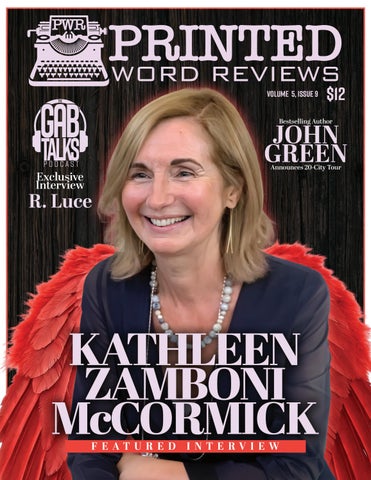
PUBLISHER'S LETTER Dear Book Lovers, Ever feel Satan is just around the corner? In this issue, Gabby Olczak sits down with the award-winning author Kathleen Zamboni McCormick to answer questions about her semi-autobiography book, Dodging Satan: My Irish/Italian sometimes awesome, but mostly creepy, childhood. This hilarious, yet poignant, coming-of-age story is being released this month on Audible. The audiobook is narrated with a spirited flair by Marni Penning. Read more about McCormick, and her eccentric chaos of her half-Irish, half-Italian Catholic upbringing. Looking for more truths, read The GAB TALKS with R. Luce on pages 5 and 10. You will be mesmerized by R. Luce’s versatility and fascinating backstory. Luce is a contemporary American author whose body of work spans novels, short stories, plays, poetry, and nonfiction, and injects real life experiences into his writing. Gabby elicits an intimate and inspiring conversation with Luce about craft, creativity, and the stories that shape us. I’ve included his “Walking on Nathan's Grave: A Tale Traversing Heaven and Hell” as well as “Pie in the Sky and Other Illusions We Live With,” a power collection of short stories, poems, a novella, and a play. Of course, I’ve included some great FALCON reviews, including two authors I discovered at CRAA Fest: M. Flagg, known for her work in urban fantasy, paranormal romance, and young adult fiction, and E.D. Lippert, whose endearing sports nostalgia will win over readers of any age. Read more reviews on www.printedwordreviews.com/ bookreviews. On the eve of the NYC Big Book preliminary soft announcements, I am even more invigorated with publishing than ever before. Having just attended my first International Dublin Writer’s Festival, I had the opportunity to speak about storytelling. I maintain we are in the golden age of storytelling, with so many more ways to capture and explain it all. Be sure to check out our Instagram page, www.instagram. com/independentpressaward/ where you can see more. Our Independent Press Award program is accepting book applications today at www.independentpressaward.com/. Everyone except the big five main publishing houses can participate. See page two. Until next time, keep on reading,
Ted Olczak TED OLCZAK
Publisher, Printed Word Reviews
www.PrintedWordReviews.com
3
www.PrintedWordReviews.com
TABLE of CONTENTS 2
Independent Press Award Call for Entries
3
Publisher’s Letter
4
Table of Contents / Disclaimer
5
The GAB TALKS with R. Luce
6
R. Luce's "Pie in the Sky" book review
7
A Conversation About Dodging Satan, Storytelling, Faith and the Power of Imagination
15
Bestselling Author John Green Announces 20-City Tour
17
Childrens Bookworm Award Call for Entries
18
Current GAB TALKS Podcast Guests
20
BookCAMP 2027
Walking on Nathan’s Grave: A Tale Traversing Heaven and Hell by R. Luce
Literary Fiction • ISBN: 979-8992220247 After a painful breakup sends a writer into a spiral of self-destruction, he finds hope and healing in a new town, where a budding romance with a police officer intertwines with the investigation of a historical murder case that challenges both their pasts and their futures. “Walking on Nathan’s Grave: A Tale Traversing Heaven and Hell” by R. Luce is an introspective exploration of love, devastating loss, and the arduous journey of rediscovering oneself. Written in a reflective style, this book is perfect for readers who appreciate deep emotional narratives centered on personal growth and resilience. The story unfolds over several months, primarily between Chicago and Emberland, Ohio, as the protagonist navigates his emotional recovery and embarks on new beginnings. The core conflict immediately immerses us in the protagonist’s raw grief following a painful breakup with his partner, Matt. We witness his descent into self-destructive behaviors—alcohol, drugs, and casual sex—a stark depiction of his initial struggles. Yet, with the unwavering support of friends, especially David Grayson, and a vital moment of self-realization, he begins the arduous task of rebuilding his life. This pivotal decision leads him to leave Chicago for Emberland, Ohio, seeking a much-needed fresh start. In Emberland, the narrative introduces Jake Davidson, a passionate police officer who draws the protagonist into the intriguing world of an unsolved 1870s murder case. As they delve into the research, a new kind of tension emerges: the protagonist’s growing attraction to Jake, battling his deep-seated fears of being hurt again. Their relationship deepens amidst the grim discovery of a grisly tale of murder and mob justice. Through this shared endeavor, the protagonist’s journey of healing and self-discovery is further supported by his evolving connection with Jake.
DISCLAIMER: The Printed Word Reviews magazine has been issued the following ISSNs by the U.S. ISSN Center, Library of Congress, Washington, D.C.: Format: Online Format: ISSN 3067-011X and is published 10 times per year. The title was previously published under the Independent Press Award and NYC Big Book Award Present with the following ISSNs by the U.S. ISSN Center, Library of Congress, Washington, D.C.: Format: Online Format: ISSN 2836-9157; and the Print Format: ISSN 2836-9149. Any questions or comments, please contact the Publisher Ted Olczak at Ted@GabbyBookAwards.com or Ted@PrintedWordReviews.com.
The resolution sees the protagonist and Jake finally confronting their feelings for each other. The protagonist bravely voices his fears, met with Jake’s understanding and supportive response. They express a genuine desire to continue exploring their connection, leaving the reader with a powerful sense of hope and resilience. The story concludes with the protagonist learning to trust again and finding renewed meaning in his life and work, underscoring the vital roles of friendship, self-reflection, and the courage to embrace new possibilities.
No portion of this magazine may be reproduced without express permission from the publisher. All rights reserved. No part of this magazine may be reproduced or transmitted in any form or by any means, electronic or mechanical, including photocopying, recording, or by an information storage and retrieval system - except by a reviewer who may quote brief passages in a review to be printed in a magazine or newspaper - without permission in writing from the publisher. To submit your book for review, send to: Printed Word Reviews, 63 Clinton Rd, Glen Ridge, NJ 07028. Allow 8 -12 weeks. Unpaid reviews are not guaranteed. More details available on our website at www.printedwordreviews.com
“Walking on Nathan’s Grave: A Tale Traversing Heaven and Hell” is an emotional journey that will resonate with anyone who has experienced the complexities of love and loss. It emphasizes the transformative impact of personal growth, the invaluable support of friends, and the sheer courage required to start anew.
To submit your book for our award programs, visit the websites: Fall 2026: https://www.nycbigbookaward.com/ (More consumer focused; different judging; allows for all authors and publishers to participate; closes every August 15th, winners announced in October of every year.) Spring 2027: https://www.independentpressaward.com/ (Independent press and authors consideration; does not permit the big 5 publishing houses to participate; closes December 15th every year, winners announced in March of every year.)
www.printedwordreviews.com/bookreviews/9798992220247
FALCON
To advertise, please contact: Ted@GabbyBookAwards.com or Ted@PrintedWordReviews.com, or visit our website, https://www.independentpressaward.com/advertise www.PrintedWordReviews.com
REVIEW
S P OT LI G H T 4
www.PrintedWordReviews.com
R.Luce With
A Conversation with R. Luce By Gabby Olczak
D
uring a recent episode of The GAB TALKS, we had the pleasure of speaking with author R. Luce, recipient of the 2025 NYC Big Book Award for General Fiction for his acclaimed novel Walking on Nathan’s Grave. A versatile and accomplished writer, Luce’s body of work spans fiction, nonfiction, plays, short stories, and poetry.
Throughout his career as an educator and trainer, he authored professional articles, book chapters, promotional materials, scripts, and a wide range of educational content. Beyond writing, he has performed in and directed plays and appeared in Ohio University student film productions. A graduate of SUNY Brockport, Luce went on to earn both M.A. and Ph.D. degrees from Ohio University, specializing in Creative Writing, American Literature, and Rhetoric. His recent publications include the award-winning novels Walking on Nathan’s Grave a Waning Star, along with the nonfiction work The Millfield Mine Disaster. In our conversation, Luce shared insights into his writing journey, creative process, and the inspirations behind his work, offering readers a fascinating glimpse into the mind of an award-winning storyteller. Gabby: Ron, I am amazed at the breadth of your writing: novels, non-
pilation of short stories, a novella, poems, and a play that focuses on
fiction, short stories, essays, and poetry. Your work is genre-defying.
the human daily struggle. You said it is likely to’ join those works al-
You were a college professor, an artist, and an actor.
ready being censored’. Why do you feel that way, and
When did you first realize writing would become
what inspired you to write it?
such a central part of your life? Ron: I wanted to share some of my most deeply felt Ron: I’ve always written as far back as I can remem-
convictions about what’s going on in the world and
ber. When I was working as a college professor I had
what it might take to see a better world than we’re
to write all the time for all kinds of things. I thought
currently experiencing. I wanted to share in multiple
of myself as a writer from the time I started teaching.
forms. I knew it was risky to do that. I feel like there’s
In terms of the novels and those sorts of things, that’s
a coherence to it that makes it work as a whole. It was
all been within the last ten years that I’ve really made
my goal to try to link these things together in a way
that commitment to trying to be a writer who writes
that felt like an honest expression of who I am, what I
fiction.
believe in, and what I think about.
Gabby: I was particularly drawn to your book Pie in the Sky and Other Illusions We Live With. It is a comwww.PrintedWordReviews.com
Continued on page 14
5
www.PrintedWordReviews.com
Pie in the Sky and Other Illusions We Live With by R. Luce
A searing collection of poems, stories, and memoir that exposes the false promises of American myth, from poverty and family trauma to labor struggle, queer love, and the fight for dignity against oppression.
Cross-genre • ISBN: 979-8992220278 In an era of glossy self-help and curated personas, R. Luce’s “Pie in the Sky and
just focus on the politics of the strike; he focuses on the bodies, specifically the
Other Illusions We Live With” arrives as a jagged, necessary corrective. This is a
targeting of Black miners like Sam and the ultimate destruction of the Bridges
structural autopsy of the American Dream, performed through a sophisticated
family. This section serves as a powerful reminder that the “justice” we are
blend of fiction, poetry, drama, and raw memoir. Luce targets the “illusions” we
promised is often contingent on the color of one’s skin or the depth of one’s
cling to: work, family, and justice, and exposes the hollow spaces where those
pockets.
promises often fail to materialize. Luce’s “family drama” sections are perhaps the most Luce’s versatility is the collection’s greatest strength. By
relatable and painful. Through the Graysons, we see a
moving between the internal monologue of a blocked
family not as a sanctuary, but as a site of suppressed
writer and the epic, blood-soaked history of a West Vir-
grievances and long-term abuse. The confrontation led
ginia coal strike, the author suggests that whether our
by Ben and Ginny against years of parental neglect and
struggles are private or systemic, the root cause is of-
marital violence is cathartic but avoids easy sentimen-
ten the same: a fundamental gap between cultural ide-
tality. These stories suggest that breaking an illusion
als and lived reality. The prose is unflinching, favoring
often requires breaking a relationship.
a grit-under-the-fingernails realism that demands the reader look directly at the discomfort.
The collection concludes with a shift into nonfiction, where the author’s own history, one marked by poverty,
The collection opens with intimate portraits of isolation.
an alcoholic father, and failed marriages, provides the
In pieces like “Mark LaZar,” Luce captures the paralysis
emotional backbone for the preceding fiction. The writ-
of self-doubt and the quiet tragedy of being unable to
er’s visit to a father lost to dementia is a masterclass in
accept intimacy even when it’s offered. This theme of
restrained grief.
compromised choices takes a darker, more visceral turn with Will Beesom. Waking in a freezing trailer after
Crucially, the book ends not with a “pie in the sky” prom-
a drug-fueled haze, Will’s betrayal of Elma Worthing, a
ise of a heavenly afterlife, but with a firm rejection of
woman who offers him nothing but kindness, serves as
it. Luce argues that if we spend our lives waiting for a
a searing indictment of how desperation can erode the moral compass.
reward in the next world, we fail to demand justice and meaning in this one.
The centerpiece of the collection is a sweeping narrative of the 1903 West Vir-
“Pie in the Sky and Other Illusions We Live With” is a heavy, challenging, and
ginia coal strikes. Here, Luce excels at historical drama, pitting union leaders
deeply rewarding read. It is tailor-made for an adult audience that values literary
like Moze Bridges and Josiah Wheeler against a machinery of corporate greed
complexity and isn’t afraid to see the darker corners of the American experi-
and state-sanctioned violence.
ence reflected on the page. Luce has crafted a work that is as much a manifesto as it is a literary achievement.
The depiction of the “pre-dawn” massacre is particularly haunting. Luce doesn’t
www.printedwordreviews.com/bookreviews/979-8992220278
FALCON www.PrintedWordReviews.com
S P OT L I G H T
REVIEW 6
www.PrintedWordReviews.com
A Conversation About
Dodging Satan
Storytelling, Faith and the Power of Imagination NEWLY RELEASED on Audiobook:
K
www.audible.com/pd/B0HFKCHJBN
athleen Zamboni McCormick has always understood the power of storytelling as a way to remember the past, and as a way to make sense of it. A Professor of Literature and Writing at Purchase College, SUNY, where she teaches writing at all levels as well as Irish and Italian-American literature, Kathleen brings both a scholar’s perspective and a storyteller’s imagination to her work. www.PrintedWordReviews.com
7
Her first full-length novel, Dodging Satan: My Irish/Italian, Sometimes Awesome, but Mostly Creepy, Childhood, grew out of her experiences as a Catholic girl growing up in an Irish-Italian household in Cambridge, Massachusetts in the 1960s and ’70s. The novel has earned numerous awards for humor, and Kathleen was also the 2019 recipient of the Elena Lucrezia Cornaro Award, which recognizes outstanding Italian-American scholars for contributions to their professions and communities. Through Bridget Flaherty, Kathleen transforms a complicated childhood into a story about family, faith, identity, and growing into one’s own voice. Kathleen’s journey has also led her from academic writing into fiction, audiobook production, and now a sequel that continues Bridget’s story into the changing social and cultural landscape of the 1970s. In our conversation, Kathleen reflects on the experiences behind Dodging Satan, the freedom she found in fiction, the power of laughter and imagination, and where Bridget’s story and her own writing adventure may lead next.
Dodging Satan Introducing Bridget Flaherty
emerging sexuality, and God the Father’s romantic life will both move and delight readers.
You describe as fiction that grew out of a memoir. How would
From Storytelling to Fiction
you introduce your protagonist, Bridget Flaherty, and the world she inhabits to readers who are unfamiliar with the book?
You’ve been a storyteller much of your life, and the novel is Dodging Satan is a humorous but poignant coming-of-age story of
inspired by your childhood experiences. Why did you choose
Bridget Flaherty, a student at St. Michael’s Catholic school outside
fiction as the vehicle for telling your story?
Boston in the 60s and 70s. We enter her world from the time she is three, when she is consumed by Bible stories, until she’s
Storytelling has been a part of me for as long as I remember.
fourteen and experiencing a burgeoning sexuality and feminism.
From when I was very little, I believed that stories had the power
The book opens with her having received a frightening ‘Godly
to keep people safe by somehow magically enveloping us. Family
gift’ for her first Holy Communion at age seven and ends when
gatherings were filled with stories, and every aspect of them
she’s a freshman in high school, devoted to the Virgin Mary, ‘even
enthralled me. I’d listen for different cadences, distinct rhythms of
though she hasn’t gotten pregnant in high school.’ Bridget’s wacky
each relative, admiring the wealth of styles they’d use to make even
misunderstandings of Bible Stories and Catholic beliefs enable
the drunkest among us grow silent. Captivated by the undulation
her, for much of the book, to avoid the problems of her Irish/
of their voices, how they might whisper in cigarette-husky tones,
Italian family life. She creates glorious supernatural worlds—with
how their pitch could deepen here, rise there, how they could hold
exorcisms, bird relics, Virgin Martyrs, time travel, Biblical plagues,
us, rapt, or, in an instant, make the room and any strains within it
even the ‘holy’ in holy water!—to cope with a family where leather
dissolve in laughter. So I told stories years before I started writing
handbags and even garlic can cause terrible strife. It’s my hope that
them.
Bridget’s musings on sadistic nuns, domestic violence, her own
www.PrintedWordReviews.com
8
www.PrintedWordReviews.com
Why Fiction Felt Liberating
Marni Penning bring Bridget’s voice to life?
You’ve written that you find “a memoir constraining and fiction
I’ve done a lot of readings from Dodging Satan at conferences
to be quite liberating.” What kinds of truths were you able to
and literary book fairs, and I was quite clear how Bridget’s voice
uncover through fiction?
sounded. Initially, I was just kind of shocked that Marni’s Bridget
For many years, my writing was exclusively academic: about
didn’t sound the way I’d come to voice her. But Marni Penning is
literature, or about teaching literature, or teaching writing. I
incredible. She’s an award-winning audiobook reader as well as
found that incredibly stimulating. For the last decade or so, I’ve
an actress, so she gives the book such a dramatic aliveness. When
done more “creative” writing, though, of course, academic writing
Marni is reading, each character has a separate and identifiable
involves great creativity. I love the process of writing, the sense
voice. She really “got” the book and she added all sorts of verbal
of discovery that accompanies it. You never end up where you
gymnastics that I hadn’t thought of. I found myself laughing out
think you’re going
loud at Marni’s
to; whether you’re
Bridget. It
writing a story or a
became clear to
critical analysis of
me why Marni
something.
has been called “the Maven of a Million Voices.”
I found memoir constraining, even when you are using material that can
What do you think listeners will gain from hearing Bridget’s story performed aloud?
be based in real life experience, you want to be able to play with it to create a better story. I always exaggerate in real life, even when I’m just telling my husband about my day at dinner. Any story I tell is always a
I think hearing
bit suspect in terms
Bridget’s story
of actual veracity,
performed
and since I love
aloud will
to tell stories, the
definitely give
switch from memoir
listeners an even
to fiction just let me
stronger sense
do that without holding back, which was amazingly liberating and
of the humor in the book, and possibly of the sadness that often
enjoyable.
underlies that humor.
Giving Bridget a Voice
Memory, Family and the Irish-Italian Experience
You announced the release of the audiobook version narrated
How much of Bridget’s perspective comes from your own
by Marni Penning. It must be a unique experience to hear
memories and exploration of your Irish-Italian Catholic
someone else interpret your characters, especially on such a
childhood, and how much emerged as you developed her as a
personal level. What was your reaction the first time you heard
fictional character?
www.PrintedWordReviews.com
9
www.PrintedWordReviews.com
www.PrintedWordReviews.com
10
www.PrintedWordReviews.com
as well, religion made frightening experiences not only endurable, At home, alone in my tense nuclear family, any gaps in
but epic. The book is about religion and many aspects of a child
conversation seemed to me potentially quite dangerous. So, at an
growing into her teens, so naturally sexuality is also going to get in
early age, I began to fill the gaps with as many stories as I could
there. And as Bridget’s Catholic friend, Agnes, points out, how can
create, treading a fine line between embellishment and truth, and
we mortals have sexual feelings if God didn’t have them first; hence
always searching for ways to be amusing and to mollify, to soothe
Agnes and Bridget’s speculation on God-the-Father’s romantic life.
the pain my parents seemed unable to stop causing each other.
Finding the Balance Between Humor and Darkness
There was genuine tension between my parents that seemed to me as a child to be ethnically based. It must have been more complex
The subtitle promises a “Sometimes Awesome But Mostly
than that but it was a solid way to begin developing Bridget.
Creepy Childhood.” The novel explores childhood anxieties: Since large numbers of people in the US share Irish and Italian
family conflict, abandonment, and questions about faith. How
ancestry, one might too easily forget the hostility that previously
did you balance the humor and the darker moments of Bridget’s
existed between Italian Americans and Irish Americans. I grew up
world?
with my Italian grandparents and my Irish grandfather expressing this hostility. I’ve written on the status of Italian Americans in this
There’s an immediacy to humor that quickly builds and it’s either
country, but what made the tension play such a prominent role in
going to quickly go well or not. Most humor writing, and certainly
Dodging Satan for me is that Italian/Irish tensions were the first
mine, has a much darker underside. Getting that balance right
ethnic antagonisms I experienced as a child. Like most prejudices,
is always tricky. In Dodging Satan, there are issues of sexism,
they didn’t seem based in anything real. My Irish grandfather
abuse, fear of mortality, vestiges of the immigrant experience,
called all Italians “low class,” but he was much poorer than my
particularly in all the Italian relatives, and a story of how the
Italian grandparents. I couldn’t understand how or why my mother
females in a family, though all individually under the thumb of
forbade me to tell anyone in our Irish parish when I started to go
some patriarch, can still work together to help a young girl come
to school that I was half Italian. Obviously prejudices against new
into her own that you want the reader to take seriously. I’m so
immigrants exist to the present day, as has become increasingly
pleased when I read customer reviews on Amazon from people
obvious recently, and similarly these prejudices often exist without
who say they laughed out loud when reading Dodging Satan. I’m
any basis in the real world.
also happy when they say it’s a little weird, or that you didn’t have to be Catholic to understand or like the book or to identify with
Growing Up Catholic
Bridget. My greatest inspiration is the power of laughter. Early in my life, I came to value anyone who could make me laugh because
The Catholic parish world of the 1960s is an important presence
of the incredible feelings it created—release, joy, lightness of being.
in the book. What did you most want to capture about that time,
I’ve never stopped appreciating the power of the comic, and I get
culture, and community?
such pleasure when I make someone laugh, or even smile. For me, the most effective humor occurs when it takes the form of a story,
As a child, when I discovered Bible stories, I was ecstatic. Not
whether written or told. Storytelling is something I’ve always loved
only did they promise me a virtually endless source of interesting
and it feels natural to me, perhaps because of both my Irish and
narratives, they were all somehow connected and connected to
Italian ancestry.
me. You could say that Bible stories were my first experience with a “series.” Further, because we were taught that God was present in
The propensity to exaggerate, embracing the slightly weird, and
all places across time and space, I felt that he was literally always
being comical are all attributes Bridget shares with me. I love to
there, responsible for everything in my immediate and extended
make people laugh. I really do believe that laughter is such a gift.
family. It was a relief for a time to think that all the tension, verbal,
In Dodging Satan, I very consciously exaggerated bits of “real life”
and physical abuse that happened in my immediate and extended
story and then created other stories in which it would be quite
family was ultimately of God’s making, that everyone was somehow
obvious that Bridget is exaggerating to everyone but Bridget which
doing his will.
is part of the fun of the book. Some of the events in Dodging Satan did really happen to me.
As I remember my life as a child, and I feel this is true for Bridget
www.PrintedWordReviews.com
11
www.PrintedWordReviews.com
The Adventure of Writing
Faith, Identity and the Catholic Imagination
You’ve said that writing is “what Lou Reed calls the Bridget’s encounters with religion, from finding “the holy” in
beginning of a great adventure” because stories often take
holy water to questioning the role of women in the Church,
writers somewhere unexpected. Where did Dodging Satan
reveal both devotion and doubt. How did you approach the
unexpectedly take you?
complicated relationship between faith and identity in the novel?
The place it took me was to change my writing from largely academic to fiction writing. As part of that transition, I developed
Two different critical reviews of Dodging Satan comment on the
a new favorite writing spot. A few years ago, we moved into a new
book’s use of what Andrew Greeley calls the ‘Catholic imagination,’
townhouse that has an incredibly cool room at the top, where my
the belief in “a God who is present in the world, disclosing
(then 15-year-old) cat, Katerina Puck, and I hung out to work. I
Himself in and through creation.” In Dodging Satan, I try to take
called it our “chick loft” and it’s got my huge storyboard in it where
to an extreme what the effects of such a belief in God’s physical
I started to plot out my work by hand on index cards, a sloping
presence in the world might be to a child with a particularly active
ceiling under which I write on my laptop, and an incredibly funky
imagination.
curved window that lets me look at the world outside to see if it’s more interesting than the world developing in the loft. I get
Satan isn’t a myth for Bridget; he haunts her bedroom every night.
a couple of hours of writing in during the morning, which sets
Mary isn’t a figure from the distant past; “she gets to time-travel
the tone for the work I’ll be doing the rest of the day (if I’m not
and become famous across all time and space.” I hope to show in Dodging Satan how Catholicism can be a religion of living and frightening presence, particularly to a child. The humor derives from the combination of Bridget’s limitations. She can only comprehend the complexities of the eternal with her extremely literal child-mind and her absolute assuredness that she’s figured it all out.
Looking Back After Publication Dodging Satan is a very successful debut novel. It has nearly a dozen literary awards including the 2020 Independent Press Award in the Humor & Wit category and a Distinguished Favorite in the 2017 New York City Big Book Award in Humor. Has your perspective of your own past and the paths you chose been altered since publication? My penchant to exaggerate has actually made me almost believe that some of Bridget’s experiences were really my own!
Dodging Satan www.PrintedWordReviews.com
12
What Readers Can Carry With Them
teaching). My preference is to have large blocks of time. I’ve never been the kind of person who has a spare 15 minutes and can quickly jot down ideas. Though I envy those people. A few years ago, I tried
What do you hope readers, those who see parts of themselves
something really new for me. I wrote with a group of people online
in Bridget and those who didn’t grow up Catholic, carry with
from all over the place from 10:30-12:30 EST, but some were early
them after finishing the novel?
risers in CA. We showed up for each other in a small Facebook group and wrote using what’s called the Pomodoro method—25 minutes
I hope readers will become a little more attuned to their own
on and 5 minutes off for 2 hours. The completely unobtrusive
imaginations and journeys and that, like Bridget, they’ll be willing to
companionship and our little Facebook reportings during our 5
give it a go.
minutes off created an extremely supportive group.
The Next Adventure I realised as well that in my writing, I’m a pantser. I didn’t even discover the opposing terms “pantser” or “planner” until I read a
What is your next adventure?
blog post by Audrey Kalman, another SHRP writer. But I knew the concepts. It doesn’t mean I don’t plan, but in the writing itself—and
I’m writing a sequel to Dodging Satan which focuses on Bridget’s
I’ve found this true of the academic writing that I’ve done all of my
final two years in her same Catholic high school. Cambridge,
adult life as well as the more creative writing like Dodging Satan —
MA, where Bridget lives, has become increasingly hip during
you are open to the new ideas that the very act of writing generates.
the 1970s and once again it is with humor and some pain that Bridget struggles to grow into the exciting and liberating new world she’s encountering. Whether discovering politics in protest marches and songs, feminism on the Mary Tyler Moore show, or shocking critiques of Catholicism in radical theology, Bridget feels increasingly constrained by her family. They seem paralyzed by their social class, endless family secrets (yes, there are many more than those in Dodging Satan!), ethnic tensions, sexism, and religious conservatism and Bridget must try to develop the inner strength to face those paralyzing forces and find independence without losing her family, social roots, and religion.
Dodging Satan My Irish/Italian, sometimes awesome, but mostly creepy, childhood
13
www.PrintedWordReviews.com
Continued from page 5
like people to remember Ron Luce?
Gabby: Once Upon a Waning Star: A Literary Chronicle of America at the Edge of Time is the next book I’d like to discuss. It’s a genre-de-
Ron: I would like people to like my work. I would like people to think
fying work that blends the gripping narrative of a political thriller with
that I said valuable things that enhanced the world. That I left some-
the innovative structure of a play. It’s truly unique.
thing behind that others can pick up on and engage the world with different eyes as a result of having read good literature. I don’t expect
Ron: What makes a good book is that there are layers upon layers of
to gain huge fame and fortune, but I do want my work to be read, and
meaning that you can delve into depending on how you choose to read
I want people to say, that’s good and do something with that informa-
it. The structure is such that you’re listening to a narrator talk about a
tion.
play that is being produced. We start out with the concept of going to a play, then the next thing we know we’re meeting the actors backstage and getting to know them as human beings who happen to be actors. Gabby: Why did you choose to focus on the after-effects of the January 6 insurrection the damage that trickles into everyday life as a result of the event.
With
Ron: It all takes place on the one day after the attempted coup. I chose that because in many ways it was the beginning of a whole new way of
R.Luce
seeing what’s going on in our country. As an American, I was so horrified by that experience. The notion that I am an American and we have freedoms and we have rights, and the notion that somebody could take that away in an instant was terrifying. I wanted to speak out. I wanted
To listen to and watch th full interview visit www.theGabTalks.com. To learn more about R. Luce and purchase his novels visit www.RLuce.net
people to hear that we have to do something. The message comes back to finding a way to let go of hatred. Finding a way to be kind even when other people aren’t kind, to find ways to interact with one another where we can try to understand one another. Gabby: Walking on Nathan’s Grave is the winner of the NYC Big Book Award for General Fiction. Nathan’s Grave is a literary novel that follows your protagonist through a journey of personal struggle, self-discovery, and healing. It’s very emotionally charged. How much did you derive from personal experience? Ron: A great deal, particularly in the main character, Rob Wilson. I didn’t have exactly those experiences, of course but they feed on experiences that I’ve had of disappointment, feeling like no matter how hard you try, no matter how hard you work at life, it just doesn’t always work out. Gabby: What would you like your literary legacy to be? How would you
www.PrintedWordReviews.com
14
www.PrintedWordReviews.com
Come The Blood Moon Night
Bestselling Author
John Green
by M. Flagg
Paranormal Romance/Fantasy • ISBN: 978-1509264636 A warlock scarred by prophecy and a nurse torn between worlds must confront dark magic, vampire war, and his own seductive new power to save the people he loves before destiny consumes them all.
Announces 20-City North American Tour for Adult Fiction Debut, 'Hollywood, Ending'
#1 internationally bestselling author John Green is hitting the road this fall for a massive 20-city North American tour to celebrate his highly anticipated new book, HOLLYWOOD, ENDING, published by Dutton Books. Set to hit shelves on September 22, 2026, HOLLYWOOD, ENDING marks a major milestone for Green: it is his adult fiction debut and his first novel in nearly a decade. The tour will bring the beloved author to major cities across the United States and Canada, including Toronto, New York, Chicago, Los Angeles, and Green’s hometown of Indianapolis. At each tour stop, Green will share the stage with a special guest (to be announced at a later date) for an evening of conversation about the book, audience Q&As, and more. HOLLYWOOD, ENDING follows two rising actors, Kai Laramie and Juniper Castillo, who find themselves thrust into the spotlight after being cast in a highly anticipated biopic about iconic artist Andy Warhol. As the production brings them fame, intense public scrutiny, and a deep connection with one another. Described as tender, heartbreaking, and funny, the novel explores the delicate balance between public exposure and private intimacy, and the bravery required to pursue genuine love. Fans can catch John Green in the following tour cities: •
•
•
• •
East Coast & Northeast: New York, NY; Washington, D.C.; Pittsburgh, PA; Portland, ME South & Southeast: Birmingham, AL; Winston-Salem, NC; Gainesville, FL; Nashville, TN Midwest: Indianapolis, IN; Chicago, IL; Madison, WI; Minneapolis, MN; Kansas City, MO Southwest & Plains: Tulsa, OK; Tucson, AZ; Salt Lake City, UT West Coast & Northwest: Boise, ID; San Diego, CA; Los Angeles, CA; Toronto, CAN
More information regarding tour dates, venues, and ticket sales will be released in the coming weeks. Fans can check for updates and find more details at johngreenbooks.com.
Come the Blood Moon Night is a paranormal fantasy that bridges Manhattan streets with the high-magic political intrigue of a hidden dimension. Serving as a turning point in The Champion Chronicles, this installment delivers a satisfying blend of dark magic, global vampire warfare, and a deeply tested romance. The novel expands its universe, juxtaposing a contemporary urban setting with the ancient, corrupt hierarchy of the Second Realm. Flagg weaves a web of supernatural politics where warlocks, vampires, and hidden civilizations collide. The magic system feels tangible and dangerous; magic here is an addictive, corrupting force. The introduction of the Second Realm’s economy, the corrupt immortal sorcerers, and the lore of the North Country people adds an epic-fantasy layer to the established urban fantasy backdrop. The narrative maintains a tense pace by balancing three major overlapping conflicts. First, Chris’s slow corruption via Vadoma’s mysterious, coin-filled chests creates an excellent, slow-burn tension. Watching a hero transform into a danger to those he loves is a classic, effective trope executed nicely here. Next, the retaliatory strike by the Summoned Six and Angus keeps the action-oriented reader engaged. The international stakes give the vampire war a grand, catastrophic scale. Lastly, the internal betrayal between the immortal sorcerers Archibald and Cardiff adds sophisticated intrigue, proving that the villains are rarely a united front. The climax under the Blood Moon serves as a convergence of these plotlines, offering explosive magical revelations alongside a daring prison break. Chris Forbes undergoes a satisfying transformation. His journey from a reluctant, vision-plagued warlock to a self-actualized ruler who rejects corrupted power (symbolized by burning the vest and journal) is a subversion of the “Chosen One” trope. He doesn’t just accept his destiny; he redefines it on his own terms. Paige Virelli provides the emotional heartbeat of the story. Her separation from Chris due to the dark magic’s toll raises the emotional stakes. Rather than being a passive damsel, her final choice to accept a life split between two worlds gives her agency and grounds the fantastical elements in real human emotion. The inclusion of allies like Lukas, Uriel, Draven, and Martine ensures the world feels lived-in. The stakes feel real because the narrative isn’t afraid of consequences. The demise of Deepa and the crippling of the Georgian network ensure the victory feels earned, not cheap. Chris’s ultimate victory is rejecting the corrupt artifacts meant to control him and finding his own source of power. The novel also explores how magic degrades the soul and relationships, forcing characters to make painful sacrifices to keep their humanity intact. This book is tailor-made for adult readers who crave mature, plot-driven supernatural fantasy. Similar titles are Jim Butcher’s Dresden Files, Deborah Harkness’s All Souls trilogy, or Ilona Andrews’ hidden-world lore. Readers can expect high magic, urban fantasy aesthetics, political schemes, lethal vampire factions, and a central romance that undergoes a trial by fire before reaching a unique, cross-dimensional outcome. Come the Blood Moon Night raises the stakes to a cosmic level while keeping its characters anchored in relatable emotional struggles. It is for fans of dark urban fantasy who want their magic to have real, lasting consequences.
www.printedwordreviews.com/bookreviews/978-1509264636
With more than 60 million books in print worldwide, John Green is the acclaimed author of generation-defining novels like The Fault in Our Stars, Looking for Alaska, and Turtles All the Way Down. He has also found massive success in adult non-fiction with The Anthropocene Reviewed and Everything is Tuberculosis. www.PrintedWordReviews.com
FALCON
REVIEW
S P OT L I G H T 15
www.PrintedWordReviews.com
Just One More Batter
Grabtown
by E.D. Lippert
by Sarah P. Blanchard
Sports • ISBN: 979-8271988158
Thriller/Mystery • ISBN: 979-8999692207
On a perfect June night in 1966, a 12-year-old pitcher and his struggling Little League team battle through heartbreak, heroics, and a tied championship before darkness ends the game, leaving one boy forever haunted by what might have happened if it had lasted one more batter.
In a small town haunted by buried secrets, two estranged sisters confront their family’s dark past and the trauma that binds them, as they unravel a chilling murder mystery that threatens their lives and forces them to redefine their bond. Sarah P. Blanchard’s “Grabtown” is a hauntingly atmospheric psychological thriller that proves the past is never truly buried; it’s just waiting for the right person to dig it up. Weaving together the sweltering tension of a 1985 summer with the stark realities of the present day, Blanchard delivers a narrative that is as much about the resilience of the female spirit as it is about a cold-case murder.
For themes of sportsmanship, nostalgia, and growing up, E.D. Lippert’s Just One More Batter is pitch-perfect. This sports novel centers on a high-stakes 1966 Little League championship and is a tender exploration of friendship, parental influence, and the true weight of our childhood memories. Twelve-year-old Rick Cooper enters the Burnside Rec Council championship game with the weight of the world on his shoulders. Pitching for the Orange Crush, Rick privately believes that his entire baseball future hinges on this single evening. Adding to the pressure is his best friend John, who is mired in a season-long batting slump, and the fact that Rick’s own father is the team’s head coach.
The story opens with a visceral, high-stakes introduction: twelve-year-old Elena and her sisters are in a shipping container, a desperate gamble for a new life in America. This thread of survival mirrors the internal struggles of the protagonists we meet later: twins Cassie and Ana.
What follows is an inning-by-inning narrative tension. Lippert wastes no time plunging readers into the action. Early innings deliver instant drama when center fielder Frankie is sidelined. John steps into the outfield to make an extraordinary play, only to later strand the bases loaded.
Returning to their childhood home in Connecticut following their mother’s death, the sisters expect to find old furniture. Instead, they find a manuscript. Written by their mother’s best friend, AJ Porter, the pages detail a 1985 murder investigation involving a local farmer, Jimmy Desjardins. As Cassie becomes obsessed with AJ’s words, the idyllic veneer of their small town begins to peel away, revealing a rot that stretches from the 80s directly into Cassie’s modern-day marriage.
The emotional core of the game shifts when the rival Green Machine’s powerhouse, Duke Kari, crushes a devastating grand slam. Just as the Orange Crush claw their way back to even the score, the umpire calls the game early. The forced overnight intermission forces Rick to step off the mound and confront his anxiety. Through a hospital visit to Frankie and conversations with his mother, Rick is forced to look beyond his own strike zone, gaining empathy for his rivals and insight into his teammates before the game reaches its conclusion the following evening.
The heart of the novel is the evolving bond between Cassie and Ana. Blanchard captures the complexity of twinhood—the shared history, the unspoken resentments, and the fierce, protective love that surfaces when the world turns dangerous. “Grabtown” doesn’t treat trauma as a plot point, but as a living character. Whether it is the harrowing journey of Elena or the emotional fallout of Cassie’s discovery regarding her husband, Marsh, the book explores how we carry our scars.
Literature often struggles to capture the quiet, fiercely loyal dynamics of twelveyear-old boys, but Lippert nails it. Rick and John’s bond is tested not by cruelty, but by the intense pressure they place on themselves. Furthermore, the book handles secondary characters well; a stray cat wandering onto the field subtly humanizes Jimmy, a teammate Rick had previously written off as a mere bully.
The story acts as a bridge between eras, forcing the characters to decide if the truth is worth the destruction it causes. From AJ’s moral dilemma in 1985 to Cassie’s modern-day whistleblowing, the “truth” is portrayed as both a burden and a liberation.
Coach Cooper is an exemplary figure of positive coaching. Rather than a hardnosed win-at-all-costs figure, Rick’s father offers measured, stabilizing leadership. Combined with Rick’s mother, who provides the crucial perspective, the novel offers a refreshing, healthy blueprint for family dynamics in competitive youth sports.
“Grabtown” is a slow-burning suspense. It avoids the cheap “jump scares” of the genre, opting instead for a deep, emotional resonance that stays with the reader. The climax, a chilling intersection of a historical mystery and a modern-day digital crime ring, is handled with a deft hand, leading to a resolution that feels earned rather than forced.
Just One More Batter dares to subvert the classic “underdog wins the trophy” trope. By focusing on the game’s bittersweet reality, Lippert elevates the book from a standard sports procedural to a poignant piece of character education. The flash-forward epilogue tracks where the boys end up as adults, beautifully reinforcing the theme that baseball can teach us how to live, but it cannot decide who we are.
“Grabtown” is ideal for fans of intricate, character-driven mysteries such Kellye Garrett’s “Like a Sister,” Liz Moore’s “The God of the Woods,” and “The Moonflowers” by Abigail Rose-Marie.
With zero profanity, zero romance, and a hyper-focus on team dynamics and emotional resilience, E.D. Lippert has crafted a clean, gripping, and deeply moving novel. It is a home run for reluctant readers, sports fans, and any kid learning to navigate the high-pressure waters of growing up. Highly recommended.
“Grabtown” is a powerful reminder that while we cannot change the horrors of the past, we have the power to choose how we walk out of them.
www.printedwordreviews.com/bookreviews/9798271988158
FALCON
www.printedwordreviews.com/bookreviews/grabtown
FALCON
REVIEW
S P OT L I G H T www.PrintedWordReviews.com
REVIEW
S P OT L I G H T 16
www.PrintedWordReviews.com
Hive
(Madders of Time: Book One) by D. L. Orton
Science Fiction / Thriller • ISBN: 978-1941368336 “Hive” marks the beginning of D. L. Orton’s ambitious new science fiction saga, “Madders of Time.” Orton is widely recognized for her acclaimed “Between Two Evils” series.
WHO CAN ENTER?
No publication date restriction. • • •
Independent Publishers • Hybrid Publishers • Self-Published Authors •
D. L. Orton, an acclaimed author known for her award-winning “Between Two Evils” series, launches a new, ambitious science fiction saga with “Hive,” the inaugural installment of “Madders of Time.” Published in 2025, this novel plunges readers into a gripping, high-stakes narrative that masterfully blends dystopian survival, intricate time travel, and a deeply emotional love story.
Traditional Publishers University Presses Association Presses
WHEN CAN I ENTER the Childrens Bookworm Award? We are on a rolling submission, approximately every two and a half months. All entries must be postmarked no later than November 15th, 2026. What if I miss the deadline? Enter our spring program IndependentPressAward.com as we take books until December 15th 2026. ENTRY FEE: $59 per title/per category, plus $50 for any additional category.
1.
Complete form: Download a form from this page, www.ChildrensBookwormAward.com/submit-online OR submit the entry form online on this page,www.ChildrensBookwormAward.com/submit-online
2.
Calculate the total entry fee. Choose which categories, www.ChildrensBookwormAward.com/categories, to enter each book into. You may enter a book into as many categories as you’d like. The fee for the first category is $59. Any additional book categories for that same book is $50 per category. SINGLE BOOK, MULTIPLE CATEGORIES: One who enters “Book One” in Children’s Educational and Book Cover Design Childrens category, the entry fee is $59 + $50 = $109. MULTIPLE BOOKS: One who enters “Book One” in Children’s Educational and Book Cover Design Childrens category, the entry fee is $59 + $50 = $109, and “Book Two” in Mystery and New Fiction (firsttime published), the entry fee is $59 + $50 = $109, so $109 + $109 = $218 in total book entry fees.
3.
4.
• If completing the paper entry form, include one copy of the entry form with the book. • If entry form is completed online, NO paperwork is required. You may send the book directly from Amazon, Walmart, or other major retailer directly to the address below. •For Audiobooks, a single copy of the completed Entry Label must be submitted along with either an include an Audible gift code or “Spotify” code on the entry form.
The premise of “Hive” is compelling: humanity is on the brink of extinction. The last survivors cling to life within Eden-17, a crumbling biodome besieged by rising seas and relentless microdrones. Among them are Isabel, a brilliant but dying scientist, and Diego, the man she loves. Their desperate hope rests on a monumental discovery: a long-lost time bridge. With their world literally falling apart, Isabel makes the ultimate sacrifice, sending Diego 35 years into the past. His mission? To avert the global catastrophe that led to their bleak present, even if it means confronting a younger version of Isabel and navigating a past fraught with forgotten secrets and powerful forces determined to control the future. Orton excels at crafting a richly imagined, albeit grim, dystopian future that feels both terrifying and plausible. The world-building is detailed, painting a vivid picture of humanity’s last stand. Beyond the technological marvels like the time bridge and the menacing microdrones, the inclusion of “Madders,” an enigmatic AI built from the memories of a genius physicist, adds a fascinating layer of scientific intrigue and even a touch of dark humor. At its heart, “Hive” is a poignant love story between Isabel and Diego. Their relationship forms the emotional core, driving the narrative with its themes of profound sacrifice and unwavering resilience. Orton skillfully explores the weight of their choices and the personal toll of attempting to rewrite destiny. The philosophical questions surrounding time, regret, and redemption are woven seamlessly into the thrilling action sequences, ensuring the story is as thought-provoking as it is exciting. While the scientific concepts, including alternate timelines and quantum physics, are complex, Orton presents them in an accessible manner, allowing readers to fully immerse themselves without getting bogged down in jargon. The book’s strong opening and the consistent increase in stakes keeps readers engaged. The end leads to a satisfying, if emotionally charged, conclusion. The characters, particularly Isabel and Diego, feel real and relatable, and the supporting cast, such as the physicist Matt Hudson, adds depth and occasional levity. It’s worth noting that “Hive” connects to Orton’s previous “Between Two Evils” series in a multiversal way, but it stands perfectly well as a standalone entry point. “Hive” is a powerful and emotionally charged science fiction thriller that will resonate with fans of dystopian fiction, time-travel narratives, and character-driven stories. D. L. Orton delivers a compelling tale of defiance, destiny, and the profound cost of fighting for a second chance. Prepare to be captivated by this ambitious and unforgettable start to the “Madders of Time” series.
Pay via PayPal button on the website or mail a check, along with your books and printed entry form (if entry form was completed online, NO paperwork is required), and ship to:
www.printedwordreviews.com/bookreviews/9781941368336
Printed Word Reviews / Children’s Bookworm Award 63 Clinton Road Glen Ridge, NJ 07028 (973) 969-1899
www.PrintedWordReviews.com
FALCON
REVIEW
S P OT L I G H T 17
www.PrintedWordReviews.com
www.PrintedWordReviews.com
18
www.PrintedWordReviews.com
www.PrintedWordReviews.com
19
www.PrintedWordReviews.com