1
www.PrintedWordReviews.com
www.PWRBookCAMP.com First, let me congratulate you and your family and staff over the excellent affair you produced. The dinner was truly fabulous,as was the accompanying get-together, photos, etc. The actual award I received was above and beyond what I was expecting, although it didn’t make it through TSA without an explanation. The TSA officer however, was also impressed after his inspection.
Scott Eveloff MD
I wanted to thank you and your family for running such an organized, first-class awards contest and banquet this past weekend. It was thoroughly enjoyable. When my friends and fans see the video snippet of the event, the reaction is typically, “Wow, based on the venue and the production, you really did something there by winning!” Thanks so much for everything,
Paul A. Cicchini
I wanted to reach out to thank you and your team. The dinner and ceremony were a genuinely special experience, and I left New York feeling grateful I had made the trip from Dubai. The evening itself was a wonderful tribute to everything independent publishing represents. Being in that room, surrounded by people who care so much about bringing different voices to readers, it meant a lot to be part of it. Thank you again, Ted. I hope you have had a chance to rest after what I can only imagine was an enormous amount of work behind the scenes.
I want to send a heartfelt thank you for hosting such a wonderful Independent Press Awards. It was truly an incredible experience and I am so grateful for the opportunity to have been part of such a well-organized and inspiring event.
VIP pictures showcased in such a grand way: the BIG screen in NY—are ones I will cherish forever. Thank you again for your dedication to supporting authors and for making the ceremony such a memorable success by including my mother. It was awesome to celebrate with you!
The care and effort you both put into celebrating the author community is evident in every detail. It was an honor to have been recognized among so many talented peers and the memories from the ceremony—including the thrill of seeing the
Warmest regards,
Diana Louise Webb
I want to extend my deepest gratitude to you, Gabby, and the entire team at the NYC Big Book Award committee for recognizing my book – Sower, Gon’s Infinity – as a Distinguished Favorite.
same time. Even though you only met me that weekend, you treated me like an old friend and that made the experience more enjoyable. I am very grateful. Thank you.
I enjoyed my time at BookCamp and learned a lot from it. The Awards Dinner was just fantastic! I am glad I was there. It was my first ever Awards Dinner, and I was both nervous and excited at the
I’ll work hard to keep the momentum going and earn my place at another Awards ceremony.
Brice
Thanks for everything.
I have had an absolutely fantastic and truly unforgettable time. We all have. It is an experience I will carry with me for the rest of my life. I am deeply grateful to you for arranging such a wonderful and meaningful event. And it goes for all of us. I also want to sincerely thank you for your generosity in offering additional time on Times Square and for the press release, as well. That is truly incredible, and I am so touched by this gesture. Everything has been handled with such professionalism, warmth, and care, and I genuinely appreciate all the work and heart behind it.
Warm regards,
Sarah Barry www.PrintedWordReviews.com
I wanted to give you a day or two to recover from the big success of the weekend before saying how much we appreciated and enjoyed the awards dinner. In my career, I have produced large events and had the pleasure of attending others and yours was professional, considerate, and entertaining! Every detail was a thoughtful nod to your honorees, and it was so appreciated. My sincere thanks and congratulations to you, Gabby and your entire team.
Ivona Olofsson 2
It was especially rewarding to share this evening with my 15-year-old great nieces and co-authors, who can’t stop talking about it...and the next book they want to write! Early in my career, I worked in sports marketing and when honoring some of the top competitors in the world, I saw strong, tough-minded athletes shed tears of appreciation when being recognized for their hard work. Please never forget how much it means to people who work hard, do their best, and get recognized among their peers. It’s the gift of a lifetime. Thank you again,
Rannah Gray
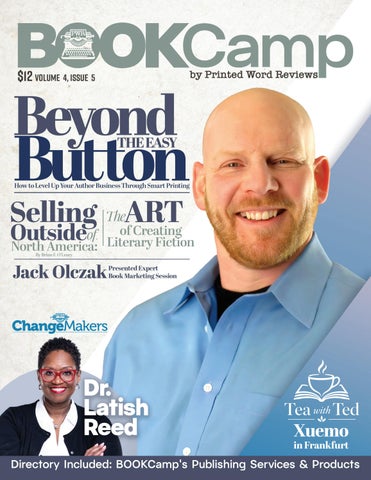
TABLE OF CONTENTS 2
Photos and Notes from BookCAMP 2026
3
Publisher’s Letter
4
ChangeMaker: Dr. Latish Reed
5
Printed Word Reviews’ VP Jack Olczak Presented Expert Book Marketing Session at WriterCon 2026
6
Friction Factor by Brian F. O’Leary Selling Outside of North America: Tapping into global revenue by conquering cross-border distribution and metadata barriers
7
Writing Classes Are the New Social Platform at Catalyst Press
8
FEATURE: Beyond the Easy Button: How to Level Up Your Author Business Through Smart Printing. BookCAMP 2026, a Dave Sheets presentation.
10
Tea with Tea: Interview with Xuemo
14
The ART of Creating Literary Fiction by R. Luce
16
“If You Ban Sally Rooney, You Ban All of Us:” The Fight Over a Writer’s Conscience
17
Amazon KDP Introduces Weekly Limits on New Title Creation to Curb Spam and Maintain Quality
19
Directory Included: BookCAMP’s Publishing Services & Products
PUBLISHER'S LETTER Is it already the last issue of the year? How did that happen! It’s been a great year for BOOKCamp magazine, let me share. BOOKCamp by Printed Word Reviews achieved several key milestones across both its publishing conference and its flagship magazine: Key Milestones • Expanded Multi-Day and Multi-Track Conference: Host to the BookCAMP 2026 multi-day publishing conference in Newark, NJ, culminating in the biggest and most exciting Awards GALA ever! Jumbo screens, new award-winning photographer, VIP seating, and afterparty dance floor were instituted. The event convened just under 300 independent authors, publishers, and industry insiders with expanded tracks covering book marketing, industry growth, and AI in publishing. This year, we added both the “Business of Publishing” as well as the “Writing” tracks to the existing “Marketing and Publicity” programming, giving even more value for the attendees. • Major Magazine Redesign: BOOKCamp Magazine unveiled a major structural and visual redesign (including the recapitalization). The revamp introduced sweeping editorial initiatives aimed at boosting exposure, offering expanded directories for print and online publishing services, and enhancing visibility for independent presses and service providers. • New Columnists and Reporters: BOOKCamp scored with the addition of Brian F. O’Leary, past Executive Director of the Book Industry Study Group (BISG); Major exclusive interviews with Kuo-Yu (梁國瑜) Liang with Jessica Shih, and Andrew Albanese and Brooke Warner with Jules Roscoe; and ongoing online J. Chester Johnson series on racial healing.
DISCLAIMER: BOOKCamp by Printed Word Reviews magazine, Online format Library of Congress ISSN: 2994-4406 is published 5 times a year. Questions or comments are welcomed, please contact the Publisher Ted Olczak at Ted@PrintedWordReviews.com.
• Newark Community & Literacy Outreach Initiative: Partnered on local community initiatives during the BookCAMP festival with the no-show Newark Library; and cultural institution Newark Museum, who receive the largest donation of the profits from the event.
No portion of this magazine may be reproduced without express permission from the publisher.
• Expanded Industry Representation: Represented independent authors and small-press publishers at major national trade gatherings, including an author showcase at AWP and curated signings at the American Library Association (ALA) Annual Conference. Our International circuit will be announced later this year.
To submit your book for our award programs, visit the websites: Independent Press Award www.independentpressaward.com (Independent press and authors consideration; does not permit the big 5 publishing houses to participate; closes December 15th every year, winners announced in March of every year.)
With so many amazing happenings this year, I’m excited to soon share our 2027 initiatives with you next month!
NYC Big Book Award www.nycbigbookaward.com (More consumer focused; different judging; allows for all authors and publishers to participate; closes every August 15th, winners announced in October of every year.)
Publish better, and be great!
Ted Olczak
To advertise, please contact: Ted@GabbyBookAwards.com or Ted@PrintedWordReviews.com, or visit our website, https://www.independentpressaward.com/advertise
TED OLCZAK
Publisher, BookCAMP Magazine
3
www.PrintedWordReviews.com
The Color of Action:
Dr. Latish Reed’s Case for Equity Beyond the Statement
“I should just write about what I’m experiencing” is a phrase most authors have said to themselves at least once. For Dr. Latish Reed, it was no different — and, in fact, a guiding principle in her educational leadership roles, consulting practice, and her 2025 debut book, The Complexities of Equity: Navigating Shades of Gray in Schools and Other Organizations.
G
rowing up in Milwaukee, Wisconsin, Reed was part of her school district’s desegregation program, and she was bused to Shorewood Public Schools, a suburb outside the city. Her parents chose this experience to encourage not only her learning but also to give her a tangible reminder of what it means to stand firmly for what you believe in. The program was a part of Chapter 220, a deep part of the state’s history that Wisconsin lawmakers created and passed in 1975, but it suddenly came to an end in 2015. What seems like a practical decision is now something deeper. Reed was often the only Black child in her class, and she had to build what she calls “this muscle around navigating the world as a black girl in a predominantly white environment.” The experience left a lasting impact, one that would eventually play into Reed’s path through education. She has spanned nearly every role within the system. She started as an adwww.PrintedWordReviews.com
4
missions counselor for Marquette University before quickly transitioning to a middle school teacher with Milwaukee Public Schools, then became an assistant principal around the time of the No Child Left Behind Act. She thought her journey had reached a peak, but that little girl who always stood determined was telling her to seek more. So to understand the complex forces shaping schools such as race, class, immigrant status, and special education needs, she earned her master’s at Alverno and then her PhD in Educational Leadership and Policy Analysis from UW Madison. After earning her PhD, she took on a professorship at UNC Chapel Hill, where she taught courses like The Cultural Aspects of Leadership Instruction in School Reform and Program Development for Special Populations. She then took on another teaching role at the University of Wisconsin-Milwaukee. Yet, with more than two decades of experience under her belt, she writes candidly in the book about her denial of tenure at UMW. A moment she says that even a high-performing faculty member like herself may go through, and is a sign to not lose your way or the reasoning for why you started the work.
VP Jack Olczak Presented Expert Book Marketing Session at WriterCon 2026
W
hile Labor Day typically offers a quick getaway before summer ends, Printed Word University’s Jack Olczak (part of Printed Word Reviews) spent the holiday presenting an exclusive presentation titled “How to Market Your Book.” at the 19th annual WriterCon, on September 5, 2026, at Oklahoma City’s historic Skirvin Hilton Hotel. With four or five sessions running at a time, Olczak had more than half of the conference in his room alone, underlining the importance of book marketing. “Writing the book was the hard part, and most good books remain invisible for reasons unrelated to the writing itself,” said Olczak. The 45-minute session ran over, as the VP walked writers through the four-rung system Olczak’s team uses with their own authors, with many clamoring for more. Olczak said “It’s built for authors at any stage—traditionally published, independent, or self-published—and designed to leave attendees with a concrete sequence they can start this week, not just a list of things to think about,” tying into the actionable sessions done at the annual BookCAMP event in Newark, NJ. “Connecting directly with authors and publishers to readers is at the heart of what we do at Printed Word Reviews,” said Olczak. “WriterCon has cultivated an incredible community of passionate creators. I’m thrilled to share practical, real-world tools that demystify book marketing and give authors the momentum they need to reach their audience.” Navigating the modern publishing landscape requires authors to be as strategic with their promotion as they are with their prose. In his Saturday 10am morning session, Olczak broke down actionable, budget-conscious marketing strategies for both indie and traditionally published authors, and gave writers a blueprint to consult when www.PrintedWordReviews.com
5
launching their book. Key topics included building an authentic author brand, leveraging targeted review coverage, running cost-effective promotional campaigns, and converting casual readers into lifelong fans. Attending writers, authors, editors, and industry professionals are invited to learn more about Printed Word University and their suite of services by contacting Jack Olczak at (973) 747-8774, Jack@ PrintedWordUniversity.com or set a meeting, https://meetings.hubspot.com/jack-olczak to answer direct questions, discuss editorial review packages, and offer guidance on maximizing book visibility in a crowded marketplace.
FrictionFactor
Selling with Brian O’Leary
Outsideof
North America Tapping into global revenue by conquering cross-border distribution and metadata barriers by Brian O’Leary
T
he U.S. market is the world’s largest for book sales, but opportunities abound in other markets, as well. Demand for English-language content can be strong in other countries, and books that are successful in the United States may attract offers to translate the work to a local language. The first places to consider are well-established markets where English-language books are already sold. Canada, the United Kingdom, Ireland, Australia, and New Zealand are good examples of countries where a U.S. author can find sales with an English-language title.
international sales on platforms that are active in the markets they want to reach. That’s an effective option to put content in any market, including those where English may not be widely spoken but interest in a topic may lead to sales in that country.
To make sure a book is readily categorized in markets outside the U.S., authors should include at least one Thema code in their metadata. Outside of North America, Thema is the default standard for subject categories, the international equivalent of the BISAC categories used in the United States.
If English-language sales are strong, consider a translation to the local language. Typically, translations are created by publishers in the target market, requiring a sale of rights by the author or publisher of the English-language edition to an international partner. Direct sales of digital content can be supported by platforms that do business internationally. Physical books require some additional planning. Increasingly, print-on-demand suppliers are operating in international markets, providing a lower-cost option to authors who may not want to create physical inventory for markets with unproven demand.
If you’ve never specified a Thema code before, the Book Industry Study Group (BISG) offers a map of Thema to BISAC that is included in the purchase or download of the full BISAC subject codes list. It is updated each year to map the current BISAC list to the current Thema category. The BISAC-to-Thema map makes for an easy start, but anyone working to sell internationally can also consult the full Thema list, published without charge. Sometimes, Thema codes provide opportunities for more granular descriptions of a title than is the case with BISAC. Specificity can help sell a book, so finding and taking advantage of the best option is recommended.
Authors can also partner with local publishers to market and distribute their books, whether physical or digital. The channels for trade sales vary across countries, so partnerships can offer a way to enter a market without having to learn all the nuances across distributors and retailers. The trade-off is in margin. Trying to enter a market directly with physical books also requires metadata that is typically underattended for domestic sale. Dimensions
Authors can sell digital content by updating metadata to authorize www.PrintedWordReviews.com
6
and weights should be expressed using metric equivalents, and books will need metadata describing where they were published and printed. Customs declarations may be required, particularly as trade regulations have become more complex in recent years. Trying to navigate these requirements without the support of a local partner is possible, but it can take time to develop the required expertise.
target markets to get a sense of how they are priced. Exceptions are possible, but try to set prices with an understanding of the local market. Resources to help anyone looking to sell internationally are available from trade associations, distributors, and publishers in the local marketplace. Two such resources are: “Internationalizing your metadata”, a one-hour video presented by EDItEUR’s Chris Saynor and hosted by BISG; and “Digital Exports Revisited”, published by Canada’s Livres Canada Books.
In most cases, works published internationally should be marketed and sold using the local currency. Platforms distributing digital content are typically set up to manage different currencies, but make sure to understand their requirements before updating a title’s metadata.
While the U.S. market remains strong, overall book reading is increasingly global. Preparing metadata and making the right arrangements for pricing, availability, and distribution are upfront requirements that can help authors find sales in markets around the world.
A price in a local market might not be a direct conversion from the U.S. dollar equivalent. Market dynamics can require lower or (less frequently) allow higher prices. Look at comparable titles in
Are Writing The Social Classes New Platform at Catalyst Press
For Tayla Mocke and Jessica Powers, there’s no better time than the present. Time zone differences, scheduled festivals, and a newly thought-out writing class can’t get in the way of the publishing duo’s goals. At Catalyst Press, an independent publishing company, they’ve honed in on a method of authors-for-authors, leaning into giving their roster of authors a new kind of platform to showcase their writing and teaching skills, and hoping to engage with a community of writers that extends across the globe. For Mocke, based in South Africa, and Powers, based in the U.S., the idea for this course of classes started just a few months ago, when they turned a conversation into action. The five-week pilot course started with one in-person class a week.
A handful of students signed up to be taught by Mike Nichol, a nonfiction and thriller author represented by Catalyst Press. His course was themed around the craft of fiction: a workshop specifically designed for writers interested in practicing the craft. The small class size and face-to-face interaction really helped engage the writers and gave an element of live feedback, which many found helpful and encouraging to keep going into next week’s lesson.
by Mali Ayala
feedback quality,” and that it was “small enough that everyone could participate without feeling like they could just sit back and turn the microphone off.” Mocke says the value is in the process. “You can definitely see the value of tangible process and real progress that they make from these practical and engaging [classes]. It’s not just a lecture. We sit back and take notes. I think there’s real value in actually engaging with people and not just with the teacher.”
Every week, Nichol would have one module, one reading, and a live in-person assignment for the group to complete. The first week was about developing character; the second was on dialogue, which helped build toward the active dialogue portion of the third week. The fourth week covered writing from three different points of view, and the final module was on actually plotting your story.
Mocke’s notes for future class takers: “If you are wanting a lecture where you can sit back, zone out, just take notes, that’s not what these classes are. These classes are for engagement and feedback, for constructive criticism. And I think I would want these students to know that we publish wonderful humans who are warm and encouraging.”
The freedom for the authors to create their own curriculum and direction for the courses is exactly why students who took the class say it “outperformed others because of its level of engagement and its
The company is already geared up to start the next set of classes. View the current and upcoming classes via the website, www.catalystpress.org/ event-list.
7
www.PrintedWordReviews.com
Beyond the Easy Button: How to Level Up Your Author Business Through Smart Printing
Dave Sheets at PWR’s BookCAMP 2026
W
hen authors gather to talk shop, the conversation almost always turns to craft. We often spend months, sometimes years, agonizing over character arcs, pacing, plot twists, and cover design.
It is a common myth that print is dead and “everything is moving to digital.” While e-books account for roughly 50% to 60% of the fiction market, choosing an e-book-only strategy means voluntarily ignoring 40% to 50% of your potential readers, according to Dave Sheets. He went on to say that in non-fiction, the numbers are even more dramatic: up to 75% of readers prefer physical books. Physical books are visible. They live on coffee tables, get passed along to friends, and create tangible connections with your readers. If you want to build lasting relationships with your audience, print remains essential.
2. Make the Best First Impression
Then, after all that creative heavy lifting is done, an afterthought creeps in: How am I actually going to print this thing?
We’ve all had that moment: a big box arrives at the doorstep, you open it with anticipation, and... the cover is misaligned, the colors are dull, or the spine is crooked.
For most authors, the default answer is the “easy button.” You upload your PDF to Amazon, or another big-box print-on-demand (POD) service, click a few boxes, and move on.
While big-box POD companies offer convenience, their automated business models can produce inconsistent results.
While POD services are fantastic when you only need one, five, or ten copies, relying on them exclusively means leaving money on the table, and potentially compromising your readers’ experience. To build a sustainable, scalable author career, you need to understand the physical side of book manufacturing and learn how to move beyond the easy button.
Imagine you’ve just delivered a knockout keynote speech or panel presentation. You walk to the back of the room, inspired audience members line up to buy your book, and you hand them a copy printed incorrectly. You only get one chance to make a first impression; a poorly manufactured book dilutes your brand as an author.
1. Don’t Ignore the Physical Book Market www.PrintedWordReviews.com
When you graduate to selling books in bulk, whether for events, speaking en-
8
• Cloth vs. Rainbow Material: Traditional cloth gives hardcovers a classic, luxury feel. “Rainbow” material is a textured, paper-based wrap engineered to look and feel like cloth or leather at a fraction of the cost. • Printed Cases: Printing vibrant 4-color cover artwork directly onto the hardcover board underneath a dust jacket. • Sprayed or Gilded Edges: Adding solid colors, foil, or custom artwork to the edges of the pages. Now, a massive trend in romance, fantasy, and sci-fi genres. • French Flaps: A fold-in flap on a softcover book that mirrors the look of a hardcover dust jacket without the high cost.
gagements, direct-to-consumer store sales, or Kickstarter campaigns, it’s time to move into short-run or long-run offset printing.
3. Demystifying Print Jargon To work effectively with professional printers, it helps to speak their language. POD vs. Digital vs. Offset • Print-on-Demand (POD) / Digital Printing: POD is often used as a catchall term, but true POD means printing one copy at a time. Digital printing uses the exact same digital equipment (essentially high-end, commercial presses), but runs 5, 50, or 500 copies in a batch. • Short-Run Printing: Typically refers to orders under 500 units, usually produced on digital presses. • Long-Run / Offset Printing: Usually reserved for orders over 500 units. While offset printing requires higher setup (“make-ready”) costs, spreading those setup costs across hundreds or thousands of units drastically reduces your per-unit cost, significantly increasing your profit margins.
5. Finding the Right Print Strategy When planning your next print run, you must balance three competing factors: Quality, Pricing, and Speed. While quality should never be compromised, having a flexible timeline gives you access to lower prices. If you are printing under 50 copies, big-box POD remains a convenient choice. But once you cross into short runs (50+ copies) or large orders for events and direct sales, working with specialized print partners gives you higher quality, lower per-unit costs, and dedicated human support when you need it most.
The Anatomy of a Book Knowing basic book terminology keeps you and your printer on the same page:
Key Takeaways for Authors
• Face: The leading edge of the book opposite the spine (not the front cover!). • Head & Foot: The top and bottom edges of the book, respectively. • Signature: In offset printing, pages are printed on large sheets and folded into groups (usually 16 pages) called signatures.
1. Design with signatures in mind so you don’t waste paid paper space. 2. Double-check image resolution (300 DPI minimum) and request soft proofs to review page layouts before production. 3. Explore custom print features like foil stamping or sprayed edges for special editions or Kickstarter campaigns to boost perceived value. 4. Calculate your true print margins on bulk orders to make sure you aren’t overpaying big-box platforms for books you plan to sell yourself.
Pro Tip on Signatures: If your book is 60 pages long and being printed in 16-page signatures, the printer will use 64 pages of paper, leaving four blank pages at the end. Instead of wasting that paper “real estate,” plan ahead and use those extra pages to advertise your website, showcase your backlist and awards, or offer an excerpt of your next book!
See Dave Sheet at BookCAMP 2027, www. PWRBookCAMP.com, and other publishing professionals that can help you.
Paper and Image Specs • DPI (Dots Per Inch): Always ensure your interior and cover images are at least 300 DPI to avoid pixelated, blurry prints. • PPI (Pages Per Inch): A measure of paper thickness. Not all 50 lb. paper is created equal. For example, one mill’s paper might measure 400 PPI, while another’s measures 454 PPI. For a thick book, this difference substantially changes your spine width.
Beyond the Easy Button
4. Unlocking Premium Upgrades When you move past standard POD, you open up a world of visual options that make your book stand out on store shelves or social media: • Embossing vs. Debossing: Embossing raises elements out of the paper; debossing presses them in. • Foil Stamping: Adds metallic accents to covers and spines.
9
www.PrintedWordReviews.com
Xuemo Interview with
A
ward-winning Chinese author Xuemo was interviewed by me via Zoom half way around the world during the Frankfurt Book Fair 2026, with interpretation by Ida Liu. The conversation focused on “The Undying Diamond Heart,” with references to “Eternal Love”, exploring the relationship between literature, spiritual practice, suffering, and human connection. The conversation focused on desert solitude to compassion: how Xuemo’s writing explores inner transformation and the responsibility to help others. Ted Olczak: Welcome. I’m Ted Olczak, publisher of Printed Word Reviews. I’m here with Ida and Xuemo, broadcasting from the Frankfurt Book Fair 2026. We’re excited to talk to Xuemo about his new book, The Undying Diamond Heart.
It was great to see you at BookCAMP this year, and congratulations on your book award. I wanted to take this time to talk a little about your writing. You have a profound depth to your writing about desert culture, meditative practice, and wisdom. Can you talk to us a little about your background growing up in Gansu, China, and how that influenced you? Especially, how does the silence of the desert landscape shape your prose? Xuemo: I write a lot about the
10
desert. I always place human beings in a very harsh natural environment instead of a big city, because the nobility of human souls can naturally present itself in this harsh environment. I love the desert very much, and I love loneliness. I’ve spent more than 20 years cultivating myself in a retreat environment because I want to seek the inner wisdom of my own soul.
and human relationships play key roles, including the tragic relationship between Khyungpo and Sarwadee. How do you view the tension between the transcendent love required for spiritual awakening and the worldly emotions that keep us human and rooted in everyday life? Xuemo: Thank you so much for your question. It is an excellent question. My answer would be that transcendence is a state achieved when individual souls rise to a higher level. In this state, one faces the world with love and wisdom. Transcendence means nothing if it remains disconnected from the world. There has to be a relationship between your awakened self and the world. When engaging with the world, we must turn this transcendent wisdom into love and insight, connecting with others and helping them achieve the transcendence that you have realized, too. People who obtain their own enlightenment without building a relationship with the outer world are called arhats. Those who attain transcendence and then help other beings reach the same state are called bodhisattvas. That is what I believe in: to transcend myself, then turn that transcendence into love and wisdom, engage with the world, and help others achieve transcendence as well. This kind of transcendent state is actually an active engagement with the world.
My novel, The Undying Diamond Heart, tells the story of a man overcoming his own desire and preserving human dignity amid harsh nature. The protagonist’s life journey in The Undying Diamond Heart can be repeated by any other person. It is very valuable because, in this book, I not only reveal the value, but also the methods. Through this book, anyone can gradually transform their own mind to achieve a higher transcendence and gain their own wisdom. Ted: We were talking about your craft and magical realism, but I want to dive a little more into Eternal Love and The Undying Diamond Heart. There is a lot of suffering that takes place. When you’re writing about these mystical realms—my question is: How do you balance being true to the sacred Buddhist tradition with your own creative literary imagination? Xuemo: Thank you very much for your question. Much of this work is both fiction and my real-life experience. That’s why the writing feels very authentic. I have lived through everything the protagonist has gone through. His journey captures the supernatural encounters along the path of self-transcendence. These experiences are very artistic and also deeply real.
Ted: At the beginning of the protagonist’s journey of self-discovery, he openly admits that he no longer believes in the inherited religious tradition. He gives up his family’s wealth and his position as a religious leader. In an era when questioning doctrine often meant exclusion or even exile, what does his story offer people today—and what kind of courage does it take to face a crisis of faith?
A writer’s imagination comes from such transcendent experiences. Without these kinds of experiences, the work could never be written. With proper practice, everyone can reach this kind of transcendent insight. That is the power of art and literature.
Xuemo: Thank you, Ted. That is a very good question. Faith and spiritual searching begin with letting go of the past. Without releasing or renouncing what came before, no new life can emerge. It is like installing a new program or new software on your computer. You must erase everything—
Ted: I understand the authenticity, but your protagonist’s enlightenment is no quiet meditation. It’s forged through avalanches, slander, physical beatings, and grief. How do you view suffering? Is suffering an absolute prerequisite for spiritual awakening, or is it simply the most reliable teacher?
Ted: Thank you, Xuemo. There are two more questions I would like to ask. You have written many books about love and wisdom. You have spoken several times about entering a state similar to meditation or flow while creating your Silk Road and epic works about western China. How much of that inner transformation have you already planned before writing, and how much emerges naturally through the creative process itself?
Xuemo: Actually, suffering has little to do with triggering spiritual awakening. Instead, it serves as a test and training ground after awakening. It matters greatly because it proves whether your awakening is genuine. Awakening can happen without suffering. Suffering comes afterward to test whether your awakening is solid and genuine. If you can endure the hardships, your awakening is real. If not, it is incomplete. Awakening is like a torch.
Xuemo (indiscernible): I write with the ideas in mind, but the story is written through the creative process.
Suffering is like the wind. Sometimes it can blow out the fire of awakening. But as you go through more trials, your torch can grow into a steady fire.
Ted: Wonderful. As an author whose work is translated globally, how do you see storytelling acting as a bridge—across geographical, spiritual, and cultural divides? How do you connect with the modern secular reader—someone who has never set foot in a monastery or on the Silk Road—and help them take away the concept you’re trying to portray in The Undying Diamond Heart? Xuemo (indiscernible): There are more and more wars, and more violence in the world... The common themes in my books is what binds us together.
Life is like a play, and awakening means realizing that it is a play. Suffering sometimes creates its most powerful and interesting scenes. The more hardships you meet, the more compelling the play becomes. Don’t get trapped in the drama of life. Step back and watch yourself performing in the biggest play. That is awakening. Ted: Xuemo, I would like to ask a related question from a different perspective. In your work, you explore spiritual attainment through devotion and renunciation. To reach a higher state, we need to transcend our attachment to the material world. At the same time, there is unconditional love. For example, in Eternal Love—and in The Undying Diamond Heart, love, attachment,
Ted: So, universal themes connecting people—rather than defining them by borders or cultural differences. We all share these human conditions and can experience wisdom through these stories. It’s amazing. It’s great. Thank you so much for this time.
11
www.PrintedWordReviews.com
Reed returned to the school district in 2016, where it all began, and became Milwaukee Public Schools’ first administrator specifically charged with leading equity work. A full-circle moment that brings those from across the organization together to write equity policies. Yet, as she puts it, “Policies and programs do not change practice, but people do.” That tension the one between good intentions and real change is the heart of her work.
pening or has happened during the action they want to enable, and when they try to implement it. It comes from the willingness to lean into being a more equitable person and maintaining that environment, even when the word “equity” itself has been criticized. These two frameworks intertwine with Reed’s consulting work, REEDLEAD Leadership Solutions, which grew out of the same gap she saw within teaching: leaders who want to lead for justice, who want to serve everyone equitably, but who don’t always know what that looks like in practice. She works in collaboration with Derute Consulting Cooperative, which she co-founded with four other professors in 2012.
Reed’s framework for understanding that tension appears in the Equity Empowerment Continuum, a tool she flips on its head by using color not to judge people, but to measure action. White, she explains, is to show “the absence of color,” the absence of action or the belief that nothing is wrong and nothing needs to change, even as documented inequities persist around us. The Continuum is a tool for identifying where you are and where you want to go, recognizing that where you are can change based on a multitude of factors. You can identify where you are in relation to equity and how you are advocating and taking action toward equity, including for others.
Her own practice focuses on keynote addresses, professional learning, and executive coaching, helping leaders assess where they are and strategize around moving the needle forward. Reed’s book and her work are a tool for people to identify where they are and where they want to go. Not everything is black and white, and it’s certainly not the default way of thinking we should have. As she puts it, “I feel that we are in a space where people need tools now to understand and to process the resistance that’s needed in this moment.”
She describes light gray as performative, for example, statements and social media activism without the willingness to confront family or friends to change an actual practice. While Dark gray is where real progress happens, within the limits of a bureaucracy, this looks like leaning into policies, procedures, and practices that make a difference. But black, although the darkest color, she says, represents the justice that would be utopian. Reed describes it as “It’s not a stationary thing. It’s dynamic.” Therefore not a fixed endpoint but an evolving ideal that people in an organization are always trying to define together.
For Reed, the light, medium, dark, and the shades in between chart the distance between action and performance, and leadership is where the two meet. What separates the two, for Reed, is introspection: constantly grappling with what equity, equality, and fairness look like in what you’re doing, and whether you’re lifting up all you can to achieve that goal. “I think some leaders forget that part,” she says about the action and act of service. “People can’t get what they need. You’re not serving people if you’re unable to serve.” Service and introspection, she says, make all the difference between talking about color and acting on it.
She pairs this with her original framework, which she calls the ICE- T, framework. Standing for Identity, Context, Experience, and Timing. A tool that shows how effectively someone can advocate depends on who they are, what is hap-
www.PrintedWordReviews.com
12
13
www.PrintedWordReviews.com
The ART of Creating Literary Fiction By R. Luce
I
t doesn’t take much effort to find all kinds of advice about the craft of writing: the so-called “rules” and “best practices” as determined by dominant voices amongst those who teach and/or criticize written language. However, when it gets down to the art of writing, the advice is less forthcoming largely because the term is abstract, almost impossible to explain, and has a variety of meanings depending upon who is doing the defining. The whole issue is too often reduced to throwaway lines like, “You either have it, or you don’t!” or “I know it when I see it.”
without the underlying commitment to creating art, those things are purely mechanical. Cliches about art abound: “Art is whatever an artist does,” “art is beauty,” “art is truth,” etc. Such statements may hold kernels of meaning, but they create more problems than they resolve: For example, 1) If we can’t define what art is, how can we define what an artist is? 2) How do we go about defining what beauty is when the word means different things to different people and can often be seen within ugly images as well as pleasant images? Isn’t it true that the absence of beauty may create profound desires in readers to remember and/or imagine beauty as a way of rebelling against its loss? 3) Don’t lawyers, judges, politicians, news media, revolutionaries, thieves, everyday people, and great writers make livings and/or affect society with their interpretations of what the term truth means? Merriam-Webster defines art as “the conscious use of skill and creative imagination, especially in the production of aesthetic objects.” Such a definition challenges us to question whether or not the unconscious is to be disregarded in the creation of art, and the word aesthetic begs its own clear definition. Like truth, it sets up conflicting interpretations. “Good” art has been defined differently through the centuries as individuals or groups of people choose what they like and or dislike about the written works of others and as younger or innovative older writers challenge their predecessors’ or contemporaries’ methods, motives, and limitations. Their reactionary works of literature are then judged by critics who compare contemporary works with one another and with outstanding works from the past and who educate readers about “worthy” and “unworthy” works. The opinions of literary agents who promote books to publishers, publishers who agree to publish books, promoters who work to convince buyers to buy books, critics who shape public opinion, and educators who select and reject books for students to read and study all have an impact on the general public’s notions of art’s meaning. “Great” writers of the past come in and go out of favor with the public on a regular basis. Various genres gain ascendency and then suddenly get pushed aside by others. In other words, art is culturally defined at the time of its creation; however, indi-
Writing is too often taught as mastery of rules and formulas and “acceptable” conventions, much like teaching grade school and high school rules of grammar and punctuation, the concept of the thesis, and imposing outlining and tricks for catching errors ... many of us learning the art of “correctness” rather than the joy in creation of meaning. Correctness is so much easier to teach and learn than art is. Unfortunately, mastering correctness, though it might be useful in day-to-day mundane writing tasks, does not create the art that is necessary for writing meaningful or great literature. My own reaction to our overwhelming focus on correctness is to offer the following advice to young writers is, “Forget for a moment all of rules correctness you’ve ever been taught about writing. All of the best grammar, punctuation and writing advice you can find is worthless if you have nothing to say. The art of writing is in discovering what must be said by you and you alone and then finding your own way of saying it as honestly as possible in a format that is likely to draw a reader into your consciousness through the words, images, and cues you give them to work with.” Note that I said, “Forget for a moment …”. Of course there is much that can be said about grammar, punctuation, spelling, paragraphing, continuity, plot development, character development, foreshadowing, etc., but www.PrintedWordReviews.com
14
www.PrintedWordReviews.com
vidual works or collections of works may be redefined later as the perceptions and meaning of the word art changes with ongoing changes within cultures. Out of the billions of books, stories, poems, essays, and other publications created over the course of human history, only a small handful of works achieve long-term status as great works of art that transcend time: Shakespeare’s, T.S. Eliot’s, William Faulkner’s work, for example.
best will lead to high-quality work and one’s best chances for publication and recognition. • A willingness to take risks, break rules of convention when doing so is essential to the reading experience and to asserting one’s unique voice. • A commitment to consistently seeking new adventures or horizons in life experiences and writing, delving into new depths of understanding, and accepting new ways of understanding oneself and/or others.
Though the definition of art may be illusive, I like to think that it can be understood by recognizing it as the confluence of the following factors within a writer’s existence:
• A willingness to hear critical assessments of one’s work and adjust accordingly if the criticism is, in fact, true once one puts his/her ego in check.
• A willingness to know oneself and reflect upon one’s most honest self-appraisal and make improvements when possible: the good, bad, and ugly of one’s existence. This involves one’s thoughts and feelings, and a willingness to go into the dark spaces of one’s experiences as a human. (Rainer Maria Rilke’s Letters to a Young Poet provides a good example of the introspection referred to above.)
• A willingness to recognize that writing for publication means recognizing that one’s words will be judged by others: readers of their work. Despite what some writers say about writing for themselves, ultimately it is readers who will determine the writer’s work as worthy or unworthy once the work is published; in other words, writers who claim they write for themselves and then publish their work are not writing for themselves; they are writing for readers who are much like themselves.
• A commitment to one’s values, beliefs, and ethics, and commitment to meaning-making as a foundation for creating works of fiction. • A deep understanding of others as individuals and collectives: similarities, differences, and observed interactions with other humans, particularly their interactions with others unlike themselves. This involves awareness of one’s own history and the collective history that shaped our behaviors from the time we came upon the planet.
• A willingness to stand alone if necessary and find “success” in the creation of one’s work, even if others can’t or won’t see it. It’s perfectly fine for one to write for readers who don’t yet exist. However, when one writes for new audiences, they have an obligation to educate others to see what they don’t know how to see. Such an approach requires huge amounts of faith in potential readers or requires good fortune regarding one’s work’s surviving until such readers come along, perhaps posthumously.
• A perception of language as life altering for ideal audiences and the author as well. • A willingness to learn from one’s own language through a work’s development and an understanding that writing is a process of thinking and rethinking as words and ideas unfold and those ideas and words play against one another seeking camaraderie and resolution of conflict.
Though the statements above may feel a bit overwhelming, they boil down to the notion that art is the manifestation of your life’s commitment to making meaning through honest self-reflection, keen awareness of your thinking processes and the impact of your emotions upon those processes, high standards of excellence for your craft and thought, and dedication to making one-of-a-kind experiences for living, thinking, feeling, and
• A genuine desire to engage one’s own use of language once it has been committed to visible word forms, whether on paper or screen and learn from the experience of reading it. This includes a willingness to reshape one’s language to make it as clear as possible that it is the best representation of one’s meaning as one can make it up to moment the writing is released to potential readers.
judgmental readers, even if your intended reader is yourself. The bottom line is that Art is not easy and doesn’t arrive in certain human beings at birth. It requires the convergence of effort, thought, skill, and time. As the saying goes, “If it were easy, anyone could do it.” Art is a way of being rather than a definition! The statements I have made above provide a framework for living the life of an artist and judging effective works of art. I believe that any one of the concepts above can be discovered by and taught to willing learners. Those who accept the complexity and necessary “confluence” of the concepts stated above will likely create meaningful works whether or not they become “great writers” as a result of their attempts.
• An understanding that the unconscious is always working behind the scenes of conscious interpretation of language. Through the process of writing, one is likely to find—or someone other than the writer might point out—that the writer has expressed thoughts and feelings that had not been consciously understood prior to the reading of one’s own writing. Once the unconscious has been manifested, it can lead to profound realizations that will improve the work as a whole but may require revision elsewhere in the text to accommodate the revelations. • An understanding of the differences between great and bad literature and a desire to match or exceed the best of the best. One might never achieve “greatness,” but the commitment to aiming high and doing one’s www.PrintedWordReviews.com
15
www.PrintedWordReviews.com
“If You Ban
Sally Rooney, You Ban All of Us:”
The Fight Over a Writer’s Conscience
S
ally Rooney, the Irish author best known for her global best-seller and TV adaptation Normal People, made a drastic decision to end her collection of UK book royalties, but now her books are being removed from shelves entirely. Just last year, the UK designated Palestine Action a terrorist organization. The decision came after the group was found in serious violation of laws against property damage, with actions the government compared to those outlined in the Terrorism Act of 2000. Protesters from the group broke into one of Britain’s largest air bases and spray-painted two aircrafts red, symbolizing the casualties of the war and Britain’s involvement and support of Israel. Palestine Action says it uses destructive tactics like these to target “corporate enablers of the Israeli military-industrial complex” and seeks to make it impossible for these companies to profit from the oppression of Palestinians. Rooney took an opposite stance from the government in a guest opinion piece last year in the Irish Times , titled “I support Palestine Action. If this makes me a ‘supporter of terror’ under UK law, so be it.” She publicly announced she would donate her UK royalties to the group in defense of Palestine, to aid those affected by the current war which fueled even more donations and attention for the fund. Now the Normal People author is speaking out again saying the government is withdrawing her books from shelves across the nation in a sudden move. In a public statement she said: “I wrote an opinion piece expressing my intention to go on supporting Palestine Action, which is not a
www.PrintedWordReviews.com
16
proscribed or otherwise prohibited group here in the Republic of Ireland.” Rooney has also cancelled her upcoming trip to the UK, fearing arrest, as she was set to pick up her Sky Arts Award for Literature for her novel Intermezzo. Faber, Rooney’s publisher, has since released a statement stating the “Current legislation in the UK has led to circumstances where Faber cannot pass on UK earnings to Sally Rooney for her work. To sell a writer’s work and not be able to pass on earnings is an unconscionable situation for a publisher.” Then within days of this statement more public outcry from fans and letters of support from fellow authors of Rooney have been pouring in. According to The Bookseller Patrick Ness, Damian Barr, Nikesh Shukla and Juno Dawson are just a few out of the 300 authors who have signed the letter and condemned the actions of the UK government’s actions against Rooney. What began as an author’s stand against government action has become a defining test of what free expression looks like today. Rooney’s decision to redirect her royalties some argue was a personal one, yet the UK government’s response of pulling her books and barring her from shelves has turned a personal protest into a public reckoning. The authors who have signed in support of Rooney have framed the stakes clearly showing that this was never just about one author, but about how they can get literature and its writers to fall in line. The letter ends with the simple statement: “A country that bans its writers for speaking out is not a free country. If you ban Sally Rooney, you ban all of us.” It warns that a country that silences one voice is willing to silence us all and while Sally Rooney’s books may be off of shelves, this conversation of authors using their craft to take a stand is one that won’t be disappearing any time soon. www.PrintedWordReviews.com
KDP
Introduces Weekly Limits on New Title Creation to Curb Spam and Maintain Quality Existing Catalog Safe: The updated policy does not impact previously created, draft, or published books. Authors can continue to sell, update, and manage their existing titles without interruption.
On Monday, September 21, 2026, Amazon Kindle Direct Publishing (KDP) updated its title creation policy, imposing a strict two title weekly cap on each new format authors and publishers can create on the platform. In taking steps to combat Artificial Intelligence (or lack thereof) writing, the new rules went into immediate effect to help maintain a high-quality publishing environment and discourage the onslaught of low-quality automated content.
Per-Format Caps: The restriction operates on a per-format basis rather than a blanket limit across the account. System Rejections: Authors who reach their limit during a given week will be blocked from creating additional titles until the Sunday midnight UTC reset.
Under the new policy, content creators are limited to generating up to two new titles per format per week. The limit applies across all supported publishing formats, including eBooks, paperbacks, and hardcovers. This means an author could create up to two eBooks, two paperbacks, and two hardcovers in a single week before hitting the maximum threshold.
While traditional authors who publish a few books a year will remain largely unaffected by the policy, the change directly targets high-volume publishing models including public-domain republishers, low-content book creators, and bad actors deploying AI to publish dozens of titles a day. The hope is by curbing rapid title creation, this will slow down the dumping of low quality and computer generated content. Amazon aims to streamline its catalog review process, reduce marketplace noise, and ensure authentic creators maintain visibility on the platform.
Weekly limits reset automatically every Sunday at 12:00 AM UTC. What Publishers Need to Know
17
www.PrintedWordReviews.com
www.PrintedWordReviews.com
18
BOOKCamp's Publishing Services Directory AUDIOBOOKS
EDITING SERVICES
Turn your story into an audiobook with Audible’s Audiobook Creation Exchange (ACX) service for independent creators. As the all-in-one marketplace, we’ll help you create your audiobook, reach a global audience, track your insights, and optimize earnings. All you need is an eBook version of your story to get started. Learn more at ACX.com.
Write On, Inc., Nonfiction Book Editor. Editing for indie authors writing on business/leadership, self-help, true crime. Work with a seasoned editor who literally wrote the award-winning book: Cover to Cover: What First-Time Authors Need to Know about Editing. Sample edit, assessment and project pricing for the level of edit your book needs and deserves. Free ebook and more information on editorial services. www.WriteOnInc.com
Pro Audio Voices, a Portland based company serving clients internationally as a go-to place for exceptional audiobook production and marketing, and producer of the AMPlify Audiobook app, which offers the highest royalties and most control to authors of audiobooks of any platform in the industry. AMPlify Audiobooks is currently available for iPhone and Android. For more information, visit www.proaudiovoices.com
MEMBERSHIPS Membership isn’t just a status; it’s an invitation to a lifelong poetry community. By joining The Poetry Society of New York, you gain more than perks—you become a key player in shaping a more vibrant, accessible poetry landscape. Members of PSNY become poetry insiders who receive members-only experiences, platforms to share work, and an ongoing poetry conversation with some of the most iconic poets in the country. www. poetrysocietyny.org/membership.
Punch Audio creates first-class Audio for Independent Authors, Producers, Right’s Holders and Content Creators the world over. For all audio formats and platforms, from long-form Audiobooks to short VO and SFX clips, Punch Audio brings exceptional talent and production value on an indie-friendly budget and schedule, enhancing the written word. www.punchandroll.com
The Book Industry Study Group (BISG) is the leading U.S. trade association dedicated to maintaining technical standards and best practices for the publishing supply chain. Founded in 1976, it facilitates collaboration between publishers, manufacturers, and retailers to improve efficiency, manage BISAC subject codes, and advance metadata and rights management research. NEW Agent, Author and student membership rates. Visit www.bisg.org/membership-information for more details.
AUTHOR SERVICES Atmosphere Press is a selective, hybrid publisher dedicated to creating beautiful, professional books with care and collaboration. Offering expert editing, design, distribution, and marketing support, Atmosphere empowers writers to retain their rights and creative control while earning high royalties, achieving high-quality publication, and worldwide reach. Learn more at www.atmospherepress.com.
PRINTING SERVICES IndieAuthorBookServices offers custom publishing services, specializing in high quality, custom book printing. Not a traditional royalty publisher, we help authors create beautiful, high quality, custom books through editing, design, and printing (including eBooks). The author is the publisher. IndieAuthorBookServices provide professional services. We work for you. We specialize in printing, editing, cover/interior design and eBooks. We bring professional-grade talent to bear on your project, every time. Our clients consist of speakers, ministry leaders and business leaders. www.believersbookservices.com/indieauthor/
Catalyst Press was founded in 2017 as a literary spark. Publishing genre and literary fiction, non-fiction and memoir, graphic novels, and picture books, our authors explore stories and places in ways that make our global community feel more connected. We believe change begins one page at a time. Contact Jessica Powers at jlpowers@catalystpress.org or visit www.catalystpress.org Gatekeeper Press is a premium full-service publishing partner empowering indie authors with expert guidance, 100% rights, 100% royalties, and global distribution for life. From editing and design to marketing, we help authors publish professionally and confidently. Gatekeeper Press — Where Authors Are Family. Website: www.gatekeeperpress.com/online-consultation/
REVIEWS Falcon Reviews: Reviews call a significant amount of attention to your book. By purchasing a FALCON Review by Printed Word Reviews, you will have the opportunity to get noticed by agents, book buyers, FALCON publishers and other industry influencers. Receive an affordable book R E V I E W review that can generously boost your writing career. www.independentpressaward.com/falconreviews
GracePoint Publishing brings bold ideas and meaningful stories to life. We specialize in nonfiction—personal growth, spirituality, memoir, business, and Human Design—with occasional fiction that captures our imagination. Through professional production, broad distribution, trade review submissions, and advance review copies, we help distinctive voices find their place in print. www.gracepointpublishing.com
SALES & MARKETING YOUR AD COULD BE HERE reaching over 10,000 authors and publishers Or here: www.independentpressaward.com/advertise reaching over 10,000 librarians and booksellers, 20,000 additional book lovers and consumers. Contact the Publisher Ted Olczak Ted@GabbyBookAwards.com
BOOK AWARDS Independent Press Award, Gabby Olczak, President. Every spring; awards independent authors and publishers. www.independentpressaward.com/ gabby@IndependentPressAward.com
WINNER 2026
TRANSLATION SERVICES As President of the 36-year-old firm, Auerbach International’s see: www.auerbach-intl.com/language-services-translation/book-translation Philip Auerbach’s firm translates your book with precision — which AI alone cannot do — as well as a reminder about keywords for foreign search engines and ways to conduct overseas podcasts, consulting assignments or speaking engagements even if you don’t speak another country’s language. In essence, understand how concepts that work in English may not work abroad, and how he can still deliver your impact internationally.
NYC Big Book Award, Gabby Olczak, President. Every fall; awards authors and publishers of all persuasions: independent, self, and traditionally published books. www.nycBigBookAward.com • gabby@nycBigBookAwards.com
19
www.PrintedWordReviews.com
www.PrintedWordReviews.com
20