Q4 | 2026
The YOUR HOME OFFICE CONNECTION.
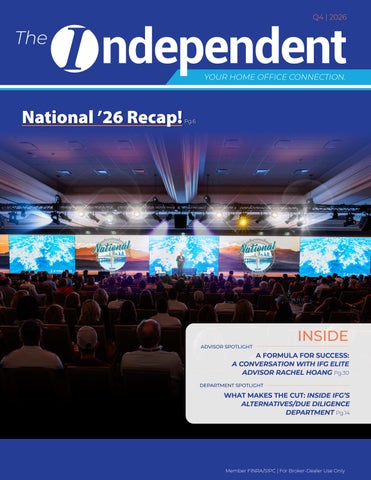
National ’26 Recap!
Pg.6
ADVISOR SPOTLIGHT
INSIDE
A FORMULA FOR SUCCESS: A CONVERSATION WITH IFG ELITE ADVISOR RACHEL HOANG Pg.30
DEPARTMENT SPOTLIGHT
WHAT MAKES THE CUT: INSIDE IFG’S ALTERNATIVES/DUE DILIGENCE DEPARTMENT Pg.14
Member FINRA/SIPC | For Broker-Dealer Use Only
CORPORATE EVENTS
Congratulations! To Those Who Have Qualified for 2027 Elite Status! 63 Advisors Have Qualified So Far! Two Months Left to Qualify $1,100,000+ GDC Required*
March 1–5, 2027 1 Hotel Hanalei Bay, Kauai, Hawaii
Total 2026 GDC production as of October 15, 2026.
2
Independent Q4
Kyle Addington
Jim Fahy
Anthony Napolitano
Sean Agahi
Jim Flanagan
Zoe Ng
Ryan Ansted
Joshua Goldsmith
Greg O'Donnell
Ian Arrowsmith
Marcus Henderson
Gregory Ostrowski
Jammie Avila
David Herman
Jodi Padgett
Kirk Badii
Rachel Hoang
Amrish Patel
Nick Behnke
Joel Hooper
Grant Prescott
Dustin Blodgett
Michael Hyat
Peter Prescott
Peter Blok
Kathy Keadle
Chad Schiel
Blake Bonner
Diane Kimbro
Jason Segawa
Pat Brennan
Kyle Kirwan
Herb Shiraishi
Tatyana Bunich
Josh Koehnen
Larry Steckler
Steve Carlton
Rich Krafcik
Steve Sutley
James Chang
Suzy Lawrence
Jonathan Szostek
Kelly Clyde
Josh Lee
Michael Tannery
Cindy Couyoumjian
Hal Lippman
Joyce Thomas
Ari Crandall
Marc Lord
Chris Vizzi
Dan Dougherty
Matthew Marcom
Shawn Walker
Dillon Dougherty
Ron Martin
Bryan Wertzer
Mark Ealy
Deepen Modi
Frank Wong
Jay Eng
Art Molloy
Jay Wurtzler
Independent Q4
3
Dear Representative
As we head into the final months of 2026, there is a lot to celebrate at IFG. It has been another exciting year of growth, new opportunities and memorable moments, and we are incredibly grateful for everyone who has been a part of it. Along the way, we reached some exciting milestones: •
Twenty-one new team members joined the Home Office, including five interns, continuing to strengthen the support we provide to our advisors.
•
Six Home Office promotions recognized the continued growth and dedication of our team.
•
IFG ranked 14th among the largest independent broker-dealers and 2nd among privately held firms according to Financial Advisor Magazine.
•
IFG was recognized for the 10th time on the Inc. 5000 list of Fastest-Growing Private Companies in America.
•
IFG’s Impact for Good Foundation was nominated for a WealthManagement. com Industry Award in the Corporate Social Responsibility category, recognizing the Foundation’s commitment to giving back.
Of course, some of the best parts of the year have been the opportunities to spend time together. We started the year in Rome for our Elite Advisor Conference, welcomed more than 800 attendees to San Diego for IFG National 2026 and are now together in Scottsdale for our Practice Management Event. Whether catching up with familiar faces, meeting someone new or simply having the chance to spend time together outside of our day-to-day 4
Independent Q4
work, these events are always a great reminder of what makes the IFG community so special. There is already a lot to be excited about in 2027. In January, we will host IFG’s first Women’s Summit in Del Mar, followed by the Elite Advisor Conference in Kauai this March. We look forward to another year of bringing our advisors together, sharing ideas and creating experiences that help us all stay connected. In this issue of The Independent, you’ll get to know Rachel Hoang in our Advisor Spotlight, meet the team behind our Alternatives/Due Diligence Department and hear from teams and Strategic Partners across IFG on topics designed to support you and your business. We’ll also look back at IFG National 2026 and some of the moments that made this year memorable. As we look toward the end of the year, we simply want to say thank you. To our advisors, their teams, our Home Office staff and our Strategic Partners, we appreciate everything you do and the trust you continue to place in IFG. We are proud of what we have accomplished together this year and even more excited for what is ahead. From all of us in leadership, we wish you and your families a wonderful holiday season and a strong finish to 2026.
Scott Heising
David Fischer
Contents / Q4 2026 DEPARTMENTS
FEATURES
6
NATIONAL ’26 RECAP! CORPORATE EVENTS
14
WHAT MAKES THE CUT: INSIDE IFG’S ALTERNATIVES/DUE DILIGENCE DEPARTMENT DEPARTMENT SPOTLIGHT
20
LENDING SOLUTIONS: HARNESSING THE POWER OF LIQUIDITY OPERATIONS
22
THANK YOU! 2026 STRATEGIC PARTNERS
38
SUPERVISION AND COMPLIANCE AS A COMPETITIVE ADVANTAGE SUPERVISION
24
IMPACT FOR GOOD Q3 UPDATE: GROWING OUR IMPACT IMPACT FOR GOOD
28
WELCOME NEW TEAM MEMBERS
30
A FORMULA FOR SUCCESS: A CONVERSATION WITH IFG ELITE ADVISOR RACHEL HOANG ADVISOR SPOTLIGHT
34
A MANAGEMENT FRAMEWORK FOR SCALING CAPACITY THROUGH OUTSOURCED SOLUTIONS PARTNER SPOTLIGHT FOCUS
40
NEW REPRESENTATIVES
42
THE NEXT STAGE OF GROWTH: BUILDING A MORE VALUABLE ADVISORY PRACTICE PARTNER SPOTLIGHT WAVELAND
46
RETHINKING TRADITIONAL MODELS PARTNER SPOTLIGHT JACKSON
54
COMPARING RILAS AND VAS PARTNER SPOTLIGHT ATHENE
44
50
56
58
PS AND QS OF PERFORMANCE REPORTING SUPERVISION AND COMPLIANCE
SAY IT WITH ME… “I AM ENOUGH”— FINDING YOUR PATH TO RECOGNIZING THIS COMPLIANCE RECENT PROMOTIONS
ANNIVERSARIES
Independent Q4
5
CORPORATE EVENTS
National ’26 Recap! By Molly Van Hoomissen Corporate Events Specialist
T
his year, we hosted our National ’26 Conference at the beautiful bayfront Sheraton San Diego Resort, where we were thrilled to welcome more than 800 attendees, including advisors, admins, partners, and their guests, to sunny Southern California. Record-breaking attendance created an energetic atmosphere and fostered meaningful connections across the IFG community. Our theme, Where Can IFG Take You?, inspired attendees to dream big, embrace
6
Independent Q4
new opportunities, and build a future they will be proud to look back on. From inspiring keynote presentations by Robert Herjavec and James Lawrence to the Women’s Luncheon and the crowd-favorite “Tacky Tourist” Farewell Party, the week was filled with insight, inspiration, and unforgettable moments. These shared experiences strengthened relationships and created lasting memories across the IFG family. Join us as we look back on an extraordinary week in San Diego!
Independent Q4
7
CORPORATE EVENTS
8
Independent Q4
Independent Q4
9
Seek More from Active ETFs Financial markets are evolving. Your clients may benefit from a non-traditional investment approach.
O1
No index constraints
O2
Rules-based, repeatable process
O3
Tactically pursues upside
O4
Seeks to limit downside with a Trailing Stop Discipline*
Put our Advisor Consulting team to work to evaluate where we may add value across your client portfolios. DUKZ
DUKH
DUKQ
DUKX
*Trailing Stop Discipline (“Discipline”): This proprietary Discipline has the objective of limiting the magnitude for portfolio drawdowns. The Discipline is based on a manual process that defines sell levels/signals for security holdings in decline, as measured by its price falling below the recent high of its lower band. These are not market orders. Ocean Park utilizes this Discipline directly in the management of non-affiliated holdings. Where Ocean Park invests in its affiliated Ocean Park Mutual Funds or Ocean Park ETFs (“Affiliated Funds”), the same Discipline is applied at the underlying funds level, not on the Affiliated Funds themselves. Please see our Form ADV Part 2A for information on conflicts of interest that exist as a result of Ocean Park investing in Affiliated Funds.
Investors should carefully consider the investment objectives, risks, charges, and expenses of the Ocean Park funds. This and other information about the funds is contained in the prospectus and should be read carefully before investing. The prospectus can be obtained on our website oceanparkam.com or by calling toll free 1·866·738-4363 (1·866-RETI-FND). There is no guarantee that any investment strategy will achieve its objectives, generate profits or avoid losses. ETF’s are subject to specific risks. depending on the nature of the underlying strategy of the fund. These risks could include foreign risk, emerging market risk. liquidity risk, sector risk, as well as risks associated with fixed income securities, real estate investments. and commodities, to name a few. While the shares of ETFs are tradeable on secondary markets, they may not readily trade in all market conditions and may trade at significant discounts in periods of market stress. ETFs trade like stocks, are subject to investment risk, fluctuate in market value and may trade at prices above or below the ETF’s net asset value. Brokerage commissions and ETF expenses will reduce returns. There is no guarantee that the Fund will achieve its objective. The Ocean Park funds are distributed by Northern Lights Distributors, LLC, member FINRA/SIPC. Ocean Park Asset Management. LLC is the investment adviser to the Ocean Park funds, and does not provide advisory services to retail clients. Ocean Park Asset Management LLC is not affiliated with Northern Light Distributors, LLC. Ocean Park Asset Management, LLC is a registered investment adviser (“RIA”) regulated by the U.S. Securities and Exchange Commission (“SEC”). The use of the term “registered” does not imply any particular level of skill or training and does not imply any approval by the SEC. For information pertaining to the registration status of Ocean Park Asset Management, LLC, please call 1 ·844-727-1813 or refer to the Investment Adviser Public Disclosure website (www.adviserinfo.sec.gov). 20260831-5882203
In Loving Memory of Kaboom! A familiar and beloved face at IFG conferences, Kaboom! was more than just a fourlegged attendee. Always front and center in the first row, Kaboom! became a special part of our IFG family, bringing smiles and joy to everyone around. Our hearts go out to Timothy and Rose as they remember their beloved companion. Kaboom! will be dearly missed, but the memories of our favorite front-row guest will always hold a special place in our hearts.
IFG RECRUITING REFERRAL PROGRAM
Earn Up to $50,000 for a Successful Referral Referrals play an important role in our continued growth. If you know a financial advisor who may be considering a move and would be a great fit for IFG, we encourage you to take advantage of our referral program. QUALITY ADVISORS Help us attract top talent and strengthen our advisor community.
STRONGER GROWTH Help drive IFG’s continued growth and success.
THE PROGRAM When you refer a qualified advisor who joins IFG and meets the minimum production requirement of $500,000 in verified trailing GDC commissions and fees, you can earn up to 5% of their production, paid in two stages:
3%
UPFRONT Earn up to 3% of the advisor’s verified trailing GDC (minimum $500,000).
2%
AFTER 12 MONTHS Earn an additional 2% based on the advisor’s actual production once they’ve been with IFG for 12 months.
EXAMPLE If you refer an advisor with $1 million in verified trailing GDC who subsequently joins IFG:
REWARDING CONNECTIONS Your referrals help us grow, and we want to thank you.
Upfront referral payment (3%)
$30,000
Additional payment after 12 months (2%) $20,000 Total potential referral compensation $50,000
This program is our way of thanking you for helping IFG grow. To learn more or discuss a potential referral please contact us: DAVID FISCHER Co-Founder & Chief Marketing Officer dfischer@ifgsd.com
JESSICA BRUNGARD Recruiting & Transition Coordinator jbrungard@ifgsd.com
TOGETHER, WE BUILD MORE.
IFG WOMEN’S SUMMIT January 10–12, 2027 L’Auberge Del Mar, Del Mar, California
Built for exceptional advisors.
Designed as an exclusive experience.
I
ndependent Financial Group is proud to have one of the highest percentages of women advisors in the industry, and we are excited to bring this community together for our inaugural IFG Women’s Summit!
Whether you're looking to exchange ideas, strengthen your network, or find inspiration for what comes next, we look forward to welcoming you to Del Mar for an experience designed to help you lead, inspire, and elevate.
Created with our women advisors in mind, this special event is an opportunity to connect with fellow advisors, share experiences, gain fresh perspectives, and celebrate the impact women are making in wealth management.
We can't wait to see you there!
Throughout the Summit, attendees can look forward to engaging discussions, inspiring speakers, practical insights, and memorable experiences focused on professional growth, leadership, and building a thriving practice.
Elevated thinking. Genuine connection. Greater impact. Independent Q4
13
DEPARTMENT SPOTLIGHT
What Makes the Cut: Inside IFG’s Alternatives/Due Diligence Department By Alexis Tamayo-Romo Marketing Specialist
A
lternative investments can offer advisors new ways to address client needs, but with a growing range of products, structures, and strategies comes the need for thoughtful research and due diligence. Behind IFG’s alternative investment platform is a team focused on evaluating opportunities, understanding risk, and helping advisors navigate an increasingly complex marketplace. The Alternatives/Due Diligence Department brings together Madison Hayes, CAIA, Vice President, Product and Platform Management; Colin Andrews, CFA, Alternative Product Manager; and Nathan Moore, CFA, Alternative Investment Analyst, each with a unique background and perspective on the industry. From sourcing and reviewing new offerings to monitoring approved products and serving as a resource for advisors, the team plays an important role in shaping IFG’s alternative investment
14
Independent Q4
platform. Madison, Colin, and Nathan share more about their paths into alternatives, the work that goes on behind the scenes, and how their different perspectives come together to support IFG advisors. Q: What first interested you in alternative investments, and what ultimately led you to the work you do today? Madison Hayes, CAIA: “My first real introduction to alternatives was almost by accident. Fresh out of college, I accepted a job as an internal wholesaler for a non-traded REIT because, frankly, I just wanted a good job. As I cut my teeth on the sales desk, I quickly realized that I wanted to completely understand what I was selling and why.
That curiosity led me to pursue the CAIA designation and eventually move into an analyst role. I had the opportunity to work on some really exciting transactions: multi-billion-dollar portfolio mergers, securities issuances and the S&P ratings process, large-scale acquisitions and dispositions, and presenting to a board of directors. I became fascinated by how all of the pieces fit together. Moving to the other side of the desk and conducting due diligence on investment offerings felt like a natural progression. I’ve now spent time as a registered assistant, wholesaler, asset manager and due diligence officer. Having seen the business from so many different seats gives me a well-rounded perspective that really informs how I think about our product shelf, our advisors and our overall strategy.” Colin Andrews, CFA: “In college, I thought I wanted to go into equity research, primarily on the public side. The advice given then, though with AI it may matter less in the future, was “learn to model.” I learned how to underwrite real estate transactions, and given my desire to stay in San Diego, and the prevalence of real estate sponsors, that is what I decided to do. I was working in corporate finance and consulting/underwriting on the side until I landed a job in acquisitions. This backdrop, and a healthy desire to understand how capital formation in other industries works, led me to my current position analyzing private markets deals for IFG.” Nathan Moore, CFA: “I have always loved numbers and been interested in investing. My first job in finance was with a family office in Carlsbad, helping manage a commercial real estate portfolio, and I was immediately hooked
on the combination of real estate, finance and investing. That experience eventually led me to pursue the CFA charter and later work on the GP side of investment partnerships. Most recently, I served as Vice President of Finance and Investor Relations at a private real estate sponsor, where I gained firsthand experience with financial reporting, acquisitions, capital raising and investor communications. These experiences have given me a deeper understanding of how alternative investments are structured, operated and presented to investors.” Q: What aspect of your day-to-day work do you find most rewarding, particularly the parts that may not be visible to advisors from the outside? Madison Hayes, CAIA: “Hands down, the most rewarding part of my job is helping our advisors with real client cases. I’ve always wanted to be a translator of sorts between the analytical/research minds and the sales minds. I felt like I had the analytical background to understand the “nerds,” but also the communication skills to take something complex and make it understandable, useful and applicable in the real world. That’s still how I view a big part of my job today. I want to understand the technical details deeply enough that our advisors don’t have to, and then translate that knowledge into something they can actually use. At the end of the day, I want to be a resource that helps IFG advisors win business, solve problems and grow their practices.” Colin Andrews, CFA: “I love talking shop with our advisors. We have the most sophisticated alternatives advisors in the industry who always keep our team honest. Knowing that they trust the work we are doing on the back end prior to approving an offering is incredibly rewarding. Beyond that, alternatives, while increasing in the private wealth channel, are anything but “plain vanilla.” I enjoy analyzing the investment thesis, underwriting, strategy, potential tax savings, and teams of the sponsors we work with in the offerings we add to the platform.”
Independent Q4
15
DEPARTMENT SPOTLIGHT
Nathan Moore, CFA: “One of the things I really enjoy about my role at IFG is being able to take what I learned on the sponsor side and apply it for the benefit of advisors and investors.” Q: How do you approach risk when evaluating an opportunity, and how do you determine whether the potential return adequately compensates an investor for it? Madison Hayes, CAIA: “I probably lean naturally skeptical when it comes to due diligence. In the back of my mind, I’m always asking: “What would cause this to blow up?” “What happens in a downside scenario?” and “What protections do investors have when something goes wrong?” That said, risk itself doesn’t make something a bad investment. You have to take risk to generate return. The question is whether we understand that risk, whether it’s appropriate for the intended investor and, most importantly, whether the investor is being adequately compensated for taking it. Sometimes the best decision we can make is to walk away from something that looks attractive on the surface because the return simply isn’t enough for what could go wrong.” Colin Andrews, CFA: “Most alternatives are considered higher-risk than traditional products primarily due to illiquidity. There are benefits to alternatives, however, namely capturing the illiquidity premium and muted volatility. This often
16
Independent Q4
lends itself well to attractive risk-adjusted returns that are portfolio enhancers and diversifiers. Notably, the dispersion of private markets returns is wider than on the public side. Our team is focused on operational due diligence at the sponsor level to ensure that we are onboarding the best managers in their respective product type.” Nathan Moore, CFA: “Risk is not always a four-letter word. If an investment is generating a return above the risk-free rate, it requires taking on some form of risk. The job is to understand exactly where that risk is and determine whether the investor is being adequately compensated for it. Financial projections can look very precise, but they are often highly sensitive to just a handful of inputs. I enjoy figuring out which assumptions really matter and whether they are aggressive, conservative or appropriately supported.” Q: Alternative investments can be complex. How does your department help advisors better understand and navigate the different products and opportunities available to them? Madison Hayes, CAIA: “One of our biggest responsibilities is making complexity manageable without oversimplifying it. Advisors shouldn’t have to become experts in every alternative investment structure in order to use alternatives effectively. We try to meet advisors wherever they are. We help
compare products, explain structures and risks, think through portfolio fit, connect advisors with the right resources and, when appropriate, challenge the way they’re thinking about an opportunity. Ultimately, I want our advisors to view us as an extension of their practice. Our job isn’t to tell them what to sell. It’s to give them a well-vetted set of tools, help them understand how and when those tools can be useful, and be available when they need another perspective." Colin Andrews, CFA: “It’s true that there are complex strategies and products, with risks that are not necessarily prevalent with traditional debt and equity. I think our team does a good job of translating that complexity to something digestible. Education is crucial with alternative products, particularly those surrounding tax strategies. By hosting webinars, podcasts, whitepapers, and the like, we try to simplify these strategies into something that will resonate with advisors’ clients.” Nathan Moore, CFA: “A key consideration is the client’s goals, expectations and appetite for risk. Different clients have different needs for income, growth, liquidity, tax efficiency and risk. A strong product shelf should give advisors a wide range of tools so they can find solutions that fit those specific circumstances.” Q: What’s something about the work your department does behind the scenes that advisors may not realize? Madison Hayes, CAIA: “Advisors may not realize just how much goes into our sourcing efforts, or how many products we ultimately screen out that they never hear about. I think an important part of our value is being able to articulate why something isn’t on our platform just as clearly as we can explain the merits of something that is. That knowledge can be incredibly valuable when an advisor is competing for new business, and a client comes in with an investment they saw somewhere else. We want to be a resource in either direction, and our team spends a good amount of time understanding what’s happening across the alternatives market… the good, the bad and the ugly.”
Colin Andrews, CFA: “I think just what goes into the review process. There are a lot of products and potential sponsors to work with, and many get screened out. We always start at the sponsor level, looking at audited financial statements, track record, management ability, and the like. Once a sponsor is approved in the system, we can look at a particular product offering on its own merits. Even a long working history with IFG doesn’t guarantee approval. We want advisors to feel confident our platform offerings have undergone rigorous review.” Nathan Moore, CFA: “There is a significant amount of work that takes place before an investment ever becomes available on the platform. We review offering documents, financial statements, thirdparty reports, projections, legal agreements and market data, and we often go back to sponsors with additional questions. The diligence also continues after approval through ongoing monitoring of sponsors, products and material developments.” Q: Each member of the team brings a different background and perspective to the department. What do you think makes your team work well together, and what does each person bring to the table? Madison Hayes, CAIA: “I want to go on record saying that I would put our team up against any due diligence team in the industry. I truly mean that, and I think IFG advisors should take a lot of pride in the reputation this team has built. One of my favorite things about our team is that we don’t all think the same way. That makes our due diligence stronger. Colin brings a very analytical and disciplined investment perspective. He has a great ability to dig into the details and thoughtfully challenge an investment thesis. Nathan brings deep real estate and underwriting experience from the sponsor side, so he understands how investments are actually built and operated—not just how they look in an offering document. I probably naturally gravitate toward the bigger picture: how an investment fits on our platform, what it means for advisors and their clients, where the risks are for IFG, and how we translate all of that into something actionable.
Independent Q4
17
DEPARTMENT SPOTLIGHT
Q: What do you enjoy doing outside of work, and how do you like to spend your free time? Madison Hayes, CAIA: “Outside of work, I try not to take myself too seriously. I work hard, so in my free time I really value having fun, being around the people I love and laughing as much as possible. I’m a huge NFL fan and try to visit a new stadium every year. I’m up to 13 so far, including Wembley for a game. Go Redskins! Most importantly, we’re comfortable challenging each other. Good due diligence shouldn’t be an exercise in everyone agreeing. I want different perspectives in the room, because disagreement leads to better questions, and better questions lead to better decisions.” Colin Andrews, CFA: “This team is special to me. I must give kudos to our fearless leader, Madison. She has worked on all sides of the ball in the industry and understands this business at an incredibly granular level. She empowers her team to innovate, lead, and take on new challenges. I feel very lucky to work closely with her. Nathan is newer to our team, but not new to alternatives and financial markets, and is a tremendous asset to the firm. He is incredibly scrupulous, technical, and has an ability to ask probing questions, which supports our product knowledge and confidence. Beyond the technical expertise of the team, we have a special working relationship (throughout the wealth management department at large, frankly) built on trust and competence that is hard to replicate.” Nathan Moore, CFA: “I think one of our strengths is the range of backgrounds and perspectives we bring to evaluating investments. We all have experience in finance and real estate, but we have also spent time across various asset classes, which is valuable when we are evaluating investments and bouncing ideas off one another. Having those different perspectives around the table helps us challenge assumptions and assess opportunities from multiple angles.”
18
Independent Q4
I also love to travel. My husband and I have been known to plan entire vacations around restaurants and food we want to try. I really believe travel is one of the few things you can buy that makes you richer. And I will almost never turn down live music, regardless of genre. I’ve seen close to 100 Dead shows (zero with Jerry, unfortunately) and some of my closest friendships came from my time “on tour.” Those experiences and the people I’ve met along the way are a big part of who I am outside of work.” Colin Andrews, CFA: “These days, spending time with the family. We have a two-year-old son and just welcomed another baby boy, so we’re “in it,” and every day is an adventure. But when time permits, I enjoy playing golf, surfing, and lifting weights.” Nathan Moore, CFA: “Most of my free time revolves around my wife and our three children, Benny, 12, Logan, 5, and Mia, 2. I am also an avid golfer and currently carry a 5.2 handicap. Some of my favorite evenings are taking my boys to the golf course, where the emphasis is usually more on candy bars and golf-cart rides than perfect swings. I am also a big Padres and Chargers fan and enjoy fantasy football and stand-up comedy.” Q: Looking ahead, what are you most excited about for the future of the Alternatives/Due Diligence Department and the ways it can continue supporting IFG advisors? Madison Hayes, CAIA: “I’m most excited about moving beyond the traditional idea of a due diligence department. Protecting the firm and maintaining a high-quality product shelf will
always be foundational to what we do, but we can provide so much more value than simply approving products. Alternatives are evolving quickly, and advisors are being asked to navigate increasingly sophisticated structures, new technologies and a much broader universe of investment solutions. I want our team to be ahead of that evolution. The future is about combining strong due diligence with education, product strategy and hands-on advisor consulting. If we do our job well, advisors should feel like they have a team at the home office that understands this space deeply, knows their business, and is genuinely invested in helping them succeed.” Colin Andrews, CFA: “Continuing the process that makes us special in the industry, bringing quality products and adhering to stringent approval standards, while also scanning the market for new exposures, new product wrappers and differentiated tax strategies. The market landscape is always evolving, and we want to stay ahead of the curve and keep our advisors competitive.” Nathan Moore, CFA: “I am most excited about the opportunity to continue building a best-in-class alternative investment platform for IFG advisors and their clients. As the alternatives universe continues to grow, I think we can continue expanding the product shelf while also improving the research, education and resources we provide to help advisors understand the opportunities and risks available to them.” Conclusion:
Driven to deliver for our clients As the world’s leading pure-play investment banking and capital markets firm, Jefferies offers clients bespoke advice and exceptional execution informed by our deep product and sector expertise.
Strong due diligence starts with asking the right questions, challenging assumptions, and understanding what lies beyond the numbers. Madison, Colin, and Nathan bring those principles to their work each day, combining their individual expertise to strengthen IFG’s alternative investment platform and serve as a trusted resource for advisors. As the alternatives landscape continues to grow and evolve, the team remains focused on what matters most: doing the work behind the scenes so IFG advisors can approach opportunities with greater knowledge and confidence. ©2026 Jefferies.
OPERATIONS
Lending Solutions: Harnessing the Power of Liquidity By Lauren Slater VP, Operations
A
t this year’s National Conference, I had the privilege of presenting on lending solutions offered by BNY Pershing alongside our relationship manager. As a result of the session, I’ve received several questions and calls from advisors wanting to learn about the options provided, the process to sign up, and the differences between LoanAdvance and Investment Credit Lines. I’m here to break it all down for you! Question: Who can benefit from liquidity? Answer: Everyone! Liquidity provided by Non-Purpose Lending is a way to support a client’s financial needs without compromising their current portfolio and investment objectives and may also help avoid unintended tax consequences that may otherwise result from liquidating assets. Question: What may a securities-based line of credit be used for? Answer: • Real Estate Purchases • Business Expenses • Medical Bills • Vacation • Tuition/Education Expenses • Cash flow • … And to support a number of other personal and financial goals! Use of funds generated from a line of credit through BNY Pershing’s lending solutions may be used for a variety of personal and business-related goals, with the exception of buying and holding stock. The line of credit may not be used for investment purchases.
20
Independent Q4
Question: What Lending Solutions are available and how do I know which is suitable for my client? Answer: BNY Pershing offers two Non-Purpose Lending Solutions – LoanAdvance and Investment Credit Lines. While it may not be suitable for all investors, understanding the options available can help determine if this may benefit your client. LOANADVANCE KEY FEATURES Minimum Line of Credit: $25,000+ Interest Rates: Fed Fund Target + Spread (Spread based on approved line of credit) No established repayment schedule: Provides the client with the convenience of repaying the loan on their terms. Securities eligible for collateral: Mutual Funds, ETFs, Equities, Treasuries, Investment Grade Bonds Not eligible for collateral: Illiquid Funds (Alternatives, Interval Funds), Cash, Money Market Securities Fees: No fees to open or maintain the account. No annual fees. Clients are only charged interest on any outstanding balance. Eligible Account Types: Non-retirement Brokerage and Advisory accounts LoanAdvance is a line of credit that uses the client’s existing Pershing account(s) as collateral. The borrowing power is up to 70% of the market value of qualified equity, mutual funds, and bonds, as well as up to 90% of the market value for US Treasury Securities. Multiple accounts may be combined to increase the approved loan amount. Using a client’s own securities as collateral allows for competitive interest rates compared to traditional banks or credit
card advances. LoanAdvance also provides flexibility by maintaining a loan indefinitely. As long as the required level of equity is maintained in the collateral account, the line of credit may remain open and available to the client as needed. INVESTMENT CREDIT LINE (ICL) KEY FEATURES Minimum Line of Credit: $1,000,000+ Interest Rates: SOFR + Spread (Spread based on approved line of credit) Securities eligible for collateral: Mutual Funds, ETFs, Equities, Treasuries, Investment Grade Bonds, Cash, Money Market Funds Not eligible for collateral: Illiquid Funds (Alternatives, Interval Funds), Closed End Funds, High Yield Bonds Fees: No fees to open or maintain the account. Clients are only charged interest on any outstanding balance. Access to IFG’s BNY Pershing Private Banker: Yes The target client for an Investment Credit Line is a HNW to Ultra HNW client looking for a $1M or greater revolving demand line of credit with competitive rates. Most ICLs allow for a greater release on eligible funds, including cash and money market funds, to support a higher line of credit. ICLs are supported through BNY Pershing’s Private Banking Solutions, which also provides access to a private banker. As the financial representative, visibility to the loan summary for both LoanAdvance and Investment Credit Lines is available in NetX360 by going to the loan tab within the client profile. The Loan tab provides a daily dashboard of the credit limit, outstanding loan balance, current interest rate, month-and year-to-date interest charged, and the loan payoff amount. In the event the client has exceeded the maximum loan value on the account, or if the securities used to secure the loan drop in value and there is a house call, that may be viewed in NetX under Items for Attention. Curious to see what amount your client may be approved for? Navigate to the LoanAdvance Dashboard by going to: NetX360 → Tools → Client Tools → LoanAdvance then select, Loan Calculator
This tool allows you to calculate the loan amount available for a client along with each individual security and the borrowing power by position. NetX also provides a dashboard that will allow you to manage all existing loans in one convenient place. From the dashboard you can go directly to an existing loan account to check available credit, outstanding balances, accrued interest, and payoff amounts.
As with any financial tool, the risks and restrictions associated with securities-based lending should be evaluated and discussed with your clients to determine if this is a suitable option for their financial situation. For questions or additional information on lending solutions, the application process, current rates, or obtaining contact information for IFG’s private banker through BNY Pershing, please contact Lauren Slater at lslater@ifgsd.com
Thank You 2026 Strategic Partners IFG hosts 60+ companies at The Alexandria in Del Mar to introduce our 2027 Marketing Support Program!
Time is a valuable asset. Spend it where it counts. IFG AccessPoint Models, powered by Goldman Sachs Asset Management, are designed to help streamline portfolio management and allow you to focus more time on delivering value to your clients. Reach out to your Goldman Sachs Representative or call +1-866-473-8637 to learn how IFG AccessPoint Models may support your practice management goals and enhance your capabilities.
am.gs.com
Your Performance, Our Priority. This email may be considered advertising under federal law. THIS MATERIAL DOES NOT CONSTITUTE AN OFFER OR SOLICITATION IN ANY JURISDICTION WHERE OR TO ANY PERSON TO WHOM IT WOULD BE UNAUTHORIZED OR UNLAWFUL TO DO SO. This material and the views and opinions expressed are for informational purposes only, do not constitute a recommendation or advice by Goldman Sachs Asset Management to buy, sell, or hold any security, and are subject to change. © 2026 Goldman Sachs, All rights reserved. 200 West Street, New York, NY 10282, USA. No part of this material may, without Goldman Sachs Asset Management's prior written consent, be (i) copied, photocopied or duplicated in any form, by any means, or (ii) distributed to any person that is not an employee, officer, director, or authorized agent of the recipient. Compliance code: N15004-OTU-649590. FOR IFG USE ONLY – NOT FOR FURTHER USE AND/OR DISTRIBUTION TO THE GENERAL PUBLIC
Independent Q4
23
IMPACT FOR GOOD
Impact For Good Q3 Update: Growing Our Impact By Paige Heising Manager, Marketing & Events President, Impact for Good
G
iving back continues to be an important part of who we are, and the third quarter gave us plenty of opportunities to make a difference. From local nonprofits to charitable initiatives at our National Conference, IFG advisors and home office employees came together to support organizations doing great work in their communities.
San Diego Center for Children - $5,000 Submitted by Karina Jerome
Here’s a look at our Q3 Impact For Good highlights!
The San Diego Center for Children provides mental health treatment, educational services, and therapeutic support to children and families facing emotional and behavioral challenges. Its programs are each child’s individual needs, helping young people build the skills and confidence to thrive. We’re proud to support an organization that has served San Diego children and families for generations.
Q3 Charitable Giving Each quarter, Impact For Good supports nonprofit organizations nominated by home office employees. From these nominations, the charity committee selects three organizations to receive donations. This quarter, $15,000 was awarded to three organizations: Nativity Prep Academy - $7,500 Submitted by Mercedes Montanez
Nativity Prep Academy is a tuition-free private school in San Diego that provides educational opportunities for students from underserved communities. Combining academics with mentorship, character development, and ongoing graduate support, the school helps prepare students for success in high school, college, and beyond. Our donation will help Nativity Prep continue providing students with the resources and guidance they need to succeed.
24
Independent Q4
Pacific Islander Festival Association - $2,500 Submitted by Christina Oyama The Pacific Islander Festival Association (PIFA) is dedicated to preserving and celebrating the cultures, traditions, and heritage of Pacific Islander communities. Best known for its annual Pacific Islander Festival in San Diego, the organization brings people together through music, dance, food, and cultural education. Our donation supports PIFA’s efforts to share these traditions and promote cultural appreciation for future generations.
Supporting the LIFT Foundation Golf Tournament Impact For Good contributed $10,000 to the LIFT Foundation’s annual charity golf tournament. Founded by IFG Elite Advisor Chris Vizzi and his wife, Candice, LIFT is a 100% volunteer-run nonprofit dedicated to helping children and families facing difficult circumstances. The organization provides essential resources, educational opportunities, and assistance to those in need, including single parents, foster families, and children facing serious illnesses. Now in its 14th year, the annual golf tournament brings supporters together for a day of fundraising and community involvement. Since its inception, the event has helped raise more than $1 million for local charitable causes. We’re proud to support Chris, Candice, and the LIFT team in their continued efforts. Giving Back at the National Conference Giving back was once again part of this year’s National Conference, with several opportunities for attendees to support charitable causes. Rancho Coastal Humane Society - $5,000
The organization provides shelter, medical care, adoption services, and other resources to give animals a second chance. Growlers Dog Bones Partnership with Nationwide For the fourth consecutive year, IFG partnered with Nationwide and Growlers Dog Bones for a fun and charitable activity at our National Conference Sponsor Fair. Attendees visited Nationwide’s booth to play cornhole, with every successful toss resulting in IFG and Nationwide donating a bag of Growlers dog treats to local San Diego animal shelters. This year, we donated a record-breaking 1,800 bags of dog treats! Growlers Dog Bones is a Columbus, Ohio-based nonprofit that provides vocational training, employment, and volunteer opportunities for individuals with disabilities. Their treats are made using repurposed grains from local breweries, supporting both people and the environment. Nationwide’s booth also featured some very special guests: adoptable puppies from Rancho Coastal Humane Society! Attendees had the chance to meet the puppies and learn more about the organization. Even better, every puppy at the booth was adopted that weekend! A big thank you to Nationwide, Growlers, Rancho Coastal Humane Society, and everyone who participated in making this year’s partnership such a success! National Conference Silent Auction This year’s National Conference Silent Auction raised $15,000, which IFG matched with an additional $15,000, bringing the total to $30,000 for Impact For Good!
IFG contributed $5,000 to Rancho Coastal Humane Society, a San Diego nonprofit dedicated to rescuing animals and helping them find loving homes.
Of the funds raised, $19,500 was distributed equally among three organizations nominated by IFG advisors. The remaining $10,500 was retained in the foundation’s reserves for future charitable giving.
Independent Q4
25
IMPACT FOR GOOD
HALO Animal Rescue - $6,500 Submitted by Kyle Addington Based in Phoenix, Arizona, HALO Animal Rescue gives homeless dogs and cats a second chance at life. The organization provides veterinary care, shelter, and adoption services while promoting responsible pet ownership. Through its rescue efforts and partnerships with other animal welfare organizations, HALO helps animals find safe, loving homes. Chaplains of Idaho - $6,500 Submitted by Lane Steel Chaplains of Idaho provides emotional and spiritual support to first responders, individuals experiencing crisis, and families affected by tragedy. Its trained volunteer chaplains work alongside law enforcement, emergency personnel, and community organizations to offer comfort and assistance during difficult times. Their services include crisis response, trauma support, and assistance to those navigating emergencies and personal hardships. Kumukahi Health and Wellness - $6,500 Submitted by John Allison
Giving Back Through Volunteerism Our commitment to giving back extends beyond financial contributions. Through IFG’s Volunteer Time Off (VTO) program, Home Office employees have the opportunity to dedicate time to causes that are important to them. Here’s how several employees gave back during Q3: Bruce Levitus – The Michael J. Fox Foundation Bruce participated in a July fundraising challenge benefiting The Michael J. Fox Foundation for Parkinson’s Research. While the challenge encouraged participants to walk, ride, or swim one mile each day throughout July, Bruce decided to complete all 31 miles in a single day on his mountain bike! Despite injuring his foot early in the ride, Bruce finished all 31 miles and raised approximately $250 for Parkinson’s research. This wasn’t his first fundraising challenge for the foundation. In 2023, he raised more than $5,000 by skiing 50 miles in a single day! Matt Hennigan – ISACA San Diego CommunITy Day
Located on Hawaii, Kumukahi Health and Wellness works to improve access to healthcare and essential support services for underserved communities. Its programs focus on HIV prevention and care, sexual health, substance use harm reduction, and community wellness. Through education, outreach, and compassionate care, Kumukahi helps individuals overcome barriers to healthcare and access the resources they need. Thank you to everyone who participated in the Silent Auction and helped support these organizations! 26
Independent Q4
Matt and his son volunteered with the ISACA San Diego Chapter during its September CommunITy Day Care Kit Build. Together, they helped assemble
care packages containing socks, water, snacks, and hygiene essentials for individuals experiencing homelessness in San Diego. The completed kits were prepared for distribution downtown, providing much-needed supplies to members of the local community.
Explore the New Impact For Good Rep Portal Page!
Sarah Kreisman – Still Got Game Foundation Sarah Kreisman volunteered with the Still Got Game Foundation at its youth baseball and softball clinic in Gary, Indiana. The organization brings together former professional athletes and underserved youth through free sports clinics and financial literacy programs. During the event, Sarah helped with registration, field setup, distributing supplies, serving lunch and ensuring participants stayed hydrated throughout the day. The clinic gave local youth an opportunity to learn from former professional athletes while developing their skills and enjoying a day on the field. Jason Ellis – PAWS of Coronado Jason volunteered at PAWS of Coronado, a local animal shelter dedicated to caring for homeless animals and helping them find loving homes. During his visit, he helped walk and play with dogs, prepare meals, and clean cat rooms, supporting the shelter’s daily operations and the animals in its care. Sarah Kreisman, Madison Hayes & Paige Heising – LIFT Annual Golf Tournament Sarah, Madison, and I volunteered at the LIFT Foundation’s annual golf tournament, helping support the event and its charitable fundraising efforts. Thank you to all our employees who took the time to give back this quarter!
https://www.ifgsd.com/app/resources/impact-forgood We’re excited to introduce a dedicated Impact For Good page on the IFG Rep Portal! Located under Resources, the new page makes it easier for advisors to learn about the foundation and stay up to date on our charitable initiatives. The page includes information about the foundation’s mission, previous quarterly updates, and a charity nomination submission form where advisors can recommend nonprofit organizations for future giving. We encourage everyone to check out the new page and submit organizations that are meaningful to them! Looking Ahead As we enter the final quarter of 2026, we have several more opportunities to give back! Our Home Office team will continue its annual traditions with the Friendsgiving Food Drive and Toys for Tots Holiday Drive, supporting individuals and families in need during the holiday season. At this year’s Practice Management Exchange (PME), all attendees will also participate in a special giveback activity benefiting New Freedom Project. Stay tuned for more details! Together, we’re making an impact for good!
Independent Q4
27
CORPORATE COMMUNICATIONS
WELCOME NEW HOME OFFICE TEAM MEMBERS
Todd Cormier Advisory Compliance Analyst
Aiden Hight Advisory Specialist
28
Independent Q4
Todd Cormier joins IFG as Advisory Compliance Analyst. He brings 20 years of experience at LPL Financial, with an extensive background in supervision, registrations, risk management, and financial operations. Most recently, Todd served as AVP of Supervision Governance, where he oversaw governance initiatives, supported audit and regulatory remediation, and helped enhance policies and procedures. He previously held leadership roles in Registrations, Cash Control, and Financial Operations. Todd holds his FINRA Series 99 license and is a Six Sigma Green Belt. At IFG, he conducts surveillance and riskbased reviews of advisory accounts and activities, supports regulatory examinations and compliance assessments, and helps maintain and enhance advisory compliance policies, procedures, and supervisory controls.
Aiden Hight joins IFG as Advisory Specialist. He brings a background in economics, financial analysis, and investment markets. Aiden earned his bachelor’s degree in Economics/Econometrics from California State University, San Marcos, and his associate degree in Economics from Butte College. Most recently, he served as an intern at PixelWerks, supporting investor diligence, financial analysis, data organization, and fundraising initiatives. He also completed professional development through Prudential Advisors and maintains his FINRA Series 7 registration. At IFG, Aiden supports the administration of advisory products and platforms, assists with account maintenance and advisory billing, and serves as a resource for advisors and internal departments on advisory platforms, products, and processes.
Molly Van Hoomissen Corporate Events Specialist
Kyle Loftin Software Support Specialist
Molly Van Hoomissen joins IFG as Corporate Events Specialist. She brings experience in account management, marketing, and event coordination. Most recently, Molly served as Senior Account Manager at Schaefer Advertising, where she managed client relationships, budgets, project timelines, and integrated marketing campaigns for attractions, tourism, and entertainment organizations. She also previously supported the Six Flags account at Moroch Partners. Molly holds a Bachelor of Science in Strategic Communication and Design Studies from Texas Christian University. At IFG, she helps plan and execute conferences, advisor meetings, and employee engagement events, coordinating logistics, vendors, travel, accommodations, and on-site operations to create seamless experiences for attendees.
Kyle Loftin joins IFG as Software Support Specialist. He brings more than seven years of experience in customer service and support, along with a background in IT, web design, and software support. Most recently, Kyle served as a Customer Service Representative at Knockaround, where he provided front-line support and helped troubleshoot user issues. He also has experience as a freelance web designer and front-end developer. Kyle earned his Associate of Science in Computer Programming from Santa Monica College, holds his CompTIA A+ certification, and is currently pursuing a Bachelor of Science in Information Technology at Western Governors University. At IFG, he provides first-line software support, troubleshoots user issues, assists with software onboarding and training, and supports internal systems and advisor-facing tools.
Independent Q4
29
ADVISOR SPOTLIGHT
A Formula for Success: A Conversation with IFG Elite Advisor Rachel Hoang By Alexis Tamayo-Romo Marketing Specialist
W
ith more than two decades in financial services, Rachel Hoang has built a career defined by consistency, continued growth and a thoughtful approach to her business. As the founder of Mathematics Wealth Management, a fivetime qualifying IFG Elite Advisor and a member of IFG’s President’s Advisory Council, Rachel brings both experience and a distinctive perspective to the IFG community. Her path into financial services, however, began somewhat unexpectedly. What started with overheard conversations about the stock market while working in a college research lab eventually grew into a career centered on helping others make informed financial decisions. Rachel shares the story behind her journey, the meaning behind Mathematics Wealth Management and the people and experiences that have shaped her along the way. Q: You’ve built a successful career spanning more than two decades in financial services. What originally drew you to the industry, and what has shaped the advisor you are today?
30
Independent Q4
A: My interest in investing began unexpectedly in the summer of 1996. In college, I was helping to publish a case study on excessive porosity in the welds of a titanium-alloy aerospace part. The part came from a California company that manufactured components for General Electric aircraft engines. For several months, I spent hours polishing titanium alloys in the lab for the study. As I worked, I often overheard my professors discuss the booming stock market and the performance of their investments. Although I knew nothing about investing, those conversations sparked my curiosity and inspired me to learn more. Later that summer, after graduation, I began looking for an internship at a local investment firm, hoping to build upon that interest and to learn how to invest the little money I had earned through working on the research project. More than two decades into my career in financial services, the same curiosity and drive to learn that first drew me into the industry still inspire me to move forward.
Q: Mathematics Wealth Management is such a distinctive name. What’s the story behind it, and what does the name represent to you and the way you approach your business?
detail I share with many female colleagues supports thoughtful and personalized planning. When clients feel both understood and informed, lasting relationships and long-term success are more likely.
A: According to the Mathematical Association of America, mathematics helps us to understand the world by examining quantity, structure, patterns, and change. Through that understanding, logical solutions are developed to make life more meaningful and beautiful.
Q: In addition to running your practice, you serve on IFG’s President’s Advisory Council. What made you want to become involved with the Council, and what do you hope to contribute on behalf of your fellow advisors?
I approach financial services in much the same way. When my husband, an automotive designer, helped to identify my business’s key metrics and to select a company name, I suggested “Mathematics Wealth Management,” and he immediately responded enthusiastically, “Great name!” Q: You’re a five-time qualifying IFG Elite Advisor and are heading toward your sixth year. What do you believe has been most important in creating that kind of consistency throughout your career? A: I believe that surrounding myself with good people has been essential to maintaining consistency throughout my career. Trustworthy and dependable colleagues provide stability, accountability, and support while reinforcing shared standards and strong work habits. Likewise, clients who communicate clearly and set well-defined expectations help to create stable, productive working relationships. Q: You’ve also earned recognition as a top woman advisor. What has that recognition meant to you, and what have you learned from building your career as a woman in the financial services industry? A: When I entered the financial services industry in 1996, few women worked in the industry. I am therefore deeply honored to be recognized as a leading woman advisor in a field historically filled by men. In my experience, women advisors often bring empathy and active listening skills that build trust, thus uncovering clients’ concerns and values. These strengths deepen relationships and help clients remain focused on their personal goals. I also prioritize education so that clients can make informed and confident decisions. The attention to
A: I am honored to serve on IFG’s President’s Advisory Council alongside dedicated and accomplished colleagues. I joined the Council to continue to grow my skills as a leader. By demonstrating my own commitment to development, I hope to encourage my employees to embrace a fresh perspective on our company culture. In addition, by strengthening my leadership skills and expertise, I hope to help build a healthy workplace culture rooted in core values I feel are necessary to a thriving practice. Some of these are empathy, transparency, clear communication, and respect for unique perspectives. On behalf of my fellow advisors, I hope to share my expertise to help shape IFG into a firm where we can contribute and build enduring careers. Q: Family is an important part of your life, and it sounds like ambition and achievement extend well beyond your own career. Tell us a little about your family and some of the things they’ve accomplished that make you especially proud. A: Family is central to my life. I was born and raised in Los Angeles. I grew up in a family of five with both older and younger brothers, whom I remain very close to today. After immigrating to the United States following the Vietnam War in 1975, my father worked as an airframe mechanic for a local SoCal company, while my mother became an entrepreneur. I witnessed my parents overcome many hardships to realize their American dream. Their day-to-day example taught me patience and unwavering discipline—lessons that continue to guide me throughout my life.
Independent Q4
31
ADVISOR SPOTLIGHT
Q: With so many driven people in one family, has your family influenced the way you think about success, education, hard work, or even the way you approach your own career? A: My husband and I first met while volunteering at a hospital as teenagers. Our years of service before beginning our careers fostered a shared dedication to helping others that has contributed to our professional success. We now nurture that same spirit of service in our young son. Q: Looking ahead, what are you most excited about for the next chapter of your career and the continued growth of Mathematics Wealth Management? A: Looking ahead, I am eager to grow my business organically. Good clients referring good friends is invaluable. I have a strong team and look forward to mentoring them each day as we work together to take business to the next level. Conclusion Throughout Rachel’s story, one theme stands out: the importance of the people around her. From the example set by her parents to the values she shares with her husband, the colleagues and clients who have contributed to her consistency and the team she now has the opportunity to mentor, relationships have remained an important part of both her personal and professional life. As Rachel looks toward what comes next, her focus is clear: continue growing Mathematics Wealth Management organically, develop the people around her and contribute to a strong future for IFG and its advisor community.
32
Independent Q4
TAILORED STRATEGIES. LASTING PARTNERSHIPS. BECAUSE YOUR CLIENTS DESERVE MORE THAN A ONE-SIZE-FITS-ALL PORTFOLIO SCAN TO LEARN MORE www.advisorscapital.com Advisors Capital Management, LLC is an investment advisor registered with the United States Securities and Exchange Commission. Registration does not imply any degree of skill or training. All investing carries risk, including the potential for the loss of principal. Past performance is no guarantee of future results. We only provide services in jurisdictions where we are registered. Our disclosure brochure (ADV Part 2A) and customer relationship summary (ADV Part 3) are available at https://adviserinfo.sec.gov and upon request.
PARTNER SPOTLIGHT
A Management Framework for Scaling Capacity Through Outsourced Solutions Outsourcing gives teams time back, but what you do with that time determines whether your practice actually grows. Too many advisors outsource investment management or operations, then fill the newly freed hours with more of the same individualized tasks. The missing ingredient isn’t more capacity—it’s management skills, and developing these skills is crucial for future success. According to a 2026 Gallup survey, managers account for 70% of the variance in team-level employee engagement.¹ As advisors often point to the Brinson, Beebower, and Hood study to explain why policy decisions matter more than day-to-day tactics, the research on team performance points to a similar conclusion: the skill of a manager plays a critical role in employee engagement. Yet despite this, a Gartner study found that approximately 60% of new managers fail within their first two years.² This failure doesn’t stem from a lack of effort—it stems from a lack of training. Research highlighted by Harvard Business Review points to four recurring root causes:³ ineffective communication, poor relationship building, an inability to adapt, and inadequate development. For financial advisors specifically, that last cause hits especially hard. Most advisors were trained to manage portfolios and plans, not people. The skills that make you a great financial advisor don’t necessarily make you a great manager. To take your practice to the next level, it’s essential to build and integrate managerial capabilities. One of the challenges many advisors face is a reluctance to give up the activities they’ve always performed themselves. This reluctance often stems from a sense of identity. Many advisors built their careers and self-worth around personal production; letting go of that can feel like losing what made you successful in the first place. Yet as firms grow, advisors often find that success depends not only on technical expertise, but also on their ability to lead, develop, and empower others. Outsourcing tasks provides a remedy to this challenge, but where does one start when it comes to becoming a better manager? The financial services industry isn’t the only one where high-performing individual contributors struggle to transition into leadership; the technology sector has grappled with this exact challenge for decades—and has produced some of the best Advisor Use Only
ADVISOR SOLUTIONS
thinking on the subject. In her book The Making of a Manager, Julie Zhuo, former VP of Product Design at Facebook, shares lessons from her own journey from individual contributor to leader. One of her key arguments is that “great managers are made, not born.” With that in mind, what steps can financial advisors take to become better managers equipped for unlocking growth? Here are three next steps for consideration. IN-HOUSE PM & OPS 1. Build, Subtract, Grow Many advisors outsource to free up time and capacity but continue acting as the sole decisionmaker on everything else. Research shows team-based advisory practices significantly outperform solo practices in both assets and organic growth. Cerulli found that team-based firms have more than double the annual organic growth of solo firms and are more likely to employ specialized support staff.⁴ This makes intuitive sense: teams create capacity for specialization, and specialization can create better client experiences, more referrals, and ultimately contribute to faster growth. One way to start building a team is to answer a simple question: “What should I stop doing so someone else can grow?” To answer this, create a “stop doing” list. For two weeks, track and evaluate all of your activities categorized into three buckets: • Tasks only you can perform • Tasks you can do, but someone else could also do • Tasks someone else should be doing Tasks in the latter two categories are prime candidates for outsourcing or delegation. Question to consider: Have you ever delegated a task, watched someone do it differently than you would have, and taken it back—even though the outcome was still good?
2. Assign, Don’t Assume Your “stop doing” list has now given you a set of tasks to outsource or delegate—but it can also help you identify what team role makes the most sense to build next. Are the identified tasks best suited for: 1. A Client Service Associate: Scheduling, paperwork, client communication? 2. An Associate Advisor: Plan preparation and client meetings under your supervision? 3. A Financial Planner: Deeper planning work for complex clients? 4. An Operations Manager: Workflows, compliance, and technology? Advisor Use Only
ADVISOR SOLUTIONS
PARTNER SPOTLIGHT
If one of these roles seems obvious, you now know the next hire to make. If not, identify which tasks would free up the most of your time or which tasks you find most unpleasant to do yourself—that’s often a good tiebreaker. When hiring new staff, it’s important to avoid confusion about who owns which parts of the client experience. Create an ownership structure that clearly defines responsibility for core client experience functions. Questions to consider: Who owns the client onboarding experience—you or your associate? Who’s responsible for scheduling annual reviews? Who handles urgent client requests when you’re unavailable? Without clear answers to these questions, tasks either fall through the cracks or get duplicated—both of which erode the client experience you’re trying to build.
3. Measure, Then Manage These first two steps will help you start making a mental shift. Many advisors are “accidental business owners.” As firms grow, success increasingly depends on communicating vision, developing employees, establishing accountability, and managing processes—rather than personally doing all the work. Michael Kitces notes that growing RIAs often discover they must evolve from advisor to manager once the firm reaches several employees.⁵ One of Zhuo’s most powerful ideas is that many new managers continue to think like individual contributors long after they’ve taken on management responsibilities. She argues that managers create the greatest value not through their own output, but through their team’s output. The measure of success is no longer how many plans you built, reviews you prepared, or portfolios you managed; the measure becomes how effectively your team serves clients, develops relationships, and delivers a consistent client experience. As the old management adage goes, “what gets measured gets managed.” If your dashboard still only reflects your personal production, that’s exactly what you’ll keep optimizing for—whether you mean to or not. Put this into practice by updating your dashboard: alongside personal AUM or revenue, start tracking team-level metrics like client satisfaction scores, new clients acquired through teamgenerated referrals, and the number of client issues resolved without your direct involvement. It’s also worth participating in industry benchmarking surveys, which can highlight where your business is already strong and where it still needs work. Questions to consider: If a client asked what you do all day, would your honest answer still be, “I manage portfolios and meet with clients”—or has it become something closer to, “I run a business”? And when you introduce yourself at a conference, do you describe yourself as an advisor who has a few employees, or as the CEO of an advisory business? Which one is actually true today, and which one do you want to be?
36
Independent Q4
Advisor Use Only
ADVISOR SOLUTIONS
The Bottom Line Great managers aren’t born—they’re made. Adjusting your day-to-day activities and learning managerial best practices, both from within wealth management and from other industries, is a powerful way to build these skills. The three steps outlined here—building a team, clarifying roles, and redefining how you measure success—are a strong place to start. The transition won’t happen overnight, but it represents the real difference between advisors who outsource tasks and stay stuck, and those who outsource tasks and use the newfound capacity to build something greater than themselves.
Sources: ¹ Gallup, 2026 ² Gartner (formerly CEB Global), 2023 ³ Harvard Business Review ⁴ Cerulli Associates, U.S. Advisor Metrics 2025 ⁵ Michael Kitces, “Using EOS (Entrepreneurial Operating System) To Manage An RIA,” Kitces.com Disclosures: For educational purposes only. This reflects the opinions of Focus or its representatives, may contain forward-looking statements, and presents information that may change. Nothing contained herein may be relied upon as a guarantee. The appropriateness of a particular strategy will depend on an adviser’s individual circumstances. This is prepared using third party sources considered to be reliable; however, accuracy or completeness cannot be guaranteed. Services are offered through Focus Advisor Solutions, LLC (“Focus”), an SEC registered investment adviser. Registration with the SEC does not imply a certain level of skill or training and does not imply that the SEC has endorsed or approved the qualifications of Focus or its representatives. Focus has been part of the Focus Financial Partners partnership since 2007. Prior to July 2026, Focus Advisor Solutions was named Focus Partners Advisor Solutions. ©2026 Focus Financial Partners, LLC. All rights reserved. RO-26- 5875823
Advisor Use Only
ADVISOR SOLUTIONS
SUPERVISION
Supervision and Compliance as a Competitive Advantage By Ian Buxbaum Director, Supervision
W
hen advisors think about compliance and supervision, the first words that often come to mind are rules, restrictions, reviews, and paperwork. It is understandable. Supervision is often most visible when someone asks a question, requests additional documentation, or tells you that something needs to be changed before moving forward. But there is another way to look at compliance: as a competitive advantage in growing your practice. A well-run compliance program should not simply prevent problems. It should help advisors build practices that are more efficient, more consistent, and more resilient. The goal isn’t to put obstacles between advisors and their clients. It is to help create a practice where good decisions are easier to make and where the advisor can confidently demonstrate why those decisions were made. Good Processes Create Better Practices As an advisor’s business grows, complexity grows with it. More clients mean more accounts, more transactions, more communications, more staff involvement, and more opportunities for something to get overlooked. The processes that worked when an advisor had 50 clients may not work when that advisor has 500. This is where compliance and supervision can add real value. Establishing consistent processes for everything you do, including onboarding clients, documenting recommendations, reviewing accounts, and communicating with clients, creates a practice that is less dependent on memory and individual judgment. The objective isn’t bureaucracy for its own sake. It is consistency.
38
Independent Q4
Documentation Protects the Advisor’s Work One of the most important elements of a wellmanaged practice is also one of the simplest: documenting the why. An advisor may know exactly why a particular recommendation makes sense for a client. The client may understand it as well. But if that rationale isn’t documented, someone reviewing the file later may only see the transaction itself. Questions often posed by regulators include: Why this product? Why this share class? Why this level of concentration? Why this investment strategy? Why this exchange? Why is this recommendation appropriate given the client’s objectives, risk tolerance, liquidity needs, and time horizon? Good documentation answers those questions. This isn’t about writing an essay for every transaction. Often, a few thoughtful sentences can provide meaningful context. More importantly, documenting the rationale while the facts are fresh creates a record that can protect both the client and the advisor. In that sense, documentation isn’t just a compliance requirement. It is a record of the advisor’s professional judgment and a reflection of the thoughtful work put into each decision. Clean Practices Create Efficiency It may seem counterintuitive, but strong compliance practices can actually save time.
Consider the difference between two practices: In the first, an account or transaction reaches supervision with missing information. The supervisor has questions. The advisor has to go back through emails, notes, and files to reconstruct what happened. The client may have to be contacted again. The transaction is delayed. In the second, the advisor anticipates the questions and provides the relevant information from the beginning. The second practice isn’t necessarily doing more work. It is doing the work at the right time. That distinction matters as a business grows. Rework is expensive. Preventing an issue is almost always more efficient than fixing one after the fact. Supervision Should Be a Resource The relationship between advisors and supervision doesn’t have to be adversarial. Our goal is to work hand-in-hand with you to support your business, allowing you to serve your clients while remaining confident that your compliance obligations are being met. A supervisor asking questions isn’t necessarily questioning an advisor’s judgment. Often, the supervisor simply doesn’t have the context that the advisor has. The advisor knows the client. Supervision knows the regulatory framework. The best outcome comes from putting those two perspectives together. When an advisor encounters an unusual situation, involving supervision early can often make the process easier. Contact your supervisor and explain the client’s circumstances. Explain the objective. Explain the recommendation. Identify what is unusual about the situation. The more complete the picture, the easier it is for supervision to understand the recommendation and help determine the appropriate path forward. In many cases, the fastest way through a supervisory review is a complete explanation on the front end.
A Strong Compliance Culture Builds Client Confidence Clients may never see an advisor’s supervisory procedures, but they experience the benefits of those procedures. A practice with strong controls is more likely to provide consistent service. Account information is maintained accurately. Documentation is organized. Requests are handled systematically. Employees understand their roles. Important changes are less likely to be overlooked. These things contribute to something that is difficult to measure but extremely valuable: trust. Clients expect their financial professional to be organized, thoughtful, and careful. A strong compliance culture reinforces those characteristics. Compliance isn’t separate from the client experience. Done correctly, it is part of the infrastructure that supports it. The Competitive Advantage The strongest practices aren’t necessarily the ones with the fewest compliance questions. They are the ones that have developed systems that make good compliance almost routine. They know their processes, document their decisions, and recognize when something falls outside the ordinary. They involve the appropriate resources when they need help, and they continuously improve. That is where compliance becomes a competitive advantage. A well-supervised practice is not simply one that avoids regulatory problems. It is one that can grow without losing control, delegate responsibilities without losing accountability, and serve clients consistently as the business becomes more complex. Ultimately, the goal of supervision and compliance is not to slow down a successful practice. It is to help build a practice that can grow—and stay strong as it does.
Independent Q4
39
WELCOME ABOARD NEW REPRESENTATIVES
WHO JOINED THE IFG FAMILY
Mary Jo Chorbagian of Villa Park, CA LPL Financial, LLC
Andy Manes of Warsaw, IN Cambridge
Aaron DiGiamarino of Diamond Bar, CA Newly Registered
Bruno Peraza of Coral Gables, FL Cetera Wealth Services
Steven Fairchild of Folsom, CA LPL Financial, LLC
Anne Shiraishi of Honolulu, HI Newly Registered
John Franklin of Shell Knob, MO Principal Securities Inc.
Alex Staggenborg of St. Louis, MO Newly Registered
Jack George of Sacramento, CA Newly Registered
Christian Von Allmen of Nashville, TN The Leaders Group, Inc.
When Markets Zig, How Can You Help Portfolios Zag?
Why Advisors Use It
Finding Opportunity in Corporate M&A Activity
DOWNSIDE PROTECTIO N
DIVERSIFICATIO N Returns are tied to mergers successfully closing rather than broad market movements.
Definitive Merger Agreements generally carve out macroeconomic and geopolitical conditions as grounds for termination. A war, an oil spike, tariffs, or an equity selloff is not on its own, a way out of a signed deal. LOW CO RREL ATIO N Historically, merger arbitrage has exhibited low correlation to Most portfolios still run on three return drivers: stocks, bonds,
both stocks and bonds.
and cash. That strategy worked well when bonds zagged, as stocks zigged. Lately, they have not, as stock and bond
A DIFFERENTIATED RETU RN STREA M
correlations have been unusually high. This has caused many
The strategy seeks profit from merger closings rather than
advisors to look for alternative strategies whose returns are
earnings, interest rates, or market multiples.
not heavily dependent on the direction of the broader markets and interest rates. One area that often flies under the radar is merger arbitrage, a strategy that seeks to capture the spread between a target company’s stock price and an announced acquisition price. While the strategy has existed for decades and is widely utilized by institutional investors, many advisors are less familiar with how it works or where it may fit within client portfolios.
How it Works It all starts with a contract. When two companies agree to merge, they execute a Definitive Merger Agreement, which is a legally enforceable document that sets out the price to be paid for the target company and the conditions that must be
Where Does It Fit? Many advisors view merger arbitrage as a complement or replacement to traditional fixed income, while others position it within an alternative’s allocation. Potential use cases include: • Diversifying equity-heavy portfolios • Seeking lower-volatility return streams • Complementing traditional bond allocations, without sensitivity to interest rates • Adding a return stream that is not a bet on market direction
the target company’s shares trade below the agreed upon
It May Be Time To Look Beyond Traditional Market Drivers
take-out price. For example, if Company A agrees to acquire
Markets will always experience periods of uncertainty. But not
Company B for $50 per share, Company B’s stock price may
every investment strategy needs to rely on rising stock prices
trade at $48 while the companies work through regulatory
or changing interest rates to pursue attractive returns. Merger
approvals, shareholder votes, and other closing conditions.
arbitrage offers something many portfolios lack: a return
That $2 difference is known as the spread. If the deal closes
stream driven by corporate events rather than broad market
in 90 days, capturing the spread would return roughly 8.0%
movements. For advisors seeking additional diversification,
annualized.
downside protection, and access to a differentiated opportunity
Unlike traditional equity investing, the primary driver of returns
set, merger arbitrage deserves a closer look.
met before the deal can close. Until those conditions are met,
is not related to the economy, earnings, or the direction of interest rates but whether the merger successfully closes at the takeout price. In other words, returns are idiosyncratic to what is happening in each specific merger.
(833) 697-7253 | WWW.NEXPOINT.COM
PARTNER SPOTLIGHT
The Next Stage of Growth: Building a More Valuable Advisory Practice By Adam Dooley President, Waveland Capital Partners
I
ndependent advisors chose independence for a reason. You own the practice. You own the client relationships. You decide how the business is built. So, what is this business actually worth, and what are you doing to make it worth more?
For one advisor, that is business owners preparing for a liquidity event. For another, it is retirees with complex income needs. Others specialize in physicians, executives, entrepreneurs or multigenerational families.
Early in a career, growth is simple. Meet more people. Make more calls. Add clients. That builds a good business. It rarely builds a great practice.
A clearly defined client profile improves almost everything. Marketing gets sharper. Referrals get easier. Service can be standardized. Most importantly, clients understand exactly why they should introduce you to someone they know.
As a practice matures, the question shifts from “How do I find more clients?” to “How do I build a practice that grows without requiring more of my time every year?” The most effective advisors we work with are no longer thinking only about production. They are thinking about capacity, client quality, recurring revenue, team development and the long-term value of the enterprise they own. Five areas deserve particular attention. 1. Be Clear About Who You Serve Best The easiest trap in this business is becoming all things to all people. Established advisors accumulate clients over many years. Some are ideal. Others consume considerable time while generating little economic value. Not every client has to fit the same profile, but you should know where you create the most value and where your practice is most differentiated.
Not every relationship requires the same level of service. Review the client base periodically based on revenue, assets, complexity, growth potential and time required. The purpose is not to rank clients. It is to make deliberate decisions about the practice’s scarcest resource, which is your time. The largest and most complex relationships warrant frequent personal contact, customized planning and direct senior involvement. Others are better served through a standardized model supported by associates, technology and a consistent communication calendar. Every client gets an excellent experience. Your time goes where it creates the greatest value.
Independent Q4
`
42
2. Segment the Practice and Protect Your Time
3. Build a Team Before You Think You Need One Many advisors wait too long to add capacity. They keep scheduling every meeting, answering every question and preparing every review. Eventually the advisor becomes the constraint on the business. A scalable practice requires leverage. That may mean developing a junior advisor who can eventually own relationships, giving an experienced client service professional real authority, or outsourcing functions that do not need to live inside the practice, including those available through IFG. The question is simple: What activities truly require the senior advisor? Everything else should be delegated, automated or eliminated. That transition is not comfortable. Most of us built our businesses by controlling every detail. But the ability to transfer responsibility is the single most important step in moving from individual producer to leader of an enterprise. It is also the step that acquirers and successors pay for. 4. Give Clients More Reasons to Engage With You The strongest relationships extend well beyond portfolio performance. Clients are thinking about taxes, retirement income, estate planning, insurance, charitable giving, business succession and their children and grandchildren.
Clients are hearing about these strategies from peers and competing advisors. The advisor who can explain them clearly, including their risks, liquidity constraints and limitations, earns a level of trust that a model portfolio never will. 5. Treat Referrals as a Process Most advisors would say referrals are important. Far fewer have an actual referral strategy. The best time to ask for an introduction is not the end of an annual review. It is after you have solved a meaningful problem. Guiding a client through a retirement transition, the sale of a business or a difficult market creates a natural opening. Be specific about the people you can help. Clients rarely know who “needs a financial advisor.” They almost certainly know someone who just sold a company, changed jobs, inherited money or is approaching retirement. That specificity makes introductions easy. Build the Business You Want to Own Practice development is about more than growth. It is about a business that serves clients well, develops its people, generates durable economics and does not depend on one person’s time and energy. For an independent advisor, it is also about owning something with real value on the day you step back.
You do not need to provide every solution. You do need to understand the questions your clients are asking. Instead of letting every review become a conversation about quarterly performance, use it to identify the next financial decision that matters to the client. That deepens the relationship, opens the door to the rest of the family and makes you harder to replace.
The best practices are built deliberately. They know who they serve. They protect their time. They invest in people. They deepen client relationships. And they create repeatable ways to attract new business.
Education matters here. Clients now have access to strategies once reserved for institutions. Alternative investments, private markets, private credit and real assets are becoming a normal part of private wealth portfolios, and IFG’s platform gives its advisors direct access to them.
It may require building differently.
For IFG advisors who have already built successful practices, the next stage of growth may not require working harder.
Adam Dooley is President of Waveland Capital Partners, where he oversees capital formation and private wealth distribution. Waveland’s programs are available on the IFG platform.
Independent Q4
43
SUPERVISION AND COMPLIANCE
Ps and Qs of Performance Reporting By Ian Buxbaum Director, Supervision and Sarah Kreisman Senior Vice President & General Counsel
O
ur ability to share information and stay connected has become so easy…one click and off it goes (hopefully to the right person without any “stops” in between). The convenience of email has changed how we communicate, how quickly we communicate, when we communicate and where we communicate from. However, as we know, it has also increased the risk of information getting “out there” or into the wrong hands. Email remains one of the fastest, most convenient and most common ways professionals communicate with clients, and not just in our field. The medical field comes to mind immediately as another heavy user of email as a primary communication tool. This life-changing convenience saves lots of time and money, but as we are all abundantly aware, it also presents significant risks when sensitive information is shared. A simple mistake, such as sending an email to the wrong recipient, using an unsecured network, or neglecting encryption, can expose confidential client data and lead to financial, legal, and reputational consequences. As cyber threats continue to evolve, we need to be ever vigilant and ensure we are taking proactive steps to safeguard information. Sometimes we do not even think about what is in the attachment, but we need to. That document is part of the email, and we need to scrutinize it the same way we do the body of the email to make sure we are not missing something when we hit send. Understanding email security risks and following best practices for handling sensitive communications is critical to making sure we are
Keeping client information secure is about more than technology. By adopting simple, thoughtful email practices, we can reduce risk, protect sensitive data, and ensure our communication remains both effective and secure. This article outlines practical steps everyone can take to help safeguard client information every time they send an email. While the main focus is on sharing of information via email, the guidance regarding the content of the communication is universal and applies regardless of how the information is being shared/presented. One of the most prevalent areas where we see data being shared is in communications about account performance and other account-related information. Besides making sure these communications are safe, it is imperative that they are clear, accurate and provide clients with the context needed to understand the information (for example, the time period). Account Performance Please frame any account performance by referencing the applicable time period (i.e., since inception, this year, last year, five-year performance, etc.) and whether it is gross or net of fees. If you are including a document or attachment, note that it should be consulted for additional information (see below for an example).
Independent Q4
`
44
part of the solution rather than part of the problem/ issue. This is the best way to ensure we are doing everything we can to protect client privacy, maintain regulatory compliance, and preserve the trust that is essential to every client relationship.
For instance, rather than saying, “Your account is up 12%,” use something like, “Your account returned 12% year-to-date through August 31, 2026, net of advisory fees. See the attached performance report for additional information.” There is no requirement for ordinary, one-on-one client correspondence to use specific performance periods (such as 1, 3, 5 or 10 years). The important point is that the client understands what time period the performance represents and if it is gross or net of fees. ‘Cherry-picking’ a performance period is not permissible. Use time periods that provide meaningful context; do not selectively present a period because it produces a more favorable result. Periods shown should be applied consistently across comparable products and should not omit periods of weaker performance. You are human…you do not have a crystal ball. We realize sometimes it is not comfortable to present performance that is lower than expected; however, it is important that you deliver that message as clearly and accurately as you communicate positive news. The key is to be accurate without being alarming and to balance the conversation without being defensive or making unnecessary excuses. By humanizing the conversation, you are engendering trust, which is a vital component in your relationship with your clients. Fees (including advisory fees if it is an advisory account and for brokerage it would include commissions) and expenses (such as ticket charges, platform fees, etc.) must be clearly distinguished and included, as appropriate. Use IFG’s approved reporting systems (such as Albridge) to both derive performance figures and generate any documents that you are going to share with clients. Please note – if you would like to use another data aggregator with reporting functionality, you must submit the report template to our advertising compliance team for pre-approval before use with clients. If you are using information from a report, please attach it to your correspondence to corroborate the performance claims noted in your email. Please
ensure this email is sent securely to protect the personally identifiable information (PII) contained therein. Remember that account value and performance are not always the same thing. Deposits, withdrawals, transfers, dividends, interest, fees, and other account activity can affect an account's value. If there have been significant inflows or outflows of cash or securities, ensure you are not including that as part of the return calculation (or, if you need to include it for some reason, make sure that is clearly noted). One More Reminder: Secure Email Communications That Contain PII If an email contains PII, whether in the body of the email or in an attachment, that communication must be sent securely. It is the easiest “easy button” ever…type the word “secure” in the subject line. This will trigger the firm's secure email process. This works even if you have your own email domain (that is, if you use an extension other than @ifgrr. com). If you are unsure if something (or some combination of data) constitutes PII or how to best communicate a certain element of performance, please reach out to Supervision or Compliance. We are happy to help. Thank you for your continued vigilance and attention to these details and for helping us keep our client communications clear, accurate, and secure.
Independent Q4
45
Planning for
adventure
Get guaranteed lifetime income and help secure the retirement you want.
Annuities are issued by Jackson National Life Insurance Company® (Home Office: Lansing, Michigan) and in New York by Jackson National Life Insurance Company of New York® (Home Office: Purchase, New York). Variable annuities are distributed by Jackson National Life Distributors LLC, member FINRA. These products have limitations and restrictions. Contact Jackson for more information. Guarantees are backed by the claims-paying ability of the issuing insurance company.
Not FDIC/NCUA insured • May lose value • Not bank/CU guaranteed Not a deposit • Not insured by any federal agency CMC25777AD 01/26
Scan the QR code to see how lifetime income could fit into your plan.
FINANCIAL PROFESSIONAL USE ONLY - NOT FOR CLIENT USE
PROTECTION-FOCUSED INVESTMENT SOLUTIONS
Build a practice designed for changing market cycles. Barnabas Capital is a strategic wholesale distributor working on behalf of leading insurance companies to bring registered index-linked and buffered annuities to Broker-Dealers and RIAs, paired with the training, case design, and consultative guidance to put them to work in your practice.
8
1
INSURANCE CARRIERS
DEDICATED ANNUITY DESK
Growth With a Level of Protection Issued by insurance companies, RILAs and buffered annuities may provide partial protection from market loss while retaining market upside growth potential.
Strategies Built to Fit
A Desk Behind Every Case
A diversified menu of equity market indexes. Choose between buffer and floor strategies, which may offer protection from 10% to 100% of downside risk. Lifetime income options available.
Carrier-diverse and product-agnostic, with independent product expertise, case design, training, and dedicated sales support on every case.
INSIDE THE IFG SYSTEM
As a strategic partner representing eight insurance carriers in the RILA space, Barnabas Capital is your representative for Brighthouse Financial and MassMutual Ascend within the IFG system. The product issuers and Barnabas Capital are not affiliated entities. The content herein is for informational purposes only and does not constitute an offer or solicitation to buy, sell, or hold securities to any specific person/investor. Financial Professionals are responsible for evaluating investment risks and exercising independent judgment when determining whether investments are appropriate for their client(s). Product availability and features vary by carrier, by contract, and by state, and may be subject to selling agreement. This is not a complete description of the terms, risks, and benefits associated with any specific annuity contract. Registered index-linked annuities are long-term investment vehicles designed for retirement purposes, will fluctuate in value, and are subject to limitations. Protection levels, index options, crediting methods, and income features vary by product and are subject to caps, participation rates and other limits that may reduce returns. Guarantees are subject to the claims-paying ability of the issuing insurance company. Investing involves risk, including possible loss of principal. Registered index-linked annuities are sold by prospectus. Investors should carefully consider the investment objectives, risks, charges and expenses, which are contained in the product and underlying fund prospectuses, and should read them carefully before investing. Where this material differs from the prospectus, the prospectus governs. Securities offered through Barnabas Capital, LLC, Member FINRA/SIPC. For more information, please visit brokercheck.com, finra.org and/or sipc.org
Ready to get started? Contact us today. 1-833-877-7984 | annuitysolutions@barnabascapital.com | BarnabasCapital.com Helping financial professionals explore protection-focused investment solutions.
COMPLIANCE
Say with me… “I AM enough”—finding your path to recognizing this By Sarah Kreisman Senior Vice President & General Counsel
S
o much tugs at us and our psyche on a regular basis. This is only amplified with the advent of AI (there, I said it so now, by default, anything hereafter is automatically legitimized…isn’t that how it works?!?). Add to that the ability to monitor and be monitored and compare ourselves to “real time” via social media and you have, well, on a good day a feeling that you are WAY MORE THAN ENOUGH and most of the rest of the time an overwhelming feeling that you could do better, need to do better, have to do better… The “keeping up with the Joneses and staying ahead of the Smiths” in this day and age is more like “keeping up with WHICH Joneses (or Kardashians) and staying ahead of WHICH Smiths”? Perhaps it is time to stop doom scrolling and, instead, press the “reset” button and take an opportunity to go back to YOUR WHY or to figure out YOUR WHY (if you have never contemplated it). You got into this business (accidentally or on purpose) for a reason. A little healthy competition is not a bad thing, but if we find ourselves “competing” with others and
50
Independent Q4
with bots and questioning our motives or direction, is that really the right focus? The right use of our energy? Why not focus on recognizing that YOU ARE ENOUGH and working to maintain that rather than eroding it by trying to be (or become) something you are not. I am not talking about not taking risks or not getting comfortable with being uncomfortable (that is “normal”). I AM talking about figuring out what you bring to the table naturally and fostering that. When it comes to answering the question of “enough,” the reality is that you are the only one who can (truly) decide that. Of course, some of us have people in our lives who help us feel that way or, sometimes, who “help” us by providing their opinion of how we are not enough. At the end of the day, even if you have to “do it yourself,” you need to decide what is enough for you and what will make you happy when you reach it.
If you set goals (and boundaries) you have a way to measure your progress (personally and professionally). In addition, you can be more cognizant of when you attain a goal and, once you have done that, decide if you want to set a new goal that you can use to continue to evolve, to grow, to move toward. The road to figuring out “what is enough (for you)” and what that looks like in real life can be challenging at times. Feeling like we failed can put our mind in a loop of negative thoughts. As a result, we may miss an opportunity to celebrate or even notice those things we are good (or even excellent) at. If we start focusing on what we are good at (either naturally or with a bit of work), this leads to growing our true skills which inevitably leads to standing out and separating ourselves from the masses. Sometimes it feels like an endless loop or a “stuck” carousel or Ferris wheel. Easy to get caught up in…difficult to get off safely or painlessly; however, the moment you decide to take action and to own your “why” you are not only doing something for yourself, but you are also doing something for your clients and prospects. You are showing up. You are becoming enough. As entrepreneurs, we tend to focus on learning new skills just because we feel like we need to do everything on our own. I am guessing everyone has made that mistake a time or two (maybe a long time ago or maybe…yesterday). Leveraging other people’s skills (or AI) for things that either take up a lot of time because of what they are or because they are not in your wheelhouse or comfort zone leads to more time to do things that are in your wheelhouse or for things that are (gasp) not work related. You know, things that fuel your soul, whatever that might be…that counts as profit, be it in the “sanity” bank or in the real bank, both of which are essential. Instead of desperately trying to acquire a skill that’s just not right for you, become aware of your personal qualities and concentrate on growing those. It’s your personal qualities – your talents – that give you your competitive advantage. They make you… YOU, they differentiate you…they differentiate your business. They make you ENOUGH.
You ARE good enough simply being who you are because your talents and your history make you unique. When you build and grow a business based upon your talents and your history, there’s a high probability that will resonate with others (your target audience). This leads me to a “follow/trust your gut” thought. I cannot tell you how many times a conversation with a rep about a client who is upset includes a statement that the rep did it as a favor to a friend or a client or that they ignored their feeling that this was not going to be a good fit or that they took a client that does not fit their typical client profile. In that moment, the decision to be okay with either voicing that the client is not a fit or telling them that you think they will be better served elsewhere is essential. To build a successful business, you need to focus on and believe in your strengths and trust your gut (I call it Spidey sense, but that’s just me). Once we become aware of – and start to utilize – our true strengths, we ARE all good enough simply by being who we are. You know, the “you do you.” Think about the decision to get into this business. Did something happen that drove you to pursue it or, like me, did it happen by accident but now (I am not saying how many years later) I cannot imagine doing anything else? Think about the path to get from there to where you are today—if nothing else, you had to pass a test or two along the way. You may have been naturally good at selling but all the other knowledge that allows you to discuss various products, strategies, types of accounts, rules, etc., comes naturally now because you are used to it. Sometimes just thinking about the path you took to get where you are is a good way to remind yourself of all the things you know and are good at and all the people you have helped and will continue to help, just by doing what you do. If that is not enough to feel like you are enough, I am not sure what is.
Independent Q4
51
08/26
Life changes, markets shift, plans adjust. The responsibility for generating income that lasts a lifetime has moved from institutions to the individual, making your guidance more important than ever. When it’s time to turn savings into income for life, help your clients meet the moment with flexible annuity solutions built to adapt to changing needs. Better retirement income conversations start with the right questions. Our Retirement Income Questionnaire is designed to help you uncover income needs, risks, and gaps while opening the door to more effective retirement income solutions.
Start the conversation
For Financial Professional Use Only. Not for Use With the Public. 5846275 © 2026 Transamerica Corporation. All Rights Reserved.
FREE NOTEBOOK
Claim your FREE Notebook! Scan the QR code
Helps you uncover your niche & find your firm’s focus This complimentary Notebook outlines why many of today’s most successful financial professionals are narrowing their focus to build a bigger and stronger book of business.
Contact the Sammons Retirement Solutions Sales Desk at 855-624-0201 or visit srslivewell.com (access code: livewell). As independent financial professionals, it is up to you to choose whether any of the sales concepts contained in these materials might be appropriate for use with your particular sales strategy and clients. Please note that Sammons Retirement Solutions® does not require you to use any of these sales concepts; they are resources that can be used at your option for your own individualized sales presentations if appropriate for the particular client and circumstances. You must be a Registered Representative and your Broker/Dealer must have an agreement with Sammons Financial Network®, LLC., member FINRA, in order to receive materials. Securities distributed by Sammons Financial Network®, LLC., member FINRA. Insurance products are issued by Midland National® Life Insurance Company (West Des Moines, IA). Sammons Institutional Group®, Inc. provides administrative services. Sammons Financial Network®, LLC., Midland National® Life Insurance Company and Sammons Institutional Group®, Inc., are wholly owned subsidiaries of Sammons® Financial Group, Inc. Sammons Retirement Solutions® is a division of Sammons Institutional Group®, Inc. NOT FDIC/NCUA INSURED, MAY LOSE VALUE INCLUDING LOSS OF PRINCIPAL, NO BANK/CU GUARANTEE, NOT A DEPOSIT, NOT INSURED BY ANY FEDERAL GOVERNMENT AGENCY. 5816932
41115R
FOR INSTITUTIONAL USE ONLY. NOT INTENDED FOR CONSUMER SOLICITATION PURPOSES.
PRT 10-26
PARTNER SPOTLIGHT
Comparing RILAs and VAs By Athene
A
nnuities have been around for hundreds of years for good reason. While much has evolved, one thing stays constant: there’s never a shortage of financial needs to fill. Much as they always have, clients continue to turn to annuities to help grow and protect their money. The questions to ask become: How much growth? And how much protection? Depending on the client and the need, the answers may lead to a variable annuity (VA) or a registered index-linked annuity (RILA). Key takeaways •
VAs offer the highest growth potential but full market risk
•
RILAs offer index-linked growth potential with a level of protection from loss due to market downturns
•
FIAs provide full principal protection from market loss with some limits on growth potential
•
Unlike other annuities, RILAs and VAs require both insurance and securities licenses
How variable annuities work VAs allow for direct investment in accounts similar to mutual funds. While VAs offer the growth potential that comes with full exposure to the markets, they also carry more risk than other annuities since they can be fully exposed to loss if the market declines. How registered index-linked annuities work RILAs are a newer type of annuity designed mainly for people seeking accumulation with a measure of protection from market loss. Unlike VAs, RILAs do not directly participate in stocks or equities. But they do offer growth opportunities in the form of index-linked interest credits up to the annuity’s cap or participation rate. When the linked index performance is positive, interest credits are earned. If the index performance is negative, the RILA’s buffer or floor absorbs a percentage of any decline in index value. For example: With a 10% buffer, if the index is down 8% over the crediting term, the buffer absorbs that decline (the credited result may be 0% before other adjustments). If the index is down 18%, the first 10% may be buffered and your client could be exposed to the remaining loss (e.g., roughly -8%), depending on contract terms. Key risk and growth differences RILAs and VAs serve different purposes and carry different levels of growth opportunities and risk. Variable annuities offer the highest growth potential with the highest downside risk. Registered index-linked annuities offer more growth potential than other fixed annuities, but with limited protection from market loss.
54
Independent Q4
Here’s a breakdown of how VAs and RILAs compare in key areas. Feature
VA
RILA
Direct market investment
Yes
No
Market participation method
Investment in sub-accounts
Linked to external market index
Downside protection
None (without rider)
Buffer or floor
Market loss exposure
Full
Partial
Growth potential
Highest
Moderate to high
Securities license required
Yes
Yes
Risk tolerance
High
Moderate
Licensing considerations for selling RILAs and VAs While these annuities have a purpose and matching risk tolerance profile, they may not be available for all financial professionals to sell. VAs and RILAs can only be marketed and sold by securities licensed financial professionals. If you’re not currently securities licensed, it may be worthwhile to weigh the options of beco ming licensed. While earning a securities license requires time and effort, the opportunities it could create for you, your firm and your clients may make the investment worthwhile. Matching annuity types to client risk tolerance Choosing the type of annuity depends on client goals and appetite for risk. For that reason, it’s important to know your client’s annuity “comfort zone” when it comes to the amount of risk they’re willing to take.
•
Because variable annuities carry the highest risk, they are typically considered for clients who can absorb the impact of market declines.
•
A RILA may be a good match for clients who want growth and some downside protection. Registered index-linked annuities may appeal to people willing to accept some market risk in exchange for stronger growth potential.
Visit https://www.athene.com/producer/insights to find more tips, tools and resources to grow your business by helping clients retire with confidence.
---------------------------------------------------------------------------------------------------------------*Although fixed indexed annuities offer principal protection from market downturns, the deduction of applicable charges could exceed any interest credited, resulting in the loss of principal. Guarantees provided by annuities are subject to the financial strength and claims paying ability of the issuing insurance company. Indexed annuities are not stock market investments and do not directly participate in any stock or equity investments. Market indices may not include dividends paid on the underlying stocks, and therefore may not reflect the total return of the underlying stocks; neither an index nor any market-indexed annuity is comparable to a direct investment in the equity markets. Registered index-linked annuities are designed to be long-term investment products used to help provide income for retirement. They are not suitable as short-term investments. There is a risk of substantial loss of principal and related earnings depending on the Segment Option(s) to which your client allocates their Purchase Payment. In the event of negative index performance, Segment Credits may be negative after application of the Buffer Rate and your client agrees to bear the portion of loss that exceeds that rate.
Independent Q4
55
RECENT PROMOTIONS AT THE IFG HOME OFFICE
ERICK MONTIEL
LUIS CHAVEZ
MATTHEW HENNIGAN
Senior Vice President, Product & Strategy
IT Associate
Cybersecurity & Infrastructure Engineer
Staying confidently invested is easier with some of the highest rates in the industry 2
A variable annuity paired with a living benefit rider can help keep clients invested. Offer Nationwide Destination® B 2.0 or Nationwide Destination® Navigator variable annuities with the Nationwide Lifetime Income Rider+® (Nationwide L.inc+®) living benefits suite, available at an additional cost. • Up to 100% equity exposure • 110+ investment options with 50+ four- and five-star Morningstar-rated funds1 • Rates as high as 9.10% (with Nationwide L.inc+ Max®, Single Life, ages 80+)2
Learn how your clients can benefit from some of the highest rates in the industry with the L.inc+ Suite.
Nationwide is on your side.
1 Morningstar as of 05/01/25. Morningstar Ratings reflect risk-adjusted performance. The Overall Morningstar Rating™ is derived from a weighted average of the performance figures associated with the Fund’s 3-, 5- and 10-year (if applicable) periods. 2
The rates are based on taking income at age 80 or older, as of 2/12/24.
This material is not a recommendation to buy or sell a financial product or to adopt an investment strategy. Investors should discuss their specific situation with their financial professional. When evaluating the purchase of a variable annuity, your clients should be aware that variable annuities are long-term investment vehicles designed for retirement purposes and will fluctuate in value; annuities have limitations; and investing involves market risk, including possible loss of principal. All guarantees and protections are subject to the claims-paying ability of Nationwide Life Insurance Company. © 2025 Morningstar. All Rights Reserved. The information contained herein: (1) is proprietary to Morningstar and/or its content providers; (2) may not be copied or distributed; and (3) is not warranted to be accurate, complete or timely. Neither Morningstar nor its content providers are responsible for any damages or losses arising from any use of this information.
Variable products are sold by prospectus. Carefully consider the investment objectives, risks, charges and expenses. The product and underlying fund prospectuses contain this and other important information. Investors should read them carefully before investing. To request a copy, go to nationwide.com/prospectus or call 1-800-848-6331. Variable annuities are issued by Nationwide Life Insurance Company, Columbus, Ohio. The general distributor is Nationwide Investment Services Corporation, member FINRA, Columbus, Ohio. Nationwide, the Nationwide N and Eagle, Nationwide Destination, Nationwide Lifetime Income Rider+, Nationwide L.inc+ and Nationwide L.inc+ Max are service marks of Nationwide Mutual Insurance Company. © 2025 Nationwide FOR FINANCIAL PROFESSIONAL USE — NOT FOR DISTRIBUTION TO THE PUBLIC VAM-3733AO.2 (06/25)
ANNIVERSARIES
! S N O I T A L U T A R G N CO D BRATE E L E C HO F 2026 W O S R R E O T VIS AR 4TH QU IFG AD E H T RIES IN A S R E ANNIV
14 YEARS 18 YEARS
23 YEARS
Rick Pavey Simon Kramedjian Art Molloy Marcella Harkness Pat Brennan Jay Wurtzler
22 YEARS
17 YEARS
Kevin Barrett Haynes Kendall
Stephen Kasher Richard Kasher Brandi Ruffalo
21 YEARS
16 YEARS
Jack Ellison John Lee Scott Dickerson Zoe Ng
19 YEARS
Jessica Couvillion
58
Yong Chang Josh Lee Lewis Perkins Robert Hagmaier Richard Drisko Brett Little Keith Schlottman
Independent Q4
Paul Pendorf Robert Bute
15 YEARS
Jeffrey Nesseth Edward Watson Gregory Chidlaw Ittai Dvir Robert Chapman Gerard Perkins
Lee Pysnik Andrew Baker Mark Dobrilovic Daniel Ruben
12 YEARS
Peter Blok Mark DiAddezio Stephen Perreault Ronald Schley James Billings Daniel Sanders
11 YEARS
Daniel Dougherty Jennifer Williams Joyce Thomas Kathy Keadle Rick Wertheim Shawn Lin Syauching Hung Julie Shen Shao-Tsung Tseng Deborah Anzelc Brett Clarke Craig Spanton
10 YEARS
Greg O'Donnell Raymond Sole Herb Shiraishi Grant Arita Kendall Kakugawa Graham Enomoto Lawrence Huh Chih-Tao Ma
9 YEARS
Andres Peterson Alan Wyse Michael Childs Jon Greulich Frank Wong Jim Patton Joel Hooper Ned Wyse Rich Krafcik Ronald Stack David Hansch Karl Cole John Hansch Daniel Hoff Christopher Dang Dennis Contrestano Jeremy Webb Kristen Wilson Michael Martin
8 YEARS
3 YEARS
Michael Nakano Dean Wilson James Noto Jacqueline Jacobsen William Dobbins William Hinds Peter Stratton
Joseph Gieser Mark Gieser Willie Thomas II Gregory Sagers Colin Peltier Evan Kimbro Jacob Kavaya
7 YEARS
2 YEARS
Maica Walker Mark Ruleman Scott Brady
6 YEARS
Gilbert Cardillo Dan Lang John Dixon Russell Hitchcock Joseph Glomski
5 YEARS
Richard Greene Timothy Vitense John Mata Kristin Mata
4 YEARS
Marcus Henderson Bryce Jones Philip Johnson
Carol Brandt James Brandt Daniel Robertson Elliott Montgomery Reese Corley Matthew Devine Daniel Kravitz Marian Geohegan Arthur Eggman Alyssa Lueck Matthew Marcom Richard Nelson John Kolody Jr. Jason Wong
1 YEAR
Wai Kee Chan Karen Brelsford Bernard Makino Frances Makino Gloria Makino Ace Kuklin Hal Lippman
Independent Q4
59
12671 High Bluff Drive, Suite 200 San Diego, CA 92130 ifgsd.com