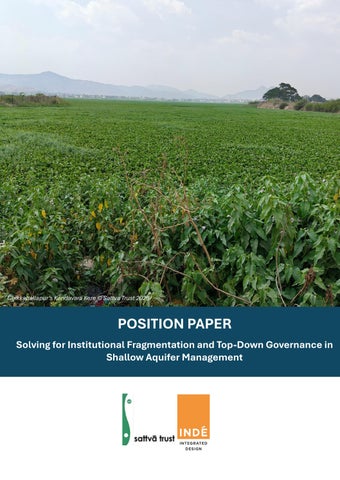
Chikkaballapur’s Kandavara Kere © Sattva Trust 2026
POSITION PAPER Solving for Institutional Fragmentation and Top-Down Governance in Shallow Aquifer Management
Introduction Shallow (unconfined) aquifers are critical to strengthening water resilience, given that these are renewable sources of groundwater that are relatively easier to access. Shallow aquifers are expressed through a range of landscape features such as lakes, ponds, open wells and kalyanis. As with the groundwater crisis, the challenges associated with shallow aquifers arise from a limited understanding of their natural characteristics, complex socio-economic dynamics around their use, and institutional frameworks that are often non-contextual and ineffective. In this position paper we train a lens on the institutional frameworks. Current institutional arrangements for shallow aquifer planning and management do not consider water as an interconnected resource, rather they are based on a fragmented understanding of water as either surface-water or groundwater. The surface-water that is visible today - is the same tangible public good that becomes groundwater at a later temporality through a complex hydrological process. Surface water resources are considered public common pool resources which are held in ‘public trust’ by the government. Groundwater on the other hand is bundled with property rights. A reimagined management approach is therefore required. Premised on the understanding that institutional fragmentation leads to weak policy implementation, the reimagination foregrounds two foundational principles. First, government bodies (at all scales) must be inherently public facing in their functioning. Second, effective management of water resources must be balanced between different scales of governance. We use the Kandavara kere (lake) in Chikkaballapura, Karnataka to outline the contours of a reimagined approach. The Kandavara Kere Chikkaballapura, a tier two city, is situated in a historically drought prone region in the Eastern Dry Agro-Climatic Zone (EMPRI, 2023), with an overexploited groundwater table (Central Ground Water Board, 2024). In the recent past, the implementation of the controversial HN Valley Project has reportedly replenished groundwater levels in the city-region.1 The Kandavara kere spanning ~330 acres is among the largest water bodies in the taluk. While physically defined by its extent and designated buffer zone, the kere also encompasses the social, biophysical and hydrological linkages that lie beyond the buffer zone. This acknowledgement of the kere as an expansive entity that 1
The Hebbal-Nagawara (HN) Valley Project lifts treated wastewater from Bengaluru to Chikkaballapura district, and is implemented by the Minor Irrigation Department, Government of Karnataka. Treated wastewater is released into tanks, lakes and other water bodies within the district.
1
includes the fields the kere irrigates, the wells it replenishes and the communities it supports is a first step to its holistic planning and management. Local communities spoke of the numerous Yetha Bhavis or traditional open wells near the kere that were once the backbone of the area’s water supply eco-system and the lush agricultural fields that are gradually getting converted into plotted developments. Currently, there is limited agricultural activity in and around the kere - practiced only by a handful of families, who benefit from the rajakaluve (overflow channel) flowing near their fields. Following the HN Valley project, the kere, along with the numerous wells and tanks in its vicinity, have witnessed a tangible increase in the water level. Yet, quality concerns have surfaced. A field visit to Sihineer Bhavi, a municipal well, revealed it to be a major source of drinking water until ten years ago. The well had dried up - but in recent months had shown an increase in the water level. The water however is contaminated and cannot be used, as underground sewage seeped into it. Most municipal wells in the vicinity of the kere are no longer being used for potable uses (although many remain in operational condition). The story repeats for the numerous private open wells (such as the Ranganna Bhavi - named after the owner of the well) in the vicinity - that have seen an increase in water level since the pumping of treated wastewater directly into the kere. The residents believe that the kere’s fish serve as a ‘benchmark’ - providing them information about water quality in the area, in light of concerns surrounding the quality of treated water from the HN Valley Project - “We know the water is safe for us, when we see that the fish are alive and doing well. Fish are very sensitive to changes in water quality. We therefore judge the quality of the water by how the fish are doing. As of now the fish are alive” (Interview, Local resident near the Kandavara kere, Chikkaballapur, 10th April 2026). There are however signages around the kere that warn residents not to use the kere’s water directly for drinking or agricultural purposes (Mongabay, 2023). Current Management of the Kere The governance and management of the kere is critical given its role in sustaining the surrounding socio-ecological system, including local lives and livelihoods. The roles and responsibilities of the institutions involved in its management are outlined below.
2
Institution
Responsibilities
Minor Irrigation Department • (Government of Karnataka) • and Bengaluru Water Supply and Sewerage Board •
Operation of STPs under the HN Valley Project. Lifting treated wastewater from Bengaluru to Chikkaballapur. Monitoring water-quality and groundwater recharge levels.
Karnataka Tank Conservation and Development Authority
Custodianship & management of the kere (in line with the KTCDA Act, 2018). Determination of the kere’s buffer zone and protection of the buffer zone. Reduction of sullage and non-point sewage that enters the kere.
• • •
Karnataka State Pollution Control Board
• •
Groundwater Directorate and Karnataka Ground Water Authority
•
Karnataka Urban Water Supply and Drainage Board
•
•
•
Chikkaballapur Urban Development Authority
•
Chikkaballapur City Municipal Council (Urban Local Body)
•
•
• •
Regulating water quality and preventing water pollution. Taking legal action against industries and commercial establishments that pollute water sources. Regulating groundwater extraction. Groundwater status monitoring. Implementing water supply projects (except distribution, which rests with the ULB). Constructing UGD networks within the ULB. Land-use regulation. Protecting the buffer zone of the kere. Maintenance of storm water drains and rajakaluves. Solid-waste management. Operations & maintenance of UGD networks.
As evidenced above, public agencies responsible for the management of the kere operate through multiple institutions that primarily function at the state level. Consequently, hyper-local aspirations, knowledge, needs and concerns do not feed into state-led interventions, as institutional mechanisms to facilitate these remain limited. Plan and policy interventions are predominantly top-down in their approach and seldom align with local community priorities.
3
A Reimagined Governance Approach A reimagined governance approach is necessitated, premised on the principle of decentralisation - with the involvement of diverse stakeholders impacted directly or indirectly by the kere’s (mis) management. Operationalising these fundamentals are proposed to be initiated with the formation of Water and Land Stewardship Associations. The Water and Land Stewardship Association (WLSA) is a proposed statutory working group within the Ward Committee2 - exclusively dealing with concerns related to ward level water and land management. The objective of the WLSA is to serve as an instrument through which local stewardship can be increased in natural resource management. The WLSA is neither a planning body, nor responsible for self-regulation. It does not take on the ownership of common pool resources regulatory power and ownership should continue to remain with public authorities. 3 The primary mandate of the WLSA would be to help co-develop plan and policy responses to challenges affecting land and water systems with the city-government, ensuring that state-led interventions are informed by local knowledge, priorities and lived experiences. The Karnataka State Pollution Control Board (KSPCB), the Groundwater Directorate (GWD) and the Karnataka Ground Water Authority (KGWA) should be mandated to work with these Associations to collect hyper-local data on issues such as solid waste management, industrial pollution, groundwater over-extraction, unauthorised borewells and built fabric expansion. Information, Education and Communication (IEC) and public awareness initiatives should likewise be anchored by the WLSAs to strengthen community-led natural resource stewardship. It is proposed that the WLSA should comprise three members of the Ward Committee, from among the members nominated by the Deputy Commissioner of the District.4 The WLSA must further co-opt two street-level bureaucrats (the value operators or equivalent) who play a role in water supply within the ward.
2
The Ward Committee is a statutory instrument to increase public participation in urban governance, mandated under the 74th Constitutional Amendment Act. Chapter III-A of the Karnataka Municipalities Act (1964) provides for the composition, roles and responsibilities of the Ward Committee. 3
The WLSA is different to other participatory approaches to water management – such as the COTAS (Aquifer Management Councils) in Mexico, where there was an explicit expectation of law implementation (Shah et.al, 2004). 4
In line with the Karnataka Municipalities Act (1964), five members are to be nominated by the Deputy Commissioner of the District from amongst the residents of the Municipal area, who shall not be a member a political party - possessing knowledge and experience in Municipality Administration or matters relating to Public Health, Town Planning etc.
4
Integrating the WLSA into the ULB Structures: Climate Action Cells The case of the Kandavara kere highlights the multiplicity of agencies involved in land and water governance, with limited mechanisms to coordinate their actions. As emergent cities and towns establish their Climate Action Cells, there is an opportunity to expand the purview of these Cells to make decisions relating to the governance of natural resources – reducing institutional fragmentation through democratic coordination. The objective of the Cells must move towards mainstreaming climate action through decentralised natural resource governance and participatory multi-stakeholder administrative action, rather than a framing of climate action as a novel idea outside of existing mandates.5 Responsibilities carried out by the KSPCB, GWD and the KGWA should be operationalised through the Cell. The recommended composition of the Cell is detailed below.6 • • • • • • • • • • • • • •
Municipal Commissioner and President of the ULB Chairman of the ULB Climate Action Cell (Elected from among the Councillors of the ULB) ULB Assistant Executive Engineer (Civil) and ULB Assistant Executive Engineer (Environment) ULB Community Affairs Organiser ULB Revenue Officer ULB Pollution Control and Environmental Regulation Officer* Representatives from KSPCB at the District Level Representatives from KGWA and GWD at the District Level ULB Chief Town Planner* - will have the mandate to prepare the Master Plan for the ULB and will be the sanctioning authority for the ULB. Representatives from Ward-Level Water and Land Stewardship Associations (WLSAs) within the ULB Assistant Executive Engineer Water Supply Board (KUWSDB) ULB Ground Water Officer* Representatives of Rural Local Bodies that surround the Urban Local Body. Nominated civil society experts from the fields of climate science, urban planning, sustainable development and allied domains.
*Proposed positions
5
The mandate of the Bengaluru Climate Action Cell is elucidated in the GBG Act, 2024, wherein the mandate of the Cell is limited to formulating and implementing the Bengaluru Climate Action and Resilience Plan and such other plans and strategies for mitigating Greenhouse Gas emissions. 6
The composition of the Cell is specific to municipalities in Karnataka and must be contextualised to different types of ULBs.
5
The WLSAs play an integral role in the activities of the Cell, serving as a key interface for the co-creation and co-development of plan and policy responses to challenges the city faces in governing land and water systems. The interface between the WLSAs and the Climate Action Cells are critical to bridging bottom-up realities and aspirations; with top-down mandates and governance imperatives. The administrative actions of the Cell must be informed by ground-up insights that are provided by the WLSAs.
Figure 1: Illustration of the interface between the WLSAs and the ULB Climate Action Cell (Source: Author Compilation)
This position paper’s proposed approach attempts to institutionalise local stewardship of natural resources and envisages a renewed role for Urban Local Bodies (ULBs). It is an approach through which the 74th Constitutional Amendment Act’s mandate may be furthered in emergent cities and towns. Strengthening the financial, administrative and operational capacities of ULBs is fundamental to designing a governance system that can effectively deliver democracy.
6
References Central Ground Water Board. (2024). National Compilation on Dynamic Ground Water Resources of India, 2024. Department of Water Resources, River Development & Ganga Rejuvenation, Ministry of Jal Shakti, Government of India. Foster, S., Garduño, H., & Kemper, K. E. (2004). Mexico – The “COTAS”: Progress with stakeholder participation in groundwater management in Guanajuato / Mexico – Los “COTAS”: Avances en la gestión participativa del agua subterránea en Guanajuato (GW-MATE case profile collection No. 10). World Bank. World Bank Document Menon, A. (2023, August 9). Should rural India drink urban wastewater? Mongabay India. Misra, A., Sharma, N., Balachandra, T., Sandeep, B. N., Kumuda, K. B., Megha, M., Naidu, S., Chandru, E. M., & Sharma, J. (2023). Rejuvenation of Chitravati River: A baseline study of the river catchment in Karnataka. Environmental Management and Policy Research Institute (EMPRI). Shah, T., Scott, C., & Buechler, S. (2004). Water sector reforms in Mexico: Lessons for India’s new water policy. Economic and Political Weekly, 39, 361–370. Task Group on Water Policy. (2019). Karnataka State Water Policy 2019: Recommendation submitted to Government of Karnataka. Karnataka Jnana Aayoga (Karnataka Knowledge Commission). The preparation of this position paper was led by Dr. Anjali Karol Mohan. Shreyas Isaac worked across all stages of the research. Valuable inputs were provided by Justin Andrews and Neeth D’Souza.
7