filtnews.com Issue 5 | 2026
SHOW PREVIEW
Fi l tX P O ™ 2026
FROM
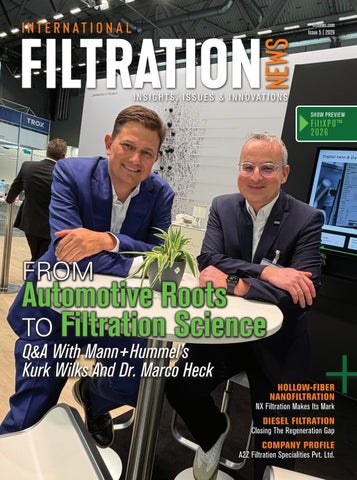
Automotive Roots TO Filtration Science Q&A With Mann+Hummel’s Kurk Wilks And Dr. Marco Heck
HOLLOW-FIBER NANOFILTRATION
NX Filtration Makes Its Mark
DIESEL FILTRATION
Closing The Regeneration Gap
COMPANY PROFILE
A2Z Filtration Specialities Pvt. Ltd.
Welcome to the future of liquid filtration technology. Single Bag Housings
Basket Strainers
Backwashing Filter Systems
Multi-Bag Housings
Centrifugal Separators
Coolant Filter Systems
Polypropylene Housings
Duplex Filter Systems
Filter Bags
High Flow Housings
Multiplex Filter Systems
Filter Cartridges
Contact us today for more information. 800.821.5373 RosedaleProducts.com
Rosedale Products Inc. 3730 W. Liberty Rd. Ann Arbor, MI 48103
Email: Filters@RosedaleProducts.com Phone: 734.665.8201 • Fax: 734.665.2214
©2026 Rosedale Products Inc.
CONTENTS
2026 | VOL 45 | ISSUE 05
FEATURES
10 Solution Center Showfloor Showcase 11 Automotive Roots 12 From To Filtration Science
Pleating Systems & Equipment A2Z Filtration Specialities
Q&A With Mann+Hummel’s Kurk Wilks And Dr. Marco Heck IFN Special Report
18
12
22
A Dialogue In Porto With Alfredo Oliveira Q&A With Alfredo Oliveira By Dr. Iyad Al-Attar, Global Correspondent, Technology and Innovation
Profile: A2Z Filtration: 22 Company Complete Filter Manufacturing Solutions By Arun Rao, International Correspondent
Filtration: From University Spin-Out 26 NXToNanofiltration Europe’s Largest Hollow Fiber Project By Adrian Wilson, International Correspondent
29 Cooling Towers Facing A New Water Reality 26 Regeneration Gap: Filtration 32 ThePerformance In Low-Duty-Cycle Diesel Applications
18 COLUMNS & DEPARTMENTS
IFN Special Report
4 Viewpoint
The Science Behind Filtration By Rachael S. Davis, Chief Content Officer & Publisher
6 Tech Spotlight
By Thomas Babineau
36 39 Show Review: 43 Excerpts From The Experts 46 Show Preview:
Smart Stormwater Filter Developed To Stop More Pollution Reaching Rivers And Beaches
How Ultrasonic Bonding Supports Assembly Of Filters Made With Synthetic Media By Sara Karmilowicz
8 Tech Notes 49 Movers & Shakers
New Technology Briefs
FILTECH 2026
By Adrian Wilson
Industry News & Notes
By Dr. Iyad Al-Attar
FiltXPO™ 2026
29
32
On the Cover: Mann+Hummel’s President and CEO Kurk Wilks and Dr. Marco Heck, president Division Filtration Materials and group vice president Operations Filtration Materials Rachael Davis INTERNATIONAL FILTRATION NEWS (ISSN: 1078-4136x), Copyright © 2026 is published bimonthly by INDA, Association of the Nonwoven Fabrics Industry. Business and Editorial Offices: INDA, 1255 Crescent Green, Suite 145, Cary, NC 27518, Accounting and Circulation Offices: INDA,1255 Crescent Green, Suite 145, Cary, NC 27518. Call 319-861-5017 to subscribe. Periodicals postage is paid at Cary, NC and additional mailing offices. POSTMASTER: Send address changes to International Filtration News, 1255 Crescent Green, Suite 145, Cary, NC 27518
2 IFN ISSUE 5 2026
RDAVIS@INDA.ORG +1 404.518.9599
TM
VIEWPOINT
CONTENT | EDITORIAL
CHIEF CONTENT OFFICER & PUBLISHER Rachael Davis rdavis@inda.org | +1 404.518.9599 EDITOR & DIGITAL PRODUCTS MANAGER Ken Norberg ken@filtnews.com | +1 202.681.2022 ART DIRECTOR Julie Flynn INTERNATIONAL CORRESPONDENTS Adrian Wilson, Arun Rao, Jason Chen GLOBAL CORRESPONDENT, TECHNOLOGY & INNOVATION Dr. Iyad Al-Attar BUSINESS DEVELOPMENT ADMINISTRATOR & BUYER’S GUIDE Angelica Gonzalez advertising@inda.media +1 (919) 459-3718
AUDIENCE | CIRCULATION circulation@inda.org
International Filtration News is published by INDA Media, the B2B publishing arm of INDA, Association of the Nonwoven Fabrics Industry. +1 919.459.3700 info@filtnews.com | www.filtnews.com News & Press Releases to IFNNews@inda.media
IFN SALES TEAM Vickie Smead SALES ASSOCIATE vsmead@inda.org +1 919.459.3715
Filippo Silvera ITALY & SPAIN info@silvera.it +39 02.284.6716
Sabine Dussey GERMANY, FRANCE, AUSTRIA, SWITZERLAND, SCANDINAVIA, BENELUX sabine.dussey@dussey.de +49 2129 5900910
Zhang Xiaohua CHINA ifj_china@126.com +86 13522898423
The Science Behind Filtration
T
he last issue of International Filtration News explored the idea of filtration as an enabler of the energy transition. The features in this issue extend that idea by looking deeper into the science that makes filtration such a powerful enabling technology. IFN International Correspondent Adrian Wilson’s coverage of the recent Filtech 2026 examines how carbon-capture systems, hydrogen fuel cells, industrial emissions controls and per- and polyfluoroalkyl substances (PFAS) treatment increasingly d e p en d on s ophi sti cat ed f i ltration operating behind the scenes (See “Filtech 2026: A Central Role For Filtration In The Next Industrial Revolution,” page 39). “Filtech 2026 ref lected an industry whose influence is steadily expanding as environmental challenges become more complex and performance expectations continue to rise,” Wilson writes. “Filtration is no longer simply an environmental safeguard op eratin g qui etly in th e background of industrial processes,” he summarizes. “It is increasingly an enabling technology for many of the industries driving the next phase of decarbonization and environmental protection.” Filtration can enable other technologies because it i s itself becoming more sophisticated, combining materials science, physics, data, artificial intelligence (AI) and systems engineering. In IFN’s interview with Germany-based Mann+Hummel, company leaders discuss the physics of filter media, multilayer material combinations and the use of AI and digital twins to balance efficiency, pressure drop, durability and cost (See “Mann+Hummel: From Automotive Roots To Filtration Science,” page 12). “There is more behind filtration than just pleating — it’s a science,” noted
Dr. Marco Heck, president D ivision Filtration Materials and group vice president Operations Filtration Materials. “We strongly believe in mastering that science in a different way not only in the transportation segment, but across filtration applications.” Mann+Hummel’s message is a reminder that a filter is not merely a replaceable component. It is a carefully engineered performance technology — and often an invisible one. The “Movers & Shakers” department in this issue highlights recent acquisitions and investments across the industry that suggest companies are responding to this increasing complexity in filtration by assembling broader capabilities. Businesses are acquiring expertise in media, membrane technologies, systems engineering, regional manufacturing, aftermarket service and life-cycle support. This activity suggests that industr y consolidation is not a separate business trend but one response to customers’ increasingly complex requirements. The trend also circles back to a central idea: The more filtration enables, the more the science behind it matters. In October, when FiltXPO™ 2026 opens its doors in Minneapolis, science, applications and commercialization will come together, while showcasing emerging technologies and market trends. IFN will be watching for insights into where the science is heading — and what it may enable next.
Rachael S. Davis Chief Content Officer & Publisher, INDA Media, IFN
MISSION
International Filtration News covers the topics and technologies that will shape the future of filtration and separation. Using subject matter experts from all parts of the industry, IFN is the leading source for the dialogues, debates and innovations across the full spectrum of filtration and separation applications and processes.
If you would like to contribute your expertise to help shape the content in IFN, consider applying for the IFN Editorial Advisory Board. We welcome input on trends and innovations, new story ideas and overall thought leadership. To apply, email rdavis@inda.org.
4 IFN ISSUE 5 2026
CONTRIBUTORS | ISSUE 5 2026 FILTRATION TECHNOLOGY SYSTEMS
IS NOW
Rachael Davis
Dr. Iyad Al-Attar
Arun Rao
Adrian Wilson
Chief Content Officer & Publisher INDA Media rdavis@inda.org +1 404.518.9599
International Correspondent Owner, Taurus Communications arun@tauruscomm.net
Global Correspondent, Technology & Innovation; Visiting Academic Fellow, Cranfield University i@driyadalattar.com
International Correspondent adawilson@gmail.com +44 7897.913134
The Filtration Expertise You Know. Expanded Automation Capabilities for What’s Next. The experience, people, and filtration knowledge behind FTS are now part of THRYVE Automation.
Thomas Babineau
Senior Emissions and Technology Advisor, Rypos Inc. tb@rypos.com
Sara Karmilowicz
Key Accounts Manager, Sonobond Ultrasonics Inc. skarmilowicz@sonobondultrasonics.com
CALL FOR COLUMNISTS & WRITERS International Filtration News is actively seeking viewpoints from qualified industry professionals and those allied to the filtration industry for insightful columns on topics such as trends, innovation, equipment, processes, etc. E-mail Rachael Davis, rdavis@inda.org with feature and column ideas.
By bringing together deep filtration expertise with more than 40 years of custom automation experience, THRYVE Automation can support more of your production needs, from individual filtration machines to fully integrated automation systems across upstream and end-of-line processes. Filter assembly and media-processing equipment Pleating, converting and laminating Robotics and material handling Machine vision and quality inspection Automated labeling, packing and palletizing Integrated controls and line connectivity Flexible systems and complete line integration Upgrades to existing equipment
You Bring the Challenge. We Automate the Solution.
+1 804.344.8101 sales@THRYVE.co 700 Gordon Ave, Richmond, VA 23224 4345 Security Pkwy, New Albany, IN 47150 ISSUE 5 2026 FILTNEWS.COM 5
T H RYVE . C O
TECH
SPOTLIGHT Smart Stormwater Filter Developed To Stop More Pollution Reaching Rivers And Beaches
E
ngineers at the University of New South Wales (UNSW) in Sydney, Australia have created a smart stormwater treatment system that automatically adjusts to changing weather conditions, markedly boosting its ability to remove harmful pollutants before they enter the environment. “Every time it rains, water washes across our roads, rooftops and footpaths before flowing into drains, creeks and rivers,” said lead researcher Jiadong Zhang. “Along the way it picks up a cocktail of pollutants — everything from fertilizers and pesticides to pharmaceuticals, plastics chemicals and contaminants released by vehicles. Some of these are toxic even in small amounts, while other pollutants can overwhelm natural systems in large enough quantities even if they are not individually toxic.” To address this, a UNSW team combined a nature-based stormwater treatment with sensors, automated controls and weather forecasts. The result is believed to be the first adaptive real-time control system designed to improve pollutant removal in stormwater biofilters. Supported by an Australian Research Council Discovery Early Career Researcher Award and published in Water Research, the research showed the technology consistently removed more pollution than conventional systems, raising removal rates for many organic contaminants from around 76 percent to nearly 90 percent. Instead of simply letting water flow through existing biofilters — landscaped areas that use soil, plants and naturally occurring microbes to clean runoff — the UNSW system continuously monitors conditions inside the filter with sensors that measure factors such as soil moisture and redox potential. These factors are
6 IFN ISSUE 5 2026
t The new smart system analyzes weather forecasts, as well as biochemical processes occurring within the system itself, to control when and how stormwater is processed. UNSW/ Jiadong Zhang
t The new biofilter system designed at UNSW continuously monitors conditions inside the filter using sensors that measure factors such as soil moisture and redox potential. Jiadong Zhang/ UNSW
an indicator of the chemical environment that affects how effectively microbes break down pollutants. At the same time, it analyzes Bureau of Meteorology rainfall forecasts in real time. If heavy rain is expected, automated valves gradually release stored water ahead of the storm to create capacity for incoming runoff. When conditions inside the biofilter are already optimal for pollutant removal, the system can hold water longer to maximize treatment. “It’s a bit like giving a rain garden the ability to think ahead,” Zhang said. To test the technology, the UNSW-led international team — including Dr. Kefeng Zhang and Professor Denis O’Carroll from UNSW, Dr. Veljko Prodanovic from the Institute for Artificial Intelligence Research and Development of Serbia, and Professor David McCarthy from Queensland University of Technology and the University of Guelph — built identical laboratory biofilters and recreated 11 real rainfall events with different storm sizes and dry periods. They compared conventional biofilters with the new adaptive system using stormwater
containing nutrients, suspended solids and ten representative organic contaminants commonly found in urban runoff. The smart system consistently outperformed the conventional ones. It proved especially effective at removing pollutants that break down readily in oxygen-rich conditions, while also improving removal of common pollutants such as nitrogen and organic carbon. Importantly, it continued to outperform conventional systems even when weather forecasts were imperfect, showing resilience under real-world conditions. Some highly persistent contaminants remained difficult to remove — a limitation shared by all current biofilter technologies — but the adaptive system still delivered more reliable treatment across a wide range of rainfall scenarios. Although the work so far has been demonstrated in the laboratory, the team believes the technology is ready for broader field testing. If successful, the approach could help cities improve water quality without replacing existing stormwater infrastructure. Source Neil Martin/UNSW, Sydney For more information visit: unsw.edu.au
The Future Flows Here International Filtration Conference & Exhibition Oct 28-29, 2026 Minneapolis, MN
Secure Your Spot at FiltXPO™ 2026 Improve your processes, products, and bottom line over two days of innovation, insights, and industry connections. Discover the latest filtration technologies and solutions from leading suppliers
Network with global professionals shaping the future of filtration
Gain critical knowledge in the 2-day Advances in Filtration Conference featuring top experts and real-world case studies
Advances in Filtration Technical Conference Strategies to transform indoor air quality
Balancing airflow, filtration, and energy efficiency in data centers
Innovations in nonwoven filtration media
Sustainability, circularity, and next-gen performance
INDA and AFS are partnering for the FiltXPO™ 2026 Conference Program
Make plans to attend and advance your filtration business.
Learn more at
filtxpo.com
TECH NOTES
Atlas Copco Launches PFP Prefilters For Simplified And Reliable Prefiltration Sweden-based Atlas Copco announced the launch of the PFP series of pleated polypropylene fiber filters, a new generation of high-efficiency prefilters designed to simplify early-stage filtration, according to the company. Built for food and beverage, pharmaceutical and chemical industries, the PFP range provides reliable particle retention and consistent downstream protection, supporting stable performance across a wide range of applications, according to Atlas Copco. The PFP series forms the foundation of Atlas Copco’s filtration portfolio, designed as a first step in the filtration process. Manufactured entirely from polypropylene using thermal-welding techniques, PFP filters offer broad chemical compatibility and low extractables. The filters use meltblown polypropylene fiber media to retain particles, prepare liquids for downstream membrane filtration and contribute to overall process efficiency. The PFP range is designed to make prefiltration selection straightforward, with five variants tailored to different application requirements. Starting with the core PFP as a general-purpose prefilter, the range includes variants that can be used in precise particle retention, high particle load, sensitive application and viscous fluid applications. This structured approach allows customers to select a filter for the requirements of a particular application, according to Atlas Copco. atlascopco.com
Ahlstrom Expands Lignin-Containing Filtration Media Production To Europe Finland-based Ahlstrom has expanded European production capacity for its Ahlstrom ECO™ filtration media. According to the company, the expansion strengthens its ability to support automotive original equipment manufacturers (OEMs) and aftermarket customers transitioning to more sustainable filtration solutions. Following the development of a first generation at Ahlstrom’s plant in Louveira, Brazil, production is now available at Ahlstrom’s Turin, Italy, plant. Increasingly stringent emissions regulations and hanges in the transportation sector are creating demand for filtration solutions. OEMs and filter manufacturers are accelerating efforts to reduce their environmental footprint, while maintaining efficiency across applications such as engine air, oil and fuel filtration. According to the company, Ahlstrom ECO filtration media addresses these challenges by integrating lignin, a renewable byproduct from the pulp industry. By replacing about 30 percent of traditional fossil-based phenolic resin, Ahlstrom ECO reduces reliance on nonrenewable materials while maintaining filtration performance including efficiency and durability in hot-oil conditions. In addition to its sustainability benefits, the company reports that Ahlstrom ECO offers mechanical properties fully compatible with existing pleating and filter manufacturing processes. The media reduces formaldehyde emissions between 40 and 70 percent during curing, which can help customers meet stricter environmental and occupational health requirements. Flame-retardant options are available, and the technology supports reliable global supply and industrial scalability.
ahlstrom.com
Aston University Unveils New £6 Million Membrane Research Facility Aston University in Birmingham, England, recently opened a research facility focused on developing and studying membranes for applications such as water purification and drug discovery. Officials hope that the lab’s open-plan design will foster collaboration among scientists and accelerate scientific discovery. In 2024, the university received £10 million from Research England to establish the new facility, the Aston Institute for Membrane Excellence (AIME). After two years of construction, Lord Patrick Vallance, the then UK Minister of State for Science, Innovation, Research and p Professor Mike Caine, interim vice-chancellor of Aston Nuclear, officially opened the £6 million laboratory. The facility houses 60 researchers, including eight research leads, nine independent AIME University; Professor Paul Topham, director of AIME; Lord Patrick Vallance; Professor Roslyn Bill, director of AIME; fellows, doctoral students, postdoctoral researchers, technicians and visiting researchers. and Councillor Stephen Simkins, deputy mayor of the West The laboratory has step-free access, height-adjustable workstations and integrated Midlands, at the ribbon-cutting ceremony for the new lab. accessibility features. Research disciplines are organized into zones, with biosciencefocused research at one end and chemistry research at the other. Major equipment is positioned to maintain the laboratory’s open design. Research will focus on designing and studying biological and synthetic membranes, including those involved in disease, waste remediation and water purification. aston.ac.uk
8 IFN ISSUE 5 2026
Finish Thompson Introduces FTI Air 3-Inch Plastic AODD Pump Finish Thompson Inc. (FTI) has launched the FTI Air Model FT30P, a 3-inch plastic air-operated doublediaphragm (AODD) pump engineered to deliver reliable performance, simplified maintenance and broad chemical compatibility for industrial fluid-handling applications. Designed with fewer parts, a stallresistant air valve and polypropylene wetted construction, the FT30P helps the pump move aggressive and abrasive fluids while reducing unplanned downtime, according to the company. The FT30P features a stall-resistant air valve that eliminates the need for separate pilot valves or mechanically operated pilots, reducing wear points and simplifying the air distribution system, according to the company. To support leak-free operation and environmental protection, the FT30P features bolted construction and precision-molded liquid chambers that help maintain gasket compression over time. Polypropylene wetted components provide resistance to alkalis and strong acids, while diaphragm, ball, seat and O-ring options enable users to tailor the pump to specific chemical, temperature and abrasion requirements. The FT30P provides a maximum flow rate of up to 300 gallons per minute (1,136 liters per minute), with a maximum air-supply pressure and outlet pressure of 120 pounds per square inch gauge (psig), or 8.3 bar. It displaces approximately 0.98 gallons (3.7 liters) per stroke, and supports maximum wet and dry suction lifts of 28 feet (8.5 meters) and more than 19 feet (6 meters), respectively, depending on diaphragm material. Adjustable center porting and 3-inch ANSI/DIN/ISO 150 flanged suction and discharge connections are designed to simplify integration into existing systems and piping layouts.
ftiair.com
p Finish Thompson’s FTI Air Model FT30P AODD Pump.
Parker Hannifin Launches Hydraulic Filtration Trolley Parker Hannifin has launched GLFTrolley, a portable filtration system designed for demanding industrial applications. The mobile unit is intended to improve fluid cleanliness before filling, transferring or servicing hydraulic systems. It can be moved between equipment, tanks, p Parker Hannifin’s drums and maintenance areas, giving GLFTrolley. engineers a way to clean fluids at the point of use instead of relying only on fixed filtration systems or scheduled oil changes. The GLFTrolley is intended for sectors in which hydraulic systems operate under harsh duty cycles, including gas, marine, mining, forestry and in-plant applications. In these environments, equipment is often exposed to moisture, dust, temperature variations and continuous mechanical stress, making contamination control part of asset protection. Portable filtration can be useful where equipment is distributed across a plant, vessel, quarry or remote site. A movable unit allows maintenance teams to address contamination at its source, rather than moving fluid or equipment back to a central service area. According to the company, this can reduce handling risks and make preventive action more likely to happen before contamination causes a failure. parker.com ISSUE 5 2026 FILTNEWS.COM 9
ADVERTORIAL | SOLUTION CENTER: MINI PLEAT SYSTEMS
Introducing All-New, Redesigned ROTH MFM3-S High-Speed Blade Pleater Breakthrough Performance/Premium Quality/Unbelievable Technology
P
leating Systems & Equipment – a leading supplier of high-quality manufacturing equipment and contract pleating services – specializes in helping filter manufacturers to select the right type of equipment and solutions to fit their filter production needs. The principals of “PSE” have owned and operated the largest privately owned filter manufacturing facility in the United States from 1996, while simultaneously owning the most successful pleating machine distributorship for over 25 years. We are experts in filter manufacturing, pleating machinery and accessories and understand the challenges manufacturers face. At PSE, we are third-generation filtration family and continue to provide outstanding solutions for our customers.
Next Evolution In Pleating Technology Has Arrived The all-new ROTH MFM3-S CNC Digital Blade Pleater. Next level performance packed with groundbreaking speeds while maintaining utmost precision. ROTH Composite Machinery has set the bar high with industry leading engineering and patented core on an all-new highspeed design.
p ROTH MFM3-S paired with the NEW High-Speed MPS-1000 (Black Edition) Mini Pleater.
10 IFN ISSUE 5 2026
The ROTH MFM3-S, an incredibly engineered high-speed blade pleating machin e, now pro ducin g a NEW recordbreaking speed of up to 510 pleats per minute! A perfect balance of high precision pleating and extreme speeds without compromising its robust strength. The remarkable MFM3-S is built to last a lifetime running 24 hrs/7 days a week, process approved. Roth Industries, partnered with Pleating Systems & Equipment, was founded in 1947, is supported by over 1,000 employees globally, and has long been respected as an innovator in the areas Building & Industrial Equipment Solutions.
Contract Pleating PSE continuously runs multiple contract pleating lines to accommodate customer’s overflow pleating requirements, interim machine sale pleating. Our production lines feature our new CroyBilt Integrated Mini Pleat Systems and the latest High-Speed CNC ROTH Blade Pleaters. Capabilities include 4-300mm pleat heights including glue bead application.
Used Equipment And Trade-In Program Used pleating equipment can be a great way to get started or expand your growing filtration business. PSE regularly acquires used pleating equipment, often via our trade-in program. Customers can frequently check our website to see what treasures we have in our warehouse. High Speed CNC Blade Pleaters Integrated Mini-Pleat Systems Servo Rotary Pleaters USED Equipment Contract Pleating OEM Parts & Service www.pseusa.com
ADVERTORIAL | SHOWFLOOR SHOWCASE: A2Z FILTRATION SPECIALITIES
The A2Z Of Pleating
P
leating is one of the most critical steps in any filter manufacturing process. Based on the media, required pleat profile, number of layers, output demands, and process parameters, manufacturers have traditionally chosen from five core pleating technologies: • Blade/Knife • Rotary • Pusher Bar • Star Gear • Zig Zag
Blade/Knife Pleaters The A2Z Intelligent Blade Pleater delivers exceptionally precise pleating, with pleat depths as fine as 2.5 mm (0.1”). Engineered around Allen Bradley® or Siemens® controls and servo motors, this machine represents the state of the art in blade pleating — purpose-built for accuracy and repeatability. For manufacturers seeking a more cost-effective solution, A2Z also offers an automatic, cam-driven Blade Pleater. Both models share the same hallmark advantages: outstanding versatility, rapid changeover of pleat depths, and the ability to handle a wide variety of filter media. The Next Generation High Speed Intelligent Blade Pleater with a production rate of up to 400 Pleats per minute • Up to 3000mm (118”) wide • With a pleat depth range 3mm (0.12”) to 300mm (12”) • Five/Six axis servo controlled systems • Different pleat configurations like V, M, W, Step, Taper and Marker Pleat • Quickest ROI in the industry • IoT & Industry 4.0, OPC-UA & FTP compliant • Quick set up with recipes to recall part numbers
Rotary Pleaters A2Z Rotary Pleaters are custom-built to accommodate a broad range of widths and pleat depths. Their defining advantage is high throughput — up to 3,000 pleats per
p ZIG ZAG PLEAT
p A2Z INTELLIGENT SERVO ROTARY PLEATER
p A2Z MINI PLEAT BLADE & ROTARY PLEATING LINE
minute — combined with the ability to emboss the media with distinct p NEXT pleat profiles such as dimple or lock GENERATION HIGH SPEED INTELLIGENT BLADE PLEATER patterns. To meet the needs of diverse production integrated production system. It includes environments, A2Z offers two drive unwinding, pleat counting, marking, and configurations: a servo-driven, on-thegathering, a conveyor, and an optional fly pleat depth change technology for pleat crest cutter. Quick changeover of maximum flexibility, and a mechanical star rolls for different pleat depths keeps pleat head change system for stable, production agile and efficient. repeatable production runs.
The Intelligent Servo Pusher Bar Pleaters A2Z Intelligent Servo Pusher Bar Pleater handles materials from 1” to 6” in pleat height, processing up to 3 layers simultaneously at high speeds. The machine supports a full range of specialty pleat configurations — including marker pleats, taper pleats, step pleats, and “W” pleats — across demanding media including heavyduty mesh, expanded metal, epoxy-coated mesh, and stainless steel. At its core is a multi-servo axis control system with programmable pleat depth options and recipe memory for up to 1,000 part numbers and media combinations. An Allen Bradley MicroLogix controller and 10 inch touchscreen interface make operation intuitive. The machine’s robust rack-and-pinion drive system sets it apart as the world’s most capable servo pusher bar pleater.
Star Gear Pleaters Designed for star gear pleating of multilayer expanded and mesh supported media — as well as single-layer self-supported media — the A2Z Star Gear Pleater is a fully
Zig Zag Pleaters
• Undertakes Zig Zag pleating of filter paper • Unique design rotary pleater • Provides extra surface area • Models: Range from 150mm to 700mm width Thi s machin e c ompl et e s A2Z’s comprehensive pleating portfolio, which now spans the Intelligent Servo Blade Pleaters, Servo Rotary Pleaters, Star Gear Pleaters, Intelligent Servo Pusher Bar Pleaters & Zig Zag pleaters.
Technology Highlights • Advanced motion control & servodriven systems • Machine vision-based inspection & defect detection • Automated material handling & assembly lines • Digital dashboards & production analytics
For further information, please visit our website – www.a2zfiltration.com or contact us at marketing@a2zfiltration.com WhatsApp: +91 98716 90592 Visit us at FiltXPO Booth #925 to learn more!
ISSUE 5 2026 FILTNEWS.COM 11
CORPORATE Q&A
FROM
Automotive Roots TO Filtration Science Mann+Hummel executives Kurk Wilks and Dr. Marco Heck discuss the company’s diversification, global growth strategy and investments in filtration materials, artificial intelligence and sustainable products.
G
IFN Special Report ermany-based Mann+Hummel has transformed from a fabric air filter, automotive-centered company into a global filtration business serving the transportation, industrial, indoor air, life sciences and water-treatment markets. Guided by its mission of “separating the useful from the harmful,” Mann+Hummel operates more than 80 sites across six continents and employs more than 20,000 people. At the recent Filtech exhibition held in Cologne, Mann+Hummel exhibited under the theme “Science of Filtration.” For the company, in practice, this idea means customized, on-demand filtration tailored to a customer’s exact requirements; bio-inspired materials made from paper industry waste; the smartFE artificial intelligence (AI)-driven platform combining more than 80 years of test data with machine learning; and exploring new frontiers applying filtration science to battery thermal management, fuel cell humidification and data center air quality. Mann+Hummel’s President and CEO Kurk Wilks and Dr. Marco Heck, president Division Filtration Materials and group vice president Operations Filtration Materials, sat down with IFN Chief Content Officer Rachael Davis and International Correspondent Adrian Wilson to discuss filtration science, as well as Mann+Hummel’s business and market strategies, technology and sustainability initiatives, among other topics.
12 IFN ISSUE 5 2026
Q+A IN THIS ISSUE:
KURK WILKS
President and CEO, Mann+Hummel
DR. MARCO HECK
President Division Filtration Materials and Group Vice President Operations Filtration Materials
The Business Perspective IFN: All markets face challenges, but what were you most encouraged by in Mann+Hummel’s performance in 2025? Wilks: When you look at our performance, we achieved revenues of 4.2 billion euros. This was down slightly from our expectations. Partly market driven, some impacted by disruptions that are now the norm. But overall, what we’re most happy about is that our free cash flow more than doubled from 133 million euros in 2024 to 289 million euros. Operating cash flow also increased significantly through strong cash management measures. We were able to reduce working capital by 138 million euros, or 16.8 percent, reflecting strong operational discipline. And our overall operating EBIT stayed at our previous levels, even with the small decline in revenue. That gave us good hope that the restructuring efforts as well as the transformation efforts that we have been making in earnest for some years now are starting to pay off. We also expect to see growth in all three divisions this year.
and Environment (LS&E). Then when we looked at the two divisions — the traditional transportation division and LS&E — what became even more obvious is the strength and the synergy we could get by also forming a filtration materials division. Two years ago, the shareholders and management team decided to form this division and Marco Heck, as the head of the region as well as Mann+Hummel’s largest filtration plant, was the logical person to become the president of this division. I would say this filtration plant was the birthplace of our first investment in filtration and synthetic media.
business, and this year we are celebrating the 30th anniversary of that facility. Our seasoned and local team is managed by President Jie Xu. I would argue that China is in the lead in the race to develop new automotive technologies and while the West still has a viable play, with every day that goes by I think the gap increases. In life sciences, a main vertical that we feel is absolutely relevant is the HVAC space, which includes retail filtration in the United States where homes are heated primarily by forced air to a very strong business in the Netherlands where we supply filtration solutions for operating theaters. Marco’s team is a critical interface between these two divisions, harnessing our engineering and science capabilities to bring solutions internally, but also to take solutions to the market. I think this puts us in a unique position to be a global manufacturer beginning with the science, then production of the filter media and lastly we can incorporate the end product into a system if required.
IFN: Mann+Hummel is still widely IFN: Where do you see the strongest associated with the automotive growth opportunities for filtration market, even as the company has over the next decade — by market, pursued a broader diversification application or region? strategy. How is the automotive Wilks: In order to maintain our filtration market evolving, and p A variety of Mann+Hummel filtration products on display during Filtech presence, we have to operate in 2026. Mann+Hummel can you explain a little about all markets. Asia is critical for the changes made in pursuit of a us, specifically China, where more diversified portfolio? We saw the ability to leverage our the business is headquartered, but Wilks: I joined Mann+Hummel in 1998, international footprint, our expertise throughout Southeast Asia. We have and I joined an automotive company. in filtration knowledge as well as our strong longevity in this market. We have But the company pivoted in a previous proximity in both markets as well as local teams in senior leadership positions strategy cycle because when we looked technologies. I think the markets we globally, which gives us the faith and trust at our capabilities and recognized that serve see us now as a filtration company of our customers. filtration was the “green thread,” if you developing really strong brands. In the Africa is an incredibly important will, among all the things we did in the life sciences space, we brand the business region. It has the fastest-growing and transportation verticals. It was logical MANN+HUMMEL. In our transportation youngest population. There is a large then to expand into water-filtration space, you see our brands MANN-FILTER, demand for transportation infrastructure, membranes and heating, ventilation FILTRON, Purolator and WIX Filters. and I recently saw first-hand, while and air conditioning (HVAC) filtration, Mann+Hummel still remains a viable at a CEO forum in Rwanda, the sheer which gave us the ability to take our player in the transportation space. amount of investment that’s going into technical knowledge, our engineering We relocated our new energy vehicle the construction of ports, airports and knowledge, our innovation capability and technical center to China some years wastewater treatment. I think somewhere form a division known as Life Sciences back to support the passenger car in the region of only two percent of the ISSUE 5 2026 FILTNEWS.COM 13
p At Filtech 2026, Mann+Hummel displayed a range of single-layer and multilayer filtration media solutions developed for demanding applications through digital material design, in-house testing and industrial-scale processing. Mann+Hummel
waste in Africa is treated. This opens up interesting opportunities for our membrane technologies. Last year, we built a factory in South Africa, which gives us the ability to produce locally. We are also active in Morocco and Turkey. I see those regions as offering significant opportunity for Mann+Hummel. Of course, our core markets in Europe don’t go away. Here, we are the market leader in automotive filtration, and we will maintain this position and continue to grow it while recognizing that the region has its own challenges and difficulties. North America also remains a significant part of our footprint.
14 IFN ISSUE 5 2026
And I w oul d b e remi ss not to mention South America, where we also see a significant surge in population. Mann+Hummel’s first international expansion was in fact in Argentina. IFN: This year, Mann+Hummel marks 30 years in China. How is the Chinese market changing and are there any challenges? Wilks: We are fortunate that we took the decision 30 years ago to be present in China . We have wholly owned entities there as well as joint venture partnerships, and I think flexibility in that market is key. It’s understanding that to be present in that market, it’s not from
the Western perspective, but from the Chinese perspective. You hear the phrase “Chinese speed.” I’ve experienced it firsthand. You also must acknowledge that China leads in many industries including automotive, rail and solar. As a country, China is very organized in terms of its economic potential, and I think the West can learn from this and needs to learn ultimately to compete. Governments can try to create certain temporary incentives, but the reality is competition wins. I truly believe the consumer is the ultimate source of truth. So, if China can build a product that the consumer values more at a lower price, it’s only a matter of time before they dominate that market. We shouldn’t fear this, but we have to learn, and then we have to compete. And this isn’t new to Western Europe; it’s not new to the United States. It just should be seen as a very clear message that things are changing, and for us to be relevant, we have to choose competitive solutions, which may mean difficult choices in the interim that are perhaps unfavorable in some of our traditional markets. But here, I think Mann+Hummel has clearly led. We haven’t shied away from the fact that we’ve had to move our production footprint and consolidate into locations that give us greater scale with better economic potential for competing against markets that are also very strong and capable. IFN: Mann+Hummel describes itself as a leader in filtration since 1941. What does leadership mean in this industry today? Wilks: We lead in so many ways. In the technical aspect of the “Science of Filtration,” which the company is talking about during Filtech, I think we provide some of the most innovative solutions for our customers, which in the end improves the value of what they do. But it’s more than just that. This year, we celebrate our 85th year as a German-owned “Mittelstand” [Germany’s “Mittelstand” comprises generally small and medium-sized enterprises, many of them family-owned and highly specialized]. Looking at the senior management team, I’m American, our
“A lot of companies can produce filters, but we can engineer the media and we can also produce the media.” — Dr. Marco Heck, President Division Filtration Materials
COO is Hungarian-Romanian, our CFO and the president of filtration materials are German , the president of our passenger car division is Chinese, and the president of the transportation division is Indian. We also have some French people in the mix. I don’t think there is a senior executive team in our industry that has a more diverse global and international view and I think this makes us a leader in filtration. We’re not afraid of challenging the norms, and here I give all the credit to our shareholders. They have really pushed this organization to think from the perspective of the markets that we need to be in, and there really isn’t a glass ceiling at Mann+Hummel. We really create the opportunity for the best talent in our organization to shape the company’s future, and this makes me really proud. We have an incredible filter value system that we also stand behind. I think our customers respect us not only for our products, but also in our ethics and way of doing business. This helps us enter into new markets with a strong reputation, which is really important as we expand into developing markets.
Technology And Product Development IFN: How is artificial intelligence being used in filter design, testing or manufacturing? Where do you see AI’s greatest impact in the near term? Dr. Heck: As my career progressed, I learned about the filter elements, seeing what is behind them, and where filtration actually happens. This is the media, and at the media level, the physics happen. I think we are one of only a few players in the global filtration market that really understand the physics on the media level. With that insight, deep know-how and data collection on a media level, on a filtration level and also on filters
in the market, we realized we could use this to differentiate ourselves from other companies. That brings us to AI, and new opportunities and effective use of the available data. A lot of companies can produce filters, but we can engineer the media and we can also produce the media. And I think here we are ahead of other companies with our simulation models that we have developed over the last few years. We generate data from our in-house media lines as well as our inhouse assembly lines. Our next step was to connect the two sides — the media production with the filter assembly lines and how they interact with each other. Companies who source the media from a supplier do not have this advantage. We u s e th e d a t a n o t o n ly f o r innovation, but also to drive down costs. We have some digital twin tools — Smart Filter Element (smartFE) and Smart Filtration Materials (smartFM) — that we use to design both the media and the filter. If a customer provides specifications or requirements, we can load that information into the tool to obtain a proposal for this given situation including the number of pleats and most suitable media option. What’s really great is that the model also looks at cost. In the end, we need to look at cost versus performance and not performance alone. IFN: What makes lignin promising for filter media, and are there any current limitations? D r . H e c k : Th e re a re sti l l m a ny combustion engines out there and they require an air cleaner for the engine, which is often cellulose-based. In order to maintain the stiffness and stability of a filter in all conditions, a phenolic resin is applied to the media that is hardened in an oven. The disadvantage of the phenolic resin is that it’s a crude oil-
based product. At Mann+Hummel, we have replaced just under 30 percent of this resin with a material extracted from wood lignin. Here we reduced the CO2 footprint of that filter, which is good for our aftermarket customers who are also trying to drive down their CO2 footprint. Wilks: This idea for me is another example of transformation: We have to recognize that no one company is able to do everything and partnerships are sometimes necessary. In this case, Gessner, which is a supplier, has been a really good partner. With the collaboration of Dr. Heck’s team, we were able to bring a solution that in the end addressed our customers’ sustainability needs, as well as improved the performance of the product, so there was no sacrifice. IFN: What are the key nonwovens products produced by Mann+Hummel? Dr. Heck: We cannot produce all the media types, and we source wetlaid products from outside suppliers but engineer those products with the supplier using a digital twin. We have spunbond and needlepunching, which are relatively mature technologies and there is not much opportunity to innovate with just a single layer. So, we think about combining different technologies to see how we can differentiate from other companies. On the spunbond side, we developed a super stiff material for the cabin air filter segment that you can nicely pleat at a very high speed. We also source nonwovens and perform activated carbon lamination on our own. In the meantime, we run two activated carbon lines in China, and we plan to expand further because we see tremendous growth in our molecular filtration business. Here now, the beauty is coming into the game. We started thinking in single layers, but now we are more in this multilayer ISSUE 5 2026 FILTNEWS.COM 15
p Exhibiting under the theme "The Science of Filtration," Mann+Hummel’s exhibits included models illustrating how the filtration mechanisms work. Mann+Hummel
dim ension , as well as enhancing and functionalizing these media. We can use the carded web, combine it with a nanofiber layer and then use a meltblown on top, and potentially also spunbond to make it pleatable. We have also lamination lines to combine these multilayered materials. Now playing with these capabilities, we see really a huge differentiation point, and we have all these capabilities in house. There is more behind filtration than just pleating — it’s a science. And we strongly believe in mastering that science in a different way not only in the transportation segment, but across filtration applications.
16 IFN ISSUE 5 2026
IFN: You mentioned just now a molecular business. What does “molecular” mean in this context? Dr. Heck: We are mainly using activated carbon generated from coconut shells in the cabin air filter segment for passenger cars. This is mostly for removing odors, but you can also apply these kinds of activated carbons to remove some hazardous gases, and possibly some basic or acidic gases to protect equipment in data centers, for example. We see this as a growing market and are using lamination technologies, wet impregnation techniques and are also incorporating activated carbon into ceramic honeycomb filters.
IFN: How are advanced fiber technologies, including nanofibers, changing filter performance? Dr. Heck: This is something really interesting. Media for cabin air filters can be charged to provide a really good initial efficiency. But unfortunately, with humidity and over the filter’s lifetime, the charge is lost. And using nanofibers, you can secure this initial efficiency over a filter’s lifetime. Nanofibers are resistant to humidity and other surrounding conditions, and we think this is more sustainable than electrocharging — although you will find different opinions in the market. This idea formed our starting point for nanofiber innovation. We have also found that nanofiber coatings are useful in truck applications where the coating helps prevent super fine dust from passing through a filter and blocking the mass airflow sensor. Most filters are in the commodity segment, but a lot of filters and many applications still require performance that other companies can’t meet. With our capabilities, we hope to find solutions together with our customers.
“
IFN: What progress can realistically achieving the absolutely necessary … the relevance of filtration be made toward more circular filters, outcome for the data center itself. only increases in the future. and how important is sustainability Mann+Hummel definitely can play in filter design? a role. This is where Mann+Hummel Dr. Heck: The lignin material we has a really unique opportunity discussed is one example. Our filters IFN: Do you think end users are also can play a role in the energy beginning to understand filtration … to make a sustained and consumption that is needed to get a as a performance technology rather substantial difference. fluid or a gas through the filter. The than simply a maintenance cost? lower the pressure loss, ∆p, is, the Dr. Heck: There are a lot of areas — Mann+Hummel President where we still can differentiate with better it is for energy consumption, and CEO Kurk Wilks performance and we can explain a which can have a huge impact on sustainability. But when the filter is little bit more to the end customer so open to reduce pressure loss, it’s about what the filter is doing. We not capable of filtering. The idea is all have cabin air filters in the car, to balance these three factors —∆p, but most people do not really know efficiency and dust-holding capacity what it is doing. This gray zone is to drive sustainability. an opportunity to explain a little bit We can also influence sustainability more about what filtration really with our packaging material, with means in terms of your health. If the raw materials, where we source you don’t have a filter, then your the material and how we source the lungs are doing the filtration. A material. filter is like an invisible guardian Fo r t h e p a st f iv e y e a r s , protecting your health. This applies Mann+Hummel has been honored not only to cabin-air filtration, but with a gold EcoVadis rating [a to all filtration. p Mann+Hummel's President and CEO Kurk Wilks (left) and sustainability rating that places the President Division Filtration Materials Dr. Marco Heck Wilks: Mann+Hummel has started company in the top 5 percent of all to explain filtration to consumers. evaluated companies globally and We w e re s o l e ly b u si n e s s - t o within the top 1 percent of their specific IFN: Earlier in our conversation, the data business, but if you read a lot of our industry]. center market was mentioned. How much advertising, we talk about clean air, clean Wilks: When it comes to sustainability, of an impact has that market had on water, clean mobility and clean industry. our purpose is so unique in this context Mann+Hummel’s business? And this is the simplest way to explain because we are both an enabler and Wilks: It’s one of our fastest-growing it, right? Mann+Hummel is something a contributor. We provide, as Marco air-filtration segments. There is a need to much greater than the traditional explained, products that improve our keep a high level of cleanliness to protect automotive-filtration company our customers’ sustainability goals, and then the assets. Not only that, but we see nextfounders established. We really stand in our own production we take great generation solutions where ultrafiltration for clean air, clean water, clean mobility, care. We think about the consumption will play a huge role, as well as in waste clean industry and across the vertical of energy, and we look for materials management of water that is degassed supply chain right up to the media that that have the ability to improve the from the application. In addition, are the heart of filtration. Through Dr. circular economy of filtration. In terms increased demand also presents more Heck’s team, we think we’re offering of sustainability itself, the factories for opportunity. really great solutions that help our which Marco is also responsible in his Ultimately, we need to service those customers but also their customers. division have very strong recycling goals. organizations in the right way. Each We also have stated targets. Our Carbon region approaches the idea of data IFN: If you could leave readers with one Zero Strategy aims to achieve carbon centers and the need for them differently. message about filtration, what would it be? dioxide-neutral production by 2035 and to What we can offer the customer is highWilks: I think the relevance of filtration extend decarbonization across the entire performing products that give high flow only increases in the future. This is where value chain by 2050. Of course, we have through the filter, reducing the amount Mann+Hummel has a really unique to balance sustainability with the cost. of energy consumption to push the opportunity over the next 85 years What was unique about the green filter air into sustainable cooling systems to make a sustained and substantial developed last year was that it was at a that use ultrafiltration to help lower difference. Our shareholders stand firmly cost that was affordable to the consumer. the environmental impact, while still behind that mission.
”
ISSUE 5 2026 FILTNEWS.COM 17
EXPERT Q&A
A Dialogue In Porto
u Alfredo Oliveira (left) and Dr. Iyad Al-Attar met in the Session Room (Sala das Sessões) located inside the Casa do Despacho of the Venerable Third Order of Saint Francis (Casa do Despacho da Ordem Terceira de São Francisco) in Porto, Portugal. Isabela Ivanova
With Alfredo Oliveira
Alfredo Oliveira discusses how evolving European regulations, historic building constraints and new filtration technologies are reshaping indoor air quality in Portugal. By Dr. Iyad Al-Attar, Global Correspondent for Technology and Innovation
A
lfredo Oliveira is a mechanical engineer with more than two decades of experience in heating, ventilation and air conditioning (HVAC), refrigeration systems, and manufacturing operations. His expertise spans product development, regulatory compliance and the implementation of natural refrigerants. Oliveira has a deep knowledge of regulatory frameworks, particularly concerning European Union (EU), CE, Saudi Standards, Metrology and Quality Organization (SASO) and UL markings. He leads strategic initiatives and cross-functional teams
18 IFN ISSUE 5 2026
to ensure strict adherence to EU, EN and ISO standards. He is currently director of Research and Development at Portugal-based Friemo and president of the Portugal Chapter of the American Society of Heating, Refrigerating and AirConditioning Engineers (ASHRAE). As the European Union intensifies its focus on building decarbonization and the Energy Performance of Buildings Directive (EPBD), the role of the HVAC expert has expanded far beyond the traditional boundaries of thermal comfort. Today, people like Oliveira are at the forefront of a movement that prioritizes atmospheric integrity,
Q+A IN THIS ISSUE:
ALFREDO OLIVEIRA
Director of Research & Development, Friemo
treating air not merely as a medium for temperature control , but as a fundamental pillar of human well-being.
The Heritage Challenge At Igreja Da Lapa Prior to the meeting with IFN, Oliveira gave a tour of the grounds of the Venerable Brotherhood of Our Lady of Lapa. The construction of this complex — located in the heart of Porto, Portugal — began with an iconic church in 1756 (See Figure 1). Over the centuries, the site evolved to meet the city’s civic needs, expanding to include a school in 1800 and a hospital in 1904. Oliveira used this historic site to
illustrate a fundamental paradox in architectural evolution. While the health of the students and patients was a primary concern for the original designers, air filtration and indoor air quality were never utilized as design metrics. Instead, builders relied entirely on passive stone architecture, high ceilings and natural ventilation. Today, bringing these centuries-old spaces up to modern standards of atmospheric integrity presents a profound engineering dilemma . Retrofitting historic buildings with contemporary HVAC and filtration systems is not merely a physical hurdle involving thick granite walls. It is a cultural
p Exterior view of the Church of Our Lady of Lapa (Igreja de Nossa Senhora da Lapa) and the adjoining Casa do Despacho in Porto, Portugal, where the meeting took place. Alfredo Oliveira
challenge. Forcing modern mechanical compliance through invasive ductwork risks stripping these monuments of their original architectural premise, symbolic value and irreplaceable heritage. In this exclusive interview for IFN, Oliveira discusses how Portugal is navigating regulatory shifts, the practicalities of integrating high-level filtration into modern HVAC design to achieve fit-forpurpose air, and what a systems-thinking approach to indoor environmental quality (IEQ) truly looks like for the citizens of Porto, Portugal and beyond. Dr. Iyad Al-Attar: With your extensive b a ck g ro u n d i n A S H R AE a n d EU regulations, you have a bird’s-eye view of where building design is heading. As we push for more sustainable infrastructure, how is the HVAC industry adapting its systems — and the way filtration is integrated — to support energy efficiency and circular-economy goals without compromising air quality? Oliveira: The new EU perspective is adapting at the forefront to new buildings. The recast project for the EPBD is extending to the old buildings and most of the historical ones. That’s the more complicated part; that is why some actions will drive into heat pumps or air handling units. The latter are preferred, as we can control the inlet air and the filtration system. The basic HVAC needs extra effort and study to apply. But as you noticed during our visit to the monument, the process will be challenging. Dr. Al-Attar: For decades, the HVAC industry’s primary focus was thermal comfort — essentially, just keeping people at the right temperature. Now, we are seeing a necessary shift toward a holistic approach to IEQ. From a systems perspective, what are the most exciting developments driving this transition, and what will this mean for everyday public health and wellbeing? Oliveira: In my opinion, we will have a better environment and should notice this in our day-to-day work, resulting in a decrease in problems such as stress and concentration issues, among others. ISSUE 5 2026 FILTNEWS.COM 19
“… the world is changing. The climate is shifting, and air pollution is increasing. While we should retain the best traditional ideas, we must evolve our building practices to create healthier, higher-quality indoor environments.” — Alfredo Oliveira Dr. Al-Attar: Translating broad European directives into local action is always a complex task. Looking specifically at Porto and the rest of Portugal, what are the most notable initiatives or regulatory changes happening right now regarding indoor air quality, and how is the local HVAC sector stepping up to meet these new demands? O l i v e i ra : Por tu gal l egi sl ation i s directly correlated with the EPBD and environmental well-being. It is implemented in part through the country ’s building automation and control systems (SACE), as required under Decree-Law No. 101-D/2020. SACE integrates systems such as lighting, HVAC, air quality, security and energy management. Without it, you may not have the building certification, of course, if it is new or being rebuilt. Preserving historical buildings as you saw them presents another level of difficulty. Dr. Al-Attar: Let’s talk about practical application in modern buildings. As an HVAC expert, how would you envision better integrating advanced air quality and ventilation solutions into our building systems today compared to five or ten years ago? What high-level trends in system design are making the biggest impact on the air we breathe indoors? Oliveira: Air-handling units (AHUs) and heat pumps now incorporate higher levels of filtration, along with ultraviolet light and other measures like gas-phase and high-efficiency particulate air (HEPA) filters, which were not used in day-to-day applications. The role of air filtration technologies is evolving, with the potential to play a much bigger role in new and retrofitted buildings. Dr. Al-Attar: The HVAC and refrigeration sector is currently juggling two massive demands: decarbonizing our urban
20 IFN ISSUE 5 2026
environments and significantly enhancing public health. Looking to the future, what do you see as the biggest upcoming milestones — or hurdles — for the industry in Europe as it tries to deliver highly energy-efficient buildings that also guarantee pristine indoor air? Oliveira: The primary challenge lies in adopting new refrigerants that are subject to strict flammability constraints while simultaneously using high-efficiency filters. As filters accumulate dust and particulate matter over time, they can generate localized heat or static resistance, creating a potential source of ignition in the presence of flammable gases. At present, many AHUs successfully navigate this by utilizing indirect systems and advanced airflow control. By precisely regulating airflow to create strategic positive or negative pressurization within a space, these systems achieve superior air quality while mitigating direct safety risks — a balance that will become increasingly complex as refrigerant standards evolve. Dr. Al-Attar: Today, we stood inside the historic Igreja da Lapa complex. What critical lessons can modern engineers learn regarding human occupancy, evolving building functions, thermal comfort and the broader pursuit of holistic IEQ? Oliveira: Buildings constructed before COVID primarily focused on energy efficiency. In the post-COVID era, however, a much more comprehensive approach is required — every aspect now matters. Looking at traditional architecture from the façade to the interior, particularly in Northern Portugal, the main concern was protection against the cold. This explains the widespread presence of fireplaces. Rooms typically featured high ceilings well above 2.5 meters and dome-shaped designs, which allowed heat to rise naturally, helping to keep the space feeling fresh and cool during the summer.
Yet the world is changing. The climate is shifting, and air pollution is increasing. While we should retain the best traditional ideas, we must evolve our building practices to create healthier, higher-quality indoor environments.
Closing Thoughts The discussion with Oliveira focused on the evolving landscape of indoor environments. Set against the backdrop of e v o lv i n g EU re g u l a t i o n s , t h e conversation explored the intersection of HVAC design, urban sustainability and public health, emphasizing a shift toward treating indoor air as a fundamental pillar of human well-being rather than merely a medium for temperature control. The dialogue highlighted how the European Union's intensified focus on building decarbonization and the recast EPBD is driving changes in both new construction and the renovation of historic buildings. Oliveira noted that integrating modern HVAC requirements into historic buildings is a highly complex challenge. In adapting to these new standards, AHUs are often preferred because they allow direct control over inlet air and the integration of proper filtration systems, both of which were more difficult to achieve with basic heat pumps. Furthermore, the HVAC industry is moving away from its traditional, primary focus on simple thermal comfort. The transition toward comprehensive IEQ is expected to yield tangible improvements in daily environments, ultimately helping to diminish modern occupational challenges such as high stress levels and poor concentration. Bio Update: Dr. Al-Attar also now serves as a visiting scholar in the Department of Construction and Technology in Architecture at the Escuela Técnica Superior de Arquitectura within the Universidad Politécnica de Madrid (UPM), Spain.
Don’t just keep up — get ahead at AHR Expo.
Co-Sponsored by
COMPANY PROFILE
A2Z FILTRATION:
Complete Filter Manufacturing Solutions A2Z Filtration Specialities has grown from a single pleating-machine sale into an international supplier of filtration equipment, components and technical support. By Arun Rao, International Correspondent
I
n an Indian city called Gurugram, a family-run business has quietly become one of the world’s most trusted names in filtration manufacturing equipment and components. A2Z Filtration Specialities Pvt. Ltd. doesn’t make filters but it builds the machines that make filters as well as the end caps and other components to assemble filters. From the oil filter in a truck engine to the high-efficiency particulate air (HEPA) filter guarding a hospital ward, from a refrigerator’s odor-absorbing carbon cartridge to the hydraulic filter inside an aircraft, chances are A2Z-built machinery played a part in its creation. A2Z Filtration Specialities’ growth is unique. From selling a single pleating machine in 2002 to becoming today’s global filtration-equipment powerhouse managing four production facilities, the company currently ships more than 110 production lines and millions of components annually serving customers in more than 75 countries.
22 IFN ISSUE 5 2026
A Niche Nobody Else Saw A2Z’s origin story begins with a gap that almost nobody saw and very few people acted on. Digvijai Singh, A2Z’s managing director, founded the company with his father and his brother after they left partnerships in other filtration ventures. They zeroed in on pleating, the folding process that sits at the core of virtually every filter ever made. “Pleating is the heart of all filtration,” Singh said. “Almost every filter has pleating in it. We sensed an opportunity and saw an ability to start manufacturing pleating machines and then, of course, making other peripherals.” The year was 2002. Worldwide, only a handful of companies built pleating machines. The fledgling company built its strategy around two complementary pillars — equipment to manufacture filters and components like caps, bypass valves, machined parts, expanded metal, inner tubes, injection molded components and frames, which are used to assemble the filters.
The pleating machine became the first product to carry the A2Z name into the market, and tellingly, its first order was an export order to the United States. From that single machine, the range grew organically, almost entirely in response to customer requests. “As we went to customers with an offering, they asked us, ‘do you have other solutions?’” Singh noted. “And that’s how we grew organically.” Each customer request for things such as mini pleating; heating, ventilation and air conditioning (HVAC) assembly; seam sealing; cap gluing; wrapping; and seaming became a new product line, until A2Z’s catalog swelled to almost 300 distinct machine technologies and options covering automotive, medical, HVAC, aerospace, household and several other filtration applications. Asked whether he considers himself a pioneer, Singh said: “As a company, we are a pioneer in what we started. And we continue to evolve, coming up with new concepts and ideas. Twenty-five years
ago, we were new to this game. Today, customers reach out to us as a first-choice supplier.”
Four Facilities, One Philosophy A2Z now operates across four production facilities. Two sit close together near the company’s Gurugram headquarters. One plant houses the head office, design, assembly, finance and accounting; the other is dedicated purely to machine assembly. The third and fourth facilities, which adjoin each other, are roughly 35 miles away in Bawal. Bawal is where proprietary machining and component manufacturing take place, supported by a workforce of roughly 500 people. Around 100 more work across the two Gurugram sites. The split, Singh explains, traces back to logistics with the bulk of the business overseas-orient ed , th e Gur ugram facilities offered better connectivity, even as transport links to Bawal have since improved considerably. Altogether, the company operates on roughly 200,000 square feet of manufacturing space. What truly differentiates A2Z is the seamless loop between its functions. Sales catch the client’s need, design and development invents the blueprint, purchasing secures word-class components, production executes under rigorous ISO standards, and the service team ensures that machine runs smoothly for decades. All these efforts culminate in providing built to purpose solutions.
“O ur custom ers can find th ese components from globally renowned brands within literally 50 miles of their location,” Singh stated. On top of that hardware foundation sits a remote-support capability A2Z built more than 15 years ago, well ahead of the Industry 4.0 wave that later made the practice fashionable. “We can connect to a machine anywhere in the world, can do live diagnostics and do upgrades of software through the remote support facility. It also gives customers live visibility into production rates, fault data, rejection rates and material usage,” he explained. A team of 12 service engineers operates out of India, complemented by a fiveperson U.S.-based team serving American customers in their own time zone, with additional representatives elsewhere supporting installation, training and servicing. The speed of response has become a genuine differentiator, according to the company. Customer chat groups mean a reported issue typically receives a reply within five to 10 minutes, with many problems — sometimes nothing more than a training gap rather than an actual fault — resolved within half an hour.
The Defining Pivots: Servos, Cobots And Now AI Asked to name the single most defining moment in A2Z’s history, Singh resisted the idea of one event, describing the company’s growth instead as continuous evolution. But one inflection point stands out: the shift from mechanical cam-driven to servo-driven systems more than 20 years ago. “We went from a cam-driven system to our first servo-driven systems, where there were no cams,” Singh said. “You had lots of operation choices. That was the most defining moment.” A decade later came the integration of robots and cobots into assembly lines woven into A2Z’s own machines to reduce human intervention and increase automation. The next frontier, Singh says candidly, is artificial intelligence (AI), although A2Z is still at the starting line. “We haven’t really integrated AI yet,” Singh admitted. “We have just started providing basic training on how to use the standard AI tools.” He pointed to recent SOLIDWORKS training on AI-assisted design as an early step. But he’s unequivocal about its eventual significance. “I’m sure when, thousands of years
Earning Customers’ Trust Selling sophisticated automation to customers thousands of miles away inevitably raises a question : what happens when there is a breakdown? Singh said A2Z solved that problem at the component level long before it became a service conversation. The company standardized the various ancillaries of its machines on globally available brands like Allen Bradley, Siemens, Mitsubishi controllers; Festo and SMC pneumatics; Pilz safety systems; and Banner Engineering and Keyence sensors, to name a few.
p A2Z's catalog includes some 300 distinct components for applications including automotive, medical, aerospace, HVAC and household. All images courtesy of A2Z
ISSUE 5 2026 FILTNEWS.COM 23
Customer-Led Research And Development Research and development (R&D) at A2Z is almost entirely customer-led. New technologies emerge from d et ai l e d c on sult ation s that Singh compares to an architect designing a home: probing what media a customer will run, at what width and speed, and what their needs might look like years down the line, because these machines are built
The logic is straightforward: in a complex assembly, a single failed component can shut down the entire line. Before any machine leaves the facility, it undergoes a full production trial using the customer’s own materials — typically with the customer present, able to request on-the-spot changes. According to Singh, it’s fully tried and tested. There’s a full acceptance test at this facility. Trials can stretch across multiple hours or even days depending on complexity. Design work runs on SOLIDWORKS for 3D modeling, simulation and inspection, alongside EPLAN for electrical design, a
p A2Z is headquartered in Gurugram, India. u The company operates four manufacturing facilities, two of which are located in Bawal, India, where proprietary machining takes place.
ago, they discovered the wheel, there was a eureka moment,” Singh mused. “In the same context, AI should bring tremendous changes in everything that we do.”
How A2Z Avoided Spreading Itself Too Thin With a product range spanning complete filter manufacturing solutions from blade and rotary pleaters to seaming machines and testing equipment, the obvious question is how A2Z has avoided spreading itself too thin. Singh’s answer is that diversity of application masks an underlying consistency of process. While the range is diverse — covering automotive, industrial , aerospace, m e d i c a l , H VA C a n d m a ny m o re applications — the processes are fairly similar. The company’s two business lines — filter-manufacturing equipment and filter components — were deliberately built to be complementary, partly as a hedge against the cyclical nature of capital-goods spending. “Capital goods sometimes go through cycles, so we said we need to support ourselves with something else,” Singh said, noting that the equipment side has avoided major downturns to date.
24 IFN ISSUE 5 2026
to last decades. The company’s very first mechanical pleating machine from 2002 is reportedly still running today, a fact Singh offers as evidence of its build quality.
Tight Tolerances For Machines A2Z is an ISO 9001:2015 certified company and is an IATF 16949:2016 certified facility. Quality control at A2Z splits sharply between its two business lines. On the components side — where the company produces millions of pieces — statistically relevant sampling governs in-process and finished-goods inspection. For machiner y, the standard is absolute. “Not a statistically relevant size, but every part is checked,” Singh said. “We conduct 100 percent inspection,” he noted, describing the use of coordinate measuring machines and SOLIDWORKS inspection software to verify tight tolerances on every dimension.
marked upgrade from the company’s early AutoCAD days. With 3D software, the company is able to verify and troubleshoot issues, translating directly into faster delivery and fewer post-installation issues for customers.
Global Sourcing Creates Customer Confidence A2Z’s reliance on internationally sourced components in its machines carries an obvious cost premium of 20 to 25 percent over cheaper alternatives. Singh argued the trade-off is overwhelmingly worth it, particularly after the supplychain shocks of recent years prompted the company to begin stocking regularly used items in-house. That additional cost is paid for more than 10 times by having less downtime. Customers can choose from recommended spare-parts packages, buy
components only as needed or enter into maintenance contracts — flexibility that Singh says reflects how differently each customer prefers to plan for the long operating life of their equipment.
remain the most consistent markets alongside a growing footprint among Asian manufacturers.
From A U.S. Export Order To Six Continents
A2Z generates 48 percent of its own energy needs from solar power across all its facilities and recycles wastewater for gardening and sanitation use. Singh is careful, though, to distinguish between the company ’s own environmental footprint and its broader role in sustainability. “Directly, we have no contribution, unfortunately,” he said. “But indirectly, yes — because we’re building systems that help produce filters. Cleaner-running engines, properly filtered exhaust systems and gas-turbine filtration all trace back to the equipment A2Z builds.” When pressed on whether poor filtration causes urban pollution, Singh said, “Filtration can mitigate pollution, but not its cause, which lies in factors like geography, climate, and industrial activity. Filtration can help reduce that as a treatment.”
A2Z’s export-led identity was set from day one: its first-ever order was a pleating machine shipped to the United States, and overseas sales still account for roughly 80 percent of total sales. Singh attributes the early export tilt to automation levels that, two decades ago, found readier acceptance abroad as compared with the then-smaller local market — a gap that has narrowed considerably as India’s own manufacturing base has expanded. On the components side of the business, Europe, the United States and the Middle East each account for roughly a quarter of business, with India making up the balance. For machinery that is considered capital goods, the picture shifts year to year depending on which country is investing in new capacity, though Europe and the United States
Sustainability: An Indirect But Real Contribution
What’s Next Looking ahead, Singh is clear that filtration remains the company’s singular focus, even as this decade and the next bring new questions about which adjacent product categories within filtration might be worth adding. The company has recently launched a high-speed blade pleater, running at 400 pleats per minute compared with a previous benchmark of 250 to 300. Besides this, the company continues to add various automation capabilities across its offerings. Also in the works is a fifth facility, another 50,000 square feet in the Bawal area, set to break ground soon and go online by the end of 2027, adding roughly 30 percent to existing capacity. A2Z’s catalog includes more than 7,000 distinct filter component part numbers, each traceable by a single reference number for instant customer reordering. With a 25-year operating history that includes machines still running from its first year in business, A2Z’s pitch to the market is less about novelty than reliability compounded over time. “ Today, customers will come to us as a first-choice supplier rather than us having to go and pitch to them,” Singh stated. “They have that confidence in us. That’s the big difference.”
p (clockwise from top left): A mini pleat blade and rotary filter; an intelligent modular filter assembly line; and a servo-driven cabin air filter line.
ISSUE 5 2026 FILTNEWS.COM 25
NANOFILTRATION
From University Spin-Out To EUROPE’S LARGEST Hollow Fiber Nanofiltration Project NX Filtration’s largest hollow-fiber nanofiltration order builds on decades of membrane research and commercialization. By Adrian Wilson, International Correspondent
H
aving increased its sales by 28 percent to 14.1 million euros ($16.3 million) in 2025, Dutch membrane technology specialist NX Filtration has now secured its largest order for its hollow-fiber nanofiltration (HFNF) technology. The order is for the new Minnesgärde drinking water treatment plant under construction in Östersund, Sweden, which will become the world’s largest facility of its kind based on HFNF technology. For NX Filtration — a 2016 spin-out from the University of Twente in the Netherlands — the project represents a significant commercial breakthrough for its technology in the European water treatment market. Se cured throu g h a c on s or tium led by Swedish original equipment manufacturer (OEM) partner Purac, the contract also provides important validation of NX Filtration’s strategy of accelerating commercial growth through partnerships with established system integrators in its key regional markets. Sweden-based Purac is a provider of water, wastewater and biogas treatment solutions that designs, builds and services treatment facilities for municipal and industrial customers worldwide. With more than 4,000 completed projects in more than 70 countries, Purac has established a strong track record in delivering sustainable and innovative treatment solutions. Minnesgärde is designed to meet the
26 IFN ISSUE 5 2026
p NX Filtration opened the Euronext stock exchange in Amsterdam on July 9 this year, to celebrate five years since its IPO listing. Euronext
future requirements for safe, reliable and climate resilient drinking water production with the capacity to supply approximately 55,000 people.
HFNF Membranes Unlike conventional nanofiltration, which almost always uses spiralwound membranes requiring extensive pretreatment, HFNF combines nanofiltration performance with the operational advantages of hollow-fiber ultrafiltration. The unique combination of a lowfouling hollow-fiber configuration with
the ability to remove organics and salinity, or hardness, from water means that other than a strainer or sand filtration, no further pre-treatment is required. HFNF membranes are also manufactured in a patented layer-bylayer process, in which multiple nanoscale layers are deposited on a membrane support, resulting in very precise and controlled properties.
Low Carbon Footprint A key advantage of NX Filtration’s HFNF technology within the Minnesgärde project is its ability to operate without
the continuous addition of flocculants, coagulants, or other chemicals during operation. This supports a simplified and low carbon footprint treatment process focused on operational stability, reduced complexity and long-term plant reliability. The new plant reflects a broader S c a n d i n av i a n m o v e m e n t t o w a rd modern multibarrier drinking water systems, driven by increasing attention to microbiological security, per- and polyfluoroalkyl substances (PFAS), and micropollutant preparedness, operational resilience, and climate adaptation. “ This project represents a major milestone for both NX Filtration and the European water sector,” said CEO Floris Jan Cuypers. “Utilities are increasingly looking for future-ready treatment solutions that combine strong water quality performance with operational simplicity and reliability. We are proud that our HFNF technology will contribute to safe and resilient drinking water production for decades to come.”
Winning Combination NX Filtration has made significant progress in a comparatively short time. The company was formed in 2016 as a result of the initial work undertaken by Professor Erik Roesink and his team at the University of Twente — one of Europe’s strongest engineering universities. Beginning around 2013, the membrane specialist led research into what became direct hollow fiber nanofiltration technology, with the aim of creating a membrane capable of removing organic micropollutants, color, bacteria, viruses and selected salts in a single treatment step. Th e suc ce ssful c ombination of nanofiltration performance with the operational advantages of hollowfiber ultrafiltration led the company to translate laboratory-scale developments into industrial production, bringing together specialists in membrane chemistry, process engineering and manufacturing while securing the associated intellectual property. The company received backing from Infestos, a Dutch family-owned firm with a history of investing in sustainable
p HFNF membranes are manufactured in a patented layer-by-layer process. NX Filtration u HFNF modules combine nanofiltration performance with the operational advantages of hollowfiber ultrafiltration. NX Filtration
industrial technologies, and rather than relying on contract manufacturers, NX Filtration chose to develop its own production process. Between 2016 and 2018, it designed and built its first industrial membrane production facility in Enschede, the Netherlands. This facility not only manufactured membranes but also served as a development center where production methods were continually refined.
Milestones In 2018, the company also introduced the Mexplorer, a portable pilot-testing system allowing prospective customers to evaluate membrane performance on their own water streams before committing to full-scale installations. The system has become an important commercial tool, and its compact design makes it easy to transport and allows it to be used in a variety of locations. The units are also now widely used in universities and for training purposes. The first significant commercial HFNF project came in 2019, when NX Filtration supplied 31 modules for a decentralized municipal drinking water plant in the Philippines. Although relatively modest in size, the project demonstrated that the technology could operate outside the laboratory and provided an important reference installation for future customers. A major turning point came in 2020, when NX Filtration signed an agreement
with Hydranautics, part of Japan’s Nitto Group, to become the exclusive producer of HYDRAcap hollow-fiber ultrafiltration products from 2021 onwards. T h i s a g re e m e n t g e n e r a t e d a n immediate commercial revenue stream and gave NX Filtration access to an established global customer base, exposing it to the worldwide replacement market for ultrafiltration modules and providing opportunities to introduce HFNF technology to existing customers. Thi s strat egic move ef fectively combined an established business with the development of a disruptive new technology.
Scaling Production NX Filtration f loated on Euronext Amsterdam in 2021, raising approximately €165 million ($190 million) with the proceeds used to expand manufacturing capacity and accelerating commercial rollout. The company was valued at approximately €550 million ($634 million). As demand increased, the company expanded beyond its original Enschede site, and a major new manufacturing facility in nearby Hengelo was completed and opened by Queen Máxima of the Netherlands in September 2024.
OEM Partners NX Filtration has now successfully expanded its network of partners ISSUE 5 2026 FILTNEWS.COM 27
Unlike conventional nanofiltration, which almost always uses spiral-wound membranes requiring extensive pretreatment, HFNF combines nanofiltration performance with the operational advantages of hollow-fiber ultrafiltration. for HFNF technology to 180 original equipment manufacturers. A gross margin of 59.1 percent on its 2025 revenues of €14.1 million ($16.3 million) reflects its strong technology position. “We now benefit from a proven track record of more than 50 operational HFNF projects, and a further 30 projects are in the commissioning phase,” Cuypers said. “Our enduring high gross margins reflect the strong technology position we have achieved and in 2025 we completed the transfer of all our operations into our new factory, enabling a reduction of our operational expenses while simultaneously growing our business. I am now confident of our revenue growth objective of on average 50 percent per year.”
Expertise At Twente NX Filtration is not the first success story to emerge from the University of Twente, where membrane research stretches back to the early 1970s, when Professor Kees Smolders established one of Europe’s first dedicated membrane research groups. Over the next five decades, successive researchers have expanded the work from polymer membranes into ceramics, gas separation and water purification, creating a unique concentration of expertise. Today, around 60 researchers work across the university ’s membrane science groups, covering everything from fundamental polymer chemistry to fullscale industrial process engineering. Twente also developed an effective culture of commercialization, and researchers have routinely moved between academia and industry, taking their ideas into manufacturing companies before returning to research.
28 IFN ISSUE 5 2026
t MExpert pilot installation. NX Filtration
q The compact design of the Mexplorer makes it easy to transport for use in many and varied locations. Jotem Water Solutions
X-Flow Perhaps the best example is X-Flow, founded in 1984 at a time when hollow-fiber membranes were still a relatively niche technology. As an alternative to the prevailing hydrophobic membranes, X-Flow pioneered the use of hydrophilic membrane systems that embrace water instead of repelling it, and applications were rapidly found in drinking water, food processing and industrial filtration. The business grew through Norit, a Dutch producer of activated carbon materials, before being sold to Pentair, headquartered in Minneapolis. Pentair X-Flow membrane elements are now to be found in processing installations all over the world and virtually every landmark industrial project with membrane technology, either installed in OEM systems, or in Pentair’s own systems and solutions. Roesink, who led the development of NX Filtration’s direct nanofiltration technology, previously spent more than two decades helping to build X-Flow into a global leader before returning to the University of Twente to develop the next generation of membranes. In many ways, then, NX Filtration represents a second-generation of the same scientific and industrial cluster that drove the commercialization of Pentair X-Flow hydrophilic membrane systems.
Collaboration The Netherlands has also invested heavily in collaborative research, and one of the most important organizations is Wetsus, the European Centre of Excellence for Sustainable Water Technology in Leeuwarden.
Rather than acting as a conventional research institute, Wetsus brings together universities, water companies, industrial manufacturers and government organizations to solve practical water treatment challenges. Mo r e t h a n 1 0 0 c o m p a n i e s n o w participate in joint research programs covering PFAS removal, desalination, industrial water reuse, membrane fouling and resource recovery. Another feature of the Dutch approach is that membrane development has increasingly been driven by national necessity. Although the Netherlands enjoys an excellent reputation for drinking water, it also faces growing pressure from agricultural runoff, pharmaceutical residues, PFAS contamination and periodic water shortages. Researchers at Twente argue that advanced membrane technologies will become essential for both protecting drinking water quality and enabling largescale water reuse, particularly as industry competes with housing and agriculture for finite freshwater supplies. This is creating something of a virtuous circle in the Netherlands — in which real environmental challenges stimulate research, research produces commercial technologies, successful companies create experienced engineers, and those engineers often return to universities or establish new businesses.
WATER TREATMENT q The U.S. General Services Administration (GSA) identifies reducing cooling tower blowdown as one of the most effective ways to lower a facility’s overall water footprint. All images courtesy of Clear Comfort
Cooling Towers Facing A New Water Reality
Large facilities under growing pressure to conserve water are exploring alternative treatment approaches as a practical way to reduce blowdown and save water without disrupting operations. IFN Special Report
D
ata centers continue to attract much of the scrutiny of rising water demand in North America. While that focus is warranted, similar pressure is building across oil and gas, food processing, manufacturing and power generation, where operators are also being pushed to find meaningful water savings without disrupting uptime. One of the most practical targets is the cooling tower, and, more specifically, the treatment strategies used to keep those systems running. Cooling towers are inherently designed to lose water through evaporation as they expel heat. That makes them a logical target for conservation because facilities can often reduce water loss within these systems without replacing core capital equipment or altering primary production processes. W hile some evaporative loss is unavoidable, there is also the issue of
blowdown, or the intentional discharge of water to prevent mineral buildup, scaling and corrosion. The U.S. General Services Administration (GSA) identifies reducing blowdown as one of the most effective ways to lower a facility’s overall water footprint. In conventional treatment programs, blowdown is part of the balancing act. As water evaporates, dissolved minerals stay behind and become more concentrated. To prevent that buildup from damaging equipment, operators flush out some of the concentrated water and replace it with fresh makeup water. If a facility can safely operate at higher cycles of concentration, it can reduce the amount of water that has to be discharged and replaced.
Alternative Cooling Tower Treatments Gain Momentum As scrutiny of industrial water use continues to build, the reality of where
that water goes is becoming clearer. A recent report, “Data Centers are Facing Scrutiny over Water Usage,” from the Houston Chronicle noted that while data centers have drawn headlines for their water demands, thermal power plants, including nuclear, coal and natural gas facilities, place an even larger burden on water systems. That challenge is pushing more facilities to look beyond conventional treatment programs and consider whether a different approach can reduce blowdown without disrupting operations. One category gaining more attention is the advanced oxidation process (AOP). This approach uses reactive oxidants to reduce contaminants and treatment burden, helping facilities operate at higher cycles of concentration and lower blowdown. “Cooling towers use a tremendous amount of water, so if you can add something to the system that has no ISSUE 5 2026 FILTNEWS.COM 29
impact on production but a major impact on water use, that becomes a very meaningful place for a power plant to look for savings,” said Shawn Ewer, water treatment specialist at Aquagy. Aquagy still provides conventional chemical treatment, but after more than a decade of working with AOP, it views the technology as another option for facilities looking to cut water and chemical demand without compromising system performance. In public findings based on an evaluation of one AOP-based system, the GSA, the U.S. Department of Energy (DOE) and the National Renewable Energy Laboratory (NREL) reported average water savings of 26 percent, along with 50 percent less maintenance.
How AOP Changes The Water Equation In many facilities, conventional cooling tower treatment is built around control rather than prevention. Operators add chemicals to limit scale, corrosion and biological growth, then use blowdown to keep dissolved solids from climbing too high as water evaporates. That approach works, but it also creates a familiar tradeoff: the more conservative the treatment strategy, the more water often has to be discharged to keep the system in balance. AOP changes that equation by helping create more stable water chemistry. The GSA’s cooling tower guidance makes the relationship clear : high cycles of concentration are linked to lower blowdown, while low cycles are linked to higher blowdown. According to the Cooling Technology Institute, AOP-based cooling tower treatment helps maintain cleaner, more stable water with fewer operational variables. By reducing the organic and biological load in the system, it can interrupt the chain of events that often leads operators to rely on heavier chemical feed, unstable cycles and rising blowdown. In many conventional programs, that burden is spread across core chemical categories such as biocides, biodispersants and cleaners, and antiscalant treatments.
30 IFN ISSUE 5 2026
“Traditional chemical treatment is still a large part of what we do, but we never saw AOP as a competitor,” Ewer said. “We see it as another tool in the tool belt, especially for clients looking for measurable impacts on water and chemical savings.”
How AOP Complements Filtration AOP does not replace filtration. Sidestream filtration removes suspended solids, debris and other particles from cooling tower water, while AOP targets biological and organic contaminants that can contribute to biofilm and fouling. Used together, the technologies address different parts of the waterquality challenge. Filtration reduces the particulate load, while AOP can help limit biological growth and deposits that affect heat-transfer surfaces and increase maintenance. This complementary approach can support cleaner system operation, higher cycles of concentration and lower blowdown.
Proven Technology Finds New Opportunity AOP is not a new concept. The category has been around for decades, and, in cooling tower treatment, it has been used commercially for more than a decade. Its use in cooling towers can be traced back to a hospital facilities
manager looking for a better way to address water quality and treatment risk in a sensitive environment. That effort eventually led to the first industrial AOP water treatment platforms, originally launched as Silver Bullet and now known as Clear Comfort. In an AOP system, reactive oxidants are generated in a separate unit and introduced into the circulating water as a gas, rather than requiring the water itself to pass through the treatment device. That distinction helps explain why this alternative treatment has drawn interest in cooling tower applications: it offers a way to improve water conditions without replacing the tower itself or shutting down the larger process to install a new treatment approach. Field results are one reason AOP is getting more attention. At the Denver Federal Center, a 600-acre campus housing more than 20 federal agencies, public records show the Clear Comfort system reduced average annual makeup water by more than 527,000 gallons, equal to 26.3 percent water savings. The same project also reported cleaner condenser tubes and significantly lower maintenance costs. A second example from a large Midwest food and beverage facility showed a similar pattern in an industrial setting. Using the same AOP platform, the site
p (above left): When a cooling tower can operate at higher cycles of concentration with more stable water chemistry, operators can often reduce treatment complexity, lower dependence on chlorine-heavy and corrective chemistry programs and spend less time managing the side effects of instability. p (above right): In public findings tied to the Clear Comfort AOP system, the GSA, the U.S. Department of Energy, and the National Renewable Energy Laboratory reported average water savings of 26 percent.
Beyond Water Savings
t Cooling towers are inherently designed to lose water through evaporation as they expel heat, which makes them a logical target for conservation.
increased cycles of concentration from seven to 10, reduced blowdown from 75 to 50 gallons per minute and saved roughly 36,000 gallons of water per day. Aquagy has seen the same type of performance over a longer operating window at one natural gas-fired power plant in the Northeastern United States. “After more than 10 years of using the
Clear Comfort technology, we’ve seen the facility reduce its chemical footprint by more than 90 percent and cut water consumption by more than 25 percent,” Ewer said. “The fact that the system can be installed without shutting the plant down makes it even more attractive for facilities looking for savings without disrupting operations.”
Reducing blowdown does more than conserve water. When a cooling tower can operate at higher cycles of concentration with more stable water chemistry, operators can often reduce treatment complexity, lower dependence on chlorine-heavy and corrective chemistry programs and spend less time managing the side effects of instability. In addition, cleaner condenser surfaces, less fouling and fewer treatment variables can reduce maintenance burden and help protect heat-transfer performance over time. As facilities seek to conserve while maintaining uptime and controlling costs, cooling tower treatment is moving from a maintenance issue to a more strategic operating decision. For more information , conta ct Clear Comfort; info@clearcomfort. com; +1.303.872.4477; clearcomfort.com/ cooling-tower-water.
ISSUE 5 2026 FILTNEWS.COM 31
DIESEL FILTRATION
The Regeneration Gap:
Filtration Performance In Low-Duty-Cycle Diesel Applications Passive filters depend on exhaust heat that intermittent, low-load engines may not consistently provide, making regeneration strategy central to emissions performance and equipment reliability. By Thomas Babineau
W
all-f low diesel particulate filters (DPFs) routinely capture more than 90 percent of the particulate matter (PM) passing through them. That efficiency figure, proven in certification testing, has helped establish DPF technology as a mature and dependable emissions control solution when proper conditions exist. In low-duty-cycle applications, the picture is more complicated. Standby diesel generators, commercial harbor craft and any diesel-driven equipment that runs infrequently at low loads or has numerous cold starts share an operating profile under which wall-flow filters can struggle, or worse, plug. For this category of equipment, the factor that determines real-world performance is regeneration: the thermal process by
32 IFN ISSUE 5 2026
which accumulated soot is oxidized and the filter restored to capacity. Understanding why regeneration governs field performance, and what that means for substrate selection and regulatory compliance, is increasingly important as low-duty-cycle diesel inventories grow and as emissions frameworks shift toward demonstrated in-use performance.
The Regeneration Constraint Wa l l - f l o w D P Fs re ly o n p a s s iv e regeneration, which under optimal conditions requires sustained exhaust temperatures between 260 to 350°C to oxidize the carbon captured in the filter substrate. Continuous and highutilization engines may reach and hold these temperatures as a matter of normal operation.
Low-load and low-duty-cycle applications, however, rarely do. A standby generator at a data center or hospital may operate less than 100 hours in a year, and much of that in short exercise intervals at low load. Selective catalytic reduction (SCR) systems and passive wall-flow DPFs alike depend, and in fact compete, for the limited thermal energy that these operating frequencies supply. Field data and operator experience indicate Tier 4 aftertreatment systems on standby engines may require 20 to 25 minutes of loaded runtime to reach effective operating temperature. This means nitrogen oxides (NOx) reduction is zero, and passive regenerations will p Seven ADPF-7 active systems on 2500 kW diesel gensets located on a data center in Kentucky. All images and charts courtesy of Rypos Inc.
For engineers specifying filtration systems, the question to ask is what are you optimizing for? not occur reliably, if at all, under these conditions. Th e c o n s e qu e n c e s a c c u mu l a t e predictably: • Soot loads into the DPF substrate faster than passive regeneration can clear it. • Back pressure rises as the filter fills, increasing fuel consumption and stress on the engine. • Operators compensate by loading the engine long enough to force regeneration, which adds cost, operational complexity and more pollution. • Deferred or incomplete regeneration raises the risk of engine damage and derating. • The SCR doesn’t have time or heat to begin to reduce NOx, putting the air permit at risk. None of this reflects a deficiency in the passive wall-flow design. In fact, catalyzed cordierite and silicon carbide wall-flow substrates perform as designed. The limiting factor is thermal: the application
does not deliver the temperature required for passive regeneration and early NOx reduction. Running these engines at higher loads just to regenerate a passive filter is a net loss to the environment and the health of the impacted communities.
Active Regeneration And The Case For Temperature Independence Active DPF regeneration decouples the cleaning cycle from exhaust temperature. Rather than depending on engine load to generate sufficient heat, an active system supplies energy, typically electrical, to initiate and sustain soot oxidation independent of runtime or load condition. T h e p ra c t i c a l re su l t of a c t iv e regeneration is that the filter regenerates reliably and won’t plug whether the engine has operated for three minutes or three hours, at idle or at rated output, or after one or 1,000 cold starts. For lowduty-cycle applications, this distinction separates systems that put the backup power at risk versus systems that prepare one for the eventual outage.
p Two of 24 ADPF-9 active systems on 3.5 MW diesel gensets located on a data center in the Pacific Northwest.
The relevance for active regeneration extends beyond operational reliability into c ompli an c e. A s v eri f i cation programs increasingly evaluate inuse performance rather than modeled results alone, the ability to demonstrate consistent filtration across an actual duty cycle becomes a regulatory requirement. Because active DPF technology does not compete with the SCR for thermal energy, placing the DPF after the SCR can close the distance between the engine and the SCR, thereby achieving the lowest net NOx under identical conditions.
Substrate Considerations For Intermittent Duty
p Exhaust temperature in a low-load exercise cycle stays below the passive regeneration threshold. Active regeneration is temperature-independent.
The regeneration challenge carries direct implications for achieving Best Available Control Technology (BACT) in any application. Wall-flow DPFs simply compete for thermal mass with other pollution control technologies, require engine temperatures to be sufficient, and place distance between the engine and the SCR. Active filters, on the other hand, are temperature independent, allowing faster NOx reduction to occur if positioned downstream from the SCR, and are ureaslip tolerant. For engineers specifying filtration systems, the question to ask is what are you optimizing for? If the requirement is BACT — that is, the lowest possible emissions with the highest reliability — an SCR upstream from an active ISSUE 5 2026 FILTNEWS.COM 33
NOx, whether from space limitations or duty-cycle realities, PM reductions were favored because they have outsized health benefits and are achievable under all operating profiles. That asymmetry is what makes PM reduction the priority when application constraints force a sequencing decision. As the data center industry accelerates the adoption of low-load and low-dutycycle diesel backup power, regulatory scrutiny will increase as installations scale in size and community proximity. The same underlying condition that motivated harbor craft regulation, concentrated diesel inventories operating near populated areas, is now gaining attention in the air quality permitting agencies as they wrestle with balancing industry needs with sound environment and public health policy.
p Twenty-four active diesel particulate filters on 3500 kW diesel gensets at a data center in the Pacific Northwest. u 1 of 7 ADPF-7 active systems on a 2500 kW diesel genset located on a data center facility in Kentucky.
DPF achieves these two important objectives. If optimal NOx reduction is not a requirement, but the “five nines” — 99.999 percent — of reliability is a requirement, then an active DPF, upstream or downstream of the SCR, is optimal. If reliability and NOx emissions are not being optimized, then passive DPF technology upstream from the SCR is a common practice.
The Health-First Precedent The regulatory treatment of commercial harbor craft in California offers a useful case study in how emissions standards can evolve when regulators examine the importance of reducing NOx versus PM. The California Air Resources Board (C ARB) am ended its Comm ercial Harbor Craft (CHC) regulation in 2022, with compliance obligations phasing in beginning in 2024. The regulation requires a verified DPF in addition to Tier 3 or Tier 4 engines for affected vessels. To qualify, the filter must meet the Level 3 verified threshold: at least an 85 percent reduction in PM. CARB’s own analysis projects the amendments will deliver an 89 percent reduction in diesel PM from the harbor craft fleet by 2035 and estimates the
34 IFN ISSUE 5 2026
A Broader Principle For Filtration Design health benefits at roughly 500 avoided premature deaths. The regulation’s insistence on a DPF, even for vessels upgrading to cleaner engine tiers, reflects a recognition that engine-tier PM improvements alone are insufficient. An active filter is likely to be the choice for critical applications where operational reliability isn’t a want but a need.
Why Particulate Matter Takes Priority The regulatory rationale behind the choice to prioritize PM rests on a health distinction. The International Agency for Research on Cancer (IARC) classified diesel-engine exhaust as carcinogenic to humans in 2012. Its health impact is concentrated near the emission source, affecting workers and communities in proximity to exhaust regardless of how few hours the engine runs. NOx warrants control as well, acting as respiratory irritants and regional c ontri butors to ozon e and smog formation. Although reducing NOx remains a legitimate air quality objective wherever an application allows, for applications with limited ability to reduce
Air quality permits must evaluate system performance against the actual operating profile of the application, not against idealized conditions or constrained operating profiles. Verification programs that require demonstrated in-use results, such as those CARB applies in the on-road, off-road and harbor craft sectors, are beginning to expose the gap between modeled and real-world results. In this environment, BACT can take on a new meaning. In the past, BACT was technologycentric. Now, the same technologies, just sequenced differently, can produce the best net reductions for both NOx and PM. The bonus is that these improved results can be delivered under low load and high load applications alike.
Tom Babineau has more than 30 years of experience at the intersection of diesel emissions policy, regulatory strategy and filtration technology. He currently serves as a senior emissions and technology advisor at Rypos Inc., a manufacturer of active diesel particulate filter systems. He can be reached at tb@rypos.com.
March 23–25, 2027 Kansas City Convention Center Kansas City, Missouri
Exhibit Where Global Nonwovens Business Happens At IDEA®27, your booth is more than just space—itʼs your launchpad for new business. Over three powerful days, youʼll engage directly with decision makers from major nonwoven manufacturers, showcase your latest products and technologies, and build partnerships that drive results.
Why Exhibit at IDEA®27 Join thousands of professionals from over 60 countries who come to IDEA® to source solutions, form collaborations, and shape the future of nonwovens. Exhibiting at IDEA®27 positions your company at the center of it all.
IDEA®27 is the worldʼs preeminent event for nonwovens and engineered fabrics— where innovation meets opportunity.
•
Connect with brand owners, converters, roll goods producers, material and equipment suppliers, and service providers.
•
Achieve in three days what would take months of calls, emails, and travel.
•
Meet current customers and new prospects ready to do business.
•
Collaborate on solutions that improve product performance and sustainability.
•
Expand into new markets and grow your business globally.
Donʼt let competitors capture your share of the market. Reserve your exhibit space today and position your company at the center of the nonwovens world.
ideashow.org
Show Organized by:
FILTRATION MEDIA
q Ultrasonic bonding of nonwoven fabrics delivers a clean, repeatable assembly method.
HOW
Ultrasonic Bonding SUPPORTS
Assembly Of Filters
Made With Synthetic Media Ultrasonic bonding can join compatible synthetic filtration media without thread or adhesive, potentially reducing perforations, consumables and secondary production steps. By Sara Karmilowicz
F
ilter manufacturers are working with increasingly advanced m edi a . Ne w er nonw ov ens, synthetic blends, meltblown materials, nanofiber layers and composites are being engineered to improve filtration efficiency while reducing pressure drop and extending service life. At the same time, demand is growing in heating, ventilation and air conditioning (HVAC), coolant filtration, vacuum cleaner filters, liquid filtration, automotive, medical and industrial applications. End users want cleaner air and water, while facility managers and original equipment manufacturers seek filter designs that are efficient, costeffective and more sustainable. As filtration requirements become
36 IFN ISSUE 5 2026
more demanding, the assembly method can be just as important as the media selection. Conventional joining methods can introduce perforations, added materials, inconsistent seams or extra production steps that may affect finished filter performance. For compatible synthetic materials, ultrasonic bonding offers an alternative for joining targeted areas of the material without sewing thread or adhesive.
What Is Ultrasonic Bonding? Ultrasonic bonding is a fast, efficient method for joining synthetic textiles using high-frequency vibrations, typically 20 kilohertz (kHz) or greater, combined with pressure. Ultrasonic vibrations generate localized heat, causing the
synthetic fibers to fuse and form strong, sealed seams or edges without thread, glue or other consumables. To achieve bonding, textiles must contain at least 60 percent synthetic materials such as: • polyester; • polypropylene; • polyethylene; • nylon; • acrylic; • vinyl; or • acetate.
How Do Ultrasonic Bonding Machines Work? In a typical ultrasonic bonding process, the synthetic fabric or filtration media is placed between a vibrating horn and an
anvil. The horn delivers high-frequency vibrations directly into the material at the bond point, while the anvil provides counterpressure and supports the material during the bonding cycle. As vibration is concentrated in the targeted area, frictional heat is generated within the synthetic fibers. This localized heat softens the material and allows the layers to fuse together. Once the material cools, the fused area forms a finished seam, sealed edge or bonded pattern, depending on the tooling configuration. Because the bond is created without needle penetration or added adhesive, the process can produce clean, consistent seams while avoiding stitch holes, glue gaps, loose thread and adhesive residue. Tooling plays an important role in the final bond quality and seam configuration. The horn, anvil, pattern wheel or rotary fixture determines where ultrasonic energy is applied, how pressure is distributed and what the finished seam or edge looks like. For filter manufacturing, tooling may be designed to create continuous seams, intermittent bond patterns, sealed edges or slit-andseal finishes. For hand-guided applications, machine design also matters. Ultrasonic bonders with higher clearance between the wheel and horn can make it easier for operators to guide material through the bonding area, especially when working with bulky assemblies, curved shapes or tight tolerances. This can be useful for synthetic filter components that require precise seam placement or flexible handling during assembly.
Limitations Of Conventional Filter Bonding Methods Synthetic media can be assembled in several ways, including sew ing, adh esive bonding, thermal bonding and mechanical fastening. While these methods may be suitable for some applications, they can create performance, cleanliness
and production challenges as filter designs become more complex.
Sewing And Barrier Compromise Sewing creates a mechanically strong seam, but it also punctures the filtration media. Each needle hole creates a potential leakage pathway through the material stack, which can be a concern in applications where filtration efficiency, particle control, liquid resistance or barrier performance are critical. S e w i n g c a n a l s o c re a t e o t h e r production and performance issues, including: • fraying or unraveling along cut edges; • lint, loose fibers or thread contamination; • added costs for consumables such as thread and needles; • downtime for rethreading, tension adjustments, needle replacement and seam quality checks; and • inconsistent results when joining multilayer or delicate synthetic media. In applications that require clean, continuous seams, these variables can affect both filter performance and consistency.
Adhesive And Thermal Bonding Challenges Adhesive bonding avoids needle holes, but it can introduce a different set of concerns. The quality of the bond depends on proper adhesive application, coverage, curing and compatibility with the filtration media. Inconsistent glue patterns, excess adhesive or incomplete bonding can af fect both product appearance and performance. Common adhesive-related disadvantages include: • glue gaps, uneven coverage or weak bond areas; • cure time that can slow production; • added costs for adhesives and dispensing equipment; • adhesive strings, residue, overspray or other cleanliness concerns; • potential chemical compatibility issues with synthetic filter materials; and • added material that may affect re c y c l a b i l i ty o r d o w n st re a m processing. Thermal bonding can be effective for compatible materials, but it requires careful temperature control. Excessive or uneven heat may contribute to stiff seams, material distortion, shrinkage or damage to delicate filter layers.
Benefits Of Ultrasonic Bonding For Synthetic Filter Manufacturing Ultrasonic bonding gives filter manufacturers a clean , repeatable method for assembling compatible synthetic media without sewing or a d h e siv e b o n di n g . For synthetic media, this process can help address many of the limitations associated with sewing and adhesive bonding. It may be used in air and liquid filtration products t Although similar in appearance and operation to traditional sewing machines, ultrasonic bonding machines use ultrasonic energy to produce fused and sealed seams.
ISSUE 5 2026 FILTNEWS.COM 37
where seam integrity, cleanliness and repeatability are critical. Depending on the material and filter design, ultrasonic bonding can help manufacturers: • avoid stitch holes that may create unwanted pathways for air, liquid or particles; • avoid glue gaps and adhesive residue in filter seams and edges; • create clean, sealed edges that resist fraying and unraveling; • seal and trim in one operation, reducing secondary processing; • improve seam consistency through repeatable bonding parameters; • reduce reliance on consumable joining materials; • bond multilayer synthetic media when materials are compatible with ultrasonic welding; and • support filter designs intended for demanding HVAC filters, HEPAgrade filtration, cleanroom, liquid filtration and other barrier-critical applications. Material compatibility remains an important consideration. Ultrasonic bonding is generally best suited for thermoplastic materials or synthetic blends that can respond to ultrasonic energy.
Potential Sustainability And Cost Considerations In filter manufacturing, sustainability is closely linked to material efficiency, waste reduction, energy use and the consumables required to produce each finished part. Ultrasonic bonding may support these goals by reducing reliance on thread, adhesives, solvents and chemical binders. Because the bond is created directly in compatible synthetic materials, manufacturers may be able to reduce added materials, adhesive-related waste, thread scraps and cleanup requirements. By combining operations in some applications, ultrasonic bonding can also help reduce handling, excess material and secondary processing. From a cost standpoint, many of these benefits stem from improved process efficiency. Ultrasonic bonding
38 IFN ISSUE 5 2026
As filtration requirements become more demanding, the assembly method can be just as important as the media selection.
The exact savings depend on the filter design, synthetic media, production volume, quality requirements and current assembly method. For that reason, manufacturers should evaluate total cost across the full process, not just the purchase price of the bonding equipment. Consumables, labor, downtime, scrap, rework, cleaning and throughput all play a role in determining the overall economics.
Matching The Assembly Method To The Application
p Ultrasonic bonding can be used to assemble compatible synthetic nonwoven media for automotive, food and beverage, pharmaceutical, air, water, petroleum and agricultural filtration applications.
can help reduce or eliminate expenses associated with thread, glue, adhesive application equipment, curing time, rethreading and needle changes. Cleaner, more repeatable seams may also reduce rework and scrap, especially in highvolume production environments where incremental process improvements can deliver long-term savings. Key sustainability and cost benefits can include: • reduced use of thread, adhesives, solvents and chemical binders; • less waste from glue overspray, residue, thread scraps and rejected parts; • fewer secondary operations when sealing, slitting or trimming can be combined; • faster throughput compared with processes that require curing or drying time; • reduced cleanup related to adhesive application; • improved repeatability, which can help reduce scrap and rework; and • potential support for recyclability goals by avoiding added adhesive materials.
No single assembly method is right for every filter design. Sewing, adhesive bonding, thermal methods and mechanical fastening will continue to have a place in filter manufacturing. Each method offers advantages, but each also introduces process variables that must be carefully managed. For manufacturers evaluating ultrasonic bonding, important considerations include material compatibility, seam design, tooling geometry and process parameters. Results typically depend on matching the bonding method to the media, performance requirements, production volume and quality targets.
Using Ultrasonic Bonding For Filter Assembly As synthetic and nonwoven filtration media continue to evolve, assembly methods play an important role in finished filter performance, production ef ficiency and sustainability. For compatible synthetic materials, ultrasonic bonding offers a clean, repeatable assembly method that can reduce consumables, support seam consistency and simplify production without adding thread or adhesive to the finished filter.
Sara Karmilowicz is a key accounts manager for Sonobond Ultrasonics Inc., West Chester, Pa., where she helps companies improve manufacturing efficiency with advanced ultrasonic welding and bonding technology. Karmilowicz can be reached at skarmilowicz@ sonobondultrasonics.com.
FILTECH 2026 REVIEW
Filtech 2026: A Central Role For Filtration In The Next Industrial Revolution Advances showcased at Filtech 2026 demonstrate filtration’s growing role in emissions reduction, carbon capture, clean transportation and PFAS removal. By Adrian Wilson, International Correspondent
T
he extent to which the filtration industry has positively influenced emissions reductions in Europe over the past 25 years was underlined at Filtech 2026 held recently in Cologne, Germany. In a keynote presentation, Professor Laurence Le Coq of IMT Atlantique, a French engineering and research university, drew on statistics from organizations including Eurostat and the European Environment Agency to explain how the widespread implementation of Best Available Techniques (BAT), under the European Union’s Industrial Emissions Directive, has contributed to this transformation. While attention has understandably focused on greenhouse gases, BAT has simultaneously delivered dramatic reductions in particulate matter, sulfur oxides, nitrogen oxides and other harmful emissions, demonstrating how regulatory certainty coupled with technological innovation can reshape industrial environmental performance. Across Europe, thousands of power stations, waste incinerators, cement plants, steelworks, refineries and chemical plants have progressively been required to adopt BAT.
Renewable Energy According to Eurostat, the greatest reduction in greenhouse gas emissions since 1990 has come from fuel combustion in the energy industries, in which emissions have fallen by 46 percent as coalfired power generation has progressively been replaced by renewable energy sources and more efficient technologies.
p Some 180 speakers presented at the Filtech 2026 conference.
Emissions from fuel combustion in manufacturing and construction have meanwhile fallen by 44 percent, reflecting improvements in industrial efficiency, the widespread adoption of BAT — including state-of-the-art, lower-pressure-drop filter systems — and a gradual shift to cleaner fuels.
Carbon Capture The integration of carbon capture (CC) technologies into industrial plants is now putting significantly tighter requirements on upstream f lue-gas cleaning performance, as explained in a presentation by Björn Karlsson of Austriaheadquartered Andritz. Fine particulate matter, submicron aerosols, acid gases and trace contaminants can negatively impact amine-based CC systems operation, solvent stability, capture efficiency and operating costs. Consequently, highperformance f lue-gas cleaning and filter bags with very high separation
A. Wilson
efficiency are fundamental prerequisites to future-proof plants for carbon capture deployment. Fabric filters combined with dry fluegas treatment systems, such as the novel integrated desulfurization (NID) process offered by Andritz, provide a robust and proven solution to achieve ultra-low particulate emissions and stable flue-gas conditions.
Field Testing At the AWG Wuppertal waste-to-energy plant in Germany, Andritz has performed field testing of an amine-based carbon capture pilot plant that features six boilers and a multistage flue-gas cleaning train with electrostatic precipitators — primarily for dedusting — and an Andritz NID system with integrated filters, followed by advanced stages including activated-coke (HOK) and selective catalytic reduction (SCR). The performance of these upstream systems determines the quality of the gas delivered ISSUE 5 2026 FILTNEWS.COM 39
to any downstream carbon capture unit and its performance, operating cost and maintenance. Field experience has highlighted three dominant mechanisms by which insufficient upstream filtration affects amine capture performance. First, submicron particles act as nuclei for aerosol formation in the absorber, enabling amine vapor and acid condensates to form droplets that are not effectively removed by demisters and can carry solvent and contaminants to the stack. Second, acidic components and halogens drive heat-stable salt formation and corrosion processes in hot, oxygenrich solvent environments. Finally, fine particulate and metal oxides contribute to foaming and pressure-drop instabilities and increase the need for antifoam dosing and maintenance. O verall , th e t esting in Wuppertal has demonstrated that investing in high-efficiency filtration is a decisive step toward reliable and economically viable carbon capture integration.
Needle Felts Many examples of the filter media that have contributed to the progress in emissions reductions appeared in product displays at the Cologne exhibition. Ly d a l l G u t s c h e , f o r e x a m p l e , headquartered in Germany and now part of Alkegen, has pioneered the manufacture of high-performance nonwoven needle felts for applications such as waste incineration, cement production and coalfired boilers since the 1980s. BAT media inevitably comprise blends of individual fibers or separately functional l ayers, such as Lydal l Gutsche’s polytetraf luoroethylene (PTFE) and polyimide (PI) media aimed at optimizing the outlet emissions and efficiency of media in waste emissions, polyphenylene sulfide and PI for coalfired boilers and polyacrylonitrile and polyester combinations for cement
40 IFN ISSUE 5 2026
p Ahlstrom highlighted its more than 60 years of expertise in filter media at Filtech 2026. Ahlstrom t Lydall Gutsche’s high-performance nonwoven needle felts are widely employed in industrial emissions removal. Lydall Gutsche
and metallurgical applications — all far outperforming single-fiber felts in hightemperature and chemically aggressive conditions. Within its porotex® range, Lydall Gutsche has developed specific grades for modern energy-from-waste (EFW) and refuse-derived-fuel (RDF) plants for which advanced flue-gas cleaning systems are essential for neutralizing harmful gases and reducing pollutants. High-performance bag filters play a critical role in delivering stable, compliant operations, and the company’s porotex range consists of engineered fiber blends, fine-fiber surface layers and ePTFE membrane options to lower emissions and ensure stable pressuredrop behavior and the efficient sorption of pollutant gases.
Transportation W hi l e in du stri al emi ssion s h av e consistently fallen across Europe, fuelcombustion emissions generated by the transportation sector have still risen by 7 percent since 1990, as the increasing demand for passenger and
freight transport has largely outweighed efficiency gains. Across the globe, for instance, about 60 million heavy-duty vehicles travel thousands of miles and most still rely on diesel for fuel. The growing push for a fast transition to zero-emission vehicles is accelerating investments to improve technologies and infrastructure that power these big engines. Fuel cells make ideal power sources for heavy-duty vehicles, which rely on hydrogen tanks to feed them with highly pressurized hydrogen gas. The fuel cell then converts hydrogen and oxygen to produce electricity that powers the electric motor. Compared to electric batteries, the fuel cell is smaller, lighter, faster to refuel and provides more power. A challenge here is that the oxygen needs to be completely pure so as to not damage the fuel cell catalyst, but it is taken from the outside air, which can be polluted by various gases. Hydrocarbons, sulfur dioxide (SO2), nitrogen oxides (NOx) and ammonia (NH3) poison the catalyst, while particles can enter the fuel cell and foul the proton exchange membrane.
Fuel Cell Air Intake At Filtech, Clair Prost, head of product development and technical customer
service for Ahlstrom EMEA, outlined the benefits of her company’s FiltEV fuel cell air intake filter media in preventing this. The multilayer technology has been developed to deliver the purest air for the fuel cell cathode, removing the finest airborne particles and harmful gases and protecting the catalyst. Its outer layers, activated carbon blend and particulate efficiency layer can all be modified to match specific customer specifications. “Customization is essential for the emerging heavy-duty electric vehicle industry, where the market requirements are constantly evolving,” Prost said.
Cabin Air Today’s cabin air intake systems must also capture a wide range of contaminants while maintaining low pressure drop and silent operation — requirements that are increasingly critical with the rise of electric vehicles. Finland-based
Ahlstrom’s PurXcel™ filtration media is a low-pressure-drop solution also based on optimized carbon loading. It can be configured as a combi-media to remove both gaseous pollutants and particulate matter in a single filter element. Its multiple adsorbent layers can be tailored to target specific contaminants, including volatile organic compounds and inorganic gases, as well as odors. A wide range of particulate efficiency layers is available, extending up to HEPA 13 to meet even the most stringent air quality requirements. The media’s pleatability and cohesion enable higher converting efficiency, simplified filter manufacturing and waste reduction. Additionally, an optimized internal structure supports compact designs and whisper-quiet operation. “Beyond cabin air intake, this versatile platform can be adapted to HVAC systems, fuel cell air intakes and personal
C NTRACT PLEATING SERVICES
protection devices, meeting the evolving needs of multiple industries,” Prost said.
Dealing With PFAS Water treatment presents another example of filtration moving beyond traditional particle separation toward addressing entirely new classes of contaminants. An issue currently preoccupying filter makers is the removal of per- and polyfluoroalkyl substances (PFAS) from water. PFAS are man-made f luorinated chemicals known for their useful properties such as oil, water and heat resistance and are consequently used in products like textiles, coatings and foams. There are thousands of PFAS compounds and they have spread into water sources globally. Because of their extreme stability resulting from strong molecular bonds, PFAS accumulate in the environment and living organisms over time.
With our extensive knowledge in production of the innovative SOLTECH “Mini Pleat” Systems, and over 20 years of contract pleating with our revolutionary glue bead technology.
GLASS | SYNTHETICS | PAPER | MEMBRANE
We offer the following services to our customers:MINI-PLEAT-GLASS Mini-Pleat: H.E.P.A., ULPA & ASHRAE
Pleat heights 1/2” to 12” up to 39” wide. Interrupted beads, many configurations.
MINI-PLEAT-SYNTHETIC Mini-Pleat: H.E.P.A. & ASHRAE Pleat heights 3/4” to 4” upto 25” wide. Interrupted beads, many configurations.
We can incorporate the following features in your elements: Edge Seal - allowing economical frame sealing Slitting/Perforating - multiple packs “W” pleat Fire retardant glue
A service of
Solent Technology Inc Filter Manufacturing Machinery
South Carolina, USA. Tel. +1(803)739-0770 Fax:+1(803)739-0814 cps@solentech.com
ISSUE 5 2026 FILTNEWS.COM 41
Whether ensuring the reliability of carbon capture systems, protecting hydrogen fuel cells, removing persistent PFAS contaminants from water or continuing to reduce industrial emissions through ever more sophisticated filter media, advances in filtration are now determining the performance of many new technologies.
p BAT media comprise blends of individual fibers or separately functional layers in a wide variety of formats. A.Wilson
PFAS contamination presents one of the most complex challenges in modern water filtration, demanding solutions that go beyond conventional carbon blocks and rigid filter designs. In response, Germany-based Gessner has developed a filter media concept that takes a fundamentally different approach to PFAS removal and filter design with a new multilayer media designed for efficiency available in both pleated and wrapped filter formats.
Mechanisms By integrating three complementary mechanisms — size exclusion, absorption and targeted adsorption — into a robust, self-supporting composite, Gessner’s media delivers maximized PFAS capture while protecting downstream adsorbents and extending system service life. Designed for system-level flexibility, it can function as either an upstream PFAS pre-filter or a stand-alone PFAS remover, allowing filter manufacturers to seamlessly incorporate PFAS control into various treatment configurations. “PFAS filtration is challenging because these forever chemicals possess incredibly strong carbon-f luorine bonds that resist natural degradation,” explained Gessner’s R&D Senior Manager Dr. Ashish Bandekar. “They are highly mobile, watersoluble and often require expensive, high-energy methods such as specialized activated carbon, reverse osmosis or resin treatments rather than standard materials. Each method, however, has its own restrictions. Filtration using carbon blocks and resins has the limitation of site
42 IFN ISSUE 5 2026
p Ahlstrom’s PurXcel cabin air intake filter is based on optimized carbon loading. Ahlstrom u New introductions from Gessner included a multilayer PFAS-removal filter media and PPS pleat support substrates. A.Wilson
blinding by other contaminants and resins also need extensive chemical flushes which can be an expensive process, while reverse osmosis is a process that is energy-intensive.” Gessner believes its new media could provide huge advantages as a prefilter cartridge in reverse osmosis, ion exchange, wastewater, process water treatment and groundwater remediation. “ The meltblown layers used are designed for balancing efficiency and low pressure drop and the carbon selected also has a moderate to high surface area with low pressure drop,” Bandekar said. “Operational stability is something that has been achieved after repeated testing and process optimization at multiple levels.”
Enabling Technology Filtration is no longer simply an environmental safeguard operating quietly in the background of industrial
processes. It is increasingly an enabling technology for many of the industries driving the next phase of decarbonization and environmental protection. Whether ensuring the reliability of carbon capture systems, protecting hydrogen fuel cells, removing persistent PFAS contaminants from water or continuing to reduce industrial emissions through ever more sophisticated filter media, advances in filtration are now determining the performance of many new technologies. Filtech 2026 reflected an industry whose influence is steadily expanding as environmental challenges become more complex and performance expectations continue to rise. The next edition of Filtech will be held November 16-18, 2027, in Cologne.
EXCERPTS FROM THE EXPERTS Compiled By Dr. Iyad Al-Attar
The Imperative Of IAQ: Securing Public Health Through Advanced Filtration
Luca Valentini
I
ndoor air quality (IAQ) is now one of the most critical challenges related to public health, well-being and productivity. Every day, an individual breathes an average of 12,000 to 15,000 liters of air and spends approximately 90 percent of their time indoors, navigating environments such as offices, schools, homes, healthcare facilities and professional spaces. Despite this reality, IAQ has long been underestimated compared to outdoor pollution. Indoor environments frequently accumulate fine particles, volatile organic compounds (VOCs), allergens, viruses, bacteria and other invisible contaminants that directly compromise health, concentration and overall quality of life. In recent years, global awareness has shifted: pristine indoor air is no longer viewed simply as a matter of comfort, but as a fundamental necessity for protecting building occupants. Addressing this challenge requires moving beyond systems that merely circulate air, transitioning toward a “hardware-first” approach to building design where air is purified continuously and with scientifically measurable results. Historically, the most robust air filtration technologies were developed exclusively for intensive industrial environments. In these settings, controlling airborne micro- and nanoparticles is an operational imperative for protecting both personnel and highly sensitive production processes. The modern challenge — and the key to safeguarding public health — lies in translating this
decades-old industrial know-how into everyday professional and public spaces. Achieving this requires relying on highefficiency multilayer mechanical filtration. Systems utilizing rigorous media, such as ultra-low particulate air (ULPA) U15 filters, are capable of physically capturing nanoparticles and airborne contaminants, including PM1, PM2.5, allergens, viruses and bacteria. When evaluating air purification, it is vital to avoid relying on unproven, non-mechanical purification technologies that can inadvertently release harmful byproducts or ozone into the environment. Pure mechanical filtration relies on uncompromising physical integrity, ensuring contaminants are trapped without chemical alteration, making it internationally recognized as the safest and most effective solution for indoor air purification. The tangible public health benefits of deploying advanced mechanical filtration in everyday spaces are significant and supported by empirical data. One of the most significant real-world studies to date on indoor air purification is an independent randomized controlled trial conducted by the Politecnico di Milano, the EuroMediterranean Center on Climate Change (CMCC) and the RFF-CMCC European Institute on Economics and the Environment (EIEE). The study involved approximately 2,000 schoolchildren in Milan over the course of an entire school year and evaluated the impact of Netco Niveus professional air purification technology in occupied classrooms. The results demonstrated a 32 percent reduction in PM2.5 concentrations, a 12.5 percent reduction in illness-related school absences, as well as a significant reduction in respiratory and allergic symptoms among children in classrooms equipped with the air purification systems compared with the control group. Today, IAQ can no longer be treated as a secondary compliance issue. It must be recognized as a central pillar for public health, human well-being, and the long-term sustainability of the environments in which we spend our daily lives. Luca Valentini is CEO of Netco, an Italy-based company specializing in high-efficiency professional air filtration technologies. With more than 20 years of
experience in advanced filtration systems, he leads the development of industrialgrade IAQ management solutions that are designed to improve health, well-being and sustainability in commercial and public indoor environments.
It’s Time To Treat Clean Indoor Air As A Public Health Requirement
Paul Marold
F
or decades, we have accepted a simple truth. Clean drinking water protects public health. That is why we regulate it. We also regulate our highways, hospitals, food processing plants and countless other aspects of society where health and safety are at risk. Yet we continue to spend nearly 90 percent of our lives breathing indoor air with remarkably little oversight of its quality. That should concern all of us. For years, IAQ has been treated as a matter of choice rather than responsibility. Building owners, employers and facility managers often make decisions based primarily on operating costs, not on the long-term health and productivity of the occupants. While many organizations invest in high-quality heating, ventilation and air conditioning (HVAC) systems and filtration, many others do the minimum required because there is little incentive to do more. The science is no longer in question. We know that effective filtration reduces airborne particulate matter, allergens, smoke, bacteria and many viruses. We know properly designed HVAC systems improve ventilation and occupant comfort. We also know poor IAQ contributes to
ISSUE 5 2026 FILTNEWS.COM 43
EXCERPTS FROM THE EXPERTS Compiled By Dr. Iyad Al-Attar illness, absenteeism, lost productivity and rising healthcare costs. If these facts are well established, why do we still rely almost entirely on voluntary action? Perhaps the most striking comparison comes from agriculture. Modern pork and poultry producers increasingly operate sophisticated biosecurity facilities equipped with advanced air filtration systems. They understand that airborne disease reduces yield, profitability and operational stability. They invest because prevention is less expensive than recovery. Should we value human health any less? The people working in our offices, schools, hospitals, airports and public buildings deserve the same level of protection. Clean indoor air should not depend on whether a facility manager has room in this year’s maintenance budget. It should be viewed as essential infrastructure. During nearly four decades in the filtration industry, I have watched filtration technology advance dramatically. The solutions exist today. What has not kept pace is the commitment to implement them consistently. The next step requires leadership. CEOs should view IAQ as an investment in workforce health and productivity. Building owners should measure and report IAQ with the same discipline applied to energy consumption. Policymakers should establish meaningful minimum standards for ventilation and filtration in occupied commercial and public buildings, backed by regular verification and enforcement. Real change also begins with individuals. Ask your employer how IAQ is monitored. Ask your children’s school what level of filtration protects their classrooms. Ask your elected officials why IAQ standards remain largely voluntary. History shows that meaningful public health improvements rarely happen by accident. They happen because informed people decide the status quo is no longer acceptable. It is time for clean indoor air to become an expectation, not an option. Paul Marold is a senior executive with more than 40 years of experience driving revenue and sustainable growth within the specialty chemicals, engineered materials
44 IFN ISSUE 5 2026
and global filtration sectors. With a proven track record across Fortune 100, private and mid-tier companies, he is recognized as a strategist and leader in the global filtration and nonwovens industry.
IAQ: Safeguarding Health, Comfort And Productivity
Hiba Khaireddin
I
AQ is increasingly recognized as an important determinant of health, comfort and overall building performance. However, it is often overlooked until occupants begin experiencing symptoms such as fatigue, headaches or difficulty concentrating. In many cases, the issue is not solely related
diluting and removing indoor pollutants. However, its effectiveness may be limited in areas with poor outdoor air quality, as this can introduce additional contaminants into the indoor environment. In such situations, filtration becomes the primary method for controlling indoor air pollutants. Modern filtration systems commonly employ filters classified according to ISO 16890, including ePM₁ and ePM₂.₅ filters, while high-efficiency applications may require filters certified under EN 1822 (HEPA). These standards offer a highly representative assessment of filtration performance under real-world conditions and provide a reliable measure of a filter’s ability to remove airborne particles. While filtration efficiency is crucial, it should not be assessed in isolation. Other factors, particularly pressure drop and energy consumption, play a significant role in overall system performance. Achieving consistent IAQ requires the adoption of several key practices: • Select filtration solutions appropriate for the intended application, c o n s i d e r i n g o c c u p a n c y l eve l s ,
“Maintaining good IAQ requires a comprehensive approach that integrates source control.” — Hiba Khaireddin to outdoor air conditions but rather to how effectively the indoor environment is monitored and controlled. IAQ is influenced by a complex mixture of particulate matter and gaseous pollutants. The particulates of specific significance are PM₁ and PM₂.₅ because their small size enables them to reach deep into the respiratory system. Additionally, VOCs are regularly emitted by furniture, construction materials and cleaning agents. In environments such as workplaces, learning institutions and healthcare centers, exposure to these pollutants has been associated with reduced occupant productivity and well-being. Maintaining good IAQ requires a comprehensive approach that integrates source control. Ventilation plays a key role in minimizing pollutant concentrations by
exposure risks and local environmental conditions. • Prioritize filters with a low pressure drop to maintain filtration performance while minimizing energy consumption. • Evaluate the total life-cycle cost rather than just the initial purchase price, taking into account energy, maintenance and filter replacement schedules. • Adhere to regular maintenance and service intervals to prevent declines in performance caused by filter loading. • Incorporate continuous monitoring of particulate concentrations and system performance to support timely adjustments and informed decision-making. These practices help maintain the longterm effectiveness of filtration systems and
contribute to stable IAQ throughout their operational lifespan. The benefits of enhanced IAQ extend beyond health outcomes. It is linked to improved concentration, productivity and overall occupant comfort. Furthermore, p ro p e r I AQ m a n a g e m e nt i m p rove s equipment performance and reduces energy consumption. By recognizing IAQ as a fundamental aspect of healthy workplaces and learning environments, organizations can better support occupant well-being. Collective efforts to improve filtration, maintenance and system design can help millions of people breathe cleaner air every day. Hiba Khaireddin is sales manager for the Clean Process segment in the Middle East and Africa and the Commonwealth of Independent States at Sweden-based Camfil Group. A biomedical engineer and PMP with more than 15 years of experience, she specializes in advanced air filtration solutions, partnering with customers to improve IAQ and support clean process environments.
From The Nanofiber Layer To The Filter System: Designing The Medium For High Performance In Real-World Conditions
Simona Pellegri
H
ow can particle capture efficiency be increased without excessively penalizing resistance to airflow? This is one of the most critical tensions in air filtration and an area where electrospun polymer nanofiber layers can make a particularly relevant contribution.
“… the value of a nanofiber layer is not demonstrated when the layer performs on its own. It is demonstrated when that layer is transformed into a filter media capable of operating within a real filter system.” — Simona Pellegri, CEO In conventional filter media, improving efficiency often means increasing the density, thickness or compactness of the filtration structure. This can lead to a higher pressure drop, with direct consequences for energy consumption, airflow rate and the system’s overall effectiveness. Electrospun nanofibers, by contrast, enable the introduction of an extremely fine fibrous network, often in the range of a few hundred nanometers, that enhances particle interactions while maintaining a thin, lightweight and permeable structure. In this way, when the layer is properly designed, it is possible to increase filtration capacity while keeping pressure drop under control and, compared with denser or thicker conventional solutions, achieve a more favorable balance between efficiency and airflow resistance. However, the value of a nanofiber layer is not demonstrated when the layer performs on its own. It is demonstrated when that layer is transformed into a filter media capable of operating within a real filter system. This transition is far from trivial. A nanofiber layer can have a very limited thickness, often in the range of a few micrometers or a few tens of micrometers. For this very reason, its integration cannot be considered a simple overlay on a support. The support, interface, continuity of the layer, mechanical stability, permeability and compatibility with handling, assembly and final use all become integral parts of filtration performance. In the context of IAQ, the real outcome does not depend only on the initial efficiency measured on a sample. It depends on the filter’s ability to maintain, over time, a stable balance among particle capture, pressure drop, airflow rate and media integrity. If the layer loses continuity, detaches, is damaged, or changes its permeability in an uncontrolled manner, the filter system may no longer guarantee the
expected performance, even when starting with a highly promising technology. For this reason, the design of future highperformance filter media should not stop at the selection of the functional material. It must include, from the very beginning, the design of the complete medium architecture, the integration of the layer with the support, and, more broadly, the design of the final filter and its behavior within the real system. In the case of electrospun nanofibers, the real value leap occurs when the potential of the layer is transformed into stable, reproducible and reliable performance under real-world conditions. This is where the difference lies between having an advanced material and obtaining filter media truly capable of contributing to better air quality outcomes. Simona Pellegri is CEO of Italy-based INVENIO S.r.l., a company developing electrospun nanofiber-based materials for industrial applications. She is a co-inventor of a patented nanofiber-based filter media solution, and her work focuses on translating functional nanofiber layers into filter media and real industrial applications.
SUBSCRIBE TO IFN TODAY! Covering the topics and technologies that will shape the future of filtration and separation.
Get Your Complimentary Subscription At www.filtnews.com/ subscription
ISSUE 5 2026 FILTNEWS.COM 45
SHOW PREVIEW
Filtration’s Next Chapter Takes Shape At FiltXPO™ The Minneapolis event brings together technical education, new products and expert perspectives from across the filtration supply chain. IFN Special Report
Technical Training Before The Show
ore than 100 exhibitors will gather at the Minneapolis Convention Center October 28-29 for FiltXPO™ 2026, a North American exhibition and technical conference dedicated exclusively to filtration and separation. Organized by Cary, N.C.-based INDA, the Association of the Nonwoven Fabrics Industry, the fifth edition of FiltXPO will bring together participants from across the filtration supply chain. Attendees can explore emerging materials and technologies, learn from industry experts and connect with filtration professionals.
Before the FiltXPO show floor opens, I N D A w i l l h o st it s Fi lt e r Me di a Professional Development course. This two-day learning event, presented in partnership with The Nonwovens Institute (NWI), examines the design and use of nonwoven materials in air and liquid filtration. NWI’s Dr. Benoit Maze, director of Education and Administration; Dr. Behnam Pourdeyhimi, executive director emeritus; and Dr. Hooman Tafreshi, associate director of Research, will coteach the course. The course is designed for professionals working in research and development, product development, technical sales, technical support, and testing and quality control, as well as marketing and product managers. Course topics include: • the physics of filtration; • the design and use of nonwoven media in air and liquid filtration; • advances in nanofiber technology
M
FiltXPO™ Demographics FiltXP O expects more than 1,000 attendees, including senior executives and professionals working in research and development, sales and marketing, purchasing, consulting, academia, finance and government. Attendees are expected from the Americas, Europe and the AsiaPacific region. Figure 1 shows the industry sectors represented by FiltXPO exhibitors. These companies represent 13 countries across 3 continents. Exhibitors will include material suppliers, converters and endproduct manufacturers, brand owners, machinery and equipment suppli ers, t e stin g-equipm ent providers, transportation and logistics companies, and software providers.
Automotive & Aerospace
Biotech & Pharmaceutical
p Figure 1: Industry sectors represented at FiltXPO™
46 IFN ISSUE 5 2026
and applications; • trends in air and liquid filter media technologies; • unmet needs for nonwovens used as filter media; and • testing standards for air and liquid filtration. E a c h a tt e n d e e w i l l r e c e i v e a comprehensive guide with instruction and reference materials. Breakfast and lunch are included in the registration fee. Complete details about the course are available at inda.org/training/filtermedia-training/. “At the heart of clean air and clean water are the filtration and separation media that are increasingly being asked to tackle more complex pollutants and contaminants,” noted Dr. Matt O’Sickey, INDA’s director of Education and Technical Affairs. “The Filter Media course taught by world-renowned Professor Behnam Pourdeyhimi and his peers will equip participants with fundamental insights into the structureproperty relationships that drive filtration and separation process performance. This course is one of the most in-demand Professional Development opportunities that INDA provides.”
FiltXPO Conference Program Features Five Tracks T h e A d v a n c e s i n Fi l t ra t i o n conference runs alongside the exhibition on Wednesday and
Food & Beverage Production
HVAC & Indoor Air Quality
Water & Wastewater Treatment
Power Generation, Oil & Gas, and more
We
FILTER
The News You Need to Know! www.filtnews.com/subscription International Filtration News has served the global community of industry leaders, influencers, and technical professionals, covering the topics and technologies that will shape the future of filtration and separation. Using subject matter experts from all parts of the industry, IFN is the leading source for the dialogues, debates and innovations across the full spectrum of filtration and separation applications and processes. IFN provides thoughtful insights and perspectives to global producers, users and business leaders who need to know about what’s next in filaments, separations, equipment, and processing solutions. Our readers are qualified industry professionals who are engaged in production, research and development, sales, marketing, and purchasing in filtration and related technologies and applications.
Read about the trends powering the industry at www.filtnews.com Subscribe to get needto-know information!
Check out IFN’s sister publication! Since 1986, International Fiber Journal has served industry and technical professionals involved with textile fiber applications worldwide. IFJ covers fiber-related trends and material science developments and how they impact the supply chain from raw material to end use.
Subscribe Today! www.fiberjournal.com/subscription
1255 Crescent Green, Suite 145, Cary, NC 27518 919-459-3700 advertising@inda.media
Send your news releases to ifjnews@inda.media or ifnnews@inda.media
“FiltXPO™ provides a unique opportunity to learn about the latest technical developments in the filtration industry from our partners at AFS and meet with prominent suppliers on the exhibition floor — all under one roof.” — INDA President and CEO Tony Fragnito
Thursday. INDA partnered with the American Filtration and Separations Society (AFS) to create the conference program. Experts from industry, academia and government will present sessions across five tracks: • Air Apparent: The Next Generation of Filter Media; • Changing Gears: Next-Generation Filtration for a Changing e-Vehicle Market; • Feeding the Machine: Filtration, Cooling & AI Data Centers; • PFAS: Filter It Out, Design It Out; and • At the Limit: Filtration Technology, Tariffs & the Road Ahead. The complete conference program, including speaker information and presentation abstracts, is available at the FiltXPO website. “INDA is once again pleased to partner with the American Filtration and Separations Society (AFS) to present the FiltXPO Technical Conference,” shared Dr. O’Sickey. “AFS brings a rich heritage of technical programming from industry, academia and government laboratories, which combines with INDA's extensive network of nonwoven filter media manufacturers to deliver a robust slate of presentations. Bringing the best of both INDA and AFS together will deliver coverage of technical topics that will be both in-depth and fundamental while also being relevant and actionable with
48 IFN ISSUE 5 2026
respect to today and tomorrow’s filtration and separation challenges.”
FiltXPO Innovation Awards Recognize New Technologies In collaboration with International Filtration News (IFN), INDA will recognize products and technologies introduced since FiltXPO 2023 by presenting the 2026 FiltXPO™ Innovation Awards. Entries fall into two categories: • air/gas filtration media, equipment and processes; and • water/liquid filtration media, equipment and processes. The Technical Advisory Board will select three finalists in each category. Magazine readers, INDA members and show participants can vote for the winners through the IFN website. The winners will be announced on October 28.
Plan Your Time At FiltXPO™ FiltXPO is open from 9 a.m. to 5 p.m. on Wednesday, October 28, and 9 a.m. to 4 p.m. on Thursday, October 29. During the show, exhibitors and INDA partners will deliver “Lightning Talks” at the INDA booth, highlighting their participation in FiltXPO. The Biergarten will give attendees an afternoon gathering place on the show floor. At the end of the first day, the Biergarten will host a Happy Hour Welcome Reception for all FiltXPO
participants. INDA encourages everyone to use the reception to connect after the first day’s conference sessions and exhibits. Att end ee s can regi st er for th e conference and show floor or show floor only. Visitors who register before September 28 qualify for an early-bird rate. Attendees also can add the two-day Filter Media Professional Development course during registration. The course pass also includes a complimentary twoday pass for the expo show floor. “FiltXPO provides a unique opportunity to learn about the latest technical developments in the filtration industry from our partners at AFS and meet with prominent suppliers on the exhibition floor — all under one roof,” said INDA President and CEO Tony Fragnito. Make plans to join the filtration industry in Minneapolis this October! All information accurate as of IFN’s publication date. For more information about FiltXPO, visit filtxpo.com.
MOVERS & SHAKERS
Commercial Air Filter Manufacturer Brookaire Acquires Hinds & Coon Co.
F
air Lawn, N.J.-based commercial air filtration company Brookaire Corp. has acquired the assets of Hinds & Coon Co., Avon, Mass., bringing additional resources, regional support, and expanded HVAC air-filtration capabilities across the Northeast, without disrupting existing personnel, service or ordering processes, the company reports. Hinds & Coon Co. has served customers with HVAC filters, V-belts, and powertransmission products supported by local knowledge, service, and long-standing customer relationships. Hinds & Coon will continue operating from its Avon location as a p Hinds & Coon Co. division of Brookaire Corp. The acquisition brings Hinds & Coon into Brookaire’s regional platform while preserving existing customer relationships, service and local expertise. According to Brookaire, the goal is to maintain continuity while expanding customer support over time. brookaire.com
Parker Completes Acquisition Of Filtration Group Corporation
P
arker Hannifin Corp., Mayfield Heights, Ohio, announced that it has completed its acquisition of Filtration Group Corp., Austin, Texas. According to Parker, Filtration Group adds to its portfolio of engineered products and brings technical and application knowledge to key growth markets, including life sciences; heating, ventilation, air conditioning and refrigeration (HVAC/R); and in-plant and industrial. Filtration Group is expected to add approximately $1.8 billion to Parker’s fiscal 2027 sales in the first 10.5 months of ownership. Approximately 60 percent of sales are expected in the Diversified Industrial Segment’s North American businesses and 40 percent in its international businesses The acquisition is expected to be neutral to adjusted earnings per share (EPS) in the first quarter of fiscal 2027 and accretive to adjusted EPS for the full 2027 fiscal year. Parker estimates pretax cost synergies of approximately $220 million by the end of the third year. parker.com
Astara Capital Partners Acquires Dynatec Systems
N
ew York City-based Astara Capital Partners L.P., a middle-market private equity firm, announced that it has acquired Dynatec Systems, a provider of membrane-based industrial wastewater treatment systems and aftermarket products and services. Headquartered in Burlington, N.J., and founded in 1978, Dynatec designs, builds, operates and services systems that treat industrial wastewater for discharge and water reuse, serving customers across end markets including food and beverage, automotive, data centers, waste management, and general manufacturing. Astara will build on Dynatec’s technical capabilties by investing in its team, growing its design-build-own-operate-maintain (DBOOM) and aftermarket service capabilities, and expanding into adjacent technologies and new end markets where demand for industrial water and wastewater treatment is accelerating. The investment is supported by powerful long-term trends, including growing water scarcity, the reshoring of North American manufacturing and tightening regulation of industrial discharge. Following the transaction, Dynatec will be led by an accomplished leadership team. Hu Fleming, a longtime water-industry leader and Astara strategic advisor, will join the company’s Board of Directors as executive chairman. Tom Doherty, founder and president of Dynatec, will remain with the business and retain an ownership stake. dynatecsystems.com
WaterPure International Signs Research License Agreement With NASA
B
oca Raton, Fla.-based WaterPure International Inc., a clean-water technology company focused on identifying, developing and commercializing water technologies, announced the execution of a research license agreement with the National Aeronautics and Space Administration (NASA) to evaluate advanced NASA-developed membrane and filtration technologies for potential industrial water applications. The agreement advances WaterPure’s strategy of expanding its technology portfolio through licensing and collaboration with government agencies, research institutions and commercial partners. By evaluating technologies with potential commercial applications, the company is building a diversified portfolio designed to address demand for water-treatment solutions. Under the agreement, WaterPure will evaluate NASA-developed membrane and filtration technologies for potential use in industrial water-capture and delivery systems serving markets that include agriculture, HVAC systems, data centers and U.S. military installations. The agreement is structured as a nonexclusive research license authorizing WaterPure to evaluate the licensed technologies for specified research purposes. Any future commercial use of the technologies would require a separate commercialization license with NASA. waterpureinc.com ISSUE 5 2026 FILTNEWS.COM 49
MOVERS & SHAKERS
DuPont™ FilmTec™ Fortilife™ XC220 Element Named A Sustainability Product Of The Year
Hillwood Invests In Dallas-Based Hexivon To Address PFAS In Water
uPont announced that its FilmTec™ Fortilife™ XC220 element has been named a Sustainability Product of the Year by the Business Intelligence Group for its contribution to advancing industrial water reuse, resource recovery and more sustainable zero liquid discharge (ZLD) and minimal liquid discharge (MLD) operations. The FilmTec Fortilife XC220 element is a high-pressure reverse osmosis solution designed to help industrial operators maximize water recovery and increase brine concentration to levels of up to 220 grams per liter (g/L) of sodium chloride (NaCl), extending membrane-based treatment further into applications traditionally reliant on energy-intensive thermal processes. As industries face increasing pressure from water scarcity, tightening discharge regulations and rising management costs, DuPont reports that the FilmTec Fortilife XC220 element supports a more efficient approach to industrial water management. By enabling brine concentrations of up to 220 g/L NaCl, the technology is designed to increase water recovery, create new opportunities for selective salt recovery and reduce liquid-waste volumes for final downstream treatment. The element is designed to extend membrane-based treatment into concentration ranges that have traditionally required energyintensive thermal processes, helping lower overall treatment costs and energy consumption in selected MLD and ZLD applications. Launched in April 2026 as part of DuPont’s expanded FilmTec Fortilife brand portfolio, this element was developed to help industrial users improve water circularity while optimizing operating efficiency in sectors including mining, petrochemicals, automobile manufacturing, textiles, power generation, lithium extraction and advanced manufacturing. dupont.com
allas-based Hexivon Inc. has announced a new investment from Hillwood, a Perot company. Hexivon has developed a technology that the company says eliminates per- and polyfluoroalkyl substances (PFAS), also known as “forever chemicals,” from water rather than transferring them to a separate waste stream. The investment expands Hillwood’s infrastructure portfolio into advanced water technologies as utilities, industry and government agencies seek long-term approaches to PFAS treatment. Conventional treatment methods such as carbon filters, ion exchange and reverse osmosis pull PFAS out of water, but leave waste that must be hauled off and stored. According to the company, its technology works at any ambient temperature and destroys PFAS at the molecular level onsite. It breaks the chemicals apart and leaves nothing harmful behind. In a 2025 pilot in Cary, N.C., drinking water tested at 40 parts per trillion of PFAS. After treatment using Hexivon’s technology, the level was below the laboratory’s detection limit. The system cleaned 150,000 gallons per day and produced no waste, according to independent, Environmental Protection Agency-certified labs that checked the results. hexivon.com
D
Integrated Water Services Announces Acquisition Of Advanced Equipment And Services
I
ntegrated Water Services Inc. (IWS), Austin, Texas, recently announced the acquisition of Advanced Equipment and Services Inc. (AESINC), a Houston-based provider of reverse osmosis and water purification systems. The acquisition adds reverse osmosis and desalination to IWS’s portfolio of process water, water treatment, wastewater, reuse, filtration, and life-cycle capabilities. AESINC’s modular and containerized solutions complement IWS’s focus on productized systems that can be deployed and scaled as customer needs evolve, according to the company. IWS is owned by Sciens Water, an investor in the U.S. and global water sectors. integratedwaterservices.com
50 IFN ISSUE 5 2026
D
Vance Street, Keltec Complete Strategic Acquisition Of AJR Filtration
V
ance Street Capital’s portfolio company, Keltec Technolab (Keltec), recently announced that it acquired AJR Filtration (AJR). Founded in 1997, AJR is a family-owned, Chicago-based manufacturer of process liquid and dust collection filtration products that focuses on providing consumable filtration solutions for industrial applications. Headquartered in Hudson, Ohio, Keltec specializes in designing, developing and manufacturing an extensive array of filtration solutions for compressed air and hydraulic solutions across various industries, including general industrial, pharmaceutical, aerospace, and many others. Keltec’s products span from air/oil separators to air filters, oil filters, coalescing filters, hydraulic filters and refrigerated air dryers. The acquisition of AJR will combine Keltec’s expertise in compressed air and hydraulic filtration with AJR’s decadeslong experience in designing and manufacturing process liquid and dust collection filtration consumables. According to the companies, the combined organization will be a onestop shop offering a broad portfolio of industrial filtration solutions to a global customer base. ajrfiltration.com
MOVERS & SHAKERS
Aquatech Announces Agreement To Acquire METICHEM
A
quatech, headquartered in Canonsburg, Pa., announced that it will acquire Metito Chemical Solutions (METICHEM), a United Arab Emiratesbased provider of advanced water treatment chemicals, and operations and maintenance services across industrial, municipal and institutional markets in the Middle East, North Africa and Southeast Asia. METICHEM will continue to operate as a standalone business within Aquatech’s global services division.
Drawing on seven decades of technical and operational experience built up by Metito’s operations and maintenance bu sin e ss, MET IC HE M’s sea s on ed workforce and customer service have supported its growth in the region in water services for industrial, commercial and municipal clients. METICHEM offers a portfolio of performance chemicals and full-scope operations and maintenance expertise, with 700 employees and service contracts executed across 46 countries.
The acquisition expands Aquatech’s ability to deliver complete water lifecycle solutions, spanning chemicals, digital optimization and longt erm plant p er formance ser v ices to industrial customers worldwide. Integrating METICHEM’s specialty chemical programs and operations and maintenance capabilities is expected to help the company deliver data-driven solutions designed to increase uptime and reduce total water costs. aquatech.com
De Nora Completes Acquisition Of BW Water
I
ndustrie De Nora S.p.A. — an Italy-based m u l t i n a t i o n a l c o m p a ny s p e c i a l i z i n g i n electrochemistry, water treatment systems and sustainability-focused solutions — announced that it has completed the acquisition of 100 percent of BW Water Pte. Ltd., a growing water-treatment company. The transaction became effective on July 1 this year following the satisfaction of the conditions set out in the share purchase agreement. The consideration paid at closing amounted to $60.8 million. The final consideration and enterprise value (EV) will be determined in the third quarter, following adjustments related to the completion of financial statements as of the closing date. The EV will, in any case, not exceed $66.5 million. The acquisition will enable De Nora to create a platform to address global water challenges related to scarcity and security, expanding its capabilities, according to the company. By combining De Nora’s technological expertise with BW Water’s engineering and system integration capabilities, the group expects to improve the execution of largescale projects, offer turnkey solutions and enter new markets, including semiconductors, mining, pharmaceuticals, food and beverage processing, and desalination. The transaction will also enable De Nora to strengthen its presence in key geographic areas, including Southeast Asia, and to develop commercial and operational efficiencies, including cross-selling opportunities and access to projects and tenders requiring endto-end solutions. denora.com
ADVERTISER INDEX
Rachael Davis PUBLISHER/CHIEF CONTENT OFFICER rdavis@inda.org +1 404.518.9599
General Advertising Inquiries advertising@inda.media
Vickie Smead BUSINESS DEVELOPMENT SALES ASSOCIATE vsmead@inda.org +1 919.459.3715
Angelica Gonzalez IFN BUYER’S GUIDE agonzalez@inda.org +1 919.459.3718
Filippo Silvera ITALY & SPAIN info@silvera.it +39 02.284.6716
ADVERTISER..............................................................................WEB ................................................................................................. PAGE
A2Z Filtration Specialities......................................a2zfiltration.com...............................................................3 AHR Expo................................................................ahrexpo.com...................................................................21 Beverlin...................................................................beverlin.com................................................................. IBC Contract Pleating Services.....................................solentech.com................................................................41 FiltXPO™ 2026........................................................filtxpo.com........................................................................7 IDEA® 27................................................................ideashow.org..................................................................35 JCEM......................................................................jcem.group..................................................................... BC Magnetool Inc. ......................................................magnetoolinc.com............................................................9 Pleating Systems and Equipment..........................pseusa.com.......................................................................1 Rosedale Products..................................................rosedaleproducts.com...................................................IFC Solent Technology Inc............................................solentech.com................................................................31 THRYVE...................................................................thryve.co...........................................................................5 IFC = Inside Front Cover | IBC = Inside Back Cover | BC = Back Cover
52 IFN ISSUE 5 2026
AD SALES CONTACTS
Sabine Dussey GERMANY, FRANCE, AUSTRIA, SWITZERLAND, SCANDINAVIA, BENELUX sabine.dussey@dussey.de +49 2129 5900910
Zhang Xiaohua CHINA ifj_china@126.com +86 13522898423
Download the 2026 Media Kit: www.filtnews.com/advertise
+
INNOVATIVE AT THE CORE Manufacturing philosophy built on trust and independence. Beverlin Specialty Tube and Perforated Tubes deliver complete solutions for welded assemblies,
perforated cores and filter elements. From large-scale industrial applications to specialized projects, our products are custom-built to fit your needs and exacting standards. With over 115 years of combined experience, we don’t lead the industry—we created it.
Visit beverlin.com/core to request a quote for your next project.
Customer-driven. Family-owned. 616.949.5990 sales@beverlinmfg.com 3515 Raleigh Dr SE Grand Rapids, MI 49512