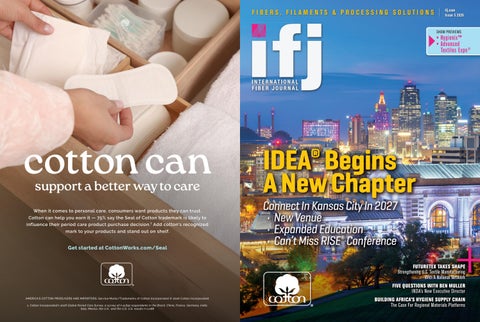
FIBERS, FILAMENTS & PROCESSING SOLUTIONS
ifj.com Issue 5 2026
SHOW PREVIEWS
• Hygienix™ • Advanced Textiles Expo ®
cotton can support a better way to care
When it comes to personal care, consumers want products they can trust. Cotton can help you earn it — 75% say the Seal of Cotton trademark is likely to influence their period care product purchase decision.¹ Add cotton’s recognized mark to your products and stand out on shelf.
Get started at CottonWorks.com/Seal
IDEA Begins A New Chapter ®
Connect In Kansas City In 2027 • New Venue • Expanded Education • Can’t Miss RISE® Conference
FUTURETEX TAKES SHAPE Strengthening U.S. Textile Manufacturing With A National Network FIVE QUESTIONS WITH BEN MULLER INDA’s New Executive Director AMERICA’S COTTON PRODUCERS AND IMPORTERS. Service Marks/Trademarks of Cotton Incorporated © 2026 Cotton Incorporated. 1. Cotton Incorporated’s 2026 Global Period Care Survey, a survey of n=9,652 respondents in the Brazil, China, France, Germany, India, Italy, Mexico, the U.K., and the U.S. U.S. results n=1,088
BUILDING AFRICA’S HYGIENE SUPPLY CHAIN The Case For Regional Materials Platforms
March 23–25, 2027 Kansas City Convention Center Kansas City, Missouri
Exhibit Where Global Nonwovens Business Happens At IDEA®27, your booth is more than just space—it’s your launchpad for new business. Over three powerful days, you’ll engage directly with decision makers from major nonwoven manufacturers, showcase your latest products and technologies, and build partnerships that drive results.
Why Exhibit at IDEA®27 Join thousands of professionals from over 60 countries who come to IDEA® to source solutions, form collaborations, and shape the future of nonwovens. Exhibiting at IDEA®27 positions your company at the center of it all.
IDEA®27 is the world’s preeminent event for nonwovens and engineered fabrics— where innovation meets opportunity.
•
Connect with brand owners, converters, roll goods producers, material and equipment suppliers, and service providers.
•
Achieve in three days what would take months of calls, emails, and travel.
•
Meet current customers and new prospects ready to do business.
•
Collaborate on solutions that improve product performance and sustainability.
•
Expand into new markets and grow your business globally.
Don’t let competitors capture your share of the market. Reserve your exhibit space today and position your company at the center of the nonwovens world.
ideashow.org
Show Organized by:
WEBINAR
ENGINEER MORE INTO THE FIBER In-Melt Technologies for Nonwoven Performance Join Americhem for a technical webinar exploring PFAS-free barrier repellency, moisture management, softness, odor control, and antimicrobial performance in fibers and nonwovens. See how polymer compatibility, additive loading, fiber processing, fabric construction, and application-specific testing influence final performance.
November 10, 2026 | 11 a.m. ET
Register Now
CONTENTS
SEPTEMBER-OCTOBER 2026 | VOL 40 | ISSUE 05
FEATURES
8
INDA’s Public Policy Corner: The Producer Pays:
U.S. State EPR Laws Come Of Age By Wes Fisher
FOCUS ON NONWOVENS
10 12 15 18
Executive Q&A: Five Questions With
22 26
Beyond Animals And Plastic: Bringing Biofabricated Leather To Industrial Scale
29 30 33 34
FutureTEX Aims To Strengthen U.S. Textile Manufacturing
INDA Executive Director Ben Muller IFJ Special Report
What To Expect From IDEA®27 In Kansas City IFJ Special Report
18
By Jack Eaton
Building Africa’s Missing Hygiene Materials Layer
By Raymond Chimhandamba, International Correspondent, Africa
By Sanjay Wahal
From Rope To Roll Goods: Inside Elixrr’s Pulp-Powered Bet On Spunlace
COLUMNS & DEPARTMENTS
By Arun Rao, International Correspondent, India
4 Viewpoint
Collaboration And Innovation Have No Fixed Address By Rachael S. Davis, Chief Content Officer & Publisher
By Rachael S. Davis, Chief Content Officer
Closing The Fiber-To-Fiber Loop At Industrial Scale
By Adrian Wilson, International Correspondent, Europe
22
Temco: High-Precision Rollers For Demanding Nonwovens
SAPScan: Turning Hidden Product Characteristics Into Measurable Data Latest Technology Briefs
PalmFil®: From Agricultural Waste To Advanced Materials
By Diletta Del Giudice & Sophie Fairbrother
5 Tech Spotlight
6 Tech Notes 42 Movers & Shakers
IFJ Special Report
Industry News And Notes
26
Textile Innovation Takes Center Stage By Dr. Matt O’Sickey, Technical Editor
38
STA Summer Marketing Forum:
By Rachael S. Davis, Chief Content Officer
“Strength In Our Threads”
SHOW PREVIEWS 40 Hygienix™ 2026: Absorbent Hygiene
Industry Heads To Houston
IFJ Special Report
41
15
Balancing Risk: How Open Innovation Helps Manufacturers Navigate Volatile Markets
EVENT REVIEWS 36 Techtextil North America:
12
Advanced Textiles Expo® 2026: Orlando Bound
IFJ Special Report
2 IFJ ISSUE 5 2026
30
34
Cover Image: Kansas City will host the next edition of IDEA®, the global triennial nonwovens and engineered fabrics event, March 23-25, 2027. iStock/Sean Pavone
INTERNATIONAL FIBER JOURNAL (ISSN: 1049-801x), Copyright ©2026 is published bimonthly by INDA, Association of the Nonwoven Fabrics Industry. Business and Editorial Offices: INDA, 1255 Crescent Green, Suite 145, Cary, NC 27518, Accounting and Circulation Offices: INDA,1255 Crescent Green, Suite 145, Cary, NC 27518. E-mail circulation@inda.org to subscribe. Periodicals postage is paid at Cary, NC and additional mailing offices. POSTMASTER: Send address changes to International Fiber Journal, 1255 Crescent Green, Suite 145, Cary, NC 27518.
CONTRIBUTORS | ISSUE 5 2026
Wes Fisher
Director of Government Affairs, INDA wfisher@inda.org +1 919 459 3726
Rachael Davis
Chief Content Officer & Publisher, INDA Media rdavis@inda.org +1 404.518.9599
CALL FOR CONTRIBUTORS
Jack Eaton
Chief Commercial Officer, NIRI jacke@nirigroup.com
Raymond Chimhandamba
International Correspondent, Africa, Handas Consulting ray@raychimhandamba.com
Adrian Wilson
International Correspondent, Europe adawilson@gmail.com +44 7897.913134
Diletta Del Giudice Brand Manager, Noukk diletta@noukk.com
Dr. Sanjay Wahal
Arun Rao
sanjay.wahal@gmail.com +1 920.562.9639
arun@tauruscomm.net
Founder Decarbonization LLC
Sophie Fairbrother Research & Sustainability Associate, PalmFil
International Correspondent, India Owner, Taurus Communications
Dr. Matt O’Sickey Technical Editor Director of Education & Technical Affairs, INDA mosickey@inda.org +1 919.459.3748
International Fiber Journal is seeking contributed technical articles and editorial columns from qualified industry professionals and those allied to the fiber industry. If you would like to pitch an article for publication in IFJ, please contact Rachael Davis at rdavis@inda.org.
ISSUE 5 2026 ifj.com 3
RDAVIS@INDA.ORG +1 404.518.9599
VIEWPOINT CONTENT | EDITORIAL
CHIEF CONTENT OFFICER & PUBLISHER Rachael Davis rdavis@inda.org | +1 404.518.9599 EDITOR & DIGITAL PRODUCTS MANAGER Ken Norberg ken@ifj.com | +1 202.681.2022 ART DIRECTOR Julie Flynn TECHNICAL EDITOR Dr. Matt O'Sickey EUROPEAN EDITOR Geoff Fisher INTERNATIONAL CORRESPONDENT, EUROPE Adrian Wilson SMART & ADVANCED TEXTILES CORRESPONDENT Marie O’Mahony INTERNATIONAL CORRESPONDENT, CHINA Jason Chen INTERNATIONAL CORRESPONDENT, INDIA Arun Rao INTERNATIONAL CORRESPONDENT, AFRICA Raymond Chimhandamba
ADVERTISING | SALES
See Sales Representative Contact Details in Movers & Shakers Section For Inquiries to Your Sales Representative, e-mail advertising@inda.media
Download the IFJ Media Kit at www.fiberjournal.com/advertise AUDIENCE | CIRCULATION circulation@inda.org
International Fiber Journal is published by INDA Media, the B2B publishing arm of INDA, Association of the Nonwoven Fabrics Industry. +1.919.459.3715 info@fiberjournal.com | www.fiberjournal.com News & Press Releases to IFJNews@inda.media
2026 BUYER’S GUIDE
www.fiberjournal.com/buyers-guide SUBSCRIBE: www.fiberjournal.com/subscription
MISSION
International Fiber Journal covers fiber-related trends and material science developments and how they impact the supply chain from raw material to end use. IFJ provides thoughtful insights and perspectives to global producers, users and business leaders who need to know about what’s next in fibers, filaments and processing solutions.
Collaboration And Innovation Have No Fixed Address lace has always mattered to the textile industry. Manufacturing clust ers de velop around resources, infrastructure, a skilled labor force and generations of technical knowledge. Trade shows may be associated with host cities, and companies build identities around the regions they call home. But geography does not have to define where ideas originate and who helps develop them. The cover story examines the decision by INDA — the Association of the Nonwoven Fabrics Industry — to move IDEA® from Miami Beach to Kansas City, Mo., for the 2027 edition. INDA sees the new setting as an opportunity to lower costs, make business interactions more convenient and bring the exhibits and RISE® technical conference together. As INDA’s Dan Noonan observes, one goal is for participants to leave Kansas City recognizing that valuable connections with customers and suppliers are not determined by geography. Jack Eaton’s article on open innovation approaches the same idea from a research and development perspective. NIRI, an innovation consultancy, advocates for a process “founded on cocreation with complementary partners through alliances, cooperation and joint ventures during which give-and-take is crucial for success for all parties.” Companies do not need to maintain every capability internally. By working with outside researchers, suppliers, startups and specialists, manufacturers can explore unfamiliar materials and processes while sharing risk. Expertise may be found outside a company’s walls, or even outside the industry, but collaboration can make knowledge accessible. The recently announced FutureTEX puts that idea into practice. The 10-year initiative is being built not around a single institution or location, but as a national innovation ecosystem connecting universities,
P
4 IFJ ISSUE 5 2026
manufacturers, government agencies, associations and workforce-development organizations. With its headquarters at Gaston College in Belmont, N.C., and hubs in Raleigh, N.C., Philadelphia, Atlanta, and Lowell, Mass., FutureTEX will draw on expertise and resources distributed across the country. The network is focused on accelerating innovation in fibers, textiles and advanced materials to support defense and commercial textile markets. Together, these stories show that geography can shape opportunity without becoming a boundary. Innovation may begin in a laboratory, on a show floor, inside a mill or through a conversation across regions. It has no fixed address, but does require a community willing to build something together. This issue also marks the addition of Dr. Matt O’Sickey to the IFJ masthead. As technical editor, Dr. O’Sickey will continue to contribute articles to IFJ and help shape the content. Dr. O’Sickey is the director of Education and Technical Affairs at INDA. He has held leadership roles in research and development, marketing, and product management at RKW North America and Tredegar Corp. Dr. O’Sickey holds multiple patents, has received industry innovation awards, has delivered numerous presentations and serves as a course instructor. Dr. O’Sickey has a Ph.D. in chemical engineering and is an alumnus of Purdue University and Virginia Tech. His studies emphasized the processing-structure-property relationships of polymeric materials. Dr. O’Sickey can be reached at mosickey@inda.org.
Rachael S. Davis Chief Content Officer & Publisher, INDA Media, IFJ
TECH SPOTLIGHT
TiHive Co-Founders Hani Sherry (left) and Carlos Prada with the SAPScan technology
SAPScan: Turning Hidden Product Characteristics Into Measurable Data APScan is a non-destructive terahertz laboratory scanner designed to reveal and quantify internal product characteristics without cutting or altering the sample. Developed by France-based TiHive, the solution turns lengthy laboratory analysis into actionable results in 90 seconds. It gives research and development and quality teams faster access to internal data that was previously difficult or time-consuming to obtain, helping accelerate product development and testing cycles. Developed initially for the absorbent hygiene industry, SAPScan’s optics, calibration and measurements can be tailored to different materials and use cases across nonwovens, medical devices, packaging and textiles. Depending on the application, the technology provides insights into characteristics such as moisture, density, material distribution and internal defects. In absorbent hygiene, the system maps the quantity and distribution of superabsorbent polymer (SAP) inside finished diapers, adult incontinence products and period pads. According to the company, SAPScan delivers results within a few minutes — up to 15 times faster than many traditional methods — while leaving the sample intact for later destructive tests such as rewet or absorptionbefore-leakage measurements. SAP can absorb up to 300 times its own weight in aqueous fluids and is a primary driver of core performance. Both the total amount and its placement matter. A product can appear acceptable from the outside yet contain overdosed zones, underdosed areas or material that has shifted during manufacturing. Whole-product weight and surface vision cannot reveal these internal patterns. Teardown analysis is destructive and
S
time-consuming; delayed lab feedback slows troubleshooting. SAPScan closes that gap. Non-ionizing terahertz waves penetrate non-metallic multilayer structures — such as fluff, nonwovens, films and adhesives — and produce contrast linked to SAP. TiHive’s software and product-specific calibration convert the raw signals into estimated SAP quantity in the full sample or selected zones, distribution heatmaps, zonal and profile plots that highlight peaks, valleys and asymmetry, sample-to-sample comparisons, and 3D core topography. The same physical sample can then be archived or used in complementary performance tests, linking internal structure directly to functional results. Industrial teams gain concrete advantages. Quality groups can verify internal profiles, compare batches, and document deviations with visual evidence rather than relying solely on aggregate weight or subjective teardown. R&D and product-development teams shorten prototype comparison cycles, explore zoning strategies, and perform rapid competitive benchmarking of market products. Production and process engineers receive faster feedback that helps localize variation and support rootcause analysis. One cited economic and environmental illustration is that saving a single gram of raw material per product can translate into up to $1 million in annual savings per production line while also reducing associated carbon dioxide emissions, according to the company. A customer survey referenced by TiHive indicated that process improvement frees several hours of technician time per day. The underlying technology sits between infrared and microwave on the electromagnetic spectrum. Terahertz
The Terrahertz chip with CMOS
radiation is non-ionizing; it can penetrate many materials opaque to visible or nearinfrared light and reveal internal structure or compositional differences. TiHive’s fullstack approach combines custom terahertz hardware, proprietary CMOS semiconductor, application-specific optics, and AI-powered analytics that turn complex signals into actionable data. The same platform underpins TiHive’s complementary inline solution, SAPMonit, which targets continuous production monitoring. TiHive was founded in Grenoble in 2017 by Hani Sherry and Carlos Prada. It received European Innovation Council Accelerator support in 2020, won the INDA RISE Innovation Award in 2023 for SAPMonit, announced an 8 million euro funding round in October 2025, and was selected for France’s French Tech 2030 program in 2025. In short, SAPScan transforms previously difficult-to-access internal product characteristics into visual, quantitative and repeatable data without destroying the sample. In absorbent hygiene, this means measuring SAP quantity and distribution in 90 seconds. More broadly, the combination of speed, non-destructive inspection and digital output provides a new way to understand materials, compare products and make datadriven decisions. For more information, visit tihive.com For details on how to submit your company’s technology for consideration as a “Technology Spotlight” in IFJ, contact Ken Norberg at ken@ifj.com or +1 202.681.2022.
ISSUE 5 2026 ifj.com 5
TECH
Heberlein air covering solutions
NOTES
Americhem Introduces nPure™, nZorb™ Platforms For Fibers And Nonwovens Cuyahoga Falls, Ohio-based Americhem has launched nPure ™ and nZorb™, two per- and polyfluoroalkyl substances-free functional additive technologies for fiber and nonwoven applications. Incorporated into the polymer matrix, the platforms are designed to provide odor control and moisture management without relying on separate topical treatments. nPure is designed to capture and reduce malodors without fragrances, biocides or antimicrobial chemistries. Americhem reports that independent testing demonstrated adsorption of sweat, body odor and selected volatile organic compounds. The technology is compatible with polypropylene, polyethylene, polyester and bicomponent fiber systems. Engineered for polypropylene-based fiber and nonwoven systems, nZorb improves wetting, wicking, absorbency and liquid transport. Potential applications include hygiene products, medical materials, wipes, filtration, textiles, automotive interiors and packaging. “Manufacturers are increasingly looking for material solutions that solve multiple performance challenges without adding manufacturing complexity,” said Parminder Agarwal, chief technology officer at Americhem. “nPure and nZorb demonstrate how masterbatch formulation, polymer compatibility, and fiber processing work together to deliver application-specific functionality within the polymer matrix.”
americhem.com
Heberlein Opens Service Hub In China, To Exhibit at ITMA Asia + CITME Heberlein will present its APh- and APe-series air interlacing jets for draw-textured yarn applications at the upcoming ITMA Asia + CITME 2026 in Shanghai. The technologies are designed to reduce compressed-air consumption in aircovering and other synthetic filament yarn processes. Heberlein reports that its APh213 jet can reduce air consumption by up to 10 percent when processing specified polyester yarns. Tests of the APe-series demonstrated reductions of up to 15 percent, according to the company. The jets are used in producing yarns for sportswear, underwear, hosiery, stretch fabrics and medical textiles. The company also recently opened a service hub in Shengze City, China. The facility provides technical support, maintenance, cleaning, testing and troubleshooting services. “We have opened the service hub in China as part of our long-term commitment to the Chinese market,” said Martin Zuercher, CEO of Heberlein. “The new service hub enables us to provide faster response times, stronger technical support and closer customer interaction.” heberlein.com
SAHM, Vandewiele Combine Winding Automation SAHM Winding Solutions and Vandewiele Automation demonstrated an integrated system for automating industrial winding processes at Techtextil in Frankfurt and Techtextil North America in Raleigh, N.C. SAHM’s CB1 mobile handling system manages automatic doffing, supplies empty tubes to winding machines and transports and buffers completed packages. The system combines tube and package storage with a programmable robotic arm that can be adapted to different production environments. Vandewiele Automation’s KR1 knotting
6 IFJ ISSUE 5 2026
SAHM Winding Solutions and Vandewiele Automation showcased their combined automation expertise for industrial winding processes at Techtextil in Germany, and Techtextil North America in Raleigh, N.C.
station adds robot-assisted yarn knotting. It automatically knots yarn ends on completed packages, preparing them for transport and downstream production while reducing manual handling. The system accommodates various yarns and package types. Together, the technologies connect package handling and yarn knotting to support continuous production. SAHM, part of the Vienna-based Starlinger Group, presented the system in North America with American Starlinger-Sahm Inc.
sahmwinder.com
Indorama Ventures Presents Odor Capturing Technology B a ng ko k -b a s e d I n d o ra ma Ve n t u r e s presented its latest odor management technology at the recent Dornbirn Global Fiber Congress in Austria. The innovation has been developed to address one of the most important yet challenging performance requirements in absorbent hygiene and technical products: effective odor control. By incorporating odorcapturing functionality for a broad spectrum of odor-causing compounds directly into the fiber structure, the technology helps manufacturers create products that actively capture odor-causing molecules rather than simply masking them. According to the company, this enables a more effective and long-lasting approach to odor management while maintaining the comfort and performance consumers expect, for instance
from adult incontinence and feminine care products, as well as from technical products such as air conditioning systems. The technology further strengthens Indorama Ventures’ position as a partner for innovation in the hygiene and technical sector. Through its global manufacturing footprint and dedicated research and development capabilities, the company continues to develop solutions that help customers address evolving market needs across adult incontinence, feminine care, baby care as well as technical applications. The respective bi-component fiber portfolio will be marketed under the product brand platform “expera,” which includes solutions that deliver superior sensory, visual or haptic appeal.
indoramaventures.com
Kimberly-Clark Develops Alternative Natural Fiber Platform Kimberly-Clark Corp., Irving, Texas, has introduced a research program focused on developing alternative natural fibers for hygiene products. Company researchers created a patented technology platform that transforms fibers from a rapidly renewable succulent plant into material intended to support product performance and sustainability goals. “This represents an exciting moonshot for KimberlyClark and the culmination of more than two decades of materials and plant science expertise,” said Craig Slavtcheff, chief research and development officer at Kimberly-Clark. “We have developed a highly proprietary technology platform rooted in alternative fiber research and believe that these novel natural fibers will form our next great materials platform — an innovation with the potential to reshape the hygiene category.” Testing of the material is continuing. The company expects the program to reduce its dependence on traditional fiber sources while supporting supply-chain resilience and the development of differentiated hygiene products. The initiative is part of Kimberly-Clark’s consumerled innovation platform, through which the company invests in technologies intended to balance product performance, cost and resource stewardship.
kimberly-clark.com
Custom Converting Equipment • Unwinds / Rewinds • Slitters (Ultrasonic, Laser or Conventional) • Laminators (Ultrasonic, Thermal and Adhesive) • Traverse and Spiral winders • Membrane / Hollow fiber lines • Festooners • Accumulators • Ultrasonic sewing machines • Ring Welders • Custom assembly machines • Splicing equipment
We employ our 70 years of web handling experience to benefit our customers. Contact Chase Machine today for your equipment needs! 324 Washington St., West Warwick, RI USA 02893 401.821.8879 • www.chasemachine.com Guyg@chasemachine.com
ISSUE 5 2026 ifj.com 7
PUBLIC POLICY CORNER
The Producer Pays: U.S. State EPR Laws Come Of Age By Wes Fisher Director of Government Affairs INDA, the Association of the Nonwoven Fabrics Industry
or most of the last decade, companies in the United States planned for extended producer responsibility (EPR) frameworks for packaging. In 2026, it became something they pay for. Invoices are landing, fee schedules are published, and courts are weighing whether the whole architecture survives constitutional scrutiny. While many in the nonwovens industry are not covered producers under state law definitions, these frameworks will matter as more products are pulled into scope in the coming years.
Maryland is slated for 2028, Minnesota for February 2029, and Washington for 2029 to 2030. Maine is still selecting a stewardship organization. De minimis thresholds under which producers do not need to register differ as well. Such thresholds are under one metric ton or under $5 million in global revenue in Oregon and Washington, under $2 million in Minnesota and Maryland, and under $1 million in California gross sales, with California requiring an affirmative annual application rather than an automatic exemption.
What Is EPR?
No state administers an EPR statute itself. Each one delegates the operational work to a producer responsibility organization — a private entity that stands between the regulator and the regulated. The PRO registers producers, collects supply data, writes a program plan describing how the state's targets will be met, sets and publishes the fee schedule inside that plan, invoices producers, and passes the money through to haulers, materials recovery facilities and local jurisdictions. The state agency approves the plan and audits performance. One organization occupies almost all of that space. The Circular Action Alliance (CAA) is a 501(c)(3) nonprofit founded in 2022 by roughly 20 companies from the food, beverage, consumer goods, restaurant and retail sectors, and it now serves as the single approved PRO in California, Colorado, Maryland, Minnesota, Oregon and Washington. Maine is the only enacted state that has not yet selected one. The hope is that the one large national PRO will allow for some harmonization of reporting and compliance across states.
F
Packaging EPR shifts the cost of end-of-life management for packaging, paper and food service ware from municipalities and ratepayers to the companies that put those materials on the market. A covered “producer” of a good, usually the brand owner, but in several states the importer or distributor as well, must register with the state, report how much covered material it supplied by weight and material category, and pay a perpound fee. The fees are meant to be eco-modulated. Readily recycled formats sit at the bottom of the rate card, and hard-to-recycle formats sit at the top, so the design decision made years before a fee arrives determines the size of the payment due.
Seven States, Seven Programs No national packaging EPR framework is on the horizon, and states are moving where the federal government has not. As of this summer, California, Colorado, Maine, Maryland, Minnesota, Oregon and Washington have enacted comprehensive packaging EPR laws, covering roughly a fifth of the U.S. population — closer to 40 percent if pending bills advance. New York's bill failed again before adjournment, and proposals in Tennessee, Missouri, New Jersey, Rhode Island and Illinois remain in play for 2027. Timing varies widely. Oregon began charging fees July 1, 2025. Colorado followed in January 2026 and reached full statewide implementation in June. California published a 2026 early fee schedule in July and begins its ongoing program fee in 2027.
8 IFJ ISSUE 5 2026
What A PRO Is, And Why CAA Matters
Implementation And Fees CAA's clearest statement of what this costs came on June 15, when it submitted its draft California program plan to the SB 54 Packaging Producer Responsibility Advisory Board. The plan is the operating recipe for the largest packaging EPR program in the country, and its budget numbers reset expectations: total program costs of roughly $1.2 billion to $1.8 billion in 2027 alone, and $9.3 billion to $17.2 billion over the 2027-2031 period,
funded entirely by producer fees. The plan itemizes 16 budget lines, including the statutory Plastic Pollution Mitigation Fund, which requires producers to contribute $500 million per year from 2027 through 2031 on top of program costs. Looking at the fees, Oregon offers an initial indication. Oregon’s schedule spans roughly 60 material categories. Aluminum cans run about $0.07 per pound and corrugated about $0.09, while clear polyethylene terephthalate is roughly $0.28, polypropylene $0.42, monomaterial polyethylene film $0.47, and multilayer laminate pouches about $1.12 — a 16-fold spread driven by perceived recyclability.
The Courts Weigh In In July 2025, the National Association of WholesalerD i stri butors (NAW ) su ed O regon's D e p ar tm ent of Environmental Quality, arguing the Recycling Modernization Act violates the dormant Commerce Clause and due process, and unconstitutionally delegates fee-setting authority to a private party. In February 2026, a federal district court judge granted a preliminary injunction, the first federal court intervention against a U.S. EPR program on constitutional grounds, though it shields only companies that were NAW members on the date of the order. Everyone else keeps registering, reporting and paying. A five-day bench trial ran in July 2026 in the case. A ruling is likely in the late summer or early fall, and litigation and appeals can be expected on this case regardless of the ruling. Legal challenges have continued. The Independent Lubricant Manufacturers Association sued Colorado in March; NAW joined 17 state attorneys general in a June federal challenge to California's SB 54; environmental groups sued CalRecycle from the opposite direction; and NAW filed against Colorado in July. Meanwhile, a separate California ruling has enjoined enforcement of the SB 343 recyclability labeling law on First Amendment grounds.
MARKET INTELLIGENCE REPORTS Order today!
Learn more at: inda.org/market-intelligence
North American Nonwovens Supply Report 2026 Obtain the 2025 capacity, production, and trade data for North America. The 2025 INDA North American Nonwovens Supply Report is now available—your essential resource for understanding where the industry is headed and how to align your strategy for success.
North American Nonwovens Industry Demand & Forecast Report 2024-2029 A Review and Forecast of the North American Nonwovens Demand for 2019, 2024 & 2029. Discover the latest intelligence in vital demographic trends and how it could affect your business. Make better business decisions with accurate, reliable data.
The European Parallel Europe has been in the EPR space longer and is moving in the opposite direction on structure, namely with a far more harmonized structure. The Packaging and Packaging Waste Regulation became applicable August 12, 2026, replacing a 1994 directive with a binding regulation that applies directly in all 27 member states. It mandates eco-modulated EPR fees, design-for-recycling by 2030, minimum recycled content and harmonized labeling, though rates may differ among EU member states. The contrast is instructive. Europe built a harmonized framework and is filling it in. The United States is assembling a patchwork under litigation. For nonwovens producers selling into both, the compliance work is the same: know your material categories, know your weights and assume that rates will only continue to increase.
Global Nonwoven Markets Report: A Comprehensive Survey and
Outlook 2023-2028
Get the insights you need to navigate the future of nonwovens. This in-depth report offers regional forecasts, production trends, investment opportunities, and an enhanced trade section, covering North America, Greater Europe, Asia, and South America.
ISSUE 5 2026 ifj.com 9
EXECUTIVE Q&A
Five Questions WITH
INDA Executive Director Ben Muller Ben Muller brings more than 20 years of leadership experience to his new role overseeing INDA’s regional strategic initiatives, managing operations and representing INDA’s interests within the Americas.
IFJ Special Report ate last year, INDA, the Association of the Nonwoven Fabrics Industry, announced the search for a new executive director based at its headquarters in Cary, N.C. The leadership role, envisioned as part of the Global Nonwovens Alliance (GNA) transition, plays an important part in advancing the mission of both INDA and GNA. The search is over, and INDA recently confirmed the appointment of Ben Muller as executive director. He reports directly to Murat Dogru, GNA CEO. INDA President and CEO Tony Fragnito will shift into an executive consultant role in which he will support Muller in the leadership transition, and work on projects and initiatives related to operational integration and global outreach until his planned retirement at the end of 2027. Muller brings more than 20 years of progressive leadership experience across nonprofit, corporate and trade association environments. Most recently, he served on the senior executive team of High Point Market Authority, where he led marketing, public relations and educational programming for the High Point Market — a large home furnishings trade show. Previously, Muller held senior brand and marketing positions with HanesBrands and Kayser-Roth, where he gained experience in textile and apparel supply chains. He began his career ser ving mission-driven
L
10 IFJ ISSUE 5 2026
Q+A IN THIS ISSUE:
BEN MULLER Executive Director, INDA
organizations, including the American Cancer Society and the National Multiple Sclerosis Society. “I am honored to join INDA at such a pivotal moment for the industry,” Muller said in a recent press release announcing his appointment. “The formation of the Global Nonwovens Alliance represents a tremendous opportunity, and I look forward to learning from our members and advocating for them on every front.” Mu l l e r re c e n t ly a n sw e re d f iv e questions for International Fiber Journal about his professional background and the experiences that inform his new role.
IFJ: What attracted you to the nonwovens industry and INDA at this point in your career? Muller: A few things stood out to me in particular — the fact that INDA is an established organization with a rich history of providing value to its members, in an industry that is large and provides so many products that make our lives easier and more comfortable, even if the general public is not necessarily aware of its scope! Additionally, being at the center of an industry along with the connections made while advancing a general cause is work that I have always enjoyed. I appreciated similar connection-building work in my past roles at the American Cancer Society and High Point Market Authority. IFJ: Which aspects of your education or professional training have most influenced your approach to leadership? Muller: The leaders that I have admired most in my life have been those who embody servant leadership. I think having the mindset of service is the right approach to most aspects of professional life: it gives the most value to an organization and its workforce, while also providing personal fulfillment. IFJ: When you enter a new industry or organization, how do you approach learning and building trust? M u l l e r : I think b ein g v uln erabl e, understanding and also communicating that you have a lot to learn is a key part of building trust and acceptance. I think
I am honored to join INDA at such a pivotal moment for the industry. The formation of the Global Nonwovens Alliance represents a tremendous opportunity and I look forward to learning from our members and advocating for them on every front.
one of the most undervalued skills when entering any position or industry is the ability to actively listen — a skill that, when practiced genuinely, sets you up for success down the road. IFJ: What skills or areas of expertise do you believe you bring to INDA? Muller: I come from a marketing and public relations background, so I believe that those skills are relevant for communicating as well as advancing our members’ priorities and addressing their needs. Additionally, I spent the last four years managing one of the largest trade shows in the world, so I hope to bring some
insights into how to increase our members’ satisfaction and return on investment from all of INDA’s conferences and shows. IFJ: What would you like INDA members and the broader textile community to know about you that they might not learn from your professional biography? Muller: I’m currently doing my best impression of a volleyball player supporting my teenage daughter who has a passion for the sport, and I also have a love of gardening and cooking. I’ve won multiple ribbons for my veggies in past local fairs and hope to enter them into the N.C. State Fair here in Raleigh in the future!
ISSUE 5 2026 ifj.com 11
SHOW PREVIEW
What To Expect
From IDEA®27 In Kansas City INDA leaders explain the decision to move IDEA®27 to Kansas City and discuss what the new venue, lower costs and collocated RISE® conference will offer exhibitors and attendees. IFJ Special Report iami Beach has hosted the IDEA® nonwovens trade show since the early 2000s apart from one edition held in Boston during renovations at the Miami Beach Convention Center. Now, the long-running triennial nonwovens event is preparing for a change of scenery. Event organizer, INDA — the Association of the Nonwoven Fabrics Industry based in Cary, N.C. — will hold the 2027 edition of IDEA in Kansas City, Mo., March 23-25. In addition, the organization will collocate its RISE® technical conference in Kansas City. In a conversation with IFJ, INDA President and CEO Tony Fragnito, Director of Business Development and Membership Dan Noonan, and Director of Education & Technical Affairs Dr. Matt O’Sickey addressed the reasons behind the move and what attendees can expect from the show’s new venue and the addition of the RISE conference in 2027.
M
Reasons Behind The Move IFJ: After decades in Miami Beach , why was 2027 the “right” time to move IDEA to a new location? How did feedback from exhibitors and attendees impact the TONY FRAGNITO decision to move? President and CEO, INDA Tony Fragnito: One of the things I heard consistently from our members and customers at IDEA in 2022, was the cost and logistical challenges related to the Miami Beach Convention
12 IFJ ISSUE 5 2026
Center and surrounding area. Hotels were scattered, meals and entertainment were expensive, and the cost and logistics of exhibiting in Miami were high. I also heard folks loved the beach, no surprise. I was also told that these sentiments were expressed to INDA many times and that INDA doesn’t listen to its members. I wanted to show I was listening, and that INDA was willing to try something different. IFJ: Did INDA consider any other cities, and what ultimately distinguished Kansas City? Fragnito: INDA’s main consideration was first the conference facility and available hotel and entertainment options, especially within walking distance. My personal experience with other organizations told me that exhibitors and attendees are looking for a good place to do business, but also a pleasant place to unwind afterwards. Two major hotels connected to the venue, a modern airport and lots of restaurant and entertainment options should make this location both productive and memorable. Kansas City has been very accommodating, and I am convinced will welcome our event with the full resources the city has to offer. The venue, the restaurants and the hotels will be very competitive, increasing the return on investment (ROI) for all participants. IFJ: Some longtime participants may see Miami Beach as part of IDEA’s identity. What would you say to those who are disappointed or skeptical about the move? Fragnito: I say let’s talk again after Kansas City. This is not a forever shift. This is INDA listening to member concerns and attempting to address them.
IFJ: What would a successful IDEA in Kansas City look like in terms of results and feedback? Fragnito: For me it’s better ROI for our customers. Concentrating the audience within the conference center and connected venues will provide more opportunities for both formal and casual exchanges and a better sense of the community. Everything our customers and attendees need for the week will be steps away, versus a cab ride away.
The Exhibitor & Attendee Experience IFJ: What measurable savings can exhibitors expect in Kansas City from booth and other exhibitor expenses to accommodations and dining? Dan Noonan: There are three major expenses when exhibiting at a trade show — the floor space fee; booth costs including structure, labor, and shipping; and costs for DAN NOONAN a team to travel. The Director of Business move to Kansas City Development and will help exhibitors Membership, INDA with those latter two charges. In Miami, for every two laborers hired to help build the booth, a union laborer was added. That’s not the case in Kansas City. This difference should lower the labor costs by at least 33 percent. In addition, INDA negotiated with a new general services contractor to provide a shipping/material handling rate that’s drastically lower than what our previous contractor charged in Miami.
Four Art Deco-inspired pylons suspend the roof of the Kansas City Convention Center and form a distinctive feature of the city’s skyline. iStock/TriggerPhoto
IFJ: INDA has cited overall hotel savings for Kansas City compared with Miami Beach. Can you share some examples or information about these savings? Noonan: There are two major hotelrelated savings. First, the nightly rates for the seven hotels INDA added to the attendee block — covering all major hotel brands including Marriott, Hilton, IHG and Loews — range from $189 to $279 before taxes and fees, which is significantly lower than prices in Miami Beach. Second, all the hotels are within two to three blocks of the main entrance to the convention center so exhibitors and attendees will save not only on room nights, but also on rideshare and taxis to and from the building. IFJ: How accessible is Kansas City for domestic attendees? How about for international attendees, especially those accustomed to flying into South Florida? Noonan: Kansas City Int ernational Airport offers nonstop service from major U.S. hubs and is served by several major airlines. Kansas City should be no different for U.S.-based attendees than Miami. For international travelers, there may be an extra flight from a U.S. airline hub, but once in Kansas City, there should be a better and faster experience to pick up baggage and get to the hotel. The Kansas City airport opened a new terminal in 2023, and it feels brand new.
IFJ: What does the area around the Kansas City Convention Center offer in terms of walkability, hotels, restaurants and places for informal business networking? Noonan: The area around the convention center and hotels is very easy to get around. There is a free hop-on/hop-off streetcar that runs from the riverfront area to South Plaza with stops in between at art museums, the Crown Center for shopping, the Power & Light District for restaurants and bars, and the City Market. IFJ: How will the Kansas City venue change the exhibition floor experience? Noonan: The show floor design will be different for this edition of IDEA. The hall is on the third floor of the convention center, so attendees will come up to access the show floor. With only two columns in the exhibit hall, attendees and exhibitors will have largely unobstructed views across the show floor. In addition, INDA has designed a “Main Street” aisle on the floor. It’s 20 feet across and runs the length of the hall. From that main aisle, attendees will be able to see every exhibitor to the outer walls, which are only about 100 feet from the aisle. There are quite a few additions that we’re making with this venue. The first major change for IDEA 27 is the collocation of the RISE conference. The conference area will be housed on the show floor so attendees can go back and forth from the conference to the exhibits quickly. The show floor
will also house an area to showcase our Innovation Awards finalists. Attendees will be able to see the finalists before we announce the winners. The setup for food in Miami was also odd because the venue didn’t have concession stands and so food carts were brought in that took up valuable floor space. In Kansas City, there are concession stands spread throughout the exhibit hall and we’ve added multiple seating areas for convenience. IFJ: For a company deciding whether to send a large team to IDEA, what can sales, technical and executive personnel each gain from attending? Noonan: The sales group will find that the entire supply chain is at the show. INDA has already heard feedback that many companies are planning to send more staff than usual due to the lower hotel and attendance rates. For technical staff, the RISE conference has been a top technical conference in the industry for many years. Attendees rave about the sessions, speakers and content. The ability to attend the RISE sessions and then quickly hop back on the show floor is a great benefit. For executives, we know that IDEA is a place where deals are made. It’s a chance to meet with other decision makers in the industry, network and walk away with new contacts and fresh ideas, and that doesn’t change with the move to Kansas City. INDA also recognizes the economic ISSUE 5 2026 ifj.com 13
pressures and market uncertainty the industry is facing. To facilitate our members’ ability to convene and connect, source solutions and identify new opportunities, INDA members can receive a show floor pass at no charge in 2027. IFJ: Is there anything first-time visitors to Kansas City should make time to experience beyond the convention center? Noonan: Two words — bourbon and barbecue. Kansas City is world-renowned for its barbecue and INDA will feature Kansas City barbecue among the food options available during the Welcome Reception. Kansas City also is home to a few dozen distilleries that offer tasting tours available after show hours. In addition, there are a couple of major sporting events in Kansas City during the week of IDEA 27. The Kansas City Royals open their 2027 season on Thursday, March 25, and the National Collegiate Athletic Association Men’s Basketball Tournament Midwest Regional begins March 26.
Education And RISE® IFJ: What influenced the decision to move the RISE conference and collocate the event with IDEA 27? Dr. Matt O’Sickey: We had a very successful, well-attended and thematically focused conference at IDEA 25. While considering ideas for a similarly focused topic area for DR. MATT RISE, one idea that O’SICKEY Director of Education & came up was “Enabling Technical Affairs, INDA Technologies for Long Life Nonwoven Products.” This content has historically been underrepresented in INDA’s programming versus its prevalence in the nonwoven industry as a whole. However, at IDEA there is usually a good representation from industry providers of per- and polyf luoroalkyl (PFAS) replacements, flame retardants, antistatic treatments, weather- and ultraviolet (UV)-resistant materials, composites and acoustic materials, for example. It just made good sense to lean into an expertise
14 IFJ ISSUE 5 2026
base that will be present at IDEA to make focused conference content more easily available to the thousands of attendees that typically go to IDEA. I F J : How w i l l th e R I S E p rog ra m complement the technologies and conversations taking place on the IDEA show floor? Dr. O’Sickey: RISE will provide the deeper, more technical discussions related to the long-life and durable nonwoven products market segments, while our show floor content will be limited to short, largely promotional introductions of new products from exhibitors. If you want a five-minute snapshot of the latest and greatest, you can catch that on the show floor. If you want to know why the technology works and how it best fits your needs, the conference is the place for you. IFJ: Will attendees be able to participate in both RISE and IDEA without missing important conference sessions, exhibits or meetings? Dr. O’Sickey: While some programming will be running concurrently, INDA saw at IDEA 25 that visitors were able to manage both the exhibit floor and conference without issue. We also found that choosing a focused theme for the conference meant many companies saw value in sending one or two technical staff to specifically attend the conference. On occasion, those attendees had to step away for a customer meeting, but also had time during the lunch break and endof-day period to visit exhibitors. IFJ: Are there any emerging technologies, issues or topics that will be highlighted during RISE? Dr. O’Sickey: RISE this year will be focused on the technologies related to longlife or durable nonwoven products such as transportation, geotextiles, building materials, garments and medical products, among other topics. We anticipate discussions surrounding the state-of-the-art in PFAS coating replacements, stain repellency, flame retardants, weather- and UV-protection chemistries and antistatic treatments.
IFJ: What would you say to a technical professional who has attended IDEA before but has never considered attending RISE? Dr. O’Sickey: RISE provides a glimpse into the state-of-the-art technologies of today as well as a peek into what’s coming tomorrow. As such, it’s been a unique opportunity to fill a company’s technical investigation pipeline. As one longtime RISE attendee told me, RISE has provided his company with a first-to-market advantage in applying new nonwoven technologies. By bringing RISE to IDEA, we hope to support a broader section of the industry.
Closing Thoughts About IDEA®27 IFJ: Complete this sentence: “IDEA 27 in Kansas City will be different because …” Fragnito: It will be an efficient week filled with strong industry connections. Noonan: It will provide exhibitors and attendees a stronger ROI. IFJ: What is the single strongest reason for an exhibitor to participate? What is the biggest reason for an attendee to come? Fragnito: The IDEA show is the largest nonwoven-focused trade show in the Americas — or anywhere — based on the number of unique visitors and exhibitors. IFJ: Are there any misconceptions about Kansas City or the venue that you would like to correct? Fragnito: That Kansas City is not a modern city and is difficult to reach. Kansas City was chosen as a host city for the World Cup and is home to major national sports teams. It also has a modern airport and is easy to travel in and around. IFJ: When attendees leave IDEA 27, what do you hope they will say about the decision to move the show? Noonan: Kansas City is ready to welcome the nonwovens community, and I know visitors will have a great experience. I hope that participants leave with the realization that valuable connections with customers and suppliers are not determined by geography.
RESEARCH & DEVELOPMENT
Balancing RISK: A collaborative approach to innovation can help manufacturers explore new opportunities while managing the technical and commercial risks.
How Open Innovation Helps Manufacturers Navigate Volatile Markets By Jack Eaton
n an uncertain economic climate, cost pressures, supply chain disruption and market volatility are changing the way manufacturers approach innovation. This is particularly t r u e f o r e st a b l i s h e d n o nw o v e n s businesses, where product development decisions must balance technical ambition, commercial risk, regulatory change, operational priorities and shareholder expectations. This article looks at how open innovation can support both continuous improvement and the controlled exploration of potentially disruptive opportunities. Innovation across the nonwovens sector has never been more important. Manufacturers are under growing pre ssure to re sp on d to e v o lv in g regulations, sustainability targets, material restrictions, changing customer requirements and end-user needs. From per- and polyfluoroalkyl substances (PFAS)-free finishes and biobased materials to recyclable constructions, lower -energ y processing and new performance demands, the sector is being
I
asked both to improve existing products and to create new forms of value. Incremental innovation remains essential to progress. Continuous improvement in product performance, process efficiency, quality, cost and manufacturability will always be central to the development of nonwoven materials. However, as market and regulatory pressures accelerate, internal research and development (R&D) pipelines can become stretched. Companies may need to investigate unfamiliar materials, alternative processes, new applications or adjacent markets that sit outside their established development pathways.
The Value Of Open Innovation This is where open innovation becomes increasingly valuable. By working with external partners, specialist facilities, research organizations, suppliers, startups and cross-sector experts, companies can extend their innovation capability without placing all of the risk on internal teams. Open innovation provides a practical route to test new ideas, access specialist knowledge, assess emerging opportunities
and build technical confidence before committing to major investment. It can also create the conditions in which genuinely disruptive opportunities are identified and evaluated. Disruptive opportunities do not always begin as fully formed breakthrough technologies. They can emerge from incremental solutions, lower -cost materials, more accessible manufacturing routes, new applications or existing technologies combined in a different way. For established manufacturers, open innovation can provide a controlled, evidence-led means of assessing such opportunities. For new entrants into the nonwovens sector, both models — open innovation and disruptive innovation — can accelerate progress from concept to market while reducing the risk that lower cost is achieved at the expense of quality or performance.
Disruptive Innovation: A Specific Market Process The phrase “disruptive innovation” is widely used, but often too loosely. As Clayton Christensen, the originator of ISSUE 5 2026 ifj.com 15
disruptive innovation theory, explained in his last interview in 2020: “Disruptive innovation describes a process by which a product or service powered by a technology enabler initially takes root in simple applications at the low end of a market — typically by being less expensive and more accessible — and then relentlessly moves upmarket, eventually displacing established competitors.” Crucially, and where the theory is often misunderstood or misappropriated, disruption does not equate to breakthrough or incremental innovation. Instead, it can be defined as one of two approaches to innovation: low-end disruption, where a company takes a low-cost business approach to enter an existing market and undercut established businesses within that space; or newmarket disruption, where a new entrant creates a market segment by serving a previously underserved or non-existent customer base. When disruptive innovators enter a preexisting market, a major threat to established businesses stems from stakeholder expectations and customer demands. Continuous product improvement can take several forms. For example, improved sustainability requires the interrogation of materials and processes, but customers demand products that perform to at least the level they are accustomed to. Equally, regul ator y d emand s may require comprehensive product review and redevelopment, as with the quest to establish PFAS-free alternatives in the more challenging sectors and applications. In the context of disruptive innovation, incumbents focus on their most demanding and profitable customer base, through incremental innovation, to ensure mid- to longer-term stability. This leaves a gap for disrupters who can focus on the “good enough” product, providing both a rationale for development of lowend products and/or creating a new consumer demographic. This specific focus — on theory rath er than product — of fers an opportunity for companies at all scales and stages to explore less divisive, more
16 IFJ ISSUE 5 2026
collaborative approaches to innovation. England-based NIRI — an innovation c on sult an c y inv o lv ed in pro du ct development for fibers, nonwovens and advanced materials — sees this as another innovation paradox. The ubiquity of the application of disruptive innovation and the scope for exploration beyond its strict definition represent an opportunity through an open innovation approach to the challenges facing nonwovens today. Not every radical R&D project will be disruptive, and not every disruptive business begins with advanced technology. The practical lesson is not that incumbents should abandon
how capable or how big, could innovate effectively on its own … “For business, open innovation is a more profitable way to innovate, because it can reduce costs, accelerate time to market, increase differentiation in the market, and create new revenue streams for the company.” As with disruptive innovation, there are two distinct approaches to open innovation, as defined by Chesbrough. The outside-in approach, whereby a business will bring external technologies, processes or developments into its own existing innovation pipeline, can increase a company’s own knowledge through the integration of suppliers, customers and
incremental innovation. Rather, they need a way to explore opportunities that do not fit the assumptions, customer priorities or investment criteria of the core business. Open innovation can provide that parallel pathway.
external knowledge sourcing. The insideout approach allows companies to offer external organizations underutilized or unexplored ideas that have not been developed internally. Here, the originator can earn profit by bringing ideas to market, selling intellectual property and multiplying technology by transferring ideas to the outside environment. NIRI also sees a third option: the coupled process, founded on cocreation with complementary partners through alliances, cooperation and joint ventures during which give-and-take is crucial for success for all parties. Where incremental innovation represents the norm for corporate-scale R&D, innovation is internally focused to reinforce past successes, and the return on investment will generally be predictable. And a
Collaborative Value Creation: Bridging The Gap Between Internal R&D And Radical Innovation Henry Chesbrough introduced the term “open innovation” in 2003 to describe an externally focused approach that bridges the gap between business and academia. As Chesbrough explains: “Conceptually, it is a more distributed, more participatory, m o re d e c e n trali z e d appro a ch t o innovation, based on the observed fact that useful knowledge today is widely distributed, and no company, no matter
radical approach — such as disruptive innovation — introduces risk and high levels of uncertainty. In a volatile market, with the cost and value pressures m a n u f a c tu re r s a re f a c i n g t o d ay, collaborative open innovation offers a valuable alternative approach. For establi sh ed manufacturers, open innovation can be a particularly powerful concept when negotiating a competitive landscape where disrupters can seem to benefit from a more agile approach and one that allows for risktaking that corporate stakeholders may reject. Disruptive projects are, by their very nature, resource-intensive, and a collaborative approach — harnessing the expertise of external partners and collaborators — can facilitate and accelerate experimentation, enabling incumbents to identify and exploit potentially disruptive opportunities that would otherwise be outside the scope of their own internal, closed R&D processes, thus enabling disruptive innovation to run in tandem with incremental innovation, but with shared risk and reward. Equally, for small to mid-sized enterprises and startups, the bridge between open innovation and disruptive innovation — through collaboration with external organizations, harnessing the expertise of commercially focused research and development partners — can prove a valuable approach to product and materials innovation. Where smallerscale businesses generally lack the resources for effective experimentation in R&D and the financial resources to commit to extended development timelines, collaborative and open
innovation can allow for access to facilities and to new markets, meaning accelerated and more responsive ideation and product development than would be feasible when working in isolation. NIRI’s Accelerator program is designed around this principle: to fast-track R&D, reduce commercial exposure, leverage shared expertise and foster effective commercial collaboration. NIRI pairs each client with a senior consultant who facilitates access to the collective expertise of our entire innovation team and to our extensive laboratory and pilotscale prototyping facilities, encouraging streamlined product development and rapid progress from inception to market entry.
Why An Open Approach Matters For Nonwovens Innovation NIRI is aware of the immediate pressures facing manufacturers today, including: • customer expectations; • supply chain issues and rising material costs; • inflation; • the need to explore new materials without sacrificing performance; and • the regulatory demands that require innovative solutions. A closed approach can be too slow or too capital-intensive. For incumbents and disrupters alike, the financial barriers to innovation can be prohibitive, with significant capital costs for facilities for repeated experimentation with new materials or novel processing of existing fabrics. Even when companies have facilities in-house, testing new materials and processing treatments can risk damaging equipment or disrupting production.
Open innovation and a collaborative approach to R&D can help businesses to anticipate and adapt to disruptive market shifts that are beyond the reach of increm ental innovation . E xt e r n al e xp e r ti s e a n d fa c i liti e s enable companies to experiment at a more appropriate scale, benchmark alternatives, identify failure modes earlier and build an evidence base before committing capital. They can also help businesses detect market shifts that incremental product improvement alone may not address. When open and potentially disruptive innovation are built into projects from the outset, through collaborative technical assessment, material development, benchmarking, market mapping, prototyping, testing and scaleup, manufacturers gain more options. In a competitive and volatile world, an open innovation strategy can turn uncertainty from a constraint into a source of commercial opportunity.
References 1.
h t t p s : / / w w w. f o r b e s . c o m / s i t e s / joemckendrick/2020/02/04/timeless-truthsabout-disruptive-innovation/
2.
h t t p s : / / w w w. f o r b e s . c o m / s i t e s / henrychesbrough/2011/03/21/everything-youneed-to-know-about-open-innovation/
Jack Eaton obtained a B.Sc. in Sports Materials Technology and an M.Sc. in Advanced Textiles and Performance Clothing, both from the England-based University of Leeds. After graduating, Eaton gained extensive consultancy experience at NIRI over a seven-year period in various roles. He then went on to gain commercial experience in coatings, pigments and polymer processing for a diverse range of applications. In March 2025, Eaton rejoined NIRI and is now responsible for the commercial development of the business, combining his technical textiles knowledge and commercial experience. He oversees marketing, sales, product development and customer service activities. He may be contacted at jacke@ nirigroup.com. ISSUE 5 2026 ifj.com 17
HYGIENE MARKETS
Building Africa’s
Missing Hygiene Materials Layer Regional materials platforms could reduce African hygiene converters’ dependence on imports while creating a practical path toward competitive local production. By Raymond Chimhandamba, International Correspondent, Africa iStock/Irina Lesovaia
frica’s absorbent hygiene market presents an industrial paradox. The continent has a young and growing population, rising urbanization, improving retail access and expanding local production of baby diapers, feminine hygiene products and, increasingly, adult incontinence products. It also has access to polypropylene and other petrochemical inputs used across the hygiene value chain. Yet most African converters remain heavily dependent on imported nonwovens and other essential materials. This gap is usually described as an import-substitution opportunity. That assessment is correct, but incomplete. The larger opportunity is to build the missing industrial layer between raw materials and finished hygiene products: a network of regional platforms capable of supplying hygiene-grade nonwovens, films, laminat es, acqui sition and distribution layers, airlaid and related components to clusters of African converters.
A
18 IFJ ISSUE 5 2026
The investment case, however, cannot rest on population growth alone. A technically viable plant is not necessarily a bankable plant. Successful localization will depend on aggregating demand across countries, selecting the correct regional base, securing anchor customers, and matching the scale of investment to the market’s maturity. The continent is already divided into trading blocs by subregion, so the model would neatly fit into these regional blocs, namely: the Economic Community of West African States (ECOWAS) and the Southern African De velopment Community (SADC), the Common Market for Eastern and Southern Africa (COMESA), and the East African Community (EAC).
Conversion Has Localized Faster Than Materials Across Africa, investment has generally started at the end of the value chain. Local companies import converting lines, pulp, superabsorbent polymers, nonwoven roll goods, films, elastics,
adhesives and packaging, and then manufacture the finished product close to the consumer. This sequence is understandable. A diaper or sanitary-pad line requires less capital than an integrated materials platform. Finished products are also expensive to transport relative to their weight because they are bulky. Local conversion can therefore reduce freight costs, shorten replenishment times and allow manufacturers to tailor pack sizes, product specifications and pricing to local purchasing behavior. The result has been the gradual emergence of converter clusters in markets such as South Africa, Nigeria, Kenya, Egypt and Algeria, with additional capacity appearing elsewhere. However, the materials base has not expanded at the same rate. Except for a limited number of established production locations — in this case, Egypt, Algeria and South Africa — hygiene-grade roll goods are still imported over long distances, often from Asia, Europe or the Middle East.
Across Africa, investment has generally started at the end of the value chain. Local companies import converting lines, pulp, superabsorbent polymers, nonwoven roll goods, films, elastics, adhesives and packaging, and then manufacture the finished product close to the consumer. For converters, this creates exposure to ocean freight, exchange-rate movements, port congestion, long lead times and minimum order quantities. It also ties up working capital. A manufacturer may be able to respond quickly to a change in consumer demand at the converting stage, but not if the required material is still several weeks away. For global material producers, this fragmented demand can appear too small or too dispersed to justify a manufacturing investment. Viewed country by country, that conclusion may be reasonable. Viewed as regional converter corridors, the opportunity begins to look different.
The Regional Platform Rather Than The National Factory Not every African market needs its own nonwovens plant. In fact, attempting to replicate a full production base in each country could create underutilized assets and weaken the economics of localization. A more credible model is a limited number of strategically located platforms serving several national markets. Such a platform might ultimately combine roll-goods manufacturing with slitting, warehousing, technical support, product development and distribution. Its role would be to connect global material expertise with regional converter demand. The logic differs by subregion. West Africa offers population scale and a substantial consumer market, led by Nigeria. However, it also requires careful consideration of power reliability, foreignexchange availability, logistics and the ability to serve neighboring markets. A strong industrial partner and dependable infrastructure would be as important as market size. East Africa has an establi sh ed
Southern Africa already contains t h e c o n t i n e n t ’s m o st d e v e l o p e d nonwovens and hygiene manufacturing ecosystem, centered on South Africa. Future investment in the subregion may therefore be more specialized, including differentiated materials, local service, recycling and selected capacity expansion, rather than simple replication of existing products. Mau r it iu s pre s e nt s a di f fe re nt proposition. Its domestic market is small, but its industrial stability, export orientation, textile capabilities and membership of regional trade blocs could make it a platform candidate for selected products. It illustrates an important point: the largest consumer market is not automatically the best manufacturing location. Reliability, trade access, skills, utilities and the quality of the local partner can outweigh domestic scale. These possibilities should not be treated as predetermined investment destinations. They are hypotheses to be tested through converter mapping, landed-cost analysis, customer qualification and technical feasibility.
Sanitex SARL, Democratic Republic of the Congo, selected two baby diaper lines and one sanitary napkin line from Andritz for its facilities in Kinshasa. (left to right): Andritz Nonwoven Vice President Ettore Paolini, Sanitex Managing Partner Thierry Lasoen, and Andritz Area Sales Manager Carlo Franceschini during INDEX™26. Andritz Operator monitoring the slitting process at the end of the nonwoven production line. Reifenhäuser Reicofil GmbH
manufacturing and distribution center in Kenya and access to a wider East African Community market. Its attraction lies not only in Kenyan demand but also in the possibility of supplying converters across a regional trade corridor. Central Africa remains less developed as a hygiene-materials base, but a location such as Cameroon could connect domestic demand with neighboring markets in Central Africa and parts of West Africa. The opportunity would depend on real, addressable converter demand rather than geography alone.
Localization Should Be A Sequence The industry often frames the choice too narrowly: continue exporting to Africa or build a plant in Africa. Between those two positions lies a practical progression that can reduce risk for both suppliers and investors. The first stage is market development supported by reliable local representation and customer intelligence. A supplier needs to know not merely which companies own converting lin es, but which lines are operating, what ISSUE 5 2026 ifj.com 19
Only after demand has been demonstrated should the platform move toward local roll-goods production, whether through licensing, a minority technology partnership, a joint venture or a greenfield investment. By this stage, the investor should have better visibility of product mix, basis weights, customer specifications and realistic capacity utilization. This staged approach does more than reduce risk. It creates a commercial pathway from imported supply to industrial localization without requiring the market to absorb the full iStock/liangliang XU
Disposable nonwovens for wipes and mask applications
products th ey make, what materials they currently use, their credible consumption volumes capacity iStoc k/Co and their ability to meet of a new plant prid commercial terms. from its first day. T h e s e c o n d s t a g e i s re g i o n a l stockholding. Local inventory can shorten Bankability Begins lead times and enable converters to order With Verified Demand closer to actual production requirements. One of the central challenges in African It can also help an international supplier industrial projects is the difference distinguish recurring demand from between apparent demand and bankable occasional inquiries. demand. Import statistics may show The third stage may involve investment a large market, but they do not reveal to develop local slitting, rewinding, and whether volumes are concentrated quality support and application. Jumbo among creditworthy customers, whether rolls can be imported and converted into specifications are compatible, or whether widths suited to individual customers. buyers are willing to enter longer-term This lowers logistics inefficiencies, builds supply arrangements. technical capability and creates a neutral A bankable project therefore requires supply point for several converters. a bottom-up view of the converter base. Neutrality matters. If the materials How many production lines are active? platform is controlled by one finishedWhat are their speeds and utilization product manufacturer, competing rates? Which hygiene categories do they converters may be reluctant to buy from serve? What proportion of their material it. For this reason, the partner best suited can realistically be supplied by the to manufacturing diapers or sanitary proposed plant? Are projected volumes pads may not be the best partner to supported by customer discussions, operate an independent slitting and letters of intent or offtake agreements? distribution centre. Different functions Product mix is equally important. may require different partnerships. A nominal annual capacity figure can
20 IFJ ISSUE 5 2026
create false confidence if the market requires frequ ent grade changes, multiple basis weights or narrow pro du c t i o n c a m p a i g n s . Th e li n e configuration must reflect the customers the plant can actually secure, not simply the maximum output quoted by an equipment supplier. Anchor customers can help resolve thi s pro bl em . A l arge c onv er t er, medical-products producer or regional consumer-goods group may provide an initial demand base, while independent governance allows the platform to serve the wider market. In some cases, the anchor may also provide land, utilities, local relationships or operational capability without taking full control of the materials supplier. The choice of t e ch n o lo g y al s o h a s to match the financing strategy. A low-cost line may reduce initial capital expenditure, but lenders and customers will consider product consistency, energy consumption, safety compliance, maintenance support, component availability and the ability to meet international quality standards. Conversely, the most advanced technology may be difficult to justify if regional demand cannot support its scale or cost. The strongest project is therefore not necessarily the cheapest or the most technologically sophisticated. It is the one in which market demand, product specification, line capacity, partner capability and financing structure reinforce one another.
The Opportunity Extends Beyond Spunmelt Spunbond and spunmelt nonwovens are an obvious starting point because they are used extensively in diaper and feminine hygiene topsheets, backsheets, leg cuffs and medical applications. But Africa’s missing materials layer is broader. Absorbent-core and airlaid materials present another potential opportunity as converter volumes develop. Acquisition and distribution layers can improve fluid handling and product performance.
Africa has already begun localizing the finished product. The next stage is to build the materials infrastructure behind it. Breathable films, laminates, elastics, release papers, adhesives and packaging components all influence cost, comfort and line efficiency. Local laboratories, pilot facilities and technical service cap abi liti e s are al s o p ar t of th e ecosystem. Some of these opportunities may support manufacturing; others may initially justify only distribution , finishing or technical partnerships. That distinction is useful. Industrial development should not be measured solely by the number of new extrusion lines commissioned. A local slitting operation, application laboratory or qualified stockholding hub can solve a real constraint and lay the foundation for later investment. There is also scope to connect localization with circularity. Postindustrial polypropylene trim and offspecification material can potentially be recovered and returned to suitable applications, subject to hygiene, quality and regulatory requirements. Over time, a regional platform could combine virgin material supply, production efficiency and carefully controlled recycling streams. Circularity becomes more achievable when materials, converters and recovery capabilities are located within a functioning industrial network.
Financing An Ecosystem, Not Only A Machine Development finance institutions are potential participants in this opportunity because regional materials platforms can support import substitution , manufacturing employment, skills transfer, intra-African trade and more resilient essential-goods supply chains. Yet these benefits will not compensate for weak project fundamentals. Investors will still require a capable sponsor, appropriate equity, reliable utilities, environmental and social compliance, credible forecasts and a
clear route to repayment. They will also look closely at foreign-currency exposure where project debt or equipment costs are denominated in dollars or euros but customers pay in local currency. This is where project origination becomes more important than equipment sel e ction . Th e w ork b egins w ith identifying a genuine regional gap and assembling the parties required to close it: converters that can provide demand, an African industrial group that can provide local execution, an international producer that can contribute material and process expertise, a technology supplier and financiers whose mandates fit the project. No single participant is likely to supply every capability. The project has to be structured around complementar y strengths and a commercially credible allocation of risk.
Let Fi-Tech Be
YOUR GLOBAL CONNECTION Our Fi-Tech Team connects you to the most technologically advanced suppliers serving the Polymer, Synthetic Fiber, Nonwoven and Textile Industries.
From Market Gap To Investable Platform Africa’s growing hygiene demand is no longer the most interesting part of the story. The more consequential question is what industrial structure will serve that demand over the next decade. Continuing to import every major input leaves converters exposed to supply disruption and working-capital pressure. Building oversized national plants before demand is ready creates a different form of vulnerability. Regional, phased and independently accessible materials platforms offer a middle path. The opportunity is not to reproduce the entire global hygiene supply chain in every African market. It is to identify the missing layers that can be localized competitively, locate them where they can serve several converter clusters, and bring together the customers, technology, industrial partners and capital needed to make them bankable. Africa has already begun localizing the finished product. The next stage is to build the materials infrastructure behind it.
Our customers trust us to provide the best quality and service. They rely on our commitment to their needs day to day and when exploring new opportunities to grow and to improve their manufacturing operations.
fi-tech.com +1 (804) 794-9615 sales@fi-tech.com
ISSUE 5 2026 ifj.com 21
ALTERNATIVE MATERIALS
Beyond Animals And Plastic: Bringing Biofabricated Leather To Industrial Scale Commercial success will depend on whether biofabricated leather can meet manufacturing, performance, regulatory and cost requirements at industrial scale. By Sanjay Wahal
This article is part two in a two-part series about biofabricated leather. Part two examines commercialization from manufacturing, scaling, regulation, adoption and future outlook See IFJ Issue 4 for part one, which focused on the reason for leather disruption, terminology and the major technologies and material development. erhaps the most important question facing biofabricated leather is not whether these materials can be created — but whether they can be manufactured reliably at industrial scale. This is where the conversation shifts from biotechnology to process engineering. Commercial success requires compatibility with existing converting and fabrication infrastructure, including roll-to-roll processing, coating systems, calendering, embossing, lamination, c u tt i n g , s e w i n g a n d a u t o m a t e d fabrication equipment. Manufacturers may also require consistent thickness, uniform surface quality, stable mechanical properties, color consistency, hydrolysis resistance, ultraviolet (UV ) stability, abrasion re s i s t a n c e a n d l o n g - t e r m a g i n g performance. These requirements are particularly stringent in automotive and upholstery applications, where product qualification cycles can extend for years.
P
22 IFJ ISSUE 5 2026
O n e of th e hi d d en realiti e s of biomaterials commercialization is that durability itself is a sustainability metric. A material that biodegrades rapidly may not necessarily be environmentally superior if it requires frequent replacement or cannot survive realistic use conditions. Consequently, many companies face the difficult balancing act of increasing biological content while simultaneously maintaining industrial performance standards. This tension often leads to greater reliance on coatings, laminates, and synthetic reinforcement systems than consumers may realize.
Sustainability: Promise Versus Reality Biofabricated leather is frequently presented as inherently sustainable. However, sustainability assessments are rarely straightforward. Life cycle assessment outcomes depend heavily on feedstock sourcing, energy systems, coatings chemistry, manufacturing efficiency, transportation, product durability and end-of-life scenarios. Important questions include: • How much fossil-derived polymer remains in the final product? • What chemicals are used during finishing? • Can the material truly biodegrade under realistic conditions? • How durable is the product relative
to alternatives? • What are the actual carbon and water footprints at scale? In some cases, sustainability claims may outpace independently verified data. At the same time, it would be equally incorrect to dismiss the sector entirely. Many biofabricated materials genuinely offer promising pathways toward lower livestock dependence, agricultural waste valorization, reduced solvent use, lower land-use intensity and potentially lower long-term carbon footprints. The reality is nuanced. The industry is still in an early transitional phase where biological innovation, manufacturing maturity and sustainability optimization are evolving simultaneously.
Why Many Biofabricated Materials Struggle To Scale History suggests that many promising biomaterials fail not because the science is flawed, but because industrial scaling proves extraordinarily difficult. Common failure points include: • inconsistent biological feedstocks; • contamination risk; • slow production rates; • high capital intensity; • limited throughput; • complex downstream processing; • coating dependency; • inadequate durability; and • an inability to meet cost targets. In addition, customer qualification
Ultimately, the future of biofabricated leather may not resemble either traditional leather or conventional synthetic leather. Rather than serving merely as substitutes, nextgeneration materials are likely to emerge as entirely new classes of engineered biomaterials with unique combinations of aesthetics, functionality, sustainability and circularity.
A fermented bacterial cellulose
t i m e l i n e s i n i n d u st r i e s su c h a s automotive, footwear and furniture can span several years, significantly slowing adoption. Another challenge is competitive benchmarking. Biofabricated leather is not competing against outdated materials. It is competing against highly optimized global industries with decades of manufacturing refinement, massive scale advantages and deeply entrenched supply chains. This is w hy many biomaterials companies initially target luxury and premium markets, where storytelling, exclusivity and sustainability branding can justify higher price points. However, broader market disruption will require overcoming the difficult realities of industrial economics. Table 2 presents an industrial readiness matrix for various biofabricated leather technologies.
rapidly evolving landscape of product certifications, chemical regulations and green marketing requirements. Programs such as the U.S. Department of Agriculture’s BioPreferred® Program help validate bio-based content, while certifications including OEKO-TEX® Standard 100 provide assurance that finished materials meet established safety requirements. For products incorporating recycled content, the Global Recycled Standard offers thirdparty verification of recycled inputs, traceability, environmental practices and social compliance throughout the supply chain. Such certifications are increasingly requested by brands and retailers seeking greater transparency and accountability.
Chemical regulations are equally important. The EU ’s Registration , Evaluation, Authorisation and Restriction of Chemicals framework imposes strict requirements on substances used in coatings, binders, dyes and finishing chemistries, while growing restrictions on per- and polyfluoroalkyl substances are driving the development of alternative approaches to water repellency, stain resistance and surface protection. Beyond product-level compliance, broader policy trends such as extended producer responsibility legislation are placing greater emphasis on recyclability, repairability and circularity. At the same time, regulators in North America and Europe are intensifying scrutiny of
Technology
Performance
Scalability
Cost Competitiveness
Sustainability Potential
Mycelium
High
Medium
Low-Medium
High
Regulatory And Certification Considerations
Plant Fiber Hybrids
Medium
High
Medium
Medium-High
As biofabricated leather moves from niche innovation to commercial adoption, regulatory compliance, certification standards, and environmental disclosure requirements are becoming increasingly important determinants of market success. While sustainability discussions often focus on renewable feedstocks and reduced environmental impacts, manufacturers must also navigate a
Bacterial Cellulose
Medium
Low
Low
High
PrecisionFermented Collagen
High
Low
Low
High
Animal Leather
High
High
Medium
Low
PU/PVC (Synthetic) Leather
High
High
High
Low
Table 2: Industrial Readiness Matrix For Biofabricated Leather Technologies
ISSUE 5 2026 ifj.com 23
environmental marketing claims, requiring companies to substantiate terms such as “green,” “eco-friendly” and “sustainable” with credible scientific evidence. A s a re su l t , f u tu re l e a d e r s i n biofabricated leather will need to demonstrate not only technological innovation, but also transparent supply chains, robust data and verifiable environmental performance. Regulatory compliance and certification are rapidly evolving from secondary considerations into strategic competitive advantages.
Market Adoption: Where Biofabricated Leather Is Gaining Traction Although biofabricated leather remains an emerging materials category, adoption is beginning to accelerate across several high-value market segments. Luxury fashion has become the earliest commercial proving ground. Premium brands are often willing to absorb higher material costs in exchange for sustainability differentiation, compelling brand stories, and access to innovative materials. Limited-edition handbags, footwear and accessories have therefore become important test beds for mycelium
Coated textile
Nonwovens of plant fibers
important commercialization pathways that will help determine whether biofabricated leather evolves into a mainstream materials platform or remains confined to niche applications.
Lessons From The Nonwovens Industry The emergence of biofabricated leather bears striking similarities to the technological transitions that transformed the nonwovens industry over the past five decades. While the technologies differ, the commercialization challenges — and ultimately the determinants of success — are remarkably similar. When spunbond and meltblown nonwoven technologies first emerged in the 1960s and 1970s, many industry observers viewed them with skepticism. Compared with traditional woven and knitted textiles, early nonwoven materials often exhibited limitations in strength, durability, softness, aesthetics and process consistency. Many customers questioned whether they could ever compete with established textile technologies. The eventual success of nonwovens, however, was not driven by novelty alone. Continuous improvements in
Thickness
Tensile Strength
Tear Resistance
WVP
WVA
Flex Resistance
ISO 17186-A
ISO 3376
ISO 3377-1
ISO 14268
ISO 17229
ISO 32100
(mm)
(MPa)
(N/mm)
(mg/(cm2 x h))
mg/cm2
Flex Cycles to Grade ≥ 2
Leather
1.93
39.5
82.9
4.6
8.4
>200,000
Muskin®
6.22
0.2
0.5
10.4
6.0
10,000
Kombucha
0.29
9.7
5.1
0.1
9.2
10,000
PUR coat text.
1.37
10.2
17
1.1
1.4
200,000
Desserto®
0.88
20.8
37.3
0.5
2.5
30,000
Appleskin®
1.14
14
18.4
0.4
1.7
50,000
Vegea®
0.95
9.4
16.6
0.6
3.0
50,000
Teak Leaf®
0.57
12.2
30.7
0.1
0.1
100
Pinatex®
1.43
4.5
31
2.5
3.8
150,000
SnapPap®
0.57
24.9
7.5
10.3
3.7
5,000
Physical Properties
Naturally grown material
and plant-based leather alternatives. The automotive sector represents one of the industry’s most attractive long-term opportunities. Major vehicle manufacturers are increasingly evaluating alternatives to both animal leather and conventional synthetic upholstery as part of broader sustainability commitments. However, demanding requirements related to abrasion resistance, UV stability, hydrolysis resistance, flame retardancy, and long-term durability continue to present substantial barriers to widespread adoption. Furniture and upholstery markets may provide a more accessible neart e r m p a t h w a y. C o m p a r e d w i t h automotive interiors, these applications generally impose less demanding performance requirements while still offering meaningful opportunities for sustainability differentiation. Consumer electronics represent another emerging application area. Laptop sleeves, phone cases, headphones and related accessories allow brands to showcase sustainability innovations while avoiding some of the durability challenges. Collectively, these sectors provide
Table 1: Physical Properties Comparison Of Various Types Of Biofabricated Leather Versus Natural Leather2 WVP: water vapor permeability; WVA: water vapor absorption; Highlighted numbers show distinguishing property(ies) of various technological approaches.
24 IFJ ISSUE 5 2026
polymer science, process engineering, equipment design, fiber formation, bonding technologies and manufacturing control enabled nonwoven materials to achieve reliable, repeatable performance. Equally important, manufacturers learned to optimize materials for specific applications rather than attempting to create a universal replacement for traditional textiles. Biofabricated leather is likely to follow a similar trajectory. Today’s myceliumbased, plant-fiber, bacterial cellulose, and precision-fermented materials continue to face challenges related to variability, durability, scalability and cost. As was the case with early nonwovens, these limitations should be viewed not as evidence of failure, but as indicators of an industry progressing along its learning curve. Another important lesson concerns the critical role of scale. Many nonwoven technologies became commercially viable only after production volumes increased sufficiently to reduce costs and improve operational efficiency. Economies of scale, process reliability, and manufacturing consistency ultimately proved far more important than technological novelty. Biofabricated leather companies face a similar challenge today. Supply-chain d e v elopm ent and customer qualification also remain critical. The growth of the nonwovens industr y required coordinated investments across raw material suppliers, equipment manufacturers, converters, brand owners and end users. Likewise, biofabricated leather must establish reliable feedstock, processing, testing, and manufacturing ecosystems while navigating lengthy qualification cycles in sectors such as automotive, furniture, footwear and consumer products. Perhaps the most important lesson is that material innovations rarely succeed solely because they are environmentally superior. Long-term adoption occurs when sustainability, performance, manufacturability, supply-chain reliability and economics converge simultaneously. The future winners in biofabricated leather will be those that recognize they
are not simply developing new materials — they are building entirely new industrial ecosystems.
The Future Outlook: From Biology To Hybrid Manufacturing Despite the challenges, the long-term outlook for biofabricated leather remains highly promising. However, the future is unlikely to belong to a single “perfect” replacement for animal leather. Instead, it will likely involve a diverse ecosystem of engineered biomaterials tailored to specific performance, sustainability and application requirements. Several technological developments a re a c c e l e ra t i n g th i s tra n sit i o n , i n c l u d i n g a dv a n c e s i n a r t i f i c i a l intelligence-assisted biomaterials design, fermentation engineering, engineered nonwoven scaffolds, biobased coatings, decentralized agricultural feedstocks and circular manufacturing systems. Together, these innovations are enabling the development of materials that combine biological functionality with industrialscale manufacturability. Importantly, the industry is gradually moving beyond simplistic natural versus synthetic narratives toward a more sophisticated framework that balances performance, durability, carbon intensity, circularity, manufacturability and cost. As a result, future materials may increasingly be judged not by the percentage of biological content they contain, but by their overall environmental and economic performance across the entire value chain. The most successful companies may not necessarily be those with the most novel biology, but those capable of integrating biology into scalable, reliable, and cost-competitive manufacturing systems. In this sense, the industry is moving beyond the question, “Can we grow it?” toward the far more demanding challenge of “Can we manufacture it economically, consistently, and at global scale?” Ultimately, the future of biofabricated l eath er may not resembl e eith er traditional leather or conventional synthetic leather. Rather than serving merely as substitutes, next-generation
materials are likely to emerge as entirely new classes of engineered biomaterials with unique combinations of aesthetics, functionality, sustainability and circularity. The greatest opportunity may therefore lie not in replicating existing materials, but in redefining what leather-like materials can become in a resource-constrained and carbon-conscious world.
References 1.
Huber, T., et al. (2024). Biofabricated Leather Alternatives: Current Status and Future Directions. 2. Meyer, M., et al. (2021). Comparison of the Technical Performance of Leather, Artificial Leather, and Trendy Alternatives. 3. Jones, M., Bhat, T., Wang, C.H., et al. (2021). Mycelium Composites: A Review of Engineering Characteristics and Growth Kinetics. Journal of Bionanoscience. 4. Elsacker, E., Vandelook, S., Van Wylick, A., et al. (2020). A Comprehensive Framework for Mycelium-Based Materials. Journal of Cleaner Production. 5. Huber, T., et al. (2022). Alternative Leather Materials Based on Fungal and Plant Biomass. Materials Today Sustainability. 6. Appels, F.V.W., et al. (2019). Fabrication Factors Influencing Mechanical Properties of Mycelium-Based Composites. Materials & Design. 7. Montalvo-Navarrete, J.I., et al. (2023). PlantBased Leather Alternatives: Materials, Processing and Sustainability. Sustainability. 8. Spierling, S., et al. (2018). Bio-Based Plastics and Fiber-Based Composites: Environmental Assessment and Market Outlook. Journal of Cleaner Production. 9. Gorgieva, S., Trček, J. (2019). Bacterial Cellulose: Production, Modification and Applications. Nanomaterials. 10. Jozala, A.F., et al. (2016). Bacterial Cellulose Production and Industrial Applications. Applied Microbiology and Biotechnology.
Dr. Sanjay Wahal is the founder of Decarbonization LLC, a strategic advisory and consulting firm committed to accelerating low-carbon transitions through innovation in materials, manufacturing and energy systems guided by a strong foundation in policy and systems thinking. With more than 30 years of executive leadership spanning technology commercialization, advanced materials and sustainable industrial practices, Dr. Wahal offers a multidisciplinary approach to climate-focused innovation. He holds a Ph.D. in Chemical Engineering and an MBA in Strategy and Innovation. ISSUE 5 2026 ifj.com 25
COMPANY PROFILE
From Rope To Roll Goods:
Inside Elixrr’s Pulp-Powered Bet On Spunlace By Arun Rao, International Correspondent, India
n a nonwovens landscape dominated by scale and players running polypropylene, polyester, viscose or polyester/ viscose blended lines at commodity prices, Mumbai, India-based Elixrr Industries Pvt. Ltd. has staked its future on a more complex path — pulp-based spunlace fabrics. Built on the back of a three-decade rope-making legacy, the company’s new facility houses a Trützschler-Voith hybrid spunlace line, which is the only one in India capable of processing pulp as a raw material, according to Elixrr. Elixrr’s Director Madhav Goel, who is part of the second generation steering the family business, spoke about the journey from producing ropes to spunlace nonwovens, the thinking behind a deliberately versatile production line the company calls “Pentatech,” and why betting against the commodity crowd may pay off.
I
Elixrr Industries’ Director Madhav Goel
From Ropes To Nonwovens: A Considered Pivot Elixrr’s origins trace back to Tufropes, founded by Madhav Goel’s father in 1992 as a greenfield venture that grew into a well-known rope manufacturer and exporter. “We had built Tufropes into one of the top rope global manufacturers and exporters,” Goel said. But after three decades, the business had plateaued. Long before formal talks of divesting Tufropes began, Goel and his brother were scouting a new greenfield opportunity, one that would put the family’s cash flow and technical-textile expertise to work. Nonw ovens fit the profile. The group already had exposure through Techfab, one of India’s largest geotextile manufacturers, and had briefly explored spunbond. But spunbond’s exposure to the domestic hygiene market, driven largely by diapers, didn’t match the export orientation the family wanted. By c ontrast, spunl ace required substantial capital, presented
steep technological barriers and involved a long gestation period — advantages the rope industry had and gradually lost as competition intensified. “Anybody could put up a rope facility,” Goel noted. “When competition becomes that extreme, it becomes very hard to maintain your position as a market leader.” The market gap reinforced the decision. China operates roughly 100 spunlace lines; India, even today, has perhaps five or six. The family’s export experience from Tufropes, built selling into more than 100 countries, gave the company, in Goel’s words, an understanding of “the ethos of export” and the patience required to build long-term partner relationships, a discipline he credits directly to the rope business.
Building The Plant: Timing, Technology And A Tax Window The project was conceptualized between 2021 and 2022, largely
negotiated online during the pandemic since travel to Europe wasn’t possible, and also coincided with a shift away from Tufropes as divestment discussions gathered pace. Two factors pushed the timeline: a now-expired Indian government tax incentive offering a 15 percent lifetime corporate tax rate for new manufacturing companies established before 2025, and a growing seriousness about eventually selling the rope business. The technology decision was shaped by timing as much as ambition. Around the same period, Germany-based partners Trützschler Nonwovens GmbH and Voith GmbH & Co. KG — a company with a broad portfolio including a papermaking technology division — had developed a new hybrid nonwovens line, a smallerscale alternative to a full wetlaid tissue line, combining carding and wet-laid pulp capability. Elixrr’s line became only the second such line installed globally, after one supplied to Ecowipes in Poland. It remains one of only two in the world running this specific configuration, though competitors have entered the pulp-based nonwovens space through other global spunlace technology manufacturers. Critically, Elixrr’s line can process pulp directly as an input alongside conventional carded fibers such as polyester and viscose, a capability Goel says no other Indian producer has. The single-line plant became operational for carded products in December 2023 and began producing pulp-based composite fabrics in May 2024 after resolving early technical challenges. The single line runs at roughly 15,000 metric tons per year depending on fabric weight in grams per square meter (gsm) and fiber blend. The facility itself spans roughly 15,000 square meters, with a further 4,000-squaremeter finished goods warehouse added later, bringing the total built-up area to around 20,000 square meters. Elixrr employs approximately 150 people.
A Deliberate Bet On The Harder Road The decision to chase pulp-based spunlace over the far more established polyester/ viscose (PV) route was, by Goel’s account,
Elixrr's state-of-the-art facility was designed to produce up to 18,000 metric tons of nonwoven fabric per year. Elixrr Industries
the defining boardroom debate of the project. Rather than compete in an already crowded PV segment, which includes a newly announced line in India, the family made what Goel described as a research and development (R&D) bet on future market demand and the competitive protection afforded by high capital requirements. The cost of that ambition was real. The pulp-capable line required an investment of close to $40 million, against roughly $25 million for a conventional PVonly line, an incremental $15 million commitment. The family built out Leadership in Energy and Environmental Design (LEED)-certified infrastructure, which also included a dedicated 66 kilovolt power yard and zero-liquiddischarge water treatment system, sized to support two additional future lines on the same campus, well ahead of any confirmed expansion. LEED certification is a globally recognized symbol of sustainability achievement for buildings. Goel attributed the appetite for risk to his father, Elixrr Chairman Arun Goel, whose guiding principle “If God is your partner, make your plans big,” shaped the call to build for a 20-year horizon rather than compete on price in a shrinking PV niche. Today, the plant runs both technologies in parallel. PV-led production serves the domestic Indian market, which Goel says remains largely price-driven, while pulp-based fabrics target export markets, particularly industrial and professional cleaning applications in the United States, where the hard-surface disinfectant wipes category is well established.
Pulp-based fabrics have generally not gained meaningful traction in consumer wipes, including Europe, where regulatory pressure has instead pushed the market toward 100 percent viscose, now classified as a biodegradable fiber.
Pentatech: Five Technologies, One Line Central to Elixrr’s positioning is what the company calls Pentatech, an in-line combination of thermal bonding, coating and laminating, dyeing, and up to eightcolor rotogravure printing — currently run using two colors — layered onto the base spunlace process. The configuration allows the line to produce five distinct product families: carded fabric alone; carded-pulp composites; spunbond-pulp composites; carded-spunbond blends; and a three-layer spunbond-pulp-carded structure. The rationale was to build maximum optionality into a single first-generation line rather than commit to a narrow product range before knowing which applications would gain traction. “Since we were new entrants, we didn’t know which segment might take off,” Goel explained. That flexibility came at the cost of a steep internal learning curve. Goel estimates it took between eight and 10 months of market trials and product refinement to establish a credible commercial portfolio, given that neither the company nor its marketing team had prior exposure to pulp-based nonwovens. A planned second line, he said, will likely have a narrower scope once the market signal becomes clearer. ISSUE 5 2026 ifj.com 27
into the same retail packaging and shipping cartons used for the North American market. Goel added: “Most importantly, this solution enabled the customer to successfully replace a long-established patented product with Elixrr’s innovative alternative. The performance and commercial advantages of our solution helped secure a major retail program with one of North America’s largest retail chains.”
An aerial view of Elixrr’s plant Elixrr Industries
Automation, Traceability And A LEED-Certified Plant From Day One Elixrr built full Industry 4.0 automation into the facility from the outset, starting with a barcoded, 3,800-position automated storage and retrieval system (ASRS) for incoming raw-material bales. This set up is mirrored by a similarly automated finished-goods warehouse. At the end of the line, a robotic system handles slitting, packaging, stretchwrapping and labeling with no manual handling, a deliberate choice, Goel said, to eliminate contamination risk from oil or grease marks introduced during manual handling, even though its fabric is not strictly a hygiene product. Every batch is barcoded and traceable back to its raw-material source, and counter samples are retained for two years after dispatch regardless of whether a customer requires them, a policy Goel says is applied uniformly because maintaining two parallel processes, one for major accounts and one for smaller converters, simply isn’t operationally viable. The facility also pursued LEED certification from the planning stage, an unusual choice for a manufacturing plant in India, where the standard is more commonly associated with hotels and commercial buildings. LEED certification required certified fittings down to bathroom flush hardware, approved concrete sourcing and lighting specifications. Goel frames the company’s approach to sustainability as “care” rather than a marketing checklist, extending to on-site housing for staff. The plant also holds International Organization for Standardization (ISO),
28 IFJ ISSUE 5 2026
Forest Stewardship Council (FSC) and Program for the Endorsement of Forest Certification (PEFC) chain-of-custody credentials and is preparing for the European Union’s deforestation regulation (EUDR), which becomes mandatory for pulp-heavy products from January 2027. Pulp itself is sourced exclusively from northern latitudes — Canada, Sweden, Finland and Germany — where the spruce and fir species most suitable for producing spunlace fabrics are grown.
Customer-Driven Innovation Goel cited a major North American wipes program as an example of customerdriven innovation. The customer wanted to improve the performance of a longestablished, patented nonwoven material while reducing overall packaging and logistics costs, without changing the consumer experience. “Our technical team worked closely with the customer to understand the end-user requirements rather than simply replicating the existing product,” Goel said. “Leveraging our proprietary in-house technology and process expertise, we developed a new spunlace construction that delivered significantly higher water holding capacity and superior cleaning efficiency, despite having a lower basis weight and reduced thickness.” This innovation created multiple benefits across the value chain, Goel noted. Because the fabric was thinner w h i l e m a i n t a i n i n g t h e re q u i re d performance, the customer was able to wind more linear meters onto each roll. This increased production efficiency during converting and enabled a greater number of finished wipes to be packed
Export Footprint The United States accounts for roughly 40 percent of Elixrr’s production, split nearly evenly between pulp-based and PV products, with India representing a similar share, predominantly PV, and Europe and the United Kingdom making up the remainder.
Competing With China And What Comes Next Goel is candid about the competitive reality. China’s roughly 100 spunlace lines dwarf India’s handful, and pandemic-era overcapacity has kept commodity pricing depressed industry-wide, compounded more recently by tariff uncertainty and geopolitical disruption. Elixrr’s answer is to avoid competing head-on in commodity PV and instead lean into R&D-driven, value-added products, though Goel acknowledged fiber accounts for 60 to 65 percent of total cost in a commodity wipe, leaving thin margins without differentiation. Immediate expansion plans are on hold pending another year of clarity on which direction — spunbond-pulp, carded-pulp or another hybrid configuration — makes the most sense for the technology. The second line may be installed early next year with commissioning by 2028. Encouragingly, Goel points to a second Indian spunlace line now being built by a competitor as validation of the broader thesis. “By 2035, I hope that this ecosystem is richer,” Goel said. “India can definitely have 10, 15, 20 lines.” This would position the country as a genuine China plus one alternative in a category where, for now, Elixrr remains a first mover.
MANUFACTURING INNOVATION INSTITUTE
FutureTEX Aims To Strengthen U.S. Textile Manufacturing The 10-year initiative will unite industry, academia and government to advance defense textiles, commercial applications and workforce development. By Rachael S. Davis, Chief Content Officer
utureTEX is a new national Manufacturing Innovation Institute focused on fibers, textiles and advanced materials. The 10-year Department of War initiative is intended to modernize U.S. textile manufacturing, strengthen domestic supply chains and support the defense industrial base. The FutureTEX award includes $36 million in first-year funding and has a ceiling of $480 million over 10 years. Raleigh, N.C.-based NC State was selected to lead the initiative. Core partners include Belmont, N.C.-based Gaston College, Philadelphia-based Drexel University, Atlanta-based Georgia Institute of Technology, the Detroit-based Industrial Sewing and Innovation Center (ISAIC), and the Lowell, Mass.-based University of Massachusetts Lowell. In addition to its headquarters at Gaston College’s Kimbrell Campus in Belmont, FutureTEX will have hubs in Raleigh, Philadelphia, Atlanta and Lowell. Gaston College President Dr. John Hauser, w ho has been appointed FutureTEX’s inaugural CEO, shared some details about the vision for the institute during the Southern Textile Association’s Summer Marketing Forum. “ We are building an innovation ecosystem that is focused on connecting industry and associations, engaging in applied research and modernizing the equipment and facilities that are in the U.S. now,” Dr. Hauser said. FutureTEX plans to bring together manufacturers, brands, retailers, federal agencies, universities, trade associations and nonprofit organizations. Its work will focus on accelerating innovation, reducing the risks associated with scaling
F
Gaston College's Dr. John Hauser discussing FutureTEX during the STA Summer Marketing Forum.
up new technologies and moving applied research toward commercial production. While the institute has a national defense mission, Dr. Hauser emphasized that its work will also serve commercial textile markets. Materials, manufacturing technologies and workforce capabilities developed for military applications can often be transferred to automotive, aerospace, medical, protective apparel and other commercial sectors. The initiative will address multiple stages of textile manufacturing, from fibers and yarns to finished products. Planned areas of activity include automation, digital infrastructure, advanced materials, product development, testing, production scale-up and workforce training. Gaston College and NC State will initially work together to establish an independent nonprofit organization that will assume administrative oversight of FutureTEX.
The institute will build on Gaston College’s existing textile facilities and workforce programs. Its Kimbrell Campus is home to the Textile Technology Center as well as the 39,000-square-foot Fiber Innovation Center, which opened in 2025. The center houses a polymer development lab, extrusion , yarn and filament processing, product development and analytical testing capabilities. Workforce development is also a central part of FutureTEX’s mission. Dr. Hauser said manufacturers consistently identify the availability of trained employees as one of their most significant challenges. The consortium plans to promote textile careers nationally while creating educational pathways extending from K-12 outreach and industry-recognized credentials to associate, bachelor’s and graduate degree programs. “People don’t realize that textiles and advanced materials are in everything that we touch every day,” Dr. Hauser said. “Part of the mission of FutureTEX is to change and rebrand what people think about textiles, advanced materials and fibers.” FutureTEX’s broader objective is to make the domestic textile network more resilient while helping manufacturers access research expertise, modern equipment, technical assistance and trained workers. Dr. Hauser invited companies and industry associations to help determine the consortium’s priorities and participate in projects as the institute develops. “ We’re looking to innovate, really looking to collaborate across the consortium,” Dr. Hauser noted. “Our focus is strengthening U.S. manufacturing, accelerating technology development and building that workforce. Let’s go build this thing together.” ISSUE 5 2026 ifj.com 29
TEXTILE RECYCLING
CLOSING THE
Fiber-To-Fiber Loop AT INDUSTRIAL SCALE
ReHubs is connecting technologies, infrastructure and industry partners to move European textile recycling from individual projects toward industrial reality. By Adrian Wilson, International Correspondent, Europe
urope has no shortage of technologies capable of turning textile waste back into useful fibers — the considerably harder task is connecting them into an economically viable industrial system. This challenge is increasingly defining the work of Brussels-based textile recycling alliance ReHubs, w hich is pursuing an ambitious target of establishing the conditions for 2.7 million tons of textile waste to be recycled annually in Europe by 2035. Its membership stretches across the textile recycling value chain, encompassing collectors and sorters, recyclers, technology providers, manufacturers, brands, producer responsibility organizations and other industry stakeholders. R ath e r th a n v i e w i n g re c y cli n g technology in isolation, ReHubs is attempting to break what it describes as the “supply-demand deadlock” between recycled fiber supply, market demand, infrastructure and investment.
E
Getting To Scale “Despite growing momentum across Europe, textile-to-textile recycling remains far from at industrial scale,” said ReHubs board advisor Béatrice Moureaux. “The reason is not a lack of innovation or commitment, but that today’s economics simply do not support a circular system at the scale Europe needs.”
30 IFJ ISSUE 5 2026
Moureaux, who joined ReHubs at the end of 2025, has recently taken over as managing director of the Dornbirn Global Fiber Congress (GFC), following a career spanning more than two decades with DuPont and subsequent senior positions with Jacob Holm, Glatfelter and Magnera. The overlap between her two roles was evident at the 65th Dornbirn GFC in Austria, where ReHubs members presented practical experience from projects exploring textile-to-textile recycling, with a particular emphasis on workwear.
Controlled Environment Workwear is increasingly being viewed as an important proving ground because many of the difficulties associated with postconsumer fashion are reduced. Uniforms, protective clothing and textiles supplied through industrial laundries frequently have documented fiber compositions and manufacturing histories, while collection can be organized through established business rel ation ships . In rent al sy st em s , individual garments may already be tracked throughout their working lives using QR codes or radio frequency identification. The result is a more controlled environment in which collection, sorting, preparation and recycling technologies can be connected to a defined demand for the resulting fibers. Th i s d o e s n o t m a ke re c y c li n g
straightforward, however, as the two-year Workwear 2 Workwear (W2W) project carried out by Spain-based ReHubs member Texlimca with industrial supplier Prolians Metalco demonstrated.
Practical Requirements Founded in 1945, Texlimca is one of Spain’s longest-established textile recovery companies and handles postconsumer clothing, commercial textiles and preconsumer manufacturing waste. Its W2W project was designed to explore the practical requirements for establishing an end-to-end textile recycling ecosystem. Some 5,370 kilograms (kg) of waste workwear was collected, but only around 60 percent, or 3,216 kg, was considered suitable for preparation for recycling. The removal of trims and other non-textile elements subsequently reduced this to 2,523 kg. The resulting fibers were used to manufacture 480 meters of a 270 grams per square meter fabric containing 15 percent recycled polyester and 15 percent recycled cotton, suitable for new workwear applications, including protective aprons. A further 160 5-kilogram packs of cleaning cloths were produced. The significant finding, however, was economic.
Additional Costs Collection and sorting added approximately 80 euro cents (90 cents) per
Béatrice Moureaux: “Today’s economics simply do not support a circular system at the scale Europe needs.” ©ReHubs Texlimca is one of Spain’s longestestablished textile recovery companies. ©Texlimca
Building Infrastructure
kilogram to the process and preparation another 0.50 euro cents (0.57 cents), while the eventual fabric cost around 11 euros ($12.63) per meter compared with approximately 4 to 6 euros ($4.60 to $6.98) for equivalent material manufactured from virgin fibers in Asia. The project consequently highlighted that recycling technology itself is only one element of the cost equation. Customer engagement, reverse logistics, storage, transportation, sorting, contamination and removing unwanted components can collectively become a significant burden before recycling even starts. For ReHubs, this is precisely the type of information that needs to emerge from demonstration projects if industrial recycling is to develop beyond technically successful but economically unsustainable trials. The Texlimca experience also points to the importance of volume commitments, clearly defined responsibilities and accurate cost mapping throughout the chain, alongside policy mechanisms such as extended producer responsibility (EPR) and public procurement to help close the gap with virgin materials.
Health Workers, NTG initially set out to provide hospital workers with a means of managing textile waste. After securing public and private funding in 2023, it established a recycling plant and subsequently expanded its preprocessing capabilities. Today, rather than receiving bags of discarded garments from individual health care workers, the company is taking a full truckload of textile waste almost every day from Norway, Sweden and Denmark. Much originates from health care and hospitality industrial laundries and includes workwear, bed linen and towels. The known composition and concentrated nature of these materials results in a much higher proportion of usable feedstock than is typically available from mixed postconsumer collections.
In Norway, fellow ReHubs member Norsk Tekstilg jenvinning (NTG) is demonstrating how quickly the necessary infrastructure can develop when reliable waste streams and technology are brought together. Founded in 2021 by Pål Erik Haraldsen, owner of health care workwear supplier
features such as logos, buttons and zippers. It’s possible to separate the material into as many as 100 categories. The company has also spent more than two years working with an Italian machinery manufacturer on equipment designed to remove hard components and other impurities while minimizing the loss of surrounding textile material. This matters, because conventional preparation systems can sacrifice substantial quantities of usable fabric when removing zippers, buttons and similar components. Preserving as much material as possible, and maintaining fiber length during subsequent recycling, has a direct bearing on both yield and the quality of the final recycled fiber. With the new preparation technology incorporated, NTG expects its integrated mechanical recycling operation to be capable of producing between 600 and 1,000 kg of regenerated fiber per hour.
Designing Out The Problem
Increasing Sophistication NTG has simultaneously invested in increasingly sophisticated preparation. Its Norwegian-developed sorting system combines hyperspectral cameras and artificial intelligence to classify textiles according to fiber content, color and
Another ReHubs member, Resortecs, is approaching the preparation challenge further upstream by asking whether garments can be designed from the outset to make disassembly easier. Its Smart Stitch technology is a heatactivated sewing thread developed for applications ranging from consumer apparel to workwear. Compatible with conventional sewing machinery, the thread is engineered to dissolve at selected temperatures between 150°C and 190°C without affecting normal garment washing, ironing or laundering. C ombin ed w ith th e c omp any ’s industrial Smart Disassembly system, which has a capacity of up to 13 tons per day, the technology enables components to be separated more rapidly into cleaner textile fractions. The potential benefits extend beyond recycling. Garments can be delabeled, re p aired or stripp ed of v alu abl e components, while unsold or grade B production can potentially be redirected before entering conventional waste streams. Resortecs is already working with workwear manufacturer Sioen Industries ISSUE 5 2026 ifj.com 31
©Resortecs
Resortecs’ Smart Stitch technology is a heat-activated sewing thread developed for apparel disassembly.
Purfi’s “soft mechanical recycling” employs a patented reverse-spinning process.
©Purfi
and has been involved in projects with the Belgian Red Cross and Brussels Airlines, as well as industrial laundries and workwear rental companies. The wider implication is that decisions made during garment manufacture can have a considerable impact on recycling economics years later. Designing for disassembly can reduce the cost and complexity that projects such as Texlimca’s have encountered when dealing with products never intended to be taken apart.
Preserving Value Once material has been collected, identified and prepared, retaining sufficient fiber quality for textile-to-textile recycling presents the next challenge. Belgium-based Purfi is tackling this through what it describes as “soft mechanical recycling,” employing a patented reverse-spinning process intended to preserve much more of the original fiber length and strength than conventional shredding. Its system is producing recycled cotton and polycotton fibers between 22 and 32 millimeters (mm), compared with around 10 to 16 mm through conventional mechanical recycling. With higher-value para-aramids, lengths of 38 to 48 mm are being achieved compared with 18 to 25 mm from shredding. Similar results are being obtained with cashmere, wool and silk.
32 IFJ ISSUE 5 2026
This ability to p re s e r v e v a l u e i s particularly relevant to workwear and other controlled supply chains, where the input materials can themselves be relatively valuable and their composition is known. Purfi’s pilot line in Waregem, Belgium, has a capacity of 300 kg per day and has been operating at full demand, while its industrial-scale Cookie Monster line has a projected annual capacity of approximately 3,000 tons.
Connecting The Pieces Taken individually, the projects being pursued by ReHubs members address very different stages of textile recycling. Together, however, they illustrate why no single technological breakthrough will create a circular textile industry. Texlimca has exposed the real costs associated with getting discarded textiles to a recycler in usable condition. NTG is developing the sorting, preparation and recycling infrastructure needed to handle material at industrial volumes. Resortecs is attempting to eliminate costly disassembly problems through decisions made when garments are first manufactured , while Purfi is demonstrating how greater fiber value can be retained during mechanical recycling. Workwear provides a particularly
©NTG
NTG is taking a full truckload of textile waste almost every day from companies in Norway, Sweden and Denmark.
useful environment in which to connect these elements, but ReHubs ultimately sees the lessons being applicable much more widely. “Reaching the target of 2.7 million tons will require the whole system to move together,” Moureaux said. “This means more efficient collection, sorting and preprocessing, industrial-scale recycling infrastructure, common standards for feedstock and recycled fibers, predictable demand from manufacturers and brands and crucially, investment capable of bridging the remaining cost gap.” The sessions at Dornbirn GFC 2026 provided a useful snapshot of how some of those pieces are now coming together, while also highlighting how much remains to be done. Europe increasingly has the technologies required to recycle textiles. The next phase is about connecting them, providing sufficient feedstock, creating markets for their output and establishing an economic model that allows each participant in the chain to operate profitably. “For ReHubs, that transition from individual recycling projects to a functioning industrial ecosystem is now the real measure of progress,” Moureaux concluded.
NONWOVENS MACHINERY
TEMCO: High-Precision Rollers For Demanding Nonwovens Temco’s ULR34250-08 deflection roller and FR 26 guide roller series are designed to support precise material handling in high-speed hygiene products manufacturing. IFJ Special Report emco, a subsidiar y of the Switzerland-based Rieter Group, develops and manufactures high-precision technical rollers for demanding nonwoven applications. For hygiene product manufacturing, Temco’s “Made in Germany” solutions include the ULR34250-08 deflection roller with nonstick coating and the FR26 series guide rollers. Hygiene products are among the most demanding nonwoven applications, requiring exceptional precision and reliability at high production speeds. Temco’s high-precision technical rollers are designed to meet these needs, ensuring reliable material handling, high process speeds and increased machine availability.
T
Reliable Handling With A Nonstick Coating The deflection roller ULR34250-08 is designed to precisely guide films and nonwovens in hygiene production. Its nonstick coating is particularly beneficial in processes involving hot-melt adhesives, helping to prevent residues from adhering to the roller surface.
The roller combines smooth running with a low mass moment of inertia and high rotational speeds. Lifetime lubrication and a bearing system sealed on both sides enable maintenance-free operation, helping to reduce machine downtime and ensure consistently high process reliability. These characteristics make the ULR34250-08 particularly suitable for the production of baby diapers, adult incontinence products and feminine hygiene products where sensitive materials must be guided precisely and reliably at high production speeds.
Low-Friction Handling For Sensitive Elastic Threads The Temco guide roller series FR26 is designed for processes requiring extremely low yarn tension and gentle handling of elastic threads, such as those used for waistbands and leg cuffs in diaper production. The latest FR26 generation offers more than 50 percent lower bearing friction than the
previous design, according to Rieter. The resulting reduction in required drive force enables reliable guidance of elastic yarns, including yarns made with spandex, even at extremely low tension levels. Precisely engineered groove geometries, combined with a broad range of material and surface options, help ensure reliable processing. Low startup and running friction allow process speeds of up to 6,500 meters per minute, contributing to high productivity and consistent product quality. With these products — ULR3425008 with nonstick coating and the FR26 series — Temco provides two roller solutions for key processes in modern hygiene production. The company reports that the rollers’ combination of low friction, precise material guidance and long service life helps manufacturers increase process reliability, machine availability and production speed.
Temco’s ULR34250-08 deflection roller and FR26 guide roller series are designed for high-speed baby diaper production. Temco/Rieter Group
ISSUE 5 2026 ifj.com 33
ALTERNATIVE FIBERS
PalmFil®: From Agricultural
Waste To Advanced Materials PalmFil® is unlocking the potential of date palm fiber and transforming a regional challenge into a global material opportunity. By Diletta Del Giudice & Sophie Fairbrother
he materials industr y i s u n d e rg o i n g a s h i f t . A s m anufa cturers se ek sustainable alternatives to synthetic fibers and imported rawmaterials, attention is increasingly turnin g to und er uti li z ed natural resources that can support circular economy objectives while maintaining industrial performance. Across the Middle East and North Africa (MENA), date palms have long been an agricultural and cultural cornerstone. Yet each year, millions of metric tons of date palm pruning by-products are discarded, burned or left to decompose despite their untapped potential. Through a proprietary extraction technolog y, Eg ypt-based PalmFil ® transforms date palm pruning byproducts into fibers suitable for textile and technical applications. The company’s innovation converts an abundant regional resource into high-performance fibers and technical nonwoven materials, establishing a new category of sustainable materials for global industries.
T
Creating Value From An Untapped Resource More than 4.8 million metric tons of these agricultural by-products are generated annually across the MENA region. Historically, these by-products have been largely underutilized despite representing a large untapped natural fiber opportunity. PalmFil’s patented process, with the patent and all associated intellectual property rights solely owned by Valorizen Research and Innovation C enter, transforms this abundant regional resource into industrial-grade fibers, creating a scalable raw-material solution that simultaneously addresses waste reduction, resource efficiency and supply chain localization. As governments and industries increasingly invest in circular solutions, PalmFil demonstrates how locally available materials can support both environmental objectives and economic development.
Performance Designed For Industry While sustainability is an important Total Pectin (wt%) Extractives (wt%)
driver, widespread industrial adoption ultimately depends on three key factors: performance, price competitiveness and raw-material availability. PalmFil addresses all three factors by offering a locally available fiber solution that can perform similarly to conventional natural fibers currently imported into the MENA region, such as hemp, sisal and jute. PalmFil fibers have demonstrated the following characteristics: • High tensile strength for reinforcement applications; • L ow w ei g ht p er forman c e for automotive and construction sectors; • Thermal insulation performance comparable to established natural fibers; • Acoustic and vibration-damping properties; and • Compatibility with existing spinning, composite and nonwoven manufacturing systems. See Table 1 for a comparison of selected properties of PalmFil fibers compared to some other natural fibers. This compatibility enables
Density Diameter Tensile Young's Elongation Strength Modulus at Break (g/cm3) (µm) (MPa) (GPa) (%)
Moisture Content (%)
9.84
1-1.2
80 (50-150)
265.13
8.94
3
9.6-10.7
0.1-0.2
1.0-1.5
0.5-1
7-460
46.4-500
2.17-26
2.84-51.4
4.7-11.4
5-26
0.2-4.4
0.5
1.23-1.5
5-350
187-938
3-78
1-8
12-23
8-21.5
6.8-21.5
4.5-5
0.3-5
1.2-1.6
12-250
223-1191
14.5-53
1.5-6.9
6.2-20
10-24
4-14
0.8
0.4-10
0.7-1.5
7-300
268-855
9-56
1.9-14
11
Fiber Type
Cellulose Hemicellulose (wt%) (wt%)
Lignin (wt%)
PalmFil
57.25
22.48
10.41
––
Coir (Coconut)
32-43
0.15-20
40-45
Jute
45-84
12-24
Kenaf
31-72
Sisal
43-78
Table 1. Comparison of selected chemical, physical and mechanical properties of PalmFil® fibers and selected natural fibers
34 IFJ ISSUE 5 2026
manufacturers to integrate PalmFil materials into existing production infrastructure without requiring extensive process modifications, accelerating commercial adoption and scalability. Applications Across Multiple Industries The versatility of PalmFil fibers creates opportunities across diverse sectors. • Technical textiles — PalmFil is a sustainable alternative for industrial fabrics, reinforcement materials and specialty textile applications; • Automotive composites — PalmFil is a lightweight fiber reinforcement solution that supports vehicle weight reduction and sustainability initiatives; • Thermal and acoustic insulation — PalmFil is a natural-fiber solution for buildings, transportation and industrial environments where energy efficiency and noise reduction are priorities; • Nonwoven materials — PalmFil is suitable for applications in filtration, geotextiles, packaging, construction products and other industrial substrates; • Apparel and home textiles — fiber blends featuring PalmFil can introduce sustainable content into consumer products; and • Pulp and paper — PalmFil may be used as a renewable fiber feedstock that complements traditional cellulose sources. By serving multiple sectors from a single feedstock platform, PalmFil is creating a diversified growth pathway for sustainable material innovation.
Supporting Circular Economy And Regional Industrialization Beyond its material performance, PalmFil contributes to broader sustainability and industrial development goals. By valorizing palm agricultural residues that would otherwise be sent to landfill or openly burned, PalmFil transforms biowaste into a high-value industrial input, reducing waste generation, landfill disposal and the associated environmental impacts. Through the utilization of this underused biomass resource, PalmFil
A blend of PalmFil® for textile applications comprising 40 percent cottonized PalmFil and 60 percent organic cotton.
supports circular economy principles by extending material life cycles and creating value from agricultural by-products. PalmFil’s localization of raw-material supply chains aligns closely with strategic initiatives, including Saudi Vision 2030 and the United Arab Emirates’ Operation 300bn, both of which prioritize advanced manufacturing, sustainability and industrial self-sufficiency. PalmFil also supports green building initiatives and sustainability frameworks, including Leadership in Energy and Environmental Design and regional Gulf Cooperation Council programs such as Estidama, by providing renewable material alternatives for construction and infrastructure applications.
Looking Ahead The next phase of PalmFil’s development focuses on scaling fiber production, expanding nonwoven and composite product portfolios, and establishing partnerships with international OEMs and other industry partners. As demand grows for sustainable, high-performance materials, PalmFil re p re s e n t s a n e w g e n e ra t i o n of fiber innovation emerging from the MENA region — one that transforms underutilized agricultural by-products into industrial value. By leveraging abundant local resources, PalmFil also unlocks new opportunities for regional industrialization and reduces dependence on imported natural fibers. PalmFil’s goal is not simply to introduce a new fiber. The company hopes to expand
PalmFil nonwovens with different basis weights
the global portfolio of natural fibers by adding a new material sourced from the MENA region, while simultaneously transforming an underutilized agricultural waste stream into a valuable industrial resource. PalmFil may create a new resource category that could redefine how agricultural by-products contribute to the future of sustainable manufacturing.
Diletta Del Giudice, brand manager, Noukk, leads brand strategy, partnerships and business development for PalmFil supporting the commercialization of sustainable materials derived from date palm pruning by-products. Sophie Fairbrother, research & sustainability associate, contributed to the research and development of PalmFil’s technical communications, with a particular focus on sustainability, circular economy principles and the positioning of innovative biobased materials for industrial applications. ISSUE 5 2026 ifj.com 35
SHOW REVIEW
Textile Innovation Takes Center Stage At Techtextil North America The Raleigh event combined exhibits, technical education and student research highlighting innovations across the textile value chain. By Dr. Matt O’Sickey, Technical Editor
echtextil North America (TTNA) returned to Raleigh, N.C., this summer, bringing a combination of trade show exhibits, student poster content and professional education. More than 140 exhibitors from all areas of the world presented their latest and greatest textile technologies. Exhibitors spanned the entire value chain of the textile industry from fibers, resins and modifying chemistries to processing, converting and end-use products and applications. This year, show organizer Atlantabased Messe Frankfurt Inc. partnered with the Sewn Products Equipment Suppliers of the Americas (SPESA) and the Alphabet Soup Collective to cohost the welcome reception, also known as the Shindig. The Alphabet Soup Collective is a collaborative network of approximately 15 associations and groups representing the global textile, sewn products and related industries that meets regularly to review event calendars to minimize overlapping events, identify common event and membership challenges and solutions, and find potential areas for collaboration.
T
TTNA Symposium Educational programming at TTNA consisted of three parallel paths: the dedicated classroom-style symposium, show floor Tech Talks, and the Student Research Poster Program. This year, symposium sessions included emerging technologies in nonwovens, transportation technical textiles, nextgeneration materials, military textiles and medical devices, among other topics. The session, “Emerging Technologies:
36 IFJ ISSUE 5 2026
Nonwovens,” featured three speakers. Dr. Eunkyoung Shim, an associate professor and nonwoven minor coordinator in the department of Textile Engineering, Chemistry and Science at NC State, presented work on hybrid nonwovens for stormwater runoff remediation. This work has applications in a number of scenarios — agricultural runoff, industrial runoff and even urban runoff — in which both organic nutrients and particulate matter may be unintentionally entering bodies of water. This pollution may introduce heavy metals into the water, foster oxygen-depleting algal blooms, or even allow persistent per- and polyfluoroalkyl substances (PFAS), also known as “forever chemicals,” to contaminate water. The proposed solution combines meltblown nonwovens, already known for particulate capture, with various absorbents such as activated carbon, biochar and metal oxides to strip away chemical pollutants. Dr. Hooman Tafreshi, also a professor at NC State, addressed the challenge of characterizing the structure of nonwovens, which by definition lack the geometric regularity of woven or knitted materials. His group has developed modeling techniques for the far more complex and random structures encountered in nonwovens. This in turn allows for predictive models of fluid flow through the fabrics, essentially modeling the void space or what’s not there as well as predicting the mechanical performance of the fabrics by modeling what is there. Doctoral candidate Isabel Albelo concluded the nonwoven session as she presented her research on the
valorization of textile waste. This is a topic area of increasing interest as more jurisdictions are enacting extended producer responsibility requirements or mandatory textile recycling. A general rule of thumb for both post-industrial and post-consumer recycling is that returning material to its original form — like recycling a yarn-based textile back to a yarn to make more textiles, for example — is likely to capture the greatest value of that material. During yarn, fabric and endproduct manufacturing, and throughout recycling and reclaim, yarns and fibers may be degraded to such a point that they are no longer useful for yarn production. Albelo’s research instead considered such waste streams as inputs for other processes and material categories such as additive manufacturing and nonwovens. The following session on “Technical Textiles for Transportation” began with Jennifer Rogers, Messe Frankfurt’s Conference and Program specialist, who established the rich history of textiles in transportation from nautical beginnings through coaches, carriages and balloons into the modern combustion era of motorized vehicles and aircraft. Stefanie Rodgers continued the transportation session with an eye on the future of textiles in transportation, including insights into the use of textiles in incredibly challenging physical aeronautical and astronautical environments. This theme continued with the afternoon panel covering “Balancing Durability and Performance in NextGeneration Materials” and the second day’s session on “Advancements in Military
and Protective Textiles.” Presented by NC State Research Scholar Dr. Marc Mathews and Madeline Poley-Bogan, a biomedical engineer at the U.S. Army Research Institute of Environmental Medicine, the military session highlighted the “science of survivability” and “tradespace” when considering the interlayered and often competing goals of material, composite, system, human, mission, threat and sustainment needs. The session included an in-depth dive into anticipating and managing thermal stress on materials, equipment and warfighters that gave a greater appreciation for the benefits fiberbased engineered fabrics provide. The session on “D igital Design and Anthropometric Measurement” provided a real glimpse into the future of garments, apparel and personal protective equipment (PPE). Miranda Tidwell, an account executive with the Hohenstein Institute, set the tone with a discussion of digital avatars that go well beyond what’s possible with traditional mannequin-based design and size charts. Digital avatars allow for consideration of fit with respect to dynamic movement and motion of the wearer. The potential for reduction of sizing-driven returns is considerable. Dr. Susan Sokolowski and Dr. Linsey Griffin, professors from the University of Oregon and University of Minnesota, respectively, highlighted how such data can enable improved fit characteristics for products like PPE pants for women and gloves for all users. Frank Henderson’s talk on automation highlighted the potential for expanded fit design options via the “fastsewn” approach that entails automated cutfeed-sew. Henderson is the CEO of Henderson Sewing Machine Co. While many of the earlier sessions highlighted advances that enable source reduction in material consumption, improved material utilization and other sustainability-related topics, the closing sessions of the symposium focused directly on sustainability and circularity. Amy Rauen, founder and principal of Circular Intention, highlighted the opportunities, challenges and realities of bringing apparel textiles full circle, which she illustrated
Hohenstein’s Miranda Tidwell presented during the “Digital Design and Anthropometric Measurement” symposium session during Techtextil North America.
with real branded apparel case studies in her session titled “Circularity: By Intent.” During the final session, “Bringing Forward: Fibers and Composites,” Bear Fiber Inc. President Guy Carpenter highlighted the potential of hemp fibers as both a standalone material but also as a “collaborative fiber” with cotton in nonwovens. Eric Gardner, Fiber Processing Development Engineer with Cotton Incorporated, discussed a less familiar use for cotton — as a backbone material for nonwovens and a reinforcing phase of composites. Such applications leverage the unique and difficult-toreplicate, nature-designed attributes of cotton. Both hemp and cotton fibers are seeing a resurgence in use for longer life, durable applications such as composites.
Show Floor Tech Talks In parallel to the symposium, TTNA also provided show floor Tech Talks that are open to all attendees. A few highlights included an overview of nonwoven technologies, the current state of digital product passports that are becoming increasingly prevalent and necessary to support textile recycling efforts, a look into performance cotton fabrics, an insightful look into the transition of textiles and nonwovens from conventional fabric products into medical devices and a new technology that can digitally quantify the softness of textile fabrics. The on-floor Tech Talk venue also hosted student presentations as well as the Techtextil North America Innovations Awards for 2026. PlasmaGear Inc. won the New
Concept Award, Syniform Inc. received the New Production Award, the NC State Wilson College of Textiles won the New Product Award, and IND HEMP won the New Materials Award.
Student Posters The final component of the educational content showcased at TTNA is the student posters. This year, there were about a dozen posters that showcased fundamental research as well as advancements that are ready for adoption by industrial partners. Topics ranged from sustainable materials in nonwovens and textiles — such as hemp, polylactic acid, polyhydroxyalkanoate, and wool-derived keratin — to end-oflife and environmental topics including microfiber shedding, biodegradation, PFAS alternatives and composting, enhanced performance of PPE, improved filter media charge retention, optimized extreme weather apparel, and improved testing of composting. Students and faculty were available to discuss their work throughout the event. Unsurprisingly, considering the location, NC State was well represented with researchers from the Wilson College of Textiles; Nonwovens Institute; Milliken Textile Protection and Comfort Center; Department of Textile Engineering, Chemistry and Science; and Forest Biomaterials. The next installment of Techtextil North America will take place in Atlanta at the Georgia World Congress Center, May 11-13, 2027, collocated with Texprocess Americas. ISSUE 5 2026 ifj.com 37
EVENT REVIEW
STA Summer Marketing Forum: “Strength In Our Threads” The association’s 21st Summer Marketing Forum explored technology, talent and industry trends. IFJ Special Report he Southern Textile Association (STA) was founded in 1908. The nonprofit organization has more than 500 members from almost every sector of the textile industry most of whom are located in the Southeastern United States. To best serve its members, STA is divided into two divisions — the Northern Division and the Southern Division. STA hosts divisional meetings every spring and fall — in North Carolina and South Carolina — as well as a Winter Seminar, a Summer Marketing Forum and an Annual Meeting. More than 100 people attended the recent Summer Marketing Forum, which was held at the Textile Technology Center at Gaston College in Belmont, N.C. The theme for the conference was “Strength In Our Threads: Talent, Tradition And Tomorrow’s Market.” The program was curated to explore innovation, branding, artificial intelligence, retail trends and the future of textiles in America. The forum was preceded by an optional tour of the Kimbrell Fiber Innovation Center and Textile Technology Center. STA President Nathan Evans of Advan Enterprises opened the proceedings, and Jim Booterbaugh, CEO of National Spinning Co./Carolina Nonwovens, moderated the forum.
T
38 IFJ ISSUE 5 2026
Gaston College President Dr. John Hauser was a last-minute addition to the day’s agenda to speak about FutureTEX, the newly announced Department of War initiative to be led by NC State and headquartered at Gaston College’s Kimbrell Campus (See “FutureTEX Aims To Strengthen U.S. Textile Manufacturing,” page 29, this issue). Attendees heard from five other individual presenters: • William Barnes, principal of Materials and Manufacturing Innovation, Under Armour — “Performance Innovation Through Athlete-Centric Philosophy;” • Deidre Goodwin , founder and CFO of HALTZGLOVES — “From Idea To International Brand: The HALTZGLOVES Journey;” • Barbara Buhr, senior vice president and managing director, Global Sourcing, at Destination XL Group Inc. — “Destination XL Bringing FiTMAP Technology To The Big And Tall Guest;” • Alexis Diaz, head of growth at Top of Funnel, host of the “Manufacturer’s Magic Wand” podcast and founder of Lead Megaphone — “AI As A Relationship Starter: A Marketing Playbook For The American Mill;” and
• Joe Parrish, founder of upupdndn — “AI is Working For Someone. Why Not You?” The afternoon’s proceedings closed with a panel discussion titled “The State Of American Textiles: A Leadership Roundtable” featuring Brian Moore, president of Unifi Inc., Mark Hatton, managing director of Threads Americas, American & Efird, and Davis Warlick, COO, Parkdale Mills. The panel was moderated by Cheryl Smyre, vice president of Parkdale Advanced Materials + CiCLO.® “This year marked the 21st annual Summer Marketing Forum, a program STA developed to bring brands, retailers, entrepreneurs and other voices from the marketplace directly to the textile industry,” said Devin Steele, STA secretary and treasurer. “It continues to be one of STA’s most popular events and, outside of our Annual Meeting, is typically our highestattended program of the year. I think that speaks to the value our members place on hearing directly from the people developing, sourcing and bringing products to market, combined with the tremendous networking opportunities the forum provides. This year’s strong turnout — with more than 100 industry representatives — was another indication of the energy and engagement we’re seeing across the association and the textile industry.”
We
PROVIDE The News You Need to Know! fiberjournal.com/subscription International Fiber Journal serves the global fiber community — including industry leaders, and technical professionals and academics — with coverage of the topics and technologies shaping the fiber industry. Drawing on expertise from across the industry, IFJ provides reporting and analysis on developments and innovations across fiber applications and processes. IFJ provides thoughtful insights and perspectives to global producers and business leaders who need to know what’s next in materials, fibers, equipment and processing solutions.
Read about the trends powering the fiber industry at fiberjournal.com
Our readers are qualified industry professionals who are engaged in production, research and development, sales, marketing and purchasing across the fiber and broader textile industries.
Subscribe to get needto-know information!
Check out IFJ’s sister publication! Since 1979, International Filtration News has served filtration and separation professionals worldwide. IFN covers trends, emerging technologies and innovations across the filtration and separation industry, offering perspectives for technical professionals and C-suite executives.
Subscribe Today! www.filtnews.com/subscription
1255 Crescent Green, Suite 145, Cary, NC 27518 919-459-3700 advertising@inda.media
Send your news releases to ifjnews@inda.media or ifnnews@inda.media
SHOW PREVIEW
Hygienix™ 2026 To Bring Absorbent Hygiene Industry To Houston The annual conference will unite the absorbent hygiene supply chain for education, innovation and networking in Houston. IFJ Special Report rofessionals from across the absorbent hygiene products supply chain will gather in Houston this fall for Hygienix 2026, an annual conference focused on the technologies, materials, consumer trends and market forces shaping the future of the industry. Organized by Cary, N.C.-based INDA, the Association of the Nonwoven Fabrics Industry, Hygienix will take place November 16-19 at the Hyatt Regency Houston. The event is expected to bring together manufacturers, material and equipment suppliers, product developers, researchers, entrepreneurs, and other business leaders serving the global absorbent hygiene market. “Hygienix 2026 offers an exceptional program of industry developments and insights, as well as networking and learning opportunities, that address the challenges and opportunities within the absorbent hygiene and personal care markets,” said INDA President and CEO Tony Fragnito. “The pre-conference professional development courses provide the opportunity for registrants to build or expand their knowledge before the conference even begins. The conference program and networking will enhance those experiences, with industry experts addressing market dynamics and attendees establishing key connections and focused conversations throughout the week.”
P
Program Highlights This year’s program will examine a wide range of issues influencing the development and commercialization of
40 IFJ ISSUE 5 2026
absorbent hygiene products. Key subject areas include market intelligence and global economics, the regulatory and trade environment, sustainability and end-of-life solutions, and innovation in products, materials and manufacturing processes. Presentations will also explore changing consumer expectations and emerging technologies driving the industry forward. The event begins Monday, November 16, with three optional , hands-on workshops. “Inside the Diaper Market” will examine innovations and trends shaping the industry from marketing and technology to product performance. “Inside Sustainable Hygiene” will address sustainable technologies and the support needed to substantiate sustainability claims. A third workshop, “Inside the Absorbent Core,” will take a systemsbased look at fluid control in absorbent hygiene core structures. The workshops require separate registration. The Hygienix Welcome Reception will be held Monday evening. Open to all attendees, the reception offers the chance to socialize face-to-face in a setting designed for conversation and connection. Conference presentations run Tuesday through Thursday. In addition to the educational program, attendees will have the opportunity to meet suppliers and view new products and services during tabletop exhibits and evening receptions on Tuesday and Wednesday. Nearly 20 companies are also expected to participate in the event’s Lightning Talks, where they have the chance to deliver a fast-paced, five-minute presentation
on new technologies and commercial developments.
Awards And Recognition A central feature of the conference is the Hygienix Innovation Award, which recognizes a new product or technology making a significant contribution to the absorbent hygiene sector. Finalists will present their innovations on Tuesday, November 17, with the winner announced at the close of the event on Thursday. The 2025 award went to Confitex Technology Ltd. for its washable nonwoven sanitary pads, developed to offer a scalable reusable option without superabsorbent polymers. Hygienix will also recognize two longtime industry contributors. Carl Cucuzza and Pricie Hanna have been selected to receive INDA Lifetime Service Awards for their work advancing the nonwovens industry and supporting the association. The awards will be presented Tuesday afternoon. “INDA is pleased that we will recognize Carl Cucuzza and Pricie Hanna with INDA Lifetime Service Awards,” noted Fragnito. “Their decades of service, leadership, and commitment to INDA and the nonwovens industry have made a lasting impact. It will be my honor to celebrate their contributions at Hygienix.” Beyond the formal program, networking will remain a major component of Hygienix. Receptions, exhibits, breaks and organized business activities are designed to help attendees connect with customers, suppliers, potential partners and industry colleagues. For more information about Hygienix™ 2026, please visit hygienix.org.
SHOW PREVIEW
Advanced Textiles Expo® 2026
Heads to Orlando
Textile professionals will gather for three days of exhibits, education and industry networking. IFJ Special Report dvanced Textiles Expo®, the f l a g s h i p a n n u a l e v e n t of the Roseville, Minn .-based Advanced Textiles Association (ATA), will bring the specialty and technical textiles supply chain together in Orlando, Fla., November 3-5, 2026. The expo will take place at the Orange County Convention Center’s West Building, with preconference education and networking beginning November 2. Organizers expect more than 4,000 p ar ti c ip ant s an d m ore th an 3 0 0 exhibiting companies. The event is designed for textile manufacturers, fabricators, engin eers, design ers, suppliers, distributors and business leaders working across industrial , specialty and advanced textile markets. “The 2026 Advanced Textiles Expo in Orlando is a great opportunity to see what’s next for our industries in one place — new products, new ideas, new education options and the people who are shaping where their markets are headed,” said Steve Schiffman, ATA president and CEO. “For anyone looking to learn how to grow their business, gain hands-on experience, solve challenges a n d b u i l d v a lu a b l e c o n n e c t i o n s , Advanced Textiles Expo is a worthwhile investment of their time.”
A
Exhibits The show floor will give attendees an opportunity to examine new materials, machinery, components and services from across the advanced textiles supply chain. Products on display include woven and nonwoven fabrics, coated and laminated materials, fibers and yarns,
smart and electronic textiles, sewing and welding equipment, cutting systems, printing technology, testing equipment, fasteners, hardware and other fabrication components. The expo serves companies working in a broad range of markets, including aw nings and canopi es, marine fabrication, fabric structures, military and tactical products, outdoor recreation, geosynthetics, tarps and truck covers, medical products and smart textiles. Equipment demonstrations and opportunities to handle materials on the show floor are intended to help fabricators and product developers evaluate potential investments and identify new suppliers.
Education Education will be another major component of the 2026 event. The Emerging Technologies Conference will take place Monday, November 2, one day before the expo opens. The add-on program will examine technologies that could shape the textile industry in the years ahead. Scheduled subjects include anti-smoke textiles, digital tools for textile machinery, agricultural feedstocks for fiber production, biobased fire retardants, functional textiles, self-powered sensors, space suit fabrics, circular footwear and artificial intelligence in dyehouse operations. Registration for the Emerging Technologies Conference includes admission to the three-day expo. Classroom presentations will be held each morning before the show floor opens, covering technical and business subjects. The schedule also includes hands-on, fabricator-led instruction using
equipment such as sewing machines and ultrasonic welders, as well as digital tools. Participants will be able to explore fabrication methods, custom sewing, patterning and measuring techniques, as well as strategies for improving workflow and business performance. Show-floor education will complement the classroom program with shorter sessions addressing developments and challenges throughout the industry. The Marine Fabricators Association Roadshow, ATA Textiles Challenge, networking roundtables and a Women in Textiles leadership program are among the planned activities. Social events will include an opening reception, Pub Night and Industry Night, although some events require an additional ticket. Beyond products and education, the event is structured to encourage business development throughout the three days. Receptions, roundtables and informal gatherings will give attendees opportunities to connect with suppliers, customers, technical specialists and potential partners from throughout the international textile community. Advanced Textiles Expo will once again be collocated with Sun Shading Expo North America. An Advanced Textiles Expo badge will provide access to both exhibit floors, allowing visitors to explore additional products related to awnings, shutters, sun-shading systems, controls and technical fabrics. The show floor is open from 10 a.m. to 5 p.m. Tuesday and Wednesday and from 10 a.m. to 2 p.m. on Thursday. For more information about Advanced Textiles Expo or to register, please visit advancedtextilesexpo.com. ISSUE 5 2026 ifj.com 41
MOVERS & SHAKERS
Hyosung TNC Begins Bio-Spandex Production In Vietnam, Expands Hygiene Spandex Production In Brazil outh Korea-based Hyosung TNC has begun commercial operations at a 50,000-ton-peryear bio-butanediol (bio-BDO) plant in Ho Chi Minh City, Vietnam. The company has invested $1 billion in the project, which includes infrastructure to expand annual capacity to 200,000 tons. Hyosung converts sugarcane-derived bio-BDO into polytetramethylene ether glycol at its Dong Nai plant. The material then supplies the company’s Dong Nai spandex facility for production of Regen Bio spandex. The integrated system connects raw-material production with finished fiber manufacturing. Hyosung said the arrangement is intended to improve
S
supply stability and reduce reliance on fossil-based materials. The company plans to expand the platform into plastics and chemical applications. In other company news, Hyosung TNC is expanding spandex production for personal hygiene products at its manufacturing facility in Brazil. Production is expected to begin early in the fourth quarter of 2027, adding capacity of up to 3,000 tons per year. The project will extend the company’s personal hygiene spandex production network to five countries: South Korea, China, India, Turkey and Brazil. Hyosung expects the Brazilian operation to shorten lead times and reduce logistics, duty and tax costs for customers in the Americas.
Hyosung TNC’s new integrated bio-spandex production facility in Vietnam. Hyosung TNC
“The expansion of our Brazil facility marks another important milestone in building a global manufacturing network for our personal hygiene spandex business,” said Scott Blackadar, global leader of personal hygiene at Hyosung TNC. Hyosung.com
INDA Hires Ben Muller As Executive Director en Muller has joined Cary-based INDA, the Association of the Nonwoven Fabrics Industry, announced as executive director. He brings more than 20 years of leadership experience spanning nonprofit organizations, corporations and trade associations. Most recently, Muller served on the senior executive team of the High Point Market Authority, where he led marketing, public relations and educational programming for one of the world’s largest trade shows. (See “Five Questions With INDA Executive Director Ben Muller,” page 10, this issue). Tony Fragnito, INDA’s current president and CEO, will transition to an executive consultant role in January 2027 to support the leadership transition and focus on projects and initiatives designed to expand the reach and participation of the Global Nonwovens Alliance (GNA). He plans to fully retire in December 2027. The creation of the executive director position follows the formation of GNA by INDA and EDANA and represents the next step in the evolution of INDA’s staff leadership to support the alliance. Muller’s broad leadership experience, strategic marketing expertise and deep understanding of member and industry engagement will be valuable as he leads INDA’s strategic initiatives, oversees operations and represents the interests of the nonwovens industry across the Americas. “I am honored to join INDA at such a pivotal moment for the industry,” Muller said. “The formation of the Global Nonwovens Alliance creates an exciting opportunity to strengthen collaboration and expand the value we provide to members. I look forward to listening to our members, learning from their expertise and ensuring INDA continues to be a strong advocate
B
42 IFJ ISSUE 5 2026
and resource for the industry throughout the Americas.” “Tony has provided outstanding leadership to INDA during a transformational period for both the association and the global nonwovens industry,” said Mark A. Thornton, chair of the INDA Board of Directors and vice president, Ben Muller Baby Care, Fem Care and Family Care Quality Assurance, The Procter & Gamble Co. “The Board is deeply appreciative of his leadership, commitment to our members and role in helping establish the Global Nonwovens Alliance. As we look ahead, we are confident Ben brings the strategic thinking, industry experience and collaborative leadership needed to build on that strong foundation and guide INDA into its next chapter.” “Ben’s appointment represents an important step in bringing the vision of the Global Nonwovens Alliance to life,” said Murat Dogru, CEO, GNA. “The strength of the Alliance will depend on combining a truly global perspective with strong regional leadership that understands the priorities of its members. I am very pleased to welcome him and look forward to working closely together as we build the next chapter of the Alliance.” “Leading INDA has been one of the most rewarding experiences of my career, and I am grateful for the opportunity to work with such a dedicated staff, board and membership,” said Fragnito. “It has been a meaningful way to cap off my career, and I look forward to working closely with Ben to ensure a seamless transition of INDA’s business operations and member relationships. I am excited to support him as he helps lead INDA and partner with Murat as he leads the Global Nonwovens Alliance.” inda.org
Menang Restarts Production With New Andritz Airlay Line alaysian automotive nonwovens manufacturer Menang resumed production after only four months following a fire that damaged its airlay line earlier this year. The company ordered a replacement line from Austria-based Andritz AG, which was able to install and commission the new machinery in such a short time frame. Menang reconstructed the site while Andritz installed the equipment, allowing the company to quickly resume manufacturing. “Following the fire, our focus was on rebuilding quickly and ensuring continuity for our customers and partners,” said Menang Group Director William Wong. “The strong collaboration The new ANDRITZ airlay line at between the MENANG and ANDRITZ MENANG’s production site in Malaysia teams played a key role in making this possible. We sincerely appreciate the commitment and responsiveness shown throughout the project and are pleased to be back in operation with our new airlay line.” The line provides web-forming technology for nonwoven automotive components. Andritz.com
With UMT, Freudenberg Performance Materials becomes a full-service provider of advanced wound care. Freudenberg Performance Materials
Freudenberg Performance Materials Acquires Foshan United Medical ermany-b a sed Freud enb erg Performance Materials, a global manufacturer of technical textiles, reports it has acquired Foshan United Medical Ltd. The sellers are UMT founder Dr. Xiaodong Wang and a private Chinese founding partner. UMT is a leading fullservice supplier of advanced wound care products. The company with headquarters and state-of-the-art production facilities in Foshan, China, has a workforce of some 200 people. The parties have agreed not to disclose the purchase price. UMT’s core competencies range from fiber manufacturing and functionalization to nonwoven production and final packaging, sterilization and marketing authorization. UMT’s regulatory know-how, successful international first approvals for products as well as patents granted in China, Europe and the United States are key elements for expanding the healthcare business of Freudenberg Performance Materials. With the UMT takeover, Freudenberg Performance Materials can cover all important steps in the value chain in-house and thus offer one of the broadest technology platforms in the market for advanced wound care. In the future, the company will provide a wide range of solutions for different applications including dressings made of polyurethane foam, with silicone coatings or antimicrobial agents such as silver. Alginate-based absorbent fiber solutions, chitosan- and carboxymethyl cellulose-based wound dressings supplement the portfolio. The broad technological foundation unlocks comprehensive options for individual adaptation and enables tailormade solutions for customers all over the world. freudenberg-pm.com
G
Andritz
M
INDA Brought Nonwovens To Thousands Of Policymakers ary, N.C.-based INDA, the Association of the Nonwoven Fabrics Industry, recently participated in the 2026 National Conference of State Legislatures (NCSL) Legislative Summit, held in Chicago. Drawing more than 9,000 attendees from across the country, this year’s summit marked the fourth time that INDA exhibited at the event. The summit serves as a platform for shaping state-level policy discussions between state lawmakers, policy experts, corporations and trade associations. We s F i s h e r, d i r e c t o r o f Government Affairs, and Kevin C on roy, senior m an a ger of Government Affairs, represented the association in the exhibit hall where they engaged with thousands of state legislators, legislative staff, international delegates, and key industr y stakeholders. Conference INDA brought nonwovens to thousands of attendees visited INDA’s booth to policymakers and staff at the 2026 National gain insights on critical legislative Conference of State Legislators Summit. and technical topics, including flushability standards, the California Collection Study, state-level wipes labeling legislation and the broader economic footprint of the nonwovens sector. “Securing a booth for INDA during the 2026 NCSL Legislative Summit provided numerous opportunities to speak directly with state legislators and policy stakeholders on wipes labeling and other issues prevalent in the nonwovens industry today,” Fisher said. “The high-level conversations and product demonstrations we had were instrumental in highlighting the crucial role of nonwoven fabrics in consumer households and industrial applications.” inda.org
C
ISSUE 5 2026 ifj.com 43
MOVERS & SHAKERS
Nonwovenn, CorpAcq Form Technical Materials Group onwovenn and TDR Capital portfolio company CorpAcq, both based in England, have formed Technical Materials Group (TMG) to acquire specialist materials manufacturers in the United Kingdom, Europe and North America. TMG will target companies producing intellectual propertyrich textiles, films, composites, ceramics and laminated products. Areas of interest include power and thermal management, filtration, electrification, lightweighting, activated carbon and alternatives for per- and polyfluoroalkyl substances. Keith Pickering has joined TMG as head of acquisitions after completing more than 120 transactions during a 30-year mergers and acquisitions career. “I am very enthused about the opportunity of working with the Nonwovenn and CorpAcq teams to build out a dedicated technical materials vertical within the CorpAcq portfolio,” Pickering said. “We already have a number of live discussions with potential acquisition targets and I am confident that, with the highly experienced Nonwovenn management team, the significant financial backing of TDR Capital and the competitive and flexible deal structures we can offer company owners, we can build a highly strategic group achieving revenues of £300 million plus over the next three years.” “We are experiencing an incredibly exciting time at Nonwovenn,
N
AD SALES ADVERTISING | SALES General Inquiries: advertising@inda.media
Rachael Davis PUBLISHER rdavis@inda.org | +1 404.518.9599
Vickie Smead BUSINESS DEVELOPMENT SALES ASSOCIATE vsmead@inda.org | +1 919.459.3715
Angelica Gonzalez IFJ BUYER’S GUIDE agonzalez@inda.org | +1 919.459.3718
Sabine Dussey GERMANY, FRANCE, AUSTRIA, SWITZERLAND, SCANDINAVIA, BENELUX sabine.dussey@dussey.de | +49 2129.348390
Filippo Silvera ITALY & SPAIN info@silvera.it | +39 02.284.6716
achieving record organic growth and profitability,” said David Lamb, Nonwovenn chairman. “Using this as the platform to acquire a broader range of specialist materials businesses has long been my plan and the transaction with CorpAcq and TDR allows me to bring this to fruition.” Keith Pickering, TMG plans to launch its website in the Head of Acquisitions coming weeks. at Technical In other Nonwovenn news, the company Materials Group named Robert Green business development director for its U.S.based operations. Green brings more than 30 years of experience with knowledge of the U.S. market and a track record of driving commercial growth. He will focus on growing sales specifically for the PouchTech and ProTech divisions. “It was vitally important to have a senior person on the ground in the U.S. to lead the business, and Robert is an incredibly impressive, capable and technically qualified person who fit the role perfectly,” Lamb said. “His experience to date, including building his own very successful consulting business, meant we were immediately comfortable putting him in front of very high-level clients. His insight and nuances from the country will inform our growth plans and next stage of product development.” nonwovenn.com
Schotex Global® Welcomes Mats Jengard as Nordic Sales Director extile and textile technology developer Schotex Global® Co. Ltd., Hong Kong, announced it has named outdoor industry sales veteran Mats Jengard as its head of sales for the Nordic region. Jengard brings more than 25 years of successful sales and project management experience to his position at Schotex. Based in Sweden, Jengard has previously served as sales manager for established outdoor performance brands, including Norrona, PrimaLoft and W.L. Gore & Associates. Designed in Switzerland, developed from European raw materials, Mats Jengard and manufactured on European machinery, the Schotex Global collection pairs Swiss design heritage with the efficiency of Asian manufacturing. Schotex Global textiles range from its ACTIVE double weave constructions and FLEX single-layer textiles with exceptional four-way stretch comfort to its TERRA natural fiber and technical synthetic blends and its SHIELD ultimate weather protection twoor three-layer laminates. schotex-global.com
T
ADVERTISER INDEX ADVERTISER
WEB
PAGE
Americhem.......................................................................americhem.com......................................................................... 1 Chase Machine & Engineering.......................................chasemachine.com.................................................................... 7
Zhang Xiaohua
Cotton Incorporated........................................................cottoninc.com..........................................................................BC
CHINA ifj_china@126.com | +86 13522898423
Fi-Tech Inc.........................................................................fi-tech.com............................................................................... 21
Ask for the 2026 Media Kit!
IDEA®27...........................................................................ideashow.org..........................................................................IFC
44 IFJ ISSUE 5 2026
Hygienix™........................................................................hygienix.org............................................................................IBC Temco/Rieter Group........................................................temco.de.................................................................................... 3 IFC = Inside Front Cover | IBC = Inside Back Cover | BC = Back Cover
The premier event for professionals in baby diapers, adult incontinence, and period care.
Nov 16–19, 2026 Houston, TX
Advancing the Future of Absorbent Hygiene The hygiene industry is evolving at unprecedented speed. From shifting global trade dynamics to the urgent demand for sustainable end-of-life solutions, the challenges are real—but so are the opportunities. Hygienix™ 2026 brings the leaders, innovators, and disruptors together to move the industry forward.
Why Attend? • Market Intelligence & Global Economics: Get a 360° view of the forces shaping the industry worldwide.
• Regulatory & Trade Navigation: Stay ahead of changing standards, stewardship requirements, and tariffs.
• Sustainability & Innovation: Discover cutting-edge materials, processes, and eco-forward solutions.
• Consumer Insights: Understand what end users truly need—backed by real-world data.
• Startups & Emerging Tech: Connect with innovators
Panels & Premium Content • Diaper Entrepreneurs Panel: Unfiltered insights from founders building the next generation of brands.
• The Global Access Crisis: A critical conversation on affordability, access, and scalable solutions.
• Interactive Workshops: Hands-on sessions covering menstrual products, diaper design, and baby pants.
redefining what’s possible.
Connections That Matter Lunch Arounds:
Lightning Talks:
Exhibit Hall:
Casual, topic-driven networking over lunch.
Rapid-fire, 5-minute presentations showcasing the latest innovations.
Put your brand at the center of industry attention.
Whether you’re looking to gain insight, build connections, or showcase innovation, Hygienix™ 2026 is where the industry moves forward.
Register now and reserve your exhibit space.
Learn more at hygienix.org
cotton can support a better way to care
When it comes to personal care, consumers want products they can trust. Cotton can help you earn it — 75% say the Seal of Cotton trademark is likely to influence their period care product purchase decision.¹ Add cotton’s recognized mark to your products and stand out on shelf.
Get started at CottonWorks.com/Seal
AMERICA’S COTTON PRODUCERS AND IMPORTERS. Service Marks/Trademarks of Cotton Incorporated © 2026 Cotton Incorporated. 1. Cotton Incorporated’s 2026 Global Period Care Survey, a survey of n=9,652 respondents in the Brazil, China, France, Germany, India, Italy, Mexico, the U.K., and the U.S. U.S. results n=1,088