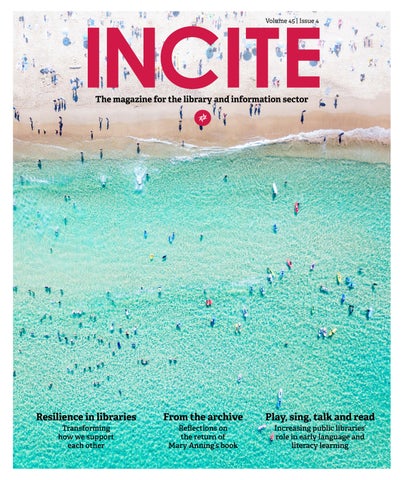
Volume 45 | Issue 4
The magazine for the library and information sector
Resilience in libraries
From the archive
Play, sing, talk and read
Transforming how we support each other
Reflections on the return of Mary Anning’s book
Increasing public libraries’ role in early language and literacy learning
Elevating the library experience Your all-in-one library management system for elevating library success and delivering the best experiences for both members and staff.
ALIA Information Online 2025 Platinum Sponsor
Visit libero.com.au to learn more
CONTENTS
28
34
39
42
Columns From the editor
4
From the president
5
Library stories: Melissa Whitrow
6
From the archive: Reflections on the return of Mary Anning’s book
8
Aboriginal and Torres Strait Islander readers are warned that the above article contains images of persons who may now be deceased.
ALIA News
Features
Resilience in libraries: Transforming how we support each other 12
Wikimedia Australia’s partnership with Alice Springs Public Library
28
Topnotch outcomes from LARIS @ Curtin internships
32
New kid on the resource sharing block
Supporting communities through the Social Work in Libraries Online Simulation Hub
33
Reflections from the IFLA Information Futures Summit 2024 16
Collaborating in style: How Holmesglen TAFE became a fashion runway
34
Keeping us connected: The story behind ALIA’s Code of Ethics
Growing manga and graphic novel collections: A case study from Barker College
36
Play, sing, talk and read: Increasing public libraries’ role in early language and literacy learning
39
A conversation with Angela Savage
42
14
20
On our collections: The importance of LOTE and accessible collections 24
INCITE is the magazine of the Australian Library and Information Association. It presents perspectives on issues relating to library and information science. © ALIA 2024 Subscription enquiries subscriptions@alia.org.au
Apart from fair dealing for the purposes of research or study, reproduction of this material in any form, for public or commercial use is prohibited without permission from the publisher. Contributors assert their moral rights to be identified as the authors of their works.
ALIA ABN 40 090 953 236 ALIA House, 9–11 Napier Close Deakin ACT 2600 PO Box 6335, Kingston ACT 2604 Ph: 02 6215 8222 enquiry@alia.org.au www.alia.org.au
Editor: Liz Bradtke incite@alia.org.au Design: Coretext www.coretext.com.au Advertising: Liz Bradtke media@alia.org.au Events: Zola Maddison zola.maddison@alia.org.au
ALIA EXECUTIVE Cathie Warburton, CEO cathie.warburton@alia.org.au Kylie Fiddy, Chief Operating Officer and Company Secretary kylie.fiddy@alia.org.au Zola Maddison, Director of Events and Training zola.maddison@alia.org.au Trish Hepworth, Deputy CEO trish.hepworth@alia.org.au
Cover: An aerial view looking down at Bondi Beach in Sydney on a busy day with blue water. Photo: Darren Tierney/Istock.
Contents | INCITE Magazine 3
FROM THE EDITOR
By Liz Bradtke Editor
Welcome to the final edition of INCITE for 2024. I hope those of you reading are preparing for some well-earned rest and relaxation over the holiday period. I also hope that this summer edition of INCITE can be part of that relaxation. Whilst these articles serve an education purpose, we also believe they make for some pretty enjoyable reading! In our regular ‘Library stories’ feature we hear from Melissa Whitrow, who made the transition from a public health academic to librarian and who talks to us about how her mix of skills and experience has helped her in her LIS journey. In ‘From the archive’, Hayley Webster of Museums Victoria takes us on a journey of a different kind. Hayley’s piece explores the curious tale of the rare book A Natural History of the Crinoidea, which once belonged to 17th century fossil collector Mary Anning. The text was recently returned to its rightful home in Lyme Regis after it was spotted in a Museums Victoria video. Hayley also discusses how they solved the mystery of the missing inscription. In ‘On our collections’, we hear about the importance of LOTE and accessible collections from My Van Nguyen Dang and Sarah Bloeforn and get tips from James Baker on how to communicate the value of collections primarily intended for minorities. In the ‘ALIA updates’ we hear from 2024 Library Technician of the Year award recipient Chloe Delaney on the wellbeing strategy she developed for her library and how others can do the same. We also hear from ALIA staff who attended the IFLA Information Futures Summit in Brisbane in October, the Chair of ALIA’s new Resource Sharing special interest group, and we sit down with members of the
ALIA team who led the development of the recently launched ALIA Code of Ethics for the Australia LIS workforce. Our feature articles cover the usual impressive array of topics. We hear about a partnership between Wikimedia and Alice Springs Public Library to add a selection of images from the Central Australian Historical Images Collection to the platform, outcomes from the LARIS @ Curtin internships, and the Social Work in Libraries Online Simulation Hub project at Charles Sturt University. We hear how Holmesglen TAFE library was turned into a fashion runway for a night, get a case study from Barker College on their data-driven approach to growing their manga and graphic novel collection, and get an article on how to increase public libraries’ role in early language and literacy learning. And last but not least, we sit down with CEO of Public Libraries Victoria Angela Savage and talk everything from her early years in public health and international development, her hopes for PLV and the library sector more broadly, and her new book co-edited with Kirsten Kath, Spinning Around: The Kylie Playlist. I sincerely hope you enjoy this edition of INCITE and that you all have a safe and restful holiday period, however and wherever you may celebrate.
Liz Bradtke, Editor incite@alia.org.au
Acknowledgment of Country The Australian Library and Information Association acknowledges the Traditional Owners of Country throughout Australia and recognises their continuing connection to lands, waters, cultures and communities. We pay our respect to Aboriginal and Torres Strait Islander peoples; and to Elders past and present.
Artwork: Richard Allan Jr. 4 INCITE Magazine | From the editor
FROM THE PRESIDENT
Jane Cowell AALIA (DCP) ALIA President
Welcome to the final edition of INCITE for 2024. As I write this, I am fresh from the three-day International Federation of Library Associations and Institutions (IFLA) Information Futures Summit in Brisbane, which took place 30 September to 2 October. This was an event I will remember for some time to come. I am still processing the insights from coming together in person with library industry professionals from 70 countries and an abundance of Australian library representatives — some at their first IFLA experience. The best part of any global professional event is the sharing of experiences, building professional networks and continuing to learn and grow as an information professional. There were many highlights through the week. One that stands out for me was the reading flash mob of global librarians reading in the Brisbane Mall, as promoting the joy of reading is a core public library function and one I, personally, view as a skill that supports empathy, social cohesion and democracy. Thanks to IFLA (especially Vicki McDonald; Sharon Memis, FRSA; Stephen Wyber; Helen Mandl; and all the amazing volunteers) for a wonderful three days of ‘wide-skilling’, thoughtful panels on leadership, the future of reading, GenAI, Open Access and many more. I have many follow-up questions and want to explore some topics more deeply. One of the summit’s major events that will be of interest to INCITE readers was the release of the IFLA Information Trends report for 2024. The report was developed with academic rigour but it is not a report that predicts the future. Instead, it can be used to spark conversation and speculation in your library — what are the trends you are seeing and how can they help your library to act locally to make a difference, whether you work in academic libraries, special libraries, school libraries or public libraries? I have included the seven trends identified in the report and the key questions that sparked my curiosity below: 1. K nowledge practices are changing. The question I am considering is: ‘How can you build skills in your community to counter misinformation?’ Short video skill development for staff may also be a key communication tool. 2. AI and other technologies are transforming society. This is a major question now for many library workers: ‘How will AI change things like learning, language translation and creating content and information?’ 3. Trust is being renegotiated. A really important question for me as a public librarian is: How can libraries help build trust in public institutions?
Photo: Pexels
4. Skills and abilities are becoming more complex. What is the role of libraries in identifying and addressing emerging skills gaps in communities? And an extra question from me: How do we advocate successfully to be funded to deliver on the role? 5. Digital technologies are unevenly distributed. An essential question for planning is: What data do you currently have? What data do you need? What data should you be collecting (or not, when privacy is a core right in a democracy)? 6. Information systems are using more resources. Our organisations usually have green strategies, but this still resonated with me. How can libraries reduce or offset their environmental impacts? 7. People are seeking community connection. Given ALIA’s purpose statement — ‘a strong library and information services sector for a thriving democracy’ — this conversation point really resonated with me. ‘What is the role of the library in addressing larger social problems like digital exclusion, poverty and education gaps?’ Throughout the whole summit, there was a strong theme of strategic partnerships — libraries do not have to do it alone. Seeking key partners at the national, state and local level will support all Australian libraries to step forward into the future with hope and optimism. As the IFLA strategic vision states, we are stronger together.
Jane Cowell AALIA (DCP) ALIA President From the President | INCITE Magazine 5
LIBRARY STORIES In this edition of ‘Library stories’, we speak with Melissa Whitrow from the Barossa Council Public Library. Like many of the people we’ve talked to in this feature, Melissa entered the LIS sector equipped with a strong set of skills honed in a previous career — in her case, as an academic in public health research. We asked Melissa about her current role, how her research background intersects with her work in library management, and why children’s literacy has become a key focus of her work.
Library stories Melissa Whitrow
‘Don’t pass up opportunity for growth (within reason!)’
6 INCITE Magazine | Library stories
Hi Melissa. Thanks for speaking with us. Could you start by telling us a bit about your current role? I am currently the Manager, Library Services at The Barossa Council Public Library. We provide library services to a population of around 25,000 people in the beautiful Barossa Valley across four physical library branches. This includes collection services, child and adult programs, history and heritage services, and a small (but developing) range of outreach services. I manage a team of 20 staff who work in library customer service and specialise in one or more of our service delivery areas. You have a very interesting background, having previously worked in epidemiology and rural health before moving into the library sector. Can you tell us about the ways in which your research background and experience intersect with your role as a library manager and your work in libraries more generally? My first career was as an academic in public health research. Armed with a Bachelor of Science and PhD in Epidemiology (both through the University of Adelaide), I ventured to the UK to work as a Career Development Fellow with the Medical Research Council in Glasgow. This was my initiation into the social determinants of health, and the role early life exposures have on health and wellbeing throughout life. Upon my return to Australia, I worked as a Research Fellow with the University of Adelaide (UniSA) for just over a decade. This position coincided with a tumultuous personal time for me — with two periods of
maternity leave and two years away from the workforce when my seven-year-old daughter was diagnosed with leukaemia. With great challenges comes reflection and change. Once she was well and had returned to school, I had the nagging feeling that I could be doing more than researching social determinants, and that grassroots interventions in my own regional community was where I could truly make a difference. I spoke to a career coach in 2019 and identified that working in a public library was the perfect conduit for turning my passion and skills into positive community outcomes. Now I am embedded in the public library sector, I can see significant transferable skills and overlap between my research career and current role. Academic research taught me to look for best practice, measure and demonstrate success, be strategic, embrace change, and think about the bigger picture and purpose of the work and projects we are doing. Both careers have also developed and utilised my skills in critical thinking, innovation, perseverance (this is a big one!), organisation, communication and advocacy. I was also fortunate to have amazing female role models and mentors in my research career who inspired me to be an empathetic and generous leader to my team today. I understand that upon moving into the LIS sector you completed your library qualification. Could you tell our readers a little bit about why you wanted to do this and how it has helped you in your career? My career change was a big decision, but once I had made it, I wanted to be ‘all in’, so I would know that if it didn’t work out
LIBRARY STORIES
Melissa Whitrow Photo: Supplied
it wasn’t because I hadn’t put the effort in. My academic background meant I immediately looked to tertiary study as the best way to learn about contemporary library services and how to deliver them. I enrolled in the Graduate Diploma of Information Management (Library and Information Management) at UniSA and completed the first six months full time before converting to part time when I secured an entry level role in the sector. The Grad Dip gave me an amazing overview of what working in a contemporary, innovative, inclusive library meant, the impact libraries have and the more practical aspects of library work. The guest lecturers provided brilliant examples of the many ways I could work in the sector. I remember a public library manager delivering one of our lectures, and being captivated by the impact she was having on the health and wellbeing of the community. That was a real ‘ah ha’ moment that confirmed this is what I wanted to do. I was also fortunate to be awarded the 2021 ALIA Prize when I graduated, which introduced me to ALIA with a 12-month membership and funding towards one of the interesting ALIA short courses.
You’ve recently started some work with Raising Literacy Australia. Could you tell us about this organisation and the work it does, what your involvement has been thus far, and why children’s literacy has become a key focus for you? My research background means I have a strong understanding of the importance of early life experiences and of children (and their families) having access to the support, connections and education they need to thrive. I had also seen the benefit of early literacy and developing a love of reading with my own children — both are avid readers, so much so that my daughter’s Make-A-Wish was for an everlasting supply of books. So, for me, it was an easy decision to engage with Raising Literacy Australia. The organisation works with the community to improve literacy levels in children from a very young age, and its programs (such as Words Grow Minds) help families engage and read with their children as early as possible to foster their ability to reach their full potential. I am currently working with Reading Literacy Australia and the Light Regional Public Library to design an early years intervention project. The project plans to deliver books into the households in our regions who have
young children, and then use those book deliveries as a conduit for connecting families to each other, to local services (like public library programs!) and information about child development. Public libraries will be at the centre of this project by providing a safe, free space for families to meet, take part in early literacy programs, and connect with allied health service providers in the region for information about child development. What advice would you give to someone who is thinking about changing sectors? To back yourself, your abilities (and how transferable your skills are) and take a chance on a career that will make your heart happy. This doesn’t mean leaping into change without thinking through the options, but the ‘perfect time’ to make a change or try something new doesn’t exist. At some point you need to be brave, go for it and embrace any opportunities that come your way. Finally, what is one thing you’ve read or watched this year that you would recommend to our readers? Read – The Girl with the Violin by Shelley Davidow. Watched – Nobody Wants This on Netflix. Library stories | INCITE Magazine 7
FROM THE ARCHIVE
Reflections on the return of Mary Anning’s book
By Hayley Webster Library Manager, Museums Victoria
From the archive I freely admit to a love of mysteries and have been the butt of many a gentle jibe for endlessly rewatching Agatha Christie adaptations. Therefore, it has been fascinating to be involved in a real-life rare book mystery for the past couple of years. The book in question once belonged to 19th century palaeontologist Mary Anning and, in 1985, made its way into the Museums Victoria Library, where I am library manager, to support museum research. The Museums Victoria Library has a fantastic collection of natural history books due to early purchasing by the museum’s first director, Frederick McCoy. McCoy was an armchair naturalist and, some might say, spendthrift, who invested £80,000 setting up the museum in his first decade as director. Only a small portion of that went towards the library, but the £3,500 that was spent on books and journals was a significant investment that has stood us in good stead over the decades. The library has continued to develop since the 1850s and is best known today for some of the beautiful and rare natural history books collected by McCoy. In the 1970s and 1980s, a second museum administrator took an interest in developing the library. As Deputy Director, palaeontologist Tom Darragh filled gaps in the collection, leafing through antiquarian book sellers’ catalogues, talking to museum experts, and bidding at local auctions to acquire rare books. A Natural History of the Crinoidea by John Samuel Miller (1821) was purchased from Oxford bookseller Blackwells as part of this collection development. The work was known to have belonged to Dorset fossil dealer Mary Anning; however, it was acquired for research purposes rather than the association to Anning. 8 INCITE Magazine | From the archive
y’.
FROM THE ARCHIVE Below x Photo: RA&HS Archives
Right ‘The Beatles Urinal’ — x Photo: RA&HS Archives
A photo of the inscription in a darkened room under UV light. Photo: Supplied
From the archive | INCITE Magazine 9
FROM THE ARCHIVE Historic texts are central to the work of museum taxonomists, who use them to trace the history of an animal’s classification. Increasingly, older scientific works are accessible in online repositories such as the Biodiversity Heritage Library. Our copy of A Natural History of the Crinoidea wasn’t being actively used for research by the time I started to investigate its provenance in 2021. The Treasures of the Natural World exhibition was due to open at the Melbourne Museum, and excitingly it included a lot of material that related well to our rare book collection. The exhibition highlighted the work of Mary Anning and, suddenly, the rare book she once owned was of interest again — this time as an artefact rather than a reference. Anning is significant for having made some of the most important geological discoveries ever known. She discovered extinct marine reptiles, such as the first ichthyosaur and plesiosaur known to Western science, and her discoveries fed into the development of evolutionary theory. She built up a successful fossil dealership, and interacted with many leading scientists of her day, including John Samuel Miller who, in addition to being the author of A Natural History of the Crinoidea, was curator of the Bristol Institute. Indeed, several of Anning’s fossils were acquired by the Bristol Institute during Miller’s curatorship. As a working-class woman, however, Anning operated on the fringe of scientific discourse, unable to join the scientific societies that fostered professional networks, supported publication of new ideas and recognised members’ contributions to science. Anning owned few books, which were an expensive commodity in this period. Some of her academic acquaintances presented her with copies of their journal articles, while she laboriously copied others out by hand. I expect she was grateful to receive the inscribed copy of A Natural History of the Crinoidea from Miller when he gave it to her with the dedication: ‘To Miss Mary Anning with the author’s best wishes’. Miller visited Lyme Regis in Dorset in 1824, and the two corresponded directly in 1830 over a fossil fish specimen that she unearthed, named Squaloraia by Henry Riley. Anning correctly identified the fossil as new to science. I had seen the 2020 film Ammonite, which highlighted Anning’s difficult and painstaking work collecting and preparing fossils. The film depicted Anning with female love interests, showing a blossoming relationship between her and geologist Charlotte Murchison, and alluding to an old romance between Anning and another Dorset collector, Elizabeth Philpot. I was intrigued to see a second inscription on our rare book underneath the one from Miller: ‘Elizabeth Philpot, given to her by …’ The rest of the inscription was missing. Unfortunately, as with other collectible items, there is a trade in stolen rare books. This occasionally warrants media attention, such as the dramatic 2017 case that involved members of an organised crime group abseiling into a London warehouse to steal significant rare books by Galileo and Isaac Newton. It is enough of an issue that the International League of Antiquarian Booksellers (ILAB) has created a Database of Stolen and Missing Books to track stolen items. Evidence of prior ownership of rare books is something that researchers, librarians and many collectors now take a great interest in. However, that wasn’t always the case and, unless a work had a significant former owner, ownership marks such as inscriptions, bookplates and marginalia were often removed. This was also the 10 INCITE Magazine | From the archive
Above Posthumous painting of Anning by BJ Donne from 1847, based on a 1842 portrait, showing her pointing at an ammonite. Photo: BJ Donne, public domain, via Wikimedia Commons
FROM THE ARCHIVE case for stolen books, where these marks might be used to identify a particular copy of a work. A common way of removing handwritten text was ‘washing’, which involved washing the paper with bleach until the ink faded. The history of queer or lesbian women is one where erasure also features prominently. Because they occur outside the socially sanctioned bond of heterosexual matrimony, historical evidence of same sex relationships is comparatively scant. In a Western context, if romantic relationships between women were acknowledged, they were routinely demonised and pathologised, while family members or authorities actively suppressed material evidence of queer relationships. A Natural History of the Crinoidea had clearly been tampered with, and I wanted to know what the missing inscription said. The paper conservator and I took a photo of the inscription in a darkened room under UV light. We still couldn’t make it out, so one of our imaging staff enhanced the photo until I could read the words ‘Mr & Mrs Joseph Anning’ and the date: 1847. It seemed that when Anning died in 1847 of breast cancer, her brother gave the book to Elizabeth Philpot as a memento. Anning and Philpot were known to be close friends, and although Ammonite is fictional, it takes inspiration from real possibilities. In searching for a ‘hidden’ lesbian past, historians have pondered ‘romantic friendships’ and studied figures who challenged gender norms. Anning is certainly interesting as an example of a woman who defied convention by pursuing a career as a fossil collector, and contemporary descriptions of her could be seen as suggestive. Explorer and naturalist Ludwig Leichhardt described Anning as ‘a strong, energetic spinster of about 28 years of age, tanned and masculine in expression’. Palaeontologist Gideon Mantell called her ‘a prim, pedantic vinegar looking, thin female; shrewd, and rather satirical in her conversation’. These types of descriptions resonate if you are used to listening for silences and reading between the lines. I wondered what had happened to the book after Philpot owned it. Anning’s biographer, Tom Sharpe, thought that the book was sold with Anning’s papers in 1885 by her nephew, Albert Anning. Sharpe thought the book lost; the last he knew of it was from a Bristol book dealer’s 1983 catalogue. In 2022, we released a video showing how we uncovered the missing inscription in Mary Anning’s book. It was seen halfway around the world by staff at the Lyme Regis Museum in Dorset, and they got in touch to let us know that the book was missing from their
collection. They explained that the book had been donated to the museum in 1929 by a relative of Elizabeth Philpot. The museum had suffered a period of decline from the 1930s to 1970s, and during that time the book went missing. We returned the book in May this year, in recognition of the significance of the item to Lyme Regis. It has been on public display in the museum, close to the sites where Anning made her discoveries. With the information from Lyme Regis, the whole ownership history of the book was known. But why was part of the inscription erased? The two logical reasons that suggest themselves are that someone wanted to obscure the ownership history or that they wanted to obscure something about the relationship of the people involved. The erased text did not prevent the book from being identified once the Lyme Regis Museum knew its location. The main identifying feature was that it was owned by Anning with an inscription by the author. Elizabeth Philpot’s name was also retained, which tied in with the donation information from Lyme Regis. The erasure of Joseph Anning and his wife from the inscription removed the lesser-known figures from the picture. The date of the gift at Anning’s death suggests that Philpot and Anning were close — but this was already known. The repatriation of Anning’s book has been an interesting experience on a few levels. Professionally, it was illuminating to be involved in an ownership claim and reassuring to work in an institution that prioritises ethical practice. Throughout the process, though, my mind has continued to return to the implications of erasure. This was the first question a historian of sexuality asked me when I presented on the return of the book recently, finding the erased text as suggestive as I had. I remembered a queer colleague excitedly visiting to see the inscriptions to Anning and Philpot; the book has a queer aura. It brings to mind Margaret Middleton’s interpretive strategy ‘queer possibility’, which argues that lived experience is valid interpretative expertise, and that museums should resist double standards around proof of gender or sexual identity and allow for different, queer ways of reading objects. Objects can have different meanings in different contexts or to different people. Anning’s copy of A Natural History of the Crinoidea is significant as a tangible, material object once owned by an important historical figure, and it is right that the book has returned to the place where she has so much significance. Having been the treasured item of two female 19th century palaeontologists, and the subject of deliberate erasure, it is also significant for the questions it invites and its ability to hint at a possible queer past.
In 2022, we released a video showing how we uncovered the missing inscription in Mary Anning’s book. It was seen halfway around the world by staff at the Lyme Regis Museum in Dorset, and they got in touch to let us know that the book was missing from their collection. They explained that the book had been donated to the museum in 1929 by a relative of Elizabeth Philpot. The museum had suffered a period of decline from the 1930s to 1970s, and during that time the book went missing. From the archive | INCITE Magazine 11
ALIA NEWS
Resilience in libraries: Transforming how we support each other Chloe Delaney is the recipient of 2024 Library Technician of the Year Award. In this article, Chloe discusses her development of a wellbeing strategy for her library and how others can do the same for the overall benefit of their staff and their patrons. By Chloe Delaney, Library Technician, Carindale Library
‘ To be vulnerable means to show up and be seen. To ask for what you need. To talk about how you’re feeling. To have the hard conversations.’ — Brené Brown I love this quote from Brenè Brown because there is power in vulnerability and power in speaking up about things that are important. If we don’t talk about things that challenge us, then we may not realise that positive changes can be made. It was this vulnerability that led me to pitch a wellbeing idea in 2021 that I thought may help my team at Carindale Library, Queensland. In the end it not only would help my team, but it would also lead me to meet many extraordinary people in the industry, have some extremely insightful conversations, and talk to other library services about the value of a wellbeing strategy. If you have not considered a wellbeing strategy for your library branch before, it may be time to introduce one. According to the most recent National Report Card from the Australian Government’s National Mental Health Commission (2023), one in five people struggle with a mental health issue, and many of the factors that impact mental health — such as financial stress, loneliness and discrimination — are not showing improvement. Many of these elements have a huge impact on our library customers and how they present in the branch. As much as 12 INCITE Magazine | News
we strive to do our best to serve the needs of these valuable community members, library and information professionals across Australia are working outside of their limitations and qualifications to meet complex needs of patrons, which is creating new levels of individual and organisational stress across the board. It is uplifting and promising to see social workers getting more of a look-in within libraries (and some fantastic research being undertaken) to meet these needs. However, there are instances where social workers are not currently available to provide that support for a multitude of reasons. So, how do we stay resilient in libraries in a time of increased economic and social strain? For my team, it took the form of the wellbeing strategy mentioned above. Developed at the end of 2021, the initiative was designed to ensure that staff were aware of what resources were available to support them at work and outside of it, so that they could better support library customers. For the first year, we worked on building and maintaining resilience, with resources sent out and communicated by only one person (me). We soon realised that having only one person send out resources created a restriction in how we look at mental health, as there was just one perspective on offer and that perspective may not necessarily align with all members of the team and how they perceive wellbeing. To manage this, in 2024, team members were encouraged to take ownership of their wellbeing at work by working in pairs to share resources with
the team. By doing this, each team member was able to provide a unique perspective on wellbeing drawn from their own experience, which allowed the rest of the team to explore new areas. Some of the topics we have covered across the last two years include overthinking, psychosocial safety, the third space, neurodiversity, grief, and simple concepts such as the power of being kind. Ultimately, having a different staff member contribute a wide range of resources each month has helped keep the team curious about learning new things, and enabled us to build and maintain a growth mindset. This work is going towards the creation of a set of wellness goals for the whole team to establish how they want to ‘work in wellness’, which we are hoping to have established by the end of 2024.
ALIA NEWS Chloe Delaney Photo: Supplied
Illustration: Supplied
The wellbeing strategy continues to be influenced by a range of brilliant people, events and resources through ALIA. As an example, the work done by Dr Jane Garner, Dr Kasey Garrison and Dr Beth Wahler to highlight the social context that public libraries are currently facing has been highly influential. Their podcast, Surviving the Stacks, has provided an avenue for deepening our understanding of the wellbeing challenges and solutions facing the community, including library staff. The wellbeing strategy has really brought our team together and I would encourage all libraries to put one in place, no matter how big or small your branch or library service is. My team works better together because we now have a greater understanding of each other’s needs, we are better at communicating, and we have a bigger perspective on the things that give each of us motivation and drive. We lean into being vulnerable and have a space that is safe to express how we feel. There is also a greater understanding of psychosocial hazards, and we work closely together to prevent and minimise them. There is no harm in putting an extra element of positivity in your day, and if you can all support each other through stressful moments or days with what you learn from each other, then there is no loss from having implemented such a program. As we move into 2025, I invite you to take the advice of Brené Brown — lean into your vulnerabilities, have the confidence to ask for what you need, and have the hard conversations to make the necessary changes that will fulfil your days in the library and in your personal life. A small amount of positivity in each day does help, and I am looking forward to seeing many of you implement wellbeing into your branches in the new year.
News | INCITE Magazine 13
ALIA NEWS
New kid on the resource sharing block
By Linda Marchesani, Chair, Resource Sharing Special Interest Group
Welcome to the ALIA Resource Sharing Special Interest Group (SIG)! This new group, established in late 2024, replaces the ALIA Interlibrary Lending and Advisory Committee (ILAC). In its new iteration as a special interest group, it is structured for much greater involvement from many more participants. So, if you have an interest in resource sharing, this is definitely the group for you. The Resource Sharing SIG’s activities focus on the practice of resource sharing — the tradition of cooperation, collaboration and reciprocity that exists between libraries, and enables them to draw on the collective wealth of their combined resources in order to satisfy the information needs of their users. The group’s two key aims are: • to facilitate networking, support professional development and develop educational resources • to provide a forum for members to engage with others in the sector, to participate in conversations that shape great practice, and advise the profession more broadly on issues raised. The group’s Executive Committee also has responsibility for the ALIA Interlibrary 14 INCITE Magazine | News
Lending Resource Sharing Code, including revision and the calculation and communication of annual recommended fee increases. As Chair of the group, I am excited to see how we can collaborate to connect those interested in resource sharing to ultimately improve service delivery to our clients and strengthen the skills of those working in the area. With changes to the national resource sharing system taking place, the group is another forum for library staff to share in the development and implementation of that system at this important time. The group has a brand-new webpage including details about the group, the Interlibrary Lending Resource Sharing Code, the Executive Committee, key activities and the terms of reference. It also has a link to join, and we invite all interested members to explore the webpage here. The Executive Committee is currently planning 2025 events, so keep your eyes on the webpage, social media channels and ALIA News for more details. New course alert! Coinciding with the launch of the SIG is the newly released Resource Sharing: Interlibrary Loan and Document Delivery course. It is a self-paced online microcredential suitable for all Australian
library staff interested in or working with interlibrary loan and document delivery services. The course will take 5–8 hours to complete and consists of seven self-paced modules, including quizzes. You will receive a certificate of participation upon the successful completion of this course. The course is right for you if ... • You are involved with or responsible for interlibrary loan and document delivery services. • You wish to increase your understanding of resource sharing in Australian libraries. This course covers the fundamentals of interlibrary loan and document delivery services. It is suitable for all levels of staff. This training course is a huge undertaking and achievement by the group’s Executive Committee, and it is fantastic to see it finalised and now available for registration. I am grateful to all our Executive Committee members who wrote content for and edited the program. I am also excited about the opportunity this presents for those wanting to learn about or upskill within the area of interlibrary loan and document delivery. I would certainly recommend the training program as a key tool for professional development. MORE INFORMATION and registration for the course is available here.
ALIA INFORMATION 2025
&
Transformation Disruption
18 – 20 March 2025
Registrations for ALIA Information Online are now open. Head to the website to explore the draft programs for the Greening GLAMR and AI & the Future of Library Technology days and to register. The Indigenous Knowledges Day program will be available in early 2025. www.alia.org.au/EventDetail?EventKey=�O25
ALIA NEWS
Reflections from the IFLA Information Futures Summit 2024 By Emily Wilson, Engagement Manager, ALIA Jacqui Lucas, Professional Learning Teacher Librarian, ALIA Zola Maddison, Director, Training and Events, ALIA Trish Hepworth, Deputy CEO, ALIA
The IFLA Information Futures Summitt (IIFS) was held from Monday 30 September until Tuesday 2 October 2024 in Meanjin, on the lands of the Turrbal and Yuggera peoples, at the Brisbane Convention and Exhibition Centre. Not since 1988, when the IFLA General Conference was held in Sydney, has an IFLA event of this scale been held in Australia. The summit had over 700 delegates, who travelled from 70 countries to be there. With the theme Stronger Together, IIFS provided a wealth of perspectives on different ways information is created, shared and applied, and how this is evolving — as well as what this means for our societies, cultures and economies. IIFS — provocation and idea generation The summit kicked off with the distribution of the IFLA Trend Report, which provided the perfect context and framework for the expansive selection of Ignite Talks held across the program. From Chinese lessons in storytelling as advocacy, to reimagining Australian library engagement with spatial imaging, to a bibliotherapy clinic 16 INCITE Magazine | News
Exploring the QAGOMA Research Library Archives. Photo: ALIA
in a Nigerian university, attendees were positioned to see the global work of the library field through the lens of IFLA’s seven emerging trends: • knowledge practices are changing • AI and other technologies are transforming society • trust is being renegotiated • skills and abilities are becoming more complex • digital technologies are unevenly distributed • information systems are using more resources • people are seeking community connection. In all, there were seven Ignite Talks sessions, each with a wide range of presentations representing many different countries, sectors and perspectives of our work. Yet, with the framework of the trend report, it became clear how our profession is grappling with many of the same global pressures while gaining a breadth of insights and inspiration to tackle these challenges.
IIFS — so much more than the main program Associated events took place before and after the summit and opened wider participation. Research and Effective Practices Seminar ‘Libraries Beside You All the Way: Sustainable Reading at Every Age and Stage’ was a collaborative effort of four IFLA Sections: Libraries for Children and Young Adults, School Libraries, Literacy and Reading, and Environment, Sustainability and Libraries (ENSULIB). The event kicked off on Friday 27 September with a tour of Ipswich Children’s Library — Australia’s only public library dedicated solely to children. Participants travelled by train to the venue and were met at Ipswich Station by smiling library staff. On arrival at the library, participants received a welcome from Ipswich Mayor Cr Teresa Harding, before a behind-the-scenes tour of both the Children’s Library and the Ipswich Library. The libraries are in a ‘destination location’ for the Ipswich community, where families
ALIA NEWS
Participants in the reading flashmob outside the Brisbane Square Library. Photo: ALIA
can come and easily spend an entire day enjoying facilities. Library staff shared how they implement the First 5 Forever program — a play-based program supporting Queensland families to talk, read, sing and play with their babies and young children — and the challenges and joys of delivering dynamic public library programs and services. Saturday’s session was held at Brisbane Square Library, beginning with a heartfelt keynote from Tylissa Elisara, First Nations author of Wurrtoo: The Wombat Who Fell in Love with the Sky. The Children and Young Adult Section shared the amazing resource that is The World Through Picture Books, followed by a presentation about the initiatives that public libraries in Singapore have undertaken to engage children and young people in reading. IFLA’s School Libraries Section contributed a session on immersive environments, followed by a panel discussion. The day concluded with a book launch of the new ENSULIB title, Libraries Driving Education for Sustainable Development. The take-home message of
the day was the call to action ‘just do it!’. Sunday’s keynote presenter, Marika Simon from the teacher librarian team at Charles Sturt University, shared recent research into effective collaborations between public and school libraries. IFLA’s Reading and Literacy Section then contributed three fabulous sessions including a bibliotherapy workshop, a presentation from Libraries Tasmania, and the impressive practice from the National Library of New Zealand Te Puna Mātauranga o Aotearoa. The Research Seminar was a grassroots collaboration that not only built positive connections between the four IFLA Sections but also between the individual organisers and participants. The seminar was an excellent example of IFLA’s current theme of Stronger Together in action. Reading flashmob A fun side-activity of the summit was the reading flashmob that took place outside Brisbane Square Library. People arrived with a picture book from their country and,
on a agreed signal, started walking and reading aloud. To add to the visual excitement and sense of camaraderie, many participants dressed in red. At the end of the experience, picture books were either exchanged or donated to the local Children’s Book Council of Australia branch. ALIA LARK Symposium The ALIA LARK (Library Applied Research Kollektive) Biennial Symposium was about Australian and international connections. This one-day event had a richly curated program aimed at evidence-based practice and applied research in library and information studies. ALIA QLD Mini Conference: Working Together The annual ALIA QLD Mini Conference was held to align with the IIFS and was the group’s biggest mini conference to date. Attendees spent a day networking with their peers and attended presentations and workshops on the theme of News | INCITE Magazine 17
ALIA NEWS Working Together. It was an excellent opportunity for cross-sector collaboration, with presentations from state, school, academic and public libraries and an insightful tour of the Queensland Art Gallery/Gallery of Modern Art (QAGOMA) Research Library. Mentoring mysteries: Unlocking your potential as a future mentor or mentee This event was an initiative of IFLA Continuing Professional Development and Workplace Learning and involved participation from ALIA, the Chartered Institute of Library and Information Professionals, CAVAL and Skilltype. Led by Dr Gill Hallam and Dr Anne Reddacliff, the workshop was an opportunity to explore the benefits and challenges of mentoring and the dispositions and structures that lead to successful mentoring partnerships. A panel discussion capped off a productive morning with a commitment from participants to continue to connect, not just nationally but also internationally. IIFS — creating opportunities IIFS provided opportunities for attendance and participation, as well as a multitude of ALIA Members to deliver Ignite Talks and participate on panels. Madhavee Wright from the ALIA SA Committee and Ashleigh Lowry from the ALIA QLD Committee were IIFS volunteers. They gave their time, dedication and enthusiasm to assist us in successfully delivering this international event and had the chance to grow professionally. Brad Chugg from the ALIACT and ALIA Rainbow Committees received the IFLA Emerging Leaders Grant. The purpose of the grant is to provide newer professionals with the opportunity to attend and play a contributory role at an international IFLA event, build their profile within the profession, engage with other professionals across the world and facilitate networking for the advancement of librarianship in the recipients’ institutions, communities and countries. IIFS — showcasing Brisbane’s GLAMR The summit delegates could discover the innovative landscape of Brisbane and surrounding areas and explore outstanding 18 INCITE Magazine | News
Above Madhavee Wright from the ALIA SA Committee. Photo: ALIA
Top The Supreme Court is watched by hundreds of eyes, created by artist Yayoi Kusama. Photo: ALIA
libraries and cultural institutions. Some examples are highlighted here. Queensland University of Technology (QUT) showcased Brisbane’s evolution from the 1800s to today through an impressive archive of imagery from the QUT Digital Collections with ‘River City Stories’ — a digital interactive journey displayed on the vibrant screens of The Cube. This exploration offered a view of the city’s past and present on an epic scale. The IIFS GALA Dinner was held at the Queensland Art Gallery and attendees had the opportunity to view the Asia Pacific Triennial of Contemporary Art. The ALIA QLD Mini Conference took attendees on a behind-the-scenes tour of the QAGOMA Research Library. A tour of the Supreme Court Library QLD was offered as one of the IIFS Library Explorer Tours. Delegates had the opportunity to explore the library in the QEII Courts of Law, view the library space and rare books collection, and partake in a special tour of the building’s diverse range of public artworks.
Gale OneFile: Australia and New Zealand Featuring CHOICE® from the Australian Consumers’ Association We are very excited to announce CHOICE® from the Australian Consumers’ Association is now available in Gale OneFile: Australia and New Zealand. (Full-Text content only) as of 2024. • Choice magazine backfile from December 2021 up until the current issue • Gale has negotiated no official embargo for the monthly publications.
Gale Books and Authors - highlighting Australian Authors Gale Books & Authors helps to connect readers with books. Among many benefits to your library, it can increase circulation of fiction and non-fiction, build and promote book clubs and programs in your library and help patrons make informed reading choices. Since November 2021, we have been working with an Australian librarian as our local ANZ Subject Matter Expert and have now added over 500 new Australian and New Zealand titles and authors. Speak to your Gale Account Manager to arrange a free 30-day trial or discuss how a Gale local content solution will meet your library community’s needs. Maureen Quinn QLD/NT/NZ 0439 772 155 maureen.quinn@cengage.com
Darren Brain TAS 0419 881 973 darren.brain@cengage.com
Hellen Pervushin VIC/SA/WA 0413 873 364 hellen.pervushin@cengage.com
Isis Bibaoui NSW/ACT 0434 605 960 isis.bibaoui@cengage.com
To learn more email anz.gale@cengage.com
ALIA NEWS
Keeping us connected: The story behind ALIA’s Code of Ethics
In October ALIA launched its Code of Ethics for the Australian Library and Information Services Workforce. This Australian-first set of ethical principles is designed to guide and support people in the library and information sector in their decision-making and behaviour. To take a deeper look at how the Code of Ethics came about, why it is needed for our sector and how it was adapted to the Australian context, we sat down with three members of ALIA’s Policy and Education team who worked closely to bring project to fruition. Hi Phoebe, Jacqui and Heather! Could you start by introducing yourselves and talking a bit about the role you played in developing the Code of Ethics? Phoebe: I’m Phoebe Weston-Evans and I’m the Senior Research Coordinator at ALIA. It’s actually hard to talk about individual roles for the project because it was such a collaborative piece of work. It was like one big ball of energy that shifted between us as it needed to. People took up parts of the project that they wanted to or were good at, and there wasn’t really any lead in particular. Jacqui: I’m Jacqui Lucas and I’m the Professional Learning Teacher Librarian at ALIA. All three of us are qualified librarians, but we have varied backgrounds. Phoebe’s got an academic background and is fresh from her studies and so her knowledge of the landscape is very current. My background is as a teacher librarian — my areas have always been in children and youth services, and I have particular interest in CPD, literacies and sustainability. 20 INCITE Magazine | News
Heather: And I’m Heather Brown, librarian, sector standards and education at ALIA. I started out as a children’s librarian but I also have a background in reference and research. Most recently, my interest has been in the preservation and heritage areas. In your view, why does our sector need a Code of Ethics? I understand that you were responding to calls from within the ALIA membership and the LIS workforce more broadly to develop one. But, from a more philosophical perspective, why is a Code of Ethics particularly necessary for our sector at this specific time? Jacqui: Yes, it was absolutely asked for by the ALIA Membership and it is really an opportunity to unite and unify our membership. The Code of Ethics is applicable no matter what career stage you’re at, no matter what sector you work in, no matter whether you’re working as a volunteer. Employed at any level, the ethics are applicable to us all.
ALIA NEWS Photo: Pexels
News | INCITE Magazine 21
ALIA NEWS Phoebe: It’s a reflection and a clear articulation of what people are already doing and behaviours that people are already demonstrating across the sector. It can also guide people coming into the sector as new graduates, or from other sectors at the management level, and introduce them to the ethical standards in our workforce. Heather: Really, it’s about connection. It’s our shared principles that help us work together and live together, and that has always been important for library and information science and services. The ALIA Code of Ethics has been developed from the IFLA Code of Ethics. Can you talk a little bit about how you adapted it to the Australian context and what the main points of difference are between the two codes? Phoebe: One key area is the inclusion of Aboriginal and Torres Strait Islander knowledge, which is embedded throughout. This gave us an opportunity
22 INCITE Magazine | News
to incorporate Aboriginal and Torres Strait Islander priorities across different areas instead of having one isolated ethical clause. To do this we worked closely with the ALIA Aboriginal and Torres Strait Islander Expert Group to integrate foundational content into each of the ethical clauses with that contextual understanding and unique difference that we have in Australia. Jacqui: Another point of difference that is very pertinent to critical librarianship is that we don’t at any point use the word ‘neutrality’. Libraries aren’t neutral. We’re not living in neutral times, we’re living in grayscale times. And so instead we use the word respect, which you don’t see as often in other Codes of Ethics. Heather: I think the incorporation of sustainability is also another key point of difference and this aligns with ALIA’s commitment to the UN Sustainable Development Goals, which we’re highlighting.
How do you measure the impact of the Code of Ethics and how it is being used across the sector? Jacqui: There is no mandate for implementing the code; however, in the document itself we encourage people to let us know about how they are using the code in practice by getting in touch with ALIA. Over time we hope to get a sense of how the code is being utilised and how the action examples are being adapted and created in various workplace contexts. Our wonderful ALIA Schools special interest group have already written their own adaptation of the Code of Ethics for school libraries that is going to be launched in February! Heather: That also means that before our next revision we will ideally have numerous examples of the code being taken up in contextualised forms, which is something we can both measure and share. And having both the success stories and stories of challenges shared with us will help us strengthen the document over time.
ALIA NEWS Speaking of the review process, how often will this happen, and do you intend to change the clauses in accordance with shifting priorities and areas of focus for the sector? Jacqui: The review is set to happen every three years and this aligns with the ALIA Core Values statement too. The idea is that everything that ALIA does has an interconnectedness. So, whether it’s the framework for the workforce, the Code of Ethics, or any other document that we develop, they’ll all be interrelated and inform each other. Heather: It goes back to that connectedness that we’re continuously aiming to foster. The Code of Ethics will inform all of ALIA’s policies and procedures into the future and it will also be a point of connection for people joining as members. Phoebe: In terms of changing the clauses, we did really try to make the language in the clause descriptions high level so that there’s room for people to adapt their action items according to
their workplace, but we will of course use that review period to ensure the code if relevant and up to date. If this were a Code of Ethics written in the 60s, for example, sustainability might not have been on there because it wasn’t a global concern and imperative in the way it is now. What is the best way for people to start implementing this in their workplace? Jacqui: Make sure someone’s responsible for it. And a good starting point is to reflect on what you’re already doing, read through the code and see what you’re doing well. Where possible, involve everyone so there’s ownership of the action examples. We have provided a list of hints and tips in the guide for use. Finally, what was your favourite part of working together on this project? Phoebe: For me it was the absolute trust and sense of safety in working with Heather and Jacqui, and the leadership of Trish
Hepworth (ALIA Deputy CEO). Her vision was something that we all completely trusted, and she trusted us in return. Heather: Whilst this was a serious undertaking, I have to say there were a lot of laughs as well! And it was wonderful to work together to really crystallise each clause. Ethics are like poetry in a way, it’s about distilling the essence. Jacqui: Along with the delight of working with my learned colleagues, I loved the rigor and transparency of the consultation process. Playing a part in developing and delivering something as important and purposeful as the code was an absolute privilege. You can find the ALIA Code of Ethics for the Australian Library and Information Services Workforce on the ALIA website. You can also find details on how to implement the code, as well as customisable template.
2024 WINNERS more at creative.gov.au/PMLAs
News | INCITE Magazine 23
ON OUR COLLECTIONS
On our collections: The importance of LOTE and accessible collections
Although it is a core part of our work, as library professionals we often do not focus on effectively communicating the importance of our collections as much as we focus on the collections themselves. In this series, we are looking at why various collections within a library are important and, crucially, how to communicate that importance to the different stakeholders we deal with. Previously we’ve looked at collections that are there for everyone to use, but how do you justify a collection that large sections of a community are unlikely to be able to use?
Photo: Supplied
The importance of LOTE collections By My Van Nguyen Dang
In my early teenage years, I never understood why I had to go to Saturday Chinese school. In day school I was learning Italian. I was an avid reader from a young age, but I had never read a full book in Chinese before — reading in class didn’t count — until I picked up my first Chinese fiction from my local library. That opened a whole new world of possibilities and, from then on, I became fascinated by Chinese culture. I think that this was what influenced me in becoming a diversity librarian. The 2022 report from State Library Victoria and Public Libraries Victoria, Inside Our Public Libraries, found that users of Victorian public libraries spoke over 183 languages. Of Victorian public libraries members, 32% have reported speaking a language other than English at home. In her recent research paper, ‘Firstlanguage reading and the role of public libraries’ (2022), Dr Jane Garner from Charles Sturt University explored the reader’s experience of reading in their first language and how public libraries can support this. For the participants in this research, they identified that being able to read in their ‘mother tongue’ was a ‘deeply emotional experience’ (Garner, 2022, p.8). 24 INCITE Magazine | On our collections
ON OUR COLLECTIONS
Why are these stats and research findings important? Because where I work, Greater Dandenong Libraries, this is everyday reality. In the 2021 Australian Census, the Australian Bureau of Statistics identified 149 languages as a spoken language used by residents of the City of Greater Dandenong. Close to 69% of Greater Dandenong residents identify as speaking a language other than English at home and 31% of library members say they speak a language other than English. Our community members feel proud to have their native language represented in our collections. This is quite evident when we make changes to collections, as there will be almost immediate community feedback, particularly if there is a reduction of collection size or the consolidation of language collections to a single branch. As a part of my preparation for this article, I anonymously surveyed all Greater Dandenong Libraries staff, asking two set questions and one open question. I was surprised at the number of replies that I received — within four days I had received responses from almost 50% of the staff. My first question asked was: ‘Why do you think libraries need a community languages collection?’. A common theme noted from the replies included phrases such as: • ‘a reflection of the community’ • ‘language should not be a barrier to access’ • ‘make it feel like home’ • ‘celebrate, and acknowledge, culture’ • ‘enjoyment’ • ‘appreciation’ • ‘inclusivity’ • ‘connection’ • ‘teaching languages to children’. My second question was: ‘Do you think the community benefits from libraries having a community languages collection? Why?’. Some common responses included: • ‘maintaining cultural identity’ • ‘feel welcomed’ • ‘representation of the community’
• ‘sense of belonging’ • ‘maintain literacy’ • ‘access’ • ‘respected’ • ‘engaged’ • ‘retainment of language’ • ‘supporting new migrants’ • ‘acceptance’ • ‘diversity’. One response that summarised these two questions particularly nicely was, ‘Libraries become more valuable by offering … languages, making life better for everyone in the community.’ However, understanding why community languages collections are important is not enough. In my final question to the staff, I asked, ‘Any other thoughts?’. The most common response I received to this was that there needed to be more promotion of the community languages collection. When I was first approached about this article, it was said to me that libraries are great in developing amazing collections but not so great about promoting these collections, and I absolutely agree with this statement. There are many barriers between public libraries and the community, particularly those who have never set foot in their local library. A language barrier is one major hurdle. How do we attempt to engage with the community if we cannot speak their language? In Dr Garner’s paper, she recommended ‘library language ambassadors’ — community volunteers to assist library members and function as a feedback portal for the community they represent. ‘Inserting a human being between the bookshelf and the people … will create magic … create some sort of a happening or experience, and people will get excited’ (Garner, 2022, p.15). Community languages collections are an important part of public libraries, particularly to those who serve a community as diverse as Greater Dandenong. Libraries are here to provide unbiased access to information and resources. Community languages is but
one of the many special collections that are held at public libraries, but it should not be developed and then forgotten in a corner. A collection with a high level of engagement can lead to a more cohesive and engaged community, which in turn can support social cohesion, and mutual understanding of different cultures as well as instigate feelings of curiosity in others. Reference Garner, Jane (2022). ‘First-language reading and the role of public libraries’, Charles Sturt University, www.sl.nsw.gov.au/sites/default/files/ first_language_reading.pdf. ABOUT THE AUTHOR My Van is a Diversity and Literacy Librarian from Greater Dandenong Libraries. Her work with diversity began in 2015 after graduating with a Master of Business Information Systems specialising in Library, Archival and Recordkeeping Systems from Monash University. She is currently a co-convenor of the PLV Multicultural Services and Programs Special Interest Group and a committee member of ALIA Multicultural Group.
On our collections | INCITE Magazine 25
ON OUR COLLECTIONS
Photos: Kim Jane Photography
The importance of accessible collections By Sarah Bloedorn
Accessibility is what’s best for everyone. This is something you’ve likely heard, but what does that mean in a library setting? And how does a library make meaningful contributions to accessibility for all patrons? Vision Australia (VA) Library is a public library with some big differences. A national library service, the VA Library is for people who have a print disability. This is term that encompasses people who live with blindness and low vision, as well as those who may not be able to access printed materials for another reason, including dyslexia or a physical disability. Around 18% of Australians live with a print disability. In a print-saturated world, the VA Library creates, converts and shares information in accessible formats. The main ways of this access are audio or braille. In recent years this has been made easier with the implementation of the Marrakesh Treaty, which allows copyright exceptions when converting into accessible formats. What this means in practical terms is more materials with less waiting time. This increases 26 INCITE Magazine | On our collections
inclusion for library members, who can have richer engagement with their learning or social communities. If this feels like an overstatement, imagine being in a book club but being unable to keep up with prescribed novels, or sitting in a classroom without being able to follow along with a textbook. Accessibility should start as soon as a need is recognised. For many people, age brings with it health concerns, including failing vision. A lifetime of reading can seem to grind to a halt, bringing with it grief and stress. A need may also arise soon after birth, when a child may be diagnosed with a condition affecting their vision. Literacy development in young children with low vision can include braille and tactile literacy, helping them to decode the world around them. How can public libraries make small but impactful changes to how they enable access to information? Providing a range of formats for patrons is a great start. There’s no need to reinvent the wheel — the VA Library can support your patrons too — but even a small collection of braille picture books in your children’s area will make a young person learning braille feel included and safe. Making sure that book club members have access to a book in their preferred format is another way to remove any stigma around alternative formats. Take some time to consider if your library website is accessible, and if you’re not sure, ask an expert! Library
spaces can also be very daunting for someone with low vision, so ensuring uncluttered and well-lit areas makes a huge difference. Seeing eye dogs are permitted into all public areas including libraries, so make them feel welcome if you’re lucky enough to have one visit! Thinking about accessibility is also a way to check any underlying biases you may not even realise you have. Have you ever thought ‘audiobooks are not real reading’? This is fundamentally untrue, as audiobooks bring the richness of story and language to life and provide needed education and entertainment to many people. You might have also wondered why we still have braille in our high-tech world? Braille continues to be a relevant and useful reading and writing system that teaches essential literacy building blocks including grammar, punctuation and spelling. Thinking about accessibility doesn’t need to feel burdensome. It presents a great opportunity to enhance our wonderful library spaces to be even more diverse and inclusive and to celebrate reading in all its beautiful forms. ABOUT THE AUTHOR Sarah Bloedorn has worked in libraries for 15 years. She has focused much of her career thus far on supporting emerging literacy for children and young people. She currently manages the Vision Australia Library, overseeing the provision of national library services to people with a print disability. Sarah lives up to the stereotype that librarians have a lot of cats.
ON OUR COLLECTIONS
The first thing to always be aware of when talking about collections primarily intended for minorities — be that cultural, disability, neurodiverse, GSSRD (gender, sex, sexuality, and relationship diversity), d/Deaf or First Nations — is that unless you are a part of that community, you should not presume to speak for them. It can be easy to fall into the trap of saying, ‘we’re providing these resources because it’s what they need’ rather than ‘we’re working with them to provide resources that meet their needs’. It’s a small difference, but the change in the implications relating to respect, autonomy and recognition are much greater. Generally, I think this is something libraries try to be aware of, but it’s important to make sure we check regularly that we continue to apply that awareness. With that covered, both of the collections this issue are likely to be difficult for the majority of library users to engage with. This can lead monolingual English readers to question whether the library is helping the wider community as effectively as it can when these materials are made available through the library. It’s easy to immediately assign this reaction to some form of bias or bigotry but, as libraries operate with limited resources, it is reasonable for library users to question how those resources are being used. The initial response to questions such as these should be to treat them as genuine and sincere requests for information unless other factors indicate differently.
The problem with a question about why resources are being allocated to LOTE, braille or other resources that meet a minority need but are in an inaccessible format for the majority of library users is that it makes the assumption that those resources aren’t improving the library service for all library members. While it may initially seem counterintuitive that a monolingual English speaker is getting a better library service by giving up collection space to a collection in a language they cannot understand, engaging with these communities in their own language means that these community members are more likely to use and value the library. In economics there is a phrase, ‘A rising tide lifts all boats’, and this is somewhat applicable here — the more diverse members of a community use and value the library, the more likely that library is going to be supported in its programming, collection development and funding. Remember that even though it isn’t often put in these terms, when applied to an individual’s use, this is essentially no different to the library holding romance, crime, horror and science fiction, even though most library users are unlikely to read across all these genres. No library user will ever access every resource the library makes available, so if there is an interest for a particular collection from various individuals within the community the library serves, there is value to that collection for the community as a whole – and that value doesn’t inherently reduce the value of the library to other members of the community.
The question, then, is how to articulate this. While the rising boats allegory can be a good illustrative device if the person you are talking to is already othering the subsection of the wider community, it is important to avoid othering them yourself. Where possible talk about meeting the needs of the diverse community the library serves and ensuring that everyone is included by being able to access material in a format they can engage with. It can be a daunting prospect to justify and defend collections within the library to people who see little value in those collections, but by talking about them in terms of inclusion and the community the library serves, it is possible to demonstrate that value. Even though someone may not be inclined, or indeed able, to use some of the materials the library makes available, this doesn’t mean that those collections are reducing the overall value of the library to that person. In fact, by strengthening the community as a whole, they are increasing the value of the library to every member of the community, no matter how frequently or extensively any particular individual uses the library. ABOUT THE AUTHOR James Baker is a librarian and library educator from Melbourne (Naarm). Before undertaking his master’s in information management, he completed a degree in professional writing, media and communication, which he continues to use regularly in his work in libraries.
On our collections | INCITE Magazine 27
IMAGE COLLECTIONS
Wikimedia Australia’s partnership with Alice Springs Public Library By Alice Woods Education and Projects Officer, Wikimedia Australia Ella Turner Collection Development Co-ordinator, Alice Springs Public Library
At the end of 2023, Wikimedia Australia partnered with the Alice Springs Public Library, located in the heart of Mparntwe, to add a selection of images from the Central Australian Historical Images Collection to Wikimedia Commons. Wikimedia Commons is a free media file repository where individuals and institutions, including those from the galleries, libraries, archives, museums (GLAM) sector, can make files available. These files are either in the public domain or under a variety of Creative Commons licences. Wikimedia Commons uses the same technology as Wikipedia so that everyone can edit. Uploading files to Wikimedia Commons means that they will show up in web search results like Google Image, and many institutions have found this has increased web traffic to their websites and collections. The Alice Springs Public Library is not the first GLAM institution in Australia to add images to commons, with the State Library of NSW having added over 2,000 images and the State Library of Queensland 50,000. The Central Australian Images Collection at the Alice Springs Public Library, which consists of about 3,000 images (made up of 29 smaller collections) has been written about previously in a 2019 issue of INCITE, when an assessment of the cultural 28 INCITE Magazine | Feature
sensitivity of the images took place with Braydon Kanjira, a Traditional Owner and Arrernte Senior Ceremonial Leader, from Ntaria (Hermannsburg). As part of this assessment, images were graded on a ‘traffic-light’ system — green for unrestricted access, orange for warned access and red for restricted access. Only a small number of images were flagged as orange or red; however, it was an important assessment to undertake with any sort of publication of these images to ensure cultural sensitivity. All images that were flagged in any way have not been included in the partner project with Wikimedia Australia and, in this partnership, we have referred regularly to the Guidelines for First Nations Collection Development by Tui Raven, which were released as this project started. One of the intentions of these guidelines — along with assisting libraries to adopt reparative and anti-racist description practices and premises in understanding Indigenous Cultural and Intellectual Property — is to make Aboriginal and Torres Strait Islander materials more discoverable. The goal of increased discoverability was a foremost concern of Geoff Purdie and Barry Allwright, the two local historians who were responsible for collecting the majority of images that make up the Central Australian Historical Images Collection, although discoverability can be understood in a more general sense in this context. They wanted to preserve as much Central Australian photographic history as possible due to a concern that long-term
IMAGE COLLECTIONS
Aboriginal boys outside a shop on the corner of Gregory Terrace and Todd Street, Alice Springs, 1957–1958. Image from the Anton Faymann Collection, Central Australian Historical Images, via Wikimedia Commons
residents often leave Alice Springs, taking their photographs with them, and when residents die, their photos are often destroyed or dispersed to family throughout Australia. Geoff and Barry wanted the images to be available to the general public, especially writers and historians. It is not an overstatement to say that the project between Wikimedia Australia and Alice Springs Public Library has gone a long way to increasing discoverability as, previous to this partnership, none of these images were available online and were only available on select computers within the library building. Additionally, this project has prompted discussions between Alice Springs Public Library and Libraries & Archives NT about the possibility of making these
images available through Territory Stories, a database of digital and published collections about the Northern Territory. If this further partnership is successful, it would also mean that the images will be harvestable through the National Library’s Trove database. Two collections were initially selected for upload to Wikimedia Commons as part of the partnership: the Donald and Isabel Dowling Collection and the Anton Faymann Collection. These are vastly different collections and they were chosen, in part, for the following reasons. ● The Donald and Isabel Dowling Collection is a collection of 241 black-and-white images that capture the transformative impact of World War II in Mparntwe and other areas of Central Australia. The photographs were Feature | INCITE Magazine 29
IMAGE COLLECTIONS
Workers on the Stuart Highway, south of Alice Springs, 1957–1958. Image originally from the Northern Territory Public Works Department. Image from the Anton Faymann Collection, Central Australian Historical Images, via Wikimedia Commons
30 INCITE Magazine | Feature
taken between 1938 and 1948 and show the military build-up during that period, including army encampments in Alice Springs. These images were added to 28 Wikipedia articles and, for many of the pages, they were the first Creative Commons images available and added significant historic value. The Wikipedia page, ‘Her Majesty’s Gaol and Labour Prison, Alice Springs’, was also created to host a number of these images. ● The Anton Faymann Collection is a collection of 81 colour images that were taken by an Austrian traveller between 1957 and 1958 while he was working as a truck driver and chainman to improve the Stuart Highway.
These images present a really joyful picture of Mparntwe and show Anton’s interest and affection for the people and places of the town. In many ways these were harder to slot directly into Wikipedia pages, but 17 of them have been linked and used to add significant value to Wikipedia pages — in particular, the images of Pitchi Richi Sanctuary and Friedrich Wilhelm Albrecht (who was a Lutheran missionary). The total number of images that have been uploaded so far is 322 and we used an open-source platform called Pattypan to make bulk uploads. In the first six months of being uploaded, between December 2023 and May 2024, the
IMAGE COLLECTIONS
Army camp in Alice Springs during World War II. Photo taken from the top of ANZAC Hill (Untyeyetwelye/ Atnelkentyarliweke), 1938–1948. Image from the Donald and Isabel Dowling Collection, Central Australian Historical Images, via Wikimedia Commons
Table 1: Statistics for the first six months of 322 uploaded images Month
Views
Wikipedia pages using
December 2023
51,010
25
January 2024
70,524
28
February 2024
59,524
28
March 2024
85,102
29
April 2024
63,060
49
May 2024
55,440
49
images were viewed almost 400,000 times on Wikipedia alone, with an average of 60,000 views a month. The full statistics are available in Table 1. This is an amazing result for both Wikimedia Australia and the Alice Springs Public Library and, based on this success, we will continue working together to make more of these images available. If you have photos in your collection you’d like to share, you can go to Wikimedia Commons, sign up for an account and start uploading today. However, if you have a large collection you want to upload all at once, then get in contact with Wikimedia Australia and we’ll help you!
March of Army personnel on Todd Street, Alice Springs, This is now the Todd Mall, 1938–1948. Image from the Donald and Isabel Dowling Collection, Central Australian Historical Images, via Wikimedia Commons
Feature | INCITE Magazine 31
INTERNSHIPS
Topnotch outcomes from LARIS @ Curtin internships By Gaby Haddow Associate Professor and Course Coordinator, Libraries Archives Records and Information Science, Curtin University
When Curtin University’s Libraries, Archives, Records and Information Science (LARIS) teaching area began the process of curriculum renewal, industry engagement was front of mind. LARIS staff knew that the first experience (often a practicum placement) in a library and information service can be a pivotal moment for enrolled students; it is when students know they want to be part of the LIS profession. Feedback from stakeholders during the renewal process showed that industry engagement was equally highly valued by the professional associations and industry partners. In fact, many were keen for placements to be extended beyond three weeks (15 days) — the standard duration for practicums in LARIS courses. The new Master of Information Science (Extended) course provided LARIS with the opportunity to include a longer industry placement of 25 to 30 days. Offered for the first time in 2023, several students have now successfully completed this unpaid, project-based internship unit. The most recent is Tom Button. Tom came to the course with a Bachelor
of Commerce, a Diploma in Library and Information Services and extensive customer service and training experience. His first three-week placement was hosted by the University of Western Australia’s Records, Archives and Digitisation Services. Tom’s second placement was at Curtin University Library, where he worked with the research support and learning success teams. The longer internship was with the Western Australian Department of Justice and was a great success for Tom and the host. Reflecting on the industry engagement afforded throughout the course, Tom says, “Having the opportunity to complete the two shorter placements first was a perfect way to ensure that I got the most out of the internship, which allowed me to try focusing in on a different area to where I had worked previously, a perfect way to end the course and to apply the many skills
learnt throughout the theory/class work components. ‘The added skills had a very direct career benefit, as the gained understanding of a law library secured a position with Legal Aid shortly after the internship concluded. The internships also provide great opportunities to meet and network with others in the industry, as I have continued to maintain contact with connections made along the way, which has been incredibly helpful for further networking and potential future job opportunities.’ An internship may not suit all students due to the time commitment, and those unable to take up this option can select a coursework only alternative. However, the success of the internship unit for Tom and other students has demonstrated the value of longer, project-based industry experience. It enables students to gain a depth of knowledge and skills that may not be available in the standard three-week practicum placement, and industry hosts have greatly appreciated the contribution LARIS students have made to their organisation. If you are interested in hosting a LARIS intern and providing valuable, hands-on experience to the next generation of information professionals, please contact us to explore hosting opportunities. Gaby Haddow g.haddow@curtin.edu.au
Tom Button Photo: Luke Riley 32 INCITE Magazine | Feature
COMMUNITY
Supporting communities through the Social Work in Libraries Online Simulation Hub By Kasey Garrison and Sabine Wardle
Placing social workers in libraries is a growing trend throughout the world. Public libraries across metropolitan and regional locations in Australia have more recently been engaged in this movement as well; this includes examples from the public library in the City of Melbourne and the regional public library, Wagga Wagga City Library, embracing diversity initiatives. Libraries have always been places that bring the community together to learn, but in recent years, libraries have emerged as central hubs for local services to provide information and act as a safe haven for people. The concept of Social Work in Libraries (SWiL) was introduced in response to a need for community members to have access to various social resources and services they were seeking in the library. The collaboration of social workers with librarians means that people are getting the support they need, whether that be knowing how to seek social welfare services, such as public housing and healthcare, or understanding their rights around child custody. The SWiL program at Charles Sturt University aims to bring social work to communities at the grassroots level, promote co-designed research, and enhance pedagogy for social work and information studies students. The SWiL program has been recognised by Wagga Wagga City Council as ‘unique in Australia’, reflecting on the emerging trends of social workers providing referral, consultation and services to support communities. The practice of having a social worker’s presence at public libraries holds strong potential for supporting the community in accessing important social welfare services and helping librarians deal with unprecedented social challenges in their libraries. To promote social justice as the common goal of social workers and public libraries, the SWiL Online Simulation Hub project supported us in developing an online and
publicly available platform to support social work and library students, their host libraries and supervisors during the workintegrated learning experience in public libraries. This simulation hub, dedicated to social work in libraries and funded by the National Priorities and Industry Linkage Fund, is an innovative way for social work and information studies students to connect theory to practice and learn about real-world challenges in a safe learning environment before they experience similar situations during their placement. The SWiL hub includes a range of free resources available to students and it is free for anyone to access. The SWiL hub facilitates public libraries to join the initiative and express their interest in hosting a social work student. Additionally, it provides free access to recordings from the public lecture series tied into our 2022 SWiL Online Symposium. However, the highlight of the hub is the one-of-a-kind animated simulations focused on SWiL. As part of this experience, users tour the Wagga Wagga City Library and when they encounter an animated patron like the woman on crutches shown in the image, they click and watch a scenario involving the patrons and library staff. Based on real scenarios our industry partners — public libraries — have shared with us, these interactive animations depict diverse and potentially distressing situations; for example, patrons experiencing homelessness and domestic violence as featured in the image. Questions preceding each simulated animation ask users to reflect on the next steps and what services they may offer the patrons as support. These questions also make connections with the key concepts learned in the classroom and link theory to practice. Additionally, the questions involve important industry documents like ALIA’s Free Access to Information Statement and the Australian Association of Social Workers’ Code of Ethics.
Photo: Supplied
Social work and information studies students using the hub before their work placement experience will be able to begin thinking like a social worker in the library setting and what they might do to best support the communities. We hope that you will take the time to explore the SWiL Online Simulation Hub, and, whether you are a public library interested in welcoming a social work placement student or you are a social work student yourself, please consider joining the initiative by completing the form on the website. ACKNOWLEDGEMENTS This project was funded by the Australian Government’s National Priorities and Industry Linkage Fund. The SWiL team would like to thank Andrew Hagan and the XRC unit at Charles Sturt University for their work on the animations. Thanks to the Wagga Wagga City Library, NSW. Authors Kasey Garrison, Senior Lecturer, School of Information and Communication Studies, Faculty of Arts and Education, Charles Sturt University kgarrison@csu.edu.au Sabine Wardle, Senior Lecturer, School of Social Work and Arts, Faculty of Arts and Education, Charles Sturt University swardle@csu.edu.au
Feature | INCITE Magazine 33
COLLABORATION
Collaborating in style: How Holmesglen TAFE became a fashion runway By Chris Meeking AALIA (CP), Information Literacy Librarian, Holmesglen Institute of TAFE
As libraries, we are often said to be at the heart of our communities and play a big role in their existence. Whether they are events or workshops to engage, spaces to create comfort and safety, or targeted resources to inform or educate, these are all important ways of bringing community together. Holmesglen Library certainly positions itself at the core of its organisational heart, with staff actively working with teaching departments and other institute units to establish excellent working relationships. We strive to create a library that meets the needs of the Holmesglen community and promotes our value. It is essential for TAFE libraries to collaborate with teaching departments and other support units if we are to successfully provide value to those within our education community. Collaboration is key — we cannot exist or operate alone. Last year (2023), one such fantastic collaborative opportunity arrived between myself and my designated fashion department liaison area. The Holmesglen fashion department needed a space to host a student runway show on campus, and Holmesglen Library had the space. Needless to say, I jumped at the opportunity and was 34 INCITE Magazine | Feature
very excited to have our library space used in such a unique way! Who would have thought? A fashion runway in the library? It turned out to be the perfect match. I was able to work with the fashion education manager to help plan the library space for the event. For one evening, our Holmesglen’s Chadstone campus library was transformed into a makeshift runway, proudly showcasing student clothing designs and collections, as well as mood lighting, projections and music. I am pleased to say it was a success, and this collaboration will continue, with another fantastic student runway show planned for late 2024. To collaborate or partner with any stakeholder, it is important to first build that initial relationship. Once you open up a channel of communication and forge those ties, it can then lead to an ongoing relationship that is mutually beneficial for all involved. For Holmesglen Library staff, actively reaching out to others across our education community has definitely been the way to go, leading us to work together with different institute units to produce resources or be part of events, all for the benefit of our students and staff. Over the last few years, Holmesglen Library staff have partnered and consulted with various
teaching and non-teaching departments to create more tailored guides, displays, services and inductions. Some notable examples of the team’s work have been our resources guides on First Nations, jobs and careers, and LGBTIQA+, and our referencing guides on APA 7th and Holmesglen Harvard. All these collaborative opportunities have emerged for us by working closely with departments and being actively engaged with the Holmesglen community, listening to their needs and supporting them when required. It helps build an understanding that a library is more than just books and quiet spaces. To ensure the library is front of mind within our communities, we need to build solid relationships with them and be open to what comes our way. Where our communities see value is exactly where we should look to find these golden opportunities for collaboration.
Models walking down the catwalk during the fashion runway show in the Holmesglen Library, 2023. Photos:Holmesglen Institute, 2023
COLLABORATION
Feature | INCITE Magazine 35
CASE STUDY LIBRARIANS
Growing manga and graphic novel collections: A case study from Barker College Updated manga collection, Barker College. Photo: Barker College 36 INCITE Magazine | Feature
CASE STUDY By Christine Chin, Claire Elliott and Matt Prosser, Barker College
In 2024, the Barker College Library decided to offer students a diverse reading experience by undertaking a review of our graphic novel and manga collections to promote and encourage all reading interests. We implemented a multifaceted approach, which included forming a staff committee, collating collection, circulation and observational data, as well as seeking student input into the expansion of the two collections. Graphic novels and manga have emerged as valuable tools for supporting students, particularly struggling or reluctant readers. These formats engage readers through visual storytelling and provide alternative ways of absorbing narrative content. Research has highlighted the effectiveness of graphic novels in fostering literacy skills, enhancing program participation and encouraging voluntary reading. In addition, the accessibility of these texts can help students feel more comfortable with reading and visiting the library. This highlights the significant potential of graphic novels and manga in promoting both reading enjoyment and visual literacy skills. To ensure our collection was aligned with student needs, the teacher librarians (TLs) conducted independent research, which included visiting and interviewing other local school libraries with established graphic novel and manga collections. These visits provided valuable insights into best practices for collection development, display and reader engagement. Observing how these libraries managed their collections helped us identify opportunities to diversify and refresh our own resources. Engaging with these spaces also informed decisions about title acquisition and better curation strategies, ensuring our collection would be inclusive and dynamic. In addition to these visits, data gathered indicated that the existing graphic novel and manga collections were outdated and inconsistently organised. Many titles had been added during the early 2000s, and little had been done to maintain or update the collection until 2023. As a result, the collection was not appealing to a broad student base, nor was it attracting new readers. Much of the collection
consisted of speculative, classic and historical genres, making up approximately 70% of the graphic novel collection. However, this did not align with our data on student preferences, which indicated a growing interest in crime and mystery, humour and relationship-based stories with more contemporary settings. A review of the collection data further confirmed the need for expansion, with combined graphic novel and manga purchases in decline since 2010. Between 2016 and 2022, we purchased an average of 17 titles annually, down from 2009 to 2015 when we purchased an average of 56 titles, illustrating a gap in acquisition. This period demonstrated the necessity for targeted growth to meet the evolving interests of our student body. With the school recently becoming fully co-educational in 2022, we recognised that the bulk of the existing collection was purchased prior to 2019 when most of the students were male. As such, the malecentric focus of the collection also needed addressing. Expanding the collection to include genres and voices reflective of the diverse student population was an important step in fostering an inclusive reading environment. To ensure the collection was reflective of student diversity, we felt it was imperative to consult the students. We wanted to understand anecdotally how students interacted with our collection and to give them agency in shaping its future development. Manga emerged as an area where TLs had limited familiarity, making student input and insights invaluable. As a result, it became the primary focus for development. We invited interested students to a lunchtime meeting to help advise how we could improve the manga collection. We had 15 enthusiastic middle school students attend. The consultation supported us in being able to determine how students access manga while also gathering their feedback on our current collection and possible titles for inclusion. Students were avid manga and anime fans who indicated they often access manga online, so it was encouraging to see that they were satisfied with our current collection and actively borrowing from Manga expansion consultation, Barker College. Photos: Barker College
Feature | INCITE Magazine 37
CASE STUDY it. They provided helpful suggestions for how the manga could be displayed to increase accessibility and gave positive feedback on the new purchases we had made, such as Spy x Family by Tatsuya Endo and My Hero Academia by Kōhei Horikoshi. One of the most valuable insights was the request for volumes to be purchased using story arcs, rather than a definitive number of volumes, which may result in incomplete storylines. Students were positive about the collection, with one student excited to discover manga as it was not available at his primary school library. The meeting was extremely insightful for the TLs but also provided students with agency to shape the development of a collection they are passionate about. Following the meeting the TLs considered the students’ ideas before implementing several changes to the collection. One of the easiest changes was tweaking how the manga was displayed. We also shortened the loan period on manga to reduce wait times for titles on loan. The TLs then investigated adding titles that students had suggested, mindful that not all suggestions were considered age appropriate. Within the school library context, there is a duty of care to ensure students are not exposed to content that would be considered inappropriate or harmful. With this in mind, we used manga and anime ratings systems, ALIA Graphic group and publisher sites to ensure the content was not too mature for our primary manga readers — middle grade students. We subsequently made the decision to update our collection development policy with specific criteria for graphic texts.
Student manga requests leaned towards Shōnen (manga targeted towards male audiences), which the collection already held. Consequently, TLs conducted additional research to balance the collection and provide greater diversity. We added several Shōjo (manga targeted towards female audiences) titles that incorporate relationships and slice of life along with some Shōnen titles we did not have. We also reviewed circulation data and weeded uncirculated titles, or titles that formed incomplete arcs where replacement volumes were unaffordable. The review of our graphic novel and manga collections is ongoing. We are pleased with the progress and direction of our manga collection and will continue to expand the collection in response to student input and in line with our collection development policy. We are currently focused on implementing similar improvements to our graphic novel collection to build a collection that meets the needs of our students. Authors Christine Chin, Teacher — Library Services, Barker College Claire Elliott, Assistant Coordinator of Library Services, Barker College Matt Prosser, Teacher Librarian, Barker College
It all starts with a question Research Directions is a new series of question led, open access journals that have broken free of the limitations of the traditional publication model to better reflect the research process. Shaped by an expert subject community, Research Directions are defined through a challenging range of research questions. The resulting research outputs are broken down into discrete parts: Results, Analysis and Impact papers. Research Directions provides a dynamic forum for researchers to collaborate, to debate and to accelerate high-quality open research in an accessible and transparent way. All journals in the series operate under transparent peer review to further accelerate discovery.
cambridge.org/researchdirections
For more information kathleen.quilter@cambridge.org @CUP_RDirections
LANGUAGE AND LITERACY
Photo: Istock
Play, sing, talk and read: Increasing public libraries’ role in early language and literacy learning By JR Campbell-Hicks, PhD
Increasing libraries’ role in early language and literacy learning can be easy, enjoyable and educational. Learning can take place simply by encouraging families to play, sing, talk and read with their young children, all within a relaxed social setting. This article, drawn from my recently completed doctoral research, explores three key ways of effectively delivering early language and literacy messages at libraries. The first is ways in which library-based language and literacy events for young children can be delivered; second, staff training to assist in effective delivery of these sessions; and finally, noting of learning outcomes.
1. Ways to deliver library-based early language and literacy activities Direct teaching of language and literacy concepts This involves intentionally including new vocabulary, general knowledge, rhymes or sound–letter relationships within stories, rhymes and activities. With this style of storytime, rhymetime and playtime, staff plan graded content, keep track of what is specifically being taught, and encourage families to observe and acknowledge children’s progress. This method has an advantage of enabling formal evaluation of skills learned at library events, which can be useful for informing relevant authorities of the beneficial effects of library events for the early childhood cohort. Modelling A second mode of storytime, rhymetime and playtime involves library staff modelling playful interactions, singing, conversation, and reading with very young children. During the course of these sessions, naturally occurring ways of working with children can be observed and learned by attending families. Staff demonstrate skills informally
to families, such as reading with enthusiasm, asking open-ended questions, managing children’s behaviour, and pointing out colours and numbers. For some, these may include personal tactics learned from being a parent themselves. This type of delivery has beneficial effects on adult–child interactions and on early language and literacy behaviours. Social focus At some storytimes, rhymetimes and playtimes, early language and literacy may be enhanced simply through social engagement by families in attendance. Young children are enabled to develop their language skills as they play with each other, while the adults can develop confidence in child management through meeting casually with families who have children of a similar age. Since social interactions are at the foundation of language and literacy learning, this mode of storytime, rhymetime and playtime delivery is as important as more specific languagebased methods. These three modes of delivery are flexible and can be modified according to local situations. With suitable experience, early Feature | INCITE Magazine 39
LANGUAGE AND LITERACY childhood sessions can be adapted by staff ‘on the go’. This may include considering the ages, stages and nature of the day’s participants, the personal, practical and pedagogical skills of library staff, the space and resources at the library, the time of day, weather and season, and the particular needs of participants. 2. Staff training for library-based early language and literacy activities In small libraries, there may only be one person who completes all necessary tasks, including delivering children’s events, while in bigger venues there may be a designated person. In both cases, providing quality early language and literacy events can benefit from even a small amount of relevant staff training. Training need not be extensive, so long as it covers background information about how children develop language and literacy skills, how to engage and inform parents about early language and literacy learning, and basic presentation skills. Training in background information Staff can learn skills and information through workshops at their state library, through formal studies and through being mentored by experienced staff within the library service. Skills may be gleaned from staff who were formerly teachers or educators, from speech and occupational therapists, and from respected childhood development experts.
Training in how to engage and inform parents This element of library staff training involves meeting the specific needs of the community in which the library is based. Elements to be considered include family literacy levels, overall socio-economic status of the region, members of culturally and linguistically diverse groups, and suitable behaviourmanagement techniques. The language used by staff to present literacy information may need to be adapted to local and varying conditions. Above all, and as a consistent principle, staff can be encouraged to ensure that sessions are enjoyable and fun. Training in presentation skills Library staff need to be entertainers as well as educators. Training in voice projection, presentation skills, reading the audience, dressing up and being playful can be helpful. While this comes naturally to some people, others may not be comfortable with this part of the role. It is advantageous to make use of those staff for whom working with the chaos and lack of inhibition of small children is a pleasure rather than a strain. 3. Noting outcomes To date, outcomes of early language and literacy activities at libraries have been underreported. Nevertheless, families who attend library sessions consistently note learning
by their children. First and foremost, parents report their children love coming to the library; second, they learn new songs and rhymes; and third, both adults and children benefit from the social engagement. Qualitative data to this effect can be collected from comments recorded with pencil and paper, photographically, pictorially, aurally, online or by other means. Additionally, quantitative data can be collected through counting attendees and recording detailed information about inputs and outputs. Inputs may include new vocabulary words introduced, new general knowledge offered, and new rhymes learned, while outputs may include increases in children’s word use, improvements to children’s language structures, and positive changes to children’s behaviour. Children being able to sit to listen for longer periods of time, ask relevant questions and interact with the stories and rhymes are just a few ways in which early language and literacy skills can be seen to grow. Finally, inviting councillors, senior staff and other interested people to attend librarybased early language and literacy sessions can enable them to feel the excitement, energy and learning that is taking place, and subsequently to spread the word about libraries’ role in early childhood learning. It’s as easy as playing, singing, talking and reading. MORE INFORMATION Campbell-Hicks, J. R. (2024). An Expanded Early Literacy Role for Public Libraries. Journal of the Australian Library and Information Association, 1–12.
https://doi.org/10.1080/24750158.2024.2393909
Photo: Istock 40 INCITE Magazine | Feature
INTERVIEW WITH AN AUTHOR
42 INCITE Magazine | Feature
INTERVIEW WITH AN AUTHOR
A conversation with Angela Savage
Many in the sector will already know Angela Savage from her role as CEO of Public Libraries Victoria or her previous role as CEO of Writers Victoria. But some may not be as aware of her life in writing. Her debut novel, Behind the Night Bazaar, won the Victorian Premier’s Literary Award for Unpublished Manuscript, and all three of her Jayne Keeney PI novels were shortlisted for Ned Kelly Awards. I sat down with Angela to discuss her work in libraries, her background in public health and her writing career — from her early crime novels to her latest collection Spinning Around: The Kylie Playlist, co-edited with Kirsten Krauth and published by Fremantle Press. By Liz Bradtke
Thank you so much for talking to us today, Angela. Could you start by saying a little bit about yourself and your current role? I’ve been CEO of Public Libraries Victoria (PLV) since October 2020. When I introduce myself, I often refer to my role as ‘the greatest job in the world’. Since starting at PLV, I’ve been stunned by the positive culture of this sector. It’s unlike anything I’ve experienced in my professional life before. It’s really rare and cherished. I see people who come to our
sector from other places get a new lease of life. It’s fantastic. I will also say that I have had an incredible amount of support coming into this sector without a library background. As soon as I started, I thought ‘oh my, this is my place’. This role brings together my passion for community development, my passion for writing and literacy, and my interest in books and authors. It also draws upon my public health background since health and wellbeing is a space that libraries have been working in for some time. And to be surrounded by a Board who wanted me to succeed, and who were there to help me succeed, was just so wonderful and enlightening. You mention your background in public health, and you’ve got extensive experience in international development project design and management, particularly in the areas of sexual health, family planning and HIV/AIDS. How have the skills you acquired in previous roles supported you in your leadership and management roles in libraries? I learned a lot in South-East Asia, when I was living in very resource-constrained settings. I credit that time with learning about problemsolving and innovation and creativity in terms of how to achieve things, and I learned that from my incredible colleagues. When you’re living with certain types of constraint, and when you just don’t always have the resources you need, you get very creative in how you go about things.
The other thing I learned about was the importance relationships and trust. You needed to be able to listen closely and read the room and be very respectful of the fact that people have different ways of communicating. I have vivid memories of interactions with colleagues where I would be asking direct questions and getting indirect answers. And it wasn’t until I changed my style of questioning and focused on creating a conversation that I got the information I needed to be able to make decisions. By the time I took on my first major leadership role as CEO at Neighbourhood Houses Victoria, I felt I had a lot of experience working with a lot of different managers and I knew what not to do. Again, culture and relationships were critical to that, along with consultation, active listening and creating a culture of trust. Before we move to your writing career and your recent book, can you tell us a few of the key areas you’d like to focus on at PLV? I want to shore up funding for libraries. I’d like to see the funding secured, increased and indexed, which is not what we have at the moment. We know that libraries can achieve an enormous amount. We know that the return on investment is over $4.00 for every dollar invested. So you’re only going to increase the output, the outcome and the impact of libraries by resourcing them properly. I also think there’s a lot of really interesting developments that we face in Feature | INCITE Magazine 43
INTERVIEW WITH AN AUTHOR terms of AI. We need to be at the forefront of digital and technological literacy so we can assist and educate our communities in managing those transitions, particularly the people whose employment arrangements will be impacted by AI. And then there’s the critical role of collections. Every time we survey our users, we hear that the two primary reasons that bring people into our libraries is to access our collections and seek the assistance of a librarian, and we shouldn’t be embarrassed and feel the need to say we’re ‘more than just books’. It’s ultimately about raising awareness about our offerings and how we support and strengthen communities. For example, we’re seeing a massive uptick in digital borrowing and at PLV we’re about to embark on a huge campaign to market our digital collection. We’re also working to raise awareness about ‘libraries of things’ and how this can assist in the current cost-of-living crisis. Communicating what we do and what we offer is absolutely critical. And now to the writing. What was the start of your writing journey and career? I started writing when I was still at the University of Melbourne. Back in those days I was heavily influenced by Angela Carter, so I started off in that vein — the feminist fairytale genre. I went on to win a short story competition for Farrago, the University of Melbourne’s student newspaper, and that was a really big boost. But then I had this notion that if I wanted to be a writer, I needed to lead an interesting life first. When I returned to Australia after living and working in South-East Asia, I decided that I was going to set aside 12 months just to write, to really go for it, and create something that could potentially be published. A story I submitted for the Sisters in Crime Awards came in third and that was sort of enough incentive to think I could write crime fiction. The issues I was interested in fitted the crime genre very well because working cross-culturally is a lot like being a detective — you’ve got a small set of clues and you’re trying to figure out the big picture. You’ve got
44 INCITE Magazine | Feature
to work out who’s a reliable source and who’s trying to take you for a ride, and you’re often searching for meanings lost in translation. I eventually received a scholarship to do a PhD in Creative Writing at Monash University, and that’s how I wrote my fourth novel, Mother of Pearl. And in amongst all of that novel writing, I’ve also continued to write short fiction. Speaking of short fiction, your latest book Spinning Around: The Kylie Playlist — co-edited by yourself and Kirsten Krauth and published by Fremantle Press — is a collection of stories from 24 writers who use a Kylie Minogue song as the springboard for a new, original piece of work. These pieces cover the genres of crime, memoir, speculative fiction, poetry and science fiction. Can you talk a bit about how this book came about? I was approached a couple of years ago when Fremantle Press was producing a book inspired by Paul Kelly songs and I was asked to be a contributor. That was a really lovely exercise, so when the opportunity came to work on another in the series, this time on Kylie Minogue, Kirsten and I jumped at the chance. We liked the idea of a female subject following on from the previous two volumes about Paul Kelly and Nick Cave, and I really loved the idea of being a commissioning editor as well as a contributor. The ‘playlist’ format that the book adopts is a really interesting way to tell the Kylie story — having different writers put their ‘spin’ on a common subject. What can that format do that, say, a more traditional ‘cradle to grave’ biography might not? Well, I do describe it as ekphrasis — even though everyone rolls their eyes when I say that! What you get from ekphratic writing is much more the spirit of someone, in a way. And clearly what comes through in this collection is Kylie as a gay icon, which is such a rich vein to explore through multiple viewpoints. We’ve got a lot of queer-identifying writers in the collection and there’s such joy that comes through those stories. There’s
also the exploration of being able to reinvent yourself, and I think that comes through really strongly in many of the stories. Well, in your piece, your protagonist, Margie, is emboldened by taking on a certain part of Kylie’s identity, even if it’s just her name. Yes, it was a lot of fun to write. But I think there is also sadness in there, in that story and in others — ‘Breathe’ by Jes Layton comes to mind. And then there are the pieces by Julie Koh and Grace Chan that have a fantastic creepy take in speaking to the incredible reinvention that Kylie does. You can almost imagine her morphing into some of those characters as she’s very creative with her style, with the film clips, and I think some of the stories captured that kind of essence of her as well. How did your perception of Kylie evolve as you were working on the book? My respect and admiration for Kylie grew the more I worked on the book, studied her and looked into her. And Kirsten was the same. We were just so impressed with her. She an icon for all the right reasons. She epitomises how we like to think of ourselves as Australians — she’s got a great sense of humour, she takes the piss out of herself. She’s really unprepossessing and modest and humble and very talented and very hardworking. She’s also lent her profile to significant public health initiatives and she was one of the first performers to go back into Japan after the tsunami. And I think she does a lot of work behind the scenes in the not-for-profit space, too. We were, across the board, impressed. Do you think Kylie will read the book? I hope so! I’m trying a few strategies to get it to her, because if I was her, I would love to read what my career has inspired. I don’t think it’s flattering in the facile sense — I don’t think anyone is flattering her. I think people are responding genuinely to her career, to her persona, to her creativity, and that’s the real tribute. I think it’s a real way of honouring someone.