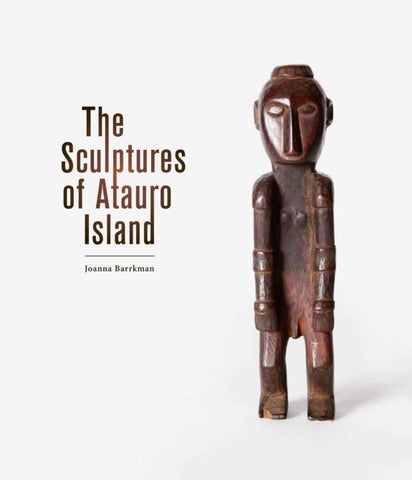
Joanna Barrkman
Charles Darwin University Art Gallery
A Charles Darwin University Art Gallery publication made possible with support from the Gordon Darling Foundation
‘The Sculptures of Atauro Island’ exhibition is presented by Charles Darwin University Art Gallery in collaboration with the Secretariat of State for Arts and Culture, Timor-Leste and Timor Aid. 15 March–15 July 2017 Charles Darwin University Art Gallery, Darwin, Australia
CONTENTS
A Partnership Between CDU and Timor-Leste Professor Simon Maddocks, Vice-Chancellor, Charles Darwin University Francisco Kalbuady Lay, Minister for Tourism, Arts and Culture, Democratic Republic of Timor-Leste 6 Preface Joanna Barrkman, Curator, Charles Darwin University Art Collection and Art Gallery 8 Atauro and the Atauroans 11 Atauroan Sculptures in Transition 15 The Sculptures of Atauro Island: Exhibition Catalogue 35 Bibliography 108 Glossary 110 Acknowledgements 111
The Sculptures of Atauro Island is dedicated to Jennifer Phipps 1944–2014 Vissi d’arte
4
A PARTNERSHIP BETWEEN CDU AND TIMOR-LESTE ‘The Sculptures of Atauro Island’ exhibition and the accompanying catalogue are another milestone in the University’s on-going engagement with the people of the Democratic Republic of Timor-Leste. Charles Darwin University recently renewed its Memorandum of Understanding with the Universitas Naçional Timor-Lorosa’e, which includes co-operation through cultural exchange as one of its partnership aims. This exhibition and catalogue are splendid examples of such exchange. The University has a long-standing engagement with Timor-Leste. This relationship includes a significant number of alumni, current students and visiting fellows who are nationals of Timor-Leste. We are also proud to facilitate collaborative research projects in disciplines such as education, health, politics and history, natural resource management, sustainable livelihoods and the creative arts. ‘The Sculptures of Atauro Island’ is a survey of an important Asian art tradition. The exhibition reflects on the continuing practice of traditional sculpture and how this has been carried into the contemporary era. The exhibition includes works from the Charles Darwin University Art Collection, which were acquired specifically for this exhibition; sculptures from the National Collection of TimorLeste, for which the University is honoured to feature; and [Previous page] Ancestor figure, itara Artist unknown Atauro Island, Timor-Leste Late 19th – early 20th century Wood 30.2 H cm The Metropolitan Museum of Art, Gift of Fred and Rita Richman, 1988; 1988.143.179 Image courtesy of The Metropolitan Museum of Art This classically styled itara figure consists of a series of flat angular planes that convey the classic elements of Atauro sculpture: the forward hanging arms, the standing posture with slightly bent knees, incised fingers and toes, a single tiered hat, relief carved eyes and ears, and a aquiline nose.
6
significant sculptures from the National Gallery of Australia and the Museum and Art Gallery of the Northern Territory. In addition, sculptures from the private collections of Maria do Céu Lopes da Silva of Timor-Leste and Michael Abbott AO QC of Australia are also featured. On behalf of the University, I warmly thank these institutions and individuals for their support, which has enabled the Charles Darwin University Art Gallery to curate this comprehensive survey of the sculptures of this remote island. I wish to thank the Gordon Darling Foundation for their support of the publication of this scholarly catalogue, which contributes to a deeper understanding of the art of our region. As a leading academic institution, Charles Darwin University recognises its responsibility to the diverse cultures and communities of our Southeast Asian neighbours, and anticipates that the exhibition ‘The Sculptures of Atauro Island’ will contribute to preserving and celebrating aspects of Timor-Leste’s cultural heritage. The University acknowledges the collaboration of the Secretariat of State for Art and Culture, and of Timor Aid, a leading non-government organisation that has operated in Timor-Leste in the field of cultural heritage preservation since 1999, for their contributions, especially in managing the logistics of freighting sculptures between Timor-Leste and Australia. I thank Joanna Barrkman, Curator, CDU Art Collection and Art Gallery whose dedication is evident in this exhibition. I commend this exhibition and publication to you.
Professor Simon Maddocks Vice–Chancellor and President Charles Darwin University
‘The Sculptures of Atauro Island’ exhibition and this accompanying catalogue show us how distinct the sculptures of Atauro Island are within Asian sculptural traditions and how strongly they depict Timorese culture, lifestyle and beliefs. The sculptures in this exhibition are full of meaning and beauty as well as being evidence of the skills of our master Atauroan sculptors, which have been passed on from generation to generation. As part of our heritage these sculptures are highly prized and a source of immense pride for the people of TimorLeste. The Government of the Democratic Republic of TimorLeste is delighted that ‘The Sculptures of Atauro Island’ is on public display at Charles Darwin University Art Gallery. Due to the travails our nation experienced during Indonesian occupation and its early years of independence, many Timorese cultural traditions have been placed under immense strain. Valuable and historic artworks have been lost through destruction and disappearance, or through their sale due to economic need. Aware of this situation, the Secretariat of State for Arts and Culture has been conducting surveys, research, support and promotion of tangible and intangible expressions of cultural heritage that constitute the rich social and cultural fabric of Timor-Leste. We continue to support artisans in their traditional creative practices. In doing so, we anticipate that these practices will underpin our future Timorese cultural and national identity, and provide a firm foundation for contemporary creative industries, which give meaning and value to our lives. With this vision of a creative, dynamic and sustainable culture in mind, the Secretariat of State for Arts and Culture is delighted to collaborate with Charles Darwin University and Timor Aid. Timor Aid has worked over many years in partnership with the staff of the Secretariat. In 2011, with the generous support of the late Jennifer Phipps and under the guidance of Joanna Barrkman, Timor Aid facilitated a workshop with sculptors from Atauro Island. During this
workshop, sculptors from Maquili and Macadade districts identified sculptures in the National Collection of Timor-Leste and the private collection of Maria do Céu Lopes da Silva. The seeds for ‘The Sculptures of Atauro Island’ exhibition were sewn at that workshop. I commend Timor Aid for its efforts together with the Secretariat of State for Arts and Culture in caring for, storing and documenting these sculptures. I congratulate Charles Darwin University Art Collection and Art Gallery for bringing these fine examples of Atauro sculpture to public attention. Timor-Leste is grateful for the scholarship, curatorship and dedication of Joanna Barrkman in showcasing the artistic heritage of Timor-Leste. I acknowledge her continued collaboration with the custodians of the National Collection of Timor-Leste. Most importantly, ‘The Sculptures of Atauro Island’ honours the achievements of Atauro sculptors, past and present and, and in doing so I anticipate that it will encourage the sculptors of the future. His Excellency Francisco Kalbuady Lay Minister of Tourism, Arts and Culture Democratic Republic of Timor-Leste
7
PREFACE I first met Antonio Soares in 2002 in Dili. I was having a morning coffee at the Tropical Bakery Café, which at that time was a haunt of the many expatriates who had flooded Dili following the arrival of the United Nations Transitional Administration of Timor-Leste in late 1999 and various peacekeeping forces during 2000. Antonio sat patiently outside the café entrance, at a respectable distance, waiting for each malae (the Tetum word for ‘foreigner’) to leave the café. As the morning coffee drinkers left the cafe one by one, he would pull himself up, together with his hands full of sculptures and his laden back-pack, and launch into his sales pitch. A formidable salesman, in no time at all malae would begin surveying his sculptures and before they knew it they were bargaining with Antonio to buy one. It became part of my morning coffee routine to observe Antonio at work. I can testify that Antonio struck some good deals outside the Tropical Bakery Café during 2002. Over time I too became one of Antonio’s customers as I became increasingly familiar with the sculptures that he was selling. I discovered that he was a sculptor himself and resided at Maquili village, Atauro Island. He routinely made the journey from Maquili across the Wetar Strait to Dili where he spent days wandering from café to hotel in search of customers. Antonio is one of a small cohort of sculptors from Atauro Island who I have observed at work in Dili over the past decade or more. These men maintain a small but consistent presence on Dili’s esplanade with the establishment of a roadside stall located in front of the Dili Beach Hotel. Known as Grupu Kultura Manukoko, their co-operative was formed in 1997 and consists of approximately 20 sculptors.1 They spend their days under the shade of the trees on Dili’s esplanade whittling and carving an eclectic array of sculptures, from grand to minute in size. They eagerly greet passers-by and customers who seek them out.
8
In 2011, Timor Aid, a non-government organisation focused on cultural development and heritage preservation, co-ordinated a workshop in Dili with members of Grupu Kulutura Manukoko and senior sculptors from Macadade and Maquili, Atauro Island. The workshop was funded through the generosity of Ms Jennifer Phipps, an Australian art curator, who also attended the workshop.2 Together with the sculptors, we discussed their craft and identified some of the statues in the National Collection of Timor-Leste and the private collection of Maria do Céu Lopes da Silva. During the workshop the sculptors were fascinated to see sculptures that had been collected by the Provincial Museum of Timor-Timur during the 1990s when the Republic of Indonesia established a local museum.3 In the case of the private collection of Maria do Céu Lopes da Silva, it was acquired from late 1999 onwards following the end of the Indonesian occupation. At that time, large numbers of Atauro sculptures flooded the local market as people sold whatever they had to the influx of foreign peacekeepers and aid workers in attempts to secure desperately needed funds for their survival. Maria do Céu Lopes da Silva fortuitously bought as many sculptures as possible due to her affinity with the art of the island on which she had been born and raised.4 The workshop served several purposes. It enabled the makers of several sculptures in both collections to be identified. It also affirmed for the sculptors that their work was recognised as being valued by its inclusion in local cultural collections. For me, the workshop affirmed the importance of a unique and isolated sculptural practice, which continues in this remote, small Southeast Asian island. The larger context of this workshop was the damage, sale and illicit removal of material culture from the country during the Independence struggle in Timor-Leste.5 War, sweeping social change and an increasing indifference to clan-based traditions has resulted in the demise of material
cultural heritage and its associated intangible heritage in the region. According to José Ramos-Horta: Thankfully, a small number of memories were immortalised by our ancestors in wood, stone and metal … But even these “concrete” memories are grievously imperiled. In recent years they have dwindled in number as they have literally been cut down by the forces of neglect, war and social progress.* Against the odds, sculptors from Atauro Island have held on to their sculpting traditions and they continue to create distinctive wooden sculptures during the 21st century. They have responded to the various influences that have affected their lives by incorporating these into their contemporary sculptures and in doing so have given new impetus to this increasingly rare artistic practice. ‘The Sculptures of Atauro Island’ celebrates the remarkable achievements, both past and present, of Atauroan sculptors by bringing together a range of sculptures from the 20th and 21st centuries. It is hoped that this exhibition and catalogue will encourage the continuation of this ancient skill into the future. Joanna Barrkman Curator Charles Darwin University Art Collection and Art Gallery
* José Ramos-Horta, 2001: 8–9.
Antonio Soares and his grand-daughter Joanna Guterres at a roadside stall with his sculptures. Joanna Barrkman, 2012.
Grupu Kultura Manukoko selling sculptures on the Dili Esplanade. Joanna Barrkman, 2012.
Paulino Ximenes and Carlito Alves identifying a sculpture from the private collection of Maria do Céu Lopes da Silva with Joanna Barrkman as part of the workshop hosted by Timor Aid. Elloise Baldwin, 2011.
9
10
ATAURO ISLAND AND THE ATAUROANS Atauro Island is home to a unique sculptural tradition that remains alive in the 21st century. On this small mountainous island there are two wood-carving centres – Maquili and Macadade districts located in the south. Atauro is approximately 30 kilometres north of Dili, the capital city of Timor-Leste. Located on the Wetar Strait segment of the volcanic inner Banda Arc, Atauro Island is situated between Alor and Wetar Islands.6 (See map on the next page.) The island is extremely dry with very poor soil. It is 22 kilometres long, nine kilometres wide and comprises 105 square kilometres. Its highest point is Mount Manucoco, 999 metres above sea level. The sea for the Atauroans is a source of food as well as a source for lore and legend. According to Jorge Barros Duarte (b. 1912, d.1995), a Timorese Catholic priest who worked on the island between 1960 and 1975, the Atauroans have an ‘atavistic fascination’ with the sea.7 They believe that the islands surrounding Atauro, such as Alor, Lira, Kisar, Wetar and Timor, were once one single land upon which people traversed by foot and horse. One day a giant eel slapped its tail causing the land to separate and create the various islands, including Atauro Island.8
A pair of ancestor figures, itara Artist unknown Atauro Island, Timor-Leste 19th century Wood and fibre Female: 31 H cm Male: 28 H cm The Wallace Collection Image courtesy of The Wallace Collection www.wallacetribal.com
Three dialects of Wetarese language are spoken on Atauro Island: Rahesuk spoken in Beloi and Biqueli villages; Resuk spoken in the south-eastern villages of Maquili and Maumeta; and Raklungu spoken in the south-western villages of Macadade and Manroni. A fourth dialect, Dadu’a, is spoken by the descendants of Atauroan settlers on the ‘main-land’ villages of Ilioma and Beheda, west of Manatuto.9 Collectively, these dialects form the Adabe language.10 Tetun, the linguafranca of Timor-Leste also is spoken widely.11 The Portuguese flag was raised on the island in 1884.12 The inhabitants of Atauro began paying taxes to the colonial Portugal government during 1905, the same year as the island became militarily occupied.13 Since then Atauro Island has been used as a prison and site of exile by the Portuguese and subsequent Indonesian occupiers of the territory. The revolutionaries who supported the Boaventura Rebellion were imprisoned there and the insurrectionist chieftain Boaventura himself died on the island.14 15 During the Salazar regime in Portugal (1932–1968), dissidents known as deportados from the Portuguese colonies such as Macau, Mozambique, Angola, Guinea Bissau and Capa Verde were imprisoned on Atauro Island.16 At the end of World War II more than 300 Timorese accused of collaborating with the Japanese were interned there.17 Timorese activists from the 1959 Rebellion mounted against the Portuguese administration also were interned. During the mid-20th century people reportedly died of starvation on Atauro, as noted in Ruy Cinatti’s poem Segunda Meditação (Second Meditation): Seven times seven, times ten, died in Atauro, burned in the sun, perishing of hunger like dry corn on a glowing grill.18
11
Following the Timorese Democratic Union (UDT) coup in 1975, the Portuguese Governor Mário Lemos Pires fled with his Portuguese administration to Atauro Island on 26 August.19 Between 1980 and 1982 the Indonesian military shipped approximately 8,000 prisoners to Atauro. According to Maria do Céu Federer da Lopes, who was a volunteer with the International Committee of the Red Cross on Atauro: ‘We kept hearing story after story about prisoners being burnt with cigarette butts, being slashed, being kicked, their fingernails ripped out, electric shocks … A cholera epidemic broke out and there were four or five children a day dying.’ 20
With Timor-Leste’s independence on 20 May 2002, Atauro became part of the Dili District. It remains relatively isolated and beautiful, with echoes of past trauma and visible evidence of present hardships. The islanders continue to seek a subsistence living through farming and fishing. Due to its tourism potential, the island now boasts several small-scale tourist resorts and eco-tourism initiatives that attract scuba-divers.
N
Vatuu
BIKELI
ATAURO ISLAND
Bikeli-Pala
Adara
BELOI
Atekru Maker
Beloi
Anartutu
VILA-MAUMETA Vila
MACADADE
Sulawesi
Berau
Maquili
MAQUILI
Seram
Banda Sea
Selayar
Sumbawa
West Papua
Kai
INDONESIA Lembata
Flores
Aru Wetar
Alor
Babar
Tanimbar
Moa
TIMOR-LESTE Sumba Sawu
Roti
Arafura Sea
West Timor
Timor Sea AUSTRALIA
Atauro Island. Joanna Barrkman, 2007.
Atauro Island location map. David Palazón, 2017.
An Atauroan fisherman casts a line from his inshore fishing vessel, bero (T), Joanna Barrkman, 2016.
13
14
ATAUROAN SCULPTURES IN TRANSITION Atauro Island is part of the Lesser Sunda Islands often referred to as the ‘forgotten islands’ and is home to a distinctive art and material culture tradition.21 The art of the Lesser Sundas has the same Austronesian origins as Oceanic art of the Pacific, and developed shared stylistic elements due to encounters and interactions with pre-existing Melanesian cultures for more than 3,500 years.22 A dominant form of creative expression has been the sculpture of ancestor figures reflecting the spiritual belief systems that underpin the cultures of this region. Similarities in style between Wetarese sculptures and Atauro sculptures are evident.23 The austere and elongated Atauroan ancestor figures depicted in standing postures however, differ from the more ubiquitous hunched figurine found in the region, such as on Tanimbar, Kai and even Flores Islands. Indeed, scholars have identified two distinct styles of Atauro sculptures: ‘While the two styles are not necessarily distinguished by more or less realism, in the Western sense, one Note: Language key: Adabe (AD), Tetun (T), Portuguese (P)
Ancestor figures Artist unknown Atauro Island, Timor-Leste 19th or early 20th century Wood and fibre A: 26 H x 4.5 cm W x 3.5 D cm B: 19 H x 3 cm W x 3 D cm Fowler Museum, University California Los Angeles, X81.L22A & B Gift of the Rogers Family Foundation Image courtesy of Fowler Museum, University California Los Angeles This pair of figures exemplifies the angular, abstracted figures of Atauro Island. This style may have developed from an earlier, widespread archaic style, which was rounder and more naturalistic. Their lanky straight arms droop forward from their hunched shoulders in contrast to their partially bent knees, yet each limb features simplistic block-like hands and feet. Protruding rounded eyes and ears are contrasted with aquiline noses and horizontal brows and mouths. A twined cord, from which they were once suspended, continues to link the figures together.
is marked by straight limbs and sharply defined facial features and characteristic of the islands of the south Moluccas, the other style comprises forms that are more rounded, softer and elongated’.24 Atauro Island’s proximity both to Timor and the southern Moluccas Islands resulted in the art of Atauro being a ‘speculated style’ that evolved in the context of a Timorese and south Moluccas aesthetic.25 Exemplifying these two styles are the pair of figurines on page 14 and the figure on page 22. Before the arrival of Christianity, Atauroans worshipped their ancestors as the pre-eminent spiritual authorities. Today, a syncretic culture exists, as the majority of Atauroans are Protestant, unlike the Timorese population, who are largely Roman Catholic following the establishment of a Catholic mission in 1949. Nearby Kisar Island was an established Protestant stronghold during the 19th century.26 Dutch Calvanist missionaries arrived on Atauro in the 1930s to evangelise and convert the population while Protestant American missionaries also were active on the island during the 1950s.27 Baptist influences from Alor, Lira and Kisar were also noted by Durate.28 The elimination of many older elements of Atauroan culture is attributed to the presence of the Protestants. The practice of figurative carving was discontinued in Macadade during the early 1970s when the Protestant Church implemented a ban requiring all adherents to the Christian faith to forego any form of ancestor worship. The sculptors of Macadade recall that many sculptures were burnt at this time although some people subverted this ban by hiding older sculptures in a sealed cave where they remained for several decades. They retrieved these sculptures circa 2005, after Independence was granted to Timor-Leste in 2002. The bans imposed in Macadade by the Protestant Church interrupted the transmission of sculpting skills between generations. Today, it is only the older men of the district who have retained the sculptural skills and occasionally carve figurines.
15
Although ancestor worship practices have diminished over recent decades, much of the culture of the Atauroans, including their sculpture, is rooted in the adoration of the original founders of Atauro communities. Prior to Christianisation, clan leaders memorised extensive ancestral genealogies that reached back to their establishment. The recitation of the oral histories perpetuated communal memory of each clan’s history. Atauroans venerated their ancestors in order to maintain cosmic balance and give thanks for life, to seek protection, ensure the fecundity of clans, crops and seas upon which they depended. In each community ritual specialists, mata blolo (AD), were intermediaries with the spirit realm. They officiated at ceremonies as conduits between the living and the ancestors. It was believed that to displease the ancestors was to create a cosmic imbalance, which manifested in natural disasters, sterility, poor crops, illness and death. In the creation of images of the ancestors, the Atauroans effectively incorporated the sacred world of the ancestors into their daily lives. The ancestors were ‘fed’ through ceremonial activity, prayer, the offering of foodstuffs and betel, and the sacrifice of livestock. Although ancestor worship has significantly diminished over recent decades, it is likely that ancestor figures are still secretly stored and respected in those ceremonial houses that continue to be maintained on Atauro Island.29 Most of the approximate 8,000 inhabitants of Atauro Island cultivate subsistence livelihoods based on fishing, agricultural production and rearing livestock.30 Contemporary sculptures eloquently depict the daily life and material culture of the people. One example is the herding of goats, the main livestock on the island, which led the island to be known in Bahasa Indonesia as Pulau Kambing, meaning ‘Goat Island’. Goats are portrayed in contemporary sculptures (see page 97).31 The sculptures also depict objects of every-day life such as machetes, pisu (AD), katana (T), used to clear fields and gardens, and baskets, topo (AD), bote (T), used to carry firewood for cooking and foodstuffs from the garden to the house (see page 17).
16
Fishing is a major part of the Atauroan economy. Contemporary sculptures feature mermen, mermaids, fish and eels (see page 91) inspired by local stories that glorify the dangerous, deep and unpredictable Wetar Strait. Mermaid and mermen sculptures, depicted with either one or two heads, scales and genitalia, refer to the power of the sea as a source of fecundity and punishment. Atauroans believed that fish would swallow those people who had transgressed and caused offence to their ancestors. As one informant related: ‘In a canoe with several people, the fish will only get the bad person.’ 32 The story of Kori-Tutu describes how an enormous dolphin devoured Kori-Tutu’s four companions from a boat. He climbed the mast to escape danger and chanted: Lord of the sea Lord of the land Of the sacred sea From the sacred land Cut the sea Order to the sea May this vow be embodied In one iteas.33 In Luis Cardoso’s contemporary memoir of a Timorese childhood, The Crossing, he refers to the ability of the sea to play tricks on people: ‘On the sea a trick would be called a tasi fila (T) with the waves turning inside out and causing a shipwreck that would drag everything down to the ocean depths. No tricks could save us then.’ 34 A coral reef extending between 30–150 metres wide surrounds Atauro Island. The waters are abundant with fish, molluscs and crustaceans. Dolphins are encountered frequently while whales are sighted occasionally. Turtles are also common and their shells are used for small-scale jewellery production on the island. Fishing from boats utilises rattan fish traps, nets and hand-lines. The reefs around Atauro are generally healthy with coral gardens and colourful schools of reef fish, making the area a tourist destination and divers’ paradise.35 Spear-fishing is widely practised (see page 17).
Increasingly, however, this is the domain of women who seek a living in shallow waters whilst men fish from boats.36 Locally carved goggles used in spear-fishing show how wood skills are adapted for a range of practical purposes, the most obvious of which is boat building. Atauroans are adept builders of the dug-out out-rigger canoe known as a bero, which has earned them the reputation amongst Timorese as famous seafarers. Small bero, under five metres in length, are still used as inshore fishing vessels and intra-island transport, where sometimes they are powered by a motor. Larger bero are used for harvesting bigger opensea species of fish such as tuna, mackerel and manta-ray, and for transport and trade between Dili and as well as the more distant Wetar and Alor islands. Canoe size depends on the available tree trunks harvested for this purpose. Occasionally, a bero can be seen making its way across the Wetar Strait, a body of water that is 3,500 metres deep and renowned for its dangerous currents. Increasingly, ferries and speedboats transport people between Atauro Island and Dili. According to legend, a man from Manroni clan was the first bero builder. Initially, he moulded a boat in red clay and then constructed a miniature boat with wood that floated. The manufacture of a bero involves the selection of a suitable tree, accompanied by the necessary rituals seeking ancestral permission, felling and trimming a trunk. It is then physically carried to the coast for its subsequent carving into a dugout vessel. As part of launching a bero, sacrifices are made to the sea and to the ancestors in the form of roosters, cut in half on a sacred stone. This rite is accompanied by chants invoking the blessings of Nusa-Obun, the Deity of Above and the sky, and Rare-Obun, the Deity of Below and the earth, by chanting their names.37 Such practices have become adapted into Christian beliefs, with St Peter becoming an example for Atauroans who acknowledged him as a skilled fisherman who followed in the path of Jesus. Today, Atauroans celebrate the ‘festival of the fishermen’ and launch a bero as part of these festivities.38
Domingus Soares and Lydia Alves walking in Villa Maumeta carrying locally woven baskets, topo (AD). Joanna Barrkman, 2016.
Dina Martins diving and spear-fishing wearing locally made goggles carved from wood. From the film Wawata Topu – Mermaids of Timor-Leste by David Palazón and Enrique Alonso. Photograph by Nuno da Silva, 2013.
A carved boat, bero (T), from Maquili made specially for the annual fishermen’s festival. David Palazón, 2009.
17
Duality reflected in sculpture Concepts of duality, such as sea and earth, above and below, underpin Atauro society as exemplified by the fertility sculptures – the feminine, Lepu-Hmoru and the masculine, Baku-Mau (see pages 19, 53, 55). More recently, these masculine and feminine fertility deities have been absorbed into Christian beliefs as representations of the Virgin Mary and Joseph, the parents of Jesus Christ. Mau-Bonok plateau in Maquili was the site where Lepu-Hmoru and Baku-Mau where installed in the style of grave-markers in honour of the founding ancestors. Positioned upon stone mounds at an angle facing each other, in a configuration reminiscent of the bow and stern of a boat, they marked a site for ritual practices. A sliced coconut shell occasionally was placed upside down on the tip of the elongated hat, possibly symbolic of feeding the deity and ensuring fecundity.39 These sculptures customarily were replaced with newer sculptures and at one time Lepu-Hmoru was depicted with 50 nipples.40 On other occasions, Baku-Mau has been depicted with either an erect phallus or with his child, (see page 53). As recently as 2005, Mau-Bonok plateau was a site of ritual activity associated with these deities.41 The classic Lepu-Hmoru and Baku-Mau figures provide the basis for a more contemporary style of figurine, or more accurately described as a bust, that is made today in an increasing range of variations. The incorporation of fish, turtles and crocodiles often suckling the woman’s breast or laying in a position suggestive of copulation, replaces human genitalia and progeny in these busts, suggesting a relocation of fecundity back into the untamed natural world (see page 81). This is especially apt as the recent proliferation of stories of the crocodile, lafaek (T), as the founding father of the Timorese people and creator of the island itself, gives added significance to the incorporation of crocodiles into contemporary Atauroan sculptures. These figures increasingly feature more naturalistic facial features and include a carved, tiered base, yet are clearly innovations based on the original Lepu-Hmoru and Baku-Mau figures.
18
In addition to ‘grave-markers’ of fertility gods that were installed outdoors, other sculptures were customarily stored inside the ceremonial and lineage house known as either the ruma pera’ik (AD) or ruma leluli (AD), uma lulik (T). The ceremonial and lineage houses stored sacred objects for use in rituals performed for the ancestors, such as the veneration of secondary deities. Typically, these houses were constructed from a frame of four-cornered pillars and the four crossbeams that joined the top of each pillar. The ‘masculine’, south-west pillar of the ceremonial house was the site of the sacred rack, ruma-tara (AD), where ancestral relics and sacred objects were hung.42 Sculpted wooden statuettes, itara (AD), that represent the lineage ancestor customarily were hung from the ruma-tara in gendered couples of male and female. When itara were not in use, they were strung over a rafter with the use of hand-made twine, twined or plaited from palm leaves, Borassus flabellifer,
Sculpture [Left] Lepu-Hmoru Atauro Island, Timor-Leste 19th century – early 20th century Wood 220 H cm Musée du Quai Branly–Jacques Chirac, 70.2013.40.1 Photo (C) musée du quai Branly–Jacques Chirac, Dist. RMN–Grand Palais / Claude Germain Sculpture [Right] Baku-Mau Atauro Island, Timor-Leste 19th century – early 20th century Wood 245 H cm Musée du Quai Branly–Jacques Chirac, 70.2013.40.2 Photo (C) musée du quai Branly–Jacques Chirac, Dist. RMN–Grand Palais / Claude Germain This elegant pair of ancestor sculptures, Lepu-Hmoru and Baku-Mau, were once inserted into the earth and supported with stone mounds. As representations of the founding ancestors the feminine deity, Lepu-Hmoru, and the masculine diety, Baku-Mau, were revered as a manifestation of unified cosmic dualism.
20
known as tua hiron (AD), akadiru tahan (T). The smoke and soot caused itara to develop a black and dark patina as fires were burnt routinely inside ceremonial houses to prepare food for the ancestors and the keeper of the house. This practice of binding the figurines served the purpose of physically keeping the figurines together, while metaphorically maintaining the balance of masculine and feminine entities. On occasion itara were also hung outdoors on the iteas, a pronged wooden stake inserted into the ground at the entrance of the lineage house which itself was also representative of a totemic guardian ancestor. The iteas served as a site or ‘altar’ for offerings and sacrifices to invoke rain to ensure good harvests.43 The status of each house was determined by the number of itara it contained; one pair of itara suggested the house of ordinary people, while three pair signified the house of aristocrats or mata blolo. In cases of theft, the itara were offered betel, areca, corn, fish and wine after which the figurines were placed in a woven basket, lele’u (AD), lafatik (T), and then set at the threshold of the house to locate the culprits.44 A prayer accompanied this itara rite: They came to take possession of my things, They came to steal my chickens. Go look for them then. Drink wine, eat rice, Also eat fish, Chew areca and betel. Go look for them, Bring back the people who came to steal, Go ahead.45
Pair of figures, itara Atauro Island, Timor-Leste Early 20th century Wood, cloth and fibre 14 H x 22.5 W x 7 D cm Musée du Quai Branly–Jacques Chirac, 70.2001.27.405.1-2 Photo (C) musée du quai Branly–Jacques Chirac, Dist. RMN–Grand Palais / Claude Germain
The use of cloth with sculptures The practice of using clothing to cover the genitalia of the sculptures may date from the arrival of Christianity. An ancestor figure, itara (AD) (see page 22), dated early 20th century is one of the earliest known examples of Atauro figures to feature a loincloth, tari hak or hak (AD), hakfolik (T). The cloth that binds this figure is hand woven, in keeping with the loincloths that formerly were woven from locally grown cotton and were several metres in length.46 Hak (AD) were loincloths made from bark of the ficus, nuno (AD), tree and its roots. Alternatively, the female figures wear rapin hirik (AD), a unique style of wrap worn around the waist and which was woven on a simplified version of a back-strap tension loom from finely sliced Corypha utan palm fronds.47 During the mid-20th century wearing the rapin hirik was abandoned in preference for imported Javanese hand-made batik and factory printed sarongs, lipa (T), in the same way that the hak were replaced with Western trousers and shorts for men.48 Many sculptures from Atauro feature discarded remnants of commercially printed batik cloth (see pages 57, 59, 65). The accumulation of a dark patina on older sculptures also indicates that cloth was used to cover the genitalia on late 19th to early 20th century sculptures. The presence of cloth lessened the darkening of the wood as it protected the covered area from being exposed to soot and smoke from fires lit inside lineage houses (see pages 11, 14). [Following page] Ancestor figure, itara Artist unknown Atauro Island, Timor-Leste Early 20th century Wood, fibre and cloth 49.53 H x 9.52 W x 9.52 H cm Dallas Museum of Art; The Art Museum League Fund, 1981.15 Image courtesy Dallas Museum of Art The use of softly curved lines to create this figure, itara (AD) are epitomised by the almond-shaped eyes, generously curved ears and rounded crown adorned with a top-knot. The loincloth, hak (AD), hakfolik (T), worn by this figure replicates the long pieces of cloth, up to four metres in length that were once worn by men on Atauro Island.
21
22
23
Masks and shields Masks, saet ai pan (AD), are specifically associated with Maquili but not Macadade district. One theory is that masks were introduced by Angolan and Mozambican exiles, who the Salazar regime incarcerated on Atauro Island while it was a Portuguese penal colony. It is most probable, however, that masks were used as a form of enmity protection on Atauro Island, in keeping with mainland Timorese fighting practices where warriors wore masks during inter-clan raids as a disguise as well as for facial protection. Masks also were worn as part of celebratory dances, tebe dai (T), performed upon victorious return from military actions. As well, masks were suspended from tree branches at the boundary of fields where they supposedly deterred thieves who intended to steal the crops. Since the cessation of headhunting practices and the increased presence of Christianity, masks’ association with war has been forgotten and now they are regarded as dance costume.49 Contemporary masks depict headdresses known as ngoru kaik (AD) made from palm leaves, Borassus flabellifer, tua (AD), akadiru tahan (T). Masks also are referred to as carnival (P), a result of Portuguese influence and the use of festive paper-masks.
When conflict arose over land boundaries combat occurred at a site between pre-determined by Macadade and Maquili clans. Warriors carried lances, daggers, bows and arrows as well as shields, kle-hili (AD), made of goat skin stretched over a wooden frame.50 However, sculpted shields, such as the magnificent and rare 19th century shield in the Barbier-Mueller Museum collection (see page 23) were considered as magical paraphernalia that enabled mata blolo to become invisible and to take flight. The narrow width of the shield may not have afforded much practical protection, however, the depiction of a masculine ancestor on the upper third of the shield, facing outwards away from the bearer was intended to invoke ancestral protection.
[Previous page] Shield Atauro Island, Timor-Leste 19th century Hardwood, brass, horn, remains of red pigments 90.8 x 18 x 10 cm Barbier-Mueller Museum, Geneva, Inv. 3795 © Barbier-Mueller Museum, Studio Ferrazzini Bouchet This rare shield is attributed as having once been ritual paraphernalia used by ritual specialists, mata blolo (AD). The incised geometrical design on this shield has residue of red and black pigments. The base is made from buffalo horn. The ancestor figure perched on the upper third of the shield stares blankly. His eyes are made from brass discs. The reverse side of the shield incorporates a sturdy handle carved from the same block of wood, with which to grasp the shield.
24
An Atauro man wears a headdresses, ngoru kaik (AD), made from palm leaves, Borassus flabellifer, tua (AD), akadiru tahan (T). Photograph by Gibrael Dias Carocho, 2010.
Materials and methods The sculptures of Atauro Island are carved using a variety of local woods. Currently the use of a white wood, Wrightia javanica, initim (AD), ai lalar (T), is most popular as it is plentiful and sculptors consider it easy to sculpt. Also Eucalyptus alba, oe (AD), ai bubur (T), is increasingly popular. Older sculptures are predominantly sculpted from three wood species: rosewood, Pterocarpus indicus, nara (AD), ai naa (T); red cedar, Tona ciliata, lero (AD), ai saria (T), and cassia, Canafistula spp. initi hua mnara (AD), casafistru (T). In Macadade village spoons were reportedly made using either rosewood or ua (AD), an unidentified type of wood. In addition to sculpting with wood, buffalo horn has been used as a material for the creation of ceremonial spoons, aru (AD) (see page 71), and coconut shell also is used for spoons, cups and bowls. Most often sculptures are carved from one piece of wood. The incorporation of bases used to balance large figurines appears to have occurred in the early to mid-20th century (see page 37). In most instances bases are hewn from the one block of wood and it is still only the exception that the base is constructed from a separate piece of wood (see pages 41, 61, 63, 65). The process of felling trees for sculpture of ancestor figures required permission to be sought from the ancestors. Once cut, the wood was stored inside the ceremonial house.
Ceremonial spoon Place of origin unknown 17th century Ivory 25.4 H x 3.81 W x 2.54 D cm Promised gift of Steven G. Alpert and family to the Dallas Museum of Art PG.2013.7 Image courtesy of Dallas Museum of Art This rare spoon, although of undetermined provenance, ‘can be recognized in the artistic expression of a number of these eastern Indonesian islands, the most compelling comparisons come from early, atypical items known to come from Atauro.’ (Steven G. Alpert, 2003: 101) The tiered hat and stylised facial features, with the exception of the rounded flared nostrils, resonate with Atauraon sculptural styles. Ivory, a symbol of wealth in insular Southeast Asia, was a valuable trade commodity exchanged for spices, sandalwood and slaves.
25
26
Then the tree trunk was cut in half widthwise to form two blocks for use as figurines. Masks are usually made from a tree trunk that has been sliced lengthwise to create two blocks with a half circular front and a flat back. The mask on page 67 illustrates how, in some instances, the shape of the original block of wood was retained to form the final sculpture. Simple hand tools such as chisels, hammers, and handsaws were used, and their use continues today. Tools are cherished by sculptors. There are minor variations in tools between the two sculpting districts of Macadade and Maquili. The process of carving a piece of wood into a figure requires the sculptor to start at the head and then work down the figure. The face and details such as the ears, eyes and any relief features are added during the final stages. Upon completion, the sculpture’s surface is finished using commercial sandpaper. The completed sculptures are darkened using the bark of the ai turi mutina (T) tree, which is pounded into a powder. This is combined with the sticky liquid produced by boiling wild beans, uuas (AD), lehe (T) or hadu (AD), kalele (T), which are poisonous and require extensive treatment. Finally, the ash of burnt coconut husks is added to create a paste that is painted on to the sculptures two or three times. This paste is applied as a treatment to protect and darken the wood. This practice is a relatively recent development intended to imitate the darkened patina of older sculptures, but now it is done simply on a personal preference or to ensure a suitable ‘finish’. Occasionally young sculptors apply black varnish to their sculptures.
Santiago da Costa Soares from the Grupu Kultura Manukoko, carving a estatue at their seafront location in Dili. David Palazón, 2009.
Ancestor figure, itara Artist unknown Atauro Island, Timor-Leste Late 19th – early 20th century Wood 20.3 H cm The Metropolitan Museum of Art, Gift of Fred and Rita Richman, 1988, 1988.143.44 Image courtesy of The Metropolitan Museum of Art The sturdy roughly hewn legs of this diminutive figure contrast with the gently rounded forward hunched shoulders and hanging arms together with the finely executed nipples, ears and eyes. The arms remain joined to the torso at the ‘elbow’ point as a strengthening device. The dark and shining patina of this figure is offset by the light and red section of the lower torso, where presumably a cloth was once attached.
Hand tools used by Antonio Soares to sculpt wood. Joanna Barrkman, 2016.
27
28
Demand for Atauro Sculptures During 2000, the trade of Atauro sculptures involved the sale and marketing of contemporary carvings promoted as ‘old’ carvings to the influx of foreigner peace keeping forces and aid workers during the United Nations Transitional Administration of Timor-Leste from October 1999 until May 2002. The sale of fraudulent works was in part a response to potential buyers commonly enquiring about the age of the works they intended to purchase, inferring that ‘old’ sculptures were commercially more desirable. Passing off sculptures as being of greater age than they actually were was also a response to the demands of ‘middle-men’ who for several years prior to this time sought sculptures for the artefact trade in Bali. The illicit removal of statues from ceremonial houses also contributed to underlining the value of old sculptures. The demand for ‘antique’ figures did not endure, as sculptors began to produce work in full view of the public in order to meet the demand. Consequently, soon after 2000, good-quality contemporary sculptures began to command their own prices. References to counterfeits persist, but as Moss indicates: ‘The word fake should be avoided, except to denote an object clearly represented as something it is not, especially as it may disparage fine replicas and other contemporary art being sold as such, which are significant in the economies of tribal peoples. This is an important issue for the continuance of cultural resources in the Lesser Sunda Islands.’51 While it Ancestor figure Artist unknown Atauro Island, Timor-Leste Late 19th – early 20th century Wood 42.5 H x 19.2 W x 14.3 D cm Asian Civilizations Museum, 2010-01363 Image courtesy of Asian Civilizations Museum This atypical ancestor figure is a rare example of a squatting figure from Atauro Island. Its softly curved head alludes to an archaic style of sculpting widely attributed to eastern insular Southeast Asia. It is possible that an archaic regional style of sculpture gave way to a more contemporary distinctive Atauro Island style, which gave preference to angular and elongated forms over curved and rounded ones. A customary Timorese necklace, morten (T), is incised above the figure’s protruding collar-bones.
may be easy to relegate contemporary sculptures to a derisive category of ‘tourist art’, which suggests the work is merely a derivative of authentic traditional sculptures, it is important to reflect on whether sculptures are simply mimicking an earlier style or whether contemporary sculptors are expanding upon a traditional repertoire to create new artistic forms. Cultures are always in transition. The fact that Atauroans continue to sculpt, albeit for commercial rather than religious purposes, is testimony to an enduring heritage and highlights Atauroan creativity, innovation and ingenuity. The importance of economic returns for labour should not be under-estimated on an island that remains one of the poorest regions of Timor-Leste with staggeringly high rates of malnutrition and infant mortality. In this context it is no surprise that sculptors increasingly respond to exploring new influences and market demands. The demand for old Atauro sculptures can be traced back to the interest shown by the international art market in the material culture of the Lesser Sunda Islands in the early 1970s, which resulted in textiles, sculptures and jewellery being collected to a point ‘that by the 1990s the islands were almost drained of their old treasures.’52 The removal of Atauro sculptures by European collectors coincides with this era, a time of strong impact from the political and economic pressures of Indonesian occupation in Timor-Leste.53 During the early 1970s, a number of Atauro sculptures came to the attention of collectors and dealers. The style became very desirable as it had been previously unknown in the wider art market.’54 Other accounts suggest: ‘For a brief period around 1980, the small island of Atauro, near Timor, was surprisingly fecund, the source of some twenty-five to thirty-five ancestor figurines.’55 Maria do Céu Lopes da Silva recalls the first time she saw Atauro sculptures was as a young girl. Sometime between 1964 and 1966 in her family home, a visiting Belgium Professor of Anthropology displayed a cache of sculptures he had acquired on the island. Her father, Mário Lopes da Silva, watched the Professor load them on to a bero and depart the island.
29
The sculptures of ancestors Lepu-Hmoru and Baku-Mau, placed as gravemarkers upon stone mounds in the Mau-Bonok plateau in Maquili. Photograph by Alessandro Boarccaech, 2009.
30
The removal of Atauro sculptures coincided with a rapid decline in the practice of creating sculpture across Timor. In addition to the increase in conversion to Christianity and the gradual abandonment of ancestor worship, the demise of traditional architecture in the wider Timor region also contributed to this decline. Lineage houses, which once relied on locally available plant materials and woods for their construction, became increasingly neglected or else have been maintained with the use of contemporary materials, such as corrugated iron, bricks and cement, thus rendering the practice of ornately carving wooden doors, windows, structural pillars and roof finials irrelevant. As traditional houses physically disintegrated, ancestor figures were abandoned to the elements or removed for sale. The sculptures were rarely replaced, hence, the skills of wood-carving largely disappeared on mainland Timor.56 Nevertheless, the appearance of these Atauro sculptures in the international art market has resulted in the acquisition and preservation of significant examples of Atauro sculptures by cultural institutions worldwide. Having survived the vicissitudes of time these figures offer a glimpse into the majesty and eloquence of earlier sculptural practices on Atauro Island. Sculptures from the late 19th and early 20th centuries provide an important comparative yardstick to identify the shifts and continuities in Atauro sculpture during the intervening years until the present. The continuation of these carving traditions on Atauro Island enables us to contextualise contemporary art within a broader continuum of Timor-Leste’s aesthetic traditions.
shifted from their earlier use as a form of ancestor worship to being commodities for the marketplace. One of the major contributing factors to this change has been the influence of Christianity, which forbade the creation of ancestor figures. Increased contact with foreigners over recent decades also has affected the subject matter of Atauroan sculpture with various stylistic trends emerging such as the depiction of crocodiles, fish, nameplates and Christ-like figures, and even diving goggles decoratively carved in relief. Mermaids and aquatic themes are gaining currency. Increasingly, the two key styles of earlier Atauro sculptures have given way to more naturalistic depictions of facial features and limbs. Elegant tall figurines (see page 93), resonating the earlier depictions of the fertility deities of Lepu-Hmoro and Baku-Mau, continue to appear. Diminutive paired ancestor figures, based on the earlier itara reflect former notions of duality and customary practices, suggesting that even though sculptors increasingly sculpt to accommodate middle-class Timorese customers and the preferences of foreign visitors, their sculptures continue to reflect aspects of their Atauro culture and identity.
Contemporary Atauroan Sculpture By looking at early examples of sculpture alongside more recent endeavors, it is possible to trace the influences that have caused sculpting on Atauro Island to undergo an iterative process of transformation. Over time the rationale for the creation of wooden sculptures on Atauro Island has
A pair of figurines made by Antonio Soares, Maquili. Photograph by Julia Collingwood, 2017.
31
Conclusion The shifts and changes in the creation of Atauro sculptures over time may be considered by some observers as representing a loss of tradition, reducing the art-form to a remnant of its origins. Yet these transformations have ensured a process through which sculptural skills have been re-cast and reapplied in the face of major social changes and influences. Whether sculptures continue to be made for indigenous religious practices rather than for sale is unclear, but certainly the symbolism that informs these contemporary sculptures continues to resonate with Atauroan culture. The practice of carving remains embedded within the culture of the Atauroan people today. In describing a comparable situation, on Nias Island more than twenty years ago Jerome Feldman wrote: ‘That there is still sculpture, that something of their own world view survives, is testimony to the strength of their heritage.’57 As the skill of wood-carving is now in the hands of a few rather than the wider community on Atauro Island, the tradition faces an uncertain future. Nonetheless, the continuation of the production of sculptures from Atauro Island is a remarkable testimony to the resilience of its society and the Atauroan people. Marcus Noronha, a Maquili sculptor at Barry’s Guesthouse, Beloi, Atauro Island. Joanna Barrkman, 2016.
32
END NOTES 1. ‘Manukoko’ is a reference to Mount Manucoco. The co-operative used Tetun spelling for the name of this mountain, which is spelt ‘Manucoco’ in Portuguese. 2. Jennifer Phipps (1944 – 2014) was a Melbourne-based curator, art collector and patron. Jennifer first visited Timor-Leste in 2008 and became committed to supporting various cultural initiatives in the country, including the workshop with Atauro sculptors at Timor Aid in Dili during 2011 which was facilitated by the author. Jennifer was a passionate advocate for the art of Australia, Southeast Asia and Oceania. Elloise Baldwin also participated in the workshop as a research assistant. 3. Virgilio Simith, “National Museum of Timor-Leste: Its Past, Present and Future,” Husi Bei Ala Timor Sira Nia Liman – From the Hands of Our Ancestors, edited by Joanna Barrkman (Darwin: Museum and Art Gallery of the Northern Territory, 2008), 18. Building of the Museum Propinsi Timor-Timur in Dili was initiated by the Republic of Indonesia in 1991 and was opened on 28 August 1995. Until 1997, more than 1,800 artefacts were collected for the museum’s permanent collection including ethnographic, historic, numismatic, heraldic, ceramic and fine arts objects. Whilst the museum was targeted by militia during late 1999, the remaining collection that was salvaged during January 2000 forms the basis of the National Collection of Timor-Leste. 4. Maria do Céu Lopes da Silva acquired sculptures from Atauro Island from 1999–2005 and again between 2010–2011 with the intention of establishing a sculpture gallery on Atauro Island. 5. Assis, Cecilia, “National Museum of Timor-Leste: Its Past, Present and Future,” in Husi Bei Ala Timor Sira Nia Liman – From the Hands of Our Ancestors, edited by Joanna Barrkman (Darwin: Museum and Art Gallery of the Northern Territory, 2008), 24. 6. Alor Island is a part of East Nusa Tenggara Province whilst Wetar Island is located in the Maluku Province of the Republic of Indonesia. 7. Jorge Barros Duarte, Timor Ritos e Mitos Atauros (Lisbon: Instituto de Cultura e Lingua Portuguesa, 1984), 10. 8. Jorge Barros Duarte, “Atauro: One of the Sunda Islands,” in Tribal Art 1 (1990): 23–24. 9. “The Languages of East Timor: some basic facts”. Geoffrey Hull, last modified 24 August 2004. http://www.ramelau.com/tetun/facts/html. 10. Ethnologue: Languages of the World. M. Paul Lewis (et al.). 19th edition. Dallas, Texas: SIL International, 2016. http://www.ethnologue.com. 11. Tetun and Portuguese are the official languages of Timor-Leste. 12. Geoffrey C. Gunn, Timor Loro Sae: 500 years (Macau: Livros do Oriente, 1999), 150. 13. Ibid., 150. 14. Ibid., 182–183. 15. Ibid.,186. 16. Return to Rai Ketak. https://raiketak.wordpress.com/2010/08/22/prison-island-andboat-people/. 17. Gunn, 1999, 261. 18. Ruy Cinatti cited in Return to Rai Ketak. https://raiketak.wordpress.com/2010/08/22/ prison-island-and-boat-people/. 19. Gunn, 1999, 275. 20. Jude Conway, “Céu Lopes Federer,” in Step by Step: Women of East Timor, Stories of Resistance and Survival (Darwin: Charles Darwin University Press, 2010), 4–5. 21. Nico de Jong and Djik van Toos, Forgotten Islands of Indonesia: The Art and Culture of the Southeast Moluccas (Singapore: Periplus Editions, 1995). 22. Anthony F. Granucci, The Art of the Lesser Sundas (Singapore: Editions Didier Millet, 2005), 24, 44. 23. See ancestor figures published in Michael Heppell and Robyn Maxwell, Borneo and Beyond (Singapore: Barreo Gallery, 1990), 98. These ancestor figures are attributed as being from Wetar Island, South Moluccas. 24. Robyn Maxwell, Life, Death and Magic (Canberra: National Gallery of Australia, 2010), 223. 25. Steven G. Alpert, “An early ivory spoon with stylistic connections to eastern Indonesia,” Tribal Art, 33 (2003): 105. 26. Gunn, 1999, 150. 27. Geoffrey C. Gunn, Historical Dictionary of East Timor; Historical Dictionaries of Asia, Oceania, and the Middle East (Lanham: The Scarecrow Press Inc., 2011), 153. 28. Duarte, Jorge Barros, 1984, 16. 29. Reportedly there were seven such ceremonial houses known as ruma leluli (AD) in existence in Macadade district during 2011. Personal communication, Cornelius Mario Gomes, 20 July 2011, Dili.
30. Crops consist of corn, manioc, gourd and mountain rice. Much of the island’s native vegetation has been cleared because of swidden farming practices. The upper reaches of Mount Manucoco (above 700 meters) have scant areas of tropical forest. Savanna woodlands and drier forests, especially on limestone outcrops, are located on the lower reaches of the mountain, however, much of the lower and coastal land has been cleared for agriculture. The island’s dry and rugged landscape is unstable, prone to landslides and frequent critical shortages of fresh water, especially during the dry season months between May and November. 31. Livestock such as goats remain an important part of customary bride-wealth and funeral exchanges. 32. Personal communication, Sculptors’ workshop, January 2011, Dili. 33. Duarte, Jorge Barros, 1984, 83. Iteas is a pronged wooden branch inserted into the ground, often at the entrance to the lineage house. It is revered as a totem of the ancestors and is a site of sacrifices. For some clans on Atauro Island the iteas is associated with sharks. 34. Luis Cardoso, The Crossing: A Story of East Timor (London: Granata Books, 2000), 13. 35. Blast fishing has caused some damage to reefs and has negatively affected populations of larger reef fish such as sharks. The government recently imposed a minimum catch size on fish commonly caught for consumption to prevent capture of juvenile fish. The Marine Protected Species List includes sharks, dugongs, sea turtles, whales, dolphins, oceanic and reef manta rays, spotted eagle rays, nautilus and giant clams; hence, their capture now is illegal. 36. See the film Wawata Topu – Mermaids of Timor-Leste, by David Palazón and Enrique Alonso, 2013; https://vimeo.com/81265144. 37. Duarte, 1990, 21. 38. See the film The Boat from Putin’s Place, Ro’o Putin Hatin, by Victor de Sousa, 2015; https://vimeo.com/151863413. 39. Duarte, 1984, Fig. 9. 40. Duarte, 1984, 135. 41. Personal Communication, Francisco Jose Filipe, 9 December 2016, Darwin. 42. Duarte, 1990, 21. 43. Ibid. 44. Duarte, 1984, 77; Jean Paul Barbier and Douglas Newton, Islands and Ancestors – Indigenous Styles of Southeast Asia (Munich: Prestel, 1988), 296. 45. Duarte, 1984, 190. 46. Pers. Comm. Maria do Céu da Silva, 5 February 2016, Villa Maumeta, Atauro Island. 47. Roy Hamilton and Joanna Barrkman (editors), Textiles of Timor: Island in the Woven Sea (Los Angeles: Fowler Museum UCLA Press, 2014), 89. See figure 3.2. 48. Production of rapin hirik has experienced a recent revival on Atauro Island where it is now used for handicraft production at the Co-operative Boneca de Atauro. 49. Margaret King-Boyes, Eden to Paradise (London: Hodder and Stoughton, 1963). See photograph of people wearing masks in Portuguese Timor, illustrations following page 940. 50. Duarte, 1990, 24. 51. Laurence, A. G. Moss, “International Art Collecting, Tourism, and a Tribal Region in Indonesia,” in Fragile Traditions: Indonesian Art in Jeopardy, edited by Paul Michael Taylor (Honolulu: University of Hawaii Press, 1994), 102. 52. Moss, 1994, 91. 53. Alpert, 2003, 101 states, ‘In the late 1970s and early 1980s political and economic pressures created by Indonesia’s absorption of the former Portuguese colony of East Timor affected Atauro, triggering a wholesale disgorging of ruma-tara or paired ancestor figures from the Island. The profusion of ancestor figurines (both old examples and modern replacement figurines) that subsequently appeared on the international art market tended to obscure the importance of the island’s more unusual pieces.’ 54. Barbier and Douglas 1988, 296. (See the description for Plate 52, a pair of ancestor figures, itara). 55. Moss, 1994, 106. 56. Moss, 1994, 92 states that in West Timor, ‘Ancestor figures have generally not been replaced.’ 57. Jerome Feldman, “The Adaption of Indigenous Forms to Western Taste: The Case of Nias,” in Fragile Traditions: Indonesian Art in Jeopardy, edited by Paul Michael Taylor, (Honolulu: University of Hawaii Press, 1994), 54.
33
34
EXHIBITION CATALOGUE 15 March–15 July 2017
The sculptures from the exhibition ‘The Sculptures of Atauro Island’ are presented in the following catalogue pages in a loose chronological order. Individual figurines, paired figurines, Lepu-Hmoru and Baku-Mau fertility figurines and contemporary busts are featured together with a shield and masks. Even one spoon sculpted from buffalo horn is included. This presentation of sculptures combines older and newer sculptures, enabling the reader to draw comparisons.
Ancestor bust, Lepu-Hmoru José da Costa Hhua le’en ceremonial house, Luliopon, Maquili, Atauro Island, Timor-Leste Mid-20th century Wood, red cedar (Toona ciliate), lero (AD), ai saria (T) 127 H x 11 W x 13.5 D cm National Collection of Timor-Leste, NCTL00745
The dates provided in the catalogue captions indicate the year of acquisition and then the period of production. The date of production is based on current knowledge and may be adjusted over time. These works have not been radiocarbon dated. Findings of radio-carbon dating would provide more accurate dates, but they would be based on the age of the wood, which does not necessarily indicate the age of the sculpture.* If only one date is provided, this date indicates the year of production. Scientific botanical names are given in the text as well as the common Australian names, and Adabe (AD) and Tetun (T) names where known. Wood species has been identified by botanists and Atauroan sculptors, where possible. * See Thomas Murray, C-14 Dating of Dayak Art, 2015.
35
Ancestor figures, female and male Artist unknown Maquili, Atauro Island, Timor-Leste Early 20th century Wood with cloth Female: 73.8 H x 18.5 W x 13.2 D cm Male: 79.2 H x 9.8 W x 9.5 D cm National Gallery of Australia, Canberra Gift of Michael John Gunn, Bee Fong Gunn, Bronwyn Mei Gunn and Johnathon Derek Gunn, 2010 Donated through the Australian Government’s Cultural Gifts Program, 2010.98 A-B This pair of figures honour clan ancestors. Both ancestors hold infants, indicative of fertility. The mother holds one child in each hand in a position suggestive of suckling at her breasts while the father holds an individual child in a position suggestive of an erect phallus. Fecundity is associated with Atauro Island figures, which were prior to the arrival of Christianity revered as a source of bestowing clan longevity upon the living. As depictions of family and lineage founders, the importance of maintaining the balance between the masculine and feminine elements of existence was paramount.
36
37
Male figure
Artist unknown Macadade, Atauro Island, Timor-Leste Early 20th century Wood, rosewood (Pterocarpus indicus), nara (AD), ai naa (T) 77 H x 13.5 W x 11.5 D cm Museum Art Gallery Northern Territory, SEA01116 This striking and austere male ancestor figure is well proportioned and its symmetry suggests the work of a master sculptor. The patina of this figure indicates its age. Other hardwoods used in the earlier construction of Atauro sculptures were red cedar (Toona ciliata) and cassia (Canafistula spp.). In Macadade, such figures were attributed as originating from Mount Manukoko. This sculpture possibly depicts one of the three founding brothers of Atauro Island: Macadade, Manroni or Maquili.
38
39
Figure
Artist unknown Macadade, Atauro Island, Timor-Leste Early-mid 20th century Wood, rosewood (Pterocarpus indicus), nara (AD), ai naa (T) 82.5 H x 17 W x 10 D cm Private collection The placement and position of the enlarged hands sloping shoulders and the gently curved torso and limbs makes this figure stylistically unique. The head of the figure conforms to the classic and stylistically formal characteristics of Atauroan figures. The sculpture has been hewn from one piece of wood. This figure was created in the early 1970s around the time that Protestants ordered the destruction of all animist sculptures on Atauro Island. Together with other Macadade sculptures, this figure was hidden in a cave in Macadade district where it remained until 1993, at which time senior carvers in Macadade recommenced sculpting.
40
41
Ancestor figurine, male
Artist unknown Atauro Island, Timor-Leste Early–mid 20th century Wood, red cedar (Toona ciliate), lero (AD), ai saria (T) 16 H x 3.5 W x 3 D cm Private collection of Michael Abbott AO QC This stylised male figurine, itara (AD), illustrates the incorporation of fine detail such as a decorative chokernecklace. Another pair of Atauro sculptures has evidence of this style of body adornment (see page 20) which differs from depictions of the more popular coral necklace, memoro (AD), morten (T) (see pages 53, 55). Other details include the definition of fingers and toes, pronounced circular kneecaps, genitalia and protruding nipples. This figurine wears a simple conical hat, sepeu (AD), indicative of a person of ordinary status.
42
43
Ancestor figurine, with top knot
Artist unknown Atauro Island, Timor-Leste Early–mid 20th century Wood, devil tree (Alstonia scholaris), teteu (AD), ai hanek (T) 13 H x 3 W x 3 D cm Private collection of Michael Abbott AO QC This ancestor figurine, itara (AD), exemplifies the classic style of forward hanging arms adorned with arm bands. The bent knees accentuate the squat appearance of this figure, which features sturdy thick limbs. The decorative top knot of hair suggests this may be a male figurine, as it was customary for men to knot their hair on top whilst women tied their hair at the back of their heads in a bun.
44
45
Ancestor figurine, male
Artist unknown Atauro Island, Timor-Leste Early-mid 20th century Wood, rosewood (Pterocarpus indicus), nara (AD), ai naa (T) 14 H x 3 W x 3 D cm Private collection of Michael Abbott AO QC The almond-shaped eyes carved in relief are distinctive features of this ancestor figurine, itara (AD). This style of almond-shaped eyes would have been a recognised trademark of a specific sculptor. More commonly, eyes were suggested by the shadow cast by an overhanging brow (see page 49). The elongated nose, flat hair knot, nipples and protruding relief ears are classic features for figurines of his period.
46
47
Ancestor figurine
Artist unknown Atauro Island, Timor-Leste Mid 20th century Wood, rosewood (Pterocarpus indicus), nara (AD), ai naa (T) 9.5 H x 1.5 W x 2 D cm Private collection of Michael Abbott AO QC This diminutive figurine, itara (AD), features the classic angular Atauro Island figurine style with forward hanging arms, replete with sculpted arm bands. Minimal incisions were used to create the austere facial features and ears together with the simplistic hands and feet. The shining patina of this sculpture suggests it has been well handled, possibly used as a personal talisman.
48
49
Ancestor figurines, female and male
Artist unknown Vila Maumeta, Atauro Island, Timor-Leste Early–mid 20th century Wood with cloth and fibre Female: 33.5 H x 8 W x 7 D cm Male: 29.5 H x 9 W x 6.5 D cm Museum and Art Gallery Northern Territory, SEA01545 A-B This classic pair of figurines, itara (AD), represents prominent family ancestors from Atauro Island. Customarily, the figurines were joined by twine, as is this pair, so as to ensure their continued inter-dependent relationship and to reflect the dualistic world-view of the Atauroans. Between one to three pairs of itara were customarily strung inside a clan’s ceremonial house on a sacred rack, ruma-tara (AD), which was suspended from the masculine column at the south-west section of the house. The number of itara in a ceremonial house indicated the social status of the family. Although a pair, the sculptor has stylistically differentiated these figurines by making the female, named ‘Bihoda’, taller and arching her eyebrows and carving her eyes in relief. The male figurine, named ‘Mauhusur’, is shorter with overhanging eyebrows suggestive of eye sockets beneath.
50
51
Ancestor bust, Baku-Mau
Artist unknown Atauro Island, Timor-Leste Mid-20th century Wood, white gum (Eucalyptus alba), oe (AD), ai bubur (T) 138 H x 11.5 W x 10 D cm National Collection of Timor-Leste, NCTL00351 This depiction of Baku-Mau, a masculine fertility bust, was carved from one block of wood. It is resplendent with a stylised tiered hat and adorned with a red Indian glass bead necklace, memoro (AD), morten (T), which forms a disc-like shape at the base, suggestive of a warrior pendant, belak (T). His austere, linear face and nose is offset by a gently curved mouth. A small child, presumably his progeny, is sculpted in high relief at the mid-section of the bust, which also suggests a life-giving erect phallus. This Baku-Mau bust has a female equivalent, Lepu-Hmoru (see page 55). Together they are descendants of Mido and Keti-Mata, the original Atauro fertility gods. Baku-Mau and Lepu-Hmoru sculptures were customarily located outdoors at an angle facing one another, secured into the ground with mounds of stones. In this formation, suggestive of the stern and bow of a boat, the area between them formed an altar. In this location they marked the burial site of the first immigrants to the island. Baku-Mau and Lepu-Hmoru figurines were venerated with a ritual ceremony involving offerings of wine carried in a bamboo vessel sprinkled with sacred sugar palm leaves, ritual feasting of fish, rice and coconut, and palm wine. According to sacred chants,* the ceremony possibly culminated in the ritual coupling of a young virginal male and female, so as to ensure future fecundity and fertility to the people, land, livestock and seas. * Jorge Barros Duarte, 1990: 30.
52
53
Ancestor bust, Lepu-Hmoru
José da Costa Hhua le’en ceremonial house, Luliopon, Maquili, Atauro Island, Timor-Leste Mid-20th century Wood, red cedar (Toona ciliate), lero (AD), ai saria (T) 127 H x 11 W x 13.5 D cm National Collection of Timor-Leste, NCTL00745 This feminine fertility figure, Lepu-Hmoru, is stoic and regal, bejewelled with drooping coral necklace, memoro (AD), morten (T), incised with a zig-zag pattern. Her hair is secured with a hair comb inserted above her bun at the back of her head. Her classically styled high-relief ears are decorated with delicate drop ear-rings. She embodies femininity in the physical form. Lepu-Hmoru, together with Baku-Mau (see page 53) form a dualistic representation of fertility and fecundity, descendants of Mido and Keti-Mata, the original fertility gods. LepuHmoru is the feminine founder ancestor and Baku-Mau, the masculine founder ancestor. Following the introduction of Christianity on Atauro Island these figures are now attributed with the personas of the Virgin Mary and Joseph, the father of Jesus Christ, showing how such figures continue to be relevant and incorporated into contemporary local beliefs. A ritual honouring these figures is still performed every few years.* The site known as Mau-Bonak plateau, Maquili village was the original location where Lepu-Hmoru and Baku-Mau, were installed to form an altar (see page 30). * Personal communication, Francisco José Filipe, December 2016.
54
55
Ancestor figures, female and male
Artist unknown Mid-late 20th century Atauro Island, Timor-Leste Wood, rosewood (Pterocarpus indicus), nara (AD), ai naa (T) with cloth Female: 56 H x 11 W x 9.5 D cm Male: 67 H x 11 W x 9.5 D cm National Collection of Timor-Leste, NCTL00250 and NCTL00256 This pair of ancestor figures served as protective entities to guide over the living clan members ensuring their fecundity and the harvest of good crops. Accordingly, the female figure is pregnant and possibly with lactating breasts. The female figure wears a cloth wrap, remnant of a discarded printed batik. In earlier times Atauroan women wore a style of wrap woven from finely split cabbage palm (Corypha utan) fronds, hirik (AD), tali tahan (T). These woven wraps were known as rapin hirik (AD). The male figure is naked, possibly having lost the cloth which once covered his genitalia. The use of cloth to cover the genitalia of Atauroan figures is attributed as a consequence of Christian conversions on the island. Whilst Protestant missionaries discouraged the animist worship of ancestors and denounced the practice of sculpting ancestor figures, Catholicism was more sympathetic to syncretic beliefs. Either way, naked depictions of humans would have been discouraged by Portuguese Christians and European missionaries during the early and mid-20th century.
56
57
Ancestor figurines, female and male
Artist unknown Atauro Island, Timor-Leste Mid-late 20th century Wood, devil tree (Alstonia scholaris), teteu (AD), ai hanek (T) with cloth Female: 26.5 H x 5 W x 5 D cm Male: 30 H x 6 W x 5 D cm National Collection of Timor-Leste, NCTL00234 and NCTL00235 This simple pair of ancestor figurines demonstrates the use of sharp angular lines and flat planes in Atauroan sculpture. Yet the gently protruding rounded stomach of the female figure suggests that she is pregnant, symbolising masculine and feminine union.
58
59
Pair of ancestor figures, female and male
Korneli Alves, aka Kore Hahi Villa Maumeta, Atauro Island, Timor-Leste Mid-late 20th century Wood with cloth Female: 89.2 H x 11.8 W x 12.3 D cm Male: 73 H x 10.7 W x 7.5 D cm Museum and Art Gallery Northern Territory, SEA01541 and SEA01544 This elegant pair of ancestor figures encapsulates the upright and elongated proportions employed by Atauroan sculptors. Their long slender arms remain attached to their torsos so as to ensure the limbs would not easily break. This strengthening device also serves as a reference to the arm bands that were depicted in earlier sculptures (see pages 45, 47). The female, attributed with the name Ausa, wears a threetiered hat, and towers over her male companion, named Maurua, who wears a single tiered hat suggesting that she was of a higher social status than the male. Nonetheless, their facial features and expressions are virtually identical, as are their proportions, ears, hands and feet.
60
61
Female figurine with children
Artist unknown Atauro Island, Timor-Leste Mid-20th century Wood with cloth 49 H x 13.8 W x 11.5 D cm Museum and Art Gallery Northern Territory, SEA03456 Gift of Dr Berndt Weber This sculpture shows a woman holding two children, one in each hand, possibly twins. The dark and dusty patina of this figurine is a result of smoke and soot. Once stored inside a ceremonial house, a fire would have been routinely lit by the keeper of the house and the smoke and soot would have discoloured this figure over time. The use of fire and smoke was a traditional conservation technique. Smoke keeps the wood dry and reduces insect infestation, ensuring the preservation of sculptures. During the 1950s Duarte noted that on Atauro island ‘The birth of twins is always profoundly undesirable … as it is inextricably associated with adultery by the mother!’* He noted a ritual practised on Atauro Island known as raka (AD) whereby the husband of a woman who gave birth to twins would step over each of them seven times without touching them and using the right foot first. The ritual concluded with an incantation that suggested that one of the children was not his. * Jorge Barros Duarte, 1990: 26
62
63
Male figure with beard
Artist unknown Atauro Island, Timor-Leste Mid-late 20th century Wood with cloth 109 H x 15 W x 12 D cm National Collection of Timor-Leste, NCTL00370 This ancestor figure features a beard, which is uncommon for Atauroan sculptures. The beard accentuates the classic elongated style employed in this figure. A loincloth, hak (AD), hakfolik (T), is strung around his loins. According to local accounts, such cloths were woven from locally grown cotton and were several metres in length. Hak were worn by men working in the garden and are also still worn on Atauro island occasionally as ceremonial attire.
64
65
Mask
Kai Nai Atauro Island, Timor-Leste Mid-late 20th century White hardwood (Wrightia javanica), initim (AD), ai lalar (T) 36.5 H x 16 W x 7.5 D cm Charles Darwin University Art Collection, CDU3152 This unique mask has retained the original shape of a vertical block sliced of a tree truck. The texture on the surface of the mask was created by the sculptors chiselling off the outer bark and wood. The defined nostrils is an unusual inclusion to the typical elongated nose. A moustache counterbalances the dominance of the hollow eye sockets and the narrow nose above the small mouth opening and the protruding lower lip. Masks, saet ai pan (AD), were used occasionally as deterrents to thieves who were tempted to steal crops. A mask would be hung in branches at the boundary of fields and crops to scare intruders away. Masks also protected the identity of people during warfare. This mask has a band that was placed around the back of the head when it was worn. The band is attached with twinned fibre to the sides of the mask.
66
67
Shield Artist unknown Atauro Island, Timor-Leste Mid–late 20th century Wood 75.3 H x 14 W x 65 D cm Museum and Art Gallery Northern Territory, SEA03541 Gift of Dr Berndt Weber On an initial glance this shield would have been held by its sturdy handle and used as a protective device to ward off attacks of offensive weapons, such as machetes, spears, daggers, bows and arrows. However, the narrow width of the shield would not have provided the bearer much protection, raising the question: what was the purpose of this shield? Reports indicate that shields belonged to ritual specialists on Atauro Island. The shields enabled the ritual specialists to make themselves invisible and to fly through the air.* Ritual specialists, akin to priests, diviners and healers, were known as mata blolo (AD), a term which literally means ‘sharp eye’. This shield is simply sculpted, unlike an earlier shield from Atauro (see page 23). The upper third of the shield features a seated ancestor figure. The inclusion of the ancestor figure undoubtedly imbued this shield with power. Interestingly, the ancestor figure faces the bearer of the shield and not the enemy. * Benitez-Johannot, P. and Barbier, Jean Paul. 2000: 160–161
68
69
Spoon with anthropomorphic handle Artist unknown Atauro Island, Timor-Leste Late 20th century Buffalo horn 30 H x 7 W x 7 D cm National Collection of Timor-Leste (Antoulas Collection no. 62) This spoon, aru (AD), kanuru (T), features a figure of an ancestor wearing a five tiered hat together with loose hair. The muscular curvature of his body is also a contemporary feature of this spoon. The strong lines of the head, face and limbs that form the handle are contrasted with the curved bowl of the spoon. Such spoons would have customarily been implements used for ritual feasting. As buffalos do not graze on Atauro Island, the horn used to make this spoon was either imported or else the spoon was made by an Atauroan residing on Timor island. A much earlier example of a ceremonial spoon, with presumed provenance from Atauro Island, was carved from African or Asian ivory (see page 25). This ivory spoon also raises the question of how materials such as ivory made their way to Atauro Island. * Steven G. Alpert, 2003: 103
70
71
Mask Gonzales da Costa Atauro Island, Timor-Leste Late 20th century White hardwood (Wrightia javanica), initim (AD), ai lalar (T) 27.5 H x 18 W x 8.5 D cm National Collection of Timor-Leste, 03.466 This simple mask, saet ai pan (AD), incorporates curved facial outlines, and the suggestion of eyebrows, nostrils and even teeth. The elongated features of Atauroan sculptures have been abandoned in this instance as the sculptor has sought to create a more naturalistic facial depiction on this mask. Even the nose, although long, is not especially elongated and is in proportion to the scale of the mask. However, the raised relief ears are one classic element of Atauroan sculpture. The patina of this mask suggests it has been burnished with a black treatment, which is made from crushed tree bark and coconut husk ashes mixed together with a sticky paste made from local beans.
72
73
Mask Artist unknown Atauro Island, Timor-Leste Late 20th century Wood, presumed devil tree (Alstonia scholaris), teteu (AD), ai hanek (T) A: 37.5 H x 16 W x 7 D cm Private collection This mask was acquired from street vendors in Dili during 2000. It features the customary headdress, ngoru (AD). Such headdresses were worn for ceremonial dancing and are constructed from woven lontar palm fibres, Borassus flabellifer, tua (AD), akadiru tahan (T), and chicken feathers. Whilst it is widely suggested that masks were worn mainly by men, informants indicated this mask may be for a female. A mask for a male is saet ai pan perane (AD), whilst a woman’s mask is saet ai pan he hata (AD). This mask features a more ornate women’s headdress than those worn by men.
74
75
Mask Artist unknown Atauro Island, Timor-Leste Late 20th century White hardwood (Wrightia javanica), initim (AD), ai lalar (T) 43.5 H x 16 W x 7 D cm Private collection of Maria do Céu Lopes da Silva, CF0163 This contemporary mask retains the elongated shape of the face, typical of earlier sculptures from Atauro Island. It also features typical Atauroan head attire; a style of headdress (see page 24) that is made of lontar palm leaves, Borassus flabellifer, known as a ngoru kaik (AD).
76
77
Pair of ancestor figures Artist unknown Atauro Island, Timor-Leste Late 20th century Wood, red cedar (Toona ciliate), lero (AD), ai saria (T) with cloth and fibre Man: 77 H x 11 W x 11 D cm Woman: 74.5 H x 10 W x 9 D cm Private collection of Maria do Céu Lopes da Silva, no number These sculptures display aspects of an earlier style of Atauroan figures, however, they are relatively contemporary examples of the form. Their squared limbs and upright stance are reminiscent of late 19th and early 20th century sculptures (see page 5). The retention of wood between the torso and the arms has ensured the durability of these limbs. The plaited twine that joins the figures serves the practical and metaphysical purpose of joining the pair together. As a pair of males, both figures wear a loincloth, hak (AD), hakfolik (T), and a one tiered hat, suggesting that they are depictions of ancestors from a lineage of ordinary social status.
78
79
Ancestor bust with fish José Soares Maquili, Atauro Island, Timor-Leste Late 20th century Wood 109 H x 10 W x 9 D cm Charles Darwin University Art Collection, CDU3154 Ancestor bust with crocodile José Soares Maquili, Atauro Island, Timor-Leste Late 20th century Wood 111 H x 11 W x 9.5 D cm Charles Darwin University Art Collection, CDU3155 These two contemporary sculptures depict the incorporation of crocodiles and fish with the ancestors. These works have adapted the bust format of the fertility sculptures of BakuMau and Lepu-Hmoru but rather than add children to these figures, as is the case with sculpture on page 53, a crocodile and fish have been substituted.
80
81
Warrior bust Presumed Macadade, Atauro Island, Timor-Leste Late 20th century Wood, red cedar (Toona ciliate), lero (AD), ai saria (T) 93 H x 13 W x 11 D cm Private collection of Maria do Céu Lopes da Silva, CF0059 This unusual sculpture combines references to the former head-hunting traditions of the region. A woman holds onto the shoulders of a male bust, depicted with a horned hat. Her posture could also be interpreted as act of sexual intercourse. She stands on a head at the base of the sculpture. It is unknown whether the head at the base is a reference to their child and represents the continuation of the clan. The act of decapitating heads during inter-clan raids was considered to be an act that enhanced the fecundity of harvests and clans. Could the head at the base of the sculpture be a depiction of one such head?
82
83
Woman with child carrying a ceramic bowl Artist unknown Atauro Island, Timor-Leste Late 20th century Wood and cloth 21.5 H x 4 W x 4 D cm Private collection of Maria do Céu Lopes da Silva, CF0124 The roughly hewn markings on this figurine provide a textured contrast to its finer details, such as the child and mother’s faces, fingers and ears. The figurine conveys the intimate bond between mother and child. The necessities of life on Atauro Island, which is dry, hilly and barren, required women to fetch and carry water while carrying their young. Ceramic pots, known as ranga ngipu (AD), were formerly used to carry water and for cooking. Arlo, a village located in a fertile valley with clay reserves in the centre of Atauro Island, was the source of clay pot production, possibly for 3,200 years. Ceramic sherds 2,500 years old have been identified at Lepu Kina archaeological site, Arlo, Atauro Island.* * Galipaud, Jean-Christophe and Cecilia Assis, 2014: 15, 22–25.
84
85
Man carrying children Antonio Soares Maquili, Atauro Island, Timor-Leste Late 20th century White hardwood (Wrightia javanica), initim (AD), ai lalar (T) with cloth 51 H x 11.5 W x 10 D cm Private collection of Maria do Céu Lopes da Silva, CF0048 This contemporary figure depicts a man carrying his two children. As an exemplary example of contemporary sculpting skills created by a master Atauroan sculptor, this sculpture was hewn from one piece of wood. The man wears a hat, sepeu (AD), which consists of seven tiers, indicative of his status as an aristocrat of the highest order. His facial features together with those of his children are naturalistic. His limbs are curved to display his muscular form, however inclusion of the sepeu, a classic element from Atauroan sculptures, indicates how contemporary sculptures continue to incorporate elements from the past.
86
87
Farmer with his knife Artist unknown Atauro Island, Timor-Leste Late 20th century White hardwood (Wrightia javanica), initim (AD), ai lalar (T) with cloth 69 H x 11 W x 12 D cm Private collection of Maria do Céu Lopes da Silva, CF0184 Farming and maintaining gardens for the cultivation of corn, manioc gourds, rice and millet are an essential part of daily subsistence existence for Atauroans. Men clear the fields using a machete, pisu (AD), katana (T), such as the one gripped by this figure. He also carries a machete sheath that is customarily made from light-wood or leather. Women customarily prepare the soil for planting using an iron stake, sasik (T). This figure combines aspects of formal classical Atauro sculptures with more contemporary devices such as slightly naturalistic facial features and the inclusion of his working implements.
88
89
Mermaid (back and side views) Artist unknown Atauro Island, Timor-Leste Late 20th century Wood 24.5 H x 5 W x 4 D cm Private collection of Maria do Céu Lopes da Silva, CF0117 This mermaid belongs to a genre in Maquili sculptures that reflects the local mythology pertaining to the Wetar Strait between Atauro and Dili. In Atauroan folklore this deep body of water is the place where wrong doers meet their fate and are swallowed up by the sea only to re-emerge as partfish part-human. This myth is consistent with the belief that no Atauroan will be taken by a shark unless he or she was under a curse or had offended an ancestor, custom or creature. Respect is given to sea creatures such as sharks and dolphins as they are believed to guide canoes, bero (T), and in doing so teach humans how to navigate this dangerous strait.
90
91
Pair of figures, female and male Artist unknown Atauro Island, Timor-Leste Late 21st century White hardwood (Wrightia javanica), initim (AD), ai lalar (T) and cloth F: 102 H x 11 W x 9 D cm M: 110 H x 12 W x 9 D cm Private collection of Maria do Céu Lopes da Silva, CF0065 and CF0066 Referred to by sculptors as ‘old grandmother and old grandfather’ due to their use of walking sticks, this imposing pair of figures exemplify the elongated style that is often a feature of Atauro sculptures. However, the depiction of realistic facial features indicates that these figures were created in the late 20th century The female figure is a depiction of the stately matriarch, attired with a rapin hirik and a four tiered hat and ear-rings, makro (AD), brinkus (T). The male wears a loin cloth, hak (AD), hakfolik (T), and carries two walking sticks. He wears an unconventional style of hat, sepeu (AD), another indicator of the sculptor’s innovation as he combined both classic and contemporary elements together in this pair of figures.
92
93
Man with a stick and serpent José da Costa Maquili, Atauro Island, Timor-Leste Early 21st century White hardwood (Wrightia javanica), initim (AD), ai lalar (T) and cloth 68 H x 12 W x 12.5 D cm Private collection of Maria do Céu Lopes da Silva, CF0183 This sculpture of a man with a stick and serpent exudes a distinguished poise. His naturalistic features are contrasted with the classic curved high-relief ears and the traditional hat, sepeu (AD), worn by farmers on Atauro Island. It possibly features the ancestor Kôli-lou, who when walking and hunting in the bush encountered a serpent curled up in a tree stump.* To the surprise of Kôli-lou, when he picked up the stump the serpent became a man. The man-serpent then ordered Kôli-lou to carry the stump to his house and to place it as an iteas, which is the site of livestock sacrifices and the symbolic centre-point of the clan’s existence, together with its ceremonial house. * Jorge Barros Durate, 1984: 8
94
95
A woman and man herding a goat Augusto da Costa Soares Atauro Island, Timor-Leste Early 21st century White hardwood (Wrightia javanica), initim (AD), ai lalar (T) with cloth 69 H x 27 W x 11 D cm Private collection of Maria do Céu Lopes da Silva, CF0045 The presence of goats on Atauro Island led to it being known as Pulau Kambing (Goat Island). Herding goats on the dry mountains of Atauro Island is an arduous task. These figures are evidence of a contemporary sculptural style that is increasingly naturalistic. The woman carries a woven basket from her forehead. The man carries a staff for goat herding known as ik nara (AD). The goat is tethered by a cord, twinned from cabbage palm (Corypha utan) fronds, hirik ron (AD), tali tahan (T). The figurines have been attached to the block of wood that serves as the base. Several goats are sometimes gifted as part of bride-wealth exchanges and as sacrificial livestock. A goat was offered annually to the goddess Rita, who was the guardian deity of a water spring for the community of Mau-Laku.* Goddess Rita, who manifested in the form of the octopus, was offered the goat so that she would provide the rain needed for crops. * Jorge Barros Durate, 1990: 28–29
96
97
Woman carrying a basket Artist unknown Atauro Island, Timor-Leste Early 21st century White hardwood (Wrightia javanica), initim (AD), ai lalar (T) with cloth 58.5 H x 10.5 W x 13 D cm Private collection of Maria do Céu Lopes da Silva, CF0111 This sculpture incorporates the realistic facial features of contemporary sculptures. Her naturalistic posture as capturated in the motion of her stride as she grasps the basket straps reflects little of former classic Atauroan sculptural styles. This sculpture encapsulates the common sight of women carrying baskets, toko (AD), bote (T), which are woven from lontar palm (Borassus flabellifer) fibres, tua (AD), akadiru (T). A flat woven section of a plaited strap enables the weight of the basket and its contents firewood, ai maran (T), or garden produce to be suspended from the wearer’s forehead enabling women to walk and climb rugged mountainous terrain as they move between their village, garden and the market (see photograph of women carrying baskets on page 17). A basket carried suspended from the forehead is known as topo tuur (AD) as compared with a basket carried over the shoulder, which is known as topo nehlilik (AD).
98
99
Fisherman with fish and goggles Artist unknown Atauro Island, Timor-Leste Early 21st century White hardwood (Wrightia javanica), initim (AD), ai lalar (T), with cloth and mica 81.5 H x 14 W x 9.5 D cm Private collection of Maria do Céu Lopes da Silva, no number This sculpture illustrates the importance of fishing for many Atauroan men and women. Holding his catch of fish, and his spear, this fisherman typifies the importance of local fish resources for day-to-day existence as well as the local economy. He wears a pair of diving googles. Mica inserts form the lenses of the goggles on this sculpture. He wears a necklace as well, indicative of the local jewellery made from either tortoise shell or coral. As fish is a vital part of the Atauroan diet, spear fishing is crucial to their livelihoods. Increasingly women, who are widows or without education, take up spear fishing, while men tend to fish with boats and large nets.
100
101
Woman suckling a crocodile Joanico Maquili, Atauro Island, Timor-Leste Early 21st century White hardwood (Wrightia javanica), initim (AD), ai lalar (T) 18 H x 6.5 W x 8 D cm Private collection of Maria do Céu Lopes da Silva, CF0049 This statue of a woman suckling a crocodile, hehata ne susu ne ihriat (AD), is accompanied by an account of a woman who went to the beach at low tide so as to collect shells; however, there she encountered a crocodile. Rather than be devoured, the woman offered her milk to appease the crocodile. Crocodiles are widely venerated in Timorese animist culture as the founding ancestor or grandfather of the Timorese people. Indeed, the island of Timor itself is attributed as having been created by a crocodile who transformed himself into land in order to save a young boy that travelled on its back through the sea. On Atauro the crocodile is associated with masculinity, whist the turtle is considered feminine.
102
103
Hunched figure Artist unknown Atauro Island, Timor-Leste Early 21st century White hardwood (Wrightia javanica), initim (AD), ai lalar (T) 79 H x 10 W x 11 D cm Private collection of Maria do Céu Lopes da Silva, CF0062 Created from one piece of wood, this sculpture is delicately balanced. This style of sitting figure typical of the Tanimbar Islands sculptural style, has recenlty been appropiated into the contemporary Atauroan sculpture repertoire.
104
105
Pair of figures Marcus Noronha Maquili, Atauro Island, Timor-Leste 2015 White hardwood (Wrightia javanica), initim (AD), ai lalar (T) A. 34 H x 7.5 W x 6 D cm B. 39.5 H x 7 W x 8 D cm Private collection This pair of figures reflects the incorporation of the hunched figurine typical of the Tanimbar Islands, however, the tiered hats worn by the figures are typical of customary Atauroan attire. Note the facial features are increasingly naturalistic, capturing something of a pensive or thoughtful mood, as compared to earlier stylised facial features of Atauroan sculptures. The inclusion of the hunched, elongated figure and the naturalistic facial features illustrate how young emerging sculptors are responsive to incorporating other stylistic forms into their sculptural repertoire.
106
107
BIBLIOGRAPHY Books Assis, Cecilia. ‘National Museum of Timor-Leste: Its Past, Present and Future’. In Husi Bei Ala Timor Nia Sia Liman – From the Hands of Our Ancestors, edited by Joanna Barrkman. Darwin: Museum and Art Gallery of the Northern Territory, 2008. Barbier, Jean Paul and Douglas Newton. Islands and Ancestor – Indigenous Styles of Southeast Asia. Munich: Prestel, 1988. Benitez-Johannot, P. and Jean Paul Barbier. Shields: Africa, Southeast Asia, and Oceania: from the collections of the Barbier-Mueller Museum. Munich: Prestel, 2000. Cardoso, Luis. The Crossing: A Story of East Timor. London: Granata Books, 2000. Conway, Jude. ‘Céu Lopes Federer’. In Step by Step: Women of East Timor, Stories of Resistance and Survival. Darwin: Charles Darwin University Press, 2010. Duarte, Jorge Barros. Timor Ritos e Mitos Atauros. Lisbon: Instituto de Cultura e Lingua Portuguesa, 1984. Feldman, Jerome. ‘The Adaption of Indigenous Forms to Western Taste: The Case of Nias’. In Fragile Traditions: Indonesian Art in Jeopardy, edited by Paul Michael Taylor. Honolulu: University of Hawaii Press, 1994. Galipaud, Jean-Christophe and Cecila Assis. Sanan Rai: A Vanishing Tradition in Timor-Leste. Dili: Secretaria de Estado da Arte e Cultura, 2014. Granucci, Anthony F. The Art of the Lesser Sundas. Singapore: Editions Didier Millet, 2005. Gunn, Geoffrey C. Timor Loro Sae: 500 years. Macau: Livros do Oriente, 1999. Gunn, Geoffrey C. Historical Dictionary of East Timor; Historical Dictionaries of Asia, Oceania, and the Middle East. Lanham: The Scarecrow Press Inc., 2011.
108
Hamilton, Roy and Joanna Barrkman (editors). Textiles of Timor: Island in the Woven Sea. Los Angeles: Fowler Museum UCLA Press, 2014. Heppell, Michael and Robyn Maxwell. Borneo and Beyond. Singapore: Barreo Gallery, 1990. Jong, Nico de and Djik van Toos. Forgotten Islands of Indonesia: The Art and Culture of the Southeast Moluccas. Singapore: Periplus Editions, 1995. King-Boyes, Margaret. Eden to Paradise. London: Hodder and Stoughton, 1963. Maxwell, Robyn. Life, Death and Magic. Canberra: National Gallery of Australia, 2010. Moss, Laurence, A. G. ‘International Art Collecting, Tourism, and a Tribal Region in Indonesia’. In Fragile Traditions: Indonesian Art in Jeopardy, edited by Paul Michael Taylor. Honolulu: University of Hawaii Press, 1994. Murray, Thomas. C-14 Dating of Dayak Art. San Francisco: Thomas Murray Asiatica Ethnographica, 2015. Ramos-Horta, Jose. Foreword to Ancient Echoes – The Mark Gordon Collection of Southeast Asian Indigenous Art, edited by Mark Gordon. Singapore: Talisman Publishing, 2001. Simith, Virgilio. Antoulas Collection. Dili: Secretaria de Estado e Direcção Nacional da Cultura, 2010. Simith, Virgilio. ‘National Museum of Timor-Leste: Its Past, Present and Future’. In Husi Bei Ala Timor Sira Nia Liman – From the Hands of Our Ancestors, edited by Joanna Barrkman. Darwin: Museum and Art Gallery of the Northern Territory, 2008.
Journal articles Alpert, Steven G. ‘An early ivory spoon with stylistic connections to eastern Indonesia’. Tribal Art, 33, Winter (2003): 100–107. Duarte, Jorge Barros. ‘Atauro: One of the Sunda Islands’. Tribal Art, 1 (1990): 17–32.
Other sources The Boat from Putin’s Place, Ro’o Putin Hatin, a documentary film by Victor de Sousa Pereira, 2015. https://vimeo. com/151863413. Ethnologue: Languages of the World. M. Paul Lewis (et al.). 19th edition. Dallas, Texas: SIL International, 2016. http:// www.ethnologue.com. The Languages of East Timor: Some Basic Facts. Geoffrey Hull, last modified 24 August 2004. http://www.ramelau. com/tetun/facts/html. Return to Rai Ketak. https://raiketak.wordpress.com/2010/08/ 22/prison-island-and-boat-people/. Wawata Topu – Mermaids of Timor-Leste, a documentary film by David Palazón and Enrique Alonso, 2013. https:// vimeo.com/81265144.
109
GLOSSARY of Adabe (AD) and Tetun (T) words
Adabe is a trans-New Guinea, West, Timor-Alor-Pantar, Timor language incorporating the dialects of Rahesuk, Raklungu and Resuk spoken on Atauro Island. Tetun is the national language of Timor-Leste, together with Portuguese. https://www.ethnologue.com/language/adb ai (T), wood ai maran (T), firewood aru (AD), kanuru (T), ceremonial spoon belak (T), pendant bero (T), canoe hak (AD), hakfolik (T), loincloth hehata ne susu ne ihriat (AD), suckling a crocodile hirik; hirik hiron; hirik ron (AD), tali tahan (T), cabbage palm (Corypha utan) palm fronds hiron; tua hiron, tua ron (AD), akadiru tahan (T), lontar palm leaves (Borassus flabellifer) ik nara (AD), staff for goat herding itara (AD), estatua (T), ai toos (T), wooden ancestor figure iteas (AD), is a pronged wooden stake inserted into the ground often at the entrance of a lineage house and is the site of livestock sacrifices lafaek (T), crocodile lele’u (AD), lafatik (T), a woven basket used to flay rice and prepare food lipa (T), factory printed sarongs makro (AD), brinkus (T), ear-rings, malae (T), foreigner mata blolo (AD), matan dok, (T), ritual specialist memoro (AD), morten (T), coral necklace ngoru kaik (AD), customary headdress nuno (AD), ficus tree
110
pisu (AD), katana (T), machete raku (AD), ritual activity ranga ngipu (AD), sanan rai (T), ceramic pots rapin hirik (AD), woven wraps worn by women ruma-tara (AD), sacred rack ruma pera’ik (AD), ruma leluli (AD), uma lulik (T), ceremonial and lineage house saet ai pan (AD), masks sepeu (AD), sapeu (T), style of hat sepeu dala hetelu (AD), a three-tiered hat tari hak, hak (AD), hakfolik (T), loincloth tebe dai (T), celebratory dance tasi fila (T), a sea trick topo (AD), bote (T), a woven basket used to carry firewood and foodstuffs topo nehlilik (AD), a woven basket carried over the shoulder topo tuur (AD), a wovenbasket suspended from the forehead uuas (AD), lehe (T) and hadu (AD), kalele (T), wild beans
ACKNOWLEDGEMENTS
We sincerely thank the Gordon Darling Foundation for their generous support toward this catalogue. We extend our thanks and appreciation to the following individuals and institutions, which have lent sculptures for inclusion in the exhibition and permitted these works to be reproduced: National Collection of Timor-Leste National Gallery of Australia Museum and Art Gallery of the Northern Territory Maria do Céu Lopes da Silva Michael Abbott AO QC We thank the following institutions for permission to reproduce sculptures from their collections: Asian Civilisations Museum, Singapore Barbier-Mueller Museum, Geneva Dallas Museum of Art, Dallas and Steven G. Alpert Fowler Museum, Univerity of California, Los Angeles Musée du Quai Branly – Jacques Chirac, Paris The Metropolitan Museum, New York The Wallace Tribal Collection, Singapore
We thank the following people for their contributions toward the exhibition and catalogue: Secretariat of State for Arts and Culture, Timor-Leste and Cecilia Assis, Abilio Conceiçao da Silva, Rosario Manuel Cabeças and staff. Timor Aid and Florentino Sarmento, Rosalia Soares, Zeniobo Soares and staff. Consulate General of the Democratic Republic of TimorLeste, Darwin NT, Australia and Francisco José Filipe and Dinorah Caeiro Alves and staff. Our gratitude is also extended to Antonio Soares, David Palazón, Anne Finch, Victor de Sousa, Maria Odette do Céu Guterres and Rachael Groom. We acknowledge the sculptors and participants at the Timor Aid workshop during January 2011, who included: Sculptors from Maquili: Paulino Ximenes, Hamangili, Santiago da Costa Soares and Elizio Pereira. Sculptors from Macadade: Cornelio Mario Gomes, Feliz Soares, Antonio Alves and Carlito Alves (interpreter). Elloise Baldwin (research), Victor de Sousa (documentation), Anne Finch (co-ordination) and Jennifer Phipps (observer).
111
First published in Australia in 2017 by Charles Darwin University Art Gallery. Chancellery, Charles Darwin University, Ellengowan Drive, Casuarina, Northern Territory, Australia cdu.edu.au/artgallery Copyright © Charles Darwin University, 2017 This work is copyright. Apart from any use as permitted under the Copyright Act 1968, no part may be reproduced, copied, scanned, stored in a retrieval system, recorded, or transmitted, in any form or by any means, without the prior permission of the publisher. ISBN 978-0-646-96567-3 Written by Joanna Barrkman, curator of the exhibition Design by David Palazón (www.davidpalazon.com) Edited by Julia Collingwood Research by Joanna Barrkman, Rosalia Soares and Rosario Manuel Cabeças Photography by Fiona Morrison, Regis Martin, David Palazón, Joanna Barrkman, Gibrael Dias Carocho, Alessandro Boarccaech, Nuno da Silva and Julia Collingwood Printed by UniPrint, Darwin Front cover and inside flap: Ancestor figurine, male. Artist unknown. Atauro Island, Timor-Leste. Early-mid 20th century. Rosewood (Pterocarpus indicus), nara (AD), ai naa (T). 14 H x 3 W x 3 D cm. Private collection of Michael Abbott AO QC. Back cover: Ancestor bust, Lepu-Hmoru (detail). José da Costa. Hhua le’en ceremonial house, Luliopon, Maquili, Atauro Island, Timor-Leste. Mid-20th century. Wood, red cedar (Toona ciliate), lero (AD), ai saria (T). 127 H x 11 W x 13.5 D cm. National Collection of Timor-Leste, NCTL00745. Every effort has been made to seek the permission of copyright holders to reproduce their works.
112