Inchelium Cultural Research Center
NEWSLETTER ICRC Newsletter
www.incheliumcrc.org
Fall 2026
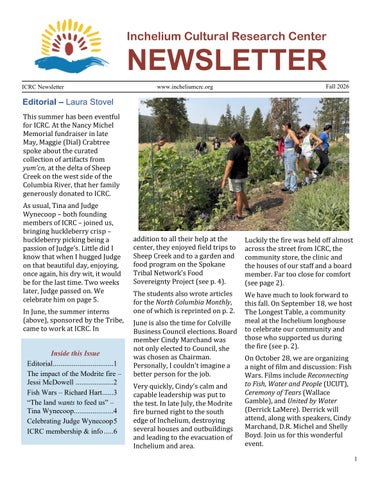
Editorial – Laura Stovel This summer has been eventful for ICRC. At the Nancy Michel Memorial fundraiser in late May, Maggie (Dial) Crabtree spoke about the curated collection of artifacts from yum’cn, at the delta of Sheep Creek on the west side of the Columbia River, that her family generously donated to ICRC. As usual, Tina and Judge Wynecoop – both founding members of ICRC – joined us, bringing huckleberry crisp – huckleberry picking being a passion of Judge’s. Little did I know that when I hugged Judge on that beautiful day, enjoying, once again, his dry wit, it would be for the last time. Two weeks later, Judge passed on. We celebrate him on page 5. In June, the summer interns (above), sponsored by the Tribe, came to work at ICRC. In Inside this Issue Editorial ................................1 The impact of the Modrite fire – Jessi McDowell ....................2 Fish Wars – Richard Hart......3 “The land wants to feed us” – Tina Wynecoop.....................4 Celebrating Judge Wynecoop 5 ICRC membership & info .....6
addition to all their help at the center, they enjoyed field trips to Sheep Creek and to a garden and food program on the Spokane Tribal Network’s Food Sovereignty Project (see p. 4).
Luckily the fire was held off almost across the street from ICRC, the community store, the clinic and the houses of our staff and a board member. Far too close for comfort (see page 2).
The students also wrote articles for the North Columbia Monthly, one of which is reprinted on p. 2.
We have much to look forward to this fall. On September 18, we host The Longest Table, a community meal at the Inchelium longhouse to celebrate our community and those who supported us during the fire (see p. 2).
June is also the time for Colville Business Council elections. Board member Cindy Marchand was not only elected to Council, she was chosen as Chairman. Personally, I couldn’t imagine a better person for the job. Very quickly, Cindy’s calm and capable leadership was put to the test. In late July, the Modrite fire burned right to the south edge of Inchelium, destroying several houses and outbuildings and leading to the evacuation of Inchelium and area.
On October 28, we are organizing a night of film and discussion: Fish Wars. Films include Reconnecting to Fish, Water and People (UCUT), Ceremony of Tears (Wallace Gamble), and United by Water (Derrick LaMere). Derrick will attend, along with speakers, Cindy Marchand, D.R. Michel and Shelly Boyd. Join us for this wonderful event. 1
More than Ashes: The Impact of the Modrite Fire Jessi McDowell, summer student The fire in Inchelium affected the community in many different ways – it not only damaged land and property, but also disrupted the everyday lives of our people. Families had to leave their homes, roads were closed and important places and resources were put at risk. It truly stressed how quickly a community’s normal way of life can change during an emergency. At the end of July, the Modrite fire burned south of Inchelium, coming perilously close to ICRC (pictured here), the store, clinic and other homes and businesses. The community was evacuated. Several homes and outbuildings were lost. On September 18, ICRC, funded by the Innovia Foundation, is organizing The Longest Table, a free meal that honors the community and all the volunteers and donors that stepped in to help.
One of the biggest impacts of the fire was evacuation. When people were forced to leave their homes, their daily lives were disrupted. Power outages made it difficult for people to get groceries, and some stores had to deal with food going bad. People also lost access to water, and appointments had to be canceled because it was not safe or possible for everyone to travel. Many people were also left searching for places to stay while they were away from their homes. These problems made an already stressful situation even harder for families in the community. The fires also caused damage to properties and important areas around Inchelium. Legacy housing was among the things at risk of being lost, while fields caught fire and roads were closed. Wildlife was also affected by the fires, and traditional harvesting sites were put in danger. These places are important because they connected not only to the land but also the community’s way of life and traditions. Losing them could mean losing parts of the history and resources that have been important to the community for generations. The fires in Inchelium were more than just flames burning through the area. They disrupted people’s homes, routines, resources and connection to the land. Even after the fires are gone, the effects can continue to impact the community. The flames may have burned through Inchelium, but they cannot burn away the strength of the community that calls it home. The fire cannot burn away the hearts of the Inchelium community. 2
Sheep Creek/Yum’cn Fish Wars Collection Tina Wynecoop Richard Hart
Last fall the 28, family of Sherry On October at 7:00 p.m. atDial thebequeathed Inchelium their mother’s curated collection regional Cultural Research Center, we willof show three artifacts from yum’cn to the ICRC. films and will host a community discussion on the fish, particularly salmon, in the Theimportance Indigenous of geographical place name yum’cn upper drainages ofthe the‘moving Columbia River.ofAtSheep least refers to the delta, mouth’ three representatives of entities involved will Creek on the west side of the Columbia River, talk, D. R.upriver Michelfrom (right, who will (see talk aboutincluding 1 1/2 miles Northport about the important work being done by Upper map), in North Central Washington. Formerly, Columbia Tribes of – UCUT), Tribalwere Council both sidesUnited of the mouth Sheep Creek Chairwoman Marchand (discussing Lakes (Sinixt)Cindy winter village sites. independent efforts of the Colville Tribes) and During historic times the landthe came under thein Shelly Boyd, who represents Sinixt Tribe ownership of the Dial family who retained a Canada. Filmmaker Derrick LaMere will show his respectful film, Unitedconnection by Water. with the Sinixt people’s traditional geographic and cultural territory. The Upper Columbia United Tribes (UCUT) The ICRCthe board of directors that Mrs. includes following tribes:agreed the Spokane, Dial’s coincided and perfectly with Coeurprivate d’Alene,collection Kalispel, Kootenai, Colville ICRC’s stated objectives to “provide community Confederated Tribes. They have numerous members with an opportunity to store in and projects addressing fish rehabilitation the contribute to the shared cultural record of our Upper Columbia basin. homeland; to foster a meaningful connection The Confederated Tribes and of the between our community theColville history of Reservation has long carried out its own projects Indigenous groups of and around Inchelium;” and litigation aimed at restoring fish to the and “to create an accessible, welcoming space Upper Columbia Basin, including fish release for cultural research, sharing and dialogue.” programs and litigation involving the Sinixt, one The artifacts given to the ICRC collection of itsyum’cn constituent tribes. tangibly connect living relatives to their cultural The Sinixt,Inwho occupied along the heritage. contrast, the the oneland million-plus Columbia River from Kettle Falls to its northern artifacts collected at nearby Kettle Falls during a bend in the 19th century, were declared extinct 1972-1978 salvage excavation remain stored far by Canadian officials in 1956. That action was downstream at Fort Vancouver. The excavation recently reversed by Canadian was led by archaeologist Davidcourts. Chance and the University Idaho. In 1974 theofBoldt Decision affirmed treatytribes’ rights to half the salmon catch in the State The local yum’cn collection, though much of Washington. Non-treaty who smaller, will be available fortribes, viewing in never its new signed away their rights to aboriginal territory, home not far from its original source. Bradley through otherwise, have no special Marshalltreaties (Hupa) or said, “When [it] is taken away fishing rights under U.S., Canadian or from its home, it cries to go back, it cries to be Washington State used…it has life in law. it and wants to be among others, it wants that interaction to survive.” The For more information, call Shannon Rosenbaum, thorough documentation that accompanies ICRC executive director, at (509)-930-7852. the collection will also be available for researc tovel0@gmail.com> 3
“The land wants to feed us” by Tina Wynecoop On a bright morning in July, the ICRC summer interns visited the tribal food sovereignty program established in their sister community, the Spokane Indian Reservation. The interns were welcomed by the staff who sought, and accepted, practiced, demonstrated and continue to share their restored relationship with the land. “When we come here it’s like we are visiting a beloved grandparent. What do beloved grandparents do when we visit? They feed us. The land feeds us and wants to feed us. These plants and the land are our Elders and have so much to teach us when we pay attention. As our Elder, the land takes care of us, and we also give care to it, especially so, now, after so many decades and centuries of injury to it. This is reciprocity – when you receive, you give to keep a balance. It is a give and give relationship,” explained William Denison, staff leader. This ‘give and give’ balance is wonderfully visible in the Spokane Tribal Network’s Food Sovereignty project. Following the welcome, the ICRC visitors introduced themselves by saying their names, both in English and in Salish, and then their parents and grandparents’ names. These ancestors were included in the day’s activities. A profound connection with ancestors, language, culture, landscape and community was taking place. A tour of the food garden, with a focus on soil restoration, followed. Post-contact damage to the land is visible. The site is bounded on one side by the Spokane River, tamed by several upstream dams. The steep hillsides have also been consumed by recent fires. This soil has been affected by western agricultural practices where once Mima mounds dotted its landscape. The mounds have been erased, except for the few remaining ones along the edges where the river meets the land. These mounds inspired stories of their formation, and of the animal people who interacted with them. They are a memory. They have been kept.
Lunch was a wonderful, filling meal made with food from the garden, reflecting its abundance. In ńpoqińišcn (the Spokane language), the Salish word Ɂełnélixʷ means ‘their food or the food by which they are known.’ The interns now know all things are possible when sought after and practiced – even a fine meal! “Since time immemorial, the peoples of the northeastern Columbia Plateau have used their local and neighboring regions' resources to live in a truly sustainable fashion,” William said. “Colonization compromised Indigenous peoples’ ability to manage and access their traditional resources. The people became dependent upon food resources they had no control in managing. This led to food shortages, especially traditional food sources and other fresh, healthy foods. Return to a traditional diet and healthy nontraditional foods takes the people a step closer to food sovereignty and food safety. Our place provides a place to converse, work and share information about food sovereignty/safety and the people’s ability to access healthy and traditional foods.” ICRC summer interns have been working on a food forest plan for the Inchelium community gardens. This day’s insights will certainly help. Thank you, lemlemts, to everyone, including William Denison and Dr. Melodi Wynne, program director of the food sovereignty program, for the welcome visit on this bright summer day. Visit the group on Facebook: Ɂełnélixʷs: Spokane Tribal Food Sovereignty and Community Gardens Or go to https://spokanetribalnetwork.org/ 4
Celebrating Arnold ‘Judge’ Wynecoop This past June, one of the founding members of ICRC, Judge Wynecoop, passed on at the age of 92. Judge, a Sinixt and Spokane man, was dear to our hearts. Judge’s close ties with our founders, Mary Kaye Hale and Nancy Michel, and with all the roots and limbs of the Sinixt family tree – including Shadow Top, Able One, Ellen Edwards Perkins, John Curtis Wynecoop, Nancy Perkins Wynecoop, Etues, Desautels and Galbraiths – connected him to our vast homelands and to so many of our families. Judge loved flyfishing, going for firewood and hunting for Christmas trees but he was best known for his love of huckleberry picking. Judge and Tina’s huckleberry seasons were summerlong. They welcomed friends and family to the ‘favorite family patches’ that provided jams, pies and gifts throughout the years. Judge taught us through his love of the woods, mountains and streams the importance of tradition, family, storytelling and friendship. Shortly after Judge died, his nephew, Jim Wynecoop, wrote a beautiful song, One Berry at a Time, to celebrate Judge. You can hear the song by using this QR code. Judge’s wife Tina recalls how she and Judge met Kaye Perkins Hale, who would later cofound ICRC with her friend Nancy Michel. Around 1996, Tina worked as a librarian in downtown Spokane. Kaye, who volunteered in the library's genealogy section, recognized the Wynecoop name on Tina's nametag and introduced herself. She explained that she and Judge were cousins. Kaye grew up on the Colville Reservation and Judge on the Spokane Reservation; they had never met. Soon Kaye brought bagfuls of her Sinixt family research papers and sent them home with Tina. A whole new world of ‘family’ unfolded. Kaye urged Judge to meet her best friend Nancy from Inchelium. "You've gotta meet her!" Kaye repeatedly said. The meeting took place at a
Perkins Restaurant during a basketball tournament in Spokane where the Inchelium team was playing. Kaye and Judge realized the coincidence of the restaurant's name. They shared the same great grandfather, Frederick W. Perkins. The meeting with Nancy was the start of a long friendship. Years later, Kaye's health was deteriorating so she entrusted her research collection to Nancy hoping that a building could be found to archive and share Sinixt history and genealogy. The nucleus of the future ICRC board of directors began to meet in the office of Sinixt liaison, Virgil Seymour. Kaye, Nancy, Judge: history, vision, relationship, place, the Columbia River, and the Sinixt peoples flowed through their veins. Today, the Inchelium Cultural Research Center tells the rest of the story. 5
ICRC mission statement The Inchelium Cultural Research Center is an accessible, welcoming archive and library and a space for sharing and dialogue. It provides community members with an opportunity to store and contribute to the shared cultural record of our homeland and fosters meaningful connections between our community and the history, both national and international, of Indigenous groups in and around Inchelium.
ICRC ANNUAL MEMBERSHIP APPLICATION Name Address
City
Contact us: Mailing address: PO Box 206, Inchelium, WA, 99138 Location: 38b Short Cut Road Inchelium, WA, 99138 E-mail: incheliumCRC@gmail.com Website: https://www.incheliumcrc.org/ Donate: https://www.incheliumcrc.org/supp
How to donate
State/Province
Zip
Phone E-mail New Membership $20 Renewal Membership $20 $
In Memory Of:
$
In Honor Of:
Thank you to our funders:
Colville Indian Housing Authority Community Grant Washington State 250 Minigrant
Please send application with your check payable to: ICRC P.O. Box 206 Inchelium, Wa., 99138
Innovia Community Grant Inatai Foundation
The Inchelium Cultural Resear ch Center (ICRC) is a 501(c)(3) tax exempt organization. No material goods or services have been provided in exchange for your membership and/or contribution. T ax I.D.#38-4168217 6