PART The Traveling Public and Tourism Promoters
1
Chapters 1 Introducing the World’s Largest Industry, Tourism 2 Marketing to the Traveling Public 3 Delivering Quality Tourism Services 4 Bringing Travelers and Tourism Service Suppliers Together 5 Capturing Technology’s Competitive Advantages EXTERNAL ENVIRONMENT
Society/Culture
Economy
TOURISM SERVICE SUPPLIERS
TOURISM PROMOTERS Destinations Tour operators
Attractions & entertainment
Accommodations Travel agents
TRAVELERS
Tourist boards Direct marketing
Incentive and Meeting planners
Food & beverages
Transportation Environment
Politics
Technology
An integrated model of tourism.
M01A_COOK4488_06_SE_PT1.indd 1
07/03/17 1:57 PM
CHAPTER 1 Introducing the World’s Largest Industry, Tourism Travel is fatal to prejudice, bigotry, and narrow-mindedness. —Mark Twain
Learning Objectives After you have read this chapter, you should be able to: 1. Understand and explain the basic definition of tourism.
5. Explain why tourism should be studied from marketing, management, and financial perspectives.
2. Identify the major participants and forces shaping the tourism industry.
6. Identify future challenges and opportunities facing the tourism industry.
3. Explain historical factors that encouraged the development of tourism activities.
7. Discuss career prospects in the tourism industry.
4. Explain the impact of physical, human, and regional geography on tourism activities.
Chapter Outline Could a Career in Tourism Be in Your Future? Introduction Services and Tourism What Is Tourism? A Tourism Model The History of Travel and Tourism The Empire Era The Middle Ages and the Renaissance Era The Grand Tour Era The Mobility Era The Modern Era
Bringing Tourism into Focus Geography Describes the Traveler’s World
Maps
Reading Maps Indexes and Locators Scales Legends Physical Geography Landforms and Vegetation Water Climate and Seasons Human Geography Regional Geography
Studying Tourism from Business Perspectives Marketing Management Finance
2
M01B_COOK4488_06_SE_C01.indd 2
06/03/17 8:46 PM
Chapter 1 ▸ Introducing the World’s Largest Industry, Tourism 3
Tourism’s Challenges and Opportunities Where Do You Fit In? Topics Covered in Each Chapter Summary You Decide
Net Tour Discussion Questions Applying the Concepts Glossary References
Tourism is a Worldwide and Growing Phenomenon. Prasit Rodphan/Shutterstock
Could a Career in Tourism Be in Your Future? From the day he entered the hospitality management program at Central Piedmont Community College, Bruce Moss knew he wanted to be in the business of serving people. The twists and turns his career took after graduating have been as varied and exciting as the industry that became part of his life—tourism. Bruce’s career began with a bang and soon skyrocketed. It started with the job of assistant manager at a 177-room Ramada Inn franchise in Charlotte, North Carolina, right after graduation. He was soon promoted to the position of general manager at another Ramada Inn with the same company in Clearwater, Florida. Based on his successful track record of profitable operations, he was recruited to open the 244-room Tampa Airport Hilton. The promotions and opportunities just kept coming. Just six years after graduation, Bruce was recruited to fill the position of director of Front Office Operations of the Innisbrook Westin Resort, a four-star, four-diamond golf/tennis resort in Palm Harbor, Florida. After two short years, he was promoted to vice president/resident manager of this resort complex covering 1,000 acres with over 1,200 condominium units, three championship golf courses, four restaurants, over 60,000 square feet of banquet space, and a staff of 1,000 employees. Like almost everyone in the tourism industry, Bruce was presented with many new and challenging opportunities on a regular basis. His next assignment found him moving from the seashore to the mountains as he accepted a transfer to Innisbrook’s sister property, Tamarron Resort, high in the Colorado Rockies. “Bitten by the resort operations bug,” Bruce decided to complete a four-year degree in tourism to open up even more opportunities. Armed with additional education and a broad base of operational experience, expanded career opportunities led him to general manager positions at Purgatory Village in Durango, Colorado, and later in Jackson Hole, Wyoming. His most recent career move finds Bruce as a business owner, serving all segments of the tourism industry. After 25 years of serving the traveling public, Bruce and his wife
M01B_COOK4488_06_SE_C01.indd 3
06/03/17 8:46 PM
4 Part 1 ▸ The Traveling Public and Tourism Promoters Lori purchased a central reservations business, which books lodging, destination activities, and vacation packages for individuals and groups traveling to the southwest Colorado region. Achieving success in this multimillion-dollar tourism operation hasn’t happened by accident. Intensive employee training focused on the highest quality customer service and constant technology investments (over $100,000 in just one year) keep Gateway Reservations (http://www.gatewayreservations.com) on the cutting edge of service delivery. As you approach the study of tourism, let your imagination soar, learning all you can to prepare yourself to grow as your career advances. Like Bruce, who earned two degrees in hospitality/tourism management and continues to maintain his Certified Hotel Administrator (CHA) designation, never stop learning. The opportunities that await you are endless.
Introduction Welcome to the study of a dynamic group of industries that have developed to serve the needs of travelers worldwide—tourism! Tourism is the business of hospitality and travel. Whether we are travelers or we are serving travelers’ needs, this exciting and demanding group of visitor services industries touches all of our lives. In this book, you will explore the many and varied segments of this multifaceted industry. As you learn more about tourism, begin thinking about the future challenges and opportunities that lie ahead for all of these industries and how they may influence your life.
Services and Tourism Services and tourism go hand in hand. You will learn more about services in Chapter 3. However, as we begin our study of tourism, it is important to know that these activities make a significant economic impact on almost every nation in the world! Services are growing at a faster rate than all agricultural and manufacturing businesses combined. In fact, tourism-related businesses are the leading producers of new jobs worldwide. Tourism has developed into a truly worldwide activity that knows no political, ideological, geographic, or cultural boundaries. For a long time, tourism was disparate and fragmented, but as this industry has continued to grow and mature, a sense of professional identity has emerged. It has formed lobbying groups such as the World Travel and Tourism Council (WCTT), which includes executives of airlines, hotel chains, and travel agents among its members and concentrates on making the case for tourism’s global importance and economic value. The future prospects for tourism are brighter than ever as people continue to travel for work or pleasure. “Given its historical performance as a luxury good during expansions and a necessity during recessions, travel and tourism’s future economic prospects look quite bright”(p. 51).1 As we will see later, the growth and popularity of tourism activities have not been accidental. Growth projections indicate that tourism will support almost 350 million jobs worldwide by 2025. This will be an increase of over 70 million jobs when compared to 2015.2 Tourism has become more than just another industry; it has developed into an important part of the economic fabric of many communities, regions, and countries. Tourism activities have historically demonstrated a general upward trend in numbers of participants and revenues. Tourism is one of the few industries that is sensitive to economic ups and downs, and yet at the same time rebounds quickly from any negative economic conditions or other environmental impacts. Even in the face of a dramatic credit crunch, an economic slump, and political uncertainty, the impact on international tourism was not as severe as the downturn experienced in foreign trade and industrial production.3 “Over the past six decades, tourism has experienced continued expansion and diversification, to become one of the largest and fastest-growing economic sectors in the world” (p. 2).4
M01B_COOK4488_06_SE_C01.indd 4
06/03/17 8:46 PM
Chapter 1 ▸ Introducing the World’s Largest Industry, Tourism 5
What Is Tourism? As tourism-related activities have grown and changed, many different definitions and ways of classifying the industry have emerged. Use of the term tourism has evolved as attempts have been made to place a title on a difficult-to-define group of naturally related service activities and participants. As we embark on our study of tourism, it is helpful to begin with a common definition that has been accepted for decades: “the temporary movement of people to destinations outside their normal places of work and residence, the activities undertaken during their stay in those destinations, and the facilities created to cater to their needs.”5 As our definition shows, tourism includes a wide array of people, activities, and facilities, and most people would agree that it is a unique grouping of industries that are tied together by a common denominator—the traveling public. Can you describe tourism in your own words? Take a moment to think about this question. You might find it easy to answer this question in general terms, but more difficult to answer if you were asked to provide specific details. In fact, you might find yourself facing a task similar to the one depicted in Figure 1.1. Tourism is much like the elephant: diverse and sometimes hard to describe, but, just like the elephant, too big to be ignored. Specific segments of tourism, such as air transportation, theme parks, eating and drinking establishments, lodging and accommodations, and museums, have their own industrial classification codes in every industrialized country. However, the overall grouping of related activities and organizations that come together to create the more comprehensive tourism industry does not have its own distinctive industry code. To address this concern organizations such as the WTTC and the United Nations World Tourism Organization (UNWTO) have spearheaded efforts to highlight the breadth and economic impact of tourism. Even though tourism may not be classified as a distinct industry, it is generally agreed that “ ‘[t]ourism’ appears to be becoming an acceptable term to singularly describe the activity of people taking trips away from home and the industry which has developed in response to this activity.”6 FIGURE 1.1 The blind men and tourism.
Food and beverage
Destinations
Transportation Attractions and entertainment
M01B_COOK4488_06_SE_C01.indd 5
Accommodations
Travel agencies
06/03/17 8:46 PM
6 Part 1 ▸ The Traveling Public and Tourism Promoters Table 1.1 Components of the Tourism Industry Accommodation Services
Food and Beverage Services
Railway Passenger Transport Services
Road Passenger Transport Services
Water Passenger Transport Services
Air Passenger Transport Services
Transport Equipment Rental Services
Travel Agencies and Other Reservation Services
Cultural Services
Sport and Recreational Services
Country-Specific Tourism Goods
Country-Specific Tourism Services
Based on: International Recommendation for Tourism Statistics 2008, UNWTO, 42.
Both the WTTC and UNWTO track and report tourism statistics to highlight the size, scope, and impact of tourism-related businesses. Comparable data from around the world is made possible through the use of a common definition of tourists or visitors. As defined by UNWTO, tourism is a social, cultural, and economic phenomenon, which entails the movement of people to countries and places outside their usual environment for personal or business/professional purposes. These people are called visitors . . . and tourism has to do with their activities, some of which involve tourism expenditure.7 The U.S. Travel Association has taken the commonly agreed upon definition of tourism and restricted its scope by defining these activities as trips away from home of 50 miles or more, one way, or trips that include an overnight stay in paid accommodations.8 By using a common umbrella definition, data can be collected and analyzed for each of the industry subgroupings shown in Table 1.1 in Tourism Satellite Accounts. Even as the debate continues for a common definition, it has been suggested that the definition be expanded to include the concept of displacement. This inclusion would expand the definition to capture, “the decision of tourists to leave the familiar behind in order to participate in something new” (p. 122).9 Because definitions conjure up different meanings and can be used for different purposes, some critics have suggested using a term other than tourism to describe the industry. One of these suggestions has been to use a more inclusive and descriptive term such as “visitor-service industry.”10 For convenience and ease of understanding, however, we will refer to tourism as an industry in this book.
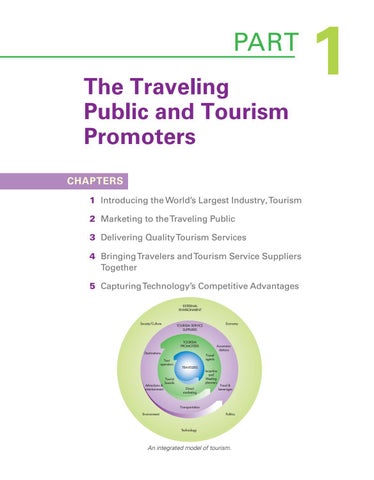
A Tourism Model In an attempt to overcome some of the problems encountered in describing tourism, the model presented in Figure 1.2 was developed to highlight important participants and forces that shape the tourism industry. The model, like a photograph, provides a picture that begins to capture the dynamic and interrelated nature of tourism activities. This model can be used as a reference throughout the entire text. Although many of the terms in our tourism model may not be familiar at this time, you will be learning more about each one and its importance in later chapters. As you study our tourism model, notice its open nature and how each of the segments is related to the others. Let’s begin our study of tourism by looking at travelers (tourists), who serve as the focal point for all tourism activities and form the center of our model. Radiating from this focal point are three large bands containing several interdependent groups of tourism participants and organizations. Individual tourists may deal directly with any of these tourism service suppliers, but they often rely on the professional services provided by tourism promoters shown in the first band of our model. Tourism promoters, such as travel agencies and tourist
M01B_COOK4488_06_SE_C01.indd 6
10/03/17 2:04 PM
Chapter 1 ▸ Introducing the World’s Largest Industry, Tourism 7
FIGURE 1.2 EXTERNAL ENVIRONMENT
An integrated model of tourism. Society/Culture
Economy
TOURISM SERVICE SUPPLIERS
TOURISM PROMOTERS Destinations Tour operators
Attractions & entertainment
Accommodations Travel agents
TRAVELERS
Tourist boards Direct marketing
Incentive and Meeting planners
Food & beverages
Transportation Environment
Politics
Technology
boards, provide information and other marketing services. Moving to the next band of our model, we see key tourism suppliers who provide transportation, accommodations, and other services required by travelers. Tourism suppliers may provide these services independently; they may compete with each other; and, at times, they may work together. For example, airline, bus, railroad, cruise ship, and car rental companies may compete individually for a traveler’s business. However, they may also team up to provide cooperative packages such as fly–ride, fly–cruise, and fly–drive alternatives. Or, as airlines have discovered, they must establish strategic alliances with many other carriers to provide seamless travel across states, nations, and continents. Hotels and resorts may also compete against each other for the same traveler’s patronage yet cooperate with transportation providers to attract tourists to a specific location. Service providers representing all segments of the tourism industry may often work together to develop promotional packages designed to attract tourists to destinations. How closely these individuals and organizations work together is ultimately influenced by the forces shaping the face of tourism activities. As our model shows, the tourism industry does not operate in a vacuum. All of the participants, either individually or as a group, are constantly responding to a variety of social/cultural, political, environmental, economic, and technological forces. These forces may range from subtle changes, which are noticeable only after many years, to more dramatic changes, which have immediate and visible impacts. Examples of these forces can be found all around us. Gradual changes may be noticed in destinations that were once fashionable but eventually faded in popularity, such as Niagara Falls on the Canadian/U.S. border and Brighton in England. Similar shifts can also be seen in transportation. Steamship passage across the North Atlantic was eclipsed by the faster and more efficient airplane, which opened new horizons for travelers. Immediate impacts can be seen in sudden shifts brought about by currency devaluations, wars, fuel shortages, natural disasters, and economic conditions.11 Rapid adoption of new technologies such as the Internet can have immediate and far-reaching impacts on tourism activities and service providers. A country that was once avoided may suddenly become a popular tourism destination because it is more affordable or accessible. Conversely, a once-popular destination may be avoided because of a recent natural disaster or political upheaval.
M01B_COOK4488_06_SE_C01.indd 7
06/03/17 8:46 PM
8 Part 1 ▸ The Traveling Public and Tourism Promoters The number of travelers from and to nations also varies dramatically due to political and economic changes. Through the year 2020, Europe will continue to see the largest number of tourist arrivals followed by East Asia and the Pacific and then the Americas. At the country level, China will be the largest tourist receiving country by 2020, surpassing France, and the United States.12 Now that China has developed a sizable middle class due to its economic growth, it has become the biggest Asian nation in terms of outbound travelers and a domestic market that is growing 15% to 20% a year.6,13 Let’s look at how our model might work. Suppose you (a tourist) want to visit a sunny beach or a snow-covered mountain. You might begin planning your trip by browsing the websites of different airlines, condominiums, hotels, and/or resorts (tourism service suppliers) searching for possible flight schedules and accommodation options. You could simply call a travel agent (tourism promoter) who would search out the best alternatives to meet your needs, rather than spending time and money contacting each supplier. Another option would be taking a “virtual trip” to your desired destination by browsing offerings on the Internet. Finally, you could contact your preferred destinations’ local chambers of commerce or visitors’ bureaus to learn more about their offerings. As you progress through this book, we will focus our attention on specific features of our model, learning more about each component and how it interacts with other components of the tourism industry. We will begin our journey into the study of tourism by looking back in time to discover the origins of these activities and the foundations they laid for tourism as we know it today.
The History of Travel and Tourism Table 1.2 lists some of the milestones in the development of tourism. Long before the invention of the wheel, travel occurred for a variety of reasons. In the beginning, it was simple. As seasons changed and animals migrated, people traveled to survive. Because these early travelers moved on foot, they were confined to fairly small geographic areas. Travel may have remained a localized experience, but people by nature are curious. It is easy to imagine these early travelers climbing a mountain or crossing a river to satisfy their own sense of adventure and curiosity as they sought a glimpse of the unknown. We can only guess at the wonder and amazement of early travelers as they made each new discovery. However, there is a rich history of people and cultures that forms the foundation of tourism. History provides important insights into the reasons for travel and the eventual development of tourism. Based on early records, we know that many cultures and nations moved great armies and navies to conquer and control resources and trade routes. Although military forces often traveled great distances, it was probably not until the emergence of the Egyptian, Eastern Mediterranean, and Roman Empires that travel began to evolve into tourism as we know it today. Early recorded history provides a glimpse into ancient tourism activities. The Phoenicians, like many travelers, were interested in travel because of a sense of curiosity and discovery as well as a means of establishing trade routes. Although written records are scarce, other peoples such as the Mayans on the Gulf Coast of what is now Mexico and the Shang Dynasty in what is now present-day China probably traveled for many of the same reasons as the Phoenicians. Evidence of their travels can be found in the artifacts they collected during their journeys to faraway places. One thing we know for sure is that as civilizations became established and spread geographically, travel became a necessity.
The Empire Era The point at which simple travel evolved into the more complex activities of tourism is hard to identify. However, tourism as an industry probably began to develop during the
M01B_COOK4488_06_SE_C01.indd 8
06/03/17 8:46 PM
Chapter 1 ▸ Introducing the World’s Largest Industry, Tourism 9
Table 1.2 Milestones in the Development of Tourism Prerecorded history
Travel begins to occur out of a sense of adventure and curiosity.
4850 b.c.–715 b.c.
Egyptians travel to centralized government locations.
1760 b.c.–1027 b.c.
Shang Dynasty establishes trade routes to distant locations throughout the Far East.
1100 b.c.–800 b.c.
Phoenicians develop large sailing fleets for trade and travel throughout their empire.
900 b.c.–200 b.c.
Greeks develop common language and currency, and traveler services emerge as citystates become destinations.
500 b.c.–a.d. 300
Romans improve roads, the legal system, and inns to further travel for commerce, adventure, and pleasure.
a.d.
300–a.d. 900
Mayans establish trade and travel routes in parts of Central and North America.
a.d.
1096–a.d. 1295
European travel on failed religious crusades to retake the Holy Lands from Muslim control introduces these military forces to new places and cultures.
a.d.
1275–a.d. 1295
Marco Polo’s travels throughout the Far East begin to heighten interest in travel and trade.
14th–16th centuries
Trade routes develop as commercial activities grow and merchants venture into new territories.
a.d.
Grand Tour Era makes travel a status symbol for wealthy individuals seeking to experience cultures of the civilized world.
1613–a.d. 1785
18th–19th centuries
Industrial Revolution gives rise to technological advances, making travel and trade more efficient and expanding markets; increasing personal incomes make travel both a business necessity and a leisure activity.
1841
Thomas Cook organizes first group tour in England.
1903
Wright Brothers usher in era of flight with the first successful aircraft flight.
1913
Westinghouse Corporation institutes paid vacations for its workers.
1914
Henry Ford begins mass production of the Model T.
1919
First scheduled airline passenger flight debuts between London and Paris.
1945
World War II ends and ushers in new era of prosperity, giving rise to millions of people with the time, money, and interest to travel for pleasure and business.
1950
Diners Club introduces the first credit card.
1952
Jet passenger service is inaugurated between London and Johannesburg, South Africa.
1950s
Rapid expansion of hotel and motel chains in the United States via franchise agreements.
1978
Competition on routes and fares begins with signing of Airline Deregulation Act.
1978
American Airlines expands access to electronic reservation system, SABRE, to travel agencies.
1984
The State Council of China approves the organization of tours to Hong Kong and Macao for mainland residents visiting relatives, which was the prelude to the outbound tourism of Chinese citizens.
1996
Expedia is founded as a division of Microsoft.
2000
TripAdvisor is founded.
2001
Dennis Tito launches the advent of space tourism as he pays $20 million for an eight-day vacation aboard the International Space Station.
2001
Transportation Security Administration (TSA) in the United States is created to ensure airline passenger safety in the wake of the September 11th terrorist attacks on the World Trade Center in New York City and the Pentagon in Washington, D.C.
2002
The euro currency is introduced, signaling liberalization of travel among member nations of the European Union.
2004
Mark Zuckerberg, a Harvard student, launches a social networking service Facebook.com.
2007
Air Bed and Breakfast (AirBnB) launched, signaling a wave of new services such as Uber and an expanding sharing economy in tourism services.
2011
Google provides an online flight-booking service, Google Flights, to public.
M01B_COOK4488_06_SE_C01.indd 9
10/03/17 2:05 PM
10 Part 1 ▸ The Traveling Public and Tourism Promoters Empire Era, which stretched from the time of the Egyptians to the Greeks and finally came to an end with the fall of the Roman Empire. During this time, people began traveling in large numbers for governmental, commercial, educational, and religious purposes out of both necessity and pleasure. The Egyptian Kingdoms (4850–715 b.c.) were the first known civilization to have consolidated governmental functions at centralized locations. Travel to these locations by boat was particularly easy because travelers could use the Nile River, which flowed northward but was constantly brushed by southward breezes. Because oars were not needed, travel in either direction was relatively effortless. Boats could go north with the current or south with sails. As travel became commonplace, basic necessities such as food and lodging had to be provided. Several factors combined to encourage travel during the height of the Egyptian, Greek, and Roman Empires. Large numbers of travelers began to seek out enjoyable experiences in new locations. The most notable group of these travelers, because of their numbers, was the Greeks. The Greek Empire (900–200 b.c.) promoted the use of a common language throughout much of the Mediterranean region, and the money of some Greek citystates became accepted as a common currency of exchange. As centers of governmental activities, these city-states became attractions in themselves. They offered visitors a wide variety of opportunities to enjoy themselves while away from home. Shopping, eating, drinking, gaming, and watching spectator sports and theatrical performances are just a few of the many activities that grew out of travel and evolved into the more encompassing aspects of tourism. The growth of the Roman Empire (500 b.c.–a.d. 300) fostered expanded tourism opportunities for both middle-class and wealthy citizens. Good roads (many of which were built to connect the city of Rome to outlying areas in case of revolt) and water routes made travel easy. As these roads were developed, so were inns, which were located approximately 30 miles apart, making for a day’s journey. Fresh horses could be hired at the inns and at more frequent relay stations. With effort, people could travel 125 miles a day on horseback, knowing they would have a place to eat and sleep at the end of the day. These roads, which connected Rome with such places as Gaul, Britain, Spain, and Greece, eventually extended into a 50,000-mile system. The most famous road was the Appian Way, joining Rome with the “heel” of Italy. Many of the hassles of travel to distant places were removed because Roman currency was universally accepted and Greek and Latin were common languages. In addition, a common legal system provided protection and peace of mind, allowing people to travel farther away from home for commerce, adventure, and pleasure. Just like the Greek city-states, cities in the Roman Empire became destination attractions or wayside stops along the way to a traveler’s final destination. Has this brief glimpse into ancient history taught us anything of use today? The answer is yes. Even today, tourism activities continue to flourish where individuals have free time; travel is easy and safe; there are easily exchangeable currencies; common languages are spoken; and established legal systems create a perception of personal safety. The absence of any of these factors can dampen people’s desire to travel and enjoy tourism-related activities, as can be seen in the demise of travel during the Middle Ages.
The Middle Ages and the Renaissance Era Travel almost disappeared during the Middle Ages (5th–14th centuries a.d.). As the dominance of the Roman Empire crumbled, travel became dangerous and sporadic. The feudal system that eventually replaced Roman rule resulted in many different autonomous domains. This breakdown in a previously organized and controlled society resulted in the fragmentation of transportation systems, currencies, and languages, making travel a difficult and sometimes dangerous experience.
M01B_COOK4488_06_SE_C01.indd 10
06/03/17 8:46 PM
Chapter 1 ▸ Introducing the World’s Largest Industry, Tourism 11
Marco Polo’s travel route from his home in Venice, Italy, to China during the 13th century.
Venice Constantinople Black Sea
Acre
A
S
I
Taitu (Beijing)
A
Caspian Sea PERSIA
C
H
I
N
Hormuz Persian Gulf Arabian AFRICA
BURMA
INDIA
Bay of Bengal
A CHINA S EAS
FIGURE 1.3
Sea Indian Ocean
CEYLON
SUMATRA
As the Roman Catholic Church gained power and influence, people began to talk of Crusades to retake the Holy Land. There were nine of these Crusades (a.d. 1096– 1291), but each failed. In 1291, Acre, the last Christian stronghold, was retaken by the Muslims, bringing the Crusades to an end. Although conquest and war were the driving forces behind the Crusades, the eventual result was the desire of people to venture away from their homes to see new places and experience different civilizations. After the Crusades, merchants such as Marco Polo traveled to places well beyond the territories visited by the Crusaders (see Figure 1.3). Reports of Polo’s travels and adventures (1275–1295) across the Middle East and into China continued to heighten interest in travel and trade. The rebirth in travel emerged slowly during the Renaissance (14th–16th centuries). Merchants began to venture farther from their villages as the Church and kings and queens brought larger geographic areas under their control. Trade routes slowly began to reopen as commercial activities grew and merchants ventured into new territories. The idea of traveling for the sake of experiences and learning can probably be attributed to the first recorded “tourist,” Cyriacus of Ancona. His journeys took him around the Mediterranean Sea in a quest to learn more about and experience Greek and Roman History.14 The desire to learn from and experience other cultures heightened awareness of the educational benefits to be gained from travel and led to the Grand Tour Era.
The Grand Tour Era The Grand Tour Era (1613–1785), which marked the height of luxurious travel and tourism activities, originated with the wealthy English and soon spread and became fashionable among other individuals who had time and money. Travel, and the knowledge provided by these travels, became a status symbol representing the ultimate in social and educational experiences. Grand Tour participants traveled throughout Europe, seeking to experience the cultures of the “civilized world” and acquire knowledge through the arts and sciences of the countries they visited. Their travels took them to a variety of locations in France, Switzerland, Italy, and Germany for extended periods of time, often stretching over many years.
M01B_COOK4488_06_SE_C01.indd 11
06/03/17 8:46 PM
12 Part 1 ▸ The Traveling Public and Tourism Promoters Although the desire to participate in the Grand Tour continued, the Industrial Revolution, which began c. 1750, forever changed economic and social structures. Whole nations moved from an agricultural and commercial focus to modern industrialism. People became tied to the regimented structures and demands of factory life and the management of business enterprises. Economic growth and technological advances led to more efficient forms of transportation, the integration of markets across geographic and international boundaries, and higher personal incomes for larger numbers of people. Travel became a business necessity as well as a leisure activity, and tourism suppliers rapidly developed to serve the growing needs of travelers. The days of leisurely travel over extended periods of time to gain cultural experiences faded away as fewer and fewer people were able to take advantage of these time-consuming opportunities.
The Mobility Era Growing economic prosperity and the advent of leisure time as well as the availability of affordable travel ushered in a new era in the history of tourism. People who were no longer tied to the daily chores of farm life began to search for new ways to spend their precious leisure time away from their jobs in offices, stores, and factories. The Mobility Era (1800–1944) was characterized by increased travel to new and familiar locations, both near and far. Tourism industry activities began to increase as new roads, stagecoaches, passenger trains, and sailing ships became common sights in the early 1800s. Great Britain and France developed extensive road and railroad systems well before Canada and the United States. The growth and development of roads and railroads helped to increase the availability of transportation alternatives and reduced their costs, attracting more and more people to the idea of travel. Thomas Cook (1808–1892) can be credited with finally bringing travel to the general public by introducing the tour package. In 1841, he organized the first tour for a group of 570 people to attend a temperance rally in Leicester, England. For the price of a shilling (12 pence), his customers boarded a chartered train for the trip from Loughborough, complete with a picnic lunch and brass band. The immediate success of his first venture and the demand for more assistance in making travel arrangements led Cook into the full-time business of providing travel services. The next major steps in the Mobility Era were the introduction of automobiles and air travel. Although automobile technology was pioneered in Britain, France, and Germany, it was Henry Ford’s mass production of the Model T in 1914 that brought individual freedom to travel, opening new horizons for millions of people. Winged travel was not far behind, and the time required to reach faraway places began to shrink. Orville and Wilbur Wright ushered in the era of flight with their successful test of the airplane in Kitty Hawk, North Carolina, in 1903.
The Modern Era But the means of mobility and an interest in seeing new places were not enough. The seeds of mass tourism were planted during the first half of the 20th century when industrialists such as George Westinghouse created the paid vacation, believing that annual breaks from work for employees would increase productivity. The working and middle classes in industrialized countries thus were given the financial means and the time to satisfy their newfound wanderlust. Indeed, at the dawn of the 21st century, most workers in virtually all industrialized nations have several weeks of vacation time that they may choose to spend traveling. Mass tourism received an additional boost after World War II (which ended in 1945). During this war, millions of people throughout the world, including over 17 million Canadian and U.S. citizens, were exposed to many new, different, and even exotic locations as they served in a variety of military assignments. Military service
M01B_COOK4488_06_SE_C01.indd 12
06/03/17 8:46 PM
Chapter 1 ▸ Introducing the World’s Largest Industry, Tourism 13
FYI All Work and No Play Forgo vacation time? You would have to be crazy, right? Well, many Americans and Brits work insane hours and frequently skip their allotted paid vacation periods. Nearly one-quarter of self-confessed workaholics in Great Britain take not a single day’s “holiday” of the 24 days they earn during the year. Ten percent of workers who work over 48 hours per week also forgo vacation breaks, whereas another 22% of these
“long hours workers” take ten days or less. In the United States, a Harris poll revealed that 51% of Americans did not plan to take an annual vacation even though they had earned an average of 14 days. In contrast, workers in France on average forgo only 3 of the 36 days they earn each year. Human resource experts believe that vacation time is necessary for workers to be productive, and they believe that the
U.S. federal government should mandate paid vacation days just as many European countries do. Believe it or not, President William Taft (1909–1913) proposed that all workers should be given two or three months off each year! Yet, the United States is still the only advanced economy that does not require any mandatory vacation time.
Sources: Based on All work and no holidays (2002). Management Services, 46(2), 5; Bellows, K. (2003). Too little play time. National Geographic Traveler, 20(8), 18; Allegretto, S., and Bivens J. (2006, July–August). Foreign Policy, 26–27. Dickey, J. Save our vacation, (June 1, 2015) Time 180(20). Save our vacation, 44–49.
forced many people who had never traveled before to do so, and they were eager to share their positive experiences with family and friends when they returned home. Following the end of World War II, several additional factors helped encourage the growth of tourism. Cars were again being produced in large numbers; gas was no longer rationed; and prosperity began to return to industrialized countries. As American families travelled around the country in cars, the motel business began to boom. Also in the 1950s, hotels and motels expanded quickly through the newly adopted franchising development model. The introduction of jet travel in the 1950s and its growing popularity in the 1960s further accelerated growth in both domestic and international travel. To grease the gears of the tourism industry even further, in 1950, the credit card was born in the form of the Diners Club card. Credit cards provided travelers with purchasing power anywhere in the world without the risk of carrying cash and the hassle of currency exchange. In fact, credit cards are now the preferred form of international buying power because travelers can charge their purchases in the local currency. Time, money, safety, and the desire to travel combined to usher in an unparalleled period of tourism growth that continues today. The 20th-century phenomenon that came to be known as mass tourism now includes two different groups of travelers.15 These groups are classified as organization mass tourists who buy packaged tours and follow an itinerary prepared and organized by tour operators. The second group is classified as individual mass tourists. These travelers visit popular attractions independently but use tourism services that are promoted through the mass media. In addition, many travelers are now seeking more than just going to a destination to be able to say “been there, done that.” They have a desire to become truly immersed in all the destination has to offer and when able to, give back through educational and volunteer programs. Well into the 21st century, the tourism industry has proven to be full of opportunities and challenges. Widespread Internet access, opening of previously closed international borders, and increased wealth and mobility of citizens in increasingly industrialized countries such as China and India are opening new venues for travelers and providing millions more potential tourists. Even countries such as Vietnam and Cuba that were once off limits to U.S. travelers are experiencing explosive tourism growth. However, the future is not completely rosy for tourism. Terrorism, political and economic instability, and health scares have discouraged travel. Increased security efforts have also meant increased hassles and time constraints for travelers at airports, borders, and attractions. Only time will tell what the future holds for us, as tourism industry members and as consumers of tourism services.
M01B_COOK4488_06_SE_C01.indd 13
06/03/17 8:46 PM
14 Part 1 ▸ The Traveling Public and Tourism Promoters This has been just a brief journey through some of the changes that have led to the growth of tourism. In later chapters, we will explore more of the historical details and importance of each of these changes as well as some of the more recent factors that have shaped the tourism industry.
Bringing Tourism into Focus The continued growth in tourism and, more specifically, international travel may well make tourism the world’s peace industry. “As we travel and communicate in everincreasing numbers, we are discovering that most people, regardless of their political or religious orientation, race, or socioeconomic status, want a peaceful world in which all are fed, sheltered, productive, and fulfilled.”16 Our methods of transportation have definitely improved, and the distances we can cover in relatively short periods have greatly expanded, but the sense of curiosity and adventure found in those early travelers is still with us today. However, travel today is more than just adventure, and it has spawned an entire group of service industries to meet the needs of tourists all over the world. Where people travel, why they choose a particular location, and what they do once they arrive are of interest to everyone in the tourism industry. These data are now collected and recorded based on the reasons given for taking trips. The primary reasons for travel can be broken into three broad categories: vacation and leisure travel, visits to friends and relatives (called VFR in the tourism industry), and business or professional travel (see Figure 1.4). Travel in all of these categories creates demands for other tourism activities. Travel and tourism have now become so commonplace in industrialized countries that we may fail to think about what has made these activities possible. If you think about it, tourism affects all of our lives and is intertwined throughout the entire fabric of a host community, region, or country. Tourism can be viewed and studied from a variety of perspectives. In addition to geography and the commonly studied business disciplines of marketing, management, and finance, other disciplines often included in the study of tourism are:
• • • •
Anthropology Sociology Economics Psychology
FIGURE 1.4 Typical reasons for travel. The percentages of trips in each category may vary from year-toyear, but they are relatively constant over time. Business or professional: 20%; Visit friends or relatives: 40%; Vacation or leisure: 37%; Others: 3%. Source: Travel Facts and Statistics. U.S. Travel Association (2010).
Visit friends or relatives, 40%
Vacation or leisure, 37%
Business or professional, 20%
M01B_COOK4488_06_SE_C01.indd 14
Others, 3%
06/03/17 8:46 PM
Chapter 1 ▸ Introducing the World’s Largest Industry, Tourism 15
Each of these perspectives provides important insights into tourism activities and raises a variety of questions. Some of the more commonly asked questions that could help us understand travel, tourism, and tourists include:
• • • • • • • • • • •
Who are these visitors? Why do they travel? Where do they travel? What are their concerns when they travel? What are their needs when they travel? What forms of transportation do they use? Where do they stay? What do they do when they travel? Who provides the services they need? What impact do they have on the locations they visit? What types of career opportunities are available in this industry?
These and many other questions point to the need to study tourism. Casual or commonsense approaches to answering these questions will not prepare us to meet the needs of tomorrow’s visitors. Rather than studying tourism from only one perspective, throughout this book you will have the opportunity to learn from multiple perspectives. You will learn more about tourism in general, the segments of the tourism industry, and the key issues facing tourism. Technology continues to have an unprecedented effect on the tourism industry. For example, the Internet has inexorably changed the way tourism services are sold and automation is being adapted for new uses. Throughout the chapters of this text, we will highlight how technology is affecting the service landscape. Technology plays such an important role in the tourism industry that we will take a more in-depth look at these impacts in Chapter 5.
Geography Describes the Traveler’s World Travel is a key component in all tourism activities; therefore, a basic understanding of geography can enrich our understanding of the tourism industry. As a future tourism professional, you may find yourself working in a position requiring more than just a basic understanding of geography. Careers in travel agencies, tour operations, airlines, car rental companies, rail and bus companies, cruise lines, travel publishing, and cartography are just a few examples of where geographic knowledge may be considered important. If you see yourself in any of these careers or just want to be a more informed traveler, join us as we journey through this section and learn how geography provides a window to the world. Take a look at what National Geographic Traveler calls the world’s greatest destinations (see Table 1.3). How does geography play a role in defining these special places? Are they the same or different? Are they near or far? Are they rural or urban? Let your imagination roam, and take a moment to locate each of these distinct destinations on a map. What makes these destinations special? Now that you have located these destinations, see whether you can answer these basic questions. How do you get to these locations? Based on climatic conditions, when would be the best time to visit? What would you see and experience once you arrive? A thorough understanding of geography gives you the confidence to answer these questions and meet travelers’ needs.
M01B_COOK4488_06_SE_C01.indd 15
06/03/17 8:46 PM
16 Part 1 ▸ The Traveling Public and Tourism Promoters Table 1.3 Fifty Places of a Lifetime African Continent
Antarctica
Asian Continent
Pyramids of Giza
The entire continent
Istanbul
Sahara
North American Continent
Acropolis
Serengeti
Canadian Rockies
Jerusalem
Seychelles
Boundary Waters
Petra
European Continent
Canadian Maritimes
Great Wall of China
English Lake District
San Francisco, CA
Japanese Ryokan
Coastal Norway
Big Sur, CA
Taj Mahal
London
Mesa Verde, CO
Hong Kong
Paris
Grand Canyon, AZ
Danang to Hue
Loire Valley
Vermont
Angkor
Barcelona
New York
Kerala
Amalfi Coast
British Virgin Islands
Outer Space
Vatican City
Oceania
An infinite frontier
Tuscany
Papua New Guinea Reefs
Venice
Outback
Alps
North Island, New Zealand
Greek Islands
Hawaiian Islands
South American Continent
Galápagos Islands
Tepuis Amazon Forest Machu Picchu Rio de Janeiro Torres del Paine
Maps What better place to start studying geography than with maps? For centuries, maps have played a role in traveler’s plans and adventures. But, what are maps? “Since classical Greek times, curiosity about the geographical landscape has steadily grown, and ways to represent it have become more and more specialized. Today there are many kinds of mapmaking, ….”17 Globes, photo maps, trail maps, topographical maps, satellite image maps, and street guides should come to mind when you think of maps and how to read them understanding basic cartography notations. However, these are only a few examples; other types of maps are also commonly encountered. Mall diagrams, airport layouts, and even stadium and concert seating diagrams are all forms of maps. “Like a model automobile or ship, a map is a scale model of the real world, made small enough to work with on a desk or computer.”18 No matter how large or small, maps show you where you are and how to get to where you want to be. Today, maps serve a variety of tourism purposes, as they are created to depict scale models of reality and convey important information to users. For smaller locations such as airports, theme parks, and historic districts, mapmaking (technically plans) is fairly simple. However, for expansive areas such as continents or countries, mapmaking is not quite as simple. The Earth is a sphere, so the most accurate map of the world is a globe; but carrying around a sphere that is big enough to provide any level of detail is a physical impossibility. So, although these spheres make attractive conversation pieces and let
M01B_COOK4488_06_SE_C01.indd 16
06/03/17 8:46 PM
Chapter 1 ▸ Introducing the World’s Largest Industry, Tourism 17
608 458 308 158 Equator
08 158 308 458
FIGURE 1.5 Mercator projection. Source: Semer-Purzycki, Jeanne, Travel Vision: A Practical Guide for the Travel, Tourism and Hospitality Industry, 1st Ed., © 2009, p. 47. Reprinted and Electronically reproduced by permission of Pearson Education, Inc., Upper Saddle River, NJ.
us visualize the complexity of our world, they are not very practical travel companions. For practical purposes, maps must be flat, which results in distortion, meaning features don’t appear exactly as they are when large areas are involved no matter how they are drawn. The most common of these representations is the Mercator projection (see Figure 1.5), and like most early maps, it was developed for navigation purposes. In addition to the Mercator projection, two other representations of the world are used. One is the Robinson projection (see Figure 1.6) and the other is Goode’s homolosine projection (see Figure 1.7). No matter what approach is taken to represent the Earth in a two-dimensional format, some distortion will occur. The Mercator projection distorts the Arctic and Antarctic regions, making them appear larger than they really are. For example, Greenland appears to dwarf Australia, when in fact Greenland is only about one-fourth the size of Australia, having a landmass of 2,175,600 square kilometers compared with Australia’s landmass of 7,617,931 square kilometers. The Robinson projection provides a more accurate view of the world, but it, too, results in some distortion, especially at the poles, which appear to be larger than they really are. Goode’s homolosine projection, which resembles a flattened orange peel, creates the most accurate view of the Earth and creates the least amount of distortion. Because the world is round, whichever projection is used, the shortest distance between two points is not a straight line, but a curved one. Current information technologies allow travelers access to maps in a number of different formats, including the traditional two-dimensional drawings, three-dimensional drawings, satellite images, and actual video images of the locations shot from the street. These can be accessed from computers or a number of mobile devices. The three-dimensional drawings simulate real view of the locations and reduce the two-dimensional challenge of distortion.
Reading Maps As the previous representations of the world show, not all maps are created alike. However, once you master the basic language of mapmaking, cartography, you can
M01B_COOK4488_06_SE_C01.indd 17
06/03/17 8:46 PM
18 Part 1 ▸ The Traveling Public and Tourism Promoters
FIGURE 1.6 Robinson projection. Source: Semer-Purzycki, Jeanne, Travel Vision: A Practical Guide for the Travel, Tourism and Hospitality Industry, 1st Ed., © 2009, p. 47. Reprinted and Electronically reproduced by permission of Pearson Education, Inc., Upper Saddle River, NJ.
FIGURE 1.7 Goode’s homolosine projection. Source: Semer-Purzycki, Jeanne. Travel Vision: A Practical Guide for the Travel, Tourism and Hospitality Industry, 1st Ed., © 2009, p. 47. Reprinted and Electronically reproduced by permission of Pearson Education, Inc., Upper Saddle River, NJ.
interpret any map. Unlocking this information requires understanding of basic cartographic notations, that is, geographic grids (longitude and latitude), legends (symbols and colors), and indexes (location guides). “Twenty-first-century maps are more than just maps—they are analytical tools referred to as geographic information systems (GIS) and are part of a larger field of study called geographic information science (GIScience).”19 Every map has several things in common. They all will serve as a means of location. The most common means of determining location is via latitude and longitude. Every place on Earth can be located by knowing these two pieces of information. Finding a location’s latitude and longitude relies on two imaginary lines that divide the Earth. One is the equator located halfway between the North and South Poles. Distances moving north or south from this line are measured in degrees of latitude. The other imaginary line is the prime meridian, running north and south through Greenwich, England, and connecting the two poles. Distances moving east and west from this line are measured in degrees of longitude. These lines intersect at right angles, forming a grid (see Figures 1.5–1.7). So, you could locate Christchurch, New Zealand, on a map by knowing the coordinates, 43°32¿S and 172°38¿E; or if you were given the coordinates 44°57¿ N and 93°16¿ W, you would find Minneapolis, USA.
M01B_COOK4488_06_SE_C01.indd 18
06/03/17 8:46 PM
Chapter 1 ▸ Introducing the World’s Largest Industry, Tourism 19
On the opposite side of the Earth from the prime meridian is the International Date Line separating east from west. This line is not a straight longitudinal line, but it corresponds fairly closely to 180° longitude, and just like the prime meridian, it extends from the North to the South Pole. This line has been set by international agreement and separates one calendar day from the next. Areas to the west of the International Date Line are always one day ahead of areas to the east. Therefore, Pacific Rim and Asian countries are one day ahead of the United States and Canada, and several hours ahead of European countries.
Indexes and Locators Some maps, such as diagrams of specific locations like road atlases, may not be so sophisticated as to have latitude and longitude. These maps may simply have indexes of locations listed alphabetically with map-specific grids or location indicators. Specific map locations are identified through the use of two index points such as A and 12. You would find A by looking down the left- or right-hand side of the map and 12 by looking across the top or bottom of the map. If the location is small, specific points of interest may be identified only by letters or numbers that correspond to locators on the outside border of the map. An airport layout is an example of a small-place diagram providing all the information travelers need to find their way around as they check in, change flights, or locate available services. Second, maps will have locator information. These locators may be cardinal directions or compass points such as north, south, east, and west. If you are directionally impaired, it may help you to remember that up is north and down is south when using the North Pole as a reference point. The same holds true for left and right. Left is west and right is east. However, anytime you look at a map, always remember to orient (place) the map facing north so that you will have a common sense of direction.
Scales Maps are replicas of reality, so they must be smaller than the area depicted. Therefore, everything shown on a map must be proportional, which requires a map scale. The scale will be indicated on the map. Examples of scales may include notations such as 1– equals one mile or 1– equals ten miles. Scales may also be shown as graphic or bar scales. Figure 1.8 provides several examples of how scales may be used on maps.
Legends Symbols or icons are often used on maps to indicate points of interest, services, and attractions. These legends save space, locating and drawing attention to everything from capital cities, roads, airports, marinas, and waterways to restaurants, museums, roadside parks, points of interest, and campgrounds. When searching for the legend, also take a look at the date the map was produced. The more recent the date, the more accurate the map should be. Finally, you may find several maps using similar notations grouped together in atlases. Maps are important tools in geography, but there is more to geography than spinning a globe and placing your finger on Tibet or locating the home of the Taj Mahal. For tourism professionals, geography includes knowledge of the physical and human characteristics that influence travel activities. Information provided through three broad categories of geography—physical, human (cultural), and regional—will enable you to learn more about locations around the world and to provide others with that information without ever having to visit those locations. Let’s look at how you might use some of these basic geographical concepts in a variety of settings.
M01B_COOK4488_06_SE_C01.indd 19
06/03/17 8:46 PM
St Augustine
75
OCALA N.F.
E.
4
Orlando 4
FLOR
275
Tampa
Sarasota
ST.
CAPE CANAVERAL
GUSMAN PHILHARMONIC HALL S.E. 1ST ST.
Metromover
FEDERAL BUILDING
ROYALTON HOTEL
Melbourne
192
S.E.
IDA’S
27 98
FLAGLER
Daytona Beach
19
St. Petersburg
BURDINES
95
FLORIDA
Ft. Myers W. Palm Beach
27 ALLIGA TOR AL LEY (EVERG LADES PKWY. ) BIG CYPRESS N.P. 41
F lorida B a y
Key West
S.E.
4TH ST.
95
HYATT REGENCY
Miami
BISCAYNE N.M.
i am Mi
R iv e r CUSTOMS HOUSE S.E. 5T
H ST
YS KE
DA FL O R I
1
OCCIDENTAL PLAZA CONVENTION CENTER S. MIAMI AVE.
EVERGLADES N.P.
3RD ST.
S.E. 2ND AVE.
Ft. Pierce
Metromover
NPI KE
Lake Okeechobee
Metrorail
98
S.E. HOLIDAY INN
T UR
75
2ND ST.
Metromover
.
1:10,000
1:10,000,000 0
5
14
5
Hialeah5
Miami Springs 41
Sweet- 5 water
836
4 3
3
874
1
A1A
2
Bal N. Miami Harbour Beach Surfside 9 8 3
N.W.
GRAPELAND HGTS. PARK 836
ST.
MIAMI STADIUM
5
3
5
A1A
MIAMI Miami 41
14
Beach
VIRGINIA KEY KEY BISCAYNE
S. Miami
N.W. WEST FLAGLER KENNEL CLUB
7T H DADE COUNTY AUDITORIUM W. FLAGLER
TAMIAMI TRAIL
N.W.
AVE.
V.A. HOSPITAL
ON
S.W.
11TH
N.W.
6TH ST. COURT HOUSE
e
7TH
5
10
15
MILES
J.F.K. TORCH OF FRIENDSHIP BAYFRONT PARK
RIVERSIDE PK. ST. CUSTOMS
METRO DADE CULT. CTR.
1:100,000
1:1,000,000 0
MIAMI HERALD BLDG.
N.W.
R iv
ST.
41
1
395
ORANGE BOWL
3RD
ST. AC . BE LV D B
95
JACKSON Mia mi MEM. HOSP.
ST .
BLVD.
AVE. 7TH
N.W. 10TH AVE.
N.W. 12TH AVE.
AVE.
20TH
N.W. 29TH ST. AVE.
Canal
I II I II I I I I I I I I I I I I I I I I
ST.
N.E. 2ND
6
95
28TH
8
10 826
Hallandale
MILES
ST.
r
4
7
.15
MIAMI
826
Opa-Locka
9
997
Hollywood
3 441
4
9
5
4
27
4
N.W.
N.W.
14 8
.1
S.W.8TH AVE.
4
6
36TH
17TH
820
4
5
S.W.17TH AVE.
8
27
MIAMI JAI ALAI N. FRONTON RI VE R DR .
N.W.
N.W.
SEMINOLE 823 INDIAN 6 RES.
Ft. Lauderdale
27TH
75
3
AVE.
595
.05
EXPRESSWAY
112
N.W.
84
10
AVE.
Plantation
I
84
RD.
10
5
150 MILES
LEJEUNE
27
6
100
AIRPORT
84
75
50
22ND
0
BISCAYNE
41
CNB BANK
COURT HOUSE
FT. MATANZAS N.M.
Ocala
N.E. 1ST ST.
AVE.
17
N.E. 3RD
CASTILLO DE SAN MARCOS N.M.
301
19 98
N.E. 2ND AVE.
Jacksonville
10
N.E. 1ST AVE.
Lake City
N. MIAMI AVE.
20 Part 1 ▸ The Traveling Public and Tourism Promoters
0
.5
1.0
1.5 MILES
FIGURE 1.8 Map scale. The four maps show Florida (upper left), south Florida (lower left), Miami (lower right), and downtown Miami (upper right). The map of Florida (upper left) has a fractional scale of 1:10,000,000. Expressed as a written statement, 1 inch on the map represents 10 million inches (about 158 miles) on the ground. The bar line below the map displays the scale in a graphic form. Look what happens to the scale on the other three maps. As the area covered gets smaller, the maps get more detailed, and 1 inch on the map represents smaller distances. Source: Rubenstein, James M. Cultural Landscapes: An Introduction to Human Geography, 8th Ed., © 2005. Electronically reproduced by permission of Pearson Education, Inc., Upper Saddle River, NJ.
Physical Geography Knowledge of physical geography provides the means to identify and describe natural features of the Earth, including landforms, water, vegetation, and climate. When these natural features are combined, they create an environment that can either encourage or discourage tourism activities. For example, during winter months in the Northern Hemisphere, visitors might be attracted to snow-covered mountains for skiing or to
M01B_COOK4488_06_SE_C01.indd 20
06/03/17 8:46 PM
Chapter 1 ▸ Introducing the World’s Largest Industry, Tourism 21
warm sun and sandy beaches for a break from the harsh realities of winter. As the seasons change, these same physical attributes could deter tourism. As the snow melts and mud appears, the mountains may lose their appeal. The same can be said for the once-sunny beaches as the rainy season arrives.
Landforms and Vegetation Landforms refer to the surface features of the Earth. Relief maps showing elevation changes provide quick clues to the many different types of landforms that may be encountered. Everything from continents and islands to mountains and valleys make up our physical world. Mountain ranges, the most significant landforms, not only create impediments to travel but also affect weather. As mountains stop moisture-bearing winds, one side will be wet and the other dry. Vegetation or the lack of it (based on rainfall) creates the mantle that covers landforms. Whether it is a barren desert landscape, deep-dark forest, verdant grassland, or the stark reality of arctic tundra, the variations capture imaginations and attract visitors.
Water Most of the world (over 70%) is covered by water, and most of this water is saltwater; so it should come as no surprise that tourism professionals should know something about oceans, seas, gulfs, lakes, and rivers. These bodies of water are the playgrounds for today’s cruise lines and river barges, but they were once the primary corridors of transportation. Because water transportation was the first means of moving large numbers of people and cargoes, it is easy to see how cities formed as people congregated around and along major bodies of water. Even today, water, and especially water currents, can have dramatic impacts on land temperatures and the amount of moisture that falls. Ocean currents rotate clockwise in the Northern Hemisphere but counterclockwise in the Southern Hemisphere. Thus, the warm Atlantic currents of the Gulf Stream and the North Atlantic Drift keep Ireland and England green almost year-round even though both are located far north of the equator. Likewise, the cold waters of the Indian Ocean are still cool as they move north up the west coast of Australia (the West Australia Current). Even large inland bodies of water can significantly affect weather patterns. For example, the warmer temperatures of the Great Lakes produce large amounts of snow in the winter as warmer moisture from the lakes collides with the cold landmass. In addition to bodies of water, levels of precipitation (see Figure 1.9) affect population densities and tourism activities.
Climate and Seasons Meteorologists can fairly accurately predict short-term weather patterns. However, travel and tourism professionals should be able to describe general weather patterns for any location at any time of the year. Will it be rainy or snowy, sunny or cloudy, humid or dry, hot or cold? Geography provides the answers to these important and specific climatic questions. Location, combined with season, will dictate long-term weather patterns. For example, a Caribbean cruise would make sense in December but would be questionable in September, the height of hurricane season. Likewise, an Alaskan cruise would be enticing in August, but would be frosty if not an impossible nightmare in December. Or, a trip to Southern China during the cool-dry season in November would be a pleasure rather than in July or August, the hot and humid season. Seasons may change, but climates remain relatively constant. The world is divided into five basic climatic zones, which are based on distance from the equator, 0° latitude. This imaginary line splits the world into the Northern and Southern Hemispheres. The tropical
M01B_COOK4488_06_SE_C01.indd 21
06/03/17 8:46 PM
22
M01B_COOK4488_06_SE_C01.indd 22
06/03/17 8:46 PM
140°
160°
OCEAN
10°
20°
30°
50°
Tropic of Capricorn
40°
90°
60°
50°
Equator 40°
OCEAN
ATLANTIC
70°
50°
40°
30°
20°
10°
20°
30°
40°
30°
20°
10°
30°
40°
50°
60°
40°
10°
50°
OCEAN
ATLANTIC
0°
ARCTIC OCEAN Arctic Circle
50°
50°
40°
Tropic of Capricorn
INDIAN
60°
ARABIAN SEA
30°
70°
20°
10°
80°
0
0
110°
120°
1,000
120°
130°
140°
2,000
1,000
140°
160°
140°
160°
40°
30°
20°
170°
0°
10°
20°
30°
180° 3,000 MILES
CORAL SEA
3,000 KILOMETERS
2,000
150°
150°
Equator
OCEAN
MODIFIED GOODE'S HOMOLOSINE EQUAL-AREA PROJECTION
40°
30°
20°
OCEAN
90°
BAY OF BENGAL
Tropic of Cancer
PACIFIC
40°
Douglas L., Airriess, Christopher A., Jordan-Bychkov, Terry G., and Jordan, Bell. World Regional Geography: A Development Approach, 8th Ed., © 2004, pp. 36–37. Reprinted and Electronically reproduced by permission of Pearson Education, Inc., Upper Saddle River, NJ.
World mean annual precipitation. Precipitation varies greatly from one part of the world to another. Moreover, there is considerable variability in precipitation from one year to the next. Variability is usually greatest in areas of limited precipitation. Source: Clawson, David L., Fisher, James, Aryeetey-Attoh, Samuel A., Theide, Roger, Williams, Jack F., Johnson, Merrill L., Johnson,
Under 25
25–50
50–100
10–20
100–150
20–40
150–200
60–80
40–60
Over 200
10°
100°
Centimeters
110°
Over 80
Inches
120°
Under 10
130°
PACIFIC
Tropic of Cancer
FIGURE 1.9
50°
40°
30°
20°
10°
0°
10°
20°
30°
40°
50°
60°
70°
80°
ARCTIC OCEAN
Chapter 1 ▸ Introducing the World’s Largest Industry, Tourism 23
The geography of the Greek Island, Santorini—caldera, calm Mediterranean water, and mild weather—makes it a popular vacation destination. Photo by Cathy Hsu
regions extend to the Tropic of Cancer to the north and the Tropic of Capricorn to the south. The north temperate climate extends from the Tropic of Cancer to the Arctic Circle, and the south temperate climate extends from the Tropic of Capricorn to the Antarctic Circle. Above and below these lines are the North and South Polar zones. In tropical zones, temperatures are mild, with little variation throughout the year. In contrast, the temperate zones are noted for their four-season temperatures. Polar zones are the exact opposite of the tropical zones, staying below 0°F most of the year. In addition to the natural features, location and accessibility are key factors that will influence the level of tourism activity. But geography is more than just landforms, water, vegetation, and climate. It also includes people.
Human Geography The exhilaration of experiencing other cultures is enjoyed by many through languages, foods, beverages, products, arts, and crafts that are typical to particular locations. Simply being in a different location and participating in daily activities can be an adventure in itself. An understanding of human (cultural) geography provides specific types of information that can enhance any tourism experience. Human geography, which includes people and economic activities, creates the rest of the picture that can be captured and explained through maps. Culture, as expressed through language, religion, dress, foods and beverages, and other customs, plays a critical role in the popularity of many tourism destinations. Other factors such as politics and economic conditions can also play an important role in the ease of travel, especially across international boundaries. Governments can encourage or discourage tourism through passport and visa requirements as well as through policies relating to taxation or the ease of currency exchange. For example, English is the most commonly spoken language in the industrialized world, but it may not be spoken in some locations. In other locations, Chinese, French, Spanish, Russian, Japanese, or a host of other languages may be common. Although
M01B_COOK4488_06_SE_C01.indd 23
06/03/17 8:46 PM
24 Part 1 ▸ The Traveling Public and Tourism Promoters this might create a language barrier for some, it can create opportunities for others who provide interpretation or tour services. Human geography allows travelers to become aware of cultural norms and religious expectations so they do not commit social blunders. In some countries, it is common practice for businesses to close on certain days and times because of accepted cultural norms or for religious reasons. For example, all commercial activity ceases in many Middle Eastern countries during designated prayer times.
Regional Geography The level of tourism interest and activity in a specific area often depends on a combination of both physical and human geography that comes together, making certain locations more attractive than others. It may be curiosity or a combination of natural as well as developed features and attractions that meet visitor wants, needs, and expectations. Regional geography is a useful framework for studying the physical and human geography of a specific area or location, providing a convenient way to organize a wide variety of facts. For example, locations near large population centers combined with access to well-developed transportation systems generally create high levels of tourism activity. Climate also influences the level and type of tourism activity. Factors such as time of year, geographic location, and proximity to major bodies of water all contribute to demand. This may explain why the most popular tourist destinations in Europe can be found along the Mediterranean Sea and in Asia around the South China Sea. We can see a similar pattern in the United States, as six of the top ten locations for domestic travelers are located near major bodies of water: Arizona, Arkansas, California, Colorado, Florida, Hawaii, Nevada, New York, Texas, and Washington, D.C. Similar patterns can be seen all along the shores of Costa Del Sol in Spain and the Sunshine Coast in Australia. Regions also play an important role in the development and promotion of tourism activities. The Gold Coast in Australia, the Pearl River Delta in China, the Alps in Europe, and the Rocky Mountains in North America form natural regions of tourism activities that cross political boundaries. Smaller regions such as the wine-growing regions of California, Washington, New York, France, Germany, Italy, and Spain also attract a great deal of tourism activity and have become popular destinations. Other regions Tourism in Action Geographic Information Systems (GIS) An enormous challenge to any business in the tourism industry is managing information. Who are the many different guests of the business? Where do they come from? What do they have in common and how do their needs differ? What time of year do they come and how long do they stay? What qualities and services do we have or need to develop to fit visitor lifestyles? The questions are endless and so is the amount of data generated by the answers. As introduced in this chapter, the ability to segment markets and serve them profitably is a critical component to competing successfully in the global tourism industry. So how do you put all the data into clear, easy-to-use information and put it into the hands of people to use it? One answer is to use a GIS for presentation and spatial data analysis (information linked to geographic location). A GIS is a set of computerized tools, including both hardware and software. GISs are used for collecting, storing, retrieving, transforming, and displaying spatial data. An easier way to think of GIS is as a marriage between computerized mapping and database management systems. In other words, anything that can appear on a map can be fed into a computer and then compared to anything on any other map, and everything on any map can have layers of data and information attached. GIS is a powerful technology and its potential uses are endless. GISs are now being used to locate park and recreational facilities, to generate site specific economic and environmental impact information on tourism activities, and to track tourist movement so as to evaluate and optimize tourist flow and refine tourism product offerings.
M01B_COOK4488_06_SE_C01.indd 24
06/03/17 8:46 PM
Chapter 1 ▸ Introducing the World’s Largest Industry, Tourism 25
may be defined by specific boundaries such as the Valley of the Kings in Egypt, the Lake District in England, Canada’s Capital Region, Chicagoland, and the French Riviera. Geography provides a foundation to help us understand why people visit or fail to visit certain areas, but we also need to learn how to meet their needs efficiently and effectively as they travel. The three primary interrelated business functions— marketing, management, and finance—add the structure to our foundation, providing many of the tools necessary to plan and meet current and future needs of travelers. Let’s look at how these business functions work together in the tourism industry.
Studying Tourism from Business Perspectives First, marketing concepts provide insights into why people travel as well as possible approaches to meeting their needs as they travel. Second, management concepts provide insights into the processes needed to meet societies’ and visitors’ current and future demands. Third, financial concepts provide the tools needed to understand, design, and supply profitable levels of visitor services. By combining knowledge from each of these perspectives, a basic understanding of tourism fundamentals can be developed.
Marketing Studying tourism from the marketing approach provides valuable insight into the process by which tourism organizations create and individual visitors obtain desired goods and services. Everyone who has either worked in or used tourism-related services knows that customers (visitors and guests) can be very demanding. The more you know about these travelers and how to meet their needs, the more successful you will be as a hospitality and tourism professional. In fact, individuals and organizations who attempt to understand and meet the needs of these visitors successfully are practicing what is called the marketing concept, an organizational philosophy centered around understanding and meeting the needs of customers. Marketing theorists have coined a variety of phrases to describe the philosophy of an organization.20 The “production orientation” organization views its mission to produce its product most efficiently and customers will simply arrive to purchase whatever is produced. In a noncompetitive, high-demand environment, this orientation works. Consider the gasoline industry. A second philosophy is the “sales orientation.” Under this philosophy, an enterprise produces its product but it needs an effective (even pushy) sales force to encourage customers to buy all of the organization’s production. This philosophy is frequently exhibited at large city hotels. The hotels have an inventory they need to “move,” and it is the role of their sales staff to fill those beds each night and bring in those conventions and wedding receptions to fill those ballrooms! Notice that neither of these orientations focuses on the needs or wants of the customer: The focus is on the “need” of the organization to produce and sell. A third philosophy, the heart of marketing, places the customer at the core of a firm’s production or service delivery purchase. This newer philosophy is called the “consumer orientation” and requires that organizations determine what customers really want and need in a product or service so that a firm’s offerings closely fit what is wanted by consumers, and therefore selling the firm’s offerings becomes much easier. Meeting visitor needs relies on a complex set of tools and techniques that is referred to as the marketing mix. The marketing mix consists of four variables that are often called the four Ps of marketing: product, price, place, and promotion. Product refers to the good or service that is being offered. Price is the value of the good or service. This value is the amount of money that will be paid as well as the time “given up” to obtain the good or service. Place includes the location and the activities that are required to make the good or service available to the visitor. Finally, promotion refers
M01B_COOK4488_06_SE_C01.indd 25
06/03/17 8:46 PM
26 Part 1 ▸ The Traveling Public and Tourism Promoters
Communications with tourists can take various creative means. Photo by Cathy Hsu
to all of the activities that are undertaken to communicate the availability and benefits of a particular good or service. Just think about yourself or someone else who is traveling to another city to attend a concert. How can each of the variables in the marketing mix come together to make that trip a memorable experience? Although tourists, as a whole, are a very diverse group, they can be divided into subgroups or market segments. Market segmentation allows an organization to develop the most appropriate marketing mix to meet the needs of specifically targeted visitor segments effectively and efficiently. For example, would a young college student want the same types of experiences at Disney World as a family would want? Each market segment contains individuals who share many of the same characteristics and common needs. For example, businesspeople may need to get to their destinations as quickly as possible, whereas the summer vacationers may want to take the most leisurely and scenic route. Young college students may need to locate inexpensive accommodations at their destinations, whereas conventioneers may need to stay at the hotel that is hosting the convention, regardless of price. Some visitors may be seeking a variety of entertaining outdoor activities, whereas other visitors are interested in shows and shopping. This list of examples could go on, but the point should be clear: As organizations plan to meet these differing needs, they can no longer afford to try to serve the needs of all visitors. They simply do not have the resources to reach everyone and meet their diverse needs successfully. You will learn more about the importance of marketing and its role in meeting tourists’ needs in the following chapters. As we explore the many facets of the tourism industry, think about yourself as well as other specific groups of visitors who are being served and how these targeted individuals shape marketing as well as management decisions.
Management Management furnishes additional tools and techniques to serve visitor needs successfully. Management, just like marketing, is essential to the continued success of
M01B_COOK4488_06_SE_C01.indd 26
06/03/17 8:46 PM
Chapter 1 ▸ Introducing the World’s Largest Industry, Tourism 27
all organizations, both public and private. The study of management provides a unified approach to planning, organizing, directing, and controlling present and future actions to accomplish organizational goals. As our model depicts, economic, political, environmental, sociocultural, and technological forces affect all tourism organizations and play a key role in the development of strategic plans.21 Managers need to understand each of these forces and how they will impact decisions as they plan for the future. Basically, management is the common thread that holds any organization or activity together and keeps everyone moving in the same direction. For example, managers working for the Forest Service must decide how many people can comfortably use a campsite and when and where new campsites should be built. Government planners and administrators must make decisions about the desirability and necessity of new or expanded highways, airports, and shopping facilities. Restaurant managers must decide how many employees are needed to provide high-quality service and, at the same time, make a fair profit. Resort managers must decide whether or not to expand and what level of service to offer. Think back to that trip you were asked to plan earlier in the chapter, and you will begin to see how all of the management functions must fit together to have a successful experience. The process might go something like this. After you mentioned the possibility of renting a cottage at the beach to enjoy some sun, surf, and sand, several of your friends asked if they could go with you. The first management function used in putting this trip together is planning: where to go, how to get there, and how many will go. Once these decisions are made, the next function used is organizing. You are using the organizing function when you assign someone to search the Web for more information and decide who will make reservations, who will buy food and refreshments, and who will call everyone to make sure each person shows up on time on the day of departure. The next logical step you would use in putting together your trip would be the directing function. You are directing as you answer questions and coordinate all of your planned activities. Finally, you will use the controlling function. You are controlling as you check maps, directions, itineraries, and reservations to ensure the success of your trip. Although the activities may be more complex, managers in all tourism-related activities are constantly going through the same types of processes.
Finance Studying tourism from a financial approach provides a basic understanding of how organizations manage revenues and expenses. To continue operating and providing services, tourism organizations must strive to generate revenues in excess of expenses or effectively and efficiently use the financial resources they have been allocated. Even nonprofit and government organizations are being called on to generate more of their own funding and to gain better control of their expenses. By definition, a business is an organization operated with the objective of making a profit from the sale of goods and services. Profits are revenues in excess of expenses. They are used as a common yardstick to represent financial performance and are the ultimate measure of financial success. However, some tourism organizations such as governmental agencies, museums, visitors and convention bureaus, and hotels associations may be classified as nonprofit. Even though they may not technically operate with a profit motive, most still strive to generate revenues in excess of expenses. For simplicity, we will use the generic term business in our discussion of financial concepts. To use and communicate financial information, a common language must be spoken. That language is known as accounting, which is often called the “language of business.” Accounting is an activity designed to accumulate, measure, and communicate financial information to various decision makers, such as investors, creditors, managers, and front-line employees. One of the purposes of accounting information is to provide data needed to make informed decisions. There are two main categories
M01B_COOK4488_06_SE_C01.indd 27
06/03/17 8:46 PM
28 Part 1 ▸ The Traveling Public and Tourism Promoters of financial reports: internal and external. Internal financial reports are used by those who direct the day-to-day operations of a business. External financial reports are used by individuals and organizations that have an economic interest in the business but are not part of its management. Three basic building blocks are used to measure financial success: 1. Margin (the amount of each sales dollar remaining after operating expenses have been deducted) 2. Turnover (the number of times each dollar of operating assets has been used to produce a dollar of sales) 3. Leverage (the extent to which borrowed funds are being used) When these three components are multiplied together, they equal return on investment (ROI), which measures profit. The ability to operate profitably is critical to tourism organizations because they are typically faced with low margins, high turnover, and the need to use leverage (other people’s money). As can be seen in Figure 1.10, managing these three components is a delicate balancing act, and tourism is an industry in which every nickel counts and profits depend on recognizing the importance of pennies. Since margins are so low for most tourism service providers, many segments of the industry are adding convenience charges on to their service offerings to improve profitability—for example, airlines charge for food, entertainment, and specific seat reservations; hotels charge for early check-outs on reservations, spa and gym access; cruise lines charge for specialty restaurants on-board; car rental companies charge for GPS navigation systems; and restaurants charge for premium seating locations. As tourism service providers search for profitability, these lists will only continue to grow. Let’s look at some practical examples of how these building blocks for financial success might work in specific segments of the tourism industry. In its simplest form, margin (50¢ or 5¢ for each dollar in revenue) for a food-service operator serving a hamburger and fries would be the sales price ($10.00) minus the cost of preparation, ingredients, and service ($9.50). Keep in mind that out of that 50¢ margin, businesses must still pay taxes to local and national governments. Airlines would measure turnover by the number of times a seat FIGURE 1.10
Turnover
s or
Low margin
sit
Room nights
Vi
High margin
Seats Passenger miles
Covers
The art of finance. Finance is a matter of balancing margin, turnover, and leverage.
Leverage:
"other people's money"
M01B_COOK4488_06_SE_C01.indd 28
06/03/17 8:46 PM
Chapter 1 ▸ Introducing the World’s Largest Industry, Tourism 29
FYI Hospitality Legend has it that New England sea captains, after returning from a voyage, speared a pineapple on the iron
gates in front of their homes to let it be known that all were welcome. The
pineapple has since been known as a symbol of hospitality!
was sold during a 24-hour period. Leverage is an indication of how much money has been borrowed or invested in a business. For example, a ski resort wanting to add a new gondola might go to a bank or investor to get the money needed for this expansion. We will explore the importance of finance in later chapters as we examine specific industry segments. Remember the analogy of the elephant? Financial information is much like the elephant’s nervous system. Just as the elephant’s nervous system allows it to respond to its environment, an organization’s financial information system allows it to read its environment and move in the direction of profitable operations. Basic knowledge of geography, marketing, management, and finance concepts will provide many of the tools needed for your future success in the tourism industry. However, the importance and practice of hospitality must be added to these basic concepts. To make a profit, managers must use their marketing and management skills to extend hospitality and high-quality service that meet guests’ needs. We will explore the importance of providing hospitality and delivering service quality in Chapter 3.
Tourism’s Challenges and Opportunities Meeting the needs of travelers by providing tourism-related goods and services has proven to be an attractive form of economic development. Attempts to encourage the development and growth of tourism activities are often desirable because tourism creates jobs and brings money into a community or country. However, unplanned tourism growth can lead to problems. Although tourism can create greater cultural understanding and enhance economic opportunities, it may also change social structures; may place increasing demands on transportation systems, public services, and utilities; and may lead to environmental degradation. Whether we are participants in or beneficiaries of (both positive and negative) tourism activities, we are all in one way or another affected by tourism. However, there is still a lack of understanding by the public of the impact of tourism on environment.22 Pause for a moment and consider the following examples of how tourism might affect our lives and communities. For example, tourism could create needed jobs for residents and increase business for local merchants in a small coastal town seeking economic security. However, as that town grows into a more popular destination, it can become overcrowded, and the original residents who sought increased tourism expenditures may be driven out because of increased housing costs, higher taxes, and/or changing business demands. Tourism can generate needed funds to improve the lives of an isolated native tribe in the rain forests of South America. Yet, it can also forever change the lives of these peoples as they are exposed to the cultures and habits of the tourists who come seeking what they consider to be the ultimate travel experience. The future of tourism provides many challenges and opportunities as well as many unanswered questions:
• Can tourism growth and development continue without creating environmental problems? • How will advances in technology change tourism experiences and how tourists and service providers deal with each other?
M01B_COOK4488_06_SE_C01.indd 29
06/03/17 8:46 PM
30 Part 1 ▸ The Traveling Public and Tourism Promoters • Will the expansion of the use of technology by tourism suppliers lead to a “low-
touch” service that is less appealing to guests? • As tourism service activities continue to grow, will an adequate workforce with the necessary skills be available? • Will tourism change the social structure of countries and communities when they experience increased tourism activities? • Will the threat of terrorism continue and spread around the globe, decreasing potential travelers’ sense of security and thus decreasing the level of international travel? These are only a few of the questions that may arise as plans are made to respond to the demands of tourism growth. Information presented throughout this book will provide you with the fundamental knowledge necessary to begin forming your own opinions and possible answers to many of the questions and issues that you will face as decision makers of tomorrow. As you search for answers to the future of tourism, let your thoughts and actions be guided by ethical principles. Although most people can easily distinguish between right and wrong based on their own personal experiences, they are often faced with decisions where it is difficult to make these clear distinctions. In an effort to promote ethical behavior, organizations often publish codes of ethics to help guide individuals in their daily activities and decisions. Even without the help of a code of ethics, there are some very simple questions you can ask yourself about any situation or problem to identify ethical and unethical behavior:
• • • •
Will someone be hurt in this situation? Is anyone being coerced, manipulated, or deceived? Is there anything illegal about the situation? Does the situation feel wrong to you?
Tourism in Action World Tourism Organization The World Tourism Organization (UNWTO), an agency of the United Nations, serves the world as a global source of tourism information and skill development. Headquartered in Madrid, Spain, the UNWTO boasts 144 member countries and over 300 affiliate members from the private sector and other tourism organizations. Begun in 1925, the UNWTO, through its various programs and committees, aids countries in developing tourism and its benefits. For example, the UNWTO was instrumental in the Silk Road Project aimed at revitalizing the ancient highway through Asia. The UNWTO’s Business Council works hand-in-hand with private-sector members to strengthen public–private sustainable tourism efforts. The UNWTO also is a major publisher of important tourism resources, offering more than 250 titles in four official languages. A critically important role of the UNWTO is its collection of global tourism statistics. Its international standards for tourism measurement and reporting provide a common language that allows destinations to compare tourism revenues and other data with those of competitors. The UNWTO is recognized as the world’s most comprehensive source of tourism statistics and forecasts. In 2000, the United Nations approved the UNWTO’s Tourism Satellite Account methodology. This method helps ensure the measurement of the tourism industry’s true economic contribution in terms of gross domestic product, employment, and capital investment. To learn more about the UNWTO and its structure and activities, visit its website at http://www.unwto.org.
M01B_COOK4488_06_SE_C01.indd 30
06/03/17 8:46 PM
Chapter 1 ▸ Introducing the World’s Largest Industry, Tourism 31
• Is someone else telling you that there is an ethical problem? • Would you be ashamed to tell your best friend, your spouse, or your parents about
your contemplated actions or your involvement? • Do the outcomes, on balance, appear to be positive or negative? • Do you or others have the right or duty to act in this situation? • Is there a chance that you are denying or avoiding some serious aspect of the situation?23 Finally and possibly the simplest, yet most thorough, ethical guideline is the Golden Rule: Do unto others as you would have them do unto you. Keep these guidelines in mind as you analyze and respond to the “You Decide” challenge found at the end of each chapter.
Where Do You Fit in? The prospects for the future of the tourism industry and employment in this industry are bright. Projections from the UNWTO indicate that tourism will remain the world’s largest “industry” through the year 2020 with travel and tourism sales growing at the rate of 4.1% a year. Employment opportunities in countries such as Australia, Brazil, China, and the United States appear to be especially positive. Realizing the significant role tourism plays in everyone’s future, we should all attempt to understand how it functions. Only through understanding the participants and forces shaping the tourism industry can we meet the expectations and desires of society. Tourism offers a world of opportunities for you to become involved as either a visitor or service supplier. Just like Bruce, whom you met in the chapter opener, you never know where a career in tourism may find you in the future.
Topics Covered in Each Chapter The text, like our tourism model, is organized around meeting the needs of travelers who are discussed in detail in Chapter 2. In Chapter 3, you will learn more about travelers and how tourism suppliers identify and deliver quality services. Each of the fundamental participants and forces shaping tourism can be explored through the information presented in the remaining chapters. Chapter 4 takes an in-depth look at the multifaceted distribution systems and sales functions that link travelers and tourism suppliers. Chapter 5 explores how technology has shaped and continues to change every aspect of the tourism industry. Chapters 6 through 10 focus on the marketing, management, and financial issues facing primary groups of tourism service suppliers—transportation, accommodations, food and beverage services, attractions and entertainment, and destinations, respectively. Throughout these chapters, we highlight the importance of maintaining a motivating environment that supports high-quality service. Chapters 11 and 12 explore the forces that shape the current and future operating environment for every person and organization that is found in the tourism model. These forces include economic, political, environmental, and social/cultural issues. Chapter 13 is devoted to exploring how we can maintain tourism’s benefits. Chapter 14 takes a glimpse into the future of tourism. Finally, selected readings have been included at the end of each major section of the book to complement and expand the information provided in the chapters. Integrative cases at the end
M01B_COOK4488_06_SE_C01.indd 31
06/03/17 8:46 PM
32 Part 1 ▸ The Traveling Public and Tourism Promoters of each major section give you an opportunity to apply your knowledge to realworld situations. Questions and exercises at the end of each chapter will allow you to check your knowledge and apply the concepts you have learned. You will also have an opportunity to think about some of the challenges and ethical issues facing participants in the tourism industry. We sincerely hope that you enjoy the journey as you study all this multifaceted industry has to offer!
Summary The study of tourism will introduce you to one of the largest and fastest-growing industries in the world. As shown in our model, tourism is a multifaceted service industry that has a rich history and exciting future marked by many challenging opportunities. The career opportunities created from serving the needs of travelers are almost limitless. Our journey into the study of tourism began with a brief look back in history. History provides many important lessons that help explain the growth and significance of travel in world economies. In fact, the lessons to be learned from history can still be used to help plan for and serve the needs of travelers today and in the future. Travel continues to be influenced by factors such as time, money, mobility, and a relative sense of safety. A business focus centered on marketing, management, and finance will be used as a foundation for examining the
development and interdependence of the participants and forces shaping the tourism industry. Based on this foundation, and recognizing the importance of geography to travel and tourism, we will explore all of the components of the industry on an individual basis and in an economic, political, environmental, and social context. As you learn the concepts and terminology of tourism, you will gain an appreciation for how the industry has developed and you will be equipped to gain more from your travel experiences or understand and meet the needs of others as they travel. Finally, if you decide to become a member of this industry, by practicing the art of hospitality, you can use all of your knowledge and skills to meet and exceed visitor expectations. As you explore the world of tourism throughout this book, you will be introduced to the concepts and issues facing tourism today and in the future.
You Decide The idea of traveling for education and experience reached its pinnacle in the Grand Tour Era. During that time, travel to locations such as Paris, Rome, and Venice was considered to be the ultimate travel experience. Today’s equivalent of the Grand Tour participants, the adventure travelers, may not have the time or money for extended trips but still seeks the same educational experiences. Although the adventure travelers may travel to some of the same destinations that were popular on the Grand Tour, these destinations are not new or exotic. Today’s adventure travelers seeking new and exotic destinations may be found trekking through Nepal, viewing wildlife on the Galápagos Islands, or braving the elements in Antarctica. The original Grand Tour participants and today’s adventure travelers may have been seeking the same
benefits from travel, but their travel impacts are very different. Whereas Grand Tour participants traveled to cities to study, explore, and experience the arts, today’s adventure travelers visit remote areas and cultures, seeking new experiences while generating new income sources for the native population. As they popularize these different locations, roads, utilities, buildings, and other environment-altering activities follow. Think for a moment about the impacts Grand Tour participants had on the areas they visited while traveling throughout Europe. Are the impacts adventure travelers have on today’s destinations the same? From an ethical perspective, should tourism activities be encouraged everywhere?
Net Tour To get you started exploring the world of tourism, enter the terms tourism and travel, history of travel and tourism, and/or travel and tourism geography into your favorite search engine, or use the specific links provided here to learn more. www.wttc.travel www.unwto.org www.ustravel.org
M01B_COOK4488_06_SE_C01.indd 32
www.mapquest.com travel.state.gov google.com/earth www.pata.org en.cnta.gov.cn www.destinationmarketing.org
06/03/17 8:46 PM
Chapter 1 ▸ Introducing the World’s Largest Industry, Tourism 33
Discussion Questions 1. Why should we study tourism? 2. History has taught us that people travel and engage in tourism activities in increasing numbers when several basic conditions can be met. Identify and describe these conditions and why they help facilitate travel and tourism activities. 3. What is geography? 4. How do physical, human (cultural), and regional geography influence tourism activities?
5. Why should we study travel and tourism from a marketing approach? 6. Why should we study travel and tourism from a management approach? 7. Why should we study travel and tourism from a financial approach? 8. What are some of the future opportunities and challenges facing the tourism industry?
Applying the Concepts 1. Ask several people of different ages, occupations, and genders to describe tourism to you. Note the differences in their descriptions. List those things that are common in their descriptions as well as some of the distinct differences. 2. Travelers are attracted to countries such as Australia, Canada, England, France, and the United States to participate in tourism activities. However, they have typically avoided countries such as Afghanistan, Iran, and Pakistan. Why are tourists attracted to some countries while they avoid others? 3. Based on your knowledge of the factors and conditions that encourage tourism, find articles that could explain the popularity of travel and tourism destinations such as Canada, Costa Rica, France, Macao, New Zealand, Spain, Thailand, and the United Kingdom. List the
things that popular destinations have in common as well as the things that may be missing in less popular destinations. 4. Go to the reference section at your local library and look at the different types of maps that are available. After selecting or being assigned a nation, state, or province, make two lists of geographic features: (a) physical and (b) human (cultural). Your lists should provide an overview of significant information that would be of use to someone traveling to the destination you are describing. 5. Use your favorite search engine to find three sources of maps. Prepare a list including Web addresses showing the types of maps available and the information contained on these maps.
Glossary Accounting A service activity of business designed to accumulate, measure, and communicate financial information to various decision makers. Business An organization operated with the objective of making a profit from the sale of goods and services. Cartography The science or art of making maps and interpreting mapped patterns of physical and human geography. Convenience charges Additional charges added to basic services that are designed to increase profitability. Feudal system A system of political organization, prevailing in Europe from the 9th to about the 15th century, in which ownership of all land was vested in kings or queens. Host community A town or a city that welcome visitors and provide them with desired services. Human (cultural) geography The human activities that shape the face of a location and shared experiences, including the cultural aspects of language, religion, and political and social structures. Leisure travel Travel for personal interest and enjoyment. Management The distinct processes of planning, organizing, directing, and controlling people and other
M01B_COOK4488_06_SE_C01.indd 33
resources to achieve organizational objectives efficiently and effectively. Marketing concept An overall organizational philosophy that is focused on understanding and meeting the needs of customers. Marketing mix Those things that an organization can do to influence the demand for its goods or services. It consists of four variables, often called the four Ps of marketing: product, price, place, and promotion. Mass tourism Twentieth-century phenomenon whereby the working and middle classes began traveling in large numbers for leisure purposes. Model A simple representation showing how important features of a system fit together. Physical geography The natural features of our planet, including such things as climate, land masses, bodies of water, and resources. Professional travel Travel by individuals to attend meetings and conventions. Profits Revenues in excess of expenses representing the financial performance and the ultimate measure of the financial success of a business.
06/03/17 8:46 PM
34 Part 1 ▸ The Traveling Public and Tourism Promoters Regional geography The components of geography that focus on regional landscapes, cultures, economies, and political and social systems. Return on investment (ROI) A measure of management’s efficiency, showing the return on all of an organization’s assets. Services The performance of actions or efforts on behalf of another.
Tourism The temporary movement of people to destinations outside their normal places of work and residence, the activities undertaken during their stay in those destinations, and the facilities created to cater to their needs. Tourism Satellite Accounts Methodological framework that uses common classifications and definitions to measure economic impacts of tourism on a national basis. VFR Visits to friends and relatives.
References 1. Wilkerson, C. (2003). Travel and tourism: An overlooked industry in the U.S. and Tenth District. Economic Review, Third Quarter. Federal Reserve Bank of Kansas City. Available at: http://www.kc.frb.org. 2. Economic Impact of Tourism (2015). World Travel and Tourism Council, 1–2. 3. Smeral, E. (2010, February). Impact of the world recession and economic crisis on tourism: Forecasts and potential risks. Journal of Travel Research, 49(1), 31–38. 4. Tourism Highlights, (2015). UNWTO, p. 2. 5. Hunt, J. D., and Layne, D. (1991, Spring). Evolution of travel and tourism terminology and definitions. Journal of Travel Research, 29(4), 7–11. 6. Waters, S. (1990, February). The U.S. travel industry: Where we’re going. Cornell Hotel & Restaurant Administration Quarterly, 30(4), 26–33. 7. Glossary of Tourism Terms (February 2014). UNWTO, 1. 8. U.S. Travel Association. (2015). U.S. travel answer sheet. Retrieved https://www.ustravel.org/answersheet. 9. Baranowski, S. (2007, March). Common ground: Linking transport and tourism history. Journal of Transport History, 28(1), 120–243. 10. Outbound tourism market becomes spotlight of industry. (Retrieved 2004, July 20). Xinhua (China). Available at: http://www.xinhua.org. 11. O’Brien, A. (2012). Wasting a good crisis developmental failure and Irish tourism since 2008. Annals of Tourism Research, 39(2), 1138–1155. 12. Tourism 2020 vision. (2008). Available at: http:// www.unwto.org/facts/eng/vision.htm. 13. Ward, S. (October 10, 2011). The virtues of traveling light. Barrons, XCI(41), 25, 27.
M01B_COOK4488_06_SE_C01.indd 34
14. Belozerskaya, M. (2010, March). The first tourist. History Today, 60(3), 26–32. 15. Cohen, E. (1972). Towards a sociology of international tourism. Social Research, 39(1), 164–182. 16. D’Amore, L. (1988, Summer). Tourism—The world’s peace industry. Journal of Travel Research, 27(1), 35–40. 17. Robinson, A. H., Morrison, J. L., Muehrcke, P. C., Kimerling, A. J., and Guptill, S. C. (1995). Elements of Cartography (6th ed.). Hoboken, NJ: Wiley Publishing. 18. Rubenstein, J. M. (2005). The Cultural Landscape (8th ed.). Upper Saddle River, NJ: Pearson Education. 19. Clawson, D. L., and Johnson, M. L., eds. (2004). World Regional Geography: A Development Approach (8th ed., pp. 36–37). Upper Saddle River, NJ: Pearson Education. 20. Burns, A. C., and Bush, R. F. (2010). Marketing Research (6th ed.). Upper Saddle River, NJ: Pearson/ Prentice Hall. 21. Hsu, C. H. C., Killion, L., Brown, G., Gross, M. J., and Huang, S. (2008). Tourism Marketing: An Asia-Pacific Perspective. Milton, Australia: John Wiley & Sons Australia. 22. Miller, G., Rathouse, K., Scarles, C., Holmes, K., and Tribe, J. (2010), Public understanding of sustainable tourism. Annals of Tourism Research, 37(3), 627–645. 23. (1992). Code of ethics: Hospitality service and tourism industry. In Stephen S. J. Hall, ed., Ethics in Hospitality Management. East Lansing, MI: Education Institute of the American Hotel and Motel Association.
06/03/17 8:46 PM