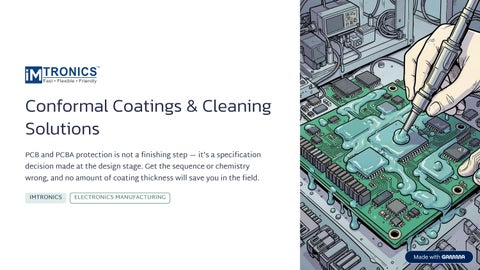
Conformal Coatings & Cleaning Solutions PCB and PCBA protection is not a finishing step — it's a specification decision made at the design stage. Get the sequence or chemistry
wrong, and no amount of coating thickness will save you in the field. IMTRONICS
ELECTRONICS MANUFACTURING
The Failure Pattern Nobody Talks About A board that fails a salt-fog test six months into a defense contract
doesn't fail because of a bad component — it fails because cleaning was rushed to hit a shift target and coating was applied over residue nobody checked.
Moisture finds its way to an uncleaned flux pocket under the coating. By the time the board is in the field, it's a warranty claim — not a production note.
Cleaning Before Coating: The Non-Negotiable Step IPC J-STD-001 Standard Ionic contamination is measured in
micrograms of NaCl equivalent per
cm². Anything above 1.56 µg/cm² risks trapping corrosive residue under the coating permanently.
The No-Clean Flux Trap No-clean flux is often left deliberately to save a wash cycle — but once sealed
under a protective coating, that residue becomes a long-term liability, not a shortcut.
Visual inspection cannot
detect ionic residue. Ask for actual test numbers, not an eyeball check.
Coating Chemistry: Match the Environment, Not the Inventory Acrylic
Silicone
Fast cure, easy rework. Moderate chemical resistance.
Wide temperature range, excellent vibration resistance.
Urethane
Parylene
High chemical and moisture resistance. Moisture-cure
Top-tier protection via vapor deposition. Requires
Best for indoor consumer electronics.
types are humidity-sensitive before application.
Harder to remove. Ideal for automotive and industrial.
specialized equipment most EMS shops don't have inhouse.
Thickness & Coverage: IPC-CC-830 Specifications
Key Thickness Rules Too thin: No meaningful protection at edges and corners
Too thick: Cracks under thermal cycling, interferes with connector fit
Coat count ≠ thickness: Humidity and technique affect actual deposit
Selective coating around connectors and test points must be planned at design stage
Five Criteria for Evaluating a Coating Supplier Ionic Contamination Data Not "visual inspection is
sufficient" — actual µg/cm² test numbers per batch.
Environment-Driven Selection
Documented Thickness Measurements
Not "one coating for everything."
Not "standard number of coats."
Chemistry must match your board's end-use conditions.
Documented Rework Process
Selective Masking Capability
Not "we'll figure it out." Solvent or
Not "we coat the whole board."
coating chemistry.
connector rework.
thermal removal specific to the
Proper masking avoids costly
Actual micron readings per batch.
This Protects Your Margin, Not Just Your Reliability
Fewer Field Failures
Contract Qualification
Properly cleaned and coated boards resist humidity and
Defense and automotive customers require IPC-CC-830
months after shipment.
qualification — having it ready shortens your sales cycle.
condensation failures that surface as warranty claims
documentation and ionic cleanliness data during supplier
Lower Rework Cost
Extended Product Life
A documented rework process avoids trial-and-error
Chemistry matched to actual end-use conditions extends
solvent damage on unfamiliar coating chemistry.
functional life well beyond a generic, one-size-fits-all choice.
Sourcing in India: What Most Buyers Overlook Storage & Transit Matter Moisture-cure urethanes are sensitive to storage humidity even before
application. Open-container shelf life is often very different from sealed shelf life — ask directly.
Chemical Compatibility Conformal Coatings & Cleaning chemistries must be stored separately. Cross-contamination during storage can compromise both — not every wholesaler will flag this.
IMTronics tracks batch and expiry data closely across Bengaluru, Pune, Chennai, and Delhi NCR — because moisture-sensitive coatings degrade faster than most buyers expect once opened.
About IMTronics Since 2013 We supply SMT equipment,
consumables, and ESD protection to Indian electronics manufacturers.
Coating and cleaning products entered
our catalog because customers building
for defense and automotive contracts kept asking us to solve reliability problems standard consumables couldn't touch.
The Test That Changed Our Recommendation In 2021, two customers reported
yellowing and reduced UV resistance on an acrylic coating for outdoor LED
applications — within 14 months, well short of its 5-year rated life. We
switched to silicone for outdoor use and haven't had a repeat complaint.
We're not the biggest coating
supplier in India. We're the one who tells you when a coating
isn't right for your application — even if it costs us the sale.
THANK YOU FOR MORE INFORMATION GET CONTACT US
📞 Call Us
+91-9971302649
🌐 Visit
www.imtronics.in
Sales@imtronics.in