Imperial Health Charity Pre-Doctoral Research Fellowship
Guidance notes, 2027/28


CHARING CROSS • HAMMERSMITH
QUEEN CHARLOTTE’S & CHELSEA • ST MARY’S • WESTERN EYE
Imperial Health Charity Pre-Doctoral Research Fellowship
Guidance notes, 2027/28
We support the five hospitals of Imperial College Healthcare NHS Trust (ICHT):
• Charing Cross
• Hammersmith
• Queen Charlotte’s & Chelsea
• St Mary’s
• Western Eye
Imperial Health Charity is committed to supporting the training and development of staff at our hospitals and pioneering research
Together with our funding partner, the NIHR Imperial Biomedical Research Centre, we run an annual Research Fellowship programme. You will need to identify an important research question that will impact on patient care at ICHT, our surrounding communities within North West London and the wider NHS.
We have funded fellows who have carried out research into new and novel diagnostic techniques and treatment, self-management and aftercare, research into service delivery, team dynamics and decision making, shift handover procedures and projects on the implementation of clinical guidelines.
Pre-doctoral Research Fellowships are available to clinicians and healthcare professionals.
The key aim of the Pre-doctoral Research Fellowship is to provide funding, primarily for Imperial College Healthcare NHS Trust staff to undertake a full-time 12-month out of their job role or their current training programme to develop their research skills and undertake a project for the benefit of ICHT patients in four of the Charity’s focus areas: Cancer, Children’s Health, Frailty, and Women’s Health
This is open to clinicians and healthcare professionals. We particularly encourage NMAHPPs (nurses, midwives, allied health professionals, pharmacists, psychologists and healthcare scientists) to apply.
*NMAHPPs is the chosen acronym of the Imperial College Academic Health Science Centre to describe healthcare professionals outside of medicine, standing for Nurses, Midwives, Allied Health Professionals, Healthcare Scientists, Pharmacy staff, and Psychologists.
Our fellowship creates a strong foundation from which to build an academic career. It is intended that successful applicants will be able to utilise the skills and data produced in their research project to springboard onto successful funding bids for further study, e.g., NIHR doctoral fellowship.
As part of our charitable objectives, we are committed to supporting our hospitals to undertake pioneering research and invest in the training and development of hospital staff for the benefit of patients.
It is important that you check your eligibility for this fellowship as outlined in this guidance. If you have any questions, please email Hani Ahmad, Senior Grants Manager: hani.ahmad@imperialcharity.org.uk
Available funding
The funding covers your salary and related research expenses. You must carry out your fellowship full-time for 12 months.
We will support the full cost of an individual’s salary and related research costs up to a maximum of £85,000.
We are unable to exceed the funding threshold.
Application timeframe
Applications will open on Monday, 8th June 2026 and close on Sunday, 1st November 2026
Shortlisted applicants will be invited to attend an interview on Teams on Monday 25th January 2027. The interview panel comprises members of the Charity’s Research Fellowship Committee. The interview will take up to 45 minutes.
Applicants will be notified of the outcome of their application by Thursday, 25th February 2027
The 2027/28 Fellows are expected to start their fellowship between May and August 2027.
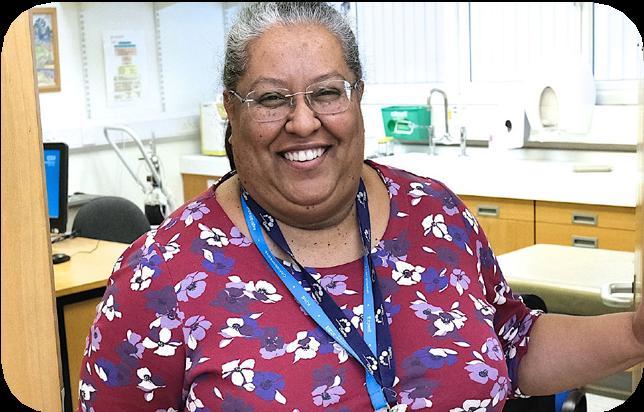
“The experience has opened up new research opportunities for me.”
Adine Adonis, Clinical Specialist Physiotherapist
Many patients affected by an inflammation of the spinal cord are left unable to walk, with bladder, bowel and erectile dysfunction severely affecting their quality of life. The progressive condition – known as HTLV-1 Associated Myelopathy (HAM) – kills off spinal cord nerves, including those that supply the leg muscles. Adine’s fellowship gave her the opportunity to explore ways of measuring muscle strength in patients affected by the condition using a handheld device called a dynamometer. In a research study involving around 50 patients – at the Trust’s National Centre for Human Retrovirology - she was able to test whether the device could be used in a clinical setting to identify muscle weakness sooner and provide treatment options to prevent further muscle and functional deterioration.
Adine said: “The fellowship gave me the opportunity to explore how research helps make a difference to clinical practice The experience has opened up new research opportunities for me, and I have since been awarded a patient and public involvement. The fellowship has allowed me to explore participants’ views on what matters most to them. The seeds of this were planted during my fellowship.”
Beacon, Imperial Health Charity’s online grants system, opens to applications on Monday, 8th June 2026. You will first need to complete the sign-up form to access the full application form.
Quick links
• ICHT research: Developing your research proposal
• Research Governance and Integrity Team SOP
• Imperial Health Charity Research Fellowships
Top tips
Get the support of your line manager as early as possible. They will help support you and backfill your substantive position if you are an NMAHPP. If you are a doctor, you will also need to contact your training programme director to request your out-of-programme. Consult the relevant ICHT Divisional Research Manager (DRM) early too. They will advise you on costing your fellowship including set-up and archive fees. Make sure your salary costs include high-cost area supplement, employer’s NI and pension contributions, and any potential pay awards. Give ample time to obtain the required signatures, and the supporting letter(s) from your supervisor(s).
Reach out to CATO for guidance and support
You must submit your application by Sunday, 1st November 2026
Checklist – make sure you include these documents with your application:
• Updated CV
• Gantt chart, and any reports, images, data or illustrations to support your research project
• Supervisor letter(s) of support
Our grants team will carry out due diligence on your application before it is reviewed by our Research Fellowship Committee. If you are shortlisted, we will contact you by Wednesday, 13th January 2026 to attend an interview on Monday, 25th January 2026 on Teams with members of our committee. You must be prepared to provide additional information during this assessment period.
You will be notified of the outcome of your application and if you are successful you’ll receive your Fellowship Grant Award Letter by Monday, 1st March 2027
• You must accept our fellowship grant offer and terms and conditions via email by Monday, 5th April 2027
• You must provide confirmation via email that your substantive post has been backfilled or Out-ofProgramme (Research) request (for doctors) secured before you start your fellowship. We expect our fellows to start between May and August 2027
• If you need ethics approval, we recommend you get started on this as soon as possible. You must provide us with a copy when this is received
You must attend the welcome and networking event on Monday, 12th April 2027, 10am to 12.30pm at the Charity’s office.
You must submit your End of Fellowship report on Beacon and final invoice within three months of your fellowship end date.
We may ask for an annual update for up to three years after your fellowship.
Before beginning an application, please make sure you have read and understood the eligibility requirements below.
We strongly advise you to read the sample application form side by side with the Guidance notes. The form will give you additional information on what is required from you.
If you have any questions, please email Hani Ahmad, Senior Grants Manager (hani.ahmad@imperialcharity.org.uk). We understand that you may have complicated contractual arrangements and we will not have covered all situations below. In your email, please describe your circumstances and we can assess your eligibility before you complete the application form
1. You must have an NHS employment contract with ICHT, noting that you currently deliver services to, and plan to undertake your proposed research project for the benefit of ICHT patients and/or its surrounding communities. You must have started in your ICHT role at the point of applying and still be employed by ICHT when your fellowship ends.
2. If you are a doctor in training and currently on rotation, you must be at ICHT at the point of applying (any time between 8th June to 1st November 2026). If you are unsure about your eligibility, please contact us before you apply,
3. If you are employed by another NHS Trust, but your Trust has a Service Level Agreement with ICHT, and you spend at least 80% of your work time at one of the ICHT hospitals
and/or directly care for ICHT patients, you may be eligible to apply, provided your research project will benefit ICHT patients
4. If you are employed by Chelsea and Westminster Hospital NHS Foundation Trust and work in West London Children's Healthcare, you may be eligible to apply, provided you undertake your fellowship at Imperial College London (ICL) and your research project will also benefit ICHT patients
5. If you are employed by ICL but have an honorary contract with ICHT, you may be eligible to apply, provided your role at ICHT includes delivering or directly supporting clinical services, and that your research project will benefit ICHT patients.
6. If you are an ICHT or ICL clinical research fellow, you may be eligible provided the research project you are currently working on is not your own. Please contact us, describing your current ICHT role, how much of your time is spent on research, is the research project your own etc
If you situation falls within points 2 and 6 above, and if your application is successful, you must undertake your fellowship at ICHT and/or ICL, and your research project must include PPIE activities with ICHT patients. If you are unsure, please contact us before you apply.
• If you are only employed by ICL.
• Past and current academic clinical fellows are not eligible to apply.
• You must not be registered for, have secured funding for, or hold a PhD or MD. Nor will the fellowship fund any part of a PhD or MD including salaries, fees or consumables. Our Pre-Doctoral fellowships are for you to carry out a standalone research project for you to collect sufficient pilot data to then do a PhD or MD.
• If you have a MSc or are currently undertaking or have registered for an MSc or MRes, you are eligible to apply for the fellowship to run alongside your intended research project. However, you’ll need to demonstrate that you’re able to do both concurrently and that your fellowship research project is a standalone project.
• If you have a MRes, please contact us before you apply to confirm your eligibility for the scheme.
• The charity will not fund salaries, fees or consumables related to an MSc or MRes. However, the costs for certain MSc training modules (excluding IT or personal development courses) will be considered if they are directly related to the research project. Please refer to our ‘Costs that can and cannot be supported’ in the Guidance Notes document that you can download from our website,
• You must be able to demonstrate a commitment to use the fellowship position to undertake further study, ideally - but not exclusively – a PhD or an MD.
• You must be resident and have a legal right to work in the UK. If you currently have a work visa, please contact the grants team before you apply.
Your application will be reviewed by our Research Fellowship Committee, which has a broad and varied range of expertise, so it’s important that your proposal is clearly presented and can be easily understood by those outside your area of research. Avoid using too much field-specific jargon and make sure all acronyms and abbreviations are defined on first use. Please refer to the Pre-doc Sample Application Form for further guidance.
You need the support of your line manager, the relevant ICHT divisional research manager, and at least one ICHT supervisor for your fellowship and research project, who must be an established investigator.
It is important that you contact them to secure their buy-in as early as possible. This ensures that you will be able to take the protected time out for your fellowship (through them arranging your backfill or supporting your out-of-programme request), that your costs will be appropriate, and that your proposal is competitive. To show their support, they need to review your application (or in the case of your supervisor/s, provide a supporting letter).
We will contact them to seek confirmation that they have read and reviewed your application.
Trust Divisional Research Managers contact details: Medicine and Integrated Care - Christopher Khuoge (c.khuoge@nhs.net) Surgery and Cancer - Donna Copeland (donna.copeland@nhs.net) Women’s, cardiac, clinical support, sexual health - Ella Johnson (ella.johnson@nhs.net)
If you are a doctor, you should ensure that you have discussed your application with your training programme director, to enable you to organise your out-of-programme (research) request.
If you have questions at any point about the funding available, your eligibility, or how to apply, please contact Hani Ahmad, Senior Grants Manager: grants@imperialcharity.org.uk
The following contacts are available to discuss your application -
• Clinical Academic Training Office (CATO) cato@imperial.ac.uk
We recommend that you consult the following useful links -
• Developing your research proposal. You will first need to log into ICHT’s intranet.
• Guidance on preparing for research Research Governance and Integrity Team SOP:
• Guidance about managing research at the Trust Research Fellowships info page
• Imperial Health Charity’s website
The application form asks for the following important information.
1. Personal details
• Your work contact information
• Your personal statement, CV and publication details, including education and training.
2. Research project lay summary
Be concise and where possible use Plain English. This information will be used in all communications to the charity’s Board of Trustees and with key ICHT teams. Avoid using acronyms, abbreviations and technical language specific to your field.
3. Research proposal (1,000 words)
Our Research Fellowship Committee is looking for you to be succinct, specific and focused on what needs to be conveyed.
• Research question
You are asked to identify an important research question that will make an impact on ICHT’s patient care, North West London communities and the wider NHS.
• Background information
It is important to acknowledge existing studies, evidence base, pilot data, publications and established tools. The committee is also looking to see your comments and acknowledgement of existing tools/data and your reasons for utilising them (or not utilising them) in your proposed research project. We do not expect you to gather this data but will want to make sure you are aware of them and can build on the evidence base or any locally conducted work.
• Measurable aims and objectives, including how you will evaluate its impact
• Design of project/plan of investigation
• Methods of analysis proposed (quantitative or qualitative)
• Practical application of the research
The committee is looking for important and interesting research topics that will have a demonstrable impact on satisfying the charity’s strategic objectives and NIHR Imperial BRC’s research themes – immediate or long-term. Quantifying the project endpoints and practical applications are key.
• References
• Gantt chart/optional figures (you must provide a Gantt chart for your research project that includes information on Health Research Authority (HRA) application/approval, if applicable, and backfill. This will enable the committee to determine if your project can be delivered within your fellowship period. The committee also encourages you to provide pertinent data that illustrates your proposed research project).
Your chosen supervisor(s) must have relevant academic research and professional background to support you in the delivery of your project. They should be permanent Trust staff (this means their employment contract has no end date), or have an Honorary contract with the Trust, showing they deliver or support clinical services, with no end date. This is to ensure you have the support you need at the Trust to undertake your fellowship. If your intended supervisor works only at Imperial College London, please get in touch with us to discuss further.
Where a research topic is particularly specialist, we can accept the addition of an external supervisor to your application.
The charity’s five-year Strategic Plan (2026 to 2031) and its objectives:
• To support exceptional patient care in our hospitals: we will go above and beyond the standard of care by funding life-enhancing technology and refurbishing hospital spaces into healing environments.
• To support the health of the communities we serve: we will take healthcare into the heart of our neighbourhoods, focusing on prevention, thus closing the health gap and ensuring everyone has a fair chance of having a healthy life.
• To drive research and innovation: acting as a launchpad for discovery, we will fund novel research and new and innovative ways of working.
The committee is looking for you to show how your research project will have a direct impact on the above, while also expecting the project to create learning and knowledge that can be disseminated more widely within the NHS.
If you are awarded a fellowship, ICHT/ICL will first pay for any approved costs upfront and then invoice the charity for reimbursement. This means you need to follow ICHT/ICL’s procurement rules.
For larger purchases (items over £5,000 at ICHT, or items over £10,000 at the ICL), you will need to seek at least two quotes, so it’ll be worth considering this at application stage.
Find out more on the Trust intranet: search ‘Procurement’, or on the ICL’s website: search ‘Purchasing’.
• Ensure you provide accurate and realistic costings, and that each cost can be related back to the purpose of your proposed project.
• Your cost should cover your salary and any reasonable research expenses only. Supervisor time cannot be costed
• Use the table overleaf as a guide on what and how much you can apply for. You must
provide a detailed breakdown of your costs, and full justification for each cost, in your application. If you do not provide this, your application will be withdrawn. You must retain quotes for any single item over £500 (except your salary). We may ask for these
• Your salary costs should be provided by the relevant ICHT Divisional Research Manager. Make sure you provide a breakdown – basic salary, high-cost area supplement, and employer’s pension and national insurance contributions. Your fellowship is more than likely to straddle two financial years, for instance FY 2027/28 and FY 2028/29. Make sure when finalising your salary that any potential pay awards are included.
• Your ICHT divisional research manager must review your costs to help ensure you have considered everything necessary Their contact details are on page 9.
Your total request cannot exceed £85,000
Cost type Amount Costs
Access charges for use of equipment and facilities
Refer to your Divisional Research Manager
Conference Up to £2,000 for all costs relating to conferences including travel and accommodation
Costs that can be covered
Only standard JRO set-up and archive costs as directed by fellows’ relevant ICHT Divisional Research Managers
Costs that cannot be covered
The charity expects the fellow’s sponsor/host institution to absorb non JRO costs. You can’t include access charges costs such data storage
Costs that can be covered
Only for the fellow. You must present your IHC/NIHR
Imperial BRC research project as a condition of attending conferences
You can only include up to two UK conferences, or one UK conference and one in continental Europe or North America
For conferences in London, we will not pay for any travel or other expenses, such as food
You must provide a detailed breakdown:
• conference fee
• standard/advanced purchase travel (outside London)
• reasonable airport transfer (up to £75 return)
• reasonable public transport to conference venue from hotel (up to £25 in total)
• accommodation up to £100 per night (outside London)
• food for up to £30 per day (if the training provider provides lunch and tea, the amount allowed is £15 per day). We will not pay for alcohol
The conference budget is up to £2,000 only inclusive of all the costs outlined above. We encourage fellows to take advantage of early bird discounts where possible
Conferences can take place within three months of your fellowship end date. However, the costs must be
Consumables including PPIE costs
Equipment
Up to £5,000
Up to £5,000
Laboratory costs
Personal computer
No set amount
Up to £1,000
incurred within your fellowship period
• Where possible, we encourage all fellows to consider their carbon footprint and to limit their travel etc. If the conference is a hybrid of inperson and virtual, the latter is a preferable option
Costs that cannot be covered
Travel insurance, visas and passport fees, excess luggage charges, etc.
Costs that can be covered
Reasonable items for PPIE studies etc.
Costs that can be covered
Small items for the fellow’s use only. You must provide full justification as to why this is essential for your research project
Our fellowships are for a short duration (12 months at 1.0 WTE). High value equipment won’t be considered
Costs that cannot be covered
Maintenance, service
If the equipment is VAT exempt, you shouldn’t include VAT costs in your application as it can be reclaimed by ICHT/ICL
Costs that can be covered
Reasonable lab chemicals and materials essential for you to deliver your research project only
Costs that can be covered
Laptop for fellow only, that must be essential to the delivery of your research project
Costs that cannot be covered
Generic software and computer accessories (drives, cases, chargers, batteries etc.)
Please note: CATO offers bursaries for all fellows for the purchase of software programmes/licenses required to undertake research projects (SPSS, NVIVO, EndNotes, etc.). Further info can be found here
This means you should not include these in your application.
Salary No set amount
Costs that can be covered include a breakdown
• Basic salary
• High-cost area supplement
• Employer’s pension contribution
• Employers’ national insurance contribution
If your fellowship straddles over two financial years, make sure you include potential pay awards
Our fellows are employed either by ICHT or ICL during their fellowship period. Therefore, the Charity doesn’t pay for maternity/ paternity leave or long-term sick leave. Your fellowship will pause from the day you go on maternity/ paternity leave, or long-term sick leave and will be reactivated when you resume your fellowship
Other staffing needs - the charity will consider the salary of other posts, such as data statistician or clinical trial unit staff, up to 0.2 FTE, if they ae essential to the delivery of your research project
Costs that cannot be covered
Redundancy
Childcare
UK apprenticeship levy
Our fellowship is for you to undertake a standalone research project. We can’t pay your salary for you to undertake a PhD, MD, MSc or MRes
However, you can undertake a MSc or MRes
alongside your fellowship
(We can pay for essential MSc training courses on a case-by-case basis, as explained below)
Training courses Up to £1,500
Travel (not for conference or training course attendance
Costs that can be covered Only for fellows
You must explain why you wish to undertake this training, including why it’s essential for you to deliver your research project, and how the courses will further your academic research career
We would consider MSc training courses/ modules that are directly related to the delivery of the your research project
If the training course is outside London, you need to provide a full explanation as to why there is no comparable course in London
Fellows must provide a detailed breakdown:
• course fee
• standard/advanced purchase travel (outside London)
• reasonable airport transfer (up to £50 return)
• reasonable public transport to training venue from hotel (up to £25 in total) accommodation up to £100 per night outside London
• food for up to £30 per day (if the training provider provides lunch and tea, the amount allowed is £15 per day). We’ll not pay for alcohol
We encourage fellows to take advantage of early bird discounts where possible
The training budget is up to £1,500 only inclusive of all the costs outlined above
For training courses in London, we will not pay for any travel or other expenses, such as food
Where possible, we encourage all fellows to consider their carbon footprint and to limit their travel etc. If an available course is held virtually, this is a preferable option to in-person
Costs that cannot be covered
Training associated with a PhD or MD
Non-science specific, IT or personal development
training courses
Training courses outside the UK Travel insurance
Up to £300
Costs that can be covered
This cost is for you to travel to attend meetings with research partners within the UK only
Training course and/or conference travel mustn’t be included here
Where possible, we encourage all fellows to consider their carbon footprint and to limit their travel etc. If the meeting can be held virtually, this is a preferable option to in-person
Costs that cannot be covered
Costs you would normally pay to travel to work and within London, including congestion charges and ULEZ charges, parking fees, any fines such as penalty parking charges.
Any costs associated with using a car, hire or private, except petrol
Publication costs Costs that can be covered
You cannot include these costs in your application. However, if there is an underspend in your fellowship, we could consider you using this for this purpose. Please contact us at that point
Other costs that cannot be covered
• Animal research
• Recruitment
• Furniture
• Utility costs
• Standard telephone and internet costs
• Departmental support staff
• Clothing
• Fees to professional membership organisations
• Insurance
1. Application support and declarations
Please consult your primary supervisor on any HRA requirements for your research project. If you’re awarded a fellowship, we would expect your HRA application to be progressed as soon as possible.
Please consult your primary supervisor if your research project involves the use of animals or animal tissue.
If you’re a medic, please confirm you have discussed your application with your training programme director.
You must allow time to secure signatures from your line manager and DRM, and your supporting letter/s from your supervisor/s, in advance of the deadline – you cannot submit your application without them.
2. First complete the sign-up form on the charity’s online grants portal, Beacon
3. You will then receive an email to access the online application form
4. There are six sections in the form. Expand a section by clicking on the V sign at the bottom right corner. Then click on Edit to start populating the section. You must complete all the required fields before clicking on the SAVE CHANGES button at the bottom of the section.
5. You can go back to your application at any point to make further changes before the application closes on Sunday, 1 November 2026
6. After this date, you will not be able to make further changes, and Beacon will automatically submit your application for you.
7. You can find your submitted application when you log in to your Beacon account.
1. All applications are assessed on the quality of the applicant and their research project.
2. The charity’s Grants team will carry out due diligence on each application including checks on eligibility and costing.
3. The applications are then reviewed by the charity’s Research Fellowship Committee in November and December 2026.
4. The committee will meet in mid-January 2027 to discuss the applications and shortlist applicants for interview.
5. Shortlisted applicants will be invited to attend an interview on Teams between Monday 25th January 2027. The interview panel comprises of members of the Charity’s Research Fellowship Committee. The interview will take up to 45 minutes.
6. Applicants will be notified of the outcome of their application by Thursday, 25th February 2027 You will be provided with feedback whether you have been successful or unsuccessful.
7. The 2027/28 Fellows are expected to start their fellowship between May and August 2027
Applications are scored across four categories:
1. Quality of the applicant
Have you produced a clear and coherent proposal, showing attention to detail in response to all questions?
Have you clearly presented your personal qualifications and experience, and the relevance of these to the proposed area of research?
Have you allocated a sufficient number of hours per month to achieve the project aims?
2. Quality of the project
Does the project seem sufficiently important with regard to the number of potential beneficiaries, the research being conducted and alignment to charity and BRC strategic objectives?
Have you presented measurable aims and identified significant outcomes?
Is your project achievable in the time given?
Are your costings well thought through and reasonable? Have you presented a sound methodology?
3. Quality of the supervisor(s)
Have you provided a convincing case for the choice of supervisor(s)?
Have the supervisor(s) allocated sufficient hours to oversee the project?
Are the qualifications and experience of the named supervisor(s) satisfactory in relation to the project?
4. Quality of long-term career plans
Have you made a good case for the importance of this fellowship to your future clinical academic research career?
Have you provided/identified a clear long-term pathway for your career?
When addressing questions in the application form regarding your career goals, it is important to demonstrate how the fellowship position will support your progression on a clinical academic research career path.
The committee wishes to see a clear and considered response to taking on future study. This should be reflected both in response to your personal career pathway and the future development of your area of research.
We are suspending the Post-doctoral scheme for 2027/28 only, In 2026/27, we awarded seven fellowships.
Pre-doc Fellows
Aoife Sweeney, Doctor
Real-time metabolomics to enhance the diagnosis and treatment of cervical precancer and cancer during colposcopy.
Charlotte Bell, Physiotherapist
Understanding central hypotonia identified in childhood: assessment, management, and lived experience
Hla Myat Mon, Doctor
Improving ovulation induction for anovulatory disorders
Imogen Pateman, Physiotherapist
The COMPP Statement: Achieving Delphi Consensus on Pre-Existing Primary Chronic Pain Management During Pregnancy
Luke Wilkinson, Physiotherapist
What expert-identified clinical factors determine when and for whom bedside positional vestibular function tests are inappropriate in adults with acute traumatic brain injury?
Post-doc Fellows
Natasha Hezelgrave, Doctor
Antenatal corticosteroid use at late preterm gestations for pregnancies affected by fetal growth restriction.
Stuti Pant, Honorary Research Practitioner
Two-step Short Oral Consent for urgent neonatal trials: a mixed-methods evaluation of parent acceptability, understanding and equity