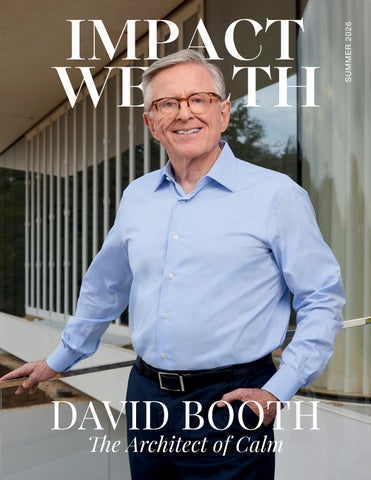
SUMMER 2026
DAVID BOOTH The Architect of Calm
1
CONTENTS INVESTING
12
34
California's Wealth Tax Debate Is Reshaping the Conversation Around Capital, Mobility, and Innovation By Candice Beaumont
16
America’s Economic Miracle and The Golden Era Of Stocks By Robert Zuccaro, CFA
18
The 10 Principles Every Family Office Needs to Master By Rich Bello
THOUGHT LEADERSHIP
HEALTH & WELLNESS
Inheritance a Machine Can 22 The Read New Science, on the
34 The Clean Air Home Gym
Shoulders of Your Life's Work By Kaushal Sheth
By Angela Gorman
New Playbook for 26 The High-Stakes Corporate Risk
Nature Indoors 38 Bringing 5 Houseplants That Will
By David Seidman
Transform Your Health and Home
COVER STORY
By Dorian May
Cancer Biopsy 42 Beyond How 5Q Spectra is Advancing
THE ARCHITECT OF CALM 22 How David Booth Transformed Academic Finance Into a Trillion-Dollar Investment Empire By Candice Beaumont
4
28
Early Cancer Detection, Care & Treatment By Hillary Latos
BEAUTY Art of Confidence 46 The How Brandon Michael Is
48
58
Redefining Luxury Hair Extensions By Hillary Latos
STYLE & FASHION SCANLAN THEODORE 48 Autumn/Winter 2026
58 Mermaid
Photographer: Daniel Perry
Watch Tailor 66 The The Art of Building a Truly Personal Watch Collection By Hillary Latos
TRAVEL
70 byEXPLORE The Leading Hotels of the World
78 The New Family Inheritance By Angela Gorman
You Make Money 84 Can With a Yacht? By Steve Doyle
78
5
CONTENTS
108 LIFESTYLE
88
By Hillary Latos
Redefining High-Culture Entertainment
Five Distinctive New Hotels From Different Corners of the World
By Candice Beaumont
By Angela Gorman
ART
FINE DINING
Horikawa 112 Rina Painting Hope Beyond the
96 Cimento Where Venture Capital
Edge of Life By Mai Itoh
Discipline Meets World-Class Winemaking By Hillary Latos
PHILANTHROPY
Entertaining Gets a 100 Home High-Tech Upgrade
Species Created Equal 114 AllInside The Brady Hunter
By Hillary Latos
6
Cirello and David Cancel Together Maverick of Modern Opera 108 The How Marcelo Guzzo is
TRAVEL
88
in the Digital Age 104 Love How Raya Brought Amanda
96
Foundation's Mission to Rescue the Voiceless By Candice Beaumont
7
EDITOR’S NOTE
The Calm and the Current: Navigating Global Wealth from the East End Summer in the Hamptons is a time for reflection, connection, and deep-dive exploration into the ideas reshaping our global economy. In this issue, we explore the intersections of generational wealth, rapid technological integration, and the visionary leaders pushing the boundaries of modern capital. We are incredibly privileged to present our cover story, “The Architect of Calm: How David Booth Transformed Academic Finance Into a Trillion-Dollar Investment Empire.” Decades after his historic $300 million endowment to the University of Chicago Booth School of Business, David Booth continues to prove that rigorous, empirical finance theory can scale into a powerhouse with over a trillion dollars in assets under management. Our exclusive feature details how his philosophy of steady, evidence-based investing provides an indispensable blueprint for navigating today's turbulent markets. Beyond our cover story, our Investing section dives headfirst into timely structural shifts, analyzing how California's ongoing wealth tax debate is actively reshaping the geography of capital, mobility, and state-level innovation. We also unmask the digital future of legacy planning in "The Inheritance a Machine Can Read," alongside a definitive guide on the 10 core principles every family office must master to thrive in the modern era. For our readers looking to enrich their personal lives, our Health, Wellness & Lifestyle features examine the future of clean living. Discover how to create the ultimate healthy sanctuary with "The Clean Air Home Gym" and learn about the five specific houseplants scientifically proven to transform indoor environments. In Fashion and Fine Dining, we bring you an exclusive Scanlon Theodore fashion spread, a tasting tour of Cimento wines, and a look at the automated future of mixology with Barsys.
with Ikonic Yachts and Yacht Hampton. We round out the issue with exclusive society coverage from the red carpets of the Parrish Art Museum Gala, the high-stakes panels of the Milken Global Conference, and the Uncharted conference right here in the Hamptons. Whether you are managing a global empire or relaxing by the shore, we hope this issue inspires you to align your capital with true impact. Enjoy the summer.
Finally, as global travel rebounds with multi-generational itineraries, our Travel & Luxury Experience team previews the five most anticipated luxury hotel openings worldwide, alongside private sea excursions
8
Candice Beaumont Managing Editor
Healthy, Radiant Skin Starts Here
LOGO GUIDELINE
10.03.2023
www.cellcosmet.com
Creating Wealth. Creating Impact. SUMMER 2026 ISSUE
Hillary Latos EDITOR IN CHIEF
Candice Beaumont MANAGING EDITOR
Emil Pavlov ART DIRECTOR
Jaime Pavon, Daniel Perry CONTRIBUTING PHOTOGRAPHERS
Neal Berger, Janelle Brown, Cristina Carbo, Maria Gutierrez, Dorian May, Amy Poliakoff, Hannah Rose, David Seidman CONTRIBUTORS
Angela Gorman, Adam Weiss PUBLISHERS
Colin Thompson
DIRECTOR OF SPONSORSHIP
Impact Wealth Media LLC 222 Broadway, 18th Floor, New York, NY 212 542 3146 www.impactwealth.org info@impactwealth.org Impact Wealth magazine is published quarterly. Copyright 2022 by Impact Wealth Media. All rights reserved. Reproduction of any material from this issue is expressly forbidden without permission of the publisher. Unsolicited manuscripts and photographs are welcome on an exclusive basis, but Impact Wealth magazine cannot be responsible for unsolicited materials submitted. Printed in the U.S.A. Contents of Impact Wealth Magazine are for general educational purposes only and do not constitute personalized financial, legal, or investment advice. Reading this publication does not establish an advisor-client relationship. Market predictions and strategies involve financial risk and speculative outcomes.
10
Drink youth.
INVESTING
CALIFORNIA'S WEALTH TAX DEBATE Is Reshaping the Conversation Around Capital, Mobility, and Innovation A Growing Unease Among California's Wealth Creators By Candice Beaumont
12
California has long been viewed as a magnet for entrepreneurs, investors, innovators, and business builders. Its climate, talent base, lifestyle, and culture of ambition have made it one of the most powerful economic engines in the United States. Yet among high-networth individuals and business owners, a different conversation is gaining momentum. In private investor circles, peer groups, and entrepreneurial networks, many are now discussing whether California remains the right place to build, invest, and preserve wealth. At the center of that conversation is concern around proposed wealth-related taxation, regulatory uncertainty, and what some business leaders describe as a growing hostility toward private capital. That concern has found a particularly vocal audience inside TIGER 21, a global peer-to-peer learning network of nearly 2,000 ultra-high-net-worth wealth creators spanning entrepreneurs, investors, family office principals, and business owners. With
a strong California presence, the network has become one of the clearest windows into how the state's most financially sophisticated residents are processing what comes next.
and a veteran of four Ironman Triathlons, more than thirty marathons, and the TransPacific sailboat race. He is also a private pilot, ship captain, and licensed real estate broker.
One voice helping to frame that conversation is Gerry Morton, a Manhattan Beach-based entrepreneur and Chair of TIGER 21 Los Angeles. Morton is the founder and CEO of NutriScience Corp, a platform he built in 2003 to develop and acquire nutrition and consumer packaged goods brands, including EnergyFirst and Greens Plus, both of which grew into category leaders under his leadership. His academic credentials are equally extensive: he holds a Master of Science in Nutrition with honors, an Executive MBA from UCLA Anderson, and is a graduate of both the MIT Entrepreneurial Masters Program and the Harvard Business School/ YPO President's Program in Leadership. Beyond business, Morton is a past president of the Entrepreneurs' Organization in Los Angeles, a YPO chapter board member, a Manhattan Beach Planning Commissioner,
That breadth of experience across peer networks, operating companies, community leadership, and high-performance competition gives Morton an unusually wide vantage point on how California's business climate is being perceived by those with the most at stake. The Concern Is Bigger Than One Tax With signatures for the California 2026 Billionaire Tax Act looking likely to clear by late June, the debate has moved from hypothetical to immediate. The proposed measure centers on a one-time five percent excise tax on individuals with a net worth of one billion dollars or more, and it has become a flashpoint in California's business community. Although the proposal is framed as a narrow levy on billionaires, many entrepreneurs see it as a precedent that could expand over time. The concern is not simply that a small group of extremely wealthy individuals may face a new tax. The deeper issue is trust. Business owners and investors depend on stable rules when making decisions about hiring, expansion, new ventures, and longterm investment. When tax policy feels unpredictable, it becomes harder to plan. For entrepreneurs like Morton, instability can be more damaging than the tax itself. It affects how risk is calculated, where capital is placed, and whether founders choose to launch future companies in California at all. Capital Moves Where It Feels Welcome Morton described a rising belief among business leaders that California increasingly views private wealth as a source to fill budget gaps rather than as a driver of economic growth. That perception matters because the people targeted by these proposals are often among the most mobile residents in the state. Unlike many wage earners tied to a specific job or location, billionaires and ultra-highnet-worth families often have homes, businesses, and professional networks
13
INVESTING
across multiple states. If they believe the regulatory environment is becoming too unpredictable, relocation becomes a practical option rather than a distant consideration. Florida, Texas, Nevada, and other lower-tax states are already attracting entrepreneurs, investors, and family offices. In some circles, the migration is no longer hypothetical. Morton noted that in one TIGER 21 peer group of 11 members, three had relocated to Florida within the past year while continuing to travel back to Los Angeles for meetings. That kind of shift, quiet and incremental, is difficult to measure in real time but unmistakable to those inside the network. TIGER 21 leadership is hearing similar patterns across Member Groups throughout California, with members raising questions not just about residency but about how the measure might reshape decisions around liquidity events, philanthropic giving, trust structures, succession planning, and family office strategy. Why the Next Generation of Entrepreneurs May Matter Most The most significant impact may not come from current billionaires leaving. It may come from the next generation choosing not to build in California at all. Existing companies can be difficult to move. Founders may have employees, facilities, customers, and deep community ties. But new companies have more flexibility. Entrepreneurs deciding where to form their headquarters, establish residency, or build their leadership teams may simply choose another state before they ever approach a major valuation threshold. This could affect California's innovation economy over time. The state has long benefited from a cycle in which ambitious founders build companies, attract capital, create jobs, and reinvest in new ventures. If future founders begin avoiding California early, the effects may compound gradually but significantly. From TIGER 21's vantage point, that long-term behavioural shift is as important to watch as any immediate relocation headline.
14
Los Angeles Faces Its Own Pressures The discussion is especially relevant in Los Angeles, where local tax and policy concerns add another layer to statewide issues. Morton pointed to concerns around city-level taxes, including levies tied to high-value real estate transactions, and the perception that new development and business formation have become less attractive. For entrepreneurs and investors, this creates a layered concern. State taxes, city taxes, regulatory complexity, and political uncertainty combine to shape the overall business climate. Even those who love the California lifestyle may begin to question whether future projects should be based elsewhere. Morton himself remains committed to Southern California, describing Manhattan Beach, where he lives and serves on the Planning Commission, as an exceptional place to build a life. For some, the lifestyle value remains worth the cost. But that does not erase the broader concern
that many peers are making different calculations, and that those calculations are accelerating as the ballot measure moves closer to becoming law. The Slippery Slope Question One of the most common fears Morton hears across his peer groups is that a tax aimed at billionaires today could eventually reach lower thresholds. Even if current proposals focus on the ultra-wealthy, many business leaders worry that public support for taxing the richest residents could make future expansion politically easier. This concern reflects a broader erosion of confidence. Once people believe the rules can change quickly, they begin adjusting behavior before new rules are even passed. They relocate, restructure, delay investment, or avoid new commitments. TIGER 21 members are particularly attuned to this dynamic because many of them have navigated multiple business cycles, liquidity events, and regulatory shifts. They understand how quickly the ground can move.
In that sense, the debate is not only about tax revenue. It is about behavior. Capital responds to signals. When business owners feel targeted, they look for environments where capital formation is encouraged rather than penalized. A Defining Moment for California's Economic Future California remains one of the most desirable and economically powerful places in the world. Its universities, creative industries, technology ecosystem, and lifestyle remain unmatched in many respects. But the state's future as a home for wealth creation is now being actively debated by the very people who have helped fuel its growth. For many high-net-worth individuals, the decision is no longer just about weather, community, or business opportunity. It is about confidence. They are asking whether California still offers a stable foundation for long-term planning.
15
INVESTING
America’s Economic Miracle and
THE GOLDEN ERA OF STOCKS By Robert Zuccaro, CFA
HOW AMERICA ENTERED A NEW ERA OF ECONOMIC PROSPERITY A profound improvement in the fortunes of the U.S. economy began in 1982, giving rise to what this writer views as an economic miracle. Over the ensuing decades, recessions became less frequent, economic expansions lasted longer, and wealth creation accelerated. At the same time, technological innovation, globalization, and the growing importance of intangible assets fundamentally reshaped the structure of the American economy. Together, these developments altered the business cycle and helped fuel a period of exceptional stock market performance that this writer believes marks the Golden Era of U.S. equities. THE ECONOMIC MIRACLE BY THE NUMBERS Improved U.S. economic conditions have led to a more robust stock market since 1982, with longer economic expansions providing a favorable backdrop for wealth creation. Recessions became far less frequent. From 1857-1981, recessions occurred about once every four years. Starting in 1982, just five recessions have occurred over the past 44 years, or roughly one every nine years. The stock market entered a new era of performance. Using 1926 as the starting point for reliable long-term S&P 500 return data, the index produced an annualized return of 9.1% during 1926-1981. Starting in 1982, the annualized return has risen to 12.2%.
16
This writer believes this marked the beginning of the U.S. stock market's “Golden Era,” driven by a fundamental shift in the economic cycle. BEHIND THE ECONOMIC MIRACLE Economic expansions started to lengthen in 1982 coincident with the shift away from a manufacturing economy to an economy replete with digital products and services. Tangible assets of S&P 500 companies shrank from 83% in 1975 to just 8% by 2025 with intangible assets including technological properties making up the difference. The burgeoning impact of a technology driven economy combined with the strong movement toward globalization in world trade has much to do with this shift. Globalization, which began taking root in the U.S. around 1970, opened new markets for many companies that became aware that the global market represented an opportunity that was four times greater than the domestic market. Thus, the US economy transitioned from a fragmented industry arrangement into a hyper-connected digital framework which led to an economic boom in technological development. Financial deregulation, the disintegration of the Soviet bloc, and the advent of the internet all contributed to this economic
boom which led to an “economic miracle” identified by this writer. This shift now allows businesses to respond more quickly than ever to changing business conditions. After 1982 economic expansions became much longer and recessions far fewer than at any time in the past century. WILL THE GOLDEN ERA CONTINUE? The unfolding economic miracle has not gone unnoticed by the stock market which has now gone up four years in a row, with the S&P 500 Index setting 23 record closing highs so far this year. Bull markets since 1981 have averaged an index gain of 221% versus 101% for earlier bull markets since WWII. Will the “Golden Era” continue in the years ahead? Yes, it will in the opinion of this writer. The US stock market has been generating above norm returns since 1982 powered by a proliferation of technological advances. The first wave of tech goliaths has made its mark on the US economy; Apple, Microsoft, Amazon, Nvidia, and Google which all went public during 1980-2004. We are now witnessing the second wave of transformative technology companies; Uber, Airbnb, SpaceX, Anthropic, and OpenAI – the latter two which are on the verge of going public at trillion-dollar market valuations.
The advent of AI holds the promise of increased productivity gains similar to the introduction of the assembly line for the Model T Ford in 1913. This innovation reduced the building time for the Model T from 12.5 hours to 93 minutes, allowing Henry Ford to reduce the price of this car from $850 to $490 one year later and double the wages of his employees. The coming second wave of new technology companies holds promise for substantial productivity gains which should translate into higher corporate profits and continued economic growth. The same forces that fueled the economic miracle of the past four decades are still gathering strength, suggesting that the Golden Era of U.S. stocks is likely far from over.
About Robert Zuccaro, CFA Robert Zuccaro, CFA is the Founder & Chief Investment Officer at Golden Eagle Strategies LLC – a Registered Investment Adviser. Robert has over four decades of experience in equity research and fund management, having led institutional portfolios through multiple market cycles. He’s been recognized by national financial publications for his growth equities portfolios and is pioneering in Hypergrowth Stock Investing.
17
INVESTING
THE 10 PRINCIPLES Every Family Office Needs to Master Why the next great wave of family wealth will be won or lost on governance, talent, and purpose, not just returns. By Rich Bello
18
Family offices are having a moment. Total wealth held by families with family offices has grown from roughly $3.3 trillion in 2019 to $5.5 trillion in 2024, a 67% increase, and Deloitte projects that figure will reach $9.5 trillion by 2030.¹ The assets those family offices directly manage are growing just as fast, from an estimated $3.1 trillion today to $5.4 trillion by 2030. I've watched this growth up close, and it's clear why family offices have become one of the fastest growing structures in private wealth.
$9.5t 90%
PROJECTED TOTAL FAMILY WEALTH BY 2030
OF FAMILIES LOSE WEALTH BY GENERATION THREE
But growth in assets doesn't guarantee growth in longevity. The oldest, most persistent finding in wealth research is still true: most fortunes don't survive contact with the third generation. A widely cited 20-year study of more than 3,200 families found that 70% lose their wealth by the second generation and 90% by the third.² In my experience, money alone was rarely the reason. The families that beat the odds shared a common thread: they ran their family office like an institution, not an inheritance. That's the premise behind the 10-principle framework I've built for creating and sustaining a family office, one that treats wealth management as equal parts finance, governance, psychology, and legacy design. Each principle comes with its own best practices reviews, giving families a way to benchmark where they actually stand. 01 Start With Mindset, Not Just Money
42%
of family offices worldwide have a formal governance framework in place³
02 Build Governance Before You Need It A family office isn't a bill-paying back office, it's a strategic enterprise. I've seen that distinction shape everything else:
• Offices that see themselves as cost centers tend to behave like one, underinvesting in talent and tolerating fee creep. • Offices that see themselves as businesses serving a client (the family) professionalize faster and make better decisions under pressure. • The starting question isn't “how do we manage this money,” but “what is this money for.”
Governance is the least glamorous principle, and in my experience it's arguably the most important. Most family offices operate on informal understandings that work fine until a crisis forces the issue.
• Family councils, written charters, and defined decision rights let a family disagree without fracturing. • Independent advisory input adds accountability that pure family control can't provide on its own. • Informal governance tends to surface its gaps at the worst possible moment: a succession, a dispute, or a death.
03 Treat Investment Strategy and Estate Planning as One Discipline Too many of the families I've worked with run investment strategy and estate planning as separate conversations happening in separate rooms.
• One side grows the wealth, the other decides who gets what, when, and how efficiently. • Tools like dynasty trusts, GRATs, and ILITs work best when the investment strategy is built with those structures in mind from the start. • Retrofitting an estate plan onto an existing portfolio almost always leaves value on the table.
19
INVESTING
04 Educate the Next Generation Before You Hand Them the Keys Financial literacy compounds like capital does. I've watched families that treat education as optional raise heirs who are unprepared to take over, and in my experience the fix is staging it to match what a young person can actually absorb at each phase of life.
• Children start with money skills: saving versus spending, needs versus wants, and the discipline of delayed gratification. • Adolescents build on that with budgeting, saving toward real goals, and a first age-appropriate look at how the family's wealth works. • Young adults move into investing fundamentals, then earn a genuine strategic voice at the table, a seat that should scale with demonstrated readiness into adulthood, not just a birthday. 05 Get the Back Office Right Accounting and operations rarely make headlines, but in my experience they're where trust is either built or quietly eroded. A large share of family offices still lean heavily on spreadsheets, which obscures the real financial picture.
• A single source of truth, real internal controls, and modern reporting infrastructure aren't luxuries. • Fraud prevention, dual authorization, and regular reconciliation are what let everything else in the framework function. • Consolidated dashboards and transparent reporting keep family members informed without anyone wading through spreadsheets.
$1.82M
average combined base salary and bonus for U.S. family office CIOs in 2025, up from $1.41M in 2023, as offices compete with hedge funds and private equity for talent⁴
06 Compete Seriously for Talent I've found that a family office is only as good as the people running it, and increasingly, family offices compete directly with hedge funds, private equity firms, and other alternative investment funds for the same talent pool.
• Discretion, cultural fit, and structured onboarding matter as much as compensation.
• NDAs and background checks protect both family privacy and institutional continuity.
• Career development and leadership
training keep top performers from drifting to hedge funds, private equity, and other alternative investment funds.
20
07 Treat Tax Strategy as a Wealth Preservation Tool, Not an Afterthought In my experience, tax is the largest recurring drag on family wealth, and one of the few a family can actually control.
• Coordinated planning across personal, trust, and corporate entities changes how much wealth actually reaches the next generation. • Jurisdiction selection and alignment between tax strategy and estate goals compound over time. • The right structure turns tax planning into a recurring source of preserved wealth rather than a once-a-year compliance exercise.
08 Don't Let Privacy Become an Excuse for Weak Compliance
THE BOTTOM LINE
Family offices operate with more regulatory flexibility than public companies, particularly under the SEC's family office exclusion, but I always remind clients that flexibility isn't the same as immunity.
• The population of single family offices globally continues to grow, and regulators have taken notice. • Scrutiny has increased, especially after high-profile blowups involving large, leveraged family capital pools. • Privacy is not secrecy: the offices building real compliance infrastructure now won't be caught flat-footed later.
43%
of family offices report a cyberattack in the past 1–2 years⁵
09 Take Security as Seriously as Returns I treat cyber and physical security as a core discipline, not an IT afterthought.
• North American offices are hit especially hard relative to other regions.
• Family offices are attractive targets
because they combine significant wealth with minimal public disclosure and often under-resourced security. • Multi-layered cybersecurity, verified payment protocols, and documented crisis response plans have moved from optional to essential. 10 Give the Wealth a Purpose In my experience, philanthropy and impact investing are where many family legacies ultimately succeed or fail. Done well, giving becomes the glue that holds a family together across generations.
• Most family offices still operate without a formalized philanthropic strategy.
• Younger generations increasingly want wealth aligned with values.
• Responsible and impact invest-
ing continues to gain ground among family offices, with allocations expected to keep climbing.
While family office success can look like an investment performance story, it's really a governance, education, and stewardship story. The families who understand that are the ones who make it to the next generation. I've spent over 25 years as Co-Founder and COO of Blue Ridge Capital, the hedge fund I co-founded that grew to roughly $10 billion in assets under management at its peak, where I helped launch and operate family offices alongside the core hedge fund business. Earlier in my career, I held senior roles at Tiger Management, Morgan Stanley, and Ernst & Young. That vantage point, inside the family office world from the operator's chair rather than the advisor's seat, is what shapes this framework. I've watched a well-run family office function as the connective tissue for a family, and I've seen the pitfalls up close, from informal governance that collapses under a succession to back offices that can't produce a reliable number when it matters most.
• Markets matter, but governance, education, talent, security, and purpose are what determine whether wealth actually survives long enough for performance to matter.
• The rare families who make it past the third generation tend to share the same traits: they treat the family office as an enterprise, articulate their values explicitly, and invest deliberately in the structures around the money, not just the money itself. • The real question isn't how to invest the capital. It's whether you want to build a legacy, and everything
else follows from that answer. Family offices are having a moment, with trillions of dollars flowing into them over the next decade. These 10 principles are what decide whether that moment becomes a lasting legacy for your family, or another entry in the 90% that don't make it past the third generation. Unpacking these ten principles requires a deeper diagnostic assessment. While my book outlines the core questions family offices should ask, executing these best practices requires continuous oversight. To explore these frameworks further and access operational checklists, visit arootah.com.
1. Deloitte, “Global Edition Explores the Rapid Expansion of Family Offices and Offers Vision of the Future Landscape,” Deloitte, 2024. www.deloitte.com/global/en/about/press-room/global-edition-explores-the-rapid-expansion-family-officesand-offers-vision-of-the-future-landscape.html 2. Trovato, Elisa Battaglia, “Engaging with the Next Generation of Family Wealth,” PWM, Apr. 2024. www.pwmnet.com/engaging-with-the-next-generation-of-family-wealth 3. UBS, “UBS Global Family Office Report,” UBS, 2023. advisors.ubs.com/mediahandler/media/563297/ubs-gfo-report-2023.pdf 4. Heidrick & Struggles, “2025 Family Offices Compensation Survey,” Heidrick & Struggles, 2025. www.heidrick.com/en/insights/private-equity/2025-family-offices-compensation-survey 5. Deloitte Australia, “The Family Office Cybersecurity Report 2024,” Deloitte, Oct. 2024. www.deloitte.com/global/en/services/deloitte-private/research/family-office-cybersecurity-report.html
21
THOUGHT LEADERSHIP
THE INHERITANCE A MACHINE CAN READ New Science, on the Shoulders of Your Life's Work By Kaushal Sheth
22
Four years ago I began building a system to trade markets. I worked on it most days. By the time I stopped it had grown to something over a hundred thousand lines, a novel and a half, written in a language only machines and I could read. Earlier this summer I sat down and read the whole thing back, slowly, as a stranger would. I expected to be reminded of how clever I had been. What I found instead was the most valuable asset I owned, and I had spent four years walking past it.
And the diary turned out to be worth more than the machine.
software is an unusually honest record that cannot be tidied up afterwards.
The parts still running told me what I currently believed, which I already knew. The parts I had abandoned told me what I once believed and stopped believing, and that is where all the learning actually lives. The working system was the conclusion. The discarded ideas were the reasoning.
Consider what your own institution keeps: the acquisitions, the allocations, the board minutes, the annual letter. Every decision taken, documented to a standard your auditors are happy with.
There was one problem, and it is the reason I am writing this. I had faithfully recorded that I stopped. I had almost never recorded why.
The Diary I Didn't Know I Kept The Diary Your Company Is Keeping Roughly one line in twenty was switched off. Not deleted but turned off, and left exactly where it was. Whole strategies I had built, tried, doubted and quietly retired, still sitting in place like furniture in a house nobody cleared out. A hundred and eighty-one of them, each marked with some version of the same note: old, not in use, superseded.
I found, twice, that I had built and abandoned nearly the same idea about eighteen months apart. Not a variation but the same idea, approached from a different direction, killed for what I suspect were the same reasons both times. The second version was built by a man with no memory of the first.
I had never thrown anything away in four years. I had been keeping a diary the entire time and I had not known I was writing one.
That is not a story about a careless engineer. It is a story about every organization I have worked in, visible in my case only because
Now consider what it keeps of the decisions it declined. The business you looked hard at and passed on. The market you spent four months studying and walked away from. The standing rule — we don't take that kind of leverage, we don't partner on those terms — that has protected the company for thirty years and whose original reasoning left with the person who set it. I spend much of my working life inside large enterprises, and I have now seen this in enough of them to stop calling it a coincidence. The pattern holds almost without exception: the older and larger the institution, the more complete its record of what it did, and the thinner its record of what it chose against. Ask why the firm doesn't do a particular thing and you get an answer immediately, with real conviction. Ask what evidence produced the rule and when anyone last tested it, and the room goes quiet. I have sat in meetings where a prohibition older than most of the people present was restated with total confidence, and nobody could name the event behind it. The company had outlived its own reasoning. I single out the refusals only because they are the seam nobody thought to keep. They are one part of something far larger. Everything a working life produces is inheritance: the deals that worked and why, the instinct for a counterparty, the feel for when a market has turned, the hundred small corrections too obvious to write down and too hardwon to be obvious to anyone else. All of it. Until very recently almost none of it could be handed on, so almost none of it was, and every generation started closer to the beginning than it needed to. What Has Genuinely Changed The useful breakthrough here is not that machines can predict. Predictions were never in short supply.
23
THOUGHT LEADERSHIP
that has been recording what it learned since it learned to write. This means the raw material of this technology is precisely the thing you have spent a career producing. So you are not starting from zero and you are not behind. Whatever you have been told about needing years of clean data first, you already hold the least copyable asset in your industry: decades of expensive, hardwon, largely unwritten understanding of how your world actually works. Competitors cannot buy it or hire it away, and most have not realized they are sitting on their own. It is in the filing cabinets, the closed folders, and the four people who have been there longest. For the first time, it is recoverable. Start unglamorously. On the next thing you decline, write down why, in three sentences, on the day you decline it — that is the seam nobody keeps, so it is the cheapest place to begin. Then let a machine read what you already have and show you what you have been repeating. I found my own repetitions at eighteen-month intervals, and I am one person with a good memory. It is that a machine can now read, thirty years of minutes, memos, letters and closed files, at a pace no team could sustain, and answer plain questions about them. How often has this committee looked at this same structure and passed, what reason was given each time, and did the reason change? I put thirteen questions of that kind to my own record and made the machine answer from evidence rather than from my memory, which I had learned not to trust. Several hundred answers came back. Eight survived every attempt I made to break them, and those eight I now treat as settled. Eight, out of four years. It sounds brutal. I think it is roughly right, and I would be suspicious of anyone whose ratio looked much better.
managed was made standing on work someone else did and wrote down. That is the whole mechanism of human progress, and it has always leaked badly: most of what a person learns in a lifetime of doing something well dies with them, because writing it down properly was always slower than living it. What is arriving now is not a machine that thinks for us. It is the first honest repair to that leak — patient enough to receive a lifetime of knowing, and precise enough to hand it on intact. The compounding that follows is the interesting part. Your successors will not start where you started. They will start where you stopped, and go on from there, and the person after them will start where they stopped.
The families and founders thinking seriously about the next hundred years are rarely worried about handing over the assets. There are excellent lawyers for that. The harder question was always how you hand over the knowing — the whole of it, not the summary. That was impossible for so long that we stopped treating it as a question at all, which is why every generation has quietly rebuilt what the one before it already knew. It is no longer impossible. What you have learned is not lost. It was only ever unread, and something can read it now. What gets built on top of it will not be yours, and that has always been the point of an inheritance.
About Kaushal Sheth This is the least glamorous use of artificial intelligence I can think of. It forecasts nothing. It lets an institution read its own mind, and I have come to think that is worth more than anything on the demonstration stages. It is also, I think, how the next real advances get made. Every discovery any of us has
24
Everything It Knows, It Learned From Us The current mood makes this easy to forget, so let me say it plainly: everything these machines appear to know, they learned from people who did the work and wrote it down. Nothing in them is original to them. They are the accumulated output of a species
Kaushal Sheth is co-founder of an AI-native investment research firm and CTO of a global financial technology company. He has spent the last decade building intelligent systems at the intersection of computational neuroscience and capital markets..
MIKE BLANKENSHIP HOUSTON OFFICE MANAGING PARTNER Winston & Strawn
KEY SUPPORT AREAS
Offering 10+ Years of Expertise in IPOs, M&A & Private Equity
SCAN QR CODE FOR BIO & CONTACT INFO
NORTH AMERICA
Mike is the managing partner of Winston’s Houston office. He focuses his practice on corporate finance and securities law, including securities offerings, public company advisory, special purpose acquisition company offerings, private equity and venture capital transactions, mergers and acquisitions, and general corporate representation.
SOUTH AMERICA
EUROPE
ASIA 25
THOUGHT LEADERSHIP
The New Playbook for
HIGH-STAKES CORPORATE RISK The Litigation Paradigm Shift: Why Wealth and Business Strategies Must Adapt By David Seidman
The corporate legal landscape has fundamentally fractured over the past fourteen months. While overall case volumes are declining for the Fortune 1000, the financial magnitude of individual claims is skyrocketing. This shift from frequency to extreme severity means that a single, unmitigated lawsuit can destabilize an enterprise and erode substantial private wealth. Compounding this risk is a severe drop in corporate readiness. Recent data reveals that corporate counsel leaders feeling "very prepared" for litigation plummeted from 46% to 29%. For high-net-worth investors, family offices, and business owners, passive monitoring is no longer a viable defense. Navigating this volatile environment requires a proactive legal strategy across four critical frontiers. 1. NAVIGATING THE TECHNOLOGICAL FRONTIER: AI AND EVIDENTIARY RISK Artificial Intelligence has evolved into a powerful operational engine, yet its rapid adoption has far outpaced the maturity of the legal frameworks governing it. This disconnect creates a dangerous friction between corporate utility and legal liability. Business leaders must recognize four primary evidentiary challenges currently being forged in federal and state courts: Absence of Human Authorship: AI-generated materials lack human creators, complicating traditional legal standards regarding intent and testimony. Opacity of Provenance: Algorithms rarely leave a transparent audit trail, raising steep hurdles for admissibility and authentication. Proprietary Exposure: Standard judicial discovery requests targeting AI processes risk exposing proprietary algorithms and violating third-party non-disclosure agreements. Fictional Citations and Hallucinations: AI-generated legal "hallucinations" have resulted in severe judicial sanctions and permanent reputational damage.
26
2. GUARDING THE $21 BILLION DATA PRIVACY BATTLEFIELD Data breaches and privacy violations now represent the single largest driver of highcost litigation. Total class action settlements reached an unprecedented $21 billion in 2025. While large-cap companies face the brunt of massive data privacy class actions, businesses of all sizes are vulnerable to a aggressive new wave of statutory litigation. Plaintiffs are increasingly leveraging the federal Video Privacy Protection Act to target ubiquitous corporate tools like web analytics pixels and session-replay code. Concurrently, state-level biometric laws and the Genetic Information Privacy Act (GIPA) represent a rapidly expanding frontier of liability carrying draconian statutory penalties. 3. ADAPTING TO THE POSTCHEVRON REGULATORY SURGE The Supreme Court’s landmark decision to overturn the Chevron doctrine has fundamentally shifted the balance of power. By removing mandatory judicial deference to federal agency interpretations, the court has effectively given private litigants a green light to challenge federal rules. This unpredictability will inevitably lead to a highly litigated federal regulatory environment. However, the more immediate threat is the corresponding surge in state-level regulation. As federal oversight faces systemic challenges, individual states are aggressively implementing their own regulatory frameworks to fill the void. For businesses operating across multiple jurisdictions, the compliance burden has multiplied exponentially. 4. PROTECTING INTELLECTUAL CAPITAL VIA TRADE SECRETS
Trade secrets offer three distinct strategic advantages for wealth preservation: Absolute Confidentiality: No public disclosure is required, preserving competitive advantages indefinitely. Unlimited Duration: Unlike patents, trade secrets never expire, offering perpetual protection for proprietary formulas, customer lists, and core algorithms. Economic Breadth: The framework shields the underlying business methods and operational technologies that directly drive firm valuations.
outlined in Mustafa Suleyman’s The Coming Wave, the intersection of rapid technological adoption and regulatory necessity requires immediate, structural guardrails. Review your frameworks, engage proactive counsel, and insulate your capital before the crisis hits. David Seidman is the principal of Seidman Law Group, LLC, serving as outside general counsel for mid-market companies, & high net worth business owners. This article provides general educational insights and does not constitute formal legal advice. He can be reached at david@seidmanlawgroup.com
About David Seidman With non-compete agreements rapidly becoming a relic of the past, protecting an enterprise's "secret sauce" requires a strategic pivot away from patents and toward trade secrets. Because patents require public disclosure, sophisticated firms are increasingly relying on the Defend Trade Secrets Act (DTSA) to protect their core valuations.
THE MANDATE FOR 2026: PROACTIVE RISK MITIGATION A reactive legal posture is a direct threat to capital. In an era defined by profound regulatory unpredictability and the AI revolution, leadership must shift from passive observation to aggressive risk mitigation. As
David Seidman is the principal of Seidman Law Group, LLC, serving as outside general counsel for mid-market companies, & high net worth business owners. This article provides general educational insights and does not constitute formal legal advice. He can be reached at david@seidmanlawgroup.com
27
COVER STORY
28
The Architect of Calm
How David Booth Transformed Academic Finance Into a TrillionDollar Investment Empire The co-founder of Dimensional Fund Advisors has spent five decades making the case that the simplest investing strategy is also the best one. Now, with his new book, Stay Calm, his message has never felt more urgent. By Candice Beaumont
David Booth grew up watching his parents live in quiet financial uncertainty. His father, a World War II veteran who settled in a small Kansas town, never once bought a single stock. Neither did his mother. The market, in their view, was a trap built for insiders, and ordinary people like them had no business near it. They kept their savings in cash, locked in a safety deposit box, untouched for forty years. When Booth opened that box after they passed away in 1985, he found $15,000 sitting there, earning nothing, slowly losing ground to inflation while the stock market quietly multiplied fortunes all around it. That image never left him. It became a symbol for everything he built. Today, David Booth is one of the most consequential figures in the history of modern investing. As the co-founder of Dimensional Fund Advisors, he turned a set
of academic ideas that most of Wall Street dismissed into a firm managing over a trillion dollars in assets. His weapon was never a smarter algorithm or a sharper trading instinct. It was evidence, patience, and an unshakeable belief that ordinary people deserved the same returns that markets had always been capable of delivering, if only someone would stop telling them the game was rigged against them. This revolutionary approach to finance, democratizing academic theory for the everyday investor, ultimately culminated in a historic $300 million gift to his alma mater, which at the time it was given set a record as the largest individual gift ever given to any business school in the world. Today, the University of Chicago Booth School of Business permanently bears his name, standing as a monument to the very ideas his parents once feared, and transforming him into one of global education's most impactful philanthropists.
That mission now has a name, and it is two words: Stay Calm. Your book is called Stay Calm. When markets are tumbling and headlines are screaming, what is the first thing an investor should do to keep their emotions from hijacking their portfolio? Stand back and return to your investment principles. Think long-term. Don't get caught up trying to time short-term moves in the market. It is always appropriate to review your long-term plan, but the focus should be on what you can control. You can control how much risk you take. The market, you cannot. If you have a well-thought-out investment process, you should not have to make adjustments very often. Warren Buffett has said that over his entire career, he has had to make maybe seven or eight big shifts. That is the spirit you need to have.
29
COVER STORY
You helped create one of the first index funds, which now accounts for a massive share of global assets. Was it clear from the beginning that the idea would have this kind of impact?
not seem to be able to do any better than that. So the individual investor has as good a chance of getting the market return as the pros. I think that is a miracle. We ought to be having ticker tape parades for this research.
Absolutely not. When the idea first emerged that trying to pick individual stocks is a losing game, and people began thinking about indexing as an alternative, it was a genuine challenge to the establishment. That is not a phrase I use lightly. The academic research behind these conclusions came from a new generation of economists who were questioning the orthodoxy that you had to stay up late pulling your hair out trying to pick stocks. That turned out to be a poor way to go.
You spent decades collaborating with Nobel Laureates like Eugene Fama and Robert Merton. What is a specific lesson from those relationships that shaped the core message of Stay Calm?
The good news is you do not have to do any of that to have a good experience. Everybody can buy market portfolios. They are very inexpensive and easy to access. And it turns out that professional money managers do
30
My very first course at Chicago was taught by Gene Fama, and he laid out his view of how markets work and why the conventional wisdom does not hold water once you put it to a test. The breakthrough was really data. Before the 1960s, you did not have the data to properly test investment claims. As a result, people could say anything. The shift came when we finally had data that could put those claims to the proof, and many of them were found wanting.
That was what motivated me. The ideas of Fama and Merton and the other leading academics of that era needed to be applied. They should not stay locked in academic circles. These ideas can change people's lives. That is what made me want to leave school and start working on putting them into practice. And it is gratifying to see, fifty years later, that they worked. Fees have come way down. Risk controls are much better. People are getting a much better deal than they were when I graduated in 1971. In the early days of Dimensional Fund Advisors, your small-cap strategy underperformed the broader market for nearly a decade. How did you hold firm, and how did your clients stay the course? When you have logic, reason, and empirical evidence on your side, that helps. But what we also had was an intuitive pitch that people accepted right away. When we went
The goal is always to manage uncertainty, not to eliminate it. You have to figure out what types of uncertainty you are willing to accept and in what quantity. Control what you can control, and manage what you cannot. with your plan, you are much more likely to stay calm when things get difficult.
in to see our first clients, large institutional investors like IBM and Boeing, we made a portfolio argument rather than a stockpicking argument. We would ask: if you are building an equity portfolio, does it not make sense to hold stocks in both large companies and small companies rather than concentrating everything in large caps? That is obviously sensible. Then we would follow up: but you are not doing that. Let us help.
disappointing. Since then, small stocks have done better, as history suggested they would.
People accepted that idea. And our first decade, as you point out, was an unusually difficult one for small stocks relative to large stocks. But we delivered exactly what small caps did, and over the long haul, we have significantly outperformed small-cap indices. So the clients were getting what they asked for. Sometimes you lean back and ask: does the idea still make sense? Yes, it does. We just had a difficult time. That happens in markets. Every strategy, every idea has its periods when things are
I do. Whether you are a professional athlete or an investor, there is a tendency to cry over spilled milk. I didn't get that call. I should have done this differently. The theme of Stay Calm is that if you truly understand how markets work, you will come up with an investment plan that is sensible, and you will be able to live through the ups and downs far better than someone who thinks they have some kind of magic edge or special insight. Once you have made good decisions and you are comfortable
You have drawn a direct parallel between elite athletes and disciplined investors. As a former professional tennis player myself, I find that comparison fascinating. Do you think elite athletes and elite investors share that mental muscle of letting go and focusing on the next move?
When you get a bad call in tennis or a bad quarter in the market, judge yourself by the quality of your decision, not the outcome. If you hit the shot the right way but the opponent made something phenomenal, there is nothing you can do about that. You step back and say: I did everything I could. That is true whether you’re playing tennis or investing in the market. How has your view of uncertainty evolved, from selling shoes in Kansas to managing a trillion-dollar global firm? The goal is always to manage uncertainty, not to eliminate it. You have to figure out what types of uncertainty you are willing to accept and in what quantity. Control what you can control, and manage what you cannot. About twenty years ago, I received a serious cancer diagnosis. I looked at all the options, came to a conclusion, and dealt with it. That is controlling what you can control. It turned out well, which is why I am here talking to you today. But that experience crystallized something for me. Anytime you are in a tense situation, fall back to those principles.
31
COVER STORY
The biggest lesson is this: life is about maximizing true wealth, not maximizing your investment portfolio. If you concentrate too hard on the wrong thing, you sacrifice something more important.
What are my options? What can I actually influence here? Dealing with uncertainty is fundamentally about resolving trade-offs, and usually there is no perfectly optimal solution. You just do the best you can. That is why the book is called Stay Calm. If you have made a thoughtful decision, a wellconsidered one, you can relax a bit afterward. It is the willy-nilly decisions, the reactive ones made under pressure, that spike the anxiety. Modern culture is obsessed with financial hacks and shortcuts. Why do you think that is, and how can investors resist the temptation? It is almost basic human nature. In most areas of life, if you are smarter and work harder, you will probably do better than the person next to you. That is simply not true when it comes to investing in public stock and bond markets. And the reason is actually encouraging once you understand it. Public markets are genuinely remarkable places. Buyers and sellers come together and do not trade unless each side believes they are getting a fair deal. You have very sophisticated institutions on both sides of every transaction. What emerges from all of that activity, with all of its liquidity, its volume, its investor
32
protections, are fair prices. Not perfect prices. Not prices that guarantee a positive return tomorrow. But fair prices. And the implication for the individual investor is powerful: you can get a fair deal simply by buying the market. You do not need to outsmart anyone. You have shared a beautiful story about your high school math teacher, Mrs. McReynolds, who believed in you when you had given up on yourself. How did that single moment shape your trajectory? It is a story I told my children often while they were growing up, because it is a lesson in how a single setback can cloud your judgment. Up until the final exam in my senior year calculus class, I was actually excelling in her class. But I became seriously ill right when finals hit and did poorly on the test due to my illness, so I did not do well enough to earn college credit. Being a teenager, I overreacted to the disappointment. I dropped to a lower level math class and convinced myself that I simply wasn’t meant to take math ever again. My first day in the new class, Mrs. McReynolds walked in. She had noticed I was gone, went to the office to find out where I was, and tracked me down. She told me how badly she felt and asked me to come back. This was a woman who went out of her way to do that for a student. I could not say no. And the
short version is that I went on to take a great deal of math after that and earned top marks in every course. I had just had a bad day. I told that story to my kids every time a result came back disappointing. That is life. You have a bad day. It does not define your capabilities. Your philanthropic footprint runs from the University of Kansas to the Chicago Booth School of Business. When you decide to support an institution, what are you looking for? Initially, it was about paying back the people and institutions that helped me. I grew up in modest circumstances, and through education I was able to build a good career. The University of Kansas and the University of Chicago gave me that foundation, and I wanted to give something back. Now it is more about impact. What can I do that genuinely moves the needle? My gifts to Kansas have had a real effect, not just on the university but on my hometown and the surrounding region. My gift to the Chicago Booth School was really about ensuring it can remain at the very top of business education. I would rather give away my money while I am still around to see the impact, because I genuinely enjoy that. I get more out of it than I put in. It sounds a little corny, but it is true.
What is the legacy you most hope to leave behind? Hopefully, more people who have a better understanding of how markets work, and who have arrived at investment solutions they can feel genuinely confident about. Not just financially secure, but safe, in the deeper personal sense. In your personal life, you want to feel that whatever happens, you are going to be okay. That is what we are trying to help people achieve with investing. If you can figure out how to make good decisions in life and in the market, you should be able to feel comfortable with the outcomes, even when those outcomes are not always what you hoped for. If you have done everything you can, that is all you can do. For financial advisors using your book as a guide for anxious clients, what is the single biggest takeaway? We organized Stay Calm into three parts, and the final section is really about true wealth.
When you ask people what is genuinely important to them, money typically appears fairly far down the list, after family, friends, health, and purpose. My parents were wealthy. They just did not have much money. They had a great family, strong values, a life they were proud of. That was true wealth to them. The biggest lesson is this: life is about maximizing true wealth, not maximizing your investment portfolio. If you concentrate too hard on the wrong thing, you sacrifice something more important. Keep your eye on the ball. What really matters to you? And then invest, in life and in the markets, in a way that reflects that priority, not the other way around. How would you define true wealth, and how can readers ensure their money is actually supporting a life of purpose and freedom? True wealth is something only you can define for yourself. My parents defined it as a good family, a reasonable standard of
living, and the knowledge that they could get through life without taking on financial risk that might threaten the things they cared about. That was enough for them, and they were right to feel that way. For me, true wealth has been the privilege of working alongside extraordinary people, academics and clients who have pushed my thinking and made me better at everything I do. I learned that lesson early. During my second year at Chicago, I went home for Christmas to my grandparents' house in a small Kansas town. No indoor plumbing, linoleum floors, relatives crammed into every room, everyone bringing their favorite pie. And everyone was laughing and having a wonderful time. I was standing there completely stressed out over my research. My family was mainly farmers. And I looked around and thought: these people have figured something out that I have not. That is where I learned my lesson about true wealth.
33
HEALTH & WELLNESS LIFESTYLE
THE CLEAN AIR HOME GYM As luxury homeowners rethink materials, ventilation and design, the private gym is becoming one of the most considered wellness spaces in the home. By Angela Gorman
34
The private home gym has been undergoing a meaningful transformation for the last decade. Wellness is now deeply embedded into luxury living and homeowners are looking beyond just equipment and square footage when considering the gym environment. The air they breathe, the materials being used, and even the way the room feels aesthetically are considered when assessing if they fit into a daily wellness routine. This new awareness is changing the way fitness spaces are designed from the ground up. Standard items when you think of traditional gyms like rubber flooring, synthetic yoga mats, adhesives, plastic weights and cleaning products are now considered to only add to our toxic load. With new research around indoor air quality and environmental toxins becoming mainstream, many homeowners are demanding that the spaces designed to support their health be held to a higher standard. At Paragon Studio, the London-based luxury wellness brand designing bespoke fitness spaces and premium gym equipment for private homes, hospitality clients and superyachts, this shift is already influencing client demand. “Clients are becoming far more forensic about what they bring into their homes, and that scrutiny now extends to fitness spaces,” says Edward Thomas, founder of Paragon Studio. “The same individuals who avoid toxins in their kitchens and bathrooms are starting to question why a workout still means breathing in emissions from rubber, foam and plastic.” The concern is especially relevant during exercise. People breathe more deeply and frequently while training, increasing exposure to the surrounding air. In a fitness setting, potential sources of indoor pollutants may include rubberized surfaces, foam accessories, synthetic equipment materials, adhesives, disinfectants and cleaning products. Many of these release volatile organic compounds, or VOCs, contributing to the unseen environmental load of a room. “There is growing awareness of the unseen impact of traditional gym equipment, from synthetic materials to off-gassing VOCs,” Thomas says. “For many, investing in their health while surrounded by these inputs no longer aligns.”
Nerio Alessandri, founder and CEO of Technogym, says the definition of the luxury home gym has expanded significantly in recent years.
of the home. “A luxury home gym is now a space that inspires and motivates, designed with the same attention to detail as the rest of the home, if not more,” Alessandri adds.
“The concept of a luxury home gym has evolved far beyond being merely a room with fitness equipment into a fully integrated and personalized wellness space,” says Alessandri. “Today, luxury means creating a holistic place that supports a wellness lifestyle. This new definition is centered on experience and seamless integration into the home architecture.”
For Paragon Studio, this evolution is closely tied to material. Each project begins with the space itself, considering architecture, movement patterns, finishes, airflow, lighting and the way a client wants to use the room. The result is a softer, more thoughtful approach to fitness design.
That seamless integration is increasingly important for UHNW homeowners, who bring the same level of design awareness to wellness rooms that they do to kitchens or entertaining areas. A private gym is expected to function, look beautiful, feel good emotionally and reflect the overall aesthetic
“There is a clear shift away from highintensity, performance-led fitness within the home towards more considered, restorative environments,” Thomas says. UHNW home owners are prioritising spaces that support the daily rituals that help them with their recovery, stress management and overall balance.”
35
HEALTH & WELLNESS
“Many are already training at a high level elsewhere, whether that is a private members’ club or specialist PT studio,” Thomas says. “At home, the focus is different. It is about creating space for lower-intensity movement such as Pilates, yoga and meditation, alongside recovery tools like cold plunges and saunas.” With fitness equipment becoming a permanent feature of the home, beauty has become an essential part of the equation. Equipment should perform but also belong aesthetically. “While gyms were once relegated to dark basements, the desire for home wellness spaces that are as beautiful and well-designed as the rest of the home has become a decisive factor,” Alessandri says. “When equipment is a permanent feature in a home, it must be in harmony with the interior design.” For Alessandri, environmental wellness is also part of that experience. “At Technogym,
36
we have always believed that personal well-being is connected to environmental well-being,” Alessandri says. “When you respect your own health, you also respect the health of the planet . This philosophy is the driving force behind our latest innovations, such as our new Sand Stone Collection, which is a direct response to this growing desire for environmental harmony and conscious luxury in Wellness.” Air quality, material choices, ventilation, lighting, acoustics, equipment design and technology all play a role in creating a room that feels as healthy as the lifestyle it is meant to support. Both Paragon and Technogym’s equipment is for the homeowner who wants fitness equipment to feel crafted and consistent with the rest of the home with softer palettes and more considered materiality that support lowering cortisol and a more sustainable approach to wellbeing.
Creating Your Own Clean Air Gym For those looking to build out their own clean air gym, the process often begins with prioritizing ventilation and filtration, bringing in natural light where possible, selecting low-emission finishes, choosing equipment with durable materials and avoiding unnecessary synthetic accessories. Paragon Studio’s product range offers a way to build this environment piece by piece, combining craftsmanship, utility and an elevated material language. The Pilates Hand Weights Kit, starting from £1,236 including VAT, is designed for toning and light-weight exercises, with 1, 2 and 3kg weights stored on a portable rack. The set can be displayed on a tabletop or shelf, with a carry handle that allows the weights to be moved outside or to another workout location. Available with customizable wood and metal finishes, it is designed to complement the interior rather than disrupt it.
The Classic Leather Medicine Balls, starting from £66 including VAT, offer a more refined alternative to standard synthetic gym accessories. Handcrafted from 100 percent genuine leather and available in dark tan, red brown or dark brown, they bring a timeless, tactile quality to strength and conditioning work, with weight options ranging from 4lb to 20lb. The Paragon Studio Pull Up Bar brings bodyweight strength training into the home with a minimal footprint. Wall-mounted for stability, it provides a secure platform for pullups, chin-ups and hanging core work while maintaining a clean, architectural aesthetic. Technogym adds the performance and technology layer with equipment designed to integrate into interiors while supporting personalized training. Meet their new Sand Stone Collection and their newest product the Technogym Reform, the brand's first Pilates reformer. Launching in the U.S. this September, the reformer combines studioquality performance with Italian design.
37
HEALTH & WELLNESS
BRINGING NATURE INDOORS 5 Houseplants That Will Transform Your Health and Home By Dorian May
38
Skin healing and hydration The primary health benefit of keeping an Aloe vera plant nearby is its immediate availability for topical skincare. If you suffer from dry skin, minor burns, sunburns, or insect bites, you can simply snip off a small lower leaf, slice it open, and apply the raw gel directly to your skin. It provides an instant cooling effect, reduces inflammation, and accelerates tissue repair without any added synthetic chemicals or preservatives. Low-maintenance care Aloe vera thrives on neglect, making it perfect for beginners. It requires bright, indirect sunlight and minimal watering. Place it on a sunny windowsill in your kitchen or bathroom so it is always within arm's reach when your skin needs a quick, soothing treatment. 2. SNAKE PLANT: THE 24-HOUR OXYGEN FACTORY Formally known as Sansevieria (and affectionately called mother-in-law’s tongue), the snake plant is a striking architectural marvel characterized by its upright, swordlike leaves. While it adds a sharp, modern design element to any room, its internal airpurifying capabilities are where it truly shines. Nighttime oxygen production
If you have been scrolling through your feed lately, you have probably noticed a major shift toward greener, more intentional living spaces. With remote work rates doubling in the post-pandemic era, creating a balanced living space has become more essential than ever. But indoor plants are far more than just a trendy aesthetic or a beautiful backdrop for your next photo. They are living, breathing wellness tools that actively improve your physical health, sharpen your mental focus, and purify the very air you breathe.
For daily inspiration on how to style these green companions and curate a home that feels like a wellness retreat, make sure to connect with Dorian May on Instagram.
When you introduce the right greenery into your living space, you are investing in a daily dose of nature therapy. From clearing out unseen household toxins to providing soothing skincare straight from the leaf, the benefits of becoming a plant parent are undeniable.
No wellness-focused home is complete without the powerhouse known as Aloe vera. This succulent has been celebrated for centuries as a "miracle plant," and for good reason. It features thick, fleshy leaves packed with a clear, nutrient-dense gel containing vitamins, minerals, enzymes, and antioxidants.
Here is a look at the top indoor plants that benefit your health and how you can easily integrate them into your daily self-care routine. 1. ALOE VERA: THE ULTIMATE NATURAL SKINCARE SPECIALIST
Most plants absorb carbon dioxide and release oxygen during the day through photosynthesis, reversing the process at night. The snake plant is a rare exception. It continues to convert carbon dioxide into fresh oxygen all through the night. This unique trait makes it the absolute best plant to place on your bedroom nightstand to improve sleep quality and keep the air feeling crisp and light. Filtering everyday toxins In addition to boosting oxygen levels, snake plants are highly effective at filtering out airborne toxins like benzene, formaldehyde, xylene, and toluene. These invisible chemicals are commonly emitted by everyday household items like carpets, cleaning products, and synthetic furniture.
39
HEALTH & WELLNESS
3. SPIDER PLANT: THE RESILIENT PURIFIER If you feel like you lack a green thumb, the spider plant (Chlorophytum comosum) is your perfect match. With its graceful, arching leaves and tiny "spiderettes" that dangle from the mother plant, it adds beautiful texture and movement to hanging baskets or high shelves. Champion of clean air Don’t let its delicate appearance fool you. The spider plant is a heavyweight champion when it comes to cleaning the air. It is incredibly efficient at removing up to 90% of the formaldehyde and carbon monoxide from your indoor environment within just a few days. Safe for furry friends One of the biggest hurdles for pet owners looking to buy plants is toxicity. Luckily, spider plants are completely non-toxic to both dogs and cats. You can let them cascade safely from your living room shelves without worrying about your curious four-legged roommates. 4. PEACE LILY: THE MOISTURE AND TOXIN BALANCER With deep green foliage and elegant white blooms, the peace lily (Spathiphyllum) brings an instant sense of tranquility to any corner. It acts as an organic filtration system and a living humidifier all at once. Reducing airborne mold spores Peace lilies excel at absorbing airborne mold spores and dust, making them an excellent addition to bathrooms, laundry rooms, or damp spaces prone to mildew. By lowering the dust and spore count in the air, they can significantly reduce symptoms for individuals who suffer from seasonal allergies or asthma. Adding healthy humidity Through the process of transpiration, peace lilies release moisture back into the air. This natural humidifying effect is incredibly beneficial during dry winter months or in air-conditioned environments, helping to soothe dry sinuses, scratchy throats, and chapped skin.
40
5. ENGLISH IVY: THE RESPIRATORY RELIEF AID English ivy (Hedera helix) is a classic climbing vine that brings an elegant, old-world charm indoors. When grown in a hanging pot or trained to climb a small trellis, it creates a stunning vertical visual anchor. Neutralizing airborne particles Studies have shown that English ivy is exceptionally good at reducing airborne particles of fecal matter and mold. For anyone living with respiratory sensitivities, introducing English ivy to a primary living space can noticeably clear the air, making every breath feel deeper and cleaner. Design Your Sanctuary with Dorian May Transforming your home into a healthy, vibrant sanctuary is all about choosing pieces that nourish both your eyes and your wellbeing. Incorporating these air-purifying, skinhealing plants into your decor is the perfect first step toward a more mindful lifestyle. Want more tips on how to elevate your health, blend wellness with high style, and create spaces you truly love? Connect with Dorian May @eagleyeny on Instagram to explore lifestyle and health tips, inspiration, plant decor ideas, and expert insights that will breathe new life into your everyday environment and health.
41
HEALTH & WELLNESS
BEYOND CANCER BIOPSY How 5q Spectra is Advancing Early Cancer Detection, Care & Treatment
Led by entrepreneur and medical technology veteran Steve de Jaray, 5Q Spectra has developed a breakthrough new approach to blood-based cancer detection that is now available for and changing the diagnostic journey for prostate cancer patients today—and potentially breast cancer patients in the future. By Hillary Latos
In cancer, timing can change everything. Detecting disease earlier can mean more treatment options, less invasive intervention and, potentially, better outcomes. Yet despite decades of medical advances, cancer patients can still find themselves caught in an unsettling space between an abnormal screening result and an actual cancer diagnosis. 5Q Spectra is working to close that gap. Led by co-founder, chairman and CEO Steve de Jaray, the medical technology company has developed a patented blood-testing platform designed to detect molecular evidence associated with cancer. Its first clinical application, Prostate Dx, also known as the Prostate Specific Biomarker or “PSB” test, is designed to help physicians determine whether clinically significant prostate cancer may actually be present following an elevated PSA. More than 15 years of scientific development with the University of Alberta and over C$85 million invested in the underlying technologies and miRNA science have gone into developing the PSB platform. The test is now available as a LaboratoryDeveloped Test through CLIA-certified
42
For patients, however, the importance of 5Q’s novel science and actual, reliable clinical PSB blood testing technology is going far beyond the status quo of mere statistics underlying the current PSA test for men that is prone to false positive results. The Power of Knowing You Don't Have Cancer One of the most compelling insights to emerge from de Jaray's work with 5Q has been something he did not initially anticipate: the emotional value of a reliable negative, “no cancer found” result. An elevated PSA can immediately create fear. Patients may assume the worst before cancer has ever been diagnosed, bringing spouses, children and other family members into that uncertainty. De Jaray has witnessed what happens when PSB provides hard and reliable micro-cellular evidence when Prostate cancer is not present. “The best part of my job is when we see cancer it isn't there,” he says. He describes men leaving their urologist's office and immediately calling their families with the news they desperately wanted to hear: “I don't have cancer.” For de Jaray, those moments have become central to the company's mission.
laboratories. But for de Jaray, prostate cancer and PSB may be only the beginning. The larger opportunity lies in 5Q's portfolio of medical patents and whether the technology can eventually be expanded into breast cancer and other diseases—potentially creating a broader clinical testing platform for detecting cancer earlier through a blood draw. Moving Beyond the PSA PSA testing has long been an important first-line tool for identifying men who may be at risk for prostate cancer. The problem is that an elevated PSA does not necessarily mean cancer is present. Benign prostate enlargement, inflammation, infection and age-related changes can
also increase PSA levels. The result can leave men facing repeat testing, imaging, surveillance and potentially an invasive biopsy before receiving a definitive answer. 5Q's PSB test is designed to add another clinical step between that initial diagnostic warning and an—all to-often, needless— surgically invasive procedure. Rather than relying solely on the PSA level, the PSB test looks for molecular-specific evidence associated with prostate cancer in the blood. The goal is relatively simple: provide physicians with additional cancerspecific information to help determine which patients should move forward with imaging, biopsy or treatment and which may be able to avoid unnecessary procedures.
“We get the notes, we get the comments. Thank you,” he says. “I had no idea that we would get so much joy.” That relief can arrive from a urologist ordering a PSB blood test within days of a patients’ elevated PSA rather than after a lengthy diagnostic journey through invasive surgical biopsy. At the other end of the diagnostic spectrum, identifying true evidence of prostate cancer earlier may allow a patient and physician to begin addressing the disease while the biological burden remains relatively low. The potential value, therefore, lies on both sides of the equation: helping identify patients who require additional intervention while potentially sparing others from procedures they may not need.
43
HEALTH & WELLNESS
Following Cancer Over Time 5Q also sees an opportunity for its technology beyond initial detection. Because PSB involves a simple blood draw, it could potentially be repeated over time to monitor changes in a patient's cancerassociated signal. This creates the possibility of longitudinal surveillance following surgery, radiation or other treatment. De Jaray stresses that 5Q is providing physicians with information rather than making treatment decisions itself. “We are the reliable blood test for prostate cancer cells,” he says. “We are not the predictive or prognostic steps of the urologist. We are simply doing the reliable detecting in aid of making those clinical decisions.” The distinction is important. The objective is to give clinicians another tool that may help them make more informed decisions about what should happen next.
For de Jaray, the breast cancer mission is also deeply personal. From Entrepreneur to Cancer Detection
Breast Cancer Could Be the Next Major Frontier The potential expansion into breast cancer may ultimately be one of the most significant chapters in the 5Q story. The company is advancing a women's cohort study as it works toward a blood-based breast cancer test called the Mammobiogram. De Jaray envisions a future in which the Mammobiogram could play a role similar to PSB: providing additional biological information after an abnormal screening result and before a woman proceeds further down the diagnostic pathway. The breast cancer application remains under development and is not at the same stage as the company's prostate test. 5Q hopes to pursue validation following completion of its women's cohort study. A reliable blood test capable of adding meaningful biological information at that point in the journey could potentially change the experience dramatically one day soon for women as it is today for men and prostate cancer.
44
De Jaray's career has been built at the intersection of technology, manufacturing, imaging and healthcare. Over more than three decades, he has founded, financed, operated and scaled businesses across North America and internationally. His biography credits him with investing more than $1 billion in development capital, and his career has included work with Fortune 100 companies, strategic M&A, intellectual property and medical technology. He has twice been nominated for Ernst & Young's Entrepreneur of the Year and received Deloitte's Fast 50 recognition. Before 5Q, de Jaray built a significant microelectronics and medical electronics manufacturing business. He recalls producing technology connected to medical imaging and diagnostic equipment for companies including General Electric and Abbott Laboratories, eventually operating five facilities and employing thousands of people. Then cancer became personal. De Jaray lost his wife to triple-negative metaplastic breast cancer.
Following the successful exit from his previous business, he was in a position, together with colleagues, to help fund the science that eventually became central to 5Q. “I was very fortunate to take an exit,” he recalls. Losing his wife, he says, became part of the journey that ultimately allowed him to devote his experience and resources to advancing early cancer detection. His background also explains why he approaches 5Q differently from a purely scientific founder. He views the company simultaneously through the lenses of medicine, intellectual property, commercialization and scale. The Bigger Value May Be in the Patents While Prostate Dx and the PSB test is 5Q's current flagship product, de Jaray believes the company's most important long-term asset may ultimately be in the breadth of its intellectual property. The underlying technology is designed around detecting and analyzing viable circulating tumor cells and their molecular signals derived by miRNA. When that platform is successfully validated across additional cancers—including breast, bladder, lung and colon cancer—the same core science and blood testing
protocol could potentially support these multiple clinical diagnostic applications. 5Q is already looking beyond prostate and breast cancer. De Jaray discussed current development possibilities involving bladder and eventually lung cancer, although those programs remain at earlier stages. The company's patents may also have implications beyond detection. De Jaray describes future possibilities in which related technology could contribute to more targeted ways of studying or treating cancer cells. Some of those applications could require years of additional development, clinical trials and regulatory approval, and he readily acknowledges that they may ultimately be better suited to the resources of a major global healthcare or pharmaceutical company. That is precisely why he sees the patent portfolio as such a significant asset. 5Q's near-term mission is self-limited to early cancer detection. The underlying science, however, could potentially have a much longer runway.
Where Medicine Meets Investment Cancer diagnostics can be enormously expensive. An inconclusive screening result can lead to specialist visits, advanced imaging, biopsies and other procedures. Treatment of disease discovered at a later stage can be dramatically more complex and dramatically more expensive. A reliable clinical blood test capable of helping physicians avoid unnecessary procedures while directing patients with evidence of cancer toward earlier intervention has an obvious human benefit. It could also create meaningful economic value for healthcare systems and insurers. “For every negative PSB test today, it's likely a surgical prostate biopsy they may not need to do,” de Jaray says. “And more importantly, for every positive test, it's prostate cancer that is found early.” That alignment between patient outcomes and healthcare economics is one reason de Jaray believes 5Q has the potential to scale significantly.
He is currently overseeing the company's U.S. public-market initiative while developing relationships with laboratories, multiple supportive urology groups, major institutional investors, impact targeted family offices and leading, strategic, healthcare partners. Ultimately, he believes a global healthcare company could become the natural home for some or all of 5Q's technology. “This is a company with a science and a patent suite that we will not own in the long term,” he says, envisioning a future in which a major medical company possesses the resources and infrastructure to take the 5Q medical technologies even further. A New Chapter in Early Detection The future of cancer care will not be determined by treatment advances alone. Finding disease earlier—and determining more quickly when disease is not present— could prove equally transformative. That is the opportunity 5Q Spectra is pursuing. Today, its clearest clinical application is prostate cancer, where Prostate Dx as the “PSB” test is designed to provide additional biological information following an elevated PSA. Bladder and Breast cancer represent the next major opportunities if Breast Dx, as a Mammobiogram test and Bladder Dx successfully complete development and validation. Beyond that sits a broader portfolio of intellectual property that could potentially extend the platform into other cancers and applications. There is still much to prove as 5Q expands beyond prostate cancer. New indications will require clinical evidence, validation and, where applicable, regulatory review. But the vision behind the company is compelling precisely because it addresses one of cancer's most fundamental challenges: getting a meaningful answer earlier.
For Information Contact: 5Q Spectra Corp, Mr. Steven de Jaray CEO PH: 1.689.888.8889 EM: Steve@5QSpectra.com WEB: 5QSpectra.com
The ultimate value of 5Q may one day be measured in patents, market capitalization or the scale of a strategic transaction. But its impact could be measured much more simply, in the number of patients who receive the right answer before fear, unnecessary procedures or advancing disease change the course of their lives. 45
BEAUTY
THE ART OF CONFIDENCE
How Brandon Michael Is Redefining Luxury Hair Extensions By Hillary Latos
In the world of luxury beauty, exceptional service is no longer enough. Today's discerning clientele seek expertise, personalization, and a transformational experience that leaves them feeling as extraordinary as they look. That philosophy has become the foundation of Brandon Michael Salon, where founder Brandon Michael has built one of the industry's most sought-after destinations for premium hair artistry and luxury extensions. What began as a passion for hairstyling has evolved into a thriving beauty brand centered on craftsmanship, innovation, and confidence. Brandon's approach goes beyond creating beautiful hair—it's about empowering clients through personalized transformations that complement their individual style while preserving the health and integrity of their natural hair. Elevating the Luxury Salon Experience With over 10 years of industry experience, Brandon has redefined what it means to receive beauty and wellness services. Recognizing a need for high-end, discreet, and truly convenient care among his elite clientele, he created Brandon's Mobile Beauty He is a celebrity beauty insider and a highly sought-after expert in the Hamptons and beyond. His approach combines meticulous technique with a deep understanding of luxury hospitality—ensuring that every appointment feels less like a service and more
46
Under his direction, Brandon Michael Salon has grown into a collaborative environment where education remains a cornerstone of the business. His team regularly refines its techniques while embracing new technologies and advanced methods that elevate both client outcomes and the overall salon experience. This culture of continuous learning extends beyond the salon floor. Brandon is equally passionate about mentoring fellow stylists, sharing knowledge that helps elevate industry standards while fostering the next generation of beauty professionals. Confidence Is the Ultimate Luxury For many clients, a visit to Brandon Michael Salon represents far more than a cosmetic appointment. Whether restoring volume after hair loss, preparing for a milestone event, or simply embracing a fresh new look, the transformation often extends well beyond appearance. Hair has always been closely tied to identity and self-confidence, and Brandon recognizes the emotional impact that exceptional artistry can have. Every service is rooted in creating an environment built on trust, comfort, and genuine connection, allowing clients to leave not only looking refreshed but feeling empowered. like a private retreat. All services in the private of your home or hotel. services cut, color, blow out, Brazilian, extensions, highlights, lowlights.
Michael Extensions, a premium extension line designed to deliver exceptional quality while maintaining a natural appearance.
Brandon has earned a reputation for designing virtually undetectable hair extensions that blend flawlessly with a client's own hair. Rather than chasing trends, he focuses on timeless beauty, emphasizing healthy hair, precision application techniques, and meticulous attention to detail. The result is hair that not only looks luxurious but feels effortless.
His philosophy is refreshingly straightforward: luxury begins with quality. Every extension is selected to create fullness, movement, and longevity without compromising the client's natural hair.
This dedication to excellence has attracted a loyal clientele who appreciate discretion, consistency, and a highly personalized experience. Building a Brand Around Trust While many stylists excel behind the chair, Brandon has successfully expanded his vision beyond the salon through Brandon
That commitment has positioned Brandon Michael Extensions as a trusted resource for both consumers seeking transformative results and professional stylists looking for superior products and education. Beauty Meets Business Behind every successful luxury brand is an entrepreneur willing to continually evolve. Brandon understands that lasting success requires more than technical talent—it demands leadership, innovation, and a relentless commitment to improvement.
The Future of Luxury Beauty As luxury consumers increasingly seek personalized experiences over mass-market solutions, Brandon Michael continues to position his brand at the intersection of artistry, wellness, and innovation. With plans to further expand educational initiatives, curated product offerings, and the Brandon Michael Extensions brand, his vision extends well beyond the walls of the salon. In an era where authenticity has become the ultimate luxury, Brandon Michael is proving that true beauty isn't simply about changing hair—it's about inspiring confidence that lasts long after clients leave the salon. Through impeccable craftsmanship, premium products, and an unwavering dedication to excellence, Brandon has created more than a successful business; he has built a destination where transformation begins with trust and ends with lasting confidence.
47
STYLE & FASHION
AUTUMN/WINTER 2026 An interplay of structural design and understated luxury for effortless sophistication...
48
49
STYLE & FASHION
50
51
STYLE & FASHION FASHION
52
53
STYLE & FASHION
54
55
STYLE & FASHION FASHION
56
57
STYLE & FASHION
Photographer: Daniel Perry @DanielPerryStudios Makeup Artist: Linda Bertino @modelskinpalmbeach Hairdresser: Eris Flores @erisdoesmyhair Wardrobe: Marcus Chaves @outherebymarcuschaves Hats: @kokinnewyork Model Credit: Linda Bertino @linda_bertino
58
Strapless green floral long dress with detachable sleeves
59
STYLE & FASHION
Strapless fuchsia chiffon floor-length gown
60
Nude colored gown with applique flowers
61
STYLE & FASHION
Tulle floral mid dress with sheer sleeves 62
Earth tone strapless embroidered and beaded mini dress
63
STYLE & FASHION
Strapless taffeta floral peplum mid dress
64
Sea green chiffon halter ruffle dress
65
PROFILE
CEO and Founder Nathan Yakubov at the Hamptons Concours Randluxury Event Photo Credit: Courtesy of Gotham Trading NY
The Watch Tailor The Art of Building a Truly Personal Watch Collection
How Gotham Trading NY founder Nathan Yakubov is bringing a more thoughtful, relationship-driven approach to the world of luxury timepieces. By Hillary Latos
66
For serious watch collectors, there comes a point when acquiring the next coveted timepiece is no longer enough. The more interesting question becomes: What actually belongs in my collection? It is a subtle distinction, but one that sits at the heart of Gotham Trading NY and founder Nathan Yakubov’s philosophy toward collecting. In a luxury market often driven by scarcity, waiting lists and the pursuit of recognizable references, Yakubov takes a decidedly more personal approach. He thinks of himself as something of a “watch tailor.” Much as a bespoke tailor considers the individual before cutting the garment, Yakubov begins not with the watch he wants to sell, but with the person who will ultimately wear it. Their lifestyle, personal style, travel habits, professional environment, existing watches and long-term collecting ambitions all become part of the equation. The result is an approach to watch collecting built around curation rather than accumulation. From the Diamond District to Private Collecting Yakubov began his career in New York City’s Diamond District in 2018, immersing himself in a marketplace where knowledge and access matter, but relationships and reputation can matter even more. That experience ultimately shaped Gotham Trading NY, a New York-based luxury timepiece company working with clients across private sourcing, buying, selling, trading and collection building. For Yakubov, however, sourcing the right watch is only the beginning. “I think of the work as being a watch tailor. The watch has to fit the individual, not the other way around.” Understanding a collector can mean looking at what is already in the watch box and identifying unnecessary overlap. It can mean finding a timepiece that works for frequent travel, an important professional setting
5822P-001 Cubitus Platinum | 45 mm
or a more relaxed lifestyle. Sometimes the objective is celebrating a major milestone. In other cases, it is finding an exceptional piece that might eventually be handed down to the next generation. That personalization has become increasingly relevant as the luxury watch market has matured. Experienced collectors are often less interested in simply acquiring another recognizable watch and more interested in understanding why a particular reference deserves a place within their collection.
The Architecture of a Great Collection Yakubov believes a strong collection should have range, purpose and balance. Rather than filling a watch box with variations of similar high-demand pieces, he considers the role each timepiece plays. An everyday watch should be comfortable and versatile enough to receive genuine wrist time. A sports watch can introduce durability, functionality and a more casual design language, while a dress watch brings proportion, traditional craftsmanship and understated elegance.
67
PROFILE
For collectors drawn more deeply into horology, a complication can introduce another dimension entirely, whether through a chronograph, perpetual calendar, world timer, minute repeater or tourbillon. Then there is what might be called the collector’s piece. This is often the watch that reveals the most about its owner. It might be an elusive discontinued reference, an independent manufacture, an unusual configuration or a historically important model. Alternatively, its significance may have little to do with the broader market at all. A watch connected to a personal accomplishment or important chapter of someone’s life can ultimately become one of the most meaningful pieces they own. The framework isn't meant to be a checklist. Instead, it gives Yakubov a way to evaluate a collection as a whole: what the client owns, what may be redundant, what is missing and what a potential acquisition would contribute. That distinction becomes especially important at the highest levels of collecting. Access Is Only the Beginning Luxury watches exist within an ecosystem where access can be extraordinarily valuable. Rare allocations, discontinued references and difficult-to-source configurations can command intense interest, and knowing where to find them is part of Gotham Trading’s role. Yet Yakubov’s philosophy is that access by itself should not be confused with advice. “I want to understand the person before I recommend the watch. What they already own, how they live, what they actually wear, and what they want the collection to become.” That can sometimes mean advising a client that the watch they are considering does not actually improve their collection.
68
ROLEX: 336938 SKY-DWELLER Yellow Gold | 42 mm Patek Philippe: 5811/1G NAUTILUS White Gold | 41 mm Audemars Piguet: ROYAL OAK Rose Gold | 41 mm
Patek Philippe Grand Complications 6159G 39.5mm Sapphire Crystal Dial
It is an approach that places judgment alongside sourcing. Provenance, authenticity and documentation also become particularly important as values increase and collections become more sophisticated. Gotham Trading says every timepiece it offers undergoes a four-step authentication process. For collectors, that degree of diligence becomes part of the luxury itself. Discretion, confidence in provenance and the ability to have a trusted advisor navigate an increasingly complex secondary market can be every bit as important as gaining access to the watch.
goal is not necessarily to own more. It is to own better—and more meaningfully. The best collections evolve alongside the people building them. A watch may begin as an object of craftsmanship or desire but eventually become inseparable from the memories surrounding it: the business milestone celebrated when it was purchased, the places it traveled, the dinners and meetings where it was worn or the person who ultimately inherits it. In that sense, a collection can become a form of personal history.
Collecting With an Eye Toward Legacy Perhaps the most compelling aspect of Yakubov’s philosophy is that the ultimate
preserving, with pieces that can carry that story forward to the next generation.”
“A great collection should feel personal. It should say something about the person who built it and tell a story worth
For Gotham Trading NY, that is ultimately what separates simply owning luxury watches from truly collecting them. Scarcity and market value may help make a watch desirable, but they do not necessarily make it meaningful. The most successful collection is one in which every watch has a reason for being there—and, perhaps one day, a story worth passing on.
Request a Private Watch Consultation
69
TRAVEL
EXPLORE
by The Leading Hotels of the World A celebration of humanity's instinct to discover
70
Monte Mulini Hotel, Rovinj, Croatia. Photograph: Maistra Hospitality Group
71
Nayara Alto Atacama, San Pedro de Atacama, Chile. Photograph: Nayara Resorts
72
The Datai Langkawi, Langkawi, Malaysia. Photograph: Frédéric Lagrange
Rayavadee Krabi, Thailand. Photograph: Russel Wong
NIHI Sumba, Sumba, Indonesia. Photograph: NIHI Sumba and Catchagypsea
73
Terre Blanche Hotel Spa Golf Resort, Tourrettes, France. Photograph: Terre Blanche Hotel Spa Golf Resort
The Reserve, Funchal, Portugal. Photograph: Savoy Signature and The Reserve
74
VILLA EDEN – The Private Retreat, Merano, Italy. Photograph: VILLA EDEN - The Private Retreat
75
Katikies Kirini, Santorini, Greece. Photograph: Katikies Kirini
76
77
TRAVEL
THE NEW FAMILY INHERITANCE For ultra-high-net-worth families, multigenerational travel is increasingly used as a way to pass down values, traditions and identity By Angela Gorman
78
At the foot of Cape Town’s Table Mountain, three generations of one family might begin the morning together and then experience the landmark in entirely different ways. Teenagers can hike to the summit while grandparents take the cable car. Parents may choose to leisurely escape with a glass of South African wine while everyone else heads to the top. The family then reconvenes over dinner, each person bringing a different version of the same day to the table. For Heather Heverling, President and Managing Director of Audley Travel, this is an example of a “multi-spoke” itinerary: one shared journey designed to accommodate different interests, activity levels and stages of life. “They’re still seeing the destination as a family, but maybe adapting it to that customized, individual approach,” Heverling says. “Then they can talk about it at dinner and compare and contrast their Table Mountain day.”
see?’ But it’s really, what is that feeling you want to have when you’re there, and then the memories you take back with you?”
For many ultra-high-net-worth families, the goal is no longer “Let’s go to this really impressive resort”. Travel is increasingly a form of legacy building itself, a way for all generations of a family to share in their family history, establish traditions and create an inheritance of experiences. The category has become a significant part of the luxury travel market. According to Heverling, Audley’s country specialists reported that approximately 65 percent of the inquiries they received last year involved multigenerational travel, a notable figure for a company that also serves couples, solo travelers and other groups. Butterfield & Robinson has witnessed similar momentum. The luxury active travel company celebrating their 60th year in business saw strong growth in multigenerational bookings in 2025 over 2024, with 2026 developing into another robust year. “What we’re noticing is that our travelers are looking for a different way to make their investments,” says Kristi Elborne, Chief Experience Officer of Butterfield & Robinson. “To transfer wealth amongst the generations is becoming more of an investment in memory making and traditions.” Rather than arranging a single celebratory vacation, some families are now planning
Heverling believes the pandemic helped accelerate the desire with multiple generations. “Coming out of the other side, people want to get out there while they can,” she says. “It underscored that things aren’t always as solid as we think they are. You have to take advantage of the time that you have.”
a continuing series of journeys. “We’re not seeing large families do one-off trips with us,” Elborne says. “We’re seeing them build these traditions around multi-year planning.” Audley creates tailor-made journeys across more than 80 countries, with itineraries planned by country specialists who have lived in or traveled extensively throughout their regions.That firsthand knowledge is extremely valuable when planning for several generations. Audley’s specialists often begin with an important question: How do you want to feel? “That’s really the centerpiece of all of the itinerary design that our country specialists have,” Heverling says. “You’re thinking about, ‘Where do I want to go? What do I want to
She also sees “a renaissance of sorts around the family unit and trying to bring people back together.” Travel places relatives in unfamiliar situations that reveal something about themselves. “You’re faced with different food, different cultural norms. How do people react, and what do people learn from that experience?” Heverling says. “I think it brings you closer together when you have that shared experience of a completely different culture.” One increasingly meaningful part of Audley’s business is heritage travel, in which families return to the towns and communities where parents, grandparents or earlier generations once lived. Heverling recalls an Audley client who wanted to revisit the Italian village where she had grown up. During the experience, the woman ran her hand along a doorway where the heights of children had been marked over the years. The traveler had told Audley that she wanted to “feel like a kid
79
TRAVEL
again.” She wanted to return physically to the setting of her childhood and reimmerse herself in her own history and ancestry. When planning a multi-gen trip it’s recommended to start planning as far as a year in advance. Some trips require a longer planning runway, ones with a larger number of people or those with a unique destination. Multigenerational families typically have fewer available dates because of school calendars, professional commitments and the schedules of several households. Highly sought-after experiences, such as cherry blossom season in Japan, may require planning 18 months ahead. Butterfield & Robinson approaches multigenerational travel as an ongoing family narrative. The company began with cycling journeys in Europe and remains closely associated with active travel. Walking, hiking and cycling however are not treated as athletic pursuits. They are ways of moving more slowly through a region, meeting local people and reaching places that might otherwise be missed. Private family journeys at Butterfield & Robinson are developed by Experience Designers who often live in the regions they plan and draw upon local relationships, cultural knowledge and decades of access. The company recently formalized their commitment to the multigenerational category through a portfolio of Multi-Gen Legacy journeys centered on three formats: private villas, yacht charters, and safari and wildlife experiences. One year might involve a yacht with all the grandchildren. The next may be a private trip for the grandparents, followed by a journey bringing siblings and their families together. Traveling together becomes a family tradition in and of itself. For Elborne, the best family trips balance shared experiences with personal freedom. “Families do best when they have both shared moments and individual freedom,” she says. “That balance of ‘time together, time apart’ is often what makes a multi-gen trip feel successful rather than exhausting.” Villas, yachts and exclusive-use properties work particularly well because they offer private sleeping areas alongside communal spaces. They can also accommodate different mobility
80
requirements, meal times and daily rhythms without separating the family entirely. Privacy and discretion are also very important. Planning a multigenerational journey can involve different budgets among households, varying relationships between relatives and sensitive personal or security considerations. “The planning process is as much about understanding a family as it is about building an itinerary,” Elborne says. “The appeal is not just about luxury. It is about creating the conditions for genuine connection.” We asked Audley Travel and Butterfield & Robinson to share the destinations they believe are best suited to a seamless multigenerational journey, with the right balance of accessibility, variety and meaningful shared experiences.
AUDLEY'S MULTIGENERATIONAL FAVORITES
South Africa: One Destination, Many Experiences
Costa Rica: A Flexible Introduction to Adventure
South Africa offers a broad canvas, combining Cape Town, the Winelands, wildlife and coastal scenery within one itinerary.
For families seeking an approachable introduction to multigenerational adventure, Heather Heverling recommends Costa Rica. A private beachfront villa can serve as a home base, providing communal space, privacy and downtime without requiring the family to pack and change hotels repeatedly. Younger travelers may be drawn to zip-lining and canopy tours, while others focus on wildlife, birding, beaches or a cooking class. Grandparents who have no interest in being strapped to a zipline in the forest can enjoy the kids or enjoy a quiet morning at the villa. “You can have some downtime, but then do day trips from there,” Heverling says. “It’s great for kids in terms of wildlife and birding, and there’s the soft-adventure element with the zip-lining and canopy tours.” Its proximity to the United States, straightforward logistics and breadth of activities make Costa Rica especially well suited to families planning their first ambitious journey together.
A family can explore Cape Town together before branching into different experiences: hiking or taking the cable car up Table Mountain, visiting the surrounding wine regions, seeing penguins along the coast or continuing to a safari lodge. Photo: Mikaela Wall Photo: Andy Freeman
Tanzania and other safari destinations also work beautifully for several generations, but Heverling sees South Africa as an accessible introduction because of its variety. “It lends itself well to multi-gen because you can do Cape Town in the city. You have the wines, and you do have that safari element if you want it,” she says. South Africa captures the essence of a multi-spoke journey. Family members can experience the destination according to their own interests and abilities before coming back together to share the day.
81
TRAVEL
BUTTERFIELD AND ROBINSON'S MULTIGENERATIONAL FAVORITES Canada: Range Without the Rush Italy, France, Tanzania and North America have been among Butterfield & Robinson’s strongest multigenerational destinations during the past three years. For 2026, the company is seeing a meaningful shift toward Canada, particularly British Columbia, the Canadian Rockies and Newfoundland. “Multi-gen families are increasingly drawn to a ‘closer to home’ model of travel,” Kristi Elborne says. “Shorter flight times and easier logistics remove friction before the trip even starts, which means more energy is left for the experience itself.” British Columbia has become an anchor
82
because it offers coastline, mountains, wildlife and sophisticated cities within a relatively concentrated region. Grandparents can spend a morning sailing or exploring a coastal town while younger relatives hike, kayak or surf. In one memorable journey, Butterfield & Robinson arranged a trip for a grandmother and her five granddaughters that included forest bathing, salt baths, surf lessons and jewelry making with an Indigenous leader. “It was remarkable,” Elborne recalls. The Canadian Rockies are gaining ground because Calgary is easily accessible from major U.S. hubs, while Newfoundland offers the remote character Elborne describes as “adventure without the jet lag.” Fogo Island is a particular draw, combining striking hospitality and cuisine with connections to the local community and fishing heritage.
Oaxaca: Mexico Beyond the Beach Mexico reflects another preference among sophisticated travelers: experiencing familiar countries in less familiar ways. For many visitors, Mexico remains associated primarily with coastal resorts. Oaxaca offers a more layered alternative, shaped by Indigenous culture, pre-Columbian history, traditional craftsmanship, celebrated cuisine and dramatic landscapes. “Oaxaca is a part of Mexico where we’re spending a lot of time,” Elborne says. “It’s a little bit out of the traditional spots. I think they’re looking for something that’s a little bit more off the beaten path.” Days can be built around markets, archaeological sites, artisan communities, cooking experiences and encounters with local producers. Children can watch a craft being made or participate in preparing a regional dish, while adults engage more deeply with the history and traditions surrounding the same experience. “Rather than chasing well-documented tourist hotspots, discerning travelers are seeking places with genuine depth that have been overlooked or misunderstood in the luxury market,” Elborne says. Here, private access creates a more personal connection to place, giving younger generations an opportunity to understand the surrounding culture rather than simply observe it.
83
TRAVEL
Can You Make
MONEY WITH A YACHT? By Steve Doyle
84
For many prospective yacht owners, the dream of ownership comes with a practical question: Can chartering the vessel generate enough income to offset the costs? The answer is yes—but with important qualifications. A yacht is rarely a conventional profit-making investment. However, when the right vessel is professionally managed, properly marketed and operated by an exceptional crew, charter income can significantly reduce annual ownership expenses. In select cases, a successful charter program may even produce a positive financial return. Understanding the Charter Market The Caribbean and Mediterranean remain two of the world’s most active luxury yacht charter markets. Demand for private yacht vacations continues to be strong, particularly among affluent travelers seeking privacy, personalized
service and access to destinations that are difficult to experience from land. Competition, however, is substantial. With thousands of yachts available for charter, guests can be highly selective. The vessels that consistently attract bookings tend to share several characteristics. They are generally newer, impeccably maintained and equipped with an appealing selection of water toys, wellness amenities and entertainment options. Above all, they have an outstanding crew. A yacht may feature exceptional design, spacious accommodations and the latest technology, but the onboard experience ultimately determines whether guests return or recommend the vessel to others. Attentive service, strong culinary offerings and a knowledgeable captain and crew frequently distinguish the most successful charter yachts from the rest of the market.
How Many Charter Weeks Are Needed? A commonly cited industry benchmark is approximately 12 to 14 weeks of charter bookings per year. For many commercially operated yachts, this level of activity may cover a substantial portion of annual operating expenses. The precise economics depend on several factors, including the yacht’s size, charter rate, financing, maintenance requirements, crew costs, insurance, marina fees and management expenses. Charter income should therefore be viewed as a way to offset ownership costs rather than as guaranteed profit. There are also notable exceptions. Yachts operating in highly specialized destinations, including Alaska, Antarctica and other expedition regions, may command premium charter rates because of their limited availability and
85
TRAVEL
unique itineraries. Vessels equipped with extraordinary features—such as helicopters, submarines, extensive dive equipment or custom adventure amenities—may also stand out in a crowded marketplace. Structuring Yacht Ownership Correctly For owners who intend to charter their yacht, the ownership and operational structure can be just as important as the vessel itself. Establishing the yacht as a legitimate commercial enterprise may create certain tax and financial-planning opportunities for U.S. owners. When properly structured and operated, some business-related expenses may be deductible, potentially improving the overall economics of ownership. Bonus depreciation has also been an important consideration for qualifying buyers. Under certain tax rules, eligible owners have historically been able to deduct a substantial percentage of a yacht’s purchase price during the first year it is placed into commercial service. However, depreciation rules, percentages and eligibility requirements can change. Owners must also satisfy strict standards regarding business use, documentation and commercial activity. For this reason, no buyer should rely on a tax strategy without consulting an experienced maritime attorney and a qualified tax adviser familiar with yacht ownership, charter operations and current IRS requirements. Creating Philanthropic Value Yacht ownership may also provide opportunities to support charitable organizations.
should be reviewed with qualified legal and tax professionals to ensure that the donation is properly documented and compliant with applicable regulations. For impact-minded owners, this approach can transform a luxury asset into a platform for philanthropy, relationship-building and memorable donor engagement. The Most Popular Charter Destinations
Some owners make their vessels available for qualified nonprofit events, fundraising experiences or charity auctions. Donating a private cruise or charter experience can help an organization raise meaningful funds while introducing new supporters to its mission.
Caribbean, Bahamas and British Virgin Islands The primary charter season generally runs from Thanksgiving through Easter, when travelers seek warm-weather escapes from North America and Europe. Summer bookings are also becoming increasingly popular.
Depending on how the contribution is structured, there may also be tax considerations for the owner. As with commercial chartering, charitable use
In the British Virgin Islands, sailing catamarans are particularly sought after. Their stability, spacious layouts and shallow drafts make them well suited for island-hopping and
accessing secluded anchorages. They can also be among the most commercially productive vessels in the region. Mediterranean The Mediterranean charter season typically runs from June through late September. Popular itineraries include the French Riviera, Italy, Greece, Croatia, Spain and the Balearic Islands. High-profile events, including the Cannes Film Festival, Monaco Grand Prix and major summer social gatherings, can create especially strong demand during peak weeks. Alaska Alaska’s charter season generally extends from June through September. Expedition-style yachts are particularly well positioned in this market, offering guests access to glaciers, wildlife, remote waterways and destinations that are difficult to reach by traditional means.
The Bottom Line A yacht should not be purchased solely as a financial investment. The costs of crew, maintenance, insurance, management, dockage and ongoing upgrades can be substantial. Nevertheless, with the right vessel, an experienced management company, a highly trained crew and a carefully planned charter strategy, an owner may offset a meaningful portion of those expenses. The most successful owners approach chartering as a professionally operated hospitality business rather than simply making a private asset occasionally available for rent. They understand their target market, invest in the guest experience and maintain the vessel to the highest possible standards. With realistic expectations and qualified legal, tax and maritime guidance, yacht ownership can offer both an extraordinary lifestyle and valuable financial advantages. Steve Doyle Ikonic Yachts 508-982-0094 Steve.doyle@ikonicyachts.com www.yachts-bysteve.com
TRAVEL
Five Distinctive New Hotels
FROM DIFFERENT CORNERS OF THE WORLD By Angela Gorman
88
89
TRAVEL
From the Arctic Circle to the Adriatic, Kyoto, Los Cabos and Laikipia, these new and newly reimagined destinations reveal how a deeper connection to nature is reshaping luxury hospitality. These five distinctive properties share a quality that cannot be replicated through thread count or service alone. Their genuine relationship with the land reflects the growing influence of biophilic design, an approach that brings people into closer contact with nature through architecture, natural materials, light, landscape and seamless transitions between indoor and outdoor spaces. From buildings that follow the contours of a remote Norwegian island to planted roofs in the Kenyan wilderness and oceanfront homes that open toward the Pacific, the natural environment shapes the architecture and guides the experience.
90
YTRI ISLAND RETREAT Træna, Norway At Ytri, the day’s weather sets the pace. Located just 60 kilometers off the coast of Northern Norway, the newly opened Relais & Châteaux resort sits within Træna, an archipelago of 477 islands.. Most guests make the final approach by boat, watching the islands’ peaks grow ever larger, slowly merging with their history that was shaped by wind, sea and generations of fishing culture. Private boat and helicopter transfers can also be arranged for a more direct arrival but in our view the mysterious approach is part of its appeal. The hotel started from a local vision and was more than a decade in the making. Designed by Vardehaugen Architects, with interiors by Bonaparte Interiør, the resort’s collection of wooden buildings was inspired from the colorful fishing settlements once lining the Norwegian coast. The buildings that serve as private suites follow the contours of the land, while expansive windows allow the shifting Arctic light to spill into rooms filled with natural materials and whispered tactile details. A three-night stay allows guests to settle into island life. Days might be filled with kayaking through Norwegian waters, visiting sea caves, hiking to a remote island or a daytrip to Myken for a tasting at its whisky distillery. Ytri’s Arctic wellness experience includes a wood-fired sauna, hot tub and an invigorating cold-water plunge. At Alma, the kitchen begins with what the surrounding sea provides. The menu is built around the daily catch with local ingredients and finished with the culinary traditions of Træna. Guests can choose a four-course dinner or a longer Chef’s Table experience. For travelers looking to experience Ytri as part of a seamless Norwegian journey, Up Norway can curate personalized itineraries that include stays at the retreat alongside immersive experiences throughout all of Norway.
91
TRAVEL
VILLA ORSULA AND VILLA ARGENTINA Dubrovnik, Croatia Dubrovnik has no shortage of commanding views, but few are as spectacular as the outlook from Villa Orsula and Villa Argentina. Within walking distance of the UNESCOprotected Old Town, the properties’ view is of the Adriatic toward Lokrum Island, the old harbor and Dubrovnik’s ancient city walls. The intimate Villa Orsula and the larger Villa Argentina reopened together in August 2026 following an extensive, multi-year transformation. Originally constructed in 1913, Villa Argentina returns with 96 rooms, while the 1930s Villa Orsula offers just 13 individually designed accommodations. Seafront gardens connect the two properties, creating a private estate that descends toward the water through Mediterranean greenery. The project carries personal significance for 3LHD architect Marko Dabrović, who grew up in the surrounding neighborhood and approached the redesign with an intimate understanding of the site. Local stone, much of it recovered during construction, has been used across terraces and lower volumes so the new architecture appears to emerge from the Dubrovnik cliffside. Approximately 14,000 plants, including bitter orange, bougainvillea, lavender, rosemary, myrtle and sea fennel fill the estate’s gardens.
From there, guests can descend to an almost 200-foot shoreline arranged across four terraced levels. An outdoor pool overlooks Lokrum Island and the Old Town walls. The new Anima Wellbeing & Spa extends across 6,000 square feet, with indoor and outdoor pools, a Finnish sauna, steam bath, Himalayan salt room and treatments incorporating Mediterranean botanicals. Its centerpiece is a restored 1967 mosaic by Croatian painter Ivo Dulčić, preserved from the former hotel.
92
CAPELLA KYOTO Kyoto, Japan Kyoto rewards travelers who are willing to slow down and look closely. Capella Kyoto, which opened in March, embraces that sensibility from its location in Miyagawa-cho, one of the city’s historic hanamachi, or geiko and maiko districts. The hotel is Capella’s first property in Japan and occupies the former site of an elementary school near Kennin-ji temple, the Kamo River and Gion. Rather than replicate a traditional building, the architecture which was overseen by Kengo Kuma and Associates reinterprets the proportions and spatial rhythms of the Kyoto machiya. Low rooflines, narrow passages, interior courtyards and transitions between indoors and out allow the 89-room hotel to sit quietly within its neighborhood. Brewin Design Office shaped the interiors around craftsmanship, layered natural materials and Kyoto’s delicate relationship with light and shadow. The hotel’s 89 accommodations include 29 suites, with six featuring private hot-spring baths.
Capella’s cultural programming provides experiences intended to draw guests into the living traditions of Kyoto through encounters with artisans, performers and local experts. The approach is well suited for a city where meaningful experiences occur behind workshop doors, within private gardens or through introductions that are difficult to arrange independently.
The hotel’s culinary centerpiece is SoNoMa by SingleThread, the first international restaurant from the team behind California’s three-Michelin-starred SingleThread. Auriga Spa, a sauna, fitness studio and gym complete the hotel, though Capella Kyoto’s real draw is its sense of access: to the traditions of Miyagawa-cho, the craftsmanship of the city and a quieter, more
93
TRAVEL
region’s semi-nomadic communities create a warm interpretation of what the designers describe as an Afro Wabi-Sabi philosophy. Floor-to-ceiling glass frames Mount Kenya, the Ewaso Narok River and the plains below, while each suite opens onto expansive terraces and a private rim-flow plunge pool. Twice-daily game drives bring you the safari experience while Suyian encourages guests to encounter the land from several perspectives. Guided walks follow animal tracks and ancestral trails; horseback safaris let you move quietly across the plains and camel experiences introduce guests to local herders. Meals use seasonal and locally sourced ingredients whenever possible, including vegetables from nearby shambas, or farms, and beef raised within the conservancy. Suyian’s wider significance lies in the relationship between hospitality and conservation. The lodge is the only one within the conservancy, giving guests rare privacy while supporting a landscape where ranching and wildlife protection coexist.
ANDBEYOND SUYIAN LODGE Laikipia, Kenya The journey to andBeyond Suyian Lodge begins with a flight from Nairobi to Loisaba Airstrip, followed by an approximately onehour drive through northern Laikipia. Wildlife sightings may begin long before check-in, with elephants, zebras, giraffes and warthogs moving across a landscape of grassland, woodland and ancient granite formations. The lodge occupies the 44,000-acre Suyian Conservancy, a former cattle ranch that now forms part of an important wildlife corridor. More than 100 mammal species live within the unfenced landscape, including African wild dogs, reticulated giraffes, Grevy’s zebras and the elusive melanistic, or black, leopard. Only 14 suites overlook the conservancy. Sculptural curves and planted roofs allow the buildings to settle into the surrounding rocks and indigenous vegetation. Inside, wood, stone and cultural details drawn from the
THE RESIDENCES AT THE ST. REGIS LOS CABOS Los Cabos, Mexico In Los Cabos, the growing biophilic design movement is finding expression through homes conceived around the beauty and rhythm of the Pacific coastline. With the project anticipated to welcome residents later this year, The Residences at The St. Regis Los Cabos occupy a 33-acre oceanfront site with approximately 1,200 feet of shoreline, where architecture, light and landscape are designed to flow together. Here the connection between nature and wellbeing is established through panoramic ocean views, abundant natural
light, open-air terraces and interiors that transition almost imperceptibly into the surrounding landscape. Rather than treating the coastline as a backdrop, the residences invite in into the living experience. The collection includes expansive villas and luxury townhomes complemented by the five-star services and amenities associated with St. Regis. Six-bedroom oceanfront villas feature direct beach access, private 60-foot infinity pools and uninterrupted Pacific views. Five-bedroom townhomes offer their own pools, generous terraces and unobstructed vistas designed for indoor-outdoor living. Dramatic rock formations, endless horizons, and the rhythm of the Pacific remind you that nature and access to its beauty is a luxury. At The Residences at The St. Regis Los Cabos, the restorative qualities of the coast become part of the home itself.
95
FINE DINING
CIMENTO
Where Venture Capital Discipline Meets World-Class Winemaking For many entrepreneurs, success is measured by the companies they build, the markets they disrupt, or the returns they generate. For David Wanek, whose career has been defined by venture debt, technology investing, and identifying emerging opportunities before the rest of the market catches on, success is now being measured in vintages. By Hillary Latos
96
As founder of Cimento Wines, Wanek has applied the same disciplined investment philosophy that shaped his financial career to one of the world's oldest luxury industries. Rather than chasing established prestige regions, he saw value where others overlooked it: Washington's Walla Walla Valley and, more specifically, The Rocks District of Milton-Freewater. His vision wasn't simply to create another luxury wine label—it was to make a multigenerational investment in one of America's most distinctive wine-growing regions. Investing Where Others Haven't Looked Yet Long before Cimento released its first bottle, Wanek recognized something familiar in The Rocks District. Like identifying an exceptional earlystage company before institutional capital arrives, he believed the region possessed extraordinary fundamentals that had yet to receive worldwide recognition. "There are world-class wines here," Wanek explains. "The world simply needs to know they exist." That philosophy became the foundation of Walla Walla Company, launched in 2018 to acquire and develop vineyard land throughout the region. Rather than purchasing existing brands or sourcing fruit from outside growers, Wanek and his partners invested directly in one of the rarest vineyard assets in North America. Scarcity was central to the thesis. Although The Rocks District officially encompasses roughly 3,700 acres, only a fraction of that land is actually plantable. Roads, homes, schools, and commercial properties reduce the amount of vineyard acreage dramatically, creating an exceptionally limited supply of world-class terroir. For an investor accustomed to evaluating supply constraints, competitive advantages, and long-term appreciation, the parallels were impossible to ignore.
Thinking Like a Family Office The luxury wine business often rewards patience more than speed. Unlike many consumer brands focused on rapid expansion, Cimento was built with a decades-long investment horizon. Wanek approached the vineyard much as sophisticated family offices approach generational wealth—making decisions designed to compound over time rather than maximize immediate returns. Instead of optimizing for short-term production, Cimento prioritizes vineyard health, lower yields, meticulous farming practices, and significant reinvestment into the land itself. Every decision is intended to improve quality over successive vintages rather than increase annual output.
It's a strategy familiar to seasoned investors: preserve the underlying asset first, and superior returns often follow. Luxury Without Compromise For Wanek, refusing to compromise has become Cimento's defining principle. The winery farms exclusively estate-owned vineyards and produces wines from 100% estate-grown, single-vineyard fruit. Every vineyard expresses a different personality, allowing the wines to communicate the nuances of place rather than relying on blending to achieve consistency. The result is a portfolio built around authenticity rather than volume. The winery employs low-intervention winemaking techniques, native yeasts, gentle fermentation, and avoids unnecessary manipulation,
97
FINE DINING
allowing each vintage to reflect both the growing season and the distinctive mineral character of The Rocks District. Rather than imposing a style, Cimento allows the land itself to become the signature. Building Competitive Advantage Through People One of Wanek's most interesting insights doesn't concern wine at all. It concerns talent. Having spent years evaluating successful businesses, he believes the greatest companies are built by exceptional people—not simply exceptional products.
98
people, retaining expertise, and creating a culture of excellence are viewed as essential ingredients in producing wines capable of competing with the world's finest estates. It is a business philosophy that mirrors many of today's most successful investment firms: elite people consistently produce elite outcomes. A New Definition of Luxury Investment Luxury wine has increasingly attracted collectors, investors, and connoisseurs searching for authenticity over mass prestige.
That philosophy carries directly into Cimento's operations.
Cimento arrives at a moment when consumers are seeking brands with genuine stories, exceptional craftsmanship, and a clear sense of place.
Instead of viewing labor as a commodity, the winery considers its vineyard teams a strategic competitive advantage. Investing in skilled
Rather than attempting to emulate Napa, Bordeaux, or Tuscany, Wanek believes the future lies in showcasing what makes
The Rocks District unlike anywhere else in the world. Its ancient riverbed of basalt cobblestones, naturally low yields, remarkable minerality, and unmistakable terroir create wines that cannot be replicated elsewhere. For Wanek, this isn't simply another business venture. It's the culmination of decades spent recognizing opportunity before others—and having the conviction to invest accordingly. As Cimento continues to grow, the ambition reaches far beyond producing exceptional bottles. The goal is to elevate an entire wine region onto the global luxury stage while proving that disciplined capital allocation, patient stewardship, and uncompromising quality can create enduring value. In finance, identifying asymmetric opportunities is considered one of the greatest competitive advantages. With Cimento, David Wanek believes he has found one in wine.
99
FINE DINING
HOME ENTERTAINING Gets a High-Tech Upgrade
The art of hosting has always been about making guests feel effortless luxury. Today's smartest cocktail innovations are ensuring the host enjoys the party just as much as everyone else. By Hillary Latos
There was a time when the ultimate home bar was measured by the rarity of its Scotch collection or the gleam of handcrafted crystal. Today, luxury entertaining is becoming less about what's on display and more about the experience itself. The modern host isn't interested in playing bartender all evening—they want to be part of the conversation while still serving cocktails that rival those at the world's finest hotels. It's a shift that reflects a broader movement in luxury living, where technology quietly elevates everyday rituals without taking away the artistry behind them. Just as espresso machines transformed the morning coffee ritual and smart wine preservation systems changed the way collectors enjoy their cellars, a new generation of intelligent cocktail makers is redefining entertaining at home. Among the companies leading that evolution is Barsys, whose growing ecosystem of connected cocktail technology is designed for homeowners who appreciate both exceptional design and impeccable execution. From dramatic statement pieces for a dedicated bar to portable devices that travel effortlessly from the terrace to the yacht, the brand is making mixology accessible without sacrificing sophistication.
100
Fresh off its CES debut, the rechargeable device takes the precision Barsys has become known for and condenses it into a travelfriendly format. Connected through the Barsys app, illuminated visual cues guide each pour with remarkable accuracy, while the device simultaneously mixes and aerates the drink. It's less about replacing the ritual of cocktail making than simplifying it. Even someone with little bartending experience can confidently prepare drinks that look and taste professionally crafted, allowing spontaneous entertaining to feel every bit as refined as a carefully planned dinner party.
The Cocktail as Theater Luxury entertaining has become increasingly experiential. The Barsys 360 embraces that philosophy. Rather than hiding beneath cabinetry, its sculptural silhouette is designed to become part of the room itself. Available in minimalist Midnight Black or Polar White, the system feels more like contemporary architecture than a countertop appliance, complementing the clean lines found in today's luxury kitchens and entertaining spaces. With the touch of a button, the Barsys 360 automatically measures and dispenses cocktails using six different ingredients in less than ten seconds. Precision algorithms ensure that every margarita, negroni, or cosmopolitan tastes exactly as intended—whether it's the first cocktail of the evening or the fiftieth. For hosts, that consistency offers something increasingly valuable: freedom. Instead of measuring pours or shaking cocktails throughout the night, they're able to focus on welcoming guests, introducing friends, and enjoying the celebration they've worked so hard to create.
A Reflection of Modern Luxury
Entertaining Beyond the Home Bar Of course, not every gathering happens around a custom-built bar. Cocktail hour might unfold beside the pool, aboard a yacht anchored off Palm Beach, at a ski chalet in Aspen, or on a sunset terrace overlooking the Mediterranean. Those moments demand something equally polished, but considerably more portable.
Today's luxury homeowner values time as much as craftsmanship. They invest in innovations that remove friction without diminishing quality. Intelligent kitchens, integrated lighting, climate-controlled wine rooms, and now connected cocktail systems all serve the same purpose: creating spaces that are beautiful, functional, and designed around effortless hospitality. In many ways, that's where the future of entertaining is headed. Guests may never notice the algorithms calculating precise measurements or the engineering behind a perfectly balanced cocktail. What they'll remember is that every drink was exceptional, the conversation never paused, and the host never disappeared behind the bar. And perhaps that's the greatest luxury of all.
That's where the Barsys Shaker Pro finds its place.
Barsys.com
101
with Hamptons Employment Agency’s President, Aleksandra Kardwell Aleksandra Kardwell, founder and president of Hamptons Employment Agency, Inc., and author of How to Find, Hire, and Keep the Right Domestic Professionals: The Household Employer’s Guide to Hiring Great Employees Who Will Stay for Years, shares her insights on the current household staffing environment.
What are you currently seeing in the domestic staffing market? At Hamptons Employment Agency, we’re having another very busy year in 2026. Client demand for household staff remains strong, particularly for experienced, reliable professionals who can step into private homes and perform at a high level. Strong candidates are still securing attractive positions quickly, especially when they have excellent references and a stable work history. Fortunately for employers, worker salaries have generally leveled off following the substantial increases we saw from 2020 through 2024. That said, the market for truly qualified domestic professionals remains competitive, so employers still need to offer fair, market-appropriate compensation and move decisively when they find the right person.
Do you have any advice based on the second edition of your book? Sticking to the fundamentals of finding, hiring, and keeping great domestic staff is still the most important advice I can give. Using effective recruitment methods, either directly or through a qualified agency, is key to attracting candidates who meet your needs and preferences. Because the market for household employees remains tight, employers should be prepared before they begin interviewing. That means knowing the schedule, responsibilities, compensation range, and benefits being offered. When you find someone who is a good fit, be ready to extend an offer quickly—strong candidates often have multiple opportunities.
Now Available!
As for staff availability, our large and up-to-date database of experienced professionals allows us to assist nearly all household employers who seek our help.
What’s new for you this year? I’m very pleased that the second edition of my book has been published. It was released in March of this year and includes many timely updates for household employers, including current salary range information and revised legal and tax sections. The goal of the book is to give household employers a practical, easy-to-understand resource for navigating the hiring process. Many families know they need help but aren’t always sure how to structure the role, what to pay, how to screen candidates, or how to retain a good employee over time. The second edition addresses these issues in a timely and comprehensive way.
It’s also important to offer a market-competitive salary. Even though the market has stabilized, experienced workers with strong references still have plenty of employment options. To retain your staff, clear communication and mutual respect are essential. Fair compensation is a big part of that; at a minimum, long-term employees should receive annual costof-living raises and end-of-year bonuses, while summer staff are typically incentivized with end-of-season bonuses. Many families also choose to provide health insurance or additional benefits to full-time professionals. The households that have the greatest success are usually those that view domestic staffing as a long-term relationship. When expectations are clear, compensation is fair, and employees feel respected, families are much more likely to find and keep great people.
www.HamptonsEmployment.com www.DomesticStaffingBook.com
DOMESTIC
STAFFING NYC • The Hamptons • Palm Beach
BEST DOMESTIC AGENCY PLATINUM/#1 ELEVEN YEARS IN A ROW! BBB Rating: A+ As of Summer 2026
Your free time is priceless … Let us do the work for you to find your next domestic staff member. We place professionals for permanent and seasonal positions, as well as for one-time events: ■ Butlers ■ Private Chefs ■ Chauffeurs ■ Housekeepers ■ Housemen ■ Maids
■ Nannies ■ Mannies ■ Estate Managers ■ Estate Couples ■ Companions/Aides ■ Personal Assistants
How to Find, Hire AND Keep The Right Domestic Professionals, Second Edition by Aleksandra Kardwell Principals and Managers — get a complimentary copy on our website.
Q&A with Hamptons Employment Agency’s President, Aleksandra Kardwell Aleksandra Kardwell, founder and president of Hamptons Employment Agency, Inc., and author of How to Find, Hire, and Keep the Right Domestic Professionals: The Household Employer’s Guide to Hiring Great Employees Who Will Stay for Years, shares her expertise. What are you currently seeing in the domestic staffing market? At Hamptons Employment Agency, 2026 is shaping up to be another very active year. Demand from household employers remains strong, and top-tier candidates are continuing to secure attractive compensation packages quickly. That said, after the sharp increases
we saw from 2020 through 2024, compensation levels have largely stabilized, which has brought a bit more balance to the market. On the supply side, our deep and continuously updated database of experienced professionals allows us to effectively support our clients. What’s new for you this year? The second edition of How to Find, Hire, and Keep the Right Domestic Professionals: The Household Employer’s Guide to Hiring Great Employees Who Will Stay for Years was published in March 2026 and is now available. This updated edition includes current salary benchmarks, along with refreshed legal and tax guidance that reflects today’s hiring environment. It’s designed to give clients and household employers a clear, up-to-date resource they can rely on when navigating the domestic staffing process.
Aleksandra Kardwell, President
Free, No-Obligation, Private Phone Consultations
Call 631-204-1100 or 212-810-9828 www.HamptonsEmployment.com / www.DomesticStaffingBook.com Email: info@hamptonsemployment.com
NY State Licensed & Bonded. Fully Insured. License #2079789-DCA
LIFESTYLE
LOVE IN THE DIGITAL AGE
How Raya Brought Amanda Cirello and David Cancel Together In a world where dating apps are often dismissed as transactional, exhausting, or impersonal, Amanda Cirello and David Cancel’s love story offers a more optimistic counterpoint: sometimes, technology does not replace fate. Sometimes, it simply gives fate the right interface. By Hillary Latos
Amanda and David did not meet through a traditional matchmaker, a dinner party, or a chance introduction from one of their many mutual friends. They met on Raya, the famously selective, private membership dating app whose acceptance rate has been widely reported at around eight percent, making it one of the most exclusive dating platforms in the world. Raya describes itself as a private, membership-based community designed for people to connect and collaborate, with a committee looking for that elusive “something extra” that makes a person’s perspective meaningful to the broader community. For Amanda and David, that exclusivity mattered less because of status and more because of alignment. Raya was not just another swipe-based platform. It became the conduit that connected two people whose lives had already been running in parallel.
104
David, a celebrated tech entrepreneur and five-time founder, had built and sold companies including Compete, Lookery, Performable, Ghostery, and Drift. Amanda, a published scientist with more than thirteen years in pharmaceutical and biotech innovation, had built her career around discovery, science, and emerging technologies. Both had deep Boston roots. Both were intellectually curious. Both were drawn to innovation, art, travel, and philanthropy. Both had been moving through the same orbit for years without ever formally meeting. They had mutual friends. They went to the same favorite restaurants in Boston. During Covid, they even walked the same paths. Their lives were close enough to overlap, but never close enough to collide. It took Raya’s highly curated ecosystem — and the digital clues in their profiles — to finally make the connection.
Amanda believes the app’s algorithm likely recognized what life had been hinting at all along. Her profile reflected her work as a scientist at Novartis, her curiosity, and her interest in emerging technologies. David’s profile reflected his world as a serial entrepreneur and technology leader. “I think having those keywords in our bios probably got us linked up,” Amanda recalled. In an age when people often complain that apps have made dating feel less human, Amanda and David’s relationship proves that technology can still be deeply human when it is connecting people around substance, values, and shared life patterns. That idea — that love can still be magical even when mediated by technology — sits at the heart of their story. “You could have walked by your soulmate hundreds
105
LIFESTYLE
of times,” Amanda reflected during the interview. In their case, they may very well have. The universe provided the nearmisses; Raya didn’t invent their compatibility it was the doorway proving that dating apps do work. What mattered was that Amanda and David arrived with intention, openness, and a genuine readiness to meet someone whose life matched their own in ways neither could have engineered. This July, Amanda and David will celebrate their marriage on the shores of Lake Garda, Italy’s largest lake, surrounded by mountains, centuries-old villages, and ninety of their closest family and friends. The three-day wedding will be intimate and immersive, designed less as a spectacle and more as a shared experience rooted in culture, connection, and place. For Amanda, the location carries a sense of destiny. Thirteen years ago, while on sabbatical from Novartis in Switzerland, she traveled to the Italian lakes and fell in love with their beauty. She told friends and family that if she ever married, she would want to do it there. Years later, engaged to David, she discovered Lake Garda, with its castles, lemon groves, limoncello villages, and quiet grandeur. It felt like the right place for a wedding rooted not in spectacle, but in story. Amanda’s gown, a custom Galia Lahav design, reflects the Italian setting with full lace, sleeves, and a timeless romantic quality. The welcome party will evoke an Italian marketplace, but with a more sophisticated palette of eggplant, pomegranate, and moving musicians rather than the familiar red-sauce clichés. Their engagement was equally global and personal. David proposed in South Korea in November 2024 after the couple traveled through Japan and Korea, two destinations that reflected their shared love of culture and discovery. He designed Amanda’s ring himself: a 10.9-carat yellow diamond flanked by two 2-carat diamonds, set on a platinum and yellow gold band.
106
But beyond the romance, Amanda and David’s partnership is grounded in impact.
and communities. His career has included founding or co-founding Compete, Lookery, Performable, Ghostery, and Drift, with Drift becoming one of Boston’s leading SaaS success stories and reaching unicorn status. Yet his philosophy has always been less about valuation and more about solving real problems, creating meaningful value, and understanding how people connect with technology.
David Cancel is known in the technology world as a builder of companies, ideas,
That same human-centered lens carries into his philanthropy. As a Board Member
of the Whitney Museum of American Art, David supports artists with bold, original visions, especially underrepresented voices pushing creative and cultural boundaries. Amanda brings her own powerful blend of science, technology, art, and purpose. A published scientist with more than thirteen years of experience across global pharmaceutical and biotech innovation, she has worked at the intersection of research, rigor, and impact. Beyond the lab, she has helped make STEM more accessible
to young students and has championed women in technology and digital culture, including curating Boston’s first NFT art exhibition focused on women in crypto. Together, Amanda and David are now building a shared philanthropic life through the Whitney Museum. David serves on the board, and Amanda has joined the Whitney Digital Art Committee, where she is helping support a major digital art exhibition. Their work together reflects a rare intersection of their worlds: his background in technology and entrepreneurship, her passion for science and emerging digital culture, and their shared belief in supporting artists, ideas, and communities with lasting impact. Amanda’s philanthropic work also extends globally. She is involved in a project with the Safar Global Foundation and the Flaviana Matata Foundation to help young girls and women in Tanzania remain in school by building safe, accessible washrooms and supporting scholarships through donations and an annual gala in New York City. As they look ahead, Amanda and David are embracing a chapter centered on family, travel, philanthropy, art, and perhaps even a future entrepreneurial venture together. They live in New York City and recently purchased a larger home in Massachusetts, a place they envision as a gathering space for family and friends. Their story is romantic because it feels improbable. It is modern because it began on an app. And it is hopeful because it challenges the cynicism around dating in the digital age. Amanda and David may have crossed paths hundreds of times before. They may have sat in the same restaurants, walked the same streets, and known the same people. But it was Raya, with its selective community and its ability to read the signals hidden in a profile, that finally brought them together. In the end, the app did what the best technology is supposed to do: it made a human connection possible. And sometimes, even in love, the algorithm gets it exactly right.
107
PROFILE
THE MAVERICK OF MODERN OPERA How Marcelo Guzzo is Redefining High-Culture Entertainment By Candice Beaumont
108
Some voices don't just fill a room, they electrify it. Marcelo Guzzo possesses that rare, magnetic baritone voice capable of touching the soul, embracing hearts with the raw emotion of a man truly in love with his art. Yet, the internationally renowned opera star is no longer just commanding the world's most prestigious traditional stages. He is actively dismantling the invisible walls that surround classical music. As the co-founder of Greenwich Opera, Guzzo, alongside his wife and business partner, Anelle De Beer, is pioneering a cultural revolution. By stripping away the rigid formality of the traditional opera house, they are delivering world-class vocal performances into the ultra-luxury spaces of the modern elite: private estates, yacht clubs, historic manors, and aviation hangars.
From Uruguay to the Global Stage: An Instinctive Musical Destiny Guzzo's journey to becoming an international opera phenomenon is an inspiring testament to following one's instinct. Growing up in Uruguay, his path was far from predetermined. Guzzo did not come from a musical family, and in a country dominated by soccer, local opera productions were rare and classical singing was not nurtured in schools. Guzzo discovered the art form instinctively in his youth, driven by a deep, innate passion that would go on to define his life. This organic connection to music shaped his entire career. Guzzo went on to build a commanding global presence, famously singing alongside Andrea Bocelli under the baton of Plácido Domingo, Gustavo Dudamel
touring the United States in the starring role of South Pacific, and performing as the legendary anti-hero in Don Giovanni with Opera Hong Kong among many others. Redefining Luxury Entertainment with Greenwich Opera Last spring, Guzzo's spellbinding power was on full display as the featured entertainer at the elite Wings, Wheels & Water party. The event was a celebration of luxury complimenting the Steelpointe Yacht Show and was hosted at Three Wing Aviation's hangar at Sikorsky Airport in Stratford, Connecticut. Opera was not the ostensible purpose of the event, but Guzzo stole the show with an electric performance that dominated the space, captivating an audience that had not expected an Opera. It served as a perfect proof of concept for Guzzo's ultimate artistic proposition that opera belongs everywhere. To realize this vision fully, Guzzo and De Beer founded Greenwich Opera, a nonprofit dedicated to making Opera accessible for everyone with world-class talent set in unconventional venues. De Beer assumed the role of President, and orchestrated a curation of intimate performances in its celebrated Manor Series, transforming architecturally significant and unexpected spaces into intimate sanctuaries of sound. This expanded further into other luxury venues where Opera complimented luxury experiences. Breaking the Fourth Wall of Classical Music Greenwich Opera purposefully and seamlessly deconstructs the separation between the artist and the audience. Instead of watching a distant stage from a balcony, guests experience outstanding opera unfolding just feet away. The company's productions have brought breathtaking acoustic experiences to historic castles and lavish country manors, private backcountry estates, and even the aforementioned luxury aviation hangars. Guzzo shocked an audience with a performance at the Ferrari Club of America's Annual Experience fashion show at Monticello Motor Club in New York. Guzzo swept the audience away with a completely unexpected opening performance that leveraged his powerful voice to set the stage. During the fashion show, a vocalist performed on the
109
PROFILE
runway while models strutted their wares in synchronization. It was a revolutionary interpretation of what a fashion show can be. A Synergy of Masterworks and Millions in Rare Instruments Greenwich Opera also hosts more traditional performances as well. Last December, during Greenwich Opera's Holiday Backcountry Estate Performance, the Company married an exceptional set of violins with an all-star cast of Opera performers. Hosted inside a sumptuous private estate, the candlelit evening combined monumental vocal performances with historic instrumental curation. A bold repertoire spanning Georges Bizet, Léo Delibes, Giacomo Puccini, Antonín Dvořák, Umberto Giordano, Astor Piazzolla, George Gershwin, and Stephen Sondheim set the canvas for amazing artists to paint upon. What elevated the acoustic experience to unparalleled heights was a unique partnership with Barnes Fine Violins and The Guarneri Society. Guests were treated to the resonance of historic instruments, including a rare 1716 Antonio Stradivari violin, played by acclaimed Romanian violinist Robert Dumitrescu. Experts from Barnes International shared insights with collectors and patrons regarding the timeless craftsmanship and investment significance of these instruments. Guzzo's commanding baritone anchored an evening that also served as a launchpad for the industry's brightest emerging stars. Alejandro Roca, masterfully anchored the program on piano, and an exceptional American tenor, Ryan Capozzo, performed
110
The Vision for 2026 and Beyond: The Opera Supper Club
ahead of highly anticipated debuts with the Seattle Opera and Irish National Opera. Jillian Tate, a luminous soprano and recent Yale graduate, is already a Metropolitan Opera Laffont Competition district winner. And Tess Klibanoff, a versatile mezzo-soprano, brought profound dramatic depth to the intimate room.
Greenwich Opera is experiencing a period of remarkable growth. Guided by a philosophy of access, intimacy, and inclusion, Guzzo and De Beer are planning an ambitious expansion for the 2026 season and beyond. The Opera Supper Club, launching across Greenwich, Westchester, and beyond, will anchor this effort with a series weaving music, gastronomy, and luxury brands together, partnering with elite chefs and wineries to bring opera directly to the dinner table. The company is also introducing more casual formats, including intimate morning and afternoon "tea concerts" and breakfast salons, alongside the Artist Trampoline, a foundational residency and mentorship program designed to help young artists transition smoothly from students to touring professionals. All of this effort builds toward the company's Annual Gala, a high-profile, table-driven seated dinner featuring international stars that will fund Greenwich Opera's 2027 educational and artistic initiatives.
A Pure, Organic Art Form for the Modern Moment What Marcelo Guzzo and Anelle De Beer have tapped into is a response to a deep, quiet cultural longing. In a highly digitized world, audiences are hungry for authentic human connection. By bringing the oldest, most emotionally pure form of acoustic entertainment into exclusive, intimate settings, Marcelo Guzzo isn't just singing the classics—he is ensuring the future of opera remains vibrant, immediate, and utterly magical. Join the Next Chapter This October, Greenwich Opera invites collectors, patrons, and family offices to a founders' event for the Opera Supper Club in Greenwich, Connecticut—an intimate first look at the series before its public launch. The evening precedes the company's Annual Gala, which will raise funds for Greenwich Opera's 2027 educational and artistic initiatives.
111
ART
As an emergency and ICU nurse, Rina encountered situations that few people ever experience firsthand. She listened to patients' final words, stood beside families making impossible decisions, and witnessed moments of extraordinary courage as well as overwhelming grief. Every shift reminded her how unpredictable life could be and how deeply people long to be understood, remembered, and loved. Although nursing gave her a profound sense of purpose, it also came at a personal cost. Constant exposure to trauma and loss gradually became emotionally overwhelming. Rina has spoken about reaching a point where the weight of those experiences left her physically and mentally exhausted. Painting, which had always been her refuge, became impossible. The creative voice she had relied on for years fell silent.
RINA HORIKAWA
Painting Hope Beyond the Edge of Life Born in Hokkaido, Japan, in 1998, Rina Horikawa is a London-based contemporary artist whose work is rooted in one of the most profound human experiences: witnessing the fragile boundary between life and death. Before becoming an artist, she spent years working as an emergency and intensive care nurse in Japan, caring for patients during their most critical moments. Those experiences continue to shape not only her artistic vision but also her understanding of compassion, resilience, and the value of the present moment. By Mai Itoh 112
Later, she moved into home-care nursing, supporting terminally ill patients, children with disabilities, and their families. Unlike the urgency of emergency medicine, home care allowed time for conversation, reflection, and connection. She witnessed not only illness but also the quiet beauty of everyday life: shared meals, family laughter, and moments of tenderness that often go unnoticed. These experiences reinforced her belief that the true value of life is often found in ordinary moments rather than extraordinary achievements. One encounter changed the direction of her life forever. A patient told her that one of Rina's paintings had become the wallpaper on their mobile phone and remained there until the very end of their life. Realizing that her artwork had provided comfort during someone's final journey profoundly moved her. In that moment, she understood that art could heal in ways that medicine sometimes could not. It became clear that if her work could offer even a small sense of peace or hope to another person, there was no reason to postpone her dream of becoming an artist. Choosing art was never about leaving nursing behind. Instead, it became another way of caring for people. Where medicine treats the body, art has the ability to reach emotions that cannot always be expressed through words. Rina sees these two professions as deeply connected, each seeking to preserve
Without Answer | Oil on canvas | 1000 × 1000 mm, 2026
dignity, encourage empathy, and remind people that they are not alone.
quiet contemplation, allowing each viewer to discover personal meaning through their own memories and emotions. This openness has enabled audiences from different backgrounds to connect with her work in deeply individual ways.
After relocating to London, Rina found herself surrounded by one of the world's most diverse artistic communities. The city's openness to different cultures and perspectives encouraged her to develop her own visual language with greater confidence. Rather than creating work that explains itself, she embraces ambiguity and invites viewers to bring their own experiences into each painting. Her signature violet palette and dreamlike atmosphere have become instantly recognizable, reflecting both vulnerability and quiet strength. In July 2026, Rina presented her first London solo exhibition, FLOW. The exhibition represented not only a professional milestone but also a deeply personal one. It reflected years of emotional growth, self-discovery, and the courage to transform difficult experiences into something meaningful. Instead of presenting definitive answers, FLOW invited visitors to pause and reflect on universal experiences such as change, hope, grief, healing, and renewal.
Endurance | Oil on canvas | 46 × 56 cm, 2026
Today, Rina continues to build her career from London while exhibiting internationally and expanding her creative practice. Her journey from healthcare to the arts has given her a unique perspective on what it means to create with empathy. Every painting reflects her belief that even in uncertainty there is beauty, and even in loss there is the possibility of hope.
Rina believes that contemporary art has the power to create conversations that transcend language and culture. While her own experiences provide the foundation for her work, her intention is never to tell people what to feel. Instead, she creates space for
Looking ahead, Rina hopes to continue sharing work that encourages people to slow down in an increasingly fast-paced world. She believes that art cannot change the fact that life is fragile, but it can change the way we experience that fragility. Through her paintings, she invites viewers to embrace the present, cherish human connection, and discover that hope often appears in the quietest moments.
113
PHILANTHROPY
ALL SPECIES CREATED EQUAL
Inside The Brady Hunter Foundation's Mission to Rescue the Voiceless By Candice Beaumont
114
from South Florida to South Africa, and encompasses both underserved youth and animals who cannot speak for themselves. Emphasis On Immediate Impact What distinguishes the foundation, its leaders argue, is a bias toward speed. Where many organizations pour resources into long-term research, The Brady Hunter Foundation asks a blunter question of its partners: what do you need, and how can we make the biggest difference in the shortest amount of time? The results are tangible by design. When the South Florida Wildlife Center needed a modern working ambulance to rescue and rehabilitate more animals, the foundation underwrote the vehicle and a driver's salary for a full year. When elephants in Thailand were suffering, the foundation documented their conditions before intervening, then shared the transformation once the animals reached a sanctuary. That instinct to stay on top of every donation and prove the outcome has, over time, positioned the foundation as a safety net for shelters and sanctuaries across the country and, increasingly, around the world. From One Donation to a Hundred Partners
Born from the loss of a beloved dog, The Brady Hunter Foundation has grown into a global force for animals and underserved youth. Its founder explains how immediate impact, unlikely partnerships, and an audacious sanctuary dream are rewriting what a family legacy can look like. It began with a walk on the beach. One person, one dog named Hunter, and a stretch of Florida shoreline littered with the debris of other people's carelessness. What started as a private act of cleaning up has since rippled outward into a movement, with hundreds and even thousands of volunteers on any given day pulling trash from the world's coastlines. That improbable arc, from a solitary morning walk to a worldwide call to action, captures the essence of The Brady Hunter Foundation, an organization built on the conviction that ordinary people can create extraordinary change in their own backyards.
A Legacy Born From Loss The foundation traces its origins to grief. Its founder, who has no children, describes his dogs as exactly that. When Brady passed away, the loss was profound, and the impulse was to turn something painful into something purposeful. The name honors both animals: Brady, named after Tom Brady during the founder's University of Michigan years, and Hunter, who remained a fixture at every event, office meeting, and Zoom call until his own passing. That personal spark hardened into a philosophy. "All species are created equal," the founder says, describing a tagline that treats a goat, a sheep, a dog, an insect, and a child as equally deserving of protection. The foundation frames its work around what it calls the voiceless and the vulnerable, a phrase that stretches, in the founder's words,
The early days were self-funded. A single personal donation seeded partnerships with roughly 80 organizations that were, as the founder puts it, the boots on the ground. That number has since climbed toward 100. The foundation's reputation has grown to the point where partners now come looking for it rather than the other way around, arriving with their stories and their specific, urgent needs. A national television show accelerated that momentum. Partnering with biologist Jeff Corwin, one of the most prolific champions for animals in television history, the foundation reached an audience of 30 million viewers in its first season of the series “Extraordinary World”. The 30-minute weekly series aired weekend mornings on CBS as part of the "CBS WKND" programming block. It followed the foundation’s charitable endeavors throughout the country as it rescued abused or neglected animals, empowered children through a multitude of impactful initiatives, combatted food insecurity, and protected the environment through beach cleanups and
115
PHILANTHROPY
coral reef restorations, among other things. The leaders of the show were depicted in real life and "the show is actually an extension of our day-to-day work," one explains, describing a camera crew simply following the team through work they would be doing regardless. That authenticity, they believe, is precisely why viewers connected with it. A Portfolio of Rescues, Big and Small Ask the foundation to name its proudest accomplishments and the list runs long. It has rented out an entire stadium to host a football camp for underserved youth alongside the Detroit Police Athletic League, funded an aircraft in South Africa to combat rhino poaching, and delivered an anti-cyberbullying curriculum to 34 schools across MiamiDade County. It has stepped in for severely injured animals other groups had written off, including a dog struck by a machete and another mauled by an alligator, providing life-saving funds in place of euthanasia.
116
The reach extends into children's lives just as deeply. The foundation has adopted close to 15 wishes through Make-A-Wish for critically ill children, sponsored hygiene and supply closets with Alonzo Mourning's Overtown Youth Center, and funded a golf cart and animal-assisted therapy events for families at the Ronald McDonald House of Miami. Its signature Feel to Heal program brings children from groups like Big Brothers Big Sisters and the Boys and Girls Club to a four-acre farm each month, where rescued animals provide therapy to kids from difficult backgrounds. The tagline says it plainly: rescued animals rescue people. Josh, one of the foundation's leaders, points to a standout moment: a partnership with the Los Angeles Chargers to give away 400 bikes to an underserved school in Compton, an initiative that also became a major episode of the television series. Other efforts span veterinary scholarships for minority and
veteran students, a fund for the children of fallen federal law enforcement officers, pop-up spay and neuter clinics in Jakarta and Bogotá, and the adoption of an island in Oleta River State Park, where a volunteer database of some 600 people kayaks out to clear away trash. The Currency of Relationships Behind many of these projects sits a network of mayors and civic leaders. For high-net-worth families hoping to work at the intersection of public and private, the founder's advice is disarmingly simple. "It's all about relationships," they say. Those connections, cultivated in every city where the foundation has a footprint, are leveraged for the greater good. One of the most touching examples came when the Hollywood, Florida police department needed a new K-9 officer. The foundation purchased the dog, and a grateful department named him Hunter, after the founder's late companion.
Passion, Longevity, and a Sanctuary Yet to Be Built For families chasing a generational legacy, the founder returns again and again to a single word: passion. Whether the cause is animals, a disease that claimed a loved one, or something else entirely, success is impossible without genuine love for the work. Just as important is the long view. "When I hear the word legacy, I think longevity," the founder says, describing every bench, mural, and rescue as an investment meant to benefit people and animals for decades. That thinking now points toward the foundation's most ambitious undertaking. Its twice-yearly Padel for a Purpose fundraiser, held in Miami and the Hamptons, blends networking for next-generation family office leaders with a broader message about health, encouraging young people
to trade screens for time outdoors. The proceeds help the foundation continue its important mission, with the ultimate goal of establishing a paradigm-shifting animal sanctuary. Convinced that the conventional shelter model fails the animals in it, where dogs may see only an hour of sunlight a day, the foundation is seeking up to 20 acres in South Florida for an open-pasture refuge where older, hard-to-adopt, and struggling animals can simply live freely. Tickets for the upcoming Padel For a Purpose charity event in the Hamptons can be purchased online here https://www.padelpurpose.com/ It is, fittingly, a legacy project born from the same instinct that sent one person and one dog out to clean a beach. Having spent years lifting up others, the foundation is now, in its founder's words, ready to spread its wings and leave its own mark.
117
EVENTS
CURING THE LONELINESS OF SUCCESS
Inside Michael Loeb’s Uncharted Summit for America’s Elite Founders By Candice Beaumont
Americans are launching new businesses at a staggering pace. In 2026 alone, a new company will form in roughly one out of every 25 American households. While this entrepreneurial boom is exciting, a hidden crisis is emerging. As these new business owners scale their ventures, many find themselves trapped by their own success, leading to intense feelings of founder loneliness and isolation. An exclusive community called Uncharted is stepping in to solve this problem. This past June in Southampton, the organization demonstrated the true power of an entrepreneurial support network. Curing Founder Loneliness at the Uncharted Summit Uncharted hosts elite networking events year-round for its curated membership of successful founders, venture capitalists, and startup operators. The crown jewel of their calendar is the annual Uncharted Summit. Billionaire serial entrepreneur Michael Loeb, the founder of loeb.nyc, opens his private Southampton estate to serve as a launchpad for collaborative business ideas. The gathering sparks new professional relationships and strategic partnerships. The exclusive event brings together a hand-picked list of 600 influential business leaders who collectively manage 250 billion dollars in assets under management. The summit schedule was packed with insights and unique experiences. On the Main Stage, Poppi co-founder Allison Ellsworth shared the story of building her beverage brand and its massive 1.95 billion dollar valuation. Ohio State football head coach Ryan Day also took the stage to share leadership strategies on building a winning culture. The day also highlighted Uncharted’s dedication to philanthropy and social impact. In partnership with Libra Philanthropies, the organization presented the inaugural Uncharted Stewardship Award to Hafeezah Muhammad. As the founder of Backpack Healthcare, Muhammad was honored for her groundbreaking work expanding pediatric mental health access across the country.
118
Inside the Hamptons Tech and Venture Capital Hub
Year-Round Executive Networking and Peer Support
Beyond the keynote speeches, the atmosphere thrived on raw collaboration. In the Pitches Tent, prominent angel investors and venture capital firms evaluated brief fundraising presentations from heavily vetted startup founders. For investors seeking exclusive deal flow, the community offers a dedicated membership group called Uncharted Pitches.
Every detail of the experience encouraged deeper relationships. The venue featured relaxing lounges and custom introductions facilitated by the staff. The event drew major corporate sponsors, including UBS, Justworks, Sentient Jet, the New York Stock Exchange, GNOMI, Baker Tilly, and Kintsugi.
Meanwhile, a beachside lobster bake hosted intimate tech workshops focusing on practical artificial intelligence implementation and business automation. However, the real magic happened during the unscheduled interactions. Attendees built authentic connections while talking on the sand, sharing drinks, or looking up at the evening drone show. Michael Loeb frequently describes entrepreneurship as a lonely but noble enterprise. Uncharted intentionally builds a trusted environment where executives can let their guard down, share personal struggles, and find common cause.
Media coverage was extensive, with Bloomberg TV and the New York Stock Exchange broadcasting live from the venue. Anchors interviewed prominent attendees throughout the day, including Bill Harris of Evergreen Wealth, Bruce Taragin of Blumberg Capital, Adam Dell of Domain Money, and Maggy Nyamumbo of Kahawa 1893. Uncharted does not stop when the summer crowd leaves the Hamptons. The community facilitates founder mastermind groups all year long through private dinners, tech trend panels, breakfast salons, and cocktail mixers. They also host specialized events for family office principals and next-gen wealth leaders.
Building a company will always have its challenges, but it does not have to be an isolating journey. The loyal members of the Uncharted Summit return every single year to strengthen the network of genuine friends they built the year before. By creating an unguarded, authentic ecosystem, Uncharted seamlessly transforms strangers into lifelong business collaborators.
119
EVENTS
Hamptons Social Season Reaches Its Zenith with
PARRISH ART MUSEUM’S LUMINOUS MIDSUMMER GALA By Candice Beaumont
120
The Hamptons social calendar achieved unparalleled heights as the Parrish Art Museum welcomed an elite international crowd for its annual crown-jewel benefit. The highly anticipated Midsummer Gala: A Night in the Clouds transformed the museum’s iconic Water Mill campus into an ethereal sanctuary of fine art and high philanthropy. Drawing more than 700 culturally distinguished guests, the breathtaking evening successfully raised over $1,700,000 to fund the museum's exhibitions, community outreach, and inclusive educational programming. Set against the architectural grandeur of the Parrish building, the evening blended seasonal Hamptons glamour with a profound dedication to artistic legacy. The museum's expansive galleries, pristine terraces, and scenic meadows served as the backdrop for a spectacular gathering of artists, philanthropists, collectors, and civic leaders from New York City and beyond.
A Gathering of Cultural Icons and VIPs
and Assemblyman Tommy John Schiavoni.
The guest list read like a definitive register of the contemporary art world and global high society. Renowned visual artists mingled effortlessly with prominent luxury sector pioneers and tastemakers during a sunset cocktail hour soundtracked by the lively sounds of The Dixons. Celebrated figures in attendance included industry powerhouses, creative visionary minds, and beloved entertainment personalities.
Celebrating Visionary Artists and Philanthropic Leadership
The notable crowd featured Hollywood mainstay John Leguizamo alongside his wife Justine, television personality Chris Cuomo with wife Christina, and iconic contemporary creators like Sanford Biggers and Sheree Hovsepian. High-profile collectors and philanthropists Lisa and Richard Perry, fashion designer Jonathan Simkhai, and Her Highness Sheikha Alia Al-Maktoum added further prestige to the guest roster, alongside New York State Representative Rebecca Seawright
Under the leadership of Executive Director Dr. Mónica Ramírez-Montagut, the core of the evening focused on celebrating the creative forces that drive the cultural vitality of the Hamptons community. Board Chairman Fred Seegal presented a special honor to philanthropic giant Ellen Katz, praising her extensive history of underwriting major exhibitions, lending masterworks from her private collection, and rallying her influential network of friends to make the 2026 gala an unprecedented financial success. The museum also paid homage to a glittering roster of visual art honorees who have shaped the institution's curated legacy. The museum celebrated legendary photographer Hiroshi Sugimoto, celebrated abstractionist Joan Semmel, and vibrant
121
EVENTS
Puerto Rican painter Enoc Perez, all of whom have major solo retrospectives highlighting the Parrish calendar over the next three years. A deeply moving moment of the night included a tribute to the recently passed artistic titan Pat Steir, whose monumental work will be honored next summer in a expansive landmark exhibition titled Color Wheel and Waterfalls. A High-Stakes Paddle Raise for Critical Community Access The philanthropic energy peaked on the Mildred C. Brinn Terrace during an exquisite multi-course dinner curated by Thomas Preti Events to Savor. While dining on sesame-crusted shrimp and corn nutcrusted steelhead trout under opulent floral clouds designed by Arthur Golabek Flowers, attendees participated in a highoctane live auction. Led by Rachael White Young of Christie’s, a surge of competitive generosity pushed the evening’s fundraising total well past the $1.7 million milestone. A significant portion of the gala proceeds will directly anchor ACCESS PARRISH, an inclusive museum initiative celebrating its tenth anniversary of providing tailored, therapeutic art experiences to neurodivergent individuals and those living with physical and mental disabilities. The record-breaking funds will also support the historic Student Art Exhibition, currently entering its 74th year of showcasing the work of over 1,000 local youth, and the ARTscope Teen Council, a paid internship program providing local teenagers with critical professional pathways into the global art market. An Immersive Night of Design, Dance, and High Energy Throughout the evening, the celebration evolved into an immersive multi-sensory experience. Guests explored the museum's critically acclaimed current exhibitions, walking the halls to view masterworks by Ellsworth Kelly, Tony Bechara, and Dennis Oppenheim. The physical spaces of the museum were dynamically activated by the world-renowned Parsons Dance company, who delighted the crowd with surprise pop-up contemporary dance performances across the terraces.
122
Between gallery tours, attendees enjoyed premium artisanal cocktails from a dedicated Casa Dragones Tequila lounge and captured high-fashion portraits inside an exclusive photobooth hosted by Corporate Chair Capital One. The night concluded with an influx of youthful energy at the Afterglow Dance Party in the Lichtenstein Theater. Chaired by Alexandra Dennett and powered by the high-impact beats of DJ Jason Fioto of Generation Events, dynamic revelers filled the dance floor until midnight, pausing only to indulge in a late-night coffee and donut lounge provided by Capital One. Brought to life by Dinner Co-Chairs Charlotte Pilaro and Yanina Fuertes, and supported by luxury sponsors Crozier Fine Arts, Greenberg Traurig, Michael Kors, and Related Ross, the Midsummer Gala solidified the Parrish Art Museum's position as the undisputed beating heart of the Hamptons summer social season. Photos by Bre Johnson/BFA.com
123
EVENTS
LEADING IN A NEW ERA
Inside the Multi-Trillion-Dollar Network at the 2026 Milken Institute Global Conference By Candice Beaumont
124
Every spring, the world’s elite descend upon Southern California for an event that is part high-stakes macroeconomic war room, part cutting-edge science fair, and part luxury wellness retreat. The 29th Annual Milken Institute Global Conference, which took place from May 3–6, 2026, transformed The Beverly Hilton and Waldorf Astoria Beverly Hills into the undisputed center of global influence. Operating under the official theme “Leading in a New Era,” this year’s summit convened an astonishing 4,000 participants and over 1,000 speakers spanning finance, technology, public policy, healthcare, and sports. Against a tense geopolitical backdrop and unpredictable market realignments, the overarching mission was clear: translate unprecedented disruption into resilient, actionable global solutions. From the electric star power of Tom Brady to high-level political debates, groundbreaking AI healthcare panels, and a legendary closing concert by Pitbull, here is your definitive,
all-access look inside the most exclusive corporate gathering on the planet.
Navigating Deglobalization and Fiscal Headwinds
POLICY, POWER, AND THE PUBLIC SECTOR: THE POLITICAL PANELS
The political friction points didn't stop there. Multiple sessions featured intense debates among global policymakers, federal officials, and sovereign wealth administrators. Panels scrutinized the delicate balance between protective tariffs and international trade stability, a topic that kept the room packed as attendees calculated the downstream effects on global portfolios.
The conference’s political and macroeconomic tracks provided a blunt, essential reality check on government intervention and national competitiveness. Glenn Youngkin Targets Regulatory Reform Virginia Governor Glenn Youngkin, a veteran of both private equity and public office, anchored the weekend's headline political panel. Youngkin leveraged his unique perspective to tackle the complex mechanics of corporate stewardship, interstate competition, and supply-chain infrastructure. He argued aggressively for streamlined regulatory policies to incentivize domestic energy transitions and bolster private-sector job creation.
PRIVATE MARKETS, VOLATILITY, AND THE FINANCIAL VANGUARD While saving the world is the public mission statement, the underlying gravity of the Milken Institute Global Conference has always been massive capital deployment. In 2026, with stock markets hovering near record highs yet clouded by shifting interest rates, financial discipline was the ultimate differentiator. David Rubenstein on Capital Deployment Carlyle Group co-founder David Rubenstein spearheaded the private equity dialogue. Rubenstein led high-level roundtables exploring how mega-funds are pivoting away from simple market-timing toward operational alpha and deep-value corporate governance. The Shift in Global Capital Allocation Alongside Wall Street icons like Citadel’s Ken Griffin and BlackRock’s Laurence D. Fink, the overriding financial narrative centered on managing systemic cross-border risk. The Takeaway: Capital preservation is being rewritten. High-net-worth allocators are aggressively favoring private asset markets over traditional 60-40 public portfolios to safeguard wealth against unexpected geopolitical flashpoints. THE HEALTHCARE AI REVOLUTION: PRECISION MEDICINE AND BIO-TECH Perhaps no segment of the 2026 conference hummed with more revolutionary energy than The Next Era of Health panels. Industry leaders emphasized that healthcare is undergoing a radical structural change, driven entirely by exponential computational power.
125
EVENTS
AI-Accelerated Drug Discovery The discussion centered heavily on how generative AI models are condensing decades of biological testing into a matter of mere weeks. Panels mapping biotechnology investments highlighted how pharmaceutical giants are utilizing AI to pinpoint precise, targetable cell receptors, virtually eliminating billions of dollars in traditional R&D waste. Precision Medicine and Care Delivery Experts from clinical research, healthcare venture capital, and institutions like the Milken Institute Public Health Advisory Board shared breakthroughs in hyper-personalized healthcare. Attendees got a first look at software pipelines capable of analyzing a patient's entire genome alongside realtime behavioral data to design bespoke oncology and longevity protocols before chronic diseases can even manifest. THE WELLNESS GARDEN: RED-LIGHT THERAPY AND ELITE BIOHACKING Between grueling closed-door dealmaking and intense panels, attendees found refuge in the conference's premier lifestyle activation: The Wellness Garden. This dedicated sanctuary perfectly illustrated a macro trend dominating the summit: billionaires treating personal health and neurological output as a business metric. Next-Gen Mind Tech: Elite executives crowded the space to test custom bio-feedback loops, expert-led mindfulness workshops and localized sound baths designed to lower baseline cortisol within minutes. Biohacking Hub: The buzz was palpable around commercial sleep-optimizing platforms and custom, medical-grade red-light therapy masks used to counteract jet lag and accelerate cognitive clarity. TOM BRADY ON CULTIVATING SUSTAINED EXCELLENCE The intersection of sport, massive venture capital, and elite human performance drew a massive crowd to a marquee plenary session featuring seven-time Super Bowl champion Tom Brady. 126
MILKEN 2026 HEALTH AI ARCHITECTURE Generative AI Platforms
Accelerates
Enables Scale
Reduces R&D Waste
Clinical Workflow Automation
Delivers
Targeted Drug Discovery
Precision Patient Care
THE 2026 WELLNESS GARDEN ACTIVATIONS NEXT-GEN MIND TECH
Immersive sound baths & bio-feedback loops
PHYSICAL REJUVENATION
Rapid-recovery targeted deep-tissue massage
LONGEVITY BIOHACKING
Medical red-light therapy & sleep-tracking
Moderated during a specialized track focused on the surging modern sports economy, Brady bypassed standard athletic clichés. He instead provided an intricate blueprint on: Corporate Team Culture: Mirroring the exact elite preparation of a professional locker room in the executive suite. Discipline over Motivation: Training corporate teams to prioritize consistent execution over short-term creative inspiration. The Longevity Mindset: Treating the corporate body and mind like a highperformance machine to sustain professional output over a decades-long career.
TECH TITANS AND MACRO REALITIES: JENSEN HUANG AND BEYOND The digital infrastructure undergirding the entire world economy commanded equal spotlight time, led by the tech industry’s primary catalyst. NVIDIA's Jensen Huang Defines the AI Imperative In one of the most anticipated discussions of the summit, NVIDIA CEO Jensen Huang sat down to dissect how foundational artificial intelligence is radically rewriting the future of human labor. Huang emphasized that
When the world feels fractured, this is where the people with the will and the resources to repair it come together—not to talk past each other, but to build real solutions. processing power is the new sovereign asset class, cautioning that corporations and nations failing to establish scalable AI computing clusters risk total economic obsolescence within the decade. Sovereign Realignments To ground the rapid tech optimism, IMF Managing Director Kristalina Georgieva stepped up to address cross-border resilience. Her address forced an honest assessment of current macroeconomic realities, outlining exactly how emergingmarket debt structures and ongoing supplychain fragmentation must be managed to ensure global financial stability.
Richard Ditizio, CEO of the Milken Institute
KEY TAKEAWAYS FOR THE GLOBAL EXECUTIVE
THE GRAND FINALE: CLOSING CONCERT AND CELEBRATION WITH PITBULL Following four grueling days of deal pipelines, data-heavy slideshows, and structural economic strategy, the rigid corporate facade dropped for Milken’s legendary grand finale. Global cultural icon Armando Christian Pérez, known globally as Pitbull, took the stage to headline the final closing concert and reception. Mr. Worlwide's explosive, high-octane set accomplished the impossible: getting institutional asset managers, tech founders, and international diplomats dancing sideby-side. Yet, in classic Milken fashion, the celebration carried a deeper purpose. The choice of Pitbull directly underscored the summit's core focus on global philanthropy and inclusive economic mobility, highlighting his widespread cross-cultural influence and massive personal funding of localized charter schools and educational equity.
As the 2026 conference closed its doors, attendees left Los Angeles with a vital playbook for navigating a highly volatile corporate landscape: Agility Is Non-Negotiable: Traditional market-timing is dead; success now hinges entirely on deep capital discipline, robust liquidity, and long-term execution. Integrate AI Instantly: Artificial intelligence has graduated from a speculative tech trend into a core operational pillar spanning everything from biotech breakthroughs to corporate governance. Prioritize Personal Capital: Human performance is your ultimate asset. Incorporating data-driven biohacking, wellness routines, and mindfulness into corporate cultures is vital to sustaining elite performance. The Milken Global Conference proved once again that while the global landscape may feel fractured, true opportunity belongs to leaders who refuse to accept the status quo..
127
EVENTS
Each year, Palm Beach attracts many of the world's most accomplished investors, entrepreneurs, philanthropists, and business leaders. Against that backdrop, the invitation-only 1640 Society Family Office Wealth Forum once again brought together an exceptional community of family office principals, Chief Investment Officers, founders, and distinguished guests for a day of thoughtful conversations exploring the ideas, relationships, and investment themes shaping the future. Designed as a highly curated gathering rather than a traditional conference, the Forum creates an environment where meaningful dialogue takes precedence over presentations and where many of the day's most valuable conversations happen just as often between sessions as they do on stage. Throughout the day, attendees exchanged perspectives on global markets, emerging technologies, private capital, healthcare innovation, leadership, philanthropy, and the long-term stewardship of both wealth and legacy.
Palm Beach Once Again Becomes a Global Gathering Place for
FAMILY OFFICES AND VISIONARY LEADERS By Anna Goldenberg
128
The morning opened with discussions focused on identifying opportunities in today's evolving investment landscape, examining everything from hypergrowth equities and modern portfolio strategies to the changing role of fixed income. As artificial intelligence continues to reshape industries worldwide, speakers also explored how technology, data, and innovation are influencing investment decisions and creating new opportunities for sophisticated investors. Health innovation also remained an important theme, highlighting how advances in wearable technology are transforming preventative care and personal wellness. The conversation expanded beyond traditional markets as investment professionals and entrepreneurs explored global capital flows, the growing importance of Japan and private credit, and the convergence of technology with institutional investing. Discussions reflected the increasingly international perspective shared by today's leading family offices, whose investment strategies continue to span industries, geographies, and generations. Entrepreneurship and long-term value creation remained central themes throughout the Forum. Founders, investors, and
operators shared perspectives on building enduring businesses, scaling organizations responsibly, and creating sustainable enterprise value. These conversations reinforced one of the defining characteristics of the 1640 Society community: the intersection of entrepreneurial vision and disciplined long-term investing. One of the day's featured conversations brought former Florida Governor Jeb Bush to the stage for a thoughtful discussion led by hotel tycoon & former Ambassador to the European Union, Gordon Sondland, on leadership, investing, public service, and the qualities required to navigate periods of economic and geopolitical change. The conversation offered attendees unique perspectives drawn from both public office and private investment, making it one of the Forum's most anticipated sessions.
As the afternoon continued, the program explored many of the issues increasingly shaping family office priorities, including the evolution of private equity, next-generation family leadership, global energy infrastructure, supply chains, and the expanding investment opportunities emerging within youth athletics, women's sports, and sports-anchored real estate. Together, these discussions reflected how today's family offices are thinking well beyond traditional asset classes while preparing future generations to preserve and build upon family legacies. The Forum concluded with a special musical performance before guests gathered for an exclusive cocktail reception, where conversations from throughout the day continued in a relaxed and intimate setting. As is often the case at 1640 Society gatherings, many of the day's most valuable
moments happened away from the stage, as family office principals, chief investment officers, entrepreneurs, investors, and global business leaders strengthened relationships and exchanged ideas in an environment designed to encourage authentic dialogue rather than transactional networking. More than simply a conference, the Palm Beach Family Office Wealth Forum once again demonstrated why the 1640 Society has earned its reputation as one of the premier private gatherings for the global family office community. By bringing together accomplished leaders from business, finance, technology, philanthropy, and entrepreneurship, the Forum continues to foster the meaningful relationships and forward-looking conversations that shape the future of wealth, leadership, and legacy.
129
EVENTS
Impact Wealth & The 1640 Society Toast Palm Beach's Most Exclusive
"NIGHT BEFORE" CELEBRATION By Hillary Latos
130
On the eve of the annual 1640 Society Family Office Conference, Impact Wealth Magazine and The 1640 Society once again hosted their highly anticipated Night Before Cocktail Party, bringing together an intimate gathering of family office executives, entrepreneurs, luxury tastemakers, and notable personalities for an elegant evening in Palm Beach. This year's celebration was held at Hilary Musser's newly completed Palm Beach waterfront mansion, an architectural showpiece that provided the perfect setting for one of the conference week's most coveted private events. Guests mingled throughout the spectacular residence while reconnecting before the following day's conference and celebrating the relationships that continue to define the family office community.
Photos: Getty 131
EVENTS
Guests enjoyed an impressive selection of premium beverages throughout the evening, including Muyons Pawpaw, Aphrodise Sparkling Wine, Adobe Road Winery, Sip Channé Rosé, Harry Blu's Vodka, Casa Malka Tequila, Java Lava Coffee, and Dr. Perricone Hydrogen Water, providing the perfect accompaniment to an evening of networking and celebration. As anticipation built for the 1640 Society Family Office Conference, the annual Night Before Cocktail Party once again demonstrated why it has become one of Palm Beach's signature gatherings for the family office community. By blending meaningful connections with elevated hospitality in an extraordinary setting, Impact Wealth and The 1640 Society continue to create memorable experiences that bring together leaders from the worlds of finance, luxury, philanthropy, and entrepreneurship.
Among those in attendance were celebrated chef Todd English, Abby Wilson, Sue Belle, and reality television personalities Hilary Musser and Jill Zarin, creating a vibrant mix of business leaders, philanthropists, and lifestyle influencers. The evening offered guests an immersive luxury experience beyond cocktails and conversation. Attendees explored an exceptional collection of couture jewelry as well as rare collectible timepieces, and bespoke Hermès handbags presented by Iconic Timepieces and left with gift bags provided by K Beauty mimmua! Skincare. Luxury on the water was equally well represented, with Ikonic Yachts showcasing its portfolio of extraordinary yachts available for charter and ownership.
132
Photos: Victoria McDougal