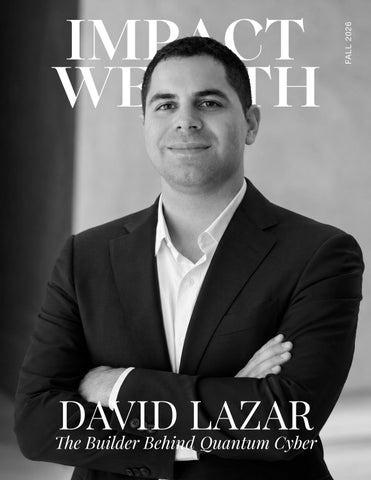
FALL 2026
DAVID LAZAR The Builder Behind Q uantum Cyber 1
CONTENTS COVER STORY LAZAR 10 DAVID The Builder Behind
10
FALL BEAUTY EDIT 24 10THELuxury Essentials for Radiant
Quantum Cyber By Hillary Latos
Skin, Timeless Beauty & Effortless Elegance
PROFILE
16
HEALTH & WELLNESS
By Hillary Latos
THOUGHT LEADERSHIP
INSIDE TIGER 21 How the World's Wealthiest Entrepreneurs Are Redefining Wealth, Investing, and the Family Office
and 30 Philanthropy Citizenship by Merit
By Hillary Latos
40
What Meaningful Contribution Looks Like By Christopher Willis
2026 34 Concordia Where Global Power, Private Capital and Purpose Converged to Shape the Future By Hillary Latos
Global Initiative 2026 40 Clinton How the World’s Most Influential Leaders Are Redefining Philanthropy, Innovation, and Global Impact By Hillary Latos
Rockefeller Foundation 46 The Explores How AI Could Power Africa's Future Through Mission 300 By Hillary Latos
4
54
LUXURY LIVING Architectural Artistry 68 Where Meets Elite Celebration The Year-Round Allure of the Hamptons' Most Iconic Event Canvas By Candice Beaumont
Future of Private Aviation 70 The How Embraer and Flexjet Are Redefining Luxury, Time and the Flying Experience By Anya Goldenberg
FINE DINING TRAVEL
50 The Colors of Puerto Vallarta
80
By Angela Gorman
54
By Hillary Latos
Becomes a Work of Art
By Amy Louise Bailey
By Hillary Latos
XIII Unveils $28,000 84 LOUIS BLACK PEARL
Ski Escapes Worth 60 Five Planning Around
A Rare Cognac Masterpiece Limited to Just 398 Decanters
By Angela Gorman
By Hillary Latos
LUXURY LIVING By Angela Gorman
Together in Flatiron Pérignon x Damien Hirst 80 Dom When Fine Champagne
The Art of the Fall Escape
Bridge X 64 The A Decade in Motion
New York Brings Italian 76 Aqua Flair and Japanese Artistry
Legacy 88 Liquid How Fladgate Family Wines Is
88
Turning Rare Vintage Port Into a Collectible Asset By Hillary Latos
5
EDITOR’S NOTE
The New Architecture of Power In an exclusive interview with Impact Wealth, TIGER 21 fo
We are living through a defining period of global transformation. Geopolitical tensions, technological breakthroughs, shifting economic alliances, and the evolving balance of international power are reshaping the way we think about wealth, security, and opportunity. In this increasingly interconnected yet unpredictable world, the ability to anticipate change, recognize emerging trends, and invest in the future has never been more consequential. For the Fall 2026 issue of Impact Wealth, we explore the individuals, institutions, and innovations influencing this new global landscape—and how the world's most successful entrepreneurs, investors, and thought leaders are navigating an era of unprecedented complexity. Our cover story features David Lazar, the visionary dealmaker behind Quantum Cyber, whose remarkable career illustrates the intersection of financial ingenuity, entrepreneurial conviction, and technological ambition. Having built his reputation identifying overlooked opportunities in the capital markets and revitalizing dormant public companies, Lazar is now undertaking his most ambitious venture yet: developing an American defense technology platform
6
focused on autonomous systems, drone innovation, domestic manufacturing, and emerging quantum-photonic capabilities. At a time when military strategy is increasingly shaped by artificial intelligence, autonomous technologies, and the economics of modern warfare, Lazar's vision reflects a broader transformation in the defense industry. His story is not simply about technological innovation, but about recognizing where geopolitical necessity and commercial opportunity converge—and having the conviction to build something with lasting strategic significance. That intersection of capital, innovation, and influence runs throughout this issue. In our exclusive interview with the founder of TIGER 21, we explore the perspectives of ultra-high-net-worth investors navigating shifting markets, global uncertainty, and the responsibilities that accompany extraordinary wealth. We also examine the growing importance of collaboration between business, government, and philanthropy. Our coverage of the Clinton Global Initiative, Concordia, and the Rockefeller Foundation highlights the conversations and
partnerships addressing some of the world's most pressing challenges. From international development and economic opportunity to energy access and global cooperation, these initiatives demonstrate how private capital and institutional leadership can help shape outcomes far beyond the financial markets. As geopolitical dynamics evolve, so too do the strategies employed by globally minded investors and entrepreneurs. Our examination of residency through merit reflects the increasing value placed on international mobility and opportunity, while our feature on collectible Port explores how heritage, scarcity, and craftsmanship can intersect with alternative asset ownership. Yet even amid global uncertainty, the pursuit of exceptional experiences remains central to the Impact Wealth philosophy. Our travel features take readers into the world of private aviation with Flexjet and Embraer, while exploring the cultural richness of Puerto Vallarta, captivating fall escapes, and premier ski destinations. We also celebrate the enduring appeal of craftsmanship and collecting through Dom Pérignon's collaboration with Damien Hirst, Louis XIII, and the traditions of fine entertaining.
In our dining coverage, we visit Aqua New York, where Italian and Japanese culinary traditions meet under one roof, reflecting the cosmopolitan sensibility that defines modern luxury. And because true wealth extends beyond financial success, we turn our attention to health, wellness, and longevity. Our coverage of the Live Long Women's Health Summit explores the growing importance of preventive health and scientific innovation, while our curated beauty and wellness selections reflect an increasingly holistic approach to living well. What connects these seemingly diverse worlds is a common thread: the power of foresight. Whether developing the next generation of autonomous defense systems, allocating capital across global markets, advancing humanitarian initiatives, or investing in personal well-being, the individuals shaping tomorrow understand that lasting success requires both vision and adaptability. Perhaps the greatest measure of wealth today is not simply what we possess, but the freedom to make meaningful choices, the resilience to navigate uncertainty, and the ability to create a lasting impact. At Impact Wealth, we remain committed to exploring the intersection of prosperity, purpose, and global influence—bringing our readers closer to the ideas and individuals defining the future. Welcome to our Fall 2026 issue. Hillary Latos Editor-in-Chief Impact Wealth
7
Creating Wealth. Creating Impact. FALL 2026 ISSUE
Hillary Latos EDITOR IN CHIEF
Candice Beaumont MANAGING EDITOR
Emil Pavlov ART DIRECTOR
Jaime Pavon, Daniel Perry CONTRIBUTING PHOTOGRAPHERS
Neal Berger, Janelle Brown, Cristina Carbo, Maria Gutierrez, Dorian May, Amy Poliakoff, Hannah Rose, David Seidman CONTRIBUTORS
Angela Gorman, Adam Weiss PUBLISHERS
Colin Thompson
DIRECTOR OF SPONSORSHIP
Impact Wealth Media LLC 222 Broadway, 18th Floor, New York, NY 212 542 3146 www.impactwealth.org info@impactwealth.org Impact Wealth magazine is published quarterly. Copyright 2022 by Impact Wealth Media. All rights reserved. Reproduction of any material from this issue is expressly forbidden without permission of the publisher. Unsolicited manuscripts and photographs are welcome on an exclusive basis, but Impact Wealth magazine cannot be responsible for unsolicited materials submitted. Printed in the U.S.A. Contents of Impact Wealth Magazine are for general educational purposes only and do not constitute personalized financial, legal, or investment advice. Reading this publication does not establish an advisor-client relationship. Market predictions and strategies involve financial risk and speculative outcomes.
8
COVER STORY
DAVID LAZAR
The Builder Behind Q uantum Cyber From resurrecting forgotten public companies to assembling a U.S.based autonomous defense platform, David Lazar has built a career around seeing value before the market does. With Quantum Cyber, his most ambitious bet yet, the veteran dealmaker is applying that instinct to the rapidly changing economics of modern warfare. By Hillary Latos
Photos by Jaime Pavon
10
restructurings, he was fascinated by markets, tickers and the mechanics of how companies were assembled. That curiosity eventually led him into the overthe-counter market, where success depends less on glossy presentations than on mastering details: transfer agents, court orders, securities filings, shareholder disputes, convertible securities and the often messy history sitting inside an abandoned corporation. The Custodian’s Playbook Working through Custodian Ventures LLC, Lazar built his early career as a courtappointed custodian for abandoned or delinquent public companies. The work could involve restoring corporate good standing, resolving liabilities, reconstructing records, addressing legacy securities issues, holding shareholder meetings and bringing years of filings back into order. He did it repeatedly. Over time, each situation became another layer of institutional knowledge. What looked from the outside like a niche practice became a highly specialized playbook for corporate rehabilitation — one that combined legal precision, capital-markets fluency and an operator’s tolerance for complexity. From Rainmaker to Builder If you ask people who have worked with David Lazar over the last decade what he actually does, the answer rarely fits neatly on a business card. Rainmaker. Dealmaker. Fixer. The person who can walk into a public company that has been left for dead, understand the legal and financial machinery beneath it, and figure out how to make it function again. For years, Lazar operated in one of the least glamorous corners of the capital markets: dormant tickers, delinquent filings, broken capitalization tables, court proceedings and public shells that most traditional Wall Street professionals would rather avoid. He became known for taking neglected corporate structures, cleaning them up and positioning them for a second life. Today, however, the story is no longer simply about Lazar’s ability to engineer a transaction. At Quantum Cyber N.V. (Nasdaq: QUCY), he is attempting something fundamentally
different: building and operating the company himself. The platform is being developed around autonomous defense systems, U.S. manufacturing, drone technology and an emerging quantum-photonic architecture that, if successfully translated from concept to field-ready hardware, could address some of the most consequential constraints facing autonomous systems.
By the time the COVID-era market dislocation arrived, Lazar had spent years preparing for a moment he could not have predicted. As private companies searched for faster routes to public capital, clean public vehicles became more valuable. His obscure specialty suddenly sat at the intersection of timing and demand. When the Market Caught Up
For Lazar, it is the evolution from sponsor to operator — and perhaps the clearest expression yet of the instinct that has defined his career: find the overlooked asset, understand what others have missed, and build around the opportunity before the crowd arrives. Oceanside Roots
The transactions that followed moved Lazar from the OTC world toward major exchanges. Among the most notable was IKONICS Corp., where he took an activist position and helped shepherd a transaction that ultimately became TeraWulf Inc. (Nasdaq: WULF), now associated with large-scale digital infrastructure and high-performance computing.
Lazar grew up in Oceanside on Long Island’s South Shore, an environment that helped shape a style that remains distinctly unvarnished. Long before he became associated with public-company
Other situations followed, including NovaBay Pharmaceuticals and Indaptus Therapeutics. At Mainz Biomed N.V., Lazar’s involvement ultimately led to the platform that became Quantum Cyber. The common thread was
11
COVER STORY
The problem with handing the keys over, is that half the time the person you hand them to doesn’t drive the way they said they would. And the shareholders, my shareholders, pay the price.
not industry. It was structure: Lazar was drawn to situations where the existing corporate vehicle and its future potential were dramatically out of alignment. “It’s a series of victories,” Lazar says of the process. “You keep the process the same, you don’t get emotional, you show up the next day.” The Moment the Playbook Changed For much of his career, Lazar’s role ended once a transaction was completed. He could acquire influence, restructure the vehicle, install leadership and move on. Eventually, that became the part of the model he questioned most. “The problem with handing the keys over,” he says, “is that half the time the person you hand them to doesn’t drive the way they said they would. And the shareholders, my shareholders, pay the price.” The lesson changed his approach. Rather than viewing the closing of a transaction as the finish line, Lazar increasingly began to see it as the beginning. He took operating roles when necessary, committed his own capital and focused on what happened after the corporate restructuring. Quantum Cyber is the fullest expression of that shift. This is not a company Lazar intends merely to reposition and hand off. It is the company he intends to build.
12
Quantum Cyber: A Bet on the Autonomous Era Quantum Cyber is being positioned around a structural change in defense: the rise of autonomous, attritable systems. Modern conflicts have demonstrated that inexpensive unmanned platforms can alter battlefield economics. Instead of relying exclusively on a smaller number of exquisite, extremely costly systems, militaries increasingly need scalable autonomous platforms that can be deployed in volume, operate in contested environments and, in some cases, be lost without creating an unacceptable economic or strategic cost. Quantum Cyber’s corporate presentation frames the opportunity as an integrated autonomy platform spanning air, ground and maritime domains, with a common control architecture intended to reduce the cost and complexity of deploying multiple autonomous systems. The company also emphasizes a U.S.-based supply chain and manufacturing footprint, including its Bridgeport, Connecticut facility.
That vertical integration matters strategically. In a defense environment increasingly focused on domestic manufacturing, resilient supply chains and rapid procurement, owning or controlling more of the path from design to production can reduce dependence on external suppliers and potentially shorten the distance between engineering changes and field deployment. The company’s stated strategy also extends beyond a single drone. Its materials describe aerial systems, autonomous ground vehicles, maritime systems, counter-UAS capabilities and a portfolio of filed patent positions. The larger ambition is to create a platform in which software, autonomy, manufacturing and intellectual property reinforce one another rather than exist as disconnected products. The Strategic Advantage: Economics, Autonomy and Control The most important strategic argument behind Quantum Cyber is not that drones are new. It is that the economics and operating
doctrine surrounding them are changing quickly. A low-cost autonomous system can force an adversary to expend a far more expensive interceptor, expose a position or devote scarce personnel and equipment to defense. At scale, that imbalance becomes a strategic weapon of its own. Quantum Cyber is attempting to build around that asymmetry. Its presentation emphasizes coordinated swarms, compressed decision cycles and autonomous operation in environments where GPS or communications may be degraded. In that model, advantage comes from combining quantity with intelligence: systems inexpensive enough to deploy in meaningful numbers, but sophisticated enough to coordinate, adapt and continue operating when traditional command links become unreliable. A second advantage is architectural. Rather than approaching air, ground and maritime systems as entirely separate businesses, Quantum Cyber describes a common autonomy layer across domains.
If executed, that could allow software, control systems, training and mission logic to be reused across multiple platforms — potentially lowering integration costs and accelerating deployment. A third is industrial. The company’s emphasis on U.S. manufacturing places it within a broader policy shift toward domestic defense production and more secure supply chains. For government customers, the provenance of critical components and the ability to manufacture at scale can be nearly as important as the performance of the platform itself. The Quantum Photonic Antenna The technology that gives Quantum Cyber its name may also become one of its most differentiated assets. Through an exclusive worldwide license from Project LightShift, Inc. for defense and national-security drone applications, Quantum Cyber is developing a patent-pending Quantum Photonic Antenna designed as a multifunction photonic surface.
In simple terms, conventional photovoltaic and communications hardware typically works within defined portions of the electromagnetic spectrum. The proposed Quantum Photonic Antenna architecture is designed to interact with a broader range of light, separate photons by wavelength, convert different inputs toward a common band, compress or “squeeze” the resulting stream and coordinate its propagation through phase control. The company compares the concept to a digital soundboard for light: different channels receive different wavelengths, a translator brings those inputs toward a common form, and a compressor organizes the result into a controlled stream. The proposed surface is intended to serve multiple functions, including supplemental energy capture and transmitter-receiver communications. For autonomous systems, that combination could be meaningful. Small unmanned aircraft operate within unforgiving constraints: every additional battery adds weight; every
13
COVER STORY
antenna occupies space; every sensor competes for power. A thin surface capable of supporting more than one mission function could help address those constraints without simply adding more hardware. Why the Photonic Layer Could Matter in a Contested Environment The most strategically interesting application may be communications. Quantum Cyber’s whitepaper describes a transmitter-receiver architecture in which encoded photonic signals can be distributed across multiple frequencies rather than relying on one predictable channel. The intended result is a communications pathway that is more difficult to identify, intercept, jam or disrupt. Post-quantum cryptography could then protect the information carried across that link — in the company’s formulation, one layer protects how the signal travels while the other protects what the signal says.
14
The architecture is also being explored for multispectral sensing and optical navigation. In a GPS-denied environment, a platform that can use celestial, terrainreferenced or other optical information to help determine its position could have obvious military relevance. Supplemental broad-spectrum energy capture, meanwhile, is intended not to replace a drone’s battery but potentially to slow depletion, extend loiter time or preserve payload capacity. Those possibilities are significant, but they remain developmental. Quantum Cyber’s own August 2026 whitepaper describes the technology as early-stage and precommercial, moving from modeled architecture toward a demonstrable module. The next milestones are concrete: fabrication, measured capture and conversion, transmitter-receiver testing, communicationsresilience testing, repeatable manufacturing yield, environmental validation and integration with a representative drone platform.
That distinction is important. The strategic value today lies in the combination of intellectual property, a defined defense use case and a pathway toward hardware validation — not in treating modeled capabilities as already proven in the field. The Brain Behind the Swarm The quantum antenna is only half of Dr. Wolf Kohn's contribution to Quantum Cyber. The other half is MAHCA, short for Multiple Agent Hybrid Control Architecture, a decision-making system Dr. Kohn spent years developing to solve a problem the drone world is only now catching up to: how does a swarm of autonomous machines think together, in real time, when the battlefield changes every second? MAHCA is, in plain terms, the brain that lets a fleet of drones act as one. It takes rules, whether written in law, doctrine, or a mission plan, and turns them into math the machines can solve in under a millisecond. For a platform
was built on optionality — restore the vehicle, complete the transaction, find the next situation. Quantum Cyber demands the opposite: concentration, patience and execution over years rather than quarters. Beyond the Balance Sheet For all the capital-markets intensity, Lazar’s interests extend beyond the tape. He supports the Soul Center of Oceanside, a supported-living initiative for adults with developmental disabilities, alongside Chabad of Oceanside and Soul Purpose New York. He has also supported STEM programming for underserved youth, business education connected to his former high school and founder mentorship. The through line is familiar: identify a system that is not working as well as it should, bring resources and structure to it, and leave something more durable behind. The Long Game
whose whole premise is that America needs cheap, autonomous drones deployed by the thousand, MAHCA is the piece that makes the idea coherent, and it came from one of the field's most published minds. Building a Defense Company, Not Just a Technology Story This is where Lazar’s background becomes unusually relevant. Deep technology companies often fail for reasons that have little to do with the elegance of the underlying science. They need capital, public-market discipline, manufacturing, procurement relationships, regulatory fluency and the patience to survive long development cycles. Lazar has spent his career inside precisely those less glamorous layers of company building. Quantum Cyber is therefore a convergence of two stories: a defense technology platform built around autonomy and an operator whose principal skill has always been navigating complexity. The company’s materials point to a Bridgeport manufacturing facility, an owned U.S. production footprint, autonomous systems across multiple domains and a
growing intellectual-property position. The thesis is that these assets can become more valuable together than they would be separately: autonomy software informs the platforms; field requirements inform the hardware; manufacturing supports iteration; and the photonic program offers a potential technology layer that could ultimately differentiate the entire system. Capital at Risk, Reputation on the Line Lazar has also structured his involvement in a way that makes the bet personal. The original profile notes that he has committed millions of dollars of his own capital to the platform, retired legacy debt and maintained a substantial beneficial ownership position. That alignment is consistent with the way he has approached previous situations: if shareholders are being asked to believe in the transformation, he wants his own capital exposed to the outcome as well. “I don’t want to be the guy who took the deal and left,” he says. “I want to be the guy who built the thing.” It may be the most concise explanation of what has changed. Lazar’s earlier career
There is a temptation to frame Quantum Cyber as Lazar’s arrival. He rejects that idea. “You don’t get to arrive in this business,” he says. “You just get to keep showing up.” Yet the scale of the wager is different. The Oceanside trader who built a career around forgotten public companies is now attempting to assemble a vertically integrated, Nasdaq-listed defense platform around one of the defining military shifts of the decade. The custodian who once specialized in bringing companies back to life is trying to create something designed for the future. Whether Quantum Cyber ultimately realizes the full promise of its autonomous and photonic technologies will depend on engineering, manufacturing, procurement and field validation. But Lazar’s bet is already clear: the next generation of strategic advantage will belong not simply to whoever builds the most sophisticated platform, but to whoever can combine autonomy, affordability, resilient communications, domestic production and speed at scale. For a man who made his career seeing value in structures others overlooked, it is a remarkably consistent next act. David Lazar is no longer merely finding the vehicle. He is building the machine.
15
PROFILE
INSIDE TIGER 21
How the World's Wealthiest Entrepreneurs Are Redefining Wealth, Investing, and the Family Office In an exclusive interview with Impact Wealth, TIGER 21 founder and chairman Michael Sonnenfeldt reveals how a global network of nearly 2,000 ultrahigh-net-worth members is reshaping investment strategies, embracing private equity, and navigating the complexities of generational wealth. By Hillary Latos
16
liquidity, evaluating unfamiliar asset classes, and making decisions that may influence their families for generations. "Particularly when they sell a business successfully and go from being a wealth creator to a wealth preserver, that's a challenge that they have not dealt with before," he said. For many entrepreneurs, the expertise that enabled them to create significant wealth does not automatically translate into the skills required to preserve it. TIGER 21 was designed to address that gap through confidential peer groups where accomplished individuals could exchange perspectives, challenge assumptions, and learn from others facing similar circumstances. Today, the organization's members span approximately 30 countries, with established peer groups operating across 14 countries in North America, Europe, and Asia.
For the world's most successful entrepreneurs, building a fortune is often only the beginning. Preserving it, investing it wisely, and determining its purpose across generations can present an entirely different set of challenges. Few understand that transition better than Michael Sonnenfeldt, founder and chairman of TIGER 21, the exclusive peer-to-peer network that has quietly become one of the most influential communities in global wealth. What began nearly three decades ago as an intimate gathering of six successful entrepreneurs has evolved into an international network approaching 2,000 members, with an average net worth of approximately $140 million. Collectively, its members represent an estimated $280 billion in wealth, creating a powerful lens into how some of the world's most sophisticated private investors are deploying their capital. In an exclusive conversation with Impact Wealth, Sonnenfeldt discussed the organization's evolution, the expanding influence of family offices, the rise of younger entrepreneurs, and the investment trends transforming the portfolios of the ultra-wealthy.
Perhaps the most revealing development is a fundamental shift in how members are investing: private equity has reached an unprecedented 34% of portfolio allocations, while traditional hedge funds and cash reserves have declined significantly. The implications extend far beyond TIGER 21's membership. They offer a window into the changing philosophy of wealth itself. From Wealth Creation to Wealth Preservation When Sonnenfeldt founded TIGER 21 approximately 28 years ago, his vision was rooted in a deceptively simple observation: extraordinary financial success can be surprisingly isolating. "TIGER 21 is about 28 years old, and it started with a very simple idea that entrepreneurs lead somewhat isolated lives sometimes," Sonnenfeldt explained. The transition from entrepreneur to investor can be particularly challenging. Business founders who have spent decades building companies suddenly find themselves responsible for managing substantial
The model remains remarkably consistent with its origins. Members typically meet for one full day each month, engaging in confidential discussions that extend beyond financial performance to encompass family dynamics, philanthropy, personal fulfillment, and the responsibilities that accompany substantial wealth. Despite its international expansion, Sonnenfeldt believes the organization's greatest value continues to reside in these intimate gatherings. "The biggest event is the monthly event," he emphasized. "Every month you meet for a full day. That's the core experience." Inside One of the World's Most Exclusive Wealth Networks Membership in TIGER 21 is not simply a function of financial resources. According to Sonnenfeldt, prospective members undergo a comprehensive qualification process that includes financial verification, background checks, criminal checks, and interviews with existing members. Character and compatibility are central considerations.
17
PROFILE
The big story is really private equity, and within private equity, it's direct ownership of parts of businesses or complete ownership of businesses, as well as probably a healthy dose of venture capital. The organization seeks individuals who can contribute meaningful experience and perspective while respecting the confidentiality that underpins its discussions. "Our core groups have members with net worths between $20 million and a billion, and our family office members generally start at $250 million and up," Sonnenfeldt explained. With an average member net worth of approximately $140 million, the organization represents an unusually concentrated community of entrepreneurial and investment expertise. Yet Sonnenfeldt emphasizes that financial qualifications alone do not determine admission. Existing members must also determine whether a prospective participant will enhance the group's collective experience. That selectivity becomes particularly important when members are discussing sensitive matters involving investments, succession planning, business challenges, or family relationships. For entrepreneurs accustomed to being the ultimate decision-makers in their organizations, access to a trusted group of equally accomplished peers can provide an unusual opportunity for candid dialogue.
18
The Private Equity Revolution: Why the Ultra-Wealthy Are Moving Away From Traditional Investments
How TIGER 21 Members Are Allocating Their Wealth Asset class
One of the most significant revelations from Sonnenfeldt's interview concerns the dramatic transformation of TIGER 21 members' investment portfolios.
Asset class
Allocation trend
Private equity
Approximately 34%, up from 10% historically
Real estate
Approximately 26–28%, now the second-largest allocation
Rather than focusing on short-term market fluctuations, Sonnenfeldt believes the most important insights emerge from examining allocation trends over the past decade or more.
Cash
Approximately 7–8%, down from a historical 12%
Hedge funds
Approximately 2%, down from 7%
Bitcoin and other digital currencies
Roughly 1–3%
Gold
Gold Roughly 1–3%
"The overarching trend is private equity has grown from about 10% to 34%. It's an alltime high now, just extraordinary," he said. That increase represents a profound reallocation of capital toward privately held businesses, direct investments, and entrepreneurial ownership.
Figures reflect approximate allocations and historical comparisons discussed by Sonnenfeldt during the interview, rather than a complete portfolio breakdown.
Why Direct Ownership Is Winning Over Traditional Private Equity Funds While institutional private equity funds continue to attract substantial capital globally, Sonnenfeldt sees a distinction between conventional fund investing and the strategies favored by many TIGER 21 members. He suggested that members often prefer entrepreneurial opportunities where they can leverage their own business experience, industry relationships, and investment judgment. "They tend to stay away from the plain vanilla large asset aggregator funds, all the big names, who've had good returns, but our members have had better returns by focusing directly on entrepreneurial direct ownership or partial ownership," he said. His observation highlights an increasingly important distinction within private markets: the difference between passive exposure to private equity and active participation in business ownership. Many successful entrepreneurs possess advantages that can be particularly valuable in direct investing, including sector-specific expertise, established professional networks, and experience identifying opportunities that institutional investors may overlook. Sonnenfeldt noted that members pursue opportunities across a broad spectrum, including established companies, distressed businesses, and early-stage ventures.
For years, real estate represented the largest allocation within TIGER 21 portfolios. That hierarchy has now shifted, with private equity taking the lead. The transition is particularly noteworthy because many TIGER 21 members originally created their fortunes through entrepreneurial ventures. Their increasing preference for private investments suggests a desire to remain connected to the operating businesses and entrepreneurial opportunities they understand. "The big story is really private equity, and within private equity, it's direct ownership of
parts of businesses or complete ownership of businesses, as well as probably a healthy dose of venture capital," Sonnenfeldt said. Rather than relying exclusively on traditional investment managers, members are increasingly participating directly in the ownership and growth of private enterprises. For family offices, this trend has important implications. Direct investments may provide greater influence over business strategy, governance, and long-term value creation, although they also introduce concentrated risks, liquidity constraints, and operational responsibilities.
He estimated that venture capital might account for approximately five percentage points of the overall 34% private equity allocation, although he stressed that this was an anecdotal assessment rather than a precise measurement. Distressed investing also remains an area of interest for members with the specialized expertise required to evaluate and restructure underperforming businesses. For sophisticated investors, the appeal of these strategies is not simply the potential for higher returns. It is also the opportunity to apply entrepreneurial knowledge directly to the investment process.
19
PROFILE
The Surprising Decline of Cash and Hedge Funds Perhaps equally revealing is what TIGER 21 members are choosing to hold less of. Historically, members maintained approximately 12% of their portfolios in cash, a level that Sonnenfeldt described as remarkably consistent over time. That allocation has now declined to approximately 7–8%. "Members have dropped their cash from 12% to seven or eight," he said, describing the shift as one of the most extraordinary changes in the organization's portfolio data. The reduction suggests greater willingness among members to deploy capital rather than maintain historically elevated liquidity reserves. Sonnenfeldt attributes part of that shift to increasing comfort with investing in operating businesses through private equity.
20
Hedge funds have experienced an even more pronounced decline in their share of member portfolios, falling from approximately 7% historically to just 2%. The trend raises broader questions about the role of traditional alternative investment managers within ultra-highnet-worth portfolios, particularly as wealthy entrepreneurs seek greater transparency, direct ownership, and opportunities to leverage their own expertise. It does not necessarily signal the disappearance of hedge funds from sophisticated portfolios, but it demonstrates how significantly investment preferences have evolved within this particular community. Bitcoin and Gold: Alternative Stores of Value Gain Ground Although private equity dominates the discussion, Sonnenfeldt also identified growing interest in Bitcoin and gold.
Both asset categories currently represent relatively modest allocations, generally in the range of 1–3% each across member portfolios. Given the scale of TIGER 21's collective wealth, however, even small percentages translate into substantial dollar amounts. Sonnenfeldt estimated that members collectively hold approximately $3 billion to $5 billion in Bitcoin and other digital currencies. The figures underscore the growing presence of digital assets within sophisticated private portfolios, even as allocations remain considerably smaller than those devoted to traditional private investments. Importantly, these percentages represent averages across a diverse membership. "Some people have a lot more, and some people don't have any," Sonnenfeldt explained. The variation reflects the different investment philosophies, risk tolerances, and wealth preservation priorities among members.
We have a unique position in the family office market because we're already deployed around the globe with our chairs and our team. These include communities focused on women, philanthropy, real estate, aviation, motorsports, golf, and other shared interests. The result is a network that increasingly extends beyond financial discussions to encompass professional collaboration, personal relationships, and global experiences. Family Offices: The Next Frontier for TIGER 21 For family offices, Bitcoin and gold can occupy distinct positions within broader diversification strategies, although their volatility, liquidity characteristics, and underlying risks differ substantially.
"That's a reflection of the nature of the economy and the nature of a frictionless economy where you can grow successful businesses quicker than you could have in a prior generation," he explained.
As the global population of ultra-highnet-worth families expands, Sonnenfeldt sees family offices as one of TIGER 21's most promising areas of future growth.
The Rise of the Next Generation of Wealth Creators
The emergence of younger ultra-highnet-worth individuals is reshaping the broader wealth management landscape.
The organization has developed a dedicated offering for family office members, generally beginning at the $250 million wealth level.
Technology-enabled businesses, global distribution platforms, and increasingly interconnected capital markets have created opportunities for entrepreneurs to build substantial enterprises on accelerated timelines.
Sonnenfeldt believes TIGER 21's existing international infrastructure gives it a meaningful advantage in serving this increasingly sophisticated market.
One of the most compelling developments within TIGER 21 is the rapid expansion of its younger membership. The organization's network for members aged 49 and under has grown to approximately 700 participants, reflecting a new generation of entrepreneurs achieving significant financial success earlier in their careers. "We've had explosive growth in our 49 and under members," Sonnenfeldt said. He attributes the trend partly to the transformation of the global economy and the ability to scale businesses more rapidly than in previous generations.
For organizations serving wealthy families, this generational shift introduces new considerations around investment preferences, technology, philanthropy, lifestyle, and the long-term stewardship of capital. TIGER 21 has responded by developing specialized networks that connect members beyond their traditional monthly peer groups.
"We have a unique position in the family office market because we're already deployed around the globe with our chairs and our teams," he said. Family offices face a particularly complex set of responsibilities, ranging from asset allocation and governance to succession planning, philanthropy, and the coordination of multigenerational interests.
21
PROFILE
Unlike conventional wealth management clients, many family offices operate as highly sophisticated investment organizations, with dedicated teams evaluating private transactions, direct investments, real estate, and alternative assets. Yet even the most established family offices can benefit from exchanging perspectives with similarly situated families. For Sonnenfeldt, the opportunity lies in creating a global community where members can access expertise, build trusted relationships, and learn from experiences across industries and geographic markets. A Global Network Built on Relationships, Not Just Wealth
in multiple markets has become an important strategic advantage. Sonnenfeldt described how members can draw upon the network when exploring business opportunities, philanthropic initiatives, or even personal needs in unfamiliar locations. From Singapore and Mumbai to Madrid and New York, the value of membership increasingly extends beyond a single city or peer group. The organization has also expanded its calendar of international gatherings and curated experiences, including trips to destinations such as Peru and India, as well as events connected to members' shared interests.
TIGER 21's international expansion reflects another fundamental shift in the way the ultra-wealthy conduct business and manage their lives.
These experiences provide opportunities to develop relationships that might otherwise take years to establish.
As family offices become increasingly global, access to trusted relationships
Yet Sonnenfeldt remains deliberate about expansion.
TIGER 21 has historically grown at approximately 15–20% annually, a pace he considers sustainable without compromising the quality of the membership experience. "We're pretty focused not on pursuing growth for growth's sake, but filling out a global footprint of members whom other members want to connect with," he said. That philosophy reflects the organization's central proposition: the value of a network depends not simply on its size, but on the quality, expertise, and integrity of its participants. Beyond the Balance Sheet: The Future of Wealth The story of TIGER 21 is ultimately about more than asset allocation or access to exclusive investment opportunities. It reflects a broader evolution in the meaning of wealth among entrepreneurs and family offices.
The financial decisions facing successful business founders are increasingly intertwined with questions of identity, legacy, purpose, and the responsibilities that accompany extraordinary success. At the same time, the investment landscape is changing. Private markets have become a central component of sophisticated portfolios, younger entrepreneurs are creating substantial wealth at unprecedented speed, and family offices are assuming a more prominent role in global capital allocation. For Sonnenfeldt, the challenge remains much the same as it was when he first brought six entrepreneurs together nearly three decades ago: helping successful individuals navigate a world in which their financial achievements have created an entirely new set of decisions. What has changed is the scale. With nearly 2,000 members, a growing international presence, and hundreds of billions of dollars in collective wealth, TIGER 21 has evolved into a revealing barometer of how the world's wealthiest entrepreneurs think about capital, opportunity, and the future. And if its latest investment trends are any indication, that future will be defined increasingly by direct ownership, entrepreneurial conviction, and the power of trusted relationships.
About TIGER 21 Founded approximately 28 years ago, TIGER 21 takes its name from its original designation, The Investment Group for Enhanced Results in the 21st Century. The organization connects ultra-high-net-worth entrepreneurs, investors, and family office principals through confidential peer groups and specialized global networks.
BEAUTY
THE FALL BEAUTY EDIT
10 Luxury Essentials for Radiant Skin, Timeless Beauty & Effortless Elegance From next-generation pigment-correcting serums and advanced anti-aging treatments to restorative skincare and innovative beauty technology, discover the season's most coveted beauty essentials. By Hillary Latos
24
As summer's golden glow gives way to autumn's more refined elegance, the changing seasons present the perfect opportunity to rethink our beauty rituals. Months of sunshine, travel, and outdoor indulgence can leave their mark in the form of hyperpigmentation, dehydration, uneven texture, and lackluster hair. Fall, however, is the season of renewal—a time to restore, rejuvenate, and invest in beauty innovations that deliver more than fleeting results. Today's luxury beauty landscape is increasingly defined by sophisticated formulations, science-backed skincare, and professionally inspired treatments that bridge the gap between the dermatologist's office and the vanity. From advanced pigment-correcting technology and barrier-restoring botanicals to indulgent hydration and at-home beauty devices, the latest innovations reflect a growing appreciation for intelligent skincare that delivers visible results. 1. SKINBETTER SCIENCE EVEN INTENSIVE SKIN TONE CORRECTING SERUM The New Frontier in Hyperpigmentation Correction For those seeking a more even, luminous complexion after months of summer sun exposure, Skinbetter Science's Even Intensive Skin Tone Correcting Serum deserves a coveted place in the fall skincare wardrobe. Developed to address the appearance of stubborn discoloration, dark spots, and uneven pigmentation, this advanced serum represents a sophisticated approach to achieving brighter-looking skin without relying on traditional hydroquinone-based treatments. Its combination of brightening ingredients makes it particularly appealing for those concerned with sunspots, melasma, and lingering discoloration. Rather than simply masking imperfections, the formula is designed to improve the appearance of uneven skin tone over time. For those who have undergone professional pigmentation treatments, including Pico laser, a thoughtfully selected brightening regimen may help maintain a more uniformlooking complexion once the skin has fully healed and the treating dermatologist has approved the use of active ingredients.
Why We Love It: A sophisticated option for targeting visible discoloration and achieving a more polished, even-toned complexion. 2. SKINBETTER SCIENCE ALPHARET OVERNIGHT CREAM Beauty Sleep, Reinvented The most effective beauty rituals often happen while we sleep, and Skinbetter Science's award-winning AlphaRet Overnight Cream takes nighttime rejuvenation to an elevated level. Combining retinoid technology with alpha hydroxy acid benefits, the innovative formulation is designed to improve the appearance of fine lines, wrinkles, uneven texture, and photodamage while helping maintain hydration.
Unlike traditional retinol products that can leave skin feeling dry or irritated, AlphaRet was developed with tolerability in mind, making it an appealing choice for those seeking visible skin refinement with a luxurious nightly ritual. For beauty enthusiasts focused on both pigmentation and age management, AlphaRet offers a complementary approach to maintaining smoother, more youthfullooking skin. As with any retinoid-based product, gradual introduction and consistent sun protection are essential. Why We Love It: A multitasking nighttime treatment that combines skin refinement, hydration, and anti-aging benefits in one elegant formula.
25
BEAUTY
4. CELLCOSMET ULTRA SENSITIVE CREAM Swiss Cellular Science Meets the Art of Skin Restoration In the world of luxury skincare, few names embody the intersection of Swiss precision and advanced beauty science quite like Cellcosmet. The prestigious skincare house brings its decades of expertise in cellular-inspired formulations to Ultra Sensitive Cream, an indulgent treatment designed to restore comfort, hydration, and resilience to delicate complexions. At the heart of the formula is Cellcosmet's proprietary CytoPep™ Cellular Extracts, a complex of peptides, proteins, and amino acids complemented by hyaluronic acid, soothing allantoin, botanical extracts, and antioxidant ingredients. Together, these components are formulated to support the skin's protective barrier while improving the appearance of redness and sensitivity. What makes Ultra Sensitive particularly compelling for fall is its emphasis on recovery and balance. Following months of sun exposure, environmental stress, and intensive beauty treatments, maintaining a healthy skin barrier becomes essential to preserving a luminous complexion. 3. MAKARI KOJIC & AZELAIC BRIGHTENING SERUM A Targeted Approach to Dark Spots and Post-Treatment Radiance Hyperpigmentation remains one of the most persistent beauty concerns, particularly following prolonged sun exposure or for complexions naturally prone to developing dark spots. Makari's Kojic & Azelaic Brightening Serum brings together two ingredients recognized for their role in addressing the appearance of uneven pigmentation: kojic acid and azelaic acid. The combination makes this serum an intriguing addition to the fall beauty edit, especially for those looking to improve the appearance of sun-induced discoloration, post-inflammatory marks, and uneven skin tone.
26
Azelaic acid is particularly valued in dermatology for its ability to address pigmentation concerns, while kojic acid is commonly incorporated into brightening formulations designed to promote a more uniform-looking complexion. For individuals who have invested in professional treatments such as Pico laser to target sunspots and discoloration, maintaining results requires thoughtful skincare, consistent sun protection, and patience. Brightening ingredients may play a role in long-term maintenance, but should only be introduced after the skin has fully recovered and with professional guidance. Why We Love It: A targeted brightening option for those looking to address stubborn discoloration and promote a more even-looking complexion.
The fragrance-free formulation is especially appealing for those incorporating advanced pigment-correcting serums, retinoids, and professional aesthetic treatments into their skincare routines. Cellcosmet also positions the cream for skin sensitized by certain noninvasive aesthetic procedures, although use following Pico laser should always be cleared by the treating dermatologist. In a beauty landscape increasingly dominated by aggressive active ingredients, Cellcosmet offers a refined reminder that true radiance begins with healthy, resilient skin. Why We Love It: A luxurious Swiss skincare essential that combines advanced cellularinspired technology with soothing hydration and skin barrier support, making it an elegant complement to more intensive anti-aging and brightening treatments.
5. NEBULYFT R1G GOLDEN STATE The Luxury of At-Home Beauty Technology The boundary between professional aesthetic treatments and at-home skincare continues to blur, as beauty enthusiasts increasingly embrace sophisticated devices designed to complement their daily routines. The Nebulyft R1G Golden State brings a technology-driven dimension to facial care, offering an elevated beauty ritual for those interested in firmer-looking skin and a more sculpted appearance. Designed to complement topical skincare, the device reflects a growing movement toward integrating beauty technology into a comprehensive approach to self-care. For discerning consumers who appreciate the convenience of maintaining their beauty routines between spa appointments, athome devices represent an increasingly appealing category of luxury wellness. While no device can replace the expertise of a qualified aesthetic professional, the growing sophistication of home beauty technology is transforming the way consumers approach long-term skin maintenance.
Why We Love It: An innovative addition to the beauty vanity that brings a professionalinspired approach to everyday skincare.
6. CLÉ DE PEAU BEAUTÉ MINI RADIANCE TRAVEL KIT The Art of the Luxury Skincare Ritual Few beauty houses embody understated sophistication quite like Clé de Peau Beauté. The brand's Mini Radiance Travel Kit brings its signature skincare philosophy into a beautifully curated collection designed for effortless indulgence. Ideal for jet-setters and beauty connoisseurs alike, the kit offers an introduction to the brand's luxurious skincare rituals, helping skin look refreshed and luminous even after long-haul flights and demanding schedules. As autumn ushers in a calendar of international travel, galas, and social engagements, maintaining a consistent skincare routine becomes an essential part of looking polished wherever the season leads. Compact yet indulgent, the collection is a reminder that the finest beauty rituals need not be sacrificed when traveling. Why We Love It: A travel-friendly introduction to one of luxury beauty's most distinguished skincare houses.
27
BEAUTY
7. OFF WE GLOW SKINCARE SET A Gentle Reset for Stressed Skin After a summer of sun exposure, humidity, and travel, sometimes the most luxurious approach to skincare is also the simplest. The Off We Glow Skincare Set offers a nourishing approach for those seeking to restore comfort and balance to skin that may be feeling dry or stressed.
8. BURBERRY GODDESS AMBER VANILLA EAU DE PARFUM INTENSE The Scent of Fall: A Seductive Symphony of Amber and Vanilla
As temperatures drop and indoor heating becomes more prevalent, barrier-conscious skincare takes on renewed importance. Gentle cleansing and thoughtful hydration can help maintain the skin's natural softness without overwhelming it with unnecessary active ingredients.
As autumn ushers in a season of sumptuous textures, rich colors, and sophisticated indulgences, Burberry introduces a captivating new interpretation of its beloved Goddess fragrance. Burberry Goddess Amber Vanilla Eau de Parfum Intense is an intoxicating celebration of warmth, sensuality, and modern femininity—a fragrance that feels as luxurious as cashmere against the skin.
For those balancing a more intensive skincare regimen with exfoliating acids or retinoids, incorporating moments of gentle care can be particularly beneficial. Why We Love It: A welcome reminder that healthy-looking skin begins with a balanced, consistent routine.
28
Building upon the original Goddess collection's signature trio of vanillas, this new expression introduces a deeper, more indulgent dimension. Luminous lavender and an unexpected maple syrup accord open the composition, giving way to the irresistible richness of caramelized, roasted vanilla. A warm amber base adds
depth and sophistication, creating an enveloping fragrance that feels both comforting and undeniably glamorous. The scent captures the essence of autumn elegance, effortlessly transitioning from crisp afternoons to candlelit dinners and glamorous evening soirées. Housed in a beautifully designed glass bottle with an amber gradient, golden cap, and signature Burberry medallion, the fragrance is as visually striking as it is alluring. Designed to be refillable, Goddess Amber Vanilla also reflects Burberry's commitment to creating enduring luxury objects that extend beyond a single season. Why We Love It: A sophisticated, sensual interpretation of vanilla that combines the warmth of amber with unexpected gourmand notes. The ultimate finishing touch to an elegant fall beauty wardrobe.
10. SIMPLER HAIR COLOR The Modern Approach to AtHome Hair Refinement Summer's combination of sunshine, saltwater, chlorine, and frequent styling can leave hair looking faded and less vibrant by the arrival of fall. Simpler Hair Color offers a convenient at-home approach to refreshing color, appealing to those who value efficiency without sacrificing a polished appearance. Whether maintaining a signature shade or addressing visible regrowth, the brand reflects a growing demand for streamlined beauty solutions that fit seamlessly into sophisticated lifestyles. As fall fashion embraces richer textures, tailored silhouettes, and more polished beauty looks, well-maintained hair remains one of the most effortless expressions of personal style. Why We Love It: A practical beauty essential for maintaining a well-groomed appearance between salon visits. The New Luxury Beauty Philosophy 9. EPICLIGHT LUMINIZING GLOW GEL The Secret to an Effortless Autumn Glow While summer may be synonymous with sun-kissed skin, autumn calls for a more refined interpretation of radiance.
Why We Love It: An effortless way to maintain a radiant appearance without additional sun exposure.
This fall, beauty is less about chasing perfection and more about investing in intelligent products that enhance the skin's natural radiance while elevating the everyday ritual of self-care. your natural radiance to shine through.
EpicLight Luminizing Glow Gel offers a luminous finishing touch, enhancing the complexion and body with a subtle glow that captures the light without overpowering the skin. Applied to the cheekbones, collarbone, shoulders, or décolleté, the lightweight luminizing effect creates a sophisticated radiance ideal for fall soirées, intimate dinners, and black-tie celebrations. For those who prefer to avoid unnecessary sun exposure, a beautifully formulated luminizer provides an elegant alternative to tanning while maintaining that coveted healthy-looking glow.
29
THOUGHT LEADERSHIP LIFESTYLE
PHILANTHROPY AND CITIZENSHIP BY MERIT What Meaningful Contribution Looks Like
For internationally accomplished individuals, contribution can extend far beyond financial capital. Christopher Willis examines how philanthropy, expertise, and long-term engagement may create meaningful national value – and why Malta’s approach places substance ahead of standardized conditions. By Christopher Willis
30
The most valuable contribution an internationally successful individual can make to a country is not always measured by the size of a financial transfer. It may lie in the institution they help build, the research they enable, the employment they create, the knowledge they share, or the social challenge they commit themselves to addressing. Capital can make these ambitions possible, but capital alone does not define their value. This distinction has become increasingly important as governments consider how exceptional individuals might contribute to their long-term national objectives. For wealthy families with an interest in philanthropy, the relevant question is not simply how much they are prepared to give. It is what their resources and commitment, supported where relevant by their experience, expertise, or networks, could genuinely help a country achieve.
In this regard, Malta provides a particularly timely case study. From Financial Contribution to Individual Merit In April 2025, the Court of Justice of the European Union ruled that citizenship of an EU Member State could not result from a commercial transaction based on predetermined payments or investments. Malta subsequently discontinued its former citizenship framework based on direct investment and removed the associated transactional provisions from its legislation. At the same time, it strengthened its existing laws concerning citizenship by naturalization on the basis of merit. And the distinction between the two proves fundamental. Malta Citizenship by Merit is not a continuation or revised version of the country’s former framework. It is not
governed by a standardized financial contribution, nor does any particular payment create an entitlement to citizenship. Instead, Maltese law allows for exceptional services or contributions to be considered individually. Any decision remains discretionary and depends upon the substance, credibility, and national value of the merit presented. The conversation therefore considers both how much an individual is prepared to contribute and what that contribution could help Malta achieve. Malta Vision 2050 and a Broader Definition of Value This approach must be understood within the context of Malta Vision 2050, the country’s long-term blueprint for economic, social, and environmental development. The vision deliberately looks beyond conventional measures of growth. It emphasizes well-being, education, sustainability, innovation, inclusion, economic resilience, and quality of life. It also seeks to create a more competitive, knowledge-led economy capable of generating high-value employment and remaining resilient in a changing world. When Malta amended its citizenship legislation in 2025, the government expressly connected the strengthened merit provisions with Malta Vision 2050, including its emphasis on added value and job creation. That connection not only matters – it suggests that national value should not be interpreted narrowly. An exceptional contribution, for example, might involve scientific or medical expertise, technological innovation, entrepreneurship, education, culture, sustainability, job creation, international advocacy, or even knowledge transfer. It could also involve opening global networks to Maltese institutions or helping the country develop capability in a strategically important field. For Malta, the opportunity lies in engaging people who can apply their resources and commitment, supported
31
THOUGHT LEADERSHIP
where relevant by their achievements, influence, or experience, to priorities the country has identified for its future. Where Philanthropy Can Fit Philanthropy can be one expression of this wider contribution, particularly where it responds to an identifiable need and creates a measurable, durable public benefit. That could mean enabling specialist medical research, supporting scholarships, developing academic partnerships, preserving cultural heritage, advancing environmental initiatives, improving disability inclusion, or helping an organization expand work that directly benefits Maltese society. The financial value of such support will naturally matter to the institution receiving it. However, the wider context is equally important. The most meaningful philanthropy can be connected to an individual’s values, interests, experience, or desire to address a particular need. It is delivered through reputable organizations, supported by appropriate governance, and designed around outcomes rather than appearances. An entrepreneur with an interest in educational technology, for example, may be able to contribute funding to improve digital learning, supported where relevant by specialist knowledge, intellectual property, and international partnerships. An individual with an interest in healthcare might support research through funding delivered by established institutions and specialists. An individual with an interest in culture may help preserve Maltese heritage or expand its international reach. In each case, the significance of the funding lies in the outcomes it enables, supported by credible delivery arrangements and a commitment to lasting benefit for Malta. Merit and a Lasting Contribution Exceptional merit is assessed by considering both the individual and the contribution made or proposed. The assessment may take into account a coherent record of achievement, credibility, engagement,
32
and impact, as well as the substance and intended outcomes of a new initiative. Relevant considerations may include what an individual has accomplished, any relevant experience or international standing, how their work has benefited others, the connections they have established or propose to develop with Malta, and whether their contribution can create lasting value for the country. A significant philanthropic initiative may form part of the proposal. Its credibility depends on the substance of the initiative, the supporting evidence, and the applicant’s capacity to fulfil the proposed commitments. This is why sustained engagement matters. Someone who contributes funding or expertise, remains involved in fulfilling the agreed commitments, builds relationships with local institutions, and demonstrates a serious commitment to Malta presents can help ensure that the intended benefits are delivered and sustained.
The strongest examples unite resources with credible plans for delivery. They demonstrate that the individual can fund an initiative and fulfil the associated commitments. Where relevant, their knowledge, reputation, leadership, or network can make the initiative more valuable and more likely to succeed. Why Selectivity Gives Recognition Meaning The absence of a standardized formula can appear less predictable than conventional immigration arrangements. In the context of merit, however, discretion serves an important purpose. Exceptionality cannot be reduced to a checklist or mass-produced through identical financial commitments. If recognition is genuinely based on merit, the state must be able to consider the distinctive characteristics of the individual and the contribution. That selectivity gives the recognition greater meaning.
For internationally accomplished individuals, it allows citizenship to reflect something deeper than compliance with prescribed financial conditions. It can recognize a relationship founded upon shared purpose, continuing commitment, and a contribution that Malta considers important to its national interest. It also protects the integrity of philanthropy. A charitable initiative retains its credibility when it has an independent purpose, sound governance, and worthwhile outcomes, irrespective of any subsequent recognition the individual may receive. The Responsibility of Family Offices and Advisors
That includes evaluating institutions carefully, establishing appropriate governance, defining realistic objectives, measuring impact, and ensuring that any initiative can stand on its own merits. Advisors should also be candid about discretion. No contribution, however substantial, can guarantee recognition or bind a sovereign decision. The credibility of the individual and the initiative depends partly upon accepting that separation. Contribution With a Legacy
Family offices and professional advisors have an important role in maintaining this distinction.
Malta’s approach reflects a wider truth about citizenship and belonging: the strongest relationships between a country and an exceptional individual are built around shared purpose.
Their responsibility is not to manufacture a philanthropic narrative around a desired personal outcome. It is to help clients identify where their authentic interests, expertise, and resources can address a genuine need.
Philanthropy can form an important part of that relationship, particularly where it advances the ambitions embodied in Malta Vision 2050. But its significance lies not simply in the capital deployed. It
lies in the commitment, credibility, and lasting national value surrounding it. For individuals capable of making that level of contribution, Malta presents a compelling proposition: the possibility that exceptional service, genuinely rendered, may receive exceptional recognition.
About the Author Christopher Willis is Co-Founder and Managing Partner – Americas & Caribbean at Latitude Group. He has worked in immigration since 1995, is a member of the College of Immigration and Citizenship Consultants and the Canadian Association of Professional Immigration Consultants, and is a Fellow of the Investment Migration Council. He advises private clients and governments on residence and citizenship frameworks.
33
THOUGHT LEADERSHIP
CONCORDIA 2026
Where Global Power, Private Capital and Purpose Converged to Shape the Future From artificial intelligence and geopolitical realignment to sustainable investing, global health and the changing architecture of philanthropy, the 2026 Concordia Annual Summit brought together influential leaders to explore how publicprivate partnerships can redefine economic growth and global prosperity. By Hillary Latos
34
As world leaders descended on New York City for the United Nations General Assembly, another influential gathering was taking place just blocks away. At the 2026 Concordia Annual Summit, heads of state, business executives, investors, philanthropists and innovators convened to confront a fundamental question: Who will finance, build and lead the next era of global progress? Held September 20–23 at the Sheraton New York Times Square Hotel, the summit reflected a profound transformation in how the world's most pressing challenges are being addressed. Government policy alone is no longer sufficient, traditional philanthropy is being reimagined, and private capital is increasingly being called upon to bridge the gap between ambitious global objectives and tangible results. Founded by Nicholas Logothetis and Matthew Swift, Concordia has established itself as a prominent nonpartisan platform connecting the public, private and nonprofit sectors. Its annual gathering has become an important forum for the intersection of diplomacy, business strategy and social impact. For the global family office community, institutional investors and entrepreneurial wealth creators, the conversations carried implications extending well beyond international policy. They illuminated where capital may flow, how emerging technologies could reshape industries, and why the next generation of successful investors may increasingly be measured not only by the wealth they create, but also by the systems and societies they help strengthen. A New Economic Order: The Growing Influence of Private Capital Among the most consequential themes emerging from Concordia 2026 was the evolving relationship between government, institutional finance and private wealth. The session New Capital, New Blueprint: Accelerating Development's Next Chapter confronted a structural challenge facing the international development community: traditional aid budgets are shrinking at a time when global financing needs continue to expand.
The discussion, featuring Anna Gawel, Lisha McCormick, Hammam N. Bin Juraied, Hend Alhinnawi and Jose Aguirre, examined the growing influence of sovereign wealth, blended finance and private investment in financing development. The underlying issue was not simply how to replace diminishing donor funding, but how to create an entirely new financial architecture capable of attracting sustainable investment. For family offices and private investors, this evolution presents an important strategic opportunity. Infrastructure, renewable energy, healthcare, digital connectivity and education are increasingly being examined through models that combine financial sustainability with measurable social benefits. Blended finance, which uses catalytic public or philanthropic funding to help mobilize commercial investment, is particularly relevant. By reducing certain investment risks or improving project economics, these structures can potentially make previously inaccessible development opportunities more attractive to institutional and private investors.
Yet the opportunities come with challenges. Political instability, currency fluctuations, regulatory uncertainty and the difficulty of measuring social returns remain important considerations. The broader message was unmistakable: private wealth is no longer merely a supplementary source of development funding. It is becoming an increasingly important participant in determining how global development is financed. Navigating Market Volatility and the AI Investment Revolution Financial markets and the changing discipline of investment management were also prominent subjects. In Finding Opportunity in Volatile Markets, Calamos executive John Koudounis joined CNBC's Morgan Brennan for a discussion framed around monetary policy uncertainty, political risk and the search for investment opportunities in an unpredictable economic environment.
35
THOUGHT LEADERSHIP
The conversation's agenda also explored how artificial intelligence is transforming investment research, portfolio management and financial decision-making. For sophisticated investors, AI represents both an investment theme and an operational transformation. Machine learning and advanced analytical tools can process vast quantities of financial information, identify patterns and support risk assessment at speeds that would have been unimaginable a generation ago. However, the increasing availability of AIpowered investment tools raises a question for wealth managers: When technology democratizes access to sophisticated analytics, where does competitive advantage reside? Increasingly, the answer may lie in the combination of proprietary information, investment judgment, disciplined governance and the ability to identify long-term structural opportunities rather than simply respond to short-term market movements.
employment opportunities and supportive institutions, a young population can become a source of instability rather than an engine of growth.
For family offices managing multigenerational capital, this distinction is particularly important. Technological sophistication must ultimately serve a coherent investment philosophy rather than replace one.
The investment imperative is therefore twofold: identify markets positioned to benefit from demographic expansion while supporting the institutions and infrastructure necessary to convert that potential into productive economic activity.
Ajay Banga and the World Bank: Turning Demographic Growth into Economic Opportunity One of the summit's most consequential discussions featured Ajay Banga, President of the World Bank Group, in conversation with Ravi Agrawal. The session examined a demographic challenge with enormous economic implications: Over the coming decade, approximately 1.2 billion young people are expected to reach working age in emerging markets, while only 420 million jobs are projected to be created. That imbalance represents far more than a labor-market challenge. It has implications for migration, political stability, consumer demand, infrastructure development and the future distribution of global economic power.
36
Energy Security Becomes a Defining Investment Theme
The discussion focused on making job creation a central organizing principle of international development, supported by foundational investment, policy reform and private capital mobilization.
Energy emerged as one of the clearest intersections between economic competitiveness, national security and private investment.
For investors, the potential opportunities are substantial. Emerging markets with growing populations will require expanded transportation systems, housing, telecommunications, energy infrastructure and financial services.
In Powering Prosperity: A Pragmatic Agenda for America's Energy Future, Representatives Mike Levin and Deborah Ross joined Concordia co-founder Nicholas Logothetis to examine how energy policy can strengthen American competitiveness while addressing affordability, reliability and technological innovation.
However, demographic growth does not automatically translate into economic prosperity. Without adequate education,
The discussion highlighted the Thriving Economy Project, an initiative intended to develop actionable policy recommendations.
Elsewhere, From Datacenters to Doorsteps examined a striking contrast in the global energy landscape. While artificial intelligence and expanding data-center infrastructure are driving demand for additional electricity in developed markets, hundreds of millions of people worldwide continue to lack reliable power. The session explored how centralized energy infrastructure and decentralized solutions can coexist to address these very different needs. For investors, the implications extend across the energy value chain, from electricity generation and transmission to battery storage, grid modernization and distributed power systems. Artificial intelligence is often discussed as a software revolution, but its physical infrastructure requirements are becoming an equally important investment consideration. The companies and investors capable of delivering reliable, affordable energy may occupy an increasingly strategic position in the AI economy. Geopolitics, NATO and the New Industrial Order Global security and the reconfiguration of international trade also occupied a prominent place on the Concordia agenda.
In NATO's Eastern Flank: Holding the Line, Winning the Peace, former Polish President Andrzej Duda joined Paula Dobriansky and Estonian Foreign Minister Margus Tsahkna to examine European security, defense modernization and the political sustainability of Western support for Ukraine.
Geopolitical exposure can no longer be evaluated solely through the lens of country risk. Investors must increasingly consider where products are manufactured, how supply chains are structured, and whether critical industries depend on politically vulnerable trading relationships.
The discussion reflected a broader transformation in how governments and investors assess geopolitical risk.
Healthcare: From Reactive Treatment to Preventive Investment
Defense spending, energy independence and supply-chain security are increasingly interconnected. Meanwhile, The New Industrial Order: Rethinking Global Supply for a Fragmented World explored how industrial policy is being reshaped by strategic competition. The session, featuring Matthew Swift and John Jovanovic, addressed the importance of export financing, strategic reserves and public-private cooperation in securing critical materials and strengthening industrial resilience. For private capital, these developments are creating opportunities in domestic manufacturing, advanced materials, semiconductors, logistics and defense-related infrastructure. They also underscore a fundamental shift in investment analysis.
The summit's healthcare discussions reinforced the idea that health should be understood not simply as a social expenditure, but as a fundamental component of economic productivity. In The Cognitive Edge: A Global Imperative for Work, Warfare, and Wellbeing, Sandi Chapman, Morgan Luttrell, Jesus Mantas and John Nosta examined the emerging importance of proactive brain health. The session explored the role of cognitive performance in workforce productivity, military readiness and resilience in an increasingly AI-driven world. This shift from treating disease to supporting long-term cognitive function reflects a broader evolution in the healthcare and longevity industries. For investors, it points toward growing interest in preventive diagnostics, digital health platforms, neuroscience and technologies designed to support healthy aging. Reza Pahlavi on Iran's Future, Economic Opportunity, and Regional Stability One of the summit's most compelling geopolitical conversations featured Iranian opposition leader and former Crown Prince Reza Pahlavi in a discussion with Concordia co-founder Matthew Swift about Iran's political future, regional stability, and the economic opportunities that could emerge from a fundamental transformation of the country. Pahlavi presented a vision of Iran reintegrating into the international economy, arguing that decades of political isolation have prevented the country from realizing its economic potential.
EVENTS
His closing remarks reflected a central theme of Concordia's broader mission: the belief that cooperation can create greater prosperity than confrontation. "Your gain is my gain and vice versa. It should not be zero sum." Wyclef Jean and the Enduring Value of Human Creativity Amid discussions of artificial intelligence, finance and geopolitics, one of the summit's more culturally resonant conversations explored the enduring importance of human creativity. In From Fugees to the Future, Grammywinning musician, producer and entrepreneur Wyclef Jean joined former Colombian President Iván Duque to consider how artificial intelligence is reshaping creative expression.
"We want to be able to be partners with the free world. We want to be re-engaged in the world economy," Pahlavi declared, drawing a striking comparison between Iran's trajectory and that of South Korea. "Had it not been for the revolution, Iran today should have been the South Korea of the Middle East at the very least. Instead, it has become the North Korea of the Middle East." For international investors, the implications of such a transformation could be considerable. Iran possesses substantial energy resources, a large domestic market, and an educated population, yet political restrictions, international sanctions, and longstanding economic challenges have severely constrained its participation in global capital markets.
38
Energy security was another central theme. Pahlavi pointed to Iran's potential role in diversifying Europe's energy supply, particularly as European governments seek to reduce their exposure to geopolitical disruptions. He also argued that the country's political future should be determined by its citizens rather than through negotiations that exclude their aspirations. "Why is it that you should invest on the people of Iran rather than endless negotiation" with the existing government, he asked, emphasizing the importance of supporting the Iranian population.
Pahlavi suggested that political change could create significant commercial opportunities, particularly for American businesses and investors.
Beyond economic development, Pahlavi outlined a broader vision of regional cooperation, suggesting that resources currently directed toward military confrontation could instead support healthcare, environmental protection, and infrastructure.
"It's the fact that it will create economic opportunities unprecedented in modern history," he said, describing the potential benefits of renewed international engagement.
"My biggest concern is the water crisis that affects Iran in particular, but many other countries in the region," he said, highlighting the urgency of addressing shared environmental challenges.
The conversation's central theme was especially timely: As technology becomes increasingly capable of generating music, images and other creative content, what makes human imagination distinctive? For the entertainment, media, luxury and creative industries, this question carries significant commercial implications. AI offers extraordinary opportunities to streamline production, personalize consumer experiences and expand creative possibilities. At the same time, it raises questions about
intellectual property, authenticity and the economic value of original artistic work. For luxury brands in particular, human creativity remains closely associated with heritage, craftsmanship and emotional connection. The most successful creative enterprises may therefore be those that embrace technological innovation while preserving the originality and cultural identity that make their work valuable. The discussion served as a reminder that technological advancement and human creativity need not be opposing forces. Their most productive relationship may be one in which technology amplifies human ingenuity rather than attempting to replace it. The Family Office Perspective: Where Capital Meets Global Influence For the international family office community, Concordia 2026 offered a particularly relevant window into the evolving relationship between wealth, policy and societal transformation. Unlike traditional investment conferences focused primarily on asset allocation and financial performance, Concordia approached economic opportunity through a broader framework encompassing geopolitics, technology, human capital and institutional resilience. Several strategic themes stood out. First, the distinction between traditional investing and impact-oriented capital deployment is becoming less rigid. Infrastructure, healthcare, energy and digital connectivity can represent both commercial opportunities and essential components of social development. Second, geopolitical awareness is increasingly central to sophisticated wealth management. Supply-chain resilience, energy security and political stability can materially influence long-term investment outcomes. Third, the growing importance of publicprivate partnerships creates opportunities for patient capital. Family offices, with their potentially flexible investment
horizons and ability to pursue objectives beyond quarterly performance, may be particularly well positioned to participate. Finally, philanthropy itself is evolving. Rather than viewing charitable giving solely as a mechanism for redistributing wealth, families are increasingly able to consider strategies that combine grants, catalytic investments, institutional partnerships and measurable outcomes. The result is a more integrated approach to wealth stewardship, one in which financial resources, intellectual capital, business expertise and philanthropic priorities can work together. The Concordia Legacy: From Dialogue to Action Perhaps the most important takeaway from the 2026 Concordia Annual Summit was that many of the world's defining challenges can no longer be addressed effectively by any single sector. Governments possess the authority to establish policy and shape regulatory environments. Businesses bring operational capabilities, innovation and investment. Philanthropic institutions can support experimentation, address funding gaps and advance initiatives that may not yet attract commercial capital.
The greatest opportunities may emerge where these capabilities intersect. Concordia's cross-sector model reflects a growing recognition that collaboration is not merely a diplomatic ideal, but an increasingly practical necessity for addressing challenges at global scale. For the leaders gathered in New York, the conversations extended from immediate geopolitical concerns to questions that will shape the coming decades: how to create employment for a rapidly expanding global workforce, how to finance resilient energy systems, how to preserve natural resources, and how to ensure technological progress benefits society. The next generation of wealth creation may be defined as much by access to innovation, strategic partnerships and the ability to anticipate structural change as by traditional financial assets. And the legacy of wealth may increasingly be measured not only in the preservation of capital across generations, but in the opportunities that capital creates. As Concordia 2026 demonstrated through the breadth of its agenda, the future of global prosperity will depend on the ability of influential leaders to connect ambition with investment, innovation with responsibility, and private success with lasting public benefit.
39
THOUGHT LEADERSHIP
CLINTON GLOBAL INITIATIVE 2026
How the World’s Most Influential Leaders Are Redefining Philanthropy, Innovation, and Global Impact By Hillary Latos 40
From Bill and Hillary Clinton to visionary entrepreneurs, global philanthropists, and technology pioneers, the 2026 Clinton Global Initiative brought together an extraordinary coalition of changemakers to transform bold ideas into measurable action. At a time when geopolitical tensions, economic uncertainty, rapid technological disruption, and growing humanitarian challenges are reshaping the global landscape, the question confronting the world's most influential leaders is no longer simply what needs to change, but how to make that change happen. That question became the defining theme of the 2026 Clinton Global Initiative (CGI) Annual Meeting, held September 22–23 at the New York Hilton Midtown during the United Nations General Assembly. Under the theme “How Do We Get It Right?”, the gathering convened leaders from business, government, philanthropy, technology, and civil society to explore how collaboration, innovation, and strategic investment can produce meaningful, lasting solutions.
Convened by former President Bill Clinton, former Secretary of State Hillary Rodham Clinton, and Chelsea Clinton, the meeting underscored a fundamental shift in modern philanthropy: meaningful impact increasingly requires more than writing checks. It demands entrepreneurial thinking, sophisticated financial structures, crosssector partnerships, and a willingness to rethink traditional approaches to solving the world's most pressing problems. The gathering resulted in 60 new Commitments to Action, representing more than $603 million in projected value when fully funded and implemented, with over $212 million already secured, according to the Clinton Foundation.
Venture Philanthropy Takes Center Stage: A $100 Million Bet on Breast Cancer Innovation
Beyond Traditional Philanthropy: The New Architecture of Global Giving
Among the most compelling announcements at CGI 2026 was the launch of BCRF Ventures, a $100 million venture philanthropy initiative from the Breast Cancer Research Foundation. The fund represents a potentially transformative approach to accelerating scientific breakthroughs by applying principles traditionally associated with venture capital to philanthropic medical research.
For more than two decades, the Clinton Global Initiative has operated on a distinctive premise: the world's greatest challenges cannot be solved by governments, corporations, or nonprofit organizations working independently. Founded in 2005, CGI created a platform where leaders could move beyond dialogue and develop specific, measurable projects known as Commitments to Action. Unlike traditional conferences, where discussions often conclude without concrete follow-through, CGI encourages participants to identify partners, mobilize resources, and establish actionable plans designed to produce tangible results. Its broader network has involved more than 10,000 organizations and generated thousands of commitments affecting hundreds of millions of people worldwide. The 2026 gathering took place against a particularly challenging backdrop. As governments reconsider international aid priorities and philanthropic organizations face increasing demands, private-sector leadership has become more important to the global development equation. President Clinton urged participants to move beyond zero-sum thinking and confront the consequences of declining international
With an initial $11 million commitment from philanthropists Karen and Rob Hale, BCRF Ventures aims to support promising scientific advances that might otherwise struggle to attract sufficient capital during early development. cooperation. His message reflected a central argument running throughout the meeting: progress depends on finding common ground even when political and economic divisions appear insurmountable.
Unlike conventional grantmaking, the model is designed to recycle financial returns from successful investments into additional research, creating the possibility of a self-reinforcing cycle of innovation.
For wealthy families, family offices, and institutional investors, the implications are significant. Philanthropy is evolving from an activity often treated separately from wealth management into a sophisticated component of long-term capital allocation, legacy planning, and global engagement.
BCRF President and CEO Donna McKay emphasized the urgency of bringing discoveries to patients faster, particularly as advances in biotechnology and precision medicine open new avenues for treatment.
The question is increasingly not only how much wealth can be donated, but how effectively financial resources, business expertise, and networks can be deployed to create sustainable change.
For family offices and wealthy individuals seeking to align financial sophistication with philanthropic ambition, the initiative illustrates how venture philanthropy can potentially bridge the gap between scientific discovery and commercial investment.
41
THOUGHT LEADERSHIP
It also reflects an important development in medical philanthropy: donors are increasingly looking beyond funding individual research projects toward building ecosystems that can accelerate discovery, attract additional capital, and sustain innovation over time. Rethinking the Economics of Giving Another major theme was the need to reconsider how foundations deploy their assets. Dr. Carmen Rojas, president and CEO of the Marguerite Casey Foundation, challenged the philanthropic community to respond more aggressively to immediate social needs rather than allowing traditional endowment preservation strategies to dictate the pace of giving. The foundation has announced plans to distribute at least $500 million over the next decade, an approach reflecting the belief that extraordinary circumstances may warrant extraordinary deployment of capital. Rojas argued that the risk of withholding resources during periods of urgent need can outweigh the financial risks associated with more aggressive spending. Meanwhile, Ford Foundation President Heather Gerken encouraged participants to think beyond short-term challenges and envision the institutions and communities they ultimately hope to build. Together, these perspectives raised an important question for philanthropic investors: should foundations primarily seek to preserve their purchasing power indefinitely, or should they be willing to deploy greater resources when the potential social return is particularly high? Artificial Intelligence: A Defining Opportunity and Responsibility
42
expanding opportunity can also deepen inequality and introduce new social risks. The conference's emphasis on responsible innovation reflected the growing recognition that technological progress cannot be measured solely through productivity gains or commercial valuations. For investors and philanthropists, the challenge is to ensure that emerging technologies become tools for broad-based prosperity rather than instruments that concentrate economic and informational power. Among the prominent participants was Noubar Afeyan, founder and CEO of Flagship Pioneering and co-founder and chairman of Moderna. His participation highlighted the importance of entrepreneurial science and biotechnology in discussions about the future of human health. The presence of technology innovators alongside public health leaders also illustrated the growing convergence between artificial intelligence, scientific research, and global development.
Artificial intelligence emerged as one of the most consequential issues shaping the future of global development.
Prince Harry Calls for Greater Accountability in the Digital World
As AI transforms healthcare, education, business, and scientific discovery, CGI participants confronted a fundamental tension: the same technologies capable of
One of the meeting's most prominent voices was Prince Harry, who addressed the growing dangers facing children in an increasingly digital world.
Speaking from his perspective as a father, the Duke of Sussex highlighted the risks associated with social media and emerging artificial intelligence technologies, calling for stronger accountability and transparency from technology companies. His remarks drew attention to the work of The Parents' Network, an initiative he and Meghan, Duchess of Sussex, established to support families affected by online harms. The discussion underscored the increasingly important intersection of technology, mental health, child protection, and corporate responsibility. Healthcare as a Global Investment Priority Healthcare access and medical innovation remained central pillars of the 2026 meeting, with several major commitments demonstrating how targeted partnerships can address persistent disparities. MISTR announced a commitment to provide one million free HIV tests and one million free hepatitis C tests by the end of 2027. Direct Relief launched a $40 million campaign intended to support 2.5 million safe births. These initiatives illustrate two complementary approaches to improving global health: expanding access to preventative services and strengthening the delivery of essential care.
The economic implications are substantial. Earlier detection, preventative medicine, and improved maternal healthcare can help reduce avoidable complications and lessen the long-term financial burden on health systems. However, the ultimate impact of these commitments will depend on implementation, sustained financing, and measurable health outcomes. Mobilizing $100 Million for Global Impact Another significant announcement came from Global Impact Ventures, which committed to mobilizing and deploying $100 million in new philanthropic funding over three years. The organization, whose network includes Global Impact and Geneva Global, intends to support initiatives addressing economic opportunity, healthcare, education, climate resilience, and humanitarian needs. Its strategy focuses partly on a persistent problem in philanthropy: the administrative and operational barriers that prevent funding from reaching organizations capable of delivering meaningful results.
By providing grantmaking administration, fiscal sponsorship, and other implementation services, Global Impact Ventures seeks to improve the efficiency of philanthropic capital deployment. For family offices managing multiple charitable initiatives across different countries, such infrastructure can be particularly relevant. While donors may possess the financial resources to support ambitious projects, navigating local regulations, identifying effective partners, and monitoring implementation can be complex. Organizations that simplify these processes may help transform philanthropic intentions into more consistent and scalable outcomes. Democracy, Leadership, and the Role of Civil Society The health of democratic institutions also featured prominently in discussions. Political leader and voting rights advocate Stacey Abrams introduced two initiatives designed to strengthen the financial sustainability of organizations working on democratic participation.
The Democracy Index Fund is intended to pool philanthropic resources for nonprofit organizations, while the Democracy Hedge Fund is designed to generate revenue alongside support for democracy-focused initiatives. The announcements illustrated how financial innovation is extending beyond conventional areas of social investment into civic infrastructure. Former Secretary of State Hillary Clinton also participated in discussions about the importance of press freedom and accountability, issues increasingly intertwined with technological change and the proliferation of digital information. Nobel Peace Prize laureate Maria Ressa was among the voices drawing attention to the threats confronting independent journalism and the implications of artificial intelligence for democratic societies. Although these subjects are politically contested, their relevance to investors and philanthropists extends to broader questions of institutional stability, transparency, and the social conditions that support sustainable economic development.
43
THOUGHT LEADERSHIP
Humanitarian Innovation: Building Resilience Beyond Emergency Relief As conflicts and climate-related crises displace communities around the world, humanitarian organizations face the challenge of responding to growing needs with increasingly constrained resources. At CGI 2026, the session “Rewriting the Humanitarian Playbook” examined how organizations might rethink traditional aid models. Moderated by David Miliband, president and CEO of the International Rescue Committee, the discussion included Ahmed Shehata, CEO of IDEA, and explored new approaches to humanitarian financing and delivery. The conversation reflected a broader shift toward resilience-based strategies that seek to help vulnerable communities develop longer-term economic and social stability. IDEA also participated in a high-level roundtable with CGI and the Islamic Development Bank focused on the global forced displacement crisis. For private philanthropists, this approach suggests opportunities to support not only emergency assistance but also education, employment, healthcare infrastructure, and locally driven economic development. Such investments may help communities become less dependent on recurring humanitarian intervention, although their effectiveness depends heavily on local conditions and sustained partnerships.
a team of approximately 650 people. The development offered a concrete illustration of how a commitment announced at an international gathering can evolve into operating institutions delivering services in communities facing extraordinary challenges. It also highlighted the importance of following philanthropic projects beyond their initial announcements. While financial pledges and ambitious targets can generate attention, the more meaningful measure of success is whether organizations build the capacity to deliver lasting benefits.
Four years after bringing a commitment to establish a war trauma center in Ukraine to CGI, Rudnieva returned in 2026 to report on the initiative's progress. According to a subsequent Clinton Foundation update, the effort had expanded to three centers located in Lviv, Dnipro, and Odesa, supported by
44
Catalytic capital, for example, can accept greater risk or lower financial returns in order to attract additional investment toward projects with meaningful social benefits.
Unlocking New Capital for Change
For family offices, this creates an opportunity to consider how philanthropic funds, concessionary investments, and marketrate capital can complement one another within a broader impact strategy.
A particularly relevant session for the Impact Wealth audience, “Unlocking New Capital for Change,” examined how investors, philanthropists, and public institutions can improve access to financing for initiatives that traditional capital markets have overlooked.
Rather than treating charitable giving and investment as entirely separate activities, some wealthy families are exploring approaches that deploy different pools of capital according to their objectives and risk tolerance.
Participants included European Parliament President Roberta Metsola, Grand Challenges Canada CEO Karlee Silver, Equality Fund CEO Jess Tomlin, and other leaders working across development finance and social investment.
The CGI discussions reinforced the importance of financial structures that match the needs of the communities and organizations they are intended to serve.
Ukraine: From a Commitment to a Lifeline One of the most tangible examples of CGI's model came from Olga Rudnieva, CEO and co-founder of Ukraine's Superhumans Center.
The discussion addressed catalytic capital, gender-lens investing, and public-private partnerships, highlighting how different forms of financing can be combined to support solutions that might otherwise remain underfunded.
That distinction matters, particularly for sophisticated donors and investors accustomed to evaluating performance against clearly defined benchmarks. CGI's enduring contribution may be its insistence that public commitments create a framework for accountability, encouraging leaders to move beyond aspiration and demonstrate progress over time. The Optimism Strategy: Why Leadership Still Matters The meeting's closing theme, “The Optimism Strategy,” offered a fitting conclusion to two days of discussions about the world's most formidable challenges. The Growing Influence of Family Offices and Next-Generation Philanthropists Perhaps the most important takeaway from CGI 2026 for the private wealth community is the expanding role of family capital in shaping global outcomes. Historically, philanthropy was often regarded as the final stage of wealth creation: a means of redistributing accumulated resources through charitable institutions.
priorities to the causes they support. Effective partnerships therefore require transparency, community participation, and credible evaluation of results.
Optimism, in this context, was not presented simply as a positive outlook. It was a call to make deliberate choices, build partnerships, and invest in solutions despite uncertainty.
The most promising opportunities may emerge when philanthropic capital complements public institutions and local organizations rather than attempting to substitute for them.
For President Clinton and the broader CGI community, the underlying philosophy remains that cooperation can generate outcomes beyond the capabilities of any single institution.
From Promises to Progress: Measuring the Real Impact of CGI 2026
For business leaders, investors, and philanthropic families, the lesson is equally relevant.
The true legacy of the 2026 Clinton Global Initiative will not be determined by the prominence of its speakers or the size of its announced commitments. It will be measured by what happens next.
Wealth carries the potential to influence the future not merely through financial markets, but through scientific advancement, institutional development, and the expansion of opportunity.
Will new healthcare initiatives reach their intended populations? Will venture philanthropy accelerate medical breakthroughs? Can innovative financing mechanisms attract additional resources to underserved communities? And will humanitarian partnerships produce durable improvements in the lives of people affected by conflict and displacement?
The most consequential legacy of wealth may ultimately be found in the institutions it strengthens, the discoveries it helps accelerate, and the opportunities it creates for generations yet to come.
Today, that model is becoming more complex. Wealthy families increasingly have access to investment expertise, entrepreneurial networks, scientific advisors, and international partnerships that can be applied to philanthropic objectives. This evolution is particularly relevant to the next generation of wealth holders, many of whom are interested in connecting their financial resources to issues such as healthcare innovation, climate resilience, education, and economic inclusion. CGI's model offers a framework for such engagement by emphasizing measurable commitments and collaboration across sectors. However, the meeting also raised important questions about accountability. Private philanthropy cannot fully replace government investment, and wealthy donors inevitably bring their own
These questions are central to the credibility of modern philanthropy. The 60 new commitments announced at CGI 2026 represent a significant pipeline of proposed action, but they are not equivalent to completed projects or independently verified results.
As the 2026 Clinton Global Initiative demonstrated, the question is no longer simply whether the resources exist to address the world's greatest challenges. It is whether leaders possess the imagination, discipline, and collective determination to deploy them effectively. And in an era defined by unprecedented complexity, that may be the most important investment of all.
45
THOUGHT LEADERSHIP
What if the extraordinary energy demands of artificial intelligence could become part of the solution to one of the world's most pressing development challenges? That provocative question is at the heart of a Rockefeller Foundation symposium examining whether demand for AI computing power can accelerate electricity access across Africa. The discussion comes as the Foundation and its Mission 300 Accelerator introduce the Emergent Grid Project, an ambitious initiative designed to test a new model for financing renewable energy infrastructure in underserved communities. Announced on September 24, 2026, the project represents an intriguing convergence of technology, philanthropy, and innovative finance, exploring whether the explosive growth of artificial intelligence can help address the persistent energy gap that has constrained economic opportunity for millions of Africans.
THE ROCKEFELLER FOUNDATION
Explores How AI Could Power Africa's Future Through Mission 300 At the intersection of artificial intelligence, impact investing, and sustainable development, a groundbreaking initiative seeks to turn growing global demand for computing power into a catalyst for electrifying underserved African communities. By Hillary Latos 46
For family offices, institutional investors, and philanthropists seeking measurable social impact alongside financial sustainability, the initiative offers a compelling case study in how technological disruption could be harnessed to unlock new forms of development capital. Turning AI's Energy Appetite Into Economic Opportunity Artificial intelligence is transforming industries, reshaping global investment priorities, and driving unprecedented demand for electricity. Yet while much of the conversation has centered on the strain AI data centers place on existing power grids, The Rockefeller Foundation is examining a different possibility: using that demand to strengthen energy infrastructure in communities where electricity remains scarce. Across sub-Saharan Africa, more than 560 million people still lack access to electricity, according to the Foundation. At the same time, the continent faces an annual development financing gap exceeding $400 billion. The challenge is not simply building new power systems. It is creating economically sustainable infrastructure that can attract
investment, generate revenue, and serve communities over the long term. Many renewable energy mini-grids are designed with sufficient capacity to accommodate future population and business growth. During their early years, however, electricity demand may be too low to fully utilize the available generating capacity. That underutilization can weaken project economics, increase dependence on subsidies, and make private investors reluctant to commit capital. The Emergent Grid Project proposes an unconventional solution: position flexible computing operations alongside these renewable energy systems, allowing otherwise unused electricity to generate revenue through AI and other digital workloads. "Global demand for compute doesn't have to push electricity costs higher for people. We think it can actually do the opposite," says Andrew Herscowitz, CEO of the Mission 300 Accelerator.
Increasingly, development organizations are exploring models that combine philanthropic capital, private investment, and commercially viable revenue streams. The Rockefeller Foundation's Mission 300 Accelerator, housed within its charitable affiliate RF Catalytic Capital, is helping advance this approach by testing whether flexible computing demand can make distributed energy projects more financially sustainable. Rather than treating philanthropy as a permanent source of subsidies, the initiative seeks to determine whether strategic earlystage support can help establish models capable of attracting private capital over time. For impact investors, this distinction is significant. The ultimate objective is not merely to fund additional infrastructure, but to develop a repeatable financial model in which commercial demand supports reliable, affordable electricity for communities that have historically been underserved.
From Kenya to the Democratic Republic of Congo: Testing the Model The Emergent Grid Project will begin with demonstrations across three African countries, with the potential to expand or strengthen electricity access for approximately 85,000 people. In Kenya, five demonstration sites will examine whether flexible computing demand can help support new solar-plusstorage systems serving communities totaling approximately 50,000 residents. In the Democratic Republic of Congo, computing capacity will be integrated into an existing solar facility with underutilized generation. The plant currently serves more than 30,000 people, over 350 small and medium-sized businesses, and approximately 30 to 40 social institutions. Meanwhile, in Sierra Leone, three rural sites will explore how existing unused generating capacity can be put to productive economic use.
"If we build it right, that same demand becomes the reason someone in a remote village finally gets reliable, affordable power." The premise is straightforward but potentially transformative. By creating a paying customer for electricity that might otherwise go unused, developers could strengthen the financial viability of rural energy systems while expanding reliable power access for local residents. Mission 300: A Bold Ambition to Electrify 300 Million Africans The Emergent Grid Project supports the broader ambitions of Mission 300, a joint initiative of the World Bank Group and African Development Bank Group to connect 300 million Africans to electricity by 2030. The scale of the challenge demands innovative approaches to capital mobilization. Traditional development assistance and philanthropic grants remain essential, but public funding alone cannot close Africa's enormous infrastructure financing gap.
47
EVENTS
The demonstrations will investigate whether computing operations can generate sufficient additional revenue to improve the economics of renewable energy mini-grids while maintaining affordable and reliable electricity for surrounding communities. A fundamental principle of the initiative is that local energy needs must always take priority. Households, schools, health clinics, and businesses will retain preferential access to electricity. Computing operations are intended to function as flexible customers, reducing or shifting their power consumption when community demand increases. Independent monitoring and evaluation will assess the project's technical performance, financial viability, electricity affordability, reliability, and broader socioeconomic impact. The results will help determine whether the concept can be replicated on a larger scale without continued dependence on philanthropic subsidies. The Next Frontier for Impact Investing and Family Offices For the global investment community, the initiative raises an important question: Can the commercial economics of emerging technologies be structured to finance essential infrastructure in developing markets?
Historically, rural electrification projects have struggled to attract sufficient private capital because of uncertain revenue projections, limited consumer purchasing power, and long investment horizons. By introducing a potentially reliable commercial customer, the Emergent Grid model could alter that equation.
For investors evaluating opportunities in Africa's energy transition, the project offers a potential framework for connecting digital demand with infrastructure financing. However, the initiative remains experimental. Its ability to produce attractive returns, reduce electricity costs, and scale commercially has yet to be demonstrated.
If successful, revenue from digital computing could help reduce operating costs, improve project cash flows, and create a more attractive financial proposition for infrastructure investors.
That uncertainty is precisely what the initial pilot projects are designed to investigate.
This approach may be particularly relevant to family offices and private foundations increasingly interested in catalytic capital— funding designed to absorb early-stage risks, demonstrate commercial viability, and encourage larger pools of private investment.
The potential impact extends beyond the financial performance of energy infrastructure.
It also reflects the growing intersection of technology investing and sustainable infrastructure.
For small businesses, dependable power can support refrigeration, manufacturing, agricultural processing, and expanded operating hours.
While AI infrastructure is often viewed through the lens of data centers, semiconductor companies, and cloud computing, the Rockefeller initiative suggests that its economic influence could extend into distributed renewable energy and emerging-market development.
Beyond Electricity: Unlocking Education, Healthcare, and Entrepreneurship
Reliable electricity can fundamentally transform the economic prospects of underserved communities.
For schools, electricity enables digital learning, lighting, and access to educational technology. For healthcare facilities, reliable energy supports essential medical equipment, vaccine refrigeration, and more consistent delivery of care. The connectivity infrastructure associated with computing operations could also create opportunities to expand access to digital financial services, online commerce, education, and healthcare. "Africa's energy and digital access gaps have long been treated as separate challenges, but they are deeply connected," says Ibrahima Guimba-Saïdou, CEO of the Partnership for Digital Access in Africa. The Emergent Grid initiative, he explains, creates an opportunity to explore how addressing those challenges together could strengthen infrastructure, unlock investment, and expand economic opportunity. The broader implications are significant.
48
Rather than viewing electricity access and digital inclusion as separate development priorities, the initiative explores whether they can reinforce one another through a shared infrastructure and financing model.
to communities in Africa," says Kate Steel, Senior Vice President of NRECA International. The larger challenge, she emphasizes, is ensuring that those systems remain financially and operationally sustainable over time.
A New Model for Philanthropic Leadership The Rockefeller Foundation has a long history of supporting ambitious initiatives at the intersection of science, economic development, and social progress. Over its 113-year history, the organization reports investing approximately $30 billion in efforts to improve human well-being around the world. Its involvement in Mission 300 reflects a philosophy of using philanthropy not only to address immediate needs, but also to test solutions capable of generating lasting systemic change. The Emergent Grid Project exemplifies that strategy. By bringing together philanthropies, energy developers, researchers, and technical experts, the initiative seeks to develop evidence that can inform future investment decisions. "Building rural power systems is only part of the challenge as we work to bring electricity
This emphasis on sustainability distinguishes the project from traditional models that depend heavily on ongoing grant support. If the pilot programs demonstrate that flexible computing demand can improve financial performance without compromising community access, they could provide a foundation for new partnerships between development institutions, private investors, and technology companies. Can Artificial Intelligence Become a Force for Inclusive Growth? As artificial intelligence continues to reshape the global economy, questions surrounding its energy consumption, infrastructure requirements, and social consequences are becoming increasingly urgent. The Rockefeller Foundation's Emergent Grid Project reframes part of that debate. Instead of asking only how the world can generate enough electricity to meet AI's growing demands, it asks whether those
demands can be directed toward places where new economic activity might make essential infrastructure more viable. For Africa, where electricity access remains a critical barrier to development, the answer could carry far-reaching implications. For the investment and philanthropic communities, the initiative illustrates how creative financing structures and technological innovation may help address challenges that conventional approaches have struggled to solve. And for the millions of people still living without reliable power, the ultimate measure of success will not be the amount of computing capacity deployed, but whether electricity becomes more accessible, affordable, and dependable. The Emergent Grid Project is still in its demonstration phase, and its commercial and social outcomes remain to be proven. Yet its central proposition is a powerful one: the next wave of technological innovation could help finance the infrastructure needed to ensure that more people participate in the global economy. For a world confronting both an AI revolution and persistent development inequalities, that is a possibility worth exploring.
49
TRAVEL
The Colors of
PUERTO VALLARTA From Grand Velas Riviera Nayarit to the volcanic cliffs of the Marietas Islands, Mexico’s Pacific coast reveals itself through color, wildlife and a compelling sense of place. By Angela Gorman
50
Velas Resorts describes Grand Velas Riviera Nayarit as Mexico’s first luxury all-inclusive resort. The property later earned AAA Five Diamond distinction, while Forbes has credited it with helping elevate expectations for the all-inclusive category. In many ways, Grand Velas recognized the appeal of this coastline before the broader luxury hospitality world caught up. In the decades since, Riviera Nayarit has attracted an increasing number of international hotel names, all drawn by the same combination of Banderas Bay, the Sierra Madre mountains and a landscape that remains closely connected to nature. The resort remains Mexican-owned and operated, and that sense of place runs throughout the experience. Its all-inclusive model encompasses accommodations, dining, beverages and 24-hour in-suite service, creating a stay in which most details have been anticipated before guests ever need to consider them. The property comprises 267 suites, many oriented toward the Pacific and Banderas Bay. Spacious interiors create a more residential atmosphere, while the resort itself unfolds across pools, restaurants, gardens and beachfront. Mexico’s western coast carries an immediate sense of adventure. Its history conjures images of ancient civilizations and golden sun gods, while its landscape retains a wildness that feels surprisingly untouched, as though there are still corners waiting to be discovered.
invited to sit while the resort team comes to them. A welcome drink arrives, followed by a brief shoulder massage, an understated ritual that signals the transition into vacation.
That feeling begins almost immediately on the journey toward Grand Velas Riviera Nayarit. The farther you travel from the airport, the deeper the greens become, eventually giving way to the Riviera Nayarit corridor at the edge of Banderas Bay, framed by the hazy Sierra Madre mountains.
Along the coastline, colorful butterflies drift southward while brown pelicans skim just above the breaking waves. Beyond the resort lie volcanic islands, protected marine habitats and forests alive with birdlife.
Our ornithologist and guide, Alfonso Langle, would later explain how those mountains have helped shape the region, separating Puerto Vallarta geographically from much of Mexico and contributing to the distinctive rhythm of life along this stretch of Pacific coast.
Long before Riviera Nayarit became a destination populated by major international luxury brands, Grand Velas was already here.
At Grand Velas Riviera Nayarit, that rhythm begins at check-in. Rather than standing at a front desk after a day of travel, guests are
Following the Turtles Each morning, the beach reveals evidence of what happened overnight.
The bay offers the same invitation. Sea turtles return to this coastline to lay their eggs, leaving deep tracks across the sand before beginning the slow journey back toward the Pacific. On one morning during our stay, the resort counted 52 turtles still laying eggs or making their way toward the water.
A Resort That Arrived Before the Rush
Opened in 2002, the resort was built around an idea that was still relatively unusual at the time: that an all-inclusive property could deliver the service, cuisine and design associated with the world’s leading luxury hotels.
Staff quietly protected the space around them, ensuring guests remained far enough away for the turtles to complete their journey undisturbed. That attentiveness to the natural environment feels woven into the property rather than staged for visitors. From the beach, the day moves easily toward breakfast overlooking the ocean, followed by the kind of unhurried pool experience Grand Velas has mastered. Attendants in crisp
51
TRAVEL
white uniforms and wide-brimmed hats move between lounge chairs with aguas frescas, cocktails, ceviche and lunch served poolside. And then, just beyond the calm of the resort, the Pacific becomes dramatically wilder. Into the Marietas The journey to the protected Marietas Islands begins early. Our Ornithologist and guide Alfonso of PVBirding.com arrived to pick us up at 8am and a 45 minute drive later we arrived to Punta Mita and met our captain for the day. We boarded a small boat and arrived at the archipelago in roughly 25 minutes. As the mainland disappears behind a layer of mist, volcanic cliffs begin to emerge from the ocean. The islands feel remote almost immediately. Then comes the first flash of blue. Still some distance from shore, a male blue-footed booby flies overhead, its unmistakably bright feet visible beneath it. Closer to the islands, more appear along the edges of the dark volcanic rock. The contrast is extraordinary: pale heads, dark stone and brilliant blue. Parts of the landscape appear almost lunar. One section is aptly known as “the Moon,” a rocky expanse that seems to belong to another planet. Blue-footed boobies use the intensity of their coloring as part of courtship, with brighter feet signaling health and condition to potential mates. Along the cliffs they share the habitat with magnificent frigatebirds, blue herons, vultures and other seabirds. The Marietas sit at the intersection of several ocean water masses, contributing to the remarkable diversity of bird and marine life found here. UNESCO has recognized the area for its ecological richness, particularly its abundance of bird and fish species. The waters surrounding the islands are home to angelfish, Moorish idols, butterflyfish, parrotfish, pufferfish and schools of blue tang, transforming the landscape from volcanic and austere above water to intensely colorful below it.
52
Back on Land The region’s biodiversity extends well beyond the shoreline.
sighting captured what makes exploring the region with an expert so rewarding. Returning to Grand Velas
On another excursion, Alfonso led us inland in search of a mangrove cuckoo, a species that can be particularly difficult to spot. We left the road and entered an area thick with trees and butterflies. Mangrove cuckoos feed on caterpillars, Alfonso explained, so the presence of butterflies can offer a clue that the surrounding habitat is promising.
After mornings spent circling volcanic islands, snorkeling and searching for elusive birds, returning to Grand Velas feels especially indulgent.
For several minutes we walked slowly through the landscape, spotting other species along the way, including a streakbacked oriole. Then Alfonso stopped. He had heard the cuckoo. A few minutes later, it appeared among the trees.The
Dining follows a similar philosophy. Restaurants including Frida and Lucca bring a more elevated sensibility to the all-inclusive format, supported by attentive service and thoughtful wine pairings. Meals are allowed to unfold slowly.
There is an appealing duality to the experience: adventure outside the property, followed by effortless comfort upon returning.
The resort’s 16,000-square-foot SE Spa offers another interpretation of the same idea. Its signature hydrotherapy ritual moves through steam, ice, aloe, sauna, immersive showers and pools of varying temperatures before guests transition into treatment rooms. It is choreographed less as a series of amenities than as a gradual process of slowing down. By the time a massage begins, relaxation feels less like an activity than a physical state. The Colors We Take Home What remains most vividly after leaving Riviera Nayarit is color. The deep green of the Sierra Madre mountains. The gold light across Banderas Bay in the morning. Pink sunsets reflected over the Pacific. Butterflies moving along the coastline. The almost impossible blue of a booby’s feet against volcanic rock. Grand Velas provides the polished frame around those experiences, but the destination itself supplies the drama. That may ultimately be the resort’s greatest luxury: it makes exploring this remarkably rich landscape feel effortless. The details are handled quietly in the background. Meals appear. Excursions unfold. The staff anticipates what is needed. And with everything else taken care of, there is time simply to look outward to the bay, the mountains, the turtles moving across the sand and the birds soaring above a coastline that still feels wonderfully wild.
53
TRAVEL
The Art of the
FALL ESCAPE From the lingering warmth of the Mediterranean to the start of the Caribbean season, these four beach addresses make a compelling case for following the sun a little longer. By Amy Louise Bailey
54
55
TRAVEL
There is a particular appeal to arriving just as a place changes pace. By fall, the intensity of high season has lifted along the Riviera and the Greek islands, but the sea is still warm and dinners still unfold al fresco. A few weeks later, Palm Beach begins to fill again and the Caribbean gathers momentum ahead of the holidays. For travelers able to move with the weather rather than the conventional calendar, it is an especially good time to be by the water. Fall also leaves more room for improvisation. A boat can be arranged around the day’s weather, lunch can run into the afternoon and plans can change without rearranging an entire itinerary. Hotels that spent August at capacity have more time to accommodate all of it. From a private omakase served in an Anguilla villa to long lunches overlooking the Cretan Sea, these are four places worth knowing this fall. FOUR SEASONS RESORT AND RESIDENCES ANGUILLA Anguilla has long suited travelers who prefer their Caribbean with less spectacle. Its appeal is straightforward: exceptional beaches, real privacy and a dining scene that rewards settling in rather than ticking through reservations. Four Seasons Resort and Residences Anguilla, spread between Barnes Bay and Meads Bay, works especially well for families and groups traveling together. Its Kelly Wearstler-designed
villas, penthouses and townhomes combine the privacy and space of a residence with the ease of a full-service resort. Guests staying in villas, townhomes and penthouses have a dedicated Residence Assistant, making the arrangement feel closer to a private home than a conventional hotel stay. This festive season, Esther Choi brings contemporary Korean cooking to Sunset Lounge, Mika Leon takes Latin-inflected dishes to Salt and Valentino Longo of Miami’s ViceVersa takes up residence behind the bar. The most distinctive experience, however, happens away from the restaurants. From December 23 through January 1, Uchi at
56
Home places a dedicated chef in a guest’s villa, penthouse or townhome for a multicourse omakase, limited to two parties each evening. The restaurant comes to the guest, and the evening is entirely their own. Beyond dining, the property works particularly well across generations. Former ATP players Nick Monroe and Donald Young lead tennis and pickleball clinics in November, Miss Lymph is in residence over Thanksgiving, and New York’s Craft Studio joins Kids For All Seasons over the holidays. There is enough structure for children to have their own day, while adults can use the resort as they please. experiences throughout all of Norway.
THE VINETA HOTEL, PALM BEACH The Vineta brings Oetker Hotels’ particular pedigree to the United States for the first time. From the group behind Hôtel du CapEden-Roc, Le Bristol Paris and Jumby Bay Island, the boutique hotel opened earlier this year following an extensive restoration. Tino Zervudachi’s redesign includes a landscaped courtyard and palm-fringed pool, while complimentary bicycles make it easy to explore town. Guests can also reserve a beach setup or settle in around the pool. Coco’s, the indoor-outdoor Mediterranean restaurant, has a direct link to Hôtel du Cap-Eden-Roc, with dishes developed in collaboration with the Antibes hotel’s culinary team. In place of a conventional spa, facials, massages, hair and makeup can be arranged in-room, and a Dr. Barbara Sturm skincare cart is available on request. From November, afternoon tea brings seasonal sweets and fine teas, with Champagne available alongside them; festive lunches and dinners follow at Coco’s in December. The hotel sits comfortably within Palm Beach’s social orbit, from lunch at Swifty’s at The Colony Hotel to dinner at Le Bilboquet and an afternoon shopping along Worth Avenue. Fall catches Palm Beach as the winter season begins to gather momentum, when the town feels lively again without yet being at its busiest.
57
TRAVEL
DAIOS COVE, CRETE Crete holds onto summer longer than many of the smaller Greek islands. Well into fall, days can still be spent almost entirely outdoors and around the water. Daios Cove occupies its own sheltered bay on the island’s northeastern coast, with rooms, suites and villas descending toward the beach. Developed by Greek industrialist Asterios Daios, it has the scale and confidence of a resort conceived with considerable ambition. For families or friends traveling together, the villas are the draw: private pools and generous outdoor space give them the separation of a house, while the beach and restaurants remain close at hand. That same ambition extends to KĒPOS by Goco. The 2,500-square-meter wellness center
58
is unusually serious for a Mediterranean beach resort, with personalized programs spanning nutrition, fitness and recovery alongside cryotherapy, hyperbaric oxygen therapy, thermal facilities and BXR fitness. It gives the hotel another dimension entirely, whether the intention is a structured wellness stay or simply a few hours away from the beach. The Beach House is made for a long lunch by the water, with a seasonal menu built around locally sourced ingredients, while Taverna stays closer to traditional Greek cooking and Ocean and RHO take a more contemporary approach. In October, the sea off Crete is still warm enough for a morning swim, making Daios Cove a convincing reason to stretch summer a little further.
GRAND-HÔTEL DU CAP-FERRAT, A FOUR SEASONS HOTEL The French Riviera is having a moment again, but the Grand-Hôtel du Cap-Ferrat has never fallen out of fashion. At the tip of the SaintJean-Cap-Ferrat peninsula, between Nice and Monaco, it remains one of the coast’s defining addresses, drawing a sophisticated international crowd to its Mediterranean gardens and terraces above the sea. In fall, the sea is still warm and the light turns golden by late afternoon. Days gravitate toward Club Dauphin, reached by glass funicular through the gardens and set above the rocky coastline, with a heated seawater infinity pool and cabanas. Lunch is as much a draw as the pool, with Mediterranean cooking served in the open air above the sea. Back at the hotel, Michelin-starred Le Cap is overseen by chef Yoric Tièche, whose Provençal cooking draws on herbs and vegetables grown in the hotel’s gardens.
Families are especially well served. The recently reimagined Sea Explorers Kids’ Club unfolds across 43,000 square feet beneath the pines near Club Dauphin, with treetop adventures, pirate-inspired play areas and creative workshops for children ages four to 12. It makes a multigenerational stay considerably easier without changing the elegant character of the hotel. Then there is the Penthouse. Designed by Sybille de Margerie, it takes over the top floor of the historic building, opening onto a 110-square-meter terrace with a plunge pool, rooftop garden and panoramic Mediterranean views. It has the privacy and scale of a residence, with the hotel below. Nice, Èze and Monaco are all close enough for an afternoon out or dinner. But at a hotel where everything is exceptionally well done, staying exactly where you are remains a perfectly good itinerary. From New York, Delta flies nonstop to Nice into fall, with Delta One making the journey to the Riviera an easy overnight proposition.
59
TRAVEL
FIVE SKI ESCAPES Worth Planning Around
Family-run hotels, private chalets, and a Montana ranch give these mountain destinations an appeal that extends well beyond the slopes. By Angela Gorman
60
The best ski trips get the essentials right: great terrain, straightforward access, and a hotel or chalet worth returning to after a day on the slopes. But the dinner reservations and the reasons to take a day off skis deserve just as much consideration. When we spoke with Best of the Alps, the collective representing nine European mountain destinations, a useful distinction emerged: its member towns existed before their ski areas. Generations of hoteliers, guides, and restaurateurs helped shape the places travelers visit today. Two members, Courmayeur and Lech Zürs, illustrate the appeal. Alongside Andermatt, Méribel-Mottaret, and Big Sky, they offer five different approaches to a winter holiday, with accommodations that put the destination’s character within reach. Andermatt, Switzerland For demanding skiing and a well-planned dinner Andermatt makes a strong case for travelers who want challenging terrain and a substantial restaurant itinerary. Gemsstock is the mountain for advanced skiers, with predominantly red and black pistes and freeride terrain to explore with a local guide. The wider Andermatt–Sedrun–Disentis area offers more than 180 kilometers of pistes, allowing groups to vary the difficulty and scenery throughout the week. Make The Chedi Andermatt your base. Its Alpine and Asian design influences give it a distinctive identity, while indoor and outdoor pools, saunas, and treatment rooms provide a persuasive reason to finish skiing before the last lift. Dinner at the hotel’s Japanese Restaurant merits advance planning. The kitchen combines Japanese and European influences in omakase menus, with counter seating for guests who want to watch the preparation. For lunch on the mountain, The Japanese at Gütsch serves Japanese cuisine at approximately 2,400 meters. Away from downhill skiing, the Urseren Valley offers cross-country routes, winter walks, and snowshoe outings. The Nätschento-Andermatt toboggan run adds another option for groups whose enthusiasm for skiing starts to diverge midway through the trip.
61
TRAVEL
Courmayeur, Italy For mountain heritage and lunches worth lingering over Courmayeur’s skiing spreads across the Chécrouit and Val Vény sides of the mountain, combining groomed runs, wooded sections, and more demanding off-piste terrain. Hire a guide for the latter—a fitting introduction to a town whose mountain-guiding society dates to 1850. That history helps explain Courmayeur’s place in Best of the Alps. According to the collective, 85 percent of its hotels are familyrun. The pedestrian center has cafés and boutiques that give non-skiers somewhere to spend the morning and skiers a reason to stay out after returning from the mountain. For a smaller village setting, stay at Auberge de La Maison in Entrèves, a historic hamlet within Courmayeur. Stone-and-timber buildings and narrow lanes establish the surroundings; the hotel’s L’Aubergine restaurant continues the regional
62
emphasis at dinner, with local cuisine and views of the Mont Blanc range.
as a race; the changing views and places to stop are part of the attraction.
Food is a substantial part of Courmayeur’s identity. Best of the Alps points to FontinaMI On Tour, which pairs Michelin-starred chefs with local cheese producers, as one expression of that connection. During a ski stay, leave room for mountain lunches as well as restaurant reservations in town.
A second Best of the Alps member, Lech Zürs has roots as a Walser settlement and a hotel tradition closely tied to local families. Hotel Post Lech, run by the Moosbrugger family, makes an appropriate base. Antiques and country-house interiors give the historic inn its character, while its central location keeps village life close at hand.
For a day off skis, Skyway Monte Bianco carries visitors to Punta Helbronner at 3,466 meters. Cross-country skiing and snowshoeing in Val Ferret offer a quieter outing, with Mont Blanc remaining the main attraction. Lech Zürs am Arlberg, Austria For family-run hospitality and a ski circuit with history Lech Zürs offers broad cruising slopes alongside steep runs and freeride terrain. Its signature outing is Der Weisse Ring, or the White Ring, a circuit linking Lech, Zürs, Zug, and Oberlech. Plan a day around it rather than treating the route
The hotel offers several dining settings, including the Panorama Restaurant and traditional Kutscherstube. There is also a heated outdoor pool, a sauna, and a steam bath—useful amenities after a full day covering the Arlberg. For something beyond the usual spa afternoon, visit Skyspace Lech, James Turrell’s installation above Oberlech. A winter walking route leads toward the work, making contemporary art part of a mountain excursion. Across Lech Zürs, approximately 50 kilometers of groomed winter hiking trails provide further options for exploring without skis.
Méribel-Mottaret, France For a private home and plenty of ground to cover Méribel-Mottaret puts Les Trois Vallées’ 600 kilometers of linked slopes within reach, making it a strong choice for skiers who like to head in a different direction each morning. Beginner areas accommodate newer skiers, while Mont Vallon offers more demanding descents. For a private base, consider the HomeExchange Collection apartment on the top floor of a chalet building, with panoramic views toward Saulire and direct access to the ski area. Light-filled interiors combine contemporary design with Alpine warmth, with room to settle in beyond the usual hotel routine. The property is available through HomeExchange Collection’s membership community for luxury homeowners, subject to exchange agreements and host availability. Make time for lunch at Le Clos Bernard, tucked into Méribel’s Altiport forest, where wood-fired meats share the menu with Savoyard specialties such as fondue and croziflette. On a day off skis, explore the valley on a guided snowshoe walk, try ice skating, or take the family sledging. Big Sky, Montana For a ranch house with room for the whole group Big Sky’s terrain spans beginner runs through to the demanding upper reaches of Lone Peak. Strong skiers have ample reason to spend their days on the mountain, while less experienced companions can build confidence on gentler terrain. At Lone Mountain Ranch, the accommodation becomes a substantial part of the trip. Bison Lodge, the former owners’ residence, sits on a private ridge overlooking Lone Mountain. The 5,000-square-foot house has six king bedrooms, generous communal spaces, a heated infinity pool, a hot tub, and a sauna. Its interiors incorporate Montana artwork, antiques, ranch artifacts, and Pendleton textiles. Five wood-burning fireplaces and a speakeasy hidden behind bookshelves make it particularly suited to a group planning to spend its evenings together.
The ranch provides transfers to Big Sky Resort, but its own Nordic trails offer a reason to alternate downhill days with cross-country skiing. Snowshoe routes provide another option, and a guided snowcoach excursion into Yellowstone National Park merits setting aside a full day.
For dinner, Horn & Cantle emphasizes ingredients from Montana producers. Book the ranch’s sleigh-ride dinner for another evening: guests travel to historic North Fork Cabin for prime rib cooked on a century-old railroad stove, accompanied by cowboy songs and storytelling. It is the reservation that most clearly places this ski holiday in Montana.
63
LUXURY LIVING
Photo : Huseyin Erturk 64
THE BRIDGE X A Decade in Motion
Ten years after its debut, The Bridge returned to Bridgehampton with an extraordinary gathering of automotive icons, contemporary rarities and the collectors who keep car culture moving forward. By Angela Gorman
65
LUXURY LIVING
Maserati MC12 at The Bridge X. Photo: Michael Foster
There are car shows, and then there is The Bridge. For its tenth anniversary, the invitationonly gathering returned to the historic grounds of the former Bridgehampton Race Circuit, bringing more than 300 remarkable automobiles to one of the Hamptons’ most evocative settings. Presented by Mercedes-Benz USA, The Bridge X celebrated a decade of automotive culture while paying tribute to the history that made the event possible in the first place. Under beautiful September skies, the fairways of The Bridge golf club became an open-air gallery of design, engineering and automotive history. There are no judging panels or traditional concours hierarchy. Instead, cars are arranged with an eye toward color, lineage, visual impact and the occasional element of surprise. That sensibility has become one of The Bridge’s defining signatures. For the tenth edition, Mercedes-Benz took a central role as both presenting sponsor and a marque celebrating a milestone of its own: 140 years since Carl Benz patented what is widely regarded as the first automobile in 1886.
The anniversary came to life through “Lines of Motion,” an installation extending from The Bridge Pro Shop into the surrounding landscape and vehicle displays. Color, form and movement traced a visual line through Mercedes-Benz history, while cars spanning generations illustrated just how far that first idea has traveled. Among them were several of the most recognizable shapes in automotive history. The unmistakable Mercedes-Benz 300 SL, with its sculptural body and legendary gullwing doors, appeared in multiple iterations across the grounds. Nearby, the Mercedes-AMG ONE represented the opposite end of the timeline: Formula 1-derived technology translated into one of the most technically ambitious road cars of the modern era. That conversation between past and future appeared throughout The Bridge. Porsche was represented in carefully considered color stories, including a progression of white 911 RS models spanning generations and an ombré grouping of green Porsches that turned subtle differences in paint, shape and era into a visual installation of their own.
Ferrari delivered another dramatic moment. Sixteen Testarossas stretched across the driving range, transforming one of the 1980s' most recognizable supercars into an architectural display when seen repeated across the landscape. Elsewhere, green Ferraris challenged the marque's traditional association with red, while Ferrari North America presented a separate curated display on the croquet lawn. Race cars dating from the 1950s to today occupied a starting grid on Paddock Four, connecting the gathering directly to the motorsport history beneath its feet. The original Bridgehampton Race Circuit opened in 1957, designed by Grumman engineers on more than 500 acres overlooking Peconic Bay. For decades, the circuit became an important part of American racing culture, hosting some of the era's great cars and drivers. That history remains embedded in The Bridge experience. Guests are not simply looking at automobiles on a golf course. They are standing on land where racing once helped define the East End's cultural landscape. The anniversary edition also offered several debuts and unexpected discoveries.
faced the possibility of development. Abas, President of Shamin Abas Associates, and Einhorn, a Manhattan attorney and longtime car collector, joined Rubin in creating an event that could celebrate significant automobiles while remaining connected to the character and history of Bridgehampton. A decade later, that original vision remains remarkably intact. The Bridge has grown in scale and international stature, but its appeal still lies in its intimacy. Collectors talk. Designers wander. Friends stop for a rosé beneath the trees. At The Bridge X, the cars remained what they have always been here: machines made to move, surrounded by people who understand exactly why that still matters.
Mercedes-Benz SLS AMG. Photo: Tony Laiacona
Spyker made its first appearance at The Bridge with the limited-edition C8 Preliator XXV, while Volvo introduced its new all-electric EX60 against a timeline of cars illustrating the evolution of the Swedish marque. The presentation included a 1957 PV444E, 1972 P1800E, 1995 850 T-5R and contemporary XC90 T8, accompanied by a live performance from pianist and composer Chloe Flower.
Founders Jeffrey Einhorn, Robert Rubin, Shamin Abas. Photo: Chris Jeyes
Beyond the cars, The Bridge has increasingly become a gathering around the wider culture of collecting.
Volvo Introduces the EX60 with renowned composer and pianist Chloe Flower Photo: Huseyin Erturk
Breguet brought watchmaking onto the grounds with working artisans demonstrating guilloché and movement assembly. Mytheresa created a men's lounge centered around fashion and craftsmanship, while Pivotal demonstrated its electric aircraft nearby. The People Behind The Bridge The Bridge itself grew from a shared passion among Robert Rubin, Shamin Abas and Jeffrey Einhorn. Rubin has owned the former Bridgehampton Race Circuit property since 1981 and later established The Bridge golf club on the site in 2002, preserving land that had once
American icons on the fairway. Photo: Huseyin Erturk
LUXURY LIVING
WHERE ARCHITECTURAL ARTISTRY MEETS ELITE CELEBRATION The Year-Round Allure of the Hamptons' Most Iconic Event Canvas By Candice Beaumont
68
The Hamptons has long been defined by its pristine beaches, shinglestyle estates, and an influx of global tastemakers seeking an upscale coastal retreat. Yet, hidden in plain sight along Montauk Highway in Water Mill stands a structure that completely redefines luxury on the East End. Designed by the internationally acclaimed architectural firm Herzog and de Meuron, the Parrish Art Museum is not merely a home for world-class masterpieces; it is an iconic landmark and one of the world's most coveted backdrops for legendary weddings, high-concept brand launches, and ultra-exclusive private galas across every season. Luxury is defined by uniqueness, precision, and an elevated sense of place. The Parrish Art Museum delivers this through an architectural language that blends industrial minimalism with the natural romanticism of the landscape. The monolithic, barn-inspired structure stretches horizontally across a meadow of native grasses, catching the legendary golden hour light that has inspired artists for over a century. It is this marriage of striking design and expansive natural beauty that makes it a premier canvas for discerning hosts who reject traditional, cookie-cutter ballroom settings. When it comes to high-society nuptials, the museum offers a seamless and dramatic flow that top-tier event planners dream about. Couples frequently host sunset ceremonies on the expansive lawns or within the dramatic shelter of the museum's monumental roof overhang. Guests are then welcomed into the sleek, soaring galleries and the indoor-outdoor terrace overlooking neighboring vineyards for cocktail hours infused with a sophisticated dinnerparty energy. Over the years, the Parrish has hosted an array of breathtaking, bespoke celebrations, from vibrant multicultural fusions, such as grand weekend-long Lutheran-Hindu weddings, to minimalist, design-forward avant-garde celebrations featuring custom-painted dining installations and mirrored dance floors. Every affair is entirely unique, utilizing the museum's clean lines to allow a host’s personal aesthetic to completely transform the space.
While many associate the East End solely with warmer months, the venue is a true year-round destination, with each season imparting a distinct, breathtaking atmosphere. In the summer, the property comes alive for the Hamptons' legendary high-society benefits and open-air galas, featuring live auctions and celebrity attendance. Guests mingle during sunset cocktail hours on the monumental covered terrace, surrounded by lush, green meadows and cool coastal breezes. As the year transitions, the venue offers an unparalleled setting for dramatic autumn weddings. The changing colors of the surrounding landscape and vineyards provide a rich, warm backdrop against the museum's sleek concrete and wood elements, creating an intimate yet grand environment for crisp-weather celebrations. The versatility of the Parrish Art Museum extends far beyond elite weddings. As a premier destination for corporate and philanthropic gatherings, the venue has played host to an illustrious roster of international fashion designers, luxury automotive brands, and major global financial institutions. From high-stakes product launches and exclusive corporate dinners to private symposia, the museum easily adapts to accommodate everything from intimate events to major gatherings for hundreds of guests with complete sophistication.. Whether utilizing the state-of-the-art theater for a private symposium or transforming the grand lobby into an immersive brand experience, the estate provides an unparalleled level of prestige. Ultimately, hosting an event at the Parrish Art Museum is an exercise in curation. It is an opportunity to immerse guests in an environment where contemporary architecture, natural beauty, and fine art converge. No matter the season, this Water Mill masterpiece remains the ultimate East End destination for celebrations meant to make history. Jade Klein & Triston Stegall. Photography by Lyndi Ruth. Planning & Design by Rebecca Driver, Studio RDS
69
LUXURY LIVING
THE FUTURE OF PRIVATE AVIATION
How Embraer and Flexjet Are Redefining Luxury, Time and the Flying Experience Inside the $7 billion aviation partnership, the next-generation Praetor 600E and the expanding ecosystem transforming how the world's wealthiest travelers fly. By Anya Goldenberg
70
expectations as their businesses, families and travel requirements evolve. "It used to just be: make it bigger, make it go faster, make it go farther," Amalfitano explained. "Those are the only three definitions that used to be developments for an airplane." Today, those traditional measures of progress are no longer sufficient. "Now it needs to be smarter. Now it needs to be more intuitive. Now it needs to have a techsavvy environment. It needs to be quieter." From the operator's perspective, Flexjet CEO Michael Silvestro is witnessing many of the same changes. He summarizes the evolution of the private aviation customer in three words: "Younger, larger and longer."
In the world of private aviation, time has always been the ultimate luxury. But as a new generation of ultra-high-net-worth travelers demands more than speed and convenience, two of the industry's most influential players are reimagining what private flight can deliver. At the center of this transformation is a partnership between Embraer Executive Jets and Flexjet, underscored by an agreement valued at up to $7 billion. With a firm order for 182 aircraft, options for another 30 and an expanded services and support package, the agreement reflects a broader shift in how private aviation is designed, delivered and experienced. From the next-generation Praetor 600E to Flexjet's expanding network of private terminals, helicopter connections and bespoke hospitality experiences, the two companies are building an ecosystem around an increasingly valuable commodity: the ability to control one's time. Their relationship dates to 2003, beginning with the Legacy Executive and continuing through successive generations of Embraer aircraft, including the Phenom
300, Legacy 450 and Legacy 500, and the original Praetor 500 and 600. Now, with Flexjet serving as the fleet launch customer for the newly evolved Praetor 600E, the partnership is entering another chapter. Yet understanding the significance of this aircraft requires looking beyond its engineering and performance specifications. It requires understanding the changing expectations of the people who fly privately—and the increasingly sophisticated infrastructure designed to serve them. A New Generation of Private Aviation Michael Amalfitano, President and CEO of Embraer Executive Jets, sees a fundamental shift underway in the demographics and expectations surrounding private aviation. "We're seeing the owners are getting wealthier sooner," he told Impact Wealth. That trend has significant implications for aircraft manufacturers. Customers entering private aviation earlier in life may remain within the category for decades, developing increasingly sophisticated
Over approximately the past 25 years, Silvestro said, the average age of a Flexjet flyer has declined by roughly a decade. Customers who might once have waited until their mid-50s to begin flying privately are increasingly entering the category earlier. Their expectations are changing as well. "They think of not just enduring the journey to get to their destination, but enjoying the journey," Silvestro said. At the same time, customers are gravitating toward larger aircraft earlier in their private aviation experience and traveling greater distances aboard them. The observations from Embraer and Flexjet reveal a fundamental transformation in the market. The next generation of private aviation customers is not simply asking aircraft to travel farther or faster. They are demanding more from the time they spend aboard them. Private Aviation as a Strategic Asset For entrepreneurs, family office principals and global investors, private aviation can serve as a practical tool for managing complex lives and businesses.
71
LUXURY LIVING
The ability to visit multiple cities in a single day, maintain confidential conversations while traveling and access destinations underserved by commercial airlines can offer advantages extending well beyond convenience. For executives overseeing international operations or investors managing assets across multiple markets, greater control over travel schedules can support productivity, flexibility and responsiveness. For younger entrepreneurs entering private aviation, personalization, reliable service and seamless technology are increasingly part of the value they expect. Fractional ownership adds another dimension to that equation. Rather than purchasing and operating an entire aircraft independently, fractional owners acquire a share in an aircraft, with access to a professionally managed fleet under the terms of their program. The structure can offer operational convenience and predictable access arrangements, although its economics depend on factors including flight hours, aircraft category, management fees and individual travel patterns. For family offices, the decision between fractional ownership, chartering and full aircraft ownership is ultimately a question of capital allocation, usage requirements and the degree of operational control desired. The Embraer-Flexjet relationship illustrates how manufacturers and operators are responding to these demands, combining advanced aircraft engineering with a broader service infrastructure designed around the lifestyles and professional obligations of their customers. Innovation With a Purpose Inside the Praetor 600E
72
The Praetor 600E is intended to bring those qualities together. Its cabin introduces seating with electrically assisted controls and a lie-flat configuration, advanced cabin controls, enhanced connectivity and one of its most distinctive features: Embraer's Smart Window™. Flush with the sidewall of the aircraft, the curved 42-inch 4K OLED touchscreen can display real-time imagery from three exterior cameras, provide entertainment and support video conferencing.
The changing expectations of private aviation customers are reflected throughout the Praetor 600E.
The technology allows passengers to experience panoramic exterior perspectives and observe parts of the aircraft normally invisible from the cabin, including the landing gear during takeoff and arrival.
“For Embraer,” Amalfitano said, “two characteristics have defined the company over its 57-year history: efficiency and innovation.”
At another moment, the same screen can become part of a working or meeting environment.
The effect is both visually striking and functional, reflecting the increasing convergence of aircraft design, digital technology and executive productivity. But Amalfitano is careful to distinguish meaningful innovation from novelty. "You're not doing something for a novelty," he said. "You're not doing something simply because it looks good. It has to add productivity. It has to add value." That philosophy is reflected in what he describes as four pillars behind Embraer's product line: unmatched performance, disruptive technology, unparalleled comfort and comprehensive support. Amalfitano chose the name Praetor for its meaning, “to lead the way”—an ambition reflected in the aircraft’s elegant design, thoughtful technology and attention to the passenger experience.
The objective is not technology for technology's sake. It is technology that meaningfully changes what passengers can accomplish aboard an aircraft. That distinction becomes particularly important as connectivity transforms the private cabin into an extension of the office. Flexjet's Praetor 600E aircraft are being equipped with Starlink, bringing highspeed connectivity into an environment where uninterrupted communication has become increasingly important. Silvestro sees that transformation as dramatic. Twenty-five years ago, he recalled, the experience aboard a private aircraft could be relatively spartan and disconnected. Passengers might simply have been pleased if the catering arrived as expected. "Fast forward to 2026," he said, and expectations are fundamentally different. Flexjet has responded with investments in equipping its fleet with Starlink, customized interiors and its Red Label Training Program, which includes enhanced service training for cabin attendants.
The result is a broader shift in how flight time itself is valued. Saving time on the ground remains essential. But for a global executive, entrepreneur or investor, preserving the usefulness and comfort of the hours spent in the air can be equally consequential. A Seven-Billion Dollar Partnership Built on Trust The Praetor 600E represents the latest milestone in a partnership spanning more than two decades. It began in 2003 through Flight Options and has continued across multiple Embraer aircraft programs. Flexjet and its predecessor, Flight Options, committed early to successive generations of Embraer aircraft, from the original Legacy to the Phenom 300 and the models that would become the Praetor family. “We have always been an organization that was willing to step up and be the leader in terms of committing to them as they evolve their product line,” Silvestro said. That confidence has been reciprocated. Flexjet brings extensive operating experience
and direct insight into fractional owners’ expectations; Embraer brings engineering, manufacturing and product development. Silvestro credits Embraer with listening closely to that feedback, while Amalfitano describes an ongoing exchange: “We trade information about what the market is saying.” The personal relationships behind the partnership run even deeper. Amalfitano’s professional history with the people behind Directional Aviation and Flexjet spans approximately four decades, beginning during his career in aviation finance. “We’ve been through hard times. We’ve been through difficult discussions, and we came out on the other side stronger,” he said. Silvestro points to COVID as one such test, recalling how Embraer demonstrated flexibility beyond contractual obligations as the companies worked toward a mutually agreeable solution. “When you go through those things with people and organizations—because essentially organizations are people—that builds a level of trust,” Silvestro said. Behind the multibillion-dollar agreement is a sustained commitment to each other— expressed through early support for new aircraft, close attention to feedback and the flexibility to navigate difficult times together. A Luxury Experience That Begins Before Takeoff If Embraer is reimagining what happens inside the aircraft cabin, Flexjet has increasingly focused on everything surrounding it. The private aviation experience can begin long before a passenger reaches the aircraft. From Manhattan, Flexjet's helicopter service provides a connection to Teterboro, where passengers can move through a Flexjetexclusive private terminal before boarding. The individual elements matter: speed, privacy, comfortable spaces to work or dine, coordinated baggage handling and fewer transitions throughout the journey. But their cumulative effect is more important.
73
LUXURY LIVING
They remove friction. For individuals whose schedules involve multiple business commitments, international travel and personal obligations, that seamlessness can be as valuable as the aircraft itself. Flexjet has increasingly expanded beyond traditional aviation services into a broader ecosystem encompassing private terminals, helicopter access, hospitality, curated travel experiences and relationships across the luxury sector. Silvestro points to FXLUX Travel Guides, Chairman’s Club experiences and its involvement in Formula 1. He also sees opportunities to expand the owner experience through luxury brands following the investment led by L Catterton, the LVMH-backed investment firm. The objective is not simply to associate the aviation company with recognizable luxury names.
74
It is to understand the broader world of the Flexjet owner and create experiences that complement it. Silvestro described Flexjet as cultivating relationships with brands that share its values and inspire an “emotional connection,” while continuing to expand the experiences available to owners. "I think the future is even brighter than it ever has been," he said. This strategy reflects a larger transformation taking place across the luxury sector. Affluent consumers increasingly expect brands to understand their lifestyles rather than simply provide individual products or services. In private aviation, that means the journey is no longer defined exclusively by the time between takeoff and landing. It encompasses the entire experience of traveling.
Behind the Scenes at Flexjet’s Global Command Center In Cleveland, Flexjet’s attention to detail extends from the aircraft cabin to the Global Command Center. Silvestro describes the distinction as “an operation center that combines function with… a sense of style”—the same sensibility evident in the aircraft’s interiors. Inside the command center, large screens display a global view of Flexjet’s operation. Teams monitor aircraft, flight conditions, crews and maintenance while working directly with owners on their travel needs. Each owner’s itinerary and individual requests are part of the planning, helping shape how the journey is arranged and how changes are handled. The scale is striking, but so is the care behind it. What the passenger experiences as an effortless journey depends on an intricate operation, designed with the same deliberation as the cabin itself.
Delivering that level of luxury takes careful planning and an operation equipped to respond when circumstances change. Weather, airspace restrictions and air-trafficcontrol decisions remain part of private aviation, along with the unexpected. Flexjet’s investment in its people, technology and facilities gives its teams the resources to work through those challenges and look after the owners relying on them. As the fleet expands, continued investment in operational infrastructure becomes increasingly important. The collaboration with Embraer also gives customers more than one way to access its aircraft. Flexjet offers fractional ownership, while Embraer can introduce buyers facing delivery waits to Flexjet. As Amalfitano explained, each company has become one of the other’s best sales teams. The agreement, valued at up to $7 billion, includes 182 firm aircraft, options for another 30 and an expanded services and support package. Amalfitano said the deliveries will help Flexjet substantially expand its fleet over the next five years. “This is just the first of many more aircraft that Flexjet customers are going to enjoy,” he said of the Praetor 600E. As those aircraft arrive, Flexjet will also need to expand the teams, facilities and support behind each flight, carrying the same attention to its owners into a much larger operation. The Human Infrastructure Behind the Luxury The emphasis on experience extends throughout Flexjet's Cleveland campus. Contemporary workspaces, quieter areas and hospitality-oriented gathering spaces create an environment intentionally different from the conventions of a traditional corporate headquarters. The newer human resources area takes that philosophy further, incorporating comfortable seating and social spaces designed to create a less institutional environment for recruiting and employee interaction.
After the formal interviews concluded, Silvestro and Amalfitano moved easily among employees and guests gathered there.
those expectations change, that exchange will help guide what both companies offer next. What Comes Next
It was a small but telling moment. Both executives had emphasized, in different ways, that aviation may be built around extraordinarily sophisticated machines, but successful organizations ultimately depend on people. The same principle extends throughout the passenger experience. Aircraft engineering matters, but so do pilots, maintenance teams, operational personnel, cabin attendants and the individuals responsible for countless decisions passengers may never know were made. As technology becomes increasingly sophisticated, the human element remains fundamental to delivering a genuinely personalized luxury experience. Flexjet’s daily experience with owners gives Embraer a close understanding of how its aircraft are used. Embraer draws on that experience to refine its aircraft, and Flexjet sees its owners’ needs reflected in the design. As
Range, speed and cabin size still matter to private aviation customers. But the expectations described by Amalfitano and Silvestro go further. Owners are entering the market younger, choosing larger aircraft and looking for a travel experience that fits the way they live. The Praetor 600E reflects those expectations through its cabin design, technology and performance. Flexjet carries that approach through the rest of the journey, from private terminals and helicopter connections to onboard service and experiences offered through its luxury partners. As more aircraft join the fleet, the task will be to deliver that same level of personal attention across a growing operation. For owners whose work and personal lives take them across cities and continents, the value is felt in practical ways: fewer hours spent in transit, the ability to stay connected and the freedom to arrive rested. Luxury elevates the journey. Greater control over time makes it invaluable.
75
FINE DINING
AQUA NEW YORK
Brings Italian Flair and Japanese Artistry Together in Flatiron Two kitchens, one roof, and a world of culinary possibilities: Aqua Roma and Aqua Kyoto redefine the modern Manhattan dining experience. By Hillary Latos
76
In a city where culinary innovation is practically a competitive sport, Aqua New York is carving out its own distinctive identity with a concept that brings two of the world's most celebrated cuisines together under one roof. Located in the heart of Manhattan's fashionable Flatiron District, this stylish dining destination offers an unexpected marriage of Italian conviviality and Japanese precision, creating an experience that is as versatile as it is indulgent. The premise is refreshingly simple yet decidedly sophisticated: two kitchens, two culinary philosophies, and one seamlessly integrated dining experience. On one side, Aqua Roma celebrates the rich traditions and vibrant flavors of Italian cuisine. On the other, Aqua Kyoto showcases the elegance, artistry and meticulous presentation associated with Japanese dining. Rather than requiring guests to choose between the two, Aqua New York invites them to enjoy the best of both worlds, transforming dinner into a culinary journey across continents without ever leaving the table.
Two Kitchens, One Extraordinary Experience What distinguishes Aqua New York from the city's crowded upscale dining scene is its ability to deliver two distinct gastronomic experiences within a single setting. At Aqua Roma, Italian culinary traditions take center stage, with dishes designed around the warmth, generosity and pleasure of sharing a meal. Think beautifully prepared pizzas, comforting Italian flavors and the kind of convivial dining experience that encourages guests to linger over another glass of wine. Across the culinary divide, Aqua Kyoto offers a contrasting yet complementary approach. Here, Japanese cuisine is celebrated through carefully composed sushi and sashimi, highlighting the importance of freshness, balance and presentation. The magic lies in the interplay between the two.
Imagine beginning an evening with a Sushi & Sashimi Omakase Platter, an elegant assortment that celebrates the delicacy of Japanese seafood preparation, before sharing a Pizza Romagnola from the Italian kitchen. It is an unconventional pairing, but one that perfectly captures the restaurant's philosophy: Great dining experiences should be guided by curiosity and pleasure rather than culinary boundaries. For groups with diverse tastes, the format is particularly appealing. Sushi aficionados and Italian food enthusiasts can each indulge their preferences without compromising on the restaurant selection. Where Design Meets Dining The restaurant's visual identity is as ambitious as its menu. Aqua Roma embraces a dramatic, contemporary aesthetic with warm lighting and an atmosphere designed for lively conversation, celebratory dinners and stylish evenings out.
77
FINE DINING
Aqua Kyoto introduces a more theatrical dimension, anchored by an impressive 77-foot sushi counter that the restaurant describes as New York City's longest. With 22 seats overlooking the chefs at work, guests can observe the intricate preparation of sushi and sashimi. A striking Noh mask, inspired by Japan's centuries-old theatrical tradition, adds a cultural focal point to the space. Together, the interiors create a dining destination that feels equally suited to an intimate date night, a fashionable gathering of friends or an elegant business dinner. From Omakase to Pizza Romagnola Among the most enticing expressions of Aqua's dual-kitchen concept is the pairing of a Sushi & Sashimi Omakase Platter with the Pizza Romagnola. The Japanese selection celebrates the subtle textures and clean flavors of carefully prepared seafood, while the Italian pizza delivers an entirely different sensory experience. Featuring San Marzano tomatoes, mozzarella, prosciutto crudo di Parma,
78
arugula cream and Parmesan shavings, the Romagnola brings together savory richness and fresh Mediterranean flavors. For diners looking to explore further, Aqua Roma's handmade pastas and woodgrilled specialties offer a comforting counterpoint to Aqua Kyoto's sushi, sashimi and robata-inspired dishes. The restaurant also offers dedicated tasting experiences that unite both kitchens, including a four-course Taste of Aqua menu and an eight-course signature tasting menu, creating a more structured journey between the two culinary traditions. Aqua Spirit: A Cocktail Destination of Its Own Adding another layer to the experience is Aqua Spirit, the restaurant's 44-seat cocktail bar, which serves as a social gathering point between the two culinary worlds. Whether arriving for pre-dinner cocktails, meeting friends after work or extending an evening beyond dinner, the bar contributes to Aqua's appeal as an allencompassing hospitality destination.
A Fresh Perspective on Manhattan Dining In a city defined by its extraordinary culinary diversity, Aqua New York succeeds conceptually by embracing contrast rather than convention. Italian cuisine is celebrated for its warmth, generosity and convivial spirit, while Japanese gastronomy is admired for its precision, discipline and attention to detail. At Aqua, those philosophies do not compete. They complement one another. The result is a restaurant that offers more than a choice of cuisines. It creates an opportunity to experience two culinary cultures through a single, distinctly New York lens. For those seeking a sophisticated Flatiron dining destination with a sense of occasion, Aqua New York offers an appealing proposition: Why choose between Rome and Kyoto when you can enjoy both in one evening? Aqua New York 902 Broadway, Flatiron District, New York, NY 10010 Reservations: (212) 353-3888 Weekend DJ programming brings additional energy to the restaurant, making it a natural choice for diners seeking an evening that transitions effortlessly from dinner to nightlife. A Sophisticated Setting for Private Entertaining For Manhattan's business and social circles, Aqua New York also offers a compelling setting for private events and corporate hospitality. The venue accommodates intimate dinners, cocktail receptions, semi-private celebrations and full buyouts. Its two-floor event space can host up to 500 guests, with dedicated bar service and menus drawing from both culinary traditions. For corporate hosts, luxury brands and private clients, the combination of two distinct cuisines offers a practical advantage: the flexibility to accommodate different preferences while delivering a cohesive, elevated experience.
79
FINE DINING
DOM PÉRIGNON x DAMIEN HIRST
When Fine Champagne Becomes a Work of Art The legendary Champagne house joins forces with one of contemporary art's most provocative visionaries to create a limited-edition collection that celebrates creativity, craftsmanship, and the art of collecting. By Hillary Latos
What happens when one of the world's most celebrated Champagne houses collaborates with an artist whose work has challenged the boundaries of contemporary art for nearly four decades? The result is more than an extraordinary bottle of Champagne. It is a convergence of artistic vision, heritage, and luxury that transforms an everyday ritual of celebration into an expression of cultural significance. For its End of Year 2026 Limited Edition, Dom Pérignon has partnered with British contemporary artist Damien Hirst, whose provocative installations, iconic butterfly compositions, and kaleidoscopic imagery have made him one of the most recognizable figures in the global art market. The collaboration reimagines two exceptional expressions from the Maison's portfolio— Dom Pérignon Vintage 2018 and Dom Pérignon Rosé Vintage 2010—through Hirst's distinctive artistic language, creating a striking marriage of fine wine and contemporary art. For collectors and luxury connoisseurs, the partnership speaks to a larger evolution in the luxury landscape, where provenance, artistic collaboration, and cultural relevance increasingly contribute to an object's desirability.
80
ingredients, but the transformative vision that brings them together. The Art of the Kaleidoscope At the heart of the collaboration is Hirst's celebrated Kaleidoscope series, an artistic exploration of symmetry, repetition, transformation, and beauty. Known for incorporating butterfly wings into intricate, hypnotic compositions, Hirst has long explored the relationship between natural forms and human perceptions of life, beauty, and mortality. For Dom Pérignon, he found inspiration in an unlikely but instantly recognizable canvas: the Champagne house's iconic shield. "Dom Pérignon's iconic shield was the starting point," Hirst explains. "I saw a lot of parallels with my Kaleidoscope series." The artist points to the butterfly-wing shapes, inspired by Victorian tea trays, and the underlying principle of assemblage that connects his paintings to the Maison's approach to winemaking.
A Meeting of Two Creative Icons For Damien Hirst, the opportunity to collaborate with Dom Pérignon was irresistible. "Dom Pérignon approached me to create their end of year 2026 limited edition, and I said yes immediately," Hirst reveals in an interview accompanying the collaboration. "I was excited to join such an amazing list of artists associated with Dom Pérignon: Warhol, Lynch, Koons, Basquiat, Murakami. And it's an icon before you even incorporate any art." The partnership continues Dom Pérignon's longstanding dialogue with influential creative figures, including Karl Lagerfeld, Lenny Kravitz, and Lady Gaga, reinforcing the Maison's position at the intersection of fine Champagne and contemporary culture. Yet Hirst sees a deeper philosophical connection between his own artistic process and the meticulous craftsmanship behind Dom Pérignon.
"I've said anything done well is art. Music, food, wine, furniture, anything," he explains. That philosophy finds a natural counterpart in Dom Pérignon's winemaking tradition, where every vintage is an exercise in balancing nature, time, experimentation, and creative intuition. Hirst likens the lengthy process of creating a work of art to the development of a great Champagne, in which the unpredictable characteristics of nature become an essential part of the final composition. For the artist, the most compelling creations are those in which individual elements combine to produce something greater than their parts. "I see it as a mathematical sum where 1 plus 1 equals 3 or even more," he says. It is a philosophy that resonates with both the artistic and winemaking worlds: true luxury is not simply the sum of exceptional
A Dom Pérignon vintage is created by blending grapes from a single harvest into a harmonious whole, much as Hirst's Kaleidoscope works bring individual elements together to create a unified visual composition. The result is a reinterpretation of the house's signature shield through two distinctive color palettes. Dom Pérignon Vintage 2018 is presented in a mesmerizing combination of deep blue and violet, evoking infinity, spirituality, and the luminous character of the vintage. Dom Pérignon Rosé Vintage 2010 takes on a warmer, more sensual identity through shades of pink and purple, reflecting the expressive intensity of Pinot Noir and the wine's more introspective personality. The kaleidoscopic patterns appear to multiply across the shield, creating an impression of continuous movement while preserving the identity of the historic Champagne house. Rather than obscuring the brand's heritage, Hirst's artwork amplifies it.
81
FINE DINING
Two Vintages, Two Expressions of Luxury Beyond their visual appeal, the two Champagnes represent distinct expressions of Dom Pérignon's winemaking philosophy. The Vintage 2018 reflects a particularly favorable growing season, marked by generous sunshine, well-balanced water availability, and early grape maturity in August. Under the direction of Chef de Cave Vincent Chaperon, the vintage developed a profile emphasizing minerality, fruit, salinity, and tactile complexity. The Rosé Vintage 2010 offers a contrasting experience, characterized by the density and expressive power of Pinot Noir. Its deeper, more contemplative character provides a counterpoint to the vibrant energy of the 2018 vintage. Together, the two releases form a compelling duality: one radiant and expansive, the other intimate and intense. For Hirst, the finished bottles represent an opportunity to elevate an already iconic object without sacrificing its original purpose. "I think the bottle transcends its function even further," he says. "It's craftsmanship meets imagination, tradition meets reinvention." And while his artistic interventions can transform objects into collectibles, Hirst remains adamant that beauty should never compromise usability. "I love aesthetics but never at the expense of function." When Luxury Becomes Collectible Culture The collaboration also reflects a broader transformation in the luxury market, where the boundaries between fine art, collectible design, rare wines, and experiential luxury continue to blur. For high-net-worth collectors, an object increasingly derives its appeal not only from craftsmanship and scarcity, but also from the cultural narrative surrounding its creation.
82
A limited-edition Champagne bottle designed by a globally recognized contemporary artist occupies an intriguing position within this landscape. It combines the prestige of an established luxury house with the creative identity of an artist whose work has become a fixture in major museums, private collections, and international art-market conversations. Hirst's career offers an especially compelling context. Since emerging as a leading figure of the Young British Artists movement in the late 1980s, he has built an artistic identity that extends far beyond traditional gallery walls. His formaldehyde sculptures, Spot Paintings, Spin Paintings, and Kaleidoscope works have challenged conventional notions
of artistic value while demonstrating the power of a recognizable creative signature. The Dom Pérignon collaboration brings that signature into a different collecting category, one in which the artwork is inseparable from a luxury product intended to be experienced. Unlike a painting or sculpture, however, collectible Champagne presents a fascinating paradox: its contents are designed to be consumed, while the bottle and its artistic identity may retain significance long after the final glass has been poured. For collectors, the appeal lies in that tension between permanence and pleasure. Although artist collaborations can enhance desirability, limited-edition packaging does not automatically guarantee investment appreciation. Production quantities,
provenance, condition, storage, and future demand remain important considerations for anyone approaching collectible Champagne as an alternative asset. Nevertheless, the intersection of art and fine wine represents an increasingly interesting dimension of luxury collecting, particularly for those who value the cultural significance of an acquisition as much as its potential resale value. Reinvention as the Ultimate Luxury Perhaps the most compelling aspect of the Dom Pérignon and Damien Hirst collaboration is the shared belief that heritage should serve as a foundation for innovation rather than a constraint. Dom Pérignon's identity is rooted in an unwavering commitment to vintage Champagne, with each release expressing the characteristics of a single harvest. Hirst's artistic practice, meanwhile, has been defined by experimentation, unconventional
"Creativity thrives in that tension between tradition and reinvention," Hirst observes.
In this case, the connection between Hirst's Kaleidoscope compositions and Dom Pérignon's philosophy of assemblage gives the partnership an artistic rationale that extends beyond decorative packaging.
For the artist, creative freedom means embracing uncertainty rather than attempting to control every aspect of the outcome.
Both celebrate the transformation of individual elements into a harmonious whole. Both embrace the interplay between precision and unpredictability.
"I personally love breaking boundaries," he says.
And both recognize that extraordinary creations require time, experimentation, and a willingness to challenge convention.
materials, and a willingness to challenge established ideas about what constitutes art.
That philosophy is particularly relevant in today's luxury industry, where historic maisons face the challenge of preserving their identities while remaining culturally relevant to new generations of collectors and consumers. The most successful collaborations are those that create a genuine dialogue between two distinct creative worlds rather than simply placing a famous name on an established product.
A Celebration Worth Collecting As Dom Pérignon unveils its End of Year 2026 Limited Edition, the collaboration with Damien Hirst offers a compelling perspective on the future of luxury. In an era when exclusivity alone is no longer sufficient to distinguish the exceptional from the merely expensive, the most desirable objects increasingly carry stories of artistic expression, craftsmanship, and cultural relevance. The Dom Pérignon x Damien Hirst collection captures that philosophy in two visually arresting bottles that celebrate both the art of winemaking and the imagination of one of contemporary art's most influential figures. For the collector, it is an opportunity to acquire an artist-designed interpretation of a celebrated Champagne house. For the connoisseur, it is an invitation to experience two distinguished vintages through an entirely new aesthetic lens. And for Hirst, it is another expression of his enduring belief that art need not be confined to museums or galleries. Sometimes, it can be found in the simple, extraordinary pleasure of opening a bottle of Champagne.
The Dom Pérignon x Damien Hirst End of Year 2026 Limited Edition features Dom Pérignon Vintage 2018 and Dom Pérignon Rosé Vintage 2010.
83
FINE DINING AND BEVERAGE
LOUIS XIII UNVEILS $28,000 BLACK PEARL A Rare Cognac Masterpiece Limited to Just 398 Decanters
The legendary French Cognac house introduces an extraordinary tribute to its birthplace, combining generations of savoir-faire, a revolutionary tasting ritual, and the ultimate expression of collectible luxury. By Hillary Latos
84
In the rarefied world of ultra-luxury spirits, where heritage, scarcity, and craftsmanship define the most coveted acquisitions, LOUIS XIII Cognac has unveiled a remarkable new addition to its prestigious BLACK PEARL collection. Priced at $28,000 and limited to just 398 decanters worldwide, BLACK PEARL: TRIBUTE TO THE BIRTHPLACE OF LOUIS XIII is more than an exceptional Cognac. It is a liquid homage to history, an exercise in sensory innovation, and a compelling expression of modern luxury collecting. Unveiled in September 2026, the latest creation pays tribute to Le Grollet, the historic cellar in Cognac, France, where the story of LOUIS XIII began. Revered by generations of Cellar Masters, this atmospheric sanctuary has shaped the character and legacy of one of the world's most prestigious Cognac houses. For collectors accustomed to acquiring rare watches, fine art, and exceptional wines, the latest BLACK PEARL represents a different kind of luxury proposition: an extraordinarily limited creation whose value lies in its provenance, craftsmanship, exclusivity, and the experience it delivers. A Rare Spirit Born From Generations of Heritage At the heart of BLACK PEARL lies a singular eau-de-vie selected by LOUIS XIII Cellar Master Baptiste Loiseau from the House's historic collection of demijohns. The exceptional spirit was identified as carrying the distinctive character of Le Grollet, a legacy passed down to Loiseau by his predecessor, Pierrette Trichet. Rather than simply recreating an established blend, Loiseau infused the precious eau-de-vie into a single, carefully selected tierçon, the traditional oak cask central to LOUIS XIII's aging heritage. The result is a distinctive expression that captures the essence of the cellar itself, a place where the passage of time, natural conditions, and generations of expertise converge. Since its founding in 1874, LOUIS XIII has built its reputation on the extraordinary eaux-de-vie of Grande Champagne, the prestigious Cognac growing region whose
exceptional terroir contributes to the complexity and longevity of its spirits. Its philosophy extends beyond conventional notions of luxury production. Each generation of Cellar Masters inherits a responsibility to preserve and develop a legacy that may not reach its fullest expression until decades into the future. It is this commitment to time as an essential ingredient that gives LOUIS XIII its distinctive place in the world of fine spirits. The World's Most Exclusive Cognac Tasting Ritual What distinguishes this latest BLACK PEARL release is not merely its scarcity, but an innovative approach to how Cognac is experienced. For the first time, LOUIS XIII has developed a temperature-driven tasting ritual designed to recreate the natural environment of Le Grollet.
Each decanter is presented within its own bespoke cooling cellar, maintaining the Cognac at a minimum target temperature of 13°C, or approximately 55°F, before tasting. At this temperature, the spirit reveals an intimate aromatic profile, with notes of beeswax, honey, precious woods, and patchouli. As the Cognac gradually warms to ambient temperature in the glass, its character evolves, revealing layers of warm spice, nutmeg, chocolate, and the complex, mature notes known as rancio. Rather than presenting a static tasting experience, the ritual transforms the Cognac into an unfolding sensory journey, inviting the connoisseur to discover its complexity gradually. "Each tasting in Le Grollet is a deeply moving sensory experience," explains Baptiste Loiseau, LOUIS XIII Cellar Master.
85
FINE DINING AND BEVERAGE
He describes how the cellar's humidity, cool temperatures, and subdued winter light reveal previously hidden dimensions of the Cognac, creating a tasting experience that evokes the discovery of ancient treasures. The innovation effectively transports the atmosphere of one of Cognac's most storied cellars into the private residences and collections of discerning clients around the world. "For the first time, we brought the experience of the Cellar beyond its walls, with this singular blend and its exclusive temperaturedriven ritual," says Ludovic du Plessis, Director of Rémy Cointreau Prestige Division. The BLACK PEARL Decanter: A Collector's Object The presentation is as meticulously considered as the liquid within. The latest BLACK PEARL is housed in a reimagined LOUIS XIII decanter, distinguished by mesmerizing midnightblue reflections inspired by the darkness, depth, and mystery of Le Grollet. The dramatic finish gives the vessel an almost sculptural presence, transforming it into an object worthy of display alongside fine crystal, collectible design, and contemporary works of art. Accompanied by its individual cooling cellar, the decanter becomes both a functional component of the tasting ritual and an expression of the House's commitment to exceptional presentation. With only 398 examples produced worldwide, the edition occupies a particularly exclusive position within the luxury spirits market. For collectors, such scarcity adds another dimension to the appeal of a brand already synonymous with extraordinary craftsmanship and heritage. The BLACK PEARL collection demonstrates how the world's most prestigious spirits houses are increasingly extending their creative ambitions beyond the liquid itself, developing objects and experiences that resonate with the sensibilities of high-end collectors.
86
Why Rare Cognac Is Capturing the Attention of Luxury Collectors As the global market for luxury collectibles continues to evolve, exceptional spirits occupy an intriguing position alongside fine wine, watches, and other passion assets. For ultra-high-net-worth individuals and family offices, these acquisitions can serve multiple purposes, from personal enjoyment and entertaining to legacy gifting and the cultivation of carefully curated private collections. The appeal of rare Cognac is particularly compelling because its production is fundamentally tied to time. Unlike luxury goods that can be manufactured in response to demand, aged eaux-de-vie are the product of decades of patience, with the oldest stocks representing a finite resource shaped by generations of expertise. In the case of LOUIS XIII BLACK PEARL, the narrative is further enhanced by the historic provenance of the selected eaude-vie, its connection to Le Grollet, and the highly restricted production run. While rarity and heritage can contribute to collectible desirability, they do not guarantee financial appreciation. Secondarymarket liquidity, authenticity, condition,
provenance, and collector demand remain essential considerations for buyers evaluating rare spirits as alternative assets. Nevertheless, the appeal of a creation such as BLACK PEARL extends well beyond conventional investment metrics. It represents the opportunity to own a tangible expression of a centuries-spanning tradition, with an intimate connection to the people and places responsible for its creation. For collectors who prize experiences as much as possessions, that combination can be especially meaningful. A New Definition of Experiential Luxury The launch also reflects a broader shift within the luxury sector toward increasingly personalized and immersive experiences. Today's most discerning consumers are not simply seeking expensive objects. They are seeking access to extraordinary craftsmanship, authentic heritage, and experiences that cannot easily be replicated. BLACK PEARL addresses this evolution by transforming the traditional Cognac tasting into a carefully orchestrated ritual. The bespoke cooling cellar, the gradual temperature evolution, and the story
of Le Grollet create a multisensory experience that connects the collector directly to the Maison's heritage. Following its global unveiling, the new expression will also be available by the glass at select prestigious destinations in Paris, London, New York, Shanghai, and Kuala Lumpur. These exclusive tasting opportunities will allow connoisseurs to discover the temperature-driven ritual without acquiring one of the limited decanters. For those seeking a more permanent addition to their private collections, the 398 decanters are available through LOUIS XIII's network of private client directors. A Legacy Designed to Transcend Generations Perhaps the most compelling aspect of LOUIS XIII BLACK PEARL is its celebration of time. In a world increasingly defined by immediacy, the House continues to embrace a philosophy in which the most extraordinary creations are measured not in months or years, but in generations. The eaux-de-vie selected by today's Cellar Masters reflect decisions made by their predecessors, just as the spirits being nurtured today may ultimately be enjoyed by future generations. BLACK PEARL: TRIBUTE TO THE BIRTHPLACE OF LOUIS XIII embodies that philosophy through an unusually intimate connection to the cellar where the Maison's legacy began. Its limited production, distinctive midnightblue decanter, and pioneering tasting ritual elevate the release beyond the conventional boundaries of fine spirits. For the world's most discerning collectors, it offers something increasingly difficult to acquire: a creation that unites authentic provenance, extraordinary craftsmanship, and an experience shaped by time itself. And in the world of ultimate luxury, perhaps that is the rarest commodity of all.
87
FINE DINING
LIQUID LEGACY
How Fladgate Family Wines Is Turning Rare Vintage Port Into a Collectible Asset From exceptional vintages to century-old reserves, CEO Adrian Bridge reveals why the world's finest Ports are becoming a compelling expression of generational wealth, heritage, and the art of collecting. By Hillary Latos
88
the first simultaneous declaration across Taylor Fladgate, Fonseca, and Croft in seven years, underscoring the selectivity behind the group's most prestigious releases. "Our 2024 declaration across Taylor Fladgate, Fonseca and Croft, the first across all three houses in seven years, is a reflection of that discipline and selectivity," says Bridge. "We see our role as stewards of these historic houses, with a responsibility to honor their heritage while preserving their distinct character and style." For collectors, this philosophy provides an important distinction. While scarcity alone does not guarantee appreciation, the combination of limited exceptional vintages, historical reputation, and long-term aging potential creates the characteristics that make certain wines desirable in the secondary market. The 2024 Vintage: A New Chapter for Collectors In the rarefied world of luxury collecting, where investment-grade watches, fine art, vintage automobiles, and exceptional wines have become tangible expressions of wealth, one category offers a particularly intriguing proposition: rare Vintage Port. With a history measured in centuries, a production philosophy rooted in selectivity, and an extraordinary capacity to age, the finest Ports occupy a distinctive position at the intersection of collectible assets and family legacy. At the forefront of this tradition is Fladgate Family Wines, the Portuguese wine group behind the historic Taylor Fladgate, Fonseca, and Croft Port houses. Under the leadership of CEO Adrian Bridge, the company is preserving centuries of winemaking heritage while positioning exceptional Port for a new generation of collectors who increasingly value provenance, authenticity, and experiences that transcend material ownership. For Bridge, the appeal of rare Port extends far beyond the potential for financial appreciation. It is about owning something that can outlive its original purchaser, become part of a family's story, and ultimately be shared across generations.
The Art of Scarcity: Why Vintage Port Is Different In the world of collectible wines, scarcity is often associated with limited vineyard acreage, exceptional terroir, and the reputation of individual producers. Vintage Port introduces another dimension: the decision to declare a vintage only when the quality of a particular harvest meets exacting standards. Unlike wines produced as vintage-designated offerings every year, classic Vintage Port is reserved for exceptional harvests, creating natural intervals between declarations. "For collectors new to Vintage Port, one of its defining characteristics is that classic Vintage Port is declared only in exceptional years. We make that decision carefully, with a focus on balance, structure and longterm aging potential," explains Bridge. "Vintage Port is among the world's longestlived wines, and the finest examples often reflect the legacy of vineyards planted by previous generations." This discipline is central to Fladgate's identity. Its recently declared 2024 Vintage Ports mark
The release of Fladgate's 2024 Vintage Ports arrives at an interesting moment for the global fine-wine market. While broader wine consumption faces pressure, the premium segment continues to attract interest from collectors seeking exceptional quality and established provenance. During Fladgate's September 2026 harvest briefing, Bridge acknowledged that global Port sales had declined approximately 10% in both volume and value by June, reflecting economic uncertainty, trade concerns, and cautious consumer spending. Yet the market tells a more nuanced story. While overall Port volumes have been declining over the longer term, Bridge noted that the higher-quality end of the category has demonstrated greater resilience and growth. "We're seeing the interest in port, particularly quality, growing," he observed, highlighting emerging opportunities in Asia and sub-Saharan Africa alongside established international markets. The 2024 releases have also generated encouraging critical attention. Bridge cited scores of 97 points or higher from
89
FINE DINING
wine critic James Suckling for the group's wines, while reporting positive momentum surrounding the en primeur launch. For collectors, purchasing at release can provide an opportunity to acquire wines with a clear provenance and establish a cellar intended to mature over decades. However, fine wine remains a specialized and relatively illiquid collectible market. Long-term value depends on producer reputation, vintage quality, storage conditions, bottle authenticity, market demand, and the costs associated with ownership and eventual resale. The attraction of Vintage Port is therefore best understood through two lenses: its potential collectible value and the exceptional experience of eventually opening a bottle at its peak. The Ultimate Luxury: A Wine That Can Outlive Its Owner Few luxury purchases are conceived with a time horizon extending beyond a single lifetime. Vintage Port is one of the exceptions. Properly stored, the finest examples can evolve over many decades, creating an unusual opportunity for collectors to build a collection that carries personal and historical significance. "In my view, collectible Port is about much more than financial appreciation. As people build wealth, many look for ways to spend it on things with lasting value and significance," Bridge explains. "Port creates a meaningful connection to time, family and tradition. A bottle can be laid down for a child to enjoy when they come of age or passed down as an extraordinary drink from the year they were born." For family offices and multigenerational wealth holders, this concept introduces an appealing dimension to the traditional definition of legacy assets. A collection of Vintage Ports might commemorate the birth years of children and grandchildren, important family milestones, or significant moments in the history of a family enterprise.
90
Unlike an investment portfolio measured primarily by returns, a wine collection can acquire emotional value that increases with the passage of time.
In July 2026, Taylor Fladgate introduced an 80-year-old White Port, a remarkable expression of the group's historical reserves and expertise in long-term maturation.
"It can evoke a memory, mark a celebration and remain relevant throughout a person's lifetime and beyond for future generations," Bridge adds.
During the September harvest discussion, head winemaker David Guimaraens described the painstaking process of assembling the blend, which incorporates exceptionally old wines, including a component dating back to 1896.
In this sense, a rare bottle of Port is not simply an asset to be preserved. It is an experience waiting for the right moment to be realized. Beyond Vintage: The Extraordinary World of Century-Old Port While Vintage Port is prized for its ability to develop over decades in bottle, Fladgate's expertise also extends to another extraordinary category: aged Tawny and White Ports matured for extended periods in wood.
For collectors accustomed to the rarity of historic whisky, Cognac, and other aged spirits, such releases demonstrate the remarkable depth of Portugal's Port cellars. Guimaraens described the privilege of working with wines preserved by previous generations of winemakers, some originating long before today's custodians were born.
In my view, collectible Port is about much more than financial appreciation. As people build wealth, many look for ways to spend it on things with lasting value and significance. Adrian Bridge Bridge emphasized that the significance of these wines lies not only in their extraordinary age but in the experience they create. When a family opens an 80-year-old Port, the occasion becomes part of its own history, connecting the craftsmanship of the past with the memories being created in the present. For luxury collectors, such bottles represent a different proposition from young Vintage Ports purchased for long-term cellaring. They offer immediate access to an exceptional aged wine whose rarity reflects both historical inventory and decades of stewardship. Preserving the Asset: Climate Change, Craftsmanship, and Innovation For an asset whose value is so closely tied to agricultural heritage, environmental conditions are inseparable from long-term quality. The 2026 harvest offered a vivid illustration of the challenges facing historic wine regions. According to Guimaraens, the Douro experienced an unusually wet winter followed by accelerated growing conditions and extreme summer temperatures. Harvesting began significantly earlier than normal, with white grapes picked as early as August 13.
91
FINE DINING
Temperatures exceeding 40 degrees Celsius, followed by rain and renewed heat, forced Fladgate's vineyard teams to make rapid decisions about which parcels to harvest first. The challenge was not simply producing sufficient quantities of wine, but protecting the quality of the fruit destined for the group's most important labels. Guimaraens highlighted the strong performance of Touriga Nacional and Tinto Cão, two grape varieties central to the character and structure of the group's Ports. Meanwhile, head viticulturist Pedro Barbosa described experiments involving delayed pruning, artificial shading, and mechanical harvesting, alongside trials involving agricultural drones. These initiatives reflect an increasingly sophisticated approach to protecting vineyard quality in a changing climate. For collectors, the implications are significant. The long-term desirability of exceptional wines depends not only on historical
92
prestige but on the ability of producers to maintain quality and consistency under evolving environmental conditions. Fladgate has also invested in sustainability initiatives, including lighter glass bottles and expanded solar power capacity. Bridge reported that the group's photovoltaic installations are expected to generate electricity equivalent to approximately 106% of its wine operations' annual electricity requirements over a full year. Such investments illustrate how the preservation of traditional luxury products increasingly depends on modern technology, operational efficiency, and environmental stewardship. Rare Port as an Alternative Collectible Asset For investors and family offices considering tangible assets beyond conventional financial markets, collectible wine presents an unusual combination of scarcity, cultural significance, and discretionary luxury.
Rare Vintage Port shares several characteristics with other established collectible categories: distinguished producers, identifiable production years, documented provenance, limited availability, and an international community of enthusiasts. Yet Port also has characteristics that distinguish it from many other fine wines. Its exceptional longevity can accommodate multidecade collecting strategies, while the tradition of selective vintage declarations creates meaningful distinctions between harvest years. A thoughtful collector might focus on landmark vintages from historic houses, acquire original cases through established merchants, and maintain meticulous records of storage and provenance. Professional storage is especially important, as improper conditions can compromise both wine quality and resale value. Auction fees, insurance, storage costs, and differences between retail and secondarymarket prices must also be considered. Unlike publicly traded securities, fine wine does not generate income, and appreciation is never assured. Its value can fluctuate considerably, with a limited buyer pool for some releases. For this reason, rare Port may be most compelling as a passion-driven collectible within a broader portfolio of lifestyle assets, rather than a substitute for traditional investments. The strongest collecting rationale is often the simplest: acquire bottles that would be meaningful to own and enjoyable to drink, even if they are never sold.
Fladgate's approach to Vintage Port reflects this broader transformation. By preserving the distinct identities of Taylor Fladgate, Fonseca, and Croft while investing in modern viticulture and sustainable production, Bridge is pursuing a strategy that balances commercial relevance with long-term stewardship.
The Future of Luxury Is Generational As the global luxury market evolves, the definition of value is expanding beyond exclusivity and price. Increasingly, discerning consumers are seeking objects and experiences that embody craftsmanship, authenticity, and a meaningful connection to history.
The 2024 Vintage declaration is a reminder that true luxury is not necessarily about producing more. Sometimes, it is about knowing when not to produce at all. And in an era when wealth is frequently measured through digital accounts, market valuations, and increasingly intangible assets, a bottle of exceptional Vintage Port
offers something refreshingly physical: a carefully preserved expression of place, time, and human craftsmanship. For Bridge, its ultimate value is realized not necessarily at auction, but at the family table. A bottle purchased today may eventually be opened to celebrate a wedding, a milestone birthday, or the arrival of a new generation. Its financial worth may rise or fall, but its personal significance can become immeasurable. In a world obsessed with immediate returns, rare Vintage Port makes a compelling case for a different kind of investment: one measured not only in wealth accumulated, but in memories preserved and legacies shared.
93
EVENTS
THE NEW AGE OF WOMEN’S LONGEVITY
Inside New York’s Livelong Women’s Health Summit Jane Fonda, Bobbi Brown, Dr. Mary Claire Haver and leading voices in medicine, biotechnology and wellness converged in Manhattan for a groundbreaking exploration of how women can live longer, stronger and healthier—and why the future of longevity must be designed specifically for women. By Hillary Latos
For generations, women have been taught to approach aging as something to resist, conceal or quietly accept. But at the 2026 Livelong Women’s Health Summit in New York City, an entirely different narrative took center stage: Aging is not simply about adding years to life, but about preserving vitality, independence, cognitive sharpness and purpose throughout those years. Held September 25–26 at the Hilton Midtown, the two-day gathering brought together an ambitious cross-section of physicians, researchers, entrepreneurs, wellness innovators and cultural icons, including Jane Fonda, beauty entrepreneur Bobbi Brown, menopause specialist Dr. Mary Claire Haver and exercise physiologist Dr. Stacy Sims. With a program featuring more than 100 experts and an anticipated audience of over 3,000 women, the summit represented a growing movement to transform women's healthcare from a largely reactive system into one focused on prevention, personalization and healthy longevity. Under the empowering theme "Your Health Is Your Power," discussions ranged from the science of cellular aging and hormone replacement therapy to cardiovascular disease, cognitive decline, sexual wellness, artificial intelligence and the emerging investment opportunities in women's health. For Impact Wealth, the summit offered an especially compelling perspective on the convergence of longevity science, financial independence and a rapidly expanding market for femalefocused healthcare innovation. Jane Fonda: The Third Act May Be the Most Powerful Few public figures embody the possibilities of purposeful aging quite like Jane Fonda. The Academy Award-winning actress, activist and fitness pioneer headlined a conversation titled The Third Act, moderated by exercise physiologist Dr. Stacy Sims. At 88, Fonda remains a compelling example of how reinvention, engagement and purpose can continue well beyond conventional retirement age.
94
The session explored an idea that challenged the traditional narrative surrounding later life: What if the most meaningful chapters of our lives are still ahead of us? For women navigating their sixties, seventies and beyond, this perspective is more than motivational. It reflects a growing body of research linking social connection, physical activity and a sense of purpose with improved well-being and healthier aging. Fonda's presence also underscored the cultural transformation taking place around longevity. Rather than defining older women by what they have lost, the conversation increasingly centers on what they can continue to contribute, create and accomplish. The message was especially relevant to women who have spent decades building careers, raising families or supporting others, only to discover that later life offers an opportunity to redefine success on their own terms. Menopause Takes Center Stage as a Whole-Body Health Issue Among the summit's most important medical themes was the changing understanding of menopause and its influence on long-term health. For decades, menopause was frequently discussed primarily in terms of hot flashes, sleep disruption and reproductive aging. Today, specialists increasingly recognize that hormonal changes during midlife can affect cardiovascular health, bone density, muscle mass, metabolism and quality of life. Dr. Mary Claire Haver, a board-certified OB-GYN and prominent advocate for menopause education, participated in discussions examining the relationship between hormones, inflammation and women's overall health. Her participation reflected a broader movement toward individualized, evidence-based menopause care. The decline in estrogen during menopause is associated with changes in bone turnover, body composition and cholesterol
levels. These changes can have lasting implications, particularly when combined with insufficient exercise, poor sleep or existing cardiovascular risk factors. Menopausal hormone therapy can be effective for appropriately selected women, especially for managing vasomotor symptoms and preventing bone loss in certain circumstances. However, its benefits and risks depend on individual factors, including age, medical history, treatment formulation and timing.
Dr. Stacy Sims: Why Women Are Not Small Men One of the summit's most relevant scientific discussions came from Dr. Stacy Sims, whose session, Women Are Not Small Men, challenged longstanding assumptions in exercise science. Historically, much of the research informing fitness, nutrition and athletic performance has been conducted predominantly on men, with findings often generalized to women.
The summit also featured Dr. Jessica Shepherd, an OB-GYN focused on comprehensive women's health, alongside reproductive endocrinologist Dr. Natalie Crawford in a session examining the ovarian clock.
Yet female physiology is influenced by distinctive hormonal patterns, reproductive transitions and changes in body composition that can affect exercise response and recovery.
Their discussion connected reproductive aging with broader questions about women's health across the lifespan.
Sims' work emphasizes the importance of understanding these differences rather than relying exclusively on training and nutrition models developed around male physiology.
The larger takeaway was that women should not have to wait until symptoms become debilitating to begin conversations about hormonal health, preventive screening and long-term wellness.
For women entering perimenopause and menopause, the conversation is particularly relevant.
95
EVENTS
Age-related declines in muscle mass and strength can contribute to metabolic changes, reduced mobility and increased vulnerability to injury. Resistance training, adequate protein intake and appropriately programmed cardiovascular exercise can help counter these effects. The summit's broader focus on physical strength reinforced a powerful principle: Muscle is not merely an aesthetic asset. It is essential to metabolic health, mobility and long-term independence. Orthopedic surgeon Dr. Vonda Wright expanded on this theme in Unbreakable: Age with Power, examining the role of strength and musculoskeletal health in maintaining physical capability throughout life. Together, these sessions repositioned fitness as a form of preventive medicine rather than simply a strategy for weight management or appearance. Brain Health and the Race to Prevent Cognitive Decline As women live longer, protecting cognitive function is becoming an increasingly urgent medical and economic priority.
96
The summit addressed this challenge in How to Protect Your Brain: The Science of Preventing and Treating Cognitive Decline, featuring UCLA neurologist Dr. Rhonda Voskuhl, Cognito Therapeutics Chief Medical and Scientific Officer Dr. Ralph Kern and NeuroAge Therapeutics co-founder Dr. Christin Glorioso.
no available therapy can guarantee the prevention of Alzheimer's disease.
Their session examined emerging approaches to Alzheimer's disease, neurological aging and the possibility of identifying cognitive decline earlier.
From GLP-1s to Peptides: Separating Longevity Science from Hype
The relationship between menopause and brain health has also attracted growing scientific interest, particularly as researchers investigate how hormonal transitions influence memory, sleep and neurological function. For the biotechnology sector, these developments represent a significant area of research and investment. Companies are exploring new diagnostics, neurotherapeutics and technologies that could eventually transform the treatment of age-related cognitive disorders. However, many experimental interventions remain unproven, and
The strongest established preventive strategies continue to include managing cardiovascular risk factors, regular physical activity, adequate sleep and maintaining social and cognitive engagement.
Few categories have attracted as much attention in the wellness industry as GLP1 medications and peptide therapies. At Livelong, physicians including Dr. Kathleen Jordan, Dr. Heather Woolery-Lloyd and endocrinologist Dr. Rocio Salas-Whalen explored the implications of GLP-1 treatments for women's metabolic health, weight management and hormonal transitions. Although medications such as semaglutide and tirzepatide have transformed obesity treatment, their use requires individualized medical supervision. Preserving muscle mass, ensuring adequate nutrition and monitoring adverse effects remain essential considerations.
A separate session, Peptides: Hype, Hope, or Both?, featured physician-scientist Dr. Florence Comite alongside Dr. Poonam Desai, Dr. Juhi Saltzstein and Dr. Krista Ramonas. The discussion addressed a growing disconnect between the commercial enthusiasm surrounding peptide treatments and the clinical evidence supporting particular applications. Some peptide-based medications have well-established medical uses, while many compounds marketed for anti-aging remain investigational, lack adequate human safety data or are not FDA-approved. For consumers investing significant sums in personalized longevity programs, distinguishing established therapies from experimental interventions is becoming increasingly important. Bobbi Brown: Reinvention Has No Age Limit While much of the summit centered on medical innovation, beauty entrepreneur Bobbi Brown offered a different perspective on aging: the freedom to reinvent oneself.
In a conversation with author and entrepreneur Jess Ekstrom, the founder of Jones Road Beauty explored entrepreneurship, beauty and the possibilities of beginning again. Brown's professional journey offers a compelling case study in the relationship between experience and innovation.
opportunities in products and messaging that celebrate individuality, authenticity and confidence across generations. Brown's presence reinforced one of the summit's defining cultural messages: Aging does not diminish a woman's capacity for creativity, reinvention or entrepreneurial success.
After building her original cosmetics brand into an internationally recognized business, she returned to entrepreneurship with Jones Road Beauty, a company reflecting her evolving philosophy of effortless, natural-looking beauty.
The Next Frontier: AI, Wearables and Personalized Medicine
Her story also illustrates the growing commercial influence of mature women.
A session titled Beyond the Step Count: Making Sense of Your Health Data brought together representatives from WHOOP, Oura, Canyon Ranch and OpenAI to explore how wearable technologies and artificial intelligence are changing personal health monitoring.
Long overlooked by brands disproportionately focused on younger demographics, women over 40 represent a powerful consumer audience with substantial purchasing influence and increasingly sophisticated expectations. For the beauty industry, the shift is significant. Rather than promoting youth as the singular ideal, brands are finding
The growing integration of artificial intelligence into healthcare was another major theme.
Participants included WHOOP's Dr. Kristen Holmes, Oura's Dr. Chris Curry, Canyon Ranch's Dr. Jen Wagner and OpenAI healthcare AI strategist Giuliana Freda. Smart rings, fitness trackers and continuous monitoring technologies are generating unprecedented quantities of personal health data. The opportunity lies in transforming that information into meaningful decisions. Sleep patterns, resting heart rate, activity levels and recovery indicators can offer useful insights into individual health trends. Yet consumer devices vary in accuracy, and their measurements are not substitutes for clinical diagnosis. The more transformative possibility is the development of integrated systems that combine longitudinal health information with professional medical oversight. For investors, the convergence of AI, diagnostics, remote monitoring and personalized care represents an expanding area of healthcare innovation.
97
EVENTS
Investing in Women's Health: An Underserved Market Comes of Age One of the summit's most commercially significant discussions addressed the financing of women's healthcare innovation. In The Front Row: Investing at the Edge of Women's Health, Trish Costello, founder and CEO of Portfolia, examined the investment landscape for companies developing solutions in women's health and longevity. The subject was also explored in The Breakthroughs in Women's Health You Need To Be Ready For, featuring Costello, Earli founder Cyriac Roeding, Stanford bioengineering professor Dr. Mark SkylarScott and Cure CEO Seema Kumar. The program highlighted emerging technologies in cancer detection, regenerative medicine and other areas of biomedical innovation.
Historically, women's health has been underrepresented in certain areas of clinical research and venture funding. Growing awareness of those gaps is encouraging entrepreneurs and investors to develop more targeted solutions. Opportunities span menopause care, reproductive health, oncology, cardiovascular diagnostics, pelvic health, mental health and digital healthcare delivery. But the sector's investment potential depends on more than consumer demand. Successful companies must demonstrate clinical effectiveness, navigate regulatory requirements, establish sustainable reimbursement or payment models, and build trust among patients and physicians. For family offices and investors seeking opportunities at the intersection of healthcare and social impact, women's health offers a compelling field for longterm research and capital allocation. Healthspan Meets Wealthspan: The Financial Implications of Living Longer For Impact Wealth readers, one of the summit's most relevant sessions was Healthspan & Wealthspan: Planning for Women's Longer, Healthier Lives. Featuring Dr. Kim Henderson, Head of Health and Wellness Education at Morgan Stanley, the discussion explored how women's health milestones intersect with financial security. The connection is increasingly important. Women generally have longer life expectancies than men, creating distinctive challenges in retirement planning, healthcare spending, caregiving and long-term financial independence. An extended lifespan can mean additional years of opportunity, but also greater exposure to inflation, market volatility and the potential cost of long-term care. The summit also addressed Solo Aging with Confidence, featuring legacy planner Marni Blank and financial planner Beth Pinsker.
98
The Future of Longevity Is Female What made the 2026 Livelong Women's Health Summit particularly relevant was not simply its roster of high-profile speakers or its ambitious exploration of emerging medical technologies. It was the recognition that women's longevity deserves its own scientific, cultural and economic framework. For too long, conversations about aging have been fragmented across specialties, separating reproductive health from cardiovascular medicine, physical fitness from cognitive wellness, and financial planning from the realities of women's longer lifespans. Livelong brought these subjects into a shared conversation.
Their session considered the legal, financial and social planning necessary for individuals who may age without a spouse, children or other traditional family support systems.
Tai Chi and Dance Church, alongside conversations about sleep optimization, gut health, sexual wellness, skin health and personalized diagnostics.
For affluent women and family offices, longevity planning should extend beyond investment portfolios and estate structures to include healthcare advocacy, durable powers of attorney, long-term care arrangements and the preservation of independence.
A discussion featuring Dr. Somi Javaid and Dr. Sameena Rahman addressed sexual health across different stages of life, helping bring greater visibility to an area of women's medicine that has historically received insufficient attention.
The emerging concept of wealthspan recognizes that financial security and physical well-being are deeply interconnected.
Other sessions explored blood-flow-restriction training, cellular health, cardiovascular screening and emerging technologies designed to support healthy aging.
After all, the value of a longer life is substantially enhanced by the health and independence necessary to enjoy it. Beyond the Main Stage: An Experiential Approach to Wellness Livelong extended its programming beyond traditional panel discussions through an interactive wellness showcase, expert roundtables and specialized breakout sessions. Attendees could explore fitness experiences including PVOLVE functional training,
The summit's approach reflected a broader shift within the luxury wellness industry: Consumers are increasingly seeking personalized, science-informed experiences rather than isolated beauty or fitness treatments. For established wellness destinations and emerging health technology companies alike, this shift creates opportunities to develop more integrated offerings that combine medical expertise, lifestyle interventions and ongoing health monitoring.
The summit also reflected an important evolution in the definition of luxury. For a growing number of affluent consumers, the most valuable investments are no longer confined to real estate, art or traditional financial assets. They increasingly include access to quality healthcare, time, mobility, cognitive vitality and the freedom to remain active throughout life. The promise of longevity science is not that aging can be eliminated. Rather, it is that better research, preventive medicine and informed lifestyle choices may help more women preserve their health and independence for longer. From Jane Fonda's reflections on purpose to Bobbi Brown's entrepreneurial reinvention and the scientific insights of leading physicians, the summit offered a multidimensional vision of what it means to age well. The most powerful message was also the simplest: The future of women's health is not merely about living longer. It is about having the knowledge, resources and agency to live better. And for the next generation of women—and the investors, innovators and healthcare leaders shaping their future—that may be the most valuable return of all.
99
EVENTS
ART & CULTURE
HUNT SLONEM AT ONE ART SPACE Bunnies, Butterflies and Bold Colors Bring Hunt Slonem’s World to Tribeca
DON HERSHMAN — OUT OF LINE AT ONE ART SPACE Breaking Boundaries: Don Hershman’s OUT OF LINE Celebrates 30 Years of Artistic Expression
Celebrated American artist Hunt Slonem brought his unmistakable artistic vision to Tribeca’s One Art Space gallery with an exhibition celebrating his signature blend of neo-expressionism, vibrant color and whimsical imagery. Renowned for his iconic paintings of rabbits, tropical birds and butterflies, Slonem has established a distinctive visual language that combines repetitive motifs, richly textured surfaces and an exuberant palette curated by One Art Space co-owner MaryAnn Giella McCulloh. Photos: PMC / Paul Bruinooge
Acclaimed contemporary artist and surgeon Don Hershman celebrated three decades of artistic exploration with OUT OF LINE, a compelling solo exhibition at One Art Space in New York City’s Tribeca neighborhood. Known for his bold compositions, expressive use of color and distinctive approach to figurative abstraction, Hershman presented a collection of works exploring identity, perception and the relationship between structure and spontaneity. Photos: BFA / Victor Arriola
MvVO ART SHOW 2026 AT WALDORF ASTORIA NEW YORK Art Meets Advertising: MvVO ART Brings Contemporary Creativity to the Legendary Waldorf Astoria The worlds of contemporary art, advertising and luxury hospitality converged at the newly restored Waldorf Astoria New York as MvVO ART presented its 2026 edition of AD ART SHOW, an innovative exhibition celebrating artists working within the advertising and commercial creative industries. Founded by Maria van Vlodrop, MvVO ART has established a distinctive platform recognizing the artistic talents of professionals whose creative work extends beyond advertising campaigns and into the world of fine art. The exhibition brought together artists, collectors, advertising executives and cultural tastemakers for a celebration of artistic innovation in one of Manhattan’s most iconic hotels Photos: filename of images.
100
Lisa Blanco, Ashanti, Jennifer Brooks at the NYC Second Chance Rescue “concert for a cause” at the Estate of Kenneth and Maria Fishel. Photo: BFA / David Benthal
Hunt Slonem honored by Casita Maria at their annual Fiesta! Gala. Photo: BFA / Kevin Czopek
Antonella Bertello, Jean Shafiroff at The Baker House 1650 HIFF Celebration in East Hampton. Photo: BFA / Skylar Searing
Trees New York Director Nelson Villarrubia at Trees NY Fall Mixer. Photo: Neha Gautam
Heidi Skolnik GLP-1 Game Plan Book Launch at One Art Space with Wolf Blitzer. Photo: PMC / Paul Bruinooge
Southampton History Museum Insider's View. Photo: Lisa Tamburini Jean Shafiroff celebrates the French Heritage Society. Photo: PMC / Paul Bruinooge
Leesa Rowland and Larry Wohl’s Halloween Party "Forbidden Planet” with Marc Bouwerr. Photo: BFA / Quadir Moore
Nic Canal and Alberto Luzzi celebrating the 1st Anniversary of Alberto Luzzi Fine Jewelry. Photo: Vital Agibalow
Thomas J Henry, Dr Elena AlvarezHenry second time title sponsors of the American Cancer Society’s 2026 Grand Gala, held in San Juan, Puerto Rico. Photo: TJH 101
EVENTS
FASHION
HITECHMODA Pamela Privette’s Global Designers Take Center Stage at Times Square’s Edison Ballroom International fashion production company hiTechMODA returned to New York Fashion Week for its 16th season, transforming the historic Edison Ballroom in Times Square into a dynamic showcase of global design talent. Under the direction of founder and executive producer Pamela Privette, the two-day production featured nine runway presentations highlighting established designers, independent labels and emerging talent from around the world. Photos: Getty Images / Slaven Vlasic VICTOR DE SOUZA Victorian Romance Meets Modern Rebellion on the NYFW Runway New York-based fashion designer Victor dE Souza unveiled his Spring/Summer 2027 collection at Arlo Midtown, presenting a striking interpretation of Victorian and Edwardian elegance through a contemporary lens. Renowned for his architectural silhouettes, theatrical styling and meticulous craftsmanship, dE Souza drew inspiration from New York’s vibrant cultural landscape, blending historical romance with modern individuality and unconventional design. Photo: Hideki Aono
102
MALAN BRETON A Fashion Farewell: Malan Breton Bids New York Adieu Designer Malan Breton delivered an emotional and theatrical finale to his New York Fashion Week chapter with the presentation of his Spring/Summer 2027 collection, Le Jardin des Mille Demains (Garden of a Thousand Tomorrows), at Sony Hall. Celebrated for his distinctive fusion of couture craftsmanship, cinematic storytelling and live performance, Breton created an evening that reflected both his artistic achievements and his forthcoming move to Rome. Photos: Omega Studios/Danny Chin
CATWALK FURBABY Where High Fashion Meets Four-Legged Philanthropy Fashion met philanthropy as ELYSIAN IMPACT presented its fourth annual Catwalk Furbaby at Sony Hall, bringing together celebrated designers, animal rescue organizations and New York society for an evening dedicated to animal welfare. Founded by ELYSIAN’s Karen Floyd, the event paired 10 rescue organizations with fashion designers, including Marc Bouwer, Anne Fontaine and Victor dE Souza, showcasing runway looks alongside rescue animals to raise awareness and support adoption Photos: PMC / Paul Bruinooge
V&S GLOBAL STUDIO Vanderbilt Glamour Takes Over Grand Central for a Fashion Revolution Fashion, entrepreneurship and international creativity converged beneath the soaring ceilings of Grand Central Terminal’s Vanderbilt Hall as Consuelo Vanderbilt Costin and Michaela Seewald launched Vanderbilt & Seewald Global Studio during New York Fashion Week. Hosted by Mario Lopez, the runway presentation introduced an innovative business platform designed to connect emerging and established designers with investment, media exposure, technology and international markets. Photos: SIPA AP David Warren
103
EVENTS
THE GLOBAL POWER PARADIGM
Inside The 2026 Milken Institute Asia Summit By Candice Beaumont
The global financial architecture is undergoing a foundational realignment, and nowhere was this more palpable than at the Four Seasons Hotel Singapore. Gathering the world's most influential asset allocators, sovereign leaders, and visionaries, the 13th annual Milken Institute Asia Summit wrapped up its high-stakes run under a poignant and urgent banner: "Leading with Intelligence." For family offices and ultra-high-net-worth investors, the summit served as a strategic compass. Across 10 specialized tracks and over 100 sessions, the event exposed a fractured macroeconomic landscape. Three core forces define this new reality: structural shifts in global trade, the rise of middle-power dynamics, and massive private capital flows into advanced technology. A WORLD IN BIFURCATION: GEOPOLITICS & MARGINS The old architecture of globalization has shifted. During an opening-day keynote, Singapore’s Minister for Foreign Affairs, Dr. Vivian Balakrishnan, delivered a candid assessment of the global trade war, highlighting the domestic fractures inside both the United States and China that have permanently altered international commerce. For wealth management hubs like Singapore, Balakrishnan emphasized that securing a "trust premium", built on transparency, strict adherence to the rule of law, and institutional sanctity is the ultimate defensive moat against global fragmentation. This theme of macroeconomic resilience was echoed by Bridgewater Associates Founder Ray Dalio. In a sweeping macroeconomic dialogue, Dalio mapped out the realities of a high-yield capital cycle, noting that with 30-year yields flirting with 6% and oil trading above $100 a barrel due to geopolitical pressure, traditional low-yield private equity models must pivot rapidly to survive. THE AI MANDATE AND PRIVATE CAPITAL
Vivian Balakrishnan (Minister for Foreign Affairs, Singapore): Headlined the geopolitics discussions, detailing the shift away from traditional globalization and the importance of regional trust premiums. 104
Artificial intelligence was not just a topic of conversation; it was the core lens through which the future of global industry was analyzed. The dedicated AI track brought together technologists and capital allocators to debate technological sovereignty and investment deployments. Panelists focused
Ray Dalio (Founder, Bridgewater Associates): Led macro investment panels detailing the implications of 6% yields, $100 oil, and the necessary evolution of private equity strategies.
heavily on the intersection of massive private capital and AI safety infrastructure, discussing how family offices can balance the staggering upside of generative AI with the existential need for robust risk-mitigation frameworks. BEYOND FINANCE: THE NEW FRONTIERS OF INFLUENCE Reflecting Impact Wealth’s dedication to lifestyle, longevity, and high-performance culture, the summit seamlessly bridged deep financial policy with cultural shifts. The "Iconic Dialogues" series captured the room's undivided attention. MercedesAMG PETRONAS F1 Team Principal and CEO Toto Wolff shared rare leadership insights on managing high-stakes pressure, building sustainable organizational cultures, and treating high-performance sport as a highly calculated asset class. On the cultural front, actor and producer Daniel Dae Kim spearheaded vital discussions regarding narrative equity, media ownership, and the expanding soft power of Asian media and entertainment on the global stage. Meanwhile, First Lady Dr. Jill Biden anchored high-level conversations around institutional philanthropy, emphasizing strategic capital deployment toward global health infrastructure, education accessibility, and the economic empowerment of women.
THE ROAD AHEAD FOR TRADITIONAL CAPITAL As the summit concluded, the mandate for family offices became abundantly clear: passive allocation is dead. Navigating the remainder of the decade requires an active, highly intelligent framework capable of thriving amidst higher-for-longer interest rates, localized supply chains, and rapid technological disruption. For those who command the world’s private wealth, the 2026 Milken Asia Summit provided more than just insights. It delivered the definitive playbook for a new economic era.
105