Tablet Based Customer Onboarding for Faster and More Accurate Field Banking Operations
Running a field banking operation is a logistics job as much as a banking one. Someone has to decide which representative goes where, make sure they carry the right information, confirm the visit actually happened, check that the paperwork is complete, and answer for every rupee and every document handled along the way. Do that across fifty representatives and a few hundred visits a week, and the coordination effort becomes enormous. Tablet based customer onboarding changes the economics of that operation. The device doesn't just replace the form. It becomes the planning tool, the verification tool, the supervision tool, and the audit record, all at once. This article looks at field banking from an operations manager's perspective and shows where the gains in speed and accuracy actually come from.
The Operational Problems Paper Creates
In a paper-driven field operation, managers are usually working with yesterday's information. They know a representative left with twelve forms, but not how many visits were completed, where, or when. Files return in the evening, sometimes incomplete. Errors are discovered days later by the back office. Reconciling who collected which document, and when, is guesswork supported by handwritten registers. The result is a team that works hard but unevenly. Some representatives complete eight visits a day, others three, and nobody can say precisely why.
How the Tablet Changes the Field Workflow Visits Planned Before the Day Starts Instead of a bundle of forms, the representative starts the day with a scheduled list of visits on the device, sorted by location. Appointments, addresses, customer details, and the purpose of each visit are already loaded. Less time is lost finding addresses or calling the office for information.
Capture That Validates Itself As details are entered, the app checks them. Mandatory fields can't be skipped, identity numbers are checked for valid formats, and document images are rejected if they are blurred or incomplete. Mistakes are fixed while the customer is present, which is the only moment when fixing them is cheap.
Offline Capability for Real Field Conditions Connectivity in rural and semi-urban areas is unpredictable. A well-built app stores work securely on the device when there's no signal and syncs automatically once a connection returns, without creating duplicates. Representatives never have to abandon a visit because the network dropped.
Proof That the Visit Happened Each entry can be geo-tagged and time-stamped, so managers can see where and when a visit took place. This protects honest representatives from false complaints and gives the bank a reliable record for audits and disputes.
Security in the Customer's Hands Field operations carry real security risks: lost devices, impersonation, and unsecured data. Device binding, biometric or PIN-based login, encrypted storage, and remote wipe keep customer data safe. Customer-side verification methods, such as scanning a QR code to confirm the representative is genuine, protect people from fraudsters posing as bank staff.
Supervision Without Micromanagement The biggest operational gain is visibility. A live dashboard shows how many visits each representative has completed, how many applications were submitted, which ones are pending documents, and where teams are running behind. Managers can reassign a visit when someone is delayed, rather than discovering the problem the next morning. This also makes coaching possible. If one representative consistently records higher completion rates, their approach can be studied and shared. If another has a high rejection rate, the cause is usually a specific step they need help with, and the data points straight to it.
Why Accuracy Improves Along With Speed It's tempting to assume faster work means sloppier work. In field banking, the opposite usually happens, because the biggest source of error is the gap between collecting information and entering it. When a form is filled by hand and typed up two days later, every unclear letter becomes a guess. Tablet based customer onboarding closes that gap completely. The customer confirms their details on screen, the system reads documents directly, validation runs immediately, and nothing is retyped. Fewer hands touching the data means fewer opportunities for error.
Making Doorstep Customer Onboarding Scale Small pilots are easy. Scaling to hundreds of representatives across many branches is where operations teams need structure. A few practices help. Standardise the device fleet so support teams aren't troubleshooting ten different models. Build a simple onboarding and training routine for new representatives, ideally short enough that someone can be productive within a couple of days. Set clear rules on cash handling limits, receipts, and daily reconciliation. Create an escalation path for technical issues so a broken device doesn't cost a day's visits. And review your metrics monthly, not annually, so problems are caught while they're still small.
Metrics Worth Tracking Once tablet based customer onboarding is in place, the numbers finally become easy to track. Useful field metrics include completed visits per representative per day, the conversion rate from visit to submitted application, first-time-right rate, average time spent per onboarding, pending document cases older than 48 hours, and the percentage of visits with valid geo-tagged records. Together these show both productivity and quality, which is important, because pushing one without the other rarely ends well.
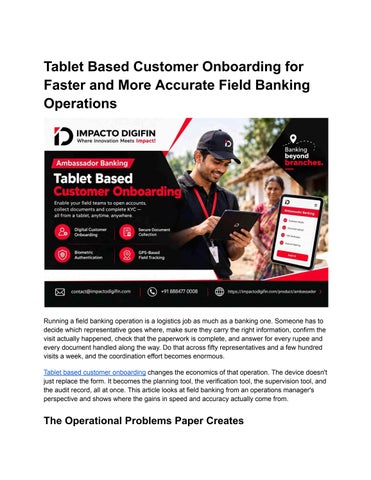
How Impacto Digifin Technologies Supports Field Banking Teams Impacto Digifin Technologies offers Ambassador Banking, a secure tablet-first platform designed for agent-assisted and field banking. Representatives can handle customer onboarding, account opening, KYC verification, loan sourcing, and transactions from the branch floor, a customer's home, or a remote village, with QR-based customer verification and no unsecured communication. The platform is built for scale, supporting banks that manage growing agent networks across multiple channels. Impacto reports end-to-end onboarding in around 15 minutes with very little manual data entry, and because Ambassador Banking connects with its wider AI banking suite, field applications flow directly into compliance checks, lending, and document management rather than sitting in a separate queue.
Frequently Asked Questions How does tablet based customer onboarding improve field team productivity? It removes paperwork, retyping, and follow-up visits, and gives representatives a planned schedule with customer details already loaded, so more visits can be completed in a day with less administrative effort. What happens if there is no internet during a visit? A well-designed app continues working offline, stores data securely on the device, and syncs automatically once a connection is available, with safeguards to prevent duplicate submissions. How can banks verify that field visits actually took place? Geo-tagged, time-stamped records for each application and transaction provide reliable proof of the location and timing of every visit. Is doorstep customer onboarding suitable for small banks with small field teams? Yes. Smaller institutions often see results quickly, because even a handful of representatives can cover a wide area once paperwork and follow-up visits are removed from their day.
Conclusion Field banking succeeds or fails on execution: who visited whom, whether the information collected was correct, and how quickly it reached the bank's systems. Paper makes all three hard to manage. Tablet based customer onboarding gives field teams structure and gives managers visibility, producing faster visits and cleaner data at the same time. If your bank wants a field operation that scales without adding administrative burden, Impacto Digifin Technologies can help you build it.