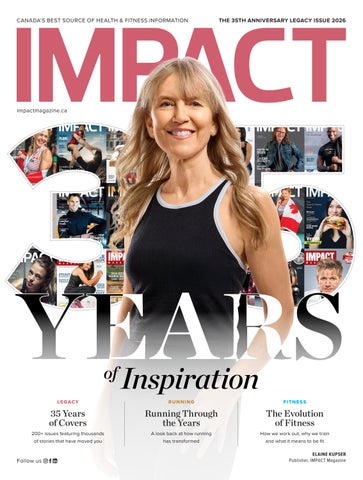
CANADA’S BEST SOURCE OF HEALTH & FITNESS INFORMATION
THE 35TH ANNIVERSARY LEGACY ISSUE 2026
impactmagazine.ca
of
Inspiration
LEGACY
RUNNING
FITNESS
35 Years of Covers
Running Through the Years
The Evolution of Fitness
200+ issues featuring thousands of stories that have moved you
A look back at how running has transformed
How we work out, why we train and what it means to be fit
Follow us
ELAINE KUPSER Publisher, IMPACT Magazine
STRENGTH LIVES IN EVERY STEP.
Strength supports the moments that ask your body for a little more. Exercise helps build that strength, and real life is where you feel the difference. CanPrev’s Creatine MagnaPower® fuels your muscles with the energy needed to power those everyday demands, supporting strength in every step.
canprev.ca/creatine
Proudly Canadian
Setting a New Standard in Women’s Footwear
The Hettas Alma Tempo is designed for women’s biomechanics, performance and support.
Hettas designs research-led footwear for female performance
L
indsay Housman has never blindly accepted the status quo. Rather, she has always looked for a better way to do things—the very mindset she brings to the running shoe industry. In her early forties, when Housman began experiencing severe foot pain (later diagnosed as bursitis), she started thinking about the impacts that ageing, hormones, and perimenopause/menopause might have on women’s biomechanics. What she discovered was a complete lack of research and that most running footwear is designed for and tested on men. Clearly, it was long overdue to create a shoe for women rather than adapt from a men’s model. In 2021, Housman founded Vancouver brand Hettas, named after her teen twin daughters; it launched in late 2023. Prior to Hettas, Housman was leading the technology team at Native Shoes, where she met Doug Sheridan, now Hettas founding product partner.
As for the science, it was in partnership with Simon Fraser University’s RunLab that research revealed the different shape and structure of a woman’s foot and her unique force profile. Research also suggests that estrogen loss during perimenopause and menopause can make tendons stiffer and less elastic — something Hettas has begun studying with RunLab. To protect the Achilles, Hettas replaced the rigid heel counter with a softer, flexible one and a lower ankle collar, using nitrogen-infused foam “pillows” to lock the heel in place. Their flagship performance collection is the Alma (Cruise, Tempo, Speed) featuring varying levels of firmness and foam depending on the run. The Cambie model, a bridge between a plated and non-plated shoe, is softer and more flexible than the Alma for easy runs. Who better to be involved as the company’s elite running advisor than long distance runner Rachel Cliff, who’d suffered a partial Achilles rupture in 2020. “In my immediate
post-op days in winter 2023, the Alma shoes didn’t put pressure on my healing Achilles insertion. I returned to running nine months after surgery!” says Cliff, 38, who set the Canadian record in the half-marathon in 2018 and the marathon in 2019. Hettas plans to launch an unplated, lower stack speed shoe in June 2027, and a trail shoe and tennis court shoe are in development. CEO Housman, 48, says it continues to be challenging getting into specialty retail stores. “It’s often as a favour and not necessarily with a store aligned with carrying a new brand requiring product education. It’s a big change.” But Housman forges ahead, creating a more equitable athletic shoe industry.
www.hettas.com
wear_hettas
Hettas
Sponsored Content
Wellness Runs in the Family
A 380-metre indoor running track overlooks courts below.
A first look at The Nostalgia Club, the 420,000 sq ft private social & athletic club now rising in Calgary’s southeast, built around elevated wellness for the whole family
Y
ou know the routine: early alarm, training session, work, family, repeat. You keep your body, your business and your household running at a high level. And most weeks that involves stitching together a gym in one part of the city, a physio clinic in another, swim and hockey practice in separate neighbourhoods and a dinner reservation somewhere in between. The Nostalgia Club was designed to end that commute. The first shovel is in the ground, and the countdown to a fall 2029 opening has begun. Over the next 36 months, 420,000 square feet of amenities, dining and services will rise above the Bow River as the social and athletic heart of Nostalgia Townlet,
a 500-acre community in southeast Calgary. It’s positioned as the most prestigious private social and athletic club in North America. The idea behind it started close to home. Chairman and co-founder Jay Westman found his inspiration while touring a Calgary club with his daughter and son-in-law. What stayed with him was how much of the place was built around children and families. That visit grew into a five-day research expedition through eleven of the most respected private clubs on the continent, with architects, designers and the next generation of the family along for the trip. The team came home with a clear picture of what makes a club last: real culture, real community, and a reason for every member of the family to walk through the door. The goal was a place where people know your name, the way they did in small towns a generation or two ago. Hence the name.
Wellness, redefined
Plenty of private clubs are built around a single pursuit. Golf, or racquets, or dining, with everything else added later. The Nostalgia Club makes wellness the organizing idea and defines it broadly enough to cover your training, your recovery, your meals, your kids and your headspace. Start with the fitness centre. It covers 25,000 square feet, with a turfed zone for sled work and core training, a power zone for Olympic lifting, private personal training studios, and a dedicated recovery room. A 380-metre indoor running track means a Calgary February won’t wreck your mileage. A group fitness partner runs a full schedule of yoga, pilates, barre and spin. Then there’s the racquet centre, with 12 tennis courts, 10 pickleball courts, three indoor padel courts and four badminton courts, plus a lounge for the postmatch debrief. Add a full NHL-sized ice rink, a 25-metre pool with four competition lanes,
a lifestyle pool with waterslides and a lazy river, an eight-lane bowling centre and six golf and gaming simulator bays. The scale is deliberate. When everything a family needs sits under one roof, showing up becomes effortless.
Aera: where recovery gets serious
Anyone who trains hard knows the work isn’t finished when the session ends. Aera, the Club’s spa and wellness destination, is built on that understanding. Aera’s rooftop spa is built around a restorative circuit of sauna, steam, hot and cold plunge, with a zen patio for slowing down between rounds and luxury locker rooms to finish. It will also feature a red light therapy bed. Aera is an adults-only retreat, designed for stillness and restoration. Aera shares the rooftop with the Club’s private outdoor pools and hot tubs, a separate adult-oriented space where members can take in the views long after their treatment ends.
Care that connects
The clinical side matters just as much. The Club provides a full Wellness Centre massage, physiotherapy, traditional Chinese medicine, laser and shockwave therapy and aesthetic services, supported by nutrition, chiropractic care and private treatment rooms. That tight hamstring, the shoulder that’s been nagging since spring and the nutrition plan you keep meaning to sort out can all be handled in the same building, by practitioners who can see how the pieces connect. Health is the foundation of everything else. The Nostalgia Club treats it that way.
Generational wellness
This is where The Nostalgia Club parts ways with most of its peers. It was designed around families from day one. Members will enjoy a 3,000-squarefoot gymnastics centre, a clip ‘n climb centre with 35-foot walls, a multi-purpose gymnasium, a supervised youth centre and a family games room with foosball, pool and plenty more. Lessons, leagues and ladders take place in every activity area.
The Nostalgia Club’s 25,000-square-foot fitness centre offers dedicated training zones, personal training studios and state-of-the-art facilities; From competitive swimming to family fun, the aquatics centre features a 25-metre lane pool, waterslides and a lazy river.
Trusted child-minding covers infants through youth, so a parent can finish a full workout without watching the clock. With so much to explore together, every generation has a reason to be fully present. The bigger payoff is harder to measure. Children who grow up watching their parents train, recover and eat well tend to carry those habits forward. A grandparent swims laps while a grandchild learns to skate just down the hall. A Saturday pickleball game turns into a family tradition that outlasts everyone’s first racquet. That’s what legacy means, and it’s why the Club talks about membership in terms of generations. And then there’s the rest of the day. Five dining venues keep you fuelled from morning to night. Café au Lait handles morning coffee, the post-workout smoothie and the quick lunch. Saint Monday’s, an elevated sports lounge overlooking the ice rink, works for family dinners and game nights alike. Clementine’s pairs a
world-class wine list with refined shareables. Evermore brings members-only dining to the rooftop, and Winston’s, a speakeasystyle lounge, is made for the nightcap. The practical details are covered too. A business lounge with workstations, private meeting rooms and a library, Saint Monday’s private dining room, plus the 30-person Evermore boardroom on the rooftop, means you can take the meeting and still make your class. Concierge looks after bookings and errands.
Be a Legacy Member
Legacy families are invited to join now, ahead of the Fall 2029 opening. Being early means being part of the story from the beginning. Legacy memberships are now available at an exceptional entry point value. This is where your family’s story begins. Learn more at www.thenostalgiaclub.ca. _thenostalgiaclub
Sponsored Content
CONTENTS COVER: HARDERLEE
Features 33
54
35 YEARS OF COVERS
Revisiting the athletes, achievements and cover stories that defined 35 years of IMPACT
FITNESS THEN AND NOW
IMPACT looks back over the decades to an industry that has seen trends, fads and challenges
Inside This Issue WO R KO U T
24 Exercises That Have Stood the Test of Time 28 Beyond the Reformer
54
FOOD & NUTRITION
98 Nutrition Then and Now
RECIPES: EDITOR’S CHOICE T R AV E L
65 Places That Moved Us C A N A DA’ S TO P F ITN E S S TR A I N E R S & I N S TR U C TO R S
50 A Legacy of Recognizing Those Who Make a Difference for Others
AT H L E T E S W I T H I M PAC T
60 The Comeback of a Lifetime 62 Running to Make a Difference RUNNING
82 Running Through the Years 86 Run Forever H E A LT H
90 The Evolution of Sleep
102 Green Goddess Sandwich 104 Roasted Sweet Potato Tacos 106 Mushroom Burger 108 Sesame Cashew Soba Noodle Salad 110 Sprouted Coronation Chickpeas 112 Vegan Mushroom Stroganoff 114 Vegetable Barley Soup 116 Tex-Mex Rice Salad 118 Easy Vegan Garlic Noodles 120 Ragu Bolognese 122 Chocolate Chunk Protein Bars 124 Protein Cookies 126 Key Lime Pie 128 No-Bake Nanaimo Bars
24
FINAL IMPACT
130 Where It All Began
S PORTS M E D ICI N E
92 The Changing Face of Sports Medicine 96 What We’ve Learned About Back Health
CANADA’S BEST SOURCE OF HEALTH & FITNESS INFORMATION
INS TH E
CA NA
BE DA’S
UR ST SO
Extras
HE ALT
NE SS
INF
ION
CA NA
2
K WOcR ATH BRE d Athleti ce
6 I 35th Anniversary Legacy Issue 2026 I IMPACT MAGAZINE
CANADA’S TOP
Fitness Instructors
an rman Perfo
IGHT Y-WE T BODORKOU dy W Every Bo
2023
for
Fol low
us
ine.ca
SMARTER In Fitnes HOW TO TRAIN
RRAY K MU JAHMEEd as one of ess Feature ’s Top Fitn Canada Trainers
ma gaz
Ultramarathon
ine.ca
ESS S FITN INER TR A 022
50
UR CE
ANDREW ALCALDE One of Canada’s Top Fitness Instructors in Vancouver, B.C. Follow us
OF HE
ALT H
& FIT
NE SS
INF OR
MATIO N
TH E
RACING THE WORLD’S HIGHEST
p a’s To Canad
2026 Road & Trail Running Shoe Reviews
ST SO
impactmagazine.ca imp act
ma gaz
DA’S BE
TIO N OR MA
SELF-CARE ROUTINE
ON LI N E E XCLUS IVE
THE INSPIRATION ISSUE
ISS UE
CREATING A
imp act
Visit impactmagazine.ca
CE OF
FIT H&
PIR AT
NAZ TAB
One of IBI Fitness Canada’s Top in Calg Instructors ary, AB
Fol low
us
CANA
DA’S TO
P
struc s 2023 tors
INS PIR
ATION
ISS UE
33 60
65 86
120 C ANADA’S BEST SOURCE OF HE ALTH & FITNESS INFORMATION | JANUARY/FEBRUARY 2018
IMPACTMAGA ZINE.C A
The Motivation & Inspiration Issue Personal Trainer
Scott Salling
Yoga Studio
FASHION
Our Favourite
Comfort Foods An Adventure To
PERU
18
S OLYMPIAN WATCH TO
CANADA'S TOP
FITNESS TRAINERS Follow us
C ANADA’S BEST SOURCE OF HE ALTH & FITNESS INFORMATION | JANUARY/FEBRUARY 2018
C ANADA’S BEST SOURCE OF HE ALTH & FITNESS INFORMATION | JANUARY/FEBRUARY 2018
IMPACTMAGA ZINE.C A
IMPACTMAGA ZINE.C A
The Motivation & Inspiration Issue
The Motivation & Inspiration Issue Personal Trainer
Alicia Bell
Personal Trainer
Jeff Aker
Yoga Studio
FASHION
Our Favourite
Our Favourite
Comfort Foods
Comfort Foods
Yoga Studio
FASHION
An Adventure To
18
CANADA'S TOP
S OLYMPIAN WATCH
FITNESS TRAINERS
TO
Follow us
PERU
18
S OLYMPIAN WATCH TO
CANADA'S TOP
FITNESS TRAINERS Follow us
CANADA’S BEST SOURCE OF HEALTH & FITNESS INFORMATION
JANUARY/FEBRUARY 2020
impactmagazine.ca
The Inspiration Issue
PHILIP NDUGGA Featured as one of Canada's Top Fitness Trainers 2020
CANADA’S BEST SOURCE OF HEALTH & FITNESS INFORMATION
JANUARY/FEBRUARY 2020
CANADA’S BEST SOURCE OF HEALTH & FITNESS INFORMATION
impactmagazine.ca
impactmagazine.ca
The Inspiration Issue
The Inspiration Issue
JANUARY/FEBRUARY 2020
CASSIE DAY Featured as one of Canada's Top Fitness Trainers 2020
INSPIRING ADVICE
To Get Fit in 2020! INSPIRING ADVICE
INSPIRING ADVICE
RECIPE IDEAS
FOR PRE, DURING & POST WORKOUT
CANADA'S
TOP FITNESS TRAINERS HANNAH FLETCHER Featured as one of Canada's Top Fitness Trainers 2020
Follow us
CANADA’S BEST SOURCE OF HEALTH & FITNESS INFORMATION
THE INSPIRATION ISSUE
impactmagazine.ca
Follow us
CANADA’S BEST SOURCE OF HEALTH & FITNESS INFORMATION
impactmagazine.ca
Canada’s Top
Canada’s Top
Fitness Instructors
Fitness Instructors
2021
2021
The State
THE INSPIRATION ISSUE
impactmagazine.ca
Canada’s Top
Fitness Instructors 2021
The State
The State
— of the —
— of the —
Fitness Industry
Fitness Industry
STRETCHING for OPTIMAL MOVEMENT
STRETCHING for OPTIMAL MOVEMENT
NAOMI KEANE Featured as one of Canada’s Top Fitness Instructors
— of the —
Fitness Industry STRETCHING for OPTIMAL MOVEMENT KIM HARVEY Featured as one of Canada’s Top Fitness Instructors
DIONE MASON Featured as one of Canada’s Top Fitness Instructors
Follow us
Follow us
CANADA’S BEST SOURCE OF HEALTH & FITNESS INFORMATION
CANADA’S BEST SOURCE OF HEALTH & FITNESS INFORMATION
THE 30TH ANNIVERSARY ISSUE
THE INSPIRATION ISSUE
CANADA’S BEST SOURCE OF HEALTH & FITNESS INFORMATION
THE INSPIRATION ISSUE
CANADA’S BEST SOURCE OF HEALTH & FITNESS INFORMATION
From left to right: Philip Ndugga, Kyle Shewfelt, Tanya Dubnicoff, Simon Whitfield, Jon Montgomery, Brian McKeever, Mark Tewsbury, Jessica Zelinka.
impactmagazine.ca
impactmagazine.ca
Canada’s Top
FITNESS TRAINERS 2022
BREATHWORK and Athletic Performance
30
BODY-WEIGHT WORKOUT
YEARS of Inspiration
for Every Body
Follow us
CANADA’S BEST SOURCE OF HEALTH & FITNESS INFORMATION
THE INSPIRATION ISSUE
impactmagazine.ca
THE INSPIRATION ISSUE
impactmagazine.ca
THE INSPIRATION ISSUE
CANADA’S TOP
Fitness Instructors
CANADA’S TOP
SMARTER
CANADA’S BEST SOURCE OF HEALTH & FITNESS INFORMATION
impactmagazine.ca
Ultramarathon HOW TO TRAIN
90
CANADA’S BEST SOURCE OF HEALTH & FITNESS INFORMATION
RACING THE WORLD’S HIGHEST
CREATING A
SELF-CARE ROUTINE
2023
Fitness Instructors 2023
CANADA’S TOP
Fitness Instructors 2023
ANDREW ALCALDE One of Canada’s Top Fitness Instructors in Vancouver, B.C.
NAZ TABIBI One of Canada’s Top Fitness Instructors in Calgary, AB
SHAKERA MARTIN One of Canada’s Top Fitness Instructors in Toronto, ON
Follow us
Follow us
Follow us
CANADA’S BEST SOURCE OF HEALTH & FITNESS INFORMATION
THE INSPIRATION ISSUE 2026
CANADA’S BEST SOURCE OF HEALTH & FITNESS INFORMATION
THE INSPIRATION ISSUE 2026
CANADA’S BEST SOURCE OF HEALTH & FITNESS INFORMATION
impactmagazine.ca
impactmagazine.ca
Optimal
Optimal
Optimal
PREVENTING
Burnout
PREVENTING
Burnout
EXERCISE TIMING
Hard Core
EXERCISE TIMING
Hard Core
WORKOUT
CANADA’S TOP
Fitness Trainers
2026
JENNIFER NEIL One of Canada’s Top Fitness Trainers Calgary, AB.
WORKOUT
CANADA’S TOP
Fitness Trainers
CANADA’S TOP
Fitness Trainers
2026
2026
Follow us
THE INSPIRATION ISSUE 2026
impactmagazine.ca
PREVENTING
Hard Core
WORKOUT
Follow us
ANITA AVIC One of Canada’s Top Fitness Trainers Toronto, ON
EXERCISE TIMING
Burnout
Follow us
DANIEL SALAZAR One of Canada’s Top Fitness Trainers Port Moody, B.C.
impactmagazine.ca
Canada’s Top
FITNESS TRAINERS 2022
BREATHWORK and Athletic Performance
BODY-WEIGHT WORKOUT
impactmagazine.ca
Canada’s Top
FITNESS TRAINERS 2022
BREATHWORK and Athletic Performance
BODY-WEIGHT WORKOUT for Every Body
for Every Body
JAHMEEK MURRAY Featured as one of Canada’s Top Fitness Trainers
KELSEY JACK Featured as one of Canada’s Top Fitness Trainers
PAUL ANTHONY Featured as one of Canada’s Top Fitness Trainers
Follow us
Follow us
Follow us
THE INSPIRATION ISSUE
Follow us
CANADA’S BEST SOURCE OF HEALTH & FITNESS INFORMATION
Follow us
THE INSPIRATION ISSUE
35TH ANNIVERSARY EDITION 2026 VOLUME 36, ISSUE 1 A leader in the industry for over 35 years, IMPACT Magazine is committed to publishing content provided by the best experts in their fields for those who aspire to higher levels of health and fitness.
VANCOUVER • CALGARY • TORONTO PUBLISHER & EDITOR-IN-CHIEF Elaine Kupser elaine@impactmagazine.ca GUEST EDITORS Louise Hodgson-Jones corsa.communications@shaw.ca Emily Meyer emily.meyer.content@gmail.com Chris Welner cwelner@telus.net ART DIRECTION & GRAPHIC DESIGN Logan Johnson hello@loganjohnson.com Marc Morin - Impello Inc marc@impello.com COPY EDITOR Tom Lundteigen DIGITAL MARKETING & SOCIAL MEDIA MANAGER Maricris Taeza maricris@impactmagazine.ca ADVERTISING advertising@impactmagazine.ca LEGAL COUNSEL PRINTING DISTRIBUTION
Gregory Forrest TC Printing Media Classified Maple Leaf Distributors
CONTACT IMPACT Magazine Head Office 2007 2nd St. S.W. Calgary, AB T2S 1S4 403.228.0605 SUBSCRIPTIONS $45 for one year, or $70 for two years (includes GST) impactmagazine.ca/subscriptions WEBSITE www.impactmagazine.ca
2 013
ER
r/A
02
r g ent 2
ve
l
ve
l
E KUPS
2
Si
AIN
Awards ng
ING
EL
line Publishi On
Si
line Publishi On
02
2
BL
Canadian
MENT IN PU
ImpactMagTelevision
Canadian
IEVE
SOCIAL impactmag
Awards ng
CH
ISH
A
impactmagcanada
r/A
r g ent 2
The opinions expressed in IMPACT Magazine are the writers’ and not necessarily those of the publication. IMPACT Magazine advises you to consult your physician if you do not follow a regular fitness program. All content is the property of IMPACT Productions Inc. and cannot be reproduced in any form without written consent of IMPACT Productions Inc. © 2026 Impact Productions Inc. Funded by the Government of Canada
8 I 35th Anniversary Legacy Issue 2026 I IMPACT MAGAZINE
CONTRIBUTORS LOUISE HODGSON-JONES Louise is a professional communications and special events consultant working primarily in the sports and fitness industry and with non-profit organizations in Victoria, B.C. Formerly an editor of IMPACT Magazine, she is also a frequent guest editor with IMPACT. She is a Six Star Abbott World Major Marathon finisher. Louise brings us two compelling features, on fitness over the decades, and how running has evolved through the years. LOUISEHODGSONJONES
LOUISE.HODGSONJONES
LOGAN JOHNSON Logan is an award-winning art director and graphic designer with over 15 years of experience in editorial design, branding and advertising. Based in Calgary, AB, he runs his own freelance design business, working with clients across a variety of industries. Logan returns to IMPACT Magazine for this special edition, bringing his expertise to create IMPACT-ful editorial layouts and advertising features. LOGANJOHNSONDESIGNS
EMILY MEYER Guest editor Emily Meyer is a Calgary-based freelance writer with a background in journalism and communications. Passionate about fitness, travel and telling inspiring stories, she brings us our top travel destinations over the decades. Outside of writing, Emily has visited 61 countries and is always looking for an excuse to add another to the list. EMILY.MEYER.TRAVELTALES
EMILYMEYER287
MARC MORIN Marc is IMPACT Magazine’s art director and an award-winning creative director with over 25 years of experience in branding, advertising and design. He is the founder of Impello, a Calgary-based creative studio, and DNQ (Do Not Quit), a custom athletic apparel and merchandise company. An accomplished endurance athlete, Marc has completed the Boston Marathon, multiple Ironman triathlons and challenging ultramarathons, including the Canadian Death Race and Sinister 7. MARCRMORIN
CHRIS WELNER Chris is a writer, editor and entrepreneur with over 40 years experience in daily newspapers, magazine journalism, and communications. He is a former editor at IMPACT Magazine and is co-author (with his granddaughter Isla) of the children’s book Things I Taught My Bampa. He travels the world by planes, trains and RVs with his wife Judy. Chris brings us 35 Years of Cover Athletes in this special edition. CRYSWRITING
CONTRIBUTORS Charmaine Broughton, Dr. Syl Corbett, Scott Cruickshank, Julie Daniluk, Carol Dudar, Caroline Doucet, Elizabeth Emery, Tommy Europe, Zuzana Fajkusova, James Fell, Damian Hall, Louise Hodgson-Jones, Anita Ivic, Russell James, Andrea Katz, Dr. Ty McKinney, Maria Koutsogiannis, Nikki Lefler, Dr. Stuart McGill, Emily Meyer, Dr. Nick Mohtadi, Joni Pypers, Lori Rasmussen, Heidi Richter, Hannah Sunderani, Lauren Toyota, Nisha Vora, Chris Welner, Jessica Woollard. PHOTOGRAPHERS Lori Andrews, Patricia Ainol, Albatross Adventure Marathons, Amcm/Mainguy, Berlin Marathon, Billie Design Co, Danielle Blancher, Barry Calhoun Photography, Meagan Broughton, Jaxon Castellan, Caroline Doucet, Elizabeth Emery, Luis Escobar, HarderLee, Russell James, Jo Evans Da Kine Images, Jungfrau Marathon, Sebastien Goldberg, Gokul Gurang, Mick Haupt, Eric Hanson, Charles Hope, Fotografed – Aleksandra Was, Laura James, Eddie Kiszka, Walker Jordan, Maria Koutsogiannis, Darina Kopcok, Adam Lapierre Breakaway Promotions, Jay Lawrence, Rosie Lee, Graham McKerrell, Jana Miko, Mathias Mullie, Emily Meyer, Arjay Neyra, Newfoundland and Labrador Tourism, Tim Oun, Parks Canada / Scott Munn, Blaine Penny, Joni Pypers, Lori Rasmussen, Heidi Richter, Hannah Sunderani, Tourism Whistler, Martin Vemodalen, Victoria Falls Marathon, Nisha Vora, Paula Wilson, Queenstown Marathon, Mike Yoshida / X Games Images, Eugenia Zykova.
10 I 35th Anniversary Legacy Issue 2026 I IMPACT MAGAZINE
35 years of ExtrAORdinary Innovation 1991
AOR is Founded
1998
D-Ribose First in the World
1993
Glucosamine Sulfate First in Canada
2001
Benfotiamine First in North America
2007
Oxaloacetate (benaGene®) First in Canada
2009
Curcumin Nanoparticles First in the World
2011 2012
NOx3,2,1 Technology First in the World
2019
Longvida® Curcumin First in Canada
2017
CurQFen® and Turmacin combination First in the World
Palmitoylethanolamide (PEA) First in Canada
2023
NMN + Wheat Germ First in North America
2024
Urolithin A+ First in Canada
2026
The pursuit of better never stops
MEMO
A Personal Reflection on
35 Years of IMPACT ELAINE KUPSER, PUBLISHER & EDITOR-IN-CHIEF elaine@impactmagazine.ca HARDERLEE HAIR & MAKEUP: K AREN MALCOLM-PYE
K ARENMALCOLMPYE
CLOTHING: LULULEMON 17 AVE. CALGARY
I
n the early 1980s, I was a fitness club manager and aerobics instructor, working in the midst of a fitness movement that was changing how people thought about health and exercise. I loved the energy of the industry, the sense of community and the idea of helping people discover the benefits of living healthier, more active lives. I also discovered something else: I loved marketing and advertising and was always looking for ways to spread the word and give our growing industry a voice. Perhaps I caught the magazine bug when I appeared on the cover of Calgary’s Action Magazine in 1987. How glamorous! After managing a few of Calgary’s leading fitness clubs, I began thinking about my next steps and what more I could contribute to an industry I loved. As a fitness professional, I saw a need for a platform where the industry could share credible information, recognize its leaders and tell its stories. There was no such publication in Canada at the time, and I set out to create one. In September 1991, with $5,000 in my pocket, as much research as I could gather about the magazine industry, and what I considered a pretty solid business plan, and a whole lot of optimism, IMPACT Magazine was born. I wanted to bring together the best of health, fitness, running, sports performance, nutrition and sports medicine, and create a place for businesses to market themselves. I assembled an advisory board of respected experts across these fields, along with talented writers, photographers and designers. Many of those early relationships continue today, and I remain grateful for the knowledge and support they brought to those first pages. From the beginning, we sought to recognize people who were doing extraordinary things. We’ve had the privilege of profiling Olympians, Paralympians, professional athletes, fitness professionals, coaches, researchers, chefs and everyday people overcoming adversity through sport and fitness.
12 I 35th Anniversary Legacy Issue 2026 I IMPACT MAGAZINE
I didn’t set out to build a magazine empire. I wanted to create something meaningful for an industry that had given me so much. Over time, IMPACT became much more than a publication. It became a platform, a community and a place where people could see themselves, learn from one another and find inspiration. It also became an enormous part of who I am. I came to magazine publishing through the fitness industry, not through a traditional publishing career. It took me decades to become completely comfortable identifying myself as a publisher. Unfortunately, I didn’t have a female role model in publishing to show me the way and there were plenty of moments when I wondered whether I belonged in the room. Yet, over the last 35 years, I have learned to trust my own instincts, believe in the value of good work, lead with kindness, and keep moving forward through the challenges of owning a small business. And a healthy dose of stubbornness doesn’t hurt! I’d love to share with you some of the things I am most proud of from our 35 years of publishing: IMPACT was among the early Canadian publications to put Olympians and Paralympians on the front cover, at a time when many athletes weren’t receiving the recognition, exposure or financial support they deserved. It was important that their stories were told, and that readers had the opportunity to see what dedication, determination and resilience really look like. Our Athletes with IMPACT stories have always been especially close to my heart. They remind us that inspiration doesn’t belong exclusively to elite athletes. It’s found in everyday people accomplishing extraordinary things, overcoming challenges and discovering what they’re truly capable of. In March 1993, we introduced our first RACE SOURCE GUIDE, the first of its kind in Canada. Running had become such an important part of my life, and I loved being able to bring this
IMPACT Magazine is Canada’s longest-standing independent woman-owned magazine.
I wanted to create something meaningful for an industry that had given me so much. resource to our readers. This was way back when runners filled out paper entry forms, put a stamp on an envelope and mailed them in. There was no online registration, no instant race results and no social media. I kind of miss those days! By 1997, readers were recognizing IMPACT for its excellent writing and describing it as one of ‘the most informative and educational magazines around.’ That feedback meant a great deal to me. We have always believed that solid editorial mattered. In 2016, we embraced a plant-based approach to food and sports nutrition, with an emphasis on showing readers how delicious, accessible whole foods could support overall health and performance. Our philosophy was never about telling people what not to eat, but about inspiring them to add more of the good things to their plates. Beautiful food that is good for you, too! In 2018, we introduced Canada’s Top Fitness Trainers & Instructors. What began as an editorial platform to acknowledge outstanding professionals in our industry has grown into a national recognition program, awards ceremony and fitness conference celebrating hundreds of individuals. Through their education, leadership, community contributions, philanthropy and dedication to helping others, these professionals represent the very best of our industry. This program has become one of the contributions I’m most proud of. Honouring people who spend their lives making a difference in the lives of others feels like a natural extension of everything IMPACT stands for. I hope this legacy continues for many years to come. Then came 2020. COVID brought the fitness and publishing industries to an almost complete standstill. Gyms and studios were forced to close, running events were cancelled and the future of so many businesses became uncertain, including IMPACT. After 29 years, I genuinely wondered if this was it. •
However, stubbornness has its advantages. Rather than step away, we found ways to help our industry stay connected and visible. Our online platform expanded to showcase businesses in our community, and we organized early town halls for the race and fitness industries, bringing people together when none of us knew what lay ahead. We also hosted free weekly live workouts on Instagram for over a year with Canada’s top trainers and instructors, giving people a reason to keep moving, stay motivated and feel connected during an incredibly isolating time. During a time of unprecedented uncertainty, our digital platform grew in ways we hadn’t anticipated, becoming a powerful extension of the IMPACT brand. That summer, we also produced a 138-page digital magazine, offering free advertising to businesses affected by the shutdown. Contributors and supporters from years past came forward to help however they could. Something unexpected happened amid all the uncertainty and hardship. With the usual competition set aside, people began sharing ideas, resources and experiences, to help one another navigate an incredibly difficult time. New advocacy groups emerged, and collaborations developed that might never have happened otherwise. It was a reminder that our industry is about so much more than competing for customers. While COVID brought massive challenges and lasting consequences for many, I believe it also brought us closer and reinforced that we’re all working toward something bigger. In 2024, we published our Inclusivity and Diversity issue. We’ve always believed that health, fitness and sport should be welcoming and accessible to everyone, and that the stories we tell should reflect the diversity of the communities we serve. This edition showed how far the industry had come while acknowledging how much further we still need to go. And now, we made it to 35 years! And… yes, that’s me on the cover! Since Jane Fonda wasn’t available (and believe me, I tried!), designer Logan Johnson suggested I step in. It took some major convincing, and I’m still a little out of my comfort zone, but here I am! A huge thank you to Trudie Lee and Brian Harder, two incredible photographers who have been part of this journey for decades, and Karen Malcolm-Pye for the glamorous hair and makeup. I never imagined that 25-year old girl on the cover of
DIGITAL EDITIONS
Action Magazine cover, circa 1987.
Action Magazine in 1987 would one day find herself on the cover of the magazine she founded. Some things really do come full circle. I’m particularly moved by my IMPACT team who came together to create this special edition. A heartfelt thank you to Louise HodgsonJones, Logan Johnson, Emily Meyer, Marc Morin, Maricris Taeza, Chris Welner, and Michelle Gjerde. It’s a privilege to work alongside the best in the industry. None of this would be possible without you. My daughter Lindsay and my husband Tom have been my unofficial sounding boards, proofreaders, and shoulders to lean on for years. Neither applied for the volunteer position, but both have devoted countless hours alongside their own busy careers. There’s no escaping the magazine business in our family! No salary, no set hours and, apparently, no retirement plan. They’re my first call, and I’m grateful for them every day. If there’s one thing I know for sure after 35 years, it’s that IMPACT has never been a solo effort. It has been built on relationships with our writers, photographers, designers, contributors, athletes, advertisers, partners and, of course, our cherished readers. As a free magazine, IMPACT would not exist without the advertising support of the businesses that have believed in and invested in our pages. I can’t thank you enough. So many of you have been part of this journey from the very beginning and seeing you all represented in this edition is especially meaningful. Thank you for your time, trust and loyalty. I hope that somewhere within these pages over the years, you’ve found a little inspiration, learned something helpful, discovered a new way to move or eat, or simply felt part of a community. And I hope you enjoy looking back with us as we revisit some of these special memories. Would I do it all over again? In a heartbeat. Thank you, thank you, thank you. Here’s to the next page.
Looking for more IMPACT? Explore our archive of past digital editions including previous anniversary editions, at www.impactmagazine.ca/digital-editions/. And never miss an issue! Subscribe to our FREE newsletter and digital editions online at www.impactmagazine.ca/subscriptions/.
14 I 35th Anniversary Legacy Issue 2026 I IMPACT MAGAZINE
The Heart & Sole of Gord’s Running Store Cathy Scott (bottom row, centre) with some of the team members at Gord’s in 2026; Gord Hobbins (inset) celebrates the grand opening of his original store in 1990.
A legacy of passion, people & running
O
ver the decades, Gord’s Running Store has become an iconic part of Calgary’s running community, built on a passion for the sport and a genuine commitment to helping every runner find the right fit. For many, it became the soul of Calgary’s running scene. Running was on the rise, and Gord Hobbins recognized something that would become the foundation of his business. “The right running shoe is about more than the brands or the latest models. It’s about the individual wearing them,” he believed. The original location opened its doors in March 1990 and expanded to its new location in 2000, where that commitment to personalized service continues today. Gord was inspired to open his own store because he recognized the importance of fitting running shoes to the individual. Foot shape, biomechanics and training needs all play a role in determining which shoe is right for a runner. A shoe that works well for one person may not be suitable for another, and Gord understood just how much that mattered.
“He knew the minute details of every shoe and studiously observed different foot shapes and gait patterns, which helped runners of all abilities narrow their appropriate choices just as the running shoe industry began its explosive growth,” says Cathy Scott, Gord’s wife and partner in life and business. During the 2010s, as online shopping gained popularity, it appeared that shoe sales might shift predominantly online, threatening the future of brick-and-mortar stores. Yet the need for individualized, in-person service receiving immediate feedback from someone trained to observe how the foot responds, has only grown with the rapid pace of change in shoe technology. Gord’s family and the store family are most proud of Gord’s outstanding 40+ years of dedication to the running community. He participated in races of all distances and types, endlessly volunteered his time, knowledge and enthusiasm, and provided financial support to events, whether large or small.
919 Centre St. N Calgary, AB 403-270-8606 www.gordsrunningstore.com Gords.Running.Store gordsrunningstore Most days, you would find Gord doing what he loved best: spending time with customers and his many friends at the store, sharing his expertise or telling stories with his characteristic kindness. Since Gord’s untimely passing in 2025, his ethos remains at the heart of the business. His family keeps things humming in the office, while the store’s outstanding team continues to provide the same level of attention and expertise that Gord’s Running Store has always been known for. One thing is certain. This team will continue to be an invaluable part of Calgary’s running and fitness community, carrying Gord’s legacy forward for years to come.
Sponsored Content
Nineteen men competed in the first Calgary Marathon on August 10, 1963.
The Calgary Marathon: Then & Now A legacy in every step
R
un Calgary is thrilled to celebrate IMPACT Magazine’s 35th anniversary and all its contributions to the running community while inspiring healthy living. The long-standing relationship between Run Calgary and IMPACT means both organizations have seen the tremendous growth and continuous change of the running landscape and how it continues to bring people together.
The Calgary Marathon has changed a lot over the past 35 years, but at its heart, this event has always been about bringing people together. As we look ahead to a new era, we’re proud to build on that legacy by creating opportunities for more people to discover running and find their place in Calgary’s running community.” – Kirsten Fleming, CEO, Run Calgary
The Calgary Marathon in 1991
If we take a trip down memory lane, thirty-five years ago the 1991 Calgary Marathon, known that year as the ‘Stampede Run-Off’, was hosted on a beautiful day in July. It was the biggest event of the year for the Calgary Road Runners club, and it was the first year that prize money was up for grabs.
Participant Numbers Then & Now
Looking 35 years back, the Calgary Marathon has seen many eras and grown alongside our running community. In 1991, the Calgary Marathon welcomed about 500 participants, and in 2026, a record 20,600 participants hit the streets. These numbers are expected to be surpassed in 2027, the 63rd edition of the race.
Women Then & Now
Register at: www.calgarymarathon.com calgarymarathon CalgaryMarathon
Sponsored Content
When women first joined the race in 1975, it marked a turning point. Today, women represent 48% of participants across all race weekend distances. Run Calgary is committed to bringing more equality to the start line, and aims to support women through inclusive policies, like the ability to defer an entry due to pregnancy or postpartum, the addition of infant feeding stations, a free Women’s Training Program, and flexible stroller policy.
The 2026 Calgary Marathon hit a record 20,600 participants; (Right) Eight-time champion Kelvin Broad wins the 1997 Calgary Marathon in 2:30:07; (Below) Participants enjoy iconic views of Calgary throughout the course.
Route Then & Now
The Calgary Marathon has always shown Calgarians and visitors scenic views to celebrate our beautiful city. In the past 35 years, the race has seen many start lines, finish lines, and routes. But some iconic views have stayed the same. In 1991, the race started in the Eau Claire neighbourhood as opposed to Stampede Park but shared a similar route down Memorial into Bowness.
How the Race has Changed
In 1991, the Calgary Marathon included the marathon distance, a 10 km race, and a Mayor’s 2 km Fun Run. Now race weekend consists of a marathon, half-marathon, 10 km, 5 km, kid’s race, and diaper dash! With distances for everyone, the Beneva Calgary Marathon prides itself on being an inclusive race for everyone to run, walk, or wheel.
New Beneva Era
The Calgary Marathon is excited to welcome Beneva (Canada’s largest mutual insurance company) as their new title sponsor, becoming the 7th running event supported by Beneva across Canada. As IMPACT celebrates this milestone, the team at Run Calgary is also looking forward to the future and a new era of the Beneva Calgary Marathon. Creating new opportunities, finding new ways to innovate, and growing the race alongside the running community. Together, Beneva and the Calgary Marathon are busy planning behind-the-scenes to deliver a premier race weekend experience. Run Calgary is continuing to create opportunities for more people to participate, and contribute to the health, vitality, and spirit of Calgary through initiatives such as the Fair Entry Program, First Timers Program and Women’s Training Program. Join the Beneva Calgary Marathon on May 29 and 30, 2027 as a participant, volunteer, or spectator and feel the race week excitement throughout all of Calgary. Whether this is your first race, your next challenge or a return to something you love, there’s a place for you at the Beneva Calgary Marathon. Experience Calgary from a whole new perspective and join a running community 63 years in the making.
History In The Making
On August 10, 1963 nineteen men lined up at Glenmore Stadium to run the first Calgary Marathon, and what was also the first marathon event ever to be held in Canada. More records were set in the 1990’s. Kelvin Broad ran his first Calgary Marathon in 1991. That same year he set the record for the Calgary Marathon in a time of 2:23:49 and the record stood until 2012 when Benard Onsare ran a 2:22:47. 1991 was also the first year that prize money was given out to the top performers. Kelvin received $500 for his efforts that day. He continued to win every Calgary Marathon he entered and remains the Overall Winner of the Men’s Division with a record eight victories. The Calgary Marathon course records continue to be challenged year after year, with the current men’s and women’s records standing since 2018 and 2017, respectively.
Marathon Course Records Male
Feyera Dadi (2018)
2:16:37
Female Caroline Kiptoo (2017) 2:42:48
FIRST IMPACT
Marathons Generate Billions in Revenue NEW YORK ROAD RUNNERS, SCOTT McDERMOTT
T
he world's top 50 marathons generated an estimated US$6 billion in economic impact for their host cities in 2025, according to a new report from Brand Finance, the world's leading brand valuation consultancy. Topping the list was the TCS New York City Marathon with $857 million, followed by the Bank of America Chicago Marathon ($803 million) and the TCS London Marathon ($604 million). The report stated that international runners are a major contributor to this economic activity supporting local hotels, restaurants, transport and other businesses. Charities also benefited with the $434 million being raised for charity from the top 50 marathons, and 160 million hours of physical activity was recorded over the race year. Not surprisingly Brand Finance values the seven Abbott World Marathon Majors—New York, Chicago, London, Boston, Berlin, Tokyo and Sidney—at a combined $1.1 billion. The New York City Marathon is the most valuable marathon brand at $339 million, followed by London ($230 million) and Chicago ($149 million). (Note: the report was published before Cape Town, South Africa was named as the eighth Abbott World Marathon Major.). Source: www.brandfinance.com.
2027
Fitness Trends
T
he American College of Sports Medicine (ACSM) has published its 2027 Worldwide Fitness Trends report. The annual report outlines the trends exercise professionals expect to influence the industry in 2027. Wearable technology tops the list with strength training, older adult fitness and exercising for mental health maintaining a top 10 presence from previous years. Good news for the industry is that fitness classes prevail in many forms despite the continued rise of digital technology. “Technology continues to shape how people approach fitness, but this year’s rankings also highlight the value of shared experiences and programs that fit different stages of life,” said Cayla R. McAvoy, PhD, ACSM-EP, lead author and chair of ACSM’s Trends Workgroup. 1. Wearable Technology 2. Mobile Exercise Apps 3. Balance, Flow, and Core Strength 4. Fitness Programs for Older Adults 5. Traditional Strength Training 6. Exercise for Weight Management 7. Group Fitness Classes 8. Data-driven Training Technology 9. Exercise for Mental Health and Well-Being 10. Influencer/Ambassador-led Fitness Programs Source: https://acsm.org/2027-fitness-trends.
The Promise and Complexity of GLP-1s
F
or decades, we’ve searched for the magic weight-loss pill, hoping to find a simpler solution to one of the most complex challenges in health and wellness. But body weight is influenced by far more than how much we eat, with genetics, hormones, metabolism, medications and other health factors all playing a role. From fad diets to low-fat eating plans, the promise of a breakthrough has continued to capture our attention. Then came GLP-1 medications, which have transformed the conversation around obesity and weight management. By influencing appetite, feelings of fullness and blood sugar regulation, these medications offer a new approach, with significant results for many people. As with any medical treatment, understanding the benefits, risks and long-term considerations of GLP-1 medications should be done in consultation with a qualified medical professional.
18 I 35th Anniversary Legacy Issue 2026 I IMPACT MAGAZINE
Someone made your favourite play space possible. This year, that someone can be you. Prince's Island Playground: After 23 years, Calgary's favourite playground is ready for its next chapter an inclusive playground. Help us finish the story.
Basketball Court Revitalization: Across Calgary, aging hoops, faded lines and worn surfaces are limiting the places where communities can play and connect. Help us build fresh hoops for stronger communities. 40 Years of Building Calgary’s Play Spaces: Parks Foundation and our donors have helped create the outdoor spaces Calgarians love.
Share the joy of play. Donate today.
parksfoundation.ca/donate
FIRST IMPACT
Action athletes fired up for X-Games League Tour One of sport’s most popular showcases is coming to Calgary this winter MIKE YOSHIDA, X GAMES IMAGES
T
he MoonPay X-Games League will bring the world's top skiers and snowboarders to the hill and half-pipe at Winsport in Calgary this February. For the first time, athletes will be competing for one of four cities in a league format with $500,000 being awarded to the winning team. The series kicks off in Aspen, Colorado, January 29–31, 2027, heads to Calgary from February 19–21, and concludes in Ruka, Finland, April 9–11. Four teams each selected 10 skiers and snowboarders to represent their cities for the league competition. Eileen Gu, the San Francisco athlete who represents China in international events, was the first selection for XC Golden State in a pro-sports style draft in September. XC New York Winter then took Saskatchewan’s Mark McMorris—a 2020 IMPACT Magazine cover athlete—with the second overall pick. “X Games will be the largest winter sport event hosted in the city since the Calgary 88 Olympics.,” says Russell Reimer, Calgary bid lead. “Canada’s action sports athletes—from Mark McMorris to Megan Oldham—have dominated the X Games and Olympics for a decade and bringing the event to Calgary feels like a homecoming.” “X-Games is kind of the main focus for me—being ready and dialled in for that,” says McMorris, whose 25 X-Games medals is more than any other athlete. “A lot of work goes into my body to keep it working at a high level. I’m feeling good, but being able to ride the park at 33 is not easy.” McMorris has suffered catastrophic injuries in his career. A big mountain crash in 2017 could have been career-ending, but 11 months later he won a slope-style bronze medal at the Olympics in Korea. At the Cortina Olympics, McMorris had a hard fall in big air that knocked him unconscious. Two weeks later he was back on the slope-style course to win another bronze medal. “If you get knocked down, definitely get back up again,” he told media at the Olympics. “And make sure you’re having the best time doing it and make sure you’re pushing yourself and you’re doing it for the right reasons—because you love it.”
20 I 35th Anniversary Legacy Issue 2026 I IMPACT MAGAZINE
Three-time Olympic medallist and record 25-time Games medallist Mark McMorris soars through the air; Mark was featured on the December 2020 cover of IMPACT.
HERE ARE THE FOUR TEAMS COMPETING IN THE MOONPAY X-GAMES LEAGUE (WITH THEIR FIRST DRAFT PICKS): • • • •
XC Golden State | Eileen Gu - China XC New York Winter | Mark McMorris - Regina, SK XC Park City | Yiming Su - China XC Whistler | Megan Oldham - Parry Sound, ON
The Source
35 years of snowboarding, skateboarding and community
F
rom its early days bringing California’s surf and streetwear culture to Calgary to becoming a cornerstone of Canada’s snowboarding scene, The Source has spent more than three decades helping build a community around the sports and lifestyle it loves. Founded in Calgary in 1992 by Dave Beddome, The Source began as a small retail venture inspired by California’s surf, skate and streetwear culture. What started as an effort to bring California cool to Calgary would eventually grow into one of Canada’s leading snowboard retailers. “It feels like another lifetime ago. So much has changed, in business, in my personal life and in the world around us,” Beddome reflects. The idea was born from a gap in Calgary’s marketplace. In the early ‘90s, streetwear was heavily influenced by beach volleyball, surf and skate culture, with brands like Mossimo, Stüssy, FreshJive and Billabong setting the tone. Dave and his business partner, Mark, wanted to bring some of that culture to Calgary.
Dave Beddome, co-founder of The Source and Less17 in Calgary, AB.
Their first store, Authentic Sportz, opened next to a Westbeach location, which they eventually purchased from Chip Wilson, who would later build Lululemon. At one point, the two stores operated side by side on Calgary’s trendy 17th Avenue. That was when the business adopted the name The Source and eventually moved one of its locations to Kensington. The name represented a place connected to the heart of action sports, somewhere people could come to discover something cool. Over time, it evolved into The Source Snowboards and Skateboards, and its now-iconic Canadian flag logo became a recognizable symbol within the industry. “When my business partner, Mark and I opened the store, snowboarding wasn’t even on our radar. We were both skiers, and snowboarding was still very new and not very popular. Mark convinced me to give it a try. We did, and never looked back. We were hooked and The Source gradually evolved into Canada’s leading snowboard shop.”
Building a Snowboarding Community
The early days of snowboarding were a wild ride. The Source wasn’t simply selling equipment, the team was actively immersed in the culture. They organized snowboarding events and contests, brought riders together and, of course, hosted more than a few parties along the way. The staff, snowboard team and customers were equally passionate about this new movement. There were plenty of memorable adventures and, no doubt, stories that have grown with each retelling. As Dave likes to say when one of those stories starts taking on epic proportions: “Back in The Dave, we did…” That grassroots spirt became an important part of The Source’s identity, making snowboard accessible and exciting for the next generation. It also helped nurture talent that would go on to achieve considerable success. Many pro snowboarders and Olympic athletes got their start at The Source, such as Mark McMorris and Liam Gill, both of whom have represented Canada on the Olympic stage. The Source has also made a point of supporting Indigenous communities, sponsoring young, up-and-coming riders and helping guide them in a positive direction. “We’ve always been a grassroots business and tried to help out wherever we could,” Dave says. “Over time, that grassroots approach became harder to maintain as snowboard associations and committees became more involved in how events were run.” At its peak, The Source operated as many as eight retail operations, including its online business, with multiple Calgary locations and stores in Canmore, Red Deer and Edmonton. The company also operated Canada’s largest indoor skateboard park for almost five years. “It was more of a passion project. An amazing facility, but a financial disaster,” Dave admits.
An Evolving Sport and Business
Snowboarding itself has undergone an extraordinary transformation since those early days. The equipment that today’s riders take for granted bears little resemblance to what was available when The Source first opened. “In the early days, boards were very basic, bindings were almost nonexistent, and snowboard-specific boots weren’t even available,” Beddome recalls. Advances in technology have changed virtually every aspect of the sport, from board construction and shapes to bindings, boots and outerwear. Interestingly, snowboarding technology also influenced the ski industry, contributing to wider skis and greater sidecut that made skiing easier and more enjoyable. “From head to toe, from goggles to boots, the gear is so much better now. It’s easier to ride, and everything is more comfortable, warm and dry.” Today, the business operates a 10,000-square-foot Source store in Calgary, along with its Edmonton location. It also maintains a connection to its roots: the original location is still in operation, now home to Less17, its menswear store.
For Beddome, longevity itself is perhaps the greatest business milestone. “If surviving as a business counts as a milestone, that would have to be the biggest one. That’s huge in today’s retail world. Many competitors have come and gone. We stayed true to the core of living and breathing snowboarding and skateboarding.” He is quick to credit the customers who supported the business over the years and the long-term employees who have become an integral part of its story. “We wouldn’t have made it without our amazing long-term staff. They’ve been a major part of our long-term survival. Surrounding ourselves with great people has made the ride much easier.”
The Passion Behind the Business
Snowboarding remains the sport that first hooked him and became central to The Source’s identity. And for those who haven’t yet discovered it, he believes there’s still plenty of time to get started. For younger riders, he recommends Riders on Board Snowboard Club, where young riders can learn with experienced coaches and access an indoor skateboard park. For adults, his advice is simple: take a lesson, give it a few days and, ideally, start in softer snow conditions. “Before long, you’ll be having fun. The learning curve is much shorter than skiing, and a powder day on a snowboard can’t be beat.”
A Legacy Built on Community
When asked about his legacy, Beddome admits it’s not something he had given much thought to before. “I’d never really thought about my legacy until I saw this question.” But looking back, he recognizes that The Source’s contribution extends well beyond retail. It helped build Calgary’s snowboarding and skateboarding communities, giving people a place to discover the sports, support riders young and old, and find a sense of belonging. “There are families we’ve sold snowboards to across three generations—that’s pretty cool.” For more 35 years, The Source remains rooted in the same sports and culture that inspired its beginnings. “Many of the great people who worked at The Source have stayed in the industry or gone on to start businesses of their own. I’m proud that The Source has lasted through so much change, and grateful to the staff, riders and customers who made that possible.”
www.sourceboards.com | www.lesssoneseven.com sourceboards lessoneseven
Sponsored Content
WORKOUT
EXERCISES THAT HAVE STOOD
THE TEST OF TIME
Get your gains with these oldies, but goodies BY TOMMY EUROPE BARRY CALHOUN PHOTOGRAPHY A professional trainer, Canadian actor, stunt man, and former professional football defensive back living in Vancouver, B.C. Tommy is one of IMPACT Magazine’s 2X Canada’s Top Fitness Trainers. TOMMYEUROPE
TOMMYEUROPE
T
here are exercises, and then there are exercises that have been staples in workout plans since the beginning of time. Tried and proven, these beauties get the job done while making exercisers cringe at the mere mention of their name. However, once you start doing them consistently, you too will reap the benefits. So … add these to your next workout… it’s the SHRED way of life!
24 I 35th Anniversary Legacy Issue 2026 I IMPACT MAGAZINE
1
BURPEE
3 sets, 10 reps (do the last set to failure) 1. Start in a standing position. 2. Place your hands on the ground, in a crouched position. 3. Jump (or step) both feet back to put you at the top of a push up position. 4. Reverse that movement by pulling (jumping or stepping) both of your knees to your chest while keeping your hands on the floor. 5. Explode up to an upright position and jump into the air, raising your arms overhead. 6. Repeat for the remainder of the repetitions. Coaching Tip: For an ultimate burn, perform a push-up when you are in the prone position. You can also perform this exercise holding a pair of dumbbells.
2
BULGARIAN SPLIT SQUAT
3 sets, 10 reps per leg 1. Grab a pair of dumbbells, and stand with your feet hip-width apart. 2. Place the top of your rear foot on a bar or bench behind you. 3. Slightly bend the knee of your standing leg, sit into your heel (load the glute) and slightly tilt your upper body forward. 4. Start the movement by lowering towards the ground. 5. Pause and drive up through your heel to return to the starting position. 6. Repeat for the required number of repetitions and repeat on the other leg. Coaching Tip: When performing this exercise, ensure that your knee, feet and hip are in line with each other. Don’t forget to pre-load your glute, with the leg that is on the ground. •
IMPACT MAGAZINE I 35th Anniversary Legacy Issue 2026 I 25
3
DUMBBELL ARNOLD SHOULDER PRESS
3 sets, 8-12 reps (do the last set to failure) 1. Sit on a bench with your back supported, holding a pair of dumbbells. 2. Raise the dumbbells to chin level, with your closed palms facing you. 3. Move your arms to the side, until the dumbbells are just outside your shoulders. 4. Press straight up until your arms are fully extended. 5. Reverse the movement, and lower (under control) the dumbbells back to the starting position (dumbbells at chin level). 6. Repeat for the required number of repetitions. Coaching Tip: I like to press from a neutral position, as it feels better on my shoulders.
4
DEADLIFT
4 sets, 6-10 reps 1. Stand with your feel slightly wider than shoulder width. 2. Bend down and place your hands on the trap bar with an overhand grip. 3. Drop your hips down, raise your chest, and remove any slack in your arms. 4. With your back straight, push through the floor to power up to a standing position. 5. Repeat that movement for the required number of repetitions. Coaching Tip: On your way up, lift with your legs, not your back! Form is the most important part of this exercise.
5
KETTLEBELL RENEGADE ROW
3 sets, 8 reps per arm 1. Place your hands on a pair of kettlebells in a prone position, with your feet slightly wider than shoulder width apart. 2. Pull/row one of the kettlebells towards your hip. 3. Return the kettlebell back to the ground. 4. Repeat that sequence with the opposite arm. 5. Continue the process, alternating from arm to arm for the required number of repetitions. Coaching Tip: To modify, you can complete the repetitions from your knees. Try to avoid tilting your body.
26 I 35th Anniversary Legacy Issue 2026 I IMPACT MAGAZINE
POV:
YOU’RE GOING FOR IT. We’ll help you stay on track.
GIVE IT A WEEK // SEE WHAT CLICKS
7
FREE GYM WORKOUTS
TRY EVERYTHING. KEEP WHAT WORKS. *Conditions apply. SCAN FOR DETAILS:
FITNESS CLUB
www.gymvmt.com
WORKOUT
BEYOND THE
REFORMER
Five Pilates movements for strength, mobility and control. Train systems. Not just muscles. BY ANITA IVIC DANIELLE BLANCHER A Pilates, yoga, TRX, instructor trainer, fitness pro and owner of Imprint Pilates in Toronto, ON. Anita is one of IMPACT Magazine’s 3X Canada’s Top Fitness Trainers. IMPRINTPILATES
P
ANITAIVIC
ilates is having a moment. From boutique Reformer studios to high-energy classes with curated playlists and atmospheric lighting, the method has evolved into a modern fitness phenomenon. And there’s absolutely a place for that evolution. But Pilates is more than a workout experience. Originally developed by Joseph Pilates as Contrology, it’s a complete movement system built around alignment, breath, strength, coordination and precision. I embrace contemporary approaches informed by biomechanics and movement science while preserving the integrity of the original method. The Reformer, Cadillac, Chair, Ladder Barrel and Mat each offer unique ways to develop strength, mobility and control. Pilates doesn’t just train muscles. It trains how the body works together. Here are five movements with five pieces of equipment and one integrated system. Each exercise can be adapted across the apparatus or mat to meet different goals and abilities.
1
REFORMER | ARABESQUE
Posterior-chain strength. Shoulder stability. Core control. Balance. 2 sets, 6-10 reps per leg A. Reformer: From an inverted V-position with the hands on the footbar and one foot supported on the carriage, extend the opposite leg upward and backward into an Arabesque. Maintain shoulder stability, abdominal engagement and pelvic control as you move the carriage through a controlled range, adjusting spring tension and range of motion to modify the challenge. B. Mat Alternative: Perform Leg Pull Front from a strong plank position, lifting one leg into controlled hip extension while maintaining a stable pelvis, aligned spine and engaged shoulders. Alternate legs without shifting or rotating the torso. Modify with bent knees, a smaller leg lift or adjusted support.
A
B
2
A
CADILLAC | SINGLE-LEG HAMSTRING & GLUTE PRESS
Posterior chain strength. Hip stability. Control. 2 sets, 10–12 reps per leg A. Cadillac: From four-point kneeling, press one foot upward against the appropriately secured, spring-loaded push-through bar. Extend through the hip while maintaining pelvic stability, then return with control. B. Mat Alternative: Perform quadruped donkey kicks using a resistance band, keeping the pelvis stable and emphasizing controlled hip extension. •
B
IMPACT MAGAZINE I 35th Anniversary Legacy Issue 2026 I 29
3
CHAIR | FORWARD STEP-UP
4
LADDER BARREL | SIDE BEND / MERMAID
Glute strength. Balance. Unilateral stability. 2 sets, 10 reps per leg A. Chair: Step from the spring-loaded pedal onto the Chair, driving through the supporting leg while maintaining hip and knee alignment. Adjust spring assistance and add controlled pulses for progression. B. Mat Alternative: Perform alternating reverse lunges, progressing to a single-leg balance or knee drive.
A
B
A
Lateral strength. Spinal mobility. Postural control. 2 sets, 6–8 reps per side A. Ladder Barrel: Lengthen laterally over the barrel, allowing the spine to move into a controlled side bend. Engage the obliques to return while maintaining pelvic stability. B. Mat Alternative: Perform a seated Mermaid side bend or side-lying oblique lift, emphasizing length and controlled lateral movement.
B
30 I 35th Anniversary Legacy Issue 2026 I IMPACT MAGAZINE
The Pursuit of Excellence
The Evolution of Olympic & Paralympic Performance THE
DEFENDERS
A
s IMPACT Magazine celebrates 35 years, it’s an opportunity to reflect on just how far Canadian sport has come. From the evolution of sport science to the way we support athletes, the past three decades have been defined by progress, innovation and a shared commitment to helping athletes reach their full potential. The pursuit of Olympic and Paralympic excellence has always been about pushing boundaries, challenging limits and finding ways to be better. But over the past three decades, our understanding of what it takes to reach the podium has evolved dramatically. In the early 1990s, Canada’s highperformance sport system was at a turning point. There was growing recognition that athletic success required more than talent, determination and great coaching. It called for a more coordinated approach, bringing together scientific expertise, specialized services and a greater focus on the people behind the performances. In 1994, Canadian Sport Institute Alberta (CSIAB), originally established as the National Multisport Development Centre in Calgary, became part of that evolution. Over the years, sport science has transformed how athletes prepare, train, recover and compete. What began with a growing emphasis on understanding how athletes respond to training has developed into a sophisticated approach to performance, where scientific knowledge and practical expertise inform decisions every day. Today, physiologists, strength and conditioning coaches, performance dietitians, mental performance consultants, medical professionals and coaches work together to identify opportunities for improvement. This integrated approach recognizes that success isn’t determined by any single factor, but by the collective impact of many small gains over time.
2010 CHAMPIONS LEAD CANADA INTO SOCHI CANADA’S BEST SOURCE OF INDEPENDENT SPORTS INFORMATION | JANUARY/FEBRUARY 2014
COMMEMORATIVE
POSTER INSIDE
DEFENDING VANCOUVER 2010 GOLD MEDALLISTS
FROM LEFT: BRIAN McKEEVER, DENNY MORRISON, HEATHER MOYSE, DEFENDING MAELLE RICKER, CHRISTINE NESBITT AND LUCAS MAKOWSKY. CANADIAN
GOLD
CONCEPT BY CHRIS WELNER | DESIGN BY JANET MATIISEN | TECHNICAL ARTIST TIFFANY CONNELL
52
AL MED LS PEFU HO
TRY THESE
OLYMPIAN WORKOUTS
SEVEN SUPERFOODS TO BOOST YOUR DIET
TOP OF THE
PODIUM FASHION
THE OLYMPIC & PARALYMPIC ISSUE
PHOTOGRAPHY BY EWAN NICHOLSON, DAVE HOLLAND AND PAUL BRIDE
IMPACT Magazine’s January/February 2014 issue celebrated Canadian Olympic and Paralympic athletes with a cover and commemorative poster.
ALBERTA EDITION | WWW.IMPACTMAGAZINE.CA | FACEBOOK.COM/IMPACTMAG | TWITTER.COM/IMPACTMAG
As Scott Maw, CSIAB’s Director of Sport Science, explains, “understand which metrics are both relevant, and sensitive enough to track meaningful changes and guide interventions that improve an athlete’s performance.” Yet, one of the most significant changes has been the evolution of how athletes themselves are supported. From its earliest days, CSIAB recognized that pursuing excellence also meant caring for the person behind the performance. That philosophy continues today through a commitment to athlete well-being, education, personal development and preparing athletes for life beyond competitive sport. More than three decades later, CSIAB has contributed to 714 Olympic, Paralympic and World Championship medals, reflecting the collective efforts
of athletes, coaches and the experts supporting them. While performances continue to reach new heights, the principles behind success remain remarkably consistent: curiosity, collaboration, continuous improvement and putting athletes first. As Maw reflects, “World records are always getting faster. So by the very nature of just staying where you are, you will eventually start to fall behind.” Because while the pursuit of excellence never stands still, neither does the commitment to the athletes behind it.
www.csialberta.ca CSIAlberta
Sponsored Content
IMPACT Magazine JANUARY/FEBRUARY 2014
49
Revisiting the athletes, achievements and cover stories that defined 35 years of IMPACT
W BY CHRIS WELNER Former IMPACT Magazine editor, August 2010–July 2018, Chris is a writer, editor and entrepreneur with over 35 years of experience in daily newspapers, magazine journalism and corporate communications. CRYSWRITING
e all have those special people in our lives who have made an impact on us. At IMPACT Magazine for the past 35 years those special people are the 250 inspirational athletes and personalities we have featured on more than 200 magazine covers since 1991. Over the years the cover athletes were selected, not only because of their athletic achievements, but because of their character as people whose stories make an impact on you. So today as we look back on 35 years of oh-so-inspiring IMPACT, we offer a glimpse into the lives of cover athletes still making an IMPACT today. Many of them have drawn their own inspiration from fellow IMPACT athletes and we wanted to celebrate those connections. •
IMPACT MAGAZINE I 35th Anniversary Legacy Issue 2026 I 33
J ER EM Y
DEERE T R EVO R
ON THE COVER IN 2002
Jeremy Deere | 51
5,000 Metre National Champion Calgary, AB
ON THE COVER IN 2020
Trevor Hofbauer | 34
1991–1993
Olympic Marathoner Calgary, AB
34 I 35th Anniversary Legacy Issue 2026 I IMPACT MAGAZINE
HOFBAUER J
eremy Deere and Trevor Hofbauer appeared on IMPACT Magazine covers 18 years apart, but you could say they they have been joined at the hip for many years since. Deere, 51, is a national champion 5,000 metre runner who can still lay down a 2 hour 53 minute marathon as he did at the 2026 Berlin Marathon. Hofbauer is a Tokyo 2020 Olympic marathoner who hung up his competitive road shoes a year after those Covid-delayed Games. Joined at hip? They often trained together and have been part of linked marathon runs to raise awareness for mitochondrial disease. Hofbauer is a bit of a gym rat now, packing on 40 pounds of muscle to his 6’3” frame. He says it helps hauling boxes in his role as operations manager for the Calgary Marathon. “I met Trevor in 2013 when this young guy organized a run in solidarity with victims of the Boston Marathon bombing,” Deere says. “I was impressed that he had taken it to heart and gone out of his way to organize this run.” Deere hired Hofbauer to work at his Strides running store in Calgary and watched the young man grow into one of Canada’s best marathoners. “I have too many positive words to use for Jeremy Deere and the impact he has had on my life,” says Hofbauer. “He was always so kind and welcoming and that kind of set me on my way. Jeremy was always in my corner, giving positive feedback and spitballing ideas. He was kind of like a father figure to me.” Deere has made his mark on thousands of other people, too, selling more than 115,000 pairs of running shoes to runners and walkers since 2006.
ER I CA
WIEBE CH R I STI N E
E
NORDHAGEN
rica Wiebe can a draw a straight line from Christine Nordhagen’s IMPACT Magazine cover to the Olympic gold medal she won in 2016. Nordhagen, a six-time world champion wrestler mailed a signed copy of her 1998 IMPACT cover encouraging the Stittsville, Ont. high school wrestler to move west and join the University of Calgary wrestling team. A decade later, she was Olympic champion. “Christine is a legend in the sport of wrestling and Calgary was the best environment for women’s wrestling to train,” says Wiebe. “Christine mailed me a hand-written note that included her signed cover of IMPACT, encouraging me to move to Calgary. So I took the bait and many years later had the opportunity to follow in her footsteps.” Nordhagen, a teacher at William Aberhart High School in Calgary who coaches the school’s wrestling team, has three teenage daughters involved in the sport. Identical twins Lexi and Rian, 17, compete on a national level and their sister Rayel, 19, is a wrestling official. “I remember seeing Erica in high school and thinking, ooh this girl’s good. She reminded me of me and I told our coach we need to recruit this girl,” says Nordhagen. “Knowing her all these years, she is such a great human and such a strong leader.” Wiebe is manager of athlete relations at the Canadian Olympic Committee in Montreal. She is co-founder of a non-profit called Girls Can supporting girls in wrestling. She also got married this year. “Christine has always been someone who is such a role model and an incredible human being. People say we look alike and we both have this infectious energy,” says Wiebe. A farm girl from rural Alberta, wrestling opened a door to the world that Nordhagen barely imagined, discovering exotic places and meeting people who are still her best friends today. “As an athlete you can be very self-centred. I love being a parent and I just try to support my kids,” she says. “They tell me, ‘Mom, you don’t know anything’ … I’m ok with that. They think they can beat me up now.” •
ON THE COVER IN 2021
Erica Wiebe | 37
Olympic Champion Wrestler Montreal, QC
ON THE COVER IN 1998
Christine Nordhagen | 55 Six-time World Champion Wrestler Calgary, AB
1994–1996 IMPACT MAGAZINE I 35th Anniversary Legacy Issue 2026 I 35
SANDRA
McCALLUM CA LV I N
ON THE COVER IN 2003
Sandra McCallum | 64 Desert Marathoner Westcliffe, CO
ON THE COVER IN 2007
Calvin Zaryski | 58
1997–1999
12-Time Xterra World Champion Calgary, AB
36 I 35th Anniversary Legacy Issue 2026 I IMPACT MAGAZINE
ZARYSKI W
hen Calvin Zaryski and Sandra McCallum were featured on the cover of IMPACT two decades ago they were two of the world’s best adventure athletes. Today? Pretty much the same. McCallum, 64, is still one of the world’s elite desert runners, getting set for a two-month, 1,300 kilometre camel trek across the Sahara Desert in Morocco— the longest ever desert trek by a Canadian woman. With more than 100 marathons and ultra-marathons on her ledger, McCallum has logged almost 4,000 kilometres of desert racing. Zaryski, 58, recently won his record 12th world Xterra championship, a career that has seen him swim, bike and trail run thousands of kilometres. Zaryski is also a renowned endurance coach, who has prepared athletes to climb Mount Everest, race the Hawaii Ironman and compete at the Olympics. He’s coached 38 Canadian champions and he’s also been a key part of McCallum’s camp for the past 25 years. “Sandy chooses hard life challenges. Running across a desert carrying all of your supplies, sleeping on cardboard in a makeshift tent, I mean, that’s uncomfortable,” says Zaryski “She is in the .00001 per cent of the world that’s willing to embark on such a challenge. This latest adventure is actually pretty dangerous. It’s way beyond my comfort zone.” McCallum says the camel trek (camels carry the supplies) has been a bucketlist challenge since 2003. “I let the dream go and now it’s happening. We walk at the speed of the camels—about 20 kilometres a day. I want to take in all the small towns, connect with the people.” “Cal and I have been working together for about 25 years. He’s just been there for me every step of the way. It’s been an amazing friendship and coaching relationship.” “When I moved to Colorado, I was burned out—I wasn’t running for almost eight years and Cal stood by me,” says McCallum “Now at 65, I’m finally doing something I have wanted to do for 40 years. It’s scary but it’s really rewarding and I’m thinking ‘Wow, I’ve still got it.’”
MA L I N D I
ELMORE
N ATA S H A
N
WODAK
atasha Wodak and Malindi Elmore have been chasing each other around tracks and roads since high school and life’s race has taken them to the pinnacle of athletics when conventional wisdom would say they were past their prime. But apparently, wisdom is not so conventional. At 41, Wodak owns the Canadian women’s marathon record of 2:23:12 set at the 2022 Berlin Marathon. It is 18 seconds faster than Elmore’s best marathon time set in Berlin a year later. These two women have raced nine of the 10 fastest Canadian women’s marathons ever, all of them when they were over 40. “We both believe we can run without limiting ourselves and thinking, oh, I’m 40 it’s time to stop,” says Wodak. “We’re still running fast and training well, and making teams so why would we stop. I never dreamed I’d still be making national teams at 44 but Malindi was the one who said there’s no expiration date on our careers.” Elmore was a running phenom, a Canadian champion and NCAA star who competed in the 1,500 metres at the 2004 Olympics in Athens. She retired from her track career to raise a family then took up marathon running at age 39, setting a national record and qualifying for the 2020 Olympic marathon in Tokyo. Wodak started getting noticed internationally when she was in her 30s as a 10,000 metre track specialist , winning Pan American gold, before turning to longer road distances. A year later she joined Elmore on the Tokyo Olympic start line. Canada’s dynamic duo placed ninth and 13th. “Running is my life,” says Elmore, who also coaches private clients and at UBC Okanagan. “I didn’t realize 30 years ago I could turn this into a career and passion that would take me through my life. Natasha and I are great friends on and off the course. It’s nice to have someone who understands the sport. We’ve both had really long journeys and experienced so many of the highs and lows. We understand where each other is coming from and we’re not going to give up.” “I’m forever inspired by Malindi,” says Wodak. “When she ran 2:24:50 at Valencia last year I said well, I’ve got to keep going—if she can do it, I can do it.” •
ON THE COVER IN 2005, 2021
Malindi Elmore | 46
Olympic 1,500 m Runner and Marathoner Kelowna, B.C.
ON THE COVER IN 2022
Natasha Wodak | 45
Olympic 10,000 m Runner and Marathoner Vancouver, B.C.
2000–2002 IMPACT MAGAZINE I 35th Anniversary Legacy Issue 2026 I 37
RICK
HANSEN T ER RY
ON THE COVER IN 2012
Rick Hansen | 68
Paralympic Track-and-Field Athlete Vancouver, B.C.
ON THE COVER IN 2016
Terry Fox | 22
2002–2005
Canadian Icon and Symbol of Hope Port Coquitlam, B.C.
38 I 35th Anniversary Legacy Issue 2026 I IMPACT MAGAZINE
FOX B
ack in the 1970s two Vancouver kids playing wheelchair basketball might not have been able to imagine the impact they would have on people around Canada and the world. The legends of Terry Fox and Rick Hansen occupy heroic status for their displays of endurance, athleticism and epic courage. Fox dipped his prosthetic leg into the Atlantic Ocean in St. John’s Newfoundland on April 12, 1980 and skip-hopped almost 5,000 kilometres over 143 days until cancer stopped his journey in Thunder Bay, Ont. He thought his goal to raise awareness for cancer research was over, while in fact the Marathon of Hope was just beginning. While Fox died at just 22, millions of runners have carried on his mission through the annual Terry Fox Run that has raised more than $1 billion in the past 45 years. Hansen suffered a spinal cord injury and was paralyzed when he was thrown from a pick-up truck in an accident just two months before his 16th birthday. An avid sports enthusiast, Rick took up wheelchair sports and recruited Terry to play basketball where they talked about how they could make a difference in the world. While Terry ran his race, Rick established himself as a world-class athlete, ultimately winning 19 wheelchair marathons and 15 Paralympic and Pan American Games medals. In 1985, Rick began his Man in Motion World Tour, wheeling around the world to make life more accessible for people with disabilities. Twenty-six months and more than 40,000 kilometres later Hansen was back home. Through his foundation and other sources, Hansen has raised almost $400 million to support accessibility issues, including funding research and providing mobility equipment for people who need it. Interestingly, both Terry and Rick have new critically acclaimed films about their journeys. Run Terry Run and Man in Motion: The Rick Hansen Story both premiered this fall at the Toronto International Film Festival.
J EF F
GARCIA VINCE
J
DANIELSEN
eff Garcia and Vince Danielsen are brothers in football, forever linked by a Grey Cup ring, an SUV and a 52-inch projection TV. Then there are the locker-room pinup IMPACT Magazine covers. Garcia and Danielsen led the Calgary Stampeders to the 1998 Canadian Football League championship, sharing most valuable player awards in the title game. Garcia, the quarterback from California, won a Dodge Durango for his efforts. Danielsen, as top-Canadian, got the television. “I told Jeff, how ’bout you give me the car,” easy Danielsen. “I mean I caught a lot of your balls today. And he’s like — yer not getting the car.” Garcia is a four-time CFL all-star and a four-time Pro Bowl quarterback in 10 NFL seasons. He’s raising four teenage kids in San Diego, California, and coaching high school football. Danielsen played eight seasons with the Stampeders, winning two Grey Cups before founding a series of medical health and wellness companies. He is vice-president of WELL Health Technologies Corp. and lives in North Vancouver with his wife Colleen and two teenage kids. Garcia and Danielsen entered the CFL together as rookies, becoming roommates and best friends along the way. And the IMPACT Magazine covers? They go straight to the locker-room bulletin board. “The team has a lot of fun with those. You treat each other respectfully but there is also a lot of joking and laughing,” says Danielsen. “When teams really join together, you bring that onto the field.” “I feel very blessed with the life I have had. I thrived in the challenge of people not believing in this awkward red head, freckle-faced kid,” says Garcia. “Sports became a way for me to fit in and be accepted—a driving force that said I’m going to prove you wrong.” Garcia says his five years in Calgary and winning a Grey Cup will stay with him forever. He’s also incredibly proud of his teammate’s success on and off the football field. “To see what he has meant to the community, developing healthy alternatives for people through fitness and healthcare and you see why he’s the guy that he is.” •
ON THE COVER IN 1995
Jeff Garcia | 56
CFL & NFL All-star Quarterback San Diego, CA
ON THE COVER IN 1999
Vince Danielsen | 54
Two-time Grey Cup Champion Receiver North Vancouver, B.C.
2006–2008 IMPACT MAGAZINE I 35th Anniversary Legacy Issue 2026 I 39
R O BY N
REGEHR M A RTI N
ON THE COVER IN 2002
Robyn Regehr | 46 NHL Hockey Player Calgary, AB
ON THE COVER IN 2004
Martin Gelinas | 56
2008–2010
NHL Hockey Player Calgary, AB
40 I 35th Anniversary Legacy Issue 2026 I IMPACT MAGAZINE
GELINAS W
hether as teammates or rivals, Robyn Regehr and Martin Gelinas brought unquestioned competitive toughness to the National Hockey League ice for every game they played. Today on the tennis court, not much has changed. Regehr and Gelinas play tennis regularly at the Calgary Winter Club these days and as the saying goes, “No quarter asked, none given.” Net cords produce no apologies. There is no love lost when a game is settled at love. When competitive fires burn, there is little that can extinguish them. “Marty loves tennis and he has this huge motor and just chases everything down. He’s like a border collie,” sys Regehr. “We have a ton of fun on the tennis court because we get into these long, long rallies. And if you win them, you celebrate!” Regehr retired after 16 years in the NHL, winning a Stanley Cup with the Los Angeles Kings in 2014. He has built businesses in oil and gas and agriculture while watching his teenage sons follow their own athletic paths into volleyball and hockey. Gelinas, infamously part of the trade that sent Wayne Gretzky to Los Angeles in 1988, then won a Stanley Cup with the Edmonton Oilers in 1990. He was also the author of the famous disallowed goal that would have won the Cup for the Flames in 2004. He played more than 20 seasons in the NHL and in Switzerland. He rejoined the Calgary Flames as an assistant coach in 2012 and currently works in player development for the team. The IMPACT Magazine story celebrated Gelinas as “The Fittest Flame.” “Reg is bigger, younger and faster and when he embraces a sport like tennis or squash he digs deep into how to be better,” says Gelinas. “I was impressed how quick and technical he is. He’s competitive, that’s for sure, but when I play I want to win too! No one gets a pass, but we have fun.”
JANELLE
MORRISON
ANGELA
J
NAETH
anelle Morrison and Angela Naeth grew up on parallel paths as pro triathlon competitors but never raced each other. As Naeth’s star was rising with 19 victories in 70.3 mile races, Morrison was wondering whether she would ever walk again, let alone compete, after a car crash in 2010 derailed her career and almost took her life. After two years of therapy, walking worked up to riding and swimming and then running. Mental toughness carried Morrison to a miraculous return to competition at the 2012 Penticton Ironman where she medalled in third place. Soon after, both athletes found themselves training with legendary coach Mark Allen in Las Vegas. “Certain people leave an impression from a particular chapter, and Janelle is one of those people. We shared great training days, some very different experiences, and a way of looking at life that I think we both understood,” says Naeth. “Looking at her journey since then, especially after her accident and her return to professional racing, I have tremendous respect for her. An experience like that changes your perspective, and it takes real determination to find your way back.” At 44, Naeth is still racing triathlons and learning a new skill set in gravel cycling. She has a thriving coaching business as well. Morrison, 49, is a school counsellor in Penticton, returning to her roots as a school teacher. “Angela was absolutely at the top of her game then (2013-2014). She was winning most of her races, but I never really got back to the level that I was prior to the accident. I just had too many injuries,” says Morrison. “That was very frustrating.” Morrison says the women bonded on long rides talking about life. They became good friends and visited coach Allen’s shaman, a vivid memory for both of them. “What made the connection special was how much we had in common beyond triathlon,” says Naeth. “We both seemed to see the world a little differently. We were committed athletes, and we were also curious about life outside training schedules and race results. We liked exploring different perspectives and looking past the conventional edges of the sport. I appreciated that Janelle was not defined only by being an athlete. She had a curiosity and openness I related to. We could share the intensity of the sport and also step completely outside it.” •
ON THE COVER IN 2009, 2013
Janelle Morrison | 49 Triathlete Penticton, B.C.
ON THE COVER IN 2012
Angela Naeth | 44 Triathlete Cape Cod, MA
2011–2013 IMPACT MAGAZINE I 35th Anniversary Legacy Issue 2026 I 41
R AY
ZAHAB RYA N
ON THE COVER IN 2016
Ray Zahab | 57 Adventurer Chelsea, QC
ON THE COVER IN 2016
Ryan Atkins | 39
2013–2016
Obstacle Course Racer Fulford, QC
42 I 35th Anniversary Legacy Issue 2026 I IMPACT MAGAZINE
ATKINS F
aster, higher, stronger might be the Olympic motto, but it also describes the exploits of Ray Zahab and Ryan Atkins. Zahab is one of the world’s ultimate adventurers, with a lifetime of extreme challenges crossing 17,000 kilometres of Arctic tundra, desert sands and mountain terrain from the bottom of the world to the top. Even a cancer diagnosis has not slowed him down and he says to stay tuned for new adventures in 2027. Atkins retired recently as one of the most accomplished professional obstacle course racers, a virtual Tarzan of the sports world. And they’ve been connected since Atkins was a kid. “I remember Ryan when he was young. I knew he’d be amazing in anything he chose to do. He’s accomplished so much but he’s got so much more to do,” says Zahab. “That’s what makes adventure interesting.” Atkins first encountered Zahab through a recreational mountain bike camp near Ottawa. “I remember Ray being this mythical legend, doing things that seemed pretty far out there — especially for a 12-year-old boy,” says Atkins.“Ray has found what he is meant to do on this earth. His excitement is contagious and he’s always willing to share that with other people.” Atkins, who is married to OCR champion and 2019 IMPACT cover athlete Lindsay Webster, operates a tree service business, a trade that comes naturally with his career climbing obstacles. They have two children. Zahab founded impossible2possible in 2008, an organization that aims to inspire and educate young people through adventure learning. He and his wife Kathy have two daughters Anika and Mia, competitive paddlers and runners. “The planet is just so incredible and I’ve been fortunate enough to use my body to get into these remote places on foot and experience some of these things,” says Zahab. “I’ve also learned how incredible human beings are and what we're all capable of doing in our lives. Everyone of us is capable of doing something extraordinary in our lives.”
KURT
BROWNING E L L A DJ
BALDE
K
urt Browning and Elladj Balde come from different generations but both have advanced figure skating to new atmospheres. The first figure skater to land a quadruple jump in competition, Browning won four world championships with unmatched technique and Hollywood panache. With a career in show skating and broadcasting, Browning remains one of the sport’s most recognizable names and faces. When Olympic dreams faded, for Balde, he shifted gears away from competition to pure artistry and ultimately connecting with nature on limitless wild ice. His videos of skating on frozen mountain lakes and rivers have attracted more than 800,000 Instagram followers. “It's great to see what Elladj has been doing on wild ice, opening the sport up to more people and inspiring so many along the way,” Browning told IMPACT. “I remember the first time I met him, he was open and engaging, which is exactly the way he is on the ice and to everyone he meets.” Balde’s passion for skating has never wavered. He’s a champion for diversity and equity in the sport and runs inclusive skate camps called The Art of Performance. “I never could have imagined that my life would take the path it did. What began as a pursuit of perfection on the ice, chasing the dream of being an Olympic Champion - transformed into a journey of self-discovery, artistry, and purpose far beyond medals or achievements,” he wrote on social media. “For me, Kurt’s legacy is a reminder that the impact you leave behind isn't measured only by medals or records, but by how you inspire the next generation to see what is possible. He helped create space for skaters to express themselves differently, to embrace their individuality, and to understand that there isn't just one way to be a great figure skater,” Balde told IMPACT. “I think that his influence continues to live on in the sport today and will for generations to come, and that's a pretty special legacy.” •
ON THE COVER IN 1992
Kurt Browning | 60
Four-time World Champion Figure Skater Toronto, ON
ON THE COVER IN 2024
Elladj Balde | 36 Professional Figure Skater Calgary, AB
C ANADA’S BEST SOURCE OF HE ALTH & FITNESS INFORMATION | JANUARY/FEBRUARY 2018
IMPACTMAGA ZINE.C A
The Motivation & Inspiration Issue Scott Salling
Yoga Studio
FASHION
Our Favourite
Comfort Foods An Adventure To
PERU
18
PIANS OLYMWATC H TO
CANADA'S TOP
FITNESS TRAINERS Follow us
C ANADA’S BEST SOURCE OF HE ALTH & FITNESS INFORMATION | JANUARY/FEBRUARY 2018
C ANADA’S BEST SOURCE OF HE ALTH & FITNESS INFORMATION | JANUARY/FEBRUARY 2018
IMPACTMAGA ZINE.C A
IMPACTMAGA ZINE.C A
The Motivation & Inspiration Issue
The Motivation & Inspiration Issue Personal Trainer
Alicia Bell
Personal Trainer
Jeff Aker
Yoga Studio
FASHION
Our Favourite
Our Favourite
Comfort Foods
Comfort Foods
Yoga Studio
FASHION
18
PIANS OLYMWATC H TO
Follow us
2016–2019
Personal Trainer
An Adventure To
PERU
CANADA'S TOP
FITNESS TRAINERS
18
PIANS OLYMWATC H TO
CANADA'S TOP
FITNESS TRAINERS Follow us
IMPACT MAGAZINE I 35th Anniversary Legacy Issue 2026 I 43
H EL EN
VANDERBURG M I C H EL L E
ON THE COVER IN 1993, 2005
Helen Vanderburg | 67
World Champion Synchronized Swimmer Calgary, AB
ON THE COVER IN 1995
Michelle Cameron | 62
Olympic Champion Synchronized Swimmer Calgary, AB
CAMERON H
elen Vanderburg and Michelle Cameron Coulter's bonds run much deeper than a swimming pool. The Calgary women share the distinction of being the best synchronized swimmers in the world, Vanderburg winning two titles at the World Championships in 1978 in West Germany and Cameron being crowned duet Olympic champion in 1988 in Seoul, Korea. “Michelle was always super curious and keen to study, really follow, the senior swimmers. She was always wanting to learn, wanting to get better,” says Vanderburg. “Right from the get go, she wanted to be the best she could be. She would put her goggles on and sit underwater and watch us underwater to study our technique. I think it was always her curiosity that drove her.” Vanderburg founded Heaven’s Elevated Fitness in 1982 and she has been staple in health and wellness ever since. She expanded Heaven’s aerobics studio specialty and rebranded as THE ACADEMY to include corporate fitness management and certified instructor training for disciplines such as Pilates and yoga. She has helped train and motivate more than 25,000 people in the past 44 years. Cameron headlines motivational seminars and corporate leadership talks. She’s a TEDx speaker and hosts a podcast titled Inspiring Possibilities — The Courage to Jump In. When she needed a health and wellness expert to join her speakers’ list, she called Helen. “Helen was my mentor growing up. She was the world champion when I was swimming and now to see what she's done in business and health and wellness is amazing. She was a catalyst for me,” Cameron says. “Helen has definitely been a great friend and role model and we've worked on some projects together, so that's very cool.” Once athletes striving for perfection, it’s taken a lifetime of lessons, raising children and stepping out of their comfort zones to keep thriving today. “We all go through challenging times and different chapters of our life— starting different ventures, closing one chapter, opening another,” says Cameron. “I speak about letting go of perfection to step into possibilities, because we're often so hard on ourselves. Letting go of perfection was such a huge step for me.”
CANADA’S BEST SOURCE OF HEALTH & FITNESS INFORMATION
JANUARY/FEBRUARY 2020
impactmagazine.ca
2019–2021
The Inspiration Issue
PHILIP NDUGGA Featured as one of Canada's Top Fitness Trainers 2020
CANADA’S BEST SOURCE OF HEALTH & FITNESS INFORMATION
CANADA’S BEST SOURCE OF HEALTH & FITNESS INFORMATION
impactmagazine.ca
The Inspiration Issue
The Inspiration Issue
JANUARY/FEBRUARY 2020
CASSIE DAY Featured as one of Canada's Top Fitness Trainers 2020
INSPIRING ADVICE
To Get Fit in 2020! INSPIRING ADVICE
INSPIRING ADVICE
RECIPE IDEAS
FOR PRE, DURING & POST WORKOUT
CANADA'S
TOP FITNESS TRAINERS HANNAH FLETCHER Featured as one of Canada's Top Fitness Trainers 2020
Follow us
CANADA’S BEST SOURCE OF HEALTH & FITNESS INFORMATION
impactmagazine.ca
Canada’s Top
Fitness Instructors 2021
THE INSPIRATION ISSUE
Follow us
CANADA’S BEST SOURCE OF HEALTH & FITNESS INFORMATION
impactmagazine.ca
Canada’s Top
Fitness Instructors 2021
THE INSPIRATION ISSUE
Follow us
CANADA’S BEST SOURCE OF HEALTH & FITNESS INFORMATION
impactmagazine.ca
Canada’s Top
Fitness Instructors 2021
The State
The State
The State
Fitness Industry
Fitness Industry
Fitness Industry
— of the —
STRETCHING for OPTIMAL MOVEMENT NAOMI KEANE Featured as one of Canada’s Top Fitness Instructors
— of the —
STRETCHING for OPTIMAL MOVEMENT
— of the —
STRETCHING for OPTIMAL MOVEMENT KIM HARVEY Featured as one of Canada’s Top Fitness Instructors
DIONE MASON Featured as one of Canada’s Top Fitness Instructors
Follow us
44 I 35th Anniversary Legacy Issue 2026 I IMPACT MAGAZINE
JANUARY/FEBRUARY 2020
impactmagazine.ca
Follow us
Follow us
THE INSPIRATION ISSUE
K EN
READ ER I K
GUAY
K
en Read and Erik Guay are Canadian alpine ski royalty. Read won five downhill races and stepped on the podium 14 times as one of the original Crazy Canucks from 1974-1983. He also served as president of Alpine Canada from 2002-2008, a time when Guay was on his way to becoming Canada’s most decorated alpine skier. With 25 podium finishes in 15 seasons racing, Guay won five World Cup races and two world championships in downhill and super-G. He was also crowned the overall super-G champion in 2010. “Erik was an exceptional ski racer. He led by his example on the hill — with results, with dedication, he had the package, the skill set you get when you come from a skiing family,” says Read, noting both of Guay’s parents were ski instructors in Quebec. “He was a double world champion. He won World Cup titles, and became the most decorated male skier in Canadian ski history. My task (as president) was to make sure that the team had resources.” Read has two national team ski racers to cheer for in the family. Both Erik Read, 35, and Jeffrey Read, 29, still compete on the world stage. Guay has four ski racing daughters and serves on the board of Alpine Canada and as Canadian representative to the International Ski Federation. He succeeded Ken Read in those roles. "When I was a kid through Nancy Green and the Crazy Canucks, that generation inspired me to be better,” Guay said at his induction into Canada’s Sports Hall of Fame in 2025. “I think that’s what it’s all about, inspiring the next generation.” •
ON THE COVER IN 2003
Ken Read | 71
Olympic Alpine Ski Racer Calgary, AB
ON THE COVER IN 2010
Erik Guay | 45
World Champion Alpine Ski Racer Mont Tremblant, QC
CANADA’S BEST SOURCE OF HEALTH & FITNESS INFORMATION
CANADA’S BEST SOURCE OF HEALTH & FITNESS INFORMATION
THE 30TH ANNIVERSARY ISSUE
THE INSPIRATION ISSUE
CANADA’S BEST SOURCE OF HEALTH & FITNESS INFORMATION
THE INSPIRATION ISSUE
CANADA’S BEST SOURCE OF HEALTH & FITNESS INFORMATION
THE INSPIRATION ISSUE
From left to right: Philip Ndugga, Kyle Shewfelt, Tanya Dubnicoff, Simon Whitfield, Jon Montgomery, Brian McKeever, Mark Tewsbury, Jessica Zelinka.
impactmagazine.ca
impactmagazine.ca
Canada’s Top
BREATHWORK
BREATHWORK
BODY-WEIGHT WORKOUT for Every Body
Follow us
CANADA’S BEST SOURCE OF HEALTH & FITNESS INFORMATION
THE INSPIRATION ISSUE
impactmagazine.ca
CANADA’S BEST SOURCE OF HEALTH & FITNESS INFORMATION
impactmagazine.ca
Ultramarathon CANADA’S TOP
HOW TO TRAIN
SMARTER
CANADA’S BEST SOURCE OF HEALTH & FITNESS INFORMATION
impactmagazine.ca
CANADA’S TOP
RACING THE WORLD’S HIGHEST
CREATING A
SELF-CARE ROUTINE
THE INSPIRATION ISSUE
Fitness Instructors
Fitness Instructors 2023
2023
CANADA’S TOP
Fitness Instructors
THE INSPIRATION ISSUE
2022
and Athletic Performance
BODY-WEIGHT WORKOUT
impactmagazine.ca
Canada’s Top
FITNESS TRAINERS 2022
BREATHWORK and Athletic Performance
BODY-WEIGHT WORKOUT for Every Body
for Every Body
JAHMEEK MURRAY Featured as one of Canada’s Top Fitness Trainers
KELSEY JACK Featured as one of Canada’s Top Fitness Trainers
PAUL ANTHONY Featured as one of Canada’s Top Fitness Trainers
Follow us
Follow us
Follow us
2021–2024
FITNESS TRAINERS
and Athletic Performance
YEARS of Inspiration
Canada’s Top
FITNESS TRAINERS 2022
30
impactmagazine.ca
2023
ANDREW ALCALDE One of Canada’s Top Fitness Instructors in Vancouver, B.C.
NAZ TABIBI One of Canada’s Top Fitness Instructors in Calgary, AB
SHAKERA MARTIN One of Canada’s Top Fitness Instructors in Toronto, ON
Follow us
Follow us
Follow us
IMPACT MAGAZINE I 35th Anniversary Legacy Issue 2026 I 45
MARK
GIORDANO S EA N
MONAHAN T
he Captain and the Kid shared an IMPACT cover in 2013. Giordano was the Calgary Flames leader and Monahan a fresh-faced rookie in the big leagues. Whatever lessons he learned from his captain, Monahan has parlayed it into an ongoing 15 year pro hockey career. He won the 2025 Masterton Trophy for perseverance, sportsmanship and dedication to hockey. An assistant captain with the Columbus Blue Jackets, Monahan received the award from Meredith Gaudreau, the widow of Monahan’s teammate Johnny Gaudreau, killed tragically with his brother when they were struck by a drunk driver. “I've learned a lot being surrounded by some great people early in my career and I've got to try and carry that forward,” he told IMPACT. “I learned a lot from Mark. I think his work ethic, his determination, and the leader he was for me and in my career. Basically everything he did is stuff that I still live by. Implementing those rules into my day to day life and being a father now is life changing.” Giordano played 19 NHL seasons in Calgary, Seattle and Toronto, winning the Norris trophy as the league’s top defenceman in 2019. He credits the play of up and coming stars like Monahan, Gaudreau and Matthew Tkachuk for helping him shine. “We had a first-place team, and all these young guys coming into their own,” he told NHL Network. “The game starts and all of a sudden you get two points and you’ve barely touched the puck. We had Jarome Iginla as captain and Robyn Regehr and Rhett Warriner, two defencemen I really looked up to.” Off-season, Monahan and Giordano both train at Milo Athletics in Mississauga, Ont. Giordano is a recipient of the 2017 Muhammad Ali Sports Humanitarian Award. He is assistant coach with the Toronto Marlies of the American Hockey League.
ON THE COVER IN 2013
Mark Giordano | 43 NHL Hockey Player Toronto, ON
Sean Monahan | 32
2024–2026
NHL Hockey Player Columbus, OH
CANADA’S BEST SOURCE OF HEALTH & FITNESS INFORMATION
THE INSPIRATION ISSUE 2026
CANADA’S BEST SOURCE OF HEALTH & FITNESS INFORMATION
THE INSPIRATION ISSUE 2026
CANADA’S BEST SOURCE OF HEALTH & FITNESS INFORMATION
impactmagazine.ca
impactmagazine.ca
Optimal
Optimal
Optimal
PREVENTING
Burnout
PREVENTING
Burnout
EXERCISE TIMING
Burnout Hard Core
EXERCISE TIMING
Hard Core
WORKOUT
CANADA’S TOP
Fitness Trainers
2026
JENNIFER NEIL One of Canada’s Top Fitness Trainers Calgary, AB.
impactmagazine.ca
PREVENTING
Hard Core
WORKOUT
Follow us
ANITA AVIC One of Canada’s Top Fitness Trainers Toronto, ON
EXERCISE TIMING
WORKOUT
CANADA’S TOP
Fitness Trainers
CANADA’S TOP
Fitness Trainers
2026
2026
Follow us
THE INSPIRATION ISSUE 2026
Follow us
DANIEL SALAZAR One of Canada’s Top Fitness Trainers Port Moody, B.C.
46 I 35th Anniversary Legacy Issue 2026 I IMPACT MAGAZINE
A COMMUNITY THAT KEEPS GROWING
Room to move. Room to belong.
For every age. Every goal. Every new connection. Westside Recreation Centre is planning expanded aquatics, a new fieldhouse and more hockey ice. See how we’re growing. westsiderec.com/expansion
IMPACT MAGAZINE I 35th Anniversary Legacy Issue 2026 I 47
Tailored to Empower
The Gryph celebrates individuality through personal style Terese Pratt, one of Canada’s Top Fitness Trainers, sports her custom Gryph suit.
A
fter 25 years as a Fortune 500 executive, burnout hit hard for Claudine Adlington, and she knew it was time for a change from the corporate world. She wanted to channel her energy into uplifting, mentoring, and empowering women in their careers and in their own bodies. “So much of our confidence stems from how we feel in our own skin, especially given the relentless societal pressure on our bodies. As a curvy woman who has walked that path, I knew I could make a meaningful difference.”
The Gryph founder, Claudine Adlington.
In July 2026 Adlington officially launched The Gryph and it has been a whirlwind adventure ever since. The name was inspired by her son, Griffin, who is on the autism spectrum. “He lives with complete authenticity, no masks, no pretense, just refreshing honesty.” In a professional world where women often feel forced to wear a mask, the name carries deep meaning. The Gryph was built to challenge those expectations, celebrating individuality and helping clients express their authentic selves through personal style. It also honours the mythical Gryphon, a fierce protector of royalty (which every woman is) and symbolic of strength. “No two bodies are identical, yet the fashion industry insists on generic sizing over actual fit. It leaves so many women feeling overlooked and disheartened,” says Adlington. The Gryph takes a different approach, offering personalized fittings for every body shape, ensuring garments complement each client’s proportions, preferences and style. Although Adlington chose university over art school at OCAD, her creative spirit and passion for personal expression never faded. She eventually took a year off from the corporate life to reconnect with what brought her joy: supporting women. Through those conversations, clothing emerged as a recurring theme.
What began as a vision for the perfect pair of pants has evolved into custom suiting, outerwear, bespoke gowns, tuxedos, fine jewelry, and accessories. The Gryph has also opened its doors to welcome men into the clubhouse. The experience begins with an intimate two-hour consultation to select fabrics, cuts, buttons, linings, and personal touches like monogramming. Once crafted, followup fittings fine-tune each garment before it’s ready to take home, typically within four to six weeks. “I start every journey with a client by asking, ‘How do you want to feel?’ Whether it’s powerful, confident, sexy, or relaxed, my goal is to create a piece that aligns with that emotion, empowering them to conquer their days.” In an era of fast fashion, Adlington believes craftsmanship and quality matter. “Fast fashion has its place, but self-investment is far more powerful. True style isn’t about chasing fleeting trends; it’s about honouring who you are. We don’t cut a single piece of fabric until a client requests it, ensuring every garment is a unique extension of their true self. That level of quality, care, and permanence simply cannot be replicated by mass production.” www.thegryph.com
the_gryph
Sponsored Content
C ANADA’S BEST SOURCE OF HE ALTH & FITNESS INFORMATION | JANUARY/FEBRUARY 2018
IMPACTMAGA ZINE.C A
C ANADA’S BEST SOURCE OF HE ALTH & FITNESS INFORMATION | JANUARY/FEBRUARY 2018
C ANADA’S BEST SOURCE OF HE ALTH & FITNESS INFORMATION | JANUARY/FEBRUARY 2018
IMPACTMAGA ZINE.C A
The Motivation & Inspiration Issue
IMPACTMAGA ZINE.C A
The Motivation & Inspiration Issue
The Motivation & Inspiration Issue Personal Trainer
Alicia Bell
Personal Trainer
Scott Salling
Personal Trainer
Jeff Aker
Yoga Studio
Yoga Studio
FASHION
FASHION
Our Favourite
Our Favourite
Comfort Foods
Our Favourite
Comfort Foods
Comfort Foods
Yoga Studio
FASHION
An Adventure To
PERU
CANADA'S TOP
18
FITNESS TRAINERS
PIANS OLYMWA TCH TO
Follow us
CANADA’S BEST SOURCE OF HEALTH & FITNESS INFORMATION
impactmagazine.ca
THE INSPIRATION ISSUE
18
PIANS OLYMWA TCH TO
Follow us
CANADA’S BEST SOURCE OF HEALTH & FITNESS INFORMATION
impactmagazine.ca
An Adventure To
PERU
CANADA'S TOP
FITNESS TRAINERS THE INSPIRATION ISSUE
18
PIANS OLYMWA TCH TO
CANADA'S TOP
FITNESS TRAINERS Follow us
CANADA’S BEST SOURCE OF HEALTH & FITNESS INFORMATION
THE INSPIRATION ISSUE
impactmagazine.ca
CANADA’S TOP
Canada’s Top
FITNESS TRAINERS 2022
BREATHWORK and Athletic Performance
Canada’s Top
FITNESS TRAINERS
Fitness Instructors 2023
2022
BREATHWORK and Athletic Performance
BODY-WEIGHT WORKOUT
BODY-WEIGHT WORKOUT
for Every Body
for Every Body
KELSEY JACK Featured as one of Canada’s Top Fitness Trainers
PAUL ANTHONY Featured as one of Canada’s Top Fitness Trainers
Follow us
Follow us
SHAKERA MARTIN One of Canada’s Top Fitness Instructors in Toronto, ON Follow us
CA
NA
’S B DA
EST
U SO
RC
EO
FH
A legacy of recognizing those who make a difference for others
S
ome of the most meaningful things we do in publishing are the ones we never could have imagined when we began. Canada’s Top Fitness Trainers & Instructors is one of those things, and perhaps one of the most significant contributions to IMPACT Magazine’s legacy. It all began in 2018 with a simple question to our readers: “Who is your favourite fitness trainer?” We wanted to recognize the exceptional people often behind the scenes in the fitness industry. These dedicated individuals share their knowledge, passion and countless hours helping others become healthier, stronger and more confident, making a lasting difference in their lives. We had no idea just how far this simple idea would go, or how much it would change the lives of those individuals. What started as an editorial feature grew into an extraordinary national initiative, one that has helped elevate careers, create new and meaningful connections, and bring the well-deserved recognition to the people who are the heart of Canada’s fitness industry. Over the years, it’s evolved into an annual celebration with an AWARDS GALA and Canadian Fitness Industry Conference, creating a place for fitness pros from across the country to come together, share their experiences, and most importantly, celebrate each other. Every nominee deserves recognition. Behind every nomination is a story of dedication, leadership and a genuine commitment to
50 I 35th Anniversary Legacy Issue 2026 I IMPACT MAGAZINE
im p
ac t
ma
g az
in e
T EAL
F H&
IT N
ESS
IN F
OR
M
.c a
making a difference in the lives of others. Top da’s a n Our evaluation process has remained Ca independent, and rigorous from the beginning. Nominees are assessed on their education, certifications, philanthropy, leadership and contributions to their communities. All answers are blind-scored by an expert panel with social media and popularity having no bearing on the results. During COVID, the community surrounding E AT BR and A this initiative became even stronger. We took f Per our celebrations virtually, finding new ways to recognize our nominees and connect with one another. What could have been a pause became an opportunity to BO reinforce just how important this community is. Looking back, we didn’t fully understand what we were creating in 2018. Today, we’re proud of the careers it has helped advance, the deep friendships it has fostered, and the sense of belonging it as created within our industry. The people have made it one of our most meaningful legacies. In January 2027 we look forward to celebrating the 10th year of Canada’s Top Fitness Professionals with our Top Instructors, and an even bigger AWARDS GALA and Conference celebration to which everyone is invited. We set out to recognize those who changed lives, and along the way they changed ours too.
ES N T FI AINE 2 TR 202
CANADA’S BEST SOURCE OF HEALTH & FITNESS INFORMATION
JANUARY/FEBRUARY 2020
impactmagazine.ca
The Inspiration Issue
PHILIP NDUGGA Featured as one of Canada's Top Fitness Trainers 2020
JANUARY/FEBRUARY 2020
CANADA’S BEST SOURCE OF HEALTH & FITNESS INFORMATION
JANUARY/FEBRUARY 2020
CANADA’S BEST SOURCE OF HEALTH & FITNESS INFORMATION
impactmagazine.ca
impactmagazine.ca
The Inspiration Issue
The Inspiration Issue
CANADA’S BEST SOURCE OF HEALTH & FITNESS INFORMATION
THE INSPIRATION ISSUE
CANADA’S BEST SOURCE OF HEALTH & FITNESS INFORMATION
impactmagazine.ca
CASSIE DAY
Canada’s Top
Fitness Instructors
THE INSPIRATION ISSUE
Canada’s Top
Fitness Instructors
2021
INSPIRING ADVICE
CANADA’S BEST SOURCE OF HEALTH & FITNESS INFORMATION
impactmagazine.ca
impactmagazine.ca
Canada’s Top
Featured as one of Canada's Top Fitness Trainers 2020
THE INSPIRATION ISSUE
Fitness Instructors
2021
2021
To Get Fit in 2020!
RECIPE IDEAS
The State
The State
The State
Fitness Industry
Fitness Industry
CANADA'S
STRETCHING for OPTIMAL MOVEMENT
Fitness Industry
INSPIRING ADVICE
INSPIRING ADVICE
— of the —
FOR PRE, DURING & POST WORKOUT
TOP FITNESS TRAINERS Follow us
Follow us
Follow us
CANADA’S BEST SOURCE OF HEALTH & FITNESS INFORMATION
Optimal
Optimal
Optimal
PREVENTING
PREVENTING
Burnout
EXERCISE TIMING
TH E IN SP
Hard Core ’S BE ST SO CA NA DA
UR CE
IO N
IR ATIO N
WORKOUT
T
T IO MA
TI O RA
IS SU E
im pa ct ma
Hard Core WORKOUT
CA NA DA ’S BE ST
JENNIFER NEIL One of Canada’s Top Fitness Trainers Calgary, AB.
CANADA’S TOP
SO UR CE TOP CANADA’S O F HE
ALTH & Fitness Trainers FI TN ES S Fitness Trainers IN FO RM AT IO N
Fitness Trainers Follow us
N
EXERCISE TIMING
Hard Core
2026
S PI
impactmagazine.ca
PREVENTING
Burnout WORKOUT
CANADA’S TOP
UE
ANITA AVIC One of Canada’s Top Fitness Trainers Toronto, ON
THE INSPIRATION ISSUE 2026
CANADA’S BEST SOURCE OF HEALTH & FITNESS INFORMATION
impactmagazine.ca
Burnout IN FO RM AT
THE INSPIRATION ISSUE 2026
impactmagazine.ca
EXERCISE TIMING
SS TH & FIT NE OF HE AL
Follow us
Follow us
THE INSPIRATION ISSUE 2026
CANADA’S BEST SOURCE OF HEALTH & FITNESS INFORMATION
IN HE
KIM HARVEY Featured as one of Canada’s Top Fitness Instructors
DIONE MASON Featured as one of Canada’s Top Fitness Instructors
HANNAH FLETCHER
SS NI
STRETCHING for OPTIMAL MOVEMENT
STRETCHING for OPTIMAL MOVEMENT
NAOMI KEANE Featured as one of Canada’s Top Fitness Instructors
Featured as one of Canada's Top Fitness Trainers 2020
Follow us
— of the —
— of the —
2026
2026
Follow us
DANIEL SALAZAR One of Canada’s Top Fitness Trainers Port Moody, B.C.
Follow us
im pa ct m ag azin HE RACING Te.caHEST HIG ’S D L WOR n
gazin e.c a
atho Ultramar
A CREATING E
AR SELF-CIN T ROU E
TO TR AIN H OW C AN
A’ R SMFA RTES TOP AD
i ness Instrtu ctors 2023
SS S ER
’S TOP CANADA
Fitnestsors c Instr2u 023
2
K OR W H tic
T hle
At ance m for
HT E IG T W U y Y OD ORKO Bod W Every for
NAZ TABIB I One of Ca nada’s Top Fitness Ins tructors in Calgary, AB
CALDE ANDREW AL da’s Top One of Cana ctors Fitness Instru r, B.C. ve ou nc Va in
Fo llo w us
C A N A DA’
’S
I TN E SS
IN
HA
•
•
•
LL OF FAME
View the previous IMPACT Magazine’s Canada’s Top Fitness Trainers and Instructors online at WWW.IMPACTMAGAZINE.CA /DIGITAL-EDITIONS .
PF
C TO R S
ERS
•
HA
EXPLORE A DECADE OF INSPIRATION
TO
RU
C A N A DA
S
ST
us
P FITNES
AIN
ow F o ll
TO
TR
AY URR K M ne of o MEE s JAH red as Fitnes p tu Fea da’s To a n a C ers Train
S
Fo llo w us
LL OF FAME
IMPACT MAGAZINE I 35th Anniversary Legacy Issue 2026 I 51
T
A Lifetime of Movement
The Fitness Table Story
F
or Patricia Maybury, owner of Fitness Table, movement has always been more than exercise. It has been a way of life, beginning with her early years as a professional ballerina and evolving into a nearly 30-year journey helping others discover the strength and potential of their bodies. Her introduction to the Fitness Table method came in the late 1980s while studying ballet at L’École supérieure de ballet du Québec in Montreal. Part of the dancers’ curriculum, the method helped develop core strength, flexibility and control while preventing injuries. Maybury credits it with contributing to 15 injury-free years as a professional dancer.
Patricia Maybury (above) and with her team Heidi Pittman, Nathalie Nadeau and Jackie Stewart.
After joining Alberta Ballet, where she performed principal roles in productions including Carmina Burana, The Nutcracker and Romeo and Juliet, she continued teaching at Alberta Ballet School for more than 20 years. Another chapter began in 1997 when her friend Nathalie Nadeau, who had opened The Fitness Table Calgary a year earlier, invited her to become a business partner. She recognized an opportunity to continue doing what she loved: understanding the body, exploring movement and helping people build strength. “Looking back, I realize that Fitness Table was never really a departure from my dance career. It was a natural evolution of everything I had learned, loved and believed in throughout my life. The stage may have changed, but my passion for movement has never changed.” At Fitness Table, the philosophy goes far beyond traditional exercise. The method is built on an understanding of anatomy, physiology, body mechanics, proper alignment, core strength, balance, flexibility and therapeutic stretching. Suspension work on the Fitness Table helps strengthen the deep spinal muscles, supporting core stability, posture and the spine. But what truly distinguishes the approach is its emphasis on individualized attention and purposeful movement.
Every body is different with its own strengths, limitations, injuries and goals. Whether in a group class or private session, the method can be adapted for someone recovering from an injury or surgery to improving strength, mobility, flexibility, and posture, or helping elite athletes enhance performance. It is accessible to all, regardless of age, body type or fitness level. Members range from age 14 to 96, and her oldest client has been practicing the method for 25 years. “Fitness should not have an expiry date. It should evolve with us throughout our lives, helping us maintain strength, mobility, independence and confidence at every age,” says Maybury. Nearly three decades later, many original members remain part of the community, a testament to the relationships built over the years. “It’s never been just about exercise. It’s about relationships, consistency, trust and making a meaningful difference in people’s lives. Our greatest achievement isn’t the business we’ve built, but the community we’ve created.”
www.fitnesstable.com
fitnesstableyyc
Sponsored Content
OU R FAVO U R I T E
Health & Fitness Brands BEAUTIFUL SKIN, NATURALLY
Handpicked and rigorously vetted skincare from the world’s leading clean beauty pioneers.
highstreetshoppe.ca CALGARY · SHIPS ACROSS CANADA
Lose hope jumping rope? You’ve come to the right spot.
UROSPOT Calgary 403-776-2572
FITNESS
FITNESS THEN AND NOW
IMPACT looks back over the decades to an industry that has seen trends, fads and challenges, and with a little help from our friends, reflects where we are now with a vision of the future
BY LOUISE HODGSON-JONES IMPACT guest editor, communications and event specialist, six-star Abbott World Major Marathon finisher, from Victoria, B.C. LOUISEHODGSONJONES
LOUISE.HODGSONJONES
F
rom Jazzercize and aerobics to H.I.I.T. and Hyrox, the fitness industry has undergone many changes over the decades. It is an industry that has seen fads, trends, the ‘no pain – no gain’ attitude, one-size-fits all programs, crazy weight-loss diets – and those clothes! Leg warmers, head bands, neon tights and skimpy tops—the brighter the better. It’s an industry that saw celebrities embrace the movement to sell books and records—thanks to Jane Fonda and Olivia Newton-John. And of course there was Richard Simmons! Who could forget ‘Sweatin to the Oldies’? Iconic! It’s an industry that has seen challenges—most recently, COVID being a major one. But studios and gyms have always had their share of ups and downs. Changing trends brought with it competition, a re-assessment of business models, funding issues and having to adapt classes to whatever is the whim or current fad. But we found out that the industry is also resilient—while COVID closed doors, others opened and a new audience emerged that wanted more variety and the opportunity to work out anywhere, on their terms and in their own time. Fitness changed from being trendy to be a lifestyle choice—people realized that being fit and healthy aids longevity, cognitive function, mobility and strength.
54 I 35th Anniversary Legacy Issue 2026 I IMPACT MAGAZINE
DEDICATION AND RESILIENCE In the late 1970s a Vancouver fitness business founded by Barbara Crompton was building momentum, well before aerobics, personal training, and corporate wellness took the fitness world by storm. By 1982 she opened The Fitness Group, a popular club buzzing with energy, creating a social fitness scene that drew people in and attracted instructors from across the country who wanted to learn from the best. One of the pioneers in the early days was King Dunn, the original co-owner of Fit City with his sister, Ivy Dunn in Calgary. “We opened in 1980 – 1981 and I believe were the first aerobics studio in Calgary,” he recalls. Fit City was the place to be in the early 1980s, offering not just a high-energy workout but the buzzing social hub where members and instructors came together to experience the aerobics craze. With its almost nightclublike atmosphere, complete with mood lighting for cool-downs, it brought a whole new level of excitement to the fitness scene. In Calgary Helen Vanderburg opened Heavens Fitness in 1982, and although the business model has since evolved into THE ACADEMY gym, they have adapted, while keeping their roots. “Our philosophy has remained consistent: to create a welcoming community where people can improve their health, build relationships, and enjoy the benefits of an active lifestyle. We’ve always believed that fitness is about more than exercise. Our philosophy is “Train for Life.”
Top: The staff at Heavens Fitness in 1988, including Tracy Mann (circled); Bottom: Pete Estabrooks (circled) and the TKO - High Fitness aerobics revival, 2019.
Also in Calgary, Sandra Bueckert-Davison and King Dunn were helping shape the growing personal training scene. “In 1989, people kept asking me for help while I was doing my own workouts. I started training people in their homes and at gyms, and I loved it. That’s how One On One started,” recalls Bueckert-Davison, founder of One On One Personal Fitness. Dunn established one of the first personal training studios in Calgary in the early 1990s, at a time when personal training was still an emerging concept. Rory Pederzolli, co-founder of Rocket Cycle, was in Toronto in the mid to late 1980s promoting fitness. “Sheryl Fieldstone and I were featured in the Toronto Star as part of a group of fitness instructors who travelled around the city doing demonstrations,” he fondly remembers. Fieldstone, now an instructor at Westside Recreation Centre in Calgary, remembers those years. “Those demonstrations around Toronto were such a fun and exciting part of the fitness movement in the 1980s. We truly believed in the message we were sharing, and I think it’s pretty special that all these years later we’re still standing in front of classes, helping people discover the physical, mental, and social benefits of exercise.” It is down to the dedication of fitness instructors that has led to the success and longevity of so many gyms. Tracy Mann, founder and owner of Yoga Passage began his career 40 years ago at Quantum Fitness in Saskatchewan before moving to Calgary and Heaven’s Fitness. Then in 2003 he opened Yoga Passage, one of the first dedicated yoga studios in the city. Jari Love, CEO and Founder of Get RIPPED in Calgary, turned her first job—a receptionist—in the fitness industry into a lifelong passion. “I’ve had the privilege of experiencing so many changes in our industry, from the aerobics boom of the 1980s and 1990s to strength training, functional fitness, online workouts, and now artificial intelligence. I still get excited walking into a room full of participants, just as I did when I first started.” Dunn says the 1980s and 1990s was an exciting time for the industry. “What I witnessed during those times of explosive growth was excitement, innovation, connection and continuous education. The music, fitness outfits and choreography made exercise fun. It was amazing times. Many people met and started lifelong friendships and relationships in these healthy communities.” •
THE OLD AND THE NEW
THE EVOLUTION OF FITNESS FROM AEROBICS TO STRENGTH FOR LONGEVITY
• Jazzercise • Aqua Fitness • Aerobics – High Impact, Low Impact • The 20-Minute Workout • Step Aerobics • The Fitness Table • The ThighMaster • BodyPump/Get RIPPED! • Boot Camps • Home Workout Videos • Bodybuilding • Personal Training • Strength Training • Tae Bo & Kickboxing • Yoga • Pilates • Circuit-Based Training • Slide Workouts • TRX Suspension • Spin & Cycling Workouts • BOSU & Stability Ball Training • Resistance Bands • H.I.I.T. • Kettlebell Workouts • Zumba • Barre • Aerial Yoga • CrossFit Training • Obstacle Course Training • Online Workouts • HYROX
King and Ivy Dunn, the dynamic brother-sister team of the 80’s.
56 I 35th Anniversary Legacy Issue 2026 I IMPACT MAGAZINE
Looking back there are aspects of the industry that are very much in the past. Many professionals agree that one-approach-for-all mentality is out, as are extreme fitness trends and gimmicks. “One-size-fits-all programming is out. We’re learning that two people can have exactly the same age and have completely different capacities, histories, injuries, stress levels, hormones, medications and goals,” says Fyonna Vanderwerf, owner of Bees Knees Wellness in Muskoka, Ontario. Calgary’s Fitness Guy, Pete Estabrooks, has 47 years of experience in the fitness industry and feels that nothing is ever really out. “Most fitness trends find a group that it absolutely connects with. There is a tiny but loyal following of everything ever popular.” But fitness trends do have a habit of going full circle. “Everything old eventually becomes new again. Muscle conditioning, walking, skipping, boxing—they’re all still relevant, just reinvented in different formats. And that’s the beauty of our industry: there’s always something for everyone, no matter their interests, fitness level, or lifestyle,” says Pederzolli. Love agrees and can see some coming back. “I see 1980s-style aerobics making a comeback, along with Jazzercise-inspired workouts, circuit-style training, and low-impact fitness classes.” What has changed is consumer attitudes—people want to be healthy and have made it a lifelong choice. “They are becoming more discerning and looking for exercise that delivers meaningful, lasting results. What’s next is a greater emphasis on longevity, functional fitness, personalized programming, and overall well-being. People want to maintain their strength, mobility, and independence as they age.” says Vanderburg. Functional strength and mobility, personalized fitness and purposeful movement is the now and the future, according to many fitness professionals. “The basic and lasting principle of fitness—train with resistance, move your body, sleep well, eat healthy. These principles haven’t changed; they’ve just been styled differently,” says Jeff Booke, CEO, MNP Community & Sport Centre, Calgary. “We’re also seeing tremendous growth in fitness for perimenopausal and menopausal women, driven by new research highlighting the benefits of strength training for maintaining muscle mass, bone density, metabolic health, and overall wellbeing. The focus is shifting from simply looking fit to staying strong, healthy, and active for life,” says Fieldstone. The interest in strength and conditioning is evidenced by some studios decreasing their cardio space. “Over the last five years we have reduced our cardio footprints strategically by thirty to fifty per cent and have taken that room and expanded our strength offerings to ensure members can get access to the high demand equipment they need,” says Dennis Gardner, Senior Director of Operations at GYMVMT, in Calgary. Many clubs are also responding to the needs of special populations by adapting their gyms and offering classes to cater to this important demographic. Some standard fitness equipment in gyms today can be adapted for those with disabilities.
Everything old eventually becomes new again. RORY PEDERZOLLI CO-FOUNDER OF ROCKET CYCLE
Cable machines, for example, have different handles and can be adjusted for height. Krank cycles are commonly seen, and free weights offer flexibility. Geoff Starling, Director and Exercise Physiologist with Every Body STRONGER in Calgary, has been intentional with his gym space. “There is space between equipment and our benches, boxes, and accessories—risers, lifts, wedges etc—are sourced or custom built to facilitate bodies of all sizes. We do not carry any machines without a load limit of at least 500 lbs.” In addition, Every Body STRONGER hires plus-size, BIPOC, LGBTQ trans and older adult trainers. MNP Centre offers an array of equipment regardless of physical ability including pool lifts, water wheelchairs and adaptive equipment. “We are fortunate to live in a country where every person matters and where all Canadians are entitled to the same benefits. Shining a light on this has made our facilities more inclusive and more successful,” says Booke. The use of imagery in marketing to special populations is beginning to change, with more diverse representation that includes larger bodies, a broader range of ages, marginalised identities—queer, trans, BI POC, disabled individuals—and other visible signals of allyship such as flags, stickers, and inclusive messaging. The use of all-gender language including asking for and displaying pronouns and gender-neutral washrooms and change areas is gradually being adopted across the industry. While progress is being made, there is still considerable work to be done to ensure fitness spaces are truly inclusive, welcoming and accessible to everyone.
CHALLENGES AND CHANGES The changes and adaptations in the industry are among the many challenges that gyms face. Love also cites: “Economic downturns, rising operating costs, increased competition, and the constant need to adapt to new technology.” But most agree that the global pandemic was the biggest hit to the industry. “Having to close our doors and find new ways to connect with members challenged everything we knew about operating a fitness business. It tested our resilience and forced us to rethink how we delivered our services,” says Vanderburg. It was the new way of offering services that also produced a silver lining. While some studios sadly didn’t survive COVID, others adapted by offering online classes—a model that has continued to this day. “It also opened up fitness in so many ways—the surge
Top: Sheryl Fieldstone and Rob Dixen; Bottom: Tracey Ilgner and Rory Pederzolli, Crystal Light Aerobics Championships 1980s.
of participation in running, at-home gyms and virtual workouts, and people realizing the connection between health and exercise,” says Toronto Health and Fitness Coach, Erin Phelan. “COVID established a small upward bump in physical activity in the public. The masses momentarily saw health as an asset,” adds Estabrooks. While online classes are here to stay, the general feeling is that they won’t replace in-person but rather the hybrid model will work side by side. “I see the future as a combination of both. Technology can extend our reach, but the relationships we build and the sense of belonging we create are what make people feel connected to a fitness community,” says Vanderburg. “It gives people flexibility and helps them stay consistent with their fitness goals. I also believe offering both demonstrates that we’re willing to evolve with the industry and meet our clients where they are,” says Love. •
IMPACT MAGAZINE I 35th Anniversary Legacy Issue 2026 I 57
Canada’s Top Fitness Trainers Uli Webster (top) and Geoff Starling (bottom) prioritize functional fitness and inclusivity.
Bueckert-Davison agrees. “I think we’ll see more women picking up weights in their 40s, 50s, 60s and beyond. People want to stay strong enough to do the things that matter to them, whether that’s taking the stairs with confidence or getting down on the floor to play with their grandkids.” Although Pederzolli believes that people adapt their fitness routines as they age. “The beauty of our industry is that there’s something for everyone at every stage of life. Health and wellness remain important, and people continue to exercise— they simply find the formats that work best for them as they evolve.” Gardner has also seen a younger element in his clubs with the average age dropping by over a decade. “This group is looking for more connections and why our investment around club events like DJ events has been so widely popular.”
AI AND FITNESS
Personal training has also seen a shift. Once seen as an elite service for athletes and those with higher incomes, having an online coach or trainer has become more affordable and is no longer regarded a luxury, but more a necessity to achieve personal goals. “We’re also seeing a greater need for trainers with specialized knowledge in areas such as strength and conditioning, mobility, older adult fitness, and working with people who have specific health considerations,” says Vanderburg. Vanderwerf concurs: “There’s an expectation that a good trainer needs to understand assessment, behaviour change, bio-mechanics, communication, individual limitations and increasingly, health considerations.” Personal trainers are also cognisant of the changing demographics and need to adapt their approach and programs accordingly. More adults in their 50s, 60s and 70s are working out. “We’re seeing growing demand for strength training, balance, mobility, osteoporosis-focused exercise, fall prevention, active aging, and programs designed for people managing arthritis, joint replacements, or other health conditions,” says Fieldstone.
58 I 35th Anniversary Legacy Issue 2026 I IMPACT MAGAZINE
One of the biggest challenges the industry is facing is the growing influence of artificial intelligence. Some would say it is a threat as it removes the personal touch that instructors and trainers bring to the profession. Vanderwerf feels the danger isn’t AI replacing trainers but the misconception that information is the same as expertise. “There’s a difference between generating information and understanding a human being. A program can look absolutely perfect on paper and be completely inappropriate for the person standing in front of you.” Booke admits to being a cynic about fitness and technology. “AI may enhance ancillary aspects of our industry, but it won’t change the fact the fitness requires work. And when the work becomes something you love, the benefits will follow.” There are others who believe AI can be an effective tool if used correctly. “It can help us personalize programming, analyze information, track progress, and make certain aspects of running a fitness business more efficient,” says Vanderburg. But everyone agrees it can’t replace the in-person connection. “AI cannot replace the energy in a group fitness class, the encouragement from an instructor, the relationships that develop within a fitness community, or the ability of a skilled coach/instructor to connect with someone on a human level,” says Fieldstone. Love agrees. “As instructors, we have an incredible opportunity to create an environment where people feel welcome, supported, and valued. We build relationships, friendships, and a sense of community that often extends well beyond the gym.” So, after decades of trends and changes where does this leave the fitness industry? The verdict is—in a healthy and positive place. Due to the passion and commitment of fitness professionals we have a thriving, adaptable industry catering to a knowledgeable audience that cares about their health. “People are not just training for how they want to look today; they’re training for how they want to live in the years ahead. They want connection, a sense of belonging, and an experience that makes them want to keep coming back,” sums up Vanderburg.
Test, Don’t Guess
Training tailored around how your body moves
M
ost people train hard. Very few train from a plan built on how their body actually moves. Vancouver kinesiologist Daniel Salazar Giraldo built his practice to close that gap. Daniel (BKin, SFU) was named one of IMPACT Magazine’s Canada’s Top Fitness Trainers for 2026, and he starts every client the same way: with an assessment. He uses the Functional Movement Screen (FMS), Manual Muscle Testing (MMT) to map where a body is strong, where it compensates, and where it’s likely to break down, all before he writes a single program. “Most plateaus and injuries aren’t a mystery,” says Daniel. “They show up in how you move long before they show up as pain. Test first, and the training gets simpler and a lot more effective.” Daniel is a former Provincial Champion in Olympic weightlifting, and he holds everyday clients to an athlete’s standard. His clients range from executives staying strong through demanding schedules to first-time HYROX racers. He has coached clients across the finish line of their first HYROX races and led groups to international events in Costa Rica, Cancún and Toronto.
One-on-One Training
Daniel’s private coaching in Yaletown pairs his assessment with a program built around each client’s goals, injury history and schedule. It combines strength training, mobility work and assisted stretch therapy. Progress is retested on a schedule.
Small Group Training
For people who want expert coaching and a community to train with, Daniel is a lead instructor for small group classes in two Vancouver locations: • The Lab at the Fairmont Pacific Rim’s Wellness Club: small group strength and conditioning in the hotel’s private training studio. • House Concepts in Yaletown: small group classes with the same movement-first coaching, in a tight-knit studio setting. The groups are kept small on purpose. Every person gets coached and gets corrected, and everyone moves better because of it. Whether the goal is a first race, a pain-free back or simply feeling strong again, the process is the same: assess, build, retest.
Daniel coaches a client during a one-on-one personal training session.
Start Here
Book a complimentary 60-minute movement assessment with Daniel at https://houseconcepts. com/private-training/Daniel, or message com/private-training/Daniel him on Instagram at @mr.salazarlifts. View The Lab at the Fairmont Pacific Rim’s Wellness Club small group strength and conditioning schedule at www.fairmontpacificrim.com/ fairmont-spa/fitness. fairmont-spa/fitness
Sponsored Content
AT H L E T E W I T H I M PAC T
THE COMEBACK OF A LIFETIME
Days after giving birth, Arianne Jones nearly died of a rare bacterial infection. Instead of asking ‘why me,’ she wonders—'what good things are around the corner?’ BY JESSICA NATALE WOOLLARD FOTOGRAFED – ALEKSANDRA WAS Jessica is an award-winning freelance writer and communications specialist based in Victoria, B.C. JRWOOLLARD
O
n February 17, 2025, Arianne Jones opened her eyes for the first time in 21 days. Terror enveloped her when she realized she had a breathing tube in and her body was paralyzed. She had no idea what had happened. With help from her family, the former World Cup gold medallist and Olympic luger pieced together the unbelievable story of what had befallen her in the last month. First and foremost, she had given birth to a beautiful, healthy baby boy, River, who was being cared for by her husband, Jeff Christie, also a former Olympic luger, and family members. Jones’s nightmare began after being discharged. The family of three had made the happy trip to their Calgary home only for Jones to be readmitted to hospital two days later with an unknown infection. Within a week, her body was in septic shock, failing to respond to antibiotics. She was placed in a medically induced coma where she stayed, fighting for her life, for the next three weeks. “I had no memory of any of it,” Jones, 36, says. “I still don’t. Not only do I not remember getting sick, I don't remember giving birth… It’s something I'll forever grieve. I would like to remember meeting my son.” Doctors identified the cause of her illness as a mutation of a bacterium called Clostridium Sordellii, which occurs naturally in the vaginal flora but can be deadly if, similar to Staph, it enters the body under rare circumstances that Jones describes as a “perfect storm.” There have only been 50 recorded cases of this
60 I 35th Anniversary Legacy Issue 2026 I IMPACT MAGAZINE
type of infection in the world, and she is one of only three who survived it. By the time she woke from the coma, Jones had undergone 12 lifesaving surgeries, including the removal of her ovaries, uterus and gall bladder. Her body had been in survival mode for weeks; now awake, her mind joined it. “There was so much emotion and anger and hurt, but [I couldn’t] allow myself to feel the weight of everything that had happened because I would be crushed under it,” she recalls. Jones channelled the skills honed as an Olympian into her recovery. Her world became very narrow as she focused on one small goal at a time. Learn to breathe. Hold up my head. Move my feet. Hold my baby. After 125 days in the hospital, Jones was discharged to continue healing at home. Today, her organs have recovered from the sepsis and show no lasting impacts. She lives with invisible injuries, such as the memory loss, nerve injuries in her feet and infertility from the loss of her reproductive organs. “I'm so unbelievably, miraculously grateful [to be alive],” says Jones, noting there’s been no better rehab than running after a toddler. River, now 20 months, is the “joy spark” of her life. “He's healthy, happy, kind and smart. He’s magical,” she says proudly. Mother and
You can also say I am one of the luckiest people alive…
son didn’t get a traditional start, but she believes their symbiotic relationship helped save her life. Every day, the devoted and stalwart Christie placed the sleeping infant on the comatose Jones for hours in the hospital, their skin-to-skin closeness benefiting both. Nutrition has been another difference maker in her recovery. Jones had faced health challenges before—in 2016 she broke her back while training for luge, and she battled Lyme disease from 2018 to 2022. Driven by these setbacks, Jones became certified in holistic nutrition and trained as a chef. “I know that how healthy I was throughout pregnancy helped me survive,” she says. “Nutrition is also helping me to rebuild. I know what to eat and what to fuel my body and soul with.” Jones makes a living as a content creator, sharing her approach to healthy cooking and eating through social media and online courses. Her first cookbook is coming out in January and features recipes she developed during pregnancy, recipes that served as the foundation for her health going into labour and her
subsequent illness. Her recovery is now part of her online story. In her videos and posts, she is honest about her journey to health with her 500,000 followers. Yes, she has recovered in many of the big ways, but she is still rehabilitating, including mentally, with help from therapy. “I think that certain pieces of this will take years for me to deal with. I also think certain pieces of it will be with me for life,” she says. There is so much about River’s start to life that Jones and Christie wish had been different. But determined not to ask “why me” or to “spiral downward,” they are choosing to “spiral up” and have what they call “a delusional sense of optimism”— a focus on the potential for good things to happen. “You can say I am one of the unluckiest people alive,” Jones reflects. “You can also say I am one of the luckiest people alive… I need to take more from my trauma than it took from me. And it took a lot. So what am I going to turn that into?” she wonders. “What’s the best thing that could happen?”
IMPACT MAGAZINE I 35th Anniversary Legacy Issue 2026 I 61
AT H L E T E W I T H I M PAC T
RUNNING TO MAKE A DIFFERENCE Blaine Penny has made his personal heartbreak into a crusade to help others BY SCOTT CRUICKSHANK JAY LAWRENCE, BLAINE PENNY Scott is a writer from Calgary, AB covering all levels of sport for 35 years for websites and magazines all over Canada. SCOTTCRUICKSHANK
F
or the keeners of Calgary’s running community, group outings are embraced. So, when Blaine Penny shared the details of an upcoming get-together, he knew he’d get a few takers. But when he saw 50 runners crowding the street in front of his home on the chilly morning of October 28, 2024, he could not believe it. Initially, this was going to be a solo voyage for Penny. He had planned to tug on his sneakers and cover the five kilometres to the funeral home where his son Evan was scheduled to be cremated. There, he’d say goodbye. Penny mentioned his intentions to a few chums, who offered to join him. He decided to spread the word. And so it was that six days after the death of Evan—a 20-year-old quadriplegic who had lived with mitochondrial disease, who had inspired his family and countless others to devote themselves to raising the profile of the devastating and under-researched condition—dozens of mourners loped through the neighbourhood to bid farewell at the crematorium. “It felt like the most natural thing to do—to have your friends there, to run over,” Penny says. “We ran over in solidarity. It was really moving. Very emotional. Everyone was there to support me and remember Evan. “That was perfect.”
Above: Blaine Penny's IMPACT Magazine feature story in 2010; Below: Blaine pushes Evan to a sub-3 hour marathon in 2018.
Even if their entrance, all tights and toques, into the funeral home caused double takes. “For the two guys looking after things, it was, ‘I don’t think we’ve seen this before,’” says Penny. Chuckle-worthy memory dispensed, he recounts another vivid moment from that morning—seeing Evan for the last time, then being frozen by grief. “I’ll never forget it,” says Penny, choking up. “We walked outside. It was super hard to make another step. All I could think was, ‘Keep moving forward.’ Every runner can relate. Especially if you’ve run ultramarathons, there comes a point when you question why you’re doing these things. (To overcome), it’s that relentless forward progress, one foot in front of the other.
(To overcome), it’s that relentless forward progress, one foot in front of the other. “That’s all I could think of at that point in time. And that’s how we’ve endured this thing.” Which has been one heart-wrenching journey for the family, including wife Sarah and daughter Julia. Evan, following a routine appendectomy in 2009, fell into a coma. Suffering severe brain damage, the four-year-old was diagnosed with mitochondrial disease. Driven to jumpstart a wave of advocacy, Penny co-founded MitoCanada, a national organization that raises money—more than four million dollars so far—for research, awareness and support. The charity has become a race-day mainstay, with its trademark neon green T-shirts and Guinness World Record-setting endeavours (such as having more than 110 linked runners complete the 2017 Calgary Marathon). Recently—and understandably—he has stepped back from MitoCanada. “It’s nice to disengage, to create some space from that period of his life,” says the 52-year-old. “There’s still a lot of processing to do with Evan’s loss and the disease.” It’s unimaginable what the family faced—what Evan faced. “That guy endured more than anyone I know,” Penny says. “He went through a period of three years where he was in chronic pain. Crying literally 24-7. One of our neighbours called the police—they thought there was child abuse because Evan was screaming so loud.” Struggling, Penny checked in with a counsellor, who, after hearing the details, told him: “You can’t live this way.” But he did. And they did. Tight-knit and determined, the Pennys managed to make a difference. “I don’t walk around thinking I’m an inspiration,” he says. “But when I actually think about where I’ve channelled my time—
and the impact it’s made—while living a very difficult life, that’s what I’m most proud of. We had years of incredible hardship. People wouldn’t believe what we’ve been through.” Running, then and now, has been central. At the 2025 New York City Marathon, which served as the world age-group championships, he placed third in the men’s 50-54 category with his brisk 2:33:57. A three-time national ultramarathon champion, is a coach with the We Run the World Coaching club and, for the Calgary Marathon in May, he was the 3:05 pacer. Those who know the man will not be surprised to hear about a new goal—to operate as a race guide for disabled and blind runners. “I just really enjoy helping people have an experience. A big job, but it’s pretty cool to help others.” And when Penny himself needs support, local running enthusiasts are always there. He raves about the restorative powers of Sunday morning jaunts with the Bow Valley Harriers. Even -20 C temperatures and whipping snow cannot deter them. “The only thing in my week that I had to look forward to —connect with good buddies, go for a run, forget about the stress in your life,” says Penny. “Running’s such a social thing. The community element has been such a blessing. It’s been a gift to meet these amazing people who are friends for life. That, to me, is the essence of it.”
IMPACT MAGAZINE I 35th Anniversary Legacy Issue 2026 I 63
COURONS. It goes far. Once upon a time… there were paths waiting to be forged
F
rom the very first kilometres to the biggest finish lines. From personal challenges to the records we dream of chasing down. Thousands of people moving at their own pace—yet together, becoming part of something much bigger.
That belief is why COURONS was born.
Behind the 21K Nespresso de Montréal and the Marathon Beneva de Montréal, two flagship events on the running calendar, stands an organization driven by one clear ambition: to champion running and bring people together around the very best of the sport. Because running is never just running. It’s getting out of bed when everything tells you to stay under the covers. It’s tackling a hill you wish wasn’t there. It’s realizing, kilometre after kilometre, that you’re capable of far more than you ever gave yourself credit for.
We don’t run to conquer. We run to discover who we are.
At COURONS, we believe every journey belongs here. From the athlete chasing a podium to the first timer toeing the start line. From the runner tracking every shaved second to the one simply running for the pure joy of moving. And while every story is different, they all meet somewhere along the way. In the cheers of a stranger on the sidelines. In the quiet glances shared before the gun goes off. In that unspoken energy that carries you forward when your legs start questioning your life choices. That’s where the magic of the running community truly comes alive. Through our events, COURONS sets out to create far more than race days. We build experiences that unite, memories that stick, and opportunities to grow a running community—both here at home and beyond.
Because past the split times, the medals, and the kilometres, there’s everything running gives back to you. Confidence, real connection, pride, and sometimes, a completely new way of seeing yourself. And once you cross the finish line, the story isn’t over. You walk away with a lasting memory, a new spark, or a goal that felt out of reach just a few months ago.
COURONS is the starting line for every one of these journeys.
One stride. One breath. One after another. There is no finish to this story. Only the next start line. COURONS. It goes far.
www.couronsmtl.com courons MarathonMTL 21knespressodemontreal mtlmarathon 21kdemontreal
Sponsored Content
TR AVE L
Revisiting the destinations that inspired us to move, explore and adventure For years, we have enjoyed bringing you the best destinations in all things fitness and adventure. Whether we’ve asked you to lace up your runners for the world’s most spectacular marathons, grab your hiking poles for the best hikes around or experience world-class fitness holidays, you’ve always been game. Now, we’re revisiting some of our favourite destinations to inspire your next adventure. BY EMILY MEYER Calgary, AB-based freelance writer and IMPACT Magazine guest editor. With a background in journalism and communications, she is passionate about travel, storytelling and fitness. EMILY.MEYER.TRAVELTALES
EMILYMEYER287
MOST SCENIC MARATHONS IN THE WORLD BIG SUR INTERNATIONAL MARATHON April | Big Sur, California LUIS ESCOBAR
For one of the most stunning marathons in the world, try this point-to-point course along Highway 1 from Big Sur to Carmel. Spectacular scenery including crashing waves and towering redwoods will be a welcome break from thinking about the distance you have to cover. This race has limited entries, don’t wait to register.
GENERALI BERLIN MARATHON September | Berlin, Germany BERLIN MARATHON
New name, same beloved race. Known as being flat and fast, with temperate weather in late September, runners aren’t exposed to the extremes they are in some of the other major marathons. Beginning west of the Brandenburg Gate, the course passes sights like the Victory Column, the German House of Parliament and Checkpoint Charlie. The perfect sightseeing tour of the city, after running through the boroughs of Berlin, runners pass under the famed Brandenburg Gate before crossing the finish line.
66 I 35th Anniversary Legacy Issue 2026 I IMPACT MAGAZINE
BIG FIVE MARATHON
June | Limpopo, South Africa ALBATROS ADVENTURE MARATHONS
This is your chance to immerse yourself in the African savannah. Run through the Entabeni Game Reserve, and keep your eyes peeled for Africa’s big five: elephants, rhinos, buffalo, lions and leopards. With a couple of big hills and surfaces ranging from deep sand to pavement, this race is sure to challenge your limits. This marathon is done as part of a safari package that includes accommodation, transportation, game drives and more.
KAUAI MARATHON
September | Poipu, Kauai, Hawaii JO EVANS DA KINE IMAGES
Ocean views, tropical breezes and palm trees await you on this marathon route in Kauai. Beginning in Poipu, a resort area on the sunny south shore, you’ll follow the coastline before heading inland, with sweeping, rugged mountains and tropical rainforests around you. Runners are encouraged by hula dancers and Taiko drum troupes along the course to add to the Hawaiian experience. •
IMPACT MAGAZINE I 35th Anniversary Legacy Issue 2026 I 67
COLUMBIA GORGE MARATHON October | Hood River, Oregon
ADAM LAPIERRE BREAKAWAY PROMOTIONS
Columbia Gorge Marathon is touted as more than just a marathon. It’s the perfect way to enjoy Oregon in the autumn. Come for the nature-filled hikes and cozy wineries and stay to enjoy the spectacular autumn colours as you run along the famous Columbia River Gorge. The route passes by waterfalls, winds through the small town of Mosier and offers a fantastic view at the Rowena Viewpoint turnaround.
ICEFJORD MIDNIGHT MARATHON June | Ilulissat, Greenland
ALBATROS ADVENTURE MARATHONS
Imagine testing your trail-running skills on this spectacular midnight race where the sun doesn’t set. Beginning and ending near the historic Hotel Hvide Falk, runners head through the picturesque town of Ilulissat before tackling Greenland’s rough terrain. Run past impressive icebergs in the Ilulissat Icefjord, a UNESCO World Heritage Site. With virtually no flat parts along the trail, the surroundings more than reward the effort.
68 I 35th Anniversary Legacy Issue 2026 I IMPACT MAGAZINE
JUNGFRAU MARATHON
September | Eiger, Mönch, and Jungfrau Mountains, Switzerland JUNGFRAU MARATHON
You’re not likely to get a PB here. Although the route starts relatively flat for the first 10 kilometres, by the end, runners will climb 1,953 metres, finishing the race at an altitude of 2,320 metres. Despite the challenging route runners are treated to panoramic views of meadows, alpine lakes, and cascading waterfalls, with the iconic peaks of the Eiger, Mönch, and Jungfrau as a backdrop to the marathon.
MARATHON DES CHÂTEAUX DU MÉDOC September | Bordeaux, France AMCM/MAINGUY
Are you up for the challenge of joining the largest eating and drinking race in the world? This marathon has over 20 places along the route to stop for wine tastings and treats including grapes and ice cream. The course takes you through more than 50 charming vineyards around the Médoc region in Bordeaux, and participants are required to run in costume, which just adds to the fun. •
IMPACT MAGAZINE I 35th Anniversary Legacy Issue 2026 I 69
PATAGONIAN INTERNATIONAL MARATHON September | Patagonia, Chile PATRICIA AINOL
Run with a backdrop of Torres del Paine National Park, one of the most striking regions in the world. The breathtaking expanse of untamed lakes and jagged, snow-capped peaks will be a welcome distraction from the difficult course. From the strenuous, hilly terrain and relentless, hostile climate of the area, this marathon will test your limits.
QUEENSTOWN MARATHON
November | Queenstown, New Zealand QUEENSTOWN MARATHON
Queenstown is easily one of the most scenic places in the world, which is why we think this marathon belongs at the top of your list. You’ll pass through the stunning Lake District surrounding Queenstown with a backdrop of majestic mountains, pristine lakes and green rolling countryside. This primarily flat course features 70 per cent hard-packed trails and 30 per cent paved surfaces.
70 I 35th Anniversary Legacy Issue 2026 I IMPACT MAGAZINE
VICTORIA FALLS MARATHON July | Victoria Falls, Zimbabwe VICTORIA FALLS MARATHON
If you’re looking for some scenery to take your mind off the act of running a marathon, you might have just found your race. Starting in Victoria Falls Town on the Zimbabwe side of the falls, runners cross the famous Victoria Falls Bridge toward Zambia, all while the magnificent Victoria Falls thunders nearby. Make this a trip to remember by adding a travel package to explore nearby wildlife areas.
TOP WINTER ADVENTURES LAPLAND Finland
MARTIN VEMODALEN
You know what they say: recovery is just as important as training. That’s why this snowy destination is on our list. The Finns invented the sauna, so what better place to soak up the benefits than in Lapland? Saunas have a host of wellness benefits beyond relaxation. Emerging evidence suggests that sauna use could reduce the risk of high blood pressure, cardiovascular disease and inflammation as well as treat the common flu, various skin conditions, headaches and more. There are some wonderful resorts and accommodations in Lapland offering sauna experiences (and cold plunges if you’re feeling brave!). •
NISEKO Japan
JAXON CASTELLAN
If you’re looking for a winter getaway that offers both outdoor adventure and an unforgettable cultural experience, look no further than Niseko, Japan. Located on Japan’s northernmost island of Hokkaido, Niseko is famous for its powdery, white snow—and is even said to have the best powder snow in the world. After a day on the slopes, relax and experience traditional Japan. Visit one of the many onsen around Niseko. These public bathing facilities and hot springs are an integral part of Japanese culture. Experience the benefits of “toji,” the practice of relaxing in the geothermally heated, mineral-rich water.
WHISTLER
British Columbia TOURISM WHISTLER
Whistler is a unique place in that it is a phenomenal destination all year long. When the soft, clean snow blankets the mountains, the town doesn’t sleep. It comes alive. Hit the slopes for some adrenaline-boosting skiing and snowboarding or try your hand at something new. Did you know you could learn to ice climb? An expert instructor will teach you how to climb on ice formations. If you’re looking for something a little more traditional, take in the fresh mountain air and spectacular views on Whistler’s snowshoeing trails. You can even go winter ziplining in the old-growth forest. Back in the village, skate under the wide-open sky in Whistler Olympic Plaza.
72 I 35th Anniversary Legacy Issue 2026 I IMPACT MAGAZINE
MOST SCENIC HIKES THE BLYDE RIVER CANYON Mpumalanga, South Africa VARIOUS DISTANCES |
MATTHIAS MULLIE
Stretching approximately 26 kilometres and reaching depths of 800 metres, Blyde River Canyon is one of the world’s largest canyons. Carved by the Blyde River, this geological masterpiece features dramatic rock formations, towering cliffs, cascading waterfalls and lush valleys. A variety of trails cater to different fitness levels, from shorter walks to longer treks, rewarding hikers with spectacular views of the canyon’s verdant landscape. Don’t miss God’s Window, one of the region’s most famous viewpoints, offering sweeping views over the surrounding lowveld.
EAST COAST TRAIL
Newfoundland and Labrador, Canada 336 KM |
ERIC HANSON
Stretching 336 kilometres along North America’s easternmost coastline, the East Coast Trail is the perfect way to experience Newfoundland’s rugged beauty. Hikers traverse dramatic cliffs, beaches and towering sea stacks while taking in panoramic views of the Atlantic Ocean. Along the way, discover charming coastal communities, historic sites and diverse wildlife—and keep your eyes on the ocean for whales and icebergs! With plenty of opportunities for both day hikes and multi-day treks, the East Coast Trail offers an unforgettable adventure along one of Canada’s most spectacular coastlines. •
IMPACT MAGAZINE I 35th Anniversary Legacy Issue 2026 I 73
GR20
Corsica Island, France 200 KM |
TIM OUN
Known as one of Europe’s most demanding long-distance trails, the GR20 runs approximately 200 kilometres from Calenzana to Conca and takes about 15 days to complete. The southern section takes hikers through dense forests, while the more demanding northern section features rugged, rocky terrain. Along the way, expect gorgeous lakes, towering granite peaks and spectacular mountain scenery. With steep ascents, technical terrain and unpredictable weather, the GR20 demands physical fitness, mental resilience and a serious sense of adventure. It’s a beast of a hike, but one dedicated hikers won’t soon forget.
GROS MORNE MOUNTAIN TRAIL
Gros Morne National Park, Newfoundland 17 KM |
NEWFOUNDLAND & LABRADOR TOURISM
It’s true that Gros Morne Mountain Trail captures the raw and untouched beauty of Newfoundland, but similar to other trails on this list, it’s not for the faint-hearted. This challenging loop will test your limits with approximately 1,000 metres of elevation gain as you climb from lush forests to the 806-metre summit of Gros Morne Mountain. Expect spectacular views of Ten Mile Pond and the Long Range Mountains, as well as wildlife and wildflowers along the way. Plan your visit wisely: the mountain portion of the trail is closed from May 1 to June 27 each year to protect wildlife during critical breeding and growth periods.
74 I 35th Anniversary Legacy Issue 2026 I IMPACT MAGAZINE
JOHN MUIR TRAIL California, U.S.A. 340 KM |
MICK HAUPT
There are few trails more iconic than the John Muir Trail. Running from Yosemite Valley to Mount Whitney, the trail winds through the spectacular Sierra Nevada and some of America’s most impressive wilderness, including Yosemite, Kings Canyon and Sequoia national parks, as well as the John Muir and Ansel Adams wilderness areas. Hiking the entire trail takes approximately three weeks, but multiple exit points offer opportunities for shorter adventures. Permits are limited, so plan ahead. For those not ready to commit to the full journey, sections of this legendary trail can also be experienced on a day hike.
LOST CITY TREK (LA CIUDAD PERDIDA) Sierra Nevada de Santa Marta, Colombia 44 KM
Everyone’s heard about Machu Picchu, but have you heard of the Lost City Trek? Ciudad Perdida is an ancient archaeological site founded more than 1,200 years ago. Hidden deep within the Sierra Nevada de Santa Marta mountains in northern Colombia, hikers are treated to dense tropical jungle, river crossings and waterfalls while passing through Indigenous villages and following ancient stone paths toward the Lost City. Be prepared: conditions are hot and humid, and sections of the trail can be muddy and challenging. But it’s all worth it to explore the spectacular terraces, ancient stone-paved roads and plazas of this lost city. •
IMPACT MAGAZINE I 35th Anniversary Legacy Issue 2026 I 75
MILFORD TRACK
South Island, New Zealand 53.5 KM |
SEBASTIEN GOLDBERG
Fiordland National Park on New Zealand’s South Island is among the most magical places you can visit. Hikers begin with a scenic boat ride across Lake Te Anau, home to New Zealand’s only inland fjords, before landing at Glade Wharf. Over the course of four days, hikers traverse a rare combination of rainforests, glacial valleys and towering alpine peaks before finishing at Sandfly Point on Milford Sound. There are three huts along the route, each limited to just 40 bunks, so advanced planning is a must, as camping is not permitted along the trail.
NORTHOVER RIDGE Kananaskis, Alberta 34 KM |
ARJAY NEYRA
Most people visiting Alberta for the first time will want to head out to the world-famous Banff. And we can’t argue that Banff has some breathtaking trails, but for those looking for a more venturesome experience, Kananaskis is the place to go—more specifically, Northover Ridge. This 34-kilometre loop is perfect for the adventurous, with over 1,500 metres of elevation gain and a thrilling knife-edge traverse along the Continental Divide.
76 I 35th Anniversary Legacy Issue 2026 I IMPACT MAGAZINE
THE SALKANTAY TRAIL Mollepata, Peru 74 KM |
EDDIE KISZKA
The Inca Trail is one of the most popular trails in the world, so for travellers looking for a quieter—yet no less spectacular—trek to Machu Picchu, look no further than the Salkantay Trail. The journey usually takes five days, compared with four days on the classic Inca Trail. Hikers are treated to the magnificence of the Peruvian Andes, with lush jungles, cloud forests, high-altitude alpine meadows and snow-capped mountains. However, the Salkantay Trail ups the physical challenge, with its highest pass sitting at 15,190 feet—some 1,300 feet higher than the Inca Trail’s highest point.
WEST COAST TRAIL
Vancouver Island, Canada 75 KM |
© PARKS CANADA / SCOTT MUNN
With crashing waves, dramatic rock formations and old-growth forests, the West Coast Trail is not your run-of-the-mill walk on the beach. Designed for experienced backcountry hikers, the trail travels through traditional First Nations territories, weaving between sandy beaches and lush rainforest. Hikers can tackle the route in either direction or opt for a shorter journey from the Nitinaht Village midpoint entrance. Along the way, expect rugged terrain, ladders, cable cars and plenty of spectacular coastal scenery. The trail is open from May 1 to September 30, and reservations are required. •
FITNESS & ADVENTURE LA FORTUNA Costa Rica
EMILY MEYER
Costa Rica is known as a paradise the world over. Although many are attracted to its white sand beaches and incredible surf, if you’re on a mission to find the country’s fitness paradise, look no further than La Fortuna, a quaint, laid-back haven with great local eateries and plenty of yoga studios. If you’re looking for adventure, you’re in the right place. Hike the base of the Arenal Volcano, swim at the waterfall sharing the town’s name, try your hand at canyoning and waterfall rappelling or get an added boost of adrenaline from whitewater rafting. Basically, if you can dream it, you can do it in La Fortuna.
RISHIKESH India
GOKUL GURANG
There are arguably hundreds of cities around the world with incredible yoga retreats bound to inspire your most Zen self. But it wouldn’t seem right to talk about yoga destinations without mentioning Rishikesh, widely considered the yoga capital of the world. Located on the Ganges River in northern India near the Himalayan Mountains, Rishikesh offers breathtaking views and peaceful vibes, as well as countless yoga studios, retreats and ashrams offering a range of yoga and meditation styles. In keeping with the city’s spiritual traditions, alcohol and non-vegetarian food are restricted, with plenty of delicious local vegetarian and vegan food on offer.
78 I 35th Anniversary Legacy Issue 2026 I IMPACT MAGAZINE
TAGHAZOUT Morocco
LOUIS HANSEL
Chances are, if you aren’t an avid surfer, you’ve never heard of Taghazout, Morocco. Boasting year-round waves, there’s a reason this southern Moroccan fishing village has made a name for itself as a surfer’s paradise. But don’t be discouraged if you’ve never surfed before—Taghazout is a great destination no matter your skill level, with plenty of surfing camps for beginners. There’s more to Taghazout than surfing. You’ll find an array of yoga studios, stunning snorkelling opportunities and, just a short drive away, Paradise Valley, a spectacular area in the Atlas Mountains offering breathtaking scenery and hiking.
MARATHONS CLOSE TO OUR HEART ROYAL VICTORIA MARATHON
October | Victoria, British Columbia BILLIE DESIGN CO
With a total elevation gain of around 200 metres, the Royal Victoria Marathon is a great route for first-timers. Runners enjoy a refreshing run along the ocean with a few gentle hills. This magical course will take you through the famous Beacon Hill Park and past the B.C. parliament buildings, with views of the Strait of Juan de Fuca and the Olympic Mountains of Washington. •
BENEVA CALGARY MARATHON May | Calgary, Alberta LAURA JAMES
As the longest-running marathon in Canada, this race has been at the forefront of running for more than six decades. What started in 1963 with 19 men now sees thousands of people from around the world flock to the city to run through downtown and the quaint neighbourhoods of Calgary. In 2025, the marathon marked a significant milestone, splitting the race events over two days to make an already incredible event even more electrifying.
Beyond the Finish Line
The 2025 Subaru Canada Adventure Racing World Championship.
Celebrating decades of Canadian outdoor adventure BY M I K E B I L O D E AU
F
or the past 35 years, IMPACT Magazine has chronicled the evolution of Canada’s active lifestyle. During that time, one automotive brand has been simultaneously fueling its longstanding connection to Canadian endurance sports. Long before adventure racing became a fixture on the Canadian outdoor calendar, Subaru immersed itself in the grassroots triathlon boom of the early 1990s. By backing landmark races such as Ironman Canada and regional events across the country, Subaru recognized a core truth about endurance sports: while supporting individual athletes matters, investing in the events themselves builds entire communities, creating space for thousands of everyday Canadians to test their limits, link with peers, and embrace the outdoors. These events also positively impact their host regions. From rugged coastlines to mountain valleys, endurance races attract athletes, spectators, and media, boosting local tourism and creating economic opportunities for local communities. As outdoor pursuits evolved in Canada, Subaru’s commitment naturally expanded from pavement and open water to the wild terrain of adventure racing, a discipline defined by exploration and grit.
The Canadian outdoor adventure industry is flourishing, and Subaru’s commitment along with it. In 2025, hundreds of athletes from more than 25 countries descended on Penticton, BC, for the Adventure Racing World Championships, and Subaru was there as the title sponsor. That was only the beginning, however. Today, the supporting partnership lives on through Team Subaru Expedition Canada, which impressively placed fifth at the 2026 World Championships in Corsica. The Subaru Western Canada Adventure Racing Series, which champions independently organized races across the West, is steadily growing its calendar, with sights set on national expansion, bringing new athletes and host communities into the fold. “At Subaru, we’ve always believed that supporting sport is about more than the competition itself. It’s about the people, the communities, and the experiences that bring us together,” says Simon Coulter, Regional Executive Director of Subaru Western Canada. “From our longstanding involvement in Canadian endurance sports to our partnership with Expedition Canada and the growing adventure racing community, we’re proud to support events that inspire people to challenge
themselves, explore new places, and discover what’s possible.” As IMPACT celebrates its 35th anniversary, Subaru’s involvement is stronger than ever, not only putting its badge on race banners but also supporting the events, communities, and adventures that keep Canadians moving forward.
www.subaruadventureracing.ca subarucanada
Sponsored Content
RUNNING
RUNNING THROUGH THE YEARS
From innovative shoe and wearable technology to an explosive growth in participation, running has seen many changes over the decades
TECHNOLOGY OVER THE LONG RUN BY DR. SYL CORBETT An endurance athlete, scientist and coach. Syl has competed in numerous triathlons, marathons and mountain running events: founder of Athletic Wise and Rock on Clay. ROCKONCLAY
ATHLETICWISE
82 I 35th Anniversary Legacy Issue 2026 I IMPACT MAGAZINE
B
ack in the good ol’ days of running purity and simplicity where all you needed was a pair of tennis shoes, has evolved to a literal fast forward of technology changing not only our shoes, but our apparel, our training tools, how we measure our performance and monitor our physiological response to the demands of the ever-changing fitness landscape.
FOOTWEAR CHOICES Footwear started from a novel waffle soul to a present-day proprietary gas-infused midsole with an embedded carbon fibre plate that abets a propulsion forward. The trends went from a minimalist style, to one with a maximum cushioned 40 mm stack height, back to a barefoot runner, and now offering a match for everyone’s preference and style. Shoes have become lighter with increased breathability, better traction and comfort, and of course have become more expensive. Most running and fitness footwear is north of $150 and goes as high as > $400! Insoles went from paper-thin to plush, to orthotic infrared inserts supporting the foot. “Shoe technology has changed more in the past five to seven years than in the previous two decades,” says Jeremy Deere, former elite runner and owner of Strides Running Store in Calgary. “New technologies such as super-foams, carbon plates, increased stack heights, etc. have taken over from ‘gimmicks’ like Air and Gel.” Deere has seen a decline in stability shoes over the last 10 years. “This may be due to changing shoe technology, recommendations from health care professionals or just customer preferences.”
VARIETY OF CLOTHING According to Lindsay Housman, Founder & CEO, Hettas: “The biggest shift in running shoes isn’t the super foam or the carbon plate. It’s that we can now study how a specific runner moves and design for them.” The ‘toe-off’ feature that some shoes have can give a biomechanical advantage, but it can also affect gait and potential injury. With the advancement of footwear, research on injury rates is inconsistent with some higher and some lower. Unfortunately, a reduction in training or cessation until healed is commonplace for an impact activity and reliance ‘solely’ on our fancy kicks doesn’t appear to solve all our running related ailments. Trail shoes have also evolved over the years as more and more runners are going off road. “The breadth of trail footwear offerings has increased, from lower profile racing-style shoes, to max cushion shoes, to the newer, gravel shoes, designed as a hybrid for roads and trails,” says Deere. “Whether someone is exploring their first trail or competing at the highest level, our goal is to give them the confidence, comfort, and performance they need to get the most out of every experience,” says Joe Toth, General Manager and Vice-President of the Americas, Altra. “That’s why we’ve invested in better foams, grippier outsoles, and more specialized models designed for different runners, terrains, and distances.”
Alongside footwear, athletic apparel has evolved from basic cotton through changing colour trends from drab to neon to subdued, to sophisticated, to high-tech polyester fabrics. Features now include automated ventilation, graphite textiles for enhanced cooling, and materials that detect movement and provide physiological feedback. Evidence that these garments improve performance is limited, but their added comfort is undeniable. Compression garments, thermal layers, wind-resistant shells, and breathable fabrics offer options for varied activities and weather conditions leaving fewer excuses to skip outdoor training year-round.
The biggest shift in running shoes isn’t the super foam or the carbon plate…
WEARABLE TECHNOLOGY
A study conducted by ACSM this year surveyed 1,433 fitness professionals around the world regarding trends influencing their day-to-day programming and strategic decision-making. Wearable technology figured prominently globally appearing in the top 20 in 15 countries. Far more elaborate than the basic stopwatch, GPS devices now not only tell time of day and the duration of the workout, but so too, a plethora of information to describe our performance. From the heartrate, that used only to be detected with a chest strap, can be a wrist-based capture with audio alerts to ensure we are in the appropriate zones. •
IMPACT MAGAZINE I 35th Anniversary Legacy Issue 2026 I 83
GPS is now a routine feature recording routes, providing maps minimizing our chances of getting disoriented in the beauty of our environments. Our mechanics including; cadence, stride length, ground contact time, vertical oscillation, and power are available right from your wrist. No need to go to a lab to get an estimate of your caloric expenditure, VO2max and your predicted race time finishes, some even provide approximations for lactate threshold. Should you need a workout, devices can offer suggestions of what to execute. From training plans to recovery analysis, your watch has physiological proof of your readiness status. Sleep tracking further arms you with useful data to quantify recovery. Multiple activities can be accounted for and settings can be switched to accurately log your efforts. The watch can be paired with other devices such as chest straps, power metres, cadence sensors, phones, etc. As for increased safety, live location sharing, incident detection, emergency contacts, etc. justify its utility. Even the simplest fitness trackers offer enough data to get the weekend warrior moving in the healthier direction. An amazing novel and innovative tool we now have monitors our hydration and electrolyte levels. A small sensor attaches to a disposable patch on the skin and sends real-time information to a connected app, providing personalized guidance on when and how much to drink. Unlike general hydration recommendations, this technology responds to your individual sweat patterns during a workout eliminating any guesswork. It can help inform hydration strategies for various intensities and environmental conditions, an invaluable tool in training and racing.
BIOMECHANICS So too, gait analysis has undergone an explosion of technology. From a coaches’ eye to an AI 3D markerless motion capture, there is little guess work and few obstacles to diagnosing limitations. Metrics provide insight that was inaccessible before and helps to home in on specific issues that may avert an injury from occurring. “The convergence of markerless 3D motion capture, advanced biomechanics and artificial intelligence is transforming how we understand human movement,” explains Pat Hamilton, Founder of Yana Motion Lab, Calgary, AB. “Complex biomechanical data can be turned into meaningful, actionable insights that help people move better, recover smarter and stay active longer.” Interpretation and implementation are critical to take advantage of and reap as much as possible from this ‘heart pounding’ evolution. A coach may help you use these tools and navigate through what can be overwhelming information. For the past 35 years our industry has morphed into an exciting field of fitness innovation. A caveat with all this data is losing touch with oneself, the ultimate dictator of performance. The best recommendation is to balance the technological advances made over past few decades, learn from its wisdom… and perhaps reap the benefits along your fitness journey!
84 I 35th Anniversary Legacy Issue 2026 I IMPACT MAGAZINE
RUNNING: FROM BOOM TO BOOM! BY LOUISE HODGSON-JONES IMPACT guest editor, communications and event specialist, six-star Abbott World Major Marathon finisher, from Victoria, B.C. LOUISEHODGSONJONES
T
he popularity of running has seen a boom over the last three decades: running clubs, clinics and races are continuing to rise; coaching is seeing a hybrid of in-person and online and many are seeking nature on the trails and in the backwoods. Jim Fixx and Jeff Galloway popularized running from the 1970s through to the 1990s making it a ‘doable’ activity for anyone. The run/walk concept—often called ‘Jeffing’ after its founder—became the norm for many starting out on their running journey. Some could say this was the start of the social aspect of running where completing a distance by time became more popular than by distance. Now schedules are often done by time and running three or four times a week is enough to train you for a marathon. Is the 80-100 mile week a thing of the past? Perhaps says Rob Reid, the Victoria-based philanthropist, and owner of New Balance and Frontrunners, who ran a 2:22:10 PB in 1981 in Toronto. “It wasn’t unusual to do a 20-mile run every weekend and run almost every day—and fast. Now the social component is as important as the performance aspect, which is why there are so many run clubs.” Clubs and clinics have seen a surge in interest since COVID. Jeremy Deere has seen the run clubs at his three Strides Running Store locations tripled. The world-wide park run movement doesn’t seem to be slowing down and as more runners establish goals, race-specific run clinics are on the rise.
“More runners, especially new runners, want guidance and are looking for help with their running. Joining a clinic typically means you're surrounded by similarly experienced runners and removes the intimidation factor, or at least decreases it,” says Melissa Paauwe, owner of Calgary’s We Run the World Coaching. “Many new runners are looking for knowledge and expertise as well as connection through an established program,” says Nick Walker, owner of Frontrunners Victoria which has one of the largest run clinics in North America. Clincs can offer training schedules with organized group runs, nutritional advice, expert advice on shoes, GPS devices and clothing. But the biggest bonus is running with like-minded individuals all with a common goal. Those who are self-motivated have found that on-line coaching works. “Online coaching has increased since COVID. Some runners prefer to train individually—allowing for more flexible schedules— and an online coach allows this, sometimes at a lower cost than meeting a group in person,” says Deere. And then there are the apps—download a schedule and all you have to do is follow it.
SHIFT IN DEMOGRAPHICS What has seen a steady growth over the years, is the percentage of women running. Statistics Canada in 2023 cited 57 per cent of runners were women. A similar trend was recorded by Sport England in the U.K. in 2016 at 51 per cent. However, Running U.S.A. in 2022 recorded only 36 per cent were women—a surprising statistic since women are often the largest demographic in races. (This disparity could be explained as location such as physical safety and running at night). But globally women are donning running shoes and entering races. “They represent a significant share of our participants, and we continue to see strong appetite from women who are new to the sport or ready to take on a bigger distance,” says Kirsten Fleming, CEO of Run Calgary. It is often the social aspect that attracts women: “Many women are moms, have careers and have very busy lives. Running is a small part of the day they can carve out for "metime" and socialize with friends or get some alone time. I don't see this coming to an end,” says Paauwe. The demographic shift is also being seen in multisport races. Once the domain of the 40-45-year age group, Tom Bamford from Platinum Racing is seeing a change. “The only real growth is the 25-29 year old demographic doubling in size year over year at all events. Ironman is seeing the same occurrence globally. It will soon become our biggest five-year age group.” But there are challenges. “Now we have to think of ways to keep the athletes coming back. They are more experiential than competitive.” Organisations like Run Calgary are facing another growing demographic. “We hired our first ever adaptive athlete coordinator
helping us with adaptive athlete work, we do significant run-crew engagement and community outreach all designed to remove specific barriers to participation. Inclusivity doesn’t happen by accident,” explains Fleming.
HITTING THE TRAILS A wider demographics range is having an influence on the rise of trail running. While cross-country running was often instilled in us growing up, we left it behind to explore roads. Now many are realizing that running on a softer, more forgiving terrain is good for the body and soul. Once again COVID was a factor when running bubbles developed and it was safer to run miles from anyone and away from prying eyes! And it was a lot of fun! “Trail running removes the pressure with pace that often comes with road running. I see long-term runners looking for new challenges going this route as well as those over chasing personal bests,” says Paauwe. “Trail races are set up to cater to all types of runners—shorter, introductory races such as 5 Peaks—to longer, more challenging races, all the way up to trail ultras,” says Deere. “We’re seeing trail running grow in new markets, attracting new runners and bringing more women to the start line,” says Joe Toth, General Manager and Vice President of the Americas, Altra. “That’s what makes this growth so exciting. It’s not just about more people discovering trail running; it’s about more people discovering the power of the outdoors and the incredible physical and mental benefits that come with it.” Trail races are experiencing the same growth trend as road races. Even in the running boom of the 1980s and 1990s races weren’t selling out—you could guarantee getting a race entry up to race day. Now some races are selling out withing weeks of event day, adding frustration to race organisers having to deal with hundreds of disgruntled runners. It isn’t as if there isn’t the variety of distances. From the day when all that was offered was a 10-kilometre, half-marathon and marathon, now there is a plethora of races offering every distance imaginable. “Years ago signing up for a marathon was your Mount Everest, now we have ultras and various trail distances to choose from,” recalls Reid. Fleming says it is an exciting time for running. “Running is having an extraordinary cultural moment because it sits at the intersection of health, community, identity and experience. People aren't only signing up for races because they want a finish time; they're looking for something to train for, people to belong with and an experience that feels meaningful.” The beauty of running is you can do it anywhere, no matter the climate or where you live. With all the tools at your disposal there is really no excuse. May the boom continue.
Running is having an extraordinary cultural moment…
IMPACT MAGAZINE I 35th Anniversary Legacy Issue 2026 I 85
RUNNING
Run
Forever Research shows there are numerous health benefits to running as we age
BY DAMIAN HALL A record-breaking ultra-runner, coach, author and columnist for Runners World U.K. from Wiltshire, U.K. ULTRA _DAMO
E
ndurance sports are initially less affected by ageing, whereas sports with speed and power—which prioritise fast-twitch fibres over distance-running’s slower twitch fibres—fade sooner as those fibres switch from speed to endurance. So, what does that decline look like for distance runners? While performance can decrease from the age of 30, research published in The Journal of Physiology found that, “Peak endurance performance is maintained until about 35 years of age, followed by modest decreases until 50 to 60 years of age, with progressively steeper declines thereafter.” Other studies suggest another drop-off after 70. Rather than being a slow and steady process, ageing may occur in at least two accelerated bursts. This idea of an ageing cliff is debated. Some research shows that athletically we may fall or stumble down a cliff in our fifties and again in our seventies. Research into the general population from Stanford University in 2024 suggested cliffs around the ages of 44 and 60. That’s not just linked to menopause, it seems to happen in men too, according to the study, which tracked thousands of molecules in 108 people aged 25 to 75. The first wave of changes included molecules linked to cardiovascular disease and the ability to metabolise caffeine, alcohol and lipids. The second wave
86 I 35th Anniversary Legacy Issue 2026 I IMPACT MAGAZINE
included molecules involved in immune regulation, carbohydrate metabolism and kidney function. Molecules linked to skin and muscle ageing changed at both time points. It may be that the ageing cliffs that occur in sedentary people in their forties and sixties happen to runners later, in their fifties and seventies. Either way, runners’ marathon times are just two per cent slower for every year after their late-twenties peak. Another study has even better news. Between 35 and 40, runners slowed down by only one per cent over the five-year span. A 2018 Yale University study looked at 5 km, 10 km, half-marathon and marathon results from 200 male runners aged 40 to 95 who had set world records in their respective age groups. “You don’t see any real fitness declines until age 40,” says study author Dr. Ray Fair. The study found that between the ages of 40 and 70, runners slowed by a linear rate of about one per cent each year or 10 per cent per decade, until they reached their late seventies, when they began to decline by about one point five per cent; between ninety and ninety-five, that rate accelerated to a two to three per cent decline. “Even at age 90, people are only a little more than twice as slow as they were in their peak years,” says Fair.
But not all studies take into account changes in lifestyle, motivation levels, injury and other factors. A slight decline in VO2 max may be offset by the ability to deal with greater amounts of lactic acid, an advantage found in older runners. This could explain why many endurance athletes in their late forties and fifties are able to remain competitive with athletes in their twenties and thirties.
YOU STILL HAVE HUGE POTENTIAL In 2019, Irishman Tommy Hughes ran a jaw-dropping 2:27 marathon at age 59. Hughes’s VO2 max was 65.4, more than twice what you’d expect from a largely sedentary man his age. The former Olympic marathoner currently holds the world marathon record for the 60–64 age group, at 2:30:02. Elsewhere, Hans Smeets is a 75-year-old middle-distance runner who holds multiple European and world age-group records, with a VO2 max of 50.5, equal to the highest known measurement for his age. Smeets only began running at 50, and over the next 25 years he never missed more than a week of training. Initially, he ran more than 85 miles per week, and at 75 he was still logging 50 miles. He attributed
his ability to train so consistently without injury to running at, “an easy pace.” The conventional view had been that as you get older, the decline gets steeper, with a ‘break point’ sometime after 70. But recent research into the role of lifelong endurance exercise as a countermeasure against age-related decline in VO2 max, correlated scores across different ages and found no evidence that VO2 max values fall off a cliff beyond a certain point. This suggests that the steepest declines probably happen when you start exercising less, rather than when hitting a particular age. Statistically, female runners decline a little faster than males. There’s a 20 per cent difference between male and female finishing times until the age of 55, when the gap starts to widen. By the age of 70, women are about 40 per cent slower than men. But that finding may be influenced by a small study-pool size. As well as indicating our athletic capabilities, our VO2 max can inform how long we will live and how functional we will be in later years, and our VO2 max is probably a better indicator of our body’s health status than our chronological age, says Joe Friel. •
IMPACT MAGAZINE I 35th Anniversary Legacy Issue 2026 I 87
RUNNING ADDS YEARS TO YOUR LIFE, AND LIFE TO YOUR YEARS
YOU’RE MORE IN CONTROL THAN YOU THINK Ageing isn’t the only factor in athletic decline. In midlife we might have children, which affects sleep, finances and availability to train. Work might ask more of us, sleep and diet might suffer, training might take a hit, and performances likewise, which affects our motivation. And then we’re in an athletic-ageing doom spiral. Perhaps we get a motivation bump post-Christmas or after watching the London Marathon and we jump excitedly back into training. And get injured. Meaning a break from training and more decline. So how much of the ageing process is an inevitable physical fade and how much is a result of lifestyle and consistent quality training not always being the happiest bedfellows? Renowned triathlon coach Alan Couzens noticed a pleasing symmetry in data from his athletes. All else being equal, the amount of aerobic fitness lost by getting a year older was almost identical to the amount gained by adding an hour per month of training time. So in theory, freezing the biological clock from one birthday to the next merely required an additional fifteen minutes per week of running. Around 50 per cent of the fitness losses suffered by endurance athletes as they get older are attributable to the passage of time. The other half can be explained by reduced training. Joe Friel speculates the balance could be as much as 60:40 or even 70:30. Whatever the exact equation is, the idea is huge. Research published in Human Genetics goes even further: the study of over 20,000 Danish, Finnish and Swedish twins found that how we age is 70–90 per cent down to us, our lifestyle and the decisions we make. We’re not prisoners of our genes and our DNA, which only account for 10–30 per cent of how we age. Sporting and health longevity is in our hands.
88 I 35th Anniversary Legacy Issue 2026 I IMPACT MAGAZINE
It’ll come as little surprise to fellow runners that runners live longer. On the 70th anniversary of Sir Roger Bannister’s subfour-minute mile record, a study published in British Journal of Sports Medicine revealed that elite runners live for many years longer than non-runners. Researchers tracked down the health records of the first 200 people to run a sub-four-minute mile, including runners from the U.K., Australia, France, New Zealand and the U.S., born between 1928 and 1955. The study’s authors not only noted that the runners lived on average almost five years longer than the general population, but they also analysed how healthy their lives were by accessing their medical records. “We know that elite athletes have bigger hearts due to their sustained aerobic output and there was some belief that this could affect their health and longevity,” said Professor André La Gerche. “Five years of extra life compared to average is very significant, especially when we found that many of these runners not only enjoyed long lives but were also healthy. Not everyone needs to be able to run a sub-four-minute mile to enjoy good health long into old age, but they need to exercise regularly and push themselves aerobically.” Running may even add 19 years to our lives, concluded a study of serious marathon runners. Ben Rosin, a long-time American marathoner, cardiologist and cardiac rehab specialist, noted how his old training partners in their seventies and eighties seemed to be holding up well. So he analysed 54 of his friends who’d run numerous marathons against the general population and discovered his running pals were living, on average, 19 years longer than U.S. men who reached the age of 40 in 1975 at about the same time as them.
YOU CAN RUN YOURSELF YOUNGER This is the big one: running makes us younger. It may not feel like it 18 miles into a long run, but science indubitably says it does. Running has a unique anti-ageing effect on our cells which can equate to turning the clock back by 12 years on as little as 75 minutes per week, according to a 2023 study published in The International Journal of Environmental Research and Public Health. The research looked at more than 4,400 subjects, comparing those who ran at least 75 minutes a week with those who ran less than 10 minutes a week. They found that the difference equated to “roughly a 12-year cellular ageing advantage associated with jogging/running.” The study examined telomeres, structures found at the end of chromosomes. The longer and more numerous they are, the better our cellular health. As we age, their quantity and length decrease, but exercise can help to slow the decline. Another study, published in The European Heart Journal, found that three 45-minute runs per week led to stronger telomeres, which help us age better. Researchers at Brigham Young University discovered that adults who ran for 30–40 minutes per day, five days per week had significantly longer telomeres than less active individuals. In fact, people who maintained a high level of physical activity had a biological advantage of approximately
nine years compared to the sedentary. In simple terms, active adults—especially runners—show cellular markers of youthfulness nearly a decade younger than their inactive peers. Research published in The Journal of Applied Physiology found that 75-year-olds who did about seven hours a week of aerobic exercise (running, swimming or cycling) over the course of their lives had similar cardiovascular health to a typical 45-year-old. A study on first-time marathoners discovered that averaging just six to 13 miles a week decreased the stiffness in participants’ arteries, equivalent to a reversal in the age of their vascular system of about four years. The training also lowered their systolic blood pressure, and therefore their risk of stroke, by approximately 10 per cent over the course of their life. Running isn’t just fantastic for us – regular exercise is the very best thing we can do to combat ageing. Even going from zero exercise per week to 90 minutes is predicted to reduce the risk of dying by 14 per cent. Study after study has found that regular exercisers live as much as a decade longer than sedentary people. They also stay in better health, with less morbidity (suffering from disease or a medical condition) from causes related to metabolic dysfunction. We know you’ll have more energy too, to enjoy life more.
speed,” said Anna Troup after her 2015 overall win at the 268-mile Summer Spine Race. It’s about patience, says science journalist Alex Hutchinson: “When you’re older, you can see the bigger picture more than you could when you were 17. We have patience. It’s really easy to get excited about big goals, but to actually achieve them requires patience to take care of details, patience to stay on track when obstacles arise.” Also, older people are likely to just be happier. In general, people start off with a high degree of contentment. From around the age of 18, our happiness gradually declines, reaching a nadir in our forties. However, as we enter our fifties, levels of contentment climb again and reach new highs in our sixties. This U-shaped curve is consistently clear in data from American and European studies. A U.K. study published in The Lancet that followed more than 9,000 people in their sixties for eight years found that people in the bottom quartile for happiness had a death rate of 29 per cent. That rate fell to just nine per cent for those in the most contented quartile. Fittingly, some of this stark difference can be attributed to physical health. What causes happiness? The two main theories are economics and the effect of work on our well-being and psychology. We start off in life with high hopes, which we gradually realise are unlikely to be fulfilled; then middle age brings a new sense of realism, a determination to enjoy life as it is and thus an increase in happiness. I feel like mature runners simply bring more joy to running. We’re no longer in it for the PBs, perhaps, and feel more motivated by the process or act of running itself. We also have far more knowledge about ourselves, our body and all its quirks. We’ve been here and done it before.
Wisdom cancels out some of the advantages of youth.
AGE IS AN ATHLETIC ADVANTAGE I was dubious at first, but research shows that in ultramarathons previous experience is a greater predictor of success than training measures. “Wisdom cancels out some of the advantages of youth,” says sports coach Chris Carmichael. “If young athletes behaved like older athletes, they could be even stronger and faster. Remember the old adage that youth is wasted on the young? It’s generally true in endurance sports. Older athletes tend to have the means and patience to eat fresher and more nutrient-dense foods. They’re more willing to go to bed earlier if their coaches tell them they need more rest and often better at listening to the signals their bodies are sending them. In other words, age gives some people the wisdom to be better at being athletes.” Mature athletes can use life experience to take away a lot of the pressure and expectation and go just to run. The run just doesn’t matter as much. “A run doesn’t impact whether I’m a good or bad person,” says sports psychologist Dr. Josephine Perry. “Our identity is less wrapped in a particular run or in running. We’ve developed less of a mono identity.” While running may seem like a simpler sport on the surface, when trails are involved —plus fuelling, hydration, even sleeping, pacing and motivation strategies for the really long ones—there is a great deal to think about and it’s not such a huge surprise that older athletes do so well. “At 55, it is difficult to win shorter races, but in ultrarunning races where you have to be able to strategise, problem-solve, run and endure, age and experience can outweigh
THE TAKEAWAY Ageing can be terrifying. However, while we’re led to believe that age-based physiological decline is inevitable, that we should just accept our fate and give in, ageing is only half—or perhaps even less— down to our bodies. The other half comes from the choices we make each day, about whether to drink alcohol, what time to go to bed, how much time we spend sitting down, whether to go for a run… The simple but profound act of running helps bone health and cardiovascular health, makes us more disease-resistant, increases longevity and health span, makes living right now better, and helps us mentally and intellectually. There are so many ageless aces to feel inspired by and age can even bring some significant athletic advantages. So, for runners ageing needn’t be quite so terrifying after all, just lace up those shoes and stay in the race. Extract from Run Forever: The Secrets To Becoming An Ageless Athlete, by Damian Hall, Vertebrate Publishing – www.adventurebooks.com.
IMPACT MAGAZINE I 35th Anniversary Legacy Issue 2026 I 89
H E A LT H
The Evolution of Sleep How advances in sleep science can transform our energy, health and daily lives BY DR. TY “THE NEUROGUY” MCKINNEY A neuroscientist specializing in Neurodiversity performance coaching, cognitive assessments, and data-driven wellness plans in Calgary, AB. TYTHENEUROGUY
90 I 35th Anniversary Legacy Issue 2026 I IMPACT MAGAZINE
T
he year is 1991. The government just introduced the G.S.T tax, the USSR is collapsing, Freddie Mercury just died, and I’m so tired I want to join him in peaceful sleep. Every night, it feels like the same struggle: I don’t feel tired until 11:00 p.m., I watch some TV to help shut my mind down, and I finally drift off past midnight. Sometime between 3:00 and 4:00 in the morning I wake up to use the bathroom and it’s hard to get back to sleep. When my alarm goes off at 7:30 a.m., I’m certain that Freddie Mercury in the grave has more energy than I do right now. Everyone else at work seems to have so much more energy than me and get so much more accomplished. I can tell my performance is suffering and the only question is who is taking notice. I have spoken with my doctor about my sleep, but he’s convinced it’s just a case of depression and prescribed me some Prozac. Why doesn’t the doctor believe me that sleep is the issue, not the symptom?
When the Prozac shockingly didn’t work, he recommended a Benzodiazepine prescription. I might not be a doctor, but tranquilizing myself to sleep every night doesn’t seem like the best solution. Being this tired all the time is a special kind of torture though, and sleeping pills might be worth the risk for a good night’s sleep. In the last 35 years, sleep science has advanced substantially. Sleep used to be viewed simply as a symptom of another condition, whereas sleep is now viewed as an integrated part of health and wellness. Our sleep is governed by circadian rhythms of
hormones, with people who identify as “Night Owls” often having a slight offset to when their brain releases different hormones. It doesn’t help that we have all sorts of artificial lights (TV, phone, LED lights, etc.) that trick our brain into thinking the sun is still up and depriving us of all the melatonin that helps us sleep. However, these offsets can be corrected by a consistent morning exercise routine paired with sunlight, even in Night Owls 2. Creating a consistent morning wake time and routine is the single biggest thing one can do to improve their sleep health, as the brain will adjust evening hormones accordingly. With respect to aligning our circadian rhythms, our brains care much more about WHEN we work out compared to WHAT kind of exercise the workout entails. Accordingly, high levels of anxiety and “artificial sunlight” leading up to bed disrupt sleep quality, so removing them helps our brains prepare for a peaceful slumber. Mastering the when of our circadian rhythms tuns sleep into the ultimate recovery for both brain and body. The year is 2026. Trump is being Trump, everyone has an opinion about AI, and Canada was invited to participate in Eurovision. Typically, I would be too tired to enjoy the Eurovision announcement or care about whatever Trump said. But then I saw a therapist who specialized in behavioural sleep medicine and it changed my life. Turns out I wasn’t depressed after all— my circadian rhythms were all out of whack and now I have a system to keep them in check. I always knew that exercise was great for my health, but I didn’t realize that working out within 90 minutes of waking would supercharge my energy for the day. Speaking of charging, it turns out that humans need to absorb some morning sunlight to charge up. This is Canada, so I’m now armed with a 10,000-lux sunlight pad to charge up in our winters with precious little sunlight. Whereas my old morning routine required coffee to get the day started, I have re-discovered the joy of a nutritious breakfast after a morning workout before I satisfy my caffeine addiction. The therapist helped me realize that my nighttime routine needs to be the opposite of my morning routine. Instead of exercise, I need relaxation. Instead of eating a late-night snack, I need to let my digestive system rest while I’m sleeping. Instead of watching TV before bed and tricking my brain into thinking it’s still daylight, I now read a book with mood lighting until I am ready to sleep. And it works. Not only is it much easier to fall asleep at night, but I stay asleep and feel clear headed throughout the day. It doesn’t matter how scary tomorrow might seem, I know that I will wake up refreshed and ready to tackle the day!
Mastering the when of our circadian rhythms turns sleep into the ultimate recovery for both brain and body.
IMPACT MAGAZINE I 35th Anniversary Legacy Issue 2026 I 91
SPORTS MEDICINE
What We’ve Learned About Back Health The science behind assessing, identifying pain triggers and modifying movement patterns
WITH DR. STUART McGILL Distinguished Professor Emeritus at the University of Waterloo, ON and CSO of Backfitpro. His work includes more than 245 peer-reviewed scientific journal papers and he continues to consult with high-performance athletes. BACKFITPRO
DRSTUARTMCGILL
92 I 35th Anniversary Legacy Issue 2026 I IMPACT MAGAZINE
F
or decades, the fitness world has embraced the idea that progress comes from pushing harder. But when it comes to back health, Dr. Stuart McGill has a very different message: knowing when to stop can be just as important as knowing when to push. A world-renowned authority on spinal biomechanics, McGill has spent more than four decades investigating how the spine responds to movement, physical demands and repetitive stress. His work has involved everyone from people struggling with persistent back pain to Olympians and elite athletes. Through his research, teaching and best-selling book, Back Mechanic, he has helped reshape the conversation around back pain, rehabilitation and physical resilience.
His philosophy is straightforward, although the process is rarely simple. There is no universal exercise prescription or quick-fix solution for back pain. Before determining what someone should do to get stronger, McGill believes it is essential to understand what is causing the problem in the first place. This is the foundation of the McGill Method. Rather than immediately prescribing exercises, the approach begins by identifying the movements, postures and physical loads that aggravate an individual’s symptoms. Equally important is understanding which activities can be performed comfortably. From there, everyday movement patterns are reconsidered and modified to reduce unnecessary stress on the spine. That might mean changing how someone sits at a desk, bends to tie their shoes, lifts a child or approaches a workout. Even walking can be adjusted to accommodate an individual’s tolerance and recovery. The objective is to calm irritated tissues, avoid repeatedly provoking symptoms and gradually restore the body’s ability to handle physical demands. McGill has used a simple analogy to explain why this matters: repeatedly irritating an injury while trying to exercise your way out of it is unlikely to work. “If you bite your lip every day for a week, your lip will be angry,” he says. “But doing lip exercises every day will fail to get you out of pain. Instead, stop biting your lip.” It’s a practical reminder that sometimes the most productive first step is removing the source of irritation.
The program introduces self-assessment techniques, followed by strategies for modifying everyday movements and rebuilding strength. Rather than encouraging people to push through discomfort, the emphasis is on finding movements they can perform safely and progressively increasing their capacity. Central to the approach are three exercises that have become widely known as the McGill Big 3: the modified curl-up, side bridge and bird dog, also known as the quadruped exercise. Together, they help develop trunk strength and muscular endurance while emphasizing spinal stability rather than repeated bending and twisting. Walking is another important component. McGill has described it as nature’s balm, recommending appropriately paced and measured walking as a way to maintain movement without unnecessarily aggravating symptoms. The important distinction is that these exercises are not a universal prescription. Their suitability, frequency and progression depend on the individual and the findings of their assessment.
Biology does not give you infinite capacity.
THE IMPORTANCE OF GETTING THE ASSESSMENT RIGHT One of McGill’s strongest messages is that back pain is a symptom with many causal pathways: a thorough assessment will reveal the specific pathway then inform the best approach to build sustainable robustness. A detailed assessment considers a person’s history, symptoms, physical capabilities and response to different movements and loads. What aggravates one person’s back may have little effect on another’s. Without identifying those differences, treatment can become a frustrating cycle of trying exercises and therapies that may not address the underlying problem. “Assessment is king,” McGill says. He has long argued that too little attention is given to listening carefully to patients and understanding the circumstances surrounding their pain. In his experience, the details of someone’s story often reveal important clues about why previous attempts at recovery have failed. This is one reason he developed Back Mechanic, a step-by-step guide designed to help people better understand their own pain triggers and take a more informed approach to rehabilitation.
YOUR BODY HAS A LIMIT Perhaps one of the most important lessons from McGill’s research is that physical capacity is not the same for everyone. Spinal structure, disc size, hip anatomy, limb proportions and previous injuries all influence how the body responds to exercise and mechanical stress. What represents a manageable training load for one person may exceed another person’s capacity. McGill describes this as a biological tipping point. The body can adapt to physical stress, but it has limits. When the demands placed on it consistently exceed its ability to recover, cumulative damage can occur. The challenge is to find the appropriate level of activity that encourages positive adaptation without repeatedly crossing that threshold. “Biology does not give you infinite capacity,” he explains. An individual’s pain-free capacity is also influenced by their particular injury and the movements or loads that provoke it. •
IMPACT MAGAZINE I 35th Anniversary Legacy Issue 2026 I 93
Similarly, studying elite athletes provides valuable insight into how the body manages physical demands, develops capacity and maintains performance. Those lessons can then be adapted to help everyday individuals move more efficiently and build a stronger, more resilient body.
BACK TO BASICS
This principle applies to everyone, from someone returning to exercise after a back injury to a competitive athlete training at a high level. The goal is to build strength and resilience through manageable, progressive demands rather than continually testing how much the body can withstand. McGill frequently uses weight training to illustrate why individual differences matter. Consider the squat. A traditional back squat, front squat, safety bar squat and hex bar squat may all develop strength, but each places different demands on the body. A person with shorter legs and a longer torso will naturally move differently from someone with longer legs and a shorter torso. Hip socket shape and femur length can also influence stance and positioning. Some people are naturally more comfortable squatting with a wide stance, while others favour a narrower position. Forcing everyone into identical technique can create unnecessary stress and compromise their ability to train effectively. The same applies to selecting exercises during rehabilitation. The right movement for one person may be a poor choice for someone with different anatomy, limitations or pain triggers. For McGill, the answer is not to find the most popular exercise or follow the latest training trend. It is to determine what works for the individual.
LESSONS FROM ELITE ATHLETES McGill’s work with powerlifters, Olympians, top fighters and professional golfers has given him an unusual perspective on how the body produces strength, power and athletic resilience. Although these athletes operate at the highest levels of performance, the principles behind their success have applications well beyond competitive sport. He likens the process to automotive manufacturer Honda developing and testing a high-performance Formula One race car before transferring aspects of that technology into its everyday Civic models. The demands may be very different, but knowledge gained at the highest level can inform products and practices that benefit a much broader population.
94 I 35th Anniversary Legacy Issue 2026 I IMPACT MAGAZINE
Six days on, one day off. McGill’s philosophy about physical activity extends into his own lifestyle. While his approach to training has evolved over the years, he remains committed to keeping his body strong, mobile and capable. He follows what he calls a “biblical work week,” rising at approximately 5 a.m. six days a week and getting physical chores done around his home. His advice is to resist spending the first part of the day sitting in front of a computer. “Stay away from your computer in the morning. If you are a slave to your computer, you have made a deal with the devil to compromise your health,” he says. “My point is, get moving.” His weekly routine balances several types of physical activity. Two days are dedicated to mobility, keeping his neck, shoulders and hips moving well, along with thoracic work to maintain upper-back mobility. Strength and power take priority on another two days. Whether working out at Backfitpro headquarters or chopping firewood outdoors, the emphasis is on developing the physical capabilities needed for everyday life. “Those days my focus is on strength and power. For example, if I trip, I can get my foot in front of me and arrest the fall. The goal is to be harder to kill,” he says. The remaining two days focus on cardiovascular conditioning, which might include cross-country skiing, swimming or cycling. And then comes the seventh day. “And here’s the wisdom,” McGill says. “On the seventh day you don’t do anything. Let your body adapt.” For someone who has spent decades studying what the human body can and cannot withstand, the message is fitting. Building a healthier, stronger back isn’t about doing more at every opportunity. It is about understanding your body’s capabilities, making intelligent movement choices and allowing sufficient time for recovery. In a fitness culture that often celebrates intensity, McGill’s approach offers a valuable reminder: lasting strength and resilience come from working with your body, not continually pushing against it. This article is an updated version of the original by Nadia Moharib and Dr. Stuart McGill. www.backfitpro.com
Epsom Impact_AD_March_8_final.pdf
thebigcarrot.ca
1
choicesmarkets.com
Rapid Recovery
2017-03-08Epsom 1:09 Impact_AD_March_8_final.pdf PM
thebigcarrot.ca
1
choicesmarkets.com
Rapid Recovery
MADE IN CANADA
2017-03-08Epsom 1:09 Impact_AD_March_8_final.pdf PM
thebigcarrot.ca
choicesmarkets.com
Rapid Recovery
MADE IN CANADA
MADE IN CANADA
epsomgel.ca epsomgel.ca epsomgel.ca Fast Absorbing Magnesium for Rapid Recovery
Helps Relieve Muscle Cramping and Restless Leg
T
raditionally used in Herbal Medicine to help relieve pain and inflammation in muscles and joints, including cramps, sprains, bruises and joint pain.
C
M
Y
CM
MY
CY
CMY
K
C
C
M
M
Y
Y
CM
CM
MY
MY
EpsomgelNatural combines Arnica 100% Natural 100% Montana and Magnesium Sulfate Solution Solution in a fast-absorbing topical pain Magnesium + Arnica relief gel to Mg provide targeted Magnesium Mg + Arnica muscle pain relief and joint pain Relieves Pain and Relieves Pain and relief exactly where you need it. Inflammation in
CY
CY
CMY
CMY
K
Muscles and Joints “For years I suffered from deep muscle Increases Flexibility cramping after running. Then I discovered EpsomGel. My cramping Available at: actually subsided within about 15-minutes after application. It’s been a game-changer.” Elaine Kupser, Publisher IMPACT Magazine vitaminsfirst.ca
Inflammation in
epsomgel.ca
Magnesium Mg + Arnica Relieves Pain and Inflammation in
Muscles and Joints
Muscles and Joints
Increases Flexibility
Increases Flexibility
Available at:
Available at:
vitaminsfirst.ca
vitaminsfirst.ca
Available at your local natural health food store and at epsomgel.ca thebigcarrot.ca choicesmarkets.com thebigcarrot.ca
MADE IN CANADA
K
100% Natural Solution
choicesmarkets.com
MADE IN CANADA
epsomgel.ca
thebigcarrot.ca
choicesmarkets.com
MADE IN CANADA
epsomgel.ca
1
2
SPORTS MEDICINE
The Changing Face of Sports Medicine How orthopaedic treatment has evolved over the past 35 years By DR. NICHOLAS MOHTADI A Canadian orthopaedic surgeon, professor and researcher and co-medical director at the University of Calgary Sport Medicine Centre. He is an adjunct professor in the Faculty of Kinesiology, and clinical professor in the Department of Surgery, Cumming School of Medicine, from Calgary, AB.
96 I 35th Anniversary Legacy Issue 2026 I IMPACT MAGAZINE
A
s an orthopaedic surgeon much of what I’ve done has evolved over the past three and a half decades. Arthroscopic surgery in the knee was routine in the early 1990s for most sport medicine conditions. Arthroscopic surgery in the shoulder, however, was still being refined. “Scoping” ankles and elbows was uncommon, and hip arthroscopy did not exist in Alberta. All joint conditions are now typically operated on using arthroscopic techniques. In 1991, patients were routinely admitted to hospital for postsurgical care. Research done here in Calgary has demonstrated that not only is there a benefit to patients going home the same day, but it is also safe and costs less for our healthcare system. Today the same advantages are being realized by patients who are receiving hip and knee replacement surgery. We have refined many of our older surgical techniques. For example: Anterior Cruciate Ligament (ACL) surgery in the knee has seen minimal change and newer methods have come and gone. These understandings can be attributed to contributions from world-leading surgeons here in Canada. We have pioneered new ways to advance patient care by providing direct access to patients through the development of a unique self-referral clinic for knee injuries. This has been developed at the University of Calgary Sport Medicine Centre. This clinic has provided improved access to care for more than 25,000 patients in the past 16 years. Similar applications are now available for shoulder conditions. Probably the most significant change in the past 35 years has been the recognition that the patient’s perspective is paramount. Decades ago, we were only concerned about objective measurements and tests. Today, understanding and measuring the subjective characteristics of patients is vital. To this end the development of patient-generated and Patient-Reported Outcome Measures (PROM) or questionnaires has been invaluable. In the late 1980s and into the 2000s we developed several PROMs that provide clinicians with this critical subjective information. For example measuring the impact of a patient’s condition on their quality of life is paramount. Measuring PROMs has helped us determine what treatments are better than others. More importantly, to guide decisions on who may benefit from surgery rather than other treatments. Several of these questionnaires have been translated into different languages and are used worldwide. Yet another paradigm shift is related to patient compliance with treatment. Compliance can be defined as “the extent to which a person’s behaviour such as taking medication, following diets, or executing life-style changes coincides with medical or health advice.” The basic assumption is that the medical or health advice is what is best for the patient and that their behaviour should follow that directive. When it comes to surgical procedures, the patient is already compliant by going through the procedure. However, managing recovery from surgery with medications, walking aids, daily rehabilitation
Probably the most significant change in the past 35 years has been the recognition that the patient’s perspective is paramount. and ultimately modification of activity are arguably just as or in many cases more important than the surgery itself. A patient who fails to follow these post-operative instructions is labeled as being non-compliant. One patient’s story can exemplify this concept. This patient had routine arthroscopic surgery on each knee several years apart. The first time they travelled the next day; a four-hour flight. Then worked every day for a week and travelled again to Europe. Several walking tours later and a return to work resulted in a five-month recovery. The second time they had their knee scoped, they iced their knee diligently, used a cane for a few days, limited time at work, avoided travel and recovered in a matter of a few weeks. This patient, admittedly, was me. So, the truth is that we are all non-compliant at times. There are known reasons for “non-compliance.” A pill is easier to take than an exercise program, simple advice easier than complex and adults tend to be more likely to follow advice compared to adolescents. The real question is why; and what can be changed? The answer is to use the more agreeable term “adherence.” Adherence, as defined by the World Health organization, is “the extent to which a person’s behaviour— taking medication, following a diet, and/or executing lifestyle changes—corresponds with agreed recommendations from a healthcare provider.” In the case of a surgeon performing an ACL reconstruction, they need to appreciate the circumstances of the patient, not just the exercises required to get better. A professional athlete is paid to do their rehabilitation; they have equipment and therapists to help. No wonder they get back to their sport successfully and usually faster than others. Most patients have many confounding factors such as limited physiotherapy coverage, family commitments or illness to deal with, work or economic pressures, travel, language barriers, lack of equipment or facilities. Any of these factors can make it very difficult to recover effectively from surgery. What I have learned over the past several years is that surgeons and all practitioners need to appreciate these challenges. They need to incorporate this understanding into the rehabilitation plan, adjust timelines and expectations and, most importantly, do everything to understand and partner with their patients. They need to understand adherence from the patient’s perspective and stop using the term compliance.
IMPACT MAGAZINE I 35th Anniversary Legacy Issue 2026 I 97
NUTRITION
NUTRITION THEN AND NOW
Was food we ate 35 years ago all that bad? Or do we simply know more today? BY ANDREA KATZ Certified integrative nutrition coach, fitness instructor and owner of Best You Nutrition, from Winnipeg, MB. BESTYOUNUTRITIONCOACH
BYNCOACH
Research has proven that plant-based diets should be prescribed for myriad conditions— heart disease, arthritis, inflammatory bowel disease, diabetes, high blood pressure, and more. Don’t take my word for it. Look at the science. MICHAEL GREGER, M.D., FACLM FOUNDER OF NUTRITIONFACTS.ORG
I
f you grew up in the 1990s, you may remember a time when gummy bears could practically pass as health food. They were fat-free, after all. Many bought into that logic wholeheartedly. Fat was the enemy, so a food containing none of it seemed fair game— even when its first nutritional contribution was sugar. Meanwhile, margarine went on almost everything because it was supposed to be the responsible alternative. Some hard margarines of that era contained industrial trans fats, but butter was out and the tub was in. Then there were eggs: good, bad, whites only, cautiously acceptable, controversial again. When I was lifting weights, egg whites were a staple because that was what “clean” protein looked like. Soy had its own identity crisis. Tofu was healthy until rumours insisted it would give men breasts and women cancer. Nutrition advice has become far more sophisticated in 35 years. Unfortunately, our habit of turning one food or nutrient into a hero and another into a villain has been harder to leave behind.
THEN: EAT LESS, FEAR FAT AND FOLLOW THE RULES For years, healthy eating was presented as a math problem. Count Food Guide servings and calories. Keep fat grams low. Do not eat after 6:00 p.m. If you wanted to be thin, eat less, then congratulate yourself for ignoring your hunger. Fitness nutrition had rules of its own. Carbohydrate loading was almost a competitive event. Later, carbohydrates became the enemy, and protein took over the spotlight. Fad diets continue to thrive because certainty is appealing. Dividing food into “allowed” and “forbidden” categories can feel easier than advice requiring context and flexibility—but rigid rules rarely survive real life. And the next diet usually arrives before the last one has delivered what it promised. Over the past few decades, we saw the raw food diet gain prominence for its emphasis on fresh, unprocessed, plant-based foods. The raw-food movement brought colourful produce and minimally processed ingredients into focus, but it also gave
There is an increasing awareness that whole food plant-based nutrition is capable of halting and selectively reversing cardiovascular disease. CALDWELL B. ESSELSTYN, JR., MD
us another oversimplified rule: uncooked was always better. Variety is more useful than turning food preparation into another test of purity. The problem was not that fat, carbohydrate or protein did not matter. It was that we kept judging an entire diet by one nutrient. A fat-free cookie was still a cookie. A giant refined bagel was not automatically excellent fuel simply because it was high in carbohydrates. And eating as little as possible was never a sound strategy for building strength, supporting recovery or ageing well. “After more than two decades immersed in the raw food and plant-based movements, I’ve come to understand that true health isn’t about following a philosophy perfectly, but about learning to nourish ourselves through every season of life. My belief in the power of living foods has never wavered, but my perspective has evolved: eat well, move your body, stay curious, and honour where you are in the process, because everything changes, and learning to adapt and evolve is part of what keeps us well.” says Danielle Arsenault, raw food chef and plant-based educator.
NOW: LOOK AT THE FOOD—AND THE LIFE AROUND IT Today, we understand that an eating pattern matters more than a single nutrient or meal. So do age, health, training demands, digestion, sleep and daily life. Carbohydrates are neither mandatory mountains of pasta nor something everyone needs to fear. Oats, barley, fruit, beans, lentils, brown rice and whole-grain bread provide carbohydrate •
IMPACT MAGAZINE I 35th Anniversary Legacy Issue 2026 I 99
alongside fibre and other nutrients. They fuel activity and help replenish energy after training; the amount needed depends partly on what someone asks their body to do. Protein matters for muscle repair, recovery and healthy ageing, but adding “protein” to every cereal, bar and snack does not automatically improve a diet. Lentils, chickpeas, tofu, tempeh, edamame, nuts and seeds can contribute across the day. Despite decades of alarming claims, clinical research has not shown that soy feminizes men. Tofu can come out of hiding. We now know far more about fibre and the gut microbiome. Different plants provide different fibres and phytochemicals. Your broccoli and carrots can stay, but they might enjoy some company: berries, cabbage, mushrooms, leafy greens, squash, apples, oats, beans, walnuts, seeds, garlic, ginger and herbs. As Dr. Syl Corbett has previously explored in IMPACT, plant foods also provide polyphenols—compounds being studied for their roles in managing oxidative stress and supporting cardiovascular and brain health. Another reason dietary variety matters more than chasing one celebrated “superfood.” For active people, performance nutrition has widened beyond carb loading and counting macros. Training creates the demand, but adaptation also relies on adequate food, hydration, rest and sleep. The best race-day gel or post-workout product cannot compensate indefinitely for under-fuelling or poor recovery.
STILL TRUE: START WITH RECOGNIZABLE FOOD Here is the wonderfully unexciting truth: many of the fundamentals never left. Eat a variety of foods. Include plenty of plants. Cook more often. Choose foods close to their original form. Eat enough to support the life you want to live. Put oats, frozen berries, chia seeds and walnuts on your next grocery list. Buy canned lentils or beans for soup, salad, pasta sauce or a grain bowl. Try tofu or tempeh in a stir-fry with brown rice and two vegetables. Keep frozen vegetables for the night when chopping is not going to happen. Use garlic, ginger, turmeric, cinnamon, citrus and herbs rather than assuming healthy food must be bland. A modern way of eating does not need a label. It might look like oatmeal with berries and seeds for breakfast, lentil soup with whole-grain bread at lunch, fruit and nuts as a snack, and a tofu, vegetable and rice bowl for dinner. Across the week, vary the beans, grains, vegetables, fruit, nuts and seeds. Thirty-five years ago, I was surrounded by advice about how to eat as little as possible so I could be skinny. Today, my goal is different: I want to live long and strong. That shift may be the most useful nutrition lesson of all. Stop asking which single food is good or bad, in or out, allowed or forbidden. Build meals from foods you recognize, include enough variety and fuel your body for what you want it to keep doing. Nutrition science has become more complicated. Eating well does not have to be.
100 I 35th Anniversary Legacy Issue 2026 I IMPACT MAGAZINE
TOP 20 INFLUENTIAL DIET & NUTRITION BOOKS OVER THE DECADES • THE ZONE, BARRY SEARS (late 1990s) Balanced carbohydrates, protein and fat (40-30-30). • THE FOOD REVOLUTION, JOHN ROBBINS (2001) Connected food choices, health, animals and the environment. • ATKINS DIET, DR. ATKINS (early 2000s) Popularized low-carb, high-protein eating. • THE SOUTH BEACH DIET, ARTHUR AGATSTON (2003) Emphasized quality carbs, protein and unsaturated fats. • THE CHINA STUDY, T. COLIN CAMPBELL AND THOMAS M. CAMPBELL (2005) Linked plant-based nutrition with chronic disease prevention. • EAT TO LIVE, JOEL FUHRMAN (2003) Promoted nutrient-dense eating for weight management. • YOU ARE WHAT YOU EAT, GILLIAN McKEITH (2004) Connected food choices, digestion and lifestyle to health. • PREVENT AND REVERSE HEART DISEASE, DR. CALDWELL ESSELSTYN (2007) Advocated oil-free, plant-based eating for coronary health. • REVERSING DIABETES, DR. NEAL BARNARD (2007) Plant-based approach for diabetes management. • THE SPECTRUM, DR. DEAN ORNISH (2007) Explored lifestyle changes for improved heart health. • WHEAT BELLY, WILLIAM DAVIS (2011) Challenged convention by advocating wheat-free eating. • THE STARCH SOLUTION, DR. JOHN MCDOUGALL (2012) Championed starch-rich, plant-based foods for better health. • THE WHOLE30, MELISSA HARTWIG AND DALLAS HARTWIG (2015) Introduced a 30-day food elimination program. • THE BLOOD SUGAR SOLUTION, MARK HYMAN (2012) Explored blood sugar, insulin resistance and metabolism. • HOW NOT TO DIE, DR. MICHAEL GREGER (2015) The science of plant-based eating for chronic disease prevention. • THE PLANT PARADOX, STEVEN R. GUNDY (2017) Advocated restricting lectins to improve health. • THE KETO DIET, LEANNE VOGEL (2017) Promoted high-fat, low-carb eating as fuel for fat burning. • THE BLUE ZONES, DAN BUETTNER (2019) Explored longevity through diet and lifestyle. • FIBER FUELED, DR. WILL BULSIEWICZ (2020) Explored fibre’s benefits for nourishing gut microbiome. • THE MEDITERRANEAN DIET: AN EVIDENCE-BASED APPROACH, EDITED BY VICTOR R. PREEDY AND RONALD ROSS WATSON (2020) Examined Mediterranean eating patterns and health benefits.
Amaranth Whole Foods Market
Three decades of health, wellness & community
www.amaranthfoods.ca
K
amaranthfoods
en Klatt was ahead of his time. Long before eating organic was the norm, he recognized an opportunity to make quality health foods and premium supplements more accessible while prioritizing environmental responsibility. A former accountant, Klatt brought his vision to life in 1994 with the opening of his first Amaranth store in Calgary. “I saw so much opportunity to enhance the in-store customer experience, and I believed customers deserved a more engaging, more supportive experience. I felt the industry needed to evolve and expand for customers and for the impact on our communities. It became important to me to be part of this evolution,” Klatt reflects. The industry has evolved and today, customers have more choices than ever before, with natural and organic products becoming increasingly accessible. “What hasn’t changed are the core values of our customers. People continue to seek out products that support their health, their families and the environment. Seeing more people take ownership of their health and feel empowered to make informed choices has been incredibly rewarding,” he adds. Inspired by the growth of the industry, especially while visiting successful natural and organic stores during his travels, Ken is most grateful for the incredible team at Amaranth. What started with one person has grown into hundreds of passionate individuals who genuinely care about the health and well-being of their customers. “Seeing that commitment shared by so many people feels like a dream come true.” Today, Ken’s son Brendan Klatt carries on the legacy, drawing on the knowledge and experience of a father who led by example.
Sponsored Content
“My Dad has always been relentlessly focused on quality and the customer. He is very passionate about high-quality produce and clean stores, and he’s quick to point out when we’ve missed a carry-out or when the team isn’t engaged with customers,” says Brendan. Looking ahead to the next 20 years, Brendan envisions a future that stays true to the values that have shaped Amaranth. “I’ve avoided introducing AI, self-checkouts, digital price tags, etc. I firmly believe people will always need real experiences when shopping for their food, along with social
connection and the sense of community it brings. I feel the experience is a big part of how we contribute to the health of the communities our stores are in.” “Looking ahead, I hope to bring a more personalized approach to nutrition. It can be complex and confusing, with often conflicting information. People want to understand what’s best for them throughout different stages of life.” With three Calgary locations and one in St. Albert, Amaranth continues to build on a legacy of quality, community and the belief that better food can change lives.
Amaranth founder Ken Klatt and his son Brendan share a commitment to healthy living, carrying the family business into its next generation.
RECIPES
EDITOR'S CHOICE
Running Issue March / April 2024
Green Goddess Sandwich with Herb Mayo A flavourful vegan sandwich perfect for picnics and patio lunches RECIPE AND PHOTOGRAPHY BY HEIDI RICHTER Food photographer and recipe developer behind The Simple Green on Vancouver Island, B.C. THE_ SIMPLE_GREEN
T
THESIMPLEGREEN
his sandwich is stacked high with so many seasonal green—marinated cucumbers, spinach, avocado, pea shoots and fresh herbs. You've likely heard the Green Goddess name as it relates to herbaceous salad dressings, and this one certainly lives up to its name in that respect. This recipe makes extra herb mayo which can also be made ahead of time and will keep in the fridge for up to four days.
Prep Time – 10 minutes Refrigeration Time – 30 minutes Serves 2
INGREDIENTS
DIRECTIONS
HERB MAYONNAISE • ¾ cup vegan mayonnaise • Juice of ½ lemon • ¼ tsp. sea salt • 1 tsp. Dijon mustard • 1 Tbsp. apple cider vinegar • 2 Tbsp fresh chives, diced • 1 Tbsp. fresh parsley, finely chopped • 1 Tbsp. fresh dill, finely chopped
PREPARE THE HERB MAYONNAISE In a small bowl, whisk together the mayonnaise, lemon juice, sea salt, apple cider vinegar and Dijon mustard. Stir in the chives, dill and parsley. Cover and refrigerate for a minimum of 30 minutes to allow the flavours to mingle.
MARINADED CUCUMBERS • ½ large English cucumber, sliced on bias ⅛” - ¼” thick • Juice of ½ lemon • 1 tsp. virgin olive oil • ½ tsp. sea salt • Fresh cracked black pepper SANDWICH FIXINGS • 4 slices multigrain bread, toasted • ½ avocado, sliced ¼" thick • sprinkle of sea salt • baby spinach • green leaf lettuce • fresh pea or sunflower sprouts, washed
MARINADE THE CUCUMBERS Meanwhile, whisk together the lemon juice, olive oil, salt and pepper in a bowl. Add the cucumber slices, gently toss and let marinate for 10 minutes in the fridge. ASSEMBLY Toast the bread. Spread a good dollop of the herb mayonnaise on one half. Then stack with the marinated cucumbers, spinach, avocado, a sprinkle of sea salt, green leaf lettuce and sprouts. Slather the remaining two slices of bread with more herb mayo then place on top of each sandwich. Slice and serve. Nutrition facts per serving Calories 253; protein 15 g; fat 32 g; carbs 43 g.
IMPACT MAGAZINE I 35th Anniversary Legacy Issue 2026 I 103
RECIPES
EDITOR'S CHOICE
Fall Fitness & Food Issue October 2023
Roasted Sweet Potato Tacos Transform your tacos with one simple ingredient
RECIPE AND PHOTOGRAPHY BY ELIZABETH EMERY Recipe developer and creator of Vancouver with Love, a fully plant-based food blog, based in Vancouver, B.C. VANCOUVERWITHLOVE
T
VANCOUVERWITHLOVE
hese Roasted Sweet Potato Tacos with refried beans are colourful, protein-packed and taste incredible. Plus, they're really easy to make, and they are gluten free. I don't know what it is about the humble little ingredient of sweet potatoes but let me promise you, you won't regret trying this recipe.
Prep Time – 15 minutes Cook Time – 30 minutes
Makes 8
INGREDIENTS ROASTED SWEET POTATOES • 1 large sweet potato/yam, cut roughly into 1.5 cm cubes • 1 Tbsp. coconut oil • Sea salt to taste • 1 tsp. chili powder TACOS • 8 soft corn tortillas • 1 ¼ cups heated refried beans • ⅔ cup your favourite salsa • ⅔ cup vegan cheese shreds (optional) • ½ cup red cabbage sauerkraut (or just thinly sliced red cabbage) • 1 cup sliced avocado or guacamole • ½ cup cooked sweet corn kernels • Small handful of cilantro leaves, chopped • lime wedges
DIRECTIONS 1. Make the roasted sweet potatoes: Preheat your oven to 400 F. 2. Toss the sweet potatoes in the coconut oil and chili powder and spread across a large baking tray. Season to taste with sea salt. 3. Roast in the oven for 30 minutes, flipping once midway through. When cooked, removed from the oven and set aside. 4. To assemble the tacos: Prepare all filling ingredients as described above.
5. Heat each corn tortilla as per package instructions (usually: add 1 tsp. water to a hot skillet and add your tortilla to it immediately. Heat for approx. 15 seconds per side, then wrap in a towel to keep warm and flexible). 6. Fill each tortilla with the sweet potato, refried beans, salsa, vegan cheese (if using), sauerkraut, avocado and sweetcorn. Sprinkle over the chopped cilantro. 7. Drizzle lime juice over just before serving and enjoy.
NOTE: Refried beans: I strongly recommend using refried beans and not regular as they are already seasoned. If you use regular beans, your tacos will taste a lot plainer. Feel free to use any type of refried beans though, as it doesn't really matter which you use. I like pinto beans myself, but black beans are also great. For vegan cheese, I personally really like Daiya mozzarella shreds. If you're not a fan, you could also omit the cheese, as it's totally optional.
Nutrition facts per serving Calories 203; protein 6 g; fat 8 g; carbs 29 g.
IMPACT MAGAZINE I 35th Anniversary Legacy Issue 2026 I 105
RECIPES
Mushroom Burger with Tomato Relish and Vegan Aioli Step aside, store-bought vegan mystery burgers! You can pronounce everything in this whole-food delight RECIPE BY CAROL DUDAR PAULA WILSON Freelance Food Stylist and recipe developer based in Toronto, ON. CAROLDUDAR
EDITOR'S CHOICE
Inspiration Issue January 2024
M
ushrooms are having a moment. Touted for their richness in selenium and vitamin D, these life-of-the-party fun-guys aren’t just tasty—they’re also incredibly versatile. But branching out from your usual cremini and portobello stand-by options can be intimidating, which is why we love this burger recipe that urges you to shake things up in the produce section. A familiar favourite with a twist that’s sure to delight.
Makes 2 burgers
INGREDIENTS
DIRECTIONS
BURGERS • 6 Tbsp. avocado oil, divided • 14 oz. black oyster or maitake mushrooms, either in 2 or 4 clusters • 2 Tbsp. cornstarch • 15 large sprigs fresh thyme • 2 tsp. salt • 1 Tbsp. black pepper • 4 green onions, roots trimmed
1. Prepare tomato relish and aioli first. To make the aioli, add all ingredients except avocado oil to the food processor. Purée for 1 to 2 minutes or until mixture is white and foamy. Using the chute, very slowly drizzle the oil into the food processor while keeping it running. It should be a fine stream of oil, taking roughly 2 minutes to pour the full amount. Continue to process for another minute until the aioli has thickened to the consistency of mayonnaise. Taste for seasoning, then remove from the food processor, transfer to an airtight container and set aside. 2. To make the tomato relish, heat a heavy skillet to medium heat. Add half of the tomatoes to the pan and toss until they start to char and blister. Remove from the pan and set aside to cool completely. Meanwhile, cut the remaining tomatoes into quarters and place them in a medium-sized bowl. Add the capers, vinegar, salt and pepper. Once the charred tomatoes are cooled, cut them into halves. Add to the relish and gently mix. 3. Sprinkle and toss mushrooms in the cornstarch and let sit for 5 minutes. Preheat skillet to medium heat and add 4 tablespoons of oil and thyme. 4. Place the mushrooms in the pan and cook for 2 minutes. 5. Press down on the mushrooms with the bottom of another skillet. Cook for 5 minutes. Turn the mushrooms over. Mushrooms should be deep golden-brown. 6. Add the 2 remaining tablespoons of oil and cook for another 5 minutes, then press down on the mushrooms again with the bottom of the skillet. Remove mushrooms from the pan and season both sides with salt and pepper. 7. In the same frying pan, add the green onions and toss with tongs for 5 to 10 minutes or until wilted and starting to char. Remove from heat and set aside. 8. Toast the split burger buns. Spread the bottom halves of the buns with the aioli. Divide the mushrooms between the two burgers. Top with green onions, tomato relish and fresh greens. Spread more aioli on the inside of the top bun and place on the burgers. Serve immediately.
VEGAN AIOLI
Makes 1 cup • • • • • • •
¼ cup aquafaba (the liquid from canned chickpeas) 2 tsp. Dijon mustard 2 tsp. lemon juice 1 tsp. maple syrup 1/2 tsp. salt 1/2 tsp. garlic, minced 3/4 cup avocado oil
TOMATO RELISH
Makes 1 cup • • • • •
1 cup red and yellow cherry tomatoes, divided 1 Tbsp. capers 2 tsp. sherry (or rice wine) vinegar 1/4 tsp. salt 1/2 tsp. black pepper
FOR SERVING • •
2 burger buns 1 cup baby arugula or baby sorrel leaves
NOTE: Aioli and relish can be made ahead of time and kept in the fridge in an airtight container for a week. An immersion blender or Vitamix can be used instead of the food processor—the method is the same.
Nutrition facts per serving Calories 705; protein 11 g; fat 16 g; carbs 41 g.
IMPACT MAGAZINE I 35th Anniversary Legacy Issue 2026 I 107
RECIPES
EDITOR'S CHOICE
Running Issue April / May 2025
Sesame Cashew Soba Noodle Salad High-protein soba noodles paired with a creamy, spicy sauce RECIPE AND PHOTOGRAPHY BY NISHA VORA Nisha Vora is a vegan recipe developer, food blogger, and cookbook author from San Diego, CA. She is well-known for her outstanding recipes and bestselling cookbooks at Rainbow Plant Life. RAINBOWPLANTLIFE
T
RAINBOWPLANTLIFE
his dish is a powerhouse of nutrient-rich whole foods, packed with flavour and effortless to make! It’s not just delicious—it’s also loaded with protein. Soba noodles alone provide 8 grams per serving, while tempeh and edamame take the protein content even higher. Tempeh, made from fermented whole soybeans, is minimally processed, making it a highly nutritious and protein-rich addition to your meal. And let’s talk about the spicy sesame cashew sauce—it’s absolutely irresistible! Creamy, spicy, slightly sweet, and tangy, it brings bold, well-balanced flavours to every bite. If you can’t find cashew butter and/or don’t make it at home, almond butter will do the trick. Use peanut butter only if you really love the taste of peanut butter because it has a more pronounced, less subtle taste than either cashew butter or almond butter.
DIRECTIONS
Prep Time –25 minutes Cook Time – 25 minutes Serves 4
INGREDIENTS • • • • • • • •
8 oz buckwheat soba noodles or brown rice noodles 1 head of broccolini, or broccoli, cut into florets 1 ½ cups shelled edamame 3 large carrots, peeled and shaved into ribbons 2 watermelon radishes, sliced into thin strips ½ cup fresh cilantro, finely chopped 1 bunch scallions, sliced on an angle Black or white sesame seeds for garnish
SPICY SESAME CASHEW SAUCE • ¼ cup cashew butter • 1 ½ Tbsp. fresh lime juice • 2 tsp. reduced-sodium tamari or soy sauce • 1 Tbsp. coconut nectar, brown sugar, or agave nectar • 1 Tbsp. toasted sesame oil • ½ - 1 tsp. crushed red pepper flakes • ½ cup water PAN-FRIED TEMPEH • 1 Tbsp. refined coconut oil or neutral oil of choice • 8 oz tempeh, cut into ½-inch slices • 2-3 tsp. reduced-sodium tamari or soy sauce
1. Bring a large saucepan of salted water to a boil. Once the water is boiling, add the soba noodles and broccolini (or broccoli) and cook according to the package instructions. Usually noodles have a cook time of 5-6 minutes, which is the perfect amount of time for broccoli. If you are using noodles with a longer cook time, add the noodles first and then add the broccoli when there is 5-6 minutes left of cook time on the pasta. Drain in a colander and rinse well under cold water and toss to remove some of the starch. Alternatively, you can steam or blanch the broccoli in a separate pot. 2. Meanwhile, make the Pan-Fried Tempeh. Heat oil in a large frying pan over medium-high heat. Once the oil is hot, add the tempeh slices in a single layer. Brush the top layer with a bit of the tamari. Cook the tempeh slices, undisturbed, for 3-5 minutes, or until nicely browned. Flip and cook on the other side until well browned, brushing again with the tamari. 3. To make the Spicy Ginger Sesame Sauce, place all of the ingredients in a high-speed blender and blend until smooth and creamy. Alternatively, add all of the ingredients except for the water in a medium bowl and whisk until well incorporated; add the water gradually, whisking to thin. 4. To assemble the salad, toss the cooked noodles with the Spicy Ginger Sesame Sauce. Add the cooked tempeh, along with the edamame, carrot ribbons, radish slices, cilantro, scallions, and sesame seeds.
NOTE: If you buy 100% soba/buckwheat noodles, they will be gluten-free, as buckwheat is a pseudo-grain that’s naturally gluten-free. However, many commercial varieties of soba noodles are made with part buckwheat flour, part wheat flour and are therefore not gluten-free.
Nutrition facts per serving Calories 633; protein 34 g; fat 25 g; carbs 81 g.
IMPACT MAGAZINE I 35th Anniversary Legacy Issue 2026 I 109
RECIPES
EDITOR'S CHOICE
Fall Fitness & Food Issue October 2023
Sprouted Coronation Chickpeas An innovative take on a traditional curry recipe
RECIPE AND PHOTOGRAPHY BY RUSSELL JAMES The Raw Chef, the U.K.’s leading raw-food chef has taught at culinary academies across the U.S. and is known for his beautiful presentation and expertise in the gourmet raw food world. THERAWCHEF
C
THERAWCHEF
oronation chicken is a very British creation by chefs for the banquet of the coronation of Queen Elizabeth II in the 1950s. It’s essentially chicken in curry mayo, so the idea lends itself well to doing a raw version… what could possibly go wrong with a bunch of cashews and curry powder?
Serves 1-2
INGREDIENTS
DIRECTIONS
• • • • • • •
1. Blend the cashews, salt, lime juice, apple cider vinegar, curry powder, sundried tomato halves and water in a high-speed blender. Set aside. 2. In a bowl, crush the sprouted chickpeas with a fork, leaving some texture to them. Some people digest chickpeas better when they have been steamed for 5 minutes first. If this is you, sprout them, and then store them. 3. Add the onion, apricots, salt, black pepper and cilantro to the bowl and mix well. 4. Add the curry cashew sauce to the chickpeas and combine, ready for serving. 5. Serve on lightly dressed greens or enjoy with your favourite bread.
• • • • •
¾ cup cashews ¼ tsp. salt 1 tsp. lime juice 2 tsp. apple cider vinegar 1 Tbsp. curry powder, mild 4 sundried tomatoes, halved and soaked until soft ¾ cup water, preferably the soaked water from the sundried tomatoes 1 ½ cups sprouted chickpeas 2 Tbsp. red onion, finely diced ½ tsp. salt 1/8 tsp. black pepper ½ cup cilantro, finely chopped
Nutrition facts per serving Calories 1,436; protein 69 g; fat 56 g; carbs 199 g.
IMPACT MAGAZINE I 35th Anniversary Legacy Issue 2026 I 111
RECIPES
Vegan Mushroom Stroganoff This dish is creamy, rich and luscious RECIPE AND PHOTOGRAPHY BY HANNAH SUNDERANI Founder and creator of Two Spoons in Toronto, ON. TWOSPOONS.CA
E
TWOSPOONS.CA
njoy this hearty, traditional dish while sticking to a plant-based diet. Meatless crumbles are an excellent substitute for meat, high in protein, and they cook and taste even better. Toss with pappardelle pasta noodles for an easy and ultimate comfort food dish.
Serves 6
INGREDIENTS
DIRECTIONS
• • • • •
1. In a large deep skillet add the onion, garlic and coconut oil. Bring to medium heat and cook until softened. Add the mushrooms and continue cooking until the mushrooms are softened and browned (about 10 mins). If using the plant-based ground ‘beef’, add it to the skillet and cook until browned (about 7 mins). Remove from heat. 2. In a small saucepan, whisk together the vegetable broth, coconut milk, nutritional yeast, tamari, lemon juice, Dijon mustard, sea salt and pepper on low heat. Pour the liquid mixture into the skillet reserving ½ cup of the liquid. Add the all-purpose flour to the reserved liquid and whisk to combine. Add the reserved liquid to the skillet and stir everything to combine. Increase heat to a low simmer. 3. Add the pasta noodles to a large pot of boiling water. Cook until al-dente (about 7 mins). Strain and gently rinse with cold water, then add the pasta to the skillet and toss together to combine.
• • • • • • • • • •
1 yellow onion, finely chopped 2 cloves garlic 1 Tbsp. coconut oil 1 lb. cremini mushrooms (16 oz), sliced 340 g plant-based ground ‘beef’ (optional) 1.5 cubes vegetable broth ½ can coconut milk (200 ml) 2 Tbsp. nutritional yeast 1 Tbsp. tamari 1 Tbsp. lemon juice 1 Tbsp. Dijon mustard ¼ tsp. sea salt, finely ground Pinch pepper ½ cup all-purpose flour 500 g pasta noodles of your choice (such as Pappardelle)
Nutrition facts per serving Calories 103; protein 5 g; fat 5 g; carbs 12 g.
112 I 35th Anniversary Legacy Issue 2026 I IMPACT MAGAZINE
EDITOR'S CHOICE
Running Issue May 2021
RECIPES
EDITOR'S CHOICE
Holiday Gift Guide November / December 2024
Vegetable Barley Soup This hearty barley soup is bursting with rich flavour and packed with texture RECIPE AND PHOTOGRAPHY BY JONI PYPERS Calgary, AB-based creator of The Pypers Kitchen, where she develops original contemporary comfort food recipes that are elevated, unfussy and delicious. THEPYPERSKITCHEN
T
his vegetable barley soup hits all the right notes over the winter months. You can use this recipe as a canvas and throw in whatever veggies you like. I’m a fan of corn for a little sweetness and edamame for the great texture and the added hit of protein. Hearty pearled barley has the best chew and it’s swimming around in a rich, super savoury broth with loads of chunky veggies. It’s all just so satisfying and then … we top off each bowl with a rich and spicy chili garlic drizzle and a smattering or bright, fresh green onion. It is truly the best.
DIRECTIONS
Prep Time – 10 minutes Cook Time – 30 minutes Serves 6-8
INGREDIENTS SOUP • 3 Tbsp. olive oil • 1 onion, diced • 3-4 carrots, diced • 1 pepper any colour, diced • 2 garlic cloves minced • 2 Tbsp. flour* • 1/2 tsp. dried thyme • Pinch red pepper flakes • Salt & Pepper • 1 1/2 cup pearled barley* • 8 cups vegetable broth • 2 Tbsp. soy sauce • 1/2 cup corn kernels • 1/2 cup edamame DRIZZLE • 3 Tbsp. olive oil • 1 large garlic clove, minced • 1/2 tsp. red pepper flakes • 1 tsp. Sriracha • 1/2 tsp. salt • Green onion, sliced for topping
SOUP 1. Heat the olive oil over medium-high heat and add in the onion. 2. Cook for several minutes, until softened. 3. Add in the carrots, pepper and garlic and stir well. Cook for two minutes. 4. Stir in the flour, thyme, red pepper flakes and a good pinch of salt and pepper. Cook two minutes more. 5. Add the vegetable broth, barley and soy sauce and bring to a boil. 6. Reduce to a simmer and allow to cook 20-30 minutes until the barley is tender. 7. Stir in the corn and the edamame. Season with salt and pepper to taste. DRIZZLE 1. Heat the olive oil over medium-high heat and add in the garlic and the red pepper flakes. Allow to sizzle for a couple of minutes and remove from the heat. 2. Stir in the Sriracha and salt. 3. Serve the soup and garnish with the drizzle and the green onion.
NOTES: • *I like my soups hearty and thick and this one will thicken up even more as it sits, so add broth to loosen it if needed. If you like a thinner soup, you can omit the flour and/or reduce the amount of barley to 1 1/4 or even 1 cup. • *There are different forms of barley, but I prefer the pearled. They look like little pearls when they’re cooked and have the most awesome chew when you eat them. That’s what I’m using here.
Nutrition facts per serving Calories 608; protein 11.5 g; fat 52 g; carbs 38.4 g.
IMPACT MAGAZINE I 35th Anniversary Legacy Issue 2026 I 115
RECIPES
Tex-Mex Rice Salad
This zesty summer salad comes together in a flash RECIPE CHARMAINE BROUGHTON MEAGAN BROUGHTON Bracebridge, Ontario based cooking instructor, TV host, and cookbook author who always leaves room for dessert. Find Delicious & Doable: Recipes for Real and Everyday Life on Amazon. CHARMAINE_BROUGHTON
E
ven if you wouldn’t describe yourself as a pro in the kitchen, no doubt you’ll be able to recreate this plant-based meal that doubles as a salad with ease. It tastes even better than it looks, and it can be made two days in advance (just be sure to toss well before serving).
Serves 4
INGREDIENTS
DIRECTIONS
• • • • • •
1. Cook rice according to package directions. 2. Cool and toss rice with remaining ingredients. 3. Cover and refrigerate for up to two days. Toss well before serving.
• • • • • •
½ cup basmati rice 1 19-oz can black beans, drained and rinsed 2 ripe avocados, diced 2 cups halved grape tomatoes ½ cup frozen corn, thawed ½ cup each of chopped fresh cilantro and chopped green onions ¼ cup chopped fresh mint 2 limes, juice and zest 2 cloves garlic, minced 1 tsp. each of ground cumin, ground coriander and chili powder ½ tsp. salt ¼ tsp. chili flakes
116 I 35th Anniversary Legacy Issue 2026 I IMPACT MAGAZINE
Nutrition facts per serving Calories 337; protein 8 g; fat 15 g; carbs 36 g. Excerpt from Delicious & Doable: Recipes for Real and Everyday Life by Charmaine Broughton, I C Publishing 2022.
EDITOR'S CHOICE
Summer Outdoor & Travel Issue July 2024
RECIPES
EDITOR'S CHOICE
Inspiration Issue January 2024
Easy Vegan Garlic Noodles
These delicious vegan garlic noodles are loaded with flavour from the garlic and sesame and can be made in under 15 minutes RECIPE & PHOTOGRAPHY BY MARIA KOUTSOGIANNIS Recipe developer & food blogger at FoodByMaria in Calgary, AB. FOODBYMARIA
T
his quick recipe is perfect to whip up for lunches, or dinner. Blasted with flavour from the sesame oil and garlic, you can’t go wrong with this vegan noodle recipe. What’s great is that it’s so easy, but it will still wow you (or your family) with flavour. Even the busiest of people have time to make this healthy meal and you won’t regret it! I love Asian-inspired dishes, and this one is loaded with all the goodness that you would want in a noodle dish.
Prep Time – 5 minutes Cook Time – 10 minutes
Serves 2-3
INGREDIENTS • • • • • • • • •
200 g. ramen noodles 1 Tbsp. coconut oil 4 garlic cloves, crushed or minced 1/3 cup green onion, finely chopped 2 Tbsp. soy sauce 2 Tbsp. sambal oelek – use less if you don’t fancy hot/spicey food* 1 Tbsp. rice wine vinegar 1 tsp. sesame oil Top with more green onions, toasted and sesame seeds and ginger chili oil
DIRECTIONS 1. Cook ramen noodles as instructed on the packet. 2. Heat a medium-size pan on medium heat. To the pan add coconut oil, garlic, and green onion. Heat for 3-4 minutes. 3. To the pan add soy sauce, sambal oelek, rice wine vinegar, and sesame oil. Stir and cook untill the sauce begins to thicken. 4. Transfer strained/cooked noodles to the pan and cook for 2 minutes until the sauce has seeped into each pore of the noodles. 5. Serve with more green onions, toasted sesame seeds, and ginger chili oil.
INGREDIENT NOTE: *Sambal Oelek: Sambal is an Indonesian chili sauce/ pasta that is made from a mix of chili peppers, garlic, ginger, shallots, palm sugar, and lime juice. It’s great to add spice and flavour to Asian-inspired dishes like this one. However, it’s important to note that some of these sauces contain shrimp paste for those that are vegan. Personally, I’m okay with cheating a bit if it means using flavourful sauces like sambal oelek. You can find some vegan-friendly versions, or make your own!
Nutrition facts per serving Calories 175; protein 16 g; fat 5 g; carbs 10 g.
IMPACT MAGAZINE I 35th Anniversary Legacy Issue 2026 I 119
RECIPES
EDITOR'S CHOICE
Running Issue April / May 2025
Ragu Bolognese
A delicious way to get more veggies into your mains RECIPE LAUREN TOYOTA EUGENIA ZYKOVA Creator of Hot for Food blog and cookbooks, Lauren is one of IMPACT Magazine’s Top Vegan influencers, vegan chef, content producer and author based in Los Angeles, CA. HOTFORFOOD
E
HOTFORFOODBLOG
veryone has got to have a good go-to Bolognese recipe in their back pocket, and this is mine. A classic ragu Bolognese is not a super tomatoey-saucy sauce, as it’s usually made with ground meat and its juices. I used mushrooms because they’re superior to meat and just as juicy! Sure, there’s usually red wine in the base of the Bolognese, but I made the executive decision to not do that—you can also tweak this to your liking. It’s also traditional to use a flat pasta like pappardelle or tagliatelle, and you want to kiss and coat the noodles, not drown them in sauce.
DIRECTIONS Prep Time – 10 minutes Cook Time – 45 minutes Serves 4-6
INGREDIENTS • • • • • • • • • • • • • • • • •
1 white onion, peeled and coarsely chopped 2 carrots, coarsely chopped 1 celery stalk, coarsely chopped 1 pound cremini/baby bella mushrooms 2 zucchini, peeled and coarsely chopped 2 Tbsp. olive oil 1 Tbsp. minced garlic (2 or 3 large cloves) 1 tsp. sea salt 1⁄3 cup tomato paste 1 Tbsp. vegan mushroom or beef-flavoured bouillon base or 2 cubes 1⁄2 cup unsweetened soy or cashew milk 2 tsp. balsamic vinegar 1 package (16 oz/454 g) pappardelle 1 Tbsp. vegan butter 1 cup shredded vegan Parmesan, divided Ground black pepper, to taste Finely chopped fresh parsley for garnish (optional)
NOTE: You can substitute 1 Tbsp. of vegan Worcestershire for the vegan beef-flavoured or mushroom bouillon base.
1. In a large food processor, add the onion, carrot, and celery. Pulse blend until finely minced and set aside in a bowl. You should have 2 to 2 ¼ cups of this mixture. 2. Add the mushrooms and zucchini to the processor bowl. Pulse blend until finely minced and nearly a puree, then set aside in another bowl. You should have 4 to 4 ½ cups of this mixture. 3. In a large cast-iron pan or Dutch oven over medium heat, add the olive oil and the onion, carrot, and celery mixture. Sauté for about 5 minutes, until reduced to about half. Add the garlic and sea salt and cook for another minute. Add the mushroom and zucchini mixture and cook for 15 to 18 minutes, stirring occasionally, until it looks more brown than green or gray and most of the water has been cooked out and you really can’t distinguish the vegetables. 4. Add the tomato paste and bouillon base and cook for 3 to 5 more minutes, until it starts to caramelize. If you wanted to add in a splash of red wine, here’s where you would do it and just cook a little longer. 5. Add the soy or cashew milk and balsamic vinegar and deglaze the pan, scraping up any brown bits at the bottom. Turn the heat down to low and simmer for another 10 minutes or so while your pasta cooks. 6. Meanwhile, bring a large pot of salted water to a boil and cook the pasta to al dente. Reserve 1 cup of the pasta cooking water and add it along with the vegan butter and ½ cup of the shredded vegan Parmesan to the sauce mixture. Stir to combine until the cheese is mostly melted, about 2 minutes, and then use tongs to add the cooked pasta right into the pot of sauce. Use the tongs to coat the pasta properly, 1 to 2 minutes, until heated through and all the Parmesan is melted. 7. Serve the Bolognese topped with the remaining vegan Parmesan, black pepper, and parsley. Nutrition facts per serving Calories 336; protein 19 g; fat 14 g; carbs 40 g.
IMPACT MAGAZINE I 35th Anniversary Legacy Issue 2026 I 121
RECIPES
Chocolate Chunk Protein Bars
A quick and nutritious snack that’s packed with plant protein
RECIPE AND PHOTOGRAPHY BY CAROLINE DOUCET A registered dietitian based in Vancouver, B.C. She has a private practice where she helps clients eat more plants and improve their relationship with food. She also shares simple vegan recipes and non-diet nutrition tips on her website www.nourishedbycaroline.ca. NOURISHEDBYCAROLINE
T
NOURISHEDBYCARO
hese easy and nutritious no-bake granola bars are packed with protein from sunflower seeds, sunflower seed butter and hemp hearts. They’re also gluten-free, vegan and sweetened with dates. No protein powder needed. One small serving packs over 7 g of protein and a good dose of healthy unsaturated fats.
Prep Time – 15 minutes Total Time – 15 minutes
Serves 8
INGREDIENTS • • • • • • • •
1 ½ cup rolled oats 1 cup Medjool dates, pitted ½ cup sunflower seeds ¼ cup hemp hearts ¼ cup sunflower seed butter, smooth 3 Tbsp. water (or melted coconut oil) 1 tsp. vanilla extract ¼ cup vegan dark chocolate, chopped
DIRECTIONS 1. Add the oats, dates, sunflower seeds, hemp hearts, sunflower seed butter and vanilla to a food processor. Process until combined. The mixture will be crumbly. 2. Add water (or coconut oil), one tablespoon at a time and process until the mixture sticks together when pressed. You might not need all three tablespoons if your dates are softer and stickier. 3. Chop your chocolate into small-medium chunks and add to the food processor. Pulse a few times to incorporate into the mixture. 4. Press the mixture at the bottom of a small dish. Keep covered in the fridge or freezer. They're great when eaten straight out of the freezer!
122 I 35th Anniversary Legacy Issue 2026 I IMPACT MAGAZINE
NOTE: The bars will crumble a little if you try to cut them when warm. If you have the time, it’s best to chill the bars for at least one hour before cutting, but this is not necessary. Make sure to use vegan chocolate to make this recipe completely vegan. You can chop a chocolate bar or use chocolate chips if preferred. Feel free to substitute the sunflower seeds in this recipe with pumpkin seeds. If you don’t have a nut allergy, you can also use cashews, walnuts or other nuts of choice. You can substitute the hemp hearts for ground flax seeds or chia seeds. However, hemp hearts will have a bit more protein. I use original Sunbutter, which is a little sweet and adds a nice flavour. Unsweetened sunflower seed butter will have more of a bitter taste. If you don’t have sunflower seed butter, you can use other nut and seed butter. Keep in mind that it will change the flavour of these bars, so make sure to use a nut or seed butter that you enjoy.
Nutrition facts per serving Calories 384; protein 7 g; fat 20 g; carbs 49 g.
EDITOR'S CHOICE
Fall Fitness & Food Issue October 2023
RECIPES
Protein Cookies
Easy to make and packed with 8 grams of protein RECIPE AND PHOTOGRAPHY BY LORI RASMUSSEN Creator, author, and photographer behind the food blog My Quiet Kitchen from Asheville, North Carolina. Since 2018, Lori has shared her passion for nutritious, flavour-focused, and practical plant-based recipes with readers around the world. MYQUIETKITCHEN
MYQUIETKITCHEN
Homemade vegan protein cookies are a healthier, more affordable alternative to store-bought protein cookies and bars. With pea protein powder, cocoa, and unrefined sweeteners, you'll love how naturally wholesome these are! These protein cookies taste like real food. They're moist from mashed banana, lightly chocolatey, not overly sweet, and thanks to peanut butter and pure pea protein powder, they're very satisfying.
DIRECTIONS
Prep Time – 20 minutes Cook Time – 12 minutes Makes 12 Cookies
INGREDIENTS • • • • • • • •
1 cup mashed ripe banana (about 2 medium-large bananas) 2 tsp. coconut sugar 1/3 cup natural peanut butter, salted ¾ cup pea protein powder, unsweetened ¼ cup cocoa powder 1 tsp. baking powder ½ cup rolled oats 1/3 cup mini, vegan chocolate chips
1. Preheat oven to 350° F. 2. Line a baking sheet with parchment paper or a silicone baking mat. 3. Place bananas in a mixing bowl and mash with a fork. Whisk in the vanilla, coconut sugar and peanut butter. 4. In a medium-sized bowl whisk together the pea protein, cocoa, baking powder and oats. If using unsalted peanut butter be sure to add about ¼ tsp. fine sea salt here. 5. Pour dry ingredients into the wet ingredients and stir to combine. The dough will be very thick. Fold in the chocolate chips. 6. Scoop up a scant 3 Tbsp. of dough per cookie. Using a 1.5 Tbsp. cookie scoop works well. Put two scoops of dough into your palm, squeeze them together and roll into a smooth ball. Use your palms to gently flatten each cookie into a thick patty shape. 7. Place on cookie sheet and use a fork to create a criss-cross pattern on top of the cookies, further flattening them into a cookie shape. 8. Bake for 12-14 minutes or until the bottoms are golden. 9. Let cool on the pan for about 5 minutes before transferring to a cooling rack.
NOTE: Cookies can be stored in the refrigerator for up to five days or frozen for up to one month.
Nutrition facts per serving (2 cookies) Calories 210; protein 8 g; fat 6 g; carbs 30 g.
124 I 35th Anniversary Legacy Issue 2026 I IMPACT MAGAZINE
EDITOR'S CHOICE
Running Issue April / May 2025
RECIPES
EDITOR'S CHOICE
Inspiration Issue January / February 2025
Key Lime Pie
A healthier twist on key lime pie with a naturally sweet crust of coconut, pecans, and Medjool dates RECIPE BY JULIE DANILUK WALKER JORDAN Julie is a registered holistic nutritionist, best-selling author, TV host, and public speaker from Toronto, ON. JULIEDANILUK
T
JULIEDANILUKNUTRITION
his pie is the ultimate healthy gourmet treat. You’ll wish you could turn back time with the last bite of this pie—proof that nutritious food can taste good. Avocados are packed with vitamin B6, which supports your liver in metabolizing and balancing certain hormones such as estrogen. It’s the perfect non-chocolate rescue for PMS!
Serves 8
INGREDIENTS
DIRECTIONS
CRUST • 1 cup unsweetened shredded coconut • 1 cup pecans • ¼ tsp. unrefined grey sea salt or pink salt • ½ cup pitted Medjool dates
1. Place the coconut, pecans and salt in a food processor and process until coarsely ground. 2. Add the dates and process until the mixture resembles breadcrumbs and clumps together. 3. Using the back of a spoon or your fingers, press the crust mixture into the bottom and up the sides of a 9-inch pie plate or in individual ramekins. 4. Place the crust in the freezer for 15 minutes. 5. Place all filling ingredients in a food process and process until smooth. 6. Pour the filling into the pie crust. Allow to set in the refrigerator for 20 minutes. 7. Garnish with lime slices and coconut flakes, if desired. Store, without the garnishes, covered in the refrigerator for up to 3 days or in the freezer for up to 3 months.
FILLING • 3 firm avocados, pitted and peeled • ½ cup lime or lemon juice • 1 tsp lime or lemon zest • ¾ cup coconut whipping cream (see NOTE) • 1 tsp. Stevia liquid, or ½ tsp. monk fruit extract, or ½ cup raw honey • Pinch unrefined grey sea salt or pink salt OPTIONAL GARNISH • 1 or 2 lime slices • Coconut flakes
NOTE: If coconut whipping cream is unavailable, chill a can of full-fat coconut milk in the fridge, then scrape the thick cream off the top; you’ll need ¾ cup. You can omit this ingredient if unavailable.
Nutrition facts per serving Calories 363; protein 4 g; fat 31 g; carbs 28 g Excerpted from Meals That Heal Inflammation, Completely Updated and Revised Edition by Julie Daniluk. Copyright © 2024 Julie Daniluk. Published by Penguin, an imprint of Penguin Canada, a division of Penguin Random House Canada Limited. Reproduced by arrangement with the Publisher. All rights reserved.
IMPACT MAGAZINE I 35th Anniversary Legacy Issue 2026 I 127
RECIPES
EDITOR'S CHOICE
Holiday Gift Guide November / December 2024
No-Bake Nanaimo Bars A Canadian tradition turned vegan
BY ZUZANA FAJKUSOVA & NIKKI LEFLER DARINA KOPCOK Personal wellness coaches & vegan authors of The Vegan Weight Loss Manifesto and Plant-Powered Athlete, from Vancouver, B.C. ACTIVEVEGETARIAN
T
ACTIVEVEG
he holidays wouldn’t be complete without Nanaimo bars. This classic B.C. treat, adored from coast to coast, boasts layers of chewy coconut, creamy custard and decadent chocolate. We’ve reimagined this Canadian favourite—traditionally laden with butter and sugar—into a healthier, vegan delight that satisfies your sweet tooth without compromise. You’re welcome!
Makes 12 bars
INGREDIENTS
DIRECTIONS
BOTTOM LAYER • 1 cup shredded coconut • 1/2 cup dates • 1/2 cup dried cranberries • 1/2 cup almonds, soaked for 12 hours or overnight • 1/4 cup raw cacao powder, unsweetened
1. Coat a 9" x 9" cake pan with coconut oil or line with parchment paper. 2. Bottom layer: combine all ingredients in a food processor fitted with the S-blade. Process until the mixture is broken down and begins to stick together. Scrape down the sides of the food processor as needed. 3. Press the crust into the bottom of prepared pan using a spatula. Cool in the fridge. 4. Middle layer: rinse the soaked cashews and blend all of the middle layer ingredients in a clean food processor until you have a smooth cream filling (8 to 10 minutes). Spread the cream evenly on the top of the base and return to the fridge. 5. Top layer: place the vegan dark chocolate and coconut oil in a small pot and melt down over low heat. Mix continuously so it doesn’t burn. 6. Pour chocolate layer over the middle layer and sprinkle with cacao nibs. Cool. 7. Allow the chocolate and the bars to firm up for about 3 hours (or overnight) before slicing. Keep bars in the refrigerator for 3 to 5 days.
MIDDLE LAYER • 2 cups raw cashews, soaked 4 to 6 hours or overnight • 1/4 cup maple syrup • 2 Tbsp. coconut oil, melted • 4 Tbsp. lemon juice • 2 tsp. pure vanilla extract TOP LAYER • 100 g dark vegan chocolate bar • 2 Tbsp. coconut oil • 3 Tbsp. cacao nibs
NOTE: These are very rich; eat in moderation.
Nutrition facts per serving Calories 335; protein 6 g; fat 21 g; carbs 30 g.
IMPACT MAGAZINE I 35th Anniversary Legacy Issue 2026 I 129
FINAL IMPACT
Where It All Began James Fell reflects on the magazine that helped launch his writing career BY JAMES FELL
LORI ANDREWS
James Fell is the author of several fitness books aimed at debunking fitness myths, and history books including On This Day in History Sh!t Went Down. His columns have appeared in the Chicago Tribune, Los Angeles Times Men’s Health, The Guardian and Chatelaine magazine. James resides in Calgary, AB. JAMESFELLAUTHOR
BODYFORWIFE
I
n 2002 I was working in a marketing role for a technology company, and every lunch hour I went to Heaven’s Fitness with three colleagues. The other three were all doing Bill Phillips’s immensely popular Body for Life program. A decade previous, I’d decided to get in shape prior to proposing to my girlfriend (now wife of over three decades) and made a crack that I was on the “Body for Wife” program. They laughed, and one said, “You should write a book with that name.” On the way out of the gym, we saw there was a new issue of IMPACT Magazine. We all grabbed a copy. I don’t know about my friends, but for me the biggest appeal of the magazine was the local focus. It wasn’t just Canadian, but very Calgarian. The writers, the photos, the stories … Calgary was the city where I first discovered my love of fitness, and this magazine was like a hometown support system. Fast forward to 2008; I was getting mighty tired of this technology marketing stuff. I was 40 years old, and the thing I wanted to do more than anything was write full-time. The only expertise I had other than being a marketroid was knowing a fair bit about fitness. But it wasn’t enough. An opportunity came along to take a marketing role that was only 20 hours a week but still paid well, so I jumped and spent the next six months reading everything about fitness I could, while also studying to become a certified strength and conditioning specialist. When I felt ready, I sent an email to the editor that I’d like to write for IMPACT.
130 I 35th Anniversary Legacy Issue 2026 I IMPACT MAGAZINE
They invited me in for a meeting. After a long career as a fitness writer for many publications, I can assert that such openness and friendliness is not at all common. I met with both the editor and Elaine Kupser, the owner and publisher. The two top people at the magazine were willing to take a meeting with someone who had never been published but was earnest and keen. I’ll never forget the kindness they showed me. My first piece for IMPACT Magazine appeared in the 2009 March/April issue. That’s the one Elaine and I are holding in the photo. A year later, I had a fitness column with the Los Angeles Times, but I have continued to write for IMPACT across the years. Sometimes I’d be out for a bike ride and just stop by the office to say hello. In 2020, I dusted off an old master’s degree in history and began writing about that subject instead. I stopped all fitness writing, but I remained passionate about exercise. And the only fitness story I’ve written since then was for Elaine, a story with a historical bent that was about the exercise icon Jack LaLanne, ‘The Original Personal Trainer’ in their popular Top Trainers edition in 2024. For over three decades, IMPACT Magazine has meant a lot to readers across Canada, and to me personally. Whenever I’m in the grocery store and see a new issue, I always smile and make sure to grab a copy, and I guess if you’re reading this story, congratulations—you did too.
COME EXPERIENCE OUR NEW DEALERSHIPS! OIL CHANGES WHEEL ALIGNMENTS TIRES & BRAKES AND SO MUCH MORE!
WE SERVICE ALL MAKES & MODELS
WOLFE CHEVROLET GMC BUICK & WOLFE CADILLAC
WE WANT TO GIVE YOU
TO TRY TO TRY OUT OUT OUR NEW OUR NEW SERVICE SERVICE DEPARTMENTS DEPARTMENTS PRESENT THIS AD TO RECEIVE 15% OFF YOUR NEXT SERVICE VISIT AT WOLFE CADILLAC CALGARY OR WOLFE CHEVROLET GMC BUICK CALGARY Offer is subject to terms & conditions*
PUT YOUR FA MILY TR EE IN TO PRACTI CE.
GROUNDBREAKING FALL 2026. OPENING FALL 2029. North America’s Most Prestigious Private Social and Athletic Club.
VISIT OUR DISCOVERY CENTRE TODAY.
TheNostalgiaClub.ca