PATHWAYS
Your monthly guide to better health and peak performance.
JUNE 2018 /
ISSUE 01
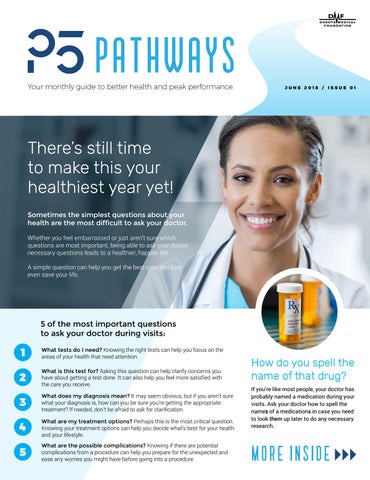
There’s still time to make this your healthiest year yet! Sometimes the simplest questions about your health are the most difficult to ask your doctor. Whether you feel embarrassed or just aren’t sure which questions are most important, being able to ask your doctor necessary questions leads to a healthier, happier life. A simple question can help you get the best care and can even save your life.
5 of the most important questions to ask your doctor during visits:
1
What tests do I need? Knowing the right tests can help you focus on the areas of your health that need attention.
2
What is this test for? Asking this question can help clarify concerns you have about getting a test done. It can also help you feel more satisfied with the care you receive.
3
What does my diagnosis mean? It may seem obvious, but if you aren’t sure what your diagnosis is, how can you be sure you’re getting the appropriate treatment? If needed, don't be afraid to ask for clarification.
4
What are my treatment options? Perhaps this is the most critical question. Knowing your treatment options can help you decide what’s best for your health and your lifestyle.
5
What are the possible complications? Knowing if there are potential complications from a procedure can help you prepare for the unexpected and ease any worries you might have before going into a procedure.
How do you spell the name of that drug? If you’re like most people, your doctor has probably named a medication during your visits. Ask your doctor how to spell the names of a medications in case you need to look them up later to do any necessary research.
MORE INSIDE
It’s time to schedule your annual exams –
Here’s why Without your annual exams, you can’t expect to have the best health management plan.
A
lthough visits to a doctor take time out of your day, they’re a small price to pay compared to treating a chronic disease or life-threatening illness. Annual exams can help you find health problems before they start or catch them early when your chances for treatment or finding a cure are better. As you age, your annual exams become more important. They are used to assess your overall health and review any changes to your health history. Regular exams provide opportunities to ask your doctor questions about your health and create strong
relationships with your care team. At the same time, receiving regular care from your doctor can help improve your doctor’s ability to make a diagnosis and recommend any preventative measures to avoid diseases like diabetes, heart conditions, and other illnesses that become more prevalent with age. Receive the proper care you need to stay healthy, and get screened for diseases that could threaten your health. You can help improve your chances of living a longer, healthier life by scheduling and going to your annual exams.
Did you know? Nearly one third of the 133 million Americans living with a chronic disease are unaware of their health condition. A chronic disease causes 7 out of every 10 deaths. Preventive health screenings and primary care consultations have been found to significantly increase life expectancy, particularly among the 30-49 year age group.
One-Pot Healthy Pasta Ingredients • • •
•
12 ounces pasta of choice 1/2 small eggplant, cubed 2 cups cremini or button mushrooms, sliced (or other veggies of choice) 3 cloves garlic, minced
• • •
1 1/2 cups marinara sauce 2 cups water 2 tsp sea salt + a pinch more for eggplant
• • •
1 tsp ground black pepper 2 Tbsp olive oil Optional: Fresh parsley or basil for finishing
Directions 1.) Sauté your veggies in a big pot or pan. Set aside and cover - you will top the pasta with them. 2.) To the same pan, add the pasta, water, marinara sauce, garlic, and seasonings. 3.) Bring mixture to a boil then cover and reduce heat. Once the pasta is cooked, adjust seasonings to taste, remove from heat and add veggies. – Serves 4
For complete instructions and information about this recipe, go to minimalistbaker.com, where you will find heaps of irresistible, healthy recipes.
ONE-POT
Healthy Pasta This recipe has been ever-so-slightly adapted from the Minimalist Baker’s One-Pot Vegan Pasta. You can further adapt this recipe to be vegan or meat-friendly!
Who can resist a simple, yet full-of-flavor, pasta dish! Hardly anyone, which is why this pasta dish is such a crowd pleaser. What’s even better, is the fact that this dish is made in one pan, making clean-up super easy. You’ll notice the recipe calls for mushrooms, eggplant, and fresh parsley, but you can incorporate other veggies or substitute the suggested vegetables with your favorites. It’s really just three easy steps before you have a customized pasta dish ready to eat!
3 tips for choosing tasty
Good-For-You Produce Frozen or Fresh? Choose frozen if your produce isn’t in season or locally purchased. Studies show that unless your produce is eaten soon after harvesting, it’s likely to have fewer nutrients than those that are frozen. Produce begins to lose its nutrients as soon as it gets picked.
Organic or Non-Organic? Choose organic for some but not necessarily all produce. The 2017 report by the Environmental Working Group on the ‘dirty dozen’ showed more than 98% of samples of strawberries, spinach, peaches, nectarines, cherries and apples tested positive for residue of at least one pesticide. Knowing this, spending a little more on organic produce is a good idea.
Prepackaged or Non-Packaged? Choose prepackaged if you won’t be using your produce right away, otherwise, non-packaged produce is a good choice. Extra wrapping creates more waste; however, plastic wrapped produce may extend the life of some fruits and vegetables. For example, according to the Cucumber Growers Association, shrink-wrap helps prevent physical damage and dirty hands from touching the actual produce, as well as helps cucumbers stay hydrated longer.
What is the Dirty Dozen? The dirty dozen is a list of 12 fruits and vegetables with the highest pesticide load. The list includes:
• • • • • • • • • • • •
Strawberries Spinach Nectarines Apples Peaches Pears Cherries Grapes Celery Tomatoes Sweet Bell Peppers Potatoes
When possible, choose to buy organic options for these fruits and vegetables.
Your best life is at the top of the stairs T
here’s an opportunity to improve your health with every staircase you come across.
can even count towards the recommended 2 hours and 30 minutes of moderate activity each week - a big time commitment for most people.
You’re probably thinking you already know the health benefits of taking the stairs. But, did you know stair climbing requires a higher amount of energy per minute than most moderate level physical activities?
Build your muscles, strengthen your bones, and improve your cardiovascular health by making stair climbing part of your daily routine.
Simply put, climbing the stairs is a great way to do some physical activity throughout your day, even if you’re only taking the stairs a couple of times per day. You can accumulate stair climbing across the course of the day, making a significant contribution to the recommended 30 minutes of daily physical activity. Climbing stairs during the day
If the stairs exist, you don’t need to worry about equipment, money for a gym membership, or other reasons that keep you from exercising or doing some kind of activity that requires movement. Start by taking these small steps (literally) to begin forming habits around physical exercise and increasing movement in your day.
How well do you really know your colleagues? Perhaps you have a few close relationships with your co-workers, but outside of those, you might not know other co-workers that well. And that can be a problem. With that being said, inviting a colleague to an afternoon coffee or tea can help break the ice and provide an opportunity to get to know each other better.
FAST FACTS:
This is what inviting your colleague to a coffee break could do for you... Fact #1: Employees who know each other well are more engaged and more productive. • Employees with 6-25+ friends are likely to be 48-69% more engaged
Fact #2: Collaboration and respect comes easier when co-workers know each other well. • 93% of people value the respect of work friends or colleagues
Fact #3: Workplaces become more enjoyable places when people are friendly to each other. • 89% say work relationships matter to quality of life
Initiating a conversation shows others you’re a leader and someone who is willing to go out of their way to make the workplace a better place for everyone! Short breaks for coffee and conversation also provide opportunities to share experiences, advice, and frustrations with each other. Opportunities to talk to each other are extremely important since a majority of people spend onethird of their day at work. Although the first interaction beyond the friendly hello may be a bit awkward, great ideas can be ignited from connecting with your colleagues on a deeper level. Furthermore, you’ll be improving your own skills like communication and team-building. We all need short breaks away from our tasks. They help improve productivity, relieve stress, and bring joy to our day! You’re not alone in building better workplace relationships: “73% of the employees surveyed have laughed together, and 61% have cried with a co-worker.”
Five essential reasons to have a primary care provider Believe it or not, having a primary care provider is essential to your health.
A
pproximately 28% of U.S. men and 17% of women don’t have a personal doctor or healthcare provider, according to a government survey. The survey also reported that some people chose not to see a doctor in the last year due to the cost. This is concerning because people without a primary care provider report being in fair to poor health. In addition, they are more likely to visit the ER where the expense to see a doctor is much higher than seeing a primary care provider. The reality is, you’re not saving yourself any money when you avoid finding a primary care provider. Furthermore, it can take up to 30 days for new patients to get into a family practice doctor; these are the doctors who typically provide referrals for patients to see a specialist. Add the 30 days it could take to get an appointment with a primary care provider, with additional wait time to see a specialist, and patients are looking at waiting over two months or more to see the right doctor. Even more alarming is that some areas of the U.S. lack physicians. One-third of the states have half or less of their primary care needs met. In fact, the lack of primary care providers is so low in some areas, they are referred to as primary care deserts.
Taking all of this into account, here are five additional reasons to find a primary care physician:
1. They’re better able to think about your current symptoms along with your family history and lifestyle. Urgent care centers are not likely to have the same background information about your health.
2. They’re more likely to provide preventative care and monitor any current conditions you have. Ultimately, this could help spare you from having to go to the emergency room.
3. They could save you money. Research shows those who regularly visit a primary care physician have fewer ER visits and hospitalizations than those who do not utilize primary care doctors.
4. They can provide better and timelier referrals since they know your health history and preferences of care. Without a primary care physician, seeing a specialist may get delayed as wait times for new patients can be up to three weeks.
5. You’re more likely to feel satisfied with your care as a result of higher trust and good communication.
TAKE THE FIRST STEPS TOWARD BUILDING
Your Emergency Fund
Tackling finances can be a breeze for some and a nightmare for others. Regardless, everyone should be mindful that emergency situations happen. They’re part of life. That’s why having an emergency fund is critical. Even if you have debt, you should still be putting money into an emergency fund. Why? Well, if an emergency arises, and you already have debt with no money in the bank, you’re probably going to end up adding to your existing debts. Take these initial steps toward creating an emergency fund to avoid the financial stress of an emergency situation.
Track your spending each week.
Set your goals.
Keeping a record of your spending each week will give you a clear vision of where your money is going. Look at your spending, and identify what expenses are your needs and which are not. In doing this, you’ll be able to pinpoint where you can spend less to save more.
Establish your monthly savings goals, write them down (like you would with other goals), and let others know about your plan. You won’t need to feel uncomfortable turning down social plans that cost money if your friends and family know your savings goals.
Be proactive about savings. Money doesn’t magically appear. People who save money live under their means and include savings into their monthly budgets.
Information is reviewed by a prestigious Medical Advisory Board comprised of physicians and healthcare professionals and is intended to help you make smart health decisions for yourself and your family. Although editorial content is based on sound medical information, we ask that you consult a healthcare professional for all matters of concern. We also encourage you to keep your copies to build a convenient home-medical reference or recycle issues to friends and family. 2017 P5 Performance™, 4141 28th Ave S, Fargo, ND 58104; phone 701.271.0263; visit our website at www.p5performance.org. All rights reserved. ISSN 1549-9367. Executive Editor: David Hunnicutt, PhD; Executive Director: J. Patrick Traynor; Contributing Editor: Amanda McDonald. Information may not be reproduced, copied, cited, or circulated in any format.