The Landscape for Youth From Crisis in Faulkner County, Arkansas
AS OF SEPTEMBER 4, 2025
HALEIGH, 14
AS OF SEPTEMBER 4, 2025
HALEIGH, 14
In order to better understand the needs and assets of teens and young adults in and around the foster care system in Faulkner County, Immerse Arkansas conducted this in-depth needs assessment that highlights extensive data and community voice. The findings will guide organizational decision-making and strategic planning as Immerse increases its programming for youth from crisis and overall impact in the Faulkner County region.
A crucial aspect of this effort included 21 interviews conducted with local nonprofit and social service providers, law enforcement, Division of Children & Family Services (DCFS) staff, youth, families and academic administrators. Immerse is grateful for the tremendous, existing efforts in the Faulkner County region and is honored to partner in the work to meet the needs of young people in the community.
Founded in 2010 by CEO Eric Gilmore and his wife, Kara, Immerse is a nonprofit working to disrupt cycles of trauma and poverty in Arkansas. Its primary goal is to build a broad,
reliable pathway to healing available for every youth from crisis in the state.
While serving as house parents in a group home, Eric and Kara witnessed the harsh realities youth face as they age out of foster care and are propelled into adulthood without a network of support and many of the skills needed for success. Immerse was established in response to these critical needs and has expanded its reach to include those who have experienced a wide range of childhood traumas.
Each year, Immerse serves roughly 450 youth ages 14-24 who are in and around the foster care system. Through relationship-based coaching, therapy, and wraparound support, Immerse empowers youth to overcome crisis and enter adulthood resilient and ready for life. Immerse began in Little Rock and launched a second site in Conway in 2023.
Scan the QR code to hear more about how Immerse

The teenage and young adult years comprise a pivotal stage of life. While this journey can be saturated with joy, excitement for the future, and anticipation of independence, it can also feel like a wilderness experience marked by fear of the unknown, deep loneliness, shadows of trauma, and formidable struggle. For those in and around the foster care system, the transition into adulthood is frequently characterized by the latter.

When Sam was 4, he was found by police while he was walking along the side of a highway with “someone who used to be my older sister; she was 5,” he recalled. At the children’s home, officers “did an emergency inspection and found no food in the house. Anyone who was there was passed out from being drunk and on drugs. So they immediately arrested the adults and took all the children out of the home.”
During the next two years, Sam was placed in 13 foster homes. At 6, he was adopted into a family where he suffered psychological and physical abuse. Eventually he wound up in juvenile detention; after he got out, he went straight into a Qualified Residential Treatment Program.
It is tempting when reading Sam’s story to imagine his experience is singular or the kind that only happens to a few teens each year. However, Sam’s journey is the reality for many teens.

Arkansas’ foster care system falls under the jurisdiction of the Division of Children & Family Services (DCFS). There were more than 2,000 transition-aged youth ages 14-21 in foster care at one point in state fiscal year (SFY) 2024, making up 34% of Arkansas’ foster care population—considerably higher than the national rate of 24%.
When a teen in foster care turns 14, they are assigned a DCFS Transitional Youth Services (TYS) coordinator with the goal of preparing them for a successful transition to adulthood and connecting them with eligible resources. A young person enrolled in foster care on their 18th birthday can exit foster care, or they can enroll in Arkansas’s extended foster care system at any point until they turn 21.
with a Developmental Disability Services (DDS) provider. A young person’s sponsor is responsible for providing some level of relational support, as well as receiving and distributing the extended foster care financial stipends to them each month.
For many teenagers in the system, aging out at 18 or remaining in extended care is a likely reality; this reinforces the need for continued support in early adulthood. If a youth enters foster care as a teenager in Arkansas, there is an 84% chance they will age out without ever being adopted.
During the past five years, 962 young people aged out of Arkansas’ foster care system — often ill-equipped; hundreds more are following in their tracks.
To remain in extended foster care, youth must meet certain work or educational requirements. Placement options include enrollment in a Supervised Independent Living (SIL) program— which offers housing, case management, and other social services—or living independently and identifying a community-based sponsor (either a family member or a support person they know, such as a former foster parent).
If youth are unable to identify a support person, their DCFS caseworker will help identify a community-based sponsor for them. Some youth may qualify for placement
Transition-aged youth also make up a disproportionately large number of those waiting to be adopted: 44% of children and teens available for adoption are ages 14+, and 29% of all children and teens waiting to be adopted were placed in congregate care settings such as group homes, shelters, or subacute/acute residential treatment programs in FY20241,2.
2
1
Inconsistency of placements can diminish a youth’s sense of felt safety and cause past traumas and/or behavioral struggles to surface. These reactions often lead to additional placement disruptions and force young people to re-enter the moving and settling cycle, creating a negative feedback loop that is carried into adulthood.
Teens move around the system at a pace unconducive to developing attachments, succeeding in school, or gaining valuable work experience. Children and teens in foster care move placements on average at least once every six months in Arkansas—well
above the national average of roughly every nine months. The number of moves a young person makes negatively impacts the quality of relationships they build with others and diminishes their skill set for forming and maintaining connections; there is little space to “practice” connection-building and little time to develop secure, healthy attachments that dip below the surface.
Teens and young adults lack employment stability and life-skills development.
Between moves in residential facilities or Qualified Residential Treatment Programs
In general, a lack of foster placements around the state also contributes to older children and teens being placed in group homes, residential treatment facilities, shelters, or juvenile detention centers in the event of system overlap.
The reality for these transition-aged youth in non-traditional placements is that any skills training related to adulthood and independent living come solely from DCFS placement providers and TYS programming, resulting in an even more challenging pathway toward a resilient adulthood.
Additionally:
Foster youth are falling behind academically. In Arkansas, the high school graduation rate for foster youth is 24% lower than that of non-foster youth, and 12% lower than that of youth selfidentifying as homeless3. With children and teenagers in care moving on average at least twice a year, every transition and placement (whether out of district or county) results in lost credits, fluctuating academic services, lack of relationships, and added learning struggles. During source interviews, one informant or participant noted that some Arkansas school districts offer few services for those with learning disabilities or unique situations like foster care; many districts are quick to encourage a move to “homebound” learning if a case appears difficult.
With the level of autonomy afforded to school districts, there is little continuity of support across learning environments. Learning challenges, behavioral struggles, and the number of times a young person moves while living in care impact whether they will graduate on time, if at all. For those who earn a diploma or GED, the chances of attending and completing a two- or four-year program are low. Even with extended foster care stipends (ETV funds), many young adults must work full time to cover all living expenses; keeping a full-time job often comes at the cost of staying in school.
Arkansas foster youth lack placement stability and relational connection. With each new placement, teens must adapt to an upending that limits their opportunities to settle, build a sense of home, and make healthy connections with foster families and/or peers.

(QRTPs), young people who do not reside in foster homes often do not have a climate for practicing life skills they would use in a typical daily environment, such as those related to hygiene/cleanliness, financial literacy, employment and cooking. There is also less opportunity for obtaining and maintaining employment between inconsistent placements, lack of transportation, and a lack of skills for performing well in a job.
In source interviews, one interviewee (a young adult in foster care) stated that any progress she made in her schooling, job attainment, or financial stability was on her own. In her group home, she did not have daily interactions that allowed her to practice those types of skills or learn what it “means to be an adult.” Though DCFS and other agencies offer transitional living classes to teens in care as an attempt to alleviate these struggles, studies show that youth learn best and flourish in relationships with others.
To help mitigate these obstacles, transitionaged youth can enroll in extended foster care or
apply specifically for a supervised independent living (SIL) program. Roughly 355 youth ages 18+ were enrolled in extended foster care (ages 18-21) as of December 2024, with 38 youth enrolled in an SIL program and 312 youth living independently while connected with a sponsor or living in a DDS placement.
Even though hundreds of Arkansas youth participated in extended foster care during FY2024, 177 aged out of the system at 18; 32% of the 56 contracted SIL beds throughout the state (only enough beds for one out of six youth in extended foster care) lay vacant as of December 2024.4
and lacks age-appropriate supports for youth in and around the foster care system. Apart from licensed foster homes, the only DCFS contractual provider lies in Faulkner County – a QRTP, or group home setting, serving females ages 12-18.
The Arkansas Division of Children & Family Services (DCFS) divides the state into 10 service areas. Each is composed of local leadership, program supervisors, and caseworkers. The counties represented within Area 5 span from Northern to Central Arkansas, including Boone, Marion, Baxter, Newton, Searcy, Pope, Van Buren, Conway, and Faulkner at the southernmost tip. In Area 5, there were 536 children and teens in foster care at one point during 2024; 30.6% (164) were 12 and older. The highest concentration of youth 12+ was in Faulkner (29.8%) County.
In Area 5, there were 536 children and teens in foster care at one point during 2024; 30.6% (164) were 12 and older.
The highest concentration of youth 12+ was in Faulkner (29.8%) County.5
Compared to the rest of Arkansas, especially areas such as Fort Smith (Area 2) and Little Rock (Area 6), Area 5 remains under-resourced
Pockets of Area 5 also report a high density of child and teen homelessness, with Faulkner, Conway, and Perry (northernmost tip of Area 3) counties reporting 1,533 youth in the school systems experiencing homelessness in March 2025.6
Within Faulkner County, there were 160 children and teens in care at one point in all of 2024, with 28% having been in the system for two or more years. Of these 160, 30% were 12 and older, meaning a significant portion of the county’s foster care population is on track to exit the system as adults in the coming years.7 There is also a dense population of teens and young adults facing homelessness and economic vulnerability.

12.9% live at or below the poverty line.13 14 Local organizations, like the Conway Ministry Center, made more than 500 utility assistance payments to individuals and families and served more than 14,000 from the region through their food pantry in 2022.15
Teens in the juvenile justice system lack long-term supports: The Faulkner County Juvenile Court and the Juvenile Detention Center witness a range of cases from truancy, drug possession, and Family in Needs of Services (FINS), to murder and armed robbery. In 2024, there were 574 youth ages 10-18 in Faulkner County cited with a criminal offense. Sixty-one were admitted into the detention center upon time of arrest and citation.16 Youth sentences can range from 30 days to waiting to be tried for crimes as an adult.
The Faulkner County Juvenile Court will also place youth in Arkansas Division of Youth Services (DYS) custody depending on their level of offense and/or level of risk. As part of case management, the juvenile court administers a risk assessment that measures a youth’s level of risk for violent behavior and existing protective factors. This helps the court understand what individualized supports a youth needs while they complete their sentence and/or probation.
The juvenile court and other organizations working with teens in the juvenile justice system note that youth receive abundant supports such as recreational activities, job readiness coaching, mentorship, and life-skill development while they are serving their sentence. However, youth often lack necessary long-term coaching, therapy, employment assistance, and stable housing with families once their case is resolved or they enter adulthood.
Youth connected to the system also lack reliable transportation, making it difficult to keep higher paying jobs or make probation appointments that maintain good standing with the courts. If a young person falls behind in probation appointments, the likelihood of recidivism increases. Faulkner County Juvenile Judge Troy Braswell and his team said a significant percentage of juvenile cases involve youth who live with kin or fictive kin but possess no formal ties to the foster care system. These families need continued wraparound services.
Drug-related charges and treatment programs are handled through Faulkner County’s Juvenile Drug Court if the youth is younger than 18. Young adults with drug-related offenses may voluntarily enter Faulkner County’s Adult Drug Court program for up to 18 months and receive treatment, counseling, and case management services to aid recovery and prevent reoffending.
The Faulkner County Adult Drug Court program partners with local transitional housing providers to offer options for participants without reliable and/or safe housing due to the high risk of homelessness and trafficking. The Adult Drug Court program also reports the average age of participants is consistently lowering as they work with a greater population of young adults.
13 Faulkner County 20th Judicial District Juvenile (2024). 2024 Annual Report. Benton County, Arkansas.
14 The State of ALICE in Arkansas, United for ALICE, https://unitedforalice. org/county-reports/arkansas#7/34.770/-92.129.
15 Conway Ministry Center, 2023. 2022-2023 Year End Report, Conway Ministry Center, https://www.conwayministrycenter.org/lives-changed/20222023yearendreport. s A M, 17
16 Faulkner County 20th Judicial District
Transition-aged youth lack healthy relationships. Across the majority of source interviews, participants noted teens and young adults lack healthy relationships and community to carry them into adulthood. Specifically:
• DCFS reports teens and young adults within the foster system are experiencing loneliness and lack trusted adults to turn to for advice, encouragement, and community.
• Compass Academy reported a portion of their high school students immediately enter into financial and housing vulnerability upon graduation with little relational support from family.
• Local juvenile justice agencies and law enforcement report teens exiting the juvenile justice system lack longterm mentorship into their adult years and often reunite with unhealthy family members and/or friends, therefore hindering growth and permanent separation from the justice system. Young adults also report facing housing instability due to deep familial estrangement after they leave the system and reunify.
• Conway Cradle Care, a support agency providing daycare to high school moms, noted young women need healthy adults in their support system as well as skill development in building strong, long-lasting relationships.
• City of Hope Outreach (COHO), an agency dedicated to empowering underserved communities, reports young adults in their programs often lack community and support from peers; many feel alone and overwhelmed as they struggle to find stability within young adulthood.
• Conway High School counselors stated many students experiencing instability have little support in transitioning into adulthood; for example, in obtaining vital documents, a driver’s license, and healthcare.
Overall, what is the landscape for youth from crisis in Faulkner County?
Vulnerable teens and young adults in Faulkner County do not possess the supports needed for a successful transition into a thriving adulthood. Whether they’re connected to the foster care system, the juvenile justice system, or other crises such as homelessness and poverty, teens and young adults moving throughout these systems — often coming from outside counties for services — remain under-served and under-resourced for the long term.
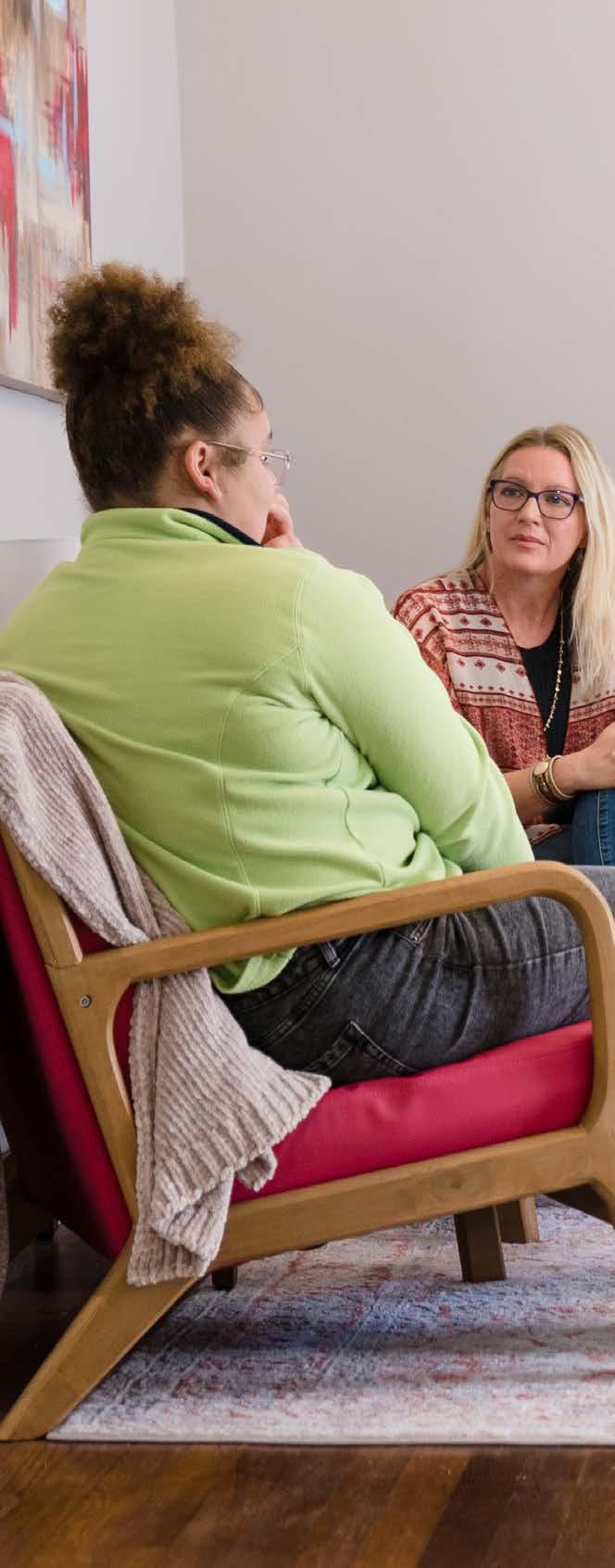
Faulkner County is an area dedicated to the well-being of families, community support, and the empowerment of the next generation. The region also provides abundant opportunities for teens and young adults across the state to continue their education and workforce development.
The collaborative efforts of local agencies allow for specialization of services to ensure gaps are filled locally and in the surrounding areas.
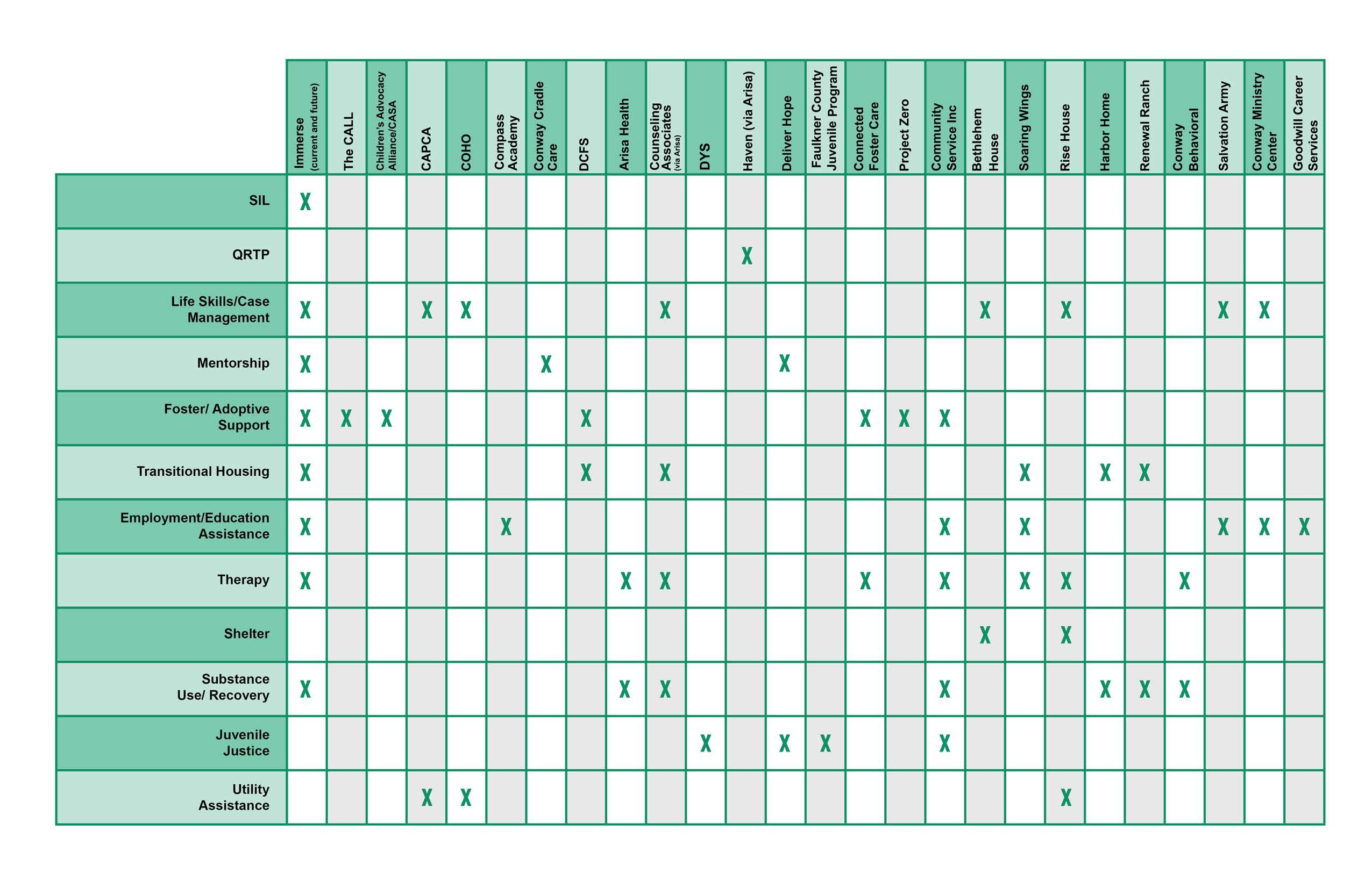
While not an exhaustive list, the following organizations have committed to deep specialization and the provision of unique services in the region:
• Bethlehem House is a 32-bed transitional housing program whose individualized case management program allows for adults of all ages to engage in services.
• City of Hope Outreach provides “tiny-home” style transitional housing (amongst other services) for those progressing in their journey toward independent living and partners with other local organizations.
• Conway Ministry Center specializes in innovative case management and utility assistance for those experiencing housing
and economic vulnerability while working toward opening an emergency shelter for families and those with severe mental illness.
• The CALL trains foster families and provides long-term supports, even as families finalize adoptions.
• Deliver Hope serves teens involved in the juvenile justice system, offering life-skill development, mentorship, community, and sobriety support.
• The Faulkner County Adult and Juvenile Drug Courts provide individualized case management and peer support to teens and adults in their recovery journey while partnering with local providers to ensure access to innovative and supportive housing.
• The Faulkner County Juvenile Court delivers exceptional support to youth and families navigating court sentences and inspirational programming to help prevent recidivism.
• Rise House advocates for individuals experiencing sexual assault and domestic violence and provides emergency, transitional housing with a pathway toward a safe, stable future.
Refer to p. 24 for a list of Faulkner County source interviews, including transitionaged youth service providers.
Despite resources in the Faulkner County region providing training, sponsorship and counseling, gaps in services and supports remain.
1
Additional local placements and supports for teens in foster care: As teens in care move out of Faulkner County to other placements and/or more restrictive settings, there is a need for foster homes that provide stability and opportunities for flourishing.
2
Increased wraparound supports for foster and adoptive families: The wraparound needs of foster and adoptive teens are frequently experienced by their families, too. Many parents report not feeling equipped to handle acute mental health needs, trauma responses, and/or other disabilities, reflecting a need for in-home coaching and therapy. If families knew of resources they could have accessed early in their foster or adoptive journey, they would have felt more prepared and supported.
3
4
Age-appropriate transitional housing and wraparound supports for young adults 18+: Of the providers in Faulkner County, there is not a transitional housing program and/or emergency shelter dedicated to serving only the young adult population. Housing and transitional supports greatly benefit young adults in extended foster care as well as those experiencing homelessness. Without ageappropriate supports, young adults are at higher risk for dropping out of school, struggling with employment, and cycles of chronic homelessness, addiction, and exploitation throughout their lifetimes.
5
Long-term, wraparound supports for teens in the juvenile justice system: For teens and young adults connected to the justice system, there is an opportunity to help meet long-term needs and, in turn, help build restored futures. If there are not proper, long-term supports in place such as life-skill development, stable housing, and employment assistance, there is an increased likelihood of substance relapse, recidivism with more severe offenses, and/ or future experiences of homelessness.
Healthy, community relationships for teens and young adults: There are immense benefits from stable, longlasting relationships and knowing there are others in your corner. Throughout this assessment process, it was found that teens and young adults in and around various social systems are experiencing a lack of healthy relationships with family, peers, and community members. This disconnectedness with others leads to higher levels of isolation and instability. Through recruitment and training, there is an opportunity to provide young people with long-term support and transform their perceptions of what thriving relationships can look like.

Immerse Arkansas is grateful to be established in this region as a nonprofit agency and is honored to continue meeting the needs of teens and young adults. We believe when partnering with other organizations and families, we can change the landscape for youth from crisis in Faulkner County, for those in surrounding counties and for young adults moving to Conway for academic opportunities.
Since launching at the end of 2023, Immerse has served and learned from 30 teens and families in Faulkner County. The majority of youth have improved their overall well-being and maintained their foster or adoptive placement. As a result, the demand for coaching, trauma therapy, life-skill development, and additional supports has grown among teens ages 14-18 in foster/ adoptive placements and their families.
“You have a coach, a mentor, and a counselor. Now, that’s how we can make some change happen… It’s a recipe for success.”
– Jeff Hardy, LifeBASE Teen parent
“Since being with Immerse, I’ve worked with my coach and my therapist and I’ve seen a change in my whole person.”
– Trinity, LifeBASE Teen youth
In response to the impact of the LifeBASE Teen program and the findings of this needs assessment, Immerse has developed a plan to grow support in Faulkner County to fill a gap within the community by continuing to serve teens in foster and adoptive care and providing supports specifically to the young adult population. The following tiered approach is dependent on funding, staff capacity, recruitment, and program implementation.
Through one-on-one coaching, trauma therapy, relationship building, training, and employment and education support for teens ages 14-18 who are in foster care or have been adopted, Immerse addresses past trauma and equips teens and their families for the teen’s transition into adulthood. In Faulkner County, there are roughly 30 teens in foster care, in addition to those in adoptive placements. By increasing Immerse’s capacity from 20 teens and families to serve at least 30 at any given time, we can truly transform what it means to be a teen in foster care in Faulkner County.
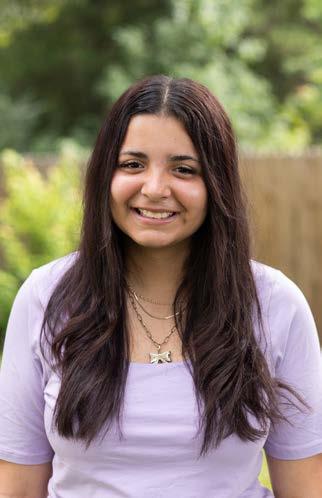
T r INITY, 16
PHASE A:
Provide relationship-based coaching to young adults ages 18-24 in extended foster care or those needing additional wraparound supports.
As a response to the needs of those in extended foster care, Immerse plans to provide relationship-based coaching, therapy, and wraparound supports to young adults 18-24. Through its proven, scalable LifeBASE program, Immerse will equip up to 10 young adults at a time to be resilient and ready for life
PHASE B:
Provide transitional housing, relationship-based coaching, therapy, and wraparound supports to young adults ages 18-24 from crisis.
In response to the high level of need for local, safe, stable housing options, Immerse plans to obtain transitional houses and/or apartments in Conway in order to provide transitional housing and other LifeBASE supports for up to six 18- to 24-year-old young adults at a time.
The transition to adulthood and the trauma associated with crises including foster care, housing insecurity and poverty can create what appear to be insurmountable challenges. At Immerse, our goal is to build a broad, reliable pathway to healing for every youth from crisis in Arkansas. We want to make sure they have the support and care they need to enter adulthood resilient and ready for life, equipped with tools to achieve their goals and dreams.
Our recent expansion in Conway gives us the opportunity to serve more youth from trauma and crisis through LifeBASE Teen, truly changing what foster care looks like for teens in Faulkner County. We’re blessed to build on this strong foundation as we set goals for the future and develop additional programming to walk alongside young adults 18-24.
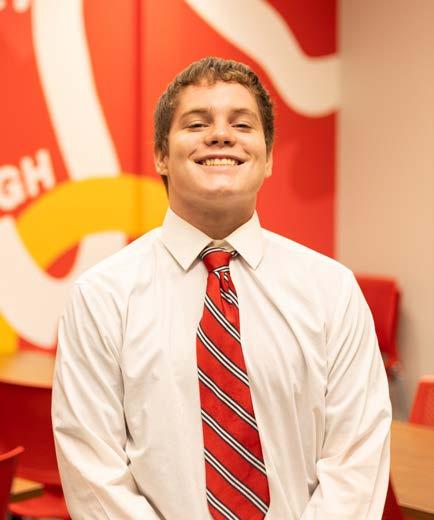
r ETT, 19
We look forward to partnering with those working in the region to disrupt cycles of trauma and poverty. And we’re excited for young adults from crisis to see that overcoming starts in Faulkner County.
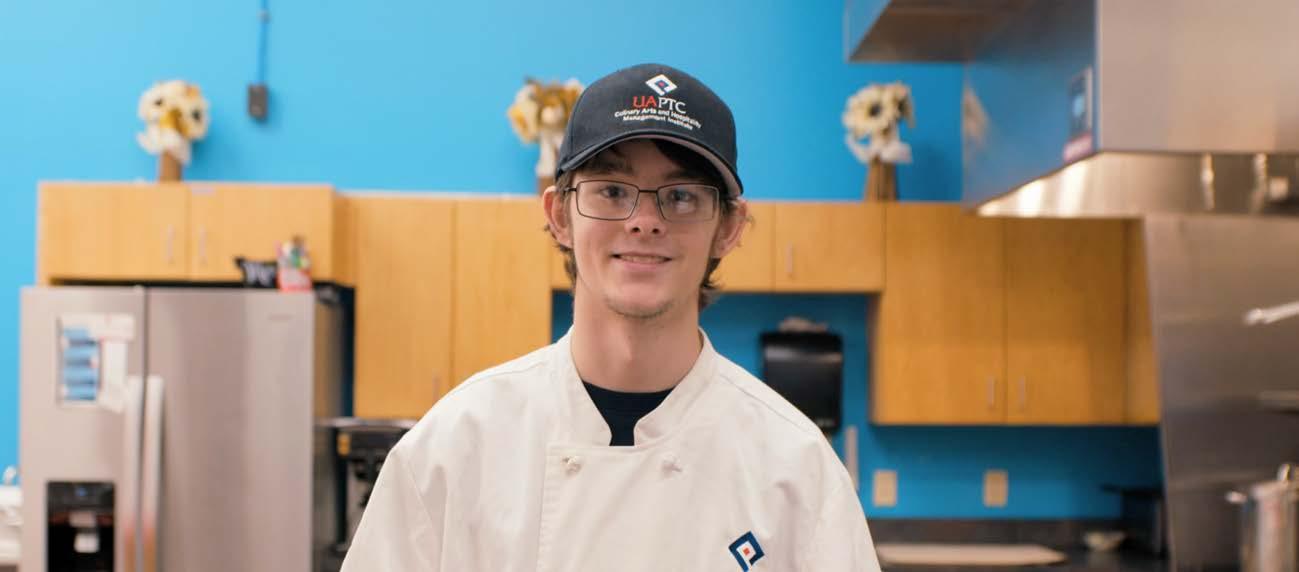
Like many other youth from crisis, 19-year-old Sam endured brutally harsh experiences as a small child. He didn’t choose these traumatic circumstances, but he’s choosing not to be defined by them.
When Sam was 4, he was found by police while he was walking along the side of a highway with “someone who used to be my older sister; she was 5,” he recalled. At the children’s home, officers “did an emergency inspection and found no food in the house. Anyone who was there was passed out from being drunk and on drugs. So they immediately arrested the adults and took all the children out of the home.”
During the next two years, Sam was placedin13 foster homes. At 6, he was adopted into a family where he suffered psychological and physical abuse. Eventually he wound up injuvenile detention; after he got out, he went straight into a Qualified Residential Treatment Program.
In detention, he discovered a passion for cooking. He began thinking about his future and decided to enroll in the culinary program at Pulaski Tech in Little Rock when he turned 18. Knowing he would need a place tolive
while he attended college, Sam reached out to the Arkansas Department of Human Services forhelp.
And that’s how he found LifeBASE, a transitional program that equips youth ages 1824 for healthy adulthood.
“I came to Immerse for housing, but they’ve helped me have transportation and get an apartment,” said Sam. “I have a great therapist provided by Immerse who’s helping me work through anxiety and the reasons in my past that have been causing it, and helping me with PTSD I’ve had from my past.”
“In my seven months at Immerse, I’ve overcome challenges with school, not really understanding the dynamics of college or what I’m supposed to be doing at any given time,” he added. “I’ve been gaining physical strength, as well as emotional and psychological strengths. I’m just trying to better myself as much as Ican.”
Soon after Sam was accepted, he gravitated toward rock climbing. He received belay certification and became a member at the Little Rock Climbing Center.
“In LifeBASE, we’re looking for an increase in BASE independence,” said Justin Kirkes, Immerse’s recreation manager. “The fact that Sam went from us taking him to the Climbing Center to going on his own—that’s transformation!”
“Climbing requires a community,” Justin added. “So Sam, my oldest son and I formed a team and entered a climbing league. We called ourselves ‘The Overcomers.’ We went every Tuesday for four weeks and finished in sixth place at the end.”
Sam continues to thrive in LifeBASE. He trained for and ran in the 2025 Little Rock Marathon 5K and now counts backpacking and hiking among his favorite activities.
“We took him along with five other youth on our first overnight backpacking trip in December,” Justin recalled. “Sam was so excited about it that he wanted to do a solo experience. This is the kind of increase in BASE independence we’re looking for.”
Sam is continuing therapy; he looks forward to traveling someday and making new friends. And he’s taking ownership of his growth in life.
“I’m still overcoming my lack of self worth— constantly thinking I’m not good enough or strong enough, or I’m not progressing and getting better at things fast enough,” Sam said. “Because, turns out, I’m doing better than enough.”
This is what LifeBASE does for youth: It offers them the tools, skills and supportive relationships they need to grow, and to define themselves differently—to experience life as overcomers.
From climbing walls to culinary school, Sam is thriving. And for every youth who steps into LifeBASE…

“At Immerse, I’ve learned I’m more than my past,” said Sam. “I’m not the scared 4-year-old who’s walking down the highway. I’m a 19-yearold who’s overcome a lot of challenges and who’s gotten further in life than anyone would’ve imagined.”
Thank you to the following individuals who generously offered their time and insights as part of this assessment:
• Arisa Health Therapeutic Foster Care Program
• Bethlehem House
• Children’s Advocacy Alliance/Court Appointed Special Advocates (CASA)
• City of Hope Outreach (COHO)
• Community Service Inc. (CSI)
• Compass Academy
• Conway Cradle Care
• Conway Emergency Shelter
• Conway High School Guidance Counselors
• Conway Ministry Center
• Deliver Hope
• Faulkner County Division of Children and Family Services (DCFS)
• Faulkner County Drug Court Program
• Faulkner County Judge Troy Braswell
• Faulkner County Juvenile Detention Program
• Goodwill Industries of Arkansas - Career & Employee Services
• Rise House
• The CALL in Faulkner County
• University of Central Arkansas Career Services Department
• Youth, Families, and Sponsors
Abuse, neglect and trauma have wreaked havoc on the relationships, identity and resilience of youth from crisis, making their transition to adulthood extremely challenging.
Immerse provides a continuum of support to protect, inspire, equip and empower youth in their journeys toward healing and healthy adulthood.
Alumni
We believe when we surround youth from crisis with unconditional relationships, tools that anticipate their needs and dreams and a vision for their restored future, we create a climate that leads to healing, growth and transformation.


Empower graduates to give back to youth coming behind them

LifeBAsE Transitional Program
The OC Youth Center
The station Youth shelter
We want to disrupt the cycles of trauma and poverty that afflict teens and young adults connected to the foster care system. We see a future where growing up in foster and adoptive care in Arkansas isn’t solely a devastatingsetback, but also a starting point for healing. A place where youth have a reliable pathway to get the support and structures they need to overcome crisis and enter adulthood resilient and ready for life.
We’re building that pathway. And we’re expanding our reach — working to ensure that youth across the state have access to specialized trauma care, safe and stable housing, an education for a better earning potential, and a caring mentor walking with them as they exit state and adoptive care and enter adulthood.
Equip youth through a transitional program in houses, apartments or families
Inspire youth to achieve big goals, connect them with tools and a community of support
Protect youth experiencing homelessness through a low-barrier, safe place to sleep and get help
FUTURE LOCATION
Northwest Arkansas
CURRENT LOCATIONS
Little Rock & Conway
We’re investing in the future of our youth, in the future of our state, in a future immersed in hope.