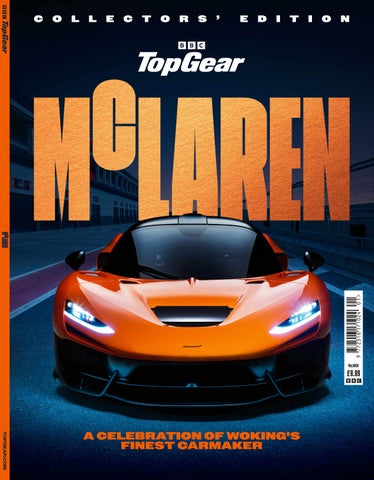
C
O
L
L
E
C
T
O
R
S
’
E
D
I
T
I
O
N
McLAREN
£8.99
002 M c L A R E N › T O P G E A R . C O M
005 014 026 040 056 062 076 088 102 112 124
GUIDE TO M c LAREN Everything you need to know about Woking’s finest carmaker
MP4-12C vs FERRARI 458 Modern McLaren’s big comeback up against the benchmark Ferrari
THE BIG FIVE Controversial? Surely not. Our picks for the five greatest supercars ever made
HOLY TRINITY Was this a golden era? The OG (automotive) holy trinity meet
JAMES HUNT McLaren’s greatest driver? Not on the track, maybe, but the best at having fun
570S vs R8 and 911 On a supercar budget? McLaren, Audi and Porsche had your back with these
SPEEDTAIL This slippery longtail GT was a nod to McLaren’s past with its three seats
WHEN WE’RE DEBATING/ARGUING IN THE TG office about which company to dedicate our next one of these gorgeous bookazines to... I’ll be honest, McLaren hasn’t had much of a look in. Ferrari, Lamborghini, Porsche, BMW – all are dripping in heritage and have back catalogues as fat as a phone book... but McLaren’s road car history has been patchier than 5G. The road car division summited right out the traps with Gordon Murray’s peerless McLaren F1 in 1992 (turn to the Big Five feature on p26 to see the company it keeps), then stumbled a bit with the confused McMerc SLR in 2003 before pulling up its socks in 2009, launching the MP4-12C and with it a proper road car division that had Ferrari, Porsche and Lambo in its cross hairs. Since then it’s been peddling hard, producing moments of utter magic – step forward P1, 675LT, 750S... but never far from cash flow problems and the occasional duff decision. It’s what makes McLaren the soap opera so transfixing to watch. So why did we pick it? Because when you look at the body of work since 2009, mix in some new and old F1 pedigree, take into account that it’s prone to bouts of pure madness (we’re looking at you Speedtail, Solus and W1) then it all adds up to one hell of a story. And TopGear, of course, was there every step of the way, pushing hard to drive these incredible cars earlier than anyone else, to take them further and create the kind of articles that should be as exciting to read as the cars they feature.
SPEEDSTERS Roof? Who needs a roof on their ultra exclusive supercar? Everyone, turns out
SOLUS GT Why buy a hypercar that’s only for the track? Because it drives like this...
750S WINS SPEED WEEK Spoiler alert? But it was in 2024, and the 750S saw off a diverse set of rivals
W1 It’s been 10 years, but it’s finally time for a new star at the top of the McLaren tree
Jack Rix
E D I T OR-IN-CHIE F
TOPGEAR.COM
› McLAREN
003
Enjoy the content you love on your mobile or tablet with the digital edition of BBC TopGear magazine!
A beginner’s guide From greatest hits to lowest moments, everything you ever wanted to know... and a fair bit you didn’t
TOPGEAR.COM
› McLAREN
005
What’s McLaren, and when did it start making cars? McLaren is named after Bruce McLaren, the New Zealand racer/engineer who never won the F1 world championship, but set up a team that has managed exactly that 12 times so far. But the question of when McLaren started building road cars isn’t quite so straightforward – 1994 is the answer that makes most sense as that was when McLaren released the production F1. Arguably the world’s first hypercar, the three seater was revolutionary. But 26 years earlier Bruce had tried to homologate an M6A Can-Am racer for Le Mans. The project never materialised, but two road cars were made and Bruce actually used one as a daily driver. McLaren didn’t properly get going as a road car manufacturer until 2010, with the unveiling of the MP4-12C and the creation of a much more diverse and extensive plan. McLaren Cars was established in 1985 by visionary team boss Ron Dennis to build a road car. Post-F1 it was dormant until 2010, when it became McLaren Automotive. Since September 2025 McLaren has been owned by an investment fund controlled by the Abu Dhabi government.
McLaren’s greatest hits
McLAREN P1
McLAREN 675LT
McLAREN 750S
ÁıÚ ¸˙ʺÓ˚ðΝĆ θˇĆć ʺˇ¸ʺÚˇ ıðʺÚˇÓˇ Ćˆ˚Ú ćıÚ Ÿ+ ‘ ʺ˘ČÙ¶ˆ˚ ıðÔˇˆÒ đˆćı Ÿ¸ˇ˙Č˘Ó ‚˚Ú¶Ććð˘Ú fiÿÂÊ Ó˚Ò ◊ÂÊ ćıÓć Ó˚ ˇČ˚ Û¸ˇ Ó ÛÚđ ˙ˆ˘ÚĆ Óć Ó ćˆ˙Ú ¸˚ Ú¶ʺ¸đÚˇ Ó˘¸˚Ú ‚˚Ú ¸Û ćıÚ ˘ÚÙÚ˚ÒÓˇð Μı¸˘ð ćˇˆ˚ˆćðΝ ¸Û ıðʺÚˇÓˇĆ ć¸ÙÚćıÚˇ đˆćı ćıÚ ŸÚˇˇÓˇˆ flÓŸÚˇˇÓˇˆ Ó˚Ò „¸ˇĆıÚ 3+2 ÊʺðÒÚˇ
When ënewí McLaren really clicked. The lighter, ÛÓĆćÚˇ ˇÚđ¸ˇ¯ˆ˚Ù ¸Û ćıÚ 0/*Ê ©ˆćĆÚ˘Û Ó˚ Ú踢Čćˆ¸˚ ¸Û ćıÚ +,÷™ ˆĆ đˆćı¸Čć Ò¸ČÔć ¸˚Ú ¸Û ćıÚ Ó˘˘ ćˆ˙Ú ĆČʺÚˇÓˇ ÙˇÚÓćĆ ‘ ʺˇ¸ʺÚˇ Ó˘ćÚˇ˚ÓćˆčÚ ć¸ Ó ŸÚˇˇÓˇˆ
A brilliant all rounder ñ incredibly fast, but also usable as a day to day car. We love its blend of old school supercar vibes with cutting edge tech ñ this will be one of the last great purely petrol powered
./2 ÊʺÚˆÓ˘Ú ćıÓć đˆ˘˘ ÔÚ ˇÚ˙Ú˙ÔÚˇÚÒ Û¸˚Ò˘ð Û¸ˇ ðÚÓˇĆ ć¸ ¸˙Ú
fast cars, and we could give it no higher compliment ćıÓ˚ ˆć ÔÚˆ˚Ù ¸Čˇ ,*,. „ÚˇÛ¸ˇ˙Ó˚Ú ÷Óˇ ¸Û ćıÚ ÏÚÓˇ
McLAREN SPEEDTAIL
McLAREN F1
McLAREN MP4/4
McLarenís fastest and most powerful road car yet, đˆćı Ó ć¸ʺ ĆʺÚÚÒ ¸Û ,/*˙ʺı Ó˚Ò ¸čÚˇ + ***Ôıʺ Ûˇ¸˙ ˆćĆ ıðÔˇˆÒˆĆÚÒ . *¶˘ˆćˇÚ È2 ÁıˇÚÚ ĆÚÓć ˘Óð¸Čć ÓʺÚĆ ćıÚ ¸˘Ò Ÿ+ Ó˚Ò ˙Ó¯ÚĆ ˆć ÛÚÚ˘ ıČÙÚ˘ð ĆʺÚˆÓ˘ ·¸ć Ó ćˇÓ¯ Óˇ ÔČć ćıÚ ˘¸˚Ù ÒˆĆćÓ˚Ú ∕Á ćȡ˚ÚÒ Čʺ ć¸ ćıÚ ˙ÓÐ
The daddy. Considered by many to be one of the greatest cars of all time, and now đ¸ˇćı ČʺđÓˇÒĆ ¸Û ~+/ ˙ˆ˘˘ˆ¸˚ Ó ʺ¸ʺ ćıÚ Č˚¸˙ʺˇ¸˙ˆĆˆ˚Ù ‡flÓˇÚ˚ Ÿ+ đÓĆ ¸˚Ú ćıÚ fastest car in the world. Spawned a racer ćıÓć đ¸˚ flÚ ‡Ó˚Ć Óć ˆćĆ θˇĆć ÓććÚ˙ʺć
One of the most dominant Formula One cars in ıˆĆ渡ð ıÓčˆ˚Ù đ¸˚ +/ ¸Û ćıÚ +0 ˇÓÚĆ ˆ˚ đıˆı ˆć ¸˙ʺÚćÚÒ ©ÚˆÙıć Û¸ˇ ÊÚ˚˚Ó ĆÚčÚ˚ Û¸ˇ „ˇ¸Ćć™ ˆ˚ +322 Senna won the driversí championship, and McLaren took the constructorsí title with three times more ʺ¸ˆ˚ćĆ ćıÓ˚ ĆÚ¸˚Ò ʺ˘ÓÚÒ ŸÚˇˇÓˇˆ
McLAREN M8D
McLAREN MP4-12C
McLAREN SENNA
·¸đÓÒÓðĆ ‡flÓˇÚ˚ ˆĆ ÔÚććÚˇ ¯˚¸đ˚ Û¸ˇ Ÿ+ and its road car business, but its earliest motorsport successes were in Can-Am. ÁıÚ ćÚÓ˙ 游¯ ˚ˆ˚Ú đˆ˚Ć Ûˇ¸˙ +* ˇÓÚĆ ˆ˚ +31* Bruce McLaren was killed that year testing Ó˚ ‡2◊ Óć ∕¸¸Òđ¸¸Ò
‡flÓˇÚ˚ΝĆ θˇĆć ʺˇ¸ÒČćˆ¸˚ Óˇ Ćˆ˚Ú ćıÚ Ÿ+ đÓĆ Óˆ˙ÚÒ Ć˛ČÓˇÚ˘ð Óć ćıÚ ŸÚˇˇÓˇˆ ./2 Ó˚Ò flÓ˙Ô¸ˇÙıˆ˚ˆ ∕Ó˘˘ÓˇÒ¸ flÓČ˚ıÚÒ ˆ˚ ,*++ Ó˚Ò Ó˘Ć¸ ÓčÓˆ˘ÓÔ˘Ú ÓĆ Ó ÊʺˆÒÚˇ ˆć ĆÚć ćıÚ ćÚ˙ʺ˘ÓćÚ Û¸ˇ ÚčÚˇð ˇ¸ÓÒ Ù¸ˆ˚Ù ‡flÓˇÚ˚ Ćˆ˚Ú Ó˚Ò ıÓĆ ĆʺÓđ˚ÚÒ Ć¸˙Ú ˇÓ¯ˆ˚Ù čÚˇð ČĆÓÔ˘Ú ÓˇĆ
The most extreme, focused McLaren road car yet built. Not a looker ñ its design was governed by aerodynamics, not style ñ but massively impressive on an engineering level. That something this quick around a track is allowed a set of number plates is just outrageous.
TOPGEAR.COM
› McLAREN
007
BRUCE McLAREN Won his first GP in 1959, four years before founding a team in 1963
What’s the cheapest car McLaren builds... and what’s the most expensive? All McLarens have a lot in common even if they vary hugely in price. To get the economies of scale right, all use a carbon tub and a twin turbo V8 mated to a 7spd twin clutch gearbox. The tubs differ slightly, and by varying the capacity, ancillary components and tuning, the engine delivers anywhere from 540bhp to 825bhp and up. There are three levels of McLaren – Sports Series is the entry level, next is Super Series, then Ultimate Series. The current entry car is the GTS,
which costs £180k. Then there’s the Artura at £200k, and TopGear’s 2024 Performance Car of the the Year, the 750S, will set you back around £250k. The sky’s the limit for the more bespoke Ultimate Series cars – the W1 hypercar, revealed at the end of 2024, will cost around £2m if you’ve made it onto the list for the 399 limited run. Of course, new McLarens aren’t the most expensive McLarens. If you want to buy an F1 these days, you’ll need to pony up £20+ million.
RON DENNIS Longtime McLaren boss credited for returning the team to its winning ways
GORDON MURRAY Legendary designer and engineer... and father of the McLaren F1
AYRTON SENNA
What’s McLaren’s fastest car? Now, a tricky one again. Back in the day the McLaren F1 hit 240mph. In the late 1990s we’d never seen anything like it. It was the fastest car in the world by a long, long way and wouldn’t be beaten until the Veyron emerged more than a decade later. Fast forward almost 30 years and McLaren’s fastest car is fast, but not setting the benchmark like the F1 did. The 2020 Speedtail does have a
fairly strong flex though – it’s limited to 250mph. McLaren said the car hit vmax 30 times during development testing in Texas. We’ve no reason to doubt McLaren’s claim given the Speedtail’s 1,036bhp power output and sleek aero, but we haven’t actually seen any video evidence of it – and we all know that something’s only true once it’s been uploaded to YouTube and GPS verified...
One of the greatest racers of all time. Won three F1 titles at McLaren
LEWIS HAMILTON Now seven time F1 champion started his career at McLaren
Where are McLarens built, and how many does it build a year? McLaren’s first road car of the modern era was the MP4-12C. It was a name that had everyone scratching their heads. We knew the first part stood for McLaren Project 4, but the second part was more of a mystery. McLaren claimed it was an internal designation that proved the car was objectively better than any rival, but refused to divulge any further details. Maybe C stood for Carbon, maybe it didn’t. Years later rumours emerged that a certain key employee owned the numberplate 12C...
McLarens are built in the world’s coolest Bond lair. Sorry, factory. Sorry, production centre. It’s far too clean and neat to be called a factory, so McLaren calls it the MPC (McLaren Production Centre), which sits alongside the even more glamorous MTC (McLaren Technology Centre – the famous circular building), the two connected by a tunnel. This is all located just outside Woking, a few miles southwest of London. The MPC has two separate production lines, one for the ‘mainstream’ cars and one for the more exotic, bespoke machinery. McLaren shifted 2,137 cars in 2023, the latest year we have numbers for.
What’s the best concept McLaren made? McLaren doesn’t really do concept cars. Instead it decides what it’s going to build and then releases some pictures of a car without door mirrors, with the word concept after the name. A year later, that car’s on sale. So we need to look further and down a different path. Back in 2017 McLaren did release a proper concept – a Vision Gran Turismo car for the PlayStation game of the same name. A chance for its designers and engineers to let loose on a fantasy hypercar that would never exist in the real world. The options were limitless. But alas, even then it was grounded in reality, right down to being powered by a 4.0-litre twin turbo V8.
TOPGEAR.COM
› McLAREN
009
010
What’s been McLaren’s best moment?
What’s been McLaren’s worst moment?
The arrival of the F1. Yes, still, almost three decades later. It was such a statement car at the time, so innovative and clever compared with its contemporaries. And who doesn’t love a central driving position and a naturally aspirated 627bhp V12? It remains the world’s fastest naturally aspirated road car, in fact. We’d also nominate the first time we drive the 675LT back in the summer of 2015. It wasn’t just that it followed the remarkable P1 hybrid hypercar, but that it was actually even better to drive. It was the moment McLaren gelled for most of us, when we realised that although Formula One tech didn’t cross over into road cars, the mindset and ability to move rapidly really did. McLaren’s rate of progress and development in those early years was unlike anything we’d ever seen in the car industry.
Tricky one this, for such a young company that’s mostly been on the up and up. Yes, it’s had its share of money problems and had to battle some challenging conditions. Apparent overproduction has caused residual values to soften, especially of the awesome 720S – a shame for undoubtedly one of the most complete supercars around at the moment. The cars aren’t known for being particularly reliable, either, though they’re getting better all the time. Actual bad moments? Let’s change that to most misleading – then we can have a pop at the 2019 McLaren GT that proved to be no kind of GT whatsoever, but another mid-engined, carbon tubbed supercar with a slightly softer gait and a bit more luggage space. Still fast and good to drive, as all McLarens are, but a GT ought to be more practical.
M c L A R E N › TOPGEAR.COM
1963 That’s a Kiwi in the middle, a tribute to Bruce’s homeland
1967 ‘Speedy Kiwi’ reflects higher speeds Bruce’s cars were now racing
1981
What’s McLaren’s weirdest moment?
New motif resembles a chequered flag. Red flash is a nod to sponsor Philip Morris
1991 Back in late 2013 when the P1 was in its final stages of development and Nürburgring lap times were all the rage, the company claimed the car would be able to lap the Nordschleife in “under seven minutes”. McLaren then failed to tell us any further details other than to say it had achieved its aim. To this day no exact time has been published. Infer from that what you will... And we have to talk about the SLR. Once upon a time, McLaren and Mercedes-Benz were partners – a tie-up that resulted in many F1 wins and precisely one controversial mash-up of a road car that Gordon Murray charitably describes as “not my sort of motor car”. Effectively a big, luxury Benz with a hefty dollop of McLaren engineering brilliance, there had never been a McLaren like it, and never again. Hopefully.
Simplified logo coincides with the company’s then-new road car division
1997 The ‘speedmark’ is an ode to “vortices created by a [racecar’s] rear wing”
2002 McLaren’s logo, now with a more modern font, has been much the same since 2002
Now you’re a McLaren expert, it’s time to buy one... McLaren MP4-12C / 2011–2014 / £60,000–£100,000 What is it? The launch of the MP4-12C heralded the arrival of McLaren Automotive, and while the superlative McLaren F1 and oddball Mercedes SLR sit above it on the company’s family tree, this was a new dawn. Things didn’t start superbly, though. Reaction to the MP4-12C – renamed 12C partway through its life – had a lukewarm tinge, with those expecting the second coming of the F1 left unsatisfied. But now McLaren is properly established in the supercar arena, those early cars are taking on something of a new life. Some are suggesting they’re collectors’ items in waiting – the rare, valuable ‘McLaren #1’ that will be an important
012
M c L A R E N › TOPGEAR.COM
part of sports car collections of the near future. Like every McLaren that’s followed since, the 12C’s core consists of a carbon MonoCell chassis tub and a twin turbo V8 engine. It launched in 2011, with the 562bhp Ferrari 458 Italia as its chief rival. Yet the 12C stamped all over it on paper, launching with 592bhp and later upgrading to 616bhp, enough to take its 1.4 tonnes to 207mph, via a 3.1secs 0–60mph time. But while 458s still cost at least £100k, you can pick up a 12C for around £60k. Which makes it a relative bargain. Ahem.
Driving On our first acquaintance with a 12C, just after its launch in 2011, it felt otherworldly fast and capable.
GEARBOX
BATTERY
There’s a known oil seal issue, which can cause an oil leak from the transmission. It’s a sealed unit, so pricey to replace if you don’t have a warranty
Make sure the car comes with its original trickle charger, and use it if it’s going to be parked for a while. Jump starting is not advisable
A bit bewildering. Revisiting it several years later, it’s lost some of that awe factor. But that shows the progress McLaren’s made. But when you find a stretch of road empty and wide enough to extend the 12C as much as you dare, its ability – and how much grip it finds with just one driven axle – is astounding. Recalibrating your brain to how quickly you can turn into corners, and then how much you can push the car through them, takes some time. We can’t pretend it’s more exciting or life affirming than a Ferrari 458 – this is an area where McLaren’s newer cars have really stepped up from the 12C. It doesn’t sound as nice, either.
ENGINE One specialist we spoke to described the twin turbo V8 as “bulletproof”. Routine servicing costs around £1,500 a time
On the inside Where the 12C really counters against the 458 is in its sheer usability. It rides so smoothly, the steering is so light and sharp, and the ergonomics of its driver centric dashboard are just sublime. It’s an absolute doddle to drive in even the most congested traffic, thanks its simple controls and brilliant all round visibility. The only bugbear is how wide its caravanner spec wing mirrors seem to make it, but what they do add is a level of rear visibility that escapes so many of its mid-engined rivals with their letterbox rear windows. Even an oaf can parallel park a 12C with confidence.
INFOTAINMENT The first iteration of McLaren’s own IRIS infotainment system was pretty rubbish. Don’t even think about trying to connect your phone to the Bluetooth. Asking for trouble
BRAKES Few specced the ceramics. Not a problem, the steels are fine and cheaper to replace
TOPGEAR.COM
› McLAREN
013
WORDS TOM FORD
PHOTOGRAPHY PAUL BARSHON
The MP4-12C marked the start of the McLarennaissance – but not before going up against Ferrari’s 458
TOPGEAR.COM
› McLAREN
015
One hundred and fifty three miles an hour on the clock, on a bumpy little public back road in the British Isles, driving a Ferrari 458 Italia so yellow it’ll make your eyes flinch. There’s a matte black superbike bucking away in front, something exoskeletal and racily mutated, wearing what appears to be a slick rear tyre and making a noise like a jet engine playing a kazoo. We are, currently, having a bit of a race. There’s a rosy tint descending, and I’m urging the Ferrari on via a grip on the steering wheel that’ll need my fingerprints polishing out of the carbon fibre. The throttle pedal is welded to the floor so hard my right calf is knotting like a spun rubber band. In a perverse trick of biology, my palms are getting slick while my eyes are drying up. I don’t think I’ve blinked for the past three miles. There was a white McLaren MP4-12C occupying my rearview mirrors not so long ago, stooping at apexes with the commitment and authority of an F-15 on a strafing run, but even though the driver has more skill, he also possesses a greater sense of self-preservation. As well he might; there are walls and lamp posts and cliff-type carnage awaiting those who allow ego to overwhelm ability. The change-up lights on the upper rim of the steering wheel click into place one by one, swelling the former but not – unfortunately – enhancing the latter, and the Ferrari’s naturally aspirated V8 starts making a noise that’ll curl your toes and straighten your hair. Sixth gear, lots of rpm. I don’t dare glance at the speedo. The biker risks a quick look (still at what I assume to be 130+mph), then tucks back up, winds on, and starts to elasticate his lead into the next corner, just as a policeman standing at the side of the road raises his arm and makes the universal pointy forearm roundhouse whip that signals ‘go for it’ in international motorsport Makaton. Seeing as we have just overtaken a motorway maintenance truck on the wrong side of the road, halfway around a blind corner, at speeds likely to
016
M c L A R E N › TOPGEAR.COM
usually see an extended stay at Hotel HMP, you may think this somewhat surprising. I back off in Pavlovian surprise, a fountain of sickly dread already rising from somewhere sternum south, just as a heaving, buzzing, snarling herd of motorcycles comes streaming past like a giant muster of cow sized wasps. All are doing more than 120mph. And then I remember. Legal. This is entirely legal. We’re on the Isle of Man during TT week practice, and the top part of the TT course is a one way, speed limit free slice of life in own hands heaven. TopGear has made the pilgrimage in two of the most exciting supercars of the past decade – the Ferrari 458 Italia and the McLaren MP4-12C – to test them on real roads, at proper speeds. The ultimate contemporary head to head. The fact that I’m legally allowed to harass bikers just seems like a very big cherry on a gasoline based cake. So there’s the why. The fact is that two cars like this don’t come along very often, and almost never with enough synchronicity to set themselves up for a proper ding dong. The Ferrari 458 Italia was lauded since its launch a few short months before we arrived here as a game changer in the baby supercar market, a swirly, exciting blend of pseudo F1 technology and Italian speaking stomach butterflies. It is exactly the car that the apex tech McLaren MP4-12C has been designed and engineered to eclipse. Before we go chasing any more bikers, cars first. Peas in a very speedy pod, when you check bald facts. Both V8s, both mid-engined two seaters, both rear wheel drive with electronic traction conjuration, both seven speed double clutch gearboxes with near identical weight distribution. Rumour has it that McLaren benchmarked the 458 in terms of performance, and tasked itself with making the MP4-12C better in every direction. So the McLaren produces 592bhp and 443lb ft of torque from a 3.8-litre twin turbo, the Ferrari 562bhp and 398lb ft from a naturally aspirated 4.5 litre. It’s pretty much the same with the performance figures too – the Ferrari manages 0–62mph in 3.4 seconds and 202mph, the McLaren strips the sprint in just 3.3 and tops out at 205mph. The McLaren is incrementally faster, then, possibly thanks to also being some 51kg lighter. But on the road, such fine on-paper delineations are much harder to call. Both will leave your flabber well and truly gasted the first time you really allow them some room, the Ferrari almost ridiculously vocal in Race mode, howling and screaming, gurgling and spitting on the overrun. It devours revs, a constant goad. It feels light at the fingertips, communicative, visceral, passionate. Like a proper bloody Ferrari, in other words. The paddles are huge carbon fibre sickles mounted to the column, the view a little restricted, but by no means bad by supercar standards. When it really winds up, it’s hard to imagine much faster this side of a Veyron. But the McLaren manages it. You can disseminate, argue and wander around the houses all you like, but the MP4-12C immediately feels faster down a real road. The mid-range avalanche from the turbos simply means that the little Mac can pull out car lengths on the 458, its block-like stability under braking and mid-corner meaning that once you get used to it, you can carry more speed, more of the time. The vision – necessary for going properly quickly – is exemplary, the seating position perfect, the small, wheel mounted paddles needing a firm yank to get them moving. And the suspension. You may think the Ferrari manages a stunning compromise between glide and go, but drive the MP4-12C properly quickly down a bumpy road, and it gets better and more composed, to the point where there appears to be no compromise. Game over, then? Well, no. Because a ‘supercar’ isn’t just about statistical masturbation, or a couple of tenths to 62mph, in the same
458 vs MP4-12C
“MY PALMS ARE GETTING SLICK WHILE MY EYES ARE DRYING UP. I’VE NOT BLINKED FOR THE PAST THREE MILES...”
Nightmare trying to find a parking space round here. May as well do another lap...
TOPGEAR.COM
› McLAREN
017
458 vs MP4-12C
“WHEN THE 458 REALLY WINDS UP, IT’S HARD TO IMAGINE MUCH FASTER. BUT THE 12C MANAGES IT”
018
M c L A R E N › TOPGEAR.COM
way that losing well can be more of a victory than winning without grace. But more of that later. For the minute, I’m quite interested in whether or not a modern supercar can keep up with a superbike. And judging by the leathery bloom of biker bacteria buttered across the front of the infamous Creg-Ny-Baa pub, we’re in the right place. There is, however, a problem. The trouble with racing random bikers on the TT course is that you have precisely no way of knowing who’s good and who’s not. Which bike is comparable and which just has a trumpet for an exhaust. Both the Fezza and the Mac seem to have the number of a lot of these biker types – especially on the brakes and through the meat of a corner. But it means nothing, not knowing who’s committed and who’s having a genial tootle. I need some help... Which is why we end up at the Isle of Man’s Jurby airfield mini circuit staring at one of those very bikers as he does a high rpm, screaming burnout against the front bumper of the McLaren MP4-12C, laughing his head off inside his helmet. His road going Honda Fireblade – a standard ABS model with 178bhp – is representative of the kind of stuff currently pounding around the TT course. The man inside the helmet isn’t. The man in the helmet is 15 time TT winner John McGuinness, known as the ‘King of the Mountain’. It’s a scant couple of hours before practice, and John has come to prove a point to TopGear. Not an everyday situation, I’ll grant you. It’d never happen in Formula One. A couple of hours of horsing about later, and three things are clear. One, John McGuinness is one of the most genuine, warm and bloody funny men you’ll ever meet at the top echelon of any motorsport. Two, he’s pretty effing good on a motorbike, and three, he seems impressed with both cars, especially the McLaren. “I accelerated hard and then looked round, and it was, like, there. Right beside me. That’s not usual for something with four wheels... and watching that thing go around a corner fast – there’s no way you could get a bike around that corner at that speed. On long radius corners and straights, the power to weight means
Can’t put our finger on it, but it feels like we’ve turned up in the wrong mode of transport
He’s not searching for contraband, just trying to find the doorhandle
All the signs point to... an epic drive in either of these two monsters
TOPGEAR.COM
› McLAREN
019
“THERE’S A BIKER DOING A SCREAMING BURNOUT AGAINST THE FRONT BUMPER OF THE McLAREN”
020 M c L A R E N › T O P G E A R . C O M
458 vs MP4-12C
TOPGEAR.COM
› McLAREN
021
“Well why don’t you try and stop him to tell him his bulb’s gone?”
022
M c L A R E N › TOPGEAR.COM
458 vs MP4-12C
the bike catches up, but I’ve not seen a road car that has grip like that.” This from the first man to run a lap of the TT course at an average of over 130mph. But funnily enough, McGuinness seems genuinely interested. And a bit confused by the line the car takes around Jurby. “Bike lines and car lines are totally different. If I turned in where these two cars have been, I’d never get round. A bike trail brakes into the apex and carries more speed through the corner. A car can do all its braking in a straight line and apex, then get hard on the power earlier.” But which is faster, then? There’s only one way to find out – let the man himself have a go. Which is why I end up sat next to John McGuinness just before the TT as he removes his helmet and boots – he’ll drive in his socks – and hunches himself in the driver’s seat. Hunches, because he still has his leathers on, complete with some sort of aerodynamic torpedo along his spine. And John McGuinness, as it turns out, is pretty quick in a car. Most people would require a lap or three to get used to cars like these. McGuinness needs 20 metres. “The Ferrari isn’t far away from the McLaren and makes a wonderful noise, but the front starts to hop a bit when you go really quick,” says John, eyes alight. “But that McLaren... that thing is something else. I seriously think you’d struggle to keep up with it on a road bike, on road tyres meant to last 10,000 miles. I think my race bike would still have it,
but it would be a lot closer than you think. I had a proper sweat on in that. What a thing. What. A. Thing.” So there you go. From the mouth of a man who really should know: there are cars out there that can keep up with bikes. There’s just one small issue, which is that to beat an off the peg £11.5k sports bike like the Fireblade John was using, you’d have to spend the thick end of £170k on a McLaren MP4-12C. Whichever way you cut it, that’s still a hell of a victory for biker punch per pound. Dammit. But that doesn’t satisfy. It’s all very well deciding that a bike is faster than a car on a smooth race circuit, but the real world is a haphazard place, and I’m yet to fall off a car. And there’s still the question of which is better, Ferrari or McLaren. Back out on the Mountain TT course to decide between our pair of bike worrying supercars, and canvass local opinion on which is better. The styling seems to polarise neatly. Some prefer the lean, clean lines of the McLaren, sensing purpose and resolve in the low sweep of the nose and slash vented haunches. The Ferrari is more sensuous, more organic, more insectile evolution than graphic design. Immediately, we’re into the realms of taste rather than objectivity. The back and forth continues throughout the couple of days we spend on the island. The McLaren has the more ergonomically comfortable, well designed and slick interior, but the Ferrari has a sense of occasion missing from the MP4-12C. The car
“I ACCELERATED HARD, AND IT WAS STILL RIGHT THERE. THAT’S NOT USUAL FOR SOMETHING WITH FOUR WHEELS”
TOPGEAR.COM
› McLAREN
023
458 vs MP4-12C
These two cars are the epitome of the heart versus head battle. And of course heart usually wins through...
from Woking may have the more impressive roll on acceleration, but the Ferrari makes such a bonkers noise – worth at least 10 imaginary mph – and has such delicious, natural throttle response, that the fact that the McLaren is actually faster doesn’t count for much. Then again, I wouldn’t expect to pay £170k+ to get beaten, even if the odds of running into each other are microscopic. But a decision is necessary. I’d like to cop out and say that both cars offer different things, and that if you’re rich enough for one, you’re probably flush enough for both, but for me it’s all about delivery. I want the McLaren to have all the engine responsiveness of the 458. I don’t want to be a ‘Ferrari owner’, and the McLaren’s obvious attention to detail and slightly mystical provenance would really count. But the turbotastic nature of the MP4-12C just doesn’t cut it. It feels faintly – and this’ll cause a few shakes of the head – faintly £70k Nissan GT-Rish in terms of delivery. Astonishing, but faintly industrial. It doesn’t sing. Or involve like the Ferrari. Or like a McLaren, for that matter. If the MP4-12C were a naturally aspirated, operatic sliver of pure inspiration, then this would be a different story. But it never seems to be enjoying itself, so the Ferrari feels more thrilling for more of the time. To get the sense of wonder from the MP4-12C, you have to be totally engaged, the Ferrari is a huge grin inducer under 60mph. So we’re going to ignore the empirically ‘better’ car, and choose to take home the car that delivers a sucker punch to the soul – the Ferrari 458 Italia. Because sometimes winning isn’t just about being faster. Just after writing this, John McGuinness had won his 16th TT victory – the opening Superbike TT fixture – with several more races to go. We like to think we helped with his preparation by asking him to do wheelies and burnouts and drive cars. TopGear wishes him many more, and wants to say thank you to all the bikers on the TT, who were, without exception, extremely friendly people.
024
M c L A R E N › TOPGEAR.COM
“IF THE MP4-12C WERE A NATURALLY ASPIRATED SLIVER OF INSPIRATION, THEN THIS WOULD BE A DIFFERENT STORY”
Just two really fast expensive sports cars and the open road – what more could you ask for out of life?
TOPGEAR.COM
› McLAREN
025
WORDS JASON BARLOW PHOTOGRAPHY JOHN W YCHERLEY AND MAGICTORCH
This is the inner circle any new supercar needs to infiltrate. The five greatest supercars ever according to TG, and why...
TOPGEAR.COM
› McLAREN
027
“DESPITE ITS MOTORSPORT ROOTS, THE V12 HAD TO BE TRACTABLE AND WELL-MANNERED”
028
M c L A R E N › TOPGEAR.COM
McLaren F1
THE BIG FIVE
↳
Every great story has a strong beginning, and the McLaren F1 is no different. On 8 March 1990, Gordon Murray addressed the newly recruited McLaren Cars team in the company’s Genesis HQ. The meeting lasted 10 hours. “I went into the detailed targets: maximum weight 1,000kg, maximum width 1.8m, front and rear overhangs the absolute minimum because I wanted to concentrate the mass within the wheelbase to minimise the polar moment of inertia. Aerodynamically we had to maintain the centre of pressure position, something production car manufacturers never addressed and which accounts for high speed instability. I just listed everything that was inherently bad on mid-engined sports cars and said we intended to avoid it. The engine question remained open but I thought a 5.0 V12 would do the job and then I eventually opened the meeting to questions...” Murray disdains zero to 60 times, top speed and Nürburgring lap times. The F1’s achievements, particularly as the competition car it was never meant to be (Le Mans 24-Hour Race winner in 1995 and more), distract from the purity of its original philosophy. Which was to create the lightest and most focused driver’s car ever made, but also a GT civilised enough to carry three to the south of France in comfort. The F1’s achievements would flow from the inherent rightness of its design. It was the world’s first carbon composite production car, its monocoque consisting of 48 mouldings. There’d be no traction control, ABS or power steering. The driver would sit centrally, with the passengers set slightly back on either side. McLaren boss Ron Dennis lobbied for a single seater, but that would have run counter to the usable GT remit. Then there was its engine. That question remained open longer than Murray would have liked. He’d determined that only Honda, BMW or Ferrari could meet his requirement for a large capacity, normally aspirated power unit that could deliver 100bhp per litre. Given McLaren’s close F1 partnership, and the fact that Murray’s road car at the time was an NSX, Honda was the obvious choice. Yet nothing materialised. “They never really said no. It just sort of drifted into oblivion,” he recalls. At the German Grand Prix in July 1990 he met old friend Paul Rosche, BMW Motorsport’s engine boss, who had supplied the unit in the 1983 F1 championship-winning Brabham BT52. Murray told him they were struggling to find an engine. BMW had a 5.0-litre V12 in development, but that was too heavy and not high enough revving. “I want big displacement in the smallest possible overall package size – absolutely no more than 600mm long, revving to around seven-five, 550+bhp, maximum weight 250kg, rigid enough to work as a load bearing structural member, dry sump lubrication to minimise overall height and avoid surge in high g cornering,” Murray said. “We’ll do a new engine,” Rosche replied. Work began in March 1991, and by Christmas a prototype of the 6.1-litre, 60º V12 was on the dyno. It ended up weighing 266kg, a penalty Murray could live with in the circumstances. Despite its motorsport roots, the V12 had to be tractable and well-mannered for everyday use, and operate to a reasonable service interval. The head and block were cast in aluminium, the cylinder bores coated in Nicasil.
TOPGEAR.COM
› McLAREN
029
BMW was also expert at fitting large capacity cylinder bores within minimum sized block dimensions; on this unit, barely 3mm separated them from each other. The exhaust was made of Inconel, and the silencer was designed to double up as a rear impact absorber. Murray was pushing boundaries elsewhere. He demanded a minimal flywheel effect, with an aluminium plate no bigger than absolutely necessary to achieve it. This reduced rotational inertia, imbuing the F1 with throttle response closer to a superbike than a car. “I said to Paul, a 60º V12 doesn’t need a flywheel, because every 120º you have a cylinder firing and it’s in perfect primary balance. There’s no upsetting force at all. Why do you need a flywheel? One of his engine designers piped up and said, ‘You can’t build a road car without a flywheel.’ Paul turned on him and said, ‘Have you ever built a road car without a flywheel?’ He said, ‘No.’ And Paul said, ‘Well, don’t say no until you’ve tried.’ And it hasn’t got a flywheel. The first thing anybody says when they jump in an F1 is, ‘Well, that’s just got to be the best V12.’ It wangs up and down, which is all part of the experience.” Peter Stevens, who had just completed work on the Lotus Elan and knew Murray from Brabham, was contacted for advice, only to offer his services full time. “I didn’t want a stylist because I knew in my head what the size and proportions of the car were going to be. I’d done some sketches,” Murray says. “Peter said, ‘I want the job.’ And I said, ‘You’re a bit senior. I really just want to steer someone.’ He said, ‘No, I want the job.’ So I said, ‘Well, if you don’t mind the fact that you are part of the design team and I’m leading it, fine.’” Nevertheless, Stevens helped propel the part of the F1 story that is often sidelined, the way it looks. It’s true that the car’s dimensions and aerodynamic requirements were predetermined. The body’s height was set at 1,140mm, and Murray
“THE INTERIOR REMAINS UNPARALLELED IN TERMS OF ERGONOMIC FIRST PRINCIPLES”
030 M c L A R E N › T O P G E A R . C O M
refused to go any wider than 1.8m – although it would eventually grow by 20mm, and he had to accept it or redesign the suspension. The three seat configuration in such a compact package was a challenge. As was the continued absence of an engine. “The moment BMW gave us an engine length we knew the wheelbase. That’s when we went to the wind tunnel,” Stevens says. Even then, he still didn’t work up a design. Instead, he tried a variety of solutions using four different 3/10th scale models, and ran over 1,100 tests. At which point the car’s form language began to emerge. Gordon and Peter were fans of 1960s masterpieces like the Alfa 33 Stradale and Canguro, and Murray wanted to reference the 1971 Brabham BT34’s ‘lobster claw’ front end. “I’d wanted something 1960s, all soft curves, but it couldn’t look retro. We didn’t want a fashionable shape that’d date. The way I see it is that Peter’s skill was inventing the look of the F1 in spite of everything I imposed.” The interior remains unparalleled in terms of ergonomic first principles. Everything the driver sees or touches feels special in a way no mass produced car could. Murray says there’s too much play in the switchgear, and the T.50 addresses the F1’s poor headlights and wheezy aircon. But some things are unimprovable. “My idea was that when the car was parked and a little kid came along and peered in, it would look like a single seater and you couldn’t see the passenger seats. It works!” As does the noise. The Formula One-inspired roof inlet enabled the induction to be directly above the driver’s head. Engineering and music are two of Murray’s biggest passions, notably united here. “I tuned the piece of carbon where the induction pulses are coming forwards and backwards up through that,” he says. “I tuned the thickness so it’s a loudspeaker. Everybody thinks the F1’s roar is exhaust. But it’s nothing to do with the exhaust. It’s this loudspeaker. Because that’s all a loudspeaker is: just a membrane moving the air. And it transfers the noise perfectly through this thin thing. I offered everybody a thin one and a thick one. Nobody bought the thick one. We never made one.” Who would argue with Gordon Murray?
THE BIG FIVE
TOPGEAR.COM
› McLAREN
031
Lamborghini Countach
↳
Sure, it’s age dependent, but this is surely the poster car of all time. The Miura may have claimed first dibs on the word ‘supercar’, but the Countach is the one that really sent jaws accelerating south at high speed. Almost 50 years since it appeared in prototype form at the 1971 Geneva Motor Show, it still does. This is probably the most outrageous looking production car ever made. Marcello Gandini had already sent car design hurtling in a quasi sci-fi direction at Bertone with 1968’s Alfa Romeo Carabo and Seventies Stratos Zero, progenitors of the so called ‘wedge’ look. These were concept cars around which the Italians pivoted away from curves and sensuality, to create a radical new idiom. Then the Countach appeared and did it for real, flat planes, ducts and
032
M c L A R E N › TOPGEAR.COM
trapezoidal shapes a go-go. On the original LP400, trifling little issues like zero rear visibility were dealt with by adding a periscope into the headlining on the passenger side. Name me another car with a periscope. Ferruccio Lamborghini was more of a GT man, it’s said, but he was also a disruptor long before anyone knew what the word meant. In an era when his nemesis Enzo Ferrari still decried the mid-engined format – “It’s always been the ox that pulls the cart,” he observed – the Miura had shown the way with its transversely mid-mounted V12. Now chief engineer Paolo Stanzani positioned (ex-Ferrari engineer) Giotto Bizzarrini’s masterpiece longitudinally, in pursuit of improved weight distribution, better packaging, and general ease of use and maintenance.
I WAS THERE
THE BIG FIVE
↳ MARCELLO GANDINI, DESIGNER, LAMBORGHINI COUNTACH Ferruccio Lamborghini was a brilliant and straightforward man, very intelligent in his simplicty. In 1970, the question for Paolo Stanzani and I was, “What should we do after the Miura?” The answer was obvious – something very different. While I was thinking about the shape, Stanzani and his co-workers were studying several proposals for a
different mechanical set-up. My only request was that we have the radiators in the rear. We were working through the night before the 1971 Geneva show and one of the workers kept saying the Piedmont word “countacc”, which literally means “contagion”. We added the “h” and adopted the expression as the name.
The badge was added to the car’s tail with the approval of test driver Bob Wallace, who said that the name had a good ring to it in English. In the midst of so many commonplace cars, not many in history were a real surprise. The Countach was one such, and true surprises never stop amazing us.
“REALLY, THE COUNTACH WAS MORE OF A LOW FLYING SPACESHIP THAN AN UNTAMED BEAST” Well, we say ease of use. This is clearly nonsense. The Countach reigned supreme in the 1970s as the archetypal scary supercar, even if its power output is now the province of superior hot hatches. But really it was more of a low flying spaceship than an untamed beast, assuming you could arrange your limbs in such a way to pilot the thing. The driving position didn’t improve much even as the rest of the car did. The LP500S arrived in 1982, the LP500 Quattrovalvole in ’85, Gandini’s geometric genius now besmirched with priapic wings and wheelarch extensions. Bored and stroked to 5.2 litres, fuel-injected and fitted with four valves per cylinder, the V12’s power output rose to 414bhp. The Countach doubled down on its poster boy status. TG drove the farewell Anniversary a few years back during a trip to Sant’Agata. Lamborghini man Horacio Pagani had done his best to
paper over the cracks, but the thing was 18 years old by the end of its life. I expected a bluff, straight talking war veteran, or the equivalent of the family member who hasn’t quite grasped that it’s the 21st century and there are some things you just don’t do or say anymore. Pointing that chiselled snout into and out of corners at speed was definitely an adventure, and those of a flappy paddle and power steering disposition would be better off elsewhere. Or indeed anyone who likes brakes. But in a car whose name famously translates into something profane in the Piedmontese dialect, the key thought when you open the taps on that mighty V12 and the Emilian scenery begins galloping past the window in a verdant rush, well, it’s one that I can’t repeat in a family magazine. Countach!
TOPGEAR.COM
› McLAREN
033
“IT’S BRILLIANT, AS POINTY AND RESPONSIVE AS A GIANT, 4.7-LITRE V12-POWERED GO-KART”
034 M c L A R E N › T O P G E A R . C O M
THE BIG FIVE
I WAS THERE
Ferrari F50
↳
↳ LORENZO RAMACIOTTI, CHIEF DESIGNER, PININFARINA Ferrari was in transition at the time, and the direction was not rock solid. We designers were shooting for an advanced aesthetic, in the wake of the Mythos prototype we showed in 1989. Ferrari wanted something safer, more in the vein of the F40. So we started aggressively but arrived at a more classic result. For the F40, I brought back elements from historic Ferraris, the air intakes on the front, the round tail-lights, the black line
that runs around the car. For the F50, I gave a clearer reading to these aspects. The most striking visual connection between the two cars is the high mounted rear wing connected to the body. Although I’m happy with the result, and the F50 has become more appreciated over the years, I would’ve liked to push forward with the design. The F40 was the final act of a technology dating back years, while the F50 is the closest road car to a racing prototype.
In a world redefined by McLaren’s virtuoso F1, the F50 was the first Ferrari supercar that found itself on the back foot. It also had the unenviable task of following up the epochal F40, the last car developed under the by now rheumy but still ferocious eye of Enzo Ferrari himself. Underappreciated for much of the 25 years that have elapsed since its arrival, there’s been a correction of late, and anyone who’s been lucky enough to drive an F50 will tell you why, when their heart has stopped trying to escape through their ribcage. It’s brilliant, as pointy and responsive as a giant, 4.7-litre V12 powered go-kart. That engine shared plenty of DNA with the 3.5-litre used by Ferrari’s 641/2 (Alain Prost’s 1990 F1 car, an example of which is on display in MoMA in New York, so officially a work of art). The engine was bolted directly to the tub via metal subframes and was therefore a stress-bearing member of the chassis. Racy, if a little challenging on the vibration front. The F50’s tub was made of carbon fibre, the first road going Ferrari to harness this tech. Some didn’t like the F50’s looks in period, but time has been extraordinarily kind: the swage line is a classic Pininfarina signature, and the way the body morphs into the rear spoiler is part cartoon, part theatre, but all good. Supercars have grown visually more complicated this past quarter century, but the F50 keeps things relatively simple, like the sort of car a little kid might draw. No bad thing. It’s also magnificent fun to drive. That it has a 60 valve, quad cam V12 – one with a higher specific power output than its McLaren F1 arch rival – good for 513bhp at 8,000rpm, is clearly a major plus. It is also normally aspirated so its throttle response is crazy good, while the sound it makes as the revs gather is what you imagine the Almighty might sound like were he/she/it to stub a toe. But it’s the F50’s chassis and transmission that delivers the home run. There’s a twin plate clutch so no real effort is needed on the manual six speed box, and the gearlever just glides across the open metal gate with delicious, delirious precision. There’s no power steering either, no servo assistance for the brakes, and no software to interfere with the handling, so you’re on your own. But this is less terrifying than it sounds. Its handling patrols the territory somewhere between the F40 and the Enzo – it’s on less of a knife edge than the former, more fuller flavoured than the latter. And it even rides well. Ferrari only made 349 F50s, so it’s rarer than the F40, Enzo and LaFerrari. Its personality is also less complex than those cars. Ferrari pretty much forgot to fit a dashboard to the F50, but in terms of connectivity it’s all going on here. It’s as pure a driver’s car as Ferrari has ever made, and that’s saying something.
TOPGEAR.COM
› McLAREN
035
THE BIG FIVE
↳
Even the most poverty stricken rental car has been engineered to do things most of us never get to find out about. So it’s worth considering for a moment the lengths Bugatti had to go to in order to make a car with 1,479bhp work in every global market its parent company Volkswagen sells cars in. The Chiron is here because it’s a feat of engineering beyond anything in the 135 year history of the motor car. The Veyron, the Chiron’s equally important predecessor, was dubbed the automotive world’s Concorde. There was no sequel to that, but Bugatti decided to have another crack at it. This isn’t just supersonic, it’s a moon shot. “It’s a pity we’re not on a runway today,” Bugatti test driver, Le Mans winner and world record holder Andy Wallace told me the day I drove the car. “The Chiron really comes alive above 150mph.”
036 M c L A R E N › T O P G E A R . C O M
To be fair, it’s not too bad below that, but this is a car that does really silly numbers. It can accelerate to 62mph in 2.5 seconds, 124mph in 6.5, and 186mph in 13.6. You may or may not be all that interested in the stats – Gordon Murray, for one, isn’t – but the Chiron moves so quickly that it really does provoke strange sensations in the depths of your stomach. Strange but very, very exciting, although your passengers might not agree. They can always take the train. For me, it’s all about the engine. Even the guy who designed the car, Achim Anscheidt, can’t believe what his colleagues pulled off here, and he had to wrap it all in a shape that pushed all the right multimillion pound emotional buttons while allowing eight litres, 16 cylinders and four turbos to do their thing. You’re always aware that something monumental is occurring right behind your head, a cosmic
I WAS THERE
Bugatti Chiron
“THE CHIRON MOVES SO QUICKLY, IT REALLY DOES PROVOKE STRANGE SENSATIONS IN THE DEPTHS OF YOUR STOMACH”
↳ ACHIM ANSCHEIDT, DESIGN DIRECTOR, BUGATTI The [2009 concept] Galibier was originally meant to be the Veyron’s successor. It slowly turned into a Rolls Phantom rival, lost its fastback, gained a boot, became longer and taller but not wider. Then it was stopped altogether. I had worked up a Plan B, which Ferdinand Piëch saw at a preview during Pebble Beach, and said, “OK, we do this one.” He was a hero to me, despite all the myths – most of which were true! He was so sparse with his words, but what he did say had so much meaning. You’d better pay attention to every syllable. I had a fantastic team who helped turn around the Chiron design
so quickly: Etienne Salomé, Sasha Selipanov and Frank Heyl. The Chiron initially had a different, rather feline front end treatment, which Mrs Piëch called ‘Bucatti’. That was the only thing that changed. The Bugatti hoop line and open rear end were there and survived. Our cars were never ‘racing cars’ for the road, we wanted to create our own segment – the ultimate GT. And this project only ever lived because of the incredible engine. My designer’s brain has always been fascinated by technical development, and a lot of my styling development is connected to the technical side. So I’m immensely lucky.
chemical reaction involving vast amounts of fuel and air. And the engineers really pushed the boat out, incorporating so many new components over the Veyron that it’s way more than just an evolution. The turbos, for example, are much bigger, and to avoid chronic lag, exhaust gases are fed through two of them below 3,800rpm, after which the other two pile in. There’s a new crankshaft, but it’s no heavier than before, and the conrods are also stronger but weigh the same. No fewer than 11 radiators help cool the beast. The car’s structure is also incredible: its chassis is made of carbon fibre with a layer of aluminium honeycomb in its core, and the body panels are all carbon, too. Wallace told me that the Chiron is as stiff as an LMP1 world endurance racing car. It feels it. In fact, it feels virtually impregnable.
TOPGEAR.COM
› McLAREN
037
I WAS THERE
↳ MICHAEL HOELSCHER, PROJECT DIRECTOR, PORSCHE CARRERA GT I was asked to do a feasibility study on the concept car from the 2000 Paris show for the board. The race engine was too expensive, and didn’t meet road regs. Colleagues lobbied for a cheaper solution, but I argued for a reworking of the competition engine. We wanted to use a competition oriented chassis, but it wasn’t clear how we should mount the engine. I drove a
911 GT1 for 10km and we needed a frame in the back; there were too many vibrations. We talked about aluminium, and a tube type configuration, but then we had the idea to use carbon fibre. I persuaded the board we could be the first to do a subframe in carbon fibre. The core team was about 30 people, and we had to design a new transversely mounted gearbox and
suspension. The race guys helped. The engine was mounted very low, and we developed a ceramic clutch. We had experience with ceramic brakes, but needed to develop a new material because of the revs. I’m proud that the Carrera GT came directly from the team that made it, no politics. It was a car made by Porsche engineers, with perfection there in every detail.
THE BIG FIVE
“LEGEND HAS IT THAT EVEN A DRIVER AS GIFTED AS WALTER RÖHRL HAD HIS HANDS FULL WITH AN ON THE LIMIT CARRERA GT” ↳
Easy to forget now, but Porsche was in a bit of a pickle in the early 1990s. Money was too tight to mention, and every project had to justify its existence. In triplicate. This is why the Cayenne came to pass, a car whose existence was heresy to the faithful but would turn out to be one of the most quietly influential of the 21st century. Not least in keeping Porsche afloat. So the Carrera GT was a genuine outlier. Even as things got existential, Porsche wanted to reassert its position at the top table. A concept car appeared at the Paris show in 2000, the world went nuts for it, and a small team in Weissach had to bullet proof the business case, then figure out how to engineer the damn thing. Porsche being Porsche, there was a weapons grade engine in the cupboard, a V10 that had been prepared for LMP1 battle before running aground on internal group politics. So we’re talking sodium cooled exhaust valves, Nikasil coated bores, titanium connecting rods (10 of them), and forged pistons, the whole unit weighing in at a flyweight 215kg. Its low rotational mass is one of its defining features, a quality the Carrera GT shares with the McLaren F1. Then there was its carbon fibre monocoque and subframe, the first time anyone had gone this route. The result is a car of spectacular structural rigidity. But despite its ultra racy mien, the Carrera GT was a road car, and the development team figured that bolting this engine directly to the chassis would make it untenable. Not that this was a particularly user friendly car, its failure to suffer fools gladly or any other way another reason it’s here. Famously, the lightweight ceramic clutch – its diameter just 6.7in – caught everyone out, and getting it off the line required technique. Nor did Porsche fit any electronic stability control, because it felt the chassis was sufficiently good to manage without a prophylactic. Yet legend has it that even a driver as gifted as Walter Röhrl had his hands full with an on the limit Carrera GT. Let’s just say that not all of the 1,270 that were made have survived... Gordon Murray talks of the T.50 as one last hurrah for the analogue supercar. Well, the Carrera GT is the last great analogue Porsche, channelling decades of unsurpassable engineering genius and competition experience into a car of minimal compromise.
TOPGEAR.COM
› McLAREN
039
The three most wanted hybrid hypercars on the planet, tested together for the first time anywhere in the world. Same roads, same days, same drivers. So which one is the best?
PHOTOGRAPHY ROWAN HORNCASTLE, LEE BRIMBLE
TOPGEAR MAGAZINE present a “WORLD-EXCLUSIVE FIRST TEST” from 2015, starring McLAREN P1 FERRARI LAFERRARI and PORSCHE 918 written by OLLIE MARRIAGE, TOM FORD and CHARLIE TURNER photography by ROWAN HORNCASTLE and LEE BRIMBLE
WORDS OLLIE MARRIAGE, TOM FORD, CHARLIE TURNER
them all together, to have all three yowling up an Italian hillside. This is an unbelievable privilege.
horsepower puzzle and I’m still pinching myself that we’ve managed to make this happen. I’ve been working on this for months, and to actually be here with the team about to drive the three most technologically advanced cars on the planet, on sublime roads, is the stuff the dreams are made of. And this is an official test – all the manufacturers know what we’re up to, all three were prepared to offer factory cars, confident in their machines. That they chose to lend them all to TopGear magazine first is a huge privilege. But it’s not a free pass. We at TG are beholden to no one – if there’s a bad car or a winner, we will say so. That said, it’s great to be back in the P1, a car I loved from the first time we tested it. And luckily, there are 40 miles of road to fund a re-edit of my opinions before we get down to the three car shenanigans.
TF: With the other two cars on the way, it’s time to get this LaFerrari moving. As Ollie said, we’re not allowed to track test these three, but Ferrari allowed me a few laps of its Fiorano test circuit for reference so that I could fully deploy the LaFerrari’s 950bhp without fear of immediate prison time. What those minutes reveal is that this will be possibly the greatest three car test in modern history. At full stretch, the LaFerrari is ferociously accelerative, eerily stable and brakes like a shove to the shoulders. In the right mode – in my case, Race – the guidance systems also allow me to feel like a hero without actually needing to be a legend. And this thing howls. A brittle V12 soprano with the kind of throttle response that feels like witchcraft. Which it is, of a modern sort. But this isn’t a circuit test. And with that in mind, I’m kicked off Ferrari’s hallowed ground and drive carefully out of town to meet the others. The LaFerrari turns out to be an easy companion. You almost forget you’re driving the apogee of Ferrari’s road car programme, as long as you ignore pedestrians walking into lamp posts and small children hauling their mothers to a dead stop in a whiplash of wonder. And when we finally get out of town and onto the long, sweeping Italian A roads, the LaFerrari accelerates up the road like a thrown punch. That 161bhp of electrical urge? It’s just there to slice open the bottom of the torque curve of the V12 and stuff it with the throttle response of the gods. No wait, no lag, just endless, soul buffeting acceleration and noise. It’s a bizarre feeling, this speed of reaction. A simple V12 has never flared to input like this, but the hybrid power doesn’t feel unnatural. And the steering is ultra sharp, almost disturbingly so, flicking the car rather than steering it, at least for the first few miles. There is a whiff of body roll, instructive and intended, and the brakes are ridiculous. There is also one of the most spectacular front ends on any road car I’ve driven, apart from, unsurprisingly, a 458 Speciale – on a dry road, LaFerrari will stick where you think it will slip, eke grip where you think it will falter. And you can use the power. Not all of it all of the time, but get it right, and this is a car to end all things. A bare 40 miles later, with the million pound Ferrari ticking its heat away in a wide Italian layby on the bottom of a hairpin infected back road, I’m convinced LaFerrari is the greatest car in the world. A vehicle that looks like a distillation, a single malt supercar. And then the 918 and P1 arrive within seconds of each other, and suddenly I’m not so sure.
OM: Getting these three together is the test we’ve wanted to make happen ever since we learned that Porsche, McLaren and Ferrari were all working on hybrid hypercars. And now, four or five years and roughly a million phone calls, meetings and arm twistings later, it’s the ping of text messages that reveals it’s finally happening. Sitting in the 918 Spyder, I’m properly optimistic – I know, it’s tempting to see the 918 as an underdog, a poor relation. It’s from a more mainstream firm that doesn’t have F1 roots. They’re building more of them. It’s cheaper, and with the biggest battery and smallest CO2 emissions, the most overtly hybrid. And so on. If nothing else, this morning has already revealed the complete nonsense of that viewpoint. The Porsche is just as hyper, just as ferocious as the others. I’m intrigued to find out how it compares to the LaFerrari, utterly intrigued. And completely overexcited. The only stipulation was no track work (basically no lap times), but I’m not fussed about that right now – I can’t wait to see
OM: A couple of miles from our rendezvous point, and I’m at a T junction. There’s a gush and snarl, and the P1 rips past on the main road. Excellent. I latch the Porsche onto the back, and together we go in search of the final bright red piece of the jigsaw puzzle. Just from these first few miles, I’d be amazed if the Porsche isn’t the most multidimensional, the everyday hypercar. Its swipe touchscreen is an all consuming joy, the sound system has real might, it’ll do 0–60mph in six seconds in total silence, you can take the roof off. It’s the best constructed, the most imaginative, the most comprehensively developed, the most otherworldly. And yet I wouldn’t have mine in this spec, with bare carbon footwells and seats more upright and pious than a church pew. I’d have mine with carpets and easy on the harnesses, it would suit the car’s demeanour better and do nothing to upset the fundamentals. No, the brakes don’t have real feel and finesse, the front driveshafts mean I
Charlie Turner has just texted me a selfie, and it’s made me more than a little excited. I’ll just point out that it’s because he is standing in front of a McLaren P1 and inviting me to join him. Even better, Ollie Marriage has responded with a similar photo where he’s clutching the key to a Porsche 918. Neither of them is far away. You’d think that might be enough – but TG mag already pitted the 918 and P1 against one other, and in the Great Hypercar Showdown there has been a glaring omission. It means that these digital snaps are big news. I compose my response and send it with a location of where to rendezvous on a fabulous, wriggle strewn road in the Italian hills above a little town called Maranello. I’m smiling, too. The backdrop of my shot is LaFerrari. Time to dance. CT: That’s it. Tom Ford has the final piece of TopGear’s biggest ever
HOLY TRINITY
“I’M STILL PINCHING MYSELF THAT WE’VE MANAGED TO MAKE THIS HAPPEN” TOPGEAR.COM
› McLAREN
043
HOLY TRINITY
“MASTERING THE P1 WOULD BE OCCASIONALLY ALARMING, BUT HUGELY REWARDING” doubt the 918 has the steering purity of its rivals, and the ride is on the brittle side. On tight hairpins, the 4WD system proves decidedly rear wheel drive, but it’s still so fast and makes an unbelievable noise. I love putting the Porsche in a high gear at low revs and feeling the instant electric shove, the gradual handover from e-motor to feral race derived V8. Give the 918 its head, and it charges so hard and is so absorbing and all consuming. I adore it. It’s wheeled proof that the future of the sports car is in good hands. CT: My first experience of the P1 was being chauffeured at speed by McLaren’s development boss around a Noah’s Ark specification Spa-Francorchamps. An experience that will remain permanently etched in an area labelled ‘moments of extreme peril’. That day, despite the rain soaked track, in his hands the P1 felt hardcore, devastating and violent – a new assault on the senses. And it was – let’s not forget the P1 was the first of these cars revealed and driven – the new benchmark. But benchmarks are there to be challenged. To my mind, it’s the least attractive of the three in all but Track mode, with a sinister aesthetic that I find awkward and disturbing – but that might just be a flashback to Spa. Less so on the inside: the interior of the P1 feels brilliantly resolved, the carbon fibre MonoCage wrapping around the driver, with the transparent roof panels generating useful airiness. But it’s time to get on with it. Northern Italy in late November is cold, and the roads are damp and lined with patches of autumn colour freshly detached from the trees. Conscious today really isn’t the day to make an apologetic phone call, it’s time to focus. The route to the meeting point showcases the P1’s talents, and the initial thing that strikes is its tractability. Driving through towns is as easy and effortless as it would be in a 650S. And then out of town, the P1’s gathering of speed is dramatic – as the turbos spool up, you’re constantly aware of the huge potential. But you have to show respect – hard shift from second to third, and the P1 will break traction on the damp roads and focus the mind. It’s spiky, but that spikiness is what makes it so attractive. It’s a car you would never tire of, the journey to mastering it would be long and occasionally alarming but hugely rewarding. Having managed to keep the P1 in the right province and mostly pointing in the right direction, I pull into the last road before the
044 M c L A R E N › T O P G E A R . C O M
meeting point, and by glorious coincidence see Ollie in the 918 drop into formation behind me. The last 100 metres, and I can see a LaFerrari, doors arcing skywards, parked in a layby. Right now, with all three cars sold out, you literally cannot buy this experience. Better not crash them, then. TF: As the McLaren and the Porsche sweep in alongside, it takes a moment to register exactly what’s going on. This is it. Various smartphones in the vicinity immediately glow white hot, and there’s a spike in the local bandwidth usage. The triumvirate looks spectacular. But we need to drive, and take many pictures, so Charlie, Ollie and I swap keys, and go for another drive. I take the 918. First up, and after the LaF, I find the 918’s seats incredibly vertical. In the Ferrari, you sit reclined on pads attached to the carbon tub and move the pedal box and steering wheel, but in the 918 the seats feel rally car upright. It’s also harder to get into with the roof on – the Ferrari’s side impact crash structure lifts away with the door, making for surprisingly elegant and easy egress and ingress, but to clamber into the 918 is to post yourself into a smaller hole than you imagine possible. And yet the 918 is beguiling. It’s less flash than the Ferrari, less ostentatious, more considered. Less aggressive than the McLaren. Inside, it’s more futuristic, inventive and exciting. It feels like it’s pushing into new territory, with a slab of swipeable touchscreen glass, configurable TFT dials and the potential for proper EV mode usage. You get the impression the Porsche is the only car here that truly embraces the idea of hybridisation – it’s the only one that wears a Hybrid badge and the only one with EV running as a core mission statement, rather than a happy by-product. It feels complex, and deep. The way that the car manages torque between both axles, of which it has a distinct advantage over the other two (943lb ft vs 663lb ft for the Ferrari and 664lb ft for the McLaren), the way that it juggles regen, the sheer complexity and integration of the drivetrain. And it’s the one that gives you the most confidence early on. On the same road as the LaFerrari, it didn’t dance quite so happily, but felt grounded and grippy. There’s a less intimate conversation with the front axle, but no less traction, and you can get on the throttle earlier, confident that the electronics will vector torque. But it feels heavier and more controlled than the competition. In fact, this 918 feels like a
The most expensive traffic jam this side of Monte Carlo, this...
There’s a water pistol in the glovebox for any time anyone uses the phrase ‘fancy 911’
TOPGEAR.COM
› McLAREN
045
046 M c L A R E N › T O P G E A R . C O M
HOLY TRINITY
TOPGEAR.COM
› McLAREN
047
“THE P1 NEVER BOTHERS PRETENDING IT ISN’T HYPER” fighter jet – switch off all the electronic minders, and it’s harder to master, the distance between its natural state and electronic intervention more noticeable. So I leave everything in Race, and just marvel. I honestly think I’m quicker down an unknown road in the 918 than anything else. It doesn’t ride with particular fluency – it feels a bit stiff – but the confidence, the solidity... they’re the things that make this car great. The fact that you can potter in e-mode and then prod that 4.6-litre V8 into life and revel in sonic assault. There are so many character traits, so much care and attention. It feels like a groundbreaking moment. And it even has a cupholder, a targa top and a healthy margin of price difference. It’s a heady brew. OM: While Tom was pressing buttons in the 918 and smiling at the
cupholder, I snaffled the P1 and went for a blast. The thing with the Porsche is that when you back off and drive slowly, it’s an affable thing – mild mannered and happy to pootle. The McLaren never manages that. Yes, you can drive it slowly, but, if you do, the P1 practically accuses you of spilling its pint. This is a hypercar that never bothers pretending it isn’t hyper. It’s utterly furious. It’s all to do with the imbalance between the front and rear ends. The front is delicate, light and accurate with super sensitive steering that actually needs more weight. It grips well enough (although you will get understeer if you pile on lock through slow corners), but it feels almost dainty. The rear end, meanwhile, is a sledgehammer of gusting turbos and overwhelmed tyres. The P1 is rampantly, exponentially explosive. While the Ferrari’s naturally aspirated delivery picks you up and carries you along, the McLaren’s seems to leave you behind, clinging on, fighting for breath in the torque torrent. You can feel the electricity torque filling the turbo lag, but when the afterburners ignite, they hit so hard you’re not sure what to do. Lifting off might have consequences. On the other hand, staying on the gas definitely will have consequences. So you end up nibbling at the McLaren, getting braver, learning how to treat it. God, it’s exciting. You’ll get out of it with an inexplicable thirst and a desire to call your relatives to reassure them you’re OK. You won’t be able to, because you’ll be trembling. It is a furious car, the McLaren, the most uncompromised of these three. It suffers the most road noise, bombards
048 M c L A R E N › T O P G E A R . C O M
you with a barrage of noises that don’t so much prickle your nape as threaten to rip your spine out, and has the most confusing e-system controls that include drag reduction and an IPAS boost button. The seats and steering wheel are fabulous, the best here – you’re clenched in place, locked as a part of the car. And as a component, the P1 asks much of the driver, but if you’re on your game it’ll give you greater thrills, richer memories, deeper exhilaration. But you have to man up to the Mac – where the LaFerrari fills you with the joys of being alive, the P1 dares you to look into the abyss.
CT: More people have walked on the Moon than have driven all three of these cars. Today, Tom and Ollie join the club, but I’ve been fortunate enough to be a member since I pulled rank to attend the hyper exclusive LaFerrari launch event. So as I drop down into the Ferrari’s cockpit and adjust the pedals further down into the footwell by pulling the lever to the right of the driver seat, there’s a happy familiarity to proceedings. While the exterior – for me – wins the hypercar pin-up battle (its design only recently overshadowed by the frankly rude Ferrari FXX K) the interior is littered with familiar touchpoints. The ignition sequence – insert disappointingly cheap red plastic key, turn, press massive red Engine Start button, smile as the naturally aspirated V12 barks into life – is all Ferrari 101. Choose what particular level of heroism you’d like for your journey from the manettino, grab a gear and off you go. The Ferrari was developed in these hills, and it shows. There’s a suppleness to the ride that soaks up bumps and camber changes on this broken vein of tarmac. Some would say this was an unfair local advantage. In reality, it only goes to highlight how well developed LaFerrari is: while the McLaren feels frustrated by pitch and surface changes and the 918 feels heavy and bottoms out, LaFerrari rides above it all. These hard won road manners will translate the world over. But it’s LaFerrari’s ability to let you focus on the job in hand that is its trump card. In the P1 and 918, you choose your mode of attack through a number of different strategies. LaFerrari removes that complexity from proceedings, leaving you to concentrate on enjoying the most responsive V12 engine ever produced, safe in the knowledge that myriad algorithms are working in harmony with your inner driving god.
HOLY TRINITY
TOPGEAR.COM
› McLAREN
049
McLAREN P1
THE McLAREN P1 IS THE CAR THAT FEELS MOST RELIANT ON ITS AERODYNAMICS. ÁıÚ ÓćˆčÚ ˇÚÓˇ đˆ˚Ù Ó˚Ò ˇÓ¯ÚˇĆ ÂÓÚ ˙¸ÒÚ đıÚˇÚ ćıÚ ˇÚÓˇ đˆ˚Ù ˘ˆυĆ Ć¯ðđÓˇÒĆ Ó˚Ò ćıÚ ĆČĆʺÚ˚Ćˆ¸˚ Òˇ¸ʺĆ /*˙˙ ˆĆ ćˇÓ¯ ¸˚˘ð ‹ćΝĆ ÚčÚ˚ Ù¸ć Ó ◊ÂÊ ÔČćć¸˚ ¸˚ ćıÚ ĆćÚÚˇˆ˚Ù đıÚÚ˘ ć¸ ÔÓ¯ ¸ν ćıÚ ˇÚÓˇ đˆ˚ÙΝĆ Ó˚Ù˘Ú ¸Û ÓććÓ¯ Òȡˆ˚Ù ¸čÚˇćÓ¯ÚĆ ÿčÚ˚ đıÚ˚ Ù¸ˆ˚Ù ˙¸ˇÚ Ƣ¸đ˘ð ð¸Č đˆ˘˘ ÔÚ ÓĆĆÓȢćÚÒ Ôð Ó ĆÚˇˆ¸ČĆ đÚˆÙıć ¸Û Ô¸¸Ćć ʺˇÚĆĆČˇÚ ÁıÚ „+ ˇÚÓ˘˘ð Ò¸ÚĆ Ú˘ÚÔˇÓćÚ ˆćĆ ćȡԸıÓˇÙˆ˚Ù Ó˚Ò ʺČ˚ćˆ˚Ù ¸Čć 1,1Ôıʺ Ûˇ¸˙ Ó - 2¶˘ˆćˇÚ È2 Ó˘¸˚Ú ˆĆ ˚¸ ÚÓĆð Č˚ÒÚˇćÓ¯ˆ˚Ù Û¸ˇ Ó ˇ¸ÓÒ Óˇ ‘˚Ò Ó˘ćı¸ČÙı ćıÚ Ú˘Úćˇˆ ˙¸ć¸ˇ θ˘˘Ć ˆ˚ Ƹ˙Ú ¸Û ćıÚ ćȡԸ ˘ÓÙ ð¸Č ÓˇÚ Ććˆ˘˘ ˙¸ˇÚ ćıÓ˚ ÓđÓˇÚ đıÚ˚ ÛȢ˘ Ô¸¸Ćć ÓˇˇˆčÚĆ ÿĆʺÚˆÓ˘˘ð ÓĆ ˆć ʺˇÚĆÚ˚ćĆ ˆćĆÚ˘Û ÚÐ˘ČĆˆčÚ˘ð ć¸ ćıÚ ˇÚÓˇ đıÚÚ˘Ć ‘˚Ò ðÚć ćıÚ „+ ӢƸ ćÓ¯ÚĆ ÛȢ˘ ÓÒčÓ˚ćÓÙÚ ¸Û ˆćĆ Ú˘ÚćˇˆÓ˘ ÓÔˆ˘ˆćð ß ð¸Č Ó˚ ÒˇˆčÚ ˆć Óˇ¸Č˚Ò Û¸ˇ 0ß2 ˙ˆ˘ÚĆ ¸˚ ʺČˇÚ Ú˘Úćˇˆ ‹ćΝĆ ˚¸ć ˆć ıÓĆ ć¸ ÔÚ ĆÓˆÒ ćıÚ ÚÓĆˆÚĆć ¸Û ÓˇĆ ˆ˚ đıˆı ć¸ Ù¸ ÛÓĆć Ò¸đ˚ Ó˚ Č˚¯˚¸đ˚ ˇ¸ÓÒ ß ˆć ÒÚ˙Ó˚ÒĆ ð¸Čˇ ¸˚Ú˚ćˇÓćˆ¸˚ ˙¸ˇÚ ćıÓ˚ ćıÚ ¸ćıÚˇ ćđ¸
FERRARI LAFERRARI
FERRARI CALLS IT “TORQUE SHAPING”, THE WAY IT USES ELECTRIC URGE FROM ćıÚ ˙Č˘ćˆ¶Ú˘˘ ÔÓććÚˇð ˙¸Č˚ćÚÒ Č˚ÒÚˇ ćıÚ ĆÚÓćĆ ć¸ θ˘˘ ˆ˚ ćıÚ đÚÓ¯ Ćʺ¸ć ÔÚÛ¸ˇÚ ćıÚ ˙ˆÙıćð È+, Ú˚Ùˆ˚Ú Ò¸ÚĆ ˆćĆ ÔÚĆć đ¸ˇ¯ ÁıČĆ ćıÚ È+, Ó˚ ÔÚ ¸ʺćˆ˙ˆĆÚÒ Û¸ˇ ıˆÙıÚˇ ˇÚč ÓʺÓÔˆ˘ˆćð Ó˚Ò ćıÚ flÓŸÚˇˇÓˇˆΝĆ ćıˇ¸ćć˘Ú ˇÚĆʺ¸˚ĆÚ ÔÚ¸˙ÚĆ ˘ˆćÚˇÓ˘˘ð Ú˘ÚćˇˆÛðˆ˚Ù ‹ćΝĆ ćıÚ Óˇ ćıÓć ÛÚÚ˘Ć ćıÚ ˘ÚÓĆć ıðÔˇˆÒ ¸Û ćıÚ ćıˇÚÚ ÒÚʺ˘¸ðˆ˚Ù ˆćĆ ʺ¸đÚˇ ˆ˚ Ó čÚˇð ćˇÓÒˆćˆ¸˚Ó˘ ˙Ó˚˚Úˇ ÁıÓćΝĆ ˚¸ć ć¸ ĆÓð ˆćΝĆ ˚¸ć ÓÔƸ˘ČćÚ˘ð ÔÓ˘˘ˆĆćˆ ÔČć ćıÚ Òð˚Ó˙ˆ Ó˚Ò ÒÚ˘ˆčÚˇð ČÚĆ ÓˇÚ ÚÓĆˆ˘ð ˇÚ¸Ù˚ˆĆÓÔ˘Ú ‹ćΝĆ Μ˜ČĆćΝ Ó ./2 ÊʺÚˆÓ˘Ú đˆćı ÙÚććˆ˚Ù ¸˚ Û¸ˇ ćđˆÚ ćıÚ ʺ¸đÚˇ ÁıÚ ćıˆ˚Ù ˆĆ ˆÛ Ƹ˙Ú¸˚Ú ĆÓˆÒ ćıˆĆ đÓĆ Ć¸˙Ú ÚÐʺÚˇˆ˙Ú˚ćÓ˘ È+, ð¸Č ˙ˆÙıć ˚¸ć ÚčÚ˚ ˘¸¯ ćıÚ Ú˘ÚćˇˆÓ˘ ÙČÔÔˆ˚Ć Óć Ó˘˘ ß ˚¸ ÔÓÒÙÚĆ ˚¸ ÔČćć¸˚Ć ˚¸ ÿÈ ˙¸ÒÚ ¸ˇ ʺˇÚćÚ˚Ú ć¸ Ćˆ˘Ú˚ć ˇČ˚˚ˆ˚Ù ÁıÚ flÓŸÚˇˇÓˇˆ ıÓˇčÚĆćĆ Ú˘ÚćˇˆÓ˘ Ú˚ÚˇÙð đˆćı ¸˚Ú Ćˆ˙ʺ˘Ú Óˆ˙ ˙Ó¯Ú Ó čÚˇð ÛÓĆć Óˇ ÚčÚ˚ ÛÓĆćÚˇ ‹ćΝĆ ˚¸ć ćıÚ ˙¸Ćć Û¸ˇđÓˇÒ ˘¸¸¯ˆ˚Ù Óˇ ıÚˇÚ ÔČć ˆć ĆČˇÚ ˆĆ ÚνÚćˆčÚ
PORSCHE 918
IF YOU WANT A TASTE OF THE FUTURE, THEN THE 918 REALLY IS THE ONLY CAR TO ıÓčÚ ’˘Ú˚Òˆ˚Ù Ó . 0¶˘ˆćˇÚ ˚ÓćȡӢ˘ð ÓĆʺˆˇÓćÚÒ È2 Ú˚Ùˆ˚Ú đˆćı Ó ʺÓˆˇ ¸Û Ú˘Úćˇˆ ˙¸ć¸ˇĆ ÙˆčÚĆ Ô¸ćı ˆ˙˙ÚÒˆÓćÚ ćıˇ¸ćć˘Ú ˇÚĆʺ¸˚ĆÚ Ó˚Ò ćıÚ ıÚυˆÚĆć 渡˛ČÚ θÙČˇÚ ¸Û ćıÚ ćˇˆ¸ ÁıÚ ÚÐćˇÓ ÔÓććÚˇˆÚĆ Ó˘Ć¸ Ôˇˆ˚Ù đˆćı ćıÚ˙ ÙˇÚÓćÚˇ đÚˆÙıć ˙ÚÓ˚ˆ˚Ù ćıÓć ćıÚ 3+2 ˆĆ ,-3¯Ù ıÚÓčˆÚˇ ćıÓ˚ ćıÚ „+ Ó˚Ò ,23¯Ù ˙¸ˇÚ ʺ¸ˇ¯ð ćıÓ˚ ćıÚ ŸÚˇˇÓˇˆ ‘˚Ò ðÚć Ûˇ¸˙ Ó ĆćÓ˚Òˆ˚Ù ĆćÓˇć ˆćΝĆ ÚÓĆˆ˘ð ćıÚ ˛Čˆ¯ÚĆć ß Ó˘˘ đıÚÚ˘ ÒˇˆčÚ Ó˚Ò Ć¸ʺıˆĆćˆÓćÚÒ ćˇÓćˆ¸˚ ¸˚桸˘ ˙ÚÓ˚ˆ˚Ù ˇÚʺÚÓćÓÔ˘Ú ˇÚĆȢćĆ ˚¸ ˙ÓććÚˇ ćıÚ ĆȡÛÓÚ TG ӢƸ Û¸Č˚Ò ćıÚ 3+2 ć¸ ÔÚ ćıÚ Óˇ đˆćı ćıÚ ÔˆÙÙÚĆć ÒˆνÚˇÚ˚Ú ÔÚćđÚÚ˚ ÂÓÚ ˙¸ÒÚ Ó˚Ò ΜÓ˘˘ ¸νΝ Ćđˆćı ¸ν Ó˘˘ ćıÚ Ú˘Ú桸˚ˆ ˙ˆ˚ÒÚˇĆ Ó˚Ò ćıÚ ÛÓĆćÚĆć „¸ˇĆıÚ ÔÚ¸˙ÚĆ ćˇˆ¯ð flÚÓčÚ ćıÚ˙ ¸˚ Ó˚Ò ð¸ČΝ˘˘ ÔÚ ÙÓĆʺˆ˚Ù ‹ćΝĆ Ó˘Ć¸ ćıÚ ¸˚˘ð Óˇ ıÚˇÚ ćıÓć ÛÚÚ˘Ć ˘ˆ¯Ú ˆć đÓĆ ÒÚĆˆÙ˚ÚÒ Ûˇ¸˙ ćıÚ ¸ČćĆÚć ÓĆ Ó ¸ˇÚ¶ÒÚÚʺ ıðÔˇˆÒ ‹ć ˇČ˚Ć ĆÚčÚˇÓ˘ ˙¸ÒÚĆ Ó˘˘ ¸Û đıˆı ˆ˚¸ˇʺ¸ˇÓćÚ Ú˘ÚćˇˆθÓćˆ¸˚ ć¸ ćıÚ ÛȢ˘ÚĆć ÒÚÙˇÚÚ Ó˚Ò ˆćΝĆ ćıÚ ¸˚˘ð ¸˚Ú ćıÓć đÚÓˇĆ Ó ıðÔˇˆÒ ÔÓÒÙÚ
050 M c L A R E N › T O P G E A R . C O M
HOLY TRINITY
TOPGEAR.COM
› McLAREN
051
HOLY TRINITY
“THE MCLAREN PLANTS ITS FEET AND DELIVERS HAYMAKERS”
TF: And so to the P1 for me. Probably the car I’m most familiar with.
Also the car I’m most wary of, having had a serious moment of high gear wheelspin on a frosty Belgian motorway the first time I drove it. As ever, McLaren’s most aggressive road car doesn’t disappoint. I’ve said this before, but the P1 looks small, and shrink wrapped. Almost dainty. It also looks like a weapon. I have no idea what a photon torpedo actually looks like, but it would probably be something like this. Unfortunately, we can’t activate the full fat Race mode on the public carriageway (even though it’s closed), as the 50mm ride height drop makes it unusable on a road maintained by the Italian equivalent of the Highways Agency. The P1 would essentially end up as a very fast sledge. And then a ball of recycling. Even so, this thing feels truly feral. The absolute commitment to turbocharging means that even though the e-motor fills in the lag to some degree, the slap of boost that comes from the pair of turbos is shocking, scary and utterly life affirming. For the first few miles I over drive the car, snatching at corners, trying to predict the boost, failing. And then I get into the groove, and the front wheels start to be where I want them and I find the right gears (one higher is better, and ride the wave of boost), the chassis starts to be less intimidating. And the P1 simply… disappears up the road. Of all the things that are holy, the P1 is a monster. Here, in the dry, I swear the P1 is the fastest of all, Race mode or no. But then I follow Ollie in the LaFerrari, and realise that it probably feels faster because I am working so much harder. There’s no respite. It tears chunks out of roads, chunters, whooshes, crackles and spits flame. It’s not hard to drive, but to drive quickly requires you to have your nerves fully extended into the steering wheel and through the rest of the car. You have to be immersed. Where the Ferrari ducks and weaves and jabs, the McLaren plants its feet and delivers haymakers. The 918 is different again, more mixed martial artist than pure boxer. You get out of the P1 feeling like you’ve been through the mill. And it is glorious. And then it rains again. I lose the front end of the P1 – not massively – and all of a sudden I’m back to square one: unsettled and nervous. Which in a car like this, you cannot be. The P1 requires more of you as a driver than either of the other two cars. Which is both its genius and its Achilles’ heel. OM: It’s weird, isn’t it? Given their respective countries of origin, you’d
expect the Ferrari to be the strident one, histrionics a mere ankle twitch away. Instead that’s the McLaren. The P1 may share tub and basic twin turbo engine with the 650S, but there’s a far bigger gulf in personality between these two than between 458 and LaFerrari. The P1 is spiky. Spiky in an addictive, need another hit sort of way. The Ferrari? Well, it’s just perfect. How they’ve made 950bhp this usable, this playful and predictable, is nothing short of divine inspiration. It keys itself into the tarmac better than either rival, finds traction where the McLaren squirms and the Porsche skitters. It rides with astonishing dexterity, is effortlessly supple and communicative, and weaves and dances up these difficult roads. It’s a joy, a vast, vast pleasure, the steering sharp, quick and feelsome enough that I’m not even bothered about the stupid square
052
M c L A R E N › TOPGEAR.COM
steering wheel. The LaFerrari’s cloaked electrics mean it is more natural on the road, and the chassis is sweet as honey. It’s a car almost without dynamic flaw. But what I can’t help thinking, while having such a marvellous time, is that this is Ferrari operating within its comfort zone. A faster 458 Speciale, fabulously honed, but deliberately masking the benefits the electrics bring, the e-motor no more than backing singer to the V12 vocalist. Quite right too, most would say, and I’m tempted to agree, but just as the BMW i8 feels as if it’s moved the sports car game on, I’m tempted to think the LaFerrari looks backwards rather than forwards, pines for the old days, is an end rather than a beginning. But you can’t deny it’s near perfection, though. Magnanimous and generous, the LaFerrari is an Italian of the pinch your cheeks persuasion. It’s big hearted, warm and remarkably even tempered.
CT: The weather has taken a turn for the worse. It’s started to rain as night falls, so I opt for the AWD safe haven that is the 918. The first thing that strikes you as you drop into the 918’s interior is how beautifully finished this car is. Porsche wanted this to be a touch point for the breadth of its technological capability, and the interior showcases its latest nav and touchscreen connectivity beautifully packaged in one of the best finished interiors in the world. It would be hard to argue that an 875bhp hypercar would make a practical everyday choice, but the 918 makes a strong case for just that. It’s different from the more focused P1 and LaFerrari, but no less beguiling for it. We set off across the rain slicked back roads, and the 918’s AWD instils confidence at every turn. The only issue I have with the interior being the ridiculously upright positioning of the seat backs, but I guess it’s Porsche’s way of making sure you’re sitting up and paying attention to its ultimate creation. As the pace of the £2.5m convoy rises, the bark of the 918’s flat plane crank erupts from those periscope exhausts. What a noise. And to complement it, the grip levels are staggering. But it never completely manages to hide its weight and bottoms out on some more extreme cambers, which is jarring and expensive. And although the 918 is stunning, and for my money has the most dramatic rear with the wing raised and the periscope exhausts belching blue, it’s a shame that the front of the car feels like it was made to conform to the more corporate vision of what a Porsche should look like by the marketing bosses. TF: It has started raining. Really quite heavily. We’ve been driving for hours, and tracking back to the hotel to tuck our little convoy up for the night, fuelling and washing the cars ready for a pre-dawn start, we’re all trying desperately to find out what each other is thinking. But there’s one picture painted on every one of our faces: astonishment. That three cars can be so utterly different and yet so comparable. We manoeuvre the cars into the worryingly tiny underground garage, and sit in amiable silence over pizza. It’s late. But there’s more to come in the morning...
TOPGEAR.COM
› McLAREN
053
“THE PORSCHE IS ALMOST TOO USABLE...” 054 M c L A R E N › T O P G E A R . C O M
HOLY TRINITY
Bright and early the next day and it’s cold and tricky. We’ve got eight more hours of driving, many more pictures to take. So we pile into different cars and disappear off into the hills to see if we can reprise the feelings of yesterday. Today, we have to come to some solid conclusions. Today, we each have to pick a winner. OM: Which is best? Oh boy, are you asking the wrong question. What’s
most clear after two days of pummelling these three around the hills is that different frames of reference encapsulate each car, so different that even that most basic question needs further qualification. So, which car best represents the future? The Porsche. Which car is best at being exciting? The McLaren. Which is the best to drive? The Ferrari. Which means I have to finish with another question, one that puts me on the spot. Which one would I have? In truth, I’d happily lucky dip for the keys and walk away giddy with delight with any of them, but if I had to choose… the Ferrari. It’s the best to drive, after all. CT: In reality, every one of these cars is a different flavour of ultimate. And in the rarefied air in which the difficult decision of which to choose exists, the reality is that for many the answer will be based on looks, or brand, and no less valid for that. The P1 was the first of this new generation, and it still feels like it’s from another planet. As the speeds build and the aero goes to work, it transforms and takes you to a whole new level of performance, one that you would never tire of exploring. The 918, while in the same class as the P1 and LaFerrari, delivers to a broader remit, and it really is the one you could happily consider using all day every day, in any conditions. It’s this breadth of ability that makes it not only a hugely impressive achievement but an incredibly attractive proposition. Weirdly, LaFerrari feels like the end of an era, the ultimate expression of everything Maranello knows about fast delivered in one staggeringly capable and incredibly beautiful package. And that’s why I’d have it. The genius of Ferrari’s ultimate creation is the simplicity of its operation – this car just wants you to focus on the driving, to savour every moment. After 48 unforgettable hours in the company of
these three incredible creations, this is the car I’d take home. This really is The Ferrari. TF: As Ollie says, there’s more nuance to this than just stats. But I have a conclusion – nitpicky though it is. The McLaren I learn more about every single time I step into it. It requires time and effort to do it justice, an antidote to modern performance cars that do ‘it’ all for you. But because you can’t access all of its talents on the road (Race mode being track only), I can’t in all honesty give it the win. I’m not a track head, so this wonderful, brain melting car can’t be my number one. The Porsche, on the other hand, is almost too usable. I know that sounds silly, but the idea of an ‘everyday hypercar’ really doesn’t chime with me. If I wanted an everyday car and had this kind of money, I’d drive a Range Rover or S-Class Merc daily and have something a bit more... wild for the weekend. Yes, the 918 fills the brief Porsche set itself to the brim – it feels like the most rounded car here and is the most technologically exciting and multidimensional. But it’s also not completely bonkers. A wee bit too clever for thick headed me. Which leaves me with the LaFerrari. Now I might be being a bit of a Luddite, but the Ferrari is the one that made my spine tingle. A purely personal application of want. To use that hybrid tech to do nothing but supplement the transcendent V12 is not forward thinking, but it’s wonderful. It drives like I imagined a supercar would drive when I was 10 – leagues above common, laugh out loud fun, stupidly fast. I’m not a fan of the Ferrari brand, and I don’t think it’s actually the fastest – but the most hyper of the hypercars is, for me, the red one. Which means we finish with an unexpected result – a single, unanimous winner. To be honest, there was no particular order to the other two, the arguments about the 918 and P1 settling into a comfortable cyclical argument about ferocity versus technology. And yes, as Charlie says, they are all so fast that you might as well pick the car that you prefer the look, or the brand image, of – you won’t exactly be left standing in any kind of race. But on these two days, through all these conditions and on these roads, there is one car that TG magazine would most like to take home. LaFerrari wins.
TOPGEAR.COM
› McLAREN
055
Who was James Hunt? A look at his 1976 championship winning season might offer some answers... W O R D S C HR I S T O P HE R H I LT O N
056 M c L A R E N › T O P G E A R . C O M
JAMES HUNT
TOPGEAR.COM
› McLAREN
057
1
2 3
1 In the days before team radio on the world feed you had team sticky notes to drivers 2 There was an intense rivalry between Lauda and Hunt, but respect underneath it all 3 The Lauda/Ferrari relationship was strong, though things got strained after the 1974 Japanese Grand Prix 4 It was nip and tuck between Ferrari and McLaren all year
4
058 M c L A R E N › T O P G E A R . C O M
JAMES HUNT
JAMES WAS MANY PEOPLE.
They were all authentic, all natural, and they somehow all intertwined in the tall, stooping man with unkempt blond hair who walked towards you with a slightly uncoordinated gait and a craggy grin. Most of the time he’d have a glass in one hand and a cigarette – or something slightly stronger – in the other. If he had wanted to create a caricature of himself he had plenty of material. He was a public schoolboy and a gifted all-round athlete, he had a temperament that led him to deck people, he was a lover of beautiful women (prolifically) and had a great contempt for orthodoxy. He sauntered into Formula One with Lord (yes, Lord) Alexander Hesketh and a group of English eccentrics running their team out of a minor stately home. It doesn’t get much more unorthodox than that. Through Th rough 1976, Hunt’s larger than life character spurred on a national frenzy as he drove his McLaren against Niki Lauda’s Ferrari for the world championship. Mid-1970s Britain, wracked by intractable social difficulties, wanted to be seduced by an image of what the country had once been – James became the great seducer. The reality wasn’t quite like that. James Simon Wallis Hunt, born in August 1947 to a Surrey stockbroker, had no particular interest in self caricature or national adulation. The British media decided they’d mould the image themselves. Wrapped tightly in a public schoolboy background, he became a Battle of Britain fighter pilot born a generation too late. His courage could never be questioned. Lord Hesketh said that he was “the kind of guy you’d be perfectly happy going tiger shooting with because he had a combination of competence and bravery”. But he was intelligent enough to understand mortality, especially his own. Teddy Mayer, boss of McLaren in 1976, said, “James was a quick driver but he also knew it was very dangerous. We kind of left him to himself, and I think that was what he wanted. He was very much his own man and you certainly couldn’t dissuade him from believing it was dangerous. On the other hand, I don’t think you could just tell him not to drive, either. It was always his decision.” Remember, this was not an era of wide run-off areas and tyre retention straps – it was an era where death was a regular occurrence. In the four short years Hunt had been in F1, Roger Williamson, FranÇois Cevert, Helmut Koinigg and Mark Donahue had all been killed. The media wanted the Battle of Britain refought on the Grand Prix circuit. McLaren was based in heartland England – Woking – Lauda was German speaking, Ferrari was foreign and all the pieces fitted, especially because the season was genuinely dramatic, Lauda back from the dead after a dreadful fire at the Nürburgring and the battle for the championship down to the wire at the final thunderstorm blasted race in Japan. Alistair Caldwell, McLaren team manager, explains how they got Hunt. “He was forced on us, there was no option. He rang us up and said ‘I think I’m your Grand Prix driver,’ and we said, ‘Yeah, guess you’re right’. Mrs Hesketh got pissed off with her boy spending all the money and closed thee race team down. We lost Emerson Fittipaldi because he went off and th created his own team. So suddenly we had no racing driver and James had no seat. We were thrust upon each other.”
TOPGEAR.COM
› McLAREN
059
060 M c L A R E N › T O P G E A R . C O M
JAMES HUNT
Hunt’s lifestyle fed the rebellious caricature. He was living like a Bohemian pop star, arriving at airports barefoot and smoking naughty things. He’d married a gorgeous blonde, Suzy, but as they prepared for the second race in South Africa, news emerged that Suzy had met Richard Burton on the ski slopes and the old Welsh warbler had done some seducing of his own. John Watson, driving for Penske that year, said that “the amount of media attention James was getting was not that of a racing driver – it was disproportionate. James was delighted when Suzy ran off with Richard Burton. It was probably more valuable to him than winning the world championship because it took him off the sports pages and onto the news pages.” It didn’t cost him any money, either. Lauda won the first race of 1976 in Brazil and stole victory in South Africa from Hunt, then the season was set up: Lauda the calculator and defending champion, Hunt the damned hard and sometimes absolutely inspired racer. By the British Grand Prix at Brands Hatch, the Hunt caricature was almost complete – James had won Spain, Lauda won Belgium and Monaco, Hunt won France. Lauda carried 55 points to the British Grand Prix at Brands Hatch, Hunt 26. Here was the Briton in a familiar British position – adversity. When officials intended to exclude Hunt from the race after an aborted first start, the immense crowd threatened riot and for a moment the police were uneasy. Then he won from Lauda and the crowd went wild again. Lauda had the fire in the German Grand Prix (the race after Brands), Hunt won Holland, then Lauda, returning heroically, came fourth in Italy. Hunt won Canada and during the meeting decked a marshal. He won the United States Grand Prix, Lauda came third, and only Japan remained, with Lauda on 68 points, Hunt 65. The race, at Mount Fuji 60 miles from Tokyo, was utter chaos in a thunderstorm. Lauda, acutely aware of his own mortality as the Ferrari aquaplaned from corner to corner, retired after two laps – too dangerous. But Hunt kept doggedly on. The track dried and shredded his wet weather tyres. He thought the team should have brought him in, but they felt only he could judge that moment and the eventual pitstop seemed to have destroyed his championship. He drove the last few laps in a great rage and finished third. At first he didn’t know he was third and he wanted to punch his own team members as they struggled to convince him he’d done enough. And then the
“HUNT WON CANADA AND DURING THE MEETING DECKED A MARSHAL” caricature was complete and he was world champion. The Battle of Britain was won again. And that leaves all the other James Hunts. A female Dutch journalist slept with celebrities and then wrote about it. Hunt heard she awarded marks for content and technical merit (she didn’t) – he told a friend he was sure he’d got two 10s. There was the acid tongued TV commentator, much disliked by Murray Walker until he gave up smoking and drinking to reform himself. There was the second marriage and the two sons he openly doted on, while at the same time he became a serious budgie breeder. There was the divorce and an d a young girlfriend who didn’t know who he was, and great mutual love. They didn’t go out much, they just lived a normal, quiet life in his house in sleepy Wimbledon. Alll these James Hunts died of a heart attack in 1993, aged 45. Who Al were they? Just James, you know. Forever world champion in 1976, and forever himself.
TOPGEAR.COM
› McLAREN
061
570S
McLaren’s ‘entry level’ 562bhp, 204mph 570S was a game changer for the company, but it took it into hotly contested territory... WORDS OLLIE MARRIAGE PHOTOGRAPHY MARK FAGELSON
TOPGEAR.COM
› McLAREN
063
1
1 Can’t be an entry level car with spicy doors like this, surely? 2 This badge is McLaren’s seal of quality . Surrey sounds better than Woking... 3 Nice digital rev counter. Green means good, red means veeery good 4 Sign up for the loyalty cards, you’ll be doing this quite a bit...
2
3
4
570S
Let’s open with something startling: the McLaren 570S is as fast as the fabled McLaren F1. And this, let’s not forget, is the firm’s entry level car. An entry level car that hits 100mph in 6.3 seconds. Only it doesn’t. It’s faster. More on that later. Nevertheless, claiming F1 matching acceleration times is not a coincidence – there’ll have been a parameter laid down when the car was conceived, a target to be met – but as a statement of speed and intent, the numbers are revealing. McLaren calls the 570S its “luxury sports car”. Does anyone else have similar issues getting their head around the concept of the words ‘luxury’ and ‘6.3 to the ton’ appearing together? Maybe not. Maybe it’s ‘luxury’ and ‘McLaren’ that’s harder to equate? The simple facts are these. The 570S is the first car to appear in McLaren’s Sports Series range. Above it in McLaren’s three tier line-up
sits the Super Series and at the top, the Ultimate Series. For the first time in the company’s illustrious history, it feels like there’s proper clarity and cohesion to the model range. We’re used to the idea that all the cars use the same 3.8-litre twin turbo V8, the same SSG twin clutch gearbox, the same carbon fibre chassis tub. It’s the ancillaries that change. So the crux of the matter for the 570S is how it differs from the 650S, how the company has managed to reduce the asking price by £60k. “Only 10 per cent of parts are carried over,” says Andy Palmer, the head of the Sports Series product range who oversaw 570S development. “And these are mostly things such as the front and rear wishbones, the braking system, some engine components and the IRIS infotainment system. The engine uses new injectors, turbochargers and cam phasers, the exhaust and manifold is bespoke and we’ve even changed the carbon tub itself.” There’s a reason – McLarens are not easy cars to get into. The angle the dihedral door opens to and the chunkiness of the side sill means it’s like posting yourself into a circus cannon. So, here, the carbon sill height has been reduced by 85mm and the doors now rise further and twist outwards more. But the dynamic differences, the reason for the cost saving, largely come down to suspension and aero. Instead of the high tech hydraulically cross linked dampers of the 650S that keep the car super level without the need for anti roll bars and contribute so much to the spookily smooth ride, the 570S has regular spring/damper units and (a first for any modern McLaren) actual anti roll bars. Nor are there any moveable aerodynamic devices. No pop up wing to keep the 570S planted at high speed or level under braking. Instead the unadorned body has to do its own work using just a set of flying buttresses, a lip spoiler and many intakes and vents. What I didn’t appreciate until I was up close with the 570S is just how sparingly the bodywork has been drawn over the underpinnings. It covers the vitals, but not a lot else and hints suggestively at what goes on underneath. The tease. It makes it doubly frustrating that you can’t open that rear deck to have a good pore over the engine. All you get is a miserly little flap for the oil filler. Still, it’s got concave rear glass like a Citroen C6, and that’s just cool. Reassuringly, it doesn’t appear to distort the view out the back, but given that view is currently occupied by nothing but blackness, maybe I’m being too hasty in my judgement. It’s 4.45am and I’m heading north, away from the warm southern coast of Portugal, to the chillier uplands, where we’ve arranged a little get together for the 570S. There’s no more hostile way of getting acquainted with a supercar then stumbling out of bed into a dark, unfamiliar seat and having to do many hours of motorway plodding. It’s all the stuff that you can’t imagine a supercar needs to be good at. But actually, to be a daily driver, how easily you can get the satnav sorted (very), a beefy holdall in the boot (simple), phone Bluetoothed up (straightforward), and comfortable in the seat (the driving position is superb), is the kind of stuff the 570S needs to be good at. Here’s what else I noticed. It’s still not that easy to get into, though it doesn’t help that our car has the optional £4,910 one piece carbon buckets. It sounds especially rowdy and belligerent in an underground car park at 4.15am. Every time I get out, my ankle seems to clout the external carbon sill. The headlights have a massively potent main beam. The cruise control is easy to master. The sun visors contain vanity mirrors which look and feel a bit... TVR. The digital dash isn’t one large screen, but three small ones. I was actually a bit
TOPGEAR.COM
› McLAREN
065
570S
“PUSH HARD AND THE 570S PROVES IT’S AN EVERYDAY CAR, NOT A TRACK HERO” disappointed when I noticed this. The optional £3,400 Bowers & Wilkins 12 speaker stereo has to work quite hard to overcome the background noise. Can’t imagine the standard four speaker system is up to much. This is important. In fact, of all these things, refinement and access are the two that most concern me about the 570S. Getting in and out requires deft joints, and I can’t in all honesty say the next five hours pass in perfect tranquillity. It’s fair to say the carbon tub transmits a bit of hubbub, and noise insulation could be improved. But if it were, the 570S would be heavier. And that would make it slower and less efficient. As it is, when I stop to fill up after 242 miles, I work out I’ve averaged almost 25mpg. Pity it’s not the 29.1mpg the trip computer is telling me I’ve done. But I have no aches and pains, I’m not deaf and the ride and ease of progress has impressed. And we’re nearly there, at Serra da Estrela, a national park containing Portugal’s only ski resort, its highest point and the N339. The N339 is so good I want to track down the minister in charge of the roads and give him a hug. That’s until I find the N338. Then I want to have his babies. Majestic granite scenery woven together by fabulous ribbons of road. Up through the cobbled heights of Covilhã we climb, the 570S feeling narrow and easy to place on the old streets, its gearbox proving to have no vices, and finally above the trees to the surrealist land where every roundly weathered rock looks like a Henry Moore sculpture. Deep breath, drink it all in, savour the scenery. And... go. We climb and climb, up beyond 1,600, 1,700, 1,800 metres and yet there’s no sense that the 570S, unlike me a few minutes later, is struggling for breath. The turbos feel sharp and eager and the power delivery is so... exciting. It pays to use the revs because it’s ferocious at the top end, but you always feel on top of the performance because the chassis is so biddable and controllable. And the brakes are stellar. Palmer had said to me last night that “McLaren wants to own steering feel”. At the time I’d thought it was a pompous statement, but now I don’t doubt him. Where Ferrari favours steering so quick it’s almost nervous, this McLaren feels, well, peerless. It’s feelsome, direct and puts the car exactly where you want it.
066 M c L A R E N › T O P G E A R . C O M
This feel and sensitivity bring colossal confidence. It helps that the car never seems to grow around you or lose its agility. Instead you get utterly caught up in the process of accelerating, braking, steering and shifting. Because the suspension isn’t trying anything too tricky, it feels beautifully natural, and the car moves with the road. Push hard and you’ll find the point where the 570S proves it’s an everyday car, not a track hero. The clarity of communication means you sense the surprisingly modest 225-width front tyres starting to edge wide before understeer ever becomes an issue. But it does mean you have to be slightly circumspect about getting on the power coming out of corners – too much, too soon and you’ll push wide and sense the traction control subtly doing its thing. But this is safe, and it’s not like you’re travelling slowly. Here I refer back to where we came in. This car has almost surreal sprinting ability. And it teams this with a chassis of astonishing dexterity to create something really quite special indeed. The 570S may not have the technological focus of the 650S, but driving it, two things strike me – the whole spiel about F1 tech in road cars is claptrap, but what F1 has undoubtedly given McLaren’s road car department are the processes necessary to improve and make changes fast. The speed of development since the 12C arrived has been vast. The 570S is a confident car from a company that has found its feet. The other thing that strikes me? Given a straight choice between the two, I think I’d have the 570S. I prefer the way it looks and drives. But choosing between two McLarens? That’s not the reason we’re here...
570S looks great, goes better. No one need know you’ve gone for the cheap McLaren...
As colour combos go, it’s a brave one. Ah well, in for a penny...
TOPGEAR.COM
› McLAREN
067
068 M c L A R E N › T O P G E A R . C O M
570S vs RIVALS
Time for the 570S to meet its rivals. Please welcome the Porsche 911 Turbo S and Audi R8 V10 Plus to the stage WORDS OLLIE MARRIAGE PHOTOGRAPHY MARK FAGELSON
TOPGEAR.COM
› McLAREN
069
* they were, and they were very friendly and polite and excited. Even took their guns off to sit in the cars...
I hear the Audi R8 a long time before I see it. Whole minutes earlier. The hollow, baleful wailing rises up the mountains, the sound waves washing against the rocks, slipping through the crevices. And you know what my first thought is? Not “Can’t wait to have a go in that”, more “That’s it, the polícia will be on our case within minutes.”* Supercars, even those of an everyday persuasion, tend to leave things in their wake: not least perturbed, talkative locals and readily identifiable sound waves. Especially if they’re yellow. Unless they’re a Porsche. The 911 Turbo S rolls up a few minutes later, having done the supermarket shop. The back seats contain many crisp packets and chocolate bars. There are many corners between supermarket and mountain top. I didn’t hear it coming at all. I could only identify it as not another grey cloud by the four twinkling LEDs in the headlights. The 911 Turbo is the original everyday supercar. It’s the template for others to copy, the light that guides the way, arguably the reason Audi built the original R8 and why we now have a McLaren 570S. The methods may be different – no one else seems convinced slinging an engine behind the rear axle is a good idea – but the results are the same: stellar speed, everyday usability. After years on sale, those are still the two key selling points for anything that challenges it. And aren’t these three closely matched? Each costs around £140k, scoots to 62mph in a shave over three seconds, has a top end around the 200mph mark, a boot of around 150 litres and two seats. Except the Porsche, where the kids get to join in the fun as well. Technically, apart from the fact all have twin clutch gearboxes with paddles to pull, they go about power production in different ways. Both McLaren and Porsche have 3.8-litre twin turbo engines, eight in a vee for the 570S, six horizontally opposed for the 911, while the R8, a V10 Plus with harder suspension and shorter gear ratios, relies on nothing but natural aspiration to aid its 5.2 litres split between 10 cylinders. Just to digress for a moment, the fact Audi has carried over the V10 surprises me. Firstly, because it’s not a clean and efficient engine; secondly, with BMW giving us the stunning hybrid i8 and Mercedes-AMG the brutish, belligerent GT, I thought Audi would be braver, would move the R8 on, try to claim back technological momentum. Instead we get entrenchment, a car that looks similar to its predecessor and has a very similar set of specs. Not that I’m
570S vs RIVALS
“THE HOLLOW, BALEFUL WAIL RISES UP THE MOUNTAINS”
TOPGEAR.COM
› McLAREN
071
“WHAT’S RAPIDLY BECOMING CLEAR IS THAT THE 570S IS MORE GT3 THAN GT” complaining about natural aspiration – far from it, as we will see – I’m just surprised Audi didn’t bow to the inevitable and go turbo. No one is shocked when we compare notes from our journeys here and discover the Porsche has used the least fuel, the Audi the most. What does surprise is the gulf between them. Flanking the 25mpg McLaren, over the course of 1,200 miles, the R8 V10 Plus has achieved 18.0mpg, the 911 Turbo S a frankly astounding 31.0mpg. The same story will be reflected over the next two days – we’ll emerge from the Serra da Estrela with the Porsche having returned 13.8mpg, the McLaren 10.3 and the Audi 8.4. In our defence, the roads are very, very good... We’re parked by a sculpture carved into the rock that we’ve instantly christened ‘The Fallen Madonna with the Big Boobies’. It’s a frighteningly dated reference that reveals my age and has the youngest member of our crew utterly flummoxed. The pared back McLaren looks the lightest – and it is, by a considerable margin. Despite the crisp creases, the Audi alongside looks heavy and bloated, the Porsche, a porker. Naturally. And yet both have something about them. Later I follow the 911 and am struck by its broad, planted, muscular stance, and when I see the R8 howling around a corner, low, wide and fully lit, I just think... phwoar! There’s something in its cab forward proportions that’s eager and very nicely judged. What really surprises me is that while the McLaren looks the smallest, it’s actually the longest and widest of these three. The reason it feels a tiddler is that, inside, it is. Driver and passenger are shunted into the centre in cosy companionship, pressed forwards further within the cabin. In the Audi you have space, both in front and around you. And you have style. It’s got a jaw droppingly beautiful
072
M c L A R E N › TOPGEAR.COM
cabin, all effortlessly executed surfaces, stunning screens and dazzling, jewel-like trinketry, just the right side of pure decadence and artistry. It’s Pagani, by Audi. Shame, then, that the pedals are too far up the footwell for genuine comfort. But that’s it, the one criticism. There’s no car here I’d rather spend time in, and for an everyday supercar, that matters. In comparison, the Porsche feels bland, a workaday 3-Series, and the McLaren, for all its improvements, doesn’t have the quality, artistry and craftsmanship. Though it does have a fabulous driving position. But the Audi feels big on the road, which makes it harder to deploy its considerable force. And when you do, you have less confidence in its responses. The problem here is the optional Dynamic steering – it’s too light and the variable ratio rack means that the steering becomes suddenly darty as you turn in. It’s therefore hard to accurately predict your trajectory around corners. At least until you have a fiddle with the endless settings and work out Comfort steering is more progressive, if even lighter. However, you can turn the magnetic dampers up to maximum Dynamic and not feel the wrath of the road. It is genuinely supple. So supple, in fact, that you don’t feel you’re getting all the information you might want. The Audi communicates in broad brushstrokes – the McLaren, in finely textured detail. The 570S isn’t harsh – it’s just positive, and no more uncomfortable than the Porsche. But in terms of mindset and approach, what’s rapidly becoming clear is that the 570S is more GT3 than GT. It wouldn’t, we all agree, have been as easy on the schlep down, and the next day, when the wind howls and sheets of rain sweep the landscape, it’s the one that needs the most circumspection – rear wheel drive
570S vs RIVALS
The 911’s silver reflects the fact it’s the sensible buy, if you’re into that sort of thing
TOPGEAR.COM
› McLAREN
073
570S vs RIVALS
and Corsa tyres ensure that. But it’s worth pointing out that this particular 570S is in a very sporty spec – one piece moulded seats, £13k of exterior carbon, Sport design interior. If it were mine, I would back the spec off a bit. It wouldn’t diminish dynamics, but it would enhance habitability. If not quite to Porsche levels. It’s such a deceptive car, the 911 Turbo. You see them around, they appear sensible and familiar, and people you know who talk about cars say they’re not as responsive as a standard 911. And they’re right. Visually, it doesn’t thrill me, at £140k it’s a hill of money, and so you chronically underestimate it. But, jeez, it’s fast. It has at least as much real world pace as the others, feels more together and cooperative on a difficult road than the Audi and gets about the place in a far more addictive, compelling manner than you expect. You can drive it deep into corners on the superb PCCB brakes, and use the vast, vast torque to come piling out the other side. It drives with real conviction and harmony. Doesn’t quite have the clarity and communication of the McLaren, the stellar steering, chassis and brake feel, but it’s deeply capable, convincing and amusing. What it doesn’t do is get under your skin. The beguiling Audi is inferior to drive but for one very important asset – its drivetrain. The V10 reminds us why we love naturally aspirated engines. Its response, pick up and reach are majestic, it curdles the air around it. If I have an issue with it, it’s that the buttercream note and delivery are so soothing and mellifluous that it never seems to be working that hard. I always preferred the old R8 V8 – it was slower, but had a more savage engine. You have to work the V10 hard to get the best from it, but the rewards are there. In the Porsche, as long as you have 2,100rpm showing, you’re away with all 553lb ft engaged. The turbos are big and take a second to spool up, but they don’t half shoulder the mid range aside. I prefer the McLaren’s approach – sharper, fizzier, shriller blowers that not only react faster, but get more and more forceful at high revs, the engine’s flat motorsport blare hardening to a tungsten point. It’s got a top end hit neither of the others comes close to matching. And a chassis of rare talent. The 570S scythes along these roads, an instrument of dissection, picking them apart with its accuracy, balance and finesse. Neither can match its urgency, nor come close to its intoxicating involvement. One thing brings it home. It’s night and we’re tumbling back down the mountain, McLaren leading, Audi behind, Porsche already dispatched to find an eatery. When we reach the bottom, the Audi is heaving and puffing with the effort, standard carbon ceramic brakes smoking. The McLaren? Fitter, leaner... it’s barely worked up a sweat. The best car here, then? To drive, undoubtedly. To live with? No. The Audi has a sense of occasion to match it and a far better appointed cockpit. The Porsche hits the outer limits of real world speed and practicality better. So it all depends where you place the tipping point, where your wants as a driver give way to your needs as an owner. For us, it’s the McLaren. Every time.
“I PREFER THE McLAREN’S 074
M c L A R E N › TOPGEAR.COM
APPROACH - SHARPER, FIZZIER” TOPGEAR.COM
› McLAREN
075
AIR TO 076
M c L A R E N › TOPGEAR.COM
TOPGEAR.COM
› McLAREN
077
078
M c L A R E N › TOPGEAR.COM
THE THRONE Three seat hypercars have been in short supply since McLaren tore up the rulebook with the F1. The Speedtail marked a return to form WORDS OLLIE MARRIAGE PHOTOGRAPHY ALEX HOWE
TOPGEAR.COM
› McLAREN
079
leek, isn’t it? Long and low and lean and, well, sleek. A streamliner. This is it, the McLaren Speedtail, the car formerly known as BP23 and likely forever known as the spiritual successor to the F1. Three seats, stratospheric top speed and a price tag that’s similarly out of this world. Facts, though, have been in short supply. And when we’re starved of facts, we feed off myths. The rumour mill spooled up with tales of a 300mph target, of Chiron beating power, and, to be fair, all we did was fan the flames. Let’s rein in hyperbole and exaggeration though, and focus on what we do know. The McLaren Speedtail, when deliveries started in early 2020, cost each of its 106 owners £1.75m for a car that boasts 1,036bhp and a 250mph maximum speed. When they strap themselves into the centre seat, line up on a runway, press the Velocity button above their head and nail the throttle, they’ll feel what it’s like to accelerate from zero to 186mph in the same time it takes a diesel supermini to hit 62mph. How is it powered? That still hasn’t been fully revealed, but let’s start by looking at a broader picture. McLaren likes its Ultimate Series cars to answer questions. Take the Senna, which answers “Is it possible to road legalise racing levels of downforce?” Turns out it is, and no other hypercar comes close to the 800kg of downward pressure the Senna is able to produce at 150mph. Now we’re in the realm of “What if we forgot about downforce and went low drag instead? Say grand touring was still a thing – what would the ultimate 21st century GT car look like? What would it be able to do?” McLaren’s leap of faith was that grand touring is still a thing, and that people will want to do it as a threesome. Hyper GT is the pitch and Bugatti Chiron, even if McLaren isn’t admitting as much, the target. The Speedtail is about luxury as much as speed. Well, heading that way. We’ll come to talk about the clean lines of the cabin, the tactility of the materials, but first just look at it. The length of the tail, the elegance of those rear lines. It’s plain
080 M c L A R E N › T O P G E A R . C O M
SPEEDTAIL
TOPGEAR.COM
› McLAREN
081
stunning, a shape that treats the air passing over and around it with respect. What air it needs is subtly taken, used as appropriate for combustion or cooling and then calmly reintroduced, before being precisely and delicately detached by the samurai blade tail. At 5.13 metres long, the car is 600mm longer than a Chiron, the sweeping carbon cape carrying with it a suggestion of art deco/steampunk 1930s cool. The kind of car the Rocketeer would have driven. That’s the back, at least. The front is more challenging. What initially springs to my mind are mid-1980s concept cars, stuff such as the MG EX-E, the Lotus Etna. Think it’s something to do with the wheelspats and low, low nose. The more I look the better it gets though, and I really admire how the intakes and air channels have been hidden away. Still, at this end of the car engineering is more important than aesthetics. Design chief Rob Melville describes it as a “comet, with the mass at the front, then this long tail”. He’s also interesting about the wheel spats. “Without them, the car would not have been able to deliver on its top speed and acceleration parameters.” The spats (which remain static as the wheel rotates) reduce turbulence almost entirely, the air allowed to escape from the wheelarch through a single notch, smoothing flow. They can be removed, but McLaren suggests you don’t. Just think of the brake dust build up. And did you notice? No exterior mirrors.
082
M c L A R E N › TOPGEAR.COM
Instead, pop out cameras with screens at the base of the A pillars. I don’t think I’ve seen a smoother transition from window into roofline – there’s no header rail, nothing to delay the air’s passage. And how about the cuts at the back of the rear deck? Flexible carbon fibre, moved by hydraulic actuators to adjust the centre of pressure or aid braking stability. We must assume that somewhere in Woking that vast one piece clamshell is undergoing not just air proofing, but child proofing, being continuously flexed, bent and pressurised so that the Speedtail can resist the challenges of Casino Square. Which, let’s face it, is a likely destination. Let’s just hope it’s been able to use a decent proportion of that 1,036bhp on the way there. There’s a delicate balance between combustion engine and electric motor – 747bhp from the familiar 4.0-litre twin turbo V8 and more than 308bhp of electric. There’s a conventional battery pack, but no plug in socket. Instead, inductive charging. There are a couple of elephants in the room. Anyone else slightly underwhelmed by the stats? Only 7mph faster than the 25 year old F1, no more e-power than the Porsche 918 Spyder, a mere 1,036bhp total when rivals like the Koenigsegg Agera RS offer a full megawatt (1,341bhp), and the Chiron 1,479bhp. And 1,650bhp seems the entry point if you want to talk 300mph. It’ll do 0–62mph in 3.0secs, but it’s the 0–186mph time of 12.8secs that’s more interesting. The Chiron’s time is 13.1secs (the
SPEEDTAIL
Billionaire? Have to be the centre of attention? Step this way
TOPGEAR.COM
› McLAREN
083
“THREE SEATS, STRATOSPHERIC TOP SPEED AND A PRICE TAG THAT’S SIMILARLY OUT OF THIS WORLD”
084 M c L A R E N › T O P G E A R . C O M
SPEEDTAIL
1
3
2
4
Details 1 Front load bay is smaller than rear, together they’re about half a VW Golf’s boot 2 Design of the front corner was crucial to overall airflow 3 Blue button: not eco mode, but high speed 4 High definition wide angle cameras replace side mirrors 5 Luxury handbags inspired the leather edging. Bowers & Wilkins did the stereo
Bug might have a hefty power advantage, but it’s also getting on for 600kg heavier – the two have near identical power to weight ratios of around 740bhp per tonne). Nothing in it really, but the Speedtail is rear drive. It can’t match the Bug’s 2.3secs 0–62mph time, and still hasn’t caught up by the time they’ve both reached 124mph – 5.5 versus 6.6secs. Mad enough though. For reference, the F1 took 22.0secs to reach 186mph, the P1 16.5secs. So it’s deeply, deeply fast, but not as rapid as the Koenigsegg Agera RS (11.9secs). Bragability is good, but not at levels the F1 enjoyed at launch. But maybe that’s the point. McLaren has never talked about 300mph, because the faster you want to go, the more you have to compromise – stiffer tyre sidewalls are just the beginning. Going back to first principles, McLaren wants the Speedtail to answer the hyper GT question, not simply battle for bigger numbers. Seen from that point of view, it’s hard to conclude that 250mph isn’t ludicrously adequate. So 250mph it is, reached very quickly. McLaren’s focus is on high speed stability as a core facet, to make distance relaxing and undemanding. Wind and tyre noise need to be minimised – in that respect, it’s encouraging the front tyres are modest 235 section, there’s nothing to snag the air passing over the canopy. The fuel tank is likely massive (“more than 60 litres” was all
5
Ultimate Series line director Andy Palmer would admit), but its 18.1mpg WLTP is relatively efficient for a car of this stature. Comparing and contrasting the Speedtail is all well and good, but its USP isn’t speed, but seating. When I drove a central seat 720S I found it captivating, almost instantly a more logical, sensible place to sit in the car, distanced from both A pillars, the symmetry of the view out an utter joy. The catch is getting in. Various techniques are available, none is elegant. Or quick. All involve a measure of shuffling and scooching. I do like the fact McLaren has incorporated recessed handles in the headlining, and engineered “directional leather” that aids sliding in, then “subtly holds the occupant in place while they drive”. This was necessary because the central seat couldn’t have high bolsters. You do miss them. If you want to feel wedged in, drop back into one of the flanking chairs. Here, tucked behind B-pillar, shoulder overlapped with the driver, you are genuinely hemmed in. It’s comfortable but restrictive. You can’t be big. The view out, however, is, like the driver’s – unique. It’s a special place to sit, and you’re aware of views in interesting directions, of the amount of light, of angles you’ve never seen before in a car. It’s not social, though, doesn’t treat passengers as equals.
TOPGEAR.COM
› McLAREN
085
086 M c L A R E N › T O P G E A R . C O M
“NO EXTRA KEY, THIS WILL DO 250MPH STRAIGHT OUT OF THE BOX”
SPEEDTAIL
The centre seat makes the Speedtail egocentric. The symmetry is emphasised by how much it’s been decluttered. No sun visors – instead, the Speedtail is fitted with electrochromic glass which darkens at the press of a button. The LED interior lights have been incorporated into the glass, too. Your eye has less to fall on, and the clean view across the swathe of screen and air vent, mirrored either side, channels you into focusing on the steering wheel, finished in this glorious woodlike machined carbon. That material, supertactile, carved from billet carbon where each layer is just 30 microns thick, is used for the paddles too, and forms the binnacle around the porthole above your head. That’s where you find the car controls, buttons for gearlever, start/stop and switchable dynamic modes. The most interesting one is labelled Velocity. This prepares the Speedtail for high speeds. “No extra key or anything,” Palmer tells me. “This will do 250mph straight out of the box.” It lowers, the active aero is optimised and the wing cameras fold away. Whether this makes it an illegal mode on the road, like the P1’s track mode, McLaren has never admitted. The doors operate electrically, there are stowage drawers underneath the outer seats, load bays at either end (162 litres in total, fitted luggage matched to the interior specification was an optional extra) but no lockers in the flanks à la F1... more’s the pity. Cupholders? They were on the options list, apparently. But it’s not just the tech and layout that separates the Speedtail from lesser McLarens – it’s the design and quality. So here we have Scandinavian leather where air is infused beneath the surface during manufacturing, to reduce density and cut weight by 30 per cent. It’s still tough enough that, with stippling to aid grip, McLaren used it in place of carpet on the floor. Then there’s Titanium Deposition Carbon Fibre (I’m sure it’s scientifically accurate McLaren, but you shouldn’t put scientists in charge of naming it as well as creating it). Carbo-tanium gets around the issue of coloured carbon fibre, which can, apparently, compromise the material’s structural integrity. Here, a micron-thin titanium layer is fused onto the carbon weave. McLaren has left the finish natural on this Speedtail, but the titanium can be anodised in any colour – you could even have images and words placed into the carbon. McLaren pioneered carbon fibre. Now it’s taking it to the next level.
FACEE What do you build for the billionaire who has no roof, and no rationale. For one breezy day, the WORDS OLLIE KEW
088 M c L A R E N › T O P G E A R . C O M
/OF /OFF
SPEEDSTERS
12 of everything? Supercars with no windscreen, ultimate speedsters were ours. To Scotland, obviously PHOTOGRAPHY JONNY FLEETWOOD
TOPGEAR.COM
› McLAREN
089
I’VE JUST BEEN UNDRESSED BY A £1.4MILLION McLAREN ELVA. It’s my own fault for refusing to wear the unforgivably dweeby McHelmet designed for this roofless, screenless screamer. My cosy bobble hat substitute is forcibly ejected, dances through the heat haze across the rear deck and is lost in the slipstream. If you were in the Fiat Panda overtaken by a solid gold rocket car on the A87 near Fort William recently and pulled over to retrieve it after you’d finished laughing, could you post it on to the Inverlochy Castle Hotel? I’d like to stay again. TopGear staffers do not habitually overnight in castles, but it’s important to get into character. We’re here to rendezvous with the apex of supercar excess: speedsters. Cars devoid of shelter, practicality, and any dregs of common sense. Jack Rix has spent several months negotiating the loan of a Ferrari Monza and Aston Martin V12 Speedster, and thrown in the fastest car Caterham makes to see if TopGear might be able to offer a bargain alternative to this roofless self indulgence. We’d harangued McLaren for an Elva: the Senna’s (much) more beautiful, less downforce literate cousin, but the prototype was too busy touring the world gathering deposits to be risked in the Scottish Highlands. So we elected to do without. Days before zero hour, there were murmurings from Woking. Staggered we’d got its competitors to agree and wracked with FOMO, McLaren scrambled an Elva to Inverlochy in the nick of time. You join us the evening before the shoot. Rowan squelches in from a location scout in the Caterham he’s voluntarily buzzed up from London. We gather in the entrance hall to brief the photography crew. I tune in for snippets. Tomorrow’s forecast is wet enough to have had the Battle of the Somme rained off on a pitch inspection, but the three enclosed transporter trucks lurking in the hotel’s overflow car park insinuate that our £4m trio is present and correct. Jack wears a look of pure satisfaction one suspects only Mrs Rix is familiar with.
090 M c L A R E N › T O P G E A R . C O M
I can admit now that while my colleagues discussed lenses and locations, I was horribly anxious of the bone china plates we’re about to spin. Not one but three impossibly valuable ultra roadsters, on a public road. Torrential downpours predicted. No hope of rebooking them. Intermittent phone signal. Eye watering insurance paperwork. It was a tiring bank holiday Monday, but despite the long northward voyage I did not sleep soundly as threatening gusts rattled the window panes right into the night. Dawn breaks into a mild, dry morning. This can’t last. My mood surges. We quit the castle walls and ascend to base camp north of Glen Garry. Yes, Garry. Far be it from me to inflame Anglo-Scottish relations, but did the natives run out of names as they neared Skye? We skirted the shores of Loch Lochy on the way up here. Does the Lake District have a Lake Lakey? Good Lord, Scotland is beautiful. The mottled heather, the steadfast firs, the millpond calm surface of Loch Garry framed by snow capped peaks and, somewhere enveloped in the morning mist, the summit of Ben Nevis. The pregnant sky promises rain, but the clouds of midges I’d expected to ingest are absent. In the foreground, three trucks disgorge their 800 horsepower contents. There is, as the saying goes, no such thing as bad weather, only inappropriate clothing. And deeply inappropriate cars. At last they meet outside of a heated garage, untethered from trickle chargers, 2,294bhp of delectable vulgarity. Just us standing agog, majestic scenery, this road, and the cars. And the Aston Martin technicians. And the McLaren pit crew. Ferrari has neglected to dispatch rosso-pyjama’d experts to mollycoddle the Monza, because this is the only car not lent to us by the factory. Ferrari doesn’t have a dealer demo Monza. The gentleman who’s sent us his actual car has also deployed his personal bodyguard, with the strict instruction that if a stone chip appears in the pearlescent
SPEEDSTERS
TOPGEAR.COM
› McLAREN
091
SPEEDSTERS
white coachwork, I’m going to be sleeping with the Loch Ness monster. “You’re writing this. You drive the Ferrari first,” proffers Rowan, hurriedly settling down amid the McLaren’s golden innards. I wheel around to see Jack has selflessly poured himself head first into the Aston’s retro helmet/goggle combo. Usually we engage in a passive aggressive duel before someone senior pulls rank on the scarlet key. Today my colleagues are suspiciously generous in allowing me first crack at someone else’s al fresco 812 Superfast. The Monza is impossibly gorgeous, and a stunning piece of business. Having upset a hoard of one per centers who aren’t used to being told ‘no’ by their own governments – let alone their toymakers – by denying them a LaFerrari, Maranello’s stopgap limited edition borrows the thin crust base of a 6.5-litre V12, twin clutch gearbox and running gear from its series £295,000 super GT and sprinkles it in exquisite carbon fibre toppings inspired by the 750 Monza and 860 Monza racers of the mid 1950s. There are bespoke 21in turbine wheels, expensive light clusters and switchgear from a 1990s Punto alongside the familiar 812 dashboard and button festooned wheel, plus a token 10bhp power boost. Yours for £1.4m. Too late of course – all 499 sold out in 2018. Access is the first of many first world problems we’ll encounter today. Reach inside to tug its
092
M c L A R E N › TOPGEAR.COM
fabric door handle, sidestep the uppercut from the praying mantis wing door, then sit on the thickset carbon sill and tuck both feet into the footwell before sliding into the embrace of the bucket seat. Ferrari offered two body styles: a single seat ‘SP1’ and this sociable double hump SP2 complete with a passenger chair hidden beyond a carbon fibre tendon that splits the cabin like a felled telegraph pole. The door is tugged shut with a hollow thud, the key secured in a suede pod and a thumb on the red button wakes the finest engine in production. It idles with an almost derisive, bored blare. Pull the right paddle for first, push the throttle slightly further than you’d hope for a smooth getaway, and the Monza scoots forward into my first mile of speedster motoring. It feels enormous, but the arch flares help sight the front wheels, and two of the three mirrors aren’t useless. This, I now realise, was the calm before the storm. Beyond town speed, onrushing air doesn’t just ruffle my face, it brutally attacks it. I take a hand off the wheel to catch my glasses as they bid for freedom and instantly regret prioritising shades over some bloke’s wallopchariot. The Monza has inherited the 812’s katana sharp steering, and though the car’s far from as lightweight as you might expect despite shedding trifling luxuries like sun visors, wipers and glass, it flits right across the lane. Gulp.
“THE AIR DOESN’T JUST RUFFLE MY FACE, IT BRUTALLY ATTACKS IT”
Ferrari claims the duct ahead of the pilot seat sucks in airflow and blasts it vertically over the cockpit and you’d imagine that lot know their way around a wind tunnel, but I’m afraid the so-called Virtual Wind Shield exists virtually only in the mind of the man who coined it. To go faster than 70, you need (besides a dry surface and Olympic ping pong reflexes) a full face helmet. And that rather spoils the point of jettisoning the windscreen to wrap the world around you in a panoramic vista. Though if you’re enjoying the bracken ’n’ thistle backdrop in this, you’re about to become a permanent fixture in it. Everything about the Monza is on a knife edge – the instant turn-in, the tripwire throttle. Except the ride, which is spectacularly comfortable. Rain begins to splodge from the heavens. I foolishly attempt to drive ‘through’ the turbulent zone, and discover those gentle droplets that soothe you to sleep as they pit pat on your bedroom window become razor sharp microbullets when you headbutt them at speed. Seriously, was taming a V12 Ferrari not dicey enough? Ordinarily you’ve enough to focus on without having to consciously blink and breathe. At the top of third gear in a Monza, you physically force air in and out of your lungs against the pressure wave that’s ricocheting around your gob. Breathtaking. Literally.
37 bedrooms but no garage? Probably time to move house
TOPGEAR.COM
› McLAREN
093
SPEEDSTERS
094 M c L A R E N › T O P G E A R . C O M
Doctors say the bruises from lorry wind slap wil heal in a week or two
“British Broadcasting Corporation, TG Squadron reporting for duty sir”
Alright Scotland, you’ve got some nice peaks, but check out these humps
TOPGEAR.COM
› McLAREN
095
SPEEDSTERS
“THE TRAGEDY IS THE V12 LOSES THE SHOUTING MATCH WITH THE HEADWIND BEYOND 40ISH”
096 M c L A R E N › T O P G E A R . C O M
You’re thinking that this is all scant inconvenience for being at one with that searing engine, but the tragedy is the V12 loses the shouting match with the headwind once you venture beyond 40ish. Honestly, it might as well be electric once you’re above 4,000rpm in any gear. It’s incredibly disorienting, losing that aural clue of when to change gear – or when the revs have spiked and you’ve got to either catch it or headline the evening news. The best place to enjoy a Monza, perversely, is from outside a Monza, where you can drink in its spaceship curves and bathe in the howl. Your turn, chaps. Our suspicion was the more reasonably priced £765k, carbon cloaked Aston Martin would offer a more relaxed take on the Monza blueprint. Its first impression is less racy – slab sided door, turbo muffled ignition. The scuttle is taller, lapping at your chin rather than nipple height. Grab your PlayStation’s steering wheel and liein a roll top bathtub for an idea. It’s impossible to judge where the mighty nose ends, but as rain morphs to sleet (more numbing, less painful) the Aston redeems itself as the only speedster equipped with heated seats. Well, so does the Caterham, but its seatbelts are submerged in a bucket seat puddle which has to be bailed out before it can tag along. Meanwhile, the Aston too is way faster than the speed of its sound. It growls menacingly at idle and a look at me blip rocks the entire chassis on its supple suspension, but you only get a sense of how much racket you’re making from the heads turning to follow as you swoop past. Later on, Jack will spend half a mile on the rev limiter in third, the only person in the valley unaware it’s time to grab the paddle. With the kitsch lid on, earflaps down and goggles seated, eyeballs remain moist and ears undeafened. Useful given this is the only contender that doesn’t make a high tech effort to interrupt the category five hurricane that’s currently using your face as a crumple zone, just a bolt on glass ramp. What isn’t gulped down by the twin turbo 5.2-litre V12 is coming atcha, ready or not. Though this Speedster’s livery nods to Aston’s 1950s DBR1 racer, there’s a Battle of Britain vibe being channelled here, right? The tan leather strapping, the pert aero screens, the sense of a huge Merlin V12 chugging away ahead juxtaposing a daintiness in the controls. It’s a brute, with a lightness of touch. It’s a Spitfire. Moments later, it chases the Italian enemy headlong into a hailstorm, providing an authentic rat-a-tat-tat as the frozen pellets ping off the bodywork and pool between the carbon chair’s padding. Rowan emerges from the Monza with the complexion of a Chernobyl firefighter, but importantly the Ferrari’s paintwork remains intact. I sense he didn’t really believe me that the Monza’s V12 shriek gets lost in its wake and decided the traditional Horncastle application of throttle was required, which put most of the colour in his cheeks. As the icy shrapnel morphs into steady rain the Ferrari’s bouncer produces a bespoke car cover. We rush to peg down the tarpaulin before it’s inflated by a passing gust and drags us skyward. They always made this look much easier at Wimbledon. The Aston’s less highly strung – more gentlemanly – than the Ferrari. In its default GT mode it’s downright squidgy, but two clicks of the mode buttons amp up its reflexes: much more like it. Usually the lazy eight speed autobox would annoy me, and I’d prefer more bite from the low cal steering, overly assisted to disguise the Aston’s portly kerbweight, but these devices are proving to be such a sensory overload I don’t object to the Aston’s friendlier gait. It’s an easier prospect to tip through a bend in one linear movement. As the clouds roll away to usher in a sun kissed afternoon we hadn’t dare dream of, Jack agrees it’s refreshingly easy to build a flow with. Handy in a dogfight.
Or you could have one of these...
How much of the hyperspeedsters experience does a Caterham give you, for one thirtieth of the price? Enough, trust me. Twenty minutes of blundering with Allen keys and a fiddly wire connector divorces this 620S from its heated windscreen, replaced with pleasingly effective carbon aero ramps. Cold? Not a bit of it. The heated seats are furnaces, but the rasping side-exit exhaust keeps you just as toasty. What the Seven does better than anything else on four wheels is distil driving into its component actions. With just 610kg summoned along by 310bhp, it’s as rabidly quick up to cheek-rippling speeds as any of the unicorns, but you’re savagely busy on the way, snicking gears and feathering the gas. There’s never a moment you can’t hear exactly what the willing supercharged motor is up to. Never a situation where you’ve got no space in your lane to exploit. You can impress yourself on a Caterham. Boss it about. Form a partnership. And be simultaneously at one with your car and your environment. Every junction becomes an excuse for a puerile slide, every bend an opportunity for a gratuitous throttle blip and downshift. McLaren’s engineers told me they borrowed a Seven to get their eye in when they set about designing the Elva. They may have overdone it a touch. Fancy a slice of high speed exposure? The quintessential speedster has been here since 1957, and getting steadily better – and more relevant – ever since.
TOPGEAR.COM
› McLAREN
097
SPEEDSTERS
“WELCOME TO THE BEST SOUNDING MODERN McLAREN, FIZZY AND FURIOUS” 098 M c L A R E N › T O P G E A R . C O M
Outdoor seating and enforced distancing. How very ‘summer 2021’
“Pump two and some Maltesers, please. Do you sell jumpers?”
I’d been putting off driving the Elva for two reasons. It seemed like more of a known quantity, and it’s broken. Chassis 000 needs a software patch for its trick Active Air Management System. Yup, even when McLaren crafts a preposterous nitroglycerine go kart, it takes it seriously. All three cars are made by Formula One marques, but only the Elva has done extra homework. See that grid in the nose where McLarens usually offer a sizeable boot? That ejects airflow ingested up front, having rotated it 130 degrees on its journey through the bonnet. An ugly but necessary pop up fence creates an area of low pressure behind it which helps to suck this localised storm through the vents, then up and over the cockpit, while whatever wind the system hasn’t gathered up is parted by a specially crafted instrument binnacle. While the laptop boots up and Jack returns from a blat in the Caterham with his face frozen into a permagrin, I try the Elva in ‘AAMless’ mode. Perhaps I’ve steadily acclimatised to being happy slapped with fresh air today, but it’s no more uncomfortable than the others. What’s gratifying is hearing – and feeling – the mid-mounted engine at work, pulsing through the bulkhead.
The twin turbo V8 isn’t as special on paper as the 12 pots, but McLaren’s separated the exhaust outlets to aim bassy frequencies to bounce off the road, and throw high notes vertically where occupants can hear them scream. Welcome to the best sounding modern McLaren: fizzy, zippy, and furious. Once Mac the Faceripper has its Norton AntiVirus reinstalled, AAMS is activated and I tail the Aston to the local petrol station. I remember bellowing with laughter as the speedo climbed past the pain threshold of the front engined cars. Unlike the Ferrari, this airbender actually works! It’s hardly a wafter, but it’s helpful. Like a blinking contest with a desk fan instead of a jet engine. For the first time today I properly drink in the skyline, appreciate the crispness of the air and purple/ green/yellow foliage whipping past on the embankment. Eliminating the draft allows concentration on other stuff. Like the Elva’s almighty performance. McLaren’s ‘regular’ supercars all boast world class steering, ride and handling, so its lightest road car to date gels all those superlative elements into a virtuous circle of spectacular feedback and feel, anchored to that rigid carbon tub. It grips fiendishly and generates
TOPGEAR.COM
› McLAREN
099
“OF COURSE THEY MAKE NO SENSE. THEY’RE UNJUSTIFIABLE TOYS”
100
M c L A R E N › TOPGEAR.COM
massive traction, yet it’s alive as it pivots and swivels around your hips. In summary: imagine a Lotus Elise to the power of six. Sensational. And vividly, terrifyingly fast. Fast enough to nonchalantly outrun the design limits of the AAMS, even in an A road overtake. Farewell, headgear. Everyone who feels it come on boost through third and rides the fury through fourth staggers out of the car puffing their cheeks, shaking their head and garbling swearwords. The Elva delivers one of the most violent, primevally exciting experiences I have ever had in a road car. One that plenty of its owners won’t ever enjoy, I suspect. Are these cars pointless? We could argue this for eons. You might reason that all supercars are futile, but then you would be reading the wrong publication. Good luck with your dentist appointment, hope it’s not too expensive.
SPEEDSTERS
Do we overthink the rationale behind supercars? Probably. Are we guilty of chastising supercars for having become too competent, too daily drivable, not flawed or compromised enough, then deriding speedsters in the next breath as the flakiest of barrel scrapings – too impractical to drive, too hedonistic to be tasteful? Yeah, we’re hypocrites. The British pair prove that even up here in the giddy motoring stratosphere, it’s not simply a case of “build ’em and they’ll come”. Ferrari spent decades cultivating its little black book of dead cert collectors. McLaren originally announced 399 Elvas. Customers insisted that the car should be more exclusive to protect values. Then the pandemic hit. Then only 149 of them were planned, they didn’t all sell straight away and the business case is long gone. The Aston may be the rarest (88 units) and half the price of the others, but several still remained up for grabs as we drove to Scotland.
Whoops. I fell into the trap of trying to rationalise speedsters. Of course they make no sense. They’re unjustifiable toys. A McLaren insider divulged to me the Elva’s rivals aren’t other cars. It competes against yachts. Mansions. Another wristwatch. I could make equally impassioned arguments that these wealth capsules represent everything that is wrong with fast cars... at the same time as encompassing all that makes them fascinatingly, thrillingly, stupidly wonderful. Here are three machines built for people who already have everything, capable of mainlining the bloody minded joy of driving nowhere in particular. But they are destined to cover fewer miles than an asthmatic fun-runner. It was a deathbed memory to unleash them all together for one halcyon day. What a day. After a year indoors, I needed that raw, unapologetic hit of open air theatre. Speedsters, I’d take my hat off to you, if I still had one.
A big thank you to Luxury Scotland and the Inverlochy Castle Hotel for having us. To the man in his pyjamas at the window... apologies if the Ferrari woke you up. You can book your own stay at Inverlochy by visiting inverlochycastlehotel.com
TOPGEAR.COM
› McLAREN
101
From Vision GT to visceral reality, the V10 Solus GT is a lightweight, single seat hit of pure violence. You’re on your own, Jethro... WORDS JETHRO BOVINGDON PHOTOGRAPHY GREG PAJO
SOLUS GT
TOPGEAR.COM
› McLAREN
103
1
2 3
1 Jethro spent three months in training for this very moment. On his PlayStation, that is 2 Lovely track and all that, but if you’re a real gazillionaire, you’d have one of these at home 3 No real purpose to exposed front suspension, but it’s pretty cool all the same 4 Any final words, Jethro?
4
SOLUS GT
We’re at COTA in Austin, Texas – a state of the art F1 facility – and there are people and cars everywhere, lavish hospitality and film crews and Bruno Senna and a McLaren MP4/4 and MP4/5 making ears bleed as they warm through in a pit garage. The MP4/4 won 15 of 16 F1 races back in 1988 driven by Ayrton Senna and Alain Prost and, obviously, has irresistible star power. It draws those attending this ‘Pure McLaren’ event like bees to honey. These are McLaren’s best customers. Those racing in their one make series, or buyers of the Ultimate Series cars or their track only hypercars. There are 20 Sennas gathered in the paddock including some road registered Senna GTRs, plus P1s and the wild 720S GT3X. In other words, I am among my people. Ultra high net worth individuals. Which is why today, I am top dog, as I’m here to drive McLaren’s newest track only project, the Solus GT. In fact, the real top dog is The Triple F Collection, which has kindly allowed us to drive its Solus GT, finished in Gulf colours. These guys have all the hypercars and are officially my new favourite people. A ground up project with no romance attached to it, the Solus has nothing whatever to do with the current McLaren road or racecars, has an engine outsourced from a supplier with no history attached to McLaren and looks like pretty much nothing else. Don’t get me wrong, the prospect of driving a 935kg single seater with a bespoke carbon fibre chassis, extreme aero and a naturally aspirated 5.2-litre V10 that revs to over 10,000rpm is mouth watering. But what exactly is the Solus GT? The aesthetic grew out of a project started way back in 2010 by McLaren’s former designer Rob Melville, which was then adapted into the Vision GT virtual racer for the Gran Turismo video game series in 2017. Customers in the real world liked what they saw and the Solus was suddenly a live project. The surfacing was handled by Tobias Sühlmann – who was subsequently appointed chief design officer at McLaren Automotive – and McLaren enlisted the help of KW Special Projects as technical partner. It seems strange that a company making carbon fibre supercars, F1 cars and with MSO – a division set up specifically to create bespoke and often wild options for clients – needs another company to build the Solus GT, but maybe that’s just me. Having said that, there’s no denying the purity of engineering here. Suspension is by double wishbones with inboard dampers connected via pushrods at the front and pullrods at the rear and torsion bars. Again, all good F1 or LMP-style practice. The chassis is carbon fibre, of course, and
all laid up by hand just like an F1 car rather than the more ‘mass produced’ resin moulding technique used for, say, a 750S. The Solus also uses its unique 5.2-litre V10 (manufactured by Judd but developed in partnership with McLaren) as a stressed member of the chassis. Just like in, well, you know the rest... The engine choice is fascinating. The Vision GT concept used McLaren’s twin turbo V8 in combination with electric motors on the front wheels, but in the real world the programme quickly shifted focus from road relevance and hybrid technology to an absolute focus on lightweighting and linear response. McLaren claims the Solus weighs 935kg, delivers 829bhp in Race mode (858bhp with airbox ram effect) and with Goodyear slicks from an LMP2 car should deliver lap times comparable with the latest Le Mans Hypercar class. Owners get a proper seat fitting at the factory, the steering wheel is based off Lando’s F1 item and it seems extreme in every sense. However, I’m also told it’s intended to be easy to drive and a great platform for customers to “learn and grow with”. The V10 needs prewarming for 45 minutes before it’s even started and it’s hooked up to tubes and pumps when I arrive at COTA. The garages are spotless. Engineers in McLaren uniforms are doing things that seem important with laptops and tools. Everyone is chirpy enough but my imposter syndrome ramps up yet again. The Solus GT looks stunning. Small and organic but with such presence. With the canopy pushed forward in the open position the sense that I’m about to step into uncharted territory is palpable and pretty intimidating. Two other people will drive this car today – one is a current IndyCar driver, the other a former Le Mans class winner. And Bruno Senna is on hand for any advice I might need, too. Is it too late to get my mum to write a sick note? Getting in is easy. Step over the bodywork onto the seat, then support yourself on the sides of the cockpit and slide into the hot seat. The driving position is reclined but doesn’t seem as extreme as the Aston Valkyrie and the pedals and steering wheel have plenty of adjustment. Ahead is a thick Halo-style spar of carbon fibre with a rearview screen attached to the top and the curved canopy still some way off into the distance. It’s pushed back into position by one of the crew and suddenly the central driving position and that unbroken windscreen make perfect sense. What a view!
TOPGEAR.COM
› McLAREN
105
Steering wheel based off the shape of the one in Lando’s F1 car. Canopy slides forward to allow access, fighter jet style
Got a spare, ooh, £3.3 million quid? This could be you
TOPGEAR.COM
› McLAREN
107
“THERE’S SO MUCH POWER, SO MANY REVS TO ENJOY, SO MUCH NOISE...” The driving environment is glorious. Even in a full face helmet and restricted by a HANS device, the sheer field of vision is wonderfully panoramic and liberating, and placing the Solus will surely be so easy with the tops of the front wheels right there ahead of you. Immediately some of the trepidation melts away. Vision GT might have been a better name for this thing, after all. The V10 is fearsomely loud in the garage – and actually drowns out even the MP4/5’s Honda V10 engine on track – but when you’re inside the Solus bubble it’s neither shockingly violent nor scary. In fact, it feels bizarrely smooth and where I’d expected the whole car to tingle and resonate due to the engine and box being bolted directed to the carbon tub, it barely tickles your backside at idle. The noise is so much nicer than the Valkyrie’s from the inside too, which is so dominated by the gear-driven cams and is deafeningly loud and deeply uncouth. So, first impressions dissipate the nerves further. There’s no clutch – select first, give it at least 20 per cent throttle and rip out into the pitlane and slam into the limiter. The steering is light and hyper direct but feels perfectly in tune with the car’s inherent agility and even as the V10 stutters and strains against the pit limiter the Solus GT has already reassured me. It’s clearly a brand new and in some ways alien experience but somehow everything feels entirely natural. How does that work? I’ve no idea, but I’m very grateful nonetheless. COTA is huge in scale and with some properly quick corners and incredible elevation change. Exiting the pits you head sharply uphill for a tight left hander, then plunge downhill through a fast right before climbing again over a blind brow into a left-right-left-right combination that the Solus could probably take nearly flat. I can’t summon the courage, but even at a more conservative pace the car feels sharp, supremely stable and wonderfully agile. The central driving position is fantastic, the engine’s response and reach gives the car a weightless feel, and the seven speed sequential box rips between ratios with precision. For somebody used to road cars – even very good ones – the instant reactions and lack of inertia are elating. Although still
108
M c L A R E N › TOPGEAR.COM
engaged in the familiar act of driving, most of the reference points are gone. No need for patience and managing weight transfer, everything is compressed and waste is eradicated. Action and reaction meld into one seamless movement and the GT really does set you free. Free to brake later, turn in faster and use all that power with confidence. I’m barely scratching the surface through the quickest corners, but the thrill is undiminished and it’s truly easy to believe you could grow into the Solus GT’s vast capability over (a long) time. That IndyCar driver I mentioned earlier proves the point, as he’s not only highly impressed with the performance but feels the car is a little too on edge at the limit. For me – at a reduced pace – the traits he’s talking about are absent and it possesses a lovely, confidence inspiring balance. Gentle understeer bleeding into a high g, hooked up balance that feels like all four tyres are sharing the load equally. But getting to the point where the Solus is on a knife edge? That’s a journey that I’d love to take. There are glimpses – a triggering of ABS here and there, a few occasions where the car starts to slide in the quicker, longer corners as mechanical grip and aero finally start to cry enough. These fleeting moments are crucial, and make you feel like you’re exploiting the Solus rather than just watching on as an amazed passenger. The sheer accuracy ensures the driver always feels deeply involved in the act of unravelling the track. The car might have limits beyond the abilities of most, but it requires the driver’s inputs and commitment at all times. Of course, the shrieking V10 engine is simply staggering. There’s so much power, so many revs to enjoy, so much noise once you’ve got it working hard... the Judd-built V10 was an inspired choice. Truly, it’s one of the great internal combustion engines. However, the fact it’s just one element of a balanced, cohesive package says much about the capability of the Solus GT. For a few laps at least I forget all about pretending to be one of the super rich and just imagine that I’m one of the super talented. A proper, real life racing driver. I can see why somebody might think £3.3m is a small price to pay to live that fantasy from time to time.
SOLUS GT
Judd V10 revs to 10,000rpm, needs prewarming for 45 mins. Not ideal if you’re in a hurry
As colour combos go, it’s a brave one. Ah well, in for a penny in for a pound
TOPGEAR.COM
› McLAREN
109
The final five of Speed Week 2024 – what will be crowned Performance Car of the Year? Hopefully the McLaren... WORDS OLLIE MARRIAGE PHOTOGRAPHY MARK RICCIONI
TOPGEAR.COM
› McLAREN
111
Cowshit flow-vis. It plasters the Valkyrie’s barge boards, coats the delicate aero elements, clads the carbon. Provides a deeper boundary layer than regular flow visualisation paint, but less actual... flow. Although that surely depends on the bowels of the ruminant involved. Either way, safe to say it’s not a new aero engineering technique that Adrian Newey needs to keep an eye on. The smell for one thing. And if it dries on... Ah, the perils of being first up the Piedra San Martín on the French/ Spanish border early on a chilly, misty morning. The overnight deposits sit like mines on the tarmac, detonating under tyres, sending slurry shrapnel far and wide. Don’t follow too closely now. And yet there’s the GR Yaris, tucked right up behind. It’s our pest. A nuisance. The fly the others will attempt to swat for the next two days. Forty-five grand snaps at the heels of two and a half million, and we couldn’t be happier. This is what Speed Week is all about. At the track the hierarchy is clear. Every car knows its place and the Yaris’s is, ooh, about half a lap behind the Valkyrie. Road is the leveller. Outright speed and grip count for nothing, it’s all about each car’s ability to immerse you in the experience of driving. All are capable of it – this is the best final group we’ve had in years. You’ve already met our bookends. The Valkyrie was always going to go through. Who wouldn’t want to drive something so radical, so single minded, on a regular road? Not enough justification? It was intoxicating at Navarra, so full on it was overwhelming. A car that demanded utter focus, was exhausting to drive and yet needed time to appreciate. Time. Interesting concept where the Aston Martin Valkyrie is concerned. It breaks the first law of Speed Week – cars
should be new within the past 12 months. We first asked for a Valkyrie for Speed Week – now let me get this right – five, yes, five years ago. Forgive us for taking liberties with our own constitution. Toyota’s GR Yaris hasn’t fundamentally changed very much. But it didn’t need to. It nailed the template first time round, and has now undergone a little light fettling. It’s that rarest of things: a new hot hatch. Show me another. They’ve all gone. Of all the turmoil we’ve seen in the car world, the biggest head scratcher to me is the demise of the hot hatch. The demise of affordable performance cars full stop actually. We shake our heads at the £45k this costs, but it’s basically a quarter of the cost of the next most affordable car here. Which isn’t Porsche’s £232k 911 S/T. I wanted to dislike this car, to believe it was Porsche just cashing in, being lazy, smearing together GT3 Touring and GT3 RS and plonking some trite historical badge on the back. And then I drove it. Balls. Porsche has nailed it. And the biggest irritation of all is that you can’t have one, because the biggest winners of all are the lucky 1,963 who got an allocation and got an investment that’s doubled in value. If recent history tells us anything it’s that a McLaren won’t be an appreciating asset, which has made a secondhand 720S one of the great supercar bargains. It won Speed Week in 2017 and now it’s back for another go. Jokes. I don’t know how McLaren is going to begin selling a car that looks identical to a seven year old one, but if this was a new shape now, we’d all be cooing over it. It looks wicked. It’s also comprehensively re-engineered and on track was so fast, so complete, so confidence inspiring that it kept the Valkyrie on its toes. Rounding out our top five is the car that surprised us the most. We had high expectations of the McLaren and Porsche coming in to Speed Sp eed Week. The Aston Martin Vantage? That was in the possibles pile alongside the 911 GTS, Ariel Nomad 2 and Corvette Z06. But the Vantage came through with flying colours. It was just so exuberant on track, so up for it and matey, keen on a slide, but polished with it. And docile on the road as it emerges into the soft early light of a sleepy, remote Pyrenean village. The V8 burbles and throbs, helping to massage feeling back into my left buttock, numbed, once again, by the carbon seat’s protruding edge as I got in. What a feelgood cabin though, great seats (once you’re in them), knurled knobs, expensively blended carbon and metal, the scent of leather, and actual physical controls on the Porsche-style console. Calibration, there’s a dull word, but as I crawl out of town it’s the one that comes to mind. The throttle, gearbox and steering do exactly what I hope, following my inputs exactly. We’re soon into open, flowing curves and the Aston laps it up. No rush or hurry, even when piercing beams signal the scything McLaren’s arrival in my mirrors. It looks good back there, flat and precise where I can already feel movement and squish in the Aston’s suspension. Barrelling along, the Vantage is a deeply satisfying, laid
SPEED WEEK
GR Yaris’s Yarii s’s attempts to follow the leader backfired immediately i mmedii ately
“WE’RE SOON INTO OPEN, FLOWING CURVES AND THE ASTON LAPS IT UP”
On a misty grey morning these two Skittles are a photographer’s dream
TOPGEAR.COM
› McLAREN
113
“THIS IS ONE OF THE WORLD’S GREATEST DRIVING ROADS”
SPEED WEEK
Come on Aston, only 656bhp? How’s the Vantage supposed to overtake the McLaren?
back car, you don’t have to put much into it, but you get a lot back. There’s richness and depth here, and talent too. After the valley come the hairpins, climbing up to Larra-Belagua. They’re tight, the kind you dread when you know there’s a GR Yaris not far behind. Historically, this would have been where Astons struggle. Not just a question of weight, but balance and response. Too much separation between front and rear axles would have led to scruffy understeer on turn in and scrappy oversteer on exit. You’d be waiting for the engine to get its act together. No longer. The Vantage’s front axle is wide and essentially unstickable. It will always grip harder than the rear, but both work in real harmony, helping each other out. So it’s balanced through the middle of a corner, and although it loves a slide on the way out, the rear end isn’t loose and sloppy, it wants to go forward. This is traction and momentum you can play accurately with because the chassis is so together and the twin turbo V8 doesn’t understand the concept of lag. I love this engine, from its old school V8 soundtrack to its new age ability to cruise at 30mpg. It’s a big, punchy motor, with great response and endless reserves of power. It never did escape the leopard-like 750S, which effortlessly stalked its mirrors the whole way up, but the new Vantage is that thrilling thing, a car that has just a fraction more power than the chassis can contain, a hint that it might flex and burst, Hulk-like, through its own bodywork. We gather where the NA-137 curls back over itself. The Valkyrie is last to arrive – hardly surprising since its driver had to deal with
TOPGEAR.COM
› McLAREN
115
Aston’s Valkyrie – not for the fainthearted, or the lanky. Sorry Ben
Ollie’s idea of a quick detour in the 750S. Saw him 9hrs later
McLAREN SOLUS GT SPEED WEEK
harnesses, a removable steering wheel, a gullwing door that occasionally drops without warning and untangling headphone cables before they could even begin the start up procedure. Driving the Valk is a bit like doing a hobby that involves a lot of equipment – skiing maybe, or scuba diving. It’s a pain in the arse to get sorted and ready, but once in the flow all that’s forgotten and it’s sheer bliss. Ah, no, wait. Because there’s nothing blissful about the sound. If your surroundings involved bars on windows and concrete floors and walls while being exposed to this screaming thrash of white noise, this would be classified as torture, and various human rights organisations would get involved. But apparently it’s fine if you’ve paid £2.5 million (plus tax) and are ratcheted tight into a cramped carbon cell like a squeezed sausage. I’ve never driven a car with a wider separation between outside (V12 musical majesty) and inside (malevolent screech). It’s not just the noise, but the vibrations from the rigid-mounted V12 that are amplified through the carbon chassis. No consideration to refinement whatsoever. Or fuel economy. The tank is a thimble that’ll need two refill trips today. And the brake pedal isn’t firm enough. And yet it’s so shockingly exotic in everything it does, so different and unusual and multifaceted, so pure and visionary and single minded. This should be the Le Mans template, not LMH. I can’t quite get my head around it as a road car. I drive for a few miles and it’s bizarre – ear defenders on, bathtub driving position, cold seeping into my left calf where it presses against the carbon chassis wall. But gradually the Valkyrie reveals itself. It steers cleanly and precisely, as little interference and as much much feedback as the 750S or 911 S/T. The ride is softer than either, there’s actually too much movement until you toughen it up, then you feel more connected and start to appreciate just what it’s capable of. It flits along lightly, deftly, an effortless blend of calmness and control. It drives how it looks, seeming to hover above the surface, its relationship with the road different to anything else here. It’s immensely absorbing, even if you can only tickle the edges of the V12. You’re not going to be hitting 11,000rpm, because above 8k the acceleration is so vivid you can’t process it on a narrow road. There’s a reason we’ve come here, beside the fact it’s one of the world’s greatest driving roads. This is where I came last year with the GMA T.50. We tried so hard to get it back for this test, to get it together with the Valkyrie. It would have been a fascinating comparison. Because I think the T.50 drives like you expect the Valkyrie to drive, and vice versa. The T.50 is heavier in its control weights than you expect, the Valkyrie lighter. What might have been. But here today there’s only one. The Boss. The Don. They all bow before it. Except the sheep. No respecters of F1-inspired engineering, they’re already crossing the road, so I don’t even attempt to push through, just let woolly coats brush wind tunnel honed surfaces and hope for the best. The Yaris would have torn off and herded them all up. We all love the tenacity of the GR, its pint-sized aggression and never-back-down determination. It’s the car most at home on this road, the one able to charge the hardest and give the most of itself. It’s the only one I relish taking over the tighter, gnarlier French side of the pass, because it’s a car that loves having a rough and tumble with the road, loves getting beaten up, keeps coming back for more. It has fewer vices than it used to. The seat has been dropped 25mm, the chassis is stiffer, the spring rates changed and this all
makes it a little more composed. I’ll never understand why people would want an auto gearbox in it – it’s simply not that sort of car – but the extra 19bhp and 22lb ft do make themselves felt. On track I’d expected it to run out of grunt and eagerness, but it didn’t, it was still pulling gamely in fifth. Up here it’s explosive out of hairpins in second, especially if you left foot brake and build the power through corners to get the turbo spooling, then unleash it. It’s an instant hit of fun and amusement, against it the others all come across as a bit aloof, a bit self aware. The Toyota charges gustily back and forth, up for anything and eager to please. But it’s still playing the same tune. If I had a MkI I don’t think I’d feel the need to upgrade to a MkII. Question is, does the same apply to the 911 S/T and 750S? They, after all, are also merely tweaked versions of existing cars. And yet... It’s hard to put a finger on why they’re such an upgrade on what’s gone before. It’s the detail work, the time, energy and resources put into every element of them. It’s not long ago that the 750S met and beat Ferrari’s 296 GTB, and what struck me was that it felt more together than it ever had before. I was hard pushed to detect that it rode better or had more vivid throttle response but overall it was noticeably superior. There was a clarity to it that hadn’t been there before. Same goes for the Porsche. This one is shorn of tricks such as rear wheel steering, and yet it’s so agile into corners you’d swear it has it. I mean it’s essentially just a GT3 Touring that’s benefitted from the GT3 RS’s 518bhp flat six and carbon doors, but there’s a suppleness to it that I’m not sure I’ve ever felt in any 911 before. It drives expensively.
“AGAINST IT THE OTHERS ALL COME ACROSS AS A BIT ALOOF, A BIT SELF AWARE” I get them together with the Vantage and head off to investigate. In isolation the Aston is a terrific car, but its rivals here weigh hundreds of kilos less. They’re defter and keener, don’t have to manage their weight, don’t need as much suspension travel to quell their movements. In part this is because they have a slightly different mindset. The Aston still requires cruising comfort. Porsche has other 911s to offer that, the McLaren is a full blooded supercar. And yet neither is uncomfortable. I drove the S/T up here from Navarra yesterday evening, and it was calm. Apart from when I nailed it through tunnels. Yes, there’s tyre noise and the view through the plastic rear window is milky and the seat hunches my shoulders and back after a while, but I’d accept that as a trade off. Because this is one of the all time great driving experiences. We made a film of the 911 S/T and in it I said I reckon this might be peak 911, the greatest there’s ever been. I stand by that. Until now it had been the 997.2 GT3 RS. But I’m blown away by the S/T. Precision, precision, precision, that’s the secret here. How it responds to millimetric adjustments in hands and feet, yet doesn’t have the Ferrari trait of being artificially over sharpened. It’s perhaps the most lavishly finessed sports car I’ve ever driven.
TOPGEAR.COM
› McLAREN
117
You might not have heard of it before, but Piedra San Martín really does have it all. Breathtaking scenery, epic roads... and a shedload of sheep
118
M c L A R E N › TOPGEAR.COM
SPEED WEEK
TOPGEAR.COM
› McLAREN
119
I hope all customer 750Ses are as well built and glitch free as this one. Not a stutter or stumble from it, meaning downsides were limited to the hardcore race seats (shorn of comfort as well as weight) and the now abandoned flip display. What an extraordinary supercar this is. Rampant turbo power, mesmeric feedback, a genuine hunger for devouring roads, an ability to connect the driver as directly as shoving a plug into a socket and an experience pretty much as vivid and exciting as the Valkyrie. This is the complete supercar, and up here it’s wheeled dynamite. Quite different to the Porsche though. That, with its fabulously stubby lever and ‘never miss a gear’ shift is all about mechanical tactility. It’s then easy to pigeonhole the McLaren as a ruthless pursuer of speed. Easy, but wrong. Like the Porsche, it’s tactility that is the McLaren’s special sauce. It’s early the next morning and we’re heading off. The McLaren crept back to the hotel last night with 15 miles of fuel remaining. The nearest fuel station doesn’t open for another hour. Too late. So I nurse the 750S 25 miles across yet another dazzling road at 33mpg. All I’ve got for company is the chassis and steering. And it’s wonderful. The roaring Vantage and yowling 911 come hurtling past, Yaris tucked up close behind, Valkyrie calmly shepherding its flock from the back. And still proudly clad in a stippled layer of cowshit. Hell of a line up of cars. The question is, which is best?
Decision time...
I’m going to deal with the Valkyrie first because it’s just so otherworldly it’s impossible to put it into a final line up. It’s simultaneously the most flawed and life affirming car here. Fabulously dramatic, this is a hypercar drawn differently, eschewing the frippery and artistry of the breed in favour of motorsport exoticism. It bestrides this group like a colossus, dominates every conversation we have. It’s come, it’s proved itself and it goes down in the TG annals as perhaps the most memorable, exotic, intense road car we’ve ever driven. Condensing that into a number in a line up is pointless. On then to cars we can place. We need to celebrate the GR Yaris because, hell, it’s a hot hatch in 2024 and those are vanishingly rare. But it was also something of a one trick pony. Now, hunting sports cars costing multiples more is a good trick, but the Yaris doesn’t have the depth and personality of the next car in line. I can’t think of the last time an Aston Martin made it through to the final of Speed Week and this year we’ve got two. We’d love to be placing the Vantage higher up the order because it’s our biggest improver, a thunderously entertaining, warmhearted and charismatic sports car. Bit weighty and doughy compared to the best here, but really, Aston, well done indeed. You could see it as a pity that the two best cars here are so familiar in so many ways. We all want something new and exciting to come in and blow us away. But the truth is that genuine brilliance rarely emerges overnight. The designers and engineers behind the Porsche 911 S/T and McLaren 750S only know what they’re doing so intimately because they’ve got so much experience. And they’re both light. Under 1,400kg apiece. We need to point out once again what a huge advantage this is in every aspect of these cars. What we have here are twin peaks – peak sports car, peak supercar. No one out there builds better driver’s cars than these. Both deserve to go down in the records as all time greats. They are our top two at Speed Week 2024 by a relatively comfortable margin. Excitement, that’s what made the difference in the end. Sitting in the nose of the McLaren, scudding low over the tarmac, animated steering chattering away, turbos gusting and fading with the curves, the sheer, shocking force unleashed when you nail it. It’s those moments that had most of us convinced. Not a unanimous verdict, but enough. The winner of TopGear’s Speed Week 2024 is the McLaren 750S.
120
M c L A R E N › TOPGEAR.COM
“THIS IS THE COMPLETE SUPERCAR, ANDD UP HERE IT’S WHEELED DYNAMITE”
SPEED WEEK
TOPGEAR.COM
› McLAREN
121
122
M c L A R E N › TOPGEAR.COM
W1
WORDS JASON BARLOW PHOTOGRAPHY WILSON HENNESSY
Thought the 750S was fast? The McLaren P1’s successor – the W1 – is ready to spread its wings
“IT’S POWERED BY A NEW V8 HYBRID POWERTRAIN WITH A COMBINED OUTPUT OF 1,257BHP”
124
M c L A R E N › TOPGEAR.COM
Just us or a bit of Zenvo in the nose? And some Boeing in the rear wing
W1
This is the W1. The difficult follow up album to the untameable P1. The hypercar that needs to make the ballistic 750S seem merely pedestrian. The one that lines up against the new Ferrari in a once in a decade face off. McLaren’s mic drop moment. Forgive me if we start with a stream of big fat numbers, but the W1 is that kind of car. It’s powered by an all new V8 hybrid powertrain with a combined system output of 1,257bhp. The 4.0-litre twin turbo V8 makes 915bhp by itself (which is more than a P1 made in total), aided by what McLaren refers to as an ‘e-module’ that throws another 342bhp in the direction of the rear wheels (and the W1 is strictly rear wheel drive, this is important). With a quoted dry weight of 1,399kg, that translates into a jaw dropping power to weight ratio of 899bhp per tonne. Obviously the W1 will weigh more with fuel and fluids, probably closer to 1,500kg, so we’re talking something like 838bhp per tonne. That’s still bonkers. For reference, and using dry weight figures, the McLaren P1’s power to weight ratio was 647bhp per tonne, the GMA T.50’s 666bhp per tonne, and the Mercedes-AMG One’s 618bhp per tonne. The W1 has them all licked. It can also accelerate to 62mph in 2.7secs, 124mph in 5.8, and 186mph in “less than 12.7 seconds” (increments matter here, as do marginal gains). That makes it faster accelerating than the cartoonishly streamlined Speedtail, if intergalactic pace is your thing. Top speed is 217mph. Here’s another: it’s three seconds per lap faster round McLaren’s reference test track (at Italian proving ground Nardò) than the aerodynamically savage Senna. We repeat: the W1 is rear drive only. How have they done it? More than ever, this is about the appliance of science. The W1’s aero platform, says McLaren, is the most advanced the company has ever developed for a road car, not least
because it uses full ground effect. This is only the second road legal car to do so, the other being Aston Martin’s wild Valkyrie. It’s a tricky thing to pull off in a vehicle that McLaren describes as an “everything” car, though you’re unlikely to do much shopping in one of these. The W1 does it by having two primary modes, Road and Race. In the latter, the ride height drops by 37mm at the front and 17mm at the rear, a clever heave system stiffens the suspension, and the W1’s active aero kicks in. Its front wing delivers a level of performance that’s similar to that of the rear wing on most supercars. It uses e-motors to alter its configuration in Race mode with a central section that sends air downstream to an F1-inspired keel, while the side sections generate front downforce. This bleeds off under braking to provide more cooling, as well as moving the aero balance towards the rear. Yet it’s a mere trifle compared to the rear wing, dubbed the McLaren Active Long Tail. It extends rearwards by up to 300mm through a 180° arc, far beyond the trailing edge of the W1’s body. It’s also aided by a roof mounted flow diverter that keeps air connected to the rear deck and wing. In Race mode, the ground effect generates up to 350kg of downforce at the front and 650kg at the rear for maximum attack in high speed corners. Four e-motors move the long tail up or down and alter its angle, and it also works as a DRS device and an airbrake. It’s one of many aspects on the W1 that McLaren has patented, science and theatre combined. “Opportunities to do cars like this are pretty rare,” Marcus Waite, head of performance and attributes at McLaren Automotive, tells us. “The interaction of the rear wing and diffuser is extremely clever. When the rear wing moves backwards it reinforces the diffuser to the extent that you could call it a diffuser extension. The rear wing is helping to suck more air out through the car to achieve ground effect. That relies on being able to accelerate the air under the car as quickly as possible and then expand it out. It’s about really working the underbody. And ground effect is downforce with free drag.” So the W1 is more advanced in key aspects than the current era of F1 cars, as Waite attests with the air of a man who has just found a forgotten £50 note in his pocket. “They would all do this, if they could. It’s by far the best solution, particularly for that moment you hit the brakes at the end of the straight. The F1 guys would love this level of freedom.” The W1 also gets a new ‘Aerocell’ monocoque. It’s made from pre-preg carbon fibre, the technically optimal form of composite manufacture, usually reserved for high end motorsport. The tub has complex aero surfaces that were only possible by raising the floor, which in turn has elevated the footwell position. The W1’s seats are integrated into the chassis, which helps reduce the wheelbase by 70mm enabling further weight savings. What else? How long have you got? The W1 has gullwing doors, ‘anhedral’ in McLaren’s techy lingo. They aid airflow from the front wheelarches into the high temperature radiators and provide an extra 100mm of cooling space, so the radiators don’t need to be as big. Gullwing doors also make it easier to get in and out, useful given the W1’s notably raised footwell. Elsewhere there are visible carbon fibre aero structures and exposed suspension components. The side pod intakes and ducts are engaged in a multidimensional cooling and aero battle. Beauty is not a concept that can survive this onslaught, though at least the W1 is easier on the eye than the Senna. But it also looks uncomfortably like a 750S that’s been Robocopped (“You have 20 seconds to comply...”).
TOPGEAR.COM
› McLAREN
125
“THE McLAREN W1 LOOKS UNCOMFORTABLY LIKE A 750S THAT’S BEEN ROBOCOPPED”
126
M c L A R E N › TOPGEAR.COM
W1
TOPGEAR.COM
› McLAREN
127
“RACE MODE INSTIGATES THE FULL SHAPE SHIFTING BANZAI CONFIGURATION”
Does W1 move the game on from P1, or just offer collectors something new to collect? Discuss...
128
M c L A R E N › TOPGEAR.COM
Seems an odd choice to have your postcode on your car. Takes all sorts
W1
Hang on, haven’t we seen this fabric before? On London Underground seats circa 1987?
The engine has been four years in development and was conceived to be at the centre of an electrified powertrain. The 3988cc unit has a lightweight block, cylinder heads and pistons, and uses 350 bar direct injection and port fuel injection. It revs to 9,200rpm, higher than any previous McLaren engine, with peak torque on its own of 664lb ft (it’s 988lb ft in total). There are plasma spray coated cylinder bores, and the valve gear uses sliding finger followers with a diamond-like carbon coating to reduce friction. The exhaust features tubular manifolds with equal length runners for maximum sonic impact as the red line approaches. The powertrain is inclined within the chassis by 3º to accommodate a mighty rear diffuser. The e-module consists of a radial flux e-motor similar to the sort used in F1 that can spin to 24,000rpm and weighs just 20kg. It’s coupled to a motor control unit and fed by a 1.4kWh battery, whose cooling system can withstand long track sessions. It’s housed in a cavity within the W1’s monocoque, fully protected but mounted as low as possible to help the centre of gravity. McLaren says the total weight of the hybrid setup is 40kg less than the P1’s while delivering 40 per cent more power. The transmission is an new eight-speed dual shift with a much higher torque capacity than on previous McLarens, as evidenced by the numbers it’s expected to handle. There’s also an all new hydraulic e-differential. Powertrain options in Race mode include a GP setting for consistency on longer runs, or Sprint for all 1,258bhp. Bespoke Pirelli P Zero Trofeo RS rubber is standard fitment, 265/35 at the front, 335/30 at the rear. The W1’s suspension also leans heavily into F1. Remember the FRIC debacle, back in 2014? That stood for ‘front and rear
interconnected suspension’, which linked all four corners of the F1 car diagonally to generate more underbody aero and helped stabilise the car. It was swiftly banned by the FIA. Well, the W1 revisits that idea. This is also the first McLaren road car to use pushrods which are linked to inboard dampers, another aspect of the car’s ruthless aero optimisation. A Comfort setting is the default road one and uses the e-motor for torque infill. Sport ups the agility and connectedness, with sharper throttle response and faster gearshifts. Race mode is the one that instigates the full shape shifting, aerodynamically banzai configuration. Inside, the fixed seats and raised footwell give the W1 a decidedly racecar feel. The pedals, flat bottomed steering wheel and primary controls move to meet the driver. There’s a cantilevered door fin blade designed to maximise interior space, carbon fibre sun visors that are just 3mm thick, and the W1 has the narrowest A-pillars on any McLaren. So forward visibility is magnificent. The wheel now has two buttons – one for a boost function, the other to tweak the aero – but remains calm and functional compared with rivals’. As on other McLarens, chassis and powertrain modes can be adjusted via rocker switches on the top of the instrument binnacle. The binnacle’s shape acts as a flow diverter to direct cool or warm air to the driver. The central high-res touchscreen is similar to the one on the Artura and 750S. McLaren is also pioneering an interior trim called InnoKnit, an ultra lightweight sustainable material that can be tailored in multiple colours and integrates audio and ambient lighting. The W1 costs from £2m including taxes, with production limited to 399 cars. They’re all spoken for. Mic dropped. Again.
TOPGEAR.COM
› McLAREN
129
Jack Rix E D I T O R -I N - C H I E F
D E P U T Y E D I T O R Ollie Kew H E A D O F C A R T E S T I N G Ollie Marriage A S S O C I AT E E D I T O R Tom Ford
B R A N D M A N A G I N G E D I T O R Esther Neve S U B - E D I T O R S Sam Burnett, Peter Rawlins E D I T O R , T O P G E A R . C O M Vijay Pattni
C O N S U LTA N T E D I T O R Paul Horrell
D I G I TA L R E V I E W S E D I T O R Joe Holding
E D I T O R AT L A R G E Jason Barlow
D I G I TA L F E AT U R E S E D I T O R Greg Potts
U S C O R R E S P O N D E N T Pat Devereux D I G I TA L D I R E C T O R Simon Bond H E A D O F V I D E O Charlie Rose
W E B P R O D U C E R Callum Alexander H E A D O F C O N T E N T S T R AT E G Y Rowan Horncastle D I G I TA L C O N T E N T P R O D U C E R Ben Pulman
Art team C R E AT I V E D I R E C T O R Andy Franklin
A R T E D I T O R Elliott Webb
CONTRIBUTING PHOTOGRAPHERS Lee Brimble, Dave Burnett, Mark Fagelson, Jonny Fleetwood, Wilson Hennessy, Olgun Kordal, Greg Pajo, Mark Riccioni, John Wycherley
P R O D U C T I O N D I R E C T O R Koli Pickersgill
I M C E O Sean Cornwell
G R O U P P R O D U C T I O N , S U S TA I N A B I L I T Y &
D I R E C T O R , S U P P LY C H A I N & L I C E N S I N G Alfie Lewis
E T H I C A L M A N A G E R Jo Beattie S E N I O R P R O D U C T I O N C O N T R O L L E R Katie Panayi S E N I O R R E P R O T E C H N I C I A N Darren McCubbin H E A D O F A D S E R V I C E S Eleanor Parkman-Eason S E N I O R A D S E R V I C E S C O O R D I N AT O R S
Cherine Araman, James Webb I N S E R T S C O O R D I N AT O R Agata Wszeborowska NE WSTRADE MARK E T ING MANAGER
Gareth Viggers
D I R E C T O R O F I N T E R N AT I O N A L , L I C E N S I N G & T O P G E A R M A G A Z I N E Tim Hudson HE A D OF PA R T NERS, BR A ND M A N A G E M E N T & E T H I C A L C O M P L I A N C E Molly Hope-Seton H E A D O F L I C E N S I N G Tom Shaw H E A D O F S Y N D I C AT I O N Richard Bentley G R O U P F I N A N C E D I R E C T O R Stephen Lavin F I N A N C E M A N A G E R Benjamin Town J U N I O R M A N A G E M E N T A C C O U N TA N T Ben Simmons
M A R K E T I N G M A N A G E R Laura Connaughton
BBC STUDIOS, UK PUBLISHING G L O B A L D I R E C T O R , M A G A Z I N E S Mandy Thwaites A S S I S TA N T P R O J E C T M A N A G E R Eva Abramik C O M P L I A N C E M A N A G E R Cameron McEwan
S E N I O R V P, D I G I TA L ( G L O B A L B R A N D S & L I C E N S I N G )
Jasmine Dawson D I G I TA L V P, A U T O S Chris Mooney
C H A I R , E D I T O R I A L R E V I E W B O A R D S Jane Lush E D I T O R I A L R E V I E W B O A R D Alex Renton
www.bbcstudios.com
© Immediate Media Company London Limited PRINTED BY GEOFF NEAL PRINTWORKS
FOR MORE TOPGEAR VISIT TOPGEAR.COM BBC TopGear magazine is owned by BBC Studios and produced on its behalf by Immediate Media Company Limited. BBC Studio’s profits are returned to the BBC and help fund new BBC programmes This product is made of recycled materials and other controlled sources. It can be recycled for use in newspapers and packaging. Please remove any gifts, samples or wrapping and dispose of it at your local collection point.
MAGAZINE IS PUBLISHED IN THE FOLLOWING TERRITORIES:
Bulgaria, China, Czech republic, France, Hong Kong, India, Italy, Japan, Lithuania, Malaysia, Netherlands, Philippines, Por tugal, Singapore, South Africa, South Korea, Spain, Sri Lanka, Taiwan, Turkey,Middle East [English edition], Middle East [Arabic] We abide by IPSO’s rules and regulations. To give feedback about TopGear magazine, please email editor@bbctopgearmagazine.com or write to BBC TopGear magazine, BBC Studios, 2nd Floor, 1 TV Centre, 101 Wood Lane, London, W12 7FA
130
M c L A R E N › TOPGEAR.COM
OUR DOO R DI RECT TO Y OUR DOO R DI REC
YOUR CHANCE TO ORDER THIS MONTH’S ISSUE AND HAVE IT DELIVERED DIRECTLY TO YOUR HOME. ORDER ONE ISSUE AT A TIME, WITHOUT SUBSCRIPTION
BACK ISSUES ALSO AVAILABLE
Order a copy of BBC TopGear today at
MagsDirect.co.uk
Orders placed by midday Monday to Friday will be posted the same day, using Royal Mail 1st Class post