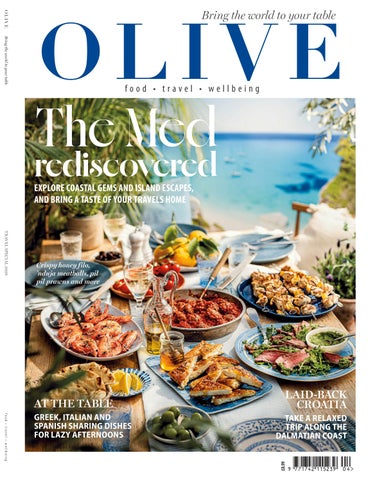
Bring the world to your table Bring the world to your table
food • travel • wellbeing
The Med
rediscovered
EXPLORE COASTAL GEMS AND ISLAND ESCAPES, AND BRING A TASTE OF YOUR TRAVELS HOME
AT THE TABLE food • travel • wellbeing
GREEK, ITALIAN AND SPANISH SHARING DISHES FOR LAZY AFTERNOONS
LAID-BACK CROATIA TAKE A RELAXED TRIP ALONG THE DALMATIAN COAST £8.99
TRAVEL SPECIAL 2026
Crispy honey filo, ’nduja meatballs, pil pil prawns and more
DISCOVER
GREECE JUST
60
PP
DEPOSIT*
*On bookings made ten weeks or more before departure. Full payment required by balance due date.
Editor’s letter
W
hat makes the Mediterranean such a dream destination for food lovers? Maybe it’s the sheer diversity of the cuisine – after all, this is a region that spans three continents, from southern Europe to north Africa and the Middle East, and every corner brings something different to the table. One trip is never enough. In this sun-soaked issue you’ll find some of our all-time favourite Med recipes, alongside fresh new takes – from the mix and match sharing dishes on our cover (made for slow, sociable eating, find them from p18) to Annie Mae Herring’s relaxed Provençal-inspired menu (p33) and Özlem Warren’s flavour-packed Turkish home cooking (p100). It’s all about bringing that holiday feeling home. For a destination so deeply loved it’s easy to think there’s little left to discover – yet it continues to surprise us. In this issue we travel to Croatia’s laid-back Dalmatian coast (p78), find food-focused island escapes (p116) and experience the vibrancy of Istanbul’s food scene. We’re also diving into the Mediterranean diet – not as a set of rules but as a way of eating that people genuinely love. It’s fresh, generous and, famously, one of the few approaches nutrition experts agree on. Head to p130 for easy ways to make it part of your everyday. So whether your cooking, dreaming or planning, we hope you’ll find lots of inspiration here.
HOW TO CONTACT US General enquiries oliveweb@immediate.co.uk
Janine Ratcliffe, deputy magazines editor @olivemagazine @missj9
Subscription enquiries olivemagazine.com/contact-us
COOK THE COVER EDITORIAL TEAM OF THE YEAR olive magazine and Good Food
Bring the best of the Med to your table with our summery, mix and match sharing menu, p18. COVER PHOTOGRAPH: ANT DUNCAN. SHOOT DIRECTOR: GILLIAN MCNEILL. STYLIST: DAVINA PERKINS. FOOD STYLIST: AMY KINNEAR. PORTRAIT PHOTOGRAPH: CHRIS TERRY
3
7
food 7
What to cook now
18
Holiday vibes
30
Gurd Loyal’s hot takes
33
A taste of Provence
41 49
52
59
4
Ideas that make the most of seasonal produce. Serve a Med-inspired mix and match sharing menu.
Our trends expert shares a Greek taverna classic. Enjoy the flavours of southern France at home with Annie Mae Herring’s three-course menu.
Shelf love
66
Smart new ways to use olive oil.
Edd Kimber’s modern baking A citrussy, syrup-soaked cake inspired by a Cretan favourite.
Signature dishes
Ranie Saidi shares recipes that showcase his Malay heritage.
Tray chic
One-pots, traybakes and more that make entertaining extra simple.
75
travel 68
73
Wine 101
Learn about traditional grapes and new-wave producers in Türkiye.
75
Barhopper
78
Slow travel
86
Immersive escapes
92
Why I love Valencia
Sunshine sipping
Three warm-weather cocktails to usher in summertime.
Aperitif hour
We pick out the best bottles and barware.
143 Recipe index 145 Verna eats Japan
Our columnist recreates tsukemenstyle ramen.
Italian bars to head to for an aperitivo (or two). Take a relaxed trip along Croatia’s Dalmatian Coast. Luxe stays in hotels carved into the surrounding landscape. Must-try Spanish cuisine.
100 Cook like a local
Dive into the lively food scene of the cosmopolitan city of Istanbul.
Contents TRAVEL SPECIAL
124 wellbeing
&
don’t miss 16
Subscription offer
72
Reader offer
124 Easy seasonal nourishment Wholesome recipes for summer.
108 Spotlight on Somerset
Head to beautiful countryside villages for top-tier fare and fresh produce.
116 Island hopping
Explore some of the Med’s best island destinations.
121 My London
Islington’s top foodie picks.
130 The miracle of the Med diet
Learn more about the much-loved way of eating that has many health benefits.
134 Simple nutrition boosts
Quick tweaks to up the nutrients in your meals.
Treat yourself or a loved one to a six-month olive subscription for just £20. Luxury Corfu and Zante escapes.
107 Reader offer
Island-hop around Croatia, or visit the Moorish cities of Andalucía.
141 Coming next issue
Find out what’s in store in your next edition of olive.
122 Weekender
Must-visit stops in Rome.
5
EXCEPTIONAL
PESTO
Flavour Like No Other
Made with Filippo Berio Extra Virgin Olive Oil, our real Italian recipe pesto sauces are simply delicious.
WHAT AT TO O COOK K NOW
Make the most of the season’s best produce as we move into the warmer months Recipes JANINE RATCLIFFE Photographs ANDREW BURTON
7
Silky green asparagus soup Save the sweet, tender asparagus tips to use as a topping for the soup – it looks pretty and gives a nice textural contrast. SERVES 4 | PREP 10 MINS | COOK 20 MINS | EASY 450-500g asparagus 1 large leek, halved, washed and chopped 2 tbsp extra-virgin olive oil, plus extra for drizzling 600ml vegetable stock 75g baby spinach Trim and discard the rough, woody ends from the asparagus, then cut off and reserve the tips for garnish. Roughly chop the remaining stalks. Cook the leek in the oil until softened. Add the asparagus stalks and cook for another minute, then add the stock and bring to a simmer. Cook for 7-10 mins until very tender. Add the spinach and cook for 2 mins, then whizz using a hand blender until smooth. Taste for seasoning. Blanch the tips in a separate pan of boiling water for 3-4 mins until tender. Spoon the soup into bowls, garnish with a few asparagus tips, then finish with an extra drizzle of oil, if you like.
SHOOT DIRECTOR: GILLIAN MCNEILL. STYLIST: FAYE WEARS. FOOD STYLIST: LIBBY SILBERMANN
PER SERVING 111 kcals • fat 7G • saturates 1G carbs 5G • sugars 4G • fibre 5G • protein 5G • salt 0.4G
8
9
Herby tabbouleh with marinated halloumi Marinating the halloumi after it cooks means the cheese can soak up all of the flavours. SERVES 4-6 | PREP 15 MINS | COOK 15 MINS | EASY 100g bulgur wheat 1 /2 small red onion, finely chopped 250g ripe tomatoes, diced 1 lemon, juiced 2 tbsp extra-virgin olive oil 50g parsley, leaves picked and sliced 25g mint, leaves picked and sliced HALLOUMI 2 blocks of halloumi, thickly sliced aleppo pepper 1 /2 lemon, juiced 1 tsp baby capers 1 tbsp olive oil To make the tabbouleh put the bulgur wheat in a heatproof bowl and pour over enough boiling water to cover. Stand for 15-20 mins or until just tender when you test a grain. Drain well. Put the onion, tomatoes, lemon juice, oil and a good pinch of sea salt in a serving bowl. Tip in the bulgur and toss to combine. Fry the halloumi in a non-stick pan until golden and softened. Whisk together the chilli flakes, lemon juice, capers and oil, and season. Spoon this over the hot halloumi. To finish the tabbouleh, mix the herbs into the bulgur. Taste and season with more salt or lemon juice, if needed. Serve with the warm marinated halloumi. PER SERVING (6) 366 kcals • fat 26G • saturates 15G carbs 11G • sugars 4G • fibre 2G • protein 22G • salt 2.5G
10
11
Hake and roasted veg traybake Hake is a thick, meaty fish that is ideal for roasting – here it sits on a bed of chunky Mediterranean veg, which creates an easy all-in-one traybake. SERVES 4 | PREP 10 MINS | COOK 30 MINS | EASY 500g baby new potatoes 3 tbsp extra-virgin olive oil, plus extra for drizzling 1 small red onion, cut into slim wedges 350g small courgettes, cut into chunks 150g red and yellow cherry tomatoes 4 chunky pieces of skinless hake 1 lemon, zested and halved handful of parsley, chopped Tip the potatoes into a pan of boiling salted water, return to the boil and simmer for 8 mins. Drain well and cool. Heat the oven to 190C/170C fan/gas 5. Drizzle the oil into a large shallow roasting tin, then add the potatoes, onion and courgettes, season well and toss together. Roast for 35 mins until the courgettes and potatoes are tender, and have started to colour. Stir in the tomatoes and sit the hake on top. Roast for 10 mins or until the fish is just cooked. To serve, drizzle over a little more oil, squeeze over some lemon juice and sprinkle over the lemon zest and parsley. PER SERVING 315 kcals • fat 12G • saturates 2G carbs 24G • sugars 5G • fibre 4G • protein 27G • salt 0.3G
12
13
Caramelised fennel and spicy sausage mafalde Fresh fennel and fennel seeds give this pasta a lovely aniseed edge, which pairs brilliantly with the spicy sausage. SERVES 3-4 | PREP 10 MINS | COOK 20 MINS | EASY 1 tbsp olive oil, plus extra for drizzling 250g-300g Italian-style sausages (or any herby, garlicky sausages – we used Salsicciamo Calabrese), skins removed 1 small onion, grated 200g fennel bulb, finely chopped, fronds reserved 1 /2 tsp fennel seeds, crushed 1 garlic clove, crushed pinch of dried chilli flakes small glass of white wine 200ml chicken stock 100ml single cream 300g mafalde or other long ribbon-like pasta 50g grated parmesan, to serve Heat the oil in a large non-stick frying pan. Divide the sausages into chunks and fry until browned, breaking the meat into smaller pieces as you go. Scoop the meat into a bowl using a slotted spoon, leaving any fat behind. Cook the onion and chopped fennel with another splash of oil, if needed, for 10-15 mins until the fennel has softened and turned light golden. Add the fennel seeds, garlic and chilli, and cook for 5 mins. Add the wine and simmer until it has completely reduced. Return the meat to the pan, add the stock, cover and simmer gently 15 mins. Stir in the cream. Cook the pasta following pack instructions, then drain, reserving a cup of the cooking water. Tip the pasta into the pan and toss, adding a splash of the cooking water to loosen, if needed. Serve in warm bowls scattered with the parmesan and the fennel fronds. PER SERVING (4) 653 kcals • fat 32G • saturates 12G carbs 59G • sugars 6G • fibre 6G • protein 23G • salt 1.8G
14
15
Exclusive spring subscription offer
Just £8.99
£3.34
Your passport to exceptional flavours, emerging trends and restorative escapes
per month
16
2 EASY WAYS TO SUBSCRIBE
is now bigger, bolder and more premium
food
•
travel
•
wellbeing
Explore the finest flavours, extraordinary places and wellbeing inspiration for just £20 every six months
SCAN THE QR CODE and subscribe right away ORDER ONLINE at olivemagazine.com/in-mag This offer is only open to new UK customers subscribing to olive magazine by recurring payment methods. The closing date for this offer is 1 July 2026. You will pay £20 every six months, saving 66% on the usual shop price. Prices are discounted from the full UK subscription price of £116.87 and include P&P; Europe and Republic of Ireland €87.50; USA and Canada US$135; Australia and New Zealand A$128; rest of the world US$100. Our customer service team is available Monday-Friday, 9am-5pm (UK time) on 01233 560607. UK calls will cost the same as other standard fixed line numbers (starting 01 or 02) and are included as part of any inclusive or free allowances (if offered by your phone tariff ). Outside of free call packages, call charges from mobile phones will cost between 3p and 65p per minute. For US/Canada phone (610) 510-6690.
17
Bring the sun to your table Channel summery holiday vibes with these delicious mix and match sharing plates, inspired by Mediterranean flavours
PHOTOGRAPH: NICK BRUNDLE PHOTOGRAPHY/MOMENT/GETTY
Words and recipes JANINE RATCLIFFE Photographs ANT DUNCAN
18
19
Bring dishes to the table and let everyone help themselves. Put out extra bowls of olives, soft flatbreads and bought dips to make a real feast
Chargrilled steak tagliata with green mojo sauce
SERVES 4 | PREP 10 MINS | COOK 10 MINS | EASY 450g sirloin steak (3cm thick), trimmed of excess fat butter thyme 100g rocket GREEN MOJO SAUCE 1 /2 small green pepper, roughly chopped 1 jalapeño, roughly chopped 1 garlic clove, chopped 15g parsley, roughly chopped 15g coriander, roughly chopped 1 /2 tsp ground cumin 4 tbsp olive oil, plus extra for the rocket 1 tbsp sherry vinegar, plus extra for the rocket
20
To make the sauce, put the pepper, jalapeño and garlic in a small food processor, and pulse a few times. Add the herbs, cumin, oil and vinegar, and blend, adding a splash of water if needed to bring together. Season. To cook the steak, oil both sides then season well. Heat the oven to 200C/180C fan/gas 6. Heat a heavy frying pan until very hot. Hold the steak fat-side down for 2-3 mins to render a little, then sear for 2 mins on each side until you have a good colour. Add a knob of butter and a couple of sprigs of thyme to the pan, and put in the oven for 5 mins. Remove the steak to a warm plate, loosely cover and rest for 10 mins. Dress the rocket with a little oil and vinegar, and season. Put on a platter then thinly slice the steak and lay on top. Spoon over the mojo sauce and serve. PER SERVING 280 kcals • fat 19G • saturates 5G carbs 1G • sugars 1G • fibre 1G • protein 25G • salt 0.2G
SHOOT DIRECTOR: GILLIAN MCNEILL. STYLIST: DAVINA PERKINS. FOOD STYLIST: AMY KINNEAR
Buying a thicker piece of steak means you can control the cooking more easily, and slicing it thinly will make it go much further.
21
Roasted prawns with pil pil butter This sizzling dish of prawns in a smoky, spicy butter is so simple but really packs a punch. Use a heatproof dish then you can bring it straight to the table. Make sure you have plenty of napkins and some dishes of lemony water for rinsing hands. SERVES 4-6 | PREP 5 MINS | COOK 20 MINS | EASY 24 whole shell-on prawns lemon wedges PIL PIL BUTTER 75g salted butter, softened 1 garlic clove, crushed ½ tsp smoked paprika ½ tsp of dried chilli flakes handful of chopped parsley, plus extra to serve To make the butter, mash everything together and season. Heat the oven to 220C/200C fan/gas 7. Put a small heatproof baking dish in the oven for 10 mins to heat up. Carefully take out and put the prawns in the dish with some dollops of the butter. Cook for 10 mins then baste, add a little more parsley and serve with lemon wedges for squeezing over. PER SERVING (6) 134 kcals • fat 12G • saturates 7G carbs 0.3G • sugars 0.1G • fibre 0.2G • protein 5G • salt 0.7G
22
23
Souvlaki evokes holiday memories of sizzling chicken coked over charcoal. Make the potat salad ahead and chill until you need it
Smoky souvlaki platter with tzatziki potato salad If you’re not barbecuing, the addition of smoked sea salt gives these skewers a little taste of the flames.
Put the chicken in a bowl with the garlic, lemon juice, smoked salt, oregano, oil and 2 tsp of salt. Leave at room temperature for 30 mins-1 hr.
SERVES 6 | PREP 15 MINS PLUS MARINATING | COOK 10 MINS | EASY 4 chicken breasts, cut into chunks 1 garlic clove, crushed 2 lemons, juiced, plus extra slices for the skewers 1 tsp smoked salt 1 tsp dried oregano 1 tbsp olive oil TZATZIKI POTATO SALAD 500g baby new potatoes ½ lemon, juiced ½ garlic clove, crushed 100g greek yogurt 2 mini cucumbers, finely diced handful of chopped dill, plus extra to serve
24
To make the salad, boil the potatoes in salted water until tender then drain really well. Cool then mix with the rest of the ingredients. Sprinkle over some more dill to finish. To cook the chicken, thread 4-5 pieces each on long skewers with a few slices of lemon in between. Heat a large griddle to hot then cook, turning, for 8-10 mins until coloured and cooked through. Serve with the potato salad. PER SERVING 227 kcals • fat 6G • saturates 1G carbs 13G • sugars 2G • fibre 2G • protein 29G • salt 5.9G
25
’Nduja meatballs with rich tomato sauce A spreadable spicy Italian salami, ’nduja can be used to bump up the flavours in sauces or melted into butter and oil to dress fish and seafood. Here we’ve used it to give juicy meatballs a spicy boost. Serve with lots of warm crusty bread as part of a sharing feast. SERVES 6 | PREP 15 MINS | COOK 50 MINS | EASY 250g pork mince 250g beef mince 2 tbsp ’nduja 1 small onion, grated 75g breadcrumbs mixed with 3 tbsp whole milk 30g parmesan, finely grated 2 tbsp chopped parsley 2 thyme sprigs, leaves chopped extra-virgin olive oil, for frying crusty bread, to serve TOMATO SAUCE 2 garlic cloves, crushed 1 tsp dried chilli flakes 2 thyme sprigs, leaves picked 2 x 400g tins of finely chopped tomatoes handful of torn basil Put the mince, ’nduja, onion, breadcrumbs, parmesan and herbs in a bowl. Season then mix really well with clean hands. Roll into 30 walnut-sized meatballs. Heat 1 tbsp of oil in a large non-stick frying pan. Cook the meatballs, turning, until golden all over (you might need to do this in batches). Once browned, scoop out of the pan. To make the sauce, add 1 tbsp of oil to the same pan and gently cook the garlic for 2 mins. Add the chilli flakes, thyme and tomatoes, stir and bring to a simmer. Cook for 20 mins then add the meatballs and simmer for another 20 mins. Stir in the basil and serve with crusty bread. PER SERVING 332 kcals • fat 20G • saturates 7G carbs 16G • sugars 7G • fibre 2G • protein 22G • salt 0.5G
26
27
Crisp filo parcels drizzled wih golden honey and sesame gives a lovely salty/sweet contrast
Crisp feta parcels with sesame and hot honey drizzle Feta is lovely when cooked, breaking down into creamy softness. Here it’s wrapped in filo and fried to give a gorgeously crunchy contrast. SERVES 4 | PREP 10 MINS | COOK 10 MINS | EASY 2 blocks of feta 4 large sheets filo pastry, halved olive oil honey, for drizzling black and white sesame seeds aleppo pepper
28
Cut each block of feta in half then slice each carefully in half again widthways so you have eight pieces. Wrap each piece in the filo, folding in the sides as you go, until you have eight small parcels. Heat a shallow pool of oil in a large non-stick frying pan over a medium heat then fry the parcels for a few minutes on each side until crisp and golden. Cut into diagonals to expose the cheese then serve on a warm plate with a drizzle of honey and a scattering of sesame seeds and chilli flakes. PER SERVING 439 kcals • fat 28G • saturates 15G carbs 27G • sugars 5G • fibre 2G • protein 19G • salt 2.9G
29
PHOTOGRAPH: ANT DUNCAN. SHOOT DIRECTOR: GILLIAN MCNEILL. STYLIST: DAVINA PERKINS. FOOD STYLIST: AMY KINNEAR
Gurd
HOT
30
Loyal’s
T TAKES
Our trends expert shares a recipe that’s having a moment online and in the restaurant world – this month, a Greek taverna classic
P
rawn saganaki is a beloved Greek taverna dish with a name that stems from the two-handled pan it’s traditionally cooked in. It’s bold and balanced, blending the very best Mediterranean ingredients together simply. It’s a dish that’s close to the heart of Petros Dimas, chef-patron of Michelin-starred Makris in Athens. “Prawn saganaki always reminds me of Greek summer,” he fondly recalls. “It brings back so many memories of long evenings by the sea in small fishing harbours, where simple food always tastes incredible. I’ll never forget eating prawns in a tiny taverna on the Ionian coast, with bread soaking up the tomato sauce and a hint of ouzo – it showed me how the simplest ingredients, when treated well, can be truly unforgettable.” The dish begins with a rich tomato-based sauce with lots of olive oil, onions and garlic – there’s a tangy element from either fresh lemon or vinegar, and regional aromatics such as oregano, chilli and cinnamon. Petros explains that ingredients are key: “This dish is all about balance. Use good tomatoes, good olive oil and just a bit of heat so it doesn’t overpower the sweetness of the prawns. Always use the freshest prawns you can find, cook them gently and finish with fresh herbs to bring everything together.” Traditionally a splash of ouzo or tsipouro is added for an aniseed note – alternatively you can add fresh fennel, as I have in this recipe. What’s essential is sharp, barrel-aged Greek feta, crumbled or lightly melted into the dish towards the end. When serving a Michelin-starred take on prawn saganaki, Petros explains: “At Makris we honour tradition but reinterpret it through precision and layering of flavours. A saganaki at the restaurant will start with impeccably sourced shellfish, a tomato emulsion, aromatic herb essences and a broth clarified and perfumed with seasonal nuances. For me the best combinations are those rooted in our terroir: sweet shellfish with slow-roasted tomato and hand-picked oregano, fresh citrus zest with wild herbs from our farm, Greek olive oil that bridges sea and earth. We always seek harmony, allowing each ingredient to sing while contributing to a unified whole.” The dish must be served bubbling hot, accompanied by crusty bread to soak up everything, plus a final flourish of fresh parsley or mint for vibrant earthiness that balances the tang of the sauce.
Greek prawn saganaki SERVES 4 | PREP 15 MINS | COOK 30 MINS | EASY 600g raw shell-on jumbo prawns 4 tbsp olive oil 1 large red onion, diced 6 fat garlic cloves, chopped 1 medium fennel bulb, diced 10g oregano, chopped 1 tsp ground cinnamon 1 tsp dried chilli flakes 4 tbsp red wine vinegar 1 tbsp brown sugar 680g tomato passata 20 black olives, pitted 100g barrel-aged feta 10g parsley or mint, finely chopped crusty bread, to serve Carefully remove the shells from the prawns, leaving the tails intact. Remove and discard the central tracts. Heat the oven to 220C/200C fan/gas 7. Heat the oil in a large, deep, ovenproof pan over a medium heat and cook the onion, garlic and fennel with a good pinch of fine salt for 10-12 mins until softened and just starting to take on a little colour. Add the oregano, cinnamon and chilli, stirring for 1 min, then add the vinegar, sugar and 11/2 tsp of fine salt. Cook for 2-3 mins until the liquid has evaporated, then stir through the passata. Simmer, uncovered, for 10 mins until the sauce has reduced by a third, then add the olives. Taste the sauce for seasoning, adding more salt or sugar if needed. Nestle the prawns deep into the surface of the sauce, then crumble over the feta. Bake in the oven for 13-15 mins until the prawns are cooked through and the feta is just beginning to melt. Garnish with chopped parsley or mint and serve with good crusty bread. PER SERVING 384 kcals • fat 21G • saturates 6G carbs 20G • sugars 17G • fibre 6G • protein 25G • salt 4.6G
31
WIN £100
VOUCHERS
by telling us what you think of
A
Hello,
The survey should take no more than 7 minutes to complete and will be open until 11.59pm on Sunday 31 May 2026. As a thank you for taking part, you will have the opportunity to enter a free prize draw where you could win one of two £100 John Lewis gift cards.
SCAN THE QR CODE to complete the survey Immediate prize draw open to UK residents aged 18+. Closes 31 May 2026. One entry per person. Two winners selected at random, each receiving a £100 John Lewis gift card. Winners notified within 28 days, surname and county may be published. Personal data used per Immediate privacy policy. Promoter may amend or cancel and is not responsible for lost or late entries. For full T&Cs visit immediateinsiders.com/uc/admin/e9b0/.
32
PHOTOGRAPH: MARIA KORNEEVA/GETTY IMAGES
s a valued reader of olive magazine, we would love to know what you think of our new look. Take our survey and tell us what you like about the refresh, what you’d change and what you’d like to see more of.
A taste of
SHOOT DIRECTOR: GILLIAN MCNEILL. STYLIST: DAVINA PERKINS. FOOD STYLIST: AMY KINNEAR
Provence
Embrace the flavours of southern France with this sunshine menu from Annie Mae Herring Recipes ANNIE MAE HERRING Photographs ANT DUNCAN 33
Menu Bouillabaisse with garlic and saffron aïoli Poulet aux olives French chocolate mousse cake
Bouillabaisse with garlic and saffron aïoli At its heart bouillabaisse is a brilliant fisherman’s stew built on good stock, aromatics, saffron and whatever the sea has given you that day. This is a home cook’s version, gently simmered and generous, served with toasted bread and bold garlic and saffron aïoli for spooning liberally over the top.
Lightly crush the saffron, then put in a small heatproof bowl with 2 tbsp of warm (not boiling) water. Set aside to bloom for 10-15 mins. Meanwhile, heat the oil in a large pan over a medium heat and cook the onion, leek and fennel with a pinch of salt for 10 mins until softened but not coloured. Add the garlic and fennel seeds, and cook for 1 min until fragrant.
SERVES 4-6 | PREP 25 MINS | COOK 40 MINS | EASY large pinch of saffron 3 tbsp olive oil 1 onion, finely sliced 1 leek, sliced 1 fennel bulb, sliced (fronds reserved) 6 garlic cloves, sliced 1 tsp fennel seeds 2 tbsp tomato purée 200ml dry white wine 400ml passata 1.2 litres good-quality fish stock 1 orange, zested and juiced 500g mixed firm white fish (such as cod and hake), cut into chunks 200g mussels, cleaned 250g raw king prawns, peeled finely chopped tarragon, to garnish toasted baguette slices, to serve GARLIC AND SAFFRON AÏOLI 1-2 garlic cloves 1 egg yolk 1 /2 tsp dijon mustard 150ml light olive oil small pinch of saffron, soaked in 1 tbsp of boiling water lemon juice, to taste
34
Stir in the tomato purée, then pour in the wine and simmer for 5 mins to reduce slightly. Add the passata, stock and bloomed saffron, along with its soaking liquid. Bring to a gentle simmer and cook for 20 mins. Add the orange zest and juice, and stir through. Add the fish, prawns and mussels, cover and cook for 5-7 mins until the fish is just cooked and the mussels have opened – discard any that remain closed. Season to taste. To make the aïoli, crush the garlic to a smooth paste with a pinch of salt. Whisk with the egg yolk and mustard, then slowly drizzle in the oil, whisking until thickened and emulsified. Stir through the bloomed saffron and its soaking liquid, then add lemon juice and seasoning to taste. Serve the bouillabaisse with some toasted bread slices, topped with some chopped tarragon and generous spoonfuls of the aïoli. PER SERVING (6) 490 kcals • fat 32G • saturates 5G carbs 10G • sugars 8G • fibre 5G • protein 31G • salt 0.9G
35
Poulet aux olives There is something deeply comforting about chicken cooked slowly with garlic, thyme and wine until the kitchen smells like the south of France. Here tomatoes slump into the pan while green olives lend their salty brightness to the juices. It is simple, generous cooking that asks very little of you yet delivers deeply layered flavour. Serve it with crusty bread for mopping up every drop.
Season the chicken well with salt and pepper. Heat the oil in a large, deep-frying pan or flameproof casserole over a medium heat and cook the chicken, skin-side down, for 8-10 mins until deeply golden and the fat has rendered. Turn over and cook for a further 3 mins, then remove to a plate.
SERVES 4 | PREP 15 MINS | COOK 1 HR | EASY
Pour in the wine and let it bubble for 2-3 mins, scraping up any sticky bits from the bottom of the pan. Add the tomatoes, olives, thyme, bay and stock. Stir, then return the chicken to the pan, skin-side up, nestling it into the sauce. Finally, add the lemon zest and juice.
8 chicken thighs 2 tbsp olive oil 1 large onion, finely sliced 6 garlic cloves, lightly crushed 200ml dry white wine 400g ripe tomatoes, chopped (or good-quality tinned tomatoes) 150g pitted green olives 4-5 thyme sprigs 2 bay leaves 300ml chicken stock 1 lemon, zested and juiced small handful of parsley or tarragon, finely chopped crusty bread, to serve
36
Reduce the heat slightly and cook the onion in the same pan with a pinch of salt for 8-10 mins until soft and translucent. Stir in the garlic and cook for 1 min.
Cover loosely with a lid and simmer gently for 30 mins until the chicken is tender and the sauce has reduced slightly. Remove the lid for the final 10 mins if you’d like the sauce a little thicker. Taste for seasoning, then scatter over the parsley or tarragon and serve straight from the pan with plenty of crusty bread. PER SERVING 423 kcals • fat 26G • saturates 6G carbs 9G • sugars 7G • fibre 4G • protein 27G • salt 2.1G
37
French chocolate mousse cake An airy and rich gâteau with a delicate set edge and tender, almost mousse-like centre. Made without flour it relies on whisked eggs, good-quality dark chocolate, butter, cocoa, brown sugar and salt for its texture. Served warm with balsamic strawberries and a generous spoonful of crème fraîche, it’s the sort of dessert made for sharing, passing plates and second helpings without asking. SERVES 6-8 | PREP 15 MINS PLUS COOLING AND MACERATING COOK 40 MINS | EASY 180g salted butter, plus extra for the tin 50g cocoa powder, plus extra for dusting 220g dark chocolate (at least 60-70% cocoa solids) 160g soft brown sugar 4 eggs 1/2 tsp sea salt flakes crème fraîche, to serve STRAWBERRIES 300g strawberries, hulled and sliced 2-3 tbsp caster sugar 2 tbsp good-quality balsamic vinegar
Heat the oven to 180C/160C fan/gas 4. Generously butter a 23cm springform tin and dust with cocoa. Gently melt together the butter and chocolate in a heatproof bowl over a pan of simmering water, ensuring the bowl doesn't touch the water (or do this in short bursts in the microwave). Leave to cool for 5 mins. Whisk together the sugar, eggs and salt in a large bowl using an electric whisk until thick, pale and mousse-like. Or do this in a stand mixer – it should take 5-6 mins on medium speed. Stir the cocoa into the chocolate until smooth, then gently fold this into the eggs, keeping in as much air as possible. Pour the batter into the tin and gently level the surface with a spatula. Bake for 35-38 mins or until the edges are set and lightly risen, and the centre is soft with a slight wobble. Rest for 15 mins – the outside will settle while the middle will stay mousse-like. Toss the strawberries with the sugar and balsamic, and leave to macerate for 10 mins until glossy and syrupy. Bring the gâteau to the table. Dust with cocoa, then slice and serve just warm with the strawberries and crème fraîche. PER SERVING (8) 504 kcals • fat 35G • saturates 20G carbs 38G • sugars 34G • fibre 5G • protein 8G • salt 0.8G
Annie Mae Herring is a recipe developer and food stylist who shares regional French, British and Nordic recipes as @theculinarybee on Instagram and The Seasonal Kitchen on Substack.
38
39
SHELF LOVE OV
Give storecupboard ingredients a little TLC and create some clever recipes – this month, celebrate fruity, peppery olive oil Recipes HELENA BUSIAKIEWICZ Photographs ANDREW BURTON
41
Charred grapefruit and tuna salad with aleppo pepper, honey and olive oil dressing This is a warm summery salad. It would be fab served with some grains, like quinoa or freekeh. SERVES 2-4 AS PART OF A LARGER SPREAD | PREP 20 MINS COOK 10 MINS | EASY 2 red grapefruits 3 tbsp olive oil 35g flaked almonds 6 spring onions, cut into thirds 2 tuna steaks 60g rocket 15g mint, leaves picked DRESSING 2-4 tbsp grapefruit juice 3 tbsp extra-virgin olive oil 30g honey 2 tsp aleppo pepper 1 tsp red wine vinegar
Cut away the peel from the grapefruits then segment over a bowl by cutting between the membrane into sections. Squeeze the left-over grapefruit core and membranes over a separate bowl to gather the juice. To make the dressing, whisk together the reserved grapefruit juice, oil, honey, pepper and vinegar. Season well with salt and pepper. Set a metal sieve over a heatproof bowl. Pour 2 tbsp of oil into a medium frying pan over a medium heat. Once hot, scatter in the almonds and cook for 3-4 mins until golden and sizzling, then tip into the sieve, allowing the bowl to catch the oil and the sieve to catch the almonds. Season with a little pinch of salt. Pour the oil back into the pan, turn up the heat and scatter in the spring onions with a pinch of salt, cooking for 3-4 mins until blistered and softening. Remove from the pan and leave to cool slightly. Put half of the grapefruit segments into the pan, stirring quickly until charred and breaking down slightly. Remove to a plate. You want the salad to be warm, not hot, so leave the ingredients to cool slightly while you assemble and cook the tuna. Coat the tuna in 1 tbsp of oil and sprinkle with salt. Cook for 1-2 mins on each side (depending how thick the steaks are) until golden on the outside but still pink in the middle. Drizzle 1 tsp of the dressing onto the tuna in the final few seconds of cooking, then remove to a board and cut into thick slices. Arrange the rocket and mint leaves on a large platter, then nestle in the spring onions, the cool charred grapefruit, then layer on the tuna. Spoon over the dressing, reserving some to serve with, then scatter over the almonds.
SHOOT DIRECTOR: GILLIAN MCNEILL. STYLIST: FAYE WEARS. FOOD STYLIST: LIBBY SILBERMANN
PER SERVING (4) 363 kcals • fat 22G • saturates 3G carbs 15G • sugars 7G • fibre 2G • protein 24G • salt 0.1G
42
43
Lazy confit tomatoes and garlic with feta dip Confit is a French term for cooking that comes from the word ‘confire’, which means to preserve. It involves cooking in oil at a low temperature, most traditionally done with duck or pork. Here we’ve used that technique to cook tomatoes, making them jammy and sweet. I’m calling it ‘lazy’ confit as to properly confit you would submerge the tomatoes but here it’s more of a half roast/half confit.
Heat the oven to 160C/140C fan/gas 3. Put the tomatoes in a roasting tin small enough that they will fit snugly and season with salt. Put in the garlic halves cut-side down. Toss through the chillies and oregano, then pour over the olive oil. Don’t worry if everything isn’t completely submerged.
SERVES 4-6 AS PART OF A BIGGER SPREAD | PREP 5 MINS COOK 1 HR | EASY
Allow the oil to cool before pouring through a sieve into a clean bowl, pressing any left-over garlic, chillies and oregano against the sieve. This flavoured oil can be used for another batch of confit, or for pasta, dressings or sautéing onions.
850g small mixed colour tomatoes (using a few larger tomatoes is fine) 1 small garlic bulb, cut in half horizontally 2 long red chillies 3 oregano sprigs 400ml olive oil 200g feta 100g greek yogurt ½ a lemon, zested and juiced 10g chives, finely chopped focaccia or sourdough, to serve
44
Roast for 1 hr, gently turning the larger tomatoes halfway through. Carefully remove the tomatoes from the oil using a slotted spoon and put on a baking tray to cool slightly.
While the tomatoes are cooling, put the feta, yogurt, lemon zest and juice into the bowl of a food processor. Blitz for 2-4 mins until whipped and smooth. To serve, spread the feta dip over a platter and then gently top with the tomatoes and garlic. Scatter over the finely chopped chives and some black pepper, and serve with bread for dipping. PER SERVING (6) 234 kcals • fat 20G • saturates 7G carbs 6G • sugars 6G • fibre 2G • protein 7G • salt 0.9G
45
Vanilla and honey semifreddo with olive oil and sea salt Vanilla ice cream with olive oil and sea salt is one of life’s great pleasures, and this is a great way to showcase your fanciest olive oil. If you wanted a little bit of crunch, some toasted nuts or even some praline would be a great addition. Semifreddo is translated from Italian as ‘half-cold’ due to its airy texture. SERVES 6-8 | PREP 15 MINS PLUS FREEZING | COOK 15 MINS | EASY 1 vanilla pod, seeds scraped 60g set honey 50g golden caster sugar 4 eggs 300ml double cream high-quality extra-virgin olive oil, to serve sea salt flakes, to serve
Line a 900g loaf tin with baking paper, leaving some hanging over the edges so it will be easy to lift out later on. Put the vanilla, honey, sugar and eggs in a medium glass bowl. Add a tiny pinch of salt. Put a pan of water on to boil that the bowl sits comfortably on top of – you don’t want the water to touch the bowl. Use electric beaters to create a sabayon, whisking for 10-15 mins until lightly mousse-like. Remove from the heat and set aside to cool completely. Once the sabayon is cool, whip the cream to soft peaks, then fold the sabayon into the cream. Pour into the loaf tin and freeze overnight. When ready to serve, dip the bottom of the tin in some hot water, then invert onto a plate. Slice and serve drizzled with olive oil and sprinkled with sea salt flakes. PER SERVING (8) 264 kcals • fat 22G • saturates 13G carbs 12G • sugars 12G • fibre 0G • protein 4G • salt 0.1G
46
47
Edd Kimber’s
MODERN BAKING A syrup-soaked cake inspired by the sunshine flavours of Crete Words and recipe EDD KIMBER Photographs ANT DUNCAN
O
ver the years, I’ve been lucky enough to spend a bit of time on the beautiful Greek island of Crete. The village we stay in has a brilliant bakery that produces a whole host of filo-based dishes and, while they’re all delicious, they never seem to include my all-time favourite Cretan treat, portokalopita – so I had to learn how to make it myself. This cake is unique because instead of flour it’s made with dried filo pastry. The resulting cake is surprisingly tender, with an unusually lacy texture. Because the recipe uses dried filo it’s reasonable to assume it was originally made as a way to use up any left-over pastry that had become too dry to use for other recipes. The origin story, however, suggests it was invented by thrifty cooks who had scraps of left-over pastry after making spanakopita. This is also a recipe that fits into the siropiasta category of Greek desserts – cakes and pastries soaked in simple syrup to keep them moist. Traditionally the batter is made with oil but I prefer the flavour of butter. But feel free to use an equal quantity of oil should you want a more traditional version. In this version the usual orange-flavoured syrup is deepened with a fragrant blend of cardamom, cinnamon and bay leaf. While the included amount is entirely used up in the cake, you can always make a little extra to drizzle over the fresh oranges slices, if you like.
Edd Kimber is a baker, food writer and the author of seven cookbooks, including his latest, Small Batch Cookies. Find him on Substack and Instagram @theboywhobakes.
49
Heat the oven to 160C/140C fan/gas 3. Lightly butter a 20cm round springform tin and line the base with baking paper. Unroll the filo sheets and, working with one at a time, scrunch up from one of the short sides, creating lots of pleats. Layer the filo across two large baking trays and bake for 15 mins. Carefully turn over each piece of filo and bake for another 15 mins, then set aside to cool. At this point, the pastry should be completely dry and extremely crisp. Carefully break into smaller pieces. Turn up the oven to 180C/160C fan/gas 4. Whisk together the eggs, sugar and orange zest using an electric whisk in the largest bowl you have for 5 mins or until thickened and pale. Add the orange juice, yogurt, bicarb, baking powder, salt and butter, and mix until just evenly combined. Add half the pastry shards and stir until they have rehydrated and shrunk slightly as they absorb some of the moisture. Add the remaining pastry shards and stir until everything is evenly coated. Scrape into the tin and spread out into an even layer. Bake for 25-30 mins or until the cake springs back to a light touch and the top is golden. Meanwhile, prepare the syrup. Put the sugar, orange juice, spices and 75ml of water in a pan, and bring to the boil over a high heat. Reduce the heat to a simmer and cook for 10 mins.
SERVES 8-10 | PREP 45 MINS | COOK 1 HR | EASY 150g butter, melted then cooled slightly, plus extra for the tin 350g filo pastry 3 eggs 150g caster sugar 2 large oranges, zested and juiced (you’ll need 125ml), plus extra orange segments to serve 175g greek yogurt 1 tsp bicarbonate of soda 1 tsp baking powder pinch of fine sea salt whipped cream and flaked almonds, to serve SPICED SYRUP 200g caster sugar 2-3 large oranges, juiced (you’ll need 150ml) 1 cinnamon stick 5 cardamom pods 2 bay leaves
50
Serves the cake in slices with whipped cream and segmented oranges. If you want a little extra texture, sprinkle over some flaked almonds too. It will keep chilled for up to three days. PER SERVING (10) 414 kcals • fat 17G • saturates 10G carbs 58G • sugars 39G • fibre 1G • protein 7G • salt 1.2G
SHOOT DIRECTOR: GILLIAN MCNEILL. STYLIST: DAVINA PERKINS. FOOD STYLIST: AMY KINNEAR
Fragrant orange portokalopita
As soon as the cake comes out of the oven, poke holes all over the surface using a cocktail stick, then slowly drizzle over the syrup until all of it has been used up. Leave to cool completely.
This cake is unique bcause instead of flour it’s made wih dried filo pastry
51
sd
ignature ishes Our favourite creators share dishes that showcase their unique style of cooking – this month, Ranie Saidi celebrates the flavours of his Malay heritage
Recipes RANIE SAIDI Photographs MOWIE KAY
52
Curry puff pie, p54
53
Karipap pie
Curry puff pie
Malay fried chicken
Curry puffs, or karipap, are an everyday street snack in Malaysia – filled with curried potatoes and sometimes sardines, chicken or other meat. They were one of my favourite treats growing up but making them at home can be quite the task. So instead I created this pie made with the same comforting filling, covered in crisp filo pastry. It’s simpler and quicker yet still brings back that nostalgic flavour.
Rumour has it that Malay fried chicken is the tastiest fried chicken around. A marinade made of a mixture of dried spices and fresh herbs soaked in coconut milk gives the chicken a depth of flavour that’s hard to beat. Don’t be fazed by the list of ingredients – that’s the key to the deliciousness. The sweet orange dip with sourish yogurt cuts through the greasiness nicely, getting you ready for the next comforting bite.
SERVES 4-6 | PREP 15 MINS | COOK 50 MINS | EASY 60ml vegetable oil 20-30 fresh or dried curry leaves 1 star anise 2 tbsp cumin seeds 1 long shallot, finely chopped 3 garlic cloves, finely chopped 2 tbsp curry powder (mild or hot, depending on your liking) 1 tbsp paprika 300g carrots, cut into 1cm cubes 500g white starchy potatoes, peeled and cut into 1cm cubes 2 vegetable stock cubes 1 tsp cornflour 300g frozen peas 4 tbsp chopped coriander leaves PASTRY TOPPING 10 filo pastry sheets 100g butter, melted 2 tbsp cumin seeds Heat the oven or air fryer to 180C/160C fan/gas 4. To make the filling, heat the oil in a large ovenproof casserole dish over a medium heat. Cook the curry leaves, star anise, cumin seeds, shallot and garlic until fragrant. Add the curry powder and paprika with 1 tbsp of water and cook for 10 mins until the oil separates. Add the carrots and potatoes, crumble in the stock cubes and stir in 125ml of water. Cover with a lid and cook for 10-15 mins until the potatoes and carrots are fork-tender. Remove the lid, stir in the cornflour and cook for 5-10 mins until the sauce thickens. Turn off the heat, add the peas and coriander, then season with salt and 1 tbsp of pepper. Stir to mix well and leave for 5-10 mins. Take the pastry out of the fridge just before using it. Mix the butter with 1 tsp of salt and use to evenly brush both sides of one pastry sheet. Roughly scrunch up the pastry and lay over the filling, tucking the edges in. Repeat with the other pastry sheets until the entire surface of the filling is covered. Sprinkle the cumin seeds over the top and bake for 20-25 mins until the pastry is golden. Leave to cool for a few minutes before serving.
Tip To make this recipe vegan, swap the butter for vegetable oil but do also check the filo pastry to make sure it’s suitable for vegans. 54
Ayam goreng melayu
SERVES 6 | PREP 10 MINS PLUS MARINATING | COOK 30 MINS | EASY 6 chicken legs vegetable oil, for frying MARINADE 10 fresh or dried curry leaves 1 tbsp paprika 1 tbsp ground turmeric ½ tbsp ground cumin 3 tbsp all-purpose food seasoning or 3 chicken stock cubes 5cm piece of ginger 4 garlic cloves 3 long shallots 3 lemongrass stalks, trimmed and lightly bashed 1 tbsp coriander seeds 1 tbsp fennel seeds 3 tbsp curry powder (mild or hot) 400ml coconut milk FLOUR MIXTURE 200g cornflour 100g self-raising flour 3 tbsp curry powder (mild or hot) DIPPING SAUCE 5 tbsp natural yogurt 1 tbsp mayonnaise 1 large orange, zested and juiced 1 garlic clove, roughly chopped 1-2 tbsp chopped coriander leaves To make the marinade blitz all the ingredients with 2 tbsp of salt in a food processor until smooth, then transfer to a deep bowl. Add the chicken legs and rub the marinade thoroughly into the meat, ensuring each piece is evenly and generously coated. Cover and chill for at least 30 mins or ideally overnight. When ready to fry, remove the chicken from the fridge and allow to rest at room temperature for 10 mins. Meanwhile heat 10cm depth of oil in a deep-fat fryer until it reaches 160C. In a bowl, combine the flour mixture ingredients with 1 tbsp each of salt and pepper. Dredge each leg in the flour mixture, shaking off any excess. Working in batches of two or three legs at a time, carefully lower the chicken into the hot oil and fry for 7 mins. Flip the chicken and fry for a further 7 mins until deeply golden and crisp – a digital probe thermometer inserted near the bone should read 74C. Transfer the chicken to a tray lined with kitchen paper to drain. Repeat the process with the remaining chicken legs. For the dipping sauce, mix all the ingredients in a bowl and serve alongside the chicken.
55
Pandan tiramisu I first learned how to make tiramisu when I visited Florence a few years back. I was captivated by its creamy layers and delicate airy textures. This version is my light-hearted twist, using pandan – the Asian vanilla – to give it a gentle fragrant lift. It may never beat the classic Italian tiramisu but the pandan and palm sugar pair surprisingly well with the mascarpone, giving the dessert a familiar feel while adding a little something different.
Separate the egg whites and yolks into two medium bowls. Add the palm sugar, pandan, vanilla and 1 tsp of salt to the yolks. Combine with a handheld electric whisk on medium speed until the mixture is smooth. Gently fold in the mascarpone until well combined. In the second medium bowl, whisk the whites and caster sugar on medium speed until peaks form. Using a spatula, carefully fold this mixture into the egg yolks. Add 3 tbsp of espresso powder, the tamarind paste, food colouring, if using, and coconut flakes. Mix well until fully incorporated.
SERVES 6-10 | PREP 20 MINS PLUS CHILLING | EASY 6 eggs 150g palm sugar (grated if using a block) 3 tbsp pandan extract 1 tbsp vanilla extract 250g mascarpone 1 tbsp white or golden caster sugar 9 tbsp instant espresso powder, plus extra for dusting ½ tbsp tamarind paste 1 tbsp green food colouring (optional) 50g coconut flakes 350g savoiardi biscuits
To prepare the soak, mix the remaining 6 tbsp of espresso powder with 250ml of water in a small bowl. Dip the sponge fingers into the coffee mixture one at a time until well soaked but not soggy. Use the fingers to line the base of a 20cm square serving dish. Evenly spread half of the cream mixture over the sponge fingers. Repeat with another layer of coffee-soaked fingers, then top with the remaining cream, spreading it evenly. Put the dish in the fridge, uncovered, to set for at least 4 hrs. When ready to serve, remove the tiramisu from the fridge and generously dust the top with more espresso powder. Serve chilled.
Recipes extracted from The Malay Cook by Ranie Saidi (£25, Ryland Peters & Small). Photographs © Mowie Kay. Recipes are sent by the publisher and not retested by us.
56
57
Make the most of your
outdoor space with an awning
We’re here to help you make the most of your outdoor space with a made-to-measure awning. Enjoy sun-shaded moments with family and cosy evenings entertaining friends, all in a garden you can be truly proud of. Measuring and installation are always included, for complete peace of mind.
SCAN TO SEE MORE
HILLARYS.CO.UK
Tray chic
Keep things simple with these clever traybakes and one-pots – stylish enough to serve up to guests Recipes JOHN GREGORY-SMITH Photographs MARTIN POOLE 59
Greek-ish lamb stifado Meltingly tender lamb in a simple but flavourful sauce of tomatoes, garlic, cinnamon and allspice, this is my take on the quintessentially Greek dish lamb stifado. I adore this kind of lazy cooking where the oven does all the heavy lifting. Now here’s a little secret: the traditional recipes use small shallots but I find peeling them uber fiddly, so if I’m in a rush I grab peeled frozen baby onions from the supermarket and throw them straight into the roasting tin instead. If you can make life easier for yourself, why would you not?
Heat the oven to 180C/160C fan/gas 4. Heat the oil in a non-stick frying pan over a medium heat and season the lamb all over. Brown the meat for 2-3 mins per side until golden – make sure the pan isn't overcrowded, you may need to do this in several batches. Transfer the cooked lamb to a 32cm x 24cm roasting tin.
SERVES 4 | PREP 12 MINS | COOK 3 HRS 30 MINS | EASY
Remove the foil and poke a few holes into the middle of the baking paper to let the steam out and help reduce the sauce – make sure it’s very snug over the meat to stop it from drying out. Return to the oven for 30-40 mins or until the sauce has reduced and is lovely and thick.
1 tbsp groundnut oil or other neutral oil 1kg lamb shoulder, cut into 5cm pieces 700ml lamb stock (from 1 stock cube), hot 2 tbsp tomato purée 1 tsp sugar 1½ tsp ground cinnamon ¾ tsp allspice 150g shallots, larger ones halved 8 garlic cloves 2 rosemary sprigs 400g tin of chopped tomatoes cooked orzo, feta, kalamata olives, sliced tomatoes, sliced cucumber and sliced red onion, to serve
60
Whisk together the stock, tomato purée, sugar, cinnamon and allspice, and pour over the lamb. Add the shallots, garlic, rosemary, tomatoes and pinch of salt and pepper, and stir together. Scrunch up some baking paper and spread it over the lamb. Cover the whole tray with foil and roast for 2 hrs-2 hrs 30 mins until the meat is soft and tender.
Check the seasoning, adding salt and pepper to taste. Skim off any excess fat then serve with some cooked orzo, feta, olives and sliced tomatoes, cucumber and red onion.
61
Sweet chilli and turmeric roasted salmon This mouth-watering roasted salmon traybake is inspired by a showstopping Vietnamese dish called chả cá lã vọng, a feast of golden spiced fish served in a pan with loads of dill, spring onions and peanuts. In place of the fried fish I use salmon, which I love to roast as the slightly fatty flesh stays really juicy and will drink up anything it’s paired with – in this case a punchy marinade of turmeric, garlic, ginger and sweet chilli sauce. Toss in some rice noodles to soak up all the juices from the roasting tin and, for an extra pop of flavour, serve with a tangy dipping sauce on the side. SERVES 4 | PREP 20 MINS PLUS MARINATING | COOK 35 MINS | EASY 200g vermicelli rice noodles MARINADE 4 garlic cloves, crushed 2 spring onions, finely chopped 2-3cm piece of ginger, peeled and grated ½ red chilli, deseeded if you like and finely chopped 1 lime, juiced 2 tbsp fish sauce 2 tbsp sweet chilli sauce 1 tbsp groundnut oil or other neutral oil 1 tsp ground turmeric SALMON 800g side of skin-on salmon 8 spring onions, roughly chopped into 3-5cm pieces 2 large handfuls of dill, roughly chopped 1 tbsp groundnut oil or other neutral oil DIPPING SAUCE 2 tbsp fish sauce 2 tbsp sweet chilli sauce 1 lime, juiced, plus wedges to serve TO SERVE 30g roasted peanuts, roughly chopped ½ red chilli, deseeded if you like and finely chopped small handful of dill, finely chopped
62
Heat the oven to 200C/180C fan/gas 6. Mix together all the marinade ingredients. Put the salmon, skin side down, into a snug dish and pour the marinade over the top. Rub it all over and leave to marinate for 10 mins. Put the spring onions and dill into a 32cm x 24cm roasting tin. Add the oil and toss together. Put the salmon on top, skin side down. Scoop out all the sauce from the marinating dish and pour over the fish. Add 4 tbsp of water around the salmon and roast for 25-30 mins until the salmon is just cooked through. Cook the noodles following pack instructions. Drain and immerse in cold water to cool completely, then drain again. Remove the salmon from the roasting tin and transfer to a plate. Cover with foil to keep warm. Chuck the noodles into the tin and mix into all the juicy herbs. Return to the oven for 5 mins to warm through. Mix together the dipping sauce ingredients with 4 tbsp of water in a small serving bowl. To serve, divide the noodles between four plates. Top with a piece of the salmon and garnish with the peanuts, chilli and dill. Serve with lime wedges and the dipping sauce. Alternatively, put the noodles and salmon on a large serving platter and let everyone help themselves.
63
Hasselback squash with preserved lemon gremolata This is the ultimate vegetarian showstopper, easily made vegan with a simple swap to vegan butter. It takes the humble butternut squash and transforms it into something truly spectacular. The squash is hasselbacked – sliced into delicate accordion-like slits, which absorb every drop of the umami-rich sundried tomato butter. SERVES 4 | PREP 25 MINS | COOK 50 MINS | EASY 1 butternut squash 1 tbsp olive oil 10g toasted pine nuts SUNDRIED TOMATO BUTTER 40g butter, softened 80g sundried tomatoes in oil, drained and finely chopped 2 garlic cloves, crushed PRESERVED LEMON GREMOLATA 3 tbsp olive oil 1 preserved lemon, seeds removed 1 green chilli, deseeded if you like 1 garlic clove 2 handfuls of parsley leaves 1 handful of coriander leaves 1 lemon, juiced TAHINI SAUCE 120g tahini 1 garlic clove, crushed ½ lemon, juiced
Recipes extracted from The Greatest Traybake Cookbook Ever by John Gregory-Smith (£25, Penguin Michael Joseph). Recipes are sent by the publisher and not retested by us.
64
Heat the oven to 200C/180C fan/gas 6. To prepare the squash, top and tail it, and peel off the skin with a peeler, then cut it in half lengthways and scoop out the seeds. Lay one half, cut side down, on to a chopping board and put two wooden chopsticks either side. Cut slits every ½cm into the squash, using the chopsticks as a buffer so you don’t cut all the way though. Repeat with the other half. Put the squash halves into a 32cm x 24cm roasting tin, cut side down, and pour over the oil. Season with salt and pepper then roast for 40-45 mins until the fattest part of the squash is tender. Meanwhile mix the butter with the tomatoes, garlic and a little pinch of salt and pepper. Alternatively, blitz everything together in a mini chopper. Make the gremolata by blitzing all the ingredients together in a mini chopper with a pinch of salt and pepper until you have a lovely fine salsa. To make the tahini sauce, whisk together everything along with 120ml of water and a pinch of salt until smooth and creamy. Remove the squash from the oven and spread the butter over the top, making sure it squidges into the gaps. Return to the oven for 5 mins until the butter has completely melted. To serve, pour the tahini sauce on to a serving platter. Add the squash and spoon over any butter from the roasting tin. Drizzle over the gremolata and scatter over the pine nuts.
65
Wine 101 with Kate Hawkings
Türkiye
Main grapes
Türkiye’s wine culture has a rich history and now its young producers are really making waves
T
ürkiye has all the attributes for a large and thriving wine industry: a viticulture history going back more than 6,000 years, vinefriendly soils and climates in its seven diverse wine regions, dynamic young winemakers and a plethora of exciting indigenous grapes. However, while most governments are generally supportive of their country’s wine producers, in Türkiye advertising any alcohol is strictly banned, online sales are illegal, taxes are high and producers are forced to keep huge collateral reserves in case they transgress.
Despite these challenges Turkish wine is on a roll at the moment, with recent years seeing an impressive haul of medals from reputable global wine competitions and a growing export market. Once state-controlled, the modern industry is now driven by forward-thinking boutique producers, often family owned and with young winemakers who’ve worked abroad and come back with fresh ideas, who are championing ancient native grapes from old vines, raising quality and finding ways to sell their wines to the world. Lucky us, for many are very, very good.
Although Türkiye has the sixth largest vineyard area in the world, only 3% of its grapes are made into wine, the rest being used for table grapes, raisins or molasses. Sultaniye is its most widely planted variety, mostly dried to make sultanas but also used for light, fruity whites. Of the hundreds of other native varieties the commonest are narince, floral with pink grapefruit notes, more mineral and savoury emir, and bornova misketi with its lovely muscat-like aromatics. Reds are led by öküzgözü’s plush and plummy wines, while boğazkere is more intense and tannic. Kalecik karası is often referred to as Türkiye’s pinot noir – karası means ‘black’ although its wines are often pale and perfumed.
Something surprising
Paşaeli Sidalan Pét Nat (£24.50, amathusdrinks.com) Sidalan is an ancient native white grape, grown near the site of ancient Troy. Here it’s made into a gentle, creamy fizz, fermented with natural yeasts – floral but not cloying, with crunchy red apples, pink grapefruit and herbs, and a lovely saline finish. Very charming.
Kate Hawkings is a wine consultant and author of The Little Book of Aperitifs: 50 Classic Cocktails and Delightful Drinks (£10, Quadrille). Follow her on Instagram @kate_hawkings.
66
What to eat Turkish food is a riot of flavour and textures: grilled meat, oily aubergines, sweet tomatoes, earthy spices, zesty yogurt and lots of herbs appear so often. Robust reds are a no-brainer for kebabs and other meat dishes, particularly if the spicing is heavy, while more delicate reds are great for a meze spread. Try aromatic whites with vegetable stews and salads, and fresher wines with dolmades or börek.
t
Ask a sommelier
Bottls to try
Vinkara Kalecik Karası 2021 (£11.95, thewinesociety.com) Kalecik Karası is the signature grape from this region in central Anatolia, near Türkiye’s capital, Ankara. Unoaked, as is the modern style, so lighter and fresher than more traditional wines. Bright red berry fruit, a hint of chocolate and kiss of black pepper – great with a classic imam bayıldı.
Blow o
Where to stay
A great base to explore the province of Denizli, inland from the Aegean coast and famous for its incredible natural thermal springs, travertines, ancient ruins and its wines. This huge but comfortable hotel has sleek, well-appointed rooms and an impressive range of treatments and therapies in its various pools and spa rooms. dogathermalhotel.com Be warned that most hotels have unexciting wine lists, often with only a few large producers, so more interesting wines need sniffing out. Rent a car and see what you find; don’t miss the Çal Vineyard Route where the region’s best winemakers will make you very welcome. vineyards.goturkiye.com
ut
Kuzubağ Çal Karası 2024 (£19.65, vintagecellars.co.uk) From the Çal region, a high-altitude plateau that produces around 40% of Türkiye’s wines. Three young women run this beautiful family winery where they make brilliant wines and also offer great visitor experiences. Sour cherries, strawberries, rhubarb and thyme with a little earthy spice – delicious.
Your easy guide to getting the most out of your wine glass
Elinor Blair, Bar Flor Elinor is bar manager at wine and pintxos bar Bar Flor and Mediterranean-inspired sister restaurant Wildflowers in Belgravia. wildflowersrestaurant.co.uk/barflor I love albariño but I want to try something different. What other Iberian wines would you recommend? I would recommend trying macabeo, also known as viura. It is one of the most widely planted grapes in Spain because of its use in rioja and cava blends – however, many winemakers vinify it as a single-varietal wine. It retains beautiful acidity even in the heat and has a balanced profile that is lightly aromatic while still retaining good fruit flavours similar to albariño. You could also try godello, a grape grown in north-west Spain that feels like albariño all grown up. I’m buying wine for a summer barbecue/garden party – what do you always recommend? Txakoli is great fun, it is Spain’s answer to vinho verde. Native to the Basque region, it is low in alcohol, spritzy, dry and citrussy, and exactly what you want to be drinking outside in the sun. The fresh lemonade of the wine world. What’s your guilty pleasure when it comes to wine? A silly pleasure of mine is that you can upgrade a cheaper sparkling by adding a drop of a passito-style sweet wine or a drop of sherry – then you get a drink that starts tasting like an expensive champagne.
PHOTOGRAPHS: ISTOCK/GETTY IMAGES PLUS
B
ge d u
67
SUNSHINE SIPPING Channel holiday vibes with these Med-inspired drinks Recipes HANNAH GUINNESS Photographs ANT DUNCAN
GARIBALDI SPRITZ This recipe combines two iconic Italian drinks: the spritz and the garibaldi. SERVES 1 | 5 MINS | EASY
Put the amaro and orange juice in a highball glass filled with ice. Gently stir, then top up with the prosecco and garnish with an orange wedge.
68
SHOOT DIRECTOR: GILLIAN MCNEILL. STYLIST: DAVINA PERKINS. FOOD STYLIST: AMY KINNEAR
50ml red bitter amaro (we used Campari) 100ml freshly squeezed orange juice prosecco, for topping up orange wedge, to garnish
69
LIMONCELLO
LEMON DROP
Limoncello, the classic Italian lemon liqueur, is the perfect addition to this sweet retro cocktail. Don’t skip the sugared rim – it provides necessary sweetness that rounds out the tart, boozy elements of the drink.
70
SERVES 1 | 5 MINS | EASY lemon wedge, plus a slice or twist, to garnish 1 tbsp caster sugar 50ml vodka 25ml limoncello 25ml lemon juice
Run a lemon wedge around the rim of a martini glass. Tip the sugar onto a saucer, then dip the rim of the glass into it to coat. Put the glass into the fridge to chill while you make the cocktail. Put the vodka, limoncello and lemon juice in a cocktail shaker filled with ice. Shake well, then strain into the chilled martini glass and serve garnished with a lemon wheel or twist.
NEXT-LEVEL
TINTO DE VERANO
Tinto de verano, a simple mixture of red wine and lemonade, is a fizzy, refreshing cocktail that’s popular in southern Spain during warm weather – it literally means ‘summer red wine’. Here we’ve added vermouth for a herbal, bittersweet edge. No need
to spend a lot on the wine – something young and fruity works best. SERVES 6-8 | 5 MINS | EASY 750ml red wine 750ml lemonade (don’t use a cloudy variety) 150ml sweet red vermouth lemon slices, to garnish
Pour the wine into a large jug, followed by lemonade and vermouth. Add the lemon slices and gently mix. Pour into ice-filled tumblers and serve garnished with more lemon slices.
71
READER OFFER
Experience luxury on the Ionian with these Corfu and Zante island escapes Book now and look forward to a food-focussed trip of a lifetime
FIVE-STAR CORFU 5 NIGHTS PREMIUM ALL-INCLUSIVE FROM £799PP DEPARTURES APRIL-OCTOBER 2026 AND 2027
ZANTE GULET CRUISE 7 NIGHTS HALF BOARD FROM £979PP DEPARTURES MAY-OCTOBER 2026 AND 2027
On Corfu’s south-east coast, MarBella, Mar-Bella Collection combines fivestar resort comfort with a strong focus on food. Set among landscaped gardens overlooking the Ionian Sea, the resort offers spacious rooms and suites alongside an all-inclusive experience designed to let guests relax and enjoy the setting – from poolside snacks and cocktails to a varied programme of dining across the property. Dining is a central part of the stay. Through the Mar-Bella Collection’s Dine Around programme, guests can eat across sister properties including Nido, Mar-Bella Collection & Avali, Mar-Bella Collection, choosing from six à la carte restaurants and three buffets. Options range from Corfiot dishes at Apaggio Restaurant and French-inspired menus at Celeste Restaurant to Greek grilling at Stia Grill, alongside Mediterranean and international buffets with live cooking stations.
WHAT’S INCLUDED:
WHAT’S INCLUDED: • • • • • • • •
Flights and hand baggage Five nights at the five-star MarBella, Mar-Bella Collection Premium all-inclusive Two à la carte dinners per five-night stay Dine-around programme Welcome mini bar Signature cocktails and branded drinks across all bars Complimentary wi-fi
• • • • • • •
Seven-night cruise on board the MS Aphrodite or similar Daily buffet breakfast Daily lunch buffets Welcome dinner and captain’s dinner* Complimentary wi-fi on board Airport transfers Flights and hand baggage
Day 1 Zante (Zakynthos): arrival and embarkation from 17:00, time to explore Zante Town and marina, welcome dinner on board. Day 2 Agia Efimia, Kefalonia: sail to the traditional harbour village with waterfront tavernas, cafés and shops. Day 3 Fiskardo, Kefalonia: swim stops in secluded bays, visit Antisamos or Harami beaches before arriving in the lively harbour village of Fiskardo. Day 4 Nidri, Lefkada: explore Lefkada’s popular port and local markets selling Greek food and souvenirs. Day 5 Meganisi: discover this quiet island with scenic villages, seafront cafés and fresh seafood tavernas. Day 6 Ithaca (via Atokos): possible swim stop at Atokos Island before sailing to Ithaca for a relaxed evening. Day 7 Zante: swim stop en route back to Zante. Captain’s farewell dinner on board. Day 8 Departure: disembarkation and departure.
To BOOK call 020 3931 0965 and quote ‘olive magazine’ TERMS AND CONDITIONS *First night ‘welcome dinner’ is subject to flight arrival time. Prices are correct at the time of print. From price is per person based on two sharing. Subject to availability. For stays in Corfu you will need to pay an additional £13 per room per night in local taxes and fees directly to your hotel. For the Zante Gulet Cruise there is a local payment of £130 per person for your gulet’s running costs including marina fees, local taxes, damage deposit waiver and charter pack, this is payable at or before check-in. These amount are based on current exchange rates and may vary. Please check prior to travel to ensure you have the most up to date information. Operated by Inspired Luxury Escapes. ATOL 3634/ABTA 17088/V917X.
72
Pelo Del Perro Espadín £60/700ml, pelodelperro.co.uk This new mezcal brand works directly with third- and fourthgeneration mezcaleros who have been distilling at their family palenque for more than 40 years. The espadín expression is a lovely all-rounder mezcal – bright and lightly smoky with touches of citrus and tropical fruit. It works equally well in margs and picantes as it does as a post-supper sipper.
Graham’s Blend No 5 White Port £27/750ml, waitrosecellar.com A fresh, aromatic white port designed for mixing – drink with tonic water over ice, with a slice of citrus and a mint sprig for maximum summer vibes.
Better Sundays Hard Kombucha Ginger & Yuzu £36/12 pack, bettersundays.co.uk This alcoholic kombucha is just 3% ABV making it very sessionable, plus it boasts gut-friendly benefits. Perfect for summer day drinking – the ginger & yuzu is tangy and citrussy.
Falcon three-pint jug £40, falconenamelware.com We love the sunny Mediterraneaninspired hue of this elegant pitcher – ideal for serving jug cocktails.
Aperitif hour
Feral tasting box From £65, feral-drinks.com
Beautiful bottles and barware to take your cocktails to the next level Words HANNAH GUINNESS
Lyme Bay Elderflower Wine £12.79/750ml, lymebaywinery.co.uk
Elijah Craig Toasted Barrel £51.75/70cl, The Whisky Exchange
Made in Devon this is a lovely option for garden drinks – it’s floral, crisp and light. Best enjoyed chilled but it would also make a delicious spritz.
A big, bold, crowd-pleasing bourbon with fragrant oak, baking spices and milk chocolate notes. Try using in an old fashioned or mint julep.
This Italian brand from the Dolomites produces refined, fermented, botanical non-alcoholic drinks using mountain veg, roots, herbs and spices – think of them like a flavourful alternative to wine. There are five different expressions, including our favourite, No 2 – made with white beet, ginger and allspice – which has fiery, zingy notes.
Stacking glass fish tumblers £30/set of four, johnlewis.com This glassware set has a space-saving design feature and comes in a cheerful blue.
Tomato cocktail sticks £15.99/set of six, souschef.co.uk These are just the ticket for serving snacks like canapés, tapas and antipasti.
73
collection
AIR FRYER Mediterranean 100+ vibrant
Fresh, lighter ideas inspired by Mediterranean recipes
recipes
Simple, satisfying salads packed with protein and veg
Take inspiration from this sunshine region with more than 100 recipes featuring lighter flavours, lean proteins and plenty of veg, all made using your favourite kitchen gadget.
On sale now
Crowd-pleasing bakes, made without turning the oven on
Available in all supermarkets or order online at magsdirect.co.uk
BAR VITA AT UPDOWN FARMHOUSE, DEAL, KENT
ER}
S R A B N A I L ITA
OPP H R A {B
emple t a m o r f o or two, me v i t i r e p a ce for an ar inspired by Ro a l p t c e f r The pe s, to a Kentish b i to negron AN Words H
NAH GUIN
NESS
The Kent countryside is an unexpected setting for a Roman cocktail bar but Bar Vita’s glamorous ode to the drinking dens of Rome is well worth a visit. Set within a former stable block of destination hotel and restaurant Updown Farmhouse near Deal, owners Ruth and Oli have created a slinky space with lashings of marble, white tablecloths, lacquered wood and banquette seating. In summer a spacious covered terrace gives lush woodland views. At the sweeping bar, bartenders in cream jackets serve up creative twists on classics, from clementine shakeratos to fig leaf negronis. Punchy bar snacks include cacio e pepe croquetas and anchovy and lardo bruschetta. updownfarmhouse.com/bar-vita
What to order Make ours a vodka martini with a smoked eel gilda.
PHOTOGRAPHS: DAVID LOFTUS
GIACOSA 1815, FLORENCE, ITALY This Florentine bar’s cocktail heritage is hard to beat. With roots stretching back to the 19th century, its original location on Via Tornabuoni was where the negroni was first invented in 1919. Its latest iteration is open just steps away, where in lushly elegant surrounds – blush pink arched ceilings, inky blue velvet and rich wood panelling – you can embark on a negroni odyssey of your own. The bar has its own dedicated menu with 12 variations on this classic cocktail, negroni flights and original creations should your tastes stray beyond the Campari adjacent. giacosafirenze.com
What to order Giacosa’s own take on the negroni adds extra bitterness, or try creative spins like the velvety Negroni Nitro or the fun Cosmo Negroni which uses cachaça, vodka, raspberry and tonka bean for a playful, fruity serve. 75
PASSIONE VINO, CLERKENWELL, LONDON Veronese Luca Dusi has no truck with wine lists. At his much-loved east London fixture, Passione Vino in Shoreditch, guests simply drink whatever Luca thinks they might enjoy, and he’s brought the same idea to his second site on Exmouth Market – a former tattoo parlour with a bar lined with homemade pickles. Here you can tell staff what you’re in the mood for and they’ll make their own intuitive recommendations, bringing bottles to try and talking passionately about different grapes, producers and regions. A food menu showcases the country’s best ingredients, including excellent platters of Italian cheese and charcuterie. passionevino.co.uk
What to order Our server did a fine job of introducing us to Italian grapes and styles we hadn’t tried before, from peachy, lemony sylvaner from the Alpine Isarco Valley in South Tyrol to red fruit and herb flecked nebbiolo from Valtellina in Lombardy and fragrant pòllera from the ancient region of Lunigiana. 76
18ñ21 June 2026
Your ticket includes entry to
NEC, BIRMINGHAM
Serving up
s e t i b y t i r b cele Brand-new to the Big Kitchen theatre, feel-good entertainment with delicious foodie chat! The Big Kitchen is the heart of the show, where top chefs and experts cook and bring incredible dishes to life before your eyes, with the help of theatre sponsor HexClad. Enjoy culinary inspiration from James Martin, Si King, Lisa Faulkner, Gennaro Contaldo and more, plus this year we’re spicing things up with brand-new Celebrity Bites sessions! Join Kelvin and Liz Fletcher, Greg Rutherford, Joanna Page and Angellica Bell as they take to the stage. Alongside hosts Marcus Bean and Andy Clarke, they will dive into irresistible celebrity chat, served up with summer recipes and cocktails! Book your seat for these unmissable sessions today.
Save 15%*on tickets! Book your tickets today and use code OLIVE15 at checkout
WITH THANKS TO OUR SPONSORS: Headline sponsor
Big Kitchen sponsor
Fabulous Food Finds Tasting Theatre
Cocktail Club sponsor
*15% off valid on adult/standard-entry tickets. Offer ends 23:59 on 14 May 2026. All offers exclude VIP tickets, 2-day tickets, group tickets, added extras. Not valid with any other offer. Transaction fees apply per e-ticket per order, not all celebrities appear on all days and the line-up is subject to change. Details correct at time of print.
S L O W
T R A V E L
A land where life is less hurried Follow a slow-paced journey along Croatia’s Dalmatian Coast and learn how to truly unwind Words MARY NOVAKOVICH
78
PHOTOGRAPHS: MARY NOVAKOVICH, ISTOCK/GETTY IMAGES PLUS
D
almatians love a slow pace of life – so much so that other Croatians often mock their southern counterparts. But when your landscape includes the shimmering Adriatic Sea on one side and the Dinaric Alps towering over Venetian-style villages on the other, why would you want to race through it? And that’s without mentioning the irresistible food and wine to be enjoyed. Dalmatians have a word for this laid-back attitude – pomalo, roughly meaning, ‘hey, why the rush, take it easy’. It’s a mindset I readily slip into every time I come here. Less than an hour’s drive from busy Dubrovnik along the meandering coast road leads to the Pelješac peninsula – specifically
» READ ON 79
» READ ON 80
PHOTOGRAPHS: MARY NOVAKOVICH, GORAN STIMAC/E+/GETTY
the village of Mali Ston. Game of Thrones fans will recognise the hulking medieval Walls of Ston that loom over the village, which helped depict the show’s fictional capital city, King’s Landing. But shellfish lovers will look to the bay, with its oyster and mussel beds that bring sweet saltiness to Dalmatian plates. For more than 40 years, the Šare family has been farming European flat oysters for its Bota Šare restaurants in Mali Ston, Dubrovnik, Split and Zagreb (bota-sare.hr). The bay’s salty waters combine with the mineral-rich freshwater from the Neretva river to give these oysters a delicate sweetness that mingles with their natural brininess. Many years after I first tasted these I’m still not sure I’ve had a better oyster. The Šare family also run boat tours to one of the floating shacks where you can see the oysters being harvested before tasting them – it’s as fresh as you can get. They’ll also cook their own just pulled from the water mussels buzara-style in olive oil, garlic and white wine. For a truly VIP experience, contact them directly for a visit to their private islet, Banja, where a rustic restaurant under the pines is the setting for serious feasting on oysters, mussels and pršut (prosciutto), alongside Dalmatian white wine. While white wine might be the usual companion to oysters – and several grape varieties grow here – Pelješac produces some kings of Croatian red wine. From Ston down to the port town of Orebić, vineyards of red plavac mali grapes sprawl along the peninsula and cling perilously to stony slopes, particularly in the south. Fruity, full-bodied and robust, plavac mali is the happy result of the strong Dalmatian sunshine being tempered by those dry Adriatic winds. The southern coastal villages of Dingač and Postup are among the few in Croatia to have their own appellation, and these are among the most prized reds. The village of Potomje is winery central, with more than a half dozen small-scale winemakers. If you have time for only one, Matuško will give you an excellent introduction (matusko-vina.hr). Taste its plavac mali, postup and dingač, along with the aromatic white Dalmatian rukatac and – one of my
From Ston down to the port town of Orebić, vineyards of red plavac mali grapes sprawl along the peninsula and cling perilously to stony slopes
81
As the boat takes me across the narrow channel, I feel a familiar anticipation that I get whenever I see Korčula town’s medieval walls curving around its thumb-shaped peninsula
favourites – dry, lightly citrussy pošip, which originated in the neighbouring island of Korčula and is now produced in small quantities in Pelješac. From Pelješac, it’s easy to reach Korčula town via the 20-minute ferry that shuttles from Orebić. As the boat takes me across the narrow channel I feel a familiar anticipation that I get whenever I see Korčula town’s medieval walls curving around its thumb-shaped peninsula. Almost like Dubrovnik in miniature, the old town’s stone houses and cobbled lanes fan out from the centre like a fishbone – best for letting the hot Dalmatian air circulate. Down one of the narrowest of alleyways is Fundamentum, a minuscule, fair-weather restaurant – or, rather, a cluster of wooden tables squeezed wherever they can fit – where homemade pasta dishes include heavenly gnocchi with truffles (@fundamentum_korcula). You’ll smell the truffles from around the corner. Delightful as Korčula town is, I have another wine route to revisit. It’s been nearly 10 years since I stumbled across the fishing village of Lumbarda, a 10-minute drive south of Korčula town. Here, amid several sandy beaches (a rarity in Croatia), a few family-run wineries produce crisp white grk wine which, after I first tasted it, became my top white. This grape has been around for about 2,300 years and, until very recently, was cultivated only in Lumbarda. Among Lumbarda’s grk-producing wineries, Bire is probably the most popular, so book ahead (bire.hr). For me, though, Zure winery became a favourite after I tasted its grk and pošip (zure.hr). Brothers Ivan and Marko Batistić run it with their father Bartul, and I met up with them at the winery in time to celebrate yet another Decanter Award win. Find yourself in Lumbarda on a summery Friday and you’re in for a treat. Kicking off around the
82
PHOTOGRAPHS: MARY NOVAKOVICH, ISTOCK/GETTY IMAGES PLUS, FG TRADE/E+, ROBERT GEORGE YOUNG/PHOTODISC GETTY, ADAM BATTERBEE
summer solstice in June, Fishermen’s Evenings run every Friday until early September – a lively beachfront festival during which fishermen fry their catches, winemakers sell bottles and craftspeople showcase creations while music fills the air. It’s truly one of the great pleasures of a sultry Dalmatian night. To reach Dalmatia’s largest island Brač from Korčula takes a bit of planning, as you need to ferry-hop from Korčula to Orebić to Trpanj, then Ploče on the mainland. But here you can slow your journey even further with a detour to the Neretva valley – this lushly fertile place where the Neretva spills into the Adriatic is Dalmatia’s orchard, with its fruit trees supplying mandarins (its particular speciality) and other citrus fruits, plus cherries and melons to restaurants, markets and riverside stalls. Another speciality is brudet, a stew made from frogs’ legs and eels, which might not be to everyone’s taste. But what should appeal are the boat trips organised by Hotel Villa Neretva (hotel-restaurantvilla-neretva.hr) to its second restaurant, Konoba Neretvanska Kuća, which is on the water and reachable only by boat. It might sound touristy but it really is an enjoyable experience being serenaded by folk musicians as you drift along the river to a lunch of one of Croatia’s most mouthwatering dishes. Throughout Croatia, especially in rural areas, you can find lamb, veal, pork or octopus cooked in a cast-iron, bell-shaped pot called a peka, which is
» READ ON 83
84
PHOTOGRAPHS: WELLSIE82/MOMENT, TUUL & BRUNO MORANDI/THE IMAGE BANK/GETTY, ADAM BATTERBEE
then smothered in embers while everything – veg, potatoes, garlic – cooks together slowly for hours. Here by the river I devour the most succulent veal shank I’d had since, well, the last time I had a peka. It’s rare I refuse a peka but you do need to book it at least several hours in advance, if not the day before. Onwards to the ferry port at Makarska to Brač – the v-shaped Zlatni Rat is Croatia’s mostphotographed beach. Despite its fame it’s certainly worth a visit but best seen in the mellow morning. Pitch up in the neighbouring village of Bol at lunchtime and you might wonder why it’s so relatively relaxed (answer: everyone’s at the beach or on a boat). Come evening the place comes alive, especially during the weekly summertime seafood festival on Wednesdays – a larger affair than Lumbarda’s Friday fish fest. Brač’s heavily indented coastline harbours so many charming villages and ports – Pučišća, Sutivan, Milna – that it’s easy to forget the hinterland of olive groves, vineyards, scrub-covered hills and tiny villages. In the small village of Donji Humac, I enter a carnivore’s paradise, also known as Konoba Kopačina (kopacina.com). This cheerful family-run restaurant takes farm-to-fork and nose-to-tail seriously, and local Brač lamb is the star on the grill and under the peka’s bell. As parts of Croatia become slicker and glossier, count on Konoba Kopačina to remind you of the simpler pleasures of life.
85
Three unique, luxurious hotels, each ingeniously carved into the surrounding landscape, from which to enjoy field-to-fork sunshine food 86
VETERA MATERA, BASILICATA, ITALY In a nutshell Nestled among Matera’s ancient caves, this boutique retreat from Relais & Châteaux brings quiet five-star luxury to Italy’s oldest city. What’s the vibe? The 23-room hotel is built into the Sassi di Matera, a UNESCO World Heritage Site, blending the ruggedness of the mountains with plush modern interiors. Tuff stone arches, vaulted ceilings and cosy courtyards decorate the property, with a new sunset-facing cocktail bar set to open this year. Food and drink Expect dishes that pay homage to Basilicata produce at Artema Ristorante, where two tasting menus are on offer from chef Eduardo Estatico (à la carte is available for parties with three guests or fewer). Stand-outs include a soufflé paired with Vesuvian costoluto and yellow cherry tomatoes, and Murgia goat mozzarella, as well as rockfish soup with sweet and sour vegetable terrine, seaweed and Matera sourdough bread. Salads, sandwiches and charcuterie are served in the Lounge Bar for casual lunches and dinners. Which room to book? Rooms on the Noble Floors have a more contemporary feel, with high ceilings, exposed brick and large windows that offer panoramic views of the Sassi. For a more immersive Matera experience, stay in the Hypogeum where the underground suites are carved directly into the ancient rock. Three of the master suites also have private pools. What’s for breakfast? Breakfast consists of a buffet of breads, pastries, cereals, fruit and yogurt, as well as fresh juices and coffee. Savoury options include bacon, eggs, Med vegetables and Italian cheeses including caciocavallo, fior di latte, stracciatella and ricotta. Anything else? The largest of its kind in the Sassi, the Elysium Spa is home to hydropools, a caldarium, sauna, hammam and cold plunge pool, as well as treatment rooms for massages and facials. Wine tastings can be also booked in the cellar, where an expert sommelier will guide you through labels from around the region and beyond. Neighbourhood gems For lunch visit L’Antica Credenza where the sandwiches are decadently packed with fresh Italian cheeses, meats and vegetables. Osteria San Giovanni is a great spot for an authentic Lucanian feast, while on the rooftop of Terrazza Cavaliere you can soak up idyllic views with an Aperol spritz in hand.
WORDS: NATALIE BASS. PHOTOGRAPHS: FRANCESCO LOPAZIO
From £220 per night (including breakfast), veteramatera.com
87
ARGOS IN CAPPADOCIA, TURKEY In a nutshell Luxury pays homage to the primeval past at this extraordinary cave hotel in the hilltop village of Uçhisar, the highest to demark the volcanic moonscapes and fairy chimney landforms of Cappadocia. The vibe The contemporary mingles seamlessly but strikingly with the ancient throughout Argos in Cappadocia’s spaces. Most of the hotel’s 71 rooms are architectural hybrids, making use of caves hewn into the rocky hillside (often millennia ago), interlaced with contemporary stone frontages. The result is a fascinating contrast of clean lines and decisive angles, set against undulating walls with glowingly lit nooks and niches ornamented with artefactual pieces. Food and drink Nahita is the first farm-to-table restaurant in the region, where all ingredients are sourced from within a 60km radius. The menu centres on the reclamation of the ancient, traditional and local: think succulent lamb cooked in a tandoor for 12 hours, aubergine testi (dough-sealed clay cooking pots) kebabs and pillowy, smoke-scented breads. An array of savourysweet-sour salads, drenched in viscous, clingy dressings, is an unexpected highlight too. PanMediterranean sister restaurant Seki also retains Nahita’s commitment to local sourcing. Which room to book? Each room at Argos in Cappadocia is architecturally and stylistically unique. Rooms described as standard are anything but. Suites may take the form of single-storey warrens, with barrel-vaulted stone sitting areas concealing cave-hewn grotto bedrooms; others are duplex, with rooftop balconies spilling out onto the hillside. Some have their own pool or hot tub. What’s for breakfast? Served in Nahita, breakfast is a feast for the senses, with breads, pastries, salads, dips, meats, cheeses, fruits, nuts and cereals presented on patterned ceramics. The cookedto-order menu offers classic Turkish fare like menemen: eggs scrambled with spices and tomatoes. Anything else? Argos’s cave spa offers guests a surreal sojourn into a world of subterranean escapism, while dining privately in the hotel’s ancient converted monastery, though an indulgent add-on, represents a truly one of a kind gastronomic experience. For oenophiles there’s also the largest natural underground wine cellar in Europe, with accompanying pickle room. Neighbourhood gems Cappadocia’s food scene continues to garner international recognition – the Michelin Guide recognised restaurants in the region (including both Nahita and Seki) for the first time in its 2026 guide. Green Garden offers Anatolian cookery classes hosted by husband-andwife duo Güler and Sedat in their house-cum-restaurant with kitchen garden and clay tandoor.
WORDS: FREDDIE STEWART. PHOTOGRAPHS: KORAY ERKAYA, RAINER KLOSTERMEIER, AXEL KULL
From €375 per night, argosincappadocia.com
88
89
90
LOU CALEN, PROVENCE, FRANCE In a nutshell An eco-friendly, nature-led retreat steeped in history and Provençal elegance. What’s the vibe? Relaxation is taken seriously at this rustic chic country estate. The grounds are lush with greenery: vines from which you’re encouraged to pluck grapes, heady lavender fields to amble through and gardens where produce for the kitchen is grown, all interspersed with pools and relaxation areas. Food and drink Restaurants are dotted around the estate, with Lou Calen Bistrot as an elegant option for dinner. Sit on the terrace with a pear liqueur spritz as the sun sets behind the Cotignac hills, before tucking into the likes of pork ribs with hand-cut fries and housemade BBQ sauce. For a special occasion, book an evening at Jardin Secret Restaurant to try a tasting menu of elevated Provençal cuisine celebrating seasonal ingredients from Alain Ducasse alumni Benoît Witz. For casual brews and bites, La Tuf Festive Bar offers house-brewed beers using seasonal ingredients such as mimosa flowers, and regular pizza and taco nights. Finish the night in the O’Fadoli Pastis Bar, with over 80 anisette and pastis varieties to try. Which room to book? For a retreat in nature you can stay in the Mico Hamlet – a collection of converted châteaux, some with bedrooms carved into limestone caves. The Providence rooms exude French farmhouse chic with luxuriously large beds, free-standing baths, waterfall showers and locally made olive oil toiletries. What’s for breakfast? Breakfast is a varied continental spread with an eggs-to-order bar too. Taste goat’s yogurt, hams and cheeses, and signature viennoiserie, including croissants and pains au chocolat. Anything else? The hotel has an ever-changing calendar of things to do, from sound baths to concerts, clay-modelling and watercolour painting. Neighbourhood gems Next door, visit the Centre d’Art La Falaise to admire the art before popping down to the Mirabeau winery for a tasting experience – grapes are farmed regeneratively to produce refreshing wine. For lunch head to Le Bistrot for steak tartare prepared tableside, then swing by the Lou Gourmandises bakery for fresh bread and patisserie.
WORDS: HELENA BUSIAKIEWICZ. PHOTOGRAPHS: HERVÉ FABRE, MELANIE RETAMAR
From £200 a night, loucalen.com
91
Why I love
Valencia
92
PHOTOGRAPH: ISTOCK EDITORIAL/GETTY IMAGES PLUS
This sunny Spanish city is frequently nominated as the best place in the world to live in for its work/life balance, not to mention its incredible food scene Words EDUARDO IDROBO
» READ ON 93
This Mediterranean red prawn is deeply embedded in our cuisine and considered one of the most exceptional seafoods around the world. Its red colour is a result of the depth at which the prawns live in the sea, which contributes to the intensity of flavour and natural sweetness. The texture is very delicate, almost like butter.
Rice
Rice is the most important ingredient in our culture, we use it as a transmitter of flavours. There are three different varieties. The first is bomba, a short-grain rice cultivated in Albufera Natural Park, which is great at absorbing broth. The second is albufera and the third is senia. These are both considered good but don’t hold up as well when cooked over fire. Bomba allows you to play more with it.
94
Paella valenciana
Paella valenciana is our most iconic dish. It traditionally contains chicken, rabbit, garrofón beans (a type of butter bean), artichokes and runner beans, though ingredients vary depending on where you are in the region. You’ll find snails and pork near the mountains, and seafood on the coast. Paella is not just a dish but a ritual that we usually cook on Sunday, similar to a Sunday roast, over a fire pit and enjoy with friends. Fire itself is embedded within the paella tradition – it’s considered an important ingredient that adds smokiness.
Las Fallas
This is a major festival held annually in March where locals build huge satirical sculptures that are set alight at the end of the celebrations. At the fairs you’ll find people selling a dessert called buñuelos de calabaza, which is fried pumpkin dough sprinkled with sugar, often paired with hot chocolate.
PHOTOGRAPHS: FOTOGRAFIABASICA/ISTOCK EDITORIAL, ISTOCK/GETTY IMAGES PLUS/GETTY
Gamba roja
Citrus
Valencia once was the principal exporter of oranges across Europe due to its warm climate and soil, which is perfect for citrus, particularly sweet oranges. Oranges play a key role in daily life – we tend to start the day with an orange juice paired with pan tomate, and also use them in desserts such as cake or flan.
The importance of lunch
Valencians truly respect lunchtime. At around 2pm everyone stops what they’re doing for a one- to two-hour break back at home. The shops are closed, the world stops. This is why most dishes are to share, including paella valenciana, fideuà (a short noodle dish cooked in a paella pan), vegetarian rice with artichoke, garlic and leeks, and coca bread (similar to pinsa and focaccia).
Agua de Valencia
Everyone from Valencia drinks this cocktail made from a base of cava, Cointreau, water and orange juice. We have it as an aperitif and drink it in social settings with friends. It was created to use up the products you had available, resulting in many personal variations.
Mountain produce
Another beautiful part of the Valencian community is that as you move to closer to the mountains there is even more variety of amazing produce. You’ll find snails, rabbits, mushrooms and garrofón beans, which have a very smoky flavour when you cook them over fire.
Horchata
This is a nutty, soft drink made by soaking dried tiger nuts in water, then blending with water and sugar before pressing out the liquid and serving cold. It’s milky and refreshing, popular with kids, and we usually drink it in the morning paired with sugar-glazed brioche fartons.
Marcona almonds
These almonds are indigenous to Spain and they have been eaten in the Valencia region for centuries. They are usually served as a snack with a beer in bars, as well as being incorporated into savoury and sweet dishes.
» READ ON 95
96
PHOTOGRAPHS: ISTOCK/GETTY IMAGES
Paella is not just a dish but a ritual that we usually cook on Sunday, similar to a Sunday roast, over a fire pit and enjoy with friends
» READ ON 97
WHERE TO STAY Housed in two 19th-century mansions on the cusp of Valencia’s old town, this luxury boutique hotel retains original palatial features with a pristine contemporary layer atop. Wooden double doors open into a gleaming lobby of marble flooring, majestic columns and a sweeping double staircase, all doused in an alluring aroma of orange blossom to tempt guests further in. Suites are all pale wood, sumptuous creams and muted geometric throws with statement headboards to add character, and many have juliette balconies for soaking up the city bustle below. Hide away in the subterranean Bodyna Spa with treatments grounded in Mediterranean practices before thermal circuits in the hydrotherapy pool, sauna and steam room. An olive and orange tree-lined central courtyard makes relaxing lounging territory for an iconic agua de valencia cocktail, while the bar is a prime spot for the well-respected martinis accompanied by extra olives. On-site restaurant Ampar has a 0km ethos with a local take on tapas such as coca d’oli, cod fritters and garlic pepper octopus, plus paella valenciana, artichoke fideuà and turbot with garlic and gamba roja. Enjoy your meal in a swirly art-adorned ruby red alcove inside or the parasol-shaded terrace, where a breakfast of freshly baked bread, jamón and cheese is also served, with an obligatory glass of freshly squeezed Valencian orange juice. hospes.com/en/palau-mar
98
Cuatre Finques, Marina Alta
Nestled in a valley between Valencia and Alicante, this rural retreat is a lesson in rustic elegance. Owner Nicky is a wonderful host, welcoming guests into her idyllic stone finca, complete with parasol-lined pool for disconnecting. The nine ensuite rooms include individual touches – antique dressers, Moscatell’s stone headboard and Olivera’s intricate four-poster bed. Private balconies and terraces look out over pine and almond trees, with Sierra de Bernia vistas and Xaló Valley views beyond. If not grown on the land, produce for the lovingly prepared meals is sourced from local growers. Breakfast spreads are made up of fresh bread, serrano ham and manchego, alongside seasonal cakes and homemade jams, plus melon, mango and figs plucked from the property’s trees, all enjoyed in the garden to soak up surroundings for plotting the day’s activities. Once a week there’s a sharing feast when guests gather around the tiled table beneath an atmospheric veranda. Cava cocktails and Spanish wines are free flowing, a variety of tapas dishes are laid out to share and bossa nova melodies from the in-house band flutter into the night. Sunday lunch is dedicated to paella or fideuà, cooked traditionally in large pans and paired with tumblers of refreshing tinto de verano. There’s also the option of candlelit four-course dinners, while the honesty fridge and bar encourage a grazing make yourself at home feel. cuatrefinques.com
PHOTOGRAPHS: JUAN SERRANO CORBELLA, KIKE TABERNA
Hospes Palau de la Mar, Valencia
WHERE TO EAT AND DRINK Quique Dacosta, Dénia
Located in the Alicante province in a small city called Dénia, this three-Michelin-starred restaurant is deeply connected with the territory. Most of the inspiration comes from the nearby Montgó mountain region and is realised in beautiful dishes. It is one of the most revered restaurants in Valencia and probably one of the best food experiences you’ll have in Spain. The service is immaculate. I highly recommend going in the summer. quiquedacosta.es
Racó del Pla, Alicante
This small family-run restaurant is not that well known to tourists but it is to locals. The dishes represent the authenticity of the Alicante community very well, including the mountain region reflected in arroz de pata de ternera – a rich, gelatinous veal leg cooked with chickpeas. The team will head to the seafood market in the morning and take what it can back to the restaurant, so it all tastes very fresh. restauranteracodelpla.com
Ricard Camarena, Valencia
Ricard Camerena is a well known chef from Valencia. This twoMichelin-starred fine-dining restaurant has a strong focus on vegetables and seasonal produce. The restaurant works closely with farmers and producers, and there is an emphasis on sustainability and only working with what you have. What makes this place special is the elegance and respect for tradition. Everything you eat here is from the community. ricardcamarena.com
Restaurante Casa Carmela, Valencia
A must-go for first-time visitors to Valencia, this is where paella valenciana was originally created and is the most well respected authentic paella restaurant in the city. Located near the Malvarrosa Beach it has been operating since the early 20th century and has become an institution. They cook with wood fire only, there is no gas or induction involved. It’s recommended to book in advance. casa-carmela.com
La Finca by Susi Díaz, Alicante
This small restaurant holds one Michelin star. It’s great for those who want to experience fine dining without spending too much. Located in the most southern part of Alicante it’s on a rural estate surrounded by ancient palm trees. Dishes combine elegance with creativity and deep respect for local ingredients. lafinca.es Head to olivemagazine.com for our full guide to the Michelin-starred restaurants of Valencia.
Eduardo Idrobo is executive chef at Arros QD, a finedining restaurant in London opened by Quique Dacosta celebrating the best of Spanish food.
99
100
ADDITIONAL PHOTOGRAPHS: ISTOCK/GETTY IMAGES PLUS, ALXPIN / E+/GETTY
Cook like a local
İSTANBUL
Dive into the lively food scene of this cosmopolitan city Words and recipes ÖZLEM WARREN Photographs SAM A HARRIS
B
orn and raised in Türkiye, I lived in İstanbul for more than 15 years. I love this magical city, where I studied, worked and even married my husband, Angus, on the banks of the Bosphorus. I found huge inspiration in İstanbul’s vibrant food scene and loved nothing more than soaking up the bustling atmosphere of Mısır Çarşısı (Spice Market) and the pazar (farmers’ markets) dotted around the city, sampling the delicious street food, such as simit, lokma, balık ekmek and feasting on my favourite meal, kahvaltı (Turkish breakfast) while sipping Turkish coffee with family and friends. Often after work I would pick up my mother, Gülçin, and head to Arnavutköy on the European side, where we would walk watching the fishermen’s boats passing by, marvelling at the grandeur of the city, gazing over to the Topkapı Palace and Hagia Sophia in the distance.
A strategic harbour capital connecting Asia to Europe, İstanbul has had access to the best produce, grains and spices for centuries. Jews, Christians, Muslims, Arabs, İstanbullu Rums, as well as Kurds, Armenians, Russians, folk from the Balkans and more have all left their mark on the vibrant mosaic of İstanbul cuisine. Some of my best friends are from these diverse communities and nothing makes me happier than gathering around the table together. What makes İstanbul unique is the variety of food the city offers and how it is often a blend of traditions. Depending on where you go you can be offered mantı, dumplings of Turkish nomadic origin, the Ottoman-era classic hünkar beğendi, a spread of multicultural meze that may include Circassian chicken, grilled fish or, of course, kebabs. For dessert, treats include Ottoman favourites şekerpare and fıstıklı baklava. Old and new co-exists in harmony in İstanbul and there is something for everyone.
101
Oval flatbreads with vegetables and cheese Pideci (pide shops) are dotted all round İstanbul, providing a variety of topped oval flatbreads all day long. As food writer Petek Çırpılı notes, even though a variety of pide are made and eaten throughout Türkiye, the Black Sea region (Karadeniz) is particularly renowned for them and many of the pideci in İstanbul are run by people from this area. A joy to make at home, my version has a butterenriched dough, a nod to the Black Sea tradition, which makes a lovely, soft pide.
MAKES 3 | PREP 1 HR PLUS PROVING | COOK 20 MINS | EASY 7g fast-action dried yeast 1 tsp sugar 300g plain flour, plus extra for dusting 30g salted butter, cubed and softened TOPPING 3 tbsp olive oil 170g white button mushrooms, cut into 5mm slices 1-2 sivri biber, deseeded, sliced lengthways and then cut into 9 pieces widthways, or 4-5 padrón peppers, deseeded, stalks removed and sliced in half lengthways 85g eski kaşar or mature cheddar, grated 200g taze kaşar or medium cheddar, grated 1 /2 medium tomato, cut into 6 wedges BRUSHING 1 tsp olive oil 1 egg Combine the yeast, sugar and 185ml of warm water in a small bowl. Mix well to dissolve and cover for 10 mins until frothy. In a large mixing bowl, combine the flour and 1 tsp of sea salt. Create a well in the centre and pour in the yeast mixture. Knead with your hands for 2-3 mins to bring the dough together, then turn out onto a lightly floured worksurface. Add the butter, work it into the dough and knead for a further 3 mins until you have a smooth ball. Put the dough in a lightly oiled bowl, cover with clingfilm and a tea towel, and leave in a warm place to prove for 30 mins.
102
ADDITIONAL PHOTOGRAPHS: DPS ISTOCK EDITORIAL/GETTY IMAGES PLUS, ALEXANDER SPATARI/MOMENT, EDWIN REMSBERG/THE IMAGE BANK/GETTY
Peynirli, sebzeli pide
For the topping, pour the oil into a large pan set over a mediumhigh heat. Stir in the mushrooms, season with salt and pepper, and fry for 5 mins. Remove the pan from the heat and stir in the peppers so they become coated with the oil. Spread the mixture on a large plate to cool. After 30 mins, punch back the dough and knead for 1 min, then divide it into three balls. Put them back in the bowl, 4cm apart, cover and prove for a further 30 mins. Heat the oven to 220C/200C fan/gas 7 and line two baking trays with baking paper. In a small bowl, combine the egg and oil for brushing. In a separate bowl, combine the cheeses for the topping. Once the dough has risen, put one of the balls on a lightly floured worksurface, keeping the other two covered. Using a rolling pin, stretch the dough into a thin 26cm x 20cm oval and put on the baking tray. Spread a third of the cheese in the centre of the pide, leaving a 4cm border. Spoon over a third of the mushrooms, placing three strips of pepper diagonally on top. Insert two wedges of tomato between the pepper strips. Fold the longer edges over the side of the filling and gently press. Fold and twist the dough at each end to give it a pointy, boat-like shape. Repeat the process for the other two pieces of dough, then put the pides on the baking trays about 5cm apart. Brush the edges with the egg mixture then bake for 14-15 mins or until golden. Slice and serve while warm.
103
My mother’s yogurt and mini meatball soup with spiced oil This comforting soup appeared often on our table when I was growing up in İstanbul. Versions of it are made all over Türkiye, sometimes with yogurt, sometimes with a tomato-based stock (broth). My mother, Gülçin, added rice to the meatballs, as well as a little to the stock, which helped thicken it and make it more substantial. Medium grain baldo rice is a popular choice at home, though long grain rice works well too. Yogurt is a big part of the Turkish diet and it adds a lovely natural creaminess. Chard is my addition as I love its sour taste but you can use other greens, such as spinach, too. Don’t skip the spiced oil – it really elevates the taste as well as adding a delicious warmth. SERVES 4-5 | PREP 30 MINS | COOK 55 MINS | EASY 55g long grain rice, rinsed 180g chard, washed, trimmed and coarsely chopped MINI MEATBALLS 4 tbsp plain flour 85g long grain rice, rinsed 250g minced beef 1 tbsp olive oil YOGURT SAUCE 500g full-fat turkish or greek yogurt 2 eggs, beaten SPICED OIL 4 tbsp olive oil 2 tsp dried mint 1 tsp pul biber, or to taste
104
First make the meatballs. Spread the flour on a baking tray. Put the rice in a bowl, stir in the beef and oil, season with 1 tsp of salt and some black pepper, then combine well using your hands. Wet your fingers in a bowl of water drizzled with oil, then take a large cherry-sized piece of the mixture, roll it into a ball and put on the tray. Repeat until all the mixture has been used. Shake the tray, coating the meatballs on all sides with the flour – this will help them to stay intact. Pour 1.85 litres of hot water into a pan and add a pinch of salt. Gently drop the meatballs into the water, stir in the rice and bring to the boil. Partially cover, reduce the heat and simmer for 20 mins, stirring occasionally. Put the flour left on the tray (it should be about 7g) in a bowl. Add the yogurt and eggs, season with salt and pepper, then blend well with a spoon. Take a ladleful of hot liquid from the pan and slowly blend it into the yogurt mixture. Add a further two ladlefuls, one at a time, combining well before adding the next – this will help bring the temperature of the yogurt mixture closer to that of the soup and prevent it curdling. Stir the yogurt mixture into the soup, add the chard and season well with salt and black pepper. Bring the soup to a gentle simmer over a low-medium heat, partially cover and cook for 10 mins. For the spiced oil, pour the oil into a small pan, stir in the mint and pul biber, and allow them to infuse over a low-medium heat for 30-40 seconds. Ladle the soup into bowls, drizzle over the infused oil and serve.
ADDITIONAL PHOTOGRAPHS: OLEG BRESLAVTSEV/MOMENT/GETTY, ISTOCK EDITORIAL/GETTY IMAGES PLUS
Annemin köfteli yoğurt çorbası
Fırın mücveri
Baked courgettes with feta, herbs and eggs An easier baked version of the courgette fritters, kabak mücveri, packed full of flavour and lighter too. My mother made this often when I was growing up in İstanbul – it suited our busy weekday suppers perfectly and is now a regular feature in my home too. It has a softer texture than fritters (it’s more akin to a crustless quiche) and is a great way to use up other vegetables you may have to hand – beetroot or squash both work well. Make sure to really squeeze out the excess moisture from the grated courgettes otherwise your fırın mücveri will end up being soggy. SERVES 4-6 | PREP 45 MINS PLUS RESTING | COOK 1 HR 30 MINS | EASY 3 medium courgettes, trimmed and grated 1 medium carrot, trimmed and grated 6 tbsp olive oil 1 small onion, finely chopped 4 spring onions, trimmed and finely chopped 4 garlic cloves, finely chopped 15g dill leaves, finely chopped 30g parsley, finely chopped 4 eggs, beaten 225g beyaz peynir or feta, drained and crumbled 100g plain flour 1 tsp baking powder GARLIC YOGURT 425g full-fat natural turkish or greek yogurt 2 garlic cloves, crushed with salt and finely chopped Heat the oven to 200C/180C fan/gas 6. Put the courgettes in a colander, sprinkle with a little salt and leave to drain for 10 mins. Using a clean tea towel, or kitchen paper, squeeze out as much moisture as you can, then put in a large bowl. Also squeeze out the excess moisture from the carrots and add to the bowl. Pour over 4 tbsp of the oil, then add the remaining ingredients. Season with salt and black pepper (bearing in mind that the beyaz peynir or feta is salty too) and, using your hands, combine well. Line the base and sides of a 26-27cm round, 5cm deep baking dish with baking paper. Brush the base and sides with 1 tbsp of oil then put in the oven for 4-5 mins. Take out the hot dish and put in the prepared mixture, smoothing the top with a spoon. Bake for 50-55 mins until golden brown. Oil a slightly larger round baking dish or a tray with the remaining 1 tbsp of oil. Wearing oven gloves, carefully invert the fırın mücveri over this dish and peel off the baking paper, then put in the oven and bake for a further 25-30 mins until the top is golden brown and crisped around the edges. Remove from the oven to rest for 15 mins. In a medium bowl, combine the yogurt with the garlic. Check the seasoning, adding a little more salt, if needed. Once rested, cut the fırın mücveri into slices and serve either warm or at room temperature with the yogurt. Pickles and a refreshing salad are lovely accompaniments.
105
Mozaik kek
Mosaic cake with chocolate, dried cherries and nuts İstanbul has a vibrant café culture and every neighbourhood has a pastane (patisserie) selling a variety of traditional sweets and puddings, as well as elaborate cakes (kek) and cookies (kurabiye), including this mozaik kek. A feature, always, of my mother’s afternoon tea gatherings, it is similar to the chocolate salami that can be found in Italy, Romania and Portugal, also to Greek mosaiko. Made with petit-beurre biscuits that are crushed and combined with a chocolate sauce to resemble a mosaic, it requires no baking. I like to add pistachios, hazelnuts and dried cherries for an extra layer of texture and flavour but feel free to use other dried fruit and nuts, as well as other biscuits such as digestives. Delicious enjoyed with Turkish coffee or a glass of çay (Turkish tea). MAKES 10-12 SLICES | PREP 30 MINS | COOK 10 MINS | EASY 300g petit-beurre or rich tea biscuits, broken into 2.5cm x 2.5cm pieces 70g dried cherries, halved 45g shelled unsalted pistachios, coarsely chopped 45g blanched hazelnuts, coarsely chopped 115g unsalted butter 60g sugar 170g 70% cocoa dark chocolate, coarsely chopped 11/2 tbsp cocoa powder 200ml whole milk 11/2 tbsp shelled unsalted pistachios, finely ground for decoration (optional) Combine the biscuits, cherries and nuts in a large bowl. Melt the butter in a small pan over a low heat. Stir in the sugar, chocolate and cocoa until the sugar has dissolved and the mixture is smooth. Remove from the heat and slowly pour in the milk, whisking as you do so, until it forms a smooth, glossy sauce. Pour the sauce (which should be at about room temperature) over the biscuits, nuts and cherries, and combine well with a large spoon. Then use your hands to crush the biscuits a little (without crumbling them) to ensure everything is coated. Lay two 60cm x 30cm sheets of clingfilm on top of each other on a clean, dry worksurface. Put the mixture in the middle, press it together with your hands and shape into a neat, compact log. Fold over the clingfilm, roll tightly and seal both ends. Put in the freezer for 2 hrs to set. About 20 mins before you wish to serve, remove from the freezer and, if you wish, sprinkle the top with ground pistachios, then cut into slices. You could also spread the ground pistachios on a small plate and roll the edges of the slices to coat.
Recipes extracted from İstanbul by Özlem Warren (£28, Quadrille). Photography © Sam A Harris. Recipes are sent by the publisher and not retested by us.
106
READER discover cook likeOFFER a local
Taste the Mediterranean, from Croatian island feasts to Andalucían culinary classics From
£2,199 per person*
CROATIAN ISLAND HOPPING 8 DAYS FROM £2,375PP, DEPARTURES MAY-OCTOBER 2026
THE MAJESTIC CITIES OF ANDALUCÍA (PREMIER COLLECTION) 8 DAYS FROM £2,199PP, DEPARTURES JUNE-OCTOBER 2026
Sail the Adriatic in style aboard the MS Adriatica, enjoying sun decks, a hot tub and refined half-board dining. Swim at Bol’s celebrated beach, wander Jelsa’s cobbled harbour and savour vineyard wines in Korčula.
A refined small-group journey through Andalucía’s great Moorish cities, pairing landmark access with elegant four- and five-star stays. From Málaga and dramatic Ronda to Seville’s tapas-lined plazas and the splendour of the Royal Alcázar, plus the stunning palaces and gardens of the Alhambra in Granada.
HIGHLIGHTS AND INCLUSIONS • Seven nights’ half-board accommodation aboard the MS Adriatica • A welcome dinner and captain’s dinner • Seven breakfasts and six lunches (three-course meal and salad bar) • Wander around the old town of Jelsa • Discover the highlights of Hvar, a popular summer resort • Swim in the waters of the Mediterranean on the island of Brač • Complimentary coffee, tea and fresh fruits available daily • One beach towel • Free wi-fi on board • Walking tour of Korčula with wine-tasting • Walking tours of Dubrovnik, Hvar and Split • Guided tour and entrance to Mljet National Park • Return flights to Split • Comfortable, air-conditioned coach travel and transfers • Fully escorted by a friendly, experienced tour manager
HIGHLIGHTS AND INCLUSIONS • Seven nights’ four- or five-star bed and breakfast accommodation in Málaga (one night), Seville (two), Córdoba (two) and Granada (two) • Seven breakfasts • Discover the mountaintop city of Ronda and the Puente Nuevo bridge • Explore lively Seville and the impressive Royal Alcázar of Seville • Visit the lavish Alhambra and the enchanting Generalife estate • Tour of Córdoba, the Mezquita-Cathedral and Córdoba Synagogue • Stop off in the beautiful city of Priego de Córdoba • Tour hilltop Granada and its major landmarks • Enjoy a more intimate experience of 16-24 travellers • Return flights to Malaga • Comfortable, air-conditioned coach travel and transfers • Fully escorted by a friendly, experienced Premier Collection tour manager
To book or request a brochure, please call 0303 330 0950 and quote ‘olive’ or visit newmarketholidays.co.uk/OLV TERMS AND CONDITIONS These holidays are organised and operated by Newmarket Holidays Ltd. ABTOT 5509. ATOL protected 2325. ABTA V7812. Standard phone charges apply. Prices correct at time of going to press. Single supplements apply. Newmarket Holidays reserves the right to cancel, change or amend any tour.
107
PHOTOGRAPHS: JULIAN ELLIOTT PHOTOGRAPHY, DAVID CLAPP/STONE, CHASING LIGHT – PHOTOGRAPHY BY JAMES STONE JAMES-STONE.COM/MOMENT/GETTY, DEFROG/ALAMY STOCK PHOTO
108
Somerset
SPOTLIGHT ON Somerset keeps finding its way on to must-eat lists and it’s no surprise – when you’re surrounded by farms, dairies, vineyards and orchards, great plates follow. These places capture exactly why Words JENNA WALTERS
Jenna is a Somerset-based content creator, writer and photographer, working with brands across food, drink and travel. Alongside commissioned work she shares recipes, countryside life, getaways, creative projects and dinner party ideas on Instagram @jennafifi.
109
Bruton
FOODIE TOWN SPOTLIGHT This pint-sized but flavour-steeped Somerset town has an abundance of exceptional field to fork spots, plus galleries, independents and vintage shops dotted in between. Make a weekend of it by staying at Number One Bruton – whether unwinding in the cosy cottages or beautifully decorated Georgian townhouse, you’ll arrive to a welcome hamper filled with local produce (numberonebruton.com). It’s also home to Briar, where chef Sam Lomas serves hyper-seasonal, locally led small plates as part of a menu that changes daily.
THE SHEPPEY INN, LOWER GODNEY Set on the Somerset Levels with little around it for miles, The Sheppey Inn is everything you wouldn’t expect – inside you’re greeted with retro toys, disco balls and live music that drifts out onto the riverside terrace, which is perfect in sunshine and during sunsets, especially with a cider or cocktail in hand. But it’s the food that really stands out: vegetarian dishes are great and the Korean fried chicken burger steals your attention – no small feat in a place this wonderfully weird. thesheppey.co.uk
The riverside terrace is perfect in sunshine and during sunsets, especially wih a cider or cocktail in hand
HOLM, SOUTH PETHERTON Relaxed restaurant dining that celebrates the very best of Somerset’s produce is exactly what you’ll find here. Set in a former bank in South Petherton, Holm is a calm, modern space with a seasonal menu that’s shaped by local farmers, growers and makers. The wine list is superb – get acquainted with it on the sunny terrace. Go for the chef ’s menu, order the Westcombe cheddar fries and trust that you’ll be talking about the mont blanc choux long after. holmsomerset.co.uk
110
Wander down the high street to find The Old Pharmacy, a wine bar, bistro and grocery with great things to take home, plus a menu worth staying for (oldpharmacybruton.com). Over at Matt’s Kitchen it’s BYOB alongside a five-course set menu, cooked by Matt and served in his old living room – relaxed, welcoming and reliably brilliant (mattskitchen.co.uk). It’s also worth heading a little further afield – two or three fields, to be precise – to Westcombe Dairy for rich cheddar (westcombedairy.com), or Hauser & Wirth for a post-gallery wine at Roth Bar, before shopping for Somerset bites from the farm shop opposite (hauserwirth.com).
PHOTOGRAPHS: JAKE EASTHAM, GREG BALFOUR EVANS/ALAMY STOCK PHOTO, ED SCHOFIELD
In summer, afternons in the garden wih a Somerset P imm’s are something of a riual
LORD POULETT ARMS, HINTON SAINT GEORGE This is the kind of country pub you’ll end up recommending a lot: thatched roof, low beams and open fires that draw you in for a post-dog walk pint and bar snacks. In summer, afternoons in the garden with a Somerset Pimm’s are something of a ritual. The food is reliably excellent – especially the roasts and nostalgic puds. The molten chocolate skillet cookie is always tempting, unless local cheeses get there first. lordpoulettarms.com
AT THE STATION, FROME A former train station turned buzzy food hall, At the Station is home to a brilliant mixture of independents – bakery, cheesemonger, pizzeria and wine bar – all in one lively collaborative space. Order what you fancy to share at a sunny table. Whether it’s a Rye Bakery pizza and south Indian curry, or a bottle paired with a cheeseboard you won’t find elsewhere, it’s one of the easiest places to eat well with friends. atthestationfrome.com
111
THE COTLEY INN, WAMBROOK This peaceful country pub surrounded by rolling hills is as much a rural escape as it is a feasting favourite. Having one of the best beer gardens around makes it the easiest ‘yes’ on summer afternoons, enjoying pizzas served from the hut or spending the evening by the fire pit. The Sunday roasts are seriously good – big sharing boards piled high with all the trimmings. It feels a bit like being on holiday, just with a Somerset cider in hand. cotleyinnwambrook.co.uk
Having one of the best beer gardens around makes it the easiest ‘yes’ on summer afternoons 112
WRAXALL VINEYARD, SHEPTON MALLET Perched on a hillside with sweeping countryside views, Wraxall Vineyard is a place to truly slow down and enjoy yourself. Book a tour and tasting, wander through the vines, then find a spot on the terrace at The View wine bar to enjoy a Somerset cheese and charcuterie board, and a bottle of extremely sippable Wraxall bacchus just in time for sunset. For a longer stay the cottages and shepherd’s huts make for a wonderfully peaceful escape. wraxallvineyard.co.uk
HORRELL & HORRELL, SPARKFORD Every weekend, Steve and Jules open the doors of their beautiful garden barn and personally invite you in. Or, at least, that’s how you’ll feel. The dining experience is seasonal and menu-free, with four courses guided by the week’s harvest and cooked over fire, all served at a long communal table. Expect generous, sensational dishes like wood-roasted lamb or raspberry crostata with pistachio and Italian meringue, and an evening that feels like a dinner party with friends. horrellandhorrell.co.uk
PHOTOGRAPH: GEORGINA PRESTON, BENJAMIN PRYOR, DAVE WATTS
The dining experience is seasonal and menu-free, wih four courses guided by the week’s harvest and cooked over fire
THE MANOR HOUSE INN, DITCHEAT A 17th-century inn and boozer at heart, this is everything you want in a proper country pub: relaxed, full of character and with great local pints and cosy corners to settle into. Seasonal, comforting pub food is done really well here and the pizzas pair superbly with lazy garden drinks. Come hungry – three courses are hard to resist. Order the scotch egg to start and leave room for the sticky toffee pudding. Welcoming and well loved, and rightly so. manorhouseinnditcheat.co.uk
113
NORTH DOWN ORCHARD, HASELBURY PLUCKNETT Come summer North Down Orchard transforms into a mini festival most weekends, and locals flock to the rustic cider barn for live music and a weekly rotating line-up of seriously good street food vendors – if you smell wood-fired tacos, don’t hesitate! It’s well loved, the cider’s strong and it’s exactly where you’ll want to spend a warm evening with friends (preferably with no plans the next morning). Completely Somerset and very much a word of mouth favourite. northdownorchard.com
Locals flock to the rustic cider barn for live music and a weekly rotating line-up of street food vendors
AT THE CHAPEL, BRUTON If you spend any time in Bruton you’ll almost certainly end up here. The beautifully renovated 18th-century chapel is home to a very stylish, relaxed restaurant that serves seasonal dishes and much talked about wood-fired pizzas alongside a bakery that’s reason enough to stop by. Get there early for your pick of almond croissants, cinnamon cruffins or a Somerset ham and Westcombe cheddar croissant – or do the sensible thing and order all three before exploring. atthechapel.co.uk
114
DA COSTA, BRUTON A visit to Hauser & Wirth nearly always leads to a table here. This is proper Italian cooking, shaped by the seasons and surrounding countryside. Gather with friends, go big on the sharing plates and pair a bottle with the homemade pasta – the kind you’d normally have to book a flight for. The estate venison with creamy polenta is a favourite for very good reason, and the tiramisu is absolutely essential – indulgent and boozy. da-costa.co.uk
PHOTOGRAPHS: SARA GASKENS/HIDDEN SOMERSET, JAKE EASTHAM, DAVE WATTS, JENNA WALTERS
This is proper Italian coking, shaped by the seasons and surronding contryside
CANTEEN AT PERRYS, DOWLISH WAKE Tucked away on a cider farm with thatched barns and orchards to roam, Canteen at Perrys serves proper street food alongside café classics. Order a meze bowl, add a Perrys cider tasting paddle and settle under the blossom, or, come autumn, soak up the scent of pressed apples. Brunch is notoriously good and the Somerset tea – think scones and jam, but also scotch eggs and toasties – makes it a great coffee and cake stop. canteenatperrys.uk
115
Best
MEDITERRANEAN ISLANDS
for foodies
Explore the best the Med has to offer in destinations centred around local food and drink Words HEATHER STEELE
116
Crete is the largest island in Greece – explore the best beaches and tavernas around the island, or commit to pure relaxation in one destination. Whichever you choose, most flights land in Heraklion – spend a handful of days here to see archaeological sites like Knossos Palace and Phaistos. You won’t find Michelin-starred restaurants on Crete but it’s famous for its tavernas which celebrate local produce – many shout about their organic gardens and family recipes. Chania has a buzzing food scene – just a short walk from its centre is Periplous, a seafood restaurant on the Halepa waterfront with outside tables for sunset dining (@periplousrestaurant). Nearby Maiami is great for brunch and Med staples all day long (maiamichania.com). The owner, a ceramicist, sells pieces in the shop next door. Also in Chania is Ginger, a formerly traditional eatery – last summer the team moved to an industrial building down the road and now embraces late-night dining and cocktails (gingerconcept.gr). Learn more about Crete’s legendary ingredients by booking a tour at one of the many vineyards to the north-west of the island – Fabulous Crete offers a day tour to an olive oil factory and two family-run wineries (fabulouscrete.com). Luxury hotel Acro Suites is carved into the cliffside of Mononaftis Bay to the north (acrosuites.com). Couples can stay in villas with private infinity pools or two-storey suites with sea views. Elsewhere, Domes of Elounda in the east has its own private beach and overlooks Mirabello Bay (eloundamare.com).
PHOTOGRAPHS: ISTOCK/GETTY IMAGES PLUS, PAOLO GRAZIOSI/E+/GETTY, F ROSSI
CRETE, GREECE
CORSICA, FRANCE Corsica is known as the ‘island of beauty’ for its beaches, clear waters, dramatic mountains and pretty villages. On the Med’s fourth-largest island life moves at a slower pace, especially outside the high months of July and August. There are plenty of hiking, biking and canyoning routes along the island’s famed GR20 trail – stop off at Santa Giulia beach, which is less busy than some of the better known swimming spots. Porto-Vecchio is loved for its walled citadel, narrow lanes, smart shops and unmissable restaurants, many of which have made it into the Michelin Guide. U Santa Marina overlooks the gulf of Santa Giulia and serves barbecued langoustines and local green asparagus (usantamarina.com). Casadelmar (casadelmar.fr) is the place to book for high-end seafood (the chef ’s signature dish is confit john dory with olive oil, red lentils, burrata and tomato water emulsion), while La Table de Mina is the place to be on Tuesdays when the team serves a tasting menu of island specials (hotel-palombaggia.com/en/ latable-de-mina.html). Elsewhere, Le Tire Bouchon in Calvi is a lovely bistro and wine bar (@letirebouchon.calvi), and I Scalini hillside Sant’Antonino is the place for a sunset drink and relaxed bowl of traditional veal stew (iscalini.shop). Stay at A Mandria di Murtoli, which offers a selection of villas in converted stables that make the most of Corsican design – each with private gardens, pools and panoramic views of the Ortolo Valley (amandriadimurtoli.com).
117
MALTA Valletta, the Maltese capital, is steeped in history – its cathedral is home to two Caravaggio paintings. Food is a large part of its appeal, too: head to Merchant Street Market, with stalls serving Maltese cuisine, like pastizzi (curried pea- or cheese-filled pastries). Legligin is a cellar bar serving local wine and tapas (legliginmalta.com), and Tal-Kaptan is a nautically decorated spot along Valletta’s wharf that focuses on pizza and pasta. Or make a beeline for buzzy bar-lined Strait Street. For fine dining, Michelin-starred Noni serves modern Maltese and Med dishes alongside an excellent wine list (noni.com.mt), while Xara Palace’s Michelin-starred De Mondion is all about elegant French and Maltese food (demondion.xaracollection.com). On its piazza, the hotel’s more casual Trattoria AD 1530 serves pizza, mussels and calamari (@trattoriaad1530). For special occasions, Simon Rogan’s Ion Harbour is Malta’s only two Michelin starred restaurant (ionharbour.com) – located on the fourth floor of the Iniala Harbour House hotel, take in views of Valletta’s grand harbour. A day trip via boat to Gozo is a must – it’s quieter than the main island and home to the two temples of Ġgantija, which feature huge Bronze Age structures. Check out Scottadito, an osteria that makes exemplary rabbit ragu, a Maltese speciality (osteriascottadito.com). In Mdina, Relais & Châteaux Xara Palace is one of Malta’s most historic hotels (xarapalace.com.mt). The 17th-century palazzo forms part of the walls around the city and this history is reflected in the rooms which are decorated with original paintings and tapestries.
118
PHOTOGRAPHS: ISTOCK, ISTOCK EDITORIAL/GETTY IMAGES PLUS, WESTEND61/GETTY, SERGIO LAURITANO, LUCY LAUCHT
ISCHIA, ITALY Part of the region of Campania, Ischia is a short ferry ride from Naples. Known as the ‘green island’, it’s a place of natural beauty and hot springs. If you like hiking, this is the spot for you – Mount Epomeo is the island’s highest point and offers incredible views, and there’s another beautiful walk up to Madonna di Zaro, a site of pilgrimage. For something gentler, Sant’Angelo is a charming pedestrian-only village and former fishing port: its distinctive colourful houses line the seafront and make for postcard-perfect photos. For the best hot spring experience, head to Le Fumarole beach, with its volcanic steam vents. Or check out Maronti beach, which has the longest stretch of sand on the island. Given its proximity it’s no surprise that Ischia’s food has a Neapolitan flair. Try Da Peppina di Renato for an authentic trattoria experience – it offers potato and gorgonzola pizza, panzanella salad and pomodoro piccante rigatoni (@dapeppinadirenato). And you can’t visit without trying coniglio all’Ischitana, a local rabbit stew – some of the best is served at Trattoria Il Focolare (trattoriailfocolare.it). Mezzatorre Hotel & Thermal Spa is part of the same group as Il Pellicano in Tuscany and La Posta Vecchia near Rome. It’s ruled Italian hospitality since the 1970s, so expect relaxed yet impeccable service, bold design and a gorgeous spa (pellicanohotels.com).
119
JOIN THEFOOD GOOD FOOD COMMUNITY GOOD SUBSCRIPTION OFFER
Join our Good Food Subscriber Club for some incredible benefits Each issue of the magazine is packed with thoroughly tested recipes, seasonal ideas and clever ways to love your leftovers. PLUS! every all-access subscriber will get full access to the Good Food app. That means even more inspiration for meal-planning at your fingertips.
Subscriber benefits
Just £6.99
£3.75 per month
• Free delivery direct to your door – never miss an issue • Full access to the Good Food app with premium content and meal-planners • Discounted Good Food Show tickets • Subscriberonly events • Exclusive offers on wine and travel
TWO EASY WAYS TO SUBSCRIBE Scan the QR code and subscribe right away
goodfood.com/in-mag
{MY LONDON}
Gina Jackson’s
ISLINGTON favourites
T
PHOTOGRAPHS: MING TANG-EVANS, GINA JACKSON, HARRY MITCHELL
o its locals Islington has always been known as a foodie hotspot, offering everything from independent cafés to artisan bakeries and destination restaurants worth making a pilgrimage for. Stretching well beyond the bustle of Angel and Upper Street, there are plenty of hidden gems waiting to be discovered if you’re willing to wander off the main drag. Local insider Gina Jackson, who lives in the neighbourhood, gives us the lowdown on the best places to eat and drink.
SUNDAY This all-day brunch spot in leafy Barnsbury has a cult following: on weekends you’ll need to queue early to snag a table. It’s very much worth the wait. Feast on thick buttermilk pancakes loaded with maple syrup, bacon and honeycomb butter, banana bread slathered with espresso mascarpone, and crispy courgette fritters. @sundaybarnsbury
HALF CUT MARKET York Way might seem an unlikely setting for a buzzy wine bar but evenings at this neighbourhood spot see locals gathering around the roadside tables, working their way through an expertly chosen list of natural wines. The food here is no afterthought either, with a menu featuring creative charcoal-grilled dishes and shareable plates. halfcut.world
WESTERNS LAUNDRY Westerns Laundry is tucked away on a residential street minutes from Highbury Fields. The daily-changing menu is scratched onto a blackboard and always includes a mixture of handmade pastas, seasonal veg dishes and expertly grilled meats. In summer, candlelit tables spill outside under the leafy canopy. westernslaundry.com
LOT 103 Bordering Newington Green, Lot 103 is a stylish all-day café pairing thoughtful design with excellent coffee and Danish-inspired breakfast plates: think softly scrambled eggs and rye bread with cheese and jam. The interiors feel closer to a carefully curated homewares shop than a standard café. @lot.103
CARAVEL This is one of my favourite restaurants for celebrating special occasions. Aboard a converted barge on a quiet stretch of Regent’s Canal, Caravel is an intimate space serving elevated British-European small plates. The low-slung ceilings and tableclothed, candlelit settings make this a quietly romantic spot, ideal for date nights. caravelrestaurant.com
TRULLO Widely considered one of the best Italian restaurants in London, Trullo has become an institution among those in the know. Slurp up plates of thick, chewy cacio e pepe pici and silky pappardelle ribbons tangled with slow-cooked ragù. There are perfectly grilled meats and indulgent puddings to follow too. trullorestaurant.com
GIACCO’S This tiny wine bar on Blackstock Road is a blink-and-you’ll-miss-it kind of place. Inside, expect a carefully curated list of low-intervention wines and a rotating calendar of chef residencies that always keeps things interesting. giaccos.bar
THE TAMIL PRINCE From the exterior you might assume The Tamil Prince is a regular neighbourhood boozer but instead of pub grub you’ll find tingly curries and flaky roti on the menu, all washed down with fresh mango lassi. Sister restaurant The Tamil Crown is also located in Islington and is a little easier to get a reservation at. thetamilprince.com
QUINCE BAKERY Islington has no shortage of standout bakeries yet Quince is a quietly brilliant under-the-radar spot that deserves your attention. Founded by pastry chef Anna Higham, this takeaway-only bakery focuses on dense cookies, sourdough loaves, scones and seasonal cakes and tarts. quincebakery.co.uk
THE BARING Sitting on the cusp of De Beauvoir, this polished pub feels a cut above a typical weekend local. Expect a refined, seasonally driven menu that utilises the best British produce: tuck into hearty cuts of meat paired with fresh veg and thick, proper chips. The Sunday roast is one of the best you’ll find in Islington. thebaring.co.uk
Gina Jackson is a London-based travel writer specialising in destination guides and hotel reviews for the likes of Condé Nast Traveller, The Times, The Telegraph, The Standard and The Independent. As a keen photographer, Gina has documented her adventures around the globe for almost a decade on Instagram at @ginagoesto and has also authored two books: British Boutique Hotels and An Opinionated Guide to London Hotels, both published by Hoxton Mini Press.
121
WEEKENDER
ROME Where to eat and drink in the Italian capital: an insider shares her favourite spots Words HEATHER STEELE
I
’m not a Rome local (yet!) but it’s a city I visit at least twice a year. Whenever I interview Italian chefs I’ll always trade recommendations for the Eternal City. From morning coffee spots to late-night drinking dens, the 10 places here are all on my list of favourite tried and tested Roman restaurants that I send to anyone who asks.
122
Clockwise from above: Rome’s famous Colosseum; a plate of rigatoni alla carbonara at Santo Palato; Da Enzo’s signature tiramisu; a cobblestone street in Trastevere; countertop dining at Roscioli
FOR A FUN NIGHT OUT: DA BUCATINO
This lively Testaccio restaurant is always packed with locals and you must order the signature bucatini amatriciana. Before it arrives at the table one of the waiters will appear to tie a huge branded bib around your neck to protect your clothes. Da Bucatino also does local classics extremely well: think Roman-style tripe or baby pork with potatoes. dabucatino.it
FOR A LATE DINNER: AL MORO
larder (think Cantabrian anchovies or Pugliese mozzarella), with plates like gnocchi cacio e pepe or raw Sicilian prawns with puntarelle. salumeriaroscioli.com
FOR A TRUE TRATTORIA: DA DANILO
PHOTOGRAPHS: ISTOCK/GETTY IMAGES PLUS, HEATHER STEELE
FOR MORNING COFFEE: SANT’EUSTACHIO
Just behind the Pantheon, Sant’Eustachio has been serving countertop espresso since 1938. It can be chaotic: once you’ve queued to pay for your €1.70 espresso, politely elbow your way to the counter, hand over your receipt, shoot your coffee and leave. They’ll add sugar unless you ask otherwise but, however you take yours, make sure to pair it with cannoli. caffesanteustachio.com
FOR A STYLISH LUNCH: SALUMERIA ROSCIOLI
With an outpost in New York, Roscioli is a bright, modern deli. Don’t let its expansion deter you – it remains an excellent place for a relaxed lunch spanning the whole Italian
A tiny trattoria near Termini station, Da Danilo offers a high-low experience: exceptional food in a traditional Roman restaurant, with walls covered in football shirts and signed photos of sports stars. Go for a long lunch over cacio e pepe (twirled in a wheel of parmesan tableside) and plates of slow-cooked meats. End the meal with a glass of passito (sweet wine from the Italian island of Pantelleria) served with a side of biscotti for dunking. trattoriadadanilo.com
FOR A TRADITIONAL EXPERIENCE: LA MATRICIANA DAL 1870
Opposite the opera house, La Matriciana’s retro lit-up sign draws you in. Inside it’s all terrazzo floors, dark wood tables and silver serving trolleys groaning with ready to slice meats and cheese. Its signature spaghetti amatriciana is piled messily onto branded plates but it’s one of the best in the city – as are the whole fried artichokes and seasonal chocolate pears. lamatriciana.it
FOR MEMORABLE CARBONARA: DA ENZO
There are often queues at this Trastevere restaurant, especially in the summer, but the team is always happy to bring you a Campari and soda while you wait – and the food is always worth it. Even on a 40C day I’ll happily pile into plates of meatballs, carbonara and fried artichokes. Leave room for the tiramisu – or buy one to take away if you’re too stuffed. daenzoal29.com
Near the Trevi Fountain, Al Moro doesn’t take online bookings so ask your hotel to book for you – or pop in during the day to check availability. Even if you can’t get a table until after 9pm the atmosphere alone is worth staying up late for. The authentic carbonara is tossed tableside and is a perfect yolk colour with fat pieces of guanciale. Service can be a little brisk if you’re not a local but they’ll warm up if you order like an Italian (don’t just share the carbonara and an Aperol spritz). ristorantealmororoma.it
FOR AN ALL-ITALIAN EXPERIENCE: SORA MARGHERITA
Sit outside, watch the old Jewish quarter come to life and pour over the Italian-only handwritten menu. Try the rustic rigatoni alla gricia (guanciale, coarse black pepper, pecorino romano) or the baked aubergines followed by a wedge of cherry and ricotta pie, served with a glass of amaro. soramargherita.com
FOR DATE NIGHT: SANTO PALATO
If you’re after a dark-lit dinner spot with a new take on the traditional trattoria vibe, book a table here (and do it in advance). It has the classic tiled floors, vintage posters on the walls and a chalkboard menu but the dishes are bold. Think a twist on the classic carbonara, giant meatballs and a riff on maritozzo. santopalatoroma.it
FOR LATE-NIGHT DRINKS: DRINK KONG
A futuristic spot in Monti, Drink Kong’s inventive approach has earned it a place on the World’s 50 Best Bars list. Guests can order by mood or spirit, while Nite Kong, its hidden sister bar, is smaller, chicer and just as fun. drinkkong.com
Heather Steele is a writer covering food, travel, books and trends. She was SheerLuxe’s first ever lifestyle director and is now a contributing editor. Find her on Instagram @steeleheatherrr or subscribe to her newsletter, Crisp Packet, on Substack.
123
EASY SEASONAL
Bright and vibrant healthy recipes that pack in the flavour Recipes JESSICA MARIGLIANO-BARRY Photographs ANDREW BURTON
124
PHOTOGRAPH: CHELSEA BLOXSOME
NOURISHMENT
Rhubarb ripple baked oats, p126
125
Rhubarb ripple baked oats Perfect for meal prep, these baked oats are easy to reheat and will satisfy your cake-like cravings in the morning. SERVES 4 | PREP 10 MINS | COOK 25 MINS | EASY 300g rhubarb, cut into 2-3cm chunks 21/2 tbsp maple syrup, plus extra to serve 11/2 tbsp chia seeds 150g oats 1 /2 tsp ground cardamom ¼ tsp ground cinnamon 1 tsp ground ginger 1 tsp baking powder 1 banana 2 eggs 120g 5% fat greek yogurt, plus extra to serve (optional) 25g toasted flaked almonds, to serve Line a 20cm square cake tin with baking paper and heat the oven to 180C/160C fan/gas 4. Put the rhubarb, 2 tbsp of maple syrup and 1 tbsp of water into a pan. Cook over a high heat for 6-8 mins until the fruit is collapsing – it should form a thick compote-like mixture with some chunks of rhubarb still visible. Remove from the heat and stir in the chia seeds. Leave to cool a little while you prepare the oats. Put 100g of oats, 1/2 tbsp of maple syrup, the cardamom, cinnamon, ginger, baking powder, banana, eggs and yogurt in a blender, and blitz until smooth. Tip into the cake tin then stir in 50g of oats until well combined. Dollop over half the rhubarb mixture and loosely swirl to mix. Bake for 20 mins until set and a skewer inserted into the middle comes out clean. Serve warm with extra yogurt, toasted flaked almonds, some of the reserved rhubarb compote and extra maple syrup, if you like. PER SERVING 309 kcals • fat 9G • saturates 2G carbs 41G • sugars 13G • fibre 7G • protein 12G • salt 0.4G
Sumac carrot and tahini bean sandwich with lime pickled radishes Carrots might seem an unusual filling but once you taste this Middle Eastern flavoured sarnie, you’ll see why they take centre stage. MAKES 4-6 | PREP 15 MINS | COOK 25 MINS | EASY 400g carrots, halved lengthways and quartered if large 2 tbsp olive oil 11/2 tsp sumac 1 tbsp sesame seeds 1 tbsp maple syrup 100g radishes 1 lime, juiced 1 /2 tsp sugar 1 /2 tsp sea salt flakes 570g queen butter beans, drained and rinsed 2 tbsp tahini 2 tbsp soft cheese 3 tbsp mayonnaise 11/2 tbsp harissa 8 slices of bread Heat the oven to 200C/180C fan/gas 6. Spread the carrots onto a baking tray and drizzle over 1 tbsp of oil along with the sumac, sesame seeds and maple syrup. Season then mix until well coated. Cook for 20-25 mins until tender. Thinly slice the radishes using a mandoline, then put in a bowl with half the lime juice, the sugar and salt. Massage together until the sugar and salt have dissolved. Combine the beans with the tahini, cheese, 1 tbsp of olive oil and the lime juice. Lightly crush some of the beans but keep some whole for texture. Season to taste. Mix together the mayo and harissa in a small bowl. To assemble the sandwiches, spread the bean mixture onto four slices of bread and a little harissa mayo onto the other four slices. Pile some carrots and pickled radishes on top of the bean mixture then put the mayo-covered slices on top. If not eating right away you can wrap the sandwiches in baking paper and store in the fridge for up to three days.
126
Tip
Tip
This reheats in the microwave really well. Put a portion in a microwave-safe container or bowl and heat on high for 1-2 mins.
The sandwich works well lightly toasted and is an excellent way to refresh it on days two and three if your bread is a little stale. Remove the paper, drizzle with a little olive oil and then heat in an air fryer for 2-3 mins at 180C.
SHOOT DIRECTOR: GILLIAN MCNEILL. STYLIST: FAYE WEARS. FOOD STYLIST: LIBBY SILBERMANN
PER SERVING (6) 361 kcals • fat 16G • saturates 3G carbs 39G • sugars 10G • fibre 9G • protein 11G • salt 1.1G
127
Spanakopita-inspired brothy rice For added protein and a boost of collagen swap the vegetable stock for chicken broth and mix in some cooked shredded chicken. SERVES 4 | PREP 10 MINS | COOK 30 MINS | EASY bunch of spring onions, greens and whites separated 1 tbsp olive oil 1 garlic clove, grated 200g brown basmati rice, rinsed 1.25 litres of good-quality vegetable stock 150g peas, defrosted if using frozen, podded if using fresh 150g baby spinach 10g dill, finely chopped 15g parsley, finely chopped ½ lemon, juiced 100g feta 2 tbsp toasted sesame seeds 4 tbsp extra-virgin olive oil TO SERVE crusty bread (optional) Slice the white parts of the spring onions into ½cm rounds. Thinly slice the green parts into long strips and put in a bowl of iced water. Heat the oil in a large pan over a medium heat and cook the spring onion whites for a couple of minutes, then add the garlic and stir to combine. Add the rice, mix for 1 min, then add the stock and bring to a boil. Cover with a lid, reduce to a simmer and cook for 20-25 mins until the rice is cooked. Remove the lid, turn off the heat and stir in the peas, spinach, herbs and lemon juice. Stir until the spinach has wilted. Divide between bowls then scatter over the feta, sesame seeds and extra-virgin olive oil. Drain the sliced spring onion tops and use to garnish. Serve with crusty bread, if you like. PER SERVING 467 kcals • fat 24G • saturates 6G carbs 45G • sugars 6G • fibre 7G • protein 14G • salt 1.5G
Tip Putting the spring onion greens into iced water makes them crisp and curly, and is an extra way of helping to remove any dirt and grit.
128
129
The miracle of the Med diet
There are a host of different diets to choose from but really only one which is advocated by nutritionists as the best way to eat for your health Words JO WILLIAMS 130
F
or more than a decade I’ve worked as a nutritionist helping people navigate the overwhelming maze of often conflicting eating advice. But alongside my professional training I’m also a foodie – the kind of person who plans holidays around markets, will travel to particular shops for the best ingredients and believes that joy often comes in the form of a plate of food. That’s why the only diet I ever wholeheartedly recommend is one that beautifully
The foods to include
If you really love food, the Mediterranean diet is an absolute dream. Think of it not as a restrictive plan but as a celebration of the flavours of Greece, Italy, Spain, Lebanon and beyond. At its core the Mediterranean diet is built around: • Fresh vegetables – lots of them – bursting with colour and natural sweetness. Roasted peppers, charred aubergines, jammy sun-kissed tomatoes… The Mediterranean approach transforms vegetables into objects of desire • Fresh fruit in abundance. Ripe figs, juicy oranges, fragrant peaches, nectarines and pomegranates, often served solo or paired with thick greek yogurt and a drizzle of honey • Extra-virgin olive oil as the main fat, often locally sourced, fragrant and deeply satisfying. It’s drizzled over salads, spooned over hummus and used to gently sauté garlic and greens • Wholegrains, from nutty farro and fluffy bulgur to rustic sourdough. Grains are minimally processed and deeply satisfying
• Lean proteins like poultry • Minimal red meat and ultra-processed foods As you see, the Med diet incorporates a wonderful variety of colours and types of foods, so you glean a good spectrum of vitamins and minerals. When it comes to dishes, the variety is endless. Try a Mediterranean chicken traybake loaded with olives, feta and baby plum tomatoes, or a summery Mediterranean frittata for an easy, protein-packed meal. Craving something fresh and vibrant? A smoky aubergine, pepper and walnut salad with pomegranate or a bowl of chilled gazpacho with cheesy pesto croutons deliver layers of flavour without fuss. For seafood lovers, healthy sardines on toast or a fragrant Mediterranean baked hake showcases what the diet does best: simple ingredients treated with respect, producing dishes that feel indulgent yet naturally wholesome.
As you see, the Med diet incopoates a wonderful variety of colours and types of food
• Legumes and pulses like creamy chickpeas, earthy lentils and buttery beans, simmered into hearty stews. These bring plant-based protein and lots of fibre • Nuts and seeds like toasted almonds, walnuts and sesame seeds scattered over salads and folded into dishes for crunch
PHOTOGRAPH: ANDREA COMI/MOMENT
marries pleasure with nourishment: the Mediterranean diet. Rooted in the traditional eating patterns of countries like Greece, Italy and Spain, it celebrates vibrant vegetables, golden olive oil, fresh seafood, seasonal ingredients and – crucially – it’s designed around enjoying shared meals. It’s a way of eating that proves balanced nutrition doesn’t have to mean restriction or blandness but instead can be satisfying and full of flavour.
• Plenty of herbs, such as fresh basil, oregano, mint and parsley. Garlic sizzled in olive oil, zest and juice of lemons brightening and lifting dishes without relying on salt • Oily fish such as sardines and mackerel, frequently served • Small amounts of dairy for flavour, especially tangy yogurts and crumbly cheeses
The health-boosting nutrients What makes this way of eating so powerful isn’t any single nutrient, it’s the whole pattern. It offers:
• High fibre from fruit, vegetables, legumes and wholegrains • Healthy monounsaturated fats from olive oil, nuts and seeds • Omega-3 fatty acids from oily fish • Antioxidants and polyphenols found in colourful fruit, vegetables, herbs and olive oil • Low levels of ultra-processed foods, which further support metabolic and cardiovascular health Research shows that the diet’s emphasis on whole, plant-based foods amplifies its benefits. It’s this variety and balance rather than strict rules that define the Mediterranean diet as one of the most nutritious eating patterns in the world.
» READ ON 131
What are the health benefits of the Mediterranean diet?
Decades of research, including recent large scale analyses, continue to confirm what Mediterranean populations have known for generations: this diet protects health across the lifespan. CARDIOVASCULAR HEALTH The Mediterranean diet significantly reduces all cause mortality and cardiovascular morbidity, including heart disease and stroke – benefits supported by high-quality evidence from the 2025 National Guidelines review. A 2026 analysis also highlighted that even modest shifts toward Mediterranean eating lower cardiovascular events compared with typical Western diets. CHRONIC DISEASE PREVENTION Evidence shows reductions in rates of heart disease, diabetes, cognitive decline and even breast cancer among those who follow this type of eating.
MENTAL HEALTH AND COGNITIVE FUNCTION Emerging research continues to show benefits for mental health, including lower depression risk and better cognitive performance across age groups. In short this isn’t a fad diet, it’s one of the most robustly studied eating patterns in nutrition science.
Why and how you should eat Mediterranean
The Mediterranean diet isn’t a ‘diet’ at all. At its core it’s about a way of eating that celebrates flavour, seasonality, balance and pleasure
The Mediterranean diet isn’t a ‘diet’ at all. At its core it’s about a way of eating that celebrates flavour, seasonality, balance and pleasure. As a nutritionist I love its evidence base for heart health and longevity. As a foodie I love that it’s generous, rustic, colourful and pleasurable.
IF YOU WANT TO FOLLOW IT SUCCESSFULLY, FOCUS ON THESE PRINCIPLES: • Centre your meals on plants, wholegrains and healthy fats • Choose fresh, seasonal ingredients whenever possible • Enjoy fish and legumes often, keep red meat occasional • Make ultra-processed foods the exception Cook more, share meals, savour flavours, because enjoyment matters And, perhaps most importantly, don’t think of it as an eating plan. Think of it as a lifestyle. A lifestyle where food nourishes not just your body but your sense of connection, culture and joy.
Jo Williams is a registered nutritionist (RNutr) with the Association for Nutrition with a specialism in public health. Alongside trying to grow more of her own fruit and veg at her allotment, Jo works as a nutritionist and health coach for Second Nature.
132
PHOTOGRAPH: JOHNER IMAGES/GETTY
CANCER AND LONGEVITY Mediterranean diet adherence is linked to lower cancer incidence and improved survival outcomes, with extensive research supporting its role in long term health and longevity.
OF ORIGI N
•
OTECTED PR
SIGNATIO
N
DE
THE EUROPEAN UNION SUPPORTS CAMPAIGNS THAT PROMOTE HIGH QUALITY AGRICULTURAL PRODUCTS
•
SIMPLE
NUTRITION BOOSTS
Lemony white beans with courgette, burrata and tarragon pesto, p136
Nutritionist and chef Erica Rodriguez explains the easy tweaks you can make to add more nutrients to your dishes Words, recipes and photographs ERICA RODRIGUEZ 134
CHANGE YOUR COOKING METHOD
Vitamin C is a highly unstable molecule when exposed to heat and light, and vegetables can lose up to a whopping 70% just by overcooking them – boiling your veggies in particular can result in a significant loss. Lightly steaming is the recommended method to retain that all-important vitamin.
KNOW YOUR FAT-SOLUBLE NUTRIENTS
Become familiar with the fat-soluble nutrients and the foods that contain them – and when preparing these foods be sure to combine them with a fat source since this allows for enhanced absorption of the nutrients. It can be as simple as adding a drizzle of olive oil, a handful of nuts or some avocado to your meal.
CELEBRATE HERBS
I use them liberally. The everyday herbs we’re familiar with not only add a ton of flavour and freshness to meals, they also contain an abundance of medicinal properties. Fresh parsley is rich in vitamin C and beta-carotene, and can be added to salads, stews, soups and pasta dishes. I like to add herbs like mint, basil and dill to salad dressings, all of which are a good source of magnesium and vitamin K. Fresh herbs are a powerhouse of nutrition and there are endless ways to incorporate them into our diet.
USE CITRUS ZEST
Flavonoids are plant chemicals that can be found in a variety of fruits and vegetables, and in high concentrations in the peel of citrus fruits. They serve as potent antioxidants and help to reduce oxidative stress in the body. We quite often use the juice of lemons, oranges and limes, so why not throw in some zest for an extra nutritional boost? Just be sure to opt for organic, unwaxed citrus fruits.
LEAVE THE SKIN ON
Most of the fibre and nutrients can be found in the skin of fruits and vegetables, so leaving that peeler in the kitchen drawer can have its benefits. Just give the produce a good rinse and remove any dirt with a vegetable scrubber, then you’re good to go.
EMBRACE NUTS AND SEEDS
These can be added to a number of meals to increase the mineral, fat and protein content, and they’re great for adding some texture too. Hemp seeds are a good plant source of omega-3 and can easily be added to porridge and salads, or as a topping for soups.
Sunflower and pumpkin seeds are a good source of zinc, and are delicious when lightly toasted. Next time you roast a pumpkin or butternut squash, throw the seeds in the oven too. Sesame seeds are rich in both calcium and copper, and taste great when added to stir-fries or salads. I like to make a seed mix by adding several types to a jar, which I’ll use to scatter on my meals. Nigella seeds, otherwise known as black cumin seeds, not only contain antioxidant, anti-inflammatory and antimicrobial properties, they have an incredible onion-like flavour and work really well with curries and dhals. I also add them to rice when it’s cooking to give it some flavour and extra nutritional value.
GO FOR RAW GARLIC
There’s no denying that garlic is a complete nutritional powerhouse providing plenty of health benefits but when a single clove is crushed and eaten raw, something magical happens. Allicin, the primary active compound in garlic is released, offering up its antioxidant, antiinflammatory and antibacterial properties. It has been dubbed nature’s antibiotic and has been the subject of extensive research into its medicinal uses.
SLOW THINGS DOWN
Eating your meals in a relaxed environment can influence digestion and nutrient absorption. Although this might sound somewhat basic, chewing your food properly can also optimise the bioavailability of the nutrients. The digestive process begins in the mouth where the salivary glands release certain enzymes needed to break the food down. Salivary amylase breaks down carbohydrates into smaller molecules and the fats in our food are broken down by salivary lipase. The simple takeaway here is chew, chew and chew some more – food should be unidentifiable before it travels down the digestive tract!
TRY SOAKING AND SPROUTING
Pre-soaking grains and legumes prior to consumption is something we’ve been doing for centuries as a way to optimise nutrient intake and improve digestibility. Phytic acid is a compound found in grains, legumes, nuts and seeds, and can inhibit the absorption of certain nutrients such as zinc, calcium, iron and B vitamins – it binds to these nutrients making them unavailable for the body to utilise. The enzyme phytase is released when these foods are left to soak in water, resulting in more nutrients accessible for absorption into the bloodstream.
» TURN OVER TO TRY SOME NOURISHING RECIPES
135
Lemony white beans with courgette, burrata and tarragon pesto
Sun-dried tomato, feta and jalapeño muffins
White beans are such a humble food yet their versatility allows them to shine across many different recipes. They’re a great source of protein and fibre, and are rich in vitamins and minerals including folate, copper, magnesium and iron. Opt for really good quality white beans that have a soft bite and creamy texture. The ones available in glass jars will do the job nicely, whereas canned beans tend to be on the harder side. When serving, tear up some warm crusty bread and dunk into the piping hot beans and cool, creamy burrata – utterly delicious.
These flavourful, super nutritious, savoury muffins make the perfect mid-morning or afternoon snack and can be enjoyed eaten either warm or cold. Gram flour provides a nutty flavour and is rich in fibre and protein. Lycopene, a potent antioxidant is found in high concentrations in sun-dried tomatoes, and the prebiotic leeks provide fuel for your gut microbiome to thrive. Sunflower and pumpkin seeds are brimming with healthy fats and essential minerals like zinc and copper, and hemp seeds are a good source of omega-3.
SERVES 2 | PREP 30 MINS | COOK 15 MINS | EASY 2 tbsp butter 1 leek, trimmed, washed and finely chopped 3 garlic cloves, finely chopped 700g jar of white beans, rinsed and drained 250ml vegetable stock 1 tsp sweet white miso paste 1/2 lemon, zested and juiced, plus extra zest to serve olive oil 1 courgette, finely sliced 1 ball of burrata, at room temperature sea salt flakes (kosher salt) crusty bread, warmed, to serve PESTO small bunch of tarragon, stalks removed 1 tbsp pine nuts 5 tbsp extra-virgin olive oil, plus extra to serve 1/2 lemon, juiced 1/2 tsp honey To make the pesto, pulse the tarragon and pine nuts in a food processor a few times. Add the oil, lemon juice, honey and a small pinch of salt, and blitz until smooth. If it needs thinning out, add a little more oil. Melt 1 tbsp of the butter in a large frying pan over a medium heat and cook the leek, garlic and a pinch of salt for 5-6 mins, stirring frequently, until the leeks are soft. Add the beans, stock, miso, lemon zest and juice, and some freshly ground black pepper. Stir to combine everything and cook over a lowmedium heat for 5-6 mins. Give it a taste and adjust the seasoning as necessary. Then, using a potato masher, mash about half of the beans to create a creamy consistency, stir through the remaining butter and cook for a few minutes more. While the beans are cooking, heat a little oil in a separate frying pan over a medium heat and cook the courgette for 6-8 mins, stirring frequently, until they start to brown slightly. Remove from the heat.
136
MAKES 12 MUFFINS | PREP 25 MINS | COOK 25 MINS | EASY olive or avocado oil 1 leek, trimmed, rinsed and finely chopped 1 garlic clove, finely chopped 1 green chilli, finely chopped 2 tbsp pickled jalapeños, finely chopped, plus extra to serve 15g sun-dried tomatoes, finely chopped 60g oat flour 60g gram flour 30g shelled hemp seeds 1 tsp baking powder 1 tsp bicarbonate of soda ¼ tsp ground turmeric 1 large egg 120ml oat milk 70ml extra-virgin olive oil 60ml honey 2 tsp dijon mustard 100g feta handful of cherry tomatoes, sliced 2 tbsp sunflower seeds 2 tbsp pumpkin seeds 1 tsp garlic pepper Heat the oven to 200C/180C fan/gas 6. Oil a 12-cup muffin tray. Warm some oil in a frying pan over a medium heat and cook the leek and the garlic for a few minutes until the leek is soft. Add the chilli, jalapeños and sun-dried tomatoes, and cook for 2-3 mins. Remove from the heat. In a large bowl, mix together the flours, hemp seeds, baking powder, bicarb, turmeric and 1/2 tsp of salt. Then add the cooked leeks and combine well. Beat the egg in a separate bowl and whisk in the oat milk, extra-virgin olive oil, honey and mustard. Add the wet mixture to the dry ingredients and mix well to combine. Crumble the feta and fold it into the batter.
Divide the beans between two shallow bowls, pull the burrata apart and arrange on top of the beans, then add the courgette and spoon over the pesto. Finish with a little drizzle of extra-virgin olive oil, a touch of lemon zest, freshly ground black pepper and sea salt flakes. Serve with some warm crusty bread.
Spoon the batter into the muffin tray cups. Top each with the cherry tomato slices, jalapeño slices, sunflower seeds, pumpkin seeds and garlic pepper. Bake for 15 mins or until the muffins have risen and turned golden brown. Serve warm or cooled.
Nutritional benefits
Nutritional benefits
good source of fibre and protein • rich in folate • rich in copper • promotes cell growth and repair • supports blood sugar regulation • supports cardiovascular health • skin-protective properties • supports bone health • promotes a healthy gut microbiome
good source of zinc • good source of iron • supports nervous system function • source of prebiotics • fibre-rich • may help regulate cholesterol levels • anti-inflammatory • supports immune system health • rich in lycopene
137
Spanish tortilla with radicchio, shallot and parmesan salad This is the perfect example of simple Spanish cuisine that fully delivers on taste and satisfaction. It can be eaten both hot and cold, including as a bocadillo de tortilla, a tortilla wedged between slices of crusty bread. I have combined the tortilla with a bittersweet radicchio salad, although a juicy tomato and onion salad would be equally delicious. A classic Spanish tortilla should remain a little on the runny side but if you prefer your eggs a little more well done just increase the cooking time slightly. SERVES 4 | PREP 15 MINS | COOK 35 MINS | EASY 150ml olive oil 1 large onion, diced 500g Maris Piper potatoes, peeled and diced 8 large eggs SALAD 1 tbsp red wine vinegar 1 tbsp extra-virgin olive oil, plus extra to serve 1 tsp light agave syrup small head of radicchio, finely sliced 1 long shallot, finely sliced small bunch of chives, finely chopped sea salt flakes parmesan
Heat the oil in a medium frying pan over a medium-high heat, add the onion, potatoes and 2 tsp of salt, and stir around the pan for a couple of minutes. Reduce the heat to low and cook for 20 mins, stirring occasionally, until the potatoes are tender and the onion is slightly caramelised. Meanwhile, beat the eggs in a large mixing bowl. Remove the pan from the heat and carefully drain any excess oil into a separate bowl, then add the potatoes and onion to the eggs, stirring to combine. Put the pan back over a low-medium heat, add a little of the reserved oil, then add the egg mixture and cook for 6-8 mins – you can use a rubber spatula around the edges to ensure the tortilla does not stick. To flip the tortilla, remove the pan from the heat, take a plate just slightly larger than the pan, put it on top and quickly flip over. Slide the tortilla from the plate back into the pan and cook the other side for 6 mins or until cooked to your liking. Meanwhile, in a small bowl combine the vinegar, extra-virgin olive oil and agave. In a separate bowl combine the radicchio, shallot and chives, then pour over the dressing. Toss to combine and season with sea salt flakes and freshly ground black pepper. When the tortilla has finished cooking transfer it to a large plate, cut into slices and serve with the salad. Finish the salad with some shaved parmesan, sea salt flakes and a drizzle of extra-virgin olive oil.
Nutritional benefits protein-rich • good source of lutein • good source of vitamin D • promotes healthy skin and hair • source of prebiotics • supports gut health • supports brain health and memory • promotes a healthy immune system • good source of vitamin B12
Recipes extracted from Nourished Kitchen: Nourishing Vegetarian Recipes to Enjoy Everyday by Erica Rodriguez (£27, Carnival). Recipes are sent by the publisher and not retested by us.
138
139
CONTACT US firstname.surname@immediate.co.uk COMMERCIAL DIRECTOR Simon Carrington CONTENT DIRECTOR Lily Barclay
CONTENT
FOOD TEAM
DEPUTY MAGAZINES EDITOR
HEAD OF BRAND TRUST Lulu Grimes HEAD OF FOOD Cassie Best SKILLS & SHOWS EDITOR
Janine Ratcliffe
Barney Desmazery
HEAD OF MULTIMEDIA OPERATIONS
SENIOR FOOD EDITOR & PODCAST EDITOR Samuel Goldsmith FOOD EDITOR & TEST KITCHEN MANAGER Alice Shields maternity
GROUP MAGAZINES EDITOR
Keith Kendrick
Natalie Hardwick DIGITAL GROWTH LEAD Alex Crossley DIGITAL EDITOR Tamarah Green HEALTH EDITOR Emma Hartfield DIGITAL COMMISSIONING EDITOR
For all advertising enquiries, please email: imfood@immediate.co.uk
CLIENT DIRECTOR Catherine Crosby SENIOR STRATEGY CLIENT LEAD
Margaret McGonnell HEAD OF AGENCY NETWORK
Rachel Dalton HEAD OF AD SERVICES
Eleanor Parkman-Eason SENIOR AD SERVICES COORDINATOR (DISPLAY & INSERTS)
Sandra Da-Costa DIRECTOR OF DIGITAL TRADING
James Walmsley REGIONAL AD DIRECTOR
Gavin Barber REGIONAL BUSINESS DEVELOPMENT MANAGER
Nicola Rearden
DEPUTY ART DIRECTOR
Freddie Stewart SENIOR MULTIMEDIA DESIGNER
Laurie Newman MULTIMEDIA DESIGNER
SUBS
Isabella Keeling
ADVERTISING
SENIOR MULTIMEDIA SUB-EDITOR & DRINKS WRITER Hannah Guinness SENIOR MULTIMEDIA SUB-EDITOR
DESIGN HUB MANAGER
Jordan Edmonds-Moore THANKS TO Owen Connolly
TEST KITCHEN ASSISTANT Lucy Bridge
PROJECTS & AI EDITOR Anya Gilbert REVIEWS EDITOR Lydia Anderson DIGITAL WRITER Helen Salter CONTENT PRODUCER Emily Marten MULTIPLATFORM CONTENT ASSISTANT Ao Lan Guo
Rachel Bayly (Good Food)
FOOD CONTENT PRODUCER
DEPUTY HEALTH EDITOR
Melissa Kuman
Fiona Forman
cover (Ailsa Burt) Helena Busiakiewicz
VIDEO
René Lorraine
GROUP CONTENT & PRODUCTION MANAGER Stella Papamichael CONTENT & PRODUCTION MANAGER Sarah Nittinger maternity
VIDEO MANAGER Rachel Gunter
cover (Marianne Voyle)
HEAD OF VIDEO Anna Glover SENIOR SOCIAL CONTENT CREATOR
CONTRIBUTING SENIOR SUB-EDITOR
ART DIRECTORS Gillian McNeill,
Gabby Harrington
Lucy Roxburgh HEALTH SOCIAL MEDIA CREATOR
DESIGN
Tom Stevens MULTIMEDIA SUB-EDITOR
Zazie Atkinson THANKS TO Charlotte Morgan
CONTRIBUTORS Verna Gao Kate Hawkings Edd Kimber Gurdeep Loyal Tony Naylor Kerry Torrens (nutrition)
MULTIMEDIA PRODUCTION EDITORS
Dominic Martin, Katie Hopkins
Beth Shirazi
MARKETING & SUBSCRIP TIONS
COMMERCIAL
Dan Elton-Allisett maternity cover (Natasha Gandotra)
PARTNERSHIPS DIRECTOR
PUBLISHING MANAGER
Tom Townsend-Smith
LIVE EVENTS DIRECTOR OF OPERATIONS
BRAND GROWTH LEAD
AUDIENCE DEVELOPMENT MANAGER Alice Johnston SENIOR PR MANAGER
ACQUISITIONS MARKETING MANAGER Meg Padley ACQUISITION MARKETING LEAD
Lauren Roberts HEAD OF NEWSTRADE MARKETING
Martin Hoskins NEWSTRADE MARKETING MANAGER
Gareth Viggers
Natasha Lee (020 7150 5472)
Sophie Walker EVENT DIRECTOR Rachael Bosshardt MARKETING MANAGER Cat Price
DIVERSITY & INCLUSION HEAD OF EQUALITY, DIVERSITY & INCLUSION Ridhi Radia
INTERNATIONAL DIRECTOR OF INTERNATIONAL LICENSING Tim Hudson HEAD OF LICENSING Tom Shaw HEAD OF PARTNERS, BRAND MANAGEMENT & ETHICAL COMPLIANCE Molly Hope-Seton HEAD OF SYNDICATION
Richard Bentley
PRODUCTION PRODUCTION DIRECTOR
Koli Pickersgill PRODUCTION MANAGER
Lee Spencer SENIOR PRODUCTION CONTROLLER
Leanda Holloway SENIOR REPRO TECHNICIAN
Darren McCubbin
trust OLIVE
Our recipes work olive recipes are tested by our team so you know they’ll work every time. Please note: book extract recipes are supplied by the publisher and not tested by us. Sustainability It’s at the heart of everything we do. We try to help you cut down on food waste by suggesting ideas for using up any leftovers, and by celebrating and keeping you informed about green initiatives. Balanced eating Our recipes are analysed by a BANT-registered nutritionist, so you can be informed on exactly what you are eating. For more health advice and recipes, see olivemagazine.com. Ethical In our test kitchen, where possible, we use humanely reared meat, eggs and chicken, sustainably caught fish, unrefined sugar and fairly traded ingredients. International savvy British produce is great but we also like to cook dishes inspired by travel: some ingredients only grow in tropical conditions and can’t be had without air/sea miles – it’s your choice whether to use them. Reviews We carry out our taste tests, product and gadget reviews fairly and rigorously. Our writers are food experts, so when we make a restaurant recommendation or review a destination or product, you can trust our opinion. olive is brought to you by the same team as Good Food, Britain’s leading food media brand. We’re committed to improving diversity and inclusivity, and work with a wide range of contributors to drive authentic change. There’s so much more to explore beyond the pages of your magazine, including recipes, award-winning podcasts and videos showcasing cooking skills and techniques at olivemagazine.com.
olive is owned and published by Immediate Media Company London Limited, Vineyard House, 44 Brook Green, London W6 7BT. ISSN 1742/115. Printed by Walstead Roche Ltd. Immediate Media Company is working to ensure that all of its paper comes from well-managed, FSC®-certified forests and other controlled sources. This magazine is printed on Forest Stewardship Council® (FSC®) certified paper. This magazine can be recycled, for use in newspapers and packaging. Please remove any gifts, samples or wrapping and dispose of them at your local collection point. Copyright Immediate Media Company London Limited 2026. Reproduction in whole or part prohibited without permission. The publisher cannot accept responsibility for errors in advertisements, articles, photographs or illustrations. All prices correct at time of going to press. Full UK subscription price for 13 issues £116.87; Europe and Republic of Ireland €87.50; USA and Canada US$135; Australia and New Zealand A$128; rest of the world US$100.
CEO Sean Cornwell COO & CFO Dan Constanda 140
Coming next issue
LAZY LA AZY
PHOTOGRAPH: MARINA CAVUSOGLU/MOMENT/GETTY
SUMMER MM M ER R LUNCHESS Stylish entertaining for relaxed gatherings
Why everyone is taking a ‘coolcation’
How to eat for natural skin protection
48 hours of eating and drinking in Amsterdam 141
Discover real food inspiration from all our trusted magazines
Read. . k o o C Eat. Repeat. Try now! Scan the QR code to order direct to your door or subscribe collection
RECIPE INDEX
71
44
Starters and d snacks
60 Greek-ish lamb stifado if d
34 Bouillabaisse with garlic and saffron aïoli 44 Lazy confit tomatoes and garlic with feta dip V GF 126 Rhubarb ripple baked oats V 8 Silky green asparagus soup VE 126 Sumac carrot and tahini bean sandwich with lime pickled radishes V
Mains and sides
105 Baked courgettes with feta, herbs and eggs 14 Caramelised fennel and spicy sausage mafalde 20 Chargrilled steak tagliata with green mojo sauce GF 42 Charred grapefruit and tuna salad with aleppo pepper, honey and olive oil dressing GF 28 Crisp feta parcels with sesame and hot honey drizzle V 54 Curry puff pie 31 Greek prawn saganaki GF
12 Hake and roasted veg traybake GF 64 Hasselback squash with preserved lemon gremolata 10 Herby tabbouleh with marinated halloumi 136 Lemony white beans with courgette, burrata and tarragon pesto 54 Malay fried chicken 26 ’Nduja meatballs with rich tomato sauce 102 Oval flatbreads with vegetables and cheese 36 Poulet aux olives 22 Roasted prawns with pil pil butter GF 24 Smoky souvlaki platter with tzatziki potato salad GF 128 Spanakopita-inspired brothy rice V 138 Spanish tortilla with radicchio, shallot and parmesan salad 62 Sweet chilli and turmeric roasted salmon 145 Tsukemen-style instant ramen 104 Yogurt and mini meatball soup with spiced oil
BRINGING YOU THE BEST
50
Desserts and D d bakes b k
50 Fragrant orange portokalopita V 38 French chocolate mousse cake V GF 106 Mosaic cake with chocolate, dried cherries and nuts 56 Pandan tiramisu 136 Sun-dried tomato, feta and jalapeño muffins 46 Vanilla and honey semifreddo with olive oil and sea salt V GF
Drinks
68 Garibaldi spritz 70 Limoncello lemon drop 71 Next-level tinto de verano GF
Gluten-free VE Vegan
V
Vegetarian
VIDEO EXTRA
SCAN TO FIND MORE GREAT CONTENT ON INSTAGRAM INCLUDING TRAVEL, WELLBEING AND RECIPE INSPO
Annie Mae Herring
Özlem Warren
Ranie Saidi
Bring Provençal flavours into your kitchen with Annie’s three-course menu (p33).
Explore Istanbul’s unique cuisine through Özlem’s take on traditional recipes (p100).
Ranie celebrates his heritage through signature dishes, including Malay fried chicken (p52).
143
Don’t miss the latest on the app
Melissa Hemsley shares her exclusive easy-to-prep, unprocessed meal plan Download today and access over 17,000 recipes, meal plans and exclusive celebrity chef content, all in one trusted app
Verna eats
J A PA N
Each month our columnist shares a recipe inspired by her travels, plus tips for making your own version at home Recipe VERNA GAO Photographs ANT DUNCAN
Tsukemen-style instant ramen
SHOOT DIRECTOR: GILLIAN MCNEILL. STYLIST: DAVINA PERKINS. FOOD STYLIST: AMY KINNEAR
My new obsession post-Japan is tsukemen and I think this is a genius way to liven up a standard packet of instant noodles. Tsukemen is where cold, chewy noodles are served separately and dipped into a hot, ultraconcentrated broth. If you think about it, instant ramen is perfect for this. By undercooking the noodles and shocking them in an ice bath, they stay bouncy and springy, while using less water for the soup packet keeps the broth rich and punchy. Add a few strategic shortcuts – roasted ham brushed with sweet soy, jammy marinated eggs – and suddenly this stops feeling like a hack and starts feeling intentional. SERVES 2 | PREP 5 MINS PLUS MARINATING | COOK 10 MINS | EASY 2 packs of instant ramen (any flavour works) 2 tbsp sweet soy sauce 2 tbsp mirin 1 tbsp sesame oil TOPPINGS 2-4 thick slices of roasted ham 1 tbsp sweet soy sauce shredded spring onions, sesame seeds and chilli oil, to serve
SOY EGGS 2 small eggs 5 tbsp soy sauce 2 tbsp mirin Boil the eggs for 6 mins 30 seconds, then plunge into iced water to cool completely. Peel, then put in a small container with the soy and mirin. Leave to marinate for at least 1 hr or overnight if you can. Prepare a large bowl of iced water. Bring a pot of water to the boil and cook the noodles for 2 mins. Drain and transfer to the ice bath to stop the cooking – this keeps the noodles firm, bouncy and extra chewy. Drain well. Put 400ml of water and the instant ramen soup packs in a small pan. Bring to a gentle simmer, then stir in the soy, mirin and sesame oil. Taste and adjust if needed – the broth should be saltier and more concentrated than normal ramen because it’s meant for dipping. Brush the ham slices with sweet soy and dry-fry in a non-stick pan until caramelised. To serve, pour the hot broth into two bowls and the noodles in two separate bowls. Top the noodles with the ham and a halved egg, spring onions, sesame seeds and a drizzle of chilli oil. To eat, dip the cold noodles into the hot broth, letting them soak up just enough flavour with each bite. PER SERVING 529 kcals • fat 17G • saturates 3G carbs 74G • sugars 25G • fibre 2G • protein 20G • salt 9.7G
Verna Gao is a Shanghai-born chef, presenter, creator and author. She uses cooking as a means of staying connected to her Chinese heritage and loves travelling to learn about cultures through eating, as well as for recipe inspiration. Her book, Have You Eaten?, is out now. Follow her on Instagram @vernahungrybanana.
145
Verna eats
Tsukemen is where cold, chewy noodles are served separately and dipped into a hot ultraconcntrated broth. If you think about it, instant ramen is perfect for this
TRY MY RECIPE ON PAGE 145
» 146
J A PA N
YOUR ULTIMATE DINNER INSPIRATION Two flavour experts have joined forces to serve up feel-good dishes from £3.20 a meal.* Choose from over 175 recipes every week, with everything you need delivered to your door.
Get 50% OFF your first box at gousto.co.uk/goodfood Order now for next day delivery New customers only. * Excludes delivery and surcharge items. Offer ends 31.12.26. Skip or cancel anytime for free. T&Cs apply. Next day delivery when you order before 12pm Friday-Tuesday. Subject to availability and geographical restrictions. Visit gousto.co.uk/ndd.
Nothing else is a Hartley
Victorian Pavilion | Jersey
Request a brochure
|
www.hartley-botanic.co.uk
|
0800 783 8083
The only aluminium Glasshouses and Greenhouses endorsed by the RHS. ®The Royal Horticultural Society. Trade marks of The Royal Horticultural Society (Registered Charity No 222879/SC038262) used under licence from RHS Enterprises Limited.