MEMBERS’ R E WA R D S Enjoy amazing savings with our latest offers!
J U LY 2 0 2 0
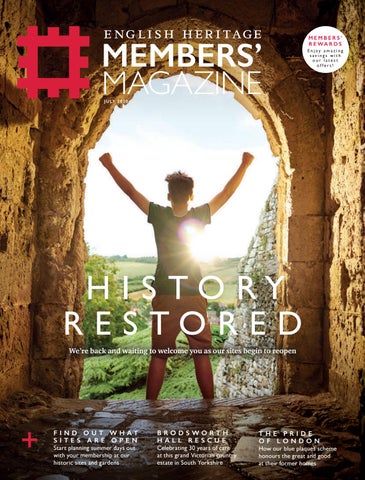
H I S TO RY RESTORED We’re back and waiting to welcome you as our sites begin to reopen
F I N D O U T W H AT SITES ARE OPEN Start planning summer days out with your membership at our historic sites and gardens
BRODSWORTH HALL RESCUE Celebrating 30 years of care at this grand Victorian country estate in South Yorkshire
THE PRIDE OF LONDON How our blue plaques scheme honours the great and good at their former homes
An extra 10% off For all Members of English Heritage with your Member’s Discount Card*
GOoutdoors.co.uk *O�er valid on production of your proof of English Heritage membership at the till in store. For full T’s and C’s of the o�er and to access your online promotion code, head to the English Heritage members’ rewards section. If you have any questions please call us on 0330 008 1555 or email us at enquiries@gooutdoors.co.uk
Welcome Get in touch
W www.english-heritage.org.uk/members E membersmagazine@immediate.co.uk (for magazine queries only) or members@english-heritage.org.uk (for membership queries) T 0370 333 1181 PO Box 569, Swindon, SN2 2YP
For English Heritage
Luke Whitcomb, Johanna Lovesey, Jeremy Ashbee, Tom Dennis, Tony Dike, Tom Moriarty, Fran Gibbons, Richard Leatherdale
For Immediate Media Co.
Group editor Matt Havercroft Group production editor Oliver Hurley Senior art editor Sam Freeman Art editor Elaine Knight-Roberts Account director Esther Procee Account manager Joanne Robinson Director Julie Williams Editorial director Dan Linstead Design director Will Slater Consultant editor Dave Musgrove Advertising manager Jamie Bolton Advertising enquiries 0117 300 8518; jamie.bolton@immediate.co.uk
Contributors
Anna Eavis, Paul Bloomfield, Charlotte Martyn, Kevin Booth, Mary-Ann Ochota, Matt Ford, Paul Pattison, Jeremy Ashbee, Dominique Bouchard, Michael Carter English Heritage Members’ Magazine is published on behalf of English Heritage by Immediate Media Co, Eagle House, Colston Avenue, Bristol, BS1 4ST T +44 (0)117 927 9009 W www.immediate.co.uk
Advertising income
Thank you to our advertisers and partners. The income we raise from adverts and inserts helps to cover the costs of producing your magazine.
Support us
English Heritage is a charity. Without the support of our Members and donors, our work would not be possible. To find out more about how you can help by making a donation or leaving a gift in your will, please visit www.english-heritage.org.uk/support-us or call the fundraising team on 020 7973 3797.
N
ow that the first of our sites have reopened, there is so much to look forward to over the coming months. On page 15 you can find details of all of our historic sites currently welcoming visitors back, with the remainder due to open in August. Among these is Belsay Hall, Castle and Gardens in Northumberland, where work to revive the gardens has been progressing as part of a project to transform the site (see page 6). If you are a family Member with children, don’t miss our Summer Explorer Quests at selected sites (see page 20). I would like to take this opportunity to thank you for your patience and continued support. Like many other charities and organisations, we are now facing an unprecedented challenge as a result of the closure of our sites and there’s no escaping the fact that this has left us with a huge shortfall in the funds we need to care for our sites and collections. Turn to page 32 to see how you can help us to ensure we can protect our unique treasures which together tell the story of England. Kate Mavor Chief Executive
Contributors
English Heritage cares for more than 400 historic monuments, buildings and places – from world-famous prehistoric sites to grand medieval castles, and from Roman forts on the edges of the empire to Cold War bunkers. Through these we bring the Story of England to life for more than 10 million visitors each year.
Kevin Booth Senior curator January to December 2019: 444,773 Registered charity no. 1140351 (England) Registered company no. 07447221 (England) Product code: 200630
On page 36, Kevin reveals the conservation work that has taken place to rescue Brodsworth Hall in South Yorkshire as we celebrate the 30th anniversary of it being gifted to the nation
Howard Spencer Senior historian, blue plaques
Michael Carter Senior properties historian
We go behind the scenes with Howard on page 42 to discover the secrets of the success of the London blue plaques scheme, which is the oldest of its kind in the world
On page 58, Michael reveals the story of St Aelred, one of the greatest figures of the monastic age and the abbot of Rievaulx Abbey in North Yorkshire
www.english-heritage.org.uk
3
Contents July 2020
15 ‘WE’RE LUCKY TO HAVE SO MANY LARGE GARDEN SITES THAT WE CAN OPEN EASILY AND SAFELY’ F E AT U R E S
12
Meet the expert
Meet the style-loving stars of our historyinspired makeup tutorials on YouTube
15
New this season
Everything you need to know following the reopening of our sites to visitors
20
Multi-site
Start planning summer days out at this selection of our reopened sites
26
Objects of England
Discover the story of the bust of William the Conqueror at Richmond Castle
28
Stories of England
Mary-Ann Ochota reveals the history hiding in plain sight in our landscapes
36
Expert care
Celebrating 30 years of conservation at Brodsworth Hall and Gardens
Cover image: A young visitor enjoys the sunshine at Carisbrooke Castle on the Isle of Wight
REGULARS
06
06
The big picture
See the team reviving the gardens at Belsay Hall in Northumberland
08
Then & now
Our latest news, including details of the measures we’re introducing to keep you safe at our reopened sites
42
57
20 questions
Put your knowledge of our blue plaques scheme to the test with our regular just-for-fun quiz
51
12
28
Y O U R E N G L I S H H E R I TA G E
51
My experience
42
Two young Members share their experiences of exploring history at home
Meet the team tasked with keeping our historic blue plaques scheme running
53
58
Past lives
The inspirational abbot who transformed Rievaulx Abbey in North Yorkshire
26
Over to you
The best of your letters and correspondence on social media
54
Ask the experts
Your questions answered by our experts across English Heritage
KEVIN GIBSON; BRIDGEMAN ART LIBRARY; ABI BANSAL
Behind the scenes
THE BIG PICTURE
Reviving Belsay Hall’s gardens While the nation has been in lockdown, the gardening team at Belsay Hall, Castle and Gardens in Northumberland has been busy this spring. Under the guidance of acclaimed landscape designer Dan Pearson, they’ve been replanting the gardens as part of Belsay Awakes, a project that will transform your experience of visiting the site. www.english-heritage.org.uk/belsay
6
english-heritage.org.uk www.english-heritage.org.uk
LISTEN TO EPISODE 57 OF OUR PODCAST TO DISCOVER MORE www.english-heritage.org. uk/podcast www.english-heritage.org.uk
7
Then&Now Keep up to date with the latest news, sites and developments
A family enjoying Tintagel Bridge in summer 2019 and pre-social distancing. See website for new visiting details
D AY S O U T
Start planning summer days out after selected properties reopen for visitors he phased reopening of our historic sites has started following their closure in March due to the coronavirus pandemic. This means you can start planning days out at a selection of our properties over the summer months. At the time of going to print, around 50 of our sites were scheduled to have reopened in early July. To enable us to manage visitor numbers, these are all operating
T
8
www.english-heritage.org.uk
with a timed ticketing system. If you are a Member, your ticket will be free, but you still need to book an allocated time in advance. Among the sites scheduled to welcome visitors back are Brodsworth Hall and Gardens in South Yorkshire, Whitby Abbey in North Yorkshire, Audley End House and Gardens in Essex, Osborne on the Isle of Wight, Stonehenge in Wiltshire, Tintagel Castle in Cornwall and Eltham
Palace and Gardens in London. It is hoped that the majority of our remaining sites across the country will reopen in August. For more details on the reopening of our sites, including a comprehensive list of the properties you can now visit, how to book tickets and the facilities that will be available, turn to page 15. Please see our website for the latest information. www.english-heritage.org.uk
NEWS
A N N I V E R S A RY
NEWS IN BRIEF
August marks 75th anniversary of atomic bombings at Hiroshima and Nagasaki This summer marks 75 years since the atomic bombings at Hiroshima and Nagasaki, on 6 and 9 August 1945. The bombs, dropped by the USA, killed around 214,000 people and forced the Japanese government to surrender, effectively ending the Second World War. Some historians speculated that the bombings were also designed to send a message to the Soviet Union about the strength of the USA’s arsenal. The threat of nuclear war existed throughout the years of the Cold War. A stark reminder can be seen at York Cold War Bunker (pictured), designed to monitor fallout in Yorkshire in the event of a nuclear attack. www.english-heritage.org.uk/york-cold-war-bunker
The area in hectares covered by the gardens and estate at Osborne in the 19th century. www.english-heritage. org.uk/osborne
Staff at Stonehenge recently spotted a visitor who was clearly ignoring lockdown – a great bustard. The species became nationally extinct in 1832 but was reintroduced to Wiltshire in 2004.
IN NUMBERS
57
The height in metres of the footbridge at Tintagel Castle above the sea. www.english-heritage. org.uk/tintagel
750
Iron Bridge wins heritage award
Work at the Iron Bridge has won the conservation category at the European Heritage Awards/Europa Nostra Awards 2020. Votes are still open for a public choice award at vote. europanostra.org.
The number of years since Hailes Abbey received a holy relic believed to be a portion of the blood of Christ. www.english-heritage. org.uk/hailes
I N S TA N T E X P E R T
EVENTS
On the hunt for bugs at Apsley House in London
Members’ Week postponed to 2021
What on earth is that? It’s a two-spot carpet beetle and it’s one of the bugs we regularly have to contend with at Apsley House in London. Why are carpet beetles a problem? Their larvae are ferocious eaters and love to chomp on organic materials, such as wool. Unfortunately, Apsley House has lots of big carpets, which means lots of food for bugs. Is it a particular issue at this time of year? Yes. In warm weather, carpet beetles spread around and larvae hatch out. But, don’t worry, our bug hunters are on the case, monitoring traps and scanning the floors for any signs of pests. The best thing to do is keep cleaning, so there’s lots of vacuuming, especially in the dark quiet spots where bugs like to live.
Is this part of a wider scheme? It is. We have an integrated pest management programme so that our conservators have a national picture of what is going on. So you’ve nothing to worry about from beetles at our properties – two-spot or otherwise. www.english-heritage.org.uk/apsley
We recently had to make the difficult decision to postpone our inaugural Members’ Week from October 2020 to April 2021, due to the impact of the coronavirus pandemic. The week will be a special thank you for your continued support and, for a booking fee of only £10, you will be able to access a range of exciting events, showcasing the best our historic sites and experts can offer. Over the course of the week, we’ll also be providing special offers and discounts just for you. Look out for more news on our plans over the coming months. www.english-heritage.org.uk
9
JAMES RODLIFF
800
Great Bustard spotted at Stonehenge
THREE TO SEE IN MY VIEW Anna Eavis Curatorial director
Our historic memorials and Black Lives Matter We look after 48 statues and monuments in London, erected over a period of about 300 years. Some, like the Cenotaph, were erected by the government. Others were commissioned by individuals, such as the equestrian statue of Charles I now near Charing Cross. These monuments are owned by the state and our job is to maintain them. We also run London’s blue plaques scheme, which commemorates significant historical figures on buildings associated with them. There are 950 plaques, installed over 150 years, and we add around 12 new plaques every year. The Black Lives Matters movement has brought to the fore questions about the significance and symbolism of public memorials. We recognise that commemorative monuments erected in the past may not reflect the values or perspectives of people today. We understand too that those monuments associated with Britain’s colonial past are offensive to many. Our responsibility must be to ensure that the history of those commemorated, and the context in which their memorials were erected, is told in full. In some cases this may include confronting some painful truths about the actions and legacies of past figures. But by doing do, and by debating the difficult issues that they raise, we can learn more about our shared history – and its impact on our lives today. 10
www.english-heritage.org.uk
Look out for these intriguing objects when our sites are fully reopened
1
2
3
The Kenilworth Fountain, 2008
Smith pot, third century AD
Portrait of Margaret Audley, 1562
This painstaking recreation of a 16thcentury marble fountain is the centrepiece of the formal garden at Kenilworth Castle.
Excavated in 2019 and displayed at Aldborough Roman Site museum, this jar is decorated with the tools of the blacksmith’s trade.
This imposing portrait of the Duchess of Norfolk by Hans Eworth can be seen in Audley End House after being treated by our team.
Enjoy an epic family day out with our series of Summer Explorer Quests The first events to take place at our sites since lockdown are scheduled to begin on 18 July. The Summer Explorer Quests will take place throughout the summer at 16 properties around the country, including Bolsover Castle in Derbyshire, Wrest Park in Bedfordshire and Kenilworth Castle in Warwickshire, and will challenge young visitors to see if they can complete the trail. We also plan to host living history events at Audley End House and Dover Castle in July and August, and a series of historic falconry events at selected sites from August (see page 20 for details).
Listen out for new podcast episodes You can listen to new episodes of our podcast every Thursday. Upcoming discussions include the life of Margaret Brotherton at Framlingham castle, the South Sea stock market crash and the great siege of Dover Castle. Discover more at www.english-heritage. org.uk/podcast.
www.english-heritage.org.uk/events
Sheep help conservation efforts at Old Oswestry Hillfort Efforts to maintain the landscape at Old Oswestry Hillfort in Shropshire have been given a boost by a flock of eye-catching black sheep. The Soay/Hebridean cross-breed sheep thrive on rough grassland and have been introduced to tackle the problem of bracken overgrowth. ‘Over time, bracken has re-established itself on the hillfort, which can cause damage to underlying archaeology,’ says free site partnership manager Helen Allen. ‘The scale of the site and steepness of the slopes make it hard to cut the bracken back, so we decided to experiment with sheep grazing.’
Fencing and gates on the hillfort were repaired in preparation for the new arrivals in May and hillfort users are now being asked to keep dogs on a lead within the grazing area.
M E E T TH E E X PE RT S
Amber Butchart and Rebecca Butterworth Fashion historian and historic make-up artist INTERVIEW CHARLES ROWE PHOTOGR APHS ABI BANSAL
Amber Butchart: When I was first invited to present a series of historic make-up tutorials for English Heritage, it sounded like a great project. I loved the idea of helping people to create different looks from the past at home. A big part of the work that I do is about using clothing and how we adorn the body to try to understand the past, so I just thought this sounded like a fantastic route into history, and a lot of fun as well. Rebecca Butterworth: In the series we go all the way back to Roman times, where we’re focusing on Julia Donma, who was the wife of Emperor Septimius Severus in the 3rd century AD. We also recreate the iconic looks of Queen Elizabeth I and Queen Victoria, along with typical looks from the Georgian era and the 1930s. Our most recent video concentrated on the Second World War and we styled the model as a Wren serving at Dover Castle. AB: Of the six episodes we recorded, my favourite to work on was the Georgian episode, when we created looks for male and female models. They’re such theatrical looks but ones we all recognise from costume dramas on film and TV, so trying to peel back the layers and understand the reality versus the fictionalised depictions was really interesting. There’s also such close links between dress, make-up, politics, society, power at this time – it’s got everything. RB: It’s tricky to pinpoint an exact moment when make-up started. As far back as you look, people were discovering pigments they could mix with oil to use as paints. The ancient Egyptians were some of the first to use make-up to enhance facial features, using crushed-up malachite, coal or carbon to create eyeliners. I think one of the main ways make-up has evolved is that it’s no longer the preserve of the very wealthy, royals or religious leaders. Anyone can get their hands on it now, which is more democratic. 12
www.english-heritage.org.uk
Clockwise from above The most popular video of the series is the tutorial on how to recreate the look of Queen Elizabeth I, which has attracted over 5 million views on YouTube; Amber (left) and Rebecca (right) worked with English Heritage’s historians on their research for each episode; Rebecca used a replica of a Roman make-up applicating tool to apply the model’s eyeliner in the Roman episode
RB: The hardest tutorial to produce was the Roman episode. I really wanted to recreate some Roman make-up recipes but it’s hard to get hold of the ingredients these days. It was also very difficult to apply the make-up because I was using a replica of a Roman make-up applicating tool, which was this little grinder with a small mixing bowl to make an eyeliner. The shape of the grinder is meant to fit your eye so you can draw your eyeliner straight on, but it was definitely not that straightforward! AB: You can definitely see how make-up and fashion have evolved together through the ages as they didn’t operate in a vacuum. For example, madder root was used to create blush during the Elizabethan era but was also used to dye clothes. Their evolution can also be related to changes in politics and culture and so it’s a great magnifying glass for these wider issues in society. Because many of us still wear make-up and all of us still wear clothes, it forms a tangible link with the past. WATCH THE VIDEOS To see all of our history-inspired make-up tutorials, go to www.youtube.com/englishheritage/playlists
‘I loved the idea of helping people to create different looks at home as a route into history’
LISTEN TO EPISODE 68 OF OUR PODCAST TO DISCOVER MORE www.english-heritage.org. uk/podcast
EXPERT CARE
S U M M E R S AL E Luxury bespoke fitted furniture designed just for you
NEW FINISHES | FREE DESIGN PLANNING & FITTING | BUY NOW PAY IN 12 MONTHS | 10-YEAR GUARANTEE With up to 30% savings across our entire collection, there’s never been a better time to invest in our luxury fitted furniture. Our wide range of designs include everything from bespoke walk-in wardrobes and bedrooms to hardworking home offices, elegant lounges and indulgent dressing rooms. So whatever your vision may be, our expert designers will help you realise it to perfection. Request our latest brochure or arrange a FREE design consultation today.
Call 0800 0138139 or visit www.strachan.co.uk /eng Quoting offer code ENG200702. Lines open 7 days a week.
BEDROOMS | DRESSING ROOMS | WALK-IN WARDROBES | WALL BEDS | STUDIES | LOUNGES | CINEMAS | LIBRARIES Strachan Furniture Makers Ltd. is authorised and regulated by the Financial Conduct Authority.
NEW THIS SEASON
W E L C O M E
B ACK We met the team tasked with reopening our historic sites to discover what it has taken to come out of lockdown – and what you can look forward to as a result WORDS PAUL BLOOMFIELD
www.english-heritage.org.uk
15
NEW THIS SEASON
I
t has been an unprecedented few months for all of us – including the teams running English Heritage’s historic sites. After taking the decision to close all properties across the country in March, the focus shifted to keeping them secure during the lockdown. Then, as restrictions started to ease, the challenge of deciding where, when and how to reopen them began. Some 200 free-to-enter sites that generally allow easy social distancing opened in late May, but it wasn’t until 13 June that the initial half-dozen staffed locations welcomed visitors for the first time in almost three months. Selecting these was a major task, reveals Heather Redmond, head of on-site visitor experience. ‘We looked through our whole portfolio using one key criterion: where can we make sure that people can come and have a great time in safety?’ she explains. ‘It meant picking sites that are accessible, and that visitors can enjoy without us having to open any interior spaces, while also ensuring a good geographical spread across the country.’
Osborne, the beloved Isle of Wight home of Queen Victoria and Prince Albert, reopened its grounds to visitors in early July
Assessing the options
The sites selected for reopening in June were 1066 Battle of Hastings, Abbey and Battlefield in Sussex, Beeston Castle and Woodland Park in Cheshire, Brodsworth Hall and Gardens in South Yorkshire, Kenilworth Castle and Elizabethan Garden in Warwickshire, Old Sarum in Wiltshire and Wrest Park in Bedfordshire. Although the decision-making may sound simple, the process of assessing each site involved a massive amount of work. ‘Our teams studied site plans, photographs, drawings – everything we could get hold of to see what we could fit into each space, while making sure we offer a range of experiences,’ Heather recalls. ‘That’s how we narrowed down the next batch to open in early July. We’re very lucky to have so many large garden sites that we can open easily and safely.’ Even so, to help with social distancing, a limited number of people will be admitted to each site, based
Come face-to-face with our sculptures of Saxon and Norman soldiers at 1066 Battle of Hastings, Abbey and Battlefield in East Sussex
16
www.english-heritage.org.uk
‘Our teams studied site plans, photographs and drawings to see what we could fit into each space’ on available space and the average visit duration. Entry is by timed tickets that must be pre-booked online. ‘That’s the only way we can manage it safely,’ says Heather. ‘Visitors will print tickets or download QR codes to their mobile, which can be scanned instantly to allow people on to site quickly with a really easy, smooth process.’ The website will also feature updated information about access and facilities, including two crucial features of any visit: toilets and cafés. ‘I’ve spoken to many other organisations in the same position, and toilets are the one thing that all of us are absolutely desperate to nail,’ smiles Heather. ‘Toilets will be carefully monitored and deep-cleaned every hour, and staff may manage a one-in one-out system.’ You’ll be able to enjoy a cup of tea at most sites, too. ‘Wherever possible, outdoor catering will offer takeaway options,’ says Heather. ‘You can imagine
Young visitors take time out in the gardens at Brodworth Hall in South Yorkshire
The sites now open to visit
Where you can start planning your summer days out
SOUTH WEST
Old Sarum, Wiltshire Pendennis Castle, Cornwall Stonehenge, Wiltshire Tintagel Castle, Cornwall
LONDON
Eltham Palace and Gardens, Eltham (gardens only) Kenwood, Hampstead (grounds only)
SOUTH EAST
1066 Battle of Hastings, Abbey and Battlefield, East Sussex Carisbrooke Castle, Isle of Wight Dover Castle, Kent Home of Charles Darwin – Down House, Kent (gardens only) Osborne, Isle of Wight (gardens only) Pevensey Castle, East Sussex Richborough Roman Fort and Amphitheatre, Kent St Augustine’s Abbey, Kent Walmer Castle and Gardens, Kent (gardens only)
WEST MIDLANDS
Goodrich Castle, Herefordshire Kenilworth Castle and Elizabethan Gardens, Warwickshire Witley Court and Gardens, Worcestershire Wroxeter Roman City, Shropshire
EAST MIDLANDS
Bolsover Castle, Derbyshire (gardens only) Kirby Hall, Northamptonshire
EAST OF ENGLAND Audley End House and Gardens, Essex (gardens only) Castle Acre Priory, Norfolk
Framlingham Castle, Suffolk Wrest Park, Bedfordshire
YORKSHIRE AND THE HUMBER
Brodsworth Hall and Gardens, South Yorkshire Kirkham Priory, North Yorkshire Middleham Castle, North Yorkshire Mount Grace Priory, House and Gardens, North Yorkshire (gardens only) Pickering Castle, North Yorkshire Roche Abbey, South Yorkshire Scarborough Castle, North Yorkshire Whitby Abbey, North Yorkshire
NORTH WEST
Beeston Castle and Woodland Park, Cheshire Brougham Castle, Cumbria Carlisle Castle, Cumbria Furness Abbey, Cumbria
NORTH EAST
Barnard Castle, Durham Belsay Hall, Castle and Gardens, Northumberland (gardens only) Brinkburn Priory, Northumberland Dunstanburgh Castle, Northumberland Tynemouth Priory and Castle, Northumberland
HADRIAN’S WALL
Birdoswald Roman Fort, Cumbria Chesters Roman Fort and Museum, Northumberland Corbridge Roman Town, Northumberland Housesteads Roman Fort, Northumberland
In addition to these, around 200 of our free-to-enter sites are also open. For details, go to www.english-heritage.org.uk/visit/free-sites
the financial impact of the lockdown, so it’s really important for us to raise additional funds wherever we can – and every cup of tea contributes to the site. If you’re having a brew with us, that helps to look after the collections and properties in our care.’ At the moment, all our playgrounds are closed but they’ll reopen as soon as the government guidance allows. Some inside areas will remain closed for the time being, though that’s being regularly reassessed. ‘We’re working through a plan to see which further sites can open in August,’ says Heather. ‘Together with the curatorial department we’re looking at every single element, including indoor areas, to ensure it’s going to be safe.’
Moving with the times
‘We’re looking at this as a dynamic process,’ adds Dr Dominique Bouchard, head of learning and interpretation. ‘If it becomes apparent that closed-off areas can be made accessible, then we’ll do that. We want people to be able to enjoy each site to the fullest possible extent – but that cannot come at the expense of personal safety.’ The events programme has had to adapt, too. A number of new events have been confirmed for the summer. From mid-July, families can embark on Summer Explorer Quests. These clue-led adventures, taking children and their families on missions across whole sites, will be available at locations ranging from Birdoswald Roman Fort on Hadrian’s Wall to Osborne on the Isle of Wight, and more than a dozen others in between. You’ll also be able to marvel at www.english-heritage.org.uk
17
NEW THIS SEASON
falconry displays at Stonehenge, Kenilworth Castle and Whitby Abbey, to name just a few highlights, and enjoy encounters with costumed re-enactors at Dover Castle and Audley End – albeit with a twist. ‘Members might remember meeting Mrs Crocombe, the cook at Audley in the 1880s,’ says Heather. ‘But whereas in previous years she’s been working in the kitchens, this summer you might see her picking herbs in the kitchen garden. It’s been fun playing with the scripts and interpretation, to switch this story around and make it a bit different.’ Clearly, the current situation has posed significant challenges but it’s also created opportunities to find new ways of telling the rich, diverse stories of these wonderful places. For Dominique’s team, it’s sparked the creation of a new interpretation programme to address gaps or changes in the visitor experience. ‘Some interior or enclosed areas that will be inaccessible to the public feature major elements of interpretation such as panels,’ Dominique explains. ‘We’re updating our digital history pages for those sites so that visitors have access to the most relevant and up-to-date research. And we’re creating Bring Your Own Device downloadable audio guides, which involved a painstaking process, going through every stop of each of the tours to assess accessibility, and adding images to assist the user. We’re also looking
Kenilworth Castle and Elizabethan Garden in Warwickshire is among the sites with extensive grounds that are being reopened for visitors to enjoy
‘The current situation has created opportunities to find new ways of telling the rich stories of our sites’
A number of our sites will be hosting historic falconry displays this summer, with a variety of birds of prey
at ways of incorporating additional digital content that can be accessed via QR codes – video of people knapping flint, perhaps, or Neolithic baking methods, bringing history to life.’ Whether you visit properties to find peace and space, or to discover more about history, these places can play a special role in this difficult time. ‘Some people love to learn about the past because it can be an escape from the present; they like to imagine what it would be like to work in a castle – or indeed to be the king or queen,’ says Dominique. ‘There’s a sense of solace or inspiration to be found in the fortitude of those who lived at our sites, who faced and overcame challenges – whether that’s the 13thcentury siege of Dover, or fire, or earlier epidemics. We want to offer a platform for visitors to explore their own personal journeys, or one that helps them feel grounded or part of something bigger. ‘Most of our sites, even castles and forts, have been home to families,’ Dominique continues. ‘So when people visit with their families, that act is kind of a participation in the narrative; we write ourselves into the stories of these places or write these places into our own family histories. I think that is the most powerful thing that happens when somebody visits – and one that’s particularly relevant now, when we are so aware of the role of family in our daily lives.’
YOUR QUESTIONS ANSWERED For more information about the reopening of sites, go to www.english-heritage.org.uk/reopening-ticket-faqs 18
www.english-heritage.org.uk
EXPERT CARE
“An intuitive and
Be Safe at Height
well-designed tripod ladder that felt safe in use and handy for a variety of gardening tasks.”
Work in Safety & Comfort
Good Housekeeping Institute Expert
with the Platform Tripod Ladder ● ● ●
Ladders account for 40% of all working at height falls in the UK** 48,000 ladder users a year attend A&E for injuries† Ladder falls account for a 1/3rd of all home fatalities††
Step ladders are designed for use on flat hard ground, which makes them unstable on uneven or soft ground. HENCHMAN Tripod Ladders are different.
FREE RUBBER FEET WORTH £25 when you quote code
Reduce risk of slipping
EH607
on ordering
The 3-legged design, extra wide standing platform and clawlike feet make it far more secure especially on uneven soft ground. In addition, it has a ‘crows nest’ platform at its highest point you can tuck in and brace your thighs against for added safety. Incredibly lightweight, a HENCHMAN Tripod Ladder is easy to carry and manoeuvre making it ideal for jobs in the garden as well as general DIY.
Made from premium, lightweight aluminium ● All joints welded for strength & long life ● Wide feet prevent sinking ● Available in sizes between 6ft – 16ft to suit any job ● 5 year guarantee ●
PLATFORM TRIPOD LADDER PRICE LIST
1 3
Adjustable 6ft £225 8ft £265 Leg 10ft £325 12ft £365 Adjustable 6ft £275 8ft £349 10ft £415 12ft £475 14ft £535 16ft £615 Legs
Also available in PROFESSIONAL RANGE
Stable on uneven ground
FREE
97% GREAT OR EXCELLENT
FREE SET OF RUBBER FEET (WORTH £25) Improves grip on hard surfaces Protects delicate flooring from scratching Fits snuggly over the ladders feet To receive your FREE Rubber Feet, add them to your order and then apply discount code EH607 at checkout ● ● ●
For more information or to order, call today on 03333 444 229 or visit www.henchman.co.uk/heritage english-heritage.org.uk **Based on HSE current ‘fall from height’ statistics. †Based on figures from Rehab UK. ††Based on figures from Bureau of Labor Statistics.
19
Start planning unforgettable days out with this guide to a selection of our reopened sites, where historic treasures, awe-inspiring gardens and family adventures await WORDS CHARLOT TE MART YN ILLUSTR ATION LUCY NAL AND
20
www.english-heritage.org.uk
M U LT I - S I T E
S OUTH W E ST S OA K UP T HE SEA V IEWS Pendennis Castle , Cor nwall Built by Henry VIII on a headland above Falmouth, Pendennis Castle has defended the South West since Tudor times, seeing action during the Civil War, the Napoleonic wars and both world wars. What to see: Pendennis is now the perfect spot for a peaceful walk with views over the Fal estuary. As you stroll around the grounds, you’ll see the gun emplacements that defended the coast. You can explore the castle keep, too, before climbing to the roof for a 360-degree view. What’s on: Summer Explorer Quest (18 July–1 September) Facilities: Toilets, takeaway catering www.english-heritage.org.uk/pendennis DI S COV E R T H E S E C R E TS OF T HE STONE S Stoneh e n g e , W i l t s h i r e A visit to our famous prehistoric monument provides a tantalising glimpse into the secrets of the stones and the lives of those who constructed the stone circle on Salisbury Plain 4,500 years ago. What to see: Our visitor centre will be operating a one-way system this summer, allowing you to safely explore the site and examine some of the hundreds of artefacts discovered in and around the stone circle. Just outside the visitor centre, you can take a stroll among a number of replica Neolithic houses before completing your visit with a walk around the iconic stones. What’s on: Summer Explorer Quest (18 July–1 September); Falconry Series: Victorian Falconry & Hawking (29–31 August) Facilities: Toilets www.english-heritage.org.uk/stonehenge
TOP TIPS
Book now To help us control visitor numbers and keep everyone safe, you must book in advance before visiting our staffed sites. You’ll need to arrive during a particular time slot and show your booking confirmation and membership card.
Plan ahead Some facilities may be closed at certain properties, so please check before you visit. Many of our cafés will be offering a takeaway service but you might prefer to bring a picnic or extra drinks and snacks.
Arrive early Social distancing, one-way systems and our new ticketing arrangements mean it might take a little longer to get into some of our properties. Please arrive in good time for your time slot.
Check events Find out whether there are any special events running on the day you plan to visit. Full details will be available on the web pages for each of our sites.
S OUTH EAST STA N D W H E R E H I STO RY WA S M A D E 1066 Battle o f Has tings , A bb e y and Bat t lefield, Eas t Sus s e x Stand on the battlefield where King Harold was defeated by William the Conqueror at the Battle of Hastings in 1066. This momentous event was commemorated by the building of a great abbey on the spot where Harold was said to have fallen. What to see: The site of the battle is now a tranquil landscape of wildflowers, and you can follow a sculpture trail around the battlefield. The 19th-century walled garden has been replanted with local species of fruit trees, providing a peaceful hideaway. What’s on: Summer Explorer Quest (18 July–1 September); Falconry Series: Falconry of the Saxons and Normans (10 & 11 October) Facilities: Toilets, takeaway catering www.english-heritage.org.uk/battle EXP LOR E OUR M OST I CON I C C ASTLE Dove r Cas tle , Ke nt Overlooking the shortest span of sea between England and France, Dover Castle has long defended the coast. While it’s best known for its medieval keep, this hill above the White Cliffs has been occupied since the Iron Age, and its network of tunnels played a pivotal role in the Dunkirk evacuation of 1940. What to see: While the tunnels and Great Tower remain closed for now, the rest of the site will be open all summer, with over 80 acres of courtyards and hills to explore. Journey through time as you peer inside the Roman lighthouse before looking out over the English Channel from the First World War fire command post. On weekends from 18 July we will bring the story of Operation Dynamo and the Dunkirk evacuation to life, with opportunities to meet and question Vice Admiral Bertram Ramsay as he plots the Allied troops’ great escape. What’s on: Summer Explorer Quest (18 July–1 September); Falconry Series: Falconry of the Plantagenet Kings (5 & 6 September) Facilities: Toilets, takeaway catering www.english-heritage.org.uk/dover ES C AP E TO QUEEN VI C TOR I A’S B EACH Osbor ne , Isle of Wight Once the treasured family holiday home of Queen Victoria, Prince Albert and their children, Osborne was built from 1845 onwards and remains a treasure trove of the royal family’s time here. The house is surrounded by extensive grounds, with ornate terrace gardens giving way to less formal parkland and paths leading down to the villa’s private beach. What to see: Although the house itself will be closed, the gardens and beach will be open, giving you a chance to explore this beautiful estate. The Isle of Wight’s climate ensures the gardens are a riot of colour, from the formal planting of the terraces to the wildflowers of the parkland. Tucked away in the woods you’ll find the Swiss Cottage – a chalet built for the royal children. Wander a little further and you can take a cooling paddle on the beach. What’s on: Summer Explorer Quest (18 July–1 September) Facilities: Toilets, takeaway catering www.english-heritage.org.uk/osborne www.english-heritage.org.uk
21
W EST M I D L AN D S
SUMMER FUN
Don’t miss the family-friendly experiences taking place across the country (see site listings for dates) SUMMER EXPLORER QUESTS, NATIONWIDE See if you and your family have got what it takes to crack the clues and follow the trail around the grounds of historic sites across the country. HISTORIC FALCONRY, NATIONWIDE Let our falconers transport you back in time with Victorian, medieval and Tudor-themed shows taking place across the country, featuring a variety of birds of prey. LIVING HISTORY AT AUDLEY END Enjoy an encounter with some of Audley End’s Victorian staff, including John Baker the groom and Mrs Crocombe the cook as she heads into the gardens to collect ingredients for recipes. LIVING HISTORY AT DOVER CASTLE Meet Vice Admiral Bertram Ramsay in the grounds of Dover Castle to discover how he plotted the daring Dunkirk rescue from the castle during the Second World War. LO N D O N EXP E R I E NCE 1 930 s G L A M O U R E lth am Palac e an d G a rd e n s , L o n d on If you’re looking for a unique marriage of ancient and modern, Eltham Palace is hard to beat. Once home to a succession of royals before falling into gradual decline, it gained a new lease of life in the 1930s when a lavish art deco mansion was built, incorporating the medieval great hall. What to see: Eltham Palace sits within 19 acres of beautiful gardens, which are open while the house and great hall remain closed. The garden incorporates medieval elements into its Arts and Crafts design, and late summer is the perfect time to admire the herbaceous border, as well as the Rose Garden and wildflower meadows. What’s on: Summer Explorer Quest (18 July–1 September); Falconry Series: Tudor (19 & 20 September) Facilities: Toilets, takeaway catering www.english-heritage.org.uk/eltham 22
www.english-heritage.org.uk
D I S COVER A PAL AC E FI T FOR A QUE EN Ke nilwo r th Cas tle and Elizab e than Gard e n, Warwickshire First built as a royal castle in the 1120s, Kenilworth Castle was transformed into a lavish palace by Robert Dudley, Earl of Leicester, a favourite of Elizabeth I. Today, the evocative ruins of its buildings and formal gardens hint at its medieval and Tudor glory. What to see: There’s a huge amount to see during a day out, with many of the buildings on site reopening for the summer (only Leicester’s Gatehouse will remain closed). The Norman keep and medieval great hall still evoke the power the castle represented, and a walk through their remains reveals their architectural secrets. The Elizabethan gardens were restored to their original glory 10 years ago and are a tranquil haven on a sunny day. What’s on: Summer Explorer Quest (18 July–1 September); Falconry Series: Elizabethan (26 & 27 September) Facilities: Toilets, takeaway catering www.english-heritage.org.uk/kenilworth EAST M I D L AN D S EXP LOR E A FAI RYTAL E STUART R ETREAT Bo ls ove r Cas tle , De rby s hire Built as 17th-century aristocratic retreat, Bolsover Castle continues to entertain and impress all who visit. At its heart is the Little Castle with its labyrinth of sumptuously decorated rooms. What to see: Although many rooms in the Little Castle are likely to be shut for the foreseeable future, we will endeavour to provide some access to see its fragile murals. After visiting the Riding House – the earliest surviving example of this sort of equestrian building in England – don’t forget to explore the gardens before taking a stroll along the newly restored wall walk for unrivalled views over Derbyshire. What’s on: Summer Explorer Quest (18 July–1 September) Facilities: Toilets, takeaway catering www.english-heritage.org.uk/bolsover
M U LT I - S I T E
EAST M I D L AN D S ST E P I N TO A N E N G L I S H CO U N T RY G A R D E N A ud le y End Ho us e and Gard e ns , Es s e x Audley End is a grand country house with a history stretching back to the 17th century, and one that shines a light on what life was really like for masters and servants on a wealthy Victorian estate. What to see: Audley End’s interiors are closed at the moment but its glorious grounds are at their best at this time of year. Wander through flower-filled parterres, rest by the river Cam or pick your way through the produce of the organic kitchen garden, which bursts with fruit and veg in the summer months. On weekends from 18 July, we will bring the story of the house and Service Wing to life as a number of the Victorian household staff roam the grounds. Meet Mrs Crocombe the cook and Mrs Warwick the housekeeper as they keep a close eye on the rest of the servants. Then find Mr Vert the head gardener as he tends to his lordship’s garden and John Baker the groom in the stables. What’s on: Summer Explorer Quest (18 July–1 September) Facilities: Toilets, takeaway catering www.english-heritage.org.uk/audley CO M P L E T E A C A ST L E WA L L WA L K Fr am lin gh am Cas t l e , S u f fo l k This mighty medieval fortress – the ‘castle on the hill’ from the Ed Sheeran song – dates back to the 12th century. It was a power base for the dukes of Norfolk, and Mary Tudor mustered her supporters here before becoming queen. Unusually, there was also a workhouse here until 1839. What to see: The wall walk, with its fantastic views over the town and mere, is the highlight of any visit to Framlingham. You can still take a trot along the battlements with a new one-way system. What’s on: Summer Explorer Quest (18 July–1 September) Facilities: Toilets, takeaway catering www.english-heritage.org.uk/framlingham AD M I R E C EN T UR I ES OF GAR D EN D ESIG N Wre s t Par k, Be d fo rd s hire Wrest Park’s huge gardens are perfect for exploring and there’s so much to see, from quirky buildings and bridges to peaceful waterways and woodlands. The grounds reflect hundreds of years of English garden history, while the house was built to a grand, French-inspired design in the 1830s. What to see: Although they’re closed for now, you can still admire the exterior of the house and the baroque Archer Pavilion from across the Long Water. The gardens stretch to over 90 acres, which incorporate everything from formal gardens and sweeping landscapes to woodland walks, so there’s plenty of room to run around, relax with a good book or stroll through centuries of horticultural history. Look out for the statues dotted around the grounds, too (there are more than 40 to find), as well as a Chinese Temple and Bridge, designed to imitate the scene found on ‘willow pattern’ plates. What’s on: Summer Explorer Quest (18 July–1 September) Facilities: Toilets, takeaway catering www.english-heritage.org.uk/wrest www.english-heritage.org.uk
23
YO R K S H I R E A N D T H E H U M B E R EN J OY A V E RY V I C TO R I A N WELCOME Brod swo r th Hall an d G a rd e n s , S ou th Yo r ks h ir e Built in the 1860s, Brodsworth Hall offers a peek into the life of a wealthy Victorian family. While the house is conserved as it was found in 1990, the garden has been restored to its original grandeur. What to see: Although the house is closed, you can admire its Italianate exterior from the elegant gardens. Linked by bridges, tunnels and paths, there are many areas to explore, from fern-filled dells to the formal gardens. What’s on: Summer Explorer Quest (18 July–1 September); Falconry Series: Victorian Falconry at Harvest Time (12 & 13 September) Facilities: Toilets, takeaway catering www.english-heritage.org.uk/brodsworth WALK ON THE WILD SIDE Scar bo r o u gh Cas t l e , Nor th Yo r ks h ir e Discover over 3,000 years of history at this imposing coastal stronghold on a headland occupied since the Iron Age. With views over the North Sea, the castle has been a key part of England’s defences for centuries. What to see: The long history of the site means there’s lots to see. The 12th-century great tower still looms over Scarborough, and the Roman signal station commands extensive views. There’s wildlife to look out for, too, including foxes, deer, butterflies and red kites. What’s on: Summer Explorer Quest (18 July–1 September) Facilities: Toilets, takeaway catering www.english-heritage.org.uk/scarborough EXPLORE BROODING RUINS W h itby A bbey, No r t h Yor k s h i re The ruins of 13th-century Whitby Abbey are an iconic sight. The site’s religious significance stretches back to the 7th century, and it has survived storms, Viking raids and shelling in the First World War. What to see: Our visitor centre and museum is open, displaying artefacts from the Bronze Age onwards. These tell the story of the site, which has provided artistic inspiration for JMW Turner and Bram Stoker. The extensive grounds are perfect for family picnics. What’s on: Summer Explorer Quest (18 July–1 September); Falconry Series: Victorian Gothic (3 & 4 October) Facilities: Toilets, catering concession www.english-heritage.org.uk/whitby 24
www.english-heritage.org.uk
N O RT H EAST GET LOST IN AMAZING GARDENS Be ls ay Hall, Cas tle and Gard e ns , No r thumb e r land
Prepare to be charmed by Belsay, with its 30 acres of gardens bursting with exotic plants and seasonal blooms surrounding a medieval castle and an imposing 19th-century Greek-revival mansion. What to see: While the hall and castle are closed, the gardens are open to explore. Much of what you’ll see was designed by Sir Charles Monck (1779–1867), who was keen to enhance the planting that he’d inherited. The Quarry Garden, created by the excavation of the stone for
the Grecian hall, is a dramatic setting of ravines and pinnacles. More formal gardens can be found nearer the hall, including the Yew Garden and Magnolia Terrace. The gardens are being replanted this year under the expert eye of acclaimed landscape designer Dan Pearson and this is your first chance to see them. What’s on: Summer Explorer Quest (18 July–1 September) Facilities: Toilets, takeaway catering www.english-heritage.org.uk/belsay
H AD R I AN ’S WAL L MARCH IN THE FOOTSTEPS OF ROMANS Bird o s wald R o man Fo r t, Cumb r ia Dating back to AD 122 and standing on the longest remaining stretch of Hadrian’s Wall, Birdoswald Roman Fort is one of the best places to admire the scale of this frontier. Roam the ruins and get young visitors to imagine they’re Roman soldiers on patrol. What to see: Once you’ve explored the fort itself, take a short walk through the rugged countryside to discover the wall’s other defences, such as a turret and a milecastle. What’s on: Summer Explorer Quest (18 July–1 September) Facilities: Toilets, takeaway catering www.english-heritage.org.uk/birdoswald
PICK UP A LITTLE PIECE OF ENGLAND We were thrilled to invite Alan Kitching, one of the world’s foremost practitioners of letterpress typographic design and printmaking, to create the vibrant ENGLAND artwork for this years Members’ Handbook cover. Now we can offer you a range of products from beautiful art prints to mugs and tote bags featuring this unique artwork, and by buying one of these products you will be helping to keep the story of England alive for future generations.
Shop the range online english-heritageshop.org.uk
10% OFF EXCLUSIVE MEMBERS OFFER* USE CODE: ENGLAND10 *Refer to website for T&Cs. Valid until 16th August 2020. ENGLAND artwork © Alan Kitching for English Heritage. Designed and printed in the UK. The English Heritage Trust is a charity, no. 1140351, and a company, no. 07447221, registered in England.
OBJECTS OF ENGLAND
William the Conqueror bust, Richmond Castle WORDS RICHARD MASON
The conquest of England in 1066 is largely associated with one man, William of Normandy. His invasion radically changed the character of our medieval society, affecting architecture, language, identity and the economy. One of the most common and distinctive legacies of the conquest is the network of castles constructed by the Normans to control territory. One of these is Richmond Castle in North Yorkshire, which was first built by Alan Rufus in 1070, four years after he fought alongside William the Conqueror at the Battle of Hastings. Today, it remains one of the bestpreserved early Norman castles in England. Among the objects on display at the castle is this lead bust of William the Conqueror, which was made in around 1740. The bust is a contemporary copy from a series of sculptures by John Michael Rysbrack depicting the kings of England, commissioned by Queen Caroline, consort to George II. The series was, at least in part, about affirming their royal lineage and cultural identity. It paved the way for the wider trend in ‘establishing’ ancestry, which remained fashionable throughout the 18th and early 19th centuries.
DISCOVER MORE To learn about the history of Richmond Castle, go to www.english-heritage.org.uk/richmond-castle
26
www.english-heritage.org.uk
www.english-heritage.org.uk
27
© CHRISTIE’S IMAGES / BRIDGEMAN IMAGES
O
ur busy landscape is one of the most complicated historical ‘documents’ you’ll ever explore. Obviously much has been erased by what came after but a surprising amount remains, hidden in plain sight. It reveals our changing relationship with the land and gives us roots. The earliest permanent inhabitants arrived in the Mesolithic, or middle Stone Age (around 9500–4000 BC). They were hunter-gatherers, moving significant distances, informed by seasonal rhythms. We might imagine a hand-to-mouth existence in a hostile environment, but these people were bushcraft experts, at home in the wild, armed with knowledge gathered over generations and shared through a rich culture of stories and ritual. And we can catch a glimpse of these ancient people in the landscape at Stonehenge. Outside the fence around the main stone setting, in what used to be the visitor car park, are three wooden markers set into the ground. They mark the location of the earliest known activity on the site, a row of large pits, which may have held large timber posts, dating to between 8500 and 28
www.english-heritage.org.uk
In the latest of our Voices of England essays, Mary-Ann Ochota explains how the story of England and our evolving relationship with the landscape can be found hiding in plain sight in our hills, roads and hedgerows ILLUSTR ATION AL AN KITCHING
STORIES OF ENGL AND
7000 BC. At that time most of England was covered in woodland, but the chalk grassland of the Salisbury plain was more open. It could have been an important place for hunting game, for meeting people or because it had a spiritual significance. These enigmatic pits could have been places for offerings, or held posts that were carved and painted. We’ll never know for sure. But regardless they’re an important, early mark of the relationship between people and place.
Humble beginnings
The beginnings of the English landscapes we still have today were forged in the Neolithic period, around 4000 BC, with the introduction of farming. Early farmers cut and burned the wildwoods, cleared stones and marked out the earliest land boundaries. They used new techniques to make flint tools, and introduced pottery to Britain. Crucially for the landscape enthusiast, they also built stone monuments. They built in timber too, as well as ascribing meaning to natural places – springs, summits and rock outcrops, for example – just as their hunter-gathering forebears might have done. But what appears to change is that the
more settled way of life meant people started to think about who they were in relation to where they were from. The farmers grew roots. You can go inside Neolithic chambered tombs today and explore the result of people emotionally and literally embedding themselves in the land, some 5,700 years ago. Fine examples include the four English Heritage long barrows in Gloucestershire: Nympsfield, Uley (aka Hetty Pegler’s Tump), Belas Knap and Windmill Tump. It’s perhaps no surprise that tombs are often sited on high ground above fertile, farmed river valleys. These monuments were part of the everyday working landscape, and were used for a whole range of ceremonial activity, not just death rites. Farming demands an emotional, as well as physical, investment in the earth, and these monuments proclaim a permanent link between the people and the land on which they depend. It’s an idea that carried traction for many generations. At the rocky summit of Tintagel there’s a hollowedout footprint shape. Now known as ‘Arthur’s Footprint’, it actually dates to the early medieval occupation of the headland, from around AD 450–650. Generations of regional kings might www.english-heritage.org.uk
29
have placed their foot in the footprint as part of inauguration ceremonies. This act bound them into the bedrock of the land and the lives of their people. At Pike O’Stickle in the Lake District, the scree below the summit appears natural. But it’s mostly made up of axe-making debris from around 3800 BC. Stone axe heads quarried here have been found at later stone circles such as Castlerigg and Long Meg and Her Daughters. It’s been estimated that stone to make upwards of 100,000 axe heads was quarried and the resulting tools have been found as far away as Lincolnshire and Cornwall. Grime’s Graves prehistoric flint mine in Norfolk is another astonishing example of how far early people were willing to go for the ‘right’ raw material. It boasts 400 mines, dug around 4,600 years ago. Some of the shafts are 13m deep, and the radiating galleries enabled the miners to burrow their way towards highly prized smooth black flint. Perfectly good flint can be found on the soil surface in Norfolk, but that obviously wasn’t the point. Owning a flint blade from Grime’s Graves or an axe from Langdale said something powerful about the owner. The artefact itself may have had magic or a history and personality of its own – like a magical sword in a medieval tale, or an heirloom inherited from a beloved grandparent.
Paths to the past
Other, perhaps less impressive archaeological features also tell stories about how – and where – we feel we belong. The Romans are often credited with building Britain’s roads and, indeed, they constructed around 10,000 miles in the first hundred years after the Roman conquest. But this was in addition to the serviceable tracks and paths that already existed, and the network of coastal and river routes linking England’s people to each other and beyond. A fine example of an ancient long-distance route is the Ridgeway, which passes Oxfordshire’s Uffington Castle hillfort and white horse on its way from East Anglia to Dorset. One of the best places to explore the Romans’ colonial success is at Silchester in Hampshire,
30
www.english-heritage.org.uk
where you can walk along the Iron Age earthworks of the Atrebates tribe, and then in through the Roman gates to the best-preserved Roman amphitheatre in England. Strangely, after the Romans left Britain, Silchester was abandoned. Most Roman towns are hidden under modern towns but Silchester has survived extraordinarily well under tranquil fields. There are more of these ghost landscapes across England and Dartmoor is one such place. Modern visitors experience a windswept, wild expanse. But Dartmoor is actually a human landscape, with more than 20,000 archaeological sites to prove it. From 2400–1000 BC, during the Bronze Age, it was home to thousands of successful farmers. You can spot the remains of animal enclosures, field boundaries (known as reaves), ritual sites and houses right across the moor: Merrivale and Grimspound are fantastic examples. Then the weather changed and the peat began to form, establishing the landscape we see today. People returned in the 1200s, when England’s peasant farmers were ‘land hungry’. It coincided with a period of slightly warmer weather and settlers moved higher on Dartmoor. Hound Tor village was re-established in the 13th century, and villagers built longhouses designed to shelter animals at one end and people at the other. Any successes didn’t last, however, and the villagers had given up growing grain by 1350.
From left The ancient Ridgeway runs past Uffington Castle and White Horse in Oxfordshire en route to East Anglia; stone axe heads made at Pike O’Stickle in the Lake District have been found at nearby Castlerigg Stone Circle
Stories of disinheritance
Across England, wherever you see the remains of ‘ridge and furrow’ corrugations in fields, there may be a story of disinheritance like the one from Wharram Percy. But for those in possession, the land was a source of great wealth. Harmondsworth Great Barn near Heathrow Airport is a cathedral to the bounty of the land. Built in 1426 as part of an endowment for Winchester College, the oaktimbered barn is a staggering 58 metres long, and is thought to be the largest ever built in England.
M ARY-AN N OC H OTA Mary is a broadcaster, an anthropologist and the author of Hidden Histories: A Spotter’s Guide to the British Landscape
The greatest recent change in land use was during the ‘Enclosures’ of the 18th and 19th centuries, after acts of Parliament granted permission for people to enclose their share of common land. Lines were drawn on maps, hedgerows planted and dry-stone walls built. Almost overnight plots surrounding villages shifted from ‘our land’ to ‘private land’. The quintessential ‘English’ landscape – a patchwork of fields and hedges, punctuated by oaks and access lanes – is actually the relatively recent result of landscape privatisation. A livelihood in the countryside was harder to come by, the Industrial Revolution accelerated and, by the mid-1800s, more people lived in England’s towns and cities than rural areas. England’s countryside has been a human landscape for millennia. Pick blackberries in summer and rosehips in winter, and you take a step towards the Mesolithic. Walk through a hollow way, or sunken lane, and you travel in the footsteps of a medieval pilgrim. And step into any number of stately halls and country houses and you surround yourself with wealth drawn from the land. Whether in steel, stone or earth, we continue to write England’s story into the landscape and it, in turn, writes ours. DISCOVER MORE To learn more about the story of England, go to www.english-heritage.org.uk/voices-of-england www.english-heritage.org.uk
ALAMY
We don’t know what happened to the residents. Some must have moved away, but others likely succumbed to hunger or disease. Sometimes, the stories we’ve inherited about the English landscape are more myth than history. For example, most deserted medieval villages aren’t the result of the Black Death of 1348–50 – they’re the result of sheep. Wharram Percy in North Yorkshire is a Mary Celeste kind of place. It’s easy to imagine it as a thriving village felled by pandemic. But Wharram Percy’s community died out in the mid-15th century, following decades of population decline. The booming British wool trade meant the landlord decided to turn ploughland to pasture, so villagers were forcibly evicted and houses were razed. Wharram Percy, a village with an agricultural economy that had supported 200 souls, was reduced to pasture that fed 1,240 sheep and employed two shepherds.
31
WE’RE RISING TO THE CHALLENGE With your help, England’s story can survive this crisis As the country gradually emerges from the coronavirus crisis, many of our historic properties are facing a precarious future. During many weeks of lockdown, all of our sites were closed. This has left us with a huge funding shortfall. The loss of revenue from visitors, new Members joining, and our shops and cafés has caused a catastrophic drop in income. Whether we are open or not, historic buildings need to be maintained if their stories are to survive. It costs £13 million a year to keep up this critical maintenance. Membership has helped us enormously throughout the crisis, but the funding shortfall still leaves our most treasured places under threat. By the time you read this, we hope you will be able to start visiting us again. More than ever, we need inspiring, culturally rich places, which excite the mind and stir the soul. But there is critical work to be done at our properties right now, which is why we urgently need additional support from you today. Our sincere thanks and gratitude to those of you who have already made a donation.
Essential maintenance at Dover Castle
PLEASE HELP ENGLAND’S STORY SURVIVE IN ALL ITS GLORY
BOLSOVER CASTLE
Major conservation is now on hold but there is a risk of damage to the historic interiors, including the castle’s famous wall paintings. £40 could help to pay for critical repairs to the roof.
DOVER CASTLE
We need to carry out essential maintenance on the stonework, which has been damaged by invasive plants and the elements. £75 could help to pay for work to maintain and protect the outer walls.
!
HURST CASTLE
Wave damage to the sea wall has led to cracking in the West Wing interiors and undermined the internal brick vaults. £30 could pay for urgent repairs to protect the historic interior.
Thank you so much for keeping up your membership and staying with us during this unprecedented crisis. Your commitment is vital at a time when our income has fallen dramatically. If you feel able to give an additional gift below, it could help pay for critical maintenance that cannot be delayed. With your support, we can make sure all of our historic properties will be here to enjoy in the years to come.
Yes, I want to help keep England’s story alive Here is my gift of:
£30
£40
£75
Other
(please choose your own amount)
Could you donate your three-month extension?
Many of our Members have opted out of our offer of a three-month extension to their membership, and we’re so grateful. If you would like to do the same, please go to www.english-heritage.org.uk/forms/membership-extension-opt-out-form or tick the box below.
Yes, I want to forgo my three-month’s additional membership extension. Please treat it as a donation during this period of closure. Title
First name
Our ref DON2020
Surname
Address Postcode Email
Membership number
I enclose a CHEQUE/CAF CHEQUE for £ , payable to The English Heritage Trust (please write your membership number clearly on the reverse of your cheque) Debit my Visa/American Express/Mastercard for £ Card No. Cardholder’s name
Expiry date
During the current crisis, it’s easier and safer to donate online at www.english-heritage.org.uk/appeal2020. If you wish, you can complete this form and return it in an envelope to: Appeal2020, English Heritage, The Engine House, Firefly Avenue, Swindon SN2 2EH
Boost your donation by 25p for every £1 that you donate By ticking this box you confirm that you agree that you wish The English Heritage Trust to benefit from Gift Aid legislation. You confirm that you are a UK taxpayer and have paid or will pay an amount of income tax and/or capital gains tax that is at least equal to the amount reclaimed on ALL your Gift Aid donations (not just The English Heritage Trust) for each tax year. You understand that other taxes such as VAT and Council Tax do not qualify. This declaration applies to all eligible membership subscriptions/donations you have made during the last four-year period and until further notice. Please let us know if you wish to cancel this declaration, change your home address, or you no longer pay sufficient tax on your income and/or capital gains. Your support is helping to keep the story of England alive at over 400 historic sites across the country. We’d love to keep in touch with you about things to see and do, exclusive offers, our latest work, appeals and how your support makes a difference. We will never share your details with anyone else to use for their purposes. You can change your mind at any time.
The English Heritage Trust is a charity, no. 1140351, and a company, no. 07447221, registered in England.
passage along the rhone
Discover the cultural & natural splendours of the Rhone aboard the MS Van Gogh 15th to 23rd May & 30th June to 8th July 2021 Exploring any country by river provides the traveller with extra insight, understanding and a lasting memory. This is particularly true of France where Mother Nature has provided the most perfect means of observing a great swathe of the country and as we meander along the scenic Rhone we will explore one of her loveliest corners. The Rhone offers a passage through history past great architectural treasures, through some truly wonderful scenery and an ever-changing countryside dotted with cypress, umbrella pine and vines. Our programme combines excursions ashore to nearby towns and sites as well as time at leisure, so you can truly relax and experience all that the region has to offer. There will be the opportunity to explore France’s gastronomic capital Lyon and visit Avignon, the great City of Popes which boasts a number of splendid museums, churches and palaces. We will also discover some of the many impressive Roman sites including the amphitheatre at Arles, the Roman theatre of Orange and the magnificent Pont du Gard. But, no trip to Provence would be complete without visiting the surrounding countryside and we will visit the Ardeche Gorges as well as some of the surrounding hillside villages. All this will be accomplished with ease from the comfort of the delightful MS Van Gogh. MS Van Gogh For our voyages along the Rhone we have chartered the delightful MS Van Gogh from our associates at Croisi Europe. The vessel accommodates a maximum of 105 passengers and offers spacious public areas and comfortable cabins. She is a charming vessel and joining you on board will be a Noble Caledonia team including a Cruise Director, Tour Manager and Guest Speaker. The cabins are spread across the Main and Upper Decks and all are outside facing. Cabins on the Main Deck feature picture windows, and those on the Upper Deck feature French Balcony style sliding windows. The public areas are both elegantly furnished and spacious and include the lounge which is a relaxing environment in which to admire the passing scenery, socialise and enjoy a drink from the bar. There is also a spacious Sun Deck with comfortable deck furniture. Meals are taken in a single sitting in the MS Van Gogh’s bright and airy open-seating restaurant which offers delicious international cuisine and regional specialities.
14
www.english-heritage.org.uk
For full details on this holiday call us today on 020 7752 0000 for your copy of our brochure.
RIVER CRUISING WITH NOBLE CALEDONIA SPECIAL OFFER – SAVE £200 PER PERSON
RHON E
Lyon
Abbaye Saint Andre Ardeche Gorges Uzes Pont du Gard
Vienne
FRANCE Viviers Grignan Orange Chateauneuf du Pape Avignon Arles Nice
THE RHONE DELTA
Marseille
The Itinerary in Brief Day 1 London to Avignon, France. Fly by scheduled flight to Marseille or Nice airport or travel by train from London St Pancras. Upon arrival transfer to the MS Van Gogh in Avignon and embark. Meet your fellow travellers this evening during welcome drinks and dinner. The ship moors overnight in Avignon. Day 2 Avignon & Abbaye SaintAndre. The great City of the Popes boasts a number of splendid museums, churches and palaces. Our guided walking tour will include the Palais des Papes, one of the wonders of Provence and the largest and most important Medieval Gothic buildings in Europe. We will also visit the Cathedral and famous Pont Benezet, a bridge that spans the Rhone between Villeneuve les Avignon and Avignon. After lunch on board, we will visit Abbaye Saint-Andre’s beautiful gardens with its Florentine inspiration and excellent views of Avignon and the Rhone Valley. The Abbey is located atop the hill known as Mont Andaon and now lies within the impressive Saint Andre fortress. Day 3 Arles. A UNESCO World Heritage Site, Arles sits on a low hill where the Rhone river branches in two parts to the sea. The town dates back to the 7th century BC, and was a major Gallo-Roman city.
The Roman sites are unique in that they are integrated into the houses and buildings of the town. During our walking tour we will see the huge amphitheatre and the former Cathedral of St Trophime, a Romanesque Basilica constructed in the 12th century. After lunch on board, enjoy some free time before we sail upstream this evening. Day 4 Pont du Gard, Uzes & Chateauneuf du Pape. Today we will drive to Pont du Gard, the impressive Roman aqueduct built in the first century as part of a system to bring water to Uzes and Nimes. Later, we continue to historic Uzes, a gem of a town with a captivating history and some imposing and beautiful buildings including the castle of the Ducs d’Uzes. After lunch on board the ship we will enjoy a wine tasting in Chateauneuf du Pape, an area renowned for its rich ruby reds. Day 5 Orange & Viviers. This morning we have a half day tour of Orange, site of the greatest of all Roman theatres to survive in the West. The magnificent, semi-circular Theatre Antique, situated in the centre of town, was built just before the birth of Christ. Accommodating 7000 spectators, its acoustics are superb. This is also the only Roman theatre still possessing its original Imperial statue of Caesar Augustus, which, at 12 feet in height, is one of the tallest in existence. Sail later to Viviers and enjoy some free time in this charming town. Day 6 Ardeche Gorges & Chateau Grignan. This morning we will visit the Ardeche Gorges with its magnificent scenery, most notably the spectacular limestone cliffs and the Pont d’Arc, the largest natural arch in Europe. We will also stop at a lavender museum where we will learn about the secrets of the flower and its culinary, medicinal
and cosmetic uses. Return to the ship for lunch after which we will drive to Grignan. A charming hillside village, Grignan was made famous by Madame de Sevigne in her letters. Here we will visit a truffle farm where we will have the chance to taste some of these local delicacies. Continue to Chateau de Grignan which, originally built in the 11th century, was transformed into a luxurious residence during the Renaissance. Day 7 Vienne. We will spend this morning in the fine Roman town of Vienne, beautifully located in the Rhone Valley and surrounded by hills. On our walking tour, we will learn about its Roman era with a visit to the Temple of Augustus & Livia and the Roman theatre located in the centre of town. Also visit the RomanesqueGothic Cathedral St Maurice. Relax on board this afternoon as we continue sailing north.
The afternoon is free to wander past the shops and cafes on the banks of the Saone, or perhaps visit one of the marvellous museums. This evening join your fellow travellers for farewell drinks and dinner. Day 9 Lyon to London. Disembark this morning and transfer to Lyon airport for the return scheduled flight to London, or travel by train to London St Pancras.
Aix-en-Provence Pre-Cruise Extension Before embarking the MS Van Gogh in Avignon, we are offering the opportunity to join our three night pre-cruise extension in Aix-en-Provence. Full details can be viewed online.
Day 8 Lyon. Today begins with a guided tour of the old part of the city including the amazingly decorated 19th century hilltop Basilica of Notre Dame. Take a walk through the ‘Halles de Lyon’, a famous food market where renowned chefs are often spotted selecting their ingredients.
PRICES & INCLUSIONS
Special offer prices per person based on double occupancy start from £2695 for a category 1 cabin.
WHAT’S INCLUDED: Economy class scheduled air or train travel • Eight nights aboard the MS Van Gogh on a full board basis • All-inclusive drinks from 10am to 11pm daily (please note premium brands & sparkling wine are not included) • Shore excursions • Cruise Director • Tour Manager • Guest Speaker • Gratuities • Transfers. NB: The outbound transfer time from Marseille airport to Avignon is 1 hour and 15 minutes, and from Nice airport to Avignon is 2 hours and 45 minutes. Travel insurance is not included in the price. All special offers are subject to availability. Our current booking conditions apply to all reservations.
Alternatively view or request online at www.noble-caledonia.co.uk
SMALL SHIPS - BIG EXPERIENCES
S AV I N G
36
www.english-heritage.org.uk
E XPERT C ARE
The drawing room at Brodsworth, a private family space and place for entertaining, exemplifies the quality of the hall’s Victorian interiors, and the many challenges of caring for them
WORDS KE VIN BOOTH
On the 30th anniversary of Brodsworth Hall and Gardens in South Yorkshire being gifted to the nation, we celebrate the rise, fall and revival of this graceful Victorian country estate, created in the 1860s as a home for the Thellusson family and their servants
HISTORIC ENGLAND ARCHIVE
G R AC E
www.english-heritage.org.uk
37
D
uring the 1860s Charles-Sabine and Georgiana Thellusson refashioned the Brodsworth estate, creating a comfortable country mansion fit for family life and lavish entertaining. Their new home was furnished with sumptuous textiles and plush carpets, family heirlooms and efficient new technology. Plate-glass windows looked out across formal gardens and parkland beyond. Ranks of estate workers and servants busied to maintain the family’s leisured lifestyle. Over successive generations the family added and adapted to meet changing needs and fortunes. By the mid-20th century Brodsworth was becoming increasingly difficult to maintain and, as servant numbers decreased and finances dwindled, the house and gardens slid, inexorably, into decline. Sylvia Grant-Dalton came to live at the hall in 1931. She and the estate aged together. Widowed for a second time in 1970, Sylvia lived in the house alone until her death in 1988. Asked late in life whether she loved Brodsworth, she replied, ‘I don’t love it, no, I look after it because that’s what I was asked to do but I don’t love it’. In 1990 English Heritage took on the daunting task of fulfilling Sylvia’s wish – saving Brodsworth, a remarkable treasure, for the benefit of the nation. TAMING THE WI L D ER N ES S ( 1930 & 1990) The rose garden, as seen in this photo from the 1930s (top left), was one of Sylvia’s favourite places. Although it was maintained late into her life, the pergola handed over in 1990 (bottom left) was a poor memory. By then, most of the formal gardens had become an overgrown wilderness of dense foliage punctuated by marble statues and dilapidated structures. Yet the framework of the Victorian garden remained, and the restoration of lost planting schemes, paths and features has created one of the finest gardens in the country.
‘Most of the formal gardens had become an overgrown wilderness’ 38
www.english-heritage.org.uk
E XPERT C ARE
As Charles and Constance Thellusson stood on the south terrace in 1910, celebrating their 25th wedding anniversary, Brodsworth was at its peak. The family was embedded in local society and the estate, especially the gardens, had matured. 80 years later almost every aspect of Brodsworth needed urgent attention. The house was subsiding due to mining works, its limestone facing crumbling and roof leaking. Services were a health and safety red alert. Inside, wallpapers and furniture, silks, carpets and paintings were all threatened by changes in temperature and moisture, by sunlight and the attentions of insects. It took five years to stabilise the hall and its contents. Armies of skilled craftspeople – conservators, builders and curators – gradually brought decay under control and the house was opened to the public by Princess Margaret in July 1995. www.english-heritage.org.uk
39
COURTESY OF MRS JEANNE BREWIN; HISTORIC ENGLAND ARCHIVE
KEEP I N G UP AP P EAR AN C ES ( 1910 & 1990)
A DEEP S LE E P (1990 & 2 0 2 0 ) The Boat Bedroom, seen in 1990 (left) and as it is today (right). Across Brodsworth Hall, compromised interiors with peeling wallpaper, scattered textiles and an eclectic mix of possessions have been retained unrestored. The house is presented largely as it was found, with the effects of time and neglect acknowledged rather than repaired.
P R ES ERVI N G M EM OR I ES ( 1909 & 1990) Brodsworth in 1990 retained much of the 1860s scheme beneath an immense clutter of objects and furnishings from across its history, a mixture of old and new, decayed, grand, mundane and personal that gives the hall its special character. Carpets were laid on top of one another, new furniture mixed with old, kitchen Tupperware stored with copper pans, electric fires placed within richly detailed fire surrounds. The original kitchen, seen here in 1909 (top left), was a time capsule. Having been largely abandoned for several decades, the pots and utensils, sharpeners and blocks familiar to cook Martha Lockey (left) and kitchen maid Caroline Palmer (far right) sat on shelves and surfaces, patiently awaiting their return. Preserving the stories and memories of those who worked and lived at Brodsworth has been as important as the conservation of the estate itself.
‘The kitchen was a time capsule, having been abandoned for decades’ 40
www.english-heritage.org.uk
E XPERT C ARE
I F WAL L S COUL D TALK 2020
FI N D I N G TH E TARGET ( 1915 & 2020) The Target Range photographed in around 1915 (left), and as seen today (above), beautifully and sympathetically replanted to match the historic scheme. After 30 years Brodsworth is still emerging from the shadows, and there is still so much to uncover.
DISCOVER MORE To learn more about the history of Brodsworth Hall and Gardens or to plan a visit, go to www.english-heritage.org.uk/brodsworth english-heritage.org.uk www.english-heritage.org.uk
41
HISTORIC ENGLAND ARCHIVE; ENGLISH HERITAGE TRUST; SCOTT MERRYLEES
As our conservators and curators entered the hall in 1990 they found pots catching leaks from the roof, threadbare carpets stained by dogs, and textiles fraying to dust as sunlight dismantled their structure. The approach they adopted was not to renew or recreate lost elements, rather to retain as much surviving material as possible. Beautiful patterned wallpapers from the 1860s, chosen by Georgiana Thellusson, retain a faded glamour (left). Three decades on, specialist conservators work to preserve Brodsworth’s dilapidated appearance, painstakingly cleaning and stabilising the decoration, furniture and furnishings.
42
www.english-heritage.org.uk
Facing page, from top The unveiling last summer of a plaque to photographer Camille Silvy and painter John Linnell; a plaque commemorating the life of JM Barrie at 100 Bayswater Road has helped to preserve the novelist’s former home
T
he past can often feel impossibly remote. Many of the great names that populate it can seem as abstract as tombstones and as cold as ceremonial marble. The stories of those that fill the vast boneyard that shaped our country are all too often buried away in books or the backwaters of Wikipedia, and only discovered by those with the curiosity to go hunting for them. But our blue plaques scheme shakes awake these ghosts, giving them a chance to catch people’s eyes as they go about their day-to-day lives. ‘I like to think about them as tweets on a building,’ says blue plaques historian Howard Spencer. ‘I think the plaques speak to us in a very contemporary way. Their concise text – how they link history with buildings – has found its moment in the era of the smartphone and the way we access information about our surroundings on the move.’ There are currently more than 950 plaques on buildings across the capital that honour the notable men and women who lived or worked in them. Writer, TV presenter and historian David Olusoga, who sits on the panel that decides which plaques are produced, believes that the scheme helps us ‘break through the fourth wall of history’ and, in doing so, creates unexpected connections to other times and other lives.
In the footsteps of greatness
‘The blue plaques give us those wonderful moments when we are reminded that the streets we know today were walked by previous generations, who lived their lives in the same spaces,’ he says. ‘And it doesn’t have to be the distant past. I remember being really struck years ago walking past the plaque marking the London home of John Lennon. That transports you back to the London of the late 1960s, only six decades ago and yet another world in so many ways. I hope it helps people to remember that our cities are historical stage sets in which previous generations lived out their lives. We are just passing through.’ William Ewart MP first came up with the idea of launching a commemorative plaques scheme in 1863. The first plaque was erected in 1867 by the Society of Arts to commemorate the poet Lord Byron at his birthplace, 24 Holles Street, Cavendish Square. Although the early plaques were blue, these were expensive and difficult to produce, and so the Society changed tack and used a brown background instead. At the turn of the 20th century, London County Council (LCC) took over the scheme and experimented
BEHIND THE SCENES
‘The plaques create unexpected connections to other times and lives’ with different colours and decorative schemes, before settling on what would become the iconic blue design in 1921. Between 1966 and 1985 the LCC’s successor, the Greater London Council (GLC), expanded the scheme to cover a wider geographical area and a broader range of people, including Sylvia Pankhurst and Mary Seacole. English Heritage took over the scheme in 1986 and has run it along similar lines to its predecessors ever since – albeit with an focus on making it more representative. In autumn 2019 the poet Benjamin Zephaniah unveiled a plaque to Bob Marley at 42 Oakley Street, Chelsea. ‘Bob Marley’s plaque is testament to how our scheme is changing, as English Heritage continues to work to overcome the obstacles that have led to under-representation,’ says Olusoga. The scheme also helps chip away the edifice of celebrity to remind us that extraordinary people often had ordinary domestic lives: they also woke up on cold mornings, ate breakfast in family homes and walked to work on the same streets as us. www.english-heritage.org.uk
43
BEHIND THE SCENES
Blue plaque medical pioneers As the nation celebrates the work of the NHS, here are the healthcare pioneers honoured with blue plaques Nye Bevan (1897–1960) 23 Cliveden Place, Chelsea, SW1W 8HD Labour politician Aneurin ‘Nye’ Bevan founded the National Health Service in 1948. His plaque can be found at the house where he lived when the National Health Service Act became law in November 1946. Edith Cavell (1865–1915) London Hospital, Whitechapel Road, Whitechapel, E1 1BB British nurse Edith Cavell is celebrated for saving the lives of soldiers from both sides during the First World War, as well as helping 200 Allied soldiers escape from German-occupied Belgium. Florence Nightingale (1820–1910) 10 South Street, Mayfair, W1K 1DE Florence Nightingale was a British social reformer, statistician and the founder of modern nursing. She came to prominence while working as a manager and trainer of nurses during the Crimean War in 1853–56. Mary Seacole (1805–1881) 14 Soho Square, Soho, W1D 3QG Mary Jane Seacole was a pioneering Jamaican nurse who established a ‘British hotel’ between Balaklava and Sevastopol during the Crimean War and saved the lives of many injured British servicemen.
Sir Alexander Fleming (1881–1955) 20a Danvers Street, Chelsea, SW3 5AT Sir Alexander Fleming was a Scottish biologist, physician, microbiologist, and pharmacologist who identified the world’s first broadly effective antibiotic – a discovery that transformed modern medicine. Sigmund Freud (1856–1939) 20 Maresfield Gardens, Hampstead, NW3 5SX Known as the ‘father of psychoanalysis’, Sigmund Freud was an Austrian neurologist who devised a clinical method for addressing poor mental health through dialogue between a patient and their psychoanalyst. Marie Stopes (1880–1958) 28 Cintra Park, Upper Norwood, SE19 2LH Marie Stopes was at the forefront of the movements for sex education and birth control in the 1920s and 1930s, helping to reduce unplanned pregnancies and break down Victorian taboos about sex. Douglas Macmillan (1884–1969) 15 Ranelagh Road, Pimlico, SW1V 3EX Douglas Macmillan was a British civil servant, who founded the Society for the Prevention and Relief of Cancer – now Macmillan Cancer Support – which has since become one of the UK’s largest health charities.
Read about more health heroes at www.english-heritage.org.uk/heroes-of-health 44
www.english-heritage.org.uk
‘The blue plaques remind us that they were part of society and that their lives were far more than just their achievements,’ says Olusoga. ‘I think the scheme also shows that homes and buildings have long lives, that they can be repurposed and reborn. In London, a city of constant reinvention, that is particularly true.’ And there is even the suggestion that the scheme itself acts as a brake on the constant urban churn of reinvention. ‘I think the plaques act as a preservation aid,’ says Spencer. ‘The scheme predates the listed buildings system and has always acted as a kind of “soft power”, encouraging developers to hold back.’ 100 Bayswater Road features a plaque commemorating the life of JM Barrie and the house is the only example from its period left standing on the road. The rest are now flats. ‘I think they are a bit less inclined to knock down a building with a plaque on it,’ says Spencer.
Disappearing acts
Sadly, not all blue plaques have survived the passage of time. The house featuring the first ever blue plaque, commemorating Lord Byron, was demolished in 1889 and others have proved less than popular. A plaque put up in 1937 to mark the final address of Karl Marx in Chalk Farm was repeatedly vandalised until it was taken down. A replacement suffered similar attacks and the homeowner chose to turn down a third attempt. The life of a blue plaque begins with the nomination process. Anyone can put their hand up and suggest a historical figure they believe deserves the honour and contact us with the details for consideration. ‘Lots of people get involved and there are lots of diverse ideas about who should be nominated,’ says Spencer. These suggestions are then put before a panel made up
BEHIND THE SCENES
This page Sue Ashworth and her husband Frank have been creating blue plaques since 1983 Facing page Karl Marx’s blue plaque in Chalk Farm was repeatedly vandalised until it was finally removed. He now has a plaque in Soho
‘The plaques themselves are a masterclass in functional design’
BEHIND THE SCENES
of academics and practitioners, alongside other public figures. ‘They are all experts in their different disciplines and industries,’ he adds. ‘There is always a spirited debate.’ Of course, most nominations don’t succeed. Out of around 80 to 100 nominations per year, only a dozen plaques are erected. But if agreed, the address of the subject is verified using original documentary sources – and permission sought from the property owner. ‘When you see an English Heritage blue plaque you can be sure that the information on it has been rigorously researched, strongly debated and thoroughly thought through,’ says Olusoga. Finally, the team needs to decide the precise location to site the plaque – somewhere it can be seen clearly from the road, while passing at speed, perhaps from the top deck of a bus or a bike saddle. And because of this need for instant recognition and easy reading, the plaques themselves are not only beautiful objects, they are also a masterclass in functional design. And for nearly 40 years, each one has been handcrafted by the husband and wife team of Sue and Frank Ashworth. The couple, both artists, were invited to get involved with the scheme in 1983 by a former neighbour and ex-MP, Michael Ward, who was working as public relations officer for Lewisham Borough Council and keen to revive a lapsed scheme for commemorating local people of note. The size of the plaque required was about 500mm in diameter and 50mm thick – difficult to make and handle on a potter’s wheel. Instead, it would need to be made in a plaster mould using a special clay mixture.
ALAMY
Instant impressions
Above Tourists gather to photograph the blue plaque honouring John Lennon at his former home in Marylebone Below Poet Benjamin Zephaniah and historian David Olusoga at the unveiling of Bob Marley’s blue plaque in Chelsea
‘The plaques stamp history on the urban landscape’ The text itself passes through an equally precise process that follows the hierarchical scale and protocol of upper and lower-case fonts. ‘Arranging the letters well is more easily said than done!’ says Sue Ashworth. ‘Allowing “air” between the letters makes the text more legible. It can be challenging trying to fit the text into a circular-shaped plaque but I quite like that.’ The final result is an enduring, iconic signpost that flips time playfully to bring history into the foreground. ‘Heritage plaques are a brilliantly simple device,’ says Olusoga. ‘They stamp history onto the urban landscape. There are many schemes around the world but the English Heritage blue plaques scheme is special. It’s the longest running and, as such, it not only celebrates great people and significant historic events, it has its own history. ‘I’m very fond of seeing the older plaques, noting the changes in design over the decades that show the evolution of the scheme as it constantly adapts to reflect the changing society it serves.’ DISCOVER MORE Turn to page 57 to try our blue plaques quiz and, to find out more about the blue plaques scheme, go to our website at www.english-heritage.org.uk/ blue-plaque-stories
46
www.english-heritage.org.uk
SUMMER SAVINGS Enjoy big discounts and win a coffee brewing kit with our latest offers
FREE DELIVERY
SAVE
15%
(usually £7.99)
HOMEWARE DISCOUNTS Save 15% on selected products – including homeware, gadgets, electricals, toys, clothing and more. ONLINE ONLY
SAVE
15%
BEST-SELLING ROSÉ FOR JUST £5.99 A BOTTLE
SAVINGS FOR GARDENERS
Enjoy a delightful glass of summer, delivered straight to your door with this offer from Laithwaite’s. Save 48% on six bottles of outstanding rosé wine and pay just £35.94, plus receive free delivery. ONLINE ONLY
Save 15% on plants, bulbs and seeds. Choose from exclusive collections and gorgeous individual varieties. 0345 092 0283, ref EH20
Visit the Members’ Area of our website at www.english-heritage.org.uk/rewards to discover our latest offers and competitions
FIVE OF THE BEST
WIN!
WIN A PACT COFFEE BUNDLE + BREWING KIT! There’s no need to go out for a quality cup of coffee… enjoy Pact Coffee from the comfort of your sofa! Fancy winning a delicious selection of taster packs and a V60 Brewing kit? Enter now to be in with a chance! ENTER ONLINE
Even more fantastic offers for Members that you won’t want to miss
STONEWARE SAVINGS Save 10% on all online purchases from Denby, which has been handcrafting its beautiful stoneware pottery in Derbyshire for more than 200 years. ONLINE ONLY
ON-TREND STYLE
50
EXTRA BULBS
SAVE
50%
Save an extra £20 when you spend £200 on women’s clothing and accessories at Karen Millen, in addition to any offers available on the site. ONLINE ONLY
GET FIT AT HOME SAVE ON ALLIUM BULBS
HALF-PRICE AUDIOBOOKS
Buy a handpicked collection of 50 allium bulbs for £19.99 or pay just 1p more and receive 100 bulbs for only £20. 01386 426245, ref ROER20-25
Save 50% on membership for the first three months at Audible. You’ll get one audiobook credit each month. ONLINE ONLY
SAVE
20%
GET ONE FREE
VITAMINS VALUE
BEAUTIFUL PALM TREES
Save 20% on orders of £20 or more from Healthspan, the UK’s leading direct supplier of high-quality vitamins. ONLINE ONLY
Buy a Canary Island date palm tree for £14.99 and get one free, plus receive a free pack of plant food, worth £4.99. ONLINE ONLY
Enjoy 30 days’ home fitness for free with MoveGB, which offers a huge variety of live-streamed classes and on-demand workout videos. ONLINE ONLY
FASHION MUST-HAVES Coast is perfect for wardrobe essentials.You can save an additional £15 when you spend £150, on top of any offers available on the site. ONLINE ONLY
ENJOY THE OUTDOORS Make the most of getting outdoors with Rohan, the outdoor clothing specialist, by saving 10% on any purchase online, in-store or by phone. 0800 840 1412, ref EHR9
For full terms and conditions of each offer, please visit www.english-heritage.org.uk/rewards and check the relevant offer page
Try Turmeric+ before you buy it
Rated Excellent by our customers
You may have heard wellness warriors talking about turmeric, only to be left wondering how the popular household spice had garnered such a following.
F
UTUREYOU, a Cambridge nutraceutical company known for its popular turmeric supplement, is offering new customers the chance to try its flagship product for just the cost of the £1.50 postage.*
“I will take these tablets for the rest of my days. Obviously I intend to be a VERY long term customer. Thank you so much” The leading nutritional supplement innovator has gained praise for their Turmeric+ supplement thanks to a special formulation that allows more of the active ingredient to get where it is needed. Curcumin is the active ingredient in turmeric, but unfortunately it is difficult for the body to absorb - meaning that powdered turmeric sold in the supermarket isn’t suitable. FutureYou’s formulation, which was developed in Cambridge, a city known across the globe for its academic
and medical excellence, is 30x more absorbable than standard turmeric, and also contains vitamin C which contributes to normal collagen formation for the normal function of cartilage. Happy customers have been keen to share their experiences and the product has received a flurry of positive reviews on Trustpilot, the independent online review platform, since its launch. ‘I will take these tablets for the rest of my days. Obviously I intend to be a VERY long term customer. Thank you so much,’ said one reviewer. To help people find out if Turmeric+ is right for them, the company is offering people their first month’s supply for free. ‘We’re very happy to give people their first pack for free so they can experience it for themselves,’ says Adam Cleevely, the company’s CEO. ‘It might sound bonkers but it really isn’t. We’re that confident in the effectiveness of our formulation. ‘I can’t think of a better way to convince people. If they like it, they will stick with it. Tens of thousands of customers already do.’
Claim your free trial online at
www.FutureYouOffers.co.uk
HOW TO CLAIM YOUR FREE TRIAL PACK *Just pay £1.50 postage To get hold of your free subscription trial pack, quote the code FR667 when you visit www.FutureYouOffers.co.uk or call on 0800 808 5740. *You only need pay £1.50 postage and your free subscription trial pack worth £16 will be shipped out via Royal Mail 1st Class. After your trial pack, your subsequent packs will cost £16 (inc postage) and be delivered automatically every 28 days. If it’s not for you, simply cancel your subscription at any time, without obligation. Call 0800 808 5740 for free or visit www.FutureYouHealth.com to cancel your subscription.
0800 808 5740 And quote code FR667 Or call on
Discount valid until 30th September 2020. Turmeric+ contains vitamin C which contributes to normal collagen formation for the normal function of cartilage and bones. New UK customers only. One free trial per household. Your first box is free (Just pay £1.50 postage) and you will be enrolled into a flexible subscription (£16 every 28 days). We regret but we cannot take payment for this offer by cheque. You can stop deliveries at any time without obligation. See website for more information on our subscription service. Turmeric+ from FutureYou Cambridge should be consumed as part of a healthy and balanced diet and lifestyle. If you are taking any prescribed medication or have any medical conditions always consult your doctor or pharmacist before taking vitamins or supplements. Trial pack promotion cannot be used in conjunction with any other promotions.
Over to you Trending Ask the experts 20 questions
Young Members Kevin and Mila Schutts during their visit to Bolsover Castle in Derbyshire before lockdown
Got an interesting story to share? Email us at membersmagazine@ immediate.co.uk
MY EXPERIENCE
‘I would love to see the Battle of Hastings’ miss visiting historic sites. It always makes me feel like I am part of history. I really like castles in particular. One of my favourites is Beeston Castle in Cheshire, which was one of the last places we visited before the lockdown started. It has an interesting history and a nice landscape. I also love visiting Bolsover Castle
I
in Derbyshire as it has a lot of different fun events.You can explore the ruins, there’s a nice garden with a fountain, a grand living quarter and a giant stable. During lockdown, I have watched several videos on English Heritage’s Kids Rule! web page and my sister Mila and I played the Tudor battleships game, which we printed out. I also
enjoyed watching YouTube videos on how to build castles in Minecraft, which inspired me to try to build my own. I also found the kids interviews with historical people very interesting, as well as seeing the videos of places we visited – the episode about prehistoric round houses at Beeston Castle is one of them. We haven’t tried any historical
recipes yet but Mila wants to try making almost every recipe she watched. Once English Heritage sites are open to visitors again, I would like to visit Battle Abbey and see the re-enactment of the Battle of Hastings because it was a very important event that changed England. www.english-heritage.org.uk/ history-at-home www.english-heritage.org.uk
51
INNA SCHUTTS
Young Member Kevin Schutts on exploring history from home during the lockdown
OUT & ABOUT
Over to you
www.english-heritage.org.uk/magazine facebook.com/englishheritage twitter.com/englishheritage
Share your stories and send us your experiences, photos and tips
instagram.com/englishheritage
Each issue, our star letter writer will receive a Craghoppers jacket worth £100 – perfect for exploring in the outdoors. To be in with a chance to winning, simply send in a letter or email for publication in the magazine. Email us at membersmagazine@immediate.co.uk or write to us at English Heritage Members’ Magazine, Immediate Media, Eagle House, Colston Avenue, Bristol BS1 4ST.
Anti-aircraft guns I have seen your recent articles and photographs of the three-inch anti-aircraft gun located at Dover Castle. The gun you showed looked familiar and, going through old family photographs, I found a photograph (below) that I’m sure shows other similar three-inch guns. I believe the photograph was taken in Hong Kong between 1930 and 1933 when my grandfather, Harry Fieldhouse, was posted there as a Royal Artillery gunnery instructor. My grandfather is pictured second from left and at the time was a battery sergeant major. Maybe another reader of your magazine recognises a family member! Pete Lip STAR LETTER
Osborne. The walk down to the beach to relax and sunbathe rounded off our day perfectly. Mr and Mrs Nigel Cox
Belsay Hall plans We are now several weeks into a historic lockdown. Flicking through the English Heritage handbook with my four-year-old daughter had us reminiscing about our last visit to the fantastic Belsay Hall in Northumberland. She made me promise to take her back as soon as we can go, so she can hunt for hidden objects, climb the castle steps, play in the forest and stand next to the ‘dinosaur plants’ in the gardens. Hopefully it won’t be long until we can do so. Martin Barnes Please see the feature on page 15 for the latest information on our sites reopening.
Dissolving a monastery
Members of the Royal Artillery in the 1930s
Isle of Wight visit A family visit before lockdown to the Isle of Wight was made doubly enjoyable due to our English Heritage membership. Firstly we got a discount on the ferry from Southampton, then we explored the beautifully preserved
TRENDING What’s got you talking on our social media channels?
On page 12 of the May issue is an item on the time and cost of dissolving a monastery. I should be most grateful if you would let me know where I might find more information of this study. Frank W Thompson The accounts were submitted to the Court of Augmentations, the body set up to administer the property and lands of dissolved monasteries, and are now at the National Archives. A detailed analysis and transcription has been prepared and we’ll soon release details about its publication.
Lockdown life Photos of Audley End House and Gardens in Essex, taken by the property supervisor during lockdown, have had over 1,400 likes. bit.ly/2XoPJT8
Grime star A video on the Neolithic mines Grime’s Graves in Norfolk – the first in our How England Was Made series – has been viewed more than 15,000 times. bit.ly/2XSecPo
Old Sarum in Wiltshire
We got our membership at Old Sarum in March 2019. We had the best year visiting quite a few of the sites. We are looking forward to them reopening so we can visit them again! The staff are always friendly, helpful and knowledgeable too. English Heritage membership is one of the best things I have taken up and will definitely continue with it. Caroline Yard (via Facebook) Loving seeing @ElthamPalace on @BBC_ARoadshow. As a teenager we lived backing on to this throughout its restoration and reopening, and my mum used to go apple-scrumping there as a child in the war years! A very special place and worth visiting. Anne Sarrag @anne_src (via Twitter) It is so much fun to go on a walking tour around London, finding blue plaques. Love it! Mary Anne Gunter (via Facebook) I hope @EnglishHeritage take advantage of the popularity of Barnard Castle. gmaninis @gmaninis (via Twitter)
Fort for the day Drone footage of Hadrian’s Wall, around Housesteads Roman Fort in Northumberland, has generated almost 12,000 views. bit.ly/2XkOOCY www.english-heritage.org.uk
53
OUR WEBSITE
WHAT’S NEW?
Ask the experts The English Heritage team answers your questions
Listen to our latest podcast episodes Catch up with our archive of over 60 podcasts, with new episodes every week. www.english-heritage. org.uk/podcast
Paul Pattison
Jeremy Ashbee
Dominique Bouchard
Senior historian
Head properties curator
Head of learning and interpretation
Hilary Douglass asks… were the Courtaulds allowed Q How to build what was then a modern extension on to the medieval Eltham Palace?
Download everything you need for the kids to play a game of hnefatafl! www.english-heritage. org.uk/kids
Hadrian’s Wall marked the northern limit of the Roman Empire
Steve Waldenberg asks… now know that Hadrian’s Wall was Q We built at the narrowest point of the British mainland but how did the Romans know this?
Test your knowledge of blue plaques From musicians to MPs, see how you fare in our special blue plaques quiz. www.english-heritage. org.uk/members
Make our latest ‘homes through history’ model Get the kids crafting and help them make their very own mini model of a Saxon thegn’s house. www.english-heritage. org.uk/kids
Paul Pattison replies… Romans didn’t have maps, accurate to a scale, T he as we do. However, they had route descriptions, or itineraria, with pictorial depictions that we can call ‘strip-maps’. These showed places along roads and the distances between them. One example is the Peutinger Table, which shows the road network of the Roman Empire. It is probably a 13th-century copy of a Roman original: look online at bit.ly/3eEF38G. The Romans had surveyors who could measure angles and distances accurately. By surveying between a series of inter-visible high points, they could plot a road’s course, and the angles and distances involved. It is a short stretch from this to see that they could calculate the cumulative distance between opposite coasts. In relation to Hadrian’s Wall, they had built the Stanegate road from coast to coast 40 years previously and had established the distance. Moving a couple of miles further north to build the wall was simply to take advantage of the high ground.
Jeremy Ashbee replies… seems that Steven Courtauld made a direct A Itapproach to Sir Charles Peers, who was about to retire as chief inspector of ancient monuments, and secured his approval in principle. This made it impossible for the Office of Works to refuse permission, though certainly some officials would have preferred to excavate the site. Peers may have been alarmed at the growth of suburbs around the site – the Courtaulds wanted extensive grounds for their gardens, creating a cordon sanitaire around the historic core of the palace. Nigel Plane asks… would like to express my Q Iappreciation of the illustrations that accompany the information boards at your properties. Are they all by the same artist? Dominique Bouchard replies… work with a number of different artists, A We including Ivan Lapper, who created the wonderful image of Stoney Littleton Long Barrow that can also be seen on page 39 of the March issue. Creating reconstruction illustrations often involves both English Heritage and external experts, including historians, curators, archivists, 3D digital modelling specialists, photographers, and artists who specialise in historical reconstructions. The collective approach focuses on painstaking attention to detail to ensure reconstructions are informed by historical evidence and are as authentic as possible.
SEND US A QUESTION For your chance to have your questions answered by one of our English Heritage experts, email us at membersmagazine@immediate.co.uk
GETTY
Play a game of Viking chess
Advertisement
Tablets – helping you be closer to your loved ones...
T
ablets – iPads and Android tablets – can be great once you know how to use them. It’s amazing all the things they can do. And possibly the best thing tablets can do for you is help you keep in touch with family and friends. I don’t just mean letting you send emails instead of writing paper letters, though that can be handy. In just a few taps of the screen you could be talking to them as if they were sat right there beside you. But when you buy a tablet, there’s something missing. It’s not the charger (hopefully!). It’s not a case, though it’s usually a good idea to buy one to protect your new tablet. It’s a manual – something to show you how to use the thing. The manufacturers seem to assume that you’ll just know how to use it, as if by magic. It’s “intuitive,” they say. Well, it can be. In parts. But there are other things you simply need to know how to do. It’s not obvious that you have to swipe from the top of the screen, pull up from the bottom or tap with two fingers instead of one. Who would know you had to use two fingers and pull them apart on the screen or rotate them... or that they’d bury the option you want behind three little dots? Things like that you just can’t know – someone has to explain it to you. But if you do ever find a book about it or get someone to tell you, they always seem to assume you already know how to do it. Daft, really – you wouldn’t be asking if you did. But they whizz through it so fast you can’t possibly take it in. Not to mention the steps they leave out because “everyone knows that”! That’s where a set of books from a small, employee-owned company based in Cumbria comes in. They’re called The Helpful Book Company and lots of their customers say they certainly live up to their name! They’ve published iPads One Step at a Time and Android Tablets One Step at a Time – and these books have proved
These helpful books mean there’s nothing to fear about using tablets – from sending a quick email to video calling your family and friends.
hugely popular with all sorts of people who have a tablet – but who aren’t experts at using it. Whether you’re frustrated with the very basics, want to know what else it can do for you or wish you knew how to do some of the slightly fancier things, this book might be just what you need. It explains everything nice and simply, in plain English, without all the confusing jargon and gobbledegook. And it has lots of pictures showing exactly what to do – where to tap the screen and so on.
“Plain English without all the confusing jargon and gobbledygook” The company have already published books about computers and smartphones
that have helped thousands of people. But they actually started much smaller – the author wrote some notes to help his Mum and Dad on their PC and realised that other people might find them useful too. Several thousand happy people later, he decided to bring out a book on tablets as well – and if you’ve ever been frustrated with your tablet, it’s worth finding out more. As a small independent publisher, the books aren’t in the shops or available on Amazon, but you can get a free information pack telling you about what’s covered in the books, who they’re suitable for and how to get hold of them. Just ring 01229 777606 today, post back the coupon below or email EH0720@helpfulbooks.co.uk
Or call: 01229 777606
Yes, please send me a free info-pack about: iPads One Step at a Time and Android Tablets One Step at a Time It’s free & there’s no obligation.
Quote ‘EH0720A’
Name Address Postcode
Post to The Helpful Book Co, 13B Devonshire Rd Est, Millom, Cumbria, LA18 4JS or call 01229 777606 We use the details you give us to send you information on the products mentioned. We store the details securely and only share them with the Royal Mail for posting the information. Full privacy notice at www.helpfulbooks.co.uk/privacynotice
english-heritage.org.uk
55
Why have a stair lift when you can have a real lift? Approaching retirement and beyond, thoughts can often turn to living safely in your home. Installing a Stiltz Homelift takes away the worry of getting up and down stairs. So, put aside concerns about moving out of your much-loved house or placing an order for the dreaded stairlift which announces your lack of mobility to every visitor. Neat, discreet, affordable and elegant. At the touch of a button a Stiltz Homelift turns your now home into your forever home.
Get in touch with Stiltz Homelifts on 0808 159 3485 or visit stiltz.co.uk
English Heritage Member Offer
FLY A SPITFIRE CAA-approved two-seat Spitfire flights from £2750 at the
Q U OTE EH S2 20 FO R £1 0 0 O FF
FR EE vi de o of yo ur fl ig ht Tr ip Ad vi so r Ce rt if ic at e of Ex ce ll en ce
historic RAF Biggin Hill Airfield. The UK’s Largest Spitfire Flight Operator Take the controls of our combat veteran Spitfire Fly alongside upgrade options for guests
www.flyaspitfire.com | 01959 576 767
OUT & ABOUT
questions 20
Test your knowledge of the blue plaques scheme with our quiz
1 Around how many plaques are part of the London blue plaques scheme? A 2,000 B 950 C 500
2 To whom is the oldest surviving plaque dedicated? 3 Which was the first body to run the scheme when it launched?
10 What is the record for the most plaques held by a single person as part of the scheme? 11 What is the musical significance of numbers 23 and 25 Brook Street?
Log into the Members’ Area at www.english-heritage. org.uk/members to check your answers
16 Entertainer Gracie Fields (pictured below), who has a plaque in Islington, signed a contract in 1937 with 20th Century Fox for how much?
12 Can you identify this tennis player (pictured below), who has a plaque in East Sheen?
4 Which writer has a plaque at 29 Fitzroy Square, Fitzrovia, where she lived from 1907 to 1911? 5 The scheme came about after which MP (pictured below) suggested the idea in the House of Commons? 13 In which decade did Vincent Van Gogh live at 87 Hackford Road, South Lambeth, where a plaque has been installed?
6 In which year were the first plaques installed as part of the scheme?
14 Which footballer (pictured below), who has a plaque in Stroud Green, was the first black footballer to play for England in a competitive match?
17 How many plaques that are part of the scheme are there in the City of London? 18 Which painter (pictured below) has a plaque at 7 Reece Mews, South Kensington, where he lived and worked from 1961 to 1992?
A 1867 B 1887 C 1907
7 When did English Heritage take over the scheme? 8 How many years must have passed since a candidate’s death for them to be eligible for a blue plaque? 9 What is the significance of Johnston Sans, a font designed by Edward Johnston (pictured), who has a plaque in Chiswick?
15 The blue roundel that we recognise today was originally designed by a student in 1938. How much were they paid for the design?
19 Whose plaque, which was first erected in 1937 in Chalk Farm, was repeatedly vandalised? 20 Bob Marley was honoured with a blue plaque in 2019. Which album did he record with The Wailers while living in London? www.english-heritage.org.uk
57
PA S T L I V E S
St Aelred at Rievaulx Abbey The ruins of Rievaulx Abbey in north Yorkshire stand as a monument to its inspiring former abbot, who oversaw much of its expansion WORDS MICHAEL C ARTER ILLUSTR ATION JASMINE WHITELE AF
elred of Rievaulx (1110–67) can justifiably be counted among the great monastic figures of the Middle Ages. Born in 1110 to Anglo-Saxon parents, aged 14 he entered the service of King David of Scotland. Aelred’s talents meant that he became the king’s steward, entrusted with diplomatic missions. It was during such a trip to York in 1134 that Aelred learned of Rievaulx Abbey. Founded in 1132, it was home to a community of reforming Cistercian monks. The spiritual rigour of the Cistercians appealed to Aelred and he joined the Rievaulx community. He rapidly adjusted to the rhythms of life within the cloister. In 1142, Aelred was appointed as the abbey’s novice master. It was at this time that Aelred wrote The Mirror of Charity, a guide for novices. In this he vividly evokes the hardships and spiritual rewards of life as a Cistercian monk. Aelred was then dispatched to serve as abbot of Revesby, a newly founded Cistercian abbey in Lincolnshire. However, in 1147 he was recalled to Rievaulx and appointed abbot. The abbey prospered under his leadership, the community expanding to include as many as 640 men. During this period, Aelred oversaw the construction of many of the abbey’s buildings, including the church, cloister, chapter house, novices’ chamber and infirmary. In keeping with the austere ideals of the Cistercians, which Aelred enthusiastically embraced, their ornament was minimal.
A
‘Aelred oversaw the construction of many of the abbey’s buildings’ 58
www.english-heritage.org.uk
Aelred’s services as a preacher and diplomat were much in demand and he was also a prolific author. His best known work is On Spiritual Friendship, which provides an ideal of friendship that many people still find inspirational. Aelred’s final years were blighted by illness. He died at Rievaulx on 12 January 1167 and was buried in the abbey’s chapter house. In c.1220, the east end of the abbey’s church was rebuilt to house Aelred’s relics,
or physical remains. These were venerated until the abbey’s suppression in 1538. The ruins of the abbey remain an enduring testimony to this loving, compassionate and inspirational man. DISCOVER MORE To find out more about the story of Rievaulx Abbey in North Yorkshire, go to www.english-heritage.org.uk/rievaulx
Bolsover Castle is currently in need of urgent roof repairs
PLEASE HELP ENGLAND’S STORY TO SURVIVE
Dover Castle requires essential maintenance to protect its walls
The recent closure of our sites due to the coronavirus outbreak has left many of our historic properties facing a precarious future. The loss of revenue from visitors, new Members joining and our shops and cafés has resulted in a catastrophic drop in income, meaning we’ve had to postpone critical conservation work and major restoration projects. Your continued support as Members is essential to our survival, but our ability to protect our sites is under threat as never before. Whether we are open or not, our historic properties need to be maintained if their stories are to survive. It costs £13m a year to keep up this critical maintenance, which is why we need additional support now. To donate, go to www.english-heritage.org.uk/appeal2020. Our sincere thanks to those who have already donated.
Cracking in the West Wing interiors at Hurst Castle
It costs £13m a year to keep up the critical maintenance of our buildings
The English Heritage Trust is a charity, no. 1140351, and a company, no. 07447221, registered in England.