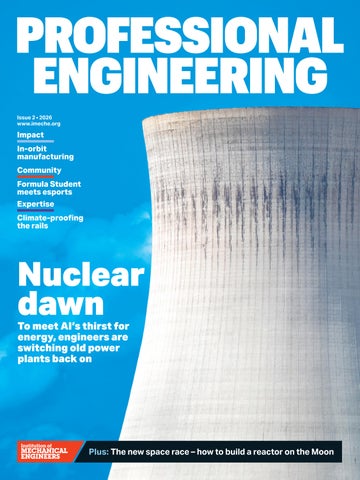
Front cover and spine
VERSION REPRO OP SUBS
Issue 2 • 2026 www.imeche.org
Impact
ART
In-orbit manufacturing Community Formula Student meets esports
PRODUCTION
Expertise Climate-proofing the rails
CLIENT
Nuclear dawn To meet AI’s thirst for energy, engineers are switching old power plants back on
Issue 2 • 2026 • www.imeche.org
Plus: The new space race – how to build a reactor on the Moon
BLACK YELLOW MAGENTA CYAN
91IPEJUN26900.pgs 22.06.2026 16:10
Contents VERSION
Issue two, 2026
REPRO OP
Contents
SUBS ART PRODUCTION CLIENT
Features
Impact
Community
Expertise
03 Welcome Interim chief executive Jo Passingham reflects on the value of volunteers 44 Nuclear production line Building small modular reactors in factories raises several challenges 52 Sleeping giants As demand for power grows, once shuttered nuclear plants are being given a new lease of life 58 Nuclear energy’s next frontier The new space race: who will get the first reactor to the Moon? 64 Weird engineering A wind-powered robot for interplanetary exploration
05 Clumsy astronauts and space drugs In-orbit manufacturing offers many benefits: zero atmosphere, microgravity and, best of all, no humans 08 Good foundations The world’s single largest offshore wind farm is being built in the North Sea 10 Three key questions for the hydrogen economy Key discussion points from IMechE’s sixth annual Engineering a Hydrogen Economy conference, plus a nuclear roundtable
15 In the spotlight Our series on IMechE members having a big impact profiles Michaela Haynes 18 Institution news Formula Student Sim Racing, launched as a virtual alternative in 2020, is going from strength to strength 20 Your voice Readers have their say on key issues of the day 23 Heritage Lord William Armstrong’s country home, Cragside, became his personal testing ground in the 19th century
33 Simulation and fusion UKAEA’s Tom Deighan on tech changing the game 36 Pressure systems Paul Smith, chair of the Pressure Systems Group, sets out the agenda for October’s lifecycle event 38 Rail freight How an industry-first assessment model aims to tackle the effects of climate change head on 41 Project management Four useful tips, from proper risk assessment to improved communication
p58
www.imeche.org
Professional Engineering
BLACK YELLOW MAGENTA CYAN
91IPEJUN26100.pgs 19.06.2026 16:59
1
Over 75 years of leadership in the design and productionof standard components combining reliability and efficiency with great care in ergonomicsand design.Tradition
150 9001
150 14001
OHSAS 18001
Quality
Enwlronmental
'"'"'"""''
Management
and innovation for the widest range of standard elements for industrial machines.
ELESA.More and more ...
a
~
Operating Clamping elements knobs
Clamping levers
Lift&
Pull handles
Fixed & Revolving handles
Control elements
Rotary controls
Indexing and posttioning elements
-•
··-
HHlthandSaftty Manilgefflent
0
Machine Levelling Hinges and Latches Accessories Castors and elements elements and connections for hydraulic wheels supports systems
Connecting clamps
Followus on
E-mail: sales@elesa.co.uk Phone: 01526 322670
elesa.com STANDARDMACHINEELEMENTS WORLDWIDE
ele,a
Welcome VERSION
Welcome
REPRO OP
Looking up and out IMechE’s interim chief executive Jo Passingham on turning strategy into action
SUBS
M
ART PRODUCTION
ost of our members are focused on the future. They are looking up and out: towards new technologies, new challenges and the role engineering must play in shaping what comes next. Our role as an Institution is to match that ambition, not just in what we say, but in what we do. Over the past year, we have made real progress in strengthening our foundations. Through the Annual Report and Accounts 2025, we can clearly see the scale of what has been delivered – much of it made possible by the commitment of our volunteers. Their expertise, time and energy continue to drive the Institution forward, and I want to thank them for the vital role they play in everything we achieve.
to schools outreach, policy committees and engineering competitions, volunteers continue to play a central role in helping the Institution deliver impact across the profession. Volunteering is also a powerful way to build skills, expand networks and shape the profession, and we are continuing to look at how we better support and recognise that contribution.
Culture and inclusion
CLIENT
Alongside this, our commitment to culture and inclusion remains central. If we want to attract, support and represent the best of engineering, we must create an environment where people feel included, heard and able to contribute. Our strategy, Engineering 2023–2030, remains the right one. What is changing is how we deliver it. We now have a refreshed activity plan running through to May 2027, giving us a clearer framework to align our work, prioritise effectively and ensure our activity delivers against strategic goals. Another important milestone is the renewal of our Engineering Council Licence. This reflects a huge collaborative effort across staff and volunteers, and gives us a clear opportunity to focus on delivery – supporting engineers, strengthening the profession and increasing our impact over the next five years. That means continuing to improve how we work, connect and deliver for our members. Because, ultimately, if our members are looking up and out, we need to make sure the Institution is doing the same.
During 2025 we:
l Registered the most engineers and technicians
on to the Engineering Council register for the 14th successive year, upholding professional standards across engineering; l Engaged circa 3,600 students and apprentices through our educational competitions and activities, supporting the future engineering talent pipeline, and delivered STEM outreach and training with our partners at Primary Engineer and STEMazing through our STEM Ambassador programme; l Contributed engineering expertise to 18 political consultations and inquiries, and held 59 meetings and events with policymakers and industry, helping ensure engineers are part of national conversations on infrastructure, skills and sustainability. From professional registration interview panels
PROFESSIONAL ENGINEERING
is published by Think on behalf of the Institution of Mechanical Engineers. PE, 65 Riding House Street, London W1W 7EH 020 3771 7200
EDITORIAL profeng@thinkpublishing.co.uk Editor: Amit Katwala Deputy editor: Joseph Flaig Sub-editor: Rebecca Dyer Group art director: Jes Stanfield Executive director: Jackie Scully
Client engagement director: Kieran Paul tinyurl.com/PEmagazine
@ProfEng
ADVERTISING 020 3771 7232 Commercial director: Michael Coulsey michael.coulsey@thinkpublishing.co.uk
SUBSCRIPTIONS For address changes, phone 01952 214050 or email subscriptions@imeche.org
Senior commercial partnerships manager: Chris Barnard chris.barnard@thinkpublishing.co.uk
ABOUT IMECHE The Institution of Mechanical Engineers is the professional body overseeing the qualification and development of mechanical engineers. It has 115,000 members in 140 countries.
Commercial partnerships manager: Anthony Epega anthony.epega@thinkpublishing.co.uk Copyright: Think Publishing 2026
~ --
Printed by: Acorn Web, Yorkshire
IUllainabtymanaged forellSandc:onlraled
CARBON
BALANCED PAPER
?EFC
-.petc.co.uk
www.c:arbonbGlanc:9dpg1M1• .,;:om Cllf'OIH30
Visit imeche.org for more information about membership and its benefits, or email membership@imeche.org.uk. Views expressed in Professional Engineering are not necessarily those of the Institution or its publishers. Interim chief executive: Jo Passingham President: Matt Garside CEng FIMechE MIET IMechE is a registered charity in England and Wales number 206882
www.imeche.org
Professional Engineering
BLACK YELLOW MAGENTA CYAN
91IPEJUN26101.pgs 18.06.2026 14:39
3
Jointhe Modelling and Simulation Eventof the Year! Discounted rates are available for academic and group registrations.
ProgramHighlightsInclude:
Keynote talks hosted by industry leaders
Demo stations offering 1-on-1 guidance from COMSOL engineers
20+ minicourses covering the latest modelling techniques across engineering disciplines
Poster and slideshow presentations on the use of COM SOL Multiphysics® in the real world
» comsol.com/conference/cambridge
..■ COIVISOL
Impact opener, 1
VERSION REPRO OP
Impact
The forces shaping engineering
SUBS ART
Cardiff materials company and in-orbit manufacturing pioneer Space Forge is launching its own satellites
PRODUCTION CLIENT
Clumsy astronauts and space drugs From semiconductor substrates to cancer treatments, in-orbit manufacturing offers a wealth of opportunities
M
icrogravity, zero atmosphere, extreme temperatures – space has several unique features that give it an edge over terrestrial fabrication for certain products, according to Joshua Western from Space Forge. But there is another, perhaps less obvious advantage. “The benefit that we don’t talk about going to space for is you get away from all the humans,” the CEO said, speaking on stage at the Space-Comm Expo in London on 5 March. The Cardiff materials company and in-orbit manufacturing pioneer aims to take advantage of that as it produces semiconductor substrates – the base material for electronic devices – in space. “The last thing I want to introduce is a human into my
manufacturing process, who has the opportunity to ruin what I’ve been making,” Western (below) said. “[There] is a very well documented history of astronauts who weren’t quite trained in the thing that they were responsible for, and the experiment or the product… was lost.”
Emerging market
That misanthropic perspective means Space Forge will not be installing its technology on commercial space stations, the boss said, and is instead developing and launching its own line of ForgeStar satellites. Currently demonstrating key tech in orbit, ForgeStar-1 is the UK’s first in-space manufacturing satellite.
Clumsy astronauts are far from the only challenge for the nascent in-orbit servicing and manufacturing (Isam) industry, which benefited from an announcement of £105m public funding at the same event. Described by the government as “an emerging market where the UK has a strong competitive edge and opportunities to deliver significant commercial returns and strengthen national resilience”, Isam’s principal challenge is putting products in customers’ hands. “Being able to reliably return these products to Earth is a huge challenge,” said Portia Bowman, founder and CEO of sustainability-focused space consultancy Growbotics, during the same panel discussion at the Excel London conference centre. 5
www.imeche.org
Professional Engineering
BLACK YELLOW MAGENTA CYAN
91IPEJUN26147.pgs 18.06.2026 15:41
VERSION REPRO OP
Overcoming that hurdle will be vital for supply chain integration and competitive pricing. But not everything that goes up will come down. Some products will remain in space to be used on other spacecraft, said the CEO, whose company produced a report on British Isam capabilities for the UK Space Agency (UKSA). “The complexity as to integrating that into the supply chain is harder, because it’s primarily autonomous,” said Bowman. “You have to have the logistics from spacecraft to spacecraft, to be able to get it to the place that you need it.”
SUBS ART
Congested space PRODUCTION
In space, famously, no one can hear you scream. That same vacuum – providing an ambient pressure 10 trillion times lower than Earth’s atmosphere – removes contamination issues and the need for multi-stage pumps, according to Space Forge. Microgravity, meanwhile, prevents buoyancy to enable larger crystal formation and uniform alloy mixing, while temperatures near absolute zero allow ultra-fast curing without cryogenics. Those enviable characteristics mean growing interest in Isam. As with all orbital applications, however, it faces the challenge of an increasingly busy environment. “Space is getting more and more congested. The regulations are evolving and changing, and I think that’s going to have a big impact on this,” Bowman said. Factories in low Earth orbit (Leo), for example, might be particularly visible and could face objections from astronomers. Scaling up will be another massive hurdle. New re-entry vehicles will “unlock the market”, according to Jacques Fossey from BioOrbit, which plans to use space for protein crystallisation for on-Earth cancer treatments, but it will be permanent commercial
CLIENT
6
Professional Engineering
BLACK YELLOW MAGENTA CYAN
Space Forge hopes to take advantage of space’s microgravity, low pressure and temperatures near absolute zero to produce semiconductor substrates
‘Space is getting more congested. The regulations are evolving and changing, and I think that’s going to have a big impact on this’
platforms that eventually make it economically viable. “You can leave all your heavy manufacturing equipment in orbit, and all you’re doing is taking the raw product up and bringing down the [finished] products,” he said. Despite those significant challenges, the CTO was buoyant about the sector’s possibilities. “Space drugs will be here before you know it,” he told the audience. The company planned to first demonstrate its system on the International Space Station in May, to better understand what the final commercial platform should look like.
the event. Identified as a “key capability area” for space, the field is expected to bring significant commercial opportunities to the UK, according to the agency. Alongside work with BioOrbit and Space Forge, the government is also collaborating with OrbiSky on a study investigating the
Rocketing up the agenda Isam is “very high on the government’s agenda,” said Jodie Howlett, senior project manager at UKSA – which has since merged into the Department for Science, Innovation and Technology – at www.imeche.org
Impact opener, 2
Impact
‘By backing these companies to explore manufacturing in orbit, we’re positioning the UK to capture new markets and bring benefits back to Earth’ manufacturing in orbit, we’re positioning the UK to capture new markets and bring tangible benefits back to Earth – from better medicines to more efficient electronics. These studies demonstrate the government’s ambition to drive forward one of the most exciting frontiers of space technology,” said UKSA chief executive Dr Paul Bate in an announcement.
‘Mary Poppins from space’
production of fluoride glass in orbit. That glass could be used in specialist ZBlan optical fibres, which can transmit light with up to 100 times less signal loss than traditional silica fibre. “By backing these innovative companies to explore
Liz Lloyd (right), minister for the digital economy, spoke alongside industry figures at this year’s Space-Comm Expo
www.imeche.org
Those tantalising possibilities are not yet within reach – so for now, in-orbit manufacturing firms are focused on completing their latest technical milestones. The week after the London event, Space Forge celebrated another important step as it successfully demonstrated operation of a high-pressure tank aboard ForgeStar-1. Manufactured by UK advanced materials company TISICS, the tank is a vital part of Space Forge’s Plasma Strike experiment. A previous demonstration has already confirmed that the extreme conditions needed for gas-phase crystal growth – a core building block of semiconductor production – could be created and controlled on an autonomous platform in Leo. Focused on highly valuable materials such as gallium nitride, silicon carbide, aluminium nitride and diamond, Space Forge aims to underpin technologies including power electronics, advanced communications, quantum systems, defence platforms and high-performance computing. On Earth, development of materials is
constrained by defect formation, impurity incorporation and thermal instability during growth. “Space offers a different pathway,” an announcement by the firm said. “The absence of convection in microgravity, the ultra-high quality vacuum with near-zero nitrogen contamination and the stable thermal conditions can enable semiconductor crystals several orders of magnitude cleaner than those produced terrestrially.” Designed for compatibility with 14 different operational launch vehicles, ForgeStar satellites will work in orbit for two weeks to six months before returning to Earth. That re-entry will require a deployable, lowballistic coefficient heat shield – or, as Western described it, “Mary Poppins from space – an inverted space-grade umbrella”.
All systems go The Welsh company is developing that system now. In February, it also received a £300,000 UKSA contract for 2Forge2Furious, a study aimed at demonstrating how semiconductor seed crystals could be produced commercially in orbit. The project’s backers hopes those crystals could improve the efficiency, reliability and power density of high-power electronics, including data centre infrastructure, EV charging, telecommunications and quantum computing.
Find out more Get a weekly digest of the latest cutting-edge research and development across aerospace, automotive, manufacturing and more by subscribing to our weekly news digest. Just head to imeche.org/news Professional Engineering
7
91IPEJUN26148.pgs 19.06.2026 17:37
VERSION REPRO OP SUBS ART PRODUCTION CLIENT
Good foundations ix of these giant monopiles arrived on Teesside in February for the construction of Hornsea 3, the world’s single largest offshore wind farm, being built by Ørsted in the North Sea. Each weighs an average of 1,670 tonnes and is 90m in length – equivalent to nine blue whales in weight or three in length – and has a diameter of up to 11m at the bottom and 8m at the top. These are just three of the 197 that will be shipped from Bilbao to the UK to form the foundations of new wind turbines. “2026 is the year we begin offshore works on Hornsea 3 in earnest and the arrival of these first monopiles marks a key milestone in that process,” said Luke Bridgman, managing director of Hornsea 3. “Working closely with expert partners is how we’ll make Hornsea 3 a success and we’re confident that we have the best possible team in place to make that happen.”
S
8
Professional Engineering
BLACK YELLOW MAGENTA CYAN
www.imeche.org
Picture story, 1
Impact
www.imeche.org
Professional Engineering
9
91IPEJUN26104.pgs 18.06.2026 14:36
VERSION
Impact
REPRO OP
Three key questions for the hydrogen economy Joseph Flaig reports on IMechE’s sixth annual Engineering a Hydrogen Economy conference
SUBS
lot has happened in the hydrogen economy in recent years. High-profile successes include adoption of hydrogen technology in projects such as the Lower Thames Crossing, approvals for green hydrogen production facilities and development work on hydrogen-centric industrial clusters. Some ambitious targets have been missed, however, and the long-term future for the fuel and energy vector remains unclear. With these challenges in mind, IMechE’s Engineering a Hydrogen Economy returned to Birmingham in April. The conference remained as – if not more – relevant than ever in its sixth year, said event chair Dr Maria Felice, industrial liaison manager for hydrogen at the High Value Manufacturing Catapult, who said it prioritised “engineering and facts over hype and misinformed opinions”. Here are three questions raised by speakers – and some answers.
A ART PRODUCTION CLIENT
When will the new hydrogen strategy be available? From a lack of distribution networks to the cost gap between fossil fuels and hydrogen, barriers to the hydrogen economy were presented as part of an interactive poll on the first day. Asked to choose, attendees – including researchers, chemical and mechanical engineers and trade organisation representatives – were clear: the absence of a transparent, long-term strategy is the most pressing issue, selected by 38%. Delays to the strategy – which was due in autumn 2025 – are affecting confidence, said 10 Professional Engineering
BLACK YELLOW MAGENTA CYAN
Dr Emma Guthrie, CEO of the Hydrogen Energy Association. “If we don’t see this movement, there is a risk of the UK falling behind peers,” she said. Despite “very large ambitions”, the delays mean the UK has slipped below Germany as most attractive place to invest in hydrogen. The delayed strategy “will significantly impact the demand that is coming from the industry,” said Dr Shahrouz Nayebossadri, principal R&D engineer for hydrogen systems at the Offshore Renewable Energy Catapult. The UK’s “very favourable” programme of Hydrogen Allocation Rounds is nonetheless recognised by other
‘There’s this big challenge around bringing down the costs of electrolysis and recognising what a realistic cost of production is’ countries, Guthrie added, with attractive rates for domestically produced low-carbon hydrogen. Professional Engineering contacted the Department for Energy Security and Net Zero for an update on the strategy’s launch. What will power the hydrogen economy? While the roll-out of hydrogen infrastructure has faced delays, other pillars of the green energy system are in place. In 2025, renewables generated a record 52.5% of the UK’s electricity, largely thanks to a productive year for wind and solar generation. That electricity is powering millions of homes and businesses – but when it comes to electrolytic
production of ‘green’ hydrogen using water and renewable power, decarbonisation could cause issues. Chief among them is intermittency. A constant feature of renewable power due to fluctuating weather conditions, but at its worst during dunkelflaute – periods with little wind or sun – stop-start generation is a drawback as electrolysers operate most efficiently with steady, continuous power. “This can significantly impact the lifetime of electrolysers,” said Nayebossadri. “This is something that we have to carefully think about, and see how we can actually improve the durability of the electrolysers to… reduce the cost of hydrogen production.” Questions remain around the costs of electrolysis, agreed panel member Dr Robert Sorrell, CEO of the government-backed Royce Hydrogen Accelerator. “There’s this big challenge around bringing down the costs of electrolysis and actually… recognising what a realistic cost of production is,” he said. “Some of the figures that are quoted are based on an old paradigm of comparing to oil and gas-type structures, where it’s not particularly appropriate.” Along with durable electrolysers, new and more widespread energy storage options will be needed to maximise hydrogen production using renewable energy. Are we ignoring a golden underground opportunity? Whether it is green electrolysis, steam methane reforming or another process, the dominant production method for the future www.imeche.org
Impact hydrogen, 1 SHUTTERSTOCK
hydrogen economy remains up for debate. But there is another option, according to José Mária Santa Bárbara, director of the Aragón Hydrogen Foundation in Spain. Found underground in Aragón, Mount Chimaera in Turkey, mines in Ukraine and other subterranean locations is naturally produced – or ‘golden’ – hydrogen. Extraction projects are being developed in Spain, Australia and France, and one is already operating in Mali. “What was once considered waste is now the fuel of the future,” said Santa Bárbara. A potentially costeffective complement to green hydrogen, the gas is produced by several distinct processes: radiolysis, in which irradiated water splits; an exothermic reaction
‘If we have the possibility to gather natural hydrogen and make it work, it will be like a constant flow of energy coming at very low cost’ between water and underground rocks known as serpentinization; and magma degassing. Exploration and extraction tech needs to be developed, but the process could have similar costs to oil and gas production. Trillions of tonnes of natural hydrogen may be available in the Earth’s crust, according to the US Geological Survey, with only a small fraction needed to reach net zero carbon emissions for the next 200 years. “The key is that this is something being generated constantly,” Santa Bárbara said. “If we have the
Nuclear nation he UK’s Modern Industrial Strategy sets out ambitious goals for net zero, innovation and economic growth. But ambition alone is not enough. Engineers are needed to turn plans into projects. IMechE’s policy team has been in Bristol, working across government, industry and academia to ensure engineers are central to the plans. In April, IMechE convened sector leaders in Bristol. Through site visits and roundtables, the policy team connected national strategy with
T
www.imeche.org
real-world delivery. Discussions focused on the nuclear sector, sustainable aviation and the role of regional innovation. At the Nuclear Nation roundtable, experts examined whether the UK can deliver major ambitions at pace and scale. “A key takeaway is that UK nuclear enterprise is entering a decisive decade. Successive governments have made clear commitments to civil deployment and the modernisation of the UK’s nuclear deterrent,” said Matthew Rooney, IMechE head of policy. “Together, these priorities represent a once-in-a-generation opportunity to rebuild national capability, strengthen energy security and sustain sovereign defence outcomes. The question is not whether nuclear is essential, but
possibility to gather that and make it work, it will be like a constant flow of energy coming at very low cost.” Extraction techniques could include accessing underground reservoirs, drilling into hydrogenrich rock formations or injecting water into formations with high iron content. Doing so will not be easy, however, largely thanks to hydrogen’s high diffusivity, due to its small molecule size. This also causes embrittlement of metals, requiring new material solutions. Another challenge is that serpentinization produces carbon dioxide. Santa Bárbara said the gas could be extracted and sold – but ties with the greenhouse gas could be a mark against golden hydrogen.
Find out more The use and viability of hydrogenbased combustion engines will be explored at IMechE’s Advancing Automotive Engineering event at the British Motor Museum, Warwick, from 4-5 November. Find out more at imeche.org/events
whether the UK is organised to deliver it at the required pace, scale and level of assurance.” A second roundtable explored the next steps for sustainable aviation, building on IMechE’s published report Aero 2050: Flying More Sustainably, while visits to the Universities of Bristol and the West of England highlighted how future engineers are being developed. From spinouts like iCOMAT and Lineat to advanced digital labs, the region shows innovation in action.
Find out more Want to shape the future of engineering? Explore IMechE’s policy work at imeche.org/ policy-and-press Professional Engineering 11
91IPEJUN26105.pgs 18.06.2026 15:22
AFC Advertorial
VERSION
SPONSORED CONTENT
REPRO OP
Beyond supply: the power of product expertise at AFC Europe
SUBS ART PRODUCTION CLIENT
In today’s manufacturing environment, sourcing components is only part of the challenge. Increasingly, engineers, buyers and supply chain professionals need access to technical expertise, application knowledge and value-added support that helps them solve problems, reduce costs and improve performance. At AFC Europe, product expertise sits at the heart of everything we do. Our strength lies not only in our extensive portfolio of industrial components and engineered solutions, but in the knowledge and experience of the specialists behind them. Across our organisation, we have dedicated product experts who possess deep technical understanding of specific product categories, helping customers select the right solution for even the most demanding applications. Whether it’s the unique performance characteristics of wave springs, the critical role of seals and O-rings in ensuring reliability, or the selection and specification of precision fasteners, our specialists work closely with customers to provide practical, application-focused guidance. Their expertise helps customers navigate complex technical requirements, identify opportunities for optimisation and avoid costly design or procurement mistakes. For projects that require something beyond standard catalogue products, AFC Europe offers extensive experience in custom engineered solutions. Our engineering teams collaborate with customers from concept through to production, developing bespoke components tailored to specific operational, environmental and performance requirements. This capability extends into custom fabrications and assemblies, where multiple components can be integrated into ready-to-install solutions that simplify manufacturing processes and reduce total cost of ownership. However, technical product expertise is only part of the story.
BLACK YELLOW MAGENTA CYAN
As supply chains become more complex, inventory management has become a critical factor in operational success. AFC Europe has developed considerable expertise in supporting customers through advanced inventory management programmes, including Vendor Managed Inventory (VMI), typically deploying Kanban methodology. These solutions help customers improve stock visibility, reduce inventory (saving valuable cashflow), consolidate supply base (saving time and money) and minimise production downtime, ensuring critical components are available when needed. By combining product knowledge with supply chain expertise, AFC Europe creates solutions that deliver measurable value across the entire procurement cycle. This collaborative approach has enabled AFC Europe to build long-term partnerships across a wide range of industries, supporting customers with everything from routine production requirements to highly specialised engineering challenges. Our teams understand that every application is different, and they bring a consultative mindset to every project, ensuring
customers receive not just products, but the expertise needed to maximise their performance. In an increasingly competitive world, access to knowledgeable specialists can make all the difference. Whether you require guidance on fastener specifications, sealing technologies, wave spring applications, custom-engineered components, fabrication and assembly solutions, or inventory management strategies, AFC Europe provides the technical insight and commercial support needed to achieve successful outcomes. Because at AFC Europe, we’re more than a supplier – we’re a partner in engineering, procurement and supply chain excellence.
~ AFC Europe l Visit afceur.com to find out more or email us at enquiries@afceur.com
91IPEJUN26126.pgs 18.06.2026 14:37
REPRO OP
Connecting engineers, recognising success
SUBS
Rising to the equation
ART
In our next article showing the tremendous impact made by IMechE members, we speak to Michaela Haynes, whose achievements show that a successful engineering career doesn’t always follow a neat path and requires some brave decisions
A PRODUCTION CLIENT
key moment in Michaela Haynes’ journey to engineering was watching an all-female crew land a Chinook helicopter at her school. Another was her decision to trade her pocket money for a maths tutor because, as she explains, maths doesn’t come naturally to all engineers. And, most importantly, there was her older sister, who not only beat the engineering path ahead, but also helped Haynes connect her curiosity and all those dismantled gadgets to what has turned into a promising career at Rolls-Royce. Haynes, 28, works as a senior lifecycle engineer within the company’s defence division. Her role supports the smooth running of gas turbines on warships – aircraft carriers, frigates, destroyers – which includes dealing with routine maintenance and influencing long-term strategy that “keeps a complex system working for 50 years”. But what Haynes loves most about her job is witnessing what these chunks of metal can achieve at sea – the “real impact” they make to the lives of thousands of people. “When I look at the Queen Elizabeth-class carriers, those ships can carry 1,500 people.
www.imeche.org
BLACK YELLOW MAGENTA CYAN
MANUAL RELEASE LIFEBUOY
1111/ESCIIPE fW/J/J/ESO fll.l.lllC 7'/JNI< & IWEl/f/.Ol/f TIINI(
Engineers in the spotlight
Each one is a mini city,” she says. “As well as propelling the ship, the crew rely on the gas turbine to eat, to keep the lights on, to power the hospital bay and to charge their phones. The power plant is keeping more than a thousand people safe and looked after.”
Making choices
Haynes grew up in Kent, the youngest of three sisters, who routinely helped their dad, a
builder, to fix things around the house or service the car. “I was that kid who was saving bits of rubbish, inventing things, sticking things together, opening TV remotes and breaking things,” she recalls. “I was always very curious, hands-on and creative.” Then one of her older sisters became a civil engineer. Until then, Haynes never made the connection between her interests and a potential career.
Professional Engineering 15
91IPEJUN26106.pgs 18.06.2026 15:34
Member profile, 1
VERSION
Community
HELP THEM FIND A ROLE THAT FITS.
I
F SOMEONE IN YOUR FAMILY IS READY FOR A NEW ROLE,
Support Network can help. As part of your membership, everyone in your immediate family can get one-to-one career coaching and CV advice. We'll pair them with an adviser from our partner agency for tailored support via video call, phone or email -wherever they're based, help is at hand.
The adviser will: • Work with them to clarify their personal goals, values and style • Align these to their skills and experience
Your family member will also get six months' access to an online toolkit, including: • A personal CV builder • Psychometric tests
• Help them refine the content and presentation of their CV
• An interview simulator with common questions
• Identify suitable opportunities.
• A comprehensive vacancy database. And it's all free as part of your membership.
TALK TO US TODAY If you or a family member needs support with neurodivergence, please get in touch: call 020 7304 6816 or call/text 07552 669160 Email:supportnetwork@imeche.org To learn more about how we support members, visit www.imeche.org/support-network/how-we-help
SUPPORT NETWORK 1ffl@fflwfo'f
REPRO OP SUBS ART PRODUCTION CLIENT
“She was the first in my immediate family to go to university and opened my eyes to what was possible,” Haynes says. “I started to form a goal. To dream and focus my efforts. It felt like it was all I wanted to do.” But during her final years at school, that engineering dream was far from guaranteed. Haynes enjoyed maths, science and physics – she likes the certainty of a right or wrong answer – but struggled with the first of these subjects, so much so that her teacher told her to give it up. “My dad was the only one working full-time then. There were three children. And my mum gave me the option to either get a maths tutor or have pocket money,” she remembers. “I wanted to be really responsible. I was set on engineering. It felt within reach. So I made the decision to get the maths tutor… and I’m very glad I did!” Haynes stuck with the tutor for months, fixing the cracks in the foundations of her knowledge. It was hard work but after that, she says, things got a little easier.
Flying start
Another core memory from those early years was the Royal Air Force visiting her school, arriving in spectacular fashion. Watching a Chinook helicopter hover overhead before coming in to land, releasing its all-female crew, stuck with Haynes, later leading her into the defence sector. “It was incredible,” she says. “Those kinds of things make such a difference in your life.” Haynes wonders how many young engineers today lack role models like her sister, let alone helicopter crews swooping in to speak about STEM. Since joining IMechE during her studies at Coventry University, Haynes has been paying it back via outreach
www.imeche.org
BLACK YELLOW MAGENTA CYAN
As part of her outreach and volunteering work, Michaela Haynes speaks to aspiring engineers
‘Organisations benefit from different opinions and perspectives. Ask questions and think differently’ and volunteering for the Culture and Inclusion Committee as a Young Members Board representative. Now a chartered IMechE engineer, she attends conferences, helps to onboard new members, and is hoping to get more involved in policies that drive deeper, meaningful change. When she meets young engineers, she encourages them to “speak up and be heard”. “Don’t think that just because you’re the new person no one needs to hear what you have to say. Organisations benefit from different opinions and perspectives. Ask new questions, reframe old questions and think differently.”
Sustainable career
Haynes sees an industry that’s changing – there’s more awareness around engineering and more opportunities – but she’d like to see more done to keep engineers from leaving the field (not unlike gas turbines on ships – it’s one thing to build them and another to keep them running for decades). She isn’t sure where her career will take her next, but
she’s studying towards a Level 7 Through-life System Sustainment master’s degree apprenticeship with Cranfield University. This aligns with her interest in making the gas turbines she works on more sustainable, involving finding ways to make them run more efficiently and reduce waste. When she’s not at work, Haynes spends her free time walking or running with Maze, her Labrador, gardening, or doing something arty and creative, such as baking or painting. Her sisters live nearby and her parents are planning a move to be closer to where she lives in Gloucestershire, not wanting to miss out on all the key life moments that lie ahead.
~
-
Nominate
To nominate an IMechE member making a difference, email profeng@ thinkpublishing.co.uk
Professional Engineering 17
91IPEJUN26107.pgs 18.06.2026 15:34
Member profile, 2
VERSION
Community
VERSION
01:11lll'<II 1'1-1.Ao: !I( t I 1:08ft.A
REPRO OP SUBS
The series combines monthly races in the online racing simulator Assetto Corsa with engineering challenges designed to test racing strategy and analysis
ART PRODUCTION CLIENT
Gearing up for a virtual Formula Student The online event that started life as a pandemic stop-gap now has more than 70 global teams ou probably know all about Formula Student, IMechE’s long-running competition for budding engineers, which is due to return to Silverstone in a few weeks. But did you know there’s also a virtual equivalent? The Formula Student Sim Racing Series began in 2020 at the height of the Covid-19 lockdowns as an alternative to the live event and has been growing steadily ever since. The series is open to all Formula Student teams online, combining monthly races from November in the online racing simulator Assetto Corsa with engineering challenges designed to test a team’s approach to racing strategy and analysis. The line-up this year featured 283 drivers from 73 Formula
Y
18 Professional Engineering
BLACK YELLOW MAGENTA CYAN
Student teams, which represent 19 countries across four continents, making this a truly global competition. “The year-on-year growth for the FS Sim Racing Series is fantastic to see,” says Dan Jones, chief judge for the Formula Student competition. “Starting from the virtual event, running from my home office in 2020, to over 70 teams from all around the world racing and competing in our USP with the engineering challenges, it’s already developed further and faster than I hoped. I’m looking forward to an exciting season ahead and meeting the teams in person at our live final.” The series has grown by nearly 50% from 2025, reflecting its popularity and relevance among
young engineers wanting to participate in and learn new skills in virtual dynamic vehicle set-up and race strategy. “From a stop-gap solution to save Formula Student during the Covid lockdown to a full-time series with a global stage, it’s inspiring to see how this contest is transforming gamers into engineers,” says James Montgomery, Formula Student Sim Racing event captain. The series will culminate with a final event, taking place alongside the main Formula Student event in July. Queen Mary University of London will be the defending champions after winning last year’s final, which took place at the Williams headquarters at Grove, Oxfordshire.
www.imeche.org
Events calendar Stay up to date with the latest courses and conferences from IMechE Rail Freight 2026 16 September 2026, London Whether taking lorries off roads and reducing congestion or transporting the goods we consume every day, Britain relies on rail freight to provide a fast, green, safe and efficient mode of transport. It is an indispensable part of the British economy and an essential component in supporting economic recovery and long-term growth. Bringing together engineers, operators, policymakers, researchers and industry innovators, this event is a key forum to explore developments in rail technology, infrastructure, automation and sustainability.
While being a fun event, the competition also provides young engineers with opportunities to develop additional skills in line with the objectives of the Formula Student event, with participants regularly going on to join motorsport teams to assist with vehicle set-up and race strategy duties.
Find out more Watch the teams in action at imeche.org/events/formulastudent/team-information/ fs-sim-racing
www.imeche.org
ALARP 2026 24 September 2026, Manchester The As Low As Reasonably Practicable (ALARP) principle lies at the heart of UK health and safety legislation. Given ongoing innovation in technology and processes, it is critical that standards and methods used to demonstrate ALARP are challenged. Otherwise, companies risk significant financial, legal and public backlash. This event brings together engineers and safety and risk professionals to exchange examples of how ALARP is applied in engineering projects and operations. Simulation and Modelling 2026 29 to 30 September 2026, Birmingham Simulation and modelling are playing an increasingly important role in modern engineering. By allowing engineers to test ideas virtually before development, simulation helps improve product design, enhance safety, reduce costs and accelerate innovation across industries. Now in its sixth edition, IMechE’s Simulation and Modelling conference brings together engineers, researchers, academics and industry to explore
how simulation is being applied to real-world engineering challenges. Lifecycle of Pressure Systems 2026 28 to 29 October 2026, London This year, we’re bringing the pressure systems community together at IMechE’s headquarters for a singlestream event, allowing all participants to benefit from insights and discussions across the full pressure systems value chain. The event will be structured around themed sessions that reflect the full lifecycle of pressure systems, exploring the journey from design and manufacture through operation, life extension, innovation and decommissioning, for a cohesive programme focused on efficiency, collaboration and insight. 16th International Conference on Turbochargers and Turbocharging 4 to 5 November 2026, Warwick IMechE’s turbocharging conference returns to address advances in system designs and boosting solutions. With designs changing to meet new market demands, this conference will provide an essential forum for all engineers, researchers, OEMs, suppliers and academic representatives to share technical findings, innovative solutions and lessons learned. Don’t miss the chance to network with colleagues and learn about developments leading to enhanced performance and efficiency, increased durability and reduced emissions.
Find out more For more details and to book, go to imeche.org/events
Professional Engineering 19
91IPEJUN26108.pgs 18.06.2026 15:57
Institution news and events, 1
Community
VERSION
Your voice
REPRO OP
Got something to share with the IMechE community? Write to us at profeng@thinkpublishing.co.uk, using the subject line ‘Your voice’
Closing the circle SUBS ART PRODUCTION CLIENT
In ‘Gone with the wind?’ (issue one, 2026), Chris Stokel-Walker rightly says it is difficult and costly to separate the fibres from the resin matrix in composite wind turbine blades; we knew this decades ago. The fibre-matrix system is designed to be durable and is not supposed to fall apart. To attempt a solution for recycling fibrous composites, I developed a novel method for retaining the chemical feedstock (fibres and resin) and remanufacturing composite components, which remained over 50% of the original E modulus, tensile strength and interlaminar shear strength. With teams of final-year project students at the University of Bristol, I investigated the feasibility of the process. The method consisted of splitting (delaminating) the composite and then crushing it at intervals to create a semi-flexible mat. The mat was used to remanufacture tubes from previously flattish material by laying over a former and impregnating with a laminating resin. Flat plates were made from previously curved material by laying up as before and consolidating in a hot press. I presented our findings at several composites and recycling conferences, and a paper was written that covers most of what we did (Adams et al, Applied Composite Materials (2014) 21:263-284). Designing and making composite structures is exciting and makes money, but few think of the end-of-life scenario. Our method shows that it is not necessary to crush into
20 Professional Engineering
BLACK YELLOW MAGENTA CYAN
GONE WITH THE WIND? THE PROBLEM WITH RECYCLING TURBINES Wlndturblnebladnarebllilttolnt-w>dthat'•-Uywlry thay'r•so
hMd lobraakdown.
By Chris StOMI-Walkar
A~~~::c,1o1 fOOlprintis10wanalhOl"sagoo<1
~I<»:= mat-llt>eootning-to igncn.-Eulq,a.thllirst blg-ol-'lr-'q lhtOOClo(ltso,igonll<ltty\W. anCIINO'ldl.Stryildisco,e,ing thot-mighebeogreon
==.::-1ar-::=. 11111._,11.--.
~===~-===~::,=-~ O.C.tromORE~,i..--.
..--w.naieat•"'"'-
-lianng.,.,..,;llddupto
BrHkingltdown
315.000-glot,9lyby2050
Ei<lll>'lg___
·---25---
---~.-
go
...
..,._..,....,.,.,__,iot____ ,,, ___
o/~-
...
IM:'Whlldo.,.ICl"°")'doM lhl---QUIII•'-
-.1111111._y~
_""Y__,....
=~..=:.fo,wln,;l--ll\ll-
~-«don~........... ol_.,...,.,.,..,.. ~..-.:IIOftw,g.
n..•-·-
·~--
~.~is..,,....
into!on:e_tlil,...lhll.1
lnlht..._Wffl,___. -to-.-,-1rom,..,......-"'llwy'
..
~not~ll<" INrmOplNtic,a."n.--
-~a...~tc""""'
:::.:.':..-i.-w::-
__
• ...,...,.,.
to1Nt""4ol•long.,..C¥1
90,oes-.o1,.-
... ......,,. ..,.._ II'_.,_.
_,_ac"'°'I'_,_ _r..:ydod, __ _ """'to--11-'"
--~-~ --toben•-""' -o1.-..,..,.oe_
n.gooc1,-111N111~
In~,,,_....,..,.._
=.-:-:.!:.-
"~•pro,o,ctln~•tolryto ___ ~-ir.mcn-
~~:~ lhw--......-,g-
n... .. .-..cry_
_ol_...,..,_ 1n-. ... t,,--.g-ol<I
-~""""' --bu)'lntott-. ...... -...,..~
~===
,._..._..,,____.,_
1
o.nw,y-o.nn-
~·""-
.... _.....,.
~~=•11.-m10-18.5'ol ~~t,y20Xlln1N
"Thli-11.-.bllngllNCIICI -----.illlii ___ ln_Eutq)a._ ---Hol'ol-ln
---..t•to~
--I0--11,eyltlnd.
WinCI_...,
=:=:.l)t-
,.,,..
~----miglf;be..,~ ------
---~In
Cln;ul..-thlnklng
-..~·
-~--
..,,
--o-.w.o1
.-llil"°""'""9-~-
-~~~'::'
.... lhlt_ lnpr __ ,,....,,.t,lglt~-~-IOrconstr\lCtlol,prO<t.lCII.
r..:ydod,~--notbeln!I __
.,.,....,,llwn!O
==---==N
blg-MU>olu.-t.-..ru:ti
Pl'l'l_
... ,.,._....__tt.
LongerNfHPl'n•
---~Ul'lbe_ftO_ p,c,lynwsto"""'"-~
_...,._,,.~
afwoonlht...-.<>Of'llo:Wll.st. ~,,.,._., __
__
no-,.-..,,-ne_._
-i'llv.9i-~I
Aac,dltlcangrlnd-millht
IN-ol-l'Mf\ll--
...,..,..... --,gbul-.,
....,_,IO<,gll'ii.ln>m1lwllay"ll'irl,gto.....-il
201<>25_.__ , ... _.,...,.
~.,.,1,e-
lld<Jelhl~ol~-bul --...-. ... ~ on _ _,.1111,pM...,_,lhl_
-olthtP,-.,isllOl)Tnlf ~-""""'"-· _polrr,w __ ______
...
~IO---tyl)Nol
• .,,...
~~~
p,of-lncirtulf---..my MN~ol..-. lnEutopa.1NMCIOtriN
""°"'t<I ....
.......,,
..,..,,_
.. -
·"""-IN-to-In ~.... .,,.incluslr",Unlncl"""'""'-"""'°' -bllng-~olln~
‘Our method shows it is possible Blowing in the wind Perhaps we are looking at the to remanufacture composite problem of recycling wind turbine blades from the wrong wind components. If we got good direction. Instead of making/ results using a university designing the blades to have a longer life, perhaps with workshop, surely industry even more difficult-to-recycle could use these ideas to materials, could the blades be recycle composite structures’ made to have a shorter life with powder and use as a filler, or to burn or put into landfill, but it is possible to remanufacture composite components. If we could get good results using undergraduates and a university workshop, surely industry could use these ideas to solve the problem of recycling large composite structures and close the circle. Professor R D Adams, Oxford, FIMechE, CEng
cheaper, more easily recycled materials? Yes, there is of course a cost to replace the blades and I have no idea what this is or if a replacement would be financially viable. Maybe we should just dump the blades in the sea to create artificial reefs to grow our fish stocks (so European fishermen can benefit). In general, too little thought is put into what happens when a product is designed, brought to market, used and discarded, and the associated costs of recycling/
www.imeche.org
WAYMO
In the driving seat decommissioning, whether it is a short-term item such as plastic bottles or one-time vapes, or long-term such as wind turbine blades, solar panels, etc (let alone nuclear waste), before it gets into the market. Most plastic bottles are recyclable, I hear you say, but how many actually are? Perhaps a return to the old system of having to pay a refundable deposit on an item should be reintroduced. By giving something a value it should reduce waste and pollution through better collection and thus, hopefully, recycling. (The same payment of a deposit might be applied to NHS appointments, of which some 15 million a year are missed at a cost of around £30 a pop, but I digress.) While kids are not going to collect wind turbine blades to supplement their pocket money, requiring wind turbine, solar farm or similar owners/operators to set aside funds in escrow to recycle/ clear up upon decommissioning might focus minds, and not just push the problem and cost on to the next generation when the
www.imeche.org
Issue one, 2026, of Professional Engineering contains an article entitled ‘Engineering vehicles for a self-driving world’. I am aware that some cars already embody a number of functions, such as automatic braking if the car is too close to the vehicle directly in front, which occur without any input from the driver. However, as an older engineer – I am in my 90s now – I always think that this is putting the cart before the horse. I have always considered it to be essential that I, as an engineer, am in charge of any machinery I am operating, whether it be, as in the past, the complete undercarriage system on the TSR2 Hydraulic Systems Test Rig, groups of underground coal mine roof supports, large plastic injection-moulding machines or a 12,000-tonne forging press and 120-tonne forging manipulator. Eur Ing Robert A Nash, CEng FIMechE
owners of such equipment/ facilities decide to conveniently go out of business, having reaped 25 years of profit. J Lander, MIMechE
Remote possibility FT Murphy’s idea to install remote-controlled switches in a house wiring (‘Your voice’, issue one, 2026) has a difficult hurdle to overcome. When a new circuit is installed, it is tested to ensure continuity in the fixed wiring and that its resistance to earth is high enough to switch the power on.
In theory, any alteration to the circuit and a further test is required. Sockets with USB charger sockets have become quite popular. These have to be shorted out during a high-voltage test so the sockets and their wiring are not actually tested. Switches would fall into the same category. So we do not know if the socket or switch has been correctly connected after the test. I suggest it is far better for you to take the exercise and operate the switch manually. Mike Travers, Fife
Professional Engineering 21
91IPEJUN26109.pgs 18.06.2026 16:11
Your voice, 1
Community
EURO-BEARINGS LTD
VEE
BUSHES
COMBINED ROLLER with MATING STEEL
BEARINGS PROFILES
MOTION
SYSTEMS
GUIDANCE
VEE BEARINGS
ROUND
SHAFT
Specialists in Linear Motion Systems Email: sales@euro-bearings.com
Tel: 01908 511733
www.euro-bearings.com
and
RAILS
LINEAR
STAINLESS OPTION
Heritage VERSION
Community
REPRO OP SUBS ART PRODUCTION CLIENT
1868
Cragside T
his is arguably the UK’s first smart home. Built on a rocky hillside in Northumberland, Cragside was the country home of engineer and industrialist Lord William Armstrong. As founder of the Elswick Works in Newcastle upon Tyne, Armstrong was a pioneer in hydraulic machinery, shipbuilding and armaments. He invented the hydraulic accumulator and designed the mechanism that operates London’s iconic Tower Bridge. Cragside was his personal laboratory – a domestic testing ground for the hydraulic and electrical theories he was pioneering on an industrial scale. In 1868, he installed a hydraulic engine in the house that was used to power laundry equipment, a hydraulic
www.imeche.org
BLACK YELLOW MAGENTA CYAN
lift and a rotisserie. Two years later, he built the world’s first hydroelectric power station using water from the estate’s artificial lakes and used the resulting electricity to power first an arc lamp, and then later Joseph Swan’s new incandescent lamps. In 2014, the estate’s renewable energy heritage was revitalised when a 17m-long Archimedes screw hydroturbine was installed. Generating around 10kW of electricity, the modern system produces enough continuous power to light all 350 lightbulbs in the main house. Today, the historic pump house, the original water turbines and the revolutionary Victorian machinery remain preserved and on display for the public through the National Trust.
Further reading Cragside’s pioneering hydroelectric system was recognised with an IMechE Engineering Heritage Award in 1985. Find out more about award-winning engineering heritage projects at imeche.org/engineeringheritage-awards
Professional Engineering 23
91IPEJUN26110.pgs 18.06.2026 16:14
EVENTS CALENDAR JULY TO DECEMBER 2026 Gain the knowledge, connections and practical insights to grow your career and shape the future of engineering. IMechE conferences enable technical peer-to-peer knowledge exchange while building valuable professional networks across the engineering community. IMechE Conferences 16Sep
Rail Freight 2026
London
24Sep
ALARP 2026
Manchester
29Sep
Simulation and Modelling 2026
Birmingham
07Oct
Advanced Nuclear Reactor Design 2026
Manchester
28Oct
Lifecycle Of Pressure Systems 2026
London
04Nov
Heat Recovery Steam Generator User Group 2026
Hinchley
04Nov
VTMS16 - Vehicle Thermal Management Systems Conference
Warwick
04Nov
Electrified Vehicle Engineering 2026
Warwick
04Nov
16th International Conference on Turbochargers and Turbocharging
Warwick
04Nov
Hydrogen Propulsion and ICE Conference
Warwick
11 Nov
Improving Fire Safety through Simulation and Modelling 2026
Birmingham
11 Nov
Fire Safety On The Railway
Birmingham
11 Nov
Crane Safety 2026
Manchester
11 Nov
Nuclear Lifting 2026
Manchester
03Dec
Young Engineers and Apprentices RailwaySeminar 2026 (YEARS)
Bristol
Be part of the conversations shaping engineering. Explore must-attend perspectives, and connect with peers driving innovation.
~ +44 (0)20 79731251
~
eventenquiries@imeche.org
events, gain fresh
i imeche.org/events
SUPPORT NETWORK
--
Annual Review 2025 Patron: His Majesty King Charles III
Supporting members and STEM projects worldwide
WHAT IF THINGS DON'T GOTO PLAN?
...A NETWORK OF COLLEAGUES IS READY TO HELP
For Institution members and their families, we are that network of colleagues standing ready to respond. We are Support Network, the personal support and practical assistance charity for IMechE members. While we may not be a life-saving emergency service like the RNLI,the support we provide can make a real difference when life doesn't go to plan. Much of our work is enabled through member donations and volunteer engagement -we are so grateful to those of you who support us in this way.
This review highlights some of our achievements during 2025 and our
SUPPORT NETWORK
iffi@l!b'f
aspirations for the current year. We will continue to give our time to every member who contacts us, and to shape our response around their unique circumstances so that it does the most good. That can mean counselling, grants or secured loans, parenting guidance, neurodiversity assessments, respite breaks for carers, financial and wellbeing advice, or help with employment and CVs - and often several of these at once. We work with each individual to find the best solution for their situation. When the waters rise, we aim to be the lifeline back to safety. But we would like to do more. We cannot assist unless we know that there is a need - the alarm has to be raised and heard. Often, people only speak up once they have reached crisis point. and even then, it can be difficult to ask for and receive help. That is why we act as a partner to those in need. We work alongside
them, withoutjudgement. offering effective and timely support. so no one feels that they're stranded on their own. Our main concern is that many are simply not aware that Support Network exists, nor that help is at hand. Raising our profile and visibility will be a priority in 2026, as we do not want those who could benefit from our services to miss out. Nobody needs to be left without a route to dry land. Please encourage those you know to reach out to us when in difficulty - or you can contact us on their behalf. We are dedicated to IMechE members and their families, wherever they are in the world, working confidentially and compassionately. We are a small team with a big heart, and we are ready to listen and respond. Anni Broadhead, Chief Executive Officer, Support Network
1111 Thank you for giving me hope. That I could start this new phase of my life in such a meaningful way, without debt and able to see a way forward has been immense.
Kathleen, 73, first contacted us when she felt she could no longer cope. She had been diagnosed with chronic obstructive pulmonary disease (COPD),which increasingly affected her breathing and energy, and she was caring for her older partner, an IMechE member. As he grew frailer, the strain took its toll. Knowing that Support Network helps members' families, Kathleen called us. We sent a visitor, who listened and understood, and for the first time she felt less alone. Over a series of visits, we helped Kathleen and her partner to claim disability and carer-related financial support; we encouraged them to make wills and arrange their powers of attorney. When her partner developed dementia, we provided respite care and access to specialist support. Subsequently, we assisted with the difficult move into residential care, and later, bereavement. We were there for Kathleen at every stage, and she asked us to share her story so others might reach out. If you or a loved one is in a similar position, we can help.
Matty finally contacted us when his many efforts to secure work had failed. After completing his engineering studies, he had travelled and worked in Australia in the oil and gas industry but had not been able to find permanent employment on his return to the UK. With a baby on the way, he was anxious to obtain a steady income and continue his career in his chosen industry. Support Network referred him to our employment coaching service, who helped to refresh his CV and interview style. When they identified a need for additional training, we helped him with the cost of the course. We also provided 'breathing space' grants to help with rent. bills and getting ready to become a family while he looked for work. Thankfully, it all paid off: a few months after becoming a father, Matty secured offshore work with a family-friendly schedule. This is an example of how we help Newly Qualified members into the profession. We could help you or a family member in this way too.
TO FIND OUT how Support Network could help you or someone you know email supportnetwork@imeche.org or text/WhatsApp/call/leave a voicemail on 07552 669160 www.imeche.org/supportnetwork
IMPROVING LIVES WORLDWIDE
Six years of international In 2019 we expanded our charitable objectives to be able to use more of our resources for good. We committed funds from our investment portfolio to help STEM projects worldwide, and made our first 'foundation funding' grant in 2020. Since inauguration, we have committed £981,815 to 26 projects in 13 countries.
The last bridge was washed away and three villagers died. When first crossing this new bridge I really felt that I'm in a new world now, more secure ... children will not miss school even if it rains and the river flows strongly or rises, plus they'll come back home safely.
Going forward, we will continue to work with STEM Learning in the UK
SUPPORT NETWORK
1!@1!&:'f ~YERTY
2
~~RNOGER
\\\ Mt+t ~ 8
DECENT WORK AND
ECONOMIC GROWllf
9
3 :~~~~~-~~NG
10
....
◄=►
.....
-
UGANDA:Establishing a mechanical repair shop and micro-financing scheme to help 35 young people into business. RWANDA:Building bridges to re-connect divided communities and enable safe passage to hospitals, markets and schools. We have funded four bridges, directly helping 31,000 people.
to support teachers to better deliver STEM subjects. Outside of the UK, we will extend our ongoing bridgebuilding work in Rwanda into Zambia. Members based in Tanzania and Sierra Leone have helped us find engineering and education funding opportunities in these countries, and we are exploring how we can best support local engineering innovations and start-ups.
-
INDIA: Helping women's farming co-operatives to use organic fertilisers and seeds as a route to financial independence for 30 women, and improving biodiversity in their villages.
..I.
~ ~
UK: Helping REMAPto scale their disability adaptation branches and start activities in new areas. ~ ~
If you are interested in engaging with this work, please do get in touch. Similarly, if you know of a project or organisation that aligns with our objectives of STEMfocussed education, international development or engineering innovation, we would love to hear from you.
4 ~~~~ON
5
GENDER !{JUALJIY
6
ClfANWATER ANDSANITATION
4• Mi Cf V
IIOOSIRY,11110VATION AllllNRIASll!UCI\IRE =~ES
ffl &
KENYA:Providing equipment and training to recycle waste ocean plastics from the beach to create 3D printer filament. generating new income and cleaning the local environment.
1111
We see this work as an integral part of what we do - expanding our assistance beyond the direct IMechE membership, and enabling tangible, engineeringfocussed benefits on a worldwide basis. In this way, we can help to relieve poverty, contribute to climate change initiatives, inspire tomorrow's engineers, and support them to flourish through today's STEM initiatives.
1
support
11:r:~~:~mESES 12~~~N 13
CUM.Ill ACTION
AHO PRODUCTION
Affl~w00
6>
~1~
UK: Enabling over 60 vulnerable and disadvantaged city children to have educational and confidenceboosting holidays in the countryside and on the coast. ~ ~
7
AFFDRDABLEAND
CLEAN ENERGY
We support STEM-related projects on a global basis in education, international development and engineering innovation. This is a valuable extension of our core work. We now contribute to 14 of the 17 United Nations Sustainable Development Goals.
~co-: ,, .. \II
I I\
15
~~LIND
6-:": I
At Support Network we are passionate about assisting our neurodiverse community. We have helped many members obtain assessments for their children -vastly reducing waiting times and sourcing vital support in a timely way. In some circumstances, a parent then realises that they too might be neurodiverse, and we have helped them as well; a late diagnosis can be equally life-changing. We provide services in relation to autism and dyslexia, and are working to introduce ADHD services this year.
1111 Looking back now, I realise that I've had a good year. Support Network giving me a neurodiversity assessment grant has helped me to discover more about myself and to understand my previous challenges - the doctor thinks I've got autistic traits - and perhaps I do look at things in too much detail sometimes, but I'm starting to use that differently. I gained the confidence to apply for CEng with IMechE, and to apply for a new position. I'm feeling so much brighter about the future thank you.
6 Newly Qualified grants to help with first steps in STEM careers
181
Student and Apprentice grants, awarded to international and UK-based mechanical engineering students (134 in 2024)
151
'Breathing space' grants to help members pay essential bills in times of transition or unanticipated circumstances
135
Fuel and extra Winter Warmth grants given to those on fixed incomes or households with disabled and/or vulnerable members.
Wellbeing support included:
18
parenting support advice and/or respite breaks for carers
204 counselling grants to help manage mental health difficulties or work through past traumas (121in 2024)
120
in-person and online social visits, calls and online contact made by our volunteers and team.
£493,632 is the total grant support to members in 2025 (approximately £78,000 more than in 2024), of which £72,659 (15%) supported international members
Extract from 2025 Financial Performance Income Total £1,382,555
Expenditure Total £1,185,558
75 neurodiversity specialist support grants/programmes and/or initial diagnoses of autism, dyslexia or ADHD (47in2024)
15
sleep support programmes to tackle the underlying causes of poor sleep
61 employment coaching and CV
1400K 1300K
Member donations £192,381
1200K
Gift aid £16,858
1100K
Legacies £271,002
1000K
specialist referrals to help members get back into or start work (34 in 2024) 1200K
1000K 900K
SOOK
SOOK -
Investment income £902,314
158
1100K
900K
700K
Practical help
included:
Financial assistance £402,885 Wellbeing support
~ £31,855
700K
600K
600K
500K
500K
400K
400K
300K
300K
200K
200K
100K
100K
0
0
Practical help £58,790 -
~ _
Engineering projects and international development grants £212,045 Governance £34,983 Organisation running costs £445,000
To view the full 2025 financial accounts and activities report visit www.imeche.org/support-network/governance
callers used the legal helpline and factsheets for advice on tax, probate and housing matters (125in 2024).
International project grants included: 2 bridges built in Rwanda to connect isolated communities and support local livelihoods via Fika (previously Bridges to Prosperity) schoolchildren in Uganda to benefit from improved sanitation and classrooms via the Mondo Foundation
260
500
residents in Juba, South Sudan to engage in a plastic bottle waste recycling project in partnership with Tearfund.
WHAT HAPPENS NEXT? You can help shape our future Thank you for reading our Annual Review and your interest in Support Network. We really value your opinion on our services, grant range and foundation funding activities. Our mission is to help Members of the IMechE and their families, and to broaden our good work into new projects. We want to hear from you: what else could we be doing? Is there a place for more direct engagement with the Young Member or Diversity networks? Could you help us at Board level, or as a volunteer or country representative? Do you have feedback on your application experience with us? Whatever your thoughts, we would be happy to hear them - and it is our intention to further this during 2026. Please scan the QR code to get in touch.
1111 We want to express our sincere gratitude to Support Network for IMechE for finding some of our students worthy to be beneficiaries of the Student Hardship Grant. The grant has gone a long way in alleviating their school charges and accommodations, and helps them to study without worry. We will forever be grateful for this kind gesture.
Engr. Dr. Raymond Ana, Head of Department, Mechanical Engineering, UNICAL (University of Calabar), Nigeria [International Student Grants Programme]
Even during the cost-of-living crisis and uncertain times, people can find it difficult to ask for help. You can assist by encouraging IMechE members to reach out. Many are under pressure, overstretched, or coping with health challenges - their own or their family's. Nobody needs to face these problems alone, and we are here to help.
Your intervention could be the vital connection and make all the difference.
TO DISCUSS HOW WE MIGHT BE ABLE TO HELP Please email supportnetwork@imeche.org or text/call/leave a message for the team on 07552 669160 For more information about us: www.imeche.org/supportnetwork
SUPPORT NETWORK
1m@IJi+P
WHY LEARN ANYWHERE ELSE?
• • •• 15,000
91%
+Cffl
satisfaction on courses
delegates attend events a year I I
-----------------------------------------------I-----------------------------------------------
•* 'I! Over 10,000
engineers trained each year
I
+
l \ 11
Trusted
: ,.-
by over 800 companies
I I
,
+
-----------------------------------------------I-----------------------------------------------
Over 110,000 members across the globe I I
-----------------------------------------------I----------------------------------------------e+ / Average customer rating: 75,000 onlineresources ;:* I
'Rt 'f +
l +
available to members
I I I
Over 30 years of experience ~ +44(0)20 7304 6907
4.75outof5
*****
in delivering training.
~ training@imeche.org
i imeche.org/training
llEl,I ..IIUI
ADDITIVEMANUFACTURING
Plastic I Nylon I Ceramics I Wax I Rubber I Peek I Ultem™
Fig4135 Resin • OLP All materials • FFF • FFF-HT Funmat Pro 610 G5.G12Pellets • FGF PJ2500+.W. IC • MJP Resin. Paste • SLA • SLS PAll. PA12 • SLM LPBF Metal For a quotation please send your STL file to: replik8@cdg.uk.com
01420556755
~ 3D SYSTEMS'
JJFIIC~REJ\T
3::D€ERAM
IT IS NOTJUSTA RETAINING RING, IT ISANAPPLICATION DRIVEN SOLUTION The only company that does IT ALL and does IT globally Astheonlymanufacturer of everyretainingring style(circlip,snapringandspiral),RotorClip ensures youhavethebestringsolutionforyour application. Standard orcustom, coiledorstamped, wearecommitted to producing thehighestquality ringswithunparalleled engineering support.
[!]~[!] ~~"··~
[!]~
@ROTOR
CLIP
DREAM IT@ DESIGN IT MANUFACTURE IT SHIP IT@ INSTALL IT
IT IS THERIGHT CHOICE rotorclip.com
REPRO OP
Sharing knowledge and experience
SUBS ART PRODUCTION CLIENT
SIMULATION IS TAKING FUSION FROM RESEARCH TO REALITY Jonny Williamson speaks to Tom Deighan from the UK Atomic Energy Authority about simulation’s key role in the push for clean, unlimited energy
SHUTTERSTOCK
B
y fusing two forms of hydrogen at extreme temperatures, fusion promises abundant low-carbon energy capable of meeting rising demand, safeguarding energy security and supporting the transition to net zero. The UK government’s ambition to establish a domestic fusion industry depends on a prototype power plant on the site of a former coal-fired power station in Nottinghamshire – a project delivered by UK Fusion Energy with the UK Atomic Energy Authority (UKAEA). Simulation capability lead Tom Deighan explains why advanced simulation and
www.imeche.org
BLACK YELLOW MAGENTA CYAN
modelling technologies are bridging the gap between theoretical fusion and this first-of-a-kind tech demonstrator. Fusion is at an inflection point. Is that changing what work is being done?
As a first-of-a-kind project, the biggest challenge is the absence of a previous fusion plant to refer to and understand how everything will perform. We have a number of experimental facilities, such as CHIMERA (Combined Heating and Magnetic Research Apparatus), under construction at UKAEA South Yorkshire, which will enable testing
in a combined thermal and electromagnetic environment, and the LIBRTI (Lithium Breeding Tritium Innovation) programme, aiming to study and validate tritium breeding technologies. But these are looking at subsets of physics rather than the whole system. The challenge for engineers is how we deploy simulation effectively, along with the knowledge from these experiments, to build enough confidence in a full power plant design. Professional Engineering 33
91IPEJUN26149.pgs 18.06.2026 16:19
Expertise simulation, 1
VERSION
Expertise
How is your use of simulation technologies changing? REPRO OP SUBS ART PRODUCTION CLIENT
Within fusion engineering, much of the work focuses on the impact of plasma on surrounding systems. That involves thermal-structural analysis and understanding how neutrons move through materials and structures. Traditionally, those analyses have been discrete, helping to answer specific questions or explain an experiment’s outcome. When you move to designing a full power plant, those questions need to be considered together. The focus now is on bringing those different simulation activities into combined workflows so we can understand system behaviour as a whole. A key part of that is improving how simulation links back to design. We need to make the workflow between CAD models and analysis tools less fragmented. Models are created, exported, refined and re-imported in a repeating cycle. We are adapting to create a seamless, two-way interface so analysts and designers can collaborate within the same platform. Another major area is managing uncertainty. The lack of experimental data to rely on means more uncertainty in our simulations, which we can’t remove through extensive physical testing. Historically, engineers might compensate by applying conservative
‘We need to think in terms of confidence levels. What is the likelihood that a design will meet a given requirement?’ safety factors. But for fusion, we need a more rigorous understanding of how uncertainty propagates through every stage. Rather than treating outputs as fixed, we need to think in terms of confidence levels. What is the likelihood that a design will meet a given requirement? That represents a significant shift in how we work. It is also more computationally intensive because, instead of running a single deterministic simulation, you may need www.imeche.org
BLACK YELLOW MAGENTA CYAN
‘Even with advances in computational power, it’s not practical to create a single ultra-high-fidelity model that captures every physical process in the plant’ to run thousands to understand the reliability and robustness of a design. Related to that is inverse uncertainty quantification (UQ). Because data is limited, we need to extract as much value as possible from that data. That means designing experiments more effectively. For example, deciding where sensors should be placed and how many are needed to maximise value. We also need to use experimental data to refine model inputs over time, progressively narrowing uncertainty. Over time, this allows us to build a more reliable understanding of system behaviour. But that can’t happen in isolation. The parameters used in one model are often the same parameters affecting work elsewhere across the programme, so UQ and simulation management need to be managed across teams, disciplines and projects. That’s both a technical and cultural shift. How far can simulation realistically go in modelling the full system?
Even with advances in computational power, it’s not practical to create a single ultra-high-fidelity model that captures every physical process in the plant and underlying physics, certainly not within this timescale. One area becoming increasingly important is systems simulation. Fusion research has traditionally focused more on high-fidelity physics models, but other industries, such as automotive, make extensive use of reducedorder system models to understand how complex systems interact as a whole. The idea is to simplify certain areas so computational effort can be concentrated where it matters most, while still capturing the key interactions at the system level. Within our teams, expanding our systems simulation capability is a big focus. That includes developing in-house libraries and workflows using tools such as Modelica and Simulink
to understand system-level behaviour and interactions across the plant. This also has another important application. If aspects of a system can’t be fully validated experimentally, simulation alone cannot remove all uncertainty. A degree of commercial risk will always remain at the design stage. One way to mitigate that is extending the use of simulation beyond the design phase and into live operations through a digital twin. In its truest sense, a digital twin is a live simulation running alongside the physical machine. It combines realworld operational data with simulation outputs to provide enhanced insight, such as in areas where sensors either can’t be installed or wouldn’t survive the environment. By linking those two streams in real time, engineers can gain a much deeper understanding of how the plant is behaving. That improves fault diagnostics, condition monitoring and operational decision-making, whether through automated control systems or human operators. It also creates opportunities to optimise future performance and protect critical assets. And because systems simulations can be designed to run relatively quickly, they provide a practical route to enabling that kind of live operational capability. In that sense, simulation is no longer just a design tool; it is becoming something that will support the lifecycle of an asset, from concept and validation through to real-time operation.
Find out more Simulation and Modelling 2026 takes place in Birmingham from 29 to 30 September. Find out more and register at imeche.org/events Professional Engineering 35
91IPEJUN26150.pgs 18.06.2026 16:19
Expertise simulation, 2
VERSION
Expertise
VERSION
Expertise
REPRO OP SUBS
UNDER PRESSURE Ahead of an upcoming IMechE conference, the chair of the Pressure Systems Group outlines what’s vexing the sector. By Chris Stokel-Walker
ART
very piece of industrial equipment has a lifespan. Whether it’s a pipe, a vessel or a reactor component, each is designed, manufactured, tested, put into service, monitored for defects and used until it’s eventually retired. But as economic pressure ratchets up and the energy transition comes to bear, how to manage that lifecycle safely and cost-effectively has become an even more important question for engineers. That’s the challenge Paul Smith, chair of the Pressure Systems Group (PSG) at the Institution of Mechanical Engineers, has spent years trying to address. And it’s the reason that, for the third time, the PSG is convening its Lifecycle of Pressure Systems conference – an event designed to bring together the full spectrum of related disciplines, from designers and manufacturers to operators, regulators and inspection specialists. “The reason for doing the event is to take a step back and take a bigger-picture look at the lifecycle,” says Smith. “If a designer is making design decisions, it can have unintended consequences downstream, including in manufacturing and operation.” The event is well-timed. Britain’s industrial and energy infrastructure is ageing and, while
E PRODUCTION CLIENT
36 Professional Engineering
BLACK YELLOW MAGENTA CYAN
the government wants economic competitiveness for the country, safety imperatives are pulling in the opposite direction. Nuclear plants like Hinkley Point C, the UK’s first new nuclear plant in a generation, represent the new wave of energy infrastructure being built, but until then existing facilities have to keep running, and running safely. “There is a big pressure to get as much out of existing plant as possible,” says Smith. That makes people like him ever more important in organisations. “There’s a big piece about life extension – running it economically for as long as possible, but feeling safe at the same time.”
Thinking globally It’s about more than economics, too – it’s about Britain’s place on the world stage. The country’s industrial operators are facing competition from international peers, who can manufacture pressure systems faster and more cheaply. Staying competitive while maintaining world-leading safety standards requires the kind of whole-system thinking the PSG conference is designed to foster. Among new innovations in the field to be discussed is the role of non-destructive testing (NDT), which encompasses techniques such as ultrasonics and radiography to verify the integrity of newly
Delegates will hear case studies from the Sellafield nuclear processing site
manufactured components and monitor equipment in service. “When you finish manufacturing, you do NDT to make sure that the plant enters service without any defects or cracks,” explains Smith. “And then, as it goes through its life, you use NDT to monitor the state of the plant. It enables you to do an assessment of older plant about whether you can safely continue operating it or not.”
Ultrasonic probes What’s changed in recent years are both the sophistication of the techniques and the volume and quality of the data that NDT examinations generate. Phased www.imeche.org
Pressure systems expertise, 1 ALAMY
‘Rather than offering one topic, it’s about fostering a sense of community in the pressure systems industry’
array ultrasonics – in which multiple probes collect data simultaneously, producing rich digital datasets rather than a single reading – is one major innovation. Another is AI, which Smith reckons could be the next frontier. “Instead of having one ultrasonic probe, you can have multiple probes that collect back huge amounts of data,” says Smith. Those could then be parsed at a scale and volume humans would struggle to match. “That’s going to be the next big thing,” he says. The upcoming conference programme reflects how much the lifecycle of pressure systems www.imeche.org
is changing. Delegates will hear presentations spanning the full lifecycle: new developments in design codes and analysis techniques; advances in additive manufacturing and electron beam welding; approaches to in-service modifications; and case studies from Sellafield, the nuclear processing site in Cumbria, on the practical realities of life extension and advanced repair assessment.
Bringing it all together The PSG’s broader mission is to act as a convening force across what Smith describes as a “quite fragmented” industry. And at the upcoming conference, trade
bodies, standards organisations including the British Standards Institution and regulators who might ordinarily operate in silos are brought together in a shared space, with the aim of building a genuine sense of community. “What we do well is bring all these different bodies together as a kind of community,” says Smith. “Rather than offering one focused, specialised topic for the conference, it’s about fostering a sense of community in the pressure systems industry.” Because for all its specialisms and skills, it is often a siloed sector. Yet it’s at the vanguard of rapid technological change, economic headwinds and the long transition to a lower-carbon energy mix. “Understanding the full lifecycle,” says Smith, “will help people to see where we can do that together.”
Find out more Lifecycle of Pressure Systems takes place in London from 28-29 October. Find out more and register at imeche.org/events Professional Engineering 37
91IPEJUN26151.pgs 18.06.2026 16:31
VERSION
Expertise
REPRO OP SUBS
EXTREME WEATHER IS FORCING RAIL FREIGHT TO RETHINK RISK
ART
Climate change is often viewed as a future problem, but the rail network is already dealing with its consequences. An industry-first assessment model aims to help freight operators respond proactively. By Jonny Williamson
PRODUCTION CLIENT
ore frequent and extreme weather events are placing mounting pressure on rail infrastructure, operations and maintenance schedules. Flooding, heatwaves, high winds and landslips are increasingly disrupting services while raising new safety concerns for operators. According to Network Rail, weather-related incidents now account for more than 3 million delay minutes annually, costing the industry more than £120m each year in compensation payments alone. The nature of those disruptions is also changing. Network Rail’s latest Adaptation Report shows that between 2006 and 2024, cold- and snow-related incidents have given way to flooding, extreme heat and subsidence as the dominant causes of delay. That trend sits uneasily alongside government ambitions for rail freight. Moving goods by rail can reportedly reduce carbon emissions by up to 76% per tonne compared with road haulage, and a single freight train can replace around 129 heavy goods vehicles. Ministers are pushing to expand rail’s current 8-10% share of UK freight movement as part of broader environmental targets. But pursuing that growth means
M
38 Professional Engineering
BLACK YELLOW MAGENTA CYAN
routing more traffic through ageing infrastructure never designed for today’s climate conditions. Freight depots, sidings and multi-user operational sites are particularly exposed. Yet responses across the industry have remained fragmented and predominantly reactive – sitespecific assessments prompted by severe incidents rather than any systematic forward planning.
‘It’s important that, as a rail freight operating industry, we are aware of the hazards that climate change can cause to sites not just now, but in the years to come’
Making an assessment That gap is now being addressed. The Freight Safe Programme (FSP), which brings together key stakeholders from across the sector, has developed and launched what it describes as the rail freight industry’s first coordinated, standardised Climate Change Risk Assessment Model. The tool is intended to provide freight operating companies (FOCs) with a consistent method for identifying, ranking, mitigating and tracking climate-related safety risks across multi-user sites. Available to all FOCs via the Rail Safety and Standards Board website, the model draws on assessments of around 200 operator-owned sites. Users can select a specific site or hazard category and generate risk rankings from low to very high.
By combining climate science with safety risk management for the first time at scale, its developers say the tool bridges the gap between complex environmental data and day-today operational decision-making. It also supports the creation of climate change adaptation reports, giving estate and property managers a structured framework for planning against both current and projected risks.
Real-world testing The model underwent a 12-month pilot at DB Cargo UK’s Crewe International Electric Maintenance Depot, where it was used to assess site-specific vulnerabilities under a range of projected climate scenarios. www.imeche.org
Freight expertise, 1
.. ,., "-'
~ -
::
"'
Flooding, heat and subsidence are now the dominant weather-related causes for delay
ALAMY
.; ,,
Among the risks identified were the impact of extreme heat stress on track infrastructure, increased wind speed and exposure along the tree line, and a heightened risk of ballast washaway and track instability caused by heavier rainfall. The assessment also highlighted that intense rainfall could overwhelm the depot roof and flood inspection pits, presenting a direct safety and welfare risk for maintenance staff. “It’s important that, as a rail freight operating industry, we are aware of the hazards that climate change can cause to sites not just now, but in the years to come,” says Stacie Scullion, sustainability manager at DB Cargo UK. “[The model] allows us to plan, budget and address the impact of www.imeche.org
climate change on safety before issues arise, putting in place a clear plan for the future.”
Accelerated action The urgency is hard to ignore. Temperature extremes have become more frequent and more intense, according to analysis by the Met Office. The UK recorded its hottest summer in 2025, while 2026 has already produced its hottest May day, 34.8°C – two degrees higher than the previous record. October 2023 to March 2024 was the wettest half-year on record, and the last three years have been the three highest for annual mean sea level rises. In its latest report, the government’s Committee on
Climate Change called for accelerated action to prepare the UK’s national infrastructure for the physical consequences of a warming climate. Against that backdrop, resilience planning is fast becoming an operational necessity rather than a long-term consideration. The FSP’s Climate Change Risk Assessment Model suggests the rail freight sector is beginning to respond accordingly.
Find out more Rail Freight 2026 takes place in London on 16 September. Find out more and register at imeche.org/events Professional Engineering 39
91IPEJUN26152.pgs 18.06.2026 16:41
PENTAG
N
Pentagon delivers a full turnkey solution for plastic injection moulding from one site of UK Manufacture.
C
YS
Ensure consistently high-quality 30 Printing with the new lntamQuality Control Software. delivering precision and reliability across Aerospace. Automotive. Defence. Electronics. Medical. and Oil & Gas industries.
Materials include:✓ Ultem™ ✓ PEI ✓ PPS ✓ PEEK
.ci~
D TECH
PEKK PPSU
REPRO OP
HOW TO TAKE CONTROL WITH PROJECT MANAGEMENT Being a good engineer doesn’t necessarily make you a good project manager, but certain tools and techniques can quickly make you more effective
SUBS
W
ART
ant to take more control of your workload? IMechE’s upcoming Project Working for Engineers training session could be for you. This one-day course covers the practical tools you need to start contributing more to your projects and your organisation. Here course trainer Mary Guerdoux-Harries gives four useful tips to help you take control using project management techniques.
PRODUCTION
Break down the work
CLIENT
A lot of people start from the goal of the project, the very ‘macro’ bit, and then they go very quickly all the way down to the details. This misses a step, which is where they go wrong. Having a work breakdown structure in between is a really good way for everyone to visualise and understand what needs to be done – but also to understand who can take responsibility for what, from quite early on.
SHUTTERSTOCK
Keep documentation under control
Everyone knows documentation needs to happen, but – because it’s the thing that nobody really likes doing – it gets left to the end. When a document isn’t updated as the project evolves, it becomes even harder to do. It’s important to keep those updates happening throughout. Most people don’t go into engineering to write up what they’re doing – they want to do the ‘doing’ bit. It might feel less urgent than fixing a problem or moving a design forward, but you are just creating more work in the end if you ignore it. www.imeche.org
BLACK YELLOW MAGENTA CYAN
It’s better to have a short list of things that you can really do something about than produce a huge list that actually doesn’t serve the project.
Prioritise communication
‘It’s better to have a short list of things that you can really do something about than produce a huge list that actually doesn’t serve the project’ Assess the risks (but keep the list short)
People often say in training that they don’t manage risks well, or that risk assessments are just an exercise at the start of projects. They produce a gigantic list and say: “Oh, my goodness, we’ve got all these risks.” And then it’s just a document that gets updated now and again. It doesn’t drive anything; it’s more a box-ticking exercise than a tool to anticipate issues.
Most people think the principal role of a project manager is to execute actions to make the project happen, but it is actually to communicate – receiving information, communicating back to stakeholders. That could be the client or people in the team, but it’s about being that central source and making sure that everyone who needs information gets it. That’s usually a surprise to people – but even things like producing a schedule and updating finances are part of communication, because they are tools you use to communicate measurable things about the project, which will move it forwards. Usually, people end up being project managers because they’re good engineers – but being a good engineer doesn’t necessarily make you a good project manager. That shift, in terms of your focus, can be hard to make. It’s useful to have the communication mindset from the beginning, so you can make that transition and start being more effective as a project manager.
Find out more Project Working for Engineers next takes place online on 25 August, then in London on 9 December. Learn more, book your attendance or check for further dates here: imeche.org/training-qualifications/training-details/ project-working-for-engineers Professional Engineering 41
91IPEJUN26153.pgs 18.06.2026 17:30
Project management expertise
VERSION
Expertise
-house develo ment and own test
Guarantee
~ cha1nfl€9<'
4 lgus4-year chalnflex cable guarantee and service life ----
--
---
.....-1,1
-------
--t'
---==-----•'
C
• laboratory for PTFE and PFAS alternatives ...
PTFE FREE
VERSION REPRO OP SUBS ART PRODUCTION CLIENT
Nuclear production line: how will SMR factories work? Until now, most nuclear power stations have been built as one-offs. But factory-made small modular reactors are expected to change that By Len Williams 44 Professional Engineering
BLACK YELLOW MAGENTA CYAN
www.imeche.org
Rolls-Royce’s SMR design has been selected for use on a site in Anglesey, with a contract signed in April this year
he case for small modular reactors (SMRs) is compelling. Unlike traditional nuclear power plants that take years – or even decades – to build, SMRs will largely be made inside factories. Identical reactors will roll off the production line, ready to be shipped to site, fixed together and switched on. Once the production line is up and running, the companies selling SMRs will – in theory – be able to predictably churn out multiple units a year. While SMRs will generate far less power than traditional reactors, they’ll be cheaper and quicker to make. That should make them easier to finance and mean investors get their money
T
www.imeche.org
back sooner, all while delivering carbon-free power faster. Several countries are in the race to produce SMRs. In the UK, Rolls-Royce’s SMR design has been selected for use on a site in Anglesey, and a contract to start work on three of the reactors was signed in April this year. However, until now, no one has actually built any kind of nuclear reactor in a factory environment. Building one is typically a highly complex construction project. A company might make a few versions of the same design, but each facility is pretty much unique, custom-built on site.
Prefab power? Perhaps the closest analogy would be modular housing, in which whole buildings – including their walls, roofs and rooms – are pieced together inside a workshop before being shipped to a plot of land. This example demonstrates how structures traditionally built on a construction site could largely be transferred to factory processes, yet the scale and complexity of nuclear facilities is hardly the same as a prefab house. So what might actually be made inside SMR factories? And, more generally, how might this emerging industry work? Professional Engineering 45
91IPEJUN26116.pgs 18.06.2026 17:36
SMR factories, 1
Small modular reactors
VERSION REPRO OP SUBS ART PRODUCTION
Early days
CLIENT
“We are in the developing stages,” says George Borovas, a lawyer and nuclear specialist at law firm Hunton, who advises companies on the financing of SMR projects. At present, SMR firms are still putting together plans. At most, he says, some might be placing orders for certain “long-lead items”, which they may need to make reactors in the future. Nevertheless, this is an industry that appears to be burgeoning. The World Nuclear Association has a live map of SMR projects around the globe on its website. A handful have already been built, while close to 100 projects are at various stages of (mainly early) development. To turn all these plans into power-generating SMRs, factories will need to be built to start making the reactors themselves – not to mention all the other components and structures that will come together to form an SMR.
Not just one factory The promise of SMRs is that they will allow companies to build multiple reactors in factory conditions. However, it’s unlikely we will see 46 Professional Engineering
BLACK YELLOW MAGENTA CYAN
one big plant turning out complete products ready to ship. Instead, the nuclear company – be that Rolls-Royce, Westinghouse, Holtec International or anyone else – will take on a coordinating role, working with their supply chains, who will produce large portions of the final SMR. That being said, nuclear companies will probably make some of the most important or secret elements themselves in-house. “A lot of [these companies] are recognising they have parts of their technology that are bespoke to them and they want to keep it that way,” says Charles Carpenter, head of research for the University of Sheffield Advanced
Manufacturing Research Centre’s nuclear manufacturing group. Rather than outsourcing the production of their intellectual property, companies will likely make these elements themselves in-house. For some reactor companies, this unique aspect might be a coolant or the fuels, for example. These companies will also certify kit produced by their suppliers and then assemble it inside their own factories. Carpenter continues: “You’ll see these modules coming offline with mechanical, electrical and pump piping modules. You’ll see modules with valves in them, with tanks, with pumps in them, with electrical units. www.imeche.org
Electron beam welding and laser welding at the University of Sheffield’s AMRC nuclear manufacturing group
‘Companies are recognising they have technology that is bespoke to them and they want to keep it that way’ Those are going to be built in factory. They’ll be tested in the factories themselves and certified there.”
Built to order One example of this would be US nuclear firm Holtec International’s plans to build their small modular reactor, the SMR-300. Patrick O’Brien, the company’s head of communications, says they expect to build “steam generators, reactor pressure vessels, modules for the construction of containment www.imeche.org
structures and other ancillary components” at its factory in Camden, New Jersey. Making these components will require some advanced manufacturing technologies. O’Brien lists equipment for “welding, rolling, machining, including the largest plate roller in North America, which can roll 7in cold steel and 10in heated steel”. The first SMRs will likely be made using traditional manufacturing methods, Carpenter reckons.
However, once the process starts to scale up, we’re likely to see more advanced methods such as electron beam welding or laser welding, which will allow workers to be far more productive.
Layers upon layers “There’s not just a car factory, like one building that basically does it all,” explains Adam Locke, nuclear sector lead at construction firm Laing O’Rourke. Locke points out that auto manufacturers don’t build all the parts that go into a car themselves; instead, they assemble various widgets made by suppliers elsewhere. “You’ve got layers of factory. There’s a factory Professional Engineering 47
91IPEJUN26117.pgs 18.06.2026 17:36
SMR factories, 2
Small modular reactors
VERSION
Small modular reactors
REPRO OP SUBS ART
somewhere that makes dashboards, another one that makes electronics. They arrive at the car factory and they’re quality-controlled and certified” before being fixed together. This is how SMRs are likely to be built in the future. Dense supply chains will feed in a whole range of elements for the final SMR, including pipes, pumps, valves and thousands of other components. However, unlike a car factory, where finished vehicles roll out the gate, a large part of the final fabrication can only ever be done on site. Indeed, it’s likely that much of the final ‘product’ will have never
PRODUCTION
‘You’re always going to have that challenge with respect to timing into budget. The first SMR will be more expensive than you’d think’
CLIENT
passed through a factory belonging to an SMR company. For example, Laing O’Rourke makes modular concrete structures that could be used in the build of a final SMR. It wouldn’t make sense to ship these to the SMR company’s factory – instead they’d just be shipped to the site and fixed together around the reactor itself. Building an SMR will, in a sense, be like putting together an extremely complex Lego set, suggests Locke. While the reactor itself may arrive at the site ready-made, it will also need to be connected up to a dizzying array of components, pipes, valves and a concrete structure in a predefined way. Even though SMRs are an order of magnitude smaller than traditional nuclear power plants, there will probably still be tens of thousands of components that need to be attached to one another. Planning out the order that things get fixed together will be fiendishly complex. This will, however, be made somewhat 48 Professional Engineering
BLACK YELLOW MAGENTA CYAN
easier thanks to digitalisation. Having some kind of digital twin will allow builders on site “to just check on a tablet” to work out how to attach pieces together, believes Carpenter. As long as everything’s been made and delivered according to plan, the build process should be relatively straightforward.
Supply chain reaction Manufacturing SMRs will, clearly, be far from a simple process. And there are a number of significant challenges companies hoping to build these products will face. One difficulty will be around setting up the supply chain. Borovas says: “The supply chain needs purchase orders, right? Before they say, ‘OK, I’m going to start manufacturing this component’, they want to sign a contract that says, ‘I’m going to pay you a certain down payment and then milestone payments’.” This creates a chickenand-egg situation. If, for instance, a manufacturer is to start building certain valves for an SMR customer, the SMR firm needs to provide some funding up front. But since SMR firms aren’t yet making money – or may not even have a final design – they might not be ready to provide that upfront cash. Until definite orders are agreed, it will be challenging to get the supply chain to start gearing up.
Start-up challenges Another issue is cost. SMRs should, in principle, be cheaper to make than traditional gigawatt-size reactors, but they’re still going to be pricey. Borovas explains: “In nuclear, just like in every business in the world, when you’re still dealing with a first of a kind, you’re always going to have that challenge with respect to timing into budget. So, yes, [SMRs are] going to be cheaper, but the first one is probably going to be more expensive than you’d think.”
The issues involved in building the first of a kind are particularly challenging when it comes to nuclear reactors. Carpenter explains that, with traditional reactors, having a one-off design means engineers can tweak and customise as they go. But creating a design for mass-manufacture poses its own set of challenges. Essentially, your initial design has to be your final design. If you’re setting up large manufacturing facilities to mass-produce multiple copies of the same reactor, there is www.imeche.org
SMR factories, 3
‘All your connections need to come together. You don’t want to be bending pipes too much on site’ these things. The problem, according to Carpenter, is that people with the required know-how are in short supply and high demand. Many of the skills needed to manufacture SMRs are also needed in several other energy-related industries, from wind to solar to hydrogen, as well as oil and gas. People who know how to weld or fit pipes are also in demand in defence industries. Countries will need “national strategies on how we’re going to get our workforce and skills and supply chain ready for a rapid increase of the need” for these skills, Carpenter believes.
Timing is everything Holtec expects to build ‘steam generators, reactor pressure vessels and other ancillary components’ at its factory in New Jersey
very little room for error with the first product. Making any changes to the design would be very costly if you’ve already set up a factory to work in a certain way. But just as significant is regulatory approval. Any nuclear reactor design must go through very rigorous checks to ensure safety and compliance. So, even the smallest changes between the first design and subsequent models would require a manufacturer to go through the entire approval process again. This could slow things down, and any delays could shake customers’ confidence in the basic premise of SMRs.
Interface issues As we’ve seen, a fully functioning SMR isn’t going to leave the factory and get plonked down on a site. Rather, multiple parts – from the reactor itself to all the pipes, valves www.imeche.org
and turbines, through to the concrete shells and beyond – will arrive at a site somewhere to be connected. This raises issues about interfacing: will all the parts actually connect as expected? Carpenter says: “All your piping connections, all your electrical connections need to connect, fit, need to be able to come together… you don’t want to be bending pipes too much on site or moving them around.” Again, this is because any significant change to the design of a nuclear facility needs regulatory approval. If builders at the site have to make lots of changes to the plan to get different components to work together, this could introduce real risks when dealing with potentially hazardous plants. A final big challenge for SMRs is the workforce required to make
None of the challenges of setting up SMR factories or their networks of suppliers are insurmountable. And, with many governments expressing renewed interest in nuclear energy, the stars might just align for these facilities to take off. Locke points to the growing demand for power from data centres, the need for carbon-free energy to meet net-zero targets and countries’ desire for energy independence following recent fuel price shocks. “You might say I’m biased, but I do think now’s the time for this [emerging industry] to take shape because, basically, it needs to,” he says.
Further reading Stay up to date with the latest news and features on nuclear engineering at imeche.org/news Professional Engineering 49
91IPEJUN26118.pgs 18.06.2026 17:36
How Much Tanker Space Do I Need? This is quite a simple exercise. A tanker is generally accepted as being 2.4m wide and, if it is an articulated single barrel vessel, it will be 16m long, including the tractor cab. There may be slight length variances due
to the type of tank. Furthermore,a lot will depend on where the tanker connections are.
Rear Loading Ifthetankerconnections areat the rear,therewillbe two portsQiquid andvapou~for the armsto connectto. The loadingarms will be designedso that whicheverpositionthe ports are in (liquidleft, vapour right, or vice versa),the arms will cross over to make connectionpossible. Do not underestimatethe potentialfor these variances.The size of those ports will vary from country to country, so take nothingfor granted. Rear Loading Bay Width
• Centrelineto standpost: 2430mm • Tankeroffset from kerb: 400-500mm • Loading bay width: 3500mm (kerbto kerb)
Side Loading
LNG Road Tanker Loading I Practical DesignGuidancefor LNG Loading As LNG infrastructurecontinuesto expand worldwide,engineersare increasingly being asked to designloadingfacilitiesthat are safe, efficientand capableof accommodatinga varietyof tankerconfigurations. While loading a road tanker may appear straightforward, decisions made during the earliest stages of design can have a significant impact on operational efficiency, safety and future expansion capability.
If the tanker connectionsare at the side, there will be two ports (liquidand vapour)for the arms to connect to. They are likelyto be lower to the ground than rear connections. The loadingarms will be designedso that whicheverposition the ports are in, the arms will cross over to make connection possible. Note: Greater space is required. Side Loading Bay Width
• Centrelineto standpost: 3930mm • Tankeroffset from kerb: 1500mm • Loadingbay width: 5630mm (kerbto kerb) The sizeand linearpositionof those ports will vary from countryto country,so take nothingfor granted.
2430.00 3118.34
This article highlights some of the key design considerations when planning an LNG road tanker loading facility. What is LNG? NaturalGas that has been cooled to a liquid form for transport and storage. Key Facts
• Temperature:-162°C (-260°F) • VolumeReduction:11600thof its original volume • Main component: Methane(CH4) • Other Hydrocarbons:Ethane,Propane, Butane(smallamounts) • The vapour created as the liquid warms is generallyknown as Boil-Off-Gas(B.O.G.)
•;@!Mi:i·M
/[_ CARBIS LOAD!!.£ +44 (0) 1303 813030
I info@carbisloadtec.com I carbisloadtec.com
LNG-Specific Design Considerations The loadingarm willtypicallybe manufacturedfrom 316L stainlesssteel.All swiveljoints must incorporate nitrogenpurgefacilitiesto ensuremoisturedoes not freezewithinthe balltracksand restrictmovement. The end connectionis normallyan industryapproveddry disconnectcoupling.The liquid arm should be insulatedfor both safetyand cold retention.The loadingarm will typically be manufacturedfrom 316L stainlesssteel.
Layout Summary The Loading Station
Nitrogen Purge Systems
A typicalLNG loadingstationinoorporatesdedicated liquidand vapourloadingarms,cryogeniccouplings, nitrogenpurgesystemsand integratedsafetyfeatures designedspecificallyfor LNGservice.
The nitrogenpurge system is a critical component of LNG loading operations.Its distributionsystem allows each swiveljoint to havea dedicated flow and return. Enhancedsystemscan also incorporateswivel monitoring,continuously monitoringnitrogenflow and notifyingoperatorsif maintenanceattention may be required.
The loading station is the heart of any LNG loading facility.Whilestation layoutsvary accordingto site requirements,a typical LNG loading station incorporatesdedicated liquid and vapour loading arms, cryogeniccouplings,nitrogenpurge systems and integratedsafetyfeaturesdesignedspecifically for LNG service. Typical Design Features
1. Both arms are mounted on a common standpost, typicallygalvanisedsteel and fitted with an earthingboss. 2. Clientscan choose betweenparkingswitches or simplelatches.Parkingswitchescan be linkedto traffic barriersor stop/go systems. 3. The lower arm is typicallya 3" liquid line with six swiveljoints to provideeasierarticulation. 4. The upper arm is the vapour return line with five swiveljoints. It is generally3" and reducedto 2" at the tanker connection. 5. Arms can be supplied in 2", 3" or 4" configurations. 6. Both arms incorporate: • Spring balancecylinders • SpecialLNG swiveljoints with nitrogen purge • LNG dry disconnect couplings • Optionalbreakawaycouplersto protect equipmentduring an unplanneddriveaway event. The arms are fitted with specialcold-resistant handlesto enablesafe and comfortablearticulation during operation.
The most compact arrangementis achievedwith rearconnections,enablingthe potentialfor doublesided loadingislands. Whereside-loadedtankersare used,connections will generallybe locatedon only one side. Anotherimportantconsiderationis whetherboil-off gas will be recompressedand returnedto storage or utilisedfor energygenerationon site.Ifutilised, additional meteringmaybe requiredto aoourately measureandreoordthemassof B.0.G.used.
Loading Islands In manyinstallations, a double-sidedskid arrangementcan be usedwith loadingarms positionedon eachside.Therewill be variations dependingon the oontentof the meterskid, but the arrangementprovidesa practical
lj,Ft,
•4-J~
.
j
r •
guideto loadingarm positioning,vehicle ri} d·_. _:_ . .,.i.i_~·•_. accessand loadingbay design. '\ ./ ""- , . 1!7 . \ Theseare not fixedrules,but ., •~ _lj' • ~ guidancethat can helpavoidissues ' • laterin the designprocess.The := lengthof the islandwilldependon ! the contentof the meterskid.
!
Arrnssundipo5tbne.ncltrud<IJf"Patthe-~1181:p/,arlew/oa.wbconsodered1111tw°"9'.
~
SIDE VIEW
LNG Meter Skids The meter skid measures product mass and controls the functionalityof the loadingsystem while helpingpreventoverfilling.
~;:,::o
•
Everymeter skid should typicallycomprise: • Manualvalve isolation • Mass flow meters • Control valves • Emergencyshut-down valves • Meter provingconnections • Temperatureand pressureinstrumentation • Pressurereliefvalves • Batch controllers • Electricaldistributionsystems • Tankerearthingsystems • Drain-downfacilities The B.0.G. line may also be fitted with a dedicated meterto measurevapour return for fiscal purposes.
PLAN VIEW REAR LOADING
H¥M#MMM
VERSION
REPRO OP
SUBS
ART
PRODUCTION
CLIENT
BLACK YELLOW MAGENTA CYAN
Sleeping giants AI data centres, electrification and geopolitics are driving demand for more local power. Slumbering nuclear plants are being awoken to meet that demand – but the process is not without its technical challenges
SHUTTERSTOCK
By Alex Eliseev
J
oseph Jerz feels the eyes of the world on the engineering team he leads. But what he doesn’t feel is any doubt that they can achieve a world first: rebooting a nuclear power plant that was shut down for decommissioning. Jerz, Holtec International’s director of
www.imeche.org
engineering for the Palisades nuclear power plant in Michigan, US, believes that when – not if, as he points out during our interview – the facility wakes up from its slumber, it will lead other countries to consider restarting retired stations. “We’re far enough into this that I have
Three Mile Island in Pennsylvania has been reborn as the Crane Clean Energy Center
Professional Engineering 53
91IPEJUN26119.pgs 18.06.2026 17:45
Restarting nuclear, 1
Recycled plants
VERSION
Recycled plants
REPRO OP SUBS ART PRODUCTION CLIENT
no doubt it will happen,” he says. “We recognise that we don’t just have the eyes of the US Department of Energy, the US Nuclear Regulatory Commission, the state of Michigan or the US nuclear power industry on us. The eyes of the world in this industry are on Palisades.” And those eyes are watching to see whether Palisades, which first came online in 1971 and was shut down for business reasons by the prior owner in 2022, can navigate the regulatory framework to restart a plant that was preparing for decommissioning, while overcoming the technical challenges involved. “Can you bring a machine like this back when it’s been off for a period of time?” asks Jerz, his answer locked and loaded. “We’re going to prove it can be done.”
The start of a trend? The Palisades plant is the world’s first to have its operating licence restored after shutting down for decommissioning. It’s now also received a fresh consignment of nuclear fuel, which it’s preparing to load into the reactor core. From here on out, the process to full power generation is routine – no different from any refuelling at any nuclear power plant around the globe. In other words, it is nearing the final stages of its landmark restoration. It may be further down the track, but Palisades is not the only nuclear plant to be performing a u-turn. The reasons for a renewed interest in nuclear power range from nations looking to become more energyindependent to pressure to reach decarbonisation targets, and from electrification to the rapid growth of power-hungry AI data centres. In Iowa, the Duane Arnold Energy Center plans to reopen by 2029. Shut in 2020, the plant has signed 54 Professional Engineering
BLACK YELLOW MAGENTA CYAN
a 25-year agreement to provide 615 MW of “clean, reliable nuclear energy” to Google’s expanding cloud and AI infrastructure.
Leaving the past behind In Pennsylvania, the site of America’s most serious nuclear accident on Three Mile Island has been reborn as the Crane Clean Energy Center, with one of the plant’s units due to restart in 2027. With a 20-year contract in place, the unit’s 835 MW output will feed Microsoft’s data centres. The 1979 partial meltdown at Three Mile Island affected one of the plant’s two reactor units. That unit (Unit 2) is still being decommissioned, while the unit being restarted (Unit 1) was retired in 2019 for financial reasons. Its restoration is reportedly costing more than $1.5bn and involves replacing the main power transformer and filling a milliongallon water tank. Other countries are not rushing to restart decommissioned plants, but some have changed their minds about shutting down existing stations or are exploring how to connect small modular reactors (SMRs) to existing infrastructure. Using existing sites for new technologies like SMRs saves years in applying for new operating licences and allows energy companies to take advantage of established grid connections.
Emotional roller coaster Back at Palisades, Jerz says the past five years have seen a shift in public sentiment towards nuclear unlike anything he’s experienced in his career. And he’s worked at the plant for nearly two decades, coming from what he describes as a “nuclear power family”; his father spent 35 years at a nearby plant. This half a decade has been a “roller coaster of emotions” for him.
Work to reboot the Palisades nuclear plant in Michigan began in late 2023
First came news of the shutdown in 2022. Jerz was tasked with leading the decommissioning as his engineering team shrunk from around 100 people to 10 (“You need fewer people to take things apart than you do to put things together”). Just as he accepted his new reality, and the possibility that he’d have to leave Michigan to find work, then came the “Wow! We’re going to start it back up” moment. Active work to reboot Palisades began in late 2023. Fortunately, no major decommissioning work – such as barricading, removing pipes or pouring concrete into systems – had been carried out. www.imeche.org
Restarting nuclear, 2
‘Can you bring a machine like this back when it’s been off for a while? We’re going to prove it can be done’
ALAMY
Rare opportunity As planning got under way, Jerz and his team realised they had a unique opportunity to carry out bigger repairs and generational upgrades. Typically, these would be done piecemeal during short refuelling pauses, but with the plant switched off they could all be done in one go. “We are using the extended shutdown window to address a large quantity of things to help ensure long-term reliability and safety for www.imeche.org
the remaining life of our plant,” Jerz explains. Things like a digital turbine control system installed in the early 1990s (using late 1980s technology). “Think about the advancements in computer hardware from then to today, and the improvements you can make to control a large asset like this.” Managing the restart project and these upgrades and repairs required a lot of coordination and scheduling. It also required a bigger team. Jerz
set to work bringing back people who knew the plant and all its “unique complexities”, who could then share this knowledge with new recruits. It’s been an exercise in restoring expertise and growing the engineering unit back to a team nearly 100-strong.
Tackling engineering complexity Inspecting and testing equipment that hadn’t run for years gave Jerz and his team a long to-do list. Pipes had been chemically cleaned to reduce residual contamination in the primary system. This cleaning process stripped a protective layer Professional Engineering 55
91IPEJUN26120.pgs 18.06.2026 17:45
VERSION
Recycled plants
REPRO OP
The benefits of repurposed power plants
SUBS ART PRODUCTION CLIENT
“In terms of added capacity to the grid, restarts of nuclear power plants to meet AI will have a limited contribution compared to new builds, but are likely to offer comparatively shorter deployment timescales,” says a spokesperson from the International Atomic Energy Agency (IAEA), which actively assists countries looking to establish or expand their nuclear power programme through technical expertise and capacity building. “Advantages of leveraging existing plant infrastructure – particularly if the plant was shut down before the operating licence expired – include access to experienced staff, demonstrated lower commercial risk relative to a new build and generally stronger community acceptance. The existing plant would likely have a shorter operational lifespan compared with a modern new build. “Modernising legacy plant components and systems to meet rigorous engineering codes, standards and regulations is an engineering challenge. Major life extension projects undergoing such upgrades have been delivered on or ahead of schedule and on or under budget. A key reason for this is the existing workforce – the presence of utility engineering and project staff with decades of experience delivering and managing engineering projects, such as refuelling outages and plant upgrades. This institutional experience positions both the utility and their commercial partners extremely well to develop and deliver a major refurbishment or restart project. “All nuclear power programmes are subject to rigorous technical and regulatory requirements to ensure safe operations. IAEA safety standards and technical reports provide the fundamental principles, requirements and recommendations that serve as a global reference for protecting people and the environment, and contribute to a harmonised high level of safety worldwide. “Every restart will be unique, depending on, for example, the plant’s material condition at the time of shutdown, the duration of the shutdown, the extent of decommissioning work completed and the staff retention.”
The IAEA actively assists countries looking to establish or expand their nuclear programmes
56 Professional Engineering
BLACK YELLOW MAGENTA CYAN
that shields stainless-steel pipes from corrosion – a protective layer that now had to be re-established. Major components also needed to be refurbished or replaced, including both turbine rotors. To offer just one example, Jerz explains how his team found areas of degradation in portions of the steam generators during detailed inspections. This meant repairing the intricate network of tubes inside the heat exchanger to ensure continued integrity and performance. Removing tubes from service was not the most practical option if they wanted to work efficiently and remain compliant, so the solution lay in inserting sleeves into the tubes. “This isn’t on some bench in a workshop,” he says. “We’re in a plant and guess what? In the location where I have to install these sleeves, I have to shoot them 20ft [about 6m] above my head, and I’m in a 4ft [just over 1m] hole. And then you have to do that a thousand times. And once that’s done, you get on with the maths behind it – you’ve reduced the diameter of the pipe, so what will the impact be on thermal performance? How does that compare with the sleeveless pipes? And so on…”
Many moving parts And yet, ask Jerz how he explains all this to people outside his industry and he’ll tell you that, actually, it’s not as complex as you might think. To him, it still comes down to boiling water, creating steam and getting a turbine to spin. “I have compliance rules and additional safety systems, but fundamentally, the machine is not complex – it just has a lot of moving parts,” he says. And now that the plant is nearly ready to start generating 800+ MW of power, Jerz says that having played a role in its rebirth is hugely exciting. His hope is that people see nuclear energy not as competition to wind or solar, but as a partner in the wider energy mix, supplying a stable baseload to the grid. www.imeche.org
Restarting nuclear, 3 Holtec and its partners are preparing to bring its SMR-300 design to the Cottam site in Nottinghamshire
Matthew Rooney, head of policy at IMechE, agrees, saying the world needs reliable dispatchable power and restarting retired nuclear stations bridges a gap that opened when the construction of new plants slowed down over the past few decades.
ALAMY
Restarts make sense Nuclear plants are expensive and slow to build, Rooney explains, but once they’re operating, they are relatively cheap to run. He says he expects to see more mothballed nuclear plants being reopened. “There is appetite for nuclear around the world. If you can get approval to extend the life of a nuclear plant, it makes economic sense,” he says. “We would like to see progress in using not only the electricity that nuclear power plants produce, but also the heat. That heat is valuable and has multiple applications.” As conversations around nuclear waste continue, Rooney says this is no longer a technical problem (methods to dispose of it safely www.imeche.org
are well known) but a political one, requiring social acceptance from communities. That’s why building new-age SMRs adjacent to existing or awakening nuclear plants is a strategy energy companies are pursuing – companies including Holtec, which has plans for a twounit, 680 MW SMR at Palisades. Restarting nuclear plants generates something else: more expertise, which can be used in other settings, in other countries. Earlier this year, Holtec and its partners cleared a major regulatory hurdle in the UK, preparing to bring its SMR-300 design to the Cottam site in Nottinghamshire.
No industry like it Colin Tait, deputy director of regulation at the UK’s Office for Nuclear Regulation and a member of IMechE’s Nuclear Power Committee, believes the nuclear sector sits at the heart of some of society’s greatest challenges: clean, affordable energy; cost
of living; national defence; and energy security. “It’s a tremendously interesting field to work in,” he says. “The scale of the engineering challenge, the skill of the human endeavour, the number of people working at one time on some of the large nuclear power station developments is really inspiring.” Tait says nuclear is an attractive field for talented engineers, ready to offer a “long-term, rewarding career”. The kind of career that Jerz relies on as he leads his team in restarting Palisades. “There’s not an industry in the world that provides the growth and development opportunities that nuclear power provides,” says Jerz.
K
‘There is appetite for nuclear. If you can get approval to extend the life of a plant, it makes economic sense’
Further reading For the latest news and features on nuclear engineering, head to imeche.org/news Professional Engineering 57
91IPEJUN26121.pgs 18.06.2026 17:46
VERSION
Moon reactor
REPRO OP SUBS
Nuclear energy’s next frontier
ART
A new space race is on to establish a permanent human presence on the Moon, powered by nuclear. So what makes the celestial body a suitable base – and how do you get a reactor up there? By Len Williams
PRODUCTION CLIENT
58 Professional Engineering
BLACK YELLOW MAGENTA CYAN
www.imeche.org
Moon reactors, 1
wo years ago, Russia and China announced a joint initiative to place a nuclear reactor on the Moon by 2035. Not to be outdone, the United States announced its own plans last year to land a reactor there (named LR-1) with a deadline of 2030. These reactors, it is hoped, will provide a constant source of power to future settlements on the rock. This won’t be the first time a nuclear reactor has been sent into space (the US did it once in 1965, while the Soviet Union launched
T
www.imeche.org
several into orbit). However, these were all used to power satellites, so today’s plans to land a reactor on the Moon are truly unique. But why is a nuclear reactor even needed on the Moon? And what engineering challenges need to be overcome to get one up there?
The need for nuclear
If humans are to spend significant time on the Moon, nuclear power is the only real option for meeting our energy needs. The simple reason is that the lunar night lasts
for 14 days, followed by 14 days of sunlight. This means photovoltaic panels, currently used to power most deep space missions, just aren’t suitable. While you could, in theory, use solar energy to charge up batteries to get through the lunar night, this wouldn’t be very practical. Dr Hannah Sargeant, a planetary scientist at the University of Leicester, explains why: “Batteries aren’t going to power a Moon base. You can’t do that on batteries for 14 days. It would be hugely massintensive to carry all of that battery
Professional Engineering 59
91IPEJUN26122.pgs 18.06.2026 17:51
VERSION REPRO OP SUBS ART
storage” up to the Moon on rockets. On top of that, as any electric vehicle owner knows, batteries perform worse in the cold – and the lunar surface gets very chilly. Therefore, a nuclear reactor is the only way to reliably supply energy to a permanent base that could keep working effectively through the lunar night. A NASA spokesperson says this will be “a fission surfacepower system designed to keep the Moon base operating regardless of the availability of solar power”.
On the grid
PRODUCTION CLIENT
“NASA intends to route electricity on the Moon through a grid that will evolve over time from point-to-point user connections to a distributed system, similar to the power grids in the United States,” they continue. “The fission surface-power system will operate within the Artemis architecture to power NASA’s lunar exploration infrastructure, which will include habitats, logistics and other critical systems, and future Artemis partner and industrial users.” But before looking at how this reactor would work, it’s important to understand why we’d even want a permanent base there. Having a crew of astronauts on the Moon’s surface for extended periods would enable lots of research into the origins of the solar system, but the real prize is water. Sargeant (above) explains that the south pole of the Moon is known to have deposits of H2O. “Hydrogen and oxygen: that’s your rocket fuel,” she says. A nuclear reactor up there
‘NASA intends to route electricity through a grid that will evolve from pointto-point user connections to a distributed system’ 60 Professional Engineering
BLACK YELLOW MAGENTA CYAN
could be used to power drills to extract water. The reactor’s energy could then power electrolysis to produce hydrogen, which can be used as fuel. “The moon can become a pit stop fuel station,” Sargeant says, before astronauts continue onwards to Mars. But why stop at the Moon on the way to the red planet? Because the Earth has such strong gravity, a huge amount of energy is needed to get out of its orbit. As a result,
flying a crew directly from Earth to Mars would be extraordinarily expensive. Only a very small number of astronauts could be aboard and the ship would be very small.
Lunar pit stop By contrast, if these interplanetary adventurers could make a pit stop at the Moon (with its much lower gravity), they could pick up more fuel and supplies, and travel in a bigger craft. Besides serving as www.imeche.org
‘The Moon’s surface has water, rare earths, helium and a number of different resources’
Reibaldi reckons such a reactor could not weigh more than a few tons. Anything heavier than that would be prohibitively expensive to get out of the Earth’s orbit.
With a steady source of power from a nuclear reactor, it might be possible to start mining for minerals that could support future industries. To achieve these goals, NASA has been working with engineering firms to develop reactor concepts and awarded contracts to Lockheed Martin, Westinghouse and IX (a joint venture of Intuitive Machines and X-energy) in 2022 to develop ideas. The ultimate goal would be for a 100kW reactor (roughly equivalent to the power needs of 80 or so homes). But the first reactor to land on the moon will be much smaller – perhaps closer to 5 or 10Kw. In March this year, NASA also announced plans for a nuclearpowered spacecraft called Space Reactor-1 Freedom, which will be sent to Mars by the end of 2028 and demonstrate nuclear propulsion in space. That will be a stepping stone towards getting LR-1 on to the Moon’s surface two years later.
One way to shed some weight might be to use more highly enriched uranium, which is less dense than the usual stuff. “A lot of the terrestrial reactors use low enriched uranium at less than 10% enrichment,” Timmons says. “We’re looking at a newer technology, which is called highassay low-enriched uranium (HALEU) fuel, which is 19% enrichment. So it gets us a little bit more density of energy to optimise the mass for our systems.” The reactor would also need to survive launch, which is, as Sargeant mildly puts it, a “highvibration environment”. Indeed, NASA’s spokesperson points out: “The system will endure vibrations from launch and shock loads from landing, which are likely more extreme than the conditions it will experience while operating on the Moon.” To deal with the forces the reactor would undergo during take-off and landing, Timmons says Lockheed Martin’s designs will “use materials that are not only lightweight, but also have the right stiffness and support to maintain not only the launch loads, but the landing loads”. The firm is also innovating with ways to ‘pack’ the reactor on to a rocket efficiently. “We can do some interesting things that protect the vehicle during launch, like stow and fold radiators, and we have deployable booms that protect it during launch.” One concern the general public may have is around the risk of nuclear fallout should a reactor explode on launch or burn up in the atmosphere. However, Sargeant says: “Most of the design work is
Enriched uranium
NASA is working with firms including Lockheed Martin to develop concepts for ‘a fission surface-power system’
‘We have to do it differently’
an intermediary launch pad, a settlement on the Moon could also enable industry. “Resources were identified on the surface of the Moon in the 1990s, particularly water, but then also rare earths, helium and a number of different resources,” says Giuseppe Reibaldi, a space policy expert and president of the Moon Village Association, an international organisation that aims to advance exploration of our rocky neighbour. www.imeche.org
Getting a nuclear reactor to the Moon and then making it work will be no mean feat. “When we’re looking at the space designs [of nuclear reactors], we have to balance the power levels with the mass and volume constraints. And so we have to do things a little bit differently,” says Kerry Timmons, nuclear strategy lead at Lockheed Martin Space. Start with simply getting the thing off the ground. The reactor and all its attachments, as well as a cable to attach it to a lunar grid, would need to be transported in a single launch. NASA’s spokesperson says “the reactor will be designed to fit within available rocket fairings”. At most,
Professional Engineering 61
91IPEJUN26123.pgs 18.06.2026 17:52
Moon reactors, 2
Moon reactor
VERSION
Moon reactor
REPRO OP SUBS
on making these types of systems safe in various disaster scenarios.” She adds that levels of uranium enrichment would be comparatively low and reactors would not be switched on until they are well into outer space.
Moon life
ART PRODUCTION CLIENT
Assuming we manage to get the reactor to the Moon, it has landed safely and been unstowed, how will it work and survive the harsh environment it now finds itself in? A key part of NASA’s requirements for any lunar reactor is that it uses a Brayton cycle. This is a way of using gases such as helium or nitrogen that circulate in a closed loop. The reactor would use conventional fission to heat the gas, which then expands to turn a turbine. That drives a generator and produces electricity. The gas is then cooled, compressed and returns to the start before the cycle begins again. A Brayton cycle is believed to be the best system for the lunar environment because it does not require fluids (which would behave differently in low gravity). It also has very few moving parts, which is important because performing any sort of maintenance on the reactor would be near-impossible. But another big challenge is heat dissipation. Fission generates a lot of heat, so conventional terrestrial nuclear plants use either water or air to draw it away from the reactor. However, since the Moon is essentially a vacuum, water or air
Unlike Earth, with its steady temperatures and protective atmosphere, the Moon is a harsh place peppered with asteroids 62 Professional Engineering
BLACK YELLOW MAGENTA CYAN
cooling aren’t possible. The most likely solution will be to use arrays of radiators allowing heat to escape into space – something Lockheed Martin is focusing on. A final challenge for any lunar nuclear reactor will be the extreme environment it needs to operate in. Unlike Earth, with its comparatively steady temperatures and protective atmosphere, the Moon is a harsh place. Because it lacks its own atmosphere to burn them up, its surface is continually peppered by (mainly) small asteroids. This would pose a real risk to any nuclear reactor.
Hostile environment Timmons (left) says they’re taking this risk into account with their radiator designs. One option would be to “over-design the system to have extra margin so that if one panel is impacted [by a small asteroid], we would still meet the heat rejection needs” of the reactor. Another option would be to bury the reactor beneath the Moon’s surface to reduce the risk of such impacts. A related challenge is regolith, the layer of loose dust and stone on the Moon’s surface. Because there’s no wind or water to smooth this material down, it is extremely abrasive. So, whenever future rockets land or take off from the Moon’s surface, they could accidentally throw this material at the reactor and damage it. One possible solution would be to build walls of regolith around the reactor to protect it from accidental dust showers. Another challenge is the extreme temperature fluctuations the reactor would operate under. During the lunar day, the surface can reach more than 120℃, while at night temperatures can drop close to absolute zero. Choosing suitable
A Moon base could be a vital pit stop on the way to Mars, as well as allowing access to water and rare earths
materials for the reactor’s pipes and casing – and ensuring they can work for several years – is therefore essential. At Lockheed Martin, Timmons says they’re using thermal vacuum chambers that can be made to swing between these temperature extremes. This kind of testing means the final reactor design will have withstood the extreme conditions it will face on the Moon. www.imeche.org
Moon reactors, 3
‘It’s good to have ambitions. By having this kind of commitment, it means resources will be directed towards it’
~_;,...:;, ~----
'l.
~ ·--
<I ••
Mission 2030 “I think it’s good to have ambitions,” says Sargeant, with a wry smile. NASA’s goal to have a reactor on the rock by 2030 is definitely bold, and there’s quite a bit of scepticism among experts about the realism of this plan. However, as much as anything, this kind of target helps to focus minds and action. “There are challenges that we can’t foresee,” she continues. “So I would be www.imeche.org
surprised if they meet that target. But if it gets the ball rolling, then it’s a really good thing because we just haven’t been able to have nuclear reactors make it back into space. By having this kind of commitment, it means that the resources will be directed towards it.” Whether or not the 2030 deadline is met then, it seems likely that, sooner or later, our planet’s moon will play host to its own nuclear power station.
Further reading Stay up to date with the latest news and features on nuclear engineering at imeche.org/news Professional Engineering 63
91IPEJUN26124.pgs 18.06.2026 17:52
Weird engineering
VERSION
Weird engineering
WANDER-BOT REPRO OP
This wind-powered robot could one day embark on a search for alien life
T
SUBS
he surface of Titan, Saturn’s largest moon, is no place for a human. Roughly 9.5 times further from the Sun than Earth, it receives just 1% of the sunlight. Temperatures hover around -179ºC. But what it lacks in golden sunrises and surface water, it makes up for in atmosphere – specifically 95% nitrogen and 5% methane, 1.5 times as dense as Earth’s. That thick atmosphere brings another intriguing feature: wind. Researchers at Cranfield University in Bedfordshire hope to harness that wind to power the Wander-bot, a walking device they believe could aid a search for extraterrestrial life. Inspired by the Strandbeesten (beach beast) kinetic sculptures of Dutch artist Theo Jansen, Dr Saurabh Upadhyay and Sam Kurian set out to create a low-cost and easily repairable robot that does not need a battery to power movement (which usually accounts for 20% of energy use). The 3D-printed machine could go far, but some challenges need to be solved first – turning left and right, for example.
ART
Wander-Bot’s design was inspired by artist Theo Jansen’s Strandbeesten kinetic sculptures (left)
PRODUCTION
different materials and use commercial 3D-printing systems to increase the robot’s size. It currently requires wind speeds of at least 2m per second to move, but that could increase with larger machines.
CLIENT
Extreme conditions
Wander-bot’s wind-powered locomotion could make it well suited to long-duration missions on Titan, Unveiled in March, Cranfield’s 1ft prototype converts which Upadhyay calls “one of the key scientific places wind into locomotion using a vertical Savonius wind for people working in planetary exploration”. turbine. Use of the helix-like turbine enables some Closer to home, it could work in polar environments. features that might seem impossible at first. “This is quite interesting for Arctic and Antarctic “The wind turbine will move only in one direction, applications,” he says. “Existing robots face a very and that will make the robot move forward. So even challenging scenario because solar panels will [only] if the wind is coming in front of the robot, it will still be work for six months, because there is very low light able to go towards that direction,” says Upadhyay, a there. If you want to cover as much as possible in lecturer in space engineering. these polar regions, you need a source that will always The turbine is connected to a Jansen linkage be available. And the real answer is wind.” mechanism, as found in the Strandbeesten, by Working on such a unique project is exhausting and a gearing system. As the turbine spins, it exciting, he adds. “When we started moves the legs to create locomotion, building this thing, we had only one OTHER WEIRD THINGS the movement of each foot optimised to or two applications in mind. But now WE LEARNED WHILE maximise contact time with the surface. it looks like only slight modifications MAKING THIS ISSUE: Designed to demonstrate wind or adaptations [are needed for] harnessing and a 3D-printed locomotion The UK’s first smart home specific applications. This opens up was built in 1868 (p23) system, the prototype is fairly simple, a completely new branch of robotics, with no embedded systems or even where the key idea is you can build Three Mile Island, site of steering. Options being explored include very simple 3D-printed robots and you America’s worst nuclear differential steering and a modified can use them in hostile environments.” accident, is getting a new lease of life (p52) locomotion system for greater flexibility. The research was supported by the The team aims to minimise the use UK-RAS+ Network at the University A nuclear reactor could of electronics in future versions, using of Manchester and funded by the UK be installed on the Moon as early as 2030 (p58) light power sources for data collection Engineering and Physical Sciences or transmission. It also plans to explore Research Council.
WANDER-BOT; ELOQUENCE
Walking into the wind
64 Professional Engineering
BLACK YELLOW MAGENTA CYAN
www.imeche.org
91IPEJUN26125.pgs 18.06.2026 14:41
•
~
-+-
L
0 ......
(J Q)
·c-
--,
::J
0
() Q)
·o ...... <( Q) (/)
0
0I
JR OJ C
i:i5
()
J!I