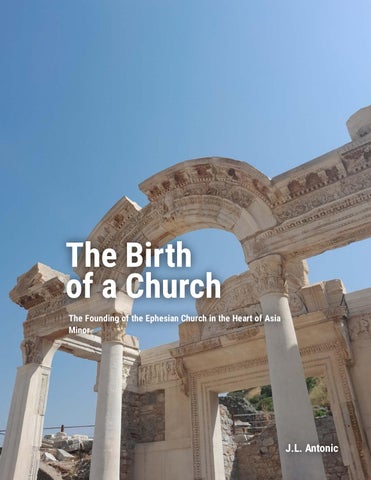
The Birth of a Church The Founding of the Ephesian Church in the Heart of Asia Minor
J.L. Antonic
Table of Contents The Ancient City of Ephesus
4
The Great Theater of Ephesus
5
The Library of Celsus
6
The Harbor of Ephesus (Port of Ephesus)
7
Worship of Ephesian Artemis (Diana)
9
Ephesus in the Bible
10
The Beginnings of a Gentile Church
11
A Seed is Planted in Ephesus
12
Completing An Un nished Work
13
The Church at Ephesus
14
Acts 19:1-8 (KJV)
15
Acts 19:1-8 (NIV)
15
(Acts 19) The In uence of Miracles
16
(Acts 19-20) Overcoming Strong Contention
17
(Acts 20:18-38) Paraphrased
18
(Acts 20-28) At Mission's End
19
Ephesus in other Epistles
20
1 Corinthians 15:32
20
1 Timothy 1:2-7
20
Ephesus in Revelation 1-2
21
Timeline of Bible Events at Ephesus
22
The Book of Ephesians
23
Ephesians - Commentary on Key Verses
24
Ephesians - Commentary on Key Verses Cont'd
25
Study Keys
26
Getting in Touch
28
01
The Ancient City of Ephesus
Ephesus was an ancient Greek and Roman city located on the western coast of present-day Turkey. Today the modern Turkish name of Ephesus is Selçuk - a small agricultural town which has a population of 36.000 people. Founded by Ionian Greeks in the 10th century BC, it was once a prominent port city and a center of trade, culture, and religious worship. According to mythology, it was established by Androclus, a prince of Athens. However, archaeological evidence suggests that there were settlements in the area even before the Greek period. Ephesus ourished during the Hellenistic era, particularly under the rule of the Attalid dynasty after the death of Alexander the Great. The city became a vital port and commercial hub, attracting merchants from various parts of the Mediterranean. In 133 BC, Ephesus came under Roman control as part of the province of Asia and during the Roman period it experienced further growth and prosperity. Emperor Augustus invested in its infrastructure, including the construction of a large theater and the Temple of Artemis. The City of Ephesus became renowned in the Ancient World for its remarkable architecture and urban planning. Over time however, the harbor of Ephesus gradually silted up, leading to a decline in its maritime signi cance. Repeated invasions and earthquakes further contributed to the city's eventual downfall and by the 7th century AD, Ephesus was largely abandoned. Today, the ruins of Ephesus are a UNESCO World Heritage site and attract visitors from around the world. They provide valuable insights into the ancient Greek and Roman civilizations, their architectural achievements, and their historical signi cance.
The Birth of a Church - The City of Ephesus
The Great Theater of Ephesus The Great Theater of Ephesus was an ancient amphitheater located in the city of Ephesus, in present-day Turkey. Built during the Hellenistic period, around the 3rd century BC, but it underwent several renovations and expansions during the Roman era. It was carved into the slope of Mount Pion, providing a natural setting for the theater. The original design incorporated both Greek and Roman architectural elements. The Great Theater was capable of accommodating approximately 25-30,000 spectators, and was therefore one of the largest and most impressive theaters of the ancient world. The semicircular seating area was tiered into three main sections ("diazomas") and provided excellent acoustics, allowing the audience to hear performances clearly. It was primarily used for theatrical performances, including plays, dramas, and comedies, but also hosted musical and poetic contests, gladiatorial games, and public assemblies. The theater served as a gathering place for the people of Ephesus, and it played a signi cant role in the cultural and social life of the city.
The Birth of a Church - The Founding of the Ephesian Church in the Heart of Asia Minor Page
4
The Birth of a Church - The City of Ephesus
The Library of Celsus The Library of Celsus was built during the Roman period in the 2nd century AD, under the rule of the Roman Emperor Hadrian. It was commissioned by Gaius Julius Aquila in honor of his father, Celsus Polemaeanus, a renowned Roman senator and consul. The library was designed by the architect Vitruoya, and its construction was completed by Celsus' son, Gaius Julius Aquila. The library served as a repository for ancient texts and manuscripts, housing a vast collection of scrolls and books. The main reading room, known as the Bibliotheca, featured shelves designed to accommodate a collection of thousands of scrolls and books. As a center for education, research, and intellectual activities in Ephesus, scholars, philosophers, and students would gather there to study and access the wealth of knowledge contained within its walls. Like many ancient structures, the Library of Celsus suffered from earthquakes and res over the centuries. It was damaged by an earthquake in the 3rd century CE and subsequently rebuilt. However, in the 4th century CE, the library was destroyed, likely during an invasion by the Goths. The modern facade is a reconstruction, based on the original architectural elements
The Birth of a Church - The Founding of the Ephesian Church in the Heart of Asia Minor Page
5
The Birth of a Church - The City of Ephesus
The Harbor of Ephesus (Port of Ephesus) The Port of Ephesus was located on the western coast of Asia Minor (modern-day Turkey), near the Aegean Sea. It was situated at the mouth of the Cayster River, which provided a natural harbor and facilitated maritime trade. A vital hub for international trade and commerce, it connected Ephesus to other major cities and regions throughout the Mediterranean, allowing for the exchange of goods, ideas, and cultures. The port facilitated the import and export of various commodities, including grain, marble, textiles, pottery, and spices. The port's strategic location as an ideal stopover point for ships traveling between Greece, Rome, Egypt, and other parts of the Mediterranean contributed to the growth and prosperity of Ephesus by attracting merchants, traders, and travelers. Over time, sedimentation from The Cayster River's gradually lled the harbor and made it unnavigable. As a consequence of being no longer directly connected to the sea, the ancient Port of Ephesus experienced a shift away from its maritime focus and fell into decline. Modern archaeological excavations and research continue to have provide insight into the port's infrastructure and operation.
The Birth of a Church - The Founding of the Ephesian Church in the Heart of Asia Minor Page
6
The Birth of a Church - The City of Ephesus
Temple of Artemis of Ephesus (Diana) One of the Seven Wonders of the Ancient World, the Temple of Artemis was a signi cant religious site in Ephesus. Built under Croesus, king of Lydia, about 550 BC, it was designed and constructed around 550 BCE by the Greek architect Chersiphron and his son Metagenes. An architectural marvel and an impressive display of wealth and craftsmanship, the structure was made primarily of marble and featured a mix of Ionic and Corinthian architectural styles. The temple was dedicated to the Greek goddess Artemis (Roman equivalent: Diana) who was the goddess of hunting, wilderness, and fertility. Artemis was a highly venerated deity in ancient Ephesus, and the temple served as a major religious center attracting pilgrims from far and wide. Also known as the "Artemision", the temple stood as a testament to the grandeur and importance of the Artemis cult in the city.
The Birth of a Church - The Founding of the Ephesian Church in the Heart of Asia Minor Page
7
The Birth of a Church - The City of Ephesus
Worship of Ephesian Artemis (Diana) The worship of Artemis (also known as Diana) in the city of Ephesus was of immense importance and held a central place in the religious and cultural life of the city. In Ephesus, the cult of Artemis took on a distinctive form known as the "Artemis of Ephesus" or "Ephesian Artemis." This fusion of Anatolian and Greek religious traditions, resulted in a unique depiction and worship of the goddess. Artemis was venerated as the goddess of hunting, wilderness, and fertility. In Ephesus, the emphasis was on her role as a fertility goddess associated with the abundance of nature and the cycles of life. The representation of Artemis in Ephesus was uniquely depicted as a multibreasted gure adorned with symbols associated with fertility and abundance, such as eggs, animals, and fruits. Her cult was believed to bring prosperity and protection to the city and its inhabitants. Priests of Artemis were responsible for the maintenance of the temple and the performance of rituals while Priestesses known as the "Melissae" or "Bees" played a signi cant role in the worship of Artemis and enjoyed the respect of high social status. The Birth of a Church - The Founding of the Ephesian Church in the Heart of Asia Minor Page
8
02
Ephesus in the Bible
Ephesus is mentioned several times in the Bible, particularly in the New Testament. The book of Acts mentions Ephesus extensively. It describes the Apostle Paul's visits to the city and his interactions with the people there. Acts 18:19-21 mentions Paul brie y stopping in Ephesus on his way to Jerusalem, and in Acts 19, Paul spends a signi cant amount of time in Ephesus, preaching and performing miracles. The chapter also recounts the riot that broke out due to opposition to Paul's teachings. The Apostle Paul wrote several letters to the Christian community in Ephesus. The Epistle to the Ephesians is addressed speci cally to the believers in Ephesus and discusses various theological and practical matters. Ephesians 1:1 and Ephesians 6:23 mention the recipients of the letter as "the saints who are in Ephesus." Additionally, Paul mentions Ephesus in 1 Corinthians 15:32, 1 Timothy 1:3, and 2 Timothy 1:18. The book of Revelation contains a letter addressed to the church in Ephesus. In Revelation 2:1-7, the message from Jesus Christ commends the Ephesian church for their perseverance but rebukes them for losing their initial love and calls them to repent. These biblical references highlight the signi cant presence of Ephesus in the early Christian community and its interactions with the Apostle Paul. The city of Ephesus played a crucial role in the spread of Christianity in the region, and the biblical accounts provide insights into the challenges and triumphs faced by the early Christians in Ephesus.
The Birth of a Church - The City of Ephesus
The Beginnings of a Gentile Church The city of Ephesus features very prominently in the history of the early church. After Jesus Christ ascended into heaven, he told the disciples to wait in Jerusalem until they were endued with power from God to be his witnesses throughout the world (Luke 24:49). After the Holy Spirit was poured out on the day of Pentecost (Acts 2:4), and as the apostles began to preach in their communities, the church began to grow exponentially (Acts 2:41-47). The edgling church made up of former Jews was met with strong opposition by those Jews who did not accept Jesus Christ (Acts 8:1). Including among these was jewish leader named Saul. Saul zealously persecuted the church (Acts 8:3) and very nearly destroyed it (Acts 9:1-2) condoning the stoning murder of the evangelist Stephen. God intervened however, appeared to Saul, and converted him to a follower of Jesus Christ (Acts 9:1-23). Initially the church feared to include Saul (Acts 9:26), but after the Apostle Barnabas vouched for him (Acts 9:27) and he proved his ministry to them, the church welcomed Saul sending him rst to Cesarea and then to Tarsus (Acts 9:30) after his life was threatened by Jewish opposition there. Up until this point, the gospel had not yet been preached to any gentiles(non-jews). Only Jews and Samaritans (half-jewish). Upon the conversion of a Roman centurion named Cornelius (Acts 10), the church in Judea became concerned about gentiles coming into the church (Acts 11:1). The Apostle Peter, who converted Cornelius, explained to them (Acts 11:5-18) how was he given a vision by God (Acts 10) to include the gentiles in their ministry. They accepted what Peter related to them (Acts 11:18) and thereafter agreed to share the gospel with the gentiles. Having been mentored in ministry for a time by Barnabas, Saul (now called "Paul") embarked on what would a series of three missionary journeys, the latter two of which would take him to Ephesus to help establish that church. He would go on to have an extremely in uential ministry to the now combined jewish and gentile church writing many pastoral letters (epistles), including one to the the church at Ephesus included as the 8th book in the New Testament.which we call now call the book of "Ephesians". The book of Acts, Chapters 18-20 describes the establishment of the church at Ephesus beginning with Paul's second missionary journey which takes him there for the rst time.
The Birth of a Church - The Founding of the Ephesian Church in the Heart of Asia Minor Page
10
The Birth of a Church - The City of Ephesus
A Seed is Planted in Ephesus Having travelled through Syria, Cilicia, Galatia, Asia, Macedonia, we nd Paul having left Athens, arriving in Corinth where, working in his craft as a tentmaker to support himself, he meets a Jewish couple named Priscilla and Aquila (Acts 18:2). These then travel with him as he makes his way back to Syria. On his way, Paul stops at Ephesus for the very rst time. Leaving Priscilla and Aquila in the city, he goes into the local synagogue to reason with the Jews there (Act 18:19). They ask him to stay longer but he declines citing his desire to not miss a feast in Jerusalem. (Acts 18:20-21). Paul sails back home. After Paul left Ephesus a Jewish follower of Jesus not known to Paul named Apollos arrived on the scene from Alexandria and began preaching Jesus from the Hebrew Scriptures. He convinced many Jews in Ephesus that Jesus is Christ (Messiah) but had not heard the teaching of Peter and the Apostles about conversion to the gospel (Acts 2:37-41). He had only heard about the baptism offered by John the Baptist. (Acts 18-24-25). Still in Ephesus, Priscilla and Aquila, intercept Apollos (Acts 18:26) and begin teaching him for a short span before he decides to leave and visit the church at Corinth in Achaia (Acts 18:28) where he again meets Paul's disciples. (1 Corinthians 3:6) The Birth of a Church - The Founding of the Ephesian Church in the Heart of Asia Minor Page
11
The Birth of a Church - The City of Ephesus
Completing An Un nished Work When Paul last left Ephesus the Jews there were not yet fully persuaded of Jesus Christ but were eager to hear more. Having been persuaded afterward by Apollos that Jesus was the Christ (Messiah) they were taught only as much as Apollos knew. (Acts 18:25). Therefore when Paul arrived back on the scene in Ephesus, the rst thing he did was track down twelve of these new believers (termed "disciples of Jesus") and took an inventory of their conversion aligning them with Peter's prescription to "Repent, and be baptized every one of you in the name of Jesus Christ for the remission of sins, and (ye shall) receive the gift of the Holy Ghost." (Acts 2:38). Paul asked them if they have either received either the baptism of the Holy Spirit or been water baptized in the name of Jesus Christ since they rst believed. (Acts 19:1-7) They only knew about John's baptism from Apollos so Paul instructed them further. He then re-baptized them water "in the name of the Lord Jesus" (Acts 19:5). Afterward Paul then laid his hands on them and they received the Holy Spirit as evidenced by speaking in other tongues and prophesy. (Acts 19:27). This work brought their conversion experience into alignment with that shared by the rest of the church. The Ephesian Church was now born.
The Birth of a Church - The Founding of the Ephesian Church in the Heart of Asia Minor Page
12
03
The Church at Ephesus
Nearly twenty years (54 AD) after the Apostolic Church was birthed in Jerusalem on the day of Pentecost (33-34 AD), with the conversion of a dozen Jewish disciples the Church at Ephesus had begun. With the Apostle Paul taking the lead, evangelists Apollos (of Alexandria, Carthage) and husband and wife ministry team of Priscilla and Aquila (of Corinth, Macedonia) all played a role in leading these Jewish disciples of Jesus through their conversion to Christianity. Returning to Ephesus on his third missionary journey, the Apostle Paul quickly assimilated these Jewish disciples of Jesus Christ at Ephesus by aligning them to the same gospel message preached by Peter at the birth of the church in Jerusalem almost twenty years prior (Acts 2:38). In so doing, he re-baptised them in water in Jesus Name and then, laying hands on them, they received the Holy Spirit as evidenced by the miracles of speaking in other tongues and prophesying. As Paul would later say similarly of the work in Corinth, "I have planted, Apollos watered; but God gave the increase. (1 Cor 3:6) The Ephesian church planted, and the twelve (Acts 19:7) believers converted to Christ, Paul then seized the opportunity to continue to spread the Gospel throughout the city by spending the next three months speaking in the synagogue. (Acts 19:8). Unfortunately his ministry was met with strong opposition by the remaining Jews and they spoke out against his ministry throughout the city. This caused Paul to separate himself and the new Christians from the Jewish synagogue and relocate their ministry to a local school run by a man named Tyrannus where they would spend the next two years promoting the gospel of Jesus. (Acts 19:8-10) From this preaching point, Paul was able to reach the whole province of Asia, his ministry being con rmed by God by way of "special miracles" (Acts 19:10-12)
The Birth of a Church - The City of Ephesus
Acts 19:1-8 (KJV)
Acts 19:1-8 (NIV)
1 And it came to pass, that, while Apollos was at Corinth, Paul having passed through the upper coasts came to Ephesus: and nding certain disciples,
1 While Apollos was at Corinth, Paul took the road through the interior and arrived at Ephesus. There he found some disciples
2 He said unto them, Have ye received the Holy Ghost since ye believed? And they said unto him, We have not so much as heard whether there be any Holy Ghost.
2 and asked them, “Did you receive the Holy Spirit when[a] you believed?” They answered, “No, we have not even heard that there is a Holy Spirit.”
3 And he said unto them, Unto what then were ye baptized? And they said, Unto John's baptism.
3 So Paul asked, “Then what baptism did you receive?” “John’s baptism,” they replied.
4 Then said Paul, John verily baptized with the baptism of repentance, saying unto the people, that they should believe on him which should come after him, that is, on Christ Jesus.
4 Paul said, “John’s baptism was a baptism of repentance. He told the people to believe in the one coming after him, that is, in Jesus.”
5 When they heard this, they were baptized in the name of the Lord Jesus.
5 On hearing this, they were baptized in the name of the Lord Jesus.
6 And when Paul had laid his hands upon them, the Holy Ghost came on them; and they spake with tongues, and prophesied.
6 When Paul placed his hands on them, the Holy Spirit came on them, and they spoke in tongues[b] and prophesied.
7 And all the men were about twelve.
7 There were about twelve men in all.
The Birth of a Church - The Founding of the Ephesian Church in the Heart of Asia Minor Page
14
The Birth of a Church - The City of Ephesus
(Acts 19) The In uence of Miracles Notwithstanding the miracle of the Ephesian Christians speaking in tongues and prophesying, God continued to con rm the truth of Paul's ministry with supernatural signs and miracles. Because of the demands on his ministry, Paul could not travel to everyone who sought after him to pray for them. To solve the problem, he employed an unconventional strategy to reach those in need. Paul prayed over pieces of fabric (handkerchiefs/aprons) and sent them to those in need. The Bible records that when the people received the fabrics, they were healed from both diseases and evil spirits. (Acts 19:12) One of the chief priests in Ephesus named Sceva had seven sons who would go from city to city casting evil spirits out of people. They were so impressed by the power and authority of Paul's ministry that they tried to appropriate it by trying to take dominion over the evil spirits "by Jesus whom Paul preached" (Acts 19:12-14). When they tried this on a possessed man it back red terribly because the evil spirit recognized they had no authority in Jesus to use his name. The man then attacked them and overpowered them, the evil spirit saying "Jesus I know. Paul I know, but who are you? Word of this spread among the Jews and the Greeks in Ephesus and they feared the power of the Gospel. (Acts 19:15-17) These events had a profound effect on the local people who as a result magni ed God and turned favorably toward the church even going so far as voluntarily burning all of their extremely valuable books which dealt with occult practices. This enabled the Word of God to increase in in uence. (Acts 19:17-20)
The Birth of a Church - The Founding of the Ephesian Church in the Heart of Asia Minor Page
15
The Birth of a Church - The City of Ephesus
(Acts 19-20) Overcoming Strong Contention As Paul's ministry spread the gospel message throughout the whole province of Asia, it caused discontent among one unique group of people, speci cally the artisans and craftsmen who were devoted to making objects and idols used in the Temple of Artemis and others like it for worship. As people turned away from these "false gods" and "idols" it signi cantly impacted the incomes of these who relied on the revenues associated with the temples. One of the leading voices of this opposition to Paul's ministry was a man named Demetrius who made a lot of income producing silver shrines for Artemis (Diana). Demetrius took it upon himself to gather the other idol craftsmen and persuaded them to oppose Paul who was teaching that their silver "gods" weren't really gods at all but just objects made by men's hand. He complained that this problem extended beyond Ephesus to all over the province of Asia (modern western Turkey). They feared that because of the gospel they would lose their livelihoods and the Temple of Artemis (Diana) would lose all relevance. (Acts 19:24-27) Hearing Demetrius' complaints, the craftsmen became enraged, shouted in protest, and then went and captured Paul's traveling companions dragging them to the Great Theater throwing the whole city into confusion and unrest. Paul tried to intervene but he was prevented by those loyal to him that feared for his life. With everyone gathered in the Great Theater they all began to argue until the Jews delegated a man from among them, Alexander, to stand up and defend Paul. But the crowd gathered were Greeks and did not want to hear it and shouted at them "Great is Diana of the Ephesians!" for two hours straight. (Acts 19:28-34) The town clerk then intervened on behalf of Paul's companions persuading and then dismissing the Ephesian assembly telling them that if Demetrius and others had a complaint they were to go to the law and abandon mob tactics. The crowd dispersed, Paul's companions were released, and they were reunited without incident. Things having stabilized, Paul then left for Macedonia. (Acts 19:35-20:1) After next completing a ministry circuit spanning the Aegean Sea, Paul determined to return back to Jerusalem for Pentecost. Instead of stopping at Ephesus, he stopped on Miletus and instead called the elders of the Ephesian church to meet him there where he gave them advice they needed to continue the ministry of the church. (Acts 20:15-18)
The Birth of a Church - The Founding of the Ephesian Church in the Heart of Asia Minor Page
16
The Birth of a Church - The City of Ephesus
(Acts 20:18-38) Paraphrased When the elders came to Paul in at Miletus, he said unto them, "You recall, from the rst day that I came into Asia, how I conducted myself in ministry, serving the Lord with all humility of mind, despite the many tears, and temptations, which I suffered from the Jews that plotted evil against me. I held back no pro table teaching from you but showed you all I know teaching both publicly and house-to-house testifying to both the Jews and the Greeks repentance toward God and faith toward our Lord Jesus Christ. But now, the Spirit of God compels me to go to Jerusalem despite warning me in advance that the journey will likely end in my imprisonment and suffering. Despite this, I do not count my own life so dear that I am persuaded to avoid my fate. I am called to ful ll the ministry Christ has given me to testify of the gospel of the grace of God. I know that all of you here whom I have preached to will never see my face again. Take note to yourselves that I am innocent of anyone here's damnation because I know I have declared to you the full truth of God. Be diligent to "feed the ock", God's church which He purchased with His own blood, and over which the Holy Spirit has made you overseers. For, after I leave you, others will come like wolves and grieve you as they try and tear the church apart. Also from among your own ranks, men will rise up and will pervert the things I have taught you to draw people away to follow themselves. Watch and remember how, for three years night and day, I never stopped warning you all through my tears to remain vigilant. I leave you in God's hands and in the word of His grace which is able to build you up and to give you an inheritance among those whom God has saved (sancti ed). I have not desired your money, wealth, or your clothes as I have provided for myself by my own hands (making tents). And to those that were working alongside me, I taught you you how to labor (in a craft) for an income to support the needs of the church. And to remember how the Lord Jesus taught us it is better to give than to receive."
Then Paul kneeled and prayed with the elders. They were all so grieved when he told them that he would never see them again that they wept heavily and put their arms around his neck, kissing him like a brother before escorting him to his ship.
The Birth of a Church - The Founding of the Ephesian Church in the Heart of Asia Minor Page
17
The Birth of a Church - The City of Ephesus
(Acts 20-28) At Mission's End Acts 20:17 brings us to a pivotal point in the history of the church at Ephesus. Just like the end of his second missionary journey we nd Paul meeting with the church before embarks to Jerusalem for Pentecost. Only this time, instead of reassuring them as he did before that he would return, he instead related that he would likely not because Holy Spirit warned him repeatedly that he would be arrested and punished ("a icted"). Knowing all of this lends quite a bit of gravity to Paul's pastoral advice (Acts 20:17-38) as it was given with the understanding that these were his last wishes for the church because he would never see them again. In fact, after hearing Paul's pastoral exhortation all of the elders broke down and cried sorrowfully before seeing him on his way to Jerusalem. (Acts 20:36-38) On his journey back to Jerusalem, Paul stopped in in Caesarea at the house of Philip the Evangelist and was warned there by a Judean prophet named Agabus not to go down to Jerusalem because the Jews there intended to capture him and turn him over to the gentiles. Instead of deviating course, Paul declared that he was ready to be bound and suffer for the gospel and sailed on to Jerusalem. (Acts 21:8-15) On arrival in Jerusalem, Paul met with the church elders (including Luke) and the Apostle James updating them about the work amongst the gentiles in Asia (Ephesus). They then gave Paul advice to remind the gentile church to avoid things offered to idols, blood (sacri ces), things strangled, and from fornication (all aspects of pagan worship). After a puri cation ritual, Paul left the temple. (Acts 21:18-26) After being seen walking with Trophimus of Ephesus he was recognized by some Jews from Asia. An angry mob arose, captured Paul, and dragged him out of the temple to kill him. The chief captain of the band heard about the unrest and quickly deployed soldiers and centurions to disband the mob. When they arrived the Jews were beating Paul in the street. The captain arrested him and demanded information but getting no clear answer, brought him into the castle for safety. (Acts 21:27-36). Acts 22-28 recounts Paul's continued imprisonment and many appeals. It was around 60 AD that Paul wrote his pastoral "Letter to the Ephesians" from prison. Paul later received clemency and continued to minster freely from a rented house in Rome for two years accompanied by Luke. Despite this, in 68 AD Paul was re-arrested by Roman Emperor Nero and beheaded.
The Birth of a Church - The Founding of the Ephesian Church in the Heart of Asia Minor Page
18
The Birth of a Church - The City of Ephesus
Ephesus in other Epistles 1 Corinthians 15:32 If after the manner of men I have fought with beasts at Ephesus, what advantageth it me, if the dead rise not? let us eat and drink; for tomorrow we die. Here Paul is speaking derogatorily of mob of the Diana Worshippers of Ephesus likening them to coliseum "beasts" who opposed him at the Great Theatre and desired to kill him; thereby saying effectively that, "There's no point for someone to contend for the gospel in the face of such erce and deadly opposition if the resurrection of Jesus is a hoax/lie/untrue".
1 Timothy 1:2-7 2 Unto Timothy, my own son in the faith: Grace, mercy, and peace, from God our Father and Jesus Christ our Lord. 3 As I besought thee to abide still at Ephesus, when I went into Macedonia, that thou mightest charge some that they teach no other doctrine, 4 Neither give heed to fables and endless genealogies, which minister questions, rather than godly edifying which is in faith: so do. 5 Now the end of the commandment is charity out of a pure heart, and of a good conscience, and of faith unfeigned: 6 From which some having swerved have turned aside unto vain jangling; 7 Desiring to be teachers of the law; understanding neither what they say, nor whereof they a rm. After Demetrius' Uprising in Acts 19, in Acts 20:1 Paul Ephesus left for Macedonia. What Luke omits in Acts, we learn here in 1 Timothy 1, namely that Paul entrusted his ministry to Timothy, leaving instructions on what to instruct the church in his absence. Paul's exhortation (1 Tim 1:3-17) is consistent with what he gave the church elders at Miletus in Acts 20:28-31 regarding those who would teach their own false doctrines to gain followers for themselves. In verse 3 Paul begins "...as I besought thee" which means "in the same way I asked you to " and in verse 18 we pick up the new command "this (new) charge I commit unto thee "
The Birth of a Church - The Founding of the Ephesian Church in the Heart of Asia Minor Page
19
The Birth of a Church - The City of Ephesus
Ephesus in Revelation 1-2 The book of Revelation, written by the Apostle John, is originally titled in Greek "The Apocalypse of John". The Greek word Apokalypsis (Ἀποκάλυψις) does not mean the "cataclysmic destruction of the world". It actually means "a revealing, uncovering, or disclosure". The purpose of the book of Revelation is to "reveal" hidden truth to us. Writing sometime between 95-100 AD, while imprisoned for the gospel's sake on the island of Patmos (Rev 1:9), the Apostle John wrote of a series of revelations come to him from Jesus Christ (Rev 1:1). He begins by addressing the seven churches of Asia (Rev 1:4, 11) which include the church at Ephesus. John begins by sharing a vision of seven candlesticks representing the churches, Jesus standing in their midst, sending seven stars (angels) to watch over each church. Revelation 2 begins the rst message from Jesus to the churches beginning with the Church of Ephesus. Scholars debate whether these messages were precise messages for not only those exact churches at that time, or whether or not they represented symbolically various church "ages" as well - Ephesus being the rst age and Laodicean being the last before the second coming of Jesus Christ. The message to the Ephesian Church (Rev 2:1-7) begins with Jesus speaking to the church (v1). He then commends the church for their good works, labor, and patience (v 3) and how they refused to deal with evil people. Paul's chief concern after leaving the Ephesians was that they would fall victim to deceivers. Jesus commends the Ephesian Church for following Paul's and Timothy's warnings by trying false apostles and exposing their lies. (Rev 2:2). Jesus cites their hatred of the rising practice of the "Nicolaitanes" meaning "followers of Nicolas" or those in ministry who seek to subjugate the church by way of power ("nico") over the laity ("laitanes").(Rev 2:6) Jesus also reminded them not to forget "their rst love". In their maturity and steadfastness they had begun to forget from where they had fallen and to renew their repentance (Rev 2:4-5). Jesus promises eternal life to the overcomer. (Rev 2:7) The Birth of a Church - The Founding of the Ephesian Church in the Heart of Asia Minor Page
20
The Birth of a Church - The City of Ephesus
Timeline of Bible Events at Ephesus Year
Event
~1000 BC
Ionian Greeks establish the city of Ephesus
~550 BC
Croeses of Lydia builds the Temple of Artemis in Ephesus
~400 BC
The Great Theater is built
~133 BC
Ephesus falls to Roman Rule, becomes part of the province of Asia
0-33 AD
Jesus' life, ministry, death, resurrection, and ascension (Gospels, Acts 1)
33 AD
Day of Pentecost (Acts 2)
36 AD
Saul's Conversion (Paul) (Acts 9:1-23)
51-54 AD
Paul's Second Missionary Journey (brie y at Ephesus in 54 AD)
54-58 AD
Paul's Third Missionary Journey (Church at Ephesus begins in 54 AD)
55-57 AD
Paul stays in Ephesus to build the church
57 AD
Paul leaves Ephesus for Macedonia (Summer of 57 AD)
58 AD
Paul is arrested in Jerusalem
62 AD
Paul writes his letter (epistle) to the Ephesians from a Roman prison
63 AD
Paul is acquitted and released from prison
68 AD
Paul is re-arrested and executed by Roman Emperor Nero
95-100 AD
Apostle John writes Revelation from prison on Patmos - mentions the Church at Ephesus
The Birth of a Church - The Founding of the Ephesian Church in the Heart of Asia Minor Page
21
04
The Book of Ephesians
The traditional author of Ephesians is the Apostle Paul around 60 AD, Paul was in a Roman prison awaiting trial. . The letter opens with the statement, "Paul, an apostle of Christ Jesus by the will of God" (Ephesians 1:1). However, some scholars debate whether Paul personally wrote the letter or if it was dictated to one of his followers. The letter is addressed to the Ephesian church, however, as Paul mentions "and to the faithful in Christ Jesus" in the benediction of the letter, it's worth noting that the letter might also have been intended for a broader audience, manifested by the letter's eventual inclusion into the New Testament canon. Ephesians explores several theological and practical themes. It emphasizes the unity of the body of Christ, the church, and the reconciliation of Jews and Gentiles through Christ. The letter discusses God's plan of salvation, the role of grace and faith, and the work of the Holy Spirit in the lives of believers. It also provides instructions on Christian living, including relationships within families and the importance of spiritual armor in the face of spiritual warfare. Ephesians can be divided into two main parts. The rst three chapters focus on theological teachings and doctrinal concepts, emphasizing the unity of believers in Christ and God's redemptive plan. The latter three chapters shift to practical applications, addressing issues of Christian conduct and ethical living. The Book of Ephesians offers profound theological insights and practical guidance. It emphasizes the importance of unity, grace, faith, and the work of the Holy Spirit.
The Birth of a Church - The City of Ephesus
Ephesians - Commentary on Key Verses Benediction (1:1-2) The Apostle Paul, writing to the church at Ephesus makes a benediction with a curious distinction between "God our Father" and the "Lord Jesus Christ". We can know that Paul believed Jesus was the son of God, because he says God is "The...Father of our Lord Jesus Christ". At the same time he says that God is "The God...of our Lord Jesus Christ" leaving us to ponder the deity of Christ. Thankfully we are provided with clarity by way of Paul's letter to Timothy (1 Tim 3:16) where Paul declares clearly that Jesus is "God manifest in the esh" showing that he believed Christ not to be "God the Son", a second God, or a second person(a) of God but that the man Christ Jesus was a eshly manifestation of the one singular God (Θεοῦ). God's Eternal Plan (1:3-12)-- Paul declares that God had the church planned when he created the earth and that those who followed his son Jesus Christ would have eternal salvation by being adopted into the Kingdom of God. Paul a rms to the church that "we" (inclusive of all christians) have obtained an eternal inheritance because of God's grace and the forgiveness of our sins through Jesus' blood and that "we" the church are glori ed by being the rst ones to trust in Christ. A Distinct Experience (1:13) "In whom ye also trusted, after that ye heard the word of truth, the gospel of your salvation: in whom also after that ye believed, ye were sealed with that holy Spirit of promise." Many christian leaders and churches take this verse out of context, loosely applying it to their evangelical creeds, erroneously concluding and even teaching that because someone believes in Jesus, or prays a sinner's prayer, or kisses the ring of their bishop at a con rmation ceremony that they are automatically therefore " lled with the Holy Spirit". A careful reading of Ephesians 1:13 however proves otherwise. Ephesians 1:13 is not a prescription, it is a reminder of an event that already happened when the church was formed. It is referring to Acts 19 where the Ephesian believers in Jesus Christ had not been lled with the baptism of the Holy Spirit "since (they) believed" (Acts 19:2) proving a the distinction between belief and sancti cation. Paul reminded them that after they heard and believed the full truth from him (Acts 19:4-5) they were sealed with the Holy Spirit (Acts 19:6) a rming their covenant relationship with Jesus. A Deposit Contract (1:14) Paul goes on to teach the Ephesians that the Holy Spirit is the "earnest of their inheritance until the redemption". This means that the purpose of Holy Spirit baptism is that it functions as God's spiritual deposit (of Himself!) in the heart of the believer guaranteeing (s)he will be redeemed for heaven.
The Birth of a Church - The Founding of the Ephesian Church in the Heart of Asia Minor Page
23
The Birth of a Church - The City of Ephesus
Ephesians - Commentary on Key Verses Cont'd Saved by Grace through Faith Ephesians 2:8-9: "For by grace you have been saved through faith, and that not of yourselves; it is the gift of God, not of works, lest anyone should boast." This oft quoted scripture is used my many protestants to challenge doctrines for example from the Catholic Church which point to works or acts of penance as a means of achieving God's grace and favor. Many of these have misunderstood grace by declaring any act of christian obedience a "work". Looking back over our study of the church at Ephesus, when was it that Paul considered them "saved"? When they believed in Jesus? Or, was it when they acted upon their faith in Jesus by being water baptized in Jesus Name and receiving his Holy Spirit. It was the latter! The same Paul who instructed them to be baptized and laid hands on them did NOT CONSIDER these transactions to be "works" or deeds meriting one for salvation. Why not? Because that's not what they are. Baptisms are a means of entry into a covenant relationship with Christ explained by 1 Peter 3:21 and Colossians 2:12. By harmonizing the Ephesians (Acts 19:1-8) with the church at large (Acts 2, Acts 8, Acts 10, Acts 11) the believers were made recipients of God's grace - by their faith! Unity in the Gospel Ephesians 4:4-6: "There is one body and one Spirit, just as you were called in one hope of your calling; one Lord, one faith, one baptism; one God and Father of all, who is above all, and through all, and in you all." These verses highlight the unity of believers in Christ and the importance of maintaining harmony and love within the body of Christ. In these modern times, unity among churches is virtually non existent, yet for the rst few hundred years of Christianity, the church was united on most major themes - especially that we have one Lord (Jesus) and One God. There is only one True Faith (Christianity) and there is only one Baptism into that Faith. What baptism is Paul talking about? The baptism he gave the Ephesian church (Acts 19:3-5) baptizing them "in the name of the Lord Jesus", which brought them into alignment with the gospel of Jesus. Far too many want to bend the scriptures to t their doctrinal viewpoint vs. aligning with what was already taught by Jesus and His Apostles. To an honest reader, the Bible reads very clearly and requires no intellectual leapfrogging beyond what was taught by the Apostles, which is simply to "Repent and be baptized every one of you in the name of Jesus Christ for the remission of sins and ye shall receive the gift of the Holy Ghost." The unity God desires for His church is is realized only by those that are willing to forsake teachings that deviate from the gospel (Galatians 1:6-9) The Birth of a Church - The Founding of the Ephesian Church in the Heart of Asia Minor Page
24
05
Study Keys
When we read the book of Ephesians we must read it for what it is - a pastoral letter written to an established church. We cannot full understand and apply Ephesians to our lives until we rst understand that Paul was instructing to the same church he fathered in Acts chapters 18-20 and that many of the later references in 1 Timothy, Ephesians, Revelation etc. point squarely back to distinct events that happened during the formation of that church body. When Paul writes in 60 AD to the Ephesians "In whom ye also trusted, after that ye heard the word of truth, the gospel of your salvation: in whom also after that ye believed, ye were sealed with that holy Spirit of promise," (Eph 1:13) he is not teaching about the potential metaphysics of belief. Paul is speaking of a speci c event which occurred, recorded by his companion Luke in the book of Acts 19:1-7, occurring sometime between roughly 55-58 AD. Without the understanding that Paul is rea rming an experience the Ephesians already had, the meaning of Ephesians 1:13 becomes lost to the reader and the door swings wide open for doctrines that deny the doctrine of baptisms (Hebrews 6:2) and rob the believer of both a covenant with Christ and of spiritual uni cation with the Apostolic church of the Bible. Paul reminded the deacon Timothy to "Study to shew thyself approved unto God, a workman that needeth not to be ashamed, rightly dividing the word of truth." Our responsibility as Christians is not less than his. We need to study diligently with an open heart, mind, and spirit. Thank you for reading this book.
My Questions Did this study provoke any challenges or questions to the topics covered
Questions/Thoughts I need to study more about
My Thoughts My observations, journal moments, key notes, scriptures to remember
The Birth of a Church - The City of Ephesus
Getting in Touch If you have any questions, comments, challenges, concerns, or words of encouragement for the author OR if you would like to contact the author for a Bible Study or schedule him for a speaking event at your church or fellowship... please send an email to: theriverforum@gmail.com
The Birth of a Church The Birth of a Church - The Founding of the Ephesian Church in the Heart of Asia Minor, by J.L. Antonic presents a brief but compelling overview of the formation of one of the seven churches founded by the Apostle Paul in the Roman province of Asia (modern day western Turkey). Author J.L. Antonic's exploration of Biblical Ephesus provides both believers and non believers alike with a challenging new way to understand the New Testament. By examining a narrative slice of the Ephesian Church you will gain new insights about what the Bible has to say about a variety of topics which contrasted many teachings provided by sectarian churches, ministries, church movements, and denominations. This study provides a straight forward overview supported by scripture which attempts to eliminate any con rmation bias to any particular dogma, creed, orthodoxy, or church movement. If you feel challenged by the content provided, do your best to prayerfully ask God to open your understanding and then let the Bible speak for itself. Above any church tradition, dogma, doctrine, practice, or ministry, above even ministers themselves - above all other considerations, Christian disciples must be foremost students of the Bible and followers of the Truth it contains about our Lord, Jesus Christ. "Be diligent to present yourself approved to God, a worker who does not need to be ashamed, rightly dividing the word of truth." - 2 Timothy 2:15 (NKJV)