New Apostolic Reader’s Version
The Gospel According to Luke Κατὰ Λουκᾶν
An account of the life, ministry, death, and resurrection of Jesus Christ, written by Luke, a missionary companion of the Apostle Paul.
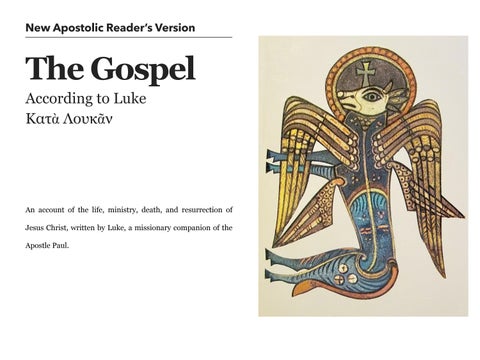
Reverse: An illumination from the Irish Book of Kells using the “winged ox” imagery found in Revelation 4:7 and Ezekiel 1:10 traditionally associated with Luke.
ABOUT LUKE The exact dates of Luke's life are not known, but scholars have made various estimates based on historical records and biblical accounts.Traditionally, Luke is believed to have lived in the 1st century AD, during the time of the apostles. Some estimates suggest that he was born around 5-15 AD and died: around 80-130 AD. Early Christian tradition identifies Luke as a physician as well as Paul’s reference in his letter to the church at Colosse. “ Luke, the beloved physician, and Demas, greet you.” - (Colossians 4:14). Luke is often depicted in art as an ox or a winged ox, symbolizing strength and sacrifice. Luke was a traveling companion of the Apostle Paul, joining him in Troas on his second missionary journey between 50-52 AD. Paul wrote his second letter to Timothy from prison (2 Tim 1:8, 12) saying all had abandoned him except for Luke. “Do thy diligence to come shortly unto me: For Demas hath forsaken me, having loved this present world, and is departed unto Thessalonica; Crescens to Galatia, Titus unto Dalmatia. Only Luke is with me. Take Mark, and bring him with thee: for he is profitable to me for the ministry.” (2 Tim 4:9-11) Paul’s letter to Timothy was most likely written during his first imprisonment. Luke was able to stay with him because it was more of a confinement under house arrest to bar him from preaching than it was a full incarceration.
ABOUT LUKE’S GOSPEL In Acts 1:1, Luke mentions a "former treatise," which is often interpreted as a reference to the Gospel of Luke. This suggests that the Gospel of Luke was written before the Acts of the Apostles. While some scholars believe that Luke wrote his Gospel after Matthew and Mark, placing it around 70-80 AD, others place it even earlier between 60-65 AD because the narrative in Acts ends in 62 AD and does not mention the execution of Paul in Rome which historians date from 62 AD to 67 AD. It is therefore likely that Luke’s Gospel was written while Luke was with Paul, under Roman house arrest around 60-62 AD. Most scholars agree that Luke used Mark's Gospel as one of his primary sources because Luke shares about 50% of his material with Mark, including many of the same stories and sayings. While there is evidence to suggest that Luke might have been familiar with Matthew's Gospel, the exact nature of their literary relationship remains a topic of ongoing debate and research among scholars. One theory suggests that Luke had access to Matthew's Gospel and used it as one of his sources when writing his own Gospel. An idea, growing in popularity, is that Luke translated an earlier, either Hebrew or Aramaic version of Matthew's Gospel into Greek. Some scholars believe that Luke wrote his Gospel independently of Matthew, using his own sources and traditions while others propose that Luke and Matthew shared a common source, referred to as "Q" (from the German "Quelle," meaning "source").
PROLOGUE Many have undertaken to write a narrative of what was accomplished in our midst. In the same way that the eyewitnesses and servants of the word have done from the beginning, (and) being perfectly acquainted with it since the start, I decided to carefully and methodically write about it. This is so that you, most excellent Theophilus, might know the certainty of what you were first taught.
New Apostolic Reader’s Version
Chapter One The Angel Gabriel visits Zachary and Mary
IN JUDEA, during the reign of King Herod, there lived a temple priest named Zachary from the Order of Abia and his wife Elizabeth, a descendant of Aaron. They were righteous and blameless before God, faithfully following all of His commandments and ordinances. Elizabeth could not have children, so despite their old age, they remained childless. When it was time for Zachary's priestly Order of Abia to perform their service to God, he was chosen by lots to burn incense in the temple. When the time came to burn the incense, many people were praying outside the temple. Suddenly, an angel appeared to Zachary, standing to the right of the Altar of Incense. Zachary was very afraid and troubled by what he saw. The Angel told him, “Don’t be afraid, Zachary, because the prayers of you and your wife have been heard (by God), Elizabeth will get pregnant with a son; you will call him ‘John’. The child will bring you joy and gladness; many will rejoice at his birth. He is destined for greatness before the Lord, And he will not drink wine or strong drink, And he shall be filled with the Holy Spirit even before he is born from his mother; And he will turn many of the sons of Israel to the Lord their God; And he will go forth in the spirit and power of Elijah to turn the hearts of the fathers toward their children, and (turn) the disobedient to the wisdom of the righteous - to prepare them for the Lord”. Zachary told the Angel, “How can I be sure this is true? I am an old man, and my wife is advanced in her years.”
The Angel answered, “I am Gabriel, the one who stands before God, and I was sent to speak to you and to bring you this glad message. Because you did not believe my words which will be fulfilled in due time, you will be silent and unable to speak until the day that these things take place.” Meanwhile, the people gathered for prayer had been expecting Zachary and wondered why he was delayed in the temple. When he came out, he was not able to speak to them. They recognized that he had seen a vision in the temple, but he could not explain it. He tried explaining by gesturing to them but failed because he was mute. When the day came for his shift of priestly duties to end, Zachary returned home. After the days of his shift, his wife Elizabeth conceived a child and secluded herself away for five months, saying, “The Lord has looked (favorably) upon me by doing this, and He has taken away my disgrace from among men.” In the sixth month of Elizabeth’s pregnancy, God sent Gabriel to a city in Galilee named Nazareth to meet with a maiden virgin named Mary, who was engaged to a man named Joseph of the House of David. (the family out of which the Messiah is supposed to come) And he (Gabriel) having come to her, announced: “Rejoice, favored one, the Lord is with you!”
But at his words she was troubled and confused about what manner of greeting this might be. The angel said to her, “Don’t be afraid, Mary, for indeed you have found favor from God. Behold you will conceive in your womb and bring forth a son and name him ‘Jesus’. He will be great and he will be called ‘Son of the Most High’. His father, the Lord God, will give him the throne of David. He will be king over the nation of Jacob forever and his kingdom will never end!” Mary replied to the angel, “How can this be since I have not been intimate [1097] with a man?” And answering, the angel said to her, “The Holy Spirit will come upon you and the power of the Most High will overshadow you. Therefore, the Holy child you bring forth will be called the ‘Son of God’.” And Behold! Your relative Elizabeth, whom everyone knew to be barren in her old age, is now six months pregnant with a son. Because, with God, nothing is impossible.” Then Mary said, “I am the Lord’s servant. Let it happen to me according to your promise.” And the angel departed from her. [1097] - γινώσκω (ginōskoo). “know” or “known” is conventionally idiomatic for “sexual intimacy”
Having arisen for the day, Mary departed quickly to the town of Judah in the hill country. When she came to the house of Zachary, she greeted Elizabeth. As Elizabeth heard Mary’s greeting, the baby in her womb leaped in her belly and Elizabeth was filled with the Holy Spirit. And Elizabeth called out in a loud voice “You are a blessed woman and blessed be the fruit of your womb. How is it that the mother of my Lord should come to (visit) me? Behold, just as your greeting came into my ears, my baby leaped for joy within my womb. And blessed is the one having believed that there will be a fulfillment of things that were spoken to her from the Lord.” And Mary replied: “The Lord magnifies my soul, and my spirit rejoices in God, my Savior! For he has looked upon the humiliation of his handmaiden and behold, from henceforth every generation will call me blessed. For the Mighty One has done great things for me, and Holy is His Name. And his mercy extends to generations upon generations of those who fear Him. He has shown strength with his arm, he has scattered the proud-minded in heart. He has brought down rulers from thrones and exalted the humble. He has filled the hungry with good things and the rich he has sent away emptyhanded. He has helped His servant Israel to remember mercy Just as he spoke to our fathers, to Abraham and to his descendents, from forever ago.” Then Mary dwelt with Elizabeth for about three months before returning back home.
Now that Elizabeth’s pregnancy was full-term, she gave birth to her son. Elizabeth’s neighbors and relatives heard her magnifying the Lord and His Mercy, and they rejoiced with her. And it came to pass on the eighth day, they who came to circumcise the child were calling the boy’s name Zachary after his father, But his mother told them, “No. He will be called John” And they said to her “…But no one among your relatives are called John!” (Because Zachary was still mute) They gestured to Zachary for him to indicate to them what he might wish to call the boy. Zachary asked for a writing tablet and wrote: “His name is John”. And they were all astonished. At that very moment, Zachary’s mouth was opened, his tongue was loosed to speak, and he immediately began praising God. And fear came upon all those who dwelled around them. Word of these things began to be talked about in all the hill country of Judea.
Since the hand of the Lord was upon him, all those who heard what happened reasoned within their hearts saying, “What will become of this child?” And his father, Zachary, was filled by the Holy Spirit and prophesied, saying: “Blessed be the Lord God of Israel because He has visited us and brought redemption to his chosen people, and has raised up a horn of salvation for us who are of the House of David, his servant. As was spoken by the mouth of His ancient holy prophets: ‘Salvation from our enemies and from the hand of those who hate us; to fulfill the mercy (promised) to our fathers; and to remember His holy covenant - the oath that He swore to Abraham, our father, to deliver us from the fear of the hand of our enemies, having been saved to serve Him in holiness and righteousnees all the days of our lives.’ And now, my child, you will be called a prophet of the Most High, and you will precede the Lord to prepare a path for Him; to give to his people the knowledge of salvation and remission of sins through the deep affection of God’s compassion which will visit us like the dawn of a new day from heaven which will shine upon those in darkness who sit in the shadow of death; and to direct our feet onto the path of peace.” And the child, continued to grow and was strengthened in spirit, living in the wilderness until the day when he first appeared in public to Israel.
New Apostolic Reader’s Version
Chapter Two Chapter Two
To be continued
References
Name Footnotes Aaron Brother of Moses and the first High Priest of the Israelites. He acted as Moses’ spokesperson during the Exodus from Egypt. From the Hebrew: אַהֳר ֹןor “Aharown” of unknown etymology and meaning.
Elijah Renown miracle-working prophet of God mentioned in 1 and 2 Kings, a pre-figure of John the Baptist who fervently upheld the worship of Yahweh. From the Greek “Ἠλίας (Elias). Origin: Hebrew: ֵא ִליּ ָהor ֵא ִליּ ָהוּ, or Eliyah or Eliyahu meaning either “strength of Jehovah”, or “my God is Jehovah”.
Elizabeth Cousin of Mary, the mother of Jesus, and mother of John the Baptist. From the Greek “Ἐλισάβετ (Elisabet) or “Ἐλεισάβετ” (Eleisabet). Origin: Hebrew: שׁבַע ֶ ֱאלִיor “Elisheba”, meaning “God is an oath”.
Gabriel One of the angel-princes or chiefs of the angels of God, Gabriel is often engaged with mankind as a messenger to annouce or explain. From the Greek “Γαβριήλ (Gabriél). Origin: Hebrew: ַגּב ְִריאֵלor “ ַגּב ְִריאֵלGavri’el” meaning either “man of God” or “strong man of God”.
Jacob (Israel) The Hebrew patriarch Jacob, grandson of Abraham, son of Isaac, bother of Esau. Later given the name “Israel”. From the Greek Ἰακώβv (Iakób”). Origin: Hebrew: “( ”יַעֲק ֹבYa’aqob), meaning “supplanter”.
References
Name Footnotes Jesus (of Nazareth) The declared name of the Son of God. Born of Mary of Nazareth, a descendant of King David of the tribe of Judah. The Christ. Messiah. From the Greek Ἰcσοῦν (Iēsoun) or Ἰησοῦς (Iēsous). Early Greek MSS: ιϲ, ιυ χυ, χν, ιηcοῦν; Aramaic - Isho (;)ܝܫܘܥ Eastern Syriac. Isho (īšōʕ); Latin, “IESV” or “IESVS”. Origin: Hebrew: “ַ ”י ְהוֹשׁוּעor “Yehoshua”, meaning “Yahweh is Salvation/Deliverer”.
John (the Baptist) A cousin of Jesus, and prophet whose ministry of repentance was to baptize people and urge them to follow Jesus. Jesus said that there has been no greater prophet born than John (Luke 7:28). Also that he came “in the spirit and power of Elijah (Elias)” (Luke 1:17) From the Greek Ἰωάννην (Ioánnin). Origin: Hebrew: י ְהוֹ ָחנָןor “Yehochanon,” meaning “the Lord has been gracious”
Joseph (of Nazareth) The husband of Jesus’ mother, Mary. After Joseph, the second youngest son of the Hebrew Patriarch Jacob. From the Greek Ἰωσὴφ (Iōsēph). Origin: Hebrew: יוֹסֵףor “Yoseph,” meaning “he increases”.
King Herod I (Herod the Great) (ruled from 36 BC - 1BC) Edomite vassal king of the Hasmonean dynasty over the Roman Province of Judea. Succeeded by Archelaus, and Antipas From the Hebrew ( חרדharad) or the Greek Ηρωδης (Herodes), meaning “Trembler, Coward”.
Mary (of Nazareth) Several women are named “Mary” or “Mariam” in the Bible, most notably Jesus’ mother. Mother of James, Joses (also known as Joseph), Judas (also known as Jude), and Simon.
μ
From the Greek Μαριά (Mariam). Origin: Hebrew: מ ְִרי ָםor “Miryam,” of unknown meaning.
References
Name Footnotes Theophilus Proper Name - also “Theo.” (Var.)”; Colloquial Name - “Friend of God”; a generic address to the reader From the Greek “Θεόφιλε (Theophile) or Θεόφιλος (Theophilos) meaning “friend of God”.
Zachary Husband of Elizabeth, the cousin of Jesus’ mother Mary. From the Greek: Ζαχαρία (Zacharia/Zachariah). (Origin: Hebrew: זְכ ְַרי ָהor “Zekaryah” meaning “God has remembered”.
References
Subject Footnotes Altar of Incense The Hebrew Altar of Incense was a significant piece of furniture in the Holy Place of the Tabernacle and later the First and Second Temples. It was used for burning incense, which was a daily offering, symbolizing the prayers of the Israelites ascending to God. The altar was located in the Holy Place, before the veil that separated it from the Most Holy Place. Priests would burn a specially prepared incense every morning and evening, using four precious spices: stacte, onycha, galbanum, and frankincense. (Ex 30:34) It was made of acacia wood, overlaid with pure gold, and was approximately 18 inches by 18 inches and 30 inches tall. (Ex 30:1-3)
Angel Literally “messenger”, angels are spirit beings that serve God and deliver messages from him to humans. They are often described as powerful, intelligent, and invisible. The Bible describes several types of angels such as Seraphim, Cherubim, Archangels, Messengers, all with different purposes. Some minister to the weak, some heal, some bring words of warning, some even kill. They are not visible to humans, except when God sends them on a special mission or clothes them in human form.
Eighth Day Relating to the covenant relationship between Abraham and his descendents and God. God commanded that all Hebrews males be circumcised. “This is my covenant, which ye shall keep, between me and you and thy seed after thee; Every man child among you shall be circumcised. (Gen 17:10) Mosaic law establishes that circumcision for newborns shall be done on the the eighth day of his life. “And in the eighth day, the flesh of his foreskin shall be circumcised”. (Lev 12:3)
Holy Spirit The Holy Spirit represents the divine presence of God in activity. The Holy Spirit is also known as the Holy Ghost. The Holy Spirit is the divine force of God that manifests in the world involved in creation, prophecy, and guidance. The Holy Spirit also seals believers' salvation, teaches and guides believers, sanctifies them, and fills them with strength and wisdom.
References
Subject Footnotes House of David The descendents of King David. Also called “the Davidic line”. According to the Hebrew Bible, David and his house—his descendants—were appointed by God to rule all Israel. David was the second king of Israel after Saul, and notably was champion over Goliath of Gath and the Philistines.
Messiah (GK: Μεσσίας “Messias”, Heb: “ מָשִׁ י ַחMashiyach”) Literally, “Anointed One” usually someone consecrated as a king, priest, or saint. Typically used in the context of a “promised deliverer” of the Hebrew People. Noah during the Great Flood, and Moses during the Exodus, are both Messianic precursors to Jesus Christ. Jesus as Messiah is a Jewish kinsman redeemer from the tribe of Judah, and a righteous king whose purpose is to lead the first the Hebrew people, and then all others, to eternal salvation and forgiveness of sins.
Most High A superlative, referring to God. In the title LORD Most High, the Hebrew words are Elohim Yahweh meaning that there is no god, idol, or created being that should be worshiped or exalted above Yahweh, the LORD, because He is superior in every way.
Order of Abia (Abijah) In the Bible, the order of Abijah was the eighth of the 24 priestly courses or divisions established by David. The Order of Abijah included hundreds of priests who served in the temple for five weeks each year.
Son of God "Son of God" refers to Jesus' status as the divine son of God the Father. The title is used to affirm Jesus' humanity and divinity. The Bible does not use the term “God the Son” which implies an eternal sonship existing prior to Jesus’ birth as defined in later centuries after Jesus and his Apostles. Angels, just and pious men, and the kings of Israel are also all called "Sons of God.” Jesus was the only person to be born of a mortal mother, Mary, and an immortal father, God. Jesus never refers to himself as the Son of God, but as the Son of Man. God said of Jesus “This is my beloved son, in whom I am well pleased” (Luke 9:35)
References
Subject Footnotes Theophilos While most translations assume Luke was writing to a particular individual named “Theophilos,” the use in Greek manuscripts of the derivative word “Theophile” could imply he was writing affectionately to a more generic reader from a wider audience using the term to say “friend of God literally.”
Throne of David The "Throne of David" refers to the earthly throne of the kingdom of Israel, specifically the throne held by King David. It symbolizes the Davidic lineage and the promise of a future messianic king who would inherit David's throne and reign eternally. In religious contexts, particularly within Christianity, the throne of David is often associated with the coming reign of Jesus Christ and his establishment of a kingdom of peace and justice. The idea of a future messianic king inheriting David's throne was a key prophetic expectation in the Old Testament.
References
Place Footnotes Israel kingdom in ancient Palestine comprising the lands occupied by the Hebrew people; established about 1025 b.c.; divided about 933 b.c. into a southern kingdom (Judah) and a northern kingdom (Israel). The latter so-named after the Hebrew Patriarch f/k/a Jacob.
Judah A son of Jacob and the traditional eponymous ancestor of one of the tribes of Israel. Jesus is a genealogical descendant of the tribe of Judah.
Judea The southern division of ancient Palestine under Persian, Greek, and Roman rule succeeding the kingdom of Judah; bounded on the north by Samaria, on the east by the Jordan River and the Dead Sea, on the southwest by the Sinai Peninsula, and on the west by the Mediterranean Sea (MW)
The Temple Solomon’s Temple was the First Jewish Temple in Jerusalem, built sometime between the 10th and 6th century BC. It was destroyed in 587 BC by the Babylonians under King Nebuchadnezzar II. The Second Temple was built in 516 BC. This new temple was desecrated by Seleucid King Antiochus Epiphanus IV in 167 BC who erected a pagan altar to Zeus there and sacrificeda pig upon its altar. After the Maccabean revolt in 164 AD the Seleucids were driven from Jerusalem and they rededicated the temple. Around 18 BC, Herod the Great made such major renovations to the temple that was called Herod’s Temple thereafter until the time of Christ. The Second Temple was destroyed in 70 AD during the Siege of Jerusalem under Emperor Vespasian led by his son, Roman Prince and General Titus Flavius.
Discussion
Luke 1:28 In Verse 28, Gabriel greets Mary and says “Rejoice, favored one, the Lord is with you!” Earlier Traditional English translations based on the 1500’s Latin Vulgate render this verse quite differently:
“And the angel came in unto her, and said, Hail, thou that art highly favoured, the Lord is with thee: blessed art thou among women.” (KJV)
‘And the angel being come in, said unto her: Hail, full of grace, the Lord is with thee: blessed art thou among women.” (DRA)
Questions: 1. What are the implications if Gabriel is “Hailing” Mary, vs telling her to “rejoice”? 2. How might these expanded renderings impact church doctrine and teaching about Mary, the mother of Jesus?
fl
3. Is there evidence in church history of teachings or practices concerning Mary that have been in uenced by these translations?
Discussion
Penned Praise for the NARV “I like it. It is super easy to read along. Unfortunately reading has always been very hard for me to do. I do it but I really do not like it. Your format, however made it less of a chore and all the notes will be very helpful for a newbie. It’s the spacing of thoughts apart from each other that makes it easier I think. It’s more like watching a movie this way and going from scene to scene. It sorts itself out as you go. But that is just me. I cannot convey to you how much from childhood to today how hard reading bunched up lines is. It just popped when I read it. I was thinking “ hey this is flowing. It’s easy.” - Tom R., Arkansas “I like the translation. It’s obviously much easier to read. Also, I LOVE the bold words and glossary. I often struggle with keeping Bible characters straight, so I really enjoyed that.” - Shauna S., Tennessee. The way the chapter is laid out in the NARV certainly does not make you feel like you are reading 80 bunched up verses. I really enjoyed reading it as I felt like it held to the true intention of the text while being easier to comprehend for a modern reader. I can (also) see how it would be easier for someone who does not read often as well. - Joshua A., North Carolina “This Gospel reading is great as I enjoyed the “origin story” much better in this narrative formatting than the traditional chapter and verse layout. This translation is definitely easier to read and it matches my understanding of scripture. It leaves less open to interpretation and I find it more direct which is helpful for new Christians. The AI image and Glossary were great!” - Michael P., Wisconsin
References
English Interlinear LUKE 1:1 CODEX SINAITICUS with the 1904 Nestlé overlaid [INTERLINEAR] επειδηπερ πολλοι επεχειρηϲαν αναταξαϲθαι διηγηϲιν περι των πεπληροφορημενων εν ημιν πραγματω. 1.
Bible Hub Greek Interlinear (NESTLÉ 1904): Epedēper [Since]; polloi [many]; epecheirēsan [have undertaken]; anatazasthai [to draw up]; diēgēsen [a narration]; peri [concerning]; tōn [the]; peplērophorēmenōn [having been accomplished]; en [among]; hēmin [US]; pragmatō [deeds]. LIT: Since many have undertaken to draw up a narration about those deeds that were accomplished among us.
ENGLISH TRANSLATIONS 1.
DOUAY-RHEIMS: FORASMUCH as many have taken in hand to set forth in order a narration of the things that have been accomplished among us;
2.
KING JAMES: Forasmuch as many have taken in hand to set forth in order a declaration of those things which are most surely believed among us,
3.
NEW INTERNATIONAL: Many have undertaken to draw up an account of the things that have been ful lled among us,
4.
NEW LIVING TRANSLATION: Many people have set out to write accounts about the events that have been ful lled among us.
5.
NEW REVISED STANDARD: Since many have undertaken to set down an orderly account of the events that have been ful lled among us,
fi
fi
NEW APOSTOLIC READERS’: Many have undertaken to write a narrative of what was accomplished in our midst.
fi
6.
References
Source Texts Codex Sinaiticus, a manuscript of the Christian Bible written in the middle of the fourth century, contains the earliest complete copy of the Christian New Testament. The hand-written text is in Greek. The New Testament appears in the original vernacular language (koine) and the Old Testament in the version, known as the Septuagint, that was adopted by early Greek-speaking Christians. In the Codex, the text of both the Septuagint and the New Testament has been heavily annotated by a series of early correctors. Codex Sinaiticus is generally dated to the fourth century, and sometimes more precisely to the middle of that century. This is based on study of the handwriting, known as palaeographical analysis. Only one other nearly complete manuscript of the Christian Bible – Codex Vaticanus (kept in the Vatican Library in Rome) – is of a similarly early date. The only manuscripts of Christian scripture that are definitely of an earlier date than Codex Sinaiticus contain small portions of the text of the Bible. Novum Testamentum Graece - Textus Majorus. There are two primary Greek texts representing the CT. The first is The United Bible Societies’ The Greek New Testament edited by five men, including Kurt Aland and Bruce Metzger who were quoted above. The second is Novum Testamentum Graece edited by Eberhard Nestle and Kurt Aland. The fourth edition of the UBS text and the 27th edition of Nestle-Aland’s text are now identical. The genealogical relationship of texts and families of witnesses. Mere numbers of witnesses supporting a given variant reading do not necessarily prove the superiority of that reading. For example, if in a given sentence reading x is supported by twenty manuscripts and reading y by only one manuscript, the relative numerical support favoring x counts for nothing if all twenty manuscripts should be discovered to be copies made from a single manuscript, no longer extant, whose scribe first introduced that particular variant reading. Despite numerous new versions which were published following the Revised Version, it was not until the New International Version (published in 1978) that a Bible version based on the CT rivaled the sales of the KJV.
References
Source Texts The Nestle 1904 edition of the Greek New Testament is one of the primary biblical greek texts found on our site, so it it is worth understanding this text. The Nestle 1904 is in the public domain, therefore, it is free from copyright constraints, making it ideal for a website that wishes to make original language bible study accessible to students. This text is the predecessor to the scholarly edition of NA28 which is used by many scholars today. While many change shave been made between the 1904 edition and todays NA28, they are still closely related. Eberhard Nestle (1851–1913) was a German scholar who was influential in the area of textual criticism. He published the first edition of this text in 1898. This first edition was based on earlier famous greek editions published by Constantin von Tischendorf and Westcott and Hort. Nestle’s text is differentiated from previous text due to the weighting it places on variants found in Codex Sinaiticus and Codex Vaticanus. This edition marks the first time we see brackets placed around text that is suspected to have not been written by the original author of a biblical text. John 7:53 is placed in brackets. Thus this text will be ideal for students who prefer bibles that follow this tradition. The Nestle 1904 edition was scanned and uploaded online by , and can be downloaded in full by anyone who wants the. Go to the Nestle 1904 website.
Papyrus 4 (
4
, part of Suppl. Gr. 1120) is an early New Testament papyrus of the Gospel of Luke in Greek. Opinions differ as to its age. It
has been dated anywhere from the late second century to the fourth century. It is one of the earliest manuscripts (along with
75
) of
the Gospel of Luke and contains extensive sections of its rst six chapters.[2] It is currently housed in the Bibliothèque nationale de
𝔓
fi
𝔓
France (Suppl. Gr. 1120) in Paris. It contains texts of Luke: 1:58-59; 1:62-2:1; 2:6-7; 3:8-4:2; 4:29-32, 34-35; 5:3-8; 5:30-6:16 (Wikipedia)
References
Greek Source Text LUKE 1:1-15 CODEX SINAITICUS with the 1904 Nestlé overlaid [INTERLINEAR] 1.
επειδηπερ πολλοι επεχειρηϲαν αναταξαϲθαι διηγηϲιν περι των πεπληροφορημενων εν ημιν πραγματω
2.
καθωϲ παρεδοϲαν ημιν οι απ αρχηϲ αυτοπται και ϋπηρεται γενομενοι του λογου
3.
εδοξε καμοι παρηκολουθηκοτι ανωθεν παϲιν ακρειβωϲ [ἀκριβῶς] καθεξηϲ ϲοι γραψαι κρατιϲτε θεοφιλε
4.
ϊνα επιγνοιϲ περι ων κατηχηθηϲ λογων την αϲφαλιαν
5.
εγενετο εν ταιϲ ημεραιϲ ηρω δου βαϲιλεωϲ τηϲ ϊουδαιαϲ ϊερευϲ τιϲ ονοματι ζαχαριαϲ εξ εφημεριαϲ αβια και γυνη αυτω εκ των θυγατερων ααρων και το ο νο μα αυτηϲ ελιϲαβετ
6.
ἦϲαν δε δικαιοι αμφοτεροι εναντιον του θυ πορευομενοι εν παϲαιϲ ταιϲ εντολαιϲ και δικαιωμαϲιν του κυ αμεμπτοι
7.
και ουκ η αυτοιϲ τεκνον καθʼοτι ην η ελειϲαβετ ϲτειρα και αμφοτεροι προβεβηκοτεϲ εν ταιϲ ημεραιϲ αυτων ἦσαν
8.
εγενετο δε εν τω ϊερατευειν αυτον ε [εν] τη ταξει τηϲ εφημεριαϲ αυτου εντιον [ἔναντι] του θυ [Θεοῦ]
9.
κατα το εθοϲ τηϲ ϊερατειαϲ ελαχε του θυμιαϲαι ειϲελθων ειϲ τον ναον του κυ [Κυρίου]
10. και παν το πληθοϲ ην του λαου προϲευχομενον εξω τη ωρα του θυμιαματοϲ. 11. Ὤφθη δε αυτω αγγελοϲ κυ [Κυρίου] εϲτωϲ εκ δεξιων του θυϲιαϲτηριου του θυμιαματοϲ 12. και εταραχθη ζαχαριαϲ ϊδων και φοβοϲ επεπεϲεν επ αυτον. 13. ειπεν δε προϲ αυτον ο αγγελοϲ μη φοβου ζαχαρια διοτι ειϲηκουϲθη η δεηϲιϲ ϲου, και η γυνη ϲου ελειϲαβετʼ γεννηϲει υϊον ϲο υ [σοι] και καλεϲειϲ το ονομα αυτου ϊωανην [Ἰωάννην] 14. και εϲται χαρα ϲοι και αγαλλιαϲιϲ και πολλοι επι τη γενεϲει αυτου χαρηϲονται 15. εϲται γαρ μεγαϲ ενωπιον κυ [‹τοῦ› Κυρίου] και οινον και ϲικερα ου μη πιη, και πνϲ [Πνεύματος]
References
Greek Source Text LUKE 1:16-26 CODEX SINAITICUS with the 1904 Nestlé overlaid [INTERLINEAR] 16. και πολλουϲ των υϊων ιϲλ [Ἰσραὴλ] επιϲτρεψει επι κν [Κυρίου] το θν [του Θεοῦ] αυτων. 17. και αυτοϲ προελευϲεται ενωπιον αυτου εν πνι [πνεύματι] και δυναμει ηλεια [Ἠλίου] επιϲτρεψαι καρδιαϲ πατερων επι τεκνα και απειθειϲ εν φρονηϲει δικαιων ετοιμαϲαι κω [Κυρίου] λαον κατεϲκευαϲμενο [κατεσκευασμένον] 18. και ειπεν ζαχαριαϲ προϲ τον αγγελον κατα τι γνωϲομαι τουτο εγω γαρ ειμι πρεϲβυτηϲ και η γυνη μου προβεβηκυϊα εν ταιϲ η μεραιϲ αυτηϲ. 19. και αποκριθειϲ ο αγγελοϲ ειπε [εἶπεν] αυτω εγω ειμι γαβριηλ [Γαβριὴλ] ο παρεϲτηκωϲ ενωπιον του θυ [Θεοῦ] και απεϲταλην λαληϲαι προϲ ϲε και ευαγγελιϲαϲθαι ϲοι ταυτα. 20. και ϊδου εϲη ϲιωπων και μη δυναμενοϲ λαληϲαι αχρι ηϲ ημεραϲ γενηται ταυτα ανθ ω [ὧν] ουκ επιϲτευϲαϲ τοιϲ λογοιϲ μου οιτινεϲ πληρωθηϲονται ειϲ τον καιρον αυτων 21. και ην ο λαοϲ προϲδοκων τον ζαχαριαν και εθαυμαζον εν τω χρονιζειν αυτον εν τω ναω [ἐν τῷτῷ ναῷ αὐτόν] 22. εξελθων δεουκ εδυνατο λαληϲαι αυτοιϲ και επεγνωϲαν οτι οπταϲιαν εωρακεν εν τω ναω. και αυτοϲ ην διανευων αυτοιϲ και διεμενεν κωφοϲ. 23. και εγενετο ωϲ επληϲθηϲα [ἐπλήσθησαν] αι ημεραι τηϲ λιτουργιαϲ αυτου απηλθε ειϲ τον οικον αυτου 24. μετα δε ταυταϲ ταϲ ημεραϲ ϲυνελαβεν ελειϲαβετʼ η γυνη αυτου και περιεκρυβεν εαυτην μηναϲ πεντε λεγουϲα 25. οτι ουτωϲ μοι πεποιη κεν κϲ [Κυρίου] εν ημεραιϲ αιϲ επειδεν αφελει [ἀφελεῖν] ονειδοϲ μου εν ανοιϲ [ἀνθρώποις] 26. εν δε τω μηνι τω εκτω απεϲταλη ο αγγελοϲ γαβριηλ απο του θυ [Θεοῦ] ειϲ πολιν τηϲ ιουδαιαϲ [Γαλιλαίας] η ονομα ναζαρετ
References
Greek Source Text LUKE 1:27-37 CODEX SINAITICUS with the 1904 Nestlé overlaid [INTERLINEAR] 27. προϲ παρθενον εμνηϲτευμενην ανδρι ω ονομα ϊωϲηφ [Ἰωσὴφ] εξ οικου και πατριαϲ δαδ [Δαυὶδ] και το ονομα τηϲ παρθενου Μαριαμ. 28. και ειϲελθων προϲ αυτην ο αγγελοϲ [omitted] , ειπεν, χαιρε, κεχαριτωμενη ο κϲ [Κυρίου] μετα ϲου. [added ⧼εὐλογημένη σὺ ἐν γυναιξίν⧽] 29. η δε επι τω λογω διεταραχθη κ(αι) διελογιζετο ποταποϲ ειη ο αϲπαϲμοϲ ουτοϲ 30. και ειπεν ο αγγελοϲ αυτη μη φοβου μαριαμʼ ευρεϲ γαρ χαριν παρα τω θω [του Θεοῦ] 31. και ϊδου ϲυλλημψη εν γαϲτρι και τεξη υϊον και καλεϲειϲ το ονομα αυτου ιν [Ἰησοῦν] 32. ουτοϲ εϲται μεγαϲ και υϊοϲ υψιϲτου κληθηϲεται και δωϲει αυτω κϲ [Κύριος] ο θϲ [Θεὸς] το θρονον δαδ [Δαυὶδ] του πρϲ [πατρὸς] αυτου 33. και βαϲιλευϲει επι τον οικον ϊακωβ ειϲ τουϲ αιωναϲ και τηϲ βαϲιλειαϲ αυτου ουκ εϲται τελοϲ !˙ 34. ειπεν δε μαριαμ προϲ τον αγγελον πωϲ εϲται τουτο επει αδρα ου γινωϲκω ?˙ 35. και αποκριθειϲ ο αγγελοϲ ειπεν αυτη πνα αγιον επελευϲεται επι ϲε και δυναμιϲ ϋψιϲτου επιϲκιαϲει ϲοι; διο και το γεννωμενον αγιο [ἅγ ιον] κληθηϲεται υϊοϲ θυ [Θεοῦ]. 36. και ϊδου ελειϲαβετ η ϲυγγενιϲ ϲου και αυτη ϲυνειληφεν υϊο [υἱὸν] εν γηρει αυτηϲ και ουτοϲ μην εκτοϲ εϲτι [ἐστὶν] αυτη τη καλουμενη ϲτειρα 37. οτι ουκ αδυνατηϲει παρα του θυ [Θεοῦ] παν ρημα.
References
Greek Source Text LUKE 1:38-48 CODEX SINAITICUS with the 1904 Nestlé overlaid [INTERLINEAR] 38. ειπεν δε μαριαμ ιδου η δουλη κυ γενοιτο μοι κατα το ρημα ϲου. και απηλθεν απ αυτηϲ ο αγγελοϲ. 39. αναϲταϲα δε μαριαμ εν ταιϲ ημεραιϲ ταυταιϲ επορευετο [ἐπορεύθη] ειϲ την ορινην μετα ϲπουδηϲ ειϲ πολιν ϊουδα 40. και ειϲηλθε ειϲ τον οικον ζαχαριου και ηϲπαϲατο την ελειϲαβετ 41. και εγενετο ωϲ ηκουϲεν τον αϲπαϲμο [ἀσπασμὸν] τηϲ μαριαϲ η ελειϲαβετʼ εϲκιρτηϲεν ε αγαλλιαϲει το βρεφοϲ εν τη κοιλια αυτηϲ και επληϲθη πνϲ [Πνεύματος] αγιου η ελειϲαβετ, 42. και ανεβοηϲεν φωνη [ἀνεφώνησεν κραυγῇ] μεγαλη και ειπεν ευλογημενη ϲυ ε [εν] γυναιξιν και ευλογημενοϲ ο καρποϲ τηϲ κοιλιαϲ ϲου. 43. και ποθε [ποθεν] μοι τουτο, ϊνα ελθη η μηρ [μήτηρ] του κυ [Κυρίου] μου προϲ εμε? 44. ϊδου γαρ ωϲ εγενετο η φωνη του αϲπαϲμου ϲου ειϲ τα ωτα μου εϲκιρτηϲε [ἐσκίρτησεν] εν αγαλλιαϲει το βρεφοϲ εν τη κοιλια μου. 45. και μακαρια η πιϲτευϲαϲα οτι εϲται τελειωϲιϲ τοιϲ λελαλημενοιϲ αυτη παρα κυ [Κυρίου] 46. και ειπεν μαριαμ: “μεγαλυνει η ψυχη μου τον κν [Κυρίον] 47. και ηγαλλιαϲεν το πνα [Πνεύμα] μου επι τω θω [Θεοῦ] τω ϲρι [Σωτῆρί] μου. 48. οτι επεβλεψεν επι την ταπινωϲιν [ταπείνωσιν] τηϲ δουληϲ αυτου. ϊδου γαρ απο του νυν μακαριουϲιν με παϲαι αι γενεαι.
References
Greek Source Text LUKE 1:49-59 CODEX SINAITICUS with the 1904 Nestlé overlaid [INTERLINEAR] 49. οτι εποιηϲεν μοι μεγαλα ο [ó] δυνατοϲ. και αγιον το ελεοϲ [CS error, corrrected inline as: ὄνομαv] αυτου 50. και το ελεοϲ αυτου ειϲ γενεαν [γενεὰς] και γενεαν [γενεὰς] τοιϲ φοβουμενοιϲ αυτον. 51. εποιηϲεν κρατοϲ εν βραχιονι αυτου διεϲκορπιϲε υπερηφανουϲ διανοια καρδιαϲ αυτω [αὐτῶν] 52. καθειλεν δυναϲταϲ απο θρονων, και ϋψωϲεν ταπεινουϲ 53. πεινωνταϲ ενεπληϲεν αγαθων κ(αι) πλουτουνταϲ εξαπεϲτειλεν κενουϲ. 54. αντελαβετο ιϲλ [Ἰσραὴλ] παιδοϲ αυτου μνηϲθηναι ελεουϲ, 55. καθωϲ ελαληϲεν προϲ τουϲ πραϲ [πατέρας] ημων τω αβρααμ και τω ϲπερματι αυτου ειϲ το [του] αιωνα. 56. εμεινεν δε μαριαμ ϲυν αυτη ωϲ μηναϲ τρειϲ και υπεϲτρεψεν ειϲ τον οικον αυτηϲ. 57. τη δε ελιϲαβετʼ επληϲθη ο χρονοϲ του τεκειν αυτην και εγεννηϲεν ϋϊο [υἱόν] 58. και ηκουϲαν οι περιοικοι και οι ϲυγγενιϲ [συγγενεῖς] αυτηϲ οτι εμεγαλυνεν κϲ [Κύριος] το ελεοϲ αυτου μετ αυτηϲ και ϲυνεχαιρον αυτη. 59. και εγενετο εν τη ημερα τη ογδοη ηλθον περιτεμι [περιτεμεῖν] το παιδιον και εκαλουν αυτο επι τω ονοματι του πατροϲ αυτου ζαχαριαν.
https://en.wikipedia.org/wiki/Papyrus_4 Contains Luke 1:58-59, 62
References
Greek Source Text LUKE 1:60-70 CODEX SINAITICUS with the 1904 Nestlé overlaid [INTERLINEAR] 60. και αποκριθειϲα η μητηρ αυτου ειπεν, ουχι ,αλλα κληθηϲεται ϊωαννης 61. και ειπαν προϲ αυτην οτι ουδιϲ εϲτι [Οὐδείς ἐστιν] εκ τηϲ ϲυγγενιαϲ ϲου οϲ καλειται τω ονοματι τουτω. 62. ενενευον δε τω πατρι αυτου, το τι αν θελοι καλιϲθε [καλεῖσθαι] αυτο και 63. αιτηϲαϲ πινακιδιον εγραψεν λεγων ϊωαννηϲ [Ἰωάννης] εϲτιν το [omitted] ονομα αυτου και εθαυμαϲαν παντεϲ 64. ανεωχθη δε το ϲτομα αυτου παραχρημα, και η γλωϲϲα αυτου και ελαλι ευλογων τον θν [Θεóν] 65. και εγενετο δε επι παταϲ φοβοϲ τουϲ περιοικουνταϲ αυτουϲ; και εν ολη τη ορινη [ὀρεινῇ] τηϲ ϊουδαιαϲ [Ἰουδαίας] δια [or πάντα] [διελαλεῖτο πάντα] τα ρηματα ταυτα. 66. και εθεντο παντεϲ οι ακουϲαντεϲ εν τη καρδια αυτω [αὐτῶν] λεγοντεϲ τι αρα το παιδιον τουτο εϲται? και γαρ χιρ κυ [χεὶρ Κυρίου] ην μετ αυτου. 67. και ζαχαριαϲ ο πατηρ αυτου επληϲθη πνϲ [Πνεύματος] αγιου, και επροφητευϲεν, λεγων 68. ευλογητοϲ κϲ [Κύριος] ο θϲ [Θεὸς] του ιηλ [Ἰσραήλ] οτι επεϲκεψατο κ(αι) εποιηϲεν λυτρωϲιν τω λαω αυτου, 69. και ηγειρεν κεραϲ ϲωτηριαϲ ημιν εν οικω δαδ [Δαυὶδ] παιδοϲ αυτου; 70. καθωϲ ελαληϲεν δια ϲτοματοϲ των αγιων απ αιωνοϲ αυτου προφητων [αυτου]
https://en.wikipedia.org/wiki/Papyrus_4 Contains Luke 1:58-59, 62
References
Greek Source Text LUKE 1:71-80 CODEX SINAITICUS with the 1904 Nestlé overlaid [INTERLINEAR] 71. ϲωτηριαν εξ εχθρω ημων και εκ χειροϲ παντων τω [τῶν] μιϲουντων ημαϲ; 72. ποιηϲαι ελεοϲ μετα των πατερων ημων, και μνηϲθηναι διαθηκηϲ αγιαϲ αυτου, 73. ορκον ο [ὃν] ωμοϲεν προϲ αβρααμ, τον πατερα ημων, του δουνε [δοῦναι ημιν 74. αφοβωϲ, εκ χιροϲ [χειρὸς] εχθρων ρυϲθενταϲ λατρευει [N\λατρεύειν] αυτω 75. εν οϲιοτητι και δικαιοϲυνη ενωπιον αυτου παϲαϲ ταϲ ημεραϲ [πάσαις ταῖς ἡμέραις] ημων. 76. και ϲυ δε, παιδιον, προφητηϲ ϋψιϲτου κληθηϲη προπορευϲη γαρ ενωπιον κυ [Κυρίου] ετοιμαϲαι οδουϲ αυτου 77. του δουναι γνωϲιν ϲωτηριαϲ τω λαω αυτου εν αφεϲι [ἀφέσει] αμαρτιων αυτω, 78. δια ϲπλαγχνα ελεουϲ θυ [Θεóν] ημων εν οιϲ επιϲκεψεται ημαϲ ανατολη εξ ϋψουϲ, 79. επιφαναι τοιϲ εν ϲκοτι [σκότει] και ϲκια θανατου καθημενοιϲ; του κατευθυναι τουϲ ποδαϲ ημων ειϲ οδον ϊρηνηϲ [εἰρήνης] 80. το δε παιδιον ηϋξανεν και εκρατεουτο [ἐκραταιοῦτο] πνι [πνεύματι] και ην ε [εν] ταιϲ ερημοιϲ εωϲ ημεραϲ αναδειξεωϲ αυτου προϲ τον ιηλ [NS-1904 Ἰσραήλ].