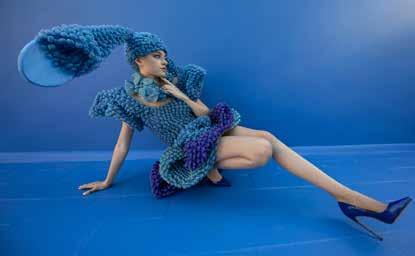
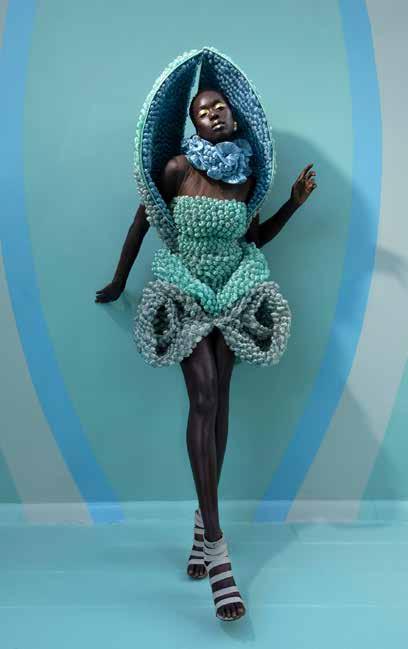
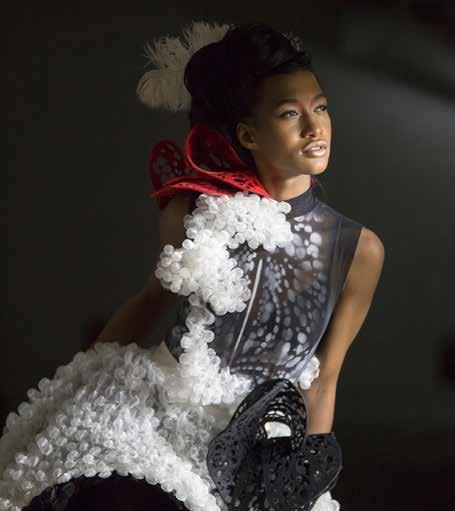
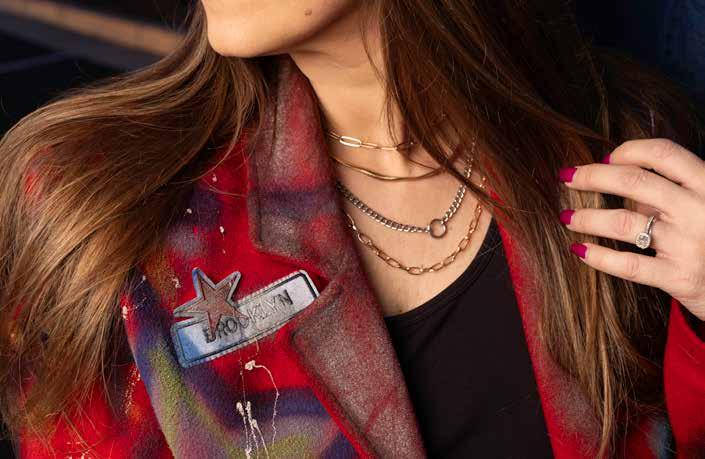
There is a moment in every great performance when the music stops — when the last note hangs in the air and the audience holds its collective breath before the applause begins. That suspended instant is not silence. It is everything the music just said, still reverberating.
May in Arizona carries that same quality. The season is winding down, the heat beginning to assert itself, and we find ourselves pausing to take stock of all we’ve experienced these past months before the summer asks us to slow down and breathe. It’s a natural rhythm — not an ending, but a breath between movements.
This month, Images Arizona celebrates music in all its forms and all the extraordinary people who make it. We’ve spent these pages with composers and vocalists, educators and collectors, performers and storytellers — people for whom music is not background noise but the primary language through which they understand and communicate the world. Their stories reminded us, again, that music is among the most direct paths between one human heart and another. It transcends generation, geography, circumstance. It finds us exactly where we are.
Images Arizona P.O. Box 1416
Carefree, AZ. 85377 623-341-8221
shelly@imagesaz.com imagesarizona.com
And so, in that spirit, we have some news to share: after this issue, Images Arizona will be taking a summer pause. We’ll return in October, refreshed and ready — and we are genuinely excited about what we’re planning for our fall issues. We’ll be working hard behind the scenes on some extraordinary stories for the season ahead.
In the meantime, imagesarizona.com will be your companion for summer — a full library of Arizona arts, dining, travel, and community coverage to guide your explorations through the warm months. We’ll see you there, and we’ll see you in October.
From our family to yours, we wish you a summer full of music, wherever you find it.
Happy listening!
Shelly Spence Publisher, Images Arizona
Photography by Loralei Lazurek
Cloth & Conscience Fashioning a Sustainable Future
Writer Shannon Severson // Photography by Chris Loomis
An Icelandic fisherman hoists a teeming mass of silver-skinned cod from the frigid waters of the North Atlantic onto his wind-tossed trawler — a portion of the more than 200,000 tons harvested annually in this remote island nation. Beyond what is consumed for food, Iceland’s 100% Fish Project’s zero-waste efforts are part of a vision for sustainability that stretches all the way to ASU FIDM, Arizona State University’s fashion school.
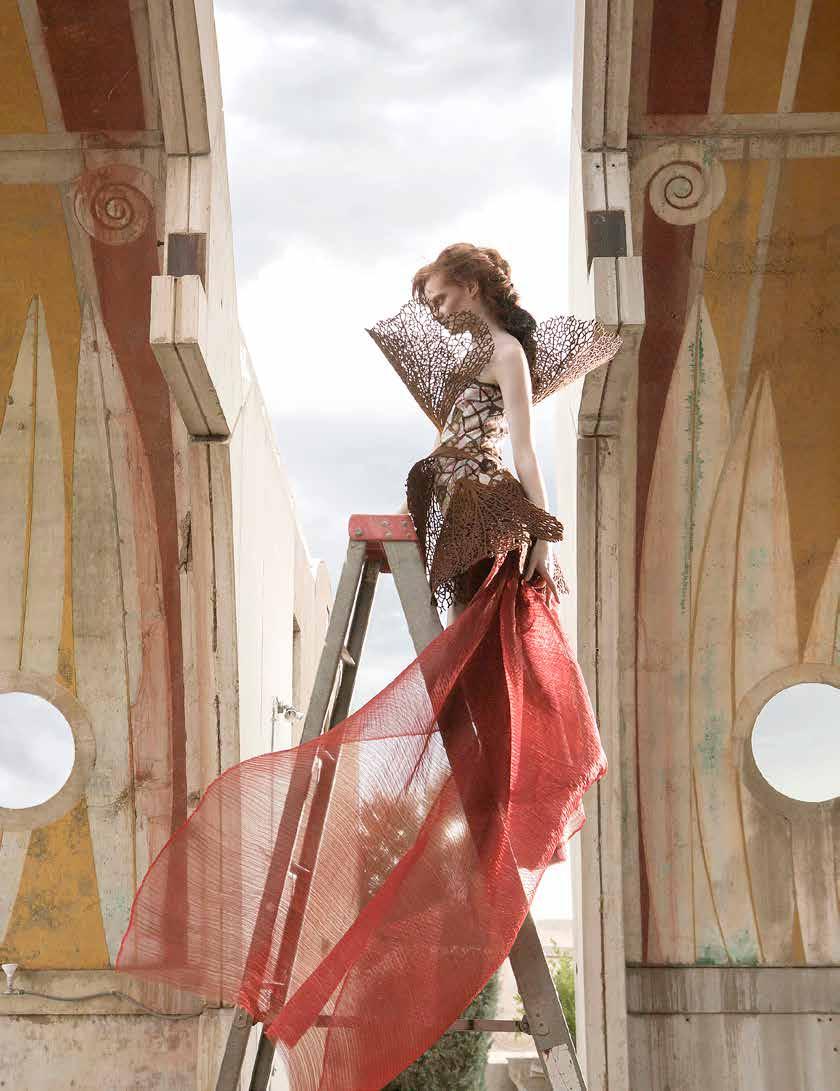
Fusion on First is the school’s gleaming 16-story atelier in downtown Phoenix that houses design studios, digital media labs and a textile lab. Here, overlooking the downtown skyline, Associate Professor Galina Mihaleva — an internationally award-winning fashion designer — transforms the carefully cleaned and preserved fish skin into laser-cut modules that create a material nine times stronger than lamb or cow leather. Mihaleva interlocks the circular and amygdaloid pieces to create an entirely new textile that can become a skirt one day and a handbag the next, a material experiment that embodies the program’s sustainability goals.
Mihaleva has studied, taught, designed and created couture fashion, wearable art and technologically advanced pieces with sustainability at their core. She’s lived and worked around the world and now teaches Materials and Techniques at the institution. Her work has earned global recognition: the Tiffany Award at Paris Fashion Week (2016), the Rumi Award in the United States
(2016) and the WOW Designer Development Award in New Zealand (2024), among dozens of international exhibitions and red-carpet showings, including regular appearances at the Cannes Film Festival.
One of her primary textiles is polyester — a fabric that can take up to 150 years to decompose but can be stretched, twisted, formed, heated and then reused time and again to create impactful fashion. ASU FIDM is both Mihaleva’s classroom and experimentation lab.
The workstations at Fusion on First are a convergence of curiosities: lasered fish-skin modules cluster beside a stack of vintage wool jackets; a 3D-printed clasp cools next to a boiled-polyester bubble skirt. At one end of the state-of-the-art lab, Mihaleva can print human-cellsized sensors onto a flexible sheet while across the room, students like recent graduate Isabelle Johnson-Heston lay out portfolios of capstone pieces that read like a syllabus for sustainable fashion.
Galina Mihaleva, an internationally award-winning fashion designer and associate professor at ASU FIDM, creates sustainable couture and medical wearable technology that transforms materials like fish skin into high fashion while improving patients’ lives.
The future of fashion is no longer to just produce more, more, more collections. Now it’s ‘What do we produce and how do we help?’ As I get older, I realize that it’s better to meet one more person or help one more child than to make one more dress. What we are doing is changing lives. Galina Mihaleva
The $28 million expansion of ASU FIDM into Los Angeles — in the former FIDM building — was designed to put this kind of experimentation and career preparation into one fashion school with two complementary, collaborative locations. The school’s home in downtown Los Angeles boasts the ASU FIDM Museum, with a 15,000-piece fashion collection that serves as a resource for faculty and students, as well as the community.
As Tinseltown glam fuses with desert design, Mihaleva embodies the promise of ASU FIDM. Trained at Bulgaria’s Academy of Fine Arts with a master’s degree, she learned textiles “from the fiber up.” She learned English upon her arrival in Phoenix, picking up the vernacular of the fashion industry here by earning a fashion design associate degree at Phoenix College, then going on to a doctorate at ASU. She has spent a career folding craft into research.
“It’s about knowing your material — in intimate relationship with your medium,” she says.
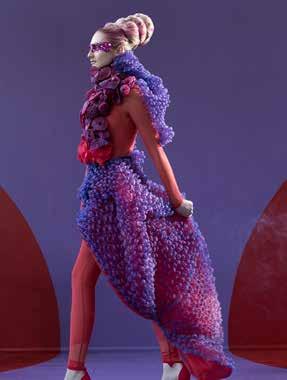
That intimacy has produced wearable high-fashion installations — “Tranquility,” which visualizes urban noise via embedded LEDs, and “Sense,” a coral-like dress made from 100 yards of manually twisted fabric that cycles from brilliant color to stark white to represent reef bleaching using 15 years of reef data encoded into the dress — alongside applied projects for hospitals and rehabilitation clinics.
Mihaleva’s work utilizes soft sensors embedded in textiles to detect environmental pollutants, conductive-thread breath monitors that comfort young cancer patients and soft exoskeletons paired with virtual reality therapy to restore muscle
movement for stroke survivors. She collaborates with engineers, neuroscientists and technological experts.
“Wearable tech can be hopeful. It can improve people’s lives,” she says.
Her assignments push students to think beyond aesthetics: materials, lifecycle tradeoffs and the social impacts of design become studio work. All begin with a personal story, and the details are negotiated from there.
One student with scoliosis had been mocked for wearing the required medical brace in her native Iran. Mihaleva encouraged her to work with her doctors, body-scan technology and 3D printing to create a fashionable brace that could be worn with pride.
“When she presented it, we all cried,” Mihaleva recalls. “It was something very personal. And with 3D printing it can be affordable. Wearable tech enables a better future.”
Isabelle Johnson-Heston graduated from ASU FIDM in 2025 with a Bachelor of Arts in Fashion Business and a minor in Sustainability after beginning her fashion education at FIDM's Los Angeles campus.
Those lessons are exactly what students like Johnson-Heston wanted when she moved from FIDM’s Los Angeles campus— where she earned an associate degree in merchandising — to ASU’s new four-year program and graduated in 2025 with a Bachelor of Arts in Fashion Business and a minor in Sustainability. The transition shifted her perspective.
“I loved my time in Los Angeles, but the experiences that ASU was able to provide for me in such a seamless way — especially being able to go and study abroad in Florence — there was nothing like it,” she says.
Study abroad, she adds, turned abstract brand histories into tactile inspiration: thrift-based workshops that repurposed donated high-end fabric, studio visits to Gucci and Ferragamo, and professors still active in the industry.
The built environment at Fusion on First made a difference in very practical terms for Johnson-Heston. There, everything is at a student’s fingertips to learn, dream and experiment under the guidance of world-class professors.
Mihaleva says she’s a craftsperson who blurs the lines between craft and technology. The atelier’s knitting machines, looms, laser cutters and 3D printers are the best of both worlds — technology is a collaborator, not a replacement for human thoughts and touch.
“We continue the craft and use technology — including AI — to enable us to be faster and more precise,” she says.
For Johnson-Heston, the accessible labs and responsive advising reduced friction: “Seeing Fusion on First — it was immaculate. It has every tool you could imagine. The professors, counselors and staff always had an answer for me on the spot.”
Johnson-Heston embraced the chance to learn the handson basics of sketching, sewing and pattern reading after primarily focusing on the business side during her time in Los Angeles.
“I felt like I was learning in reverse, as I was a little bit older than the other students, but my professors were so understanding,” she recalls.
The payoff is craft fluency and market readiness while tapping into collaborative ASU research, internships and study abroad pathways that turn coursework into careerready skills. Students also gain access to scholarships and industry luminaries. ASU FIDM students earned 10 awards from the prestigious 2025 Fashion Scholarship Fund competition, elevating the program’s national profile.
Through it all, sustainability remains a focus for designers like Mihaleva, who has innovated the reuse of fabrics into award-winning couture design -- from decompositionresistant polyester to earth-friendly wool that becomes fertilizer when buried and can even be embedded with seeds. For Johnson-Heston, sustainability became more than just a buzzword.
“It means more than I thought it did,” she explains. “I learned from both programs that everyday life can affect our world. We can make little changes, pay more attention to labels and tags and what we eat and wear. It makes a big difference.”
Mihaleva envisions designers who can prototype sustainably and work across supply chains and professional disciplines.
“The future of fashion is no longer to just produce more, more, more collections,” she explains. “Now it’s ‘What do we produce and how do we help?’ As I get older, I realize that it’s better to meet one more person or help one more child than to make one more dress. What we are doing is changing lives.”
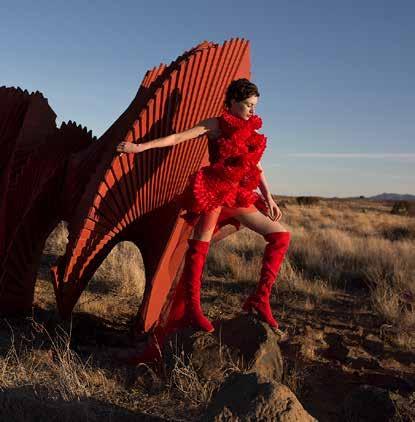
As fashion transforms futures, the work continues. Mihaleva guides her students while maintaining her professional practice: In March, her wearable art took center stage at Scottsdale Art Week’s Opening Night Vernissage, benefiting Phoenix Art Museum. The fashion presentation — part of the international art fair featuring more than 120 galleries at WestWorld — offered Arizona audiences a rare opportunity to witness how sustainable couture and technology-infused designs translate from laboratory to runway.
Meanwhile, Johnson-Heston works in retail management in Minnesota as she pursues internship opportunities and volunteers with Dress for Success, buoyed by the program she says “added confidence” and made her feel more prepared.
The promise of ASU FIDM is an institutional translation: craft practices elevated by research infrastructure that takes shape on a human scale in its meaningful application. The success metrics are simple — accomplished faculty that supports and elevates learning, creates an internship-tojob pipeline and boosts the local economy as Phoenix becomes a central hub of the fashion industry.
As those metrics materialize, the fabric of improved lives and new careers will grace runways and medical rehabilitation facilities, and students will keep learning the art of turning scarcity into abundance. That alone is a useful definition of sustainable education: not the absence of waste, but a program capable of turning constraints into creative systems that endure.
asufidm.asu.edu
Community
MAY 1–29
MUSIC IN MAY
The Anthem Community Council presents its annual free concert series, offering live music every Friday evening. Attendees are encouraged to bring lawn chairs, blankets and a picnic to enjoy the family-friendly outdoor performances, with a rotating selection of food trucks also available on-site. The 2026 lineup features Vixanne (May 1), The Instant Classics (May 8), Marble Hearts (May 15), The Bounce Band (May 22) and Soulitify (May 29). Free. 7–9 p.m. Anthem Community Park Amphitheater, 41703 N. Gavilan Peak Parkway, Anthem. anthemcouncil.com/music
MAY 2
THE STELLA ARTOIS DERBY DAYCLUB
Arizona’s only Kentucky Derby party featuring live local horse racing returns to Turf Paradise for the 152nd “Run for the Roses.” Guests can watch the simulcast and live action from the Sanderson Lincoln Black Label Lounge or the open-air Stella Artois Jazz Pavilion. The event features mint juleps, food trucks, live DJs and jazz bands, plus a new champagne and bourbon tasting experience. $50+. See website for schedule. Turf Paradise, 1501 W. Bell Road, Phoenix. thepoloparty.com
THROUGH MAY 3
TENDERLY: THE ROSEMARY CLOONEY MUSICAL
The Phoenix Theatre Company presents an intimate and poignant tribute to one of America’s most cherished voices. This two-person musical traces Rosemary Clooney’s journey from her meteoric rise in Hollywood to her personal struggles with mental health and her triumphant comeback. $60+. See website for times. Judith Hardes Theatre, 1825 N. Central Ave., Phoenix. 602-254-2151; phoenixtheatre.com
MAY 6–JUNE 14
EVER AFTER
The Phoenix Theatre Company presents a new musical inspired by the beloved film starring Drew Barrymore. $60+. See website for times. Dr. Stacie J. and Richard J. Stephenson Theatre, 1825 N. Central Ave., Phoenix. 602-254-2151; phoenixtheatre.com
MAY 7
BIG IDEAS FORUM: THE BAD FUTURE
One of the world’s leading futurists outlines the challenges lying ahead — from social structure and democracy to culture, trust and climate. This discussion explores what, if anything, can be done to address these issues, determining when action is necessary and who is responsible for taking it. Free. 4:30 p.m. Anthem Civic Building, 3701 W. Anthem Way, Anthem. 305-302-7536; bigideasforum.info
MAY 7–17
JOSEPH AND THE AMAZING TECHNICOLOR DREAMCOAT
Musical Theatre of Anthem presents the classic musical told entirely through song with the help of a narrator. The story follows preferred son Joseph, who is sold
into slavery by his brothers but soon discovers his ability to interpret dreams. $30. 7 p.m. Thursday and Friday; 1 p.m. and 5 p.m. Saturday and Sunday. Musical Theatre of Anthem, 42201 N. 41st Drive, Suite B100, Anthem. 623336-6001; musicaltheatreofanthem.org
MAY
9
ANTHEM NIGHTS CAR SHOW
Anthem Cars and Coffee hosts an evening car show featuring a wide variety of vehicles. Spectators can stroll the lot, meet fellow auto enthusiasts and enjoy an easygoing community gathering under the lights. Free. 5–8 p.m. Outlets North Phoenix, 4250 W. Anthem Way, Phoenix. anthemcarsandcoffee.com
MAY 13–30
AN EVENING AT DESERT BOTANICAL
GARDEN
Surrounded by the magnificent desert landscape with the setting sun as a backdrop, this audience favorite features two distinct ballet experiences. The program highlights the U.S. premiere of Artistic Director Daniela Cardim’s “Reset,” exploring themes of modern urban life to a score by Gabriel Prokofiev, alongside Lar Lubovitch’s “Concerto Six Twenty-Two,” a joyful work inspired by Mozart. See website
for prices. 8 p.m. Desert Botanical Garden, 1201 N. Galvin Parkway, Phoenix. 602-381-1096; balletaz.org
MAY 15–24
SPRING ARIZONA RESTAURANT WEEK
The Arizona Restaurant Association invites diners to explore the state’s culinary scene during this 10-day tasting tour. Participating restaurants — from five-star dining to hidden gems — offer exclusive three-course prix fixe menus, allowing guests to discover new favorites or revisit beloved local spots at a fraction of the usual cost. The event features a diverse array of cuisines, with meals priced at $33+. See website for participating restaurants. arizonarestaurantweek.com
MAY 16 250 YEARS OF AMERICA
North Valley Symphony Orchestra celebrates the nation’s 250th birthday with a concert dedicated exclusively to American composers. The program showcases the rich tapestry of the country’s musical heritage, featuring Bernstein’s “Symphonic Dances from West Side Story,” Florence Price’s groundbreaking “Symphony No. 1,” Barber’s poignant “Adagio for Strings” and Gershwin’s lively “An American in Paris.” $10; discounts available. 7 p.m. North Canyon High School Auditorium, 1700 E. Union Hills Drive, Phoenix. 623-980-4628; northvalleysymphony.org
MAY 30
ANTHEM CARS AND COFFEE
Classic and modern vehicles fill this monthly car show, complemented by coffee, food vendors and community fellowship. Free. 8–11 a.m. Outlets North Phoenix, 4250 W. Anthem Way, Phoenix. anthemcarsandcoffee.com
BBB ANNOUNCES SCHOLARSHIP CONTEST
The Better Business Bureau invites Greater Arizona high school students in grades 9 through 12 to enter its annual Ethical Torch Essay Scholarship Contest. Sponsored by Swiss America and Kiwanis, the competition challenges students to write an essay of up to 500 words analyzing an ethical dilemma they faced, how they handled it and what the experience taught them about ethics and themselves. Five winners will receive scholarships ranging from $500 to $1,500 and will be recognized at the Torch Awards for Ethics in November. The deadline to apply is Oct. 11. torchessay. bbbcommunity.org
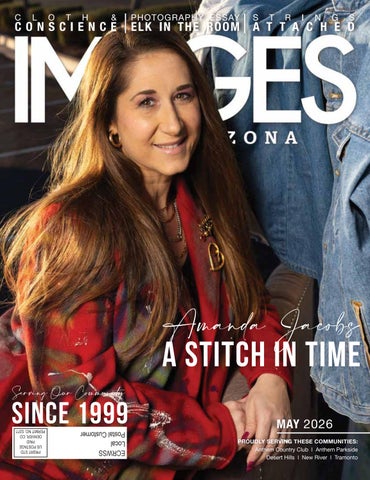
Amanda Jacobs can edit a Goodwill in 15 minutes flat. Her fingers glide across polyester blends and cotton twills with the practiced discernment of someone who once handled $3,000 jackets at Saks Fifth Avenue — feeling for quality in the seams, searching for the weight of well-made garments hiding among the castoffs.
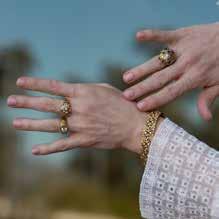
It’s a hunt, really. And in the nearly 10 years since she moved from New York to Anthem, Jacobs has turned this peculiar talent into something extraordinary: Classic Reclaim, a sustainable fashion venture that transforms overlooked vintage pieces and cherished family heirlooms into one-of-a-kind couture.
“I’m a sucker for a coat — long, big, heavy, I love it,” Jacobs says, laughing at herself. “When you’re from New York, you wear those things for months. You need them to survive. Here? Not so much. Here it’s like a week of sweater weather, you know?”
It’s this collision of worlds — Old World craftsmanship learned at age 6 from a designer aunt,
refined through a bachelor’s degree in textiles from West Virginia University, sharpened in the personal shopping club at Saks, and now reimagined in the Arizona desert — that gives Classic Reclaim its distinctive aesthetic. Jacobs calls it “classic, street and clean.” Her clients might call it magic: the way she can pull apart a mother’s wedding dress and merge it with a modern gown, preserving memory while creating something entirely new.
The story of how Jacobs arrived in Anthem reads like a love letter to suburban discovery. After college, she followed her Arizona-native husband west, landing first near State Farm Stadium before family expansion necessitated more space. A drive to visit in-laws in New River led to an exploratory detour through Anthem that changed everything.
“We just fell in love with it,” Jacobs recalls. “The community center was amazing, and we found this incredible house with a pool and a giant backyard — so much space for everybody, including our huge Lab. It felt so good and so right. We looked at each other and said, ‘Oh my God, our kids are going to have such a good time here.’”
A Stitch in Time Amanda Jacobs Transforms Forgotten Fabrics
Into One-of-a-Kind Couture
For someone raised in a small suburb outside New York City, Anthem offered something familiar yet distinctly southwestern: that close-knit neighborhood feel, the sense of community love, a major high school anchoring local life. Nearly a decade later, married with three children who attend Anthem Elementary, Jacobs has woven herself into the fabric of the community — quite literally.
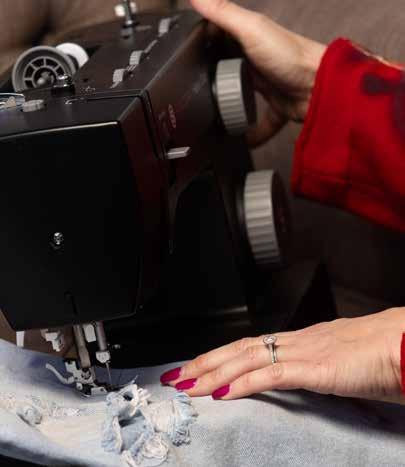
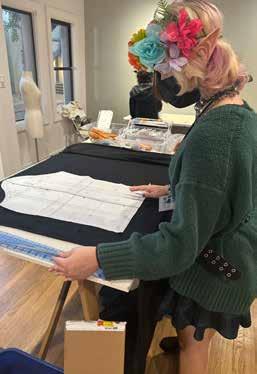
She teaches Fashion Design and Operations as a career and technical education course at Maryvale High School in the Phoenix Union High School District, now in her 12th year. And on Saturday mornings, you’ll find her at the Anthem Community Center, leading sewing classes for kids, adults, and soon, private one-on-one sessions.
“I think if I can offer what I do and what I love to our community, that’s huge,” Jacobs says. “We have a lot of homeschool students who would love to learn this skill. ‘Skills pay bills’ is our motto here. You can learn to sew and build a business out of it — start doing alterations, redesigning like I do, and put pieces back out there for people.”
But it’s the transformation work — the reclaiming — where Jacobs’ particular genius shines. Her process defies rigid planning. She starts with intention, then surrenders to what the garment reveals.
“I start out thinking, ‘Maybe I’m going to do this,’ or ‘This is what the fabric will let me do,’” Jacobs explains. “But as soon as I begin to open it up or cut into it, something else might present itself — out of necessity or just from the design revealing itself. I always allow the piece to take me on that journey.”
One project crystallizes this philosophy. A friend preparing for her wedding wanted to honor her mother
Writer Joseph J. Airdo // Photography by Loralei Lazurek
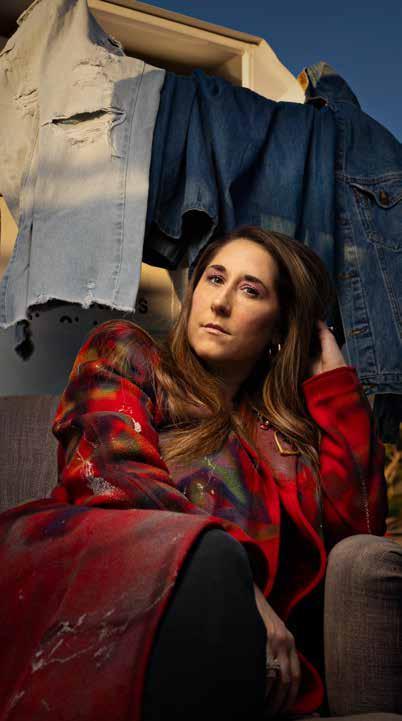
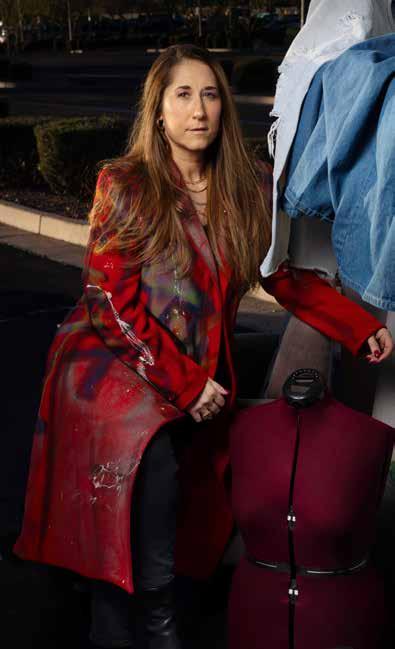
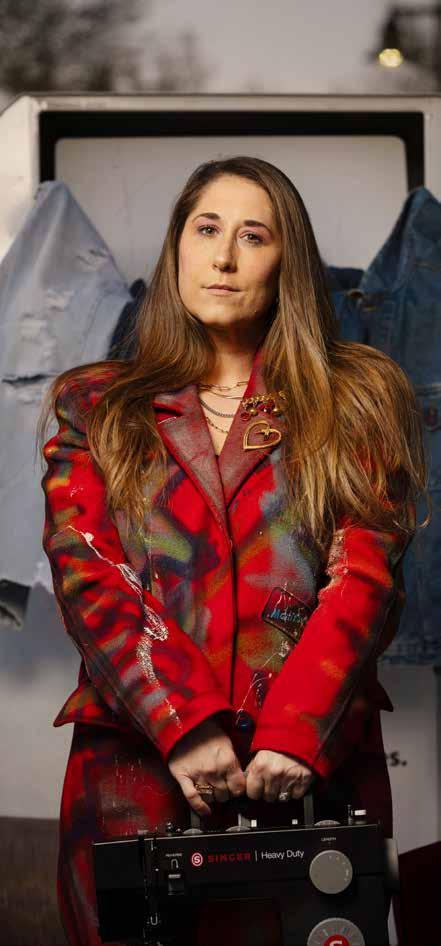
Former Saks Fifth Avenue stylist Amanda Jacobs brings luxury retail precision to sustainable fashion design in Anthem.
by incorporating the maternal wedding dress, but the fit and silhouette weren’t right. Jacobs saw possibility where others might have seen an impasse.
“We were able to pull parts of her mother’s dress and redesign it to give her the silhouette she wanted — one that fit her body,” Jacobs says. “Everyone’s body is different, so you can’t really put two people in the same dress, even if it’s your mom’s and she wants you to.”
The solution? Merge the new dress with the heirloom, pulling different components from each. They kept it secret until the family fitting.
“Her mom kept saying, ‘That’s so weird — that looks like the detail from my wedding dress.’ Then, ‘Wait, I also have that little thing on the side.’ And then she realized: ‘Oh my
gosh, is that my dress? Are those parts of my dress?’ We had pulled them out and combined them to create something unique and one of a kind. It was really, really special.”
For Jacobs, this isn’t merely clever tailoring. It’s about understanding that memory lives in fabric — an admittedly esoteric concept she acknowledges, but one that explains why people struggle to discard clothes they’ll never wear again.
“I feel like memories are kind of absorbed into the fabric. They get held there,” she says. “That’s why so many people have a hard time throwing out clothes they’ll never wear again. It’s the memory they can’t let go of, whether it’s of a person or an experience they had while wearing it. Being able to continue that memory is really meaningful. Now the piece gets to create new memories and new experiences. The life of the garment continues on.”
This philosophical approach is grounded in exceptional technical skill — a distinction Jacobs emphasizes when differentiating her work from craft projects.
“I think a lot of it is execution,” she says. “I love to teach design and fashion, and I love to teach people how to sew, because if you can acquire those skills and really master them, your work won’t look homemade — it will look
Amanda Jacobs, founder of Classic Reclaim, transforms thrift store finds and family heirlooms into bespoke fashion from her Anthem studio.
I feel like memories are kind of absorbed into the fabric. They get held there. That’s why so many people have a hard time throwing out clothes they’ll never wear again. It’s the memory they can’t let go of, whether it’s of a person or an experience they had while wearing it. Amanda Jacobs
professionally put together. People will look at your seams and they’ll look identical to manufactured seams. So I really think it comes down to education.”
Her nearly decade-long tenure at Saks Fifth Avenue proved transformative in this regard. Surrounded by exquisitely constructed garments she couldn’t afford on an early 20s retail salary, Jacobs studied the seams, analyzed construction, and taught herself to replicate that quality by thrifting well-made pieces and redesigning them.
“I had to use my skills to look the part without having the money to buy all those nice clothes,” she recalls. “At the time, I didn’t realize what was happening, but looking back now, I understand that I developed a really strong handle on how things should be put together — how well-made garments are sewn, what they should look like when they’re finished. You don’t find that quality at all with fast fashion pieces. They’re just slapped together crazy fast, and the quality isn’t there.”
When scouting at thrift stores throughout Anthem and North Scottsdale, Jacobs relies on this educated touch. She gravitates toward quality indicators: sturdy buttons, wellconstructed zippers, certain labels, items marked “Made in Italy.” But she also thinks laterally, scanning sections most shoppers ignore.
“I always go to linens and bedding and obscure things like curtains, shower curtains and pillowcases — because all that is, is just fabric,” she explains. “Yards of fabric, however much you need and can use.”
Her favorite fabric? Lace. The trend she’s happily embraced? Wide-leg pants, a respite from skinny jeans. And the one that got away? An incredible blanket-like jacket covered in colorful fringe — talked out of buying it by a skeptical friend, it haunts her still.
“If I ever see it again, I’m buying it, no questions asked,” Jacobs declares. “Fringe is so in now, too.”
Five Steps to a Sustainable Wardrobe
Amanda Jacobs shares her roadmap for reclaiming your closet.
1. SHOP YOUR CLOSET FIRST
“Before buying anything new, take inventory of what you already own. Create new outfits by mixing and matching pieces. Identify items worth repairing or refreshing. If you haven’t worn something in three to five years, ask yourself why — and whether that reason can be addressed.”
2. CHOOSE QUALITY OVER QUANTITY
“Invest in well-made, timeless pieces that will last season after season. Look for sturdy stitching, natural fibers and durable construction. Focus on pieces you’ll wear 20-plus times rather than one-wear wonders.”
3. REDESIGN, REPAIR OR REPURPOSE
“Instead of discarding items, give them new life. Mend small damage like missing buttons or tiny tears. Transform unused textiles into bags, accessories or home goods. Redesign outdated garments with tailoring or decorative upgrades.”
4. SUPPORT SUSTAINABLE AND LOCAL BRANDS
“Choose small businesses, local makers, thrift shops and resale markets. Support businesses that prioritize secondhand, upcycling and thoughtful production over mass manufacturing.”
5. LEARN AND SHARE SKILLS
“Build your personal sustainability practices through knowledge and skillbuilding. Take sewing, redesign and alteration classes. Teach others how small steps can reduce textile waste and transform their relationship with clothing.”
The Arizona climate initially challenged her New Yorktrained instincts for layering and structure.
“When I first came here, I was like, ‘Why is everyone halfnaked?’ I like clothes. I like to wear clothing. And then summer hit and I was like, ‘OK, now I understand why everyone’s wearing a T-shirt and shorts,’” she says, laughing.
Even now, she admits to keeping eight jackets in her car, peeling them off throughout temperature-swinging days.
But it’s in her classroom at Maryvale High School where Jacobs sees the most reason for optimism about fashion’s future. Her classes stay full with waiting lists, and what she observes in her students gives her hope.
“I actually think this generation is going to save fashion,” Jacobs says with conviction. “They’re rejecting fast fashion. They don’t want to look like everybody else — which, weirdly, in the 1990s and 2000s was probably something you had to strive for. But they have such a great, unique take on their own individual style. And they’re environmentally conscious. They know what’s going on.”
She emphasizes the sustainable side of fashion in her curriculum, pushing students to understand the full lifecycle and ethics of their clothing.
“If you love fashion, you should care about how it was made, who got paid for it, how the business operates. You should care about that stuff. Don’t just go blindly buying at the mall,” she tells them.
Every year, her students create pieces for a fashion show — but not with virgin fabric from bolts.
“I’m like, ‘Let’s go get some clothes. Let’s rip this up. Let’s change things. Let’s use those skills in a better way.’ Because that’s definitely the way everybody should go,” she says.
Beyond teaching, Jacobs continues expanding Classic Reclaim’s presence in Arizona’s sustainable fashion community. She recently showcased four pieces at Phoenix Fashion Week’s October event and collaborated with Fabric, a Tempe-based small-batch manufacturing facility supporting emerging designers. She’s eyeing spring events including Latino Fashion Week and Arizona Fashion Week, drawing support
Amanda Jacobs teaches fashion design at Maryvale High School while running Classic Reclaim, her sustainable clothing venture.
from organizations like Arizona Sustainable Fashion, The Garment League and advocate Laura Madden.
For readers inspired to view their own closets through a reclaiming lens, Jacobs offers straightforward advice: Have a conversation with yourself about why certain pieces remain unworn. Is it memory? Is there something wearable hidden in the garment? What specifically don’t you like — sleeves? Length? Then address that specific issue.
“I think when you have an event coming up or something to do, your first thought is never to go to your closet,” Jacobs observes. “Your first thought is: I want something new, something different, something fresh that I haven’t worn or taken pictures in. But I think the first question should be, ‘OK, what do I have in my closet?’ And then, out of those things that I like, is there something I can change so I can wear it, but it looks different? That’s better than going to the mall and buying something cheap, maybe just for one wear.”
For clients seeking more hands-on guidance, Jacobs offers closet editing services — visiting homes to evaluate existing wardrobes, performing simple alterations, and identifying redesign opportunities. It’s personal styling meets sustainable fashion meets memory preservation, all filtered through the eye of someone who learned to see quality in a Saks Fifth Avenue stockroom and translate it to the desert.
Nearly a decade into her Anthem life, with three kids playing sports across the community and Saturday mornings spent teaching neighbors to sew, Jacobs has found her rhythm in this sun-scorched landscape so different from her New York origins. Classic Reclaim has become more than a business — it’s a philosophy of continuation, of honoring what came before while creating what comes next, one reclaimed seam at a time.
“Bringing my skills and education to our small community in Anthem is very important to me,” Jacobs reflects. “I’ve just fallen in love with it and I really want to teach more people here.”
The life of the garment continues. And in Jacobs’ capable hands, so do the memories woven within.
theclassicreclaim.com
photo essay
Craig Miller
Elk in the Room
Photographer
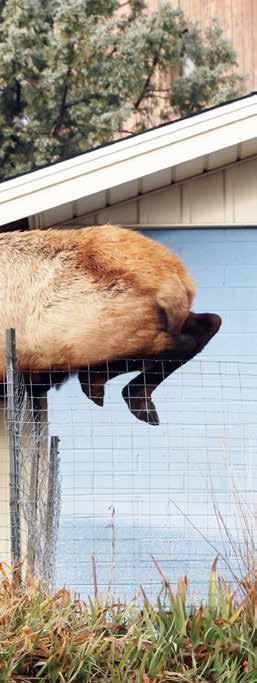
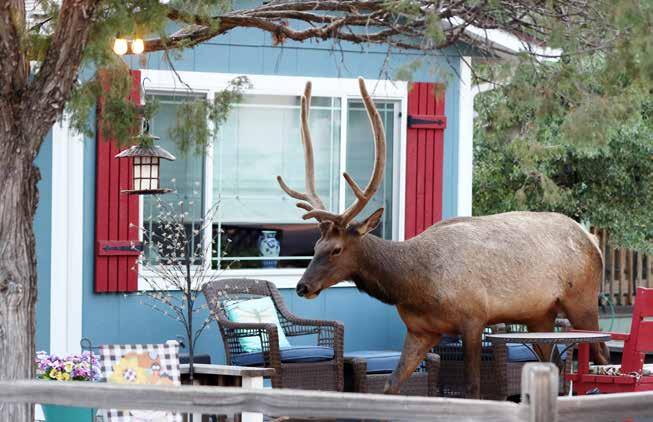
Payson photographer Craig Miller has spent 15 years documenting elk at pay phones, on volleyball courts and across Wells Fargo parking lots — proof that in one Arizona mountain town, the wildlife never got the memo about staying outside.
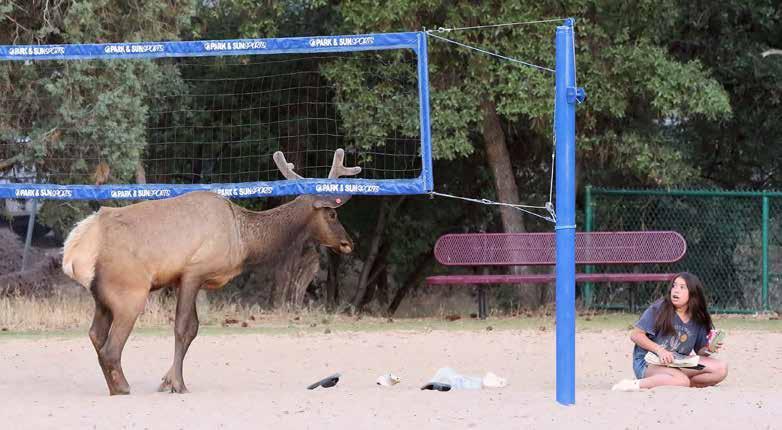
The elk does not knock. It simply arrives — on your deck, in your rose garden, at the pay phone on the corner you forgot was still there. It walks across the Wells Fargo parking lot with the unhurried confidence of someone who has somewhere to be, pauses at a bird feeder with the focused attention of a connoisseur, and ducks beneath a volleyball net with a grace that has no particular interest in being appreciated. The cars lined up behind it on the road can wait.
This is Payson — or rather, this is what Payson actually is, beneath the assumption that town and wilderness occupy separate territories with a clearly posted boundary between them. That boundary, if it ever existed, dissolved long ago. Payson grew up inside elk habitat, not on its edge. The elk were here first, and they have not forgotten it.
Photographer Craig Miller has spent 15 years documenting what happens when that fact reasserts itself. Going out once or twice a day, every day, he has built a body of work that moves through registers most wildlife photography never attempts: the slapstick of a young girl slowly registering that an elk has joined her volleyball game, the odd tenderness of a massive animal delicately licking a pink rose, the quietly surreal image of an elk standing at a pay phone — two things the modern world has largely moved on from, occupying the same frame as if to confer on the matter.
Miller doesn’t engineer these moments. He finds them. “With the elk, it’s mostly opportunistic,” he says. “They just happen to be near something you’d expect to find humans or other animals around.” But opportunism, practiced daily with enough patience and attention, eventually looks a lot like vision.
The elk in this collection are not lost. They are not confused. They are not wandering into foreign territory with wide, frightened eyes. They are, by every available measure, at home — locking antlers on a high school football field, investigating the geometry of a chain-link fence, grazing their way through neighborhoods where some residents set out bird feeders and others, Miller notes, are less charmed. “Some of us love the elk,” he says. “Some find them a nuisance — don’t like them eating their prize rose bushes, coming into their garages or tipping over their garbage cans.”
The elk, for their part, seem unbothered by the distinction.
Writer Joseph J. Airdo // Photographer Craig Miller
With the elk, it’s mostly opportunistic — they just happen to be near something you’d expect to find humans or other animals around. Craig Miller
I think we’ve all here in Payson gotten used to elk being a part of our lives. Some of us love them; some find them a nuisance — they don’t like the elk eating their prize rose bushes, coming into their garages or tipping over their garbage cans. Craig Miller
Meet the Photographer
Craig Miller grew up in the suburbs of Chicago, where wildlife and urban infrastructure kept a more conventional distance from each other. After earning degrees from Aurora University in social work, physical education and education, he built a career as a public school teacher and counselor. In 2002, he and his wife, Ann, relocated to Payson for semiretirement and the mountain air.
The elk came with the territory.
Miller had been a hobbyist photographer since childhood, but it was in Payson, about 15 years ago, that the practice became something more serious — a daily commitment, pursued once or twice a day, every day. He teaches advanced photography at Eastern Arizona College and, with Ann, operates one of Payson’s most decorated small businesses: a combined photography and disc jockey service that has been voted the town’s best in both categories by Payson Roundup readers for 14 consecutive years. The work moves between art forms, but the instinct is the same in each — attentiveness to what the moment is actually offering.
His photography has appeared in books, magazines, newspapers and calendars, and on the walls of homes and businesses throughout the region. His first Images Arizona feature, “Advent of Antlers,” was published in December 2020. This is his second.
He still goes out every day. As for what he hopes people take away from these particular images, Miller doesn’t overthink it. “Just a smile,” he says, “and a ‘Hey, Mary, you’ve got to see this picture DJ Craig posted today.’”
Payson’s elk, for their part, continue to provide the material — on the football field, in the rose garden, at the pay phone, wherever they happen to be.
djcraiginpayson.com
Writer Joseph J.
Music to His Years Vietnam Veteran Turns
TLife’s Soundtrack Into Literature
he field house at Bethany College is winding down toward its final song when the dean of students pulls Doug Bradley aside. April 4, 1968. A small town in the West Virginia hills, a Thursday night crowd that came out to see Dionne Warwick — and Warwick is about to come offstage. The dean leans in: Martin Luther King Jr. has been assassinated. In Memphis. About an hour ago.
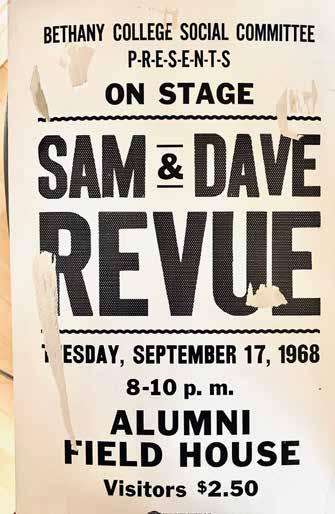
Bradley is 20 years old, the school’s social chairman, responsible for bringing 19 acts to this tiny campus in just over two years. He drove Warwick from the airport himself. He knows she’ll want to do one or two more songs. He also knows, from the faces he can already see, that something is wrong.
This is the kind of moment that doesn’t belong in anyone’s college years. And yet there it is — the first chapter in what will become a lifetime of intersections between music and history, between songs and the events they outlast.
Bradley, a Vietnam veteran and part-time Phoenician who lives near Piestewa Peak, published “The Tracks of My Years: A Music-Based Memoir” in August 2025. The book — which earned the Vietnam Veterans of America’s 2025 Excellence in Arts Award and drew blurbs from Pulitzer Prize winner David Maraniss and “Matterhorn” author
Karl Marlantes — organizes a life not by dates or milestones but by songs. Each chapter takes its title from a track that shaped it. The companion 46-song Spotify playlist is essentially the table of contents. And what that playlist contains — Sinatra giving way to doo-wop giving way to Motown giving way to Hendrix — is the arc of postwar American music history, lived from the inside.
Airdo // Photography Courtesy of Doug Bradley
Doug Bradley, author, educator and Vietnam veteran, splits his time between Madison, Wisconsin, and the Phoenix area, where he teaches courses on music, Vietnam, memoir and memory at Arizona State University.
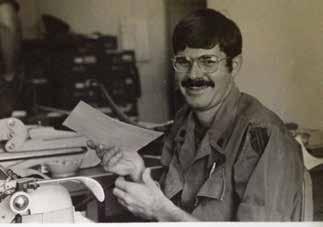
Doug Bradley at his typewriter at U.S. Army headquarters in Long Binh, South Vietnam, in 1971 — where music from Hendrix to Motown provided what he calls the soundtrack soldiers needed to “fight and stay alive.”
“Music has always been there for me,” Bradley says. “But the turning point, absolutely, was Vietnam. Music was what we needed to cling to, to keep us alive, to keep us connected to one another, to the rest of the company, to the rest of the world.”
The story begins in Philadelphia, where Bradley grew up listening to his father croon big band standards and his older brother rehearse doo-wop with street-corner groups. When the family relocated to the Pittsburgh suburbs, Bradley assembled a 45 RPM collection and spun records at high school dances. He was, in other words, exactly the kid who would end up social chairman at Bethany College — a tiny school in Bethany, West Virginia, where he ran for office on a promise to bring Smokey Robinson and the Miracles to campus.
He won. And on March 5, 1967, Smokey showed up.
“I was 19, 20 years old,” Bradley recalls. “You’re a young kid and these are your idols. You just want to do right by them and not screw up.”
Music was what we needed to cling to, to keep us alive, to keep us connected to one another, to the rest of the company, to the rest of the world. Doug Bradley
The concert went off without a hitch — and then, as the Miracles were leaving, someone said they wanted to play some ball. Smokey sat it out. But Bobby Rogers, Pete Moore and Ronnie White followed Bradley into the gym, found a ball, and played two-on-two in dress shoes on the hardwood.
“It was like being in church,” Bradley says.
That night was one of 19 concerts in just over two years — Jefferson Airplane, Count Basie, Sam and Dave, the Fifth Dimension — that made tiny Bethany an unlikely musical oasis in the West Virginia hills. But none of them prepared Bradley for the night Dionne Warwick came to town.
She had canceled twice before — November 1967, then January 1968 — before finally honoring her contract that April. Her band had flown into a small regional airport separately, so she committed to one long set and gave everything she had. The crowd was full. The night was good.
Then the dean intercepted Bradley near the stage.
“I could see she could already tell by looking at the people right there that something was wrong — we were just shaken,” Bradley says. “So I said, ‘I’m so sorry. This is terrible. Dr. King —’” He didn’t need to finish the sentence.
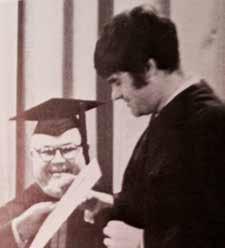
Doug Bradley receives his diploma from Bethany College in Bethany, West Virginia, where as social chairman he brought 19 acts to campus in just over two years — among them Smokey Robinson and the Miracles, Count Basie and Dionne Warwick.
“It was remarkable how she got strong, got strong in an instant,” he says. “She said, ‘I need to sing. I have to get this out.’”
She never got the chance. A local sheriff, worried about unrest, ordered the lights up and the field house cleared. The audience filed out not knowing why. Warwick left without singing another note.
“I think we all would have been healed by what she needed to sing that night,” Bradley says. “It never happened because somebody decided it was going to be too risky.”
A year after that night, he was drafted. He aced the Army’s aptitude test and earned assignment as a journalist, eventually landing at U.S. Army headquarters in Long Binh, South Vietnam, from November 1970 to November 1971. Nixon had signaled the American withdrawal was coming. Nobody wanted to be the last GI killed in Vietnam. So they kept their heads down — and they listened.
“Everybody had a radio, everybody had records, everybody had tape decks,” Bradley says. “Vietnamese bands, Korean bands, music coming from every direction. Some guys listened to country, a lot of us listened to Hendrix. Whatever it was, it was what we needed to fight and stay alive.”
“The Tracks of My Years” doesn’t stop at the music. It also moves through the complicated personal terrain that makes any memoir worth reading — including a prolonged, unresolved relationship with a high school teacher who opened the teenage Bradley’s eyes to Bob Dylan and the Beatles, and whose intentions Bradley is still working to fully understand.
The book took 10 to 12 years to assemble, built from memory, journals and verification calls to family members. He had to make sure he got the early songs right, he says — “16 Candles,” “Smoke Gets in Your Eyes,” Sinatra — songs he confirmed with his brother and parents while they were still alive to ask.
Vietnam changed everything, he says, but not only in the ways you’d expect.
“I had to learn patience,” he explains. “I had to learn forgiveness. And I think about where we are now as a country — this division, this fracture. It feels as serious as anything since Vietnam, maybe the Civil War. If you can find something to hold on to — music, memory, food, family, whatever it is — hold on.”
Bradley has found that something, both in his writing and in the life he’s built near Piestewa Peak, where he teaches continuing studies courses at Arizona State University on music, Vietnam, memoir and memory. He speaks about his adopted state the way he speaks about the music that sustained him in Southeast Asia — with the gratitude of someone who knows exactly what it means to need something and find it.
“Everybody’s got their own soundtrack,” he says. “You’re up, you’re down, you’re here, you’re there, and through all of it, music is what connects you to yourself.”
doug-bradley.com
Doug Bradley, his brother and their father in the early years before rock and roll drew battle lines in the household.
The Garment League Tailors Phoenix Into a Fashion Powerhouse
Pattern Recognition
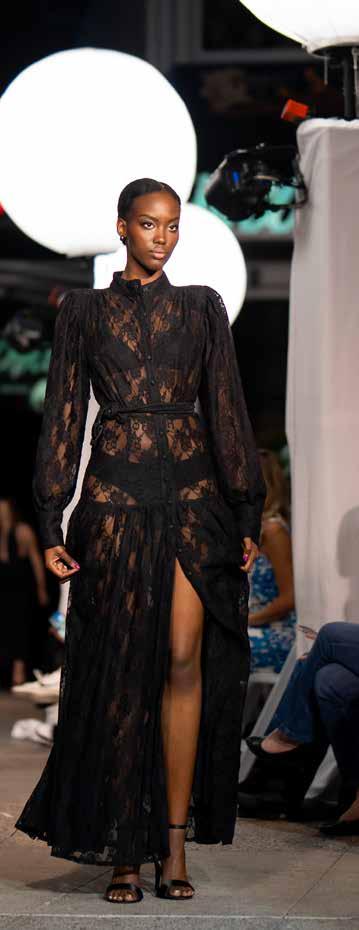
The first time Tricee Thomas shut down Central Avenue for a fashion show, Phoenix’s downtown core had never seen anything like it. Two hundred fifty models. Twenty-five designers. An entire city street transformed into a runway, with the urban skyline as backdrop and the light rail humming past just blocks away. It was 2017, and Thomas — a Fashion Institute of Technology graduate with three decades of industry expertise — had just announced that Phoenix belonged in the same conversation as New York, Los Angeles and Miami.
“I moved here in 2013 — relocated downtown from the East Coast — and at that time, there wasn’t a whole lot going on,” Thomas says. “I know we had Phoenix Fashion Week, but it was held in Scottsdale. There was simply no fabric, no real fashion presence happening in downtown Phoenix.”
What began as that audacious street takeover has evolved into something far more ambitious: The Garment League, Arizona’s leading fashion education nonprofit, serving more than 920 young creatives annually and now launching Pattern, the state’s first fashion industry trade school. Where other cities treat fashion as a luxury import, Thomas is building an ecosystem of homegrown talent — teaching pattern making and tech packs alongside business acu-
men, then showcasing the results on runways that rival anything produced on the coasts.
“I saw the opportunity and went for it,” Thomas says.
But opportunity revealed a problem. After that inaugural On Central show, Thomas partnered with then-Mayor Greg Stanton, who pushed her toward nonprofit status. The reason became clear immediately.
“What we found during that show was a significant lack of education,” Thomas says. “Designers didn’t have focus or direction — they didn’t know about manufacturing, they didn’t know how to get samples made.”
From that realization, The Garment League pivoted from spectacle to substance, launching education programs that treat fashion with the same structural rigor as architecture — where pattern making becomes blueprint, draping becomes engineering, and every garment requires a foundation before ornamentation. The organization now operates on three pillars — art, education, and workforce development — each designed to professionalize an industry that Phoenix has historically treated as hobby rather than vocation.
Writer Joseph J. Airdo // Photography Courtesy of The Garment League
It’s all about bringing big-city energy to Phoenix. I’ve never been a fan of the typical hotel runway. There’s something really magical about being outside with the city as your backdrop. That’s big city. That’s big fashion. Tricee Thomas
THE CLASSROOM AS STUDIO
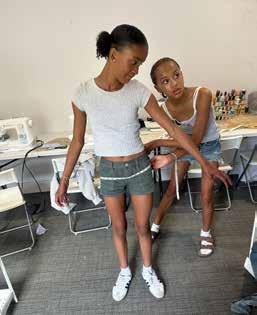
Walk into a Garment League classroom and you won’t find watered-down curricula or beginner-friendly shortcuts. Students as young as 8 learn flat sketching and specking — industry terminology for technical specification sheets — using the same fundamentals that Thomas teaches adults. It’s an approach born from her FIT training and decades working in markets where precision means the difference between a sample and a sellable garment.
“With our kids, we teach them flat sketching and specking first — the same fundamentals — but we don’t water anything down,” Thomas says. “They’re learning just like our adults are learning, and there’s something about it that they just absorb. They’re like sponges.”
The Fashion Industry Youth Initiative, known as FIYI, integrates STEM concepts into K-12 learning through fashion. Students calculate fabric measurements, apply geometry to pattern-making — learning how a two-dimensional blueprint transforms into three-dimensional form — and explore color theory through the lens of psychology and science. They complete research papers. They present their design processes publicly, building communication skills alongside creative ones.
Tricee Thomas, founder and CEO of The Garment League, has transformed Phoenix’s fashion landscape since relocating from the East Coast in 2013. A Fashion Institute of Technology graduate with more than 30 years of industry experience, Thomas now serves more than 920 youth annually through fashion education programs and is launching Arizona’s first fashion industry trade school this spring.
“I’ve got an 11-year-old who just flew to Atlanta to do a 13-piece showcase,” Thomas says. “It’s amazing. These kids are different — some of them are beating my colleagues.”
The program offers after-school sessions, weekend workshops, and summer camps, serving youth ages 8 to 17. The results extend beyond runway shows: In the last two years alone, five Garment League students have been accepted to FIT, with others headed to Parsons and other top design schools.
“We’ve helped them build their portfolios for the application process and everything,” Thomas says.
Perhaps most striking is the demographic shift Thomas has witnessed. Fourteen years ago, when education programming began, the student body skewed heavily female. Today, one Saturday class runs entirely male — young men designing streetwear with entrepreneurial intensity.
“I remember when I was coming up, if you were a guy who loved fashion, you kind of had to sneak around about it,” Thomas says. “And now it’s just the opposite — these kids are being entrepreneurs. I’ve got two seniors whose Instagrams are going crazy. They’re doing shows, and they’re really, really good designers.”
BEYOND THE SEWING MACHINE
But Thomas knows that talent without business acumen leads nowhere. The Garment League teaches the “grit and grime” of the industry — how to communicate with manufacturers, what a tech pack actually contains, how to price garments accounting for labor and materials.
This spring, that philosophy expands dramatically with the launch of Pattern, a two-year certificate program designed as an affordable alternative to four-year fashion degrees. Led by instructors with a minimum 10 years of industry experience, Pattern focuses on technical design, garment construction, and the structural precision that separates hobbyists from professionals.
The curriculum reflects Thomas’ frustration with predatory education models she’s observed elsewhere, where emerging designers are encouraged to take on debt before launching careers.
“I’ve heard about programs in other states where emerging designers are being pushed to take out loans before they’ve even launched their careers,” Thomas says. “That’s not right.”
The alternative? Instructors who remain active in fashion, not just teaching about it. Pattern also offers business classes tailored specifically to fashion entrepreneurship, taught with the understanding that most designers will need to navigate manufacturing, marketing and retail simultaneously.
“The reality is, when you have professionals teaching who have actually been in this industry for decades — people who are still actively working in fashion, not just teaching about it — the knowledge becomes accessible,” Thomas says.
THE STREET AS STAGE
Education without exhibition remains theoretical. That’s why Thomas treats runways as galleries, public installations that legitimize fashion as visual art while giving emerging designers
professional-caliber exposure. On Central — having entered its ninth year in March — continues to shut down Central Avenue, transforming downtown Phoenix into a fashion capital for one spectacular evening.
“It’s all about bringing big-city energy to Phoenix,” Thomas says. “We’re the fifth largest city in the country. We should have been on the map with the rest of the fashion capitals years ago. I’ve never been a fan of the typical hotel runway. There’s something really magical about being outside with the city as your backdrop. That’s big city. That’s big fashion.”
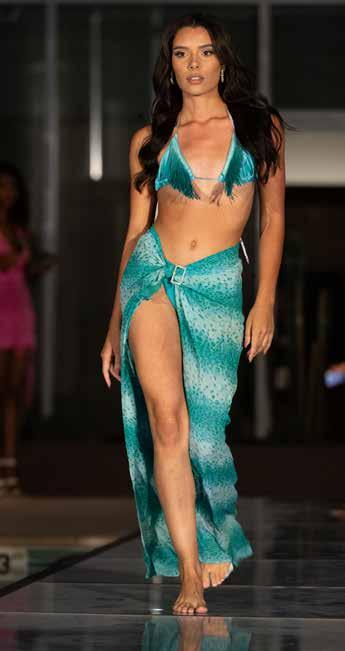
The scale has grown: This year’s show was the largest yet, featuring both Arizonabased talent and national designers. Thomas also produces Phoenix Swim Week and Phoenix Man, each designed to generate support for The Garment League’s educational mission while spotlighting Arizona’s expanding fashion scene.
Yet for all the growth — the city recognition, the newcomer award Thomas recently received, the increasing number of organizations producing downtown shows — she remains focused on a larger goal: unifying Arizona’s fragmented fashion community.
“Arizona has come a long way, but I think people are pulling from everywhere else except here,” Thomas says. “And there’s so much talent here, which makes me so upset. One of the things I think Arizona has to do first is come together as a whole. It’s so separated and divided.”
DEFINING DESERT FASHION
Ask Thomas whether Arizona has developed a distinctive aesthetic, and she offers nuanced optimism. The state has moved beyond turquoise-and-silver
clichés, she notes, with designers producing work that rivals coastal markets.
“If you ask me, we’re keeping up with the other fashion capitals,” Thomas says. “What I see on the East Coast is happening here. The other good thing is people are moving here, so we’ve got that influence from all around us. We’re not missing a beat — and we get to do ours year round because the weather is so beautiful.”
But a cohesive “Phoenix look” remains elusive, largely because the community hasn’t yet unified behind homegrown talent
with the collective force of other fashion cities. Thomas continues advocating at City Hall for designers to be included in public art installations, for vacant downtown retail spaces to be filled with local fashion rather than left empty.
“When there are calls for artists on the sides of buildings, I’m advocating for fashion designers to be considered — let us come in and dress the lobbies with our garments,” Thomas says. “You have these spaces downtown where all the retail is sitting vacant — let the designers take these spaces and do something with them. That’s what I’m fighting for now.”
A NATIONAL CONVERSATION
That advocacy extends to The Garment League’s next evolution. The organization itself is transitioning into a national conference platform, having launched its first multiday event in March — the day before On Central. The conference brought fashion educators, industry professionals, and organizations from across the country to Phoenix, positioning the city as a hub for fashion education discourse.
Meanwhile, the day-to-day programming — FIYI classes, adult workshops, Pattern courses — will operate under a new umbrella: House of Patterns. It’s a reorganization that reflects maturity and ambition in equal measure, separating education operations from the national platform while allowing both to scale.
For Thomas, who took an FIT class herself not long ago, the work remains deeply personal. Fashion, she insists, is not frivolous.
“When I was coming up in this industry, people thought fashion was just playing with fabric and glitter all day,” Thomas says. “But it really is a successful, fulfilling career. If you ask me, fashion makes the world go ‘round.”
Fifteen years after relocating to Phoenix, Thomas has constructed infrastructure that didn’t exist—laying foundations with trade schools, erecting frameworks through youth programs, and building a growing cohort of designers who understand that great fashion, like great architecture, requires both vision and precision. The question now isn’t whether Phoenix belongs in the fashion conversation. It’s whether the rest of the country is paying attention.
thegarmentleague.org // houseofpatterns.co
Sarah James had come to the old convent in Pittsburgh for silence — a private meditation retreat, nothing spiritual about it, just a quiet place to think. What she found instead, leaning against a wall in one of the rooms, was a guitar. She asked one of the nuns if she could buy it.
“Honey, you don’t have to buy it,” the sister said. “Just take it. We’ll give it to you.”
James took the guitar to a luthier. His jaw dropped: “You don’t know what you have here.”
What she had was a 1938 Martin 000-28 — what James calls a triple-ought 28, considered the Holy Grail of Martin guitars. She had pulled it from a convent wall thinking nothing of it, and walked out holding one of the most coveted acoustic instruments in the world.
“That’s the guitar that really started everything for me,” says James, now a Scottsdale-based singer-
songwriter, recording artist, and founder of Vintage Guitar Legacies, a video series dedicated to the history and stories of exceptional instruments. “For me, these instruments are connected to people. The sister who owned it was in her 90s, retiring from the order. She said, ‘Oh, the kids play with that all the time.’ And here I am finding out how significant it is.”
That moment of accidental discovery crystallized something James had been circling her whole life — a conviction, inherited from a mother who collected early American antiques and a father who ran the oldest wooden boat-building company on the Great Lakes, that the objects people make and play and pass along carry something irreplaceable inside them. At 76, she has built an artistic life organized around that conviction, performing across the North Valley while simultaneously running a video series that has drawn subscribers from around the world.
The two pursuits are more entangled than they might appear.
Strings Attached Sarah James and the Stories Old Guitars Tell
James launched Vintage Guitar Legacies during COVID, initially as a way to share the instruments accumulating behind her at Lucky Now Studios, her home recording space in Scottsdale. Each episode profiles a single guitar — its history, its construction, its provenance — with a guest musician demonstrating what the instrument actually sounds like in capable hands. The 1938 Martin was among the first. Others followed: a 1966 Gibson Trini Lopez Deluxe, a mid-1960s Buck Owens Harmony guitar whose episode has reached 38,000 views, and eventually instruments with considerably heavier history attached to them.
A Martin D-28 owned and recorded by Steve Earle. A 1957 Stratocaster that once belonged to Waylon Jennings. A 1959 Martin D-18e whose specs, James says, match those of Kurt Cobain’s guitar — the one he played at Nirvana’s MTV Unplugged concert in New York — right down to the rare Bartolini pickup. Only 300 were made.
“I can feel the vibe coming from these instruments,” James says. “When I pick up a guitar that was owned by Steve or another artist, it changes the way I play. Something happens. You approach the instrument the way it feels in your hands.”
The Earle guitar came with a specific story. Earle used it recording “The Mountain,” a 1999 collaboration with Del McCoury that found him venturing deep into bluegrass territory. James eventually added “The Mountain” to her own live repertoire — playing it, she says, on the very instrument Earle used to record it. Last year, Del McCoury came through Phoenix for a date at the Musical Instrument Museum. James brought the guitar.
Writer Joseph J. Airdo // Photography Courtesy of Sarah James
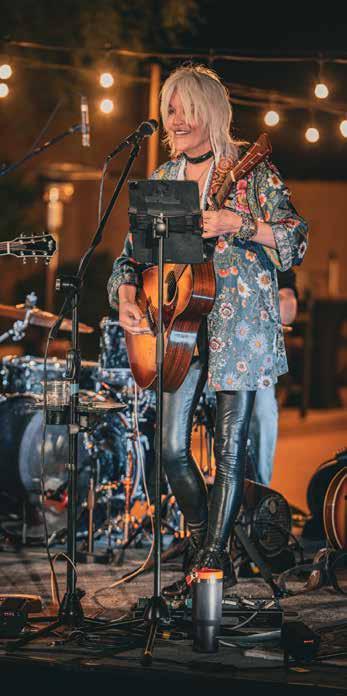
Scottsdale singer-songwriter Sarah James has spent 12 years building a performing career and a video series dedicated to the instruments that carry music’s history forward.
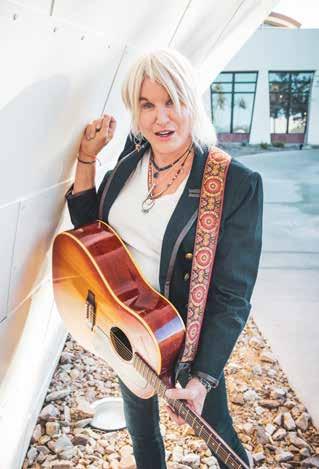
For Sarah James, every guitar has a story worth telling — and after a lifetime of raising a family and building a career, she's finally the one doing the telling.
I’m at a place in my life where I finally get to do what I want to do. My guitar was always under the bed — I raised a family, two great kids, I have grandchildren. But it was always calling me. And now I’m at a station in life where I get to answer.
Sarah James
“He said, ‘Oh, I remember this — Steve had it on the tour,’” she recalls.
That exchange — the living chain of musicians, instruments, and stories — is precisely what VGL was built to document. The series has now taken James to a 40-year-old family-owned guitar shop in Pittsburgh, to Elderly Instruments in Lansing, Michigan, where founder Stan Werbin let her spend three days filming, and most recently to NAMM — the National Association of Music Merchants — in Anaheim, where she walked the convention floor with a cameraman and media credentials and came home with 16 episodes in three days.
“I don’t see many women doing what I do in the vintage guitar world,” she says. “There are a lot of guys out there, and I love them, but it’s fairly rare to find a woman talking seriously about these instruments. Sometimes there’s that initial reaction of, ‘What does she know?’ Well, I know quite a lot.”
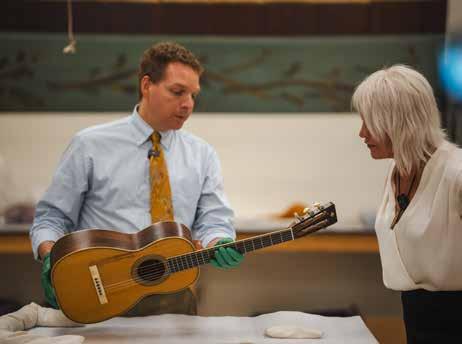
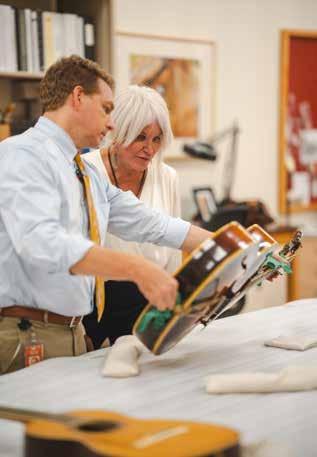
The series has also drawn her into a deepening relationship with the Musical Instrument Museum in Phoenix — one of her first stops after moving to Arizona 12 years ago. Last year, she approached the MIM’s philanthropy office and donated two instruments from her personal collection: the 1957 Waylon Jennings Stratocaster and a 1936 Martin D-18, both in exceptional condition. The MIM’s curator, she says, looked at the Stratocaster and asked whether she was certain she wanted to part with it.
She was.
“It blesses me,” James says. “For me, it’s the giving. I wanted them to be curated and cared for in a place where thousands of people can enjoy them. The tour they gave me of the curator’s suite — getting a sneak peek into the bowels of that museum — was a genuinely touching moment for me.”
The performing life runs parallel to all of it. James plays the Cave Creek and North Scottsdale circuit regularly — Whiskey & Wings, Copper Bull Restaurant, Local Johnny’s, Raven’s View — as a solo act, as the Sarah James Duo, and fronting the Sarah James Project, a full band. She performs with the Desert Cats All-Star Band as well, a loose collective of Valley musicians whose upcoming date at Desert Mountain reflects how thoroughly she has embedded herself in the community since arriving from Pittsburgh. During
At 76, Sarah James is releasing original music, running a globally followed vintage guitar series, and donating legendary instruments to the MIM — on her own terms and timeline.
Singer-songwriter Sarah James counts Ringo Starr among her heroes and mentors — proof, she says, that music keeps you young and relevant no matter what the calendar says.
summer months, James tours western Pennsylvania and New York — including a residency at the Chautauqua Institution in Chautauqua, N.Y., the landmark arts and education assembly where she performs, writes, and works on her craft.
“I love meeting people from all walks of life — bikers, golfers, bankers,” she says. “Music is the common denominator. It brings people together and lets them forget, for a moment, what they’re going through. That’s a beautiful thing.”
The songwriting came late — or rather, the recording of it did. James has been writing for years, but it wasn’t until about a decade ago that she committed fully to releasing music. Her latest single, “Swedish Machine” — a lighthearted song drawn from memories of traveling the Swedish countryside in an old Volvo — arrived on all streaming platforms in April. Before it, “Better Than This” surpassed 200,000 YouTube streams in just a few months.
It began one rainy Arizona night when she was sitting at her monitor, feeling melancholy, watching something unfold on the screen that she couldn’t quite believe.
“The lyrics started coming out of me: raindrops running down my window… And when I looked at that image, the thought came to me: shouldn’t we be better than this?”
She still writes lyrics by hand — old school, she says, because she’s a tactile person, because it helps. She brought the pages to Aaron Howard, her producer and longtime collaborator.
MUSIC
Sarah James
“He looked at them and said, ‘Yeah, we’ve got something here,’” James recalls. “It started out as something folky and dirge-like, but by the time we were done, it became this anthem — it builds and builds.”
There’s a line in an earlier James song, “Take It or Leave It,” that functions almost as a thesis statement for this chapter of her life: The window’s closing fast now, got no time to f--- around. She wrote it, she says, about exactly this — about growing older and bolder, about the things that call to you from under the bed while you’re raising a family and building a life, about the decision to finally answer.
Her heroes reinforce the point. She counts Ringo Starr — 85 and still actively touring — as a mentor, and saw him perform at the Celebrity Theatre in Phoenix last year.
“Music keeps me young and relevant,” she says.
James’ guitar was under the bed for a long time. She raised two kids, has grandchildren now, built a career in Pittsburgh before the desert took hold.
“I’m at a place in my life where I finally get to do what I want to do,” she says. “But it was always calling me. And now I’m at a station in life where I get to answer.”
She pauses, and then: “The windows may be closing fast, but I’m going to jump through them.”
Saturday, May 9 // 6–9 p.m. // Whiskey & Wings // 34406 N. Black Mountain Parkway, Cave Creek // Free 480-275-6417 // whiskeyandwingsaz.com Friday, May 15 // 5–8 p.m. // Raven’s View // 42016 N. Old Mine Road, Cave Creek // Free // 480-378-3755 // ravensviewwinebaraz.com
BOURSIN DIP WITH PISTACHIOS AND HOT HONEY
Francine Coles
Writer and Photographer
thefancypantskitchen.com
Recipe
Three ingredients, five minutes, zero effort — and yet this dip has a way of stopping a party cold. A wheel of Boursin pressed onto a plate, blanketed in salted pistachios and finished with a generous drizzle of hot honey, delivers the kind of sweet-heat-salty combination that turns crackers into vehicles for one more bite. It works as a weeknight snack, an effortless happyhour offering, or the appetizer you bring when you want people to ask for the recipe.
Yield: 6 servings
INGREDIENTS:
1 5.4-ounce wheel Boursin cheese, garlic and herb variety
1/2 cup roasted salted shelled pistachios, chopped (about 1/4 cup crushed)
3–4 tablespoons hot honey
Crackers or apple slices, for serving
DIRECTIONS:
1. Let the Boursin come to room temperature for 15 minutes to soften for easier spreading.
2. Choose a serving plate or platter. Use the back of a spoon to press the Boursin into an even layer across the surface.
3. Top evenly with the pistachios. Drizzle generously with hot honey.
4. Serve immediately with crackers or apple slices. Include a small spreading knife or spoon for easy plating.