385 T/
OC
N
OV 20 26
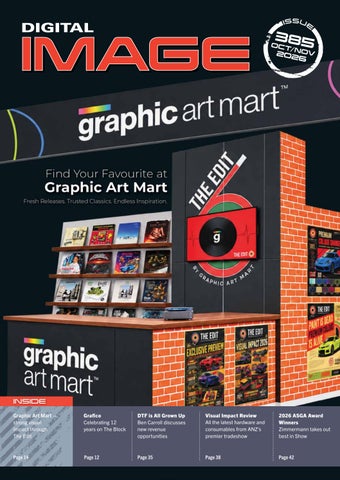
INSIDE Graphic Art Mart – strong visual impact through The Edit
Grafico Celebrating 12 years on The Block
DTF is All Grown Up Ben Carroll discusses new revenue opportunities
Visual Impact Review All the latest hardware and consumables from ANZ’s premier tradeshow
2026 ASGA Award Winners Zimmermann takes out best in Show
Page 14
Page 12
Page 35
Page 38
Page 42
Workflow Efficiency. L E S S CO M P L E X I T Y. MORE IMPAC T.
FOCUS On what matters most.
SAVE TIME Automate tasks. Accelerate results.
REDUCE RISK Minimise errors. Ensure consistency.
Simplify processes. Eliminate bottlenecks. Empower your team to do more with less.
DRIVE GROWTH Improve efficiency. Accelerate results.
That's the power of workflow ef ficiency.
Unravel the complexity. Streamline intelligence. Certified resellers for:
Smart workflow solutions that adapt to your business and unlock your potential.
WWW.WORKFLOWZ.COM.AU
CONTENTS
5
News from around the industry
12
Grafico’s Damian Corney shares memories from
12
14
14
A first glimpse at Avery Dennison’s new
Spectrix™ Colour Paint Protection Film
of pre-cut specs for 133 different car brands,
capturing 32,000 vehicle kits DTF is all grown up: Ben Carroll discusses the
evolution of DTF and new revenue opportunities
in garment decoration
43
43
Introducing the HEXIS Precut Lab, a library
42
35
products and celebrates the success of The Edit
22
35
32
Cover Story
Graphic Art Mart launches a number of new
32
22
his 12 years on The Block
2026 ASGA Award Winners: Zimmermann named Best in Show Image Magazine’s very own Vernon Kingman
receives a Lifetime Achievement award from his
sign and graphics professional peers
PUBLISHER Image Publications Pty Ltd ACN 056 489 699 PO BOX 613, Brighton South Australia 5048 T > +61 1300 001 393 E > info@imagemagazine.com.au W> www.imagemagazine.com.au
CONTRIBUTORS
DEADLINES
Charles Watson
Next Issue: December 2026 /January 2027 Vol.38 No.6
EDITOR Nige Cottingham T > +61 417 773 135 E > content@imagemagazine.com.au
SUBSCRIPTIONS
ADVERTISING Janet Maitland (Publisher) T > +61 1300 001 393 E > info@imagemagazine.com.au
Sue Hirst Vernon Kingman
Booking and editorial
Australia
1 Year $ 66 + GST
2 Year $ 110 + GST
New Zealand
1 Year $ 130 AUD
2 Year $ 200 AUD
Other countries
1 Year $ 200 AUD
2 Year $ 350 AUD
No GST on New Zealand and other countries
21 October 2026
DISCLAIMER The opinions expressed in Image magazine are not necessarily the views of the publisher. Every effort has been made to ensure the accuracy of information contained in this magazine. No responsibility is accepted by the publisher for any omissions, inaccuracies, typographical errors or printers’ errors. Nor will responsibility be accepted for any changes to information after publication.
W W W.IMAGEMAGAZINE.COM.AU
OCT/NOV 2026
3
EDITOR’S NOTE
Time to catch your wave Great to receive commentary in this issue from two of our industry’s better-known faces. Damian Corney consistently brings an infectious energy into the conversations that he graces, but to hear him talk about his 12 years providing supplies and service for The Block was next level. I caught him in between flights out to China where he was personally supervising the manufacture of Grafico’s new DIY Sav peel and stick film solution that Bunnings had agreed to sell for a limited time in September. On a similar level in terms of infectious energy, spending time with Velflex’s Ben Carroll at the Mimaki Partner gathering at Visual Impact, inspired me to try to fit more into my own days. Great insight from Ben in this magazine about the fact that he believes that DTF technology has well and truly matured now. What is evident from both of these conversations is that no part of our industry
4
OCT/NOV 2026
is standing still. Whilst the inevitable murmurs about the advances of AI changing the way we work, quite rightly, continue to rumble forwards in the background, many of the real changes in our industry are already here. It’s just a matter of how quickly we can pick up on them and, more importantly, commercialise them. Mutoh, for example, has been talking for ages now about how their breakthrough UV printing technology charts a clear pathway to compliant, profitable Braille production for Mutoh XpertJet 661UF and large format XpertJet 1462UF users. Similarly, as part of the latest technology update to HP’s PrintOS Production Hub, there are two new AI capabilities that are printer-brand agnostic and undoubtedly potential door-openers or conversation-starters with your customers. The AI Order Intake turns a customer email or a file into an order in seconds using naturallanguage AI, reducing average order creation
time by 90%, from a couple of minutes to just a few seconds. And AI Upscale fixes lowresolution files in one click, cutting back-andforth with customers and avoiding delays. Another example, as featured in this issue of the magazine, is HEXIS Precut Lab (see Page 32) which carries the pre-cut specs of 133 different car brands and almost 32,000 vehicle kits, and is compatible with more than 70 different plotter brands. My point is that as technology in our industry continues to advance at pace, there are already countless existing and emerging commercial opportunities out there, breaking like waves – is it time to catch your wave?
Best regards, Nige Cottingham Editor Image Publications
NEWS
GRAPHIC ART MART
IVE GROUP
EPSON
A number of industry’s big players set new ‘sites’ for future EPSON Epson Australia and New Zealand has expanded its regional presence with a move to larger, more modern premises in Adelaide, Brisbane and Auckland, providing increased office and operational space, as well as significantly larger showrooms. Craig Heckenberg, Managing Director, Epson Australia and New Zealand, says: “As our business expands, our infrastructure and people must keep pace. These new premises are an investment in our customers, our people and our long-term growth ambitions. The larger showrooms will create a more engaging customer experience, while additional expertise across the team will further strengthen our ability to better serve our customers and business partners.”
GRAPHIC ART MART MM Plastics has opened a new purpose-built ‘Super Site’ facility in Melbourne’s Dandenong South ‘to bring the Victorian operations of Graphic Art Mart, Dotmar and MM Plastics under one giant new roof’. Spanning more than 9,200 square metres, including approximately 8,700 square metres of high-clearance warehousing, the facility significantly expands MM Plastics’ distribution capacity and provides the infrastructure required to support continued
investment across its portfolio of leading brands. The site has been designed to improve inventory capacity, streamline logistics and enhance customer service, while providing the flexibility to expand as demand continues to grow. Acknowledging this as the Group’s single largest investment in operational capability and customer service, Executive General Manager, MM Plastics, Mousa Elsarky says: “As our customers continue to grow, so must we. This investment gives us the capacity to broaden our product offering, improve service levels and continue investing in the brands that our customers know and trust.”
POZITIVE SIGN & GRAPHICS SUPPLIES Pozitive has made a move recently to change up its Melbourne service capability, moving out of its rented premises in Burwood and acquiring a modest footprint about half an hour away in Cheltenham ‘to service a growing customer base’. Phil Trumble, Pozitive Sign And Graphic Supplies Managing Director, says: “Our Melbourne business has been growing year on year, and we recognised that now is a good time for us to purchase our own premises to further cement our presence in the market here too. Whilst we are not planning to replicate our Emu Plains, Sydney facility at this stage, our new Melbourne facility will definitely complement
what we do in NSW and with 300 square metres, it brings us almost twice the space we previously had in Melbourne.”
IVE GROUP IVE Group has officially opened its new 42,000sqm Kemps Creek printing supersite, which brings key operations across packaging, commercial print, book production, direct mail, brand activations, warehousing, and distribution into one connected manufacturing hub. Matt Aitken, Managing Director of IVE, says: “This is not just a big shed: it is the biggest investment in IVE’s 105-year history and will quickly become a world-class operational hub. The tools may have changed but the mission has not: IVE is here to enable our clients to get alongside their customers.” Located within Mirvac’s Aspect Industrial Estate, the greenfield site, which took just over a year to build, is a collaboration between IVE, Mirvac and Australian Retirement Trust, and is a component part of a broader development plan for western Sydney, which includes a new airport. The new facility incorporates advanced manufacturing technology and infrastructure, including new-generation printing presses, as well as purpose-engineered pressroom and diecutting foundations designed to accommodate future equipment requirements.
W W W.IMAGEMAGAZINE.COM.AU
OCT/NOV 2026
5
NEWS
OOH a US$16bn industry by 2032 Plenty of movement over the last few months in the out-of-home media sector. Nine paid $850 million for QMS at the start of the year. A few months ago, US private equity firm I Squared topped that acquisition with the purchase of oOh!media in a circa AUD$900m deal. And now IVE Group has jumped in on the act with a $20m acquisition of the Motio network. These acquisitions come at a time when an industry report from QY Research predicts that the global Digital Signage market will grow at a CAGR of 5.0% from 2026 to 2032, reaching USD$16.76bn by 2032. The report claims that future growth will be supported by retail
media, brand experience upgrades, real-time public communication, transportation modernisation, smart campuses, corporate digital communication, fine pitch LED adoption, and cloud-managed signage networks. The report says: ‘Demand is being driven by the need for faster content refresh, better customer experience, stronger brand visibility, real-time public communication, improved advertising flexibility, and data-driven operations in physical spaces. The market is also benefiting from cloud-based content management systems, mature media players, remote monitoring, improved LED performance, and lower deployment barriers for large-scale multi-region networks.’
Nine chooses Outdoor Media over Radio
Nine Entertainment acquired QMS, one of A/NZ’s leading digital outdoor media platforms (with contracts for the City of Sydney and Auckland Transport), for circa $850m earlier this year. The acquisition announcement was accompanied by news of Nine selling 2GB, 3AW, 6PR, and 4BC to Arthur Laundy for $56m in what Nine described to shareholders as ‘a deliberate strategic pivot away from radio and regional television towards digital advertising’. Nine’s chief executive, Matt Stanton, said: “QMS is a highly complementary media platform, offering Nine the opportunity to drive significant value by leveraging our premium content on QMS screens and creating an unparalleled advertising proposition that spans from ‘sofa to street’.” Stanton described out-of-home as ‘more resilient to the impact of global digital platforms’.
I Squared wins 4-way bidding war for oOh!media
US Private equity firm I Squared outbid three other suitors for Sydney-based out of home advertising company oOh!media, acquiring the company for circa $900m. I Squared senior partner Harsh Agrawal said: ”oOh!media represents the type of infrastructure platform we seek to invest in: a market-leading business with high-quality assets, long-term contractual foundations and attractive growth opportunities.” oOh!media operates a diversified network of more than 30,000 digital and static assets across Australia and New Zealand, spanning roadside billboards, street furniture, rail and transit networks, airports, retail environments, and other public spaces. Its scale, premium locations, breadth of formats, and extensive concession base underpin a leading market position.
IVE Group expands into digital out-of-home media
Australia’s largest diversified marketing company IVE Group has expanded into the out-of-home sector, one of the fastest growing media channels in the market, through a $20.7 million acquisition of Motio Limited. The deal, part of IVE’s broader 2030 growth strategy, will add Motio’s network of 1,300 digital screens across pharmacies, healthcare settings and retail environments to IVE’s existing marketing services portfolio. Motio managing director Adam Cadwallader confirmed that there is a ‘strong strategic fit’ between the two organisations, saying that over the past years: “We have built Motio into a very different business, simplifying the company, improving its operating performance and establishing specialist media networks across a number of attractive environments.” 6
OCT/NOV 2026
NEWS
Fujifilm planning to ‘give our world more smiles’ Having defined its group purpose as ‘Giving our world more smiles’, Japanese tech giant Fujifilm has released plans to partially spin off its ¥1,175bn Business Innovation wing as a separate listed company, to be listed separately on the Tokyo Stock Exchange, with Fujifilm likely to hold a stake of less than 20% in shares in the new entity, with the remaining shares distributed to shareholders through non-cash dividends. Fujifilm Business Innovation includes Fuji’s Graphic Communications division,
Office Solutions, and Business Solutions including document services, BPO and IT outsourcing. Its activities for the printing industry include toner devices, inks and inkjet printheads, and printing plates. If the spin-off goes ahead, Fujifilm Business Innovation Corp would still be able to use the Fujifilm brand, and have access to synergies across the wider group. The process is likely to take two-to-three years and is subject to various approvals including by shareholders and relevant authorities.
2026 FESPA Leaders Program
FESPA selected 12 professionals from 10 businesses for its flagship 2026 FESPA Leaders Program. The program, now in its 5th year, has produced more than 60 alumni across the industry and Nigel Davies, President of FESPA Australia, says: “The real measure is what happens afterwards. Past FESPA Leaders are taking on greater responsibilities, moving into leadership roles within their businesses, and becoming mentors, decision-makers and contributors to the wider industry.” The 2026 FESPA Leader’s program cohort includes: Steph Wilbow, Beth Corbin and Anthony Zuabovic from Easy Signs, Gabriella Bartolo from IVE Group, Coadie Bingham (Factory One), Daniel Buerker (Tiger Corp), Jacky Chan (HVG Graphics Media), Kathy Doan from Corrective Services NSW, Chris Gardiner (The Print Factory), Louise Paton (VMG Print Group), Tammy Roos (Formul8) and Kris Pratt who recently joined Orafol.
Ball & Doggett appoints Stone and Lyons
Ball & Doggett has appointed two highly experienced industry professionals to leadership roles within its business, with Greg Stone joining as National Manager, Industrial Equipment and Michael Lyons as Sales Manager Victoria, Sign, Display & Digital. Stone has more than 22 years of experience in the digital printing industry, including senior leadership positions with Roland DG, where he most recently served as National Product & Marketing Manager, and is widely respected across the industry. Lyons has previously held senior roles with organisations including Alloys, Conect Enterprises and most recently Spandex, where he served as Sales Manager. Rob Brussolo, General Manager – Sign, Display & Digital, Ball & Doggett, says the appointments reflect a continued investment in industry expertise and customer support: “Greg and Michael are highly regarded professionals whose experience, leadership and industry knowledge will further strengthen our business. Their appointments reinforce Ball & Doggett’s commitment to delivering market-leading products, technical expertise and exceptional service to customers across Australia.”
Cimpress forges Canva deal via Vistaprint
Announcing Cimpress’s year-end results, founder, chairman and CEO Robert Keane outlined the firm’s strategy to further expand its presence in what Keane describes as ‘more complex, elevated categories’ that are more highly-valued by customers, such as merchandise, packaging, labels, signage, logo apparel and multi-page printed products. Noting this, Cimpress has forged a new strategic partnership with online graphic design giant Canva. “Canva AI will integrate directly with Cimpress systems, so customers can move from a design prompt to a professionally produced, print-ready physical product without leaving Canva. This gives Cimpress a meaningful new customer on-ramp at scale, and gives Canva a trusted production partner for its Print Shop strategy, creating real growth opportunities for both companies.” The new partnership will link Canva design tools directly into the Vistaprint production and manufacturing centre in Deer Park, Victoria, as well as into 24 other locations around the globe. W W W.IMAGEMAGAZINE.COM.AU
OCT/NOV 2026
7
NEWS
Easy Signs stretches fabric printing with CICLO
Easy Signs has become the first Australian print and signage company to adopt CiCLO technology, starting with Stretch Fabric Media Walls, with fabric banners, table throws, and crowd control barriers also in development. CiCLO is a patented additive built into polyester and nylon fibres during manufacturing, creating microscopic points which allow the material to biodegrade into environmental waste, similar to a natural fibre, without changing how the fabric looks, prints, or performs. Independent, accredited lab testing under international standards – including ISO 19679 for seawater and ISO 15985 for landfill conditions – found CiCLOenhanced fabric reaches over 90% biodegradation within roughly two and a half to four years, compared to almost none for untreated polyester over the same period. Easy Signs Director Andy Fryer says: “For an industry that relies heavily on synthetic fabrics, this is an exceptional innovation and we have clients across the country, from councils to major brands, who, like us, are always looking for better ways to operate more sustainably and think ahead.”
Bluetooth label from Avery Dennison
Avery Dennison has revealed its AD Visi product line, a new range of Active Bluetooth Low Energy labels designed to deliver advanced tracking for time critical and high-value shipments across global supply chains. The labels, which are less than 1mm thick, have been designed for applying to parcels, pallets and returnable transport items and are effective within a temperature range of between -30°C and +60°C and a reading distance of up to 100 metres. The AD Visi product line aims to enhance end-to-end traceability for high-value or sensitive goods while offering broader applications for sectors needing greater supply chain visibility. Avery Dennison says that its Active Bluetooth Low Energy labels provide live location data, tamper alerts, continuous broadcasting and condition monitoring without manual intervention or specialised scanning infrastructure. 8
OCT/NOV 2026
Roland DG Dimense has designs on wallcoverings
Building on its innovative Dimense printing technology, Roland DG has launched Dimense Surface, a premium interior wallcovering brand created to bring texture, depth, and dimension into modern interior spaces. The wallcoverings are being printed on the Dimense DA-640 textured printer from Roland DG, which uses newly developed printheads to deliver ‘vivid, high-resolution output’, while proprietary structural ink precisely determines where texture appears. As the specialised media passes through the printer, heat activates the surface, expanding it by up to 2mm to create contours, patterns, and intricate details.
Mimaki unveils raft of new printers
Mimaki has unveiled three new UV flatbed printers with updated automation and productivity capabilities and equipped with next generation RasterLink workflow and RIP software. Building on the JFX200 Series, the JFX220-2515 is said to offer high image quality and productivity with improved automation to help users decrease their downtime. Features such as the new Anchor Technology are said to significantly reduce preparation time by applying a vacuum only where the media is placed, eliminating masking and manual vacuum adjustments, while automatic locating pins enable fast and accurate media positioning. A new four-head configuration enables dual CMYK printing, delivering print speeds of up to 42sqm/hr. The JFX220-2515 offers an expanded printable area of 2.5x1.5m, which is suitable for large-scale applications like retail signage and, as standard, can print on media up to 101.6mm thick.
NEWS
3M: ‘cool’ where it counts
3M has announced the launch of 3M™ Cooling Film, a new performance film technology designed to help fleet and rail operators manage heat buildup across transportation assets, specifically engineered for applications including last-mile vehicles, refrigerated fleets, railcars, locomotives and passenger transportation. 3M™ Cooling Film reflects over 85% of solar radiation and can help lower interior vehicle temperatures by up to 10°F / 5.5°C, depending on application and conditions. For refrigerated fleet applications, the film helps reduce heat transfer through the roof, supporting temperature-sensitive cargo and helping lower cooling demand. For rail applications, the film helps reduce heat buildup in railcars and locomotives, supporting passenger and operator comfort while helping reduce demand on HVAC systems.
New ColDesi production system speeds up DTF finishing
ColDesi has launched the AP360, a fully integrated 6-station carousel production system built for high-volume apparel decorators, contract printers, fulfilment companies, and growing DTF businesses. The system features dual 16x20” industrial pneumatic heat presses with cast aluminium plates for even heat distribution, plus a built-in post-peel finishing press, adjustable pneumatic pressure and press speed controls. A PLC touchscreen interfaces with automatic, semi-automatic, and manual modes, plus digital temperature controls. Operating a continuous six-station carousel workflow, the AP360 keeps garments moving continuously through every stage, supporting output above 350 garments per hour with consistent transfer quality.
Summa expands F Series Vantage
Veritas brings NEXA Edge Solo self-wound laminate
Veritas Print Media has introduced NEXA Edge Solo, a new self-wound laminate, that requires no release liner, to the A/NZ market. NEXA Edge Solo is formulated without PVC, plasticisers, phthalates or intentionally added PFAS, avoiding a number of substances commonly associated with conventional PVC-based media. Because of the elimination of the release liner, Nexa Edge Solo has a substantially different material and waste profile from a conventional PVC laminate. As a starting point, the cutting roll weight is dramatically reduced, so despite being supplied in an unusually long roll length - 1370mm-wide by 200-metre rolls, with subsequent production versions planned to move to 1270mm × 220m rolls – each roll only weighs around 12kg per roll. The laminate can be run through a standard laminator, allowing commercial printers and sign businesses to adopt it without investing in any specialist laminating equipment or changing established production processes.
Summa has expanded its large-format production capabilities, launching the F1832, F3220 and F3232 and the F1625 CF, a dedicated configuration optimised for dry carbon fibre cutting. Designed for high-volume signage, packaging, textile, and industrial applications, the new models extend the philosophy behind the F Series Vantage: delivering productivity gains across the entire workflow. Under the hood, the Vantage platform delivers excellent performance, with 200N vertical and horizontal cutting force, a 5 HP / 3.7kW router running at up to 60,000RPM and acceleration up to 1G, further aided by high jerk value, resulting in full speed cutting over short movements. The new platform architecture focuses heavily on serviceability, which will be welcome news for local distributors Graphic Art Mart and Pozitive Sign & Graphic Supplies.
New Roland DG TrueVIS AG-640 latex printer/cutter
Roland DG has launched the TrueVis AG-640, a next-generation 64-inch latex printer/cutter that claims to ‘combine low running costs, high output quality, expanded colours, dense white ink, and integrated contour cutting, to help print professionals move beyond traditional latex limits’. Built on Roland DG’s long-standing print-and-cut expertise, the AG-640 is the world’s first latex printer with integrated cutting functionality, enabling users to contour cut and print seamlessly. The machine uses Roland DG’s newly developed TA-2 water-based latex inks and the latest piezo printheads to deliver high-precision dot control and consistent, high-definition output across a wide range of media. An integrated optimiser ensures stable ink placement and improved adhesion, particularly on commonly used sign media such as PVC. W W W.IMAGEMAGAZINE.COM.AU
OCT/NOV 2026
9
NEWS
Visual Impact stand sales
A number of companies represented at Sydney’s recent Visual Impact expo announced the sale of equipment ‘off the stand’. Below is a quick snapshot of some of the more high profile sales secured during the show.
Connecting Brands Connecting Brands, a vehicle and fleet wrapping business from Western Sydney’s Condell Park, bought a new Summa F1625 Vantage cutter off the Graphic Art Mart stand. Jason Thompson, Managing Director Connecting Brands said: “This machine is not a tool that just does one job - it’s going to save us efficiencies on the floor when it comes to waiting and cutting, so that’s going to be massive for us.”
Printrade Melbourne-based all-digital, high-end print provider, Printrade, bought two new Summa F1625 Vantage cutters from Graphic Art Mart, with a view to applying one to its busy stickers business and the other to support its boards and corrugated sales. Paul Ilieski, Printrade Owner/Director says: “We like the way Summa integrates the flatbed and the roll cutters between the machines and by purchasing the two cutters, we can set up a more split ecosystem in the workshop.”
Monica Print Adelaide-based Monica Print purchased a new HP Latex R530 off GAMART. Aran Kilpatrick, GAMART Business Manager, Regency Park SA, explains: “Monica Print had a couple of older, slower machines, but this new R530 is a hybrid roll to roll and flatbed machine which essentially replaces both of 10
OCT/NOV 2026
them and takes up considerably less space.” Guarav Kumar, Owner of Monica Print Group adds: “We’ve been using a HP 365 for the last five years, and never had a problem, so when the time came to upgrade, the brand choice was a no brainer.”
Bailey Print Group With the 2032 Brisbane Olympics on the horizon, Bailey Print Group is ramping up by continuing to invest in the latest printing technology, as was evidenced by their purchase of HP’s newly released Latex FS50W, off the HP stand at Visual Impact. This is the fourth addition to their HP latex fleet, and for Managing Director, Peter Bailey, the decision came down to a straightforward equation of speed, quality and cost. “It’s the next generation of HP printing technology, faster, better colour gamut, better quality, cheaper ink, just an overall better functioning machine.”
Kwik Kopy Pitt Street Kwik Kopy Pitt Street purchased a JWEI SG1625 flatbed cutter from SMARTECH at the show and the quick printer’s proprietor Jake Steinfield said: “We’ve predominantly been roll-to-roll and mounting and we’re moving into more of a direct to customer model. Initially, we were looking at the lower end of these cutting tables, but seeing what this model can offer, which includes the workflow automations, the increased range of product, and the fact it’s
where our current clients want us to be, we can see that now we can get there.”
Sunkist Graphics Celmac sold an iEcho SKII-2516 with router attachment to printing and signage company Sunkist Graphics. The iEcho SKII-2516 is a 2.5m by 1.6m high-precision, multi-industry digital flatbed cutting system designed for flexible and rigid materials across packaging, advertising, and textiles. Jonny Rumney, Celmac NSW State Manager, says: “This machine is super-fast, super-efficient, and super-accurate. Sunkist Graphics are currently outsourcing a ton of rigid work for cutting, but with this purchase they will be able to bring it all in-house.”
CMYKhub Whilst Pozitive Sign & Graphics Supplies chose not to have any swissQprint products running on their stand, that didn’t prevent CMYKhub Brisbane Hub Manager, Alex Jell, from swooping in and signing a purchase order for a new Impala 5, to replace his Impala 2. “The Impala 2 has been an absolute workhorse for us. It has produced all of our rigid wide format work along with banners and roll work, and has been an incredibly reliable machine. We’ve certainly got our money’s worth out of it, but after nearly 10 years it was time for an upgrade, and we definitely couldn’t look past going with swissQprint and Pozitive again.”
Workflowz: there’s always a way Workflowz, certified resellers of Enfocus and Callas software, delivering smart workflow solutions globally, that adapt to businesses and unlock their potential, firmly believes that ‘there is always a way’, especially when it comes to removing repetitive work, reducing opportunities for error and giving skilled people more time to focus on work that genuinely needs their expertise. Brisbane-based Impressu, part of IVE Group since November 2025, represents a strong case in point. The printer produces sheetfed digital, offset and wide-format work, with finishing handled in-house. Business Systems & Process Development Manager, Dom Cooper, begins every aspect of his role by challenging: “Why are we doing this manually?” Dom explains: “It is not simply about automating for automation’s sake. But by the same stroke, I can’t sit there clicking the same buttons every day: I don’t care what it takes – I’m going to find a way not to have to do it.” Today, Callas pdfToolbox is central to supporting this philosophy. Dom’s role spans operations, IT, systems development and process improvement. His background is equally broad: he started in print-on-demand, moved through graphic design and prepress, and eventually into workflow development and automation. That production experience shapes how he approaches technology. “Knowing what a piece of software can do is useful, but also understanding the process behind what it should do is invaluable.”
From PDF checking to a production engine Dom first encountered pdfToolbox around 2015, during an Enfocus Switch implementation. Initially, he viewed it primarily as a tool for checking colour spaces and trim size. Exploring its command-line capabilities changed that perspective. “Once you know how to use pdfToolbox CLI, it’s just magic. I can run callas on the same server as my Django application, modify files and do everything I need right there.” That flexibility has allowed Impressu to use pdfToolbox inside established workflows, custom dashboards, web applications and hot folders – essentially making it a PDF processing engine around which the company can build its own business rules. One example gives sales teams better information. A submitted PDF is automatically analysed, with pdfToolbox returning structured JSON covering dimensions, colours, page boxes, orientation, image resolution and other production data. Dom turns that information into a simple HTML email, with green, orange or red status indicators showing whether a file appears ready, needs attention or contains serious problems.
1,500 forms, half an hour The biggest demonstration of practical automation came when a healthcare customer rebranded. Around 1,500 clinical forms contained the old logo and previously the process would have been to physically open, edit and save each form- five to ten minutes per file. After one outdated form eventually reached production, Dom created a pdfToolbox profile that replaced the logo automatically. Then
he processed the entire library. “I made a hot folder, dropped about 1,500 files into it and let it churn through them. Within half an hour, every single one was done.” An estimated 200 hours of manual work became one controlled batch process, while also reducing the risk of an outdated file being overlooked.
Automation built around operators Dom has taken the same approach to wideformat imposition. A custom web dashboard lets operators submit files and automatically generate layouts based on stock dimensions, including available offcuts. pdfToolbox handles the imposition and creates a continuous cutting contour for Impressu’s Zünd equipment. A recent revision cut processing time from around a minute to just seconds. “The user inputs the file, hits a button, and it automatically calculates the imposition and the single cuts. Then they’re ready to go.” That is the essence of Impressu’s approach: technology shaped around the production floor, rather than forcing the production floor to adapt to technology. And sometimes the solution is even smaller. When dispatch staff needed to change a customer name on PDF labels, Dom replaced an email-to-prepress hand-off that could take 30 minutes with a pdfToolbox process plan and hot folder. The solution took about ten minutes to build. For Impressu, automation is therefore not a finished project. It is a continuous search for the next unnecessary click, hand-off or opportunity for error. As Dom puts it: “There aren’t too many problems involving a PDF that I haven’t been able to solve with pdfToolbox. Sometimes it’s the most random thing, but there’s always a way.”
W W W.IMAGEMAGAZINE.COM.AU
OCT/NOV 2026
11
Grafico ‘enjoying 12 hectic years on The Block’ The 2026 series of the iconic Channel 9 reality TV home renovation show, The Block, marks an incredible 12-year partnership with multi-award-winning creative agency and print specialist, Grafico. Damian Corney, Founder and CEO of Grafico, who started the business in 2004 from his Nonna’s garage, while still midway through his BA in Design, recalls the moment he first met The Block’s production team: “They actually approached us at a trade show, because they were apparently big fans of our wallpaper products.” “We designed a challenge for the 2012 contestants, where they had to take photos and 12
OCT/NOV 2026
then convert them into wallpaper for a feature wall in one of the rooms, and they actually filmed the challenge at our Grafico studio which felt pretty surreal.” Following the success of this first introduction, Grafico had a foot in the production door and in subsequent years ‘did bits and pieces - a print here, some wallpaper there’, steadily building the partnership to a point where Grafico was regularly assisting in helping contestants to produce hero prints and features for their rooms. Corney adds: “Eventually we cemented the relationship with a more formal sponsorship arrangement, which saw contestants given a
dollar amount each series which they could spend with us. Part of the deal was that they also secured my services for an exclusive period during their build.” Obviously, the benefits of this arrangement far outweighed any investment cost, with The Block launching Grafico products and service capability to a nationwide audience in a manner that not even the largest advertising budget would have been able to achieve. “Grafico has also become something of a household name now,” notes Corney, “and this is evidenced by the interest in our latest venture, where we have launched our new DIY SAV peel-and-stick film solution through
Bunnings: you don’t get that opportunity just by knocking on their door!” “What people probably aren’t aware of is that many of The Block production crew have been with the show since it started 20 years ago. That continuity has in turn helped us to build some really strong relationship and friendships with the team, including the show’s presenters, Scotty and Shelley, and even their experts now regularly come to us for advice on patterns, textures, substrates and installation methods, we feel very much like part of The Block family.” But every family brings its challenges and Corney confesses that on The Block, the challenges are often huge, never been dreamt of before and needing to be delivered in ridiculous timeframes. Corney recalls one time where they had to deliver a huge interior design wallpaper drop, spanning the entire two and a half storeys of the house. “We had to cover an area that was about 12m high by 7m deep. We also produced resin tiles, in 30cm X 30cm sheets, glued and grouted, to create a tiled effect for one of the houses.”
“For another show, we worked with Canon to install and commission a Canon Colorado on the production set itself in Daylesford, so that we could have a sort of pop-up Grafico, at the beck and call of that year’s contestants – a lot of effort for a fortnight’s use!” Challenge has always been synonymous with The Block relationship, amid a production workflow that typically sees taking a brief on Monday, designing it Tuesday, printing Wednesday/Thursday and installing on Friday/ Saturday before the ‘big reveal’ on Sunday. Corney sees the half-full glass in this: “On the plus side, the work we do with The Block has pretty much prepared us for anything in ‘normal client’ world. We talk a lot about partnership over transaction and that’s always been the Grafico MO.” Grafico operates across three specialist areas - Auto, Walls and Signage - serving residential and commercial clients of all sizes across a vast range of industries. A popular online store has enabled the company to service an international audience and Grafico partners with some iconic global brands,
winning multiple industry awards. In 2022, Grafico was honoured with the City of Melbourne’s Small Business of the Year award, recognising the agency’s innovation, creative marketing, sustainability initiatives and lasting connection to the city. Back to The Block and Damian and Grafico have always been made to feel very welcome on the show. Damian feels like part of the family and naturally builds that same sort of relationship with each batch of contestants, many of whom go on to use Grafico in their own home projects after the show. Corney concludes: “It became clear fairly early on that the sort of work we could help The Block contestants deliver really resonated with the show’s audience, especially the DIY enthusiasts. But there has always been a genuinely humbling aspect to the opportunity of working on the show and with the contestants, and this has in turn nurtured a mutual respect that I believe has been the key to the longevity of our relationship with The Block.”
W W W.IMAGEMAGAZINE.COM.AU
OCT/NOV 2026
13
COVER STORY
The Edit delivers strong visual impact for Graphic Art Mart Graphic Art Mart’s innovative stand, labelled The Edit and designed to give visitors the space to explore the company’s significant range of consumables, proved to be a huge success at Visual Impact. The energy delivered through its live stand demonstrations of various new products from HP, Mimaki, Roland, Summa, Forte and CWT, contrasted well with the immersive, galleryinspired experience, complete with nostalgic record sleeves to help visitors ‘find their favourite’ amongst the racks of products from Arlon, Avery Dennison, Utopia, 3M, ASLAN, Nekoosa, Mactac, Xanita, EX-CEL, Nufoam, Nuflute and Siser. Katrina Tesoro, Head of Marketing for MM Plastics and GAMART, says: “The album 14
OCT/NOV 2026
covers were a great and very familiar portal, which allowed us to drop in samples, spec sheets and other detail. This worked perfectly, especially for some of our new releases like Avery Dennison’s Ultima Plus and Coloured paint protection films, the ten additional colours in the Arlon Premium Colour Change range, Nekoosa wall and floor films, Siser DTF film and EX-CEL PVC foamboard, as well as the latest offerings from Utopia, 3M, ASLAN, Nufoam and Nuflute.” The stand itself, including shelving, product displays and larger structural elements, was made out of Xanita-engineered fibreboard using direct-to-board printing, built specifically to show the material’s print quality and structural capability at scale. For sign and print businesses new to this application, distributed
exclusively in Australia by GAMART, Xanita also offers a CAD design service to support production requirements. Pete Townsend, GAMART Business Manager, Roseville, NSW, adds: “It also turned out to be a bumper show for showcasing some of the newer products we represent and we enjoyed some strong sales off-the-stand, which we hadn’t necessarily expected.” Connecting Brands were amongst the first to snap up a new Summa F1625 Vantage cutter, after seeing the product going through its paces live for the second time in six months (MD Jason Thompson had also previously accompanied Mousa Elsarky, Executive General Manager of MM Plastics (who are part of Graphic Art Mart and Computaleta) to FESPA Barcelona). Thompson says: “We
DIT EE
friendly and more economical, giving Monica Print greater capacity to support their ongoing business growth.” Tesoro adds: “Of course, there is always a bit of gimmickry when you’re thinking about the design of any exhibition stand. But our main aim here was to create an environment that would both encourage visitors to want to come and spend time exploring, and which offered enough to keep them on our stand for longer.” “We urged customers to come and ‘find their favourite’ – to take their time, browse the collection and explore the possibilities, whether they were looking for a new material, an exciting piece of technology or the perfect solution for their next project, and that’s exactly what they did.”
TH
do a lot of road sign contracts and Class 1 reflective work for emergency vehicles, so this new Summa will help with that immensely – and we’ve got a lot of shopfronts and work like that happening as well and this machine is not a tool that just does one job – it’s going to drive plenty of efficiencies on the floor when it comes to our productivity.” Melbourne-based printer, Printrade, were so impressed with the cutter that they bought two Summa F1625 Vantage systems for their increasingly busy trade operation. Paul Ilieski, Manager at Printrade, says: “We already operate two of the large format Summa S3160TC cutters, but the way we’ve designed our workflow, the system that sits behind that, and the kit we use – Canon Production Printers, Colex, Fotoba, Summa – all drives us to constantly look for new ways to help our customers achieve further productivity benefits and we’re confident that this latest investment will really help us push the dial even further with that.” Aside from Summa, there was plenty of activity on the rest of the busy GAMART stand, with more customers turning up with cheque-books and an appetite to buy. Kwik-Kopy Pitt Street snapped up a new Mimaki UJ330H-160 hybrid UV printer off the stand: this highly versatile entry-level printer, capable of switching from roll-to-roll to rigid applications presenting as one of the show’s product highlights, both on distributor stands like GAMART and on Mimaki Australia’s own stand where two of the products were running adjacent to each other, to enable customers to see both applications running simultaneously. Adelaide-based Monica Print also came through with a view to investing in a new HP Latex R530. Guarav Kumar, Owner of Monica Print Group says: “We’ve been using an HP 365 for the last five years, and never had a problem, so when the time came to upgrade, the brand choice was a no brainer. I think the machines sell themselves, but for us it’s also about the people who are selling them and we have been working together with the GAMART team for a very long time now – it’s like an extension of our family – and the sales, service and technical support we get from them is excellent.” The HP Latex R530 accommodates boards up to 1.6m wide with a maximum media thickness of 5cm, while delivering indoor printing speeds up to 24m²/hr. It features large 3-litre ink cartridges for both colours and white, and supports a single roll weighing up to 55 kg. Aran Kilpatrick, GAMART Business Manager, Regency Park, SA who sold the machine explains: “Monica Print had a couple of older slower machines, one a flatbed and one roll to roll, and the business had grown to a size where they could upgrade their technology. This is a hybrid roll to roll and flatbed machine which obviously requires less space compared to running two machines, so it is more environmentally
W W W.IMAGEMAGAZINE.COM.AU
OCT/NOV 2026
15
Cover Styl: a design choice, not a construction project A quiet shift is underway in how Australian interiors get remade. Instead of ripping out kitchens, closing shops or taking hotel rooms offline for weeks, more specifiers are wrapping what is already there. Cover Styl by ORAFOL Australia is a premium selfadhesive architectural film with more than 500 colours, textures and patterns. Contemporary, rustic or luxurious: the look is a design choice, not a construction project. Walls, doors, furniture, joinery, displays and shopfronts can be refurbished in place.
Residential The residential collection is framed as an easy, limitless, wide-ranging, hygienic, fast and cost-efficient way to refresh a liveable room, without turning it into a construction site. A kitchen refresh is associated with an average 10% lift in house value. Most homeowners wait around 15 years between renovations. A classic rip-out takes about eight weeks and sends roughly 300kg of material to landfill. Cover Styl keeps the cabinets, the layout and the memory of the room, and changes only the surface. The finishes themselves do the heavy lifting: kitchens move from tired to tailored; bathrooms take on seamless luxury; and living spaces pick up depth.
Commercial Retail and workplace interiors have a 16
OCT/NOV 2026
different clock. Stores typically go about six years between renovations, and a classic retail remodel takes around 12 weeks. That timing matters: roughly 70% of first-time sales depend on curb appeal, and a renovation lifts sales by about 40% on average. So retailers want a renovation that is fast, easy, costefficient, custom, certified, and nonstop. The space has to look new without the store ever going dark. At 144 Champs-Élysées, Brioche Dorée changed concept by wrapping mouldings, frames, partitions and panels with Cover Styl. Works ran from 10pm to 6am and did not interrupt trading. In Kirchberg, 532 square metres of office partitions and doors were covered in five days with a natural oak look, modernising the floorplate without stopping the company. The Cover Styl commercial palette is built specifically with hero walls, displays and shop windows in mind.
Hospitality Hotels live and die by first impressions and reviews. 84% of users treat customer opinions as seriously as those of friends and family; 90% of travellers are influenced by online hotel ratings before they book; each TripAdvisor point is linked to an 11% sales increase; and a negative review is associated with the loss of 94% of potential customers. Guest-facing surfaces, bedrooms, bathrooms,
corridors and common areas are not decoration: they are reputation, and the hotel language is non-stop, hygienic, soothing, fast, certified and cost-efficient. After renovating 200 rooms at Radisson Blu, Technical and Safety Director Jean-Baptiste Bourcier put the case plainly: ‘two to five times less expensive than a classic renovation, faster to apply, textures and colours with “no limit”, a finish worthy of a four-star house’. For hotels, motels, clubs and serviced apartments in Australia, the practical win is occupancy. Rooms can be refreshed in a tight window: corridors and public areas can be recoded without a full shutdown. Wet-area looks, marble, onyx, polished whites, specified as film rather than stone, then maintained as hygienic, cleanable surfaces. Cover Styl by ORAFOL Australia is a premium architectural film with more than 500 references, specified to any look the client has in mind. It wraps existing walls, doors, furniture and fixtures instead of sending them to landfill. Manufacturing is a clean process with low CO2; reuse of the structure cuts the waste of a classic strip-out and reduces the carbon footprint of the refresh. ORAFOL Australia supplies designers, builders, sign partners and facility teams with samples and stock for a kitchen in a home, a shopfloor that cannot close, or a hotel that cannot afford a bad review. The existing room gets to stay.
by ORAFOL Australia
Cover Styl now offered through ORAFOL ANZ Why replace when you can refresh? Cover Styl by ORAFOL Australia specialises in architectural films for commercial, residential, and hospitality interiors. A faster, cleaner way to transform walls, joinery, doors, furniture and benchtops without the cost or disruption of a traditional renovation. With 500+ finishes across wood, stone, marble, concrete, metal, leather, textile, glitter, cork and solid colour -
1300 672 365 orafol_anz
plus PVC-free, highly resistant, exterior, and extrawide XL ranges, the collection delivers the look of premium materials at a fraction of the price. Films are thermoformable and apply with air-release adhesive for a bubble-free finish; they’re water-, heat-, humidity-, and abrasion-resistant, easy to clean, and backed by a 10-year guarantee against cracking, yellowing and delamination.
store.orafol.com.au ORAFOL Australia Pty Ltd
ORAFOL ANZ
Ball & Doggett ‘runs further’ at Visual Impact Donning running shoes and bright orange T-shirts, Ball & Doggett adopted an unusual and understatedly clever approach for its recent appearance as an exhibitor at Visual Impact. Offering a highly visual Start and Finish line for visitors to the show, Australia’s leading distributor of printable materials, press consumables and printing equipment, chose to run a sort of technical valet service, rather than showcase any products on its own stand. ‘Run’ being the operative word here, adopting the simple marketing mantra ‘Run Further’ to initiate a conversation with those who made the pilgrimage to the expo. Rob Brussolo, General Manager, Sign, Display & Digital, says: “We decided our best approach this year was to fly in a team of Ball & Doggett sales and service experts, operating in different corners of our national business, and for them to first talk through where visitors’ production bottlenecks are.” “Once we had the chance to ascertain whether they were looking for advice on printing equipment, or CNC and industrial equipment, or media and substrate solutions, and whether their main challenges are on the factory floor, or in staffing or workflow, then our team would know best how or where to direct them.” “Given that we had vendor partners giving live demos and technical showcases around the expo, we could then ‘run’ our customers across to the HP or Roland or Mimaki stand and show them the benefits of various solutions of direct relevance and interest to them, first-hand.” There is also an intentional double entendre to the ‘Run Further’ catch-line, with the Ball & Doggett team hopeful to use their quality time with customers to really understand the problems they are ‘running’ into – their pain points in production, staffing and automation. 20
OCT/NOV 2026
Brussolo adds: “The onus here is on better understanding our customers’ challenges, so that we are better equipped to advise and support them, so looking at progressive and lasting solutions and outcomes for them, as distinct from just focusing on a shiny new product.” “Post-show support also plays a vital role. We have a large sales & service team across all states, though many people do not realise it. We now have seventeen equipment specialists supporting the sign and display side of the business across sales, service and technical support, covering CNC routers, lasers, printing and finishing equipment, digital cutters and heat presses.” “It’s really about how we optimise the products that people have purchased and make sure that we’ve got no downtime, because every minute that a printer’s equipment is down, they’re losing money.” Minimising downtime is one of five pillars Ball & Doggett has set out for supporting customers. Choice of media, substrates and
consumables is another important part of that equation, which is why Ball & Doggett also carries a number of application specialists, with direct knowledge of and experience with the likes of Metamark, Avery Dennison, and MasterTac self-adhesive vinyls. “This customer education model marks a deliberate shift in our approach, ensuring our specialists are equipped to help customers get more from what they buy. It also underpins the new Metamark Academy, which we will launch later this year.” Brussolo concludes: “The fact is that just two years ago, the business case for investing in wide-format equipment looked very different. In that short space of time, print speeds have continued to increase and substrate compatibility has widened significantly. Meanwhile, the cost per square metre has come down, and the applications that were once niche - architectural, textile, industrial are fast becoming mainstream.”
Paint Protection meets Premium Aesthetics:
Avery Dennison’s Spectrix™ Colour PPF As a global leader in materials science, Avery Dennison is recognised as a leading name in the automotive aftermarket industry, with its PPF earning years of global reputation in delivering exceptional installation performance, long-lasting durability and top-notch protection, vouched for by even the most skilled installers in Australia and affirmed through industry leading warranties. Driven by a market demand for uncompromised performance, the industry is shifting toward solutions that blend highimpact aesthetics with long-term protection. Engineered specifically to excel in the Australian climatic conditions, the all-new Spectrix™ Colour Paint Protection Film (PPF) from Avery Dennison delivers a premium, dualpurpose application: transformative, high-gloss styling, paired with continuous paint preservation backed by an industry-leading warranty.
Redefined Aesthetics, Uncompromising Protection The Spectrix™ Colour PPF allows installers to elevate their service offerings, enabling customers to transform their vehicles with 22
OCT/NOV 2026
a luxurious, head-turning new look while preserving the original paintwork beneath. The new range debuts with a stunning range of high-gloss colours curated for those who dare to make a bold statement on the road.
Advanced Performance and Durability Designed to withstand harsh road conditions, the product integrates several advanced technical features that ensure long-lasting quality and reduce customer returns, including: • Self-Healing Technology - Minor scratches and swirl marks disappear when exposed to heat, maintaining a flawless finish without requiring manual restoration. • Advanced Scratch and Stain Resistance The film provides environmental barriers against stone chips and road debris, alongside superior anti-staining capabilities that repel nature’s elements. • Industry-Leading Dual Warranty - Avery Dennison backs the product with an industryleading product performance warranty of 12 years, and colour stability warranty of up to 4 years, guaranteeing resistance to UV degradation, excessive colour-shifting, and ensuring long-term colour stability.
Engineered for Professional Installation Efficiency High throughput demands materials that work with the installer, not against them. Spectrix™ combines an adaptable film structure with advanced adhesive technology to easily wrap tight contours and complex body panels. Paired with Avery Dennison Slip Solution Pro, installers gain maximum positional control and effortless wet-sliding, resulting in faster turnarounds, seamless edge coverage, and a pristine, paint-like finish. The launch of Spectrix™ Colour PPF represents a strategic advancement for automotive styling and protection businesses across the Asia Pacific region. By offering a product that eliminates the compromise between protection and style, installers can capture premium market segments, drive efficiency in the workshop, and deliver reliable durability backed by a trusted industry leader. Explore the new Spectrix™ Colour PPF range at graphicsap.averydennison.com and discover the difference true materials science makes.
Mimaki unveils a new printer range First seen in the UK and now available here in Australia, Mimaki has unveiled six new printers, both advancing and balancing its existing large and small format printer portfolio. Offering a sneak preview of the new printers at its Visual Impact Partner event, Kohei Kobayashi, Mimaki Australia Managing Director, says: “The new large-format JFX220-2515 and smallformat UJF200-3042 / 6042 are successors to the popular JFX200 and UJF MkII e models respectively, and their performance is also further enhanced by RasterLink8, which is the latest generation of Mimaki’s RIP and workflow management software, and offers considerably enhanced job management and automated 24
OCT/NOV 2026
alignment capabilities.” “We’re also just launching a new DTF model, the TxF330-800, which offers automated maintenance and a 16-cartridge ink system with expanded white ink capacity. This will join and complement our existing lineup of Mimaki DTF models.” Also new from the Japanese manufacturer are New Sky Blue and Pale Pink inks which further expand the printer’s colour gamut, delivering richer colours, smoother gradients and more accurate reproduction of both cool and warm tones. Kobayashi adds: “Performance and productivity were key drivers in developing the TxF330-800, which presents as the
ideal solution for print providers looking to add digital garment decoration services or those already established in this market but in need of continuous, stable, highquality printing. With Mimaki’s technical support and expertise combined with the advanced capabilities of this latest DTF printer, customers can take full advantage of efficient, profitable garment decoration.” Building on the JFX200 Series, the JFX220-2515 offers an expanded printable area of 2.5x1.5m, which is suitable for large-scale applications like retail signage and, as standard, can print on media up to 101.6mm thick. It offers high image quality and productivity with improved automation to help users decrease their downtime. Features such as the new Anchor Technology will significantly reduce preparation time by applying a vacuum only where the media is placed, eliminating masking and manual vacuum adjustments, while automatic locating pins enable fast and accurate media positioning. A new four-head configuration enables dual CMYK printing, delivering print speeds of up to 56sqm/hr. The machine’s LD4 mode also allows for printing up to 20mm away from the printhead, and the 2.5D Texture Maker enables embossing and braille printing. Further increasing its capabilities is the addition of fluorescent EFS150 inks. Meanwhile, the new UJF200 Series, which includes the UJF200-3042 and UJF200-6042, features highly precise printheads designed to faithfully reproduce fine text, detailed graphics and smooth gradients, while support for fluorescent inks expands opportunities across bespoke promotional products, product decoration and other industrial applications. The UJF200 Series supports direct printing onto objects up to 250mm high and weighing up to 20kg, enabling it to print on items such as carry-on bags and PC cases. Kobayashi affirms: “These new systems can help print businesses protect margins and pursue sustainable growth.” “Both the JFX220 and UJF200 Series bring significant developments in automation, productivity and application capability, and we’re confident they have the potential to make a significant impact in their respective markets.” The JFX220 and UJF200 Series will both be made available in Australia in November.
A NEW ERA OF FLATBED MORE COLOUR. PRINT HIGHER. PRINT DEEPER. LESS MANUAL WORK.
NOW WITH
FLUORESCENT INK
NEW VACCUM SYSTEM
2.5D PRINT
CAMERA OPTION
BOOK YOUR DEMO TODAY Bring your own files and materials
See your job printed live
Sydney Showroom: Unit 14, 38-46 South Street, Rydalmere, NSW 2116 Melbourne Showroom: Unit 7, 3-4 Anzed Court, Mulgrave, VIC 3170 Brisbane Showroom: Unit 3, 229 Junction Road, Morningside, QLD 4170 Mimaki Australia Pty Ltd
www.mimakiaus.com.au
Get expert advice
AUTOMATION READY
Ready, or Not Yet? Three questions to answer before you spend
Is your data fit to build on?
a dollar on automation.
Automation doesn’t fix messy data - it amplifies it. A system that reasons about jobs, materials and customers needs each to mean one consistent thing in the database. Most shops fail this in familiar ways: 3mm ACM entered as three products by three estimators; one customer set up under the trading name, the parent company and the contact’s own name; finishing times guessed when the machine arrived and never clocked since. Your manual process tolerates this because people know which entries to ignore. Automation doesn’t. The test: could someone who has never worked in your business open your system today and trust what they see? If not, start there: run a duplicate report on customers and products, keep one version of each, and time your five most common operations.
Sign-makers are on the cusp of a real opportunity, and it starts with an uncomfortable observation. The divide between businesses that use automation and those that don’t has widened so far that many sign-makers now buy finished product from automated trade suppliers rather than make it. They do it because the supplier is cheaper, faster and just as good - the fruits of automation. By automation, we mean the systems that run the business, not the machines: quoting, job costing, scheduling, production records, and increasingly the AI layered on top. Conventional workflow automation needed scale and standardisation to pay off - hard for a sign-maker who turns their hand to anything, which is why most small shops never got there. AI changes that. It can handle the front end - reading the brief, building the quote, structuring the job - without forcing you to standardise your range first, or make the investment only the big players could justify. But AI still runs on your data, your people and your priorities. Readiness comes down to three things you can check before signing anything. 26
OCT/NOV 2026
Does someone own it, not just sponsor it? Plenty of projects have an enthusiastic sponsor and no owner. Someone senior approves the budget and hands implementation to whoever has the least room in their day. That rarely survives a live rollout. An owner has the authority to change a process that doesn’t fit, the time to learn the system properly, and a stake in the outcome. If that person doesn’t exist, you have a sponsor and a hope.
The test: name the owner, and write down what they can change without asking. If either takes more than a minute, you don’t have one yet.
Will leadership wear the disruption? In our experience this is the best predictor of how a rollout goes. Any real change to how a business quotes, schedules or costs work makes things worse before it makes them better. Quoting slows for a few weeks. Your best estimator says the old way was faster - and for a month, they’re right. Leadership’s job is to hold the line through that period. Staff take their cue from what the owner says on the floor, not from what a purchase order implies. Without it, the person doing the work carries it on top of their existing load, with no air cover when complaints start, and the project drifts back to the old way one exception at a time. The test: has the head of the business told the whole team, more than once, that this matters and a rough patch is coming? If not, say it before you sign. None of this is a high bar: where one is missing, fix it first rather than pushing ahead and hope. Readiness isn’t how modern the business looks from the outside: it’s whether three ordinary things are true on the inside.
Written by Nigel Davies, Founder of M-Power Software
Prestige and Ceramic by 3M Science. Applied to Life.™ Opening the Window to New Revenue Streams
For signage businesses, diversification has always been a way to stay ahead. Vehicle wraps, architectural graphics, interior branding and digital signage have each opened new doors. Now another opportunity is emerging: solar control window films. With energy efficiency and sustainability high on the agenda, premium products such as 3M Prestige and 3M Ceramic Architectural present a fresh growth avenue for professional installers.
Beyond Tint: Performance with Purpose Traditional window tinting has long been associated with glare reduction or privacy. Modern solar control films are highly engineered, delivering measurable results. According to the Australian Government’s ‘Australia’s Guide to Environmentally Sustainable Homes’, untreated 3mm clear glass can allow up to 87% of solar energy into a building as heat, driving up cooling demand. Applying solar control films reduces that load, cutting strain on HVAC systems, which account for as much as 50% of a commercial building’s energy use. The Prestige Series uses multi-layer optical construction to reject up to 97% of infrared light while keeping interiors bright and clear. The Ceramic Architectural Series is a newer option, available in visible light transmissions from 80% (virtually clear) to 35% (darker tint), balancing aesthetic choice with solar performance.
Sustainability That Sells These films are not just about comfort. They support measurable sustainability outcomes that clients increasingly demand. In a DeltaQ modelling study commissioned by 3M, a tenstorey office building was tested across Sydney, 28
OCT/NOV 2026
Brisbane, Melbourne and Auckland. • In Brisbane, Prestige 40 improved the NABERS Energy Rating by +0.23 stars and cut annual energy use by 4%. • In Sydney, results showed a NABERS Energy improvement of up to +0.16 stars with HVAC energy savings of 5%. • Even in colder Melbourne and Auckland, Low E-style films improved insulation and delivered positive NABERS impacts. For building owners, these increments can be enough to push a rating from 4 stars to 4.5, a critical factor in attracting tenants. For signage companies, those figures become sales ammunition.
Why It Matters to Signage Businesses So why should sign companies pay attention? Firstly, it’s a new service category that builds on skills signage professionals already have, measuring, cutting and applying precision films to glass and facades. Secondly, it broadens client conversations. Instead of talking only about branding, sign companies can position themselves as partners in energy savings and sustainability. That creates stronger, longer-term relationships, especially with commercial and retail clients. Finally, it’s a growth path. By offering solar control films alongside existing wraps and graphics, businesses increase their share of client spend. With Prestige and Ceramic Architectural sitting at the premium end of the market, margins can be attractive. For companies looking to expand into this space, the product families offer clear applications:
• Prestige - Premium solution for commercial and high-end residential, combining performance with aesthetics. • Ceramic Architectural - Versatile, modern film with multiple light transmission levels, suited to both functional and design-driven projects. 3M supports installers with training, technical resources and marketing material, helping signage companies step into the market with confidence.
The Bottom Line As property owners compete for tenants and aim for better NABERS ratings, solar control films are moving from “optional” to strategic. For signage professionals, this is a timely opportunity: leverage existing skills, add a new high-value service, and tap into sustainability-led demand. By adding 3M Prestige and 3M Ceramic Architectural to your portfolio, you’re not only expanding what you can offer, you’re helping clients cut costs, boost green credentials and create better spaces. That’s a win for them, and for your business.
Larger Than Life Visual Impact Expo Gold Sponsor, Epson, promised to bring a larger than life presence to the show and that’s exactly what they delivered, through a stand designed to highlight the company’s industry-leading expertise in colour, detail and large-format output.
The Epson stand jumped out at visitors to the show, with the stand walls adorned by stunning ultra-high-resolution macro photography of insects and oversized natural elements, showcasing Epson’s technology edge when it comes to producing intricate textures, vibrant colours and microscopic details – larger than life. But beyond the stand’s aesthetics, Epson delivered live demonstrations across its broad product range, demonstrating its capability in UV, eco-solvent and dye sublimation printing alike. The SureColor V4000 (a sibling model to the larger SureColor V7000) took centre stage, developed as a compact UV flatbed solution that opens the door to premium-value production for businesses wanting to move into customised products, décor and short-run signage. Representing the kind of technology that can help businesses broaden their capabilities without overextending resources, the SureColor V4000 was clearly a strong choice for the type of visitors Visual Impact attracted. According to Shuhei Sato, Senior Product Manager, Professional Print Solutions at Epson Australia: “The SureColor V4000 delivers exceptional versatility for signage, promotional products and customised merchandise production. Featuring advanced 30
OCT/NOV 2026
UV printing technology, it enables highquality output on a wide range of materials while producing vibrant colour, fine detail and durable results. It is an ideal solution for businesses looking to expand into valueadded and personalised applications.” Also taking centre stage was the SureColor G6060, Epson’s dedicated wide format direct-to-film (DTFilm) printer, designed for high-volume apparel and merchandise production. As demand for customised clothing, workwear and promotional products continues to grow, the G6060 provides reliable, cost-effective production with excellent colour consistency and productivity. The printer demonstrates Epson’s commitment to supporting businesses capitalising on the expanding personalisation market.
Dye sub & DTG/Film production For dye sublimation professionals, Epson also showcased one of its advanced SureColor F-Series production printers, SureColor F6460H, built for sportswear, soft signage, home décor and customised merchandise. Delivering outstanding image quality, speed and efficiency, this printer enables businesses to produce vibrant fabric applications with confidence. The compact SureColor F1060, designed for both direct-to-garment (DTG) and DTFilm production, was churning out samples on the stand, demonstrating its own capacity to deliver fast turnaround times and consistent output quality. As a hybrid solution, the F1060 is particularly relevant to smaller businesses, custom apparel producers, start-ups and established operators looking to broaden what they can offer without committing to large-scale production infrastructure. Visual Impact also served as the Australian debut of the SureColor F360, a compact dye sublimation printer developed to help small businesses and manufacturers expand into personalised textile applications and promotional goods.
The F360 extends Epson’s desktop dye sublimation range with A3 capability, delivering vibrant colour, media flexibility and operational simplicity in a compact form factor. Powered by Epson’s PrecisionCore MicroTFP printhead technology, the printer produces sharp image detail, smooth gradations and consistent colour reproduction, making it suitable for a wide variety of promotional and customised products.
Strong signs for eco-solvent The traditional signage and display sector was best represented by Epson’s latest eco solvent technology, including the SureColor S7160 and flagship SureColor S9160. Built for sign-makers and graphics professionals, these printers combine impressive productivity with outstanding image quality. The S9160 delivers an expanded colour gamut for stunningly accurate colour reproduction, while both models provide the reliability, versatility and precision required for demanding signage, vehicle wrap, display and retail graphic applications. Across the entire stand, visitors were able to experience the technologies that underpin Epson’s reputation for quality and innovation. From advanced printhead engineering and precision droplet control to exceptional colour reproduction and media versatility, every product on display demonstrated Epson’s focus on helping businesses produce work that commands attention.
Accuracy, consistency & reliability.
Epson signage range. No compromises. The Epson SureColor signage range is built to meet the high demands of modern businesses with exceptional colour accuracy, job consistency and reliability. Equipped with advanced PrecisionCore printheads and a host of UltraChrome ink technologies – eco-solvent, resin and UV – these robust signage machines deliver vibrant, durable prints that hit the mark every time. Learn more at www.epson.com.au/signage
HEXIS Precut Lab helps PPF installers cut out the guesswork HEXIS, one of the world’s leading suppliers of Paint Protection Films (PPF) and vinyl wrap products, has released its latest upgrade to its software platform – HEXIS Precut Lab - designed to remove the guesswork that is currently typical in the vehicle wrap industry. Ian Parsonson, Managing Director of HEXIS Australia, explains: “PPF and vehicle wrap installers traditionally work to a familiar rhythm: measure the panel, cut the sheet, apply it, trim the excess. It’s a process that works, but it also chews through material and time, particularly on larger jobs, where getting the cut wrong 32
OCT/NOV 2026
means starting again. HEXIS has essentially built a library of pre-cut templates, suitable for a range of vehicle makes and models, which covers everything from single panels through to full-vehicle wrap plans. Rather than cutting film to rough shape and trimming it on the car, installers can use this software to now send a pre-cut pattern straight to their plotter.” Each template in the HEXIS Pre-Cut Lab comes in two versions: an unwrapped pattern that runs to the panel edge, and a wrapped version that extends around it. This gives installers a finish without the shortfalls of a few millimetres that can occur with manual cutting.
Parsonson adds: “Users jump onto our platform, grab their car make and model details, and then select panels or the whole car from the complete vehicle wrap plan, which essentially enables them to wrap the entire vehicle from pre-cut material, rather than cutting it in bulk on the car. There are now over 133 car brands and almost 32,000 vehicle kits represented across eight regions around the globe.” Beyond precision, Parsonson says the software’s real value is in yield. By nesting patterns efficiently across a roll, installers can use considerably less film per job. “Instead of using four or five metres to wrap that front end of the car, you should be able to get it in less than three.” “It might sound counter-intuitive for a product and roll seller to be pushing a product like this, as it essentially means our customers will be using less film. But if we can provide customers with this sort of value-add solution, which we believe will significantly enhance their productivity, we are confident those customers will be more likely to want to do business with us in the future: so it’s a win-win.” Pre-Cut Lab is web-based, so installers can search the pattern library for a vehicle before committing to a job, and the editing tools are built to feel familiar to anyone who has used design software such as Illustrator. Parsonson says the system is compatible with more than 70 different plotter brands, with new models added to the driver library as required. Turnaround on missing templates offers another point of difference, with Parsonson citing a recent case where a client requested a full set of Ford Ranger variants. “Within three days, they had all five variants of the Ford Ranger. And another vehicle was supplied to HEXIS mid-afternoon and returned as a completed cut pattern by early evening, ready for a Melbourne installer to begin cutting that same night.” For customers already buying HEXIS PPF or its CandyFence colour range, the HEXIS Pre-Cut Lab is provided at no additional cost, positioning it less as a standalone product and more as an added service tied to material sales. For an industry where margins are tight and jobs are increasingly judged on finish quality, tools that reduce material waste while tightening tolerances are likely to find an audience, particularly among installers taking on higher volumes of full-vehicle wrap work.
CHARLES WATSON
Photo Credit: innu-asha84 - Magnific
AI
at work
Why your business needs some rules
Artificial intelligence has moved quickly from something businesses were talking about to something employees are actively using. Moving forwards, unless there is a particular reason for doing so, a policy which simply prohibits AI is unlikely to be the best approach. Used properly, AI can be an extremely useful productivity tool. The better objective is to establish some sensible rules about how it can be used, what it can be used for and where human judgement must remain involved. An AI policy does not need to be 20 pages long. For many businesses, a relatively straightforward policy supported by some employee education will be sufficient. At a minimum, here is a quick six point guide to the
employees inadvertently exposing the business to unnecessary risks.
3. What information must never be entered? The policy should make it clear that confidential business information, customer information, commercially sensitive material, passwords and other protected information should not simply be copied into a public or ‘open’ AI platform. Additionally, personal information requires particular care. The simple rule should be: if you would not ordinarily provide the information to an external third party, think carefully before putting it into an AI system.
4. Checking outputs
Drafting an AI policy, placing it on the intranet, and then forgetting about it will achieve very little. Employees need to understand why the rules exist and should be given practical examples of acceptable and unacceptable use. The policy should also be reviewed regularly. AI technology and the way businesses use it are developing too quickly for this to be a document written once and left untouched for five years.
Generative AI can produce remarkably convincing answers which are nevertheless wrong. That creates an obvious workplace risk, if employees simply copy and use AI-generated material without checking it. A workplace policy should therefore make employees responsible for checking AI-generated work before it is relied upon, provided to a customer, or otherwise used by the business. AI can assist the employee but should not remove the employee’s responsibility for the work. Additionally, employees should not use AI to perform specialist or technical work which they would not otherwise be competent or authorised to perform.
2. Which AI tools can employees use?
5. Intellectual property issues
Businesses should consider whether employees can use any publicly available AI platforms or only applications approved by the business. That distinction matters. Different platforms have different terms concerning how information is stored, accessed or used. A simple approval process can prevent
For a visually creative industry, intellectual property deserves particular attention. Employees using generative AI to create images, artwork, copy or design concepts should understand that AI-generated content can raise questions concerning copyright, ownership and third-party material. A policy
issues worth addressing.
1. Make the policy practical
34
OCT/NOV 2026
might also require additional approval before AI-generated material is incorporated into final customer work or other commercial products.
6. Decisions relating to people Particular care should be taken where AI is used to assist with decisions affecting employees or job applicants, including recruitment, performance management, disciplinary action or redundancy. Human oversight should remain central to these decisions. Various courts and tribunals have been particularly scathing of the use of AI and hallucinated outcomes. The broader message is relatively simple. AI is fast becoming another everyday workplace tool. Whether as a standalone platform or incorporated into systems, businesses do not need to fear or prohibit it. However, allowing employees to experiment with AI without any boundaries creates unnecessary confidentiality, privacy, accuracy, intellectual property and employment risks. A short, practical AI policy, backed up by appropriate implementation steps, can provide those parameters while still allowing businesses and their employees to take advantage of what the technology has to offer. This article is of a general nature and guidance only and does not constitute legal advice.
Charles Watson GM – IR, Policy and Governance Visual Media Association
Velflex: ‘DTF is all grown up!’ Ben Carroll, Managing Director of Velflex, has watched direct-to-film printing move from a volatile new technology to a dependable part of the garment decoration toolkit. Now, he feels that DTF technology ‘is all grown up’. Firstly, according to Carroll, it is worth separating DTF from its older cousins: “DTF has become shorthand for an entire category. But Direct-to-Garment, or DTG, has actually been around for over a decade: that’s digital printing directly onto a T-shirt or hoodie. Then you’ve got direct-to-fabric, which often uses sublimation or pigment inks for things like curtains.” “DTF, as our industry understands it, is Direct-to-Film – printing transfers onto a release carrier, then heat-applying that onto a garment.” “In the early days, there were a lot of products and options out of China, but the quality of print just wasn’t there and the machines were not where they needed to be when it came to repeatability of colour and quality. But more recently, the larger OEM brands, in particular the well-respected technology coming out of Japan, have got involved and steadily standardised the production quality, to the point now where the majority of available products deliver exceptional, reliable quality. Trusted partners also offering local, hands-on technical support.
This is a real maturing of DTF and it’s been great to see.” The implications go beyond reliability. As the technology has matured, the business case for DTF has become easier to understand, particularly for sign and print companies looking to add garment decoration without making it their core operation. Lower equipment costs and more reliable machinery are widening the potential customer base. DTF can now sit alongside an existing print operation rather than requiring a business to reinvent itself around garment decoration. Carroll adds: “It’s a product stream now that you can now turn to every second or third day: you don’t have to manage and keep it running every day.” For Velflex, there are now two clear routes to market: become a decorator and outsource the transfers, or move further upstream and produce them in-house. Carroll says Velflex supports both. Customers can start with a heat press and buy ready-to-press transfers, with service and turnaround becoming key differentiators. Those who eventually want to become transfer printers can be supplied with the machinery, consumables and technical know-how to replicate our own production process. It may sound counterintuitive for a transfer supplier to help customers become competitors, but Carroll sees it differently.
“They’re going to do it anyway. You’re not going to stop them. The opportunity lies in understanding those customers and keeping them within a mutually beneficial ecosystem as the technology continues to evolve.” So, where does DTF go next? Carroll’s answer is the heat press. “A transfer may be technically perfect, but the finished garment still depends on accurate positioning, pressure, temperature and application time. At production scale, the question becomes even more fundamental: how many consistently good garments can a business produce per hour?” “It’s no longer about who has the best print technology: that discussion has matured. It’s now about your internal processes, reducing human labour cost, and trying to get more decorated units out every hour.” This marks an important change in the DTF conversation. The competitive advantage is shifting away from simply having the newest printer and towards having a production workflow that is repeatable, efficient and consistent. So now that the technology has ‘grown up’, printers need to turn to the fundamentals of manufacturing - application, throughput, registration, rework and quality control – as this is where the real gains are now being made.
W W W.IMAGEMAGAZINE.COM.AU
OCT/NOV 2026
35
Caption: Pictured Left to Right at Visual Impact, the Stick On Signs team: Technical Manager Phillip Bouchard, owner Abe Weiszberger and BDM / Signwriter Alexander Bouchard.
Stick On Signs delivers winning Trifecta at Visual Impact Stick on Signs enjoyed a particularly busy Visual Impact, using half of its stand to demonstrate its solid and extremely reliable German-manufactured laminating equipment range from Neschen and the other half to showcase a wide range of specialty printed media from US manufacturer Nekoosa. Abe Weiszberger explains: “We feel that Stick on Signs is in a really strong position at the moment, because we represent a number of brands that are leading the way in their respective fields. Nekoosa is a world-leading manufacturer of specialty print media, with a 60-year legacy of innovation and we are the master distributor for them locally, linking with a number of the best-known local distributors, like Graphic Art Mart, Ball & Doggett and Spicers, to push their products out.” “We also distribute Neschen Laminating systems, including the ECOLam, COLDLam, 36
OCT/NOV 2026
which has a swing arm version too, and the PHOTIOLam. Again Neschen leans on over 50 years of knowledge and the brand name has stood for professional laminating technology and high-quality, well-engineered solutions for as long as I can remember.” One product attracting particular interest at Visual Impact was Nekoosa’s Trifecta print media, suitable for Wall Graphics, one-step floor graphics and outdoor brand and display applications. Weiszberger adds: “Trifecta is already proving to be very popular because of its versatility and durability. You can use it on walls, or the thicker texture version on your carpets for floor graphics, and it combines great textures with a really good adhesive quality; and doesn’t require any overlaminate film, which obviously keeps production times and material costs down, so it’s ideal for those quick turnaround jobs.” Available in canvas, sand, and linen - three
bright white 6mil textured finishes designed to elevate visual impact across diverse environments – Trifecta also performs on a wide range of smooth surfaces, including painted walls, wallpaper, wood panelling, concrete, and polished stone. Weiszberger attests to the fact that Nekoosa products offer an excellent, engineered tack quality, which makes them easily removable and repositionable, facilitating ‘clean removal from a wide range of interior application surfaces within one year, leaving no adhesive residue behind’. He adds: “We are very conscious of only representing brands that we’re confident are best-in-class for their particular application or use. With Neschen and Nekooksa, we’re effectively bringing over 100 years’ technical experience to the Australian market and we’ve also been very careful to ensure that the team at Stick On Signs also have the technical know-how to match.”
Visual Impact Review As the dust settles on Sydney’s Visual Impact Expo, the general consensus from the exhibitors seems positive, with many citing quality over quantity as their lasting impression of the show. Wearing bright orange tops and running shoes, Ball & Doggett cleverly turned their stand into a soft starting line for visitors, with a natural flow via a central line through the expo hall, flanked first by HP and Roland DG, then Stick On Signs and Mimaki, Epson and Celmac, Pozitive and Mutoh, through to Smartech. Alongside of this, with the biggest and arguably most innovative stand – itself entirely constructed from Xanita board (an exclusive GAMART product) - Graphic Art Mart created a highly inventive browsing experience for its visitors, through The Edit, an inviting showcase of the company’s extensive range of products and consumables. Here are some of the latest technologies that were on show: • Ball & Doggett turned their stand into a Start and Finish line for visitors to the show, with plenty of technical B&D experts on hand to walk/run customers around the range of 38
OCT/NOV 2026
equipment and consumable products that Ball & Doggett represents that were being featured on other companies’ stands. A sort of technical valet experience that offered the important by-product of allowing the B&D team valuable time with their customers, the concept was a piece of marketing genius that could only serve to cement both customer relationships and their relationships with the suppliers they represent. • Currie Group focused its energy on the Canon Colorado XL customers, inviting visitors to touch and feel a selection of samples printed on the new 3.4m hybrid graphics production printer series, which offers the power of UVgel in a larger format both on rigid and flexible media. • Epson meanwhile promised to bring a larger than life presence to the show and that’s exactly what they delivered, through a stand designed to highlight the company’s industry-leading expertise in colour, detail and large-format output. The SureColor V4000 (a sibling model to the larger SureColor V7000), took centre stage, developed as a compact UV flatbed
solution that opens the door to premiumvalue production for businesses wanting to move into customised products, décor and short-run signage. Representing the kind of technology that can help businesses broaden their capabilities without overextending resources, the SureColor V4000 was clearly a strong choice for the type of visitors Visual Impact attracted. • Graphic Art Mart’s The Edit theme presented as an immersive, gallery-inspired experience to showcase every product represented by GAMART from Avery Dennison, Arlon, Utopia, 3M, Aslan, Nekoosa, Mactac, Xanita, Ex-Cel, Nufoam, Nuflute and Siser, covering digital print media, automotive films, PPF, window tint, reflective and specialty films, wall and floor graphics, rigid substrates and apparel decoration. As per the Page 10 News GAMART also led the way when it came to equipment sold off the stand, with several well-known printers able to ‘find their favourite’, as per The Edit’s marketing slogan. • HEXIS used VI to formally introduce its Precut Lab platform, which provides installers with ready-made cutting templates
for a growing library of vehicle makes and models, covering everything from single panels through to full-vehicle wrap plans. Rather than cutting film to rough shape and trimming it on the car, installers can send a pre-cut pattern straight to their plotter. The platform is web-based and compatible with around 130 plotters. Also showcasing its new CandyFence 7.5mil carbon fibre Paint Protection Film range, which expands the options already available through HEXIS advanced Bodyfence X Technology range (BodyfenceX and BodyXFAST), the company also showcased its latest move into adjacent film markets with the launch of HexGlass and Hexpression. Both texture-led films use the same base manufacturing capability as for its automotive wrap and paint protection films, but to serve architectural, retail and interior fit-out customers. So for installers already working across signage, wrap and interior graphics, HEXIS now offers a way to source multiple film categories from one supplier rather than several. • HP ensured that its popular R530 entrylevel latex printer was the very first piece of
operational equipment that anyone visiting the show saw, but as visitors progressed further, so did their Latex technology journey, with the new 2026 Pinnacle Award winner, the scalable FS70W representing a deliberate engineering shift in response to customer feedback. Recognising that many print businesses are reluctant to face the capital expense of a full machine replacement every five years, the modularity of the FS70W – incorporating shared print heads and allowing components like cleaning stations, motors and ink pumps to be added or swapped in or out – allows customers to make purchase choices that are in step with their own customer demand instead. • Mimaki welcomed customers onto its stand with not one but two of its new UJ330H-160 hybrid UV printers running, to demonstrate the printer’s roll-to-roll and rigid applications at the same time. Also showcasing the UJV200 Series, developed to make high-quality UV roll-to-roll printing more accessible, and Mimaki’s high-performance UV print & cut UCJV330, alongside the TxF300 DTF solution for apparel decoration,
the company’s best-selling print & cut solution CJV200 rounded off the product offering. But the biggest news for Mimaki was its under-wraps announcement of more new products being launched later this year, further broadening its already impressive market range. • Mutoh also chose to demonstrate the versatility and depth of its product range, albeit also very keen to showcase its strength and knowledge in digital braille applications. An XpertJet 661UF and XpertJet 1462UF were both constantly churning out compliant Braille and full-colour tactile graphic samples in a single pass. Also, whilst no overt mention of Mutoh’s pending expansion through its recent acquisition by Brother, the Brother International Australia Managing Director Kazunori Nagaya, was no stranger to the Mutoh stand, and he and newly appointed Mutoh Managing Director, Romano Bacci, confirmed they were both awaiting more direction from Japan as to how the positive impact of the acquisition might take shape locally.
W W W.IMAGEMAGAZINE.COM.AU
OCT/NOV 2026
39
• Pozitive Sign & Graphics focused on reinforcing its extensive range of consumables, whilst demonstrating the speed and dexterity of the recently launched Summa Vantage F1612 and also showing samples of the F1625 (160x250cm) which recently received an EDP Award at FESPA as that show’s best Wide Format digital cutting solution. Targeted at signage and visual display customers looking to expand their applications into more rigid materials, such as aluminium, the Summa F Series Vantage claims to deliver up to 40% productivity gains thanks to the integration of a new 3.7kW high-frequency router and several tangential cutting modules. Whilst the swissQprint was not on show. Pozitive did secure the sale of an Impala 5, with CMYKhub Brisbane looking to replace its Impala 2. • Stick On Signs maximised every inch of its stand, featuring the ever-reliable Neschen laminators, with an EcoLam, ColdLam and PhotoLam on one side of the stand and the other side showcasing the wide range of specialty print media from Nekoosa (being sold exclusively through GAMART for Wide Format and via a range of leading distributors for the rest of the product range). One 40
OCT/NOV 2026
product attracting particular interest was Nekoosa’s Trifecta print media, suitable for Wall Graphics, one-step floor graphics and outdoor brand and display applications. Available in canvas, sand, and linen - three bright white 6mil textured finishes designed to elevate visual impact across diverse environments – Trifecta also performs on a wide range of smooth surfaces, including painted walls, wallpaper, wood panelling, concrete, and polished stone. • Workflowz As a certified reseller for both Enfocus and Callas software locally, Workflowz showcased a number of smart workflow solutions designed to help unlock the greater potential of businesses.by simplifying workflow process and eliminating production bottlenecks. Demonstrations focused on how pdfToolbox is not just a preflight engine, but quickly becomes a production composition and decisionmaking engine that enables users to position, flip, compose, and prepare large-format production files in ways that match how your company actually produces jobs. The above is just a snapshot of a dozen out of the 60+ exhibitor list at Visual Impact, which also included the likes of Roland DG, helping
customer to Make Your Mark through the company’s new industrial UV flatbed inkjet solutions, including the VersaObject IO-300, the RC-300 series of cylindrical UV printers; and a newly developed Hard UV Ink engineered for enhanced durability in demanding industrial applications. The SMARTECH team also enjoyed success with a number of off-stand sales, supporting their decision to demonstrate the highly versatile JWEI SG-1625 digital cutting system on stand, designed for signage, packaging, labels and display graphics. GJS premiered the newly launched Brother GTX300 hybrid DTG/DTF garment printer, which combines direct-to-garment and directto-film printing in a single compact machine at a new, lower price point. And Rollover showcased their premium flatbed application and laminating tables, also designed for sign makers, print shops, vehicle wrappers, road sign manufacturers, and wide-format production businesses across Australia. Meanwhile Durst Oceania exhibiting for the first time at Visual Impact used the opportunity to showcase its solutions from recently acquired Spanish-based manufacturer of cutting tables Hasler, as well as its range of Vanguard Digital Printing Systems.
Connect Conference review Alongside a bustling Visual Impact Expo, this year saw an array of speakers and facilitators delivering three days of insightful industry content at the inaugural Connect Conference Keynote addresses across each of the three days of the conference were delivered by Dr David Cooke, ESG leader and author, talking to what motivates leaders, Supercars legend, Jamie Whincup on the challenges of competition and his secrets to success, and internationally renowned economist and former Federal Minister, Dr Craig Emerson, focusing on whether AI will strengthen printing and signage, or whether it could destroy our industry. Fittingly, Karren Challoner-Miles, CEO of Visual Connections Australia, the organisation behind the conference, was first on stage, hosting a panel session with Linda Edwards, Managing Director of the British Sign & Graphics Association, Ford Bowers, CEO of the US-based PRINTING United Alliance; Lori Anderson, President & CEO of the International Sign Association (ISA), and Nigel Davies, President of FESPA Australia. The opening session covered everything from the challenges of generational change and talent acquisition, to how demand for sustainable solutions is shaping today’s market needs, and the ways businesses are harnessing evolving technologies and navigating the uncertainties of disrupted supply chains and global instability. Later in the day, there was more context given to the specifics of talent acquisition and training, through an expert panel hosted by Visual Connections Editor, Robin Griffith, with Megan Lilly, Acting Commissioner for Jobs & Skills Australia, Paul Richards, Head Teacher, Sign & Graphics at Sydney TAFE, John Watters, Executive Officer, AusSIP, and young apprentice Charbella Ayoub, a Signwriter from
Cunneen Signs. Day Two kicked off with Brett Spicer, Senior Sustainability Professional Bird & Bower Advisory, and Mel Ireland, QLD Government Manufacturing Hub Manager talking about ‘Sustainability as a Tool for Value Creation’. Brett urged delegates to view the sustainability journey as a commercial opportunity, rather than an obligation. Continuing with this theme, Gayle Sloan from the Waste Management & Resource Recovery Association of Australia (WMRR) shared her insights into the very complex and challenging world of resource recovery, recycling and the path to a circular economy. Closely followed by Barbara Albert, CEO of 100% Renewables who reinforced Sloan’s view and acknowledged the challenge for businesses being ‘squeezed from both sides’. Scott Maynard, Head of Market for electric performance car brand Polestar Australia, also brought his insights into how a highperformance electric vehicle brand has embedded sustainability and corporate responsibility across its entire value chain. The focus for Day Three was on ‘embracing change as the key to being future ready’. Neil Brener, Head of Operations for out-ofhome leaders JCDecaux Australia and Matt Fitzpatrick, General Manager for Signarama, one of the country’s most successful signage franchises, joined Karren Challoner-Miles for
the opening session about the trends in signage and outdoor advertising. The program then moved to one of the biggest risks to business, with a keynote on cyber awareness and adaptability from Richard Williams, Managing Director of Precisions Solutions Group. ASGA President Mick Harrold also led a relevant panel session looking at the future of signage in Australia, with Steve Lambourne, Director of SS Signs, Andrew Hall from Factory One, and Callan Laughton, Managing Director of Insigns. Other speakers from the conference included Matt Aitken, Managing Director of IVE Group and special guest Gillon McLachlan, CEO of Tabcorp and former CEO of the AFL, discussing the unique challenges and opportunities faced by Gillon both during his years in leadership in the AFL and now in a public company. Steve Vamos, former CEO of Xero and NineMSN, also shared his own learnings from over 40 years in leadership, likening the current discussions around AI with numerous, previous waves of technological change which engendered both fear and opportunity. Technology, he argued, does not innovate; people do. This view was reinforced by case studies brought by CSIRO Team Leader & Senior Researcher Dr Xun Li, on how AI is driving practical innovation across agriculture, robotics, automation and healthcare.
W W W.IMAGEMAGAZINE.COM.AU
OCT/NOV 2026
41
Zimmermann best in show at ASGA’s night of nights
More than three hundred people travelled from the far corners of Australia’s nationwide Sign & Graphics businesses to enjoy ASGA’s night of nights, as winners of the Easy Signs National Sign & Graphics Awards were announced with comedic, man-of-the-people, repartee from the evening’s busy MC, Dave O’Neill.
Whilst the biggest award hauls of the night went to Signs & Lines and OMG.CO, winning six awards each, Zimmermann Industries Pty Ltd claimed the Best in Show award for its suspended floor level identifiers and escalator canopy project. This capped an outstanding night for the Melbourne-based fabricator, which also took out Golds in two Illumination (LED) categories, as well as a third Gold in the Fabrication - General Signage (businesses with more than 5 staff) category. Fran Thorne was on hand – as ever – to physically hand the correct awards over to the winners, pausing only to receive her own special Lifetime Achievement award. ASGA President, Mick Harrold dwelt on the significant, unassuming contribution that Thorne has made to the industry, reminding the room that she was instrumental in securing significant government funding to keep Victoria’s TAFE Certificate III in Signs and Graphics alive. Several other companies had strong showings on the night: • Signs Inc. (5 awards) - Silver in Directional & Wayfinding and Innovation, with three further Bronze placings. • Status Signs (4 awards) - Gold in the Sustainability Award for its Reforest Australia Tree Gifting Initiative, plus Silver and Bronze placings. • BEAR DESIGNS (4 awards) — Gold in Vehicle Wraps (Colour Change) for its TAB Chopper Wrap, with further Silver and Bronze wins. • Grafico (4 awards) — Gold in Large Format Digital Print for “Tropical Staircase,” plus Silver and Bronze placings in Retail Sign Package and Vehicle Wraps. • Thomas Creative, ImageBox Group, Brisbane Signs & Engraving, National Sign Build, Ecept and Urban Prints each collected three awards. All up, 86 awards were given out, spanning 24 different categories. Other Gold award winners not mentioned above, include: SS Signs - Digital Media (LED & LCD), Good Sign Co - Illumination (Neon), Inspired Printing - Router Output, Signageworld - Small Sign Business Award, Savvy Sign Co - Traditional Signcraft Skills, Bailey Print Group - Vehicle Wraps (Printed Substrates), TAFE NSW - Training Innovation Award, Cunneen Signs Innovation Award, Populous for its Original In-House Design Concept, and Signs By Knight, who tied for Gold with Brisbane Signs & Engraving in the Fabrication - General Signage (up to 5 staff) category. The Young Star Award went to Kathryn Wheelan of Zimmermann Industries for the ‘Think Beauty, Think Mecca’ project, with GRACIE Signs and The Digi Men rounding out the podium. Last but not least, The People’s Choice award, voted on by peers attending Visual Impact, went to Tiger Corp for its VCAT/Court Services Victoria Fitout job, while Cunneen Signs won the Innovation Award for its job, US great seal. Harrold noted: “Sometimes as an industry, we forget how big and how important we are. We underestimate ourselves and we often think we’re small sign shops or smaller companies doing things. But we’re actually incredibly important to Australia. We affect every person in Australia. They need us to get to hospitals, to drive their cars into the right places. They need us to advertise their businesses – and so we’re incredibly important to all industry in Australia. And because we’re important, winning these awards is difficult, and it should be. The bar is high.” 42
OCT/NOV 2026
Long Live the KINGman Also receiving a Lifetime Achievement award at the ASGA industry awards was Digital Image’s very own Vernon Kingman ‘whose work ethic, craftsmanship, and leadership helped shape the modern identity of our sector’. ASGA Vice President, Damien Nielsen, offered a glowing tribute to the industry journeyman saying: “Signwriting ran in the Kingman name long before Vernon founded his own company. His father, Frank Kingman, began as a travelling signwriter in Victoria before founding Kingman Signs in Dandenong in the 1950s. Vernon’s older brother, Rod, followed Frank into the trade as an apprentice and went on to become Managing Director. Vernon himself grew up around the smell of solvent and the sight of a blank canvas, and in his late teens signed his own papers as a signwriting apprentice, carrying on the Kingman name into the industry. He trained at the Melbourne School of Decoration in the 1970s, starting, like many great signwriters of his generation, with a brush, a ladder, and a determination to build something of his own. After a colourful and enjoyable working trip
around Australia with his wife, Dianne, and their two young daughters, the family eventually settled in Perth and from a shed in their backyard, Vernon founded what would become Kingman Signs, later known as Kingman Visual. It was humble, it was hands‑on, and it was the beginning of a four‑decade legacy. By 1997, the business had outgrown the family property and moved into its first purpose‑built factory in Malaga. Six staff became dozens. One factory became two. A steel shop was added. A digital print division followed. Vernon’s success saw him become WA President of ASOFIA in 2008, latterly spending a decade on the ASGA WA committee and then the National Committee, from where he championed training, apprenticeships, and professional standards long before they were fashionable. In 2006, Kingman embarked on its first construction project with Multiplex - Claremont Quarter Shopping Centre. It was a jump into a completely different way of working and shaped how Kingman Visual would grow into the future. A year later the business operations were consolidated into a major facility, bringing all divisions under one roof, now widely recognised as one of the most capable and
diversified signage companies in WA. Then came one of the biggest signage projects in Australian history in 2017: Optus Stadium. More than 12,500 signs installed: a project that showcased not just technical capability, but coordination, culture, and pride. It was a defining moment for the company and a milestone for the WA signage community. After 36 years at the helm, Vernon sold the business in 2020. Since then, through Kingman Strategies, he continues to mentor, write, consult, and speak. In fact, Vernon’s contribution to the industry can perhaps best be measured through the many people he has trained up and mentored along the way. This was always a family achievement. His wife, Dianne, was there through all of it: running her own ventures alongside Vernon, working within the business itself and joining Vernon in every major decision that shaped its direction. And for 21 years, their daughter Renee was part of the team too, learning the best from each of her parents on how to build successful teams and grow enviable client lists. Vernon is a man who built more than signs. He built careers. He built standards. He built community. And he built one of the most recognisable signage companies in Australia.
W W W.IMAGEMAGAZINE.COM.AU
OCT/NOV 2026
43
Photo Credit: yanademenishin - Magnific
VERNON KINGMAN
What is the next Gerber Grafix 4? Launched around 1983 the IVB (known as the Grafix 4) was the successful derivative of the Signmaker III, commercialised by signage materials and hardware specialist, Spandex, but invented by Joseph Gerber, who had also invented the Gerber Variable Scale ‘using his elasticated pyjama cord’. The Grafix 4 was essentially the first ever digital sign making system: it revolutionised the sign industry. Then came the Apple design station and the ability to digitise logos and artwork. Suddenly, thousands of fonts were available at the click of a mouse. This was quickly followed by CNC routers, laser cutters, digital printing, sophisticated LED systems and increasingly clever software. Whilst for many traditional signwriters, this technology revolution felt, at the time, like the beginning of the end. For countless others, this 44
OCT/NOV 2026
was actually the beginning of a whole new industry. The sign industry was transformed. It also forced traditional signwriters, like myself, to evolve - or, in some cases, to disappear. My point is that for the past 40 years, we’ve witnessed an extraordinary technology revolution. We moved from a predominantly craft-based industry to one where computers and machinery now perform many of the tasks that once required years of specialised training. But something equally revolutionary has happened over the past decade: changes to hardware have slowed. Don’t get me wrong: printers are getting faster; CNC routers are getting more sophisticated; lasers are increasingly accurate and capable; LEDs are better; and finishing equipment is becoming increasingly automated. But where is the next
Gerber Grafix 4? Where is the machine that makes us stand back and say: “Bloody hell… this changes everything.” Personally, I no longer think this is coming in the form of another machine. I think the next revolution is going to be about how we build, rather than what we build with. And that brings us to Artificial Intelligence. AI is already here. You can’t read an online newspaper, scroll through social media or attend a business conference without hearing about AI. It is already changing the way we work, and I believe its impact on the sign and print industries will be considerably greater than many people realise. CNC changed how we manufactured. Digital printing changed what we could manufacture. AI could and should change how we run our entire business.
For years, one of the most common conversations I’ve had with sign-company owners has been: “Which quoting and CRM system should we use?” Everyone wants the magic system that quotes faster, schedules better, tracks jobs, manages customers and keeps the factory under control. AI may finally get us close. Imagine a customer sending you a set of architectural drawings and specifications. Instead of someone spending hours studying the drawings, counting signs and working out quantities, an AI-driven system analyses everything. It identifies the signage requirements and quickly determines that the project requires 272 wayfinding signs, 14 illuminated signs, 36 room identification signs and several rather expensive things attached to the building. Then it looks at your company’s historical data. It knows how long similar signs took to manufacture. It knows material usage, labour requirements and average installation times…now capable of spitting out an accurate quotation in minutes rather than hours. And then it can schedule the job. It intuitively works out the nuances of your productivity: knowing that the CNC is at 92% capacity on Tuesday, the digital printer has spare capacity Wednesday and the spray booth is unavailable until Thursday. Rather than relying on someone manually juggling the production schedule, AI can continuously optimise your workflow. The process becomes: Quote > Design > Engineering > Nesting > Cutting > Printing > Finishing > Quality Control > Packing > Dispatch > Installation, with your CRM automatically updated (and communicating with your customer) at every stage. And what about designers? How many customers are already walking into sign companies with AI-generated artwork asking ‘can you make something like this?’ AI can now
produce concepts and visualisations faster than most designers can open their software. I don’t believe graphic designers will disappear, but their role will change. Instead of spending three hours creating six concepts, AI may produce 60 in three minutes. The designer’s job becomes selecting, refining and making sure the result is actually suitable for production. In other words, the designer becomes the creative director rather than the production artist. And I’ve already seen many graphic designers embrace this change with exactly the same enthusiasm that brush-trained signwriters showed when computers first arrived. Finally, a word on trade expos: does this relentless advance in technology sound the death-knell for them, knowing that if an exhibition’s main purpose is to show me the latest digital printer, I can see it on YouTube before I get on the plane. And I can download the brochure, read the specs, watch a demo and ask AI to compare it with the competition. But there is something the internet still can’t replicate. Standing in front of the machine. Seeing its actual size. Hearing it run. Watching the material being loaded. Examining the finished print. Feeling the substrate. Looking at the quality of the finish. And, most importantly, talking to the people who use the equipment. Often, the best information comes from the bloke who bought the machine last year, rather than the person trying to sell you this year’s model. So for me: no death knell for trade expos, but approaching them from a traditional stance will see organisers and exhibitors alike quickly becoming irrelevant. The future exhibition needs to show us more than another faster printer or bigger CNC. I want to see a complete, connected sign factory. Show me AI estimating…automated design…intelligent
scheduling…inventory talking to production. Show me the CRM talking to the machines. And show me how a business can manufacture more with fewer administrative hours and better information. That’s where the next revolution will be. After more than 40 years, I’ve watched our industry go from brushes and paint to computers, CNC, digital printing and highly automated manufacturing. The next revolution may be different. We spent the last 40 years teaching computers how to help us make signs. The next 10 may be about teaching computers how to run the sign company. As I write, I’m flying across the country to attend Visual Impact. I don’t want to see another machine that’s 12% faster than last year’s machine. I want to see something that makes me scratch my head and say: “Bloody hell… I hadn’t thought of that.” And after all these years, I’ll still be walking around the exhibition hall looking, listening and asking questions…because there are still some things, apparently, even AI can’t replace.
Photo Credit: DC Studio - Magnific
VERNON KINGMAN is a highly respected and prominent figure in the signage industry. He is known for co-founding Kingman Visual in Perth with his wife, Dianne, in 1984. Starting from their garage, the business grew into one of Australia’s leading signage companies, known for major projects such as Perth’s Optus Stadium and the largest sky sign in Australia at St John of God Murdoch Hospital. In 2020, Vernon sold the company. He remains active in the industry as a consultant, continuing to influence and support other businesses in the field. You can contact Vernon at vernonjkingman@gmail.com.
W W W.IMAGEMAGAZINE.COM.AU
OCT/NOV 2026
45
Photo Credit: tiko33– Magnific
SUE HIRST
Productivity: the Profit Lever hiding in plain sight Productivity has become one of the most talked-about economic issues in Australia. But for businesses in print, signage, display and visual communications, it shouldn’t simply be an economic statistic or a problem for Canberra to solve. Productivity is a business issue - and one of the biggest levers available to improve profitability. At its simplest, productivity means producing more value from the resources you already have: people, equipment, technology, time and materials. It doesn’t mean asking employees to work harder. It means designing the business so less time and money are wasted producing each dollar of revenue. With new technology, equipment, automation and innovation firmly in the spotlight, the question for any business owner 46
OCT/NOV 2026
is ‘will this innovation actually improve our productivity and profit?’ Consider two print businesses generating the same revenue. One requires more employees, carries excess stock, experiences frequent rework and has expensive equipment sitting idle. The other has streamlined staffing, automated workflows, lower spoilage, higher equipment utilisation and technology connecting estimating, ordering, production and invoicing. The revenue may be identical, but the profitability almost certainly won’t be. Cost cutting asks: where can we spend less? Productivity asks: how can we produce more value for every dollar we spend? Start with the workforce - and the work. Labour is a significant cost, so workforce productivity deserves attention. But simply
reducing headcount isn’t a productivity strategy. Start by asking: what work are our people actually doing? How much time is spent entering the same information into different systems, chasing approvals, preparing quotes that could be automated or finding artwork and job specifications? Look for duplicated responsibilities, low-value administration and areas where technology can eliminate manual processes. Then re-design the work before re-designing the workforce. Gross profit per employee is a useful measure. If employee numbers increase without a corresponding increase in gross profit, you need to understand why. AI can definitely be used as a tool to remove low-value work. It represents a significant productivity opportunity, extending well
beyond asking ChatGPT to write an email. AI can help prepare proposals, draft customer communications, produce marketing content, analyse sales data, research prospects and handle routine enquiries. Imagine being able to ask: ‘which customers have reduced their spending by more than 20% this quarter?’ without someone spending hours manipulating spreadsheets. The metric isn’t how many employees are using AI, it is how many hours AI eliminates or redirects towards higher-value activities. If ten employees each save five hours a week, you’ve effectively created more than one additional full-time employee’s worth of capacity. The important question then is what you do with it.
Declare war on waste. Waste has a very literal meaning in our industry: substrate in the bin, ink, toner, media, incorrect jobs, reprints, freight, energy and obsolete inventory. But organisational waste can be just as expensive: waiting for artwork, machines waiting for operators, double handling, unnecessary approvals, poor scheduling, manual data entry and rework. Walk through a job from customer enquiry to final delivery and ask: ‘where are we adding value and where are we simply adding time or cost?’ Small improvements repeated across hundreds of jobs can translate into meaningful annual profit.
Get more from the equipment you own. After an industry trade show, it can be tempting to return with a shopping list of new equipment, software and technology. But sometimes the best investment isn’t another machine - it’s getting more productivity from the equipment already on the floor.
Measure utilisation, downtime, setup times, bottlenecks and throughput. A machine capable of producing for eight hours but actually producing saleable work for five has a productivity opportunity hiding in plain sight. Before signing your next purchase order, ask what problem the investment is solving: ‘will it reduce setup time or waste?... remove a bottleneck?...replace manual processes?...increase throughput?...allow you to take on more profitable work?’ And could some of that improvement be achieved by making better use of what you already own? Measure output, not activity. Businesses are good at measuring activity: hours worked, jobs processed and meetings attended; but activity isn’t productivity. Useful measures include gross profit per employee, machine utilisation, saleable output per labour hour, material waste, remake rates, turnaround times and gross margin by customer or job type. That last measure can be particularly revealing.
So being busy isn’t the same as being profitable, but productivity isn’t about simply pushing people to work harder either. Balance and analysis are key. So instead of asking what should we invest in next, work out what will help you produce more value from every dollar, hour and resource you put into the business. If you can produce 10% more value from the people, equipment and resources you have: that is productivity - and, done properly, it flows directly to the bottom line.
W W W.IMAGEMAGAZINE.COM.AU
Photo Credit: baharohi– Magnific
OCT/NOV 2026
47
Media Ink Equipment Dual-install Supplied. Supported. Sorted. technology built for the pros.
Graphic Art Mart powers Australia’s sign and graphics industry with trusted equipment and expert support. From printers and cutters to lasers and laminators, we supply leading brands like HP, Roland DG, Mimaki, CWT and Keencut. Backed by hands-on advice and a full range of media and substrates, we deliver end-to-end solutions built for real-world results.
WET One product, two great features for your customer personalisation and protection Wet or dry application Dry application cuts installation time by half compared to wet install PPF Cap Sheet protects the film until you're ready to use it
WHAT’S NEW ATroundGRAPHIC ART MART Great cold stretching for easy install corners and Good initial tack
in deep recesses
Use with 3M™ Knifeless™ Tapes for clean lines without blades
One film. Installs wet or dry.
MIMAKI uj330h-160
SUMMA F SERIES VANTAGE 1625
roland vg4-640
3m.com.au/protection-wrap-film
DOWNLOAD OUR EQUIPMENT CATALOGUE
1300 426 278
sales@gamart.com.au
gamart.com.au
DRY