376
DEC JAN 25/ 26
INSIDE
SPOTLIGHT ON SUSTAINABILITY
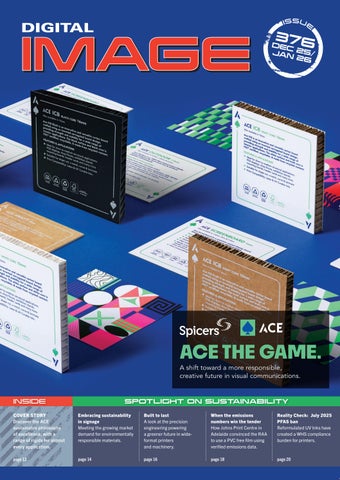
COVER STORY Discover the ACE sustainable philosophy of excellence, with a range of rigids for almost every application.
Embracing sustainability in signage Meeting the growing market demand for environmentally responsible materials.
Built to last A look at the precision engineering powering a greener future in wideformat printers and machinery.
When the emissions numbers win the tender How Johns Print Centre in Adelaide convinced the RAA to use a PVC free film using verified emissions data.
Reality Check: July 2025 PFAS ban Reformulated UV Inks have created a WHS compliance burden for printers.
page 12
page 14
page 16
page 18
page 20
CONTENTS
12
5
Wide Format and Signage News
9
Association News
11-21 Spotlight on Sustainability 12
18
Embracing sustainability in signage,
ORAFOL expands its PVC-free range
16
20
powers a greener print future Avery Dennison non-PVC film helps ‘drive’ sustainable change for RAA Reality check. Australia’s UV ink market crosses the PFAS Rubicon
Colour calendered vinyl films - A buyers guide
28
Mereton Textiles: Turning creative visions into
36 40
28
Built to last. How precision engineering
22
40
in visual communications
14
18
16 22
Cover Story: “That’s Ace!” A sustainable shift
46
printed fabric reality Traffic signage in 2026: 3M’s new strategic global collaboration Denise Kirby: Green symbols, grey areas – Recyclable is not always what it seems Sue Hirst: Mid-year reflections – Time to pause and recalibrate for financial success
PUBLISHER Image Publications Pty Ltd ACN 056 489 699 PO BOX 613, Brighton South Australia 5048 T > +61 1300 001 393 E > info@imagemagazine.com.au W> www.imagemagazine.com.au
CONTRIBUTORS
DEADLINES
Cass Theodore
Next Issue: Feb/Mar 2026
EDITOR Stephanie Gaddin T > +61 449 775 494 E > editor@imagemagazine.com.au
SUBSCRIPTIONS
ADVERTISING Janet Maitland (Publisher) T > +61 1300 001 393 E > info@imagemagazine.com.au
Vol 38 No 1
Charles Watson Denise Kirby
Booking and editorial
10 January 2026
Sue Hirst Vernon Kingman
DISCLAIMER
Australia
1 Year $ 66 + GST
The opinions expressed in Image magazine are not
2 Year $ 110 + GST
necessarily the views of the publisher. Every effort has been
New Zealand
1 Year $ 130 AUD
made to ensure the accuracy of information contained
2 Year $ 200 AUD
in this magazine. No responsibility is accepted by the
Other countries
1 Year $ 200 AUD
publisher for any omissions, inaccuracies, typographical
2 Year $ 350 AUD
errors or printers errors. Nor will responsibility be accepted
No GST on New Zealand and other countries
for any changes to information after publication.
W W W.IMAGEMAGAZINE.COM.AU
DEC 2025/JAN 2026
3
EDITOR’S NOTE
Welcome to the December issue of Digital Image Magazine This is our Sustainability Issue, a theme that resonates far beyond materials and machinery. Sustainability is also built on people, the ones who show up every day, and the new ones who join the industry to keep it invigorated. It’s fitting, then, that this issue lands in December, the month in which we recognise International Volunteer Day on 5 December. Across our sector, every association shaping industry development, advocacy, education and community-building is guided by volunteer boards. These are people who donate their time, experience, and strategic insight simply because they care deeply about the health and future of print, sign and display. Their commitment is a quiet, sustaining force behind the industry’s resilience.
4
DEC 2025/JAN 2026
Inside this issue, we explore several layers of sustainability, from energy-efficient production and circular-ready substrates to the commercial impact of being able to share emissions data for products used. We also unpack the compliance burden emerging from the June 2025 ban on PFAS. As we close out 2025, it’s also a moment to look back at the goals set, the progress made, and the changes each business has worked hard to implement. Whether those shifts were driven by innovation, necessity, regulation, or a commitment to doing things better, they reflect a sector steadily moving forward with purpose and intent. The signal is clear, leadership in sustainability is no longer about reacting to regulation and
predicting the effects of mandates; it’s about building the playbook that others adopt. As always, we love to hear about your projects so email us at editor@imagemagazine.com.au. To stay up to date with all the latest industry news, visit imagemagazine.com.au and sign up for our newsletter. You can also follow us on LinkedIn, Facebook and Instagram @imagemaganz
Warm regards, Stephanie Editor
WIDE FORMAT AND SIGNAGE NEWS
Canon unveils 3.4m Colorado XL UVgel printers Canon has introduced the Colorado XL-series, a 3.4m print platform that brings its UVgel technology to the 3.2m graphics market in both roll-to-roll and hybrid configurations. Steven Badger, Head of Sales & Professional Services at Canon Production Printing Australia, says, “Large format print providers in the 3.2m graphics market are looking for systems that deliver high productivity, versatile applications, and reliable quality while addressing the challenge of finding skilled operators. The Colorado XL-series meets all these needs with an advanced platform that combines the significant advantages of our unique UVgel technology with extensive automation and a modular design that
can grow with a customer’s business.” The series comprises the Colorado XL7 rollto-roll and Colorado XL7 hybrid models with a modular, field-upgradable design, including dual-roll capability. It offers application versatility across flexible and rigid media up to 52mm thick, with print speeds up to 211sqm/70 boards per hour. New UVgel 860 inks support both rigid and flexible applications, while UVgel 850 PrintHeads with 4,544 nozzles, automated monitoring and UVgel DynamicMotion Control help maintain high quality at speed. UVgel Fullbeam Curing uses a 3.4m LED array and mirror system to deliver uniform UV dosing and a wider colour gamut. The UVgel TRIdrive vacuum belt system with three
interactive rollers and multiple vacuum zones improves media stability, supports automated loading, reduces waste and enables unattended printing, assisted by a vision-based Smart Guided Workflow for multi-board loading. Optional capabilities include UVgel White, FLXfinish+ for matte, gloss or mixed finishes without varnish, and FLXture for textured effects. Sustainability features include low VOC emissions, GREENGUARD Gold certification, low energy use, reduced gel consumption, recyclable 2L ink packaging, and support for PVC-free and paper-based substrates. The Colorado XL-series is expected to be available in the Oceania region by mid-2026.
Ball & Doggett opens Brisbane Experience Hub Ball & Doggett opened an Experience Hub in Brisbane. Designed to provide customers with a hands-on opportunity to explore, test, and compare a wide range of print and finishing technologies, the company says the Experience Hub represents its commitment to innovation and customer support in the sign, display, and packaging markets. Located near Ball & Doggett’s Brisbane site in Brendale, the Experience Hub offers a diverse range of equipment for demonstrations, including
wide-format printers, finishing equipment, CNC routers and lasers, DTF printers, and heat presses. The supplier says that additional equipment will be added in the coming months. In addition to the equipment, the Experience Hub has a selection of consumables and substrates, allowing visitors to experience full workflow demonstrations from print through to finishing. “The Experience Hub is all about empowering our customers to make informed decisions,” says Rob Brussolo, GM Sign, Display, and Digital at Ball & Doggett. “There’s no substitute for seeing machines in action – understanding their capabilities, quality, and productivity firsthand helps customers select the right solution for their business.” Open to customers by appointment, the Experience Hub offers an interactive environment where printers, converters, and graphics professionals can gain insight into the latest print technologies and applications. “We’ve brought together an incredible range of equipment under one roof,” adds Brussolo. “It means our customers can test, learn, and explore new production possibilities – all with the guidance of our experienced team.” While appointments are available immediately for personalised demonstrations and consultations, the official launch event and Grand Opening are scheduled for February 2026. Customers can schedule a visit by contacting their local Ball & Doggett representative or visiting the company’s website at ballanddoggett.com.au/the-experience-hub.
W W W.IMAGEMAGAZINE.COM.AU
DEC 2025/JAN 2026
5
WIDE FORMAT AND SIGNAGE NEWS
Kongsberg launches Smart Material Handler Kongsberg Precision Cutting Systems (PCS) has launched the Smart Material Handler (SMH), a modular sheet handling solution for the digital cutting of signs, displays, folding cartons, and corrugated applications. Kongsberg says the new solution is designed to enhance the productivity of cutting tables; it enables operators to load new materials while the cutter is still processing the previous sheet, acting as a buffer zone and allowing one operator to handle tasks that typically require two, cutting labour needs by 50%. The SMH comprises a loading table with an optional Underside Camera (USC) that automatically detects registration marks and adjusts positioning, as well as an offloading table. Together, they act as extensions to the existing Kongsberg PCS cutting table, semiautomating the production workflow, enabling smoother loading and offloading and bringing more flexibility to production. The loading table is suitable for rigid substrates but can be quickly replaced with a roll feeder, offering flexible workflows for various material handling requirements and faster changeovers. Additionally, the Smart Material Handler can be used in both landscape and portrait orientations. Connected to the
other side of the cutting table, the offload table is positioned at a fixed 12-degree incline with integrated stoppers to securely hold finishing materials in place, facilitating smooth material unload and reducing potential costly errors. Stuart Fox, President & CEO, Kongsberg Precision Cutting Systems, says, “Solving our customers’ challenges is central to our proposition, so we are continuously exploring ways to enhance our customers’ productivity and reduce manual intervention, enabling operators to focus on more high-value tasks. By expanding our automation portfolio with the Smart Material Handler, we are reducing the operator need by 50% whilst also enabling our customers to enhance productivity and achieve overall smoother production throughout the finishing process.” The Smart Material Handler is available as an add-on unit for all bed sizes on both the Kongsberg C-series and Ultimate series. It can be retrofitted to existing machines and is available for order via local distributors.
Canon launches free AI tool for converting 2D designs into height maps Canon has announced the launch of HeightIQ, a new software application driven by artificial intelligence (AI), which simplifies the conversion of a 2D image into a detailed height map, enabling elevated printing up to 4mm high on Canon Arizona flatbed printers using PRISMAelevate XL. HeightIQ uses advanced image recognition to analyse light, contrast, and shapes, automatically and accurately translating height differences into grayscale values. The grayscale image can then be used in Adobe Photoshop or Illustrator to fine tune the image. Steven Badger, Head of Sales & Professional Services at Canon Production Printing Australia, commented: “At Canon, we have a clear commitment to innovation and providing our customers with accessible solutions that further enhance their output, increase productivity and simplify their day-to-day operations. The launch of HeightIQ and the integration of AI is a clear example of this innovation and how we’re evolving to deliver more intelligent, time-efficient solutions for our large format graphics customers.” “Elevated printing enables our Arizona 6
DEC 2025/JAN 2026
customers to add creative value to their output, but the complexity and time required to create a height map is often a roadblock for many print providers looking to add it to their offering. At FESPA 2025, we showed a technology study and, based on the very positive customer feedback, we decided to productise it into HeightIQ.” HeightIQ significantly decreases job preparation time, according to Canon, which says that creating a similar file in Adobe Photoshop or Illustrator can take an experienced designer up to 10 hours. With AI integration in HeightIQ, this time is reduced to less than 30 minutes on average. As HeightIQ is suitable for users of all skill levels, there is no requirement for specialised knowledge or lengthy onboarding, making HeightIQ even more accessible. Users can drag and drop to create up to 20 different images simultaneously. HeightIQ also features a tiling setting, which utilises a graphical technique to divide a larger image into multiple sub-images (tiles), ensuring that more detail is visible in the final print. The freeware tool is available for download from Canon’s graphiPLAZA platform for both Microsoft Windows and macOS.
Mimaki launches UJF-7151plus II e flatbed UV printer Mimaki unveiled the UJF-7151plus II e flatbed UV printer at PRINTING United Expo 2025 in October, positioning the printer as a next-generation industrial direct-to-object platform combining precision, productivity, and cost-efficiency. It is aimed at manufacturers seeking high-quality, flexible and sustainable digital production for custom goods and industrial applications, with specific focus on consistent accuracy at speed, curved or uneven substrates, and threedimensional textures. “With the UJF-7151plus II e, we are taking another step forward in industrialgrade direct-to-object printing,” said Arjen Evertse, Director Sales at Mimaki Europe. “This model offers advanced features that unlock new levels of versatility, efficiency, and cost control. It’s designed to empower customers to produce high-value, high-impact applications with greater sustainability and accuracy.” The printer delivers resolutions up to 1,800 dpi, supports light cyan and light magenta alongside CMYK, and in practical mode prints 19 sheets per hour (710 × 510 mm), providing a digital alternative to screen printing for short-run, on-demand work. It offers emboss printing up to 5mm and a new LD Mode that maintains precision on substrates with height differences up to 10mm. A printable primer improves adhesion on glass, metal, and acrylic, making two colour layers plus primer and white around 3.7 times faster than previous models, while an Ink Saving Function reduces ink use by up to 40%. Mimaki also introduces Mimaki Application Assistant 2 (MA2) for centralised software integration and updates. Core technologies include NCU, NRS, Colour Gloss, RasterLink 7, and a 30kg high-load table for heavier rigid media. The system supports GREENGUARD Goldcertified ELH and ELS UV inks free from SVHC and CMR substances and offers IoT (MDL) support for smart factory integration.
WIDE FORMAT AND SIGNAGE NEWS
Grafico and 4D Doors bring Aboriginal art to The Block’s final reveal In one of the most creative twists of The Block 2025 season, Melbourne design studio Grafico collaborated with 4D Doors and Daylesford-based Aboriginal art collective Dumawul to produce a creative roller door wrap that blended art, storytelling and innovation. The project began when 4D Doors approached Grafico to create something different for the show’s final reveal. Working with Dumawul,
Grafico’s team reproduced original Aboriginal artwork supplied by one of the collective’s artists. The design was printed on a Canon Colorado using Arlon Easy Apply High-Tac vinyl with a matching matte laminate, then expertly wrapped onto the large garage door panels at Grafico’s North Melbourne facility. To keep the final reveal under wraps, Grafico devised a ruse. Before installation, the team
created a second removable wrap featuring oversized portraits of contestants Britt and Taz, disguising the actual Aboriginal artwork underneath. Installed on-site by 4D Doors before the Sunday reveal, the ‘fake’ wrap sparked amusement and confusion among contestants and producers alike. A few days later, Damian Corney, Founder and Creative Director of Grafico, returned to Daylesford with the 4D Doors and Dumawul teams for the official “unwrapping.” Cameras captured the moment as the contestants and the audience saw the authentic artwork unveiled for the first time. “This was such a fun and creative bespoke project. We love pushing the envelope, and this collaboration shows off our team’s creativity and technical skill,” said Corney. He added that the project was particularly rewarding for its cultural dimension, “We were proud to feature original Aboriginal artwork in this medium. Working with Dumawul has been incredibly meaningful, and we’ve since expanded the partnership to create a full collection of Aboriginal art wallpapers available for homes and commercial spaces.” The roller door reveal was the final installation of The Block’s 2025 season, in what Corney describes as a “bold and meaningful finale blending Australian art, high-end printing, and smart creative execution.”
IVE Group acquires Impressu Print Group and Budget Mail Service IVE Group has announced that it is executing binding agreements to acquire Impressu Print Group (Impressu) and Budget Mail Services (BMS). Additionally, the company says it has strengthened its position in diversified marketing by signing a long-term marketing services supply agreement with Domino’s Pizza Enterprises (DPE). The acquisitions and partnership, it says, further extend its national reach and integrated marketing capabilities. Impressu is a well-established print and marketing services business, bringing deep expertise in digital and offset printing, letterbox marketing, signage, point-of-sale, and logistics. Impressu’s long-standing relationships across the quick service restaurant, retail, healthcare and public sectors will now benefit from access to IVE’s broader suite of creative, content and data-driven solutions. In conjunction with the Impressu acquisition, IVE has entered into a multi-year (6+2) marketing
services supply agreement with DPE. This builds on an eight-year relationship between Domino’s and Impressu, and expands IVE’s remit across its wider capabilities, including creative and content, CX and data, events and activations, uniforms and more. Sydney-based Budget Mail Services (BMS) also joins the group, bringing additional expertise in mail and communications across sectors such as share registries, charities, publishing, and education. The addition of BMS will increase IVE’s scale and flexibility in delivering highquality print and mail solutions nationwide.
IVE Group Managing Director Matt Aitken said, “These businesses are a strong strategic fit. They bring new capacity, new customers and enhance national reach with Impressu offering growth opportunities in the fast-growing southeast Queensland and northern NSW corridor. I’m also particularly excited about the long-term partnership with Domino’s and the opportunities that it presents.” Integration planning is underway to ensure a smooth transition for customers and employees across both new businesses.
W W W.IMAGEMAGAZINE.COM.AU
DEC 2025/JAN 2026
7
WIDE FORMAT AND SIGNAGE NEWS
Fortidia acquires Kwik Kopy Australia, expands ANZ presence Kwik Kopy Australia has been acquired by Fortidia (formerly MBE Worldwide), a global commerce enabler operating multiple brands in 57 countries across ecommerce, fulfilment, shipping, marketing and print. The deal strengthens Fortidia’s footprint in the ANZ business solutions sector alongside PACK & SEND, Mail Boxes Etc. and World Options. Under Fortidia’s ownership, Kwik Kopy will retain its brand, leadership and franchise teams. Founded in 1982 by the Penfold family, Kwik Kopy has grown to more than 85 centres nationally and is recognised as a leader in design, print and marketing services. The Penfold family will retain a minority stake and
remain actively involved in guiding the brand’s next phase of growth. “We are proud of the legacy we have built with Kwik Kopy Australia and excited about the opportunities this new partnership will bring,” said Annalise Penfold, noting Fortidia’s alignment with the brand’s focus on “creating customers for life”. Fortidia reported FY2024 system-wide gross revenue of €1.4 billion (US$1.5 billion) from more than 3,130 Business Solutions Centres and €22 billion (US$23 billion) in gross merchandise value through its digital ecommerce platform. Under the new structure, Kwik Kopy Australia’s CEO will also lead PACK & SEND. Managing Director Sonia Shwabsky said the
partnership combines global scale with “proudly Australian and locally owned” businesses, supporting innovation, sustainable growth and enhanced customer value.
Mimaki appoints AGS as a new distributor in Australia Mimaki Australia has inked a distribution agreement with Australian Graphic Servicing (AGS), effective from November 11, 2025. AGS, an Australian-owned company, is known for its high-quality service, technical reliability, and long-standing customer relationships. With an experienced team specialising in installations, maintenance, and consumables for commercial printers, AGS brings extensive expertise to the Mimaki dealer network. Jason Hay, National Sales Manager at Mimaki Australia, said the partnership presents an exciting opportunity to connect with new market segments. “Mimaki has consistently introduced
innovative new products year after year, enabling us to expand into new markets and reach new customers. Partnering with AGS allows us to bring Mimaki solutions to customers we’ve traditionally had limited access to, such as offset and flexographic printing,” said Hay. Nick Crinis, Senior Sales Executive at AGS, said, “We look forward to introducing an extensive range of market-relevant, commercially proven, and customer-focused products from Mimaki. Our goal remains to deliver the capability and professional service that AGS customers have come to value over the past 30 years.” Kohei Kobayashi, Managing Director at Mimaki Australia, said, “Trust in service quality
is something that cannot be built overnight. We are proud to partner with AGS, a company that has earned strong credibility and trust in the Australian market.”
HP unveils Latex FS70 W and productivity upgrades HP has introduced the HP Latex FS70 W Printer, HP Latex Productivity Kit and enhanced HP PrintOS Production Hub for mid- to large-sized print service providers seeking higher productivity, scalability and workflow efficiency. The new platform succeeds the Latex 3X00 series and extends the FS ecosystem alongside the Latex R530, 730 and 830 series. The HP Latex FS70 W is described as HP’s most productive Latex printer to date, delivering up to 117 sqm/hr across SAV, banner, wallpaper and canvas, with maximum outdoor speeds of 162 sqm/hr and indoor production at 91 sqm/ hr. A 6L white ink cartridge, jumbo dual roll kit, 10L ink options, optimised cleaning and an ink collector support unattended high-volume and textile printing. An optional removable overcoat printhead aims to cut overcoat waste to zero. Sustainability features include odourless water-based Latex inks tested by Odournet under VDI 3882 and certified UL ECOLOGO and UL GREENGUARD Gold, plus 100% carton cartridges. 8
DEC 2025/JAN 2026
Customers can also leverage HP’s Sustainability Amplifier and Planet Partners recycling program. The new HP Latex Productivity Kit upgrades existing FS50 and FS60 devices to near-FS70 performance, delivering around a 30 per cent throughput increase, including vinyl output rising from 69 sqm/h to 91 sqm/h. PrintOS Production Hub gains integrated Design & eCommerce order intake, consolidated analytics, collaboration tools and automated preflight and job routing, compatible with mixed-
device fleets. “It’s been quite remarkable what quality and speed the HP Latex FS70 W is producing,” said UK beta customer John Mark Watson, Managing Director at John Mark Limited. “We always say that if anything needs breaking, we will break it, due to the volumes of print we put through our printers each week; however, the FS70 has proved us wrong. It can’t be broken!” Selected availability begins early November 25, with general availability from February 2026.
FESPA
Building confidence, connection and community with FESPA Australia Leaders The 2025 FESPA Leaders Program has concluded with Sonya Beers, Publishing Account Manager at IVE Group, named the FESPA Leader for 2025, and Karen Lawler, Business Development Manager at Cactus Imaging, recognised as runner-up. FESPA Australia spoke with both women about their journeys in print, their leadership development, and how programs such as the FESPA Leaders Program are helping shape the next generation of industry leaders. Both Sonya and Karen describe their paths into print as happy accidents that evolved into long-term careers. Sonya says she entered the industry “by chance” after a teacher suggested applying for a management traineeship at Offset Alpine Printing. “What’s kept me passionate is the creativity, innovation, and tangible impact print has across industries,” she says. “I love the people— collaborative, passionate, and always evolving.” Karen says she was nearing burnout as an event manager in hospitality, when her partner encouraged her to apply for a role at Cactus Imaging. “My passion has really grown over the years,” she says. “Having incredible leaders in Keith and Nigel at Cactus inspires me to push myself and constantly learn. To be around people who want the industry not only to survive but thrive is infectious.” Now NSW Patron for Women in Print, she adds, “Having Steph Gaddin from Women in Print see the leader in me, before I did,
was a huge boost to my confidence.” For Sonya and Karen, the same sense of connection runs through both the FESPA Leaders Program and Women in Print Australia. Sonya says these networks have helped her build visibility and a stronger sense of purpose. She describes Women in Print as “empowering—a space for genuine connection and support,” adding, “Both FESPA and Women in Print have shown me the importance of lifting others as you grow, especially for women in traditionally male-dominated spaces.” Karen agrees, noting that the FESPA Leaders Program exposed her to thirteen different leadership styles—“introverts, extroverts, and everything in between.” The experience, she says, gave her permission to lead in her own way. “Knowing I’m contributing, big or small, makes me proud.” When reflecting on career-defining moments, both point to opportunities that pushed them beyond their comfort zones. For Sonya, joining the IVE Group was a significant turning point, a risk that pushed her out of her comfort zone. “Managing the onboarding of large key accounts was a major growth experience,” she says. “Now the FESPA Leaders Program has become a defining moment in my leadership journey.” For Karen, taking on the role of Women in Print NSW Patron has been a milestone. “It’s grown me exponentially, both personally and
professionally,” she says. “The community and genuine connections I’ve made with people I look up to have been incredible.” Being selected for the FESPA Leadership Program—and nominated by her cohort to represent them in Barcelona next year—she calls “the cherry on top of a pinch-me kind of year.” When it comes to leadership style, Sonya calls her approach “collaborative and peoplefocused.” “I lead with empathy and clarity,” she says, “and over time I’ve grown more confident in strategic decision-making and in leading with influence rather than authority.” Karen says the FESPA Leadership Program helped her recognise that being vulnerable, relatable, and approachable isn’t a weakness— it’s a strength. “I used to think I needed to lead more traditionally,” she says, “but now I know being genuine and approachable is what inspires trust and results.” Both women continue to invest in their growth, personally and professionally. For Sonya, prioritising regular exercise and mental wellbeing has been a game-changer. “Staying active helps me maintain clarity and resilience,” she says. Becoming a Mental Health First Aider at IVE deepened her understanding of how to support others and build a more inclusive workplace. Karen says exploring her creative side has been just as rewarding. She completed a Diploma in Photography and Photo Imaging at Torrens University. “Putting myself out there creatively has helped ease imposter syndrome,” she says. “I believe the more you learn about any craft, the more confidence you gain—and that extends to leadership too.” Both describe the FESPA Leaders Program as “transformative.” For Sonya, it’s expanded her confidence and connections, opening doors to new collaborations—including representing her cohort as an ambassador in Barcelona next year. “Opportunities like this nurture leadership, foster innovation, and help build a stronger, more inclusive industry.” Karen describes the program as vital to the print industry’s future. “It gives participants the tools and confidence to lead in their own way while learning to adapt and evolve,” she says. “It’s so important to encourage the next generation into leadership roles now, so they can learn from those who came before and keep our industry innovative and resilient.” Both women see leadership less as a position and more as a practice, one shaped by learning, community, and courage. Now in its fourth year, the FESPA Leaders Program continues to turn that belief into action, building a community of connected, capable alumni who share their experiences, challenge convention, and collaborate to strengthen the future of Australian print.
W W W.IMAGEMAGAZINE.COM.AU
DEC 2025/JAN 2026
9
Successful ASGA events series conclude for 2025 The Australian Sign & Graphics Association’s 2025 events series is reaching its conclusion, with a successful – albeit wet – Social Bowls event in Western Australia, followed by similar evenings in Adelaide and Sydney, and the final ASGA 2025 Golf Day in Melbourne. The WA Bowls event on 24 October attracted a record number of registrants, though rain prevented a few from participating that night. Despite limited opportunities for extended play, guests did not let the wet weather dampen their spirits. ASGA’s WA Chair, Wade French, reports that the group still embraced the opportunity to enjoy some friendly competition before retiring to enjoy catching up over drinks and nibbles – inside and under cover! Similar events were held in Adelaide on 20 November and Sydney on 27 November, as this issue of Digital Image Magazine was being finalised. Adelaide kicked off with a strong cohort of well over 20 players at the Adelaide Bowling Club in the heart of the city. Sydneysiders had their opportunity to ‘get out on the green’ a 10
DEC 2025/JAN 2026
week later at the recently refurbished Rosehill Bowling Club. Again, it proved to be a great night for fun and networking before the end-of-year rush kicked in. The final ASGA event for the year was in Melbourne, where a record crowd gathered at the Heidelberg Golf Club in Lower Plenty. After enjoying 18 holes of golf in the Ambrose style, where teams take turns and collaborate to navigate the course, the contingent was joined by a large number of other industry guests to celebrate the end of the year over lunch and prize presentations. Damian Nielsen, Membership & Events Manager for ASGA, and the association’s Queensland Chair, says the events this year have played an essential role in bringing the industry together. “While we spend a lot of our time providing information and creating resources for industry businesses, there’s no question that we see one of our most important roles as helping to help build the sign, print and graphics community around the country,” he says. “With the help of our principal sponsors – ORAFOL for the 2025 ASGA Social Bowls
Series, and Graphic Art Mart for the ASGA 2025 Golf Day Series – together with a host of other leading companies who have stepped up at the local level to support individual events, we are delighted to be able to do that with events throughout the year. “Huge thanks to all those companies, and also to our ASGA Board Members, who have been pivotal in organising the events in their local States – our President, Mick Harrold, who is the Victorian Chair, Marc Martello in New South Wales, Lisa Michalanney in South Australia and Wade French in Western Australia. It’s great to have such a passionate team of people who are really committed to supporting their local industry community. “We’d also like to thank all those who have made the time to attend an ASGA event during 2025. It’s been great to once again see the connection, camaraderie and friendships that are built and strengthened by getting together, and we are looking forward to continuing these popular events into 2026 and beyond.” To read more about these events, see the photos, and stay up to date with future events, go to signs.org.au
SPOTLIGHT ON SUSTAINABILITY
Where we stand, where we’re heading, and what still needs to change Photo Credit: By Eakkachai - AdobeStock
When Digital Image Magazine first published its “Spotlight on Sustainability” in August 2024, the question was whether Australia’s wide-format and signage sector had reached a tipping point. Over a year later, it’s clear we haven’t tipped yet, but we are collectively leaning in the right direction. Back then, we were watching other industries such as packaging, textiles, and manufacturing undergo a transformation driven by government targets and product stewardship schemes. By December 2025, many of those deadlines will have landed, and their outcomes offer both encouragement and caution for the wide-format and specialty print industry.
Policy moves and reality checks The 2025 packaging targets have come and gone, and while some brands achieved recyclability or reuse milestones, the national 70% recovery goal remains elusive. Additionally, Federal Government announced an acceleration of the targets, while manufacturers, converters, and print-adjacent business expressed growing discomfort with APCO as the primary voice to government. In response, the Visual Media Association formed the Labels & Packaging Coalition bringing adjacent sectors into the policy conversation. The result is a restart of the packaging targets discussion. As much as the path seemed set and clear in August 2024, the sustainable packaging sector has undergone seismic shifts through 2025. Meanwhile, Seamless, the clothing product stewardship scheme launched in 2023, continues to evolve. Early reports suggested steady uptake from major brands, but participation remains below the level the Federal Government hoped for. Regulators have indicated that if progress stalls, the scheme may transition to a co-regulatory model—reinforcing that when voluntary action slows, regulation
often follows. For signage and wide-format print, the lesson is clear: act before you’re told to. There is also growing discussion within the Department of Climate Change, Energy, the Environment and Water about extending stewardship approaches to other plasticintensive sectors, including signage and display manufacturing. While no federal policy has yet been announced, the groundwork is being laid through inter-industry consultations and material-traceability studies. As of the date of writing, Western Australia remains the only jurisdiction to explicitly ban outdoor single-use soft plastics in signage.
The materials matter PVC-free films are no longer a niche. Global suppliers such as Avery Dennison, 3M and ORAFOL have introduced recyclable or biobased options with credible end-of-life pathways. Locally, distributors are broadening their sustainable media portfolios, adding recyclable polypropylene and fibre-based alternatives. Some are also trialling collection and recovery initiatives for select product lines. While these efforts remain limited in scale, they signal the industry’s shift from simply promoting “ecomaterials” toward building practical models for waste reduction and responsible recovery. We’re also seeing the conversation broaden from substrates to inks and energy use. PFASfree formulations, LED curing systems, and smarter standby energy management are fast becoming the new normal. Business owners who have upgraded machinery through 2025 increasingly cite sustainability credentials as a factor, alongside print quality and speed.
A circular conversation The idea of “closed loop” recycling is gaining traction, though infrastructure remains patchy. Some state programs are exploring composite-plastic recovery and signage offcut trials, yet true circularity still depends on
national coordination. For many businesses, the challenge is not willingness but logistics: separating materials, storing clean waste, and ensuring there’s a domestic processor ready to receive it. Still, examples are emerging. From councils installing recyclable polypropylene signage to major retailers specifying PVC-free campaigns, practical change is happening. Many businesses are aligning their marketing and messaging to include waste tracking and recyclability. It’s progress, even if imperfect.
Data, disclosure and direction Perhaps the biggest shift since 2024 is transparency. Sustainability reports are no longer published only by corporate printers; smaller and mid-sized companies are publishing environmental metrics and seeking certifications such as ISO 14001, EcoVadis, the VMA’s Sustainable Green Print and Sign, or the Global Recycling Standard. Clients are asking tougher questions, and tenders increasingly require proof of waste minimisation or emissions reporting. This growing accountability is healthy. It rewards those already making changes and pressures laggards to catch up. Yet it also exposes how much data we still lack, particularly around signage waste volumes and recycling rates in Australia.
Where to from here The next four years to 2030 will define whether we move from aspiration to action. The frameworks and technology exist, and the intent is there. What’s needed now is collective resolve; agreement on a shared standard, coordinated infrastructure, and a willingness to redesign business models around resource recovery rather than waste removal. If last year’s question was “Are we ready to lead?”, perhaps this year we should ask ourselves “Are we ready to follow?”
WW W.IMAGEMAGAZINE.COM.AU
DEC 2025/JAN 2026
11
COVER STORY
“That’s Ace!” A sustainable shift in visual communications
Innovative, recyclable, and high-performing.
12
Spicers Precinct & POP UP Gallery - Versatile structures made from Ace ICB.
Ace Outdoor bollard Strong, sustainable, and built for impact.
Driven by the growing demand for circular materials, Spicers has extended its ACE range to give printers new fibre-based options for display applications. Designed to meet the needs of designers, printers, and brands seeking environmentally responsible alternatives, the Ace range offers a variety of sustainable solutions tailored to diverse applications - from striking point-of-sale and indoor displays to resilient outdoor signage. Ace from Spicers is not just a collection of products; it represents a philosophy of sustainable excellence. Every product in the range is 100% fibre-based, Chain of Custody (CoC) certified, and recyclable -underscoring Spicers’ ongoing commitment to offering alternatives to less sustainable materials. Whether used in retail environments, exhibitions, wayfinding systems, or creative installations, Ace products deliver quality and conscience in perfect balance. “At Spicers, we’re continually finding alternatives to less sustainable products,” says Wayne Hood, Spicers Visual Communications Portfolio Manager. “Ace gives our customers access to a suite of recyclable, high-quality materials that perform across a range of printing technologies - without compromising creativity or durability.”
Ace Screenboard One of the standout products in the Ace lineup, Ace Screenboard is a premium coated display board crafted for exceptional print performance. Coated on both sides, its bright, super-smooth surface ensures vivid colour reproduction and sharp detail—qualities essential for large-format digital printing. Its high bulk and stiffness make it ideal for applications including hanging signage, pointof-sale displays, aisle fins, category signage, header cards, and exhibition stands. Reliable with both Latex and UV-curable inks, Ace Screenboard provides flexibility for printers seeking precision across different systems. Available in 1mm, 1.5mm, 2mm, 2.9mm and
4mm thicknesses, it combines versatility with responsibility. “Our partnership with Spicers has been built on trust, innovation, and a shared commitment to sustainability,” says Andrew Robinson, Managing Director of Oppboga. “As the Australian market increasingly seeks recyclable fibre-based options that deliver exceptional print results, our collaboration has evolved. Together, we’ve developed Kraft, High White, and Outdoor solutions within the ACE Screenboard range to meet this growing demand.”
Ace ICB Engineered for performance and precision, ACE ICB (Inverted Corrugated Board) offers remarkable strength, rigidity, and stability through its innovative inverted corrugated structure. This design ensures a flat, smooth surface for excellent print quality, making it ideal for POS displays, exhibition stands, shop fit-outs, mounting boards, and header cards. ACE ICB is FSC® certified, recyclable, and made with recycled content. Available in Kraft (KKK, WKW), White (WWW), and Black (BBB) core configurations, and in 10mm, 16mm, and 20mm thicknesses, it delivers structural reliability while maintaining lightweight versatility. It can be shape-cut, v-notched, curved, or laminated, providing designers and fabricators with maximum creative flexibility. For customers needing support, cut-file and design assistance is available to ensure seamless production of complex projects. “These products are perfect for short-term targeted campaigns,” explains Hood. “They’re incredibly versatile, offering multiple options while maintaining high print quality on Latex and UV technologies.” The ACE ICB capabilities were showcased at PacPrint 2025. The product was utilised to construct the entire Spicers Precinct, including walls, POS units, and gallery stands. “We trusted ACE ICB to build the structures of our PacPrint stand,” Hood adds. “Even the Spicers Pop-Up Gallery displays were made from ACE ICB - a
true demonstration of how strong, stable, and sustainable these materials are.”
Ace HCB Designed for large-format and structural applications, ACE HCB delivers a perfectly flat printing surface that ensures smooth, precise graphic reproduction across expansive panels. Despite its lightweight construction, the board’s honeycomb interior offers superior load-bearing capacity, making it suitable for furniture, modular walls, and 3D installations often used in exhibitions or retail environments. Ace HCB’s FSC® certified surface and core are made from recycled content, ensuring environmental responsibility from start to finish. Available in 5mm, 10mm, and 16mm with Kraft(KKK), White(WWW), or Black (BBB) core options. It’s suited for signage and flat panel displays; its smooth surface enables highresolution printing, enhancing both form and function across exhibitions, shop fit-outs, and POS installations. Across retail environments, event spaces, and exhibitions, brands are turning to Ace products to bring creative visions to life without compromising sustainability. The smooth surfaces, rigidity, and print performance of Ace materials ensure campaigns capture attention while aligning with evolving environmental expectations. From vibrant promotional signage to innovative 3D displays, Ace empowers brands to communicate with impact and integrity. As businesses increasingly pivot toward ecoconscious design, Ace stands at the forefront, proving that sustainable doesn’t mean limited, and recycled doesn’t mean compromised. With the combined expertise of Spicers and partners like Oppboga, the Ace range continues to push the boundaries of fibre-based display innovation. For designers, printers, and brands alike, Ace represents not just a product range but a shift toward a more responsible, creative future in visual communications.
WW W.IMAGEMAGAZINE.COM.AU
DEC 2025/JAN 2026
13
Embracing sustainability in signage: ORAFOL expands its PVC-free range With sustainability now a business expectation rather than an option, ORAFOL Australia has expanded its PVCfree portfolio to meet growing demand for environmentally responsible materials. The new range of polypropylene and polyester films offers practical alternatives to traditional vinyls, giving print service providers the durability and versatility they expect—without the environmental trade-offs. Developed for sign and display applications, the expanded lineup also extends into architectural, industrial, and safety uses. By replacing PVC with recyclable materials and minimising plasticiser content, ORAFOL supports customers seeking to meet sustainability targets while maintaining colour fidelity, adhesion, and lifespan across solvent, latex, and UV print platforms.
Core focus: elevating sign and display with eco-conscious films At the heart of ORAFOL’s PVC-free range are digital printing films designed for sign and display work, where colour accuracy and reliability
14
DEC 2025/JAN 2026
are paramount. These films eliminate many of the environmental challenges associated with traditional vinyls — such as recycling limitations and plasticiser emissions—while providing dependable adhesion and print quality across multiple ink systems. For short-term and promotional graphics, ORAJET 3720 is a removable, matte white polypropylene film ideal for indoor displays, retail promotions, and flat-surface point-ofsale materials. Paired with the ORAGUARD 236 polypropylene overlaminate, it offers UV resistance and abrasion protection while maintaining a sustainable profile. For permanent installations, ORAJET 3740 offers a permanent adhesive option suitable for both indoor and short-term outdoor branding. Laminated with ORAGUARD 236, it delivers greater durability for high-traffic environments, reducing replacement frequency and material waste over time. Fire safety and compliance are also critical for public-facing displays. ORAJET 3172XG, a removable, blockout gloss-white polypropylene film, is certified for use in short- to medium-term indoor applications. The permanent ORAJET 3174XG/XM versions (gloss and matte) extend this capability to slightly curved surfaces, offering flexible and safe options for retail, event, and infrastructure graphics. When paired with ORAGUARD 236, both retain their fire ratings and eco credentials. Central to these combinations is the ORAGUARD 236 overlaminate itself. This PVC-free polypropylene laminate enhances durability, extends lifespan, and maintains recyclability across the entire range of signs and displays. It supports flat graphics in retail, event, and promotional environments, enabling longer-lasting visuals without compromising environmental integrity. For window graphics, ORAJET 3352F, an optically clear polyester film, is ideal for point-of-sale and architectural installations
where transparency and clarity are essential. It’s designed for interior glass applications, suitable for retail environments, office branding, and decorative privacy treatments, offering a sustainable solution for creative, temporary transformations.
Beyond sign and display: demonstrating product diversity
While sign and display work remains the cornerstone of ORAFOL’s PVC-free development, the range also proves its versatility in other sectors. For instance, the fire-certified ORAJET 3172XG and 3174XG/XM are suitable for use in compliant graphics in public facilities and infrastructure projects. At the same time, the ORAJET 3352F meets the growing need for sustainable materials in architectural glass design. The ORACAL 352 metallised polyester film further extends the portfolio’s reach. Designed for labels, nameplates, and decorative applications, it provides high-visibility markings suitable for industrial, promotional, and safety uses. The product’s durability and recyclability highlight how sustainability can extend beyond traditional signage into broader manufacturing and branding contexts.
Industry outlook: sustainability as standard ORAFOL’s 100% PVC-free range empowers print and signage professionals to lead by example. These materials not only deliver strong performance and visual impact but also support circular economy principles, reducing waste and enabling easier recycling compared to conventional PVC products. For Australian print businesses, adopting sustainable films offers tangible advantages: meeting client expectations, gaining eligibility for environmentally driven tenders, and improving operational efficiency through longerlasting graphics. As sustainability moves from optional to expected, innovations like ORAFOL’s PVC-free range position the sign and display sector to thrive in a more responsible, futurefocused industry.
Built to last
How precision engineering powers a greener print future In a market where technology moves fast and material innovations even faster, sometimes the real success stories are the ones quietly redefining production. Pozitive and its partners, swissQprint and Summa, show that sustainability isn’t a slogan — it’s a design philosophy. Take a walk into Pozitive’s Emu Plains headquarters, and the idea of sustainability feels tangible. Solar panels hum overhead, forklifts move quietly through tidy aisles, and the showroom floor is lined with machines built for endurance. For Pozitive, sustainability isn’t about offsetting or counting credits; it’s about engineering better from the start. That principle also runs through every brand they represent. Their partners, swissQprint and Summa, are examples of how precision and longevity are the quiet engines driving a lowerimpact print future.
swissQprint – Sustainability Engineered in Every Detail In the Swiss Rhine Valley, swissQprint builds UV flatbeds that exemplify doing more with less. Every printer is assembled using 100% renewable energy, with more than 80% of components sourced locally to reduce transport emissions. The company’s ISO 20690 certification confirms its energy efficiency — 16
DEC 2025/JAN 2026
producing over 300 m² of print with about the same power it takes to boil a kettle. LED curing systems use a fraction of the energy of traditional lamps, VOC-free inks keep the workspace safer, and a built-in crash detection system prevents wasted media. The result is sustainability by foresight, not by accident. Many swissQprint units installed more than a decade ago still run daily, their modular design allowing upgrades instead of replacements — a quiet rejection of planned obsolescence. It’s this kind of long-term thinking that first drew Pozitive to the partnership, aligning perfectly with its vision for the Australian market.
Summa – Precision That Saves More Than Time Across the border in Belgium, Summa applies the same philosophy to cutting technology. Every F Series and S Class cutter is engineered for precision down to fractions of a millimetre, turning efficiency into measurable savings. Through GoProduce and GoSign software, Summa optimises nesting and automates job recognition, ensuring every centimetre of media is used to its fullest — reducing offcuts by up to 30%. At its factory, nearly half of all energy comes from solar, packaging is recyclable, and spare parts are still supplied for models discontinued two decades ago.
For Pozitive, this commitment to longevity and efficiency complements swissQprint’s approach perfectly, creating a full production ecosystem where print and cut align to deliver both performance and responsibility.
Pozitive – Making Sustainability Standard Practice Pozitive’s mission is to make that kind of sustainability accessible. By pairing swissQprint’s precision with Summa’s efficiency, the company helps Australian printers lower energy use, reduce waste, and extend equipment life—all without compromising on quality or speed. That mindset starts at home. Over half of Pozitive’s operations run on solar power, logistics are streamlined to minimise transport impact, and every installation includes workflow optimisation to ensure customers get smarter processes, not just new machines. In an industry where “green” can feel like an afterthought, Pozitive is an example of how sustainability is embedded in the business and the technology when you choose the right partners. With machines that appear to think before they act, stop before there’s waste, and keep working long after trends have moved on. When equipment is designed to last, sustainability isn’t an add-on. It’s simply the way good engineering works.
Kane Schenscher says: “SP 1504 has lower initial tack so its repositioning window is longer, but you often need a bit more post-heating to fully engage the adhesive, especially around rivets or compound curves. All this is very manageable, and once you’re trained and you know the tricks, it wraps beautifully.”
Avery Dennison non-PVC film helps ‘drive’ sustainable change for RAA Leading South Australian specialist print and signage company, John’s Print Centre (JPC) recently put forward Avery Dennison’s non-PVC SP 1504 Easy Apply RS™ film as the preferred solution for an RAA service vehicle livery contract tender process. JPC GM, Daniel Woodward, says: “The environmental component of this opportunity was key. From day one, we made it clear to RAA that we would propose a non-PVC route using Avery Dennison’s SP 1504 film, rather than defaulting to the incumbent 1105 film.” “We worked with our suppliers, Spandex, to develop carbon-footprint comparisons, and we 18
DEC 2025/JAN 2026
positioned that distinctive value in our tender.” Jon Keppell, Commercial Manager Avery Dennison Graphic Solutions, adds: “The beauty of the new SP 1504 film is that it doesn’t ask installers to compromise. You get the conformability and finish of a premium cast wrap, without the PVC baggage. For clients who are really starting to drive their ESG targets, that makes this solution an all-round win-win.”
Part of the fabric of South Australian society With a history that dates back to 1903 and a member base that now sits at over 830,000, few Australian organisations can lay claim to
being truly ‘institutional’. But RAA is a part of the South Australian social fabric: its Roadside Assistance vehicles enjoy a brand recognition that is synonymous with customer support and a keen sense of responsibility to their members, to their community and, by extension, to the environment. Noting this, RAA’s latest tender for the ongoing Vehicle Livery panel of its substantial fleet, did include Sustainability as one of its evaluation criterion. Enter John’s Print Centre…blowing its own ‘industry-leading, well-respected across Adelaide and South Australia, known for exceptional quality and service’ horn. Through
JPC is now using Avery Dennison’s non-PVC SP 1504 Easy Apply RS™ film solution to wrap RAA’s various road service vehicles as required
excellent 3D conformability, air-egress channels to reduce bubbles and wrinkles, and a ‘low initial tack / easy repositioning adhesive’ that helps in installation over complex curves, corrugations, rivets, and compound bends. Its durability is rated at up to 10 years unprinted (vertical exposure) or about 6 years for printed graphics (in favourable zones) under the ICS Performance Guarantee. Keppell acknowledges: “SP 1504 behaves a little differently from traditional cast PVC films. Its installation requires a bit more attention to detail but our comprehensive training covers all of this. And in this case, we also knew that JPC’s lead installer, Kane Schenscher, was already a certified Avery Dennison installer/trainer.” Schenscher says: “SP 1504 has lower initial tack so its repositioning window is longer, but you often need a bit more post-heating to fully engage the adhesive, especially around rivets or compound curves. All this is very manageable, and once you’re trained and you know the tricks, it wraps beautifully. Thanks to the support and training of both Avery Dennison and Spandex, the JPC install team has quickly been able to hit high first-pass yields.”
Tender success
Prior to winning the latest contract as livery wrapper for all RAA Road Service vehicles, JPC delivered a contract to wrap all RAA EV charging stations throughout SA, At the end of 2024, JPC added a Canon Colorado M Series printer to its factory floor, a decision the company latterly described as ‘game changing’. The powerhouse printer features revolutionary UVgel technology, mixed print modes, tactile printing, solvent-cleanable robust ink, and multi-layer white ink capabilities, and afford JPC unrivalled quality, efficiency and versatility.
its pre-existing relationship with Spandex, JPC leant comfortably into its established relationship with multinational manufacturer and distributor of pressure-sensitive adhesive materials, Avery Dennison. Founded over four decades ago, JPC excels in large-format printing and boasts the largest and fastest UV flatbed printers in the State, to support its ambition to ‘empower brands with innovative visual solutions that inspire and captivate’. “This constant drive – towards consistently delivering a high-quality customer experience and innovating on behalf of our customers, where there are opportunities to deliver even
better results – is what helps to set us apart from our competition,” explains Woodward. “Advocating Avery Dennison’s non-PVC SP 1504 Easy Apply RS™ film for this project is a reflection of this approach.” Conforming to its Sustainability promise Avery Dennison describes its SP 1504 Easy Apply RS™ film solution as a ‘next-generation PVC-free, polyurethane-blend wrapping film’. It contains no chlorine, no phthalates, and no other halogens, and significantly reduces volatile organic compound (VOC) emissions compared with conventional PVC films. From a performance standpoint, SP 1504 offers
Talking more specifically about the success of JPC’s tender, Woodward explains: “We were able to offer statistics that confirm that the overall environmental uplift gained through using Avery Dennison’s SP 1504 in place of the MPI 1105 PVC film we would typically use to wrap fleet vehicles, is meaningful.” “In fact, the numbers we were able to crunch with Spandex talk to as much as a 53% reduction in carbon emissions from cradle to grave. It also lowers VOC emissions during use, and supports clients, like RAA, who have an ESG procurement strategy and are working with suppliers to help reduce their emissions.” Woodward adds that although JPC had a preexisting relationship with RAA on the signage preferred supplier panel – ‘we also wrapped all their RAA Charge EV charging stations using Avery products – the emission reduction metric and other associated Sustainability criteria was one of the drivers behind their tender success… “especially because we were also able to demonstrate how this Sustainability uplift would not come at the expense of performance or cost.”
Wrapping up Jon Keppell, adds: “For other fleet clients, government agencies or corporations with sustainability mandates, this JPC/Spandex/ Avery Dennison partnership model will likely be watched closely; and we fully expect future tenders to include even more explicit requirements pertaining to the use of non-PVC products and other sustainable wrap materials.” “We believe that Avery Dennison SP 1504 is a differentiating factor in winning or losing a contract of this size and nature, especially where end customers like RAA are placing more emphasis on carbon credentials and circulareconomy thinking.”
WW W.IMAGEMAGAZINE.COM.AU
DEC 2025/JAN 2026
19
Reality check:
Australia’s UV ink market crosses the PFAS Rubicon It’s been four months since updated requirements came into effect under Australia’s national chemical management framework, and sign makers may still be adjusting. While the Industrial Chemicals Environmental Management Standard, or IChEMS, isn’t new legislation, its most recent update, effective from 1 July 2025, has expanded Schedule 7 to include a new group of banned and restricted substances: PFOS, PFOA, PFHxS and their related compounds. These chemicals are found in many inks and cleaning supplies used in industry. Existing stocks of non-compliant inks purchased before the ban can continue to be used until finished and do not need to be disposed of, provided the printer can prove provenance with appropriate purchase documentation (1). ASGA President, Mick Harrold, says the association welcomes sensible regulation that improves the sustainability of the sector. “While the responsibility of ensuring their formulations meet regulations is on the manufacturers, industry businesses obviously need to be aware of these important changes,” he says. The UV ink market is currently most affected by this ban, as other inks— such as aqueous, latex, and ecosolvent formulations have long since removed these chemicals from their compositions, some as far back as a decade ago. In practice, though, many commercial printing UV inks were already compliant before July, and the industry’s real adjustment has been administrative rather than chemical. The UV-curable formulations have undergone the most recent wave of reformulation and documentation updates. These inks have also had to 20
DEC 2025/JAN 2026
evolve to meet CMR (carcinogenic, mutagenic, reprotoxic) classification requirements under the EU REACH legislation and the UN’s GHS chemical framework, both of which have driven a new round of certifications across many products. While the reformulated UV-inks no longer contain the banned substances, some remaining hazardous chemicals pose handling and respiratory risks, even if the final printed product is deemed safe. Thus, the reformulated inks now need documentation updates to comply with Australian Work Health and Safety (WHS) law. Under WHS, every workplace that uses, handles, or stores hazardous chemicals must keep current Safety Data Sheets (SDS) for every hazardous chemical in use. Additionally, it must maintain an accessible chemical register and ensure workers can easily access that information. The SDS must be readily accessible to workers at all times, including during an emergency or power outage when internet access may be unavailable. SafeWork Australia and state regulators, including SafeWork NSW, WorkSafe VIC, and WorkSafe QLD, all recommend maintaining locally stored copies. These may be digital PDFs kept on an internal shared drive or printed copies organised in a physical SDS folder located near the relevant work area. Harrold says, “We would encourage industry businesses to work with their suppliers to make sure that they not only have the newer, compliant products, but also ensure the Safety Data Sheets are kept as part of their WorkSafe requirements.” Online links and online-based directories can supplement this
system, but do not meet the requirement on their own, as links can break, websites can change, or network access can fail. The SDS Repositories of major manufacturers, including Mimaki, EFI, Agfa, Roland DG, Canon, and Epson, reveal several patterns. Multiple SDS documents were reissued or re-dated after 1 July 2025 without any change to the underlying formulation, indicating paperwork updates for a reformulated ink already on the market. However, some local distributors still list earlier documents, dated 2022, 2023 or earlier, even though updated versions have been released at global headquarters. Regulatory commentary from WorkSafe VIC and AICIS guidance issued in August and September 2025 also notes that many importers are still updating documentation to align with IChEMS reporting an d AICIS recordkeeping requirements, suggesting a broader paperwork lag across multiple sectors, not just inks or printing. Suppliers and local dealers may also be waiting for offshore documentation to be synchronised with Australian registration requirements. This transition underscores that manufacturers who reformulated their products to meet Europe’s REACH obligations were well-positioned for the Australian IChEMS update. Mimaki’s ELS and ELH UV-LED inks, for example, were launched early in 2025 with REACH-compliant formulations and GREENGUARD Gold certification. Roland’s EUV5 and Agfa’s Anuvia series carry multiregion indoor air quality credentials, while Canon, EFI, swissQprint, and Epson have published their equivalent compliance pathways.
Examples of Major Inks and their Documentation Status* Manufacturer and Ink Family
Australian Compliance (IChEMS / AICIS)
Latest SDS Issue Date*
Mimaki ELH / ELS Series
Listed and AICIS registered
2025-08-14 (Mimaki AU site)
Roland DG EUV5 / EUVS
PFAS-free; AICIS registered
2025-07-20 (Roland DG Global)
Agfa Anuvia / UV-LED
Registered under AICIS
2024-11-02 (Agfa Graphics)
Canon IJC257 / UV Curable
PFAS-free per SDS
2023-10-12 (Canon Production Printing)
EFI ProGraphics Rigid / XA
PFAS-free; import declared
2025-09-04 (EFI Global)
swissQprint UV-LED Sets
Import registered
2025-06-30 (swissQprint)
Epson Ultrachrome / UV-LED
Registered; PFAS-free per SDS
2025-09-11 (Epson AU)
Mutoh US11 Flexible UV
PFAS-free formulation
2023-12-08 (Mutoh EU)
* Data sourced on 5 November 2025. Always check directly with the supplier or manufacturer for the latest SDS. Compiled from manufacturer Safety Data Sheets (SDS) available online, verified with AICIS registration listings.
Although each state and territory has its own environmental or occupational health legislation, the obligations are identical in function, and all refer to IChEMS. The terminology may differ slightly between jurisdictions, but for printers and signmakers, the effect is a uniform, straightforward requirement nationwide. With the July 2025 update now in effect, regulators are expected to shift from issuing guidance to implementing controls. Businesses may be asked to provide documentation demonstrating compliance with the new IChEMS requirements. State agencies may also conduct random audits to confirm IChEMS alignment. Because the IChEMS register lists regulated chemicals by CAS number, businesses could be asked to demonstrate the identity of the inks and chemicals they use through SDS or supplier documentation when fulfilling WHS or IChEMS recordkeeping obligations. This prompts an industry-wide shift toward internal compliance registers and SDS repositories. The emerging best practice is to maintain an auditable record of SDS versions, CAS declarations and AICIS registration numbers for every ink, coating and cleaning agent on site (2)(3). In this regard, ASGA says that its members have access to a wide range of WHS resources as part of their membership and can always contact the association for further support and guidance. Four months on, the reforms
may not have altered how inks are formulated or used; instead, they have created a compliance burden for printers, a shift from trusting that products meet standards to maintaining the evidentiary documentation that proves it. The most visible change, however, is cultural. There is anecdotal evidence to suggest clients, buyers and specifiers are increasingly requesting proof of compliance as part of procurement, asking suppliers for GREENGUARD certificates, AICIS registration numbers, and current SDS issue dates. For many large-format printers, these requests now intersect with Scope 3 sustainability reporting, where buyers are accountable for the environmental and chemical-safety performance of their supply chains and their own operations. The effect is significant, albeit subtle; compliance is no longer a back-office task; it has become a commercial differentiator.
REFERENCES
1. DCCEEW, IChEMS Register – PFAS Prohibitions, July 2025 (www. dcceew.gov.au/environment/ protection/chemicalsmanagement/national-standard/ ichems-online-register) 2. Safe Work Australia – Hazardous Chemical Records & SDS WHS Reg 344–346; (www.safeworkaustralia. gov.au/safety-topic/hazards/ chemicals/hazardous-chemicalrecords-and-signs-workplaces) 3. AICIS, Record-Keeping Rules, June 2025 (www.industrialchemicals. gov.au/business/reporting-and-
WHEN TO REQUEST AN UPDATED SDS Under Australian Work Health and Safety (WHS) law, you must take reasonable steps to ensure every SDS in your register is up to date. Here’s what to check to determine whether you need to request updated paperwork from the supplier or manufacturer. Document and save any emails or notes of phone calls, showing you’ve asked for SDS updates.
Check the issue date If the SDS is more than five years old or predates major regulatory changes such as the July 2025 IChEMS update, it needs to be replaced.
Review the ingredients Compare the chemical names or CAS numbers in the SDS with those in the IChEMS Register. If you see PFAS, PFOS, PFOA, PFHxS, or related fluorinated compounds, or generic terms like fluorosurfactant or fluoropolymer, request an updated SDS or written assurance of compliance and proof of an exemption.
Look for outdated language Phrases such as “PFOS-compliant” or references to “fluorinated wetting agents” signal an older document that may no longer meet current Australian standards.
Monitor manufacturer bulletins If a manufacturer or distributor announces reformulations, certifications, or REACH/GHS updates, check that your SDS matches those details; if it doesn’t, ask for the new version.
record-keeping-obligations) WW W.IMAGEMAGAZINE.COM.AU
DEC 2025/JAN 2026
21
A buyer’s guide to colour calendered vinyl films Self-adhesive vinyl films are a staple in signmaking—versatile, durable, and available in a wide range of colours and finishes to suit signage, decals, and graphic applications. But not all vinyl films are created equally. The differences in film composition, adhesive technology, and durability can be a hassle to navigate but understanding these features is key to choosing the right product for a job. This guide explores self-adhesive vinyl films, outlining on the differences between polymeric and monomeric types, adhesive technologies, expected lifespan, and how these factors inform suitable applications. 22
DEC 2025/JAN 2026
Polymeric vs. Monomeric Calendered Films – A Quick Chemistry Overview PVC (polyvinyl chloride) is naturally rigid and requires plasticisers to provide flexibility. Monomeric and polymeric plasticisers act as lubricants between PVC molecules, allowing the material to bend without cracking and giving each vinyl type its characteristic behaviour. Monomeric plasticisers are smaller molecules that tend to migrate from the PVC over time. This can lead to shrinkage, cracking, or reduced flexibility. Monomeric films sit at the lower-cost end of the market and are intended for short-term use. Typically suited to:
• Flat surfaces • Temporary outdoor signage • Stickers and decals • Exhibitions and sales displays • Short-term indoor graphics Polymeric plasticisers are longer-chain structures that integrate more effectively into the PVC matrix. This improves dimensional stability, reduces shrinkage, and supports greater durability. Positioned as a more premium option, polymeric vinyls offer longerterm performance. Typically suited to: • Flat and slightly curved surfaces • Medium-term signage
Examples of Air-Release Adhesive Films: Arlon 5800x, Avery 700 Easy Apply, Mactac 9800 Pro High-tack adhesives are designed to better anchor onto low-energy or textured surfaces. While they provide strong adhesion, they may offer less repositioning flexibility during installation. Common applications include: • Low-energy substrates • Highly textured surfaces such as brick or concrete Examples of High-Tack Adhesive Films: Mactac 9800 Pro
Durability Expectations
Self-adhesive vinyl films use pressuresensitive adhesives (PSA) that bond to surfaces when pressure is applied. Characteristics such as adhesive opacity and construction influence installation behaviour, surface compatibility, and visual outcomes.
Standard, Air-Release, and High-Tack Adhesives
Clear vs. Tinted Adhesives
• General signage and graphics
Durability can vary depending on film type, environmental exposure, and manufacturer specifications. Temporary applications may last from several days to a few months. These include exhibition graphics, promotional displays, or shortterm outdoor signage. For these applications, monomeric films are often selected due to their cost profile and intended lifespan, typically ranging from 1 to 3 years. For longer-term applications, polymeric films are generally chosen for their rated outdoor durability of approximately 5 to 8 years depending on climate and exposure. Their formulation supports improved resistance to shrinkage and lifting, helping maintain visual consistency throughout their lifespan. Note: Factors such as UV exposure, temperature variation, and humidity will influence overall longevity. Refer to manufacturer documentation for specific warranty details.
• Smooth or slightly textured surfaces
Bringing It All Together
• Fleet and vehicle decals (non-recessed) • Window graphics • Outdoor displays and banners
Adhesive Technology Explained
Clear adhesives are transparent and allow the film colour to be viewed from both sides, making them common in colour-through materials. Common applications include: • Double-sided graphics • Reverse-applied window graphics • Installations on clear or white surfaces where opacity is not a concern Examples of Clear Adhesive Films: Arlon 5800x, Avery 700 and 700 Easy Apply, Mactac 9800 Pro, Avery 500 Event Films, Mactac 8300 Pro Tinted adhesives incorporate a coloured tint to improve opacity and support colour consistency. Common applications include:
• Graphics requiring enhanced colour vibrancy • Installations on non-white backgrounds Examples of Tinted Adhesive Films: Mactac 9800 Pro, Mactac 8300 Pro
Standard
adhesives
feature
a
smooth
construction suitable for wet or dry application. Installations may require additional skill to avoid air entrapment. Common applications include:
• Projects where wet application is preferred Examples of Standard Adhesive Films: Avery 700, Mactac 9800 Pro, Avery 500 Event Films, Mactac 8300 Pro. Air-release adhesives incorporate microchannels in the release liner to assist with air evacuation during installation. This technology helps reduce the risk of bubbles and supports faster,
dry-apply
workflows.
Common
applications include: • Larger graphics • Time-sensitive installations • Situations where dry application is preferred
Choosing the right calendered vinyl film involves considering composition, adhesive type, durability, and the demands of the installation environment. Monomeric films are typically used for short-term, cost-sensitive work, while polymeric films offer greater stability and suitability for medium- to longterm projects. Adhesive technologies provide additional flexibility for managing surface types and installation methods. Specifications and application categories for a selection of widely used calendered films and vinyls can be found on the GAMART website. www.gamart.com.au
WW W.IMAGEMAGAZINE.COM.AU
DEC 2025/JAN 2026
23
Opportunity abounds at Visual Impact 2026
Visual Impact Expos have long been the leading source of information, ideas and inspiration for sign, digital print and graphics businesses in Australia and New Zealand. In 2026, a reimagined exhibition will be complemented by an industry conference, delivering even more value for the sector. Now, it’s time for exhibitors to lock in their stands. Visual Impact Conference & Expo 2026 will run from 2-4 September at the Sydney Showground, Sydney Olympic Park, bringing the industry together to share information, build new connections, network with industry colleagues and transact business in the sector’s leading B2B marketplace. As usual, Visual Impact will be a comprehensive expo, encompassing everything from digital and wide-format print and finishing technologies to textile and garment printing, fabricated and illuminated signage, software and workflow solutions, media and consumables, and more. With trade shows continuing to face challenges in a busy, content-rich world, however, the 2026 show will not only look different but also offer some totally new offerings to visitors from across the region. For a start, the floorplan has been redesigned, utilising the circular design of the Showground’s iconic Dome to create an ‘in the round’ experience. ‘The Hub’ as it will be called, will provide a central focus for visitors, a place to meet, and a nucleus from which every stand is easily accessible, encouraging visitors to strike out in all directions, improving traffic flow and visitor spread throughout the hall. Karren Challoner-Miles, Executive 24
DEC 2025/JAN 2026
General Manager of the event’s host, Visual Connections, says it’s just one of the innovative ideas that demonstrate the renewed approach the association is taking with this show. “Like many, we have been closely watching the evolution of trade shows both here in Australia and overseas, and across a variety of industries, and listening to the feedback from our exhibitors and visitors from previous shows. “We know that costs are rising for exhibitors, and we know that business owners are pushed for time,” she says. “The challenge for us is to ensure our events evolve to provide exhibitors with real ROI for their investment while ensuring visitors who take valuable time away from their workplace to attend come away with not just information about products and services, but with enhanced knowledge and insights so they can have the confidence to make important purchasing decisions.” To deliver on these imperatives, Visual Connections is not only reimagining the expo, but will run a co-located industry conference covering topics of broad interest, like the economy, industry trends, sustainability, AI and more. “Businesses across Australia and the world are facing challenges like rising costs, talent shortages, and the need to meet important sustainability goals and keep pace with new technologies,” Karren says. “At Visual Impact, visitors will not only have access to the industry’s leading suppliers, who will bring their solutions and their collective expertise, experience and insights, but also to experts from outside the industry who will provide important information and valuable
perspectives to the table.” With just under 12 months to go until doors open, support for the show is already strong with several leading names already confirming their participation, including Roland DG, Mimaki, Stick On Signs, Multicam, Mutoh, Pozitive and SAled. Jenny Harris, Visual Connections Events Manager, says many other companies are currently in discussions to secure their place – a ‘great result’ considering the show is still 10 months away. “I think that’s a testament to the wisdom of pushing the date back a little bit to avoid clashes with other international shows, and the fresh approach we are taking, which is being really well received by industry suppliers,” Jenny says. Visual Impact Conference & Expo 2026 will be held at the Sydney Showground, Sydney Olympic Park, from 2-4 September 2026. For more information, go to visualimpact.org.au or contact Jenny Harris on (02) 9868 1577 or exhibitions@visualconnections.org.au
New concept, new vision, new opportunities
Secure your expo space TODAY!
Conference and Expo 2026 2-4 September 2026 | Sydney Showground
VI Conference and Expo 2026 brings the industry’s leading suppliers, thought leaders and customers together under one roof. Don’t miss your opportunity to secure a prominent space under the Dome at the Sydney Showground.
FOR MORE INFORMATION please contact the organisers on 02 9868 1577 or email exhibitions@visualconnections.org.au visualimpact.org.au
Shann Group and Hygrow Composites partner
to transform digital print and signage materials in Australia Australia’s signage and display industry is about to experience a major boost with the announcement of a joint venture between Shann Group and Hygrow Composites, focused on distributing HyCOLOR® and HyMETAL® sheet products across the country. This partnership merges Shann Group’s strong national distribution network with Hygrow’s innovative composite sheet manufacturing, promising faster access to high-quality materials for digital printers, sign makers, and display fabricators. At the heart of the venture are two product lines engineered for the sign & print sector: • HyCOLOR® Digital Printing Aluminium Composite Panels – These sheets are ideal for UV flatbed and latex printing, providing excellent ink adhesion, smooth finishes, and consistent colour reproduction. Lightweight 26
DEC 2025/JAN 2026
and robust, HyCOLOR® sheets are suitable for indoor and outdoor applications, making them a versatile choice for vibrant graphics, large-format signs, and creative displays. • HyMETAL® Aluminium Honeycomb Core Panels – HyMETAL® offers rigid, dimensionally stable panels with smooth finishes, optimized for both printing and fabrication. Perfect for Facades, lightbox fabrication and branded installations, these panels combine aesthetic impact with durability, allowing designers and fabricators to achieve high-quality results efficiently. What sets this partnership apart is the combination of local availability and global manufacturing expertise. Shann Group’s Australian distribution will ensure reliable stock, faster turnaround, and on-the-ground technical support, reducing lead times and simplifying project planning. Hygrow’s experience in
material science ensures that the sheets are engineered for optimal print performance and long-term durability, giving signage professionals confidence in both the product and the process. Shann Digital Print Media Manager Jack Matherson added “We have seen what Hygrow have done with their distribution partners in North America and Europe and partnering with them was an opportunity to good to miss out on. It is a true partnership with Hygrow, not just a buy and sell relationship, they have invested in both consignment stock and staff within our business. We look forward to bringing their products to market, repaying that faith and introducing more items soon”. HyCOLOR® & HyMETAL® products will be available from Shann nationally at the end of January 2026.
Mereton Textiles turning creative visions into printed fabric reality At Mereton Textiles, fabric is more than a medium; it’s a canvas for creativity. Based in Sydney, this proudly Australian-owned company has built a reputation as one of the nation’s leading dye sublimation specialists, transforming imaginative ideas into highimpact textiles. Their passionate team of “fabric lovers” collaborates with designers, artists, and production teams across fashion, interiors, and television to bring bold concepts to life. Mereton’s craftsmanship is showcased in some of Australia’s most recognisable productions. For the past five seasons of The Voice Australia, the team has printed everything from elaborate stage backdrops to custom costumes – including vivid textiles for performer Tom Leeming’s 2024 set and wardrobe. Their partnership with the design crew highlights Mereton’s ability to match colour, texture, and mood with precision, ensuring every print enhances the spectacle. Television designer Shayna Blaze also turned to Mereton for Buying Blind (2018), where they created bespoke printed wallpapers to complement each home’s transformation. Their ability to print on diverse substrates – from wall coverings to soft furnishings – enabled the design team to experiment with warmth, pattern, and individuality. Art, too, has benefited from Mereton’s expertise. During the 2022 Archibald Prize, the company worked with designer Brendan de 28
DEC 2025/JAN 2026
la Hay to transform artist Kathrin Longhurst’s finalist portrait into wearable art. Using advanced sublimation techniques, the painting was reimagined as fabric, resulting in a oneof-a-kind outfit that fused fine art and fashion. It’s the perfect example of how Mereton blends technical mastery with artistic sensitivity to celebrate creativity in all its forms. Mereton operates with a philosophy grounded in sustainability, local support, and innovation. The company sources materials from Australian suppliers, helping to strengthen the local industry while reducing environmental impact. Water-based inks, recycling programs, and the elimination of harsh chemicals reflect an ecoconscious ethos that’s as kind to the planet as it is vibrant on fabric. Their commitment to quality and consistency has positioned Mereton as Australia’s largest sublimation printer of elastomeric fabrics, serving healthcare, hospitality, commercial and fashion clients alike. Combining cuttingedge technology with meticulous care, they guarantee reliability and repeatability across projects of any scale. When Mereton upgraded its production capabilities earlier this year, reliability and versatility topped the list. Following months of delays caused by parts availability following the breakdown of an older machine, the team turned to Epson seeking superior technology and dependable local service. Our investment in the Epson SureColor F9560H dye sublimation printer has been
“transformative” says Fabian Aliano of Mereton Textiles. “Backed by Epson’s five-year warranty and on-site support, the system has eliminated downtime and drastically reduced lead times. No longer are we waiting weeks or months for answers or repairs, one phone call to Epson and the issue is resolved.” Beyond reliability, the new printer introduced creative advantages. “We love the inclusion of fluoro yellow and magenta inks,” Aliano explains. “They’ve always been part of our range, but industry support was limited. Now, with Epson’s system, the colour gamut is phenomenal.” Aliano also praises the design and ergonomics: “You can stand over the top of the machine and see through the glass panel as it prints, so you instantly know if something’s not right We also like the bulk-feed ink system. Open the drawer, replace the 1.6-litre ink bladder, and close it. No mess, no waste.” “Equally important, the inks are OEKO-TEX® certified, aligning perfectly with our sustainability goals. We’ve applied the same standards across all our processes, from printing to finishing,” says Aliano. “The Epson SureColor F9560H lets us confidently take on jobs of any scale, from a oneoff wedding banner to a 500-metre commercial print run, knowing quality and colour consistency will be spot on every time.” Within two months of installation, Mereton has moved 80% of its production to the new system. “We’ve loved it so much we’re already considering a second machine,” Aliano concludes.
More colour More choices More “YES”
Epson fabric solutions let you say ‘yes’ to more work. Enjoy more vibrant and accurate colour with better image quality and faster production speeds. Benefit from flexible media support, advanced management tools, and reduced operational costs with up to 5 years comprehensive service cover, including printheads. Whether it is dye sublimation, DTG or DTFilm, Epson offers superior solutions for your business. Learn more at www.epson.com.au/fabric
Confidence, creativity, and connection Zest Image invests in new technology from Currie Group
Technology may enable performance, but it’s people who give it purpose. This principle shapes the way Melbourne-based Zest Image approaches its craft. Zest Image has long described itself as a creative production partner rather than a print supplier. It’s a team where design thinking, technical precision and hands-on expertise meet to create brand experiences that last for some of Australia’s iconic retail brands and major events. Owners Rob and Chris Grosso brought in new CEO Gary Fawcett a little over 7 months ago to lead the business into its next phase of growth. The company’s recent investment in an EFI Pro 30h hybrid flatbed/roll-fed LED printer and a Canon Colorado M-series UVgel printer, supplied and supported by Currie Group, reflects that philosophy; it was as much a technology decision grounded in people as it was an upgrade in capabilities. “The problems identified were largely around capacity and control,” says Gary Fawcett, CEO. “We wanted to improve how we managed campaign work, reduce external dependencies, and strengthen the internal capability.” He continues, “Once we defined what we wanted to achieve, the choice of kit became clear. This wasn’t just about adding more printers to our fleet; it was about strengthening the backbone of servicing our clients and giving our team and our customers the confidence to keep pushing boundaries. The upgrade has already changed how the Zest Image floor operates and has created an air of excitement and opportunity in the team” The EFI Pro 30h’s flexibility with both rigid and roll media, combined with the Colorado M’s speed and consistency, has allowed the business 30
DEC 2025/JAN 2026
to respond faster to large-scale retail campaigns and high-pressure event work. The shift has been both cultural and operational, with increased capacity enabling tighter turnaround times, and a noticeable lift in morale.“The moment the new equipment went in, you could feel the energy lift,” says Rob Grosso, Managing Director and Owner. “Our production team knew straight away what it meant for them, more control, fewer bottlenecks, and the satisfaction of seeing work come off the machines exactly as they pictured it.” That sense of empowerment runs deep at Zest Image. The company’s ethos is built around service, ingenuity and trust — values that guide how it collaborates internally as much as with clients. Projects often move from concept to finished installation under one roof, meaning the same people who imagine a piece are often those who bring it to life. For Fawcett, that integration is key to quality and to culture. Fawcett says, “It’s not just about speed or print quality; it’s about pride in the outcome and the feeling that what we do matters to the client.”
Partnership and precision Zest Image’s relationship with Currie Group was central to achieving that outcome. From assessment to installation and training, the process was designed to be friction-free. Fawcett describes the collaboration as “a true partnership built on communication, understanding and trust.” “Currie Group didn’t just sell us equipment,” he explains. “They took the time to understand our workflow, the type of work we produce, and how we wanted to grow. Their advice shaped the decision and their support made it seamless. They delivered exactly when we needed them — right at the start of our busiest season.”
Paul Whitehead, Business Unit Manager – Sign & Display at Currie Group, says, “Working with the Zest Image team has been a genuine partnership from start to finish. They had a clear vision for what they wanted to achieve, and our role was to help make that vision a reality. Their investment in the EFI Pro 30h and Canon Colorado M-series isn’t just about print capability; it’s about empowering their team to create, innovate and deliver. We’re proud to have played a part in that journey.” That smooth implementation meant the team could stay focused on what mattered most: client delivery. With the new setup now fully embedded, Zest Image has been able to meet its campaign commitments with greater consistency and confidence. DIFOT performance remains high, customer feedback is positive, and internal metrics show a clear gain in throughput without compromising standards. Grosso adds that the improvement is visible not just in numbers, but in the mindset across the company. “There’s a new level of pride in what we produce,” he says. “The tools are better, yes, but it’s the team that’s really grown into them.” Fawcett and Grosso are looking ahead, continuing to build capability, nurture talent and strengthen relationships with both customers and suppliers. “We’re proud of what we’ve achieved so far, and very excited about the future”, says Fawcett. “This investment was about giving our people the platform to do their best work, and that’s exactly what it’s done. It’s set us up for the next chapter; one that’s defined by confidence, creativity and connection.”
The hidden advantage
Why service capability should influence your next equipment purchase When print businesses invest in new equipment, they typically focus on factors such as speed, quality, footprint, price, and running costs. But there’s a critical element that often gets overlooked – and it’s the one that determines whether the machine you buy delivers on its promise five, seven, or even ten years down the track: the service capability behind it. In Australia, where long distances, regional operations, and lean production teams are the norm, the quality of a supplier’s service network can be the difference between a thriving, efficient workflow and a production bottleneck that drags on profitability. Service is no longer a “nice add-on”—it is a core part of the investment decision. “Businesses look for assurance that assistance is right nearby,” says Solomon Ferreira, Ball & Doggett’s National Service Manager. “Our customers count on quick response times, authentic parts, and techs who understand the equipment completely. That mix helps them resume printing fast whenever it’s critical.” Service begins long before installation. A strong service partner doesn’t wait until something breaks. They guide you from the beginning, helping you understand the equipment’s demands and the realities of maintaining it. This includes installation planning, environmental considerations, electrical requirements, workflow integration, and staff readiness. Proper preparation eliminates common pitfalls and sets the foundation for long-term stability. Skill, expertise, and consistency matter. Not all technicians are equal. Advanced print 32
DEC 2025/JAN 2026
equipment – particularly wide-format, textile, and industrial systems – demand highly trained professionals who understand both mechanical and digital systems. Ongoing training, manufacturer accreditation, and real-world experience all play significant roles in ensuring machines operate within specification. Ball and Doggett maintain a complete national service team to support the Equipment range they offer to market. They handle installation, warranty work, and post-sale support for an expanding lineup of wideformat machines, including brands such as HP, Mimaki, Roland DG, and Eclipse DTF. Factorytrained technicians from the company reach all key cities and regional spots nationally. “We are putting a lot into growing our service reach across the country to back our customers and the equipment we offer”, says Rob Brussolo, General Manager for Sign, Display, and Digital. “Our range options keep expanding, and our tech staff grows right along with it. We aim to have a skilled team, the right tools, and support from installation to break-fix right through to preventative maintenance.” The value of preventive maintenance is often misunderstood as an optional cost. In reality, it is one of the most effective ways to extend equipment life, maintain colour consistency, and avoid major failures. Scheduled servicing, machine calibrations, and detailed reporting catch issues early and keep equipment operating within optimal parameters. A mature service organisation will offer structured maintenance programs tailored to production volumes, machine type, and operational environment.
“Strong service means more than solving breakdowns”, Ferreira points out. “It involves guiding customers to extract maximum value from their setup each day”. Parts availability also keeps your workflow moving. Machines don’t stop working solely because of significant failures. Sometimes it’s a single component – a belt, a sensor, a board – that brings production to a standstill. Local parts stocking dramatically reduces downtime. When evaluating a supplier, ask about the location of their parts, how they are replenished, and their logistics turnaround time. Good service grows with your business, your workflow evolves, so should your equipment and the support surrounding it. Service teams that understand print production holistically can help you optimise settings, integrate new media or software, and identify opportunities for improved throughput. Great service providers care about the long-term, not just the break-fix moment. A competitive advantage hiding in plain sight. Two businesses with the same printer can have completely different outcomes depending on the service standing behind it. Reduced downtime, predictable maintenance, faster throughput, consistent colour, and longer machine life all contribute to lower total cost of ownership – and can be the deciding factors in tight-margin markets. When evaluating your next equipment purchase, ask as much about the service organisation as you do about the machine. The hidden advantage isn’t always in the hardware. It’s in the people who help it perform every single day.
Route 1 Print expands large format capabilities with four EFI VUTEk Printers
Higher quality, faster turn times, more flexibility, and great support from a trusted partner help the company exceed customer expectations As the UK’s largest trade printer, Route 1 Print operates from a 100,000-square-foot facility in Manvers, Rotherham, producing roughly 8,500 jobs per week, from standard commercial products such as business cards, flyers, and leaflets to a growing portfolio of sign and display applications. “Our previous equipment lacked flexibility,” said Mark Young, the company’s Managing Director. “We knew our customers that were buying signage from us wanted more large format products. While we were selling a lot of roller banners, we had some limitations – including capacity and quality. It was time for us to invest in more capacity, better quality, and more flexibility in the types of products we could offer.”
“A Partner We Can Trust” The Route 1 Print team conducted extensive due diligence, evaluating multiple suppliers. “In the end, we were very impressed by the EFI team and the people we worked with, but ultimately, it was the equipment that really stood out,” said Young. Having chosen their preferred partner as they expanded their capabilities, Glyn Heffren, Head of Operations, stated, “The first EFI VUTEk printer we installed was the h5, and later an h5+. These hybrid printers can run roll-to-roll or flat sheets. That gives us a lot of flexibility in a single footprint.” The VUTEk
34
DEC 2025/JAN 2026
h5+ produces up to 4,234 square feet of roll media (or 109 boards) per hour with LED curing and UltraDrop™ technology. Heffren added, “The driver for the h5+ acquisition was due to the increasing demand we have seen in large pharma applications. And it’s delivering those better than we expected.”
Automation Drives Route 1’s Print Production But Route 1 Print didn’t stop there. The company also added a VUTEk Q3r for a very specific purpose. Young explained, “With all the roller banners we do, one of the key selling points of the VUTEk Q3r is the inline slitter. That allowed us to run from a roll of material and slit the banners down to finished size. They can then go straight into banner assembly and be made up and out the door very quickly. This is particularly important, since one of our key differentiators is free next-day delivery. Our clients love that!” And with production at up to 6,006 square feet per hour, Route 1 Printing can turn out a lot of roller banners each day with its EFI VUTEk h5 printers! Finally, the company added an EFI VUTEk FabriVU 340i. Young comments, “With its inline fixation, we can run the printer much like our others—an operator starts the shift, the jobs run, and finished work comes out ready to cut. The color intensity and finish across fabrics were far beyond what we expected.”
The VUTEk FabriVU 340i dye sublimation printer produces up to 5,171 square feet per hour at a resolution of up to 2400 dpi. In-line fixation allows for direct printing on fabric and sublimating in one step, without the need for a separate calendering process. Another benefit, according to Heffren, was the automation the EFI solutions offer. “Automation plays a crucial role in our production operation,” he said. “With their automation options, the EFI printers have allowed us to expand, and to hit the demand that is expected of us by our trade partners on a consistent basis. The quality these printers deliver with capabilities like UltraDrop technology, as well as the different modes we can select, are absolutely amazing. Some of the fine print is measured in tiny, tiny, millimeters; and you can read it clearly. It’s just incredible what these printers can do, and what they have done for our business.”
Business Transformation “It’s hard to overstate the impact these acquisitions have had at Route 1 Print,” Young concludes. “We’d long recognized the opportunity in large format, and these EFI printers have finally allowed us to capture it. Performance has been outstanding, our customers love the results, and the feedback has been fantastic. Where do we go next? More of the same; it’s working incredibly well, and we’re delighted to have EFI as a partner.”
Currie Group and EFI strategically aligned in A/NZ With five strong years of success as their foundation, Currie Group and EFI have announced a new chapter in their strategic partnership which sees Currie Group now becoming the exclusive distributor in Australia and New Zealand, for EFI Sign & Display technologies. Currie Group CEO, Rob Mesaros, says: “It is the strategy behind the exclusive distributorship which tells the real story here. EFI brings the technology, while we bring unrivalled reach, distribution infrastructure, service, and support.” “Now with this new ‘exclusive’ distributorship, Currie Group is better positioned than ever before to confidently pursue our strategy to be the trusted pre-eminent solution provider for the industrial and production markets in the ANZ region, while offering our customers access to the world’s leading grand-format technology through EFI’s refreshed product portfolio.” Currie Group Business Unit Manager – Sign & Display, Paul Whitehead, adds: “There are plenty of EFI products to get excited about, but we’re particularly looking forward to the
arrival of EFI’s super-wide VUTEk M3h hybrid LED printer, which offers users several more high-value applications and will be of particular interest to those printers looking to really step up their volumes and turnaround times.” “We’re expecting to take delivery of our first M3h shortly and will be showing it to interested parties at our Melbourne demonstration centre after Christmas.” A true flatbed/roll-fed hybrid UV LED platform, the VUTEk M3h handles rigid and flexible substrates, enabling users to explore new markets and differentiate their offering without compromising quality or performance. It prints on board, sheet, or roll-to-roll printing on media up to 2 inches thick in one footprint, with fast changeover times. The M3h also benefits from EFI’s advanced inks and low-VOC, low-energy LED technology, which can handle a vastly extended range of substrates without any compromise on quality. The printer has a magnetic linear drive, which enables better drop placement for precision printing with 7pL/14pL grayscale printheads and up to 2,400dpi resolution.
Whitehead adds: “Currie Group represents a number of different leading brands and we have an exceptional reputation for our distribution infrastructure and the customer service and technical support that underpins that.” “We also enjoy an unrivalled market reach, so being able to now represent EFI exclusively here in Australia and New Zealand, allows us to really build out this model and further cement those foundations of trust that we already enjoy with our customers and with EFI.” Further compounding the opportunity, Rob Pearson has recently been appointed as EFI Sales Development Manager for Australia and New Zealand, working alongside Currie Group. Pearson acknowledges: “The timing of this new agreement could not be better, coinciding with the release of our new generation of energyefficient UV LED wide-format printers.” “EFI already has one of the broadest and most well-regarded ranges of Sign & Display solutions globally and is wholly committed to providing powerful and sustainable solutions that offer the flexibility, variety and quality businesses need to diversify and grow.”
WW W.IMAGEMAGAZINE.COM.AU
DEC 2025/JAN 2026
35
Traffic signage in 2026 3M’s new strategic global collaboration
3M has announced a new collaboration it says is set to transform the landscape of printing regulated and non-regulated traffic signs. The fully certified printing solution combines the power of 3M, Canon Production Printing and SA International (SAi), and encompasses printer, ink, software and reflective sheeting and overlay films – all backed by the trusted 3M™ Diamond Certified Manufacturer and MCS™ for Traffic warranty. The Canon Colorado M-Traffic Digital Print Solution with SAi Flexi Complete 3M Authorized Traffic Edition software is fully qualified for use with 3M reflective sheeting and overlay films. It can produce seven regulated traffic colours for adherence to relevant regulations – making it a modern, cost-effective upgrade or complement to existing digital sign printing equipment across the world. Features and benefits include: • Versatile production: Fast and efficient production of custom and standard, regulated and non-regulated roadside safety and tourism signage. • Regulatory compliance: Produces seven regulated traffic colours, helping ensure 36
DEC 2025/JAN 2026
adherence to all relevant regulations. • Reliability: The Canon Colorado design helps ensure high uptime and consistent output from print to print and year after year. • Efficiency: User-friendly software helps maximize speed and accuracy for traffic signs of all types. • Peace of mind: The 3M™ Damond Manufacturer warranty provides top-of-theline coverage for regulated, finished signs using the specific combination of 3M, Canon and SAi materials and equipment. This strategic collaboration combines global expertise in transportation safety and reflective sign sheeting, imaging, digital printing and software solutions. Contributions and inclusions from each partner are: 3M Company. Our full range of reflective sign sheeting and overlay film solutions includes 3M™ Diamond Grade™ Reflective Sign Sheeting, which meets the Class AS/NZS 1906.1 2017 standard for Class 1100 retroreflective sheeting. Our 3M Diamond Manufacturer and MCS Warranty for Traffic warranty covers retroreflectivity retention and guaranteed traffic colours for up to 12 years from the date of manufacture.
Canon Production Printing. The Canon Colorado M-Traffic Digital Print Solution forms the core of the collaboration. It is built on the robust Colorado M-series platform and features a 1.6m (64-inch) roll-to-roll design powered by patented UVgel technology. Canon Uvgel offers a wide colour range, odorless ink, and instant drying at low temperatures. Canon is a global leader in consumer and professional imaging. SA International (SAi). The SAi Flexi Complete 3M Authorized Traffic Edition software is specifically designed for producing print regulated and non-regulated traffic signs. It includes the Flexi Production Manager, built on a robust 64-bit RIP with a straightforward interface for easier production even on traditionally difficult-toprint jobs. A suite of colour management tools allows for quick colour replacement, map spot colours, ICC profiles and more. 3M says it is excited to embark on this journey, delivering groundbreaking solutions that help enhance road safety worldwide. The Canon Colorado M-Traffic printing system with Flexi Complete 3M Authorized Traffic Edition and qualified for use with 3M reflective sheeting and overlay films will be available in 2026.
A great view with great performance.
80% CA80 3M Sun Control Window Film Ceramic Arch Series TM
3M Sun Control Window Film Ceramic Arch Series. TM
With 3M’s newest Sun Control Window Film, the Ceramic Architectural Series delivers immediate impact without impacting the view with a VLT range as high as 80% and as low as 35% for maximum performance.
Contact us today to learn how 3M Window Film solutions can help buildings reduce
energy use, increase occupant comfort and improve the sustainability ratings of their assets.
www.3m.com.au/buildingwindowfilm
INDUSTRIAL RELATIONS
Not all trial runs are equal Understanding the legal difference between a probation and a qualifying period
Hiring a new employee is always a leap of faith by both sides, and making the wrong decision can and does happen. This is why probationary periods give both employees and employers a chance to make sure the relationship is the right fit before making a long-term commitment. However, employers often treat ‘probation’ and ‘qualifying period’ as interchangeable terms. Although they operate concurrently, they have different meanings and serve very different purposes under workplace law. In this article, we separate and break down the two concepts.
What is a probationary period? Probationary periods are not defined in the Fair Work Act 2009, yet remain one of the most common and useful features of employment contracts. A probationary period is a fixed term that commences at the start of a successful candidate’s employment and serves as a trial phase for both employer and employee. In practice, it provides a window for both sides to determine whether the relationship is the right fit. During this period, the employer has an opportunity to determine whether the employee’s performance, conduct, and cultural fit meet expectations. Conversely, an employee can decide if the role and workplace align with their expectations. If it becomes evident that the employee is not the right fit, the employer can lawfully end the employment with relatively little formality. Whereas if the employee performs well, they should be formally confirmed in their ongoing role. Often, a probationary period can expire without any action being taken, whereas ideally, this should be documented in writing. It’s important to note that once a probationary period expires, an employer can no longer rely on it as the basis for termination. Acting within the probation period also simplifies the 38
DEC 2025/JAN 2026
process, where the reason for termination can remain limited to “unsuccessful during the probationary period”, thereby avoiding the need to detail specific issues around conduct and performance. This approach can reduce the likelihood of disputes or claims from a departing employee. As a rule of thumb, I recommend interleaving a six-month probationary period into every contract of employment. Additionally, if there is a valid reason for seeking to extend or modify a probationary period, such as an employee’s prolonged absence, it effectively constitutes an alteration to a contractual term. It must therefore be handled cautiously and with clear employee agreement. Beyond its legal utility, a probationary period serves an important and practical managerial function. It provides managers with valuable time to engage with new employees through structured meetings, feedback sessions, and early performance discussions. Used well, the probation period creates space for open communication. It allows employers to gauge whether a person is adapting to the team’s dynamics and values. Equally, it offers a new employee the support and guidance they need to succeed in the role.
What is a qualifying period? The concept of a qualifying period is distinct from probation and serves a different purpose. It is grounded in legislation rather than contract. Under the Fair Work Act 2009, an employee must complete a minimum employment period before gaining access to unfair dismissal protections through the Fair Work Commission. In simple terms, the qualifying period acts as a threshold test. Until the qualifying period has passed, an employee cannot bring an unfair dismissal claim against the employer. The length of the period depends on the size
of the business. Effectively, the employee must have completed six months of employment, or twelve months if the employee works in a ‘small business employer’ (employs fewer than 15 employees), to make that particular claim. If an employee’s employment ends before this qualifying period has been completed, they generally cannot pursue an unfair dismissal claim. However, employers should note that this protection is not absolute. Even during the qualifying period, an employee can still make other types of claims such as general protections claims.
Takeaways When viewed together, the probationary period and qualifying period create a practical and legal framework for managing new employees. The probationary period gives both parties a chance to assess suitability and performance within a structured and supportive setting. By contrast, the qualifying period defines when unfair dismissal protections can apply. Employers who understand the distinction and use both effectively are in a better position to make confident, fair and compliant decisions about new employees. Setting clear expectations from the outset, maintaining communication, and documenting outcomes throughout the probation period will help ensure those decisions are both sound and defensible.
Charles Watson GM – IR, Policy and Governance Visual Media Association
This article is of a general nature and guidance only and does not constitute legal advice.
UPCOMING EVENTS
AUSTRALIA FESPA ANNUAL BBQ
fespaaustralia.org.au/events/ 12 February 2026 Richmond Rowing Club, Melbourne, VIC
FESPA SYDNEY SOCIAL fespaaustralia.org.au/events/
26 February 2026 Sydney Rowing Club, Sydney, NSW
WOMEN IN PRINT AUSTRALIA - NATIONAL SPEAKER (BREAKFAST) SERIES womeninprint.com.au
May 2026 Adelaide, Brisbane, Canberra, Hobart, Melbourne, Perth, Sydney
VISUAL IMPACT CONFERENCE AND EXPO www.visualimpact.org.au/ 2-4 September 2026 Sydney Showground, Sydney
INTERNATIONAL
Trade Shows Events Seminars Exhibitions Open Days Conferences Training
IMPRESSIONS EXPO LONG BEACH impressionsexpo.com/
21-24 January 2026 Long Beach Convention & Entertainment Center, Long Beach California
IMPRESSIONS EXPO ATLANTIC CITY impressionsexpo.com/
26-28 March 2026 Atlantic City Convention Center, Atlantic City, New Jersey
FESPA GLOBAL PRINT EXPO BARCELONA www.fespaglobalprintexpo.com/
19 -22 May 2026 Fira Barcelona Gran Via, Barcelona, Spain
WW W.IMAGEMAGAZINE.COM.AU
DEC 2025/JAN 2026
39
DENISE KIRBY
Green symbols, grey areas
Photo Credit: Tostphoto - Adobe Stock
Recyclable is not always what it seems
Today, environmental claims have become a potent marketing tool in advertising. As consumers increasingly value sustainability, brands have adopted “green” or environmentally positive claims as a significant way to add value to their products and differentiate themselves in a crowded, competitive market. Studies show that more consumers are gravitating towards brands perceived as environmentally responsible and prefer products that are less impactful on the environment. Equally, they are willing to avoid brands with poor social and environmental practices. One of the most misunderstood areas of environmental marketing is recyclability. Many companies use the word recyclable or the familiar green triangle on their products
40
DEC 2025/JAN 2026
and in marketing communications, implying that those items can be readily recycled. This symbol has shaped consumer understanding of sustainable disposal for years, yet few realise what it represents. I always thought that if a product was called or labelled as recyclable, it would be collected and processed into another item if I disposed of it correctly. However, I later discovered that saying something is recyclable indicates potential. It can be recycled in theory, but not guaranteed in practice, or even possible in my location! The three-arrow symbol originated in 1970 at a time when the environmental movement was gaining momentum. A student design competition was held by a manufacturer of corrugated board, who was looking for a new label to represent recyclable paper and raise awareness about recycling. Other companies
quickly adopted this winning design. It was never trademarked and instead entered the public domain with no single entity being responsible for maintaining standards or enforcing its proper use. As a result, the recycling symbol’s meaning became diluted. Today, its meaning is accepted as indicating an item is made from recyclable material or could theoretically be recycled. Still, it does not confirm whether the material will be or can be processed through available recycling systems. In 1988, the Society of Plastics Industry introduced the Resin Identification Code (RIC) system to help standardise plastic identification for recycling workers. This system added numbers from 1 to 7 inside the same three-arrow symbol, each representing a different plastic polymer such as PET (#1) or HDPE (#2). While practical and helpful for
sorting in recycling facilities, these symbols quickly appeared on consumer packaging, confusing buyers into believing that any product bearing them would be accepted for recycling. However, the numbers only indicate a material’s composition, not recyclability. Despite a product being marked with these numbered recycling symbols, it may never be recycled if the local infrastructure does not exist. Many products, even though they have a recycling icon on them, cannot be accepted into kerbside recycling and require special disposal programs In Australasia, the Australasia Recycling Label (ARL) system was introduced to improve clarity for consumers. Unlike the unregulated use of the recycling triangle, the ARL symbol is trademarked and available only to members who meet strict criteria. Each product displaying it must undergo an independent assessment verifying its recyclability, outlining which components can be recycled and under what conditions, with these printed on the product alongside the recycling symbol. This system has contributed to better consumer recycling behaviour, helping them understand whether to dispose of materials in kerbside bins or take other steps for recovery. However, despite its effectiveness in the packaging world, there remains no equivalent standard for commercial materials such as print media, signage films or specialty wraps. We can only rely on what we are told. Most products we use are manufactured overseas, where a wider range of circular systems exists. Calling a product recyclable may be accurate for those countries, but it is potentially irrelevant locally. Before marketing a product as recyclable, manufacturers and suppliers should be responsible for checking whether local recycling facilities or take-back programs exist that support their environmental claims. Claims made without acknowledging local constraints are at best
careless or misleading. From an ethical and legal perspective, new global rules highlight the need for solid, credible environmental marketing. Across Europe and the UK, regulators are cracking down on exaggerated or misleading claims. These days, you can’t call something “recyclable” unless you can actually prove it with real data showing it gets recycled in practice, not just in theory. Authentic marketing backed by facts builds customer loyalty, confidence and trust. If you’re choosing sustainable materials, don’t stop at the label or marketing brochure. Ask questions. • How is this material collected and processed? • Is it recycled locally or overseas? • Is it easy and affordable to return or recycle? • Does the entire product qualify as recyclable, or just parts? • Remember, inks, laminates, and adhesives can all affect recyclability. • Can documentation or certification be provided to verify that the collected material is recycled? The smartest choices come from verified systems and proven performance, not from slogans or symbols. Excellent sustainability communication isn’t about buzzwords, it’s about being genuine. Businesses that buy from transparent, credible suppliers don’t just tick eco boxes, they earn respect with integrity. They meet customer expectations, avoid costly greenwashing risks and strengthen their brand’s reputation. The recycling symbol might suggest potential, but only genuine accountability turns that possibility into reality. Many materials are “recyclable” on paper, but never make it through the system. The future of green marketing belongs to those who can prove, not just promote, their sustainability.
DENISE KIRBY has nearly thirty years’ experience supplying selfadhesive media to the sign and print industry. Initially starting out in the family business as a distributor, she went on to work for leading self-adhesive manufacturers in marketing, business development and product management roles across Australia and New Zealand. She now has her own business, Kirbyco, which develops and supplies eco-friendly, recyclable and sustainable print media, and created ZERO, a product stewardship scheme which recycles end of life printed media. Denise is highly passionate about the industry and enjoys writing about applications, opportunities and new developments in print and signage. Her goal is to inspire people to explore new creative, functional and sustainable opportunities in print as well as educating the industry on products, trends and innovations.
WW W.IMAGEMAGAZINE.COM.AU
DEC 2025/JAN 2026
41
Photo Credit: By Windcolors - AdobeStock
VERNON KINGMAN
Yes, we can!
The power of pushing forward in business I’m giving you a fair warning: this topic will polarise readers. I suspect you will be totally in agreement with me or vehemently opposed. It started small, a one-man operation in a double garage, but this is how I built Kingman into one of Australia’s most respected sign companies. It was all about, “Yes, we can.” I always believed in selling something first, then worrying about how on earth I was going to do it. I mean, it’s no good having the most comprehensive production facility if you haven’t got anything to manufacture. Conversely, it could be argued reasonably that what’s the point of selling something if you don’t have it or can’t build it? Well, that’s my point. When I started working as a small one-person business, I always sold myself as a company that competed with the 42
DEC 2025/JAN 2026
largest sign companies in Perth. It didn’t matter if I turned up at client meetings in an old HJ panel van. I always kept a change of clothes, so I would often change in the street, a couple of blocks from my meetings. And I always offered the same service as the big boys. Yes, it meant working past midnight on many occasions, and my two girls would be pressed into service after school to rack while I screen-printed thousands of corflutes for Kodak and Schweppes. Yes, I ran a one-man business with Kodak and Schweppes as my two main clients. It’s pretty extraordinary when I look back and think about it. I had to build my own one-arm screen-printing table and buy a rack I couldn’t afford. But I pinched, scrimped, bought, begged or borrowed whatever I needed to get the job done. I remember one day we were printing a mountain of Schweppes signs, and
it was my wife’s birthday. We finished late in the afternoon, had dinner, and celebrated with our girls. We put them to bed, and I continued printing until 2 am. I’m sure that scene will resonate with many of you. When I won the work for all the shopfronts for Kodak Express, I needed a CNC router. At that time, there were only two I knew of in WA, and Tekcad had just built its first machine. I bought their second machine. I ordered it and applied for a bank loan, but pushed ahead. The router arrived, and we started R&D on the job I needed to finish when I got a phone call from the bank advising that I had been refused a loan for the router. They admitted they had no idea what it was, and that being “new” technology meant they wouldn’t approve lending. I convinced the bank manager to come out and see it to understand the importance of the machine, not
Photo Credit: By Jon Anders Wiken AdobeStock
just to my business, but to all sign companies in the years to come. When he came out, he could see how pivotal it was and basically approved the loan on the spot. That Bank Manager was Merv Hopkins, who went on to open QualSign, which became the major sign supplier in WA before being purchased decades later by Spandex. Another of the first shop fronts I did required neon lettering, something I had no experience with at that point. I phoned one of the neon shops and spoke to them about what I needed and whether they could provide a quote. I sent the drawings, and he phoned me to ask whether it needed right-angle or double-back electrodes. I had no idea what an electrode was. Yes, I lost money on that first neon job, but I learned a considerable amount, and neon quickly became a mainstay of what was now a four-person business. At this point, you will either be in awe and in agreement or totally appalled by my direction and choices. And, that’s my point. You need to decide whether your business is production or sales-based. Production-based means you stop selling or programming when your inventory of equipment and staff is full. The work gets pushed back further or rejected. Sales-based means finding a way to accept the work and then figuring out how to complete it. By working overtime hours, split shifts or outsourcing. During large projects or hectic periods, we worked split shifts, which was very effective. Half the production team would start at 4 am and finish at 1 pm, and the second shift would start and work until 10 pm. However, you need enough staff to split your team into smaller groups. Otherwise, outsourcing can work effectively. If you think that’s too expensive, consider a 20% margin instead of your usual
higher one. Remember, you’re only outsourcing what you can’t physically manage. During the Optus Stadium contract, we had to build and install 12,500 signs. It was a massive undertaking, and we outsourced some of the work. Not included in the 12,500 signs were the iconic ‘Optus Stadium Yes’ signs that adorned four elevations of the impressive stadium. These signs only came to fruition once the State Government agreed to sell naming rights. It was very hush-hush about who they would allow (or were willing to pay the naming rights fee), and local radio stations were asking the audience to seek out and discover the sponsor before it was made public. It was amusing to listen to people claiming their brother was the marketing manager at CBA and that the stadium was going to be called CommBank Stadium, among other similar claims. I just smiled in my office as I looked at the artwork and priced the 48-metre Optus logos, x4. However, we were under stringent confidentiality clauses, so we kept the secret. These four logos were outside the original tender and had to be completed within a ridiculously short timeframe. So short we could only get two logos installed by the first event. The first major concert was Ed Sheeran, and the builder was so impressed with our work that we were gifted four free seats for the opening concert. It was a very satisfying moment. So, it’s up to you. What sort of business do you want to be? Are you satisfied with your workload and quality, or do you have aspirations for more? The irony was that I never had a desire to be in a large company. It grew organically by building the best possible signs, employing the best people in the industry, and taking on jobs that other sign companies said couldn’t be done. Or… by saying; Yes, we can! WW W.IMAGEMAGAZINE.COM.AU
VERNON KINGMAN is a highly respected and prominent figure in the signage industry. He is known for co-founding Kingman Visual in Perth with his wife, Dianne, in 1984. Starting from their garage, the business grew into one of Australia’s leading signage companies, known for major projects such as Perth’s Optus Stadium and the largest sky sign in Australia at St John of God Murdoch Hospital. In 2020, Vernon sold the company. He remains active in the industry as a consultant, continuing to influence and support other businesses in the field. You can contact Vernon at vernonjkingman@gmail.com.
DEC 2025/JAN 2026
43
Photo Credit: By Sizah- AdobeStock
CASS THEODORE
New Year, New Meta ad strategy “New year, new strategy” isn’t just a cliché; it’s survival advice for signage and apparel decorating businesses in 2026. Between AI-generated design tools, shifting B2B buying habits, and Meta’s growing ad platform, the signage industry can’t afford to sit quietly in the corner, hoping referrals will keep the vinyl cutter running. Meta ads aren’t just for fashion brands and skincare startups. They’re the untapped goldmine for B2B signage shops ready to modernise their lead generation and branding. If you’re still waiting for the “right time” to start running ads, here’s the plot twist: the right time was three years ago. The next-best is now, but only if you adapt.
1. Stop Treating Meta as a Consumer Playground The biggest misconception in B2B signage? That Meta is a consumer platform for lifestyle brands and not a place for B2B leads. Here’s the truth: business decision-makers scroll as much as consumers. The same café owner who orders 20 branded t-shirts and hats for staff is on Instagram at 10 p.m., looking at signage ideas. The marketing manager looking for fastturnaround event signage is probably lurking in Meta groups about local business pop-ups, markets, or retail activations. That means your assumption that they are 44
DEC 2025/JAN 2026
NOT there is wrong; they are — you’re just not showing up for them. An action plan for 2026: Build campaigns that look consumer-polished but speak B2B. For example: • Carousel ad: “Five ways to brand your vehicles so people will actually notice.” • Video ad: Behind the scenes of your heat press in action with overlay text “Why your next merch drop deserves pro-level production.” • Lead ad: “Need a local signage partner who delivers on deadline, not excuses? Enquire Now It’s professional meets scroll-stopping — and it works.
2. Build Funnels, Not Flyers Most signage shops run one ad, one audience, one chance — and then wonder why it didn’t generate orders. 2026 is about funnels, not flyers. Your cold audience doesn’t want to “Request a Quote” yet. They want to see your quality, process, and reliability. Try this: Stage 1: Awareness (cold) • Run short, visually satisfying videos of your machines printing, cutting, laminating. Keep it industry-specific. • “Custom shop front banners under 48 hours” beats “We brand everything.” Stage 2: Consideration (warm) • Retarget people who watched or engaged.
Share testimonials from cafés, gyms, or agencies you’ve created signage or merch for. Stage 3: Conversion (hot) • Offer something of immediate value — like a sample pack of finishes, a pricing calculator. Each stage earns trust. You’re not just a signage compant you’re the brand builder behind their client experience.
3. Experiment With Meta’s New Ad Formats Meta has quietly evolved into a powerhouse of creative testing. In 2026, expect the algorithm to reward motion and authenticity over static perfection. Here’s what to try next: • Reels with captions showing before-andafter installs (“From design to install in 48 hours”). • Instant Forms that pre-fill business lead details — no more PDF downloads. • Click to DM campaigns that connect your team straight to an interested buyer in Messenger or Instagram DMs. Example for signage: “Need a quote right now? Tap below and we’ll reply in Messenger before your coffee gets cold.” That immediacy converts — especially for deadline-driven industries.
4. Make 2026 the Year of Creative Consistency
Example:
It doesn’t matter if you have exceptional work and output if your ads are inconsistent. One week it’s a photo of your latest installation, next week it’s a Friday meme, then nothing for three weeks. Your ads need rhythm, just like your organic social content. Think like a brand, because you are. Try a 3-pillar system: • Process Content — show how vinyl is printed, cut, weeded, installed • Client Outcomes — feature local businesses you’ve helped stand out with signage or uniforms. • Branding Tips — short, visual posts like “Matte
top ad isn’t the perfectly lit hoodie mockup —
vs gloss vinyl: what makes signage pop?” The magic formula: same fonts, same tone, same punchy headlines. Repetition builds recall. And recall builds trust — especially when your client only orders signage as required.
A merch branding business might discover its but a raw clip of tote bags being heat pressed. Why? The algorithm matched it to buyers focused on local, fast-turnaround suppliers.
6. Don’t Just Sell. Share Expertise. The fastest way to stand out? Be the expert, not just the vendor. For example, you could run an ad that says: “Is your signage ready for Brisbane Summer?” Direct the viewer to a short video on your site, not to sell, but to teach. When they start looking around for new signage, guess who’s top of mind? Extra tip: Use Meta’s Advantage+ placements to autotest if your ad does better as a Reel, Story, or Feed post. The system shifts budget to what works, perfect for lean spends.
5. Data is valuable – use it wisely and strategically
7. Automate the Follow-Up
If you ran Meta ads in 2024 or 2025, repeating the same audiences and copy in 2026 will waste your money. Instead: • Re-test lookalike audiences based on your current B2B client email list. • Compare cost-per-lead vs cost-per-quote to find your true ROI. • Split-test visuals they pull different buyers. And please, stop judging success by likes. Measure cost-per-qualified-lead and conversion-to-quote. Meta’s CRM integrations make it easier than ever.
industries, but many shops still rely on manual
Signage and merch are fast-turnaround quoting and call-backs. In 2026, automation will be your secret weapon. Pair Meta lead forms with: • Zapier + CRM to send instant emails: “Thanks for reaching out! Upload your logo here and we’ll quote within 24 hours.” • Automated Messenger replies that qualify leads while you’re printing or installing a window decal. Speed builds trust. If your competitor replies three hours later, you’ve already won.
8. Start With a Smart Budget, Not a Big One You don’t need $5k a month to make Meta ads work. Start with $30–$50 a day, a clear audience (e.g., “Melbourne café owners, 25– 55”), and a clear goal. Once you see consistent cost-per-lead, you can scale to a broader audience or add more ads with different goals. Think of it as proof of concept, not gambling — and grow from there.
9. 2026 Mindset: Think Like a Content Studio The businesses winning work in 2026 won’t necessarily look like sign shops; they’ll have evolved to think like content creators and to show their work, educate, and connect visually. They’ll film 10-second clips of vinyl being weeded, merch being heat pressed, or realtime installs with voiceover. They’ll show “Friday fails,” share installation hacks, and let staff be themselves. The future of signage advertising isn’t a rigid digital vs. traditional contest; it’s digital storytelling about traditional craft. Meta’s algorithm doesn’t care if you’re a signie, a tradie, or an apparel decorator. It cares about relevance and consistency. If you can show your craft, speak to your clients’ pain points (“tight deadlines,” “durable branding,” “fit for purpose signage”), and play the long game — Meta will reward you with reach, leads, and real revenue.
CASS THEODORE Marketing Director and Founder That Mrkg
WW W.IMAGEMAGAZINE.COM.AU
DEC 2025/JAN 2026
45
Photo Credit: By Family Stock - AdobeStock
SUE HIRST
Mid-year reflections
Time to pause and recalibrate for financial success
We’re already halfway through the financial year, giving us an excellent moment to pause and reflect. Are your sales and profit figures tracking as planned? Do you know exactly where your business stands, or are you relying on gut feel? For many business owners, this time of year can be a reality check. The goals that felt achievable at the start of the year may now seem distant as challenges such as rising costs, changing market conditions, and cash flow pressures emerge. The good news? There’s still time to turn things around. This isn’t about crunching numbers for the sake of it — it’s about gaining the clarity and control to make better business decisions for the second half of the year.
1. Know Where You Stand The first step to improving results is understanding your true financial position. That means looking beyond your bank balance to the 46
DEC 2025/JAN 2026
key drivers of performance. Ask yourself: • Are sales meeting expectations? • Have profit margins shifted? • Are expenses creeping up unnoticed? • What’s happening with cash flow week to week? Too often, business owners wait until yearend to find out how they’ve performed. By then, it’s too late to make meaningful changes. Regular financial reviews — ideally monthly — allow you to see what’s working and what’s not in real time. If you’re not confident your reports are accurate or timely, now’s the time to fix that. Cloud-based accounting tools and management dashboards can help you track performance clearly and consistently, turning data into insights you can act on.
2. Revisit Your Goals Mid-year is the ideal time to re-evaluate your business goals. Maybe sales are below target, or
perhaps you’re outperforming expectations and ready to raise the bar. Either way, taking a fresh look ensures your targets stay relevant. When reviewing goals, consider: • Have market conditions changed? • Are your targets still realistic? • Is your pricing strategy working? • Are there new opportunities to explore? Don’t be discouraged if you’re behind — use the insights you have now to recalibrate. Break annual goals into smaller, achievable steps. Focus on the metrics that directly influence profit, such as conversion rates, customer retention, or average sale value. A good goal should motivate action while staying grounded in reality.
3. Refresh Your Budget with Profit in Mind A budget isn’t just an administrative tool — it’s a financial roadmap. If your results aren’t where you want them to be, revisiting your budget mid-year can help realign your strategy with profitability.
Ask yourself: • Are your fixed costs manageable relative to your income? • Which expenses can be trimmed or renegotiated? • Do you understand your breakeven point? A well-structured budget helps you model different scenarios — what happens if sales dip by 10%, or if labour costs rise? Scenario planning like this gives you the power to respond proactively rather than reactively. Comparing actual results to your budget each month lets you spot trends early. Are revenues improving? Are costs drifting upward? These small check-ins create big advantages over time.
4. Strengthen Cash Flow Even profitable businesses can run into trouble without consistent cash flow. Many owners experience unnecessary stress about wages, tax, or supplier payments simply because they’re reacting rather than planning. A clear cash flow forecast is essential. Look ahead three to six months and identify potential gaps before they occur. Consider options such as: • Negotiating better terms with suppliers. • Encouraging faster customer payments. • Building a small cash reserve for unexpected costs. Managing cash well gives you freedom and
confidence. It lets you plan for growth, not just survival.
5. Make Monthly Reviews a Habit The most successful businesses don’t treat financial management as a once-a-year task. They treat it as an ongoing process — a feedback loop that drives improvement. Set aside time each month to review: • Sales performance and profit margins. • Variances from your budget. • Key metrics like debtor days and overhead ratios. These reviews don’t need to be lengthy — even a focused 60-minute session can provide valuable clarity. The goal is to identify issues early and adjust quickly. When you review regularly, you create a rhythm of accountability and focus that keeps the business aligned with its goals.
6. Get Objective Financial Guidance Running a business can be lonely, especially when it comes to financial decisions. You’re juggling customers, operations, and staff — often without enough time to analyse the numbers properly. This is where outside financial support can add real value. A trusted advisor — whether that’s your accountant, bookkeeper, or a virtual CFO — brings experience, structure, and
objectivity. They can help you interpret your figures, understand what’s driving performance, and make informed strategic choices. Having someone in your corner who can turn financial data into actionable insights can make all the difference between drifting and growing.
7. Take Action — Don’t Wait for June The middle of the financial year isn’t just a checkpoint; it’s a launchpad. You have six months to make a meaningful impact — and small, consistent changes made now can produce significant results by year-end. Here’s a simple three-step plan: 1. Review – Get clear on your numbers and identify problem areas. 2. Reset – Adjust your goals, budget, and cash flow plans. 3. Refocus – Commit to regular monitoring and agile decision-making. Even if the first half of the year didn’t go to plan, it’s not too late to course-correct. By sharpening your focus, improving visibility, and acting on the insights you have, you can regain control of performance and finish the year strong. A clear financial roadmap, backed by regular review and disciplined action, turns uncertainty into opportunity — and sets the foundation for sustainable profit growth.
WW W.IMAGEMAGAZINE.COM.AU
DEC 2025/JAN 2026
47