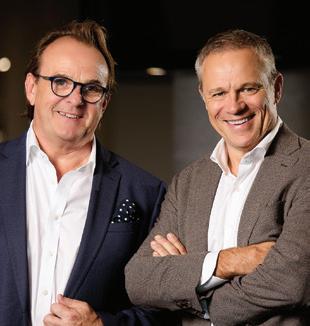
Image Publications has announced the appointment of Nige Cottingham as Editor, Image Magazine reinforcing its commitment to delivering high-quality, industry-focused content across its print and digital platforms. Nige joins Stephanie Gaddin who is the Editor of Image Online news.
Nige brings a strong background in B2B publishing, with experience spanning editorial leadership, content strategy and audience engagement. His appointment comes at a time of continued growth for Image Publications, with its acquisition of Wide Format Online which was recently relaunched as Wide Format Image along with a new industry leading digital news platform.
In his new role, Nige will lead editorial direction across the portfolio, ensuring content remains relevant, practical and aligned with the needs of printing, signage and visual communications professionals.
Nige says: “Image Publications has built a strong reputation for delivering trusted industry content and I’m looking forward to working with the team to continue that legacy, while identifying new opportunities to engage with our audience and reflect the challenges and innovations shaping the industry.”
Best regards, Janet Maitland Publisher Image Publications
Industry Yin and Yang
It’s been a busy few months for strategic partnerships, acquisitions and collaborations. Here’s what’s new since our last issue.
‘Customer first’ for Spicers & Spandex
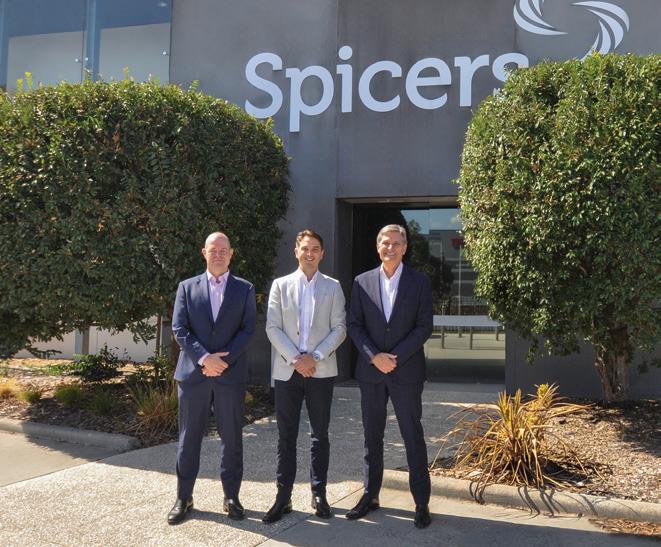
In a move that will significantly strengthen its position in the Australian and New Zealand signage and graphics market Spicers Australia has acquired Spandex Group’s local operations, forming arguably one of the most notable consolidations in the region’s print supply sector in recent years. By integrating Spandex’s well-established portfolio of signage materials, hardware, and accessories, Spicers is expanding both its product range and market reach. Looking ahead, the combined business is expected to offer customers a more comprehensive solutioncovering everything from media and consumables to equipment and technical support, and is also likely to simplify procurement processes while increasing access to premium brands and specialised products. But in the meantime, the message to respective sets of customers from both organisations is ‘steady as she goes and business as usual’, with the acquisition being allowed plenty of time to settle and both businesses continuing to operate independently.
Brother acquires Mutoh
Brother Industries has commenced acquisition of Mutoh Holdings, signalling a major strategic push into the industrial and wide-format print sectors. The move reflects Brother’s intent to diversify beyond its traditional office and textile printing segments and accelerate its presence in higher-growth areas such as signage, UV flatbed, and direct-to-object (DTO) printing. Mutoh is widely respected for its precisionengineered inkjet platforms, particularly its XpertJet series, which has gained strong traction globally and in Australia. Its portfolio spans eco-solvent, UV LED flatbed, and hybrid technologies, making it a natural complement to Brother’s existing capabilities.
Currie Group partners with IUV in solutions focus
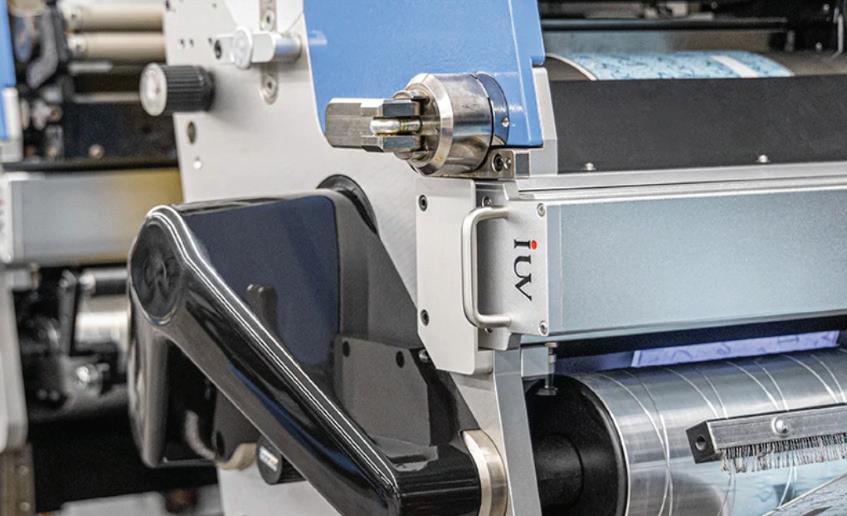
Reflecting growing demand for UV-based solutions across a range of applications, including signage, industrial printing, and direct-to-object production, Currie Group has entered into a strategic partnership with IUV, to bring the company’s award-winning UV technology to local customers by providing access to advanced systems designed for highquality, durable output. Customers are expected to benefit from enhanced choice and access to new technologies, supported by Currie Group’s established service and support infrastructure. The partnership also provides opportunities for businesses to explore new revenue streams and expand their capabilities.
CPH Group rebrands as ProGrafik to signal new direction
CPH Group has officially rebranded as ProGrafik, with a renewed focus on innovation, customer engagement, and a broader service offering. The rebrand is more than a cosmetic change - it signals a shift in how the company intends to operate in a competitive and rapidly evolving market. ProGrafik aims to position itself as a modern, forward-thinking provider, aligning its identity with the needs of today’s print service providers. Alongside the new branding, the company is expected to enhance its product portfolio and service capabilities.
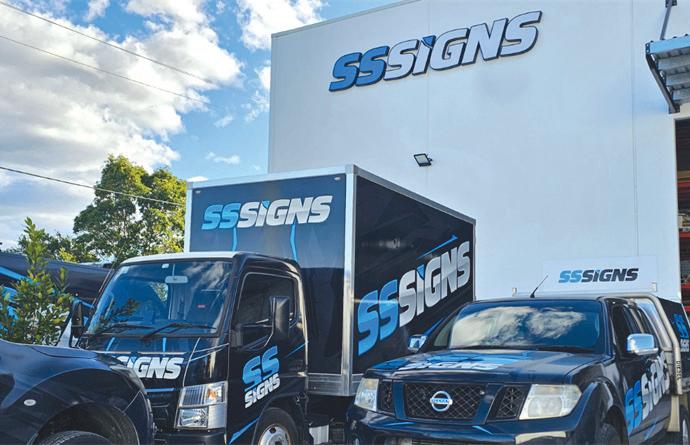
SS Signs acquires Sign Mart
SS Signs has expanded its footprint in the signage and print supply sector through the acquisition of Sign Mart, enabling the company to scale its operations and respond more effectively to evolving market demands. As print service providers increasingly seek suppliers that can deliver both breadth and
reliability, strengthening the supply chain has become a key competitive differentiator. By combining resources and expertise, companies like SS Signs are positioning themselves to meet the challenges of a rapidly changing market, including the shift toward digital production and customisation.
Color-Logic & Visualis3R strike
3D partnership
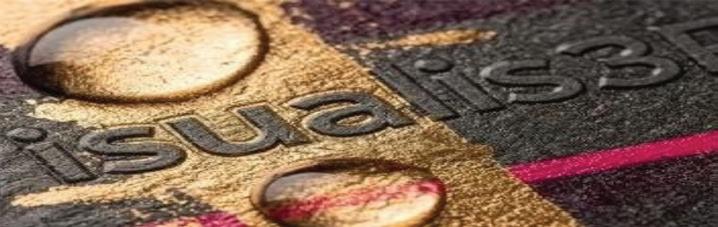
Color-Logic has partnered with Visualis3R to introduce advanced 3D visualisation capabilities for metallic and specialty print effects, marking a significant step forward in how embellished print is designed and approved. The collaboration enables designers, brands, and converters to render
highly realistic digital previews of metallic finishes, foils, and textures before production begins. This is particularly valuable in sectors such as packaging, labels, and premium marketing materials, where visual impact is critical and traditional prototyping can be costly and time-consuming.
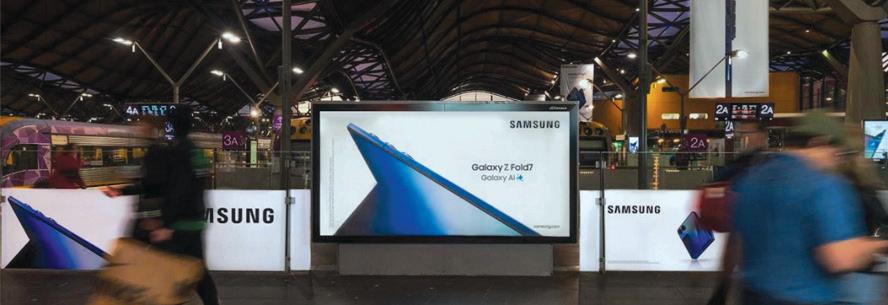
Nine Entertainment acquires QMS Media to expand OOH reach
Nine Entertainment has acquired QMS Media in a strategic move to strengthen its position in the out-of-home (OOH) advertising market. The acquisition aligns with Nine’s broader ambition to build a fully integrated media offering spanning television, digital, publishing, and outdoor channels. QMS Media operates a premium network of digital billboards and large-format advertising assets across Australia, making it a valuable addition to Nine’s portfolio. By bringing OOH into its ecosystem, Nine can offer advertisers more comprehensive, cross-platform campaigns that combine reach, data, and targeting capabilities.
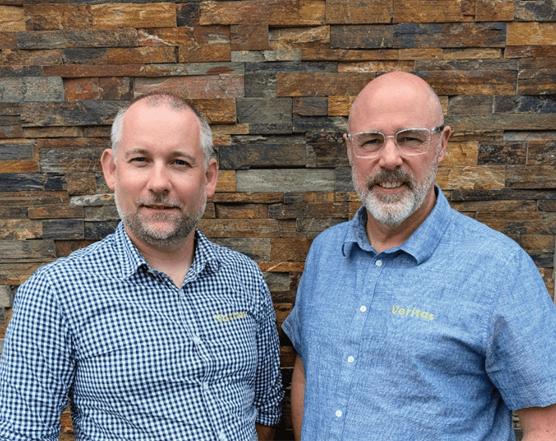
Veritas Print Media enters competitive ANZ supply market
A new player has entered the Australian print supply landscape, with Veritas Print Media launching a range of wide-format media products aimed at signage, display, and graphics applications. The company’s entry adds further competition to an already dynamic and crowded market. Veritas Print
Media is positioning itself as a supplier of high-quality yet competitively priced media, targeting print service providers looking for reliable alternatives to established brands. Its product range is expected to cover key categories such as self-adhesive vinyl, banners, and display materials.
Kornit Digital fashions PrintFactory acquisition
Kornit Digital, well-renowned for its sustainable, on-demand, digital fashion and textile production, has acquired PrintFactory, a global Netherlands-based technology leader of cloud-native workflow, colour management and production automation software. The acquisition represents a strategic step in Kornit’s mission to accelerate the digital transformation of the global fashion and textile industry.
Ronen Samuel, Chief Executive Officer of Kornit Digital, says: “This acquisition is about more than just workflow or colour management. It is about building the digital infrastructure the fashion industry needs to move from analog production to agile, on-demand manufacturing. By connecting demand generation, production workflow and manufacturing through one integrated platform, we are accelerating the industry’s transition to a new production model.”
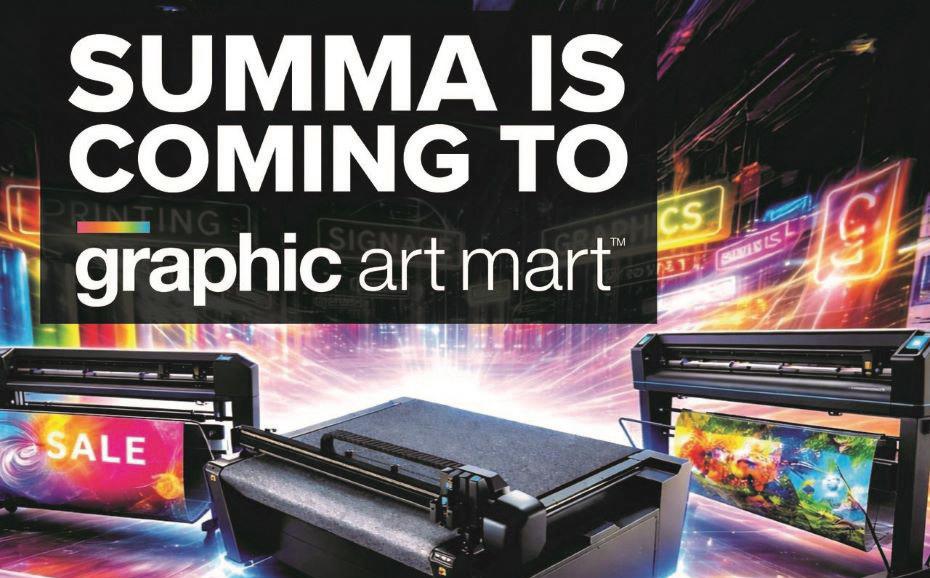
Graphic Art Mart announces start of Summa
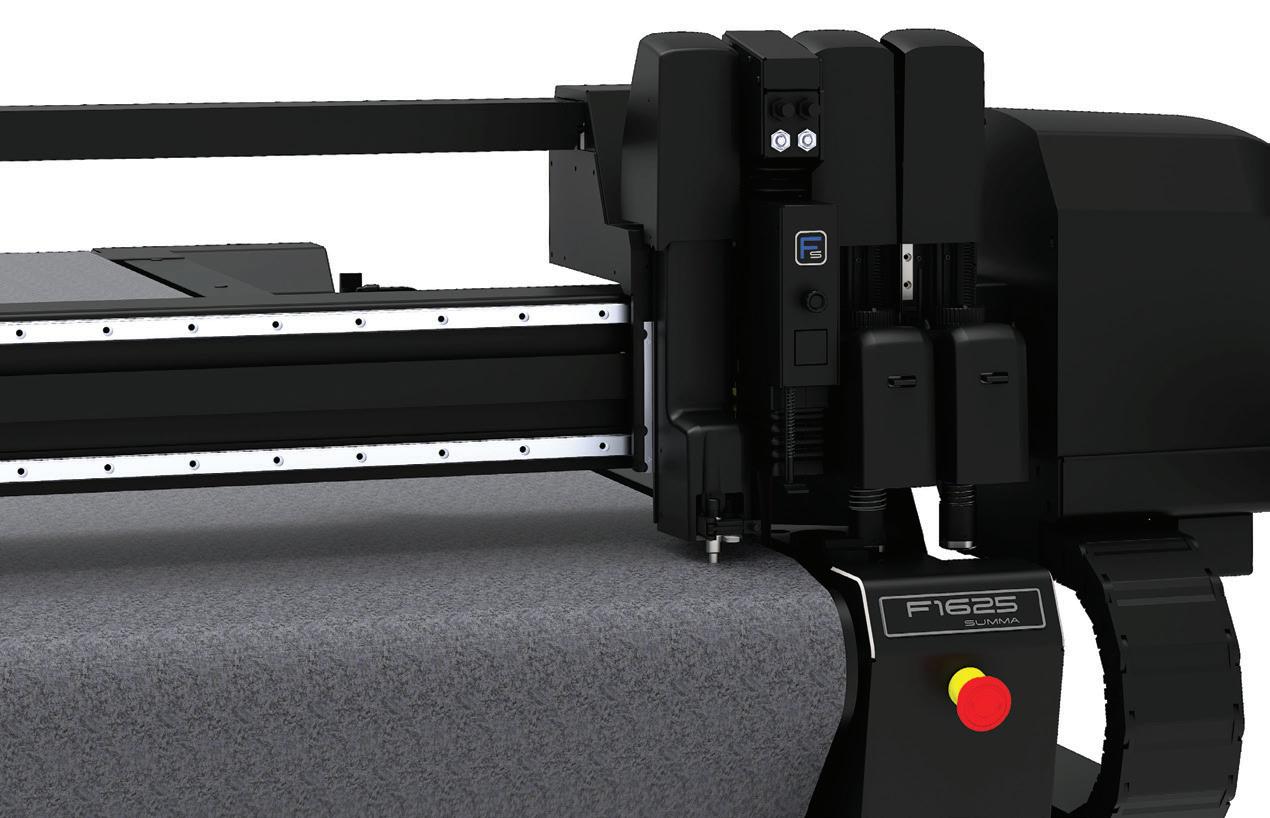
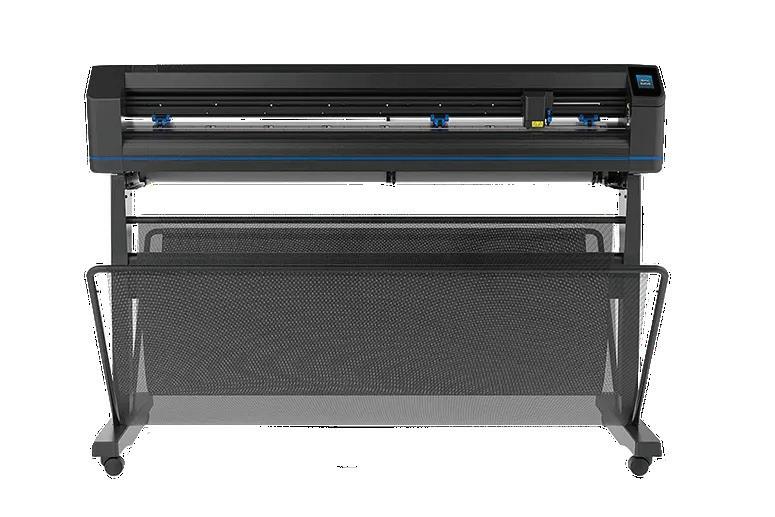
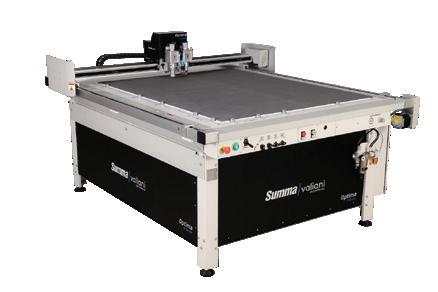
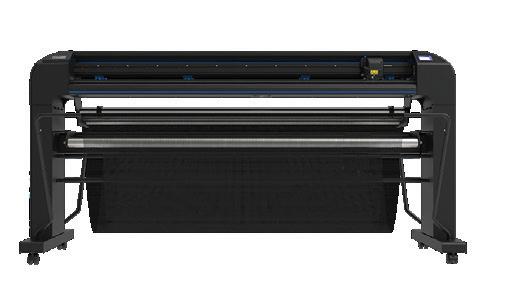
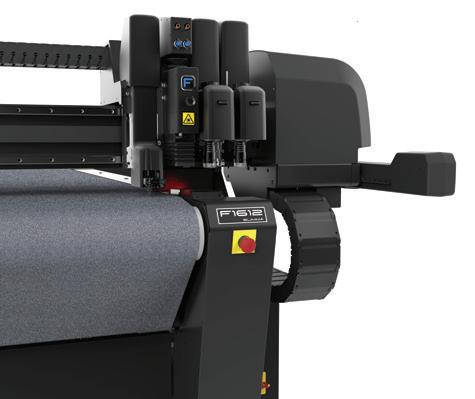
Graphic Art Mart has announced its appointment as an official Australian channel partner for Summa - one of the world’s leading manufacturers of precision cutting solutions for the signage, print and packaging industries. Graphic Art Mart will be distributing Summa’s
S-series vinyl cutters (high-end contour cutting accuracy for printed graphics on vinyl and soft-sheet materials) and award-winning F-series flatbed cutters (high performance digital flatbed cutters for signage, packaging and textiles).
New Products & Tech
With FESPA Global on the immediate horizon and Visual Impact locked in for later this year, new products and technologies are starting to leak out into the market. Here’s a quick catch-up on what’s new locally for 2026.
New products and upgrades for Mimaki
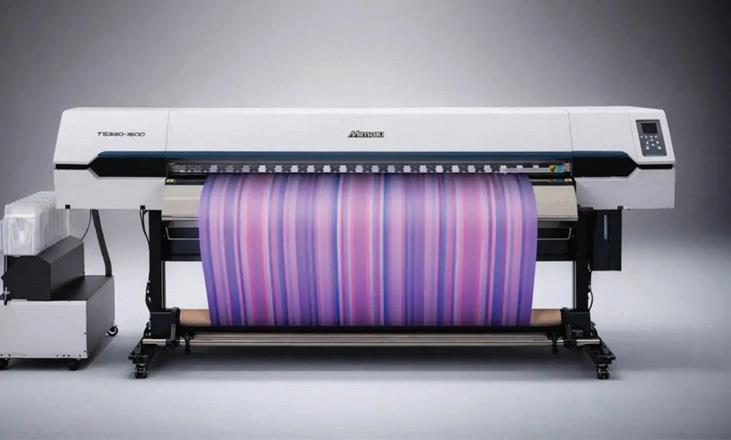
Q1 of 2026 has been a busy period for Mimaki Australia, first with upgrades to its TS330 Series dye-sublimation printers and latterly announcing the local introduction of the new Mimaki UJV200160, closely followed by the UJ330H-160 hybrid UV printer. Kohei Kobayashi, Managing Director for Mimaki Australia, says: “We’re seeing a clear shift in how local businesses are approaching print production and Australian print providers are increasingly placing greater value on flexibility and simplicity in their operations. Our new product offerings have been developed for exactly this purpose: to make high-quality printing more accessible, allowing businesses to expand their offering without adding complexity.”
• TS330 Series upgrades include full compatibility with Mimaki’s Sb411 inks in Orange, Violet, Fluorescent Pink and Fluorescent Yellow. The expanded ink set extends the colour gamut to 11 inks,
enabling higher colour vibrancy, saturation and accuracy across a broad range of applications, from fashion and sportswear to fabric signage and home décor. As part of the update, Mimaki has also introduced the TS330-1800, a new, larger-format model with a maximum printing width of 1940 mm, to accommodate single-piece, wide textile fabrics, making it particularly suited to larger home décor applications such as curtains and tapestries.
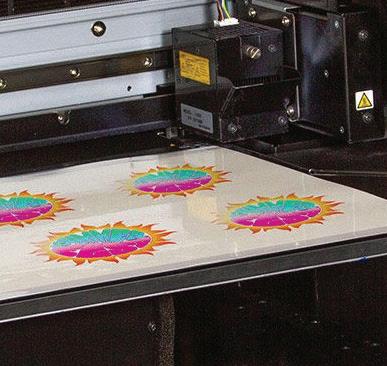
• Expanding Mimaki’s 200 Series, the new Mimaki UJV200-160 presents as a versatile UV solution tailored to the needs of Australian commercial print, sign and graphics businesses and designed to deliver highquality output with ease of use.The UJV200160 combines the benefits of UV printing, such as instant drying and broad media compatibility, with a streamlined workflow
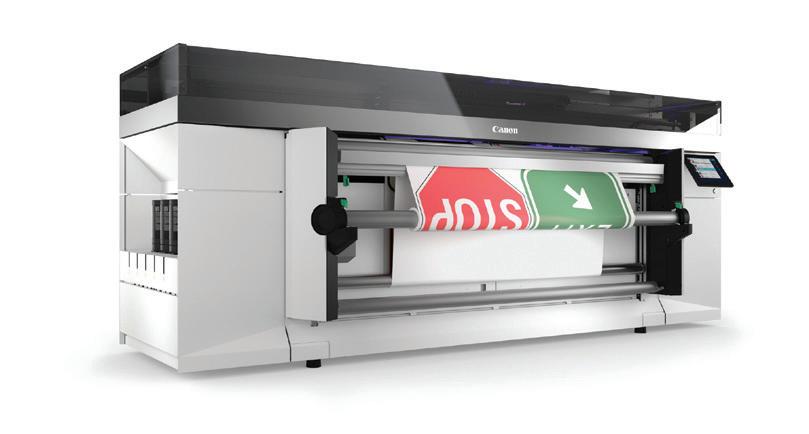
Green light for Canon Colorado M-Traffic
Canon has expanded its Colorado portfolio with the introduction of the Colorado M-Traffic printer, a purpose-built solution targeting the production of traffic signage and industrial graphics. Built on Canon’s UVgel technology platform, the new system is engineered to deliver the durability, colour consistency, and compliance required for safety-critical outdoor applications. The M-Traffic variant is specifically configured for regulated signage environments, where longevity and visibility are essential.
that enables prints to move directly into finishing or installation. This is particularly valuable for applications like signage, window graphics and retail displays, where speed and turnaround times are critical.
• The UJ330H-160 hybrid UV printer is designed to handle both rigid and roll media, making it a versatile solution for a wide range of applications. By supporting multiple media types, the system allows users to switch between jobs more efficiently, reducing downtime and maximising output. The UJ330H-160 is capable of delivering consistent quality across diverse applications, from signage and display graphics to more specialised work. UV printing technology enables strong adhesion and durability, ensuring output can withstand demanding environments.
Roland DG looks to Make Your Mark
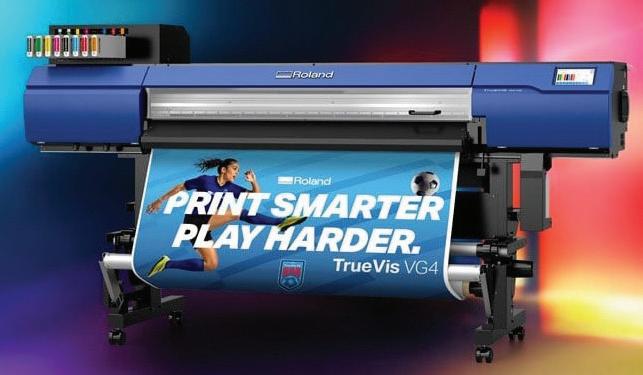
Roland DG announced the launch of the TrueVis VG4 Series, a new generation of ecosolvent print and cut devices designed to help sign makers and print service providers achieve premium-quality graphics, with TR3 inks, delivering refined image quality and smarter
eco-solvent print & cut production. Available in 54-inch (VG4-540) and 64-inch (VG4-640) models, the TrueVis VG4 Series introduces multiple workflow innovations that reduce setup time, minimise downtime, and simplify day-to-day operation.
This was the first product launch under Roland DG’s new brand identity, which invites customers to Make Your Mark, aimed at encouraging creators to use Roland DG’s extensive equipment and consumables ranges
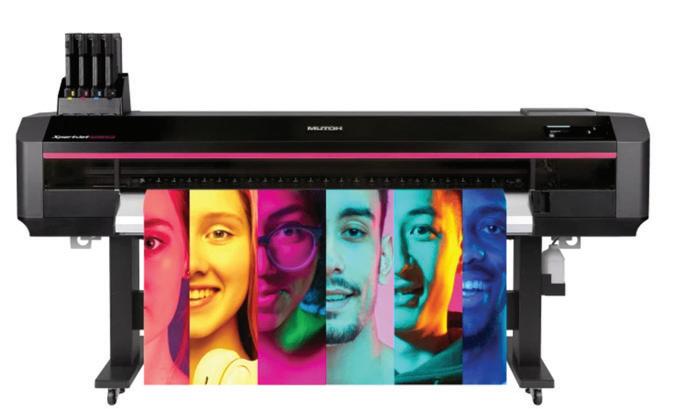
Mutoh launches XpertJet 1641SR Pro II eco-solvent printer
Designed for a wide range of professional applications, including indoor and outdoor signage, vehicle graphics and wrapping, exhibition displays, and retail and pointof-purchase advertising, Mutoh announced the launch of the new XpertJet 1641SR Pro II, a 64” ecosolvent printer earlier this year. The
new model includes Mutoh’s latest AccuFine HD Pro print head with the innovative i-Screen EX System, delivering productivity of up to 17.6 sqm/h alongside exceptional image quality. The AccuFine HD Pro print head features eight nozzle rows, with nozzle-row pairing to improve ink landing accuracy for each colour.
to ‘turn ideas into reality, and ambition into meaningful impact’.
Earlier this year, Roland DG also introduced a series of technical enhancements to its TY-300 direct-to-film (DTF) printer, aimed at improving productivity, colour accuracy, and overall usability. The updates are designed to strengthen the system’s performance in textile and apparel decoration workflows, where demand for customisation continues to grow.
Epson shows SureColor range versatility
Two new product offerings locally this year from Epson too, with the local introduction of the SureColor G9060, a new printer in the SureColor G-Series, designed to support high-volume garment and textile production and the SureColor V4000, a mid-range UV flatbed printer designed to meet the needs of small- to medium-sized sign shops and merchandise production businesses.
• The G9060 is engineered to handle larger production volumes while maintaining consistent output, making it suitable for businesses looking to scale their operations. Epson continues to leverage its PrecisionCore printhead technology, ensuring high-resolution results and reliable operation. The new model also aligns with the company’s broader focus on sustainability, incorporating features designed to reduce energy consumption and minimise environmental impact.
• With a compact footprint and the ability to handle media up to 980 × 700 mm and 200 mm in thickness, the SureColor V4000 supports printing on a wide range of rigid and flexible substrates, including acrylic, vinyl, Coreflute, film, canvas, and wood. This versatility enables the production of signage, POP/POS materials, décor panels, premium packaging, cabinetry components and customised promotional items, giving growing businesses a practical path to broaden their application range. The printer features Epson’s UltraChrome UV ink with eight colours plus white and varnish, enabling vibrant colour expression, smooth tonal gradations and excellent detail reproduction.
Sign of the Times
2026 has already seen a couple of key announcements and a flood of interesting signage industry news. Here’s a quick grab of Q1 activity.
OMA Media on the MOVE
The Outdoor Media Association’s MOVE (Measurement of Outdoor Visibility and Exposure) system went live earlier this year, delivering a new standard in audience measurement for the Australian out-ofhome industry. MOVE provides detailed
data on audience reach and engagement, enabling advertisers to plan and evaluate campaigns with greater accuracy. The system incorporates advanced analytics and location-based insights, reflecting the increasing importance of data in media
planning. For advertisers, the launch of MOVE offers improved transparency and accountability, helping to demonstrate the effectiveness of OOH campaigns. It also supports more sophisticated targeting and optimisation strategies.
JCDecaux rolls out global programmatic campaigns
JCDecaux has launched global programmatic advertising campaigns across its out-of-home (OOH) network, marking a significant step in the evolution of digital outdoor media. The initiative enables advertisers to buy and manage campaigns in real time using data-driven platforms.
Programmatic OOH allows for more targeted and flexible advertising, with campaigns that can be adjusted dynamically based on audience data, location, and time of day. This represents a major shift from traditional static booking models, offering greater efficiency and effectiveness.
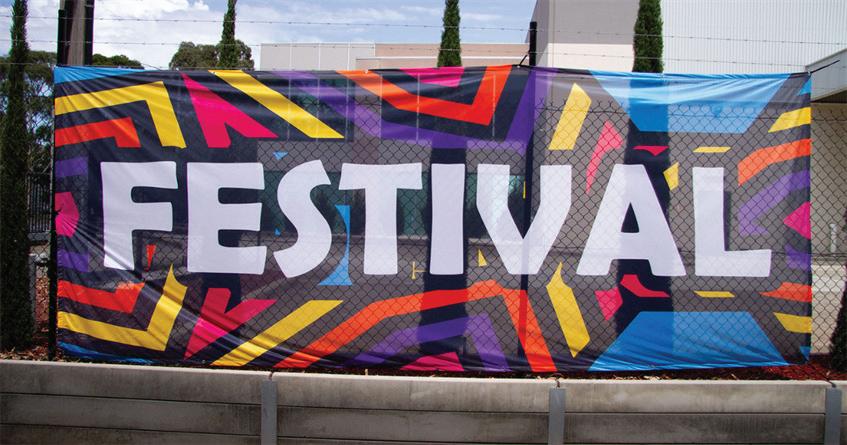
CMYKhub adds Soft Signage to trade offering
CMYKhub has added fabric display products to its national trade offering, which includes offset, digital, labels, and wide-format printing. The company said that the launch is a significant expansion for the trade-only supplier, closing a gap in its product range.
Soft signage and fabric-based display products used across retail, events, exhibitions, and outdoor promotions have grown steadily as a category as brands have moved away from rigid display materials toward lighter, more versatile fabric alternatives. All soft signage products
CWT launches Foam Cutter
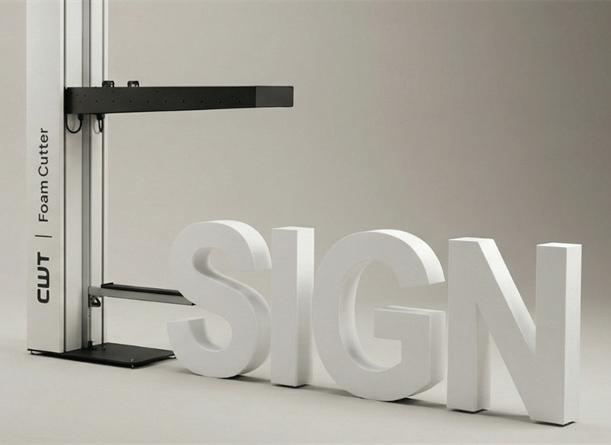
CWT Graphic Worktools has moved into the dimensional signage segment with the launch of the CWT Foam Cutter, marking a new product category for the Swedish manufacturer. The addition extends CWT’s portfolio beyond its established flatbed applicators and trimming systems, reflecting growing demand for three-dimensional signage across retail, exhibition and architectural applications. The Foam Cutter, available through Graphic Art Mart, is designed to enable sign makers, print businesses and promotional product suppliers to bring foam cutting in-house, reducing reliance on outsourced services or more complex CNC-based systems.
are produced at CMYKhub’s Melbourne facility, powered by an EFI VUTEk FabriVU dye sublimation system, a platform chosen specifically for its ability to deliver the colour vibrancy, consistency, and clean finishing that fabric display products demand.
Kyocera on the nozzle
Kyocera has announced the development of an inkjet printhead designed to handle highviscosity industrial materials; a capability the company says has previously been difficult to achieve with conventional inkjet technology. According to Kyocera, the newly developed printhead incorporates a proprietary piezo actuator structure and optimised fluid channel design, enabling stable jetting of liquids with viscosities of up to 80 mPa·s. The printhead features more than 1,500 nozzles and is intended for industrial applications, including advanced manufacturing, painting, and additive manufacturing.
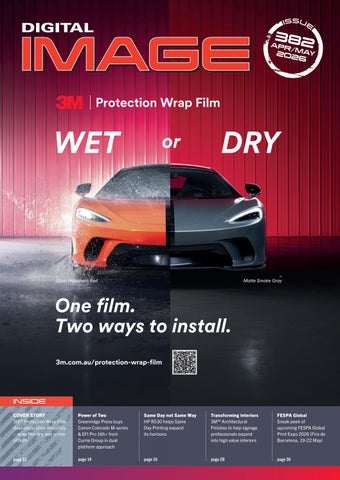
Wet. Dry. Or Both.
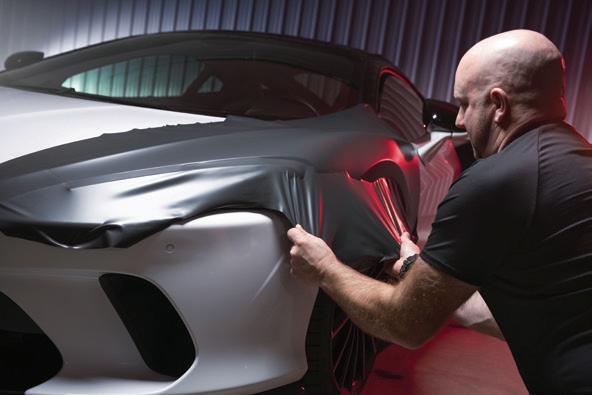
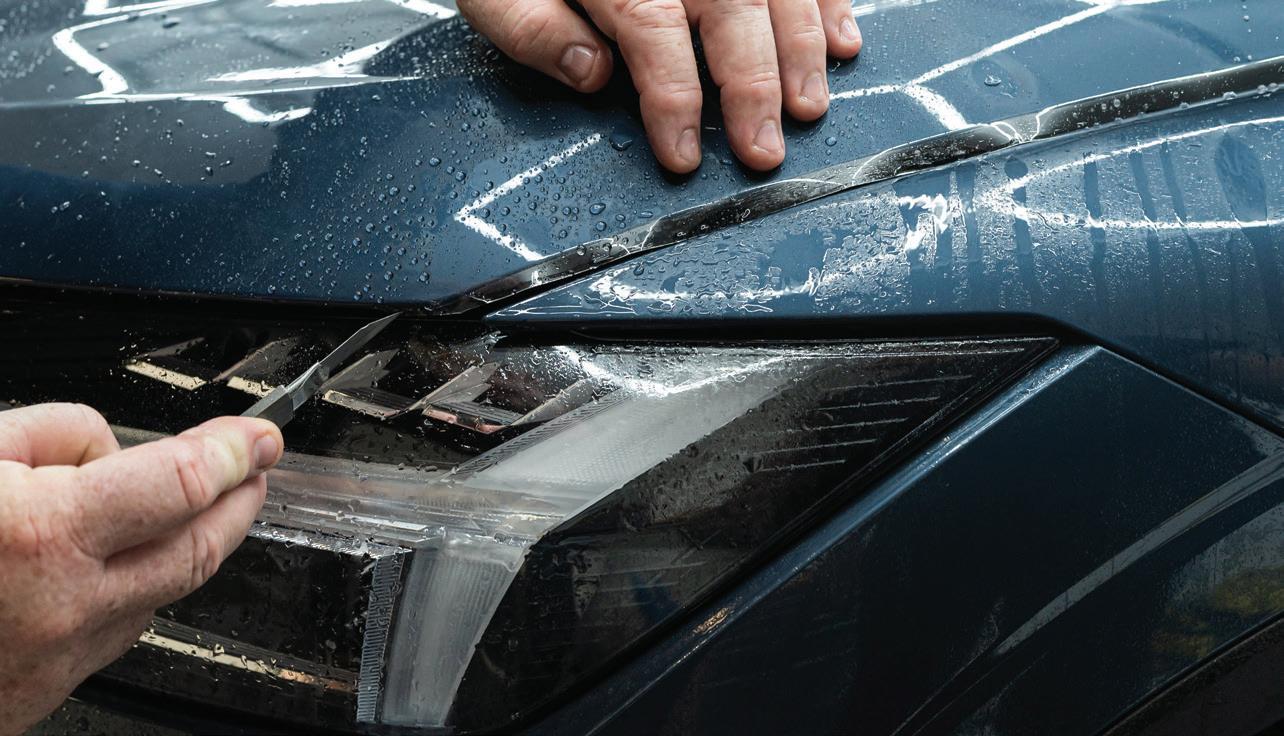
3M™ Protection Wrap Film now offers dualapplication flexibility, enabling installers to choose whether they wrap the film using a more common dry application, for speed and efficiency, or using wet application techniques that allow sliding, alignment and more controlled positioning, or even a mix of both.
Originally available locally, purely as a dry-install protection wrap film, now 3M™ Protection Wrap Film (PWF) Colour Series offers a dual-application capability, allowing installers to apply the film using either wet or dry installation methods, or a combination of both within a single installation. This development expands installation flexibility for professional workshops, allowing installers to adapt their technique based on the vehicle surface, panel size or installation preference.
Installation Flexibility
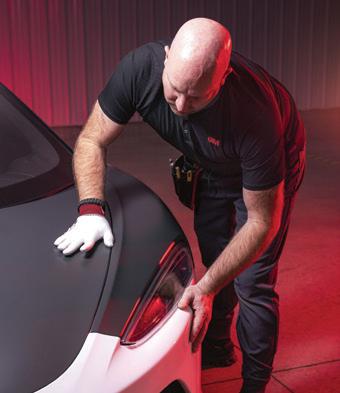
Dry installation has been the standard method for 3M™ Protection Wrap Film in the ANZ region. Using integrated 3M™ Controltac™ and 3M™ Comply™ adhesive technologies,
the film can be positioned and repositioned efficiently while allowing trapped air to escape through microscopic air-release channels.
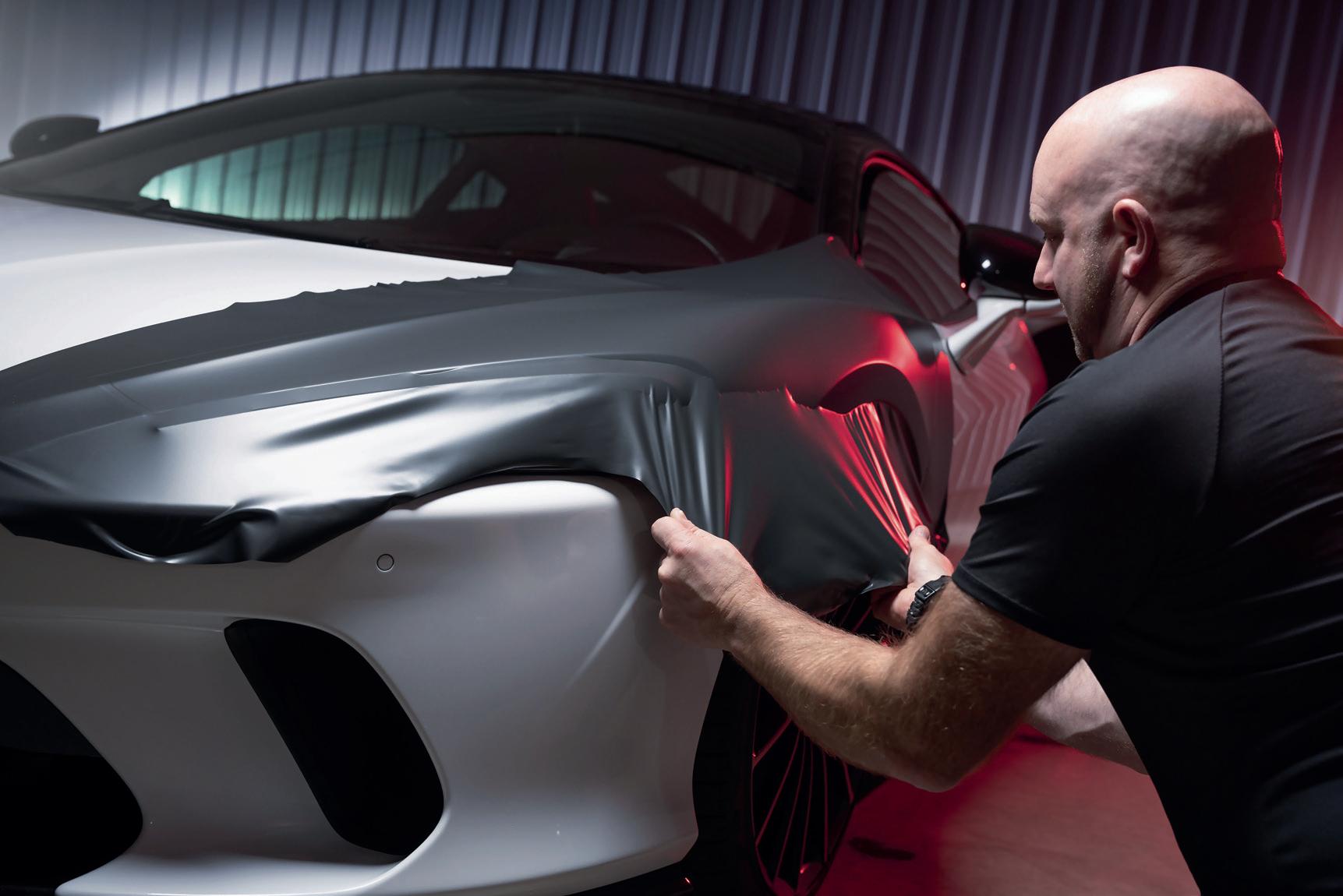
• Controltac™ technology reduces the adhesive’s initial contact area, enabling installers to slide the film across the surface for accurate positioning. Light finger pressure can temporarily tack the film into place, allowing it to be lifted and repositioned, if necessary, before firm pressure activates the final bond.
• Comply™ technology incorporates air-release channels within the adhesive layer, allowing air trapped beneath the film to move toward the edge. This helps installers achieve smooth, bubble-free installations without the need for slip solutions, making the dry workflow both efficient and predictable. Compared with traditional wet-applied paint protection films such as 3M™ Scotchgard™ Paint Protection Film Pro Series 200, dry installation can be up to two times faster endto-end, helping reduce installation time while maintaining application quality.
Wet Installation for Precision Positioning
But while dry installation offers speed, many installers, particularly those experienced with traditional paint protection film, are more familiar with wet installation workflows, especially when working on large or complex panels.
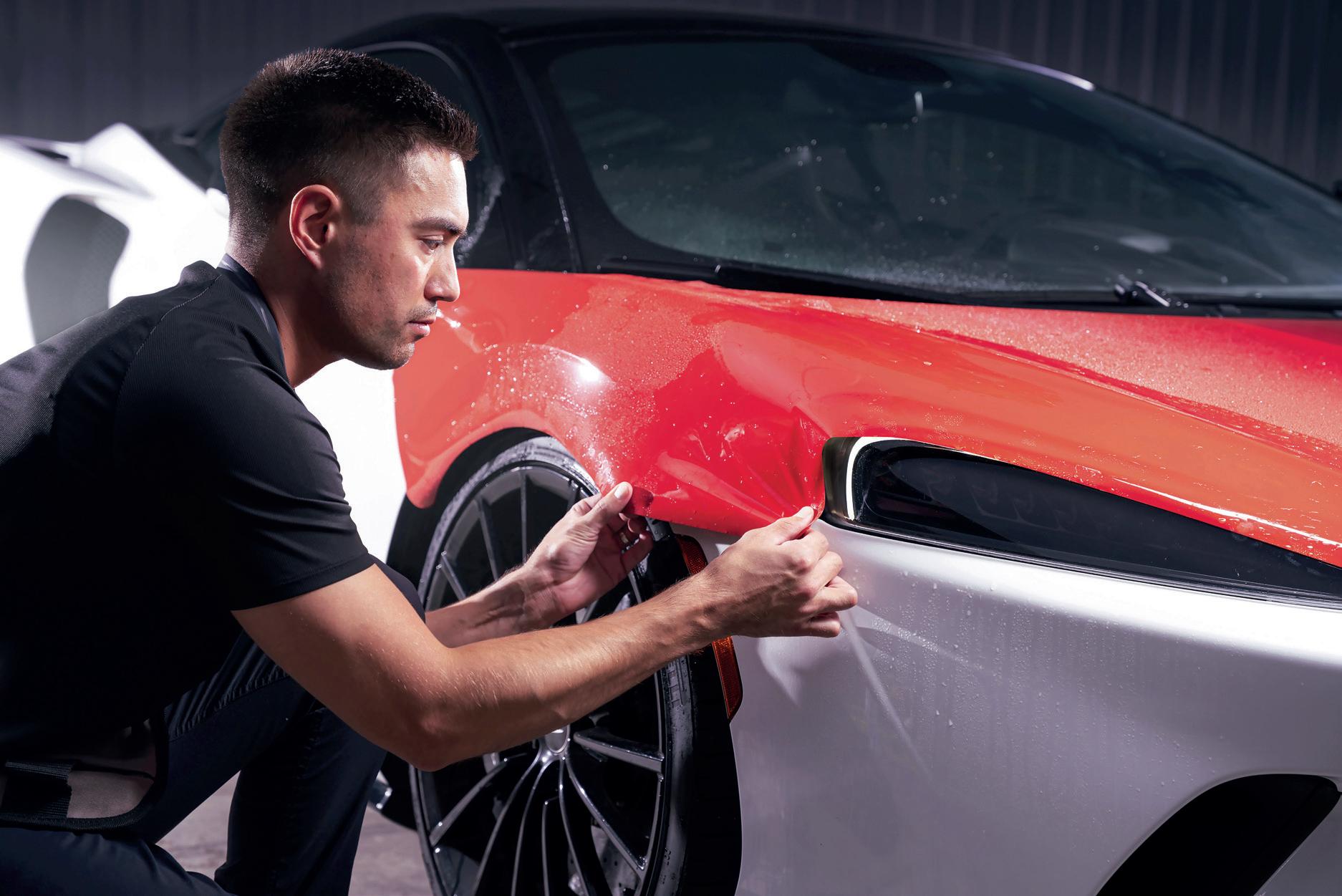
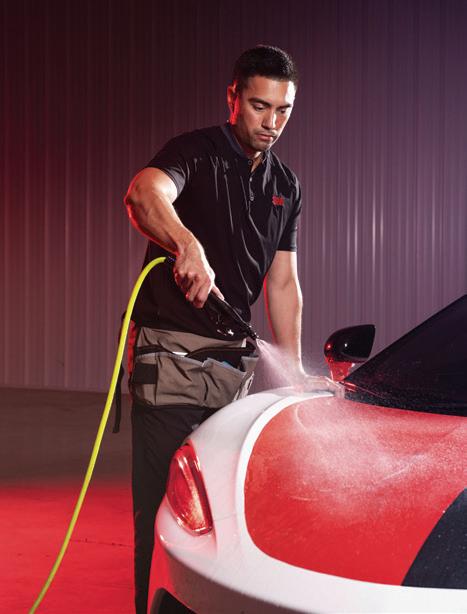
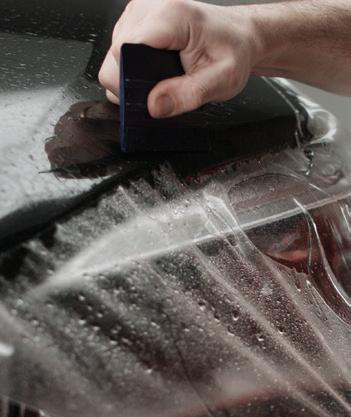
Wet application capability enables installers to float the film across the vehicle surface using deionised water or a light tack solution, allowing precise alignment before the film is squeegeed into place. This method can provide additional control when installing film on larger sections such as hoods, doors or quarter panels, where accurate positioning across broader surfaces is important. When a tack solution is used, the ratio of isopropyl alcohol to deionised water must not exceed 15% and after positioning the film, installers must thoroughly remove all water beneath the film by squeegeeing, and film edges should be dried using a heat gun prior to wrapping to ensure proper adhesion.
“Installers can now choose wet or dry application –or combine both methods within a single installation.”
One Film, Two Installation Methods
Noting the above, the ability to combine wet and dry application methods within the same installation presents as a significant production advantage. Installers can apply the film dry on smaller panels or accent areas where speed is important, while switching to wet installation on larger sections that benefit from additional slide and alignment control. By supporting both techniques, installers enjoy the flexibility to choose the workflow that best suits the job.
For professional installers, this means the ability to balance speed and precision across a variety of vehicle surfaces. For vehicle owners, it means access to a film that combines custom styling with durable protection, installed using the method that works best for the application.
Where Colour Meets Protection
While installation flexibility defines the latest evolution of 3M™ Protection Wrap Film Colour Series, the product’s performance is equally driven by its polyurethane construction, protective capabilities and extensive colour palette.
Designed to combine vehicle customisation with surface protection, the film enables installers to deliver full colour transformations or detailed accent work while helping protect painted vehicle surfaces from rock chips, scratches, stains and environmental exposure.
Unlike traditional vinyl wrap films used primarily for aesthetics, 3M™ Protection Wrap Film is constructed from polyurethane, a material widely used in premium paint protection films due to its durability, flexibility and impact resistance. The film is engineered through a multi-layer construction designed to balance appearance, protection and installation performance.
This structure includes a polyethylenecoated PET release liner, a pressuresensitive acrylic adhesive layer incorporating Controltac™ and Comply™ technologies, a pigmented polyurethane layer that provides colour and impact resistance, and a polyurethane clear coat that delivers the film’s surface finish and environmental resistance. Gloss colour variants are additionally protected by a clear polyester cap sheet during transport and storage to preserve the integrity of the high-gloss surface before installation.
The polyurethane clear coat also incorporates self-healing polymer technology, allowing minor scratches and swirl marks to gradually disappear when heat is applied to the film. This capability
helps maintain the film’s visual clarity and finish over time, while the clear coat also resists staining, yellowing and weathering.
Conformability and Installation Performance
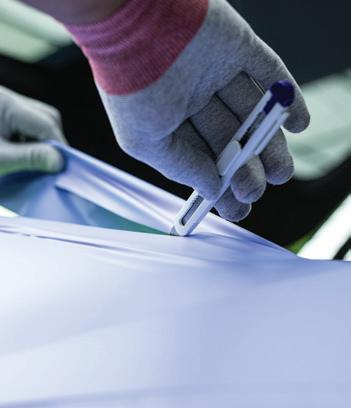
3M™ Protection Wrap Film is engineered for high conformability, allowing the film to stretch smoothly into recesses and curved vehicle surfaces with minimal heat.
The material remains flexible at room temperature, enabling installers to perform cold stretching that distributes tension evenly across the surface. For particularly complex shapes, heat-assisted stretching can be used to improve conformability.
Post-heating is a critical step during installation. Corners and edges must be heatset to 200°F to 225°F (93.3°C to 107.2°C) to stabilise the film and prevent lifting over time.
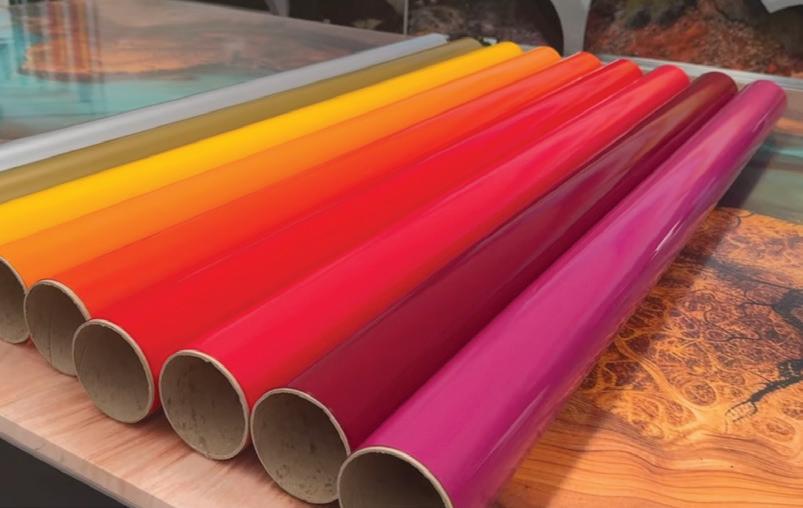
Total thickness, including adhesive, of 3M™ Protection Wrap Film ranges from 0.19mm to 0.23mm (7.5 to 9 mil) depending on colour. The series is available in nearly 30 premium colours across four finish categories.
• Gloss for a deep, mirror-like finish that resembles automotive paint, with colours such as Gloss Umbra Rosso, Gloss British Racing Green, Gloss Neptune Blue and Gloss Nardo Gray;
• Matte range for a more refined, non-reflective appearance in colours including Matte White, Matte Smoke Gray and Matte Black;
• Colour Flip iridescent films that shift colour depending on viewing angle and lighting conditions, including Gloss Flip Cosmic Dust, Gloss Flip Winter Rose and Gloss Iridescent Emerald; and
• Textured finishes to replicate the appearance of materials such as carbon fibre and for accent applications.
Recommended installation temperatures range from 16°C to 30°C, with optimal conditions between 18°C and 24°C. The film is designed for application on painted automotive surfaces. Following installation, the film is compatible with 3M™ Ceramic Coating 39901 and 3M™ Ceramic Boost Spray 39905, helping maintain surface performance and finish clarity.
Backed by a 10-year consumer warranty covering yellowing, bubbling and cracking, 3M™ Protection Wrap Film Colour Series combines installation versatility, colour customisation and durable surface protection in a single film system.
30
The Power of Two
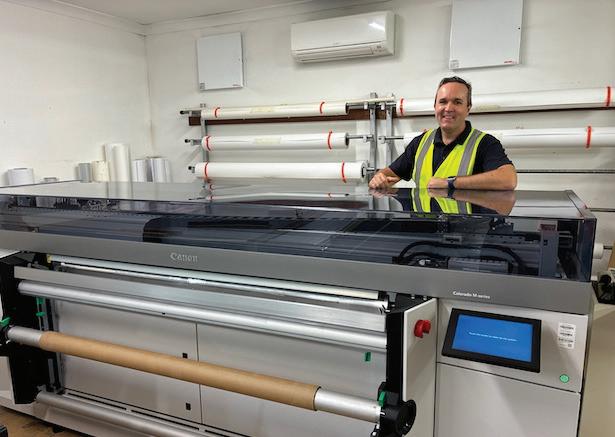
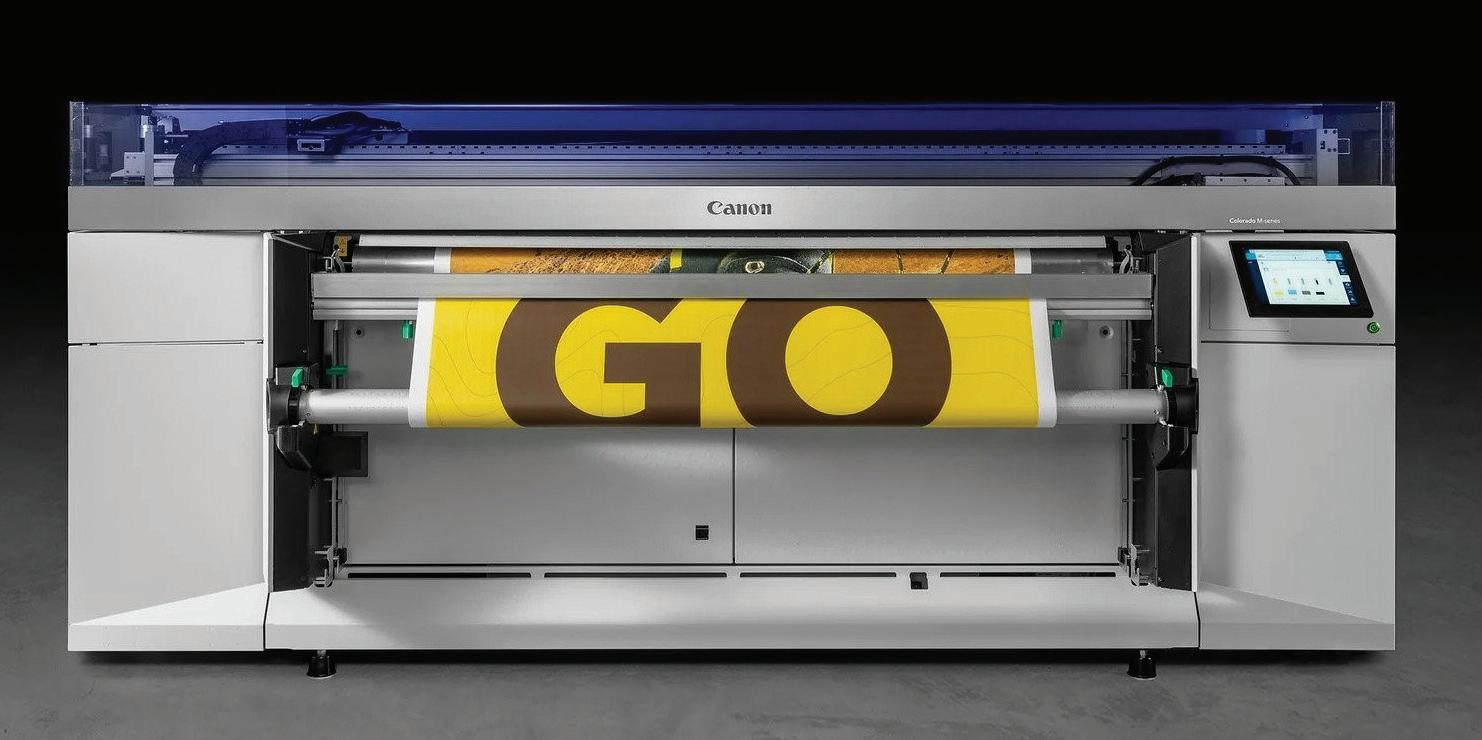
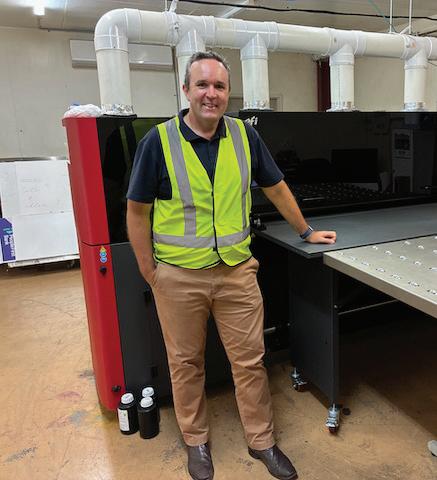
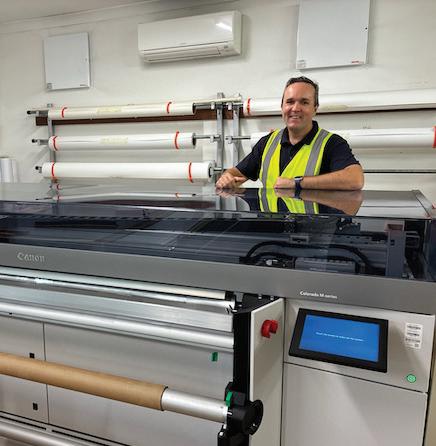
Doubling down has always been part of the Greenridge Press ethos, right back to its origins, as a small, family-owned North Queensland single printing business. Wind forward more than 3 decades and Greenridge Press is now the integral cog of a broader, national Greenridge Group, and its latest investment – purchasing both a Canon Colorado M-series and an EFI Pro 16h+ from Currie Group – represents a powerful strategic shift in how the printer intends to approach wide format production for the next three decades.
Greenridge Press Managing Director, Kyal Osborne, explains: “Growth across the business was putting pressure on space, workflow, and turnaround times, so we didn’t just need new kit, we needed a smarter way forward. So, this wasn’t about swapping out old machines…we needed to build a more efficient and scalable production environment.”
Seeing double
At the heart of this strategy is an exciting new dual-platform approach: pairing the versatility of a hybrid flatbed with the speed and automation of a dedicated roll-to-roll system. The EFI Pro 16h+ brings broad substrate capability, handling rigid boards, signage, and specialty materials, while still offering flexibility for roll applications. Alongside it, the Canon Colorado M-series delivers highspeed, automated roll-to-roll production with exceptional consistency across long runs.
According to Michael Mostyn, Currie Group’s Queensland Sales Account Manager: “The real value lies in being able to operate these two systems in tandem. This allows
Greenridge Press to match the right technology to the right application, handling rigid and flexible media separately, while maintaining high productivity and consistent output on roll jobs. This has eliminated the compromises that often necessarily come with a single-machine workflow.”
Osborne adds: “The operational impact has been immediate because it has removed compromise. Where previously, we were trying to make one machine do everything, now we can separate production properly - rigid and specialty work on the hybrid EFI Pro 16h+ and high-volume roll work on the Colorado – which has facilitated better quality, faster turnaround, and a more efficient production flow overall.”
“The Colorado requires minimal supervision too. Once it’s calibrated, we can trust every job will match from start to finish without constant adjustments. It’s fast, dependable, and very consistent.” The Colorado M-series built-in automation features, such as self-maintenance and automated roll handling, further reduce downtime too, allowing operators to focus on throughput rather than troubleshooting. Unparalleled support
Supporting Greenridge Press’ investment is a long-standing relationship with Currie Group, whose role has always extended beyond just equipment supply.
Osborne says: “We’ve worked with Currie Group for a long time. Their knowledge of the Sign & Display space, and the confidence we have in their service and support, was a key factor in our purchase decision. It’s not just about the equipment: it’s about knowing there is reliable backup and market insight behind it. In a
production environment where uptime is critical, this level of trust and support is invaluable.”
He continues: “What we have been able to achieve through the dual system purchase of a Colorado M-series and an EFI Pro 16h+ is a future-ready production platform that will enable us not just to keep pace with demand, but to stay ahead of it, with the capacity to scale up as demand grows, without needing to rethink our workflow again.”
Same Day, but not the Same Way
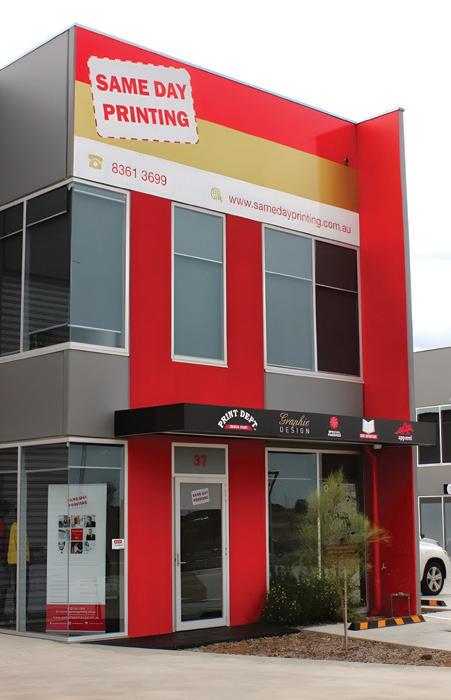
When a business is built on speed, control is everything. For Same Day Printing - a company whose very identity is defined by fast turnaround and high-quality results – this has always meant optimising production capability inhouse, balanced with ‘mindful outsourcing’ to a trusted network of trade partners, to support scale as and when needed.
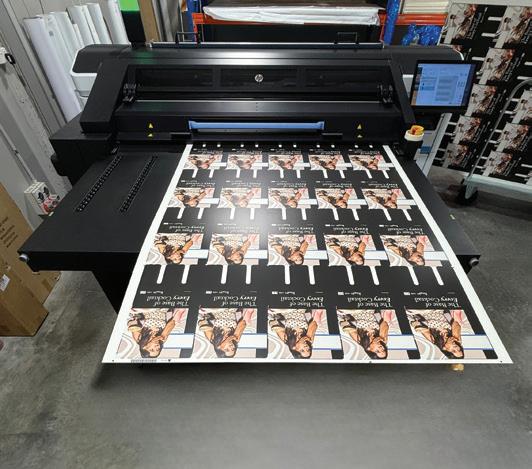
Tom Dickson, Same Day Printing Solutions Provider and Director, says: “As customer demand for rigid media and flatbed applications continued to grow, it became increasingly clear to us that there was a steady shift in this balance and the amount of work we were needing to outsource was growing at a pace that was starting to erode our control. Every investment choice is critical for an operation of our size, so we looked at a variety of options, but the all-inone HP Latex R530 jumped out at us as ideal for our needs: a system that would immediately enable us to increase our turnaround times and facilitate greater flexibility over the work we deliver inhouse and therefore more control over the outcomes.”
Reclaiming control, speed and choice
Dickson adds: “Before this investment, the rigid media jobs we were taking on would typically require a traditional print-and-mount workflow or drive a decision to outsource the
job: either option adding valuable time to our turnaround promise.”
“But with the HP Latex R530, we can accommodate a much wider range of jobs inhouse and make informed choices on production workflows, depending on the client’s requirements. Added to this, because of our increased capacity internally, we’re also securing greater volumes of work overall, so we still have plenty of work to help us maintain and even strengthen our relationships with our trade printing partners.”
displays and even plastic-free posters and smaller promotional items like drink coasters.”
With the new HP Latex R530, Same Day Printing is now averaging more than 750 square metres of rigid output per month in-house and their usage has peaked at 1100 square metres on the device in one month, enabling them to enjoy full control over production schedules and a refreshed confidence in committing to tight deadlines. This investment has already realised a significant shift in Same Day Printing’s operations, profitability, and growth trajectory.
Expanding what’s possible
Dickson adds: “The R530 hasn’t just improved how jobs are produced, it has expanded what’s possible. We’re using it to print rigid displays on FSC-certified Re-board, for Coreflute Custom Mailer boxes and other short-run boxes for retail packs or campaign kits, as well as producing Corrugated POS
Craig Hardman, HP’s ANZ Country Manager for Large Format, affirms: “What Same Day Printing has achieved with the HP Latex R530 shows what’s possible when PSPs take control of their production. Printers like the R530 provide the flexibility to expand services, improve turnaround, and explore new opportunities. Combined with tools like HP PrintOS Production Hub and the HP Learn, they go beyond efficiency to deliver real business outcomes - empowering PSPs to grow, differentiate, and do their best work, wherever their business takes them.”
Dickson concludes: “We’re fortunate to have been able to steadily build up a strong and loyal customer base. But there has never been any room for complacency here and it is vital that every investment can quickly realise its value.”
“We looked long and hard at what printer options were available and why they would suit our business and the HP Latex R530 has been a seamless fit, with plenty of potential upside still to come.”
ISA benefits Go Live for ASGA members
Members of the Australian Sign & Graphics Association (ASGA) now have access to a wide range of training and other resources from the International Sign Association (ISA) thanks to a new reciprocal membership agreement between the two associations.
The agreement sees all current ASGA ‘General / Sign Company’ Members eligible for reciprocal ISA Member Benefits, including member rates and access to a range of webinars, events and on-demand courses, information and updates, industry research and more.
Damian Nielsen, ASGA’s Membership & Events Manager, says accessing the ISA Member benefits is easy, with the Association releasing ‘How-To’ documents to step Members through the initial login and setup, and going live with dedicated resource pages on both the ASGA website at signs.org.au and on the ISA website.
Nielsen says: “Everything industry businesses need to access their full range of ISA benefits is on our new ISA Alliance page, which can easily be found in the drop-down menu within the Member Area of our website.”
Through the new alliance, ASGA Members will gain:
• ISA Member-rate access to webinars, on-demand learning and more than 60 online courses;
• free entry to the ISA International Sign Expo (plus discounted seminar pricing);
• access to ISA virtual events, newsletters and industry updates
• ISA member-rate access to ISA’s Sign Research Foundation (SRF) content; and • permission to use the ISA trademarks to identify their business as an ISA Alliance Partner Member
“All these benefits are now freely available to ASGA Members as part of their existing ASGA member benefits bundle,” confirms Nielsen, explaining that there is a link on the ASGA website, which will direct members to a specially-curated landing page on the ISA website, where they can manage their corporate membership, share the benefits by adding members of their teams, and access educational resources which have been vetted by ASGA.
In an industry where technology and regulation are moving fast, access to worldclass training and research is critical to keep businesses compliant and successful. One of ASGA’s primary aims has always been to help industry businesses save time and money, remain compliant, and learn and upskill to ensure they are well-equipped to build success in a changing and challenging business environment.
Nielsen adds: “This strategic partnership with ISA is just the latest step in the ongoing process of growing our suite of member benefits, and we are delighted to be able to offer these expanded benefits to ASGA Members.”
To access the new ISA benefits, ASGA members need to login to the member portal at signs.org.au and select ‘ISA Alliance’ from the left-hand menu. Instructions on the firsttime login set-up, and how to manage an ISA account and access training programs can all be found on that page, together with a link to click through directly to the ISA website.
Damian Nielsen
ORAFOL cements SS Signs partnership with technical support
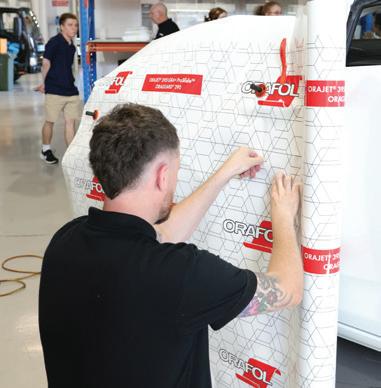
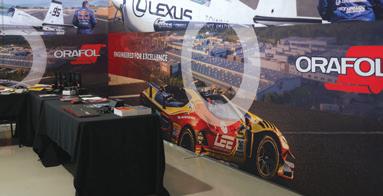
“Days like this remind me why we love this industry,” says Alex McClelland, Managing Director of ORAFOL Australia and Executive Vice President ORAFOL Asia Pacific, reflecting on an SS Signs Open Day at their Cleveland facility in Brisbane.
“We’ve always believed that strong relationships are the foundation of everything we do in this industry and our partnership with SS Signs isn’t just a commercial arrangement – it’s a genuine collaboration built on trust, performance and shared success. We’re looking forward to writing the next chapter together, with fresh products and an even stronger strategic focus across every sector we serve.”
Front and centre of the Open Day’s proceedings was a new member of ORAFOL ANZ’s technical sales and training team, Kris Pratt, playing a role for ORAFOL going forwards that sees him working alongside the SS Signs team to facilitate hands-on training programs, to help improve efficiency, consistency and confidence on the production floor.
McClelland adds: “This type of co-opted role is part of our overall strategy to cement our relationship with key customers. It was refreshing to hear the SS Signs team talk so openly about how our training, technical support and warranties have helped them win bigger corporate work. That kind of feedback tells us we’re on the right track, and it makes us even more determined to keep raising the bar.”
The Open Day also represented a great opportunity for SS Signs to showcase its steady transition from a single tier vehicle wrap operation back in 2006, when Steve Lambourne and his wife Selina first founded the business, through a steady and deliberate path of organic growth and strategic acquisitions. Skreencraft, Civic Media, Brand Productions and Vehicle Wraps Australia are amongst the original acquisitions, with more recent expansion into Victoria through acquiring Glenbrae Signs (delivering a second production base to support national clients), as well as the acquisition of Brisbane’s Sign Mart earlier this year.
Lambourne was able to talk modestly to this growth as he opened the doors to suppliers, customers and industry partners alike, for a closer look at the company’s 3,800sqm purpose-built production facility, now recognised as one of Australia’s most advanced, fully integrated signage production operations.
From in-house steel fabrication and largeformat printing through to installation logistics, the operation reflects a business that has evolved well beyond its origins to become a national, full-service signage provider and Lambourne is wholly aware of the important role played by nurturing strong and meaningful longterm supplier relationships along the way. “Our relationship with ORAFOL is a great example of this,” says Lambourne. “It dates back to when we first started out and I still remember using the ORACAL 551 series back then.”
“Obviously, like us, ORAFOL has continued to go from strength to strength over the years and our partnership with them has grown and matured accordingly. For a technical and training specialist like Kris to now be available to us to train our own teams, adds genuine value to our operation, especially given that we have a strong cohort of apprentices across our Brisbane and Melbourne operations who are hungry to learn.”
Whilst ongoing investment in workflow, automation and fit-for-purpose equipment has clearly always been part of SS Signs strategy, a central theme of the Open Day was to reinforce this distinct value in investment in people and partnerships.
The approach reflects a broader shift within the signage sector, where attracting and retaining skilled staff is increasingly tied to creating engaging work environments, clear career pathways and access to modern production technologies. SS Signs’ modelpairing experienced tradespeople with younger, technically capable recruits - has allowed the business to build capability while supporting knowledge transfer across generations.
Similarly, SS Signs has also always seen value in the development of supplier partnerships to support both operational performance and workforce development. The company’s integrated partnership with ORAFOL – a relationship that now spans two decades - was also evident throughout the day, with ORAFOL’s presence more focused on practical, on-theground engagement than product promotion.
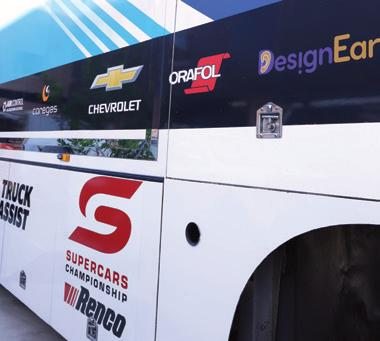
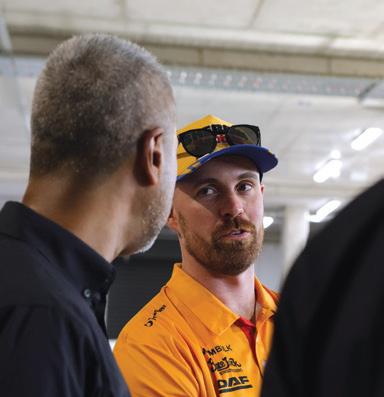
This partnership also extends into motorsport, with both companies continuing their involvement in the Repco Supercars Championship through Matt Stone Racing in 2026. While high-profile, the collaboration reflects the same underlying principle seen across day-to-day operations: longterm alignment built on trust, shared objectives and consistent support.
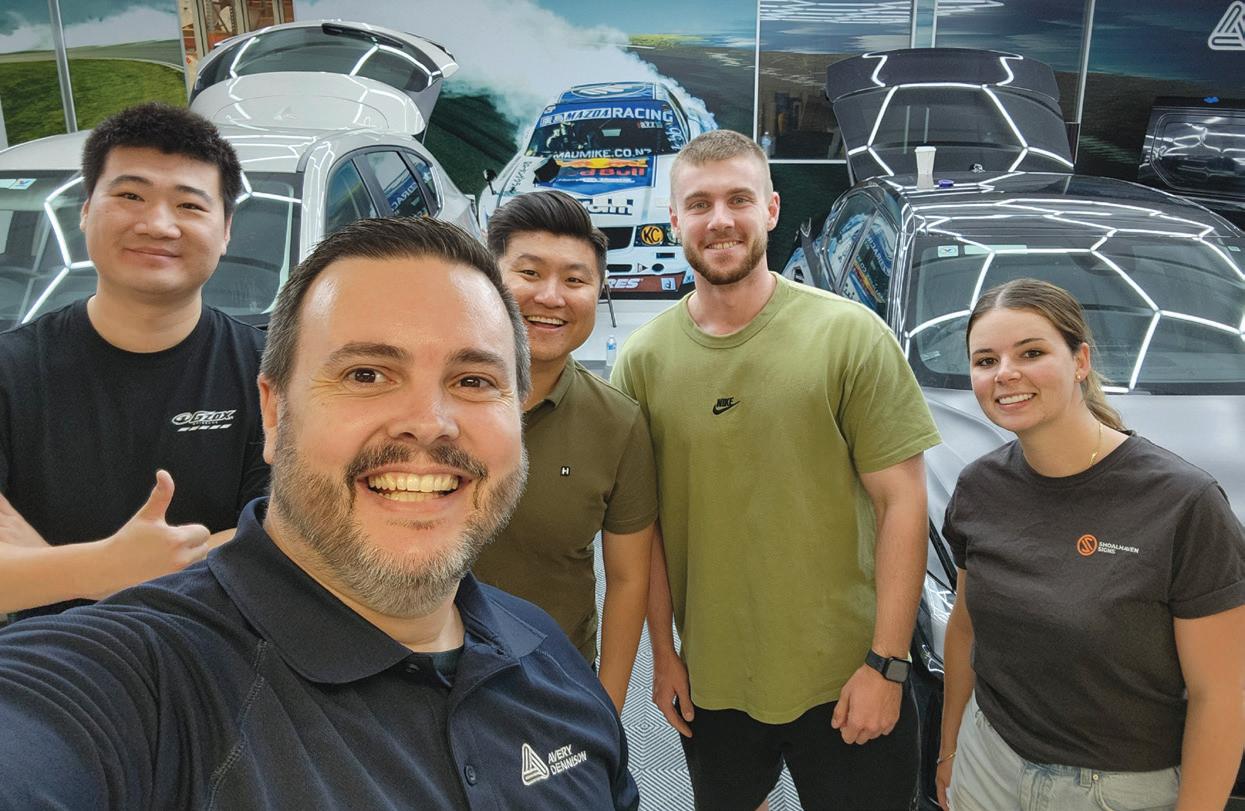
Avery Dennison bridging the craft gap
The rapid evolution of the automotive aftermarket has underscored a fundamental need across the industry for specialised training and trusted certification in advanced automotive film applications. Avery Dennison has identified a critical skills gap in this craft of vehicle wrapping and has developed an organic training ecosystem to help bridge the gap in critical skills capability.
As technologies and vehicle surfaces grow more complex, both independent workshops and established businesses face mounting pressure to equip their teams with up-to-date skills. To address this, Avery Dennison has introduced comprehensive training programmes in Vehicle Wrapping, Paint Protection Film (PPF), and Window film installation, each designed to address real-world challenges and elevate industry standards. Led by technical experts who seamlessly bridge complex material science with real-world applications, the focus is on rigorous, skills-based instruction.
At the centre of this training ecosystem are Avery Dennison’s trainers, Vaughan Philip and Todd Hapgood. With deep expertise in material science and application technology, these professionals deliver hands-on instruction to participants when and where they are needed most. Customer feedback about this opportunity has been overwhelmingly positive, with attendees consistently highlighting the trainers’ exceptional skill and the immediate improvements seen in their own workshop’s installation quality.
Vaughan says: “For many in the automotive customisation sector, industry-recognised credentials not only validate advanced skill sets but also help workshops build greater trust with clients in an evolving market. Avery Dennison’s Certified Installer and Partner Programme is one avenue through which technicians and businesses can formalise their expertise. By offering structured certification pathways alongside practical training, we are supporting the industry as it moves toward greater standardisation and accountability: an evolution that will ultimately benefit professional installers and customers alike.”
By analysing industry trends and regional demands, Avery Dennison meticulously plans its training calendar around real-world market needs. This strategic approach ensures that automotive professionals always receive the most relevant and up-to-date installation methodologies and that Avery Dennison’s programmes become a pathway to higher standards and new commercial opportunities.
Vaughan adds: “Our aim is to position participants at the forefront of the modern automotive landscape, helping automotive professionals to be ‘wrap-fit’ and able to adapt to constantly changing market demands and advances in their field of expertise.”
Ready to elevate your expertise and grow your business? Enrol in an Avery Dennison training program to gain industryleading skills, certification, and gain the confidence to tackle even the most advanced automotive installations.
Upgrade Your Skills
Master PPF, Window Films & Vehicle Wraps
Stand out with flawless PPF, window film, and wrap installations. Join our hands-on training and transform your skills into a powerful business advantage that customers notice and trust.
Stage 1 Workshops
Wrapping Fundamentals
Automotive Window Film Fundamentals
Paint Protection Film (PPF) Fundamentals
Stage 2 Workshops
Advanced Paint Protection Film (PPF) Installation
Book your training
Arlon Series 2100SL –Designed for Complexity
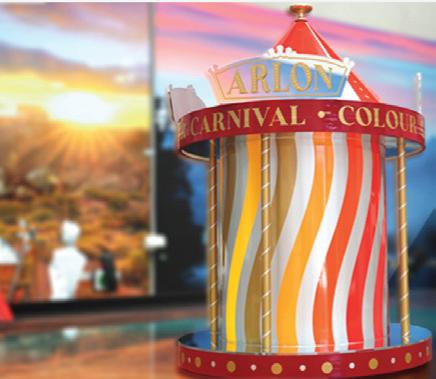
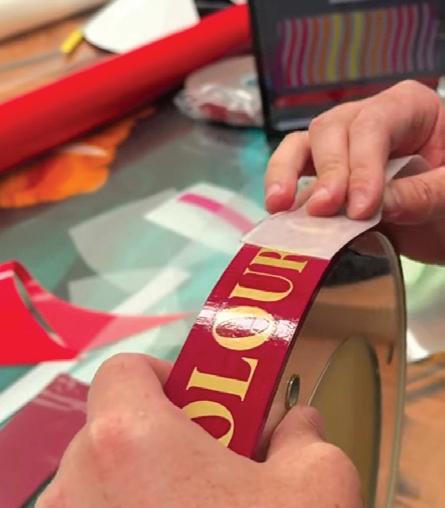
Available exclusively locally through Graphic Art Mart, the high performance cast Arlon Series 2100SL film is the latest film series to be launched to close out GAMART’s innovative Arlon Colour Carnival promotion. As part of the promotion, to demonstrate the complete opportunity the series presents, GAMART technical Specialist, Brett Matthews designed and hand-built a fully moving carousel using a combination of rigid substrates including hard-skinned PVC, acrylic, and ACM, before being wrapped in Arlon 2100SL to inject colour, movement, and impact.
A 2mm (50 micron) high-gloss premium cast coloured film, Arlon Series 2100SL is available in 41 vibrant colours and is wellrenowned for its superior conformability. The advanced permanent adhesive system is designed to perform well on a wide variety of substrates including rigid sign faces,
banners, windows and painted metals, offering plenty of outdoor durability - rated for up to 12 years on black and even in the harshest environmental conditions.
Mark Canavan, Marketing & Vendor Relations Manager at Graphic Art Mart, says: “The Arlon Series 2100SL is designed to perform on complex curves, deep recesses, and corrugated surfaces, making it ideal for vehicle graphics applications and other applications that demand higher levels of installation complexity.”
“It also has the added benefits of being equipped with a polyester PET synthetic liner, which offers even more advantages during application because the liner gives the film an improved dimensional stability and resistance to tearing, moisture absorption, and static build-up. This makes cutting and weeding smoother and more precise, particularly for fine text and intricate designs. Its flatter liner surface also reduces adhesive
texture, resulting in higher gloss levels and a noticeably glossier finish.”
The Arlon ‘Colour Carnival’ range available through Graphic Art Mart includes:
• Arlon 2100SL Opaque Cast Film
• Arlon 2500SL Translucent Cast Film
• Arlon 5200 Printable Cast Decorative Film
• Arlon 5800X Premium Polymeric Film with Air Egress
All featuring a polyester PET synthetic liner, the film range features:
• lightning fast at cutting and weeding, with sharper cuts, cleaner lifts and easier handling every time;
• multi-layer graphics applications capability, with easy registration of colours and shapes saving time on installation;
• lay-flat stability, with the vinyl keeping flat to facilitate faster cutting, sharper detail, stress-free handling and easy installs; and
• excellent gloss levels for sharper colours and a more premium look.
Innovation, Ideas & Inspiration…
Connect Conference 2026
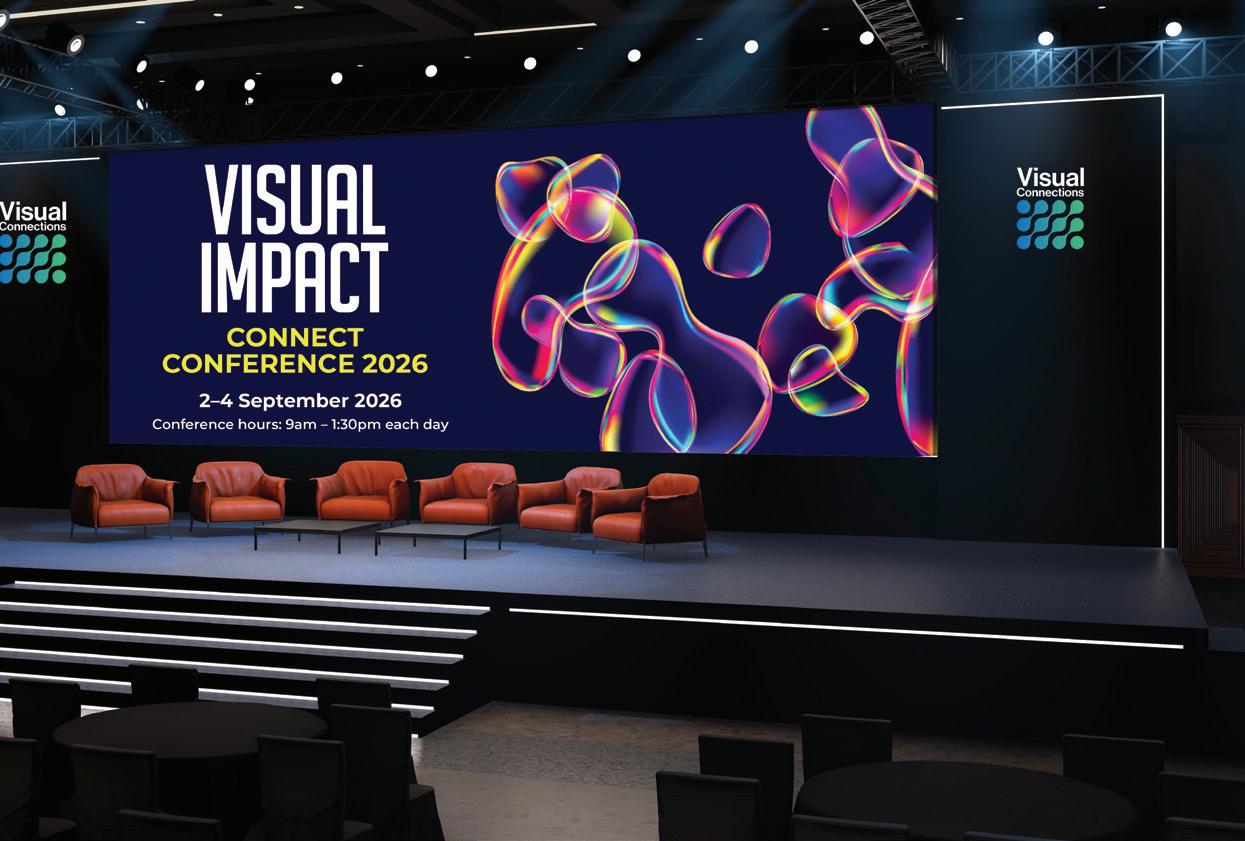
This year’s inaugural Connect Conference 2026 event, hosted by Visual Connections and to be run alongside September’s Visual Impact Expo in Sydney, promises Ideas, Innovation and Inspiration, purposedesigned to help connect industry leaders with the information and insights they need to innovate and prosper.
Karren Challoner-Miles, CEO of Visual Connections, says planning is well underway for the conference, which will run each morning of the show in Hall 2A at the Sydney Showground, adjacent to The Dome where the Visual Impact Expo is to be staged. “Connect Conference 2026 has been conceived to complement industry-focused events with a high-level business summit that is designed to help equip industry leaders to develop the innovative solutions needed to respond to today’s challenging business environment.”
“We’ve been listening to the industry’s senior leaders, who are keen for a conference that delivers more than just technical sessions, industry-focused information, and reflections on our own sector. Rather, they’ve been asking for economic, strategic and practical content which will help them understand local and global trends, address issues both within our own industry and across business more broadly, maintain profitability and build success.”
“The Connect Conference 2026 program will address these requests, featuring local and international experts and thought-leaders, bringing the knowledge, insights and ideas that will ensure business owners, senior management and key decision-makers come away informed, upskilled and inspired to successfully navigate an increasingly dynamic global environment.”
Each of the three days of the conference, there will be focus on a specific theme:
• Better Business;
• Navigating Sustainability; and
• Future Ready.
This will give delegates the flexibility to choose single-day registrations for topics that they find more relevant or suited to their business needs, or to take advantage of the full three-day program, while still leaving plenty of time to explore the Visual Impact Expo and to network with suppliers, customers and other industry colleagues.
Karren adds: “The program is taking shape nicely under the guidance of our Conference Programmer, Julia O’Keefe, and we look forward to sharing more information on speakers and topics in the months building up to Visual Impact.”
Conference delegates will also be able to take advantage of the opportunity to see a wide variety of innovations and solutions for the
digital print, signage and graphics sector, with a growing number of exhibitors confirming their participation at Visual Impact Expo under the Showgrounds’ iconic Dome.
Karren notes: “With the ASGA National Sign & Graphics Awards to be held on the Thursday night of the show in the same venue as the Conference, Make it Happen Signage Bootcamps running at the Showground that same week, and plenty of other highlights yet to be announced, Visual Impact & Connect Conference 2026 really is shaping up as the major event on the industry calendar for 2026.”
Connect Conference 2026 & Visual Impact Expo
Sydney Showground
Sydney Olympic Park 2-4 September 2026
Hosted and organised by Visual Connections. Visit visualimpact.org.au for more information or contact: Julia O’Keefe juliao@visualconnections.org.au (re Connect Conference content) Shireen de Costa exhibitions@visualconnections.org.au (re Visual Impact exhibition).
VI Conference and Expo 2026 brings the industry’s leading suppliers, thought leaders and customers together under one roof.
Don’t miss your opportunity to secure a prominent space under the Dome at the Sydney Showground.
Conference and Expo 2026
2-4 September 2026 | Sydney Showground
Connect Conference 2026
The knowledge, insights & inspiration you need, from local and international experts and thought leaders.
DAY 1: Better Business 9:00am – 1:30pm Wednesday 3 September 2026
DAY 2: Navigating Sustainability
9:00am – 1:30pm Thursday 4 September 2026
DAY 3: Future Ready 9:00am – 1:30pm Friday 5 September 2026
FOR MORE INFORMATION please contact the organisers on 02 9868 1577 or email exhibitions@visualconnections.org.au visualimpact.org.au
PROUDLY SPONSORED BY
Summa: built to last; backed to match.
There’s a particular kind of trust that develops between a production business and its equipment suppliers over many years. It’s not something that appears on a spec sheet. It builds slowly, through installations that go smoothly, service calls that get resolved quickly, and pre-sale conversations where the person on the other end of the phone understands what you’re trying to do. In the Australian sign and print industry, that kind of trust is increasingly hard to come by. And when you find it, it tends to have a history behind it.
Summa is a Belgian manufacturer with a history stretching back to 1978, and its cutting and finishing systems are amongst the most respected in the world. The range covers roll cutters for sign graphics and contour cutting, flatbed cutters for rigid and flexible materials and laser cutters for textile and soft signage.
Across all of these, the focus is on precision, durability, and accuracy that holds up over years of hard production use. Operators who have run Summa equipment for ten, fifteen, even twenty years tend to say the same thing: ‘they hold up, and they hold their accuracy’.
A key part of that reputation is how Summa builds its cutters. Entry-level models in the S Series use a drag-knife system that performs reliably across a wide range of everyday sign and vinyl work. Further up the range, Summa’s S3 Series roll cutters offer something no other roll cutter manufacturer in the world does: true tangential cutting. Tangential cutting actively controls the blade angle at every point along the cut path. Through corners, tight curves, and complex shapes, the blade leads the geometry rather than catching up to it. Cleaner cuts, sharper detail, less blade wear. It’s one of those things experienced operators notice immediately, and it’s one of the features that puts the upper end of the Summa range in a category of its own. The barcode-driven workflow systems across the range add to this, allowing jobs to be queued, tracked, and run with minimal handling in busy finishing operations.
On Summa’s flatbed systems, the
automatic tool recognition, auto device calibration and GoProduce workflow software set Summa apart from the rest. Easy to use, ready to run at a moment’s notice, and powering through production day in, day out.
Pozitive Sign & Graphic Supplies has been the Australian representative for Summa since 1992. More than three decades of representing this brand in Australia means the team has built a level of product knowledge that runs very deep. Their technicians are factory trained, and that training is ongoing. They’ve seen almost every application, substrate challenge, and production environment Australian operators work in. When a customer calls, they’re talking to people who have spent their careers working with these machines.
That expertise shows up at every stage. Before the sale, Pozitive works with customers to understand what they actually need: which machine suits the workflow, what substrates are involved, how it integrates with existing production? After the sale, installation and training are handled by Pozitive’s own in-house service team, people who know these machines inside and out and are not subcontracting to someone seeing the equipment for the first time. When something needs attention down the track, support comes from people who already know the setup.
Pozitive is one of the few remaining Australian-owned, family-operated suppliers to the sign, print and graphics industry. In a market that has seen significant consolidation and increasing foreign ownership, that’s a meaningful distinction. Decisions are made locally, by people genuinely invested in the outcome. The commitment to the customer relationship isn’t filtered through a corporate structure somewhere else in the world.
The sign and print industry is not short of suppliers who can drop a box and raise an invoice. What’s genuinely scarce is the combination of world-class equipment, deep product knowledge, local ownership, and a long-term commitment to getting it right. In Australia, for Summa, that combination has a name. That name is Pozitive.
Privacy meets design. 3M Fasara Finishes transform glass with elegant patterns and refined style.
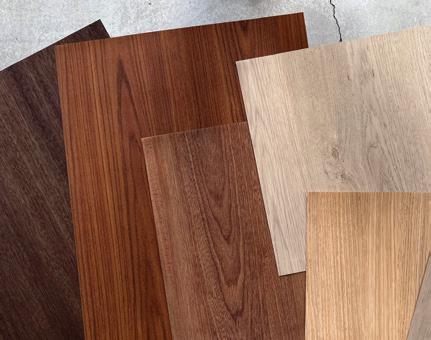
Endless finishes, one smart solution. From natural woodgrains to sleek metallics — 3M Di-Noc brings every texture to life.
Transforming Spaces, Transforming Business
As the signage industry continues to evolve, business owners are under increasing pressure to diversify their offerings, stay competitive, and unlock new revenue streams. One of the most compelling opportunities right now lies beyond traditional signage, inside the built environment itself. 3M™ Architectural Finishes, including DI-NOC™ and Fasara™ Glass Finishes, are opening the door for signage professionals to expand into high value interior transformation projects.
For signage businesses already skilled in vinyl application, the transition is seamless. These finishes use similar installation techniques but deliver a completely new category of service, architectural surface transformation. That means the ability to offer clients more than branding and wayfinding, but full spatial reinvention.
3M DI-NOC™ is a standout in this space. Designed to replicate natural materials such as timber, stone, and metal, it provides a premium aesthetic without the associated cost or construction downtime. For clients, this means tired, outdated surfaces can be transformed
into modern, high end finishes quickly and cost effectively. For signage businesses, it means access to projects that would traditionally sit with builders or shopfitters.
“DI-NOC gives signage businesses a genuine opportunity to step into refurbishment work without the complexity of major construction,” says Wayne Hood, Spicers Visual Communications Portfolio Manager. “You’re effectively turning existing surfaces into something completely new, which is incredibly appealing to clients looking for impact on a budget.”
This ability to transform old into new is particularly powerful in commercial, retail, and hospitality environments where downtime equals lost revenue. DI-NOC can be applied directly over existing surfaces, reducing disruption while delivering a dramatic change in look and ambiance. From reception counters to lift interiors, feature walls to cabinetry, the applications are extensive.
Complementing this is 3M Fasara™ Glass Finishes, which offer both functional and aesthetic value. Privacy is an ongoing challenge in modern workplaces, and Fasara provides an elegant solution. With a wide range of patterns and finishes, it allows natural light to flow while
creating privacy where needed, ideal for offices, meeting rooms, and healthcare environments.
“Fasara is a natural extension for any signage business already working with window graphics,” adds Hood. “It elevates what you can offer, moving from simple frosting to sophisticated, design led privacy solutions that clients are willing to invest in.”
Beyond aesthetics, both DI-NOC and Fasara deliver on durability, conformability, and sustainability, key considerations for today’s clients. They are engineered for high traffic environments and can be applied to complex surfaces, expanding the scope of what signage professionals can achieve.
For signage business owners, the message is clear. This is more than a product. It is a pathway to growth. By incorporating 3M Architectural Finishes into your offering, you are not just adding a new service, you are creating a new income stream, increasing project value, and positioning your business as a complete visual solutions provider.
In a competitive market, that kind of differentiation is invaluable.
Contact your local Spicers representative to find out about 3M Architectural Finishes.
Hybrid Flexibility for the Fu ture of Print
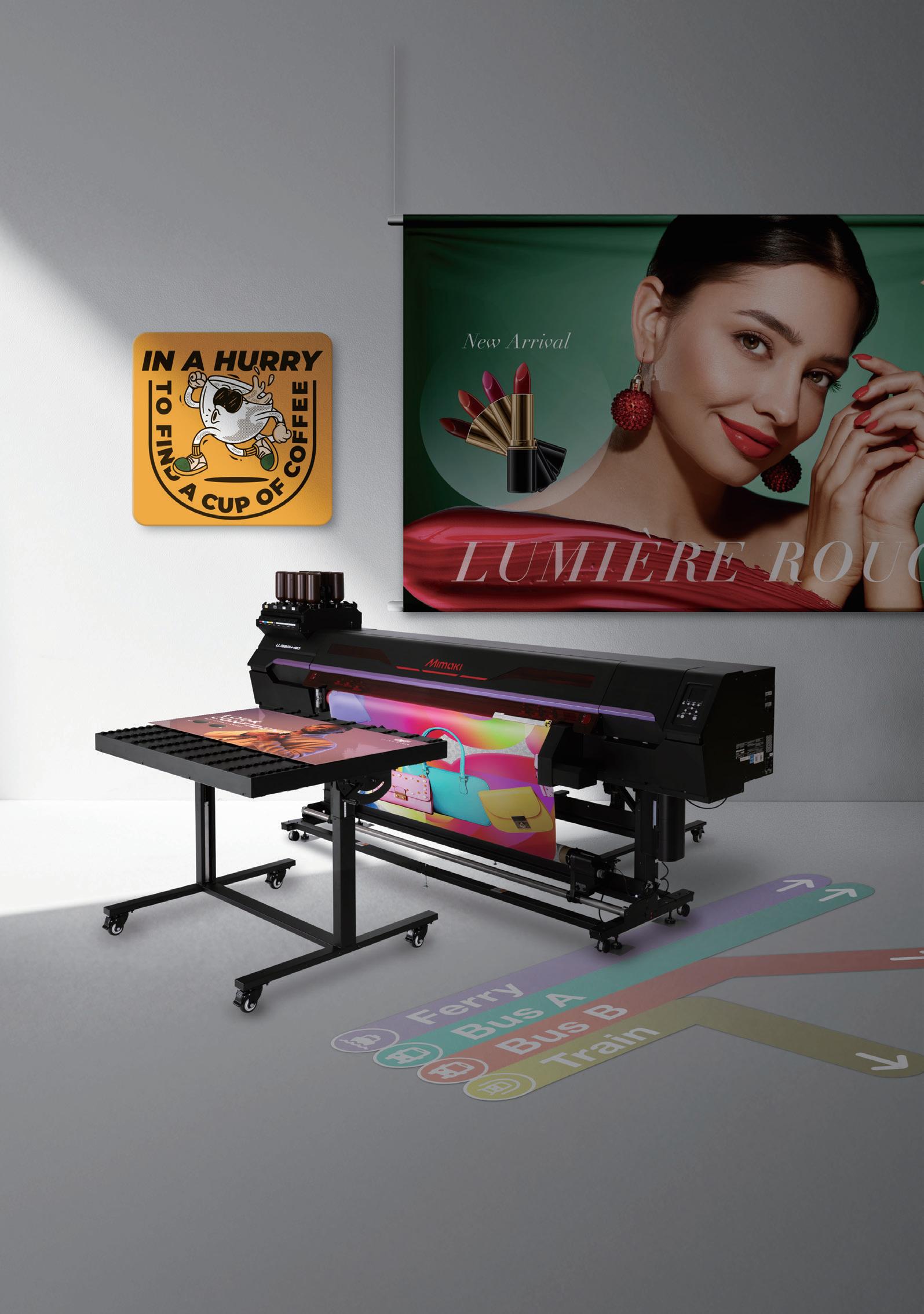
The NEW Mimaki Hybrid UV Inkjet Printer. One platform for roll and rigid production.
Designed to seamlessly switch between roll media and rigid boards, the UJ330H-160 hybrid UV inkjet printer enables businesses to consolidate multiple applications on a single system. With a newly developed belt transport system, the printer effortlessly handles materials ranging from thin films to large rigid panels, while the high-definition print engine delivers premium image quality at production speeds of up to 14.0m²/h.
The result is greater flexibility, faster turnaround and the ability for print providers to bring more production in-house. Talk to our team today about how the UJ330H-160 could transform your business.
UV changed wide format roll printing… …now it’s about to change rigid printing.
The Mimaki UCJV300 UV inkjet printer played a fundamental role in transforming UV from a specialised technology into a mainstream production tool for sign shops.
When Mimaki first introduced the UCJV300 UV inkjet printer series in 2017, UV roll printing was still a relatively niche technology. Globally, the market size was still comparatively small (circa 1,000+ units per year) and most sign shops relied on eco-solvent printers for everyday production. The UCJV300, alongside broader advancements in UV technology, helped accelerate adoption by offering greater versatility, instant curing, and the ability to print on a wider range of applications. Over the following years, the UV segment experienced steady growth, becoming an increasingly important part of the wide-format print market and a viable alternative to traditional solventbased systems.
Mimaki continued to build on the success of the UCJV300, as it steadily helped to see UV transformed from a specialised technology into a mainstream production tool for sign shops, ultimately spawning the evolution of Mimaki’s current 330 series that continues to help reshape sign production economics.
• Faster turnaround – With solvent printing, graphics often require up to 24 hours of drying time before lamination. UV inks cure instantly. Graphics can now be printed, cut and installed on the same day, dramatically reducing production time.
• Lower production costs – Many UV applications no longer require lamination. This eliminates an entire production step and reduces both labour and material costs. Power consumption is dramatically reduced also, when compared to latex solutions.
• New standards for window graphics –Before UV white ink, producing window graphics with solvent printers was extremely slow. White ink printing speeds would average less than 1 metre per hour, followed by 24 hours of drying time. With UV white ink, production speeds of around 4 metres per hour are possible, with no drying time required and higher opacity that prevents show-through.
The next transformation: rigid printing
Where rigid printing is concerned, Mimaki sees strong parallels with the way the Mimaki UCJV Series expanded the adoption of UV roll printing, predicting that the Mimaki UJ330H-160 will play a similar role in redefining how rigid printing is approached by everyday sign shops.
Current hybrid printers typically cost $130,000 or more, limiting adoption mainly to large sign companies that can afford the space and cost. This means that for most sign shops, rigid printing is either outsourced or produced through a labour-intensive workflow. But the Mimaki UJ330H-160 is currently priced at roughly half the cost of many traditional flatbed systems, making hybrid UV technology
increasingly accessible to a much wider range of print providers.
Further to this, where traditionally, rigid work has relied on a multi-step workflow - printing onto flexible media, laminating, mounting to a board, and then finishing - hybrid UV printing changes this equation. By allowing rigid boards to be printed directly, the process becomes far more streamlined, reducing labour requirements, material usage and overall production time. Just as importantly, bringing rigid production in-house enables sign businesses to retain valuable margins that may otherwise be lost through outsourcing or additional processing.
In simple terms, hybrid UV technology brings roll and rigid printing together on one platform, enabling sign shops to produce more applications, more efficiently, and with greater control over their profitability.
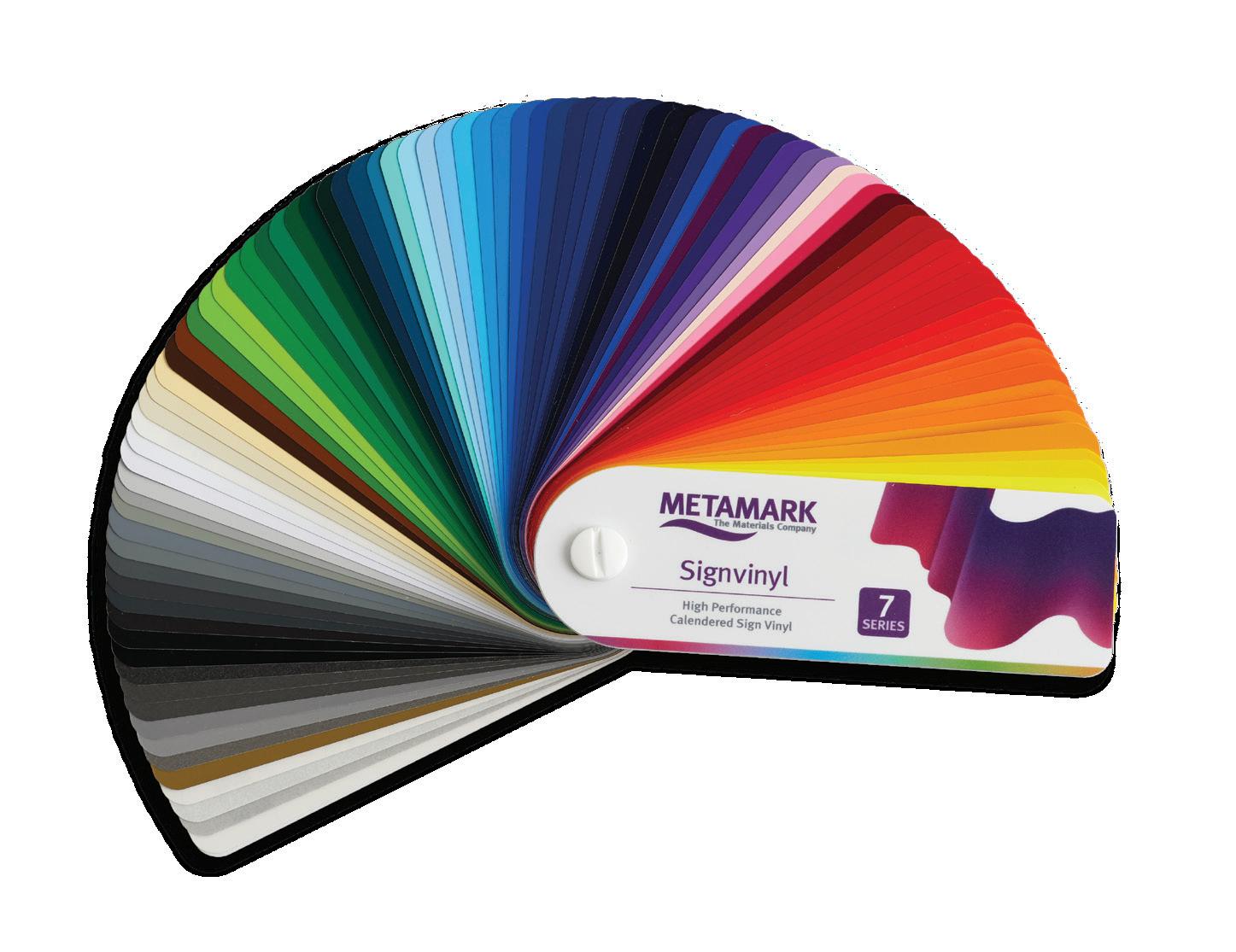
for materials that perform predictably across a wide range of applications. The Metamark M7 Series has been developed with this balance in mind: positioned as a high-performance calendered sign vinyl, it offers a dependable solution for computercut graphics, from vehicle markings and window decals through to longer-term signage on flat and slightly curved surfaces.
Steve Warn, National Product Manager - Self Adhesive Films at Ball & Doggett, affirms: “What our customers value most is consistency: absolute confidence that the product will behave the same way every time it is used. The Metamark M7 Series has been engineered to deliver that confidence across a
soft handle for easier cutting and weeding, an important consideration for production efficiency. This is supported by Metamark’s Apex solvent-based adhesive system, enabling both wet application and clean removal, giving installers flexibility depending on the job requirements.
For larger format or more demanding installs, the optional M7A MetaScape® adhesive system introduces air-release channels to support smoother, faster dry application, therefore reducing rework and improving install efficiency. Meanwhile, High Tack adhesive options extend the product’s usability to more challenging substrates such as low-energy plastics and sealed surfaces.
Durability remains a key consideration, with
This positions it as a practical choice for both short-term promotions and longer-term signage requirements.
Warn adds: “Another key strength of the M7 Series is its versatility. It is not about overengineering for niche applications, but about providing a reliable, scalable solution that signage businesses can use day in, day out.”
With an extensive colour palette and multiple adhesive configurations available, the Metamark M7 Series supports a streamlined approach to material selection therefore helping businesses maintain efficiency without compromising on performance.
To explore the full Metamark M7 Series range or request a sample, contact your local Ball & Doggett representative.
Scheduling That Works for Sign and Print Shops
A production manager drags a job onto an operator’s schedule. Fabrication expands it to 42 hours - filling the entire week. He didn’t want 42 hours on Tuesday. He wanted Steve to work on it today, then move on to something else. But now there’s no room for the other four jobs Steve needs to touch. So he closes the software, picks up a pen, and writes a daily run sheet.
Most scheduling tools fail in sign and print because they try to solve one problem, when the job demands three:
• The daily run-sheet: who does what today, and in what order? This is execution. It’s fluid, interrupt-driven, and based on priority, not hours.
• Forward scheduling: when does this job start, and when will it be ready? This is the promise you make to clients, and it has to move as reality shifts.
• Capacity visibility: how much runway do you have? Two people, 80 hours a week, 320 outstanding jobs and you’re four weeks out: this is planning, not scheduling. These three levels are in constant tension. Optimise capacity and you kill daily flow. Lock dates and you ignore reality. Focus only
on today and everything upstream becomes guesswork. Good production managers don’t solve scheduling, they continuously re-balance these trade-offs. The right tool supports that re-balancing rather than fighting it.
Priority is the durable signal
There is a reason the whiteboard survives in shops that have perfectly good software. It does one thing very well: it shows the current priority order, not a time-bound plan. When things change - and they always change - you pick up the marker and reorder. The whiteboard works because priority is more durable than time.
A time slot becomes wrong the moment something changes. But the relative ordering of what matters most - driven by due date, urgency, release state, and what’s happening on the floor - can absorb a lot of disruption before it stops being useful. So the question is not how to digitise the whiteboard, it is how to give you the whiteboard’s flexibility with a data richness it can never have.
What to demand from scheduling software
So what are the questions worth asking if you are considering investing in scheduling software:
• Can you assign work flexibly? Estimated hours matter, but if dragging a task onto
someone’s day forces you to allocate all of them at once, the tool is fighting the way your floor actually works.
• Can you see urgency at a glance? Colour should tell you what matters without opening anything. Does it show what has been worked and what remains, without mental maths?
• Can you see what’s happening now, not just what was planned? And can you see what’s not scheduled, because unscheduled work sitting in a list somewhere is where the real risk hides.
The goal isn’t a perfect schedule. The mistake is thinking the system should remove the mess: it shouldn’t. Your business runs on variability - every job different, every week different - and that variability is not a problem to be solved: it is the nature of the work.
The goal is to make the next decision obvious: faster, with better information, and without losing control of the bigger picture.
So when a tool surfaces urgency, release state, and live floor activity in a way that your team can read at a glance and when disruption on Tuesday morning is an adjustment rather than a crisis…the paper run sheet finally has a credible challenger.
FESPA Global set to deliver on several levels
At the time of print, FESPA Global will be just around the corner (19th-22nd May at Fira de Barcelona) and, in spite of simmering global tensions, the event promises to deliver to the ANZ market on multiple levels.
Physically, the event now encompasses six co-located events (FESPA Global Print Expo, European Sign Expo, Personalisation Experience, WrapFest, Corrugated and Textile), But with three separate conference programs (The FESPA Conference, The Corrugated Conference and WrapTalks) and not forgetting two live World Wrap Masters Competitions - World Wrap Masters Europe (19-20 May) followed by the World Wrap Masters Final (2122 May) - FESPA Global has steadily grown to be one of the most strategically valuable events on the international print calendar.
The technologies launched and demonstrated at FESPA typically reach local markets 12–24 months later, making the event a forward indicator of investment priorities. Conversely, key themes, such as AI, automation, sustainability, and application diversification – can and do impact much more quickly and often with more venom locally, given rising labour costs and considerable variability in local market size demands. Statistically speaking
For those Aussies and Kiwis looking to make the trip, FESPA Global organisers are promising
over 550 exhibitors and that you will be a small, but important number amongst the >14,000 international visitors expected from over 125 different countries.
These predictions reflect a continued upward trend in numbers across the board, but importantly, it is the quality of those attending that is still expected to remain high, with an estimated 87% of these attendees predicted to be holding decision-making roles and/or budgets allocated for technology upgrades.
So while the event is smaller in scale than global mega-shows like drupa, its strength lies in delivering a concentrated audience of buyers specifically focused on wide-format, textile, and specialty applications. The 2026 edition is also expected to build on this with the integration of the new verticals listed above - particularly with regards to Corrugated Packaging and Textile Printing sectors, reflecting strong diversification within our industry.
Michael Ryan, Head of FESPA Global Print Expo, says: “This is clearly our biggest showcase yet and each year, we strive to offer our visitors something new. Our three conference programmes will do just that and we’re confident that the programmes will facilitate knowledge sharing among our visitors, while giving them a platform to learn, network and maximise their business growth.”
Dominance of major hardware manufacturers
At the core of the exhibition is a strong presence of global OEMs driving innovation in wide-format and industrial print. Major players such as HP, Canon, Epson, Brother, Agfa, Durst, EFI, Mimaki, Mutoh, and Roland DG will showcase next-generation inkjet platforms.
For ANZ markets - where demand for versatile, mid-to-high volume wide-format systems is strong - these exhibitors are expected to highlight advancements in UVLED, latex, and resin-based printing. Key themes include higher throughput, lower energy consumption, and expanded substrate compatibility, especially for rigid signage, soft signage, and décor applications. Hybrid flatbed/roll-to-roll systems and compact industrial printers will be particularly relevant to Australian PSPs seeking flexible production without large factory footprints.
Signage, display and vehicle wrapping technologies
The co-located European Sign Expo and WrapFest elevate the importance of signage and vehicle graphics. Materials leaders such as 3M, Arlon Graphics, Hexis, Avery Dennison and Antalis will present new adhesive films, laminates, and sustainable substrates.
For vehicle wrapping specialists, WrapFest exhibitors are expected to emphasise faster-
installation films, air-release adhesive systems, and improved conformability for complex curves - critical for reducing labour costs in markets like Australia where skilled installers are in short supply. Sustainability is also a key trend, with PVC-free films and recyclable liner technologies gaining traction.
Finishing, cutting and automation systems
Finishing remains a critical differentiator for print businesses, and FESPA 2026 features leading cutting and workflow automation providers such as Kongsberg Precision Cutting Systems, Zünd, Summa, and Morgana Systems. These companies are expected to demonstrate integrated finishing lines that combine cutting, creasing, routing, and robotic handling. For ANZ converters and signmakers, the emphasis on automation and reduced manual intervention is particularly relevant given ongoing labour constraints and rising operational costs.
Software, workflow and personalisation platforms
A major growth area across the exhibition is workflow automation and software integration. Exhibitors including Caldera, Onyx Graphics, Enfocus, Dataline, and XMPie will showcase solutions for colour management, job onboarding, and end-to-end production workflows.
For the ANZ market—where many print businesses are transitioning from traditional production to web-to-print and short-run digital, these technologies are crucial. Expect strong focus on cloud-based platforms, APIdriven integration, and AI-assisted production planning, all aimed at improving efficiency and enabling scalable personalisation services. Textile, garment and industrial print
The introduction of the Textile Pavilion and expanded garment decoration offering
brings exhibitors such as Kornit Digital, M&R Companies, and Tajima Industries into focus. Direct-to-garment (DTG), direct-to-film (DTF), and roll-to-roll textile systems will be showcased with improved ink formulations, faster curing, and enhanced colour vibrancy. These technologies align with the growing demand in Australia and New Zealand for ondemand apparel, custom merchandise, and short-run textile production.
Emerging applications: corrugated, décor and industrial print
The addition of corrugated and industrial print segments reflects the diversification of the print industry beyond traditional graphics. Exhibitors will present digital solutions for packaging, interior décor (via the Printeriors feature), and specialty industrial applications.
For ANZ businesses looking to diversify revenue streams, these areas present significant opportunity, particularly in short-run packaging, customised interiors, and printed building materials.
Key takeaways for ANZ visitors
Overall, FESPA 2026’s exhibitor base highlights three major technology directions:
• Automation and workflow integration to address labour shortages and improve margins
• Sustainable materials and energy-efficient printing in response to regulatory and client demands
• Versatility in production, with hybrid devices and multi-application capabilities
For signage, vehicle wrapping, industrial printing, and graphic arts businesses across Australia and New Zealand, the show offers a clear view of where investment should be directed: highly automated, flexible systems paired with advanced software and environmentally responsible consumables.
Amongst the >550 exhibitor stands, visitors can expect to see healthy product and technology representation from the following companies:
3M will centre its FESPA presence on graphic films, overlaminates, and architectural finishes, alongside installation systems, while also pointing towards durability, ease of application, and sustainability, with innovations in wrap films and surface finishes aimed at both signage and interior markets. 3M is expected to showcase its IJ180 and IJ280 print wrap films, Envision non-PVC film series, and advanced overlaminates for durability and visual enhancement. Live installation demonstrations using Comply adhesive technology are also likely, highlighting reduced application time and improved finish quality. Architectural finishes -particularly DI-NOC surface filmswill also feature strongly, reflecting demand in interior branding and refurbishment markets.
Agfa will demonstrate its Onset Panthera FB 3216 flatbed press, capable of ultra-high productivity, alongside its Jeti Tauro hybrid systems. LED curing and automation will be key differentiators, supporting both graphics and packaging production.
Avery Dennison is expected to focus on sustainable pressure-sensitive materials and architectural/interior films, building on recent product lines designed for recyclability and reduced environmental impact. The company’s stand offering will also reflect continued market interest and investment in PVC-free films, digitally printable wrapping materials and smart labelling technologies. For FESPA audiences, the emphasis will likely be on applications in retail branding, fleet graphics, and interior décor, with sustainability messaging aligned to European regulatory pressures.
Canon is expected to promote Arizona flatbed and Colorado roll-to-roll platforms, emphasising UVgel technology, productivity, and automation. Canon’s messaging continues to centre on high-value applications and workflow integration. Canon is expected to demonstrate its Colorado M-series (UVgel rollto-roll) and Arizona flatbed platforms, focusing on high-speed production, automation, and low ink consumption. UVgel technology- known for instant curing and durability- will be positioned as ideal for high-volume signage, wallcoverings, and décor applications.
Durst’s focus will be on its P5 platform (P5 350/500) alongside software-driven workflow automation via Durst Workflow and Lift ERP. The focus will be on industrial productivity, automation, and integration, particularly for high-volume PSPs and packaging converters.
EFI will showcase Nozomi single-pass inkjet technology, alongside Fiery workflow solutions. Automation, industrial-scale productivity, and packaging applications are likely headline themes and EFI will present the Pro 30f+ flatbed LED printer, featuring multi-layer printing, white and clear ink, and automation features for high-value applications. EFI’s Fiery workflow ecosystem will also be central, supporting end-to-end production efficiency and colour management.
Epson will highlight its PrecisionCore printhead technology across signage and textile solutions, with a strong sustainability narrative around lowenergy systems and water-based inks. Growth in dye-sublimation textile printing remains a key focus. Epson’s showcase will be heavily productled, with confirmed technologies including the SureColor SC-F9500H dye-sublimation printer, SC-S9100 signage printer, and SC-G6000 directto-film system. The Monna Lisa textile platform will reinforce Epson’s sustainability narrative, with water-saving pigment ink processes. Personalisation and micro-factory production will be key themes.
HP will showcase advancements across Latex and Stitch platforms, with a strong emphasis on automation, workflow integration, and sustainable ink systems. Expect further evolution of water-based Latex technology, including productivity gains and expanded application versatility. HP is also likely to highlight end-to-end production ecosystems, targeting PSPs seeking efficiency and scalability. HP will anchor its exhibit around the Latex platform, showcasing the Latex R530 hybrid printer alongside the Latex 730/830 series launched recently. These systems enable both rigid and flexible printing with white ink capability and automated workflows, targeting PSPs seeking versatility. The R530’s compact hybrid format and ability to handle boards and roll media reflect a broader trend toward multiapplication production.
Kornit will centre on direct-to-garment (DTG) and direct-to-fabric systems, including the Atlas MAX and Presto platforms. Expect strong emphasis on on-demand textile production, sustainability, and waterless printing—key growth areas globally.
Orafol is expected to highlight its ORACAL and ORAJET ranges, with developments in vehicle wrapping films, reflective materials, and digital print media, including continued refinement of high-performance cast films and colour consistency, targeting premium signage and automotive applications. Orafol will spotlight its ORAJET digital print media and ORACAL cast films, including high-performance wrapping products such as ORAJET 3951RA and ORACAL 970RA Premium Wrapping Cast. Reflective materials like ORALITE will also be highlighted. The focus remains on colour consistency, durability, and ease of application, targeting premium signage and vehicle wrap specialists.
Mimaki will focus on UV, solvent, and textile inkjet systems, including hybrid and directto-object solutions. Sustainability and ink innovation (including eco-friendly formulations) remain central themes, alongside expansion into industrial and 3D applications. Mimaki’s stand will feature the JV200-160 eco-solvent printer and Tx330-1800 textile printer, alongside its expanding UV portfolio. The Tx330’s dual capability for pigment and dye-sublimation inks positions it strongly in soft signage and décor. Mimaki will also promote its ELH/ELS UV inks, formulated to reduce hazardous substances, aligning with sustainability goals.
Ricoh will highlight its Pro L5160 latex wide-format printer and Ri series DTG systems, alongside software solutions. The emphasis will be on industrial reliability and scalable production across signage and textile markets.
Roland DG is expected to feature TrueVIS VG3 and LG series printers, combining print-and-cut workflows with UV and eco-solvent technologies. Application versatility - signage, decals, and custom graphics - will remain central.
Companies such as Ball & Doggett, Celmac, Spicers, Currie Group, Shann Group, Pozitive and Graphic Art Mart are all closely aligned with major exhibiting brands - supplying media, hardware, and support across Australia and New Zealand. While they will not exhibit independently at FESPA Global Print Expo, many of their senior executives and product specialists are likely to be present on partner stands, facilitating direct connections between ANZ customers and global manufacturers and ensuring that many of the technologies on display have clear pathways into the Australian market . For visitors, this enables not just discovery, but practical evaluation of how and when new solutions can be deployed locally. In short, FESPA is less about immediate purchasing and more about strategic planning —making it an essential event for forward-thinking Australian and New Zealand print businesses
In creative industries and businesses, from design and photography to advertising and digital content, contracts often focus on one key issue: who owns the copyright? For employers and commissioning businesses, the usual assumption is simple. If an employee creates a work in the course of their job, the business owns the copyright and can use the work however it likes.
However, Australian copyright law contains another layer of protection that is often overlooked: moral rights. A recent Federal Court decision has reinforced just how important those rights remain, and why businesses cannot simply contract them away through standard template clauses.
What are Moral Rights?
Moral rights exist under the Australian Copyright Act and belong personally to the creator of the work. They apply to a wide range of creative outputs including written material, artwork, photography, films, and design work. Unlike copyright ownership, which can be assigned or transferred, moral rights belong and remain with the creator even if the copyright is owned by someone else.
In Australia, there are three key moral rights:
• The right of attribution – to be credited as the creator of the work.
• The right not to have authorship falsely attributed – preventing someone else being credited for the work.
• The rights of integrity – protecting the work from derogatory treatment that harms the creator’s reputation.
These rights apply to employees as well as contractors. In other words, a designer employed or contracted by a studio may not own the copyright in the work they produce, but they retain moral rights in the work.
The Contracting Problem
Because moral rights can complicate how
Moral rights:
The creative credit you can’t simply sign away
Owning copyright does not mean you control the creator’s moral rights.
businesses use creative material, contracts have traditionally included clauses stating the creator ‘waives’ their moral rights. The intention is practical as businesses want the freedom to edit, adapt, or repurpose work without needing to seek ongoing permission from the creator. However, a recent Federal Court decision has confirmed that these broad waiver clauses may not work.
The Federal Court Decision
In McCallum v Projector Films Pty Ltd, the Court considered a dispute involving a documentary film and who should be credited as its principal director. The production company relied on a contractual clause stating that the director waived his moral rights in the film.
The Court rejected that argument and held that Australian law does not permit blanket moral rights waivers. Instead, the legislation allows creators to give specific consent to particular acts that might otherwise infringe their moral rights. Therefore, a general clause saying the creator waives all moral rights was ineffective.
The result was that the company had infringed the director’s moral rights by failing to properly attribute him and by attributing authorship to someone else. While this case arose in the film industry, the reasoning has broader implications across the creative economy.
Why Small Creative Businesses Should Pay Attention
Many template employment and contractor agreements include sweeping moral right waiver clauses. Following this decision, those clauses may offer far less protection than businesses assume. The practical risks include failing to credit a creator appropriately, heavily altering work that may harm the creator’s reputation, and crediting the wrong person as the author. In collaborative creative environments, which are common in marketing, publishing, and media production, these situations arise more often than businesses realise.
Practical Steps for Businesses
The decision does not mean businesses cannot obtain flexibility in how creative works are used. But it does mean contract drafting needs to be more precise. Rather than relying on broad waivers, agreements should include specific consents. For example, a creator might contractually consent to:
• Editing or adapting their work.
• Publishing the work without attribution in certain contexts.
• Using the work as part of a broader production or campaign. Businesses should also consider using confidentiality provisions more effectively where appropriate, and ensure managers and creative teams understand the difference between copyright ownership and moral rights. Clear expectations around attribution and editing can significantly reduce later disputes.
The Bottom Line
In many creative businesses, copyright ownership and moral rights are treated as the same thing. They are not. A business may own the copyright in a work created by an employee or contractor, yet the creator still retains personal rights connected to their reputation and authorship. For businesses in the creative space the message is simple, review your contracts, be clear about attribution, and don’t assume moral rights can simply be signed away. The Federal Court’s recent decision is a reminder that creative credit still carries legal weight, and businesses ignore it at their peril.
Charles
Watson GM – IR, Policy and Governance Visual Media Association
NZSDA AWARDS AND SIGN CONFERENCE awards.nzsda.net.nz/ 20 June 2026
Auckland
VISUAL IMPACT CONFERENCE AND EXPO
www.visualimpact.org.au/
2–4 September 2026
Sydney Showground
ASGA NATIONAL SIGN & GRAPHICS AWARDS signs.org.au
3 September 2026
Sydney Showground
FESPA GLOBAL PRINT EXPO
www.fespaglobalprintexpo.com
19–22 May 2026
Fira Barcelona, Spain
PRINT DIGITAL CONVENTION
16–17 June 2026
Düsseldorf, Germany
PRINT TECH BANGLADESH
25–27 June 2026
Dhaka, Bangladesh
LABELEXPO AMERICAS
15–17 September 2026
Chicago, USA
PRINTING UNITED EXPO
23–25 September 2026
Las Vegas, USA
SIGN ISTANBUL
23–26 September 2026
Istanbul, Türkey
SGI (SIGN & GRAPHIC IMAGING EXPO) DUBAI
28–30 September 2026
Dubai, UAE
THE PRINT SHOW
29 September–1 October 2026
Birmingham, UK
ASIA WATER-BASED INK GRAVURE PRINTING EXPO
15–17 October 2026
Guangzhou, China
VISCOM ITALIA
28–29 October 2026
Milan, Italy
ALL4PACK EMBALLAGE
23–26 November 2026
Paris, France
LABELEXPO SOUTH CHINA
2–4 December 2026
Shenzhen, China
DENISE KIRBY
Practical Sustainability for Sign and Print
Sustainability is becoming one of the biggest conversations in modern business and the sign and print industry is no exception. Brands and print buyers are asking more questions about the materials and processes used in the production of signs and graphics as they look to better understand the environmental impact of their campaigns and seek more sustainable solutions.
Despite this growing interest, many sign and print businesses have been slow to engage in these conversations with clients. This is not due to a lack of demand. Unlike single use plastics, signage materials have not yet become a highly visible environmental issue and as a result, there is often limited awareness about the materials used in our industry and their impact. Without education and guidance, customers who want to make better choices may simply assume alternatives such as paper, organic materials or digital screen are the better sustainable options or reduce their purchasing entirely to avoid using plastic.
For some sign and print businesses, raising
the topic of materials, especially plastics, might feel like opening a can of worms. If clients are not asking questions, it can seem easier not to raise the issue. Others may feel that addressing sustainability is overwhelming, assuming it requires abandoning traditional materials, investing in expensive new equipment or completely transforming operations. They see sustainability as a luxury, not a business staple.
In reality the opposite is often true. Many of the most effective improvements are practical, incremental and operationally straightforward. Small changes to materials, design and production processes can reduce waste, improve efficiency and even lower costs. At the same time, offering more sustainable options can strengthen customer relationships and create additional value that supports stronger margins. Sustainability is good business!
Start With Materials
One of the fastest ways to improve sustainability is to review material usage. PVChas long been the go-to for most applications. PVC’s superpowers are durability and conformability. For applications like vehicle
wraps, durable architectural graphics or long-term signage, PVC is hard to beat both in performance and price point.
However, many applications are only short term and don’t require such high-performance aspects. Retail promotions, events and seasonal campaigns only remain in place for weeks or months. Forward-thinking sign shops are beginning to offer options proactively as part of their quoting process. When customers are presented with a clear comparison between materials, many are willing to consider alternatives, particularly if those options align better with their own sustainability commitments. Suppliers are also beginning to provide more environmental information about their products, including CO2 impact, recycled content, recyclability and environmental certifications. Access to this information allows converters to have more informed conversations with customers about material choices.
Design Can Prevent Waste
While materials receive a lot of attention, a significant amount of waste in sign and print actually occurs before the job even starts.
Photo Credit: sitthiphongFreepik
Poorly optimised artwork, inefficient layouts or unnecessary overruns can lead to significant amounts of media waste. Simple design decisions such as optimising graphic sizes, nesting multiple jobs on a roll, or standardising campaign formats can dramatically reduce offcuts and unused material. Using nesting software and automated prepress workflows maximises media utilisation. Encouraging clients to adopt standardised graphic sizes across campaigns can also make a substantial difference over time.
These changes don’t just reduce environmental impact; they also directly improve profitability by reducing material consumption and production costs.
Technology and Energy Efficiency
Advances in print technology have also helped reduce the environmental footprint of production. Many modern wide-format printers use inks and curing technologies that require less energy and produce fewer emissions compared with older solvent systems. UVcurable and water-based inks, for example, can reduce volatile organic compounds (VOCs) while also improving operational efficiency.
Regular equipment maintenance is another simple but often overlooked sustainability measure. Printers that are well maintained and calibrated produce fewer errors, reducing the likelihood of costly reprints and wasted materials. Scheduling print runs efficiently can also reduce energy consumption.
When small efficiencies are applied across large production volumes, the cumulative impact can be significant.
Improving Recycling Outcomes
Recycling remains one of the most immediate ways sign and print businesses can reduce their environmental impact.
As well as selective PVC-free self-adhesive materials, cardboard, corflute, packaging, pallet wrap, plastic end cores, ink cartridges and self-adhesive rigid substrate offcuts can all be recycled. Establishing internal collection systems and working with local suppliers and recyclers can divert a substantial portion of this waste away from landfill.
Recycling works best when it is considered at the beginning of a project. Materials that are compatible with recycling streams, graphics that can be easily separated from substrates and using mono materials improve the likelihood of recycling at the end of life.
Thinking Beyond Single-Use Graphics.
Another emerging area of focus is circular design. Rather than treating signage as disposable, many businesses are beginning to look at ways to extend product life or reuse existing structures. Architectural wrapping, for example, can transform surfaces without replacing them. Signage systems can also be designed so that graphics can be replaced while frames and hardware remain in place. Event displays, exhibition structures and retail signage systems can be designed to be reusable to reduce material consumption over time. This can also improve profit by avoiding the need to manufacture entirely new systems for every campaign.
Helping Clients Make Better Choices
One of the most influential roles sign and print companies can play in sustainability is educating their customers. When print providers include sustainable alternatives in quotes or explain the environmental differences between materials, clients are often receptive to considering them. Simple explanations, such as the difference between recycled content and recyclability, or choosing materials that match the lifespan or
performance requirements of a campaign can help brands align their printed communications with broader sustainability commitments. We are not just suppliers but advisors who can help guide better decision-making. Sustainability in sign and print can be seen as a constraint but in reality, it is a competitive advantage. Brands across retail, events, construction and corporate sectors are placing greater emphasis on sustainability within their procurement policies. If we can offer credible solutions whether through material choices, waste reduction or recycling programmes we are better positioned to meet these expectations and secure existing and new business. Sustainability improvements also make businesses more efficient. Reducing material waste, improving workflow accuracy and optimising production processes all contribute to better performance.
DENISE KIRBY has nearly thirtytwo years experience supplying self-adhesive media to the sign and print industry. Initially starting out in the family business as a distributor, she went on to work for leading self-adhesive manufacturers in marketing, business development and product management roles across Australia and New Zealand. She now has her own business, Kirbyco, which develops and supplies eco-friendly, recyclable and sustainable print media, and created ZERO, a product stewardship scheme which recycles end of life printed media. Denise is highly passionate about the industry and enjoys writing about applications, opportunities and new developments in print and signage. Her goal is to inspire people to explore new creative, functional and sustainable opportunities in print as well as educating the industry on products, trends and innovations.
Photo Credit: diloka107 - Freepik
Go BIG or go home
Since selling our business in 2020, I have spoken to many people and business owners who ask how to improve their business and how we succeeded. For me, even as a one-man business, I aimed high and pursued the bigger, more desirable clients…I went BIG.
The first ‘major’ I secured was Kodak. Remember, this was in the mid-80s, when Kodak was a global powerhouse. The very first job I did was for a dayglo, watercolour window (remember those?) that promoted a free roll of film, with every roll left for developing and printing. (Remember when we used to do that?)
I put in a lot of effort to ensure it was the best dayglo window I had done, but I also had
to balance it with the price. Back then, it was worth $120, so I had to finish it in about 2 hours, including paint. Honestly, I spent 2.75 hours on this first one; a lot was riding on it.
I got a call from the Kodak guy the following day, asking if that was how I normally did my windows. I was shattered as I thought he wasn’t impressed. The fact was, he was so impressed that he wanted to ensure all my future work was of a similar standard.
The following day, I received orders for 20 windows. Two days later, an order for 35 windows came through. Within 6 months, I was signwriting almost every pharmacy window in the greater Perth area. As a result of my constant work on Pharmacy windows, I soon
began working directly for the groups, Amcal, Guardian, Chemmart, etc., all of them.
In the same era, I was renting videos (remember when we did that on the way home?) and the store owner asked me to do his window, so I offered a swap—free rentals for the next month. The next week, I got a phone call from Roadshow Video asking if I could do the same for all their stores. You have to remember this was pre-digital print era, so the only way to get a large-format ‘image’ on a window was to hand-paint it. I painted them all—Arnold Schwarzenegger, Tom Cruise, and every other top release in the 80s and 90s. I completed 16 windows in one day for the ET release. I was leaving on holiday the next day, so my
wife, Dianne, drove around first to paint the background colours, and I followed up to do the signwriting. The last six windows were finished under my panel van’s headlights.
Here’s my point. What sort of business do you want to be? If you’re happy just doing basic, simple work, then great. Keep at it. But if you want your business to grow, you need to grow too. Take on challenging jobs; I promise your skills will grow with them. Take on more work than you know you should, as it will force you to find better efficiencies. Go after the large clients, regardless of how big (or small) your business is.
As a one-person business, I worked for Kodak, Schweppes, multiple Pharmacy chains and all the Perth video distributors. Granted, my wife assisted as much as she could, but this was the nucleus of what was to come. Soon, I needed another hand, so I employed a signwriter to take over the Kodak windows. As long as you have your brush skills, Fluoro windows are just great fun with a few restrictions.
Once you start working for these larger clients,
VERNON KINGMAN is a highly respected and prominent figure in the signage industry. He is known for co-founding Kingman Visual in Perth with his wife, Dianne, in 1984. Starting from their garage, the business grew into one of Australia’s leading signage companies, known for major projects such as Perth’s Optus Stadium and the largest sky sign in Australia at St John of God Murdoch Hospital. In 2020, Vernon sold the company. He remains active in the industry as a consultant, continuing to influence and support other businesses in the field. You can contact Vernon at vernonjkingman@gmail.com.
others will come to you. All of this was through word of mouth; there was no internet at the time. Fax machines were just beginning to enhance communication. The internet and email were still a distant dream for some programmers.
By now, I had a full-time installer and a junior to help keep up. More and more work came in. We did a lot of screen printing, and I still see my signs occasionally in antique shops, where I have to admit I smile to myself.
If you don’t think you have the space for larger clients, I worked from home, and my first workshop was an iron double garage. Imagine how hot that got in a Perth summer. Eventually, I converted an old, unused dog-boarding kennel into a small workshop where we produced our vinyl lettering and screen-printed items. Any spray painting was done in the old steel shed. You make do, you improvise. Outsource if you have to, but find a way. Be creative. Go in at night, work Sunday.
When we moved into a proper factory, OMG, it was like a fantasy come true, with concrete tilt-up walls and all this space. The business just exploded. It literally galloped
through the front door. Within 18 months, we had about 8 shopfronts and fit-outs to do at the new Carousel shopping centre, and we were doing all the signage and print work. I begged and pleaded with my 8-person team to work 7 days and long hours. But… I worked side by side with them, and when it was out of hours, the music got loud, and the pizzas arrived—anything and everything to foster the culture.
People genuinely want to share this excitement with you; you are not alone. You have to sell your dream, your vision, to your team. Stand beside them, support them, encourage them, and love their music (even if you hate it). Remember the end goal.
Of course, my proudest job was Optus Stadium. I have referred to it often. But you won’t get through the front door on these projects unless you bleed a little along the way. Many of our clients have referred to us as their best contractor on-site. You have to make sure that is always the case. That way, you know you’ll be invited back for the next tender, which really does mean Go BIG or Go Home!
Busy but Broke?
Why your Print Business isn’t making money.
If you run a signage, print, or graphics production business, you probably know the feeling. The printers are running non-stop. Install teams are booked weeks in advance. Quotes are constantly going out the door. From the outside, everything looks successful.
But when you check the bank balance at the end of the month, the numbers tell a different story. Despite being busy, profits are thin. Sometimes they’re barely there at all!?
This is the classic ‘busy but broke’ problem, and it’s surprisingly common across our industry. Being busy does not necessarily mean being profitable. In fact, many businesses experience the greatest financial pressure when they are operating at full capacity. If your workshop is flat out but profits aren’t where they should be, here are some of the common reasons why.
Revenue is not the same as Profit
One of the biggest misconceptions in production-based industries is that more
work automatically leads to more profit. Unfortunately, that’s rarely the case. A sign or print business can generate significant revenue through vehicle wraps, banners, shopfront signage, window graphics, exhibition displays and branded environments. But if the margins on those jobs are too small, the business may still struggle financially. Volume alone doesn’t guarantee profitability. In fact, if jobs are priced too low, being busy can simply mean you are producing more work without generating the profit needed to support the business.
Under-pricing to win work
Competition across the signage and print sector is intense. Customers often compare quotes from multiple suppliers, and price can quickly become the deciding factor. Many businesses respond by lowering their prices to secure the job. The problem is that once pricing drops below sustainable levels, it becomes very difficult to recover those margins later. Over time, this creates a cycle where businesses must take on more and more work just to cover
overhead costs such as: rent and premises, staff wages, equipment finance, materials and consumables, and software subscriptions. In this situation, being busy doesn’t necessarily improve profitability. It simply means the business is working harder to stay in the same financial position.
Poor Job Costing
Another major reason businesses feel busy but not profitable is inaccurate job costing.
On paper, a project may appear profitable. But when you account for all the time and resources involved, the margins can quickly disappear.
In signage and graphics production, the real cost of a job often includes:
• design and artwork revisions
• production time
• installation labour
• material wastage
• equipment maintenance
• administration and project management
If these factors are not properly accounted for when quoting work, businesses can
unknowingly take on jobs that deliver little or no profit. Over time, a schedule filled with undercosted work can leave a business extremely busy but financially underperforming.
Rising Equipment and Material Costs
The signage and graphics industry relies heavily on specialised equipment and materials. Large-format printers, CNC routers, laser cutters and finishing equipment represent significant investments. On top of that, there are ongoing costs for inks, vinyl, laminates, substrates, acrylic, aluminium composite panels and LED components.
As technology evolves, many businesses also feel pressure to upgrade equipment to remain competitive and offer new services. If pricing structures don’t keep pace with rising costs, profit margins gradually shrink. Businesses may still appear busy, but the financial return from that work steadily declines.
Too Much Low-Margin Work
Not every job contributes equally to a business’s profitability. Some projects generate strong margins and long-term customer relationships. Others consume valuable production time while delivering very little return. Low-margin work often includes:
• cheap banners and promotional prints
• small one-off jobs
• rush orders
• projects requiring multiple design revisions Higher-value work, on the other hand, might include:
• vehicle wraps and fleet branding
• retail signage packages
• corporate rebranding projects
• multi-site rollouts
• architectural or interior graphics
Many businesses fall into the habit of accepting every job that comes through the door simply to stay busy. However, focusing on higher-margin work rather than higher volume can significantly improve profitability without increasing workload.
Cash Flow Pressure
Even profitable jobs can create financial stress if cash flow is not managed effectively.
Signage and print businesses often pay for materials and labour before receiving payment from the client. If multiple projects are in production at the same time, the business may have substantial money tied up in work-in-progress.
Delayed customer payments can further complicate the situation. This can leave a business feeling financially stretched despite having a full production schedule.
Strong cash flow management, clear payment terms and progress payments for larger projects can help reduce this pressure.
Growth Without Systems
As businesses grow, operations naturally become more complex.
More staff, more equipment and more projects can create new challenges in areas such as:
• production scheduling
• project management
• installation coordination
• quality control
Without clear systems and processes, inefficiencies begin to appear. Jobs may take longer than expected, reprints become more common, and production bottlenecks develop. All of these issues quietly erode profitability. Many businesses find that their profits actually shrink during periods of rapid growth simply because their systems haven’t kept up with the scale of operations.
Focus on Profit, Not Just Activity
Our industry continues to offer strong opportunities for businesses that manage their operations effectively. But success requires more than simply keeping the workshop busy. To move from ‘busy but broke’ to consistently profitable, businesses need to focus on:
• accurate job costing
• sustainable pricing
• prioritising higher-margin work
• managing cash flow carefully
• improving operational systems and efficiency
A full production schedule may look impressive. But ultimately, it’s profitability - not just activity - that determines the long-term success of the business.
Because the goal isn’t simply to produce more signs, prints or graphics: it is also to build a business that rewards the effort that goes into creating it.
One product, two great features for your customerpersonalisation and protection
Wet or dry application
Dry application cuts installation time by half compared to wet install PPF
Cap
Good initial tack
Great cold stretching for easy install round corners and in deep recesses
Use with 3M™ Knifeless™ Tapes for clean lines without blades