

Hotel plans afoot for quiet street
Continued from page 1 ...been removed from their website.
Local residents first became aware of the project in July 2020 when they were informed of the results of an Environmental Impact Assessment (EIA) conducted by Phuket Environmental Services Co. Many of the residents said they never received the feedback questionnaire, compulsory under EIA requirements.
One neighbour whose registered company address is 10 metres from the project site never received a copy. One couple said that the questionnaire that was presented by two Thai ladies who knocked on their door was in Thai language only. The two Thai ladies “helped” them by filling in the very comprehensive questionnaire for them.
Regardless, the residents were told that only 30% of local residents who completed the questionnaire objected to the project. The band of residents The Phuket News spoke to disagrees. They have launched a petition which has signatures from “nearly all” residents in the area who will be directly affected by the project, they say.
ASSURANCES
During ongoing talks in response to the complaints, first voiced in 2020, Mark Tanner, at the time representing Australia-based property consultants Green Arc, responded to many of the grievances raised, including that the new electricity and water supply to the hotel will be specially fitted in order to not affect local residents, waste would be properly disposed of, changes to the design would be made to ensure privacy of residents living in adjacent villas, trees

would be planted to maintain a green atmosphere and so on.
Regarding any damage to existing homes in the area by the intensive construction the hotel would require, Mr Tanner wrote, “Pre construction we would conduct a dilapidation report on villas close to the hotel site, to ensure that if any damage occurred during construction our building team would repair and take responsibility for this. Our building team will also provide evidence of its insurance.”
Regarding noise during construction, which was projected in the EIA to take one year, Mr Tanner noted in writing, “If the construction makes the residents nearby the project suffer from the noise caused by the construction that exceeds the standard, the affected person can notify the project at any time. And if the sound that is produced makes it impossible to live and it is necessary to temporarily relocate, the project is willing to compensate such damages to the affected person.
“And in the event that the
two parties cannot find an agreement, the Coordinating Committee for solving problems from the project development need to negotiate for solution. The committee consists of the affected person/s, the project owner, and the mediator who is the local authority (in this case, it is Choeng Thale Tambon Administrative Organization). In addition, the project also provides construction insurance. If any damage occurs, the project will have corrective measurement,” he added, marking the involvement of for Cherng Talay OrBorTor President at the time, MaAnn Samran.
Yet the size of the resort remained an issue. “We have been advised we are fully compliant for an approval but should look to modify some aspects of the design where we can commercially (lowering the height and increasing the setbacks and so reducing our room count below 100 keys is not possible commercially for us with our 3-4 star hotel model) to show respect to the
complaints,” Mr Tanner wrote.
STREET WISE
Not recognised was the critical issue of the width of the street, Pasak 6, which for most of its length is only 3.5 metres wide, leaving vehicles no room to pass when any large vehicles are trundling along during construction. Any buses travelling to and from the resort would create the same issue. The street is so narrow that even vans and taxis accessing the resort would create frequent headaches.
The response was only “Traffic is up the Soi fronting the site, not the same soi as to SG”, with SG meaning the high-end villa estate Sujika Gardens located behind the resort.
Residents were told that the street could be made one-way to allow traffic flow, but that would mean constant traffic streaming past the high-end homes through the quiet neighbourhood in Pasak Soi 4.
It would also require that the street itself be extended by clearing trees and paving a
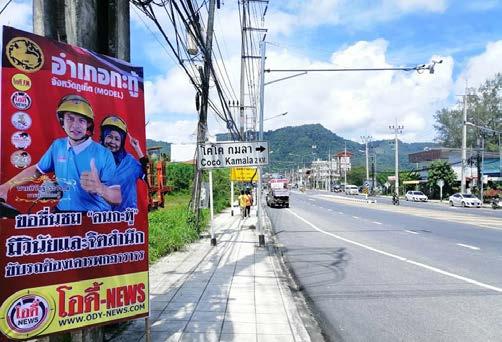
Kathu road safety campaign launched
A CAMPAIGN PROMOTing road safety was launched in Kathu last Saturday (Sept 17) as officials strive to raise awareness and encourage good discipline to prevent unnecessary accidents, injury and loss of life
The “Kathu District Model” is being led by

Siwat Waringkul, Kathu District Chief, in collaboration with heads of government agencies, subdistrict chiefs (Kamnan), village headmen (Phu Yai Baan), government officials, local council members and members of the local government.
Prominent posters remind-
ing and encouraging road users to practice safe driving will be present along road sides in Kamala, Patong and Kathu.
The campaign places particular emphasis on motorbike drivers, urging them to respect traffic rules and to ensure they wear a helmet
each time they travel. Officials said the campaign is important as it can help promote safer road conditions which in turn will protect each other and reduce the loss of life and property to ultimately improve the quality of life in the designated districts. The Phuket News
new road so that Pasak 6 could join the other back streets. The road is currently a dead end into a green area with trees.
“We understand there will be disruption during the construction process, but unfortunately that is the nature of urban development everywhere. On completing the project we see substantial real benefits for the Sujika owners, including life style,” Mr Tanner wrote.
Of note, Mr Tanner has since confirmed to The Phuket News that he is no longer involved with the Nebu Resort Bangtao. Instead, he is now involved with the Nebu Residence Jomtien project.
TALKED OUT
The ongoing talks resulted in a formal meeting on Feb 23, 2021 between the developer, the residents and the EIA consultancy at the offices of the Phuket office of the Ministry of Natural Resources and Environment (MNRE), the relevant agency tasked with approving or denying EIAs for construction projects.
The meeting left the issues unresolved, with Phuket MNRE Chief Watthanaphong Suksai, commenting in conclusion, “The committee has seriously paid attention to the complaints. However, there were different dimensions of disagreement, which the committee must thoroughly consider. I hope the project can be developed and nearby neighbours can live with the minimum impacts as well.”
However, at the meeting Mr MaAnn made his position clear. “Everyone has equal rights, so please keep the law as a priority. If you sue the project, the project has the right to sue you as well. Therefore, we must live together with a good understanding,” he said,
noted the official minutes of the meeting.
“The consulting company has already informed that the Soi Pasak 6 road is narrow. However, there are many alleyways that can go through, which will reduce traffic problems. But I think there will be noise issue,” he added
“If there is any additional concerns, please clearly state in complaint letter. Otherwise, when the construction is permitted [sic], it may occur another problem which results in continuously complaints,” Mr MaAnn noted.
IN THE DARK
An official at Cherng Talay OrBorTor told The Phuket News, on condition of anonymity, that so far a building permit for the project had not been issued.
However, The Phuket News was also told this week through a well-respected, and well-connected, developer that he had been informed that the project had been issued a building permit, and that the EIA had been approved.
The residents have been told nothing.
However, the developer was also told that if the residents conducted another poll and garnered enough support against the project, the EIA would be revoked and the project would go back to the planning stage.
The residents are hoping.
As one resident noted in airing his grievances, “Phuket has plenty of possibilities for such a project with much greater potential for success. We suggest you explore those other options, and we join Sujika residents and those living in the community, in the strongest possible objection to your proposed Nebu Resort and Hotel.”

An artist’s impression of the completed Nebu Resort Bangtao. Photo: Nebu World
Photo: PR Phuket
Bangla troublemaker nabbed
Patong Police ordered to investigate, arrest known drug dealer
The Phuket News editor@classactmedia.co.th
Aman arrested for intimidating foreign tourists with a gun loaded with blanks on Bangla Rd in Patong earlier this year has been arrested again, this time for selling marijuana and the opioid painkiller Tramadol.
Phuket Provincial Police announced through a statement issued late last Sunday (Sept 18) that a man, who the statement named only as “Mr Kittipong”, had been arrested after police found him in possession of dried marijuana, hand-rolled marijuana cigarettes and 10 tablets of Tramadol.
The statement claimed it was in response to a post online at 11:30pm last Saturday highlighting lack of action against ‘Mr Kittipong’.
Police were not ignoring the issue, the statement assured.
However, the statement also came some 10 hours after CCTV footage showing Mr Kittipong on Bangla Rd was posted online by the Phuket

Info Center, which operates under the Phuket Governor’s office.
The statement noted that the incident was brought to the attention of Phuket Provincial Police Commander Maj Gen Sermphan Sirikong, who in turn ordered Patong Police Chief Col Sujin Nilabadee to
investigate the claims.
The report did not report when Mr Kittipong was arrested. The statement also did not recognise any of the other claims made in the initial post online last Saturday, also shared by the Phuket Info Center, specifically saying that the man was openly selling
Phuket shrines ready for Veg Fest
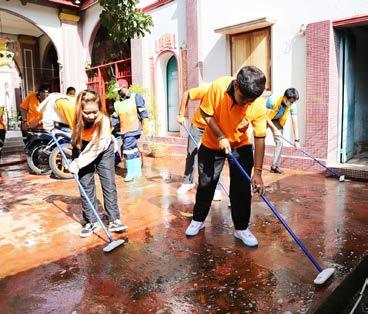
CHINESE SHRINES BEGAN THEIR preparations for the annual Phuket Vegetarian Festival last Friday (Sept 16) with mass cleaning of the temples, their altars and their surrounds
Teams of workers from Phuket City Municipality joined by volunteers began scrubbing forecourts at the main shrines taking part in the festival, including Pud Jor and Jui Tui shrines in the heart of Phuket Town.
The festival this year will be held under the same COVID-19 prevention measures as last year.
Phuket Vice Governor Pichet Panapong held a press conference last Friday to ensure that all shrine administrators were aware of the restrictions temples must abide by.
The mass cleaning at the shrines will continue through to Monday (Sept 26), when the nine-day festival will formally begin.
Never included in the official schedule of events is the traditional raising of the Go Teng poles at participating shrines, with the long poles pointing towards the heavens so that the Nine Emperor Gods can climb down to Earth for the nine-day festival.
The Phuket office of the Tourism Authority of Thailand (TAT Phuket) has released the official programme for this year’s festival, complete with route maps of the popular street processions.
Highlighted by the programme are the ‘fire walking’ purification ceremonies to be held Sept 30-Oct 4 and the ‘bridge crossing’ ceremonies to be held Oct 3-4.
The street processions will begin on Sept

27 with devotees from the Koor Su Gong Naka Shrine in Wichit taking to the streets.
Street processions will be held at participating shrines across the island every day through to Oct 4.
All streets and main roads along the procession routes will be closed to traffic while the procession is taking place. Traffic may be halted temporarily, the road reduced to one lane or redirected altogether while processions proceed.
On the final night of the festival on Oct 4 all participating shrines will make their way through the streets of Phuket, especially Thalang Rd and Phuket Rd, leading to Saphan Hin, where the final rites ceremonies will be held.
The festival will conclude with the traditional ceremony of lowering the Go Teng poles at the shrines at sunset the following day, Oct 5. The Phuket News
Also of note, the statement was not issued under the name of Patong Police Chief Col Sujin. Instead, it was issued by the “Phuket Provincial Police Spokesperson Team” and posted initially by Phuket Provincial Police, and then shared publicly by Patong Police Station.
“The investigative team brought the suspect along with the items to the investigating officer for further legal proceedings,” the statement read.
cocaine on Bangla Rd.
Police also did not report any action taken against foreign tourists or any other people found to have brought drugs from Mr Kittipong.
The statement did not even confirm the charges brought against Mr Kittipong for possession of or selling drugs.
“In such a case, the actions of the accused may affect the image of tourism of the country and there are also criminal penalties under the law. Therefore, [we] would like to publicize it to our brothers and sisters if they find clues or such behaviours, please notify the police or relevant agencies so that they can investigate, arrest and prosecute decisively.”
While focussing on Mr Kittipong’s drug offence record, the statement did not make any mention that Mr Kittipong ‒ Kittipong ‘Bank’ Chanthawong, a 25-year-old native of Nakhon Si Thammarat ‒ had been arrested by Patong Police in April for intimidating foreign tourists with a gun loaded with blanks.
In that incident, Mr Kittipong was brought in “for questioning” only after the incident was reported by foreign tourists.
Patong Police never confirmed what legal action was taken against Mr Kittpong for that infraction.
The post online on Saturday, posted on the ‘Hot Jung’ facebook page, gained wide readership online, accusing Patong Police of knowing about such behaviours in busy tourist areas, but chose to ignore it and take no action.
One comment under the post online noted, “Dare or not?”
Additional reporting by Eakkapop Thongtub
The statement highlighted that Mr Kittipong had a history of drug arrests in his home province Nakhon Si Thammarat. According to police, Mr Kittipong had been arrested three times previously on drug offences.

Mass cleaning of the shrines began last week as the island prepares for the annual Vegetarian Festival. Photo: PR Phuket
Image: Hot Jung Facebook via Phuket Info Center







New mosque rises near airport
The Phuket News editor@classactmedia.co.th
Komol Dumlak, Chairman of the Phuket Islamic Committee, has called on people to not criticise the construction of the project now branded as the ‘Phuket Central Mosque’, and has denied claims that the mosque is being built using government funds.
Through a report by the Phuket office of the Public Relations Department (PR Phuket) on Sept 15, while still using the police rank of Sublieutenant as his formal honorific title despite not having served as a police officer for decades, Mr Komol said, “It is a place where everyone benefits together, without discrimination.”
Mr Komol said that the project, under construction next to Thalang Technical College on the main road leading to the airport, is situated on nine rai and two ngan of land provided by the Royal Forestry Department.
In total there will be eight to nine buildings at the site, he said.
Of the main buildings, one will be the ‘Phuket Central Mosque’. The others will include an Islamic Ethics Training Center and a Phuket Islamic Affairs Administration Center.
“There will also be Phuket Provincial Foundation School to help the poor and the underprivileged who have no place to study or any

way to pay expensive tuition fees,” Mr Komol said.
“Students will come together at this centre whether they are Thai, Buddhist or Christian. This centre will be a centre where both Thai and English [languages] can be learned and all classes can come and study here where we will take care of the poor and the underprivileged,” he continued.
Construction of the main mosque is about 70% complete, fully funded by donations of more than B2.3 million, Mr Komol said.
So far more than B20mn has been spent on construction of the entire complex, Mr Komol added.
In total, donations of B40mn are needed to complete the complex, he said.
“Many more decorations need to be
Man robs store with sword
POLICE HAVE ARRESTED A man who robbed a small neighbourhood groceries shop in Wichit twice on the same night, first with a knife, then again with a sword.
Wichit Police were called to the shop, in Ao Nam Bor, Moo 7, Wichit, at around 1:20am on Sept 12.
Officers were told that a man with long hair who concealed his face entered the shop and threatened the staffer with a knife.
The staffer handed over all the money in the cash drawer, totalling B400, and the robber fled on a motorbike.
Later, around 4:40am, the same man returned to the store, this time brandishing a sword one metre long. He again threatened the staffer and this time made off with a further B500.
Wichit Police with assistance from Phuket Provincial Police managed to track down the man, who they identified only as “Mr Nikom”, 31. Police withheld the man’s family name.
A warrant for Nikorn’s arrest

was issued and officers moved in and arrested him at about 4:15pm that same day, police reported.
Nikom was taken to Wichit Police Station to face charges "committing robbery at nighttime by using a vehicle".
According to police, Nikorn robbed the shop the first time because he was unhappy with the person who worked there. Apparently they had a disagreement earlier.
The shop staffer was not particularly compliant when he robbed the shop the first time, so he returned to rob it a second time, this time with a more threatening weapon, police said.
When the staffer saw the sword, the staffer fled, leaving Nikorn to help himself to the cash drawer, police reported. Eakkapop Thongtub
done, with around B20mn still needed to complete the project,” he added.
“The mosque will become the face of our Phuket province. We can build the central mosque here and then people can pray, whether they are taxi drivers at the airport or foreign guests, as they all will have to pass along this road,” Mr Komol said.
“Therefore, we are all welcome to come together and donate to the mosque because the Central Mosque is now accepting donations,” he added.
Mr Komol called on people “to understand that the budget for building the Central Mosque is not a budget from the government”.
“Not even one baht, we collect from the people,” he said.
“Do not create conflict. Also tell people who create conflict to stop doing it because we are in Thailand.
We love Thailand too. We love all Thai brothers and sisters. We are in the same nation,” he said.
Regarding the Islamic Ethics Training Center, Mr Komol said that one rai had been “donated” to the Phuket Provincial Administrative Organisation (PPAO) for the centre to be built.
“It will be a centre for training and displaying various products, and used to perform important ceremonies of the nation and important ceremonies of the King with a capacity of approximately 1,000 people,” he said.
“It will be a three-storey building of the PPAO, but the Office of the Phuket Islamic Committee is the one who requested it.
“The PPAO gave the budget for construction. This is part of the budget was approved by PPAO President Rewat Arerob and Vice President Thiwat Seedokbub, and all members of the PPAO,” he said.
Not noted in the report was that the budget provided by the PPAO totalled B56mn ‒ even more than the B40mn Mr Komol said was required to build the entire complex.
Also not noted in the report was that the Anti-Fake News Center in its investigation of fake news claims that the project was to cost B250mn, had confirmed that the land provided by the Royal Forestry Department for the project covered more than 19 rai, not nine rai as claimed by Mr Komol.
Monkey trouble at new resort in Chalong
A BRAND-NEW BOUTIQUE resort in Chalong is having trouble with local monkeys disturbing its guests.
Pongchat Chouehorm, Chief of the Nature and Wildlife Education Centre at the Khao Phra Thaew Non-Hunting Area in Thalang, and fellow wildlife officers inspected the Noku Phuket resort in Soi Sai Nam Yen, Chalong, on Sept 13.
Management of the new resort, which has 91 villas and lofts, explained the issues they were having with local macaques on the resort grounds and their attempts to enter the guests’ accommodation.
Mr Pongchat said that his office laid out some ground rules that guests must follow.
“They absolutely must not give the monkeys any food,” he said.
“Do not leave food waste outside the room while waiting for it to be collected as that only attracts wild animals to come down to eat the food scraps,” he added.
“Also, we ask for the cooperation of employees to help inspect the grounds to make sure leftover food and scraps collected remain
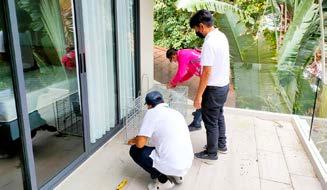
Wildlife officers set up a trap in the hope of catching one of the intruding monkeys. Photo: Khao Phra Thaew Non-Hunting Area
well kept away inside the hotel,” Mr Pongchat said.
The hotel management immediately notified its staff of the rules, and will inform its guests to be aware of the monkeys, he said.
While at the resort, the officers inspected the garbage collection facilities on site to ensure they did not invite other wild animals to come to dine for free.
Officers set up some traps in the hope of snaring some of the intruders.
“These rules will be used as a guideline for hotels in or near hilly areas or near mangrove forests to prevent attracting wildlife into their resort areas,” Mr Pongchat said.
Chutharat Plerin
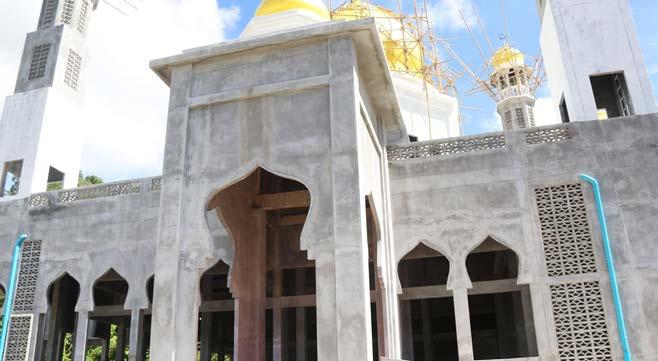
The Phuket Central Mosque under construction near the airport. Photo: PR Phuket
Photo: Eakkapop Thongtub
Building walls in communities
The Phuket News editor@classactmedia.co.th
APhuket expat has raised the issue of the lack of protection against neighbours’ building imposing walls along boundaries with adjacent properties after a wall standing 3.2 metres tall was built right beside his house, blocking even sunlight from shining into his son’s room.
Roberto Manco, a resident at the Sinsuk Thani housing estate in Srisoonthorn, said the issue began last year, when his neighbour first started sizing up where the wall was to be built.
Attempts to negotiate for the wall to be shorter to allow some sunlight into his 10-yearold son’s room proved fruitless, often deteriorating into arguments and even threats.
Roberto asked for the wall height to be built just 50cm shorter to allow some sunlight and breeze into his son’s room. The neighbour refused to compromise.
“The bulwark in question has removed all visibility and daylight from me, I no longer see anything, not even the sky, there is no more breeze and
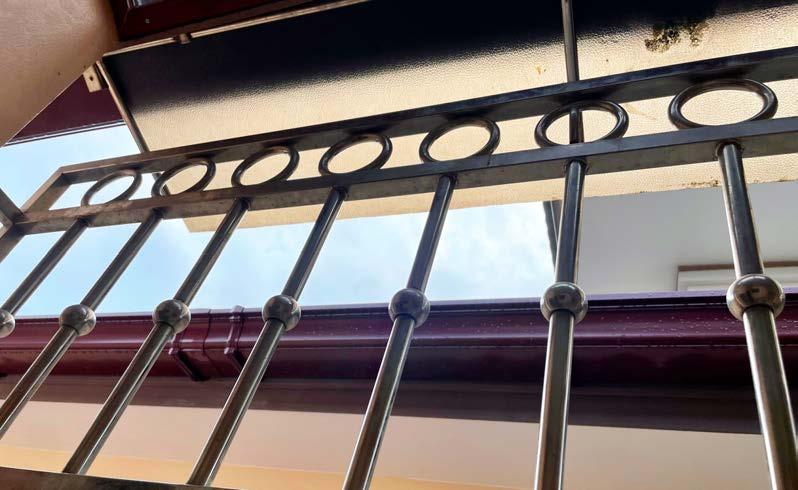
the voices and noises of the neighboring house are amplified with an uncomfortable echo. It is more like a prison,” Roberto said.
The Sinsuk Thani housing estate management group has done nothing to prevent or regulate the construction of the wall.
The wall stands on his neighbour’s property, but breaches the construction guidelines set out by the housing estate management group mandating that structures must be at least two metres from the boundary line.
Roberto, an Italian-Swiss who has lived in Thailand for 16 years, and not new to antics by people ignoring rules, attempted to hire three lawyers to resolve the issue.
“The first wrote a letter of protest to Srisoonthorn Municipality and opened a case, but despite several appointments he never managed to speak to any head at the municipality. After about a month he gave up the case and told me it wasn’t his specialty,” Roberto explained.
Of note, during the first lawyer’s attempts it was discovered that the municipality


issued a building permit for the wall two months after its construction began.
“The second, a specialist in these problems, listened to the exposition of my problem and told me at the time that he would contact me. Several days passed, and despite my insistence he made me understand that he was not interested in it,” Roberto continued.
The lawyer requested “an exorbitant figure in advance”, Roberto said. “Despite my agreement of 50% right away and the balance at the end of the case, the lawyer never responded.”
The third and last law firm Mr Roberto contacted met with him to discuss the case. After 15 days of not hearing back from the firm, Mr Roberto contacted them only to be told they were “too busy” to take up the case, but then gave “a really exaggerated fee” to continue with it.
“All this discouraged me from continuing with the law firm,” he said.
What was confirmed during the process was that the legal minimum distance between separately standing dwell -
ings in Thailand is just 50cm, Roberto said.
Any other construction conditions required within housing estates is up to the housing estate management authority to enforce its own rules.
The offending wall stands 1.2m from the boundary line, but not 2m from Roberto’s house.
“I would like to publicly reveal my story, that of a building abuse that is forcing my family to live in very disadvantaged conditions, and for which I cannot get justice,” Roberto said.

Photos: Supplied
Preparing Phuket for climate change

SUSTAINABLY YOURS
As temperatures break records in the UK and fires break records, while scorching the European countrysides of Portugal, France and Spain, Phuket has had to contend with worsening annual floods. While climate change may be inevitable, there are things that Phuket can do to better prepare itself, to limit damage to infrastructure, reduce the potential for loss of life, and protect homes and businesses.
According to United Nations Development Programme, local governments are responsible for more than 70% of climate change reduction measures and up to 90% of climate change adaptation measures. According to the United Nations Environmental Programme, 75% of CO2 emissions come from cities, with transportation, buildings and food being the largest emitters. So, the government and local communities should do what they can to lessen the impact of climate change wherever it is possible and adapt to it when it isn’t. Here are a few possible solutions.
Things the Government Can Do Transportation
While the debate about taxi mafias and electric buses vs. light rail rages on in
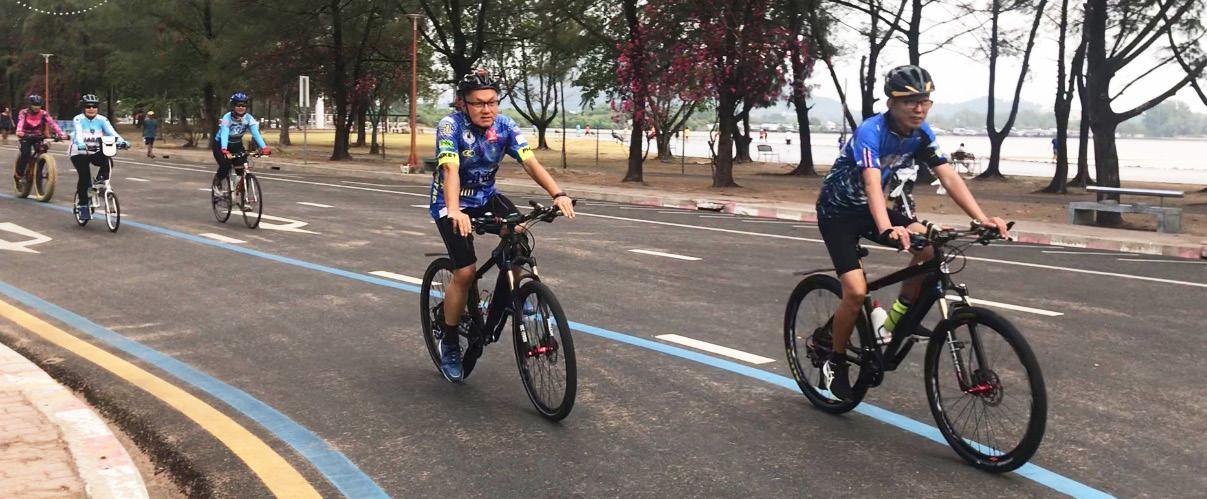
Phuket, a partial solution to reducing the congested streets of the island is seldom talked about. That is improving the walkability and bikeability in the most trafficked areas of the island, such as Phuket Town and Patong.
Many major cities such as Paris, Madrid, Ottawa, Seattle and Melbourne are already doing this by turning their densely packed downtown areas into so-called 15-minute cities in which cars are banned or limited and all essential services are strategically placed within walking or biking distance, which is easy to do because of the close proximity of the shops and restaurants. Studies show that when downtown
areas limit vehicle traffic, businesses in those areas generally thrive as do property values, while pedestrian deaths go down, and the air gets cleaner resulting in a lower incidence of asthma, heart attacks and cancers, which also reduces the burden on the healthcare system.
A recent report from the Centre for London shows that reduced traffic neighbourhoods are one of the easiest ways to save money, improve health and make cities quieter, and let’s face it the quality of life on Phuket would be immensely improved if we had less traffic.
Flood Mitigation
Phuket’s annual floods are getting worse, which is leading to millions of baht in property damage. However, there are ways to mitigate flooding and lessen the damage.
One strategy that China is using is redesigning its metropolitan areas into sponge cities that restore floodplains and wetlands and create retention ponds, sunken parks and water-permeable parking lots. Not only does this reduce flooding, but it also cleans the air and water and creates habitats for wildlife and pollinators to live, while giving people access to nature, which can improve mental and physical health.
Phuket can imitate the success of sponge cities by replacing grass lawns in parks with trees and native species of plants that have deep root systems and can increase the soil’s capacity to store water, reduce runoff and, consequently, flooding. It can also build rain gardens, plant more trees, create pocket parks (mini parks) and put up rainwater collection systems. Rainwater collection alone has been shown to reduce flood costs by up to 30%.
Combining these solutions with better drainage in the areas that are most likely to flood, can reduce the damage to roads, buildings, businesses and homes while saving millions of baht and preventing unnecessary deaths.
Food Security
Maintaining the food supply chain is something else we need to be concerned about on Phuket. One solution is turning our lawns into gardens. In the United States lawns are the single largest irrigated crop using tens of thousands of litres of water annually, while not producing any food. They are also a desert for biodiversity, which means our pollinators don’t have a home.
A study from Virginia Tech found
that lawn chemicals contaminate our water supply, and pollute our drinking water. Other studies have found that these pesticides can lead to an increased risk of cancer for you, your pets and the local wildlife, and can increase the risk of childhood leukemia by almost seven times.
So replacing some of the lawns around government buildings and in parks and turning them into edible gardens, while also promoting rooftop gardens and vertical farms, is a way that we can reduce the threat of supply chain issues while, also decreasing our use of fertilisers and pesticides and increasing biodiversity, all of which can lead to greater environmental resilience and macroeconomic stability.
Keeping Cool
Globally we’ve seen an average increase in temperature of about 1°C since the 1950s. Finding ways to stay cool without using greenhouse gas producing air conditioning is important. While planting trees, growing rooftop gardens and creating more green spaces will play a crucial part in keeping Phuket cool, there are additional measures that we can take to stave off the so-called urban heat effect, which comes from concrete buildings and black tar roads absorbing and radiating solar energy.
For example, we can paint building rooftops white, which can reduce the temperature inside by up to 30% compared to the outside. Likewise, we can coat roads in solar reflective paint, which can reduce ambient temperatures by up to 12°C. Buildings can be covered with living walls made of moss or plants, awnings and canopies can be erected to provide more shade and inexpensive terracotta and bamboo water passive cooling systems, which use evaporation to cool the ambient temperature by between 5-10°C, can be placed in public areas where people are most vulnerable.
Although these changes won’t take place overnight, they need to happen over the next five years. Climate change is already affecting Phuket and the longer we wait to deal with it, the worse it will become.
In next week’s article, we will look at personal changes that you can make in your lifestyle to help stave off the worst effects of climate change.
Palmer Owyoung is an environmental activist working with the Kamala Green Club and the Global Sustainability Hub.
Palmer Owyoung
Dedicated bicycle lanes could go a long way to help alleviate Phuket’s traffic woes. Photo: Eakkapop Thongtub / file
‘Goodbye, honey – and thanks for the house!’

A look at the law on gifts in Thailand
LEGAL MATTERS
By Dr Paul Crosio Partner, Silk Legal
Whether to give expensive cars or mansions to a Thai ‘friend’ is a dilemma typically brought up over beers and in online forums. Regardless of whether the giver is a blue-collar worker or a millionaire, gifting can sometimes lead to interesting stories where they give away more than they imagined.
This is a prickly topic as doing an internet search yields very little guidance. Perhaps you’re wondering whether you were simply used as a cash cow.
Let’s look at situations where you can get your gift back after your relationship turns sour or if you find that you have been swindled.
Lending money: a word of caution Always document the loan. A verbal contract may be enforceable but tends to be hard to prove during conflicting recollection, particularly if the receiver gathers ‘witnesses’ to verify their position. Doing so also benefits the receiver as the loan is guaranteed even if the giver reconsiders or passes away.
Write down the loan terms and be sure to include key conditions such as the amount, interest rate (not over 5%
per year), and repayment date. If preferable, you can ask them to write what they think the terms are in Thai and have them translated later. Once you’re both on the same page, you should both sign the paper.
If unsure about the repayment date, you can say that the term is extendable at the lender’s discretion.
Thailand’s laws on gifts
A gift is any property or money that is voluntarily given to another person with no expectations. This is different from marriage where matrimonial property is typically divided equally between spouses. A gift made during marriage, such as a dowry, is not revokable for ingratitude.
Under Section 531, you can claim back a gift if:
• the recipient committed a serious criminal offence against the giver;
• the recipient seriously defamed or insulted the giver, or
• the receiver refused to assist the giver in need despite being able to do so.
According to Section 533, a claim must be made within six months from the time the giver became aware of ingratitude. However, Section 535 states that some gifts are not revocable for ingratitude, particularly remuneration, encumbered gifts, gifts made under moral obligation, and gifts during marriage.
Revoking a gift Theft, fraud, or assault can be consid-

ered reasonable grounds for revoking gifts. Elder abuse or neglect are also reasonable grounds. Both these situations are extremes and not commonly seen.
To revoke a gift due to ingratitude, you would need to prove that you were seriously defamed or insulted. Serious means not trivial or minor.
An insult is a violation of another’s honour through an offensive expression or action, while defamation is the act of spreading disreputable information about the giver to others. In one successful revocation, the receiver called their father (the giver) a “despicable dog”. Surely, you can imagine other incidents like this.
Arguably, parading multiple partners to common friends during a relationship could be considered an “insult”, while even more provocative statements such as the giver being a drunkard or bankrupt may be considered defamation and a cause for revoking a gift.
How Thailand taxes gifts
Gift taxes can be defined as taxation on the transfer of property, and taxpayers can opt to pay 5% gift tax on properties worth more than B10 million or B20mn. Both individuals, even non-Thai citizens, and juristic persons are subject to the gift tax.
There are, however, exemptions to the gift tax, particularly gifts worth less than B20mn given by a spouse or family member, or gifts worth less than B10mn from others.
As always, if you feel you have the need to revoke an ill-advised gift due to the reasons mentioned above, quickly contact us to guide you through this matter. Remember: the clock is ticking.
For more information about gifts, contact Silk Legal at info@silklegal.com or by using the contact form on their website.

Photo: yanalya / freepik

1. What percent of Netflix users personally pay for their subscription?
2. What is meant by the term “hustings”?
3. In his childhood, the Dalai Lama was afraid of which insect?
4. Women were allowed to compete in the (modern) Olympics for the first time in which year?
5. How much does it cost players to get out of jail in Monopoly? Answers below, centre

1 to two
40
2,617 is
600,000
37 million
Crossword by Myles Mellor & Sally York



September 23, 1980
Bob Marley plays what would be the last concert of his life in Pittsburgh, Pennsylvania.
September 24, 2014
The Mars Orbiter Mission makes India the first Asian nation to reach Mars orbit, and the first nation in the world to do so in its first attempt.
September 25, 1926
Source:
The international Convention to Suppress the Slave Trade and Slavery is first signed.
Ninety-nine countries, but not Thailand, have since signed, ratified or otherwise committed to the Convention.
September 26, 1580
Privateer, naval officer and explorer Sir Francis Drake finishes his circumnavigation of the Earth. He becomes the second person, and the first Englishman, to achieve this.
September 27, 1822
Jean-François Champollion announces that he has deci-
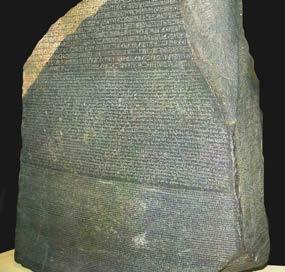
phered the Rosetta Stone.
September 28, 1928
Alexander Fleming notices a
bacteria-killing mold growing in his laboratory, discovering what later became known as penicillin.
September 29, 2006
A Boeing 737 and an Embraer 600 collide in mid-air, killing 154 people and triggering a Brazilian aviation crisis. On the same day in 1940, two Avro Ansons collide in mid-air in Australia, remain locked together, then land safely.
Source: Wikipedia
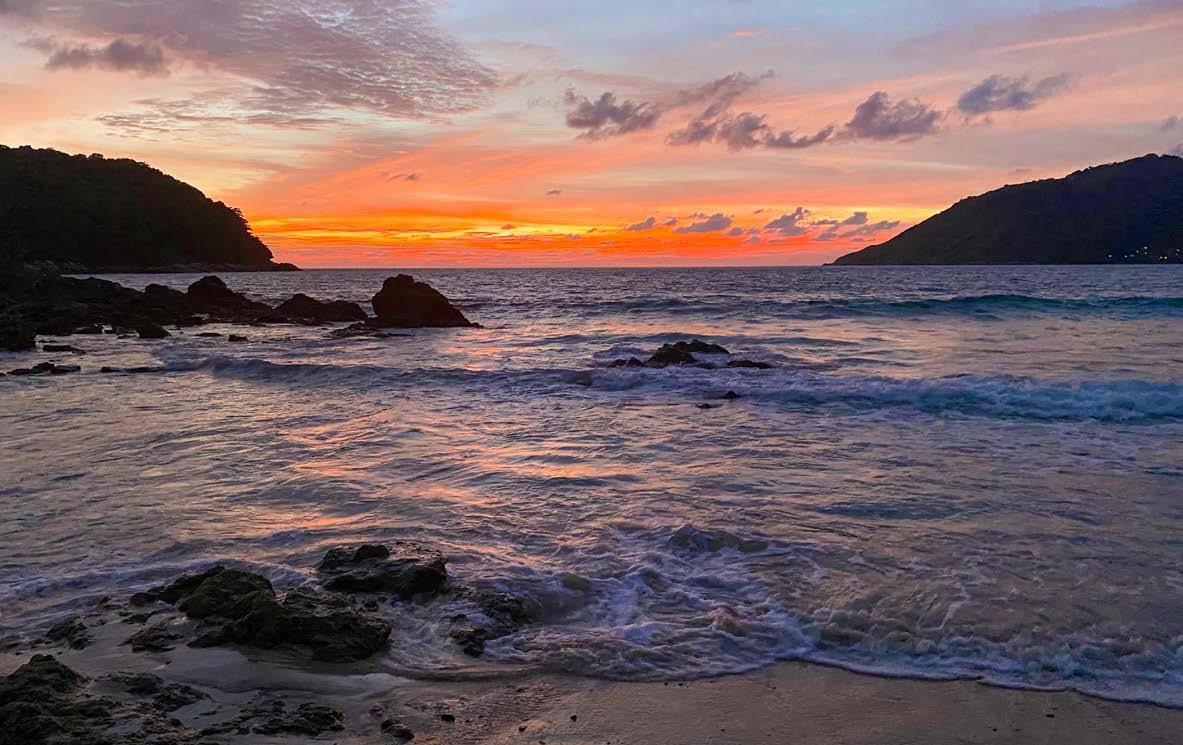
Yanui sunset. Photo by Mark Musto
The Rosetta Stone.