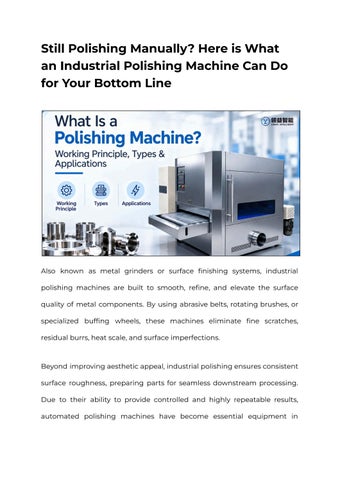
Still Polishing Manually? Here is What an Industrial Polishing Machine Can Do for Your Bottom Line
Also known as metal grinders or surface finishing systems, industrial polishing machines are built to smooth, refine, and elevate the surface quality of metal components. By using abrasive belts, rotating brushes, or specialized buffing wheels, these machines eliminate fine scratches, residual burrs, heat scale, and surface imperfections.
Beyond improving aesthetic appeal, industrial polishing ensures consistent surface roughness, preparing parts for seamless downstream processing. Due to their ability to provide controlled and highly repeatable results, automated polishing machines have become essential equipment in
modern metal fabrication, automotive manufacturing, and aerospace engineering.
What Is an Industrial Polishing Machine? An industrial polishing machine is a precision metalworking system designed to refine the surface finish of workpieces. Equipped with interchangeable processing units—such as abrasive belts, wire brushes, or non-woven polishing wheels—these machines clean, deburr, and polish metal surfaces to exact specifications.
Key Materials & Process Integration Modern precision Industrial polishing machines seamlessly handle a wide range of conductive and non-conductive metals, including:
● Carbon Steel & Stainless Steel (achieving brushed or mirror finishes) ● Aluminum & Copper Alloys (eliminating oxide layers without damaging soft substrates) ● Exotic Alloys & Sheet Metals In a typical production line, polishing machines operate right after laser cutting, plasma cutting, or stamping. They often work alongside deburring equipment to prepare workpieces for subsequent painting, powder coating, welding, or final assembly.
Did You Know? (Multi-Station Efficiency)
Advanced automatic polishing machines feature multi-stage processing heads. In a single pass, a multi-station line can
perform heavy deburring, edge rounding, oxide removal, and fine surface polishing simultaneously—drastically reducing labor costs and cycle times.
How Does an (Step-by-Step)
Industrial
Polishing
Machine
Work?
Industrial polishing relies on mechanical abrasive contact. The system feeds the workpiece past high-speed rotating belts or brushes, using precise pressure settings to remove unwanted material while preserving part geometry.
Step 1: Part Preparation & Inspection Before processing, raw metal parts are evaluated for severe defects, thick slag, or heavy burrs. Parts coming off laser cutters or punch presses may
undergo preliminary deburring so the polishing stage can focus on surface refinement.
Step 2: Selecting the Optimal Polishing Tool Choosing the right abrasive depends on the starting material condition and the desired surface finish:
● Abrasive Belts: Ideal for aggressive stock removal, leveling weld seams, and grinding heavy scratches. ● Brushes & Non-Woven Wheels: Perfect for light deburring, edge blending, and creating decorative satin finishes using advanced coated abrasives. ● Buffing Compounds & Flap Wheels: Used for fine finishing, brightening, and achieving high-luster/mirror surfaces.
Step 3: Automated Workpiece Feeding The metal part is loaded onto an automated conveyor belt or vacuum table. The through-feed system transports parts at a controlled speed, guaranteeing uniform exposure to the polishing heads.
Step 4: Controlled Surface Polishing As parts move through the workstations, pneumatic or spring-loaded polishing heads apply uniform pressure. This controlled action smoothly removes micro-defects, scales, and scratches without warping thin sheet metals.
Step 5: Final Quality Inspection
The finished parts exit the chamber and are checked for surface roughness (𝑅𝑎 values), visual consistency, and edge quality. If necessary, parts can be routed through a secondary fine-buffing station.
Main Types of Industrial Polishing Machines Selecting the proper machine architecture depends on part geometry, production volume, and required surface specifications:
Machine
Key Features
Best Suited For
Belt
Employs continuous
Flat metal sheets, plates,
Polishing
abrasive belts with
and linear profiles needing
Machine
adjustable tension and
fast leveling.
Type
grit.
Brush &
Features
Parts requiring uniform
Planetary
multi-directional
edge rounding, oxide
Polishing
rotating brush heads
removal, or satin finishes.
Machine
that cover all angles.
Automatic
Integrates multiple
High-volume industrial
Multi-Head
grinding/polishing
manufacturing requiring
Polisher
heads in one
multi-step finishing in a
continuous conveyor
single pass.
line.
Robotic
Uses 6-axis articulated
3D complex components,
Polishing
robot arms to guide
automotive castings,
Cell
tools around complex
medical implants, and
geometries.
curved aerospace parts.
Key Industrial Applications Industrial metal polishing machines play a critical role in enhancing product quality and corrosion resistance across various sectors:
● Sheet Metal Fabrication: Removes micro-scratches and thermal discoloration caused by fiber laser cutting. ● Stainless Steel Equipment: Delivers sanitary, easy-to-clean brushed finishes for food-grade, pharmaceutical, and architectural panels. ● Automotive Components: Smooths stamped brackets, engine covers, and trim parts prior to electroplating or powder coating. ● Precision Machinery: Eliminates stress-concentrating burrs and sharp edges to extend mechanical component lifespan. ● Decorative Metalware: Creates premium visual textures (e.g., Hairline, No. 4 finish) on hardware, consumer electronics enclosures, and fixtures.
Conclusion & Partnering with Experts An industrial polishing machine is a critical investment for manufacturers seeking to boost throughput, lower manual labor overhead, and deliver flawless surface finishes. By matching the right tool combination and automation level to your production needs, you can transform rough-cut metal into market-ready components efficiently.
Upgrade Your Surface Finishing Line with Lingyi
Are you looking to eliminate bottlenecks in your metal finishing department? Dongguan Lingyi Intelligent Machine Co., Ltd. specializes in
engineering
high-efficiency
automatic
polishing
and
deburring
machines tailored to your exact part specifications.
Frequently Asked Questions (FAQ) Q1: What is an industrial polishing machine used for? An industrial polishing machine is used to smooth metal surfaces, remove scratches, burrs, and oxidation, and achieve specific surface textures (such as satin, brushed, or mirror finishes).
Q2: What metal materials can be processed with a industrial polishing machine? Modern polishing machines can process virtually all industrial metals, including stainless steel, carbon steel, aluminum, brass, copper, titanium, and various alloys.
Q3: What is the difference between a deburring machine and an industrial polishing machine? ● Deburring machines focus primarily on removing sharp edges, heavy burrs, and laser slag to ensure safety and dimensional accuracy. ● Industrial Polishing machines focus on surface refinement, reducing surface roughness (𝑅𝑎), and improving the aesthetic or functional finish of the metal face. Many modern machines combine both functions.
Q4: How do I choose between a conveyor belt polisher and a robotic polisher? ● Choose a conveyor (through-feed) polisher for high-volume flat sheets, square tubes, or simple 2D stamped parts. ● Choose a robotic polishing system if your parts have complex 3D contours, curved surfaces, or hard-to-reach internal cavities.
Q5: What key factors should I consider when buying an industrial polishing machine? You should evaluate:
1. Material type and part dimensions (length, width, thickness). 2. Initial surface condition vs. desired final surface roughness (𝑅𝑎). 3. Required daily production volume (manual vs. fully automated through-feed). 4. Dust extraction and safety features (e.g., wet dust collectors for aluminum processing).