JANUARY 2021
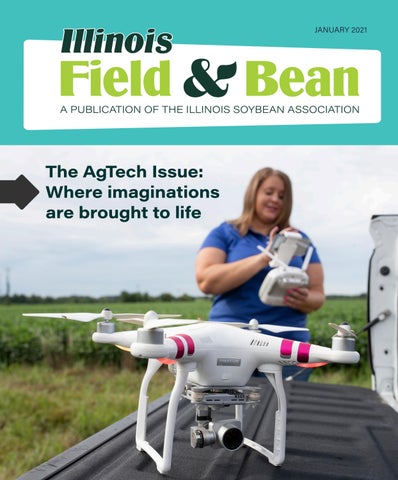
The AgTech Issue: Where imaginations are brought to life
CONTENTS JANUARY 2021
6
Volume 1 Issue 2
To market, to market we grow ISA’s new strategic plan aims to support new commercial soybean uses and market exploration.
10 Every farmer has a story Phil Bradshaw is a friend of soy. This is his tale of loyalty, dedication, and a passion for the almighty soybean.
12 Where imaginations are brought to life Get an inside look at how the University of Illinois’ AgTech team is using mind-bending science, research, engineering, and creative partnership to improve life for the American farmer.
22 Adapting and growing; more than crops Step inside international trade teams' expansion and diversification efforts, despite unprecedented travel challenges.
26 Supply chain resiliency Illinois' agri-food system overcomes challenges in a pandemic.
29 Corporate partner perspective ADM creates value across the food chain.
30 New board member Join us in welcoming new ISA board member, Bryan Severs.
DEPARTMENTS 4
VICE CHAIRMAN’S MESSAGE
5
CEO'S MESSAGE
8
VOICE FOR SOY
14 EDITOR'S MESSAGE COVER: Betsey Emerick, featured on the cover, is an ISA at-large director from Vandalia, Ill. Emerick's progressive family operation uses the latest precision technology and innovations. January 2021
3
VICE CHAIRMAN'S MESSAGE
CHAIRMAN Doug Schroeder, Mahomet District 11 VICE CHAIRMAN Steve Pitstick, Maple Park District 2 SECRETARY Elliott Uphoff, Shelbyville District 10 TREASURER Dwayne Anderson, Lynn Center District 3 ASSISTANT SECRETARY-TREASURER Scott Gaffner, Greenville At-Large Director GOVERNMENT RELATIONS COMMITTEE CHAIR Ron Kindred, Atlanta District 9 MARKET DEVELOPMENT COMMITTEE CHAIR Rick Rubenacker, McLeansboro District 18 UTILIZATION COMMITTEE CHAIR David Wessel, Chandlerville At-Large Director DIRECTORS Ryan Frieders, Waterman | District 1 Buck Hill, Grand Ridge | District 4
Mark Read, Putnam | District 5 James Martin, Pontiac | District 6 Bryan Severs, Potomac | District 7 David Niekamp, Coatsburg | District 8 Brock Willard, Pittsfield | District 12 Ed Murphy, Farmersville | District 13 Brad Daugherty, West Union | District 14 Jeff Parker, Belleville | District 15 Brian Atteberry, Carmi | District 16 Nick Harre, Nashville | District 17 AT-LARGE DIRECTORS Betsey Emerick, Vandalia Brady Holst, Plymouth Jeff O'Connor, Kankakee Tim Scates, Carmi UNITED SOYBEAN BOARD (USB) Doug Winter Dan Farney, USB Chairman Gary Berg Lynn Rohrscheib AMERICAN SOYBEAN ASSOCIATION (ASA) Stan Born, ASA Treasurer Daryl Cates, ASA Secretary David Droste Jered Hooker Ron Moore Bill Raben Rob Shaffer Bill Wykes
STAFF CREDITS Editor | Rachel Peabody, Illinois Soybean Association Assistant Editor | Betsy Osman, Illinois Soybean Association Staff Writer | Claire Weinzierl, Illinois Soybean Association Staff Writer & Advertising Coordinator | Jill Parrent, Illinois Soybean Association Digital Edition & Circulation Manager | Heather Atkinson, Illinois Soybean Association Staff Photographer | Stephen Sostaric, Illinois Soybean Association OTHER ISA STAFF Chief Executive Officer | John Lumpe Chief Financial Officer & Chief Operating Officer | Brian Hansen Senior Director of Government Affairs | Mike Levin Director of Ag Innovation | Linda Kull Director of Operations | Dustin Scott Director of Outreach | Amy Roady Director of Public Policy & Market Development | Andrew Larson The Illinois Soybean Growers is owner of Illinois Field & Bean, a publication for Illinois soybean farmers, designed and written to provide timely and useful industry information. Illinois Field & Bean is published six times a year by the Illinois Soybean Association, 1605 Commerce Parkway, Bloomington, IL 61704. For address corrections, contact Illinois Field & Bean at 1605 Commerce Parkway, Bloomington, IL 61704. Phone 309-663-7692. Web address: www.ilsoy.org. Email: atkinsonh@ilsoy.org. Comments and statewide news articles should be sent to the above address. Advertising space reservations must be made by the first of the month preceding publication. In consideration of the acceptance of advertisement, the agency and the advertiser must, in respect of the contents of the advertisement, indemnify and save the publisher harmless against any expense arising from claims or actions against the publisher because of the publication of the content of the advertisement. FOR ADVERTISING INFORMATION Rachel Peabody Director of Communications Phone: (217) 825-7654 Email: peabodyr@ilsoy.org
4 January 2021
The right agtech for you
STEVE PITSTICK ISA Vice Chairman
Over the decades, soy agriculture has seen many revolutions. The idea to domesticate plants was itself a novel idea a few thousand years ago. From there, we introduced the systematic use of crop rotations and other improvements. Only a few decades ago, we introduced man-made fertilizers and pesticides. Today, we can point to a current revolution in progress, focused around the use of machinery, information, and communication technology. Autonomous, robotic equipment has been developed for farming purposes, such as weeding, tilling, and fertilizer application. The development of unmanned aerial vehicles with autonomous flight control has provided access to sophisticated farm management advice. Smart farming has even made it possible for farmers to differentiate between plant diseases based on digital information. We are living in a constantly evolving world. And with big opportunities comes both challenge and reward. While technology plays a role for every farmer, to varying degrees, one technology solution is not right for every farm. It’s important producers look at their individual operation to consider where pain-points exist, and which technologies promise the greatest return on investment. High costs to adopt new technology for individual farms, as well as significant learning-curves, can be adoption hurdles. Farmers must be their own scientists and their own detectives, constantly keeping a watchful eye on changing data, results, and impacts. Though “smart farming” can potentially result in higher profitability for farmers, the opposite can be true without proper training, knowledge, and support. As a farmer committed to advancement, and as ISA Vice Chairman committed to the 43,000 soybean farmers we represent, I have been proud to witness the creative problem solving and use of technology at the organizational level. This pandemic has triggered an unprecedented demand for digital solutions in an effort to continue program work, to communicate with our farming communities, and to stay connected with one another. ISA has been challenged to rethink daily operations and board involvement, global market connectedness, all while moving seamlessly to maintain output and productivity. It has not been easy, but our work has continued. Are there still huge strides to be gained in maximizing today’s technology as well as the efficiencies that will come from future technologies, both as an organization and on the farm? You bet. But a solution that works for me is not necessarily a solution my neighbor is equipped to adopt. We are all at different places on the agtech spectrum. I like to think of it this way. When I go to buy a new car, someone else is going to be thrilled to buy my old car. We both have a need; we both identify a solution. We can’t all be first, or adopt the latest, or implement the newest. And that’s the idea behind innovating: wherever you are on the curve, there's a right agtech for you.
CEO'S MESSAGE
ISA, Reimagined I’m the kind of guy who keeps a pad of paper by my bed. My brain never sleeps and ideas and inspiration often come at 2 a.m. I know they say it’s bad to take work home, but I guess that’s part of the territory when you are passionate about what you do. More often than not those middle of the night ideas are about the Illinois Soybean Association — exciting projects we’ve got underway, thoughts of things we can do better, and our plans for the future. In my role as CEO, I have the privilege of taking those ideas, whether from myself, my team, our farmers, or our board, and channeling them into action. Some of the ideas are small, and some are larger, more challenging, and involve bringing new collaborators to the table. But, the journey we are on as an association — this quest to improve and refocus our organization back on the 43,000 soybean farmers we serve — well, I like to call it ISA, Reimagined. It’s incredibly exciting to lead an organization knowing that opportunity for our industry abounds, and we are thinking about new and collaborative ways to bring soybean farmers the most value. In this issue, we are looking at the topics of innovation and agtech. We are exploring the myriad of ways Illinois agriculture is looking at out-of-the-box solutions to age-old problems. It shines a light on ISA’s work to pursue innovation, technology, and creativity as it pertains to solutions for the soybean industry. We celebrate the fact that Illinois is the No. 1 soybean producing state in the country. I would dare to say much of that success can be attributed to the fact that we are also home to the most innovative, forward-thinking farmers in the country. Perfecting your craft is what you do — you like to grow soybeans, and you have figured out how to do that better every year. Like me, there are probably several of you reading this with your own nightstand notepad and 2 a.m. thoughts on improvements. Wherever this issue finds you — tech-savvy, or not — looking to do better each day is something we can all aspire to. Whether your work happens on acres, or in the hallways of an association, I hope 2021 brings you opportunity to reimagine your work and the ability to continually do it better. If you’ve got thoughts on improvements, or new and exciting endeavors you think the soybean checkoff and membership programs should pursue, we would love to hear them. Send us a note to ilsoy@ilsoy.org today. Well wishes for a happy, healthy, and productive 2021!
JOHN LUMPE CEO Illinois Soybean Association
A PUBLICATION OF THE ILLINOIS SOYBEAN ASSOCIATION
January 2021
5
Funded by the Illinois Soybean Checkoff
To market, to market we grow
ISA’s new strategic plan aims to support new commercial soybean uses and market exploration. By Betsy Osman
T
he 70 million acres of soybean plants that span the length of our country offer a generous supply for an uncapped spectrum of cleaner, greener products. From paint to tennis shoes, to energy efficient roofing materials, there seems no limit to what this powerhouse resource can do. Illinois is preparing to shift into next gear as we partner
6 January 2021
with innovators, manufacturers, and state checkoff programs to develop new soy-based materials while better promoting products currently on shelves. Commercialized uses for soy give our industry the opportunity to diversify markets, increase utilization, cultivate credibility with manufacturers and distributors, and drive new revenue streams. To think we’ve not yet uncovered all the uses for soy is a reality as challenging as it is
exhilarating. We’re not racing toward a finish line; we’re still on the innovation road, fast headed for new discoveries. “There’s some really thrilling work happening in the new uses space, and I’ve always been a believer that we can do more when we work together,” says ISA CEO John Lumpe. “That’s why I’m really excited to see Illinois partnering with other soybean states on funding these new use efforts this year. I’ve had the privilege of
going behind the scenes at Airable Research Lab in Delaware, Ohio. I’ve seen the innovation happening in real-time as they develop new products, like sealants and adhesives made from soy. To think that our farmers are growing a crop that can be used in so many innovative ways in a variety of industries is really exciting. The checkoff’s investment in the new use space is keeping that product innovation alive and thriving.”
Funded by the Illinois Soybean Checkoff The soybean industry has developed more than 1,000 soy-based products which are currently on the market. From an economic perspective, these commercial American-made biobased products strengthen the nation’s economy by providing 4.2 million American jobs through direct and indirect support. They account for a whopping $393 billion value to the U.S. economy. Environmentally speaking, bio-based products continue to reduce our carbon footprint, curb dependence on foreign oil, and support green, environmentally-desirable products. As part of a new strategic plan, ISA’s new uses mission statement proposes: The Illinois Soybean Association aims to support current new uses of soybean products and explore innovative new use product development using Illinois soybeans. “With our new strategic plan, we are challenging innovators to think outside of the box, to find new uses and products that utilize our soy,” says ISA At-Large Director David Wessel. “There are a plethora of brilliant minds around the world coming up with new inventions everyday. We need to use our political capital to share the message that soybeans are renewable and a sustainable resource.” Now underway, an FY21 project aims to facilitate partnership with an Illinois chemical producer that would develop two soy bio-based products,
one is a soy-based adhesive, the other a soy-based sealant. The goal for these projects is simple: deliver new products to the market using soy-based products and processes. “I try to look at our landscape from a business perspective,” says ISA Director of Ag Innovations Linda Kull. “Savvy investors understand the need to be diversified – to generate multiple lines of revenue and income. That’s a model we need to adopt to better ensure long-term success and sustainability.” The direction to diversify farmer supports and assets, and to create partnerships with Illinois commercial developers, will help to keep valuable resources at home. Products from Illinois lands, manufactured by Illinois hands. Wessel says, “Any new use for soy is a win for our farmers, a win for the environment, and a win for the people of our state.” More doors for new uses will continue to open as Illinois gains traction, data-informed success, and reliability in commercial product markets. We have some stories to tell, and some trust to earn. Our opportunity to innovate, increase soybean demand, and strengthen our longplay is limited only by our imaginations, and our willingness to advocate for our own products and people — the minds, the makers, the industry shakers.
A PUBLICATION OF THE ILLINOIS SOYBEAN ASSOCIATION
January 2021
7
United, we stand
Coming together in the wake of uncertainty and unrest after the 2020 Presidential Election
Over the last several weeks — leading up to the election and the days that have followed — it has felt as though our divided party lines have grown deeper and wider. Walls have grown taller, noise has grown louder, and defenses have become quick to find insult. We all seem to agree that we want the same things: unity, a healthy nation, a robust economy, and genuine leadership. We want to feel seen and heard; we want what matters to us to matter to others. Yet both sides of the political aisle seem to pull us away from a centralized middle ground, driving out much hope for inclusion and respectful discourse. My hope is that moving forward, the dry and divisive political fields of late look less at what holds us back, and instead towards what our country, and what our industry, needs for collective success. Whether the 2020 Presidential Election went your way or not, there is comfort and great responsibility in this simple idea: change will not happen because of the man we elect to the White House; change will happen because of the people he represents. The destiny of our great country and our industry depends on its citizens working every day to maintain our nation as a global leader in all respects, to continue perfecting our role in supply and demand spaces, and to explore opportunities in new global markets. To invest in technology, art, and education, and to ensure access for populations from urban to rural settings. We must use our energy and resources to work toward shared solutions to learn to disagree, respectfully, and walk away as friends. We must be as concerned with growing listeners as we are with growing leaders. We need to decide what matters to us as citizens, as agriculturists, and as a nation, and determine what message we’re sending to our children. Will the next generation of trailblazers know what compromise looks like? Will they understand the fundamentals of creative problem solving? Will they be empathetic and feel a sense of social responsibility to the environment and the world around them? This is not the work of our next president; this is the work we must carry out ourselves. As leaders of our nation’s agricultural industry, we must continue to work for connection and a sense of belonging within the Illinois farming community. From politics to policies, we must champion for each other and invest in the efforts that offer the most hopeful return on investment. As an organization, we must put into practice the values we’ve outlined as part of our strategic direction: Integrity, Leadership, Stability, Entrepreneurship. American farmers have always been, and will always be, the heartbeat of our great nation. Illinois, let’s show them the way.
8 January 2021
MIKE LEVIN Senior Director of Government Affairs Illinois Soybean Association
A PUBLICATION OF THE ILLINOIS SOYBEAN ASSOCIATION
January 2021
9
Funded by the Illinois Soybean Checkoff
Every farmer has a story Phil Bradshaw is a friend of soy. This is his tale of loyalty, dedication and a passion for the almighty soybean. By Rachel Peabody
T
he commodity checkoffs, and especially soybean, certainly found a friend in Griggsville, Ill., farmer, Phil Bradshaw. He’s devoted more than 60 years of his life to the advancement of agriculture through his involvement with commodity boards. He’s devoted, he’s passionate, he’s caring, and above all, optimistic about the value of checkoffs and the strong future they ensure for the industry. And to the Illinois Soybean Association? Phil is a good friend indeed.
Bradshaws and their soybeans Phil recalls his grandfather, S.S. Bradshaw, growing soybeans on their farm as early as the 1910’s. “Growing soybeans at that time in the U.S. was almost unheard of. Very few farmers were trying it yet, and there hadn’t been much success with the crop at that time. My grandfather was growing them as a source of protein for cattle and he fed them as loose hay,” he says. The Bradshaws got more involved with soybean diversification on their acres when Phil joined the family farm in 1963, a
Phil Bradshaw on the farm this past fall. “I always thought farming was my best opportunity,” he fondly recalls.
10 January 2021
few years after he had graduated with an ag degree from Western Illinois University. And the reasons why were simple. “The price was attractive, it gave me a crop rotation, and I needed the nitrogen for our soils,” he says. “In 1963, we only had about 20 acres of soybeans on our farm and I grew it from there.” Aside from growing soybeans, Phil found himself buying a semitruck load of soybean meal every three weeks to feed to his budding hog operation. “Buying the quantity of meal that I did to feed our hogs really got me thinking about the soybean industry and the versatility of the crop. Animal ag was, and continues to be, the No. 1 customer, but back then we were just starting to learn about its uses in soybean ink and crayons, and you could say I was inspired. I wanted to be a part of growing that industry,” he says. An early supporter of commodity checkoffs Bradshaw recalls a time when he was at the ground floor of building state commodity groups. “Back in the late 60s and early 70s, myself and some other farmers thought it was time to start promoting our products," he says. "In 1968, I got involved with our local pork voluntary checkoff. At that time, Pike County was the largest pork producing county in the state. But starting a checkoff wasn’t every farmer’s priority. I remember being a young guy in my 20s and other farmers giving me a hard time for believing in a checkoff.” Bradshaw went on to serve on the Illinois Pork Producers Association (IPPA) board. He served
as their board chairman for three years starting in 1969. When the Illinois Soybean Program Operating Board (ISPOB) was established in the early 1970s, Phil was involved from the beginning. He’s twice served as a director through the years, including leading the organization as board chairman. During his second board stint in the early 2000s, he became more involved with the national checkoff, the United Soybean Board (USB), and went on to serve as their chairman in 2010. Of all of the work that he’s touched in his storied checkoff career, he’s most proud of the Illinois soybean checkoff funded soy-fed shrimp research at Texas A&M University. “Most people don’t think of soybean farmers caring about raising shrimp in captivity, but, at the end of the day, that was a market for us. This TAMU research project made soy-fed shrimp a reality. Those advancements in shrimp production made it a product that could be enjoyed by all, not just a few people. Every person around the globe can enjoy the benefits of that research today,” he says. “The soybean farmer put up the money to make that a reality and it changed consumer access to shrimp entirely.” This example is proof of what Phil calls his “favorite bold statement” to make today. “I’ve been saying it for years, and I talk about it in my book, 'Your Food My Adventure: One Farmer's Journey to Feed the World.' Nobody in the developed world spends a day where they don’t benefit from a commodity checkoff program,” he says. “It’s nearly a billion dollars spent every year that farmers across the coun-
Funded by the Illinois Soybean Checkoff try contribute, in all segments of the ag industry, to promote their products, support research, and develop new uses. It’s a testament to the commitment from farmers to personally contribute to bettering their industry and improving lives around the world.” An early love for politics Aside from checkoff program support, Bradshaw is also known for his commitment to agricultural advocacy and championing issues on behalf of farmers both at the state and federal level. He casually references “George H.” when talking about presidents, because he’s met and worked with seven. Phil first got his taste for political campaigns as a junior at Western Illinois University. He fondly recalls attending his first political rally for Paul Findley, a new congressional candidate and newspaper man from western Illinois. “There were three people aside from Paul that attended that political rally. It might have been a small crowd, but it changed my life forever. I got involved with his campaign that day, traveled with him, and supported him during his 11 terms as a Republican congressman for Illinois,” he says. “Paul Findley changed my life by his friendship, and he gave me access to people in Washington.” Bradshaw's access even included a breakfast with Findley and President George H.W. Bush in the Senate building cafeteria. “I had a great relationship with President George H.W. Bush,” he says. “His work in opening China up for trade and the resulting impacts to the ag industry were huge. I was able to be a part of that project and in one of the first farmer groups to enter China. When China became a part of the world economy, the whole world changed.” The best opportunity “I always thought farming was my best opportunity and I’m happy that I came back to join the
farm. I’ve never regretted it for a minute,” he says. Today, at 81, Phil enjoys helping out on the farm, but having his son, Todd, and grandson, Brock, running the show. The Bradshaws still primarily raise corn and soybeans, and they contract finish 10,000 hogs per year for the Maschhoffs. For Phil, some of his greatest excitement these days comes from watching younger generations of Bradshaws take on leadership positions. Son, Todd, serves on the local bank board, and grandson, Brock, was just elected as District 12 Director for the Illinois Soybean Board this past summer. It’s fair to say that the Illinois Soybean Board checkoff and membership programs have been forever touched by Phil’s leadership and legacy. And on behalf of the association, Phil, you’ve certainly got a friend in us, too.
Memorabilia from Bradshaw’s decades of soybean advocacy adorn the walls of his home office and pages of personal scrapbooks.
From the USB archives: Phil Bradshaw and grandson, Brock, examine soybean pod development on their farm in Griggsville. Photo credit: United Soybean Board
A PUBLICATION OF THE ILLINOIS SOYBEAN ASSOCIATION
January 2021
11
COVER STORY | Funded by the Illinois Soybean Checkoff
Where imaginations are brought to life
Get an inside look at how the University of Illinois’ AgTech team is using mind-bending science, research, engineering, and creative partnership to improve life for the American farmer. By Betsy Osman
R
ight now, there is a group of people talking about you. They’re talking about how hard you’ve worked this year, what growing conditions you’ve endured, what successes you’ve seen, and what’s kept you awake at night. They’re developing new ideas, testing audacious theories, and wondering over coffee what they can do to better meet your needs. These people might not know your name, but they know your story. And they’re working for you. They are the University of Illinois’ AgTech Team, the fastest-growing division of Research Park. This program is a fascinating collaborative effort that seam-
12 January 2021
lessly weaves together science, research, engineering, resources, and talent. An innovation hub styled for technological advancement, this is the place where imaginations are breathed into life. Their close proximity to Illinois soy agriculture, coupled with the University’s rich resources and academic backing, has enabled AgTech to closely immerse themselves in the farmer experience. “This program was built to help more technologies get from research bench scale to farmer implementation in the areas of new ingredients, fuels, and commodity chemicals," says Beth Conerty, Business Development Manager for Integrated Bioprocessing Research Laboratory (IBRL). "We support clients looking into new
applications or new technologies that use commodity crops in hopes that more of these developments can be proven at the pilot scale.” This home for disruptive technologies is doing more than creating insular silos for research and development, housing entrepreneurial ventures and corporate partnerships, and playing with prototypes. The AgTech team is creating innovation models for identifying novel problems and solutions by aligning themselves with companies dedicated to value-added farming technologies, and then handing off those new technologies to those who will apply them for real world application. “The AgTech ecosystem has
been a critical part in how and why we’ve made such rapid progress,” says Chinmay Soman, Co-Founder and CEO for Earthsense, a company dedicated to creating new possibilities for crop breeders, plant protection products developers, crop scientists, and field agronomists through the use of robotics. Their first robot, TerraSentia, was born to improve the quantity, accuracy, cost, and speed of infield plant data collection, especially for under-canopy traits that can’t be seen with aerial viewing. “We started Earthsense to figure out how we could address some of the most pressing issues in agriculture. We wanted to understand the problems deeply and create specific solutions that Photos courtesy of United Soybean Board
COVER STORY | Funded by the Illinois Soybean Checkoff
Photo credit: Earthsense
directly help farmers as soon as possible.” Earthsense’s state-of-the-art innovation is one of an increasing number of tools today’s farmer have for managing their fields. New developments in precision farming technologies, biotechnology, and advancements in pesticides, equipment, and other ag inputs are arriving to the farm at breakneck paces. And while new advancements are good news, the number of incoming technologies can be overwhelming for overworked growers who feel high-octane pressure to keep up. Most of these farmers will tell you: you can retrace the familiar contours of an old country road. It’s a lot harder to retrace a technology adoption gone sour. A new focus in the AgTech community, Illinois AgTech Accelerator is designed to support early-stage ag startups grow customer traction, improve business, and gain access to game-chang-
ing farmer perspective. “We have incredible resources here in the agtech space,” says Jack Marck, Director of AgTech Accelerator. “We’re at a top-quality university, we have a nationally-ranked computer science school, and relationships with investors who understand what it means to invest in agriculture.” According to Marck, agtech innovators must be able to answer the two questions farmers have where new technology is concerned. Will this adoption add to my already-full workload? Will this adoption increase my profitability? “Farmers don’t get longer days because they decide to adopt a new technology," says Marck. "Adding a new process means letting go of an old one; something that wasn’t providing enough return on investment. That’s not always an easy or obvious choice. Farmers are incredibly busy, and the stakes are high.” And though there are exciting, dream-state ag technologies that loom in the not-so distant
future, according to Marck, it’s the smaller, more subtle innovations that potentially offer the greatest return on investment by integrating more data into the decision-making process and helping farmers make evidence-based choices. “What I get excited about are the ideas and innovations that make farmers’ lives easier and better, whether that means a reduction in workload or an increase in profitability,” says Marck. “The American Farmer is pinched in profit and overworked. There is a lot of opportunity to help alleviate pain-points, and put more money in farmers’ pockets. In the end, that’s what technology is all about.” So while they might not know your name, the folks at AgTech know your story. And tomorrow they’ll be back to work, ready to do it all over again; ready to support your short-term adoption challenges and celebrate your long-term innovation successes. In the end, that’s what they’re all about.
A PUBLICATION OF THE ILLINOIS SOYBEAN ASSOCIATION
Farmers rely on agtech companies to bring innovations that help them farm better, smarter, or more efficiently. Agtech companies rely on farmers for input and testing to ensure those innovations meet onfarm needs. That synergy is the idea behind an exciting Illinois Soybean Association (ISA) project for 2021. AgTechConnect connects farmers interested in new technologies with agtech companies seeking on-farm testing partners. This program brings Illinois soybean farmers a tremendous opportunity to be among the first to try the latest agricultural innovations—an opportunity already embraced by many farmers across the state. To learn more about AgTechConnect, check out ilsoyadvisor.com. January 2021
13
EDITOR'S MESSAGE
Hindsight is 2020
We all know the phrase “hindsight is 20/20.” And, as each and every one of us just weathered that incredibly hard year on the calendar, I think there’s much we could all say about the last 12 months. Missteps, mistakes, and misunderstandings aplenty, but adaptions, improvements, and ample time for reflection were silver linings in there, too. The year 2020 probably didn’t feel like much of a gift, but it did show us all a thing or two about what we are made of and gave us a new appreciation for our resourcefulness and flexibility. At least, that’s what 2020’s hindsight taught me. I’m not a person for New Year’s resolutions, but I am someone who whole-heartedly gets behind a fresh start. Let’s leave the frustrations of 2020 behind and take those silver linings and apply them to new visions, new energy, and new momentum that we can take into this new year. Speaking of new, there’s a soybean for that! I think you will enjoy reading about ISA’s work and the checkoff’s investment in several new usage projects that are bringing soybeans into the world of sealants and adhesives (page 6). We are tackling the topic of agtech this month and our cover story on the University of Illinois’ Research Park looks at how they are finding the farmer’s right fit for on-farm agtech solutions (page 12). And this issue shows off ISA’s resourcefulness, too. When trade teams could no longer come to Illinois because of COVID-19, we took the farmer to them, virtually of course (page 22). There’s a lot to be said about innovation, new thinking, and technology improvements happening on farm and in the soybean industry. I hope this issue encourages you to embrace the new. Whether that’s starting a new conservation practice on your farm this year, deciding to plant soybeans earlier than your corn, purchasing that new tech tool for your acres, or simply reading this issue and taking a look at the new ideas and happenings occurring all around us these days at your state soybean association. It’s a new year and a new ISA. We are focused on the needs of the 43,000 Illinois soybean farmers we are honored to serve, and we are amped up about 2021 and all of the possibilities a fresh new start presents. What’s a fresh start look like on your farm this year? I’d love to know. Send me a note at ilsoy@ilsoy.org.
14 January 2021
RACHEL PEABODY Editor Illinois Soybean Association
Funded by the Illinois Soybean Checkoff
Funded by the Illinois Soybean Checkoff
Funded by the Illinois Soybean Checkoff
Funded by the Illinois Soybean Checkoff
A PUBLICATION OF THE ILLINOIS SOYBEAN ASSOCIATION
January 2021
19
20 January 2021
A PUBLICATION OF THE ILLINOIS SOYBEAN ASSOCIATION
January 2021
21
Funded by the Illinois Soybean Checkoff
Steve Pitstick, ISA Director has been featured in a current trade team video shown to customers around the world, showcasing Illinois soybean farms.
Adapting and growing; more than crops
Step inside international trade teams' expansion and diversification efforts, despite unprecedented travel challenges. By Jill Parrent
“We adapt, we learn, we adjust, and we grow; this time more than crops.” Illinois is known globally for our ability to produce high quality and top-tier quantity soybeans. In 2019, Illinois farmers raised 532.4 million bushels of soybeans with over half being exported overseas. To build relationships with these buyers, this often means that international trade teams from around the world pinpoint Illinois as a destination to visit, build relationships, and experience the process of importing Illinois soy-
22 January 2021
beans to their country. The Illinois Soybean Association checkoff program educates buyers on the advantages Illinois soybeans can offer including a reliable supply, consistent quality, sustainable production, and exceptional processing and transportation resources. During visits, the international trade teams gain a personal experience while seeing firsthand how Illinois planting or harvest materializes. In a typical year, over 35 trade teams join Illinois farmers for a full-day on the farm to learn about agricultural technology, soil
fertility, and how soybean exports are vital to the success of Illinois farmers. These visits enhance soybean farmer profitability by building relationships and sharing information with customers to protect existing and to open potential markets around the world. While Illinois Soybean Association Director and farmer Steve Pitstick would normally have international trade team visitors take a tour of his farm, this past year has pivoted to virtual — including trade team visits. Recently, Pitstick was featured in a video showcasing harvest
which will be used for virtual trade events in the coming year. This will allow visitors who would normally have hands-on experiences at Illinois farms with soybean growers to be able to view the film anywhere in the world at any time. Rather than a one-time experience, Pitstick emphasizes, “This is the next best thing. We can bring the experience straight to our buyers at the time they need it.” During a trade team visit, the video shows a full day of a soybean farmer during harvest, from sunup to sundown, in a
Funded by the Illinois Soybean Checkoff matter of five minutes. From checking the markets to oiling his combine, to harvesting in the field, viewers join Pitstick in the combine for a day of Illinois soybean harvest. The engagement we have with trade team experiences must continue around the globe. “As a farmer, over 60 percent of Illinois soybeans are exported. It is vital to continue to be involved and enhance the markets we have of foreign buyers,” Pitstick says. No matter what is going on in the world, soybean exports continue. This video will be used in a variety of ways from virtually meeting potential international buyers to educational purposes of learning about Illinois soybean harvest. During a trade team virtual visit, the film is shown and then Illinois soybean farmers are on the call to immediately answer questions potential buyers may have. “We are on the cutting edge to be forward thinking and adaptable in promoting U.S. soy around
the world even if we can’t do it in-person,” emphasizes Jim Sutter, U.S. Soybean Export Council (USSEC) CEO. Using all opportunities to reach the world about U.S. soybeans is vital. “We want to make sure our customers around the world are able to see harvest and talk to a U.S. soybean farmer about what this growing season has represented to them," says Sutter. These visits allow for conversation with soybean farmers to continue as if these events were in-person. While this has changed the way a visit occurs, the personal touch remains. There are additional advantages to come. Doors are being opened that were formally closed. In the coming months, virtual trade team films will be used to document other soybean seasons including planting in the spring. “As we complete the yearly crop cycle with this series, visitors can see all of the seasons
During a typical trade team tour, visitors would experience in-person soybean fields as shown; now they experience the same field virtually on demand.
versus an in-person visit of one day," says Pitstick. "They can experience the crop planting stage, weed control, summer growing season, harvest, taking it to market — the complete life cycle at once. That is unique.”
A PUBLICATION OF THE ILLINOIS SOYBEAN ASSOCIATION
Nothing replaces a firm handshake and face-to-face conversation. As this project continues to expand, we look forward to meeting buyers where they currently are, returning to in-person as the ultimate target.
January 2021
23
THE
FIRST NAME LAST WORD AND
IN
WEED CONTROL. INTRODUCING THE AI RATIO THAT DELIVERS BEST-IN-CLASS RESIDUAL CONTROL AND ROI. Control the toughest weeds with unmatched residual control, especially on heavier soil types, with Authority® Edge herbicide from FMC. A proprietary combination of two effective modes of action — Group 14 sulfentrazone and Group 15 pyroxasulfone — delivers up to 14 more days of residual control of small-seeded broadleaf weeds and grasses, including Palmer amaranth and waterhemp. Research found Authority Edge herbicide demonstrated longer lasting weed control than the competition in field trials.* Authority Edge herbicide is one of 40+ products eligible for the exclusive incentives with the FMC Freedom Pass program. Visit your FMC retailer or AUTHORITYEDGE.AG.FMC.COM to learn more. *
Research from 2018 and 2019 development and university testing across many locations. For a list of such studies, please contact your FMC representative.
24
Always read and follow all label directions, precautions and restrictions for use. Some products may not be registered for sale or use in all states. Authority Edge herbicide may not be registered for sale or use in all states. Contact your local FMC retailer or representative for details and availability in your state. FMC, the FMC logo and Authority are trademarks of FMC Corporation or an January 2021 affiliate. ©2020 FMC Corporation. All rights reserved. 19-FMC-2096 12/20
Guest Content
TIPS TO BREAK THE WEED SEEDBANK Wet weather delays and prevent planting in the last few seasons have interfered with timely herbicide applications, which have resulted in more weeds. Some of these weeds are prolific seed producers with resistance to multiple herbicides. High deposits to the weed seedbank in those fields will haunt growers for years to come if they aren’t managed. A high soil seedbank delivers multiple weed flushes per season, overpowers treatments and increases chances for rapid failure of the next herbicide technology. To help preserve crop yields and manage driver weed species, deploy these strategies to break the weed seedbank.
1 START CLEAN AND STAY CLEAN
» Start with a strong preemergent herbicide and follow 14–21 days later with an overlapping residual. Only use postemergent herbicide technologies to clean up escapes from residual treatments, not as primary weed removal agents. » Use full rates. » Implement a season-long weed management strategy.
2 SCOUT
» Determine burndown herbicide or tillage effectiveness and adjust program to remove escapes prior to planting. Apply overlapping residual treatments to bare soil. If weeds are still emerging, adjust as necessary. » Know your driver weeds and their emergence patterns to select the most effective herbicides.
» Rotate traits. • There are only four post weed control options available that are still somewhat effective.
» Cultural: Increased seeding rates, narrow row spacings, crop rotation. » Mechanical: Deep tillage, windrow burning, seed destructors. » Biological: Cover crops, optimized management for three plus years to overcome weed seed viability.
» Make timely post applications when weeds are small.
WEED SEED 4 USE MUTLIPLE SITES OF ACTION 5 MINIMIZE PRODUCTION » Deploy sequential residual herbicide programs utilizing multiple sites of action to achieve optimum weed control and crop yields while reducing the soil seedbank over time.
MANAGEMENT 3 DIVERSIFY STRATEGIES
FIELD-TO-FIELD 6 MINIMIZE WEED SEED MOVEMENT
» Practice zero tolerance for weed escapes even if it means hand removal.
» Clean equipment and harvest worst fields last, if possible.
LEARN MORE ABOUT BREAKING THE WEED SEEDBANK SCAN THIS CODE ON YOUR MOBILE DEVICE CAMERA.
DO THE MATH: WHAT DOES 95% CONTROL LOOK LIKE? 1 FEMALE WATERHEMP ESCAPE / 100 SQ. FT.
= 87,120,000 SEEDS / ACRE X 30% VIABILITY 2 YRS. AFTER SEED DROP = 26,136,000 PLANTS X 95% CONTROL =
1,306,800 ESCAPES / ACRE. Always read and follow all label directions, precautions and restrictions for use. FMC and the FMC logo are trademarks of FMC Corporation or an affiliate. ©2020 FMC Corporation. All rights reserved. 21-FMC-2215 12/20
Funded by the Illinois Soybean Checkoff
Supply chain resiliency
Illinois' agri-food system overcomes challenges in a pandemic. By Claire Weinzierl
D
uring a pandemic, there aren’t often situations where we are able to see a silver lining. In fact, it’s difficult to note any positives at all. But for the Illinois Agri-Food Alliance (ILAFA), COVID-19 has brought light to an issue that may have gone unnoticed without it. That issue is resiliency, particularly with the supply chain
26 January 2021
in Illinois’ robust food and agriculture system. ILAFA is an independent, multi-stakeholder initiative working to harness the strengths of Illinois’ food and agriculture sector. The organization is building a platform for non-partisan collaboration that convenes government, non-profit organizations, and industry members and is creating the enabling environment to ensure Illinois’ food and agriculture sector continues to
be a driver of the state’s economy while also addressing environmental and societal challenges. ILAFA works to connect talent, catalyze ideas, and champion solutions in a time of unprecedented change. And that’s exactly what the organization is doing in the midst of COVID-19. Before the pandemic, ILAFA was focusing heavily on workforce development efforts, working to determine the chal-
lenges that the agri-food sector and supply chain face. But when the panic surrounding COVID-19 set in, attention was quickly shifted to the resiliency of the food system, which was not something collectively considered previously by those involved in the supply chain. “This element of resiliency has just come to the forefront due to COVID," says Tyler Strom, ILAFA Managing
Funded by the Illinois Soybean Checkoff Director. "We have had a fairly robust food system, albeit very centralized, but when components broke down in the early days of COVID, most directly related to workforce issues, plant shut-downs, and distribution challenges, we quickly saw the dynamic unfold that even a highly efficient and affordable food system can at times be challenged by significant disruptions. We’re aiming to better understand where Illinois’ food system is vulnerable and how to build resiliency in our future work.” Although the pandemic has left an ever-present feeling of destruction and despair, it is important to recognize the positive efforts that have been made to combat the effects. “There have been efforts that have come out of the pandemic to advance the role of local and regional food players in community support and food security, such as new models and financial resources that connect and support food producers and distribution programs across Illinois, which has been a unique silver lining opportunity.” ISA and soybean producers’ role in ILAFA The Illinois Soybean Association (ISA) has been a supporter of ILAFA since its fruition and has been a significant advocate and financial supporter. ISA has always had representation involved in ILAFA, with CEO John Lumpe currently serving on the Board of Directors. ISA has remained engaged in the strategic development of ILAFA and has aided in guidance and support, as well as participated in conversations surrounding supply chain transparency, data and digitization of Illinois’ food and agriculture supply chain, changing consumer habits and preferences and how that will impact the food and agriculture ecosystem.
“Ultimately, we want to create a collective vision and approach for supporting the future food and agricultural sector in Illinois, and ISA and soy producers play a significant role in that vision,” said Strom. Future Plans for ILAFA According to Strom, the intent for ILAFA is to branch out and focus its attention on other high-level goals of the Food and Agriculture RoadMap for Illinois (FARM Illinois), which outlines strategic recommendations that will set the standard for how the food and agriculture system can improve health, contribute to the economy, create jobs, employ new technologies, preserve the environment, adapt to a changing climate, and help under-served communities. Building a skilled, diverse, and inclusive talent pipeline is currently a top priority issue as well as continuing to be a conduit for many of Illinois’ agri-food businesses and organizations across the state. The organization, which currently only employs Strom, will be looking to expand its capacity by hiring more full-time staff in the near future. “We have rich, world-class assets in production agriculture, distribution, processing and manufacturing, food
service and retail, but they’re pretty disparate with limited collaboration happening between them,” said Strom. “The idea for us has always been, how do we bridge that fragmentation and identify those pressing cross-sector challenges that we can collab-
A PUBLICATION OF THE ILLINOIS SOYBEAN ASSOCIATION
oratively work on together. And how we can improve Illinois’ agri-food system’s economic vitality, environmental sustainability, and its societal health and community development. We welcome Illinois’ food and agricultural changemakers to join us in our efforts.”
January 2021
27
28 January 2021
CORPORATE PARTNER PERSPECTIVE | Funded by the Illinois Soybean Checkoff
Corporate Partner perspective
ADM creates value across the food chain. MIRANDA WAMSLEY GRAIN ORIGINATION MANAGER ADM
ADM has been processing oilseeds for 118 years, since we were founded as the Daniels Linseed Co. in 1902. It’s a heritage we’re immensely proud of. But we’re equally proud of how we’re working to lead the industry as it changes in ways that benefit farmers, consumers, and the planet. ADM’s purpose is to unlock the power of nature to enrich the quality of life. But what does that mean, exactly? Well, among other things, it means that we don’t believe that buying, transporting, and processing crops is a simple commodity business anymore. Yes, companies like ADM have to compete on price, but farmers and customers alike are looking for more today. They’re looking for transparency in supply chains, digital technologies to support business growth, and trusted partners that can help them navigate a challenging world. It’s our job — not just ADM, but the entire food and agriculture value chain — to step up and find solutions to meet those needs. This is not just a step change. It’s a whole new way of looking at our business. And it’s a tremendous opportunity, as we realize that value creation can happen anytime or anywhere on the value chain. For ADM, it starts with our farmer customers. We’re unveiling new technologies to help them run their businesses more efficiently. Earlier this year, our GrainBridge joint venture with Cargill released its new mobile technology platform, which brings together a farmer’s contracts, scale tickets, settlements, and more into a single, secure digital gateway. Another key technology is our ADM Wait Times app, which helps farmers plan their deliveries by giving them information on how long the lines are at certain ADM facilities. And we’re helping connect and support farmers with customers who are demanding new, value-added products, like non-GMO beans. We also need to think about our customers. It is not news to anyone reading this magazine that many consumers today are prioritizing natural, healthy, sustainable products. Our industry has a role to play in meeting those high standards, and it’s important that we do so in ways that producers support, and that help them grow and thrive. That’s why we work with our farmer customers to provide tools and metrics that help tell the story of current farming practices. ADM currently has 6.5 million acres enrolled in sustainable farming programs globally, including 750,000 acres in Field to Market projects in the US. We’re working to bring new, highly effective and more environmen-
tally responsible fertilizers to market. And we’ve embarked on a new mission, which we call Strive 35, for our own operations to meet highly ambitious sustainability goals over the next 15 years. At ADM, we view this new kind of agribusiness as an opportunity. We’ve always been proud of our close relationships with farmers across the country, and now those relationships can encompass even more. We’re changing the business model and creating truly differentiated products, technologies, and innovations to power growth and create value. We’ve even created and filled the new position of Vice President, Strategic Differentiation, at ADM, so we have a senior-level leader who is devoted full-time to looking for opportunities to create value for farmers and our other important partners across the value chain. I believe this is truly only the start. For all the changes we have made, more are on the horizon. This industry is innovating like it never has before, and together, we’re going to continue to find new ways to create value up and down the value chain. It’s exciting, and we look forward to working with farmers across Illinois to continue to enrich the quality of life around the globe.
A PUBLICATION OF THE ILLINOIS SOYBEAN ASSOCIATION
January 2021
29
MEET NEW BOARD MEMBER | Bryan Severs
New board member Join us in welcoming new ISA board member, Bryan Severs
Join ISA’s Heather Atkinson in getting to know Director Bryan Severs of Potomac, Illinois, who joined ISA’s board in July. Bryan and his family were recently featured in a new video from ISA’s Agribusiness Management Program (AMP), now available at youtube.com/ILSoybean. Tell us about your farm. We are a 4th generation family farm. We have corn, soybeans, and a small amount of cows. I farm with my two boys, Michael and Nicholas. Tell us about your favorite memory on the farm. When I was a young boy, my dad let me drive the tractor by myself doing tillage on tile lines with the disk. It was a 400 Farmall. When did you know you wanted to farm? When I was a young boy. Best place to grab lunch in your district? Lola’s in Potomac, Illinois
30 January 2021
Why were you interested in representing the checkoff and membership boards? I wanted to be able to serve on a board that I could help with promoting Illinois soybeans not only locally but across the world.
Favorite place in your district: Being on our farm It’s harvest time – what snacks/drinks are in the combine? A big jug of water from the well, cashews, Skittles, oatmeal pies and anything else in the pantry that Cindy put in there.
Favorite checkoff project we fund: I enjoy being a part of the AMP (Agribusiness Management Program) effort. It's a way we can help Illinois soybean farmers be more profitable.
Should tractors be red or green? Or another color? Don’t care? Mostly any color. We have 3 different colors, but we prefer green.
What do you love about agriculture/the soybean industry? Planting a soybean seed in the spring and tending to it all year long. Watching it mature, spraying the herbicide at the right time, then the fungicide and insecticide. Then the best time of all, the reward for all our hard work: Harvest.
What are you listening to in the truck? Radio station 94.9 K-Rock What’s your job during harvest? Well, that depends on the day, second combine operator, truck driver, elevator operator, bookkeeper, parts runner, tractor driver, you name it. Whatever position needs to be filled that day. Your best performing soybean variety on the farm this year: Pioneer 33T60
If you could have dinner with one famous person, dead or alive, who would it be? 007 Sean Connery Who has been the biggest influence in your life? The generation of farmers in my family that have come before me. Current Netflix/Hulu/Prime binge? The Ranch (Netflix) The game is on – what are you watching? Indy car racing Give us a harvest update from your farm: Soybean harvest is all done. Average, to a little above average yield this year, not quite enough rain in August to push the final yield higher, but sure not going to complain. This fall’s weather was very good for getting the crop out and getting fall tillage done. Getting the last field done, and then getting to celebrate with all the people who help us! That's always the best memory each year!
A PUBLICATION OF THE ILLINOIS SOYBEAN ASSOCIATION
January 2021
31
Sent to you compliments of: Illinois Soybean Association 1605 Commerce Pkwy Bloomington, IL 61704