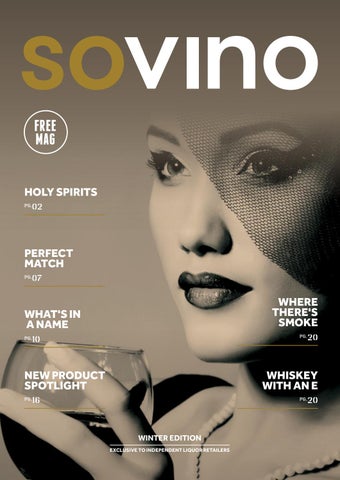
FREE MAG HOLY SPIRITS 02
PG.
PERFECT MATCH 07
PG.
WHERE THERE'S SMOKE
WHAT'S IN A NAME
PG.
10
PG.
NEW PRODUCT SPOTLIGHT
20
WHISKEY WITH AN E
16
PG.
PG.
WINTER EDITION EXCLUSIVE TO INDEPENDENT LIQUOR RETAILERS
20
DOUBLE BARREL FINISHED IN AGED WHISKY BARRELS
BONUS $20 VOUCHER WITH ANY 750mL JACOB’S CREEK PURCHASE
COLLECT UP TO $100 IN VOUCHERS TO REDEEM YOUR VOUCHER VISIT JACOBSCREEKSCANPAN.COM Aus. res. 18+ only. Ends 31/8/20 11:59pm AEST or while gifts last. Keep receipt/s. Voucher is only redeemable against a curated range of Scanpan products. T&Cs apply, see www.jacobscreekscanpan.com *Not all products available in all stores
Drink Jacob’s Creek Responsibly
SOVINO WINTER 2020
TABLE OF CONTENTS WINTER 2020
PRODUCT FEATURES
Top 5 Winter Warmers St-RĂŠmy. The world's favourite brandy. 06
04
WINTER FEATURE
02
HOLY SPIRITS The historical connection between religion and some of our favourite tipples.
Perfect match Robert Oatley Signature Series Shiraz Brands Laira Barrelman Cabernet Sauvignon Barossa Valley Estate Grenache Shiraz Mourvedre
07
What's in a name?
Pirate Life IPA
08
Penfolds Max's
12
Chivas Regal Extra
14
10
New Product Spotlight
PROSECCO DOC
Divici Prosecco DOC hails from the hills around Treviso in Northern Italy, the home of the Prosecco grape where the finest grapes are used to create this delicate wine.
16
Divici Prosecco has fine bright perlage and delicate creamy foam. Pale light yellow colour, delicate and complex bouquet with fruity notes that remind of peach, green apple with second notes of lemon. Floral notes of acacia and rose flowers combined with a light spicy Mediterranean bouquet. Fresh and soft on the palate with a well balanced acidity and sapidity. Harmonic with a long and permanent aftertaste. Organically grown and vegan friendly, with very fine bubbles and a cool bottle shape, this beauty is bound to crank up the music at the next get together.
It's not on
Ideal as an aperitif, Divici Prosecco is the perfect accompaniment to hors-d’oeuvres and delicate first courses. Also wonderful with sushi, fish and shellfish.
17
Perfect to drink now, or cellared for 2 years.
Where there's smoke
Advertising and editorial enquiries contact:
20
Whiskey with an e
21
Craig Hazelton T 1300 408 399 E Craig.Hazelton@ilr.net.au Proud distributors of Divici Prosecco Doc. Visit us at debortoli.com.au
Divici Prosecco
18
Unit 4, Building 7, 1 Dairy Road, Fyshwick ACT 2609 PO Box 318 Fyshwick ACT 2609
01
02
SOVINO WINTER 2020
FEATURE
HOLY SPIRITS Through history, it was largely thanks to religious orders that the ancient arts of brewing and wine-making were preserved in Europe. According to legend, Irish monks also invented whisky. Even today, some well-known tipples are made in monasteries.
THE SACRED VINE
There are only four monasteries in France still making wine. But for the thousand years leading up to the French Revolution, many of the country’s main winemaking areas were under the control of Benedictine and Cistercian monks. Wine was a medicine, a food, essential for religious observance and a handy source of income for the brothers. When Catholic missionaries ventured into the New World, they took their wine-making knowledge with them to California, Argentina and Chile. And to Australia. Sevenhill is the oldest vineyard in South Australia’s Clare Valley. It was founded, and is still owned, by the Jesuits and is highly regarded for its quality table wines.
TASTING STARS
Although his oft-quoted exclamation “Come quickly, I am tasting stars” is probably more legend than fact, the most famous of France’s wine-making monks was surely Dom Perignon. While he didn’t invent champagne, he is credited with refining the process and creating the first champagne cork. By introducing heavier ‘English glass’ bottles he also reduced the chance of dangerous explosions in the cellar, preserving that all-important fizz for happy drinkers.
SOVINO WINTER 2020
ABBEY BREWMASTERS
Trappist monks originally brewed beer to feed the community, in days when beer was probably a safer drink than water. As the order spread from France to other countries, the Trappists took their knowledge with them. It’s still a rule that, to use the name Trappist, the beer must be brewed in a monastery, by monks. Six of the world’s ten Trappist breweries are in Belgium, and it’s the Belgian beers that are most common in Australia. Among the best known names are Chimay and Rochefort.
BUCKS BEHAVING BADLY Strangely, a wine-based drink developed by the Benedictines in the 1890s as a medicine, and still made under license to Buckfast Abbey in Devon, has developed a particularly unsavoury reputation. Every 750ml bottle of Buckfast Tonic Wine contains as much caffeine as eight cans of cola and is around 15% alcohol by volume. No wonder it’s associated with what they call in Glasgow “ned” behaviour. According to one writer, “Buckie” has “almost supernatural powers of destruction” if you exceed the original recommended “Three small glasses a day, for good health and lively blood".
HERBAL MEDICINES
Many liqueurs were originally developed as medicines, with alcohol used to preserve the health-giving plants from the monastery herb garden. Strangely, the liqueur you’d expect to be made by monks – Benedictine – isn’t. The recipe was developed by an industrialist, who may have invented a story about its religious origins. He appropriated the Benedictine order’s motto, Deo Optimo Maximo or D.O.M., for his label to reinforce the myth. Another liqueur with a quasi-religious heritage is Frangelico, supposedly named for Fra’ Angelico, a hermit monk who inhabited the hills of Italy’s Piedmont in the 18th century.
Perhaps the best known of the liqueurs genuinely produced by monks is Green Chartreuse, made at the Carthusian Abbey of La Grande Chartreuse in the French Alps. The full recipe, which contains 130 plants and herbs, is reputedly known to only three monks. They also make Yellow Chartreuse, which gains it colour from saffron. Other French liqueurs that continue to be made in monasteries include Stellina (somewhat similar to Chartreuse) and the mandarin-flavoured Liqueur Lorina Jaune. Eau de Vie de Poire Williams, a type of brandy, is made by the Trappists at the Abbey of Notre Dame D’Aiguebelle in Provence.
03
04
SOVINO WINTER 2020
*Not all products available in all stores
SOVINO WINTER 2020
05
THE WORLD'S FAVOURITE Brandy St-Rémy is the World's favourite and most prestigious French brandy since 1886. Originally from the heart of the French Loire Valley, St-Rémy is internationally renowned for its distinctive aromatic identity and style. With 130 years of brand history, the recipe continues to be passed from generation to generation: a closely-guarded secret known only to our dedicated Master Blenders, well protected in its iconic black bottle. St-Rémy XO illustrates the legacy of our previous Master Blender, Martine Pain. She created a complex and rich brandy, her interpretation of French aromatic intensity while remaining true to the style of the House. In the past decades, St-Rémy XO became an obvious tradeup in the category. The satisfaction of a generous superior taste for the savvy, bon vivant ones.
St-Rémy XO is a brandy of character with complex aromas and a robust taste. It is recognised for its elegance, roundness and ability to linger on the palate, offering multiple layers of flavours that make it remarkable to critics and connoisseurs alike, St-Rémy XO can be savoured neat, on ice or in classic cocktails.
ST-RÉMY XO OLD-FASHIONED INGREDIENTS • • • • • •
60ml St-Rémy XO 1 Brown sugar cube 3 Dashes bitters Orange slice Orange zest Maraschino cherry
METHOD Into an old-fashioned glass, put the sugar cube and bitters. Muddle and pour in St-Rémy XO. Add ice cubes and stir. Press orange zest above the drink and garnish with orange slice and Maraschino cherry.
06
SOVINO WINTER 2020
TOP 5 WINTER WARMERS
TOP 5 WINTER WARMERS WIRRA WIRRA SCRUBBY RISE SHIRAZ
BARWANG HILLTOPS SHIRAZ Machine harvested in the cool nights of Hilltops with a small portion of whole bunch fruit to express the lifted aromatics Hilltops Shiraz. Carefully destemmed into open top fermenters, the fruit is cold soaked for two to three days before inoculation with selected yeasts.
Planted in 1972, the Scrubby Rise vineyards at Wirra Wirra sit on ancient rocks more than 100,000 years old. The fact that they are totally flat and contain no “scrub” or bush whatsoever was of more interest to the late Greg Trott, who gave them their dubious name.
Blood plums, red cherries, black spice, cloves and background toasty oak. An intense medium bodied palate of violets and blueberries with long, soft tannins and a creamy oak spice finish.
Ripe red fruits combine with plush tannins for an exceptionally approachable texture and a rich, mouthfilling quality.
HARDY’S CHAR NO.3 CABERNET SAUVIGNON
TOP 5 WINTER WARMERS
The release of Char No.3 Cabernet Sauvignon is a fine expression of archetypal McLaren Vale Cabernet Sauvignon, displaying fantastic varietal characters of cassis, chocolate and mocha. The fine tannins and oak spice provide complexity and length of palate with a smooth finish. The Bouquet is a vibrant varietal blackcurrant, ripe cassis and olive tapenade with lifted notes of milk chocolate, tobacco leaf and charred oak spice.
BARKING TREE SHIRAZ Barking Tree wines display the style and character of Margaret River Wines. This Shiraz has notes of pepper, soft cherry fruit and is fresh, vibrant and modern with a lovely spicy lift.
*Not all products available in all stores
ST AMAND CABERNET SAUVIGNON St Amand Coonawarra Cabernet Sauvignon is showing good colour with distinctive Cabernet characters of cassis, blackberry and plum with minty notes, this classic regional varietal is characterised by velvety and elegant tannins that deliver a lingering and smooth finish.
PERFECT MATCH
SOVINO WINTER 2020
Hearty
BEEF CASSEROLE
POT-ROASTED LAMB SHANKS
PERFECT MATCH
INGREDIENTS (SERVES 4) • 2 tablespoons oil • 750g chuck steak, cut into cubes • plain flour, for coating • 1 onion, chopped • 2 cloves garlic, finely chopped • 1 cup red wine (optional) • 2 tablespoons tomato paste • 400g can whole tomatoes, chopped • 500ml Beef Stock • 2 bay leaves • 2 carrots, sliced • 2 potatoes, cubed • pepper for seasoning • salt for seasoning
METHOD STEP 1 Preheat oven to 180°c. STEP 2 Heat oil in large pan, brown beef, add onion and garlic and stir for 3 minutes. STEP 3 Add wine, tomato paste, tomatoes, beef stock and bay leaves and bring to boil. STEP 4 Place in oven proof casserole dish and cover.
STEP 5 Cook in the oven 1 hour and 20 minutes. stir in remaining vegetables, salt and pepper and cover. STEP 6 Cook for a further 40 minutes and serve hot.
ROBERT OATLEY SIGNATURE SERIES SHIRAZ
BRANDS LAIRA BARRELMAN CABERNET SAUVIGNON
The Robert Oatley Signature Series draws on a remarkable portfolio of vineyards nurtured by the winemaking talent of Larry Cherubino showcasing Australia’s most successful wine styles and regions.
Cabernet Sauvignon harvest began late March with resulting wines exhibiting classic Cabernet aromas of blackcurrant and blackberry, intense colour and powerful fine grained tannin structures.
This wine is a soft, fleshytextured Shiraz displaying blueberries and spice, supple tannins and stylish French oak influence.
The palate is bursting with plush juicy dark berry fruits, supported by spicy nutty oak and a long smooth fine grained tannin finish.
BAROSSA VALLEY ESTATE GRENACHE SHIRAZ MOURVEDRE This wine captures the distinctive elegance, finesse and vibrant fruit flavours of the Barossa Valley, one of the world’s most celebrated wine regions. It’s fragrant violet with a burst of red berry fruits lingering softly on a velvety texture pairs perfectly with steak, charcuterie, duck, truffle, and goat’s cheese flavours.
*Not all products available in all stores
07
08
SOVINO WINTER 2020
*Not all products available in all stores
SOVINO WINTER 2020
2016 | IPA
INDIA PALE ALE CENTENNIAL, RIWAKA, SIMCOE
PALE, MUNICH, CRYSTAL
60 IBU | 6.8% Alc/Vol
Affectionately dubbed 'Baby Blue' by PL crew, this bold West Coast style IPA packs a punch. But don't worry, it's not all cuts and bruises...Pouring a vibrant copper orange, one is immediately drawn to the rim of the pint. Here, aromas of bright citrus and musk stick delight, while a closer look reveals notes of fresh curry leaf - thanks to the addition of Riwaka hops. The flavour itself is just as inviting, with pineapple lollies, kumquats and marmalade all building to an intense mid-palate burst of fruit. A hearty bitterness keeps things on track, while the addition of Crystal malt provides toffee sweetness and calm. The finish is clean, with a hint of candied citrus and pine. Superb.
09
10
SOVINO WINTER 2020
WHAT’S IN A NAME? We’re accustomed to identifying Australian wines according to the grape variety. But on the local wine list of yesteryear there was not a Shiraz or Semillon to be seen. Instead, you’d find Hock, Burgundy and Moselle. So what changed?
A 1987 advertisement from winemaker Angove’s proclaimed “Wine names – like hock – are forever changing. Yesterday’s hock is today’s Chablis.” Now yesterday’s Chablis is today’s unoaked Chardonnay. It seems that even up to the late 1980s we were still appropriating the wine names that properly belonged to European wine regions and slapping them on our local drops. That all changed for good in 1992, thanks to a new trade agreement with the European Union.
HERMITAGE
CLARET
Even Australia’s premier red wine could have been accused of false pretences. Penfold’s Grange was originally released as Grange Hermitage and kept that name until the 1989 vintage. In fact, Hermitage is a French Appellation d'Origine Contrôlée from a tiny section of the Rhone wine region south of Lyon. The reds from the area, based on Syrah (Shiraz), are long-aging and intense, no doubt what Max Schubert had in mind when he made the first Grange in 1951.
Claret is not a wine region, but a term coined (and still used) in Britain for red wines from the Bordeaux region in France. Bordeaux reds are generally blended and the main grapes are Cabernet Sauvignon, Cabernet Franc and Merlot. In Australia, “Claret” often referred to a blend of Cabernet and Shiraz, although Penfold’s famous St. Henri Claret was pure Shiraz.
BURGUNDY
Hock is not a region either, although the name is derived from a town in Germany called Hochheim. It’s another name that evolved in Britain. Originally referring to Riesling from the middle Rhine region, it was eventually applied to any white wine from Germany, much of which was of inferior quality. In Australia, hock could be any dry white blend. Quelltaler Hock, made by Buring and Sobel from Riesling grapes, was the first Australian wine to be served in the United Kingdom’s House of Commons.
The most famous wines produced in the Burgundy region of France are dry red wines made from Pinot Noir grapes and white wines made from Chardonnay grapes. For decades, Australian wine-makers blithely labelled their Pinot, Shiraz, or a blend of the two, as Burgundy. They also attached the label to sparkling Burgundy (usually sparkling Shiraz), infamous in the past for its supposed role in seduction. Perhaps the best known White Burgundy, from Houghton’s, wasn’t Chardonnay at all but a blend of grape varieties. It’s now known simply as “Dry White”.
HOCK
SOVINO WINTER 2020
CHABLIS
CHAMPAGNE
PROSECCO
The Chablis district lies in the north of the Burgundy region of France and its wines are produced from Chardonnay grapes. Often unoaked, the wines are known for their purity of aroma and taste and are often described as “steely” or “flinty”. Until the French began objecting, the name was adopted by white wine makers all over the world. But there was no guarantee that all those wines were made from Chardonnay.
Australian makers can no longer use the terms “Champagne” or “methode champenoise” for their bottle-fermented sparklings. Now it’s “traditional method”. There was no such restriction when the Victorian Champagne Company was formed in the early 1880s, employing a French wine-maker to create a local version of the famous fizz.
There’s an ongoing debate about this one. Prosecco was originally a grape variety, named after a town in north-eastern Italy. But in 2009 the Italians changed the name of the grape to Glera and registered Prosecco as a geographical indication, like Champagne. Australian producers are resisting, but negotiations for a new free trade agreement with the EU could force a name change.
MOSELLE
SHERRY, PORT AND TOKAY
Back in the 1970s, Australians drank a lot of Ben Ean Moselle. This wine, developed in the mid-1950s, had very little to do with the white wines mainly produced from the Müller-Thurgau and Riesling grapes in areas along Europe’s Moselle River. Ben Ean was originally a blend of Hunter Semillon and Verdelho and was semisweet, designed for the female drinker. Lindeman’s stopped making it in 2009.
Australian fortified wines can hold their own with any in the world. However, a change to the Wine Australia Corporation Act in 2011 decreed they could no longer use names the Europeans held to be region-specific. Sherry (now Apera in Australia) is an Anglicised version of Jerez, the sherryproducing region in Spain. Port (now Australian Tawny or Vintage Fortified) is a drink defined by its origin in northern Portugal. And Tokay (locallyTopaque) can only be used for wines from Hungary.
11
12
SOVINO WINTER 2020
WHY WA I T ? EXPERIENCE THE EXTRAORDINARY TODAY.
NUMBERS CAN BE EXTRAORDINARY
SOVINO WINTER 2020
*Not all products available in all stores
13
*Not all products available in all stores
16
SOVINO WINTER 2020
LATEST & GREATEST
NEW PRODUCT SPOTLIGHT
JAMES SQUIRE BROKEN BUNDABERG REGENERATION RUM SHACKLES LAGER James Squire Broken Shackles is a refreshing new lager that has been carefully crafted to deliver the perfect balance between flavour and refreshment. Broken Shackles is appealing to the increasing number of seasoned craft drinkers looking for quality sessionable options, as well as beer drinkers that are just are just looking to dip their toes into the big world of craft beer for the first time.
Australia has endured much devastation during the recent bushfire season; including the loss of precious bushland and more than a billion animals lost. To raise money and continued awareness, Bundaberg Rum have created a limited-edition Regeneration Rum. 100% of profit goes to WWF’s Australian Wildlife & Nature Recovery Fund, they aim to reach a goal of $1M.
KRAKEN BLACK SPICED RUM WITH COLA & DRY Well-known rum brand The Kraken have announced for the first time they are now selling pre-mixed bottles intended to cater to the Australian drinker who wants a bar-quality drink from the comfort of their own home. Kraken are releasing a cola mix and a dry ginger ale mix. Both flavours marry seamlessly with the subtle spice of Kraken Black Spiced Rum. This is the taste you've been hunting for.
*Not all products available in all stores
SOVINO WINTER 2020
IT’S NOT ON AT THE TIME OF WRITING, EVENTS (FOOD, WINE AND OTHERWISE) ARE JUST NOT HAPPENING. SO, WHILE YOU’RE STAYING IN, WHY NOT CATCH UP WITH OUR PICK OF SOME TOP WINE FILMS AND STREAMING VIDEOS. START WITH A YOUTUBE SEARCH ON THESE. ALL OF THEM HAVE TRAILERS THERE. BAROLO BOYS
2014 (Amazon Prime, iTunes, Google Play) In ‘oldies but goodies’ category, this didn’t get a TV or cinema release here. It traces the group of Nebbiolo-loving producers from Italy’s Langhe region who indelibly changed the world of wine in just thirty years.
A YEAR IN BURGUNDY 2013 (Amazon Prime, iTunes, SommTV) Lovely to look at, this covers a full year in Burgundy, partly a journalistic documentary and part contemplative art film. The similar ‘Year in Champagne’ (by the same filmmakers) is brisker (bubblier?) and has more business background. Both recommended.
BLOOD INTO WINE 2010 (Amazon Prime, iTunes) True life plot line: multi-platinum award winning heavy metal musician buys a winery that helped revive the near-ghost town of Jerome, Arizona, and is now one of the stars in Arizona’s northern wine region. (We bet you didn’t know it had one.) Watch the YouTube trailer, turn sound down. Or up.
RED OBSESSION 2013 (Amazon Prime, YouTube, Google Play) When they sit back down to dinner, will China still want our premium red wines? This doco is still relevant, and raises concern for rip-offs of our best wines. Fake Grange?
SOUR GRAPES 2016 (Netflix, Amazon Prime) In a similar but darker vein, this is a crime documentary about wine buying and collecting, and the rip-offs by Rudy Kurniawana rich Indonesian wine collector. He got ten years jail for it.
WINE COUNTRY 2019 (Netflix) Something lighter? You’ve vowed never to watch ‘Sideways’ again, but if you liked director Amy Poehler’s ‘Bridesmaids’, try her latest. The strong female cast are funny, witty and with a sharp eye for wine wank.
SOMM.TV As a more curated selection, SOMM.TV looked promising when we saw it launched, hot on the success of the SOMM sommelier movies (SOMM 1, 2 and 3). It’s still taking time to gather enough good programs to make a yearly subscription worthwhile, but there’s a monthly option, or individual programs via iTunes, AppleTV, androidtv, Amazon. Start at the website: sommtv.com
17
18
SOVINO WINTER 2020
*Not all products available in all stores
SOVINO WINTER 2020
PROSECCO DOC
Divici Prosecco DOC hails from the hills around Treviso in Northern Italy, the home of the Prosecco grape where the finest grapes are used to create this delicate wine. Divici Prosecco has fine bright perlage and delicate creamy foam. Pale light yellow colour, delicate and complex bouquet with fruity notes that remind of peach, green apple with second notes of lemon. Floral notes of acacia and rose flowers combined with a light spicy Mediterranean bouquet. Fresh and soft on the palate with a well balanced acidity and sapidity. Harmonic with a long and permanent aftertaste. Organically grown and vegan friendly, with very fine bubbles and a cool bottle shape, this beauty is bound to crank up the music at the next get together. Ideal as an aperitif, Divici Prosecco is the perfect accompaniment to hors-d’oeuvres and delicate first courses. Also wonderful with sushi, fish and shellfish. Perfect to drink now, or cellared for 2 years.
Proud distributors of Divici Prosecco Doc. Visit us at debortoli.com.au
19
20
SOVINO WINTER 2020
WHERE THERE’S SMOKE First there was drought, then heat, then fires. Many wine makers lost their vineyards, their buildings, their equipment and their wine. Then the smoke from those fires had a more far-reaching effect. So what has that meant for the 2020 vintage? VINEYARDS DESTROYED Perhaps the worst toll was in the Adelaide Hills, where a third of wine production in the area was wiped out in the Cudlee Creek bushfire just before Christmas. Around 1,100 hectares of vines were destroyed, among them some of the region’s oldest Pinot Noir vines. Other regions to suffer losses included Tumbarumba, the Southern Highlands and the South Coast in New South Wales, Queensland’s granite belt and Gippsland in Victoria. However Wine Australia pointed out that less that one per cent of Australia’s total area under vine sustained damage. Areas such as Barossa Valley, McLaren Vale, Clare Valley, Coonawarra, Margaret River and Yarra Valley, as well as Tasmania, remained unaffected. In fact, Margaret River winemakers were tipping the 2020 vintage to be among the best ever, particularly for chardonnay and cabernet.
SMOKE TAINT Sadly, even vineyards not threatened by the fires themselves suffered significant after-effects from the smoke they generated. Smoke taint occurs when grapes absorb smoke compounds during “veraison” – the period when grapes are ripening, softening and changing colour. Drinking contaminated wine has been compared to “licking an ashtray”, with other equally unappealing aromas described as medicinal, sticking plaster, chemical or “wet cigar”. Red wines, which have longer contact with the skins, are more affected than whites. In 2020, among the worst affected areas were the Hunter Valley, the Canberra Region, southern New South Wales and the King Valley. As a result, many winemakers including big names like Clonakilla, Tyrrell’s and Mount Pleasant decided to abandon the 2020 vintage altogether.
INNOVATIVE APPROACHES Not everyone with smoke problems is turning their 2020 grapes into fertiliser or stock feed. Some are trying to rescue a portion of their crop by hand harvesting grapes for white wine, chilling and wholebunch pressing to quickly remove the skins. Others are experimenting with distilling to produce smoky brandy, comparing it to peated whisky or smoke-infused rum. And one craft brewer is even using smoke-affected grapes to make beer. One possible silver lining for wine lovers is that some makers will be re-releasing special wines from their back catalogue to make up the short fall from this year’s vintage. And while the grape crush may have been down as much as 1015 per cent this year, there will still by plenty of 2020 vintage wines to enjoy down the track.
SOVINO WINTER 2020
WHISKEY WITH AN E While the Scots spell it whisky, Americans have adopted the Irish spelling. But the extra letter isn’t the only difference. Call it bourbon, Tennessee Whiskey or rye, America’s native spirit has its own claims to fame. Which grain?
Two centuries of history
Scotch is made from barley. But bourbon and Tennessee whiskey must, by law, be made from at least 51 per cent corn. The rest of what’s called the “mash bill” is a mix of rye, barley and wheat. Rye whiskey, unsurprisingly, is made with at least 51 per cent rye, plus corn and barley.
No-one really knows who invented bourbon, but the first commercial distillery in Kentucky opened in 1783, while the first advertisement for bourbon was printed in a Paris, Kentucky, newspaper in 1821. It was originally labelled Bourbon County Whiskey or Old Bourbon County Whiskey, with the official label of just bourbon being officially adopted in 1840.
The French connection Bourbon takes its name from Bourbon County in Kentucky. Which is, in turn, named after the family that ruled France from 1589 until 1792. That’s because the French once laid claim to a whole swathe of what is now the USA, from the Gulf of Mexico to the Canadian border. They sold the land to the United States in 1803 for $15 million.
Great barrels of fire The standards for bourbon require that it’s aged in new, charred oak barrels. Yes, they actually set the inside of the barrels on fire before using them. The char allows the flavours of the wood – notes of vanilla, oak, caramel and spice – to be absorbed by the liquor. To be defined as “straight bourbon” it has to be aged for at least two years, and if it has been in the barrel for less than four years it must have an age statement on the label.
Jim or Jack? Jim Beam is probably the best-known bourbon. But another well-known brand, Jack Daniel’s, isn’t bourbon at all. It’s Tennessee whiskey. What’s the difference? Tennessee Whisky must be filtered through charcoal, in what’s known as the Lincoln County Process. Oh, and it has to be made in Tennessee. Bourbon can be made anywhere in the USA, but around 95 per cent of it comes from Kentucky.
Some like it hot It’s winter after all. So why not make a hot toddy by adding honey, a good slug of bourbon, a little lemon juice and a lemon slice to a cup of black tea? Fancy a cocktail? Classics include the Mint Julep, the Old Fashioned and the Manhattan (although the Manhattan should properly be made with rye whiskey). Or you could, like most of us, just keep it simple with a Bourbon and Coke.
21
*Not all products available in all stores