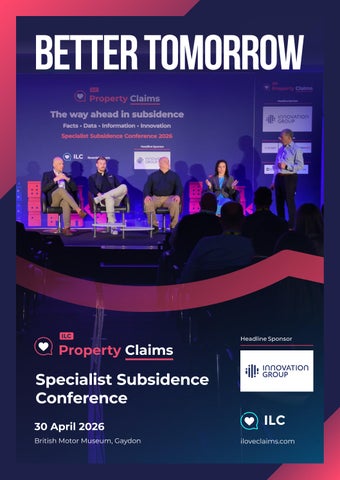
Better Tomorrow
Headline Sponsor
Specialist Subsidence Conference 30 April 2026 British Motor Museum, Gaydon
ILC iloveclaims.com
BETTER TOMORROW
SPECIALIST SUBSIDENCE CONFERENCE 2026
Contents 6 A shared commitment to progress Alan Soutar
10 Managing the surge Matt Clarke, Suzanne Reid and Richard Rollit
16 Data driving decisions Will Brewster, Paul Duddle, William Quibell and Angelina Varchione
20 Understanding the pressures Marianne Cowie, Gary De Groot and Laura Lazarus
24 Innovation through collaboration Russell Crewe, Otso Lahtinen, James Hann and Fraser Galloway
30 SHOWCASE
Integrated claims in action
Specialist Subsidence Conference feedback
Michael Hearty
32 SHOWCASE
Disruption-free subsidence solutions Lauren Hicks and Mateusz Szulca
34 SHOWCASE
Visibility in subsidence solutions Kamil Bednarek
36 SHOWCASE
Smarter drainage solutions Tony Kilgannon, Ben Middleton and Sne Patel
38 SHOWCASE
Collaboration shaping claims Peter Luby
2
42 43 The ILC App Your events, insights and community – all in one place.
44 MGA Claims Conference 2026
45 ILC Property Claims Event 2026
Headline Sponsor
The way ahead in subsidence Specialist Subsidence Conference
Gold Sponsors
Silver Sponsors
ILC DISCLAIMER
COPYRIGHT
Contributors
All rights reserved. No part of the material contained within this publication may be reproduced or copied in any form or by any means without written permission from ILC.
The views and opinions expressed within Better Tomorrow are reported from live events and are those of the individual contributor/s. They do not necessarily reflect the official policy or position of the contributor’s employer, organisation, committee or other group or individual. ILC While every effort has been made to ensure the accuracy of information, ILC will not accept responsibility for errors or omissions or for consequences arising from reliance on information published. The opinions expressed in Better Tomorrow are not necessarily the opinions of, or endorsed by ILC unless otherwise stated.
3
ILC Insurer Partners
As an ILC Insurer Partner you will be among some truly great company – helping to shape the claims sector for a 'better tomorrow'. Together, ILC Insurer Partners help drive the industry forward through insight, collaboration and innovation.
4
Better Tomorrow
Headline Sponsor
Specialist Subsidence Conference 30 April 2026 British Motor Museum, Gaydon
ILC iloveclaims.com
5
BETTER TOMORROW
SPECIALIST SUBSIDENCE CONFERENCE 2026
A shared commitment to progress Alan Soutar Chair Property Claims ILC
ILC
Welcome to the Better Tomorrow post-event publication for the fifth ILC Specialist Subsidence Conference. Returning to the British Motor Museum in Gaydon, this year’s event brought together around 300 professionals from across the subsidence claims sector for a day focused on collaboration, challenge and progress.
6
“Subsidence claims professionals continue to deliver an important service for customers during some of the most uncertain and disruptive moments they can experience as homeowners. ”
From insurers and loss adjusters to engineers, contractors and technology specialists, the conference once again reflected the strength and breadth of expertise that exists across the market. For me personally, the day reinforced something that has become increasingly clear over recent years. Subsidence claims professionals continue to deliver an important service for customers during some of the most uncertain and disruptive moments they can experience as homeowners. While the sector continues to face significant operational and environmental pressures, there remains a shared commitment to improving outcomes and driving meaningful change across the customer journey.
A SHARED COMMITMENT TO PROGRESS
That collective ambition was evident throughout every discussion, panel session and conversation across the exhibition floor.
Clear sense of progress This was the fifth conference dedicated solely to subsidence claims and, while some of the sector’s long-standing challenges remain familiar, there was also a clear sense that progress is being made. The industry has now experienced three major surge events within seven years, creating sustained pressure across supply chains, operational models and customer service expectations. Against that backdrop, this year’s conference provided an opportunity not only to reflect on where the market currently stands, but also to consider how the industry continues to evolve. Throughout the day, speakers explored how the sector has changed between the 2018 and 2025 surge periods, examining the operational lessons learned and the opportunities now emerging through innovation, collaboration and improved processes. Importantly, the conversations remained grounded in practical realities rather than theory alone.
Innovation As discussed during the conference, innovation within subsidence claims is not always about largescale technological disruption. In many cases, meaningful improvement comes from smaller operational changes, better communication,
smarter processes and a willingness to challenge established ways of working. Equally, the increasing role of digital solutions, data insight and artificial intelligence is beginning to influence how the market approaches long-term claims management and customer engagement. One of the strongest themes throughout the day was the importance of evidence-led progress. There is growing recognition that the adoption of innovation requires confidence, measurable outcomes and collaboration across the entire claims ecosystem. That was reflected in several sessions, where panellists openly discussed both the opportunities and the barriers associated with implementing change at scale.
“One of the strongest themes throughout the day was the importance of evidence-led progress.”
Customer is key Customer outcomes also remained central to discussions. With evolving regulatory expectations continuing to shape claims handling practices, speakers explored how the sector can continue to improve transparency, communication and overall customer experience during often lengthy and complex subsidence claims. Importantly, the conference focused on bringing together different perspectives to help shape solutions. Across the audience there was strong engagement, including through interactive voting sessions which encouraged delegates to share opinions before and after key panel discussions. This provided valuable insight into how views shifted throughout the day and demonstrated the willingness of attendees to openly challenge ideas, exchange experiences and learn from one another. That openness remains one of the greatest strengths of the subsidence claims community.
7
BETTER TOMORROW
SPECIALIST SUBSIDENCE CONFERENCE 2026
The exhibition hall also played a significant role in supporting collaboration throughout the conference. Consistent engagement across exhibitor stands created valuable opportunities for delegates to explore new products, services and approaches while strengthening relationships across the supply chain.
Ongoing support A sincere thank you must go to all sponsors, exhibitors and partners who supported this year’s event. Innovation Group returned as headline sponsor and once again provided significant support in helping deliver the conference. Thanks also go to Gold sponsors Auger, Geobear and GEOSEC Ground Engineering, alongside Silver sponsors Helifix, Holemasters and Shire Structures Ltd. Gratitude is also extended to exhibitors including ASUC, Burke Bros Moving Group, CET UK, City Construction (Longcroft) Ltd, Crawford & Company, Goodyer Ltd, Mainmark Ground Engineering (UK) Ltd and Westone Housing Ltd, all of whom contributed to a highly engaging exhibition space and helped facilitate valuable conversations throughout the day. The ongoing support of ILC’s Insurer Partners, Corporate Partners and Industry Body Partners also continues to play a critical role in the success of the conference and the wider ILC property community. Bringing together such a broad cross-section of expertise remains essential if the sector is to continue progressing collectively. Special thanks must also go to the speakers, panellists and moderators who contributed their insight and experience across the day’s sessions. Their willingness to openly share perspectives, challenge thinking and engage in honest discussion is what continues to make the conference such a valuable forum for the market.
8
“Perhaps most importantly, there remains a shared understanding that progress can only happen collectively.”
The support of the ILC Property Advisory Board also deserves recognition. The Advisory Board continues to provide important guidance and industry insight which helps shape both the conference agenda and wider conversations taking place across the property claims sector.
Looking ahead As the sector looks ahead, there is no doubt that challenges remain. Climate pressures, customer expectations, operational capacity and regulatory developments will continue to influence how subsidence claims are managed in the years ahead. However, what this year’s conference demonstrated very clearly is that there is also strong momentum across the industry to continue improving. Perhaps most importantly, there remains a shared understanding that progress can only happen collectively. That spirit of collaboration was visible throughout the conference and remains one of the defining characteristics of the market. The conversations will continue long after the event itself, and it is those ongoing discussions, partnerships and shared ambitions that will help shape the future of subsidence claims and deliver a better tomorrow for the industry and its customers alike.
A SHARED COMMITMENT TO PROGRESS
BETTER TOMORROW 9
BETTER TOMORROW
SPECIALIST SUBSIDENCE CONFERENCE 2026
Managing the surge The opening session, focused on the overall position of the market, set the tone for the wider conference by examining how the market has evolved through successive periods of increased subsidence activity and what lessons have been learned since the 2018 surge event.
Matt Clarke Managing Director Westone Housing Ltd
Suzanne Reid Home Indemnity Lead esure
Richard Rollit Technical Director Innovation Group UK
Chaired by Alan Soutar, Chairman – Property at ILC, the panel brought together Richard Rollit, Technical Director at Innovation Group UK; Suzanne Reid, Home Indemnity Lead at esure; and Matt Clarke, Managing Director at Westone Housing Ltd. Opening the discussion, Alan reflected on the continued significance of surge events within the sector. “We’re now looking at three surges in seven years [2018, 2022 and 2025],” he said. “What’s the overall picture currently? What have we learned or changed, and what have been the gains and the challenges?” An interactive audience poll at the beginning of the session asked delegates how much better the market was coping with the 2025 surge event compared to 2018. The initial score returned 6.8 out of 10, reflecting cautious optimism across the room and setting the tone for a discussion centred on progress, but also realism.
Learning from repeated surges Much of the early conversation focused on how the market has adapted following successive surge events in 2018, 2022 and 2025.
“We’ve learned as we go through each surge and I think we’ve improved.” Richard Rollit, Innovation Group UK
10
Richard Rollit explained that while the industry continues to face significant operational and financial pressure, there are clear signs that organisations across the sector are becoming more resilient. “There were three surges in seven years in essence,” he said. “We’ve learned as we go through each surge and I think we’ve improved in terms of how we’ve dealt with each of those surge events.”
MANAGING THE SURGE
At the same time, Richard warned that subsidence claims continue to become increasingly expensive compared to other perils. “Over the last five years, subsidence costs have outstripped the cost of all other perils,” he explained. “Subsidence is about 25-30% higher.”
“The 2025 surge felt a bit more controlled and planned.” Matt Clarke, Westone Housing Ltd
Part of that increase, he noted, is linked to the growing complexity surrounding tree-related claims and changing legal and environmental pressures. “Case law has changed and that means there’s much less pressure on local authorities to remove trees,” Richard said. “Those claims are now the most expensive group of claims that we’ve got.”
“The big part for us has really been good communication with suppliers,” Matt explained. “That allows us to manage customer expectations and help the supplier if or where they might not be coping.”
He also acknowledged the growing public sensitivity around environmental issues and tree management. “The wider public has understood climate change,” he said. “Increasingly there’s concern when we’re looking to remove trees.”
Innovation within repair and mitigation methods is also beginning to improve operational efficiency. “We’re finding a lot more resin injection, root barriers and more innovative ways to conclude claims quicker,” he said.
That tension between environmental responsibility, customer outcomes and technical mitigation remained a recurring theme throughout the wider conference.
However, despite those improvements, Matt acknowledged that legacy claims from previous surge events continue to place pressure on operational capacity.
Better planning and faster response Matt Clarke reflected on how operational handling during the 2025 surge differed from previous events and why the latest period of increased activity felt more manageable than 2018. “The 2025 surge felt a bit more controlled and planned,” he said. “I think we had much better communication throughout that.” He explained that one of the biggest improvements has been the speed at which monitoring and investigations are now being implemented. “If you miss that initial window, you can miss a little bit of the winter recovery,” Matt said. The panel also discussed how collaboration between insurers, contractors and suppliers has become increasingly important during periods of high claim volume.
“We’ve still got work in progress from some 2018 claims and some 2022 claims,” he said. “That’s going to compound.” The importance of effective triage and routing was another key area of discussion, particularly during periods where technical resource becomes stretched. “We’ve probably been a bit more selective, being smarter around triage,” Matt explained. “It’s incumbent on us to try and filter out the nonessential stuff.”
The customer experience Alongside operational pressures, customer communication and reassurance remained central to the discussion throughout the session. Suzanne Reid highlighted the emotional impact lengthy subsidence claims can have on policyholders, particularly where movement reoccurs after mitigation work has already taken place.
11
BETTER TOMORROW
SPECIALIST SUBSIDENCE CONFERENCE 2026
“It’s probably really disappointing as a customer to get your mitigation complete, think you’re about to move to repairs and then find out there’s further cracking,” she said. “It feels like you’re back at phase one again.” For Suzanne, clear communication and ongoing reassurance remain critical throughout the lifecycle of a claim. “There’s a lot of hand-holding communication with the customer,” she explained. “A lot of reassurance.” The panel also discussed the reality that, in some cases, delays are unavoidable if the correct technical outcome is to be achieved.
The discussion also explored how the market is managing resource pressures following repeated surge activity. Richard noted that while repeated surge events create operational strain, shorter gaps between surges have also allowed organisations to retain technical expertise more effectively than in previous decades. “In 2018, it had been 12 years since the previous surge,” he said. “You haven’t got the people or the resources to deal with that.”
“Sometimes waiting until we have a clear cause of damage is the best thing to do. Gathering the right evidence and good engineering analysis is how you get the right solution.”
By contrast, more frequent activity has allowed organisations to maintain staffing levels and operational continuity.
At the same time, she acknowledged the frustration many customers experience during long-running claims.
“You haven’t had those really quiet periods where you’ve had to reduce staff levels,” Richard explained. “Broadly, you’ve been able to retain staffing levels because they’ve been able to work on the work in progress.”
“Some customers may want their excess back if works were already booked but there is further cracking ,” Suzanne explained. “There’s no point in us holding onto it unless we have a start date booked. It’s their money.” Importantly, she stressed that insurers and suppliers must balance speed with ensuring repairs and mitigation are sustainable longterm. “It’s not cost effective for insurers to pay for repairs twice over, where the cause of damage has been misdiagnosed,” she said.
“Sometimes waiting until we have a clear cause of damage is the best thing to do. Gathering the right evidence and good engineering analysis is how you get the right solution.” Suzanne Reid, esure
12
Resource, resilience and future skills
He added: “Having more frequent surges is easier to cope with than random huge spikes.” Matt agreed that the industry is now significantly better prepared operationally than it was during the 2018 event. “2018 took everybody by surprise,” he said. “I don’t think anybody had robust surge plans in place.”
MANAGING THE SURGE
However, both panellists acknowledged that the sector could still struggle if faced with an even larger or more prolonged surge event in future. “I don’t think anybody’s really got an answer for how you cope with those peaks and troughs if they’re hugely apart,” Richard admitted. The session concluded with discussion around training, technical capability and the importance of continuing to invest in skills across the subsidence market. Suzanne stressed that attracting and developing talent remains essential if the sector is to continue improving. “We need to keep attracting people into the market,” she said. “We need to spend a lot of time upskilling and training because at the moment the capacity is severely limited.”
She also highlighted the importance of improving technical consistency and reducing delays caused by incomplete reporting or unclear information. “There are still reports where that technical information is lacking and you have to go back and ask a lot of questions,” Suzanne explained. “That makes the process elongated.” The wider conversation reinforced one of the key themes running throughout the conference - that innovation within subsidence claims is not solely about technology, but also about communication, collaboration, operational improvement and better decision-making across the supply chain. Summarising the discussion, Alan acknowledged that while pressures across the sector continue to evolve, there are clear signs that the industry is moving in the right direction.
BETTER TOMORROW 13
14
15
BETTER TOMORROW
SPECIALIST SUBSIDENCE CONFERENCE 2026
Data driving decisions During the event attention turned to one of the sector’s most rapidly evolving areas - the growing role of data, artificial intelligence and satellite technology in shaping subsidence claims handling.
Will Brewster Commercial Director Auger
Paul Duddle Chairman The Subsidence Forum Director of Operations Catalyst Services
William Quibell Head of Claims - Home Ageas
Bringing together insurers, contractors, engineers and technology specialists, the session explored how data is already influencing operational performance across the claims journey, while also examining the opportunities and risks that come with increasingly sophisticated technology. Chaired by Alan Soutar, Chairman – Property at ILC, the panel featured William Quibell, Head of Home Claims at Ageas; Paul Duddle, Chairman of The Subsidence Forum and Director of Operations at Catalyst Services; Will Brewster, Commercial Director at Auger; and Angelina Varchione, UK Commercial Director at GEOSEC Ground Engineering Ltd. Opening the session, Alan reflected on how discussions around surge response and triage naturally led into the question of data and decision-making. Importantly, however, he stressed that innovation is not always about highly complex systems – it can sometimes be simple detail. An audience poll asked delegates how effectively the industry currently uses relevant data to improve claims handling and decision-making. The opening score of 5.2 out of 10 suggested cautious optimism, but also recognition that significant progress still needs to be made.
Angelina Varchione UK Commercial Director GEOSEC Ground Engineering Ltd
“What happens on that first day is critical to setting the claim up effectively.” William Quibell, Ageas
16
DATA DRIVING DECISIONS
Data and expertise For William Quibell, the key issue is not whether data exists, but how effectively it is interpreted and applied within the claims process. “The availability of engineered data has improved significantly,” he said. “Historical data is available in a format that tells us stories that we didn’t previously have even a few years ago.” At the same time, he cautioned against moving too quickly towards automation within such a technically sensitive area of claims handling. “In subsidence, it’s important that engineering decision-making remains central,” he said. He explained that while advanced analytics and large language models are increasingly capable of identifying patterns and trends, claims expertise remains critical in understanding how that information should be used operationally. “Translating data outputs into practical claims insight remains a key challenge,” William explained. “Trying to articulate what you want the data to show and the patterns that it’s showing is the challenge.” Much of the discussion focused on the front end of the claims journey and the importance of early triage decisions, particularly during surge periods where technical resource becomes stretched across the market. “What happens on that first day is critical to setting the claim up effectively,” William said. “If it isn’t
directed to the right expertise early, there’s a higher risk the claim may not follow the optimal path in the early stages.” That challenge around routing and resource allocation was echoed by Will Brewster, who shared operational insight from Auger’s experience during the 2025 surge period. Comparing claims activity between the 2022 and 2025 surge events, Will explained that site investigation instructions had arrived significantly faster this time around. “We received 75% of all of our volume five weeks quicker than we did in 2022,” he said. While this initially created pressure operationally, it also reflected improvements elsewhere within the claims process. “I assume insurers and adjusters were processing those and getting instructions to site investigation suppliers faster,” he explained. Importantly, Will noted that despite the earlier spike in activity, overall work in progress was now significantly healthier than during the previous surge. “Our work in progress is about 20% better at the end of February than it was in 2022,” he said.
Improving the journey The conversation repeatedly returned to the idea that innovation within subsidence claims does not always need to be complex. In some cases, relatively
“It’s all about sharing that data and understanding what the data means.” Paul Duddle, The Subsidence Forum small process changes can have a meaningful impact on customer outcomes and operational efficiency. Will highlighted one example where Auger integrated arborist inspections into site investigation visits rather than treating them as separate stages within the process. “We saw an opportunity that we could incorporate the arborist work within our site investigation,” he said. By combining drainage, arborist and site investigation activity into a single workflow, the company was able to significantly reduce delays within the customer journey. “We’ve been able to cut out about 40 working days from the claim journey,” Will explained. Alan noted that improvements like this demonstrate how collaboration across the supply chain can often deliver practical results faster than waiting for larger technological change. “That’s not rocket science,” he said. “That’s just a few people getting together and deciding how they can dovetail their parts of the process to make an improvement.”
17
BETTER TOMORROW
SPECIALIST SUBSIDENCE CONFERENCE 2026
Will also suggested that the industry should begin testing predictive models and artificial intelligence within lower-risk claims environments before broader implementation. “Why can’t we start to pilot these predictive models on the really simple cases?” he asked. “If we never start, then we’ll never get there.”
Skills and training Training and technical understanding also emerged as major themes throughout the discussion. Paul Duddle stressed that while the industry is now collecting more data than ever before, success depends on ensuring people across the sector understand how to interpret and use it effectively. “The data’s there,” he said. “It’s how we’re using it.” Paul explained that the increasing sophistication of claims systems creates opportunities to identify bottlenecks, improve processes and support better operational decisions - but only if the data itself is accurate and understood properly. “It’s all about sharing that data and understanding what the data means,” he said. He also emphasised the importance of having experienced people involved at the earliest stages of the claims journey.
18
“We’ve been able to cut out about 40 working days from the claim journey.” Will Brewster, Auger
“The best people need to be at the front,” Paul explained. “If you get the right people at the front end that can direct it to the right places, you end up with less issue.”
However, she warned that broad datasets alone are rarely enough within subsidence claims due to the highly variable nature of ground conditions.
Alongside improving current processes, Paul highlighted the importance of attracting and developing new talent within the subsidence sector.
“We know that ground is very heterogeneous,” Angelina explained. “What might be happening over here might be completely different to that corner.”
“We’re all getting older,” he said. “We need to bring new people through the door and embrace the new things coming down the line.”
Ground-level insight As the discussion moved towards the role of satellite technology and geotechnical analysis, Angelina Varchione explained how GEOSEC combines large-scale environmental data with site-specific investigation to support technical decisionmaking. “Data is great if you take on a large scale something like satellite data to look at the broad picture,” she said.
She outlined how GEOSEC uses site-specific ground modelling to create detailed understanding of individual properties and localised movement. “We put electrodes around the whole site so we can have an individual ground model,” she said. For Angelina, the objective is not simply collecting more information, but ensuring decisions are technically justified, proportionate and clearly evidenced. “We want to make sure what you do next is done with confidence,” she explained. She also highlighted the risk of overwhelming claims teams and customers with excessive technical reporting.
DATA DRIVING DECISIONS
“If you have an array of data, it can almost be information overload,” she said. “You need the key facts clearly and concisely relayed.”
Balancing innovation Artificial intelligence became one of the most debated topics of the session, particularly around balancing innovation with regulation and customer protection. William Quibell shared a personal example involving a declined claim where the outcome was later reviewed through an AI-driven process. “It appeared the decision may have been influenced by an automated process,” he said.
Angelina Varchione, GEOSEC
“There can be a meaningful customer impact where decisions are not right,” he said. At the same time, Will Brewster suggested that the industry cannot afford to avoid innovation entirely. “Someone has to take the risk to trial it, pilot it and continue to make it better,” he said. The discussion ultimately reflected an industry attempting to balance innovation with caution - recognising both the potential value of dataled decision-making and the importance of maintaining technical oversight, customer trust and regulatory compliance.
BETTER TOMORROW
“We want to make sure what you do next is done with confidence.”
Although the issue was ultimately resolved, William explained that examples like this reinforce why insurers remain cautious about introducing AI too aggressively into complex claims environments.
19
BETTER TOMORROW
SPECIALIST SUBSIDENCE CONFERENCE 2026
Understanding the pressures The session titled ‘A view from the top’ brought together senior insurer and supply chain leaders to explore the operational, regulatory and environmental challenges facing the sector - and how the industry can continue improving customer outcomes in an increasingly complex landscape.
Marianne Cowie Head of Customer - UK Claims Zurich
Gary De Groot Growth Director Innovation Group UK
Chaired by Alan Soutar, Chairman – Property at ILC, the panel featured Laura Lazarus, Director of Home & Lifestyle Claims at Aviva; Marianne Cowie, Head of Customer – UK Claims at Zurich; and Gary De Groot, Growth Director at Innovation Group UK. Opening the discussion, Alan explained the importance of understanding the pressures insurers face if the wider supply chain is to effectively support progress across the market. “It is key to understand the high-level issues for insurers” he asked. “Because if you do, then as a supplier, you have a real chance of progressive partnership.”
A difficult peril Laura Lazarus described subsidence claims as a uniquely challenging area for insurers due to their complexity, cost and duration.
Laura Lazarus Director of Home & Lifestyle Claims Aviva
“Subsidence is a huge risk to UK properties, with as many as 1.4 million more properties being at risk according to our latest research,” she said. “Unlike floods or storms, the effects of
“If we keep talking about subsidence claims being really difficult all of the time, we might miss the opportunities to spot where we could be doing things better.” Laura Lazarus, Aviva
20
UNDERSTANDING THE PRESSURES
subsidence are often subtle and slow-moving, and the damage it causes can be huge – resulting in often lengthy and complex claims.” Laura explained that the combination of long claim lifecycles, uncertainty and customer dissatisfaction creates particular operational pressure. “Subsidence claims require a careful balance of the environmental, financial, legal and emotional impacts of a claim with the needs of our customers and the wider community. These claims can take longer to settle and the longer a claim continues, the more difficult it can be to estimate how much the total value will be. This puts pressure on our suppliers to make sure that they have the right reserves in place.” Customer experience also remains a significant concern. Laura said, “Across the market we tend to see poorer customer experiences on subsidence claims, which we believe is largely down to communication – particularly as some properties will need to be monitored over a number of years. In a world where communication is at our fingertips, customers are understandably wanting regular updates from their insurer.” However, despite acknowledging the challenges, she warned against allowing the industry to become overly focused on complexity at the expense of innovation. “My worry is that if we keep talking about subsidence claims being really difficult all of the time, we might miss the opportunities
to spot where we could be doing things better.” she said. Gary De Groot agreed that subsidence presents insurers with a particularly difficult operational profile. “If you were to create a peril, subsidence would have all the hallmarks of a bad peril that you would want,” he said. Gary pointed to long claim durations, seasonal volatility, surge events and reserving uncertainty as key factors driving insurer concern. “It’s disproportionately noisy and disproportionately costly for the volumes that you get,” he explained. At the same time, he acknowledged that the market has made visible progress through the successive surge events experienced since 2018. “Insurers and suppliers have got better,” Gary said. “There’s no doubt.”
“It’s not just the technical practicalities. It’s bringing it back to those implications for the customer.” Marianne Cowie, Zurich
Marianne Cowie also highlighted the emotional impact subsidence claims have on customers and the importance of recognising the human element behind every claim. “When we talk about customer, it’s a person with a home,” she said. “It’s their safe space.”
She added that the complexity of subsidence claims extends beyond technical repairs alone. “It’s not just the technical practicalities,” Marianne explained. “It’s bringing it back to those implications for the customer.”
Keeping customers informed A major theme throughout the session was the need to improve communication and customer understanding throughout the claims journey. Laura stressed that many customers enter the claims process with very little understanding of how insurance claims work generally, let alone the complexity of subsidence claims. “Typically, a customer will make a home insurance claim once every 12 years, which means they won’t always be familiar or up to date with how the current claims process works,” she said. She also highlighted how modern consumer expectations can create additional frustration when claims inevitably take time to progress. “We’re in times where a lot of things can be done at the click of a button, which is why we need to do more to help customers understand why some claims can take some time to resolve.” For Laura, one of the biggest opportunities lies in improving how the industry communicates with customers throughout the lifecycle of the claim. “We’ve got to think really carefully about how we communicate with customers and bring them on the journey,” she explained.
21
BETTER TOMORROW
SPECIALIST SUBSIDENCE CONFERENCE 2026
Importantly, she noted that customers experiencing stress or uncertainty may not absorb information in the way insurers expect. “We can’t assume that just because something’s been written in a letter that the message has really landed with the customer,” Laura said. Marianne echoed those concerns and shared a personal experience to illustrate how quickly customers can feel overwhelmed when expectations are unclear. “Sometimes if we can’t make the process go quicker, there are reasons why we have to wait,” she said. “But we’re not always very good at explaining the why to customers.” She also stressed the importance of maintaining active oversight throughout the claim lifecycle rather than allowing claims to progress unchecked within the supply chain. “It’s not okay if we just handover to a loss adjuster and say, right, we’ll see that in six months’ time,” Marianne said. Gary agreed that improving customer communication now represents one of the sector’s biggest opportunities. “There’s a softer skill to it now than there’s ever been,” he said. He explained that while operational improvements have
reduced claim durations and improved workflows, customer understanding and reassurance still require further focus. “We still get customers that don’t understand what’s going on with their claims,” Gary said. “We’re not articulating it properly or explaining it in the right way.” He also highlighted how desensitised claims professionals can become after dealing with large volumes of complex cases. “We deal with it every single day,” Gary explained. “But they’re laymen.”
Regulation and responsibility The panel also discussed the increasing regulatory scrutiny facing insurers and supply chains, particularly around customer outcomes and oversight responsibilities. Laura stressed that while regulation is expecting more information from insurers, the underlying expectation remains straightforward. “The reality is we’ve got to make sure the customer is at the heart of everything that we’re doing,” she said.
She explained that insurers are now expected to demonstrate much greater visibility and oversight across their supply chains. “Insurers are expected to evidence how customers are being looked after, and that can only be a good thing,” Laura said. Marianne added that the introduction of Consumer Duty has already encouraged more meaningful internal conversations around customer experience and operational improvement. “It felt like the first 18 months everyone was focused on proving they were meeting it,” she said. Now, however, Marianne believes organisations are moving towards more genuine self-assessment and improvement. “I’m really encouraged by the fact that we’re calling ourselves out for where we can make it better,” she explained. The discussion also explored how innovation can still progress within a heavily regulated environment. “If it’s not working, we’ve got to try and make it better,” Marianne said. Gary noted that balancing customer outcomes, environmental concerns and regulatory expectations simultaneously is becoming increasingly difficult for the market.
“Insurers and suppliers have got better. There’s no doubt.” Gary De Groot, Innovation Group UK
22
UNDERSTANDING THE PRESSURES
“We’ve always had to juggle the balance between cost and customer,” he said. “Now we’ve added ESG on top of that.”
Environmental pressures
“It has led to new innovation,” Marianne said. “Things like tree root barriers that before we wouldn’t have necessarily considered.”
Environmental considerations became one of the most debated areas of the session, particularly around tree management, sustainability and public scrutiny.
Gary described the challenge as one of the most difficult balancing acts currently facing the industry. “We’re really committed to a greener planet,” he said. “But if people in this room had subsidence in their house caused by a tree, nearly everyone would want that tree removed.”
Laura acknowledged the growing complexity involved in balancing customer needs, environmental responsibility and reputational risk. “You’re trying to balance quite a few really difficult issues,” she said.
He added that increasing pressure from environmental groups and local authorities is making decision-making significantly more complex. “It becomes a difficult equation to balance,” Gary explained.
Looking ahead Across the conversation, there was clear recognition that the sector has made meaningful progress in recent years particularly around surge preparedness, operational processes and collaboration. At the same time, the discussion reinforced that customer communication, environmental pressures, regulatory scrutiny and innovation will continue shaping the future of subsidence claims handling for years to come.
She warned that environmental pressures surrounding subsidence claims are unlikely to reduce in the future. “We take our environmental responsibilities very seriously and understand the multiple benefits that trees can provide to local communities, including carbon removal, improving air quality and increasing biodiversity. We expect these challenges to continue as subsidence continues to be made worse and more prevalent by climate change.”
At the same time, she noted that environmental tensions are already helping drive innovation within the sector.
BETTER TOMORROW
Marianne agreed that there is no simple solution. “It’s really hard,” she said. “There is no clear path forwards.”
23
BETTER TOMORROW
SPECIALIST SUBSIDENCE CONFERENCE 2026
Innovation through collaboration Russell Crewe CEO Evolution Group
Otso Lahtinen CEO Geobear
James Hann Supplier Relationship Manager Allianz
As the Specialist Subsidence Conference 2026 drew towards a close, the final session turned its attention to one of the most discussed - and often misunderstood topics within the industry: innovation. Following a day focused on surge response, customer outcomes, operational pressures and the growing role of data, the closing panel explored how innovation is actually adopted within subsidence claims, how progress can be evidenced and why collaboration remains critical if new ideas are to gain traction across the market. Chaired by Alan Soutar, Chairman – Property at ILC, the panel featured James Hann, Supplier Relationship Manager at Allianz; Russell Crewe, CEO of Evolution Group; Otso Lahtinen, CEO of Geobear; and Fraser Galloway, Chartered Building Surveyor at Gateley Smithers Purslow. Opening the session, Alan reflected on how the wider conference had already demonstrated that the industry is evolving, even if progress is sometimes gradual.
Fraser Galloway Chartered Building Surveyor Gateley Smithers Purslow
“We’ve got to be careful not to implement innovation for the sake of it.” James Hann, Allianz
24
The session began with an audience poll asking delegates how challenging it is to evidence the impact of innovation within subsidence claims. The opening score of 8.1 out of 10 reflected a clear industry view that while innovation is widely discussed, proving its value remains difficult.
INNOVATION THROUGH COLLABORATION
Beyond the ‘shiny new thing’ One of the earliest themes to emerge was the need to rethink how innovation itself is defined. Alan noted that innovation is often associated with highly technical or digital solutions, but stressed that some of the most effective improvements can come from relatively straightforward operational changes.
“The first thing we’ve done is use that capability to upskill our people,” James explained. “So it’s not about getting the latest shiny toy or piece of AI, but actually bringing things back to basics.” For Allianz, improving front-end technical capability and ensuring handlers have access to the right expertise at the right time has become central to improving customer outcomes.
“Innovation can be complex and we shouldn’t ignore that,” he said, “but it can also be pretty straightforward and simple.”
“If you think about using a sat nav and putting in the wrong destination,” James said. “It will find you the fastest route and help miss all the traffic but that just gets you to exactly the wrong place very, very quickly.”
James Hann echoed that point and warned against implementing technology simply for the sake of appearing innovative.
The analogy resonated across the room, reinforcing the idea that efficiency alone is not enough if claims are not routed correctly from the outset.
“Innovation is everywhere, but we’ve got to be careful not to implement innovative ideas for the sake of it,” he said. Using a light-hearted example around the rise of online communications, James reflected on how technology can sometimes create new challenges alongside new efficiencies. “We’ve now all got online platforms,” he said. “Suddenly you are accessible at any time of day or night and find you have a work stack to solve before the day has even begun.” More seriously, however, he explained that Allianz has focused much of its recent innovation work not on introducing new technology, but on strengthening the foundations of claims handling itself.
Faster outcomes and better decisions Throughout the discussion, panellists repeatedly returned to the importance of improving customer outcomes by reducing unnecessary delays within the claims journey. Russell Crewe reflected on how subsidence claims handling has evolved since he first dealt with a claim in the early 1990s. “If I look from when I dealt with the claim then to the way the claim’s been dealt with today, I think the difference is massive,” he said. However, despite improvements in technical solutions and repair methodologies, Russell argued that many of the underlying
“The only way that we will satisfy a customer during a process of dealing with a subsidence claim is speed of settlement.” Russell Crewe, Evolution Group
customer frustrations remain unchanged. “We’re still talking about the same problems,” he said. “The emotional side.” For Russell, one of the clearest measures of successful innovation is whether it improves speed of settlement and customer confidence. “The only way that we will satisfy a customer during a process of dealing with a subsidence claim is speed of settlement,” he explained. “We’ve got to get the claim settled far more quickly.” Importantly, he cautioned against assuming that artificial intelligence alone is the answer. “I think the problem when we talk about data, we automatically go to AI,” Russell said. “Well, actually, AI is not the necessary way forward.” Instead, he stressed the importance of giving technically capable people the confidence and authority to use existing data more effectively. “People, those with the technical capability, utilising the data, being given the confidence, being given the freedom by insurers to make that decision, will mean we can measure an innovative move,” he explained. 25
BETTER TOMORROW
SPECIALIST SUBSIDENCE CONFERENCE 2026
The conversation also reinforced the growing importance of triage and early routing within the claims process, particularly during surge periods where resources become stretched. Russell suggested that some claims could potentially be resolved much earlier if customers were provided with clearer diagnostic support before a formal claim is even registered. “It’s a really good thing that you’ve not got a claim,” he said, discussing cases where cracking proves unrelated to subsidence. “Particularly in the sale of your property.”
Incremental change Otso Lahtinen encouraged the audience to think about innovation less as a dramatic breakthrough and more as a series of smaller, incremental improvements. “Most of it, probably 70% or more, is incremental,” he explained. “Small improvements of process, small improvements of service.” He acknowledged that the industry is sometimes criticised for being slow to adopt change, but argued that collaboration across the supply chain is already helping move the sector forwards. “I’m sitting here as evidence that there’s a lot of openmindedness,” Otso said. “I wouldn’t be sitting here if there wasn’t a welcoming of new ways of doing things.”
26
Importantly, he stressed that innovation within subsidence claims cannot happen in isolation. “You definitely need to gain traction and need to gain buy-in from the stakeholders to get new things,” he explained. That collaborative theme continued throughout the session, particularly around the importance of sharing feedback, operational learning and technical expertise across the supply chain. Otso also reflected on the challenge of introducing new ideas within a highly riskconscious sector. “It’s very easy to focus on the negative,” he said. “It’s probably the case in any industry, maybe more so in this industry because the business is driven by insurance companies that are trading risk.” Rather than expecting immediate transformation, he encouraged organisations to maintain a longer-term perspective. “It’s very easy to overestimate what you do in a year, but underestimate what you can do in a decade,” Otso said.
“It’s very easy to overestimate what you do in a year, but underestimate what you can do in a decade.” Otso Lahtinen, Geobear
Technical trust and customer focus Fraser Galloway brought a different perspective to the discussion, focusing on major and complex subsidence losses where technical oversight and continuity are particularly important. “We deal with the major loss work,” he explained. “So we see when things go wrong.” Fraser highlighted the value of engineer-led and surveyor-led claims management models, particularly on technically complex claims where continuity and expertise are critical to customer confidence. “The customer doesn’t get passed from one claims handler to another,” he said. “They get consistent information, they get high quality information, and they get expectation sets involved in every decision that’s made.” He also stressed that innovation should not simply focus on speed or cost reduction, but on identifying the right long-term technical solution for the customer. “It’s not always tree work,” Fraser explained. “There’s other solutions as well.” Building trust with insurers and supply chain partners, he said, is essential if more innovative solutions are to gain acceptance. “Spending that time with the client, whether it’s an insurerclient loss adjuster, helps get them on board with that scheme,” Fraser said.
INNOVATION THROUGH COLLABORATION
Balancing innovation and risk One of the strongest themes running throughout the session was the difficulty insurers face when balancing innovation with operational risk, regulation and governance. James acknowledged that insurance businesses are naturally cautious environments. “We are, by nature, risk adverse and quite anxious businesses,” he said. He also admitted that insurers can sometimes hesitate to adopt new approaches unless they see evidence that others are already doing the same.
Fraser Galloway, Gateley Smithers Purslow
At the same time, he stressed that insurers themselves must take responsibility for creating an environment where innovation can happen. He said, “We have to take responsibility because if something’s not happening, it’s because we’ve not got the appetite for it.” The discussion ultimately reinforced that while innovation remains challenging to evidence and implement within subsidence claims, the market is making visible progress through collaboration, operational learning and a growing willingness to challenge established processes.
BETTER TOMORROW
“Making decisions on subsidence solutions can work by way of remote desktop review, but technical guidance is needed from an engineer or surveyor to ensure we get things right”
“Sometimes we probably do too much of hearing about innovation and then going, well, is anyone else doing it?” James said. “If not, it can’t be a good thing, so we won’t do it.”
27
28
29
BETTER TOMORROW
SPECIALIST SUBSIDENCE CONFERENCE 2026
SHOWCASE
Integrated claims in action Auger’s showcase session opened with a practical perspective on how technology, supplier collaboration and operational discipline can reshape the claims journey. Michael Hearty, Head of Field Operations at Auger, used the showcase to explore how integrated systems are being deployed to reduce friction, improve outcomes and support a more efficient end-to-end process. Michael Hearty Head of Field Operations Auger
Michael began by outlining Auger’s core focus: “how we optimise claims process through integrated systems… and how we put a focus on technical excellence and high quality.” Drawing on more than a decade of experience within the business, he highlighted a consistent theme of continuous improvement.
Reducing friction points At the heart of the session was the concept of integration across the supply chain. By connecting systems, suppliers and data, Auger aims to streamline traditionally fragmented processes. Michael explained that integrated claims processes are “ways that we link up with our suppliers all the way through the supply chain in order to… improve the quality, the outcome for our customers and for our clients.”
30
“Through fewer touches, we can lower the risk of delay, reduce error… and hopefully improve resolutions.”
This approach is underpinned by a clear operational philosophy: fewer touchpoints lead to better outcomes. As Michael summarised, “through fewer touches, we can lower the risk of delay, reduce error… and hopefully improve resolutions.” One example shared was the ‘one-stop shop’ model developed in collaboration with an arborist partner. Traditionally, subsidence claims could be delayed by sequential processes, particularly when specialist input was only introduced after initial decisions were made. Auger’s revised approach enables field engineers to capture arborist data during their initial visit, removing the need for additional site appointments.
INTEGRATED CLAIMS IN ACTION
The result is a more streamlined process that eliminates unnecessary delays. As Michael explained, the approach “gives our client a desktop arborist report without the need for two visits and without extending that claim duration.”
Data and system integration Beyond field innovation, the session also explored the role of system integration in improving transparency and reducing administrative burden. Auger’s integration with Cotality enables real-time data sharing, removing duplication and improving visibility for clients. Michael reflected on how this represents a shift from more traditional methods: “we don’t have any double touches… it means that our clients are aware of where a claim is up to in real time.” This visibility not only enhances client experience but also supports more accurate decision-making. By ensuring that notes, costs and updates are consistently aligned across systems, the need for manual intervention is significantly reduced. The outcome is a more efficient process that benefits both operational teams and customers.
Empowering the supply chain A further theme centred on the importance of enabling those at the frontline of claims delivery. With responsibility for over 150 field-based staff, Michael emphasised the need to ensure that operational teams are supported to focus on quality outcomes rather than administrative or logistical challenges. “We need to make sure that they get as much time as possible in order to deliver as good a quality product as they can,” he said, highlighting the importance of removing inefficiencies that detract from on-site work. One initiative designed to address this is a materials ordering system that allows engineers to request supplies directly to site in advance. By reducing the need for mid-task travel, the system helps reclaim time that can be reinvested into customer service. As Michael noted, this avoids situations where engineers are forced to leave site, instead allowing them to “spend that time on site giving the customer a positive journey.”
Measurable impact The session concluded with a focus on outcomes, demonstrating how integrated approaches can deliver tangible benefits. The ‘onestop shop’ model has driven a reported 59% improvement in claim duration, while system integration has reduced administrative time by 92%. In addition to efficiency gains, cost and environmental impacts were also highlighted.
“It gives our client a desktop arborist report without the need for two visits.” These results reinforce the value of a connected ecosystem, where data, systems and people operate in alignment. As Michael explained, “bringing together data, systems and suppliers removes duplication… and the uncertainty that you get when you’re trying to get your story straight.”
Specialist Subsidence Conference 2026
BETTER TOMORROW
“Spend that time on site giving the customer a positive journey.”
31
BETTER TOMORROW
SPECIALIST SUBSIDENCE CONFERENCE 2026
SHOWCASE
Disruption-free subsidence solutions Lauren Hicks UK Insurance Lead Geobear
Mateusz Szulca Geotechnical Engineer Geobear
The session ‘Disruption-free subsidence solutions’ provided a focused look at how alternative ground engineering techniques are reshaping the way subsidence claims are managed. Delivered by Lauren Hicks, UK Insurance Lead and Mateusz Szulca, Geotechnical Engineer at Geobear, the session explored how innovation, early intervention and material science can support faster, less invasive outcomes for insurers and customers alike. Opening the session, Lauren introduced Geobear as “the global leader in non-disruptive solutions for foundation and infrastructure settlement and subsidence problems,” outlining the organisation’s international footprint and cross-sector experience. With more than 250,000 projects completed globally, the business operates across residential, commercial and infrastructure environments, bringing a breadth of expertise into the insurance space.
Addressing complex claims The session quickly moved to where Geobear fits within the claims lifecycle. Lauren clarified that the solution is not designed for straightforward cases, but instead targets more complex scenarios. “If you are looking at subsidence… ongoing movement or any complex claims, we are able to have a look at those for you and design a project on a bespoke basis,” she explained.
“We look to get in, get the job done within a 75% reduction on usual claims standards.” Lauren Hicks, Geobear
32
A key theme was the value of early intervention. By engaging at an earlier stage in the claims journey, Geobear aims to significantly reduce overall claim duration. Lauren noted that this approach can deliver “a 75% reduction on usual claims standards,” helping to restore properties more quickly while improving customer outcomes. This focus aligns with a broader industry shift towards proactive, rather than reactive, claims management. By identifying and addressing root causes earlier, the potential for prolonged disruption and escalating costs can be reduced.
DISRUPTION-FREE SUBSIDENCE SOLUTIONS
Ground improvement Mateusz provided a deeper technical perspective, explaining how Geobear’s solutions are centred on ground improvement. This involves strengthening soil conditions beneath structures to improve stability and reduce future movement. “What it means is we improve soils under new foundations, we increase the strength, which translates into increased bearing capacity [and] reduced settlement,” he said. Beyond structural stability, the approach also addresses environmental factors that contribute to subsidence, particularly in clay-heavy regions. By reducing permeability, the solution can limit shrinkage caused by vegetation, a common challenge in the south of England. The versatility of the technology was also highlighted, with applications extending to void filling, water sealing and support for difficult ground conditions such as peat or made ground.
The role of geopolymer Central to the session was the use of geopolymer resin, a material that underpins Geobear’s non-disruptive approach. The material’s performance characteristics are key to its effectiveness. Once injected into the ground, the resin expands and hardens quickly, achieving the majority of its strength within minutes. This allows for immediate ground stabilisation with minimal disruption to the property. “It expands between five to 30 times its initial liquid volume… and it’s also lighter than soil or concrete,” Mateusz explained, noting that this reduces the risk of additional settlement. The delivery method further supports its non-invasive nature. Installation requires only small access points, making it particularly suitable for constrained or occupied sites. As a result, customers can often remain in their homes during works, significantly improving the overall claims experience.
Sustainability and efficiency Sustainability also formed part of the discussion, with Geobear positioning its solution as a lower-carbon alternative to traditional construction methods. In addition, the speed of installation supports operational efficiency, enabling quicker project completion and reduced disruption. This combination of environmental and practical benefits reflects increasing industry focus on sustainable claims handling. Mateusz also highlighted the importance of accreditation and assurance, noting that the company is “the only resin company with this accreditation” in reference to BBA certification. This, alongside long-term guarantees and certification of structural adequacy, provides confidence for insurers and stakeholders involved in complex claims.
This breadth of capability enables tailored solutions that respond to the specific characteristics of each claim.
BETTER TOMORROW
“We are the global leader in non-disruptive solutions.” Lauren Hicks, Geobear
Specialist Subsidence Conference 2026
33
BETTER TOMORROW
SPECIALIST SUBSIDENCE CONFERENCE 2026
SHOWCASE
Visibility in subsidence solutions Kamil Bednarek Structural Engineer GEOSEC Ground Engineering Ltd
“The two key words… are visibility and remediation.”
The session ‘From feasibility to remediation: bringing traceable and justified ground solutions to UK subsidence claims’ brought a technical yet highly practical perspective to the challenge of diagnosing and remediating subsidence. Presented by Kamil Bednarek, Structural Engineer at Geosec, the session focused on two defining principles: improving visibility of ground conditions and reducing uncertainty in remediation strategies. Opening the session, Kamil highlighted these priorities clearly: “the two key words… are visibility and remediation,” setting the tone for a discussion centred on clarity, accuracy and confidence in decision-making.
Reducing uncertainty A central theme throughout the session was the need to remove uncertainty from the claims and repair process. Kamil used a relatable analogy to illustrate the issue, describing how uncertainty in everyday situations can lead to discomfort and inefficiency. In subsidence, this uncertainty can translate into misdiagnosis, delays and ineffective solutions.
Geosec’s approach is designed to address this challenge through detailed ground analysis before any remediation begins. By investing in accurate diagnosis, the aim is to ensure that the chosen solution is both appropriate and effective from the outset. As Kamil explained, the goal is to “reduce a lot of uncertainties” by providing clear, datadriven insight into what is happening beneath a property.
Advanced ground scanning At the core of this approach is electrical resistivity testing (ERT), a technology used to create a detailed picture of subsurface conditions. This enables engineers to identify variations in soil density and moisture levels, both of which are critical factors in subsidence.
“We’re able to give a 3D image of what’s happening in the soil.”
34
VISIBILITY IN SUBSIDENCE SOLUTIONS
Using this method, Geosec can generate 2D and 3D models of the ground, offering a visual representation of potential problem areas. The ability to monitor conditions before, during and after intervention further strengthens this approach. By tracking how the ground responds to treatment in real time, engineers can validate the effectiveness of their work and provide evidence of improvement. Case studies shared during the session demonstrated how this technology can identify issues such as hidden water sources or soft ground conditions that may not be apparent through traditional investigation methods. This level of insight supports more targeted and efficient remediation.
Tailored strategies Alongside improved visibility, the session explored the range of remediation techniques available. Geosec’s primary solutions include resin injection and piling, each suited to different ground conditions and structural challenges.
Specialist Subsidence Conference 2026
This emphasis on selecting the right solution reinforces the importance of accurate diagnosis. By understanding the root cause and ground conditions, remediation can be tailored to deliver long-term stability rather than short-term fixes.
Innovative piling methods The session also introduced Geosec’s approach to piling, which differs from traditional driven methods. Instead of using high-impact installation techniques, piles are hydraulically pushed into the ground.
The installation process also provides measurable data, with load resistance recorded as the pile is driven. This enables engineers to confirm that the required structural support has been achieved, further reducing uncertainty and supporting compliance with building standards.
Evidence-based outcomes A recurring message throughout the session was the importance of evidence in supporting claims decisions and remediation strategies. By combining advanced scanning technology with measurable installation data, Geosec aims to provide clear, verifiable outcomes.
“It solidifies very quickly and turns stone solid.”
This method offers several advantages, including reduced noise, minimal vibration and improved suitability for constrained or sensitive environments. “They are very slowly driven in, which doesn’t cause vibrations,” Kamil noted.
BETTER TOMORROW
Resin injection was presented as a fast and effective method for stabilising soil and filling voids. The material begins as a liquid before rapidly solidifying, creating a stable structure within the ground. “It solidifies very quickly and turns stone solid,” Kamil explained.
This technique is particularly effective in cases where subsidence is linked to voids or weak soil layers. However, Kamil was clear that no single solution fits all scenarios. In more complex cases, such as where large trees are in close proximity or soil conditions are unsuitable, piling may be required instead.
35
BETTER TOMORROW
SPECIALIST SUBSIDENCE CONFERENCE 2026
SHOWCASE
Smarter drainage solutions The session ‘Beneath the innovation’ explored the oftenoverlooked role of drainage and underground services within subsidence and escape of water claims. Delivered by Tony Kilgannon, Director of Underground Services at Innovation Group, alongside Sne Patel, Subsidence Consultant, and Ben Middleton, Head of Field Operations, the session combined technical insight with practical application to highlight how innovation and operational capability can improve claims outcomes.
Tony Kilgannon
Ben Middleton
Sne Patel
Director of Underground Services Innovation Group UK
Head of Field Operations Innovation Group UK
Subsidence Consultant
Opening the session, Tony positioned Innovation Group as a fully integrated provider, describing the organisation as “the one stop solution for all your subsidence needs” with nationwide coverage and cross-skilled engineering teams. This integrated model underpins the company’s ability to manage complex claims efficiently, supported by regional hubs and a dedicated technical claims function.
Understanding drainage impact Sne introduced the critical role drainage plays in subsidence claims, offering both historical context and modern-day relevance. While drainage systems date back thousands of years, their impact on today’s claims environment remains significant. Sne outlined four key scenarios encountered in practice: drains as the cause of damage, drains affected by subsidence, drains that appear damaged but remain functional, and drains that
36
are unrelated to the issue entirely. This distinction is essential in determining liability and appropriate remediation strategies. A key insight shared during the session highlighted the scale of the issue. “About 35% of claims… are because of drains or water mains” in a typical year, Sne explained, noting that this proportion can shift during surge conditions. This variability reinforces the importance of accurate diagnosis. Without a clear understanding of whether drainage is the cause or consequence of damage, claims can become prolonged, complex and costly.
Advancing techniques Ben provided a detailed overview of the investigative tools and techniques used to assess drainage systems. From closed circuit television (CCTV) surveys to hydraulic testing, the focus is on achieving accurate, first-time diagnosis.
SMARTER DRAINAGE SOLUTIONS
A particular emphasis was placed on going beyond standard approaches. We’ll go that one step further,” Ben explained, describing how advanced techniques enable full system assessment even in challenging conditions. Technologies such as sonar tracing and acoustic detection were also highlighted, enabling engineers to pinpoint defects with precision. This reduces the need for exploratory excavation and supports faster, more targeted repairs. The ability to achieve a high rate of first-time fixes is a key operational advantage. By accurately identifying issues at the outset, unnecessary delays and repeat visits can be avoided, improving both efficiency and customer experience.
Minimising disruption A central theme throughout the session was the move towards less invasive repair methods. Traditional excavation, while sometimes necessary, can be costly, time-consuming and disruptive for customers.
“All of our teams are multi-skilled and can complete every part of what we do.” Ben Middleton, Innovation Group UK
“We can get a comprehensive survey done on day one,” he noted, reflecting the efficiency gains enabled by specialist equipment. One example shared was the use of advanced lining techniques, which can repair pipework quickly and effectively. In some cases, repairs that would traditionally require significant excavation can instead be completed within hours, dramatically reducing both cost and disruption.
Operational challenges Despite advances in technology, the session acknowledged the ongoing challenges associated with drainage claims. Access constraints, shared systems and third-party dependencies can all introduce complexity.
Ben pointed to shared water supply pipes as a particular challenge, where multiple stakeholders and insurers may need to be involved before work can proceed. This can lead to delays and increased frustration for customers. “How do you explain that to a customer… when we’re telling them that it’s not their responsibility?” he said, highlighting the communication challenges that can arise in complex cases.
Integrated delivery model A defining feature of Innovation Group’s approach is its integrated delivery model, with multi-skilled teams capable of handling investigation, repair and associated works. This reduces reliance on multiple suppliers and enables a more streamlined claims journey.
As a result, Innovation Group increasingly adopts trenchless or ‘no dig’ technologies. These methods allow repairs to be completed internally within pipe systems, avoiding the need to break ground.
Specialist Subsidence Conference 2026
BETTER TOMORROW
Ben highlighted the practical benefits of this approach, particularly in complex environments such as properties with limited access or internal drainage systems.
“About 35% of claims… are because of drains or water mains.” Sne Patel, Subsidence Consultant
37
BETTER TOMORROW
SPECIALIST SUBSIDENCE CONFERENCE 2026
SHOWCASE
Collaboration shaping claims Peter Luby COO Geobear
Building on a previous appearance, an interview-style discussion between Alan Soutar, Chairman of the ILC Property Sector, and Peter Luby, UK Managing Director at Geobear reflected on how perspectives from outside the insurance sector are influencing claims handling, and what progress has been made over the past 12 months. Alan opened by revisiting Peter’s earlier insights as a newcomer to the industry, particularly his comparison with large-scale infrastructure delivery. Peter, who previously spent 19 years at Network Rail, recapped how lessons from major project overruns had reshaped his thinking around supply chain management. “We were very transactional,” Peter explained, reflecting on earlier approaches. “We just gave them work, expected it to be delivered and just sat back.”
Transactional to collaborative A key theme emerging from both last year’s session and this year’s reflection was the shift towards collaboration. Drawing on his experience at Network Rail, Peter described the move to a more integrated delivery model, where clients, designers and suppliers worked together within a shared framework.
That approach, he noted, delivered long-term success: “a collaborative framework where we worked directly as a client… in that alliance model,” which has since continued to scale and deliver effectively. Bringing that perspective into the insurance claims sector, Peter highlighted encouraging signs of change. Over the past year, he has seen insurers and loss adjusters adopting a more open, problem-led approach.
“We were very transactional… we just gave them work.”
38
COLLABORATION SHAPING CLAIMS
“It’s a very much collaborative approach… this is a problem we’ve got… how can you help us?” he said, emphasising the shift away from prescriptive instruction towards shared problem-solving.
Improving speed and outcomes This increased collaboration is already delivering tangible benefits. Peter pointed to improvements in claim lifecycles, reduced work in progress and lower overall costs as key outcomes of more integrated working. “We’ve got some real stories of success… really knocking WIP down and dealing with claims quickly,” he explained, noting that faster resolution is helping to address rising claim costs across the sector. Speed, however, is not only a commercial benefit. It also has a direct impact on customer experience. The ability to respond quickly and with greater clarity can significantly improve outcomes for policyholders, particularly in complex or sensitive cases.
Ongoing challenges Despite this progress, the discussion acknowledged that there is still work to be done. One of the key challenges identified was the pace at which innovation is adopted across the industry. “Innovation is slow to really be embedded,” Peter noted, reflecting a common theme across the claims landscape. He also pointed to inconsistencies in how collaboration is applied in practice. While some organisations are embracing partnership models, others continue to operate in more traditional, transactional ways. This inconsistency can create challenges around resource planning and delivery, particularly during peak periods. Without forward visibility and shared planning, suppliers may struggle to allocate the right resources at the right time.
Learning from the sector The conversation concluded with a reflection on what the insurance claims industry has taught Peter over the past two years. While he brought significant experience from infrastructure, he acknowledged that the claims sector offers its own distinct strengths. “Customer is key,” he said, identifying the industry’s strong focus on supporting individuals during difficult circumstances as a key learning. He also highlighted the depth of technical expertise within the sector, noting the importance of preserving and developing this knowledge for future generations.
“It’s a very much collaborative approach… how can you help us?”
Specialist Subsidence Conference 2026
BETTER TOMORROW
Peter highlighted how collaboration enables better preparation and communication before arriving on site. “There’s very clear communication between insurer, loss adjuster and Geobear, so we know how to treat that job well and quickly,” he said.
39
40
41
Feedback What was said “The event allows the opportunity to network in a specialist environment and provides insight if assumptions we have are being seen at an industry level.”
“Pleasure to support the ILC Subsidence Conference and to engage with the broad range of claims management and delivery experts within this sector.”
“I had a fantastic day. As my first time at this event, it exceeded all expectations and was an incredibly valuable experience.”
“The footfall was incredible, it was a very busy and energetic event from start to finish. It was great catching up with familiar faces and equally exciting to meet so many new people.”
+
“It was brilliant to see so many suppliers, contractors, and industry professionals in one place, sharing innovative ideas, exploring new products, and revisiting core mitigation techniques and repair strategies.”
ILC iloveclaims.com
42
Better Tomorrow
ILC Events & Insights The ILC App Your events, insights and community – all in one place. ILC is proud to unveil its all-new platform – designed to deliver a seamless, more connected experience for the insurance claims community.
Why the App? • Unlock a richer, more connected
Find your event information as normal,
experience beyond events and
featuring agendas, sponsors, speakers,
emails
delegate lists and more. Choose your preferences and personalise
• A more personalised experience
your feed, reading the latest articles and
• Engage, be heard & belong
newsletters for your chosen insurance
• Stronger together – A thriving
sectors
claims community
All in one place.
Register in 3 simple steps 1
Download the app
2
Register as a new user
3
Verify your email
ILC Specialist Subsidence Conference 2026
iloveclaims.com
bu En si su ne re ss ev do er w yo nl ne ao i ds n y to ou da r y!
One platform. One community. A better tomorrow.
43
MGA
MGA Claims Conference 2026 Join us 5 November 2026
8 Northumberland Avenue London WC2N 5BY
+
MGAA members benefit from a 10% discount off all sponsorship packages. A 25% discount on exhibition stands is also available for MGAA Supplier Members. Strictly limited number available.
44
ILC
iloveclaims.com
Better Tomorrow
Property Claims Event 2026 Join us 25 & 26 November 2026 Telford International Centre, Telford
+
ILC Specialist Subsidence Conference 2026
iloveclaims.com
45
ILC
Events calendar Built for claims professionals By claims professionals
Find out
Liane Price
more today
liane@iloveclaims.com
ILC
Sales & Account Manager 07850 220 714 iloveclaims.com
Visit: www.iloveclaims.com
ILC
Contact us To discuss an ILC Corporate Partnership, as well as other ways that we can help in the marketing and brand awareness of your company at an ILC event, please contact: Liane Price
Rachael Hunt
Sales & Account Manager
Events Director
liane@iloveclaims.com
rachael@iloveclaims.com
07850 220714
07813 146944
Alan Soutar ILC Chairman - Property alan@iloveclaims.com 07792 309554
ILC iloveclaims.com
Specialist Subsidence Conference 2026
47
Better Tomorrow
Headline Sponsor
Specialist Subsidence Conference 30 April 2026 British Motor Museum, Gaydon
ILC iloveclaims.com