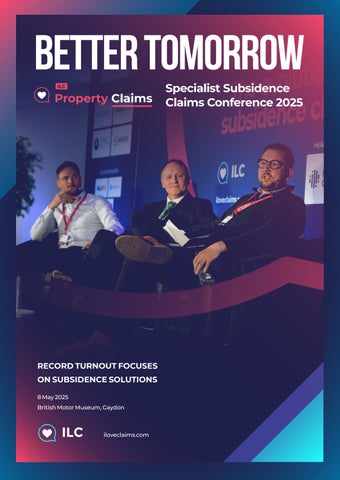
Better Tomorrow Specialist Subsidence Claims Conference 2025
RECORD TURNOUT FOCUSES ON SUBSIDENCE SOLUTIONS 8 May 2025 British Motor Museum, Gaydon
ILC
iloveclaims.com
CLAIMS CONFERENCE 2025
PROPERTY SPECIALIST SUBSIDENCE
Headline Sponsor
Gold Sponsor
Silver Sponsor
ILC 2
iloveclaims.com
Better Tomorrow
ILC Insurer Partners
Industry Body Partners
Insights Partners
CLAIMS CONFERENCE 2025
PROPERTY SPECIALIST SUBSIDENCE
Contents 06
Record turnout focuses on subsidence solutions
Specialist Subsidence Claims Conference 2025
08
Alan Soutar
Panel
Tackling the future of subsidence claims in a changing landscape Sarah Dodd, William Quibell and Richard Rollit
12
Panel
Accelerating the future of subsidence claims
16
Gary De Groot, James Hann and Matthew O’Sullivan
20
Panel
Be serious about solving the environmental challenges
Showcase session
Geosec – mini-invasive technologies for subsoil consolidation
Process innovation: a call for clarity, trust, and triage William Quibell, Michael Lawson and Peter Luby
28
Matthew Gould, Sarah Dodd and Suzanne Reid
30
Panel
Showcase session
Innovation Group – getting to the root of the problem Sne Patel and Mark Mitchell
32
Showcase session
Data-driven triage solutions for smarter claims handling Michael Lawson
Angelina Varchione
34
Showcase session
Subsidence Ltd – smart technology for better customer outcomes Carly O’Sullivan and Daniel Hadfield
38
36
Specialist session
Broadening perspectives in subsidence claims Simon Hughes, Jim Pittman and Mark Webster
Training insights
Subsidence Forum – sector collaboration, skills, and the future Liam Hanlon, Paul Duddle and Lauren Fairley
4
Better Tomorrow
ILC DISCLAIMER
COPYRIGHT
Contributors
All rights reserved. No part of the material contained within this publication may be reproduced or copied in any form or by any means without written permission from ILC.
The views and opinions expressed within Better Tomorrow are reported from live events and are those of the individual contributor/s. They do not necessarily reflect the official policy or position of the contributor’s employer, organisation, committee or other group or individual. ILC While every effort has been made to ensure the accuracy of information, ILC will not accept responsibility for errors or omissions or for consequences arising from reliance on information published. The opinions expressed in Better Tomorrow are not necessarily the opinions of, or endorsed by ILC unless otherwise stated.
Home Specialist Subsidence Claims Conference 2025
5
CLAIMS CONFERENCE 2025
PROPERTY SPECIALIST SUBSIDENCE
Record turnout focuses on subsidence solutions ILC Alan Soutar Chair ILC Home & Property
More than 300 insurance claims professionals came together in May for the fourth ILC Specialist Subsidence Claims Conference – a record-breaking turnout at The British Motor Museum. Under the banner ‘The Evolution of Subsidence Claims’, the day offered insight into operational efficiency and decision making, reinforcing ILC’s mission of driving a better tomorrow for the industry. The event was supported by Headline Sponsor Innovation Group, along with the backing of Gold Sponsors Geobear, Geosec, SML Group Ltd and Subsidence Ltd, and Silver Sponsors Helifix (Leviat), Sedgwick and Shire Structures Ltd, As highlighted on the day, subsidence claims stakeholders are increasingly looking at innovation and efficiency gains to help policyholders through, what can be, a challenging process. Following the 2018 and 2022 surge years, this year’s conference came in a period of lower demand
With over double the number of attendees since the conference’s inception, the 2025 event has had significant industry engagement – highlighting the importance of this area within claims. I would like to say a huge thank you to all our sponsors – particularly Headline Sponsor Innovation Group – as well as our expert lineup of speakers for their terrific contributions, and of course, all those who attended and supported the event. We hope the occasion – and this publication – supports everyone in striving for a ‘better tomorrow’. If you have any thoughts or comments, please let me know at alan@iloveclaims.com I hope you enjoy the content and thanks for taking the time to engage with us.
offering the perfect opportunity to consider how – as an industry - we refine processes, enhance decision-making, and address environmental responsibilities.
6
Better Tomorrow
Home Specialist Subsidence Claims Conference 2025
7
CLAIMS CONFERENCE 2025
PROPERTY SPECIALIST SUBSIDENCE
PANEL
Tackling the future of subsidence claims in a changing landscape With expert insight, robust debate, and a call to action, the session ‘What is
Sarah Dodd Director TreeLaw
real?’ revealed that despite a shrinking market, subsidence remains one of the most technically and operationally demanding issues facing insurers, suppliers and local authorities alike. Opening the discussion, Alan Soutar, Chair of Property at ILC, posed a critical question: with claims volumes falling, why does subsidence still command such
William Quibell Head of Claims (Home) Ageas
disproportionate attention? Richard Rollit, Technical Director at Innovation Group UK, was quick to provide context. “We’ve seen the subsidence market shrink significantly,” he explained, referencing the technical bulletins he produces monthly. “In 2023 we saw around 15,000 claims, and last year just 9,000 - including surge years - making it a very small volume market. But it remains a very challenging peril.”
Richard Rollit Technical Director Innovation Group UK
One reason, he noted, is escalating costs. Richard presented comparative data showing a steep rise in average subsidence claim costs relative to general claims. Particularly striking was the volatility in claim development seen over recent years, which he attributed in part to the growing complexity of claims involving local authority trees. “Fifteen years ago, council-owned tree claims were the cheapest group we had,” he said. “Now they’re the most expensive and problematic, due in part to changes in case law that make recovery much harder.”
8
Better Tomorrow
“Fifteen years ago, council-owned tree claims were the cheapest group we had. Now they’re the most expensive and problematic.” Richard Rollit, Innovation Group UK
Innovation overdue
She acknowledged progress among insurers in
Picking up on the issue of rising costs, William
handling decisions but stressed that more needed
Quibell, Head of Claims (Home) at Ageas, reflected
to be done.
on an industry that has seen surprisingly little change. “The way a subsidence claim is managed today feels not particularly different to how it was handled 10, 15, even 20 years ago,” he said. “There’s
embedding environmental criteria into claims
“This isn’t just a technical or legal problem - it’s a societal one,” she said.
been a lot of cost inflation, yes, but a major issue is
A call for collaboration and skill
the lack of skilled people managing these claims.
renewal
Claims are taking longer to resolve, and that’s costing insurers dearly.” William stressed the operational consequences: “Market life cycles at times are twice what they were 15 years ago. Reduce the life cycle, get more skilled people in, and handle it in the field. If that doesn’t happen, insurers may build the capability themselves.” He warned of a shifting dynamic, one in which insurers may increasingly look to internalise subsidence handling if the current model doesn’t evolve.
Environmental awareness moves centre stage For Sarah Dodd, Director at Tree Law, the environmental aspect of subsidence is finally receiving the attention it deserves. “Two or three years ago, talking about the environment in relation to subsidence felt novel,” she said. “Now, it’s central to the conversation.” Sarah pointed to the growing public and media interest in cases involving trees - highlighting the Sycamore Gap case as an example. “With press attention comes pressure. Environmental impact can no longer be an afterthought - it must be a core consideration.”
Home Specialist Subsidence Claims Conference 2025
Returning to the core theme of evolution, Richard advocated for greater unity across the sector. “We need to come together more effectively, especially on the difficult claims involving important, veteran trees,” he urged. “We can’t default to chopping trees down - we need more nuanced solutions.” Richard also echoed concerns about the ageing workforce and the decline in subsidence-specific expertise. “There’s a clear skills gap,” he said. “We must train and develop the next generation if we’re going to handle these claims competently in the future.” Alan posed a regional challenge: could improving processes for clay shrinkage claims in the south help reduce the long-tail claims often seen there? William’s answer was emphatic: “Yes. Subsidence doesn’t have to be difficult. Nine out of 10 valid claims are relatively straightforward. But we’ve regressed. Twenty years ago, with unqualified but enthusiastic surveyors supported by engineers, we resolved most simple claims in nine to 12 months. Now, some claims sit open for years.” He highlighted a potential tipping point: “If suppliers push another surge into monitoring, insurers won’t tolerate it. They’ll build their own solutions. That’s the direction we’re heading if improvements don’t come quickly.”
9
IN A CHANGING LANDSCAPE
TACKLING THE FUTURE OF SUBSIDENCE CLAIMS
“Nine out of 10 valid subsidence claims are straightforward. But we’ve regressed from resolving them in under a year to leaving them open for years.” William Quibell, Ageas
Conclusion: the challenge and opportunity ahead The subsidence market may be shrinking in terms of volume, but its challenges loom large for the insurance industry. From cost inflation and environmental impact to workforce renewal and process modernisation, the session made clear that fundamental change is overdue. As Alan summarised, the path to a better tomorrow will depend on whether innovation comes from insurers or suppliers - or ideally, both in collaboration. The sector faces a clear choice: continue with the status quo and risk further inefficiencies, or seize the moment to create a smarter, more sustainable approach to subsidence claims.
10
Better Tomorrow
“The environment is no longer a novel talking point in subsidence claims - it’s a core part of the conversation.” Sarah Dodd, Tree Law
Home Specialist Subsidence Claims Conference 2025
11
CLAIMS CONFERENCE 2025
PROPERTY SPECIALIST SUBSIDENCE
PANEL
Accelerating the future of subsidence claims
Gary De Groot Growth Director Innovation Group UK
At the heart of the event was a clear and collective mission: to rethink and reshape the subsidence claims journey. Industry leaders gathered to explore how collaboration, technology, and a redefined customer focus can improve claim outcomes and deliver a ‘better tomorrow’ for all involved. Alan Soutar, Chair of Property at ILC, opened the session with a frank assessment: “Is a subsidence claim a great customer journey? Arguably not every
James Hann Supplier Relationship Manager (Property Claims) Allianz Insurance
case is.” In setting the scene, Alan outlined the goal: to move from managing expectations to exceeding them. He urged delegates to question the current customer experience and challenge ingrained assumptions. He said, “This is not just about fixing houses, it’s about protecting people’s biggest investment and giving them reassurance.”
Matthew O’Sullivan CEO Subsidence Ltd
Joining him for the session entitled ‘How to revolutionise the customer perspective’ were Gary De Groot, Growth Director at Innovation Group UK; James Hann, Supplier Relationship Manager at Allianz; and Matthew O’Sullivan, CEO at Subsidence Ltd.
“People don’t want to feel like a cog in a process. They want reassurance. Human communication, empathy and transparency are critical” James Hann, Allianz
12
Better Tomorrow
Data-driven insight on complaint drivers
He recalled a personal anecdote about a coffee
Gary began by sharing detailed analytics
not about perfection. It’s about the feeling you
around complaint trends. His team had found a clear pattern: customer dissatisfaction spikes
vendor who consistently got his name wrong but provided a memorable experience regardless. “It’s leave people with,” said James.
lifecycle, with a secondary surge after three years.
The role of empowered people and process innovation
“Duration is the real driver,” Gary explained. “Even
James argued that insurers must take ownership
with perfect communication, if a claim stretches
of the claims journey and act as catalysts for
to two years, people lose patience. They just want
innovation. “We’re still here discussing the same
it resolved. The best handler and the best engineer
problems decades on. That tells me we’re under-
can’t compensate for a timeline that feels endless.”
investing in the right skills and tools,” he said.
He urged insurers and adjusters alike to shift focus
The panel discussed the need for empowered
from reactive to proactive strategies. “Shave 10% off
desktop handlers to take ownership of claims. Gary
the lifecycle, and you’ll see a corresponding uplift in
noted: “In most perils, the desk handler is in control.
NPS, satisfaction, and reduced complaint volumes.”
In subsidence, the engineer often dominates,
dramatically at the 18 to 24-month mark in a claim’s
Applying the 80/20 rule The majority of subsidence claims, Gary continued, are not complex. “Between 80-90%
leading to disjointed progression. We flipped that. Even our technical director reports to the handler.”
Fast track and front-end triage
are straightforward. Yet we disproportionately
Matthew reinforced the importance of early triage
spend time talking about the 10-20% involving
and customer confidence.
contentious tree removals. The challenge is streamlining the majority while reserving expertise
He said, “When customers come to us directly,
for the minority.”
they’re either worried or frustrated – sometimes both. We aim to triage effectively and act swiftly.
James supported this view, suggesting that while
With the right data and site assessment, we can
technical performance is strong, the sector often
resolve some issues in weeks, not months.”
fails on emotional engagement. “People don’t want to feel like a cog in a process. They want
He also highlighted the growing role of smart
reassurance. Human communication, empathy
technology in diagnosis and monitoring. He
and transparency are critical – and they’re often
explained, “We can now track structural movement
missing.”
daily, rather than monthly. That kind of data gives clarity and enables faster, evidence-based decisions.”
“If my claim hit two years, even with daily updates, I’d still be frustrated. Duration is the problem – not communication.” Gary De Groot, Innovation Group UK
Home Specialist Subsidence Claims Conference 2025
13
OF SUBSIDENCE CLAIMS
ACCELERATING THE FUTURE
Surge readiness and the risk of inaction The panel addressed the looming risk of another hot summer surge and the need to futureproof against it. Gary shared that reducing claim durations has a direct impact on capacity: “With a shorter lifecycle, we reduce work in progress (WIP) and can take on more cases. It’s surge resilience built in.” James closed the session by emphasising the need to move away from traditional metrics. He stated, “We measure what’s easy – call wait times, for example – but we must begin to track what truly matters: customer trust, outcome quality, and joined-up service.”
A collaborative vision for a better tomorrow The session concluded with a powerful message. Subsidence may be a complex peril, but the solutions are within reach. From smarter triage and shorter claim durations to empowered handlers and clear customer messaging, the path to improvement lies in marginal gains across the process. The industry doesn’t need perfection; it needs consistency, compassion, and coordination. As Alan summarised, “The best customer service people in the world can’t deliver excellence if the process behind them is broken. Let’s fix the process – and empower people to give the service they’re capable of.”
“We can’t keep doing what we’ve always done. Process must change if we want different results.” Alan Soutar, ILC
14
Better Tomorrow
“Every claim is different. But that doesn’t mean we can’t triage effectively and fast-track the straightforward ones.” Matthew O’Sullivan, Subsidence Ltd
Home Specialist Subsidence Claims Conference 2025
15
CLAIMS CONFERENCE 2025
PROPERTY SPECIALIST SUBSIDENCE
PANEL
Process innovation: a call for clarity, trust, and triage A revealing and at times unflinching session on process innovation saw panellists from across the industry
William Quibell Head of Claims (Home) Ageas
call for urgent reform to outdated structures and an end to ‘broken trust’ between insurers and their supply chains. The session featured panellists: William Quibell, Head of Claims (Home) at Ageas; Michael Lawson, CEO of Property Risk Inspection; Peter Luby, Chief
Michael Lawson CEO Property Risk Inspection
Operations Officer at Geobear; and Dave Clare, Operations Director at Structural Surveys and Design (a QuestGates company). Opening proceedings, ILC’s Property Chair Alan Soutar posed a series of pointed questions to the audience and panel: “What innovation will shorten life cycles? When and who should be making decisions? Are we too constrained by fear of big claims going wrong?”
Peter Luby Chief Operations Officer Geobear
These weren’t just rhetorical prompts - they became the guiding themes for an hour of robust insight, frank critique, and calls for fundamental rethinking of how claims are managed and delivered.
A fractured process in a low-demand landscape The timing was no accident. As Alan noted, “Low demand time is ideal for a process review.” Yet the
16
Dave Clare
irony, according to William is that despite a historically
Operations Director Structural Surveys and Design – A QuestGates Company
feels more strained than ever.
low intake of subsidence claims, customer service
Better Tomorrow
“It’s not difficult. There are industry claims out there for porch subsidence and a cherry tree being monitored which feels incorrect.” William Quibell, Ageas
“It feels somewhat odd that with the lowest intake of claims, we have probably the most strained customer service,” William said. He attributed this in part to eroded expertise, broken communication pathways, and fragmented supply chains: “Whatever ‘working in partnership’ means, most people I speak to don’t feel it’s happening.” William, who gathered candid feedback from claims handlers and industry peers ahead of the session, painted a stark picture of a system overwhelmed not by volume, but by dysfunction.
Insurers must lead - but also trust Michael challenged the narrative that the sector is ‘failing’, suggesting instead that its dysfunction is due to misaligned structures and untapped data. “There is a huge amount of data within our businesses that would allow claims to be better
Learning from the railways: the power of predictable boring Peter brought a fresh perspective from outside the sector. Drawing on his years with Network Rail, Peter recalled the aftermath of a national crisis in 2014, when track overruns led to widespread delays and public criticism. His response? “Be boring”. By changing procurement strategy, aligning incentives, and giving suppliers longer contracts with visibility of the work bank, Network Rail eliminated overruns, cut costs, and improved delivery. “The alliances we set up back in 2015 are still going,” he said. The lesson for subsidence? “Trust your suppliers, engage them early, and let them help,” Peter said. “We just want to help.”
fighting each other over the scraps.”
The case for simplicity - and the risks of inaction
Michael proposed a radical shift: that insurers
Dave echoed these calls, warning that many
triaged,” Michael explained. “But we’re too busy
take the lead by ingesting all necessary data at the first notification of loss (FNOL) and classifying claims into clear pathways - simple, moderate, and complex. “Imagine if we said this is a fast-track claim: no conservation area, no tree preservation order (TPO), tree works in 30 days, repairs in 90. Put the work in
providers still overcomplicate processes and underinvest in staff. “We’re transactional suppliers - each of us has a part in the process. But we pretend we’re all-in-one,” he noted. Dave pushed for better triage, earlier technical intervention, and genuine collaboration between professionals to match claim complexity
the right basket at the start,” he said.
with appropriate pathways.
Yet Michael was also clear: “Insurers can’t fix this
“Pay the right people the right amount at the right
alone. But they must lead.”
Home Specialist Subsidence Claims Conference 2025
stage,” he urged. “If we straighten the road early, we reduce failure later.”
17
A CALL FOR CLARITY, TRUST, AND TRIAGE
PROCESS INNOVATION:
Red flags, impatience - and the need for action Throughout the panel, the elephant in the room was the impending risk of a surge summer. William warned that the sector is “the least prepared it’s ever been” for such an event. Claims from previous years are regressing, not resolving, and staff churn in the specialist subsidence market has only increased.
“There’s a huge amount of data in our businesses, but we’re too busy fighting over scraps to use it.” Michael Lawson, Property Risk Inspection
“If a dry summer happens and things don’t change, insurers may become impatient,” he said. “They may insource again, because they may feel they have no other choice.” In a moment that crystallised the frustrations felt across the panel, William added: “There are industry claims out there for porch subsidence and a cherry tree - being monitoring. Why are we doing that?”
Can collaboration save the day? Alan closed the session with a note of cautious optimism. “We’ve been talking about the same problems for three years,” he said. “Now it’s time to act. Whether it’s the insurer leading or the supply chain uniting to offer something better -
“Be boring. That was my goal at Network Rail - and it worked. Visibility, trust, and longterm collaboration transformed delivery.” Peter Luby, Geobear
something’s got to give.”
18
Better Tomorrow
Home Specialist Subsidence Claims Conference 2025
19
CLAIMS CONFERENCE 2025
PROPERTY SPECIALIST SUBSIDENCE
PANEL
Be serious about solving the environmental challenges At the heart of the event was a moment of collective reflection, innovation, and urgency - epitomised by the afternoon
Matthew Gould Claims Specialist Ecclesiastical
session titled ‘Be serious about solving the environmental challenges’. With increasing scrutiny on the sustainability of claims processes, panellists tackled one of the most politically, emotionally, and environmentally complex issues in the sector: subsidence and its entanglement with trees.
Sarah Dodd Director TreeLaw
The panel of experts featured: Matthew Gould, Claims Specialist, Ecclesiastical; Sarah Dodd, Director at TreeLaw; Richard Rollit, Technical Director at Innovation Group UK; and Suzanne Reid, Home Indemnity Lead at esure. Alan Soutar, Chair of ILC Property, opened the session by recognising the “real challenges” ahead, urging delegates to take an honest look at how the industry balances effective claims outcomes with environmental
Richard Rollit
and regulatory pressures.
Technical Director Innovation Group UK
“We’re at a point,” he declared, “where the default response of removing a tree has to become the exception, not the rule.”
Suzanne Reid Home Indemnity Lead esure
“Tree removal maybe at the moment is the first option maybe it needs to start being the last.” Matthew Gould, Ecclesiastical
20
Better Tomorrow
“We’re changing the soil so it behaves like it’s not shrinkable. That’s potentially transformational.” Richard Rollit, Innovation Group UK
A 500-year-old Oak and a wake-up call
His demonstration of a real-life claim - where trees
Matthew set the tone with a story that symbolised
visible damage, the house was subject to a removal
the sector’s conundrum: a 500-year-old oak tree causing relatively minor damage, but whose fate has remained unresolved for five years. “We still don’t know how we’re going to remove the tree - or if we even should,” he explained, framing the larger industry dilemma of when - or if removing a tree is justified. Matthew pressed for a paradigm shift: “Tree removal maybe at the moment is the first option - maybe it needs to start being the last.” But he didn’t shy away from acknowledging the difficulty, cautioning against driving subsidence cover into unaffordability. “It’s a real possibility that insurers will exit the market if sustainable and lasting solutions aren’t found,” he said.
Innovation, not imitation Next came Richard who highlighted a promising breakthrough: a decade-long collaboration with the University of Birmingham to develop a soil treatment technology. By running an electrical current and electrolyte through shrinkable clay, the soil’s behaviour can be altered to reduce subsidence. “We’re changing a plasticity index of 40 to one of eight,” Rollit said. “It’s potentially transformational.”
survived every surge since the 1980s except 2022 - sparked the broader debate. Despite only minor request for protected trees. “These trees are protected for a reason,” Rollit argued. “And we’re applying standard formulas to very non-standard problems.”
Calculating carbon: the subsidence calculator Sarah introduced a new decision-making tool: the Subsidence Carbon Calculator. Her demonstration compared two solutions - tree removal Vs root barrier installation - based solely on their carbon footprint. “This gives us a common denominator,” she said, “a way to objectively compare very different solutions.” She was quick to clarify that the tool does not account for indemnity costs or premium impact, but instead helps insurers understand environmental consequences more clearly. In one case, she explained, “Tree removal equated to 90 trees needing replanting to offset the carbon. Saying we’ll just ‘plant a new one’ isn’t good enough.” Sarah also flagged the pending Heritage Trees Bill, currently progressing through the House of Lords, which seeks to add another layer of protection for ancient and veteran trees. “Tree removal may soon not be an option at all for certain trees,” she warned.
“The house isn’t going to fall down. We should be saying that early.” Richard Rollit, Innovation Group UK
Home Specialist Subsidence Claims Conference 2025
21
OF SUBSIDENCE CLAIMS
ACCELERATING THE FUTURE
Reclaiming trust and expertise Suzanne presented a grounded perspective on process reform. “As an industry we need to stop over-prescribing how suppliers work and start trusting them to deliver outcomes,” she stated. Drawing on claims during Storm Isha (January 2025), Suzanne highlighted the benefits of earlier decision-making and better triage - simple claims should be resolved swiftly to free up resources for the complex ones. Suzanne stressed the importance of better
“We can’t just keep pushing claims through a one-size-fitsall process. Some need to be treated differently from day one.” Suzanne Reid, esure
diagnostics and appropriate site investigations early in the claim lifecycle. “We’ve heard of situations where a tree has been removed, then subsequently suggested the claim could be declined. By then, it’s too late.” Her call for internal insurer reform - revisiting what gets passed to suppliers and how - resonated strongly. “We’ve tied up suppliers with SLAs and what might be seen as constraints. If we want innovation and expertise, we have to allow for freedom to apply it,” she stated.
The customer: missing from the model? A recurring theme was the voice of the customer. Sarah cited a homeowner so scared their house would fall down that they supported tree removal despite only minor damage. “Did anyone tell them the house wasn’t going to collapse?” she asked. Richard added, “One policyholder said, ‘Remove the tree, and I’ll go quietly.’ The challenge is, who’s really driving the decision?” This raised the issue of communication. “We must do a better job explaining the real implications,”
22
“If you remove a tree, it might take 90 trees to offset the carbon. That’s the real cost.” Sarah Dodd, TreeLaw
Better Tomorrow
said Matthew. “Customers, insurers, and local authorities all have different agendas - but they need a shared understanding.”
Collaboration and conclusion: no silver bullets, but a clear direction As the session drew to a close, there was consensus that while no single solution exists, a combination of technology, new tools, stakeholder alignment, and cultural shift is
•
A shift in insurer-supplier relationships, moving from SLA rigidity to trust in expertise
Richard summed it up: “It’s not about hugging trees. It’s about understanding which ones matter - and acting proportionately.” This session left no doubt: the industry must evolve - and quickly - if it’s to deliver sustainable, effective, and trusted subsidence claims in the years ahead.
needed. It was suggested the path forward demands: •
Balanced decision-making, incorporating environmental data, customer experience, and long-term repair viability
•
Early triage and skillful resource allocation, preventing simple claims from becoming complex by default
•
“We’ve driven out expertise from the supply chain. If we want it back, we need to pay for it - and trust it.” Matthew Gould, Ecclesiastical
Industry consistency, especially when trees are protected and legal or public pressures increase
Home Specialist Subsidence Claims Conference 2025
23
24
Better Tomorrow
Home Specialist Subsidence Claims Conference 2025
25
26
Better Tomorrow
Home Specialist Subsidence Claims Conference 2025
27
CLAIMS CONFERENCE 2025
PROPERTY SPECIALIST SUBSIDENCE
SHOWCASE SESSION
Innovation Group – getting to the root of the problem
Sne Patel Operations Consultant Innovation Group
Innovation Group’s presentation, titled ‘Getting to the root of the problem’, was a compelling exploration into the botanical dimensions of subsidence, emphasising how trees, soil, and field data must all be considered together to resolve claims effectively. Introduced by Sne Patel, Operations Consultant, and led by Mark Mitchell, Manager of EPSL (Innovation’s
Mark Mitchell Root/Timber Lab Manager Innovation Group
in-house root and timber laboratory), the session highlighted how Innovation Group has developed specialist capabilities in identifying the root causes – literally - of structural movement and damage. The team’s work focuses on delivering ‘accurate and defensible conclusions’ by integrating fieldwork, laboratory science, and decision-making analytics.
Root identification and analysis The presentation began by outlining how tree roots, particularly in shrinkable clay soils, can be a key factor in urban subsidence. Traditional approaches often involve assumption or visual inspection, but Innovation Group’s solution is data-led. They deploy site investigations coupled with lab-based root analysis to identify the species involved and determine causal links with building damage.
28
Better Tomorrow
EPSL uses high powered microscopic analysis to confirm the species of any tree/shrub roots
Insights from field to report
found during the geotechnical investigations. This
The field data – from Innovations soils laboratory
contributes directly to decision-making about
and arboricultural tea - is interpreted alongside root
whether a tree should be removed, retained, or
identification results to form comprehensive triage
monitored.
reports. These reports allow clients to proceed
This scientific rigour ensures that insurers and homeowners avoid unnecessary tree removals and that local authorities are provided with robust
with confidence, especially when engaging local councils, contractors, or homeowners in mitigation strategies.
documentation when action is needed.
Why it matters
Lab infrastructure and methodology
The presentation illustrated that understanding
Mark detailed the lab’s infrastructure, which is equipped to handle a large number of samples (especially during surge periods) under timesensitive conditions. He explained how the root processing and imaging process is combined
biological causes can reduce claim lifecycles, litigation, and cost. By using Innovation Group’s process to prove or disprove tree involvement early, insurers can make faster decisions, and policyholders face less disruption.
with a library of reference samples and decades
Innovation Group’s showcase offered a vision for
of staff experience, to ensure accurate species
how science and structured evidence can de-
identification. Live demonstrations from an actual
escalate emotionally and financially charged
EPSL microscope, showed detailed anatomical
claims.
characteristics of various tree species and discussed the subtle differences that allow the lab to identify different roots.
Home Specialist Subsidence Claims Conference 2025
29
CLAIMS CONFERENCE 2025
PROPERTY SPECIALIST SUBSIDENCE
SHOWCASE SESSION
Geosec – mini-invasive technologies for subsoil consolidation
Angelina Varchione Geotechnical Engineer Geosec
In a showcase centered on cutting-edge ground engineering, Geosec presented its innovative approach to stabilising subsidence-affected properties through mini-invasive resin injection and real-time 3D scanning. Presented by Angelina Varchione, Geotechnical Engineer, the session spotlighted Geosec’s hallmark solution: the SEE&SHOOT system - a fusion of precision engineering and geophysical imaging.
Innovation in Action Geosec’s SEE&SHOOT system was described as a controlled deep injection method that utilises 3D electrical resistivity tomography (ERT) to actively monitor resin behaviour in the ground. “The integrated 3D ERT system allows us to monitor, during the intervention, the interaction of the resin with the subsoil, its placement, and the resulting displacement of moisture, pore filling, and compaction,” explained Angelina. This level of control offers a major advantage: it enables engineers to verify, adjust, and optimise injection in real time, greatly reducing the margin for error and eliminating the guesswork traditionally associated with subsidence treatment. The result is targeted, data-backed consolidation of both granular and cohesive soils.
30
Better Tomorrow
Resin technology A core part of the presentation was Geosec’s proprietary resin, MAXIMA, designed for optimal structural performance and durability. The key specifications shared included: •
90% closed-cell content, ensuring effective void filling and long-term stability.
•
Compressive strength exceeding 500kPa, providing strong resistance against soil movement.
•
Exothermic reaction enabling expansion in 40 seconds and full solidification in 90 seconds.
•
Geosec outlined its operational model as one that delivers “fast, expert, effective, and conclusive solutions.” The company is structured around a strong local presence in the UK and across Europe, with strategically located offices and logistics hubs. The network includes markets across Germany, France, Spain, Italy, and the UK, ensuring quick mobilisation to any project site. Their process is underpinned by multiple certifications: •
ISO 9001 for Quality Management Systems
•
ISO 17020 for protocols and procedures
types.
•
EN12715 for special geotechnical works
Hydro-resistance, crucial for wet ground
Patents EP1914350 and EP2543769, validating their
Density range from 55 kg/m³ to over 800 kg/ m³, making it adaptable to a variety of soil
•
Operational excellence and certifications
conditions and flood-prone zones. These properties, Angelina explained, make MAXIMA a versatile and powerful solution for underpinning without excavation.
proprietary methodologies These endorsements underscore a high standard of repeatability, safety, and client assurance.
A technological edge The presentation featured a visual of 3D tomography in action. The process is led by a team that includes a Geological Engineer, Injection Technician, and Site Operator, each performing roles from test planning and drilling to control system operation and real-time data analysis. Angelina noted, “The level of interdisciplinary collaboration on-site means our results are fast, verifiable, and non-disruptive.” Geosec’s showcase illustrated how advanced materials, live geophysical monitoring, and certified procedures converge to create a highly effective system for treating subsidence. Their approach minimises disruption, maximises technical assurance, and offers clients a futurefacing solution that balances performance with sustainability.
Home Specialist Subsidence Claims Conference 2025
31
CLAIMS CONFERENCE 2025
PROPERTY SPECIALIST SUBSIDENCE
SHOWCASE SESSION
Data-driven triage solutions for smarter claims handling
Michael Lawson CEO Property Risk Inspection
In a session that bridged analytics and insurance operations, the SML Group, led by Michael Lawson, CEO of Property Risk Inspection, presented a transformative view on subsidence claims triage. The showcase centered on how structured data and smart rule engines can dramatically improve claim outcomes from the very first notice of loss (FNOL).
32
Better Tomorrow
Titled ‘Subsidence claims & triage solutions – using data to improve the claim journeys”, the session challenged traditional, reactive methods and demonstrated how predictive analytics and geospatial intelligence can allow insurers to anticipate claim complexity, exposure, and risk well before a site visit.
Reimagining the claim pathway Michael opened with a powerful question: “Can data-supported triage better indicate a claim pathway?” From this premise, he unfolded a system that integrates dozens of data sets everything from flood exposure and soil plasticity to lender policies and title checks - to assign risk scores and recommended actions. “We’re not short on data,” he emphasised. The challenge, he argued, is how that data is structured and interpreted. The solution? A claim rule engine that converts unstructured information into rule-based outcomes.
Rule engines and real-world application At the heart of SML Group’s approach is a robust rule engine. Michael described a rule
Geospatial intelligence and the 20year lens One of the most compelling features presented was the ‘20-year letterbox exposure’ view. Michael explained this as a way to assess the historic and future risk at any given postcode, drawing from soil maps, previous claims, and environmental overlays. He further discussed how attributes like council policy posture and regional claims cost history can be factored in - offering insights not just about the property, but also about how swiftly and smoothly a claim can be resolved in that location.
Customer and workflow implications A powerful segment of the showcase mapped the customer journey, beginning with a simple FNOL and ending with outcome-driven resolution. The proposed enhancements include: •
Geological Survey maps) •
•
Rule: Reinstatement value
•
Parameter: £345,000
•
Outcome: Indicates high-value property; potential for complex repair route
These rules interact with real-time datasets, including automated valuation models (AVMs), confidence scores, credit risk, fraud flags, and title indemnities. It also linked to a ‘subsidence severity index’ ranging from very low to very high, supported by risk factors like historical claims
In-person engineer visits based on data priority
as a “description plus parameter leading to an outcome.” An example presented included:
Early triage tools (drains/trees/British
•
Traditional crack monitoring
•
Workflow automation using APIs
“The magic is in the attributes passed to the rule engine,” explained Michael signaling the user friendliness of the platform.
Conclusion SML Group’s data-driven approach redefines how the insurance sector can manage subsidence - from claim registration to repair. With its rule engine and geospatial model, it brings speed,
concentration, local soil data, and future climate
clarity, and efficiency to a traditionally opaque
trends.
process.
The claim risk level is then assigned a ‘future
As Michael concluded, “This is about making
exposure band’ (A–C), enabling handlers to
better decisions sooner. The earlier you know, the
direct resources accordingly. This is particularly
smoother it goes - for both customer and carrier.”
helpful when trying to determine early whether a site needs a desk-based triage, immediate inspection, or expert structural input.
Home Specialist Subsidence Claims Conference 2025
33
CLAIMS CONFERENCE 2025
PROPERTY SPECIALIST SUBSIDENCE
SHOWCASE SESSION
Subsidence Ltd – smart technology for better customer outcomes
Carly O’Sullivan Managing Director Subsidence Ltd
Delivered by Carly O’Sullivan, Managing Director and Daniel Hadfield, Technical Director from Subsidence Ltd, the session illustrated how integrating smart technology can transform both the efficiency and customer experience of subsidence claims. Titled ‘Using smart technology to improve customer
Daniel Hadfield
journey, efficiency & costs’, the session focused on
Technical Director Subsidence Ltd
systems can reshape the way subsidence claims are
how automation, live data, and real-time monitoring assessed, monitored, and resolved - from the first crack to final fix.
The challenges with traditional methods The session began with a candid look at the shortcomings of conventional approaches: long lifecycle times, reactive decision-making, repeated site visits, and poor communication. “Our goal is to reduce waste - not just in material and money, but in time, in stress, in customer goodwill,” Carly stated.
34
Better Tomorrow
Subsidence Ltd suggest that the industry has relied too long on methods that were slow
Efficiency through Integration
to adapt. “We saw a better way - data-led,
Subsidence Ltd also highlighted how its
proactive, and customer-first,” Daniel added.
approach reduces dependency on traditional
Smart monitoring in action
underpinning. Instead, it advocates for: •
monitored movement
At the heart of their innovation is SUBCHECK, a smart subsidence monitoring system provided by Subsidence Ltd and powered by
•
data collection, and comparative analysis across historical claim patterns and soil types. SUBCHECK offers: •
•
Daily remote data capture using IoT-enabled
Integrated cosmetic repairs, ensuring properties are returned to normal faster
SLABsense technology. The system allows for daily automated crack measurement, remote
Targeted stabilisation treatments based on
•
Post-repair support, including posttreatment monitoring to confirm stability
This holistic package is designed not only to repair but to prevent recurrence and to validate outcomes - critical in high-volume insurer
sensors
environments.
Side-by-side crack comparison across
Wider impacts
timelines •
Custom alerts for threshold breaches
•
Instant data access for engineers and claims handlers
“Smart technology means we can replace ‘waitand-see’ with ‘see-right-now’,” Daniel explained. The result? Early intervention, clearer validation, and shorter claim resolution times.
Beyond customer and insurer benefits, Subsidence Ltd’s technology also contributes to environmental efficiency. Fewer visits mean less travel. Smart monitoring reduces unnecessary works. Cosmetic bundling cuts resource waste. “We’re not just reducing claim costs - we’re reducing carbon footprints,” Daniel added, aligning the company’s mission with broader ESG targets.
Rebuilding trust through transparency
Humanise the process
A key focus of the session was how SUBCHECK
study in how technology can humanise the
improves customer communication. Real-time
subsidence claims process. With SUBCHECK, it
monitoring data can be shared directly with
showed that it’s possible to be faster, smarter,
homeowners via mobile dashboards, allowing
and kinder - to both customers and the
them to understand the progress of their claim
environment.
and why certain decisions are being made.
Subsidence Ltd’s session was an insightful case
As Carly concluded: “Technology shouldn’t just
“Customers don’t want just speed - they want
fix cracks in walls. It should fix cracks in trust, in
transparency. They want to know someone is
communication, and in process.”
watching, someone is responding,” said Carly. She emphasised that giving customers a sense of control and insight can transform their overall satisfaction.
Home Specialist Subsidence Claims Conference 2025
35
CLAIMS CONFERENCE 2025
PROPERTY SPECIALIST SUBSIDENCE
SPECIALIST SESSION
Broadening perspectives in subsidence claims
Simon Hughes Managing Director – Subsidence & Underground Services CET UK
The specialist session titled ‘A Wider View’, brought together three industry leaders for a compelling conversation that challenged conventional thinking in subsidence claims. Featuring Simon Hughes, Managing Director – Subsidence & Underground Services, CET UK; Jim Pittman, Head of Professional Services, Evolution Claims Management; and Mark Webster, Director of Subsidence & Building Consultancy, Sedgwick
Jim Pittman Head of Professional Services Evolution Claims Management
the session offered a rare opportunity to examine subsidence claims through a comparative lens, drawing parallels with other property insurance perils and encouraging a fresh, strategic perspective.
Uniquely complex? At the heart of the session was the recognition that
Mark Webster Director of Subsidence and Building Consultancy Sedgwick
subsidence claims are often perceived as uniquely complex and protracted when compared to other perils such as escape of water, storm, or fire. The discussion interrogated whether that perception is justified - and, crucially, whether elements of the more agile decision-making models used in other claim types could be applied to subsidence without compromising technical integrity or customer outcomes.
36
Better Tomorrow
The panel opened with the key question: ‘How does the subsidence process compare to the other claims you deal with?’ This immediately highlighted key differences - notably, the extended timescales and technical dependencies inherent in subsidence cases, which often require multiple stages of investigation and validation. But also
Widening decision making One of the session’s most forward-looking questions addressed decision-making models: “In other perils we are widening decision-making. Can we follow this route with subsidence claims?” The consensus leaned toward cautious optimism.
highlighted that other perils are not immune to
Mark outlined how triage techniques, data
such a multi-faceted process.
analytics, and better digital integration could
It was suggested that much of what is focused on – and for good reason - when it comes to subsidence is the 20%, rather than the 80% which in theory should and could flow seamlessly.
Learnings from other sectors
indeed decentralise some early-stage decisions, particularly where patterns and risk profiles are consistent. However, the speakers also acknowledged the limits of automation and stressed the importance of retaining expert oversight in technical evaluations. The final segment of the session invited the panellists to reflect on the biggest lessons
The conversation moved swiftly into an
learned from managing other types of claims.
exploration of where efficiencies and proactive strategies from other sectors could be
Simon concluded with a call for adaptive
transferred.
thinking - urging the industry to “stop thinking of subsidence as an outlier” and instead bring it
Communication emerged as a central theme.
into the fold of broader claims strategies where
The panel discussed why subsidence claims are
lessons in process, technology, and customer
often perceived to involve more challenging
care are abundant. He also repeatedly made
communication cycles - with customers,
a call for the need for more young people and
contractors, and insurers alike.
skilled personnel for the future of the sector.
Jim emphasised that unlike fast-moving perils,
Overall, the session urged the subsidence
the time lag between discovery and resolution in
sector to look beyond its traditional boundaries,
subsidence often leads to customer uncertainty
challenge long-standing assumptions, and
and disengagement.
adopt proven practices from the broader
The session explored whether structured, proactive communications - routinely applied in other claims areas - could be better leveraged in subsidence cases to manage expectations and improve satisfaction.
Home Specialist Subsidence Claims Conference 2025
claims ecosystem. It stood out as one of the most strategically vital sessions of the day encouraging innovation not through technology alone, but through mindset and model transformation.
37
CLAIMS CONFERENCE 2025
PROPERTY SPECIALIST SUBSIDENCE
TRAINING INSIGHTS
Subsidence Forum – sector collaboration, skills, and the future
Liam Hanlon Outgoing Chair Subsidence Forum
The Subsidence Forum’s session – as part of the Showcase Stage - provided an insightful and strategic overview of the UK subsidence sector’s challenges, goals, and initiatives, with a clear emphasis on collaboration, training, and future sustainability. Representing a wide cross-section of the industry - including insurers, engineers, arborists, loss adjusters, contractors, and legal professionals - the
Paul Duddle
Forum positions itself as the central body uniting
Chair Subsidence Forum
management.
and progressing best practices in subsidence
Raising standards and awareness Presented by Lauren Fairley, Liam Hanlon and Paul Duddle the session opened with a firm statement
Lauren Fairley Subsidence Forum
of purpose, reaffirming the Forum’s mission: ‘To promote collaboration and best practices across all areas of subsidence management’. This mission, explained Lauren, is supported by objectives such as improving public and professional awareness, supporting education and training, developing standards, and encouraging sustainable solutions.
38
Better Tomorrow
The Forum advocates the importance of early identification of subsidence risks, the use of sustainable repair techniques, and the development of consistent approaches to diagnosis and remediation. These efforts aim not only to enhance technical standards but also to build public trust in the industry.
Investing in the next generation A cornerstone of the session was the Forum’s work to bridge the industry skills gap, which it describes as ‘significant and growing’. With an estimated 251,500 additional workers needed by 2028, the Forum identified a critical shortfall in skilled specialists such as geotechnical engineers, structural engineers, groundworkers, surveyors, and tree consultants.
Forum future vision The closing portion of the session, delivered by
Lauren stressed that most schools and colleges
newly appointed Chair Paul Duddle of Catalyst
do not promote careers in subsidence or
Services, set out the Forum’s strategic roadmap.
understand the technical and scientific nature of the work. “There’s a missed opportunity to promote high-demand, high-impact specialisms,” she stated providing a call for
Paul highlighted how the Forum aims to: •
subsidence authority
action across the industry.
INS-Pire Academy: attract, train, retain
•
Forum Outgoing Chair Liam Hanlon of The
•
programs (eg CITB, NVQ, City & Guilds) and offers hands-on exposure to specialist trades and the insurance claims sector. Each year, the INS-Pire Academy plans to host up to 10 ‘enhancement days’, combining skills development, charity work, and community engagement. As Liam put it, “Working towards shared goals and a common vision - together we can all achieve more”.
Home Specialist Subsidence Claims Conference 2025
Build stronger connections with educational institutions
•
Develop CPD-accredited content and promote professional development
Forshaw Group. The Academy opens its doors to young people from accredited apprenticeship
Expand membership and promote sectorwide collaboration
A key initiative underlined during the session was the INS-Pire Academy, spearheaded by
Position itself as the UK’s leading
•
Participate in initiatives like Open Doors, showcasing career paths to younger generations
This session reinforced the Subsidence Forum’s leadership in addressing not just the technical aspects of subsidence, but also the cultural, educational, and workforce dimensions. By focusing on training, outreach, and community, the Forum is planting the seeds of a more sustainable, skilled, and future-ready industry.
39
CLAIMS CONFERENCE 2025
PROPERTY SPECIALIST SUBSIDENCE
Feedback Specialist Subsidence Claims Conference 2025
WHAT WAS SAID
40
Better Tomorrow
“I found the event very interesting and insightful. It was interesting to hear the opinions of industry professionals and their agreements and disagreements on certain topics.” “Great event, very engaging sessions, perfect logistics as always.” “Finally the supply chain are understanding insurers view. Well done ILC.”
“Really good mix of speakers and viewpoints from different elements of supply chain and insurers. As with all ILC events, a great opportunity to connect with wider market and colleagues.” “The conference was very informative and provided an insight from all aspects of an insurance claim, from insurers, loss adjusters and contractors.” “I think the showcase sessions on the side stage were a great idea. I joined most of them and the insight I gained in just those 10 minute snapshots was powerful.”
Home Specialist Subsidence Claims Conference 2025
41
MGA Claims Conference 2025
The MGA Claims Playbook 6 November 2025 Queen Elizabeth II Centre London SW1P 3EE
// Why attend:
// MGAA member exclusives:
// Get started:
• Enhance claims handling capabilities
• 2 complimentary tickets per MGA
To find out about sponsorship opportunities contact liane@iloveclaims.com
• Gain C-suite insights and market trends • Stay informed on industry developments
• 25% discounts on MGAA supplier tickets • 25% discount on expo stands • 10% discount on sponsorship packages
• Network and forge strategic partnerships
ILC
iloveclaims.com
To secure your special MGAA member tickets visit: iloveclaims.com/events
Making property claims quicker & more effective Home, Commercial & Specialist
26 November 2025
27 November 2025
Advisory Board & pre-event networking reception
Conference & exhibition
Telford International Centre
ILC
CLAIMS CONFERENCE 2025
PROPERTY SPECIALIST SUBSIDENCE
ILC
Contact us To discuss an ILC Corporate Partnership, as well as other ways that we can help in the marketing and brand awareness of your company at an ILC event, please contact:
Alan Soutar ILC Chairman - Property alan@iloveclaims.com 07880 381 119
Rachael Hunt Events Director rachael@iloveclaims.com 07813 146 944
Liane Price Sales & Account Manager liane@iloveclaims.com 07850 220 714
44
Better Tomorrow
Home Specialist Subsidence Claims Conference 2025
45
Better Tomorrow Specialist Subsidence Claims Conference 2025
RECORD TURNOUT FOCUSES ON SUBSIDENCE SOLUTIONS 8 May 2025 British Motor Museum, Gaydon
ILC
iloveclaims.com