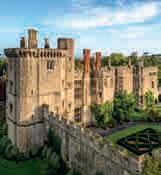
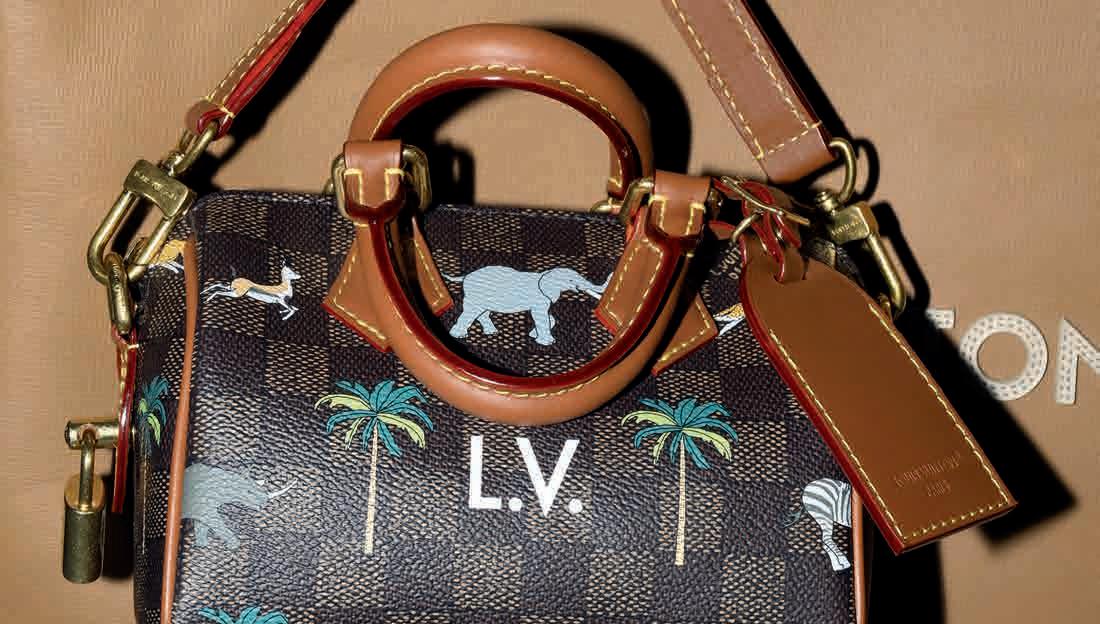
The highlights of summer’s fashion, culture, travel, beauty, food and drink
32 FASHION
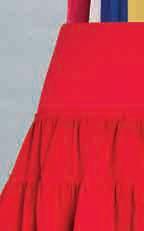
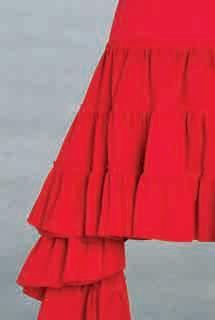
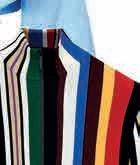
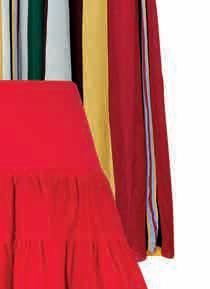
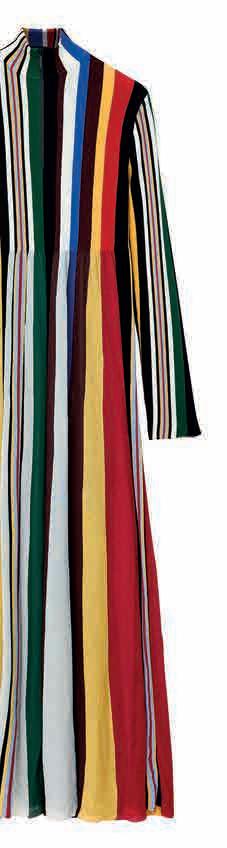
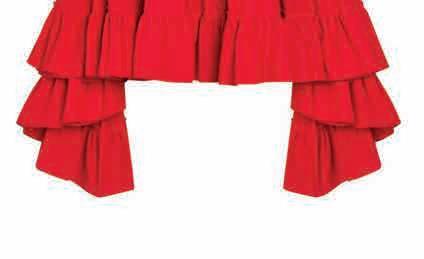
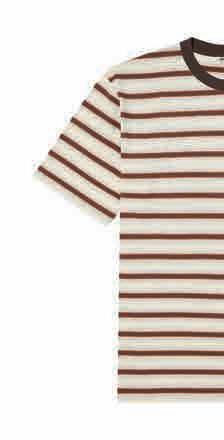
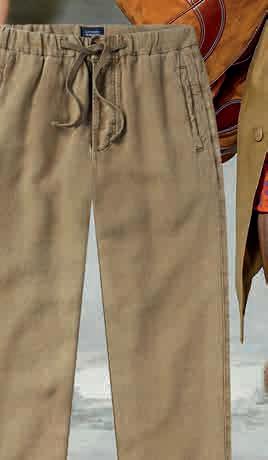
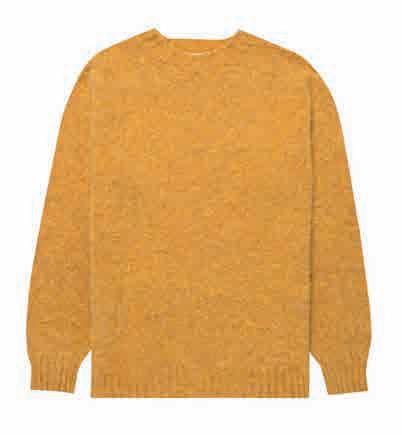
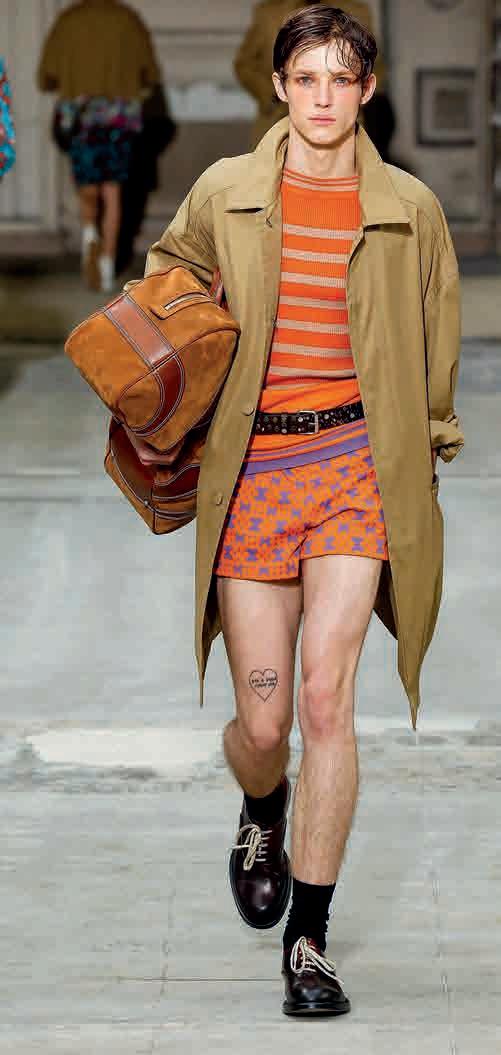
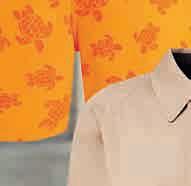
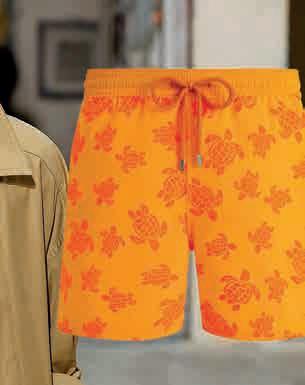
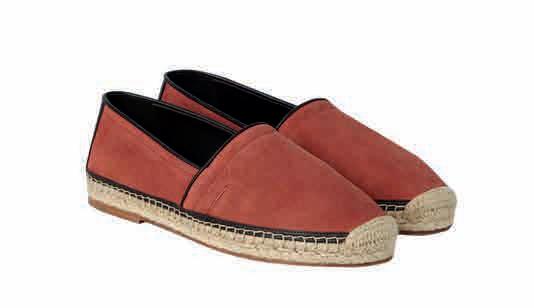
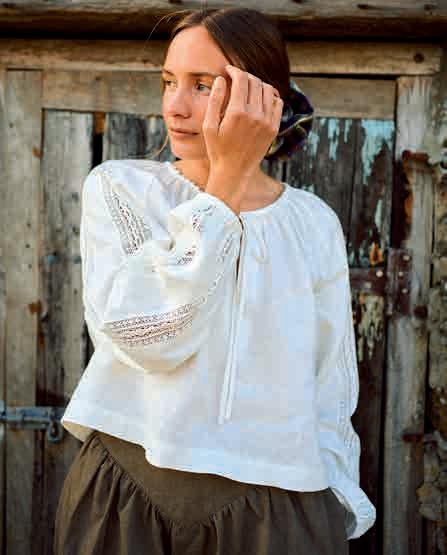
Circus drama for women and earthy spice rack shades for men
68 JEWELLERY
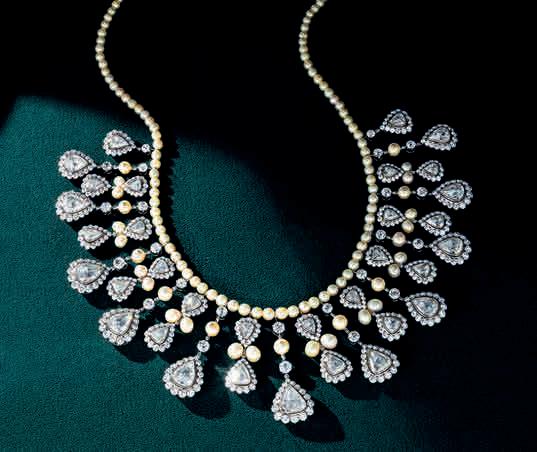
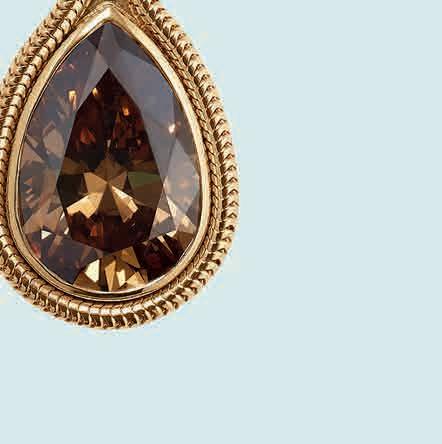
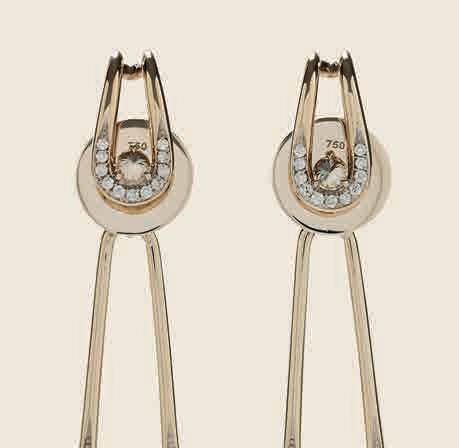
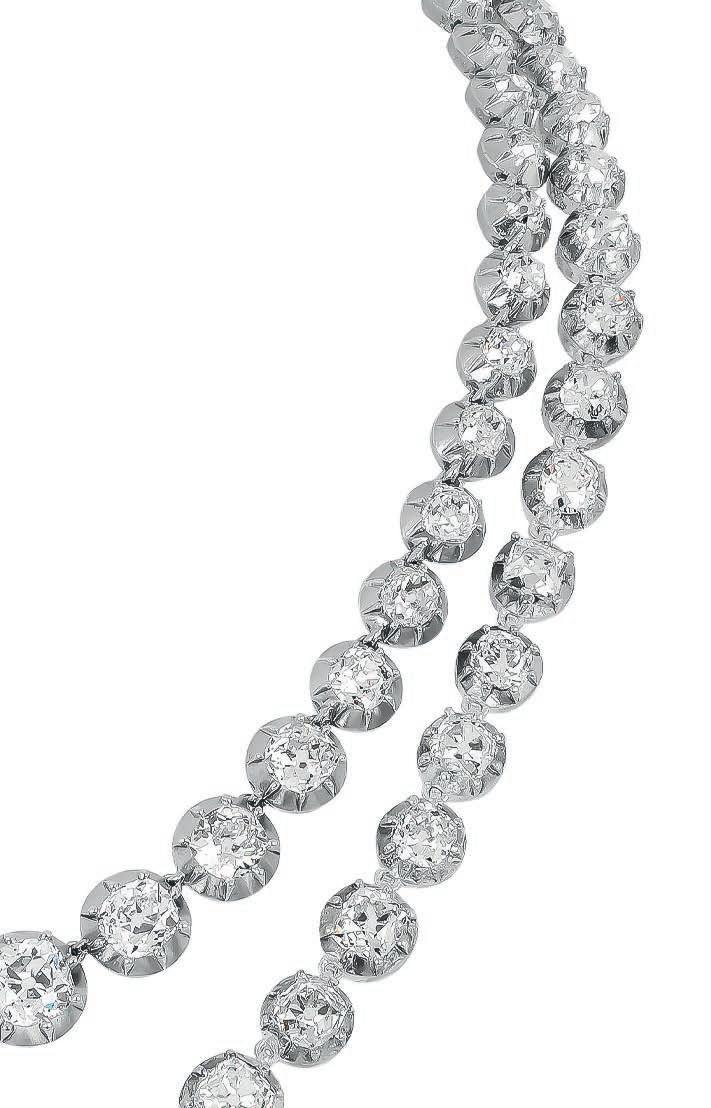
Antique diamonds are back in fashion for those who prefer a softer sparkle
89 SPHERE LIFE
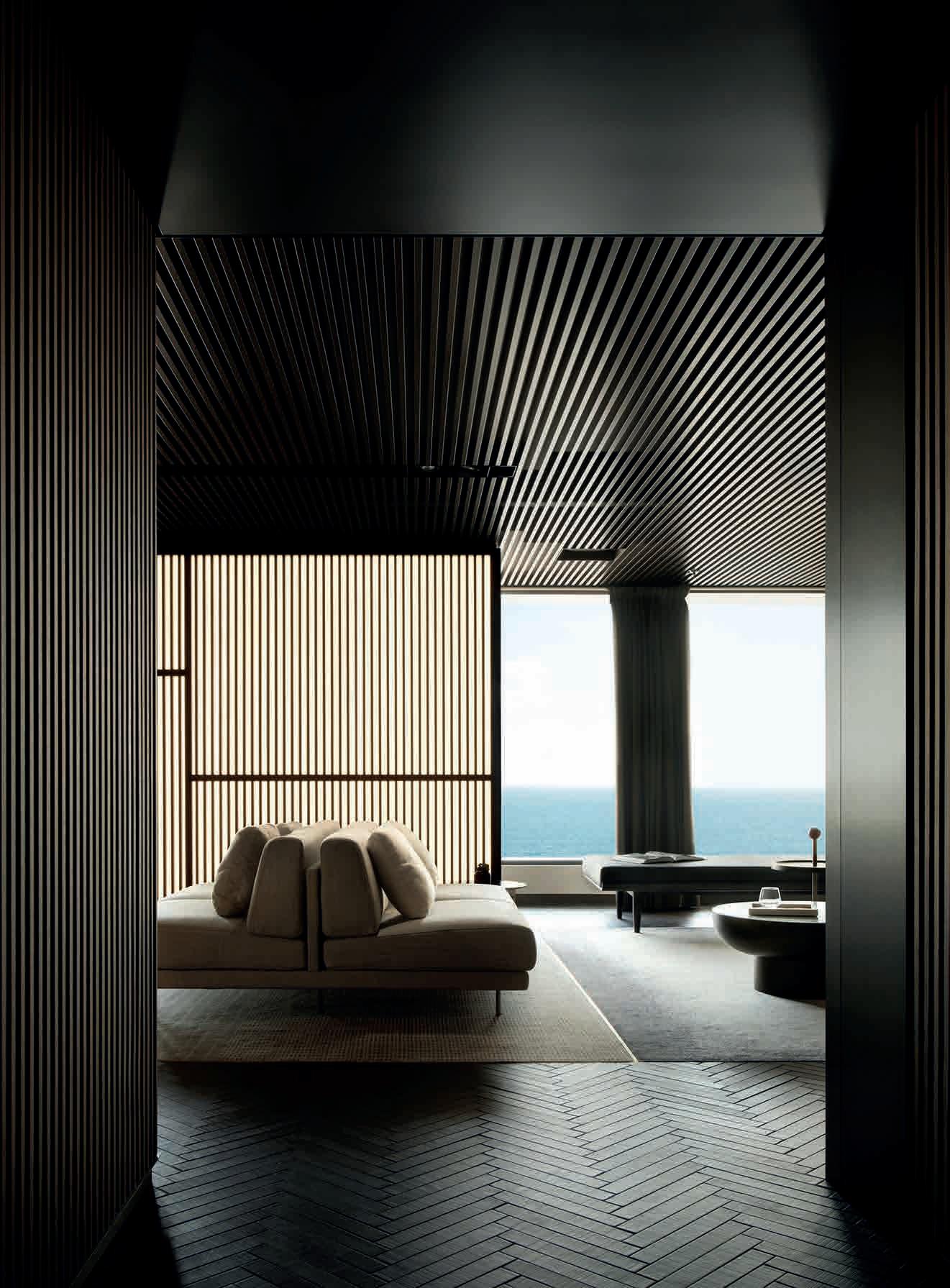
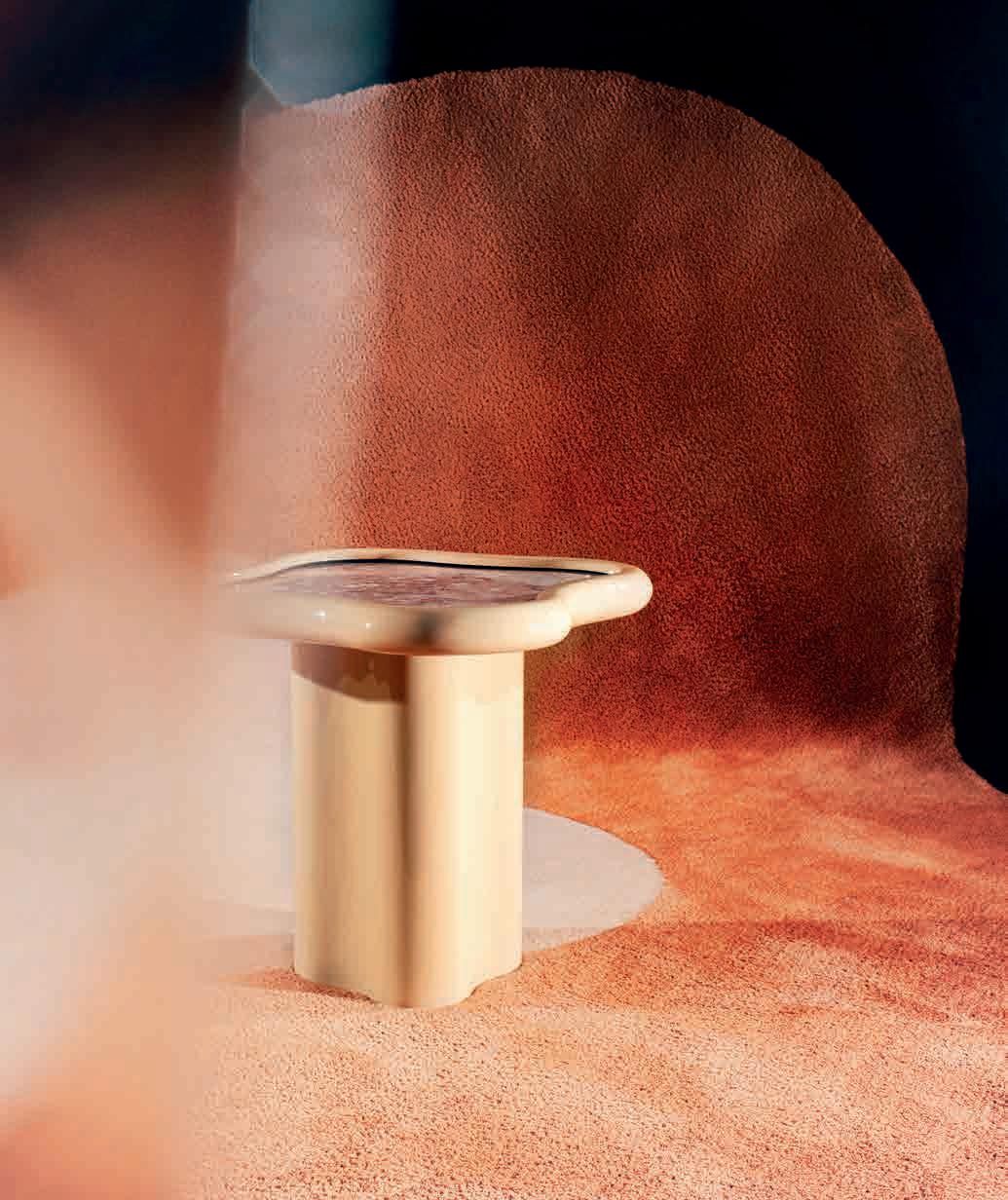
A curated collection of wellness, interiors, nature and gifting inspiration
FEATURES
36 INDIAN SUMMER
Why India is now a major destination for global luxury houses
42 RAISING THE BAR
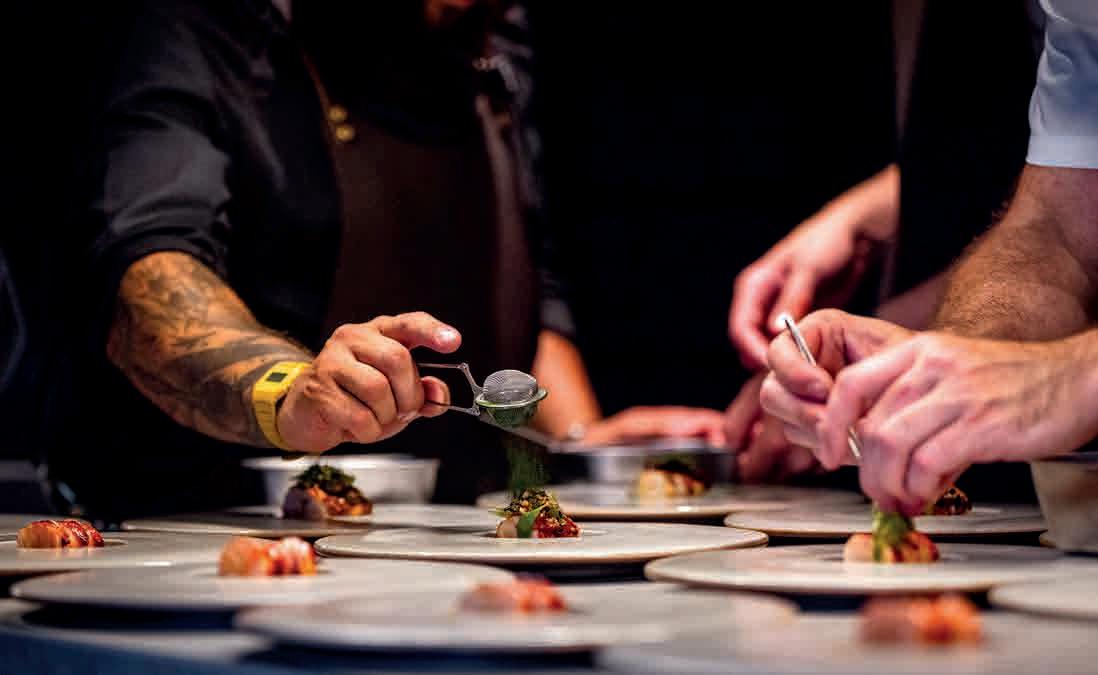
Ben McCormack snags a seat at some of London’s in-demand restaurant counters
48 A WORD TO THE WISE
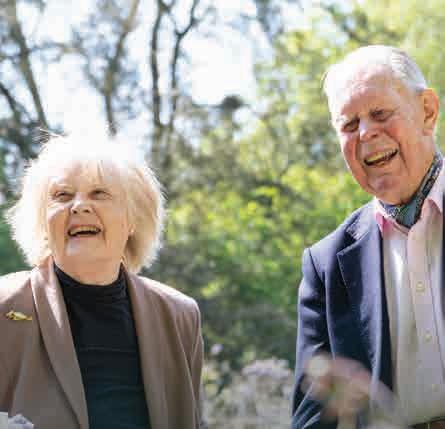
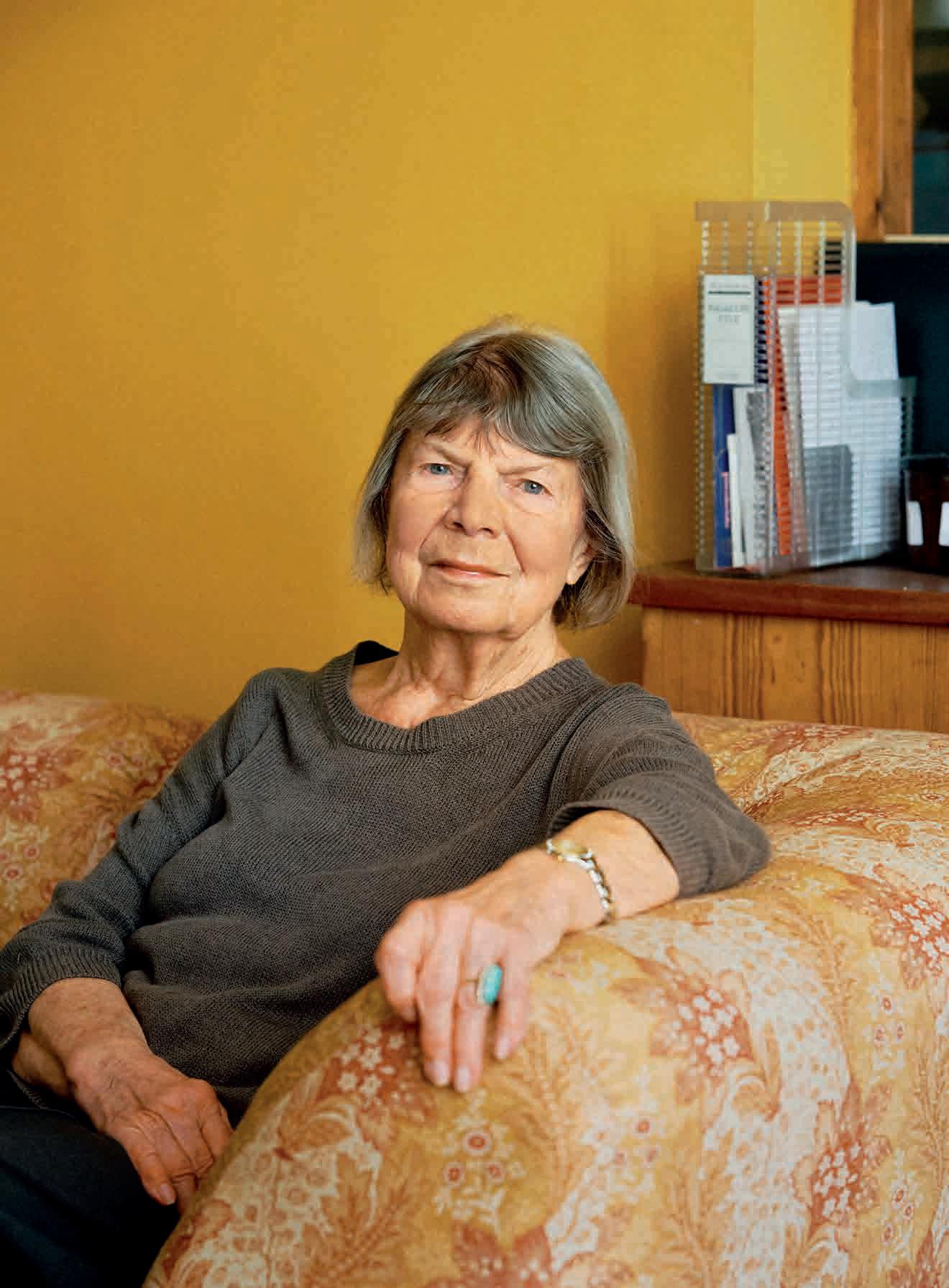
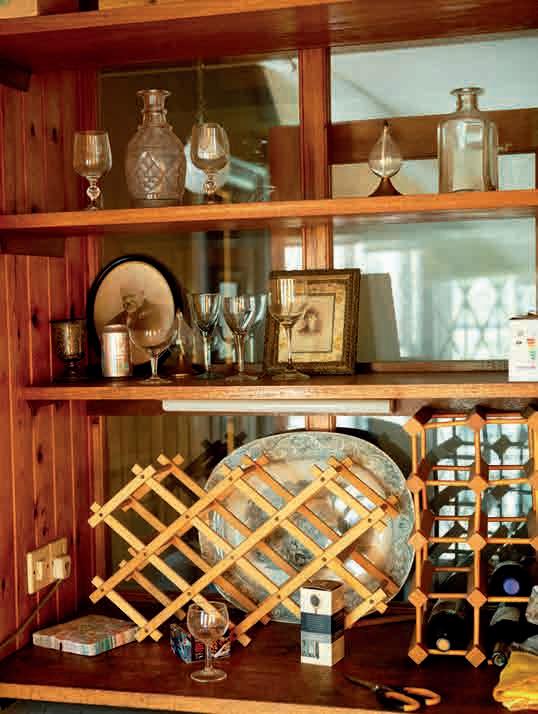
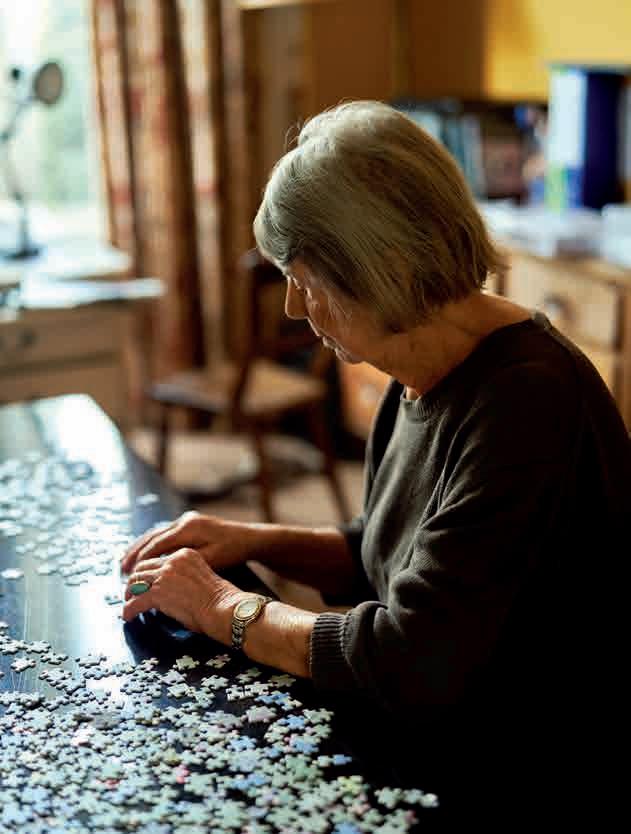
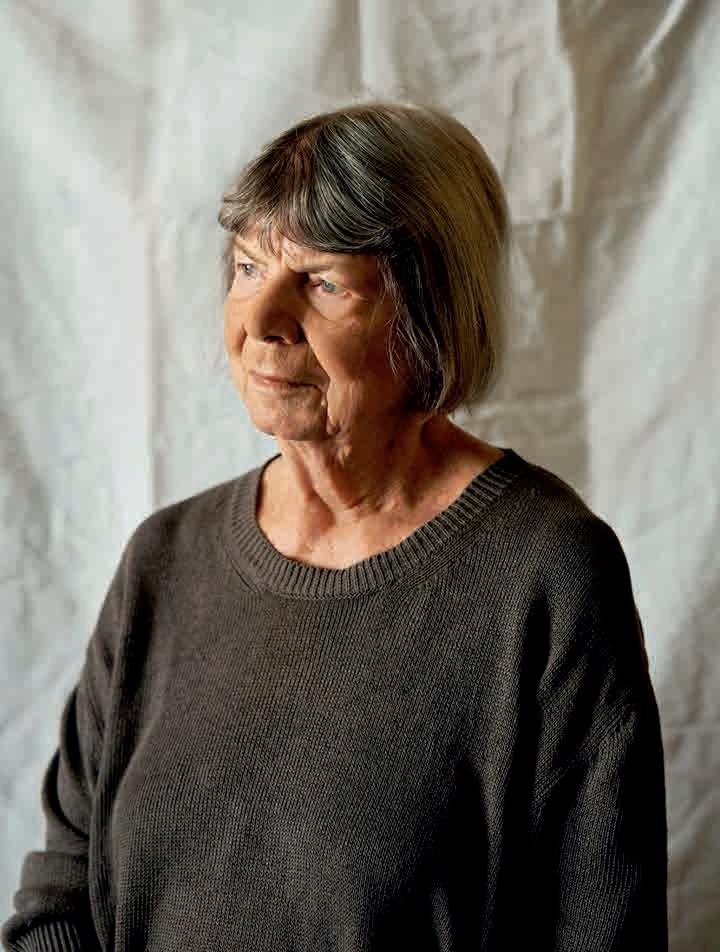
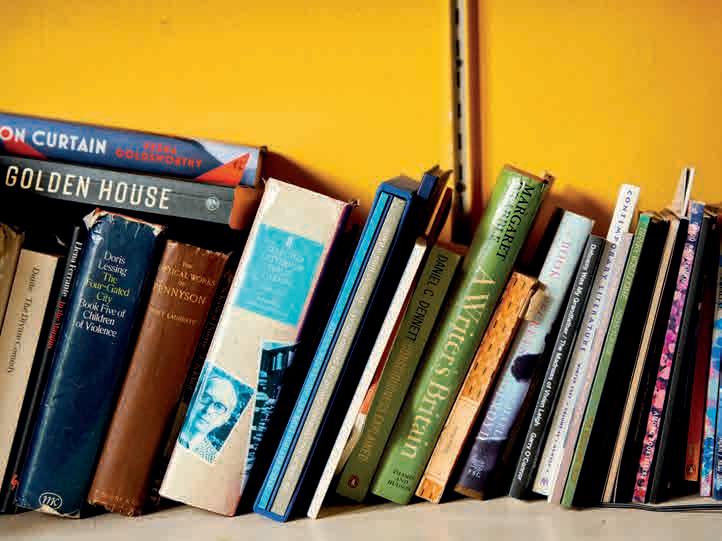
Author Dame Margaret Drabble on her latest book, In the Great Good Places, which re ects on an extraordinary life
56 LIVING LA VIE EN ROSE
Jemima Sissons and her family enjoy a French adventure in the new Bentley Bentayga Speed
62 PEAK PERFECTION
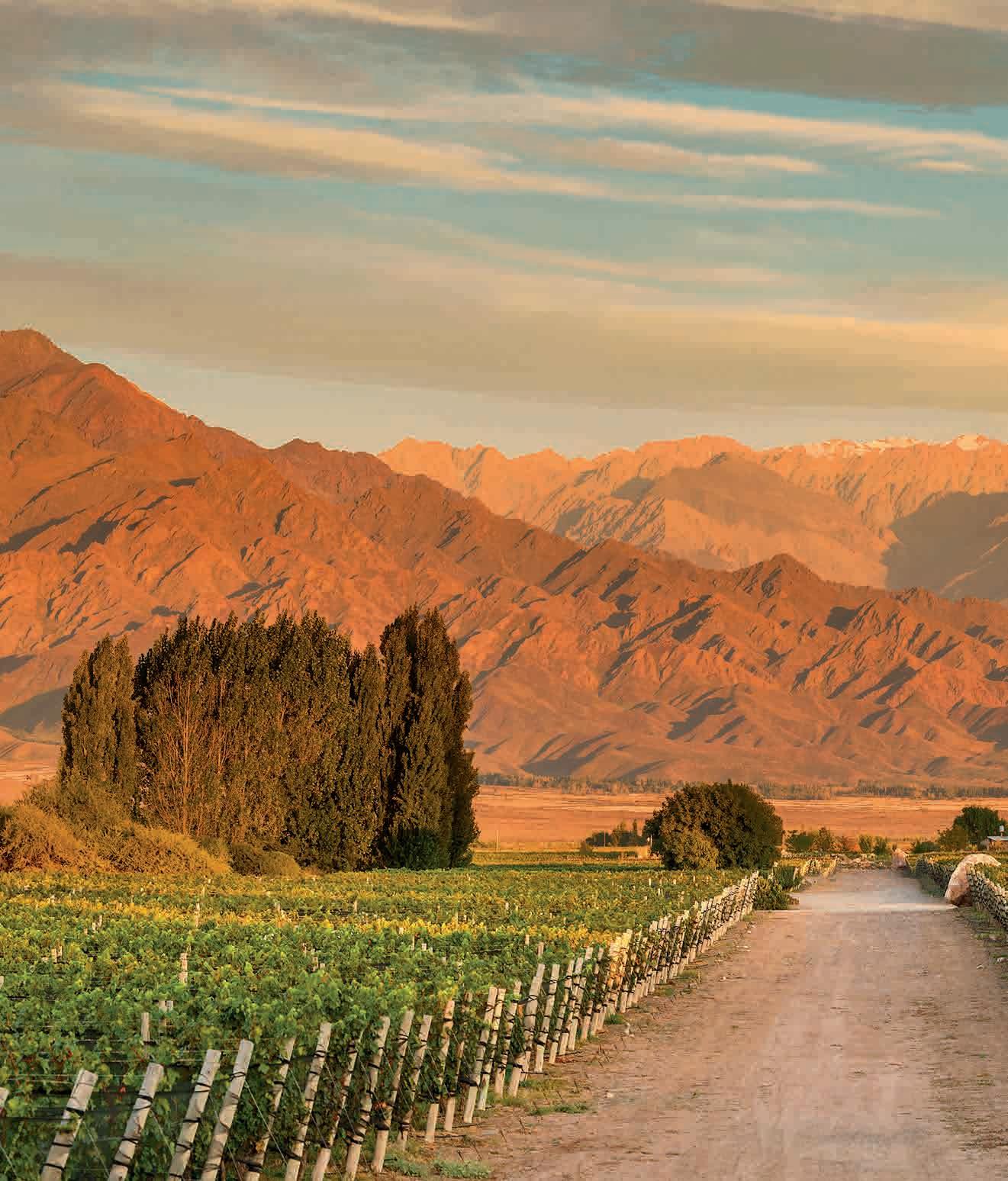
Exploring the Mendoza wine region in Argentina, where vines grow at extraordinary altitudes
76 MAKING WAVES
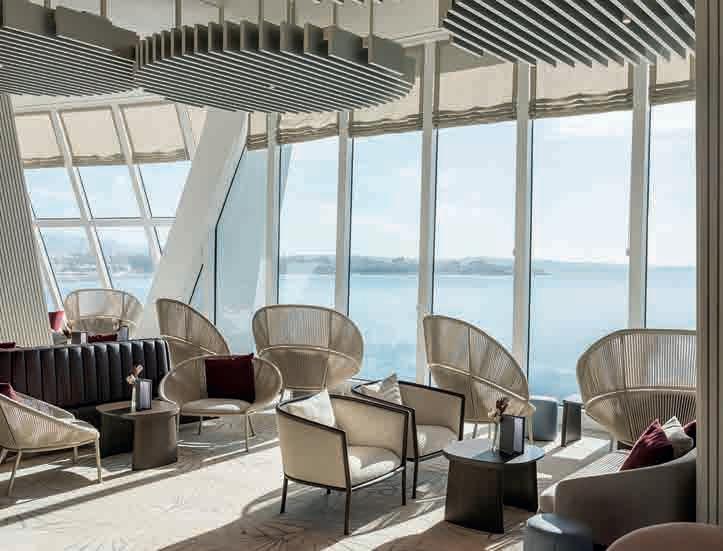
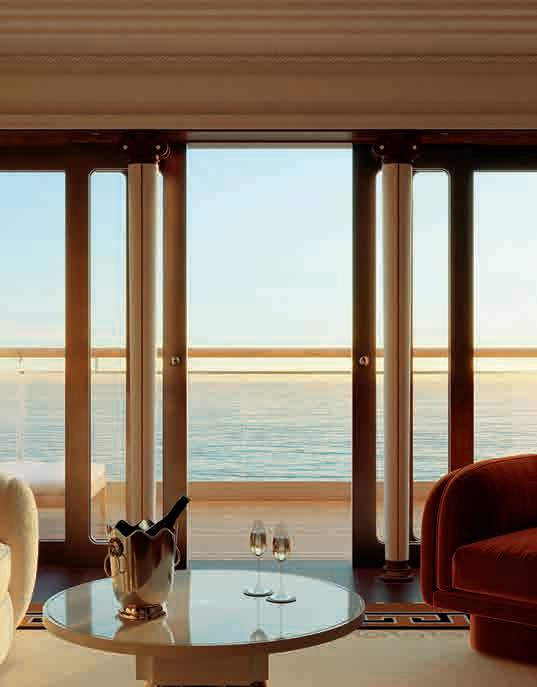
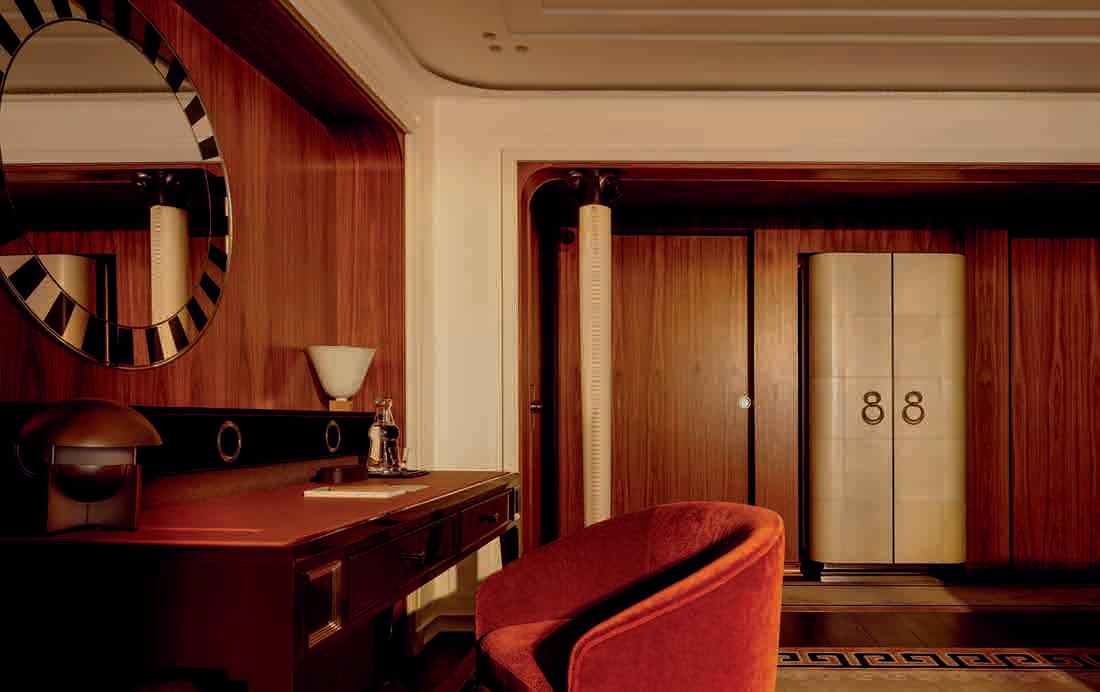
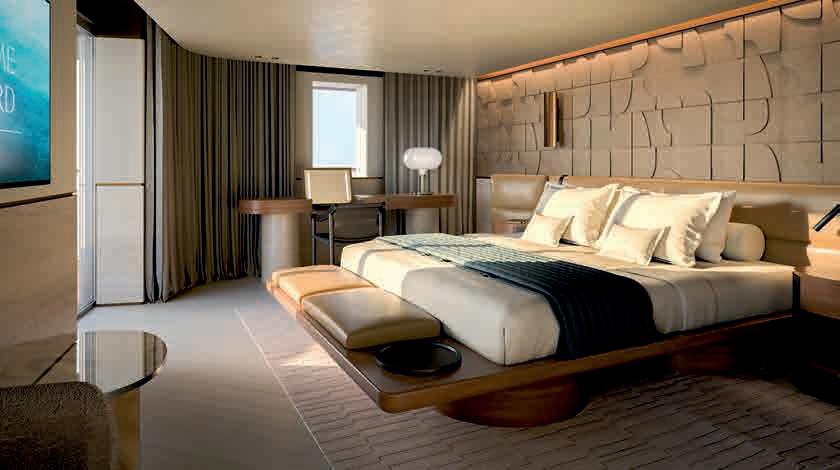
The new breed of cruise liners that are harking back to the golden era of luxury and elegance
82 HIDE AND SEEK
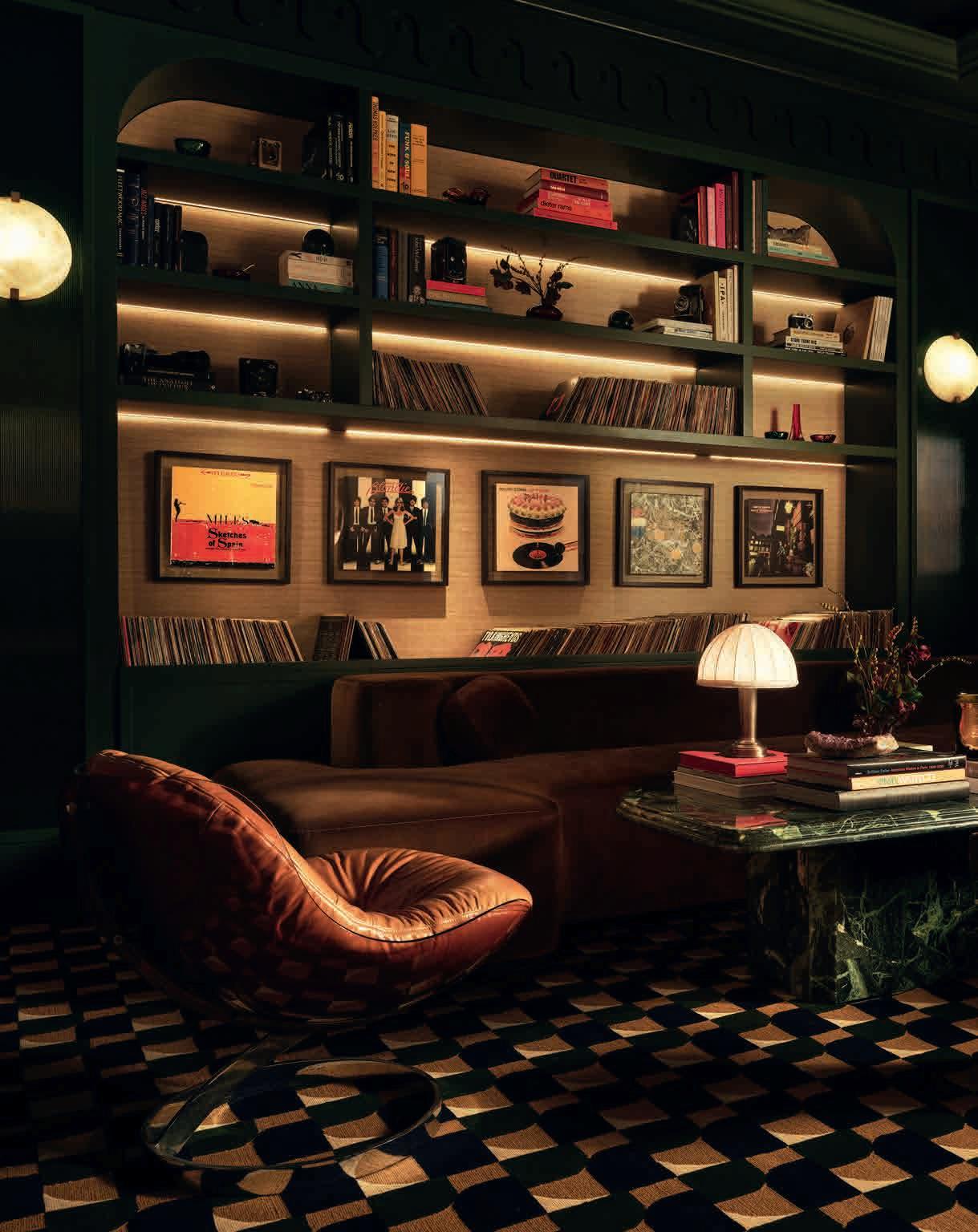
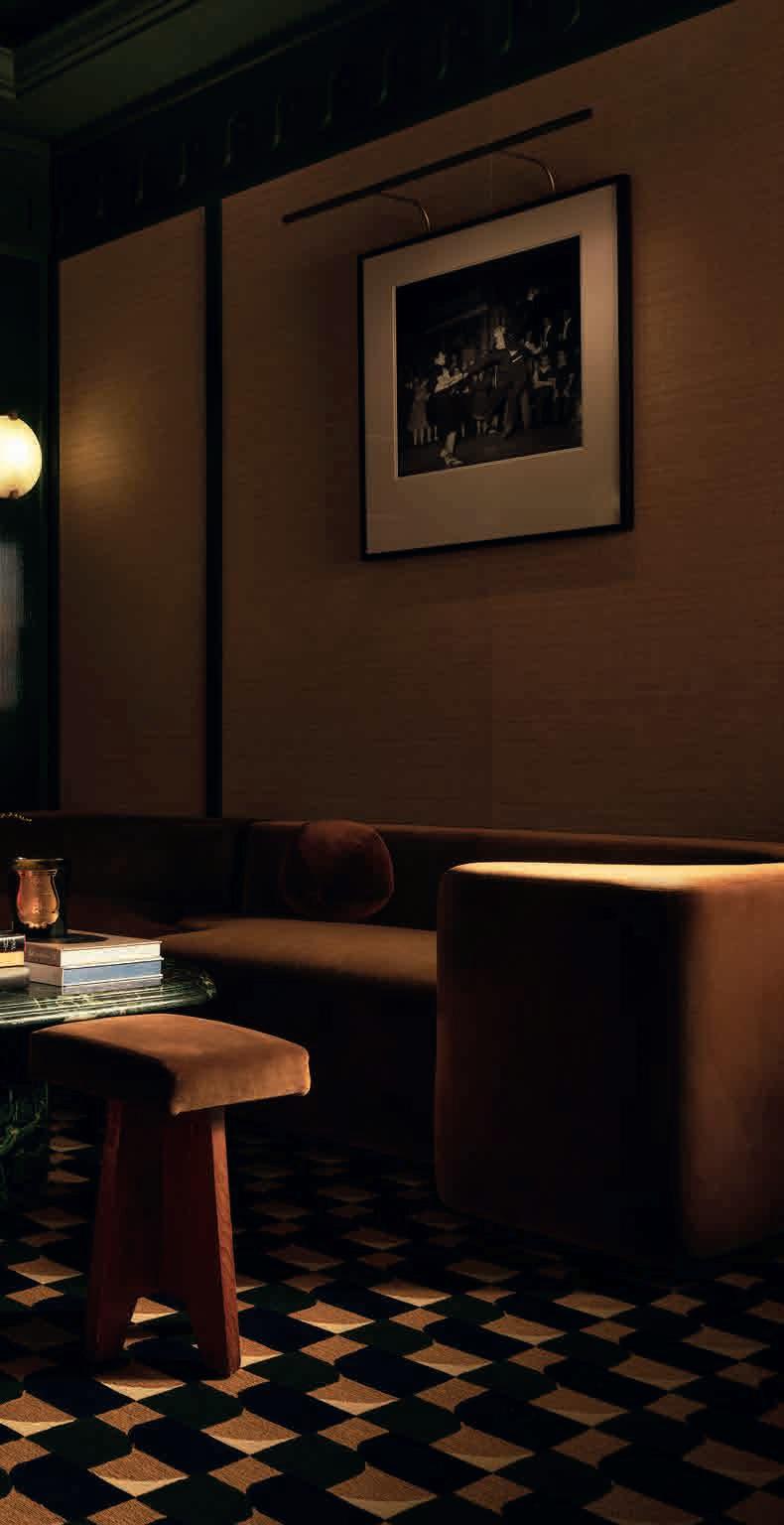
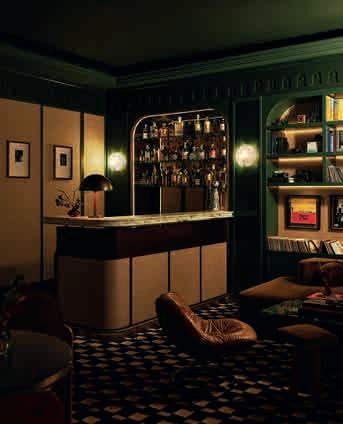
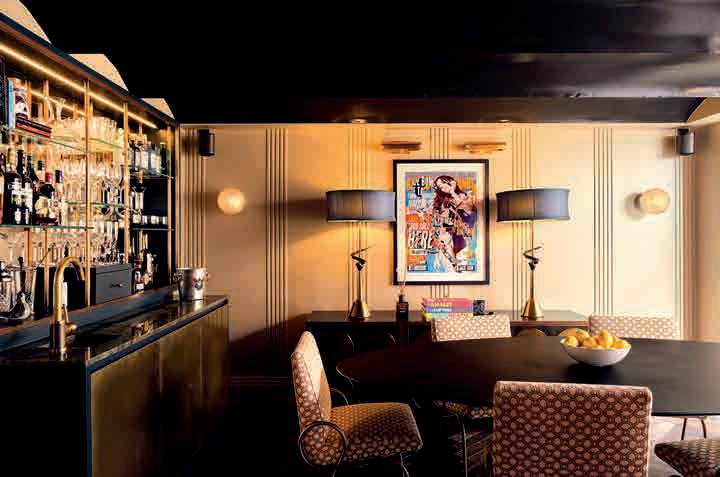
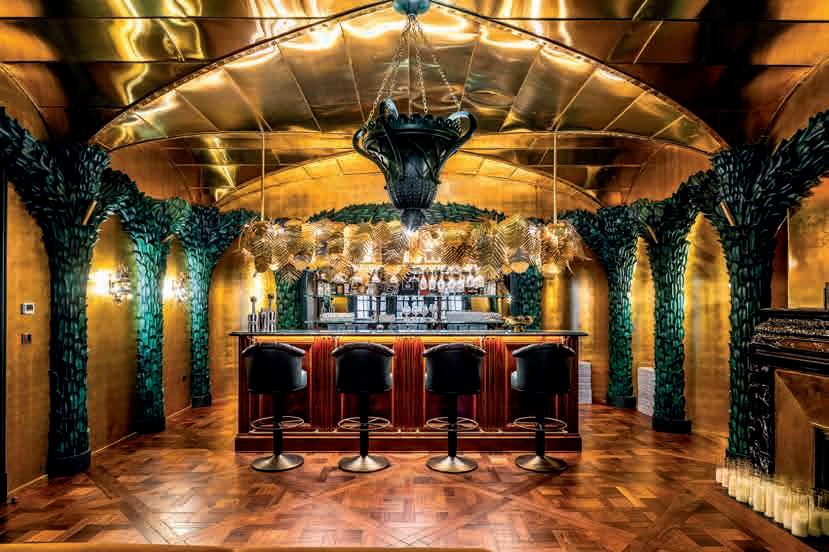
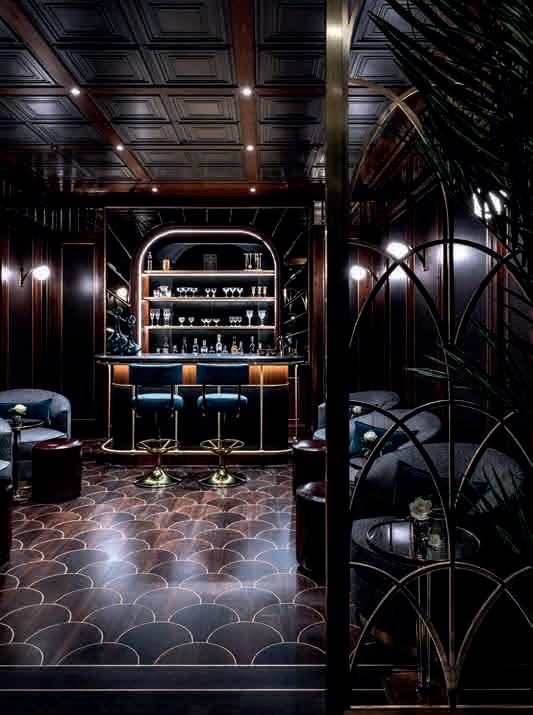
Speakeasy bars are back, this time in the comfort of the capital’s wealthiest homes
98 DOWN TO EARTH
Irish chef Richard Corrigan shares his tips for growing produce, no matter the size of your garden
EDITOR’S LETTER
Welcome to our sun- lled summer issue, along with our partner, the FT Weekend Festival.
This issue Charlotte Metcalf sits down with one of the most esteemed authors of our time, Dame Margaret Drabble for an insightful and emotional interview. Simon Brooke looks east and investigates how India is leading the luxury charge, while Nina Caplan raises a glass in the other direction, to Argentinean wines. Setting our sights on escape this summer, Jonathan Bell casts his gaze over the new design-led sailing vessels and we take a spin to the south of France in a Bentley, unearthing the nest spots to stay. Elsewhere, Ben McCormack digests the trend for counter dining and Zoe Dare Hall explores how the home speakeasy is the latest must-have.
As ever, we unearth the leaders in style, culture, food, drink, travel and wellness. For weekly access to the hottest news and insights, don’t forget to subscribe to our newsletter at spherelife.com, and please let us know at sphere@iln.co.uk if you would like to subscribe to the magazine in the future. Enjoy the read!
SPHERE
Editor
Jemima Sissons
Art Directors
Dominic Murray-Bell
Jo Murray-Bell
Sub-Editor
Rachel Roberts
Account and Production Director
David Gyseman
Colour Reproduction
Lorna Wilson
Group Advertising Director
Jane Washbourn tel: +44 (0)7920 821 577
email: jane.washbourn@iln.co.uk
Luxury Sales Manager
Dylan O’Connor tel: +44 (0)7345 532 796
email: dylan.oconnor@iln.co.uk
Chief Executive
(and Online Editor spherelife.com)
Lisa Barnard
tel: +44 (0)7887 823 116
email: lisa.barnard@iln.co.uk
Contributor
Lucia Ferigutti
SPHERE PARTNERS FT WEEKEND FESTIVAL ukftweekendfestival.live.ft.com
Andrea Mongia is an Italian illustrator based in Rome. His work spans editorial, advertising, and cultural projects. Clients include Airbnb, Barilla, The New Yorker, and The New York Times. In 2019, he was included in the Forbes 30 Under 30 Europe Art & Culture list.
AVRIL GROOM
Avril Groom writes about luxury jewellery, watches and fashion for a number of upmarket publications and websites, including the Financial Times HTSI magazine, Condé Nast Traveller and Telegraph Time. She also edits Country and Town House magazine’s jewellery and watch supplement.
CHARLOTTE METCALF
Writer and award-winning filmmaker
Charlotte Metcalf contributes to various publications, is the editor of Great British Brands, an associate editor at Country and Town House, and co-presents the Break Out Culture podcast. Her book Walking Away is about her time making television documentaries in Africa.
BEN MCCORMACK
London-based Ben McCormack has been the restaurant expert for Telegraph Luxury since 2013. His work was shortlisted in the Restaurant Writer category at the 2020 Fortnum & Mason Food and Drink Awards. He is also a regular contributor to The Standard, Food and Travel and Decanter
JONATHAN BELL
A writer specialising in architectural and transportation design, Jonathan Bell is transport and technology editor at Wallpaper*. His books include Concept Car Design and The New Modern House and he also contributes to international lifestyle and design magazines. He lives in South London with his family.
ZOE DARE HALL
Zoe Dare Hall, a property writer for publications including the Financial Times, The Sunday Times and The Daily Telegraph, is one of SPHERE’s longeststanding contributors. She lives in London but wants to live in practically every place she visits — Dorset and the Algarve are her current favourites.
Printed by: Paragon SPHERE Magazine is published by Illustrated London News Limited, Soho Works, 4th Floor, The Tea Building, 56 Shoreditch High Street, London E1 6JJ Registered in the United Kingdom No. 15725542 Website: iln.co.uk
ISSN: 2040-5316
To subscribe to
Jemima Sissons
NUCLEUS
FOOD | TRAVEL | CULTURE | STYLE | BEAUTY
FABRIC OF LIFE
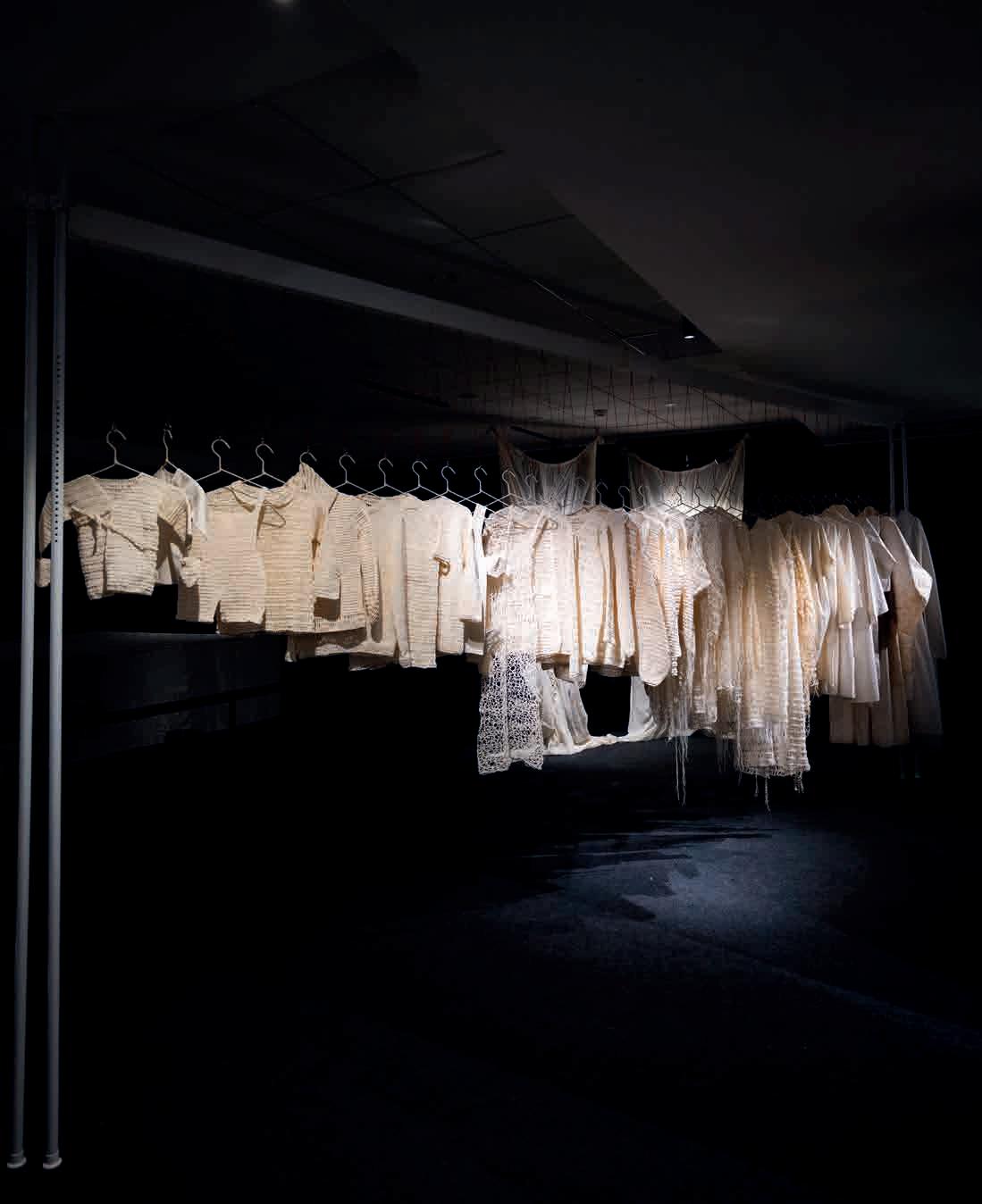
Bringing craft and community together in textile form, a new exhibition at the Whitworth, part of Manchester University, highlights the work of eight contemporary artists from Korea and India. Pieces in Hyundai Translocal Series: Entangled and Woven (from 10 July) range from explorations of plant fibres used in traditional weaving practice to a colourful series inspired by Varanasi’s Vishwanath Temple. Artist Somi Ko also presents works that utilise khadi, an Indian textile promoted by Mahatma Gandhi. Shown left: People of One, Continuum by Kaimurai. whitworth.manchester.ac.uk
TURN UP THE HEAT
Even if your season ahead is a staycation, channel the Italian Riviera with Heidi Klein’s new collection, inspired by the Amalfi Coast. Echoing the breezy charm of Positano and Sorrento, the bandeau, halterneck and square-neck pieces offer soft smocking and elegant cut-outs. Bikinis are designed to support, while one pieces flatter, such as this stylish two-tone Heron Bay Halterneck Ring Swimsuit. £265, heidiklein.com
MAKE A STATEMENT
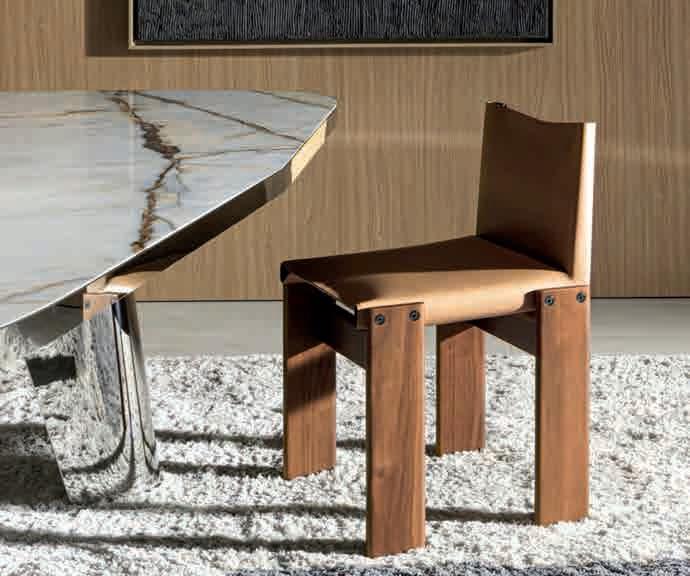
Take your seat at the table with a historic chair by an equally historic designer. A legend of quiet luxury has returned to the Molteni & C collection via its Heritage range. The Monk Chair is a stunning yet subtle fusion of leather and timber, transforming a gathering of strong shapes into one exquisite piece. This slice of furniture history is available to view alongside many other design delights in the brand new dedicated Molteni & C studio, housed in Chaplins’ 25,000 sq ft Greater London design space. £2,559, chaplins.co.uk
IN FULL BLOOM
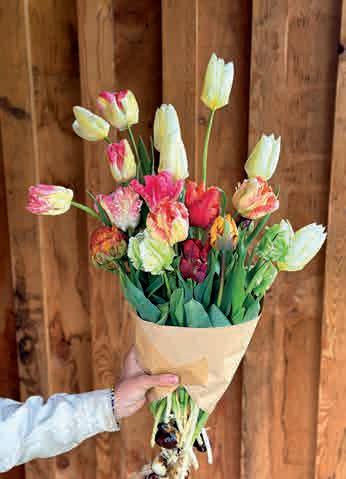
Known for their biodynamic farming — working in rhythm with the moons and seasons — Burnt Fen Flowers launched in 2019 and is now o ering single-variety bunches for the first time. These will evolve throughout the months as the fields fill with Icelandic poppies, ranunculi, cornflowers, roses, cosmos, dahlias and more — ensuring each delivery reflects the time of year. burntfenflowers.com
NUCLEUS
CHANGE OF PACE
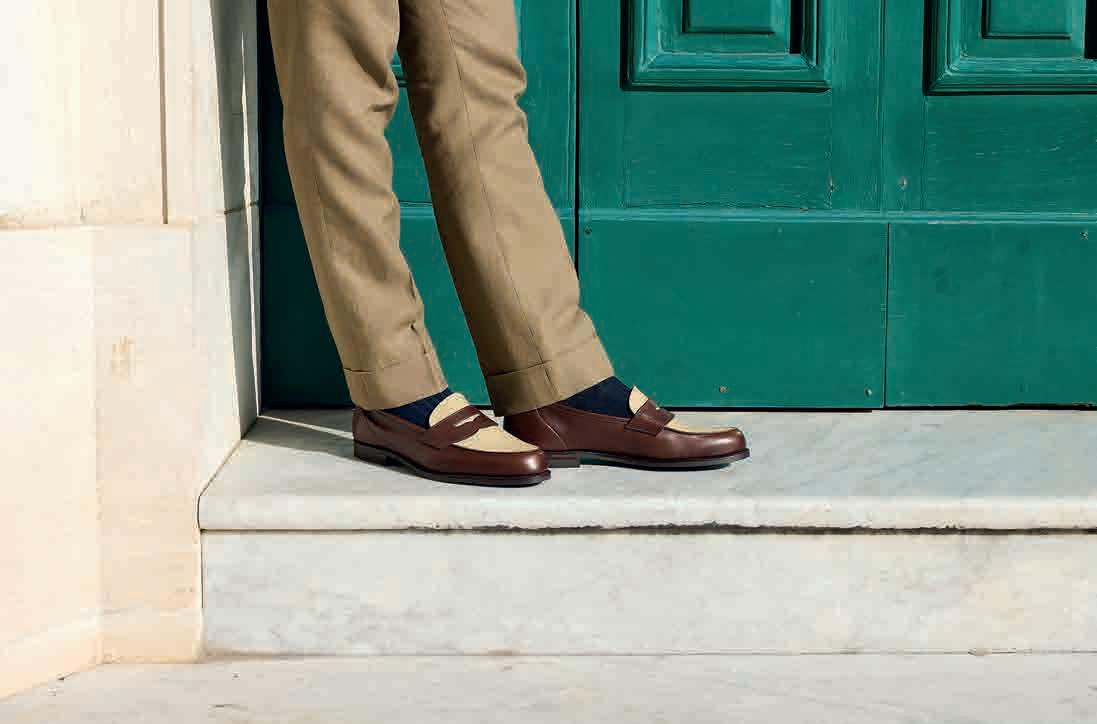
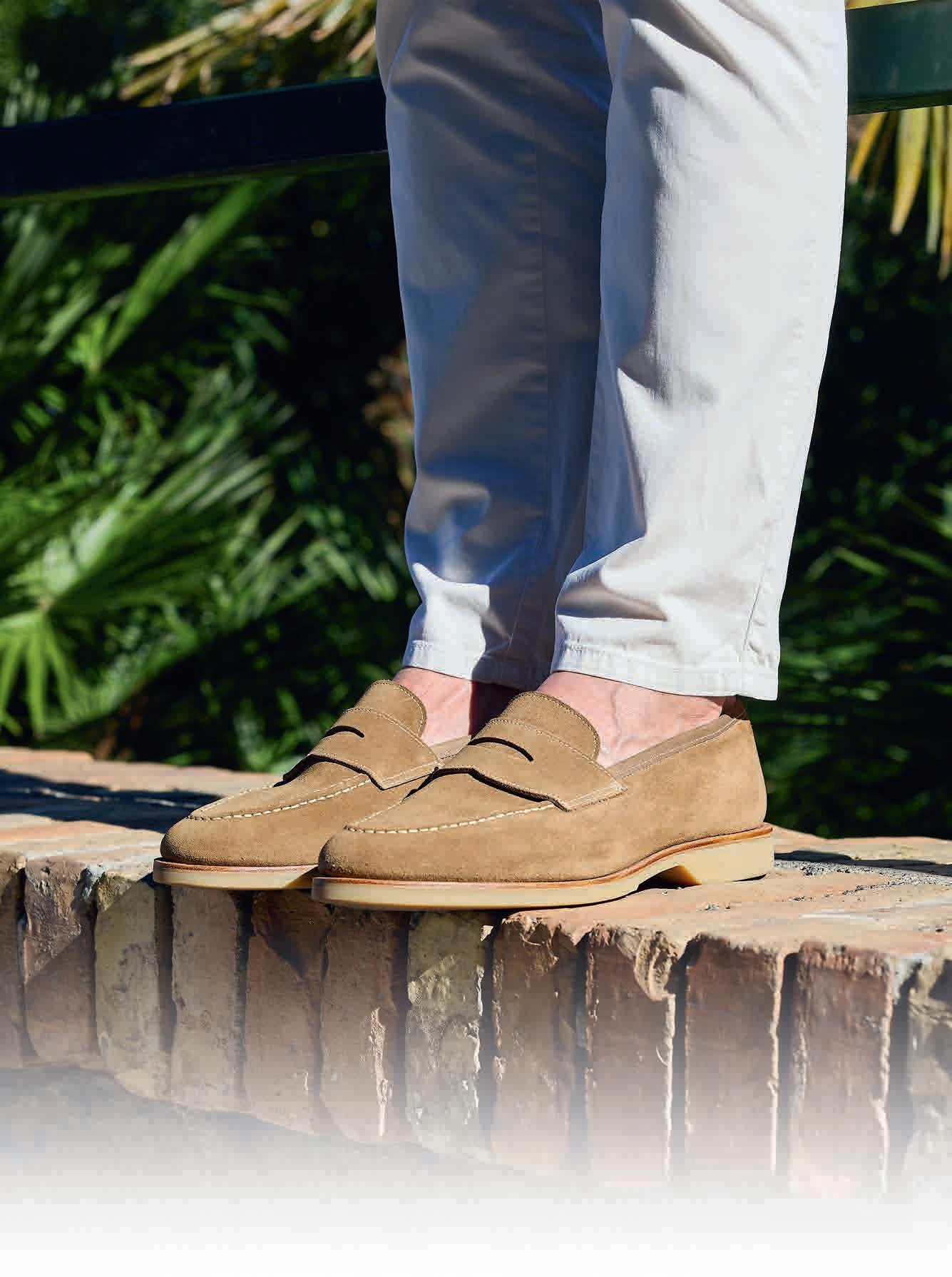
Cut a bella figura this summer with the new Travel Loafer Collection from Crockett & Jones. Featuring the Harvard 2 and Richmond 2, these Goodyear welted shoes are soft enough for sunny passeggiatas and robust enough to endure city streets. We love the two-tone walnut milled calf and stone canvas (pictured above). From £605, crockettandjones.com
THE FINER THINGS
Japanese whisky house
Hibiki has launched its new collaboration with The House of Chiso, a 460-year-old kimono maker. Drawing parallels between kimono artistry and the historic art of whisky blending, the bottles are priced between £75 and £90. Renowned Japanese actress Anna Sawai (left) is the face of the campaign. suntory.com/hibiki-whisky
CHAMPION IDEA
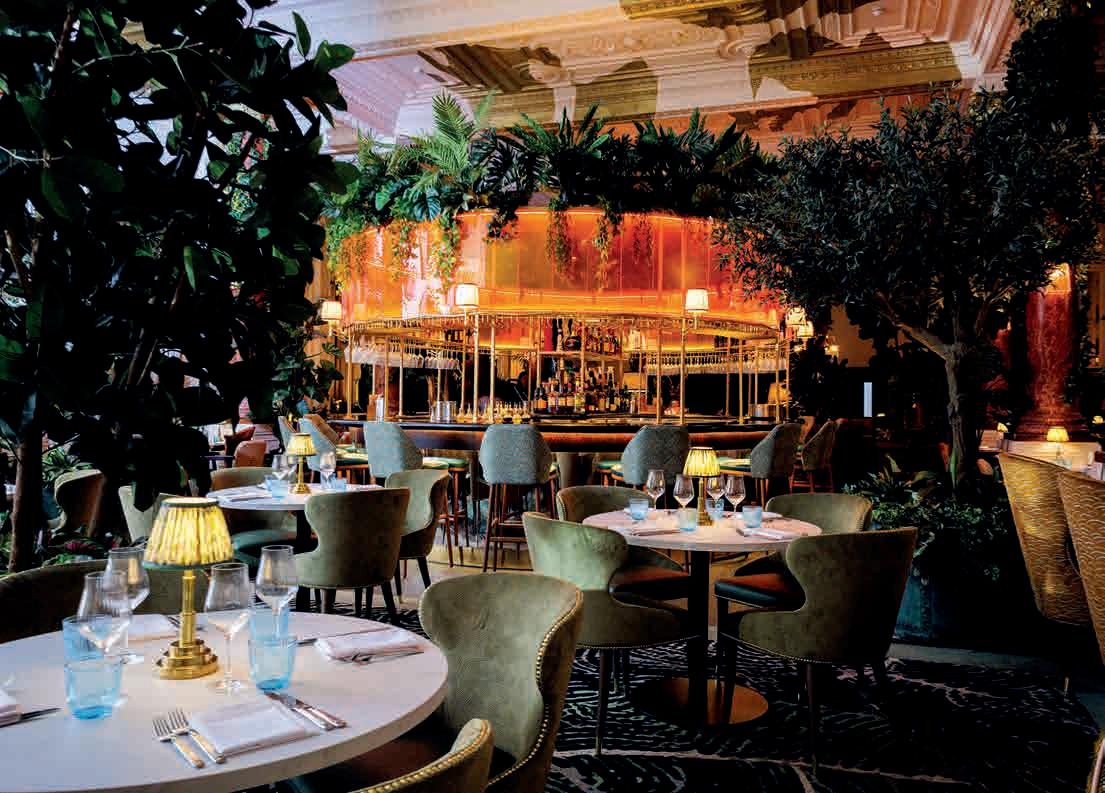
Once known for being a slightly ageing exhibition hall, the sparkling new Olympia 2.0 has finally opened its doors, putting this part of West London on the map and o ering an array of places to shop, dine and drink. Idalia at Pillar Hall is set to be one of the go-to destinations, with its warm, maximalist jungle-vibe interiors, an all-day dining menu spanning delicious Korean fried chicken and ribeye steak, and a shiny bar. pillarhall.co.uk
WEAVE A TALE
Pelican House is known for its timeless rug designs. From India to Nepal and Turkey, the founders work with local artisans to create lasting pieces. Their new collection, Talis, celebrates the Art Deco era, inspired by the symmetry, geometry and streamlined forms of the period. Bold patterns are paired with a rich palette of deep bronzes, burnished golds and warm rusts, echoing the opulence and glamour of the 1920s and 1930s. The collection features six rugs, from Vespa, crafted in Himalayan wool and adorned with a dramatic fan motif (shown left), to Cil, which celebrates the border with a repeating starburst pattern. Talis range from £2,095, pelican-house.com
NUCLEUS
BUSINESS AS USUAL
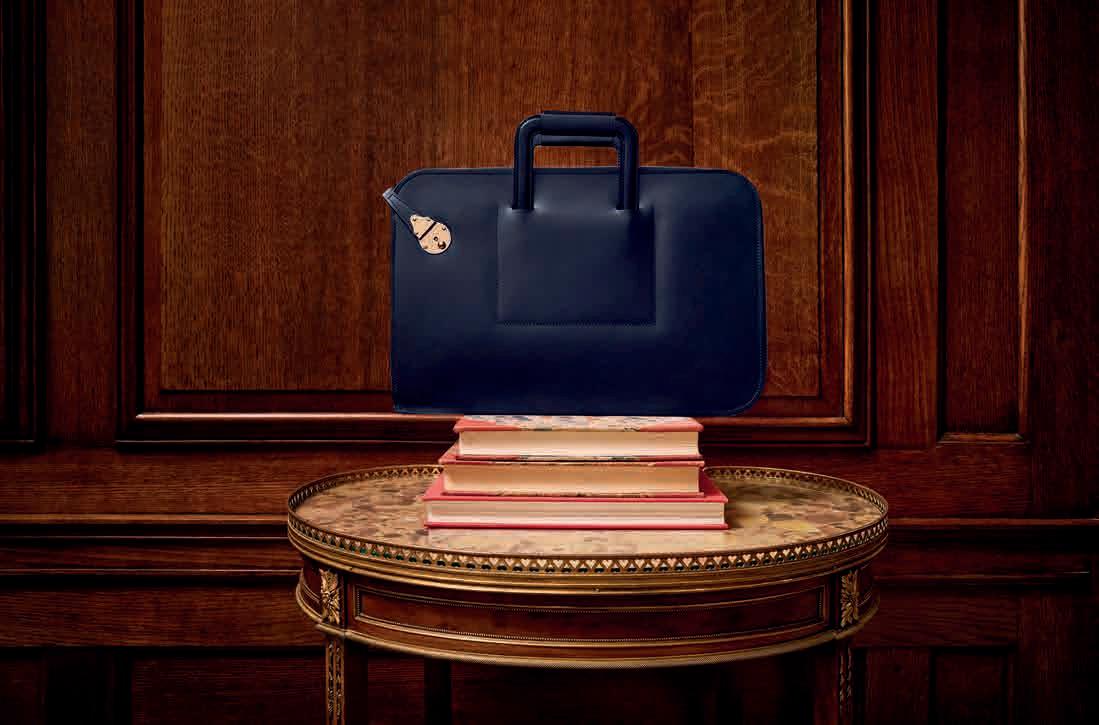
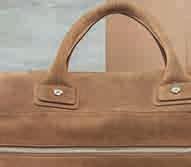
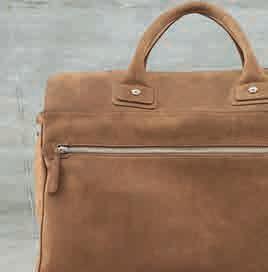
Celebrating the style of the modern city gent, Swaine’s iconic Salisbury folio has evolved this season into the Salisbury II. The new iteration of the smart leather case — named after Lord Salisbury, the former British prime minister — now features an added gusset for laptops and a repositioned lock. Colourways include Havana and Dark Navy (pictured above). £1,950, swaine.london
PICTURE THIS
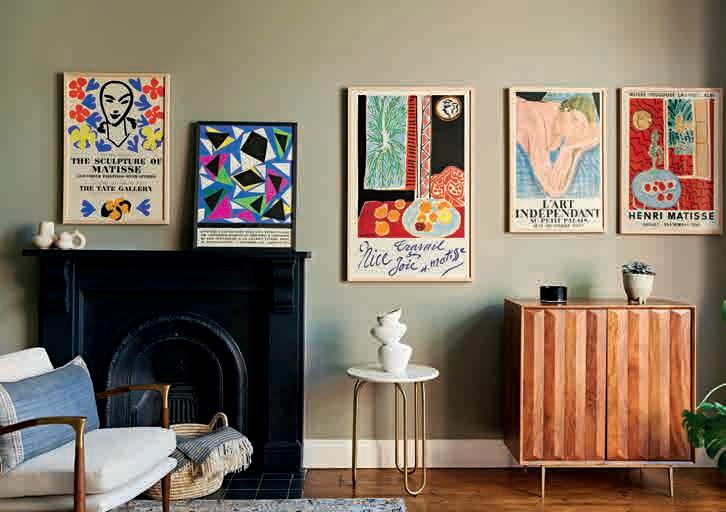
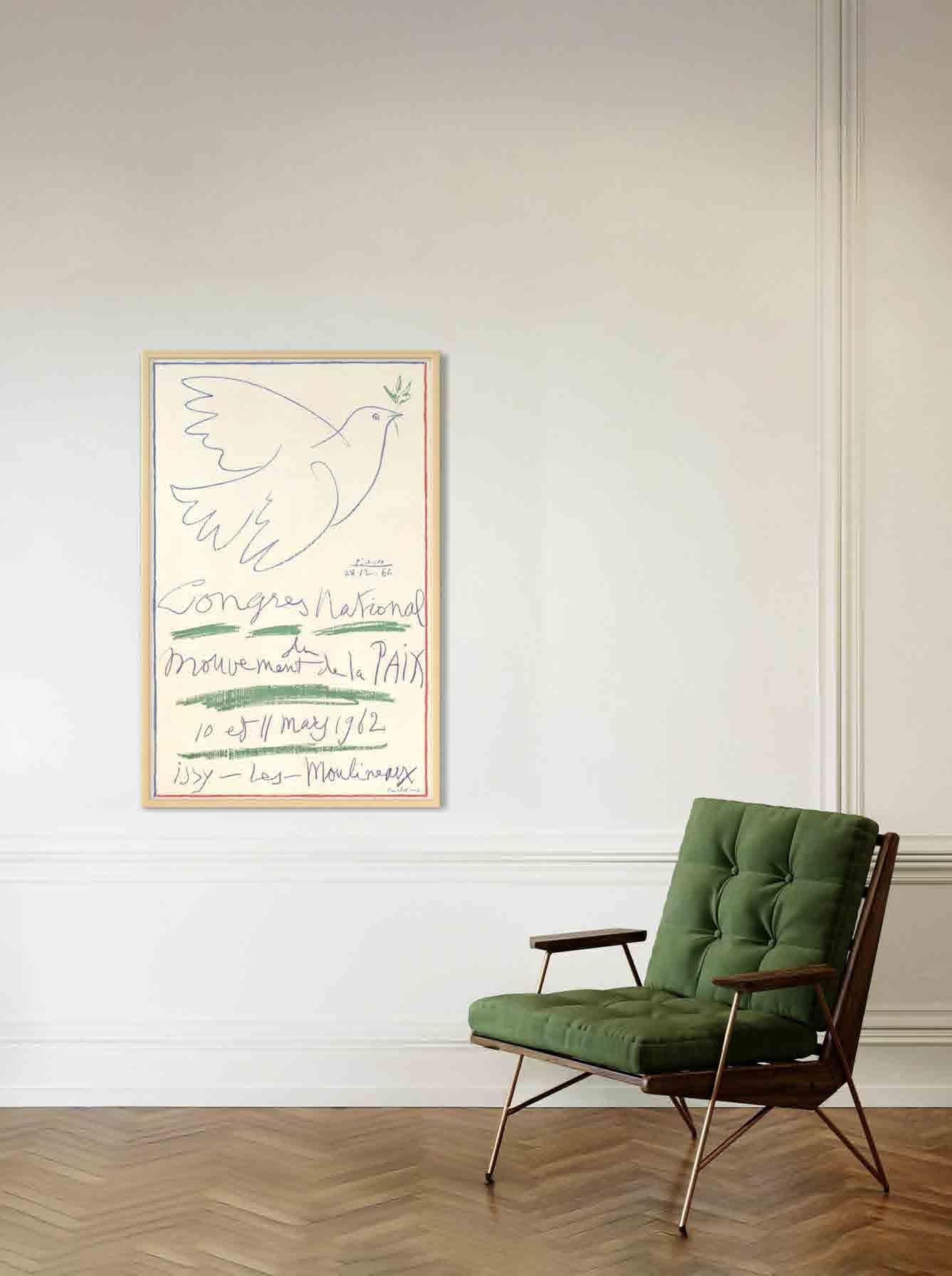
Hommage is London’s leading specialist in original lithographs and art exhibition posters from the masters of modern art, such as Picasso, Matisse and Chagall. The King’s Road Gallery will host a series of guest artist collaborations across the year, including the landscape artist and print- maker Giuseppe D’Innella, from 17 to 30 August. hommage-art.com
NUCLEUS
ARM CANDY
SMOOTH SAILING
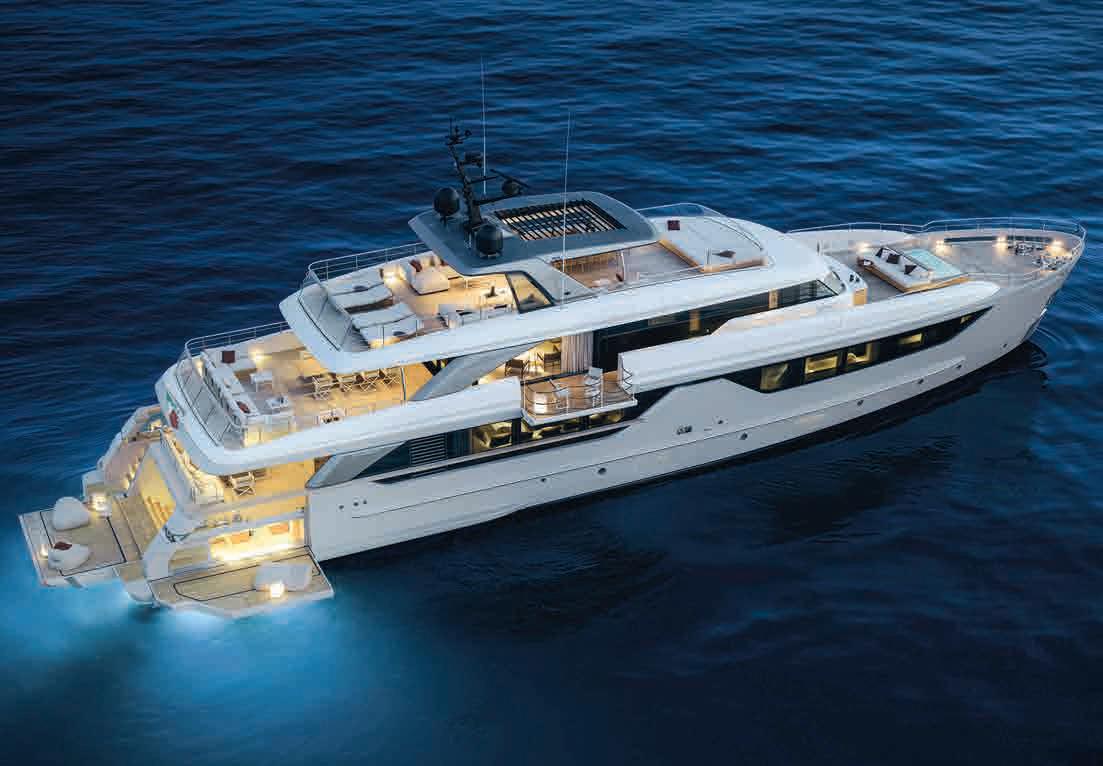
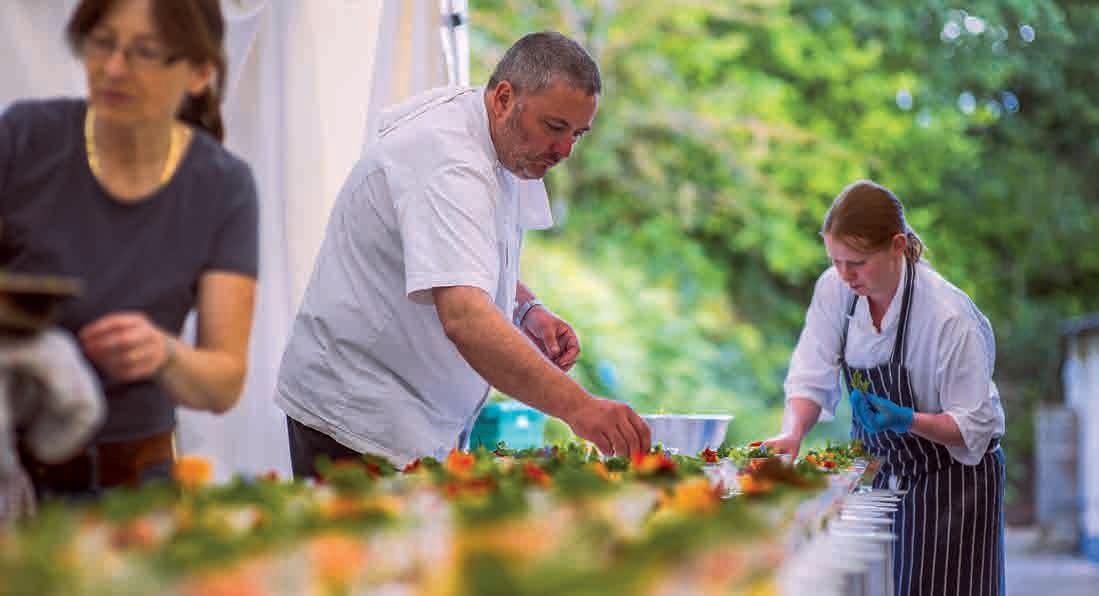
For those who want to seek out some of the world’s finest yachts in the heart of Mayfair, Sanlorenzo has opened its first London showroom. The space o ers clients the chance to peruse the made-to-measure vessels and get to know the brand a little more intimately. Reflecting a growing demand for the company’s yachts, the showroom on Park Lane has been transformed into a refined location to begin the co-creation journey. sanlorenzoyachts.co.uk
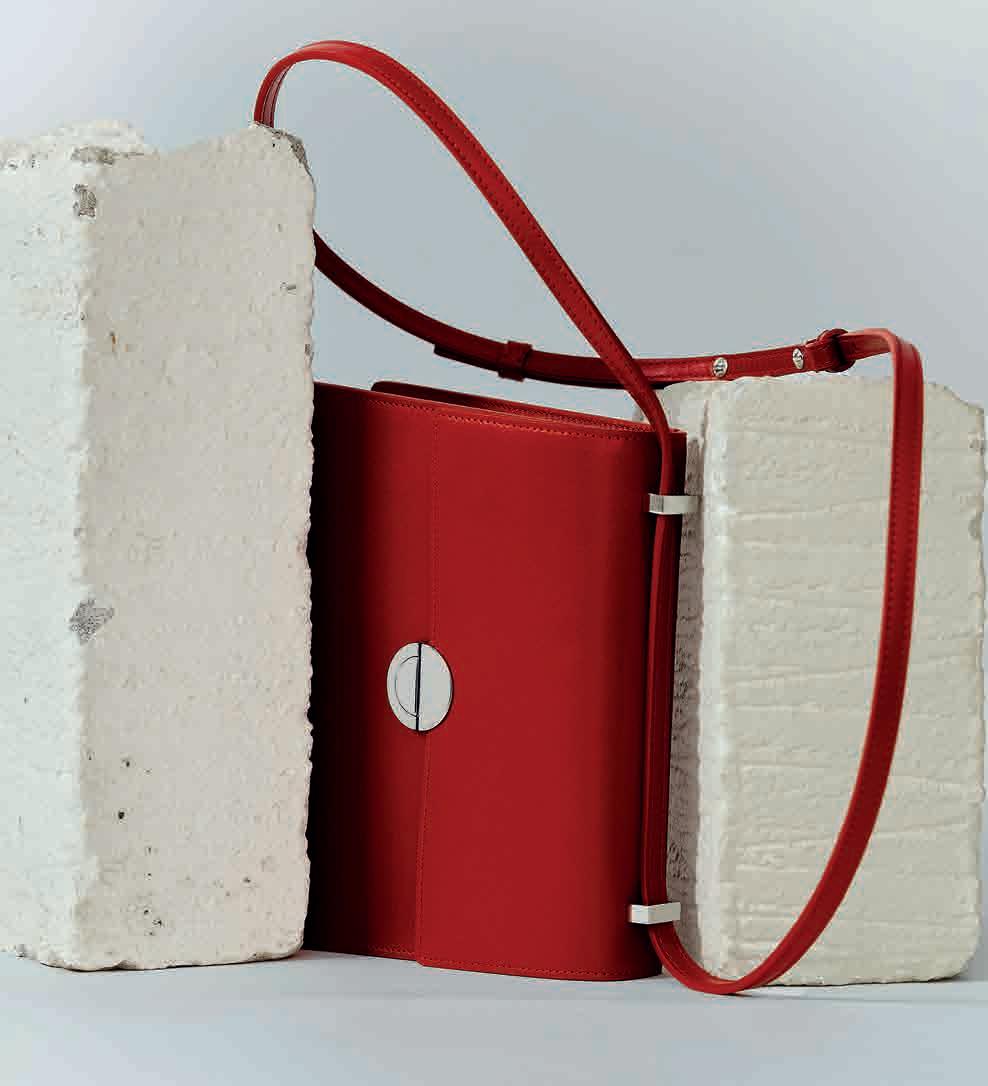
Taking its name from the French slang for a mischief-maker, Givenchy’s Voyou bag comes in a new form this season: the bucket style, featuring soft structuring and a biker-inspired aesthetic. Crafted from smooth, shiny calf leather with a fine grain and glossy finish, it o ers a generous suede-lined central compartment, complete with a pocket for essentials. The Voyou Bucket is available in ivory, light pink, chocolate or black leather with gold-finish hardware, and in cobalt blue leather with silver-finish hardware. From £1,600, Givenchy by Sarah Burton givenchy.com
HOME SWEET HOME
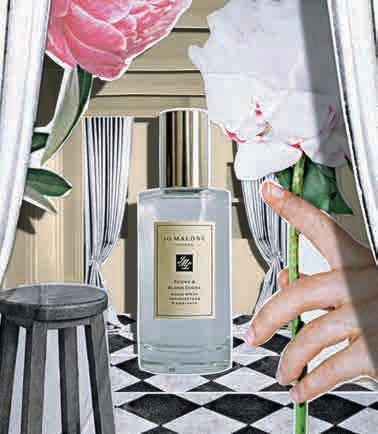
Keep your surroundings beautifully fragrant this season with Jo Malone London’s newest scents for the home. This mini room spray means you can keep the air perfumed wherever you roam; the ideal size to pop easily in your bag. Options in the range include Peony and Blush Suede and Lime Basil and Mandarin (£24). Other o erings include a divine new linen spray in Lavender and White Cedar to elevate your sheets to an olifactory joy. jomalone.co.uk
NUCLEUS
ON SPARKLING FORM
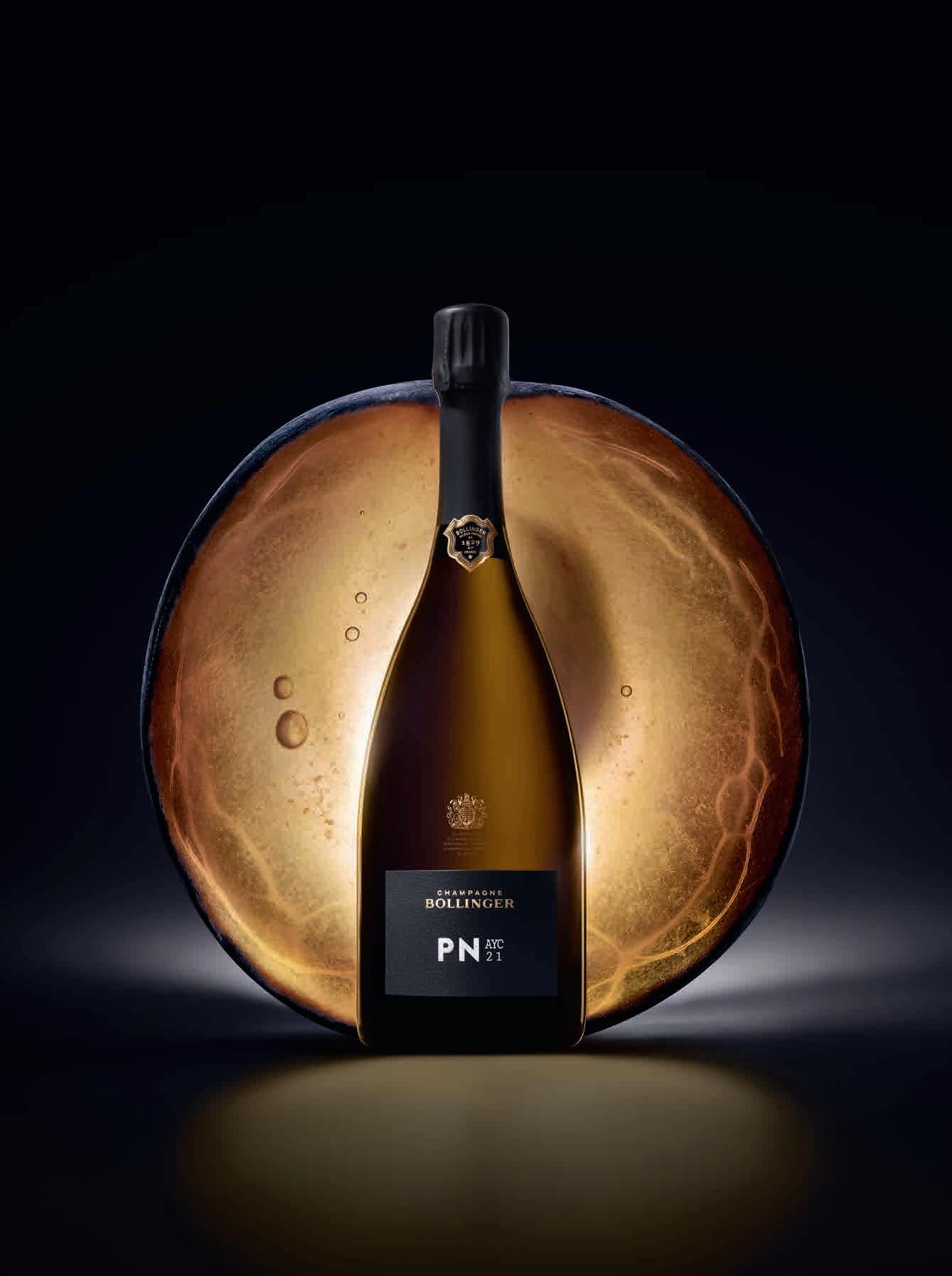
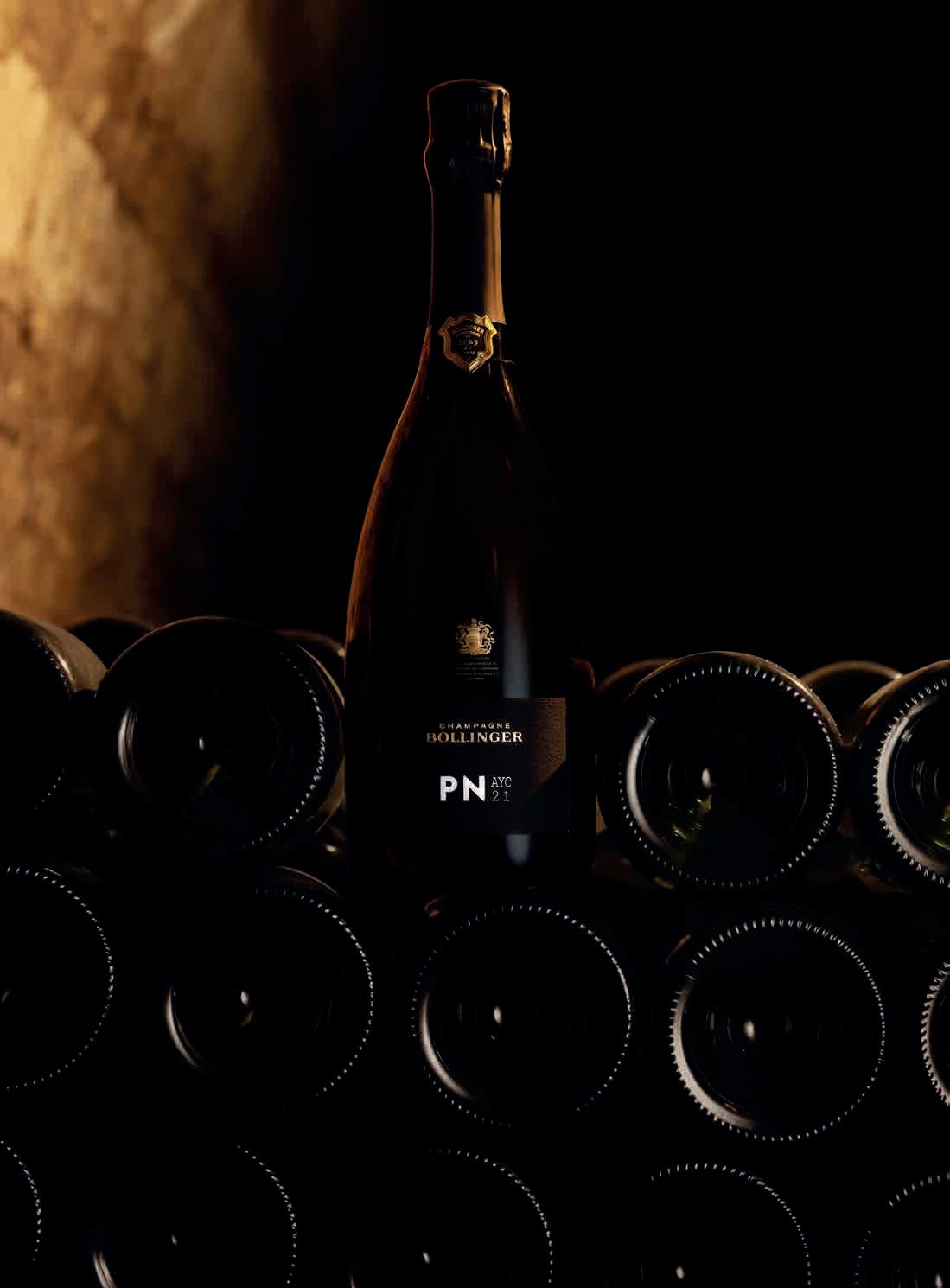
Raise a toast to the season with a glass of Bollinger’s exceptional new PN AYC21. The Blanc de Noir is made from 100% Pinot Noir predominantly from the chalky Aÿ terroir, with a base year from the 2021 harvest, and finished with 49% reserve wines from other years. With aromas of Mirabelle plums and ripe quince alongside notes of almond, brioche and blood orange, it pairs beautifully with summer dishes such as pan-fried scallops, roast turbot or apricot tart. £100. bollinger.com
NUCLEUS
STYLISH SLUMBER
Known for making some of the most luxurious beds on the market, Savoir unveils its new collaboration with fashion designer Ozwald Boateng. Fusing Savile Row tailoring with craftsmanship, the Authenticity bed features a headboard framed in solid oak and upholstered in bespoke woven leather, interpreting traditional Kente cloth, a nod to Boateng’s Ghanaian heritage. The design also features a No. 2 mattress paired with a horsetail and wool topper in Savoir’s signature white Trellis ticking. POA, savoirbeds.com
OPEN AND SHUT CASE
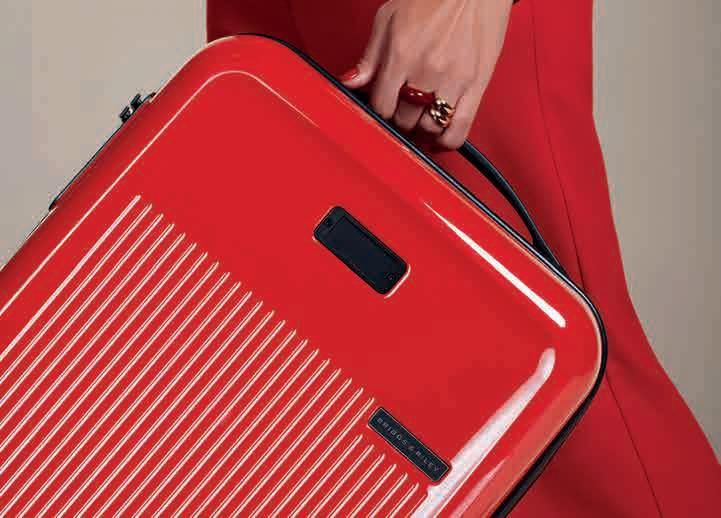
The holy grail of smart luggage is durability, the right sizing for cabins, and looking the part. Travel in style this season with the new Sympatico Glossy Ruby Collection from Briggs & Riley. Available in three sizes, the collection allows one to pack up to 25 per cent more with its compression-expansion technology: perfect for those last-minute additions. From £569, briggs-riley.com
NUCLEUS FOOD AND DRINK
CATCH OF THE DAY
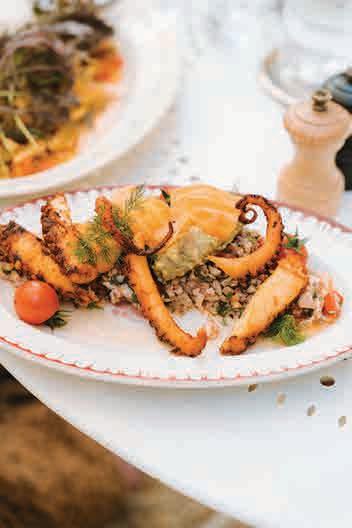
Guernsey offers a wealth of treasures. Proof of this is Vraic, which opened in 2025 and already boasts a Michelin star. Chef Nathan Davies illuminates bountiful, flavourful hyper-local produce, and ingredients for a 10-course menu are caught from the sea and foraged from the island, then transformed using meticulous techniques such as fermenting, grating and charring Basque-style over open flames. Just 40 minutes from London City, diners can move from seaweed martinis to fresh, burnt butter turbot in a refined, open-air setting. vraic.gg
SUGAR RUSH
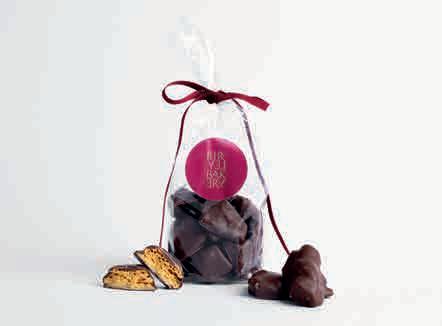
Form an orderly queue for some of the most exquisite sweet treats in town. New for the coming season, Birley Chocolate has launched a cloud-soft mousse that comes in three flavours, including a delicious 80 per cent cocoa. Stay cool with its ice cream and sorbets — the standouts are the palate-freshening citrus and herbs sorbet and the orange blossom sorbet, which transports you straight to balmy Marrakech nights. birleybakery.com
CORKING IDEA
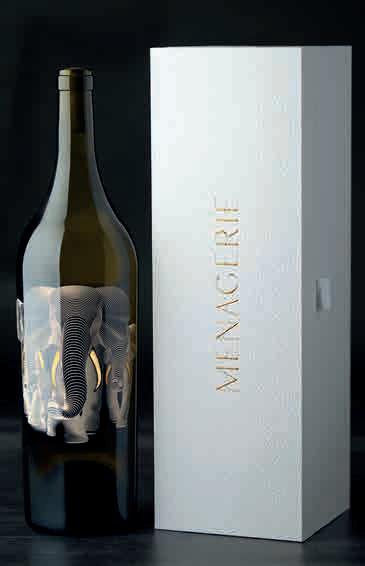
Wildlife conservation and Cabernet Sauvignon are not the most obvious union, but Menagerie wines is a new Napa-based, purpose-driven brand coming to the UK this summer.The story began when founders Ricky and Lisa Novak went on safari in Africa and were inspired to start a conservation project. Each of the six vintages is named after a collection of animals, with a portion of the proceeds donated to the Tusk charity supported by Prince William. Renowned conservationist David Yarrow has collaborated with the vintners, so each bottle comes in a specially designed box with a limited edition book.
lovemenagerie.com
Images: Dan Burns, Bryan Gray Photography
THAT’S THE SPIRIT
Despite the flurry of changes around the upscale neighbourhood, Knightsbridge’s much-loved institution, Sale e Pepe, has remained resolutely familiar. Serving its signature cacio e pepe (from giant wheels of Parmesan) and salt-baked sea bass,its new cocktail menu complements its classic dishes. These includeShaken Dirty, a take on a salt and pepper martini with black pepper-infused vodka and smoked olive brine, as well as the Frozen Vespa, poured tableside with an Amalfi lemon twist. saleepepe.co.uk
IN GOOD TASTE
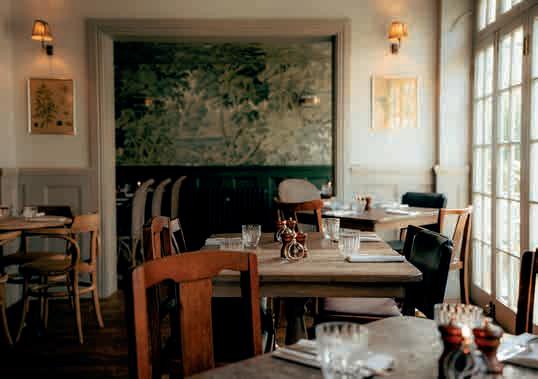
Upping the gastro game in Fulham, Brook & Badger sits somewhere between a posh pub and a casual restaurant, welcoming everyone for hearty cooking in a cosy, buzzy room. On a Tuesday during school holidays, it was heaving with diners tucking into spicy fried chicken with sriracha honey, sea bream ceviche with clementine and jalapeno, creamy cod with mussels and pub classics such as chicken and mushroom pie. Save room for their sticky to ee pudding. brookandbadger.com
FRENCH FLAIR
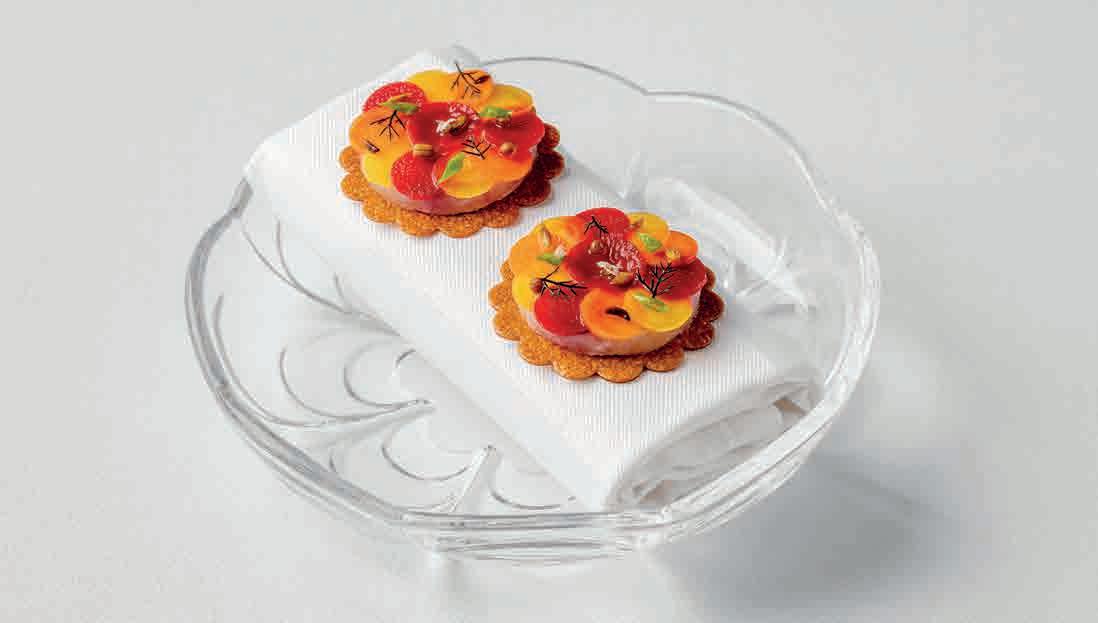
Bringing fine dining to the heart of Marylebone, Orerry by Pierre Minotti opens its doors this season, with a focus on seasonal British produce. Minotti, who worked alongside two-Michelin-starred Alex Dilling at Hotel Café Royal, fuses traditional French cooking with local ingredients over five- or seven-course tasting menus. After a snoop and a glass of fizz in the Salon du Vin, enjoy dishes such as wild garlic and morel galette, John Dory with brown crab and Pyrenees-raised quail, before finishing with a spectacular Nicolas Berger chocolate dessert. orrery-restaurant.co.uk
Images: Justin De Souza
GLASS ACT
EAU DE PROVENCE, Anthony Carfantan makes a case for winemaking outside the château walls.
Where is your château?
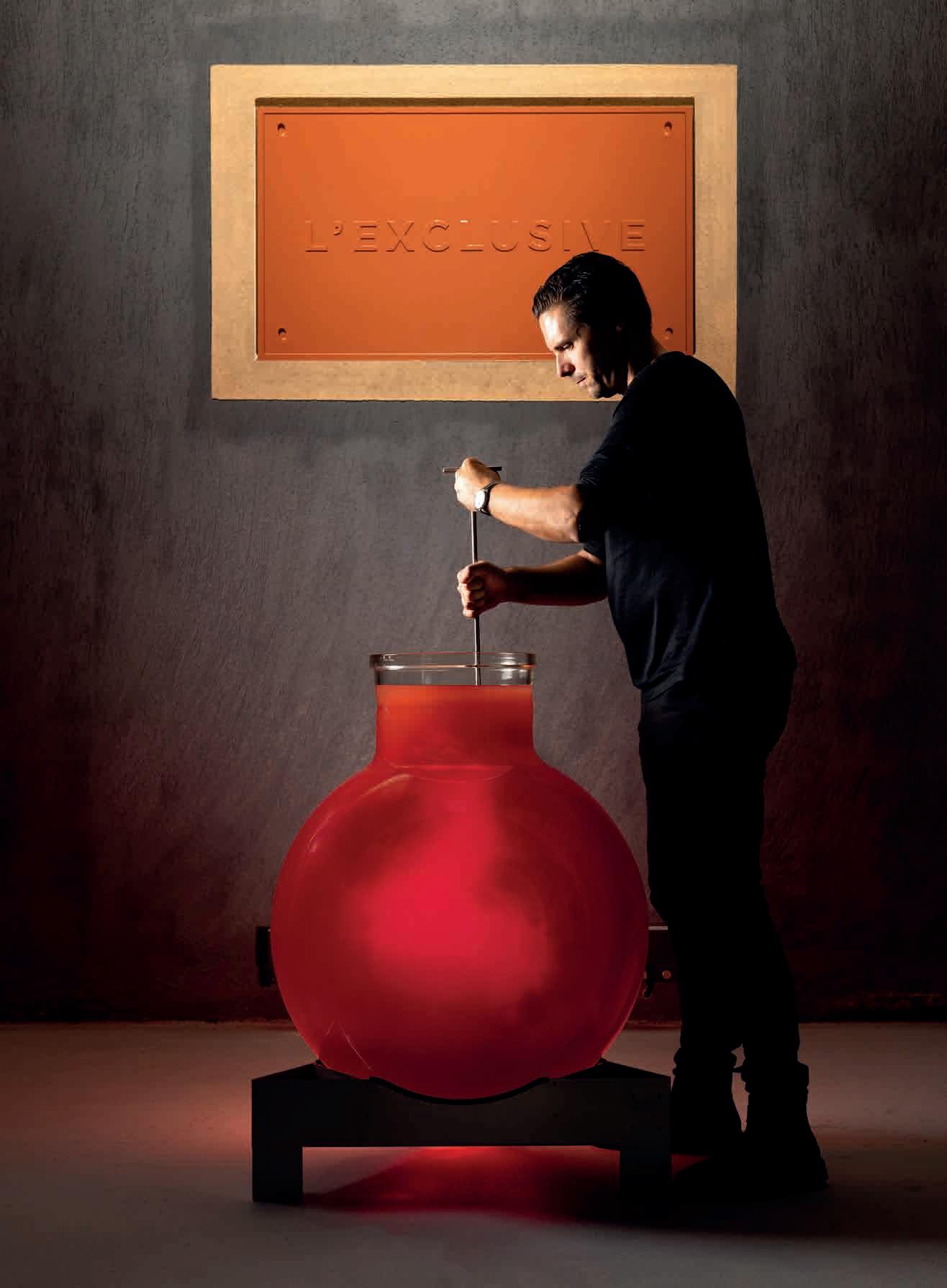
Is the rst question often poised to Anthony Carfantan, Founder of L’Exclusive, sister brand to the premium Provençal maison behind Eau de Provence Rosé. The answer is they don’t have one. Rather than operating within the traditional bounds of a château model, the 2024-born contemporary rosé takes a more exible, modernised approach.
As I speak with Carfantan, he tells me sommeliers are often resistant to nontraditional approaches, but that châteauowned estates must work with whatever grapes are available on their land in any given year, leaving them vulnerable to crop variations. This lack of restriction is a key advantage for The Private Wine Collection, the brand umbrella behind EAU DE PROVENCE and L’EXCLUSIVE: “The beauty is we can source the best grapes from the best place.” Carfantan continues to explain that in piecing together the anatomy of EAU DE PROVENCE – a bespoke blend of Grenache Noir, Cinsault, Syrah and Vermentino – they visited around 50 wineries prior to launching the brand. Now, they work with a small network of trusted grower families across key Provençal zones, sourcing grapes from carefully selected plots chosen for the quality and characteristics of their terroir. In terms of future-proo ng EAU DE PROVENCE in the ever-evolving rosé category, Carfantan explained “It’s all about the quality of the distribution” to strengthen credibility and gain visibility in luxury circles.
Not forgetting its sense of place in the process, with its name translating to ‘water of Provence’, the wine hones in on the intrinsic qualities of minerality and freshness achieved from limestone-based vineyards. Having sold over 100,000 bottles in its rst
year, the rosé resonates with a broad audience of oenophiles worldwide. “The idea was to develop something not only easy to drink, but that could seduce both the top sommeliers and brand conscious consumers,” says Carfantan. Poured in the capital’s most in uential culinary settings, including collaborations with Michelin-starred chefs at Soho’s Carousel and new openings like Jul’s London, the approach is to maintain status as a wine led by high lifestyle but grounded in innovative viticulture.
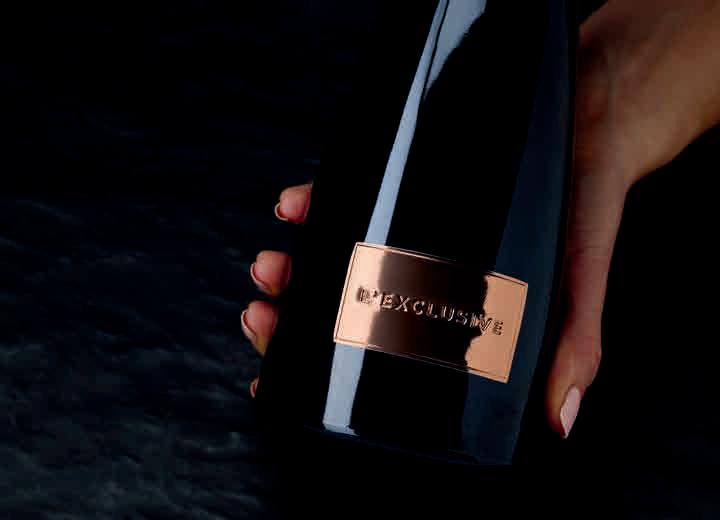
In April 2026, Carfantan launched a sister brand to play alongside EAU DE PROVENCE named L’EXCLUSIVE, setting a new benchmark for what a Provence rosé can be as the rst wine aged in a glass globe. “It was very experimental,” he said, “37% of the wine is aged in glass globes, 50% in stainless steel vats and the rest is aged in oak barrels to give a bit
of structure.” The process of using the glass globes is also more sustainable as there is less cleaning to be done and therefore less water usage. By ageing with this technique, you don’t get any oxidation in the wine which results in a nal cuvée that is fresher and more fruit driven with apricot and peach heart notes and a crisp, dry nish. “The reality is that the consumer doesn’t really like oak wine, as it can be a bit too heavy,” Carfantan re ects, “we wanted to have a ne balance between freshness and structure from the wood. I like to say we’ve got the perfect recipe!”
L’EXCLUSIVE sits as the brand’s highest expression: an ambitious, avant-garde interpretation that retains the modern Provençal ethos of EAU DE PROVENCE while being crafted with the connoisseur in mind. Available at wanderlustwine.co.uk eau-de-provence.com
Left to right: A bottle of L’EXCLUSIVE cuvée; Anthony Carfantan crafts the new L’EXCLUSIVE with innovative glass globe ageing techniques.
NUCLEUS TRAVEL
BRANCHING OUT
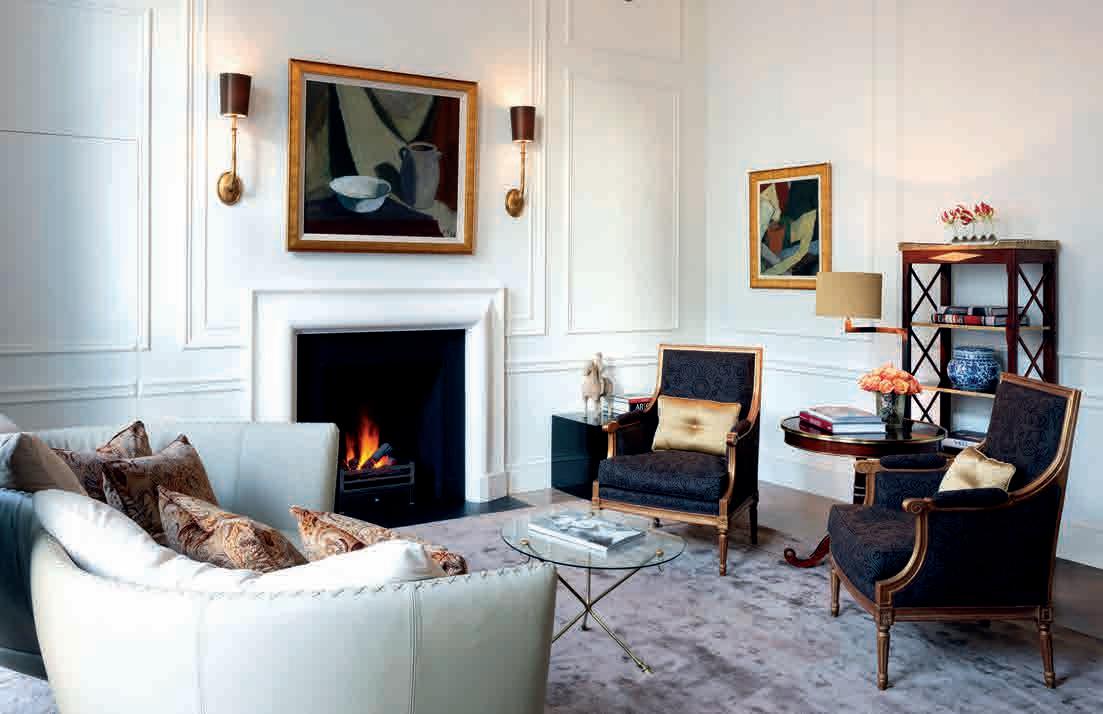
Head to the regal Kensington hotel, which offers a night in one of its botanically inspired suites with entry to shows at the Royal Albert Hall, such as Cirque du Soleil. They have also just launched a whimsical afternoon tea in collaboration with fashion house Schiaparelli in celebration of the V&A Museum’s exhibition, Schiaparelli: Fashion Becomes Art. doylecollection.com
A PLACE IN THE SUN
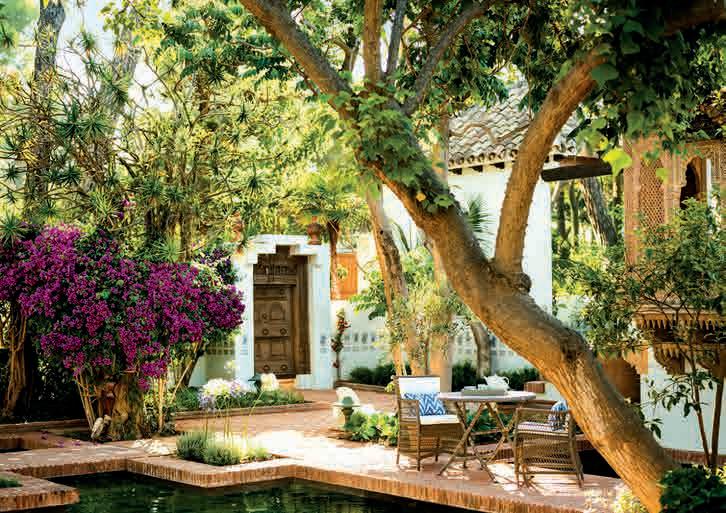
Once a humble motel servicing voyagers through the Costa del Sol, the unimpeachable Marbella Club has now added the sublime Finca Ana María to the fold. Located on the neighbouring land once owned by the Von Bismarks, it now offers an adults-only pool, acres of garden replete with roses, agave, bunnies and botanical mazes. A true paradise. marbellaclub.com
Image (top): Simon Brown
CREATURE COMFORTS
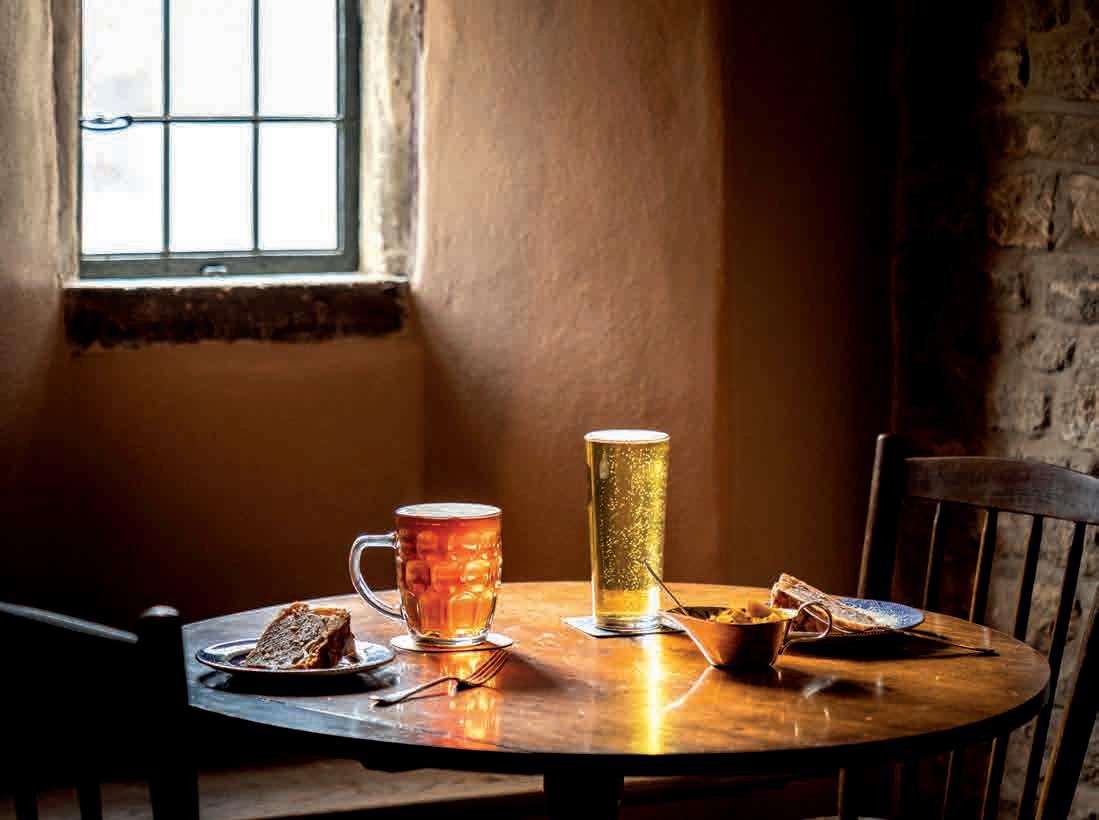
From the same team behind The Mason’s Arms and The Double Red Duke in Oxfordshire comes a new hostelry, The Wild Duck in Ewen, near Cirencester. It’s already a hit with locals and overnighters alike. Serving thoughtful plates, from burrata and blood orange to Bibury trout with beetroot and horseradish, The Wild Duck has also opened 19 light-filled rooms, and the pub garden is set to be the most convivial spot in Gloucestershire this summer. countrycreatures.com
LIFE’S A BEACH
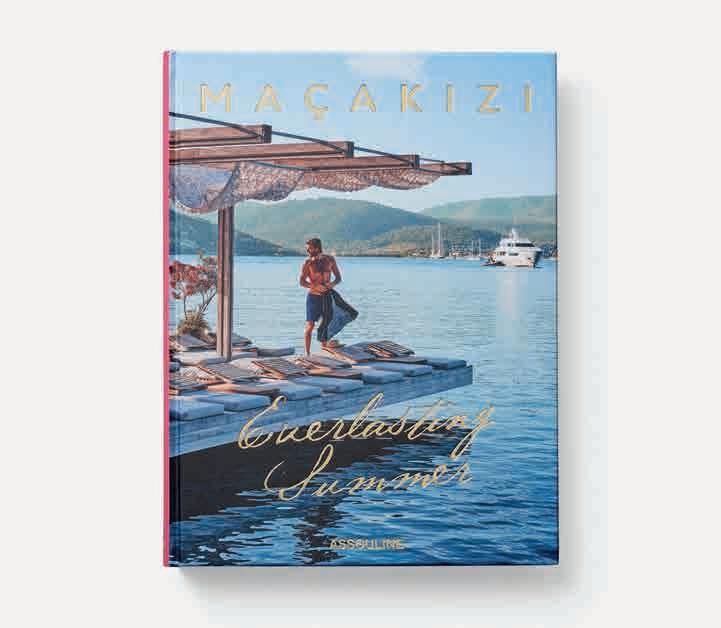
If those whitewashed walls could talk… One of the Med’s most enduring sun-splashed hideaways is celebrated in Assouline’s new book, Maçakizi: Everlasting Summer. Spanning 50 years of the Turkish Riviera’s most iconic hotel, the tome chronicles how the property evolved from an in-the-know hideaway to a hot destination, largely thanks to owner and exuberant host Sahir Erozan, known for hosting some of the Turquoise Coast’s best parties. £100, assouline.com
Image (top): Chris Terry
NUCLEUS BEAUTY
FAST FIX
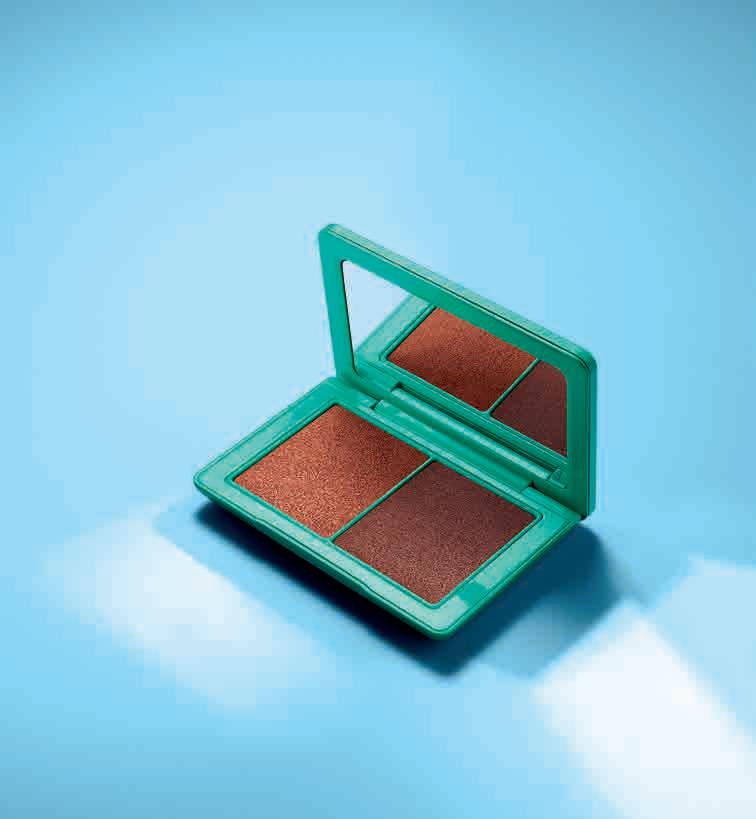
For a quick complexion boost, Westman Atelier’s Sun Tone Bronzing Crème is a duo of complementary shades that can be worn individually for a bronzed look or combined for a sculpting e ect. The cream-to-powder formula helps blur imperfections and blends easily, leaving a hydrated yet matte nish. Available in four shades. £69, westman-atelier.com
LOCK IT IN
Sea, sand and heat are not your hair’s best friends.
Ouai’s Bond Repair Balm helps quickly reverse damage from colour-treating, split ends and breakage, thanks to vegan silk protein, hyaluronic acid and peptides derived from hydrolysed rice protein. Use it in the shower and leave it on for three minutes. £46, theouai.com
STAR TURN
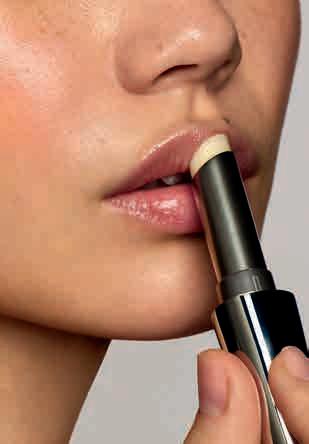
Banish dry lips with this new and (quite literally) out-of-thisworld balm. Powered by a complex cultivated aboard the International Space Station, Spacelip™ boosts the skin’s natural hyaluronic acid by up to 300 per cent to improve smoothness, plumpness and the appearance of fine lines. From £58, wecanexist.com
SAVE FACE
Summer is not the time to play around with your SPF. Mimétique’s Everyday 50 Invisible Face Fluid has a lightweight, silicon-free formula that doesn’t leave a white cast. It protects against UVA and UVB rays, and it also hydrates the skin and helps target existing pigmentation and reduce the appearance of dark spots. £45, mimetique.com
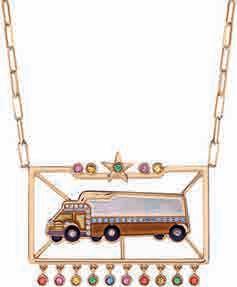
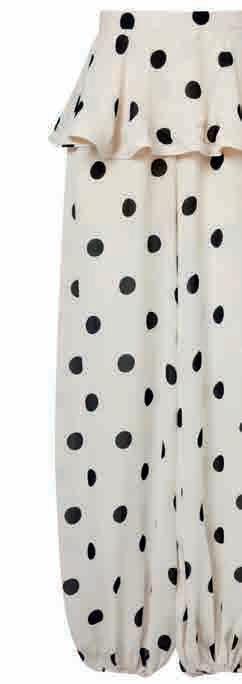
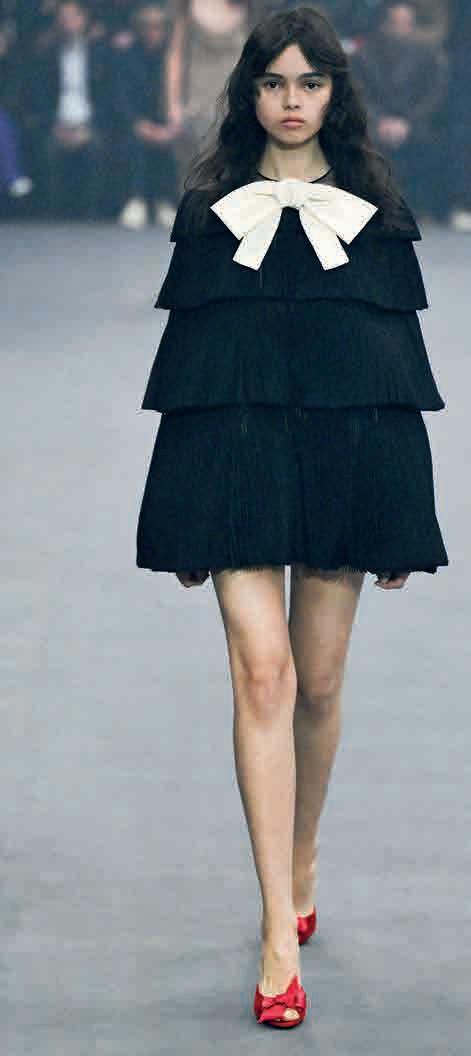
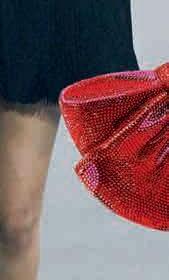
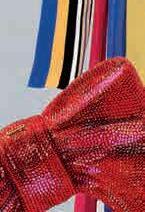
Run away with the circus with these dramatic, fun colourways and silhouettes, plus ru es galore. Think big top — and yes, a little over the top
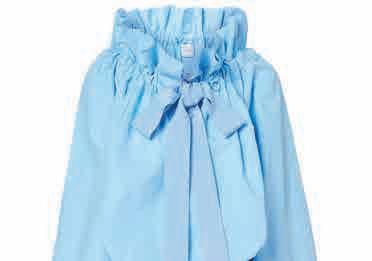
1 Francesca Villa 18k yellow gold Open Road Pendant, diamonds, sapphires, tsvaorites, white mother-of-pearl, £12,990, francescavilla.it 2 Patou Cotton Iconic Voluminous Blouse, £460, harrods.com
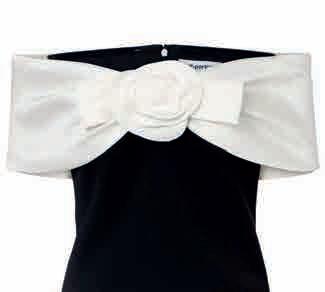
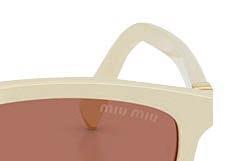
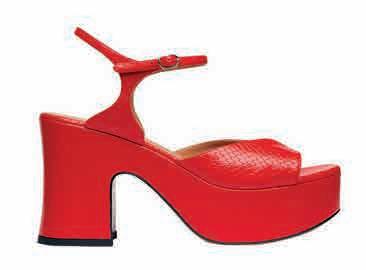
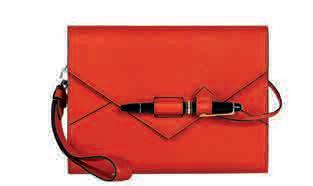
3 Loewe Dress in stretch viscose blend, £2,600, loewe.com 4 Judith Leiber Couture Bow Just for You crystal-embellished clutch£5,670, net-a-porter.com 5 JW Anderson Ruffle asymmetric silk and cotton blend skirt, £1,475, harveynichols.com 6 Nomasei Driver embossed sandals, £430, nomasei.com 7 Melanie Georgacopoulos Eclipse Gap Earrings in black rhodium-plated sterling silver with 5mm white freshwater pearls, £2,500, melaniegeorgacopoulos.com 8 Adriana Degreas Polka-dot balloon pants, £435, mytheresa.com 9 Miu Miu Rectangle sunglasses, £340, libertylondon.com 10 Self Portrait Floral-appliqué off-shoulder crêpe top,
SPHERELIFE.COM | SUMMER 2026
INDIAN SUMMER
Global luxury houses are turning their gaze to India, drawn by its rich culture and design traditions, and a rapidly growing cohort of wealthy consumers
WORDS SIMON BROOKE
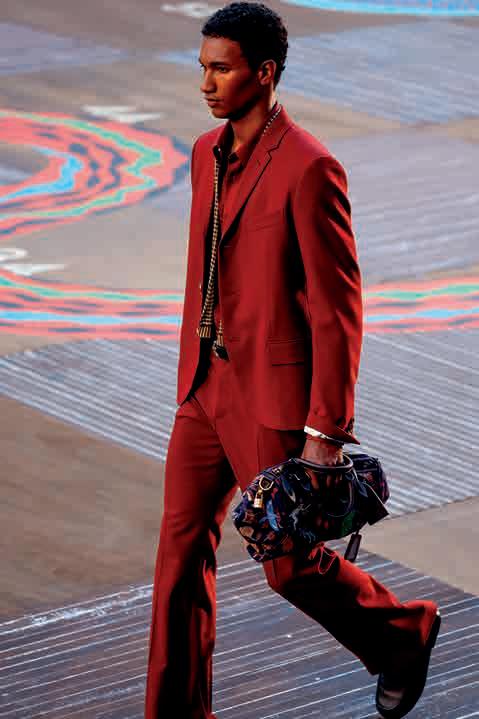
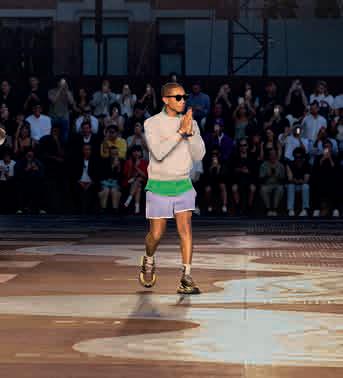
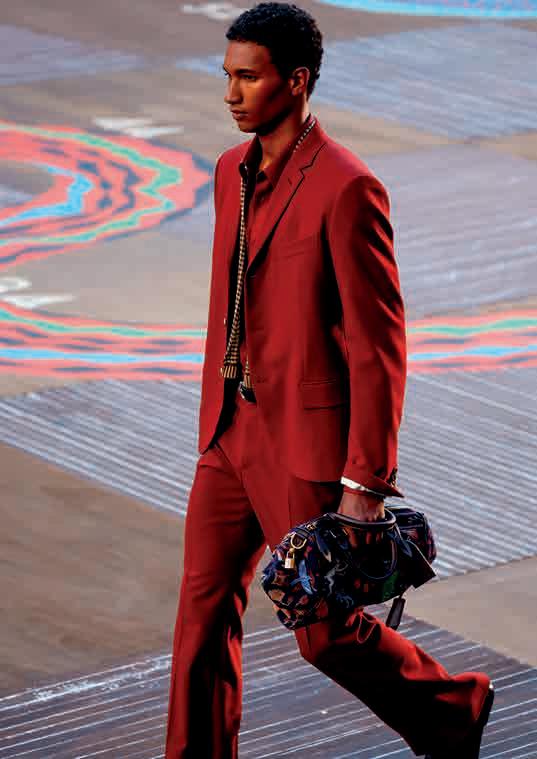
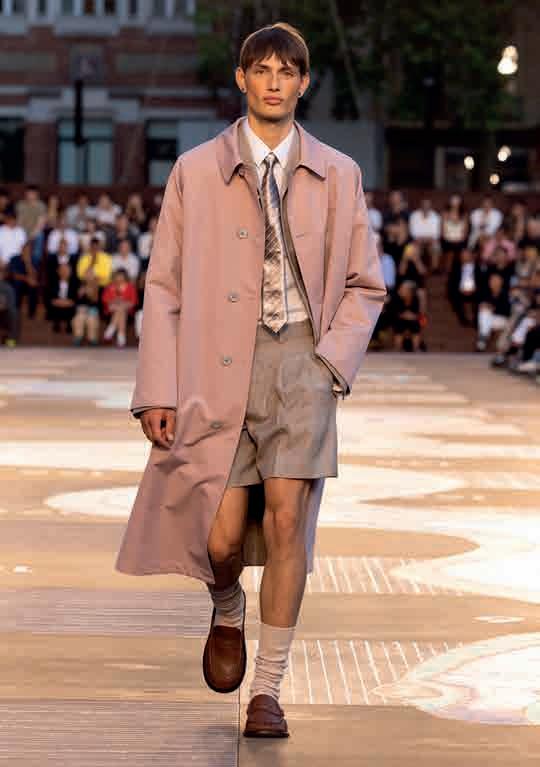
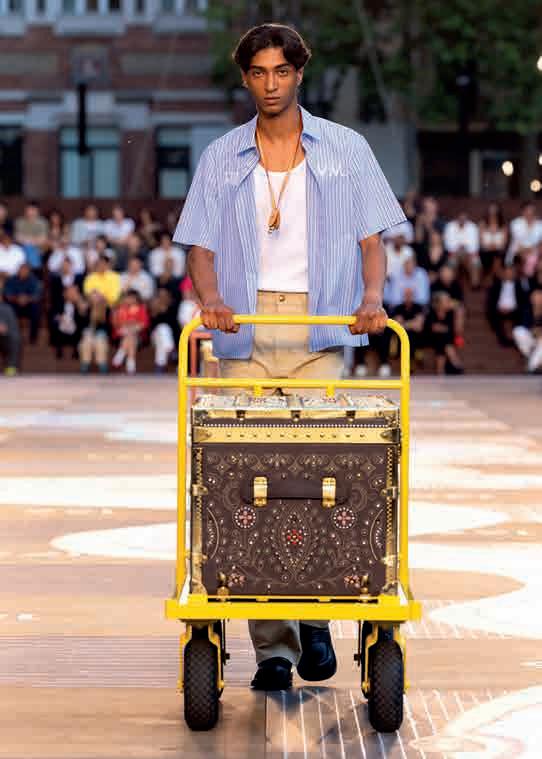
For a quintessentially French brand, albeit one with a global following, Louis Vuitton is embracing an entirely di erent culture for its Spring/Summer 2026 Men’s Collection, designed by Pharrell Williams. The colour palette, rich in burgundy and orange alongside dusty pastels and aged nuances of white, plus its soft, larger-than-life silhouettes, are inspired by the culture of the fastestgrowing and most exciting player in the luxury market. With its ancient traditions of design, colour, craftsmanship and textiles overlaid by a larger and rapidly expanding army of consumers, India has suddenly become a focus point for global luxury houses.
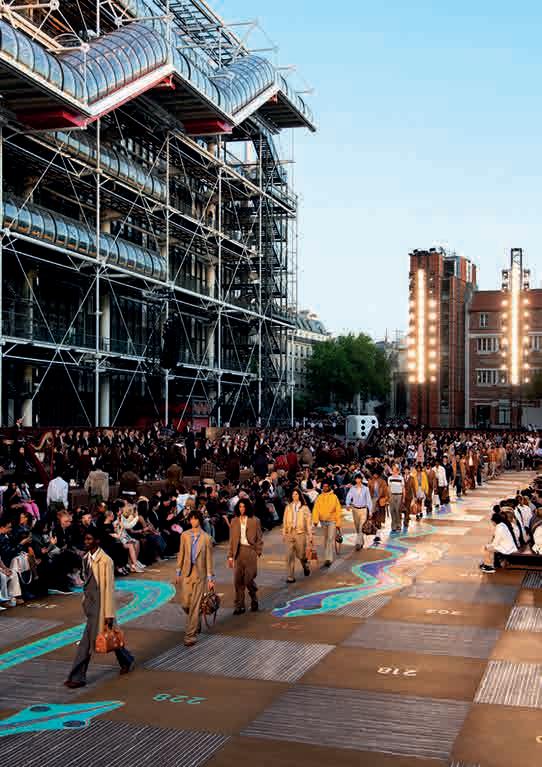
“The Louis Vuitton Spring/Summer 2026 Men’s Collection illuminates the in uence of modern Indian sartorialism on the global contemporary wardrobe and re ects it in the dandyism at the core of the Studio Homme,” states the maison. With the Centre Pompidou as its backdrop, the show was envisioned by Pharrell Williams and designed by architect Bijoy Jain of Studio Mumbai, whose fusion of Indian tradition and modernity draws on the relationship between humans and nature.
Meanwhile, Bentley has recently announced that actor and producer Priyanka Chopra Jonas will be its latest brand ambassador. The new campaign includes a lm in which the star of numerous hit movies, a New York Times
Clockwise from left: Pharrell Williams, designer of the Louis Vuitton Spring/Summer 2026 Men’s Collection. Its inspiration, India, was woven throughout and shown on the runway at Centre Pompidou
best-selling author and UNICEF Goodwill Ambassador, speaks candidly about her life, career and creative outlook.
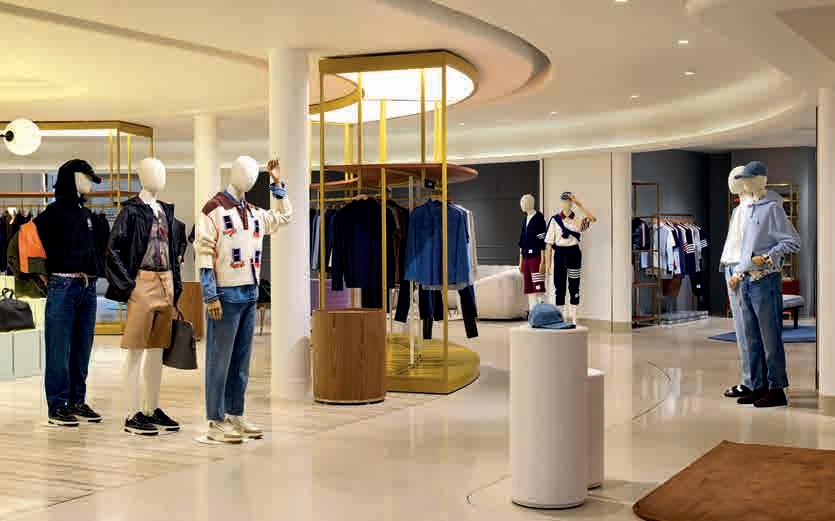
French luxury department store Galeries Lafayette is set to open its rst agship outlet in India. “With Mumbai as our anchor point, we are proud to introduce an experience that brings together French heritage, creativity and innovation, while embracing the energy and cultural richness of India,” says Nicolas Houzé, executive chairman of Galeries Lafayette Group. “This agship will stand as a symbol of our ambition to make the French Art of Living shine on the global stage.”
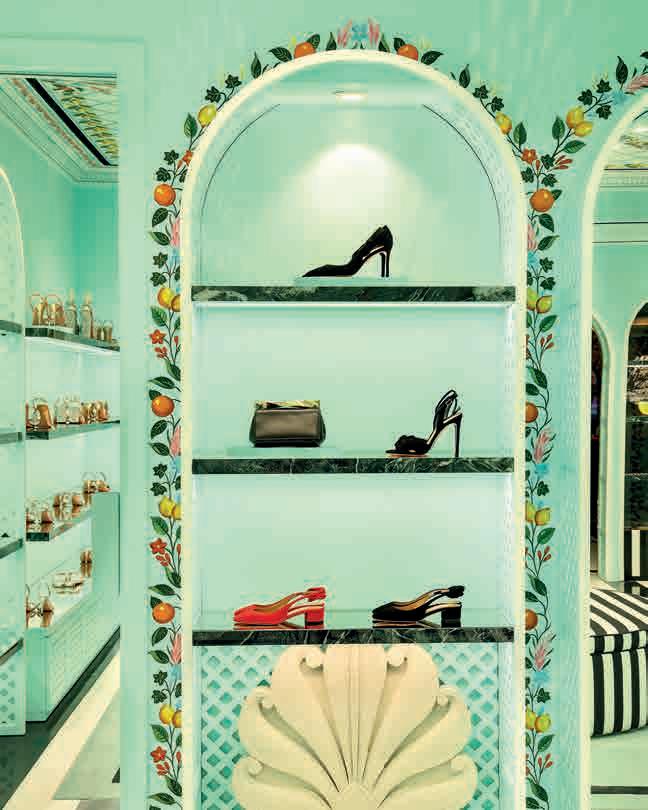
Aquazzura, known for its vertiginous heels and Italian opulence, and beloved of Meghan Markle and Amal Clooney among others, recently opened in Delhi, its rst Indian outlet. The store interior is the work of Jaipur-based Dutch designer Marie-Anne Oudejans, with an aim to create “an indoor shoe garden… a fairy-tale world.”
According to Euromonitor International, India’s luxury goods market was projected to grow to $12.1 billion last year, with a compound annual growth rate (CAGR) of 74 per cent over the next ve years — making it one of the world’s fastest-growing luxury regions. Over recent years, European luxury
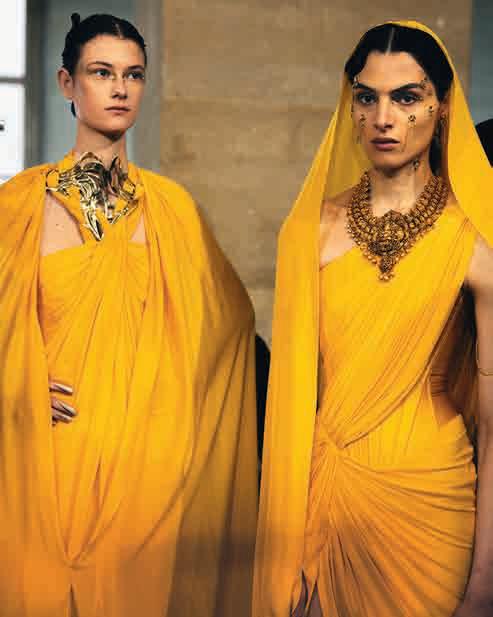
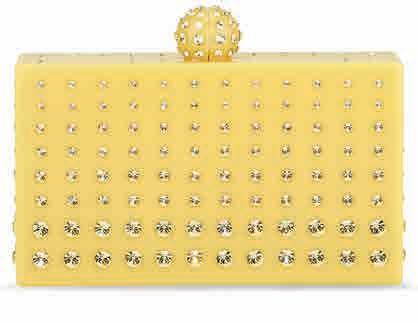
Clockwise from above: Galeries Lafayette’s first Indian flagship in Mumbai; Gaurav Gupta marries classic European elegance with Indian tradition — actor Priyanka Chopra wore a canary yellow gown to The Blu premiere; Aquazzura’s “fairy-tale” shoe garden in its new Delhi store and a Tequila Clutch in Daisy Light Gold
houses, including Stella McCartney, Prada and Burberry, have opened retail branches and developed operations across the country. Last year, Chanel named Hindi lm star Ananya Panday as its brand ambassador for India, while another screen actor, Deepika Padukone, became the rst Indian star to act as a jury member for the LVMH Prize nal.
“Hermès is succeeding in India because it has expanded carefully but visibly – opening a larger store in Mumbai’s Jio World Plaza, alongside its presence in Delhi — while maintaining scarcity in core products like Birkin and Kelly bags,” says Jai Mallick, managing director of the Indian branch of Intralink, a business development consultancy that helps companies expand in overseas markets. Dior is also doing well, he believes. “Their 2023 ‘Mumbai Voyage’ show at the Gateway of India, a celebration of India’s crafts and artisans — was seen as a watershed moment, showing how a European fashion house could honour Indian craft, while speaking a global luxury language.”
India’s luxury experience di ers from that of Europe, the US and China, according to Abhay Gupta, founder and chair of consultancy Luxury Connect and the Luxury Connect Business School. “Each of these markets has followed a di erent trajectory: Europe is heritage-led, China scaled luxury through rapid consumption and brand adoption, while the US blends aspiration with lifestyle and accessibility,” he says. “India is unique because it is attempting to build a luxury culture while simultaneously consuming it. It’s one of the few markets where ancient craft traditions coexist with modern consumption, and where global brands and local identities are negotiating space in real time.”
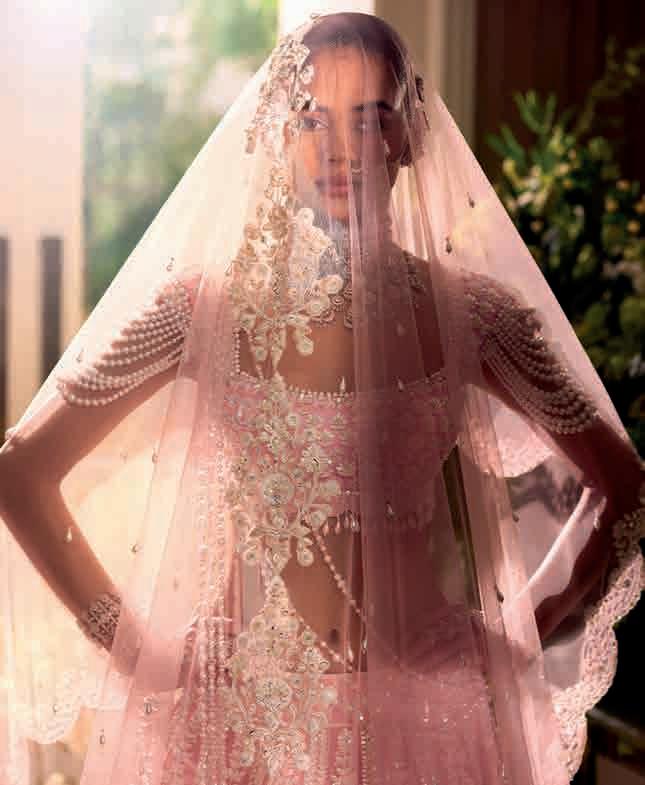
The European maisons are being joined by a new generation of home-grown Indian luxury brands. Gaurav Gupta’s gowns, for instance, blend classic European elegance with Indian traditions. “Divine Androgyne,” his Spring/Summer 2026 couture collection, draws on an Indian belief system in which creation arises from both masculine and feminine forces, as well as the human and the divine. Another designer, Manish Malhotra, is celebrated for his vibrant, glamorous, heavily embellished womenswear. “Indian luxury consumers want pieces that feel personal, that have a story, and are not mass-produced,” he explains. “There is also a strong emotional connection to what they buy, whether it’s for a wedding or everyday luxury. Today, Indian luxury stands very con dently alongside global brands. We have something very unique to o er — our craftsmanship, our textiles and history. European brands have their own legacy, and we have ours. My vision has always been to take Indian couture to the world.”
In addition to ambassadors, European maisons are now partnering with exciting
“India is unique because it is attempting to build a luxury culture while simultaneously consuming it”
“Indian luxury is fundamentally different… It’s deeply rooted, highly personal, and not always defined by brands”
new Indian design talent. Visionary fashion designer Rimzim Dadu was one of a number of creatives commissioned by Cartier to create pieces to celebrate a century of its iconic Trinity collection. She says Indian luxury is “fundamentally di erent” from its European counterpart. “It’s deeply rooted, highly personal, and not always de ned by brands. For many families, luxury is built on long-standing relationships — whether it’s with a family jeweller they’ve trusted for generations or master artisans they work with closely to create something truly bespoke.”
However, there has been a generational shift in the luxury experience for many Indians. “Millennials who grew up in the 90s have seen India transform in real time,” Dadu notes. “This generation relied on friends and family abroad to bring back brands that simply weren’t available here — and not just luxury, but everyday labels. Now, within a single lifetime, that equation has ipped. The world is actively catering to the Indian market.”
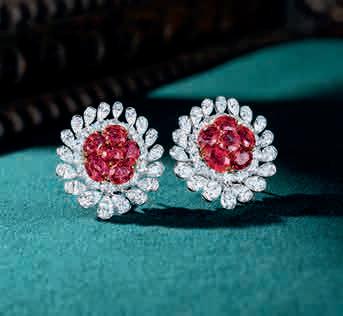
Zoya, celebrated for its delicate owing lines and references to the natural world, combined with traditional artisanship, is another highly successful Indian high jewellery brand. Zoya’s collaboration with London-based jewellery designer Alice Cicolini, includes hoops and necklaces crafted in 18 carat gold with traditional Rajasthani enamel. Alok Lodha is renowned for its use of rare gemstones, including Burmese rubies, Colombian emeralds and custom-cut tulip diamonds, complemented by exquisite craftsmanship. Based in Old Delhi, thanks to its growing international reputation as a homegrown Indian luxury brand, the atelier’s fans now include Eva Longoria and Amber Valletta, and it recently made its Cannes Film Festival debut.
It would be wrong to suggest that luxury brands have anywhere near the penetration
XXXXX: Nis et et versperit venesci psusam faceatur, voluptaernam ulles elesto beaquis del eaquias pienimos magnihillore volessin restis ex eaqui as molupti doluptatio
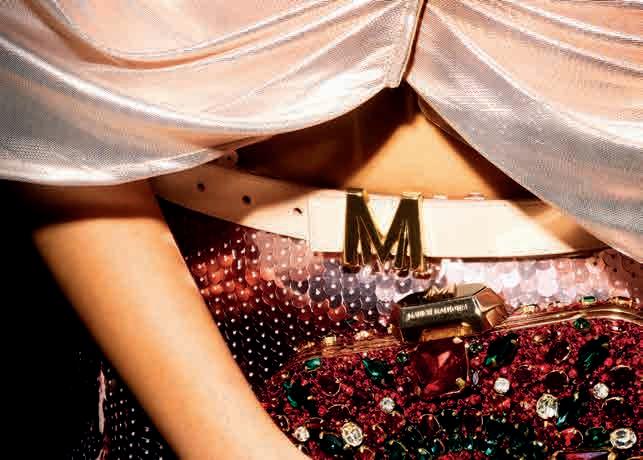
Clockwise from left: A heavily embellished bridal gown by Manish Malhotra (MM); Hema Bose of Maison Bose; the MM logo shown on a belt detail
in India — where many of the population struggle to feed and house themselves — as they do in more mature markets. Their target market is very much wealthy individuals. This means there is no need to discount prices — something no maison likes to do — for reasons of both brand integrity and economics.
Hema Bose, the founder of Maison Bose, an independent global luxury brand consultancy that has played a de ning role in shaping how Indian luxury is positioned globally, says: “The future of luxury here will be increasingly experience-led — travel, hospitality, wellness and lifestyle will grow faster than pure product categories, but still anchored in value, legacy and meaning. At the same time, Indian brands will begin to play a far more important role globally. For a long time, India has been a consumer of global luxury. Now, it is steadily becoming a creator of it.”
India is a country of superlatives as well as enjoying a long and rich artistic culture. It’s little wonder that global luxury brands are increasingly excited about the nation’s huge potential. As designer Manish Malhotra puts it: “Taking Indian craftsmanship to an international audience continues to be a key focus. That process is still unfolding, and there is a lot more to build and explore — that evolution is what makes it exciting.”
Clockwise from left: The dress/art piece by designer Rimzim Dadu created for the Cartier Trinity 100 anniversary; necklace and earrings featuring signature Alok Lodha stones; Zoya X Alice Cicolini jhumki earrings
Raising the bar
The counter used to be the salon des refusés of restaurant dining — the place you were shunted o to when you couldn’t get a table. But now the tables have turned, with the service space being the most sought-after spot in London’s restaurants
The reasons why a restaurant counter is so popular right now are obvious once you’ve experienced it. You’re in the action rather than watching from a distance, close enough to the kitchen team to ask what’s in the sauce and near enough to the bar team to ensure your glass is never empty. For solo diners, the counter removes any awkwardness about asking for a table for one. For two, there is something deliciously intimate about sitting side by side, sharing plates and a tête-à-tête, without the formality of facing each other across a white tablecloth.
Many of the places featured — from Mayfair to Shoreditch, Soho to the South Bank — have been making counter dining an experience in its own right for years. But whether a new restaurant or an old favourite, a place at the counter is never a compromise: it’s the best seat in the house.
Image:
Marcus Patrick Brown
It’s like an Edward Hopper painting of an American diner come to life, only with happy people having a good time
ST COUNTER
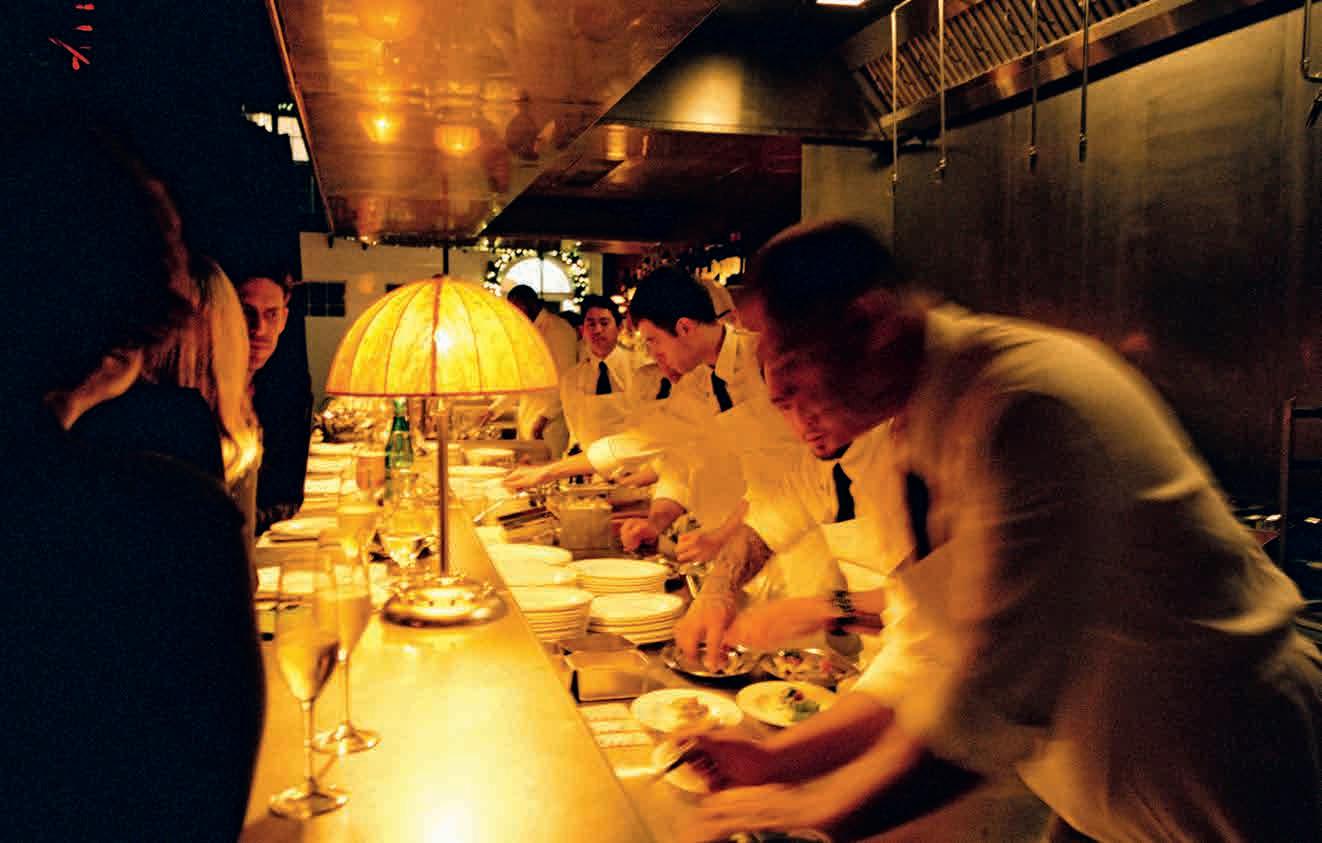
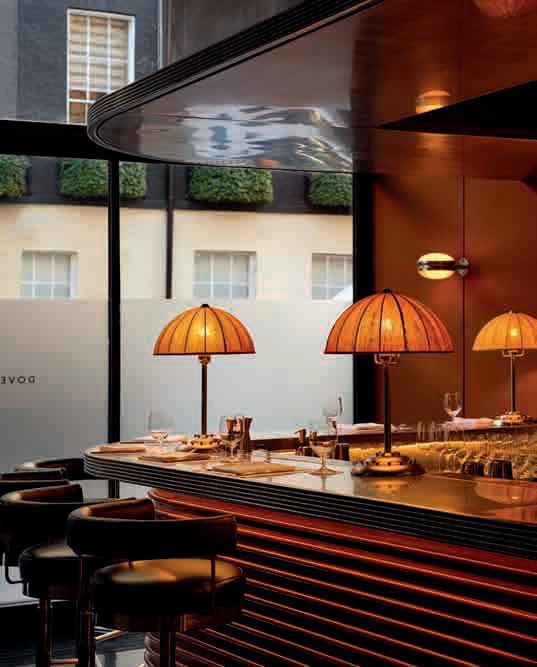
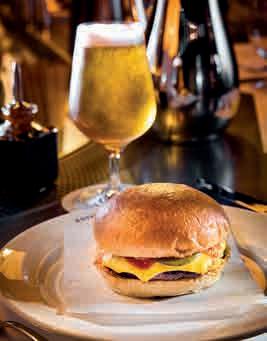
Like an Edward Hopper painting of an American diner come to life, only with happy people having a good time, Dover St Counter is the follow-up to The Dover, two doors up on the same street. Owner Martin Kuczmarski’s inspiration was the Fountain Co ee Room at the Beverly Hills Hotel, a breakfast and lunch counter beloved of old Hollywood. Here, he’s gone the other way, with last orders at midnight, but his real achievement has been nding a solution to everything that annoys him about counter dining.
The stools — tested through 11 prototypes — are designed to feel like chairs, with armrests and backrests. The counter is lower than any London equivalent, to feel closer to proper table dining. The lighting is angled to atter diners rather than illuminate the kitchen.
A state-of-the-art extraction system means
no cooking smells. And because the bar and kitchen share the same counter, as Kuczmarski puts it, “you can chat to the bartender and then you can chat to the chefs” — making it, he believes, the ideal space for solo diners who want to feel part of the energy of a room rather than alone in it.
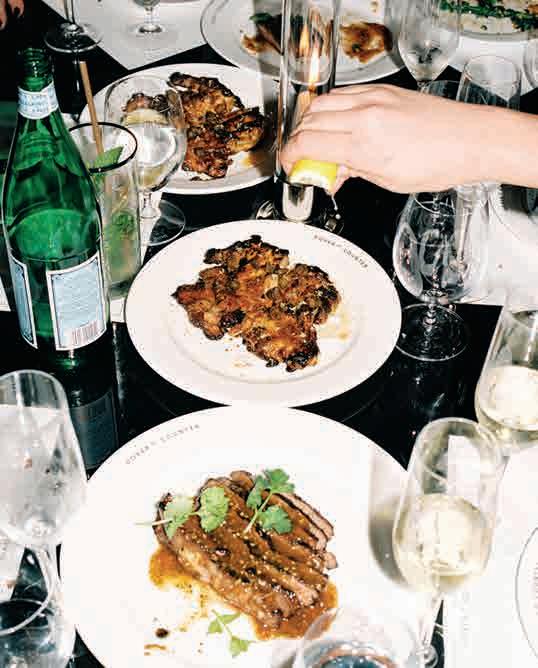
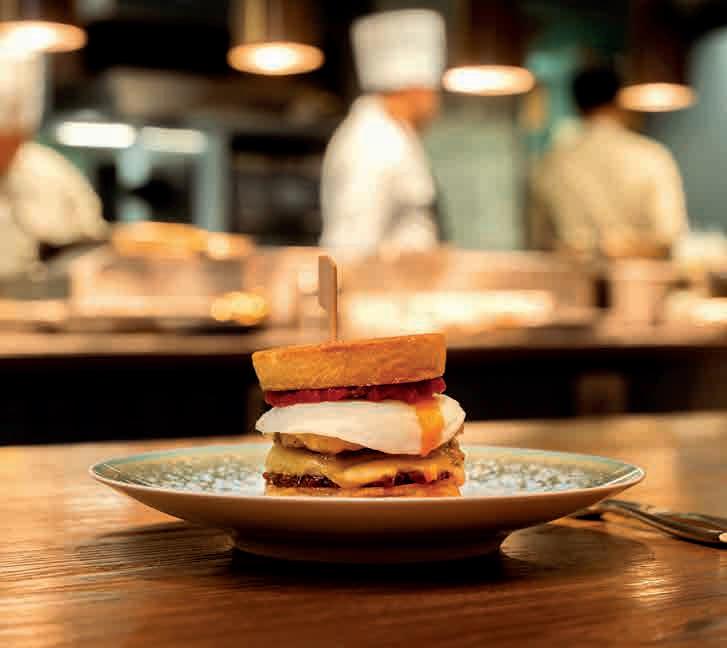
Burgers washed down with martinis are what most people order; the former a beef patty and cheese slice sandwiched in brioche and slathered with ketchup and pickles, the latter poured from a great height — and poured into a freshly chilled new glass if you’re dawdling over drinking it.
Fans of the setup should seek out the circular counter at Kuczmarski’s Sloane Square restaurant, Martino’s, exceptionally handy for the Royal Court Theatre.
Clockwise from opposite: Dover St Counter is inspired by the old Hollywood-style Fountain Co ee Room at the Beverly Hills Hotel; diners can enjoy a range of classic dishes, with the cheeseburger a favourite
DOVER
ARLINGTON
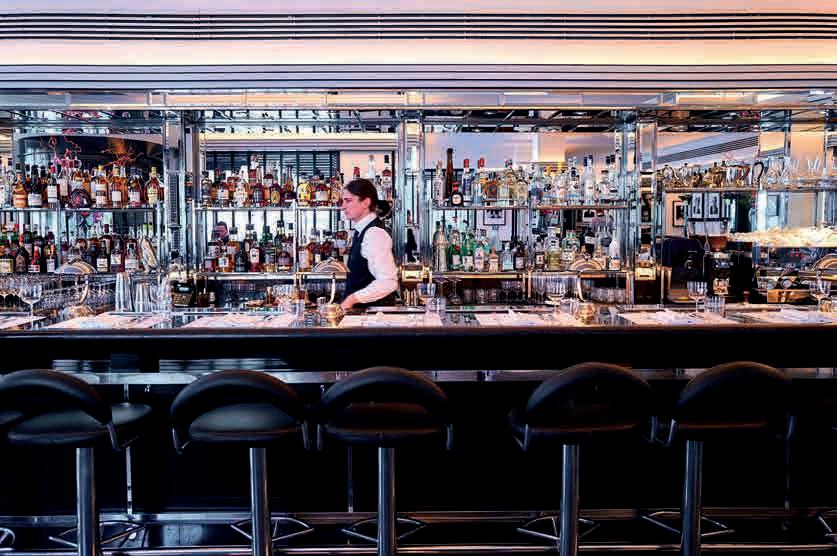
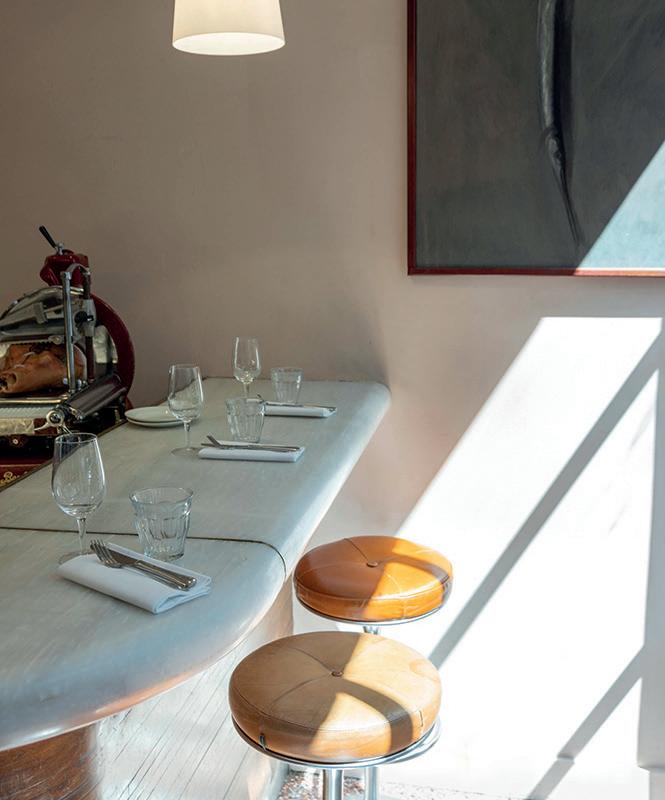
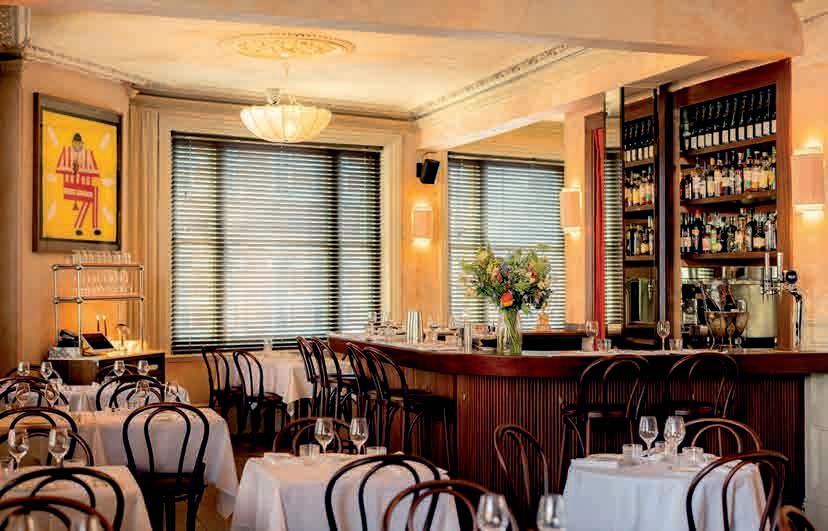
When Jeremy King opened Arlington on the site of Le Caprice, the restaurant that rst made his name, he kept almost everything looking the same. That included retaining the bar counter by the entrance, which not only gives the best view of the famous faces entering by the revolving door, but its mirrored back bar a ords a 180-degree sightline of the dining room behind. The best bit, though, is that with your back turned to the tables, no one will notice you staring at their re ection: perfect people-watching for solo diners.
The menu is a homage to the Caprice comfort-food classics: crispy duck salad or bang-bang chicken to start; salmon shcakes or shepherd’s pie to follow; and Scandinavian iced berries with white chocolate sauce for pudding. Daily specials such as hogget chops with wild garlic ensure there’s enough interest for regulars, though the fact that Le Caprice — sorry, Arlington — has barely changed since the early 1980s is the whole point of the place.
Is the counter bookable? Yes
Seats kept for walk-ins? No
20 Arlington Street, London, SW1A 1RJ;
CAFÉ KOWLOON
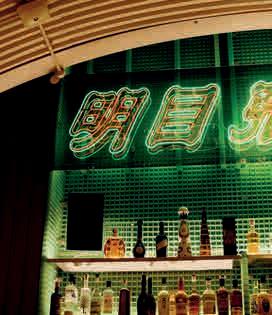
The journey is part of the experience at this new Cantonese kitchen in London Fields: diners pass through Wonton Charlie’s, the noodle bar at the front, before arriving in the neon-lit, booth-lined main room beneath the railway arches. Ten counter seats overlook the open kitchen, where rotisserie chicken, char siu and cheung fun emerge from a charcoal grill and steaming woks in a blur of heat and movement — impossible to ignore.
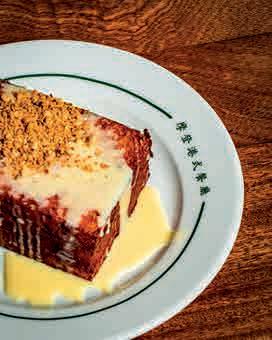
The menu, inspired by owners Frank Yeung and Abhi Malde’s research trips to Hong Kong, includes prawn toast topped with crispy prawn heads, short rib with curry sauce and pickled radish, and Hong Kong French toast lled with delicate peanut butter crème pâtissière — already a word-of-mouth favourite.
Moody lighting, club music, mirrors and neon conspire to make this one of east London’s most enjoyable nights out.
The mirrored back bar affords a 180-degree sightline of the dining room… no one will notice you staring at their reflection
Images: James Hoyle, David Loftus, Stuidio Hahn
Clockwise from above: The urban-cool sign in London Fields; neon lighting adds to the atmosphere; the Hong Kong French toast tastes even better than it looks; Arlington has retained Le Caprice’s famous bar counter
BENTLEY’S
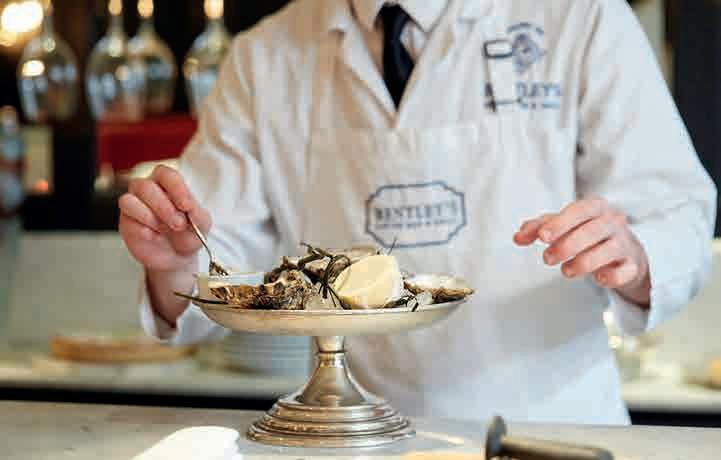
London is not short on historic seafood counters — Wiltons and Sweetings are also excellent — but Bentley’s is the most fun. The full name of this classic sh restaurant, originally opened in 1916, is Bentley’s Oyster Bar & Grill, but regulars know to always ask for a seat at the Oyster Bar.
Louche and lively, with the upstairs dining room being clubby and formal, the Oyster Bar’s marble counter is the best place in London to get to grips with seafood of any persuasion. There are oysters, of course,
ideally eaten during native season when there’s an “r” in the month, and the expert shuckers can talk guests through the ner points of oyster appreciation. (The tip I was once given here to season oysters with a squeeze of lemon and a single twist of black pepper was genuinely life-changing.)
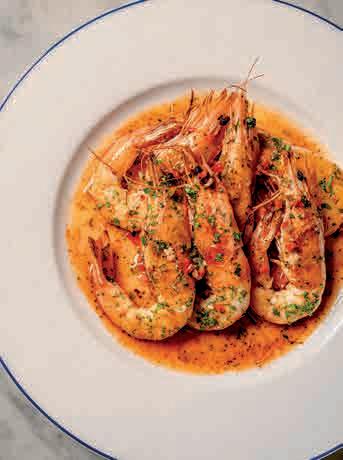
Elsewhere are whelks, cockles and clams, plus more dressed-up dishes, from a shell sh cocktail piled high with the freshest crab, lobster, prawns and brown shrimp, to butter-drenched, delicate Dover sole.
Bentley’s is perfect for mid-shopping, pre-theatre or post-work — and if you want to linger just a little longer, look no further than the knockout martinis poured in the adjoining bar.
Five or so years ago, I saw the late Russell Norman dining alone in deep concentration at the counter of Bocca di Lupo — then, when he opened Brutto in Farringdon a few months later, it too had a counter. Brutto’s is great, with Florentine T-bone steak washed down with £5-a-pop Negronis, though Bocca’s is even better. It features a long, elegant L-shaped Carrara marble bar that escapes the hecticness of the small dining room at the back, with plenty to look at — whether it’s the chefs working the open kitchen opposite or the Soho street scene through the big windows. Of course, like Norman, you could just stay focused on the plate in front of you, which would be entirely understandable.
Jacob Kenedy’s regional menu takes diners on a journey of the Italian peninsula, from a Veneto-inspired fritto misto of squeakyfresh seafood to lamb’s liver and chilli oil from Calabria. Nearly everything comes in small or large portions, which makes sensibly sized solo dining a doddle.
For the most atmospheric end to an evening spent here, pick up an ice-cream from Kenedy’s spin-o Gelupo over the road and wander o into the Soho night.
Is the counter bookable? Yes Seats kept for walk-ins? Yes 12 Archer Street, London, W1D 7BB; boccadilupo.com
BOCCA DI LUPO
Clockwise from left: Oyster shuckers at Bentley’s can share tips on how best to enjoy the shellfish; mouthwatering grilled prawns; the sleek L-shaped bar at Bocca di Lupo
Greek food has never been more popular in London — Maza in Mayfair and Lagana in Shoreditch are two of the capital’s best newcomers — but no one has taken a more ambitious approach to the cuisine than David Carter, the former Gordon Ramsay front-of-house who gave us barbecue specialist Smokestak and nose-to-tail Italian Manteca, both in Shoreditch.
Oma, his most creative project yet, sits above his Agora wine bar in Borough Market, a rst- oor dining room under the girders of the market’s roof, with a raw bar and hearth where dry-aged meat, Cornish sh and seasonal vegetables are cooked over an open wood re.
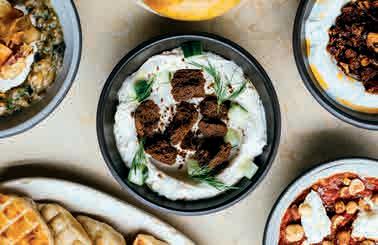
The neighbouring counter gives a ringside view of the ames. Fabulous wood- red breads are a meal in themselves, served with tarama with pickled cucumber or hummus with a sweet hit of hot honey. From the raw bar, expect sh ceviche and crudo; from the re, txuleta ribeye with girolles and beef sauce. The 400-bin wine list majors on Greek and coastal Mediterranean bottles, with a well-priced by-the-glass selection that Dionysus himself would approve of.
Is the counter bookable? Yes
Seats kept for walk-ins? Yes
2-4 Bedale Street, London, SE1 9AL; oma.london
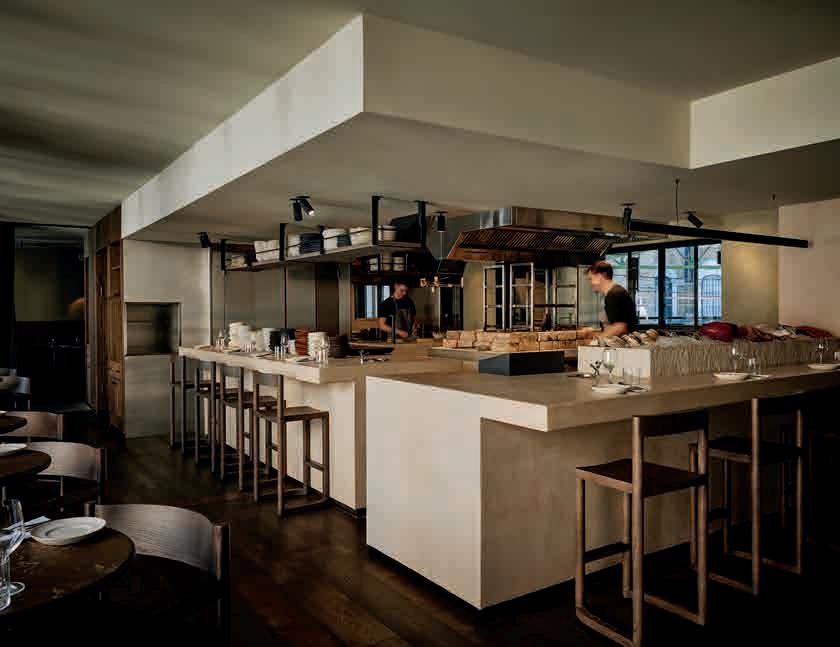
It’s probably best not to think about Brat’s former life as a strip club when dining at its counter, though the knowledge does add to the edgy appeal of a restaurant that ts its Shoreditch locale like a glove: rough around the edges at rst sight, but underneath the grunge chic, a slickly run operation built on top-notch produce. Snag a seat at the counter for a bird’s-eye view of the open- re kitchen, where the chefs working the wood grill feel part of the dining room rather than hidden behind a pass.
Tomos Parry’s cooking combines nostalgia for his Welsh childhood with Basque Country technique to produce a menu that is proudly British in its sourcing: whole turbot cooked in a cage over charred wood is the melt-in-
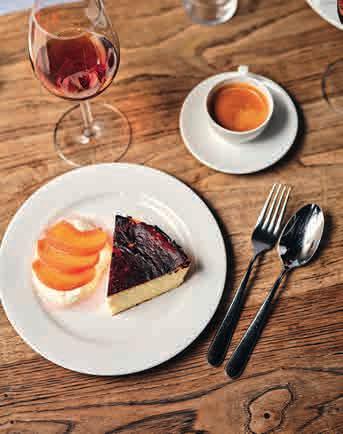
the-mouth signature dish, while a lick of re also kisses the smoked potatoes and burnt cheesecake.
West End boys and girls will nd more of the delicious same at Parry’s Michelinstarred Soho restaurant Mountain, where there’s a counter made from English elm to eat at.
Clockwise from left: Delicious dips accompany the wood-fired breads diners can watch being prepared at Oma; One Club Row’s bistro vibes; a Mayfair Mu n at Pavyllon; Brat’s renowned burnt cheesecake
ONE CLUB ROW
The dining room above Shoreditch’s Knave of Clubs pub was one of the most hyped London openings of 2025 — not least because of its gra ti-covered front door, which makes for social-media clickbait. At its heart, however, it’s a neighbourhood bistro designed to encourage repeat visits from regulars. That vibe is best appreciated at the counter, where a couple of seats are always kept for walk-ins, placing you in the centre of the room along- side the bartenders shaking martinis. It’s in the grand tradition of New York bar dining — think Gramercy Tavern rather than anything too downtown cool.
The team behind it is serious: James Dye founded The Camberwell Arms, Benjy Leibowitz ran the oor at NoMad New York, and culinary director Patrick Powell oversaw Allegra and the Midland Grand Dining Room. The food matches that smart-casual pedigree — steak tartare with beef-dripping toast followed by moules-frites with lemongrass, spring onion and curry leaf — while there’s a live pianist on Friday and Saturday evenings.
Is the counter bookable? Yes
Seats kept for walk-ins? Yes
1 Club Row, London, E1 6JX; oneclubrow.com
One Club Row is in the grand tradition of New York bar dining — think Gramercy Tavern rather than anything too downtown cool
The counter is the point of Pavyllon, Yannick Alléno’s Michelin-starred Mayfair restaurant within the Four Seasons Hotel. Currently the world’s most decorated chef, with 18 stars across 21 restaurants, Alléno built Pavyllon around a wraparound counter overlooking the open kitchen, where pinpoint-precise modern French cooking — rooted in classic recipes but with globetrotting in uences ranging from Italy to India — is prepared in full view of the room.
The Counter Culture chef collaboration series underlines how seriously Alléno takes the format, inviting fellow grandes toques to cook alongside him for one-night, sell-out events: Raymond Blanc, James Knappett and Claude Bosi have all taken their turn. The weekend breakfast tasting menu — a rst for London — is a little more accessibly priced at £70, while the £55 three-course lunch is a relative bargain in this postcode.
Is the counter bookable? Yes
Seats kept for walk-ins? No
Four Seasons Hotel, Hamilton Place, London, W1J 7DR; pavyllonlondon.com
PAVYLLON LONDON
A WORD TO THE WISE
Author Margaret Drabble’s piercing insight into our inner lives has earned her an army of devoted readers. Here, she re ects on her own rich yet challenging life and what’s to come
WORDS CHARLOTTE METCALF PHOTOGRAPHY RICK PUSHINSKY
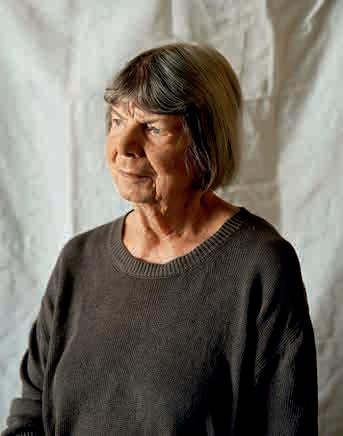
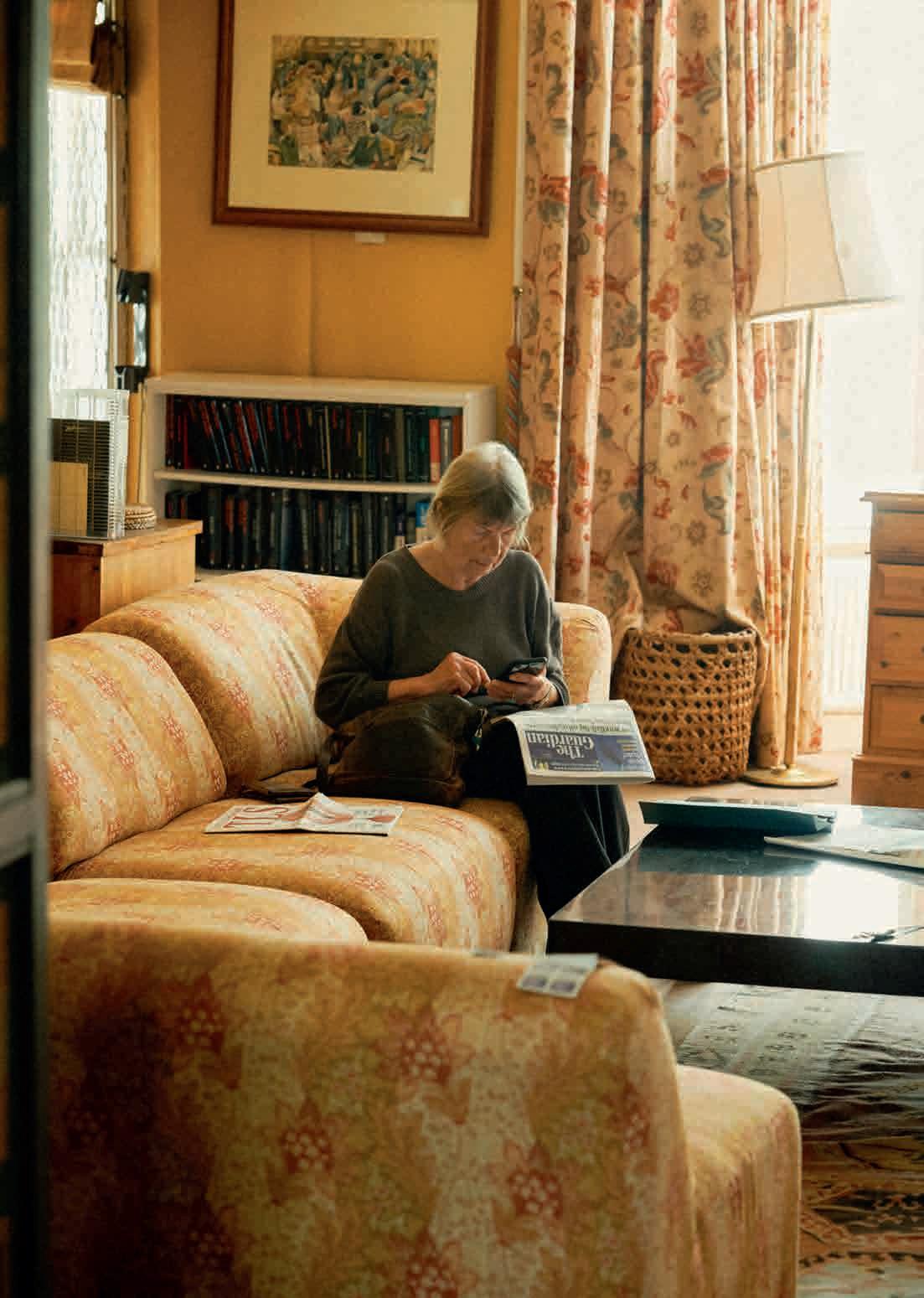
Margaret Drabble sits with her back to a large sash window.
Outside, a vast cherry tree sways and bends under the weight of great clusters of white blossom. Against this magni cent natural backdrop, Drabble, a small gure neatly dressed in charcoal grey, is lent a certain majesty tting for one of Britain’s most prominent, prize-winning authors.
Now 87, Drabble was awarded a DBE in 2008 for services to literature. She wrote her rst novel, A Summer Bird-Cage, in 1963, when she was 25, and went on to write a further 18, alongside her non- ction books about Thomas Hardy, Arnold Bennett and more. Like many, I have devoured Drabble’s novels since adolescence, captivated by her penetrating perception of our inner lives.
With her rst husband, Clive Swift, Margaret had two sons, Adam, a professor of political
theory and Joe, a celebrated garden designer, and a daughter, Rebecca, a poet and essayist.
In 2017, Rebecca died of cancer at just 53, and on Radio Four’s This Cultural Life, Drabble told John Wilson that the devastating impact of Rebecca’s death meant she would never nish another book.
Yet here we are, to discuss The Great Good Places, so I ask about her decision to publish it.
“Well, though I don’t have the appetite to plot another novel, I felt there was something still to be said, so this is a small collection of unpublished stories, some bits of memoir and chapters about places I’ve loved in my life.”
The book includes a chapter on She eld, where she was born in 1939 at the outbreak of war, and another on her grandparents’ house, to where she was evacuated on the Nottinghamshire-Lincolnshire border.
“My grandfather had been an electrician at the gas works in the Yorkshire coal elds, and
he and my grandmother bought the lovely little house in the 1930s to ful l their dream of running a tearoom. Over the years, we had so many really happy holidays there, playing in the elds all day and talking all night. Our parents didn’t talk to us much, but as siblings, we just never stopped.”
Margaret was one of four, born to parents resolutely committed to their children’s education. Both her parents were Quakers and studied at Cambridge, and she and her siblings followed suit. Before that, Margaret attended The Mount, a Quaker school where her mother, Kathleen, was a teacher. Her father, John, was a county court judge who wrote two detective novels after retirement, which she confesses to have enjoyed, particularly admiring the second. Her brother, Richard, became a KC; her younger sister, Helen Langdon, an artist and art historian; and her older sister, Antonia, the successful novelist,
than six decades
Margaret Drabble’s writing career has spanned over more
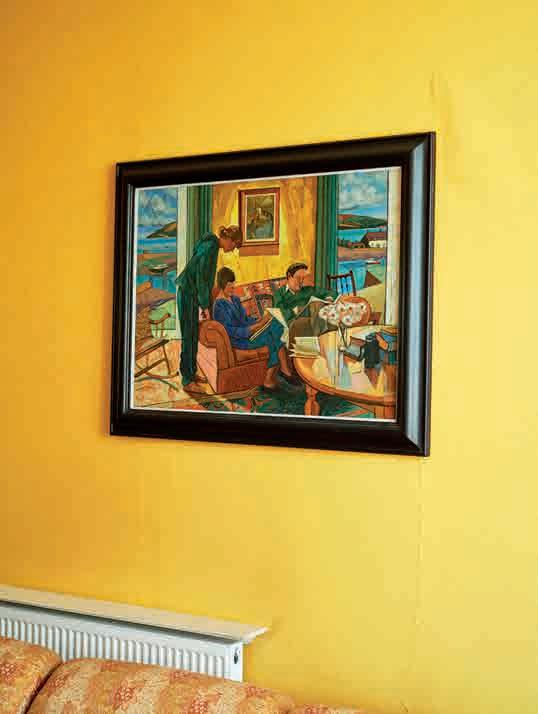
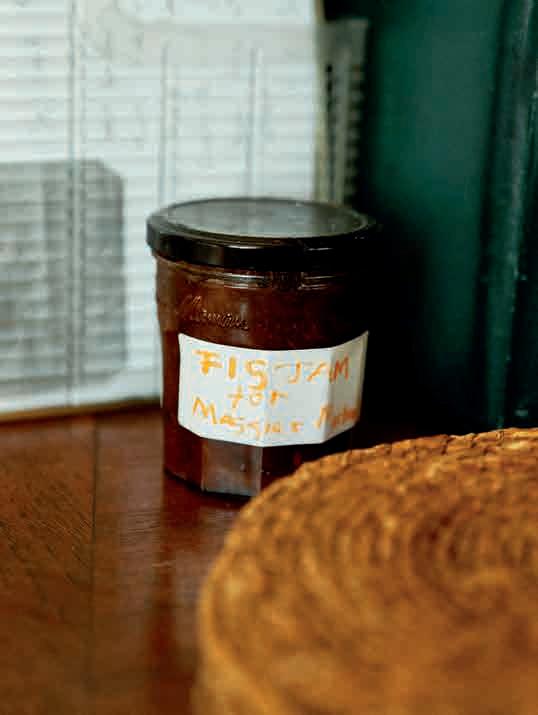
Snapshots of Margaret’s memory-filled London home, including cherished family portraits and homemade fig jam
Now aged 87, Margaret was awarded a DBE in 2008 for services to literature. She currently spends much of her time at home, caring for her husband
“I could say exactly what I wanted… I was looking at life through fresh, innocent eyes. It was fun finding my voice, and on it went”
AS Byatt. Margaret and AS Byatt fell out bitterly and publicly around the time AS Byatt won the Booker Prize for her novel Possession
At Cambridge, Drabble read English at Newnham College and took up acting. Her contemporaries included Ian McKellen, Derek Jacobi, Eleanor Bron, Corin Redgrave, Trevor Nunn, Peter Hall, and her rst husband, Clive, who later became known for playing Hyacinth Bucket’s long-su ering husband in Keeping Up Appearances. They married in 1960, shortly after she’d nished her degree.
“Clive was already at the Royal Shakespeare Company, and Peter Hall, who was running it then, really liked working with husband-andwife teams. So I moved to Stratford and was taken into the company as a walk-on and an understudy. Those were such happy days.”
She started writing because she was “bored”. “I understudied Vanessa Redgrave and Judi
Dench, who were hardly ever o stage,” she explains. “Then Clive was on stage every evening, and I didn’t know many people in Stratford, so I wrote a novel to occupy myself. To my astonishment, it was published. It led to an easier life, especially with children. Writing you can do anytime, anywhere — at least I could. And I was lucky it was never a struggle.”
I ask her if it wasn’t hard to be creative after learning such rigorous practical criticism skills at Cambridge. How did she manage not to apply those to her own writing? “It’s interesting you should ask that question,” she says. “Because I did have to nd an entirely new casual, rst-person, narrative voice. I wrote as a young woman, not as an academic having to please an instructor, and soon realised I could say exactly what I wanted and no one was going to stop me. I was looking at life through fresh, innocent eyes.
It was fun nding my voice, and on it went.”
We go back to discussing The Great Good Places and her love of the Canary Islands, which also feature in her last novel, The Dark Flood Rises, published in 2016. She has been going to Lanzarote with her second husband, the biographer and writer Michael Holroyd, whom she married in 1982 (she divorced Clive in 1975), for about 30 years.
“We were introduced to the Canaries by my son Adam when he and his family were all staying in a sort of bunker. We stayed at a nearby hotel. It was mass tourism but luxurious, and the food was excellent, so what was not to like? We now have a timeshare, and Michael and I have been going there every February for about 15 years. It was the last place we went to together before lockdown.”
Michael was gravely ill with cancer and now has severe Alzheimer’s and is non-verbal, so
Margaret is rarely able to leave London or even the house. She spends time reading him poetry, and they watch television series together. I ask her about her current favourite place, aware that she’s mainly having to stay put and can probably do no more than dream about it. “Oh dear, it’s so hard to say, as I don’t really go anywhere now,” she replies. “I really love Porlock, our family house in Somerset on the Devon border. It’s so beautiful and overlooks the Bristol channel, and you can walk into the sea if you don’t mind pebbles. But I haven’t been able to go for a year.
“I do go out, but not very often. On the whole, I just keep on at my memoir. I’ve never kept a diary because I was too busy with books and didn’t think it was interesting enough. But now, if a small incident strikes me, like a conversation on the bus, or I remember something peculiar, I’ll go to my endless reams of script and add another 100 words or so. I’m leaving it to my sons to sort out after I’ve gone.”
I ask her how long the memoir is so far. “Huge,” she grins ruefully. “Probably around 200,000 words — some of it unpublishable. But at least it’s a place I can go to put my thoughts. I’ve written a couple of short stories and am about to start a new one, but since Rebecca died, my sense of constructing a novel has completely disappeared. Life seems to be on hold in so many ways.”
We start talking about the way she seems to be facing her own mortality, having publicly spoken about her hope that her grandson, Danny, will sing at her funeral. “He’s a brilliant singer,” she says. “And it makes me smile thinking of his lovely voice seeing me o .” Indeed, Danny’s choir reached the semi- nals of Britain’s Got Talent. “I watch my friends
“My memoir so far is around 200,000 words — some of it unpublishable. But at least it’s a place I can go to put my thoughts”
“I wouldn’t say there was absolutely no God. Some kind of prime mover must have started all of this off in the first place”
die and think, ‘That was a peaceful way to go,’ or, ‘What a pity they had so much pain in the last couple of months.’ I don’t worry much about dying because that’s what happens. When it’s my turn, I just hope for peace.”
She’s not religious. “I think I’m agnostic rather than an atheist,” she explains. “I wouldn’t say there was absolutely no God. Some kind of prime mover must have started all this o in the rst place, and we human beings may never know what that thing was. Space and the Big Bang are imponderably huge concepts, and our brains aren’t up to coping with them. I have no idea what’s in store, but I don’t necessarily think death needs to be a total blackout.”
I ask her if she’d have done anything di erently in her life. “No. I took the risks I wanted to take, did the things I wanted to do. Overall, my decisions about the big things, like buying and selling houses, worked out well.”
Then she surprises me: “And I have to say that I’m immensely grateful to Michael for teaching me to drive in my forties. I’d failed my test twice, but he was so patient, and I loved learning to do something I thought I couldn’t do. How long I’ll carry on, I don’t know. I spoke to Joan Bakewell, who said she’ll drive for as long as she can. She said it was so liberating, just to be able to drive up to Primrose Hill, look at the view, and then drive home again.
“So many things can start closing down as you age, so it’s good to nd things that open our lives up a bit. Someone told me she’d learnt to swim late in life and how wonderful that was, so it’s never too late to discover something that enriches us.”
The Great Good Places, published by Canongate, is available in hardback.
The Great Good Places revisits moments in Margaret’s life, including memories of her early childhood
Living la vie en rose
Jemima Sissons and her family take a memorable French sojourn, driving in style with the Bentley Bentayga Speed and checking into some of the country’s nest hotels
dawn start from west London in our trusty pair of wheels, sleepy dust rubbed from infant eyes in the back, triple espressos jolting the drivers awake in the front. With a Tetris-style approach to packing up the car for a three-week jaunt to the south of France and back, we set o on our “relaxing” summer break. Two children under seven, resolutely no iPads and just seven hotels on the way. We brace ourselves.
Whistling down to Folkestone as the sun’s embers begin to peep above the Sussex hills, we soon board the rst LeShuttle to Calais, the smoothest way by far to get across (or under) La Manche. Before long, we are tearing through the northern French countryside, with the sandy
dunes of Le Touquet in our sights. Here, life slows to bicycle — or pony — pace, where quiet avenues studded with houses of faded grandeur lead to white sandy beaches. Based at Le Grand Hôtel, days are spent playing golf, making sandcastles on the endless beaches, or riding adorable steeds. We down oysters and Picpoul at Le Bar à Huîtres and scoop up armfuls of fresh peas in pods and strawberries at the bountiful grocers on the busy but charming main drag.
From here, we have our next destination — and our shiny new motor — in our sights and take a mosey south around Paris, nudging Versailles, until we reach the serene, bucolic idyll of Le Barn. It’s a place where foals nuzzle their mothers in buttercup-strewn pastures, while butter ies it between herbaceous
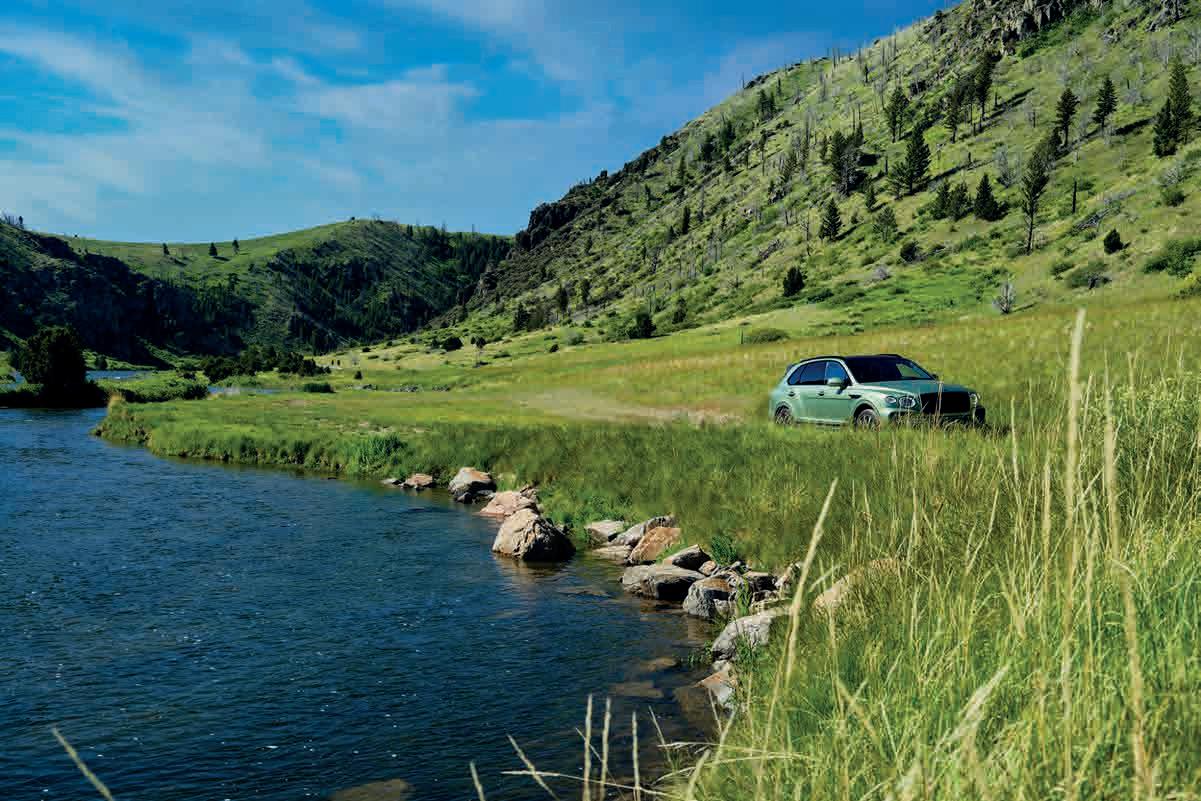
From opposite: The Bentley Bentayga Speed in Alpine Green Satin; scenes from Le Barn, a countryside haven just 45 minutes’ drive from Paris
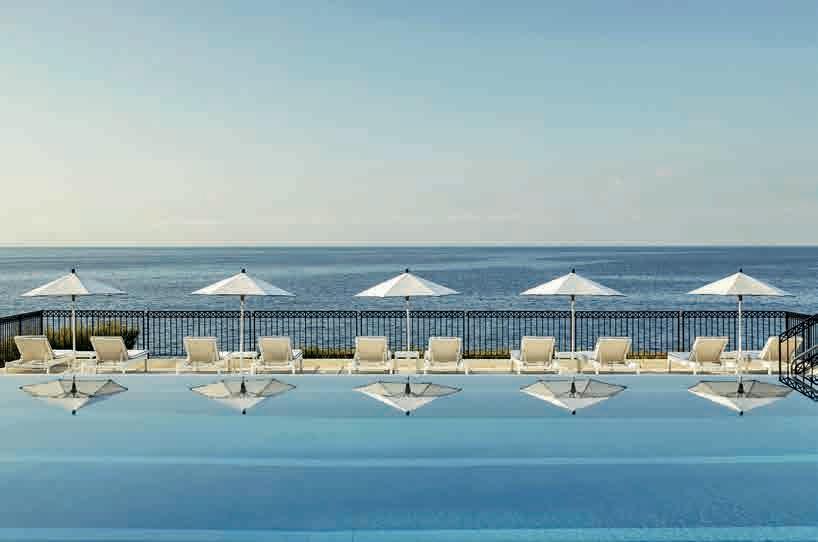
Clockwise from bottom left: Cour des Loges o ers Michelinstarred dining, the oldest parts of the building date to the 14th century; the tree-fringed pool at Terre Blanche; the salt water infinity pool at Four Seasons Grand-Hôtel du Cap-Ferrat
borders and jewel-hued dragon ies dart over a cooling pond. Living out a Swallows and Amazons sojourn, the girls play hide-and-seek in ferny woods, bathe with bobbing swans in the dark, clear water, and ride sturdy equines through knee-deep turf.
We hear the growl of the engine before we see it. Our ride for the next two weeks pulls up — the Bentley Bentayga Speed, a 641horsepower, 4.0-litre twin-turbo V8 steely grey powerhouse with all the mod cons — TVs in the back seats, heated steering wheel, a tilt-and-slide panoramic roof and mood lighting. Leaving our UK car in the safe hands of the hotel, we transfer our voluminous cargo and set o for the next adventure.
Winding our way south, agricultural swathes give way to medieval hilltop towns. Living o (excellent) service-station jambon baguettes, we make a pit stop at the ancient city of Orange in Vaucluse, which o ers us a welcome chance to cool o in the Roman amphitheatre’s cloisters. The gladiator contests are brought to life with their VR headsets — an absolute highlight for the girls. Then it’s onwards south — the Bentayga cruises along so smoothly we have to watch our speed — and after a four-hour stretch (where Eye Spy is tested to extremes), the olive- eckedmountains and Provençal vineyards hove into sight.
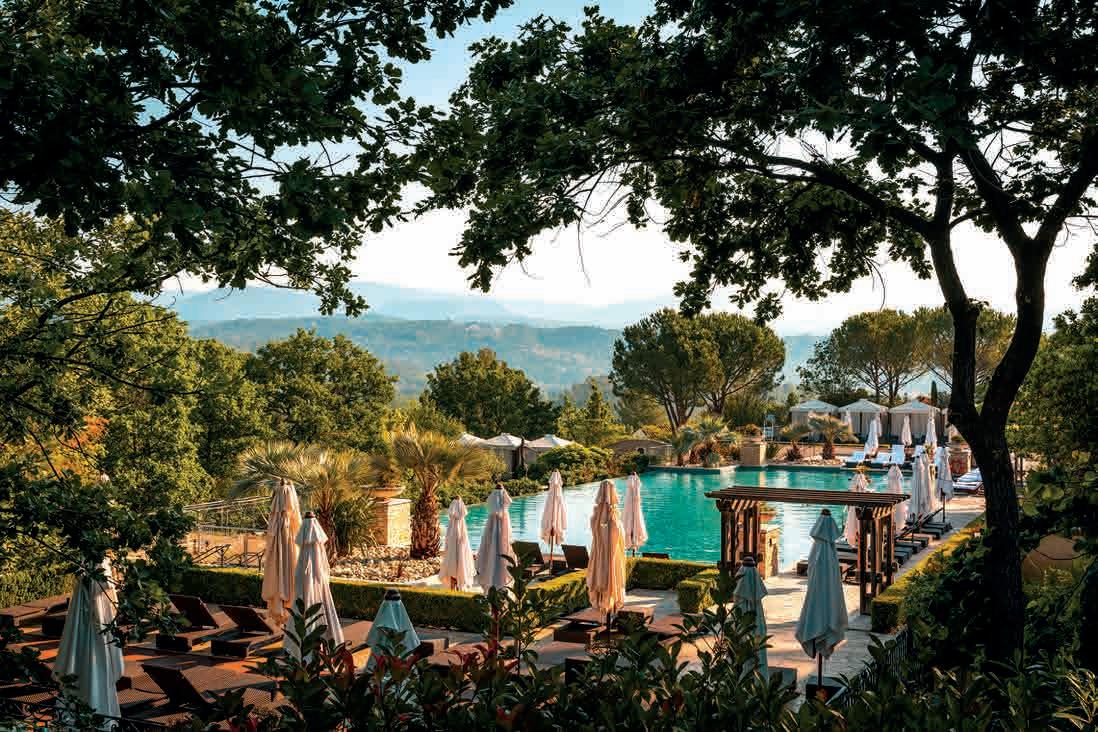
Terre Blanche emerges, the sound of cicadas cacophonous against the warm calm of the early evening, as hills decorated with rows of olive trees fade under the dwindling light. The resort is spread over 750 acres with two 18-hole championship golf courses, a capacious kids’ club with the most adorable children’s open-air restaurant — complete with a French-style three-course daily menu — and a magni cent swimming pool that has plenty of space to accommodate all generations. Rooms are cast into the hillside, a ording sweeping views of sun-drenched farmsteads. We head to Château d’Esclans, just a half-hour drive away, for a tasting of Whispering Angel and Garrus Rosé, and as dusk falls, explore the pretty, art- lled hilltop village of Tourrettes, where crisp glasses of Bandol at La Vigne Vincent are the perfect refreshment. At the hotel, the girls spend their days on nature trails, making scented soaps and honing circus skills in the kids’ club while we hike, golf and relax in the spa.
Now the ocean is calling, so we pack up the car once more — its engine purringat the ready. We set o , mountains looming and our last leg south ahead of us. This is a good
“We gleefully swap our travel clothes for swimming gear and head straight to the water at Four Seasons Grand-Hôtel du Cap-Ferrat”
“This is a good chance to try the sports mode; the curves of the Var mountains no match for the car’s well-tuned traction”
chance to try the sports mode; the curves of the Var mountains no match for the car’s well-tuned traction.
Hitting the coast, we curve past sand-hued forti cations in Cagnes-sur-Mer and grit our teeth as we try to negotiate medieval streets in Nice, praying our shiny alloys stay intact (these roads were made for horse and cart, not family SUVs). But unscathed, we enter the magical town of Saint-Jean-Cap-Ferrat, where mega mansions are hidden behind towering electrical gates, and we are joined by the purr of fellow supercars making the same beeline as us: for the fairytale palace of the Four Seasons Grand-Hôtel du Cap-Ferrat.
Sitting in lush gardens of cloud pines, oleander and ferns, the majestic hotel resides in a 17-acre estate, with the famous view to the sea and steps winding down to the Club Dauphin beach club and saltwater pool. Our room in the newer Pierre-Yves Rochon-
designed wing comes with a large terrace, complimentary mini-bar and helium balloons adorning the ceiling, which delights the girls.We gleefully swap our travel clothes for swimming gear and head straight to the water.After a refreshing mango sorbet, the children head to the pirate ship playground in the kids’ club while we catch rays.
With families — including dogs — clad in matching Dior, and babies anked by multiple bodyguards, the Four Seasons doesn’t mess around, so we put on our best frocks for the outdoor evening BBQ. Here, turbot sizzles over hot coals and a strolling band takes requests for John Denver and K-pop hits. We feast on homemade pistachio ice cream and île ottante before heading for slumber.
We take to the road once more, to snake north to the town of Lyon, where the Rivers Rhône and Saône wend through the city and layers of history, from Roman to Renaissance,
form this gastronomic stronghold. Based in theCour des Loges, A Radisson Collection Hotel, Lyon, the girls play hide and seek in towers, and we dine on llet steak and frites in the library with glasses of soft Burgundy. My eldest is convinced our room, with its ancient replace and wooden beams, is haunted, but luckily, we sleep soundly until morning.
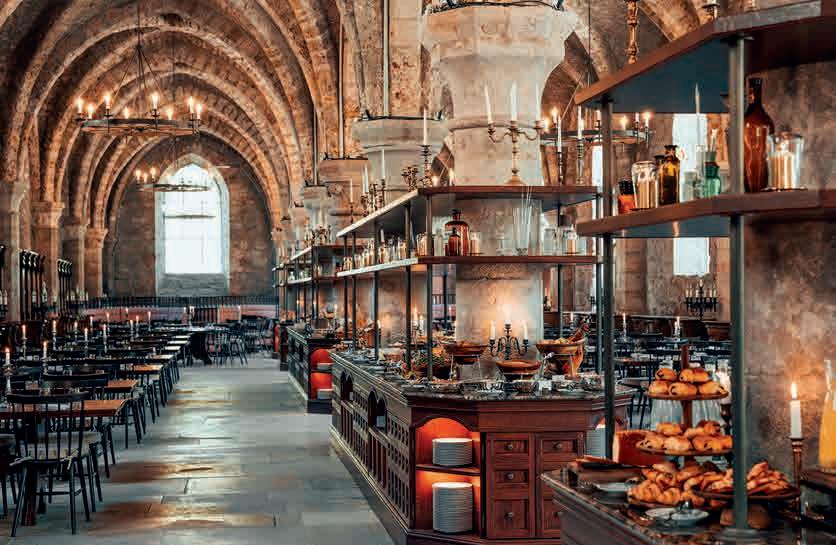
Our nal two stops beckon — rst, the much-talked-about Abbaye des Vaux-deCernay, where oh-so-soigné Parisians decamp for the weekend. Under the exquisite eye of Cordelia de Castellane, rooms swathed in Toile de Jouy and baskets of fresh garden apricots greet us, along with organic linen backpacks and plush toys. The Tartine et Chocolat kids’ club is the most photogenic we have seen, where mini worlds of toy vet, grocers and doctors hold little imaginations for hours, although it’s a hard task dragging ours from the games arcade next door,
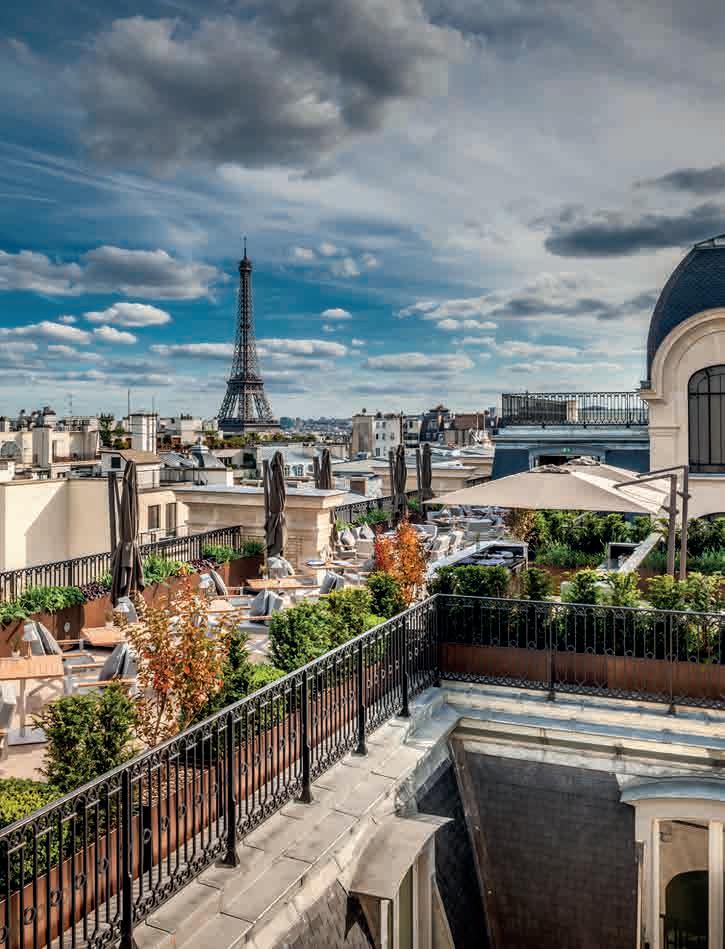
Clockwise: Jemima and her family cruised in style in the Bentley Bentayga Speed; the Monks’ Refectory at Abbaye des Vaux-de-Cernay and a bathroom detail; city skyline views from L’Oiseau Blanc, the restaurant headed by chef David Bizet at The Peninsula Paris
a light-and-sound show of dopamine highs. For sugar highs, the daily complimentary teatime is a must, with towers of madeleines and raspberry tarts, and mugs of rich hot chocolate. We work it o with tours on house bicycles around the lake and to the farmstead, where we pet goats and feed hungry hogs. An evening of karaoke in the stag-head lined restaurant sets us up for our last leg.
After retrieving our car from Le Barn, we relucantly hand over the Bentley outside Paris then slowly wind into the centre to the majestic Peninsula. Rubbing the lions’ heads for good luck, the girls pose with the famous Peninsula Pages, and we take a tour of the Ei el Tower by vintage Rolls-Royce, before tucking into Peking duck in the LiLi restaurant. On our nal morning, we swim in the underground spa pool, complete with underwater Beethoven, before saying our nal farewells. bentleymotors.com
PEAK PERFECTION
In Mendoza, the most famous wine region in Argentina, the vines grow at extraordinary altitude against the spectacular snow-capped backdrop of the Andes mountains
WORDS NINA CAPLAN
Nobody seems to agree on the highest vineyards in Europe — are they in northwest Italy, the Canary Islands, or in Switzerland?
The reason anyone cares, other than a fondness for the superlative, is twofold. These vineyards tend to be exceptionally beautiful, the eye led up to peaks or down towards fertile valleys. And, in a warming world, height means coolness. Lots of UV light without grape-shrivelling heat is a boon to vines; so are chilly nights.
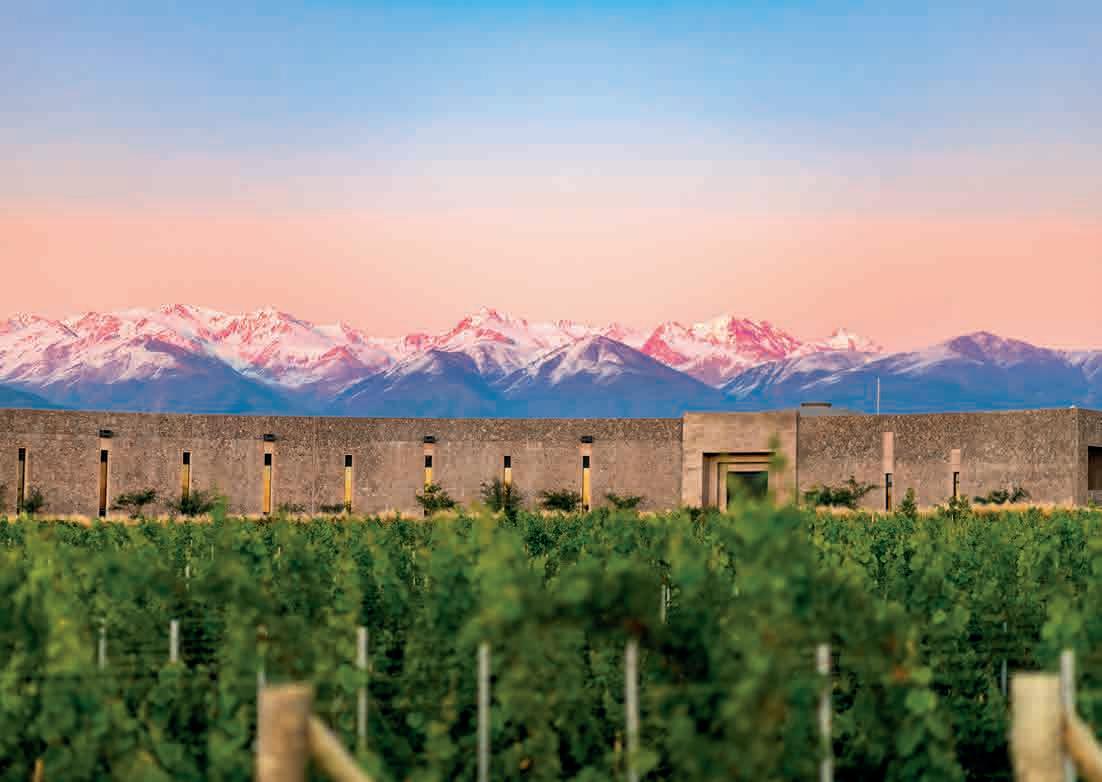
What is certain is that nowhere in this hemisphere can compete with Argentina for altitude vineyards. Driving around the Mendoza wine region, 650 miles west of Buenos Aires, the horizon is lined with dramatic peaks — snowcapped, even in November, which is their late spring. These are the Andes, the highest mountain range
outside Asia, dividing Argentina from Chile; its tallest pinnacle, Aconcagua, reaches nearly 23,000ft. The 16th-century Spanish Jesuits who stood on these hillsides, gazing at those crags and thinking “what a great place to plant vineyards” must have been mad. Except, as it happens, they were right.
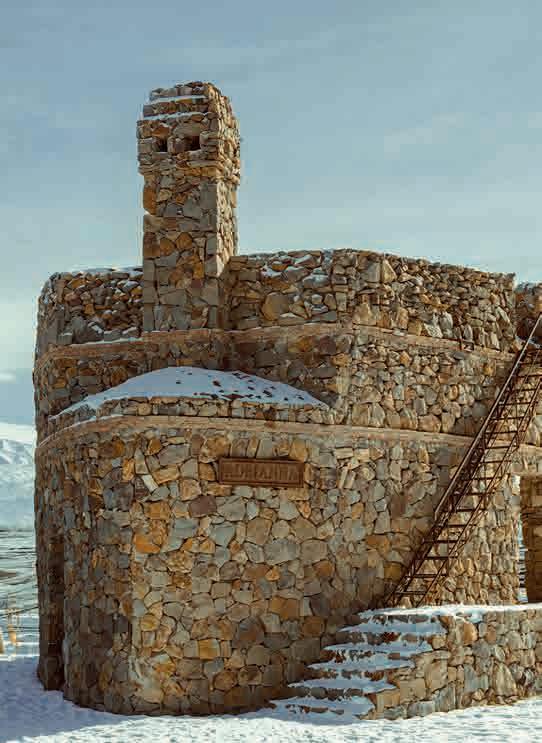
The surroundings are spectacular, but nature isn’t always kind. At Chakana winery, they complain about leafcutter ants, which devour everything, while at Bodegas Bianchi, their rst vineyard had so many rocks that they built a wall out of them. And, despite that picturesque snow, Mendoza is dry — technically a desert. A walk through these vineyards is sometimes accompanied by the whisper of water issuing from irrigation pipes: snow runo nourishing the vines while leaving them thirsty enough to ensure small, highly concentrated grapes.
The sun sets over the vines of the Zuccardi Finca Piedra Infinita winery in the Uco Valley
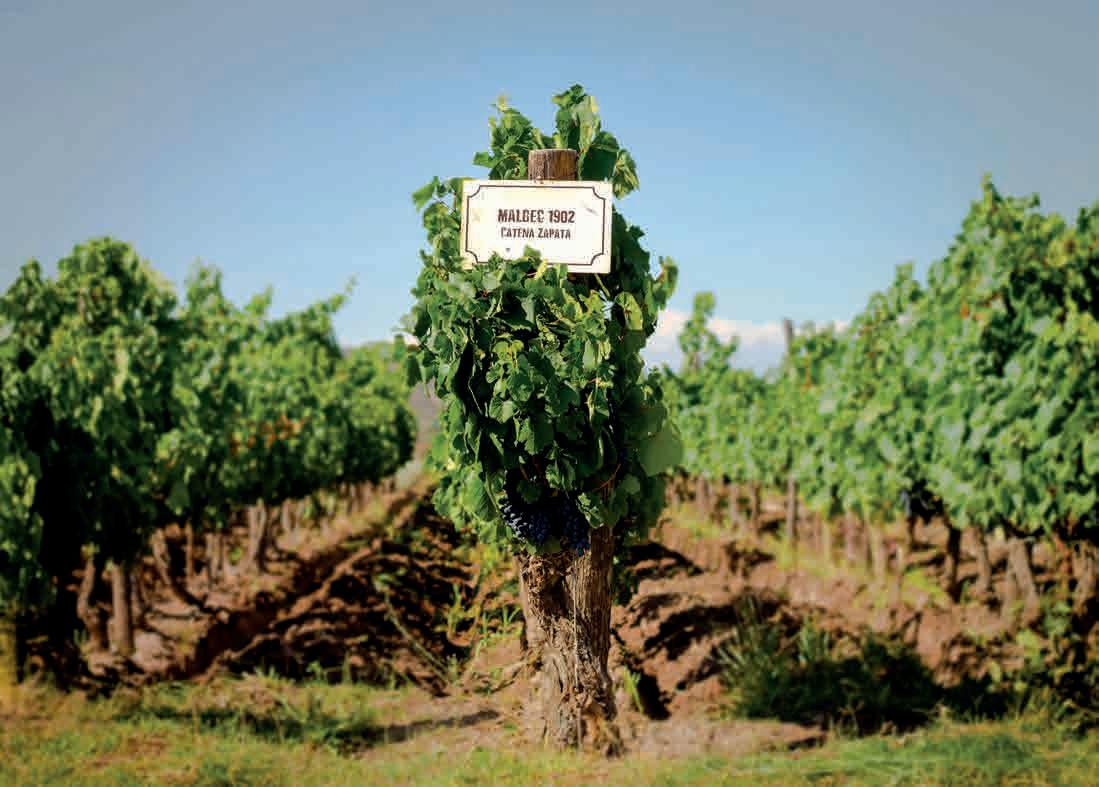
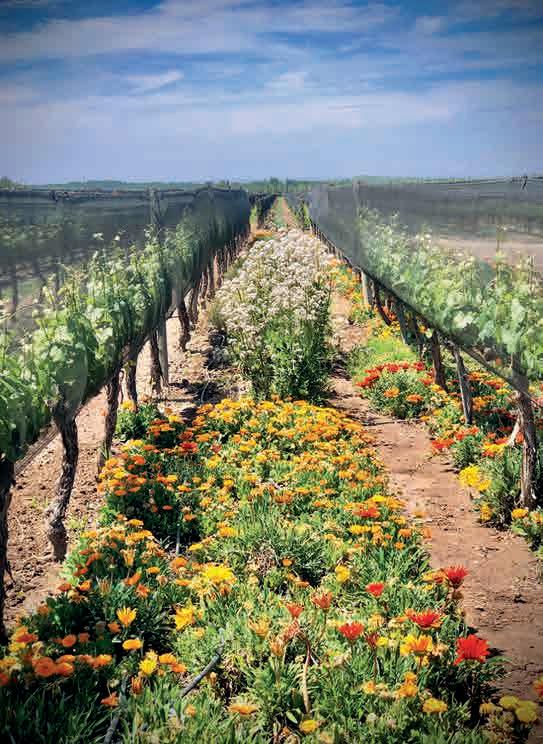
Clockwise: Catena’s Angelica Vineyard, planted in 1902; the Adrianna Vineyard at Tupungato; flowers bloom between the vines at Chakana Wines
“Our challenge is to have fruit and body in our Malbecs while keeping the acidity. It’s very easy to lose freshness because of the heat”
Until fairly recently, Argentinian wine was more about quantity than quality: the country’s inhabitants drank vast amounts, and the winemakers supplied it. When the rst boutique winery, Finca La Anita, was founded in the 1990s, the average annual consumption per person was 95 litres. Now, it’s in the twenties. (For comparison, the French drink just over 40 litres per person, the Brits 22 litres.) As the demand for rotgut tumbled, the country’s winemakers, led by Nicolás Catena, turned their attention to quality, focusing on the grape that is the obvious choice for a country that produces some of the world’s best steak: rich, fragrant red Malbec, steak’s natural companion.
When I rst came to Mendoza in 2007, the wine world had recently woken up to the gorgeousness of Argentinian Malbec. I ate more meltingly good steak — most commonly preceded by empañadas, the meat- lled local pasties, just in case I wasn’t getting quite enough protein — and drank more terri c red wine in one week than I usually do in a month at home. When white wine was required, the fruity local Torrontés grape was frequently served, but it’s the reds that live on in my memory. They were aged in oak, punchy and powerful, great in the sunshine with an asado (Argentinian grill), less suited to the cooler restraint of London life.
Nearly 20 years later, the Malbecs have evolved, and Argentina is also in love with other varieties, particularly Chardonnay. Sustainability is also now a focus. The water here comes from those beautiful mountains. If the snow goes, a lot will go with it.
“Our challenge is to have fruit and body in our Malbecs while keeping the acidity,” said Chakana winemaker Leo Devia, over a lunch at their covered outdoor table that included more fresh vegetables than I think I ate on my entire 2007 visit. “It’s very easy to lose freshness because of the heat.” Their 2023 Nuna Malbec has the appetising bite of a pomegranate, like a fruit plate after a creamy, oral Chardonnay from Paraje Altamira, on stony soils at 3,600ft near the mountains. That sounded high until they served me a deliciously complex Torrontés with notes of pear and camomile, from vineyards in the Uco Valley, south-west of where we are, that sit at 6,560ft.
These grape varieties have European ancestors (Malbec originally came from south-west France), but, like people, they have adapted to their new surroundings. Now, the people who tend them are learning to adapt to them. At Argento, they are experimenting with planting all sorts of native cover crops between the vine rows because “what you do in Europe is useless here”. The 2022
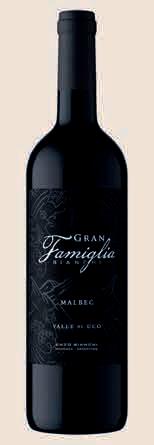
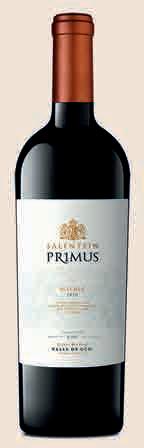
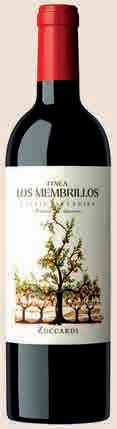
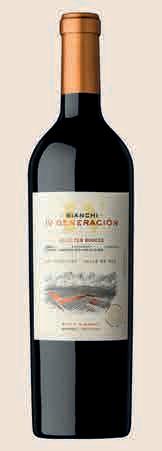
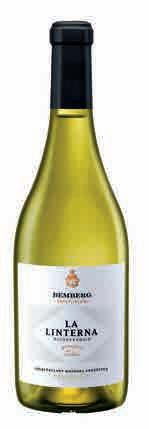
From top left: Gran Famiglia Bianchi Malbec; Bodegas Salentein Primus Malbec; Zuccardi Finca Los Membrillos Cabernet Sauvignon; Bianchi IV Generacion Gran Corte; Chakana Singular Torrontés de Maceración Prolongada; Bemberg Estate La Linterna Chardonnay
Chardonnay grown beside — and named for — Nassella, or needlegrass, tasted of herbs and camomile, while the 2021 Nassella Malbec was sultry with spice and white pepper.
When it came to altitude, the numbers bandied around were amazing. At Salentein, a bodega (winery) with luxurious bedrooms, a pool and a terrace restaurant overlooking the vineyards, I tried a Single Vineyard Las Secuoyas Chardonnay 2021 from vines grown at 5,250ft – that is, one and a half times the height of Mount Snowdon, the UK’s tallest mountain. Yet, walking through the vineyards, it was hard to gauge how far up I was, because in every direction rose mountains loftier still.
And wherever I went, the Chardonnays were a revelation: cool and pure, often with a richness that never turned into a blast from the whipped cream pump, with lovely avours of mint and citrus. It would be hard not to love the two remarkably di erent Chardonnays, White Bones and White Stones, from Catena’s Adrianna Vineyard, planted at nearly 5,000ft by Nicolás Catena in 1993, when the only way to get there was by horse or helicopter.
Bodega Catena Zapata was founded back in 1902, and the current Catenas are the fourth
generation. Laura is a powerhouse who oversees everything from books on Malbec to the conversion of the original winery into a Michelin-starred restaurant. She has founded an important institute to study aspects of winemaking and also launched a oaty tourism experience of meditation beside the vines. Her younger sister Adrianna is surely the only person to have both a PhD in history from Oxford University and her name on some of her homeland’s nest bottles: Adrianna Vineyard was named for her.
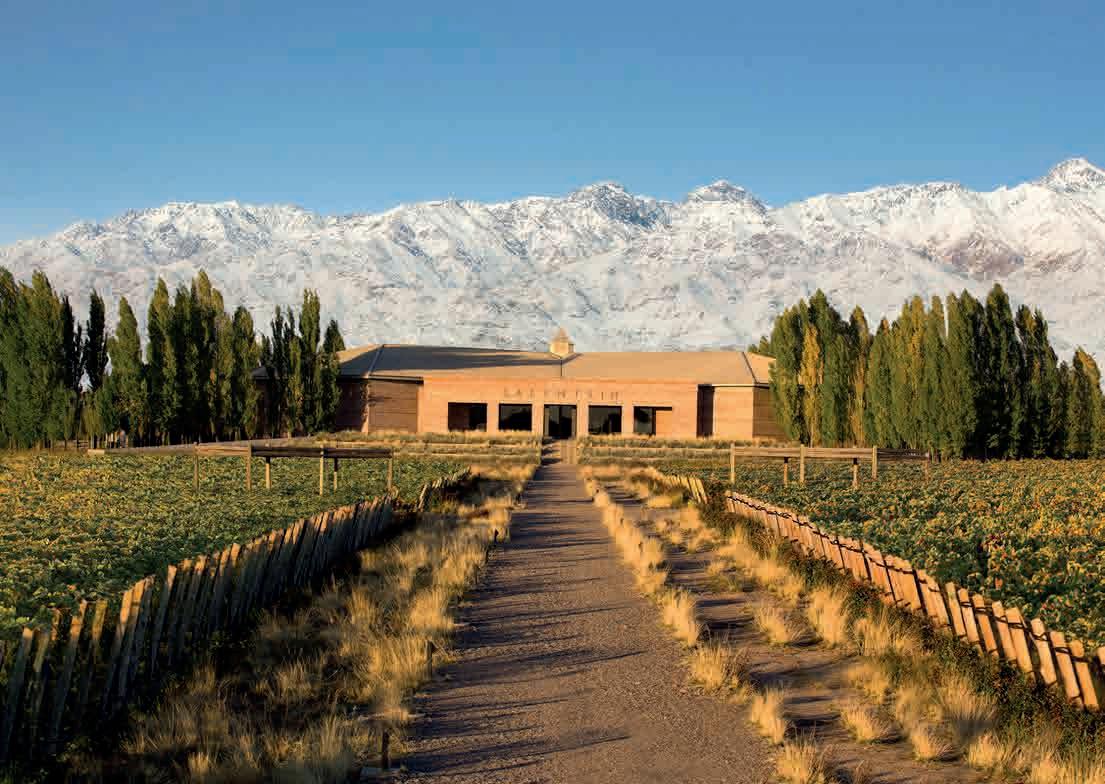
When it came to the nest reds, I was spoiled for choice, but I especially loved those made by Daniel Pi at Bemberg Estate, in an architect-designed winery surrounded by desert plants. I tried two of his single-parcel La Linterna Malbecs, both exceptionally good and startlingly young, despite being from 2019. Daniel does not restrict himself to Malbec, ranging the scale from a gorgeous Pinot Noir, heady with thyme and rosemary from the 4,265ft-high Los Arboles Valley, to a forest and violet Cabernet Sauvignon, made in the Cafayate Valley, which sits at 5,400ft.
All those mountains also made for seriously spectacular sunsets. A marvellous orange sky
accompanied a terri c mushroom paella at La Morada Lodge, enhanced by Mil Suelos’s luscious Tigerstone Garnacha, made in Cafayate 680 miles north, at an altitude of 5,575ft. An even more breathtaking sky illuminated the asado that Sebastián Zuccardi made at his Uco Valley winery — a low, stony building integrated into this incredible landscape — and served alongside what this third-generation winemaker proudly calls mountain wines: “everything that happens here is in relation to the mountain,” he says. He ferments all his wines in concrete (and abandoned new oak barrels entirely in 2013), and they are fresh and almost crackling with personality: the Malbec, Finca Las Cerrilladas 2021, herby and vivacious, the Finca Los Membrillos 2021 Cabernet Sauvignon 2021 elegant as a model clothed in Chanel. Like a winery subtly situated in its surroundings, these exciting wines integrate modern and traditional thinking.
Argentina has changed, and the country’s wines are also evolving, but nobody seeing that landscape, or the quantity and variety of meat on those grills, could believe that these winemakers have forgotten their roots.
Clockwise: Bodegas Salentein has 16 luxury bedrooms and a restaurant on site; Bemberg Estate’s spectacular architect-designed Finca El Tomillo; Sebastián Zuccardi, third generation at Zuccardi Wines; Laura Catena, the dynamo powering Bodega Catena Zapata into the future
Images: Andrea Fernandez, Eduardo
Solodki
A CUT ABOVE
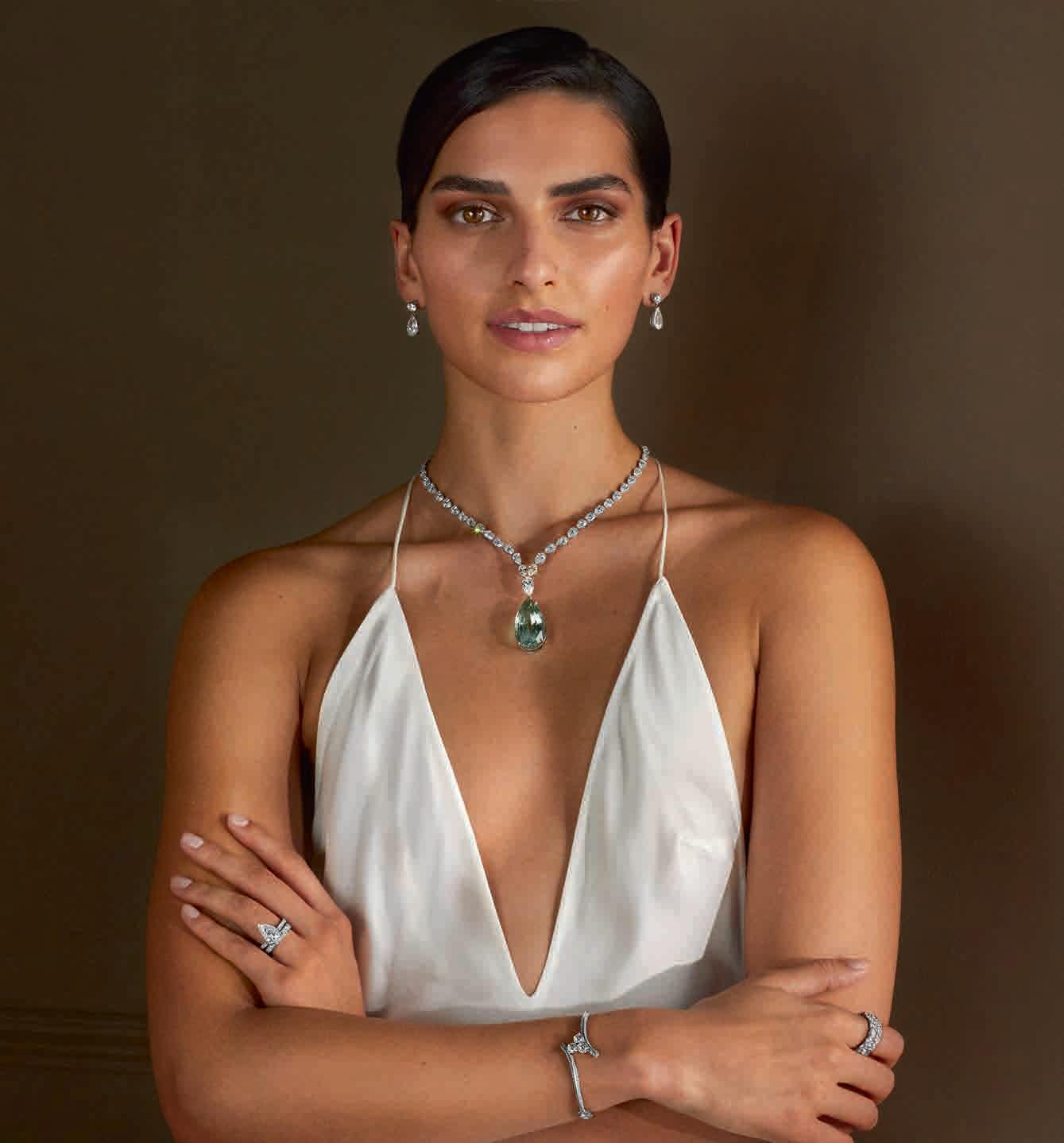
Diamonds that glimmer rather than dazzle are the ultimate hallmark of stealth wealth: the hunt is on for the nest antique stones
WORDS AVRIL GROOM
When Taylor Swift got engaged to American football star Travis Kelce last year, it wasn’t just the announcement that broke the internet. The rectangular antique diamond glinting beautifully on her nger illuminated a major trend that had been quietly gathering force and was now in the full glare of consumer desire.
The ring, an elongated cushion-cut stone set in a vintage style by American jeweller Kindred Lubeck, “accelerated interest in antique stones,” according to Lisa Levinson, head of UK for the Natural Diamond Council.
“For weeks after the announcement, it was near impossible to source a similar stone on the British market,” she adds. “Antique cut diamonds are becoming rare because so many have been recut with modern technology for extra brilliance, leading to those that remain being cherished for their softer light return and gentle lustre.” Lubeck has since created a range of bridal jewellery with antique stones in hand-engraved settings, and a capsule collection for Sotheby’s.
Diamonds vary greatly in colour, cut, clarity and carats, making them as individual as their potential owners. The one that “speaks to you,” as sales sta used to put it, may not be
the brightest or whitest. Antique diamonds often have a slightly softer tone that indeed speaks to today’s client, who seeks a more subtle allure than the high-octane dazzle of the round brilliant cut, which now accounts for 75 per cent of gem-quality diamonds. Consequently, antique shops have seen interest in historic cuts “rise over two years as people want something less o -the-shelf,” says Wave Antiques’ director Will Wright. “These stones are distinctive without trying too hard and evoke an emotional reaction.” Auction houses report more young bidders seeking antique jewellery with diamonds of a di erent cut and character, appreciating that
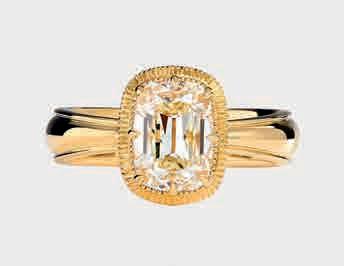
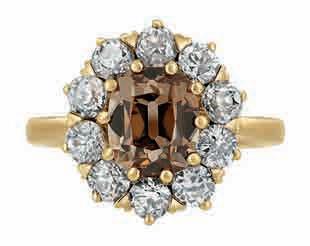
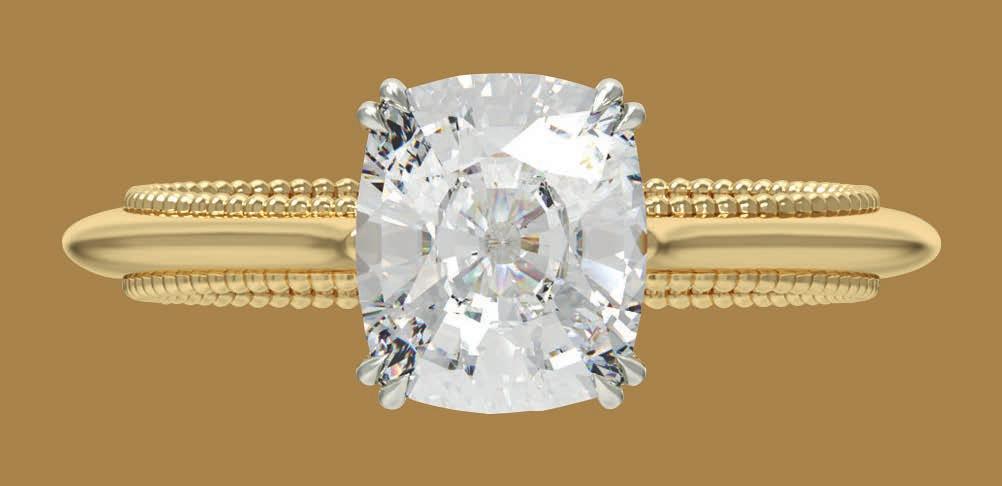
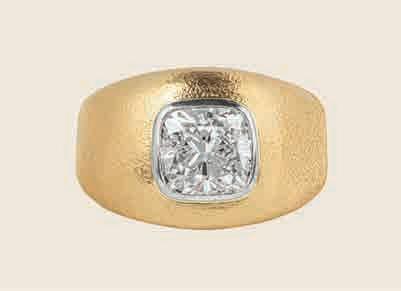
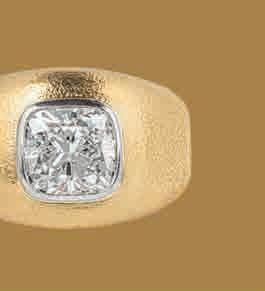
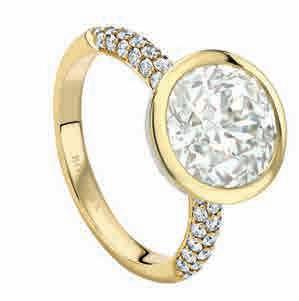
Below: Brigitte ring from Artifex Bride by Kindred Lubeck, 2.01 ct old minestyle elongated cushion-cut diamond, 18 kt engraved gold
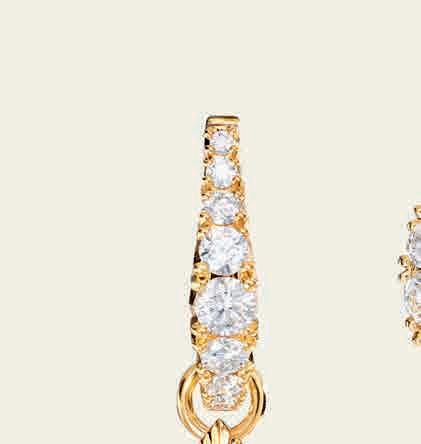
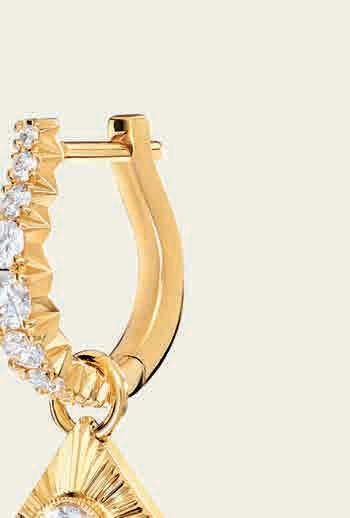
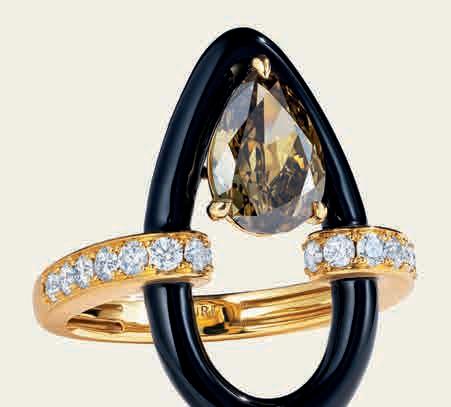
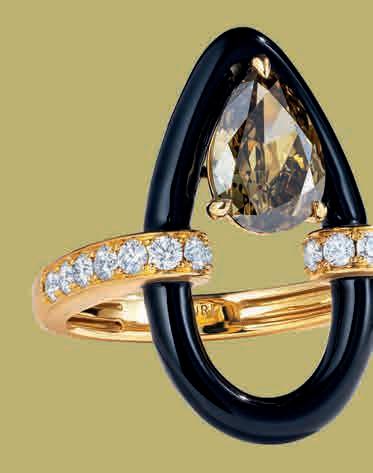
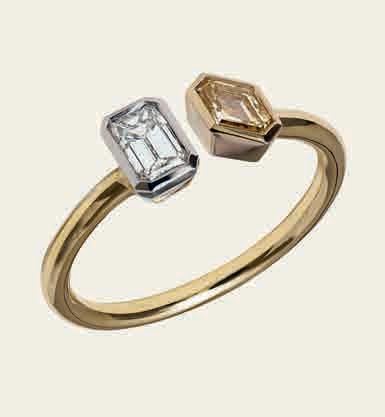
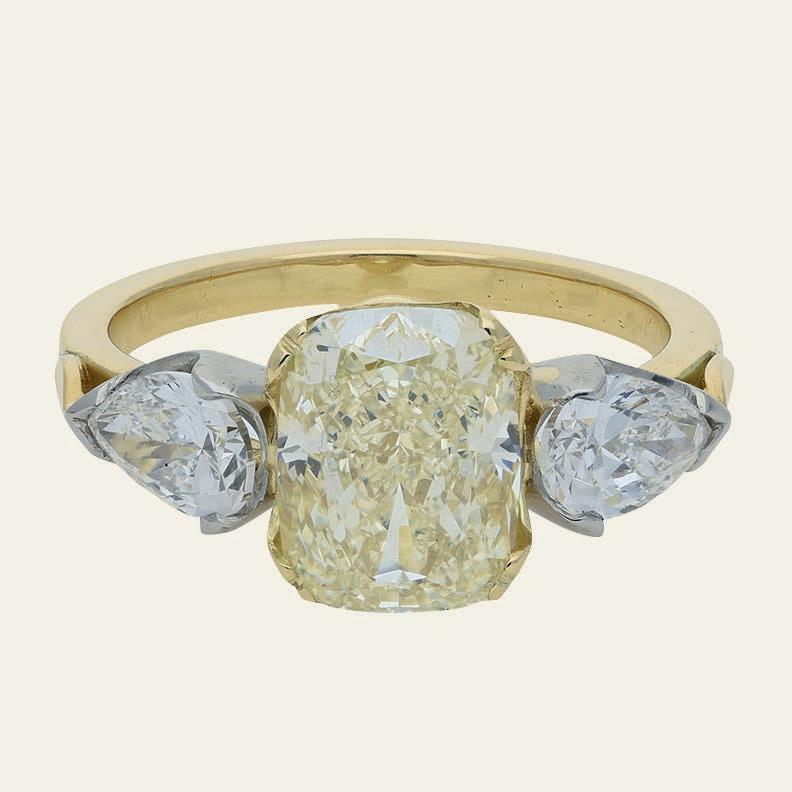
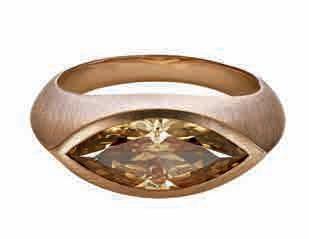
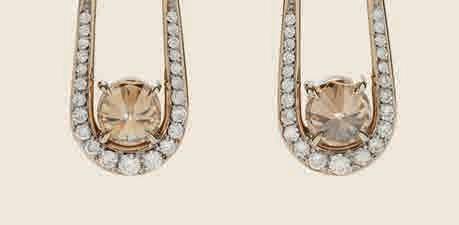
Clockwise from top: Étoile earrings from Artifex Bride by Kindred Lubeck, two old mine-style diamonds at 0.55 ct as detachable drops in engraved 18 kt gold, graduated diamond hoops in 18 kt gold; Henry and Henry Seven Twenty Toi et Moi ring, 0.2 ct emerald-cut diamond, 0.25 ct shield-cut fancy yellow diamond, 18 kt yellow gold; Wave Antiques vintage ring, 3.01 ct elongated cushion cut yellow diamond, two pear-shaped diamonds at 1ct, 18 kt gold; Matturi Pengusa ring, 3 ct pear-shaped cognac diamond, pavé diamonds, black enamel, 18 kt single mine origin gold
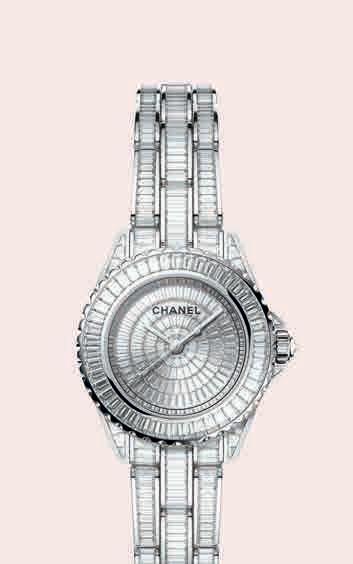
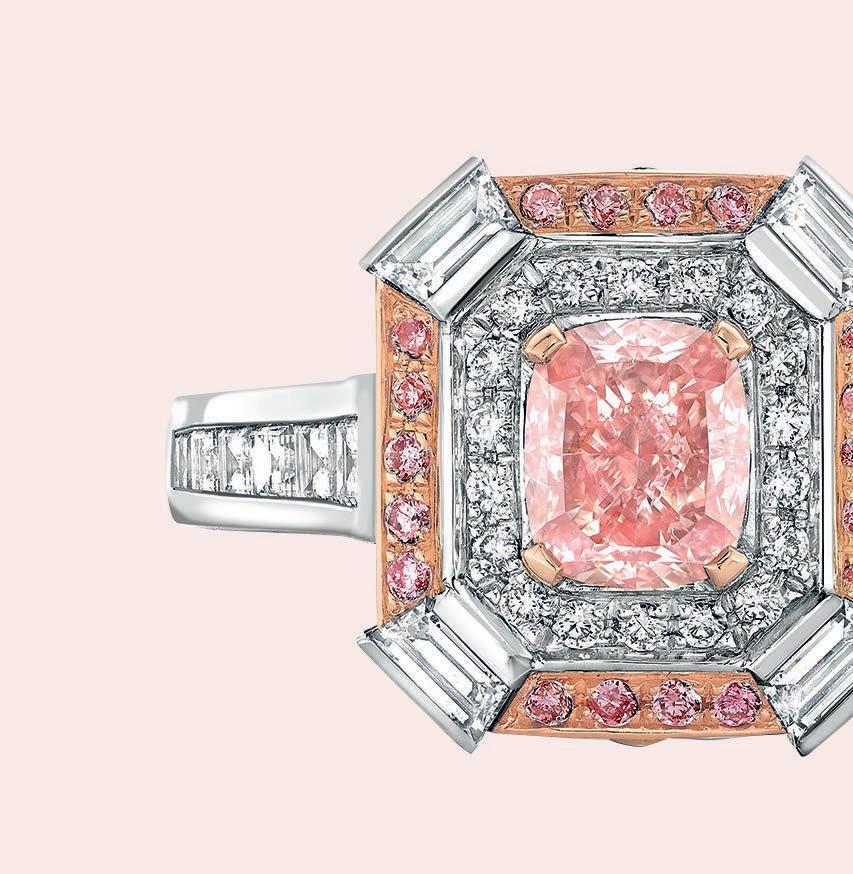
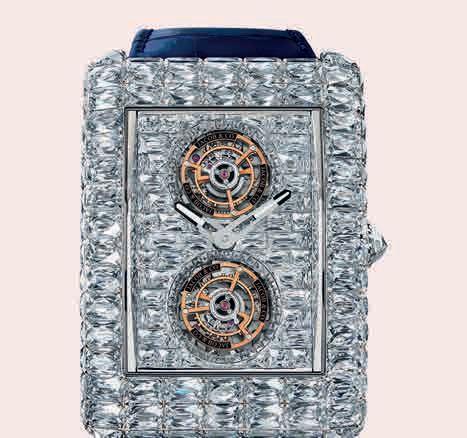
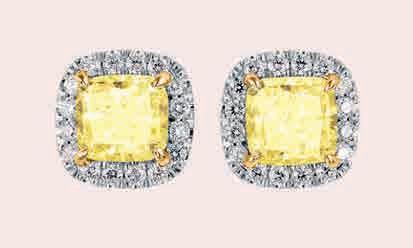
From top: Chanel J12 28 mm Diamonds watch, fully paved with 628 baguette diamonds and 1 brilliant cut diamond, 18 kt white gold, quartz movement; Boodles Vintage ring, 0.86 ct cushion cut intense pink diamond, baguette and princess-cut diamonds at 0.55 ct, white diamond pavé and pink diamond pavé, platinum and single mine origin rose gold; Jacob and Co Billionaire Double Tourbillon watch, 298 Angel cut diamonds at 79 ct, 18 kt white gold, mechanical movement; Bucherer Solitaire Collection Joy ear-pins, two fancy yellow cushion-cut diamonds at 2.05 ct, diamond pavé, 18 kt gold, platinum
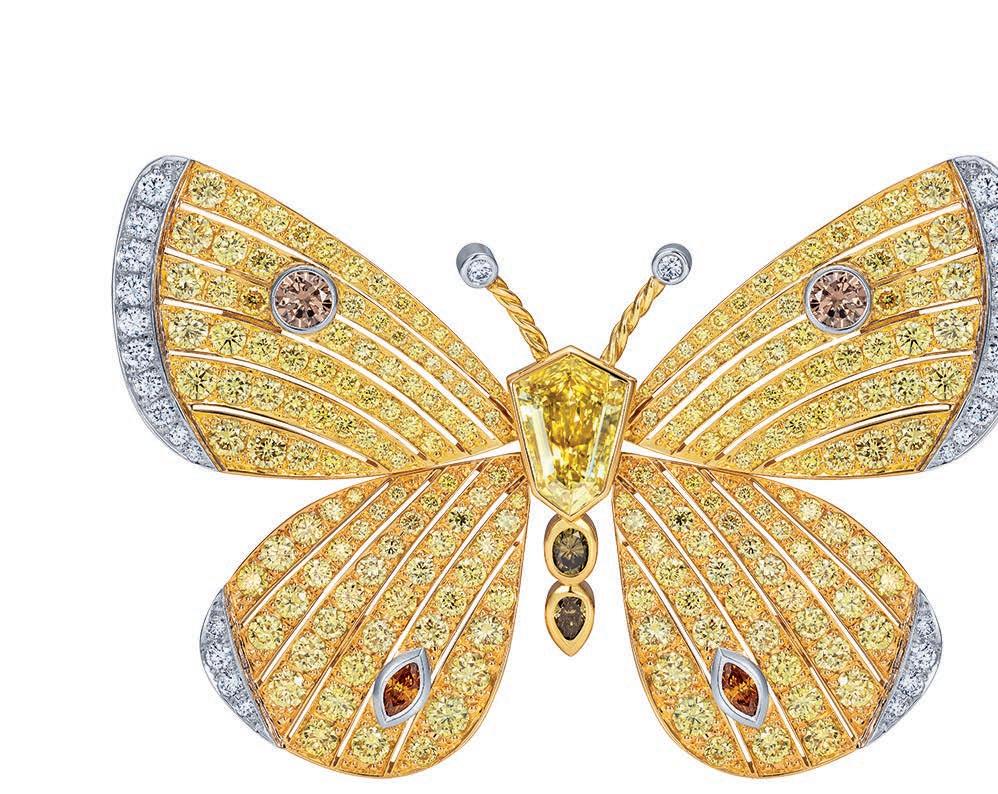
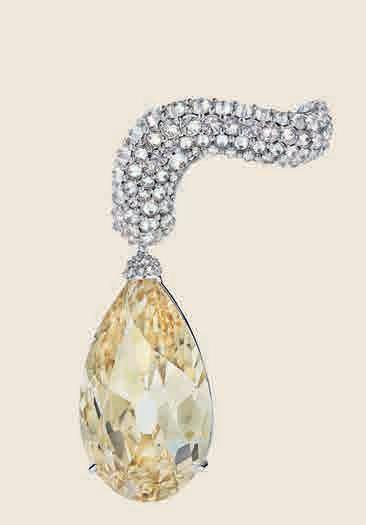
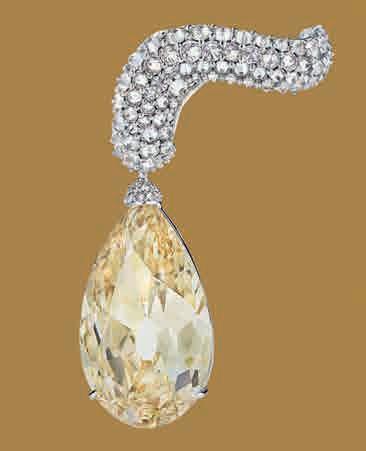
From top: butterfly brooch, kite-cut fancy intense yellow diamond, 1.76 ct, 229 yellow diamonds at 5.87 ct, pairs of cognac, orange and green diamonds total 0.81 ct, diamond pavé 0.59 ct, 18 kt yellow gold, platinum; Facets
The gems spark bidding wars between brands, with the victor resetting them in the current house style
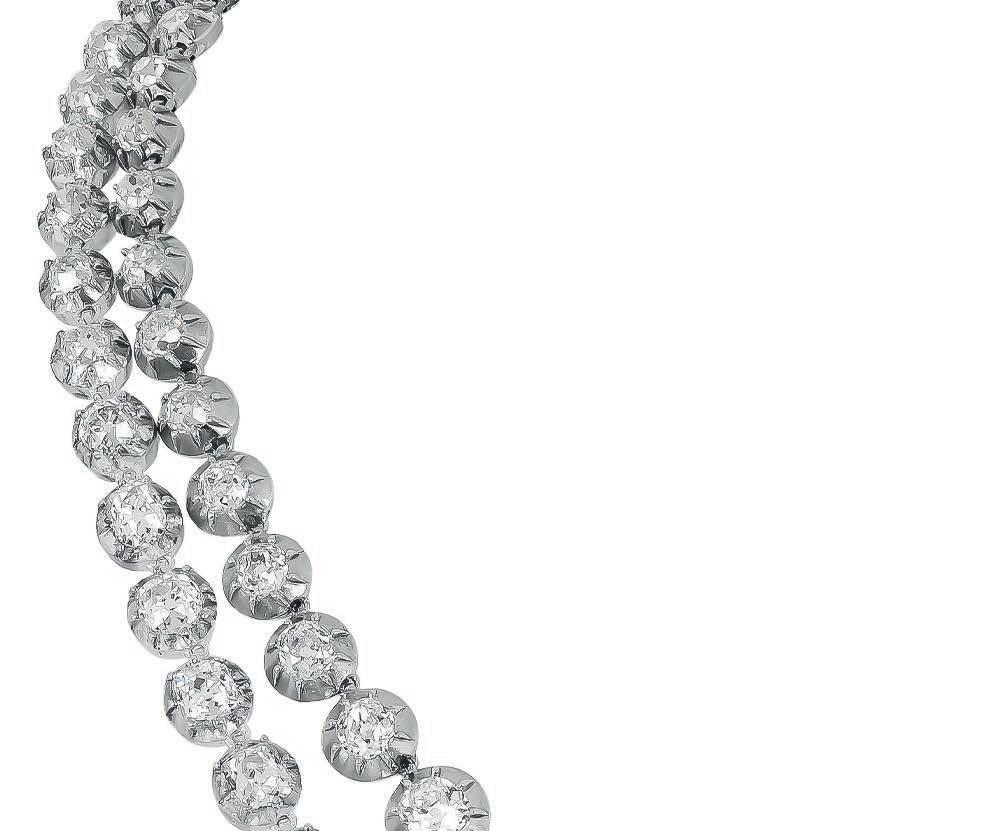
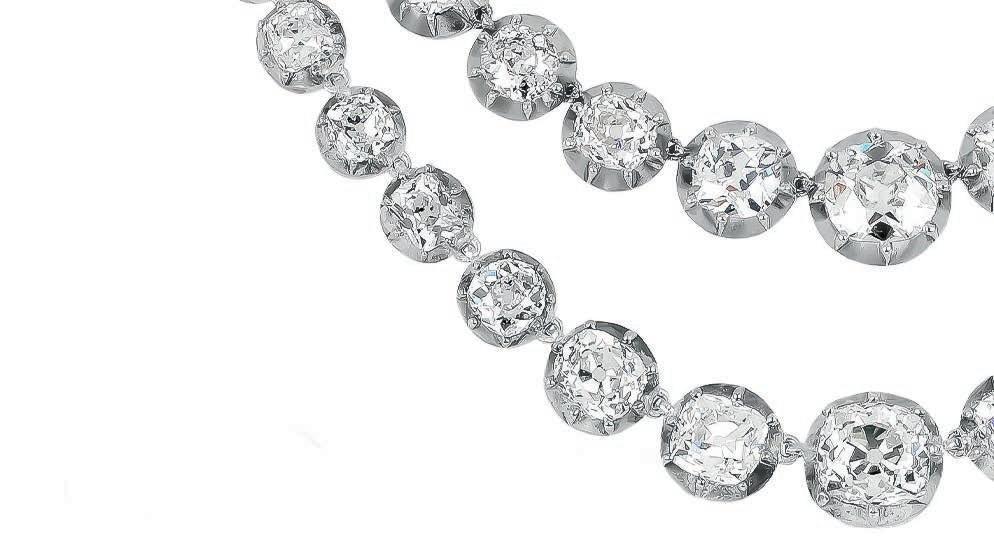
they were hand-cut by highly skilled craftsmen to enhance the refraction of candlelight.
Antique cuts had fewer facets than the 57 of today’s brilliants. By the 16th century, the softly rounded rose cut emerged, with a maximum of 24 facets, but is now prized for its subtle twinkle and warm glow, especially in Georgian settings. Consumers are discovering what collectors have long known: such pieces, often set in silver, are fragile and may need expensive restoration. Yet their beauty, often accompanied by provenance that charts the uctuating fortunes of aristocratic families, adds value and storytelling charm.
Sometimes the setting is outdated, but the gems spark bidding wars between brands, with the victor resetting them in the current house style. Most great jewellery houses are reticent about the sources of their antique gems. However, Cartier has long taken pride in buying back items to meticulously restore and resell as part of its Tradition high jewellery line, and other houses have followed suit.
While you might imagine erce competition among the world’s top jewellers for these rare
gems, they are too polite to admit it, citing their “trusted sources.” Family rm Pragnell deals in both antique and its own high jewellery. Its director, Tom Crookenden, explains: “We’re fortunate to have many antique stones in stock. Clients are drawn to their soft beauty, and if we need to restore or polish them, we use only traditional methods.” Charlie Barron is more recently established but well-connected through a career in the pearl industry and auction houses. Outstanding pieces include grand estate jewellery and items designed around stones from privately sourced family collections, such as perfectly graduated rivière necklaces of well-matched antique diamonds. Boodles has old mine and cushion cuts, but also its own modi ed version of the Ashoka cut, devised in the 1990s by legendary New York cutter William Goldberg. This cut, based on a superb antique cushion-cut gem Goldberg saw in India, captures the softer light return that today’s consumer demands.
Families in the poignant position of selling jewels with good diamonds may be courted
ring, green, orange, fancy greyish violet, fancy red, fancy blue and fancy intense yellow diamonds at 0.2 ct, 18kt yellow gold, platinum, both Hirsh
by potential dealers, but if they are wise, they will nd one who treats their heritage with respect. Mayfair jeweller Hirsh sometimes works with “antique diamonds that have had a life before coming to us, that we can preserve for the future, or meaningful family stones passed down generations, that we may carefully polish to create a beautiful new jewel that refreshes the gem while honouring its history,” says owner Sophia Hirsh. A quieter but on-the-rise spin-o involves inherited diamonds remodelled by individual designers who love to collaborate with clients. Belgravia jeweller Sophie Breitmeyer now nds half of her bespoke ring commissions entail antique stones, from the client’s family or her stock. Designer-maker Jessie Thomas says, “We often work with clients’ own antique stones, reworking them into something new, modern and relevant. Reworking is sustainable and feels more aligned to how jewellery is made and worn today.”
Sustainability is a given for stealth wealth clients who would rather glimmer than dazzle. Eliza Walter, founder of Lylie, which only
works with recycled metals and remodels many antique stones, says, “With jewellery’s current mood for warmth, subtlety, and ‘lived-in’ pieces, it’s responsible to reuse them,to extend their life and preserve their craftsmanship.”
Today’s clients and jewellers also see gems as part of essential nature conservation. For Fernando Jorge, whose spectacular new high jewellery collection was his rst presentation at the prestigious TEFAF fair in Maastricht, the imperfection of natural materials is a profound inspiration, though the craft of his pieces is very much perfect. Materials like ancient, fossilised wood or smoky quartz are shaped into fat surrounds for cushion-cut diamonds or pebble-like shapes folding around pear or marquise stones, while the quartz is cut and polished into fragile, asymmetric swirls that encase pear-shaped gems. An extraordinary, antique 11-carat fancy orange-brown pear-shaped diamond, which possibly came from the famed Golconda mines that made India’s gem-producing reputation until their depletion around 1830,
antique old mine cut champagne diamond, 2.03 ct, ten round natural diamonds at 1.36 ct, 18 kt yellow gold
Images
(Henry and Henry): Sarah Gatenby-Howells
From top: Henry and Henry Vice Cu , 2.30 ct fancy desert diamonds shield, marquise, cushion and kite cuts, 18 kt gold; By Pariah ring stack, 1.25 ct desert diamonds, Botswana agate, 14 kt rose and yellow gold; Heny and Henry Vice Cinnamon ring, 2.02 ct fancy orange brown marquise-cut diamond, 18 ct rose gold; Sophie Breitmeyer cluster ring,
From top: High Fluid pendant, 11 ct fancy orange-brown pear-cut diamond, 18 kt gold bezel and snake chain; earrings, two cushion cut fancy dark brown diamonds at 11.0 ct, petrified wood, 18 kt yellow gold, both Fernando Jorge
“You discover them rather than order from stock, and they are totally individual, with subtle tonal shifts”
Opposite page, clockwise from top: Ara Vartanian drop earrings, four inverted-set brown, round diamonds, total 2.25 ct, round white diamonds at 0.6 ct, white gold; Lylie Jewellery Audley solitaire ring, 1.5 ct antique cushion cut diamond, 14 ct recycled gold; Jessie Thomas bombe ring, 1 ct old cut diamond, 18 kt hammered yellow gold; Dyne ear climber, 16 ct pale yellow antique cut diamond, diamond pavé, 18ct white gold
This page, from top: Victorian two-row rivière necklace, Pragnell, 69 ct old mine cut graduated diamonds, silver; Boodles Florentine ring, 3.34 ct round old mine cut diamond, pink enamel, 18 kt single mine origin yellow gold
is caught in a plain gold snake-chain lasso, announcing the London-trained Brazilian’s arrival at peak design level.
Jorge’s penchant for soft, natural-shaded diamonds illustrates another subtle aspect — so-called desert diamonds, a successful marketing tag for diamonds sourced anywhere but sharing colouration along a pale yellowpink-cognac spectrum. Designers such as Ara Vartanian, whose signature is brilliant cuts, set point up — less bling but more edge — utilise them. At the recently established Henry & Henry, creative director Jake Lewis employs both antique and modern stones in these shades and says, “You discover them rather than order from stock, and they are totally individual, with subtle tonal shifts and internal character that wouldn’t meet white diamonds’ rigid criteria. But clients are drawn to their softness and imperfections.”
Krishna Choudhary of Santi, Jaipur jewellers for 11 generations, specialises in historic stones “with gems cut from the 17thto 19thcenturies, often in unconventional shapes due to the cutter working for great light rather than total
symmetry. The nest come from Golconda, displaying wonderful soft yellow or brown hues. Modern stones cut in the same style are rarely as re ned, but I use good ones for matching pairs.”
These good ones are often cushion cuts — a popular, rounded-square shape (see Taylor Swift). The Art Deco classic baguette, a slim rectangle with few facets, is a long-term stalwart of men’s jewellery for its subtlety, frequently seen in watches; Chanel uses it to cover, yet not overstate, its new mini-size J12. The latest cut is the Angel, exclusive to American jeweller Jacob and Co., featuring a large, clear top (table), and multi-faceted sides — a modern variant of the ancient portrait cut. Packed in hundreds on a $3.4-million double tourbillon, it is the essence of bling, yet just a few would be satisfyingly low-wattage. Whether the subtle diamond remains a long-term trend is uncertain, though its rarity — a key factor in demand — certainly favours it, at least among antiques. As it can never challenge the dominance of brilliants, it is even more desirable for the few.
MAKING WAVES
Contemporary cruise liners are the last bastions of maximalist hospitality design. Now, a new breed of vessels aims to return the genre to its golden era of luxury and elegance
WORDS JONATHAN BELL
t’s hard to believe, but architects once lionised the modern cruise liner. “Our daring and masterly constructors of steamships produce palaces in comparison with which cathedrals are tiny things, and they throw them onto the sea!” So wrote the great architect and polemicist Le Corbusier in his epoch-de ning tract Towards a New Architecture ( rst published in the UK in 1927). Corbusier was obsessed with the functionalist elegance of the ocean liner, as he was with the automobile and the aeroplane, and generations of his disciples have often shaped buildings that appear akin to giant, ground-scraping liners. Somewhere in the past century, however, the liner lost its lustre. Vessels that were once streamlined for a mix of style and speed were overtaken by craft built solely for idle leisure. As a result, shipshape simplicity and artistic integrity went the way of the themed mall, with crushing scale more important than creative input. Consider a vessel like the ill-fated SS Andrea Doria, which plied the Atlantic for just three years from 1953 before sinking in a tragic collision. The ship’s creative director was the Italian architect Giulio Minoletti, who played a huge role in masterplanning modern-day Milan; other design luminaries included no less than Gio Ponti and Piero Fornasetti. The ship was laden with
bespoke mid-century treasures, including sculpted ceramic tiles by Romano Rui and Guido Gambone.
Just like the earlier SS Normandie — with its Art Deco interiors by Pierre Patout — and the later QE2, where Dennis Lennon brought a swinging, space-age touch of late 60s Britain to the modern interiors, these ships re ected the highest aesthetic ideals of their era, with particular emphasis on the arts, crafts and spirit of their parent countries. The QE2, the last of these three oating gesamtkunstwerks (total works of art), launched into an era of uncertainty for the traditional liner operators. By the late 1950s, over half those making the Atlantic crossing chose to do it by plane; on 4 October 1958, the de Havilland Comet 4 inaugurated the rst jet-powered transatlantic route between London and New York.
All was not lost for travellers on the high seas. For those happy to eschew creature comforts, the big ships became a more cost-e ective option than a pricey airline ticket, while lovers of luxury could still nd grace and re nement in the upper decks, complete with sumptuous cabins, ballroom dancing and dressing for dinner. Nevertheless, some of the ine able glamour of the inter-war period had all but disappeared.
The modern cruising industry was created over time and through countless small
Caredda
Right: The Haven, an eightdeck sanctuary designed by Piero Lissoni and his team, demonstrates a new aesthetic
innovations, but credit must go to Knut Kloster and Ted Arison’s Norwegian Cruise Line (NCL), founded in 1966 to operate long-distance car ferries. Soon, NCL was ordering ships with no car-carrying facilities, instead lling the space with theatres and casinos. It was no longer about the destination but the journey. In 1979, the company made its big move, acquiring the legendary SS France (SS Normandie’s successor), spending an incredible $100 million on converting it into a playground at sea.
The SS Norway, as she became, was on a scale hitherto unseen in the cruising industry. The culture swiftly escalated. A modern mass-market cruise liner is an amusement park, hotel, mall, theatre and beach club all in one — a hulking superstructure blistered with leisure-themed embellishments that would have horri ed Le Corbusier. At the same time, just as cruising gathered pace, the superyacht industry was at the height of its gin palace era, with designers overdosing on overcooked interiors that strayed far from shipshape nautical trim and Art Deco elegance. The new breed of cruise behemoths followed suit.
Now, the tra c is going the other way. Superyacht designers are being asked to turn their attention to the cruise liner. Consider NCL’s Aqua and Prima, and their sister ship, the recently launched Luna. Both feature the
This page: Norwegian Cruise Line’s Prima features the “shipwithin-a-ship” Haven luxury concept, with Art Deco themes. Opposite: Details of Mein Schi Flow, the vision of German studio JOI-Design
Haven, an eight-deck sanctuary at the rear of the vessel, designed by Italian architect Piero Lissoni and his team. The designer has translated the re ned, crafted teak and polished chrome aesthetic of the classic superyacht into a much larger environment — scaling up the space while preserving the quality and atmosphere.
The Haven can only be accessed via key card and is emphatically distinct from the rest of the ship. Comprising 107 suites — 10 of which have balconies with hot tubs — along with a restaurant, lounge, bar and sundeck with in nity pool, the Haven is exactly that, an unshowy and authentically warm and welcoming modern retreat. The space is explicit about its “Art Deco inspirations and references to French decorative styles,” with carefully coordinated custom furniture, sage green walls, a veritable jungle of pot plants, and even a small library area — though this is not nearly as lavish as the libraries aboard Cunard’s ships. According to Lissoni’s o ce, “The Haven is a custom-designed refuge that puts the human dimension and the experience of the voyage at the very centre.” It signals the shift of the volume market towards upmarket o erings and re ects the increased desire for discretion and class.
Established companies like Tillberg Design of Sweden (TDoS) are revisiting their roots.
Images:
Francesco
Caredda
In TDoS’s case, its USP is a Scandinavian design ethos. Since its establishment in 1964, when the rm oversaw the interiors of the Swedish American Line’s MS Kungsholm — then a hybrid ocean liner and cruise ship — the Tillberg studio in the harbour town of Höganäs has straddled the worlds of compact luxury cruisers and Bahamas behemoths. Recent work includes the 177,882 GT, 4,300 passenger Sun Princess, and at the other end of the scale, the new Four Seasons 1, designed in collaboration with noted interior specialist Martin Brudnizki. Launched this March, Four Seasons 1 has fewer than 100 suites and an equal ratio of sta to passengers. At 34,000 GT, it’s a minnow compared to the giants, and points to the future of luxury cruising.
That hasn’t stopped the big tourist lines from trying to raise their game without scaling down. The interiors of the suites, lounges and restaurants aboard TUI Cruises’ new Mein Schi Flow and Mein Schi Relax are a case in point. The German studio JOI-Design is responsible for the aesthetic, the rm’s rst venture into large-scale cruise ships. Launched last April, the 4,000-passenger ships follow a familiar spatial demarcation, with the most exclusive suites having access to their own private venues.
According to JOI, “the poetic vision was to create an idyllic seaside atmosphere inspired by the beautiful shapes found in nature and the ship’s name and core philosophy, ‘relax.’” This rather literal approach to colours and forms is nevertheless calming, classic and distinctly less OTT than many contemporary designs. Culminating in two 88-square-metre Grand Freedom Suites, this section of the vessel also o ers the private X-Coast restaurant, X-Lounge and X-View areas,
Superyacht designers are being asked to turn their attention to the cruise liner
complete with Michelin-starred dining and a clear separation from the rest of the ship.
Barbara Wietho of JOI-Design explains, “We designed the interiors of Mein Schi Relax as a harmonious blend of sophistication, functionality and natural inspiration, guided by an overarching philosophy of relaxation and simplicity.”
This worlds-within-worlds approach is also in evidence in Patricia Urquiola’s work for Explora Journeys. Already experienced with ocean-going design — thanks to her studio’s Eden venue aboard the Celebrity Edge, designed in collaboration with Wilson Butler Architects — Urquiola dialled up the luxury and intimacy for Explora III’s Owner’s Residence Suite. Due to launch this summer, the LNG-powered ship is modest in scale (70,000 GT), but the palatial accommodation is anything but. Featuring separate living, dining and sleeping areas, a dedicated butler, Technogym tness equipment, Whirlpoolequipped balcony and contemporary furnishings by Moroso and Cassina, the Owner’s Residence is a bold reboot of the ostentation of bygone years.
Cynics might wonder what the point is of having a boutique-style haven with a tacked-on Travelodge that’s barely ever
as out of sight and mind as you might like, especially when you consider the substantial cost di erences. That’s why the last word must go to Maxime d’Angeac, the French designer tasked with bringing the elegant ethos of early 20th-century travel to the high seas, courtesy of Orient Express. The storied company is readying two yachts for delivery this year, both built by Chantiers de l’Atlantique in Saint-Nazaire. As artistic director of the Orient Express, currently readying its revival as part of the Accor Group, d’Angeac has already revealed the train’s lavish interior. That same attention to detail — and historical awareness — is being channelled into the company’s ocean-going venture.
“Our primary source of information was, of course, the Orient Express itself, and the brand’s DNA, its heritage and the legend it has spawned were the starting point, to learn everything there is to know about the Orient Express, and then to forget it all,” d’Angeac explains. “This was followed by years of research into that magical era — the early 20th century — which was aesthetically rich across all artistic elds. A reinvention devoid of any nostalgia.”
Charged with designing and building “the most beautiful sailing yacht in the world,”
d’Angeac and his team have delved into a traditional materials palette. “We have recerti ed a large number of materials so that they can be used again in shipbuilding, including types of varnish, wood thickness, dimensions of natural marble, types of foam and other materials that were no longer in use or IMO-certi ed,” the designer says. Maritime design requires many considerations, from re safety and escape routes through to watertight surfaces and the banishment of any vibrations or extraneous sounds. There’s another aspect of building to the exacting schedule of shipyards and passenger bookings. “Deadlines are non-negotiable,” he notes.
Ultimately, when the rst passengers take to the waves in one of the Orient Express Corinthian’s 54 unique suites (the inaugural season began in May), they will experience what d’Angeac calls “French craftsmanship of the highest calibre.” “[The ship will be] an embodiment of the French art de vivre, impeccable comfort, a wealth of industrial innovations, the promotion of French talent across all these elds, and a connection to our history and heritage,” he concludes. The passengers of the great liners of the past would doubtless agree.
Clockwise from top left: Interior details of “the most beautiful sailing yacht in the world”, the Orient Express Corinthian; the ultra luxury of Explora III’s Owner’s Residence Suite; Patricia Urquiola during the design process
HIDE AND SEEK
Speakeasy bars, private libraries and cigar rooms are a must-have feature for high-net-worth-owners seeking a retreat from the world’s chaos
Acentury on from its explosion in popularity in America’s Prohibition era, the speakeasy bar is back. You might think that in a ‘look at me’ social media age, where no one seems too shy about sharing their views, the last thing anyone feels is restrained from speaking. But perhaps it’s a sign of our need to escape the madness of the world by retreating to old-fashioned, adults-only dens for screen-free enjoyment — spaces that o er the immersive experience that high-net-worth home owners expect.
The whole point of a speakeasy is that it should be hard to nd. So, while it’s tricky to miss the new, Georgian-inspired 12,800 sq ft mansion that is 1 Whistler Square at Chelsea Barracks — also known as The Collector’s House and priced at £45 million — its sultrily dark, retro-feel speakeasy bar is hidden behind a painting that acts as a door. “It creates a sense of discovery as you enter,” says its designer, Brigitta Spinocchia Freund.
If you think that’s dramatic, you should see Rancho Paraiso Oasis, a 12-acre walled estate on Mexico’s Riviera Maya with a speakeasy whisky bar that lies within a natural underground cavern surrounded by stalactites and stalagmites. In a house designed for fun, this clandestine bar is reached via a concealed tunnel that’s entered through a classic red
WORDS ZOE DARE HALL
British telephone booth. “Buyers are wanting old-school conversation areas to unplug from their very connected, fast-paced lives,” says Matt Mathieson from Christie’s International Real Estate Mexico Luxury Properties, who is marketing the mansion for just shy of $12 million (approximately £8.8 million).
Designers and agents will tell you that the recent return of indulgent spaces such as speakeasies, private libraries and cigar rooms in high-end homes is all about reconnecting with analogue pleasures. They are designed for spending time “centred around music, conversation and hosting — where the focus shifts to tactile rituals such as playing records, mixing drinks and sitting together without distraction,” says Spinocchia Freund, whose den-like bar is shaped around a curated record collection and DJ booth, with seating designed for conversation and music. “It’s designed rst and foremost as a retreat from the pace of everything else,” she adds.
Hidden in the depths of a mews house in West London, one high-pro le, party-loving couple — who are both experts at creating immersive experiences in their respective industries — requested a “clubhouse” look to their basement, reports the London-based Canadian designer Erik Munro. “They entertain
a lot, and they wanted this property to feel like a private members’ club. By moving the formal dining and club lounge to the lower ground oor, it felt more like a destination and a surprise,” Munro says.
He has transformed a featureless, lowceilinged space into a conversation point — newly faux-vaulted and black scalloped. “I designed an in nity mirror for the stairwell, which invites guests down to a di erent world,” adds Munro, whose current London projects include a 1970s Moroccan-inspired sunken lounge with a huge travertine bar and games den. “These spaces are about indulging their passions, and as a designer, it’s where you also get to have the most fun,” he says.
Age is no barrier to sampling the clandestine pleasures of a Prohibition-style bar, either. The intimate, club-like atmosphere of the speakeasy at Auriens Chelsea — the gold standard of later living, with residences for the over-65s starting at around £2.75 million to buy or from £13,750 a month to rent — is a favourite spot for a tipple before retiring to the private cinema next door.
Few tenants can boast of having an Annabel’s-inspired private club in the basement, either. But on Avenue Road in super-prime St John’s Wood, an opulent
From top: Fun is on call via the telephone booth at Rancho Paraiso Oasis; Brigitta Spinocchia Freund designed the bar at 1 Whistler Square
ve-bedroom detached house available for £35,000 a week has been given a full redesign by Paolo Moschino, featuring a theatrical club-like space that does its Mayfair muse proud, with four-metre-high vaulted brass ceilings, a fully equipped bar and a dance oor. “It’s unlike anything I’ve seen before, but it was created as the owner’s own home. Entertaining space is paramount at this end of the market, and renters want the ‘wow’ factor,” says Olivia McSweeney from Sotheby’s International Realty, who is marketing the house.
When you tire of all that easy speaking, you could always call on leather designer Bill Amberg to provide the antidote: a listening room. In one such room for a London client, he has used naturally acoustic leather ooring, suede walls and long, deep banquettes to “create an environment that feels safe and comforting,” says Amberg. “With the world feeling quite chaotic, I’ve de nitely noticed a growing interest in more intimate spaces within the home.”
The desire to turn your home into a “private eco-system” as a bu er against the outside world is a worldwide trend, according to Christie’s International Real Estate in its 2026 Global Luxury Perspectives Report. The super-rich want their “shielded sanctuaries” to be a form of self-expression, re ecting their lives, not just their wealth, Christie’s adds.
For many, that means a personalised place of quiet introspection rather than raucous conversation — and it’s giving rise to a private library renaissance, according to Andrew Clark at hdesign, the interior design arm of Hamptons estate agency. “Reading a book in a tranquil setting has almost become an act of wellness,” he comments.
As any dedicated bibliophile knows, how you curate the contents of your prized collection is a serious matter, prone to erce debate. Do you arrange titles chronologically, by theme, author — or, controversially, by colour? One of Clark’s clients chose the latter in their Buckinghamshire home, arranging the entire library chromatically, “transforming the space into a piece of art,” says Clark, whose team was also tasked with sourcing the specially bound top 100 novels and top 100 works of non- ction of all time.
For those wanting a quick x for wall-towall empty shelves, Che ns auction house handles occasional sales of the entire contents of personal libraries — most recently that of the mural artist Graham Rust, whose move to a smaller house saw him part with his 1,700 books. The sale attracted 609 bidders, “about
The super-rich want their “shielded sancturies” to be a form of self-expression, reflecting their lives, not just their wealth
From top: Designer Erik Munro created this clubhouse-style bar in a West London mews house; opulent Annabel’s vibes by designer Paolo Moschino
40 per cent looking to buy up beautiful books for their aesthetic merit, with the rest book collectors and the trade,” reports Charles Ashton, Che ns’ ne art director.
As you would expect from the well-read, inspiration often comes from famous and sometimes far- ung libraries. A client of Philipp Nagel’s, director of British furniture designers Neatsmith, requested their contemporary, oor-to-ceiling library in their Regent’s Park house be in uenced by the modern Star eld Library in Seoul and the Tianjin Binhai Library in Yancheng, China.
“The library was created to house an extensive limited-edition book collection. Each section was meticulously tailored to hold the varying sizes and bindings of the volumes while keeping a perfectly balanced, architectural uniformity,” says Nagel, who added some discreetly integrated LED lighting and “a bespoke ladder system” for good measure.
In a Grade I listed Georgian house in central Bath, the owner asked designer Joel Bugg to turn the property’s circular atrium into their private library, inspired by the one at the National Trust’s Stourhead in Wiltshire.
“Seven doors, all slightly di erent in width
and none symmetrical, lead o the room. It also has double doors to the garden, a replace and a circular ceiling lantern to naturally light the room,” Bugg says of the design challenge. As bespoke furniture companies couldn’t cope with all the curves, Bugg came up with the perfect solution, “like designing di erent-sized segments of a cake to t a circular mould. Machining curves for back panels, shelves, skirting and cornicing is no mean feat,” he says.
Function sorted, it’s then all about the experience of these escapist dens. “In the prime segment, buyers are increasingly prioritising spaces that foster connection, privacy and a sense of identity. Libraries, music rooms and reinterpreted speakeasies are highly intentional spaces designed for analogue experiences such as reading, hosting, collecting or disconnecting,” comments Sven Odia, executive chairman of Spain Sotheby’s International Realty. Perhaps the closest equivalent to the purpose of the original speakeasy, however, given how anti-social smoking is widely perceived to be, is the cigar lounge. Yet new cigar shops and sampling lounges are
“Libraries, music rooms and reinterpreted speakeasies are highly intentional spaces designed for analogue experiences”
Clockwise from left: The stylish speakeasy at Auriens Chelsea; Bill Amberg designed this listening room, using leather flooring for its natural acoustic properties; the transformation of this circular atrium into a library brought challenges; cigar room by Henigman
springing up across London, including The Cigar Merchant at Dukes hotel in Mayfair. And places for a private pu are desirable features of super-prime homes, such as the historic eight-storey townhouse in Mayfair’s St James’s Square that Henigman have spent several years redeveloping. It’s now tentatively on the market for around £200 million.
Set apart from the showpiece entertaining rooms and opulent master suites, the cosy, earthy-hued cigar room, with its breezy palms, high wingbacks and red brick barrel-vaulted ceiling, exudes an elegant, old-school warmth. It feels like the secret spot you might sneak o to when you tire of the bombastic dinner table chat among visiting VIPs. “This cigar room also works as a whisky tasting room, nightcap lounge or intimate after-dinner space. It’s particularly valued among Middle Eastern clients, for whom hospitality, privacy and entertaining in their homes are central to their lifestyle,” comments Dean Main, Henigman’s founder.
In these designer, disconnected inner sanctums for the super-rich, there’s just one rule: please leave your phone at the door. That’s if you can nd it rst, of course…
GIVING | LIVING | NATURE | NURTURE
BAGS OF CHARACTER
Founded in 2021 by South Korean and British Indian duo Catherine Whang and Pratik Vyas, accessories brand Objets
Daso partly derives its name from the Korean word “Dasoni,” meaning “a person I love.” Its distinctive geometrical leather handbags, named after poet and painter Na Hye-sŏk, photographer Vivian Maier and performer Josephine Baker, are handcrafted in Florence and released in “volumes” rather than seasonal collections. Vivian in Ivory Leather, £1,470, and Josephine in Tan Leather, £1,430, objetsdaso.com
Image: Catharina Pavitschitz
COSTUME DRAMA
Kindred of Ireland’s garments are made to order and crafted by local artisans from locally sourced linen using rare traditional methods such as linen beetling — a technique developed in the 17th century. Ten per cent of every order is donated to Flourish, a Belfast-based charity that helps provide a brighter future for individuals affected by human trafficking. kindredofireland.com
LITTLE GEM
Sourced from private collectors and auction houses around Europe by founder Ilona Gowrie-Smith,Ilona London’s curated collection of vintage and pre-loved fine jewellery includes rare finds from Cartier, Marina B and Bulgari. It is now also available at Harvey Nichols. The brand also o ers a bespoke remodelling service, using only recycled or Single Mine Origin gold. Marina B black enamel three stone earrings, POA, ilonalondon.com
TAKE CARE
With the beauty industry producing over 120 billion units of packaging every year, Dr Sebagh’s online customers can choose to reduce their carbon footprint by receiving their order without cardboard packaging — and enjoy a 10 per cent discount as an extra incentive. Rose de Vie serum, £132, drsebagh.com
FLOCK TOGETHER
Herd was founded by Ruth Alice Rands to help revitalise British wool manufacturing and support local farms. Its knitwear and tweed are now made exclusively from the brand’s own yarn, which is spun from the wool of 100 per cent pedigree Bluefaced Leicester fleeces, in factories set within 150 miles of the farms. herdwear.co
LIVING
FLOOR PLAN
Belgian rug brand Jov has created a new collection inspired by dots, squares and familiar geometric forms. The hand-tufted pieces are all made to order, allowing for bespoke options in pile and size depth, and are crafted from natural materials including New Zealand wool, Belgian linen and silk blends. The pieces were shown alongside Belgian designer Bieke Casteleyn’s new furniture collection at Milan Design Week earlier this year, featuring co ee tables, mirrors and side tables, all centred around mid-century design. With hues of tangerine, buttery neutrals and muted russets, these rugs’ retro colourways bring a warmth to any home. jov-design.com
BEST IN SHOW
Also displayed at Salone del Mobile Milano was the Radical Home installation, bringing together three Italian brands — Gufram, Memphis and Meritalia®. Founded by Sandra and Charley Vezza, Italian Radical Design’s mission is to preserve and enhance historic Italian design brands. In addition to the acquisition of Meritalia® in 2023, the group acquired Memphis Milano in early 2022. Suvretta bookshelf by Ettore Sottass (1981) for Memphis, shop.memphis.it
FINISHING TOUCHES
Designer Phoebe Hollond is renowned for her classical-meets-luxe interiors. If a full home renovation is out of the question, she o ers flamboyant accent pieces for your space — from pendant lights to forest green leopard print fabric and starburst doorknobs. Inject a splash of colour with her Duchess throw cushions or pep up a sofa with this Starry Flamestitch Dawn or Dusk Fabric, which reimagines the classical flame stitch seen in Florentine needlework pieces from the 17thcentury that mimicked flickering flames, here inspired by the morning and night sky. £220 a metre, studiohollond.com
IN THE HOT SEAT
Make sitting soft an art form with this stylish chair, designed by Ian Callum CBE and Daniel Hopwood. Handmade to order, the piece o ers a sculptural silhouette and ergonomic comfort. This new vision of the Callum chair o ers custom detailing, low-carbon Muirhead leather, and oxblood hides with a ‘Rococo’ finish. Bespoke finishes include gold-plated ottoman and seat base collars, high-gloss maroon wood, gloss carbon fibre, and a maroon base to match the leather. £13,500, callumdesigns.com
NURTURE
WELLBEING | FAMILY | SPA
SEEK SANCTUARY
Anyone who has visited Budapest’s thermal baths appreciates the healing properties of the warm waters drawn from the earth. Omorovicza captures this essence in its mineralrich products. An independent brand using therapeutic ingredients, it is now available at The Spa in the ve-star Park Hyatt London River Thames, a glossy sanctuary within the Nine Elms development. The new Acid Glow Facial uses the Hungarian brand’s products, including Acid Milk, which illuminates the complexion, alongside traditional Hungarian massage. For dry skin, the Hydrafacial Signature o ers a revitalising boost. Take time to relax in the balmy 20m-long swimming pool before your treatment, then sup on detoxing tea afterwards while overlooking London’s handsome waterway. hyatt.com
A MATCH MADE IN HEAVEN
It is one of the jewels in the Maldivian archipelago. The much-loved Four Seasons Resort Maldives at Kuda Huraa welcomes a new naturopathic ‘healing’ island, Urja, this season. Based around nature-led therapies, o erings includetreatments with mineral clay, yoga, cleansing, nourishing and reconnecting the body. Reached by traditional dhoni boat, programmes also include liver detox and sleep enhancement using sound healing, fasting and magneto therapy. fourseasons.com
MAGIC MOMENTS
Strike a pose this summer with this fun instant thermal printing camera by Kidyprint. Featuring a playful feline design, it o ers tactile fun in the digital age, with three magnets included so children can pin their favourite pics up at home. Equipped with a carrying strap and USB charger, it enables instant memories on the go all season long. Available at Little Concepts, the online platform also o ers other treasures, including baby gyms and retro wooden hot dog vans. Camera, £84.99, littleconcepts.co.uk
FLOWER POWER
She is known for her maximalist florals and breezy botanicals. Now, Mary Katrantzou has turned her hand to dressing the younger generation. In collaboration with kids’ outfitters Lapin House, the designer has created pieces inspired by her own son’s christening on Spetses. This pretty piece, with a voluminous skirt, sunflowers and butterflies, is the perfect dress for a summer garden party or a multi-gen wedding. £255, marykatrantzou.com
NATURE
THE GREAT OUTDOORS | ECO-AWARENESS | SUSTAINABILITY
ADVENTURE AWAITS
Set within the UNESCO-protected Bay of Kotor, Siro Boka Place is just a stone’s throw from the restaurants and boutiques of the glamorous Porto Montenegro marina, in the town of Tivat. Designed with wellness in mind, the hotel’s fitness and recovery labs are state-of-the art (including a 25-metre pool), but be sure to venture beyond with expert-led bike tours, trail hikes, canyoning, sailing and more. Rooms from £330, sirohotels.com
COUNTRY PURSUITS
Set at the foot of the Pentland Hills just outside Edinburgh, the Penicuik Estate dates back to the 1600s and is now home to a collection of selfcatered cottages, alongside the 16-bedroom, exclusive-use main house. Cycle through ancient woodland, join a guided hike, swim in the High Pond, or relax in the private cedar hot tub. Cottages from £220 per night, penicuikestate.com
PASSION PROJECT
Created by perfumer Louise Turner to pay homage to the sunset in the Côte d’Azur, Ex Nihilo’s Lust in Paradise has now been reimagined as Extrait de Parfum, a more intense interpretation of the original scent. Top notes of pink pepper and red ginger are balanced by a blackcurrant and jasmine heart, and a woody base. £365 for 100ml, ex-nihilo-paris.com
A SOFT TOUCH
Tennis, padel or pickleball? Whatever your sport of choice, protect your hair while perfecting your game. Inspired by club culture, Slip’s new Sleep & Leisure Collection of eye masks and hair accessories, made from its signature slipsilk™ material, is much gentler on your locks and skin than traditional hair ties and helps prevent damage. From £39, slipsilkpillowcase.co.uk
Image (top): Alexander Baxter
Down to earth
Irish chef Richard Corrigan has carved out a remarkable career, including earning a raft of Michelin stars and helming London’s Da odil Mulligan restaurant. He tells SPHERE why polytunnels are a must-have and shares tips for home vegetable gardens
For the uninitiated, what do polytunnels give you that a traditional kitchen garden can’t? There’s always something good to nd in the polytunnels. You don’t get that out in the open where so many plants can’t survive the cold, wet weather (there’s a lot of that in Ireland!) With the warmth comes avour and opportunity — aubergines, peppers and melons, for example. A polytunnel gives these plants a chance to grow, which gives us so much more to play with in the kitchen.
Can you walk us through a year inside yours? It does feel like you’re working in your own little world, slightly ahead of the seasons outside. As winter starts to loosen its grip, the very rst seeds going in are tomatoes, leeks and peppers — they take the longest to grow, and the tunnel’s warmth gives you a head start. As spring turns to summer, we continue to nurture what we already have and sow more until the tunnels are packed with produce, from tomatoes and basil to hazelnuts, strawberries and lettuce. By the time autumn is near, things slow down again, and the nal crops —such as winter spinach and oriental salad leaves — are the hardier types that see you through until the tunnels quieten. Then we start the cycle again!
Do you have any advice for rst-timers?
You can grow so much from a bright windowsill. For example, Little Gem lettuce and radishes are perfect for plucking and adding to a simple spring or summer salad. You can also use makeshift covers on your beds, which you remove while watering.
You cook what you grow. How has that changed the way you build dishes or think about seasonality?
Cooking straight from the kitchen garden changes your whole perspective. You don’t think about the dish until you know what you have to work with. It brings an exciting, unknown element. You can’t overthink it; you must let whatever you’ve grown take you by the hand. I like the simplicity this leads to — dishes are responsive and humble, but even more delicious because they’re created around whatever is at its absolute best in that moment.
Do you have any favourite ingredients?
The ingredients that excite me are the simple ones. I love hearty, straightforward cooking, and anything grown in our kitchen garden is welcome on my plate! Aubergine can be tricky to grow because it’s picky
about its environment, and you have to get beyond its toughness when cooking it. But once you’ve done this, it’s utterly delicious — I love using it in a caponata and serving it with some decent sh.
What’s one golden rule for home cooks using just-picked vegetables?
Pick and pickle! You can never overproduce, and just about everything can be preserved for something delicious later on in the year. Our team at Virginia Park Lodge [the former 18th-century estate Richard has owned since 2014 in Cavan, Ireland, known for its sustainability ethos] pickle the beetroot leaves — they make a great addition to heavier dishes.
And equally, what’s the one thing that makes you wince when you see it done?
Overly eager lawn mowing. Aside from looking too uniform, it also removes all the dandelions that feed our lovely bees. Keep a corner of the garden left untouched so the bees can continue to do their work!
Richard’s Homegrown festival will be held at Virginia Park Lodge between 16 and 19 October. Visit virginiaparklodge.com
Richard Corrigan is renowned for his ingredient-led, natural and instinctive cooking style