THE ILLUSTRATED
WINTER 2026 ISSUE 5 | £9.99
Royalty in Britain THE ULTIMATE REGAL ROAM BY ILLUSTRATED LONDON NEWS
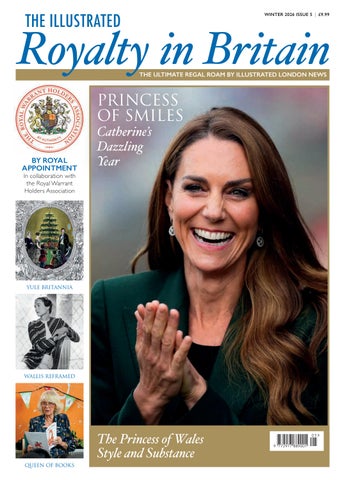
PRINCESS OF SMILES BY ROYAL APPOINTMENT
THE ILLUSTRATED ROYALTY IN BRITAIN
In collaboration with the Royal Warrant Holders Association
Catherine’s Dazzling Year
YULE BRITANNIA
WALLIS REFRAMED
QUEEN OF BOOKS
00_COVER RiB5_v3.SB.LW.indd 1
The Princess of Wales Style and Substance 27/10/2026 20:13
Introducing Alpine Bath Oil
The closest route to taking the mountain air 29 St James’s Street, London, SW1A 1HD www.drharris.co.uk
Natural England
ROYALTY IN BRITAIN – EDITOR’S LETTER
Welcome to the winter issue of The Illustrated Royalty in Britain, which, with the Christmas countdown well under way, has a discernible festive glow. From decorated trees to the monarch’s Christmas Day message, royalty has been responsible for a number of the Yuletide traditions we know and love; do join us to experience a right royal Christmas on page 30. The Princess of Wales, who graces our cover, has had a busy Christmas in recent years, notably due to the ‘Together at Christmas’ concerts she has organised at Westminster Abbey. Royal expert Victoria Murphy discusses Catherine’s pivotal role in ‘The Firm’, and how she’s skilfully balancing public duties with family life. Elsewhere, 2026 has been the UK’s National Year of Reading and who better to spearhead the celebrations than self-confessed bookworm, Queen Camilla From playing Poohsticks to wrapping up parcels at Heywood Hill bookshop, we follow her literary journey over the last year. The Queen is often accompanied by one of her six ‘Queen’s Companions’ who, as our feature on the pitfalls of being a lady-in-waiting reveals, have a rather easier time than their historical predecessors. This December marks 90 years since the Abdication, a seismic event in the history of British royalty, and one often
blamed on the woman for whom Edward VIII gave up the throne. Anne Sebba explains how fascinating evidence tells quite a different tale that reframes Wallis Simpson. Royal-endorsed craftsmanship is top of the agenda in this issue. New and renewed Royal Warrant Holders talk about receiving the ultimate endorsement, while The Queen Elizabeth Scholarship Trust reminds us of the profound connection we derive from objects made by human hands. In each issue, we want to inspire you to get out and about on your own regal roam. Take your pick from a miniature world at Windsor, a bracing walk on The King Charles III England Coast Path, or see our recommendations for some magical festive fun at royal residences old and new. Best wishes for the season, and we hope The Illustrated Royalty in Britain provides excellent company during the winter months. Lucinda Gosling Editor Taking the long view The King at the Seven Sisters in East Sussex opening The King Charles III England Coast Path earlier this year
The Illustrated Royalty in Britain is published by Illustrated London News Limited Soho Works, The Tea Building 4th Floor, 56 Shoreditch High Street, London E1 6JJ, UK. hello@iln.co.uk. iln.co.uk
Editor Lucinda Gosling Production Director David Gyseman Art Direction & Design Dominic Bell Jo Murray-Bell Lorna Wilson (Colour Retouching)
Contributors Simon Brooke, Adam Dant, Lucinda Gosling, Joe Little, Pippa Lowe, Richard Mayson, Victoria Murphy, Matthew Pike, Anne Sebba, Clara Taylor Sub-Editor Simon Barker
Chief Executive Lisa Barnard tel: +44 (0)7887 823116 email: lisa.barnard@iln.co.uk Group Advertising Director Jane Washbourn tel: +44 (0)7920 821577 email: jane.washbourn@iln.co.uk
Pictures www.maryevans.com tel: +44 (0)208 318 0034 All images are from The Illustrated London News archive (and other sources) at Mary Evans Picture Library, Getty and Alamy unless otherwise stated.
Luxury Sales Manager Dylan O’Connor tel: +44 (0)7345 532 796 email: dylan.oconnor@iln.co.uk
WITH THANKS TO THE ROYAL WARRANT HOLDERS ASSOCIATION PRINTED BY PARAGON. DISTRIBUTION BY SEYMOUR DISTRIBUTION LTD ISSN 2977-8891 ©2026 ILLUSTRATED LONDON NEWS LIMITED. ARTICLES AND OTHER CONTRIBUTIONS PUBLISHED IN THIS JOURNAL MAY BE REPRODUCED ONLY WITH SPECIAL PERMISSION FROM THE PUBLISHERS. THE PUBLISHERS ACCEPT NO RESPONSIBILITY FOR ANY VIEWS OR STATEMENTS MADE IN THE ARTICLES AND OTHER CONTRIBUTIONS REPRODUCED FROM ANY OTHER SOURCE. NO RESPONSIBILITY IS ACCEPTED FOR THE CLAIMS MADE IN ADVERTISEMENTS APPEARING IN THIS JOURNAL AND THE PUBLISHERS RESERVE THE RIGHT TO ACCEPT OR REFUSE ADVERTISEMENTS AT THEIR DISCRETION.
THE ILLUSTRATED ROYALTY IN BRITAIN 3
3_EDS LETTER.SB.LW.indd 3
23/10/2026 15:19
Cover: Alamy
Images
Andrew Parsons/Kensington Palace
CONTENTS
We look at the return to public duties by The Princess of Wales, who made her first overseas tri o o ing her cancer diagnosis, to eggio mi ia in Ita in May, a visit that focused on the early years of childhood
8
THE ILLUSTRATED MAP OF ROYAL BRITAIN Artist Adam Dant lends his unique Hogarthian style to a specially commissioned map of royal Britain in winter.
36
THE ART OF SUCCESSION Marie Karlsson explains how taking the helm of a heritage brands portfolio felt “like coming home”.
10
OUT AND ABOUT The Royal Family at work, around Britain and beyond.
40
16
CATHERINE’S COMEBACK The Princess of Wales’s recovery from cancer has seen her focus on causes close to her. Victoria Murphy explores how she balances public duty and family life.
THE UNSEEN MRS SIMPSON Ninety years since the Abdication crisis, Anne Sebba reveals how a trove of letters from Wallis Simpson casts a new light on the woman who married Edward VIII.
48
BY ROYAL APPOINTMENT Seven Royal Warrant Holders share their passion and expertise and re ect on the unique position they hold within their respective industries.
56
BLOOD LINES Who are the oldest surviving descendants of Queen Victoria? Joe Little has a roll call of royal elders.
62
A LETTER THAT CHANGES EVERYTHING Being awarded a Royal Warrant of Appointment is a day to remember. Simon Brooke talks to some new
26
30
DECLARATION OF EXCELLENCE Royal Warrant Holder, Taylor’s Port, has made its first classic vintage declaration in six years. Richard Mayson samples a Port of purity and poise. PLUM PUDDINGS AND PANTOMIMES Lucinda Gosling unwraps the Christmas traditions that the Royal Family have made their own and some that they have passed on to us.
4 THE ILLUSTRATED ROYALTY IN BRITAIN
4-6 CONTENTS.SB.LW.indd 4
23/10/2026 17:52
DRINK RESPONSIBLY
Todd-White Ar t Photography/Ben Fitzpatrick; David Pauley
CONTENTS
We explore the wealth of craftsmanship that went into the making of Queen Mary’s Dolls House, above, and look at the work of some modern makers who have been granted new Royal Warrants, right
Grantees, from a couple preserving rare plants to a hatmaker for the Royal Household. 68
72
80
86
90
MINIATURE MARVEL For more than a century, Queen Mary’s Dolls House has captivated millions. Lucinda Gosling tells the story of this small but mighty mansion. PAGE TURNERS In the National Year of Reading, we explore a busy, bookish year for The Queen, and look back at some avid royal readers from the past. HOME SWEET HOME As the o cial London home of The ing and Queen approaches its bicentenary, Lucinda Gosling reveals the history of Clarence House and its former occupants. THE FUTURE IS HUMAN MADE A Queen Elizabeth Scholarship Trust symposium concludes that there is a continued desire for a human connection, as Clara Taylor discovers. RIB RECOMMENDS From giving your bedroom the royal treatment to following in the fashion footsteps of Norman Hartnell and a jewellery collection inspired by royal palaces.
92
WALKING WITH THE KING Matthew Pike recommends four walks with royal connections that you can enjoy on the new 2, 00-mile coastal path opened by The ing.
98
SHELF PORTRAITS A selection of regal winter reading, from the jet-setting memoirs of a nonagenarian aristocrat to an acclaimed novel about a 15th-century pretender to the throne.
100 PORTRAITS IN PRINT The Illustrated London News and its sister titles had a rich tradition of publishing royal portraits. Lucinda Gosling shares some of their stories. 108 PLAYING THE WAITING GAME As The Queen brings a modern spin to the centuriesold tradition of ladies-in-waiting, Lucinda Gosling looks back at some of the regal companions who have occupied these in uential positions at court. 114 A CHRISTMAS BIRTHDAY: PRINCESS ALEXANDRA AT 90 Princess Alexandra was born on Christmas Day, 1936 the last royal birth to be witnessed by the Home Secretary. Since then, she has been a long-standing and valued member of the working Royal Family.
6 THE ILLUSTRATED ROYALTY IN BRITAIN
4-6 CONTENTS.SB.LW.indd 6
23/10/2026 17:53
THE ILLUSTRATED ROYALTY IN BRITAIN 7
RiB5_Leathersmith_V3.indd 7
22/10/2026 20:40
08-09 MAP LW.indd 8
26/10/2026 20:09
Illustration by Adam Dant
08-09 MAP LW.indd 9
26/10/2026 20:09
OUT AND ABOUT
Top: The Princess of Wales and His Excellency Sayyid Khalid Hilal Al Busaidy, the Minister of Diwan of Royal Cour t, walk in procession to the banquet at Windsor Castle during the Sultan of Oman’s State Visit in October Above: The King welcomes Volodymyr Zelensky to Buckingham Palace during the Ukrainian President’s visit to Britain in October Right: The Queen views rare books, manuscripts and letters in the exhibition, House of Stories: Tales from the Chatsworth Library. Her Majesty was at Chatsworth for The Queen’s Reading Room Festival in September
PA Images/Alamy
A round-up of recent royal visits and travels, around Britain and beyond
10 THE ILLUSTRATED ROYALTY IN BRITAIN
10-14 OUT + ABOUT.SB_LW_v4.indd 10
26/10/2026 21:35
PA Images/Zuma Press Inc/Alamy
PA Images/Alamy
Above: The King and Queen, French President Emmanuel Macron and his wife Brigitte, and Prime Minister Andy Burnham view the Bayeux Tapestry at the British Museum Left: The Princess Royal unveils a memorial to war time Norwegian-British intelligence cooperation in Oslo Below: Prince William taking par t in the Earthshot Prize’s ‘Cricket on the Mall’ event in London in October
THE ILLUSTRATED ROYALTY IN BRITAIN 11
10-14 OUT + ABOUT.SB_LW_v4.indd 11
26/10/2026 21:36
PA Images/Alamy
Above: The Duchess of Edinburgh with headteacher Kelvin Malambo and pupils at Maramba Primary School in Livingstone, during her visit to Zambia Right: The Princess of Wales visits The Commons in south Belfast, a project that will transform a church at the hear t of the diverse and vibrant Ormeau Road into a self-sustaining community centre Below: The Duke and Duchess of Gloucester attend the inaugural National Day for Victims and Survivors of Terrorism at Lancaster House in ondon in ugust he s first nationa da or victims and survivors will ensure those affected by atrocities are remembered
12 THE ILLUSTRATED ROYALTY IN BRITAIN
10-14 OUT + ABOUT.SB_LW_v4.indd 12
27/10/2026 07:58
250years_RoyalBritain_210x297.indd 1
19/10/2026 10:37
Lewis Langstaff-Wood; PA Images; Alamy
Top: The Prince of Wales is a surprise guest on the sofa on the BBC’s Graham Norton Show to promote this year’s Ear thshot Prize Above: The Princess Royal during a visit to Kendrew Barracks in Cottesmore, Oakham, Rutland to open the new £77 million veterinary and welfare facilities for the 1st Military Working Dog Regiment Right: The Duke of Edinburgh with youth groups including Guides, Scouts and local schoolchildren, after taking par t in a litter pick at Hengrove Park in Ashford, Surrey to mark World Clean-Up Day in September
14 THE ILLUSTRATED ROYALTY IN BRITAIN
10-14 OUT + ABOUT.SB_LW_v4.indd 14
26/10/2026 21:37
A fragrance deeply rooted in the very landscape of Highgrove Gardens
CATHERINE’S COMEBACK
I
t has been two and a half years since an announcement from Kensington Palace that shocked the world. Sitting on a bench in Windsor, with an abundance of daffodils in the background, HRH The Princess of Wales calmly explained that she had been diagnosed with cancer. Coming as HM The King had just announced his own cancer diagnosis, events had taken a turn that no-one was expecting. As a journalist who has covered Catherine’s journey since her engagement to Prince William in 2010, I could see all the hallmarks of her approach to royal life in how she and William handled this news. There was Catherine’s composure under tremendous pressure, their resolve to time the announcement to protect their three children and the fact they balanced being open and relatable with guarding their family’s privacy.
Since joining the Royal Family, Catherine has taken a measured approach and a long-term view. In the face of frenzied interest, she took time to learn about causes and build up knowledge, gravitas and a considered strategy to champion them. Yet, she has also recently been very open about the sudden, life-changing impact of cancer. And as such, today we can see how both consistency and change have shaped this future Queen. Perhaps one of the biggest recent insights into Catherine came during her milestone visit to Italian city Reggio Emilia this May. It was her first overseas trip since her diagnosis, and she used it to shine a light on the issue many consider to be her life’s work the early years of childhood. “This is an important step in The Princess’s recovery
Andrew Parsons/Kensington Palace
The Princess of Wales’s recovery from ‘the road unknown’ of cancer has seen her focus on causes close to her and demonstrate a stoic resilience that she will carry into her next role as our future Queen. By Victoria Murphy
16 THE ILLUSTRATED ROYALTY IN BRITAIN
16-25_PRINCESS OF WALES & FASHION.SB.LW.indd 16
23/10/2026 09:41
Andrew Parsons/Kensington Palace
Andrew Parsons/Kensington Palace
This page: The Princess of Wales visits the Loris Malaguzzi Centre in Reggio Emilia, where children’s learning is expressed through ar t, play and creativity Facing page: Catherine’s visit to Italy allowed her to focus on a cause dear to her – the early years
THE ILLUSTRATED ROYALTY IN BRITAIN 17
16-25_PRINCESS OF WALES & FASHION.SB.LW.indd 17
23/10/2026 09:41
Andrew Parsons/Kensington Palace; PA/Alamy
Top left: Catherine meets children at the Salvador Allende preschool on the second day of her visit to Italy in May; Top right: The Princess at the Anna Frank preschool, where creativity is woven into everyday learning; Above: Crowds gather to welcome The Princess to Reggio Emilia
18 THE ILLUSTRATED ROYALTY IN BRITAIN
16-25_PRINCESS OF WALES & FASHION.SB.LW.indd 18
23/10/2026 09:42
PA/Alamy; Andrew Parsons/Kensington Palace
Andrew Parsons/Kensington Palace; PA/Alamy
Above: The Princess of Wales plants a rose during a visit to the RHS’s Wellbeing Garden at Colchester Hospital in Essex Right: Catherine at The Christie centre in Manchester, where she shared her experiences of cancer treatment with patients
journey,” a senior aide told media ahead of her arrival. “I think it’s only right that her first international trip since her illness is one that is focused on an issue that she is committed to championing for decades to come.” The Princess was joined in Italy by Christian Guy, who runs the Royal Foundation Centre for Early Childhood that Catherine launched in 2021. He spoke of “her commitment to elevating early childhood as one of the most important issues facing society today”, and said that this was a “new phase” for the Foundation as Catherine took this work to a global stage. There was a sense, one source said, that The Princess had really taken things “up a gear”. The visit cemented Catherine’s unparalleled relevance. Media from all over the world ocked to Reggio Emilia. One Italian journalist I spoke to there described Catherine as the star of the Royal Family. Huge crowds in the Piazza Camillo Prampolini chanted “Kate, Kate” as she shook hands. She discussed Reggio Emilia’s pioneering approach to early childcare with educators from all over the world, who said they were impressed by her humanity, knowledge and “active listening”.
This was the culmination of Catherine’s very gradual return to public duties that began in September 2024 after she released an astonishingly personal video to mark the end of her chemotherapy. In it, she opened up about the “complex, scary and unpredictable” journey that brings “a new perspective on everything”. The following year, on a visit to Colchester Hospital in Essex, Catherine described cancer as “a roller coaster”. And recently she met patients at The Christie cancer centre in Manchester and said that during her treatment she “didn’t even have really the ability to read or focus on anything”. One of the things that repeatedly comes up is the importance of nature to Catherine, something she has long championed in her work but that has clearly taken on even more meaning since her recovery journey. “Over the past year, nature has been our sanctuary,” Catherine wrote in a 2025 Mother’s Day social media post. She also launched a four-part Mother Nature video series, offering a heartfelt and personal re ection on the importance of lessons from the natural world. “You could tell from her own personal story and things that had happened in her life that nature THE ILLUSTRATED ROYALTY IN BRITAIN 19
16-25_PRINCESS OF WALES & FASHION.SB.LW.indd 19
27/10/2026 08:10
was incredibly important to her,” Ian Boyd, Chief Executive of charity Mind Over Mountains, said. Ian and eight participants were joined by Catherine on a mental well-being walk in the Peak District in January, where he recalled they talked while “literally splashing through muddy puddles”. Ian described Catherine as a “very natural, very warm person”, adding “You could tell very, very quickly that this had an awful lot of meaning for her in what she was trying to do for others, but also in how it had helped her in her personal journey.” Of the participants, he said: “The fact that they were able to talk about their mental health and well-being journey and to do that with the future Queen was great at the time but I know will sit with them forever because of who they were talking to and what they were sharing and the conversation that she had back.” Indeed, it was Catherine who realised many years ago that mental health was something she, William and Prince Harry should collectively champion. This led to the Heads Together campaign, credited with igniting important conversations and helping to banish stigma. Today, a focus on mental well-being continues to be a thread that links many aspects of Catherine’s work, from building connection and emotional resilience in early childhood to her message for charity Action on Addiction that addiction is “not a choice or a personal failing, but a complex mental health condition that should be met with empathy and support”. The Princess is now championing a holistic approach to cancer care after her own experience has given her a deeper understanding of the challenges faced by patients. “Cancer doesn’t just affect the body. It changes how you think and feel and profoundly affects every aspect of life,” she said in a personal message released in June, when she completed the Three Peaks challenge in aid of the Royal Marsden cancer charity’s holistic care. During her 24-hour trek up Ben evis, Scafell Pike and Snowdon Yr Wyddfa she chatted with others on the mountains and listened to their stories. Catherine’s ability to put people at ease and show empathy
is something that those who meet her often mention. Just a few days after completing the challenge, she visited the Evelina London Children’s Hospital in her role as Patron. “She is really engaged, she takes her patronage really seriously,” said Gubby Ayida, Evelina London’s Chief Executive. “She always goes down to the level of the children… and it doesn’t matter what’s happening all around, for that moment it’s the one in front of her.” Dr Ayida cited how Catherine privately comforted a young girl who was upset after a treatment at the hospital. “Of course, we left the crew and the cameras behind,” Dr Ayida said. “She was crying and The Princess just sat next to her, an arm around her… This was a private moment, this was about compassion and connection.” Catherine’s return to public life is now in full swing and it has been suggested that she may travel with William to India for the Earthshot Prize this November. However, there can be no doubt that her health and family remain her focus. The family recently moved into Forest Lodge at Windsor and Prince George has just started at nearby Eton College. Prince George, 13, Princess Charlotte, 11, and Prince Louis, eight, have recently joined their parents on public visits, including to Wimbledon and the Commonwealth Games. But, in what many may consider an astonishing feat in the social media era, William and Catherine have successfully managed to ensure that their private family time is largely never photographed or reported on. They have said they do not allow their children to have smartphones, and Catherine has also used her profile to speak out about the impact of digital devices on social connection. “When we check our phones during conversations, scroll through social media during family dinners or respond to emails while playing with our children, we’re not just being distracted, we are withdrawing the basic form of love that human connection requires,” she wrote in a powerful 2025 essay in collaboration with Professor Robert Waldinger from Harvard Medical School.
Andrew Parsons/Kensington Palace
The Princess of Wales joins members of the Mind Over Mountains charity for a well-being walk in the Peak District National Park in January
20 THE ILLUSTRATED ROYALTY IN BRITAIN
16-25_PRINCESS OF WALES & FASHION.SB.LW.indd 20
23/10/2026 09:42
Andrew Parsons/Kensington Palace
Andrew Parsons/Kensington Palace
This page: Catherine meets children undergoing treatment and their families at Evelina London Children’s Hospital, where she is Patron – a role she has held since 2018
THE ILLUSTRATED ROYALTY IN BRITAIN 21
16-25_PRINCESS OF WALES & FASHION.SB.LW.indd 21
23/10/2026 09:42
The Prince and Princess of Wales consistently rank as the most popular members of the Royal Family, with more than 70 per cent of Britons holding a positive view of them. And there is a sense that the way in which the public have so taken Catherine to their hearts can be credited with generating a lot of this goodwill. “In the last few years, she has been increasingly open about her personal experiences, her cancer diagnosis, but also before that when she spoke about motherhood in a podcast,” royal journalist Emily Andrews observed. “Because she has shared a lot more of herself, I think people accept her as a Princess but also relate to her as a normal wife and mother who has navigated some di cult times.” In Reggio Emilia, more than one Italian journalist drew parallels between the popularity of Catherine and that of Diana, Princess of Wales. While the comparisons make sense when it comes to global interest, I have always felt that Catherine has more in common with The late Queen Elizabeth II. There is a delight in the outdoors, the capacity to be unfailingly stoic under pressure and a sense of availability to the public while still remaining something of an enigma. These are all qualities that have stood Catherine in good stead throughout the past few years as she has navigated, as she described it “the stormy waters and road unknown”. And they will continue to be important for her when William becomes King and she looks to the future in her next role as Queen.
Andrew Parsons/Kensington Palace; PA/Alamy
Above: The Princess has talked about the impor tance of nature in her recovery, and completed the Three Peaks Challenge in aid of the Royal Marsden cancer charity; Below: The Princess, Prince George and Princess har otte at im edon or the men s sing es fina in u
22 THE ILLUSTRATED ROYALTY IN BRITAIN
16-25_PRINCESS OF WALES & FASHION.SB.LW.indd 22
26/10/2026 21:21
AP/Alamy
Andrew Parsons/Kensington Palace; PA/Alamy
The Prince and Princess of Wales with Prince George on his rst day at ton College in September
THE ILLUSTRATED ROYALTY IN BRITAIN 23
16-25_PRINCESS OF WALES & FASHION.SB.LW.indd 23
23/10/2026 09:43
STYLE WITH SUBSTANCE From the moment Catherine Middleton appeared in a vibrant blue Issa dress for the announcement of her engagement to Prince William, her fashion choices have been part of her royal story. Over the years, she has combined accessible high-street oo s with designer and espo e o t ts and appeared in everything from sportswear to the most glamorous of gowns for State Banquets. “The Princess has remained true to her core style throughout her tenure as a senior member of the Royal Family, sticking with ensembles built around tailored silhouettes and timeless designs,” says Susan Kelley, founder of website What Kate Wore. “She understands that what she wears sends a message, knowing that photographs taken at current engagements will be looked at for decades and cent ries to come er wardro e reflects this featuring styles that will stand the test of time without being trendy or dated.” Indeed, the message that Catherine’s fashion sends can be a powerful part of her role. She has followed in Queen Elizabeth II’s footsteps and skilfully demonstrated the art of diplomatic
dressing; paying tribute to a host or guest through choice of colour, motif or designer. “This is the height of soft power, a gracious nod that speaks volumes without Catherine saying a word,” says Elizabeth Holmes, ‘New York Times’ best-selling author of ‘HRH: So Many Thoughts on Royal Style’. Diplomatic dressing is most pertinent at State events, such as the recent visit to the UK by Nigeria’s President Bola Tinubu, for which atherine se ected an o t t y ritish igerian designer o o er for the of cia we come t the evening State Banquet, she wore a gown in the green co o r of the igerian flag nd whi e it was not a state occasion, her decision to wear a blazer by Italian label Blazé Milano on her trip to Reggio Emilia and accessorise it with a bracelet y o ti e i an ased rand te ier o ayem formed part of the visit’s successful narrative. Experts note that Catherine’s style has evolved over time. Susan Kelley observes “a move away from high-street brands to designer labels”. “Less Zara and LK Bennett and more Catherine Walker, Emilia Wickstead, Jade Holland Cooper,
Andrew Parsons/Kensington Palace
The Princess wears an outfit British Nigerian designer Tolu Coker to welcome Nigerian resident Bo a inu u and irst ad uremi inu u on their State Visit
24 THE ILLUSTRATED ROYALTY IN BRITAIN
16-25_PRINCESS OF WALES & FASHION.SB.LW.indd 24
23/10/2026 09:43
Andrew Parsons/Kensington Palace
Andrew Parsons/Kensington Palace
Catherine wears an ice-blue Catherine Walker & Co ‘Lafayette’ coat dress and matching Philip Treacy hat for Trooping the Colour in June
and Erdem,” she says. Elizabeth Holmes points out how “above-the-knee dresses” have been replaced by “longer, more sophisticated styles”. And both women observe that trouser suits have become a more recent staple for daytime engagements. It’s worth noting that longer hemlines and trouser suits have been a more fashionable choice in recent years. Catherine may choose high-end classics, ut her finger remains on fashion s pulse. Interest in what The Princess wears is so high that outfits can sell out online within minutes of her appearing, a phenomenon that has even been dubbed ‘the Kate Effect’. Catherine champions the British fashion industry both through what she wears and also through public visits, such as her trip in February to a textile manufacturer in west ales. he frequently rewears outfits and chose a rented dress for the 2022 Earthshot Prize ceremony in Boston. Perhaps Susan Kelley sums up The Princess’s impact best. “There is no better ambassador for the British fashion industry,” she says.
The Princess visits Melin Tregwynt woollen mill in west Wales, wearing a coat made from fabric woven at the mill
THE ILLUSTRATED ROYALTY IN BRITAIN 25
16-25_PRINCESS OF WALES & FASHION.SB.LW.indd 25
26/10/2026 21:23
ROYALTY IN BRITAIN PARTNER
DECLARATION OF EXCELLENCE
The Douro Valley’s long, hot summer of 2024 has enabled a or s to make its first c assic vintage dec aration in si ears ichard a son discovers ho that remarka e gro ing season has roduced a ort o urit and oise
S
t George’s Day is something of a red-letter day in the wine trade diary. It is the day when Taylor’s decides whether its Port wine from the harvest 18 months earlier is worthy of a ‘declaration’. It is worth remembering that Port does not behave quite like other wines a Port vintage is only ‘declared’ when the shipper decides that they have something truly exceptional to bottle. In its 4-year history, I calculate that Taylor, Fladgate Yeatman to give the family-owned company its full name has declared a total of 4 ‘classic’ Port vintages. The most recent, declared on St George’s Day this year, is 2024. Six years have elapsed since Taylor’s previous classic vintage in 2018. The 2024 growing season in the Douro Valley was remarkable for the consistency and quality of its output. Adrian Bridge, Managing Director of Taylor’s, says that “this is the smallest-ever release from Taylor’s and I am very excited about its exceptional quality”. David Guimaraens, who heads the winemaking for all the Port houses in the
Fladgate Partnership, adds “we couldn’t have asked for better growth conditions than those of 2024”, noting the long, warm summer and “cooler harvest period for long fermentations. This is a vintage of purity and poise one that captures the enduring spirit of the Douro in its most refined form”. Taylor’s has bottled another Vintage Port, Sentinels, in 2024. amed after the granite marker stones first used to demarcate historic vineyards of the Douro in 1 5 , Sentinels is a wine from as many as 10 smaller properties that Taylor’s owns in the Pinh o Valley, the heart of the Port region. The wine is made in the same restrained style as Taylor’s classic Vintage Port but, as Adrian Bridge explains, it is “the very best selection from the Pinh o Valley and a wine that we expect to make every year”. The 2024 is the third year in succession that this wine has been produced. It was a pleasure to taste both wines side-by-side, shortly after they had been declared earlier this year. The wines are very different but both show the purity of fruit and precision which seems to be the hallmark of the lovely 2024 vintage.
26 THE ILLUSTRATED ROYALTY IN BRITAIN
26-29 TAYLORS PORT.SB.LW.v1.indd 26
23/10/2026 18:17
Taylor’s 2024 Vintage Port A blend from two of Taylor’s main quintas (estates) in the Pinhão Valley, along with wine from its flagship estate inta de arge as in the warmer Do ro perior ea tif y deep opa e e ac co o r a ready open and aromatic with a ripe flora racy and airy character rich and s pp e on the pa ate i rant and ea tif y de ned with erry and damson fr it ac ed y rm ne grained tannins p re and precise with a gripping nish wine with o tstanding nesse which yo can appreciate and en oy now t has the str ct re a ance and poise to ast or anyone orn in this is certain y a wine to accompany a ifetime
Taylor’s Sentinels 2024 se ection from fo r estates in the inh o a ey wonderf co o r with o e y p re fragrant open aromas; there’s a leafy woodland fruit freshness a o t this wine with o e y p re erry fr it great de nition with tight nit spicy tannins and a ong inear nish which retains a ner y green edge ot as ig or str ct red as the c assic ay or s t this is s preme y e egant and can e en oyed now and o er the medi m term to years if the ott e is ce ared on its side
THE ILLUSTRATED ROYALTY IN BRITAIN 27
26-29 TAYLORS PORT.SB.LW.v1.indd 27
23/10/2026 18:18
Left: Taylor’s VVOP White Por t, aged for 80 years. “When you drink it, you are drinking history,” says Taylor’s Managing Director, Adrian Bridge Below: Head Winemaker David Guimaraens samples the VVOP White Port Facing page: Taylor’s has introduced a new, lighter glass bottle – complete with ‘debossed’ 4X symbol – to help address the impact of climate change
Taylor’s VVOP White Port The letters ‘VVOP’ stand for Very, Very Old Port. This wine certainly lives up to its name with eight components in the blend, dating back to 1896. With such a long history as a family-owned company, Taylor’s had good stock to draw on. White Ports were regularly set aside and aged to ne t ne with aged tawnies designated 10, 20, 30 or 40 Years. Whereas red Ports lose colour, turning tawny with age in cask, white Ports gain in colour so that, after 50 or so years, it becomes dif c t to disting ish etween the two his is the rst time that ay or s has blended and bottled a white Port with an average age of around 80 years. (The 80 Year tag hangs from the decanter in which the wine is bottled). For wine-maker David Guimaraens, it was an exercise in making a wine that combines complexity, balance and freshness despite the venerable age of the component parts he na end was made in March this year and spent a few months homogenising in pipe (cask) before bottling in July. Adrian Bridge describes it as “an amazing wine… something completely special that shines a light on the quality of aged tawny”. He adds that “when you drink it, you are drinking history and making history at the same time”. My own take on history is as follows: deep golden amber with a glint of blood orange; calming, beautifully integrated aromas with spice, dried apricot and a hint of butterscotch underlying; glorious textural richness on the pa ate com ining dried g depth with candied citrus peel and apricot freshness; delicate and just a touch piquant on the long, gentle yet ithe nish remar a e wine for its age and vitality.
28 THE ILLUSTRATED ROYALTY IN BRITAIN
26-29 TAYLORS PORT.SB.LW.v1.indd 28
23/10/2026 18:18
ROYALTY IN BRITAIN PARTNER
In 2018, Taylor’s was a founding member of the Porto Protocol, a network of wine producers dedicated to addressing the global impact of climate change. It has recently launched a new, lightweight Port bottle which weighs in at 440 grams a 24 per cent reduction from the previous 580 grams. The new bottle, which retains the distinctive silhouette and Taylor’s coat of arms that have defined the brand for generations, is being used for Taylor’s White, Reserve, LBV and Aged Tawny Ports, shipped for Christmas this year. It saves roughly 350 tonnes of glass and cuts 210 tonnes of CO emissions across the 2.5 million bottles of Taylor’s Port produced annually. Managing Director, Adrian Bridge, says that the “new bottle respects our heritage while looking confidently to the future. It demonstrates that meaningful environmental improvements can be achieved without compromising the quality, elegance and identity that have defined Taylor’s for more than three centuries”. The new lightweight bottles are manufactured in Portugal. Richard Mayson is author of ‘Port and the Douro’, published by Academie du Vin where he is Series Editor. He chairs the Port and Madeira panel for the Decanter World Wine Awards
THE ILLUSTRATED ROYALTY IN BRITAIN 29
26-29 TAYLORS PORT.SB.LW.v1.indd 29
23/10/2026 18:18
PA Images/Alamy
This page: The Princess of Wales and Prince Louis at a carol service at Westminster Abbey in 2024 Facing page: A handwritten menu for Christmas Day at Sandringham in 1905
30 THE ILLUSTRATED ROYALTY IN BRITAIN
30-35 ROYAL CHRISTMAS.SB.LW.indd 30
23/10/2026 16:21
How do the royals spend Christmas? Like any family, they have their way of doing things, with many traditions rooted in the past. Lucinda Gosling delves into the origins of a right royal Christmas
© Historic Royal Palaces/Mary Evans Picture Library
PA Images/Alamy
PLUM PUDDINGS AND PANTOMIMES A NORFOLK CHRISTMAS The royal Christmas of the past 125 years has mostly been a Sandringham one, a tradition fixed during the reign of Edward VII. Queen Victoria spent Christmas at Windsor during the early years of her reign, and, after the death of Prince Albert, chose Osborne House on the Isle of Wight for what was a muted celebration, though as the years passed, she took greater pleasure in having her grandchildren and great-grandchildren about her. An Edwardian Christmas, by contrast, was jolly and generous. “Royalty as usual shows the way,” wrote The Tatler in 1 08, “and nowhere is Christmas kept in more old-world style than at Sandringham.” Comfortable, informal and private, Sandringham was built for entertaining and came into its own at Christmas when Queen Alexandra supervised the decorations, including an enormous tree groaning with gifts in the ballroom. The red-brick house was particularly picturesque when covered with a dusting of snow. It was the favourite residence of both George V and George VI, both of whom relished the good shooting, and Queen Elizabeth II continued the tradition of
a Sandringham Christmas, with family members, attendants and a full complement of corgis beginning the exodus to orfolk in the week leading up to Christmas Day. ow TM The ing and The Queen are the Sandringham hosts, with The Prince and Princess of Wales and their children usually joining them along with the wider family, including The Duke and Duchess of Edinburgh and their children, The Princess Royal, ara and Mike Tindall and their three offspring, and often The Queen’s two children and their families. The Christmas celebrations begin properly with a formal black-tie dinner on Christmas Eve. Christmas presents are also exchanged then, rather than on Christmas Day, a practice that originates from the German tradition adopted by Queen Victoria and Prince Albert. There have been notable absences from the family gatherings in recent years, but royal pundits are speculating whether the 202 season of peace and goodwill might be the moment for The Duke and Duchess of Sussex to be welcomed back into the royal fold. THE ILLUSTRATED ROYALTY IN BRITAIN 31
30-35 ROYAL CHRISTMAS.SB.LW.indd 31
23/10/2026 16:21
ALL THE TRIMMINGS Christmas dinner was a grand affair at Sandringham in the 1900s. And there would be not one, but two dinners. One at lunchtime, so the children could partake, and then a more formal meal at 8.45pm in the dining room, with adult guests seated at several oval tables to work their way through the courses. One of the main culinary events was the huge baron of beef a centrepiece of royal feasting since Tudor times, slowly spit-roasted. Also on the menu would be roast cygnet, sturgeon and caviar sent by the Tsar of Russia, a boar’s head and a vast woodcock pie, an annual gift from the Lord Lieutenant of Ireland. Mince pies made to a special Sandringham recipe were served alongside plum pudding, which came with brandy sauce kept warm in old saucepans balanced upon spirit lamps. Turkey was still considered a modern choice for a festive roast, but today a Sandringham Christmas lunch, served promptly at 1.15pm, consists of turkey with all the trimmings organic, naturally . Everybody, including The King, wears a paper hat from crackers supplied by Tom Smith’s. And although it seems unlikely anyone is feeling peckish following that, afternoon tea is served a few hours later with a selection of sandwiches, cakes and scones, before a grand buffet with roast meats, cheeses, p t s and salads, is laid out for the evening. SHOW TIME Amateur theatricals were a lively part of past royal Christmases. Queen Victoria greatly enjoyed seeing her children, grandchildren and members of the Royal Household take part in plays and tableaux vivants. In 1894, at Osborne, the children of the late Prince Leopold, and of Princess Beatrice played their parts in a ‘charming’ tableau vivant of Christmas set in a picturesque snowy woodland, with Mr Muther, the Queen’s German librarian, dressed as Father Christmas dragging a Yule log. During the Second World War, pantomimes were staged in the Waterloo Chamber at Windsor Castle to raise money for charity, with Princess Elizabeth and Princess Margaret taking star roles. In 1 42, this was Cinderella raising money for the Royal Household Comforts Wool Fund Aladdin was staged in 1 4 , while 1 44’s offering was Old Mother Red Riding Hood Boots. These were a cut above the usual amateur productions, with an Oscar-winning art director, Vincent Korda, responsible for scenery, and sound technicians from the BBC. With Old Masters removed to safety, posters advertising the forthcoming shows occupied the heavily ornate picture frames around the castle.
GIFTS FOR ALL Christmas has always provided an opportunity for the monarch to show their appreciation of their staff. In recent years, members of the Royal Household have often been given a Fortnum & Mason Christmas pudding by the monarch. Queen Victoria took her Christmas shopping seriously, asking Royal Warrant Holders to send gift ideas she could select from, for everyone from ladies-in-waiting who often received brooches or rings to great-grandchildren. She even browsed ladies’ magazines to see what advertised trinkets might catch her eye. When Albert was alive, the pair would demonstrate their love by exchanging paintings or specially commissioned pieces of jewellery, although in later life she favoured simple homemade gifts, recognising effort and thoughtfulness above expense. An annual festive ritual during the reign of Edward VII was the distribution of joints of beef to employees, and families from the surrounding villages on Christmas Eve. The heads of 500 households were invited to assemble at the Sandringham stables where the King personally inspected and handed over each joint. Charitable giving has also been an enduring aspect of a royal Christmas. Queen Alexandra, as patron and president of numerous hospitals and children’s homes, oversaw the distribution of gifts to orphans and sick children, and at Sandringham, drove around the estate dropping off presents to the estate’s workers, toys for children and knitted comforts or delicacies for the elderly or infirm. During the First World War, Princess Mary’s Gift Box, funded through public donations, was an embossed brass box containing cigarettes, pipe tobacco or chocolates for non-smokers , tinder box, Christmas card and photograph of the princess. The boxes were sent to some 2.5 million servicemen and women. CHRISTMAS BLESSINGS The public side to the Royal Family’s Christmas day is their walk to St Mary Magdalene Church for morning service, greeting waiting well-wishers along the way. Many will have waited some time in order to see the Royal Family out in force, always smartly dressed in hats and warm, tailored coats although not many people know that some adult family members will already have attended a communion service earlier in the morning. King Edward VII, no doubt keen to get back for lunch, his 1889 vintage champagne and Christmas cigars, stipulated that sermons should last no longer than 20 minutes. Following the service, it is back to the house for lunch and, afterwards, some family members enjoy a postprandial walk before the next gastronomic onslaught. In the Edwardian era, guests would often spend the afternoon being given a tour of the stables, kennels, dairy and aviary by the animal-loving Queen Alexandra.
‘When Christmas comes, children still like to put on paper crowns and pretend that they are princes. But princes like to forget their crowns’ Hector Bolitho, The Tatler, 1961
32 THE ILLUSTRATED ROYALTY IN BRITAIN
30-35 ROYAL CHRISTMAS.SB.LW.indd 32
23/10/2026 16:21
Mary Evans Picture Library; Mar tin J Palmer/Alamy Live News
Clockwise from top left: Princess Mary’s gift box, given to 2.5 million servicemen and women during the First World War ; a box for Tom Smith’s Dutch Doll Christmas crackers from 1907. Tom Smith’s supplies crackers to the Royal Household to this day; an illustration from The Young Woman magazine in December 1898 showing Queen Victoria selecting toys for her
grandchildren; The King and Queen lead the Royal Family on their traditional walk to St Mary Magdalene Church on the Sandringham Estate for the Christmas morning service in 2024; an 1857 engraving in The Illustrated Times showing the roasting of the baron of beef at Windsor ; and Princesses Elizabeth and Margaret perform royal pantomime Cinderella in 1942
THE ILLUSTRATED ROYALTY IN BRITAIN 33
30-35 ROYAL CHRISTMAS.SB.LW.indd 33
23/10/2026 16:21
HEIR WAVES The Christmas Day speech was first suggested in 1 2 by Lord Reith, Director-General of the BBC, to inaugurate the corporation’s World Service. From a small o ce at Sandringham, ing George V, overcame his nerves and gave a 251-word speech that reached a worldwide wireless audience of 20 million. ever comfortable with broadcasting, in 1 4, he wrote in his diary “At . 0 I broadcast my speech to the Empire. Very glad when it was over.” His son, George VI, hampered by a speech impediment, was even more reluctant, writing of Christmas Day 1 “I broadcast a message to the Empire This is always an ordeal for me I don’t begin to enjoy Christmas until after it is over.” In contrast, Queen Elizabeth II was a confident speaker, dubbed ‘One-Take Windsor’ by grateful television executives. When Queen Mary heard her granddaughter’s faultless radio message on Christmas Day 1 5 , she declared it “first rate” in her diary. In 1 5 , Her Majesty made a televised Christmas speech from Sandringham, the first of televised festive messages she would make during her reign. Since 1 0, Christmas speeches have been pre-recorded and the broadcast, which continues today with The ing’s Christmas Message, has become a familiar fixture of Christmas Day.
Top: The Queen’s Christmas message is broadcast in 1958 – the annua address as first te evised the revious ear Left: An engraving of Queen Victoria and Prince Alber t i iams that a eared in The Illustrated London News in ecem er and is ide thought to have he ed o u arise the tradition o hristmas trees in Britain
Mary Evans Picture Library
ESPECIALLY FIR YEW Although it was Queen Charlotte, consort of George III, who should be credited with introducing the Christmas tree to Britain, these early versions favoured by the Georgian upper classes used yew branches. It was not until the reign of Queen Victoria that the Christmas fir tree as we know it became widely popular, especially after an engraving of Victoria, Albert and their five children surrounding a decorated tree, was published in The Illustrated London News in 1848. The royal couple had a tree each as well as one for Victoria’s mother, the Duchess of ent, and another for the children and took great delight in arranging presents around them. Today, although The ing spends Christmas at Sandringham, Windsor Castle is renowned for its dazzling Christmas tree in St George’s Hall which visitors can enjoy as they tour the State apartments. The Palace of Holyroodhouse, beautifully decorated, is also well worth visiting at this time of year.
34 THE ILLUSTRATED ROYALTY IN BRITAIN
30-35 ROYAL CHRISTMAS.SB.LW.indd 34
23/10/2026 16:22
CHRISTMAS CORONATION CHAOS William the Conqueror was crowned at Westminster Abbey on Christmas Day, although the ceremony was not the peaceful event that might be expected on such an auspicious day. The abbey was surrounded by William’s Norman soldiers who, when they heard the shouts of af rmation from inside mistoo the cries for an assassination attempt. Their reaction was to set re to near y i dings whi e mem ers of the congregation rushed outside in terror, leaving William and a few church dignitaries to complete the coronation alone. CHRISTMAS BIRTHDAYS Princess Alice, Duchess of Gloucester was born on Christmas Day 1901. Princess Alexandra, The Honourable Lady Ogilvy, also was a Christmas Day baby, born 25 December 1936. WHO ATE ALL THE PIE? An elaborate ‘stately pye’ was an essential inclusion on the royal Christmas table since medieval times. In 1770, a newspaper published a recipe for what must have been a gargantuan creation two she s of flo r of tter fo r geese two t r eys two ra its fo r wi d d c s two woodcoc s si snipe fo r partridges two neat s tong es two c r ews se en ac irds and six pigeons!
Mary Evans Picture Library;
Mary Evans Picture Library
Below: William the Conqueror was crowned at Westminster Abbey on Christmas Day, 1066 – amid much commotion Bottom: The Prince of Wales and Prince Louis greet well-wishers on leaving St Mary Magdalene Church on Christmas Day last year
FROM POTTAGE TO PUD m p dding can date its roots ac to the 14th century and is derived from a plum broth, pottage or porridge, with a varying list of ingredients; a combination of mutton broth, c rrants pr nes raisins sac and sherry was enjoyed during the reign of Charles I. Later, it was thic ened with rown read to ecome a pudding. In 1927, King George V and Queen Mary’s chef provided a recipe for Christmas pudding using ingredients sourced only from countries within the British Empire, at the re est of the mpire ar eting oard
THE ILLUSTRATED ROYALTY IN BRITAIN 35
30-35 ROYAL CHRISTMAS.SB.LW.indd 35
23/10/2026 16:22
ROYALTY IN BRITAIN PARTNER
THE ART OF SUCCESSION
Marie Karlsson is driving a new era for The Edward Alexander Group, leading a portfolio of heritage brands. Clara Taylor meets her and explores the craft of the Group’s two Royal Warrant Holders
W
hen I first walked in, I felt like I’d come home,” Marie arlsson, the new Managing and Creative Director of The Edward Alexander Group’s Textile and Soft Furnishing House, beams. arlsson’s appointment seems almost predestined. “I’m a custodian of the past, so it felt like this is a match made in heaven.” arlsson heads the Group’s Textile and Soft Furnishing House, a portfolio of heritage brands including George Spencer Designs fabrics and wall coverings and Titley and Marr patterned fabrics , alongside two Royal Warrant Holders Gainsborough, a heritage weaving house, and Heritage Trimmings, specialists in passementerie. “My conversation with Roy Merritt, Chairman of the Group, was truly inspiring. His strong belief in and support for the heritage brands deeply resonated with my own values, making this opportunity even more exciting and meaningful to me. It further strengthened my enthusiasm for the role and my ambition to help shape a new vision for the brands, while building on their heritage and driving their continued growth and success.”
After more than a decade at the helm of Royal Warrant Holder Cole Son, where she was named one of Walpole’s most in uential leaders in the luxury industry, she brings a wealth of expertise. However, holding both the Managing and Creative Director roles is rare. Few can balance the creative with the commercial, yet arlsson insists it’s a tightrope worth walking. “I’m a big believer that every single design house needs a combination of the two,” she explains. “In leading with design and what inspires people to buy, commerciality follows.” For all arlsson’s modesty, she perhaps understates how much this is to do with the individual. It’s not common to find someone with razor-sharp commercial instincts who also studied design. “Having someone who can practise both means you have the ultimate protector of your brand and your craft,” she adds. Reading between the lines, this means the continuity of heritage craft depends on its commercial value. At a time when human skill is increasingly viewed as both a rarity and a luxury, arlsson understands that perception matters. One of her first orders of business was to retire the rather functionalsounding branding of “Textile Division” for “Textile and Soft
36 THE ILLUSTRATED ROYALTY IN BRITAIN
36-39_EDWARD ALEXANDER_V1_DG_SB.LW.indd 36
27/10/2026 19:55
Mel Yates
Marie Karlsson, the new Managing and Creative Director of The Edward Alexander Group’s Textile and Soft Furnishing House, is aware that, in order to keep heritage crafts alive, you must innovate for the future
Furnishing House”. A subtle yet impactful difference, the change re ects the level of skill and craft deployed across The Edward Alexander Group, evoking the same imagery you would associate with an atelier or couturier. To ensure these skills endure, British heritage craft must evolve, find new audiences and, perhaps most crucially, compete on the global stage. This philosophy fervently underpins arlsson’s ambitions for the group. “We’ve historically been very focused on the nited ingdom and a small part of the S. We will grow the S market and take a step towards showcasing our beautiful craftsmanship to the rest of the world,” she outlines. The European market offers natural synergy and opportunity, given its demand for heritage products, sustainability and transparency around a product’s journey from raw material to finished product. The appeal Stateside comes from another source: The Edward Alexander Group’s accolades, namely the two Royal Warrant Holders, Gainsborough and Heritage Trimmings. “From an international perspective, the Royal Warrant acts as a stamp for best in class,” arlsson says. The S’s romanticism and fascination with our Royal Family have
long been documented the expansive palaces, the glittering tiaras, Princess Diana’s every move. But the Royal Warrant represents something beyond the superficial. It is a mark of trust awarded only to those who meet the Royal Household’s exacting standards. And as Karlsson aptly puts it: “Show me another institution with that kind of heritage and authority.” It makes perfect sense, then, that the group, under arlsson’s stewardship, is bringing its two Royal Warrant Holders under one roof. This autumn, Heritage Trimmings is moving its manufacturing to join Gainsborough at its mill in Sudbury, Suffolk. “This is the first time that we’ve invested so much into our beautiful craft,” arlsson confesses. The move is more than mere operational e ciency. By housing the two brands under one roof, it creates a single environment where collaboration and knowledge-sharing can thrive and, ultimately, where traditional craftsmanship and bespoke manufacturing can ourish. More importantly, it demonstrates a willingness to invest in craft to maintain traditional skills so they don’t disappear forever. After all, being a custodian of the past means ensuring those traditions have a future. edwardalexandergroup.com THE ILLUSTRATED ROYALTY IN BRITAIN 37
36-39_EDWARD ALEXANDER_V1_DG_SB.LW.indd 37
27/10/2026 19:55
THE FINISHING TOUCH What is life without a decorative edge? Where furniture forms the foundation of interiors, trimmings provide its character. ourish of tassels, raids and gold or silver cord may seem small in scale, yet its impact is positively outsized. For Marie Karlsson, Managing and Creative Director of The Edward Alexander Group’s Textile and Soft Furnishing House, it’s simple: “A sofa without trimmings is naked.” arlsson won t e alone in her opinion. In an era where digital automation yields an a undance of generic, plain design, a small trinket can e the ery thing that, in Marie Kondo’s words, sparks joy. “ ur rains weren t designed for generic; we want something special, something we can o sess o er, she enthuses. hether it s ag charms or a fringed accent, the smallest details often leave the greatest impression. o usiness quite encapsulates this like Heritage Trimmings, a Royal
Warrant Holder and part of The Edward Alexander Group. Using the heritage craft of passementerie, it creates tassels and edgings for furnishings in some of the country’s most exclusive residences, most nota ly The ing s partments at Hampton Court Palace. Karlsson sees great things for the rand, which was founded in 1991 “I genuinely elie e eritage Trimmings will grow ery quickly for us. he notes the house s a ility to irt with many an industry, from fashion to hospitality. Ultimately, motifs like these are an indication of personality and whether you wish to display that in your home or on your person, the desire to make the ordinary feel special remains the same and just as widespread. As reassuring as it is to hear the scope for growth, it s equally encouraging to learn that there’s a demand to practise passementerie. On announcing that the Heritage
Trimmings production is moving to the ains orough mill in ud ury, uffolk, another rand under The dward le ander roup anner, arlsson was “amazed a out how many young people wanted to step into craft”. What attracts them, of course, is learning a skill rooted in the handmade. While technology promises to reshape countless industries, passementerie remains dependent on human artistry and udgement, qualities a machine can’t replicate. This new cohort of makers will no dou t ha e the est teachers. Craftspeople who ha e een with the usiness for decades and may well ha e started their journey as apprentices themselves. Now they are part of a major skills transition, integral to the survival of the heritage craft to which they have dedicated their lives. Few can wish for such a meaningful legacy. heritagetrimmings.co.uk
Mel Yates
Heritage Trimmings creates tassels and edgings for furnishings in some of the country’s most exclusive residences, using the heritage craft of passementerie
38 THE ILLUSTRATED ROYALTY IN BRITAIN
36-39_EDWARD ALEXANDER_V1_DG_SB.LW.indd 38
27/10/2026 19:55
ROYALTY IN BRITAIN PARTNER
Alun Callender
Mel Yates
Gainsborough, based in a historic region for silk-making, is keeping woven craft alive, and has an archive of more than 8,000 pieces, which it plans to showcase to the public next year
A THREAD THROUGH TIME Wander through the idyllic Suffolk countryside and you’d be forgiven for not realising you’re standing in the former centre of silk. While most mills have now given way to rolling hills, Gainsborough remains steadfast. Part of The Edward Alexander Group and established in 1903, the weavery has long earned a reputation for high-quality damasks, tapestries and velvets, one that re ects the consistency required to serve the Royal Household for decades. More than a century later, it is remarkable to see this historic textile house still operating and thriving, especially given that very few of its European counterparts remain. As Marie Karlsson, Managing and Creative Director of The Edward Alexander Group’s Textile and Soft Furnishing House, puts it: “We have an extraordinary advantage in that we have this beautiful little diamond [Gainsborough] here in the UK.” Housed within the mill, in Sudbury, is an archive of more than 8,000 pieces, including textiles, designs and woven samples – a rich tapestry of British craft. As part of what Karlsson describes as the group’s “biggest investment” in its heritage, the archive will take centrestage next year, with plans to showcase it to the public and invite them to take part in weaving workshops. The display will no doubt be beautiful and, as a heritage craft, a piece of history. Few archives can claim to chart such a broad cross section of British cultural history. Yet Gainsborough’s fabrics have been used for everything from lining the walls of the Titanic s first class dining rooms and Queen Victoria’s ceremonial sash to decorating sets for major Hollywood blockbusters like Pirates of the Caribbean and appearing in Christopher Kane’s couture collections. While the archive is an important tool for preservation, Gainsborough
must evolve to stay relevant for a contemporary audience. “It’s about creating new collections inspired by the past but coloured for tomorrow,” Karlsson outlines. This means paying homage to the brand’s heritage while staying attuned to today’s trends. This approach is timely. In an increasingly digital world, consumers are more and more fascinated by the premium of provenance and craftsmanship. There will always be something spectacular about an organisation that continued manufacturing in the UK through periods when much of the industry moved overseas. What once seemed like a challenge has now become a distinction, demonstrating Gainsborough’s true commitment to British production and its unwavering belief in the enduring value of skilled craftsmanship. gainsborough.co.uk
THE ILLUSTRATED ROYALTY IN BRITAIN 39
36-39_EDWARD ALEXANDER_V1_DG_SB.LW.indd 39
27/10/2026 19:55
THE UNSEEN MRS SIMPSON
F
or 80 years the American ‘socialite’ Wallis Simpson was viewed as a plain and greedy divorcée who chased after the handsome, charming heir to the British throne because she was a gold-digger who quite possibly had blackmail in mind. What could possibly be the attraction for this man, who it was assumed could have married anyone on whom his fancy alighted, of a woman widely considered unattractive and past childbearing age? In the absence of fact, many commentators speculated that she must have learned some unusual bedroom tricks while in the Far East and searched in vain for a ‘China dossier’. However, a decade ago I discovered a cache of 15 neverbefore-seen private letters between Wallis and Ernest Simpson, her second husband, a man she was publicly accusing
of adultery and trying to divorce, which turned the story on its head. Suddenly it became clear that while the vilified Wallis was certainly no saint, and guilty of naivety and manipulation at the very least, it was not she who was doing the chasing. She would have preferred to stay married to the reliable Ernest, once her irtation was over with the man who was Prince of Wales when they first met, as this would have improved her social status and her precarious financial situation. But, it was Edward, a deeply troubled individual who made several suicide threats and who, once he became King in January 1936, would not let Wallis go. He was, as Wallis learnt to her cost, a man who did not want to grow up. She described him in these letters as ‘Peter Pan’. The affair between Wallis and Edward led to a serious
Mary Evans Picture Library; Pictorial Press Ltd/Alamy
The image of the Abdication is one of a man who renounced throne and empire for the woman he loved. But, argues Anne Sebba, a trove of letters sho s it as a is im son ho e t she had made the igger sacrifice
40 THE ILLUSTRATED ROYALTY IN BRITAIN
40-47_ABDICATION.SB.LW.indd 40
22/10/2026 18:22
xxxxxxxxxxxxxxxxxxx
Mary Evans Picture Library; Pictorial Press Ltd/Alamy
This page: The Duke and Duchess of Windsor at the Château de Candé, France, on their wedding day, 3 June 1937 Facing page: Wallis pictured at her Paris home in Boulevard Suchet in an August 1939 edition of The Tatler
THE ILLUSTRATED ROYALTY IN BRITAIN 41
40-47_ABDICATION.SB.LW.indd 41
22/10/2026 18:23
Mary Evans Picture Library
42 THE ILLUSTRATED ROYALTY IN BRITAIN
40-47_ABDICATION.SB.LW.indd 42
22/10/2026 18:22
Mary Evans Picture Library
Mary Evans Picture Library
Above: The letter of abdication, signed by Edward VIII and his brothers Above right: The cover of The Illustrated London News marks the accession of the new King George VI and Queen Elizabeth
constitutional crisis in Britain as Edward was determined to marry Wallis yet the dominion governments of Canada, Australia, ew ealand and South Africa would not accept a woman with two living husbands as Queen. In addition, since the Church did not allow the remarriage of divorced people, the Archbishop of Canterbury, Cosmo Gordon Lang, was deeply concerned about anointing this man as ing in a sacred Coronation ceremony when it was quite clear that, by speeding up Wallis’s divorce, Edward was subverting the laws of the land he would have to pledge to uphold. And so the Abdication in December 1 , 0 years ago, was the solution to this crisis, even though it was not immediately clear that this would prove the case, as the new ing and Queen, George V1 and Elizabeth, were at first nervous about the threat of the glamorous couple lurking across the water in France. But war, which came in 1 and especially the Blitz in London put paid to that fear, and the new royal couple more than proved themselves. Bessie Wallis Warfield she removed the ‘Bessie’ as soon as she was old enough was born on 1 June 18 in a small cottage at the back of the Monterey Inn in the Pennsylvania summer resort of Blue Ridge Summit, a spa community where her parents had gone hoping to find a cure for the tuberculosis that a icted Wallis’s father. However, he died five months after her birth and her mother, the vivacious and beautiful Alice Montague, struggled from then on to make a living as a single parent. Wallis’s childhood was marked by her mother’s insecurity on the one hand and on the other by her determination to remain independent. The message she took from her mother’s dependence on the generosity of her
Above: Wallis pictured in the 1920s, when she was the wife of naval aviator Earl infie d encer ter their divorce, she married rnest im son in Facing page: The Illustrated London News repor ts on the constitutional crisis in 1936
THE ILLUSTRATED ROYALTY IN BRITAIN 43
40-47_ABDICATION.SB.LW.indd 43
22/10/2026 18:24
“That Woman”. In 1 5, ing George V and his wife Queen Mary were celebrating their Silver Jubilee, which Wallis made fun of, referring to it as “the silly Jubilee”. Wallis and most of Edward’s court were convinced that once Edward became King he would give up this woman, despite her being a useful in uence in some areas, such as persuading him to drink less. On 20 January 1 , ing George V died, before Wallis was divorced from Ernest, and now suddenly the race was on to arrange this as Edward was determined to be crowned, if at all, with Wallis at his side. His need for Wallis increased and she found herself unable to escape, although it is clear from private letters that this is what she most ardently desired. She was even contemplating escaping to China, the only place where she felt she had ever been truly free. In the summer of 1 , they went on a cruise along the Dalmatian coast on a lavish yacht called The Nahlin and, wherever they stopped, the world’s press took advantage of the ease with which they could now take pictures of this married woman holidaying with the King of England. Until this time they had held back. As soon as they returned to England, The King set about organising a divorce for Wallis and sent her off to establish residency in Felixstowe, thinking that because the case was being heard at Ipswich Assizes, it would not draw much press interest. He was wrong, as a letter that Wallis wrote to Ernest at the time shows, and also proves that the divorce was arranged by agreement, in other words was collusive or illegal. “I really can’t concentrate on anything at the moment my dear,” she wrote to Ernest. “I have had so much trouble and complications with everyone also I am terrified of the
Left: Weekly Illustrated visits Wallis at home in her at in ondon s a air in Above: rnest im son ictured in The Sphere in ecem er
John Frost Newspapers/Alamy; Mary Evans Picture Library
late husband’s brother, was that for a woman in her situation, living vicariously through a successful man was crucial. Although Wallis was clearly a bright child and thanks to her uncle Sol paying for her education went to a good school, she never dreamt of making an independent career for herself. But when her uncle refused to pay for a coming-out ball, Wallis, then 19, accepted a proposal of marriage from a handsome pioneer naval aviator eight years her senior called Earl Winfield Spencer, and at the end of 1 1 went to live with him in Pensacola, Florida. The marriage was a disaster from the start and the couple soon lived apart. However, because her mother and uncle were deeply unsympathetic to the shameful idea of a divorce, Wallis went out to the Far East in 1924 and made an attempt at reconciliation. But this was short-lived and after getting a divorce in Warrenton, Virginia in 1928, she married her second husband, Ernest Simpson, scion of an Anglo-American shipping company, moving to London with him and hoping to make a fresh start. Wallis soon came to the attention of the Prince of Wales, well known for his liking for all things American, especially women. He loved her wit, lack of deference and originality and compared with other women of his circle her knowledge of the world. But the Simpsons never had as much money as Wallis hoped or believed she needed to move in the heart of British society, and so her insecurity or greed what she herself called her ‘dual nature’ in her letters to Ernest led her to accept a variety of financial gifts, including furs, jewellery and a trust fund in her name in Canada from the Prince. The Simpsons were invited to some royal functions, often against the wishes of Edward’s family, who considered Wallis dangerous and brash and soon took to referring to her as
44 THE ILLUSTRATED ROYALTY IN BRITAIN
40-47_ABDICATION.SB.LW.indd 44
22/10/2026 18:24
Mary Evans Picture Library
John Frost Newspapers/Alamy; Mary Evans Picture Library
Left: Edward VIII and Mrs Simpson holidaying on the Dalmatian coast in August 1936 Below: A front page of the New York Daily Mirror (not the British tabloid of the same name) from 26 October 1936 Bottom: The Duke and Duchess of Windsor at the Waldorf Astoria Hotel in New York City in May 1966
THE ILLUSTRATED ROYALTY IN BRITAIN 45
40-47_ABDICATION.SB.LW.indd 45
22/10/2026 18:24
Mary Evans Picture Library
46 THE ILLUSTRATED ROYALTY IN BRITAIN
40-47_ABDICATION.SB.LW.indd 46
22/10/2026 18:27
Mary Evans Picture Library
Mary Evans Picture Library
Above: The Duke and Duchess of Windsor sailing to New York in 1967 Facing page: Wallis pictured the day before her wedding to Edward
court etcetera and the US press has done untold harm in every direction beside printing wicked lies. I feel small and licked by it all I shall come back Wednesday afternoon but remain in seclusion as the last time I went out I was followed everywhere, so horrible. I am sorry for myself, I am sorry for The ing, I hate the S press, I hate stuffy British minds and last but not least, I don’t understand myself, which is the cause of all the misery. Give me courage. 2 15 Tuesday, love Wallis. PS I am so lonely.” This is the letter which reveals most painfully the fear and loneliness of a plan gone wrong, if indeed there had ever been a plan. From now on it is clear to see in most of the letters, Wallis’s unhappiness at being saddled with Edward, newly created HRH Duke of Windsor after they were married, while she was merely Duchess of Windsor with no royal initials. She nursed the idea for the rest of her life that, although her new husband had given up throne and empire, she was the one who had given up more, not only her good name but her freedom of action. She was terrified of the paparazzi and believed every time a ashbulb went off that it was someone taking a potshot at her, as she knew how unpopular she was. The saddest letter in the collection is probably the one where she wrote to Ernest of how “I wake up in the night sometimes and I think I must be lying on that strange chaise long sic and hear your footsteps coming down the passage of the at and there you are with the Evening Standard under your arm! I can’t believe that such a thing could have happened to two people who got along so well at least it never should
have been like it is now and I am so illogical and so groomed by my pride that when that is touched, nothing will stop what I’m capable of doing, and this situation shows the truth of that remark because if I had told you I would go to such lengths, you wouldn’t have believed it humanly possible and of course you had every right to have a irtation. So really you see what a queer girl I am. I think Peter Pan should have written to you too but then you see he doesn’t understand... Write me sometime please and above all make your life again with care. You are so good and sweet.” Ernest did make his life again with care, marrying Mary irk, Wallis’s best friend from school who Wallis had herself manipulated to come and ‘look after’ Ernest. They had a son and it was this man, then living in Mexico, who eventually set me off on the path which resulted in the discovery of these extraordinary and revelatory love letters. But both Wallis and Edward remained bitter to the end of their lives about how they had been treated by the Royal Family and the Abdication cast a long shadow over Edward’s niece, Queen Elizabeth 11, who inherited the throne in 1 52. Elizabeth was determined never to give up the throne, however much she might have wished in her final days to have handed over more duties to her son. The Abdication remained a painful reminder of a dereliction of duty something to which she, to honour her mother’s memory, would never give up. Anne Sebba is the author of ‘That Woman: The Life of Wallis Simpson, Duchess of Windsor’ THE ILLUSTRATED ROYALTY IN BRITAIN 47
40-47_ABDICATION.SB.LW.indd 47
22/10/2026 18:27
BY ROYAL APPOINTMENT Royal Warrants of Appointment are a mark of recognition for the high standards of goods and services supplied to the Royal Household, as part of an ongoing trading relationship. Becoming a Royal Warrant Holder is the crowning achievement for any company and a great honour. The Royal Warrant Holders Association represents those companies, and over the following pages we ‘Spotlight’ a selection of Members of the Association who share the stories of their heritage and the secrets of their success.
www.royalwarrant.org
48_ByRoyalApt.LW.indd 48
22/10/2026 20:13
ROYALTY IN BRITAIN SPOTLIGHT
A RITUAL WORTH SAVOURING Long before Bendicks became synonymous with refined chocolate and royal recognition, it was defined by a simple ambition to create something exceptional. That ambition took shape in London in 1 0, when Oscar Benson and Colonel Dickson began producing chocolates in a modest basement on Church Street in Kensington, guided by a belief that true indulgence comes from craftsmanship and care. More than 5 years later, that same philosophy continues to elevate life’s everyday rituals, whether that’s enjoying a freshly brewed coffee or losing yourself in the pages of a good book. In 1 1, the brand’s most iconic creation followed, when Lucia Benson, Mr Benson’s sister-in-law, created the signature Bittermint an intense mint fondant enrobed in indulgent dark chocolate made from 5 per cent cocoa solids. Bold, distinctive and unmistakably refined, it marked the beginning of an enduring classic. Like a much-loved classic on the bookshelf, the Bittermint has stood the test of time, becoming an enduring favourite enjoyed by generations who appreciate decadence and moments worth savouring.
Bendicks’ reputation for quality grew, and a store opened in London’s Mayfair in 1 , cementing the brand’s place at the heart of the capital. This commitment to excellence was formally recognised in 1 2, when Bendicks was granted a Royal Warrant by Her Majesty Queen Elizabeth II. More than six decades later, that proud association continues, with the Royal Warrant granted by His Majesty ing Charles III in 2024 a mark that re ects not only quality, but consistency across generations. Today, the iconic Bittermint is still crafted using the same original recipe first created in 1 1, bringing together rich dark chocolate and refreshing mint in every bite. There are few better companions to a quiet afternoon than a good book, a freshly brewed coffee and a Bendicks Bittermint. Together, they create a simple moment of indulgence that invites you to slow down, savour the occasion and enjoy life’s quieter pleasures. A tradition shaped over generations, Bendicks remains a timeless reminder that true luxury is often found in life’s simplest rituals.
THE ILLUSTRATED ROYALTY IN BRITAIN 49
49 BENDICKS_SPOTLIGHT.SB.LW.indd 49
23/10/2026 17:18
ROYALTY IN BRITAIN SPOTLIGHT
DETAILS OF DISTINCTION True luxury is often found in the subtle details that, to the untrained eye, go unnoticed. Consider the crispness of perfectly pressed bed linen aboard a superyacht, cocooning the owner as they clamber into bed after a long day at sea, or the embroidered napkins that catch the eye as food is served on a private jet. Behind many of these moments is Heirlooms, one of the world’s leading manufacturers of luxury bespoke bed, table and bathroom linens for four decades. Based in West Sussex, Heirlooms’ creative design and manufacturing have become the industry benchmark for craft quality. Drawing on the work of skilled artisans who use the finest Italian-woven fabrics and state-of-the-art embroidery, each piece is meticulously crafted to elevate the experience of discerning clients in some of the most exclusive settings be that a private ski chalet or boutique hotel.
Of course, Heirlooms can design every item to be bespoke, enhancing an environment rather than simply fulfilling a function. Be that complementing an existing collection of china that has been in the family for generations or adding monogrammed details, Heirlooms approaches every commission as a unique design project. As a Royal Warrant Holder, first granted by Queen Elizabeth II in 2005, and later awarded by the then Prince of Wales and now by His Majesty The King and by Her Majesty Queen Camilla, Heirlooms is one of just 20 companies currently to be recognised by Their Majesties. Few honours carry greater weight in British industry and this distinction serves as the ultimate testament to the standards of craftsmanship and quality that define Heirlooms’ linens. After all, who doesn’t want to sleep like a ing or Queen
50 50 THE THE ILLUSTRATED ILLUSTRATED ROYALTY ROYALTY IN IN BRITAIN BRITAIN
50_HEIRLOOMS SPOTLIGHT.SB_DG.LW.indd 50
28/10/2026 19:05
ROYALTY IN BRITAIN SPOTLIGHT
A TRADITION OF EXCELLENCE Since 1885, Turnbull & Asser has occupied a distinctive place within British craftsmanship. Founded by John Arthur Turnbull, later joined by Ernest Asser, in London’s St James’s, the house established its home on Jermyn Street in 1903, where it began building an international reputation for shirts defined by precision, character and enduring design. Over the decades, Turnbull & Asser became the shirtmaker of choice for statesmen, artists, actors and members of the Royal Family. Its in uence extended beyond traditional shirtmaking, most notably through the creation of Sir Winston Churchill’s iconic siren suits, which became inseparable from his public image during the Second World War. In 1970, the house opened its dedicated bespoke store on nearby Bury Street, providing a permanent home for its individually commissioned shirts. A decade later, in 1980, Turnbull & Asser received a Royal Warrant from HRH The Prince of Wales, later ing Charles III the first Royal Warrant he granted following the conferral of his warrant-
granting authority. More than four decades on, that same relationship continues, with the house proudly holding a Royal Warrant from His Majesty The King. Turnbull & Asser has also maintained a longstanding relationship with the world of cinema. Best known for dressing James Bond across many films, the house has also appeared on screen in productions including Indiana Jones, The Great Gatsby and many others, becoming synonymous with British elegance in cinema. Today, shirts continue to be made in the Gloucestershire workrooms, while the opening of 69 Jermyn Street represents the house’s continued growth. Under the creative direction of Roberto Menichetti, Turnbull & Asser continues to build on its rich heritage with a clear vision for the future. Drawing on the house’s extensive archive, Menichetti has refined and expanded the ready-to-wear collection while preserving the craftsmanship, individuality and timeless elegance that have defined Turnbull Asser since 1885. turnbullandasser.co.uk
THE ILLUSTRATED ROYALTY IN BRITAIN 51
51_T&A SPOTLIGHT.SB.LW.v2.indd 51
23/10/2026 15:01
ROYALTY IN BRITAIN SPOTLIGHT
AN OIL TO SOOTHE THE SOUL In the summer of 1931, Edith and Franz Klein, having experimented tirelessly for two years, finally realised their ambition of creating the world’s finest therapeutic oil. Olverum Bath Oil is a unique and highly concentrated blend of 10 essential oils, each with their own restorative properties. With just 5ml of this extraordinary elixir in a warm bath, they combine to deeply relax muscles, ease stress, calm the airways, soothe a tired nervous system and help prepare you for a deep and untroubled night’s sleep. In the 1980s, HRH The Duke of Edinburgh, Prince Philip, asked his By Royal Appointment Mayfair barbers to hold stock of the oil for the Royal Household. It was here that Michael and Betty Hawksley, founders of the legendary Belgravia perfumery Les Senteurs, discovered the oil and began distributing it to a wider audience. It was not long before Olverum Bath Oil had earned cult status among natural well-being connoisseurs around the globe, cementing its reputation as “the best bath oil in the world”. In 2014, the Hawksley family bought Olverum, and Michael
and Betty’s son, Dominic, took the reins. He redesigned, repositioned and relaunched Olverum as a premium brand and over the next few years, embarked on the painstaking process of developing a new range of Olverum products using the bath oil as a blueprint. Crucially, each had to emulate the e cacy, functional fragrance profile, attention to texture and formulatory innovation that earned Olverum Bath Oil its place in the pantheon of iconic self-care products. Today, Olverum has a range of 16 restorative products spanning bath, body and skincare, each promising to make you feel as good on the inside as you look on the outside. The brand has garnered more than 40 industry awards, over 1, 00 five-star reviews and in 2025 was honoured to be granted a Royal Warrant from His Majesty ing Charles III for the bath oil, which is still produced to the same secret recipe used to make that first batch back in 1 1. Now available at discerning retailers including Liberty, Royal Warrant holder John Lewis and at olverum.com
52 52 THE THE ILLUSTRATED ILLUSTRATED ROYALTY ROYALTY IN IN BRITAIN BRITAIN
52_OLVERUM_RIB_SPOTLIGHT.SB.LW.v2.indd 52
23/10/2026 15:07
ROYALTY IN BRITAIN SPOTLIGHT
Leeds Castle
BEHIND BRITAIN’S REMARKABLE BUILDINGS From the medieval walls of Dover Castle to the famous facades of royal palaces, Britain’s historic buildings tell the story of the nation. Yet preserving these remarkable places requires more than admiration from the ground. Behind the scenes, specialist skills and careful planning are constantly at work. For years, Coventry Scaffolding has played a significant part in that process, providing bespoke access solutions for some of Britain’s most important and sensitive buildings. Its work has included Dover Castle, Leeds Castle, the Tower of London and the Victoria and Albert Museum very different landmarks, but each requiring an approach that respects and recognises the importance of its surroundings. With buildings of this calibre, scaffolding is far more than a temporary structure. It must provide safe, practical access for maintenance, conservation and restoration, while protecting architectural details, historic materials and the character of each property.
At Dover Castle, scaffolding has enabled major conservation work, including repairs to historic towers, walls and casemates. For the Tower of London, bespoke scaffolding supported vital maintenance and conservation while protecting historic stonework. And at Leeds Castle, Coventry supported an emergency stonework project on the castle’s south-west and west elevations. Often, this activity goes unnoticed. Scaffolding appears when needed, enables skilled tradespeople and conservation specialists to reach areas otherwise inaccessible, and disappears again, leaving the building itself in the spotlight. Established in 1 50, Coventry Scaffolding has developed specialist experience working in prestigious, historic and listed environments. Its Royal Warrant re ects the high standards of quality and service expected when working on properties of national significance. For Coventry Scaffolding, however, the greatest reward is seeing these extraordinary buildings continue to stand and be admired for generations to come.
THE ILLUSTRATED ROYALTY IN BRITAIN 53
53_COVENTRY SCAFFOLDING_SPOTLIGHT.SB.LW.indd 53
23/10/2026 15:58
ROYALTY IN BRITAIN SPOTLIGHT
TIMELESS CHRISTMAS ELEGANCE This Christmas, Tom Smith celebrates its extraordinary festive heritage with The Heritage Collection, a special collection inspired by the magic of Christmases past. For 2026, the iconic British brand looks to its rich archives, reimagining much-loved festive traditions with a fresh, contemporary sensibility. Signature wrapping paper made in the UK, gift bags and decorations feature expressive illustrations, rich seasonal colour and refined metallic detailing, creating a collection that feels both timeless and beautifully relevant today. At its heart is Christmas Town, taking inspiration from historical interiors and the enduring charm of the festive
home. Delicate line drawings of decorated trees, candles, bows, gifts and festive table settings are paired with deep heritage green and elegant gold detailing, capturing the warmth and anticipation of a home dressed for Christmas. Tom Smith proudly holds a Royal Warrant of Appointment to His Majesty The King for the supply of Christmas Crackers and Wrapping Paper a prestigious honour first bestowed in 1 0 . A celebration of Christmas past and present, The Heritage Collection brings new life to one timeless Christmas tradition. Available this Christmas at Fortnum & Mason t s it -crac ers c
54 54 THE THE ILLUSTRATED ILLUSTRATED ROYALTY ROYALTY IN IN BRITAIN BRITAIN
54_TOM SMITHS_RIB_SPOTLIGHT.SB.LW.v3.indd 54
23/10/2026 16:01
ROYALTY IN BRITAIN SPOTLIGHT
A TASTE OF LUXURY Whether eaten on a mother-of-pearl spoon or delicately piled on to the back of a hand, there’s no doubting the ritualistic luxury of eating caviar. Few understand the intricacies of these small ceremonies more than Laura ing MBE, aka Britain’s Caviar Queen. With decades of expertise, she has helped shape Britain’s appreciation of fine caviar, educating chefs and private clients alike in the art of sourcing, serving and savouring the world’s most exquisite roe. Laura has cemented her position as the ’s leading authority on caviar, bringing to market the finest varietals, including Beluga, Oscietra and rarer selections. ing’s Fine Food is a Royal Warrant Holder by Appointment to His Majesty The ing. A testament to both the product quality and service to the Royal Household, ing’s Fine Food has firmly established itself as one of Britain’s pre-eminent
artisans. It is for this reason that ing’s is the supplier of choice for airlines, prestigious restaurants, high-end retailers, hotels and discerning private clients across the . ing’s is and always has been a family-run business. Laura works alongside her daughter, Holly, who plays a pivotal role in leading tastings and educational events. They are committed to ensuring the family ethos stays at the heart of the company by honouring John ing, Holly’s father and Laura’s husband, who they tragically lost to a glioblastoma brain tumour. ing’s Fine Food has now raised more than 1.4 million for the John ing Brain Tumour Foundation, helping to fund vital testing equipment that cuts diagnosis time from eight weeks to one hour. In June, Her Majesty The Queen, now a Patron of the Foundation, opened the IC roof garden at St George’s, Tooting, made possible by ing’s fundraising.
THE ILLUSTRATED ROYALTY IN BRITAIN 55
55_KINGS SPOTLIGHT.SB.LW.v1.indd 55
23/10/2026 16:06
BLOOD LINES
Queen Victoria’s descendants have multiplied through the generations, but who are the oldest surviving of them today? Joe Little introduces us to a roll call of royal elders
H
er Highness Princess Astrid, Mrs Ferner, until her death at the age of 94 in September, had the distinction of being Queen Victoria’s oldest living descendant. That baton has now been passed to Anne Grainger, née Abel Smith. Princess Astrid, the second of Crown Prince Olav and Crown Princess Märtha of Norway’s three children, was linked to the British throne through her paternal grandmother, formerly Princess Maud of Wales, the youngest surviving child of King Edward VII and Queen Alexandra. Maud married Prince Carl of Denmark, who in 1905 was invited to be King of Norway, taking the regnal name Haakon VII. His son Alexander became Olav. In April 1 40, eight-year-old Astrid, with her siblings, parents and grandfather, were forced to ee orway when Germany invaded. The King and Crown Prince travelled to England; Crown Princess Märtha and her children were evacuated to the United States, where they remained until the Second World War ended. On 7 June 1945 the family was finally able to return to orway. Astrid, following the premature death of her mother from hepatitis in 1954, served as Norway’s First Lady during the final years of her grandfather’s reign that role continued when her father became King in 1957 and carried on, even with three young children, until her brother Crown Prince Harald married Sonja Haraldsen in 1968. A further two children arrived in 1969 and 1972. Princess Astrid, like her brother, was a sports enthusiast and regularly attended winter events. At the time of her 80th birthday in 2012, she received the Ski Association’s Birkebeiner award for her support for skiing. Despite recurring bouts of ill health in recent years,
Astrid still undertook o cial engagements occasionally and at the time of her death less than 48 hours after attending the state funeral of her younger brother, King Harald V, in Oslo Cathedral she was patron of about a dozen orwegian organisations. Their sister, Princess Ragnhild, died in 2012, so that generation of the family is no more. Fate decreed that Astrid would be Queen Victoria’s oldest living descendant for just three months after the death of her distant cousin, Lady Pamela Hicks, at the age of 97 in June. The former Lady Pamela Mountbatten, a great-greatgrandchild of the formidable ‘Widow of Windsor’ through her father, the 1st Earl Mountbatten of Burma, had a privileged childhood thanks to the inherited wealth of her rather remote mother, the former Edwina Ashley. Pamela’s public persona grew while in India in 1947, where Lord Mountbatten as viceroy was overseeing the dismantling of the Raj. She was asked by Princess Elizabeth to be one of eight bridesmaids at her wedding to Philip Mountbatten Pamela’s first cousin in London later that year. As a lady-in-waiting, she was with Elizabeth in enya at the moment she became Queen in February 1 52, and in ovember 1 5 she set off with the recently crowned monarch on a six-month Commonwealth tour. The two women remained close until Queen Elizabeth II’s death in September 2022. Lady Pamela married the highly accomplished interior designer David Hicks and they had three children: Edwina, Ashley and India. Through her social media platforms, India author, designer and goddaughter of HM The ing, and bridesmaid at his first wedding provided glimpses of the final years of her mother’s life with her approval , and on a regular basis Lady Pamela would recall with remarkable clarity some of the historic occasions she had witnessed first-hand.
56 THE ILLUSTRATED ROYALTY IN BRITAIN
56-61_BLOOD LINES.SB.LW.indd 56
23/10/2026 15:44
Mary Evans Picture Library
THE ILLUSTRATED ROYALTY IN BRITAIN 57
56-61_BLOOD LINES.SB.LW.indd 57
23/10/2026 15:44
Anne Grainger – 94 years old So, Anne Grainger, who celebrated her 94th birthday on 28 July, is now the oldest living descendant. She was born at Clock House, Kensington Palace, the London home of her maternal grandparents, Princess Alice, Countess of Athlone who had the ‘accolade’ of being Queen Victoria’s last surviving granddaughter and the Earl of Athlone, formerly Prince Alexander of Teck, a brother of Queen Mary. Through Anne’s mother, Lady May Abel Smith born Princess May of Teck , she is a four-times greatgranddaughter of George III. Anne’s maternal grandfather was a great-grandson of said king. Anne married David Liddell-Grainger at St George’s Chapel, Windsor Castle, in 1957. Between 1959 and 1967 they had five children their eldest son, Ian, became the first of Queen Victoria’s descendants to become a Member of Parliament, representing Bridgwater in Somerset. In the years that followed the breakdown of her marriage, and the death of her parents in the mid-1 0s, Anne took up missionary work and moved to Guinea in west Africa. She returned home each year, catching up with her royal relatives at a Buckingham Palace garden party, and attended the funeral of Queen Elizabeth II in 2022. Subsequent mobility issues make overseas travel impossible, so Anne now lives with her daughter in south London.
Mary Evans Picture Library; Rober t Golden
Above: Anne Grainger celebrated her 94th bir thday over the summer, and is now Queen Victoria’s oldest living descendant Left: Anne – full name Anne Mary Sibylla Abel Smith – pictured as a baby with her mother in The Tatler in 1933
58 THE ILLUSTRATED ROYALTY IN BRITAIN
56-61_BLOOD LINES.SB.LW.indd 58
23/10/2026 15:45
Mary Evans Picture Library
Mary Evans Picture Library; Rober t Golden
Princess Margaretha – 91 years old At 91, Princess Margaretha, Mrs Ambler, the eldest sister of King Carl XVI Gustaf of Sweden, is another of the most senior surviving greatgreat-grandchildren. Her paternal grandmother was Princess Margaret of Connaught, who married the future King Gustaf VI Adolf in 1905 but died 15 years later while pregnant with their sixth child. Margaretha’s maternal grandfather was the azi-supporting Charles Edward, last ruling Duke of Saxe-Coburg and Gotha. His father Prince Leopold, Duke of Albany Queen Victoria’s youngest son died of haemophilia before he was born. Margaretha married John Ambler, a British businessman, in 1964 and has lived in the UK ever since. The couple, who had three children, separated in 1 4 but did not divorce Ambler died in 2008. The Princess, who has also lost two sisters, Birgitta and Désirée, still attends some Swedish family events, most recently the celebrations for ing Carl Gustaf and Queen Silvia’s golden wedding anniversary in Stockholm that took place in June.
HRH The Duke of Kent – 91 years old (and Princess Alexandra – soon to be 90 years old) The Duke of ent Eddie to his family remains a working member of the House of Windsor at 1. His life has been well documented of late, not least because the Duchess of Kent died last year, shortly before his 0th birthday. Though less mobile these days, rather like his brother, Prince Michael of ent, he soldiers on, as one might expect given his 21 years of service in the British Army. Their sister, Princess Alexandra, will be 90 on Christmas Day. Her uctuating health has meant that she has retired uno cially but she was well enough to join other members of the Royal Family at Buckingham Palace on 21 April 202 to commemorate the centenary of Queen Elizabeth II’s birth.
Above left: Princess Margaretha of Sweden pictured with her fianc ohn m er in ondon in , the ear the married Above right: The young Prince Edward and his sister Princess e andra ictured in a ovem er edition o The Tatler. he rince ou d ecome uke o ent ust three ears ater, aged on si , a ter the death o his ather in a ane crash
THE ILLUSTRATED ROYALTY IN BRITAIN 59
56-61_BLOOD LINES.SB.LW.indd 59
23/10/2026 15:45
Queen Margrethe II – 86 years old In Denmark, Queen Margrethe II, who surprised and shocked her subjects when she announced in a New Year’s Eve broadcast that she would abdicate on 14 January 2024 the 52nd anniversary of her accession remains active in ‘retirement’. That said, she has been hospitalised five times since stepping down, including three times this year, but recovered su ciently to travel to southern France for her traditional summer holiday at the Château de Cayx and its thriving vineyard, which she purchased with her late husband, Prince Henrik, in 1974. Daisy, as she is affectionately known, and her sisters Anne-Marie, last Queen of the Hellenes, and Benedikte are great-great-granddaughters of Queen Victoria through their mother, formerly Princess Ingrid of Sweden, herself a granddaughter of Prince Arthur, Duke of Connaught. Their first cousin, ing Carl VI Gustaf, has a similar ancestry, given that his father, Prince Gustaf Adolf, killed in an air crash nine months after the birth of his only son, was Queen Ingrid of Denmark’s brother.
Mary Evans Picture Library
Juan Carlos I – 88 years old and Queen Sofia – 87 years old Juan Carlos I, 88, who reigned as King of Spain from 1975 to 2014 before abdicating in the wake of personal scandals, had the former Princess Victoria Eugenie of Battenberg as his paternal grandmother. Her mother, Princess Beatrice, the youngest of Queen Victoria’s nine children, was thus his great-grandmother. The former monarch now lives mainly in the United Arab Emirates but on an increasingly regular basis returns to Spain, where his presence always attracts great media interest. Juan Carlos’s wife, formerly Princess Sophia of Greece and Denmark, is 10 months his junior and consequently they are almost side by side on the great-great-grandchildren list. Queen Sofía is descended from Queen Victoria through two lines. Her parents, King Paul and Queen Frederica of the Hellenes, were grandchildren of the former Victoria, Princess Royal German empress and Queen of Prussia for 99 days during the reign of her dying husband, Friedrich III. Victoria’s daughter, Princess Sophia of Prussia, was Paul’s grandmother; while her somewhat despised son, Kaiser Wilhelm II, was Frederica’s grandfather. 60 THE ILLUSTRATED ROYALTY IN BRITAIN
56-61_BLOOD LINES.SB.LW.indd 60
23/10/2026 15:46
And the youngest (for now) Princess Eugenie and Jack Brooksbank’s first daughter, born in a Lisbon hospital on August a sister for ‘Augie’ and ‘Ernie’ is perhaps the youngest of the great-great-great-great-greatgrandchildren. Adelaide Elizabeth Annina is “named after three people we love and admire past and present, including her greatgrandmother who we hold close in our hearts”, the Princess said in an Instagram post. “Her name is part of English and Portuguese history, two places we love and call home.”
Mary Evans Picture Library; Kongehuset
Mary Evans Picture Library
Generation Game The Honourable Elizabeth Ramsay of Mar, born on 15 April 1963, is the youngest of Queen Victoria’s great-great-grandchildren. Her late father Alexander Sandy within the family was the only son of Princess Patricia of Connaught. Patsy, as she was known privately, relinquished her royal style and title when she married Commander The Honourable Alexander Ramsay at Westminster Abbey in 1 1 but nevertheless continued to enjoy many of the privileges that came with her former status well into old age. The number of Queen Victoria’s living descendants is thought to exceed 1,000, given that she and Prince Albert had nine children between 1840 and 185 . Princess Louise did not have children her siblings had 42 in total, though not all survived. The remaining great-great-grandchildren were born between the years 1 2 and 1 the surviving great-great-great-grandchildren between 1 and 1 5 and the great-greatgreat-great-grandchildren between 1 5 and the present day. Great-great-great-grandson ing Charles III the first British monarch to be descended from two of Queen Victoria’s children the future ing Edward VII and Princess Alice, later Grand Duchess of Hesse and by Rhine celebrates his 8th birthday in ovember. At that age he might be expected to be among the oldest of her living ancestors but the longevity of some great-great-grandchildren and early great-great-great-grandchildren, spread throughout Europe and beyond, proves that not to be the case.
This page, from top: The Tatler and Bystander rofi es the rising generation o ro a descendants the three e mith o s ring, a ong ith rincess e andra and he uke o ent ueen argrethe II remains active in her retirement, des ite having een in hos ita severa times Facing page: he edding in thens o rincess o hia o reece and In ante uan ar os o ain in a
THE ILLUSTRATED ROYALTY IN BRITAIN 61
56-61_BLOOD LINES.SB.LW.indd 61
23/10/2026 15:47
Allyson McDermott
This page and facing page: Allyson McDermott is one of the world’s leading authorities on conserving and recreating historic wallpapers, and has worked on the Yellow Drawing Room at Buckingham Palace
62 THE ILLUSTRATED ROYALTY IN BRITAIN
62-67_RWHA.SB.LW.v4_OPT 02.indd 62
26/10/2026 20:13
THE LETTER THAT CHANGES EVERYTHING Being granted a Royal Warrant is a day to remember for anyone who receives one, and stands as an acknowledgement of years of hard work and the honing of skills. Simon Brooke talks to some new recipients, from a couple travelling the world to preserve rare plants to a hatmaker for the Royal Household
Allyson McDermott
Allyson McDermott
A
ndy Taylor, Managing Director of ACT Heritage, which provides high-quality construction in environmentally sensitive and remote areas across the Highlands of Scotland, will never forget the day he received his Royal Warrant. “The envelope was good-quality paper with the Royal Coat of Arms on the back,” he remembers. “Opening it, I could see it was from the Royal Household. I was fully prepared for ‘sorry, but no’, but it very warmly congratulated us on receiving a Royal Warrant of Appointment as Groundwork and Building Contractors to HM The ing. I think I read the letter five or six times and I got my wife Aileen to check just to make sure I hadn’t picked it up wrong.” The Royal Warrant is important for a company based in the beautiful, rugged north of Scotland. Its experts often find themselves carrying out tough, physical work in remote areas all year round, facing challenging weather conditions, including rain, snow and midges. “It’s meant a huge amount to the team that their efforts are being recognised at the highest level,” says Taylor. He’s not alone. Gratitude for an acknowledgement at the very highest level of their years of hard work and the perfecting of their skills is a common theme among Royal Warrant Holders. “We have a wealth of talent and skilled craftspeople in Northern Ireland, and the Royal Warrant helps to recognise this and promote a positive image of the region,” says Cara Murphy, who has made silversmithing her career because of her love of the material. “It’s the versatility and preciousness of silver. I love the way that you can take a at sheet and then hammer it into almost any shape there’s a wonderful head, THE ILLUSTRATED ROYALTY IN BRITAIN 63
62-67_RWHA.SB.LW.v4_OPT 02.indd 63
26/10/2026 20:13
Above: Among the projects carried out by ACT Heritage is the replacement of the old Victorian Mingary Bridge on the Isle of Mull Below: Crûg Farm Plants’ quest for rare species has taken them to the ar ast in search o i d o ers ike the ga sang in eoraksan, outh orea Facing page, top: ara ur h ar right, ith daughter ait in uses transparent vitreous enamel to add colour to her silverware bowls Facing page, below: oo er tevens ead ear makes and re airs a ide range o hats or the o a ouseho d, rom si k to hats to dress ca s or the i e uards, ar t o the ouseho d ava r
ACT Heritage; Crûg Farm Plants
heart, hand connection between you and the material.” She first met The Queen when Her Majesty visited her workshop in Royal Hillsborough, orthern Ireland. “I was making Grand ational trophies, which she was presenting. What was so lovely about this initial contact was that I was talking to her about my enamelling work when she said she used to do it herself.” Murphy’s father is a silversmith, as is her daughter Caitlin, and her mother is an enameller. “We had organised a major exhibition of our work and the day that it opened I received my letter from Buckingham Palace to say that I’d been granted a Royal Warrant by Her Majesty. It was obviously a huge honour and very exciting, but I hadn’t told my family and so when I gave my speech at the opening of the exhibition, I was able to share the news.” “The ing’s love of the natural world and his passion for conservation is well known. For us being granted a Royal Warrant feels like a wonderful recognition of the work that we’ve done over many years,” says Sue Wynn-Jones, who along with her husband Bleddyn, founded Cr g Farm Plants, a nursery near Caernarfon, north-west Wales. For more than 0 years, they have travelled the world collecting and preserving rare plant species and even discovering some new ones. “We started going to Vietnam in 1 . It has an unbelievable variety of plants, a lot of which are new to science,” says Bleddyn Wynn-Jones. The couple, who regularly visit Europe and the S as well as the Far East in their quest, have been known to climb volcanoes to find rare plants. In some cases, they grow shrubs from seed that would otherwise be extinct. Head gardeners from estates, parks and gardens around the world visit the nursery looking for inspiration and are keen to learn about new and rare varieties. It was a routine domestic disaster that brought Allyson McDermott, a fine art restorer who has worked on paintings by Turner and Degas among others, to wallpaper restoration and conservation and ultimately to receive a Royal Warrant. “I was contacted by a couple whose bath had over owed and damaged some beautiful 1 th-century uber wallpaper, with its exotic, tropical patterns, in the room below,” remembers McDermott. “We managed to restore it to its former glory.” She describes what she does for 18th and 1 th-century wallpapers as “working on a small watercolour, writ large”. Her high profile in this niche brought her to the attention of the Royal Household, and since the 1 0s, she has worked on a number of projects, including the Chinese wallpaper from the 1 20s in the Yellow Drawing Room at Buckingham Palace, as reported in The Times. “You prepare for any project beforehand but it’s always slightly scary when you’re removing the wallpaper to work on it it’s like playing three-dimensional chess while wearing a blindfold,” she laughs. The ing takes a keen personal interest in the work of dedicated specialists such as McDermott and her team. “For us the Royal Warrant is a wonderful way of raising awareness of the work that we do, and it underlines The ing’s care for our national heritage,” she says. For more than a decade, Cooper Stevens Headwear has been making and repairing a wide range of hats for the Royal Household and royal palaces. The company is known for, among other things, its work with the Tower of London, the Household Division and the City of London, as well as many more historic institutions. Each item requires specialist skills born of years of training and experience. 64 THE ILLUSTRATED ROYALTY IN BRITAIN
62-67_RWHA.SB.LW.v4_OPT 02.indd 64
26/10/2026 20:13
David Pauley; Ross Murphy; Cooper Stevens Headwear
ACT Heritage; Crûg Farm Plants
Paul Baynham-Honri, the company’s Business Manager, regards the Royal Warrant as a reward for a team effort and for their skills and dedication. “Everyone here works to the highest standards,” he says. “It’s also encouraged us to think about sustainability more with nearly all the work we do for the Royal Household, the hats can be repaired and refurbished in the future and not just thrown away. We also looked more closely at how the workshop dealt with its waste. All of our offcuts, for instance, are now recycled or reused, with none going to landfill.” Top hats also keep hatmaker Steve Cutts and the team busy. “This is particularly true in the run-up to Royal Ascot,” says Baynham-Honri. “We’re kept very busy with the restoration and repair of vintage silk top hats. This is both for customers who come to us directly and we do repairs for tailors and other hatters, who no longer have the capacity for doing all the work required. This also involves the sale of silk top hats, with many people taking the time to come and see us in our workshop outside Sevenoaks in ent , so they get the full experience of a fitting with Steve.” The company still makes top hats in the traditional way. “We mainly make these toppers for professional users, such as the White Tower at the Tower of London, as well as many hotels and funeral directors,” adds Baynham-Honri. “All these users need a hard-wearing hat that can take knocks and a gossamer-bodied top hat does that. The manufacturing process is all done by hand and it can take eight weeks to make a hat from scratch.” James Hall grew up surrounded by chandeliers. “My mother and father ran a chandelier company and, when I was still a baby, my mum would bring me into their factory in the heart THE ILLUSTRATED ROYALTY IN BRITAIN 65
62-67_RWHA.SB.LW.v4_OPT 02.indd 65
26/10/2026 20:13
Top: The Royal Warrant granted to Heywood Hill booksellers in London’s Mayfair by The Queen celebrates their shared love of reading Above: Madson Black specialises in the conservation and restoration of historic chandeliers in embassies and royal palaces
Alamy; Madson Black
of London, which at the time was at the centre of the lighting world,” he recalls. “As I got older, I was soon polishing and rethreading crystals. Lighting and chandeliers have been part of my life for as long as I can remember.” Following his father’s death, Hall relaunched the family business, and today Madson Black is based in Oxfordshire, where he and his team combine traditional craftsmanship with modern design and manufacturing. Their work ranges from the conservation and restoration of historic chandeliers in embassies and royal palaces to the design and manufacture of bespoke lighting for some of the world’s leading hotels and private residences. While the surroundings can sometimes be glamorous, the work itself remains very hands-on. “I still spend a surprising amount of time up ladders,” says Hall. “Fortunately, I’m something of a gym fanatic.” For Hall, receiving the Royal Warrant has been particularly meaningful. “It’s been a tremendous honour and a real source of pride for everyone at Madson Black. More than anything, it feels like a recognition of the skill, care and dedication of the whole team.” Bookseller Heywood Hill prides itself on stocking the latest releases alongside rare, antiquarian volumes. As part of the celebrations for its 90th anniversary in July, The Queen toured its four rooms, met some of its 20 booksellers, and took part in one of the shop’s in-person reading consultations, which are used to inform book choices for its popular tailored book subscription. For the company, the granting of a Royal Warrant by The Queen is a celebration of their shared love of books and reading. “The Queen is such a powerful advocate for literacy, 66 THE ILLUSTRATED ROYALTY IN BRITAIN
62-67_RWHA.SB.LW.v4_OPT 02.indd 66
26/10/2026 20:14
RWHA; Fine Cell Work; Clarence Cour t;
Alamy; Madson Black
and she’s doing a huge amount to help readers, writers and bookshops,” says Chairman Nicky Dunne. Its sphere of operations might be very different from most other Royal Warrant Holders, but for Fine Cell Work receiving this accolade has provided an inspiration to reach for ever higher standards. The only British charity providing purposeful, paid activity to people in prison that can be undertaken in their cells creating beautiful, hand-stitched cushions, bags, purses, kitchenware and homewares it’s also one of a handful of charities to have received a Royal Warrant. Fine Cell Work currently supports around 600 men and women who are either in prison or who have recently been released. The connection with The Queen came through the designer Melissa Wyndham, who had known Her Majesty for many years and has created a range of cushion designs for Fine Cell Work. “The application process made us think carefully about our sustainability now, for instance, we repurpose excess fabrics,” says Executive Director, Victoria Gillies. “It’s also encouraged us to set the highest standards, and I think it helps to inspire our stitchers to do their very best work and that’s very important to us. If you’re in prison, you have an opportunity to rebuild your life, to create a new version of yourself.” Adrian Gott will never forget the day when he and his colleagues at Clarence Court, whose motto is “fabulous eggs by fabulous birds”, learnt that they had been granted a Royal Warrant. “People paused, smiled, congratulated one another and re ected on what the moment meant,” he remembers. The King has long been a passionate advocate for British farming and the countryside, and Clarence Court is proud to work with farmers across the country, building long-term partnerships that support rural communities while championing the very highest standards of animal welfare. It supported wildlife charity Elephant Family for its Big Egg Hunt 2025. The organisation was founded by The Queen’s late brother Mark Shand, and she and The King are joint patrons. The company is based near the National Trust village of Lacock in Wiltshire. “We’re immensely proud of our roots,” explains Gott, who is CEO of the company. “At the same time, we work with a trusted network of British farmers across the country, each sharing the same commitment to exceptional welfare, quality and craftsmanship. “To stand alongside so many iconic British businesses and craftspeople, all united by the same dedication to quality and service, is something we’re immensely proud of.”
Above left: Receiving the news that you have been awarded a Royal Warrant is a red-letter day for any grantee Above: The charity Fine Cell Work suppor ts around 600 men and women, who are either in prison or have been recently released, to produce beautiful, hand-stitched homewares Below: Clarence Cour t works with British farmers across the country to produce ‘fabulous eggs by fabulous birds’
For a full list of all Royal Warrant Holders, visit royalwarrant.org THE ILLUSTRATED ROYALTY IN BRITAIN 67
62-67_RWHA.SB.LW.v4_OPT 02.indd 67
26/10/2026 20:14
This page: Queen Mary’s Dolls’ House on display at Windsor Castle Facing page: The perfectly manicured miniature garden and one of the clocks, which were custom-made by Cartier
MINIATURE MARVEL
T
he fondness of Queen Mary for art, antiques and, in particular, miniature objets d’art was legendary. At Sandringham, glass display cases were installed to house her swelling collection of tiny trinkets, from golden tea sets to tortoiseshell carriages, all small enough to sit in the palm of a child’s hand. It was well-known that hosts of the Queen were often obliged to part with treasures that happened to catch her eye, or that museum directors were left with little choice when she requested a particular piece on permanent loan for one of the royal palaces. Princess Marie Louise, cousin to King George V, had known Queen Mary since childhood, and was well aware of her collecting passions and her love of “tiny craft”. One day, after her family had spent Easter at Windsor with the King and Queen, she found her mother Princess Helena, third daughter of Queen Victoria and her sister, Princess Helena Victoria,
organising miniature pieces for a dolls’ house the Queen was furnishing. Watching them, she was struck by an idea and knew just the person to carry it out. The Princess was good friends with Sir Edwin Lutyens. Bumping into him at the Royal Academy’s Private View, she chose the moment to pitch her idea and request a favour asking, “Will you design me a dolls’ house for Queen Mary?” Lutyens was Britain’s pre-eminent architect, responsible for the Cenotaph in Whitehall, and the government buildings in New Delhi in India, an immense, protracted project which allowed for gaps in his schedule so he could devote time to Princess Marie Louise’s whimsical suggestion. Lutyens was not only delighted to design the house, but took the lead on the entire project, approaching it with typical gusto. “Let us devise and design something which for all time will enable future generations to see how a King and Queen
©Royal Collection Trust
For more than a century, Queen Mary’s Dolls’ House has captivated millions. Lucinda Gosling tells the story of this small but mighty mansion
68 THE ILLUSTRATED ROYALTY IN BRITAIN
68-71 QM DOLL HOUSE.SB.LW.indd 68
23/10/2026 17:13
©Royal Collection Trust
©Royal Collection Trust
of England lived in the 20th century and what authors, artists and craftsmen of note there were during their reign,” he declared. At a private luncheon held at The Savoy, Princess Marie Louise and her sister, Lutyens and Sir Herbert Morgan President of the Society of Industrial Artists , gathered together a group of friends, artists and craftsmen to brainstorm the project. Before dessert had arrived, Lutyens had drawn plans out on the tablecloth and various menu cards. The house was not to replicate any of the royal palaces, but would instead represent a large, luxurious mansion, a grand home with every conceivable comfort. Mindful of how a dolls’ house would have to be constructed and displayed, Lutyens chose the symmetrical, neo-Georgian ‘Wrenaissance’ style he had begun to use more recently for domestic commissions. The garden would be the work of Lutyens’s long-term creative partner, Gertrude Jekyll. Devised as a gift to the ing and Queen, it was decided that initially the dolls’ house would be a fine centrepiece for the forthcoming British Empire Exhibition, planned to take place at Wembley in 1 24. The exhibition was meant to be a boost to the post-war empire’s morale and a celebration of its skills and enterprise. What better showcase for British craftsmanship than the most magnificent dolls’ house, a deluxe home in perfect miniature A special gallery would be constructed for it in the exhibition’s Palace of Arts and the funds raised from a modest entrance fee would go towards the Queen’s sizeable portfolio of charities. Queen Mary took an active interest in the progress of the house, recording in her diary in October 1 21, “went to see the Dolls’ House which Sir Edwin Lutyens and the British artists are giving me and decorating for me… I met there Mr Philpot who will paint the ceiling in my bedroom”. Glyn Philpot was just one of hundreds of artists engaged in either decorating the rooms or submitting tiny prints or drawings. In the ing’s bedroom, a portrait of Princess Mary was done by society portraitist Ambrose McEvoy, while the ceiling by George Plank featured roses arranged in the musical notation for God Save The King. In the Queen’s bedroom, Frank O Salisbury painted a tiny portrait of her mother to hang over the fireplace, while Gerald elly’s picture of Mary, Queen of Scots hung nearby. The bedroom clock, designed by Lutyens, was crafted by Cartier. All contributions were gifted, and in almost all cases, people gave willingly, viewing the opportunity as a prestigious honour. The exception to this was George
Bernard Shaw who, having been invited to add to the library, wrote a letter of refusal, which Princess Marie Louise remarked in her memoirs, “he wrote in a very rude manner”. The house’s basic shell was at first constructed at Lutyens’s Apple Tree Yard o ces, which had been his HQ for the ew Delhi project. Later, the house was moved to his own home in Mansfield Street, much to the dismay of his wife. For two years, the Lutyens family made do without their drawing room. It was a worthy sacrifice, as the house’s empty shell began to fill with its exquisitely crafted contents, with 1,500 businesses, tradesmen, artists and authors involved in its creation. Princess Marie Louise was kept busy writing what she estimated to be more than 2,000 letters, while the Lutyens household took delivery of all the miniature objects as they arrived on a daily basis. Often, Lutyens’s youngest daughter, Mary, aged 1 , was tasked with carefully unwrapping and arranging things, having slim, teenage fingers. Queen Mary was a regular visitor and as the house and its contents grew, she would stay longer, once spending an hour and a half there with her son, Prince George, “going over the beautiful miniature things”. Created at a scale of 1 inch to 12 inches, everything in the house was in perfect proportion, to the point where The Illustrated London News marvelled, “it is impossible to realise the rooms and their furniture are not full-sized”. o item was considered too humdrum or inconsequential not to be included. In the ing’s bathroom, the toothbrushes, made by Addis, used the finest hair from the ear of a goat . Queen Mary’s jewel safe was supplied by Chubb & Sons Lock & Safe Co Ltd, while washstand china found in each servant’s room was made by Cauldon Pottery, established in 1 4. An even older supplier was John Broadwood Sons, a company which first gained a Royal Warrant in 1 42, and who made the Lutyens-designed grand piano in the saloon. In the Queen’s sitting room, a minuscule silver watercolour paint box came from Winsor and ewton, a Royal Warrant holder since 1841. And in the nursery, a gramophone measuring five-and-a-half inches from The Gramophone Company Limited played HMV records, an inch in diameter. The occupants could choose between Home! Sweet Home!, Rule, Britannia! or the National Anthem. Teatime in the nursery included familiar food brands in shrunken form: tiny jars of Tiptree jam and Huntley and Palmers biscuit tins. Should the ing or Queen feel in need of a pick-me-up, minute bottles of Eno’s Fruit Salts were found in bedrooms and bathrooms. Cricket bats from John Wisden THE ILLUSTRATED ROYALTY IN BRITAIN 69
68-71 QM DOLL HOUSE.SB.LW.indd 69
23/10/2026 17:13
Milne’s i ie-t ebooks, designed the ex libris plate stuck inside all the books. As well as reading matter, the library re ected ing George’s other interests. There were smoking accoutrements, and a stamp album donated by Stanley Gibbons, while James Purdey Sons fashioned 4-inch guns, replicas of those used by the ing during his many shoots. Too small to fire, the guns were nevertheless expertly engineered to break and load. In March 1 24, the house was finally removed from Mansfield Street and was carefully packed into boxes, ready for its journey to Wembley. It was on display between April and November that year, and 1, 1 ,55 people paid to see the house. The following spring it was the star exhibit at the Daily Mail Ideal Home exhibition at Olympia in west London, where the public could see it for the cost of a shilling. Afterwards, it took up its permanent position at Windsor Castle, in a disused china room beneath the Throne Room, adapted by Lutyens specifically for that purpose. It has remained there ever since. Visitors to Windsor Castle today can buy a ticket to see the State Rooms and walk straight in. But if they choose to see the State Rooms and the dolls’ house, then they must join the end of a sizeable queue. More than 100 years since it first went on display, this Lilliputian home continues to enchant and beguile. In his introduction to The Book of the Queen’s Dolls’ House, published to coincide with its exhibition, AC Benson wrote: “There is great beauty in smallness.” Lucy Clayton of the ensington Dolls’ House Company founded her business on this premise, and understands the enduring appeal of this most famous of dolls’ houses. “Queen Mary’s Dolls’ House remains a major inspiration for contemporary miniaturists because it’s both of its time and utterly timeless. I think all great dolls’ houses manage to be both, and it’s a quality we always strive for in our interiors. The sheer scale of the house means there’s room for grandeur real champagne from Berry Bros
Above left: A working grand piano, designed by Sir Edwin Lutyens Above: The Doll’s House library, which comprises books by authors including Ar thur Conan Doyle, Thomas Hardy and J M Barrie
©Royal Collection Trust
& Co Ltd, matches from Bryant & May, Price’s candles, a tin of Dunhill’s tobacco, Swan fountain pens, a chess set by Jacques & Son and a sewing machine from Singer, all at a fraction of their usual size, featured in different rooms. It is di cult to choose what part of the Queen’s dolls’ house is the most extraordinary. Was it the fully working electric lifts made by Waygood Otis Ltd, or the vehicles in the garage such as the Rudge motorbike-and-sidecar, or the ing’s Daimler and Rolls-Royce Silver Ghost, the latter weighing just 4lbs? Perhaps it’s the trouser press in every manservant’s room, the five inch-high garden roller, standing ready to atten the green velvet lawn, or the crown regalia, safely displayed behind a steel grille. The cellar deserves a special mention, with the bottles all hand-blown to scale by Whitefriars Glass Company and filled with their corresponding tipples. Among the bottles the house’s butler might select for dinner and tick off in his cellar book were a 1906 Veuve Clicquot, a 1911 Louis Roederer, and an 18 5 Ch teau Lafite, Grand Vin. Each teeny bottle had to be filled with the aid of a slimline pipette, a process which unfortunately took the fizz out of the champagne. The library comprised of books given by some of the most famous writers of the day and was curated jointly by the Princess and her friend, the writer, editor and publisher, EV Lucas. Rudyard ipling submitted a book of poems which included If, which he illustrated himself, while Arthur Conan Doyle hand-wrote a new 500-word Sherlock Holmes story. Other writers included Thomas Hardy, J M Barrie, AA Milne and Aldous Huxley. There were wryly comic touches Gertrude Jekyll’s The Garden was on the shelves, as was The Haunted Dolls’ House by M R James. In addition to books, Princess Marie Louise requested prints, drawings and linocuts to be stored in cabinets in the library from well-known illustrators such as Arthur Rackham and the cartoonist H M Bateman. E H Shepard, soon to find fame as the illustrator of 70 THE ILLUSTRATED ROYALTY IN BRITAIN
68-71 QM DOLL HOUSE.SB.LW.indd 70
23/10/2026 17:14
PRINCESS ANNE’S DOLLS’ HOUSE A chance remark by Prince Philip during a visit to the factory of London furniture makers, Harris Lebus in o em er ed to the rm creating a dolls’ house which they presented as a gift for Princess Anne the following year in time for her sixth birthday. Very much in a modern, mid-century style, the contemporary home designed by architect James Cubitt featured running water, electric lights, a lily pond on the roof and a working radio set capable of receiving BBC programmes.
©Royal Collection Trust
©Royal Collection Trust
Left: The Illustrated London News details the tiny ar tworks to be found in the Dolls’ House Below: The more contemporary dolls’ house made for Princess Anne’s sixth bir thday in 1956 Bottom: Housekeeping in a tiny abode requires an equally diminutive vacuum cleaner
alongside domesticity a thoroughly modern vacuum cleaner and that adds to the charm. It’s a universe that’s very elevated and royal in style while being entirely believable and relatable to the viewer.” She adds her admiration for the myriad makers involved in the house and how it inspires her own company’s creative process. “Just as in our work, the house and its contents is a collaborative piece. We commission lots of other artists from all over the world to make specific, bespoke elements for us but Queen Mary’s Dolls’ House is the ultimate example of this approach, with hundreds of artists, craftspeople and makers contributing.” The project, which had suited Princess Marie Louise’s artistic temperament and gift for organisation and networking, gave her much satisfaction, and involved her in no small amount of intrigue. She once had to ‘borrow’ the ing’s dispatch boxes, filled with o cial government papers, in order to create a baby version for the house. “It is, of course, impossible for me to describe what this Dolls’ House has meant to me,” she wrote in her memoirs, “for it brought me into such very real touch and close acquaintance and friendship with so many wonderful and delightful people whom I would otherwise never have met I would like to place on record my deep gratitude to all who helped me.” It remains a symbol of the indefatigable efforts of Princess Marie Louise, Lutyens and all those who helped create the most famous dolls’ house in the world. THE ILLUSTRATED ROYALTY IN BRITAIN 71
68-71 QM DOLL HOUSE.SB.LW.indd 71
23/10/2026 17:14
PAGE TURNERS
Hugo Burnand
HM The Queen’s advocacy for the power of books is rooted in her childhood love of reading. Lucinda Gosling explores a busy, bookish year for Her Majesty and draws parallels with some avid royal readers from the past
72 THE ILLUSTRATED ROYALTY IN BRITAIN
72-79_READING ROYALS.SBv1.LW.indd 72
22/10/2026 19:44
A
Mary Evans Picture Library
Hugo Burnand
Facing page: The Queen, when she was Duchess of Cornwall, reading to children at a London primary school as she opened their new library in 2021; Above: King George III’s octagonal library at Buckingham House, in an illustration from W H Pyne’s The History of the Royal Residences (1819)
shdown Forest in East Sussex has long held a special place in literary history. It was here that author AA Milne lived, at Cotchford Farm, just north of the forest, and where the picturesque surroundings inspired a story for his son, Christopher Robin, of a forgetful, honey-loving bear called Pooh who resided at Pooh Corner in One Hundred Acre Wood. It was also here that HM Queen Camilla visited on 7 July this year, to mark the centenary of the publication of Milne’s magical i iet ebooks. The Queen, in her role as patron of the Royal Literary Fund RLF was there to open an all-weather trail, called the ‘Queen’s Walkway’. She also met staff, volunteers, r a author Dame Julia Donaldson and its illustrator Axel Sche er, while three winners of a poetry competition held by Ashdown Forest and the RLF were invited to play the famous game of Poohsticks with The Queen at Poohsticks Bridge. “Winnie-the-Pooh is a universal hero, people love him and his friends all over the world,” she said, and recalled how she herself had played Poohsticks as a child. It’s a reminiscence that rings very true, for The Queen has said how important books have been to her throughout her life. Her appetite for reading was first kindled by her father, Major Bruce Shand, who, in his own words was “an
omnivorous reader” but also a writer and book reviewer himself. The Queen has described her father as “probably the best-read man I’ve come across anywhere. He devoured books. He read to us as children. He chose the books. We listened. I think the love of books is ingrained in us.” More than seven decades on, The Queen has now made books, reading and literacy a central strand of her many activities. During the Covid lockdown, she established a book club which has grown into a major literacy charity, The Queen’s Reading Room, formed in 2023. The website emphasises the charity’s and The Queen’s belief that “books make life better”, but backs it up with scientific research, proving that reading can “improve brain health, mental health and social connection”. The charity’s first study used brain scans and skin conductance tests to conclude that just five minutes of reading fiction reduces stress by nearly 20 per cent and improves the brain’s capacity to manage stress, “all while boosting concentration and focus and reducing feelings of loneliness”. Powerful stuff, especially when we learn that one in two British adults reads just one book a year. With 202 marking the ’s ational Year of Reading, The Queen and her charity have been particularly busy. There has been cross-pollination with other causes close to her THE ILLUSTRATED ROYALTY IN BRITAIN 73
72-79_READING ROYALS.SBv1.LW.indd 73
22/10/2026 19:44
heart, such as a partnership with Emmaus UK, the homelessness charity of which she has been royal patron for 20 years. A visit to Emmaus Norfolk and Waveney’s Women’s Project this summer included the opening of a ‘book nook’ in the community’s historic library, a space for reading for women who have experienced homelessness and trauma. A ‘Make Room for Reading’ initiative at St Mungo’s homelessness charity has also introduced a training toolkit for front-line staff in order to engage people who might not consider themselves ‘readers’ and has installed book selections at nine St Mungo’s accommodation services across London. The toolkit has also been used at The Elm Foundation, a domestic abuse support service. The Queen’s Reading Room Medal, established last year, recognises the country’s previously unsung ‘reading heroes’ those who promote books, storytelling and literacy initiatives within communities to make everyone’s lives better. These grass-roots activities sit alongside glitzier events such as the annual Queen’s Reading Room Festival held at Chatsworth House in September, with a line-up of best-selling authors including Lee Child, Jojo Moyes, Jessie Burton and Kate Atkinson. The festival is for writers as well as readers, with a ‘Writer’s Room’ set out in the stately home’s gardens where budding authors can gain practical advice about the process of getting published. The Grand Final of the BBC’s annual 500 Words competition, the country’s biggest creative writing competition for children, is held at Windsor Castle with The Queen presiding over the ceremony. Praising the finalists of the 2025 competition, Her Majesty, ever an evangelist for
the sheer pleasure that reading and writing can bring, told the finalists “I hope that you have enjoyed taking part in 500 Words and that doing so has helped you to discover a secret… that reading and writing are the best fun ever!” For anyone curious about The Queen’s own bookish tastes, a selection of royally approved recommended reads is released four times a year on The Queen’s Reading Room website, and show Her Majesty’s choices to be wide-ranging but accessible, from classics such as Black Beauty and Daphne du Maurier’s Rebecca to modern favourites by David Nicholls or Bonnie Garmus’s runaway bestseller, Lessons in Chemistry. And as a good friend of the late Dame Jilly Cooper, it would be unusual for the The Queen not to have a copy of Rivals or Riders on a bookshelf somewhere. A photograph on The Queen’s Reading Room website shows her at Birkhall during lockdown, engrossed in the final book in Elizabeth Jane Howard’s revered Cazalet Chronicles, a series she recently revealed was her, “absolute favourite” during a visit to the celebrated Mayfair bookshop Heywood Hill to mark its 90th birthday. She was taking part in a literary consultation, something the firm specialises in, where a customer’s reading preferences are discussed in order to create a profile, upon which tailored book selections are made. Trying to recall more favourites, there was one thing she was adamant about “I don’t like sci-fi.” Among her multiple reading-related patronages are those of the National Literacy Trust, Booktrust, Coram Beanstalk and the Royal Society of Literature. She became patron of the Royal Literary Fund in 2024 taking over from Queen
am
Above: The Queen with Liz Waterland, a community library volunteer, and Selina Brown, founder of the Black British Book Festival, at Clarence House in March last year. They were the first reci ients o he ueen s eading oom eda
am
Above: The Queen and Gruffalo author Dame Julia Donaldson a oohsticks on oohsticks Bridge in shdo n orest near ar tfie d, ast usse in u , to mark ears since the u ication o the first Winnie-the-Pooh ook in
74 THE ILLUSTRATED ROYALTY IN BRITAIN
72-79_READING ROYALS.SBv1.LW.indd 74
22/10/2026 19:45
PA/Alamy
Alamy; PA/Alamy
Above left: The Queen gives a speech during The Queen’s Reading Room Festival at Chatswor th House in Derbyshire in September 2025; Above right: Her Majesty helps packer Jay Lomot Macam prepare a book for delivery during a visit to Heywood Hill bookshop in Mayfair, London, to mark the store’s 90th anniversary in July Below: Queen Camilla has a personalised reading consultation with Heywood Hill’s deputy manager Harriet Bibby
THE ILLUSTRATED ROYALTY IN BRITAIN 75
72-79_READING ROYALS.SBv1.LW.indd 75
22/10/2026 19:45
Twist not only a gripping read but, for the sheltered young Queen, an instructive eye-opener to the poverty and dreadful living conditions endured by many of her subjects. Despite numerous requests by Queen Victoria over the years for an audience with the great writer, the pair did not meet until 18 0. The Queen presented Dickens with a copy of her own book, Leaves from the Journal of our Life in the Highlands, which Dickens accepted graciously though it is unlikely he ever read it he died three months after their long overdue meeting. Might Queen Camilla one day pen her own book She would be following in a long line of royal writers if she did, but for now, she seems focused on advocating for the benefits of reading books, championing writers of all genres and working across multiple charities to ensure every single person has access to books. As the ational Year of Reading draws to a close, she is spearheading a final ourish to 202 ’s programme. She took part in a BBC documentary about the life-changing power of books this autumn, and in December, every Year and P child across the nited ingdom are receiving a free special edition of Impossible Creatures by award-winning author atherine Rundell. Each copy will carry a royal stamp on the cover and a message from The Queen inside, in which she describes the book as, “a brilliant fantasy that will introduce you to a host of mythical friends and terrifying enemies and I hope that you will love it as much as I do”. It is this simple, infectious enthusiasm that makes The Queen such a natural ambassador for the joy of reading. This summer, reports in the press have revealed that, as part of Buckingham Palace’s renovations, the Consort’s Library will come back into use, a decision thought to have been driven by The Queen herself. James Chalmers, eeper of the Privy Purse, explained to The Times “We hope that the planned new Consorts’ Library in the orth Wing, inspired by the work of The Queen and drawing on Prince Albert’s own legacy, will build further on its appeal with a new resource to attract visitors and students with a particular interest in literature and literacy.” The library will also include an audience room and it seems appropriate for The Queen’s book-related events and receptions to take place where a previous royal bookworm enjoyed their reading. Prince Albert would have approved. The Queen talks about her love of reading in ‘The Book That Changed My Life’, which is available to view on BBC iPlayer
Left: Queen Victoria greatly admired Charles Dickens, presenting him with a copy of her memoir of her life in the Highlands, as captured in this For tunino Matania illustration Right: A copy of Katherine Rundell’s fantasy novel Impossible Creatures is being given to every Year 6 and P6 child across the UK – complete with a royal stamp on the cover and a message from The Queen inside
Milton Cogheil/Trinity Mirror/Mirrorpix/Alamy
Elizabeth II , an organisation offering financial support to writers and funding for outreach programmes, with much of their income generated by bequests from authors’ estates, including that of AA Milne. The Society has royal links stretching back to the early 1 th century. It gained its royal charter in 1820 and permission to add ‘Royal’ to its name was given by Prince Albert in 1842, who said in a speech during a fundraising dinner at the Freemasons’ Tavern in May that year, “What can be more proper for us than gratefully to remember the benefits derived from their authors disinterested exertions, and cheerfully contribute to their wants ”. The deeply intellectual Albert found solace and stimulation in books and recognised their potential to do great good, a view that connects him to his 21st-century counterpart, Queen Camilla. In 18 0, he reorganised and catalogued the Royal Library at Windsor Castle, with the aid of the Royal Librarian, Bernard Woodward. Previously shelved according to size, the new, more logical system organised books by subject. At Buckingham Palace, which was modernised in the early years of Victoria and Albert’s marriage to accommodate their growing family, the Prince Consort’s Library was established in the orth Wing and housed Albert’s extensive collection of books. And at Aldershot barracks in Hampshire, Albert, who was “desirous to present 1,000 books to the o cers of the Camp at Aldershot”, personally funded the construction of another Prince Consort’s Library. Opened in September 18 0, it was designed by Captain Francis Fowke of the Royal Engineers, who was also responsible for the initial design of the Royal Albert Hall. After Albert’s death the following year, Queen Victoria expressed her desire to continue funding the library’s upkeep in her late husband’s memory. Although never considered as intellectual as her husband, it is worth noting that Victoria was given a rigorous education that left her arguably as well-read as some of the great minds of the day, including many of her prime ministers. In 2001, a leather-bound notebook was discovered among the papers of her mother, the Duchess of ent, recording the books read by Princess Victoria between the ages of seven and 1 . Among the texts she tackled were Ovid, Virgil, Horace, Voltaire in French , Dryden, Pope and Shakespeare, a reading list challenging enough to make even the most precocious teenager quake in their trainers. As an adult, she greatly admired Charles Dickens, finding Oliver
76 THE ILLUSTRATED ROYALTY IN BRITAIN
72-79_READING ROYALS.SBv1.LW.indd 76
22/10/2026 19:46
Mary Evans Picture Library; Bloomsbury
Milton Cogheil/Trinity Mirror/Mirrorpix/Alamy
THE ULTIMATE ROYAL BIBLIOPHILE? George III may be unfairly associated with the ‘madness’ of his later years, but he was a cultured monarch and keen bibliophile, who established a substantial library at Buckingham House (now Palace) after he purchased it in 1761. He also added to existing smaller libraries at Kew House and his brother’s seaside retreat at Weymouth, and built up the library at Windsor Castle, which he stocked with books on his favourite subjects of science and agriculture, alongside history, law, religion and the arts. The King intended the library at Buckingham House to be used for scholarly endeavours and permitted access to writers and thinkers of all persuasions, even those with whom he did not agree. This progressive attitude and a book collection, on which he lavished around £2,000 a year to expand, reveal him to be a learned and well-rounded disciple of the Age of Enlightenment. When George IV ascended the throne, he gave what was collectively known as ‘The King’s Library’ to the British Museum. It remained there, well-used, for 170 years until 1997, when the 65,000 volumes were moved to the new British Library where they are housed in the specially built King’s Library Tower (right). The present Royal Library at Windsor Castle was begun in the 1830s by William IV, and among the 45,000 oo s are treas res s ch as i iam a ton s rst printing of ‘Aesop’s Fables’ from 1484, the only known copy of the 17th-century ‘Padshanamah’ oo of mperors commissioned y the fth Mughal emperor, Shah-Jahan, and Shakespeare’s Second Folio, with annotations in the margin by an incarcerated Charles I.
MANE-TO-TAIL READING r reading ha its nat ra y reflect o r interests and the Royal Family is no exception. Prince Philip enjoyed books on science, engineering and philosophy, while The late Queen said her favourite book as a pony-mad little girl was ‘Moorland Mousie’, a set of stories about an Exmoor pony. As an adult, she adored James Herriott’s tales of veterinary life in Yorkshire, once telling Herriott (real name James Alfred Wight) that they were the only books that made her laugh out loud. For her mother, the crime thrillers of the racing wor d y Dic rancis were a rm fa o rite A champion National Hunt jockey-turnedmultimillion-selling author, Francis had ridden The Queen Mother’s horse, Devon Loch, during the 1956 Grand National, when the horse calamitously e y flopped st yards from ictory hort y afterwards, Francis (left) took up journalism and then novel writing. He and The Queen Mother remained friends and Francis always presented her with a copy of each new book, which he produced with impressive regularity – one every year.
THE ILLUSTRATED ROYALTY IN BRITAIN 77
72-79_READING ROYALS.SBv1.LW.indd 77
22/10/2026 19:46
Mary Evans Picture Library
Above left: Queen Victoria was arguably as well-read as many of the great minds of her day; Above right: Queen Marie of Rumania was one of a number of royals who put pen to paper ; Below: Princesses Elizabeth and Margaret in the reading room at Buckingham Palace in November 1946
78 THE ILLUSTRATED ROYALTY IN BRITAIN
72-79_READING ROYALS.SBv1.LW.indd 78
26/10/2026 21:26
A Counterblaste to Tobacco, by James I, 1604 In what is probably one of the earliest antismo ing te ts ing ames ehement y e pressed his distaste for the thie no e tie of smo ing criticising its sme and with remar a e foresight warning of the hea th dangers of passi e smo ing Leaves from the Journal of our Life in the Highlands 1848-1861, by Queen Victoria, 1868 he grie ing een ictoria was pers aded to p ish e tracts from her o rna when it was s ggested it wo d e a tri te to her e o ed ert he simp e naffected record of their times spent in the cottish igh ands endeared her to the p ic and was dedicated to the dear memory of him who made the life of the writer right and happy A King’s Story, by HRH The Duke of Windsor, 1951 arring een ictoria s igh and o rna s the former dward s memoirs p ished in was the rst oo y a monarch in cent ries o written with har es ohn incent rphy it to d the D e s side of the a dication story sold well, and was made into an Oscar-nominated doc mentary m in with oiceo er commentary by Orson Welles.
SuperStock/Alamy
Mary Evans Picture Library
Quill Power Aside from the bookworms of history some roya g res ha e een compe ed to p t pen to paper. We choose six royal wordsmiths to reckon with
My Memories of Six Reigns, by Princess Marie Louise, 1956 rincess arie o ise the yo ngest chi d of rincess e ena and rince hristian of ch eswig o stein p ished her reminiscences in o em er st a short time efore her death on Decem er his is no scanda o s te a memoir t her charming con ding sty e paints a i id pict re of a ost era and of her grandmother een ictoria of whom she writes with great fondness he oo so d copies within wee s of its p ication Peeping Pansy, by Marie, Queen of Rumania, 1919 he ea tif and romantic former rincess arie of din rgh ater a e o rg grandda ghter of een ictoria wrote an a to iography as we as se era oo s for chi dren inc ding this one charming y i strated y the artist a e cie ttwe whose co a oration ed to an in ite to the roya pa ace at charest in The Old Man of Lochnagar, by HRH The Prince of Wales (King Charles III), 1980 riginating as a story made p for the rince s yo nger rothers and inspired y the hi s and ochs aro nd a mora this whimsica ta e was i strated y ir gh asson who a so ta ght har es art ished in aid of he rince s r st it egins with a ine that re ea s his irre erent sense of h mo r ot that ong ago when chi dren were smaller and people had especially hairy nees there i ed an o d man of ochnagar ine years ater his oo ision of ritain offered his opinions on modern architect re and set o t a manifesto for preser ing the character of the s traditiona it en ironment
THE ILLUSTRATED ROYALTY IN BRITAIN 79
72-79_READING ROYALS.SBv1.LW.indd 79
22/10/2026 19:47
HOME SWEET HOME
s the o ficia ondon home o he ing and ueen a roaches its icentenar , ucinda os ing revea s the histor o arence ouse and introduces us to a ong ine o ormer occu ants
I
n 1823, Prince William Henry, Duke of Clarence, later King William IV, found himself unusually solvent. Having spent much of his adult life mired in debt, the Duke had applied to Parliament for an increase in his income, which was further boosted when his brother, George IV, arranged a profitable sinecure for him in the Marines. With the Clarence coffers replenished, he decided he needed a smart London residence for himself and his wife, Princess Adelaide of Saxe-Meiningen, and engaged the architect du jour, John Nash, to build him one. Work began in 1825 and was completed two years later. “Billy Clarence… is rigging up in a small way in the stable yard,” mocked the Whig politician Thomas Creevey, but Clarence House, as it became known, was a rather more imposing residence than Creevey suggests, and a distinct improvement on the cramped apartments at St James’s Palace the Duke had previously been using as his London base. Nash designed a stuccoed mansion of classical proportions. Facing west on to Stable Yard Road, it had three storeys above a basement with a double portico at the centre of the west front, leading to an entrance hall. To either side of this, Nash created a Breakfast Room now the Morning Room and Dining Room, with three principal reception rooms directly above on the first oor. The interior decoration was modest, with mouldings and ornamentation embellishing the first- oor reception rooms only. Despite this, the cost of the house was a budget-
busting 22,2 2, double ash’s original estimate. When the Duke became King William IV in 1830, he and Queen Adelaide continued to use Clarence House, eschewing Nash’s showy neighbour, Buckingham Palace, which he personally thought “a most ill-contrived house” he even attempted to o oad it in 18 4, suggesting it as a new home for Parliament after the original Houses of Parliament had burnt down that October . A first- oor passageway was built connecting him directly from Clarence House to the State Apartments in St James’s Palace from where he could conduct his sovereign business, a perfect arrangement combining domestic privacy with royal duty. Almost 200 years after the Duke of Clarence moved into his new house, it is once again being favoured over Buckingham Palace as the London home of the monarch. HM The King has lived at Clarence House since 200 and it was confirmed in June this year that it will remain his principal London residence, even when the decade-long refurbishment of Buckingham Palace is complete. Announcing the update during the annual Sovereign Grant Report briefing, James Chalmers, Keeper of the Privy Purse, said: “I can update you that after careful consideration, and to greatly increase opportunities for public access, The King and Queen have decided not to adopt Buckingham Palace as a personal residence and will instead continue to use Clarence House as their London home.” Buckingham Palace still has a place in The King’s heart. He
80 THE ILLUSTRATED ROYALTY IN BRITAIN
80-85_CLARENCE HOUSE.SB.LW.indd 80
22/10/2026 18:38
Mary Evans Picture Library
An aerial view of Clarence House by SW Clatwor thy from a March 1919 issue of The Sphere. At the time, it was the home of the Duke of Connaught, whose younger daughter, Princess Patricia, had married the previous month
THE ILLUSTRATED ROYALTY IN BRITAIN 81
80-85_CLARENCE HOUSE.SB.LW.indd 81
22/10/2026 18:38
PA Images/Alamy’ Mary Evans Picture Library
Above: The King and Queen at Clarence House Below: The Duke and Duchess of Saxe-Coburg held a garden par ty for 2,000 guests in 1894 Bottom: The Duke and Duchess of Connaught moved to Clarence House in 1901
was, after all, born there. As a Palace spokesperson said, “His Majesty retains huge affection for Buckingham Palace and a deep respect for its role in royal and public life”, adding: “It will be a buzzing hive of royal activity in every other way.” Without The King and Queen in residence, and the requisite security that entails, more spaces in the Palace can be opened up to the public, allowing wider access, “precisely to maximise the national benefit of a publicly funded building” was the Palace’s adroit reasoning. In essence, the Palace will be monarchy’s HQ and showroom, but Clarence House is home. In the two centuries since it was built, Clarence House has undergone substantial remodelling under successive residents. When William IV died in 18 , his sister, Princess Augusta, one of two of George III’s daughters who had remained unmarried, lived there until her death in 1840. After that, Queen Victoria, who had decided Buckingham Palace was a fitting choice as o cial London residence and family home, offered Clarence House to her mother, the Duchess of ent, who lived there from 1841 until shortly before her death in 18 1. The Duchess installed a new private entrance from The Mall, and a conservatory and porch on the south side. She also lightened the interiors, formerly hung with dark, crimson damask, by using fashionable patterned papers and gilding in the dining and drawing rooms. The most significant changes to the house were made during the tenure of Queen Victoria’s fourth child, Prince Alfred, Duke of Edinburgh, later Duke of Saxe-Coburg. The house had stood empty since his grandmother’s death, so when he moved there in 18 , he completed the reorientation of the house towards the south, instructing the firm of Waller Sons to fill in the gap between the projecting bay of Clarence House and the end of the State Apartments of St James’s Palace. ‘A e’ and his wife, the former Grand Duchess Maria of Russia, only daughter of Tsar Alexander II, spent a large portion of each year in Coburg, but when in London found that Clarence House gave them the space to entertain lavishly at one garden party held in 18 4 there were 2,000 guests including two ill-fated European figures Archduke Franz Ferdinand of Austria, and the future Tsar Nicholas II who was there with his betrothed, Princess Alix of Hesse. A Russian Orthodox Chapel was installed on the first oor for the Duchess’s use, although it was dismantled following the Duke’s death in 1 00. The Duchess, who had never cared much for England or her English relatives, spent the remainder of her days on the Continent. The next occupant of Clarence House was Arthur, Duke of Connaught, the younger brother of Edward VII and the Duke of Saxe-Coburg. The longest-lived of Queen Victoria’s children, the Duke and his family moved there in 1 01 he remained its resident until his death 41 years later. The Duke’s eldest daughter, Princess Margaret ‘Daisy’ married Crown Prince Gustav Adolf of Sweden in 1 05 and the Duke’s Swedish grandchildren were regular visitors to the house until the First World War made travel from Sweden impossible. Daisy was unable to be present when her mother died of in uenza at Clarence House in 1 1 . During the Second World War, Clarence House was given over to the War Organisation of the British Red Cross and Order of St John of Jerusalem, serving as an o ce for 200 staff of the Foreign Relations Department, tasked with keeping in contact with prisoners of war overseas. It also suffered significant blast damage, which meant that when it was selected over Sunninghill Park and Bagshot Park as the home for the recently married Princess Elizabeth and Prince Philip,
82 THE ILLUSTRATED ROYALTY IN BRITAIN
80-85_CLARENCE HOUSE.SB.LW.indd 82
22/10/2026 18:39
PA Images/Alamy
PA Images/Alamy’ Mary Evans Picture Library
Duke and Duchess of Edinburgh, renovations were required. The Edinburghs did not move in until 1949, but while temporarily housed at Windlesham Moor in Surrey, the young couple took an active interest in the refurbishment of their London home. Prince Philip, with his verve for organisation and practicalities, chose and arranged all the pictures and supervised the installation of the kitchen and laundry room. Princess Elizabeth’s bedroom was decorated in pink and blue with a crowned canopy over her bed; the Duke’s was done out in a smart combination of wood panelling and red paint, while the nursery for baby Prince Charles was painted white with blue trimmings. When the new paint smell in the dining room lingered overly long, the Princess advised placing a bucket of hay in there, saying, “that’ll take it away”. The atmosphere at Clarence House in those days was, according to the Duke of Windsor, who returned to London for the funeral of his brother, George VI, in 1952, “friendly and informal”. The Princess later Queen and her husband often invited staff to join them and their guests to watch a film in their home cinema, while in the staff sitting room, there was a television set, a rarity anywhere in Britain before 1953. Perhaps the best-known resident of Clarence House was Queen Elizabeth, The Queen Mother. She had initially been reluctant to move there and would have preferred Marlborough House, recently vacant after the death of Queen Mary, which had spacious staff accommodation and garages. Clarence House needed work again and she resented MPs questioning the cost of the renovations, angrily commenting to her Treasurer, Arthur Penn, that he should point out to them, “how little has been done and how loathsome it is”.
Nevertheless, in May 1953, she and Princess Margaret moved to Clarence House. She generally spent weekdays there and divided the rest of her time between her other homes Royal Lodge, Windsor at weekends, and, for holidays, Birkhall and the Castle of Mey in Scotland . At Clarence House, she lived and entertained in great style, effectively with her own court, and sometimes as many as 40 members of staff, including two chefs and three chauffeurs. Most were devoted to her and spent years in her service. She put her own stamp on the house, the walls liberally hung with her art collection, including portraits of herself and her family by the likes of Augustus John, John Singer Sargent, James Gunn, Philip de László and John Bratby. One corridor was devoted to paintings and mementoes of her great passion horses and racing. It became known as the ‘Horse Corridor’. The Queen Mother was a charming and generous hostess. Noël Coward, who was on friendly terms with her, noted in his diary: “She puts everyone at ease immediately without condescension or apparent effort.” During state visits, part of the itinerary would always include afternoon tea at Clarence House on day one, with The Queen Mother graciously presiding over proceedings and striking up easy conversation with world leaders. She delighted in hosting parties, lunches or dinners, often out in the garden when the weather was clement. Sir Roy Strong recalled of the latter: “The Clarence House ritual is that of an Edwardian great house and the sight of 18 people sitting at a dining-room table laid overall alfresco with three menservants ministering to their needs was pure 18 0s.” ‘Drinky poos’ as The Queen Mother called them, were always free- owing at Clarence House. After one party for
Above: The Band of the Coldstream Guards playing Three Lions and Sweet Caroline in the gardens of Clarence House in London ahead of the England men s team s uro semi fina oot a match against enmark in u
THE ILLUSTRATED ROYALTY IN BRITAIN 83
80-85_CLARENCE HOUSE.SB.LW.indd 83
22/10/2026 18:39
Queen Elizabeth, The Queen Mother on her annual walkabout outside Clarence House, here on her 77th bir thday
200 bishops from overseas, Queen Elizabeth wrote to Princess Margaret to gleefully report, “by the time that 8 o’clock came, they were in cracking form! … they tossed down Martini after Martini, especially the Americans who I am sure had been entertained on warm sherry for weeks before!” Always a great favourite with the public, it became a tradition for The Queen Mother to do a mini walkabout outside Clarence House on the morning of her birthday, on 4 August, to receive owers and cards from waiting well-wishers. While Queen Elizabeth had not initially wished to move to Clarence House, conversely, The Duke of Edinburgh had not wanted to leave and suggested The Queen, himself and their children could continue there. The Palace, he argued, would function as the symbolic focus of the British monarchy, whether the monarch actually lived there or not. After a nomadic childhood, Clarence House was his first proper home and one where he and his wife were able to operate on equal terms. But the idea was roundly rejected by The new Queen’s Private Secretary and intransigent traditionalist, Sir Alan ‘Tommy’ Lascelles, who insisted the British monarch had always lived at Buckingham Palace and should continue to do so not, in fact true, but Sir Alan, a long-serving courtier of the old school, was immoveable on the subject . Ironically, The Duke also thought it could be the ideal home for Prince Charles, and 75 years since that debate, it is exactly what has happened. The ing and his wife continue to be settled in the former home of his beloved grandmother, a place where he perhaps formed his earliest memories, and a house that is the last surviving grand, aristocratic mansion in London. When The ing is in residence, the Royal Standard ies both over Buckingham Palace and at Clarence House, just around the corner. And, as Prince Philip rightly predicted, nobody particularly minds.
Mary Evans Picture Library; Prixpics/Alamy
REMEMBERING CLARENCE HOUSE’S BEST-KNOWN RESIDENT The garden of Clarence House includes a formal area added in 2004-5 in memory of Queen Elizabeth, The Queen Mother. The planting was laid out by members of The Prince’s School of Traditional Arts
84 THE ILLUSTRATED ROYALTY IN BRITAIN
80-85_CLARENCE HOUSE.SB.LW.indd 84
22/10/2026 18:39
Mary Evans Picture Library; Prixpics/Alamy
Clarence House down the years 1825 – 1827
Clarence House is built to the designs of John Nash.
1828
William Henry, Duke of Clarence moves in with his wife, Adelaide.
1837 – 1840
Princess Augusta, unmarried sister of William IV lives out her final days there.
1841 – 1861
The Duchess of Kent, mother of Queen Victoria, makes Clarence House her home.
1866 – 1900
Prince Alfred, Duke of Edinburgh, later Duke of Saxe-Coburg uses Clarence House as his London residence.
Queen Victoria’s mother, The Duchess of Kent, lived at Clarence House from 1841 until 1860
1901 – 1942
1955
Clarence House is home to Arthur, Duke of Connaught and his family.
1940s
Used as a centre for the Red Cross and Order of St John.
1949
Following work to repair wartime bomb damage, Princess Elizabeth, Prince Philip and the infant Prince Charles move in.
1950
Princess Anne is born there at 11.50am on 15 August.
1953
Queen Elizabeth, The Queen Mother moves in. Princess Margaret also lives there until her marriage in 1960.
In October, press and public gather outside Clarence House when Group Captain Peter Townsend, love interest of Princess Margaret, pays a two-hour visit. A statement is released shortly afterwards to say The Princess has decided not to marry Townsend.
2000
The Queen Mother receives a 100th birthday card from her daughter, Queen Elizabeth II, delivered to the gates of Clarence House.
2003
Following the death of his grandmother in 2002, The Prince of Wales (now King Charles III) makes Clarence House his London base.
2026
It is announced that The King and The Queen will continue to make Clarence House their London home even after Buckingham Palace renovations are complete.
THE ILLUSTRATED ROYALTY IN BRITAIN 85
80-85_CLARENCE HOUSE.SB.LW.indd 85
22/10/2026 18:39
THE FUTURE IS HUMAN MADE
A Queen Elizabeth Scholarship Trust symposium discovered that there is a continued desire for a human connection. By Clara Taylor
T
oday is not about bashing AI,” Deborah Pocock LVO, Chief Executive of QEST The Queen Elizabeth Scholarship Trust , declares to an auditorium full of discerning listeners. It’s hardly radical, but coming in the opening speech to an event titled “The Future is Human Made”, it’s somewhat surprising. The tension between AI and human creativity is one of the most poignant fault lines in the whole technological revolution. Creatives around the world have understandably been fearful of the threat of automation replacing years, or in some cases centuries, of hard-earned skill overnight with just a few pointed AI prompts. That fear, of course, isn’t unfounded. The symposium, however, focused not on what AI could replace, but what human skill uniquely contributes. One of
the most compelling arguments for a human-made future lies in human connection. As panel chair and QEST ambassador, Debika Ray, aptly points out, “the stories of people compel us”. This speaks to an object’s meaning, rather than the object itself. A handcrafted object carries meaning far beyond its aesthetic value it carries traces of the person who created it, their experience, their skill, or, in Ray’s words, their story. For basket weaver Annemarie O’Sullivan of Studio Amos in rural East Sussex, her craft is inseparable from its human context. “At the heart of our work is really a sense of relationship. Relationship with landscape, relationship with people and relationship with time,” she tells us. O’Sullivan’s creative process is far from frictionless contrary to much of what modern life strives for. In fact,
86 THE ILLUSTRATED ROYALTY IN BRITAIN
86-89_QEST.SB.LW.v4.indd 86
23/10/2026 16:31
This page: Woodworker Sophie Sellu in her south-east London studio Facing page: Some of Sophie’s woodworking tools
every January, battling winter frost, driving rain and ankledeep mud, the Studio Amos team is on its hands and knees harvesting willow. This annual ritual cannot be avoided, nor rushed. Drying the reeds takes six months, and only then can work begin. O’Sullivan has been able to integrate more of her heritage into her practice by revisiting her native Ireland and learning more about the country’s traditional techniques. In that sense, each basket, lighting project, or even chair is shaped by the people and places that gave it its very origin. The desire to create connection is a sentiment shared among artisans. “People want to connect, and connecting with human-made is the best way to do that,” PhD student Cassie Quinn echoes. Woodworker Sophie Sellu emphatically believes that “there is something so basically human about making
things with your hands and having things made by hand”. At a time when clichés like “we’re living through a century’s worth of change in a decade” ring truer than ever, the appeal of items with provenance and a link to something bigger than ourselves is obvious. As a result, a premium is attached to the human-made, but has it ever been so commercially prized Craft is so often discussed in cultural terms, yet its economic currency is rarely truly recognised. And as automation drives abundance, the careful application of human time and skill is increasingly becoming a scarcity and a luxury. One inquisitive audience member raised this very point. “Are any of your businesses growing ” they ask from the crowd. Reassuringly, the response was overwhelmingly positive. Sellu’s practice, Grain and Knot, THE ILLUSTRATED ROYALTY IN BRITAIN 87
86-89_QEST.SB.LW.v4.indd 87
23/10/2026 16:32
For basketweaver Annemarie O’Sullivan of Studio Amos, craft is inseparable from its human context
based in south-east London and which produces beautifully hand-carved wooden objects for the table and home, has seen “14 years of growth”, she admits. “And still going.” Her craft, made from reclaimed, storm-fallen or sustainably sourced wood, has caught the attention of large retailers like Made and Ffern, collaborations which are no doubt fruitful for all parties. The most impressive anecdote comes from Eddy Bennett, a contemporary glass and gold-leaf artist from Brighton, who announces “I have an eight-year wait-list for commissions.” His work, inspired by Victorian signwriting and gilding, and which sits in the home of The Rolling Stones’ Ronnie Wood, seems to be increasing in value exponentially. “I keep doubling my prices each year and it’s not deterring people,” he jokes. “Maybe I should just start adding zeroes.” There’s no doubt that this premium is rooted firmly in the human hand. Makers across the board report going to great lengths to film their process, packaging it into digestible reels or TikToks to prove it is entirely human-made. In many ways, this creates a curious reversal where social media is the tool being used for the digital verification of human skill. The fact that these makers sit on the symposium panel testifies to their leadership in their fields. That is to say, as Ray reminds us, that while their success is warranted, it is not “necessarily re ective of the challenges lots of craftspeople face”. If the future is to be human-made on a broader scale, then opportunities must be more widespread, and industry must support it. The challenge isn’t proving the value it’s creating the circumstances in which human-made can thrive.
The answer, at least in part, lies with industry in bridging the gap between craft and design. For architect Alison Brooks OBE, there is a missing educational piece about what is craft’s place in industry. What many view as industrially produced is actually in many cases crafted. Take London Tube trains “You think it’s this factory-made metal train carriage, and that all the panels are perfectly machine-curved, cut and fitted,” she explains. But if you visit the fabrication workshop in Derby, as Brooks has done, it is filled with “all these craftspeople, with press brakes, angle grinders and oxyacetylene torches. It’s all handmade”. She posits that the misunderstanding stems from the industry failing to publicise this work and showcase pathways for craftspeople into manufacturing. Similarly, Jay Osgerby OBE, a London-based industrial designer, recounts a recent collaboration with Coventry Prototype Panels to create a four metre-long stainless-steel desk at The Royal Institute of British Architects’ Portland Place o ces. “For over a hundred years, they have hand-beaten sheet metal into unbelievably complex forms. It takes forever the craft is insane it looks so perfect people assume it’s an industrial creation.” This testimonial makes it clear that opportunities for craftspeople do exist, but to ensure a human-made future, they must be more visible, and there must be more of them. Roadblocks, unfortunately, still also remain. Much of the architectural funding comes from insurance or pension funds that will look at a risk matrix and want to see a score of zero. “How can you be experimental if that profile is avoiding risk
88 THE ILLUSTRATED ROYALTY IN BRITAIN
86-89_QEST.SB.LW.v4.indd 88
23/10/2026 16:34
Above and above left: gae screen rints and a oth rom tudio, ounded assie uinn Below: ass and go d ea ar tist dd Bennett
eather,
at all costs ” Brooks asks. “We need a more open-minded, experimental and forward-thinking clientele.” Additionally, the cost of craft must also, as Osgerby raises, be considered “Craft takes time, and that comes with a cost. That can be di cult to swallow for some, so I think we need to learn to live with less. Pay more once and then love it repeatedly.” Osgerby makes an important point about shifting mindsets and focusing on the future. Beyond the obvious preservation of heritage skills, craft can also be a blueprint for a more considered relationship with consumption, materials and, subsequently, the environment. It challenges the short-termism that so often dominates decision-making. Craftsmanship that may require greater up-front investment, can often offer a lower-cost, more sustainable proposition in the long run. Cassie Quinn is another example of this her practice sits at the intersection of science and craft, exploring how, in her words, “waste can be transformed into worth”. Through projects that turn sludge into sequins or ax into leather, Quinn is proving that environmental responsibility, human ingenuity and commercial gain are not competing priorities. Moreover, it is pleasantly ironic that she looks to the past to innovate for the future. Take In axuation, a project focused on resuscitating one of Ireland’s heritage crops. “We used ax for over 40,000 years. It would be a shame to set that aside,” she explains. By finding new applications for ax, Quinn shows how we can generate greater value from existing resources no automation necessary. If there is one takeaway from the symposium, it is that the future does not have to be a battle between technology and humanity. or is it a foregone conclusion that our future will be machine-led. Ray reminds us that “it’s in our hands to shape the future”, and that progress need not come at the expense of human creativity. In fact, QEST makes a compelling case for quite the opposite. In an increasingly digitised world, people yearn for connection. Craft already gives us that. It has also shown that innovation and tradition are not opposing forces, but natural partners that can deliver more sustainable production and, as a result, greater commercial value. Preservation does not need to be and is not just for preservation’s sake, but because it is still necessary and relevant maybe even more so. Our most valuable tools for navigating the world going forward, perhaps, are already in our hands. d t visit est r
re a
t
i itiatives a d
di
rt ities
THE ILLUSTRATED ROYALTY IN BRITAIN 89
86-89_QEST.SB.LW.v4.indd 89
23/10/2026 16:34
ROYALTY IN BRITAIN RECOMMENDS
SLEEPING BEAUTIES Now in its third generation, the Brodin family has been dressing British homes for more than 75 years. Since Nick Brodin founded Ashley Wilde in 1950, the business has received the Queen’s Award for Enterprise and supplied soft furnishings for the London 2012 Olympic Games. Its latest partnership with Historic Royal Palaces combines heritage with modern design. Each collection honours the craftsmanship and artistry of the six palaces
while feeling at home in contemporary interiors. Drawing on more than a thousand years of history, it is inspired by everything from painted walls to court gowns. Garlanded bows from Antonio Verrio’s murals at Hampton Court are embroidered onto crisp cotton, while Jean Tijou’s grand ironwork on the Queen’s Staircase is turned into a hand-painted print in pale porcelain blue. Give your bedroom the royal treatment, from 55. ashleywildegroup.com
Ashley Wilde
A regal round-up of what to buy and what to do
90 THE ILLUSTRATED ROYALTY IN BRITAIN
90-91 RIB RECOMMENDS.SB.LW.indd 90
22/10/2026 18:44
SET IN STONE Few buildings embody as many centuries of craftsmanship as Britain’s royal palaces, and fewer still can claim to have inspired a Boodles high jewellery collection. Created in partnership with Historic Royal Palaces, the Palace Collection draws on the architecture, textiles and artworks of six royal residences, from the Tower of London to Kew Palace. The collection celebrates the smallest decorative ourishes and the grandest facades. The zigzag brickwork of Hampton Court’s chimneys is reimagined as a diamond collar, while Queen Mary II’s love of blue-and-white porcelain is re ected in sapphires and white diamonds. These are heirlooms in the making. boodles.com
Royal Collection Trust; Boodles; leahairphotography/Historic Royal Palaces
Ashley Wilde
A ROYAL SKETCHBOOK Sir Norman Hartnell, the couturier behind Queen Elizabeth II’s edding dress and oronation go n, defined the e egance o a royal era. His craft lives on through the artists he continues to inspire, and a one-day workshop at The King’s Gallery, Buckingham Palace, invites you to be one of them. Led by dress historian Amy de la Haye and fashion designer Giles Pearson, there’s a guided tour of Queen Elizabeth II: Her Life in Style before you try your hand with watercolour pencils to create two full-length designs of your own. The workshop takes place on 10 February 2027, priced £125. rct.uk
A MYTHICAL YULETIDE BALL From extravagant Tudor feasts to the plays staged for James I’s court, Hampton Court Palace has more than 500 years of Christmas history. This year, it revives that festive spirit with a new tradition, Winter Palace: The Christmas Beast Ball. Drawing on Tudor heraldry, mythical creatures take over the palace’s historic interiors, from a slumbering dragon to a winter phoenix and a unicorn calf, while live er ormers and u etr fi the rooms ith magic and merriment. Outside, the palace’s ice rink returns beneath twinkling lights, while the Festive Fayre celebrates its 11th year with artisan food and drink alongside a curated selection of gifts and goods. If you’d like to join the revelry, visit between 28 November 2026 and 3 January 2027, when the Beast Ball is included in the price of palace admission. hrp.org.uk
THE ILLUSTRATED ROYALTY IN BRITAIN 91
90-91 RIB RECOMMENDS.SB.LW.indd 91
22/10/2026 18:44
WALKING WITH THE KING Earlier this year, His Majesty opened The King Charles III England Coast Path, the longest managed coastal walking trail in the world. Matthew Pike recommends four walks that will allow you to explore some ro a connections a ong the route s , mi es o magnificent coast ine
O
n the East Sussex coast a series of dazzling chalk cliffs rises from the English Channel, undulating in distinctive waves. The Seven Sisters, as they are known, are a national treasure and especially popular with walkers who like to ramble across their grassy clifftops and gaze out at the open sea. At the far western end of the cliffs, you can watch the Cuckmere river make its final journey through the shingle bank at Cuckmere Haven before reaching the Channel. If you had been standing in this same elevated spot in March this year, you might have noticed a small cluster of people strolling along the coast path on the opposite bank of the river. Those with a particularly keen eye might have noticed that the entourage was rather smartly dressed for walkers including one man in a dark suit and a beige jacket and that they were accompanied by a TV camera. However, such was the low-key nature of the event, you would be forgiven for not realising that the man in the beige jacket was none other than HM The ing. You would also, most probably, have carried on with your walk without seeing His Majesty unveil a small plaque to a warm round of applause, followed by jovial chitchat. The modesty of the ceremony belied the astonishing achievement it celebrated, for this was the most British of launches for the world’s longest managed coastal walking trail. The ing Charles III England Coast Path is a remarkable 2, 00 mile-long trail more than three times the
distance between Land’s End and John o’Groats. It offers unprecedented access to England’s coastline, from the exposed, Atlantic-facing cliffs of Cornwall to orthumberland’s rugged, castle-studded shoreline and the wildlife havens of The Wash. It’s hard to overstate the achievement, with more than a thousand miles of new access being added since work began back in 2010. And as the path is a ational Trail, it has been developed to a premium quality, with infrastructure such as footbridges, boardwalks and signage being placed where needed throughout. Those at atural England tasked with the path’s creation have had to overcome enormous obstacles, including rerouting paths to avoid landslides and unstable ground, ensuring vulnerable wildlife remains undisturbed on nature reserves and dealing with the impact of the Covid pandemic. And although the trail isn’t entirely complete yet, you can now walk along per cent of the English coast. You could say it’s a path fit for a ing, and its royal connections extend far beyond its name. Some of the great royal events throughout England’s history have unfolded along its coastline. And countless seaside locations have held a special place in the hearts of royalty, past and present. Here are four walks, all featuring the ing Charles III England Coast Path, that will bring you closer to the kings, queens, princes and princesses whose footsteps you will follow, and whose mark is still felt today. nationaltrail.co.uk
92 THE ILLUSTRATED ROYALTY IN BRITAIN
92-96 KINGS COASTAL PATH.SB.LW.indd 92
22/10/2026 19:36
Natural England; Tony Watson/Alamy
This page: The King, with the then-Environment Secretary, Emma Reynolds, and Natural England chair, Tony Juniper, opening the new coastal path Below: Pevensey Castle, where William the on ueror first set u cam
WALK 1 Pevensey Castle, East Sussex (3.5 miles/5.6km) Until July 2027, the Bayeux Tapestry will be on display at the British Museum in London. As you undoubtedly know, it tells the story of William the Conqueror’s victory at the most famous English battle of all the Battle of Hastings in 10 . And it also depicts where England’s first orman ruler set foot on our shores. Pevensey Bay in East Sussex is widely regarded as where William and his eet first landed, setting up camp within the walls of what is now Pevensey Castle. Back then it was
a Roman fort called Anderitum, which stood on a peninsula overlooking tidal marshes and a lagoon. The shoreline here has changed drastically since then. This walk begins at the centre of Pevensey Bay now a small seaside resort. Standing on the shingle bank behind the beach gives panoramic views stretching from Beachy Head in the west to fittingly Hastings in the east. After following the shoreline along the coast path passing two converted Martello towers, which were built to defend against French invasion during the apoleonic Wars , a footpath leaves Pevensey Bay and crosses what was once part of the lagoon. It is thought the shingle bank at the coast blocked the entrance to the lagoon and tidal marshes, so Pevensey Castle now overlooks what is known as the Pevensey Levels: a wetland area with nature reserves containing such rarities as the fen raft spider. Soon enough, a footpath leads in through Pevensey Castle’s outer walls. The original Roman fort was the largest of what were known as the Saxon Shore forts built in the third century. Its ancient outer walls still stand at nearly full height and, inside these are the ruins of the orman-built castle, complete with gatehouse and keep. Before heading back to Pevensey Bay, take a look around historic Pevensey, including the Courthouse Museum, which contains a replica of the Pevensey Bay landing scene on the Bayeux Tapestry; and St Nicolas’ Church, with its stone font from William the Conqueror’s city of Caen in Normandy. THE ILLUSTRATED ROYALTY IN BRITAIN 93
92-96 KINGS COASTAL PATH.SB.LW.indd 93
22/10/2026 18:52
WALK 2 Holkham Bay and Park, Norfolk (10.25 miles/16.5km) Think royalty and Norfolk, and the place that’s most likely to enter your mind is the Sandringham Estate. This country retreat has been a favourite for successive generations of the Royal Family since Queen Victoria bought it for her son in 1862. Therefore, it stands to reason that the nearby coastline would hold equally fond memories. The huge, sandy expanse of Holkham Beach has provided generations of royals with the space and relative seclusion needed for happy, carefree, family trips to the seaside not forgetting the corgis, of course . It was a particular favourite of Queen Elizabeth II, and there is footage of Prince Charles and Princess Anne playing in the dunes as children back in 1957. The 5th Earl of Leicester gave the Royal Family a chalet in a private location in the woods behind the beach. Sadly, this burned down in 2003, but the royals continue to visit, with the Duke and Duchess of Cambridge as they were then known posting a video on social media of the family playing in the dunes for their 10th wedding anniversary in 2021. Our walk starts in the pretty harbour village of Burnham Overy Staithe, where one Horatio Nelson learned to sail. From here, the coast path crosses the salt marshes at Holkham ational ature Reserve. This huge reserve more than half of which belongs to the Crown Estate has a range of habitats, which consequently attract a huge volume of migrating birds and winter wildfowl. Species found here include natterjack toads, otters, short-eared owls and up to 50,000 pink-footed geese. The next two miles or so are spent exploring the beach and dunes that royals have found so alluring, before heading inland
once more to the Holkham Estate. Holkham Hall is a Palladian mansion that once welcomed the future Queen Victoria and her entourage when she was 1 years old. The hall is set within Holkham Park with its ancient trees, deer and long lake which is freely accessible. Our walk heads through this before returning to the start via Burnham Thorpe where elson was born and Burnham Overy Town, where St Clement’s Church has the royal arms of George III.
SJ Images/Margaret Cowell/Alamy
Above: The Grade II* listed windmill at Burnham Overy Staithe was built in 1816 This picture: The sweeping expanse of Holkham Beach has been a playground for generations of the Royal Family
94 THE ILLUSTRATED ROYALTY IN BRITAIN
92-96 KINGS COASTAL PATH.SB.LW.indd 94
22/10/2026 18:53
KJ Bennett/Vit Javorik/Alamy
SJ Images/Margaret Cowell/Alamy
WALK 3 Isle of Portland, Dorset (11.25 miles/18km) Dangling from the mainland by a road and a shingle bank, the Isle of Portland has a fascinating coastline of collapsed cliffs, shingle beaches, striking lighthouses and ruined fortresses. Its most famous link with royalty came at a time when Henry VIII feared an attack from an alliance between Holy Roman Emperor Charles V and Francis I of France. Consequently, Henry built a string of defensive coastal forts, one of which was Portland Castle. We pass this castle on a walk that completes a circuit of the peninsula, almost always following the coast path. It starts from the village of Chiswell, partly protected by the great pebble bank that forms the far south-eastern end of the 18 mile-long Chesil Beach. After heading south and on to the clifftops, you get an incredible view of this strip of pebbles disappearing into the distance as it protects the Fleet, Britain’s largest tidal lagoon, which sits behind it. For more than 900 years, the Isle of Portland has been a Royal Manor, and throughout this time, tenants have had a protected right to farm the common land. This protection continues to this day and medieval strip fields are still cultivated, particularly in the south of the island. Even before reaching Portland Castle, this feature-rich walk passes the red-and-white Portland Bill Lighthouse the sheltered Church Ope Cove plus the ruins of the 15th-century Rufus Castle the original version of which may have been built for William II, nicknamed Rufus because of his red hair. Portland Castle is a strange-looking fort that is roughly semi-circular in shape, with the rounded side facing the sea a design intended to de ect cannonballs. It stayed true to its royal origins during the First English Civil War, defending resolutely against Parliamentarian attack, though ultimately falling. More recently, it housed soldiers during the Second World War in preparation for D-Day, and has since opened to the public, along with its pleasant gardens.
Top: Chesil Beach and the Fleet tidal lagoon stretching away from the Isle of Por tland Above: Por tland Bill Lighthouse
THE ILLUSTRATED ROYALTY IN BRITAIN 95
92-96 KINGS COASTAL PATH.SB.LW.indd 95
22/10/2026 18:53
WALK 4 Whitby to Robin Hood’s Bay, North Yorkshire (7.25 miles/11.7km) When Queen Victoria lost her beloved husband, Prince Albert, in 1861, she entered a prolonged period of grief that would shape her public image for the rest of her life. From then on, she wore black mourning clothes, and often a white widow’s cap and jet jewellery. The jet she wore came from Whitby, where this classic linear walk begins. If you keep your eyes peeled as you go, you might even spot a piece of the famous Whitby jet yourself in the cliffs or on the beaches. Failing that, there is no shortage of shops around town that will gladly sell you some. Whitby itself is extremely popular for its charming shops, red-roofed buildings, twin piers and swing bridge over the River Esk, not to mention its links with the world-famous explorer Captain James Cook. After crossing the Esk, this walk which follows the coast path throughout climbs 1 steps to the famous ruins of Whitby Abbey, where the author Bram Stoker set part of his Gothic horror novel, Dracula. The site has ancient royal connections, as the Saxon King Oswiu held a famous meeting, known as the Synod of Whitby, at the monastery that was here in AD664. During this, he decided to follow the rather confusing Roman formula for when Easter should be celebrated, and he aligned the orthumbrian church closer to the Roman Christian one rather than the Celtic one thus shaping the region’s religious direction for centuries to come. The walk continues south-east along the clifftops, with the option of dropping down to Saltwick Bay, which is known for its abundance of Lower Jurassic fossils, and for the sight of the
wreck of the Admiral Van Tromp a trawler that ran aground in 1 with the loss of two of its five crew members. Eventually, you arrive at the charmingly narrow cobbled streets of Robin Hood’s Bay. obody knows how this fishing village got its name, as there’s no tradition suggesting the famous outlaw ever visited. But it is now a popular hub of shops, cafés and pubs, with a sandy beach to enjoy before your bus journey back to Whitby.
eye35.pix/Ambling Images/Alamy
This picture: Whitby’s charming harbour Below: The ruins of the Gothic abbey, which feature in Bram Stoker’s Dracula
96 THE ILLUSTRATED ROYALTY IN BRITAIN
92-96 KINGS COASTAL PATH.SB.LW.indd 96
22/10/2026 18:53
THE ILLUSTRATED ROYALTY IN BRITAIN 97
RiB5_RoyalBotanic V2.indd 97
26/10/2026 20:45
SHELF PORTR AITS Recommendations for the discerning and regally inclined reader
QUEENS AND KINGS – An Unusually Personal History by Lucy Worsley (Hodder & Stoughton) £25 t seems there s rare y een an e ening in the past years where cy ors ey hasn t een on o r screens he historian writer presenter and podcaster s pro i c o tp t seems s perh man yet e ec ti es p ishers and p ic can t get eno gh of her ng ish eccentricity history cosp ay and nac for storyte ing ors ey s ta ent for ringing the past to ife nds f e pression in her latest book. Having somehow found time in the past two decades to hold down a day job as Chief Curator at Historic Royal Palaces, it is this experience that underpins her amusing and engaging meander through the corridors of their storied properties oin ors ey as she shares personal anecdotes of her time living with ghosts at Hampton Court or reveals the scatological routines of o r dor fore ears enry had a room of the too and a necessary woman to aid him in his e ac ations whereas everyone else used the 28-seat communal a atory ca ed ite ri iant y the reat o se of asement ccasiona y the oo s ips into script style, but it is a genuinely entertaining melting pot of royal history s est its from a oice whose enth siasm for exploring every crevice of the past remains undiminished.
THE PRETENDER – Jo Harkin (Bloomsbury) £9.99 Set against the violence, intrigue and double-crossing of the Wars of the Roses, The Pretender reimagines the life of Lambert Simnel, who was claimed by his supporters to be Edward, Earl of Warwick, son of the Duke of Clarence and the rightful Lancastrian heir to the ng ish throne istorians ha e fai ed to de niti e y con rm or deny ar ec s c aims and so o ar in skilfully plays on this ambiguity, giving our protagonist changing names as he egins the story as ohn o an plucked by strangers from the Oxfordshire farm of his childhood, to be schooled as a nobleman, to learn courtly ways in Burgundy and to be crowned a rival king in Dublin. But at the heart of it is a bright teenage boy, who is a reluctant pawn swept up in a power struggle he is powerless to escape. Neither we nor ohn dward am ert rea y now who he is yet we root for him thro gh his fl ct ating fort nes negotiating ado escent st rst o e s r i a and oss ar in s master y se of ate medie a ang age and literary references gives the book heft and substance without weighing heavily. Bold, brilliant and satisfyingly erudite, The Pretender should go straight to the top of the reading ist of a historica ction enth siasts
Mary Evans Picture Library
From the jet-setting memoirs of a nonagenarian aristocrat to a critically acclaimed novel about a 15th-century pretender to the throne, we round up some riveting royal reads for the winter months
98 THE ILLUSTRATED ROYALTY IN BRITAIN
98-99_ROYAL BOOKS.SB.LW.indd 98
22/10/2026 19:56
Mary Evans Picture Library
ON DUTY WITH THE ROYALS – The Inside Story of the Modern Monarchy by Dickie Arbiter (Mirror Books) £22 As a former royal press secretary to both Queen Elizabeth II, and to The King when Prince of Wales, Dickie Arbiter has had a front-row seat to both the triumphs and turbulence of royal family life. Now, as an in-demand journalist, television and radio broadcaster, Arbiter draws on his unique experience to bring his thoughts together in On Duty With the Royals. Refusing to dramatise or point ngers r iter doesn t shy away from dif c t subjects, but offers a balanced, clear-eyed and authoritative insight into the bonds and fractures within the world’s most famous family.
TRUNKS AND TIARAS – by Anne Glenconner (Bedford Square Publishers) £20 Formerly Lady Anne Coke, the eldest daughter of the 5th Earl of Leicester, Lady Glenconner was born into great privilege and yet, as her 2019 memoirs, Lady in Waiting revealed, she suffered her fair share of hard knocks, from an abusive marriage to the tragic death of two of her sons. Her refreshing candour and resilience, along with fascinating revelations from her years spent as Princess Margaret’s Lady-inWaiting were a bestselling
formula and has turned Lady Glenconner into something of a national treasure. Now 94, in her third volume of memoirs, she shares reminiscences of her extensive travels through the decades. She remembers youthful exploits on sailing boats, surprising incidents at health spas and what it’s really like to be on a state visit with a princess. The selection of personal photographs, featuring a cast of A-list acquaintances from Lady Diana Cooper to David Bowie, is worth the cover price alone.
MAY WE FEED THE KING – by Rebecca Perry (Granta) £14.99 As a curator who recreates authentic rooms in historical buildings becomes meticulously absorbed in her latest commission, the threads of a barely remembered king’s life
CUP OF TEA, ARTHUR? MY EXTRAORDINARY 50 YEARS PHOTOGRAPHING THE ROYAL FAMILY by Arthur Edwards (Harper Collins) £25 After half a century in what he describes as “the best job in the world”, Arthur Edwards has photographed
come into focus. The true fate of this man, crowned unexpectedly after the death of two elder brothers, and whose sensitivity and rejection of bloodlust make him manifestly unsuited for his position, remains buried. Centuries since his disappearance, the curator’s unorthodox approach to recreating scenes from his na days ring him ac to life and provoke us to question how much we really know about the past. Shortlisted for the Booker Prize, this short but stately debut novel is a poised meditation on how history is recorded, remembered and manipulated.
200 royal tours in more than 120 countries, photographed seven royal weddings e f nera s seven births, three Jubilees and a Coronation, and has, in the process, become a good friend to King Charles and Queen Camilla. Not bad for the son of an East End lorry driver. Now, Edwards shares the stories behind the photographs – revealing the moments he had previously kept private, and the untold stories behind his remarkable access to the Royal Family. This is backstage pass access in book form. After all, even The King has said of Edwards: “He’s a very good photographer, a jolly good bloke and a very special person.”
These and many other royal books are available at booksellers and at Royal Warrant Holder, Hatchards, at its London shops in Piccadilly and St Pancras, and in Cheltenham, or by visiting hatchards.com
THE ILLUSTRATED ROYALTY IN BRITAIN 99
98-99_ROYAL BOOKS.SB.LW.indd 99
22/10/2026 19:56
PORTR AITS IN PRINT
I
n its very first issue on 14 May 1842, The Illustrated London News printed engravings by Sir John Gilbert of a historical costume ball held at Buckingham Palace, and in so doing quickly established itself as the premier paper for exclusive royal news and pictures. That year, the paper also published a picture of Queen Victoria with the baby Prince Albert Edward the future Edward VII . The image, with the Queen sitting back in an armchair holding a rattle on a ribbon in one hand, and dandling the infant prince on her lap, was disarmingly relaxed and permitted the public to glimpse the happy domesticity of the monarch, pictured at her most maternal. Victoria and Albert were early adopters of photography, and when they asked photographers Caldesi and Montecchi to take a picture of them at Osborne House with all nine of their children, including the newborn Princess
Beatrice, the photograph was engraved by the ILN so that readers could enjoy it too. As photography became popular and pictures of royals were circulated as cartes-de-visite, periodicals wanted to offer their readers something different. otable portraits of royalty were often included as special supplements, and The Illustrated London News and the other magazines in its stable would either be among the first to publish them or would commission artists to create portraits specifically for special occasions and souvenir numbers. Over the years, portraits by artists including Sir John Lavery, Philip de L szl , John St Helier Lander and Terence Cuneo appeared in ILN magazines. Exposure in the magazine cemented the artist’s status and helped to maintain the ILN as a royal chronicle of repute. Our delve into the archive reveals some royal portraits to remember.
Mary Evans Picture Library
The Illustrated London News and its sister titles had a rich tradition of publishing royal portraits. Lucinda Gosling chips away at the paint to share some of the fascinating stories
100 THE ILLUSTRATED ROYALTY IN BRITAIN
100-106 ROYAL PORTRAITS.SB.LW.indd 100
23/10/2026 17:02
Mary Evans Picture Library
Mary Evans Picture Library
Above: The Illustrated London News picture of Queen Victoria and the baby Prince Alber t Edward – the future Edward VII Facing page: The engraving of a photograph by Caldesi and Montecchi of the Royal Family at Osborne House in 1857
Who better than Francis Marshall (1901-1980) to depict the 21-year-old Princess Margaret on the cover of The Sketch in 1951? Marshall was a leading commercial illustrator and his elegant fashion drawings graced the pages of style bibles Vogue and Harper’s Bazaar any of the poised con dent mode s he drew were based on his wife, also called Margaret. As Princess Margaret was the de facto fashionable royal, already with a taste for Dior couture, it was a perfect pairing for this cover, marking her visit to open the Festival Gardens in Battersea, part of the 1951 Festival of Britain.
This portrait of King George VI, done for the double Coronation Number in 1937 was unusual in that it was a joint commission. The two artists were John St Helier Lander (1868-1944) and Edmund Blampied (1886-1966), both of whom were from Jersey and favourites of the ILN as well as good friends. Blampied drew a delightful series of social scenes for the ILN during the 1930s, which prompted the magazine to hail him ‘the English Daumier’ and provided The Bystander with capti ating co o r i strations of fantasy flapper girls. It is hard to be certain how the work in this portrait was divided up, but the King’s robes do e hi it the ight fl id to ch of ampied
When the wedding of the Duke of York and Lady Elizabeth Bowes-Lyon took place in April 1923, every magazine wanted the pretty young bride on their cover. The Tatler chose to publish this charming pencil-and-pastel portrait by Thomas Percival Anderson (1885-1940). The artist was already well-known to the magazine, having provided a series of drawings of leading g res of the reat ar a few years pre io s y
THE ILLUSTRATED ROYALTY IN BRITAIN 101
100-106 ROYAL PORTRAITS.SB.LW.indd 101
23/10/2026 17:02
In 1924, The Sphere specially commissioned this striking portrait of Prince George, later Duke of Kent (father of the present Duke of Kent and Princess Alexandra). It appeared in the magazine’s 11 October 1924 issue, after several sittings were granted to the artist, Cyril Roberts (18711949).The magazine also printed a photograph of Roberts working on the canvas in his London studio in Belgrave Road, Pimlico.
Mary Evans Picture Library
The future King Edward VIII was a popular Prince of Wales, with a self-confessed interest in clothes. His easy, informal and fashionable style was captured in this famous painting, entitled Royal Friends by John St Helier Lander, which was done specially for The Illustrated London News and published in their 1925 Christmas Number. The magazine described how it “shows our sporting Prince in a ‘Fair Isle’ sweater and a cap, holding his favourite Cairn terrier”. The original painting was featured in the V&A Museum’s 2022 Fashioning Masculinities exhibition.
102 THE ILLUSTRATED ROYALTY IN BRITAIN
100-106 ROYAL PORTRAITS.SB.LW.indd 102
23/10/2026 17:03
Terence Cuneo (1907-1996) was the son of Cyrus Cuneo, who had worked for The Illustrated London News before his premature death in 1916 when Terence was only nine. The younger Cuneo went on to become a popular, establishment artist, the go-to man for big occasions. He painted a number of special number covers, and portraits of Queen Elizabeth II for the ILN, and was official artist at the 1953 Coronation. These quickfire sketches of a young Prince Charles at the ceremony were published in the ILN, on 24 July 1954, along with drawings of other participants used for Cuneo’s completed painting.
Mary Evans Picture Library
Mary Evans Picture Library
No artist painted as many members of European royalty as Hungarian-born Philip de László (18691937) and this painting of Princess Elizabeth, which was published in The Illustrated London News 1937 Coronation Number, shows her at the age of seven, when she had sat for him at his home studio for her first official portrait. De László described his young sitter as “intelligent and full of character” although she was “sleepy and restless”, as she had come straight from a birthday luncheon for Queen Mary. The future Queen told him confidentially, “I am going to tell you something Mr de László, that will surprise you. I paint too, and I’m a very good painter. I’ll bring my work next time and show you.”
An immense canvas of King George V, Queen Mary with the Prince of Wales and Princess Mary at Buckingham Palace by John Lavery (1856-1941) was exhibited at the Royal Academy in 1913, and can be seen today at the National Portrait Gallery. This preliminary portrait sketch for the work, of the teenage Princess Mary (later Countess of Harewood), has an arresting simplicity and was lent to The Sphere for reproduction in its 20 June 1914 issue.
Princess Patricia of Connaught was the younger daughter of the Duke of Connaught and her 1919 wedding was warmly welcomed by a post-war population. This, by leading portrait painter and Royal Academician, James Jebusa Shannon (1862-1923) appeared in The Sphere on 8 March that year. The magazine informed its readers that the portrait was hanging in the Connaught home at the time, Clarence House (see feature, p80).
THE ILLUSTRATED ROYALTY IN BRITAIN 103
100-106 ROYAL PORTRAITS.SB.LW.indd 103
27/10/2026 18:53
John St Helier Lander John St Helier Lander (1868-1944) was born in Jersey, and originally apprenticed to a watchmaker before choosing to pursue a career as an artist. His early, somewhat obtuse connection with royalty was when Lillie Langtry, actress and mistress of Edward VII, gave him a paint box. He was advised by John Everett Millais (a fellow Jersey man) to study in Paris where he attended the prestigious Académie Julian. Having moved to London and established his rep tation he gained his rst commission for a roya portrait in 1923 when The Illustrated London News requested a picture of the Prince of Wales that embodied the “Youth of England”. Lander’s picture of the Prince in his polo kit was hugely popular (the ILN gave it to Manchester Art Gallery) and Queen Mary requested a further portrait of Prince George in his tennis whites. Lander’s long-running association with the ILN saw him produce portraits of most members of the Royal Family during the interwar years to mark ceremonial occasions and marriages.
Mary Evans Picture Library
Off with his head The Illustrated London News prepared its Coronation issues months in advance, giving chosen artists time to paint detailed portraits of the new monarch in their ceremonial robes. In 1936, the magazine was well ahead of schedule with the issue to mark the Coronation of King Edward VIII, planned for May 1937. Most illustrations were in place with blank pages awaiting photographs from the day. But Edward’s Abdication in December 1936 called for quick thinking in the editoria of ce of the ILN. Two leading artists, Albert Collings and Fortunino Matania, had been commissioned to provide paintings of the King. Rather than waste what were otherwise splendid portraits, both artists were asked to re-paint the ex-King’s head with that of his brother, now George VI. It was a pragmatic solution driven by plain economics and common sense. The ILN archi e ho ds the origina e copies of the 1937 Coronation Number, and over Collings’s portrait is the artist’s invoice stating he had charged £159 and 10 shillings for the original painting, and then the princely sum of £21 for “alteration to head”.
104 THE ILLUSTRATED ROYALTY IN BRITAIN
100-106 ROYAL PORTRAITS.SB.LW.indd 104
23/10/2026 17:03
The Prince of Wales’s Cairn terrier, Cora, drawn by Ernest H Mills (18741942) – a photographer and cartoonist who described himself as an ‘artistentertainer’ – for the cover of The Sketch, 17 June 1931. The artist’s impression of Dougal, a Scottish terrier owned by Prince Henry (later the Duke of Gloucester) appeared in the following week’s issue.
Mary Evans Picture Library
Mary Evans Picture Library
Royal pawtraits Even royal dogs received the portrait treatment from time to time
This depiction of King Edward VII’s characterful terrier, Caesar, mourning the death of his master was by the famous dog artist Maud Earl (18631943) and published in The Illustrated London News, 21 May 1910.
Sketches and a scandal In 1947, Stephen Ward (1912-1963) set up his osteopathy practice in Cavendish Square, London where his patients included Winston Churchill, Elizabeth Taylor and King Peter of Yugoslavia. He was also an able artist, and later studied at the Slade School of Art. In 1961, following a successful debut exhibition held by one of his clients at a West End gallery, he was approached by The Illustrated London News, which commissioned a series of chalk-and-crayon sketches of well-known g res inc ding he D chess of o cester Duke and Duchess of Kent, Princess Margaret and Lord Snowdon. The portraits usually appeared in the centre of the magazine’s ‘Window on the World’ feature, but his drawing of Prince Philip, Duke of Edinburgh, done during a special sitting at Buckingham Palace, was used on the cover of its 24 June issue. Ward described the Duke as an excellent sitter (“still as a rock yet relaxed”) – and claimed the Duke recognised him (“By Jove, you’re the osteopath”), having – according to the artist once attended a party at ard s flat ard would become discredited through his involvement in the Profumo affair just two years later. At an exhibition of his portraits at the Museum Street Galleries during the trial, a stranger bought all the royal portraits, producing a bank draft for the exact total of £5,000. The buyer was later revealed to be an agent acting for the Thomson organisation, then owners of the ILN. Saving themselves and any sitters the embarrassment of association with Ward, the drawings stayed in the vault until they were found and sold at auction by Bonhams in 1987.
THE ILLUSTRATED ROYALTY IN BRITAIN 105
100-106 ROYAL PORTRAITS.SB.LW.indd 105
23/10/2026 17:03
Continuing the long tradition of commissioning royal portraits, ILN Limited asked QEST scholar Alastair Barford to paint a portrait of Her late Majesty Queen Elizabeth II to mark the milestone of becoming the longest-reigning British monarch in 2015. Barford later painted a portrait of His Majesty King Charles III for the rst commissioned portrait of the new reign to be unveiled. Like ILN artists of the past, he had to wor at speed on the oi painting with st two wee s to comp ete the pro ect nd whi e is a esty did not sit for the portrait arford was a e to st dy him at wor at a c ingham a ace reception on 17 February held in support of global biodiversity, and wor ed from his photographs and s etches of the occasion. ict res of roya ty from The Illustrated London News are available to purchase at prints-online.com
Mary Evans Picture Library; Todd White Ar t-Photography
New generation, old tradition
106 THE ILLUSTRATED ROYALTY IN BRITAIN
100-106 ROYAL PORTRAITS.SB.LW.indd 106
23/10/2026 17:04
AN EXQUISITE ROYAL KEEPSAKE AT A SPECIAL PRICE
THE RECORD REIGN COMMEMORATING BRITAIN’S LONGEST-REIGNING MONARCHS
DITI
O
E
ITED
N
L
IM
QUEEN
ELIZABETH II
A tribute to Britain’s longest-reigning Monarch
QUEEN
VQUEEN ICTORIA V ICTORIA A sumptuous reproduction
A sumptuous reproduction of the 1897 Book from ILN of the 1897 Book from ILN
Special price £250.00 plus delivery (RRP £295) THE DEFINITIVE COMMEMORATIVE BOOKSET: A LIMITED EDITION OF ONLY 1,000 SETS Two magnificent volumes, large format (A3) and beautifully presented in a clothbound slipcase
Order Bookset: hello@iln.co.uk
www.iln.co.uk
Record Reign 297x210.indd 1
02/04/2025 20:10
PLAYING THE WAITING GAME
As HM The Queen brings a modern spin to the age-old royal tradition of ladies-in-waiting, Lucinda Gosling looks back at some of the regal companions ho have occu ied these restigious and in uentia ositions at court
I
n November 2022, it was announced that Queen Camilla was gently breaking a centuries-old royal tradition. Rather than appointing ladies-in-waiting, she would instead have a group of friends known as ‘Queen’s Companions’, whose role would be to support her during o cial engagements and social events. Their duties were to be occasional rather than regular, and, unlike The late Queen Elizabeth II’s ladies-in-waiting she had 11 in total , they would not be responsible for managing diaries or replying to the enormous and relentless mountain of personal letters received by the monarch on a daily basis. This new informal arrangement is a notable shift away from a system that had been in place since the Middle Ages, although the ladies-inwaiting of the 20th and 21st centuries have had very little in common with their historic predecessors. Ladies who have attended Queens both consort and regnant in more recent times have been prized for their reliability, discretion and ability to put people at ease. During royal walkabouts, they have been the ones following at a discreet distance, ready to carry gifts, toys and owers given to The late Queen. When she welcomed a foreign ambassador to Buckingham Palace or Windsor Castle, it would be a lady-in-waiting who would smoothly engage their spouse in conversation. At the State Opening of Parliament or at royal garden parties, ladies-inwaiting have been on hand, smartly turned out but a subtle and unobtrusive presence, ready to help The Queen, speak to o cials or reassure a guest. But ladies-in-waiting have not always been the calm, organised presence at court. In fact, quite the opposite. Pity poor Catherine of Braganza, the Portuguese wife of Charles II, who arrived at the English court to find that her husband’s ravishing and domineering mistress, Barbara
Palmer, Duchess of Castlemaine, had been installed as a Lady of the Queen’s Bedchamber. Barbara couldn’t resist reminding the Queen of her own ill-gotten position, often lacing lewd innuendo into conversation within earshot. When Barbara fell out of favour and was replaced by the King’s French mistress, Louise de Kérouaille, the Queen was resigned to accepting her libidinous husband’s bed-mates among her ladies. At least this mistress was respectful and Catholic. These positions within the Queen’s inner circle were a matter of honour and prestige, a token of the ing’s esteem. Charles II, despite being fond of his Queen, frequently acquiesced when his lovers demanded recognition of their status. either Castlemaine nor Portsmouth were troubled by changing sheets or lighting fires as the title ‘Lady of the Bedchamber’ might suggest. In fact, during the Tudor period, a Lady of the Bedchamber was considered the most prestigious of positions at court since the Queen’s Bedchamber was the most private of spaces, only entered by a trusted few. There were also Ladies of the Privy Chamber and Ladies of the Presence Chamber and, in addition, maids of honour, unmarried young women, who might in time be elevated to one of the more select groups. The Mistress of the Robes was the senior position among the Queen’s ladies. Originally responsible for the Queen’s jewels, as well as her clothes, in modern times, the Mistress of the Robes has been the pre-eminent companion at ceremonial occasions. Mary, Duchess of Devonshire attended Queen Elizabeth II at her coronation, helping her to change into Facing page, clockwise from top left: The Tatler’s 1953 Coronation issue features The new Queen’s ladies-in-waiting; Peter Lely’s por trait of Louise de Kérouaille, Charles II’s French mistress; Mary, Duchess of Devonshire in 1957; and Barbara Palmer
108 THE ILLUSTRATED ROYALTY IN BRITAIN
108-113_INNER CIRCLES.SB.LW.indd 108
22/10/2026 19:09
Mary Evans Picture Library; Alamy
THE ILLUSTRATED ROYALTY IN BRITAIN 109
108-113_INNER CIRCLES.SB.LW.indd 109
22/10/2026 19:10
different robes throughout the ceremony. The Duchess of Grafton later took on the role. During the medieval and early modern period, positions at court were highly sought-after and came with a number of benefits. For daughters of the nobility, being in the orbit of the monarch and regularly on show meant they were more likely to catch the eye of an eligible, high-ranking suitor and make an advantageous marriage although young women had to be cautious male courtiers were renowned serial seducers . Such positions also brought financial benefits and although salaries uctuated, gifts of jewellery and fine dresses appropriate for those attending the Queen were a perk of the job. Ladies-in-waiting were often expected to use their position to help family members gain titles or places at court by putting in a good word. Accommodation and meals were provided. During the reign of Henry VIII, ladies were each allowed one servant, one spaniel, and breakfast alone consisted of a chine of beef, two loaves and a gallon of ale. But there were drawbacks. Being at court might open up marital opportunities, but queens were often fiercely reluctant to part with a favourite lady-in-waiting. In 15 4, when Elizabeth I discovered that Mary Shelton had secretly married, the Queen was so furious, “she dealt liberal both with blows and evil words” managing to break her maid of honour’s finger. It wasn’t the only time the Virgin Queen’s ladies had borne the brunt of her violent temper. During wars with the etherlands, it was reported that the strain felt by the Queen was manifested by her beating two of her ladies-in-waiting . Other marriages between courtiers resulted in similarly dramatic reactions. In July 15 2, her Lady of the Bedchamber, Bess Throckmorton, had secretly married Sir Walter Raleigh when Bess was already pregnant. Elizabeth responded by imprisoning them both in the Tower. Lady Mary Howard’s punishment for irting with the Queen’s favourite, the Earl of Essex, was for the Queen to confiscate her finest dress, and when Lettice nollys was discovered to have secretly
married, Robert Dudley, Earl of Leicester, she was banished permanently from court. nsurprisingly, the Queen did not appreciate being outshone by her female attendants and she insisted that her ladies often wore gowns of white and silver in order that they might provide a picturesque but muted contrast to her own glorious radiance. Despite her volatility, some of her women showed great loyalty. In 15 2, a smallpox outbreak at court resulted in the death of many courtiers. The Queen herself caught the disease and was nursed by Lady Mary Sidney, who then succumbed, and was so badly disfigured as a result, her husband who had been away during her illness barely recognised her. Although certainly more decorous, Queen Victoria also showed some shamefully selfish behaviour when it came to her ladies-in-waiting. Despite her pontificating on the superior joys of her own married life, her ladies-in-waiting were forced to spend months at a time separated from their husbands and children and when, in 18 , Lady Augusta Bruce told Victoria she wished to marry the Dean of Westminster, the Queen, still deeply in mourning for the late Prince Albert, was incensed, writing to her ncle Leopold “You will be sorry to hear that my dear Lady Augusta Bruce at 41 has, most unnecessarily, decided to marry It has been my greatest sorrow and trial since my misfortune I thought she would never leave me ” Two incidents early in Victoria’s reign, directly involving ladies-in-waiting, were to expose the teenage Queen’s lack of judgement and inexperience. In 18 , when the Prime Minister Lord Melbourne Victoria’s beloved ‘Lord M’ offered his resignation after a government bill had passed with only the narrowest of margins, her refusal to replace some of her Whig-aligned ladies with those from Tory families meant Sir Robert Peel to whom Victoria took an instant dislike had no option but to refuse to form a government. The Bedchamber Crisis was the result of a stubborn, 1 -year-old failing to grasp one of the fundamental principles of constitutional monarchy, and Victoria singularly failed to understand the implications
Mary Evans Picture Library; Alamy
Left: Sir Walter Raleigh, imprisoned by Elizabeth I in the Tower of London with his wife Bess Throckmor ton Below: Nicholas Hilliard’s miniature of Lettice Knollys
110 THE ILLUSTRATED ROYALTY IN BRITAIN
108-113_INNER CIRCLES.SB.LW.indd 110
22/10/2026 19:10
Sarah Troughton, 73 The eldest daughter of Sir Timothy Colman, of the Colman’s Mustard dynasty in Norwich, and Mary BowesLyon, cousin of Queen Elizabeth II, Dame Sarah Troughton has served as Lord Lieutenant of Wiltshire since 2012 and was made a Dame Commander of the Royal Victoria Order in The King’s New Year Honours list in 2025. She is chair or trustee of a number of charities including Swindon’s Society Without Abuse and, having served as lady-in-waiting to The late Duchess of Kent from 1990 to 2000, has plenty of experience of serving on the royal front line. A long-standing friend of The Queen, speaking on Good Morning Britain in 2022 she offered her personal perspective on Her Majesty saying, “I don’t think there’s much that will surprise you, all I can tell you is that she’s the nicest, kindest, most amusing friend one could possibly have.”
who, until his retirement in 2020, was chairman of Arsenal FC. Her sporting background means she has been seen with The Queen at the Wimbledon Lawn Tennis Championships, and last year accompanied The King and een in the rst carriage of the roya procession at Royal Ascot.
Lady Sarah Keswick, 80 The other Sarah within the group of six companions is the widow of Sir John Chippendale (‘Chips’) Lindley Keswick,
Carlyn Chisholm, 75 A former nurse, Baroness Chisholm of Owlpen sits as a cross-party peer in the House of Lords, having resigned
Fiona Petty-Fitzmaurice, Marchioness of Lansdowne, 72 The Marchioness of Lansdowne has run a successful interior design business as Fiona Shelburne for 10 years, skills that have come in handy at Bowood House, the Wiltshire home she shares with her husband Charlie, the 9th Marquis (not far from Highgrove and The Queen’s own home, Ray Mill). At the 2023 Coronation, Lady Lansdowne attended The Queen alongside her sister Annabel Elliot. Their friendship goes back a long way; she stood as godmother to The Queen’s daughter, Laura Lopes, in 1978.
the Conservative Party Whip in 2022, when she of cia y ecame a een s ompanion ongside her of cia duties, the mother of three can often be spotted in the company of The King and Queen at the races. Katherine, Lady Brooke, 62 Royal service runs in the blood for Lady Brooke. Her father was newspaper executive and BBC chairman Marmaduke Hussey and her mother is Lady Susan Hussey, Lady of the edcham er and con dante of een Elizabeth II from 1960 to 2022. Jane von Westenholtz, 73 Known by the nickname ‘Lofty’, Jane von Westenholtz is married to Baron Piers von Westenholz, an interior designer, and together the pair helped work on the restoration of Dumfries House, the HQ of The King’s Foundation. Her daughter Violet, second of her three children, is a friend of Prince Harry and introduced him to Meghan Markle. In her role as Queen’s Companion, she attended Her Majesty during Donald Trump’s state visit in September 2025.
Sarah Troughton, far left, with The King and Queen at the Royal Maundy Service in Durham Cathedral in 2025
PA Images/Alamy
Mary Evans Picture Library; Alamy
WHO ARE THE QUEEN’S COMPANIONS?
THE ILLUSTRATED ROYALTY IN BRITAIN 111
108-113_INNER CIRCLES.SB.LW.indd 111
22/10/2026 19:10
Top: The Queen and Lady Sarah Keswick on day two of the 2025 Cheltenham Festival at Cheltenham Racecourse Above: Queen Victoria and her newly elected Prime Minister, Sir Rober t Peel, in 1891 – when the monarch relented over the replacement of six of her ladies-inwaiting after the so-called Bedchamber Crisis
PA Images/Alamy; Mary Evans Picture Library
of her intransigence. Lord Melbourne’s Whig government limped on until the 1841 election at which point, Peel was able to form a government, and Victoria, now under the in uence of the more politically astute Prince Albert, agreed for six of her ladies to be replaced. Also in 18 , when Lady Flora Hastings, a lady-in-waiting to her mother, the Duchess of Kent, began to experience pain and swelling of the abdomen, rumours that the unmarried Lady Flora was with child, and that the possible father was Sir John Conroy, quickly spread through the court, thanks in part to the whisperings of Baroness Lehzen, the Queen’s former governess. ot until Lady Flora had written a selfdefence in The Examiner and agreed to a gynaecological examination by the court physician, Sir James Clarke, was her name cleared. It was also revealed that she was suffering from an incurable liver tumour, the reason for her distended belly. Having been swept along with the rumours implicating the hated Conroy, the Queen’s reputation had suffered serious damage. Public sympathy lay with the unfortunate Lady Flora and that year, when Victoria appeared at Ascot, the crowd hissed at her with disapproval. Her guilt over the death of Lady Flora haunted Victoria to the point where she abhorred and vetoed any form of court gossip. Ladies-in-waiting were forbidden to keep a journal while in service, and one remarked: “It makes the Queen furious if she thinks anything is written about what goes on here.” The fact was there was little to write about anyway, for many ladies-in-waiting found Victoria’s court stultifyingly dull, made worse by prolonged periods of mourning where ladies were obliged to wear black whenever any obscure European royal relative died, which they did with tiresome frequency. Dull routine was perhaps preferable to the machinations and intrigue rife in earlier courts. A position at court was one of the few opportunities in which women could become 112 THE ILLUSTRATED ROYALTY IN BRITAIN
108-113_INNER CIRCLES.SB.LW.indd 112
22/10/2026 19:10
Mary Evans Picture Library; Pictorial Press Ltd/Alamy; Eagen Archive/Alamy
PA Images/Alamy; Mary Evans Picture Library
Top: Lady Flora Hastings, whose sickness was mistaken for a pregnancy Top right: ivia o man as ueen nne in the fi m The Favourite Above: Sarah Churchill, who fought for Anne’s favour with her cousin
persons of consequence. While male monarchs often installed their favourites within their wives’ households, conversely women who found positions as ladies-in-waiting often rose to dizzying heights. Sarah Churchill, Duchess of Marlborough, began her career as a lady-in-waiting to James II’s second wife, Mary of Modena. Having married John Churchill, she became the unassailable power behind the throne during the reign of Queen Anne, that is until the arrival of her impoverished cousin, Abigail Hill who became a Woman of the Bedchamber and a rival for Anne’s affection. The power struggle was the subject of Yorgos Lanthimos’s 2018 film, The Favourite. Anne’s mother, Anne Hyde, was the daughter of Charles II’s chief political adviser during his exile and served as a maid of honour to Charles’s sister, Mary, wife of the Dutch Prince of Orange. When Charles’s brother, James, Duke of York, secretly married Anne, there was uproar. Anne’s own father, fearful that critics might think he had orchestrated the whole thing to serve his own ambition, suggested she be taken to the Tower where she should await execution, and Mary of Orange found it hard to accept a new sister-in-law who “had stood as a servant behind my chair”. In the Tudor court, deceit and double-crossing was rife. When Henry VIII had decided to rid himself of Catherine of Aragon, many of the Queen’s ladies who had served her for years turned against her, hoping no doubt to preserve their positions in the coming new order. Others, such as the Countess of Salisbury, governess to Princess Mary, remained loyal, while a few managed to act as double agents. Gertrude, Marchioness of Exeter, was made godmother to Anne Boleyn’s daughter, Princess Elizabeth, but still kept in contact with the Spanish ambassador, Eustace Chapuys. For Anne Boleyn, Jane Seymour and Catherine Howard, serving as ladies-in-waiting had provided a stepping stone to the ultimate position as queen to Henry, although not one of those marriages had a happy outcome. Anne’s own sister-in-law, Jane, Lady Rochford, wife of her brother George Boleyn, was among Ladies of the Privy Chamber who testified against Anne and gave evidence of the supposed adultery that led to her execution. Remaining as a lady-in-waiting to Henry VIII’s subsequent queens, in 1541, Lady Rochford finally knelt at the executioner’s block herself, implicated as a facilitator in Catherine Howard’s affair with the courtier, Thomas Culpeper. Where once the careers of ladies-in-waiting featured vaulting ambition, duplicity, intrigue, thwarted love, dangerous liaisons and, in extreme cases, even death, the ‘Queen’s Companions’ of today are no doubt relieved to fulfil a far less dramatic, but infinitely more enjoyable role. And for Queen Camilla, how nice it must be to go to work regularly with a best friend in tow. THE ILLUSTRATED ROYALTY IN BRITAIN 113
108-113_INNER CIRCLES.SB.LW.indd 113
22/10/2026 19:11
A CHRISTMAS BIRTHDAY:
In 1936, the Home Secretary, John Simon, had his Christmas Day interrupted when he was called upon to attend the birth of the second child of The Duke and Duchess of Kent at their home, 3 Belgrave Square, London. Arriving just a fortnight after the Abdication, Princess Alexandra Helen Elizabeth Olga Christabel was, at the time of her birth, sixth in line to the throne (she is now 59th). Hers, however, would be the last royal birth to be symbolically ‘witnessed’ by the Home Secretary. Despite the tragic death of their father in a wartime flying accident in 1942, she and her brothers, Prince Edward (the present Duke of Kent) and Prince Michael, enjoyed a close-knit and happy upbringing with their widowed mother at Coppins, Buckinghamshire. In 1963, she married Angus Ogilvy, second son of the 12th Earl of Airlie, and had two children, James and Marina. She has four grandchildren and this year became a great-grandmother.
Princess Alexandra, The Honourable Lady Ogilvy, has been a long-standing and valued member of the working Royal Family and patron or president of more than 100 charities and organisations covering medicine, healthcare and the arts. She also served as chancellor of the University of Lancaster from its foundation in 1964 until 2004. In the past few years, she has scaled back her activity and passed many of her patronages to other members of the Royal Family. As she approaches her 90th birthday, we hope she enjoys a well-earned rest this Christmas (Birth)Day! Above: From a September 1954 edition of The Tatler, Princess Alexandra pictured in the garden at Coppins, her family’s home near Iver in Buckinghamshire, during her first summer season
Mary Evans Picture Library
PRINCESS ALEXANDRA AT 90
114 THE ILLUSTRATED ROYALTY IN BRITAIN
114_BACK PAGE.SB.LW.indd 114
22/10/2026 18:58
BY APPOINTMENT TO HIS MAJESTY KING CHARLES III PURVEYOR OF FINE TEAS MACKWOODS TEA LONDON
Mackwoods, founded in 1841, is one of the world's authentic, heritage brands of fine teas, with a proven track record of economic, environmental and social sustainability of over 185 years.
Over 185 Years of Excellence WWW.MACKWOODSTEA.COM