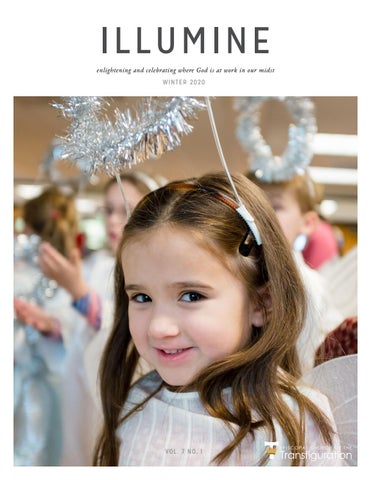
ILLUMINE enlightening and celebrating where God is at work in our midst W I NTE R 2020
VOL . 7 NO. 1
WI NTER 2020 | I L L U M I N E
2
ILLUMINE
1
[01]
F RO M T HE RE C TO R
1
[02]
I WA S A S PY: F RO M T HE E DI TO R
5
[03]
E MPAT HY O U T O F T HE MO U T HS O F BA BE S
6
[04]
L I F E HA PPE N S : PRE PA RI N G O U R YO U T H
13
[05]
A BI GGE R TA BL E : J O HN PAVLOVI T Z
19
[06]
O N E BO DY, O N E BRE A D, O N E C U P
21
[07]
HE L PI N G HA N DS I N T HE S POT L I GHT
25
[08]
N E W POTT E RY FO R N E W BE GI N N I N GS
26
[09]
PHOTO I N DE X
29
3
W I N T E R 2 020 | I L L U M I N E
WI NTER 2020 | I L L U M I N E
4
2
FROM THE RECTOR THE REV. R. CASEY SHOBE, D.MIN.
T
here are some things you just can’t do from a distance.
Recently, I overheard Melody having one of those dreaded “tech support” conversations with her father. I listened as she patiently recommended all sorts of solutions for his computer-related problem, but nothing seemed to work. Finally, she sighed, and said, “I’m sorry, Daddy, I would like to help you, but I’ve reached the limit of what I can do without being there.” I knew how much she wanted to help, but to do so, she was going to need to see and touch the computer, because there are some things you just can’t do from a distance. Technological innovation may one day make it possible for us to do just about anything from anywhere, but no matter how far technology progresses, there will always be one thing we can’t do from a distance: love. Love is like gravity for the soul; it draws us closer to those we love so we can near them, with them, in their presence. And not only when times are happy and good. Love’s gravity seems to be even stronger when the person we love is suffering or in pain.
In those moments, the force of love has extra power and pulls us even closer. Think about it. Love is what leads you to take care of your aging parent as he fades in front of you. Love is why you keep showing up to be with him, rather than saying, “I don’t want to see him this way.” And love is why you stick by your child when she so sick that she is only a faint shadow of her normal self. Love is what causes you to stay in her room all night, cramped and uncomfortable at the foot of her bed, close by and ready to help.
01
Because love is something you can’t do from a distance. That is ultimately what we celebrate at Christmas: that God’s love is so great that God simply had to enter our world to get close to us. And not because we were especially easy to love, or good about showing our love for God. No, God could see all the suffering and pain of the world, all the lives weighed down by sin, and God could not turn away.
W I N T E R 2 020 | I L L U M I N E
WI NTER 2020 | I L L U M I N E
Love led God down from the majesty of heaven to a manger in Bethlehem, and eventually, to a cross on a hill outside Jerusalem. Love. Nothing else can explain it. The kind of love that pulls you close to the object of your love, in order to help ease their suffering. And that kind of love is not something you can do from a distance. God knew it would require “moving into the neighborhood,” as John 1 reads in The Message, to actually help or heal our weary world. Because the immense power of love is only really unleashed when we get close to others. We can try to love from a distance, but the power in that love is not truly unlocked until we get up close and personal. This is something I didn’t fully understand until I learned about the work of Bryan Stevenson.
02
Bryan Stevenson is a lawyer, author, and activist, and he’s also one of my contemporary heroes. He founded the Equal Justice Initiative several decades ago to advocate for people on Death Row, and since the early 1990s, EJI has won reversals or release from prison for hundreds of wrongly convicted or unfairly sentenced prisoners, which he writes about in his marvelous book Just Mercy. And so, Bryan Stevenson is routinely sought out for advice and inspiration. People crave hope and guidance on how they can make an impact on some of the big problems in the world. And what he comes back to again and again is the “power in proximity.” “To make a difference,” he says, “we’ve got to f ind ways to get proximate to the poor and vulnerable. When we isolate ourselves, and allow ourselves to be shielded from the vulnerable and disfavored, we sustain the problems…Too often we wait until we have all the answers before we’ll engage, before we get closer to those who are marginalized. [To make a difference], we have to f ind ways to get closer to the marginalized, even if we don’t have the answers.” Stevenson says that too many of us obey that voice in our heads that tells us not to go to the bad part of town.
Don’t go where people are poor and hurting, or where there’s crime and desperation. Stay away from those people and places so you’ll stay safe, and so you won’t have to see those hard things. But if we actually want anything to change, he says, those of us who care, and who want to obey the foundational commandment to love others like ourselves, are going to have to get closer to those very places. Because there are some things you can’t do from a distance, and love is at the top of the list. I know, it would be nice if there were solutions for the biggest challenges in our lives and in the world that we could perform from the comfort of our living rooms. But if we want to help hurting people, we will have to get close to hurting people. If we want to help the poor, disabled, migrants, or prisoners, we will have to get closer to them. We have to get closer, because there is power in proximity, and when you get close, the full power of love begins to be unleashed, and there is the potential for real transformation.
03
That’s not just the wisdom of Bryan Stevenson. That’s the truth of God displayed most perfectly in the one wrapped in swaddling clothes and placed in a manger in Bethlehem. Christmas is about the power of proximity. Emmanuel. God With Us. Not, “God Up There Somewhere.” Not “God Who Visits Occasionally.” Not “God Who Sends a Check.” God With Us. Because there are some things you just can’t do from a distance, and loving the world enough to save it is something that takes the full power of God’s holy and merciful proximity. So may we draw near to the God who has drawn near to us. May we follow God’s lead get closer to those we love and those who need our love. And may God multiply the power of that love to be a force to transform the world.
W I N T E R 2 020 | I L L U M I N E
WI NTER 2020 | I L L U M I N E
5
I WAS A SPY FROM THE EDITOR By Judson Watkins
Director of Communications
S
itting on the maroon carpet in Aunt Shortie’s guest bedroom closet, I pulled a 1980s Clark’s shoebox off the shelf and removed the lid. It was full of your run-of-the-mill “junk drawer” collectibles: souvenir pens from here and there; a “Note from Carolyn Tully” notepad, no doubt bought from a school fundraising magazine; a framed photo, “Niagara Falls – 1963” written on the back; and an ornately carved wooden spinning top. But what piqued my interest the most was an old, worn U.S. passport. I grew up in rural East Texas among rolling hills covered thickly with towering trees and enough spring pollen to turn every car in the region a solid lime yellow. I didn’t know anyone who’d been outside the country, and I had certainly never before seen a passport. It was exotic. I hopped up and ran into the living room, over the bearskin rug and past the caged parakeet named Little Bit, right up to Aunt Shortie’s chair. “What’s this?” I quizzed with all the curiosity of any seven-year-old and with the thickest, cutest Texas drawl you can imagine. “It’s my old
passport,” she said, f lipping it open with pride, reading each stamp aloud. “Winnipeg. Panama City. Madrid, London, and Rome. Cyprus…” “Why did you go to all these places?” I said with my head cocked to one side. Without skipping a beat, her response was both startling and the most exciting thing I had ever heard: “I was a spy.” She wasn’t, of course, ever a spy; in the same way the creaks and mysterious house noises were not actually our imaginary friend Clem Kadiddlehopper. But these were the stories she told—the stories I soaked up and half-believed. They weren’t all tall tales, though. She told me stories of her childhood in the Depression, wearing homemade band uniforms and “playing drums” in the lumber yard with stout sticks. She told me stories from after the War, when she graduated high school and went off to college, going on to run her own laboratory studying the properties of different chemicals. She told me countless stories—intriguing, powerful, life-def ining stories.
05
Her recollections were fond and warm. The chance to recount her life made her time with me rich and cherished. It deepened our relationship, stripping away the 60-year difference between us and bringing me into a bright and magical world of yore. That’s the power of stories, to change our outlook on the world. A good story can strengthen the bonds between us, whether we’re sitting beside each other at the dining room table or reading words written by a Hebrew scribe 2,300 years ago. Stories, more than facts and f igures, are part of the glue that can bind our relationships together in the best ways. They lead us to cling to those we know and reach out to those we don’t. They allow us to share our faith and they’re a powerful tool with which we can seek and serve Christ in all persons. It is through, around, and within the stories of our lives that we continue to live into the future. In the coming year you’ll read more stories in this magazine and other publications of the church. I hope you’ll read them, ref lect on them, and cherish them. But most of all, I hope you’ll share your story too.
W I N T E R 2 020 | I L L U M I N E
WINTER 2020 | I L L U M I N E
E M PAT H Y O U T O F T H E MOUTHS OF BABES
A
06
s kids wandered into an upstairs classroom, they grabbed some orange juice and mini muff ins and plopped down onto the f loor, crisscross-apple-sauce in a simi-circle. The ImpactKids class began with a conversation about Christmas and Advent—what they are getting their parents for Christmas, what they have asked for in return. Before too long it was time for class to start. They began with a warm-up, talking about the sermon at the early service and how it applies to their lives, sounding more like young adults than 9 and 10 year olds. Director of Children’s Ministry Cindy Hauser steered the conversation toward the topic of the year.
07
6
W I N T E R 2 02 0 | I L L U M I N E
WI NTER 2020 | I L L U M I N E
08
7
“Our ImpactKids theme this year is compassion in action—walking in someone else’s shoes; imagining what we can do to alleviate their sadness. “What is empathy? What does it mean to be compassionate?” she asked the class. A kid with a plate full of muff in crumbs answered, “Empathy is when you imagine how someone feels. And compassion is when you want to do something about it.” Then Cindy introduced a special guest. “We as Christians are called to live a compassionate life and help those in need—to, in our daily life and our jobs, alleviate their pain and challenges,” she said. “Judge Delia Gonzales does that in her work with kids in foster care.” Gonzales, an associate judge of Dallas County Child Protection and Permanency Court, introduced herself to the class and brought up the topic of the day. “Often the children in my court feel the only reason CPS or their attorney cares for them is because they ‘have to’ and not because they are great kids. I think it will give hope and remembrance that they are cared for even by those they do not know personally.” The kids’ project for the day is to write cards to the kids in Gonzales’ courtroom. “The kids that I see in my court don’t have parents. They don’t live with family. They live with strangers,” she explained. “They struggle because they don’t get to see family or live with families. In our holidays we get to have traditions with family, but I see kids every day who are not going to have that. “One young lady” she said, pausing with tears in her eyes, “was in my court and we had found her grandmother.
And when her grandmother came into court this young lady was pregnant and living on the street, literally under a bridge. Her grandmother said a lot of mean things about her and said she wanted nothing to do with her. How do you think that made her feel?” “Really sad,” said one of the kids with a despondent look. “What do you think you could say to her to make her feel better,” asked Gonzales. “Believe in yourself. Don’t drop out of school,” a kid said. “You can do this. We still care about you.”
09
Gonzales posed another question, “How many of you have lived in the same home your whole life—one home, two homes, three homes?” Some kids raised their hands, more and more as the number of homes increased. “But you have probably been with your family your whole life. I know one young man who has lived in 42 homes in three years. What do you think that does to him,” she asked. “It makes him feel really bad,” said one kid. “It makes him feel bad because of all the new schools. It probably isn’t really fun.” “So what are some things you can tell that young man?” “That it is going to be okay,” another kid chimed in. “God still loves you.” “Believe in yourself,” another kid added. “You’re a survivor.”
W I N T E R 2 020 | I L L U M I N E
WI NTER 2020 | I L L U M I N E
“Sometimes it’s easier to listen to kids than it is to listen to adults,” said Gonzales. “Part of your project today is to tell my kids something you would want to hear if you were in their shoes.” The kids lined up at the supply counter, grabbing cards and markers and stamps, ready to make art to encourage the kids under Gonzales’ care. As the kids sat at their tables and wrote their messages of encouragement, looks of determination and care on their faces, they explained some of their motivations in creating their cards.
10
“Today I learned that everyone needs encouragement and that we should treat people nicely,” said 9-year-old Helen.
“TREAT OTHERS HOW YOU
When asked how they would feel if they were in the foster kids’ shoes, 10-year-old James answered, “I would feel happy that I got a card because someone is actually caring about how I feel.”
WHO ISN’T BEING PLAYED
WANT TO BE TREATED. IF THERE IS SOMEONE AT SCHOOL WITH THEN YOU SHOULD TALK TO THEM AND ASK IF THEY ARE DOING OKAY AND MAKE SURE THAT THEY FEEL GOOD.”
Maisie, 11 years old, added, “I would feel sad, depressed or angry if I were them and would really not like how my life was. When I opened the card though, I would feel encouraged and happy.” Sophie, 10 years old, summed up the lesson of the day: how do you live into your Christian values throughout your week? “Treat others how you want to be treated. If there is someone at school who isn’t being played with then you should talk to them and ask if they are doing okay and make sure they feel good.” Teacher Christina Jump closed the class in prayer, part of which read, “Lord grant us the kind of hearts that we may be voices for the oppressed, givers to the poor, and providers of encouragement for those not as privileged as we are.”
11
8
W I N T E R 2 020 | I L L U M I N E
WI NTER 2020 | I L L U M I N E
12
9
LIFE HAPPENS: P R E PA R I N G O U R YO U T H By Dana Jean Director of Youth Ministries
A
n enormous, stuffed-to-themax backpack drops to the f loor with a “thunk” as a sixthgrade boy shuff les into the Youth Center after a long day at school. He shrugs his shoulders, shaking off his jacket, which lies on the f loor beside his backpack causing me to silently chant one of my new mantras to myself, “I am not the mom, I am the Youth Minister. I am not the mom.” He breathes a giant, adult-sized sigh before sitting down across from me at the table in the center of the room where I’m setting up the slideshow for Crossover, our Wednesday night youth group meeting. The room is quiet and still; he and one other student are the f irst to arrive, a good 25 minutes early. We have some time before the evening gets off the ground, soon to be f illed with prayer, music, laughter, and lively voices.
“How are you? How was school? Why in the world is that backpack so big? What burden is making you sigh so deeply?” I want to ask, but I hold back. He looks at me wearily and says, “I’m tired. What’s for dinner? Can I play the Switch?” (Sometimes I really do feel like the mom.)
13
The Switch (a game console) lives in a hiding place—not to be used on Sundays during formation—so I give him permission to get it out and start setting it up, and while he does, we chat. Or, more accurately, he chats. Turns out his backpack is almost as heavy as he is and he carries it—proudly— all day, every day. I very brief ly worry for his poor back. He looks awfully small with that thing on. He tells me he didn’t sleep well the night before and he had a test that day that he thinks he failed. He conf ides in me that other kids make fun of him because
W I N T E R 2 020 | I L L U M I N E
WI NTER 2020 | I L L U M I N E
10
14
he struggles with reading and that “no one laughs at me at youth.” I am struck by a sense that he knows he belongs here, with us, and I am grateful. He didn’t seem to feel that way at the beginning of the year. According to Lifeway Research, approximately 70% of young people leave the church after having been raised in it. I doubt any one of us is particularly surprised by that f igure, though I wonder if we realize how many of our assumptions about why they leave are likely wrong, or at least not entirely accurate. Among the many beliefs we tend to have about young people leaving the church—beliefs that are in fact much more nuanced than they might seem—there are two that stick out to me that I would like us to reconsider: We think: Kids lose their faith after high school, perhaps as they begin to resist their parents’ faith as part of a developmental, maturing process. We might consider: Kids who leave usually have more profound reasons for leaving than simply as part of growing up, and they often become prodigals, nomads, and exiles, rather than losing their faith entirely. We think: College pushes people to drop out of church because of newfound independence, lifestyle choices that might not f it with church attendance, or for a host of other reasons.
11
We might consider: The church doesn’t always do a good job of preparing young people for life after youth group, for the challenges of adulthood and for decisions about call and faith in regard to career and relationships.
15
What I would like us to ref lect on though is that we have been given an amazing opportunity and a great gift, especially here at Transf iguration, where we count on a beautiful, well-appointed Youth Center full of highly qualif ied Sunday school teachers, and a phenomenal children’s ministry providing our students with a solid biblical foundation before they ever arrive at that Youth Center. We also have clergy and parishioners who actively seek and serve Christ in all persons, intentionally including our children and youth in that mission. As I see it, the gift we have been given is that we are called to equip our young people with the tools they need when they inevitably come to a crossroads in life, as we all do at some point. And not just tools like understanding Scripture, or carrying on our traditions, but just as importantly, the knowledge that they are part of the Body, surrounded by people who will, with God’s help, “strengthen them when they stand, comfort them when discouraged or sorrowful, lift them up when they fall” (The Book of Common Prayer, p. 830). Because they are already at that crossroads, carrying heavy burdens, wondering if the church is here for them. In the Spring we will, God willing, present for conf irmation 11 youths, at which time we will agree, as a congregation, to “support these persons in their life in Christ.”
W I N T E R 2 020 | I L L U M I N E
WI NTER 2020 | I L L U M I N E
Before then, in our youth ministries program and across the parish, I challenge us to take that vow seriously, and in preparation ask ourselves:
12
What are we (as a church and as individuals) doing to equip our youth for the time when/if they become prodigals, nomads, or exiles, to prepare them for life after youth group? And then, of course, to invest in making sure we are doing those things. Certainly, the question requires us to take stock of what spiritual resources one needs for living in this world as faithful Christians. So perhaps taking time to consider the tools you yourself have required over the years is a good place to start.
16
13
My own story is one of a prodigal. I left the church at 16 and, like a bungee jumper, bounced back periodically for major life events, to baptize our babies, or for Midnight Mass on Christmas Eve. It wasn’t until much later, when the realities of adulthood had long since set in, that I realized I had wandered in the desert long enough and I wanted to come home. I still wonder though, what if I’d had a better spiritual foundation—a more solid Sunday school program, a vibrant youth group, adults besides my family
who invested in my faith? What if I had been reminded of the church’s vow to strengthen me, comfort me, and lift me up?
fund youth pilgrimages, or any number of other ways to use gifts God has given you. Our youth truly need you to and our beloved church will thrive for it.
So, I ask you, what is your story? Have you ever been in exile or wandered like a nomad? Could that story help prepare our young people for their own journey? I encourage you to share that story when you can, by all means, but I also encourage you to give yourself fully to the church in ways that will develop those tools which would have helped others on their own journeys. I encourage you to tell it, but I also encourage you to give fully of yourself to the Church in ways that will strengthen, comfort and uplift others the way you were or would have liked to have been supported, whether that is by serving as a youth or children’s Sunday school teacher, helping
The f irst one to the door at the end of Crossover that evening, my 6th grade friend turned to look back at me, a giant lopsided smile plastered on his face. Waving goodbye, he bounced out into the night, headed home where I presume he’ll drop his jacket and backpack on the f loor, plop down on the couch proclaiming his exhaustion, and ask for a snack, hopefully with a peace-infused smile rather than a heavy-laden sigh.
17
14
W I N T E R 2 020 | I L L U M I N E
WI NTER 2020 | I L L U M I N E
16
A B I G G E R TA B L E : B U I L D I N G M E S S Y, A U T H E N T I C , A N D HOPEFUL SPIRITUAL COMMUNITY An excerpt from “An Evening with John Pavlovitz” at Transfiguration on September 29, 2019.
T
o be a person of compassion in a time and a place when compassion is in such great demand is exhausting. You wake up every day and push back against predatory politicians, toxic systems, corrupt legislation, human rights atrocities, and leadership failures in the church. It’s exhausting. The volume and the relentlessness of it all can wear you out. Have you noticed? You’re carrying the big realities you’ve seen—the realities of systemic racism, the realities of white privilege, the realities of homophobia, the realities of gender disparity—all these things you’re carrying around—that’s big stuff. That’s heavy enough. But you’re carrying around something else. You’re carrying around the names and faces and lives and stories of people you love who are under more duress than ever. And these big realities and these individual stories, you know what
they do? They start to pile up on you. They reside on your tired shoulders, and they reside in your elevated heart rate, and they reside in the knot in the pit of your stomach that returns every morning when you check the news, or you step out into your living room, or you walk out into your community. And you realize how much pain there is and how little compassion you feel you have left. Whether you’re an activist or a minister or caregiver or a parent or just a concerned citizen of the planet, you feel the effect of these days—the heaviness. The fatigue catches up to you....I f ind as I travel that everyone is feeling it. I go to Georgia. I go to Southern California. I go to Minneapolis. Everyone feels it’s gotten harder, because there’s a cruelty that we see. Part of what we have to do is f igure out how to sustain the collateral damage of all the grief and keep going.
we’re making is that we can stop. We can breathe. We can let the grief and the fatigue catch up to us, and it’s okay. Because I think you’re here because you’re one of the people I like to refer to as “damn-givers.” I think you’re here because compassion is the thing that fuels you through the world, which is actually the heart of Jesus. In all the work Jesus did, he disturbed a lot of people, friends, but he never did it to damage people. He always did it to protect people.
19
Jesus’ motivation was not to hurt the oppressors. His motivation was to care for the oppressed. That’s what we cling to as Christians. To hear a recording of the full presentation, visit: www. transfiguration.net/john-pavrecording/
When you quiet yourself, all that grief catches up to you. What I love about this evening and the space
W I N T E R 2 020 | I L L U M I N E
WI NTER 2020 | I L L U M I N E
20
17
O N E B O D Y, O N E B R E A D, O N E C U P
S
tanding outside room 314 at a local retirement community, parishioner Nancy Banitch knocked lightly next to the bronze nameplate of Betty Sacchetti’s apartment. Betty was sitting in her chair in a beautiful striped blouse, bundled in what looked to be the softest blanket in the world. Her face lit up at the sight of Nancy and me, as if she had been waiting all morning for this special occasion—a Eucharistic visit. Nancy began to unpack her traveling Communion kit, dutifully unfolding a small white cross embroidered linen cloth, setting out a chalice and a paten on which the wafers sat.
“We’re having our Christmas banquet this afternoon, soon after this and the whole place is talking about it,” Betty said, with a certain amount of glee in her eyes. “It’s really important we remain grateful for everything we have around Christmas, especially in a time when there is so much complaining and negativity.”
21
Soon after, the mood changed to one of holiness as Nancy began the shortened liturgy used by Eucharistic Visitors. “The peace of the Lord be always with you,” came the familiar line, cueing the beginning of something sacred to come. Following a collect, the lessons, and a prayer, Nancy began describing the sermon preached earlier by Father Casey, using notes she had taken in earnest during the service. The summary was casual—a conversation about the meaning of the Root of Jesse and the depth of the Scripture.
W I N T E R 2 020 | I L L U M I N E
WI NTER 2020 | I L L U M I N E
Then came the fulcrum of the visit: the Communion of the People. “The gifts of God for the people of God,” said Nancy, words spoken around the world just before the receiving of the bread and wine by parishioners.
22
Betty took the wafer, then the chalice, handling it with a delicate care, almost as if they were too fragile to be held by human hands. The intimate service concluded with a prayer that captures the essence of the visit. Church member and Eucharistic Visitor Peggy Kwoka says, “The EVs give thanks for feeding our visitee with the Sacrament, praying ‘we thank you for enriching our parish family by his/her sharing with us the food of our pilgrimage.’” “It’s hard for me to get in and out of the pew and go down to the rail. So, I just decided it was best to stay home,” Betty explained. “This ministry means everything to me. It means that my religious needs are taken care of. That was the missing link for me, to get Communion. And there was no way I was going to get it unless someone brought it to me. So it has made me feel like I’m whole, in other words, I’m taken care of spiritually.”
According to the American Medical Association, 3.4 million people over the age of 65 in nursing facilities and private residences never leave their homes. “We have a lot of people who can’t get to church,” says Deacon Ginny Kivel at Transfiguration. “We visit people of all ages in all sorts of environments, from hospitals to rehab centers, houses to assisted living facilities.” When people are unable to attend church and unable to maintain a physical connection with their faith family, it can become difficult to feel a sense of belonging. “From earliest times, the Church has made efforts to carry the bread and wine of the Eucharist to those not able to gather with the community,” explains Bishop Wayne Smith of Missouri, who provides pastoral oversight to Transfiguration. “The sacramental inclusion of everyone, and the broadest possible extension of community, are practices at the heart of the Episcopal Church’s life.” The impact felt by those who are visited is repeatedly expressed to those involved in the ministry. “They say things like, ‘Thank you for sending someone to me, it really helps me feel valued’,” says Deacon Ginny. “All of them are deeply grateful to be connected to the Body of Christ this way. When
they receive Communion, they receive visible, tangible symbols of the church’s presence. It makes our community complete.” But the impact of the Eucharistic Visitor ministry is not limited to those who are visited. “I get excited to see each person, especially as our relationship grows after a few visits,” says church member and Eucharistic Visitor Judy Drotman. “I’m thrilled when someone asks about a trip I’ve taken or remembers that the food pantry always needs grocery bags. For a short time, we are celebrating a simple Sunday ritual!” Back in room 314, as I go in for a hug with Betty, she asks for one of the most basic needs a Christian can request: prayer. She passes along a prayer request to the clergy and me, and I assure her I’ll add her request to my daily prayers. Most special though, she ensures me that she’ll pray for the church and for my happiness during the holidays.
19
23
18
W I N T E R 2 020 | I L L U M I N E
23
WI NTER 2020 | I L L U M I N E
24
20
HELPING HANDS IN THE SPOTLIGHT
T
he Outreach Committee at Transf iguration works with 18 charitable agencies and projects. These parish partnerships include mostly local agencies with the exception of Happy Homes Preschool in South Africa. In many cases, the partnerships have lasted decades, although some new partnerships have been formed in the past few years. According to committee member Kathleen Ray, “The committee works to impact the community on behalf of the parish as well as seek opportunities for the parish to mobilize and put faith to work in our community.” But raising awareness for these great organizations does not happen overnight. The parishioners on the committee work to increase awareness through regular communication efforts, collection initiatives, Outreach Recognition Sunday, and special projects. As part of their communications strategy, the Outreach Committee began spotlighting organizations throughout the year in 2018. Each spotlight focuses on providing a comprehensive review of a single parish partnership. Committee members hope that each spotlight will motivate parishioners
to discover more about each organization, help their cause, and get involved. “The spotlights help us look beyond our doors as we seek to serve others, especially those who are struggling to have some of the basics many of us take for granted,” said committee chairperson Linda Ayres. After two years of spotlights, there has been a signif icant increase in awareness and participation within the parish, resulting in a rise in volunteerism. More parishioners have learned about the incredible work these agencies do and found causes about which they are truly passionate. In addition, there has been exceptional generosity exhibited during collections, proving there is a real desire among the parish to learn more, give back, and help others. Whether parishioners are informed about opportunities to help Austin Street Center, Genesis Women’s Shelter, the Transf iguration Food Pantry, or one of the other amazing partner agencies, there has been an intensely positive response from the parish. Ultimately, the goal of each spotlight is to inform, inspire, and ignite action.
The committee also orchestrates Outreach Recognition Sunday each February. On this Sunday, representatives from parish partners are invited to attend a church service at Transf iguration and be recognized. They are encouraged to talk with parishioners, provide information about their agency, and distribute handouts after the services.
25
Later that day, the Outreach Committee organizes volunteer projects in which parishioners can participate. This provides a special opportunity for individuals to learn about organizations and get involved all in one day. These projects either take place at the church or onsite at one of the agencies. Ultimately, the dedicated volunteers that serve on the Outreach Committee strive to connect parishioners to a wide variety of agencies that help with different causes, are f inancially responsible, and offer a variety of ways to get involved that speak to diverse skill sets, interests, and schedules.
W I N T E R 2 020 | I L L U M I N E
25
WI NTER 2020 | I L L U M I N E
NEW POTTERY FOR NEW BEGINNINGS
M 26
oulded from clay and measuring 9” tall by 5” wide, the new chalices for The Table, the 5:30 Saturday Eucharist, were fashioned after the formal silver chalices used on Sundays. “These chalices and patens [plates on which the wafers sit] were commissioned specif ically for this service,” said Father Casey Shobe at Transf iguration. “The artist visited our parish and experienced this community. From that, he crafted pieces that intentionally ref lected the heart of our church family.” James Olney, master potter at Oak Cliff Pottery, expressed what inf luenced him while making these chalices and patens. “My motivation and inspiration to make these liturgical pieces was rooted in love and respect for individuality. “I am very pleased with how these pieces came out. I love the organic nature of how the wood ash interacted with the surface.
Art and specif ically pottery, connects us to the earth and to the life and energies all around us,” Olney says. “Its creation relies on the basic elements of the world: Earth, water, air, and f ire. The f inished product and the ceremony of their use brings us together in community and faith.” The pottery was specially commissioned by Diana Davis in memory of her mother LaVae Duffey Riddle, scholar, artist, nurturer and lover of all souls. “After browsing through several sites, I came upon a reference to the ‘Oak Cliff Potter,’ which led me to James Olney’s website. After reading his bio, it felt like his life’s path was representative of the Fig parishioners with whom we have the privilege to worship and live out our mission of service to those in need.” Always fascinated by the act of participating in Communion, Olney explains his belief that the Eucharist brings together people in a mysterious way. “We are all connected in many ways in this world and to worship together helps remind us that respect is the most important thing we can offer anyone.” To see the pottery in use during the Eucharist on Saturdays is to witness an almost covert interaction between an effort of detailed craftsmanship and the holiness of the bread and wine which the vessels so delicately contain. Those who know the story of these clay-origin gifts and those who do not know their story both participate in the holy interaction between the joyful fruits of intentional craftsmanship and the Body and Blood of Christ.
21
22 27
23
W I N T E R 2 020 | I L L U M I N E
27
WI NTER 2020 | I L L U M I N E
28
24
25
27
26
29
28
W I N T E R 2 020 | I L L U M I N E
WI NTER 2020 | I L L U M I N E
CHURCH STAFF CLERGY The Rev. R. Casey Shobe, D.Min. Rector The Rev. Rebecca Tankersley Associate Rector The Rev. Nancy DeStefano Pastoral Assistant The Rev. Ginny Kivel Deacon The Rev. Terence C. Roper Rector Emeritus PROGRAMS Cindy Hauser Director of Children’s Ministries Dana Jean Director of Youth Ministries 30
29
Anne Schmidt Director of Evangelism and Welcoming Ministries Judson Watkins Director of Communications Illumine is a quarterly publication of Church of the Transfiguration. The word itself has two meanings: to light up or brighten and to enlighten (someone) spiritually or intellectually. The goal behind this magazine is to tell the stories of this congregation, highlight new ministries, and celebrate where God is at work in our midst.
WORSHIP SERVICES Wednesday | 6:00 p.m. Thursday | 12:00 p.m. Saturday | 5:30 p.m.*
30
Sunday | 9:00 a.m.* and 11:15 a.m.* *Childcare available for children 6 weeks to age 5.
MUSIC Joel Martinson Director of Music and Organist
PHOTO INDEX 1. Cover: Angel at the Christmas Eve Pageant. Photo by Dickie Hill.
Stefan Engels Artist-in-Residence
2. Bag pipers at the 2019 Kirking of the Tartans. Photo by John Makowski.
Chris Ahrens Director of Youth Choir
3. The Rev. R. Casey Shobe, D.Min. at Ingathering. Photo by Carter Rose.
Kimberley Ahrens Director of Children’s Choirs ADMINISTRATION Sophie Lowrance Parish Administrator Lana Mederos Executive Assistant to the Rector Mary Hall Controller PROPERTY Bracken Reece Director of Operations Joseph Gerick Sexton
4. Shepherds © 2004 John August Swanson | Eyekons 5. Nativity © 2004 John August Swanson | Eyekons 6. Carolyn “Aunt Shortie” Tully and Judson Watkins. Photo by Charlotte Snodgrass. 7. - 8. ImpactKids formation class. Photo by Judson Watkins. 9. - 14. Youth Center activities. Photo by Dana Jean. 16. John Pavlovitz. Photo by Robert Hacker. 17. Eucharistic visitation. Photo by Judson Watkins. 18. Eucharistic Visitors receiving their communion kits. Photo by Judson Watkins. 19. Sunday bulletin. Photo by Judson Watkins. 20. Servers at Austin Street Center. Photographer unknown. 21. James Olney inspecting pottery for The Table. Photographer unknown.
31
22. The Table potter. Photo by Judson Watkins. 23. Eucharistic minister at The Table. Photo by Dickie Hill.
VESTRY
Nancy Jagmin, Senior Warden Julia Trizzino, Junior Warden Chris Ayres, Assistant Chancellor Robin Caldwell Olive Cone Frank DeLizza Betsey Hardman Roy Heller Peggy Kwoka, Clerk Rosemary Luquire Jay Madrid, Parish Chancellor Sheila MacLennan Mason McCamey Allison Murphy, Treasurer Bart Stockton Evan Williams Jodi Dalton, incoming Scott Daniels, incoming Linda Horton, incoming Mark Ramsay, incoming
24. Child at the Advent Festival. Photo by John Makowski. 25. Mtr. Rebecca and child at Fig Fest. Photo by Dickie Hill. 26. Children at their First Informed Communion. Photo by John Makowski. 27. Parishioner at Kirking of the Tartans. Photo by John Makowski. 28. Children at the iParentX pie making event. Photographer unknown. 29. Dana Jean, Youth Director. Photo by Robert Hacker. 30. Cindy Hauser, Children’s Director. Photo by Dickie Hill. Back Cover: Church bell tower at night. Photo by Robert Hacker. The Editor-in-Cheif of Illumine is Judson Watkins. This issue was copy edited by David Flick and contains articles from contributing authors Dana Jean and Rain Galetka.
W I N T E R 2 020 | I L L U M I N E
ILLUMINE
WIN T E R 2020 | I L L U M I NE