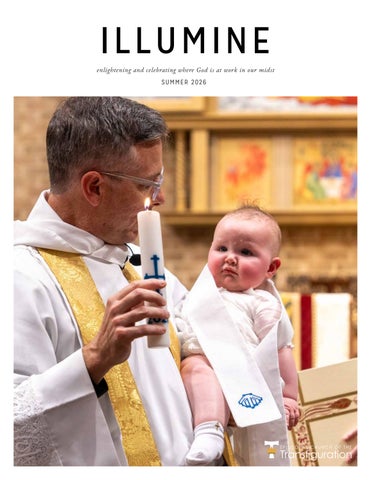
ILLUMINE enlightening and celebrating where God is at work in our midst S U M M E R 2026
16
CONTENTS S U M M ER 2 026
24
11
1 Finding My Way in the Woods 20 Poured Out F ROM THE RECTOR
R EFLECTIONS
Fr. Casey’s revelation on the Appalachian Trail
Michelle Williams explores the ways wine connects people
5 Growing Up at The Fig YOUTH
Nathaniel Dick’s walk down memory lane
11 In St. Paul’s Footsteps PILGRIMAGE
Traversing the land where the Apostle spread the Gospel
16 9 Questions for the New Bishop Q&A
Revealing interview with our diocese’s recently-elected spiritual leader
24 Who’s Missing M INISTRY
Celebrating the Eucharist with those who can’t be in our pews
28 Gala for a Good Cause O UTREACH
Highly successful Fig-hosted fundraiser for emigrants
30 Meet Brianna & Zadie N EWCOMERS
How this soon-to-be-wed couple found their way to us
32 Scenes From Around The Fig C HURCH LIFE
Left: Our 2026 confirmands pose with Bishop Price. Cover: Father Casey presents the baptismal candle to Quinn Dianne Tripp.
5
SU MME R 2026
|
ILLUMINE
F R O M TH E RECTOR
Finding My Way in the Woods
What I learned about God while hiking the Appalachian Trail THE REV. R. CASEY SHOBE, D.MIN.
T
wenty f ive years ago this spring, I hiked the Appalachian Trail. I had just graduated from college and wouldn’t begin law school until the fall, so I decided to undertake the great American hiking trail, the path that runs continually from a mountaintop in Georgia to a mountaintop in Maine. I only made it halfway before I ran out of time, energy, and money – but half still meant 1,100 miles! I hold out hope of f inishing it one day. Perhaps as famous as any of its scenic vistas or beautiful summits are the markings that indicate the trail’s route, known as blazes. They are long white stripes that are painted every 100 yards or so on tree trunks and rocks and anything else the trail runs past. You would think that a famous trail hiked by thousands of people every year would be hard to lose, but it happens. The path twists and turns, it passes through rocky sections without an obvious route, and if you start in March like I did, you just might find yourself hiking in the snow, which quickly buries the trail beneath a beautiful blanket. I once spent nearly an hour wandering in a white-out looking for a blaze to follow. That was an anxious hour, let me tell you. I always think about the AT’s blazes whenever I hear Jesus’ famous words, “I am the way, the truth, and the life." My mind returns to those months in the mountains of Appalachia and the marking that guided me across seven states. Jesus is the blaze, the route, the trail that leads to life. He is the one to follow, the one to look for. The Lord is the way, and the way is the Lord. It’s important to remember that the earliest followers of Jesus didn’t call themselves Christians; they referred A blaze marks the trail through Great Smoky Mountains National Park.
to themselves as “The Way.” Those of you who’ve been around a little while know that’s why we call our catechesis program by that same name: The Way. We didn’t get the name from the Mandalorian, but from those first courageous Christ-followers. The name helps us cling to the truth they understood deeply, which far too many modern Christians are forgetting: that being Christian isn’t as much about what you say you believe, as it is about what you show by your life. It’s less about professing some precepts than pursuing a path. Or to use a hiking analogy, it doesn’t really matter how much you’ve spent on gear at the REI, if you never actually toss that gear on your back and hit the trail.
1
There are, however, a lot of trails we could follow – lots of paths with blazes that claim to lead us to Jesus. Have you ever typed “how do I follow Jesus” into a search engine? You will be inundated with millions upon millions of entries, every one of them quite sure they are the right way, the true path to reach Jesus. For many years I treated my practice of faith as an extended experiment to f ind the right one. I tried to collect as many spiritual experiences and do as many Christian-y things as I could in order to get closer to God. I wanted to reach “destination Jesus,” and I f igured that if I just tried as many options as possible I might eventually f ind the one that brought me to him. So in college I spent some time with a group of evangelical friends and attended their long, charismatic prayer services. Then I was introduced to meditation using the Jesus Prayer, and I would practice at sitting still and repeating those words over and over (“Lord Jesus Christ, Son of the living God, have mercy on me, a sinner.”). Then I was introduced to icons. Then I learned about Taizé. Then I picked up journaling. Then I heard about Ignatian exercises. Then I went on my first pilgrimage.
S U M M ER 2 026
|
ILLUMINE
SU MME R 2026
|
ILLUMINE
Each time, I was sure that this would be the thing that unlocked the Christian faith, this would be the thing that carried me to “destination Jesus.” Admittedly, my quest was partly about my personality type. As an Enneagram Seven, I am prone to get excited about new things. But in my conversations with people over the years, I have heard many share about their similar restlessness for spiritual fulfillment. It is easy to think that we will finally have the relationship with God that we always wanted whenever we obtain some new object, perform some different practice, visit this or that holy place, which will finally unlock the door behind which Jesus has been waiting. What I’ve learned, and what I am still trying to comprehend, is that life with and in Christ is not
2
Fr. Casey on a hillside in Virginia during his 2001 hike of the Appalachian Trail.
a destination. It’s not a prize for those who have collected a complete set of religious nicknacks. It is not something we unlock with the right technique, or something we win when we’ve opened every spiritual door. We won’t one day have learned enough, prayed enough, read enough, received the sacrament enough, gone on pilgrimage enough to impress Jesus enough for him to open himself to us. He is not a destination waiting just over the next mountain, but The Way by which we make our journey toward eternal life. It’s like hiking. Some see the point of a mountain hike as reaching the summit. Everything between the start of the trail and the peak is just the stuff to be endured, the miles
to be covered in order to reach the destination. What matters is the photo you take at the top by the sign that proves you made it. But the hikers I’ve met who seem a little different, whose faces beam with an almost beatific glow, are not the summit-baggers; they are the ones who treat the journey as the reward. They know the top is merely the destination that creates the contours over which they walk. It’s like something I read in the novel Zen and the Art of Motorcycle Maintenance: “To live only for some future goal is shallow. It’s the sides of the mountain which sustain life, not the top. [It’s the sides of the mountain] where things grow. But of course, without the top you can’t have the sides.” 1
Our Lord isn’t a prize hidden at the summit, but the path that takes us there. Heaven isn’t away at the top; it surrounds us the minute we start walking in the footsteps of Christ. The Way is the Lord, and the Lord is the Way. I hiked the Appalachian Trail. I didn’t finish it, but I hiked it. It’s a journey that has defined my life. Two-anda-half months. 1,100 miles. Forests and meadows; sun and rain and snow; ups and downs. Looking back, I realize now that it was never about the destination. It was always about the journey. It was always about the path, the trail, the way. I hope to one day finish. I hope to one day reach that last mountaintop. But until then, I will keep walking.
3
1 Robert Pirsig, Zen and the Art of Motorcycle Maintenance (New York: William Morrow, 1974), as quoted by Eugene Peterson, The Jesus Way: A Conversation on the Ways That Jesus Is the Way (Eerdmans, 2007), 41.
S U M M ER 2 026
|
ILLUMINE
SU MME R 2026
|
ILLUMINE
4
Nathaniel Dick holds a flagon as first-server during the Eucharist.
YOU TH
Growing Up at The Fig
18-year-old Nathaniel Dick reflects on his formative years at Transfiguration, from a wiseman in the Christmas pageant to lifting the Seraph cross as high as possible
I don’t know if I cried at my baptism. I don’t know if I writhed or screamed or was, in any way, particularly challenging. I think there’s a rather large possibility I may have tried to go for a swim in the holy water, and an even larger possibility that I may have elected to simply sleep through the whole affair. And there are photos, of course: Half a dozen sepia-tinted memories that show me and my sister, swaddled in white, snuggled deep into our parents’ arms. A descending dove rests on a stole where it had been embroidered over my right shoulder, and a blue, scalloped shell crashes over my left. At my brow, a little blotch of oil shines in the camera glare. There’s my godfather over my dad’s shoulder – fully vested and refusing to smile, as I’ve been told he always did – and my sister’s godmother over my mom’s. And that’s about it. That’s everything I know about my baptism. Which shouldn’t come as much of a surprise. At 4 months old, I was certainly in no state to remember it, and the strain of twin newborns had my parents far from functional. But still… for better or for worse, my baptism appears to belong to the rather rare camp of memories I have at Transfiguration that lacks any level of real substance. I suppose that’s the nature of things. Your story starts long before your memory does. I was a month old when the loan for the North building was approved in our living room. I’ve been told that story a half a dozen times by a half a dozen people – my sister and I lying on the carpet while my still-recovering mother scrawled her signature across the agreement. I know, without a doubt, I didn’t cry or sleep or fuss through that. In fact, I was later informed that I behaved much like a “rather attentive lump of clay.” I’m choosing to believe that was a compliment.
I was barely 15 minutes old when I was handed directly from the doctor’s hands into the hands of Fr. Godwin, who had rushed to the hospital directly from a flat-tire incident, where he would become the very first person not paid to hold me, even before my mom or dad did. I received a little blue teddy bear from the vestry that afternoon. I suspect it may have been the best gift I received all day. Even before that, there are the stories of my mom lying down, pregnant, in the south transept’s pews. And the stories of stroller shopping and birth announcements and “Aiy, I remember when you were still in your poor mother’s belly…” 5
That is to say (rather tangentially, I suppose) that I grew up around the church. I’ve heard every story my childhood has to offer over and over: first informed communions and choir rehearsals and parties all from the lips of people I know, and knew, and am supposed to know, stretched into the folded mess of the past 18 years of my life. And I can’t really point to any one moment when that changed. I can’t look through my time at the church, stop on a single frame, and say, “There. That’s when I began creating my own memories.” I expect there’s certainly something to be said for those forged memories, for the stories I’ve heard over and over – the ones that have whirlwinded and stormed and flooded across my life: messy and tempestuous and rawly powerful in their own right. But, ultimately, it’s not those memories that will stay with me when I have to say goodbye to this church. I was 4 when I decided I wanted to be a wiseman in the Christmas pageant – one of what must’ve been 10 or twelve that year, all descending down the aisle in one long, distracted line of gold and gifts and poor liturgical timing. I was 6 when I attended my first Easter Vigil, too scared of the massive moth-work of candle smoke and dewy fire drops to actually light my candle. I was the little kid
S U M M ER 2 026
|
ILLUMINE
SU MME R 2026
|
ILLUMINE
SU MME R 2026
|
ILLUMINE
Previous page: Nathaniel (front row, third from right) and other students hold up their bibles at the 2017 thirdgrade bible presentation. (Left to right) Jennifer Rodgers, Chris Rodgers, Chris Dick, Deb Boopsingh, and Mel Kidd with Nathaniel and Naomi at their baptism
watching wide-eyed as an octopus puppet danced through Operation Overboard VBS, and the torchbearer trying not to trip over his cassock as every crucifer I worked with repeated the “all you have to do is not light the church on fire” line, and the probably-not-as-patient-as-I-remember Godly Play devotee stringing together poorly-thought-out answers to the “I Wonder” curriculum. 8
I was asked recently what the church meant to me, as someone who grew up in and around Transf iguration. I don’t think I really had an answer. There’s no easy way to sum up such an integral instrument of formation, not just in my life, but in my sister’s and my friends and, hell, probably most of the kids both within and without the youth program. But it really is the memories we make while we’re here. The ones we remember and the ones we don’t. The ones we’re reminded of every week and the ones we have to remind ourselves of. Wading in a flooded meditation garden to upright a fallen angel statue; diving through salt-slicked waves in the North Sea; walking two miles, unchaperoned, down a major road in Birmingham, Alabama, at 1 in the morning to find the nearest Waffle House; signing up to be a Wise Guy (and having no idea that included a camel costume); building cairns in riverbeds and on pebbled beaches; friendsgivings and thuribles; and trying to lift the Seraph cross as high as possible; shaving cream fights and lock ins; hide-and-seek in the church; sitting on the wall of the playground to watch the 3 a.m. traffic rush by and Austin Street meals; sunsets and prom date; lying to kids at VBS when they ask if I’m the Camp Counselor or the Navigator or whoever it ends up being and ice cream and caroling and just…
sitting in the Nave. Just sitting in church and listening to the presider, or the organ, or the complete and enveloping silence of an empty chapel, and knowing that’s enough. I don’t know if I cried at my baptism.
I don’t know if I cried at my baptism, and that’s fine. Because not every story needs to be complete in order to be breathlessly and beautifully significant. I, with so many others, have grown up at The Fig. We’ve grown up surrounded by organ music and incense and, yeah, a wealth of memories. And we – this year’s graduating class, particularly – have the months and years ahead to decide what to do with the person the Episcopal Church has created, to decide how to utilize this incomplete conglomeration of memories and ritual and people that, in its own right, may prove to be breathlessly and beautifully significant. Our stories will continue past this church. But that doesn’t make our time here – nor the people it forged – any less consequential. We, for better or for worse, have been irrevocably and irreparably shaped by the memories made in this parish. Whatever may come next is an extension of that. I, for one, can think of nothing greater.
Nathaniel’s f irst time serving as an acolyte at The Fig.
9
S U M M ER 2 026
|
ILLUMINE
SU MME R 2026
10
|
ILLUMINE
PILGRIMAGE
In St. Paul’s Footsteps How the Apostle’s preachings came to life for 27 Fig pilgrims BY GINNY WARD
L
ife is a journey, not a destination,” proclaims the bold, rainbow-coloured lettering on a tote bag I purchased from a Barnes and Noble some years ago. For Christians, however, life is a pilgrimage – a pilgrimage that will, we hope and trust, lead us eventually into the nearer presence of God. As we each journey on our individual pilgrimage, we are accompanied – sometimes brief ly, sometimes for many years – by others through the ups and downs of life. Jesus says in Mathew 11:30, “My yoke is easy and my burden is light.” But often, that yoke can seem heavy and burdensome and so we need the help and support of Christians around us. The Fig is one of those places where support and encouragement are always to be found. Along the way, through the almost daily Feasts and Fasts of the lectionary, through formation classes and discussion groups, we are reminded of those who have gone before us and encouraged to learn about their lives and the difference they made to the world around them. However, there is nothing quite like literally following in their footsteps, which is what the 27 of us who have just returned from The Fig pilgrimage “In the Footsteps of St. Paul” had the chance to do.
Of course, we did not suffer as St. Paul did. He walked from place to place, we only walked and climbed around the various sites, covering the long distances between them by coach; he was often chased out of town, we were welcomed throughout our visits; he was often hungry, we were never without places to eat; he was often on his own through his hardships, we always had one another’s helping hands to support us over rough places and up and down hills. Not only did we learn about the world of Paul’s time, but we also learned so much from our guides about the world of the ancient cities and civilisations that gradually became the classical world in which Paul lived and worked, giving us a greater understanding of the challenges and diff iculties he faced.
11
As I look back, I shall always recall particular moments. For example, that f irst Sunday when we climbed to a small plateau about two-thirds of the way up the unexcavated, steep, grassy mound that is Colossae for a celebration of the Eucharist, wondering what treasures might lie deep beneath my feet. Our visit to Ephesus, where excavation continues, and where we sat in the shade of a tree in the middle of the agora (marketplace), in sight of the theatre, and listened to a reading of Acts 19 as I shut my eyes and tried to imagine the scene nearly
Ginny Ward at the Perge Ancient Theatre in Turkey. Next page: Pilgrims gather to renew their baptismal vows at the baptistery of Lydia in Philippi. S U M M ER 2 026
|
ILLUMINE
SU MME R 2026
12
|
ILLUMINE
13
S U M M ER 2 026
|
ILLUMINE
SU MME R 2026
|
ILLUMINE
2,000 years ago. The covered ruins of an early Byzantine church in Laodicea (one of the Seven Churches in Revelation) where several of us paused to sing the Lord’s Prayer and where, as we left, I wondered about the unnumbered and unnamed saints of the church who had worshipped there in centuries past, passing the f lame of belief from one generation to the next. The day I felt closest to St. Paul was at Philippi where, before visiting the ruins and seeing the cave where St. Paul is said to have been imprisoned, we spent time at Lydia’s Baptistery, where it is believed Paul baptised Lydia and her household. There we renewed our baptismal vows, and Mtr. Rebecca gathered handfuls of water from the river and poured them on each pilgrim’s head. 14
Other special moments include: when we gathered for a group photo under a f ig tree laden with fruit and I pondered whether we are all Figlets (not just our younger members); and when, on almost our last day, we held hands in a circle in an Orthodox church dedicated to the Transf iguration and together sang the Lord’s Prayer. During our pilgrimage we learned that Mtr. Rebecca would be leaving The Fig and we prayed for her, and for Mtr. Maddie, as they each continue on their own pilgrimages. Returning to our everyday lives, we continue to pray for them, and for Fr. Casey, and for those priests whom God is calling to serve at The Fig for the next part of our pilgrimage together.
Mtr. Rebecca celebrates the Eucharist in Colossae amongst the Footsteps of Paul pilgrims.
15
S U M M ER 2 026
|
ILLUMINE
Q &A
9
Questions for the New Bishop
Fr. Casey recently sat down with the Rt. Rev. Robert Price to learn about his call to ordination and his priorities as bishop. The spiritual leader revealed the surprising way he tests his limits, too.
16
Fr. Casey: How did you experience your call to the priesthood? Bp. Price: I was brought into the Episcopal Church at Christ Church Cathedral in St. Louis. I was new in town, and I didn’t know anybody. The dean spotted me (23-yearold young men in Episcopal churches are not hard to spot!), and he took me under his wing and discipled me. Then my confirmation class said to me, “Rob, we feel like you really ought to be a priest. We think you’re called.” And I said, “There’s no way. My dad and my grandfathers are Methodist ministers. That is the family business I’m leaving. No, thank you.”
So I went to Yale to get a Ph.D in History and be a professor of American History. When I got there, I realized that I was not biblically literate in the way that someone who was studying early American colonial history really ought to be. I needed to get more familiar with this “primary document,” so I began reading. Meanwhile, I was going to an Episcopal church, not really believing in all the stuff they were saying, but thinking it was beautiful.
Bishop Price joined us for baptisms and conf irmations on the second Sunday of Easter.
17
S U M M ER 2 026
|
ILLUMINE
SU MME R 2026
|
ILLUMINE
Then one day I read in Matthew 22, where Jesus says to the Sadducees, “You know neither the scriptures nor the power of God, for God is God, not of the dead, but of the living.” I describe it like in the movie “The Matrix,” when one of the characters wants to fly a helicopter, and her eyes kind of flutter, and suddenly she knows how to fly a helicopter. For me, the risen Jesus and the story of Scripture and our life with Christ just downloaded in that moment. It was a conversion experience. I knew Jesus was in the room with me. I started praying for the first time, alone, as an adult, and after a few weeks, I felt an absolutely clear calling to the Episcopal priesthood. So then, time moves forward a couple of decades. You’ve practiced priesthood in a variety of places. What led you to imagine that God might be asking you to be a bishop?
18
I have to give the credit to two women of profound prayer in this diocese who, separately and independently of each other, within one week, took me to lunch and said, “I think you are called to be the next bishop of the Diocese of Dallas.” I had always found their prayer lives so remarkable and inspiring, so I felt that was something I needed to take seriously. I started talking to people, asking if they could second the motion, so to speak. My colleagues seemed to feel like it was something that ought to be explored and discerned, and that I should offer myself to a discernment process when the time came. What do you think is the most important thing about being a bishop? What is the essence of the episcopacy?
Because I’ve been a parish priest for 23 years, I think I’m basically still a parish priest, but from this chair. So, for me, being the bishop is about helping parishes serve Jesus better. That means serving their clergy and helping the clergy to be the best servants of Christ that they can possibly be. That’s what it’s all about. I want to look back and say, by God’s grace, I was able to make a difference in the lives of these leaders and their parishes.
Bishop Price leads our conf irmation candidates in renewing their baptismal promises and prays for the outpouring of the Holy Spirit on them.
With that in mind, how have you chosen your priorities in these early months?
How are you trying to practice that desire in these early months?
One thing I go around talking about is the leadership development pipeline. The goal is to produce flourishing leaders in flourishing congregations. Everything needs to be directed towards that. So, for example, if you walk the pipeline back to the furthest upstream, it’s youth and young adults. This year, that’s what I’m really focused on: getting our Happening up and running and Camp All Saints’. It’s about developing leaders in those ministries, encouraging them, and putting a claim on them. We have to do that now if in seven years we want to drink the wine of our own vineyard. I hope that 15 years from now, we’ll be able to say there are more flourishing leaders, and more flourishing congregations than when I began.
The primary way is to make sure that I’m with parishes in my first year that have not had a formal visit from the Bishop of Dallas in some time.
Most people see bishops on Sundays, but I’m not sure most people know what a bishop does Monday through Friday. Can you give us a little glimpse into what you’re up to during the week?
The first thing I do is pray, because I’m a sinner, and I need the help. I’m praying for my clergy and my diocese. Then I’m studying the scriptures because I’m called to teach and preach them. When I’m not doing those essential things that all Christian leaders are called to do, it’s really about making connections and applying the resources, both financial and human, that the diocese has at its command to particular parishes that are at watersheds or in need of encouragement or reinvention. The most life-giving, enjoyable part is making programs happen where people can be developed. You have made clear your desire to be the bishop of all the churches in the diocese. Why is that important?
Well, for me, it’s a theological imperative. It’s not important in some corporate management sort of thing. The diocese finds its unity in the person of the bishop, and so the bishop needs to be a pastor to every parish. Where the bishop is, there is Christ. Christ needs to be in every place. That’s part of what my sacramental ministry is, bearing witness in every local parish and then bringing what’s in that congregation to the whole church. It’s about communion.
What is something about yourself that we might be surprised to learn?
Well, I work out in my garage. I had done CrossFit for 10 years, and I’m into Olympic weightlifting now. It has a way of testing limits and leaving some of my competitive nature on the floor in my garage, so that I can bring my best self to my work. It’s just kind of fun because it’s really technically difficult. It’s a challenge and gives me something to think about other than being the Bishop of Dallas. I call it my side quest. What do you think is the biggest lesson the Episcopal Church needs to learn in the next 20 years? What have we forgotten that we need to relearn or perhaps to learn for the first time?
19
I think it’s the urgency of discipleship. Real scriptural discipleship has a way of doing the work of justice. And that doesn’t just come in Sunday sermons. The civil rights movement was ready because people were doing Bible studies in church basements and having committee meetings about raising money for the youth to do this and that – I mean, basically being the Church, despite the circumstances. In a sense, the Episcopal Church has culturally never been in a position to have to do that. We were able to have an influence by picking up the phone and calling the mayor. That’s been our model, and that model is broken. It’s probably never coming back in our lifetime. We need to have the humility to sit at the feet of the Black church and learn how to do this. We need to reaccustom ourselves to doing the hard work of showing up for committee meetings, showing up to Bible studies, knowing the scriptures (warts and all), but knowing them and having their vision for us and for the creation, so deep in our hearts that nothing can take it away. So when the time comes for us to stand up, we’re ready.
S U M M ER 2 026
|
ILLUMINE
REFLECTION S
Poured Out
Wine, Community, and the Abundance of Grace BY MICHELLE WILLIAMS
I
t arrives somewhere after the first glass is poured and before the bottle is empty—shoulders drop, voice slows, something guarded opens. I have watched it happen in an Oaxacan farmworker’s garden, a Burgundy tasting room, a Yarra Valley vineyard at the end of harvest, and a cave beneath the streets of Chișinău where a Moldovan sommelier was trying to show the world that his country deserved to be known for something other than occupation and hardship. Pour the wine. Wait. And people begin to speak truth about their lives.
20
Wine is not really about wine. It is about what happens between people when it’s present. Which is, I think, why the f irst sign was wine. Not a healing or a resurrection. At the wedding in Cana, when the celebration had run dry, Mary turned to her son and said simply, “They have no wine.” Jesus – whose hour had not yet come – turned water into wine. Six stone jars, holding 20 to 30 gallons each, f illed to the brim. The headwaiter tasted it, bewildered: You have saved the best for last. An abundance of the f inest wine, poured out at a party, because the party mattered. Eight thousand years of that story run through Hugh Johnson’s The Story of Wine – not a history, he insisted, but a story, because the real subject was always human. The Psalms declare that wine gladdens the human heart (104:15), not as an afterthought but as evidence of God’s generous care. Isaiah envisions the Messianic Age as a feast on the mountain with well-aged wines strained clear. What Johnson found across all civilization was what the prophets understood: Wine is fundamentally communal. It resists being drunk alone. It wants to be passed.
When Jesus chose the elements of his most enduring gift to the church, he reached for bread and wine – the things of the table that require other people. The Passover Seder he shared with his disciples was already a communal act of extraordinary depth. Four cups of wine moved through the meal; each tied to one of God’s promises in Exodus 6:6–7: “I will bring you out… I will free you… I will redeem you… I will take you as my own people” (NIV). To drink was to place the body inside the promise – to make liberation something tasted and shared, not merely recited. When Jesus reached the third cup – the Cup of Redemption – and reframed it around his own body and blood, he was not inventing a new ritual. He was completing an ancient one. Every thread of Israel’s story gathered into a single cup, passed around a room. What strikes me, as both a theologian and a wine writer, is how insistently material that act was. The cup was real. The wine was real. The hands that passed it were calloused and tired. Jesus did not offer an idea of redemption. He offered wine. Gisela Kreglinger’s The Spirituality of Wine names what I have long felt at the table: Wine refuses the false divide between the material and the spiritual. It is irreducibly of the earth – of a specif ic soil, season, and hands. Fermentation is the quiet miracle underneath all of this: Wild yeasts transform crushed fruit into something complex and alive, enacting their own death and resurrection. The grape does not disappear. It’s transf igured, more fully itself. Terroir is the French word:The taste of origin, the somewhereness of belonging to a specif ic place. Every honest wine is a love letter from a piece of earth stewarded by human hands.
21
A vigneron in Beaujolais, France, holds a bunch of Gamay grapes.
S U M M ER 2 026
|
ILLUMINE
SU MME R 2026
|
ILLUMINE
Transfiguration, in the vineyard, is not a departure from the ordinary. It is the ordinary, surrendered to time and trust. This is precisely why wine stands at the center of the Eucharistic meal—not merely as symbol but as sacrament: a material element that carries grace in the cup.
22
The church has known this from its earliest voices. Saint Cyprian of Carthage, writing in the third century, insisted the Eucharist required wine – and in the mixing of wine and water in the chalice, he found the image of the church itself: “The people are united to Christ, and the multitude of the believers is bound and joined to him in whom they believe.” A century earlier, Bishop Irenaeus of Lyon had seen the same movement: the bread and wine pass from being earthly to heavenly – and in receiving them, so do we. Through her concept of viriditas – the life-force animating vine and soil and f lesh alike – Hildegard of Bingen insisted that God was not above creation but within it, moving through it as through a sacrament. Julian of Norwich testif ied to the same intimacy: God’s love poured not into abstractions but into specif ic lives. “All shall be well,” she wrote – not as consolation but as witness. The cup we receive is not a symbol of departure. It is a promise of arrival. What moves me most, in all my years at tables, is that wine has always found the marginalized. In Sonoma, Indigenous vineyard workers pour twice to the earth before their f irst sip – once for the land, once for the ancestors – because the cup belongs to everyone who made it possible, living and dead. In Chile’s Atacama Desert, a Lickanantay winemaker explained that wine is how his community speaks to God and to each other in the same gesture. The table, wherever I have found it, refuses hierarchy. It insists on community.
This is, I believe, exactly what Jesus intended. His table was scandalous precisely because of who was at it – the wrong people, the overlooked people, the people no respectable host would seat together. The Eucharist has never stopped being that table. Christ is present in the bread and the wine – not explained but encountered. We come because He is here. In the cup. In the bread. In the hands receiving beside our own. “I am the vine; you are the branches. Remain in me, as I also remain in you” (John 15:5, 4, NIV). The fourth Passover cup – the Cup of Praise – he left unf illed. “Truly I tell you, I will not drink again from the fruit of the vine until that day when I drink it new in the kingdom of God” (Mark 14:25, NIV). He was not closing the door on wine. He was opening it onto eternity – a foretaste, in every Eucharist, of a feast that has no end. The wedding at Cana was not a preamble. It was the announcement. The party mattered. The wine mattered. Come to the table. The best wine has been saved. The feast is not f inished. And we drink it together.
The historic calvary cross, erected in 1723, marks the border of the world famous Domaine Romanée-Conti vineyard in Bourgogne, France.
23
SU MME R 2026
|
ILLUMINE
Who’s Missing? The important work of delivering the Eucharist to those who can’t join us in-person BY THE REV. DR. MARK W. STAMM
I 24
love the work of Eucharistic Visitation (“EV”) and have been advocating for this ministry for most of the past 30 years—as an ordained elder in the United Methodist Church, as a professor of liturgy at the Perkins School of Theology, and now as a worshipper at Transfiguration. I’ve even written a book about the practice, Extending the Table (Discipleship Resources, 2009). Our EV ministry is based on our conviction that all of us need to receive the Body of Christ on a regular basis, both in the Eucharist and in the presence of our siblings in Christ when we gather together. Thus, the ministry of our EVs always begins when someone (i) looks around in worship and asks, “Who’s missing?” and then (ii) takes the time to actually answer the question. Along with my wife, Margie, I serve as a Eucharistic Visitor at The Fig, and I’m blessed every time we share the sacrament in this way. We’ve been recipients as well, receiving Eucharist from Fig EVs during several illnesses and as we’ve recovered from surgeries. As we’ve been blessed to receive, so we feel blessed to serve. I learned of The Fig’s amazing EV ministry before I began worshipping regularly with you. For amid the eucharistic fast imposed on all of us during the COVID-19 lockdown, Transfiguration distributed Eucharist to its members dispersed across more than 50 zip codes! When I learned of this, I contacted Mtr. Rebecca and asked, “Would you send communion to us, as well?” Your willingness, as a community, to extend the table to our family is one of the primary reasons why Margie and I are a regular part of Transfiguration today.
Eucharistic visitors, Brett Vanderbrook and Jean Van Gee prepare to deliver Communion.
MINISTRY
We know about celebrations of the Holy Eucharist among the f irst Christians from Scripture. Paul’s First Letter to the Corinthians was written circa 54-55 C.E., and it contains the earliest documentary evidence for the practice of the Eucharist. Paul writes to a community who, truly, had a mess on their hands, telling them – in essence – that their celebrations of the holy meal looked too much like secular gatherings held throughout the f irst-century Mediterranean world – hierarchical and patriarchal, favoring the rich over the poor, holding little regard for those living on the margins, those easy to forget (see 1 Cor. 11:17-20). Paul insisted that if the Corinthian Christians were going to celebrate the supper of their Lord, then it had to be different, ref lecting the values of God’s reign. 2 Like a good liturgist, f irst he took them back to their roots – “For I received from the Lord what I also handed on to you …” (I Cor. 11:23). Then he gave them a rubric, the f irst eucharistic rubric: “So then, my brothers and sisters, when you come together to eat, wait for one another” (I Cor 11:33).
I like to imagine Paul asking the Corinthians to pause for a moment to cherish one another – each a precious member of the Body of Christ – then to take attendance, asking, “Who’s missing?” The f irst place we see something resembling our EV ministry occurs in a mid-second century Roman document titled The First Apology of Justin Martyr. There, Justin describes early Christians gathering, quite likely, in smaller assemblies meeting in homes. For these groups, it would have been clear when a member was missing. After describing the beginning of the service (what we know as “The Liturgy of the Word”), Justin goes on to describe the liturgy of the table, saying:
“When we have finished the prayer, bread is brought, and wine and water, and the [Celebrant] … sends up prayers and thanksgivings to the best of his ability, and the congregation assents, saying the Amen; [then] the distribution and reception of the consecrated [elements] … takes place and they are sent to the absent by the deacons”3 (emphasis added). Justin goes on to describe how members gave offerings for distribution to those in need. In summary, we see an organized set of practices motivated by compassion, all f lowing from the assembly of the faithful outward – f irst to its missing members and then to the wider community in need. While smaller gatherings were characteristic of the church’s earliest centuries, that’s not our experience now. The shape and scope of our membership changes much more rapidly than we likely realize. While we don’t notice signif icant changes from week to week, we welcome newcomers each week and we lose others over time. Some die, to be sure. Others move away to new communities and congregations, and we entrust them to the care of Christians in those places. Yet some who are missing have moved into nursing homes, retirement communities, or become homebound (either permanently or for a season). Given the scope and f luid nature of our community, it can be easy to lose track of people. Nevertheless, we are dependent upon one another to remain in communion, for we all share one Bread, one Cup.
25
So then, consider these things: (1) If we’re going to maintain these vital connections, we need all the baptized to ask, “Who’s missing?” and, having asked, to share their responses to that question with our clergy and pastoral care staff. (2) God may be calling you to serve as a Eucharistic Visitor. If so, I encourage you to reach out to the church off ice and begin to help us respond as a community to the question: Who’s missing?”
2 I invite you to read The Parable of the Great Dinner (Luke 14:15-24), The Parable of the Prodigal Son (Luke 15:1-3, 11-32) and The Rich Man and Lazarus (Luke 16:19-31) bearing in mind this critique of first century banquet practices. Through the Eucharist and other expressions of koinonia, God is forming us in how to eat together. Learning to do so is a vital part of our salvation and the salvation of the world. 3“The First Apology of Justin, the Martyr,” paragraph 67, p. 287 in Early Christian Fathers, edited by Cyril C. Richardson (New York: Collier Books, 1970).
S U M M ER 2 026
|
ILLUMINE
SU MME R 2026
|
ILLUMINE
OU TREACH
Gala for a Good Cause
A Fig-hosted dinner that raised tens of thousands of dollars for migrants BY ALYSON THOMPSON
I
n September 2025, after an inspirational visit to Gateway of Grace, where we met with the dedicated staff and toured the creative learning spaces, Fr. Casey and I sat down with the organization’s founder, the Rev. Samira Izadi Page, and her husband and fellow organizational leader, Dennis Page. “What can Transfiguration do for you?” Fr. Casey asked. “A Gala!” Mtr. Samira immediately replied.
providing emergency rental and food assistance, Englishlanguage classes, education on the American healthcare system, assistance with managing a household budget, transportation to classes and events, and career development pathways. Clients of Gateway of Grace come from dozens of different countries in South America, Africa, and Asia. Although current executive orders have virtually eliminated all refugee resettlement to the U.S., Gateway continues to serve those already in the country, as well as anyone who seeks its help, regardless of status.
She then shared how, in its 15 years of operation, Gateway With great joy, Transfiguration hosted the requested Gala of Grace had yet to benefit from such a fundraiser. The on January 31. A team of nearly two dozen hard-working goal? $40,000, which Mtr. Samira said would help the volunteers from Transfiguration was organization provide direct assistance joined by numerous volunteers from to refugees and displaced families in Gateway of Grace, and Mtr. Samira the Dallas area. Funding is a perpetual spent considerable time in the kitchen The goal: challenge, as Gateway relies entirely herself! Raise $40,000. on private donations and receives no federal funding. That lack of The result: The theme for the event was “Looking dependency on federal funding spared More than East in Winter,” alluding not only to the organization from the direct impact $50,000 raised! the wintry evening outside but also to of major cuts in 2025, but the ripple the wintry state of welcome toward effect has been tremendous as other refugees in our country. In her remarks, local organizations ministering to Mtr. Samira reflected, “This week’s ice refugees and migrants, which were more and cold weather have set the perfect mood for our theme. dependent on those federal dollars, have closed or greatly Tonight, we gather in winter, but we are looking East – not reduced their services. It has made the ministry of Gateway because the season is gentle, but because light still rises, even of Grace more important than ever. when the world feels cold, cruel, and uncertain. Our theme Gateway of Grace works to welcome, empower, and transform the lives of refugees and displaced persons by A Gateway of Grace benef iciary f rom Colombia describes how she has invested considerable time and energy in English-language classes and has become a strong supporter of others in the language program.
27
comes from St. Diadochos of Photiki, a fifth-century bishop who lived during a time of upheaval, displacement, and fear. Writing to people overwhelmed by forces beyond their control, he offered this counsel: ’When the soul feels the onset of spiritual winter, let it look to the East, for there it will see the light of righteousness rising.’ ” Over Middle Eastern hors d’oeuvres and jazz numbers by Transfiguration members David Stanley and Mason
S U M M ER 2 026
|
ILLUMINE
SU MME R 2026
|
ILLUMINE
McCamey, 150 guests perused a silent auction featuring items donated by Transfiguration clergy and members. Bishop Price and his wife, Kate, attended, as did numerous Episcopal clergy and members of several churches. During the meal, set amidst beautifully flowered tablescapes, we were privileged to hear stories of immigrants from Iran and Colombia, who shared their remarkable stories of coming to the United States. One young woman recounted her three-month journey from Iran, by way of Turkey, during which she was pregnant and separated from her husband, who is now being held in an American detention center. Gateway provides her with wrap-around support and a sense of dignity that has enabled her to continue. Then we were uplifted by the story of a neighbor from Colombia who has benefited from the ESL classes at Gateway, as well as the sense of loving community. She spoke of her desire to be of service to the wider community and the ways she strives to bless all those around her. 28
Bishop Price then stood and spoke about the Biblical command to care for strangers and the Christian duty to show compassion to refugees and migrants. He has been outspoken about this since assuming the episcopacy in January and has directed all the churches in the diocese to include detained migrants in the prayers of the people on Sundays. Finally, Mtr. Rebecca Tankersley, a longtime supporter of Gateway of Grace, made an impassioned plea to give generously. The result? Not only were new friendships formed, partnerships strengthened, and our church’s alliance with refugees reaffirmed, but we also raised more than $50,000 to support the clients of Gateway of Grace! Much gratitude goes to all who made this gala event come to life, especially to our Transfiguration volunteers: Pat Kriska, Allen McReynolds, Barbara Woster, Sarah Cox and the Flower Guild, Michael Durrance, Sara Ivey, Jodi Dalton, Suzy Rickard, Carol Miller, Barbara Yonan, Jean Van Gee, Shalu Abraham, St. Hilda’s and the Outreach Ministry. A young woman recounts her three-month journey f rom Iran through Turkey to the United States, enduring harrowing circumstances while pregnant and dealing with her husband’s detention.
29
S U M M ER 2 026
|
ILLUMINE
SU MME R 2026
|
ILLUMINE
Meet Brianna
We never imagined we would become Episcopalians.
Zadie
When we f irst met, neither of us was going to church. Zadie had grown up Southern Baptist, Brianna had grown up non-denominational, but we both no longer felt welcome after coming out as gay. We weren’t sure we would ever return to church. But last year, after watching Bishop Budde’s sermon at the President’s Inaugural Prayer Service, we discovered a new way of being Christian. We knew we wanted to learn more. The next day, we started looking for Episcopal churches that welcomed LGBTQ folks. Quickly, we found The Fig. On our f irst Sunday, we were still worshipping in Roper Hall. The formal liturgy was nothing like anything we had ever experienced! But we sat down next to Fr. Godwin and David, who guided us through the whole service. (We had absolutely no idea who they were!) We were wary at f irst, but we stayed because the community was so welcoming. We are grateful for our experience in The Way this year. Zadie: I loved breaking down Scripture’s historical context. My mind was blown when I learned that the stories in the Bible did not just happen in a row within 10 years of each other. That’s what I was taught growing up! The Way was my f irst experience of having teachers who had such an intellectual understanding of Scripture and also a grasp of living in today’s world. I was captivated. But the Lenten retreat was my favorite part!
NE WCOMERS
Brianna Hutcherson
Zadie Ranki n
A little about us:
Brianna: The Way was very educational. It was a good foundation. When I f irst came here, I wanted to throw away everything I knew and pretend like I’d never read the Bible before. It was a good beginning to our journey here. And, some of the Companions are wonderful – like John and Sara Kammrath! They were never belittling. They were very open. Very gentle. Very calm. They gave us a safe space to share what we wanted, but never pressured us.
Zadie: I’m 26 years old and work as a data analyst for Bank of America, but I was an esthetician prior to going into corporate. In my free time, I like baking, reading, and long walks with a good podcast. And, I still enjoy beauty. I do my own nails and eyebrows and color my own hair.
31
Brianna: I’m 28 years old and work in HR for a psychiatric clinic. I love hiking, kayaking, and playing sports. I like fashion. I’m into leather making right now; I’m trying to f inish a belt. What’s next for us? We are most excited to have our marriage blessed at The Fig in 2027!
S U M M ER 2 026
|
ILLUMINE
SU MME R 2026
|
ILLUMINE
1
32
3
CHU RCH LIFE
2
33
4 1
Over 75 Fig folks participated at the Dallas Pride Festival of Rainbows and Parade where we debuted our first float.
2 3
We had great weather for the Easter butterfly release. We bid farewell to Mother Rebecca Tankersley, who is now Rector of our sister church, Ascension in Dallas. We also bid farewell to Mother Maddie Hill, who served as our Interim Associate Rector for seven months and has accepted the call to become Priest-inCharge of Church of the Good Shepherd in Rosemont, Pa.
4
Volunteers serve meals to neighbors in need at Austin Street Center.
S U M M ER 2 026
|
ILLUMINE
SU MME R 2026
|
ILLUMINE
CHURCH STAFF CLERGY The Rev. R. Casey Shobe, D.Min. Rector The Rev. JoNell Lindh Pastoral Assistant The Rev. Terence C. Roper Rector Emeritus PROGRAMS Allison Blalock Director of Children’s Ministries Bailey Roberts Director of Youth Ministries Gabby Guion Minister for Congregational Life TJ McCoy Director of Communications Al Blackwell Digital Communications Specialist
34
WORSHIP SERVICES Wednesday | 6:00 p.m. Thursday | 12:00 p.m. Saturday | 5:30 p.m. Sunday | 9:00 a.m. and 11:15 a.m.
Illumine is a quarterly publication of Church of the Transfiguration. The word itself has two meanings: to light up or brighten and to enlighten (someone) spiritually or intellectually. The goal behind this magazine is to tell the stories of this congregation, highlight new ministries, and celebrate where God is at work in our midst.
We extend our sincere gratitude to all contributing authors, and to Don Nichols for his invaluable support in refining and launching this issue of Illumine.
MUSIC Joel Martinson Director of Music and Organist Chris Ahrens Director of Youth Choir Kimberley Ahrens Director of Children’s Choirs David Stanley The Table Music Director ADMINISTRATION Cathleen Dolt Parish Administrator Shalu Abraham Executive Assistant to the Rector Darla Rupert Bookkeeper Fred Ellis Administrative Assistant OPERATIONS Bracken Reece Director of Operations Alex Alvarado Sexton Erik Welch Sexton
VESTRY
Elaine Sweet, Senior Warden Nancy Korman, Junior Warden Courtney Barrow Barbara DeLizza Chris Dick Michael Durrance Brian Ferrell Sarah Ivey Sam Jackson Christy Jump Olga Ruff Jan Waller Jay Madrid, Chancellor Evan Williams, Assistant Chancellor Robin Caldwell, Treasurer Libby Nicodemus, Clerk
PHOTO CREDITS Cover: Fr. Casey holding newly baptized Quinn Tripp Photo by John Makowski 1. Bishop Rob Price with conf irmands: Helen Teeple, Sophie Cone, Peyton Cates, Millie McCoy, Anabelle Yates, Isabelle Shobe, Eliza Reynolds, and Madalyn Myers | Photo by Robert Hacker 2. Appalachian Trail hiking gear | Photo by Casey Shobe 3. Casey on Appalachian hillside 4. Nathaniel Dick | Photo by Robert Hacker 5. 2017 third grade bible presentation Photo by Robert Hacker 6. Jennifer Rodgers, Chris Rodgers, Chris Dick, Deb Boopsingh, and Mel Kidd with Nathaniel and Naomi at their baptism | Photo by Robert Hacker 7. Nathaniel’s f irst time serving as an acolyte at The Fig Photo by Robert Hacker 8. Ginny Ward at the Perge Ancient Theatre in Turkey 9. Pilgrims at the baptistery of Lydia in Philippi 10. Mtr. Rebecca celebrating the Eucharist in Colossae 11. Deacon Ginny Kivel, Bishop Price, Mat Thekil Photo by John Makowski 12. Bishop Price laying hands on Brianna Hutcherson Photo by Robert Hacker 13. A vigneron in Beaujolais, France, holds a bunch of Gamay grapes. | Photo by Michelle Williams 14. The historic calvary cross in Bourgogne, France Photo by Michelle Williams 15. Eucharistic visitors, Brett Vanderbrook and Jean Van Gee preparing to deliver Communion Photo by TJ McCoy 16. Gateway of Grace beneficiary from Columbia Photo by Sara Ivey 17. Gateway of Grace refugee from Iran sharing her story Photo by Sara Ivey 18. Zadie Rankin and Brianna Hutcherson 19. Dallas Pride Festival of Rainbows and Parade 20. Easter butterfly release Photo by TJ McCoy 21. Mothers Rebecca Tankersely and Maddie Hill 22. Austin Street Center volunteers 23. Joel Martinson at the Great Vigil of Easter 24. Acolytes: Charlotte Baker, Bram Teeple, and Mary Teeple Photo by John Makowski Back C over: Jessica Bogdan at Dallas Pride
35
SUMM E R 2026
|
I L L U M I NE