vol. 4 no. 3
Fall 2017
enlightening and celebrating where God is at work in our midst
A PUBLICAT IO N O F
2
illumine episcopal church of the transfiguration Fall 2017
CHURCH STAFF CLERGY
5
The Rev. R. Casey Shobe—Rector The Rev. Erin Jean Warde—Associate Rector for Christian Formation The Rev. Shea Gilliland—Curate The Rev. Ginny Kivel—Deacon The Rev. Terrence C. Roper—Rector Emeritus
PROGRAMS Ellen Dingwall—Minister of Congregational Life and Outreach Cindy Hauser—Director of Children’s Ministries The Revs. Alina and Jared Williams—Interim Directors of Youth Ministries Rebecca Gingles—Director of Communications
MUSIC Joel Martinson—Director of Music and Organist Nicholas Halbert—Organ Scholar Chris Ahrens—Director of Youth Choir Kimberley Ahrens—Director of Children’s Choirs
ADMINISTRATION Sophie Lowrance—Parish Administrator Mary Hall—Controller Meghan Mazur—Executive Assistant to the Rector
PROPERTY Bracken Reece—Director of Operations
VESTRY Liz Kerner-Wyse, Senior Warden Paul Sternweis, Junior Warden Chris Ayres, Assistant Chancellor George Banitch George Bienfang Robert Button John Donaldson Susan Fisk Liberty Ford Betsey Hardman Roy Heller Nancy Jagmin Peggy Kwoka, Clerk Jay Madrid, Parish Chancellor Jonathan Maedche Allison Murphy, Treasurer
Worship Service Times Wednesday | 6:00 p.m. Thursday | 12:00 p.m. Saturday | 5:30 p.m.
12
in this issue Jr. High Mission Trip
4
Holy Land Pilgrimage
12
An Interview with Fr. Michael
5
New Vestry Selection Process
14
Transfiguration’s Organ Scholar
7
An Evening with Glennon Doyle Melton 17
2017 Outreach Grant Recipients
10
18
Illumine is a quarterly publication of Church of the Transfiguration. The word itself has two meanings: to light up or brighten and to enlighten (someone) spiritually or intellectually. The goal behind this magazine is to tell the stories of this congregation, highlight new ministries, and celebrate where God is at work in our midst.
Sunday | 9:00 a.m.* and 11:15 a.m.* *Childcare available for children 6 weeks to age 5.
Why Transfiguration?
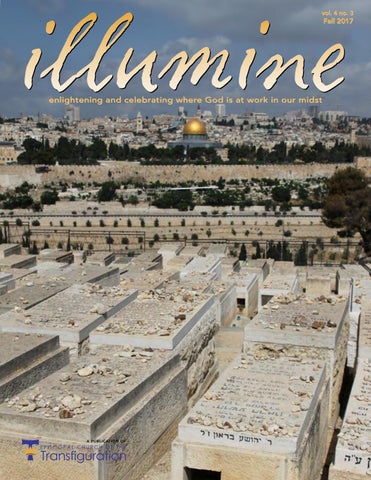
Cover photo by Casey Shobe
16
Fall 2017 episcopal church of the transfiguration illumine
3
From the Rector
Pastors and Identity
M
eeting with couples who are preparing to get married is one the real joys and privileges of ordained ministry. In just the
last few weeks I’ve had the opportunity to help two couples get ready for their marriage, and my conversations with them were intimate, hopeful, and holy. I wasn’t trying to teach them how to be married based on my own personal experience, as though just because I am married I know how all marriages can and should work. True, I have some wisdom gleaned from 12 years of experience, but I have to be careful not to project my relationship onto theirs. My goal is to explore various important issues and ask questions that will foster growth and development in their relationship, in hopes that it will help lead them to a lifetime of joy together. People occasionally say to me that they don’t understand how Roman Catholic priests can do premarital counseling, the assumption being that a person who is not and cannot themselves be married is somehow less able to talk to people about marriage. I think this is a misguided idea, because I don’t believe we need to be personally acquainted with an aspect of life to pastorally respond to someone else who is experiencing that situation. After all, if we play out this logic, it would mean that pastors are only effective with people who are within their same demographic group. I could, then, only really be effective as a pastor to straight, married, Gen X men with children, and would not be an effective or capable pastor to someone who is gay or black or female or from a different generation. But I would like to think that I was able to effectively pastor one of the two couples I mentioned above who is gay every bit as well as the other couple who is heterosexual. And that’s because my whole mindset in being with them was to listen carefully and compassionately, to draw on my education and teaching in order to
speak words of encouragement and support, and to pray lovingly with and for them. The intersection of my own life and identity with theirs is interesting, and it has the potential to enrich the conversation, but it is definitely not central to my efforts to serve them. Our shared humanity is the thing that bonds us together and is the primary lens through which I see them. There has been some discussion in our church in recent weeks, in the wake of the retirements of Fr. Michael and Deacon Liz, about whether older members of our church will have a pastor. To whom can people go, some have wondered, if they are in the second half of life? After all, at 39 I am the eldest priest on staff, and how could a priest in their 20s or 30s be a pastor to folks in their 70s or 80s? I understand this worry, as it makes natural sense to seek out the guidance and support of someone whom you think may know where you’re coming from or, perhaps, have experienced what you’re going through. However, I have trust and confidence in the clergy team to respect the dignity, to love wholeheartedly, to listen attentively, and to walk alongside every member of our church, regardless of age or race or gender or situation. I may not know firsthand what you’re going through, but I can still stand with you, listen to you, and pray with you. I may not have wisdom that comes from experiencing what you’re experiencing, but I have wisdom that comes from other life experiences, and from the guidance of the Holy Spirit. Your clergy team loves you and wants to be your pastors, regardless of whether or not we share everything about our identity in common. We are Christians, and that means the most fundamental thing about each and every one of us is our identity in Jesus Christ. I hope you will allow us the privilege of serving you whenever you need a listening ear or a prayer warrior. It would be our honor and joy, as it is the calling of God in our lives. —Casey+ PHOTO BY JOHN MAKOWSKI
4
illumine episcopal church of the transfiguration Fall 2017
Spending a Week at Mission Arlington By Meredith Sanders
T
his year, I went on my first church mission trip, at Mission Arlington the week of June 26, with five other middle schoolers and several chaperones. I loved the whole experience and I came back with journal pages full of memories. Out of the whole week, several experiences stood out to me. One experience I’ll remember for years to come is our first Rainbow Express which is Mission Arlington’s VBS program. When we first arrived at our Rainbow Express spot, a large basketball court with tables, it was mostly quiet. Confident that we would have kids, we started unpacking and setting up shop. When 10:30 a.m. rolled around, no one showed up. We waited a bit longer and Colin announced that we’d start Rainbow Express with ourselves. We got up and started playing games that we would teach the kids. Soon we were hot, sweaty, and tired, so we sat down to do storytime/crafts. Our craft of the day was reading a kid friendly story of Jesus’ forty days in the desert and the Devil trying to tempt him. When we finished making our crafts, we had some time left over. Instead of packing up, Colin sat us down and we did some reflective talking. We talked about the new kind of worship we experienced earlier in the day at Mission Arlington and how it differed from our worship. We discussed how we felt about it, each of us sharing our thoughts and perspectives with the group. Then we packed everything up, went to an afternoon service back at Mission Arlington, and got our service project.
Jr. High Mission Trip
The service project was truly a unique experience. We went to each apartment with a Rainbow Express flyer, a drink and chips to invite kids to join us the next day at our Rainbow Express spot. As a group, we made an outline of a mini speech that we would say when someone opened a door. Lucky me, I was the first one picked to knock on doors. I knocked on the first door and no answered. No one answered the second, third or fourth door either. I must’ve knocked on a thousand doors before someone answered. When someone finally did answer, I managed a “Hi” before Colin took over, because the man who answered the door didn’t look too friendly. I gave him the chips, flyer, drink and an awkward wave. I went back to the table to get more supplies and everyone clapped for me. We all had a chance to knock on doors and give our little speech before we split into groups. We were happy to come across three girls who loved Rainbow Express and came to it whenever Mission Arlington was offered. We covered most of the apartments and got better at speaking to strangers on the spot. I feel this was truly a confidence-building experience because we all got the humbling reward of having someone listen to us and accept our gifts with a smile. The very next day our hard work paid off and seven kids showed up! The following day 19 more came! It felt great to have others respond to our invitation of fellowship. Over the course of the week, I made lots of memories, grew in confidence and learned many things. I learned that some things might not go your way, but when one door closes, another one opens. I got more confidence in talking to strangers and lifelong memories that I will cherish of teaching kids that I didn’t know about Jesus. In my eyes, this mission trip was truly enjoyable with some challenges but I would not hesitate to do it again next year.
Fall 2017 episcopal church of the transfiguration illumine
5
PHOTOS BY JOHN MAKOWSKI
LEFT: Fr. Michael preaching; RIGHT: Fr. Michael leads the Liturgy of the Palms in March 2017.
AN INTERVIEW WITH
The Rev. Michael Merriman The Rev. Michael Merriman retired on August 31 after 13 years at Church of the Transfiguration and over 50 years of ministry around the world. We are so grateful for his influence on so many in the congregation. Here are his reflections on the occasion of his retirement.
1. How long have you been at
Transfiguration and how did you come to be here?
I came to Transfiguration in 2004 after I retired from full-time ministry. Cherrie and I had been living in Australia. My father had begun worshiping at the Fig a few year earlier. When he told Fr. Godwin (who is an old friend) that we were moving to the Dallas area, J. D. immediately wrote and asked me to come work part-time at Transfiguration, especially to start the catechumenal approach to new member incorporation, what we now call “The Way.” My intention at that time was to end that position and become a “pew-sitter” after 10 years (2014), though the departure of Fr. Godwin in 2013 and subsequent interim period found me staying on. Finally a little over a year ago I informed Fr. Casey that I intended to completely retire before the end of 2017. I’m happy that he has welcomed (indeed, urged) Cherrie and me to remain
part of the congregation. So after 50 years, I can finally worship God on Sundays beside my wife (while, no doubt, making notes of helpful suggestions to send Fr. Casey and Joel Martinson every Monday!).
2. Tell us about your ministry through the years and around the country.
I have been Curate at St. Stephen’s, Wichita Falls, which included St. John’s in Burkburnett. Was the first Rector of St. Barnabas, Garland. The Episcopal Church’s National Liturgical Consultant, working out of Washington DC.;
Rector of Camp Crucis in Granbury and Vicar (then Rector) of Good Shepherd, Granbury. Vice Dean and Canon Precentor of Grace Cathedral, San Francisco. Interim Rector of Gethsemane, Minneapolis. Head of St Mark’s Anglican College of James Cook University, Townsville, Queensland and Christian Formation Consultant of the Diocese of North Queensland, Anglican Church of Australia. I also was Lecturer in Liturgy and Church History in the first few years of the Anglican School of Theology, Dallas. Director of Youth Ministry in the Diocese of Dallas. Lecturer in Liturgical Studies at the Church Divinity School of the Pacific, Berkeley, California. Deputy to General Convention and a member of the Standing Commission on Liturgy and Music of the Episcopal Church.
3. What are a few of your
favorite things about serving in this parish?
The icon that was written for Fr. Michael on the occasion of his retirement representing the baptism of Christ.
Our commitment to living out our motto, Seeking and Serving All Persons. So glad to be in a parish that has been and continues to be a leader in inclusion of all people. Our liturgy and music are a joy (and I’m so glad I’ll be able to continue to be fed here in that way, now from the pews alongside my wife!)
6
illumine episcopal church of the transfiguration Fall 2017
PHOTOS BY JOHN MAKOWSKI AND ROBERT HACKER
LEFT: Michael shares his gratitude at the reception in his and Cherrie’s honor on August 27. ABOVE: Fr. Michael lights the new fire at the 2017 Easter Vigil. The new energy we are receiving from our gifted and youthful clergy leadership. I had become worried that we were in danger of becoming one of those churches that are filled with old people and led by old people. I’m old enough now to say to the other oldsters that this church we love can only continue to exist if it is reaching people who are young. Most of us old ones will not be here forever (unless out in the Memorial Garden!).
4. You’ve led our
catechumenate program during your tenure here. What is important to you about welcoming new Christians and Episcopalians to the congregation?
If the church is not actively finding, welcoming, and incorporation new Christians, it is a failure! And in this part of the country where so much of Christianity is exclusive and judgmental, it is vital that we be one of the small number of churches that offer the wideness of God’s love. There are many Christians in our nation and city who love our Lord, but who have been abused and rejected by churches. We have been able to offer them a way to love their Lord in a welcoming and healing community. In the past 12 years we have welcomed and incorporated more than 200 adults,
including almost 30 adults baptized as new Christians. And this has not been done by me either alone or even primarily. We have a team of more than 30 dedicated lay people who assist in this and who are committed to continuing and expanding The Way.
7. What’s next for you?
5. What are some of your
The parish church exists primarily for those who are not its members in order to draw them into faith in Jesus and to minister to their needs. Especially to work for justice and peace and to show the world how to respect the dignity of every person. Only secondarily is the parish church to be a chaplaincy to those who are already members. It can do that only if everyone in the parish is an evangelist; every member a human rights campaigner, a chaplain to those hurting, sick, or in need, and every one of our members each being pastor to their fellow parishioners.
most memorable moments in ministry (that you’re at liberty to share)?
The 15 years Cherrie and I led Youth Ministry in the Diocese of Dallas. My years as a consultant and contributor to the revision of the Book of Common Prayer. My ministry in Australia.
6. Any funny stories? Well, there was the time during a major service at Grace Cathedral, when a woman came up to the Altar during the Gradual Psalm and proceeded to take off all her clothes—how the music and liturgy ministers continued without pause and I was able to lead her out without further ado still amazes me (along with the looks from the choir members as I led her out through the Choir section of the Cathedral). Other than that, none that we have room for in this publication.
Time with Cherrie! Traveling. Volunteering with the Collin County Democrats. Writing. Worshiping at Transfiguration.
8. Any words of wisdom to share with us?
Fr. Michael’s final sermon as a member of the clergy staff was preached on August 28, 2017 and is available online at www.transfiguration.net/sermons. During worship that morning, Fr. Casey presented him with an icon written for the occasion. At the reception following the Eucharist, we were thrilled to announce that all of the costs for the 2018 South Africa pilgrimage, for which Michael and Cherrie had already registered, are completely covered for both them. Thank you to everyone who contributed to the send off and gifts! And don’t worry, Michael and Cherrie will still be in worship most Sundays, finally sitting together in the pews.
Fall 2017 episcopal church of the transfiguration illumine
7
Transfiguration’s Organ Scholar Some History & Our New Organ Scholar Nicholas Halbert By Joel Martinson
W
hen I was first hired as Transfiguration’s Director of Music & Organist in the spring 2003, Father Godwin, the rector at that time, told me that if I was able to grow the music program, he would support the hiring of a part-time staff member to assist me in my duties. As time went on, it was apparent that I could use both clerical staff and an assistant organist, but there was no money for either. Fortunately, before I interviewed for the position, my friend and colleague Jonathan Maedche, a Transfiguration parishioner with a Master of Sacred Music from SMU, told me that he would be willing to help with organ accompaniments as his time permitted. We had a small line item for organ assistance in the budget, so I was able to pay him for work at Christmas and Easter when we had brass or other instruments. Jonathan also substituted on the organ in my absence. Several years
later, another organist—Julane Swank—moved to the area and joined the Transfiguration Choir. She and Jonathan shared playing in a volunteer capacity as was needed. In the spring of 2010 when Easter and the organ dedication was approaching, Jonathan switched jobs, Julane had knee replacement surgery and then followed her husband to another church. These changes left me as sole organist, an increasingly-difficult task, as the growth of the Transfiguration Choir—in numbers and capability—and a new organ made possible much more significant and demanding anthems than before. Early in the spring of 2011 an organist moved to Dallas, having just completed his Masters’ degree in organ. After volunteering some at Transfiguration and playing Holy Week services here, he decided that he would be interested in serving as an “Organ Scholar” if we were able to create such a position. He sought to learn more about the work of an organist in the Episcopal Church by practical experience—accompanying hymns, psalms, and choral literature—as well as by gaining experience directing the various choirs we have
from time to time. Though the term “Organ Scholar” is not in widespread use in the US beyond some large Episcopal churches, it is a common position in the UK, particularly in cathedrals, and filled by someone who has normally completed an undergraduate degree. The Organ Scholar works under the Organist (also Choirmaster) and Sub-Organist to assist with the music program. In a way, an Organ Scholar is the musical equivalent of a Curate, who is a newly-trained priest or priest-to-be. Fortunately, we were substantially ahead of budget that summer, and Stephen Kahl, Senior Warden, worked with me to design a program which was approved to take effect the fall of 2011. Though this quarter-time position would provide Transfiguration with an assistant organist, our intent was for this to be structured as an Organ Scholar model, in which we would be able to share our musical resources with a recently-graduated organ student in order to prepare them for work in the larger Episcopal Church. The original person who had inquired about the program chose against working in church music at that time, so Glenn Stroh, a
LEFT: Last year’s organ scholar Wilhelm Sollie plays at the 60th Anniversary Solemn Evensong for Holy Cross Day. ABOVE: New Organ Scholar Nicholas Halbert poses at the organ with Joel Martinson.
8
illumine episcopal church of the transfiguration Fall 2017
Continued new young organist in town auditioned for and was given the position. Glenn had just begun a part-time job as Organist for Saint Mark’s School of Texas. He was aspiring to work in Episcopal church music, so very much fit the profile of someone for our newly-created position. Glenn served here from September 2011 until early January 2015, at which time he accepted a Director of Music & Organist position at St. Peter’s Episcopal Church in McKinney. In the spring of 2015, I contacted both Stefan Engels, the newly-appointed organ professor at SMU, as well as his colleague Christopher Anderson, organist in the Perkins Master of Sacred Music program there, to inquire as to incoming graduate organ students who might be interested in our Organ Scholar position. After reviewing the four resumes sent to me, and speaking to both professors, it was obvious that only the Norwegian organist Wilhelm Sollie had the “chops”—fingers and skills—to handle the musical demands and expectations that we have of an assistant organist. Wilhelm served from mid-August 2015 until his graduation with a Performer’s Diploma this May. Early this January, I began speaking with my colleagues at SMU regarding their incoming graduate students, and discovered that two potential new students had Episcopal background or experience. I attended the audition of one in January and met the second and heard him play after he attended
services here in February. It was obvious by the end of our brief time together that the second potential student Nicholas Halbert would be the best match for our new Organ Scholar. We flew Nicholas in to Dallas for a few days in mid-June, during which he found an apartment, met the staff, worked with me, and accompanied a choir rehearsal. He began the last week of August, and will serve Organ Scholar (Assistant Organist) while he studies for his Master of Music degree in Organ Performance. His biography as well as hopes for his time at Transfiguration appear below: Nicholas Halbert is a native of San Diego, California. His musical career began at eight years old as a Boy Chorister at St. Paul’s Cathedral there, where he would also soon begin to study organ under Canon Martin Green. Nicholas was appointed the Organ Scholar at the Cathedral at the age of 16, and held the position for two years before being accepted into the Eastman School of Music. His position at the Cathedral required him to accompany the choirs and provide voluntaries at both the weekly Mass and Evensong services, as well as giving several recitals over his tenure. From his time as a Boy Chorister to his time at the organ console, Nicholas has been immersed within the English Cathedral tradition, and has a deep love for this beautiful repertoire and practice. Upon attending Eastman, he studied organ in the studio of Nathan Laube, and harpsichord and fortepiano with Edoardo Bellotti, graduating in 2017 with a B.M. in Organ Performance. At Eastman he also prepared an honors thesis under the guidance of Glenn Mackin entitled “Democracy in the Concert Hall” for which he was awarded a B.M. in Musical Arts. Nicholas is a tenor and studies with Enrique Toral when he is in San Diego. As a recitalist, Nicholas is in demand performing at venues around San Diego, as well as at the Regional Convention of the AGO held there in 2015. He will be attending Southern Methodist University in the Fall to pursue an M.M. in Organ Performance in the studio of Stefan Engels. In addition to his busy musical schedule, Nicholas has a variety of colorful hobbies. He is a docent at the Whaley House Museum in San Diego, “America’s Most Haunted House,” where
he gives tours sharing stories about life in California during the Victorian era, as well as legends of the supernatural in Old Town. He loves to body-surf when the water gets above about 62 degrees, and he enjoys attending the summer season at the Del Mar Racetrack. At Transfiguration I am looking forward to playing weekly services on the elegant Richards, Fowkes & Co. organ, and developing consistency and excellency in my church work. I will especially enjoy finding repertoire which brings out the best colors and qualities of the instrument, as well as that which engages meaningfully with the liturgy and the congregation. I look forward to being in a community of excellent musicians, professional and amateur, who will have useful advice for me, as well as the sheer pleasure of performing with gifted people. And I most look forward to getting to know a congregation which I have already noticed in my brief interactions with the church is an extremely kind-hearted and fun group of people. I cannot tell you how impressed I am with Nicholas, and how much I am looking forward to working with him this fall! I hope that you will join me in welcoming him and helping him as needed throughout the coming months as he continues his journey in church music. In close, I offer you words from Wilhelm Sollie, in thanksgiving for his time with us: Being part of the wonderful music ministry at Transfiguration has been overwhelming! It was always great to see and hear the wonderful choir, always motivated and deeply interested people. The fact that they were coming every Sunday for services was stunningly to Wilhelm Sollie me! Being able to perform anthems, psalms and service music from different times and also a lot of music composed by contemporary composers was really inspiring. The organ was available at any time, that’s really something! Transfiguration is a phenomenal place for inspiration!
Fall 2017 episcopal church of the transfiguration illumine
9
From Aging to Sage-ing By Nancy DeStefano
A
while back an envelope arrived in the mail addressed to me from
AARP. Now I was used to seeing these mailings come for my husband, but for me? I wasn’t ready for that! Can it be? I was in my 50’s—was I old enough for AARP? Entering the second half (or third third of life—however you divide up our experience of living) is a time of transition and change. It can happen without our even realizing it and without much thought. We can enter “elderhood” kicking and screaming, denying our reality—or we can take hold of the aging experience and shape the second half of our life to be filled with meaning, purpose, and significance for ourselves and for the world. At Transfiguration we are beginning an outreach to those who are entering or are fully immersed in this stage of life. We have kicked off our work together with a formation class this fall, which will continue to meet during both class modules. If you can answer “yes” to some of these questions, this class may be for you: • Are you entering or already in the third phase of your life’s journey? • Are you nearing or in retirement? • Do you have wisdom and life experience to share with the world? • Do you want to continue to contribute to society in retirement? • Do you believe that senior citizens still have much to offer to our world even if society tells us otherwise?
Based on the work of Rabbi Zalman Schacter-Shaomi in his book From Age-ing to Sage-ing as well as others who are taking a new look at growing older, this Sunday School class will offer tools to help us to mindfully, intentionally and meaningfully live into this very important and life-enhancing phase of our lives. Some call it spiritual eldering, some mindful maturity, Rabbi Zalman calls it Sageing—whatever term we use it is the harvesting of the life experience, understanding and wisdom we have gained through our lives to enrich our years and continue to be of service in God’s kingdom. In our class we are considering such topics as: • Exploring the reality of living as a senior citizen in our culture and society • Harvesting the gift our life has been and continues to be through life review • Learning to forgive and heal past hurts and painful memories • Facing our mortality and acknowledging end of life issues • Doing the philosophical work of raising questions about the purpose and meaning of our lives • Exploring how we might serve as elders to others as guides, mentors and agents of healing and reconciliation on behalf of the planet, the nation and our families by being wisdom keepers • Transmitting the wisdom of our life experience beyond ourselves • Creating a legacy All of this is the work of the sage and all of us can embrace the challenge, the beauty and the significance of this time of life. Everyone
who wants to explore these subjects or to find fellowship with those in similar life stages is invited to join the Second Half Ministry as we launch. Questions can be directed to me (nancydestefano50@aol.com) or Al Blackwell (al@alblackwell.com). Nancy M. DeStefano is a wife, mother and grandmother and she is new to the Church of the Transfiguration. She is a Licensed Clinical Social Worker, and is certified as a Sage-ing Leader, a Spiritual Director, a Life Coach, and an Enneagram teacher. Nancy is a former United Methodist clergywoman. She has taught Sage-ing over the past five years. She currently serves as a regional manager and clinician with Wellqor, a psychological service organization serving clients in senior independent, assisted living and memory care communities. Nancy leads retreats and workshops in Sage-ing, the Enneagram, and other spiritual topics.
We who are many are one body … Become empty a spot here? have a small story or “ad”?
x 2.25" Eucharistic 7.75" Visitor and bring the Eucharist into someone’s home.
All ages are welcome, training provided, assignments on a monthly basis Contact Deacon Ginny Kivel to learn more at gkivel@transfiguration.net.
• a beacon of light • connection to community • • a representative of Christ’s love • •a
… for we all share one bread, one cup.
10
illumine episcopal church of the transfiguration Fall 2017
2017 Outreach Grant Recipients
T
he Outreach Committee is pleased to announce our grant recipients for this year.
The parish is funding 11 organizations through $25,000 from the annual budget allotment, and an additional $8,000 from the Outreach Gifts Fund. Many beneficiaries are “old friends;” three are agencies new to our grant request process (Journey of Hope, Kids U, and New Friends/New Life). This year, because of our long-standing partnerships with both organizations, the Vestry decided to designate funding for Austin Street Center and North Dallas Shared Ministries as part of the annual operating budget. Thus, they are not listed among these grant beneficiaries.
These grant recipients were recognized on Sunday, September 10 during the 11:15 Eucharist. Dallas CASA Ü $3,000 The mission of Dallas CASA is to recruit, train and supervise volunteers to represent the best interest of abused and neglected children while they are in protective care. CASA advocates are the “voice” of the child, helping him/her get the services necessary to heal from their trauma as the legal system considers a safe, nurturing home. Our grant will fund program funding to increase the number of volunteer advocates so more children can be served.
DME Exchange of Dallas Ü $1,500 The mission of DME Exchange of Dallas is to collect gently-used medical equipment, such as wheelchairs and walkers, and sanitize and refurbish these items for people who are unable to afford them. Our grant will fund repair, sanitization and distribution of the equipment.
Genesis Women’s Shelter Ü $3,000 The mission of Genesis Women’s Shelter is to provide safety, shelter and support for women who have experienced domestic violence, and to raise awareness regarding its cause, prevalence and impact. Our grant will be used for Camp G, the summer and holiday program for children living at the Emergency Shelter and Transitional Living Facility. Specifically, funds will go toward field trip expenses, supplies, and transportation costs for the children to participate in educational activities while their mothers are working and school is out.
Fall 2017 episcopal church of the transfiguration illumine
11
Happy Homes Preschool of South Africa Ü $3,000
St. Philip’s School and Community Center Ü $5,000
The mission of Happy Homes Preschool of South Africa is to provide a refuge, care and educational opportunities for young children, age six months to six years, in a desolate area of South Africa. A number of these children are orphans due to the AIDS crisis in their country. Our grant will be used for office supplies, such as a computer, fax and copy machines, etc. for the new administration building soon to be completed.
The mission of St. Philip’s is to provide an unparalleled education and compartible community services through a faith-based experience, with emphasis on serving low and moderate income families. Our grant will be used for Community Center programs, such as Afterschool Care, their Senior Citizen program, and basis administrative costs.
Journey of Hope Grief Support Center Ü $2,000 The mission of Journey of Hope is to provide no-cost group grief support to children, adolescents, and their parents or adult caregivers who have lost a loved one to death. This agency serves families from Dallas, Collin, Denton, Ellis, Fannin, Grayson, Hunt, Kaufman, and Rockwall counties. Our grant will be used for program operations and volunteer and staff training.
Kids U Ü $2,500 The mission of Kids U is to improve the lives of at-risk children by concentrating on education and issues that affect the whole child. The programs operate on-site in low income apartment c51f43 702878 communities in Dallas at no cost to the C: 16 C: 67 M: 100 M: 100 families. Y: 72 Y: 17 K: 5 K: 6 Our grant will be used for summer R: 112 R: 197 G: 40 G: 31 programs. Each day, Monday through Friday, B: 120 B: 67breakfast and lunch are provided, along with educational opportunities. This summer students will be learning about other countries, reading, taking field trips, having swimming lessons, reading, etc.
St. Simon’s After-School Program Ü $5,000 The mission of St. Simon’s After-school Program is to support elementary school children and their families who are challenged by economic and family situations by providing a safe, familiar, nurturing place for children to be after school. This free care includes nutritional snack, and support and assistance with academic and social development. Our grant will be used to help fund one of the St. Simon programs in a DISD school for a year. Up to 25 students are served per program.
The Gathering Ü $1,500 The mission of The Gathering is to serve the homeless in downtown Dallas by celebrating an outdoor Eucharist at Thanksgiving Square each Sunday, and providing support of other physical and spiritual need for those who attend. Our grant will provide winter hygiene kits, which include blankets, thermals and miscellaneous items, which can be distributed to those in need.
Birch
Voice of Hope Ü $4,000 The mission of Voice of Hope is to provide opportunities for children living in West Dallas neighborhoods. This program focuses on building strong character, providing education and life skills, and giving support to families. Our grant will be used to support out of school programs—ASPIRE After-School and Summer Day Camp, and the Early Childhood Education and Care Program.
Trebuchet MS
New Friends/New Life* Ü $2,500 The mission of New Friends/New Life is to restore and empower formerly trafficked girls and sexually exploited women and their children. Access to education, job training, interim financial assistance, mental health and spiritual support helps these women escape backgrounds of abuse, poverty and limited opportunities. Our grant will provide funds for member/children expenses as they transition to self-sufficiency. These expenses include food, clothing, shelter and counseling services. *Amy’s Friends is the other name of this organization.
Congratulations to all of our Grant Recipients!
12
illumine episcopal church of the transfiguration Fall 2017
A Reflection on a Pilgrimage to the Holy Land The Jesus of Long Ago is the Jesus of Right Now By The Rev. Erin Jean Warde
G
rowing up in Alabama, so close to the Gulf of Mexico, I’ve never been one to turn down a trip to the beach. As I flipped page after page of the
itinerary we were given from St. George’s Cathedral in Jerusalem, the many different holy sites and day-by-day adventures blurred. Part of me wanted to be completely ready for every site, well read, studied. However, another part of me desperately wanted to be caught off guard by the Holy Spirit in the Holy Land. We drove for a while past the Sea of Galilee, and I couldn’t believe how much it shone with blue. Even then, in the bus, only looking from afar, I sat astonished. When the bus was parked, we stepped out and—though I wanted to take off to the shoreline—we stopped and talked about the sea, listened to scripture, prayed together. The “amen” of our prayers struck me like the gunshot that signals that the
race has begun. I’m usually cautious about the temperature of water, never jumping in, and easing in toe by toe. Apparently, I find courage in the sea where Jesus swam, dragged in fish, and threw lines to catch people. I walked directly into the sea, grateful for Chaco’s to shield me from the rocky bottom. My eyes began to tear up, as the cool water surrounding my feet rocked calmly, like the presence of God reminding me that the Jesus of long ago is the Jesus of right now. Maybe the refreshing water from a sea in a desert gave me a chill up my spine, or maybe even my skin knew that God was close to me. I knew, from the minute I registered for the course, that visiting the Garden of Gethsemane would be one of the most moving experiences of the pilgrimage. I have leaned, maybe more than one should, of the peace I get from knowing that even Jesus— when faced with God’s will—struggled with what it means to say, “Your will be done.” When we arrived, I first noticed striking olive
BASILICA OF THE AGONY. A Catholic Franciscan church, one of the most magnificent churches in the Holy Land.
trees, gnarled and twisted by time. Tucked among shades of pink, purple, and white, the beauty and joy of the place betrayed the scripture I’d read. My mind’s eye went fuzzy, as I tried to discard the shrouded In the view of the garden Holy Land, I had always seen when I read the Bible, Jesus was to replace it with the incarnate in image before me. sand, trees, The garden was too beautiful. Too joyous. water, air. Too calming to be the place where Jesus prayed in anguish. The church on the same grounds, the Basilica of the Agony, was closer to what my mind’s eye created, with its low lighting, and darkened stained glass windows. The windows were the same pink, purple, and white, but dark, like I wanted the garden of Gethsemane to be. When we stood in the garden together, we listened to the scripture, and were then allowed to prayerfully walk through the garden and the basilica. We had earpieces, so that we could hear some of Gethsemane’s history while we walked. As I stood in front of the garden, I learned that some of the olive trees were old enough to have been present to Jesus. They were old enough to have been the young trunk he leaned on when he offered his grievous prayer. They were old enough to be the trees that stood awake with him while the disciples slept. It was then, through the olive trees, that I understood how a garden of such beauty and joy can also be the garden of Jesus’s agitated prayer. The trees were standing, wrinkled by time but still majestic. Jesus, wrinkled by our years of interpretation toward our own image, also still stands with power and truth.
Fall 2017 episcopal church of the transfiguration illumine
GARDEN OF GETHSEMANE. A garden at the foot of the Mount of Olives in Jerusalem, most famous as the place where Jesus prayed and his disciples slept the night before his crucifixion. One way that Jesus still stands with power and truth is through the community we build as the body of Christ. Our community of pilgrims was built from all across the globe: American pilgrims from Texas and Virginia, alongside Australians, Canadians, citizens of the U.K., new friends from Israel/Palestine, and much more. We were joined together each day beginning with Eucharist, and ending with Evening Prayer in St. George’s Cathedral. As pilgrim Wanda Roberts offered, “The love and communion I felt within the group was life changing! When I work with our service men and women, one of the great losses in their lives seems to be the camaraderie they felt in a unit closely knit, and in a life saving commitment to each other, and their united purpose. They believe that closeness cannot be replicated ‘back home.’ I felt something akin to that on our pilgrimage. We were united in our mission to draw close to Jesus and to support each other in that mission.” We were knit to one another through prayer and holy journeying, and the return to home was certain to be challenging, as we hadn’t lived “normal” lives for 17 days. For me, returning home happened just in time, as the wear of such a trip began to settle in my bones. Walking around in the Judean wilderness is not for the faint of heart, but my body was more able than my soul or mind. It is a taxing trip, but I found it to be more spiritually and emotionally exhausting than physically demanding. To see one holy site or site from scripture per
13
ST. GEORGE’S CATHEDRAL. An Anglican cathedral in Georgetown, Guyana and is one of the tallest wooden churches in the world.
day would be a lot to process, so when you sometimes see multiple sites in one day, just to wake up the next morning at 8:00 a.m. to do it all again, sometimes reflection gets lost in the shuffle. I think I will process this journey for years, if not more. I knew that in my ministry, this pilgrimage would startle me, but I didn’t know quite how. I was on the rota to preach Trinity Sunday, only a little over a week after our return. The gospel reading began, “The eleven disciples went to Galilee…” My eyes teared up, and I could all but feel the cool water on my feet and the rocking of the waves. I see this, I thought. Peggy Kwoka, fellow pilgrim, had a similar
THE SEA OF GALILEE. The Sea of Galilee, also known as Kinneret, Lake of Gennesaret, or Lake Tiberias is a freshwater lake in Israel.
experience of the Holy Land. In her words, “I gained an incredible education by participating in this trip. My understanding of the history, geography and terrain of the area has enriched my insights in reading the Bible… Most of all, walking in the places where Jesus walked and seeing the countryside that he saw was a spiritual experience.” In the Holy Land, Jesus was incarnate in sand, trees, water, air. For years, God had been made known to me in the breaking of the bread, but through this pilgrimage God was made known to me in the broken skin of my feet that walked where his blisters first tread.
14
illumine episcopal church of the transfiguration Fall 2017
New Vestry Selection Process By Nancy Jagmin
How Does the Vestry Operate?
f you attended a meeting of your Vestry sometime (which you are welcome to do), you might be surprised.
The Vestry is made up to 12 members; every year a new “class” of four people is elected to a three-year term and four people roll off the Vestry. The work of the Vestry is organized into three committees: • Budget, Finance, and Administration (BFA) • Building, Grounds, and Technology (BGT) • Mission and Ministry (MM) Every Vestry member is assigned to a committee, led by a Chair. Each committee meets monthly, before the next meeting of the total Vestry. A typical Vestry meeting includes reports from each committee and a discussion of issues or plans under consideration by that committee. Sometimes that committee makes recommendations which require a vote of the total Vestry, so all Vestry members need some working knowledge of the work of all three committees. Every committee assignment requires common sense and a sincere willingness to serve our parish. Members learn a lot about the work of the committee by serving on it, but it is helpful when new members already have some expertise in one of the three domains of work. This enables them to more effectively chair that committee by their third year on Vestry. In addition, each year we need to two people who are ready to handle the significant leadership demands of being Senior Warden and Junior Warden.
I
There is discussion of the financials for the past month, discussion of variances to planned expenditures or expected pledge revenue, and discussion of pressing issues about the buildings, staff, and ministries of the church. Someone may be reporting on the progress of an initiative toward our five-year strategic plan to ensure the vitality of our church. After a few minutes, you may think that you had the wandered into the executive staff meeting of a working organization, and, in fact, you have! We begin with prayer and spiritual reflection, but after that, our meetings tend to be very task-focused. The Vestry is a working leadership team. We review and discuss new information, lead projects, weigh trade-offs, and make decisions on behalf of the congregation. We don’t just review the work of the paid staff! Our Vestry is called to be reliable stewards of our parish, and the tasks of leadership are becoming more complex. The Vestry administers a large budget, staff, and physical plant. Last year we also created a five-year strategic plan, designed to keep our church relevant and vibrant, and we are now pursuing strategic initiatives to make that plan a reality. The complexity of leading a church of our size should not be underestimated. The objective of this brief article is to give you a glimpse into how the Vestry operates and what we are doing to modify the process by which the Vestry is selected.
How Was the Current Vestry Selected? The current Vestry selection process begins in the summer with the selection of a Nominating Committee Chair, drawn
from the BFA committee. The Nominating Committee Chair recruits a committee to help surface well-qualified candidates. Self-nominations to Vestry are solicited in the Notices, but in the past few, if any, were received. As a result, the Nominating Committee has typically needed to recruit nominees, a task that involves consideration of functional/technical and leadership skills, as well as involvement in church activities. Most years, the Nominating Committee has a difficult time gaining the consent of six candidates to run for the four open positions. Not infrequently, individuals have by-passed the Nomination Committee to enter a selfnomination right before the election. The election is held in October, but typically less than 20% of elibigle voting members cast ballots, despite the recent addition of absentee balloting.
Why Should We Change the Vestry Selection Process? As we move into the future, it will be important that the Vestry possess functional/ technical expertise to best equip its efforts to lead our church. There are many life experiences, in and outside the church, that can prepare a person for Vestry, but we also need specific types of expertise and skills to create a well-rounded and effective team. One of the objectives of our recent parish survey was learn more about the expertise in our parish. This past summer we also completed a project to ask Vestry members about the skills and experiences that prepared them for the work of Vestry membership. We will share that compiled information to facilitate the work of the Nominating Committee. In conjunction with this skills analysis, there are a few steps in the selection process
Members learn a lot about the work of the committee by serving on it, but it is helpful when new members already have some expertise in one of the three domains of work.
Fall 2017 episcopal church of the transfiguration illumine
that we want to change. Ideally, the Vestry selection process should be open, inclusive, and effective, yet we are only partially achieving these objectives now. 1. The process is effective if it yields a Vestry class with a good representation of needed expertise and experience. However, in our current process, voting members may not fully understand the leadership needs of the Vestry for the incoming class, and thus not make choices that best equip the team.
2. As for inclusivity, only a fifth of the congregation typically votes, so there is no reason to assume that the chosen candidates are truly representative of the entire congregation. 3. And finally, the process doesn’t feel
Old Process Nominating Committee
• Committee chair selects committee
properly open to candidates who were recruited by the Nominating Committee because of their expertise and experience, yet weren’t elected by the small percentage of voters.
15
How is the Vestry Selection Process Changing? This past summer, a sub-committee of Vestry members considered how to modify the election process in a way which would help us select the leaders we need to lead our church in the future. They made modifications to the proposed process in response to feedback from the Rector, Vestry, and Parish Council. The chart below shows how our Vestry selection process is changing.
New Process
Benefit
• Committee formed largely from selfnominees
• Improved openness, inclusivity
• Includes three previous Sr. Wardens “Qualifications” Specified
• All candidates must be a church member in good standing
Candidate Slate
• Nominating Committee reviews all candidates • Most qualified candidates • All members in good are “recommended” and recommends a slate of four, designated standing who selfas such on the ballot nominate are on the ballot • Ballot is still open to everyone who self• Self-nominees who were not recommended nominates may also choose to be on the ballot
Final Candidate Selection
• Vestry members elected by congregation via a written ballot
• Helpful expertise, leadership skills, and typical • Clarity and transparency around expectations for experiences on the path to church leadership Vestry service also are specified
• Vestry members elected by congregation via a written ballot • Nominating Committee recommended slate is indicated on ballot
• Clarity about who the Nominating Committee recommends, based on their evaluation and knowledge of needs
The Nominating Committee for 2017 is made up of Gene Bledsoe, Debra Boopsingh, Barbara Cody, David Corbett, Babs DeLizza, Alan Dunlop, Nancy Jagmin, Stephen Kahl, Jim Kirkman, Katy Spicer, and Bart Stockton. Now the process of inviting individuals to nominate themselves for Vestry and build a recommended candidate slate is underway. The process still begins by asking for your discernment. Have you sometimes wondered whether if you feel called to serve on the Vestry? Do you know someone whose skills and experience would contribute to church leadership? Printed Vestry application materials are available in the church office, or you can receive them electronically from Nancy Jagmin, Committee Chair (nancy@jagminconsulting.com). The deadline for applications is Sunday, October 8.
The Vestry is a working leadership team. We review and discuss new information, lead projects, weigh trade-offs, and make decisions on behalf of the congregation.
16
illumine episcopal church of the transfiguration Fall 2017
Episcopal Peace Fellowship By Ron Damholt and Rob Huttmeyer
T
he Episcopal Peace Fellowship (EPF) traces its roots to November of 1939, merely two months after Hitler’s invasion of Poland. Widespread war on the European continent had begun in earnest, and as it seemed highly likely that the U.S. would ultimately enter that war, conscientious objectors within the Episcopal Church were searching for resources and support: EPF was initially formed to provide that support. The work of EPF as a national organization has developed and expanded greatly over the past 78 years. Today its stated mission is “to pray, study and take action for justice and peace in our communities, our church and the world.” EPF strives to carry out this mission through the work of a National Executive Council, Peace Partner Parishes, and Local Chapters. In addition to its leadership and support of local efforts, the National Executive Council works to provide presence and voice on issues of peace and justice at every General Convention of the Episcopal Church. However it’s at the local level we “in the pew” are most likely to encounter EPF: for example
Ministry Spotlight
Episcopal Church of the Transfiguration is a Peace Partner Parish, and the North Dallas Chapter of EPF meets monthly in our own MacMaster Library. Just over two years ago, in July 2015, four people came together to found the North Dallas Chapter as a means to encourage one another to pray, to study and to act in the name of Christ for peace and for justice. To that end, over the past year the chapter has: 1. Screened and led discussions of four justice-related films, two of these in conjunction with the Fig’s Open Door Fellowship2 2. Taught two Sunday morning adult education classes, one on themes of justice in Romans and one focused on peacemakers such as Naim Ateek, Dorothy Day and Thurgood Marshall 3. Initiated Peace Post, a monthly opportunity for Christians to gather together and write letters to elected officials regarding issues of public justice on which they’ve reflected in the light of their faith. During the coming year, EPF also plans to offer training in peacemaking to individuals (members of the Fig as well as other nearby congregations) and to arrange a visit (for all interested persons) to the Islamic Association of North Texas in Richardson, in order to stand with our brothers and sisters in prayer and support at a time when many Muslim communities of faith are facing considerable
hostility. We’re also considering arranging at least one “Conversation Cafe,” providing the opportunity to discuss approaches to issues of justice with public figures from our immediate area. Matthew writes of Jesus traveling through Galilee and “proclaiming the good news of the kingdom,” and every Sunday we pray that God’s “kingdom” shall come, that God’s will “be done on earth as it is in heaven.” A well-known rabbinic way of naming this goal is “the healing of the world,” and many Christians similarly speak and write of working toward “restorative justice” throughout the earth. In the name of Christ and in the power of the Spirit, the North Dallas Chapter of EPF is committed to working toward these ends—and we invite any who are interested to add to our small efforts their own prayers, presence, creativity and action. 1. http://epfnational.org 2. See the summer 2017 issue of Illumine.
Below: Members of Transfiguration write to their elected representatives on the first Sunday of each month for the Peace Post.
Fall 2017 episcopal church of the transfiguration illumine
17
Compassion in the City Welcoming Glennon Doyle
By The Rev. R. Casey Shobe
I
t is so heartbreaking that God has to command us to love one another. You would think that we
would be able to love just fine without being commanded to. After all, love is the central characteristic of God, and it is essentially who God is. Theologian Catherine LaCugna creatively imagines that all of creation is the product of love spilling forth from God’s own self at the dawn of time (creatio ex amore Dei). Which means love is not only the foundation of creation, but it is also at the heart of what it means for us to be created in God’s image. So you might think we could do it without being commanded. But God has to command us to love because loving people is hard. Liking people is easy. Politely tolerating people is easy (well, most of the time it’s easy). But loving people is hard. To love someone is to care about them so deeply that their life and health and well-being is of utmost importance to you, and that can be challenging and exhausting. I remember a parishioner from my previous church who came back from a mission trip and debriefed with me about the difficulties of the experience. I thought she was going to tell me how hard the work had been, or about the challenges of overcoming the language barrier, but instead she just needed to vent about a fellow member of the team (another parishioner), who had behaved especially badly, causing tons of headaches and hardships, and forcing the rest of the team to care for her as well as pick up the slack. “My body is tired, but my love muscles are exhausted!” Love is about more than liking someone or politely tolerating them, and love is certainly more than feelings. Feelings are good, and feelings matter. When love dwells richly in us, we should feel less afraid; we should feel greater peace; we should feel more hopeful. But feelings are not love. Writer and activist Glennon Doyle says that “feelings are just energy. Eventually we’ve got to make something with them.” And what we make
with them is love. Because love is not feelings, it’s a way. It’s an active, moving, working orientation. We can feel things all day, but until it reaches our hands, it’s not love. “Love is the result of hours and days and years of using your hands and heart and mind to show up in a million different ways for other people,” Glennon writes. “We don’t wait to act until we feel loving—we act so that we will feel loving. You don’t wait for love—you create it.”1 Yes, love is hard, and so is its companion, compassion. They’re hard to do in a world like ours, because they aren’t always easy or simple or straightforward, and they take time to create and nurture and share. Sympathy flits through our minds when we hear news about something sad or hard, but then it’s gone. Compassion, on the other hand, is sympathy that causes us to respond. It’s when the feeling reaches our hands and feet. And that can lead us into strange and complicated places to encounter hurting people and try to serve them. But as hard as this can be, the Gospel shows us that we meet Jesus in just those places, because he is always seeking out the lonely and forgotten and suffering people of our world.
This September I’m proud that Transfiguration is partnering with First United Methodist of Dallas to sponsor an evening with Glennon Doyle, where she’ll speak about how we can create more love and foster greater compassion in our lives and in our community. As those of you who are familiar with her know, Glennon possesses unique wisdom and insight, which she gleans from the ordinary moments of everyday life, and she tells great stories that bring big ideas into focus and encourage people to keep at the hard and beautiful work of loving (she calls it “brutiful”). I very much hope you’ll choose to attend, and consider inviting others to join you. This is a fantastic “evangelism opportunity,” as Glennon is accessible and inspiring even to those who have little or no familiarity with the gospel. God commands us to love, but that doesn’t mean it’s always easy. We must encourage one another in this most sacred and important of callings, so that we can stay on the pathway of the one who is love, and in whose love we live and move and have our being. 1. http://momastery.com/blog/2016/04/12/life-is-hardbut-they-are-brave
I very much hope you’ll choose to attend, and consider inviting others to join you.
18
illumine episcopal church of the transfiguration Fall 2017
Why Transfiguration? Angel Sanchez and Amy Kraehe This church had the right purpose and programs for a suburban family of five looking for fellowship and spiritual guidance.
A
fter roughly five years of visiting various churches in the North Dallas area, we had the great fortune to stumble into Transfiguration in 2015. Our ideal place of worship for our family was shaped by past experiences, both inspiring and otherwise. We are thankful that the long search for a church home paid off, and now we find ourselves in a place that nourishes our minds and hearts. Amy grew up in the Episcopal faith in Atlanta, Georgia. She and her family attended the Church of the Epiphany, which espoused an inclusive atmosphere. This church had the right purpose and programs for a suburban family of five looking for fellowship and spiritual guidance. Her experiences at Epiphany are undoubtedly the primary reason we find ourselves at the Fig, as both churches share very similar visions. I grew up in the Catholic faith. My family attended church regularly in Mexico until an
Not only does Transfiguration provide the spiritual food and challenging thought for us as parents, but it excels in fulfilling many developmental and social needs for our young ones. opportunity arose to relocate to south Texas. In the eyes of 10-year old Angel, my world was completely changed upon crossing the border. For my two working parents trying to make ends meet, church had become a luxury that time could not afford. As a young married couple life took us to Austin, TX where we attended the First Unitarian Universalist Church for five years until relocating to the Dallas area. As our family grew, it became evident that our children needed more than just the common-sense wisdom we could offer. Not only does Transfiguration provide the spiritual food and challenging thought for us as parents, but it excels in fulfilling many developmental and social needs for our young ones.
Balancing a family life as two working parents can be difficult, and it sometimes seems impossible. Transfiguration helps us find purpose, calm, and perspective in our daily struggles. We enjoy taking part in the adult formation classes and participating in ministries. I took on the role of usher with much enthusiasm. It has become a good way of meeting folks, many of them also parents of young children. Amy has enjoyed teaching Wee Wonder for the toddlers. Educating graduate students during the week and toddlers on the weekend keeps her brain at maximum flexibility! We look forward to many more joyful and educational years at Transfiguration.
I am
Fall 2017 episcopal church of the transfiguration illumine
19
This fall our stewardship campaign features the stories and images of dozens of different parishioners in order to help us portray the diversity of our church, both in people and ministries. Transfiguration is a big, dynamic church, and our vitality depends on the active commitment and generosity of everyone. So, take a look around the halls this month for pictures of fellow members doing the things that connect them with God, the things they love, and the things that help them serve and give back. Throughout the campaign, we are featuring the reflections of many of those same people, who’ve been asked to consider two important questions: how does Transfiguration connect you with God, and why do you believe you’re giving to God when you give to Transfiguration? These two questions are the core of this campaign, as our individual answers to them are at the heart of our personal decisions about giving. Excerpts from each reflection are included in your Stewardship packet, which you’ll receive in the mail this week if you didn’t pick it up in person last weekend. A mid-week email will be sent each week featuring several people’s reflections in full. Please take the time to read them and consider how they mirror your own experiences of God and giving at Transfiguration During the Eucharist on September 16–17 we had our first Stewardship Reflection panel during which Fr. Casey engaged in conversation with different members about how they feel connected to God at Transfiguration, and how giving they understand their giving to our church to be giving to God. We’ll hear from a different group of four people in lieu of the sermon on September 30–October 1. Then, on Sunday, October 8, we’ll share in a single 10:00 Ingathering Eucharist and present all our pledges to be blessed by God. It is extremely important that our pledge results grow this year, and the Stewardship Committee has set a goal of a 10% total increase. This number stems from analysis of basic cost increases, as well as a desire to better pursue several of our strategic goals. Last year we welcomed over 50 new pledging households, in addition to nearly 400 returning pledging households, and this year we’ll need an even greater response to reach our goal! Every member matters, every pledge counts, and every act of sacrificial generosity, no matter how big or small the dollar figure, is seen and known by God.
14115 Hillcrest Road Dallas, TX 75254
Transfigured Nights 2017-18 Season
Let everything that has breath‌ www.transfiguration.net/transfigured-nights