
Letter from the Dean

Dear All,
It is a pleasure to write to you, the distinguished students, faculty, staff, alumni, and friends of Illinois Tech’s College of Computing. Before reflecting on this edition of our magazine, I want to express my deep gratitude to Lance Fortnow, our inaugural dean. He laid the foundation for the college you see flourishing, and without his leadership and dedication, we would not be producing the kind of impact that you’ll read about in this issue.
In these times of profound technological transformation, I find myself reflecting on what endures: a commitment to discovery, innovation, and humans flourishing through computing. The work highlighted throughout this magazine reminds us that technology’s true purpose is to enrich lives, expand understanding, and forge connections across communities.
Yet, we stand at an inflection point. As artificial intelligence reshapes our world, we must ask fundamental questions: How do we prepare graduates to use AI and to guide its development toward human good? How do we fuel research that addresses society’s most pressing challenges? How do we bridge academia and industry to amplify our impact?
Our response has been deliberate. We launched three strategic task forces focused on educating AI-agile graduates, accelerating research and innovation, and deepening industry partnerships. We welcomed eight faculty whose expertise spans AI, cybersecurity, networking, and the mathematics underlying quantum and traditional computing systems. We outlined initiatives to improve access and outcomes for students while advancing discovery and meeting the needs of industry, government, and society. We are leading efforts to meet learners wherever they are—on campus, online, globally—serving both degree-seekers and professionals who are advancing their careers.
I hope you enjoy reading about the successes of our faculty, students, staff, and alumni in these pages. The College of Computing stands ready to adapt, accelerate our impact, and advance computing in service of humanity.
Nicole L. Beebe Dean
College of Computing nbeebe1@illinoistech.edu
Dean, College of Computing
Nicole L. Beebe
Vice President for Enrollment Management and Student Affairs
Mallik Sundharam
Associate Vice President for Marketing and Communications
Chelsea Kalberloh Jackson
Director of Content
Andrew Wyder
Editor
Casey Moffitt
Design
Joe Goforth
Photography
Jamie Ceaser
Michael Reiter
Copyeditor
Casey Halas
College of Computing Magazine is published annually by the Office of Marketing and Communications and the College of Computing. Send Letters to CollegeofComputingMagazine Office of Marketing and Communications 10 West 35th Street, 13th Floor Chicago, IL 60616
Mission Statement
Provide the students and faculty of Illinois Tech from all backgrounds and disciplines the best-in-class computational and data science platform to excel in their respective fields.
ADA Statement
Illinois Institute of Technology provides qualified individuals with disabilities reasonable accommodations to participate in university activities, programs, and services. Such individuals with disabilities requiring an accommodation should call the activity, program, or service director. For further information about Illinois Tech’s resources, contact the Illinois Tech Center for Disability Resources at disabilities@illinoistech.edu.
On the Cover
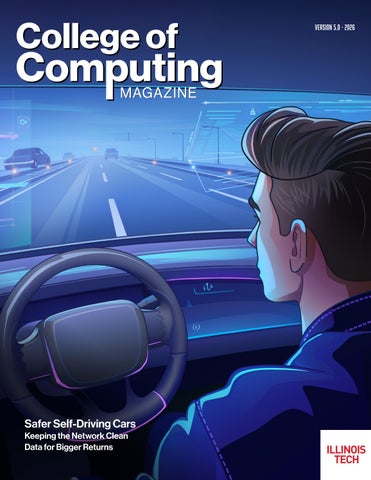
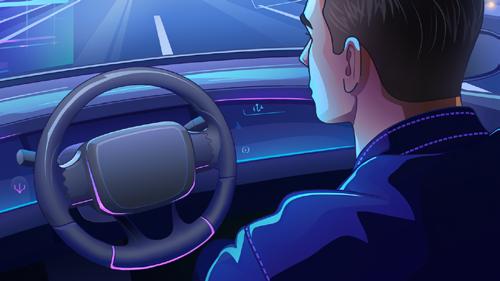
Cover generated by Adobe Firefly, given the prompt: “A dynamic magazine cover illustration depicting perspective shot from the rear through a driverless car, with the back of a slightly nervous passenger sitting in the right backseat with his head turned toward the the driverless wheel that is moving on its own as it drives; all the safety alerts and guides are depicted like augmented reality projected onto translucent windows. In the background distance is the road ahead.”


2
Artificial Intelligence
Illinois Tech students are applying artificial intelligence in projects that aim to create social good. 8
4
Cybersecurity
Faculty and students at Illinois Tech are pushing the boundaries of cybersecurity through innovation and research.
Cybersecurity Sleuth
Yacin Nadji (CS ’09) keeps networks safe by staying current with the latest attacks as a lead security researcher at Corelight.

Maximizing ROI
Nithya Mahadevan (M.S. CDSO ’18) builds mathematical and machine learning models to help advertisers make their money go further as head of data science for Google Americas.
6
Data Science
Illinois Tech faculty apply data science in new ways, while students solve real-world problems.
10
Driving Innovation
Gonzalo Florez Arias (M.A.S. ITM ’22) works to make autonomous vehicles demonstratively safer than human drivers as an engineer at Aptiv.
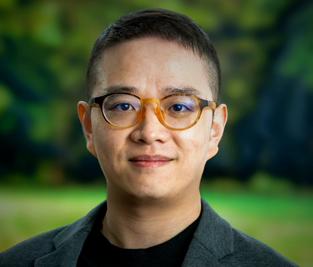
Earning an advanced degree in mathematics not only helped Hongwei Jin (M.S. AMAT ’14) gain the knowledge that he needed to earn a Ph.D. in computer science at University of Illinois Chicago and become an artificial intelligence and machine learning researcher at Argonne National Laboratory as a postdoctoral appointee. It also gave him an unusual approach to problem-solving.
“My background in applied math helped me approach complex problems analytically and develop rigorous models, which are essential in AI and machine learning research,” Jin says. “The mathematical training also made it easier to grasp advanced topics in computer science, such as optimization, statistical learning, and neural networks. Mathematics
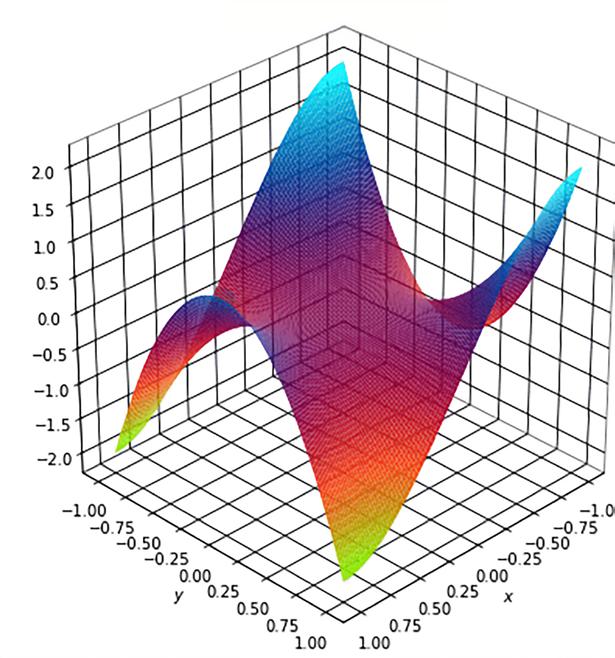
provides a solid foundation for understanding algorithms, data structures, and computational theory, which are core components of computer science.”
Jin says having advanced understanding of linear algebra, probability and statistics, optimization, calculus, discrete mathematics, and function analysis have proven essential in his research on Argonne’s AI4Science initiative, which focuses on leveraging AI and machine learning to advance scientific discovery. The program integrates AI techniques with scientific research to solve complex problems in fields such as materials science, climate modeling, biology, and energy systems. His research explores high-performance computing and machine learning to develop predictive models and focuses on domains in scientific computing and
Turning AI Research Into Social Good Want to Maximize AI? Study Mathematics
Conducting research with a team of students has given Pranav Kuchibhotla (AI 4th Year) the confidence he needs to pursue a career in machine learning. After completing a research project with Associate Professor of Biomedical Engineering Keigo Kawaji, Kuchibhotla says he joined his classmates to form Ocean’s Four-vArI to vie for the Grainger Computing Innovation Prize. The competition challenges student researchers to tackle projects that address real-world problems in education, health, energy, public safety, transportation, economic development, sustainable smart infrastructure, climate change, and more.
Ocean’s Four-vArI is a volunteer computing platform that runs
ocean-drift simulations on users’ devices. It aggregates thousands of lightweight AI-informed trajectories to predict plastic hotspots, nearly in real time, without supercomputers. The project earned the team third
energy systems.
“These experiences not only enhanced my technical skills, but also helped me build a professional network and gain confidence in my abilities, ultimately guiding me toward a career in AI research,” he says.
place and a $5,000 prize.
“That was the first time I saw an idea go all the way from a rough sketch on a whiteboard to a working tool with real impact,” he says.
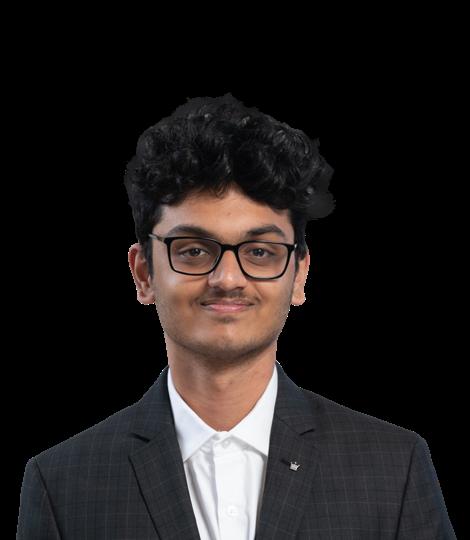
“Standing with my teammates and explaining our work to judges and guests made me realize that I really enjoy building AI systems that solve concrete problems.”
Kuchibhotla says this hands-on experience has complemented his coursework and helped prepare him for a future, either as a machine learning engineer or by pursuing graduate studies.
“Competitions and research have forced me to learn how to explain technical work to different audiences and work in teams,” he says.
Old Propaganda Tricks Add Digital Upgrade
A look to the past may soon seem like a look into the future, according to Illinois Tech researchers who recently explored how psychological operations have evolved and how artificial intelligence is changing them.
“Weaponising the Mind: AI, Cyberspace, and the Future of Psychological Operations,” written by Illinois Tech Associate Professor of Information Technology and Management Maurice Dawson and students Cedric Nartey (ITM/M.A.S. CYF 4th Year) and Abdul Hadi Khan (M.A.S. CYF 2nd Year) was published in the Journal of Military Studies
“I’m especially interested in cyberpsychology and cyber warfare and how influence operations evolve alongside
Driven to Create Safer Roads for All
Danish Nadar (AI/M.A.S. AI 3rd Year) changed the way that he looked at transportation after he was struck by a speeding car. That experience got him thinking about how quickly everyday travel can become dangerous, and how he could affect change.
“After that incident, that topic transformed from an interest to personal ambition,” he says. “It clarified what I want to spend my life working on, motivated me to use (artificial intelligence) and autonomy to build safer road travel systems, improve decision-making in complex environments, and

communication tools,” Nartey says. “AI is part of that evolution, but the core issue is psychological manipulation at scale. That broader intersection of human behavior, security, and strategy is something I hope to explore further.”
The paper traces the evolution of psychological warfare from World War II to present-day disinformation campaigns, and it highlights how adversaries can exploit democratic transparency to undermine public trust. The research team also explores how AI has added to the psychological warfare toolkit and changed how psychological operations work across physical, digital, and emotional platforms.
“Whether it’s AI-assisted or manually crafted, psy-ops succeed by exploiting emotion, bias, and information overload,” Nartey says. “It may seem like a new beast, but it’s the same old tricks.”
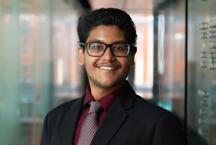
leverage novel technologies to develop exceptional and life-changing applications.”
Nadar is fascinated by autonomous vehicle technology and the idea that software could reduce human error. He is exploring his fascination through Illinois Tech’s Elevate initiative and
“
I was able to apply classroom skills such as Python, linear algebra, and modeling concepts, which made it easier to understand how the gait data translates into actual motion.”
joining the university’s EcoCAR team as a connected and autonomous vehicle engineer.
“The Elevate [initiative] stood out because it emphasized internship access, real professional experience, and a clear pathway to develop industry-ready skills,” he says. “After I arrived, I discovered even more opportunities that reinforced that decision, including hands-on teams such as EcoCAR, engineering organizations, and development groups. Those experiences ended up aligning perfectly with my ambitions.”

—Sharanya Mishra (M.A.S. DSC 2nd Year) discussing her RES-MATCH gait analysis project for robotics, where she learned to interpret human motion through kinematics with Illinois Tech Assistant Professor Nelson Rosa.
Pictured Left: Original political party photo. Right: AI misinformation-created photo. AI, artificial intelligence.
CYBERSECURITY
Testing More Than Technical Skills
Representatives from Illinois Tech’s CyberHawks cybersecurity student organization complemented their technical skills with professional soft skills as they claimed third place at the Great Lakes Regional of the Global Collegiate Penetration Testing Competition (CPTC).
Cybersecurity teams from 10 universities convened at Baldwin Wallace University in Berea, Ohio, to compete in a real-world penetration testing contest. The competition establishes a mock organization that is soliciting penetration testing services. Students act as members of a security firm and are asked to perform the testing and provide deliverables.
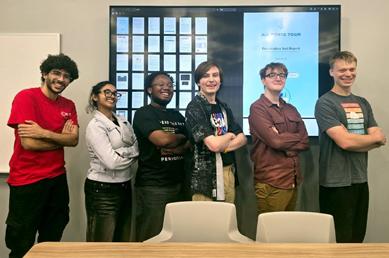
pressure while staying organized.”
“The main lesson we took away is that security is not only about finding vulnerabilities,” says Mohamed Trigui (CS, M.A.S. CYF 5th Year), CyberHawks team captain. “It’s also about thinking like an attacker, understanding how small weaknesses connect, communicating clearly with clients, and working under
Trigui was joined by Benjamin De Pater (CS 4th Year), Lucas Ferguson (CS 4th Year), Natorion Johnson (ECE 3rd Year), Kacper Stasik (CS 4th Year), and Mohithaa Ekambaram (M.A.S. CYF 2nd Year). The team was coached by alumnus John Ford (ECE, M.S. ECE ’23), who currently works as a penetration tester at NetSPI, and was accompanied by Industry Professor of Information Technology and Management James Papademas
Weaponizing Malware for War
A team of Illinois Tech student researchers have broken down how hackers implemented cyberattacks as a new weapon of war during Russia’s invasion of Ukraine in a recently published paper.
Arsheen Kazi (M.S. ITM 2nd Year), Samreen Kazi (M.S. ITM 2nd Year), and Saloni Bhosale (CYF 2nd Year) published “Invisible Battlefields: Analyzing the Viasat Attack and Its Broader Applications” in Sciendo, which breaks down how hackers attacked a Ukrainian communications satellite just before Russia launched its full-scale military operation on the country. The
cyberattack crippled Ukrainian military communications, power grids, and internet access.
“It happened just one hour before the invasion of Ukraine by Russian forces, and the fact that one small piece of malware could disable the entire satellite connectivity not only in Ukraine but all across Europe was both fascinating and alarming,” Arsheen Kazi says.
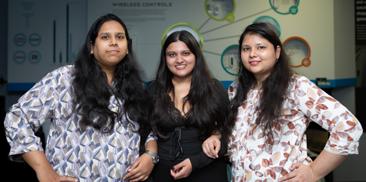
The cyberattack on the Viasat KA-SAT satellite was a coordinated element of Russia’s military strike on Ukraine, the researchers conclude in their paper. The hackers broke into the satellite’s servers by exploiting a weakness in a virtual private network (VPN) to install “AcidRain” malware to disrupt Ukrainian military communications and operations, shut down civilian access to the internet, and knocked out wind turbines as far west as Germany.
The most exciting aspect of the visit was the opportunity to bridge U.S. and North African education systems through AI and cybersecurity. It offered a platform to share Illinois Tech’s cybersecurity and AI education model while learning from Tunisia’s growing technology ecosystem.”
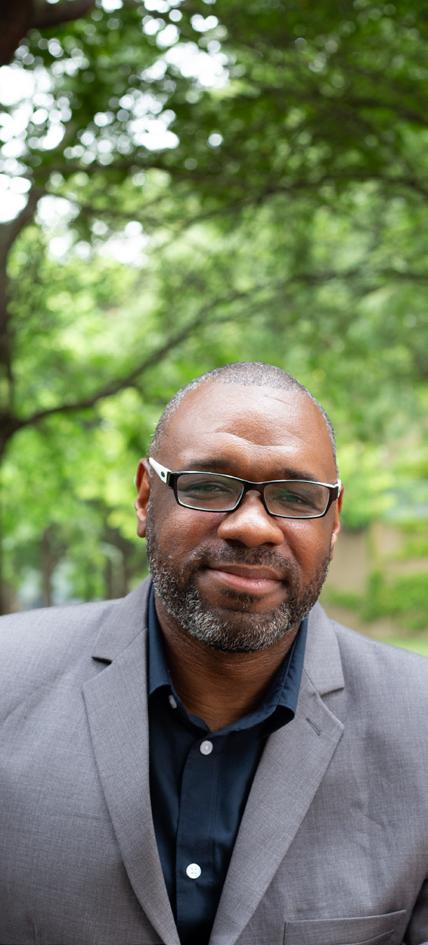
—Maurice Dawson, associate professor of information technology and management at Illinois Tech, lent his expertise in cybersecurity and artificial intelligence to Tunis Business School at Tunis University during his sixth experience with the United States Department of State’s Fulbright Scholar program.
Award-Winning Research Aims to Defend AI Systems
Developing a defense for a new backdoor attack will make training a federated graph learning (FedGL) framework safe from present and future dangers and earned an Illinois Tech researcher a Best Paper Award at the Association of Computing Machinery Conference on Computer and Communications Security.
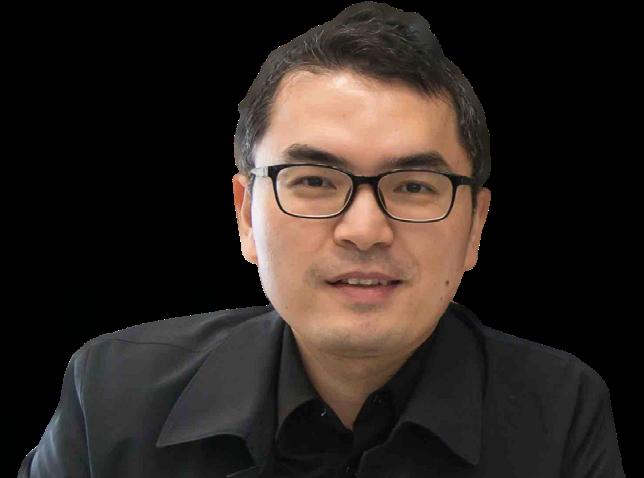
Assistant Professor of Computer Science Binghui Wang and his collaborators earned the Best Paper Award in the conference’s Artificial Intelligence Security and Privacy Track for “Distributed Backdoor Attacks on Federated Graph Learning and Certified Defenses.” The paper was submitted to the ACM’s Special Interest Group on Security.
“Our team leveraged more than five years of pioneering work in provable defenses for AI models and systems by combining insights from robust statistics to develop attack-agnostic certification frameworks, graph theory to design topology-aware robustness bounds, and through collaborative research by partnering with domain experts in cybersecurity and AI,” Wang says.
The research team developed its new attack—an optimized distributed graph backdoor attack (Opt-GDBA)—to embed in training graph data. The new attack learns a customized trigger that is deployed by a smart system that finds the best spots to hide the malicious information, as well as adapt to
different types of networks.
The team further developed a provable defense against this new backdoor attack, which can be applied to deter other attacks. It works by breaking all incoming graph data into smaller pieces. Each piece is run through a mini detector, which determines whether that piece looks suspicious and uses a mathematical proof to guarantee the system will catch
Exploring the Human Side of Digital Defense
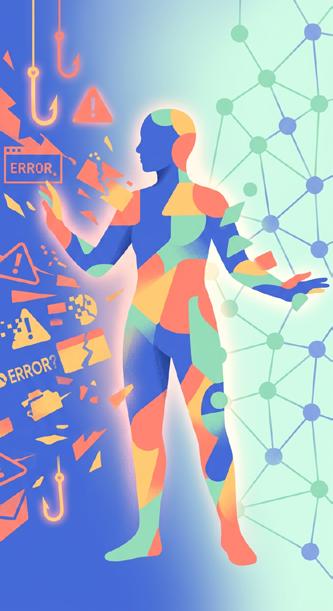
Assistant Professor of Information Technology and Management Ann Rangarajan explored human-centered cybersecurity issues as one of 13 listed authors of “Workshop Summary Report for ConectCon 2024: Minding the Gaps in Human-Centered Cybersecurity,” which was published by the United States Department of Commerce.
The authors, who include academics, industry professionals, and government officials, met at a workshop hosted by the National Institute of Standards and Technology (NIST) to look at how cyber attackers are increasingly reliant on exploiting people’s roles, actions, tendencies, unintentional errors, and lack of knowledge for successful attacks, as well as how to mitigate them.
“This report potentially holds to spark a broader movement—one that truly elevates the human element in cybersecurity,” Rangarajan says. “This work lays a crucial foundation for shifting the conversation, not just among
researchers or practitioners, but across all levels of the cybersecurity ecosystem.”
Rangarajan’s work explores how human psychological stressors influence digital decision-making. She played an active role in identifying and building consensus around the challenges that organizations and stakeholders face when implementing human-centered cybersecurity.
The solutions developed include clearly defining human-centered cybersecurity and its goals by describing its elements and using them to leverage a standard. They also include developing outcome-based guidance that is focused on measuring the impact, creating employee engagement platforms, and building tailored education and learning programs.
“Another ‘next step’ I’m passionate about is embedding the human element more deeply into cybersecurity education,” Rangarajan says. “I believe it’s critical that we equip the next generation with both technical knowledge and an understanding of human-centered principles.”
Slashing Home Energy Costs
Combining renewable energy sources with Internet of Things sensors can lead to energy and cost savings, as well as a reduce carbon dioxide emissions, according to a new Nature paper co-authored by Md. Samiur Rahman (M.S. CS 2nd Year).
“Empowering Smart Homes by IoT-Driven Hybrid Renewable Energy Integration for Enhanced Efficiency” describes an IoT-integrated hybrid
renewable energy system for smart homes that combines solar panels and wind turbines for generation, battery storage systems, IoT sensors for real-time monitoring, and smart controllers for adaptive energy management. The system demonstrated up to 72.3 percent average efficiency improvement, 61 percent reduction in energy costs, and a more than 61 percent reduction in carbon dioxide emissions compared to conventional systems.
“I was motivated to participate in this project for several reasons,” Rahman says. “This project is addressing the critical global challenges of energy demands and greenhouse gas emissions. It was also an opportunity to work at the intersection
A Flexible Research Plan
Alicia Guerra (M.A.S. DSC 1st Year) earned a fellowship with the SoReMo initiative, which gave her the opportunity to spend a semester researching a computational framework to detect illegal racial gerrymandering, which was motivated by recent mid-decade redistricting efforts in Texas.
She says that she is excited to apply her technical training to address a real-world democratic issue. The project integrates data science, public policy, and social impact in a way that reflects her long-term research goals. She also received guidance from expert faculty through SoReMo, who provided mentorship, feedback, and detailed and incisive critiques.
“They have strengthened my work and pushed it toward a publishable standard,” she says. “Collectively, these mentors have made Illinois Tech
of cutting-edge technologies and develop a comprehensive solution that combines solar, wind, storage, and intelligent controls.”
IoT sensors aggregate and securely transmit data to a cloud platform. In the cloud, advanced machine learning algorithms incorporate past and current data to conduct real-time analytics, which forecast energy demand patterns, optimize energy production, and identify potential shortfalls or system inefficiencies. Outcomes are displayed on an accessible user dashboard, allowing homeowners to monitor system performance, analyze energy statistics, and receive proactive operational optimization alerts.
feel like a place where serious research is not only encouraged but actively supported—even to students who aren’t on campus.”
Guerra presented her SoReMo research at major conferences, including the 2026 American Association of Geographers Annual Meeting in San Francisco, and at the 2026 Annual Meeting of the Western Political Science Association in San Diego.

There’s more to math than writing equations on a whiteboard. It was aspirational to work in a research hospital. I was able to take my skill set to do, truly, the most good.”
—Virginia
Reider (STAT
’25)
on her six-week research project at the University of Colorado’s Anschutz Medical Campus, where she examined data collected by the University of Colorado Hospital system on patients being treated for retinopathy of prematurity, an eye disease in premature
babies.
New Research Reveals Faster Computing Method
A Universities Research Association (URA) Visiting Scholars Program grant is allowing Assistant Professor of Computer Science Nik Sultana to team with Fermilab scientists to develop software for a network data transfer switch that will allow scientists to compute data more efficiently.
Sultana received the grant to collaborate with Fermilab researchers who are working on the DUNE neutrino project build software that reads the data collected by switches in the system’s detectors in real time. Sultana, Research Software Engineer Nishanth Shyamkumar, Bjorn Ove Sagstad (M.S. CS 2nd Year), and researchers at Fermilab and CERN teamed up to write “Complex Parsing for In-Network Acceleration of High-Energy Physics Experiments,” which describes the programmable network prototype for
the custom data packet format that is used by DUNE.
“This work is situated in an exciting problem space for finding creative solutions to the data networking problems of cuttingedge physics experiments,” Sultana says. “This space accommodates researchers with different expertise, ranging across physics, computing, and networking.”
DUNE’s detectors are designed to send very large data packets in a unique format. By programming the network equipment within DUNE’s network, the network itself could understand the data that it’s collecting rather than simply passing it into storage to be computed later, which could lead to faster, smarter data handling for high-energy physics experiments.
“Ideas developed in this research can
be adapted for other environments that involve transferring large quantities of latency-sensitive data streams,” Sultana says. “The fields that come to mind are electronic finance, online games, and supporting ongoing research on processing [artificial intelligence] workloads and on managing quantum computing workloads.”
Raicu Honored as Data Transfer Pioneer
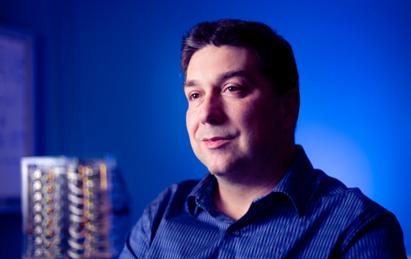
The ACM/IEEE SC25 Test of Time Committee bestowed its annual Test of Time Award to Professor of Computer Science Ioan Raicu and his collaborators for their contributions to a pioneering data transfer framework at the ACM/IEEE International Conference for High-Performance Computing, Networking, Storage, and Analysis.
“The Globus GridFTP Framework and Server” was published in 2005 and outlined a new method of moving massive amounts of data securely by stripping the data into pieces and processing it through various channels simultaneously rather than sending massive files at once. It set the foundation for massive data transfer that helped enable scientific discoveries such as telescope sky surveys, large particle accelerator analysis, and genomic studies, according to the Test of Time Award committee.
GridFTP’s innovation helped send massive amounts of data from a variety of storage systems, computing units, firewalls, and formats more quickly than the previously available methods. The open source framework proved to be reliable, fast, and modular, allowing it to be used for a variety of scientific discoveries.
Raicu continues his research in high-performance computing and systems as director of the DataSys Lab, where researchers innovate in various areas of distributed systems with an emphasis on designing, implementing, and evaluating systems, protocols, and middleware with the goal of supporting data-intensive applications at extreme scales.
“The Globus Striped GridFTP paper’s approach has been widely adopted and remains a critical part of the community’s infrastructure. Few technologies have had such a lasting impact,” SC 25 Test of Time Committee Chair Bill Gropp said in a release about the award.
When Yacin Nadji (CS ’09) discovers something fascinating at work as a lead security researcher at Corelight, it usually means bad news for someone else.
“It means that I’m about to make someone’s day unpleasant, that’s for sure,” he says. “If I get very excited to find something, then the customer isn’t going to be happy.”
It’s an odd dichotomy: when Nadji finds success at work, a client isn’t thrilled. However, it also means that his cybersecurity sleuthing has saved that same client from present or future headaches.
Corelight operates as an evidence-based network detection response-and-threat-hunting platform. As lead security researcher, Nadji finds himself examining physical and virtual networks to monitor and summarize network traffic in search of malware and suspicious behavior.
His contributions include writing security “content,” or algorithms and models that are designed to detect malicious behavior within a network.
“If we catch a known malware signal from the network, then we can say, ‘You need to check out this machine,’” he says. “It’s all based on the network traffic. Data can be used mutually, so we figure out who is telling what to who and where.”
After Nadji makes a discovery, he says that it is important that his client understands how he detected the anomalies and why he believes they are a threat. That level of transparency helps his clients make the appropriate decisions as to how to address his findings.
“If I can explain why I came to a conclusion, then they are more likely to provide feedback and help me improve my model,” he says. “If I don’t, they can get frustrated. By giving them a peek inside my work, or if I am more accommodating, then they can help.”
Attackers are always trying something new, and when Nadji finds a new technique or new malware, he first tries to determine if it is, in fact, unique.
Usually it is a shift on an old technique, but it still needs specific attention.
“If an individual wants to harm a network, they’ll try to make the attack look like common traffic to hide the attack,” he says. “Attackers are trying new things, and we have to figure out if it’s a fundamentally new trick or a twist on one that they already do.”
Attackers are adopting new tools with artificial intelligence and large language models, which have become easier to use. However, these new tools have limited effectiveness.
Nadji says that he has seen malware and attacks written by large language models, but they typically generate protocols based on old ones that are not too difficult to detect with current tools.
But these new techniques can be replicated and modified more quickly with AI tools. And the
larger security concern with AI-enhanced attacks is that they target users to facilitate it.
“Deep fakes, social engineering, and phishing scams are becoming more sophisticated with AI tools,” he says. “Images are being generated that look and sound exactly like someone else.”
He continues, “These new tools make it easier to design attacks involving individuals by masquerading as other people. For example, we know the North Korean military has made attempts to infiltrate a network by using AI to trick a security company to hire them.”
Nadji says that he discovered a passion for cybersecurity when he signed up for a research experience for undergraduate students at the University of California, Berkeley while he was enrolled at Illinois Tech. He spent the summer conducting web security research.
“We were trying to trick a browser to execute a Java script that it shouldn’t. It was an integrity experiment. We were building things, and then breaking them, which was fun.”
Yacin Nadji (CS ’09)
“We were trying to trick a browser to execute a JavaScript that it shouldn’t,” he says. “It was an integrity experiment. We were building things, and then breaking them, which was fun.”
The team he worked with that summer built a vulnerable web application for students to use to learn about XSS attacks. Nadji used that knowledge to write and publish his first research paper on robust methods to defend against XSS attacks.
While his previous academic experience was in information retrieval, he soon saw how valuable cybersecurity was to that skill set—and how cybersecurity is needed everywhere.
From web applications and mobile applications to deep learning and image classification, all technology tools need experts to help them become secure.

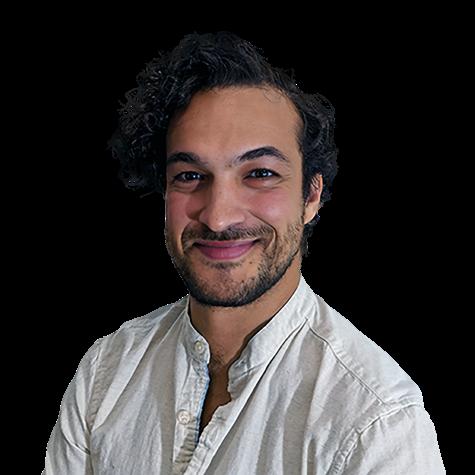
“Every part of computer science has a security component. The next new big thing in tech is going to have to be secured. I’m never bored. There is always something to learn.”

Comfort in Autonomous Vehicles
Comfort in Autonomous Vehicles
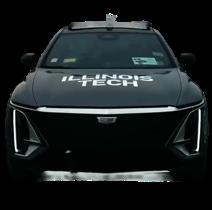
Gonzalo Florez Arias (M.A.S. ITM ’22) understands that to gain the public’s trust and to get them to use autonomous vehicles, companies such as his must ensure that the features that he helps develop can perform far better and more safely than humans can.
“I was in San Francisco recently, and got into one of those autonomous taxis,” he says. “And it is strange. You’re sitting in the backseat and watching the steering wheel move on its own. I understand why not everyone would be comfortable in it.”
As a senior autonomous driving feature development engineer at Aptiv, Florez says that the algorithms that he writes for the behavior of autonomous vehicles and to help operate it can’t simply perform as well as a human.
The technology must perform better than a human by leaps and bounds before the public accepts and uses autonomous vehicles with peace of mind.
It is a difficult bar to clear, he says.
“Reaching the level of human capacity isn’t enough,” he says. “If we look at the number of accidents each year on the highways, it won’t be enough to just reduce it. There has to be a clear distinction between human and autonomous drivers.”
Florez’s main role at Aptiv, an electric and autonomous vehicle parts and systems supplier, is to engineer algorithms that will enable an autonomous vehicle to park safely. These vehicles use tools such as radar, ultrasonics, and computer vision to not only get a car into a parking spot, but also be able to identify a spot where the car can fit.
The sensor system also must be able to identify perpendicular and parallel parking spots and differentiate between the two. These systems can “learn” the location of a person’s regular parking spot, such as one at an apartment complex or an office building.

be able to brake very quickly.
“There’s a specific pipeline of data that has to be processed, just like any other robot. How can the robot, or in this case the car, sense its environment? How can it glue the information together? We’re trying to get the car to ‘see’ in all three dimensions. These new sensors’ intentions are to ‘see’ in very small and tight areas.”
Another challenge in programming the parts for an autonomous vehicle—in addition to convincing people to use them—is to make the machines drive more like humans.
Florez says he was surprised at how his automated taxi drove while he was in San Francisco.
“Reaching the level of human capacity isn’t enough. If we look at the number of accidents each year on the highways, it won’t be enough to just reduce it. There has to be a clear distinction between human and autonomous drivers.”
—Gonzalo Florez Arias (M.A.S. ITM ’22)
“In parallel parking there are basically two features— identifying a spot, and then there’s making the actual maneuver of parking. But it’s very difficult,” he says. “Even the maneuver of parking involves just a steering wheel, the brake, and the accelerator. But you have to make them move together precisely to get the car into a tight space. It’s a challenge.”
Florez explains that the “perception of movement” of an autonomous vehicle needs to be highly accurate, as it needs to be able to perform in different driving conditions, such as highway driving, street driving, or parking. In the case of parking, movement is measured in centimeters rather than meters in other conditions. The vehicle needs to be able to use this information to make accurate, tight turns and accelerate subtly to park.
Although the stakes are not nearly as high when an autonomous vehicle executes a parking maneuver as compared to driving on the road, there is still the risk of damaging property, injuring animals, and hurting people.
“[The autonomous vehicle] still needs to be able to brake quickly, even at the low speeds of parking,” Florez says. “If it’s moving at two or three [miles per hour], it still needs to
“I was expecting a very careful, slow-moving drive, but it probably drove more aggressively than a human would,” he says. “If you’re on a road that you’re familiar with—where you wouldn’t expect a car to take a hard turn at an intersection—it can surprise you. We’re looking to design systems that behave more human-like.”
The vehicles also must be easy to operate. The user experience must be intuitive, Florez says, allowing people to get where they need to go by pushing a few buttons or giving a voice command rather than typing instructions, for example.
Engineering the algorithms that help propel these technologies also propel the robotics industry, Florez says.
“The underlying mathematics behind these [artificial intelligence] tools and models are very useful for behavior planning and control,” he says. “There are many improvements to make. But all these updates make better sensors that can process data faster.”
Florez says that more robots and autonomous vehicles are being seen in the agriculture, manufacturing, military, and commercial sectors. He even predicts that the algorithms that he is engineering for Aptiv could be helpful in developing robots for the home.
“I definitely can see the day when robots are in the home doing mundane tasks,” he says. “Robotics is a major industry right now.”
Florez says that he is always learning about new techniques and finding new ideas to improve the algorithms that he is engineering by keeping up with the latest AI research.
It helps him as he tries to improve the overall safety of autonomous vehicles.
“I’m always finding new things,” he says. “The drive to continue to make these improvements keeps me going forward.” •
Image generated: Adobe Firefly
RatingReturns

Nithya Mahadevan (M.S. CDSO ’18) provides technical services to her clients to help them maximize Google advertisement return on investment as the head of data science for Google Americas. “We become trusted advisers to these clients to help them truly achieve their overall media objectives,” she says.
Mahadevan and her team of 15 data scientists help the clients maximize return on their ad-buying dollars by building machine learning and statistical models. These models produce insights that are shared with clients, helping them to see the opportunities to maximize the return on their advertising spends.

Sometimes ads on Google aren’t the best option for every client.
“People think that Google is always going to say, ‘Invest in Google,’” she says. “But we’re trying to do the right thing. We try to put on that hat. Sometimes we tell people to not invest in Google.”
The models that Mahadevan and her team develop might show the client that there could be a bigger return on running ads with a competitor, such as Meta, and Mahadevan says that she isn’t afraid to show a client that information.
“It helps them invest in the right place,” she says. “They know that they can trust the insights that they see from the model.”
Ultimately, Mahadevan and her team are using data to tell their clients a story about their ad spends across Google platforms, and what kinds of returns they can expect from them. But if the clients don’t know how the story was created, then they are less apt to believe that story. Part of telling a client how the story was built includes processing the data through an open source model, which has been adjusted to meet their needs.
Meridian is Google’s open source model and what Mahadevan and her team helped build. Because it is open source, it allows clients to see how the model works, which helps to demystify its results. It also allows Google to hand off its models to specific clients, so that the clients can refresh and update the models themselves, as they collect more data.
The model results show the returns that the ads have generated across Google’s platforms, which include search ads, banner ads, and YouTube ads, among others. The results also help clients determine what ads and platforms might yield better results in the future.
“It can get pretty granular,” she says. “YouTube, for example, has skippable ads. The models can suggest whether to spend on those ads versus unskippable ads.”
Mahadevan says that the models could provide insights to clients on a weekly, daily, or even hourly basis. However, most clients find quarterly updates to be most helpful.
“There are common behaviors that are pretty seasonal,” Mahadevan says. “For example, at the end of the year, people tend to buy more goods for the holidays.”
Mahadevan says there are three main clients that she helps: those who need the help of data scientists to build and run a specific model for their needs; those who have in-house data scientists and don’t want to share their data with Google, so they need an effective model; and those who represent clients.
“We make the model scalable,” she says. “The products scale quickly based on the clients’ needs.”
Mahadevan says the rise of artificial intelligence tools such as chat bots and large-language models has changed the data science industry drastically, and the role of data scientist is rapidly shifting as a result.
She says the emergence of these new tools means that today’s data scientist does not work the same way that the data scientist of two or three years ago worked.
“Keeping up with the AI space is important,” she says. “The capabilities when they were released compared to today aren’t even close. We are still trying to determine how we can leverage agents in the data science field. That will make our work quicker.”
Mahadevan says any job that requires critical thinking,
reasoning, and creating are still very much in the domain of human beings. However, some rudimentary, elementary, and routine tasks are being handed off to AI agents.
And she has a patent pending on a new model that incorporates the advancements in AI to assist in ad creative generation.
“It’s a true method that leverages large-language models to speed [up] the process of creative generation to reduce the time and money needed in ad creatives,” she says. “It’s all based on a mathematical model.”
Despite all of the technological strides and the advanced mathematics in the data science field, Mahadevan says it’s the team that she works with, which has grown three times larger over the last four years, that keeps her motivated to propel the work that she is doing.
It’s the people that keep bringing her back to the office each day.
“I love my team,” she says. “They’re all smarter than me. Most of them are folks that I hired personally, and we have a lot of trust and dependency on each other.”
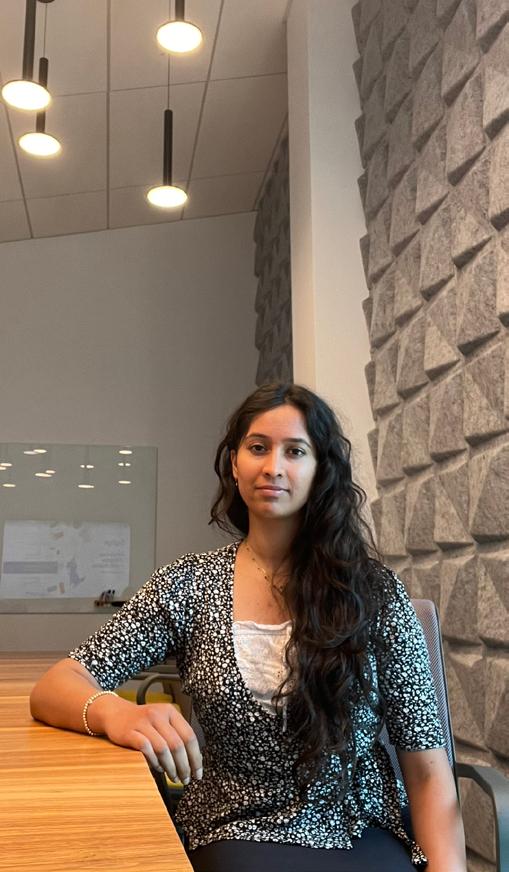
“Sometimes we tell people to not invest in Google.”
—Nithya Mahadevan (M.S. CDSO ’18)
Accelerate the Tech Revolution
We’re at a pivotal moment. Our ability to collect and analyze massive amounts of data is changing our world.
Now, more than ever, we need skilled and knowledgeable leaders who understand the fundamental importance of data science, machine learning, and cybersecurity—and everything in between. That’s the kind of impact leader we cultivate at the College of Computing.
Our students and faculty are already hard at work on innovations that will change the digital landscape of tomorrow. That means preempting problems before they arise, prepping our communities for any challenges that may lie ahead, and creating the tools and technologies that will empower our future.
You can accelerate that work. Power the Difference. https://www.iit.edu/computing/about/giving