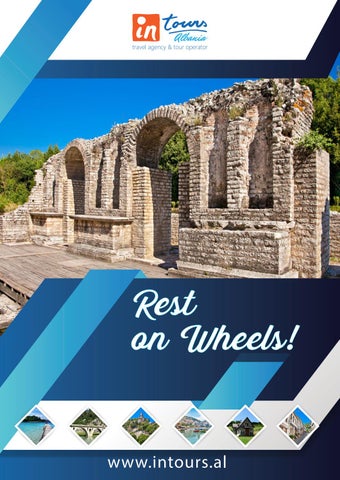
www.intours.al 1
www.intours.al
Welcome to Albania
Every corner of this touristic treasure has got a story to tell. After half a century of repression and hiding, this beautiful flower has blossomed. The itineraries of our independent and private tours of Albania and countries beyond its borders, include some of the most beautiful and unique destinations. You can discover and wander in breathless landscapes of snow-capped mountains and deep valleys, dive into the crystal-clear waters of hidden coves, spend relaxing time catching sun rays on the Riviera or learn about the centuries-old traditions of local hospitality. 2
ABOUT US intours albania is a licensed travel agency and tour operator enjoying dynamic growth, from our humble
beginnings to today; we draw experience from our rich and diverse corporate history. Development through long term partnership has increased our efficiency, flexibility and quality of service. Good reputation is our strongest point. One of the secrets of our success is our excellent relationship with suppliers and partners. We work together to aim for one result only - customer satisfaction. Our group of representatives all over the region consists of highly skilled individuals, carefully chosen for their professionalism and commitment. Our aim is to make your vacation a beautiful and unforgettable experience. Our unique tours are designed to give you the opportunity to see Albania from unusual viewpoints. Through our catalog and website, we try to supply you with as much information as we can to give you the opportunity to check all possibilities before making any travel arrangements. We provide advice on every aspect of group travel. We provide exceptional services at favorable prices. Our dedicated team of experienced professionals, is “The Jewel in the Crown”. Our goal is to achieve the highest level of operational excellence & provide all our customers with unbeatable quality of service. We take a holistic approach and manage every aspect of your travel, giving you more time to focus on your priorities. We believe that it is our duty to act responsibly, seriously and transparently.
intours albania is strongly committed to giving only the best travel deals available to all its customers. Our offers are based on the best understanding of the country, history and clients’ needs. We guarantee high standard of service and customer care. We take care of your free time! With intours albania you wake up each morning with a new adventure in front of you and when your head hits the pillow at night, you know it has been an amazing day. Best of all - we seamlessly handle the details. All you have to do is enjoy the adventure.
OUR SERVICES We always try to make your visit to our country interesting and enjoyable. It is important for us not only to show off Albania, but also to give you an opportunity to experience it firsthand! Thanks to the constant research and development of our products, we currently provide wide range of services: accommodation, hotel reservation for groups and F.I.T. transportation and transfer services with professional drivers escorted tours, city tours and sightseeing special interests groups (history, agriculture, hiking, spiritual…) business trips and conferences, incentives professional licensed tour guides, tour leaders and interpreters entertainment and events management car rental and many more
Whether planning travels in Albania or the wide world, make sure you start with US!
3
www.intours.al
General information Geographical Position Albania is a country in South-Eastern Europe, in the West of the Balkan Peninsula, between the geographical coordinates: 39 16’ latitude and 42 39’ longitude. Albania is almost midway between Equator and the North Pole, and covers a surface of 28.748 km2. The overall length of the borderline of the Republic of Albania is 1094 km; out of which 657-km is land-border, 316-km sea-border, 48-km river-border and 73 km lake-border. The Republic of Albania, on the North borders with Montenegro and North-East with Kosovo, on the East with Macedonia, and in the South and South-East with Greece. On the West, Albania is washed by the Adriatic and Ionian seas. The average altitude is 708 m, i.e. two times higher than that of Europe. Albania is included in the humid sub-tropical zone of the Northern Hemisphere, and it belongs to the Mediterranean climatic zone. Albania relief Lowland – Western Albania, Plain – Eastern Albania, Alpine – Northern Albania, the Highest Peak – Korabi Mountain (2,753m) Albania Population The population of Albania numbers 3,150,886. The vast majority of inhabitants are Albanian, with ethnic minorities representing only about 2% of the population. The minority population is comprised primarily of Greeks and Macedonians. Official Language - Albanian Albanian is an Indo-European language and it represents a separate branch of this family on the bases of its idiosyncrasy. The Greek geographer, Ptholemeous, has witnessed the existence of Albanians and Albanian language in the second century AD. The name “Shqipëri” (Albania) replaced the “old” name “Arberi” (or Arbani) by the end of the XVII century, due to the new historical conditions created, and aimed at giving importance to the connection between the nation notion and the use of the Albanian language, which was by that time called “Shqip”. The Albanian language is also used (written & spoken) in the parts of Kosovo, Serbia, Montenegro, and Macedonia, where ethnic Albanians live. Official Name: Republic of Albania (Republika e Shqiperise) Short form: Albania (Shqiperia) Flag: Black double-headed eagle on a red background Time: Local Time = UTC +1h Country Calling Code: +355 Currency: Lek (ALL) Albania Capital City Tirana (since 1920) Main Cities of Albania Durres, Vlora, Saranda, Shkodra, Berat, Korca, Gjirokastra, Elbasan Government: Parliamentary republic. Constitution was adopted by popular referendum 28 November 1998. Independence was declared on 28 November 1912 (from the Ottoman Empire). Natural resources: Petroleum, natural gas, coal, bauxite, chromite, copper, iron ore, nickel, salt, timber, hydropower. Exports - commodities: Textiles and footwear; asphalt, metals and metallic ores, crude oil; vegetablesfruits, tobacco. Imports - commodities: Machinery and equipment, food , textiles, chemicals
4
5
www.intours.al
Travel Information Located on the Balkan Peninsula in southeastern Europe, Albania is located near to the main European markets and can be visited easily by air, land and sea. VIA AIR The only airport in Albania with international service is Mother Theresa International Airport, located in Rinas, just 17 km northwest of Tirana. The most convenient way to get from the airport to Tirana is by taxi. The journey from Tirana to the airport takes twenty to thirty minutes, depending on traffic, and costs about 2,500 lekë (or 20 EURO) each way. The Rinas Express bus departs every hour between 6am and 6pm, as an hourly bus service between the Airport and the Scanderberg Square in the centre of Tirana. The single fare is 250 Albanian Lekë. The airport has a duty free shop, Customs operates 24 hours a day. VIA SEA Visitors can access Albania by passenger ferry through its larger coastal cities. Several foreign companies have regular services to: Port of Durrës: Connects to Italian ports of of Bari, Ancona and Trieste in Italy and Koper in Slovenia. Customs operate 24 hours a day. Port of Saranda: Daily trips are made to the Greek island of Corfu. Customs operate until 22.00 pm Port of Vlora: Connects to Italian ports of Brindisi and Otranto Customs operate until 22.00pm. Port of Shëngjin: Connects to the Italian port of Bari. Customs operates until 22.00. VIA ROAD Republic of Kosovo From Kosova, the primary route crosses the border near Qafë Morinё (Albania) and connects Prishtina and Kukës. The other entry points are Morinё (Tropoja with Gjakova), and Qafë Prush (Hasi with Gjakova) . Customs operates 24 hours a day. Republic of Greece From Greece through Kapshtica to Korça. Customs operates 24 hours a day. From Greece through Kakavija leading to Gjirokastra. Customs operates 24 hours a day. From Greece through Qafë Boti (Konispol) leading to Filat. Customs operates 24 hours a day. From Greece through Tre Urat, connecting Përmet with Konica. Customs operates 24 hours a day. Republic of Montenegro From Montenegro through Hani i Hotit, leading to Shkodra and Shkodra Lake. Customs operates 24 hours a day. From Montenegro through Murriqan Sukobina, connecting Shkodra with Ulqin (Montenegro). Customs operates 24 hours a day. A crossing has recently opened at Vermoshi, which links the region of Kelmendi in Albania with Plava and Gusinje in Montenegro. Customs operates 24 hours a day. Republic of Macedonia From Macedonia through Qafë Thana leading to Pogradec, Librazhd, and Elbasan. Customs operates 24 hours a day. From Macedonia through Tushemisht at the southeastern end of Lake Ohrid, leading to Pogradec. Customs operates 24 hours a day. From Macedonia through Bllata, leading to Peshkopi, Bulqiza, and Burrel. Customs operates until 22.00. From Macedonia through Gorica, leading to the northern shores of Lake Prespa. Customs operates until 19.00.
6
7
www.intours.al
Unesco Heritage UNESCO has honored Albania by adding three sites to the culturally prestigious World Heritage List. But Albania’s culture does not stop there – artisan practices are alive and flourishing and the country’s tradition of iso-polyphonic singing, under the protection of UNESCO, is recognized as unique in the world. The latest addittion to this unique list is a natural wonder. BUTRINT Registered as an UNESCO world heritage in 1992. Registration was based on cultural criteria as a unique and exceptional testimony of a cultural tradition and civilization that disappeared. Inhabited since prehistoric times, Butrint has been the site of a Greek colony, a Roman city and a bishopric. Following a period of prosperity under Byzantine administration, then a brief occupation by the Venetians, the city was abandoned in the late Middle Ages after marshes formed in the area. The present archaeological site is a repository of ruins representing each period in the city’s development. GJIROKASTRA Gjirokastra (so-called “City of stone”) proclaimed as a world heritage in 2005 as rare example of an architectural character typical of the Ottoman period. Gjirokastra, in the Drinos river valley in southern Albania, features a series of outstanding two-story houses which were developed in the 17th century. The town also retains a bazaar, an 18th-century mosque and two churches of the same period. This city impresses everyone who visits it, as a result of the architecture, the surprising images of Drinos valley, and the spectacular crown ridge of calcareous Bureto and Lunxhëria. BERAT 2400 year old town located in southcentral Albania, known as the city of “One above another Windows” Registered as a world heritage in 2005 and ratified in 2008 by UNESCO as another typical sight of the Ottoman period. Located in central Albania, Berat bears witness to the coexistence of various religious and cultural communities down the centuries. It features a castle, locally known as the Kala, most of which was built in the 13th century, although its origins date back to the 4th century BC. The citadel area numbers many Byzantine churches, mainly from the 13th century, as well as several mosques built under the Ottoman era which began in 1417. THE ALBANIAN ISO-POLYPHONY In 2005 it was added to the list of “Masterpieces of the oral heritage of humanity” protected by UNESCO. Traditional Albanian polyphonic music can be divided into two major stylistic groups as performed by the Ghegs of northern Albania and the Tosks and Labs living in the southern part of the country. The term iso is related to the ison of Byzantine church music and refers to the drone accompanying polyphonic singing. The drone is performed in two ways: among the Tosks, it is always continuous and sung on the syllable ‘e’, using staggered breathing, while among the Labs, the drone is sometimes sung as a rhythmic tone, performed to the text of the song. Rendered mainly by male singers, the music traditionally accompanies a wide range of social events, such as weddings, funerals, harvest feasts, religious celebrations and festivals such as the well-known Albanian folk festival in Gjirokastra. ANCIENT AND PRIMEVAL BEECH FORESTS OF THE CARPATHIANS AND OTHER REGIONS OF EUROPE The Gashi river in Tropojë, northeastern Albania and the ancient beech forests of Rrajcë in Perrenjas, central Albania. They demonstrate the postglacial expansion process of such forests and exhibit the most complete and comprehensive ecological patterns and processes of pure and mixed stands of European Beech across a variety of environmental conditions.
8
GJIROKASTRA
THE ALBANIAN ISO-POLYPHONY
BERAT
BUTRINT
THE ANCIENT BEECH FOREST 9
www.intours.al
Grand Balkan Tour Day 1: Arrival
Arrival to Dubrovnik (flights to Dubrovnik/ Podgorica/Tivat/bus arrival). Accommodation in hotel in Dubrovnik.
Day 3: Budva – St.Stephan – Ulcinj Budva-Sveti Stephan 9 Km 20 Min Sveti Stephan-Ulcinj 60 Km 1.5 Hours After breakfast, we will visit the marina, where you can spot some beautiful large yachts. Budva is the reigning “tourist capital of Montenegro” for all the right reasons. As one of the Adriatic Sea’s oldest cities, Budva’s 2500-year history reaches back from the past to offer us a small walled city, where the walls were built straight out of the Adriatic Sea by the Venetians. And what we see today is really only a fraction of the city’s splendor at its height, preserved with loving care by the local residents of Budva who are proud of their long history. While we walk through the
Day 4: Shkodra – Kruja Ulcinj-Shkodra 42 Km 70 Min Shkodra-Kruja 85 Km 100 Min We will start our day by a short drive to the border of Albania and our next stop will be in Shkodra, where is the largest 19th century
Day 2: Dubrovnik - Kotor Dubrovnik-Kotor 90 Km 2.5 Hours Kotor-Budva 23 Km 30 Min In the morning we will visit the fairytale old town. We will start at Pile Square, one of three ways to enter the Old Town through the thick walls. The first stop is at Onofrio’s Fountain, then we move on to the Franciscan Monastery, which boasts a gorgeous Gothic courtyard and one of the oldest working pharmacies in Europe. We continue walking down the limestone-clad Stradun, one of the widest and straightest streets, until the Sponza Palace. Other highlights we will find along the way include the city’s bell tower, the Church of St. Blaise, dedicated to the patron saint of Dubrovnik, and the opulent Rector’s Palace. As you stroll along the walls, note the gorgeous views of the Adriatic, as well as the towers at each corner of the wall. After you’ve walked in a complete circle (or, in this case, a square), head back to Pile Square to end your tour of Dubrovnik. After that beautiful tour, we will travel to Kotor. Tour of the Old Town of Kotor gives you a great introduction to this UNESCO World Heritage Site. Kotor is situated in the most secluded part of Boka Kotorska (The Bay of Kotor). While it dates from the Illyrian period, Kotor developed into an important commercial and artistic center in the Middle Ages. Many empires battled for control over the city throughout the centuries. Our Kotor tour begins at the main gate of the Old Town, also known as the Sea Gate. The tour will take you inside the city gates, and you will visit the Square of Arms with her Clock Tower, Flour Square with Pima and Buca palaces and the beautiful St. Tryphon Cathedral. After the visit, we will travel to Budva for our accommodation.
narrow streets of this historic district, you can buy souvenirs or stop for a coffee. It is also home to a seaside citadel and religious sites such as the Church of Santa Maria in Punta, established in the 9th century. Leaving Budva behind we will see amazing views from the road down south. After just a short drive we stop by the turn to the small island of Sveti Stefan. It was first mentioned in the 15th century, the fortified village was built to defend against the Turks and became a haven for pirates of the Adriatic. An Adriatic playground for the rich and famous from the 1960s to the 1980s, is today a 5* hotel resort. Next stop on our travels is historic city of Ulcinj. As one of the oldest settlements in the Adriatic coast, it was founded in 5th century BC. It was captured by the Romans in 163 BC from the Illyrians. With the division of the Roman Empire, it became part of the Byzantine Empire. During the Middle Ages, it was under South Slavic rule for a few centuries. In 1405 it became part of Republic of Venice and in 1571 part of Ottoman Empire. Ulcinj was ceded to the Principality of Montenegro in 1880. Ulcinj is a famous destination for tourists, because of its Long Beach, Lake Šas, Ada Bojana Island and for its two-millennia-old Ulcinj Castle. We will take a short ride to our hotel. 10
catholic cathedral in the Balkans. Optional is a visit to the Ethnographic and Archeological Museum, a traditional wooden building typical for the region. The main pedestrian promenade, created in the early 20th century in neoclassical style, will allow you to explore the city’s modern face. Gives the city feeling of europian spa towns. We will also see the Rozaf fortress, an Illyrian castle from the 3rd AD. The fortress majestically towers over the city on a rocky hillside, which offers a picturesque view of the surrounding area and the surrounding three rivers: Drin, Bruna and Kiri. For lunch we can stop on the shores of lake Skadar, which is prime spot for birds watching. After relaxing by the lake, we will, stop in Lezha, which is small town, where is a memorial tomb of the Albanian national hero, Skanderbeg. It was in Lezha, in 1444, that Skanderbeg summoned the leaders of the Albanian clans and led them to unite their forces in the struggle against the Turks. After 24 years of fighting against their waste armies, he died here of malaria. After this short stop, we will be coming to a beautiful town nestled on the side of a mountain. Kruja is connected with national hero Gjergj Kastrioti Skanderbeg. We will visit the ruins of his castle, which was built during the 5th and 6th centuries. Inside the
castle is today his museum and also the Ethnographic Museum. To buy some traditional handcrafted items visit the attractive Medieval Bazaar. We will stay tonight in this ancient city.
Day 5: Tirane – Durres Kruje-Tirane 29 Km 45 Min Tirana-Durres 36 Km 45 Min Durres-Berat 90 Km 1.5 Hours We will start out our day with a guided tour of the capital of Albania - Tirana. At first, we will visit The Clock Tower dated 1821 and in its’ 200 years of existence it became the symbol of the city. The Mosque of Ethem Bey is just next door. Its’ beautiful stoned build is unique as the exterior and interior are all decorated with frescos. After that we will we go alongside stately buildings which house the many offices of the state infrastructure. One of the newest museum, is old Bunker. It is built on three hall and provides an overview of the police force looking as far back as the 1913, a few months after the proclamation of Independence up to the year of 1991, it is a history marked by violence, torture, imprisonments and martyrs. We will visit the old “Block” area, which was a part of the town, where only the communistic leaders used to live. After a short drive, we will start our tour of Durres by the “Torra”, Venetian tower which was part of the defensive walls of city since the 15st century. Next, we will visit the Amphitheatre, built in the 2nd century A.D. After hearing some interesting stories and seeing a beautiful wall mosaic, we will travel a short while to the periphery of the town, to the Canteen “Gjergj Kastrioti Skanderbeu”, the largest one in Albania, dated 1933. We will taste this famous cognac, well-known since the period of communism for the quality and unique
taste, symbol of the traditional drink of Albania. Our travels will take us through the lash “garden” region of Albania. We will be heading to the mountains on the horizon, where snowcapped Mt. Tomorri is standing like a protector over the old city of Berat, where our next accommodation will be.
The Citadel is one of the oldest, largest and still mostly settled in Europe. After a walk through we will visit famous Onufri’s Museum, where you will see one of the largest collection of icons in Balkans. We will take a short drive to see the quarters Mangalem and Gorica, which are by the
Day 6: Berat – Apollonia
river Osum. The small stone houses and narrow streets look like they are glued to the side of the mountain. In the afternoon, we visit Apollonia archeological park. Apollonia was an important city founded in the 6th century BC. The fame of the city attracted many personalities as the eminent roman philosopher and orator Cicero. The city grew rich on the slave trade and local agriculture, as well as its large harbor, said to have been able to hold a hundred ships at a time. The city also benefited from the local supply of asphalt. Its’ decline, however, began in the 3rd century AD, when an earthquake changed the path of the river Aoos. For accommodation, we will travel a to the second largest port, Vlore.
Berat-Apollonia 95 Km 100 Min Apollonia-Vlore 40 Km 75 Min Known as the city of 1000 windows because of the southern orientation of all its houses built on the hillside, Berat is a town-museum which demonstrates the coexistence of different religious and cultural communities. It has beautiful sloping cobbled streets lined with old Ottoman houses with beautiful carved doors, many Byzantine churches with murals and icons 12-15 centuries, a 13th century citadel overlooking the city and the river Osum. In the morning at first, we will see the Citadel. 11
www.intours.al and the whole bay. The castle was a garrison built up by Turkish soldiers in 17th century as a mean of controlling the routes crossing at the junction of Saranda. The castle consists of a square plan and two round towers, further one rectangular tower on the west-side wall. Later on we will travel to the fascinating old center of Gjirokaster is on UNESCO’s World Heritage list. Largely medieval, with some lovely architecture to admire, reflecting the town’s wealthy past, it is built on a hill overlooking a valley and mountains. The drive to Gjirokaster is lovely. We will be staying in a hotel near the old bazaar.
Day 7: Vlora - Llogara – Saranda Vlora-LLogara 36 Km 90 Min llogara-Saranda 90 Km 3 Hours Today we will depart towards the center of the second largest port, Vlore, where will have the opportunity to enjoy the beauties of the city, like the Monument of Independence, which stands at the Flag’s square. Nearby stands the monument of Ismail Qemali, first chairman of the Albanian state. Then we will travel up to the National Park of Llogora. The park has been established in the seventies and has always been a popular vacation spot for locals and tourists alike. The Llogara Pass is a high mountain pass on the Ceraunian Mountains connecting the Dukat Valley in the north with the coastal region of Himara on the southern side. It has an elevation over 1.000 meters. The Caesar’s Pass named after Julius Caesar who marched down near the area in pursuit of Pompey is also located near Llogara Pass. We will visit this pass. Our lunch stop at a local restaurant with traditional Albanian cuisine, will offer spectacular views of the mountains and the Ionian Riviera below. We will travel through some of the lush vegetation, citrus groves and beautiful unspoilt beaches. We will pass through small stone villages, like Dhermi, Himare and Qeparo. We will stop for an interesting coffee break in a village of Borsh. Here is a beautiful waterfall which flows
through the garden and the building of the very restaurant. We will reach the southern city and port of Saranda. In the evening, we will spend some time and money in the promenade. You can buy here some souvenirs, get a glass of local wine or just watch the locals go by.
Day 8: Butrinti – Gjirokastra Saranda-Butrinti 28 Km 45 Min Butrinti-Gjirokastra 90 Km 2.5 Hours Lovers of history and archeology, will be very happy to explore the large ruins of ancient city of Butrint. Butrint lies 18 km (11 mi) south of Saranda and is a real gem if the ancient world fascinates you. The remains are spanning over 2500 years. The park, a UNESCO World Heritage Site, is one of the most important archaeological sites in the country. It contains different artifacts and structures which date from the Bronze Age up until the 19th century. A number of major monuments are still intact including the city walls, late-antique baptistery, great basilica, theatre and Venetian castle. The walk through the park will give you good idea how large the city has been in its’ glory days and how well had our predecessors placed it. Over the sea canal you will see the Ali Pashas castle. On our return, we will stop for an optional lunch and amazing view of the whole region in Lekursi castle. It is located on the hill top overlooking Saranda, island Corfu
12
Day 9: Gjirokastra - Korça - Pogradec Gjirokastra-Korça 210 Km 5.5 Hours Korça-Pogradec 40 Km 1 Hour In the morning, we will first visit the castle overlooking the entire town and its surroundings. The architectural unity of the city is enhanced by cobblestone streets polished by centuries crossing the “neck of the bazaar.” This large castle houses weapons and large arms museum. From there you will be guided on a small walk through the narrow streets of town towards the ethnographic museum, which used to be the house of the parents of ex-dictator Enver Hoxha. This interesting museum will give you a good idea how people used to live during the Ottoman period. After a short break to see the old shops and to perches some typical products, we will be leaving this stately city for Korça. The road Korça - Gjirokastra is one of the finest in the country. It will run along the mighty river Vjosa in the foothills of Mt. Papingu (2485m) and go through remote towns like Leskovik and Erseke through unspoiled landscapes.
Korça stands on a plateau some 850 m above sea level, surrounded by the Morava Mountains. The area was on the border between Illyria and Epirus and according to a historical reconstruction was ruled by an Illyrian dynasty. It became an important trading and handicraft center in the 18th century due to the development of trade with neighboring regions. Interesting is also that the first Albanian school opened here in 1878, today it houses this museum. Korçë is referred to as the city of museums. The city hosts two major museums such as the National Museum of Medieval Art and National Museum of Archeology. The National Museum of Medieval Art has rich archives of about 7000 icons and 500 other objects in textile, stone and metal. After a stroll along the beautiful streets of the old quarter full of flowers we will travel to Pogradec. After beautiful scenic drive, we will reach the shores of the Ohrid Lake, surrounded by fields nestled along the picturesque mountains. where we will stay in a hotel on the edge of the lake.
Day 10: St.Naum – Ohrid Pogradec-St.Naum 11 Km 30 Min St.Naum-Ohrid 30 Km 1 Hour Ohrid-Skopje 170 Km 3 Hours After breakfast, we will past along the lake and head to the border crossing. We will continue to the monastery of Saint Naum, perched on an outcrop above the lake. St. Naum was a healer and miracle-worker of the 10th century, whose works can be seen depicted in frescoes inside the chapel which is dedicated to archangels Michael and Gabriel. Admire the views over the lake or venture outside to the springs of the Black Drin River which spill into Lake Ohrid. We drive towards the city of Ohrid. Guided tour includes the visits to the statue of St. Cyril and Methodius, and it continues to the Lower gate, the Church of St. Sophia and the Roman amphitheater. After we clime to the Upper gate we will go see the ruins of Tsar Samuel’s fortress. Our walk will end at the marketplace. After lunch, we will drive towards the capital of Macedonia, Skopje, where we will stay overnight.
Dubrovnik Kotor
Day 11: Skopje
Budva
In the morning, we will visit to the capital’s old town, where the Kale Fortress stands overlooking the Vardar River and the modern city below. We can spend some time in the old bazaar before looking on at the Daut Pasha Hamam and crossing the 15.st century stone bridge connecting the Ottoman Bazaar (Čaršija) with the north bank with contemporary Macedonia Square to the south. In this part of the town we can visit the Memorial house of Mother Teresa.
Shkodra Ulcinj
Skopje Kruja
Durres
Tirana Ohrid Berat Pogradec
Apollonia
Korca
Day 12: Skopje - Airport Departure for airport – Skopje/Prishtina/ bus End of program.
Vlora
Gjirokastra
Saranda Butrinti 13
www.intours.al
Ethnic Albania Day 1: Arrival Tirana-Ulcinj 129 Km 3 Hours Arrival to the old town of Ulcinj by plane from the Airport in Tirana or Tivar or by bus. Accommodation in hotel in the town.
Day 2: Ulcinj - Ada Bojana Ulcinj-Shkodra 42 Km 1.5 Hours After breakfast, we will start our tour of the historic city of Ulcinj. As one of the oldest
more likely to be a delta in formation. It is located on the southernmost tip of Montenegro, with only the Bojana river separating it from Pulaj and Velipojë in the Albanian territory. We can enjoy here lovely meal at a restaurant overlooking the delta and take a short cruise along the river. We will have accommodation in the city of Shkodra.
the surrounding area and the surrounding three rivers: Drin, Bruna and Kiri.For a short break we can stop on the shores of lake Skadar, which is prime spot for birds watching. After relaxing by the lake, we will stop in Lezha, which is small town, where is a memorial tomb of the Albanian national hero, Skanderbeg. It was in Lezha, in 1444, that Skanderbeg summoned the leaders of the Albanian clans and led them to unite their forces in the struggle against the Turks. After 24 years of fighting against their waste armies, he died here of malaria. Then we will cross to the youngest country in Europe, the Kosovo Republic. We continue to the city of Prizren, probably the most attractive town in Kosovo with superbly preserved buildings from the Ottoman era. We will visit the castle which is one of the oldest in the Balkans (almost 3 millenniums), built to protect the city from attacks, the ornate Bajrakli Mosque and the old Turkish Hammam among other sights. Prizren is an absolute highlight of any visit to Kosovo and to see the old houses of the old town in low light as the sun sets is a delight. Overnight at Prizren.
Day 4 : Gjakova - Junik - Peja
settlements in the Adriatic coast, it was founded in 5th century BC. It was captured by the Romans in 163 BC from the Illyrians. With the division of the Roman Empire, it became part of the Byzantine Empire. During the Middle Ages, it was under South Slavic rule for a few centuries. In 1405 it became part of Republic of Venice and in 1571 part of Ottoman Empire. Ulcinj was ceded to the Principality of Montenegro in 1880. Ulcinj is a famous destination for tourists, because of its Long Beach, Lake Šas, Ada Bojana Island and for its two-millennia-old Ulcinj Castle. After the city tour, we will take a short ride along the Long beach to the Island of Ada Bojana. The name Ada means river island in Montenegrin.The island is created by a river delta of the Bojana River. Legend says it was formed by gathering river sand around a ship sunk at the mouth of Bojana river, but it is
Day 3: Shkodra - Lezha - Prizren Shkodra-Lezha 39 Km 1 Hour Lezha-Prizren 157 Km 2.5 Hours In the morning, we will start our day by a walk along the beautiful streets of Shkodra, where is the largest 19th century catholic cathedral in the Balkans. Optional is a visit to the Ethnographic and Archeological Museum in a traditional wooden building, typical for the region. The main pedestrian promenade, created in the early 20th century in neoclassical style, will allow you to explore the city’s modern face. Gives the city feeling of europian spa towns. We will also see the Rozaf fortress, an Illyrian castle from the 3rd AD. The fortress majestically towers over the city on a rocky hillside, which offers a picturesque view of 14
Prizren-Gjakova 37 Km 1 Hour Gjakova-Junik 19 Km 30 Min Junik-Decani 20 Km 30 Min Decani-Peja 14 Km 30 Min Peja-Prishtina 80 Km 2 Hours In the morning, we continue our tour to Gjakova which lies on the banks of the River Erenik. Visit its main sites including the old bazaar and clock tower. Then we drive to Junik where we visit the famous Kullat e Junikut (Junik Tower). The towers are castle-like houses with a special architecture built in white rock, where Albanians have for centuries sheltered to survive wars and conflicts. We visit Decani monastery (UNESCO). The medieval church houses some of the most preserved fresco decoration in the Balkans and the grounds are also a delight. Finally, we continue on to the city of Peja. After arrival in to Peja we explore the Ottoman sites of the town including the Haxhi Beut Mosque and the old house of Jashar Pasha as well as the Sheremet Tower and the old bazaar. Later in the afternoon we drive to Pristina. Accommodation is in hotel in the city.
Day 5: Pristina - Gracanica - Gadime - Skopje Prishtina-Gracanica 12 Km 30 Min Gracanica-Gadime Cave 20 Km 30 Min Gadime Cave-Skopje 70 Km 1.5 Hours At first, we will explore the Pristina visiting its main sites such as the Orthodox Church and the Carshi Mosque, dating back to the early 15th century. Later we visit the spectacular Gracanica Monastery, one of Kosovo’s most beautiful sites and containing some impressive frescoes. We continue to Macedonia stopping first at the Gadime Cave. The Marble Cave is a limestone cave in the village of Gadime e Ulët, in the municipality of Lipljan. Much of it is still unexplored. The cave was found in 1966 by a villager, who was cutting stone. We can see the beauty of this cave. We cross the border and head to the capital, Skopje. Upon arrival, we will visit the capital’s old town, where the Kale Fortress stands overlooking the Vardar River and the modern city below. We can spend some time in the old bazaar before looking on at the Daut Pasha Hamam and crossing the 15.st century stone bridge connecting the Ottoman Bazaar (Čaršija) with the north bank with contemporary Macedonia Square to the south. In this part of the town we can visit the Memorial house of Mother Teresa. Accommodation in Skopje.
Day 6:
isolated by the regime until the 1990s, to a colorful capital buzzing with life. While the city has a long history, you can enjoy its modern outlook, with fashionable bars, and wander boulevards lined with relics of the city’s Ottoman, clubs and boutiques, Italian and communist past. Tirana’s massive main square, Sheshi Skënderbej, is bordered by the National History Museum, the Palace of
Matka - Ohrid
Skopje-Matka Canyon 16 Km 30 Min Matka Canyon-Ohrid 166 Km 2.5 Hours Before heading to Lake Ohrid we can enjoy a visit to the Matka Canyon. Cruise down the river admiring the large rock walls towering beside the water. Keep an eye out for the fascinating caves that are found within the canyon. We then travel on to the gorgeous lake side town of Ohrid, perched on the border of Macedonia and Albania. This unassuming, picturesque settlement has been the setting of thousands of years of human history and the ancient churches, fortress walls, bazaars and old quarters are testimony to its past. Lake Ohrid itself is Europe’s oldest lake having formed over three millions years ago. Wander the streets and squares of its compact centre before hiking up to the ancient walled fortress that overlooks the day to day life of the city and explore the famous old churches, monasteries and basilicas. We will stay overnight in Ohrid.
Culture, the National Bank, the Et’hem Bey Mosque and Skanderbeg’s statue. And the newest museum Bunk Art which is situated in an old bunker. It is built on three parts and provides an overview of the police force looking as far back as the 1913, a few months after the proclamation of Independence up to the year of 1991, it is a history marked by violence, torture, imprisonments and martyrs. Our accommodation for the last night of our tour will be in the capital.
Prishtina
Gjakova Prizren
Shkodra Ulcinj
Day 7: Pogradec - Elbasan - Tirana Ohrid-Pogradec 53 Km 1 Hour Pogradec-Elbasan 84 Km 1.5 Hours Elbasan-Tirana 44 Km 1 Hour On the way to Tirana we stop off at the small town Pogradec on Albanian site of lake Ohrid. Continuing onwards we past through the town of Elbasan, once the most important industrial town of the communistic era. After, we arrive into Tirana, the trendy capital and largest city of Albania, which has transformed from a grey, dismal ex-communist city,
Peja
Lezha
Skopje
Tirana Ohrid Pogradec
Day 8:
Airport Tirana
This is the last day and you will be transported to the airport for your flight. Thank you for visiting! 15
www.intours.al
From the Adriatic to the Aegean Day 1: Airport Tirana to Durres Airport Tirana – Durres 30 Km 45 Min You fly today to Tirana’s Mother Teresa International Airport. After meeting your guide, you travel to the harbor town of Durres, renowned for its excellent beach. You spend the first three nights of your holiday at a hotel right on the beach front of the Adriatic Sea. Welcome drink is included this evening.
Day 2: Full day tour of Kruja and capital Tirana Durres – Kruja 45 Km 1.5 Hours Kruja – Tirana 30 Km 1 Hour Tirana – Durres 36 Km 45 Min You travel to a picturesque town of Kruja, situated on the side of mount Qafe Shtame. You will walk through the old restored bazaar to Skanderberg Castle. The castle was the citadel, from where the Ottomans were successfully resisted for 35 years from 1443-78. Entrance to the Skanderberg and Ethnographic Museum, located inside the castle, are included. You then have free time to look around the bazaar. Lunch is organized in a local restaurant with traditional meals. Following a short drive to Tirana, the capital, we visit the National History Museum. Following by a guided walking tour through the central Tirana. You see the Skanderberg square with beautiful Ethem Bey Mosque and Watch Tower. Then we walk along the ministerial buildings towards the infamous “Pyramid”. This has been built as a tomb for a communistic dictator Hoxha. Following by a free time exploration of the in part of the city, Bloku.
Day 3: Optional excursion to city and lake of Shkodra Durres – Lezha 70 Km 1.5 Hours Lezha – Shkodra 40 Km 1 Hour Shkodra – Durres 105 Km 2 Hours Join us today for a full-day excursion to Shkodra lake. The largest lake on the Balkan Peninsula, Shkodra lake is situated on the border between Albania and Montenegro. It has unique ecosystem and is one of Europe’s largest bird reserves. The lake is named after Shkodra, one of Albania’s oldest and most historic towns.
A guided walking tour of the old town visits Oso Kuka house, with entrance included to the archaeological and ethnographical museums. There is then free time to visit the pedestrian shopping area. This is followed by a short drive around the lake, stopping at the village of Shiroka, with lunch included at a local restaurant renowned for its lake fish. Continue to the city’s castle, Rozafa, dating back to Illyrian times and offering spectacular views. The entrance to this huge citadel is located on top of the hill, so there is 200-metre uphill walk along the steep cobbled path.
Day 4: Durres to Ohrid, via Elbasan Durres – Elbasan 80 Km 1.5 Hours Elbasan – Struga 80 Km 2 Hours Struga – Ohrid 16 Km 30 Min In the morning, before traveling across central Albania via Elbasan, we visit the center of Durres. Town was found as a Greek colony named Epidamnus in 627 BC. It later became Dyrrachium, an important staging post for the Roman Empire, a major trading center and the main port on the eastern coast of the Adriatic. We see the modern main square with large mosque, antic center of town “agora” and the largest amphitheater on Balkan Peninsula. In Elbasan you visit the castle area of ancient Scampis. The town was located on the Roman Road Via Egnatia and still some parts of it are visible today. Lunch is included in a local restaurant, renowned for its roasted meats and organic products. We continue through the beautiful valley of river Shkumbin over the border into the Former Yugoslav Republic of 16
Macedonia. There may be delays at the border, and you should have your passports available for inspection. You spend four nights at a hotel in Ohrid, designated by UNESCO as a site of historic interest.
Day 5: Half day sightseeing tour of Ohrid Town Starting at the Lower Gate, you visit the National Museum, located mainly in the Robev family house, a masterpiece of Ohrid town architecture. You visit the complex of St. Clement’s Church. Entrance is included to the Gallery of Icons from the 11th to 19th centuries, most of which are of local origin, but some of which came via donations from Constantinople and Salonica.
The Classical Theatre is situated below the Ohrid Fortress (also known as Samuel’s Fortress) and provides an open-air venue for summer concerts, operas and plays. It was built approximately 2.000 years ago. Entrance is also included to the picturesque 9th- century Sveta Sofia church (St. Sophia’s Cathedral), situated at the foot of the hilly part of Ohrid, close to the lake. The cathedral has undergone great change as it was the cathedral church of the Archbishopric of Ohrid, then a mosque and then a storehouse before being transformed back to church in 1912. After lunch in a local restaurant, where you can enjoy a traditional snack and drink, you have free time to spend exploring the rest of this beautiful town or walking through its many shops.
17
Day 6: Optional excursion to Lake Mavrovo Ohrid – Lake Mavrovo 120 Km 2.5 Hours Lake Mavrovo-Ohrid 120 Km 2.5 Hours This full day excursion starts with a coach journey alongside the Crni Drin River, passing three artificial lakes en route to the city of Debar. Here you enjoy a visit to the old church of St. Jovan Bigorski, which is renowned for its very famous iconostas inside. The church is 900 metres uphill from the main road, and you will have to leave your touring coach and take a mini-bus up to the church and down again.
www.intours.al
After visiting the church, you stop for an included lunch in a local restaurant by the lake, and then pass through the small town of Kicevo, of Byzantine origin, before returning to your hotel.
Day 7: Optional boat trip and visit to St. Naum Board a motorboat from Ohrid port for a scenic ride around the lake. From the boat you will see the church of St. Jovan Kaneo, and you can take a photograph of the recently rebuilt church of St. Clement. Your boat continues past the former villa of President Tito, the hotel complexes situated on the shores of the lake, returning along the other side of the lake and passing close to other famous hotels. Continue to the exquisite 10th – century monastery of Sveti Naum on the south side of Lake Ohrid. The monastery traditionally marks the place where the 9th – century missionaries Cyril and Methodius devised the Cyrillic alphabet. The interior of the monastery is docerated with in tricate carvings and frescoes. You also visit the St. Petko’s Church, where you can take the “holy water” and see the springs of Black Drin River, where the waters emerge from underground channels. In the afternoon you have free time to enjoy last moments in this amazing town.
Day 8: Ohrid to Thessaloniki via Bitola and Pella
Ohrid – Bitola 75 Km 2 Hours Bitola – Thessaloniki 220 Km 3 Hours You travel via Bitola, the second largest city of Macedonia, where you enjoy a guided walk and have time to visit the “Sirok sokak” pedestrian area. Approximately three kilometers from Bitola is the archaeological site of Heraclea Lyncestis. Your journey continues to Edessa, known as the “town of waters”, due to its water resources and waterfalls, located in the town 18
center. Archaeological remains have been discovered on the site of ancient Edessa. Continue via ancient Pella on the shores of Lake Loudias, made capital of the Macedonian kingdom in the 4th century BC. Pella became a metropolis under Philip II and Alexander III (Alexander the Great, who is believed to have been born here). Lunch is included. Your destination is Thessaloniki, the second largest town in Greece, for two nights at a local hotel.
Day 9: Tour of Thessaloniki and Vergina Thessaloniki – Vergina 75 Km 1 Hour This morning, enjoy a guided tour of Thessaloniki, founded in 315 BC by Kassander, the brother-in-law of Alexander the Great. An important trading center in Roman times, it was twice visited by St. Paul. From the 6th century AD, it emerged as a leading Byzantine city. The city was largely rebuilt after a disastrous fire in 1917, but many ancient buildings have been preserved. The Archaeological Museum houses a stunning collection of gold and silver objects unearthed from the “Royal Tombs” at Vergina, in addition to mosaics and ceramics. You also see Agios Dimitrios Church, a 7th century basilica erected on the site of the martyrdom of St. Demetrios, patron saint of Thessaloniki. Join us this afternoon for an optional excursion to ancient Vergina, site of the tomb of King Phillip II of Macedonia. Two huge tombs near the modern village of Vergina have been under excavation since their discovery by Professor Andronikos in 1977, one of the greatest archaeological finds of recent years. The vast wealth of gold and silver treasures uncovered from one of the chambers have led historians to believe it was the tomb of Philip II of Macedonia. The remains of small palace with mosaic floors can be seen, together with Romeou’s Tomb, which dates from the 3rd century BC. A farewell dinner is included at the hotel this evening.
Day 10: Transfer to the Airport Thessaloniki Thessaloniki – Airport 14 Km 20 Min Today you travel by coach to Thessaloniki Airport for your return flight. Thank you for your visit!
Shkodra
Tirana Durres
Kruja Elbasan
Mavrovo
Ohrid
Bitola
Thessaloniki Vergina
19
www.intours.al
Star of Albania Day 1: Arrival Arrival to the airport Rinas, meeting with the guide, transfer to hotel in Tirana.
Day 2: Tirana - Kruja Tirana-Kruja 30 Km 1 Hour Kruja-Tirana 30 Km 1 Hour We will start our tour from the capital of Albania - Tirana. At first, we will visit The Clock Tower dated 1821. In its’ 200 years of existence it became the symbol of the city. The Mosque of Ethem Bey is just next door. Its’ beautiful stoned build is unique as the exterior and interior are all decorated with frescos. After that we will go alongside stately buildings which house the many offices of the state infrastructure. One of the newest museum, is old Bunker. It is built on three levels and provides an overview of the police force looking as far back as the 1913, a few months after the proclamation of Independence up to the year of 1991, it is a history marked by violence, torture, imprisonments and martyrs. We will visit the old “Block” area, which was a part of the town, where only the communistic leaders used to live. After a short drive, we will be coming to a beautiful town nestled on the side of a mountain. Kruja is connected with national hero Gjergj Kastrioti Skanderbeg. After optional lunch, we will visit the ruins of his castle, which was built during the 5th and 6th centuries. Inside the castle is today his museum and also the Ethnographic Museum. To buy some traditional handcrafted items visit the attractive Medieval Bazaar. For accommodation, we return to Tirana.
largest one in Albania, dated 1933. In the afternoon, we visit Apollonia archeological park, located on the western plane on the shores of the Adriatic Sea. Apollonia was an important city founded in the 6th century BC. The fame of the city attracted many personalities as the eminent roman philosopher and orator Cicero. The city grew rich on the slave trade and local agriculture, as well as its large harbor, said to have been able to hold a hundred ships at a time. The city also benefited from the local supply of asphalt. Its’ decline, however, began in the 3rd century AD, when an earthquake changed the path of the river Aoos. For accommodation, we will travel to Vlora.
Day 3: Durres - Apollonia Tirana-Durres 36 Km 45 Min Durres-Apollonia 90 Km 1.5 Hours Apollonia-Vlora 40 Km 1 Hour After a short drive to Durres, we will start our tour by the “Torra”, Venetian tower which was part of the defensive walls of city since the 15st century. Next, we will visit the Amphitheatre, built in the 2nd century A.D. After hearing some interesting stories and seeing a beautiful wall mosaic, we will travel a short while to the periphery of the town, to the Canteen “Gjergj Kastrioti Skanderbeu”, the 20
Day 4: Vlora - Zvernec - Karaburun - Sazan Vlora-Zvernec 10 Km 25 Min Zvernec-Vlora 10 Km 25 Min After breakfast, we will depart towards the center of the second largest port, Vlore, where will have the opportunity to enjoy the beauties of the city, like the Monument of Independence, which stands at the Flag’s square. Nearby stands the monument of Ismail Qemali, first chairman of the Albanian state. We can visit the independence museum too. Later we take a small country road out of Vlore to the Zvernec Island, which is in the Narta Lagoon (situated on the southern corner of the Adriatic, north of the bay of Vlora). It is an evergreen island, with a monastery of the XIV century, which is the areas greatest cultural wealth. Visit to the Church of Saint Mary, which is a well-preserved Byzantine Church, surrounded by evergreen trees. Another church to visit is the Church of Marmiro, which technical construction is fascinating and it is called “Mother” of the Zvernec Monastery. Later if the weather permits, we will depart for port of Vlore to board the boat, which will take us on a lovely cruise along the Karaburun Peninsula. It is the largest peninsula of Albania, it has an area of 62 km2 (24 sq mi) and is not populated. It is 16 kilometers (9.9 mi) long with a width that varies from 3 to 4.5 kilometers. The peninsula is a Nature Reserve, and parts are still a military zone. While its’ surrounding sea waters form part of the Karaburun-Sazan National Marine Park. Near there is a point where the Ionian and Adriatic seas meet. You can see also the infamous island Sazan, which has been until recently an army base. Sazan has а coastline of 15 km and along its’ western shore there are cliffs descending up to 40 meters underwater. Sazan has а climate unusual in Albania due to its’ maritime location. The flora is different from that of
the rest of Albania as it is subtropical, like in countries of North Africa. We will also see the Haxhi Aliu’s pirate cave. After return back to Vlora we will travel back to your hotel.
Day 5: Gjirokastra Vlora-Gjirokastra 130 Km 2.5 Hours Gjirokastra-Vlora 130 Km 2.5 Hours In the morning, we will travel to the fascinating old center of Gjirokaster is on UNESCO’s World Heritage list. Largely medieval, with some lovely architecture to admire, reflecting the town’s wealthy past, it is built on a hill overlooking a valley and mountains. At first we will visit the castle overlooking the entire town and its surroundings. The architectural unity of the city is enhanced by cobblestone streets polished by centuries crossing the “neck of the bazaar.” This large castle houses weapons and large arms museum. From there you will be guided on a small walk through the narrow streets of town towards the ethnographic museum, which used to be the house of the parents of ex-dictator Enver Hoxha. This interesting museum will give you a good idea how people used to live during the Ottoman period. After a short break to see the old shops and to perches some typical products, we will be leaving this stately city for our accommodation to Vlora.
Day 6: Llogara - Ionian Riviera Vlora-Llogara 36 Km 1 Hour Llogara-Himara 37 Km 1.5 Hours Himara-Borsh 17 Km 30 Min Borsh-Vlora 90 Km 3 Hours Today we will travel up to the National Park of Llogara. The park has been established in the seventies and has always been a popular vacation spot for locals and tourists alike. The Llogara Pass is a high mountain pass on the Ceraunian Mountains connecting the Dukat
Valley in the north with the coastal region of Himara on the southern side. It has an elevation over 1.000 meters. The Caesar’s Pass named after Julius Caesar who marched down near the area in pursuit of Pompey is also located near Llogara Pass. We will visit this pass. Short stop at a local restaurant with traditional Albanian cuisine, will offer spectacular views of the mountains and the Ionian Albanian Riviera below. We will travel thought some of the lush vegetation, citrus groves and beautiful unspoilt beaches. We will pass through small stone villages, like Dhermi, Himare and Qeparo. We will stop for an interesting coffee break in a village of Borsh. Here is a beautiful waterfall which flows through the garden and the building of the very restaurant. We can spend today some time trying local beaches and waters of Ionian Sea. After this relaxing time, we will return back to Vlora.
Balkans. We will take a short drive to see the quarters Mangalem and Gorica, which are by the river Osum. The small stone houses and narrow streets look like they are glued to the side of the mountain. Later we will travel back to your hotel.
Day 8: Departure Vlora-Tirana Airport 150 Km 3 Hours Departure to airport of Rinas and end of service.
Day 7: Berat Vlora-Berat 81 Km 2 Hours Berat-Vlora 81 Km 2 Hours After breakfast, we will travel to Berat, city known as the city of 1000 windows because of the southern orientation of all its houses built on the hillside. Our travels will take us through the lash “garden” region of Albania. We will be heading to the mountains on the horizon, where snowcapped Mt. Tomorri is standing like a protector over the old city of Berat. Berat is a town-museum which demonstrates the coexistence of different religious and cultural communities. It has beautiful sloping cobbled streets lined with old Ottoman houses with beautiful carved doors, many Byzantine churches with murals and icons from 12-15th centuries, a 13th century citadel overlooking the city and the river Osum. At first, we will see the Citadel, one of the oldest, largest and still mostly settled in Europe. After a walk through we will visit famous Onufri’s Museum, where you will see one of the largest collection of icons in 21
Kruja Tirana
Durres
Berat
Apollonia Vlora Llogara
Gjirokastra Borsh
www.intours.al
All-Inclusive Culinary and Agriculture Tour Day 1: Airport - Kruja Tirana Airport-Kruja 20 Km 45 Min Arrival to the airport Rinas (Tirana), meeting with the guide and transfer to your hotel in Kruja. Traditional dinner and accommodation in a hotel in the center of this picturesque town.
Day 2: Kruja – Tirana Kruja-Tirana 20 Km 45 Min In the morning we visit the ruins of Skanderberg’s castle, where his museum is situated. Ethnographic museum is nearby. It is an old Turkish house, where you can see all details of the household. The best place to buy presents and souvenirs is the old Turkish bazaar. After lunch we will travel to the capital of Albania, Tirana. This new metropolis is booming with new modern architecture and interesting buildings from past periods. We start our tour by the monuments of communistic past, past the “Block” on the way to the main square, where you will see the Ethem Bey Mosque and clock tower. From there you will move to nearby restaurant where you will learn how to prepare some traditional meals from this area, which you can enjoy at the end. Your accommodation will be in Tirana.
Day 3: Amalthia farm - Durres Tirana-Amalthia farm 30 Km 45 Min Amalthia farm-Durres 10 Km 20 Min In the morning you will travel to a farm Amalthia, bio farm producing goat cheeses and meats. Next stop on our tour is Durres. It is the largest port and one of the oldest cities in Albania. The ancient city has got many archeological sites to offer. The biggest amphitheater in Balkans, is one of them. After lunch near the sea, we will visit a factory, which produces famous cognac called Skanderberg. We will see the whole process and can taste this famous drink here too. You can buy this “medicine” for your family or friends. We will stay overnight in Durres.
Day 4: Berat Durres-Berat 100 Km 1.5 Hours After breakfast we will travel to Berat. We start our tour of this UNESCO registered town at the citadel, which is still mostly inhabited. Here we will visit the Onifri’s Museum. After lunch in local taverna, inside the citadel, we will visit the quarters of Gorica and Mangalem which are very unique. You can spend some “me” time walking through these old narrow streets. Later we travel to a local wine producer. We will see the “Kantina Çobo” and try some local wines and cheeses. For accommodation in one of the beautiful old houses, we will return to the city.
as a result of an earthquake. It was abandoned by the end of Late Antiquity. We will have lunch in a nearby fish restaurant. After this feast we will transfer to a small monastery of Zvernec, located on a small island in the middle of lagoon, Narta. In the afternoon we will travel to the national park, Llogara. Here we will stay overnight in the middle of deep forest and for dinner we will enjoy local specialty of roasted lamb.
Day 5: Apollonia – Zvernec - Llogara Berat-Apollonia 57 Km 1.5 Hours Apollonia-Zvernec 45 km 1 Hour Zvernec-Llogara 45 Km 1 Hour In the morning we will be heading to ancient city of Apollonia. Apollonia was founded in 588 BCE by Greek colonists from Corfu and Corinth, on a site initially occupied by Illyrian tribes. Apollonia flourished in the Roman period and was home to a renowned school of philosophy, but began to decline in the 3rd century AD when its harbor started silting up 22
Day 6: Riviera – Saranda – Blue Eye Llogara-Saranda 85 Km 2.5 Hours Saranda-Blue Eye 17 Km 30 Min Blue Eye-Gjirokastra 52 Km 1 Hour Today we will pass through the Albanian Ionian Riviera, where beautiful old villages and towns, have been holding on to the cliffs
for centuries. We will stop in old town of Himare, to see the ruins and amazing vistas. Later we will stop for a short visit the Ali Pashas castle in the bay of Porto Palermo. After all this history, we will see the southern port of Saranda. We will have lunch here and then continue our travels to a site of a nature wonder, the Blue Eye. It is a very powerful spring of underground river Bistrica. The blues and greens of this unique spring look like an iris. Before we arrive to our final destination in Gjirokastra, we will stop shortly for some sweets in a pastiçeri “Kalimera”. After this “caloric bomb” stop we continue to the town of silver roofs. We will spend our evening in the hotel’s kitchen cooking and trying some local specialties.
Day 8: Korca – Pogradec
Day 9: Elbasan – Tirana
Leskovik-Korca 70 Km 2 Hours Korca-Pogradec 40 Km 1 Hour After hearty breakfast we will continue on this beautiful road full of amazing views and mountains until museum town of Korca. Here we will visit the old square with its cathedral, gardens of old quarter, old bazar and see the first Albanian school. After lunch we will travel to town of Pogradec, situated on the shores of lake Ohrid. One of the oldest and biggest lakes in the world. We will see the gardens of Drilon, originally the summer seat of communistic leader, Hoxha. We will be accommodated in a hotel on the shore of the lake. For dinner will have a fish “koran”, endemic species of the lake.
Pogradec-Elbasan 84 Km 2 Hours Elbasan - Uka Farm 53 Km 1.5 Hours This last day we will travel back to Tirana. On the way we will stop in a town of Elbasan, with its ruins of 15st century fortress and old mosque. For lunch we will visit a farm UKA. This two-acre farm, offers fresh bio food cooked in their restaurant, vineyard and the winery where the family produces its wine. We will walk through the fields and then will taste some of their products. Accommodation and farewell dinner in Tirana.
Day 10: Airport Tirana Transfer to airport Rinas and end of service.
Day 7: Gjirokastra – Permet - Leskovik Gjirokastra-Permet 65 Km 1.5 Hours Permet-Leskovik 50 Km 1.5 Hours This old Turkish market town have lots to offer. We will visit the citadel, old Turkish house and old bazaar. After lunch in a local taverna, we will travel along the valley of rivers Drine and Vjosa to natural thermal springs and beautiful Ottoman bridge of Benja which is still in very good condition. After some relaxing time in the warm waters of these springs we will travel to farm Sotira. This organic farm is located in the valley enclosed by great mountains covered with deep forest. You can see here all the animals they keep and for dinner try some of their local products.
Tirana
Kruja Elbasan
Durres
Apollonia
Pogradec
Berat Korca
Vlora Gjirokastra Saranda
23
www.intours.al Day 1: Durres Tirana-Durres 36 Km 45 Min Arrival to the airport Rinas, meeting with the guide, transfer to hotel in Durres. Independence on the arrival time, we will start our tour of Durres by the “Torra”, Venetian tower which was part of the defensive walls of city since the 15st century. Next, we will visit the Amphitheatre, built in the 2nd century A.D. After hearing some interesting stories and seeing a beautiful wall mosaic, we will travel a short while to the periphery of the town to the Canteen “Gjergj Kastrioti Skanderbeu”, the largest one in Albania, dated 1933. We will taste their famous cognac, well-known since the period of communism for the quality and unique taste, symbol of the traditional drink of Albania.
Taste of Albania In the afternoon, we visit Apollonia archeological park, located on the western plane on the shores of the Adriatic Sea. Apollonia was an important city founded in the 6th century BC. The fame of the city attracted many personalities as the eminent roman philosopher and orator Cicero. The city grew rich on the slave trade and local agriculture, as well as its large harbor, said to have been able to hold a hundred ships at a time. The city also benefited from the local supply of asphalt. Its’ decline, however, began in the 3rd century AD, when an earthquake changed the path of the river Aoos. For accommodation, we will travel along the coast to a large port city of Vlora.
Day 3: Vlora - Llogara - Saranda Vlora-Llogara 36 Km 1.25 Hours Llogara-Saranda 90 Km 3 Hours Today we will depart towards the center of the second largest port, Vlore, where will have the opportunity to enjoy the beauties of the city, like the Monument of Independence, which stands at the Flag’s square. Nearby stands the monument of Ismail Qemali, first chairman of the Albanian state. Then we will travel up to the National Park of Llogora. The park has been established in the seventies and has always been a popular vacation spot for locals and tourists alike. The
Day 2: Berat - Apollonia Durres-Berat 90 Km 1.5 Hours Berat-Apollonia 57 Km 1.5 Hours Apollonia-Vlora 36 Km 45 Min After breakfast, we will travel to Berat, city known as the city of 1000 windows because of the southern orientation of all its houses built on the hillside, Berat is a town-museum which demonstrates the coexistence of different religious and cultural communities. It has beautiful sloping cobbled streets lined with old Ottoman houses with beautiful carved doors, many Byzantine churches with murals and icons from 12-15th centuries, a 13th century citadel overlooking the city and the river Osum. At first, we will see the Citadel, one of the oldest, largest and still mostly settled in Europe. After a walk through we will visit famous Onufri’s Museum, where you will see one of the largest collection of icons in Balkans. We will take a short drive to see the quarters Mangalem and Gorica, which are by the river Osum. The small stone houses and narrow streets look like they are glued to the side of the mountain.
Llogara Pass is a high mountain pass on the Ceraunian Mountains connecting the Dukat Valley in the north with the coastal region of Himara on the southern side. It has an elevation over 1.000 meters. The Caesar’s Pass named after Julius Caesar who marched down near the area in pursuit of Pompey is also located near Llogara Pass. We will visit this pass. Our lunch stop at a local restaurant with traditional Albanian cuisine, will offer
24
spectacular views of the mountains and the Ionian Albanian Riviera below. We will travel thought some of the lush vegetation, citrus groves and beautiful unspoilt beaches. We will pass through small stone villages, like Dhermi, Himare and Qeparo. We will stop for an interesting coffee break in a village of Borsh. Here is a beautiful waterfall which flows through the garden and the building of the very restaurant. We will reach the southern city and port of Saranda. In the evening, we will spend some time and money in the promenade. You can buy here some souvenirs, get a glass of local wine or just watch the local go by. Accommodation is in this beautiful port city.
Day 4: Butrinti - Blue Eye - Gjirokastra Saranda-Butrinti 28 Km 45 Min Saranda-Blue Eye 21 Km 45 Min Blue Eye-Gjirokastra 52 Km 1 Hour Lovers of history and archeology, will be very happy to explore the large ruins of ancient city of Butrinti. Butrint lies 18 km (11 mi) south of Saranda and is a real gem if the ancient world fascinates you. The remains are spanning over 2500 years. The park, a UNESCO World Heritage Site, is one of the most important archaeological sites in the country. It contains different artifacts and structures which date from the Bronze Age up until the 19th century. A number of major monuments are still intact including the city walls, late-antique baptistery, great basilica, theatre and Venetian castle. The walk through the park will give you good idea how large the city has been in its’ glory days and how well had our predecessors placed it. Over the sea canal you will see the Ali Pashas castle. On our return, we will stop for an optional lunch and amazing view of the whole region in Lekursi castle. It is located on the hill top overlooking Saranda, island Corfu and the whole bay. The castle was a garrison built up by Turkish soldiers in 17th century as a mean of controlling the routes crossing at the junction of Saranda. The castle consists of a square plan and two round towers, further one rectangular tower on the west-side wall. Later in the day we will have a short stop in the Blue Eye National Park, where you can see the unique underground spring. Then we travel to the fascinating old center of Gjirokaster is on UNESCO’s World Heritage list. Largely medieval, with some lovely architecture to admire, reflecting the town’s wealthy past, it is built on a hill overlooking a valley and mountains.We will be staying in a hotel near the old bazaar.
Day 5: Gjirokastra Gjirokastra-Tirana 240 Km 5 Hours In the morning, we will first visit the castle overlooking the entire town and its surroundings. The architectural unity of the city is enhanced by cobblestone streets polished by centuries crossing the “neck of the bazaar.” This large castle houses weapons and large arms museum. From there you will be guided on a small walk through the narrow streets of town towards the ethnographic museum, which used to be the house of the parents of ex-dictator Enver Hoxha. This interesting museum will give you
a good idea how people used to live during the Ottoman period. After a short break to see the old shops and to find some typical products, we will be leaving this stately city for the capital, Tirana. We will be accommodated near the center.
Day 6: Tirana - Kruja Tirana-Kruja 30 Km 1 Hour Kruja-Tirana 30 Km 1 Hour At first, we will visit The Clock Tower dated 1821. In its’ 200 years of existence it became the symbol of the city. The Mosque of Ethem Bey is just next door. Its’ beautiful stoned build is unique as the exterior and interior are all decorated with frescos. After that we will go alongside stately buildings which house the many offices of the state infrastructure. One of the newest museum, is old ministerial Bunker. It is built on three corridors and provides an overview of the police force looking as far back as the 1913, a few months after the proclamation of Independence up to the year of 1991, it is a history marked by violence, torture, imprisonments and martyrs. We will visit the old “Block” area, which was a part of the town, where only the communistic leaders used to live. After lunch and a short drive, we will be coming to a beautiful town nestled on the side of a mountain. Kruja is connected with national hero Gjergj Kastrioti Skanderbeg. We will visit the ruins of his castle, which was built during the 5th and 6th centuries. Inside the castle is today his museum and also the Ethnographic Museum. To buy some traditional handcrafted items visit 25
the attractive Medieval Bazaar. We return for accommodation to Tirana again.
Day 7: Departure Same program as arrival day if time was not favorable or free time. Departure. End of service.
Kruja Tirana
Durres
Berat
Apollonia Vlora Llogara
Gjirokastra Saranda Butrint
www.intours.al
Four Day Tour with Museum Interest
Day 1: Tirana
Day 2: Kruja - Tirana
Day 3: Berati - Apollonia
You will meet with your guide in the airport of Tirana. Transfer to hotel in Tirana, after accommodation you will start the tour by the University of Mother Theresa. You will continue walking to the “Block” where all the communistic leaders used to live, see the infamous Hoxha’s pyramid. From there you will visit the National Gallery situated on the main street, closed to park of Youth. Then you will descend to the bunker of the Ministry of defense, the newest museum in town. Here you will learn about the past of this country and its’ police forces. Return to the hotel.
Tirana-Kruja 29 Km 45 Min Kruja-Tirana 29 Km 45 Min After breakfast, you will travel to the historic city of Kruja, nestled on the side of a mountain. This place is connected with national hero Gjergj Kastrioti Skanderbeg. You will visit the ruins of his castle, which was built during the 5th and 6th centuries. Inside the castle is today his museum and also the Ethnographic Museum. To buy some traditional handcrafted items visit the attractive Medieval Bazaar. After lunch of local specialties, you will travel back to Tirana and on the newly refurbished main square visit the National Museum. Nearby is the Ethem Bey Mosque, one of nicest and oldest in the country. Neighboring Watch Tower is the symbol of this modern city. Return to the hotel.
Tirana-Berat 100 Km 2.5 Hours Berat-Apollonia 57 Km 1 Hour Apollonia-Durres 96 Km 1.5 Hours Berat, known as the city of 1000 windows because of the southern orientation of all its houses built on the hillside, is a town-museum which demonstrates the coexistence of different religious and cultural communities. it has beautiful sloping cobbled streets lined with old Ottoman houses with beautiful carved doors, many Byzantine churches with murals and icons from 12-15th centuries, a 13th century citadel overlooking the city and the river Osum. At first, we will see the Citadel, one of the oldest, largest and still mostly settled in Europe. After a walk through we will visit famous Onufri’s Museum, where you will see one of the largest collection of icons in Balkans. We will take a short drive to see the quarters Mangalem and Gorica, which are by the river Osum. The small stone houses and narrow streets look like they are glued to the side of the mountain. In the afternoon, we visit Apollonia archeological park, located on the western plane on the shores of the Adriatic Sea. Apollonia was an important city founded in the 6th century BC. The fame of the city attracted many personalities as the eminent roman philosopher and orator Cicero. The city grew rich on the slave trade and local agriculture, as well as its large harbor, said to have been able to hold a hundred ships at a time. The city also benefited from the local supply of asphalt. Its’ decline, however, began in the 3rd century AD, when an earthquake changed the path of the river Aoos. Return to the hotel in Durres.
Day 4: Durres - Canteen “Skanderbeu” Durres-Tirana Airport 36 Km 45 Min After a short drive, we will start our tour of Durres by the “Torra”, Venetian tower which was part of the defensive walls of city since the 15st century. Next, we will visit the Amphitheatre, built in the 2nd century A.D. After hearing some interesting stories and seeing a beautiful wall mosaic, we will visit the Archeologic Museum situated near the sea front. We will travel a short while to the periphery of the town, to the Canteen “Gjergj Kastrioti Skanderbeu”, the largest one in Albania, dated 1933. We will taste this famous cognac, well-known since the period of communism for the quality and unique taste, symbol of the traditional drink of Albania. Transfer to the airport and departure.
26
Various Tours Ticketing Boat Trip Tourist Package Excursions cITY Tour Hotel/Apartment Reservations 27
www.intours.al
www.intours.al
Blv.''Bajram Curri'',Qendra Tregtare ETC, Shk.1, Ap.11/1,Tirane, Albania +355 45 800 493 +355 69 20 41 727 +355 69 70 45 012 info@intours.al intours.al www.intours.al
28