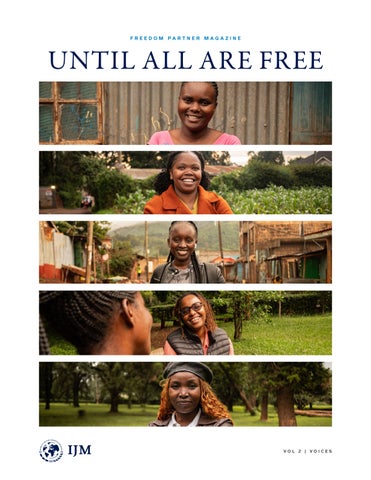
FREEDOM PARTNER MAGAZINE
UNTIL ALL ARE FREE
VOL 2 | VOICES
Until All Are Free
Our Voices Matter
2
Welcome Letter
1
When Voices Are Silenced
2
Zipporah’s Story
5
When Voices Are Heard
6
Mary's Story
9
The Police Force Who Started to Listen
10
MaryAnne’s Story
13
When Voices Are Amplified
14
Stella’s Story
15
Faith's Story
16
A Voice That Went Viral
18
Voices That Rise Together
20
Volume 2 | Voices
Voices
Dear Friend and Fellow Freedom Partner, Greetings from Kenya. It is a real privilege to write to you! Your faithful commitment to support IJM reminds us, again and again, that every survivor’s voice matters and that justice is possible when someone cares enough to listen. As someone who spends time listening to survivors, I have come to understand just how powerful a voice can be.
to speak about what had happened to them. I imagined the doubt they carried—wondering if anyone would believe them—and the fear they lived with after being threatened by those who hurt them.
I have sat in courtrooms and listened as survivors spoke their truth—sometimes trembling, sometimes steady. I have also sat with them in quieter moments, hearing not just their words, but the weight of what they have endured and their determination to move past the trauma.
But today, more than 15 years later, their voices are stronger. They speak not just about what happened to them, but about making sure no other girl goes through what they did and the urgent need to protect others.
In those moments, I see it clearly: A voice does more than shape what happens in a courtroom. It has the power to challenge harmful beliefs and change how communities and law enforcers respond to violence. And yet, I have seen how easily those voices can be silenced. I have seen how stigma, disbelief and fear can weigh heavily on survivors and make their voices feel small, even when their truths are undeniable. I’ve also witnessed voices that were once silenced rise slowly, bravely, finding the strength to call for an end to injustice. Throughout this issue, you’ll hear five of these voices resounding through incredibly brave women—living, breathing examples of the power a voice can hold. As children, they endured horrific violence at the hands of those who should have loved, cared for and protected them. As I listened to these women, I kept thinking about the little girls they once were when IJM first met them. I thought about the hesitation in their voices as they tried
It broke my heart to imagine how quiet their voices must have been as children.
Their voices are powerful reminders of what can happen when someone finally listens, and chooses to stand with survivors on their journey toward healing and restoration. That is why we have dedicated this issue of the Freedom Partner Journal to voices. What happens when voices are silenced. What changes when they’re heard. And what’s possible when we amplify them. Because when those voices echo far beyond indiv idual stories, they do more than inspire change. They help build safer communities where justice can reach everyone—and violence is no longer accepted as a part of life. Thank you for being part of this change. Gratefully,
Caroline Mwaura
Caroline Mwaura Communications Associate, Kenya International Justice Mission
1
Until All Are Free
When Voices Are Silenced Violence is normalised, justice is unseen and entire communities are trapped in a reality where fear obscures truth.
For millions of women and children around the world today, violence is the norm in their homes and communities. In fact, this form of violence is so widespread, it’s far more common than violence in war or conflict, affecting more people over time. Violence against women and children is no longer seen as only a human rights issue. According to the World Health Organization, it's now considered a major public health problem. Part of the problem is that the very justice systems meant to protect people trapped in this cycle of violence fail to do so. Police officers may tell them it’s a family matter that should be settled outside the courtroom. Judges may take the side of the abuser, depending on the power they hold in the community. And many justice actors—such as police, prosecutors, judges and social workers—may lack the knowledge and training to handle these cases with the care and compassion they deserve. Even if women and children break through these initial barriers to pursue pathways to safety, they still face dangerous risks. Women could lose their only
A justice system is the set of institutions and processes designed to protect people, uphold the law and ensure accountability when harm occurs. A functioning justice system is one that protects people from violence and holds offenders accountable.
2
source of income and livelihood. They could lose their children. And they could even lose their lives as they wait years to see justice while the person who abused them continues to walk free. When women and children are made to suffer in silence, entire communities accept violence as the norm and lose faith in the justice system that’s meant to protect them. It’s a horrific cycle. But at IJM, we’ve seen firsthand how working through justice systems can stop it. In communities where this violence is only whispered about, endured and absorbed, one bold voice has the power to ignite change. A single voice begins to echo— through courtrooms, communities and generations— until justice grows louder than fear. 🌐
Voices
G LO B A L S N A P S H OT
1 in 3 1 in 5 women experience physical or sexual violence
women and girls experience sexual violence in childhood
137
women and girls are killed every day by a partner or family member
<40%
Fewer than 40% of women who experience violence seek help
<10%
Fewer than 10% of survivors turn to police
Sources: WHO; UN Women; UNICEF. Latest available global estimates.
2026 Freedom Partner Magazine
3
Until All Are Free
4 Volume 2 | Voices
Voices
ZIPPORAH’S STORY
A Voice Once Silenced If you had met Zipporah Mbulwa a decade ago, you would have found a young girl living in constant fear after speaking up against a powerful man in her community who threatened to destroy her life.
Today, she refuses to be defined by her past and hopes her story will help others better understand both the pain survivors endure and the courage it takes to speak up.
At 12 years old, she was turned away by her community for speaking the truth about what happened to her. The person she reported was arrested and charged, but retaliation followed. The man threatened her, made false accusations and filed a case against Zipporah.
“Support is very important,” she said. “IJM provided me with a lawyer, even though my case went through many delays. Counselling helped me grow and heal and showed me that I matter.”
Because he was an influential figure, lies spread quickly throughout the community. Cultural pressure intensified, and Zipporah lost access to school. “I could not even transfer to another nearby school because the community had turned against me,” Zipporah said. For nearly a year, she lived in hiding. “I kept asking myself, ‘When will this end so I can move on with my life?’” When a children’s officer learned about Zipporah’s situation and contacted IJM, things began to change for her. “That is how I met Esther Njuguna,” Zipporah said, referring to a local IJM staff member. “She listened to me, and from that moment, I knew things could get better.”
Today, Zipporah introduces herself differently than the young girl once held back by fear. “I am a mother, I am a wife and I am a businesswoman.” At 30, Zipporah runs a shop near her home, several kilometers from the city. It is modest but steady work. Through the shop, she contributes to paying school fees for her three children, puts food on the table and maintains a daily routine she once believed was impossible. “I am proud because today I own a shop,” she says. “This is something I never imagined I could have when I was younger. Through this shop, my life has improved.” 🌐
2026 Freedom Partner Magazine
5
Until All Are Free
When Voices Are Heard Vulnerable people are protected, abusers are held accountable, justice becomes visible and communities become safer.
This might surprise you, but IJM has been working to stop violence against women and children since our earliest days. In fact, our roots go back to a case in 1997—the year IJM was founded. In Manila, Philippines, a 12-year-old girl suffered sexual violence at the hands of someone who held immense power in the community—including over the police and one local judge. While few stopped to listen to her voice, IJM did. When IJM heard about the case, our team worked with partners to get another local judge outside of the abuser’s influence to take this case seriously. As a result, the perpetrator was arrested and convicted, sending an important message to the community: Women’s and children’s voices matter. And not even the most powerful person can silence them any longer.
Intimate partner violence is a pattern of abuse or coercion by a current or former partner that is used to exert power and control. Sexual violence is any non-consensual sexual act, attempt or coercion that causes harm and violates a person’s agency and dignity.
6
Voices In 2016, another story played a pivotal role in starting IJM’s casework combating violence against women and children. In Gulu, Uganda, our colleague Acen Dorothy lost her life to intimate partner violence. This tragic loss sharpened our convictions that justice must not only protect people in public places, but inside homes and trusted relationships too. That very year, we launched our first pilot program to prevent violence against women and children in Uganda. Today, we now have programs across East Africa and Latin America. While there are so many organisations doing great work to prevent violence against women and children within the community, few of them work within
justice systems like we do. This is where our 29 years of experience partnering with local governments and justice actors comes in. Where deeply rooted social and gender norms silence victims and discourage reporting, we believe that a functioning justice system and well-trained justice actors can help ensure safety does not depend on one brave voice being heard, but becomes a reality that communities can rely on. When women and children are heard, believed and protected, their courage lights the way for others to step out of silence and into safety. 🌐
Acen Dorothy, a beloved IJM friend and colleague, served in the Gulu office in Uganda. Tragically, Dorothy was murdered by her boyfriend in June 2016. Her death became the impetus for IJM’s intimate partner violence casework.
2026 Freedom Partner Magazine
7
Until All Are Free
8
Volume 2 | Voices
Voices
MARY'S STORY
A Voice No Longer Ignored When Mary was 13 years old, she was abused by a pastor who threatened her and warned her not to tell anyone. He was respected and feared by the community. So Mary remained silent until her mother discovered that she was pregnant. “She believed me,” Mary says. “She did not abandon me.” Together, they reported the abuse to the police, and the pastor was arrested. During investigations, authorities learned the pastor had also abused other girls and boys in his church, and they charged him with additional crimes.
what once tried to break her. Instead, she is building a life that feels safe, steady and her own—one day at a time. “For me, courage means being strong enough to live my life now, without being trapped by my past,” she says. Her son, now 11 years old, remains her deepest source of joy. “He reminds me of where I have come from,” she says. “That heals me and gives me joy and satisfaction. I had him when I had so much pain but seeing him grow makes me happy. I have healed.” 🌐
But even with her mother’s support, Mary’s pain did not end there. It followed her into school, into her neighborhood and into the places where a child should feel safest. “People would talk about me openly,” she recalls. “At school, children laughed at me.” Mary met local IJM staff after her case was referred by medical personnel who treated her. IJM staff supported Mary and her mother through counselling and the long court process. “After going to a counselling session one day, I was encouraged to share my story,” Mary says. “That is when I got courage. At the hospital, I met another survivor who spoke about her abuse. I listened to her and thought, ‘Oh… even my story is not that different.’” Mary’s time in court felt long, heavy and exhausting. But relief came when the abuser was sentenced to 70 years in prison. “I was so happy,” she says. “I knew that I—and other children who had been abused by that man—were safe from harm.” Today, Mary runs her own grocery shop to support her family. At 25, she no longer lives under the weight of
2026 Freedom Partner Magazine
9
Until All Are Free
THE POLICE FORCE
Who Started to Listen When justice actors prove they’re ready to listen, community voices become a force for change. Just take a look at one community in Nairobi, Kenya. When IJM first launched our child sexual abuse project there in 2001, it was difficult to find even one police officer in this community willing to arrest someone suspected of sexual violence. In fact, some police officers viewed being assigned to a child sexual abuse case as a form of punishment rather than a core responsibility.
Child sexual abuse is any sexual act involving a child that exploits their vulnerability and results in harm, regardless of consent.
When children or their parents reported sexual violence, their voices were either not taken seriously, or officers would encourage them to settle outside the courtroom—sometimes motivated by a bribe. Most of these cases never reached court. And with only one police doctor on staff, children often waited weeks, sometimes even months, for the medical exam required to prove a case. By the end of the project in 2018, the response looked dramatically different. “We have seen significant improvements with the police,” said Benson Shamala, who served as IJM’s country director during the project. “The police are now so eager to investigate these cases and arrest perpetrators, we rarely get cases where police have not arrested the suspect.” That transformation took years of partnership. IJM worked alongside local police, providing practical training on how to interview trauma survivors and
10
investigate child sexual abuse, plus two years of mentoring for each officer. Through sustained coaching and collaboration, justice actors began to respond differently, and the community became less accepting of violence as the norm. Charles Juma, then officer in charge of crime, was one of the officers using his voice to change perceptions among the police and the broader community. He worked with IJM on several cases of sexual violence against children and coached his officers to work closely and respectfully with the communities they serve. “Every day when police officers go out on duty, I usually brief them: You are there to protect members of the public, you are there to protect our image as police officers. So protecting this depends on how you interact with the members of the public. If you are aggressive with them, they will shy off. You won't get any information. But if you are responsive, listening to them, you’ll get much more information.” After more than 15 years of partnership, the results are clear: IJM’s support dramatically increased the likelihood that survivors would see justice in their cases, with conviction rates rising to around 80%— well above the typical 30–50%. Over time, these gains extended far beyond individual cases. As communities began to see justice, trust grew. And more people had the confidence to use their voices and work together with police to identify perpetrators of this violence. Today, IJM is recognised as a leading voice in Kenya on sexual violence against children, regularly contributing to national planning efforts and helping shape a stronger, more responsive justice system—one where women and children can trust they will be heard. 🌐
Voices
Police Constable Alice Mugadia and Officer in Charge of Crime Charles Juma were among the justice actors who partnered with IJM to combat child sexual abuse in Kenya. 2026 Freedom Partner Magazine
11
Until All Are Free
12
Voices
MARYANNE ’ S STORY
A Voice That Broke the Silence After MaryAnne’s mother was diagnosed with a terminal illness, her family was forced to depend on help from others. During this period, a man in the village offered to help pay MaryAnne’s secondary school fees if she moved into his home. MaryAnne lived with the man's family and helped where she could. She did chores, washed clothes and took care of his children. Then one night, while the man’s wife was away at work, he sexually abused MaryAnne. To silence her, the man threatened to kill her if she spoke to anyone. But MaryAnne’s story did not end in silence. She went back home and told her mother, who reported the abuse to the police. She later sought medical treatment at a hospital where her case was referred to IJM. Because MaryAnne refused to be silenced, the man was convicted and sentenced to 12 years in prison.
MaryAnne, now 30, works as a child protection coordinator at Freely in Hope, a nonprofit organisation that empowers survivors and advocates to end sexual violence. Some survivors, she says, feel that society silenced them because of how their cases were handled. So she works to restore voice and agency. “Coming in and empowering the community with resources on how to support survivors, how to report and how to create an ecosystem gives me joy,” she adds. Looking back at where she once stood years ago, MaryAnne says, “There is more awareness now. The stigma is slowly reducing.” And for MaryAnne, that matters—because she knows what silence does. 🌐
2026 Freedom Partner Magazine
13
Until All Are Free
When Voices Are
Amplified Survivors become empowered, societal norms begin to shift and freedom echoes across communities, countries and continents. Though each of the women in this magazine had a unique journey of justice, their collective voices show us the incredible power they have in calling others out of silence and changing their communities’ perceptions of violence so that it’s no longer seen as the norm. It’s seen as unacceptable. When women have the confidence that their voices will be heard and believed, their voices can carry farther than you can possibly imagine. These are the voices rising together to build communities around the world where everyone can expect to be safe. 🌐
Members of the Mukunyu Women Survivor Network in Kasese, Uganda, celebrating the growing movement of women whose voices are finally being heard, believed and amplified.
14
Voices
2026 Freedom Partner Journal
15
Until All Are Free
16
Voices
STE LL A’ S STORY
A Voice That Grew Louder Stella Wairimu speaks carefully, choosing her words with meaning and weight. When asked what justice means to her, she answers without hesitation. “Justice for me is freedom.” At 13, Stella was abused by a person who should have protected and cared for her—her stepfather. What followed were years of fear and silence, reinforced by the absence of protection. “I had no one to confide in... as a result of the abuse,” she says. “People in the neighborhood were scared of him. He was well known and connected to powerful people.” Stella vividly remembers the day police officers and local staff from IJM arrived at her school, gave her a phone number and said, “If anything happens, call me.” She kept the number inside her Bible. “That meant everything to me,” she says. A few days later, after a heated argument with her stepfather, neighbors gathered around. Knowing she had people who might stand with her, Stella found the courage to speak up about what he’d done. That same day, her mother also gathered courage to use her voice, and together they reported the case.
Her stepfather was arrested and charged in court. Stella reached out to IJM again and was immediately provided with counselling, placed in a safe shelter and supported in continuing her education. “Education changed everything,” she says. “It told me my future wasn’t over. I was being given a chance to rebuild.” Today, Stella is a 30-year-old woman who is a source of hope for many young girls who’ve suffered violence at the hands of the people closest to them. “I am a young woman who is passionate about ending sexual violence,” she says firmly. She now works at Freely in Hope Kenya. “I help tell community stories in a dignified and ethical way,” she says. “Because I am also a survivor, this work is deeply personal. It gives purpose to what I have gone through.” Stella believes that stigma and silence still affect many survivors, and that fear keeps some from speaking out. But she also sees the progress in her community. “There are more conversations now around child protection, consent and safety,” she says. “Programs in schools and communities give me hope.” 🌐
2026 Freedom Partner Magazine
17
Until All Are Free
FAITH'S STORY
A Voice That Went Viral “Justice may not come the way you want,” Faith says. “But one can create one’s own justice by advocating for others and supporting survivors. That is how I reclaimed my sense of justice.” Faith is a 29-year-old woman whose voice has become a powerful force in advocating for survivors of violence. But her voice wasn’t always so bold. When she was 13 years old, one of her mother’s wellknown restaurant customers sexually abused her and threatened to harm her if she ever spoke up. Frightened and deeply confused, Faith carried her fear in silence, unsure where to turn for help. Over time, her mother noticed that Faith had become withdrawn and cried constantly. Eventually, Faith’s mother discovered she was pregnant.
The abuse was reported, and the man was arrested and charged. He was later released on bail as the case proceeded, a development that brought further fear and disruption for Faith and her mother. The man’s family started threatening them, warning them to drop the case. After seven years, the man was acquitted on the grounds that the evidence the prosecution provided was not enough. “It was not easy to attend court and listen to things that were not presentable,” Faith recalls. Even more painful than the legal process was not being believed. “People would ask me if I had caused it,” she recalls. “They would ask, ‘Are you sure you didn’t provoke him? Why were you outside at night?’ What I needed most was someone to believe me.” But Faith’s response to the outcome is proof that harm does not get the final word. It was a neighbor who knew what had happened to her and was familiar with IJM’s work who first gave Faith and her mother a glimmer of hope. “When we went there, to the IJM office,” Faith says, “my mom was given space to talk. She was listened to—unlike the ridicule we faced in the village. That mattered deeply. It helped my mom, and it helped me too.” Faith received trauma-informed counselling from local IJM staff, as did her mother. Through those conversations, Faith began to understand her reactions not as weakness but as the natural response to harm. Today, Faith works at the Madini Youth Foundation, a local organisation that supports children and young people—including teenage mothers—in vulnerable situations, helping them find stability, confidence and direction. In her free time, she creates short videos that she shares online on platforms like TikTok, Instagram and Facebook to encourage other survivors to speak up too. 🌐
18
Voices
2026 Freedom Partner Magazine
19
Until All Are Free
VoicesThat Rise Together Global Survivor Networks are survivor-owned movements supported by IJM that transform testimony into policy. Each one stands as a distinct, credible collection of voices that are shaping the future and building safer communities where everyone can flourish free of violence. Here are some of the many Global Survivor Networks who are leading the charge in ending violence in their neighborhoods, cities and communities at large.
Global Survivor Networks
HONDURAS
GHANA
VAWC
L ABOUR TRAFFICKING
Tejidos de Sanación (Threads of Healing)
The Courageous Crew Hope in Freedom My Story Counts Impact Makers The Overcomers
78
Global Survivor Networks
COLOMBIA
7,000+
VAWC
Mujeres Pro
Survivor Network members
PERU
1,200+
VAWC
Free to Serve Network
Survivors Equipped to Advocate
16
EL SALVADOR
BOLIVIA
Countries Around
VAWC
SEXUAL VIOLENCE
the World
Free to Serve Network
Fenix Group Resilience Voices
GUATEMALA VAWC
Mi Historia Importa (My Story Matters)
20
Voices
SOUTH ASIA
THAILAND
L ABOUR TRAFFICKING
L ABOUR TRAFFICKING
Jeevana Jwala (Light of Life) Udayonmukha (Emerging) Shrama Vahini (Army of Laborers) Released Bonded Laborers Association (RBLA)
Light of Hope
ROMANIA
CAMBODIA
L ABOUR TRAFFICKING/ SEX TRAFFICKING
L ABOUR TRAFFICKING
Russey (Bamboo)
SAFE (Safe Alliance for Empowerment)
KENYA
MYANMAR
POLICE ABUSE OF POWER
L ABOUR TRAFFICKING
Champions for Justice
Future Star Hantharwady Sparkling Star Lin Let Kyal (Sparkling Star)
UGANDA
INDONESIA
VAWC
OSEC/CSEC
Rwenzori Empowered Women Tororo United Champions Northern Uganda Giants
Nusa Baya Pratibodha (Togetherness, Awareness, Empowerment)
PHILIPPINES OSEC/CSEC
Philippine Survivor Network (PSN)
VAWC = Violence Against Women and Children OSEC = Online Sexual Exploitation of Children CSEC = Commercial Sexual Exploitation of Children 2026 Freedom Partner Magazine
21
Freedom Partner
INTERNATIONAL JUSTICE MISSION is a global organisation that protects people in poverty from violence. IJM's work spans four continents and 20 countries to combat slavery, violence against women and children, and other forms of violence. IJM works to rescue and restore victims hold perpetrators accountable and strengthen public justice systems. IJM empowers women around with the world with the support and tools to break free from violence and advocate for safety in their homes and communities. Learn more at: IJM.org.au
IJM Australia Ltd. PO Box 124, St Leonards NSW 1590
All text and images © 2026 International Justice Mission Australia *To protect survivors, we have used pseudonyms, obscured some images and included photos that do not depict actual survivors where appropriate. Consent gathered for all images.
T 1300 045 669 W IJM.org.au ABN 56 164 514 694 International Justice Mission Australia is a signatory to the ACFID Code of Conduct, which is a voluntary, self-regulatory sector code of good practice. As a signatory we are committed and fully adhere to the ACFID Code of Conduct, conducting our work with transparency, accountability and integrity.