1
iit Technology Ambit / DECEMBER 2018
iit TECHNOLOGY AMBIT IIT Technology Ambit envisions to identify emerging technologies, contemporary research and start-ups born out of the IIT ecosystem. The analysis of the impact of these developments is done to assist the Tech Sphere of India and beyond to be at a pace with the latest. We actively look towards contributions from all stakeholders of all IITs. By stakeholders, we refer to the trinity of alumni, professors and students of IITs.
about this edition The December issue preserves our diverse spectrum as we look at Indian startups in Tech and Operations space and also review contemporary research against Fake News. As before, we begin with the sermon of ‘The Tech Gospel’, pleading us to look at the philosophy of Technology and understand the evolution of Technology and its sociological impact over the ages. We then look at TrillBit, who are tapping the Internet of Sound space with their proprietary technology. Data transmission through sound waves is their catch! Next we look at an interesting piece on Sundar Pichai, the CEO of Google.This article is compiled through various existing interviews and we’ve tried to build a worldview that the CEO of Google holds during these times of immense change in the world of Technology. Next in line is Urbanclap, the hyperlocal startup that has raised a ton of funding. An IPO might just be around the corner for them! Shifting focus towards academia and research, we look at an amazing system built by an IIT KGP team of Professors and students that effectively curbs the issue of Fake News Propaganda. In the next piece, we highlight India’s latest Supercomputer deal and ponder over how a new Supercomputer can benefit IIT KGP in specific and the entire nation in general. We also have some views expounded on the Deep Learner Conundrum: MS or startup? The ambit of Technology is now for you to explore.
2
iit Technology Ambit / DECEMBER 2018
3
iit Technology Ambit / DECEMBER 2018
From the tech GOSPEL Aye, I’m the Tech Gospel, a magnanimous preacher for the Philosophy of Technology. Magnanimity personified in me by the fact that I will ignore your ineptitude towards ruminating on the philosophy of technology or rather in the concept of philosophy itself. In the last issues I had sermonized about first “The Greek Philosophy of Technology” and then the more recent “Humanities philosophy of technology”. In this issue we comparatively look at the philosophies of Science and Technology. It may come as a surprise that the fields of philosophy of science and philosophy of technology show such great differences, given that few practices in our society are as closely related as science and technology. Theoretical research within technology has come to be often indistinguishable from theoretical research in science, making engineering science largely continuous with ‘ordinary’ or ‘pure’ science. This is a relatively recent development, which started around the middle of the nineteenth century, and is responsible for great differences between modern technology and traditional, craft-like techniques. During the end of the 19th and beginning of the 20th century the foundational issues—the reality of atoms, the status of causality and probability, questions of space and time, the nature of the quantum world—were lively discussed and were an illustration of the close relationship between Science and philosophers. However with the advent of the digital age and the astronomical rise in the consumerist attitude questions in philosophy have converged to practical rationality and the way technology approaches and systematizes the solution of practical problems. Thus, it might be claimed that it is up to the philosophy of Technology, and not the philosophy of Science, to target the impact of Technology—and with it science—on society and culture, because Science affects society only through Technology! At least in our contemporary age.
4
iit Technology Ambit / DECEMBER 2018
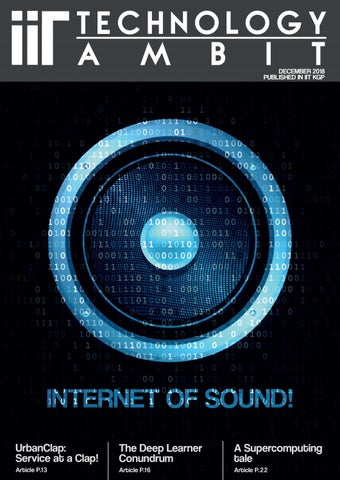
TRILLBIT: Internet of Sound
“The internet of sound� aims to bring sound to the technological revolution it has missed. It aims to give the unexplored power of sound back to people. Universal nature of sound makes it very powerful and offers a unique platform for people and businesses to connect.
5
iit Technology Ambit / DECEMBER 2018
Sight and sound are central to how we perceive the world. These are so intertwined with the human condition that it is almost a tactile part of humanity itself. Humanity is often defined by of our culture and art and here too music and visual art have dominated our expression. However in the technological revolution of the later part of 20th century, sight has simply overtaken and overwhelmed our imagination. First it was color screens , then touch screens , 3D and now augmented reality (AR) and virtual reality (VR), the progress has been staggering. Earlier artistic expression required a medium and technology served an intermediary and an enabler. However the recent technological pace has completely shifted the paradigm. Now mediums such as AR and VR are looking for artists and creatives to server the platform. Somehow sound has missed this popular revolution. Sure enough, there has been incremental development in sound technology , especially in music delivery technology but apart from Bose’s noise cancelling headphone technology from late 1980’s and early 1990’s , there has been no game changing advancement. Sound is ubiquitous, it reaches where sight cannot, we are surrounded by it , it touches our hearts , it’s our primary mode of communication and connection with the world and yet its possibilities have remained unexplored. Oil & gas Industry and military have not missed the
6
train though. They have understood and exploited sound to do amazing things. Oil industry can build detail 3D images of earth tens of kms deep without a single drill by just using sound. This is akin to taking a 3D picture of a dark room while standing 3 buildings away. Researchers in the medical industry are are developing extremely high frequency sound waves to kill cancer tissue without radiation. Yet the amazing power of sound has remained hidden or out of reach in popular culture. Part of the reason is perhaps that it is hard problem and part of the the reason maybe that simpler cheaper alternatives have filled the vacuum. All this is about to change thanks to the power of the incredibly powerful machines in your hand : the mobile phone. “The internet of sound” aims to bring sound to the technological revolution it has missed. It aims to give the unexplored power of sound back to people. Universal nature of sound makes it very powerful and offers a unique platform for people and businesses to connect.Sound can be the thread to connect us without the confines of language, sight or network. The Internet of sound can change the very perception of the world around us and we are sitting on the cusp of the revolution. Trillbit is one of the first Indian Tech startups to get into the Internet of Sound.
iit Technology Ambit / DECEMBER 2018
Trillbit: Proximity Intelligence by Sound Mrigesh Parashar, and Bhaskar Deo, were batchmates while they were pursuing M.sc. in Exploration Geophysics in IIT Kharagpur from 2006 to 2011. Both of them being passionate “core” students, they went on to bag jobs in Schlumberger and worked on different projects based on Sound/ Acoustic based technology in various countries like US and Egypt for 5 years. “Our Trillbit journey started when we were were listening a talk show on a car radio”, recalls Mrigesh. He further adds, “The host told to visit a link for more information. Later we could not remember the link. Then we thought it would be great if Legacy devices such as TV and Radio can send information to our smartphone and we can revisit it as per our convenience. We were working in the area of acoustic and sound technology, so we tried to find the solution via sound. While developing the solution, we realized the potential of our technology. There are more number of Audio speakers than people on earth.” They met a batchmate namedShashikant Burnwal, who was a Mining engineering graduate from the same batch, and had worked for Tata Motors and Ola in Business development. Together these three set out on a journey to convert each and every speaker into a data transmitter and connect the world through sound!
The Technology Data can be modulated on to any wave. Technologies like WiFi and Bluetooth modulate data on Electro Magnetic (EM) waves and need specialized hardware (Receivers and transmitters). Sound is also a wave (though it is mechanical and not EM) and hence can be used for data transfer. However, the technology 7
to modulate the data on the sound wave which can be played over any speaker and received by any microphone is not simple. Trillbit’s technology essentially transforms any speaker and mic into a data transfer device! They encode a layer of data on top of existing sounds and any device with a speaker turns into a data transmitter. The data layer is inaudible so nothing changes for a person but the smartphone starts sensing and capturing this data. The fact that it does not need any special hardware makes it powerful and universal. Trillbit’s proprietary technology sends ultrasonic pulses, which they call “Trill” tones, from any speaker. Trill tones are encoded with data which a human ear cannot hear but a smart device can decode. Any smart device with a microphone - be it your mobile, tablet or laptop can catch these tones. It can then, using the app, interpret these tones to trigger specific actions or transmit contextual data. This technology can be used to serve several purposes, e.g. user-authentication, IoT, Payments, Retail, and even underwater robotics.
Use Cases Television and Radio It helps advertisers to interact in real time with TV viewers, radio listeners using the power of data over sound by sending information directly to smart phones without the need of any network by adding inaudible sound waves on top of the broadcast. Thus, enhancing the viewing experience by adding an extra dimension to a live broadcast without causing any interference. Television and Radio have been the preferred iit Technology Ambit / DECEMBER 2018
choices for advertisers to expand their footprint in tier III cities and beyond. In a country where even the poorest of the poor people have a set top box installed in their house, it makes sense to pay the big bucks for advertisement on TV. But unlike the popular Google ad-sense and Facebook adverts, indexing the effectiveness of the marketing campaign is a daunting task, moreover there is no communication channel through which a user’s smartphone can be connected to the ad without the use of any additional hardware. Advertisers are putting in a lot of money but these ads make a passive outreach, and people have to put in additional effort to search more about the product. With trillbit’s SDK and encryption algorithms, advertisers can connect with the smartphone of the user while the ad is playing on the television, thereby giving them the ability to show relevant offers/information/ popups.
enables store owners to send important information to people passing around the stores with the help of the speakers and the layer encrypted to the sound coming out of the speaker. In this way they can utilise this existing infrastructure which saves them any initial investment cost, gives similar type of engagement and experience as compared to any other advertising tool.
Retail Stores
Trillbit uses unique inaudible audio tones to exchange the encrypted information. The limited use of wi-fi or mobile network makes it more secure. This process has been developed for all type of devices, The use of speaker and microphone makes this technology universal and truly cross-platform.
The second important application of the technology comes into action in the brick and mortar stores that you see in malls, shopping complexes around your city. Almost every store in the mall is equipped with a sound system through which store owners can play music. Trillbit helps shop owners to interact with shoppers in real time and offer them a personalized experience. First it detects their presence with ultrasonic microzoning. And then the technology
8
Large crowded places This technology can also be used in places like stadiums, concerts and airports, where transmitting dynamic information to a large group becomes problematic as WiFi networks fail due to a large audience. With TrillBit’s technology, information can be broadcasted over sound waves directly to the smart devices even in airplane mode.
User identification
iit Technology Ambit / DECEMBER 2018
Secure payment Trillbit provides a secure, multi-platform and the most diverse solution for transactions and payments. The technology can be effortlessly embedded into your payment system; whether it’s a traditional payments system (e.g. ATMs, POS systems, E-commerce platforms) or an advanced system such as a mobile wallet. Broadcasts, Retail stores and Live Events are the immediate avenues that the company is currently trying to monetise, but imagine a world where devices can interact with each other through the same medium as us, Sound! Although, sound has always been central to our human existence, it has remained as a passive medium in digital advancements and Trillbit aims to bridge this gap. There is no common universal protocol to connect Internet of things (IoT), in connecting missing pieces. The company can exploit sound’s omnipresence to build an universal ecosystem that can be leveraged by multiple devices across different platforms like Secure payments, User authentication and Smart homes.
Traction “We are currently deploying two types of revenue models. First one is monthly subscription fee model, wherein the customer pays us a fixed cost based on the number of stores where they play our tone. And the second one is the popular pay-per-click
9
model wherein the customer pays on the basis of the number of end users who clicked on the ad after receiving it”, explains Shashikant Burnwal, who leads the Business development for Trillbit. The startup is currently doing a pilot with Future Group, and the FuturePay app (20 Million+ downloads) will be integrated with the SDK of trillbit’s technology. Shoppers will be able to receive notifications about any offers in the store through the sound systems. “We are also in talks with Sony wherein the SonyLIV app which has more than 50 Mn downloads will be integrated with our SDK. Several other deals with NDTV, Asianet, etc are in the pipeline.”, adds Shashikant. 2018 has been the year of business development and technology adoption for the company. They have acquired some clients in India and Nigeria. The startup is expecting 2019 to be the year of growth and is expecting good business out of TV and Radio platform and have good presence in US market. By 2022, trillbit aims to be the preferable choice for physical businesses and TV/Radio broadcasters for real-time information exchange and be present in various geographies and reach a mark of 50 million dollar annual revenue! For more information, visit www.trillbit.com and if you find this product fascinating, reach out to shashikant@trillbit.com for in depth discussions.
iit Technology Ambit / DECEMBER 2018
Sundar Pichai: Ideology on Technology and Google A classic tale of a hardworking intelligent Indian and not quite as enthralling as the one of dropping out of college and then taking subversive jabs at the conformist education system. Think Again.
10
iit Technology Ambit / DECEMBER 2018
Sundar Pichai, the number one guy - the Chief Executive Officer of Google, hails from Chennai, India with a Bachelor’s degree from the prestigious engineering college of the countryIndian Institute of Technology, Kharagpur. He further excelled at academics in KGP and continued his stint in Stanford for an MS in Material Science and then at University of Pennsylvania’s Wharton School for his MBA and graduated as a Palmer and a Siebel Scholar. After stretches at Applied Materials and McKinsey, he joined Google in 2004 as a Product Manager and subsequently went on to the Throne in 2015. This seems quite like a classic tale of a hardworking intelligent Indian, doesn’t it? Maybe not quite as enthralling as the tale of dropping out of college and then taking subversive jabs at the conformist education system. Well, in the end, how exciting the tale actually is, is upto you to decide. We’ve tried to stitch through a lot of sources to bring his tale to you. Here is an account of his journey, describing his ideology on technology, and the challenges he encounters while helming the mammoth tech company- Google.
Journey at Stanford and the Move to Google
Growing Up in Chennai and Making It to IIT KGP
Personal Approach to Technology and Family
Growing up, Sundar Pichai describes his life to be simple, which was pleasant in contrast to the present world. Lived in a modest house, shared with other occupants. He describes: “Other houses had refrigerators and then we finally got one. It was a big deal”. A voracious reader since his childhood (aren’t all CEO’s voracious readers?!), Pichai enjoyed reading whatever he could get his hands upon. He vividly recalls enjoying the books by Charles Dickens and playing street cricket with friends. Eventually, Pichai persevered to get selected in the premier Indian Institute of Technology, Kharagpur and pursued his bachelors in Metallurgy & Materials engineering. On 5th January 2017, the institute witnessed the homecoming of one of its most glorious alumni, Sundar Pichai. An inspiration to every KGPian who wants to stir the world through technology and lead not just a company but the entire world!
After returning home on a Friday evening, Sundar Pichai truly wishes to relinquish his gadgets, but he hasn’t been quite successful in achieving that. Pichai strives at spending quality time with family, attentive to what his children learn from his actions and routine. “My son is 11 years old, and he is mining Ethereum and earning money. He’s getting some insight into how the world works, how commerce works” and his son doesn’t have a phone, adds Pichai. He believes that every generation is stressed over the new innovations and feels that this time it’s extraordinary and agrees that the change that is going on is a lot quicker than at any other time in human history.
11
Sundar Pichai arrived in California and it was the first time he had boarded a plane! Fascinated about Silicon Valley at once, Pichai fondly wanted to be in the Valley where everything happened. Things were quite different here from India. Back in IIT, Pichai seldomly accessed computers- as less as 3 to 4 times in his entire time there and here it was difficult to contain his ecstasy after seeing these big labs where one could program for unrestricted hours. When Pichai first joined Google, 14 years back, he recalls: “I was struck by the fact that it was a very idealistic, optimistic place”. Google still continues to hold the prominent streak of idealism and Pichai believes that there is more realism about how hard some things are in the world. “Technology doesn’t solve humanity’s problems. It was always naïve of me to think so”, emphasising that technology is an empowering influence still mankind needs to learn to solve its own issues and a realistic approach towards these issues safeguards us from our over-reliance on technology.
On Learning Digital Skills and Empowering the Workforce When considering to enable the workforce to flourish and discover openings in the advanced world, the main concept which comes in the limelight is “coding”. Sundar Pichai believes that coding, obviously, is a fundamental and a core skill where America invests. Google has time and again catered iit Technology Ambit / DECEMBER 2018
resources to people from diversified backgrounds, helping them to code and procure expertise in programming and artificial intelligence. Sundar shares: “All of this will help meet the growing need for workers who can write the software that will power everyone’s businesses”, fostering numerous individuals to move into high paying careers. The focus on coding has left a conceivably bigger opportunity unexplored. Previously, people learned job skills and occupational abilities which were sufficient for a lifetime. Sundar Pichai tells: “Nowadays, workers are expected to have digital skills which did not exist five years ago”. A report by Brookings Institute states that the US requiring “medium-digital” skills in America have grown from 40% of jobs in 2002 to 48% of jobs in 2016. Pichai says that these required digital skills are much simpler to learn than to code. Programs like “Grow with Google” incorporate digital skills training for job seekers, empowering them to face a world that is technologically oriented. And moreover, learning digital skills has resulted in boosting the confidence of trainees, preventing their alienation in any sense.
Google on Misinformation and Offensive Content Aimed at Kids It is natural for tech organizations like Google to ban pornography and graphic violence from online networking stages, however its inability to curb propagation of misinformation and disturbing content aimed at kids has been saddening. “There are areas where society clearly agrees what is O.K. and not O.K., and then there are areas where it is hard as a society to draw the line”, says Pichai, pointing towards the obscurity of content. Google has even hired new moderators in the wake of the criticisms received for allowing child abuse videos, hate speeches, and alarming content to flourish on YouTube.
after serious allegations against him for sexual misconduct. “People are walking out because they want us to improve and they want us to show we can do better”, acknowledges Pichai. Post this walkout, the organisation has been running differently and considerable measures are taken to fight out this tension. For instance, channels are set up where individuals can report such issues freely. “These processes are much harder on the people going through it than we had realized”, adds Sundar Pichai. In August 2017, Pichai drew publicity for firing a Google employee who wrote a ten-page manifesto criticizing the company’s diversity policies and arguing that “distribution of preferences and abilities of men and women differ in part due to biological causes and ... these differences may explain why we don’t see equal representation of women in tech and leadership”. While noting that the manifesto raised a number of issues that are open to debate, Pichai said in a memo to Google employees that “to suggest a group of our colleagues have traits that make them less biologically suited to that work is offensive and not OK”. That’s all for the tale of Sundar Pichai. Hope your ambit of looking at technology and leadership could evolve with it!
Sexual Harassment and Gender Equality at Google Recently, about 20,000 Google employees participated in a protest against sexual harassment, demanding amendments on how Google handles sexual harassment. The dissent was incited after the revelation that a senior executive, Andy Rubin, was given an exit package worth $90 million even 12
iit Technology Ambit / DECEMBER 2018
UrbanClap: Service at a Clap! UrbanClap is a mobile marketplace for on-demand local and homebased services in up to 97 different categories including beauty services, photographers, electricians, home cleaning and repairs, yoga and guitar instructors etc. The hyperlocal startup boasts of operations in over 16 cities- including Delhi-NCR, Hyderabad, Pune, Bengaluru, Mumbai, Chennai etc and over 3 million customers and 100k experts.
13
iit Technology Ambit / DECEMBER 2018
With its operations in over 16 citiesincluding Delhi-NCR, Hyderabad, Pune, Bengaluru, Mumbai, Chennai etc- over 3 million customers and 100k experts, hyperlocal startup UrbanClap is now heading towards profitability. Co-founder and CEO Abhiraj Bhal firmly state that an IPO is right around the corner. November 10, 2014. UrbanClap was born when Varun Khaitan and Abhiraj Bhal, batchmates from IIT Kanpur, decided to leave their illustrious jobs back at The Boston Consulting Group when they found their third musketeer Raghav Chandra who was then an engineer at Twitter and shared their ambitions of creating a large tech business solving a primary customer need. UrbanClap is a mobile marketplace for on-demand local and home-based services in up to 97 different categories including beauty services, photographers, electricians, home cleaning and repairs, yoga and guitar instructors etc. Realizing that the local services industry, an irreplaceable part of our day to day life, was extremely fragmented, the trio decided to find a solution that is strongly backed by technological innovation to permanently relieve the numerous phone call lists that offered some respite till then. Other startups operating in the same segment were Doormint, TimeSaverz, Mr. Right, Taskbob and Zepper and listing portals such as JustDial, Sulekha,
14
YellowPages, Near.in. The initial days were spent in experimentation to decide the perfect business model and expanding the team that would execute it. The services they provided were broadly divided into two categories, first, a full-stack model for home services with UrbanClap directly responsible for the service delivery and second, an AI-driven customization model for hiring professional services. Apart from hiring a highly skilled set of VP’s early on, they were lucky to find enough capital from VC’s like SAIF Partners, Accel Partners, and Bessemer Venture Partners. Through Series A and Series B rounds, they raised $35Mn in a year which would fuel them for a few years. At the end of 2015, they had succeeded in amassing over 2500 service requests and 10000 service professionals. However, with over 300 companies competing in the same market, they expected intense competition in 2016, the year of the Hyperlocal Bubble. With the rise in the use of smartphones, the internet and the confidence of investors a number of businesses sprung up in 2015 to tend to the niche market of instant delivery of services. This facilitated the rise of the Hyperlocal Bubble in 2016. According to Inc42, H1 2015 to H2 2015 observed a phenomenal jump of almost 500% in Total Deal Value and 50% increment in Number of Deals. However, merging the online and offline platforms
iit Technology Ambit / DECEMBER 2018
in order to scale the demand and deliver in the shortest time proved to be a daunting task for many. Lack of clear business models and too many similar apps meant that the investors lost confidence by the end of 2015 and in 2016, the number of hyperlocal startups founded dropped by 93%. Major players like Flipkart’s delivery division- Nearby and Ola Cafe lost in the Hyperlocal Shutdown Curse! For UrbanClap however, the story was different. Having sorted out the product-market fit and liquidity, they began working on customer experience and monetization in 2016. Boasting of less than 15% acceptance rates for service professionals, they were incredibly focused on quality of experience for both the service partners and the users. Abhiraj Bhal is confident that sticking to the ideology that quality needs more focus than quantity was what helped them cement their place in the internet space. The name UrbanClap was deliberately chosen over a brand name that directly connects with what the company does to foster organic growth of the brand. Urban – because all their services are targeted towards the Urban user, and Clap – to signify bringing their service professionals and customers together. Also, Clap signifies the ease with which one can hire a service professional on UrbanClap – as simple as a clap. This worked meticulously as they gained popularity among service providers to the point that they had to have a clean-up drive to focus on the long-term marketplace health. Cleanup drives are now conducted on a regular basis every quarter. They further invested resources in expanding categories to promote regular and repeat users, a decision that also helped improve their customer ratings. Through integration with Snapdeal in April 2016, UrbanClap expanded their customer base further while paying a certain commission for the bookings made through their app. 2017 was the year for the user and supplier growth. Supplier growth could only be achieved by time and hard work, and the company looked at innovative strategies like Search Engine Optimisation, Whatsapp and Facebook marketing and paid marketing through ads to tackle user growth. In July 2017, the company received Series C funding of $21M by Vy Capital. With this UrbanClap is now keenly focusing on solidifying a sustainable competitive strategy in their march towards an IPO. In the process, they are eyeing a minimum commissioned revenue of $200Mn - $300Mn as a 15
threshold and building a deeper, 5-level integration with suppliers and service professionals. The entry of big companies like Google with Areo, Big Basket, Paytm Mall, Grofers, UberEATS and Amazon Pantry in the hyperlocal space, UrbanClap is now eyeing profitability. Series D funding of $50Mn raised on November 30th, 2018 from Steadview Capital will help them boost platform adoption by different entities, invest in technology and training and expand into tier 2 cities and into international territories. The mission is now to transform 1 million service professionals into microentrepreneurs in India and other emerging markets.
iit Technology Ambit / DECEMBER 2018
The Deep Learner conundrum: MS or Startup? About to graduate? Frantically searching for the right ideology to apply to your life? Overwhelmed by Deep Learning but confused where to step in? Here’s some help.
16
iit Technology Ambit / DECEMBER 2018
MS or startup job—confused? Deep learning has become a sensation. Software engineers with full-time jobs in reputed companies are also learning about deep learning through platforms like cs231n. stanford.edu, cs224d.stanford.edu, 3Blue1Brown, and Siraj Raval. So how do you decide whether you pursue an MS or startup job to take up deep learning? Anirban Santara expounds his viewpoint on this and lets us in on his philosophy. He enjoys a unique vantage point to answer this conundrum. He’s a Google India Ph.D. Fellow in the Department of Computer Science and Engineering, IIT Kharagpur and an Intel Student Ambassador for AI. He was one of the first few in IIT Kharagpur to have started research in the area of Deep Learning which is one of the most studied areas of AI today. For the last three years, Anirban has led Deep Learning research in the IIT Kharagpur campus by collaborating with reputed public and private organizations like ISRO, MHRD, TATA Steel, Intel, and Apollo Gleneagles Hospitals as well as universities like TU Munich and IIT Madras on ambitious AI projects, publishing in top-tier international journals and conferences.
One way to address the Deep Learner conundrum: MS or startup It all boils down to just two aspects: theory and application. These two categories require two different skill sets which have some amount of overlap. Depending on which skill set you’re stronger in, you can choose your category. The ‘theory’ aspect requires taking up a paper, surpassing it and then publishing it within the next ten years. The skills you require, apart from a fervent passion for mathematics are perseverance and excellent writing skills. Presentation matters and you must be strong enough to fight off setbacks like rejections, implementation failures, bugs, and fake
17
research works. Alongside good English, you need great communication skills to present your ideas properly to collaborators so that you can discuss carefully with experts. Reading also plays a big part. You must be able to read and summarise lumps of literature in little time. Keeping the problem in mind, one can easily locate where the solution provided by the paper you’re reading fits. One also needs adequate proficiency in implementing algorithms in code using Deep Learning libraries like TensorFlow, PyTorch, Caffe etc. These are the traits of a ‘Deep Learning Scientist’ and if you possess most of them, you must go in for an MS/Ph.D. Choose your research lab wisely as you will be gauged based on the number of research papers (NIPS, ICLR, ICML) you published. Quick advice in choosing your research area: Pick something that will hold the limelight to a promising future even after 3-5 years and not fizzle out by the time you are done with your PhD. You must avoid advisors who do not encourage futuristic research, external academic and industrial collaboration, internships and free interaction with other researchers in the team. Look for a good working environment as you spend upto 20 hours a day in a research lab. Your team must be ambitious with a good track record for solving problems. A culture of aiming for top conferences and journals and publishing regularly is a big plus. Also, you must have access to requisite hardware such as GPUs, Xeon Phi/Xeon-scalable processors, TPU (in Google Cloud) etc. Next is ‘application’. The goal is to solve a problem with the deep learning theory. The data includes literature surveys and papers published on the matter. Papers should be gauged on three levels: contribution to the problem statement, scalability of the proposed solution and suitability of the solution. As an example, consider making an AI agent to help people suffering from depression. You need to know
iit Technology Ambit / DECEMBER 2018
the allowable latency of your system, that is, you must not ship private data to the cloud. The skill set required in this application domain of the ‘Deep Learning Engineer’ profile comprises some major skills. First off, superlative programming skills go without saying. You must have the zeal to optimise an algorithm as much as possible so previous full-stack work experience helps. Secondly, you must abound in knowledge about Big Data Handling, High-Performance Computing and hardware platforms such as GPU, VPU/ASIC, FPGA, CPU (x86 vs ARM) etc. Suitability of each platform must be studied and optimum code should be written. If you possess these skills, a startup job would fare you well to explore deep learning to solve problems. However, a routine check of your boss and/or company is required before signing up. We give you an idea here of what you should look out for. First of all, if your boss believes every problem can be solved through deep learning no matter how complex, give him a miss. Make sure the company has a collaboration with a domain expert and also institutions providing labelled training data. A good company has collaborations with an AI expert in academia. This ensures you have help along the way and don’t get stuck up at one place for very long. The next question that arises is whether to go abroad or stay in India. Unless it’s a top-tier university or a workplace close to Silicon Valley, it’s a waste of money because India has excellent colleges like the IIT’s, ISIs and the IISc. It’s better to stay back and work for your country because these institutions provide state-ofthe-art hardware infrastructure for Deep Learning that will be ready within 1-2 years. There are also talented professors and promising research groups. Giants like Google, Amazon, Intel and NVIDIA and government organisations like MHRD, ISRO, and DRDO are investing heavily in these groups as well. Takeaway: starting with a startup job helps you identify which role fits you best—writer, programmer, strategist etc so that you can do that particular task in your research group to publish papers when you do your PhD. If you have neither of the skills required for a deep learning scientist or a deep learning engineer, you can start off with the Google Python Class. cs231n.stanford. edu has assignments that require both paper reading and programming. This will help you understand which stream suits you better and what loopholes need to be plugged in the training.
18
iit Technology Ambit / DECEMBER 2018
Fake News: the new election rigger? BBC refers to the advocation of particular political causes as one of the main sources of fake news. These are circulated by those with scant regard for the truth and who foster those extreme political causes or monetise its online traffic.
19
iit Technology Ambit / DECEMBER 2018
We are all aware of the plethora of fake news and spam in critical crises like natural disasters and elections. For instance, during the Chennai floods of 2k16, rumours were afloat about the escape of crocodiles. This happens primarily for two reasons. News publishers no longer control the distribution of news which reaches users by obscure algorithms. Secondly, newcomers such as BuzzFeed, Vox etc have taken over the long-term position occupied by traditional news publishers. Also, social media companies like Google, Facebook etc have acquired a lot of power in controlling who posts what and the corresponding monetisation. BBC refers to the advocation of particular political causes as one of the main sources of fake news. These are circulated by those with scant regard for the truth and who foster those extreme political causes or monetise its online traffic. Media Vibes SNC is a Belgium company which owns more than 180 URLs (such as 24aktuelles.com or react365.com), devoted to creating and spreading fake news. Some websites use URLs very similar to those of well-known, reputed news stations such as ABC. For example, abcnews.go.com provides authentic news but forged URLs like abcnews. com.co. supply fake news content.“Obama Signs
Executive Order Banning The Pledge Of Allegiance In Schools Nationwide” is one such example. IIT Kharagpur has developed a solution to use artificial intelligence to collect data from social media platforms such as Whatsapp, Twitter, and Facebook, otherwise difficult to access manually. It also provides a check for the authenticity of posts and forwards it to relief organisations helping in the rescue of victims.
IIT KGP: Vanguard against fake news Prof. Saptarshi Ghosh of the Department of Computer Science and Engineering at IIT Kharagpur heads a team that has developed algorithms to identify fake news using machine learning. IIT Kharagpur and the Centre for Urban Science and Engineering at IIT Bombay have approached the Department of Science and Technology with a research project proposal for the same. IIT Kharagpur, along with its collaborators at Qatar Computing Research Institute (QCRI), has submitted a proposal to Microsoft Research India as well. Ghosh says that if the proposal gets accepted, IIT Kharagpur shall collaborate with Microsoft Research and QCRI to create systems for post-disaster relief operations.
Origins IIT Kharagpur piloted on WhatsApp and Twitter in 2015 during the earthquake in Nepal and in 2016 during the Chennai floods. Funds were received from IIT Kharagpur’s Institute Scheme for Innovative Research and Development grant, Microsoft Research India and ITRA, Media Labs Asia and Department of Electronics and Information Technology. It is helpful, let the numbers talk! The solution is 90% efficient in differentiating fake news from real news. A computer code reads English and Hindi tweets about a disaster such as the condition of earthquake victims and transfers the information to nearby relief operators. The solution also compiles information helpful for aiding victims. An unfortunate 98% of tweets are sympathy posts or expressions of pity, not useful in contributing to saving victims. Only 2% of tweets are relevant as they provide actionable information such as what resources are required, where to obtain them from and updates regarding trapped people. This information is identified, collected and
20
iit Technology Ambit / DECEMBER 2018
summarised through live updates. It helps people efficiently coordinate relief operations from the control room itself.
The Tech behind: NLP and Network Information Detection algorithms are divided based on content, distribution of content and hybridity. Three features in the text corpus considered are: linguistic style used to express rumours, characteristics of people involved in propagating information, and network propagation dynamics. In a network, rumours acquire more credibility as more and more neighbours acquire them. After some time, a threshold is crossed and the rumour is believed to be true.
Facebook and Fake News: Is FB the Generator or the Eradicator Facebook faced excessive criticism in 2016, owing to the US presidential election. The Pope Francis reported endorsement of Donald Trump was one of the pieces of fake news circulated during the time by a website run by a Romanian youngster. Facebook is using a double hybrid model of human classification and machine learning. Human classification identifies the purpose of the post to conclude if it was spamming or cheating the feed. Machine learning is executed on these classified posts. The steps include: 1) Pages that have been posting fake news have been studied by Facebook’s experts. 2) Categorise pages to identify spamming such as asking for likes, shares etc. 3) Posts from these pages are fed into a trained model for checking the authenticity. 4) A possibly authentic post will make the model take into consideration your relationship with the source that shared it. Facebook changed the sharing option, allowing only public posts to be shared. Facebook uses the ‘social graph’ to obtain intelligence about the dispersal of fake news. But the amount of power that rests in facebook’s hands today to influence the nature of the entire world does cast a shady cover on the entire Fake News scenario.
21
The Next Stage at KGP: Prof. Ghosh says that the solution not only detects fake news but also uses machine learning algorithms to alert users at the time of a disaster. His team works on developing artificial intelligence methods to extract specific types of critical information. Next in line is a web-based system to aid postdisaster relief operations. The system will utilise the algorithms developed by the team and perform tasks. So a relief worker can be updated via smartphone about trapped people and be sent to their rescue. Prof. Ghosh has stated that his team wishes to focus on emergencies in urban areas such as the recent floods in Chennai and Mumbai. IIT Kharagpur’s solution identifies fake news by analysing and mapping data ensured by the regional authorities. This helps to identify unauthorised handles spreading rumours. The battle against fake news is interspersed with some more battles, such as the battle for the most used AI framework, the company with the best data etc. All in all, a lot is being done towards eradicating the menace of fake news and we can hope to see a more authentic future in the realm of social media.
iit Technology Ambit / DECEMBER 2018
a supercomputing tale Atos, a French-based IT service company has been selected to take up India’s supercomputer project under National Supercomputing Mission (NSM), which means very soon a lot of colleges in India will have a supercomputer of their own including IIT KGP!
22
iit Technology Ambit / DECEMBER 2018
The History behind: India’s supercomputer program was started in the late 1980s because Cray supercomputers were denied for import due to an arms embargo imposed on India, as it was a dual-use technology and could be used for developing nuclear weapons. Supercomputer PARAM 8000 (made by the Centre for Development of Advanced Computing (C-DAC)) was launched on July 1 1991, and is considered India’s first supercomputer. It was indigenously built in 1991 by C-DAC and was replicated and installed at ICAD Moscow in 1991 under Russian collaboration.
Today in 2018: A new Supercomputer deal for India Atos, a French-based IT service company has been selected to take up India’s supercomputer project under National Supercomputing Mission (NSM), which means very soon a lot of colleges in India will have a supercomputer of their own including IIT KGP! Back in 2014, IIT Kanpur became India’s 1st educational institute to have a supercomputer, which for a fact was India’s 5th supercomputer. NSM plans on bringing more of these under the shed of educational and research institutes with a budget of Rs 4500 crore. Atos has won the contract for the ‘build’ part of the NSM where it will partner with C-DAC (Center 23
for Development of Advanced Computing) on all three phases of the project. While Phase I involves the assembly of the supercomputers, in Phase II, certain components like the motherboards would be manufactured locally, and in the third phase, the supercomputer would be designed in India by C-DAC.
Performance of Indian Supercomputers: Performance of any supercomputer is measured in terms of floating point operations per second (flop). In the first phase, IIT-Kharagpur will have a 1.3 petaflop machine and IISER Pune and IIT-BHU will have a 650 teraflop computer each. These would be assembled locally in Chennai by Atos, while it would source the components from France. When exactly the first set of supercomputers is delivered will also depend on whether the data centers at the institutes are ready.
Why the heck does Supercomputing even matter We may appreciate the credibility but still question the application of supercomputers and how it impacts our life. Supercomputers are defined as extremely high-performance computers with enormous computational speed. High-performance computing is important in order for India to make significant progress in various areas, from weather forecasting to drug discovery to astrophysics and bioinformatics. iit Technology Ambit / DECEMBER 2018
India’s fastest supercomputer “Pratyush” is installed in Indian Institute of Tropical Meteorology which uses data from all across the globe for accurate weather forecasting as it involves processing of large chunk of data and quite a lot of mathematical operations. Like the weather, scientific research depends upon the numbercrunching ability of supercomputers. Astronomers at NASA analyze data streaming from satellites orbiting the earth, groundbased optical and radio telescopes and probes exploring the solar system. Researchers at the European Organization for Nuclear Research, or CERN, found the Higgs-Boson particle by analyzing the massive amounts of data generated by the Large Hadron Collider, using what? Yes, a supercomputer! National Security Agency and similar government intelligence agencies all over the world use supercomputers to monitor communications between private citizens (We need another whistleblower!), or from suspected terrorist organizations and potentially hostile governments. Even the big buzzwords of this decade like machine learning and artificial intelligence came to life from the dust of textbook theories due to extreme enhancement in the computational speed. Notably, prior to this enhancement, AI computations were only possible on Supercomputing architectures.
What can a Supercomputer mean for KGP? With all that being said there is no doubt that supercomputers can lead to groundbreaking impact if harnessed with proper innovation. Its presence in IIT KGP is very promising and it can be moulded for various use cases. Primarily extensive research can be done on campus in ML and AI with the aid of the supercomputer which can easily process major chunks of data. Bioinformatics can be enhanced by the high processing speed of supercomputers. Long duration processes which usually take days of observation can be predicted in a matter of seconds! All of this is happening at a time when India has 2 of its supercomputers getting featured in the list of top 100 supercomputers across the globe. 2/100 might not seem like an impressive figure now but given that we have started late and our Technical Institutions are progressively getting at par with the other ‘Supercomputer-abundant’ nations, the ambit of supercomputing in India looks bright.
24
iit Technology Ambit / DECEMBER 2018
25
iit Technology Ambit / DECEMBER 2018