Advocacy is often described as educ ion: it’s n about the rics, it’s about preventing a umptions from becoming policy.
Advocacy doesn’t require a trip to the Capitol every w k
The sy em responds to voices th show up—especia y voices grounded in expertise, local impact, and real world experience.
Advocacy m ters because it helps lawmakers add clear guardrails th pr ect the public without cre ing wa e, confusion, or incentives th drive co s upward. SPRING 2026
EDITORIAL STAFF
Publisher
Denise Johnson, AAI, AAI-M, CISR, CIC
Managing Editor
Jerri Culpepper
Graphic Designer
Denise Canon
PROFESSIONAL STAFF
President/Chief Executive Officer
Denise Johnson, AAI, AAI-M, CISR, CIC
Chief of Staff and Operations
Josh Reasnor, MSSL, CISR, CKC
Senior Vice President of Strategic Initiatives
Sara Bradshaw Ray, CIC, CKC
Workers’ Compensation Account Manager
Jeanette Madrid
Director of Member Services
Shania Slavick
Director of Marketing and Communications
Jerry Rappe’
Specialty Lines Service Account Manager Cindy Munden, CISR
Director of Professional Liability
Cari Senefsky
Agency & Education Specialist Ali Qureshi
Conferences to Continuing Education, BIGiOK Has You Covered Denise Johnson, AAI, AAI-M, CISR, CIC
From Handshakes to Algorithms: Leading Independent Agents Into the Technological Revolution Chris Floyd, CIC, CRM
Woman Needs a Personal Board of Directors (A Framework, Not a Formula) Sara Bradshaw Ray, CIC, CKC
From the President/CEO
From Conferences to Continuing Education, BIGiOK Has You Covered
And just like that, it’s spring in Oklahoma – always a busy time for us! We have the privilege of hosting our Women’s Conference EmPower Her conference and, two weeks later, Insurcon.
This is an interesting time for the insurance industry. There’s a lot of focus on property rates and why it’s happening. And of course, we’re in an election year for most
There are designations for subjects including Surety, Claims, Risk Management and Agency Management! Already have your CIC? There’s a WAIVER program! You can use the knowledge and hours you already have (and 1 other class) and obtain the AIA (Accredited Insurance Advisor)! So many options! Be sure to check it all out at www.BIGiOK.com/Education
Have I mentioned recently that we have a new EDUCATION program? In the past, we have offered two designations, and now we are able to offer more than 35.
of the state races, including governor and insurance commissioner. These elections are going to make a big difference for our industry over the next four years.
It’s important for our members to get to know all of the candidates and see how they will manage Oklahoma laws and regulations. Your support of OKPAC is an excellent way of combining forces to support pro-business issues for our state. If you haven’t given yet, there are plenty of opportunities. Here’s the link: www.BIGiOK.com/pac.
Have I mentioned recently that we have a new EDUCATION program? In the past, we have offered two designations, and now we are able to offer more than 35: focused education for the staff for the very job that they do…
Executive Officer
Looking for more CE opportunities? If you’re a BIGiOK member, you have comprehensive, relevant CE at your fingertips, and now with more options. Build your schedule with in-demand topics, earn state-approved credits, and enjoy transparent pricing with no reporting fees or hidden costs. Can I say FREE? Check out the smorgasbord of class options at web.theinstitutes.org/ceu/ webinars
There are so many things to get involved in at BIGiOK: Young Agents, conferences, lunches and happy hours, to name a few. Take advantage of getting to know all we have to offer by visiting www.BIGiOK.com.
Uninsured Motorist. Always a hot topic of conversation, wouldn’t you say! My question is how does Oklahoma law compare with what we need to be doing for our clients? There is no comparison. I had a discussion recently with a client about this value-added automobile coverage. I told him in my business we do not write only what’s required by law; we go above and beyond. Oklahoma law does not require uninsured motorist coverage to be purchased, but we as professionals are required to offer it, with the client having the option to reject it.
Approximately 13.4%, or 181,000, drivers in the state of Oklahoma are uninsured, meaning 1 in 7 vehicles on the road lack this needed coverage. While this is a significant improvement from previous years, such as in 2015, when rates exceeded 25% (1 in 4), Oklahoma still ranks among the states with the highest percentages of uninsured motorists, frequently cited with the 18th-highest rate in the nation. Even today to me this is still shocking.
As insurance professionals, we are in the business of providing financial security to
Approximately 13.4%, or 181,000, drivers in the state of Oklahoma are uninsured, meaning 1 in 7 vehicles on the road lack this needed coverage.
And on liability coverage, Oklahoma’s law for the minimum required limit is minuscule at best. I told him we require uninsured motorist coverage to be purchased, and we sell liability limits higher than what Oklahoma law requires. Giving my reasoning behind these thoughts, he was impressed. You see, early on in my insurance career I was a claims adjuster for a national carrier. I handled claims involving uninsured motorist coverage and witnessed firsthand how these claims in some cases were life changing for the first-party recipient. Without it would have been well, life changing.
our clients through the insurance policy. Banks loan money to purchase needed or wanted products. Financial advisors make sure our futures are secure, again with money. We as professional insurance agents sell a product for a modest sum that could potentially provide a large sum of money going toward protection of people and property, whether it’s for ourselves or someone else. That’s impressive and very personal to me. How about you?
Scott Dull, CIC Chairman
NO ONE KNOWS OKLAHOMA BUSINESSES QUITE LIKE OKLAHOMANS DO.
That’s why our communities have trusted CompSource Mutual for 85+ years. We’re proud to be a premier workers’ compensation carrier o ering your customers the best: top-rated financial strength and first-rate service. CompSource Mutual is rated A (Excellent) by AM Best.
From the Young Agents Committee
Modern Tools, Timeless Values
As we move into our busy season, storm season, we’re reminded just how quickly things can change in our industry. For many of the clients and communities we serve, this time of year brings unpredictable weather and real risks. It’s also when preparation, communication and trusted guidance matter most. This season also feels like a new chapter for me personally. I’m honored and excited to be stepping into the role of chairman of the Young Agents Committee. Taking on this position is not only an opportunity to grow in my own career, but also a chance to help make a meaningful difference in our industry and for the next generation of insurance professionals.
Our industry is evolving at an incredible pace. From AI-driven tools and digital claims processes to online service platforms and real-time policy access, technology is changing how we work and how we serve our clients. Tasks that took days now take minutes. Information is easier to access, and communication is faster than ever.
And that progress is something we should embrace.
But as we lean into new tools and efficiencies, we also have a responsibility to protect what has always set independent agents apart: relationships. We live and work in the same communities as our clients. We understand the local risks, the weather patterns, the businesses on Main Street
– and the families behind the front doors we insure. Technology helps us be more efficient, but it doesn’t replace sitting down with a client who just bought their first home, opened a business, or is trying to navigate a difficult claim after a loss. Insurance should never feel like just another transaction. At its best, it’s a longterm partnership built on trust, guidance and personal connection.
That’s why being present in our communities still matters so much. As independent agents, we don’t just work here; we show up. We volunteer, support local events and serve on community boards. We maintain local offices where clients can walk in, shake hands and talk through their questions face to face. While we may not be available in person 24/7, our clients still have access to carrier service centers and digital tools that provide support whenever they need it. It’s not about choosing between technology and personal service, it’s about blending both to create the best possible experience.
We’re also operating in a world that expects instant answers. With a few taps, people can order food, book travel or compare prices. Insurance is part of that shift, too. Quick quotes and digital platforms are here to stay.
But when a storm damages a home or a fire disrupts a business, what people need most isn’t just speed, it’s guidance. It’s someone who understands their coverage, knows the local landscape, and can help them navigate what comes next
Mikayla Sikes Young Agents Committee Chairman
with clarity and care. As independent agents, we’re often the ones standing beside our clients after the storm passes, helping them put the pieces back together.
That combination of innovation and empathy is what makes our role so important and so rewarding.
The Young Agents Committee is committed to helping emerging leaders in our industry grow with that same mindset. We want to support professional development, strengthen connections, and encourage involvement in the communities we serve.
We have some exciting opportunities ahead to connect and give back. Join us for the Young Agents Happy Hour sponsored by QuoteWell on April 28 from 4–6 p.m. at The Parlor in Oklahoma City — a great chance to network and build
From the Young Agents Committee
relationships across the industry. Later this year, we’ll host our Young Agents Community Service Fundraiser – Singo on Aug. 6, where we’ll come together for a fun event that also supports a meaningful cause.
As I step into this role, I’m grateful to be part of an industry that continues to evolve while staying rooted in service. The tools we use will keep changing and technology will keep improving.
But our purpose remains the same: to be a steady, knowledgeable and caring resource for the people and businesses who rely on us. And no matter where your career takes you within this industry, I hope we all continue to embrace innovation while never losing sight of the people we serve.
Y O U R P A R T N E R S I N
C A N N A B I S C O V E R A G E
C a n n a b i s I n s u r a n c e W h o l e s a l e r s b r i n g s t h e s a m e p e o p l e - f i r s t a p p r o a c h t h a t d e f i n e s O n e G e n e r a l A g e n c y . O u r t e a m u n d e r s t a n d s t h e c h a l l e n g e s
C a n n a b i s I n s u r a n c e W h o l e s a l e r s b r i n g s t h e s a m e p e o p l e - f i r s t a p p r o a c h t h a t d e f i n e s O n e G e n
o f p l a c i n g c a n n a b i s c o v e r a g e a n d p r o v i d e s t h e m a r k e t s , k n o w l e d g e , a n d
g u i d a n c e t o g r o w y o u r b o o k a n d s u p p o r t y o u r c l i e n t s w i t h c o n f i d e n c e .
Ancillary Businesses
Cultivation Indoor/Outdoor
Delta 8/CBD Retail & Manufacturing
Dietary Supplement Manufacturers
Dispensaries
Hospitality/Consumption Lounges
Lessors Risk Properties
Processors & Manufacturers
Special Events
Vacant Buildings
We speak human, not fine print.
We believe insurance should sound like a conversation, not a contract. So, we skip the jargon and meet you where you are—with tools, insights, and people who know your customers’ industries inside and out, from manufacturers and contractors to breweries and wineries.
That’s how partnerships work. And that’s how we work. Because at EMC, we’re all about Keeping insurance human®
Let’s get to know each other at emcinsurance.com
From Handshakes to Algorithms: Leading Independent Agents Into the Technological Revolution
For nearly 25 years in the independent agency system, and almost six years serving as a national director with the Independent Insurance Agents & Brokers Association (the Big “I”), I have witnessed remarkable transformation. We have moved from paper files and fax machines when I started in this industry to today’s environment of cloud-based management systems and real-time rating platforms. Today, we stand at another defining moment: the integration of artificial intelligence and a broader wave of emerging technologies that are reshaping how we operate, compete and serve.
engines and social media often make the first introduction. Cybersecurity tools protect both agency operations and client data in an increasingly hostile threat environment. And yes, there are challenges. Adopting these technologies requires investment. It demands that we confront data privacy concerns, regulatory compliance issues, staff training needs and workflow redesign. It requires balancing automation with the deeply personal advisory relationships that define independent agents. But these hurdles are not roadblocks, they are stepping stones.
The strength of the independent agency system has always been adaptability. And the Big “I” has been instrumental in helping members navigate every wave of change.
Artificial intelligence may be the headline, but it is only one piece of a larger technological revolution. Automation tools now streamline quoting, endorsements and certificate issuance. Advanced agency management systems integrate seamlessly with carrier platforms. Data analytics and predictive modeling allow us to better understand risk and anticipate client needs. Customer relationship management (CRM) systems enhance lifecycle engagement. Digital marketing platforms help us compete in a world where search
AI-powered tools can now analyze loss trends, flag coverage gaps, assist in claims triage, and provide real-time service responses. Robotic process automation reduces repetitive administrative tasks. Intelligent document processing eliminates manual data entry. Predictive analytics helps agencies refine underwriting submissions and improve retention strategies. Instead of replacing agents, these innovations elevate us, freeing time for consultative conversations, risk
continued on page 12
Chris Floyd, CIC, CRM State National Director
From the State National Director
continued from page 11
management planning and strategic business development.
The strength of the independent agency system has always been adaptability. And the Big “I” has been instrumental in helping members navigate every wave of change. Through its Agents Council for Technology, education platforms, market access programs, technology partnerships, cybersecurity resources and advocacy on data and regulatory issues, the association equips agents not just to survive disruption, but to lead through it. By fostering collaboration between carriers, InsurTech innovators, and agencies, the Big “I” ensures that independent agents have both a voice and a seat at the table in shaping the future.
Technology is not erasing the handshake. It is strengthening it.
Our value has never been in paperwork. It has always been in advice, trust, and advocacy. With the right tools, we can deliver that value faster, smarter and more precisely than ever before. The agencies that embrace AI, automation, data intelligence and digital connectivity will not lose their identity, they will amplify it.
As I reflect on my time in this industry, I am confident in this: independent agents are uniquely positioned for this new era. We understand relationships. We understand risk. And with technology as our ally, supported by the Big “I”, we will continue to innovate, evolve and deliver greater value to the communities and clients who depend on us.
From handshakes to algorithms, our future is not something to fear. It is something to lead.
•
•
•
•
•
•
Our original specialty, Workers’ Comp has long served as the anchor line for our growing suite of commercial products. We distinguish our coverage by providing a host of value-added services before, during, and after a claim.
From Strategic Initiatives
Sara Bradshaw Ray, CIC, CKC BIGiOK
Senior Vice President of Strategic Initiatives
Every Woman Needs a Personal Board of Directors (A Framework, Not a Formula)
Over the last several years, I’ve had the great privilege of traveling to speak at women’s events, facilitating MyNetwork tables, and coaching women in a variety of leadership roles. In those spaces, I’ve spent countless hours learning, listening and sharing conversations filled with honesty, reflection, laughter and more than a few “aha” moments.
Together, we’ve explored the subtle patterns that can quietly limit women’s leadership effectiveness — doing it all ourselves, minimizing our wins, waiting to be recognized, or believing we should already have everything figured out.
One theme surfaced again and again — strong women don’t struggle because they lack capability. They struggle because they try to lead alone.
That realization is what makes the concept of a personal board of directors so powerful.
Just as successful organizations rely on boards for perspective, accountability and wise counsel, leaders benefit from having a trusted circle of advisors around them personally and professionally.
A personal board of directors isn’t a prescription or a rigid structure — it’s a flexible framework designed to help women surround themselves with the right voices at the right time. There is no “right” composition — only what best supports you in this season.
Why a Personal Board Matters— Especially for Women
Women in leadership often carry invisible weight. We support teams, clients, agencies, families and communities — often while quietly managing expectations and internal pressure. Too often, we give freely to others but hesitate to build the same structure of support for ourselves.
A personal board of directors distributes counsel rather than concentrating it in a single relationship. Instead of expecting a single mentor, partner or friend to meet every need, this approach recognizes that better decisions are made when insight is shared across multiple perspectives.
And importantly, boards evolve.
Early career leaders may benefit from more frequent guidance and encouragement. Seasoned leaders may not need all roles filled at once. Some roles are seasonal. Others reappear during transitions. As careers, goals and life stages change, so should the board.
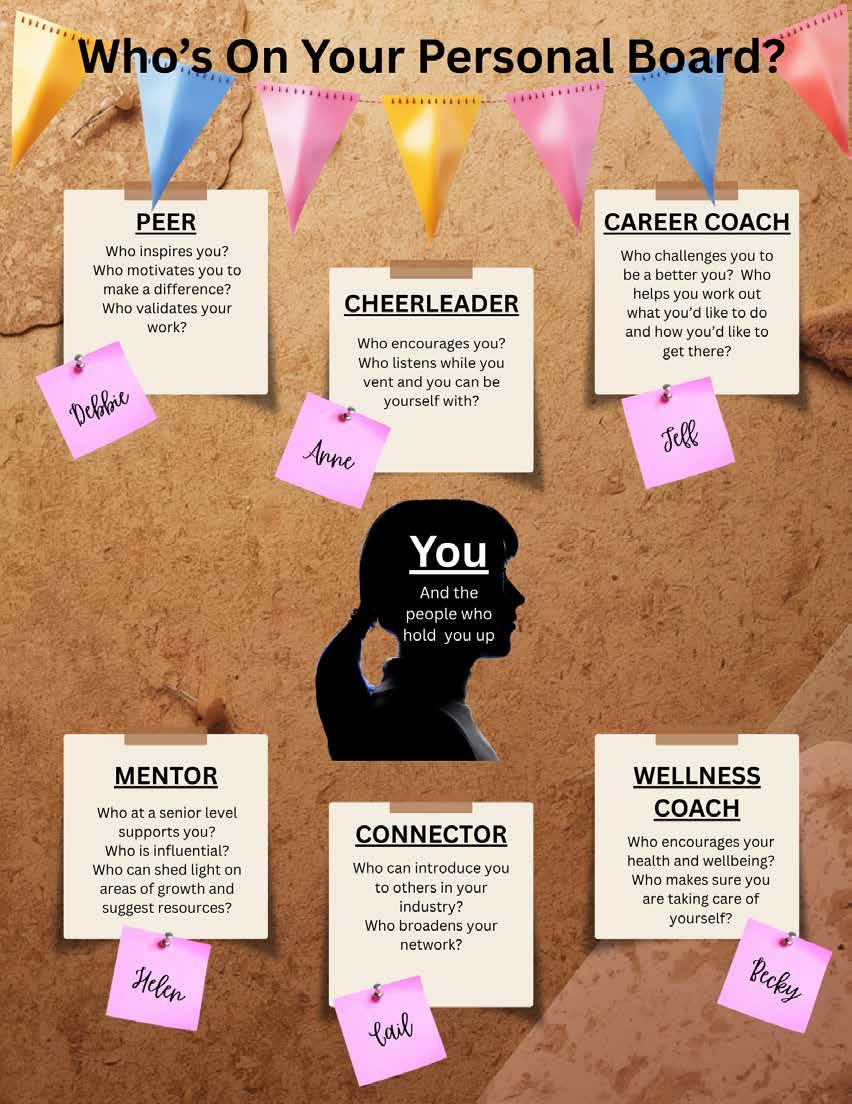
The Six Roles on a Personal Board of Directors
These roles offer a starting point — not a checklist. One person may fill more than one role, and some roles may be dormant for a season. What matters is being intentional about who you turn to and why.
on page 14
From Strategic Initiatives
continued from page 13
1. The Peer – The Reality Check
A peer is someone close enough to your role or experience to help you test assumptions and make sense of what you’re seeing. In some environments, peers may feel competitive — but trusted peers, often outside your direct reporting line or organization, provide invaluable perspective.
Peers are especially helpful in interpreting leadership dynamics, organizational signals and the “unwritten rules” that don’t show up on org charts. They help you separate fact from story — and keep you grounded in reality.
2. The Cheerleader – Your Safe Place to Land
Every woman needs someone who believes in her on the days she struggles to believe in herself. A cheerleader listens
4. The Mentor – The Context Setter Mentors, by contrast, are typically rooted in your industry or organization. Their value comes from experience and context. If a career coach helps you choose the destination, a mentor helps you understand the terrain — what to watch for, what to avoid and how similar paths have unfolded for others.
Mentors bring wisdom shaped by lived experience. They help you see around corners and navigate complexity with fewer surprises.
5. The Connector – The Advocate and Translator
Connectors do more than introduce you to people — they help open doors and translate informal power structures. These are the individuals who understand influence, politics and relationships, and who are willing to advocate on your behalf.
Strong women don’t struggle because they lack capability. They struggle because they try to lead alone.
without judgment, reminds you of your strengths and creates a space where you can be fully yourself.
This role isn’t about strategy or advice — it’s about emotional safety. Cheerleaders help you reset, regain confidence and remember who you are beneath the title.
3. The Career Coach – The Forward Look
If your peer helps you understand what’s happening now, your career coach helps you decide where you’re going and how you want to get there. This role is future-focused, strategic and goaloriented.
Career coaches challenge your thinking, help you clarify aspirations and push you toward intentional action. They don’t need to be in your industry — often, an outside perspective is what allows them to ask sharper questions and help you see possibilities you might overlook.
For many women, connectors play a critical role in visibility and access, helping ensure talent and readiness don’t go unnoticed.
6. The Wellness Coach – The Protector of Longevity
Often listed last — but arguably the most important — the wellness coach helps protect your ability to lead over the long haul. This role focuses less on balance and more on sustainability.
Wellness coaches notice when you’re depleted, remind you to rest and reset, and help ensure that success doesn’t come at the expense of health, relationships or joy.
Building — and Revisiting — Your Board
Creating a personal board doesn’t require formal invitations or quarterly meetings. Some board members may never know they’re “on the board,” and
that’s perfectly fine. What matters is that you are intentional.
Give these people a window into your life and work. Share enough context that their insight is informed and their feedback meaningful. As your goals shift, reassess the gaps you need to fill — not just titles or relationships.
Your board should evolve as you do.
You Don’t Have to Lead Alone
While this framework benefits anyone, women often face a unique convergence of professional ambition and personal responsibility. A personal board of directors acts as both a compass and a safety net — helping women navigate change, make better decisions and sustain leadership over time.
A personal board isn’t a sign of weakness. It’s a sign of wisdom.
And when women lead with support — intentionally and collectively — they don’t just succeed. They build leadership that lasts.
Insurance Careers Month: Public Service Roles at the Oklahoma Insurance Department
When Oklahomans buy insurance, file claims or ask for help understanding their coverage, there is a system in place to ensure those processes are fair and consistent. That system exists because of people doing important work behind the scenes.
February is Insurance Careers Month, a time to highlight the many career paths in the insurance industry. Most people think first of agents, brokers, adjusters and company staff – and those roles are essential. But another critical part of the industry is public service. Insurance regulation is where consumer protection and industry accountability come together, and that work happens every day at the Oklahoma Insurance Department.
OID’s mission is straightforward: protect Oklahoma consumers, efficiently regulate the insurance market and support a competitive, financially sound insurance industry. To do that, we rely on professionals with a wide range of skills and experience.
Many roles at OID are familiar to industry professionals. Financial examiners, analysts, licensing staff, fraud investigators, consumer assistance specialists and attorneys focus on market conduct, solvency, compliance and enforcement. Their work helps ensure companies operate within the law and that consumers are treated fairly.
Other roles may be less visible but are just as important. Our Communications team provides clear, timely information to consumers and industry stakeholders. Our Comptroller team manages agency finances to ensure responsible use of tax dollars. The Medicare Assistance Program helps seniors and families navigate Medicare questions. Our operations staff keeps the agency running smoothly and safely. Together, these roles support the regulatory framework that allows the insurance market to function effectively. Every employee at OID plays a part in protecting consumers and supporting a stable insurance marketplace. The skills used in public service are often transferable between the public and private sectors, and many of our staff bring valuable industry experience. That blend of expertise helps OID maintain a strong reputation for professionalism and fairness.
Insurance regulation is a team effort. Whether you are early in your career, looking for a change, or interested in applying your insurance knowledge to public service, there are opportunities to make a meaningful impact.
Glen Mulready State Insurance Commissioner
About BIGiOK
BIGiOK LEADERSHIP
President/CEO
Denise Johnson, AAI, AAI-M, CISR, CIC
BIGiOK
Oklahoma City
Secretary
Trent Willis
Cornerstone Insurance Group
Oklahoma City
Director at Large
Helen Kasper
Dillingham Insurance
Oklahoma City
Chairman
Scott Dull, CIC
Omega Insurance Agency
Choctaw
Treasurer
Guy Griggs
INSURICA
Tulsa
Immediate Past Chairman
Vicky Courtney
Ricketts Fennell & Assoc.
Tulsa
Director at Large
Tom Perrault
Rich & Cartmill
Tulsa
State Director
Chris S. Floyd, CRM, CIC
Brown & Brown Insurance
Pryor
Director at Large Niki Henley
Extra Mile Insurance
Owasso
YAC Chairman
Mikayla Sikes
Copeland Agency
Oklahoma City
Company Liaison
Traci Madole
Liberty Mutual
Oklahoma City
BIGiOK MISSION STATEMENT
MGA Liaison
LeAnn Sanderson
One General Agency
Oklahoma City
As the new voice of the independent agents of Oklahoma, BIGiOK promotes and provides education, legislative advocacy, innovative concepts and practical solutions, and community and career opportunities.
ABOUT BIGiOK
Founded in 1906 as the Oklahoma Association of Local Fire Insurance Agents, BIGiOK (Big I Oklahoma, Independent Insurance Agents of Oklahoma) has grown into the largest and most influential insurance trade association in the state. With nearly 450 independent insurance agency members, we proudly represent over 3,000 independent insurance agents and their teams. Our members range from small, one-person operations to some of the largest and most respected agencies in the region.
BIGiOK’s mission and policies are shaped by a dedicated board of directors, elected each year at our annual convention, and implemented by a professional staff based in Oklahoma City. Our work is driven by a commitment to strengthening independent insurance agencies through a variety of
programs and services. From advocacy before legislative, regulatory and judicial bodies in Oklahoma to providing essential resources, BIGiOK is a powerful voice for independent agents at the state level.
We are also proud to be affiliated with the Independent Insurance Agents & Brokers of America (IIABA), a national organization based in Alexandria, Virginia, and Washington, D.C., that amplifies our advocacy efforts on a national stage. Beyond advocacy, BIGiOK serves as the go-to resource for information and updates within the insurance industry. Through our publications—Policy Magazine, the BIGiOK Newsletter and other time-sensitive member communications—we ensure that our members stay informed and equipped to thrive in an ever-evolving industry.
OKPac is BIGiOK’s state political action committee. It provides financial support for state elected officials who will provide support for or have shown support of issues affecting the insurance industry and to those who share our business philosophies. Only individuals or partnerships can make contributions to OKPac. Under Oklahoma law, OKPac can accept no contributions from corporations.
2026 Contributors
John Ankeney
Jeremy Bagley*
Aaron Bogie
Mark Carlin
Vicky Courtney
Joan Curtis
Melanie Dinwiddle
Jennifer Dotter
Michael Dull
Warren Dull
Rebecca Easton
Chris Floyd
Vaughn Graham, Jr.
Vaughn Graham, Sr.
Guy Griggs
Niki Henley
Jaycee Hyde
Denise Johnson
Helen Kasper
Traci Madole
Pat Mandeville
Jerry Martinez
Avery Moore*
Rob Piercy
Meghan Pizzalato
Kathy Reeser
Jase Riggs*
LeAnn Sanderson
Mike Taylor
Courtney Willis
Trent Willis
InsurPac is BIGiOK’s national political action committee. It pools the voluntary and individual financial contributions of thousands of independent insurance agents to help elect candidates to Congress who share BIGiOK’s business philosophies. InsurPac is the largest property-casualty insurance industry PAC in the country.
2026 Contributors
Wes Becknell*
Stewart Berrong*
Kent Bradford
Travis Brown
Debbie Burton
Mark Carlin
Michael Cole
Vicky Courtney
Jed Dillingham
Jenny Dotter
Timothy Driskill
Michael Scott Dull
Chris Floyd
Allen Giblet
Vaughn Graham, Jr
Vaughn Graham, Sr.
Austin Greenhaw
Guy Griggs
C Ross Harris
Rich Haverfield
Tony Holmes
Clayton Howell*
Denise Johnson
Mark Long
Jeffrey Lynch*
Patrick Mandeville
Michael McCullough
Mark McPherson
Kelly Miller
Jon Moon
Avery Moore*
Thomas Perrault*
Kathy Reeser
Drew Rickets
Jase Riggs*
T.J. Riley
Michael Ross
Belynda Tayar
Brad Warwick
Ed Young
See more information and quantifiable examples of contributions by going to: OKPac - BIGiOK.com/OKPac
Is your name not on the list? Make contributions today at BIGiOK.com/pac Contributions as of 2/5/2026. Only gifts of $100 or more are listed, except for Young Agents, whose contributions of any amount are listed.
Advocacy is often it’s about preventing becoming policy.
Advocacy doesn’t require a because it helps lawmakers add clear the public without
Legislative advocacy in Oklahoma doesn’t have to feel like a specialized skill – or a full-time job. At its core, it’s a practical habit: noticing when a policy idea will affect real people, translating that impact into plain language, and delivering it to the right decision-maker at the right moment. The reason it works is simple: legislators can’t be experts in everything. They rely on credible, local voices to help them understand what a proposal will do in the real world – especially in complex fields like insurance.
Most advocacy starts long before anyone sees a bill number. A problem shows up in day-to-day business. A member or stakeholder flags an issue that doesn’t match how the marketplace actually functions. Sometimes it’s a gap in the law. Sometimes it’s a well-intended idea with side effects no one has lived through yet. The first practical step is always the same: define the issue in a way a busy person can grasp quickly. What is happening today? What would change? Who would be affected –consumers, local businesses, public entities? What is the likely consequence: added cost, confusion, delays or misplaced responsibility? If you can answer those questions in plain English, you already have the foundation of effective advocacy.
From there, advocacy becomes much easier when you know exactly who represents you. A surprising number of people want to engage but don’t know where to start, so the simplest move is to make legislator lookup part of your routine. The Oklahoma Legislature website makes this straightforward –use the “Find Your Legislator” feature at www.oklegislature.gov to pull up your state senator and state representative, along with your federal delegation. For many advocates, the fastest day-to-day tool is the Oklahoma Legislative Guide app, which puts contact information and district details in your pocket when you need them. And for BIGiOK members, the same “find your legislator” access point is also available through the top navigation at BIGiOK.com, so you don’t have to hunt for it when an issue pops up.
Once you know who to contact, the next question is how to reach out in a way that is actually useful. The most effective messages aren’t long. They don’t try to sound political. They don’t speak in jargon. They start with one credibility signal that matters more than almost anything else: “I live and work in your district.” That single line changes how your message lands because it frames the conversation the way legislators are trained to think – through constituents, local impact and district outcomes. After that, clarity beats volume. In a few sentences, a good advocacy message explains what the proposal does, what the real-world effect would be, and what you’re asking the legislator to do. Support it, oppose it or consider a specific improvement. When you keep it practical, you make it easy for a lawmaker – or their staff – to understand the ask and act on it.
Advocacy in Action
or an exact bill number — for example, "HB1234" or "SB567" — and LegiScan also supports full-text search across bill language. Once you open the bill you want, look for the Text link. That’s where you’ll find the latest bill text –often available as a PDF – and you can download it from there.
This is also where technology can help with an initial read. If you use an AI tool –such as ChatGPT or Copilot for Microsoft 365 – you can upload the PDF and prompt it with something like: “Please summarize this bill in layman’s terms. Include the main purpose, who it affects, and any key deadlines or penalties.” That kind of request usually produces a clean first-pass summary you can use to decide what to read more closely, what questions to ask, and what concerns to flag.
It also helps to understand where your voice fits inside the legislative process.
The most effective advocate isn’t the loudest voice in the room – it’s the constituent who can explain, in plain language, what a bill will change in the real world.
This is where people often underestimate their influence. Legislators hear from fewer constituents on policy issues than most people assume. Many offices are flooded with problem-solving requests, but they rarely get clear, professional input from subject-matter experts who understand how a decision will affect businesses and consumers on the ground. That’s why one email or one phone call can genuinely matter. When a legislator is preparing for a committee discussion or a floor question, they don’t need a speech – they need confidence that they understand the impact, and they need a credible voice they can trust. A constituent who can explain an issue without drama is incredibly valuable.
Just as important, effective advocacy is stronger when you can point to the bill language itself – because details matter. If you’d like to read a bill in its current form, LegiScan’s Oklahoma page is a handy place to start at legiscan. com/OK. You can search using keywords
A bill moves through a series of stages – drafting, committee assignment, committee hearings, floor votes, the opposite chamber, and sometimes conference negotiations. Along that path, the practical pressure points are where advocacy counts. Before a bill is filed, input can shape language while it’s still flexible. In committee, a single unanswered question can stall momentum or create confusion. On the floor, a misunderstanding can spread quickly because not every member has followed the issue closely. And when a bill crosses to the other chamber, the persuasion cycle starts over. This is why advocacy is often described as education: it’s not about theatrics, it’s about preventing assumptions from becoming policy.
In that environment, advocacy succeeds when two things happen at the same time. First, constituents show up as credible experts. Second, the process is
Advocacy in Action
continued from page 23
navigated by people who are tracking deadlines, amendments, vote counts and committee movement. That’s where associations and professional advocates add real value – not by replacing members, but by mapping the terrain and flagging the moments when a legislator needs to hear from the people who live with the consequences. That long-term relationship building is also where political action committees play an important role. Legislative advocacy doesn’t happen by accident; it’s built on relationships. OKPac helps support that work by creating opportunities for lawmakers and industry professionals to connect before issues become urgent. When legislation moves quickly, those relationships matter. A strong OKPac helps ensure the insurance industry has a seat at the table, so when questions come up, lawmakers already know who to call and trust the perspective they’re hearing. Through the administration of OKPac, BIGiOK is consistently advocating on behalf of independent agents, the insurance industry, the state of Oklahoma and the insurance consumer. For more information on OKPac, visit www.BIGiOK.com/OKPac; to contribute, go to www.BIGiOK.com/pac
The practical importance of advocacy shows up most clearly in the kinds of situations Oklahoma regularly faces. Sometimes an issue isn’t about stopping a bill – it’s about improving it. A proposal may begin with a reasonable goal but place responsibility in the wrong place operationally. In those cases, advocacy makes the difference by separating the intent from the mechanism and helping lawmakers adjust the details
Oklahoma leaders often describe change in terms of voices, and it isn’t just a nice sentiment – it’s an accurate description of the mechanism.
so the outcome is workable. Other times, the question is fairness and focus: ensuring public resources stay aligned with public purposes and that policy choices don’t accidentally disadvantage local businesses doing the right thing. In still other cases, public trust is central – especially when public entities and public dollars are involved. When that’s the backdrop, advocacy matters because it helps lawmakers add clear guardrails that protect the public without creating waste, confusion or incentives that drive costs upward.
Some of the hardest policy challenges are emotionally charged. When a situation has real human harm behind it, the pressure to “do something” is intense – and justified. But even then, good advocacy isn’t about arguing the emotion away. It’s about helping lawmakers find a solution that improves safety and accountability without creating requirements so impractical that
responsible businesses are punished and the original problem remains. In those moments, a calm, professional voice from the field can be the difference between a policy that works and a policy that only sounds like it works.
One of the overlooked truths about advocacy is that it’s built in the followup. A quick thank-you note after a call or meeting does more than show respect – it helps your name become familiar. It puts you in the legislator’s mental file as a resource, not a critic. It also makes the next interaction easier, because the relationship already exists. Over time, that becomes the real advocacy advantage: when an insurance question arises, the legislator knows exactly who to call.
Oklahoma leaders often describe change in terms of voices, and it isn’t just a nice sentiment – it’s an accurate description of the mechanism. Rep. Mark Lawson has said that development must respect “our communities and their voices,” and Speaker Kyle Hilbert described change as a “testament to the voices of Oklahomans who stood together.”
The practical takeaway is the same for legislative advocacy: when informed people speak clearly and consistently, outcomes improve. The system responds to voices that show up – especially voices grounded in expertise, local impact and real-world experience.
Advocacy doesn’t require a trip to the capitol every week. It starts with knowing your legislators, being prepared to explain an issue simply, and being willing to send one clear message when it counts. If you can do that, you’re not on the sidelines – you’re part of what shapes the policies your clients and your community will live under next.
Strengthen Your Agency From the Inside Out With Mini-MBA Program
Independent agencies thrive when leadership is clear, teams are coached well and business decisions are grounded in financial understanding. Even strong agencies can feel stretched when growth accelerates, staffing shifts or performance varies across departments.
That’s why Big I Oklahoma continues to expand education options that strengthen agencies from the inside out – including the IA-MBA (Mini-MBA), a focused leadership and finance program built specifically for independent agencies and provided by Goalmakers.
The IA-MBA supports agencies at different stages and leaders at different points in their careers. It’s a strong fit for agency owners and principals looking for clearer planning and performance systems, managers and team leads responsible for coaching and accountability, and emerging leaders ready to step into greater responsibility. Whether you’re building structure for the first time or refining what already works, the program offers a clear pathway to stronger leadership habits and more confident financial decision-making. The format is built to respect real
It isn’t just professional development for one person – it’s an alignment tool for the agency.
Designed to be practical and immediately applicable, the IA-MBA helps participants sharpen the peoplemanagement and business-finance skills needed to grow, optimize operations and lead with consistency. It isn’t just professional development for one person – it’s an alignment tool for the agency. While the program is open to a wide range of roles, many agencies see the strongest results when multiple team members participate together. When owners, managers and future leaders share the same frameworks and language for vision, coaching, systems and financial performance, implementation becomes smoother and progress is easier to measure.
schedules. Participants move through self-paced eLearning –about 2.5 hours per week – paired with bi-weekly 90-minute live sessions led by industry experts. Over a 10-week cohort, the total investment is typically 20–40 hours, depending on pace and experience. Live participation is encouraged because the discussion and real-time coaching are a major value, but recorded sessions are available in the learning platform for review when conflicts come up. And while the cohort runs for 10 weeks, access doesn’t end there; participants retain eLearning access for a full calendar year after the program wraps, making it easy to revisit content during planning
cycles, manager training or performance reviews.
Across the 10 weeks, the IA-MBA follows a structured progression from vision and planning, into leadership and systems, and finishes with a practical focus on understanding and applying financial insights. Participants work through vision, goals and planning; coaching teams and serving customers; empowering people and systems of management; and a two-part financial case study that leads into practical application to grow the bottom line. The takeaway is straightforward: bitesized, step-by-step methods that can be applied immediately – supported by coaching, accountability and peer learning.
In today’s environment, agencies need more than technical skill; they need leadership depth and financial clarity across the team. The IA-MBA helps develop those strengths in a way that’s realistic, structured and designed for implementation. For agencies looking to improve consistency, strengthen management and make decisions with confidence, it’s a smart investment in long-term performance.
To find upcoming IA-MBA dates and registration details through BIGiOK’s education program, contact the education team at education@BIGiOK.com or (405) 840-4426, or reach out to Agency & Education Specialist Ali Qureshi. You can also visit BIGiOK.com/education and follow the designation pathway.
Go Beyond the Basics With AILP Designation
For insurance professionals who are ready to move beyond the basics and sharpen their expertise, the Accredited Insurance Lines Professional (AILP) designation offers a clear next step. Developed by the Massachusetts Association of Insurance Agents, AILP is an advanced-level program for those who want to deepen their knowledge, strengthen decision-making and stand out as trusted leaders in the industry.
This isn’t an entry-level credential – it’s designed for professionals who already understand the day-to-day work of serving clients and managing risk, but want a more rigorous, real-world approach to coverage and policy issues.
Earning the AILP signals a commitment to excellence and continued growth, often becoming a meaningful career milestone that supports both personal development and agency performance. The program helps professionals build the higher-level skills that support leadership and specialized opportunities, think more critically through nuanced coverage and claims scenarios, and bring added value back to their agencies through stronger service, fewer errors and increased trust with clients and carriers.
AILP also offers flexible designation paths while maintaining the same level of rigor. Professionals may pursue the comprehensive AILP covering both personal and commercial lines, or choose a monoline option – AILP/PL for personal lines only or AILP/CL for commercial lines
only. Many begin with a monoline focus and later complete the additional track to earn the full AILP. Completion timelines are structured to fit busy schedules, with the full AILP to be completed within six years and monoline options within four, and once requirements are met, the designation may be used immediately.
To retain the AILP, designees complete six CE credits annually through MAIA in intermediate-to-advanced programs focused on policy issues rather than basic coverage reviews. Approved renewal options include AILP Issues courses (not Coverage courses) and any class identified as an AILP Renewal Approved Program. For courses outside the standard list, MAIA recommends confirming eligibility in advance by emailing course details and intent to renew to bamarowhite@ massagent.com.
While anyone may pursue the AILP, it’s built with experienced professionals in mind and is offered in select Big “I” states, with CE credit availability varying by state. In a field where trust, accuracy, and confidence matter, the AILP sets a clear standard – reflecting professionals committed to mastering complex policy issues and continually elevating their impact.
For more information, go to BIGiOK.com/education and follow the designation pathway or email education@BIGiOK.com.
Webinars and CE opportunities through The Institutes CEU are free to BIGiOK members.
March 3, noon
Risk Financing Redefined: The Captive Advantage
March 4, 10 a.m.
Stress, Savings and Stability: Reframing Life Insurance for Today's Families
March 4, noon
Coverage Collision: Avoiding Gaps Between Crime and Cyber Policies
March 5, 10 a.m.
Algorithms And Accountability: Ethics in the Age of AI
March 5, 10 a.m.
Autonomous Vehicles: Innovation, Liability and the Road Ahead
March 10, 10 a.m.
When Man's Best Friend Bites: The Cost and Coverage of Canine Claims
March 10, noon
Personalized or Problematic: Exploring the New Age Of Insurance Pricing
March 11, 10 a.m. Backyards and Beyond: What Today's Underwriters Really See
March 11, noon
Pressure Points: Ethics Under the Weight of Quotas and Claims
March 12, 10 a.m.
Virtual Care In Workers Comp Claims: Balancing Benefits, Boundaries, and Fraud Prevention
March 12, noon
Justice in Action: How Insurance Fraud Reports Lead to Real Prosecutions
March 17, 10 a.m.
Annuities in Focus: Abuse, Accountability, and Advancement
March 17, noon
The Integrity Equation: Balancing Incentives, Loyalty and Ethical Judgment
March 18, noon
Weathering Change:
Mapping The Insurance Impact Of Climate Migration
March 18, noon
Silent Signals: How to Detect and Report Elder Exploitation
March 19, 10 a.m.
When Man's Best Friend
Bites: The Cost and Coverage of Canine Claims
March 19, noon
Risk Financing Redefined: The Captive Advantage
March 24, 10 a.m.
The Face of Risk: Biometrics, Privacy Battles, and Liability Trends
March 24, noon
The Price of Progress: Medical Inflation and the Insurance Domino Effect
March 25, 10 a.m.
Closing the Gap: Parametric Insurance for a Volatile World
March 25, noon
Living Longer, Planning Smarter: Insurance
Innovation for a 100-Year Life
March 26, 10 a.m.
Risk, Recovery, and the Right Policy: Commercial Insurance Essentials
March 26, noon
Coverage Collision: Avoiding Gaps Between Crime and Cyber Policies
March 31, 10 a.m.
Virtual Care in Workers
Comp Claims: Balancing Benefits, Boundaries, and Fraud Prevention
March 31, noon
Algorithms and Accountability: Ethics in the Age of AI
April 1, 10 a.m.
Annuities in Focus: Abuse, Accountability, and Advancement
April 1, noon
Personalized or Problematic: Exploring the New Age of Insurance Pricing
April 2, 10 a.m.
Backyards and Beyond: What Today's Underwriters
Really See
April 2 , noon
Pressure Points: Ethics
Under the Weight of Quotas and Claims
Review the ongoing schedule update under the “live CEU webinars” heading at
www.BIGiOK.com/ theinstitutes.
Young Agents Young Agents Give Back at Pepper's Ranch
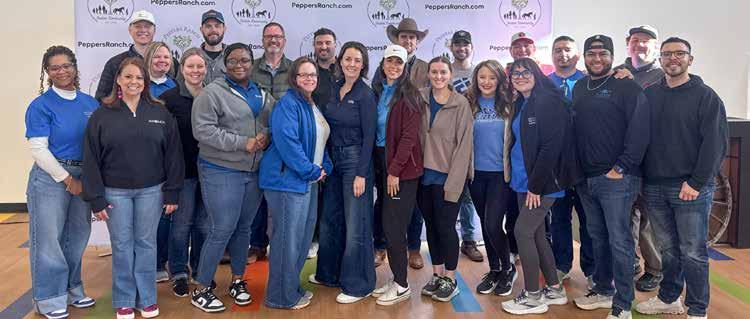
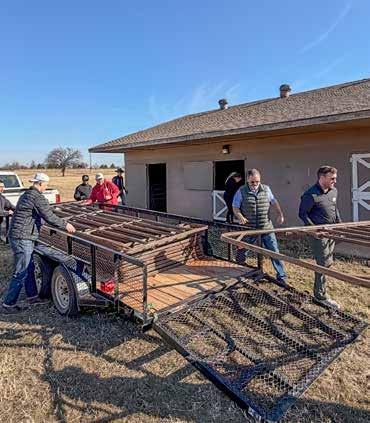
BIGiOK Young Agents and National General/Allstate partnered for a meaningful community service project at Pepper’s Ranch, including a guided tour of the property and hands-on opportunities to support the ranch and the families it serves. We spent the day giving back while learning more about its incredible mission as a foster care community.
From cleaning up spaces and moving furniture around campus to organizing youth clothing at the office, our agency and company volunteers were proud to roll up their sleeves and make a difference. We’re grateful for the opportunity to serve and support such an impactful organization in our community.
Young Agents
We have provided service-oriented, solution-driven, and specialty-focused products for the Inland Marine industry for more than 75 years. Our expertise and relationship-based approach help us offer solutions that address specific needs, even during economic instability.
OUR ALLIANCE BENEFITS WILL BLOW YOU AWAY!
As a Big “I” member, you have access to personal and commercial markets through Big “I” Alliance. Start 2026 strong by taking advantage of your member-exclusive market access options!
Our Big “I” Alliance Blue members have free access to multiple markets through our online platform.
Our Big “I” Alliance Gold members enjoy the benets of joining an agency alliance without the hefty fees and tough-to-escape contract terms common in the marketplace. And for those who wish to utilize it, signicant business coaching is included to help you grow your book and your agency.
Log on to learn more and plug in to the power of market access through Big “I” Alliance!