

Specialty teams to piece each risk puzzle together for you. Our knowledgeable underwriters and brokers coordinate among specialty teams to meet the needs of multi-faceted risk opportunities. Our specialties extend beyond commercial lines into personal lines, farm and ranch, bonds, cannabis and more. We have a dedicated medical malpractice team and one of the strongest aviation teams in the Midwest.
Our goal is to provide one-stop solutions for our independent producers’ local and nationwide insurance coverage needs.



One thing I have learned after years in this business is that independent agents are at their best when we stay close to our people, close to our communities and close to the issues that shape our profession. That has always been true in Berea, and I suspect it is true in every town and city represented by Big I Kentucky members.
A well-run agency does not happen by accident. It takes discipline, good people, dependable resources and a willingness to keep learning. The tools we use may change, but the heart of this business remains the same: serving clients well, building trust and making decisions that will keep our agencies strong for the next generation.
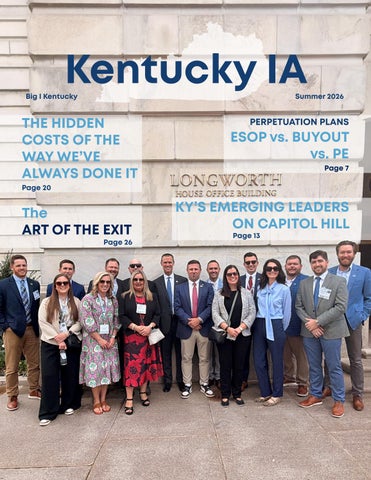
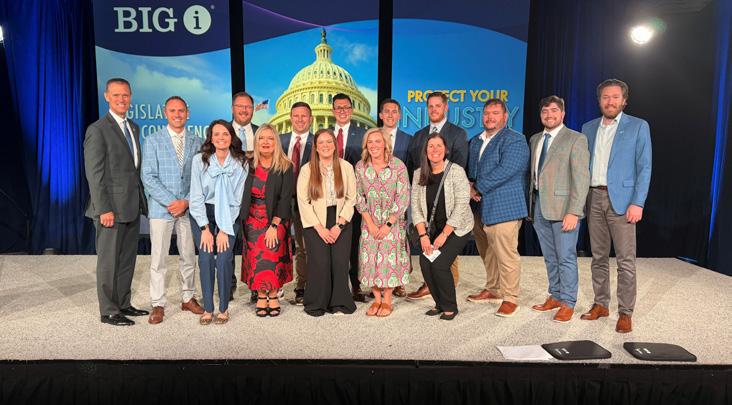
I was proud to join several young agents from our state at the Big I National Legislative Conference in D.C. in April. There is something powerful about watching the next generation walk into those conversations with confidence, professionalism and a clear understanding of what independent agents bring to the marketplace. They represented Kentucky well, and they reminded us that advocacy is not reserved for someone else. It belongs to all of us.
We have seen that same truth here at home. The recent passage of PIP reform in Kentucky is proof that engagement matters. When agents tell real stories about real clients, lawmakers listen. That does not happen by accident. It happens because members take time to learn the issues, build relationships and speak up when it counts.
Looking ahead, tort reform will remain a major focus. This is one of those issues where our industry cannot afford to sit quietly on the sidelines. The work we do every day gives us a practical perspective that policymakers need to hear. Your voice matters. Your experience matters. Your relationships matter.
I also encourage members to take advantage of our upcoming free CE days, Big I Law & Order. It is a great opportunity to earn CE, sharpen your knowledge and stay informed on issues that affect your agency. Consider this a friendly “subpoena” to show up. I promise, no objections from me.
Finally, I hope you are making plans to join us for the Annual Convention and Trade Show at French Lick Resort and Casino. There is a lot of excitement from members and company partners, and we expect strong participation from both attendees and vendors. It will be a terrific opportunity to learn, connect and enjoy the company of people who understand this business.


My husband has found a new friend – ChatGPT. While I recognize some of the benefits of this large language model tool and other models such as Claude, Gemini and CoPilot, as a regulator, I still remain skeptical and have not fully embraced this potential new friend.
These large language model tools can answer questions, summarize documents and assist with writing tasks. While these tools can be useful, they have limitations. They do not truly understand context and meaning the way humans do and may generate information that sounds accurate but is incorrect. For this reason, AI generated information should be reviewed carefully, especially when used for important decisions.
The KY Department of Insurance has added this wording to our consumer complaint forms stating “The Kentucky insurance market is regulated by KRS Chapter 304 and the regulations promulgated thereunder. Artificial Intelligence (“AI”) generated outputs are for informational purposes and do not replace professional advice and consultation. Skepticism is warranted when relying on AI-generated conclusions regarding insurance questions.”
We added this language to our complaint forms because there are at least two states where consumers do not believe the departments of insurance determination on complaints. The consumers state that “AI said something differently” so that means the department of insurance is wrong. These consumers have threatened litigation against the departments because of their total belief in what AI gave as an answer to their queries. When insurers use AI, they remain responsible for complying with insurance laws, regulations, insurance standards and consumer protection rules. This includes requirements related to fairness, ac-
curacy and avoiding unfair discrimination. State insurance regulators oversee insurers’ use of AI and may require companies to explain how these tools are used in underwriting, pricing, marketing, or claims decisions. Human oversight remains an important part of insurance decision making.
AI may change how work is done in insurance, but it is more likely to support human workers than replace them entirely. Actuaries, underwriters, claims professionals, agents and CSRs still play an important role in reviewing info, exercising judgment and working directly with consumers. AI will not replace agents who remain diligent in their jobs and communicate effectively with clients.





In partnership with your Big-I State Association, the Agent Development Program, powered by InsurAcademy provides customized learning for new agents and those seeking professional growth. It features self-paced courses, industry expert-led webinars, interactive learning activities, and a Mentor Program with one-on-one support and group sessions on relevant topics.

A tailored learning platform featuring personalized learning paths, custom dashboards, and agency-branded tools to support professional growth
AGENCY MANAGER TOOLS & PROFESSIONAL SUPPORT
Agency Manager Permissions include tools to monitor course progress, manage user access, and customize training programs through a dedicated dashboard
Access detailed reports to track learning progress, assessments, and achievements, with certificates awarded upon course completion
One-on-one sessions and quarterly group meetings provide personalized guidance for new account managers to build knowledge and excel in their careers

LIVE MONTHLY WEBINARS
Engage in expert-led webinars on technical insurance topics, workflow mastery, professional development skills, and more!
HIRING & LEARNING TOOLS
Identify top talent with unlimited hiring assessments for personality, cognitive ability, and motivation Plus, access an extensive library of courses tailored to every career stage

BY FRANCISCO LOPES, Sonant
The numbers paint an uncomfortable picture. According to industry transition data, only 30% of small businesses successfully transition to a second generation - and that number drops to just 12% by the third. For insurance agency owners sitting on enterprises worth $10 million to $200 million, this
The emotional dimension compounds the financial urgency. Research from the Ohio Insurance Agents Association reveals that 90% of agency owners who sell before age 55 cite stress and burnout as a determinative factor, while 42% of entrepreneurs experience burnout overall. The average agency principal falls between 57 and 62 years old, meaning critical perpetuation decisions must happen within the next five to 10 years. Yet an estimated 30,000 independent agencies under $1.25 million in revenue still operate without succession plans.
This article delivers what most perpetuation conversations lack: a side-by-side financial modeling framework for the four primary perpetuation paths - ESOP, management buyout, PE sale and hybrid structures. We focus specifically on the financial mechanics of each insurance agency perpetuation plan, not leadership pipeline development or governance structures. The goal is to equip you with data-driven models so you can choose deliberately
Agencies preparing for transition need operational efficiency that buyers and successors can inherit. Tools like Sonant AI help build transferable value by automating routine call handling and creating systems that function independently of any single owner.
WHY PERPETUATION PLANNING IS THE MOST URGENT PRIORITY IN INSURANCE DISTRIBUTION TODAY
The deal landscape has shifted dramatically
The M&A environment for insurance agencies has entered a new phase of complexity. According to OPTIS Partners data, the deal count dropped 17% in 2024 compared to the prior year, primarily due to increased cost of capital. Through the third quarter of 2024, only 535 mergers and acquisitions were reported. That cooling period sent a clear message: the frothy seller’s market of 2021-2023 was recalibrating.
But 2025 told a different story. MarshBerry reports that as of November 2025, there were 649 announced M&A transactions in U.S. insurance brokerage, putting deal activity on a 1.3% higher pace than the prior year. Private capital-backed buyers accounted for 471 of those 649 deals - a commanding 72.6% of the market. Meanwhile, independent
agencies served as buyers in just 89 deals, representing only 13.7% of transactions.
Public brokers have seen their values drop 21.0% since peaking in March 2025 and sit down 10.2% year-to-date, according to the MarshBerry Broker Composite Index. This volatility illustrates exactly why timing your insurance agency perpetuation plan matters - a six-month delay can mean a materially different outcome.
The risk of having no plan at all dwarfs the risk of picking the wrong plan. AgencyFocus identifies a single owner past retirement age with no plan as the number one agency risk factor. Having no plan is the fastest path to selling at a discount.
Financial stakes demand modeling, not guessing
Consider what’s at play for agencies in the $10M-$200M range. Understanding your agency valuation fundamentals isn’t optional at this stage - it’s the foundation of every perpetuation decision.
Proper preparation can increase your agency’s value by 20% or more when the time comes to execute a transition, according to INS Capital Group, which has closed over 1,500 agency transactions representing more than $5 billion in value.
The financial stakes extend beyond the sale price itself. Tax treatment, financing costs, employee retention, carrier relationships and long-term wealth creation all vary dramatically depending on the path you choose. Let’s model each one
FINANCIAL MODELING: ESOP, MBO, PE SALE AND HYBRID STRUCTURES SIDE BY SIDE
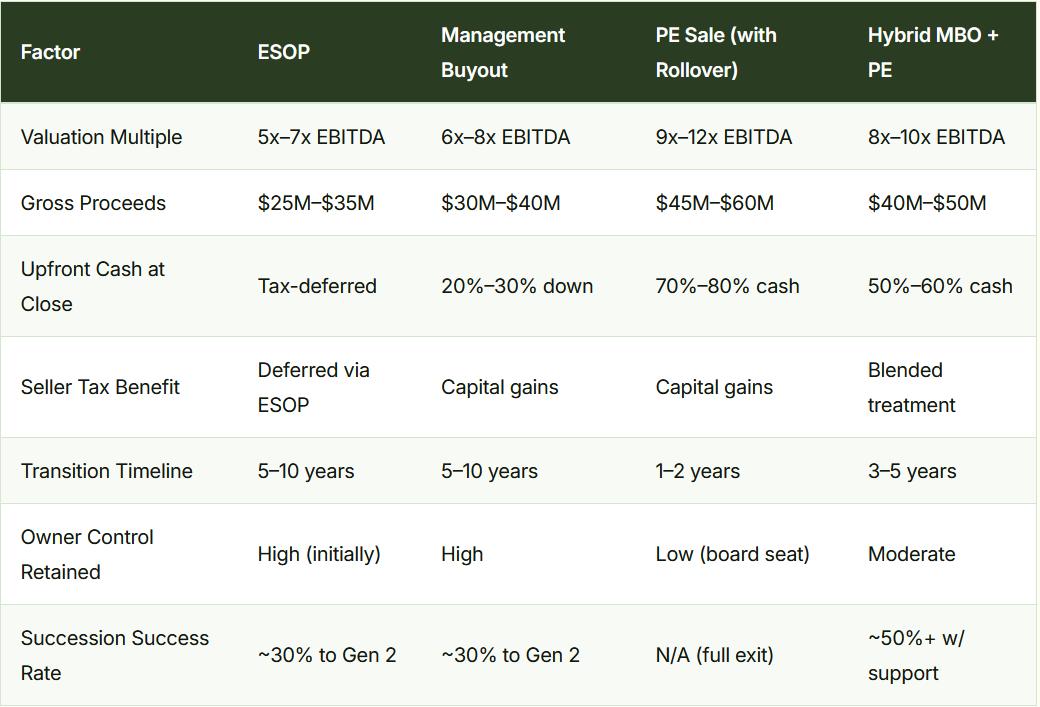
Before diving into each option, you need a clear framework for comparison. The following table models outcomes for a hypothetical agency generating $5 million in EBITDA - a common scenario in the $30M-$50M revenue range that many independent agencies occupy.
...a six month delay can mean a materially different outcome.” “
Perpetuation Path Financial Comparison ($5M EBITDA Agency)
Understanding the valuation spread
The valuation gap between internal and external transactions remains significant. Internal buyouts typically trade at 7x to 8x EBITDA, while external PE buyers often pay 9x to 12x EBITDA for well-run agencies, according to Insurance Journal reporting. Smaller books trade at roughly 6.0x to 8.0x EBITDA and few agencies today command less than two times revenue at a minimum.
That spread - potentially millions of dollars - creates the central tension in every insurance agency perpetuation plan. Do you maximize immediate proceeds, or do you optimize for tax efficiency, cultural preservation, employee outcomes and longterm wealth creation? The answer depends on your specific financial situation, family dynamics and post-transition goals
THE ESOP PATH: TAX ADVANTAGES, EMPLOYEE OWNERSHIP AND STRUCTURAL COMPLEXITY
How an insurance agency ESOP works

An Employee Stock Ownership Plan creates an internal market for your agency’s shares by establishing a trust that purchases ownership on behalf of employees. The mechanics work like this:
• An independent valuation firm appraises the agency’s fair market value
• The ESOP trust borrows funds (often with the seller providing partial financing) to purchase shares
• The agency makes tax-deductible contributions to the ESOP trust, which repays the loan
• Employees receive allocated shares based on compensation or tenure
• Upon separation, employees receive the cash value of their vested shares
ESOP adoption has grown 15% to 20% annually in insurance distribution as owners discover the combination of tax efficiency and cultural benefits. For agencies focused on reducing employee turnover, the ownership culture an ESOP creates can be transformative.
The ESOP structure offers three distinct tax benefits that can dramatically shift the financial outcome:
• Section 1042 rollover: If the ESOP acquires 30% or more of the company and the seller reinvests proceeds into qualified replacement property, capital gains taxes can be deferred indefinitely
• Corporate tax deductions: Contributions to the ESOP - both principal and interest on the acquisition loan - are tax-deductible, meaning the agency effectively repays the purchase with pre-tax dollars
• S-Corp ESOP income: If structured as a 100% ESOP-owned S-Corporation, the entity pays zero federal income tax, dramatically increasing free cash flow
For a $5M EBITDA agency selling at 8x ($40M), the Section 1042 deferral alone could save the seller $4M-$6M in capital gains taxes compared to a straight PE sale. That tax savings narrows - and can eliminate - the valuation gap between an ESOP at 7x8x and a PE sale at 10x-12x.
ESOPs typically require 12 to 18 months from initial exploration to closing. They demand ongoing administration costs of $50,000 to $150,000 annually, including annual valuations, third-party administration and compliance filings. Agencies need robust AMS infrastructure and clean financial records to support the valuation process.
The structural complexity means ESOPs work best for agencies with strong management teams already in place and consistent earnings history. If your agency depends heavily on one or two producers for the majority of revenue, the ESOP structure may face resistance from lenders and trustees
A management buyout transfers ownership to existing leadership - typically a group of two to five key employees who have earned the trust and demonstrated the capability to run the agency independently. The financing structure follows a predictable pattern:
• Senior debt (50%-70%): Provided by specialty lenders such as Oak Street Funding, Live Oak Bank, or Wintrust who understand insurance agency cash flows
• Seller financing (30%-50%): The departing owner carries a note, typically at favorable rates, with the agency’s future earnings securing repayment
• Buyer equity (5%-20%): Purchasing managers contribute personal capital as skin in the game
According to Insurance Journal, the terms of internal purchases are typically 20% to 30% down, with the buyout lasting five to 10 years. Most down payments consist of approximately 80% cash price with the balance in stock.
The insurance agency internal sale presents a funda-
mentally different risk-reward profile than an external transaction. Consider a $40M agency valued at 7.5x EBITDA ($37.5M valuation):
Management Buyout Financing Structure ($37.5M Valuation)
The MBO timeline runs six to 12 months from letter of intent to closing - faster than an ESOP but requiring more complex negotiations around seller financing terms, non-compete agreements and performance earnouts. Agencies pursuing this path need strong operational benchmarks to satisfy lender underwriting requirements.
Most management buyout candidates lack the personal wealth to fund a significant purchase independently. Seller financing bridges this gap while aligning incentives - the departing owner only collects their full proceeds if the agency continues to perform. This creates a natural consulting and mentorship period that protects client relationships and carrier appointments during the transition.
The trade-off is clear: you accept a lower headline valuation (7x-8x vs. 10x-12x) and receive proceeds over time rather than upfront. But you maintain more control over the transition timeline, preserve agency culture and often reduce total tax liability through installment sale treatment.
PE SALE WITH ROLLOVER EQUITY: MAXIMIZING IMMEDIATE PROCEEDS
How PE transactions typically structure
Private equity firms account for the overwhelming majority of agency acquisitions - 72.6% of all deals through November 2025, according to MarshBerry. The top 10 buyers drove 45.1% of all announced transactions, with BroadStreet Partners, World Insurance and Hub combining for 20.2% of the 649 total deals.
The typical PE acquisition structure looks like this:
• Cash at close: 60%-80% of total consideration
• Equity rollover: 20%-40% reinvested in the acquiring platform
• Earnout provisions: Additional consideration tied to retention and growth targets over two to three years
PE firms still pay 9x to 12x EBITDA for well-run agencies, with return on investment typically targeting 20% to 30% or higher. Foundation Risk Partners illustrates the aggregation model’s power - beginning in November 2017, they approached $700 million in annualized revenues by year-end 2024, now ranking among the top 20 largest U.S. independent agency brokers.
The rollover equity component is where PE transactions get interesting for sellers. When a PE firm acquires your agency and you reinvest 20%-40% of your proceeds, you’re betting that the combined platform will achieve a higher multiple at the next recapitalization event - typically five to seven years later. This “second bite of the apple” regularly generates 2x to 3x returns on the rolled equity.
For an owner selling a $5M EBITDA agency at 11x ($55M):
• Cash at close (70%): $38.5M
• Rollover equity (30%): $16.5M
• If rollover doubles at next recap: $33M additional proceeds
• Total potential value: $71.5M
This math explains why PE transactions dominate the market. But the trade-offs - loss of autonomy, integration requirements, potential cultural disruption and talent retention challenges - deserve careful consideration.
PE transactions move fast. From initial conversation to closing, the timeline typically spans three to six months. Buyers will scrutinize every aspect of
your operation: revenue concentration, carrier mix, retention ratios, producer productivity, technology stack and call management systems. Agencies with documented, repeatable processes command premium multiples because they reduce integration risk.
Tax treatment often determines which perpetuation path delivers the highest after-tax wealth. The differences are substantial enough to close - or even reverse - the valuation gap between options.
In a straight PE sale, the seller pays federal capital gains tax (currently 20%) plus potential state taxes and the 3.8% net investment income tax on the entire gain. For a $40M transaction with a $5M cost basis, total federal tax could reach $8.3M or more.
An ESOP with Section 1042 treatment defers that entire gain - potentially permanently if the seller holds qualified replacement property until death, at which point heirs receive a stepped-up basis. This single provision can make an ESOP at 7x financially equivalent to a PE sale at 10x after taxes.
The management buyout, structured as an installment sale, spreads the tax liability across the payment period. This keeps the seller in lower marginal brackets each year and provides flexibility in managing taxable income alongside other retirement distributions. Understanding the owner compensation structures that affect basis calculations is essential before entering negotiations.
For family perpetuation, trust structures and gifting strategies can transfer significant value before the
formal transition. Annual exclusion gifts, grantor retained annuity trusts (GRATs), and intentionally defective grantor trusts (IDGTs) allow owners to shift future appreciation to the next generation while minimizing gift and estate taxes.
Buy-sell agreements funded by life insurance provide the liquidity mechanism for family transitions. These agreements should establish a valuation formula tied to the agency’s business plan and financial performance, updated annually.
Every insurance agency perpetuation plan should start with honest self-assessment across multiple dimensions. The following decision matrix assigns weighted scores to the criteria that matter most. Adjust the weights based on your personal priorities.
Your answers to these questions will naturally point toward one path:
• What is your post-transition vision? If you want a clean break, PE offers the fastest exit. If you envision ongoing involvement, MBO or ESOP structures provide natural consulting roles
• How strong is your management bench? Both ESOP and MBO require capable second-tier leadership. If you lack it, a PE sale that brings in pro. management may be the pragmatic choice
• What is your tax situation? Owners with low cost basis benefit enormously from ESOP Section 1042 treatment. Those with high basis may find the tax differences less decisive
• How important is cultural preservation? If protecting your agency’s identity matters deeply, internal options preserve culture more reliably than PE integration
• What do your employees expect? Agencies with loyal, long-tenured staff often find ESOP ownership creates powerful retention and motivation benefits that reduce turnover costs
Every transition structure includes restrictive covenants, but the terms vary significantly. PE buyers typically require three- to five-year non-compete agreements covering a broad geographic and product scope. Internal transitions may limit non-competes to two to three years with narrower definitions. Your consulting agreement - typically one to three years at 10%-20% of your pre-transition compensation - should specify duties, time commitments and termination provisions clearly.
Operational readiness determines premium versus discount
Regardless of which path you choose, the operational maturity of your agency directly affects proceeds. Buyers and successors pay premiums for agencies that demonstrate:
• Documented workflows that don’t depend on institutional knowledge trapped by one person
• Tech systems - including AI implementation and efficiency automation - that reduce perpolicy servicing costs
• Diversified revenue across multiple producers, lines of business and carrier relationships
• Strong retention ratios above 90% with systematic call volume management
• Clean financial records w/ consistent performance benchmarks trending in the right direction
The 2025 Best Practices Study from the Big “I” and Reagan Consulting found that Best Practices agencies achieved EBITDA margins of 26.1% - just short of the prior year’s record of 26.3%. In 2025, 1,146 independent agencies were nominated, but only 348 scored high enough to qualify. These top-performing agencies command premium multiples precisely because their operations are transferable.
The deal structure you choose sends a message
to employees, clients and carriers. Internal transitions - whether ESOP or MBO - preserve the agency name, relationships and operating philosophy more naturally. PE platforms increasingly recognize the importance of maintaining local brand identity, but integration pressures inevitably reshape culture over time.
Agencies that invest in multilingual customer support and AI-powered service systems before transition create infrastructure that maintains service quality regardless of ownership changes.
The data points converge on one conclusion: the worst insurance agency perpetuation plan is no plan at all. Whether you gravitate toward ESOP tax advantages, MBO cultural preservation, PE premium valuations, or a hybrid approach, the decision framework remains the same - model the financials honestly, assess your management bench realistically and start five years before you think you need to.
Best Practices agencies don’t earn their designation by accident. Reagan Consulting, which provides perpetuation planning alongside M&A advisory and valuation services and has spent more than 32 years studying what separates top-performing agencies from the rest. The common thread: disciplined planning, consistent execution and the willingness to invest in systems that outlast any individual leader.
Your agency’s value depends not just on the revenue it generates today, but on the infrastructure, processes, and technology that ensure it keeps generating revenue after you step away. Investing in scalable agency foundations - from AI-powered call handling to documented workflows - creates the transferable value that commands premium multiples regardless of which perpetuation path you choose.
The phone will keep ringing long after you’ve moved on. Make sure the system answering it reflects the agency you built. •
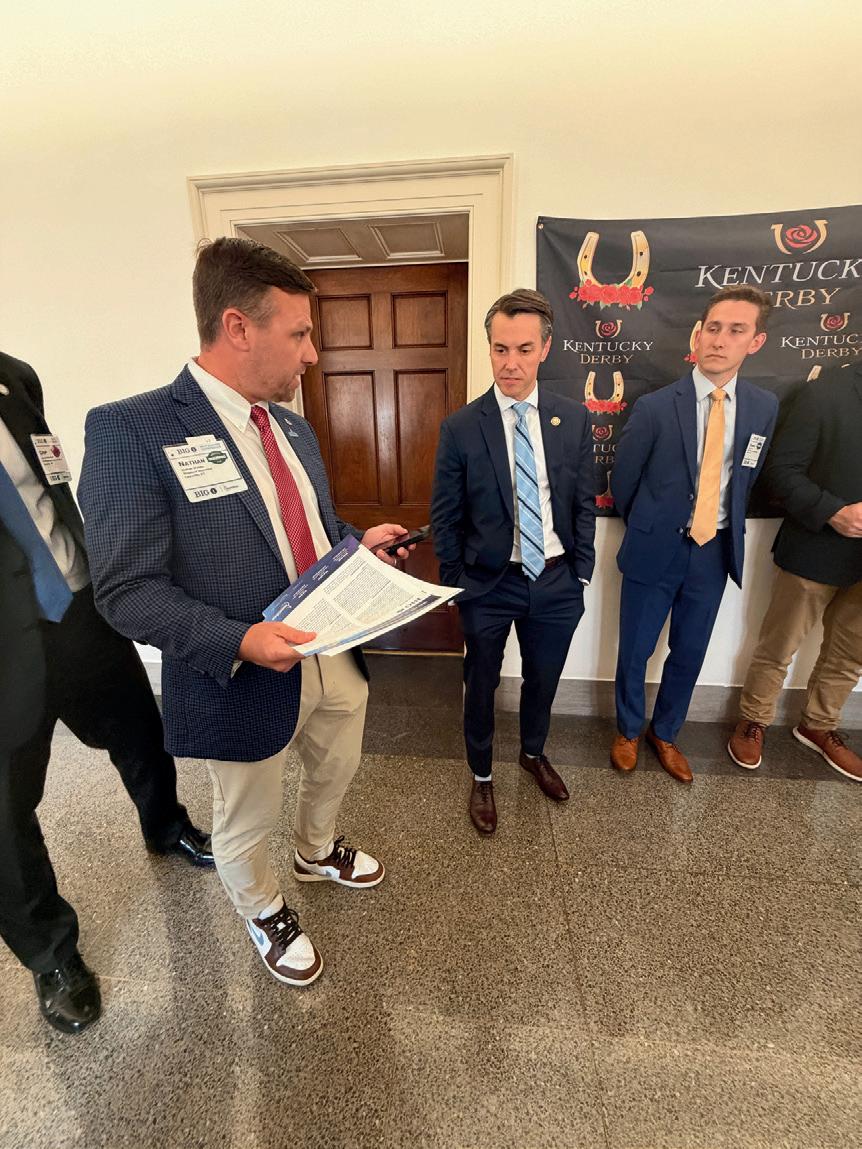
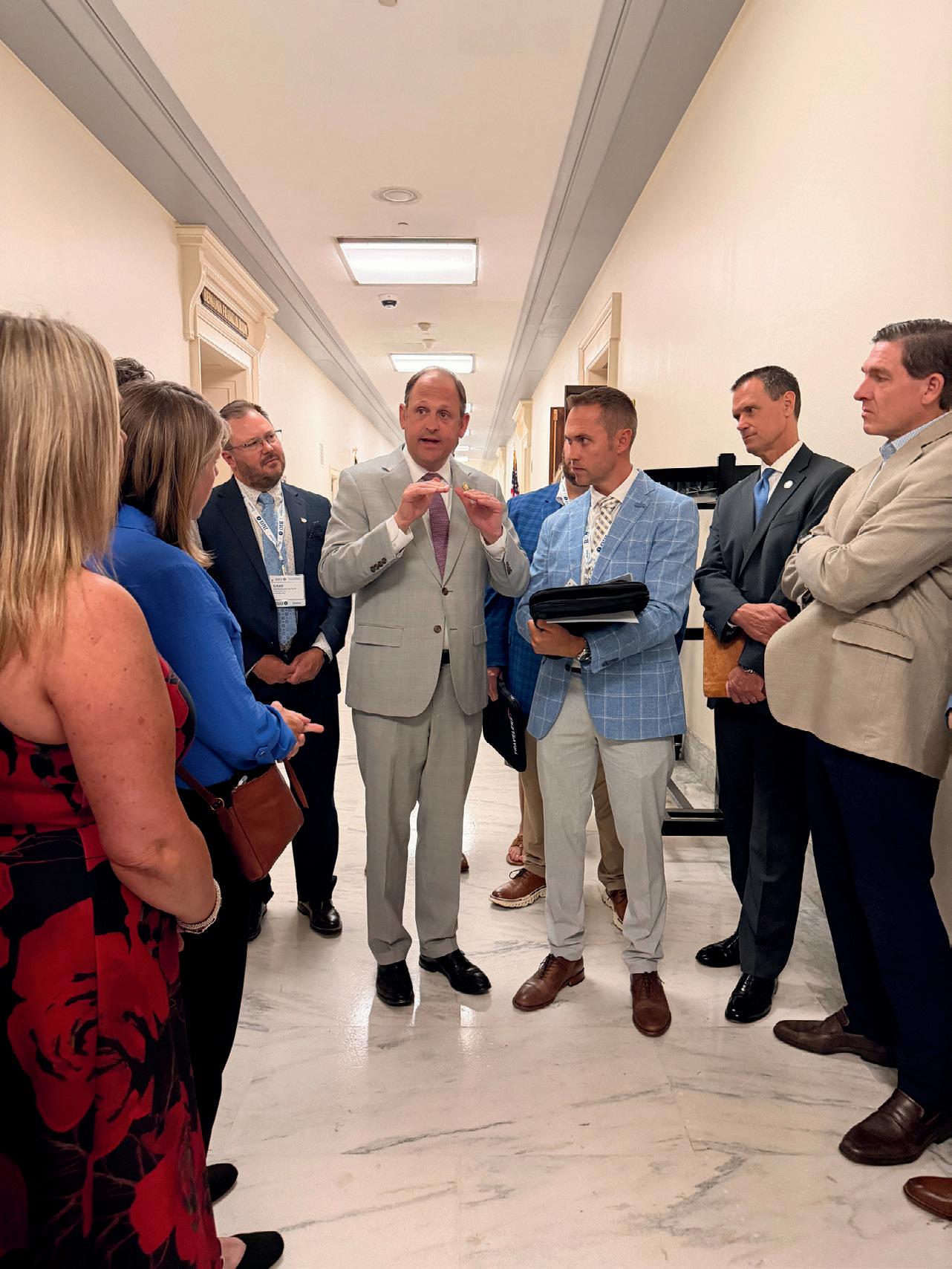
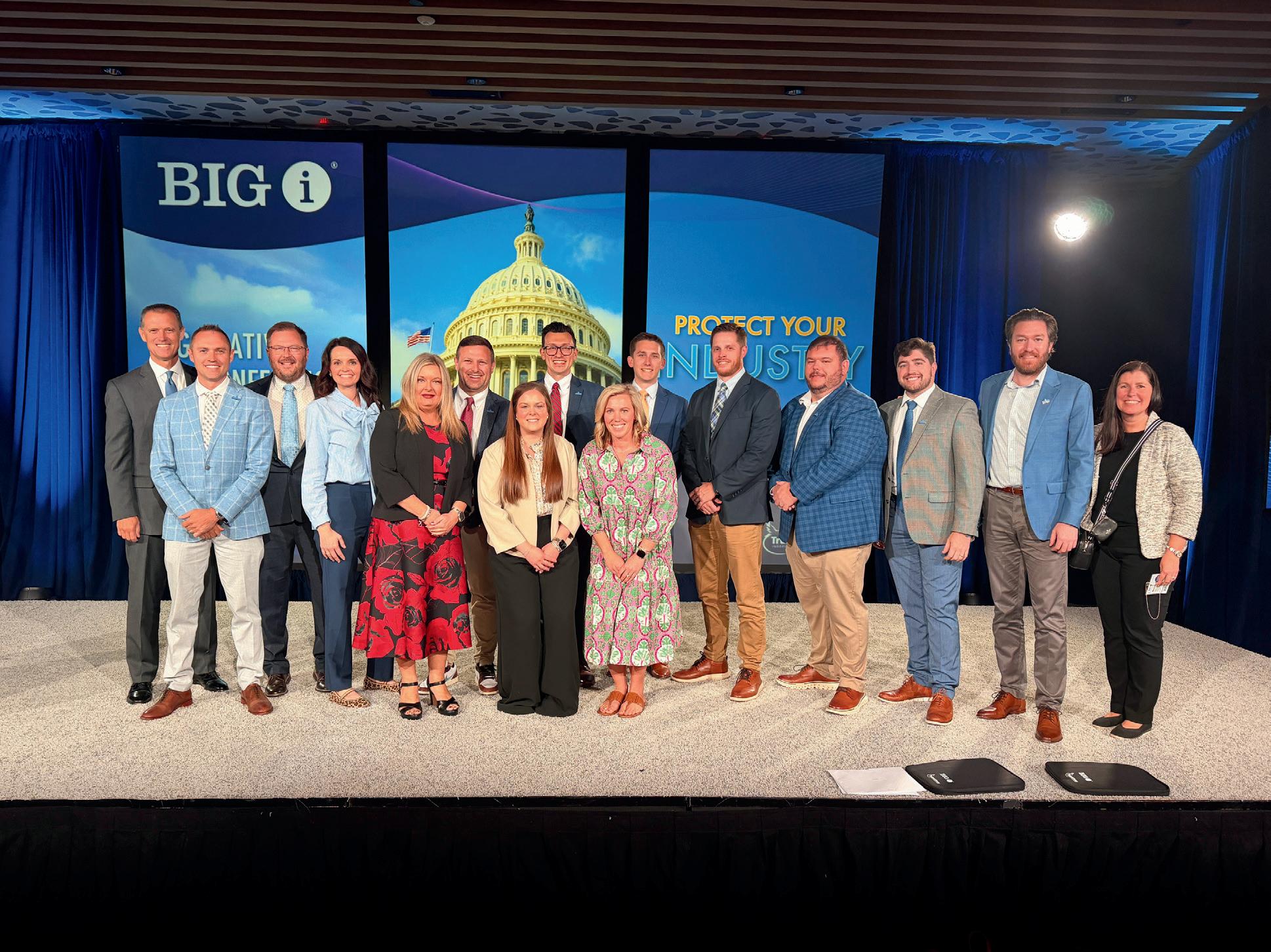
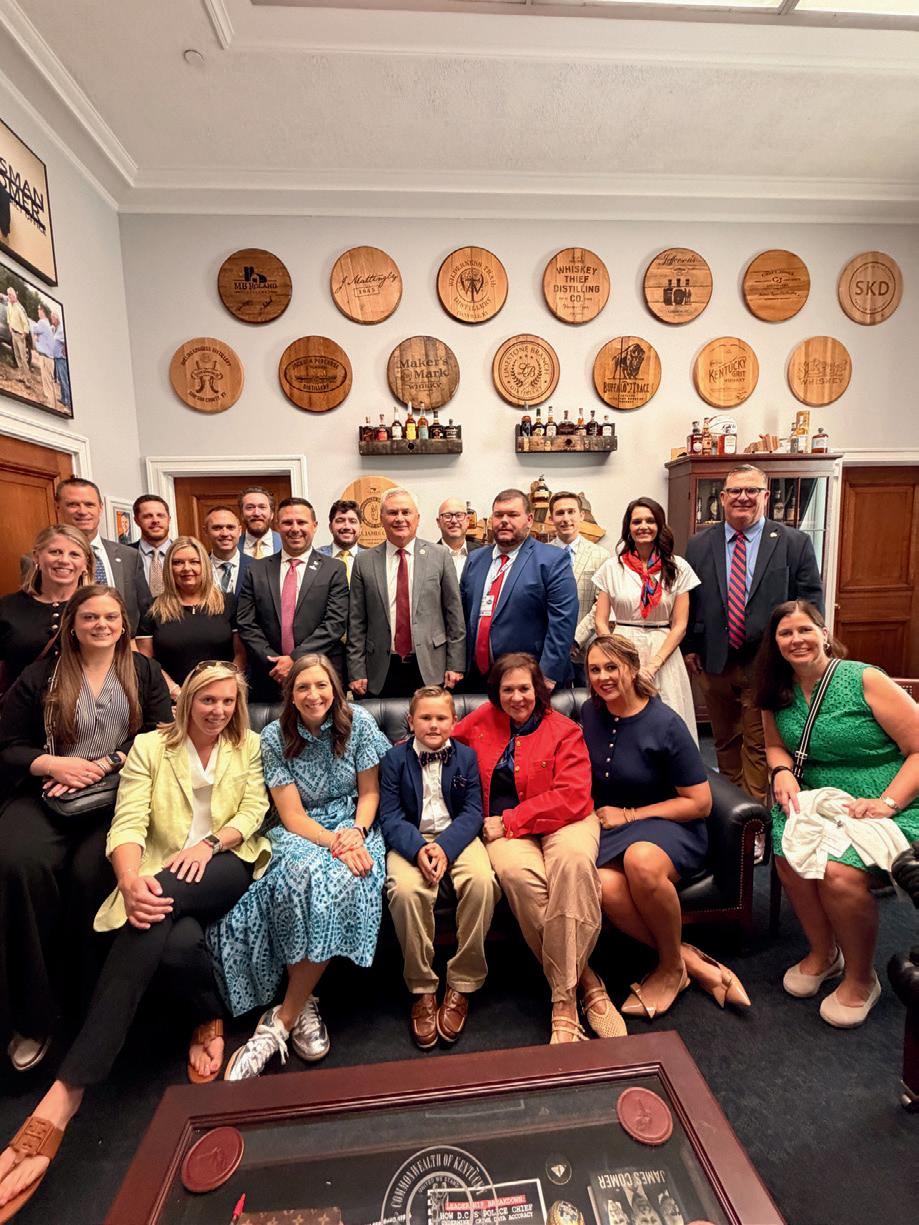
Advocacy in action. The Big I National Legislative Conference brought our young agents together to connect with legislators and champion the issues that matter most in our industry. Thank you to the agents who represented our industry. Your engagement and dedication help us keep our collective voice heard.


We’re with you every step of the way
Behind every Progressive agent is the support of more than 50,000 Progressive employees. It’s our mission to make sure you have the tools and resources you need to succeed.
From caring field sales reps to dedicated agent service teams, we’re ready to help you grow. Plus, we supplement your counsel and guidance with aroundthe-clock claims and customer service via our mobile app and online servicing.
Whether it’s sales, service, claims or anything in between, you’ve got a partner every step of the way.
Search for us online at Agents of Progressive, Progressive Connect, or Progressive Appointment.



BY JASON FURST, Catalyit
If you stopped creating new content for the next 30 days, how much value could your organization still deliver?
That question sits at the heart of modern content strategy. In a world where algorithms decide reach, Google answers questions before users ever click, and attention is harder to earn than ever, the winners are not the teams producing the most content. They are the teams extracting the most value from what they already have.
This article breaks down a proven framework used at Catalyit, designed to help organizations do more with less and extend the life of their content.
START WITH THE WHY: EVERY PIECE OF CONTENT NEEDS A JOB
The biggest content mistake organizations make is creating content without a purpose.
Before publishing anything, ask:
• Is this meant to earn attention?
• Is it designed to build trust?
• Is it meant to drive action?
Posting just to post leads nowhere. It confuses algorithms, dilutes messaging and wastes effort. Purpose-driven content ensures that every blog, webinar, social post, or email has a clear destination and outcome.
YOUR HIDDEN COMPETITIVE ADVANTAGE
Most organizations are sitting on a goldmine of underused content.
Websites are full of insights, presentations, webinars and blogs that were shared once and quickly forgotten.
Ask yourself:
• If we paused new content creation, could you still educate, guide and support your audience?
• Do we treat content as a one-time post or a reusable asset?
The goal is not more content. The goal is longer-lasting content.
Strong content performance starts with a real plan. At a high level, effective planning follows this structure:
Start with the non-negotiables:
• Major events
• Product launches
• Key campaigns
These anchor your entire year.
Collaborate
This is where the best content lives:
• What trends are emerging?
• What feedback is coming from the field?
For education-focused organizations, this becomes the core content engine.
Break the Plan Down
• Annual plan → Monthly focus → Quarterly themes
• A living document you revisit and adjust
Without a plan, content becomes reactive, inconsistent and forgettable.
Build in Bulk or Fall Behind
Consistency beats creativity when creativity is unplanned.
Instead of creating content one piece at a time:
• Time-block content creation
• Build an entire week’s worth of content at once
• Schedule it ahead of time
This approach:
• Prevents missed days
• Improves consistency
• Frees mental bandwidth for higher-value work
The same principle applies to social media. If you are not consistent, algorithms stop rewarding you.
Events are content factories if you treat them that way.
A single keynote or panel can become:
• A long-form blog
• On-demand video
• Podcast episode
• Short-form video clips
• Carousel posts
• Newsletter features
One 45-minute session can fuel an entire quarter of high-quality content.
This is not theoretical. It works when you intentionally plan for repurposing before the event even happens.
There is a ceiling to how much content any team can produce well.
Instead of asking:
• How many blogs can we publish?
Ask:
• Which ideas deserve depth?
• Which topics matter most right now?
Three strong, thoughtful pieces outperform five rushed ones every time.
Your audience does not live in one place. Modern visibility means:
• Website
• Podcasts
• Short-form video
The old model treated the website as the destination. The new model treats content as the answer, wherever the question is asked.
One of the biggest missed opportunities in content strategy is under-sharing. Most people do not see content the first time. Or the second.
A practical approach:
• Build a 90-day recycling pipeline
• Re-share blogs and insights in new formats
• Evaluate performance
• Decide whether content becomes evergreen, seasonal, or retired
Content that worked once often works again when refreshed and reintroduced.
Content audits should be routine, not reactive.
Ask:
• Is this still accurate?
• Does it reflect how we talk today?
• Can it be updated instead of replaced?
A light refresh can turn outdated content into a high-performing asset.
AI is a tool, not a replacement for voice.
Use it to:
• Draft
• Summarize
• Optimize
• Repurpose But always:
• Edit for tone
• Add personality
• Keep it conversational
Human connection still wins trust.
You do not need expensive tools to do this well.
A strong stack often includes:
• AI writing and collaboration tools
• Content planners that fit your workflow
• Clip editors for short-form video
• Social Media scheduling tools
• Transcription tools
• Design tools
• Basic audio equipment like wireless mics
Small investments save massive time.
If you stopped creating new content tomorrow, how long could you still deliver value?
For most, the answer should not be 30 days. With the right planning, repurposing and mindset, it can be months.
The future of content is not louder. It is smarter, longer-lasting and built to answer real questions.
And that is where the real advantage lives. •
Jason Furst is the COO for Catalyit and has an extensive background in content and marketing.



Hidden Costs of “The Way We’ve Always Done it”
BY Sara Bradshaw Ray, MyNetwork
It starts with a phone call.
The owner of a mid-sized independent agency — we’ll call him Sam (names changed to protect the innocent) was at his desk long after everyone else had gone home. A claim had just come in that could trigger an E&O issue. The coverage was placed correctly, but the documentation wasn’t where it should have been.
As Sam dug through files, he found himself asking a question he’d avoided for years: Why does running this agency feel so hard?
On the surface, everything looked fine. The agency was profitable, the staff loyal, and clients generally satisfied. But underneath, there were cracks:
• Processes that depended on the “way we’ve always done it.”
• Team members who were working hard but often at cross-purposes.
• Leaders stretched so thin they had little time for vision or strategy.
• A digital presence that didn’t reflect the agency’s strengths.
Sam didn’t need someone to tell him he was failing — he wasn’t. What he needed was a better way forward.
Sam’s story is not unique. Many agency owners are running good businesses, but they’ve grown comfortable with habits that limit performance. The truth is, good enough doesn’t have to be the standard.
At BIGiOK Consulting, we’ve seen agencies transform when they take a step back and intentionally optimize how they operate. That optimization looks different for every agency, but it often involves five key areas:
Kentucky Agents Political Action Committee, known as KAPAC, is the state political action committee for Big I Kentucky members. It works to protect the business environment in which independent insurance agencies serve clients, grow their businesses and compete.
Decisions made in Kentucky’s legislature and courts can directly affect independent agents, consumers and the insurance marketplace. KAPAC gives Big I Kentucky a stronger voice in a crowded public-policy arena alongside hundreds of associations, companies and other interests working to shape state policy. KAPAC contributions do not buy outcomes. They help create opportunities for meaningful conversations, allowing Big I Kentucky to share the independent-agent perspective and educate policymakers about the real-world effects of legislation and regulation. Combined with year-round advocacy, a strong KAPAC helps ensure our association can support pro-business, insurance-friendly candidates and advance policies that protect consumer choice and a healthy insurance market.
KAPAC also helps members build relationships with policymakers. Big I Kentucky hosts events throughout the year, including the Legislative Reception during the session at Golf Garage in Frankfort, where members can connect with state senators and representatives.
Adam Sheridan
Angie Taylor
Ashton Darius
Bart Rowland
Bennett Fultz
Blake Foster
Brady Walz
Braxston Hicks
Brody Layton
Carolyn Reynolds
Celeste Million
Chad Hennessey
Chandler Cohoon
Chase Riley
Chris Howell
Crystal Reid
Curtis Edge
Dennis Desmond
Diana Vazquez
Donna Schlie
Dustin Miller
Dustin Million
Dylan Cundiff
Elizabeth Flynn
Eric Vieth
Erin Fosson
George Solomon
Gregory Thomas
Jared Pursley
Jennifer Hurt
Jessica Dennis
Jessica Meincken
Jill Humphrey
Joe Evans
John Nix Purdom
John Witt
Josh Conder
Kelly Feher
Lanie Ledford
Lathan LaMar
Laura Gaunt
Mackenzie Wilson
Melissa Worrell
Nathan Mulvey
Nathan Shanks
Nate Schwartz
Neel Ford
Nicholas Rolf
Parker James
Robert Palmer
Sam Lotze
Sara Aschbacher
Sarah Dinwiddie
Sarah Johnson
Shannon Desmond Walz
Stephanie Wilson
Tara Purvis
Todd Benson
Tonya Cothern
Trenton Shain
Whitney Floyd
Zach Von Kannel
1. Strategic Clarity
A strong plan isn’t a binder that gathers dust on a shelf. It’s a living roadmap that helps owners and leaders make decisions with confidence. Strategic clarity keeps everyone — from principals to producers — rowing in the same direction.
2. Leadership Development
Agencies thrive when leaders at all levels are equipped to lead. Whether it’s coaching for an executive navigating growth or training for a new manager learning to motivate a team, strong leadership development creates ripple effects across the organization.
3. Operational Optimization
Bottlenecks and inefficiencies cost more than just time — they create risk. Streamlined processes reduce frustration and uncover hidden E&O exposures before they turn into costly mistakes. This is where many owners have their “wake-up call.” That missing documentation. The overlooked process gap. Those are the details that make the difference between a minor hiccup and a major liability.
4. Strengths-Based Teams
Every team has natural energy for getting work done, but too often that energy is wasted. By leveraging tools like the Kolbe A™ Index, leaders can align teams based on how people instinctively take action. The result? Less friction, fewer misunderstandings and more productivity without adding staff.
5. Technology Alignment
From agency management systems to your website, technology should serve your business goals — not complicate them. A clear-eyed evaluation often reveals where tools are underutilized, outdated, or simply misaligned with the agency’s direction.
Some owners wait until there’s a crisis to act. But the reality is, the current environment is already pressing agencies to do things differently.
• The hard market is squeezing margins and in-
creasing client expectations.
• Workforce dynamics are shifting — leaders must adapt to motivate and retain talent.
• Clients compare your digital experience not to other agencies, but to Amazon and Apple.
Waiting until “someday” isn’t an option. Agencies that thrive in the next five years will be those that step back, reassess and realign now.
“
Good enough doesn’t have to be the standard.”
One of the biggest misconceptions about consulting is that it’s a cookie-cutter solution. Nothing could be further from the truth.
Some agencies come to us for a targeted engagement — maybe to streamline workflows or to build leadership strength around a single key player. Others choose a comprehensive engagement that evaluates strategy, operations, leadership and technology together. In both cases, the work is customized to the agency’s size, goals and growth stage.
The result isn’t a theoretical report — it’s actionable steps that move the agency forward. And in many cases, the improvements reduce liability exposure while increasing efficiency and profitability.
Sam’s story ended differently than it began. Instead of reacting to the next issue, he and his leadership team made time to step back, look at their agency holistically, and build a roadmap. That roadmap became their filter for decisions, their guide for growth, and their safety net for reducing risk.
Your agency deserves the same.
Start the conversation. Whether you want to focus on one pressing issue or take a high-level, comprehensive look at your agency, BIGiOK Consulting can help you chart the best path forward.
Visit BIGiOK.com/consulting to learn more or reach out directly to me, Sara Bradshaw Ray, SVP of Strategic Initiatives, at Sara@BIGiOK.com. You can also complete this quick questionnaire to get the conversation started.
Don’t wait until you’re forced to change. Discover your better way now — and lead your agency forward with clarity, confidence and purpose. •
5 Signs It’s Time to Rethink Your Agency Operations
• You’re making money, but you feel like you’re working harder than ever.
• Your team spends more time fixing problems than serving clients.
• Processes depend on “the way we’ve always done it” — and only one person knows how.
• You’ve wondered more than once if a missed detail could create an E&O nightmare.
• Your strategic plan is to sit on a shelf instead of guiding your decisions.
Sara Bradshaw Ray, CIC, CKM is the Founder of MyNetwork and brings over 35 years of experience spanning agency ownership, company commercial underwriting and cluster development. She is widely recognized for her deep understanding of agency operations and strategic leadership in a rapidly evolving industry.
• If you checked even one of these, it may be time to explore a better way forward.










In its announcement this morning, The Hill stat ed winners were selected from more than 1,800 nominations and “represent the industry’s savvi est, most influential and well-connected advocates
“The Big ‘I’ is proud to see Charles recognized, once again, by one of the premier political outlets in the country,” says Angela Ripley, Big “I” chairman and owner and president of VW Brown Insurance Ser vice in Columbia, Maryland. “Charles and our gov ernment affairs team have built an impeccable rep-


Congressional leaders regularly tap the Big “I” federal government affairs team for its political acu men for sitting on congressional steering commit tees, raising campaign dollars, hosting political events and strategizing to help members of Con gress better serve their constituents and advance top issues. A vital component of the association’s advocacy efforts is InsurPac, the Big “I” political ac tion committee, which continues to be one of the top agent and broker PACs and one of the leading small business PACs in the country.
Founded in 1896, the Independent Insurance Agents & Brokers of America(the Big “I”) is the nation’s oldest and largest national association of independent insurance agents and brokers, representing more than 25,000 agency locations. Big “I” members are trusted insurance advisers who offer consumers all types of insurance—property, casualty, life, health, employee benefit plans and retirement products—from a choice of insurance companies. •

BY SHAWN MOYNIHAN, Aartrijk
While most agency owners are too focused on their current state of affairs to consider their endgame, the fact is there’s going to come a day when you hand the keys to a new owner.
Whether you decide to perpetuate internally, foster a funded business handoff to your successors, or go with an external sale, one thing is certain: There are several key steps you’ll need to take to maximize your agency’s value.
Get comfortable with the idea that your agency will—and should—outlive you. This is a good thing; it’s your legacy, and you deserve to be well compensated for the many years you’ve spent investing in it, both personally and financially.
The truth is, delaying your exit can be detrimental to your agency for several reasons. Scott Freiday, senior vice president at InsurBanc, points out that agencies with a longtime owner and no clear succession plan can suffer deteriorating revenue growth. They’re often in cruise-control mode, focusing only on renewals rather than investing further in the agency or expanding its book of business. Such agencies can also risk losing key producers over time if the business’s future remains unclear.
“It’s a systemic issue among small businesses,” Freiday says. “You need to have a written, explicit succession plan in place.” Then, you need to “develop your plan and memorialize it,” he says.
Further, a lack of planning doesn’t just affect dayto-day performance—it can also limit long-term independence and value.
“Delaying perpetuation planning threatens a firm’s ability to remain independently owned,” says Keith Schuler, president and CEO of InterWest Insurance Services in Sacramento, California.
“Perpetuation and succession planning are inseparable, and should inform all major decisions,” Schuler says. “Firms with a clearly defined perpetuation plan have more options and typically achieve higher agency value.”
There’s also the chance that an unfortunate incident could suddenly befall you, in which case your family will be left holding the bag. That’s hardly an optimal situation for anyone involved, and a rushed or uninformed sale will result in your heirs receiving far less than they would have if you had a thoughtful succession plan in place.
“Regardless of age, agency owners have to realize they could walk across the street and get hit by a truck,” says Al Diamond, president of Agency Consulting Group Inc. in Cherry Hill, New Jersey. “They need an actionable plan for their agency if something should happen to them.”
Making mindful decisions about how your agency will endure doesn’t mean you can’t stay active. It simply means you’ll be protecting your most valued asset while you decide how and when you’ll exit.
The first step is to recognize that your retirement and the perpetuation of your agency are two very different, but related, subjects. “The agency principal has to sit down and do their own estate and financial planning first,” says Diamond.
To inform your decisions as you craft your exit strategy, consider:
• How much money will I need for retirement to support the lifestyle I’ve grown accustomed to?
• How many years do I want to continue working?
• Do I have other interests outside my agency
that I want to focus on?
• Ultimately, who would be the best person to lead my agency into the future?
Knowing how long you want to continue working will help you decide whether to pass the baton to someone else—either an internal candidate or someone you’ll bring in for that purpose—or sell to an outside party. Your exit plan is twofold: It needs to address both the expected length and quality of your retirement years and who will own and manage your agency.
“Determine your goals and your timeline,” Freiday says. “What does your runway look like, and what would your life look like post-sale?”
Both Diamond and Freiday have stories about principals who decided to retire, sold to an outside party, and only months later discovered that retirement was far more boring than they ever believed it would be because they had no outside interests.
“If you don’t know what to do with your life outside your insurance agency, then stay in it and decide what you do want to do,” Diamond advises.
The truth is, selling your agency isn’t that difficult. Chances are, you’ve probably received some offers already. Savvy owners know, however, that a well-structured payout will win you maximum returns.
Just because you’ve spent decades running an agency doesn’t always mean it’s worth what you think it is. Engaging a firm dedicated to insurance agency valuations is key. They will review your financials through the lens of potential buyers.
Forget what you may have heard about the value of your agency being several times the amount of your annual revenue. The value of a business is two things: how much cash you have in the bank—and any other “liquid” assets—and how much you can sell your revenue stream—your renewal cash flow— for.
“The ‘multiple’ is a fool’s errand,” Diamond says. “Your agency is worth what its future earnings will bring. No more.”
Tidying up your books, Freiday says, is critical when best positioning your agency during the valuation process. For example, if you’ve been taking money out of the agency and not reinvesting it into your business for things that provide real value, that will hurt your valuation. If you’ve got debt on the books from acquiring other agencies or books of business, that’s a different story.
Experts will tell you to stop borrowing money from your agency and pay off any money you’ve taken out. If it’s repaid, it becomes an asset. If you have borrowed money on your books, even though it appears to be an asset, any savvy buyer knows that it’s just a hidden liability.
Also, retain the services of a certified public accountant with experience working with insurance agencies and clean up nonrecurring expenses on your balance sheet. Overall, ensure your reporting is accurate and reconciles.

Freiday also recommends pulling your own credit report to make sure there aren’t any issues, such as late payments on credit cards. “Talk with your spouse. It’s going to be one of the biggest transactions of your life, so have a hard look at what your personal picture looks like,” he says.
Once you’re able to ascertain what your agency is worth, valuation consultants can assist with the sale and help you develop a confidential pitch deck.
Throughout the valuation process, you may discover that it’s not yet time to sell. If your agency has been declining for the last five years, it will be harder to find a buyer. In that case, you should continue to run your agency and focus on adding to its value as much as possible to make it a more viable acquisition target.
“You’ll make more money that way than by selling it,” Diamond says. “You have to build the value of your agency. Take your income and supplement your
asset value, so that down the line you’ve got more to offer.”
Schuler advises that if selling becomes a viable path, “begin operating as if the agency has already been sold,” he says. “Decisions made through that lens will help maximize value.”
Once you determine you want to sell, it becomes a matter of who you think your new owner might be and how many years you’ll want to spend managing the transition.
“The real decision is whether you’re looking to perpetuate externally or internally,” says Brent Phelan, president and CEO of Phelan Insurance Agency in Versailles, Ohio. “Once that decision has been made, you either organize your business and compensation using the pro forma approach and have real numbers for external perpetuation, or determine your exit plan and find the best way to match that with your preferred internal candidates.”
If you’re thinking of selling externally, the value of your agency can vary depending on the potential buyers, all of whom have different expenses and revenue flows and different plans in mind for what they’ll do with the asset once they acquire it. One agency can have five potential buyers and five very different values, each based on the cash flow potential for that buyer.
If a potential suitor is interested only in your client base, they may offer you a very attractive price in cash. But they may plan to close your office, let some of your people go and make a larger profit on your agency’s book than you did once your overhead and staff costs are eliminated.
An internal sale can provide more runway to transition your successor while you wind down your own level of participation. “If you know you have another generation of leadership behind you and you can retire from the agency in a slow process, that gives you two to five years of preplanning to do this the right way,” says Diamond.
Another advantage of an internal sale is that, if you negotiate properly, you can arrange a much longer payout and accept smaller payments over an extended period, as opposed to a larger sum received up front in an external sale. The extended payout period provides the seller with interest payments that increase the overall return. This also makes it easier for an internal successor to afford the payments with the agency’s cash flow.
Phelan says that if you do decide to sell internally, it’s often beneficial that the buyer bring some money to the transaction. “Otherwise, by the time they pay you, pay the interest and pay taxes, they are unlikely to see anything additional in their pocket for years,” he points out.
“If you sell to your son or daughter and you’re willing to give them 15-year terms, they can profit from the growth and management of the agency,” adds Diamond.
In either case, it’s wise to factor in the tax implications. If you sell to an outside party, that most likely will be an asset sale; they’re buying your assets from your corporation. In that case, you’re going to pay not only the capital gains tax, but also greater income tax on the revenue that you generated. On the other hand, an internal sale is often a stock sale, in which you’re just responsible for the capital gains tax.
Dedicating at least two years to preparing the firm for a transaction is ideal. “It’s not solely about valuation; staff readiness is equally critical,” says Schuler. “Buyers do not want to be responsible for elevating performance or enforcing higher standards, as that creates post-transaction stress for both parties.”
Phelan agrees that while two years is generally an acceptable time frame, “it really depends on where the agency is on Day One. If your agency is being run like a true independent business and not the alter ego of the ownership, you might be ready in 12 months.
“On the other hand, if personal expenses and above-industry-standard compensation and benefits
are plentiful and blended into the financials, it may take a bit longer. Most buyers will either want to see a year or two with clean financials or they’ll discount the valuation if the date is sooner,” he adds.
Freiday says it’s never too early to start conversations with potential buyers once you know you want to sell. “That allows you to lay the framework for the conversation, and all parties to be part of those talks. Set your benchmark for the payout you want to achieve.”
Then, he says, start envisioning what your perpetuation process will look like. Will it proceed in stages? If you’ve already been grooming the next generation of leadership, you can step back into a chairman role, so you’re less engaged in the day-to-day operations.
To get the best deal possible, “work with experts in the insurance industry space – someone with a deep understanding of agency valuations,” says Freiday. “Do the same with a lender: Talk to an industry bank.”
Phelan cautions that in his experience, the best salespeople don’t always make the best managers; you may want to separate management from ownership,
problem. If you have other owners – or even potential owners – in the agency, you can execute this emergency plan with them.
With a contingency buy/sell, if you die, the co-signed parties in the agreement automatically take control of your agency the next day and continue to operate it to support your clients and staff. A key man insurance policy, which the agency’s successor pays for, gets triggered and pays your successor the full value of your agency, with a requirement to use that benefit to purchase the agency from the deceased owner’s estate. Your family is paid and your clients and staff are still taken care of.
Diamond notes that if you have no potential successor within your agency, a contingency buy/ sell agreement can be executed with another agent, either one with a similar need for contingency perpetuation or someone you trust. The execution of the agreement provides sufficient insurable interest for each participant to cross-purchase life insurance on the other, to be executed if either party dies.

BY RICHARD PITTS, Big I KY Gen. Counsel
Criminal law was never my thing, but that didn’t keep me from watching Law & Order, like so many of us. Sam Waterston was my favorite as Jack McCoy, the district attorney.
I’m no Jack McCoy, either in stature or commanding courtroom presence. My consolation is that I get to do Law & Order. No, not the television series that’s become a franchise and still on the air. It’s our own version of Law & Order from Big I Kentucky.
There are so many things that are so good about it. Our Big I version of Law & Order doesn’t have Sam Waterston, but:
• It’s qualified for four continuing education credits.
• It’s free.
• It’s happening twice, once on Monday, August 31 and again on Tuesday, September 15.
• It’s a webinar, so you don’t have to travel to get to a location and spend as much time out of the office.
• It’s absolutely chock full of information, including the goings on in the legislature, courtesy of our own Dustin Miller of Government Strategies, LLC. Dustin is a fabulous speaker and real legislative insider.
• It’s free. (I know, that’s in there twice but it deserves to be repeated.)
That’s not all. After Dustin leads us through what’s been going on and is likely to go on in Frankfort next year, I’ll start off with a quick look at where the market currently stands. This is a backdrop for our first big discussion: how you may soon be encountering parametric insurance products, or, at least, hybrid traditional-parametric products. Not sure about what a “parametric” insurance product is? Join us online to find out! (They’re closer, and probably simpler, than you might think…)
After that, we’ll look to some familiar sources for new trends and important developments. The National Association of Insurance Commissioners (NAIC) and the National Council of Insurance Legislators (NCOIL) have been busy in the past year, as has ACORD. We will discuss the new language of the ACORD form 25 and how producers should approach this.
From there, we’ll look at employment law developments with particular emphasis on the stunning number of retirees inside the insurance industry, the “Talent Cliff” industry observers have recognized.
Of course, no seminar titled “Law & Order” these days can bypass a discussion of cannabis, especially for its insurance impact. We won’t disappoint with a quick review of state-based and national developments on marijuana products and insurance. As is traditional, our final hour is a review of national developments generally, and case law of interest in the last year.
Big I Kentucky’s Law & Order is stuffed with news, trends, tips and developments. It may need to be jazzed up a bit for dramatic effect, though. When you sign on for class, let me know what you think about this for an introduction:
“In the insurance industry, the insurance producers are represented by two separate yet equally important groups: the legislative consultants who influence the legislative process and the trade association that watches out for the producers’ interests. These are their stories.”
Well… as I said… I’m no Jack McCoy. •
SCAN TO REGISTER NOW


When Kentucky businesses need a time-tested provider for their insurance needs, they turn to KEMI. As Kentucky’s leading provider of workers’ comp, employers in all 120 counties from Pikeville to Paducah have counted on KEMI for our financial stability, competitive rates, and superior service since 1995.
We’re committed to delivering on the promise to be here when our customers need us the most. Since 2010, KEMI has paid over $104 million in dividends to policyholders, and we’ve lowered rates by 40% thanks to our sound underwriting principles, a focus on workplace safety, and proactive claims management.
To learn more or obtain a workers’ comp quote, visit us online at kemi.com or speak with an underwriter at 1-800-640-KEMI (5364).
Source: © A.M. Best Company — Used by Permission; US Census Bureau
MEMBERS CAN ACCESS THE FULL SUMMARY DEVELOPED BY PAUL BUSE, RISC
Big I Kentucky has worked with Paul Buse of Real Insurance Solutions Consulting to provide you with this summary of the Kentucky property and casualty (P-C) insurance marketplace as a benefit of your membership.
The full report provides a numeric and visual summary of the P-C insurance marketplace in Kentucky from an independent agent’s perspective, including:
• Premiums for all 32 P&C Lines of Business
• The Top 10 Lines of Business for Independent Agents
• Loss and Combined Ratios by Line of Business
• Premium Change Rates
• Independent Agent Penetration Rates
• Commission Rates
• Surplus Lines
• P&C Premium Tax Revenue
• Largest/Highest and Smallest/Lowest states and U.S. Average
• In-Depth Details on the Lines of Business fo-
cused on by Independent Agents
• Five Appendices: Distribution Style Classification, NAIC Line of Business Definitions, Lines of Business – Visual Reference and Abbreviations of Key Terms, a Kentucky All Active Insurers List and Kentucky Fastest Growing Insurers
EXECUTIVE SUMMARY
Premiums Overall
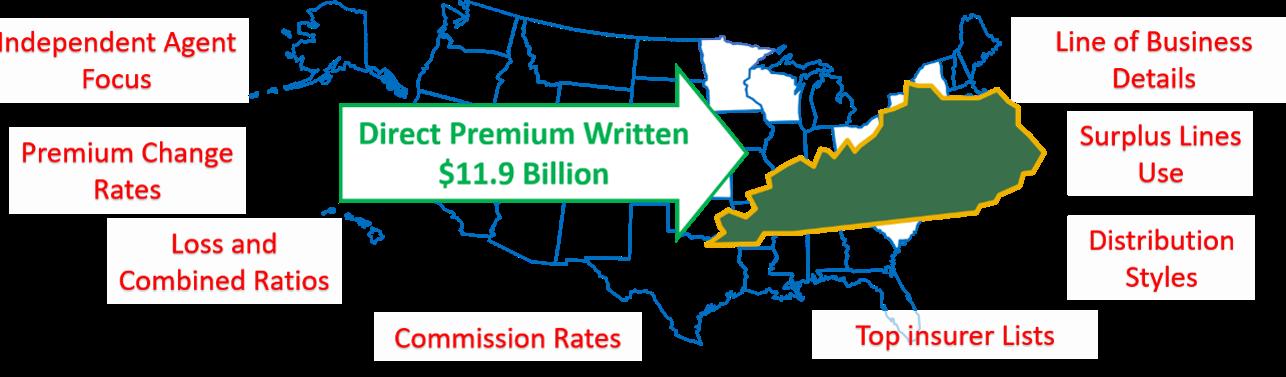
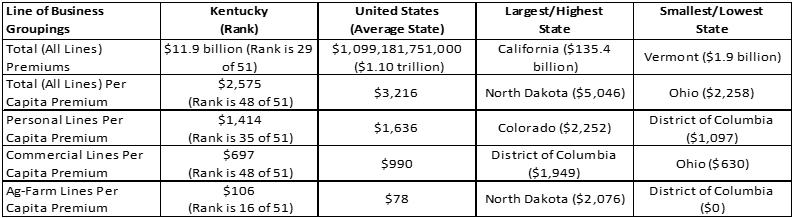
In 2025, Kentucky property and casualty (P&C) Direct Premium Written reached $11.9 billion, ranking Kentucky 29 of 51 states for total premiums in the United States. That is 1.1% out of $1.10 trillion in premiums nationwide. On a per capita basis, Kentucky ranks 48 of 51 for all P&C premiums combined, 35 of 51 for Personal Lines, 48 of 51 for Commercial Lines and 16 of 51 for Agricultural Lines.
Lines of Business
In Kentucky in 2025, the largest Line of Business for independent agents was All Private Passenger
Auto, as determined by Direct Premium Written (DPW). The second largest Line of Business in Kentucky was Homeowners Multi-Peril and the third was Commercial Multi-Peril. For comparison, nationwide in 2025 those Top 3 Lines of Business were: All Private Passenger Auto, Homeowners Multi-Peril and Other Liability (Occurrence).
Loss Ratios
In 2025 the Kentucky average Loss Ratio across all P&C Lines of Business was 71.2%, with the highest Loss Ratios occurring in Federal Flood (455.6%), Private Flood (253.4%) and Private Crop (154.1%). Nationwide in 2025 the average Loss Ratio was 57.3%, with the highest state-wide average Loss Ratio being 77.8% (California), and the lowest being 35.1% (Hawaii). Across the United States, the Lines of Business with the highest Loss Ratios are Private Crop (85.7%), Other Liability (Occurrence) (77.2%) and Multi-Peril Crop (74.9%).
Premium Change Rates
From 2024 to 2025 premiums changed in Kentucky by +6.6% for all P&C Lines of Business combined, placing it 11 of 51 in the United States and District of Columbia. The fastest-growing Lines of Business in Kentucky were Private Flood (37.8%), Homeowners Multi-Peril (13.7%) and Farmowners Multi-Peril (12.6%). Nationally, P&C premium change averaged +5.1%, with the fastest growing percentage being + 11.5% (Delaware) and the slowest being – 0.7% (Florida). The fastest-growing Lines of Business across the U.S. were Other Liability (Occurrence) (11.1%), Farmowners Multi-Peril (9.4%) and Homeowners Multi-Peril (9.1%).
Independent Agent Penetration of the P&C Marketplace
During 2025, independent agents controlled 53.4% of the Kentucky P&C marketplace. This compares to the United States average of 62.1%, with the highest Penetration Rate being 79.8% (Massachusetts) and the lowest being 51.1% (Alabama). In Kentucky, the top Penetration Rates by Lines of Business were: Private Crop (100.0%), Ocean Marine (98.9%) and Multi-Peril Crop (98.1%). In the United States, top penetration rates by Lines of
Business were: Multi-Peril Crop (97.3%), Ocean Marine (96.7%) and Private Crop (96.7%).
The average Commission Rate in Kentucky in 2025 was 12.0% for all P&C Lines of Business combined. By contrast, the average Commission Rate in the United States was 11.6%. The highest average Commission Rate was 13.6% (Massachusetts), and the lowest was 9.8% (Delaware).
The percentage of P&C insurance premiums going to Surplus Lines is on the rise in most states. In Kentucky in 2025, the percentage of premiums going to Surplus Lines Domestic insurers was 4.9%. That percentage was 4.7% in 2024, and 3.9% going back to 2021. In the United States the corresponding figures were 9.9%, 9.7% and 8.3%, respectively. In Kentucky, the top 3 Lines of Business with premiums going to Surplus Lines insurers were: Other Liability (Occurrence), Other Liability (Claims-made) and Fire Peril Only. In United States, the top 3 Lines of Business with premiums going to Surplus Lines insurers were: Other Liability (Occurrence), Other Liability (Claims-made) and Fire Peril Only.
All U.S. states levy a tax on property and casualty (P&C) insurance premiums, commonly referred to as a premium tax. In Kentucky in 2025, the average tax rate for Admitted premiums was 2.3%, while the Surplus Lines predominant tax rate was 3.0%. Together these taxes generated $278 million for Kentucky in 2025, accounting for approximately 1.8% of Kentucky’s total tax and fee revenue, or about $60.3 per capita. Nationally, the average premium tax rates are 2.2% for Admitted premiums, and 3.9% for Surplus Lines premiums. In 2025 that equates to $26 billion in premium taxes nationwide, or about 2.0% of all state tax and fee revenue.
In 2025 Kentucky Farm Bureau Group (G) was the largest insurer group overall in Kentucky, writing 14.6% of all P&C premiums. Progressive Casualty
Insurance Company emerged as the largest Pure Independent Agent-Broker Distribution Style individual insurer, State Farm Mutual Automobile Ins Co as the largest Exclusive-Captive Distribution Style individual insurer, and Kentucky Farm Bureau Mutual Insurance Co as the largest Direct Distribution Style individual insurer
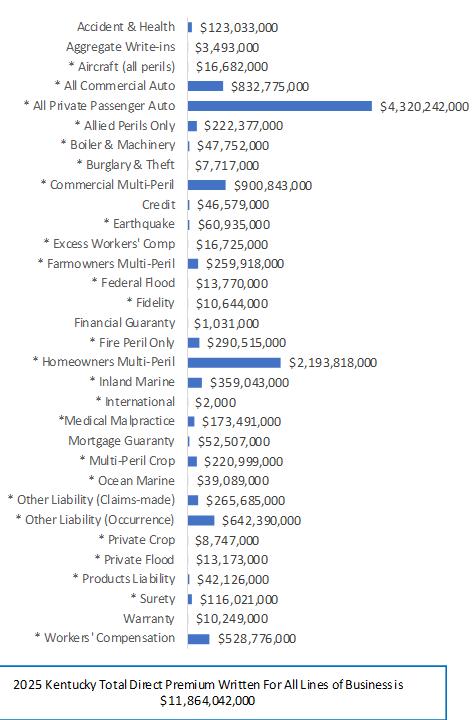
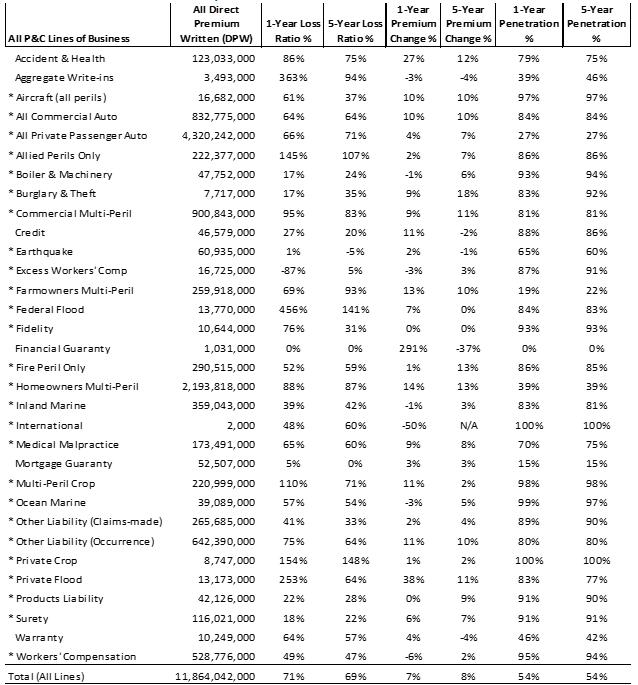
Notes & Comments: The above chart lists the Line of Business and then shows the 2025 total Direct Premium Written (DPW) for all 32 P&C Lines of Business that P&C insurers are required to report on in their annual statement to regulators.
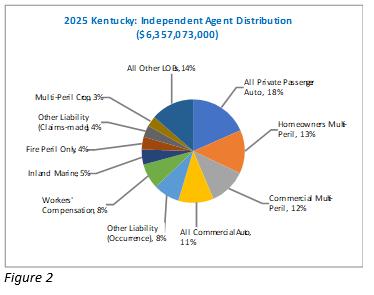
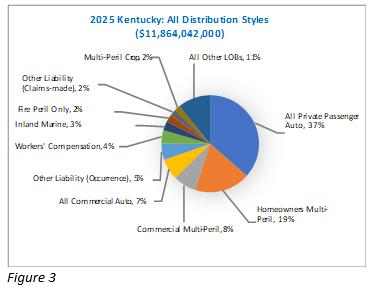
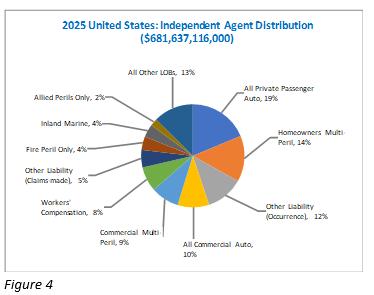
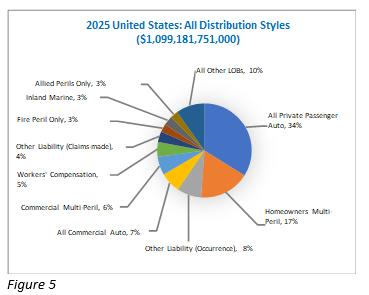
Table 1 below, 2025—Kentucky: All Lines of Business Additional Details, elaborates on the data in the previous Figure 1, with expanded detail on Kentucky Direct Written Premium (DPW), Loss Ratios, Premium Change Percentages and Penetration Percentages for the 32 P&C Lines of Business.
In Table 2 below, 2025 Total and Per Capita Premiums: Kentucky and U.S., Kentucky and United States P&C premiums are shown in total, and on a per capita basis. Per capita premiums are provided to give a relative sense of the cost of premiums but also allows for comparing premiums state to state. For deeper insight, per capita premiums are provided for the following four Line of Business groupings:
• Total (All Lines of Business Combined) includes premiums for all 32 P&C Lines of Business.
• Personal Lines includes All Private Passenger Auto and Homeowners Multi-Peril.
• Commercial Lines includes All Commercial Auto, Commercial Multi-Peril, Other Liability (ClaimsMade), Other Liability (Occurrence), Products Liability and Workers’ Compensation.
• Ag-Farm Lines include Farmowners Multi-Peril, Multi-Peril Crop and Private Crop.
In Table 2, also provided are the largest/highest state and the smallest/lowest state for total premiums and per capita premiums.
Note: The most recent population estimate from the United Census Bureau (December 2025) is the basis for the per capita comparative premium figures.
Members can access the full report on our site at https://www.bigiky.org/kentucky-marketplace-report/, with much more detail on lines of business and more. •
Paul Buse has been in the insurance business since 1982 as licensed insurance agent in Wisconsin and then worked in a consulting/actuarial capacity at the Wyatt Company and then Aon. His last 21 years were in the insurance and “for-profit” operations of the Independent Insurance Agents & Brokers of America.



Would you like to receive $1000 to reimburse you for some of your agency's marketing expenses? Who wouldn't, right? All Big I Kentucky members are eligible for Trusted Choice’s Marketing, Reimbursement Program, which will reimburse a portion of expenses incurred in 2026 for digital marketing efforts, services from TechCompare vendors and marketing education.
Digital Marketing Efforts: Funds can be toward the production of digital materials or toward the cost of digital ad placements. Eligible efforts include, but are not limited to, online display and banner ads, paid social media ads, PPC ads, ads on streaming services like YouTube and Hulu, digital sponsorships, ads within apps, graphic designer costs for email and logo development, radio and TV ads, and more.
TechCompare Vendor Services: Leverage any MRP-eligible vendors on the TechCompare platform. Check for eligible vendors at https://techcompare.independentagent.com. TechCompare vendors offer services such as websites, SEO, digital marketing, automation, social media management, and more.
You can utilize the funds with one or multiple vendors during the year. This is limited to a maximum reimbursement of $500 per TechCompare vendor. You may only apply for reimbursement once per vendor.
Agencies who utilize program funds to work with a tech compared vendor are required to leave a review of their experience on the platform within 6 months of being reimbursed.
Marketing Education: Funds may also be used for marketing education courses, marketing conference registrations, marketing trainings and marketing certifications. Trusted Choice recommends courses covering general marketing, social media marketing, small business marketing, SEO, AI, design and more. All courses and conferences must be approved by Trusted Choice to confirm eligibility. College tuition and Big I state events are not eligible. Courses must be primarily market-focused. Contact Trusted Choice to confirm eligibility.
All agencies are eligible for up to $1000 in reimbursement per year. Reimbursement amount is calculated at 50% of the cost to the member agency with a maximum reimbursement of $1000. For full program details or just submit a reimbursement request, please visit www.trustedchoice.independentagent.com/MRP today!
Depending on the size of your agency, this program could more than pay for the cost of your membership. Make sure you don't leave money on the table.



BY ANNE MARIE McPHERSON SPEARS, IA magazine
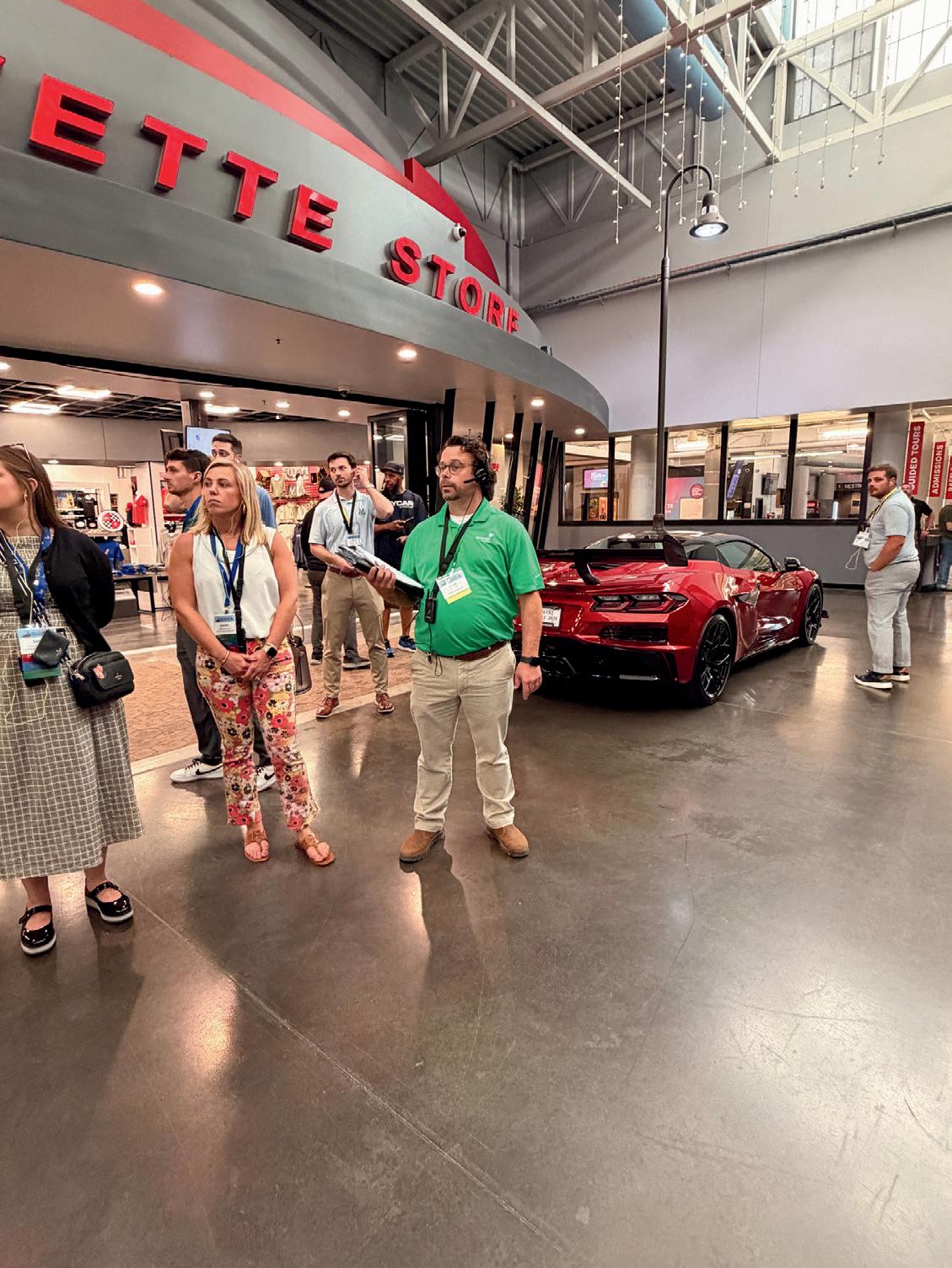
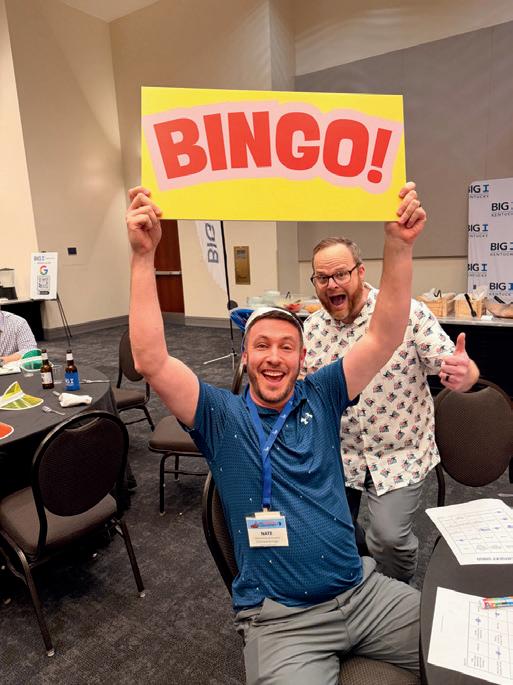
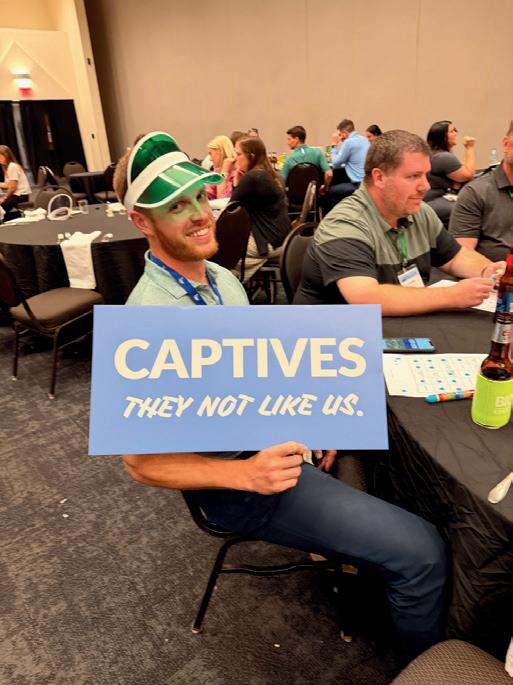
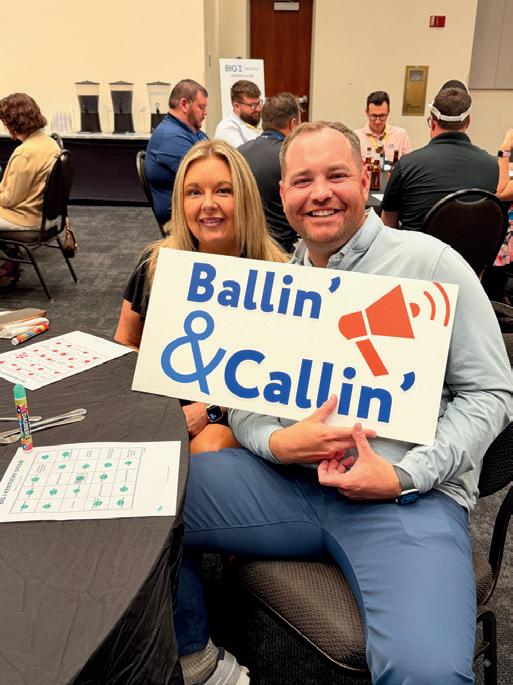
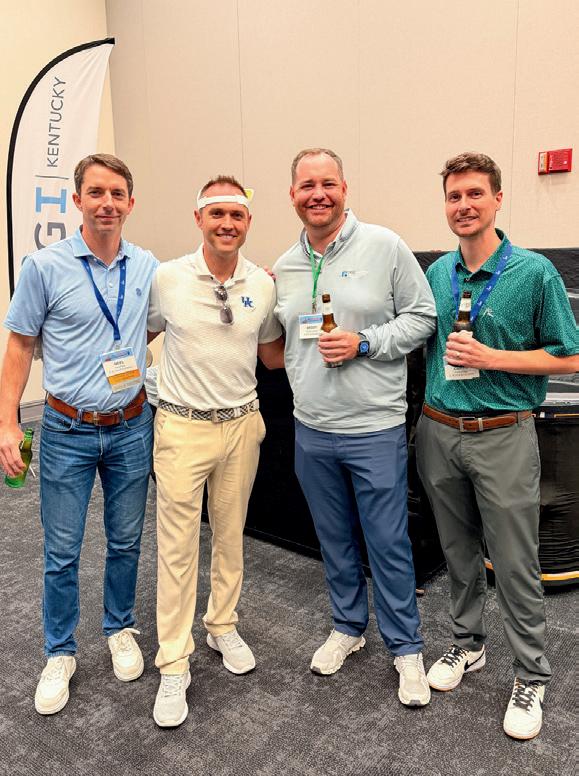
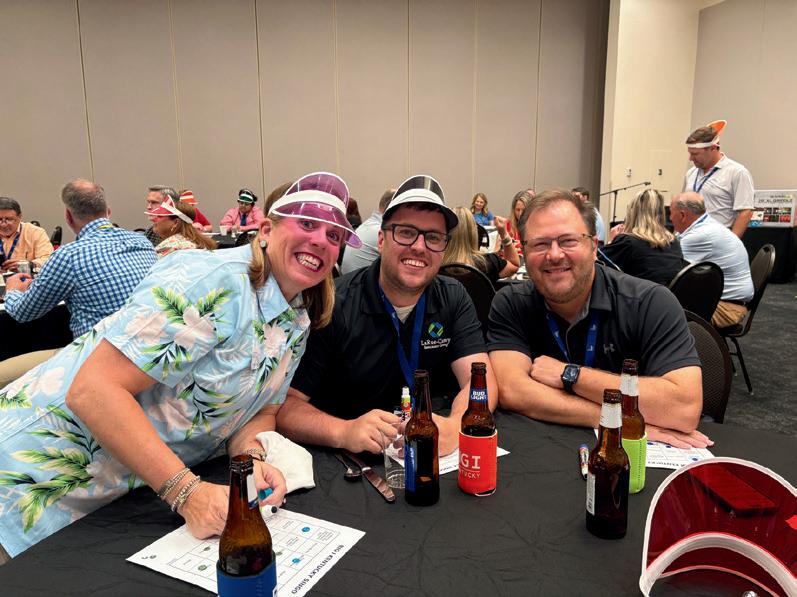
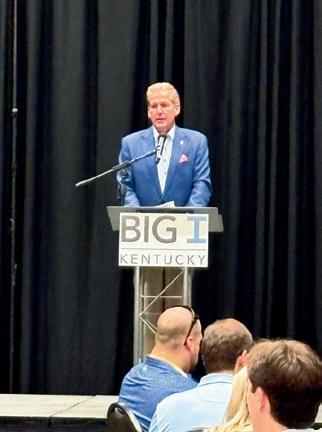
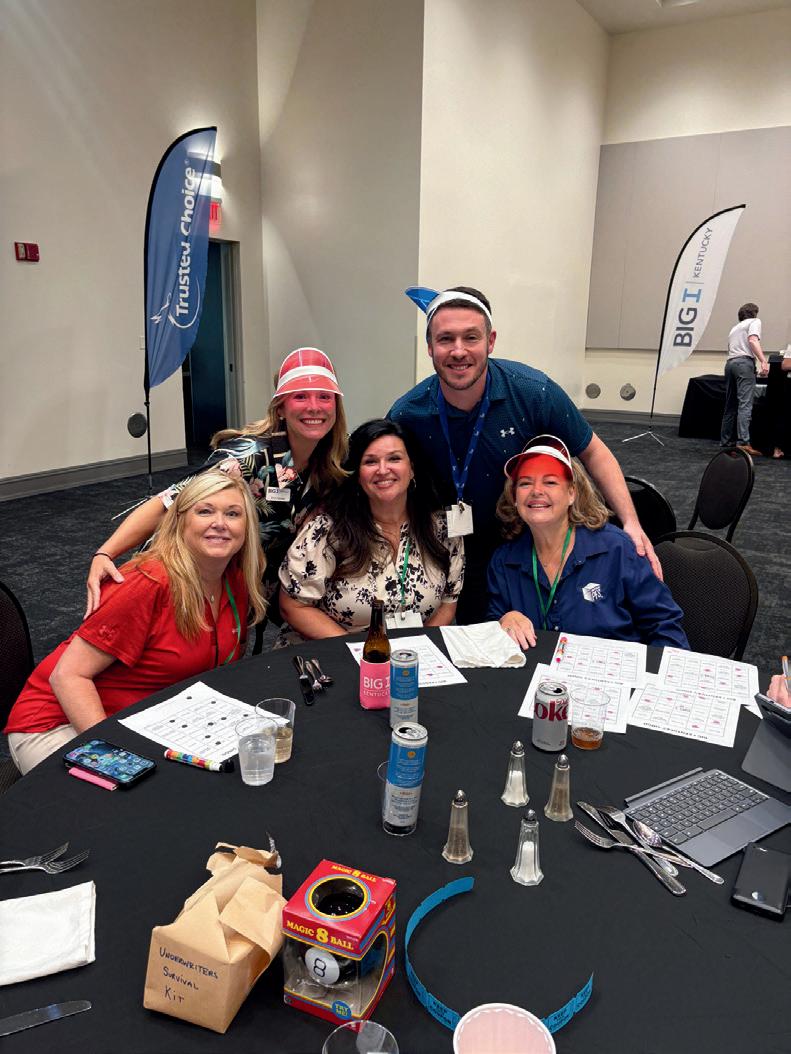
This year’s Big I Kentucky Leadership Conference brought agency leaders and emerging professionals to Bowling Green for two days of practical education, fresh ideas and meaningful connection. The conference opened with a behind-the-scenes Risk Management Tour at the National Corvette Museum, followed by an evening Welcome Reception, dinner and a lively round of SINGO that gave attendees plenty of time to reconnect with peers and build new relationships.
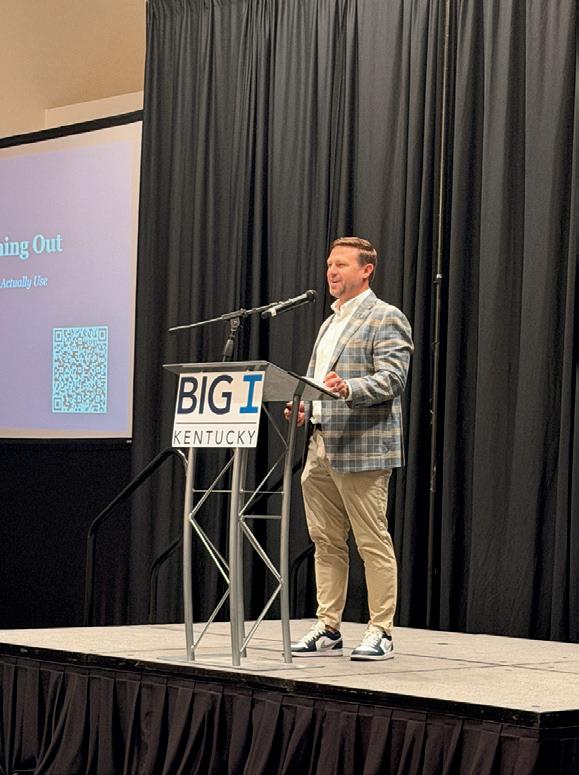
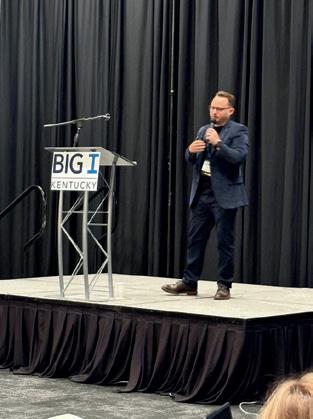
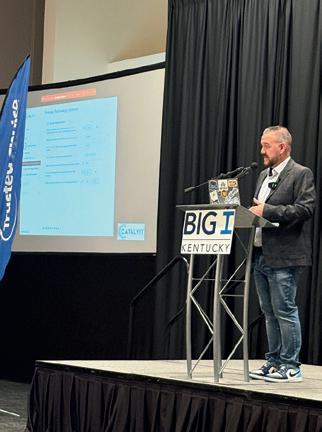
Day two focused on leadership, growth and technology. Warren County Judge/Executive Doug Gorman shared Leadership Lessons from Public Service, followed by Michael Cruz’s session on the habits and systems top producers use to scale without burning out. Casey Nelson of Catalyit led a hands-on Copilot Workshop, giving attendees practical ways to put AI to work in their agencies.
After lunch and a little friendly competition at the golf simulator, Jason Sabo closed the conference with
From Chaos to Consistency: The Elite Producer Playbook, offering strategies to help producers create more focus, consistency and results.
From risk management and leadership to AI and agency growth, the 2026 Leadership Conference gave attendees actionable takeaways, valuable connections and a renewed energy to lead what comes next.


MAY 12-14

















Page
Page
Page
Page 31 KEMI
Page
Page 40 Trusted Choice
Page BC Johnson & Johnson
OUR 2026 SUPPORTERS as of 7-1-2026

AF Group
Amerisafe
AmTrust
Anthem Auto-Owners



Affordable American Insurance
Bailey Special Risks
Berkshire Hathaway GUARD
Branch
Burns & Wilcox
Commercial Sector Ins. Brokers

Countryway
EMC
Encova
FCCI Insurance Group
First Benefits Mutual
First Insurance Funding
Frankenmuth Insurance
Grange Insurance
ICW
Invo Underwriting
Iroquois Group


JenCap
Johnson & Johnson
Market Finders Insurance
National General
Nationwide
RT Specialty
Summit Holdings
Swiss Re/Westport
The Hartford Travelers
Westfield Insurance
Big I Kentucky gratefully acknowledges these fine companies, our 2026 Industry Partners. Without their assistance, fees for the events and programs throughout the year would be significantly higher and/or the quality of the program would be restricted.
TO BECOME A SPONSOR OR FOR MORE INFORMATION ABOUT OUR INDUSTRY PARTNER PROGRAM, PLEASE CONTACT ERIN FOSSON, SALES & MARKETING DIRECTOR, AT 502-245-5432 OR EFOSSON@BIGIKY.ORG




what sets us apart:
• Experienced Team — decades of truck underwriting experience and strong carrier relationships - delivering expert guidance to our Agency partners
• Responsive Support — calls always answered, emails returned quickly
We're proud to represent six of the top wholesale truck markets our target accounts:



• Insureds that have operated in the same name for 2 or more years (5 or more for fleets)
• Low driver turnover, low loss frequency and good loss experience
• Clean drivers with 5+ years of experience
• For-hire truckers with 1-250 power units (any radius)
• Van, flatbed, & reefer operations (no logging or coal operations)
• Flexible Billing — interest-free installment plans quote@jjins.com Send Your