For I was hunrgy and you gave me something to eat, I was thirsty and you gave me something to drink, I was a stranger and you invited me in, I needed clothes and you clothed me, I was sick and you looked after me, I was in prison and you came to visit me.
Matthew 25:35-36
IHS was built on community investment well before federal grants became part of our funding model, and that foundation holds.
This has been a year of deciding what we keep and what goes. Rising costs, shifting federal priorities, and growing complexity in the populations we serve tested every part of our system. In the middle of those pressures, IHS opened two new kauhale communities, nearly doubled our employment placement rate, and expanded case management to more households than ever before.
The numbers in this report tell an honest story. We served 5,749 individuals this year, somewhat fewer than the year before, driven in large part by federal funding cuts that reduced the size of our Homeless Prevention program. At the same time, the breadth and intensity of our work grew in response to an aging and more medically vulnerable population. Our case managers served 1,693 households. Our Health Services team provided 4,440 clinical encounters. Our ʻImi Ola Piha Triage Center supported 233 individuals through medically assisted withdrawal and stabilization, a 15% increase from its first full year.
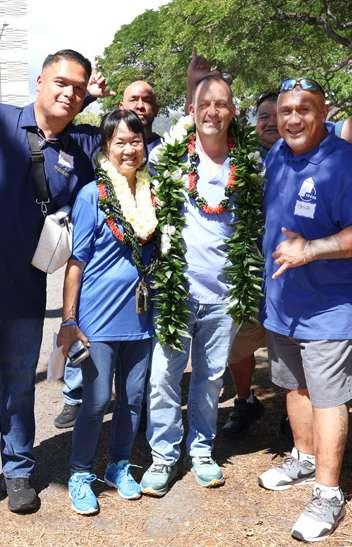
Two milestones defined this year. In December, we blessed Alana Ola Pono at 357 North King Street. This kauhale’s name, gifted by cultural practitioner Pualani Kanakaʻole Kanahele, means “Awakening to a Good Life.” In March, Kumu Ola Hou opened its doors inside Iwilei Center, bringing a first-of-itskind approach that blends neuroscience with Native Hawaiian values to address the cognitive effects that result from prolonged homelessness and trauma. Together with Paepae Hou and our re-entry homes, IHS now operates six kauhale communities, each designed around the principle that healing happens when people have a sense of purpose and belonging to a collective.
Our Re-entry program’s story also reached a turning point. What began years ago as a privately funded project had demonstrated success, with recidivism rates consistently below 10%. This year, our Governor folded the program into the state’s kauhale initiative, recognizing that its community-based model had already proven what kauhale housing is designed to do. The convergence of the state’s broader kauhale initiative with IHS programs was organic. We had long been building communitycentered recovery housing for the populations who need it most: people rebuilding their lives after incarceration and people working to sustain sobriety. The kauhale framework gave that community-buiding a name and a system of support that will outlast any single funding cycle.
As our fiscal year drew to a close, questions about the future of federal homelessness funding drew national concern and even litigation. We do not yet know what those shifts will mean for Hawaiʻi. But IHS was built on community investment well before federal grants became part of our funding model, and that foundation holds. Our mission is not abandoned because of federal funding pivots.
Thank you for standing with us through a year that asked more of everyone: our staff, our partners, our donors, and the individuals and families who trusted us with their most difficult days. You continue to make this work possible.
Me ke mahalo nui,
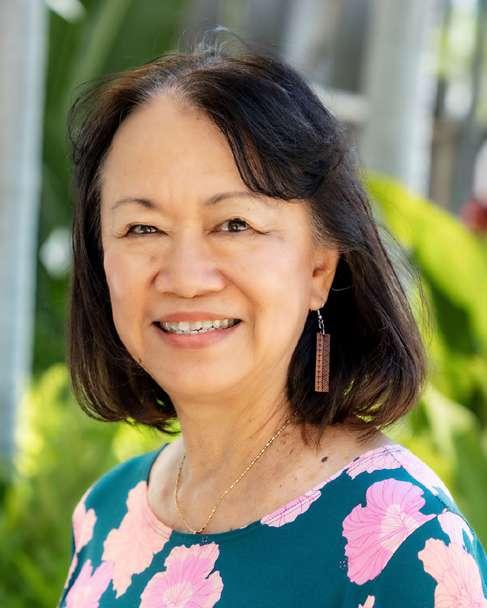
Connie Mitchell, MS, APRN Executive Director
FY2025 BOARD OF DIRECTORS
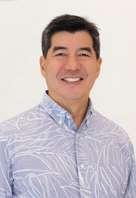
David Morimoto
President
Lauren Nahme
Vice President
Joanna Oshiro
Treasurer, Finance Chair
Lynne Unemori Secretary
Patrick McGuirk
Chair, Governance Committee
Keala Peters
Chair, External Affairs & Development Committees
Joe Viola
Chair, Internal Affairs Committee
Jim Steiner Chair, Audit Committee
Marci LaRouech
Ellen Godbey Carson
Julie Arigo
Sondra Leiggi Brandon
Bruce Coppa
Duke DuTeil
Roberta DuTeil (Emeritus)
Jerry Gibson
Jayson Harper
Jeff Harris
Ian Hogan
Ed Hope
Dexter Kubota
Andy Lee
Craig McGinnis
Liane Okumura
LeeAnn Silva
Curtis Saiki
Tracy Tonaki
Anthea Wang
Rev. Msgr. Terrence Watanabe
BOARD VOICES
“This year, IHS opened two new kauhale communities, bringing our total to six service sites across Oʻahu. Alana Ola Pono and Kumu Ola Hou each bring something distinctive to our continuum: one grounded in communal structural design resulting from our experience gained from 48 years of serving people impacted by homelessness. The other is grounded in neuroscience-informed design and Hawaiian cultural practice. The common thread is the same one that is modeled at Kahauiki Village for years: people heal in community.”
- David Morimoto, Board President
FY2025 KAHAUIKI VILLAGE BOARD OF DIRECTORS
Jayson Harper, Chair
Gordon Furutani
Melvin Kaneshige
Duane Kurisu
Craig McGinnis
Patrick McGuirk
Connie Mitchell
Lauren Nahme
Lloyd Sueda
“What stands out to me this year is the employment story. Our Hele2Work program placed more than half of the individuals it served into jobs, nearly doubling last year’s rate. In a year when some of our numbers went down, that result went sharply up. It reflects something important about how IHS operates: we adapt. When funding tightens and populations shift, our teams find ways to deliver stronger outcomes with what they have. That is the culture of this organization.”
- Lauren Nahme, Vice President
FY2025 SENIOR STAFF
Connie Mitchell, MS, APRN Executive Director
Kanui Bell, MBA, MA, CSAC, CCJP, ICADC, ICCJAP Director of Strategy, Planning and Impact
Minda Golez Director of Housing and Employment
Taumaoe Atuatasi Director of Facilities
Yasmeen Latore, DNP, FNP-BC, MS-MHC Director of Health Services
Craig Nakatsuka, MD Medical Director
Vinnesha Porter, LMHC Clinical Director
Kaelin Ryals Director of Finance
Ruth Weerapan, SPHR Director of Workforce Excellence
Steven Tseu Director of Philanthropy
MISSION STATEMENT
To create and offer tailored solutions for those in crisis, and nurture homeless people toward greater self-direction and responsibility.
VISION
A community where homeless people are empowered with hope, dignity, and confidence to quickly access and sustain a safe, decent and affordable home.
CORE VALUES
ALAKA‘I - Leadership by example. We take initiative and empower others to find their voice.
HA‘AHA‘A - Humility. We are open to learning from one another, admitting our mistakes and living transparently.
HO‘OHANOHANO - Honor the dignity of others. We practice and cultivate respect for all guests and protect their rights and privacy.
HO‘OKIPA - The hospitality of complete giving. We welcome guests with the spirit of aloha and offer the gift of hope.
KULEANA - One’s personal sense of responsibility. We encourage and challenge guests and staff to accept responsibility and be held accountable.
KŪLIA I KA NU‘U - We commit to pursuing excellence in service delivery and seek to constantly improve our skills and competence.
LŌKAHI - Collaboration and cooperation. We work in harmony and concert with each other and others outside our organization. We achieve more when we work together.
MĀLAMA - To care deeply. We serve, honor, and inspire our guests to be part of an ohana that genuinely cares.
5,749 Individuals served across all IHS programs
1,348 Individuals served at our Emergency Shelters
760 Individuals served through our Outreach Program
1,693 Households served through our Case Management Program
291,594 Meals served across all IHS sites
931 Individuals served through our Health Services and Partnerships
820 Individuals served through our Housing Program
495 Participants in our Employment Services Program
201 Individuals served through our Kauhale Communities
233 Individuals served through our ‘Imi Ola Piha Triage and Treatment Center
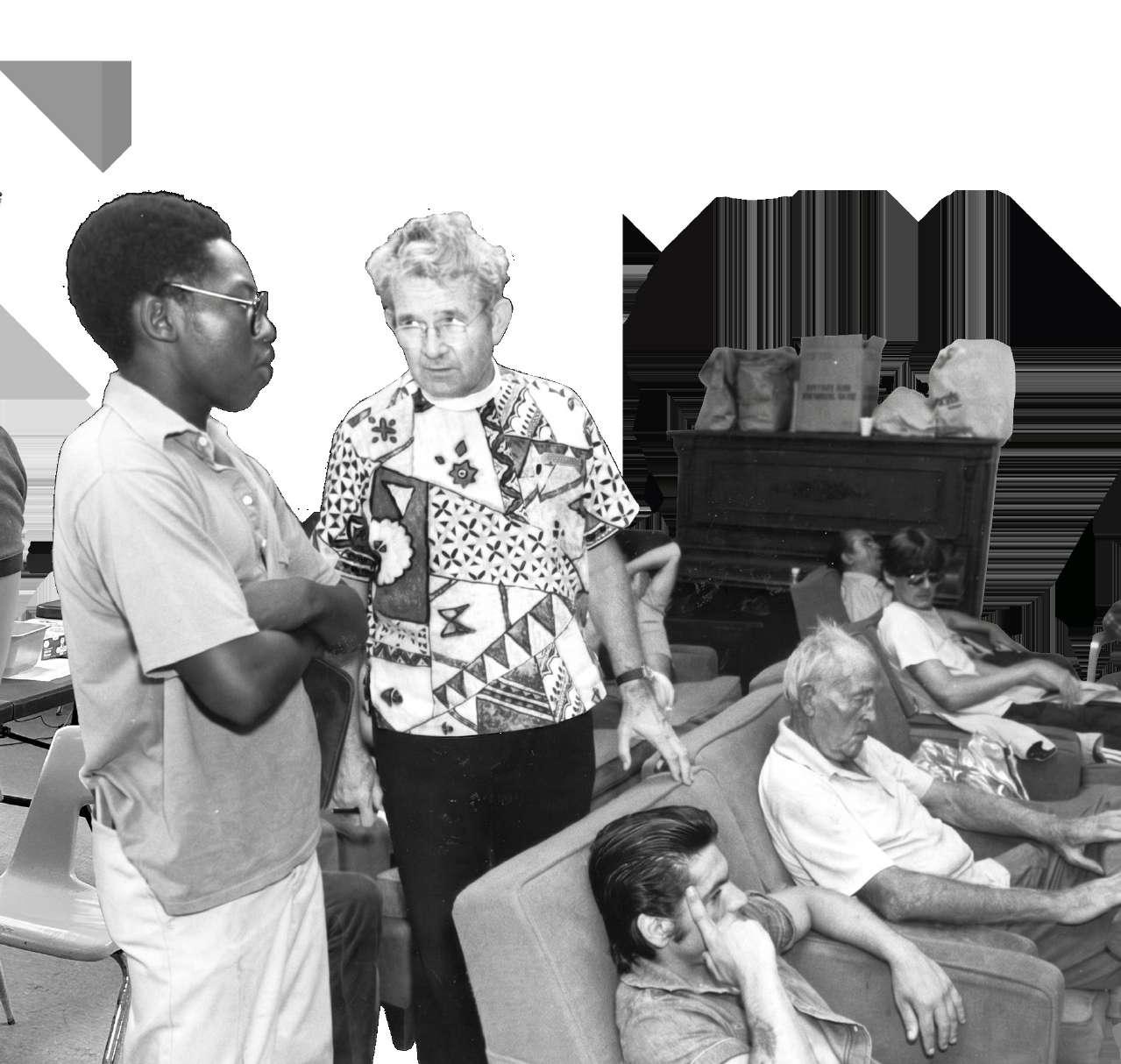
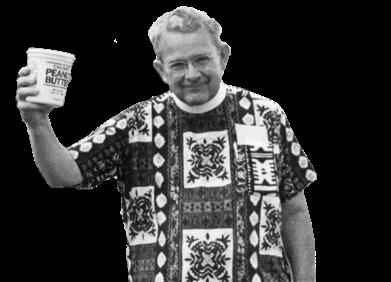
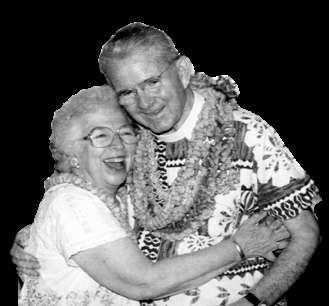
1993: Father DuTeil and his wife, Roberta “Tutu Bert,” retire and move to Texas to be closer to their children and grandchildren.
1997: Surrounded by loved ones in Texas, Father Claude DuTeil passes away on January 23, 1997.
HOUSING PROGRAM
Stable housing requires sustained support tailored to each household’s circumstances, long after a key is placed in someone’s hand. This year, IHS’ Housing Programs served 820 individuals across four program tracks.
The numbers reflect significant shifts in the external funding landscape. Federal grant rule changes eliminated our ability to assist clients already receiving Section 8 vouchers who needed a rental deposit, and fewer new vouchers were released during this fiscal year. These changes reduced the households our Homeless Prevention program could reach, from 347 households in the prior year to 201 this year, serving 434 individuals.
That is a policy-driven program contraction, and the need in our
community remains as urgent as ever. Where we could serve, we did with sustained commitment. Our housing specialists continued working with clients to identify the roots of each household’s crisis, build financial management strategies, connect underemployed individuals with Hele2Work, and navigate applications for housing vouchers and subsidies.
Across our other housing tracks, the work held steady. Rapid Re-Housing assisted 149 individuals across 94 households. Permanent Supportive Housing served 78 individuals, including four new enrollments. Housing First supported 159 individuals across 129 households, with 28 new enrollments during the year.
1998: IHS’ logo as we know it today is created.
1999: 2,574 people / year and 900 meals per day are served between two locations.
TOP: One of our Housing specialists visits a newly placed client at his apartment. BOTTOM: A client holds the keys to her new apartment after transitioning through IHS housing services.
KAHAUIKI VILLAGE
In its fifth year under IHS management, Kahauiki Village settled into the work of being a true neighborhood with 159 households calling this place home throughout the year. Of our 662 residents served, there were 144 families, 320 keiki, and 15 kūpuna.
The village’s network of support has grown deeper as community partners expanded their presence on-site. Child and Family Services maintained a consistent presence through their staff member Ciera, connecting residents with community resources tailored to each household’s specific needs. That kind of embedded partnership gives families access to support they might never seek out on their own, delivered in a setting where they already feel safe.
PACT’s on-site childcare center, the Hele2Work employment services, case management, a youth center, and community gardens, meant a KV resident could access multiple services
in a single morning without leaving the village. As for the keiki growing up here, support extends beyond academics and childcare: village staff actively encourage and connect children with community sports programs, including flag football and basketball leagues, giving kids structured opportunities in which to compete, belong, and build
confidence alongside peers from across the island.
The model that Kahauiki Village offers, affordable housing paired with wraparound services in a single community, continued to prove that family homelessness can be resolved at scale when the right partners invest.
2004: IHS receives CARF accreditation for community-based case management.
2006: Connie Mitchell joins as IHS Executive Director.
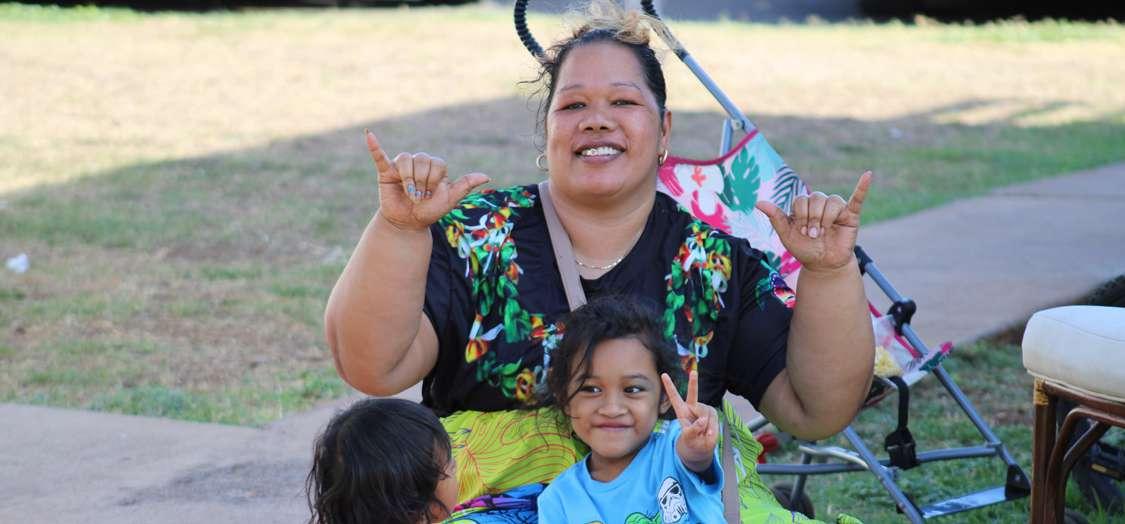
TOP: A Kahauiki Village mom and her keiki at the annual Summer Bash, one of many community events that make the village feel like home. BOTTOM: Kahauiki Village residents tend the community garden.
RE-ENTRY PROGRAM
This year marked a turning point for IHS’s re-entry work. A program initiated on private grant funding gave us years of on-the-ground learning as we grew the program. It was recognized by government as a model worth scaling, and public funding followed.
Our Re-entry homes, Halina House, Pearl City, and Village of Redemption, were designed from the start around a simple premise: formerly incarcerated individuals rebuild their lives more successfully in supportive community than in isolation. Residents share meals, attend weekly gatherings, participate in financial literacy and life skills development, connect with employment, and hold one another accountable. Those further along in their journey transfer what they’ve learned to those just arriving.
The program’s infrastructure made government adoption efficient. Leases were already in place. Staff were already trained. The programming was already field-tested, with recidivism rates
consistently below 10% across all three locations. When state funding arrived, IHS offered a cost structure that was inherently lower than new kauhale construction because the model was already operating inside existing residential properties. In return, the State offered more stable funding to help expand the program.
That efficiency mattered. At a time when new shelter beds carry significant per-unit construction costs, our re-entry homes demonstrated that proven community-based programs can scale at a fraction of the price, and deliver strong outcomes doing it.
Across the three locations, 72 formerly incarcerated individuals were served this year. Halina House supported 17 residents, Pearl City 27, and Village of Redemption 31. Combined, 26 exited to housing placements. Three transferred between sites as needs shifted, and one entered residential treatment.
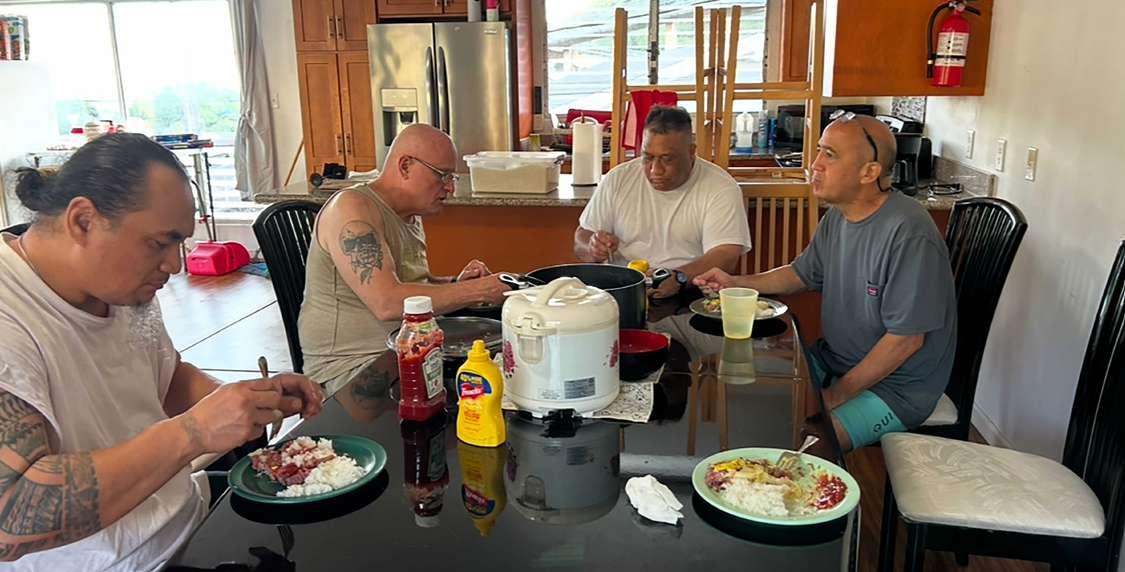
TOP: Residents share a meal at Halina House, where daily routines and accountability form the backbone of re-entry. BOTTOM: Governor Josh Green with our Re-entry Program Manager and clients at IHS’s Founders Day event.
2007: IHS expands and formalizes services to include case management, children and family programming, housing placement services, and medical care.
2007: IHS serves 2,700 people.
KAUHALE PROGRAM
Two new kauhale communities opened this year. Together with Paepae Hou, which completed its first full year, IHS now operates three kauhale sites alongside its three re-entry homes: six community-based housing programs across Oʻahu. The growth aligned with the state’s broader kauhale initiative. IHS had been building communitycentered recovery housing for years, serving populations who share a common need for structured community that supports the daily practice of staying housed.
Alana Ola Pono opened in December 2024 at 357 North King Street after a blessing ceremony officiated by Kahu Kordell Kekoa and attended by Governor Josh Green. The kauhale’s name, gifted by cultural practitioner Pualani Kanakaʻole Kanahele, means “Awakening to a Good Life.” The site serves adults, including those with pets, in a culturally grounded environment. In its first months of operation, 72 individuals were served, with 17 exiting to stable housing.
Kumu Ola Hou opened in March 2025 inside Iwilei Center, a property the City and County of Honolulu purchased in 2024 for future affordable housing
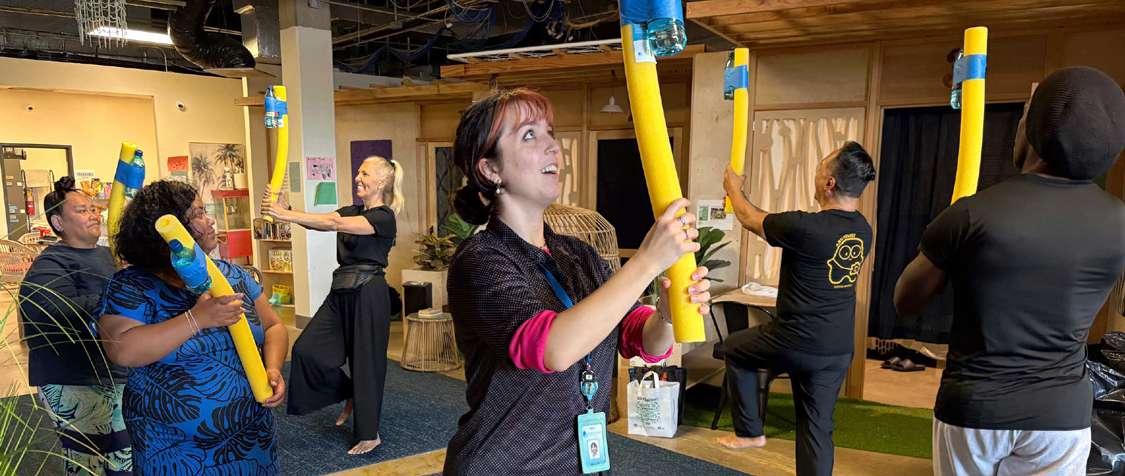
development. The State of Hawaiʻi and the City & County selected IHS to manage the facility. Designed in partnership with the Brain Health Applied Research Institute (B+HARI), Kumu Ola Hou combines cutting-edge neuroscience-informed design with Native Hawaiian values to address the cognitive deficits and trauma that prolonged homelessness often precipitates. The housing units are modular, built to be relocated when the site transitions to permanent development. Residents move through a program averaging three months, with coaching designed to encourage neuroplasticity and rebuild the daily habits that homelessness disrupts. In its first four months, 35 individuals were served, with two exiting to stable housing as operations ramped up.
Paepae Hou, in its first full year of operation, served 22 men in early recovery. Ten exited to stable housing, a 45% placement rate. The program provides community-centered sobriety support in a setting where residents hold each other accountable and practice the discipline of daily life in recovery.
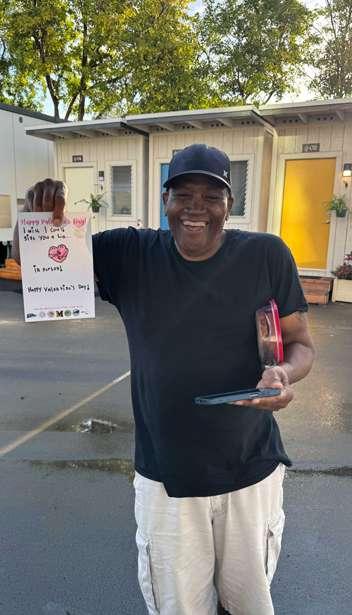
TOP: Residents at Kumu Ola Hou participate in a balance and coordination activity designed to rebuild cognitive function through neuroplasticity. BOTTOM: An Alana Ola Pono resident holds a Valentine’s Day card made by students from the Mililani School Complex.
2013: IHS opens the Veterans Engaged in Transition (V.E.T.) House in Kalihi Valley in partnership with the VA.
2014: The Kaaahi Shelter rooftop is transformed into an urban agriculture training and education center.
EMPLOYMENT PROGRAM
Employment changes the trajectory of a person’s life. A steady paycheck turns bills from impossible to manageable, transforms childcare from a barrier to a budget line, and makes the future something to look forward to rather than just endured.
This year, 495 individuals participated in IHS employment programs. The total is smaller than last year, but the outcomes tell a different story. Of the 449 individuals encountered through Hele2Work, 236 secured employment, a placement rate of 52.6%, up from 30.3% the prior year. More than half of those who engaged with the program walked out with a job.
Employment specialists continued providing one-on-one coaching that addressed the specific barriers standing between homelessness and a paycheck: transportation, childcare, documentation gaps, skills mismatches. For many of our clients, the gap on their resume is a red
flag to every employer, and the gap in their housing history is a red flag to every landlord. Our specialists helped bridge both.
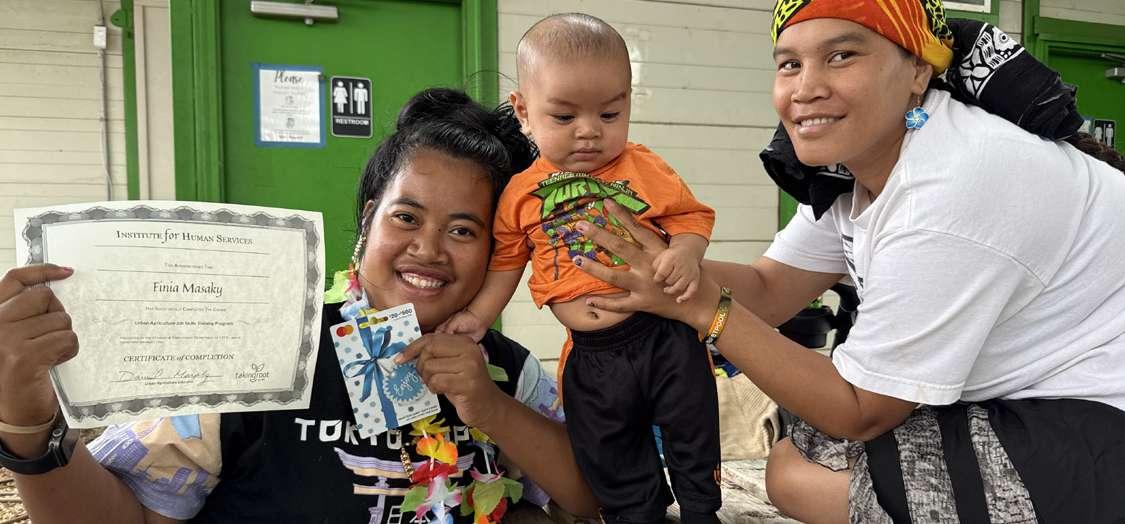
Taking Root, our Urban Agriculture Program, cultivated 658 pounds of fresh produce while training 94 participants, 63 of whom earned certificates and six of whom transitioned directly into
employment. New Leaf, our prevocational training program, completed 408 job-learning projects with 15 participants, five of whom moved into the workforce.
Each job secured creates positive effects that ripple outward. A paycheck earned allows rent to be paid, family obligations to be met, and lives to be planned.
2015: IHS wins city-funded CAP outreach contract for Honolulu. IHS had State AMHD outreach 2005–2007 and restarted in 2014.
2015: The city-funded Hale Mauli‘ola Housing Navigation Center at Sand Island opens.
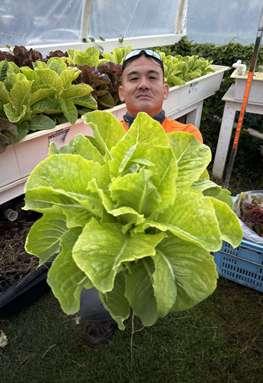
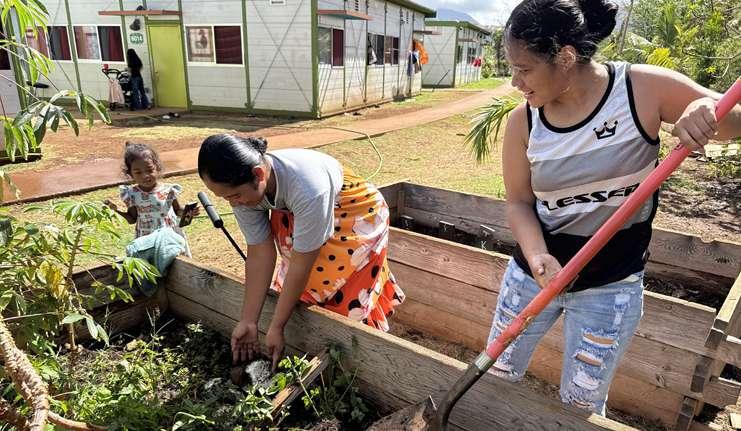
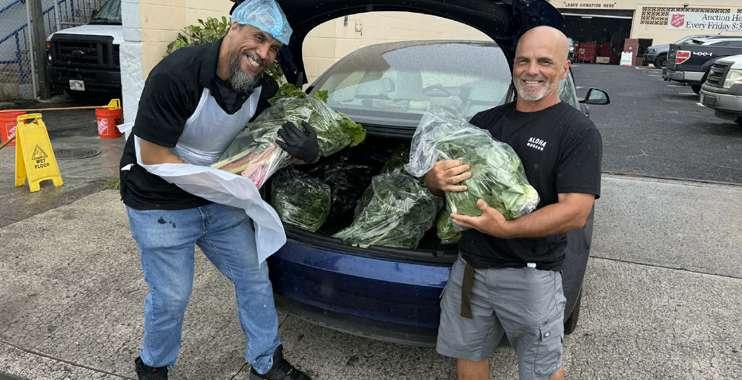
TOP: Kahauiki Village residents celebrate their graduation from Taking Root, IHS’s Urban Agriculture Program. BOTTOM: Fresh greens from Taking Root head to the IHS Kitchen, where program-grown produce supplements shelter meals.
CHILDREN’S PROGRAM
Achild touched by homelessness does not feel the impact until years down the road. This year, 120 keiki in our shelter programs found consistency through our Children’s Program, a place where school attendance was maintained, developmental milestones were tracked, and the ordinary experiences of growing up were protected and nurtured.
Of these young people served, 69 were school-age and 51 were under five. Through personalized development plans crafted alongside parents, each child’s unique needs were assessed and addressed, with academic progress tracked, social development supported, and daily routines stabilized.
Our Summer Fun 2025 Program served 66 children across two locations: 23 at Kaaahi Shelter and 43 at Kahauiki Village. These programs allowed parents to pursue employment and housing search without the barrier of childcare, while their keiki spent summer days engaged in structured, enriching activities. In our classrooms and play spaces, children are defined by what they are learning, creating, and becoming.
2015: Governor David Ige issues Emergency Proclamation on Homelessness.
In partnership with The Queens Medical Center and HomeAid Hawaii, IHS opens two Medical Respite Homes in Kalihi and Makiki.
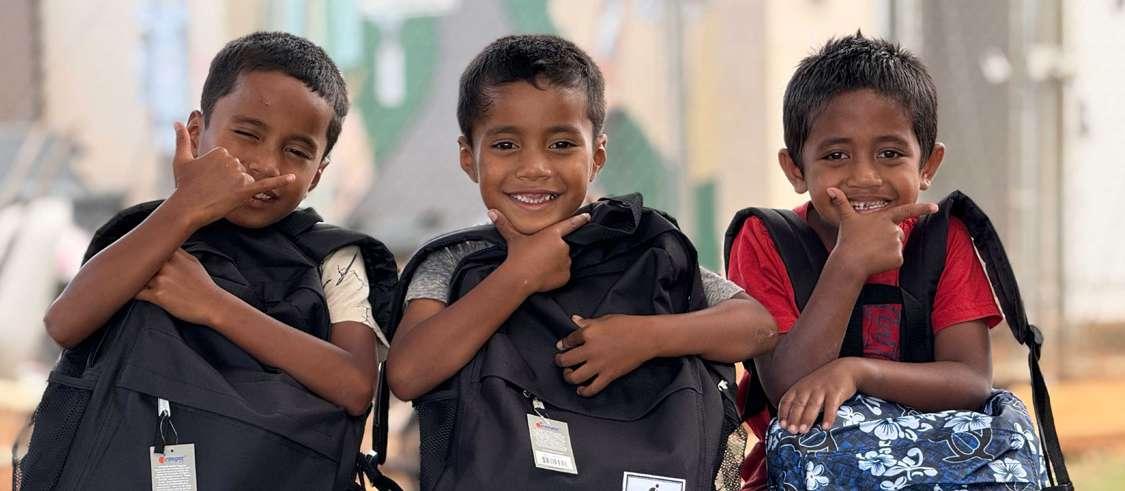
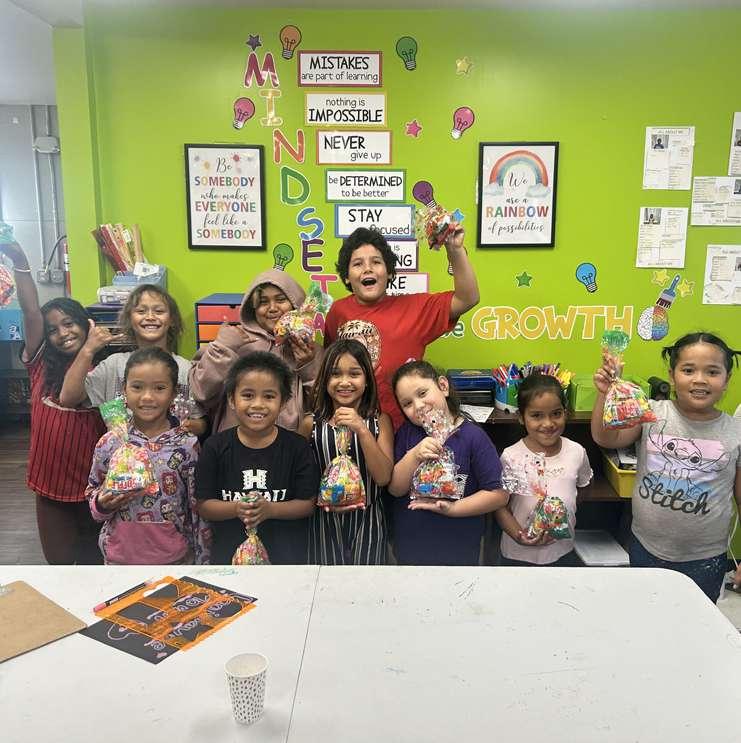
TOP: Kahauiki Village keiki show off new backpacks donated by Locations Hawaii ahead of the school year. BOTTOM: The Kahauiki Village youth center provides structured enrichment for keiki after school and during breaks.
very path from crisis to stability requires navigating systems.
CASE MANAGEMENT E
This year, IHS case managers worked with 1,693 households, a 10.9% increase from the prior year. The work is daily and specific: meeting people where they are, identifying what has to change, and helping them achieve their goals. One document, one appointment, one application at a time. Each specialized team addressed distinct dimensions of homelessness:
General Case Management (643 individuals) served shelter guests through needs assessment, resource connection, and housing navigation.
Veterans Services (131 individuals) provided dedicated support to veterans navigating VA benefits, housing vouchers, and the transition from service-connected homelessness to stable housing.
Homeless Intensive Case Management (371 individuals) supported those whose complex mental health needs
led to frequent law enforcement or emergency department contact. The expanded program, now in its second full year of island-wide operation, served 859 clients referred.
Community Care Services (378 individuals) facilitated housing and recovery for persons experiencing persistent mental illness through practical, community-based strategies.
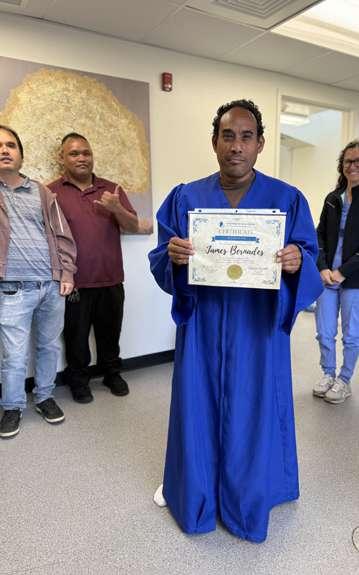
Community Integration Services (110 individuals) were focused on our more vulnerable clients who required intensive housing navigation, and saw a 41% increase from the prior year’s 78 individuals, reflecting expanded capacity and growing need.
Family Case Management (60 households) strengthened family units through coordinated support. Of these, 27 families successfully transitioned to stable housing, each representing children who will now know the consistency of a permanent address.
2017: The Kalihi-Uka Recovery Home (KURH) opens expanding IHS’ capacity to shelter homeless individuals in recovery for substance use disorders
2018: The third Medical Respite “Tutu Bert” Home opens in Kailua.
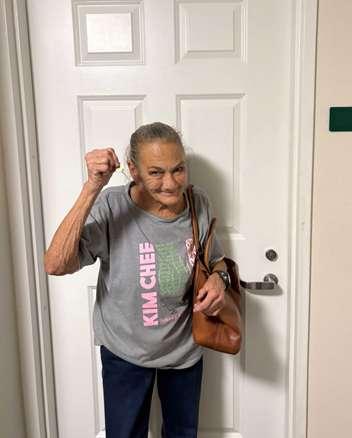
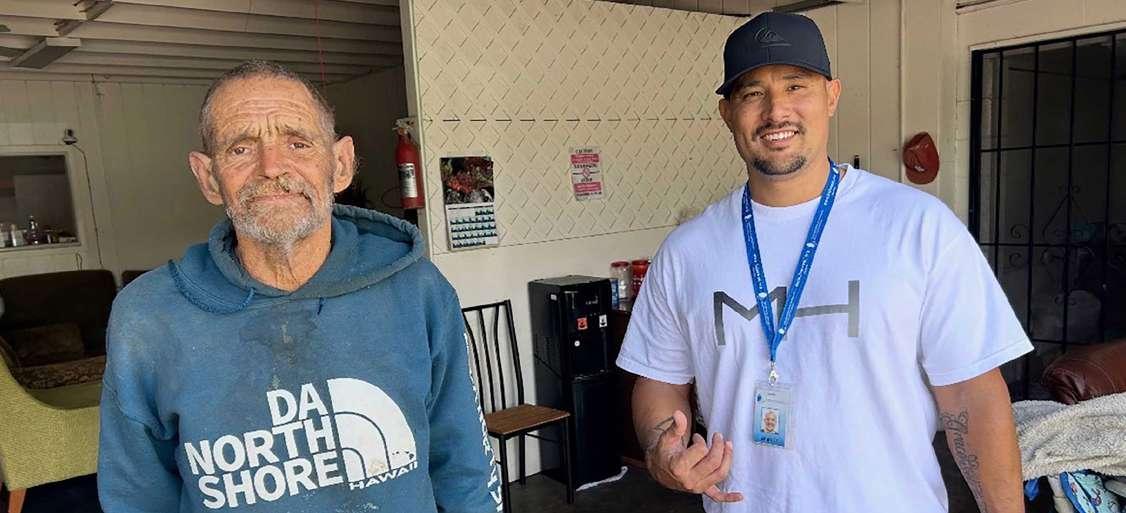
TOP & BOTTOM: Our case managers build trust through consistent, sustained engagement with each individual they serve. Behind every housing placement and treatment referral is a case manager who walked alongside a client to get there.
HEALTH SERVICES
Health is the foundation on which housing can be sustained. This year, IHS served 931 individuals through 4,440 clinical encounters, an increase on both measures from the prior year.
Our clinical team delivered 3,688 physical health encounters and 752 psychiatric interventions, ranging from field-based medication administration and crisis stabilization to ongoing support for recovery. Mental health needs remain the most visible and fastest-growing challenge among the populations we serve, and our team’s capacity to respond in the field, on the streets, and inside our facilities expanded accordingly.
‘Imi Ola Piha Triage and Treatment Center continued to expand its delivery of medically assisted detox services in its second year, serving 233 individuals, up from 202 the year before. Of those, 114 transitioned to transitional housing and 130 exited to
residential treatment. At eight beds and an 80% average utilization rate, the center operates with a per-bed cost that remains a fraction of a hospital emergency room visit, while delivering outcomes that emergency rooms cannot: sustained engagement, case management, and a pathway into the continuum of care.
This year’s data reveals a shift in need. Psychiatric encounters rose from 488 the prior year to 752, a 54% increase that reflects both the growing prevalence of mental health crises among unsheltered populations and our team’s expanded capacity to respond.
Our clinicians now operate across the full geography of IHS’s continuum: in shelters, at kauhale sites, at ‘Imi Ola Piha, and in the field alongside outreach workers. The ability to deliver care wherever a person is, rather than requiring them to arrive at a facility first, has become one of our most critical clinical strengths.
2019: IHS starts managing two community re-entry homes, Beacon of Hope for women and House of Redemption for men.
2019: An additional outreach hub is established in Waikiki with a weekly service depot and evening outreach.
TOP: Clinical staff at ʻImi Ola Piha address both acute medical needs and the longer-term work of stabilization. BOTTOM: A client celebrates completing medically assisted detox at our ʻImi Ola Piha Triage and Treatment Center.
OUTREACH PROGRAM
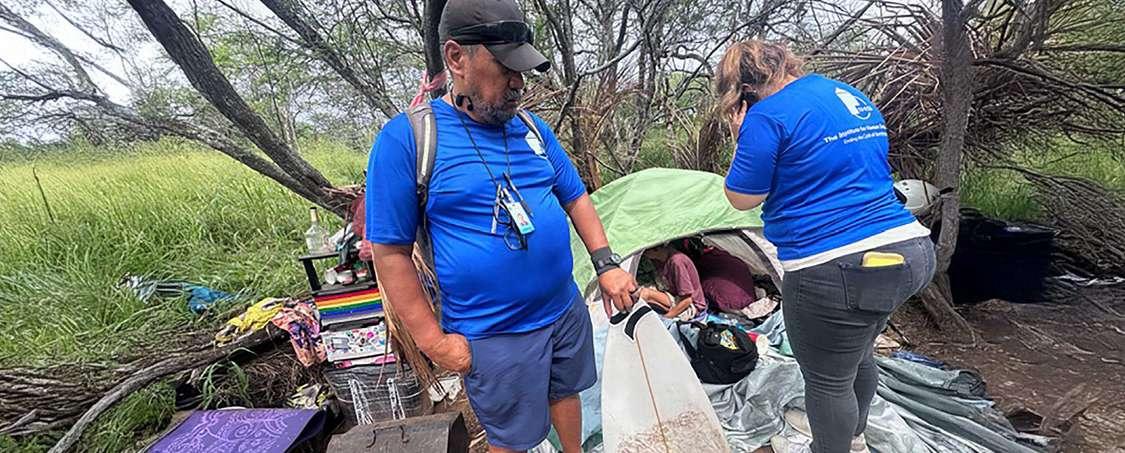
Connection starts with showing up. This year, our outreach teams reached 760 individuals across Oʻahu, continuing our geographic expansion into Leeward and Central communities that began in the prior year and building the trust-based relationships that open doors to services.
General Outreach connected with 602 individuals this year. Of those contacts, 110 moved directly into housing, 148 entered shelter, and 50 began treatment. For those 308 people, the conversation with an outreach worker was the step that changed their trajectory. For the rest, the relationship continues. Our teams returned to them the following week, and the week after that, because readiness does not arrive on a schedule.
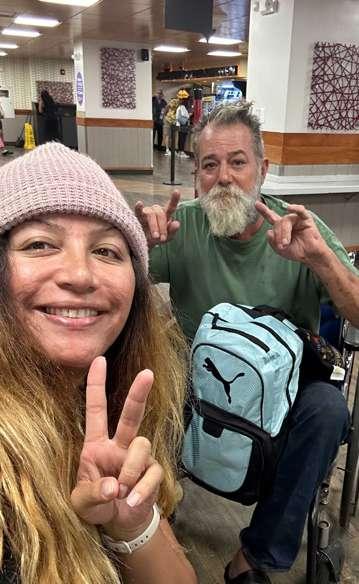
Our Relocation Program had its strongest year on record, reuniting
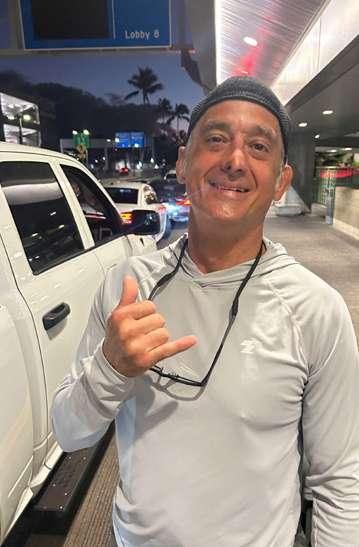
158 individuals from 121 households with family and support networks on neighboring islands, the U.S. mainland, and beyond. That is a 66% increase from the prior year’s 95 individuals. Among them were 103 singles and 18 families. These were reconciliations, not transfers: estranged parents reconnecting with adult children, veterans returning to support systems, and individuals finding their way back to communities where their recovery could be sustained.
Each case required ensuring documents were in place, airfare coordinated, ground transportation arranged, and the careful work of mending relationships that distance and crisis had frayed. Central to every successful relocation was a moment of belief: the conviction that changing one’s circumstances begins with returning to where relationships are strongest.
2020: A fourth Medical Respite “Tutu Bert” Home and a second community re-entry home for men opens in Pearl City.
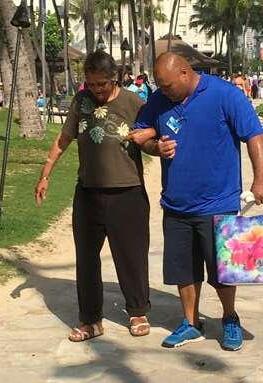
TOP: IHS outreach workers visit an encampment on Oʻahu. BOTTOM: A client at HNL airport, preparing to reunite with family on the mainland through IHS’s Relocation Program.
EMERGENCY SHELTERS
Safety is the most fundamental starting point in the journey out of homelessness. This year, 1,348 individuals found refuge in one of our four congregate emergency shelters, and with that safety, a foothold from which to begin the work of stabilization.
Sumner Men’s Shelter served 553 men. Kaaahi Women’s Shelter served 279 women. Fifty-nine families, including 143 keiki, remained together at Kaaahi Family Shelter while working toward housing, totaling 249 individuals.
Across all these sites, the daily experience extended well beyond a bed: intake assessments launched personalized recovery strategies, meals and hygiene facilities restored wellness and self-worth, and on-site
programming in financial literacy, stress management, and life skills equipped guests with tools for the transition ahead.
At Hale Mauliola Sand Island, 267 residents worked toward one goal: permanent housing. The results spoke for themselves. Of the 236 individuals who exited this program, 103 transitioned directly to housing placements, a 44% exit-to-housing rate. That number shows what becomes possible when case management, employment services, and housing search support are built into every day at a shelter.
Across all of our emergency shelters, an average of 229 individuals slept under our roof each night.
TOP: At our Kaaahi Women’s and Family Shelter, guests access case management, health services, and programming while working toward stable housing. BOTTOM: Guests share a meal at Sumner Men’s Shelter, where three daily meals anchor the day and open the door to deeper connection and engagement with services.
2020: IHS begins servicing the Homeless Outreach and Navigation for Unsheltered Persons (HONU) program at Ke‘ehi Lagoon.
2021: IHS purchases its first property to operate as its fifth Medical Respite “Tutu Bert” Home.
W SPECIALTY SHELTERS
hen someone is discharged from a hospital with no place to recover, or when addiction’s grip loosens just enough for treatment to begin, or when military service leaves a veteran without a home, the intervention required is specific. This year, 556 individuals found that specialized help.
Tutu Bert’s Medical Respite Homes served 182 individuals discharged from hospitals into homelessness. Across our five respite homes, the results extended beyond medical recovery: 49 individuals exited to housing and 25 transitioned to emergency shelters to continue toward permanent placement.
Kalihi-Uka Recovery Home served 113 individuals awaiting or actively participating in substance use treatment. Residents encouraged one another toward sobriety while case managers worked on housing plans. Twenty-two individuals
exited to housing placements and 41 transitioned to treatment facilities.
VET House and VA Medical Respite served 28 veterans navigating the intersection of military service, homelessness, and health needs. Case managers with specialized knowledge of the VA system helped residents access benefits and chart paths toward stable housing.
‘Imi Ola Piha Triage Center served 233 individuals in its second year of operation, up from 202 in its inaugural year. The center’s role in the continuum of care strengthened: 114 individuals transitioned to transitional housing, 130 exited to residential treatment, and 46 moved to emergency shelters to continue their journey. With eight beds running at 80% capacity, the center proves that when someone is ready, the right care at the right moment can alter the course of a life.
2021: Village of Redemption opens, expanding IHS’ Community Re-entry locations to three for formerly incarcerated men.
2022: aio Foundation entrusts complete management of Kahauiki Village to IHS.
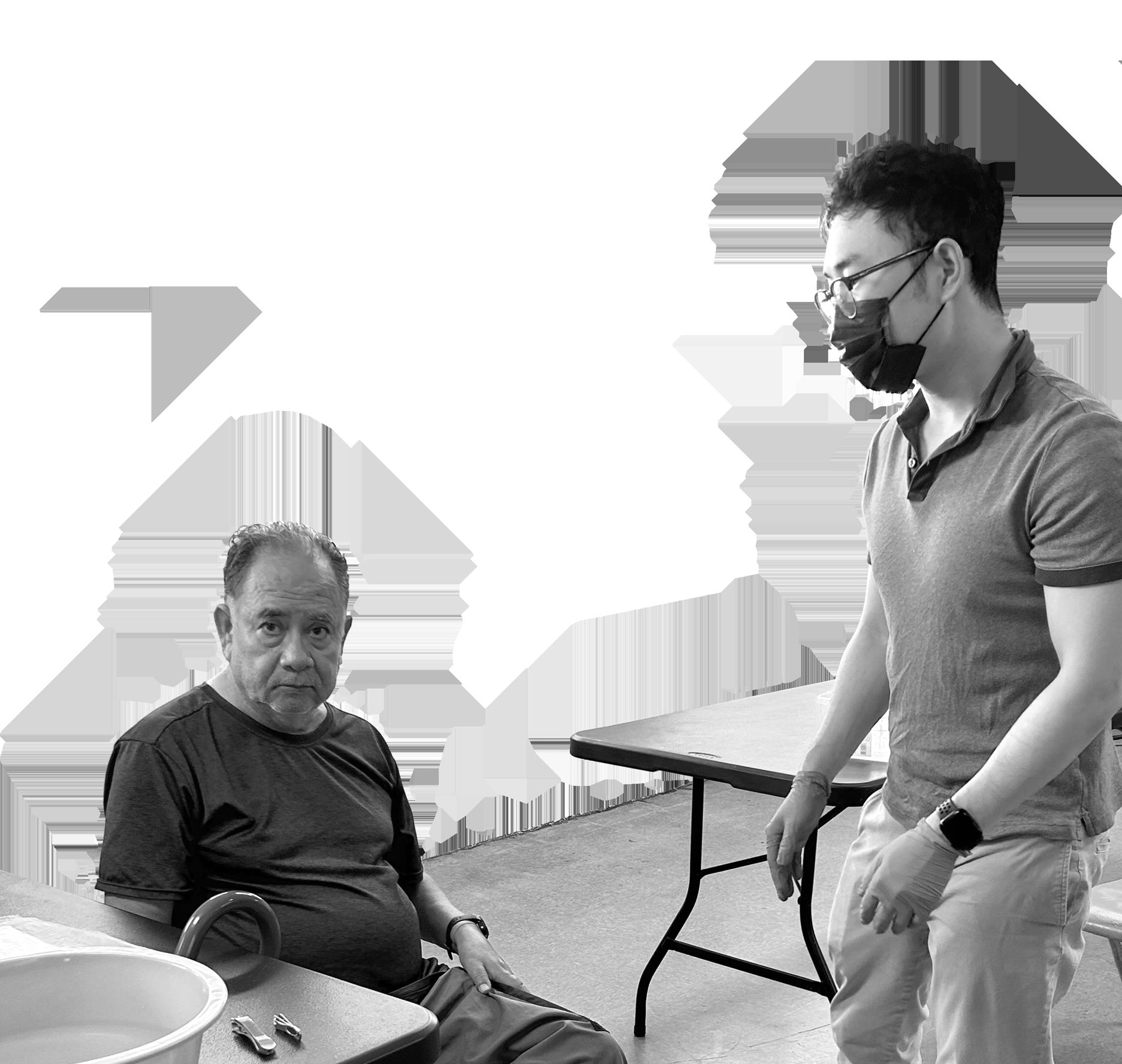
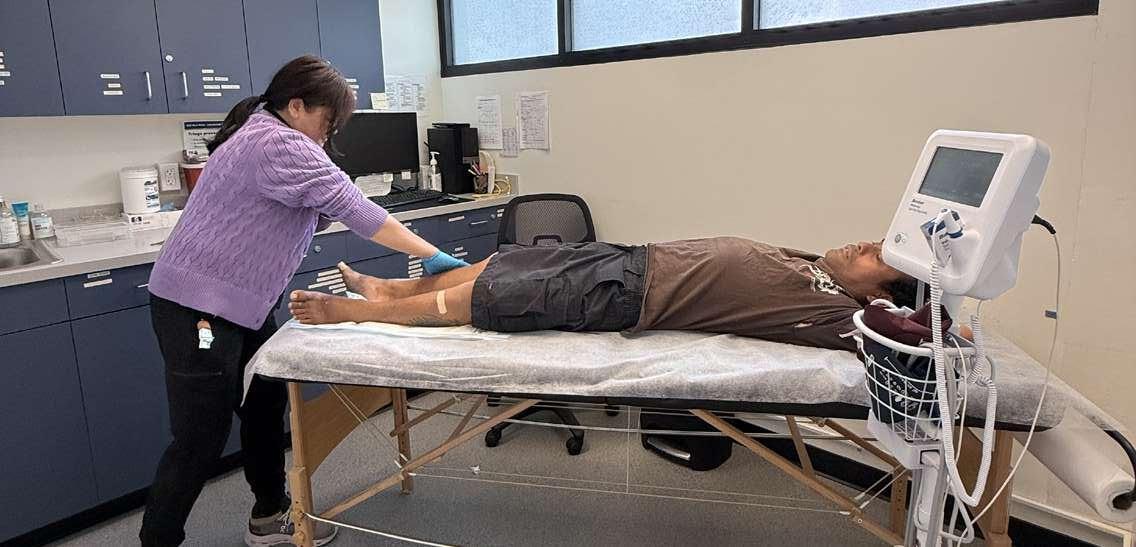
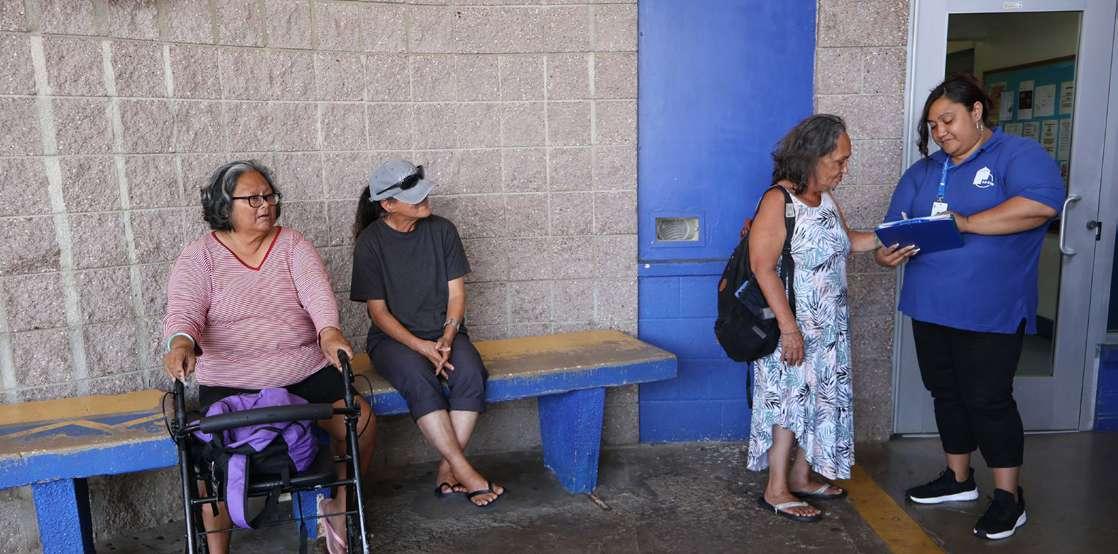
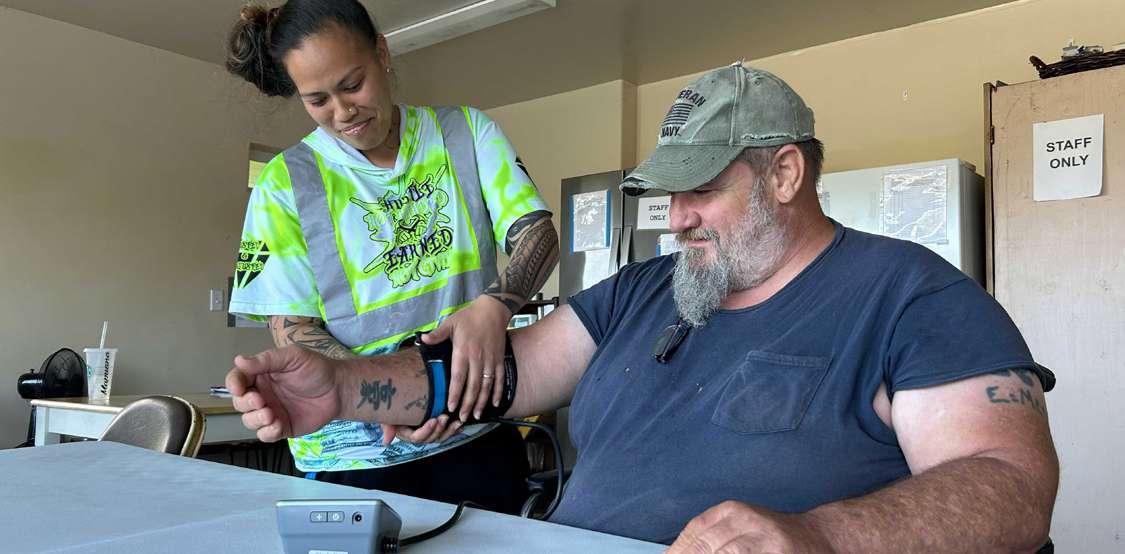
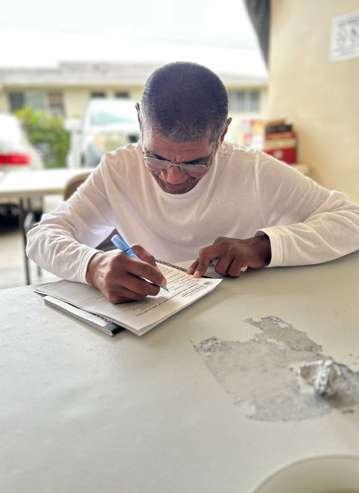
TOP: A Case manager checking on a client’s blood pressure at our Kilohana site, where health monitoring and housing navigation go hand in hand. BOTTOM: A client filling out paperwork to apply for permanent housing.
MEAL PROGRAM
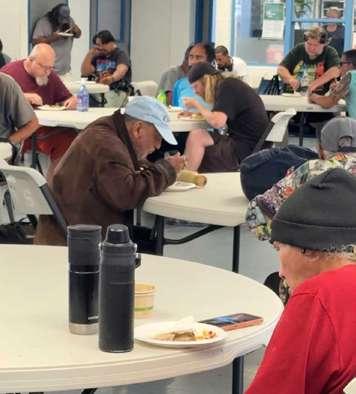
Three meals a day, seven days a week, 365 days a year. That cadence has held since IHS’s earliest days, and this year it produced 291,594 meals served across our shelters and to unsheltered community members nearby.
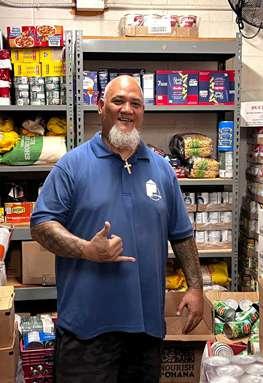
The numbers rose from the prior year: 5,608 meals per week, 801 per day, 267 per mealtime. Behind those totals are the kitchen staff who arrived before dawn, the volunteers who served lunch on Fridays, the food partnerships that kept our pantry stocked, and the community members who organized donation drives so our shelves stayed full.
The meal program’s purpose extends beyond nutrition. Our dining spaces are where trust is inspired. A guest who sits down for a plate of food may, over the course of several weeks, build enough
comfort with the environment to speak with a case manager. A conversation over coffee may surface a medical need that leads to a wellness center visit. The
kitchen is the lowest barrier to engagement IHS offers. For many of the people we serve, it is the first door they walk through, and it never closes.
2022: IHS’ Kahauiki Village joins Aloha United Way’s ALICE (Asset Limited, Income Constrained, Employed) Cohort.
2022: IHS launches a Community Integrated Services case management program for homeless and at-risk medically vulnerable adults.
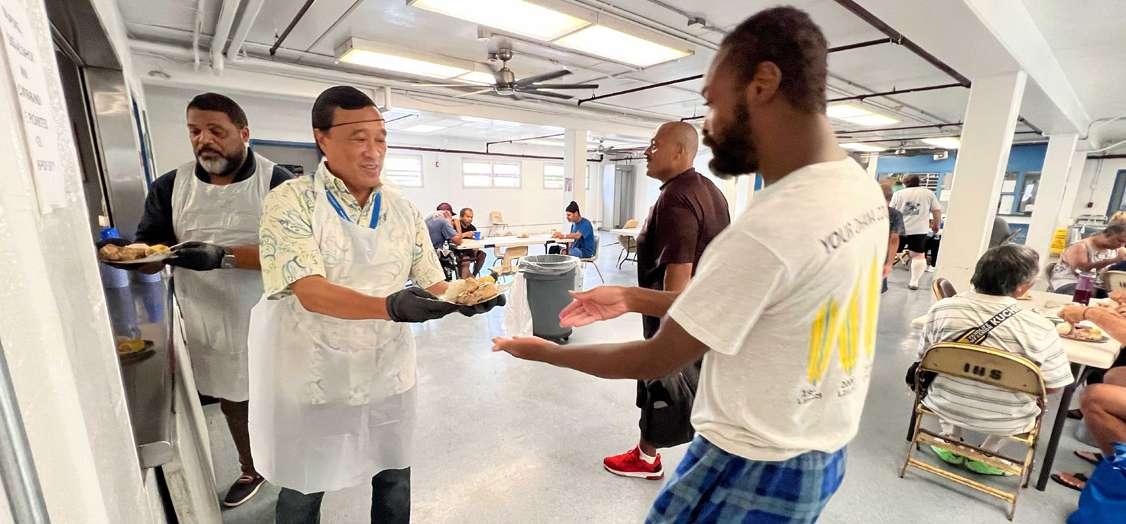
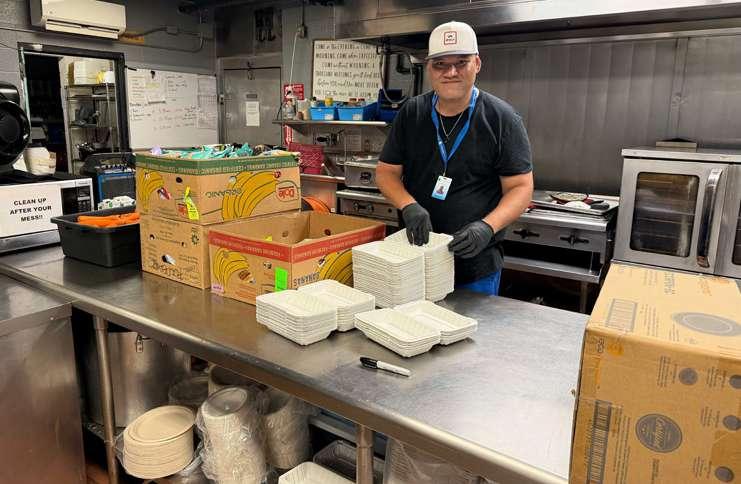
TOP: Lunch service at Sumner Men’s Shelter, where over 800 meals are served daily across all of IHS’s sites. BOTTOM: Kitchen staff beginning to plate breakfast.
VOLUNTEER PROGRAM
Volunteers have always been a part of the legacy our founders Fr. Claude and Roberta DuTeil left to IHS. This year, 1,018 individuals and 327 groups contributed 10,562 volunteer hours across IHS programs and sites.
While total hours decreased from last year’s surge, the shift reflects a change in how our community showed up: more people participated through one-time or shorter group engagements rather than long-term individual commitments. But their contributions were no less impactful as many volunteers were critical in helping us launch two of our new Alana Ola Pono and Paepae Hou Kauhale programs.
Schools, churches, businesses, and civic organizations drove this year’s participation. The average group size
of seven meant more frequent, focused service events: teams serving meals, sorting donations, supporting site improvements, and offering professional skills. The result was a broader volunteer base engaging more people in our mission, even as total hours returned to a level more consistent with our historical baseline.
Volunteers are essential to this work. Every meal served by a volunteer, every donation sorted, every skill shared creates a moment when our guests experience being valued by the broader community. Those moments matter. They remind the people we serve that they belong to a community that has not forgotten them, and they remind volunteers that the distance between housed and unhoused is smaller than most people assume.
2023: ‘Imi Ola Piha Homeless Triage Center opens. 2024: Paepae Hou kauhale opens, supporting men in early recovery.
2024: Alana Ola Pono kauhale blessed at 357
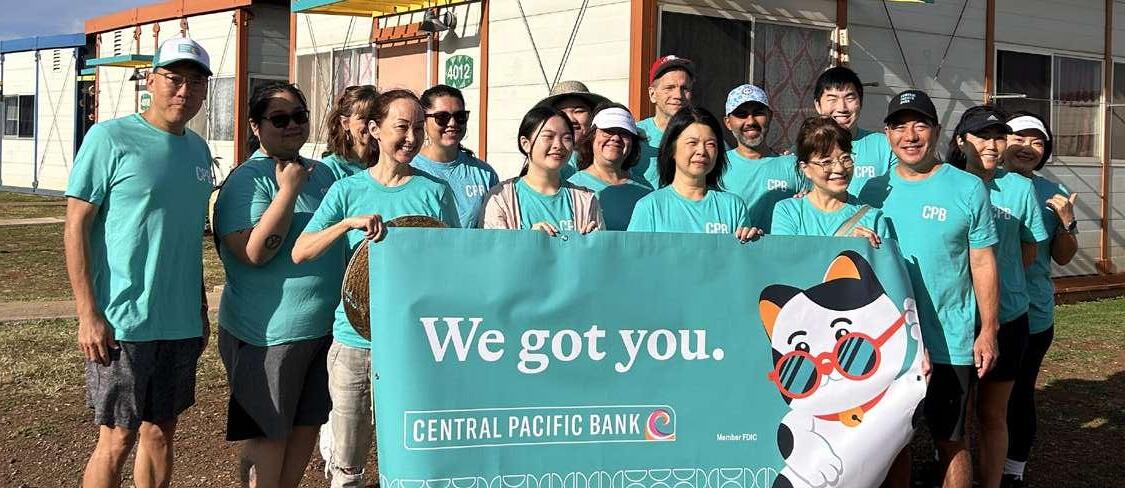
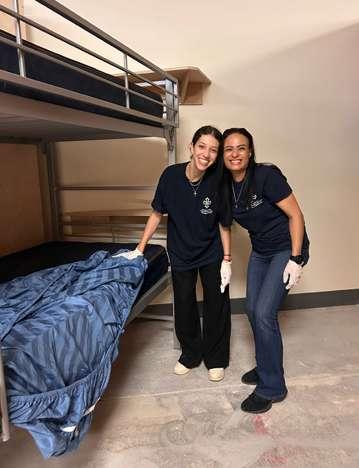
TOP: Central Pacific Bank volunteers painted picnic tables and prepped garden beds at Kahauiki Village. BOTTOM: Navy volunteers helping assemble bunk beds for the opening of our Kumu Ola Hou Kauhale.
IHS is a highly trusted nonprofit organization among philanthropists.
IHS has received exceptional ratings by core philanthropic evaluators that assessed fiscal responsibility, financial health, accountability, and transparency; repeatedly awarded four out of four stars by Charity Navigator.
For a copy of the complete FY2025 audited report, contact us at info@ihshawaii.org.
2025: Kumu Ola Hou transitional shelter opens in Iwilei Center.
2025: Roberta “Tutu Bert” DuTeil passes away on May 16, 2025, reuniting with IHS founder Father Claude.
WAYS TO GIVE
This report captures a groundbreaking year for IHS. What the coming year looks like depends on who joins us now. Supporting IHS can take many forms. Here are five ways to stand behind our work:
01. GIVE MONTHLY OR ONCE
Monthly gifts are the most reliable funding IHS receives. They keep beds staffed and meals served between grant cycles. You can give securely at www.IHShawaii.org today.
02. GIVE GOODS
Our shelters go through rice, cleaning supplies, and hygiene products daily. Shop our Amazon Wishlist or visit the Donate page at www.IHShawaii.org for a list of most-needed items.
03. GIVE TIME
Volunteer solo or bring a group to serve meals, sort donations, or clean a site. We match volunteers to projects based on your skills and interests. No experience needed.
04. LEAVE A LEGACY
A gift through your will, IRA, stock, or estate sustains our work beyond any single year. You can schedule a confidential planning talk with our Director of Philanthropy, Steven Tseu, at (808) 728-3409.
05. PARTNER WITH US
Corporate sponsorships, grants, and employee matching let businesses put institutional weight behind this work. Reach out to ihsdevelopment@ihshawaii.org to start a conversation.
funds three nutritious meals a day for one of our shelter guests
subsidizes outreach efforts to secure vital documents for an unsheltered individual
$20 $30 $50 $100 $250 $500
provides hot showers, hygiene and a safe night’s rest for one of our shelter guests
buys plates, cups, utensils, and kitchen or bathroom cleaning supplies for a newly housed individual
funds a Hele2Work employment package for a client which includes a haircut, work apparel, bus pass and new phone helps us return a willing guest from out-of-state back to their home with meaningful support on the continent
DONOR NETWORK
Mahalo to the following donors for their support this fiscal year, and to the many individuals and organizations who helped in countless other ways.
Your investment sustained the daily work of transformation: each contribution represented a belief that housing is fundamental to human dignity, that second chances are worth funding, and that a Hawaiʻi where stable homes are accessible to all remains a shared commitment.
As we navigate national uncertainty around federal homelessness funding, your generosity has never been more essential. It makes sure that IHS’s continuum of care remains intact, from outreach to shelter to permanent housing, and enables us to continue innovating and responding to unmet needs in our community.
• Gertraud Maskarinec
• Koji Takakuwa
• Zilber Family Foundation
• First Hawaiian Bank Foundation
• Dudley and Marion Foster
• Virginia Frank
• Hawaii Pacific Health
• Hawaiian Sunshine Nursery Inc
• Marshall and Yuko Hung
• Anonymous Donor Advised Fund of the HCF
• Atherton Family Foundation
• Bank of Hawaii Foundation
• The Cades Foundation
• Central Pacific Bank Foundation
• Ellen M. Koenig Memorial Fund of the HCF
• Enterprise Mobility
• Stephen and Gloria Gainsley
• Rodman Low and Helen Baroni
• Na Lei Aloha Foundation
• Nareit Foundation
• Order of Malta Western Association USA
• The Pettus Foundation
• Samuel N. & Mary Castle Foundation
• The Schuler Family Foundation
• Aloha United Way
$100,000+ $50,000+
• Aditi Fund
• C.N. Wodehouse Hawaii Charities Trust
• Jean M. Carr Revocable Living Trust
• Laraine K. Harrison Charitable Fund
$25,000+ $10,000+
• Alexander & Baldwin, Inc.
• Duane and Sally Bartholomew
• Frederic Brossy
• Antoinette Brown
• Church of Jesus Christ of Latter Day Saints
• Conduit Fund by Suzanne Nakano
• Fighting Eel, Inc.
• Jean & William K. H. Mau Foundation
• David Johnson
• Tim Johnsson
• Joseph C. Leonardo & Co. Charitable Foundation
• Keith & Polly Steiner Family Foundation
• Thomas Kiely and Mary Charles
• Kualoa Ranch Foundation
• Kubota Foundation of the Hawaii Community Foundation
• Mary Lou Cecil Charitable Trust
• Judith Mattoch
• Patricia Moore
• Audrey Mueh
• Debra and Glenn Ogasawara
• Padosi Foundation
• Alice Ransil
• Robert L. Keller and Betty Jean Keller Charitable Foundation
• Serendipity II Fund of the Hawaii Community Foundation
• Alan Stockton
• Wayne and Sharon Teruya
• Thomas & Sumie McCabe Foundation
• Wilson Okamoto CorporationEngineers & Planners
• Ronald and Judy Yamamoto
$5,000+
• 5 Minute Pharmacy LLC
• Katherine Baird
• Scott and Rachel Bradley
• Elizabeth Bremer
• Lawrence Brown
• Jean Carr
• Glenda Chow
• Chung Kun Ai Foundation
• Clifton and Abby Royston Charitable Fund
• Coastal Construction Co., Inc.
• Edward Conklin
• Kevin and Calie Durant
• Christopher Edwards
• Ernest & Margaret (Peggy) Kai Charitable Foundation
• John and Rebecca Faunce
• Sarah Fincke
• First Insurance Charitable Foundation
• Christopher Goodwin
• Marvin and Rae Hall
• Patricia Hara
• Harmony Chapter #4, OES
• Hawaii Women’s Legal Foundation
• Hawaiian Electric Company, Inc.
• Richard and Yumiko Heltzel
• Melvin and Leonore Higa
• Ida Holtsinger
• Seiki and Judy Ifuku
• InSynergy Engineering, Inc.
• The Jhamandas Watumull Fund
• Lawrence Johnson
• Walter Kam
• Loren Lasher
• Herbert and Margaret Lee
• Sherry Loo
• Steven and Jill Loui
• Mary and Paul Wagner Charitable Fund HFC
• Patrick McGuirk
• Richard Meiers
• The Michael J. Marks Foundation
• David and Kathleen Morimoto
• Carolyn Nakagawa
• Edward Nakagawa
• Steven Nakama
• The National Association of Industrial and Office Properties
• Ninth Avenue Charitable Fund
• North Carolina Community Foundation, Inc.
• Pacific Rainbow Foundation
• Par Hawaii, Inc.
• Benjamin and Mealani Parish
• Pasha Hawaii Transport Lines LLC
• Carl and Beverly Penaranda
• R.M. Towill Corporation
• Marilyn Rigterink
• Rinell Wood Systems Inc.
• Roman Catholic Church in the State of Hawaii
• Sean Santiago
• Dennis Streveler
• Jennifer Taylor and Paul White
• Thomas & Elizabeth Brodhead Foundation
• Tracy and Toby Tonaki
• Marianne Whiting
• Marcia Wright
• Eileen and Christen Yuen
• Yuen Matusmoto Charitable Fund HCF
$2,500+
• Aiea United Methodist Church
• Ana and Tana Alualu
• Atlas Insurance Agency
• Donna Bair-Mundy and Bruce Mundy
• Benevity Community Impact Fund
• Thomas Borland
• Celia Bowker
• Jill and Norbert Buelsing
• Ronald Bunn
• Capitol Consultants of Hawaii LLP
• Timothy and Elizabeth Carlson
• Central Pacific Bank
• Chauncey and Teddie Ching
• Christ Church Uniting Disciples & Presbyterians (CCU)
• Donna Christle
• Bruce Coppa
• Renee Evans
• Fidelity Charitable Gift Fund
• The First Chinese Church of Christ in Hawaii
• First Presbyterian Church of Honolulu Women’s Ministry Team
• Daniel Fischberg and Barbara Ebersole
• Foodland Super Market, Ltd.
• Harvey and Rae Green
• Volker Hildebrandt and Charlotte Yamane
• Lynn Hirashima
• Pamela and Patrick Huber
• Hung Wo and Elizabeth Lau Ching Foundation
• Ivena M. Ziegenhein Fund of the Hawaii Community Foundation
• Tad and Carol Iwanuma
• James and Melinda Cavanah Foundation of the HCF
• Kent Jones
• Melvin Kaneshige and Nancy Pace
• Kelly Laa
• Geraldine Lee
• Heidi Maxie
• Minneapolis Foundation
• Constance and Mark Mitchell
• Gary Miyamoto
• Michael Moore
• Curt and Riley Nakamura
• John Noland
• Sue Palumbo
• Pikake Foundation Inc
• Planning Solutions, Inc.
• Barbara B Polk
• Rainbow Pineapple Foundation Fund
• Roger and Helen MacArthur Foundation Fund of the HCF
• George Schmelzer and Judith Inazu
• The Schwab Fund for Charitable Giving
• Miriam Sharma
• Thomas Shiu
• Linda and Leighton Taylor
• Wade and Harue McVay Family Foundation Fund of the HCF
• Women’s League of Central Union Church
• Yasuko Mitsuyasu New Year’s Day Meal Fund of HCF
$1,000+
• Lucienne Abe
• Patricia Adams
• Air Central Inc
• Camilla Albert
• Armstrong Foundation
• Paul and Lorraine Asano
• Millicent and Leslie Asari
• Alvin and Susan Awaya
• Kandi Ayakawa
• Nancy Ayotte
• Nathan Barker
• Sandra and Robert Bellizzi
• Peter and Valerie Besenbruch
• Michael and Linfeng Beverford
• Harry Bittenbender and Donna Ching
• Dennis Bolger
• William Bowles
• Lesley Brey
• Timothy and Sara Brilliande
• Donald & Alana Busekrus
• Ruby and Joseph Bussen
• Christopher Campbell
• Barbara Cargill
• Jonathan and Millie Carr
• William Carreira
• Ellen Godbey Carson and Robert Godbey
• Peter and Raulette Carson
• Sharon and Paul Chai
• Diane Chapel
• Amy Ching
• Walter and Sharon Chong
• Laurie Chun
• Church of the Holy Nativity
• Stephen and Donna Craven
• Robert Creps and Debra Pfaltzgraff
• Rosemarie Daguio
• Jacqueline and John Earle
• Elite Pacific Construction Inc
• John Emery
• Troy and Estella Euclide
• Gerald and Monica Evans
• The Feldstein Foundation
• Fine Art Restoration
• Rebecca Fitzgerald
• Fontel Foundation
• Sondra and Evan Fram
• Sheryl Gardner
• German Benevolent Society of Honolulu Charitable Fund HCF
• Stephen Gilbride
• Emily Gillmar
• John and Helen Gillmor
• Give Lively
• Benjamin and Yvonne Godsey
• Jodi and William Goh
• Judith and Robert Goldman
• Deborah Ann Goto
• Gourmet Foods Hawaii
• James Graves
• Peter and Lois Gregg
• Warren Hananoki
• Jeffrey Harris
• Harris United Methodist Church
• Sally Hartman
• Mark and Diane Hastert
• Hawaii Hotel Industry Foundation
• Hawaii Polo Inn
• Letitia Hickson
• Lloyd Hihara
• Lorraine and Gerald Hirokawa
• James and Karen Howell
• Martin Hsia
• Thomas and Gloria Huber
• David and Ellen Huntley
• The Ifuku Family Foundation
• Lance and Jillian Inouye
• Milton and Lucy Inouye
• Leslie and Warren Iseke
• Sean Ishii
• Janell Israel
• K. James and Jeri Steiner
• J&M and James Jennings
• Amanda Jones
• Ann Jones
• Blair Jones
• Skipper and Chuck Jones
• Kailua United Methodist Church
• Kakatu Foundation
• Steve and Lois Kakuni
• Kamehameha Lions Club Foundation
• Roy and Pat Kamida
• John Kampfer
• Eloise Kapuniai
• Lynn Kataoka
• Russell Kato and Charleen Aina
• Catherine and Steven Kawamura
• Jared and Mary Kim
• Jeananne Kim
• Maurine King
• Barry and Kathleen Kishimoto
• Cami Kloster and Jonathan Scheuer
• Richard Kornowski
• Laura Kunewa
• Morris and Judy Kunita
• Geoffrey and May Lau
• Laulima Foundation
• Margaret Lee
• Marlene Lee
• Suzanne Lewis
• Lex Brodie’s Tire Company
• Alex Lin
• Peter and Satoko Lincoln
• Bernice Littman
• Lawrence and Ruth Lockett
• Roberta Lovely and Ann Chong
• Manoa Valley Church
• Barbara and Marvin Mathews
• Colbert and Gail Matsumoto
• Maui Divers Jewelry
• Audrey McMillan-Cole
• Marian Melish
• Victor and Pat Meyers
• Randolph Moore and Lynne Johnson
• John Morioka
• Randall Morita
• John Morris and Marjorie Au
• Jerry and Suzanne Murphy
• Rebecca Nadler
• Lauren Nahme
• Cynthia Nakasato
• Nakashima Ching LLC
• Dennis Nakauye
• National Philanthropic Trust
• Gerald and June Naughton
• Newberry Family Foundation
• Pepi Nieva
• Joyce Nouchi
• Nuuanu Memorial Park & Mortuary LLC
• Tom and Sally Ocasek
• Lily Ochoco
• Steven Oda
• Cousins of Jeffrey Okamura
• Paul Okano
• Steven Oppenheimer
• Organization of Chinese American Women
• Gretchen Osgood
• Gary and Susie Ota
• Dwight and Trese Otani
• Dennis Pacht
• Michael Pang
• Robert and Dawn Pascua
• Christine Piper
• James Potter
• Tony and Leilani Makuakane Potter
• Deborah Putnam and Robert Laguens
• Robert Pyburn & Gregory Wrenn
• Gregory Ravizza
• The Reverend Abraham K. Akaka Ministries Foundation
• James Reynolds
• Heidi Rian
• Janis and James Rodden
• David and Chongae Saito
• Kenneth Sakurai and Joni Masutani
• Cheryl-Lynn Sasaki
• Earl and Susan Sato
• Sandra Sato
• Arun and Mira Savara
• Marsha Schweitzer
• Sheryl Seaman
• Barbara Service
• Timothy and Sharifah Shank
• Susan Sheetz
• Clifford and Diana Shima
• David and Susanne Shimabukuro
• Michael and Susan Shire
• Shiro’s Saimin Haven
• Mark Sindelar
• Frank and Laura Smith
• Michael and Laurel Solomon
• Mollie and Mark Sperry
• St. John Lutheran Church
• St. Peter’s Episcopal Church
• Elizabeth Staley
• Warren Stenberg
• Robert Stephenson
• Steven C. Ai Charitable Gift Fund
• David Suzuki
• Benjamin and Jolene Taga
• Nadine and Larry Takahashi
• Fred Takakuwa
• Robert and Avis Takamatsu
• Paul and Sara Tamayose
• Myrtle Taoka
• Michael and Terri Taylor
• Territorial Savings Bank
• Grace Teruya
• Sebastian and Barb Troia
• David Tsiang
• Terry and Diana Tusher
• Brian Uechi
• Unicold Corp.
• United Church of Christ on Judd Street
• Unitek Contracting Group LLC
• Carl Varady
• Keith and Jo Anne Vieira
• Ryan Wagoner
• Waiokeola Congregational Church
• Marion Walker
• Jyoti Watumull
• Edward and Kathryn Weldon
• Terence A. Wesley-Smith
• Patricia Wiencke
• Timothy Wilhelm
• Julie Wiskind
• Barbara Wong
• Danton Wong
• Nathan Wong
• Patrick and Sandy Yim
• Charlene Young-Eroh and Douglas Eroh
TRIBUTE
• Gloria Adams
• Norman Aramaki
• Audrey’s Children
• Elaine Blitman
• Frances Brossy
• Frederic Brossy
• June Chambers
• Caroline Chan
• Lenore Chillingworth
• Barbara Tam Ching
• Ed & Phyllis Ching
• Murph Dailey
• Lee Donaldson
• Robert C. Donaldson III
• Roberta DuTeil
• Barbara Fischlowitz-Leong
• Mary Floyd
• Aurora Fruehling
• Lynette N. Fukuoka
• Sachie U. Hayakawa
• Helen (Mother of Laurence Ramsey)
• Herbert Inouye
• Ernest Kai
• Kevin & Drew
• Thomas Kiely
• Luna Knoepfel
• Tom Leland, M.D.
• Suzanne Lenz
• Lucille Lew
• Julia Loui
• Wayne Lum
• Luna K
• M. P.
• Michael Thomas McEnerney
• Jack Miller
• Theodore & Eva Moniz
• Andy Mounthongdy
• Karl Muller
• Alvin Narimatsu
• Richard Nishihara
• Jay Ogden
• Jeffrey Okamura
• Dermot Ornelles
• Father Vince O’Neill
• Pacle Ohana
• Parents Parents
• Philip Passion
• Barbara Pretty
• Tom Prince
• Raptor Jesus
• Elaine Sakai
• Sam Sakamaki
• James Schuler
• Danielle Shin
• Madeleine Beth Silverman
• Carolyn G. Stenberg
• Karen Stockton
• Lois Sueda
• Manuel Sylvester
• Barney Takata
• Ramona Tasaki
• George Q.W. Tom
• Lito Valderama
• Orlo G Vedder Jr
• Aaron Wallen
• Jim Albert Wiencke
• Mr.Dick and Mrs. Debby Wong
• Harriet Young
Every gift sustains someone’s pathway from crisis to stability.
Every check helps keep IHS’s full continuum of care running.
Every donation says Hawaiʻi takes care of its own.
Scan the QR code below to give to IHS today.
IHS Managed Facilities:
Specialty Shelter
Medical Respite Home
‘Imi Ola Piha - Homeless
Triage and Treatment Center
Kahauiki Village
Re-Entry Supportive Housing
IHS Managed Facilities:
Emergency Shelter Service Fair
*Shaded areas represent IHS’ primary outreach and service areas Service Partnerships
Emergency
Joint Outreach Center
Specialty Shelter
Medical Respite Home
‘Imi Ola Piha - Homeless Triage and Treatment Center
Kahauiki Village
Re-Entry Supportive Housing
IHS Managed Facilities:
Emergency
Specialty Shelter
Medical Respite Home
‘Imi Ola Piha - Homeless
Triage and Treatment Center
Kahauiki Village
*Shaded areas represent IHS’ primary outreach and service areas Service Partnerships
Joint Outreach Center
*Shaded areas represent IHS’ primary outreach Service Partnerships