International House
WORLD NEWSLETTER “That Brotherhood May Prevail’’
Vol.17 No.1
Spring 1982 coming for the most prestigious event of the year, the Marshall Visitor. I. House looked like nothing had happened.”’ United Artists did a great deal to compensate the students for the invasion
of their home. They hired 45 students as
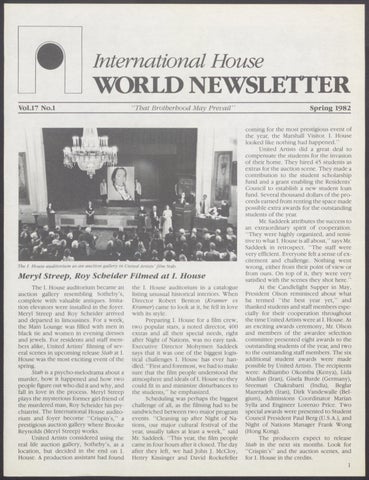
The
I. House auditorium
as an auction gallery in United Artists’ film
Stab.
Meryl Streep, Roy Scheider Filmed at I. House The I. House auditorium became an auction gallery resembling Sotheby’s, complete with valuable antiques. Imitation elevators were installed in the foyer. Meryl Streep and Roy Scheider arrived and departed in limousines. For a week, the Main Lounge was filled with men in black tie and women in evening dresses and jewels. For residents and staff members alike, United Artists’ filming of several scenes in upcoming release Stab at I. House was the most exciting event of the spring. Stab is a psycho-melodrama about a
the I. House auditorium in a catalogue listing unusual historical interiors. When Director
Robert
Benton
(Kramer
vs
Kramer) came to look at it, he fell in love with its style. Preparing I. House for a film crew, two
popular
stars,
a noted
director,
400
extras and all their special needs, right after Night of Nations, was no easy task. Executive Director Mohymen Saddeek says that it was one of the biggest logistical challenges I. House has ever handled. ‘‘First and foremost, we had to make
prestigious auction gallery where Brooke Reynolds (Meryl Streep) works. United Artists considered using the real life auction gallery, Sotheby’s, as a
sure that the film people understood the atmosphere and ideals of I. House so they could fit in and minimize disturbances to the students,’’ he emphasized. Scheduling was perhaps the biggest challenge of all, as the filming had to be sandwiched between two major program events. “Cleaning up after Night of Nations, Our major cultural festival of the year, usually takes at least a week,”’ said Mr. Saddeek. “‘This year, the film people came in four hours after it closed. The day
location,
after
murder,
how
it happened
and
how
two
people figure out who did it and why, and fall in love in the process. Meryl Streep plays the mysterious former girl-friend of the murdered man, Roy Scheider his psychiatrist. The International House audito-
rium
and
foyer become
but
decided
in
“‘Crispin’s,”
the
end
on
a
I.
House. A production assistant had found
Henry
they
left,
Kissinger
we
had John J. McCloy,
and
David
Rockefeller
extras for the auction scene. They made a contribution to the student scholarship fund and a grant enabling the Residents’ Council to establish a new student loan fund. Several thousand dollars of the proceeds earned from renting the space made possible extra awards for the outstanding students of the year. Mr. Saddeek attributes the success to an extraordinary spirit of cooperation. “They were highly organized, and sensitive to what I. House is all about,’’ says Mr. Saddeek in retrospect. “‘The staff were very efficient. Everyone felt a sense of excitement and challenge. Nothing went wrong, either from their point of view or from ours. On top of it, they were very satisfied with the scenes they shot here.”’ At the Candlelight Supper in May, President Olson reminisced about what he termed “‘the best year yet,’ and thanked students and staff members especially for their cooperation throughout the time United Artists were at I. House. At an exciting awards ceremony, Mr. Olson and members of the awardee selection committee presented eight awards to the outstanding students of the year, and two to the outstanding staff members. The six additional student awards were made possible by United Artists. The recipients were: Adhiambo Okomba (Kenya), Lida Ahadian (Iran), Gisela Burde (Germany), Sreemati Chakrabarti (India), Beglar Mazeradeh (Iran), Dirk Vandewalle (Belgium), Admissions Coordinator Marian Sylla and Engineer Lorenzo Price. Two special awards were presented to Student Council President Paul Berg (U.S.A.), and Night of Nations Manager Frank Wong (Hong Kong). The producers expect to release Stab in the next six months. Look for “Crispin’s’’ and the auction scenes, and for I. House in the credits.
aA i
“iy
~~
a >
5
=
~
line, *%
.;
:
et
John J. McCloy meets Frank
Wong (Hong Kong),
Nicolas Koutsopoulos (Greece),
Yeomi Lee (Korea).
Jobn J. McCloy & David Rockefeller, Marshall Visitors They were two important forces in shaping International House into the vital institution it is today. Their return, many
years after their active service to I. House, as
the
11th
and
12th
Marshall
Visitors,
represented a moment of history for I. House. The Hon. John J. McCloy, one of ‘the most influential diplomats of the postwar era, was for 17 years Chairman of the Board of I. House. Former Chairman of the Chase Manhattan Bank David Rockefeller’s memories of I. House stretch back to his boyhood, when his father, John D. Rockefeller, Jr. used to bring him to visit.
Since 1940, he has served as Trustee, Chairman of the Executive Committee and Honorary Trustee. In 1959, Mr. McCloy established the Marshall Visitor Program in honor of General George CC. Marshall, his predecessor as Chairman of the Board of I. House. The program was designed to broaden the opportunities for students to meet and hear distinguished spokesmen from all disciplines of American life. Mr. McCloy peppered his remarks with reminiscences and vignettes about the Presidents, generals and statesmen he had known and respected. He shared his view on the two issues from which, in his
opinion, spring most of the forces buffeting the world today. On the international side is the need for America to stabilize its Atlantic-Soviet relations in our dangerous, nuclear-powered world. On the domestic side is the United States’ debilitating inflationary spiral and ‘“‘its attending stagnation and distorted values.”’ Mr. Rockefeller spoke about his family’s long association with International House, and the important role 2
attention,
which I. House ideals play in the world. His talk focused on some of the problems of the developing world. He sees the need for a creative partnership between the technical and management skills of the West,
and
the
human
and _
natural
resources of the countries of the developing world. This would generate wealth, and create a better life for the citizens of these countries. On a particularly inspiring note to an audience of hundreds of students, Trustees and alumni patrons, Mr. Rocke-
feller quoted
President
of Zambia, whom
Kenneth
Kaunda
he had seen on a recent
trip to Africa. ““What we need desperately in the world
at this time,’’ said President
Kaunda, “‘is to build bridges between nations.”’ “International House,’’ Rockefeller, ‘‘is such a bridge.”
said
Mr.
the
Harlem
Tutorial
Fellow.
‘‘They
are a dedicated group. Even President Olson has a tutee. We've had lots of positive feedback. Mrs. Duncan tells me that the first thing that parents ask for when learning problems come up is if their child can get into the I. House program. It’s good to know that we really are helping.” Cheryl organizes special events for the whole group of tutors and tutees—ice skating in Central Park, swimming at the Teachers College pool and a trip to the zoo. Ata memorable Christmas party, the children made decorations for the I. House tree and sang carols, and then, to great excitement, Santa Claus walked in through Sakura Park to_ distribute presents, By all accounts, the Harlem Tutorial Program is having its best year yet. ‘‘It’s the most popular program for school children in our district,’’ said Mrs. Duncan. “The young people at I. House are doing this from their hearts, and that really goes over with the children.”’
I. House
in the Media
Yes! You are looking at three I. House residents from behind TV cameras. Bill Boggs of ‘‘Midday,”’ a live talk show on New York Chanel 5, invited Dirk Vandewalle (Belgium), Adhiambo
Okomba (Hong
(Kenya) Kong)
to
and appear
Frank
Wong
on
show.
the
xk CO ees 7?
the
“We were all very excited about being on TV,” said Adhiambo. He asked us
about what it is like to be a foreign student in New York City. We talked a lot about how living at International House
is so valuable for coping with the initial
adjustment problems. You aren't alone at I. House, and yet you aren't isolated from America either, because so many American students live here too,”’
fe
ORE ey
special
CH
RS
With
tet
‘
of them.
children relax and make progress. ‘I. House residents get involved as tutors because they want to be part of this community or feel they have some talent for helping a child,’’ says Cheryl Feder-
ae
all
=a
Each week, 30 fourth, fifth and sixth
grade children from P.S. 125 come to I. House to meet the students who are their tutors. They read, work on writing and math skills and talk. ‘‘What’s special about the Harlem Tutorial Program is the oneon-one attention,’’ says Mrs. Duncan of P.S. 125 who identifies the children who need extra help with their studies. ‘‘Ten years ago in school, we used to have 20 children to a class. Now there are as many _as 38. It’s harder and harder for us to reach
,
Tutorial Program
-—
Harlem
Renovations
sa" Noba
Poul
Albegelan
The International
House
Forum
“The diversity of the I. House Forum is one of the best things about it,”’ says Ferial Saeed, the 1981-82 Forum Fellow. This year we have welcomed two Columbia professors who gave _ traditionally scholarly talks on the arms race and the October Revolution in Russia, in addition to the producers of a film about violinist Isaac Stern in China, and a bestselling author. Students particularly enjoyed Nelle Nugent,
Broadway
producer
Hartling
of Nicholas
Nikelby and Elephant Man, Noha Alhegelan, the wife of a high-ranking Saudi Arabian diplomat who talked about women in Arab culture, and Poul Hartling, the U.N. High Commissioner of Refugees, recipient of the Nobel Peace Prize. “They were popular in very different ways,’ says Ferial. ‘“‘Nelle Nugent talked about getting her start and told lots of Hollywood stories. For those of us who spend our time in political economy or law or business, it was very refreshing to learn about the entertainment world. Noha Alhegelan, a scholar and the wife of
the Saudi Arabian ambassador to the United States, gave some fascinating insights into Islam and what it means. Her concept of ‘jihad’ is not ‘holy war’ but a process of continual perfection in everything. Poul Hartling gave a very straightforward talk on the refugee problem and what’s
being done
very uneven
about
it. Refugees
get
media coverage, and so it’s
an issue that many
people see in distorted
ways.” Ferial tells a story about a student who was very surprised that an Arab woman was to give a talk for the Forum. “He didn’t think Arab women were allowed or even able to speak in public,” said Ferial ‘“‘After her talk, he came up to me and said he had been wrong, and thanked me for having invited him to the speech. It was the best compliment I’ve gotten
all
year.
That
talk
changed
his
perception about something, and that’s what I. House and the Forum are all about. The only way you can change people’s ideas about issues is to show them what it’s really like.”’
Update
Visits to I. House continue to surprise and delight alumni. The renovations program, ongoing since 1977, is still transforming nooks and crannies of I. House into comfortable, sometimes elegant spaces better suited to the needs of today’s students. Over the past year, we have created a new TV room, hung mounted art posters in the residential corridors, put in new sidewalks at Riverside and Claremont, and installed an awning at Claremont Avenue. The foyer of the auditorium is now a strikingly elegant room for receptions and parties. Some of the less visible improvements are crucial to safety: an overhaul of the fire alarm system, and repairs to the fire escapes. The new TV room is the product ofa great deal of thought and discussion between the student Renovations Committee and the architect. The old room was a long, narrow and dark room with the TV at the far end. “‘A one-on-one video injection,’ commented one resident. The new one is a wide room where people come in from the side, and it is a totally different place. ‘“‘Now there’s a group of you and the TV set. It’s a more social place where you can wait for- your friends and meet them,’’ says Neill Parker of the Renovations Committee.
Major construction is now creating a new study facility on C-level. Designed by Robert A.M. Stern, the architect who so successfully renovated the Riverside entrance, the new area will follow the original Greek Revival style of I. House. It will offer conference rooms for business students, thanks to a grant from the Chase Manhattan Bank, and drawing boards for engineering and architecture students. The central reading room will have plenty of study space, soundproofed doors, even space for an art exhibit. “The most exciting project now is that we've finally gotten the appropriation to replace the furniture in the student | rooms,’ says Nich Adi-Dako, formerly a Ghanaian student in charge of the renovations work and recently appointed as business manager. The students feel it is high time for a change as the furniture was last replaced 30 years ago. The Renovations Committee spent hours discussing the merits of different kinds of furniture, and settled on some that is of blond, solid
The elegantly renovated foyer was made possible through the generosity of Trustee Ann Frantz.
oak with proven durability. ‘““We_ bargained hard and got a good price,”’ says Nich. ‘“‘We are paying less for the same furniture than Columbia paid in 1978!” Students can visit a room of sample furniture and make their comments and recommendations. The committee chose well: opinion is highly favorable. Delivery will begin during 1982.
Dance Company on Tour, Thanks to Alumni Herman Rottenberg tells the story of a day, 15 years ago, when student Isabel Soto,
then
costume
mistress of the ALL-
NATIONS Dance Company, remarked, ““some day I’m going to bring the troupe to Puerto Rico.”’ Sure enough, from April
16 to 28,
the company
performed
to
standing ovations in San Juan, Rio Piedras, Ponce and San German,
thanks to her ef-
forts. Patricia Aulestia was a fiery Mexican dancer who went on tour with the com-
pany in 1966. ‘‘When she walked down the hall, it was
iy
like a fiesta,’’ remembers
“HR” as Mr. Rottenberg is fondly known. Now a high executive with FONAPAS, Mexico’s
main
cultural
foundation,
pws)
she
and current resident Rosa Brito are arranging for the company to spend the first two weeks of September in Mexico City, Guadalajara, and other cities in Mexico.
Later on in the fall the company will take a seven week tour of Asia and the Pacific. ““We wouldn’t be going to Japan if it hadn’t been for Louis Munz (’77-79),”’ says HR. “‘Last year when he found out I was planning a trip around the world, he insisted that I come to his favorite part of Japan, Nanao, where he has been teaching for a year.”’ The unforseen but happy out-
The
ALLNATIONS
Dance
Company always brings dot wn the house with El Jarabe
come: two performances for the company in Nanao’s magnificent auditorium, and homestays with Japanese families for the dancers. “This year more alumni have become involved in helping set up our tours than ever,”’ says HR. ‘For so many of them, Joy in Every Land represents the spirit of I. House, and they’re just as interested as I am in spreading that magic around.”
countries,
they
have
made
constructive
contributions within their fields. The result is that in many important international relations today, Brotherhood does prevail!
4
tional
The llth meeting of the Council of Members will be held at InternaHouse
June
10-13,
1982. The focus
of this meeting will be to discuss future goals and directions for the Council. In response to opinions voiced at last year’s meeting in Brazil, President Olson has sent Out a questionnaire asking Council views
On
goals,
duties,
ac-
with a great deal of thought and in some
more
often,
that
all student
generations
should be represented on the Council, that Council members should organize alumni groups in their respective coun. tries, that the promotion of international
first president of the independent Philip-
Even if the world looks rather crazy today, there is no doubt in my mind that the initiative displayed by International House through the years, has inspired many thousands of students from all parts of the world. Now, when many of them have become decision-makers in their
World
detail. They expressed a great variety of opinions: that the Council should meet
From the moment I entered International House in January 1935, I have felt that it represents something very important and very worthwhile. I remember the meeting with the
felt the greatness of America behind it all.
Mexico.
tivities and finances of the Council. Seven members have responded
Axel Dessau wrote a long letter about bis days at I. House. Here are some excerpts:
pines, Manuel Queson, the Friday dances, the treasure-hunts through the House, and our own Scandinavian celebration of the wedding of our Crown Prince Frederick and the Swedish Princess Ingrid. We certainly learned a lot about many parts of the world on all these occasions, (including the United States!) and
from
Council Meeting to be Held in New York City
members’
A Letter from Denmark
Tapatio
brotherhood is most effectively handled by some association with the United Nations, that the Council should assist in fund raising efforts for I. House, and that
Portrait Unveiled The man in the picture is wearing a different tie but there is no doubt that it’s a sensational portrait of President Emeritus Howard A. Cook who retired in 1979. At a special ceremony in May, Trustee Bob Purcell unveiled the work. The Board of Trustees established a special fund for this project and commissioned alumnus Soss Melik to paint Howard. Mr. Melik has painted portraits of Mr. and Mrs. Harry Edmonds and Colonel John Mott. Howard’s portrait now hangs in the Home Room.
the Council should undertake a searching self-examination to see if it has justified its existence. It promises to be a lively and interesting discussion. The meeting will begin with Council members attending the meeting of the Board of Trustees on June 10, followed by an informal reception with Dr. Kissinger. In addition to Council business, CoChairman of the Council Daisy Soros will hold a luncheon for Trustees and Council members at her home in New Canaan, Connecticut, and Trustee Mrs. Daniel P.
Davison has arranged a reception at the newly restored historical landmark building in midtown Manhattan which
houses the U.S. Trust Co. of New York.
AF
™
A Volume of History: The I. House Memorial Register Madge Sills Hamlin is _ singlehandedly bringing alive the story of some of the remarkable people who have been associated with International House. Her
tional House for a year while studying education at Teachers College. ‘“‘She had the loveliest singing voice, and she and Harmond Mudd danced the most spectac-
idea, the. Memorial Register, is a way for
ular
the International House family to remember and honor dear friends, and help I. House at the same time. Mrs. Hamlin made the initial contribution to start the Memorial Register, and gave the first gifts
John MacGregor ('25-30) tells how she collected stones from places all over the country important to the American Indians, and built the ‘Fireplace of Nations”’ at Bacone Indian College in Oklahoma. She traveled to many of the tribes on an information gathering mission for the Rockefeller Foundation and appeared before many Congressional committees, always pursuing the best legislation for her people. She died in Santa Monica,
in honor of her late husband, Paul Hamlin,
and a lifelong friend, Colonel Frederick Hackett. Memorial gifts go into the endowment and provide income for the program, and the names of those memorialized are inscribed in a large leather volume. A companion volume includes photographs and brief biographies. Calling all over the country, Mrs. Hamlin has tracked down news of many
of her friends of the 1925-26 group. She says her phone bills are phenomenal, but her excitement over bringing to life this very special I. House history is infectious. “It would be such a tragedy for the lives and careers of all these wonderful people to be forgotten,’’ she says. That so many have responded is a tribute to her energy and her style. Below are the stories of only three of those memorialized to date: Ataloa, Princess of the Chickasha American Indian tribe, lived at Interna-
Alumni MBA
tango,’’
remembers
Mrs.
Hamlin.
Princess Ataloa, Reidar Gundersen and Louise Stephenson as they appeared in their I, House yearbooks.
group, deeply respected by her peers. After receiving a degree in dietetics at Columbia, she reached the top of her profes-
California in 1967.
sion, serving for many years as chief dieti-
“Tall and handsome’ Reidar Gundersen from Norway (27-29), married Ingeborg Halle who also lived at I. House, and became a prominent banker. He made his career, first in the international division of the Morgan Guaranty Trust Company of New York, then opening and heading its first office in Frankfurt, Germany. The first alumni trustee of International House, he served for a number of years with distinction as treasurer, and chairman of the Finance Committee. He died in New Jersey in 1966. Louise Stephenson was one of the outstanding women of the 1926-28
cian at New York Hospital. 1977 in New York City. Princess
Ataloa,
Reidar
She died in Gundersen
and Louise Stephenson are only a few of
the remarkable
people
who
have been
memorialized to date in the Memorial Register. Indeed, through the Register, future generations of students will come to know their predecessors, and appreciate what alumni have done to preserve the House. ‘““What a wealth of memories and achievements,’’ writes Mrs.
Hamlin. ‘““Who can say how much inspiration and challenge came from the days at International House.”’
Panel
Javed Kahn (’77-79) talked about the politics of banking. Michael Papayannopoulos tackled the all-important and (for those soon to be graduating) anxiously contemplated process of getting a job. Pat Cloherty discussed what it is like being a woman working in venture capital. When three alumni came back to I. House to
talk
about
their
careers
in
business,
over 50 I. House business students came to the reception and panel to meet them. “It was a very useful gathering, especially for first year business students,”’ says Betty Wong,
the MBA
Fellow.
‘Events
like
these allow students to consider different careers, and give them better opportunities to decide what’s right for them.” Javed Kahn ('77-79) recently transferred from Banker’s Trust to Chemical
Bank, where he is working in the international division with francophone African countries. Before earning his MBA from Columbia
University,
he
spent
seven
years in the Pakistan Foreign Service. Michael Papayannopoulos (77-79) worked as a Salesman for Toshiba in Greece before coming to study business at New York University. He now works with Johnson & Johnson in marketing. Pat Cloherty
ce .
‘ :
.
‘ 4 ;
a a
;
4
‘
;
Javed Khan,
Pat Cloberty and Michael Papayannopoulos talk to students about careers in business.
(65-67) has been in finance and risk investment since 1970. She founded her Own venture capital firm and handles mergers and acquisitions. “We are lucky to be able to offer opportunities like this to students,”’ says Betty. “Similar events offered at the Business School tend to be very crowded. I
also find that when people have special and fond memories of a place like I. House, they are usually more open to questions and even phone calls later on. They remember what it was like when they were students. Javed loves to give advice. Pat and Michael both said they’d love to hear from students.”’
Alumni Through the Decades Cosmopolitan Club
The 40's
Ernst G. Malherbe (’20-24) has recently published his autobiography Never a Dull Moment, an account of his varied and distinguished career in South Africa. He served his country as director of census and statistics, and during World War II as director of military intelligence. As an educator at the University of Natal, he fought for his university’s academic freedom and_ published numerous studies and articles on education in South Africa. Aagot Tharaldson (20-25) is busy painting in oil. “This is my second career. I was a piano teacher for 50 years in New York,”’ she wrote. She is having an exhibit at the library in Harrison, New York, and celebrating her 100th birthday!
Mrs. Georgia Lash ('40-41) wrote from North Carolina. ‘“‘My husband Wiley became mayor of Salisbury December 1, 1981. You can imagine how busy we are!”’ Beverly Glenn Long (44-45) wrote that she is president of the Rhode Island Bar Association this year, and active in other law associations. Irena Narell (45) had her fourth book published a year ago: Our City: the Jews of San Francisco, “So far, the reviews are running great,’’ she wrote. Carl Roberts (48-49) has just completed the fifth revision of his text on the history of Ohio, first
The 20's Randolph Smith (’22-25) wrote from Healdville, Vermont where he runs the oldest cheese factory in the state. He retired to Vermont in 1967 after a distinguished career as director of New York’s Little Red Schoolhouse for 25 years. Magda Trocme ('24-25) came to the U.S.A. last year to accept an unusual honorary degree conferred by Haverford College on the village of Le Chambon in southern France. The degree honors the villagers who secretly worked during the war to save the lives of 2,500 Jews.
The 30's Alice Quarles Fellows (’31-34) and her sisters used to be known as The Quarles Trio, and played at many Sunday Suppers. Her sisters now live near Climson, South Carolina. ‘‘We still play in concerts (though not as the Trio),’’ she wrote. Aurora and Murray Galves (’35-39), (’30-38), at
76 and 84 respectively, winter in New summer
in New
York and
Mexico.
_Harold J. Jonas (’30-32) wrote: ‘We will soon be hosts to Toshiya Murayama the grandson of Dr. Junji Oyama who was our longtime friend, beginning at I. House in 1931!” Forrest H. Kirkpatrick ('29-30, ‘34-35) has retired from two careers, one as dean and professor at
Bethany College in West Virginia and the other as an executive at Wheeling-Pittsburgh Steel Corporation. Jessie Hosham Kneisel (34-35) wrote that a former student established a prize in her name at the Eastman School of Music for excellence in singing German lieder. Dorothy Ulrich Troubetzkoy (36-38) is writing a great deal for magazines and newspapers in addition to editing and publishing the /ndependent Virginian in Chesterfield, Virginia. She received the Francois Villon National Award for a ballade she wrote. Theodore O. Yoder (32-33) is retired in Pueblo, Colorado. ‘‘We are glad that I. House is doing so well and that the idea behind it is spreading,” he wrote. “The world needs trust and confidence among all peoples. Thank God for a growing sense of world brotherhood.” Herman Van Wyck (’30-32) retired some years ago from the New York offices of the Netherlands Steamship Co., and bought a house in North Carolina ‘‘to live happily ever after!”’ Verniaud Pierre-Noel (34-40), originally from Haiti, has retired from the Pan American Health Organization in Washington, D.C. and is now doing freelance work as a graphic designer. Clarence K. Whiteside ('30-31) whom many will remember as chairman of the American group during his I. House years, is now chairman of Whiteside & Co. in Lubbock, Texas. ‘‘Any news of Chris Jorgenson of Australia?’ he asked.
6
released Fischer
in 1956. Last (48-49) in New
Bettina
Roulier
('40-42)
summer, he visited Vic Waterford, Nova Scotia. played
cello
in the
1981
winter season with the Florida West Coast Symphony in Sarasota. She teaches cello and performs with chamber music groups.
The 50's Edward Anders ('49-51) writes that he was a visiting professor at the University of Berne, Switzerland, and led a delegation of American geochemists to China. M. Elizabeth Brothers ('50-51) left Mount Holyoke College two years ago after working there for many years, the last 7 as director of development. Now as associate vice president at Rollins College, she is starting a new program in deferred giving. Beverly Chico ('58-60), a history professor, has been collecting rare and fascinating hats from all over the world for 25 years. She exhibits and lectures on her collection, called Headgear & History, which includes a 9'2-pound cowrie shell hat from the Yoruba people in Nigeria, an iron and bronze Samurai helmet from Japan and a rare Napoleonic shanko with a red plume, Richard J. Hobbs ('56-57) is president of MacLeod-Stedman
Inc.,
a chain
of
retail
stores
in
Canada. Jaime H. Luna (’55-57) works in Arequipa, Peru as general manager of Co. Minera Posco SA. Sigurdur A. Magnusson ('53-56) is a well-known Icelandic Poet, novelist, critic and translator. His se-
cond novel Undir kalstjornu (Under a Chilly Star) has become a best seller. Council Member Haji Ghulamali Panjwani (55-57) has been making headlines in Pakistan, As vice chairman of the Pakistan Ship-breakers Association, he has taken the lead in promoting this new industry which turns scrap ships into raw material for the steel industry. Now playing a vital role
in
Pakistan’s
economic
development,
ship-
Daisy Soros, Co-Chairman of the Council of World Members and Trustee, at 1. House in January.
The 60's Eve Burrows Poitier ('68-71) has becqme a chartered financial analyst, and after many years in banking and investment is now lecturer/coordinator of banking with the College of the Bahamas in Nassau. Asha Kanwar Sharma ('65-66) is teaching in the Department of Journalism and Mass Communication at Punjabi University in India. ‘‘Living in the I. House was a landmark in my life,’'she wrote,‘and I cherish the memory of the year I spent there. It has certainly influenced me in my thinking and in my way Of life.”’ Jim and Haydee Sicart Toedtman ('66-67, 65-67)
wrote
recently
that
Jim
has
been
named
editor of the Baltimore News American. Haydee helps direct an after-school learning program for 250 elementary schoolers, They have two children, Eric, 8 and Kristin, 5.
Peter
F. Zurbrugg
(67-69)
wrote
from
Basel,
Switzerland, where he is a division controller for F. Hoffmann-LaRoche.
The 70's
Ww
Jordan E. Goodman ('76-77) studied journalism at Columbia University and is now a reporter for Money magazine in New York. Bernard Allen Lubran_ ('71-72). lives in Washington where he is an international economist with the Export-Import Bank. He has a daughter,
breaking is saving millions of dollars in foreign exchange, and employing 10,000 workers. Marjorie Rosenfeld (51) is a program analyst for the Strategic Systems Project office, which handles the submarine-launched missile program for the Navy. She’s a troubleshooter for the program evaluation branch, handling problems with the Trident missile. And she’s still writing poetry. Neil D. Thompson (57-58) wrote: “‘last year | fulfilled a long-standing dream and opened my own law office. 1am happy with my work and outside activities. I'd like to know how my friends on the sixth floor came out.” Noel Tipton ('55-57) is organist and choir director at St. Paul’s Episcopal Church in Westfield, New Jersey, and has recently published a work on choral anthems. On a recent trip to the Middle East, President Emeritus Howard Cook and Executive Director
assistant with Citibank-International in San Francisco. She also plays with the Peter Rudolfi String Quartet.
Mohymen
Bruce
Saddeek
visited
H.
E. Sheikh
Zaki
Yamani in Saudi Arabia, who has agreed to come and talk at I. House on a future trip to the U.S.A.
born
in August,
1980,
Selwa Makarem ('73-78) is an assistant professor in the Division of Nursing at New York University. Hidehiko Mitsuma ('73-74) has been working in the Japanese space development programs. He wrote that they were planning to launch a meteorological satellite last summer. Toshimasa Takashi ('75-78) wrote from Japan where he’s employed as a mechanical engineer in the overseas department of Toshiba Air Conditioning Co, David and Helena Tso ('71-73), originally from Hong Kong, have moved to Houston, Texas recently,
where
David
Oil.
They
6 and
Geoffry,
1.
Watson
('70-72)
works
as
sons,
Andy,
Leslie
J.
W.
is with
Young
Gulf
('75-76)
is an
have
two
a marketing
instructor
in the
English Department at Harvard, and writinga thesis
on Shakespeare and the family,
Alumni Endow
McCloy Honored at
Student Rooms
Barbara Grace, a U.S. citizen, travels
since 1974. As inflation pushes up costs, a
I. House
extensively and works abroad. Sergei Schelkunoff is a retired scientist of no small repute. Y.F. Tam is a_ highly respected Hong Kong _ businessman. These three alumni have one thing in common: during the past year, each has endowed a room at I. House. The room endowment program, established as part of the Half Century
strong endowment will help to maintain high-quality programs and services and ensure a steady source of student aid. To date, 78 of our 503 rooms have been endowed, 37 from 20 countries, and the remainder from American benefactors. Miss Grace wanted to honor her parents. Dr. Schelkunoff wanted to
“The idea of establishing a guest suite at International House in honor of your former chairman, Mr. McCloy, has met here with great interest. His dedicated services to the Federal Republic of Germany have not been forgotten,’’ began a letter from a prestigious German bank.
Fund, continues to flourish. Income from
Jean Kennedy, whom he met at a Sunday
a $10,000 room endowment contribution provides the funds I. House needs to subsidize the stay of one student for a year. In honor of these contributions, we place an attractive ceramic tile outside a student’s room. The room endowment program has added nearly three quarters of a million dollars to I. House’s endowment
Supper in 1924.
memorialize at I. House his beloved wife,
Mr. Tam
gave a Hong
Kong room in memory of his late grandmother, Madam Mark Woon Tam. All have
renewed highly personal ties with I. House in ways that help to assure that I. House will be able to offer its unique experience to the graduate students of the next generation.
Seven
German
banks,
several
American
corporations and foundations,*and many Trustees and friends contributed over $25,000 to endow the McCloy Room in honor of a distinguished diplomat, and a man who faithfully served I. House for 17 years as chairman. Honorary Trustees Robert Purcell and David Rockefeller and Board Chairman Henry Kissinger were present at the announcement ceremony. Dr. Kissinger read aloud the resolution of appreciation: ‘For your wise leadership through your many years as chairman of the board of International
House,
for your
outstanding
service to your country, and, throughout, your dedication to the ideals of international cooperation and understanding worldwide, the Board of Trustees of Inter-
national House hereby dedicates a room for distinguished visitors to be known as the John J. McCloy Room.”’
Memorial Register Forty people have honored alumni and staff members in the Memorial Register to date. A way to remember some of the remarkable people associated with International House (see article, page 5), gifts to the Memorial Register provide sd
er
funds, only the income
*
William Choy accepts Y.F. Tam’s gift establishing
a Hong Kong room at I. House.
News from the Alumni Office After two years of hard work, the computerization of our alumni records is complete. Many recent alumni from the 1970’s will now receive news of International House for the first time since they left. The new system replaces an antiquated word processing system to which it was nearly impossible to add new names, and which used to take six weeks to print the newsletter mailing labels. Now labels are run overnight, and mailing changes and additions to our mailing list are efficient and easy. Earlier this year, many of you received a letter from the student managers of the 1982 ‘“‘Night of Nations’’ requesting support for the student scholarship fund.
We
are delighted to report that alumni
contributed over $4,000 to the effort. Many of you will remember Night of Na-
tions (known
in earlier years as ‘‘Hallo-
ween’’), as the major cultural event of the
year run by the students to raise money for scholarships. This year’s event was the most fabulous cultural event ever. Each booth featured a special presentation, including a palm reader for India, a Berber singer for Algeria, a fashion show for France, quartet
video films for Japan, a string for Israel, and a martial arts
demonstration for Korea. The local ABC news and several cable TV networks came to cover the event, and one of the cable networks is planning a special show on Night of Nations. Dani
Nemec,
Caren
Leslie,
Diane
Miyazaki and Nicolas Koutsopoulos express their deep appreciation to all the alumni sponsors who helped to make Night of Nations ’82 such a success.
of which
is used,
for student aid and the program. A companion volume includes brief biographies and photographs. Since the summer of 1980, the following people have been honored: Princess Ataloa Prof. Ramiro Aratia Stephen H. Brown Faye & Jack Buckler James T. Cleland K. P. Damlamian Harry & Florence Edmonds Dr. Richard Farr Isaac James Fisher Charles K. Foy Marguerite Soulier Gouilleux
Reidar E. Gundersen The Rev. Dr. John W. Houck Henry Sakae Matsushita Else Ovale Mary M. Richardson Lenore Rottenberg Dr. Alan I. Rowland Tredwell Smith Dorothy Spark Louise Stephenson The Rev. Dr. Henry Pitney Van Dusen
If you wish through a gift, to memorialize an I. House friend, colleague or admired staff member, write Majerus Fredericks in the Development Office for information. Note; Just before going to press, we learned that
Stab
(article,
p.1)
will
be
released
under a new name: Still of the Night.
here were smiles all around. Dr. Kissinger left the Board meeting early to meet the 40 students who are the 1981-82 Program and Residence Fellows. They are the people who make things happen at I. House, organizing some 800 events each year. They come from 18 countries, study in 31 disciplines. The majority attend Columbia University. Dr. Kissinger took a moment to pose with Gordon Grey, International Affairs Fellow;
President
Olson;
Nich
Adi-Dako,
the student who managed our renovations projects for two years, now our Business Manager; Maureen Braun, a Peer Advisor; Agnes Tulio, Sunday Supper Fellow; Veena Ravikumar, Humanities Fellow; Michael Driskill, one of the I. House Forum Fellows; and Betty Wong,
the MBA Fellow.
In Person Martin
Allwood
at I. House
('46-47),
a bilingual
poet
and
translator, living in Sweden, came by to arrange a Scandinavian celebration in honor of Scandinavian Year in 1983. Patricia Cloherty ('65-67) joined the International House Board of Trustees on January 22. Since her I. House days, Pat has been involved in finance, venture
capital,
and
served
in
the
Carter
Ad-
ministration as Deputy Administrator of the U.S. Small Business Administration. Now she has founded her own investment banking firm. Jimmy Pochkhanawalla (’74-75), at one time the I. House Travel Fellow, spent a week at I. House with his wife, who had never been to the U.S.A. He told us that he especially wanted her to spend time at I. House, as it had been such an important experience for him. Since returning to Bombay, they became the proud parents of Shireen on March 16. Council member Aly Raafat (’52-56), an architect in Egypt, came to New York for a pre-bid conference held to study several proposed tourist hotels to be built in Upper Egypt. On his first visit to I, House in 25 years, he told us that the House looked beautiful, and that he noticed many positive changes. Sinisa Ruzicic ('72-74) visited New York from Yugoslavia where he is a sports journalist for Belgrade’s daily newspaper, now married with a beautiful daughter. ‘‘The years at I. House were the greatest years of my life,’’ he recalled. ‘‘All of us came to America to get degrees, but none of us got degrees from I. House which was for all of us the greatest university.”
Barbara Shuttleworth ('65-67), well known Canadian soloist, has had a distinguished career singing with the New York City, Santa Fe, San Francisco, Baltimore, San Antonio and Welsh opera companies, and many leading roles in musical com-
edy. She has sung for President Ford at the White House, and recently in Canada for Queen Elizabeth. On May 8, she sang at the Candlelight Supper for us! Gustav Szabo ('49-51) escorted opera singer Leontyne Price ('49-52) to the International House theater benefit Merrily We Roll Along in November. Miss Price was in New York to sing concerts and Leonora in Il Trovatore, the role in which she made her debut at the Metropolitan Opera in 1961.
In Memoriam Brailsford Reese Brazeal (’32-39), educator and economist, April, 1981. Dr. Brazeal had a distinguished career at Morehouse College where he was professor of economics, and academic dean for over 20 years. He received numerous honors including fellowships from the
Ford
and
Hazen
Foundations,
and
was
ac-
tive in the NAACP and the American Economics Association. Rene Dubos (’27-29), bacteriologist, died in February on his 80th birthday. Long affiliated with Rockefeller University in New York, Dr. Dubos contributed much to the discovery of antibiotics and to research on tuberculosis. Always
a champion of the environment, his book Only One Earth was a seminal work in the environmental movement. Numerous colleges and universities honored him during his lifetime for his remarkable contributions to science and the issues of his time. Adenola Abisola Igun ('65-67), pioneer in demographic studies in Nigeria, March, 1981. As Chief
Statistician
in
the
Western
Region,
he
planned and implemented Nigeria’s first census, establishing an outstanding statistical system later implemented in other states. After retiring from
the civil service,
he was
appointed
direc-
tor of the Institute of Population and Manpower Studies, and held the chair of demography at the University of Ife. World Council Chairman
Sigurdur Helgason (right)
and
Sergio
International
Trustee
Mendes
attended
the September meeting of the Board of Trustees.
International House Vol. 17 No.
1 Spring,
World Newsletter
1982
A newsletter for former members of International House, 500 Riverside Drive,
New
Mary-Clare Metcalf, Editor 8
York,
NY 10027
As a nonprofit organization, a copy of our last annual financial report is filed with the New York State Board of Social Welfare and may be obtained by writing to the New York State Board of Social Welfare, Office Tower, Empire State Plaza, Albany, New York 12223, or by writing to the Development Office, International House, 500 Riverside Drive, New York, New York 10027.