VOLUME 27 NUMBER 1 FALL 1991
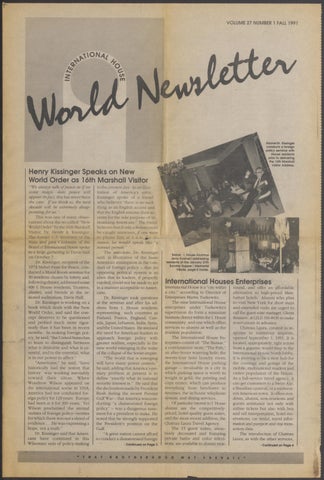
Above:Dr. Kissinger conducts a foreign policy seminar with House residents prior to delivering the 16th Marshall Visitor Address.
Henry Kissinger Speaks on New World Order as 16th Marshall Visitor “We always talk of peace as if on some magic date peace will appear.In fact, this has never been the case. If we think so, the next
decade will be extremely disappointing for us.” This was one of many obser-
vations about the so-called “New orld Order” ‘by the 16th Marshall
to the present day. Asan illustration
Kissinger
of
America’s
spoke
error,
of a friend
who believes “there is no such
thing as an English accent and
that the English assume their accents for the sole purpose of in- _ timidating Americans.” The friend — believes that if only a Briton could
be caught unawares, if one were
‘stance, he wold Geeake like
<x
1973 Nobel Prize for Peace, con-
normal person.” The anecdote, Dr. Kissinger said, is illustrative of the basic American assumption in the conduct of foreign policy -- that no
ducted a Mural Room seminar for
opposing political system is so
)
lige PRE
in Davis Hall
. on October 2:
Dr.
Kissinger, recipient of the
30 residents chosen by lottery and,
alien that its leaders, if properly
following dinner, addressed some
cajoled, could not be made to act
400 I. House residents, Trustees, alumni, and friends in the restored auditorium, Davis Hall.
in a manner acceptable to Americans. :
Dr. Kissinger is working on a book which deals with the New World Order, and said the concept deserves to be questioned
and
probed
much
more
rigor-
ously than it has been in recent months. In making foreign policy, he said, “the United States has
to learn to distinguish between what is desirable and what is essential, and in the essential, what
is in our power to affect.”
Dr. Kissinger took questions at the seminar and after his address from I. House residents representing such countries as Finland, France, England, Canada, Japan, Lebanon, India, Syria, and the United States. He stressed
the need for American leaders to approach foreign policy with greater realism, especially in the new world emerging in the wake
of the collapse of the Soviet empire.
Below: |. House Alumnus Jerzy Kosinski addressing | residents at the January 27th © Sunday Supper. Memorial tribute, page 5 inside.
International Houses Enterprises International House is a “city within a city,” according to Director of Enterprises Martin Turkewitz.
The nine International House enterprises under Turkewitz’s supervision do form a miniature
business district within the I. House community, and one which offers services to alumni as well as the resident population. The International House Enterprises consist of: ‘““The Bazaar,” a convienience store; “The Pub,”
an after-hours watering hole; the twenty-four hour laundry room; the International House parking garage -- invaluable in a city in which parking space is worth its weight in gold; the printing and
eign policy for 120 years. Europe
“The world that is emerging will have many power centers,” he said, adding that America’s primary problem at present is to define “exactly what its national security interest is.”” He said that the declaration made by President Bush during the recent Persian Gulf War -- that America was con-
had been at it for 300 years.
Yet
ducting “a disinterested foreign
Wilson proclaimed the eternal verities of foreign policy--verities
policy” -- was a dangerous statement for a president to make. He
for which there was nota
and the most recent addition, the noted that he strongly supported the President’s position on the | Chateau Laura Travel Agency. The 15 guest suites, attracGulf. tively decorated and featuring “A great nation cannot afford ‘private baths and color televito conduct a disinterested foreign _ Sions, are available to alumni year- Continued on Page 3.
“Americans,” he said, “have historically had the notion that history was working inevitably toward their ideas. When Woodrow Wilson appeared on the international scene in 1918, America had not conducted for-
shred of
evidence ... He was expressing a hope, not a truth.” Dr. Kissinger said that Ameri“| cans have continued in this _ Wilsonian vein of policy-making _
copy center, which can produce
everything from brochures to resumes; the in-house telephone system; and dining services.
Of particular interest to I. House alumni
are
the
competitively-
priced, hotel-quality guest suites,
round, and offer an affordable alternative to high-priced Manhattan hotels. Alumni who plan to visit New York for short stays and extended visits are urged to call the guest suite manager, Glenn Rosanov, at (212) 316-8436 to make reservations in advance. Chateau Laura, created in re-
sponse
to
numerous
requests,
opened September 1, 1991. It is located, appropriately, right across from a gigantic world map in the International House North lobby. It is proving to be a new hub for the comings and goings of the mobile, multinational resident and visitor population of the House. As a full-service travel agency, it can get customers to a Swiss Alp, a Brazilian carnival, ora midwestern American town. It offers residents, alumni, non-residents and guests assistance not only with airline tickets but also with bus and rail transportation, hotel reservations, car rental, travel information and passport and visa transaction data.
The introduction of Chateau Laura, as with the other services, - Continued on Page 4
From the President As Pe
ae House nears the
completion of seven decades of service, we look back with pride upon all that we have done to realize our mission.
We owe it to
| coming generations of residents, however, to take measures which will insure the future, continued
success of the institution. While the House is in fine shape in every respect, we want to enter the next century as a more powerful force than ever before.
alumni is greatly appreciated. The only reason International
House exists if for and because of people. With that in mind, I would like to pay tribute to two extraordinary human beings who have
left
our
midst
at his home in New York. International House has had very few friends as devoted as Bob Purcell, who joined the Board in 1958,
ership role in every major fund drive of the last three decades. Bob was a tireless supporter
in recent.
While an appreciation of Edmonds Award recipient Jerzy_ Kosinski appears elsewhere in this newsletter, I would like to pay. tribute to this outstanding artist |
With that in mind, we are in
Purcell passed away on August 9
served as Chairman of the Executive Committee and played a lead-
months.
the process of preparing a strategic plan which will take the House through a five-year period beginning in FY 1993 and ending in FY 1997, shortly before the 75th anniversary of the founding of the House.
Toyota Gift of a
World Council at our meeting in Prague in August. Your input as |
_of the House, and both Howard
Cook and myself relied on his guidance and friendship. I often told Bob that he was my ‘New York godfather,’ so helpful was
and devoted alumnus of Interna- _ | he
when
tional House. When Jerzy spoke
we
first
came
to
the
House and in the years since. at Sunday Supper last January, his How wonderful that continuwas a positive message of hope _ ity onthe Board is being provided for the future. We were deeply '| by Bob’s great-nephew Tim Purcell, saddened by the death on May 3 | and that the two of them sat sideof this talented writer, who was so by-side at the Board meeting in devoted to the cause of peace and _ May of this year. We miss Bob
We are in the process of
receiving input for the plan from all the House’s constituencies, and
are especially interested in hearing from our alumni. A thorough
understanding among the peopls of the world.
review of the proposed plan will
_ very much, but will never forget | his fine example
of generosity
We are also saddened to note | and quiet leadership over a pethat Honorary Trustee Robert be riod of many years.
be presented to members of the
Tercel Boosts 1991 Festival of Nations The
generous
gift of a Toyota
Tercel from Toyota Motor Corporate Services of North America, Inc. transformed the Festival of Nations 1991 into the most successful resident-run fundraising endeavor held at I. House. The experiment this year of splitting the Festival into a com-
bined
two-day
event -- with a
Thursday evening Grand Auction and Dinner added to the all-day
Saturday ‘around thé world carnival’ -- proved more successful than the organizing committee had hoped.
The Gala Auction held on April 4th, at which the Toyota Tercel was raffled, was a remarkable event, with over 250 guests enjoy-
ing an evening of dinner and music. Thanks to Trustee Kathleen Burns Buddenhagen, the renowned New York auctioneer WilliamJ. Doyle returned for his third
year at the gavel, leading the assembled guests into energetic bidding on packages of items rang| ing from Laeaey eo to trips to
n. The Bristo
“Co. generously underwrote din- * ner sierra gor
Year One: The Women’s Intemational Leadership Program As we work to solve the complex
many different countries and are.
and urgent problems facing the . studying various disciplines. The
world today, we cannot afford to | program, which takes place week- —
draw our leaders from only onehalfof the talent pool. Few women
| participate } most
ends and evenings, commenced in mid-September with a week-
in policy debates. in
countries
of
Kathleen Mullinix, President — Opportunities be open to them
can we restructure our societies to
of the Neurogenetic Corporation, and that society benefit from their Elba Montalvo, Director of the ; | wisdom.” Committee for Hispanic Children. An Advisory Council has been
take advantage of this largely untapped human resource, and how can we train more women themselves to come forward -- to think
and Families, and Thelma Awori working with Ms. Spiegel on this of UNIFEM shared with the women |. program, providing oversight, and their personal stories about how | selecting the participants. Serving
of themselves as leaders and assume leadership roles?. national
-Leadership
working, it’s critical that these
town Heights, N.Y.
| in business, or in academia. How
With its new Women’s
| their own vision of how they can | be effective. Particularly when
end orientation seminar held at — women are increasingly dependBeaver Conference Farm in York- - ent on their own resources, and
the world,
| whetherin the halls of parliament,
|
WILP coordinator. “It has to do with cultural norms, women’s own perceptions of their abilities, and
they became leaders, about the | on the Council are Pat Cloherty, I.
Inter-
challenges and problems they | House Trustee and alumna; Barfaced. Dr. Larry Lewis, Directorof bara Evans; Vreni: Hommes, I.
Program
[WILP], International House hopes - Teacher's College Center for Psyto do its.part toward improving
chological Services, helped each
this imbalance. The program, | woman identify her own uniqn begun in September, 1991, is leadership style thr
| designed to enhance the leader-
and exercises.
ship skills of women selected to participate, exposing them to new ideas and challenges,
The subseq ent
five weekend seminars will dea’ with such issues as: gender differ. ences in leadership style; womer
“The seventeen women, ‘$e
aitid ®
lected for Class I of this. three-year }
as s sokge tenes.
ee ot
House Trustee and alumna; Dunja Pastizzi-Ferencic of the United
Nations; Digna Sanchez; Peggy Stevens; and Patricia Taylor.
_. The women chosen for the program include: Theresia Wawa
Adam
of Indonesia; Adeyinka
Moronke Akinsulure of Senegal,
Angana Banerji of India; Paula rini of Italy; Lucylee Chiles.of
a Prearamateheen
the
United States;
Lisa Marie
olberry of the United States;
| are. eit sorintermns.They ome—
,
ofoa
= Ly
anda. Salah El-Batal of Syria; »-Lee Garner of the United nnifer
Green of the United
States; Nazia Hassan of Pakistan;
Olivia Le Horovitz of France; Sonia Kelsick of Trinidad and Tobago; Tal
Klausner
of Israel;
Desiree
Laborde-Sanfiorenzo of Puerto Rico; Annika Gunilla Thunborg of Sweden; Meredith Wadman of the
United States; and Laila Wazneh of Lebanon.
“The Kellogg Foundation selected International House as the site for this first program because it is a unique community,” Ms Spiegel says, “offering residents
such a marvelous opportunity to — meet and learn from people very | different from themselves and— encouraging residents to mater ce a global vision.” Each participant will receive a $1,200 stipend, but is otherwise
responsible for her own expenses. Applicants for Class II, which will beginin September 1992, will be available from the: Programs Office of: International’ House ‘on December1, 1991; (ci 7). Si _ Alumniand friends who iinow of a women who: may be inter: ested) in receiving an-application or further information are encour. aged to contact Ms. Ellie Spiegel,
: saa
Office, (212) Pisses
- Cyprus: “Tama victim ofthe | Kissinger... From page 1
policy,” Kissinger said. “We are not a philanthropic organization. We are a country.” What, approach, then, should America take? There are two possible modes, he said, of international organization. _The first is hegemony, which is
“beyond the current moral, material and political capabilities” of the United States. The second mode is that of equilibrium among political powers. “Much opprobrium,” Dr. Kissinger said, “has been heaped
on the balance of power idea -yet that isthe world! into which we are heading. . In response to residents’ questions at the seminar and after the
Davis Hall lecture, Kissinger of-. fered the following remarks on the manner in which America ought to view problems and opportuni-
|
|.
ties in or with respect to: |
4
+ The Soviet Union: “The United
| States cannot determine or fundafe
in every international crisis and try to settle it. “T would ease up on the adoration of Gorbachev. [By respond-
ing to Bush Administration arms
break-up
of the Soviet Union,] I’m
not concern
the
United
was Macarius.... A strong Greek anda strong T tel areBirise res to : settle it. |
all the standard phraseology are a
no great fan of Russian centraliza- | Currently, Japan’s military budget tion. . . : Centralized Russia is a -- one percent of the GNP -- is menace to its neighbors: [Russian _ already the third-largest in the cohesion has traditionally been. world. ” achieved in Russia by inculcating _- Germany: “I’m wary of a |
| strong, centralized Germany. I’ve
overshadows the threats posed by
once
- The Middle East: ain i peace,’ ‘direct negotiations,’ and — misconception.
States.]
a] belief in foreign threats that
For years the Is-
raelis have been asking for things they thought they'd never get [as
a way of avoiding, say, land for peace deals.] Golda Meir said that if I got her direct negotiations I
would be surprised by what she said on television that if | did. I got her direct negotiations | | Germany were not united in my and.I was surprised by what she ily expanded since the time of | lifetime I would not die unful-— did: nothing. There is ‘no reasonPeter the Great and it did not do ‘ filled. ‘Europe has two choices: a © able solution to the Middle East soby plebiscite, but by conquest.” | - dominant Germany that is sepa- _ problem because both sides want “In present day Russia, we are | _ rate from the common market, or | the same territory.” witnessing two revolutions: —— 1 a common market dominated by “(Syrian President Hafez al-
| Assad] doesn’t even understand years and against: the
the phrase ‘genuine peace.’ I think
history of the last 400. et ye 2 American humanitarian aid such |. as food aid, though I favor: it,|.a NY IEE i
*
A
the:. 3
Bote
¢
ce, Sib
3
s
”%a gre
ets
.
ue
4
mi
8
vi
™
—
man who could have settled Cyprus —
| geniously in the world [and Japan need no longer rely on a United States security umbrella. Militarily as itdoes economically, Japan can “[As for the possibility of a fend for itself in matters that do
es rommmneates I “outcome of the ‘
the end of the Cold War,] security _| is no longer considered homo-
reduction proposals] Gorbachev is not reducing any threat to the United States. He is reducing an linternal] threat to himself.”
; Soviet crisis. Nolaw of nature says . | cannot BaP
rk,oem
- Japan: “Historically, it is inCyprus issue, so I know it someevitable that a rising, economi- - what.... No American should ever cally powerful Japan become a get between those two countries big military power as well. [With [Turkey and Greece]. The only
| it’s insulting him to say he’s sud| denly become a pacifist leader. |:. | hinckaaded tie dona dees | self into a frenzy of exaltation + Secon ae Posmyete
3e,
colleg +5 B oard ©
“The Soviets ak
Geneva,
up for the lack of livof
home-made
pizza. The wok station is intended for Asian residents, whose
Although all nine I. House
Enterprises
kewitz’s office, two of them, the
From page 1
vending Turkewitz says, was “driven by the fact that you have a population that needs
certain services
and you try to provide these serv_ices in a convienient fashion at prices competitive with those of area businesses.” Alumni who visit New York from other points domestic and abroad are encouraged to utilize Chateau
Laura,
needs were not met by the old cafeteria. The dining hall, Chateau Laura and the other services are “a way of marketing the House,” Tur-
enterprises are overseen by Tur-
which
can
be
reached at (212) 694-4494. Please
machine
service
and
dining services, are run on a handson basis by independent contrac- , tors. Nicolas Koutsoupolos, a familiar figure around the House, , runs the vending machines. He is.
also employed
kewitz
by the Interna-
tional House to manage the Pub, -
which supplies beverages for most
says, since students and
ing space in the House:” That extra something, which
ing people and, in the nine enter-
prises, a safe environment in which to shop, dine, wash one’s clothes, relax over a beer, entertain one’s
family, or plan a trip. NOTE - Rates for International House’s guest accommodations
interns who come to New York have “a number of options” in their choice of residence, ranging from university dormitories to
range from $55 per night for a guest room with private bath up to
apartment shares. “There has to be something,” he said, “to make
$100 per night for the two in the President’s Suite.
I. House parties.
Dining services has been managed since May 1, 1991, by
Marriott Management Associates, which manages dining halls for
mention that you were referred by International House. The Bazaar is managed by resident Michele Boucher from
universities, health care facilities and businesses across the United —
Quebec. Ms. Boucher is an opera
Service director, has overseen a
singer who has performed at New York’s Metropolitan Opera and
renovation
who, when the spirit moves her,
tions in the menu. Marriott's fu-
treats Bazaar customers to a free note or two from the voice that opera buffs pay to hear.
ture plans for the dining hall, she says, include the installation of a five-wok station and the serving — Above: Martin Turkewitz joins President Evans and Laura Brennan of Chateau Laura.
States. Lisa Inserra, Marriot Food
of the
is
also available to I. House alumni worldwide, is a safe setting in which to meet a world of interest-
‘sj
serving line |
facilities as well as some modific
»
Alumnus Jerzy Kosinski: A Tribute On May 3rd, 1991 International House alumnus Jerzy Kosinski, one of America’s most celebrated authors, passed away at his home in New York City at the age of 57. The Polish-born Mr. Kosinski was the author of numerous novels,
Yale, as well as serving two terms as the President of the American Center of PEN, the international writers’ organization.
_
human rights.”
There,
and
Steps,
for which
he
won the National Book Award in 1968. He had taught on the faculties of Wesleyan, Princeton, and
program Following
n
4
3
aed
actively promoung reer
se’sS volun : \ ‘92 fin ae oer over 4 dozen ae
teceived M.A. degrees in Political Science and History from the University of Lodz, and came to
4 services rograms, ae Sm 5 activities arnt van : the. One of ston “ . mee as? = i mer rn . a aa = pen £84 ve o
af book,
mystique,
° were
. sj the W1 “2 tic that the ia é an pecs ad the pousewife a aera : Bre in iitself was- fulfilli er oe aenttY on
ia te : L.Hot a rapt to ro nae ' . i
7| int nen ‘ganks
the United States and International House in 1957 to complete his postgraduate work in sociology at
Columbia University. After writing two collections of essays under the pseudonym Joseph Novak, Mr. Kosinski published his semiautobiographical first novel, The Painted Bird, in 1965, to both
ee
; fe)
en
Kissinger From page 3
about what you are doing, you can make deals with Assad. [Assad is pragmatic.) He doesn’t believe that there is any permanent final solution for the situation in the Middle East. - The People’s Republic of China: “The United States will have to make a decision as to what extent we want to insist on the implementation of our values all over the world...and [to what extent we want to] pay the economic price. How can the United States conduct a serious foreign policy without a dialogue with the leaders of the People’s Republic
sete fo Sach eae
antes dents
me of 4d stinctive
the hand in tWO ‘st :Office k, but also cin: walking
critical and popular acclaim. In 1979, his novel Being There
oe the City ; ghbo rho
[were thrown together in the same
country.] I cannot make a proper analysis. I don’t know the solution.... Africa runs the risk of becoming the backwater of eco-
progres-
of China, regardless of our views
_ the past [of the 1950s and 1960s.]” The Pentagon Papers: [The revelations they made] were an
of colonization in the sense that...the colonial boundaries were drawn in such a way that people with little to do with each other
outrage then, and it is even more
of an outrage now... .You cannot
know what such papers mean — unless you know what bureau-
—
cratic fight was going on when
|
they were written.... I can’t be-. lieve that after 20 years nobody [in the media] has the guts to exam-
ine the journalistic responsibility [regarding the publication of such
-- International
House’s
Board of Trustees, working with Mrs. Kosinski’s support, seeks to establish a permanent program |
papers]. Iam an unrepentant public official.”
the fundamental factors are in flux simultaneously, when the institu-
_
tions,
- The Gulf War: “If Iraq had
war in which the American military is paid for by other countries. We cannot constitute our forces as mercenary forces. “ _ -The present political climate: “Tt very rarely happens in history that the canvas is so open...that all
Our
Prevail
ment issues.
- The United States: “I think the cohesiveness of American society is beginning to weaken. There is a rise in ethnic conflict... America is sliding into looking like a developing country. We have no progressive philosophy moment....
founded -- That Brotherhood May
‘Zinoviev in Warren Beatty’s Reds.
Latin America.”
sives are trapped in the slogans of
motto upon which the House is
for residents studying in the Hu-manities, particularly First Amend-
can never fight another war like the Gulf War. We cannot fight a
at the
In recognition of his life-long commitment and service to the
later, Mr. Kosinski himself made a cameo motion picture appearance as the Bolshevik leader Grigory
of the moderate states. [The war had to be fought because] a blockade wouldn’t have worked.... We
that the most constructive American policy at the moment is in
House for the last time giving an eloquent and moving Sunday Supper address to residents, alumni, and staff assembled in Davis Hall.
| and scholarship fund in his honor.
gotten away with annexing Kuwait, it would have been the end
nomic development in comparison with, say, Mexico. I believe
On January 27, 1991 Jerzy Kosinski returned to International
was turned into a successful film
starring Peter/ Sellers; two years
tours=
of its internal policies. China is a society that governed itself for 5000 years...without conspicuous advice from the United States.” - Africa: “I have great difficulty understanding what the United States can constructively do in Africa, because Africa is a victim
Jerzy Nikodem Kosinski was
born in Lodz, Poland in 1933. He
now augmenting
mained a vigorous polo. player, and was active as the President of the Jewish Presence Foundation. In May, 1990, Jerzy Kosinski was one of the inaugural recipients of International House’s Harry Edmonds Award for outstanding life achievement. In presenting this award ata gala benefit held at the Pierre Hotel, Executive Committee Chairman Stephen Eyre paid tribute to Mr. Kosinski’s “notable contribution to the world through his achievements in the areas of literature, film, education and
including The Painted Bird, Being
8
In recent years Mr. Kosinski re-
This fund would provide’ either ~ program support or scholarships
the
means
of interaction,
the principles of justice change -for the most~part because of American initiative. We have al-
ways thought of some terminal date to our efforts. We always talk of peace as if on some magic date peace will appear. In fact this has never been the case. If we think so, the next decade will be ex-
tremely disappointing for us.” The Marshall Visitor Program was established in 1959 by then I.House Chairman John J. McCloy in honor of George C. Marshall.
over 4 | House na io at rn Inte t 65-yea period.
Chairmen
¢ Chairmen ary~ Chairmen o from
a\
the me
of the t feminist
n the lives of
address ©
Ne Cloy Lecture
Series.
@
Mem
oirs of
Howard A. cook
first year m mie eae"
Get A
ott Eleanor Elli y . McClo
ons
Lecturesc
Abdalla. El Wakil Susan Greer
1990-1991. _ | Honor Roll of
Mr. & Mrs. David Hanawalt
Estate of Eleanor Clark French
Oscar M. Ruebhausen. William D. Rueckert
John M. French III
| StanleyM. Rumbough, Jr.
| Mary F. Miller oa Mr. & Mrs. Yasutoshi Nagayama
Freunde des International Haus
Sigurdur Helgason Dr. & Mrs. Leonard seria Ove Hoegh
_| Contributors (July 1, 1990 - June 30, 1991)
Estate of Florence sisiacthtond
Estate of Joseph Kalch Kalch
Presidents Club
Mrs. Adler Katzander
{$1,000 or more]
Mr. & Mrs. Stephen Kellen Poul Kjaer-Hansen
Mr. & Mrs. James T. Barton
Estate of Araxi Levin | William R. Liesman
Robert A. Belfer
Emma R. Broisman Kathleen Burns Buddenhagen _ Paul D. Carter Mr. & Mrs. William Citesey Patricia M. Cloherty: Howard A. Cook — | James M. Davis _ Dr. Eloise De Lay Hepes: Jacques P. De Portu Hans W. Decker ~ Miss Norma L. Dickey | Mr. & Mrs. Stacy H. Dobrzensky _ Mr..& Mrs. Burt Dorsett. he _ Percy L. Douglas sg ; Mrs. John D. Duncan
KatherineS. Miller
Mr. & Mrs. Charles Russell’ Hiroshi Sakurai
;
| Dr. & Mrs. Morton sanesinner Estate of John Sellman Mr. & Mrs. RobertF. Slutz Mr. & Mrs. Daniel Solomon Mr. & Mrs. Paul Soros Robert G. Stone, Jr.
Roy Takata, Jr. Wenn ‘idhionsiocieh Betty L. Watson |
S. Christopher Meigher Mil
John C. Whitehead — ‘Mr. & Mrs. “saga zeydel
Sally Meyer — Mr. & Mrs. Peter Milton Ashley Mitchell Antonio Mullet 3 Mr. & Mrs. Benjamin Neilson EdmondJ. Nouri
Mr. & Mrs. George D. O'Neill id Mrs. George W. Perkins .
RobertW. Purcell “ | Russell S. mayanide, J Kathleen Ritch °°
"| Estate of J. Robinson Ese of ga a Ronen
Toru Nonoyama Margaret Rice David A. Rosow
Joan D. Rueckert Jim Sakaguchi Mr. & Mrs. Bruce Schlechter Dr. William G. Sharwell Kunio Shimazu Richard D. Simmons
Mrs. Annaliese Soros
Frayda B. Lindemann Rod & Ginny Lowman
Henry C. Preston
.
tation 8 Sete Remeete:
Norton Stevens
Dr. & Mrs. Richard D. Wesley Lucia Whitmarsh
| Global Patrons | [$250 - $500] Philip C. Anderson David Ball Arlene Barilec | Dr. C. O. Bauer
Katherine S$. Douglas Albino C. Ertoia
Barbara H. Fawkes Courtney Fellowes | Aurora Galves
Thomas J. Gardner James P. Gifford Joan R. Gregory Elizabeth D.R. Haxall W. Karl Heim Vreni A. Hommes Ruth W. Houghton Shi-Ling Hsu Summer Scott Huyette Roger Jollis Gerald P. Jones Laura B. Kaufman-Kessler Mr. & Mrs, Mohamed Y. Khalil. Takeshiro Kodera Ruth G. Lehman Miss Eleanor F. Lucy George Mapp Elizabeth Marazita Takinuchi Masanobu Rev. David B. Mcllhiney
Chizuko Nagasawa Mrs. George S. Nelson Dr. Agnes Ng _| Shirley B. Nute | Dr. A.A. Nwafur Orizu
From A Resident Perspective and
With a heavy schedule of work studies, it’s all too easy to
possibility for greatness in our community is made more clear when we discover the impact that
become a slave to daily routine. The long-term goals we’ve set for ourselves are often obscured and
temporarily misplaced in stacks of books and piles of papers and assignment deadlines. So it’s no that we’ve been somewhat unconscious of our surroundings and the community we’re a part of -until we’ve left, and have time to
reflect on our past experiences. House,
we
are members of a diverse community made up of many of the world’s cultures. Each person here is as interesting and different as we ourselves are, with the same
emphatic desires and goals and personal objectives. Unfortunately,
tial of our friends, of our housemates, of ourselves. From time to time, I’ve found
little untouchable,
it’s nice to realize that these prominent persons were once just like
have
Did
someone look on Jerzy
us: students who stayed up late,
- Kozinski, reading a book in the
stood waiting for the elevators,
A full-time graduate student Main Lounge, and realize that he’d and an employee of the offices of come to write such highly-acInternational House, I was pre- — claimed novels as Steps and The sented a project by the Office of © Painted Bird? Did someone see Alumni Affairs that I thought would Sookja Hong, an International be most interesting: to research Affairs student at Columbia, in the and compile information concernelevator or walking to class, and ing the most prominent and influ- | realize that she’d not only be the ential alumni of International first female ever to run for the House. The task sounded fun and presidency of her male-dominated . government of Korea, but that her not too difficult and I was anxious to get started. But after hours and dedication and beliefs would spark hours of digging through library | a movement towards the equality files and magazines and volumes for women throughout the coun-
participated in outings and sport-
had
in the past and
are
Who,
I realized
how
try?
Who
ing events, ate their meals in the same cafeteria and slept in the same single bed in the same rooms. It’s nice to know that the our more famous alumni were once hopeful students like us; and that we as dedicated students are not that far
from realizing our dreams. So now when I get a very rare
moment to fhink about something other
than
my
studies,
I look
around me and wonder how many of the people I share my life with
knew that a theology
at International House are poten-
_ student named Dietrich Bohnhof-
tial Sookja Hongs or Dietrich Bon-
_ fer would return to Germany and _in the early 1940's have the deter-
hoeffers, how many of my friends and neighbors will go on one day . to join the ranks of the famous
the microfiche and the fine print, - _ mination and humanity to speak
alumni of International House.
I began to uncover a list of suc- - Out against Hitler’s regime, an act powerful and thought-— - that led to his execution? Who provoking personalities whose qs knew that Burl Ives would go on hard work and dedication have | to win the Oscar for his performmade a significant contribution in | -ance in the film Cat on a Hot Tin
myself witha rare and unexpected
cessful,
break from studies, and have found it interesting to imagine the career
_ potentials of the people surround| ing me. How many of my friends
| here at the House will go on to b come influential and pore
thing: Who’s going to do the
tedious and extensive a project I had undertaken. And just when I thought I'd go blind from reading
often don’t understand the poten-
them seem a
shaping of the world?
of Who’s
time moves too quickly, and we
Though their elevated status in their respective fields may make
many International House Alumni continuing to have in the present.
suprised, as busy as we are, to find
At. International
past years at International House, students like myself looked around themselves and said the very same
these very rooms of I. House? The
Roof? |
their respective fields of endeavor.
_
of the goals we’ve set for our-
Have we forgotten that many
| The project was no longer a | job. for 3 found myself taking
selves offer the possibility for
research, , looking
atness?
Pager I look aro n d to
and wonder: Who will
Amb. Masamichi Hanabusa
Kaisa Broner-Bauer
Mr. & Mrs. Charles
|
Amb. Kenneth D, Taylor
_|
Mrs. Wenke Thoman
Elizabeth M. Brothers
Phyllis Head
|
Dr. Kaspar Speckle Robert M. Spire
Dr. Herold May
iota
Matthew C. Spooner
Catherine A. Mayer
|
Charles McLoughlin
Arnold Stalder. —
_ | Simon D. Strauss
Dr. Max Bruggman
Jerry Hill
|
Donald'V. Mehus .
| Mr. Frances L. Tyau | Anthony Ukoli
Ruth P. Bucher Elena Canellas
|
Margaret G. Van Kirk
T. Irving Chang
Felicite L. Hoffman Susan$.Holland =
| ~—«J
Mr. & Mrs. Frank Melville Dorothy J. Messenger
Meeta Vyas
Herschel B. Chipp
John I. Howell
*-
1 Filip Moerman.
Mrs. John Suydam
Phillip Crawford Lucy Gillman Crockin Robert M. Cutler Alexander Dake
| Markus & Sapte F Henry C. Jadow : . V. Jorger
| Karen Munch-Ellingsen | Kenjiro Muramatsu | Alexandra C. Nichols | Peter E. Nijman
Cheng Tao & Ay Ling Lin’ _| Frank C. Taylor Marc Thomas . Mary A. Thompson
|
Dr. Robert Wolsch
_ Frank H. Wyman Anonymous [3] | |
Mrs. Kay Corinth |
World Members [$100 - $250]
Ae ;
Dominique G.Homberger
Lucie Hribal
Karl 1. Danga Sylvie Dariosecq
:
Esther Dartigue
Heratenatiola
John Dartigue Samaroo Deonarine_ Robert H. Dexter
T.S. Khatri. Jeong Kil Kin Nyong-whai Kim
David S. Dickenson Rainer M. Dumke.
Te P. King’ 36 Klaus Kirchesch
|
AustinC. Amalu Sam Armstrong
|
Michel P. Arnaud
Leonie M. Dunlap
~ | Daniel E. Aron ‘| Feher Arthur Mr. & Mrs. Peter Avazis
Agapito Duran David Durand Maurits Edersheim
‘| RadeC. Awana
Kate S. Elman
|
|
_| |
Dr. & Mrs. Edward F. Habbod Stewart F. Babbott
Martha G. Ensher Mika Fatourou
Junji Kitadai
,
SvavaBernhardsdotter. Gladys Leuba Bernheimer ~ Helen L. Bird me Mr. & Mrs. Lee Black -
‘| lajean Feldmiller .. . ‘| John C. Fiske . . ;t{ Hector Flores”... y ; ' | Merle M. Foeckler
r. & Mrs. Alan H. Booth
Rachelle Bradt
Evandro F. Braz
|
eae
—sddC t :
George S. Franklin,
Phoebe F.Gedge
Sheila Kelley Ginsberg
|
|
Vassilia Petsas —
Gordon Doong Chong Tya0
. | Margaret Pillsbury Robert W. Polak — - | Eumelia V. Pretel
RobertW. Van Zweiten’ . Carlos Velasquez Blanche T. Vessels.
Bibudhes Rautray | Sheila D. Ray
Edda B. Vidiz Dr. Masaaki Wada
| s -.
Kaarin HI. Taipale
Richard Tierney Martin Turkewitz
2
Hoyt-C. Reed
| Mr. & Mrs. William Ridenour _» | Stephen Robinson. doee! 17 Sam Roe
.
R. Scott poliperen
|James Wilkins 5 #) Richard Bradford Willett | Betty A. Wong »
Root.
Frank C. Wong ©
_| Stephanie Rosenblatt _ | Charles S. Rotenberg
. | Frederick M. Rothenberg '
“4 Victor Yen .- -<. ar ‘| Mrs. Mihoko Yoshida
_| Dr. Suengpil Yu. / |
/s=. $e. }] contributors, International House |
Angela Sigward |). %
«sig | Mie
|M
Antti Siviranta
Daniela Passal _ ‘Mrs. Charles G. Peterson
| Nandini Shah
4
‘|
—
TomomiSakai .., * + ‘| Dr. JudithC. Zola. “* | Mustafa Saleh ater('s taxed i Mrs. Leslie N. Zomalt {| Toru Sato — bat Senet ah ee aitol | Wolfgang E.G. Saxon oes ip In addition’ to: the: sins ‘listéd.
'
} | Richard E. Ford
* | RobertJ. Peaset.oi o5, 4502)
James Latimer _ | Michael R. Lavin
| Mr. & MrsyJeybalan Subbiah.»
| Lothar Sudekum © * ~ -| Professor Ulrich. SUESEE ES OF ¢ ai
| Margaret L. Montgomery
'| Elizabeth L.
Sabra Feldman.__
Mr. & Mrs. Stanley Blaugrund
aes
DavidJ. Klock — Durmus Koch Ann Kuhlmann
Prof, Georgia J. Bernard
Mervin Block... .-
_.
BengtJulin Yoshi Kawashima
Sjamsiah Achmad | Enrique L. Agios | Dr. Dieter Ahrens
|
—_—_} Shiro Miyawaki
06
}
James L. Broadhead
Dr. Gustav Szabo
| C. H. Mathews William B. Matteson
*
Sally Staley
|
|
Draga
|
Anita
G.
ie
|
of
A
Sylvie Goyet _ : Phyllis Haberman — oe
Cage
oer
Adele Breech J. L. Brierton
iy
York.
eoteomnes
_ Dr. & Mrs. Hans Speigel _| Walter Springer
Wrtng at
ef,
ik
| received 423 addidiatial phatiein.
got f
LED
10 .
penn
main lounge, lunch-
1 _ing sitng in inthethe cafeteria, occupying
‘the ones who will shape the realms _ beliefs on fant ion have led of arts and science, business and» | : towards the realization of © politics? And I wonder if, in the | i
If: |
es
the Decadey 1920s
institution in 1982.
Malcolm W. Smith (1964-67) is the Prin-
Canadian students of International House
Beverly Glenn Long (1944-45) lives in Providence, RI, and is currently a member of the Council of the Senior Lawyers Division of the American Bar Association. Eleanor Pierpont Suydam (1944-45) is retired and living in New Canaan, CT; she spent 38 years with Nestlé, where she was
in 1985. Miriam English Macdonald (1925-27), a longtime member of both the Programs and Admissions Offices at International
Mr. and Mrs. John K. Friesen (1946-48) and (1947-48) live in Vancouver, British Columbia, where they have founded an
Indianapolis. Mohammed Iqbal Dada (1965-1966) is the Chairman of the Tea Traders Association of Bangladesh where, since 1966, he has been the proprieter of Haji Ahmad Brothers Tea Exporters. Joanna Edgar (1965-67) is the Director of Communications of the Edna McCon-
International House.
nell Clark Foundation in New York City.
Felicité L. Hoffman (1924-27) of Elizabeth, New Jersey, is active in La Fonda-
tion d’Education globale Laflamme Inc. based in Montreal and organized by French-
House, is currently living in a retirement community in Hackettstown, New Jersey.
1930s Robert S. Tipson (1930-1932), of Kensington, Maryland, is the senior editor of
Advances in Carbohydrate Chemistry and
Biochemistry.
r. Theodore O. Yoder (1932-33) of
| cipal Oboe of the Indianapolis Symphony Orchestra as well as the Teacher of Oboe at Bulter University and the University of
Manager of the Pension Department.
Mark Mathabane (1985) and his wife
49) lives in Belvedere, CA where she is an
Nicholas Della Pelle (1965-66) has been
illustrator of children’s literature.
dents’ Council of the Retirement Commu-
Mr. Dickinson T. Guiler (1949-50) has
involved in dental public health activities in the Philadelphia area for the last 25
nity where he lives with his wife Ruth.
recently established an International Scholar
years.
Rosalie Regen (1934) is a freelance writer and playright living in Medford, NJ. Robert M. Cutler (1935-41) is a consult-
Room Ohio. Peter
Evandro F. Braz and Darline K. Ryther
ant in international affairs and professor
Quebec is recently retired from the faculty of McGill University.
of Political Science at Laval University in
Braz (1966-67) live in Chappaqua, New (1948-49)
of
Manic
Quebec City, Quebec.
Forrest H. Kirkpatrick (1935-36, 194041) of Wheeling, West Virginia, is recently
Sigrid Leube Snell (1950-52) is married
| Bengt Julin (1936-37) returned to Swe-
with two
den in Fas
=
ig
Sak in the
orming |
; Stockholm for Design dinei helio Art.
- Lois-Neal Hamilton Tennent (1938-39) of Spartanburg, South Carolina, lead a group to China in September, 1989 and one to Australia and New Zealand in April, 1990. Dr. R. Alberto Casas (1939-42) has retired from teaching Humanities at the University of New Hamshire, and now spends his time traveling, painting watercolors and playing tennis in the New England Circuit (where in 1989 he was ranked number one in doubles). He met his wife of forty-eight years at I. House.
1940s KatherineC. Corinth (1940-41) isa selfemployed writer who has recently moved to Evans, Georgia after living fifty years in
New York City. She met her husband, Thomas Corith, who passed away on March 1, 1988, while at I. House.
Claire Holcomb Walsh (1940-41) of Sandy Spring, Maryland, isa writer, editor and director of publications for a college printing company. Caroline Augur Schneider
recently
retired
from
Ernst H. Rosenberger (1953-1955) was recently re-elected to another 14-year term on the New York State Supreme Court.
Dr. John E. Rexine (1955) of Hamilton, New York, is the Charles A. Dana Professor of Classics at Colgate University. Dr. Robert Wolsch (1955) is Emeritus Professor of Communications and Educations at Western Connecticut State University. Karen-Margarethe Munch-
(1955-56) of Tromso, Norway, is recently retired after 33 years spent working inthe field of psychiatry. She is a former pollitician and plans to serve again on the Tromso City Council, representing | Pe elderly.
Chizuko Nagasawa (1959) is a living in Mitaka-City, Tokyo, Japan.
8
(1941-42)
teaching
art
in
Okemos, Michigan.
Miss Edith Hermann (1942-43) has recently retired from her position as Senior Librarian and Head of Technical Services at the Public Library of Hillside, NJ.
Director
of
the
Masters
Program
for the World Council of Churches. Masanobu Taniguchi (1977-79) lives in Tokyo where he is the vice president of a Japanese Religious Organization, SeichoNo-Le.
Frank Melton (1924-1926) of Norman, OK Anthonie Leeuwenburgh (1925-29) of
Jamaica, WI Vera Cole (1929) of Winter Park, FL
Austin Amalu (1980-81) has served in Zaire, Rwanda
and Sierre Leone for the
UNDP. Ms. Ann Mary Stanton (1980-82) is the Director of the Speech and Language Department of the Montreal Children’s
Hospital.
Dr. Thomas O. Nitsch (1981) has recently organized the Sixth World Congress of Social Economics, Nebraska.
held
in
Omaha,
Bernard Van Horne (1937-38) of Carmel, CA Helen Wolfe (1938) of Twin Falls, ID Catherine Needham (1939-44) of Rockford, IL
Lucile Aly (1941-42) of Eugene, OR Bernice Lamb (1941) of Eugene, OR Robert Fox, Jr. (1943-44) of Hummelstown, PA Ruth Wilcox (1943-44) of Ashville, NC Abbie Hawk (1944) of Akron, OH
Commerce de Lyon and the University of
Saskatoon, Canada Lucille Gustafson (1953) of Batavia, IL Fern Staggs (1953-54) of Newburgh, MD Jerald Bobrow (1955) of Easton, PA
as a Junior Professional Officer for UNDP in Suva, Fiji.
ens’ Studies Departments of the California
projects.
State University, San Marcos.
Tony Chapelle (1983-84) is currently an
83) live in Caracas,
Venezuela, where
International House World Newsletter Vol. 27 No. 1, Fall 1991 A newsletter for alumni and friends of International House . John Srempessea and John Wells, Co-Editors; Michael Collins, Alumni News Special Assistant; Photography: Ken Klopsch, Reinhard Krumm Contributors: Douglas Century, Joseph Pusateri, Ellie Spiegel por
Helen Baker (1934-46) of Winter Park, FL
James L. Daugherty (1936-40) of Venice, FL Carmen Sanguinetti (1937-44) of NYC, NY
Margaret Magee (1947) of Rochester, NY
Professor Mary Gegerias (1960-63) of
As « nonprofit organization, a copy of ou last annual nancial Ee ne Fe RAI
Margaret Leckie (1932-33) of Pinedale, NY Robert Tifft (1932-33) of Hightstown, NJ
Sylvie Goyet (1982-83) has earned MBA degrees from the Ecole Superiore de
ria, and simultaneously awarded an hon-
orary doctorate of literature by the same
Mary Duerson (1926-27) of New York, NY Carmen Phillips (1926-27) of Pipersville,PA Vahan Vartanian (1926-30) of New York, NY Ruby Meredith (1928-29) of Highgate,
1980s
Texas at Austin, and is currently working
rently living in Escondido, California, where she is teaching in the History and Wom-
Amsterdam, Netherlands Eric Menke (1925-26) of Washington, DC
Grace Covey (1927-28) of Golden Bridge, NY
1960s
Leslie Meyers Zomalt (1964-65) is cur-_
In Memoriam Aagot Tharaldsen (1920-25) of Rye, NY
they have a daughter; Jey directs the worldwide sales activities of an aluminum company and Eucaris works as an educational consult in several school
Prince
president of a commercial society.
Victoria Manoukian (1921-32) of Rye, NY
of the French Republic.
Dr.
plan to live in Edmonton, Canada.
Edda Prezza Vidiz of Trieste, Italy is the
_ lives in Switzerland where he is working
Akwaeke Abyssinia Nwafor Orizu (194244), a prominent figure in Nigerian education and political life, was installed Chancellor of the University of Jos, Nige-
Honorable
since
Counselling at Hunter College. Ray Sheila (1971-72), a British citizen,
Jeyabalan and Eucaris Subbiah (1982-
Right
in Greece
1989.
in
Chestnut Hill, MA, was recently named a Chevalier in the Order of Arts and x habia
The
Star-News of Pasadena. Leda Petropoulou (1987-88) has been
Hans Peter Mayr and Wren MacLean (1990-91) were married in July. They
Enrique L. Agois (1970-73) is currently School Board Member. She is still active living with his wife Nilda Hatton (1971playing viola and violin in northern New | 72).and their three children in Lima, Peru; Jersey orchestras and —- Enrique is now the president of a major sembles. Peruvian publishing concer, and Nilda is Lucie W. Bourne (1951-52) is living in 4 starting a business specializing in the Washington where she is the co-chairof export of Peruvian cotton knits. the Geriatic Social Workers of Greater Ms. Caroline Adkins (1970-72) lives in Washington D.C. Metropolitan Area. — | Greenwich, CT and is a Professor and
bourne, Australia.
Republic.. Annette Kondo (1986) of San Gabriel, California is working as a reporter for the
1990s
children and living in Haworth,
|
Phillip Mathabane on January 20, 1991 Dimitri Rupel (1985-86) has been appointed Foreign Minsiter of the Slovene
Wickersham & Taft.
New Jersey, where she has served as a
tired and living in Kent, England; she spent fifteen years involved in the management of a cancer institute in Mel-
Gail became the proud parents of Nathan
practicing architecture
1970s
Barbara N. Fawkes (1952-1953) is re-
Nigeria
York; Evandro is currently a Partner, specializing in project control services, with Coopers & Librand, and Darline isan Associate Attorney with Cadwalader,
1950s
retired after serving as Vice President of Wheeling-Pittsburg Steel Corp. and as _ | Dean and Professor at Bethany College. |
her husband atthe U.S. Embassy in Lagos,
for Metallurgy and Ceramics at the U.S. Department of Energy and is responsible for reasearch in materials science at
Maryland.
Pueblo, Colorado, is active in the Resi-
Landry
Dr. Masaaki Wada (1984-86) has been
Gaithersburg, Maryland is Branch Chief
Mary E. Fowler (1965-67) was married in July, 1990 and is living in Bethesda,
in Oxford,
in June, 1990. He lives in the Netherlands where he is the General Manager of BNP Finance B.V., a wholly-owned Dutch subsidiary of Banque Nationale de Paris.
Dr. Robert J. Gottschall (1965-67) of
Department of Energy laboratories and universities nationally.
University
1991. Mr. PeterE. Nijman (1983-85) was married
an Assistant Professor of Mathematics at the University of Pennsylvania since 1987. He and his wife live in Philadelphia with their two-year-old son. Amy Holman Casey (1985-87) was married in July, 1990, and is serving with
Dr. Gibson Gray (1947-49) of ia Se ton, N.C. is retired from the Department of Political Science Chair at Pembrook State University which he held from 198189. ’ Mrs. Norma J. Branson (1948-49) is semi-retired and living in Indio, California after thirty-five years in Clinical aoe Work. Dorothy Johnson Messenger (1948.
at Miami
Associate Producer for CNN in New York, as well as being the co-author of The Woman Who Took Back Her Streets, published by New Horizon in February,
is available from the Department of State Office of Charities Registration, Albany NY rere, a fea sco Vt age cg 10027-3916 j
12231,
Grant Williams (1950-51) of New Rochelle, NY
Myrtle E. Crawford (1952-53) of
Ferne Shipley (1955) of Tucson, AR Mary Saul (1957-58) of Marion, IN
Emilio Torres (1961-62) of Chevy Chase, MD John O’Brien (1965-66) of Bricktown, NJ Jacinto Fortunato de Veyra (1966-68) of Sao Paulo, Brazil
Roslyn Furman (1966) of Tamarac, FL Dulronain MacIntyre (1966- sks of Taynuil, Argyll, Scotland Hilda Warkentin (1967-68) of Calgary, Canada Madeline W. Cutler (1969) of Santurce, PR Frank Fairchild, Jr. (1977-78) of High Point, NC
Hsing-Hsu Ku (1981) of Cranford, NJ Endah Soebroto (1984-87) of Indonesia
aa