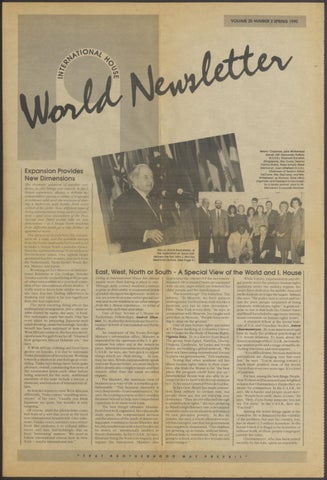
Below: Chairman John Whitehead stands with Alexander Katkov (U.S.S.R.), Shamala Kandiah
(Singapore), Mrs. Evans, Seema Varma
Expansion Provides New
Chairman of Texaco Alfred DeCrane, Mrs. DeCrane, and Mrs. Whitehead, as Richard Ebile-ottoo (Uganda) and President Evans kneel,
Dimensions
The dramatic addition of another residence facility brings new aspects to the I. House experience, always a delicate accommodation among a variety of languages at a dinner table and the nuances of shar-
ing a bathroom
for a family portrait, prior to Mr. DeCrane’s Corporate Seminar.
with bordes from every
corner of the globe. Now, different types of living arrangements bring added perspectives -- and close encounters of the First, Second and Third worlds take on new dimensions -- as I. House North residents from different lands,go a step further, as apariment
'
mates.
The attraction of a kitchen, the camaraderie of a suite, and the possible escape from the hustle and bustle have combined to make I. House North a popular choice.
Here the apartments range from studios to
Above: David Rockefeller, at
five-bedroom suites. One typical larger apartment has five women, one each from the Netherlands, Sierra Leone, South Korea, Mexico, and Japan. Working on her Masters in International Relations at City College, Sonoko Tanaka says she prefers living with people of other nationalities as a practical extension of her international affairs studies. “I really want to know how similar we are,” she says. For her, finding differences in thinking and values is far less significant than she had expected. The most exciting thing about the
the dedication of Davis Hall, delivers the first John J. McCloy
multinational arrangement, and a cause ce-
lebre shared by many, she says, is food. Her suitemates enjoy her sushi. One has
even taken to preparing Japanese-style salad dressing, under her tutelage. Sonoko herself has been surprised at how tasty West African cuisine is. She has also developeda taste for garb from far off. “Ilearned how gorgeous African fashions are,” she
says. If West African clothing and food have grown on Sonoko, it is due to suitemate Yinka Akinsulure of Sierra Leone. Working towards a masters in psychological counseling, Yinka says things have been quite pleasant, overall, considering that none of the roommates knew each other before
being selected for the suite. Additional members of the suite include a lawyer, a musician, anda student of international affairs. As Sonoko learns to view West Africans
differently, Yinka enjoys “smashing stereotypes” of her own: “Usually you think Japanese are quiet, but Sonoko is very outgoing.” Of course, amid the pleasantries come turf wars of a sort that occur in the most non-international households. One suitemate, Tanaka notes, routinely uses others’
food. She attributes it to cultural differences,
and
says,
(India), Peter Schultz (West
_ Germany), Joan Littlefield (U.S.A.),
half-kiddingly,
that on
food “borrowing” matters, “We need to follow international criteria here in New York -- maybe international law.”
Yo
Memorial Lecture. (See Page 2.)
East, West, North or South - A Special View of the World and |. House Living at International House has always meant more than having a place to stay. Through daily contact residents continue to grow in their ability to understand people of widely divergent backgrounds. In this issue, we zoom in on some rather special current and recent residents to see what emerges from the I. House experience, in terms of noteworthy activities and ideas.
One of four
appreciates the concern for the movementimpaired: He is amazed buses are equipped
with electric steps which are lowered for older people and the handicapped. The worst things? The homeless. The subway. “In Moscow, we have palaces underground. Eachsubwaystationislikea museum, and has its own decoration." Filth. “New York is very dirty,” he says, in comparison with Moscow, but laughs and adds that, in Moscow, “People have nothing to drop on the ground.” One of nine human rights specialists at I. House studying at Columbia Univer-
Soviets at I. House on
Zuckerman Fellowships, Andrei Silantiev , 31, studies the American media at Columbia’s School of International and Public Affairs. An employee of the Soviet Foreign Ministry’s information office, Silantiev is impressed by the openness of the U.S. government but takes aim at the American press. American journalists working in the U.S.S.R., he says, are “too quick to report things which are often wrong.” In contrast, he says, British correspondents speak
and read Russian better, are more likely to delve deeply into complex issues and find sources other than the usual so-called
tries, she finds the House to be “the best place the program could have put us.”
For Silantiev, the American
business-as-a-way-of-life is something unfathomable.. “This business mentality is very deep inside--I can’t understand it,” he says. He is taking a course at the Columbia
Business School to help him comprehend capitalism in its most vivid form. The best things? Libraries: Silantiev finds them well-organized, likes the ample study space, the computerized services and the absence of the smell of deteriorating paper, common to Soviet libraries. But he criticizes the ease with which books can be stolen, or intentionally misfiled to thwart classmiates. In the U.S.S.R., he says, librarians bring the book you request, and register the transaction. Silantiev also
A research fellow at the Soviet Institute of U.S. and Canadian Studies,
Anton
Churmanteyev, 26, isan Americanologist .
here to study the political psychology of U.S.-Soviet relations. To learn about the American image ofthe U.S.S.R.,he is studying opinion polls and a range of media, in-
cluding television and newspapers. “Its a difficult time, because American perceptions are changing very fast--very
fast,” he says. “You’re moving toward a much
more
positive
view
of the Soviet
Union than even two years ago. It’s a kind of landslide.”
also able to ar-
For him, among the best things: People.
range for her to meet with the top assistant to U.N. Secretary General Pérez de Cu€llar. In her view, Brazil has made a transition from military to civilian rule, but people there are not yet enjoying true democracy. “They are not educated enough to press for their rights,” she says, pointing to Brazil’s high illiteracy rate, a devastated economy anda social situation epitomized by vast, pervasive poverty. In Rio de
New Yorkers will be amazed and delighted
_ International
view of
intellectuals are no longer the targets. Instead, she says, “the police start to arrest and torture the poor, people suspected of being criminals, without any rights.” A great surprise to her is that both the United States and Brazil have failed to sign many international covenants on human rights issues.
sity’s Center for the Study of Human Rights, Viginia Feix , 29, is a lawyer from Brazil. The group, from Egypt, Namibia, Liberia, Uruguay, Cambodia, Sri Lanka and South Korea. are building a global network. “We have not been using international forums to press our governments,” Feix explains. Noting that other residents tell her about human rights issues in their coun-
experts.
While torture, imprisonment and illegal arrests were the primary human rights questions under the military regime, the issues have shifted as the middle class and
House
was
Janeiro, she says, a whole alternative society has emerged, one that the government has completely abandoned. “Our children are growing up in bands, without family, without links to institutions. They are not going to school, and they live in parks and under bridges.”
ree ee
to learn that Churmanteyev thinks they are sweet--by comparison. In the U.S.S.R., he
says, life is harder and people more nervous. “People here smile, there, it’s rare,” he says. “Here, if you bump someone, you just say ‘I’m sorry.’ In the U.S.S.R., they say,
“You fool!” Among the worst things again is the homeless. He is dismayed by the visibility of the problem, but says his country, too,
has its share--1.5 million homeless. In the Soviet Union it is illegal to be homeless or
without work, so these people congregate outside the cities. Churmanteyev, who has been joined
recently by his wife, spent an enjoyable
i van
ae
AC
&
2s
a
‘
‘
+ os
:
Reopens “" Davis Ha
:
%
i
ss
ee ca
si
as,
mn
j
5‘
Mia
:
“lag age
ae
a
:
Le
e
eae
‘
‘
ae
i.
the Honorable J Cuellar appearec
. months of exten-
aia
a
i
five t an gollowing ation
continuing ent
reso
guests dents and
ellar
2
“sons
weet
8 t
‘“
anuary 27) 3
s
ecu
chil <
Wee h
“
a4
£
atog
n
The oe 1
12,3ic
April
6.
Germany onsibility.,
a
\ SriRespo Lan enka
Thus
Cony s h
‘
+
The icles Last the life © eche
Sat
Thanksgiving with an American family in a small Massachusetts town, and has even visited that shrine to the quick buck, Atlantic City. Any criticism of that controversial town? “No, I enjoyed it. I'ma player.” A Fulbright scholar teaching Romanian and Balkan history at Columbia University’s Institute on East Central Europe until October
1991, Dr. Mibai Maxim,
46, is an assistant professor at the University of Bucharest and Chairman of Ottoman Studies. Under the Ceausescus, many professors were forced to resign, and their chairs
eliminated. Furthermore, he notes, they “did not want to pay for promotions, for libraries, for international exchange of books, for participation in academic congresses.” If Maxim wanted to attend conferences, he had to foot the entire bill. In seeking to explain the Romanian peoples’ endurance of the most repressive regime in Eastern Europe, Maxim says the people had to work so hard, they lacked
.
{
Canadian
ence of Parliamentarians, James Linton, — Fé 33, traveled to Moscow in January for the | Global Forumonthe Environmentand De-
36, who arrived in the U.S. in 1985. Intervelopment. There he helped draft declaranational House was a buffer forhiminad- | tions for the conference whose partticijusting to a radically different lifestyle and | pants included Carl Sagan, Secretary Gensociety. He says, “youcanbuild yourown | eral Pérez de Cuéllar, Elie Wiesel. Presicommunity within I. House. It’s a good | dent Gorbachev addressed the gathering, transition between any part of the world “People from every part of the world, and the United States.” every religion, harmonizing for a week -- in Bogdan who is studying electrical enMoscow,” he marvels. “The conference gineering at Columbia University, says he was a symbol of the breakdown of tradiwishes Americans were moving faster to | tional barriers, a hint of a possibility of a invest inthe Eastern countries, andthatthe
. ; “3
| great step forward.”’Linton says issues such
| U.S. would provide more aid. He says that | | asglobal warming fromthe greenhouse ef“it seems the Bush administration is sup- | fect, large-scale deforestation, and depleporting China instead of democracy” in | tion of the ozone layer have led people to Eastern Europe. | realize the entire planet shares many of the | same ecological issues. “Burning coal in
3
China has an impact on my life, as it does
.
for somebody
Easter
H
land.” Atl. House, Linton feels there is an
}
in Iceland
or on
opportunity to explore, in symbolic terms,
ashared global response to environmental
shallenges. He believes that over the next ars the House has the potential to a model environmental commule’d like to see residents be more re they may be part of a problem, but
Help *
ey can also be part of the solution.
Maxim applied to come here 10 years
se
|
sum
oo
ant in
the equation that makes the
|
ate
the Top!
its goal of $506,500, Don't let us fall short of critical resources to aid residents. Your contribution now will
awareness of energy and ‘or him, ideas are a_
Us Reach pa
rhe Annual Fund 1S $46,500 away fre om
Anton has worked actively to estabuch a program, and hopes to expand se’s recently-begun recycling efforts
ago, “I thought I’d never go,” he remem-
approval was granted almost
i
ac:
°C Jaskmon*arch A
the energy and time to question anything.
revolution,
ke
intern with the Global Confer-
With a six-hour line for a carton of milk _ typical, “you stop thinking about democ_ racy and try to survive,” he points out. 's on being rebuffed. However, after the
De
aa
erienced, such poem ar. Emperor WN"
Another Romanian, graduate student is Alexander Bogdan,
From page 1.
fl ’
al 3
2
Ss
“ie Views
.
stage in
during the Inte
: \
-ance
en
stions
gt aq zil) has gula
“J
9
ol
o Bp |
tthe
«ning ar Combining -e, Cinem t Now Alvaro Verela
make the difference.
peer.
;
| — Please send your gift before the fiscal
:
year ends on
June 30,1990,
ee
sat
yni
\
PR OR _
oe
TREN
aT aN
oee
:
et
.
-
:
From the President
@ Horry Edmonds wc’
1
iy
¢
J
ay
fifth Anniversary, we have found no better way to highlight the accomplishments of
rds Dinnet Dance .
o> atroduced by Hone
from = es ; resident aaie ublic of eae
In celebration of International House’s Sixty-
it
Awa
re
Benefi Ss
scholarships
these years than to look to the achieve-
fae Trustee Mrs
Seandb the film @ troduced by knowned |— af nd Cyrus ag
Chaired by ~8Y gala dinner ie poe cc at The Pierre wrt ae
rer: bot president of Arabia, Lawre sased,
Soy? dmondsspt were nies first a
eo
rs
pou
:
®)
as hele
adents from
ema Ma}
dia; and,
a
:
»-releas
f
n
ccasion ©
.
ments of our alumni. The Harry Edmonds
-dance
whic
achieveme
Award for outstanding life achievement was therefore established to honor select International House alumni whose lives
for
.
best exemplify the spirit of the House and its originator, Harry Edmonds. It is with considerable pride in our institution that we honor the first five re-
:
Eyskens, Sane . ad Nsouli,@ — lifetime ae ask Lewis, hich was ft ares Leontyo® stowed O anid PY sduced ntroduce banon; an ki, Flora Le? hile Ms
resident ae
from Le
ssisstp
1g, a a St
Burnt
u
ory of
yuth,
Kosins
o Toyod4
price an a Tatsut :
by
was
abl
U
‘ATO Foreign se C a Mr. > Bye races e other four due t tO
Alabama.
par to theif ea
meeting, © oly of W sche movingly
jun yee!S e
w Alumn' Vo S
International
arrival
a “metap
iss Kosinski a
=
f struggle
ns, Miss
the
is spoke of
alumnus,
Gaston
governments since 1976, serving as Minis-
See so many So cole I. House
ve
House
Eyskens, lived at International House in 1957 while studying at Columbia University. He has been a Minister in all Belgian
t the House . « ieee experience
.
ee
ai ‘was
Mark Eyskens , the son of another
Tc
a capes: in Amet sae ‘ > from Lesueut Ste Americ an residen
ey
cipients of this most prestigious award:
tO attend
hereaMwa Toyoda cribing provi oghoweke
International House in 1957. He was naturalized in 1965. Mr. Kosinski is the author of two collections of essays, and
’
available to
ohare sonal Hossndsuse forturnsthe 10 8 pees ee
t
escriD
cannot House ves of crisis
rOoKken,
a jC
PY cry
salem sr
a ed ¥ ear steppe Ovet the last have bolt per of alumni es ect ™ ties tc . ‘
9
pilogue deas forme? ©. j
be
nine novels, including
:
atrendec
i
fect
| House ge - 4 4().000 for sche er se ips at ernationa fe slows
_ PEN and currently President of the Jewish Presence Foundation in New York.
.
of resisland
Flora Lewis, born in Los Angeles, lived at International House in 1941-42 _ while studying journalism at Columbia _ University, where she earned her M.S. During her career as a foreign correspondent she has reported from Washington,
il to Meet ounc . in F , of Internation at \. House
t
2 a
Recent -
The
4
1984-88),
governing 2
ae
sed
= pomeco!
é'
>
Alumni
f events
:
8,19?
nh
ymna, Batbat a e Mqnothet 52), jyrogram inaugurare (1950-> ’ i
G race
jlot volunteer Pp
sonper
umber
12)
=
- Mexico City, Tel Aviv and it pay In ihe .
1953 after earning a degree in mechanical engineering in Japan. With subsequent experience in every major phase of the automobile industry, Mr. Toyoda super-
for
and
served
as
President of the company’s joint venture
continues to devote special attention to international activities.
These five alumni whom we have honored, are but five of many thousands who in their own way exemplify Harry Edmond’s spirit . It has been my privelege to have personally met many, including the more than 5,000 young men and women
who have benefitted from the experience of living at International House over the last eight years.
Never have I failed to be impressed by their willingness to be involved in helping one another, their eagerness to get
the most out of their education, or their en- | thusiasm for the mission of this House -- | That Brotherhood May Prevail. ve
So, to all who share in that spirit,
tended to pay. ribute.
of the New York Times based in Paris. Leontyne Price, born in Laurel,
;
friends, most i pe held on Me Aclosing gnual ball W! f the Counc! night @) October
| des
1956-58. He joined the Toyota Company in
London, Paris, Warsaw, Berlin, The Hague, . _ the Harry Edmonds Awards a are wigs d in
ty
hold its1
explains
alumnl will
House's pret sing from ere
yerobics
5
Mr. Kosinskihas taught prose at Wesleyan, Princeton, and Yale Universities. He is a former President of the American Center of
|
slarships an
ho
at 7
The Painted Bird
(1965), Steps (1968), and Being There (1971).
This poignan’ arly 350, raise’ .d by 7 nearly - and
ous others. Tatsuro Toyoda, bornin Nagoya, Japan, lived at International House from
with General Motors in California in the 1980's. As an executive of Toyota, he
saa nd less sdiscretionary serve, abt to do SO;
Caught ye ny
from the Republic of Italy among numer-
as Prime Minister. He is currently Belgian Minister of Foreign Affairs. Jerzy Kosinski, born in Lodz, Poland, in 1933, came to the United States and
the most precious t0
awards, the Presidential Medal of Freedom, Commandeur of the French Order of Arts and Letters, and the Order of Merit
vised preparations
Gis ing percep \lowe aad any ey of all the et apience Alva saic ouse and her expe! her
halls,
- cipient of 19 Grammy awards for operatic and classical vocal performance, three Emmy
ter of Economic Affairs, Minister of Finance, and following his father's footsteps,
Help eds E anded Ne f in the dilemma © ee xP
more residen
starred in the premier roles of Aida, Trovatore, Butterfly, Tosca, Don Giovanni, Porgy and Bess, Anthony and Cleopatra, and countless others. Miss Price continues to concertize around the world. She isthe re-
Mississippi,
is a graduate of the Juilliard
~ School of Music. The internationally re-nowned opera and concert singer has
Meeting, Thursday,
Walter Wriston on Technology, Freedom and Change Residents have had the rare opportunity to dialogue with top corporate leaders at 1.
House this year, thanks to the Corporate Seminar Series, brainchild of Chairman John C.Whitehead. Addressing a broad range of global issues, including business,
politics, the media, and the environment, speakers have included Honorary Trustee David Rockefeller; John M. Hennessy, President and CEO of CS First Boston, Inc.; Alfred C. DeCrane, Chairman of Texaco, Inc.; Dennis
Weatherstone,
Chairman
of
J.P. Morgan and Co., Inc.; and Walter B. Wriston, former chairman of Citicorp.
Mr. Wriston, who delivered his ad-
their primary work. “But the traders of the world, foreign exchange traders, all traders, began to drive
over
this
electronic
infrastructure,
this enormous flow of information, of data
_ chance. “The world press, which num_ bered about 40 in Beijing, suddenly swelled
and what people hear, and if your border is completely porous (and it is) to all kinds
to over one thousand when Gorbachev came. And they were sitting around there waiting for him to come when the Tian-
of data, information and entertainment, you have created a situation in the world in
and money. And today the movement of _ -anmen Square [events unfolded]. It was money capital exceeds the movement of ~ totally unplanned... But suddenly all of the world
trade by somewhere
between
30
and 50 times. This has caused an enormous erosion of the concept of sovereignty and sovereign nations in the world. “Central bankers can no longer control
the price that their currency commands in a marketplace. Today in the city of New York,
about
two
trillion dollars change ~
asingle frame ofa picture overatelephone ~ line, letthe world see what was happening in Tiananmen Square. It was absolutely brand new in the world.”
that means the intellectual capital, on which
Underscoring the importance of technology he described how it is creating
governments
recent leaders in finance. Expressing his awe at the changes now occuring across the globe, Mr. Wriston paid tribute to the
pensive hobby, and it cannot work.”
~rapid growth in both the methods and
Wriston continued by describing _ lectual capital that helped...win the war. So how the technology for news-gathering — that the mobility of intellectual capital, impacts a political climate, sometimes by _ which moves people’s heads, moves on fiber optics, over satellites, and puts presre on people to treat people properly.” _ Wriston emphasised that the free flow
means by which the world communicates.
“Information technology is changing everything that we do and the way we manufacture things; from the entertainment that we see at home, to direct broadcast satellites, to transported data flow, to
dictators,
who
are repressive,
and “oo
don’t believe in freedom, will lose [it]... the same way Nazi Germany lost the aah
nformation leads to a tide of human
the political process itself..,this enormous revolution that we’re seeing in Eastern
freedom. “It spreads, and people who have ed freedom don’t wantsomething else, if
Europe and inthe Soviet Union is based, to a large extent, on information technology. Barbara Ward, the great writer, once said
look at what’s happening in Latin merica, in Eastern Europe--and while een a temporary setback there -- in
that revolutions do not occur unless people
‘We are in, I believe, the midst of one
know the alternative, Well, the alternative
f the greatest changes in the history of the
is there...in Ted Turner's CNN and Rupert Murdoch’s Sky Channel.” Wriston described how
w technicians,
| not politicians, finance ministers, or central
_ bankers, have built a global marketplace.
“The people who tied this globe of ours
together, through the marriage of computers with telecommunic ations, really had no
If you conquered territory in order
to get natural resources you create, obviously, resentment of the population. And
“intellectual capital, which is the most vocal capital of all, and people who are |
ductive.
technology, uplinks to satellites, the new Sony development where you can transmit
hands on an ordinary day. In one day’s trading, we exceed the total reserves of all the central banks in the world, So intervention in the marketplace has become an ex-
dress on March 6, 1990, is widely considered one of the most creative and engaging
which the control of territory, for which a lot of good people die, is no longer pro-
Id. You’ ve seen the whole
ure
shaken
...the
ure of work ote -what it is you’ re ng, changing. This hasanimpact onthe
you depend, will leave. “You have forces, I believe, working
for the world to force cooperation among on
just
about
the Chernobyl poison went in Europe, or if
you believe in acid rain, is totally irrelevant. The point is that no one country can solve the problem. And that means they’re being forced into cooperative ventures ina way, and with a speed, which I think is truly remarkable.”
Corporate Seminar Series September 25, 1990 Peter G. Peterson Chairman, The Blackstone Group October 16, 1990
Edmund T. Pratt, Jr. Chairman & CEO, Pfizer November
15, 1990
James D. Wolfensohn President, James D. Wolfensohn, Inc.
chis being rapidly rewritten. Ithas
February 6, 1991
ous effect on the= CO
John F. Akers
ofnna-
everything.
Whether you believe in global warming, or you don’t, or whether you believe how far
Chairman, IBM Group
1920s
Anna Matyas Lahmer (1939-43) is currently living in Costa Rica with her husband and would be glad to meet with other alumni there.
Sigris Leube Snell (1950-52) has been a mem-
Jean Soula (1939-40) now lives in Lyon, France.
Janet Toohy Ferguson (1951-53) retired last July after 30 years in social work. She is now
Elizabeth McKinney Chimiel (1931-32) keeps busy
with volunteer and publicity work
several organizations
in the Tucson,
for
AZ area,
‘6
while working on the family genealogy. Francisco $. Cespedes (1933-35) recently published his third book on education.
Heis the
retired Director of Educational Affairs of the Or-
| ganization of American States and Chairman of _ the National Council of Education in Panama. |
Aurora Galves (1935-38) is occupied with writ-
_ ing, cooking and gardening travels over =
in between
her
last few years to Kenya, AustraS.S.R., Mexico and Italy. (1935-37), Norma and
ber of the Bergen Philharmonic Orchestra and the Adelphi Chamber Orchestra for many years.
He is retired from the French civil service following a career with the Ministry of National Educa-
Masters Program in Counseling.
Robbert J. Schalekamp (1970-72) lives in Doorn, The Netherlands, where he is the European Human Resource Manager for Yokogawa. Elaine Shea (1971-74) is Vice President
and
1940s
Kathleen S. MacIntyre (1973-74) works with Personnel Journal Magazine as Director of Advertising in Los Angeles. Zeryhun Tafesse (1975) is the Head of Mainte-
nance and Installation for the Ethiopian Educational Mass Media Agency in Addis Ababa. Dominique G. Homberger (1977-79) lives in Baton Rouge, LA where she works with the
living in Geneva, NY. Ophelia M. Hicks (1953) is a member of the
Department of Zoology at Louisiana State University. Nancy Sydor Zafris (1978-79) has recently had a collection of short stories, The People I Know, published by the University of Georgia Press.
Director of the Council of International Programs at Western Michigan University. Henri M. Yaker (1952-53) is a retired professor
tion.
Association of Retired Teachers, the AKA Sorority
Ms. Zafris’ work won the Flannery O’Connor
in
and helps with activities at the Brian Nursing
Southbury, CT, enjoys being “very much retired.” Joukje Jepsen (1943-46) continues working on her memoirs. She has been traveling throughout the U.S. and Europe renewing old acquaintances,
‘Care Center for Senior Citizens in Brodnax, VA. Harriet M. Lee (1954-55) is retired and living in
award for Short Fiction. Gordon L. Best (1978-80) recently accepted the
Katharine
1930s
1950
A.
Bonney
(1943-44)
living
_ Menlo Park, CA. Robert E. Meyers (1955-57) was named Alum-
position of Controller for the Western Hemisphere Group.
Division
of Citibank’s
among them alumni Pieter and Anne DeJong. nus of the Yearby Quincy College in Quincy, IL. Bernard R. Chalip (1945-48) is enjoying life in Donald Bain (1956-59) acts as assistant chaplain the San Francisco Bay area where he plays third © _ at the Veterans Affairs Hospital near Gainesville, base for the Alameda Islanders, a seniors team.
FL. He is also kept busy by a limited private | _ practice and on-call! chaplain service at Shands
Gibson Gray (1947-49) retires this year from the faculty of Pembroke State University, where he
” Medical Center. | Dorothy Brickman (1956-58) currently serves a Team Member for NAFSA’s Region VI, where
was Chairman of the Department of Political Science. He is living in Lumberton, NC.
Ellen McDonald Minet (1947-48) is keeping busy giving piano concerts and overseeing the rose gardens at the Planting Fields Arboretum. _ Rita A. Ortiz (1947 & 50) is a retired professor of
he is coordinator of the K-12 Program.
the Columbia Union Schoo! of aa
uri and Robert Smylie- (1958-60) remain in
kman
Works
Ms.
is Director Emeritus of Ohio
ity’s Internat ional
ew York where Robert
Student
and
State
Scholar
is the Director of the
erian Church, United Nations Office:
Private
Banking
1980s John H. Porter (1981-83) works for the World Bank as an economist specializing in debt restructuring and trade policy reform in Mexico, Morocco, and Madagascar. Harry C. Sangree (1982-84) and Pano Anthos (1982-84) celebrated their company’s passing the $1 million mark in sales. The two founded Syntra, Ltd. while at International House. Paola (Pistogini) and Patrick von Aulock (1983-85) are living in Jeddah, Saudi Arabia with
their daughter Margherita. Patrick is working _ with the Mahammed Abdallah Sharbatly Corpo_ ration and Paola is teaching in the local Italian ‘sel ool. They are expecting their next ne child in_
“Chis Cristie in 1989 and expects hex Rite chile 4
PALIC APIsJOATY 00 asnoy [PuONeUIAIU)
ure of hearing from her a couple of times a year. Marjorie Jacobs Banks (1929-30) has been writing and editing a historical novel over the past 10 years and currently spearheads The Rights of the Child Committee of the U.N.A. of Central New York. Elizabeth I. Root (1929-31) had a visit in Fort Lauderdale this past June with Sallie Davis Basombrio, an I. House friend from Lima, Peru.
after a
serves on the faculty of Hunter College’s Division
of Education where she is the Coordinator of the
Counsel for Citicorp’s Development Division.
916€-LZO0L AN ‘JOA MAN
Year. Margaret Hammond Carr (1927-28) lives in Baltimore, MD, from where we have the pleas-
Milwaukee area. Vivian F. Rilliet (1938-39) just finished her 32nd cable video program, The Silent Epidemic, the story of the Betty Clooney Center for Persons with Brain Injury.
Caroline-Manuela Adkins (1970-72) currently
—
Ralph Philipson (1926-27) who recently turned 91, wrote from Sweden with fond memories of the early years and greetings for another New
Mary V. Ghetia (1949-50) is retired gratifying career of teaching.
She hopes friends will stop by if they're in the
> SSaMddv
Canadian alumni of International House who are now its-trustees.
and wrote to let us know she survived last fall’s hurricanes on St. Simon Island. Alice H. Streng (1936-38) is recovered from an | having served on U.N. projects in Somalia and inner ear disorder which took her off her feet. — , Niger are onto their next mission in Bangladesh.
GG .
Laflamme, Inc. which was organized by French
despite being separated by the Atlantic.
CA.LSt 1NOad NOL! AAO
volved with the Fondation d'Education Globale
_ AnnaBell (Leinbach) Washburn (1948-50) was _ awarded the Tufts Center for Animals and Public Policy Distinguished Service Award for 1989 in recognition of her life-long work with animals. Yvonne (Clavery) and Yves Biry (1949-51)
Roberta Lusardi (1936-37) recently turned 76
in August. Anne’s book Simple Machines was recently published by B.F. Dalton. Jeffrey Fink (1984-85) has moved to Seattle internal
WA where he has joined the law firm of Perkins Coie.
medicine in Queens, NY, which allows him the
Kenneth L. Foster (1984-86) is a Foreign Serv-
opportunity to pay return visits to the House.
ice Officer with the U.S. Department of State in Washington, DC.
ws
Khatri
(1960-63)
is
practicing
Esen and Cano Ozgener (1961-64) are living in Nashville, TN, where Esen is a professorof child development at Tennessee State University and Cano is working in international business. _ Ilene (Martin) Toten (1961-62) and her hus-
_ band, whom she met while at the House, will celebrate 27 years of marriage this month.
|
_ Judith Alstadter (1962-64) appeared as a piano
|
vestec in Taipei, Taiwan.
Jennifer (Taylor) and Thomas Gaida
(1985-
87) have moved to Germany where they are starting their own computer consulting business.
They are expecting their first child in June. Peter Tin Kin Lee (1985-86) lives in Monterey Park outside of Los Angeles, CA where he is an
| February. She is kept busy between recitals by _ her work as director of her own piano studio.
Associate Lawyer at Rogers & Wells. Irmgard Taylor (1985) continues as a professor
Nancy McClure Merle (1962) lives in Auburn,
of German at SUNY Cortland where teaches Literature of India in English.
CA, where she is still working in real estate _ development and sales. _ Heath Drury Boote (1963) travelled to New 4 South Wales, Australia for a small family reunion
~ over the Christmas holidays. James
W.
McCourt
(1963-64)
continues
his
_ work for the U.S. Army in Panama where he has 4 4 been Director of Education since 1965.
. Catherine Comet (1964-67) has recently returned to New York where she has been ap4% - pointed the Music Director Designate of the _ American Symphony. | Judy Martin Beach (1965-67) has her own music studio in New Orleans where she teaches
F
Wellington Chu (1985-86) is working for In-
with the Greenwich Village Orchestra in
: soloist
1 piano and voice. She’s kept busy singing with pie Symphony, raising two teenagers, playing | golf and tennis, but still loves to dance. Margo Harrison (1965-66) is serving in her rth year as a Governor of the National Acad-
_
she also
Thomas Gerginis (1986-87) is finishing his last year in law school in Windsor, Ontario. Ferdinando Pennarola (1986-87) is a professor of organizational planning at Bocconi University in Milan, Italy. Nando recently met up with
a friend in this field, Phil Anderson, at Cornell. Karun Singh (1986-89) works for Hartley House, a senior citizen's social service organization. Next fall will mark the beginning of the following special anniversary years. Alumni from these years are especially encouraged to write in with news about themselves and friends with whom they have remained in contact. Tenth Anniversary Year 1980-1981 Twenty-Fifth Anniversary Year
1965-1966
emy of Recording Arts and Sciences. Marion G. Roenke (1967) of Geneva,
NY is
aving retired as a New York State secon-
Fiftieth Anniversary Year
y school teacher of World Cultures.
1930-1931
‘International House World Newsletter
Vol. 25 No. 2, Spring 1990 dIvd
Felicite Laflamme Hoffman (1924-27) is in-
They have kept in touch over 50 years,
a
of San Francisco, was ranked #3 in singles.
1970s ber.
Schl ‘ON Ito _AN “YIOX MON
Benjamin Bardin (1924-26) won the 1988 ‘ national hard court men’s doubles tennis cham_ pionship in his age class. His partner, Ken Beer
A newsletter for alumni and friends of International House _ John Naughton, Editor; Russell Baker, Alumni News Special Assistant. ‘ _ Photography, Hironobu Kato, Ken Klopsch, John Wells. organization, a copy of our‘last annual financial report is available from the f State Office of Charities Registration, Albany, NY 12231, or from the Development ete Dige. ajo ‘York, NY” 10027- 3916.