Rebirth of the NY Area Alumni Council _ The NY Area Alumni Council of Interna-
Alumni Career Networking with Resi-
tional House is in the process of rejuvena-
alumnus, Donald L. Cuneo of New York:
coe
o“F felt that Gerry would have wanted
ahis to go forward,” said Cuneo. “I was
personally close to him, and had sat in on some early meetings of the group. I’m _ trying to carry on with what he started.” The structure of the council is already in place. Seven committees have been formed, each one chaired by a volunteer
from the council. These groups will re-
ceive broad direction from a smaller steer__ ing committee, but will remain essentially autonomous, according to Cuneo.
~The World Council Liaison Committee, chaired by trustee James Barton, will
have a close working relationship with International House’s world alumni organization. Its immediate task will be helping assist the next World Council meeting in New York next October, and Cuneo said he hopes New York alumni will at that ~ time play host “on both an individual and institutional level.” _ The Alumni-Resident Link Commit~ tee, chaired by Elaine Shea (1971-74), will match volunteer area alumni with current 1. House residents in tandem with and as aie to the Trustee-Link prog-
m. This group will identify participants,
: fees
them with residents, and follow
through to insure that linkage has begun. _ The Development Committee Liaison, headed by R. Scott Whitmont (1984-86),
will work closely with the board’s Development Committee, headed by trustee William Dodge Rueckert, to design and carry
cout New York area alumni support for development activities. Support for this can ome in numerous ways, including assist-
art of the development effort.
plunge right in by helping coordinate an international affairs career networking
dinner at the House in March. For the future, the committee will help identify other careers suitable for similar events and assist in carrying out such events. The Alumni Events and Awards Committee, headed by Susan Holland (196668), assists 1. House staff in coordinating such events as alumni brunches, an alumni dance and similar programs. It will also coordinate gatherings prior to other
a
tion with the goal of building a continuing relationship between area alumni and the House. ‘The effort was begun last fall by trustee ~ Gerald E. Barsdorf, but was cut short by - Barsdorf’s sudden death in December. He has been succeeded by anoth« r trustee and
dents is a committee chaired by Sally Staley (1978-80). This group was able to
I. House
events,
and will, says Cuneo,
design mechanisms for honoring alumni contributions to the House. Night of Nations Coordination is chaired by Frank Wong (1979-80). This committee, headed by a New York alum-
nus who is a former NON manager, will work each year with residents to maximize
alumni participation in the annual event. The group will organize an annual alumni reunion at. NON, help solicit contributions or goods and services for the event, and assist with publicity and other important components of the residént fundraiser.
The Membership Committee will work with the Office of Development and Alumni Affairs to actively pursue new members in the greater New York area. The committee will also help develop a program for departing residents, especially to ensure that those who remain in the area assist with activities of the council. “We have embarked upon an important effort to create a strong and active NY Area Alumni Council,” says Cuneo. “This council is designed to encourage alumni interaction directly with the House and its residents and programs. In this way, we hope to carry on the International House experience and encourage cultural exchange
among
NY
area alumni
(Please turn to Page 5)
after
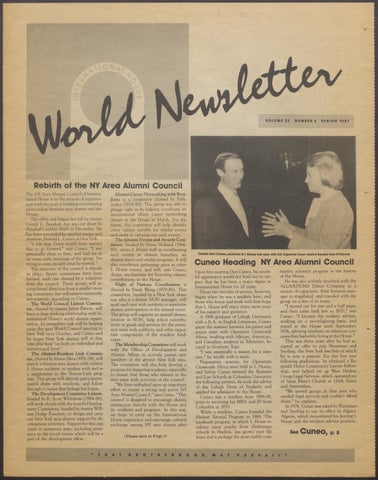
Trustee Don Cuneo, pictured at |. House last year with U.S. Supreme Court Justice Sandra Day O’Connor
Cuneo Heading NY Area Alumni Council Upon first meeting Don Cuneo, his youthful appearance would not lead one to suspect that he has been a major figure at International House for 20 years. Those two decades of service, however,
began when he was a resident here, and those who know and work with him hope that I. House will enjoy many more years of his support and guidance. A 1966 graduate of Lehigh University with a B.A. in English Literature, Cuneo
spent the summer between his junior and senior years with Operation Crossroads Africa, working with African, American,
and Canadian students in Tchitchao, located in Northern Togo. “I was essentially a mason for a sum-
mer,” he recalls with a smile. Preparatory sessions for Operation Crossroads Africa were held at I. House, and before Cuneo entered the Business and Law Schools at Columbia University the following autumn, he took the advice of the Lehigh Dean of Students and applied for admission to the House. Cuneo
was
a resident from
1966-69,
prior to receiving his MBA and JD from Columbia in 1970. While a resident, Cuneo founded the Harlem Tutorial Program in 1968. The landmark program, in which I. House residents tutor youths from elementary schools in Harlem, has grown over the years and is perhaps the most visible com-
munity outreach program in the history of the House.
He was also actively involved with the ALLNATIONS Dance Company in a | variety of capacities, from business man-
ager to stagehand, and traveled with the group on a few of its tours. “I moved out for one and a half years,
and then came back late in 1970,” says Cuneo.
“I became
the resident advisor, —
working on a moonlighting basis, and stayed at the House until September, 1974, advising residents on whatever concerns they had.while living at the House.” That was three years after he had accepted an offer to join Shearman and Sterling, the New York law firm of which he is now a partner. For the first year following graduation, he obtained a Re- — ginald Heber Community Lawyer Fellowship, and helped set up West Harlem Group Legal Services, which operated out _ of Saint Mary’s cca at iis Street aa and Amsterdam.
ie
“We served groups in hat area who ~ needed legal services and couldn’t afford 3
them,” he explains.
2
In 1974, Cuneo was asked by Shearman. — : and Sterling to run its office in Algiers,
Algeria, which necessitated his leaving I.
House and the resident advisor position. —
New York Public Library’s Chief
Speaks at Holiday Sunday Supper “All available information doubles every five years, but our ability to retrieve what we collect is decreasing,” warned Vartan Gregorian, President of the New York Pub-
lic
Library,
Holiday
Sunday
Supper
speaker on Dec. 7, 1986.
“We are only able to retrieve 10% of what we know,” he said.
Not many people realize that the New York Public Library is a private, not public organization, said President Gordon
Evans in his introduction. Dr. Gregorian’s “extraordinary achievements” there have
While computers have transformed lib-
raries’ ability to cope with what he called “the information revolution,” Dr. Grego-
rian does not see computers as an all-encompassing answer to the challenges libraries face. “We have come to idolize the computer, but it is only a tool,” he reminded his
audience. “We think if we can find the material,
that’s all there is. I hate to tell
you, but you still have to read the book. You still have to digest the book, because
information
is a neutral
phenomenon.
Gerald E. Barsdorf
Trustee Barsdorf Mourned The entire International House community was shocked and deeply saddened in December by the death of Gerald E. Barsdorf, an alumnus, trustee and devoted friend of the House. Barsdorf, 57, died of a heart attack. His death came less than a week after he had’
other half purchased a round-trip. ticket around the world. Spare parts catalogue in-hand, he vis-~>
hosted a luncheon aimed at revitalizing
tories for their overseas sales as well as acting as purchasing agents for foreign firms. He lost touch with I. House temporar‘ily, but was contacted by Howard Cook to “Kelp get the alumni program going again.” This he did, co-chairing the Council of World Members with Sigurdur Hel-
the
New
York
Area
Alumni
Council,
which he was leading at the request of Former President Gerald R. Ford, chair-
man of the board.
iG
“International House has lost a true an devoted friend,” said President Gordon W. Evans, echoing the sentiments of all who knew and admired the I. House trustee.
The passing of Barsdorf ended more than thirty years of service to I. House in numerous capacities, including lengthy tenure on the Council of World Members and eleven years as a trustee.
Gerald Edgar Barsdorf was born in 1929 in Berlin, and later moved with his family
ited I. House alumni around the globe, and the business took off. Dubars became an export management firm specializing
in the representation of American fac-
gason
and
essentially establishing
that
body. “Gerry wanted to make sure that alumni maintained an interest in the House,” said Cook. “But he also involved them in in-
teresting activities and encouraged them to learn more about each other, not just
to Argentina, where he received a B.A.
about I. House.” Barsdorf assisted
at the National College of Buenos Aires in 1949. From 1952 to 1956, he studied Business Administration at Columbia
House president in‘raising funds and making friends for the House. “He had a knack for meeting people,”
University, during which time he lived at I. House.
I. House President Emeritus Howard A. Cook, who became president when Barsdorf was a student, recalled that the young man was the first 1. House resident
to have a private telephone in his room. “He was very popular,” said Cook. “He
played the piano, had a lively personality and spoke, as I recall, seven languages.”
Barsdorf set aside plans for completing his business degree when he responded to an ad in the New York Times for someone
to sell spare auto parts in South America. This was the start of Dubars International, Inc.
more
than
one
New York Public Library President Vartan Gregorian
led some people to call the library “the
What is important is this. process of diges-
miracle on Fifth Avenue,” he said. Dr. Gregorian, born in Tehran and edu-
tion, the process standing.”
with a heavy accent,
evening talking with residents: Barbara Evans later told the story that she and
cated in Lebanon and Paris, still speaks
put him
into some
which he said has
unusual situations.
“I
still skip prepositions when I get excited,” he said. Once, when he was new to the
U.S., he was asked to introduce “the top
brass” of his university. “I had never heard of ‘the top brass,’ but I had heard of brass tacks,” he said. “So I welcomed the brass tacks of Stanford University.”
Dr.
Gregorian
of thought,
remained
President Evans had been a
of under-
latein the little con-
cerned that he would be getting home so late, and had tried to extricate him from the knot of students surrounding him.
“But he assured us that he was perfectly happy and that he was going to stay awhile,” she said, smiling.
I.
recalled Cook. “He was friendly and always had an interesting observation to make about politics or some pertinent subject, wherever he was.” Barsdorf is best remembered by many for his eleven years of service on the I.
House Board of Trustees, which passed a resolution of appreciation in his honor at its January meeting. The resolution pays tribute to Barsdorf’s “enthusiasm, wisdom and devotion,” and honors his memory “as a person whose life and work bear testament to his belief in the motto ... ‘That Brotherhood May Prevail.”
Gerald E. Barsdorf is survived by his The young Barsdorf borrowed money, wife, Margit; and his daughters, Johanna recalled Cook, of which half was used to and Alexandra, a current I. House resirent office space in New York, and the — dent.
Prior to Sunday Supper (I-r): Alumna Carol
LaPierre; Director of Development and Alumni Affairs
Nancy Cooper; Trustee Stephen C. Eyre; Trustee Kenneth D. Taylor; Pat Taylor; Vartan Gregorian; Barbara Evans; Honorary Trustee Robert W. Purcell; President Gordon W. Evans; Trustee Phyilis Hirschfeld;
Dr. Leonard Hirschfeld; Susan Cooper; Communications Officer John A. Wells
South Africa that seek some solution short of violence.
Fall Fiesta Again
You have to assure the people who hold the guns they won’t
Offers a Colorful Evening for All
be shot.” “The only language
Pretoria seems to understand is violence,” responded Mr. Mathabane.
More questions than answers were raised by the discussion.
Perhaps only at International House’s Fall Fiesta could you find a young Indian woman who grew up in Kenya wearing a Japanese kimono! Costumes on display at this year’s fashion show ranged from yellow silk Indian saris to crisp white lace Dutch caps and wooden clogs. Delicate Russian skirts were worn beside the loose
“Visions for the Future in South Africa” panel ists Mark Mathabane, the Hon. C. William
Kontos (at left), Peggy Dulany, and the moder-
ator, William Moore
(below)
_ Alpaca sweaters with bold _Sromepic designs. _ |. House’s Chamber Orst rductedby Ronald - Braunstein, performed the overture to La Gassa Ladra. The I. ~ House Chorus followed, directed a Kuros Meshki of Iran and accompanied by Kai Fikentscher of West Germany, with “Edelweiss” from “The Sound of Music.” The ALLNATIONS
important source of scholarship —
2,000 New Yorkers turned out
sian “Chorovod.” dent and author of Kaffir. Boy,
an autobiography describing his
I. House
Panel
Takes on Issue of South Africa
e “Soldier’s Song.” Something
alittle different was booming “I. ‘House Rock,” performed by . American musician Mike Wim-
berly. Ed Morgan, another American, performed a beautiful
Indian dance entitled, “The Ritual.” The
evening was produced
: and narrated by “H.R. ,”, Herman Rottenberg and dicected by ~ Chuck Golden. The lighting was designed by Stephen Edels-
Reform in South Africa was the subject of several I. House panels last fall, attracting diverse opinions from panelists and audience alike. Speakers included the Honorable C. William Kontos, executive director of the Secretary of State’s Advisory Committee on South Africa, which would issue
the so-called “Coleman Report” in February, reviewing the administration’s policy of constructive engagement; Peggy Dulany, president of Synergos Institute
tein and the fashion show was
of New York and trustee of the
coordinated~
African American Institute;
resident Vreni
childhood growing up in Soweto; and William M. Dietel,
president of the Rockefeller Brothers Fund. “It is beyond me why the South African people have so much timidity about bringing the Botha regime to the
~ German cabaret singer Martina Schmitz, accompanied by
erformed “Private Jenny” and
Be
funds, was a great success this year, due as always to hard work ae on the part of many residents and generous gifts on the part of many donors. a In spite of weather that was both rainy and wind through the first part of the day, more than ~
bya Ukrainian “Hopak,” a Mexican “Zapateado,” and the Rus-
Dutch pianist Hans Vroomans,
Another Year,
around the globe. Nations, This year’s Night of the climax of many residents’ experience at I. House ft) an
Dance Company opened with a e Greek welcome dance, followed
_ nhardsdottir, Bryndis Palsdottir, _ Sylla Edvaldsdottir and Vera Steinsen.
Night of Nations:
national foods, exotic smells and costumes, and dances from
vian resident showed off her soft
Greta Gudnadottir, Svava Ber-
heart. This was where I was first. able to talk with a white brother and sister.”
If you had visited International House on Saturday, April 4, this year, you would have discovered unusual crowds, inter-
pair of leather shorts, and a Peru-
_
holds a special placein my
Another Big Success
robes of Africa, brilliant green-
and-white Kenyan bou-bous. The Canadians wore red, of course; New Zealanders and Australians showed up in rugby costumes drinking Foster’s Lager. One German had on a
A group of Icelandic violinists 3 pad an eerily beautiful melody after which one could have heard a pin drop in the packed - auditorium. They included
Dietel
But Mr. Mathabane complimented I. House: “I. House
Mark Mathabane, former resi‘
negotiating table,” said Mr. Mathabane bringing applause from some of the audience on Nov. 19. More moderate tones were used by Mr. Kontos, who delved into South Africa’s his-
‘tory: “300 years ago apartheid began when Calvinism turned its back on European intellectualism.” Several panelists agreed that there is little, if any chance remaining for a peaceful solution. How to find the least violent solution — that is a relevant question, said Ms. Dulany. Mr. Kontos thought a peaceful solution was still possible: “There
are still men of good will in
for the event, which had been publicized the previous evening on WCBS’s Channel 2 Evening Report by roving reporter Morry Alter. You could have ile brie and wine at the French Cafe, feta cheese, yogurt, olives and grape leaves at the Turkish booth in the cafeteria, or knockwurst _
in the German Biergarten in The Pub. There was sushi in the -
Main Lounge Japanese booth, — alongside a Canadian Winter Wonderland. Lovely aromas — came from the Chinese and Arab booths. _ You could have iderasil how | Indian women don their saris, and had your palm painted with intricate henna patterns, as Indian women paint theirs on the — day of their wedding. Or you could have travelled back in time through every decade of © this century in the U.S, we? everything from 60s mini-skirts _
to 20s midis could be spotted.
_
Be
_
Dorothy
Bourne
and
Alan
H.
Booth
(1932-33) are in Plattsburgh, N.Y. Marion Bay Gordon (1934-36) lives in Fulton,
Missouri,
and
has
been
con-
certmaster of the Jefferson City (Missouri) -Biabriel M. Chideck (1924-27) is retired and living in Pensacola, Fla. She had her
= 78th birthday recently. E. Raymond Wilson (1924-26) wrote that
“the Friends Committee on National Legislation gave me a wonderful 90th _ birthday party on Sept. 20 at the office.” _ He also received two awards this past year
from
church
groups
for
being
a
“Peacemaker Extraordinary.” He lives in _ Sandy Springs, Md. - Duncan Merriwether (1925-26) lives in ; _ Marco Island, Fla. “See Who’s Who” for
: news, he wrote. -Thekla
G. Beere
(1925- 1926) lives in
4 Dublin, Ireland. “It is a long time since | lived in I-house, but I am still active. ve not seen any I.H. friends since Harry nds and his wife stayed with us.” lie F Smith (1925-32) from Norman,
: Oklahoma, : says that he visits Britain and Norway every year, and was “immensely : en” by his visit to Crete in 1986.
Aarian E. Madigan (1926-27) is retired
and lives in Weston, Nebraska. In 1985
University of Nebraska, where she ed in 1924. In between she te-. her PhD. from: the eves of
Symphony since 1960. Ann Richards Hutchins (1934-36) writes
hlumm
that she is “very retired! My huband, the Rev. Frank H. Hutchins, a neighbor and friend of I. House when I was there, and
I celebrated our 50th wedding anniversary last month.” William D. Carter (1935-41) is retired in
Huntington, N.Y., and is president of Feris Foundation of America Inc. Alice Bell Roundtree (1935-39) worked
3 1/2 years in I-house’s cafeteria. “I studied opera for 4 years, had a successful audition at. the old Met, then made the decision to raise a family instead,
I am a widow,
73 years old, with two marvelous sons. We all live in Dallas, Texas.” Morton L. and May H. Wadsworth (1936-38)
live in Richmond,
Va.,
and
write they had a “wonderful” 50th reunion luncheon with Norma and Chester Junek and Renee and Ruth Nordmann in Washington D.C. last summer. John H. Show (1936-37) is retired from Syracuse University after 35 years. He is
active in the American Friends Service foreign student program. Margaret R. Taylor Carter Morgan (1936-41) lives in Gainesville, Fla., where
she is vice-chairman of the Council of Diplomats of Florida International. Evelyn W. Arnold
(1937-38)
retired in.
1969 as art supervisor in the Portland Public Schools in Oregon. Dorothea Revie ‘Shultes oa aa
Virginia Clemens Lowman
continues
ford,
nal posts. She lives in San
N.J.,
and has four sons and four
grandchildren. Dorothy E. Clark (1939-40) lives now in a retirement community.
1940's
> in Cision Missouri.
arabadi (1928- 29) shuttles beew York in the summer Fla., in the winter.
and Danae Livesay (1941) is a retired French
teacher in Manzanta, Oregon. Gertrude
Young
Cheney
(1941-42)
tua, Norway, wrote in January
traveled to Guatemala in January 1986 and took a side trip to see the Mayan Ruins. “We are both retired and enjoying living by a lake” in Oklahoma City. She and her husband have three children and five grandchildren.
> is keeping warm in sub-zero
Helen M. Ayars (1941-45) of Bradenton,
-d Haugen (1930-31) living
Fla., is a retiree at Asbury Towers. .
Pil
|
(Florence
Mrs.
Gene
A. Garrett
(Ruth
Pennell,
0-34) has been busy serving
'1942-45) is in her 20th year as organist
: several community groups
for the Methodist Church in Clarinda, Iowa. Her husband, a psychologist, retired this year. Two children are graduate students at the University of Missouri. Edith Herrmann (1942-43) is working at the Hillside, N.J. Public Library and caring for her father, who just turned 100, a professor emeritus of German language and literature at Brown University.
| ( 130-32) retired from the ‘Labor as an economist, and
- (1930-31) is resnes
and doing
- Louise Gueveur Streat (1943-44) lives in
ie Greensboro, N.C., and wrote to say she ~ was “so happy to read you have reclaimed ©
public
work
as
a
schools,
but
consultant
in
volunteer work. ’
Patrick O. Wheatley (1951-53) has 2 years as a dentist behind him; one son graduated from Columbia in electrical en-
gineering; a daughter is a student at Col-
to represent the International Council of Women at the U.N. and last year was elected a director of the League of Women Voters of New York City, where she lives. Gerda Ehernberg Lawrence (1946-47) is a clinical social worker in Los Angeles. Mai, Wen-Kui, M.D., M.P.H. (1947-49) is an advisor of the Bureau of Health in Nanning, Guangxi, China. Dr. Gibson Gray (1947-49) of Lumberton, N.C. is now chair of the department of political science at Pembroke State University. Carl E. Veazie (1947-48) is retiring at the . end of this year from his position as senior
umbia in physical therapy. They: live 1 ta as Islip, N.Y. Ruth H. Rowe (1951-54) of Har i"
Conn., is happy about the arrival of first grandchild, Katie Elizabeth.
Lucy M. Hansson (1950-52) is ‘scot ric social worker at the Nic Waals Institute in Kolsas, Norway. “Old friends welcomed!” Dr. Jean A. Ashfield (1951-52) recent \ retired and moved to Palm Harbor, Fla. Dr. Edward H. Brown (195 2) is ¢ retired program officer with the U.S D
partment
economist at the Center for Research and Advanced
Study
.
Henry Wiatrowski (1950-53) Seva from the Springfield, Mass., public schools as~ a psychologist. He now divides his time between Cape Cod and West Germany. ©
Emma R. Broisman (1945-46) continues
at the University of | ber
of
Education,” levis
igh Dz io
Southern Maine in Portland. He lives in
Neville ( wae 46%) isaa direc-
mont inn St. O(c “This ra surkine Ei went to Jamaica where daughter Jennifer taught at Tunghai University for the year.” Miriam A. Cassady, R.N., M.A. (194748) has retired to High Desert Apple Valley, Calif., from her position as Associate Chief of Nursing Education at VAMC in Palo Alto, Calif. Anna
: he DuVtis (1928-
D.C.’s to
career, I am now enjoying the Valley of the Sun, and spend much of my time doing .
health education.. He is also executive director of Washington’s Social Hygiene Society. He lives in Silver Spring, Md.
‘<~ Brunswick. _ Anna ca j ; sor of policial science at eae Gaidai University. He lives in Nishinomiya, Hyogoken, Japan. ~ Russell Hill (1938-39) is retired in Med-
0-53) lives ee Mary Jane Silence Irwin (195 in Cave Creek, Arizona. “After a busy —
(1944-46) of
Greenlawn, N.Y. recently spent six weeks in the Asia Pacific region trading folk dances and games with Gixl Scout troupes there, to bring back to U.S. Girl Scouts. J. Arthur Miles (1945) retired in 1973 as director of health education § in Washington
7
Bell Leinbach
Washburn
"ite near Montreal in Lonouelh
Major Alice Risentbeig 95
(1948-
50) lives in New York City and serves on the advisory board of the Center for Animals at Tufts University School of Veterinary Medicine. She is also a member of the Centennial Planning Committee for Teachers College, Columbia. Mary Duncan Robinson (1949) retired in 1986 from her “second career” at Howard University. Edna F. Stappenbeck (1949- 51) isaretired lieutenant colonel from the Army Nursing Corps. She lives in Ithaca, N.Y.
lished his 16th book (if \w ‘co
in 1985, called Iceland Cr em Artistic Renaissance. has led him to many activities
Antonio Mullet (1954-63) writes t is a state advisor in the educational
a member of Long Island Philharmonic and on the faculty of Bowling College. She lives.in Huntington, N.Y.
that is underway in Puerto Rico. He : in San Juan.
Dickinson T. Guiler (1949-50) is living
Gertrude M. Bechtel (1956)
in West Carrollton, Ohio. This past year he established a scholarship at his alma mater, Miami University.
Petersburg, Fla., anit is a ving
4950's
the park. It was a gathering place for I. : able professor at Kw anse ecole einer : we in Kobe, Japan. _ House rs sacot tasters without we e
in
mam
places; most recently he was a member of an international 12-man jury of wri 1986 awarding the biennial Neust ternational Prize for Literature.
Nina P. Scharar Manuelian (1949-52) is
Beatrice S. Ross (1950-51) is psychotherapist in New York City, si pleting training at the New York Center for Psychoanalytic Training. Takeshiro Kodera (1950-51) is an honour-
|
poet, novelist, playwright and tr
ington.
|
Ione M. after 44
YeVa
a two-year
Decades
assignment
as
the
paper’s
George Geng of Pitman, NJ. & Dr. J. Harold Goldthorpe of. Gaith-
Buenos Aires correspondent. Paul A. Gillin (1981-83) lives in Detroit, Mich.,- and works at Chrysler Corp.’s of-
ersburg, MD
Malcolm Graham of Madison, NJ. 2 Saralyn Hadapoulas of Charlotte, NC., oes Hosoura (1944-46) of New York ‘ ity Penny Ingram(1967) of Wilton, CT ee 8
fice of project finance. Dana M. Cibulski (1982-83) received last
year the best-in-show award for a pastelon-paper work exhibited in New York City, where she lives.
foshal Engel Horulu (1959-60) is in the Kilim business dealing in Anatolian art made from flat weaves, and last November had her second exhibit about the nomadic
lives of Anatolian women. Gerald Berger (1959-60) is a senior assistant deputy minister of supply: and services
in Ottawa, Canada, and is “on second‘ment as federal coordinator, 1988 Olym-
sons who are tri-lingual and I am starting
to write my dissertation for my Ph.D. in Spanish.” Oksana is on the faculty of Montclair State College. Mary E. Fowler (1965-67) is director of
G.
Roenke
(1967)
was
Jeanne Palisse Marandon (1924-26) 0of-
is in Cairo
Elizabeth, NJ. John Moore of Pine Plains, NY.
Robert M. Chadwick (1983-84) married alum Irene Helmke of Santiago, Chile in March. Irene toured the U.S. last year on
Luella A. Newell of Hazelton, IA. Thomas D. Peacock of Auckland, New
the ABC
Zealand
Enid Mack Pooley of Seattle, WA. Dr. Jacob City, FLA.
Center, FLA.
Olga Tramontine of Ft. Worth, TX. Lucille Van Dyke of Ojai, CA. Helmuth Waldorf of East Hampton, NY. Violet Warfield of Washington, D.C.
Dorothy Weiser of New York City
Michael J. Dotterer (1984-85) is serving
as vice president of the Business Council . Mildred Wheatcroft of ee. for the U.N., “an organization that is england g gaged in bdvaied business leaders together - Wendell C. Wheeler ag ~ with ambassadors and secretariat-officials Luis Obispos, CA. — to discuss world issues.” He lives in poe Margaret Willis of York City.
‘Tharsis Colon (1974-76,791 yrren: in Rio Piedros, Puerto Rico. He has been cited in Who’s Who. Mark Robinson (1976-78) isSeki: as an investment broker in Mabwankee, Wisc.
ineee.
_
She —
=
ledo (Chic) Blade. newspapen: ar Ritsu Katsumata (1985-86) sot
vor
orable mention in Glamour Magazine’s “Top 10 College Women ’86,” published last fall.
M. Javed Khan (1977-79) moved mG Chemical Bank to First American Bank ah
+a
(1963- 65) isa Siolinias
with the N. a Philharmonic and lives in I nent
Speake (1963-64) is now a consultant in Switzerland. Zola, Ph.D. (1963-64) is a vice
tat Manning, Selvage & Lee, an | public relations firm, where is in health and pharmaceut2S rage and has two sons,
of the Middle East/African region of the International Division.
In Memoriam
March.”
Rachelle Bradt (1979-81) is a teacher at Columbus Academy near New York City, where she lives. Steven J. Sampson (1979-80) is business manager at Macmillan Inc. in New York City.
1980's
st of Greece/Israel for 1e International.
Lucia Magney (1980-82) is a cello teacher at the University of Minnesota and St. Cloud State University, and lives in Minneapolis. Sondra J. Fogel (1981-83) is now the director of Army Community Services for the Kuch-Goens military community. “I love it,” she says. She lives in Langgons-
Harriet Alward of Moncton, Canada Mrs.
ER.(Frederica)
Anderson
(1964-
66)of Holly Hill, S.C. Clifford Beck of Boyds, MD. Karl Bockwalter of Ashland, VA. Roger Bowman( 1970) of Greenwich, CT. Hoffman
Brown( 1979-80)
of -
Alumni nieces
Dayton, OH. Raymond Corwin, husband of Marcia Corwin (1952-53), of New York City Davis(1939)
of Lakeland
(Continued from Page 5
Hills,
_ those eldhtind have left. t
FLA. ; Derryl Duncan( 1930-31) of Nuangola, PA. Margaret Rose Emery (1944-46) of Scotts Valley, CA.
Cuneo says he is reminded one gives to somebody who
asparagus patch: “dig a trench thre ago.
Dr. Zaida Eriksson-Lihr of Helsinki, Fins : land
Elizabeth Felt, ote
Mott, of Scarsdale, NY
secretary to John
|
Oberkleen, West Germany. Annette Fortier of New York Cie (1964-66) married - Timothy O’Leary (1981-82) s an. assisMurray C. Galves of New York City erman origin wie tant foreign editor for The Washington _ Joseph Geddes( siege? = vale Col ; Rhine in D. C, He ore returned from
and was thought of as a “house mot All 24 floor hosts and hostesses epot directly to her. ; When she left the Fists 'in 1959, Pre ident Emeritus Howard Cook rec s th “half the House” turned up for a farew party given in her honor. A memorial has beens Munford’s name, ie
Dorthea E. Abt of New Haven, CT. Melecio Almonte (1926-29) of Brooklyn, NY.
Helen
Elka and two sons.
and served as resident advisor for the three years. She lived on the fifth
64- 67) lives
in New York City. “My new book, Alberta Hunter: A Celebration in Blues, was published by McGraw-Hill Book Co. in
Stephen
a 1964-69) dives in
6, 1986, ina . Middlebury, \ ing home. She was 94. | Mrs. Munford came to I. F
of New York in New York City as a head
Frank C. Taylor (1977-78,
of ae
Bessie Skinner( 1929-30) of London, tario H. Stockhold of New York City
_ Tina Kanagaratnam ( 1984) isis an account
didate Ph.D. and professor of Spanishand humanities at eine Biblico Pentecostaf
Rosof(1927- 29)
Libera Rutigliano (1925-29) of Sie st:
affiliate in Salt Lake
officer lig? eens
‘eo NY.
—pe
%
Ba Murer (1930) of Oslo, Nore
only news that occurs in Lexington, Ky., is when the stage coach comes in from. New York City with news from you.”
ga eibeting onLeuaeenas
or at the Ergibesae: Reitute atpone Sate caecammas
he
doing intensive Arabic.
KTVX,
1970's
in
Currently
City, Utah. James M. Eanes (1984) writes that “the
vara R. Daum (1960-61, 68-69) (1961-62)
Rev. Ryosho Kondo of Honolulu, HA. —
Mike Watkiss (1983- 84) is a reporter for
lives in Geneva, N.Y. Peccons Phocas Geer (1960-63) is livApril Modlinger (1968-69) lives in New York City. “I would love to Livingston, N.J. and is “in the midst of ar from I. House friends,” she writes. changing my career from occupational ard and Polly Shaw Feitzinger (1960therapy to urban planning, working for 62) ive in Vestal, N.Y., where Ed is direcmy Masters degree at Rutgers University. of research for Ozalid Corp. and Polly The shift | am making is from micro to -lecture-recitals and teaches piano. ughter Laura is a senior at Williams - macro — from rehabilitating individuals to rehabilitating society at large.” college son Ed is a second-year enneering and student. |
Achmad
_ Madeline Larson of Lethbridge, Canada _
a fellowship program by the World Press Institute. Bob has worked for Seafirst Bank in Seattle, a subsidiary of Bank of America, for 3 years and is trying to shift into an international banking job with them. The couple will live in the U.S. initially.
member of a restoration project that became a national landmark last year. She
of North Seattle Community n Seattle, Wash.
Mrs. William C. Keller of Cuuptet PA.
at Columbia.
is a staff
L. Jackson( 1938-39) of New York eS :
Westmount, Quebec, Canada. Matthew S. Gordon (1982-83) is studying
for a Ph.D. in Arab language and culture
a U.S. Department of Energy program that helps utilities help their residential and commercial customers use energy more efficiently. She lives in Bethesda, Md. Stephen L. Mintz (1965-67) was promoted to professor of physics at Florida International University in Miami, where he is now serving as department chairman. Marion
es ity
Lorenzo M. Polvani (1982-83) is finishing his Ph.D. at M.I.T. while living in
:
“We're involved |
Bs
}
.
ln NON
[. Youre
Around
a time when our government has abandoned its commitment
(from p. 3)
to equal opportunity,” she said. “President Reagan sometimes
You could have watched the Yale Russian Chorus perform in the afternoon, followed by the ALLNATIONS Dance Company that evening. As usual, ALLNATIONS commanded a packed house. In between, you might have bid on two roundtrip tickets to Switzerland, a coffee- . table art book from the National Gallery of Art, Paloma Picasso
appoints people who look like me, but who act like him.” The federal budget, she said,
is being balanced on the backs of poor people and black Seige “It is a national tragedy that . Music and dance enlivens
the lavish Turkish Booth at Night of Nations (left); Alumnus
earrings from Tiffany & Co., or
a giant amethyst at the Grand - Auction. _ One of the most popular items ~ auctioned off was a set of season — tickets to Columbia University’s
and Trustee James Barton former residents at the Alumni
Brunch
next football season, during whic h everyone is hoping that
_ the team will break a national _ record for the largest number of — consecutive losses for any Division One football team in col~ lege history. The new ticketholders will find out next year if
(below)
after 200 years of progress,a black baby is still twice as likely to die in its first year of life as a. white baby.” Furthermore, “of
the 20 million people who live beneath the poverty line, only 3 1/2 million people receive welfare funds. And we still hear complaints that too many undeserving people receive welfare funds.” She told several stories about — Martin Luther King, including one about his difficulties with French.
“He was about to get his ew ; torate, but he couldn’t pass his French test. He needed to read two languages,” she explained. At the time she was teaching | Atlanta University, part of Dr. King’s alma mater, Morehouse
;,i, you tied an L opporogether with other —
!
py #5 his French test, or I woul Idn’
telling this story,” she said he event’s success gave a much-needed rest to its resident organizers, who included Shig Hsu, general manager; Jenrife Taylor, logistics manager;
-Kamiar
Khajavi, fundraising
manager; David Ball, auction ager; and World Newsletter t John Wells, publicity
nager.
~ Mr. Hsu admitted he’d been
wing bad dreams about the
ent a month before, and had jokingly begun referring to the ent as “Nightmare of Na-
ions.” But he was reassured by Mr. Ball, a former NON general
‘manager himself, who diagnosed
this as a “completely normal” tion to frantic preparations.
tee Senator Lipman esses Dismay on
- Alumni Brunch Senator Lipman lived up to her reputation as a spokesperson for women, minority groups and the poor with a rousing speech on civil rights and racism in today’s America. “Our Justice Department has become an anti-justice depart- °. ment,” she said. “What is significant about racial tensions today is not the marches in Forsyth County, Georgia. We kind of expected those. But we didn’t expect the racial violence in Howard Beach, or the black family which was bombed out of their house in Kansas.” Most of today’s racism, she said, is on a more subtle level than 20 years ago. “People used
se alumna ast eee, mi irate tutor of Dr.
to tell Dr. Martin Luther King
3c New pad State Se-
reply, ‘Yes, 1 know I can’t make
o* oe
that ‘You can’t legislate morality. White people won't love you because of a law.’ Dr. King would white people love me with a law, but a law sure can keep them from lynching me.’ “Now we have hundreds of
- black mayors, congressmen and
state legislators. This is no small achievement. But it palesin comparison with the potential we now have before us.” She then told the story of a black lieutenant governor who was
excluded from a Washington meeting to which all governors, all lieutenant governors and all
attorney generals had been invited for years. “What lies between black people and their potential now is more subtle than the obstacles we once faced. “We have identified the institutional obstacles, but we have fallen short of reforming the white people’s feelings about blacks. When Jesse Jackson ran for president, what was significant wasn’t that he was the first black man to do so, but that he didn’t get white support. Black businesses still struggle to get white patronage.” Sen. Lipman directly attacked the current administration: “Our black Americans are condemned to the bottom of the pay scale at
About 75 former I. House nates fetid
the New York area gathered in the Main Lounge on Sunday, February | for an Alumni Brunch sponsored by the Offic
of Development and Alumni Affairs A fire crackled in the fireplace, qu sausages and coffee were served, a friends had a chance to catch
each other and share experiences wit other alumni and current residents. James Barton (1955-56) read the a greeting from fellow trustee Don: Cuneo, who heads the NY Area Alumr Council and who could not attend b
cause of a prior commitment. It seemed Cuneo had promised his fi year-old daughter a trip to Disneywor' the same time, and begged his fe
alumni’s understanding of the They did.
The group was also welch
dent Gordon Evans, and — Cooper, Director of Develo Alumni Affairs. Alumni were
update on activities at the Hou urged to be active parti vived hts ares Ahan
situa
Dear Friends: Let’s call 1987 at International House the “Alumni/ae Awareness Year,” since events this year highlighted both the fond« ness for and.commitment to International
House on the part of our wide-flung alumni body. One of the most significant Ronald Braunstein conducts the International House
events to have occurred was the way in
Chamber Orchestra
which Alumnus and Trustee Donald L.
Chamber Orchestra Enjoys A Smashing First Season -
The
International
House
Chamber
Or-
part,
are students at Manhattan
chestra, under new leadership and with
of Music
_ fresh enthusiasm, enjoyed a series of stellar
‘Music.
successes this year and is looking forward with great anticipation to the 1987-88 season.
With the arrival in September of - Ronald Braunstein as music director and conductor, the orchestra has continued itss 25-year tradition of excellence as the new conductor has led it from one triumph to another. Braunstein, the first American to win the first prize gold medal in Berlin’s Herbert von Karajan International Conductompetition in 1979, has guest-con-
ucted with major symphonies throughout the world and serves on the conductfaculty at the jyillis rd School of
Inder his baton, the 1. House Cha ~“ . ived, performing in four — concerts during the year, and demonstrating a remarkable range of styles that inluded such works as Beethoven’s SymNo. 8, Copland’s Appalachian Spring, Mozart’s Symphony No. 41, Ravel’s Mother Goose Suite, and Weill’s
Three Penny Opera Suite. “When I first arrived, I felt the House
needed a real world-class chamber or_chestra, a real show piece,” says Brauns1. “But I’ve come to see that the orChena serves the House —and particularly the musicians — in many ways.’
The 35-member orchestra is composed I. House residents who, for the most
Cuneo (1966-70) of Shearman and Sterling took up the baton as a tribute to his colleague, Gerald R. Barsdorf (1952-56), who passed away suddenly in December
Unlike
and
the Juilliard
other,
School
high-pressure
of
ALLNATIONS Dance Co., under the di-
phere
of “encouragement
and
has produced an exciting and memorable season
of music,
with
increasing atten-~
dance at each performance. “We're reaching out to the immediate
community
and
providing
them
with
evenings of great music,” says the conduc-
tor. “The next step is reaching beyond the House itself— to let the spirit of international exchange that occurs within the
orchestra manifest itself in a spirit of community pride.” The International House Chamber Or-
chestra is anticipating a full season for 1987-88. New York area alumni and all others are encouraged to support their continued excellence.
HR stated that many of the “offshore” activites
of
ALLNATIONS
through
contacts
made
by
incubated
I.
House
alumni. This year’s February tour of the Carib-
spring was aided by trustee Sigudur Helgas-
e U.S. that included ten shows at
son (1944-45), Jens Wendelboe (1984-85)
in the Study Center and re-
generally, about their experiences living at the House while in graduate school. We hope to expand this event in future years with adequate, prior notification. In
March,
Sally
Staley
(1978-80),
Chairperson of the Council’s Alumni Net-
—
Barbara and I attended two meetings of _ alumni in California in March. Alumnus — James Davis (1937-39) and his wife, Phyllis, hosted a lovely buffet reception for alumni. We then travelled northward, and _ thanks to the efforts of Alan and Teresa — Grant (1983-85), were able to meet with — 25 NY alumni at a gathering held at t International House at Berkeley. Alum viewed the video tapes which we hadbrought with us (one of > I am
ing program, invited to the House a
group of alumni working in the field of international relations: Columbia Univer-
sity’s School of International Affairs and _ a firm leading executive searches in the
field of business in the People’s Republic of China, to cite just two examples. Thirty I. House residents and a number of alumni attended what proved to be an-engaging and profitable exchange of ideas and career tips. A similar event is planned for the fall.
Frank’s and Sally’s efforts are representative of the fine work being accomplished by the NY
Area Alumni
Council.
It is
fitting that such a council should spring up in New York City, close to “home base,” but we are hopeful that the council will serve as a model for similar groups around the world. Those alumni who will be attending the meeting of the World Council here at the House in October, will have an opportunity to learn first hand more of the plans and goals of this active group. In February, the annual alumni brunch was held at the House. Alumnus and now Trustee James Barton (1955-56), President
of Prudential Bache Securities, Inc. and I were pleased to welcome over 75 alumni to the House at that time for a delicious meal and good conversation.
House. We were he to demotatrate’ t even decades later, life at I. House New York City seems to be as lively as ever! was pleased that so many of our former non-resident members were in attendance as well as those who had been residents! _ ‘Looking forward, | want to announce with pleasure that the XVth meeting of |
the World Council will be held at the
New York House in October 1987. Once again, this will be an opportunity for alumni in the Greater New York Area, in
addition to World Council members, to.
renew their ties with the House. That there is a strong sense of loyalty and commitment to I. House is evidenced from the extraordinary response we have enjoyed to our request for news from you, our alumni. Surely you will find news of friends who shared their days at the House (see pages 4-5). Our alumni are scattered in over 120 countries around the world and continue, each in their own way, to
assure “That Brotherhood May P
vrton a 2
tour of Iceland, Norway and Sweden this
re John F. Kennedy Center for the Per-
and Celia Linde (1985-86), respectively.
rming Arts in Washington, D.C., ALLTIONS toured for a month in the
done
Ini
the first’ of
minisced not only about the Night of Nations when they were residents but, more
- The atmosphere that exists within the '
recent interview. addition to continuous performance es
ir mark as ambassadors of good
assembled
other, more highly competitive environments,” says Braunstein. “I’m extremely happy with the progress
to say nothing of the talent,
hosted
of Nations. Alumni from several decades
for people to learn from each other and polish their craftmanship, more than in
hid
Committee,
what we hope will be an annual event: alumni reunions during the spring Night
hood,” says Braunstein. “There are simply greater opportunities
bean was arranged by Isabel Soto (197172); a trip to the Netherlands West Indies was sparked by Ayde Butot (1966-67); a
nce company to be invited there » the Cultural Revolution. Their perwere received with great en, but, more importantly, they
Liaison
_brother-
of the orchestra,” he says. “What we have here is a goldmine of potential for creating one of the finest orchestral training grounds in the world — and we have just begun to tap that potential.”
(See article, page 1.)
One of the earliest actions of this group occurred last month: Frank Wong (197980), Chairperson of the Council’s NON
sional groups, the chamber orchestra affords its musicians a community atmos-
is has been by far the biggest year ALLNATIONS,” said Rottenberg in
ple’s Republic of China — the second
committees.
profes-
Alumni Vital Link For ALLNATIONS Co. rection of Herman Rottenberg, continues heavy schedule of domestic and internal engagements, and “HR” says many tours have been the result of alumni
of 1986 just as he was about to launch the NY Area Alumni Council and its seven
School
“It’s really wonderful what alumni have
to support ALLNATIONS,”
said
Rottenberg.
In October, the company will tour Europe under the auspices of the Armed Forces Professional = Entertainment Bureau. This will be the fourth year in which ALLNATIONS has _ travelled abroad to entertain U.S. pine around
meta world.
international House World Newsletter Vol. 22 No. 2 Spring 1987 4 A newsletter for alumni and friends of International House, 500 Riverside Drive, New York, NY 10027-3916. As a nonprofit organization, a copy of our last annual financial report is available 4
from the Department of State Office of Charities Registration, Albany, NY 12231, res or from the Development Office, 500 Riverside Drive, New York, NY 10027-3916
e:
CUNEO trom page 4)
From the Office of Development and Alumni Affairs
He remained in Algiers until 1975, when he moved to Shearman and Sterling’s Paris office. He stayed there until * 1977, dealing with international arbitrations and European corporate matters. In 1977 he returned to New York, and in December of that year was asked to join the Board of Trustees at 1. House. He has
Alumni involvement with the House has increased substantially during this past
year; I wish you could all be part of it.
is yet
another example of his extraordinary service to the House. “Alumni are a great potential resource tol. House,” he notes. “They by and large have not had a close relationship with the House, so by utilizing their talents and
bringing them into closer contact, they
will be getting something from the House and also they will be offering something back to the House and its residents.” Alumni tend to promote contact among themselves, but I. House benefits by their presence at the House, says Cuneo.
‘Residents will become alumni. We hope to tap their enthusiasm for the House’
future benefit, and continue this relationship beyond the narrow re-
aie
eeat rb eee he .
at any time, or know the whereabouts of others involved — including both tutors
and
residents
at the Career
tion will be very much appreciated.
forward
your
whom
we have valid addresses, and we
take place Oct. 22-23 at 1. House in New tive discussions of the role of I. House alumni as well as a panel discussion featuring prominent New Yorkers. All alumni are welcome to attend the open meetings
of the Council as well as the Alumni Ball
on October 23rd and Fall Fiesta on October iat :
iA 3 fa) ° 5
8Ff 3
a OQ Cc
goO
a
to any
alumni
for
dress!
The alumni component of the Annual Fund shows an. increase in number of
Networking
Dinner and at Night of Nations was particularly enjoyed on both sides. Please, wherever you live, try to visit the House.
donors over last year, but we are still a
You will enjoy it and so will we.
for the House in other ways. The fiscal year closes on June 30th. Please send your
long way from a level of giving commensurate with the strong feeling alumni show
The
Council of World Members will meet here in October and all alumni will be welcome at the open meetings. The Alumni Ball
gift today!
Yes,
| Remember...
Name
I
Address City
Telephone
bi)
Nancy Cooper, Director
Enclosed is my contribution of $
York. The meeting will include substan-
letters
also remind you to give us your new ad- 3
WORLD COUNCIL MEETING SET FOR OCTOBER 22-23 The next meeting of the International House Council of World Members will
ee
We remind you that we are happy to
and students — please let the editors of the alumni newsletter know. Any informa-
[EUONeUIOIU]
Council
2ALIG 2piss2ary 00S
Alumni
esnoH
York Area
Next fall, the Harlem Tutorial Program at International House will be observing its twentieth year of service to the community. If you were involved in this program
£ZO0I AN ‘3JOA M3N
New
Tutorial Info Sought
QIvd
tively on behalf of numerous programs at the House. His new role as head of the
from Hariem Tutorial Program
FOVLSOd “sn ‘DYO LIGOWdNON
participating in and working ac-
Tutor and tae
—SEbl (ON BWIDg ‘A'N “M304 M42N
trustee,
for Oct. 22- 24.!
The New York Area Alumni Council has been instrumental in drawing many of the 4,000 nearby alumni back for activities at the House, and we have also enjoyed visits from alumni as they passed through New York. The interaction between- alumni
served as Secretary to the Board for the
last decade, doing legal work with his colleagues on a pro bono basis for the House, _and he has served on both the Investment and the Executive committees. He has been a highly visible and active
and Fall Fiesta will be held in conjunction with the meetings, so mark your calendars
State
House years
—